Self-Made Orphan: Why We Cringe When Karen Cooper Snacks on Her Dad

The crumbling cement in this relationship is the injured little girl lying on the table downstairs. Her parents are united only on the question of her safety. Unsurprisingly, Karen has no voice or agency of her own. The adults perceive her as entirely helpless— “Maybe it’s shock,” her mother says of her condition. “She can’t possibly take all the racket…”

This guest post by Julia Patt appears as part of our theme week on The Terror of Little Girls.

Kyra Schon had exactly one line—“I hurt”—and less than ten minutes of screen time in George Romero’s original Night of the Living Dead. Much of her role consisted of lying supine on a table. Her big scene happened 84 minutes into a 95-minute film. Her character is not a perennial favorite on the creepiest kids in cinema lists. (Although when she does appear, she’s No. 1.) But before Regan MacNeil showed us her infamous head-spinning trick, before Damien took the world’s most sinister tricycle ride, and before Samara hauled herself out of the television and into our nightmares, there was little Karen Cooper, who ate her dad and stabbed her mom with a garden trowel.

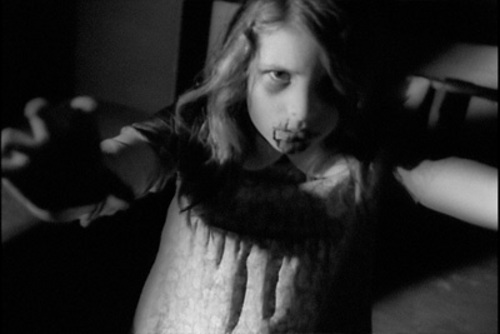
Kyra Schon as Karen Cooper


It’s impossible to understand Karen without discussing her parents, Harry (Karl Hardman) and Helen (Marilyn Eastman); initially, her family is all that gives her context in Romero’s strange new world. But the Coopers always bothered me in Night of the Living Dead. They didn’t seem to belong. After all, almost half the film passes before they appear. Ben (Duane Jones), our protagonist, has spent a good chunk of screen time securing an abandoned farmhouse against the undead. All the stuff you want a good survivor to do, he does: barricade the doors and windows, look for supplies, and settle the nearly catatonic survivor-girl Barbra (Judith O’Dea) on the sofa. Forty minutes in and we’re all ready to weather the long night of Romero’s undead apocalypse.

And then the Coopers emerge from the cellar snarling with metaphorical significance—i.e., the nuclear family staggers out of the underworld to reassert its importance. We’re what you’re meant to defend, they seem to say. Of course, their presence also highlights the awful truth of any zombie apocalypse film: there are no safe places.

If the dead don’t overrun a stronghold, you will have to deal with the living eventually.

Karl Hardman as family man Harry Cooper


By the way, good luck if the living you have to deal with is Harry Cooper. He’s all the worst characteristics of the patriarchy packaged and amplified: aggressive, entitled, self-centered, oddly petulant, and arrogant. He won’t apologize for not coming up to help, despite hearing Barbra’s screams. Instead, he lashes out at Ben for criticizing him. When the others refuse to join him in the cellar, he throws a temper tantrum. He’ll board up that door and leave them to rot, understand? Moments later, he furiously demands they share the supplies Ben’s scavenged from the house. “We’ve got to have food down there,” Harry blusters. “We’ve got a right.” Helen, his wife, is not much more compelling. Bitter and cynical, she can’t resist poking at her husband’s neuroses:

“That’s important, isn’t it?”

“What?”

“To be right and for everyone else to be wrong.”

We know from just a few lines of dialogue that this is no close-knit couple or loving family, for all that its structure might evoke white picket fences and suburban houses. (Note: it’s unclear where the Coopers come from, but they seem neither rural nor urban.) And in case we miss the point, Helen sums up their situation this way: “We may not enjoy living together. But dying together isn’t going to solve anything.”

Marilyn Eastman as Helen Cooper


The crumbling cement in this relationship is the injured little girl lying on the table downstairs. Her parents are united only on the question of her safety. Unsurprisingly, Karen has no voice or agency of her own. The adults perceive her as entirely helpless— “Maybe it’s shock,” her mother says of her condition. “She can’t possibly take all the racket…” her father objects to bringing her upstairs. She is, they believe, the thing to be protected, shielded from the horror of the events outside. Like the house itself, if they can get her through the night, it will all be OK.

What no one understands in Romero’s first film is, of course, that the undead have already infected Karen. While audiences of Dawn of the Dead and every zombie movie after know that a bite is a death sentence,  the characters in Night of the Living Dead haven’t fully realized what they will have to sacrifice. The news reports in the background that families “will have to forgo the dubious comfort of a funeral.” But the problem is much more insidious and frightening: families will have to forgo the comfort of family in order to survive.

It only takes a brief moment of contact for the Coopers to lose Karen. And no amount of hand-holding or parental influence will undo the contamination. While many debate the extent to which Night of the Living Dead is a political allegory, Romero has repeatedly stated he wanted the film to capture the social unrest of the 1960s. Once exposed to the chaos of the world outside, Karen is irrevocably changed. She is about to become part of the danger. Only Ben seems at all cognizant of the fact that she may pose a threat to them. “Who knows what kind of disease those things carry,” he points out when her parents acknowledge that she’s been bitten.

Sure, she looks helpless…


Until the end of the film, Karen remains what she seems: a sick little girl. She dies and rises amidst the chaos of the house being overrun by the undead. After a struggle, Ben shoots Harry, who went for his gun. Harry stumbles down to the cellar and staggers towards his little girl, hand outstretched in what should be a touching scene between parent and child. The next time we see the two of them, Karen crouches over her father—now dead or unconscious— a handful of meat in her hands and his blood on her lips. She does not need his affection, but she will take sustenance from him.

Undead Karen takes a bite out of dear old Dad


Helen finds them this way and, having drawn Karen’s attention, backs into a corner, horrified. Karen advances and then stabs her mother with a garden trowel in an almost surreal, Hitchcockian sequence. Helen is helpless against her undead daughter. All she can say is “baby,” which Karen does not acknowledge or recognize. Her murder of her mother is ultra-violent; she deals several blows to Helen’s abdomen, thus destroying the origin of her own life.

Romero’s living dead regularly use tools


The film and the scene disturbed audiences to no end, and Karen Cooper has become one of the iconic images of Romero’s films. As said, her moment is brief. Yet, it sticks with us. If we compare Karen to the other women in the film, she initially does not seem unlike Barbra, who is mostly helpless and overwhelmed. She must depend on the others for her survival; alone, she wouldn’t make it. Predictably, these young women are fragile, delicate, and need protection. They are not meant for the horrors outside the house.

This appears to be true up until Karen’s point of resurrection. Where Barbra is devoured, Karen is transformed. Unlike her parents, who are trying to hold onto the old social norms, or Ben, who will do anything to survive, Karen joins the restless mob of the undead. Not consciously or willfully, it’s true, but the end result is the same. Although briefly a victim, she becomes the monster and destroys the remains of her family. She cements her status as a member of the undead by consuming her father and increases their numbers by murdering her mother. These two acts definitively separate her from humanity. She neither wants nor needs the shelter of the family unit.

Karen Cooper transformed


What’s subversive about Karen Cooper, then, is that she doesn’t just die. In the eyes of society, a good, innocent little girl would simply perish when she encounters something so monstrous. Instead, she joins it. Embodied in her, the new generation does not save us or give us hope. Rather, they become part of the chaos. And no amount of reasoning or pleading will sway them.


Julia Patt is a writer from Maryland. She also edits 7×20, a journal of twitter literature, and is a regular contributor to the Tate Street High Society literary blog. Follow her on twitter: https://twitter.com/chidorme


The Beth Thomas Story: How a TV Film and Documentary Captured a Child Enraged

Tim and Julie didn’t know about the sexual abuse Beth had been subjected to as early as 19 months old by her father. They didn’t know she was suffering from Reactive Attachment Disorder, a condition that surfaces from past trauma and neglect into oceans of disturbing, detached, unresponsive, and apathetic behavior. They couldn’t possibly know that a young girl could be filled with so much—that much rage.

unnamed-1

This guest post by Kim Hoffman appears as part of our theme week on The Terror of Little Girls. 


CORRECTION UPDATED 2/10/16: An earlier version of this article incorrectly associated the Attachment Center with the Evergreen Psychotherapy Center. We have been informed that The Evergreen Psychotherapy Center has never been, is not currently and will never be associated with The Attachment Center of Evergreen.


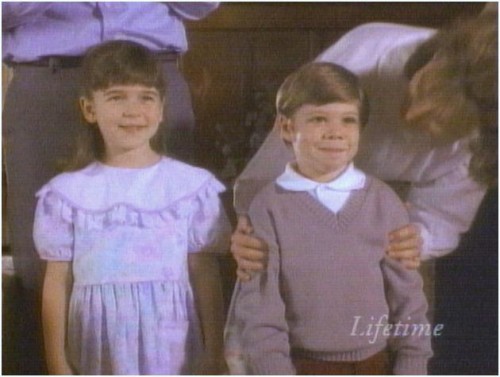
When I was a kid, I was introduced to a movie called Child of Rage, a 1992 CBS TV movie that would be on Lifetime after school. It gave me equal parts dread and fascination—it was about a young girl who wanted to kill her adoptive family, severely traumatized by previous abuse as a baby. What I didn’t know at the time was that the film was based on the real life story of a little girl named Beth Thomas, and that two years earlier in 1990, HBO had released a documentary about the real-life Beth as part of their America Undercover series, called Child of Rage: A Story of Abuse. In the documentary, an oppressed Beth accounts for all the moments I’d seen repeatedly play out in the TV movie, including frank and expressionless accounts of her polluted understanding of right from wrong—like murdering the parents who adopted her and the only brother she’d ever known. I marveled, and still marvel, over the power of this six and a half-year-old child who was never shown displays of love and empathy, until she was prepared to take another person’s life.

Tim and Julie Tennant adopted little Beth and her younger brother Jonathan back in the ‘80s. The couple took the sibling pair into their home, not aware of their past abuse at the hands of their biological father. Her mother, who had abandoned her and Jonathan, died when Beth was one. When Child Services found the children, Beth was screaming in her own soil and Jonathan was found in his crib with a curdled bottle of milk, his head flattened from the way he’d been positioned. Tim and Julie didn’t know about the sexual abuse Beth had been subjected to as early as 19 months old by her father. They didn’t know she was suffering from Reactive Attachment Disorder (RAD), a condition that surfaces from past trauma and neglect into oceans of disturbing, detached, unresponsive, and apathetic behavior. They couldn’t possibly know that a young girl could be filled with so much—that much rage.

Beth Thomas

In the documentary, a psychiatrist interviews Beth, but he’s one out of a whole team of therapists who guided Beth in her recovery. In 1989, Beth and her adoptive parents went to live with a woman named Connell Watkins, a therapist who practiced a type of “holding” therapy for children who are severely affected by RAD. That same year, a girl by the name of Candace Newmaker was born—but no one would guess that a little over a decade later, the 10-year-old would die in an accidental killing at the hands of Connell and another therapist, Julie Ponder. In that incident, they were conducting a “rebirthing” session in which they wrapped Candace in sheets and pillows to simulate a “womb connection” between Candace and her adoptive mother. Candace had been previously diagnosed with RAD after almost setting her house on fire, and years spent on medicine to keep her rage at bay—often biting or spitting at her therapists. Regardless, this session went terribly wrong. After an hour and ten minutes, the girl’s mother asked if she wanted to be born, and Candace quietly murmured “no”—her last word before dying there in that session. But this event hadn’t taken place yet, not back in 1989 when Beth was dancing the dangerous edge of child murderer and child rehabilitated. Could it be possible?

In the CBS movie, Beth’s character is called “Cat.” The new mom begins to notice Cat’s strange behavior—controlling her brother’s every move, acting jealously about any attention he receives and finding ways to seduce or manipulate adults in order to have the spotlight on her—including a highly inappropriate fondling of her adoptive grandfather. Cat’s coping mechanism for when she’s caught doing something bad includes smashing things and screaming obscenities, eventually retreating into docile panic, holding out her stuffed teddy bear like a wall of armor between herself and the adult—becoming very small and childlike, after displaying such high-strung violence. The most shocking moment in the film is when her new parents catch her bashing her brother’s head into the cement floor in the basement. It’s an eerie scene that sticks with me still, the young boy clutching his dinosaur stuffed animal, and Cat in powder pink sweatpants and tiny little sneakers following him into a corner.

unnamed

However dark and disturbing, Child of Rage depicts Beth Thomas as a manipulator and seducer to a tee—we begin to see more and more of Cat’s charms and her ability to influence anyone’s move, especially when she knows their move may squash her plan. When the parents find out the truth about Cat’s past abuse as an infant, their worries seem to magnify, especially after so many incidents: Cat kills a nest of baby birds, stabs the family dog with a pin, and slices a classmate across his face with a shard of glass. She lies about her involvement or reasoning and remains sweet—with a tinge of repulsion we can’t help but see slip out from her pursed lips when she draws out, “Yes—Mommy.”

Meanwhile in the Beth Thomas documentary, as she props her head up with her small hand, her eyes widen every once in a while as she explains in detail her desire to kill. Still, it’s obvious that by now in her real-life therapy, she has gone from deceptive to forthcoming, though her remorse is hard to locate from simply observing her. She only trips up once, about the baby birds she killed. The psychiatrist asks her if she thinks the birds could fly or run away from her—she seems confused and half states/half asks, “Yes?” He then asks if she remembers them dying, and she stumbles through an account of her mom telling her that one of them had died, yes. But the psychiatrist goes straight for it—telling Beth, “Your mom told me that you killed the baby birds, Beth.”

unnamed

Suddenly Beth shows traces of sad emotion that the psychiatrist seems to draw out, coddling her: “That’s OK, that’s OK,” though I don’t know that this is a breakthrough, perhaps just a child whose red-handed admission is still proof she has a long road ahead. This single event was big for Beth; it was her one killing spree. She even admits to hocking a knife from the dishwasher and stashing it in her room. When asked what she wanted to do with the knife, she chirps back at the therapist, “Kill John. And Mommy and Daddy.” She then says, “They can’t see me, but they can feel me,” when she explains why she chooses to sneak about in the shadows while her parents sleep, unaware that their small child could be lurking their hallways yielding a knife.

It’s frightening to watch a child, a real life child, so small on the sofa that her legs barely skim over the side, speaking so candidly about life and death—not to mention her traumatic sexual abuse that no child (or adult, even) can make full sense of and process in a way that any of us should feel is simple. In the film, when the parents take Cat into intensive therapy, the therapist gives them a book called Kids Who Kill by Charles Patrick Ewing, written in 1992, the same year the TV movie aired. If you look up the book, you’ll find it’s connected back to Beth Thomas through the company it keeps in the category of “books on children who kill.”

Nancy and Beth Thomas

There’s a lot of speculation over what happened to Beth Thomas after her intensive therapy with Connell Watkins. In the documentary, a woman in a bright track-suit with a cheery disposition talks with hope about Beth’s recovery, while we follow Beth on her chore run around the Attachment Center in Evergreen, Colorado, feeding goats and whatnot (no animals were harmed, seriously). Her name is Nancy Thomas, and she later adopted Beth. It’s rumored that the Tennants kept Jonathan. It’s a little disheartening to think that Beth has had not one, but three mothers. Nancy now owns and operates Families By Design, an organization that provides support for parents and children coping and suffering with RAD. Essentially, it’s become Nancy’s lifework.

Even Beth Thomas herself has participated in many of Nancy’s events, including writing a book that she and her mother wrote together, Dandelion on My Pillow, Butcher Knife Beneath. The book was released in 2010, following Nancy’s previous guide book five years earlier, When Love is Not Enough: A Guide to Parenting with RAD. What Cat displays in the film really illustrates best how easily young girls who are suffering with RAD can use their sexuality in ways that mirror what they’ve seen adults display, though the end result is obvious—that the behavior for how sexuality is displayed in adults is in sometimes lost in translation. How it’s modeled in children who are, as is, sexual beings, but confounded by past trauma in developmental years, can be disturbing and uninhibited. When Cat tells her grandpa that he can be her “sweet, sweet teddy bear,” we have to wonder if baby Cat was influenced by the language she heard from her biological father—the abused taking the abusive language and integrating that into their foundation for bonding, relating, receiving something she wants, gaining total affection and love.

Beth Thomas today

Look anywhere: The reviews on Amazon, web forums, personal websites, reviewers—there is an obvious split among people in support of Nancy Thomas and the practice of Attachment Therapy, and people who, as a result of the Candace Newmark case, find AT and this version of therapy to be abusive and inconclusive—even some adults who underwent said therapy have stepped out over the years to express their concerns over the therapy they were subjected to as children, but, therein lies the toughness with accurately, tangibly calculating whether or not a type of therapy that is aimed at manipulative, violent, disturbed, abused children has: long-term positive effects, or deepens PTSD because of its method.

Something to keep in mind when you watch the film (and I recommend watching the Beth Thomas documentary first, and then delving into the CBS movie last)—the 1992 movie does not mention the word rape, or sex, or vagina, or anything else sex-specific, at all. They hint at the fact that Beth was raped by her biological father through grainy nightmarish flashbacks, and in one instance when Beth shows the sexual abuse through two teddy bears. In the Beth Thomas documentary, she admits to masturbating daily, even sometimes in public, to the point of infection and bleeding and having to be taken to the hospital as a result. She also expresses that she committed similar acts on her brother Jonathan, molesting him at any opportunity she got—which is why Tim and Julie Tennant eventually had to lock Beth in her bedroom for everyone’s safety. All of this, of course, lends itself to the reason why they sought outside help.

Today, Beth works as a nurse, and continues to support her mom Nancy’s organization in Colorado, speaking out about her recovery, and even coming to the defense of Connell Watkins on the witness stand back in 2000. (Watkins served seven years of her 16-year sentence.) Beth professed she wouldn’t be here without Connell. By all accounts, those closest to Beth will attest to her dramatic change and healing. But Attachment Therapy remains the seesaw on the playground when it comes to understanding how to properly heal traumatized children. The Beth Thomas story is a reality—it’s not an afterschool special. For all we know, Beth may very well still have issues—with men, with father figures, with forgiving herself for the acts she committed on her brother, and it may be confounded by the fact that she’s a woman who hadn’t yet grown up and very well had to all at the same time. There was adolescence, teen years, periods, relationships—all of which presents foreign emotion for any girl. Imagine being Beth Thomas, having her childhood, and then facing life head-on. I want to believe in Nancy Thomas, in AT, and in little girls like Beth who “beat the odds” and reclaim life. Again, I ask: Is it possible? Or will she always just be the little child of rage?

[youtube_sc url=”http://www.youtube.com/watch?v=g2-Re_Fl_L4″]


Kim Hoffman is a writer for AfterEllen.com and Curve Magazine. She currently keeps things weird in Portland, Oregon. Follow her on Twitter: @the_hoff


Alarming Innocence: The Terror of Little Girls in ‘The Crucible’

Miller’s examination of the Salem Witch Trials, held in the Province of Massachusetts Bay from 1692-3, depicts the internal, secretive drive of a New England witch hunt, and how paranoia quickly escalates to devastate a marriage, a family, neighbors, and eventually, to cripple an entire community. The actions of little girls set it all in motion.

unnamed


This guest post by Laura Shamas appears as part of our theme week on The Terror of Little Girls. 

When I first saw Arthur Miller’s The Crucible as a child, I found it utterly terrifying; why could this crowd of girls see and feel things that no adult could? Later, studying it in school and learning about its allegorical references to McCarthyism in the 1950s, I appreciated this American theatre classic at a deeper level. Miller’s examination of the Salem Witch Trials, held in the Province of Massachusetts Bay from 1692-3, depicts the internal, secretive drive of a New England witch hunt, and how paranoia quickly escalates to devastate a marriage, a family, neighbors, and eventually, to cripple an entire community. The actions of little girls set it all in motion.

The Crucible had its premiere on Broadway in January of 1953. In his 1987 memoir Time Bends: A Life, Miller describes a 1952 flash of understanding of “the Puritan cult” upon viewing etchings and woodcuts on the walls of the Historical Society Witch Museum: “Portrayed were the afflicted innocent girls pointing in terror at some farmer’s wife who was secretly persecuting them and yet stood in proud contempt of their Christian accusations” (p. 42).

Much as been written about Miller’s “fictionalization” of the Salem trial accounts, e.g., the conflation of characters, and the changing of characters’ ages. For example, accuser Abigail Williams was around 11 years old during the actual trials, not 17. John Proctor was about 60, not a youthful man. In 1996, Miller responded to some of this, as quoted in the New York Times: “My job as a dramatist is to create a drama, not documentary history—any more, if I may say, than Shakespeare had in mind when he created his kings and characters who had very little resemblance to the real people.”

unnamed

When I saw the 1996 film of The Crucible, penned by Miller and directed by Nicholas Hytner, I was struck by its depiction of the condemnation of female sexuality in the Puritan world. The theme of “the witch as female scapegoat” is applicable to the film. Miller mentions female sexuality perceived as horror in a 1996 NY Times op-ed entitled “Salem Revisited”: “Witch hunts are always spooked by women’s horrifying sexuality awakened by the superstud Devil. In Europe, where tens of thousands perished in the hunts, broadsides showed the Devil with two phalluses, one above the other. And of course mankind’s original downfall came about when the Filthy One corrupted the mother of mankind.”

In “Salem Revisited,” Miller describes Puritanical views of race and sexuality related to Tituba from Barbados, who was enslaved to Reverend Samuel Parris at the time of the trials. As one of the few people of color in Salem Village, Tituba was abused and treated as Other. Miller notes: “Tituba was tortured into naming women she had seen with the Devil, thus starting the hunt on its way. The conflation of female sexuality and blackness in a white world is an old story, and here it had lethal result.”

Due to space limitations, I’ll narrow my analysis to three key scenes in the film: the opening dancing scene in the forest, the first accusation scene near Betty’s bed, and a courtroom “yellow bird” scene near the end, involving the condemnation of Mary Warren (Karron Graves), who works for John (Daniel Day-Lewis) and Elizabeth Proctor (Joan Allen).

unnamed

In a marked difference from the play’s opening, the movie begins at night as teenaged Abigail Williams (played by Winona Ryder) awakens a young girl named Betty Parris (Rachael Bella). Together, they sneak out of the house, lit by a full moon, and head into the dark woods; other girls join them. The group of giggling Puritan girls, ranging in ages from about 6 to 17, tramp through the wild forest together until they reach a ceremonial campfire. When they’ve gathered in a circle, Tituba (Charlayne Woodard) asks: “What’d you bring me?” The girls each put something into a boiling cauldron at the fire’s center–an herb or toad, and a boy’s name is uttered as part of a spell. Young Betty, notably, says nothing but puts something into the pot. Abigail supplies a live black chicken for the brew. Tituba twirls the animal above her head as part of a ritual, and sings in another language. The girls dance and sway to Tituba’s music, and express their longings for certain young men or boys, by name. Although Abby says nothing, the other girls volunteer that Abby wants John Proctor for her love match. Then suddenly, Abby takes the chicken from Tituba, smashes its head, and is splattered with blood. She smears it onto her face. This inspires the other girls to scream, and a few of them disrobe, dancing in “hysteria.”

Suspicious Rev. Parris (Bruce Davison) comes upon their gathering. Someone yells, “It’s the minister!” The girls run. Parris’ daughter Betty, held by Abigail, shouts, “I can’t move, I can’t move.” Alone by the fire, Parris discovers a toad in the pot. The next morning, back at Parris’ home, where his niece Abigail resides, too, Betty can’t move or speak. Eventually, an exploration of Betty’s catatonic condition leads to conjuring charges against Abigail and Tituba. As Betty begins to “wake up,” she says she was trying to contact her dead mother in the ritual and wants “to fly” to her. “Keep still, you little devil,” someone replies, already setting the tone for the demonization of the girls. Alone with the girls later, Abigail cruelly threatens them to keep quiet about what really happened that night.

This opening ritual scene establishes the adolescent girls as a group, a collective, or as a female chorus found in ancient drama. Ringleader Abigail and servant Tituba stand out in the first scene, as well as young Betty and Mary Warren, but the other girls are part of a pack, expressing an ardent interest in magic to woo young men: they exhibit a supernatural interest in romance, an eagerness to “short-cut” courtship with a spell. The wild young girls in the woods, with exceptions noted above, are established as monolithic, secretive, lusty, rule-breaking, and unfazed by the use of spells–or in other words, in league with the Devil. Their charm contributions to the boiling cauldron, which could be seen as a fiery womb symbol, are indicative of their acceptance of the dark arts; their spontaneous wanton disrobing, seemingly for Satan, signifies the magnitude of their repressed lust. This moonlit spectacle depicts the “horror” of budding female sexual desire from a Puritan perspective.

unnamed

Abigail, in an early scene with Proctor, forces a kiss on her former lover, even as he calls her “child” and says he’ll cut off his hand before he becomes involved with her again. This short exchange reinforces the concept of “female as sexual aggressor” in the film. 

By night, the Salem girls are presented as believers in conjuring, but by day, we find them seated together in a church space for questioning by the newly arrived demonology expert Reverend Hale (Rob Campbell). The girls are costumed in a rainbow array of solid colors, each a different hue; the rainbow imagery visually associates them with “light” and iridescence. The shadow/light dichotomy of the girls is highlighted here, for, in daylight, the group reflects innocence and purity—and in this scene, even a love of Christianity.

Abigail, under questioning, accuses Tituba of magic. This leads to another sequence that presents the Salem girls as terrorizing: after tortured Tituba blesses the Lord, she begins to name Salem women as witches, to appease her brutal owner Parris. Abigail suddenly declares: “I want the light of God! I want the sweet love of Jesus! I did dance with the Devil. I saw him. I wrote in his book. I go back to Jesus. I kiss his hand.” And then she adds: “I saw Sarah Good with the Devil!” The other girls take up this refrain, supplying the names of myriad local women—and a man. They name Bridget Bishop, George Jacobs, Goody Howe, Goody Sibber, Goody Pike, and many more, as “with the Devil.”

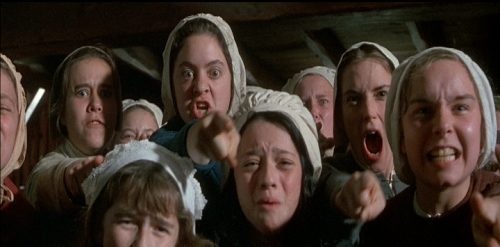
Seeking revenge on Salem adults who’ve wronged them, the girls line up on a stairwell and function as a chorus of  young female accusers. Reverend Hale yells: “Hallelujah! Glory Be to God! It is broken. They are free!” The adults who witness this scene believe the girls’ accusations, even though there’s no proof; a jailer is summoned to imprison the accused.  Abigail’s reaffirmation of her love of Christ makes her “pure” again in the eyes of the adults. The fickle nature of the girls is established in this scene; opportunistically, they accuse innocent people in order to save themselves from the soul-damning charges of witchcraft. They have their scapegoats; they will not be blamed. Their volatile swing from “Satan to Jesus” helps to launch the witch trials that will claim 20 lives:  19 hangings, and one man pressed to death.

unnamed

Their impenetrable solidarity is also what makes the girls so scary.  Perhaps because they’ve been threatened by Abigail, or perhaps because they’re truly part of a groupthink mentality focused on self-preservation, the girls, except for Mary, follow Abigail’s lead through most of the film. They become alarming again in a courtroom scene in which Proctor accuses Abigail: “This is a whore’s vengeance now.” After Elizabeth is questioned about Abigail and Proctor’s affair, Hale pronounces Abigail “false.” But Abigail abruptly screams and points to the ceiling of the court: “Why do you come, yellow bird? You cannot want to tear my face.” The girls, huddling together, “see” the yellow bird, too. Abigail identifies it as Mary’s evil spirit; they begin to repeat everything Mary says. Judge Danforth (Paul Scofield) asks Mary why they parrot her. After more screaming, the girls run out of the courtroom, to escape the predatory “yellow bird”; they sob as they run into the sea, a baptismal visual reference. Eventually, in the water, Mary recants her support of the Proctors, calling John “the devil’s man.”

In this sequence, female sexuality and jealousy (“a whore’s vengeance”) are identified by Proctor as the key motives driving the witch hunt. The vindictive girls accuse one of their own as a conjuror to save Abigail, and thus, saving the group as a whole. Loyalty to community, family, and Christian morality are not girlish attributes in The Crucible. Instead, the girl accusers seek only their own safety as the film nears its climax; there’s no more talk of romance or lust. The terrorizing little girls who offer no real proof of their accusations in The Crucible watch the community hangings as a gleeful ensemble; we see their happy faces for the first few executions. Eventually, as time goes on, they become saddened. One wonders what might happen to them in the near future, as Abigail runs away from Salem for good.

unnamed

The Puritan condemnation of budding female sexuality—a rejection of mysterious girls who long for love and lust—is mined by Miller and director Hytner for all dramatic effect in The Crucible. Females are both scapegoats and accusers in this world. In a final nod to a view of women as weak and sexually complex, Elizabeth accepts blame for Proctor’s adultery in the final moments, saying she “kept a cold house.”

In The Crucible, ruthless fickle girls propel paranoia; they are able to turn on a whim from the Devil to Jesus, and accuse their elders to save themselves. They are truly terrifying because they have no loyalty to conventional mores or religion, only to each other—a taboo sorority founded on nocturnal sexual secrecy, a presumed purity based on pretense. They are portrayed with a “pack” mentality, easily lead by a jilted teenager with a cruel streak. And the scariest aspect of all: they are so “innocent” that their accusations require no true evidence, thus upending an ideal of basic justice in the modern world. But they have an undeniable agency throughout most of the film; as a force, they are one. A communal suspicion of young girls proves fatal in The Crucible, as the last image in the film makes plain: a close-up of the hangman’s rope.


Laura Shamas is a writer, mythologist and film consultant. Her previous writing on witches is: ‘We Three’: The Mythology of Shakespeare’s Weird Sisters. Website: LauraShamas.com. 


Little Girls in Horror Films: Setting the Stage for Female Double Standards

Little girls are often what we associate with innocence. Girls are said to be born out of “sugar, spice, and everything nice,” which attaches a stigma to women from birth that is unrealistic. Society is conditioned to believe this ridiculous myth, which changes the way we value little girls over little boys.

This guest post by BJ Colangelo appears as part of our theme week on The Terror of Little Girls.

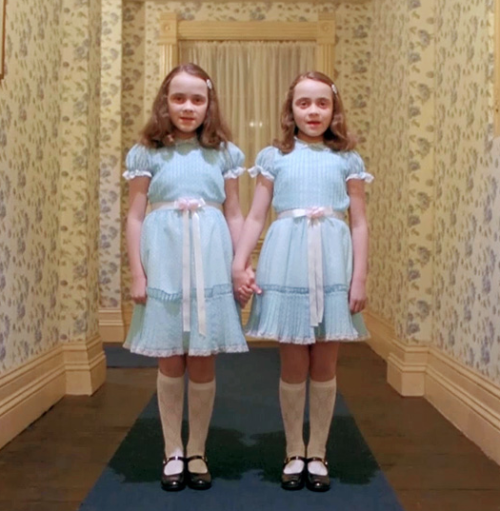
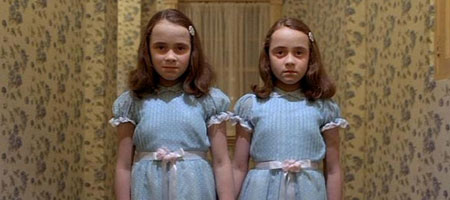
Horror films frequently utilize little girls as a “go-to” scare tactic.  As the sound disappears in a dark and spooky house covered in cobwebs and shadows, a little girl’s laugh or even a song will echo throughout the halls.  The contrast of something so seemingly innocent found in a dark and uninviting environment has been used for decades.  Whether it’s the iconic and eerie request of the Grady sisters asking Danny Torrance to play forever (and ever, and ever, and ever) in The Shining, or the innocent announcement of “They’re Heeeeere” from little Carol Anne Freeling in Poltergeist, little girls are as much of a scaring staple as a shrieking cat or a set of wailing violins.  While there are the exceptions like Damien in The Omen or Barto in The Unborn, for the large part, little girls are used much more frequently in killer kid/child possession/child ghost films.  In the same breath, the safety of little girls is valued far more than the safety of little boys.  This double standard shown with little girls in horror films perpetuates the idea that women, regardless of age, are constantly in a state of conflict.

Grady Sisters
Grady Sisters


Little girls are often what we associate with innocence.  Girls are said to be born out of “sugar, spice, and everything nice,” which attaches a stigma to women from birth that is unrealistic.  Society is conditioned to believe this ridiculous myth, which changes the way we value little girls over little boys.  When little girls in horror films aren’t used as demons/ghosts/killers/etc. and instead exist as just human, the importance of their survival is much greater than any other character.  Referring back to Carol Anne Freeling in the Poltergeist franchise, the entire film is centered on protecting and saving her.  Carol Anne’s brother, Robbie, arguably endures the more traumatic events in the film, but the focus still remains on Carol Anne.  Yes, Robbie’s trees, gravity, his own toys, and his bedroom are torturing and “taken” by the spirits in the house, but the entire focus stays on protecting Carol Anne.  Never mind the years of therapy Robbie may require to help him after the tree outside of his room tried to kill him, we still only care about Carol Anne simply because as a little girl, we feel that she constantly needs protecting.

Even when little girls are presented as the villains, we still care more about their survival than little boys.  The Swedish vampire hit, Let The Right One In, shows Eli, a vampire girl around the same appearing age as her male counterpart, Oskar.  Eli is capable of taking care of herself (and proves it throughout the course of the film) while Oskar is frequently bullied and shown as weak and in need of protection every step of the way.  However, Eli’s survival is the one we focus on the most.  Whether it’s aggravation towards her helper, Hakan, and his insolence that has now put her safety in jeopardy, or the fact an angry townsperson is hot on her trail to kill her, we sympathize with Oskar’s bullying, but we don’t invest in his safety quite like we do Eli’s. We expect Oskar to “deal” with his issues like he always had done before, but with Eli, we constantly want those around her to “save” her, even though she could do it on her own if she chose.

Insidious
Insidious


In Wes Craven’s The People Under the Stairs, we also witness intersectionality at play. Poindexter “Fool” Williams, is a young African-American boy trapped in a house of horrors.  While he appears to be about the same age as the Caucasian girl, Alice Robeson, we value her safety far more than we do Fool’s.  From the get-go, Fool is presented as almost deserving to be in trouble because he’s a poor Black child, and the angelically white Alice is stuck living in a home with abusive parents.  The threat from “Mommy and Daddy” Robeson is much greater toward Fool, but we still shift our focus toward Alice and sense a greater sense of distress towards her survival.  Fool is presented as not only a troublemaking youth, but also as the undisputed hero of the film.  We believe that this poor Black child is capable enough of making it out alive because “he should be used to survival” while we see Alice as weak and with a lack of “street smarts.”  It’s a tragic truth, but this sort of value on the young white female is something that is commonly reflected in the way the media portrays lost children (aka: missing white woman syndrome).

Orphan
Orphan


At the same time, despite our value of the lives of little girls over just about anyone else in a horror film, girls are used overwhelmingly more than boys as a source of “evil” in horror films.  Cathy’s Curse, The Exorcist, Silent Hill, The Bad Seed, The Ring, The Shining, Orphan, Night of the Living Dead, Alice Sweet Alice, The Last Exorcism, The Amityville Horror, Case 39, and countless other films have all portrayed little girls as the perfect vessel for pure, unadulterated evil.  We are terrified of these evil little girls, but at the same time, we feel like they need to be protected over anyone else.  These conflicting ideals are the very start of the double standards that women endure over the course of their lives.

People Under the Stairs


Compare this to a film like Insidious, where the focus is on little boys, we still don’t invest in their safety.  The son, Dalton, is transported into an otherworldly land, but the greatest sense of conflict occurs when the father, an adult, goes in after him.  It’s almost as if we don’t care about boys until they become men, but we only care about women when they’re little.

The film Orphan is particularly interesting in that it shows a little girl as evil–a little girl as the ultimate object needing protection–and a little boy as someone we completely ignore.  Esther, a deranged child adopted by a loving family with two existing children, plays the villain in this film.  The existing daughter, Max, is a deaf girl about the age of 4, and her brother Daniel is closer to Esther’s age at 10-12.  While Daniel is immediately skeptical of Esther, he is written off as being a pain-in-the-ass prepubescent boy, while Max is shown as the perfect daughter, loving and trusting…the way little girls SHOULD be.  However, when Esther is revealed to be the personification of evil that she is, our focus shifts to protecting Max.  Esther literally tries to set Daniel on fire and burn him alive, but we still fear for Max’s safety on a much higher level when Esther turns her attention to Max.  Why? Because she’s a little girl, and little girls need saving.

Poltergeist
Poltergeist


Once childhood is over, these little girls grow up into other tropes and female archetypes that continue the path of double standards: the mother or the killer, the slut or the prude, the dumb blonde, or the geeky brunette.  Women in horror films aren’t allowed to simply “be,” but instead are constantly being pushed into eerily specific archetypal boxes.  This practice starts in the young representation of children and follows us for the rest of our lives.  Art really does imitate life, regardless of how depressing the outcomes may be.


BJ Colangelo is the woman behind the keyboard for Day of the Woman: A blog for the feminine side of fear and a contributing writer for Icons of Fright. She’s been published in books, magazines, numerous online publications, all while frantically applying for day jobs. She’s a recovering former child beauty queen and a die-hard horror fanatic. You can follow her on Twitter at @BJColangelo.


The Terror of Little Girls: Social Anxiety About Women in Horrifying Girlhood

Horror films hold a mirror up to these ideals, distorting the images and terrifying viewers in the process. The terror that society feels while looking at these little girls echoes the terror it feels when confronted with changing gender norms and female power.

This repost by Leigh Kolb appears as part of our theme week on The Terror of Little Girls.
Horror films have a long-standing tradition of commenting on the social fears and anxieties of their time.
Another universally recognized truth of horror is that scary children are terrifying–especially little girls.
While an analysis of “creepy children” in horror films usually proclaims that they are providing commentary on a loss of innocence, and it would make sense that a little girl is the “ultimate” in innocence, it can’t be that simple. We wouldn’t be so shaken to the core by possessed, haunted, violent little girls if we were simply supposed to be longing for innocent times of yesteryear.
Instead, these little girls embody society’s growing fears of female power and independence. Fearing a young girl is the antithesis of what we are taught–stories of missing, kidnapped or sexually abused girls (at least white girls) get far more news coverage and mass sympathy than stories of boy victims. Little girls are innocent victims and need protection.

In the Victorian era, the ideal female was supposed to be pale, fainting-prone and home-bound. Feminist literary icons Sandra M. Gilbert and Susan Gubar write about this nineteenth-century ideal in The Norton Anthology of Literature by Women:

“At its most extreme, this nineteenth-century ideal of the frail, even sickly female ultimately led to the glorification of the dead or dying woman. The most fruitful subject for literature, announced the American romancer Edgar Allan Poe in 1846, is ‘the death… of a beautiful woman’… But while dead women were fascinating, dying girl-children were even more enthralling… These episodes seem to bring to the surface an extraordinary imperative that underlay much of the nineteenth-century ideology of femininity: in one way or another, woman must be ‘killed’ into passivity for her to acquiesce in what Rousseau and others considered her duty of self-abnegation ‘relative to men.'”

The feminine “ideal” (and its relation to literature) coincided with women beginning the long fight for suffrage and individual rights. It’s no surprise, then, that men wanted to symbolically kill off the woman so she could fulfill her ultimate passive role. There was something comforting about this to audiences.
Rhoda Penmark will not lose to a boy. Or anyone else.
Fast forward to the 1950s and 60s, and the modern horror genre as we know it emerged and began evolving into something that provided social commentary while playing on audiences’ deepest fears (the “other,” invasion, demonic possession, nuclear mutations and the end of the world).
We know that horror films have always been rife with puritanical punishment/reward for promiscuous women/virgins (the “Final Girl” trope), and violence toward women or women needing to be rescued are common themes. These themes comfort audiences, and confirm their need to keep women subjugated in their proper place. It’s no coincidence that the 50s and 60s were seeing sweeping social change in America (the Pill, changing divorce laws, resurgence of the ERA, a lead-up to Roe v. Wade).
Terrifying little girls also make their debut in this era. Their mere presence in these films spoke not only to audiences’ fears of children losing innocence, but also the intense fear that little girls–not yet even women–would have the power to overthrow men. These girl children of a generation of women beginning a new fight for rights were terrifying–these girls would grow up knowing they could have power.
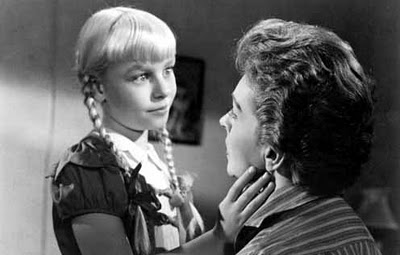
The Bad Seed‘s Rhoda Penmark (played by Patty McCormack in the 1956 film), genetically predisposed to be a sociopath, murders a classmate and the janitor who suspects her. Her classmate–a boy–beats her in a penmanship contest, and she beats him to death with her tap shoes. A little girl, in competition with a boy, loses, and kills. While in the novel Rhoda gets away with her crimes, the Hays Code commanded that the film version “punished” her for her crimes and she’s struck by lightning. It’s revealed that Rhoda’s sociopathic tendencies come from her maternal grandmother, a serial killer. This notion of female murderous rage, passed down through generations and claiming boys/men as its victim, certainly reflects social fear at the time.
In 1968, Night of the Living Dead premiered on big screens and has been seen as commenting on racism/the Civil Rights movement, Cold War-era politics and critiquing America’s involvement in the Vietnam War. However, little Karen Cooper’s (Kyra Schon) iconic scene has long disturbed audiences the most. Infected by zombies, she eats her father and impales her mother with a trowel. A horror twist to an Oedipal tale, one could see Karen as living out the gravest fears of those against the women’s movement/second-wave feminism. Possessed by a demon, she eats her father (consumes the patriarchy) and kills her mother (overtaking her mother’s generation with masculine force).
Little Karen Cooper consumes patriarchy and overtakes her mother.
Five years later, Roe v. Wade had been decided (giving women the right to legal first-trimester abortions), the Pill was legal, no-fault divorce was more acceptable and women began flooding the workforce.
Meanwhile, on the big screen, sweet little Regan MacNeil–the daughter of an over-worked, atheist mother–becomes possessed by the devil.
The Exorcist was based on a novel, which itself was based on the exorcism case of a little boy. Of course, the novelist and filmmakers wanted audiences to be disturbed and terrified, so the sex of the possessed protagonist changed (would it be as unsettling if it was a little boy?).
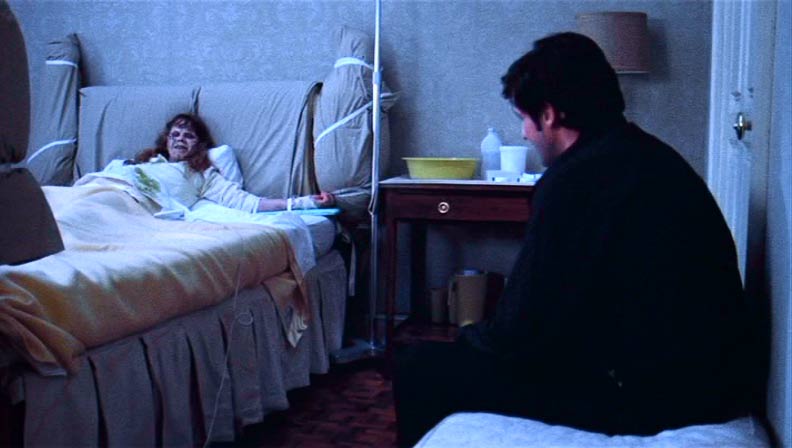
Chris MacNeil, Regan’s mother, goes to great lengths to help her daughter, and resorts to Catholicism when all else has failed. Regan reacts violently to religious symbols, lashes out and kills priests, speaks in a masculine voice and masturbates with a crucifix. This certainly isn’t simply a “demonic possession” horror film, especially since it was written and made into a film at the height of the fight for women’s rights (the Catholic church being an adamant foe to reproductive rights). Only after Regan releases her demon, which possesses a priest (who flings himself out of a window to commit suicide), does she regain her innocence and girlhood.
Tied and bound, Regan haunts and kills men, and reacts violently to religious images.
What her mother and her culture are embracing–atheism, working women, reproductive rights, sexual aggressiveness–can be seen as the “demons” that overcome the innocent girl and kill men (and traditional religion).
These films are have terrified audiences for decades, and for good reason. The musical scores, the direction, the jarring and shocking images–however, they also play to society’s deepest fears about women and feminism. For little girls to be possessed is the ultimate fall.

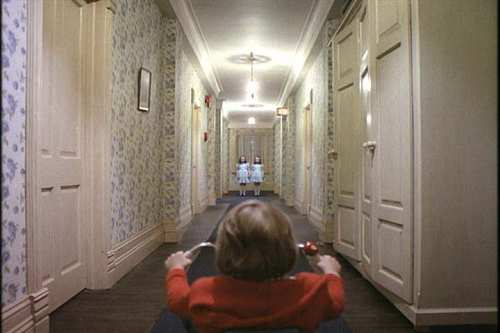
In 1980, The Shining was released. Yet another film adaptation of a novel (Stanley Kubrick’s treatment of Stephen King’s novel), this film contains two of the creepiest little girls in film history–the Grady girls. The Shining shines a light on crises of masculinity. Jack Torrance, played by Jack Nicholson, is a recovering alcoholic who has hurt his son, Danny, in the past. When he takes his wife, Wendy, and son with him to be caretakers of a hotel over a winter, his descent into madness quickly begins. Danny has telepathic abilities, and sees and experiences the hotel’s violent past. As he rides his Big Wheel through the hotel, he stops when he sees two little girls begging him to “Come play with us Danny. Forever.” These girls–dead daughters of Grady, a previous caretaker who killed his family and himself–are trying to pull Danny into their world. Danny sees images of them murdered brutally, and flees in fear. Meanwhile, Jack is struggling with his alcoholism, violence and lack of control of himself and his sensitive wife and child. When he sees Grady, Grady advises him:

“My girls, sir, they didn’t care for the Overlook at first. One of them actually stole a pack of matches, and tried to burn it down. But I ‘corrected’ them sir. And when my wife tried to prevent me from doing my duty, I ‘corrected’ her.”

Danny is confronted with the horror of what men are capable of.
In this aftermath of the women’s movement, Jack (a weak man, resistant to authority) is being haunted and guided by a forceful, dominating masculinity of the past. He’s stuck between the two worlds, and succumbs to violent, domineering alcoholism.
But he loses. Wendy and Danny win.
While his predecessor succeeded in “correcting” his wife and daughters, that time has past.
Here, the flashing memories of the ghosts of the past are terrifying. The Grady girls provide a look into what it is to be “corrected” and dominated.
“Come play with us Danny,” the girls beg, haunting him with the realities of masculine force and dominance.
Starting with the late-70s and 80s slasher films (and the growing Religious Right/Moral Majority in politics), the “Final Girl” reigned supreme, and the promiscuous young woman would perish first. Masculinity (characterized with “monstrous” violence and strength) and femininity became natural enemies. These fights on the big screen mirrored the fights in reality. The Equal Rights Amendment was pushed out of favor and was never ratified, and a growing surge of conservatism and family values began dominating American rhetoric.
In the late 90s and early 2000s, we see a resurgence of the terrifying little girl. This time, she is serving as a warning to single/working/independent/adoptive mothers.
In The Ring (the 2002 American adaptation of a 1998 Japanese film), Rachel Keller (played by Naomi Watts) is a  journalist and a single mother. She unknowingly risks her son and his father’s lives by showing them a cursed videotape. A critic noted:

“If she had never entered the public sphere and viewed the cassette in the first place, she would not have inadvertently caused Noah’s death, nor would she have to potentially cause the death of another. Rachel would, perhaps, have been better off staying at home.”

Single motherhood has often been the driving force behind horror plots.
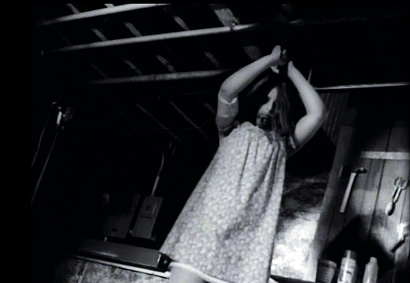
In her investigation into the video, she discovers the twisted, dark past of the video’s subject, Samara, a young girl who started life troubled (her birthmother tried to drown her). She was adopted by a couple, but her adoptive mother suffered from visions and haunting events due to Samara’s powers. They attempted to institutionalize Samara, but eventually the adoptive mother drowns her in a well after Samara cannot be cured of her psychosis. Her adoptive father, Rachel finds, locked Samara in an attic of their barn, and Samara left a clue of the well’s location behind wallpaper. (Bitch Flicks ran an excellent analysis of the yellow wallpaper and the themes of women’s stories in The Ring.)
Samara’s life was punctuated by drowning, which has throughout history been a way for women to commit suicide or be killed (symbolizing both the suffocation of women’s roles and the return to the life-giving waters that women are often associated with). While Rachel “saves” Samara’s corpse and gives her a proper burial, Samara didn’t want that. She rejected Rachel’s motherhood and infects Rachel’s son. Rachel–in her attempts to mother–cannot seem to win.
Rachel “saves” Samara from her watery grave, but she still cannot succeed.
The ambiguous ending suggests that Rachel may indeed save her son, but will have to harm another to do so. This idea of motherly self-sacrifice portrays the one way that Rachel–single, working mother Rachel–can redeem herself. However, the parallel narrative of the dangers of silencing and “locking up” women is loud and clear.
And in 2009’s Orphan, Esther is a violent, overtly sexual orphan from Russia who is adopted by an American family. Esther is “not nearly as innocent as she claims to be,” says the IMDb description. This story certainly plays on the fear of the “other” in adopted little girls (much like The Ring) and how that is realized in the mothers. In this film, Esther is actually an adult “trapped” in a child’s body. The clash of a childish yet adult female (as culturally, little girls are somehow expected to embody adult sexuality and yet be innocent and naïve) again reiterates this fear of little girls with unnatural and unnerving power. The drowning death of Esther, as her adoptive mother and sister flee, shows that Esther must be killed to be subdued. The power of mother is highlighted, yet the film still plays on cultural fears of mothering through international adoptions and the deep, disturbing duality of childhood and adulthood that girls are supposed to embody.
Like Samara, Esther is a deeply disturbed daughter, capable of  demonic violence.
In the last 60 years, American culture has seen remarkable change and resistance to that change. Horror films–which portray the very core of society’s fears and anxieties–have reflected the fears of women’s social movements through the faces of terrifying little girls.
While nineteenth-century literature comforted audiences with the trope of a dead, beautiful woman, thus making her passive and frail (of course, we still do this), twentieth and twenty-first century horror films force audiences to come face to face with murderous, demonic, murdered and psychotic little girls to parallel fears of women having economic, reproductive, parenting and marital (or single) power.
Little girls are supposed to be the epitome of all we hold dear–innocent, sweet, submissive and gentle. The Victorian Cult of Girlhood and Womanhood bleeds into the twenty-first century anti-feminist movements, and these qualities are still revered.
Horror films hold a mirror up to these ideals, distorting the images and terrifying viewers in the process. The terror that society feels while looking at these little girls echoes the terror it feels when confronted with changing gender norms and female power.

_____________________________

Leigh Kolb is a composition, literature and journalism instructor at a community college in rural Missouri.

‘The Hunger Games: Mockingjay Part I’ and What Makes Katniss Everdeen a Compelling Heroine

While watching ‘Mockingjay Part I,’ I had an epiphany. I asked myself why Katniss Everdeen is such a compelling heroine to audiences and why other heroines modeled after her are popping up all over the place? There’s no denying that audiences (especially young women) are hungry for strong female representation on screen. We love to see Katniss use her wits and her bow to save the day, but in ‘Mockingjay Part I,’ there is very little action (Katniss uses her bow only once), and Jennifer Lawrence’s performance is still riveting. Why, do you think, that is?

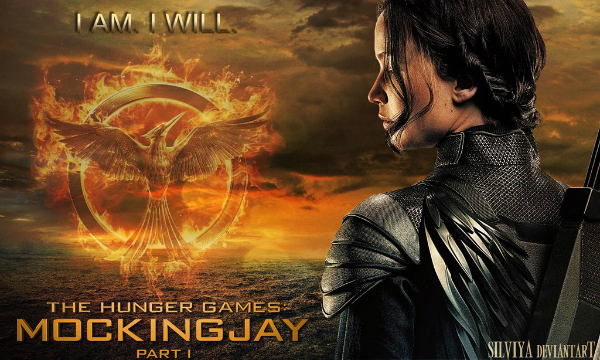
The Hunger Games: Mockingjay Part I

Written by Amanda Rodriguez.

Mild Spoilers Ahead

First off, let’s get the unpleasant part out of the way. Serious fans of The Hunger Games series will likely hate me, but we’ve all got to face the truth. The third installment in the series, The Hunger Games: Mockingjay Part I should not have been made. Splitting movies into two parts is an ever-growing trend in Hollywood’s never-ending quest for more money. Over the course of the two-hour film, not enough happens to warrant its existence. There is little moving the plot forward, and the ending itself is anticlimactic as our heroine Katniss Everdeen (Jennifer Lawrence) isn’t even involved in the ultimately uneventful final showdown mission to rescue the captive tributes. The vital events that do happen in Part I could have easily been condensed into the first 20 minutes of the finale of a legitimate trilogy.

Katniss in her one action scene in Mockingjay Part I


With that out of the way, let’s talk about what does work in Mockingjay Part I. There are a lot of women involved in the film itself, from the writer of the novels, Suzanne Collins, who adapted her books for the screen, to Nina Jacobson, the producer of the entire series, to our tenacious heroine Katniss, played by the increasingly popular, amazing performer and feminist Jennifer Lawrence.

The ever talented Julianne Moore as President Coin


I particularly liked that Mockingjay Part I also sets up the opposition between patriarchy and matriarchy with the introduction of Julianne Moore as President Coin of District 13. Under the patriarchal tyranny of President Snow (Donald Sutherland), the districts of Panem suffer as the people are used for their labor and their districts’ resources while fear and capital punishment are the norm. His Capitol, however, is rich, fashion-obsessed, and completely self-serving. The matriarchal President Coin, on the other hand, represents revolution with a strict focus on democracy and a socialist emphasis on the sharing of resources. District 13 is a militaristic, utilitarian underground compound that eschews fashion in favor of function (as evinced by the monotone uniforms all residents wear). Those of us who have read the books know that a lot will shift before the series concludes, but for now, this embodiment of a nontraditional representation of matriarchy in Coin is refreshing. She is decisive, smart, calm when under attack, and always thinking about the greater good of the people.

Katniss visits a hospital in District 8

While watching Mockingjay Part I, I had an epiphany. I asked myself why Katniss Everdeen is such a compelling heroine to audiences and why other heroines modeled after her are popping up all over the place? There’s no denying that audiences (especially young women) are hungry for strong female representation on screen. We love to see Katniss use her wits and her bow to save the day, but in Mockingjay Part I, there is very little action (Katniss uses her bow only once), and Jennifer Lawrence’s performance is still riveting. Why, do you think, that is?

Katniss stares in horror at President Snow's gift to her


Two words for you: emotional range. While there are a plethora of limitations and stereotypes by which female characters are plagued, audiences are getting tired of the limited range of emotion that male heroes are allowed to exhibit due to the strictness of masculinity within our culture. Women are increasingly allowed to showcase a greater range of emotions without it damaging their perception as a strong, good leader.

Katniss is overcome by gut-wrenching grief


In Mockingjay Part I, Katniss is suffering from intense PTSD. She has flashbacks, night terrors, uncontrollable bouts of crying, and dissociates from her surroundings. Throughout the film, she is an emotional wreck, as she should be after what she’s gone through, from being hunted and forced to kill for sport, to having her home of District 12 genocided as a result of her actions.

Katniss is overcome by fear in her 2nd participation in The Hunger Games


We watch Katniss go through an emotional roller coaster as she experiences shock, horror, terror, guilt, sadness, loss, anger, grief, and devastation. She is overcome with love for her family, Gale, and Peta, and, at her core, we are the most compelled by Katniss’ compassion and her instinctual drive to protect others. Katniss is sometimes wrong and often rash in her actions. In truth, it is her vulnerability displayed on screen like a raw wound from which we cannot look away.

Katniss weeps at the devastation of her home, District 12


This is the stuff of heroes. We see her experiences nearly break her time and time again, but she won’t give up. Carrying on is so hard that it nearly destroys her, but her sense of what is right is so strong that she cannot turn her back on her fellow oppressed district dwellers.

Like Katniss is the symbol of revolution as the mockingjay, she’s also the symbol of a movement that values women as nonsexualized leads with rich, complex characterization. We’re increasingly bored with the stoic male hero and instead crave the strength and vulnerability of the growing number of female sci-fi action heroines that are emerging thanks to the success of Katniss Everdeen and The Hunger Games.

Aside: The United States IS the Capitol. The storyline of The Hunger Games is so popular in the US, but we’re missing the point if we don’t confess that we are the oppressive world superpower that tyrannizes the rest of the word, exploiting the labor and resources of others so that most of us can live in relative wealth and comfort. End rant.


Bitch Flicks writer and editor Amanda Rodriguez is an environmental activist living in Asheville, North Carolina. She holds a BA from Antioch College in Yellow Springs, Ohio and an MFA in fiction writing from Queens University in Charlotte, NC. Her short story “The Woman Who Fell in Love with a Mermaid” was published in Germ Magazine. She writes all about food and drinking games on her blog Booze and Baking. Fun fact: while living in Kyoto, Japan, her house was attacked by monkeys.

Bitch Flicks’ Weekly Picks

Check out what we’ve been reading this week–and let us know what you’ve been reading/writing in the comments!

What have you been reading/writing this week? Tell us in the comments!

A Portrait of Tragedy and Promise: ‘God Sleeps in Rwanda’

Over a 100-day period between April and July 1994, the world stood by while Rwanda’s extremist Hutu government instructed its supporters to massacre 1 million Tutsis and moderate Hutus.

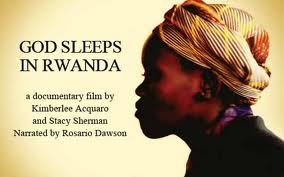
God Sleeps in Rwanda poster


Written by Rachael Johnson

2014 has been an awful year teeming with its own appalling tragedies, but it should also be a time of sober reflection for the international community. Twenty years ago, the unspeakable occurred in one of the world’s most beautiful countries. I’m talking about the Rwandan genocide, of course. Over a 100-day period between April and July 1994, the world stood by while Rwanda’s extremist Hutu government instructed its supporters to massacre 1 million Tutsis and moderate Hutus.

There have been narrative and documentary films about the Rwandan genocide, but I think the most important have yet to be made. Nevertheless, I’d like to call attention to an unpretentious, compassionate documentary short released a decade after the genocide called God Sleeps in Rwanda (2004). The title comes from a Rwandan proverb: “They say my country is so beautiful that although God may wander the world during the day He returns at night to sleep in Rwanda.” Directed by Kimberlee Acquaro and Stacy Sherman, the 28-minute Oscar-nominated film examines the impact of the Rwandan genocide on the lives of five women. Narrated in an unshowy fashion by actor and women’s rights advocate, Rosario Dawson, God Sleeps in Rwanda features powerful testimony by survivors.

Odette serving her community


As the filmmakers explain, Rwanda’s population was a little less than 70 percent female by the end of the genocide. Although the vast majority of victims were men, Tutsi women–and children–were also massacred. We are told: “Their bodies were targeted because they symbolized the future of an entire people”. Women, additionally, were victims of another atrocious aspect of the Hutu extremists’ genocidal program–systematic sexual violence. Rape was, in fact, a dominant strategy. The filmmakers cite an appalling UN statistic: 250,000 women–at least–were raped during the genocide. They also draw attention to the unexpected, unsettling truth that a woman played a central role in inciting rape–Minister for Family Welfare and the Advancement of Woman, Pauline Nyiramasuhuko. Along with her son, Nyiramasuhuko was indicted for rape as a war crime. (She was convicted of genocidal rape in 2011). God Sleeps in Rwanda, however, focuses on the victims of the genocide. Their stories are harrowing and heart-breaking. One survivor of sexual violence, Severa Mukakinani, calmly relates that she suffered multiple rapes after witnessing her family’s murder. “I cannot count the men who came to rape me,” she says. Attacked with machetes, she was thrown in the river Nyabarongo and left for dead. Somehow she survived. Severa became pregnant by rape and we see her caring for her nine-year-old daughter. At first she did not want the child but she now sees her as hers alone.  Her name, Akimana, means “Child of God.” Other women contracted AIDS through rape. The story of Fifi and Chantal is an intensely moving one. Their bond was forged in tragedy- they were gang-raped together. We see Chantal visit Fifi in hospital to comfort and care for her. Sadly, Fifi died of AIDS during the making of the film. Parentless households have been another feature of post-genocide Rwanda and the documentary features interviews with Delphine, a young woman bringing up, and supporting siblings alone.

Fifi
Fifi


The film shines a light on many of the enormous challenges facing Rwandan women in the post-genocide era: widowhood, parentless households, poverty, the psychological impact of sexual violence, children born of rape and AIDS. It also, however, makes the case that the position of women in Rwanda has greatly improved since 1994. As the filmmakers state, the predominantly female make-up of the population “handed Rwanda’s women an extraordinary burden and unprecedented opportunity.” Increased political participation is an essential part of that change and the story of Joseline personifies the promise of a new Rwanda. Joseline is a community organizer and development head in her village. Modest and motivated, she is dedicated to implementing vital projects such as road-building. The film features interviews with other strong, gracious women committed to transforming Rwandan society, such as widowed HIV-positive police officer Odette Mukakabera. Odette is an extraordinary woman. Not only does she serve her community; she also supports her children and orphaned niece, while studying to be a lawyer in the evening. The story of Chantal, mentioned earlier, is also one of promise and purpose. She found love after the tragedy, married and had three children.

Although God Sleeps in Rwanda contains haunting glimpses of those immeasurably dark days, it tells an encouraging story of courage and survival. Crucially, it respects its subjects and lets the women speak for themselves.


Nolan Superfans and Antifeminist Trolls: How Much Overlap?

Singer writes of Nolan’s fans’ approach: “If there’s a potential mistake or flaw, it’s always the viewer’s fault, never the film’s (or, Nolan forbid, the director’s).” This is all too familiar in feminist media criticism. How many times do commenters assert we’re “just looking for something to be upset about”; that is our criticism should be attributed to our own over-sensitivity rather than the actual presence of flaws in the subject?


Matthew McConaughey in 'Interstellar'
Matthew McConaughey in Interstellar

Christopher Nolan is undeniably an extremely talented filmmaker with a unique voice. He has a high batting average with his movies; for my money his only real stinker is The Prestige, and that still has plenty of fans. Nolan deserves his clout. Interstellar deserves its moment in the cultural spotlight.

But there is something about Christopher Nolan’s movies that warrants a devotion that is just too extreme. As noted in Matt Singer’s Screen Crush article “What Makes Nolan Fans So Intense?”, daring to speak ill of a Nolan film tends to lure the kind of trollish comments that make internet writers wake up with cold sweats. In the case of The Dark Knight Rises, apparently these rose to the level of death threats (particularly harrowing considering the mass murder at a screening of the film in Colorado).

As a feminist internet writer, I’m familiar with nasty commenters. And maybe that is why I suspect a substantial overlap between the Nolan Defense Squad and the Misandry Accusation Squad I know so well. I might be misperceiving this; I certainly don’t have any hard data to back it up. It’s clear that both groups offer plenty to the general pool of internet trolls, but that doesn’t necessitate they overlap themselves. So I look to the underlying motivations of these groups for further support.

"Why so serious?" mage from Joker poster for 'The Dark Knight'
“Why so serious?” image from Joker poster for The Dark Knight


Singer aptly characterizes the intensity of Nolan fans by describing their approach to his films’ critics: “If there’s a potential mistake or flaw, it’s always the viewer’s fault, never the film’s (or, Nolan forbid, the director’s).” This is all too familiar in feminist media criticism. How many times do commenters assert we’re “just looking for something to be upset about”; that is, our criticism should be attributed to our own over-sensitivity rather than the actual presence of flaws in the subject?

The similarities don’t stop there. Singer further posits:

“Looking over Nolan’s filmography you see the same archetypal protagonist reappear again and again: the moody loner who is laser-focused on his mission… perhaps Nolan’s subject matter and his preferred sort of hero resonates particularly strongly with the kind of person who might, oh I dunno, feel so passionately about a movie that they would threaten to strangle someone over it.”

What’s more, this archetypal protagonist is also always a man. Sady Doyle’s review of Interstellar described “Christopher Nolan disease”:

“There is a man. He is a sad man. His sadness makes him no less manly. The wife of this man, she is dead now…The man’s sadness, a great struggle conducted in the deep darkness of his soul, fuels his life’s grandest endeavor: The blowing-up of cool shit. In this noble pursuit of the blowing-up of things, the man’s wounds are healed and his masculinity reaffirmed.”

Matthew M crying manly tears.

So not only do we have the celebration of Men with a Higher Purpose, we have the reassurance that unwavering devotion to this Higher Purpose redeems the masculinity of men who succumb to the weakness of emotion in the face of their immense suffering.

I’d add the third prong to Nolan Fan Intensity: that there is intellectual cache in understanding his excruciatingly complex films, and in enjoying their darker themes. If you have to have a profound understanding of theoretical physics to properly appreciate Interstellar, people who like it are smarter than people who don’t. If you can keep track of the layered narratives of Inception and Memento, it proves your cleverness over people who were confused. If the bleak worldview of his Batman trilogy appeals to you more than those other inconsequential “fun” superhero movies, you are a more serious and thoughtful person.

Community's Troy Barnes tearfully admitting "I didn't get 'Inception'"
Community’s Troy Barnes tearfully admitting “I didn’t get Inception


The Misandry Accusation Squad tend to have the same self-satisfied intellectual superiority complex. See: mansplaining, tone policing, unmeetable burdens of proof. And that’s where my glimmers of recognition when it comes to the Nolan Defense Squad become blaring misogynist troll warning klaxons.

A black hole or something.
A time library or a love boat or a black hole or something.


Let me be very straightforward: I had no idea what was going on for 90 percent of Interstellar, and I don’t really care to spend any more time trying to figure it out. Maybe love was the fifth dimension or maybe it was gravity; maybe black holes are made of tesseracting bookshelves, maybe transporting hundreds of embryos and (presumably) only one uterus in which to gestate them on the ark to save humanity was a totally great Plan B.

(While I’m at it: Nikola Tesla was not a sorcerer. Your daddy issues cannot be resolved by opening a dream safe. You probably couldn’t be a superhero even if you were a billionaire, or at least your broken back would not heal that quickly.)

Nikola Tesla was not a sorcerer.


So,  yeah, I’m not smart enough to understand the science or lack thereof in Interstellar. But if you’re going to reject my hypothesis about Nolan fans because I can’t be bothered with theoretical physics, you’re kind of proving it for me. (Yep, that’s pretty circular logic. So is a lot of the bootstrap paradox nonsense going on in Interstellar.)

Do you think misogynist trolls and the Nolan Defense Squad overlap, or do they independently share a lot of traits? Do you have other explanations for their similarities?


Robin Hitchcock is an American writer living in Cape Town who firmly believes she did get Inception.

‘Haunter’: Where Ghost Power Meets Girl Power

In ‘Haunter,’ Abigail Breslin plays a teenager who galvanizes a team of young women to challenge their evil oppressor together! Oh, and they’re all dead.

“We can send this bastard to hell, but we have to do it together.”


Written by Mychael Blinde.

In Haunter, Abigail Breslin plays a teenager who galvanizes a team of young women to challenge their evil oppressor together! Oh, and they’re all dead.

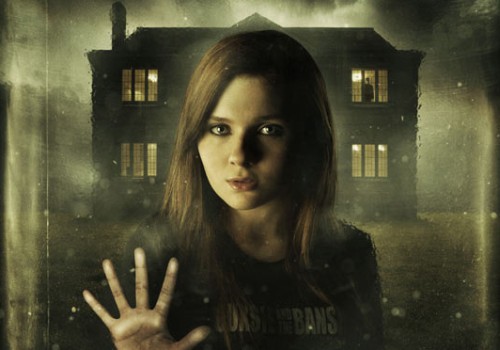
Haunter (2013) is a scary – and yet feel-good! — teenage-lady-driven horror film. It’s creepy but not gory, and Breslin and her character, Lisa, are both fantastic.

Abigail Breslin as Lisa


The most recent film by Haunter’s director, Vincenzo Natali, was Splice, a film I very much enjoyed.

A wonderful film about wombs and monsters.


Haunter’s horror is very different from the science-driven horror of SpliceIn Natali’s words: “I would almost call Haunter ‘fantasmagorica.’ It’s somewhat of a fantasy with darkness lurking around the edges.”

Splice-Haunter
In other words, fewer sluggy hybrid monsters ripping each other to shreds. More fog.


Speaking of films that Haunter is not like, Haunter is not like The Sixth Sense or The Others. In those films, the protaghostnist’s status is revealed as the final twist, whereas in Haunter, we learn relatively early on that Lisa and her family are the dead characters.

We meet Lisa just a few days after she’s discovered that she, her mother, her brother, and her father are all stuck reliving the same Sunday over and over again, trapped in their house by a thick fog that distorts space and prevents escape.

Carol, Bruce, Lisa, Robbie, and Edgar. The family doesn’t have a last name.


Not that Lisa’s family is remotely interested in escape – they seem blissfully unaware of the daily repetition and express concern for Lisa when she tries to explain it to them.

“Some clothes are missing from the laundry. Do you know where they are?”


Lisa is frustrated with her family’s denseness, and also alarmed to discover strange and creepy things happening around the house… and she keeps hearing someone whisper her name.

Then an evil presence intrudes on her family in the guise of a telephone repairman. This character is named Edgar Mullins, but actor Stephen McHattie is credited as The Pale Man.

“Whenever you hear strange noises in this house, or voices calling out to you, ignore them.”


The Pale Man confirms what we, the audience, already suspected: this repeated Sunday – the day before Lisa’s 16th birthday – is her death day.  Lisa is the ghost, and the voice she’s hearing is from the world of the living.

The Pale Man warns her: “If you should try to contact the living, or anyone else, you and your family will suffer in ways you cannot fathom.” But Lisa figures out that the living are already suffering, and that she’s been summoned by the living teenager in the house, Olivia, who is seeking Lisa’s help.

Lisa and Olivia, sharing a house and yet worlds away.


Lisa proves herself to be a smart, brave, and determined protagonist. She sends out a message to all of the Pale Man’s victims: “We can send this bastard to hell, but we have to do it together.”

And sure enough, she teams up with Olivia and with all the other young lady ghosts killed by the Pale Man’s evil, and together they vanquish him! Lisa restores order and peace to both life AND the afterlife.

Happy Birthday, Lisa!


This is a wonderful exception to film after film after film after film of male characters saving the day. It’s especially nice to see a teenage girl not only carry this movie, but succeed as the hero, and to see so many female characters join together to defeat their oppressor.

By making Lisa and her family ghosts and cluing the viewer into their ghost-status early in the film, Haunter sidesteps the most pervasive problem in haunted house films: the JUST GET THE FUCK OUT OF THE HOUSE problem. (I mean, REALLY, why did they even move there in the first place?!)

The question Haunter inspires isn’t, “Why don’t they just leave the house?”

Instead, Haunter asks:

If YOU were stuck in a house reliving the same day over and over, would you risk tangling with powerful forces beyond your control to escape? What if lives are at stake – but you’re dead?

Lisa and the Ouiji board.

Abigail Breslin:

I wanted to find a horror movie to do that was really smart and unique and different. And when I read this, I thought it was really exciting. I loved the character and the story—and it took me like three reads before I truly figured out what was going on. I love that you can’t really call the shots. It’s not really your typical horror flick. I love supernatural stories—demons and ghosts…I want the suspense, the spine-tingle, the story you’re trying to unravel.

Haunter does get a little confusing at times, primarily because the house exists in one physical space and yet on different planes of existence:

Vincenzo Natali:

 Even though the film takes place entirely in this house, the house is in itself a kind of universe. It’s a universe composed of various strata of different time periods and I loved the way the script opened up. We thought we were in one kind of world and then as this thing unravels, we realize that it’s something much larger than that.

I think this overlapping of worlds and women was an interesting idea to explore, and worth the minor confusion. The overlapping timeframes allow these young women to work together to overthrow the malevolent Pale Man.

Sure, he might be scary…

Haunted Photo

…but she’s scarier!

I never thought I would be so happy to see this face.


I read Haunter as a film about the triumph of teamwork against a tyrannical patriarchy.

The film is driven by the fear of male control and aggression, fear of men’s anger and their capacity for violence. The Pale Man kills by inspiring a murderous rage in the husband/father figure, which results in the death of the entire family.

Trigger Warning for domestic violence. It gets intense.
Trigger warning for domestic violence. It gets intense.


Here’s how Natali describes the Pale Man:

He is the Minotaur in the maze. Or the spider in the center of the web. He is the manipulator. He’s that thing you don’t see, but you know is there and waiting for you.

He is the patriarchy: he enforces an invisible oppression through the systemic subjugation of women. Then a brave young woman overcomes her subjugation and inspires a group of women to join forces, to create a new and better world for the living and the dead alike.

Haunter-jar-poster

________________________________________________________________________________

Mychael Blinde writes about representations of gender in popular culture at Vagina Dentwata

Gugu Mbatha-Raw is a Superstar in ‘Beyond The Lights’

I thought of Beyoncé often while watching writer-director Gina Prince-Bythewood’s (‘Love and Basketball’) new film ‘Beyond The Lights.’ The main character, pop star Noni (Gugu Mbatha-Raw) is supposed to remind us of Beyoncé, as well as Rihanna, with bits of Nicki Minaj, Lauren Hill, Britney Spears, and Lindsay Lohan thrown in. In early scenes we see her in elaborate videos wearing hardly any clothes, her skimpy outfits often incorporating glittering chains. She has first blonde, then purple, long flowing hair.

BeyondTheLightsNoni

About a decade ago, the powers that be were trying to make Beyoncé a movie star in films like Dreamgirls and that Austin Powers sequel where she wore a huge afro. But instead of going the way of Diana Ross (Beyoncé’s part in Dreamgirls was based on her life) with a film career fizzling after she was cast in roles that used fewer and fewer of the qualities that made her so compelling in her Lady Sings the Blues debut, Beyoncé abruptly cut back on film roles to concentrate on her music career. Her videos and award show performances have become increasingly cinematic–culminating in the stunning black and white video for “Drunk in Love” and her performance at the Video Music awards lit from behind with huge blazing letters that spelled out “Feminist.” She didn’t need to be cast in some white guy’s film to be a star in front of the camera.

I thought of Beyoncé often while watching writer-director Gina Prince-Bythewood’s (Love and Basketball) new film Beyond The Lights. The main character, pop star Noni (Gugu Mbatha-Raw) is supposed to remind us of Beyoncé, as well as Rihanna, with bits of Nicki Minaj, Lauren Hill, Britney Spears, and Lindsay Lohan thrown in. In early scenes we see her in elaborate videos wearing hardly any clothes, her skimpy outfits often incorporating glittering chains. She has first blonde, then purple, long flowing hair. We see her sing alongside a tattooed white rapper, Kid Culprit (Richard Colson Baker aka Machine Gun Kelly, who is like a taller, more current version of Eminem) while she wears shoes with heels so high it’s a marvel that she–or anyone–can walk in them, let alone dance. She wins an award and chugs champagne as she passes screaming, adoring crowds on the way to her limo. She tells the paid detail cop, Kaz (Nate Parker), outside of her hotel room not to let anyone disturb her, so he shuts out two of her hangers-on but relents to let in her controlling mother, Macy (Minnie Driver). When he hears Macy scream, he goes into the room himself where he sees that Noni is seated on the railing of her hotel balcony, many stories up, ready to jump.

This film is the second one this year in which a Black woman director (with a script from a Black woman screenwriter) has cast Mbatha-Raw as the essential center of a film (the art house hit Belle was the first), and she rewards their faith by giving her all. In contrast to the Jane-Austen-like romantic intrigue in Belle, in Lights she’s a powerhouse, utterly convincing as Noni (if she had faltered for even a moment the film would devolve into camp) whether she’s dancing in a tightly choreographed award show performance, singing (Mbatha-Raw’s voice is the one we hear during all of Noni’s songs: the film has been billed as a love story but doubles as a musical), interacting with other characters, or doing all three: during the award show appearance we see her expressive face send clear messages to both Kaz, who is in the wings and Kid Culprit, who is performing onstage with her. Prince-Bythewood  also seamlessly and sometimes wittily incorporates into the film the modern media landscape: music videos, award shows, talk shows (we see two appearances from famous chastiser of his fellow Black people, Don Lemon), Youtube and Twitter, which perhaps shouldn’t be an unusual achievement, but is.

After a summer marked by the incidents in which white police officers killed unarmed Black people, having a Black police officer as the hero may not be the best fit. But Parker is believable and likeable in the role–and like Mbatha-Raw embodies the character with touching sincerity. He does so even in scenes like the one in which he wraps Noni’s cut hand in the shirt off his back, a flimsy excuse for us to ogle his flawlessly muscled chest, abs, and arms. When this moment came the audience I saw the film with laughed–so did I–but none of us did so in a derisive way.

BeyondTheLightsNoniKaz1
Noni (Gugu Mbatha-Raw) and Kaz (Nate Parker)

Minnie Driver as Macy, Noni’s hard-driving manager-mother gets a big speech near the end (the big speeches in this film, like contractions in labor come closer together as it speeds toward its conclusion) in which she explains the desperation behind her ambition for her daughter, but we in the audience never manage to see that desperation ourselves, just the steely mask of Driver’s face. She never really softens, not even in a scene when she asks Noni, “When did you ever tell me that you didn’t want this?”

And Noni answers, “When I was on that balcony.”

While watching most films and TV shows–especially those that take place in Los Angeles and New York–I’ve wondered if anyone associated with the production ever looked up and noticed they were surrounded by Black and brown people–who were neither homeless nor worked in cleaning or wait staff positions. Beyond The Lights is one of the few recent films I’ve seen (besides Dear White People) which takes for granted that Black people, especially Black women, are everywhere; they’re not just entertainers but also political consultants and hairdressers. When Kaz is saving Noni he chants, “I see you. I see you. I see you.” Apparently a Black woman director is one of the few people who can see all the Black women in real life who aren’t “the help.”

I should confess that I dislike most mainstream films. I hated The Devil Wears Prada, which marks the last time I ever believed critics’ raving about a multiplex hit with a woman protagonist. But at Beyond The Lights,  I had almost as much fun as I did watching Snowpiercer.  Lights reminded me of the old ’80s TV series Dynasty (although the story has a somewhat different setting) with better acting and a bigger budget: a compilation of confrontations between beautiful people in (and out of) beautiful clothes: the film even has a scene in which one woman slaps another, echoing Dynasty’s famous fights between women. Parker and Mbatha-Raw have great chemistry together, shown most memorably in a love scene that has Beyoncé’s “Drunk In Love” playing on the soundtrack. Beyond The Lights gives the audience many other simple pleasures and, at least for its duration, makes us wonder what else we could ever want from the movies.

[youtube_sc url=”https://www.youtube.com/watch?v=sfcfZn8nq3w”]

___________________________________

Ren Jender is a queer writer-performer/producer putting a film together. Her writing. besides appearing every week on Bitch Flicks, has also been published in The Toast, RH Reality Check, xoJane and the Feminist Wire. You can follow her on Twitter @renjender

Bitch Flicks’ Weekly Picks

Check out what we’ve been reading this week–and let us know what you’ve been reading/writing in the comments!

recommended-red-714x300-1

‘Inside Amy Schumer’: Freeing the Pussy on Comedy Central by Inkoo Kang at Women and Hollywood

Michelle MacLaren In Talks to Direct ‘Wonder Woman’ Movie by Justin Kroll at Variety

Portia de Rossi, Norman Lear, Jesse Tyler Ferguson Salute TV’s Impact on LGBT Equality at Paley Center Gala by Andrea Seikaly at Variety

#FeministPrincessBride Is Your New Favorite Hashtag Game by Victoria McNally at The Mary Sue

Kim Kardashian doesn’t realize she’s the butt of an old racial joke by Blue Telusma at The Grio

TIME Magazine Faces Backlash for Attempting to Ban the Word Feminist at Ms.

White People Don’t Get It Because They Never Had to by Tanya Steele at Shadow and Act


What have you been reading/writing this week? Tell us in the comments!