‘Jane the Virgin’ isn’t about the fetus, and it certainly isn’t about being a passive receptacle. The show’s real coup is its emphasis on the agency of a woman who is a victim of reproductive coercion. Jane is thrown into a reproductive situation which she wouldn’t have chosen, and the show takes her quandary seriously: how does she feel? What does she do next? How does this affect her career plans, her relationships with those around her, her self-conception?
The Virgin Mary is a complicated figure in the feminist imagination. The classic feminist critique is that, as virgin and mother, she simultaneously embodies the two contradictory patriarchal idealizations of women. As the most prominent female figure in the mainstream Catholic tradition, Mary becomes the standard against which all women are measured; but, being unable to be simultaneously virgins and mothers, women are doomed to failure from the get-go.
There’s something to this critique, especially if you only consider the top-down decrees of an all-male church hierarchy, but it’s absolutely not the whole story. From early Christian converts, who were able to impute to Mary some of the characteristics of goddesses they had previously revered, to the transgressive folk Mariology of twentieth-century Latin America described by queer theologian Marcella Althaus-Reid, Christian history is rife with Marys who are considerably more nuanced and complex than a mere idealized virgin mother.
The CW’s new show Jane the Virginis a folk Mariology for the twenty-first century, and in a lot of ways it’s a pretty great one. Perhaps the show was initially been pitched and greenlit on the basis of its absurd and contrived premise – a pregnant virgin! who is artificially inseminated by mistake! – but, just like with the Virgin Mary of Christian myth, you’d be missing out on a lot of fascinating nuance if you disdain it purely because it’s fantastical.
Like the Mary of Christian tradition, Jane is an idealized woman on paper: chaste, engaged to a good man, committed to her faith, and determined to live an upright life. At the urging of her devout abuela, Jane takes a childhood vow of chastity until marriage, but a mix-up at the gynecologist’s results in a virginal pregnancy. Jane may be a pregnant virgin who tries to adhere to traditional morality, but she is definitely not the Virgin Mary reborn. She has no intention of remaining a virgin in perpetuity like the sainted Mary of Catholicism, and she plans to relinquish the baby to its intended parents; her own conception to an unwed teen mother was far from immaculate; so far from sticking heroically by her, her fiancé proves to be kind of a douche. Sharp writing and superb acting from the delightful Gina Rodriguez combine to portray Jane much more sympathetically and realistically than some of the hyper-idealized images of a perfect, sinless Mary.
In reality, Jesus’ mom definitely had darker skin, hair, and eyes than the whitebread lady up top.
In its haste to focus on the baby Jesus, Christianity has too often reduced Mary to a passive receptacle, an incubator who performs her reproductive function with the minimum of fuss, a reactive figure whose greatest display of agency is to accept the reproductive coercion of the supernatural. Jane the Virgin isn’t about the fetus, and it certainly isn’t about being a passive receptacle. The show’s real coup is its emphasis on the agency of a woman who is a victim of reproductive coercion. In a political climate of dramatic assaults on reproductive freedom, it’s not hard to see Jane’s accidental insemination as a general-audience-friendly version of the reproductive coercion that people with uteri face from a whole array of actants, including the anti-choice lobby, intimate partner violence, and economic instability. Jane is thrown into a reproductive situation which she wouldn’t have chosen, and the show takes her quandary seriously: how does she feel? What does she do next? How does this affect her career plans, her relationships with those around her, her self-conception?
I’d like to see Jane the Virgin take its interrogation of hierarchical Mariology further. I want to see a deconstruction of the whole meaningless concept of virginity (and perhaps the show is headed that way, with Jane gradually coming to acknowledge that her worth as a human being is not tied to her sexual activity or lack thereof). And I want to see a critical engagement with Abuela’s Catholicism, which, despite being both profoundly resonant theme and plot driver, remains fairly one-dimensional, being characterized primarily by exhortations to sexual purity and a vapid insistence that “God never gives us more than we can handle.”
There are plenty of other reasons to love Jane the Virgin. Nearly every character is Latin@ and there are a lot of well-rounded female characters (including queer Latina women). Arguably the central relationship is that of Jane and her mother Xiomara, which is complicated and wonderful. The show has a jocular self-awareness of its frequent silliness without being mean-spirited about the telenovelasfrom which it derives, especially in the glorious character of fictitious telenovela superstar Rogelio de la Vega. It also has the best use of a TV voiceover since Arrested Development.
Only seven episodes have aired so far, with the eighth due to air next Monday. In those seven hours, Jane the Virgin has proved itself to be one of the best new shows on TV. Long may it continue.
__________________________________________
Max Thornton blogs at Gay Christian Geek, tumbles as trans substantial, and tweets at @RainicornMax. He’s never happier than when he can combine talking about pop culture, theology, and feminism.
Jokes like these dehumanize Kardashian and all women with large buttocks. This is wrong, and the fact that Kim Kardashian lives in the public eye does not make it right.
Unless you’ve been living under a rock for the last two weeks, you’ve probably seen Kim Kardashian’s butt.
Specifically, you’ve seen her PAPERMagazinecover shot. While this picture did not in fact break the Internet, it has prompted numerous think pieces, blog posts, and comment threads. Some have derided Kardashian for behavior that, in their ancient and wrong opinion, is unbecoming of a mother. Others have accused Kardashian of cultural appropriation. Still others have focused on photographer Jean-Paul Goude’s obvious (and admitted) fetishization of black women’s bodies as evidenced by a strikingly similar — and more overtly racist — series taken several years earlier.
Cultural appropriation — in this case the profitable co-opting by non-Black folks of features and styles typically associated with black women — is a thing, and it’s not new. Even before Kardashian’s cover, this year alone has seen appropriation called on Miley Cyrus’ VMA performance, Katy Perry’s big-butted mummies, Meghan Trainor’s “All About That Bass,” and J.Lo and Iggy Azeala’s “Booty.” Here are some quotes from pieces you should read:
“I understand the argument that they are only trying to admire and honor our culture. But here’s the reality: when the dominant culture picks up pieces of our world, we [black women] get fetishized or, even worse, erased in the process.”
Tressie McMillan Cottom wrote about Cyrus’s VMA performance for Slate:
“That is how black round female bodies become inferior. That is the inferiority Cyrus is ostensibly rooting against in ‘We Can’t Stop’ when she encourages ‘homegirls with big butts’ to reject the ‘haters’ because ‘somebody loves [them].’ Just who is that somebody is left unanswered, but I suspect it isn’t the white male audience for whom Cyrus performs her faux bisexual performance. That is choreographed for the white male gaze against a backdrop of dark, fat black female bodies and slightly more normative caféau lait slim bodies because the juxtaposition of her sexuality with theirs is meant to highlight Cyrus’ supremacy, not challenge it. Consider it the racialized pop culture version of a bride insisting that all of her bridesmaids be hideously clothed on her wedding day.”
Nikki Gloudman wrote about Meghan Trainor’s “All About The Bass” at Ravishly:
“The problem with our pop cultural fixation on female body parts isn’t which body part is being focused on—it’s the fixation itself. These songs, which aim to celebrate the female form, still reduce women to the sum of their physical parts—and in doing so, propagate that damning social more of female competition…[the song] for its part, has already faced backlash from skinny girls who feel the tune disses them. Are they to feel inferior because they do wear a size two and don’t have the ‘boom boom that all the boys chase?'”
Blue Telusma, for The Grio, wrote about the connection between Kardashian and the exploitation of Sarah Baartman in the nineteenth century:
“All of a sudden, my correlation between these images and Saartjie’s treatment as a sideshow animal don’t seem so far-fetched, do they? The parallels are so literal and un-nuanced you’d have to willfully ignore what’s right in front of your face. This idea that ‘black equals erotic’ is fetishism in its purest form; it mocks ‘otherness’ while pretending to celebrate it and defines human beings by their genitals instead of seeing them as whole people.”
Wow! Nobody’s ever done THAT before!
Joyce Wadler, writing for The New York Times style blog last week, took the opportunity to expel droll jokes that are only tongue-in-cheek in the most unfunny sense of the word. For example, Wadler writes:
“Then there’s the issue of copycats. I have no interest in having a behind like Kim’s — like I said, I live in a little New York apartment. But there may be impressionable women out there who right now are marching into the surgeon’s office and saying, ‘Gimme that’ — women with whom I am going to have to share a subway seat one day.”
Wadler is part of the same body-shaming fashion journalism industrial complex that spawned September’s “seminal” Vogue article, “The Dawn of the Butt” by Patricia Garcia. That piece effortlessly reduced millennia of cultural evolution to an Internet Age fad: “Perhaps we have Jennifer Lopez to thank (or blame?) for sparking the booty movement.”
: |
It’s funny because Kim Kardashian’s body is funny?
“What’s difficult to digest is this ‘praise’ of all things black – from cornrows and large booties to acrylic nails, door-knocker earrings, and tribal fabrics – only becomes ‘chic,’ ‘trendy,’ and ‘epic’ when worn by white women. When these same cultural markers are on black women, they are ‘ghetto,’ ‘urban,’ and ‘ratchet’ – meaning, unpretty.”
As you’ve read above, there are important discussions occurring about appropriation and the questionable underpinnings of Kardashian’s PAPER Magazine cover. But what strikes me most is the more subtly racist backlash often delivered in the form of jokes by white comedians and commentators.
I claim that booty for Spain!
Wadler’s piece is relatively mild, and more exemplary of the lazy, mean-spirited humor often aimed at the Kardashian sisters. A better example of the subtle, casual racism inherent in these jocular responses comes from the Nov. 15 episode of the beloved NPR weekend quiz show, Wait Wait… Don’t Tell Me! In it, host Peter Sagal makes several jokes alluding to the supposed grossness and abnormality of Kardashian’s body; in one he goes so far as to refer to her as a “greased pig.” (As an aside, Sagal also told a flat man-in-a-dress so-called joke about guest Ron Perlman. But transmisogyny on Wait Wait is another post…)
Such jokes describe women as less than, e.g., as non-human animals, inanimate objects, or anatomical abnormalities. Consequently, they dehumanize Kardashian and all women of color (and really, all women) with large buttocks. This is wrong, and the fact that Kim Kardashian lives in the public eye does not make it right.
However, the truth and realness of reality TV is, and always has been, a myth. A basic concept of psychology is that the act of observing a thing changes that thing. How could a camera crew with all their equipment following people around not affect what those people do and say? How could knowing that millions will be watching and listening not affect their actions?
Our theme week for December 2014 will be Reality TV.
Though films like The Running Man explored the concept of reality television before the genre actually took off, most US audiences identify the 1992 MTV show The Real World as the defining reality show that popularized the genre. Audiences were hungry for representations of real people, unscripted, unproduced, and raw. The idea of watching these real people go about their real lives, experiencing real emotions in real situations was, and continues to be, fascinating to audiences.
However, the truth and realness of reality TV is, and always has been, a myth. A basic concept of psychology is that the act of observing a thing changes that thing. How could a camera crew with all their equipment following people around not affect what those people do and say? How could knowing that millions will be watching and listening not affect their actions? Not only that, but most reality shows often create a non-real (often absurd) premise, such as making strangers live together or having them compete for love or money in increasingly elaborate ways. As time goes by, audiences expect less and less of the realism supposedly inherent in reality TV, much the same as professional wrestling fans accept the performance component of their sport. All the while, many reality series continue for over a decade, a constant, reliable source of income for show producers.
There are many films that question or parody the notion of reality TV. Both The Running Man and The Hunger Games series critique the bloodthirsty, drama-hungry gladiatorial reality TV physical challenge sub-genre that we see in shows like Survivor or Naked and Afraid. The show Burning Love satirizes the absurdity of shows like The Bachelor and The Bachelorette, which require group competition for a single mate. The Truman Show calls into question reality itself, exploring the idea that unbeknownst to the subject, their life could be a scripted, carefully executed reality show.
Some questions to consider for your submission: Is there value to reality TV? What kind of gender roles are advocated? What kind of notions on race, sexuality, and class are advanced? Who is represented as the subject? Who lacks adequate representation as a subject? What does the progression of the genre look like, i.e. will we be televising executions in the future or will everyone have a camera to film and share their own reality? Why has reality TV sustained such a long history of success and audience engagement? Is it possible for reality TV to be more realistic?
Feel free to use the examples below to inspire your writing on this subject, or choose your own source material.
We’d like to avoid as much overlap as possible for this theme, so get your proposals in early if you know which film you’d like to write about. We accept both original pieces and cross-posts, and we respond to queries within a week.
Most of our pieces are between 1,000 and 2,000 words, and include links and images. Please send your piece as a Microsoft Word document to btchflcks[at]gmail[dot]com, including links to all images, and include a 2- to 3-sentence bio.
If you have written for us before, please indicate that in your proposal, and if not, send a writing sample if possible.
Please be familiar with our publication and look over recent and popular posts to get an idea of Bitch Flicks’ style and purpose. We encourage writers to use our search function to see if your topic has been written about before, and link when appropriate (hyperlinks to sources are welcome, as well).
The final due date for these submissions is Friday, Dec. 19 by midnight.
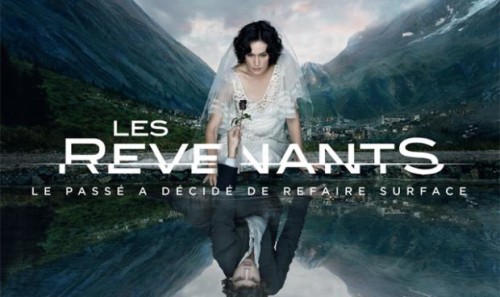
The first episode opens on a 15-year-old girl, the eponymous “Camille” (Yara Pilartz), as she finds herself alone at dusk in the mountains above her town. She starts her journey back home, disoriented and a little confused but otherwise intact, despite having died in a school bus trip four years prior.
Little girls are often what we associate with innocence. Girls are said to be born out of “sugar, spice, and everything nice,” which attaches a stigma to women from birth that is unrealistic. Society is conditioned to believe this ridiculous myth, which changes the way we value little girls over little boys.
Horror films hold a mirror up to these ideals, distorting the images and terrifying viewers in the process. The terror that society feels while looking at these little girls echoes the terror it feels when confronted with changing gender norms and female power.
Miller’s examination of the Salem Witch Trials, held in the Province of Massachusetts Bay from 1692-3, depicts the internal, secretive drive of a New England witch hunt, and how paranoia quickly escalates to devastate a marriage, a family, neighbors, and eventually, to cripple an entire community. The actions of little girls set it all in motion.
Tim and Julie didn’t know about the sexual abuse Beth had been subjected to as early as 19 months old by her father. They didn’t know she was suffering from Reactive Attachment Disorder, a condition that surfaces from past trauma and neglect into oceans of disturbing, detached, unresponsive, and apathetic behavior. They couldn’t possibly know that a young girl could be filled with so much—that much rage.
Oranges Are Not The Only Fruit, a BBC production from 25 years ago, adapted by author Jeanette Winterson and based on her own autobiographical novel, is one of the few films in theaters or on TV which contains both a coming-out story and another parallel, equally compelling story. Seven-year-old, red-haired “Jess” (played as a young child by Emily Aston and as a teen by Charlotte Coleman) grows up in a small town in Lancashire, in the north of England, with her strict Pentecostal adoptive parents; her father, always in the background, is silent and her mother (Geraldine McEwan), front and center, quotes the Bible and denouncing the “heathens” all around her.
The crumbling cement in this relationship is the injured little girl lying on the table downstairs. Her parents are united only on the question of her safety. Unsurprisingly, Karen has no voice or agency of her own. The adults perceive her as entirely helpless— “Maybe it’s shock,” her mother says of her condition. “She can’t possibly take all the racket…”
In the great monster mash team of terrifying children, the vampire girl is varsity captain. On the one hand, they are dolls forever: trapped in their prepubescent bodies for hundreds to thousands of years without a single curl losing its bounce. On the other hand, with hundreds of years of life come hundreds of years of experience, knowledge, even maturity.
However, this form of social shaming does not seem to prevent some of his young disciples from subverting their supposed childlike innocence: when the town is suddenly riddled by mysterious and violent crimes, it is suggested that the children have something to do with it, their leader being Klara, a 13-year-old angel-faced blonde and the pastor’s eldest daughter.
For Cronenberg, Candy represents the symbolic order and influence of the father, precisely what Nola wishes to eradicate. Candy is supposed to come “home to mommy” and have no fatherly influence. The characters in the film are defined by rigid gender constructs, or alternatively, through their attempts at living up to them.
These abstract symbols not only frighten, but link events in the real world to Samara’s cursed tape: this particular creature recalls the “spiders, snails, and puppy-dog tails” that little girls are decidedly not supposed to be made of. When Rachel engages this videotape, notably created by the patriarchal forces that might be seen to repress Samara, she sees Samara in a sparse hospital room in fast motion, staring at the clock as its hands whirl around and around.
She’s not nice, she’s not fragile, she’s not kind or sweet or even vaguely pleasant. She’s mean and angry and cynical and disaffected and sarcastic and snide and everything I wanted to be as a child. She’s also an intersectional feminist. And a little girl. She’s the best.
Movies where young girls are victimized are generally our idea of real world horrors, movies that are too sickening to sit through, but as much as they unsettle us, we expect them. We see these stories in the news every day. What is made truly terrifying and shocking in our culture is the advanced young girl already aware of her powers, and what she can get with them–a girl who knows how to move, how to dress, and how to manipulate.
Movies where young girls are victimized are generally our idea of real world horrors, movies that are too sickening to sit through, but as much as they unsettle us, we expect them. We see these stories in the news every day. What is made truly terrifying and shocking in our culture is the advanced young girl already aware of her powers, and what she can get with them–a girl who knows how to move, how to dress, and how to manipulate.
This post by Elizabeth Kiy appears as part of our theme week on The Terror of Little Girls.
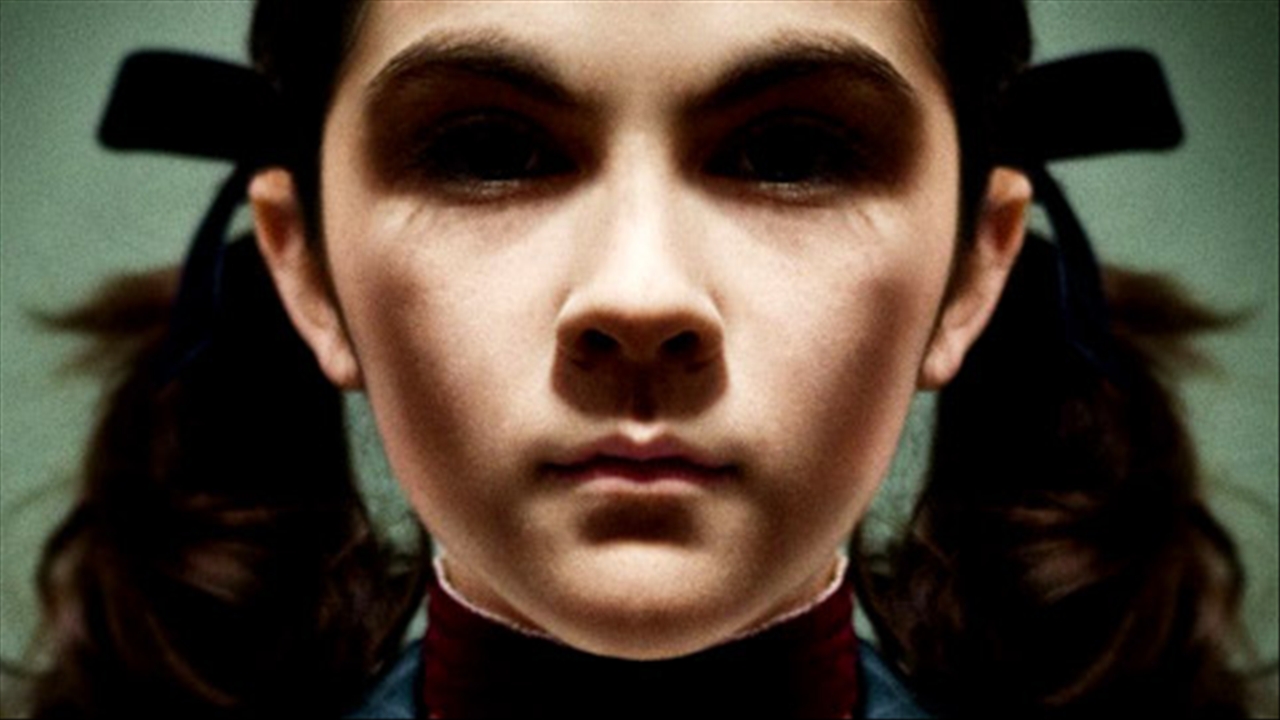
The unnerving poster for Orphan
It is very rare for a child to be a horror movie villain outside of a supernatural context. While we can turn off the movie, comforted that the children in Village of the Damned or the devil in The Omen’s Damien are fictional, we can’t entirely dismiss a child who simply goes bad, even if the narrative is as far-fetched as demonic possession and werewolves.
It frightens us because we know that an ordinary child going bad is somehow our fault, either as individuals or as a society. We have failed to intervene and save them before they were irredeemable.
Movies where young girls are victimized are generally our idea of real world horrors, movies that are too sickening to sit through, but as much as they unsettle us, we expect them. We see these stories in the news every day. What is made truly terrifying and shocking in our culture is the advanced young girl already aware of her powers, and what she can get with them–a girl who knows how to move, how to dress, and how to manipulate.
In this light, Vladimir Nabokov’s novelLolita continues to captivate literary discussions due to its unreliable narrator. Humbert Humbert defends himself, saying 12-year-old Dolores Haze seduced and manipulated him. He excuses his sexual relationship with her based on the fact that she had already lost her virginity and therefore he was not corrupting her; she was already to be considered somehow adult. Though most scholars view Humbert’s explanations as lies told to diminish his culpability, it is our tendency as readers to believe our narrator and identify with him (a major reason why the book is so disquieting).
Dominique Swain is a grubby, bratty Lolita
When the 1997 remake of Lolita appeared in theaters, amid protests of its sexual depiction of a child, this reading of the character as the seducer and the party deserving of blame was used as a defense. Likewise, in 1959, novelist Robertson Davies famously described the story as “not the corruption of an innocent child by a cunning adult, but the exploitation of a weak adult by a corrupt child.” Despite the fact that “a corrupt child” is still a child who cannot consent to sexual activity, this view is mirrored in many real life court cases, where the abuse of young girls is excused because “she looked old for her age,” “she was already sexually active,” or that most horrifying of excuses, that paints a girl in a training bra as a whore in waiting: “she seduced me, she knew what she was doing.” If our culture finds the sexual desire of an adult woman to be monstrous and abhorrent, what are we to think of a child, this horror movie bogeyman-figure who seeks to ruin the lives of successful men, whose cries of victimization fall on deaf ears?
It’s a popular misogynistic narrative: the teenage femme fatale turns into a horrific stalker figure, bent on possessing a poor well-meaning man, usually a father figure or teacher. We’ve seen it time and time again in films like Poison Ivy, Devil in the Flesh, and The Crush, all with actresses of safely legal age for viewer lust and obvious attractiveness, and gratuitous shots of their bodies. There’s no question we’re meant to identify with the man and see him as an innocent victim, unsure why this monster-girl has seized upon him, as Joey Buttafuoco attempted to portray himself in the trial of Amy Fisher, the teenage mistress who shot his wife and was thereafter known as the Long Island Lolita.
Sue Lyon plays a glamourous, conventionally attractive Lolita
But this viewer-identification is only safe as long as we the audience feel comfortable lusting after the girl at its center. Stanley Kubrick’s 1962 version of Lolita upped the girl’s age from innocent 12 to an ambiguous early teens and eradicated glimpses from the book of Dolores’s gross childishness–the gum she was always chewing, her sticky fingers and snotty nose–that would disgust the audience and make Humbert clearly abhorrent. In addition, while still underage, actress Sue Lyon is of a more mature and glamourous physical type than the book’s Lolita, which makes viewers more comfortable with her sexualization. Dominique Swain in the remake, is the clumsy, sticky child that does (and should) turn us off and makes Humbert, not Lolita, the clear monster of the story.
The Colemans are charmed by sweet Esther
When it was released in 2009, Orphan was painted as a simple evil child movie, The Good Son with pigtails and a controversial anti-adoption stance. For awhile the narrative is conventional; Esther (Isabelle Fuhrman) is a charismatic girl who can control and manipulate weaker children, like her new sister, Max, and adults. She attacks the girl who bullies her, kills a nun who promises to look into her back story and puts her adoptive brother in intensive care.
But the use of Esther as an advanced child, not only causally murderous but strangely sexual, adds a new dimension to this tale, marrying the evil child with the sexual stalker. Esther flirts with her adoptive father and attempts to kiss him and shocks her adoptive mother by stating matter-of-factly that she knows babies are made by men and women “fucking.”
There’s enough maternal and familial angst in the film to initially distract from Esther. The Colemans, a wealthy Connecticut family, decide to adopt a child to fill the void left after a miscarriage. Kate (Vera Farmiga) in particular feels the loss. Her husband and children are already wary of her because of her depression and alcoholism and refuse to believe her suspicions that something is very wrong with the angelic little girl they’ve brought into their home.
Through the film’s multiple acts, our view of Esther dramatically changes. Initially she is a perfect model child bullied for being sensitive and desperately in need of love, then she is a sociopathic child who hurts others without remorse, and finally, she is a crazy seducer, refusing to accept that she is not a sexy mature-bodied woman. In the film’s final act, we learn she is really a 33-year-old escaped mental patient with a pituitary disorder who has been posing as a child to be adopted by families and seduce the fathers.
Esther is made grotesque when she is revealed to be a 33-year-old woman
However, we see her strange sexual behavior before we learn that she is an adult woman, and it is clearly used to make us uncomfortable. As stated above, our culture’s fear of an overly sexualized child is rooted in our sense of guilt. We assume a child with this behaviour must be damaged in some way, must have fallen through the cracks of social services. Even if a child like Esther is a villain, we are obligated to feel sorry for her and speculate on the abuse she must have experienced. Orphan introduces Esther as a lonely, distanced child who has a difficult time relating to other people and children her age. It’s a narrative we’re already familiar with about children shuffled though orphanages and foster care, because in many cases it is a real life horror story.
Esther attempts to seduce her adoptive father
As such, we would ordinarily be wary of punishing Esther for her actions or question the degree of blame she deserves. A adult or teenage murderer must be killed or incarcerated to be disarmed, but what can we do with a little girl?
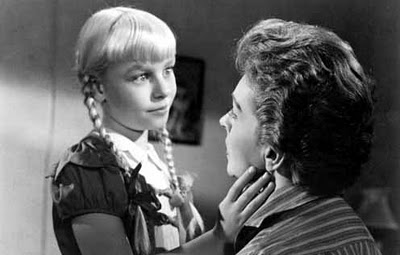
When The Bad Seedcame out in 1956, The Hays Code put filmmakers in a difficult situation. Evil Rhoda (Patty McCormack) was not allowed to triumph, as she did in the source novel and play, as the code did not allow crime to pay, so the ending was rewritten to with Rhoda dying after being struck by lightening. Still, ending a film with the death of a child and using it as a cause for celebration would not sit well with audiences. A slapstick coda was pasted on, where Nancy Kelly, who played Rhoda’s mother, delivers a spanking to McCormack, intended to stress that it was only a movie and all meant in good fun.
In Orphan, the solution is to reveal she is not actually a little girl, and thus, can be punished harshly. We don’t need to worry about her parents or her upbringing or possible rehabilitation. We don’t need to feel sorry for her. She is officially a monster, a freak, so we can hit her with a shovel or throw her across the room and breathe satisfied. The reveal of her actual face, beneath the make-up and freed from her false teeth is horrifying in itself, as she suddenly looks like an adult woman. With this reveal, she becomes a legitimate monster, an adult face on a child’s tiny body, wrinkled and malformed, crawling around and fighting like an animal.
Esther views herself as trapped inside the body of a child and unable to live the life of a grown woman with a family and a lover. Because of her appearance, any attempt of hers to be a sexual being is automatically perverted.
Kate and Esther become rivals
Her jealousy of Kate, who has everything she is denied, contributes to the uniquely antagonistic relationship between them. Because Kate is able to see through Esther’s act, she is marked as her rival early on, even while Kate still sees Esther as her child. When Esther says “fuck,” she poses it as a challenge to Kate. If Esther is a child, there is nothing Kate can really do to her and not seem like the criminal. In most cases, being a child means you’re the one to be believed.
By the film’s end, as it devolves into a classic chase/fight scene, Esther and Kate become equals and Esther is validated as a romantic rival. These final scenes mirror chase/fight scenes between adult romantic rivals, like Fatal Attraction and Single White Female. It is very rare that an “evil kid” movie ends with the mother fighting the child, in these films the mother is usually killed earlier, as in The Omen.
In the end, movies like Orphan and stories like Lolita challenge our morality and our idea of what a child can be found guilty of. Orphan’s final twist allows us some relief from this uncertainty. If Esther’s not a child, if Lolita is aged up and filled out, we’re not allowed to be uncomfortable, even if it doesn’t change the meat of the story.
She’s not nice, she’s not fragile, she’s not kind or sweet or even vaguely pleasant. She’s mean and angry and cynical and disaffected and sarcastic and snide and everything I wanted to be as a child. She’s also an intersectional feminist. And a little girl. She’s the best.
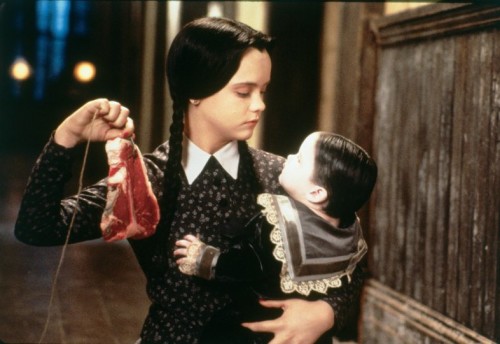
Wednesday Addams, as played by Christina Ricci in Addams Family Values
This cross-post by Deborah Pless previously appeared at her blog, Kiss My Wonder Woman, and appears as part of our theme week on The Terror of Little Girls. Cross-posted with permission.
What does it mean to be a little girl? There’s so much cultural baggage associated with female childhood. On the one hand, little girls are pure and innocent and needing of protection. They’re the emotional backdrop of a thousand action movies – the father must get home and save his darling little girl. On the other hand, little girls are threatening. They’re creepy. They’re the demons of a thousand horror movies – the family unit must save itself from the imprecations of a terrifying little girl who wants to destroy them.
And then there’s Wednesday Addams. She’s another thing entirely.
Wednesday Addams was the hero of my childhood. She was little girl who looked sort of like me, who was pasty and awkward, but who took no crap from anyone. Who defended her right to self-determination with a vengeance if needed. Who spoke up for those who weren’t given a voice. Who set fire to her enemies. I’m not saying it was healthy or tame, but she was my favorite character as a child. In a lot of ways, she still is.
She’s not nice, she’s not fragile, she’s not kind or sweet or even vaguely pleasant. She’s mean and angry and cynical and disaffected and sarcastic and snide and everything I wanted to be as a child. She’s also an intersectional feminist. And a little girl. She’s the best.
Wednesday and her nemesis Amanda (Mercedes McNab)
The Addams Family movies of the early 90s (The Addams Familyand Addams Family Values) were the kind of movies that never really made sense logically, but somehow worked all the same. They were loose on plot and big on tone, with outlandish storylines pretty much just there so that the actual Addams family had something to react to.
The movies were like extended improv sessions, where we stuck the Addams family members in weird situations and got to watch how they reacted. See Gomez and Morticia go to parent teacher meetings! Watch Wednesday and Pugsley at summer camp! What’s an Addams family wedding like? A birthday party?
The point of the movies was never the plot, but rather the experience of the characters in contrast to the world around them, and as long as you remember that, the movies hold up very well. They’re still fun and weird and kooky and occasionally deeply disturbing. They’re still deeply ridiculous. And Wednesday is still really, really threatening.
That’s right, threatening. Part of why I loved these movies so much as a kid was because Wednesday, far from being a delicate flower, or even playing second fiddle to her brother, is arguably the most dangerous character in the whole story. She has a sense of apathy and morbid misery mixed in with a violent streak and superhuman strength. She’s very threatening. Especially to everyone she views as, well, a threat.
Wednesday’s first impression of summer camp
Now, admittedly, most of this is coming from Addams Family Values. While I really do enjoy The Addams Family, it’s not until the second movie that Wednesday’s character really crystallizes, and there’s a good reason for that. Simply put, in the second movie, she’s at precisely the right age to perfectly subvert our expectations of girlhood.
In Family Values, Wednesday is directly prepubescent–a tween, if that were ever an appropriate word to apply to her. She’s just on the cusp of developing hormonal urges, secondary sexual characteristics, and a more formed idea about who she herself will be as an adult. But, she is still a child, so she still occupies that cultural space of supposed innocence and vulnerability. She’s at once both a potentially developed teen, and a fragile child.
The movie addresses this dissonance early on. When Wednesday and Pugsley are dropped off at summer camp – as part of a duplicitous plot to get them out of the way – one of the other moms comes up to Morticia and asks after Wednesday. Morticia responds, “Oh, Wednesday’s at that very special age a girl has just one thing on her mind.”
“Boys?” asks the excited upper-class white woman.
“Homicide.”
The expectation for Wednesday in this movie, at least the expectation of those around her, is that she fit into either one or the other roles of idealized femininity. Either she can be a pure and adorable child, something Wednesday is not naturally inclined towards, or she can be a teenage temptress, something she similarly has little interest in. Throughout the film the camp counselors try to turn Wednesday into a normal child, punishing her with Disney movies and singalongs, while a secondary plot tempts her with the offer of romance, albeit romance with an asthmatic, morbid fellow outcast.
Pugsley (Jimmy Workman), Wednesday, and Joel (David Krumholtz)
It’s telling then that Wednesday eschews both of these options. She flirts with Joel (David Krumholtz), but is very ambiguous about whether or not she wants his attention. While at one point she does say a tearful goodbye to him, using endearments and kissing his cheek I think, later she seems utterly uninterested in his existence, and admits that if someone loved her as much as he implies he does, she would pity him and probably murder him.
So, not so much the icon of seductive femininity. But neither is she a convincing child, because Wednesday possesses a level of awareness about the world and frankly alarming superhuman strength that make it virtually impossible to view her as someone in need of protection. Because she isn’t someone in need of protection. She’s not just virtually unkillable, she’s also unconcerned with her own safety. She’s not afraid, and weirdly that’s much more terrifying.
Wednesday isn’t scared of what might happen to her, she’s only afraid of being forced to submit to cultural standards she doesn’t agree with. She’s perfectly willing to risk life and limb (hers and other people’s), but she’s terrified of Disney movies. I would say that if she fears anything, it’s becoming normal.
And that’s a powerful message. The idea that the biggest thing we have to fear is not abnormality but the loss of what makes us distinct. It’s especially poignant coming from Wednesday, because what makes her distinct is so, well, distinctive. As Joel says when Wednesday asks if he’ll ever forget her, “How could I? You’re too weird.”
But let’s bring all of this back around again: how is Wednesday Addams a smasher of the patriarchy? Because she uses this discomfort around her, the fact that adults and her peers have absolutely no way to categorize her and her place in society, to sabotage them. She uses her place as a “child” to speak truth to power, and as a “woman” to make them uncomfortable. I mean, the best example of this, and my favorite moment of the movie, is when Wednesday destroys the camp’s end of summer play.
Wednesday as Pocahontas in the camp play
The play is horrible, a mawkish retelling of the first Thanksgiving that somehow manages to be more offensive than usual. The main character is Sarah Miller, played by Wednesday’s blonde camper nemesis, Amanda, and Sarah Miller goes on long speeches about how superior Western culture is, before admitting Pocahontas, played by Wednesday, and her tribe – played by all of the other camp outcasts.
Wednesday plays along with the script for a few lines, and then takes it on a rapid detour:
“Wait, we can not break bread with you. You have taken the land which is rightfully ours. Years from now my people will be forced to live in mobile homes on reservations. Your people will wear cardigans and drink highballs. We will sell our bracelets by the road sides, and you will play golf. My people will have pain and degradation. Your people will have stick shifts. The gods of my tribe have spoken. They said do not trust the pilgrims. And especially do not trust Sarah Miller. For all these reasons I have decided to scalp you and burn your village to the ground.”
Which they then proceed to do.
Now, this speech is wonderful because it so directly confronts all of the assumptions made earlier in the play, and because it speaks up on behalf of those who are being misrepresented, even though they are not there to defend themselves.* But it’s also wonderful because it’s the kind of thing that only a child could say. Specifically a little girl. I mean, if a boy said that, can’t you imagine the camp directors just picking him up and dragging him off the stage? If a teenage girl were to say it, she would be ruining something for children. If an adult said it, well they wouldn’t be given the opportunity would they?
Wednesday is the only character in the film who can make that speech, and it’s all the more powerful for how it subverts their expectations of her. It’s also worth noting that this speech is followed by a strong reversal. Wednesday, Pugsley, Joel, and the other camp outcasts (who are notably children of color and differing abilities) overthrow the camp leadership, burn the campgrounds, and are actually seen roasting their camp directors on a spit.
Wednesday’s default expression
The idea of course being that if you’re not afraid of anything, then you can accomplish pretty much whatever you set your mind to. Wednesday isn’t afraid of repercussions or bodily harm, and she has the assurance that her family will support her no matter what, so she’s emboldened to act out. She smashes the patriarchy, literally, and she can get away with it because she’s a little kid. No one’s expecting it. Arguably by this point in the movie they really should be, but they’re not.
I’m not saying Wednesday is perfect. She isn’t. She’s still a very privileged white girl from an unusual but still pretty standard background. She hails from a nuclear family and has never known want or hunger (except maybe voluntarily because she’s weird).
But that’s honestly OK. She’s a slightly problematic representation of intersectional feminism, but at least she is a representation of intersectional feminism. And, even better, she’s an unapologetically outspoken dissenter. She’s sure of who she is and what the world ought to be, and she’s perfectly comfortable telling everyone that–with a smirk and a sneer and a withering glance.
Hell yes, Wednesday Addams is smashing the patriarchy by not conforming to social expectations, being a creeptastic little girl, and inviting you to join her. Right on.
“You severely underestimate my apathy.”
*Arguably one of the only big criticisms that can be made of this movie from a thematic standpoint is that this speech is given by Wednesday, an upper-class white girl, rather than an actual Native American, but it would be hard to change that in the narrative without drastically changing the story, and I think it’s worth having someone say it at least. Still, worth noting, the upper-class white privileged girl really doesn’t speak for everyone.
Deborah Pless runs Kiss My Wonder Woman and works as a freelance writer and editor in Western Washington when she’s not busy camping out at the movies or watching too much TV. You can follow her on Twitter and Tumblr just as long as you like feminist rants, an obsession with superheroes, and sandwiches.
These abstract symbols not only frighten, but link events in the real world to Samara’s cursed tape: this particular creature recalls the “spiders, snails, and puppy-dog tails” that little girls are decidedly not supposed to be made of. When Rachel engages this videotape, notably created by the patriarchal forces that might be seen to repress Samara, she sees Samara in a sparse hospital room in fast motion, staring at the clock as its hands whirl around and around.
This guest post by Rebecca Willoughby appears as part of our theme week on The Terror of Little Girls.
If horror films with little girls at their centers express anxieties about puberty, female potential, or the morphing of charming young women into screeching harpies, then The Ring is probably one of the best examples. Its little girl, Samara Morgan, seems to be just plain inexplicably evil.
If recounted chronologically, her “real world” back story goes something like this: Samara was adopted by Richard and Anna Morgan when Anna failed (repeatedly) to conceive. I should note that I’m not talking about the sequels, which to me are clearly made not because we necessarily want to know more about the story and the characters, but because the first film enjoyed some financial success. Anyway, after the adoption, strange things begin to happen at the Morgan’s horse ranch, including the animals going crazy and drowning themselves. Anna begins seeing things, and believes the terrifying images are generated by Samara. The Morgans decide to seek psychiatric treatment for Anna and for Samara; at some point both are released, but Anna is still disturbed. Believing Samara to be the source of her visions, Anna suffocates her daughter and throws her into a well, then leaps off a cliff near their home.
But Samara isn’t dead, and spends seven days expiring at the bottom of said well. Afterward, well, even if she wasn’t evil before, she certainly has an axe to grind. Samara’s supernatural obsession becomes “showing” people terrible “things,” through her strange psychic ability, which gives her the power to create media—this special talent eventually takes the form of a cursed videotape that kills the viewer seven days after watching. Usually this process involves a very waterlogged and very scary-looking Samara crawling out of a leaky television set and looking at the victim with her very angry eye, whereupon that victim also suddenly becomes very scary-looking and waterlogged, but also totally dead.
When I saw the film on its release, I slept with the lights on for seven days. Yes, me: horror film aficionista, one who has seen some pretty intense stuff in the service of her dissertation research. Right. While at the time I was kind of obsessed with figuring out just why the film scared me so much, now I am kind of obsessed with one scene—hell, just a few shots—and one line of dialogue from the movie.
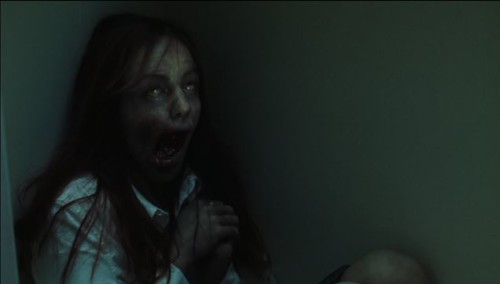
It’s probably not the scene that immediately springs to the mind of most folks who have seen the film. It’s not the last terrifying moments in Noah’s (Martin Henderson) life where a slimy Samara (Daveigh Chase) slithers out of a television screen and stalks him across his studio apartment to fulfill her awful curse. It’s not even the first of many interruptions of the linear narrative with shocking or weird images: where in the midst of Rachel’s (Naomi Watts) conversation with her bereaved sister Ruth (Lindsay Frost), we’re treated to a brief shot of poor Katie (Amber Tamlyn), the film’s first victim, crouched in a closet with a horrifying look on her dead face. It’s the scene when Rachel, previously rebuffed by Mr. Morgan in her search to discover who Anna Morgan and her daughter were, returns to his farm at night (brilliant move in a horror film) and stumbles upon a videotape of Samara Morgan’s psychotherapy.
We know that something significant is about to happen because—aside from the usual horror film suspense buildup—Rachel is surprised by a centipede as she rifles through a box of the Morgan’s belongings. She’s seen this centipede before in the fabled videotape that kills you, and throughout the film images from the tape seem to intrude little by little onto the real world. These abstract symbols not only frighten, but link events in the real world to Samara’s cursed tape: this particular creature recalls the “spiders, snails, and puppy-dog tails” that little girls are decidedly not supposed to be made of. When Rachel engages this videotape, notably created by the patriarchal forces that might be seen to repress Samara, she sees Samara in a sparse hospital room in fast motion, staring at the clock as its hands whirl around and around. An off-camera doctor indicates that they are in hour 14 of therapy–a therapy where Samara is wired with electrodes, plugged into a wall, and asked a variety of questions. The doctor makes several inquiries before she responds. But the most disturbing and important moment occurs when, just after Samara asserts that she loves her mommy, the Doc indicates that Samara is hurting her. When he says, “You don’t want to hurt anyone,” Samara responds: “But I do, and I’m sorry. It won’t stop.”
A revelation! A young girl supposedly given up by her family, subsequently adopted, and then poked and prodded by medical science and creepy male psychologists admits to having feelings other than love, maternity, and joy? Amazing! So although as a society we might locate a lot of anxiety in the maturation of young girls, this film—at least for a moment—doesn’t repress the idea that young girls might have feelings other than the ones society tells them to have. What’s problematic, of course, is that the film sees this admission as evidence of Samara’s evil. While the film overall may not be very progressive in terms of its depiction of women, and young girls in particular, it does have this ONE MOMENT of openness, like a valve releasing some of the pressure of repression.
In addition to admitting that she wants to hurt people, Samara is plagued by the idea that her adopted father is going to leave her in the institution, that he doesn’t love her. Eventually, her mother kills her, ostensibly because her idealization of what it means to be a mother didn’t come true exactly as she envisioned it. Because her adopted daughter isn’t “sugar and spice and everything nice” all the time. The expectations that society doles out for young girls and for mothers is far from realistic. Is this disconnect the real horror?
I’d like to take a moment to point out that Aiden (David Dorfman), Rachel’s young son, is far from a normal kid. He’s able to channel that creepy-but-probably-our-hero vibe that was perhaps first perfected by Haley Joel Osment in The Sixth Sense just a few years before The Ring. Rachel is also probably not up for a Mom-of-the-Year Award; like Anna and Richard Morgan, she and Noah haven’t been the best parents in the world. Ruth Goldberg has written insightfully about the mirroring present in The Ring between Anna and Richard Morgan and Rachel and Noah with Aiden in Barry Keith Grant’s book on horror film, The Planks of Reason. It’s very clear that while Aiden is a model kid—picking out not only his clothes for Katie’s funeral, but Rachel’s as well, and being extraordinarily self-sufficient because Rachel is working all the time—Rachel and Noah are far from model parents. While she certainly doesn’t seem to share Anna Morgan’s homicidal ideas, Rachel’s life is not exactly constructed to be conducive to having a young child; she relies on Aiden’s capable nature to take up the slack. So really, part of the “terror” of little girls has to do with their mothers—the expectations that society heaps upon them for a “perfect” child, and that they must always, under all circumstances (including unrelenting evil) love their offspring. Certainly reality is far more complicated, and motherhood and childhood much more complex. If The Ring is expressing THAT anxiety, then the film’s success should be evidence that this is a conversation society needs to have.
On that note, one final word on sequels. I might have tipped my hand in the paragraphs above about my general feelings for them, but I do at the end of the day have a hard time believing that any film project is mounted for purely financial or business-oriented reasons. I have to think that there’s just too much work involved in an endeavor like filmmaking to justify it with solely materialistic motives. Therefore, if there are sequels to The Ring (which there are, but which I judge to be inferior in many ways to the style of the original—which was not even an “original,” but that’s another essay), then it’s because there’s some deeper driving force behind the need to express the anxieties at their center. So, I’ll tentatively say: onward to The Ring 3! Perhaps the most frightening things about this film in the end are its telling links to some of the more frightening aspects of our own society. If it takes sequels to work those issues out, bring them on.
Rebecca Willoughby holds a Ph.D. in English and Film Studies from Lehigh University. She writes most frequently on horror films and melodrama, and is a Visiting Assistant Professor of English at Bucknell University in Lewisburg, Pennsylvania.
For Cronenberg, Candy represents the symbolic order and influence of the father, precisely what Nola wishes to eradicate. Candy is supposed to come “home to mommy” and have no fatherly influence. The characters in the film are defined by rigid gender constructs, or alternatively, through their attempts at living up to them.
This guest post by Eli Lewy appears as part of our theme week on The Terror of Little Girls.
The association between women and reproductive activities is a common theme in horror films. Female genitals have been perceived as mysterious and uncanny by men during the course of Western history. In Canadian film director David Cronenberg’s 1979 film The Brood, Nola, a wife and mother, is in a psychiatric institution where she uses Dr. Raglan’s methods of psychoplasmics to manifest her emotional and psychological troubles physically. Nola has failed in her role as a nurturing mother to her daughter Candy, and being a loving stable wife to her husband Frank, a leading cause of her psychological fragmentation. Nola’s inner rage and pain causes her to form an external womb-like sac that gives birth to evil children with whom she shares a telepathic bond. Nola’s ability to give birth parthenogenetically[1] is what constructs her as “monstrous.” Her womb, one of the primary symbols of biological womanhood, is constructed as being a volatile space filled with danger.
In The Brood, Frank, Nola’s husband, attempts to act as the protector of his daughter Candy against the evil mother, Nola. For Cronenberg, Candy represents the symbolic order and influence of the father, precisely what Nola wishes to eradicate. Candy is supposed to come “home to mommy” and have no fatherly influence. The characters in the film are defined by rigid gender constructs, or alternatively, through their attempts at living up to them.
Frank, who has recently separated from Nola, is discriminated against in the judicial system even though his wife is far from capable of nurturing Candy. When Frank attempts to take steps against Nola and get full custody of his daughter, his lawyer plainly tells him that he has no legal rights to deny Nola of her mothering responsibilities as “the law believes in motherhood.” The filmmaker suggests that even unfit mothers are preferred over fathers. The criticism of the supposed female dominance over the realm of the family in the film is clear once the audiences realize what kind of a mother Nola really is. The horror occurs when the father is powerless, rendered irrelevant by a “monstrous” mother.
Nola is in desperate need of feeling loved and accepted by Frank, who in turn, is disgusted by her. The Brood broaches the idea of a hereditary female cycle of abuse and evil: Nola’s mother was emotionally and physically abusive toward her which, in turn, caused Nola to be abusive toward her young daughter Candy. The Brood complies with the ancient sexist notion that maternal desire is the source of monstrosity (Creed 46). Most of Dr. Raglan’s patients’ rage manifests itself in boils and lesions, unlike Nola, whose rage comes in the form of an external womb capable of birthing deformed beings. Not only is her body and mental state in shambles, she has incorporated the brood children into the mix who bring harm to others. This conveys a message that Cronenberg returns to frequently: females who dare to be aggressive and expressive destruct others. Nola’s rage is seen as something that the women in her family inherited, but there is no attempt at understanding why this has happened.
During Candy’s stay with her grandmother, she sees a picture of her mother as a child in the hospital. Nola looks a lot like Candy; in fact, she is played by the same young actress. This is the first instance in which Candy shows some sense of presence, interest, and involvement in the film as she is usually catatonic and detached. The traumatic events she has lived through are reflected in her blank stare. Candy is one of the main victims in the film; she witnesses her grandmother’s death, gets viciously beaten by the brood, and is constantly under threat.
Candy could easily be mistaken for one of the brood children with her straight blonde hair and the almost identical red parka. In fact, even her own father mistakes Candy for a brood for a fleeting second. The brood children know that she needs to come with them to the institute; they are the same in some way. However, once Nola commands her brood to attack Candy, their blood ties no longer matter and they intend on killing Candy.
Candy getting kidnappedCandy in peril after Nola orders the brood children to kill her
When Frank attempts to save the kidnapped Candy, he comes face to face with Nola for the first time in the film. A primal birthing scene ensues. She is sitting on a platform in a regal manner. Nola questions Frank’s love for her and confidently explains that “what’s been happening to me is too strange, too strange to share with anyone from my old life.” She then proceeds to raise her arms to reveal what lies underneath her white nightgown: her external womb. The whiteness of Nola’s robe is juxtaposed with the “monstrosity” that lies beneath. The camera switches between Nola’s confident, queen-like posing and Frank’s pure and utter disgust for what his eyes are seeing.
Nola revealed
As though the sight of this hideous sac were not enough, Nola proceeds to bend over, bite the sac, and take out her bloodied brood fetus. However, the epitome of Nola’s “freakishness” is yet to come. Nola licks away the blood and amniotic fluid, irrevocably propelling Nola to an abject being completely comfortable with her animalistic maternal instincts, reproductive functions, and disfigurement. We see all this unfold though Frank’s eyes – we are him in this scene, disgusted and disbelieving. Nola changes from human to monster. She was unaware of the fact that the brood children are murderous, but once Frank tells her she does not change her demeanor and smiles maniacally, condoning her progeny’s actions. Rage and psychoplasmics have sucked the humanity out of her. Once Frank tells her the truth, which is that he is there to take their daughter away from her, Nola coldly says, “I’d kill Candice rather than let you take her away from me.” Frank then proceeds to leap and strangle his wife to death. He begs her to make the brood children stop what they are doing to Candy, but Nola is too far gone, her humanity has been stripped away. Nola’s plea to “kill me, kill me” is masochistic; she is letting Frank give into his urge to destroy the maternal (Beard 85). Frank is full of rage while killing Nola, which is the only effective thing he does throughout the picture. However, this does not prevent Candy from being exposed to the disease; he has not saved her. We then see the boil on her arm at the end of the film, implying that Candy will carry on the dubious honor of the clan’s “female legacy.”
Works Cited
Beard, William. The Artist as Monster: The Cinema of David Cronenberg. Toronto: University of Toronto Press. 2006.
Creed, Barbara. The Monstrous Feminine: Film, Feminism, Psychoanalysis. London and New York: Routledge. 1993.
Eli Lewy is a third culture kid, burgeoning filmmaker, and Master’s student studying US Studies. She currently resides in Berlin. You can read her film review blog here: www.film-nut.tumblr.com and follow her on twitter at @scopophiliafilm
However, this form of social shaming does not seem to prevent some of his young disciples from subverting their supposed childlike innocence: when the town is suddenly riddled by mysterious and violent crimes, it is suggested that the children have something to do with it, their leader being Klara, a 13-year-old angel-faced blonde and the pastor’s eldest daughter.
This guest post by Gloria Endres de Oliveira appears as part of our theme week on The Terror of Little Girls.
What are little boys made of? / What are little boys made of?
Snips and snails / And puppy-dogs’ tails / That’s what little boys are made of.
What are little girls made of? / What are little girls made of?
Sugar and spice / And everything nice / That’s what little girls are made of.
(nursery rhyme dating from the early 19th century)
Ana Patricia Rojo as Veronica in Poison for the Fairies
Creepy little girls in cinema and television have always been important to me; growing up as the pale, black-haired daughter of Brazilian immigrants in the suburb of an ethnically very homogenous German town instantly made me fall in love with sullen, gothic heroines such as Wednesday Addams, Lydia Deetz, and Nancy Downs (thanks to my older sister, I first saw and enjoyed The Craftat the appropriate age of 7). They looked like me, dressed like me, relentlessly pursued their own peculiar interests, and remained strong in the face of societal opposition.
As I approached my late teens, I ditched my gothy black frocks and Doc Martens and started to indulge my love for all things pink, frilly, and girly. However, this led to me experiencing an all new form of social discomfort – while before I was just looked at as plainly weird, my new stereotypically female exterior made people underestimate me in a painful way, doubting my intellectual capabilities and often even being surprised upon noticing that I, a girly girl, possessed so much as a sense of humor. Furthermore, I have experienced first hand how so-called femme-phobia can even pervade queer spaces, where femme-identified persons are often faced with exclusion. This personal background led me to be fascinated with an all new set of creepy little girls.
As Leigh Kolb notes at Bitch Flicks, ”(l)ittle girls are supposed to be the epitome of all we hold dear – innocent, sweet, submissive and gentle. The Victorian Cult of Girlhood … bleeds into the twenty-first century anti-feminist movements, and these qualities are still revered.”
“Artists like Charles West Cope and John Everett Millais produced dozens of domestic genre paintings with titles like The First Music Lesson (1863) and My First Sermon (1862-3), which portray the child as a bastion of simplicity, innocence, and playfulness. Women were also praised for embodying these qualities, and together with children they were urged to inhabit a separate sphere: to withdraw from the workforce, embrace their status as dependents, and provide the male breadwinner with a refuge from the dog-eat-dog capitalist world outside the family.”
These historic ideals are explored in Michael Haneke’s The White Ribbon; the director paints a haunting picture of the fictional rural German town Eichwald at the cusp of the outbreak of the First World War. The oppressive nature of this puritanical society is underscored by the local pastor, who, in his confirmation classes, instills a deep sense of fear in the children he teaches – and, if they sin in any way, makes them wear a white ribbon to remind them of the purity they should strive for.
However, this form of social shaming does not seem to prevent some of his young disciples from subverting their supposed childlike innocence: when the town is suddenly riddled by mysterious and violent crimes, it is suggested that the children have something to do with it, their leader being Klara, a 13-year-old angel-faced blonde and the pastor’s eldest daughter.
Maria Dragus as Klara
At one point, Klara is even implied to have butchered her father’s beloved parakeet with a pair of scissors. Childhood animal cruelty is not only thought to be an early symptom of psychopathic tendencies, but also stands in direct opposition to 1914 (and modern!) society’s standards for young girls – a budding mothering nature, nurturing, empathic and caring, finding release in doll and homemaking play.
Could angel-faced Klara have done this?
The notion of female children as the pinnacle of innocence is thus subverted – but what exactly lies behind the concept of the pure, the innocent little girl? Even today, a century after the fictional happenings in The White Ribbon, purity often seems to be a euphemism for virginity and sexual inexperience, celebrated with so-called purity balls and purity rings. Just as in Victorian times and in the rural, puritanical society depicted in Haneke’s film, nowadays, women who are sexually active (outside of marriage) are still considered impure and thus abject. This notion is so prevalent and ingrained, that even women who would deny being influenced by it often dream of a white wedding, with the father of the bride leading her to the altar to basically entrust her into the husband’s custody.
Jeanne Goupil and Catherine Wagener in Mais ne nous délivrez pas du mal
A similar church ceremony is, of course, first communion – where the traditional white wedding finds it ritualistic precursor, with pre-pubescent little girls decked out in white dresses, veils and wreaths. Anne and Lore, the two 14-year-old protagonists in Joël Séria’s Mais ne nous délivrez pas du mal, who meet at a catholic boarding school set in stiflingly bourgeois 1970s France, act out by playfully, then violently processing and at the same time powerfully overthrowing what society has taught them; in a pivotal scene, the two girls stage an elaborate, candle-lit and organ-accompanied mash-up of a wedding and a communion, where they pledge everlasting allegiance to … Satan. Interestingly, the film features a screne where a pet bird belonging to an older man is killed by a one of the girls – reminiscent of Klara in The White Ribbon and her disregard for patriarchal authority.
Ana Patricia Rojo as Veronica in Poison for the Fairies
Two little girls entangled in increasingly sinister play and satanism are also the protagonists in Carlos Taboada’s swan song Veneno para las hadas (Poison for the Fairies).
Veronica, the school’s outcast, traumatised by the death of her parents, her loneliness and the ”ridiculously inappropriate bedtime stories” her nanny tells her, befriends the new student Flavia – a wealthy, sweetly happy girl from a seemingly intact family. Veronica, a master manipulator at the ripe old age of 10, convinces Flavia that she, Veronica, is a powerful witch, enabling her to blackmail Flavia into sharing her privileges (her dolls, her happy family, her family’s summer house, even her beloved puppy) with her to an uncomfortable extent.
Elsa María Gutiérrez and Ana Patricia Rojo as Veronica in Poison for the Fairies
Scared and intimidated by Veronica’s increasingly violent displays of her supposed magical power, including the death of Flavia’s piano teacher (which was, in reality, due to a longstanding illness, not witchcraft), Flavia despairs and, at the culmination of the film, resorts to literally burning the witch: Veronica dies in a fire, the film ending with her haunting cry: “¡Flavia ayúdame!” (“Flavia, help me!”).
Behind the societal construct of the innocent little girl not only lies the imperative virginhood, but also the requirement of a certain passivity and submissiveness. Girls are taught from an early age not to be too rambunctious, not to get themselves dirty during play – femininity is thought and taught to be pristine, docile, meek and often inferior. The fact that Klara, Anne, Lore, and Veronica cannot be described as so-called tomboys is emblematic for their characters’ subversive power: They cause their violent mayhem in the frilliest, most femine dresses, decked out in candy colors, ragcurled pigtails bouncing. Perhaps this is one of the key factors that make famous cinematic creepy girls such as Wednesday Addams, Rhoda Penmark, and the Grady twins so powerful and memorable – by society’s standards, their characters’ darkness and defiance seems to exist in direct contrast to their girly exterior.
Jitka Cerhová and Ivana Karbanová in Sedmikrásky
They have this in common with the Marie and Marie, the heroines in Věra Chytilová‘s Sedmikrasky (Daisies) and Alice, the protagonist in Catherine Breillat‘s directing debut Une vraie jeune fille. Those girls, wearing plenty of mascara and mini dresses, cause a range of disturbance, ranging from public masturbation to con games, theft and cake fights.
Both of these films not only pass the Bechdel Test with flying colours, but are also exclusively and intimately told from the girls’ perspectives, rendering them very modern and relevant still (which perhaps also explains Daisies‘ current popularity among girls, with stills and gifs from the film very present on all kinds of online platforms).
Charlotte Alexandra in Une Vraie Jeune Fille
Another similarity between those two films (and Seria’s Mais Ne Nous Delivrez Pas du Mal) is that all three of them were immediately banned upon their release in their countries of origin. All three films depict young girls who defy any Victorian Etiquette School-style rules, who actively and independently take charge of their sexuality without any hint of submissiveness. None of these films explicitly depicts violence (no blood is ever seen on screen). The Godfather, on the other hand, a film released at a similar time, featuring a litany of violence, fist fights, gun shootings and blood baths (including a lengthy scene where a man brutally ”chastises” his wife with a belt), was not banned, neither in its country of origin, nor in France, or former Czechoslovakia. Rather, it was celebrated unanimously, winning three Oscars and is to this day held up as a cinematic masterpiece.
Creep girl du jour: Mia Wasikowska in Stoker
To me, the decade-long banning of films depicting rebellious young women demonstrates their subversive power that can be traced to the present day; as Elizabeth Kiy concludes, ”a culture’s horror stories have always reflected what they finds terrifying (…) from the fear of liberated women in Dracula to the virgin/whore dichotomy of the slasher film, and probably always will.”
Personally, I still cling to every well-written creepy heroine appearing on my screen, such as, most recently, India in Chan-wook Park’s Stoker – hopefully dismantling harmful gender stereotypes one lace-collared dress at a time, making it a little less difficult and less lonely to be a young woman.
Gloria Endres de Oliveira is a Berlin- and London-based actor, filmmaker, photographer, and writer. Updates on and samples of her work can be found on her tumblr and she twitters at @gloriayloslobos
In the great monster mash team of terrifying children, the vampire girl is varsity captain. On the one hand, they are dolls forever: trapped in their prepubescent bodies for hundreds to thousands of years without a single curl losing its bounce. On the other hand, with hundreds of years of life come hundreds of years of experience, knowledge, even maturity.
This guest post by Kathryn Diaz appears as part of our theme week on The Terror of Little Girls.
In the great monster mash team of terrifying children, the vampire girl is varsity captain. On the one hand, they are dolls forever: trapped in their prepubescent bodies for hundreds to thousands of years without a single curl losing its bounce. On the other hand, with hundreds of years of life come hundreds of years of experience, knowledge, even maturity. The great perverse contradiction of an innocent but worldly, pure but sexual girl beings that characterizes so many fantasies and paranoias about young girls comes to a larger than life reality with one part vampire bite added to sugar, spice, and everything nice. It’s a lot to take in. Especially since in practice, these horrific fantasies are much more complicated than they appear and often pack a harder punch than their makers bargained for. Because little girls aren’t dolls for men to play with. They have wills of their own, and one day they learn to use it with bite.
It’s worth mentioning that one of the most famous vampire girls in cinema is coveted by her makers for her girlishness. Claudia isn’t just raised in the vampire way by Louis and Lestat in Interview with the Vampire, she’s worshiped for it. From the moment she transforms from a dirty, malnourished urchin to a cherub-like creature that asks ever so sweetly for more blood, she is the apple of Lestat’s eye. He is charmed by her coquettish innocence and praises such traditionally feminine virtues as neatness. Even before this moment, Claudia represents hope for Lestat and Louis’ relationship and redemption for Louis’ conscience because of her apparent youth and innocence.
In the montage that depicts Claudia “growing up,” we see her surrounded by servants, dresses, and frills and privileges fit for a princess. One in particular has her standing on a pedestal in the center of a room–for trying on dresses, of course. But the imagery of her as a worshiped being, or perhaps a favorite doll upon a shelf is not to be dismissed. As Louis explains in his voice-over, “To me she was a child” and “to Lestat, a pupil.” Claudia is, in short, made into the desires of her makers.
This is not an uncommon motif in the vampire genre, or even in the broader spectrum of monster-making. Dracula makes his brides after his lusts, Frankenstein’s creature asks for a bride after his loneliness. Louis and Lestat are in good company, but Claudia manages to break away from the pack of female creations by sheer force of will and determined disobedience. She is more than discontent, she is proactive. And she isn’t alone.
Like all vampires, Eli was made by someone once upon a time. Both Let the Right One In and the American remake Let Me In are purposefully vague about the details of her origin story, but we can depend on the basic aspects of the common vampire myth to fill in some of the blanks. We don’t know what happened to her maker either, but their absence and Eli’s lack of preoccupation with them seems to support the idea that she doesn’t miss them. Instead, Eli roams the world as she chooses, finding human partners to help her survive along the way. She has broken away from the hold of whatever agenda she was created for and spends the film working her own. Like Claudia, Eli rebells against the routine of her lifestyle for her own desires. Her protector, Hakan, is comfortable in the way of their life and in their solitary household. He has a possessive devotion to Eli as evidenced by his behavior when the subject of Eli’s new friend, Oskar, comes up. Eli is quick to remind him that while he may play the role of her father to the outside world, he doesn’t have any authority authority over who she chooses to spend her time with.
Claudia’s rebellions are much less cooly carried out, perhaps in part because they are nearly always to some degree, unsuccessful. Like Eli, Claudia tries to gain some ownership of her identity through trying to control her appearance and how she is perceived by others. She tries to take her “perfect” doll-like appearance into her own hands by cutting her hair. She dresses older and when she is alone with Louis, she adopts the countenance of a woman as old as she feels rather than that of the child she looks like. These are different but comparable tactics to Eli insisting that she is twelve and maintaining an awareness and hold of childlike things such as puzzles and games. Both of these girls do not want to be overridden into someone else’s idea because of their circumstances. But Claudia cannot get what she wants out of her actions. Her hair grows back when she cuts it, strangers refuse to take her seriously when she dresses older, capturing and drawing grown women does not transform her by any manner of alchemy. But Claudia does accept her fate without a fight, perhaps lest Lestat mistake her for the dolls he buys her every year. So she breaks the rules, pushes her luck, and she tries her hand at a little bit of vampire-on-vampire murder. When Louis starts to show how uncomfortable he is about the deed, Claudia tells him “he deserved to die” and later, that she did it “so we could be free.” She knows, perhaps even better than Louis, that he is a created monster like her too.
Claudia and Eli are both determined, willful girls strong in their sense of self and what they want. It also feels fairly safe to say that the horror derived from them is from a fear of how much they can do and accomplish on their own terms and the consequences of getting on their bad side. I mean, these girls aren’t afraid of things getting a little bloody. At all. But it’s also worth noting that both of these films are invested in their perspectives. Interview with the Vampire is almost devoid of human characters and Let the Right One In is about Oskar and Eli’s growing relationship together. The loved ones in their lives adore them, seek comfort in them, and stand beside them. We read Eli’s notes and watch her quiet excitement as she gets back in touch with what she loves in the world. We see Claudia’s smile as she dances with Louis in France and her forlorn expressions as they share in their loneliness together. As frightful as the lengths these two girls will go to are, it’s hard not to want them to succeed. We are made to understand the frustration and anguish of their positions and the ache of hoping for something as universal and fundamental as control over one’s life and identity. Even though one of these girls succeeds in her story and the other does not, it says something that these films are able to clearly articulate that a little girl is not just pretty and cunning and mysterious. A girl is also every bit as complex and full of yearning as her older male counterparts. She can be as fierce as anything else that goes bump in the night. And sometimes? She’ll win. And you’ll be glad she did.
Kathryn Diaz is a writer living in Houston, Texas. She is currently pursuing a B.A in English at the University of Houston. You can follow her at The Telescope for more of her work.
The first episode opens on a 15-year-old girl, the eponymous “Camille” (Yara Pilartz), as she finds herself alone at dusk in the mountains above her town. She starts her journey back home, disoriented and a little confused but otherwise intact, despite having died in a school bus trip four years prior.
This guest post by Tina Giannoulis appears as part of our theme week on The Terror of Little Girls.
The concept behind Les Revenants (or The Returned to its anglophone viewers) began in 2004, with the film of the same name. Its premise follows that of the less successful film; set in a small French village, a town reacts as its previously dead inhabitants begin to return, untouched by time or their own passing. If the show sounds familiar, you may be remembering the US series, Resurrection, based on Jason Mott’s 2013 novel, The Returned which, while sharing a title, seems to transpose the same premise to a small town in Missouri without being connected to the French works.
These permutations of the same, basic idea behind Les Revenants indicates something within it that filmmakers and writers are keen to explore. Traditional depictions of zombies are fairly straightforward affairs, using the brain-dead human to comment on all manner of social ills that spread like epidemic and manifest as thoughtless allegiance; from consumerism to organised religion, the politically unpopular to the socially demonised, zombies have acted as allegory for evils that are rendered inhuman. In recent years, the figure of the zombie has had an unmissable resurgence and has seen the figure reworked and appropriated into genres other than horror; Shaun of the Dead and Zombieland offer a comedic take on a zombie apocalypse while Warm Bodies and In The Flesh opt to re-humanise the inhuman.
Les Revenants sits somewhere between these traditional depictions and their rebirth. The series quickly shies away from the tropes of the undead but continues to play with the genres they feature in; horror and thriller elements are peppered through a thoroughly riveting drama, using the mystery and otherworldliness of the revenants to grip and frighten. With only one season aired and another in production, the easiest way to deal with unexplained facets of the story is to understand the world of Les Revenants through magical realism as, ultimately, the revenants’ origins are unnecessary when considering their roles in a series which explores so much more.
In her introduction to The Left Hand of Darkness, Ursula K. Le Guin describes science fiction as a thought-experiment, arguing that thought-experiments are not meant to predict the future but rather describe reality. It’s with this in mind that I describe Les Revenants as being a thought-experiment on loss–loss of life, time, and innocence.
The first episode opens on a 15-year-old girl, the eponymous “Camille” (Yara Pilartz), as she finds herself alone at dusk in the mountains above her town. She starts her journey back home, disoriented and a little confused but otherwise intact, despite having died in a school bus trip four years prior. She does not remember her death, nor does she notice the years that she’s missed – but her family certainly has. From mother, Claire (Anne Cosigny), to father, Jerome (Frédéric Pierrot), and twin sister, Lena (Jenna Thiem), we see a spectrum of responses to the return of something lost: joy, suspicion, refusal. While it’s undeniable that Claire and Jerome have been hugely affected by Camille’s death and return, it is Lena who provides the most interesting relationship to Camille as they navigate their mutual loss of a sister–one through death, the other through life now lived and irreversible.
Camille and Lena discover each other
As identical twins, the two have a quality as otherworldly as the revenants and a cultural history as robust as the zombie. From their bountiful presence in mythology, twins have arisen in media time and time again as two sides of the same coin, playing on opposing binaries as well as the pair’s indivisibility. Perhaps the most famous mythological twins are Castor and Pollux, who make up the constellation Gemini, with whom Camille and Lena share a history; within both sets, one twin is immortal and the other not. In both cases, this leads to a struggle as each set refuses to be split by their mortal differences. What sets them apart is that Camille and Lena have been separated once before and this was not without consequence. The gap between Camille’s death and her return leaves the twins at 15 and 19 years old and while it serves as a point of difference between the twins, it also draws them closer as two halves of the same whole; Lena reflects what Camille could have been while Camille reflects what Lena once was.
Frédéric and Lena discover each other
It is in the space between these two images that Les Revenants questions matters of innocence and purity. Guilt, death and virginity are embedded in their tale as Lena escapes the bus crash by playing hooky in order to have sex with her boyfriend, Frédéric, who Camille also happens to be infatuated with. This sets up a dichotomy between the sacrificial virgin and the guilty survivor which, with the action of each event being intercut, seems to play on la petit morte. More significantly, it is the first signal of Lena’s unaccompanied move through adolescence. It is here that the twins begin to move from complimentary to opposing halves; Lena is sexualised, transitioning to woman and taking on all manner of wicked vices, leaving Camille frozen in time as the incorruptible, innocent child.
A significant part of Camille’s figurative defrosting comes as she sneaks into Lena’s room. In the time since her death, Lena seems to have taken on all manner of wicked vices; Camille surveys the array of rock records, magazine cut outs, and photographs. She lingers over pictures of Frédéric and Lena smoking and smiling in a life that could just as easily have been hers. It’s a stark contrast to Camille’s shrine of a room; a few nondescript posters and girlish colours cover the walls, not to mention the no-smoking sign on her door. Smoking also plays a brief, though telling part in Camille’s characterisation – both Lena and her father have taken it up and she asks her father for a cigarette while demanding the truth on the changes that have occurred since her death. Here, Camille’s otherworldliness does not symbolise her move to adulthood but rather permits that move (or at least permits her transgressions against what is acceptable for her age).
By combining the figures of twins and zombies, Les Revenants avoids positing Camille as a figurehead for all that is good or all that is evil. Instead, she occupies a middle ground and it is this middle ground which allows the thought-experiment to run on unabated. It does not ask what if she had not died, not even what if she came back, but by making Camille a not-quite-zombie and a not-quite-twin, she becomes not-quite-Camille. Not-quite-Camille instead opens up a space to consider what has happened since her death and, through her reappearance, what loss and time have done to Lena.
It should also be noted, however, that for all Les Revenants does for acting out against conventions of little girls in horror, there is a character which rearticulates them for boys. For the most part, Victor (Swann Nambotin) is silent and unassuming, not admitting where he came from or even his real name. He is reluctantly taken in by Julie (Céline Sallette), who was once attacked by cannibal-killer, revenant, Serge (Guillaume Gouix), and soon reveals himself to be perhaps the most horrific of the revenants. Bitch Flicks’Max Thornton wrote about the nature of violence in Les Revenants, noting the significance of Victor’s appearance in relation to Julie’s attack, stating that the series has an undercurrent of commentary on sexualised, male violence against women.
However, he mentions Victor only as plaster to this violence, a form of healing for Julie, when Victor has shown himself to be something darker. While Camille’s supernatural abilities seem to affect only her sister, Victor has the ability to cause violent visions and actions in anyone. He apparently does so to his unknowing, new-found guardian, inducing a vision of her attacker ready to repeat his crimes before the boy pries the scissors from her hands, seemingly saving her. If Serge’s attacks represent male violence at large then one could argue that Victor’s attacks represent domestic violence. More easily, the link between Victor and Serge (for Victor summons Serge’s image once more, causing Serge’s brother to shoot himself in much the way Julie was poised to impale herself), parallels the convention of a little girl being controlled by an evil spirit to embody the dangerous sexuality and power of womanhood. In Les Revenants, Victor is the little girl, Serge the evil spirit and his powers the embodiment of dangerous sexuality and violence of manhood. This reconfiguration doesn’t just even the playing field for gendered representations of children, it sheds light on far more real and dangerous evils than vampires or puberty.
Tina Giannoulis is a current media student at UNSW in Sydney, Australia. She is the convenor of UNSW Feminist Free Talks and bakes a mean red velvet cupcake. You can keep up to date with her writing and reading by following her on Twitter.