Watch Me Shine: ‘Legally Blonde’ and My Path to Girl Power

My attachment wasn’t about Elle Woods or embracing hallmarks of traditional femininity that get belittled by western mainstream society (that would come later). I was all about lyrics like, “That’s not the way/ Nice girls behave/ Oh yeah I know/ You told me/ It’s not your choice/ I have a voice/ I guess you just don’t hear me.” It spoke to me on a spiritual level.

Legally-Blonde-legally-blonde-31597227-400-292

This guest post by Kathryn Diaz appears as part of our theme week on Movie Soundtracks.

I was 9 when Legally Blonde first sparkled in movie theaters. I didn’t understand what the Bend-and-Snap was all about, half the jokes went over my head, and I was only mostly sure that a sorority was some kind of real thing. What I did know was that “Watch Me Shine” by Joanna Pacitti was my new favorite song, like, ever.

Here was a song that felt commanding and fun, something that was opening a gate to me that my Mary-Kate and Ashley makeup set never did. I played “Watch Me Shine” in the car while my mom drove me to school every morning. I stumbled over the rapid-fire lyrics at the top of my lungs and whipped my pony tail back and forth with shameless enjoyment no matter how sleepy or cranky I’d woken up. At school, I replayed the montage over and over in my head. If I just thought about the song long enough, I was sure I would become as confident and fearless as Elle. When I met my challenges, I would march through them with determined glares and that song. If this was what the rest of Girl Power sounded like, I wanted to listen non-stop.

[youtube_sc url=”http://youtu.be/u5XRYBLfjhI”]

Studying never looked so fierce.

My love for the Legally Blonde soundtrack eventually expanded to include Hoku’s defiantly happy-go-lucky tune “Perfect Day,” “One Girl Revolution” by Superchick, and “We Could Still Belong Together” by Lisa Loeb. “We Could Still Belong Together” was, and still is, an unexpected win. Legally Blonde plays the song as Elle makes the trek from home to Harvard to kick off her quest to win back Warner, but the whole song is something of a give-away about the film’s real philosophy on love: couples that belong together are ones that let the partners be their imperfect, interrupting, complicated human selves without any fuss.

[youtube_sc url=”http://youtu.be/mdU40HDmkbg”]

Why yes, women can be in a relationship without walking on a perfection tightrope.


As I hit that sweet spot between anger and anxiety with the rest of puberty, “Can’t Get Me Down” by Lo-Ball climbed to the top of my favorites from the soundtrack. By this time, my life looked even less like the positive friendship-driven fairy tale Legally Blonde existed in, but my CD had transcended its origins. My attachment wasn’t about Elle Woods or embracing hallmarks of traditional femininity that get belittled by western mainstream society (that would come later). I was all about lyrics like, “That’s not the way/ Nice girls behave/ Oh yeah I know/ You told me/ It’s not your choice/ I have a voice/ I guess you just don’t hear me.” It spoke to me on a spiritual level.

[youtube_sc url=”http://youtu.be/Fzo1uqFS-jU”]

Much angst was set to this song.


One day some of my friends and I ended up pulling out our overstuffed CD collections and taking safety pins and paper clips to their surfaces. Scratching CDs, especially ones we’d had for a long time, was a common pastime whenever we felt “bored,” that heavy catch-all for everything we didn’t want to name or didn’t know how to. I didn’t have a lot of CDs in the first place, so my fun was usually in carving swirls and rain clouds over the discs everyone else had finished with, but that day I couldn’t get out of contributing something. I’d already pretended to complain about how much I hated my pink CDs. Surprisingly, my friends didn’t believe I had any, that they weren’t “me” and I was clearly making something up. This was true, but I was not about to correct them. My love for my pink CDs would stay a deeply guarded secret for a long, long time. Through the maze of 12-year-old peer pressure logic, I decided I had no choice but to show them something and dismantle the hell out of it.

I sacrificed my Princess Diaries soundtrack. It was pinker than pink and, more importantly, it was not Legally Blonde. Legally Blonde was hidden under my Evanescence album where no one would question my cool. I wanted to hold onto it more than I wanted to be approved of. My Legally Blonde soundtrack was important, even if that idea seemed ridiculous and bizarre.

I held onto it for as long as I could. When no one was around to listen, I made the CD the big mainstay in my Walkman. My favorite song circled through the tracks and my emotions fluctuated as much as the genres from track to track. It was my big, bolstering secret. But eventually I found other movies, other albums, and inevitably other means of listening to music. My head filled up with more ideas, more role models and anthems. I stopped worrying about having too many sparkles or not enough. By the time I lost my Legally Blonde soundtrack, I was more put out than crushed.

I was in college when I resolved to track it down again. I had finished my first Women’s Studies class, I had just bought a new iPod, and I wanted to party like it was 2001, or at least have a nostalgic dance session to commemorate my gateway ticket to feminism. I blasted all the old songs on YouTube and made my friends dance to “Perfect Day” with me.

[youtube_sc url=”http://youtu.be/84odSvKFrkY”]

This song still nails that “last day of term” feeling for me.


We were young women starting our lives for ourselves, and when I rocked out to cotton-candy light pop, I was going to do it without being ashamed of sparkles or silliness. I knew the Bend-and-Snap was a little problematic, at least one of the stereotypes employed for the side characters was unfriendly at best, and the movie that had lead me to my gateway ticket to feminism wasn’t perfect. But Legally Blonde was still about finding strength in yourself and female friendship and defying the patriarchy with style, and the sparkle-covered soundtrack was still bursting with a shameless power that made me feel like I could conquer the world. That was plenty of reason to shout, “watch me shine” just a few more times for me.

What started it all
What started it all


Kathryn Diaz is a writer living in Houston, Texas. You can follow her at The Telescope for more of her work.

‘Love Jones’: The Soundtrack of the Neo-Soul Generation

‘Love Jones’ does more than captures a moment in time in the late 90s. It creates the point when neo-soul established itself as the music of all of us with artistic inclinations, those of us leaving fantasies of teenage love affairs behind for a more realistic image of making a relationship work. And, yes, for some of us it brought about a sexual awakening that helped us accept that sex could exist outside a relationship if it’s truly wanted that way.

Love Jones movie poster

This guest post by Inda Lauryn appears as part of our theme week on Movie Soundtracks.

The summer of 2000. I share my extensive music collection with my friends. In this collection: a three-year-old soundtrack to a film I never saw in the theaters but caught on video in the dorm on a night that turned into a communal viewing. I and my summer buddies listen to this soundtrack so much that we even know the background noise to a spoken word poetry performance taken directly from the film, so when we watch the film on a bus trip to an amusement park, we not only recite the poem, but also the audience reactions. We have a great time and I have a personal memory associated with one of the best film soundtracks of the late 90s.

That film: Love Jones. The 1997 film has the distinction of providing the neo-soul generation with its soundtrack. Juxtaposing Lauryn Hill and Maxwell with The Lincoln Center Jazz Orchestra and the combination of Duke Ellington and John Coltrane practically captures the essence of the burgeoning “neo-soul movement” during the mid-1990s. As the unofficial neo-soul soundtrack, Love Jones also shares an honor with the classic Super Fly soundtrack by Curtis Mayfield: many who know the film and the soundtrack agree that the soundtrack is decidedly superior to the film. (A snippet of Mayfield’s “Give Me Your Love” even appears in the film set in his hometown of Chicago.) However, seeing the film again with nearly 20 years between its release and the present day gives me more appreciation for the film, what it captured during its time, and the soundtrack.

Soundtracks to Black-cast films have always been as important as the films themselves and often attracted some of the most popular acts of the day, much like the soundtracks for Jason’s Lyric, Panther, Waiting to Exhale, and The Best Man. In some cases, they are extensions of the story on film, letting the audience relive a moment in which the song plays a crucial part. In some ways, they are a form of fan fiction with tracks not found in the film still somehow becoming relevant to the story being told. Dionne Farris’ “Hopeless” playing over the opening montage of black-and-white photos depicting Black life in Chicago brings as much nostalgia to the listener as it does to Nia Long’s Nina Mosley as she laments the end of her engagement. It represents the state of Nina’s relationship with ex-fiance Marvin (portrayed by Khalil Kain) as well as her role as a photographer. The dialogue that introduces Larenz Tate’s Darius Lovehall and his friends (two of whom are portrayed by Bill Bellamy and Isaiah Washington) definitely draws its inspiration from the burgeoning spoken word scene that colored the Black coffeehouse scene before it was co-opted by the mainstream.

Date
Nina and Darius on a date in Love Jones


Mellow and smooth, the Love Jones soundtrack creates that Black boho ambiance that permeated the flawed but still believable and enjoyable film. As a Black college student at an HBCU, seeing Black artists onscreen making a living as artists held a certain appeal even though my life was taking a drastically different trajectory at the time. But for me, the depiction of that lifestyle remains the most romantic aspect of it. The images of Nina and Darius heading off on their first date on his motorcycle (or scooter) is definitely a romantic image reminiscent of films such as Roman Holiday-only I’m seeing it with people who look like me. I’m seeing a Black woman wooed, looked at as if she could launch 1,000 ships and start a war between nations. I’m seeing a Black woman change a man’s life with the power of her existence.

Of course, in the romance genre, miscommunication drives the film, but it becomes irritating quite quickly. Seriously, the entire premise of the film relies on the understanding that Nina and Darius deny they are in a relationship, but rather they’re just kicking it. Interestingly, this uncertainty that things will work out in the end is actually one of the things I appreciate most in this film now that I’m in my mid-30s. But at least while watching Nina and Darius fumble around like teenagers for an hour and a half when I was in my early 20s, I got a depiction of a lifestyle few would achieve and a soundtrack that made it all worthwhile.

Furthermore, I saw Nina and Darius bond over music. Darius’ first meeting with Nina at The Sanctuary prompts him to rename his poem in honor of his newfound pursuit of the beautiful Nina. They meet again when Nina decides she needs an Isley Brothers CD and Darius tips her to a Charlie Parker track she’s never heard before. They go to a reggae club, The Wild Hair, on their first date, growing closer. The extradiegetic music works just as well. How many of us immediately think of the beautifully shot sex scene when we hear Maxwell’s “Sumthin Sumthin (Mellow Smooth)”? The jazz underscoring many scenes adds to the neo-soul, spoken word vibe permeating the film. The jazz score does more than create the background music all films use. It indicates sophistication, a film made for grown folks in an era when many Black films focused on coming of age or the second coming of Blaxploitation films.

Nina takes photos in Love Jones


In fact, the very essence of neo-soul comes together quite nicely in one collection. Lauryn Hill’s “The Sweetest Thing” gave us all that romance we wanted in our 20s: feeling the sensation of the kiss upon the collarbone and fingertips on the small of the back. Hill and the others in the neo-soul bracket gave us most of our music memories in our 20s. We were between enjoying our parents’ music that music such as Hill’s harkened back to and we were outgrowing the pop-radio oriented R&B of our adolescence that did not quite grow up when we did. Many of us first heard Duke Ellington’s and John Coltrane’s timeless duet “In a Sentimental Mood” on The Cosby Show, but the film brought it back to us in a new context, the rekindling of a romance between two young adults when Nina decides sex would cheapen a date that had been so perfect. (She was wrong by the way.) Cassandra Wilson’s incredible vocals on “You Move Me” evokes memories for the characters of what they lost and what they could have had if only they tried harder to make it work. Out of context for those of us revisiting the soundtrack, the sensuality of the track provides a perfect backdrop for one of those evenings.

Like many soundtracks of the time, Love Jones also includes songs not used in the film, usually to showcase new talent or to add more to the mood of the film. Trina Broussard puts a new spin on an old R&B staple and amazingly does not muck it up considering she covers a Minnie Riperton classic, “Inside My Love.” Admittedly, I heard her version before Riperton’s, but her version does the lyrics justice. The 20-somethings even got a taste of our adolescence with the Xscape cover of “In the Rain,” both because many of us first heard Keith Sweat’s version in our youth rather than The Dramatics and also because we grew up with Xscape (or Xscape grew up with us). While not used in the film, the song reminds us of the ways the rain itself added to the film at key moments, making Chicago an essential part of the film’s overall charm. In Chicago, we see Darius futilely running after the train to tell Nina goodbye as she heads for New York to pursue a career opportunity. In Chicago, we see Black communities going through their trials and tribulations in love and life.

Of course, the overarching theme of the Love Jones soundtrack is romance. But it is an adult romance differing from the lyrics we often heard in hook-up, club culture songs that still bang today. To borrow from George Michael’s assessment of his hit song “I Want Your Sex,” “It’s not about fucking. It’s about fucking within a relationship.” This is what Amel Laurieux sings about in Groove Theory’s smooth “Never Enough.” This is what Meshell Ndegeocello gets at with that below the belt bass line in “Rush Over” with Marcus Miller. It’s definitely what Cassandra Wilson croons about in her orgasmically magical “You Move Me.”

A shirtless Darius in Love Jones

Love Jones does more than captures a moment in time in the late 90s. It creates the point when neo-soul established itself as the music of all of us with artistic inclinations, those of us leaving fantasies of teenage love affairs behind for a more realistic image of making a relationship work. And, yes, for some of us it brought about a sexual awakening that helped us accept that sex could exist outside a relationship if it’s truly wanted that way. Of course, in the trajectory of a romance film, the relationship has to prevail. But there’s no judgment of Nina and Darius when they both tell themselves the other is just a temporary situation.

For me, the Love Jones soundtrack represents a trip back to my college days in New Orleans as much as it does a time when Black-cast films showed me images of my aspirations as well as an escape. It was my coming of age into adulthood and that awkward territory called relationships. It was the time when The Brand New Heavies began to speak to me more than Boyz II Men and other acts with hit machines behind them. The soundtrack represented the moment I entered the grown folks club.


Inda Lauryn has been previously published in Interfictions, Afropunk and Blackberry, A Magazine. She is currently working on a few fiction projects and blogs about women in music at cornerstorepress.wordpress.com.

Love It or Hate It, Emotions Served Raw in the Music of ‘Les Misérables’

Pitchy, breathy, raspy, screamy – all the notes are there as A-list Hollywood actors hurl themselves at the camera, relishing the chance to look and sound as ugly as their quasi-operatic characters feel. The soundtrack is probably not going to go on your iPod.

That said, there’s something amazing about the pitchiness / raspiness / screaminess / ugliness that serves to draw us in.

This repost by Katherine Murray appears as part of our theme week on Movie Soundtracks.

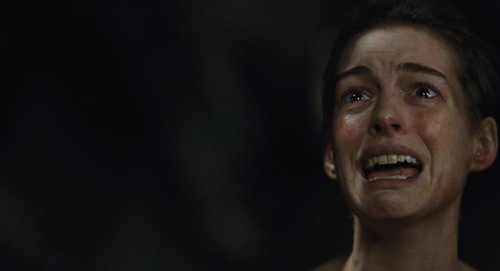
Ugly singing; ugly make-up. Les Misérables is deservedly known as the film that tried too hard to bum us out, and Anne Hathaway is known as the actress who tries too hard to be liked. But isn’t it nice, sometimes, when somebody makes an effort?

Anne Hathaway stars in Les Miserables
Anne Hathaway screams a dream in Les Mis


Tom Hooper’s 2012 film adaptation of Les Misérables is either an exercise in profoundly committed, sincere expressions of raw emotion, or a hammy, emotionally manipulative attempt to win Oscars. In fact, it’s probably both of those things at different times, but it stands out due to Hooper’s unusual choice to record the actors singing live.

Pitchy, breathy, raspy, screamy – all the notes are there as A-list Hollywood actors hurl themselves at the camera, relishing the chance to look and sound as ugly as their quasi-operatic characters feel. The soundtrack is probably not going to go on your iPod.

That said, there’s something amazing about the pitchiness / raspiness / screaminess / ugliness that serves to draw us in. When the cast list was announced, it seemed strange, because many of the actors were not really known as great singers, but the movie isn’t about singing an ear-pleasing song. It’s about letting the actors emote in the moment, having their voices sync up with the other acting choices they make in the scene – the result is something that seems so authentic and raw that it starts to go the other way and seem manipulative again.

The standout number in the film, and the one you would cite, were you trying to convince someone it’s awesome, is, of course, Anne Hathaway sobbing her way through “I Dreamed a Dream.” She won an armful of awards for it, including an Oscar, and deservedly so. There’s something beautiful and unselfconscious about the way she just lets herself go in that scene – a kind of emotional nakedness, where we believe the despair that she’s feeling. We can see that she’s let herself disappear inside the character, and invited us to see her in this dark, vulnerable moment, without any fear that she’s going to look stupid. That’s rare, and it displays a type of courage and skill as a performer that should be rewarded.

It’s also reminiscent of Jennifer Hudson’s standout performance of “And I am Telling You I’m Not Going” in Dreamgirls. That performance similarly made the whole movie, and led to an Oscar win for the woman screaming her pain to the camera.

Jennifer Hudson stars in Dreamgirls
Jennifer Hudson brings down the house in Dreamgirls


Hudson doesn’t go to the ugly place in Dreamgirls. The studio-recorded track sounds beautiful, and the makeup department isn’t trying to make her look diseased. What makes the scene stand out, though, is still the amount of raw emotion she pours into it. A more gifted vocalist than Hathaway, she uses her voice to convey a torrent of rage, despair, and desperation, which she then telegraphs through her body language and facial expressions on screen.

We’re drawn into her performance, and it conveys the most important emotional truth of the scene – that, even though her character’s words sound powerful, they’re being shouted from a place of total loss. She says, “I am telling you,” but there’s no one to tell. She’s lost her partner and her friends — she stands alone on a darkened stage without even the audience she hungered for. And, into the darkness, she orders, “You’re gonna love me, yes you are!”

It’s a powerful moment, and Hathaway’s performance in Les Misérables is like that, with the additional layer that Les Mis is so proud of her suffering.

Whereas Dreamgirls is a pretty standard and standardly-shot movie musical – enlivened by outstanding vocals from Hudson and co-star Beyoncé — Les Misérables  is really reaching for the brass ring. It has a take-no-prisoner’s approach to engaging with the story’s pathos, and an awkward kind of delight in making everyone seem plague-ridden and miserable.

Anne Hathaway stars in Les Miserables
Her bed is a coffin — get it?


Don’t get me wrong – I love Les Misérables. I had low expectations, but I was less than ten minutes in before I felt that special shiver of delight that tells you you’re watching a kick-ass movie. I would much rather watch a film where everyone really goes for it, even if their reach sometimes exceeds their grasp.

At the same time, I completely understand why some people found it annoying.

The annoyance comes in part because you’re watching people who do not live in poverty pat themselves on the back for how poor they’re willing to make themselves look, and how deeply they’re willing to crawl inside the suffering of others. The ugly singing and the ugly makeup can be read as self-congratulatory – “Look how much I’m willing to debase myself for art! I don’t care if I look pretty; I just care if I’m authentic.” After a certain point, it comes across as trying too hard – of actually being inauthentic, since the attempt at authenticity feels so calculated.

It’s the same criticism that’s followed Anne Hathaway, herself. Whereas Jennifer Hudson came across to us as a spirited American Idol reject, who made good on her big dreams of stardom by signing her heart out in Dreamgirls, Anne Hathaway has been criticized for coming across as fake during public appearances. In fact, the backlash against Hathaway reached a fever pitch just as she was accepting her slew of awards for Les Mis.

No doubt, there’s a sharp contrast between the vulnerability she shows in “I Dreamed a Dream,” and the polished, eager-to-please persona she throws on in public. (Though I hasten to add that a lot of celebrities seem self-conscious in managing their public personas; for people who want to be liked, there’s nothing better or worse than having millions of people stare at you).

The general reaction to Les Misérables seems to fall along similar lines. The raw, ugly, emotionally intense performance is either touching because it seems authentic, or it’s disgusting because it seems crass and manipulative. We all agree that the emotions, like the vocals, weren’t cooked and seasoned before they were served, but we don’t agree about whether that’s fresh and exciting, or lazy and self-involved.

Like Anne Hathaway, the movie is trying hard. Like Jennifer Hudson, it’s screaming, “You’re gonna love me,” into the darkness. One cannot dare to be loved without risking rejection, and Les Misérables invites both love and rejection from its audience – but, isn’t it beautiful to see – and to hear – someone try?


Katherine Murray is a Toronto-based writer who yells about movies and TV on her blog.

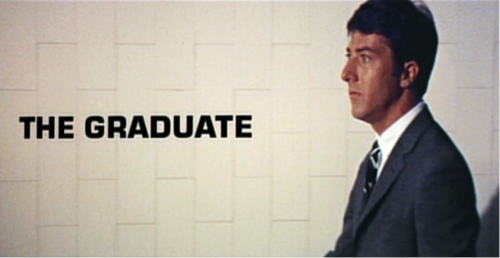
The Sounds of Change and Confusion in ‘The Graduate’

Mike Nichol’s ‘The Graduate’ has one of the most popular soundtracks of all-time. The songs reveal the dynamics of a character, theme, and a moment without the use of dialogue or a backstory, but simply through the lyrics of a Simon and Garfunkel song.

This guest post by Caroline Madden appears as part of our theme week on Movie Soundtracks.

The marriage of two different art forms- the sounds in our ears and the image on screen- can take a scene far beyond what was written on paper. With a well-placed song, a moment in film can be experienced on all levels, staying in our head long after the credits roll. Lyrics to a song can provide an insight into a character’s mind on a deeper level than just dialogue. Mike Nichols’s The Graduate has one of the most popular soundtracks of all time. The songs reveal the dynamics of a character, theme, and a moment without the use of dialogue or a backstory, but simply through the lyrics of a Simon and Garfunkel song.

1

The most renowned song used in the film is “The Sound of Silence,” which acts as the soliloquy of film’s protagonist, Benjamin Braddock. Inspired by the Kennedy assassination, the song became a popular hit associated with the 1960s counterculture and antiwar protests. “The Sound of Silence” holds what is the ongoing and overarching theme of the film–youths rebelling against the middle-class values of their parents’ generation. It also most representative of the inner turmoil Benjamin finds himself on upon graduating college and embarking on his new journey to “the real world.”

The first time the song plays is during the opening scene. The song kicks in after Benjamin’s plane has landed in Los Angeles. The pace of the song follows the speed of Ben’s monotonous progress through the airport. It peaks as he rides an escalator to meet his family and then fades out as the scene dissolves into a close-up shot of Ben at home, sitting unhappily in front of his fish tank, ready for his new life.

2

The next few scenes play out the lyrics we have just heard in the opening.

And in the naked light I saw

Ten thousand people, maybe more

People talking without speaking, people hearing without listening

People writing songs that voices never share

And no one dared disturb the sound of silence.

“Fools,” said I, “You do not know –Silence like a cancer grows.

Hear my words that I might teach you.

Take my arms that I might reach you.”

But my words like silent raindrops fell

and echoed in the wells of silence.

These lyrics echo the graduation party, where Benjamin is surrounded by a stifling crowd of his parents’ friends, all talking and asking him about his future without bothering to hear his answer.  No one listens to his concerns or apprehensions. Benjamin wants to make sense of his world first before worrying about his future, but adults want him to have a plan. In the film’s most famous line, a family friend suggests Benjamin goes plastics.

The older generation wants the younger generation to follow in their footsteps, to conform for the sake of safety and tradition. This is the reasoning for all of Benjamin’s aimlessness and disaffectedness, seeing that his only option seems to be unhappily working in a sterile corporate setting until middle-age. His zombie-like drone in the airport opening reflects the future Benjamin pictures if he follows in his elders’ lead.

“The Sound of Silence” is also featured in a second montage. The song plays right after Benjamin has shut the hotel door to have sex with Mrs. Robinson, his first time. The montage begins with brilliant dissolves and intercuts as Benjamin monotonously (just like the airport opening) goes through the motions of his days at home with his parents over his shoulder and nights alone with Mrs. Robinson. The affair is not the answer he is looking for, though. He still suffers through “the sounds of silence” with no one around to understand or hear him. The song is played again because Benjamin is still as confused as he was at the beginning of the story.

Although “The Sound of Silence” has been told through Benjamin’s point of view, the lyrics can also reflect Mrs. Robinson’s state of being. We learn that she got pregnant before marriage, and that is why she is with Mr. Robinson. Mrs. Robinson was raised in the 30s, 40s, and 50s, and the mindset of that upbringing gave her no other choice. The consequences of her actions were that she had to live her life being with a man she did not want to truly be with.

Not only was she stuck in a marriage she did not want, she also makes it clear throughout the movie that she regrets letting her education go to waste. It is a sore spot for Mrs. Robinson, she goes from “I don’t like art” to “I studied art in college” in a matter of minutes.

“Hear my words that I might teach you.

Take my arms that I might reach you.”

But my words like silent raindrops fell

and echoed in the wells of silence.

Mrs. Robinson must have felt the truth of these words throughout the course of her life. Wanting to express to her parents how she did not love Mr. Robinson and did not want to be with him, how she wanted to continue her education. She was, and is, a woman in an unhappy marriage trying to make herself heard. But gender roles in the 1950s meant women were silenced, only expected to do their duties as a housewife, to serve their homes and husbands’ wills.

Mrs. Robinson’s unhappiness manifests itself within her actions in film. These changes in her actions were due to her increasing unhappiness in her mandated role as a housewife. These new ideals and changes of the 1960s led her to understand that women have just as many rights as men do, negating her ingrained mindset of the 1950s that women are supposed to bow to their superiors (men).

3

“The Sound of Silence” song ends, and “April Come She Will” quickly picks up as Benjamin lays in the hotel bed, cutting to him bored in his room and then leaving for the pool. The song ends with a clever match cut as Benjamin jumps off of a pool raft and into bed with Mrs. Robinson.

“April Come She Will” is a simple and bittersweet song that represents the seasons of Benjamin’s relationship with Mrs. Robinson.

April, comes she will,

When streams are ripe and swelled with rain

May, she will stay,

Resting in my arms again.

These lyrics represent how smitten Benjamin was with Mrs. Robinson at the beginning of their affair. Mrs. Robinson continues to stay, and their affair goes on for some time.

June, she’ll change her tune.

In restless walks she’ll prowl the night.

July, she will fly,

And give no warning to her flight.

However, their relationship is beginning to change after Benjamin being pressured by his parents and Mr. Robinson to go on a date with their daughter, Elaine.

August, die she must.

The autumn winds blow chilly and cold.

September, I’ll remember.

A love once new has now grown old.

Their relationship is coming to an end, and though the affair was exciting and new at first, it cannot go on forever it will soon dissolve.

The third song in the film is “Scarborough Fair,” and is played several times. It first plays as Benjamin is driving to Berkeley to find Elaine, who he is now newly smitten with.

Are you going to Scarborough Fair?

Parsley, sage, rosemary and thyme

Remember me to one who lives there

She once was a true love of mine.

This can be read as representative of his journey, Benjamin is searching for what he believes to be is his love, the answer to all of his uncertainty and meandering and questions of what to do with his life.

Between the salt water and the sea strands

(A soldier cleans and polishes a gun)

Then she’ll be a true love of mine

The war references represent the battle within him, the questions Benjamin is facing with his love life and whether or not he is going to do something about it. He is here in Berkeley to find Elaine and to convince her to be with him.

Are you going to Scarborough Fair?

These lyrics play as the film pans on Elaine, the first time we see her at Berkeley. The lyrics question if Benjamin is going to make the choice fight for what he believes he wants in his life? Is he going to go for it?

4

An early version of the chart-topping hit “Mrs. Robinson” is another highlight of the film’s soundtrack. Originally written about Mrs. Roosevelt, the title and character of the lyrics was changed to fit the film. The song plays several times throughout the film, most notably throughout the chase scenes as Benjamin heads to Elaine’s wedding.

The lyrics do not directly comment on what is happening on screen, but is instead a further reflection on Mrs. Robinson’s character. It is also a song that again reflects the theme of the film, the old generation vs. the new generation, and the ideals of the 50s vs. the changes of the 60s.

Hide it in the hiding place where no one ever goes.

Put it in your pantry with your cupcackes.

It’s a little secret just the Robinson affair.

Most of all you’ve got to hide it from the kids.

The entire older generation of the 60s was desperately trying to maintain an unmaintainable false image that they’ve been trying to hold up for years. Hide it from the kids, they’ll rip off the covers and expose everything that’s wrong with their generation’s ideals, which were forcing you to hide your true self or submit to a forced gender role. Work at a job you hate. Give up your education to get married because you are pregnant.

Where have you gone, Joe DiMaggio?

Our nation turns its lonely eyes to you.

Joe DiMaggio represents the heroes of the past, the traditional American values that were so highly honored in that time. But the ideals the past have given way to the upcoming changes, the defiance of gender roles and roles in society.

The Graduate begins and ends with the same song, “The Sound of Silence.” Elaine and Benjamin’s rebellion against their elders culminates here. Benjamin has stopped Elaine’s wedding and they leave together. They run onto the bus, their smiles and glee slowly turning to lost and forlorn looks as the music starts to play.

5

“The Sound of Silence” also speaks to Elaine’s character. Elaine has surely felt the “sounds of silence” as Benjamin has. She is also struggling with the idea of not wanting to spend her life being dictated and controlled by the ideas of her parent’s generations. Elaine must have felt pressure from her father and mother to marry this man, a perfect man to secure her future. Who needs an education from Berkeley when you can get married? But Elaine is not going to be doomed to repeat her mother’s mistake of being in a loveless marriage. What better way to out rightly and outrageously defy her parents than running away on her wedding day?

Although Benjamin and Elaine have succeeded in doing everything to defy their parents, now they ask “What are we left with?” What do they do now? Are they going to repeat the mistakes of the past and stay together without really loving or knowing each other? Benjamin’s questioning of what to do with his life is no different now than at the beginning of the film. He is just as confused and directionless as ever. The film ends as it began, book-ended with the famous Simon and Garfunkel tune.

The Graduate changed the world when it became one of the first films to reuse popular music for a film, as well as one of the first representations of counterculture youth. It proved that music could be used to comment and highlight themes and characters of a film. The songs impeccably fit with a film that first represented the future changes that would rock the country.


Caroline Madden is a recent graduate with a BFA in Acting from Shenandoah Conservatory. She writes about film at GeekJuiceScreenqueens, and her blog. You can usually find her watching movies or listening to Bruce Springsteen.

The Siren Song of Cartoon Catgirls

As evocative as the scene of the Puma Sisters doing their thing might be, and as culturally-charged a time as the release of ‘Dominion Tank Police’ might have been, much of the success of this scene is owed to the music. “Hey Boy,” by Riko Ejima, is a haunting song that, while seemingly chaste in that it seems to be singing about dancing, captures something deep, deep in the soul.

This guest post by Robert V Aldrich appears as part of our theme week on Movie Soundtracks.

As  young teen, I grew up with the unhealthy belief that female sexuality was a subdued and subtle thing.  This was a misinformed viewpoint that had been fostered predominantly by growing pretty firmly in the mainstream.  Countless songs on the radio, shows I watched on TV, and movies I rented from video stores, all depicted women in the same way: no matter how assertive or aggressive they may be in their day-to-day lives, when it came to anything even remotely sexual, they turned into timid kittens hiding under the bed, fragile things needing to be gently encouraged and carefully wooed, lest they fold up entirely.

Fortunately, I also grew up an anime fan (or an otaku if you really want to be pretentious about it), so this malarkey was dismissed with all the subtlety of a rocket-powered chainsaw when I first watched 1988’s Dominion Tank Police and saw the Puma Sisters distract a SWAT team with an impromptu strip-tease.

[youtube_sc url=”http://youtu.be/mi5GFuvCIp4″]

So, let’s go ahead and get a few things right out of the way.  Yes, they’re fully formed adult women with cat ears.  Unless you’ve never seen anime ever, that really shouldn’t be anything new.  And yes, they’re stripping out of nurses’ uniforms.  Because, again, it’s anime and why wouldn’t they?  Pretty much all they needed was for one of the Puma Sisters to be holding a riding crop and the scene would have hit some kind of bizarre fetish hat trick.

But here’s the thing: as hot as that scene is, what makes it so remarkable and stand out against so much cheesecake in anime (and entertainment in general) isn’t the sexiness, the fetishistic imagery, or even just the animated near-nudity.  What makes this scene stand out is the way it characterizes the Puma Sisters.  They aren’t timid about their bodies or the affect it has on others (re: men).  They are fully aware of that effect.  And they don’t just know it; they know how to use it.  And they not only know how to use it, and do so, they enjoy it gleefully.

This is a paradigm-challenging depiction of women that would go through me like a shot, and one that would be shared among many of the anime fans during this era.  It wasn’t just “cat-girl strip-tease.”  That would have been fun, but immediately forgettable.  What makes this so remarkable was the manner in which the Puma Sisters conducted themselves, commanded the attention of everyone and everything around them, and used their sexuality as a nigh-literal weapon.

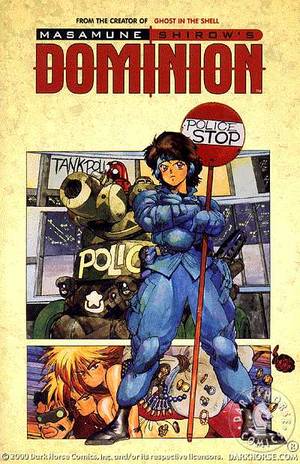
Who could guess a cartoon with a woman in combat armor on the front might not be the usual?


To fully understand the impact of this scene – or just to make sense of its zaniness – one must take a step back and understand the whole show–Dominion Tank Police, by the legendary Masamune Shirow (best known for Appleseed and Ghost in the Shell).  In Dominion Tank Police, Newport City (and presumably the world) live under a dangerous pollution cloud, necessitating people to wear gas masks at all times when outdoors.  Tangentially related, crime has gotten so bad in Newport City that a branch of the police employ tanks in their pursuit of law and order (the titular tank police).  Opposite the tank police is Buaku and his gang of criminal mercenaries, who have been hired to steal valuable chemicals from a research hospital.  The mystery of the chemicals’ nature, use, and origin unfolds across the four installments of the series (a follow-up series titled New Tank Police, released in 1993, follows an unrelated story).

Cat-girls on futuristic motorcycles. And thus the future was born.


Anna and Uni, the Puma Sisters, are Buaku’s primary partners and ostensibly his muscle.  They seem to have little interest in crime aside from it being more entertaining than any of their previous employment (different media portray those previous jobs as everything from stripping to the suggestion that they’re androids built for sexual service).  As a result, they tend not to take their heists very seriously, the police very seriously, or even Buaku very seriously.  This is best demonstrated by the very scene in question where they decide to distract a SWAT team with a striptease simply because the lighting’s really good.

To further understand the significance of this scene, you have to understand when and where it was seen.  Namely, it was seen by teenage nerds in a pre-Internet age.  Nowadays, anybody with a smart phone can find digital images of extreme sexuality, but in 1988, you had to work for it. You had to know what movies to rent from the video store and at what minute-mark to watch up to.  And that was just for live-action stuff.  If you wanted to see a cartoon with anything even passing for erotic, you were almost definitively out of luck (Rule 34 was a long way off).

More than that coming from a pre-Internet age, Dominion Tank Police came out just as the 80s cartoon boom was dying.  Transformers was in its pseudo-fifth season which was just repackaged reruns, while Robotech, She-ra and others had been off the air for a while.  While Dominion Tank Police wasn’t the only anime movie to come out during the Japanimation period, the others were totally different genres and largely devoid of sexuality.  On top of that, it would be another five years or so before the 1990s Anime Invasion would get underway.

This was also a time of cultural upheaval.  The Cold War was ending, with the fall of the Berlin Wall eminent.  There were more channels on TV than there were hours in the day.  “Straight Outta Compton” was redefining music, while “Smells Like a Teen Spirit” had yet to deflate the bloat of rock which dominated the airwaves.  There was magic in the air in those days.  So much change was happening all around us.  And so to go to Blockbuster and see on the new releases shelf a section labeled Japanimation, and to see cartoons unlike anything any of us had ever seen?  It was a transformative experience, to put it mildly.

A once-in-a-lifetime scene that would change a thousand lives for a lifetime


As evocative as the scene of the Puma Sisters doing their thing might be, and as culturally-charged a time as the release of Dominion Tank Police might have been, much of the success of this scene is owed to the music.  “Hey Boy,” by Riko Ejima, is a haunting song that, while seemingly chaste in that it seems to be singing about dancing, captures something deep, deep in the soul.  Reading the words won’t do the lyrics justice, but they are:

“Hey, let’s dance, to the hot beat

Hey, hey boy

The heated heart, feel it

And look at me

Hey, let’s dance, don’t be so shy

Hey, hey boy

Don’t be so hesitant,

Let’s dance

This dressed-up town…

This running music…

Hey boy

Nothing intricate…

There aren’t any rules tonight.”

We’ve all heard songs about sex.  Some use love as a metaphor for sex, while others use dancing.  And some are straight-up explicit.  But what they all generally have in common is that most are sung by men.  In the rare instance that a song about sex is sung by a woman, it’s almost always passive.  This trend has thankfully started to change recently, but it is a new phenomenon, less than twenty years old.  In the preceding eight decades or so of broadcast music, women have never been depicted as sexually inclined, adventurous, and certainly not aggressive.

Underground music notwithstanding, the music that’s seen radio play (and thus what most people would have access to in a pre-Internet world) has almost always been passive.  Berlin’s “Take My Breath Away” puts the onus upon the partner.  ABBA’s “Voulez-Vous” sings about enticing a partner to buy the drinks.  Janis Joplin sang about wanting to convince the man in “Take Another Piece Of My Heart.”  Even Madonna, who almost invented the modern version of the “sexually-aggressive-woman-in-music” image, had songs like “Papa Don’t Preach” and “Like A Virgin” to her name at this point.  She sang songs about sex, absolutely.  And that was groundbreaking, no argument, but they still took a passive role.

“Hey Boy” is totally different.  “Look at me.” “Don’t be so hesitant.” “There aren’t any rules tonight.” All of this sung with a sultry voice over a shifting tempo.  For an entire generation of anime fan, this was the very first time we’d ever heard a woman sing not that she hoped we would do something for her, not that we could do something together, but that she was going to take us by the hand and teach us something about ourselves.

That sexual aggression, combined with the cultural blindsiding that took place by seeing sexually charged cartoons, would burn this scene – and its song – into so many minds.  That haunting score invokes a magical time in our lives when animation became more than just cartoons, when women could take the lead, and when life in the world started to get real interesting.


Robert V Aldrich is a writer and geek chic commentator.  When not writing at various websites and periodicals, he writes serials and other stuff for his own website, TeachTheSky.com.  He has a new novel out, Rhest for the Wicked, that he’d reeeeally love for you to check out.


Running Away With ‘The Runaways’: Sex, Rock ‘n Roll, and the Female Experience

The music throughout the film deals with the lost and rebellious feelings during coming of age for young women. The movie tells the story of these two individuals and how their lives were affected by fame, but underneath that is the coming of age experience for young girls realizing their power and sexuality within a culture that seeks to suppress them.

The Runaways movie poster


This guest post by Angelina Rodriguez appears as part of our theme week on Movie Soundtracks.

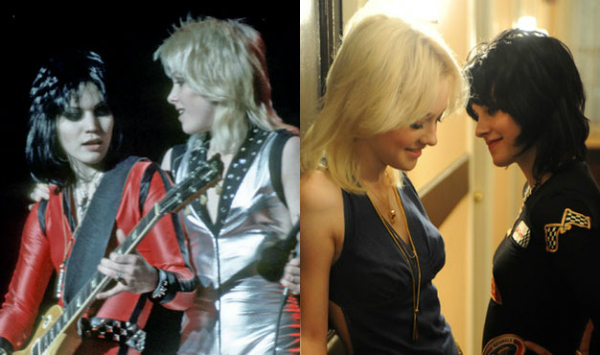
The Runaways, based on Cherie Currie’s autobiography Neon Angel: The Memoir of a Runaway, starring Dakota Fanning and Kristen Stewart, takes us on an adventure through the early lives of rock legends Joan Jett and Cherie Currie.

The actors bring the characters to life right down to their mannerisms.
The actors bring the characters to life, right down to their mannerisms.


The actresses go as far as pretending to be left handed when they are both right handed, playing and performing the songs themselves. These women really gave lively and compelling performances. The Runaways encapsulates life for women during the 1970s. It addresses the overt sexism that the all-girl-rock-band experiences, and the loud rock and roll statement they made by harnessing their sexuality and their aggression. These two tough, street smart kids from broken homes helped to pave the path for female rockers of our time. This film does justice to the music the band made in the best way– with an incredible soundtrack.

The film opens with the young Cherie Currie dripping menstrual blood on the sidewalk to the musical stylings of their idol, Suzi Quatro, with “Wild One.” This sets the tone for the film. She is going to be unapologetic, in your face, and confessional about being a girl. Later, the song “Cherry Bomb,” The Runaways’ most famous hit, talks about Cherie’s blossoming sexuality. Women are often sexualized in the media and within their day-to-day lives, but women actually choosing to be sexual and to enjoy their sexuality is a relatively new and radical notion. The song encourages young women to tap into their own power, angst, and sexuality, regardless of what authority figures have to say about it.

“Hello Daddy, hello Mom
I’m your ch ch ch ch ch cherry bomb
Hello world I’m your wild girl
I’m your ch ch ch ch ch cherry bomb”

The introduction scenes for each character parallel in an interesting way. We get to know our Cherie as she lip syncs “Lady Grinning Soul.”

Badass. Just sayin.
Badass. Just sayin’.


She mimics the movements of this androgynous, iconic male star with precision. She is essentially in drag during this scene. Then we see something similar, as the young Joan Jett lurks around a leather store until she finally buys a jacket. “I want what he’s wearing,” she says and dons what would later become her signature look.

Joan Jett is just not Joan Jett without that leather jacket.


The characters are shown, subverting the gender norms in a very obvious way in the start of the film. They are rebels who simply don’t want to play by the rules of their time. “My brother says guys like girls who are soft and flirty,” Joan’s friend explains to her. “That’s because he’s a pussy.” This statement, although the word “pussy” itself is far less than progressive, explains that Joan feels that men that don’t support female empowerment are simply intimidated. “I Wanna Be Where the Boys Are” is the musical embodiment of this feeling. Both of these girls are desperate for the liberty to express their aggression, their rebellion, and their sexuality like their male peers. There are several songs on the soundtrack that deal with gender, among them “Rebel Rebel” by David Bowie and “It’s A Man’s Man’s World” by MC5.

It’s kinda weird how infatuated fans are about two 15-year-olds kissing.


During the infamous roller rink kissing scene between Joan and Cherie, the mood is set by one of the sexiest songs on the soundtrack; “I Wanna Be Your Dog” performed by The Stooges is heavy with mood and has the kind of bass line you can feel below the belt. Although this scene was likely added for shock value, it’s empowering to see our characters expressing their sexuality in nontraditional, non-monogamos ways. The characters kiss boys and girls, without any need to really speculate on what that means or what their “true identities” are. Seeing the girls behaving outside the confines of labels and societal expectations is liberating. A lot of the other songs seek to sexually empower women, such as “You Drive Me Wild,” “Queens of Noise,” and “Cherry Bomb.”

However, the result of these young stars and their early rock ‘n’ roll careers was a somewhat downward spiral involving drug use and several underplayed abuses. The rock ‘n’ roll engineer, Kim Fowley (played by Michael Shannon), essentially created the band from thin air.

“That Frankenstein looking motherfucker did it.”
“That Frankenstein-looking motherfucker did it.”


There’s an almost meta dynamic inside the film as we observe one of the most important all-girl rock bands being brought together and greatly influenced by a man. His gaze and his expectations directed the music, the dress, and the attitudes of the band. Of course, some of this came naturally. As Cherie explains in one interview,“We didn’t have to push the envelope, we just had to show up and be ourselves.” The film touches on this when Fowley makes Cherie pose for a scandalous photo shoot even though she doesn’t want to, and gains more media attention than the rest of the band.

As the film ends we are shown the beginning of Joan Jett’s extremely successful solo career with her songs, “I Love Rock n Roll,”“Bad Reputation,” and “Crimson and Clover.” The music throughout the film deals with the lost and rebellious feelings during coming of age for young women. The movie tells the story of these two individuals and how their lives were affected by fame, but underneath that is the coming of age experience for young girls realizing their power and sexuality within a culture that seeks to suppress them. This is close to the hearts of many viewers because we have so much progress to make in the world of arts and entertainment for women. As Joan Jett states in an interview for NYDailyNews, “I don’t think much has changed, to tell you the truth. The media says that equality for women has arrived, but if you look around, you still don’t see girls playing guitars and having success with it.”


Angelina Rodriguez grew up in West Virginia. She will be attending Antioch College in Yellow Springs, Ohio this fall. She spends her time making art and interning with Literacy Volunteers of Harrison County. 


Creating the Mythology of Beatrix Kiddo Through Music

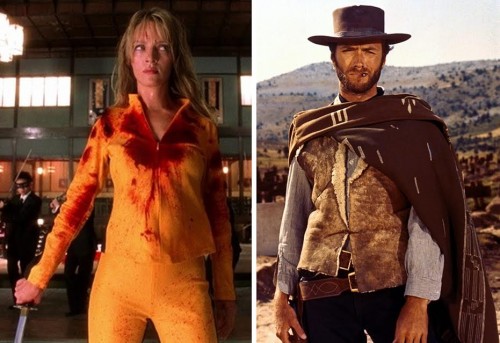
Tarantino’s vast knowledge of music is clear from the very beginning with ‘Reservoir Dogs.’ However, it isn’t until the ‘Kill Bill’ series when his soundtracks begin to drift away from pop and instead embrace more orchestral sounds like that of Ennio Morricone. Viewers need no knowledge of the genre to instantly recognize that spaghetti western feel. It’s that famous mix of Spanish guitar, orchestra, whistles, cracking whips, trumpet, flute and sometimes chorus that recalls images of Clint Eastwood clad in a green poncho and cowboy hat as the iconic Man with No Name.

The Bride/Beatrix Kiddo (Uma Thurman) in Kill Bill Vol. 1 and The Man with No Name (Clint Eastwood) in The Good, The Bad, and The Ugly


This guest post by Rhianna Shaheen appears as part of our theme week on Movie Soundtracks. 

I was obsessed with Kill Bill  in high school. While other kids from school went to see John Tucker Must Die (not that there’s anything wrong with that) I stayed home jamming out to the “Malagueña Salerosa” from the Vol. 2 soundtrack.  I legitimately thought I was Beatrix Kiddo.

Music is a hugely important aspect of Tarantino’s directorial style. In interviews, he often describes his creative process, which largely consists of writing scenes with a specific song in mind. It is how he defines the mood and rhythm of a film. He makes a song feel so organic to a scene that we forget its original source. I honestly can’t hear Nancy Sinatra’s “Bang Bang (My Baby Shot Me Down)” without associating it with Kill Bill.

Tarantino’s vast knowledge of music is clear from the very beginning with Reservoir Dogs. However, it isn’t until the Kill Bill series when his soundtracks begin to drift away from pop and instead embrace more orchestral sounds like that of Ennio Morricone. Viewers need no knowledge of the genre to instantly recognize that spaghetti western feel. It’s that famous mix of Spanish guitar, orchestra, whistles, cracking whips, trumpet, flute and sometimes chorus that recalls images of Clint Eastwood clad in a green poncho and cowboy hat as the iconic Man with No Name.

Tarantino enjoys honoring his film inspirations and obsessions by making countless references to them. However, his use of spaghetti western music is much more deliberate and masterful than just calling attention to older work. Through music he creates a mythology surrounding his heroine.

Bill: “I find the whole mythology surrounding superheroes fascinating. Take my favorite superhero, Superman. […] The mythology is not only great, it’s unique. […] Superman didn’t become Superman. Superman was born Superman. When Superman wakes up in the morning, he’s Superman. His alter ego is Clark Kent. His outfit with the big red “S”, that’s the blanket he was wrapped in as a baby when the Kents found him. Those are his clothes. What Kent wears – the glasses, the business suit – that’s the costume. Sorta like Beatrix Kiddo and Mrs. Tommy Plympton. […] You would’ve worn the costume of Arlene Plympton. But you were born Beatrix Kiddo. And every morning when you woke up, you’d still be Beatrix Kiddo.” (Kill Bill Vol. 2)

In the above quote, Bill argues that Kiddo is a “natural born killer,” making her no better than the clean slate she strives to achieve for herself and her daughter.  Whether or not she indeed fits the anti-hero role in this story is arguable. Yes, the means to her ends are violent and ruthless, but the film does not exactly take place in the real world. It’s an ultra-violent world of revenge and vengeance where Beatrix Kiddo is the hero. She could have fled her assassins after waking from that coma but instead she decides to go on a “roaring rampage of revenge” for the sake of her daughter.

In Vol. 2, music becomes the climactic expression of Beatrix Kiddo’s heroism.

Where Vol. 1 is driven by action-packed fight scenes, Vol. 2 is driven by emotion and reflection. Through music the film delves much deeper into the transformation of Beatrix Kiddo from passive victim to active avenger. For me, this is really what makes it the stronger half of the story.

During her quest, Beatrix tracks down Bud, Bill’s brother and former assassin. She arrives at his trailer ready to ambush him when he thwarts her attack and shoots her in the chest with rock salt. He was expecting her all along. As an act of his own revenge, Bud seals her in a coffin and buries her alive for “breaking [his] brother’s heart.” This seems to be the end of the road for Beatrix Kiddo.

unnamed

After a flashback to her master’s training, we return to her present state six feet underground. She lays there in complete darkness awaiting her Texas funeral when Ennio Morricone’s “L’arena” chimes in. The track was originally used in a duel scene from Il Mercenario (1968).  Here it is repurposed to a similar effect. As the music swells and Beatrix slams her fist into that pine wooden box the scene becomes a showdown of epic proportions. The guitar and snare drum charge on and we think she has a chance. This song exemplifies Morricone’s “heroic style” that carries our character through the action. This scene is not action-packed with a ton of kung fu moves but the music makes this scene just as gripping if not more. It encourages us to spur on our heroine.

unnamed-1

The Burial scene is a defining moment for our character in which we as audience witness her willpower and perseverance even on the verge of death.

After her escape, there is a short sequence of The Bride, worn and sand-ridden as she treks across the vast desert. She has come a long way on her journey. While this bit is not necessary to our understanding of the plot it is stylistically significant to our understanding of the character. A sun flare introduces the track “Sunny Road to Salina” from La route de Salina (1970) as a blurry haze of Beatrix emerges. The music is epic and grand, telling us that nothing will stand in her way in the final stages of her quest. This use of this soundtrack and this shot mirrors a similar long walking scene in The Good, The Bad, and The Ugly (1966) in which the Man With No Name is dragged and tortured across the desert by his adversary. Similarly, this is seen in the final scene of A Fistful of Dollars (1964) as the Man with no Name returns to confront the bad guys in the final battle.

Beatrix makes her heroic return in Kill Bill Vol. 2


The Man With No Name returns in A Fistful of Dollars


Throughout the film Tarantino makes inter-textual references to Dollars trilogy, often comparing Beatrix Kiddo with the Man With No Name. Clint Eastwood’s iconic character is the stoic good guy with a strict but unorthodox sense of justice, a trope that has been repeated countless times since. These musical references not only make The Bride’s action sound absolutely badass but they also elevate her story to an equally heroic status as that of the Man With No Name. This is not to say that her story relies on his validation. That’s certainly not the case. I would argue that she is superior. While the Man With No Name is a mysterious trope Kiddo is much more three-dimensional. She has something worth fighting for. These musical choices only reinforce the mythology that Beatrix Kiddo’s story enters.

In the film’s final confrontation Beatrix must cut herself away from Bill for good. After giving each other their last words, they fight while their daughter sleeps. To Bill’s surprise, Beatrix uses the Five Point Palm Exploding Heart Technique, resulting in his fated death. Morricone’s “The Demise of Barbara and the Return of Joe” from Navajo Joe (1966) enters as an emotion outpour from The Bride.

unnamed

unnamed

Although Beatrix’s intense resentment for Bill drives the series what it has all built up to is in fact bittersweet. This is not an act of hate. Beatrix does this as an act of love for her daughter who should never have to live in a world of bloodshed and deceit. This moment is the ultimate catharsis for Beatrix Kiddo. As Bill walks to his death the song’s vocal rings like a heartbreaking cry, perhaps it is that of The Bride. Her journey has come full circle.


Rhianna Shaheen is a student filmmaker and artist with hopes of writing more in the future. She recently graduated from Bryn Mawr College with a BA in Fine Arts and Minor in Film Studies and Art History. She currently spends most of her time on an epic quest for a full-time job. Check her out on twitter!


Take Away This Lonely Man: ‘(500) Days of Summer’ and Musical Storytelling

We hear the song one more time in a moment that mimics the first, after Tom’s illusion is shattered. Instead of listing what he loves about Summer, Tom lists the things he hates about her, concluding with “It’s Like The Wind,” and yelling, “I hate this song!” The romantic illusions are finally cracked. This isn’t the movie he thought this was.

500-days-of-summer-3-528x296

This guest post by Victoria Edel appears as part of our theme week on Movie Soundtracks. 

“This is a story of boy meets girl.”

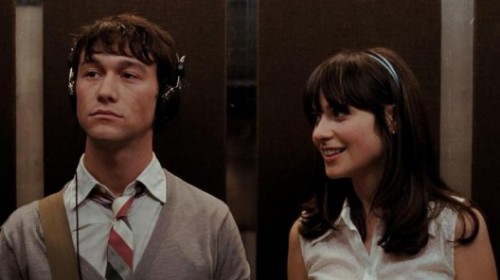
It’s the first line of (500) Days of Summer and also the first line spoken on the soundtrack. Both, then, begin with a summation of our two characters. There’s Tom (Joseph Gordon-Levitt), the hopeless romantic who doesn’t understand the point of The Graduate, and Summer (Zooey Deschanel), who doesn’t believe in love. By beginning the soundtrack with this summary of the movie’s central conflict, (500) Days of Summer posits that the soundtrack is just as much of a storytelling tool as the movie is.

And it is.

(500) Days of Summer is a profoundly misunderstood film. I’ve spoken to many people who claimed Summer was the villain, or, perhaps even worse, just a Manic Pixie Dream Girl. Even Joseph Gordon-Levitt has had to explain that Tom is selfish, not a romantic role model, as some misguided people have interpreted him.

500_1L

Like the narrator says during Track 1, this is a story of boy meets girl, but this is not a love story. Instead, it’s a story about obsession, about idealizing other people, and about having the strength to rebuild after your worldview is shattered. Its message would be impossible without the soundtrack, which places us in Tom’s obsessive mind, music conveying the depth of his feeling. And then, it helps us understand his recovery.

The movie lulls us in with the sweet sounds of Regina Spektor’s “Us,” a song about a monumental love. Accompanied by photos and videos of Tom and Summer growing up, it’s dreamy and romantic, just like Tom when he meets Summer.

A quick plot summary to refresh your memory: Tom meets Summer. Tom wants to date Summer. Summer explicitly does not want a relationship. Tom and Summer embark on something more than friendship, but less than a relationship. Tom thinks he loves Summer. Tom insists that this is, in fact, a relationship. Summer calls the whole thing off. Tom is angry, until he realizes he was wrong.

500DoSBench

Music is essential to the audience’s understanding of Tom’s feelings for Summer. The duo originally bond over their mutual love of The Smiths. Cue “There Is A Light That Never Goes Out”: “And if a ten-ton truck killed the both of us / to die by your side / well the pleasure and the privilege is mine.” That’s an intense feeling to have about anyone, let alone someone you just met. The song is about longing, about abandoning everything you have to.

The movie only works because while Tom is in the over-the-moon, in love stage, the audience is brought there with him. And the music is essential to creating this loving feeling. As they spend time together, we hear Carla Bruni’s “Quelqu’un M’a Dit,” so breathy and romantic and French, and “Sweet Disposition” by Temper Trap, excited and airy.

500-500-days-of-summer-actor-alone-broken-days-Favim.com-77420

Then, after Tom and Summer finally have sex, he leaves his apartment and participates in an impromptu dance number to Hall & Oates’s “You Make My Dreams Come True,” complete with friendly strangers who join in and some animated birds. But this isn’t Tom celebrating getting laid. The lyrics give us his feelings: “You make my dreams come true.” Summer, he’s decided, is the culmination of the girl he’s always dreamed of, the true love he’s always wanted. With just music and dance, (500) Days of Summer tells us everything we need to know about Tom’s quick, rash, all-encompassing feelings.

When he describes how Summer makes him feel, he says every time he thinks of her he hears “She’s Like The Wind,” in his head. The Patrick Swayze song was recorded for Dirty Dancing, and used when Baby and Johnny part ways for what they think is forever. It’s a sad song to remember when you think of someone you love, but it does inform the way Tom sees his story. It’s romantic and dramatic, as classic as Baby and Johnny’s.

Until it’s not.

500_Days_Summer4

We hear the song one more time in a moment that mimics the first, after Tom’s illusion is shattered. Instead of listing what he loves about Summer, Tom lists the things he hates about her, concluding with “It’s Like The Wind,” and yelling, “I hate this song!” The romantic illusions are finally cracked. This isn’t the movie he thought this was.

Thankfully, things are brighter by the end. Tom realizes that he tried to use Summer to mask his unhappiness, instead of changing his life. He finally dedicates himself to architecture ­— his original love — and we experience it in montage, accompanied by Wolfmother’s “Vagabond.” The lyrics: “Take away this lonely man. /  Soon he will be gone.” The song is loud and sprawling and rhythmic, in sharp contrast to the romantic, soft songs from earlier in the film. Tom’s finally started to change.

expectations-reality-500-days-of-summer

This isn’t to say that Tom at the movie’s end doesn’t love the Smiths or believe in love; in fact, quite the opposite. Instead, he’s realized what a horrible thing it is to idealize another person, to project your hopes and dreams onto them without getting to know them. If we don’t know much about Summer by the film’s end, it’s because Tom didn’t learn that much about her either. He saw her as much as he wanted to, ignoring everything that didn’t fit into the picture.

And in the end he learns from his mistakes.

This is not a love story. It’s better than that.


Victoria Edel lives in Brooklyn, NY, but not the trendy part. The sitcoms is her one true love, so she’s currently watching every episode of  30 Rock and blogging about it here. Follow her on Twitter @victoriaedel.


The Layered Danish Pastry Called ‘Borgen’

A subtitled Danish drama about Danish coalition politics sounds rather elitist (if not absurdly boring) and one that, at best, would appeal to a niche audience. However headlines such as “Stop what you are doing and go watch ‘Borgen,’” “Why Danish Political drama ‘Borgen’ is Everything” and “Why the World fell for ‘Borgen’” from sources ranging from ‘The Telegraph’ to the ‘Buzzfeed’ may make you reconsider that initial assumption.

1


This is a guest post by Nandini Rathi.

A subtitled Danish drama about Danish coalition politics sounds rather elitist (if not absurdly boring) and one that, at best, would appeal to a niche audience. However headlines such as “Stop what you are doing and go watch Borgen,” “Why Danish Political drama Borgen is Everything” and “Why the World fell for Borgen” from sources ranging from The Telegraph to the Buzzfeed may make you reconsider that initial assumption. Borgen, a one-hour series about a charismatic politician coming to power as the first woman Prime Minister of Denmark, defies expectations. Now internationally famous, the series has earned precious acclaim from critics and fans alike for its riveting machiavellian politics and strong female characters. The plot skillfully weaves together a fictionalized battlefield of parliamentary politics and journalistic media, without neglecting the exploration of its impact in the characters’ personal lives. Borgen anticipated a number of events — most notably, the election of Denmark’s actual first female Prime Minister (Helle Thorning-Schmidt), which occurred while the show was in its second season.

Borgen cast
Borgen cast


Borgen is better for a brilliant group of actors cast well for its complex characters. The main character is Birgitte Nyborg (played by Sidse Babett Knudsen), a first-rate politician in her early 40s and the leader of the Moderates, who is unexpectedly elected the Prime Minister.  In a parallel story, we meet the 29-year-old Katrine Fonsmark (Birgitte Hjort Sorensen) who is a gifted political journalist dedicated to her work. In addition to featuring strong and compelling female characters, the series dramatizes some of the more universal debates in progress about gender and leadership, for instance, how women are evaluated in roles such as heads of state which have long been men’s exclusive domains.

For an international audience, Borgen’s political drama is edgy and exotic. Produced in the land of relative gender-egalitarianism and environmental consciousness, Borgen’s international charm lies in its progressive difference; it weaves together the qualities of a successful show (a unique, clever plotline and talented actors) with the best of Scandinavian achievements, that is, progressive social and environmental norms.

When it comes to the classic, age-old, question of whether a woman can have both a family and a top-notch career or in other words, can she “have it all,” Borgen offers no easy solutions. Without denying the question’s specific application to women, it also forces the viewer to consider if anyone (in Nyborg’s position – even a man) balancing private life with difficult public responsibilities can have everything. As Vicky Frost states in her article for The Guardian, Borgen’s strength lies in resisting an oversimplification of questions of gender and feminism and addressing them without making them the apparent focus of the show.

Nyborg and family
Nyborg and family


Borgen dramatizes the tension between the private and public lives of highly successful individuals, especially that of active, busy politicians. From the very outset, Birgitte Nyborg’s family and colleagues acknowledge her as extremely smart and charismatic, and initially, as a Moderate not expecting much from the parliamentary elections, her political idealism and time for family are well-preserved. In that vein, without expectations and hesitations, she gives an honest, impassioned speech about the difference between being a politician skilled at power play and doing what’s best for the people. The speech is followed by unexpected events that put Nyborg in the position to lead the government. Once she becomes the PM, she is slowly forced to make many compromises with her ideals and sacrifice her family-time in order to continue being in power.

Nyborg’s family life is a fascinating commentary on the social place and perception of working mothers. In a remarkable scene from the first episode, Birgitte’s husband,  Phillip, recounts to her that while watching her debate on TV, their little son had asked him if he would grow up to be as smart as his mother. Initially, what is described by Janet Manley on The Frisky as “the most feminist marriage on TV,” drastically changes in course of the season. Phillip, who is initially highly supportive of Birgitte becoming the PM and tackles the lion’s share of child rearing and housework, eventually begins to feel neglected and emasculated as Birgitte becomes increasingly unavailable (emotionally and sexually) and his own job becomes less satisfying. At multiple occasions, Borgen draws the attention of the viewer to the fact that even in societies with greater gender equity like Denmark, neglect of family life by a busy wife is likely to be unpalatable to her husband even though the reverse expectation has long been made from wives.

Phillip encourages Birgitte when she is unsure if she wants to be the PM


Birgitte and Philip later in the show


Borgen begins with painting an almost-fantasy: a truly gender-equal society where men and women share childcare, women hold the same positions of power in politics and media as men, and everyone achieves the enviable work-life balance. However as the narrative progresses, it becomes clear that in a fundamentally patriarchal society, such feminist fantasies are not truly tenable. However, in spite of hardships, it is heartening to watch smart, driven and flawed characters like Birgitte and Katrine climb the ladder of professional excellence and not get personally punished for being ambitious.

Borgen’s Reception

As an instant watercooler hit in the UK and within the limited, cult following of the US, Borgen has been a darling of critics and fans alike. It has spurred all kinds of debate about progressive gender politics due to its portrayal of nuanced female characters that don’t appear too often on the American TV landscape. Birgitte Nyborg is not super-skinny, but a voluptuous woman in her forties. In Episode 3 of the first season, Katrine Fonsmark’s conflict about aborting or keeping the child from her affair with a married, dead man and her final decision to abort is dramatized with equanimity. Abortion as an issue is not a source of moral ambiguity in Borgen. Katrine gets an ultrasound to confirm her pregnancy and hides it from her employer, because she’s conflicted about being pregnant, and not because she’s worried that she will be fired. Moreover, her mother, who is a practicing Catholic, advises Katrine to avoid keeping the child for the wrong reasons — in grief of the child’s dead father. Katrine is surprised and asks her mother what God would say to that, to which her mother simply responds that God has nothing to do with this.  Hope Perlman from Psychology Today, is most impressed that Katrine in Denmark “can get an abortion safely, legally, and with excellent anesthesia, apparently, in a clean and well-run health facility, on national television.”

For Perlman, the calm portrayal of Katrine’s positive experience in Borgen is a sign that Denmark is well ahead of the US, not only in terms of abortion and birth control, but also in equal pay, paid family leave and quality childcare. Nuanced discussions on the subject of abortion are still a rare event on network television shows in the US (Friday Night Lights and Grey’s Anatomy are two notable exceptions), according to Sarah, a columnist for Abortion Gang. Even on Girls, the HBO show, a legal and safe abortion almost (but not quite) took place.

Politically speaking

The aesthetic of Borgen’s sets is spare, and the color palette favors faded tones. It manifests the relatively discreet and toned-down facet of Danish politics as portrayed in Borgen. Birgitte Nyborg is attended with none of the ceremony of the U.S. President. She lives in a comfortable, yet modest family house in Copenhagen, frequently bicycles to work, takes a taxi to the Parliament on the election night and travels on diplomatic missions abroad with just a few aides. The media industry as portrayed in Borgen is similarly stripped down. The interviews often take place around a simple metal table and the news presentation is quite straightforward.

1

1

Even watching a drama about the multi-party coalition politics of the Danish Parliament is a breath of fresh air compared to the limitations of a two-party model of the US. In this regard, Borgen has even been commented upon by political scientists. Writing for the Washington Post, U. Connecticut political scientist Stephen Dyson states that “Borgen … is a revitalizing antidote to the ennui of a stymied President Obama and the frustrations of our polarized gridlock politics.” The Danish political system usually produces coalition governments and the TV series reflects this by focusing on the struggle between the “Labor” and the “Liberal” (i.e. like the UK Conservatives) which usually need the support of one or more of the “Moderates,” Greens or smaller parties further to the left or right. For many American audiences, watching this level of collaboration and compromise between the so-called enemy factions and simply having a Green party is an impressive feat in itself. Speaking more generally, Borgen manages to humanize politicians. It is remarkable to watch Nyborg’s earnest and unconflicted apology to the leader of the Right Wing, for unwittingly reminding him of his daughter’s tragic death in the middle of their heated battle over immigration policy.

Critics and “Quality TV”

Many American and British critics have praised Borgen and other Nordic shows for their fearlessness in showing the darker side of characters, unlike American network shows which usually avoid experimenting with the general likeability of their main characters. Borgen can be compared to HBO shows which can afford to experiment with genre-mixing and “edgier” programming due to their independence from commercials and the subsequent concern for show ratings. On one hand, HBO markets itself as an exclusive club for the “risk-loving,” lucrative demographics using the leverage of “original programming” which is more likely to challenge social taboos (compared to its network counterpart). On the other hand, in Denmark (and Scandinavia), shows with themes like in Borgen are featured on national, publicly funded television which is the virtual equivalent of network TV in America in its accessibility to all.

Another thing that makes Borgen a quality drama in the US is its uber-limited legal availability. One may have to spend up to $50 to gain access to one season of Borgen on DVD. Within Denmark, Borgen is probably liked as a successful political drama, comparable to the likes of shows like The West Wing in the US. However, internationally, the show acquires an especially progressive tone due to the surprisingly huge differences between social realities (for e.g. in prevailing gender equity) of two Western, developed nations. The issues that are mobilized with nuance on the national TV of a country therefore tend to be indicative of what is normative within that society.

In its content, Borgen can be seen as a superior example of collaborative, global television. Borgen’s creator, Adam Price, was inspired by his favorite show, The West Wing, as he worked on creating a political drama of his own. In her interviews with Borgen’s writers, Eva Redvall, a Media and Communications scholar at University of Copenhagen, found that the writers took inspiration from many successful shows in the international domain, rather than any Danish or European series. This focus on international series is a sign of how the writers are inspired by quality product from abroad and bring aspects of their favorite series into the national domain.

What is branded as edgy within one society can be devoid of such connotations in other places. The critical consumption of International shows like Borgen therefore reveals the shifting and relative gauge of quality in “Quality TV.”


Nandini Rathi is a recent graduate from Whitman College (Walla Walla, Washington) in Film & Media Studies and Politics. She loves traveling, pop culture, photography and adventures. She wants to be immersed in filmmaking, journalism, writing and nonprofit work to ultimately be able to contribute her bit toward making the world a better place. 

Seed & Spark: Inviting Global Celebration of Films #DirectedbyWomen

We are living in an age where there is an explosion of films #DirectedbyWomen. That’s cause for celebration, but an enormous number of women filmmakers are working below the radar or on the fringes of awareness in the global film community. The result? Many film lovers are being left in the dark. They’re missing out on a rich vein of film treasures. Let’s draw films #DirectedbyWomen up into the light, so we can explore and appreciate them. Let’s help the world fall madly in love with and wildly celebrate women filmmakers and their films.

invite 3 option2

This is a guest post by Barbara Ann O’Leary.

We are living in an age where there is an explosion of films #DirectedbyWomen. That’s cause for celebration, but an enormous number of women filmmakers are working below the radar or on the fringes of awareness in the global film community. The result?  Many film lovers are being left in the dark.  They’re missing out on a rich vein of film treasures.  Let’s draw films #DirectedbyWomen up into the light, so we can explore and appreciate them. Let’s help the world fall madly in love with and wildly celebrate women filmmakers and their films.

Go ahead… fall in love!  No need to wait. Any moment is a perfect moment to relish films #DirectedbyWomen, but we want to concentrate that love by bringing the global film community together for a powerful 15-day worldwide film viewing party next year: September 1-15, 2015.  During this intense and exuberant celebration, film lovers will gather together in their communities around the world for film screenings, guest filmmaker visits and other celebrations, focusing attention on and offering appreciation for women filmmakers and their work.

We want to be sure to give everyone plenty of time to plan, so we’re launching this initiative with over a year to prepare. Film lovers/makers – women and men – everywhere are invited to create #DirectedbyWomen film viewing parties in every corner of the world.

There’s so much beautiful work unfolding and so much more ready and eager to burst forth. Let’s embrace films ‪#‎DirectedbyWomen with open arms. Let’s stand ready to receive them. Let’s say YES to the films women are creating. Let’s say “I WANT TO SEE FILMS #DIRECTEDBYWOMEN!” Let’s bring the films into our lives… into our communities… proactively. Let’s watch the films with attention and appreciation. Let’s share our responses to these films with the makers and with each other passionately. Let’s say “THANK YOU!” to the makers. Let’s say, “MORE please!” Let’s open greater opportunities for women filmmakers to create and share their work through the power of celebration and appreciation. Let’s step up to repeat this process.

FOR VIMEO banner 3 option4

I think it’s time for a worldwide film viewing party.  I’m sending out this invitation to you and to every film lover on the planet. Everyone’s invited to co-create a global celebration next year. The only thing required in order for us each to gather with friends next year in September to watch films ‪#‎DirectedbyWomen is our intention to do so, BUT if we want to be able to create a celebration that raises awareness about women filmmakers and their work on a global scale, we need resources to reach as many people as possible, extend invitations, brainstorm event celebration ideas, share information about films #DirectedbyWomen and how to arrange screening rights, coordinate event and venue information, create podcasts, generate Wayfinder Tributes to honor the individuals and groups who pour their energy into supporting women filmmakers, and other actions that will help the celebration flourish everywhere.

We’re thrilled to be offering our crowdfunding campaign on Seed & Spark. Their invitation to include this project on their Independent Film Championing platform signals that major perceptual shifts within the film community are happening now and will continue to unfold rapidly as more filmmakers and film lovers stop up to embrace films #DirectedbyWomen.  Seed & Spark’s innovative approach to crowdfunding, which includes opportunities for supporters to back financially or to provide in kind contributions, makes it a tremendous place to build community and come together to bring this global celebration into being.

It’s exciting to be part of this adventure into deep appreciation and wild celebration of films #DirectedbyWomen. Let’s celebrate!


BA-shades

Barbara Ann O’Leary, Indiana University Cinema’s Outreach Specialist, loves to help people engage authentically. Recent projects include: #DirectedbyWomen, a worldwide film viewing part; Every Everything: The Music, Life & Times of Grant Hart (Executive Producer); Indy Film Festival (World Cinema Jury [2014] & Screening Committee [2013]); Indiana Filmmakers Network Made in Bloomington Film Series (Programmer); Bloomington Screenwriting Community (Founder/Facilitator). She’s available to work one to one with people who would like support in making the perceptual shifts that will align them more deeply with their authentic creative core.


Bitch Flicks’ Weekly Picks

Check out what we’ve been reading this week–and let us know what you’ve been reading/writing in the comments!

recommended-red-714x300-1

“Las Libres” film on Mexican women convicted for homicide for abortions is coming to a theater near you by Katie Halper at Feministing

Orange is the New Black‘s accurate portrayal of men in a story about women by Mychal Denzel Smith at Feministing

‘Manic Pixie Dream Girls’ Exist With or Without the Term by Gwen Berumen at Bust

An Open Letter to TV Showrunners: There Are Over 1200 Experienced, Accomplished Women Directors Waiting to Be Hired by Rachel Feldman at Women and Hollywood

The Shifting Hollywood Audience – Women are the Future by Melissa Silverstein at Women and Hollywood

Kids’ Films And Stories Share A Dark Theme: Dead Mothers at NPR

Princess Of ‘Fresh Prince’ Brings History To Children at NPR

New Film “Third Person” Twists and Turns Its Way to Nowhere by Emily Prado at Bitch Media

Where are the women on IMDb? by S.E. Smith at The Daily Dot

The Fault in Our Media by Briana Dixon at RH Reality Check

Jill Soloway: The Rules About What Female Characters Would Do Are Super Antiquated by Denise Martin at Vulture

Filmmaker Ava Duvernay Opens Up on Her Creative Process by Kimberly Foster at For Harriet

Elaine Stritch, Broadway’s Enduring Dame, Dies at 89 by Bruce Weber and Robert Berkvist at The New York Times

Marvel Will Introduce a Female Thor This Fall by George Gene Gustines at The New York Times

The New Captain America is a Black Man From Harlem by Jamilah King at Colorlines

‘True Detective,’ ‘Breaking Bad’ top TV Critics Awards by Gary Levin at USA Today


What have you been reading/writing this week? Tell us in the comments!


Seed & Spark: The Spectrum of #BetterRepresentation

A lot has been written recently (this week) about ‘Grey’s Anatomy.’ This is strange, in 2014, because it’s a show that we’ve all stopped watching at least as many times as we’ve begun again. But for all the talk about the lack of diversity, the lack of female characters with volition, and the heyday for feminism happening now on TV, ‘Grey’s’ stands out as a show that was ahead of its time and as one that has endured. The three top surgeons at the show’s conception were African Americans. Female doctors seem to outnumber male ones and nobody in the world of the show finds that remarkable. But I do.

tumblr_mt828zj26d1s194bvo1_500


This is a guest post by Allie Esslinger.

A lot has been written recently (this week) about Grey’s Anatomy. This is strange, in 2014, because it’s a show that we’ve all stopped watching at least as many times as we’ve begun again. But for all the talk about the lack of diversity, the lack of female characters with volition, and the heyday for feminism happening now on TV, Grey’s stands out as a show that was ahead of its time and as one that has endured. The three top surgeons at the show’s conception were African Americans. Female doctors seem to outnumber male ones and nobody in the world of the show finds that remarkable. But I do.

I am the founder of a film start-up that sits at the intersection of two male-dominated, whitewashed industries. Basically described as a Netflix for Lesbians, Section II acquires and creates lesbian, bisexual, transgender, and questioning (LBTQ) content for our multi-platform network of streaming and VOD channels, which launched last month. We talk about #BetterRepresentation of LBTQ women in popular culture a lot—it’s actually written into our bylaws as a Benefit Corporation.

I remember the early reviews of Grey’s that touted its color-blind casting, its unique brand of post-feminism, and its “Surgery is The Game” competitive mentality. But as I’ve gone back to revisit the early episodes this summer, what’s left me cold is the disconnect I feel watching so many typically marginalized characters operate in a world that itself doesn’t seem to have margins. That said, what Shonda Rhimes has done for improving visibility for minorities and women on television cannot be understated.

It’s a long-play to shape popular culture and consciousness that we believe in whole-heartedly at Section II, but the reality is that Rhimes was the only African American show runner to anchor a dramatic series on primetime when she was hired, and she still is, 10 seasons later.

The Grey’s Anatomy I know and love(d) is not the textbook after which it takes its name, but we still could learn a lot about the very real struggles of minorities and women rising to the top of their field from a show created by a room full of writers who have done just that. I am certainly not suggesting that every season needs an arc with a superseding minority struggle and/or triumph, but at least show me an episode every once in a while in which Meredith and Christina (friends who actually define their person-hood through each other) both apply for a fellowship/promotion/major award but only one of them wins— because, in reality, only a limited number of women ever win. I need more realism about the underlying competition between female friends and coworkers from a show that so acutely examines their careers. That the signs of social advancement it presents are “a given,” without fanfare or comment, is a bit of a let down.

Shonda Rhimes
Shonda Rhimes


We believe at Section II that #BetterRepresentation goes beyond a numbers game, beyond visibility. Increasing the volume of strong women and strong female characters in Hollywood is important, but it won’t change the system. It hasn’t changed the fact that the number of women each year who get to be a showrunner, to write and direct feature films, continues to decline, despite overwhelming data advocating for a more economical supply and demand chain. We can only make new space for people when we make a new system, and that’s what we should be doing. That’s what we are doing.

Our name comes from the clause in the Motion Picture Production Code that outlawed homosexuality onscreen until 1968. Our model is based on being an ally to both the producers and consumers of LBTQ content and building an ecosystem that supports the entire production process as well as the people going through it.

Addressing the issues of representation begins in development and that’s why we co-produce projects as well as distribute them. There is a lot of opportunity right now to re-define how people consume content and, as a distribution platform, we are tasked with making it the best possible experience for both content creators and consumers.

Yes, there are a lot of reasons that have led people to turn away from Grey’s Anatomy over time. (Can you still pass the Bechdel Test if a conversation starts out about a heart transplant but winds up being a metaphor for moving on after a breakup?) But it celebrated its 200th episode last fall, and Shonda Rhimes now controls an entire night of ABC’s programming schedule. Those are the official reasons that I decided to go back to the beginning and re-watch the series this summer.

I went back to find the show that I miss, that game-changing series I truly believed in and that I honestly felt was good when I was in college. It’s still there, especially in the first 8 episodes on Hulu+. When I started, I wanted to understand what I’d stopped being a part of off-and-on throughout the years. But what I realized is that in the time since Grey’s Anatomy premiered, I changed, the tone of the show changed, and most importantly, the idea that #BetterRepresentation is for all of us, not just minorities, has changed. A night of Shonda Rhimes on network TV is one example of a system that’s improving. But we have the chance to create others. It’s time, now, for technology and content to merge together and foster creativity as the next step in the fight for equality and the ongoing fight for better representation. The game is changing again– join us.


unnamed

Allie Esslinger is a Southern transplant living in Brooklyn. She has produced projects across genres and formats and recently founded Section II, a new streaming platform and film fund for LBTQ content. (Think: Netflix for Lesbians.) She studied International Affairs and Creative Writing and loves television, iced coffee, and Alabama football.