‘Jennifer’s Body’: The Sexuality of Female Possession and How the Devil Didn’t Need to Make Her Do It

And now Anita is “needy” no more because she has tasted the power, lived to tell the tale and will use her new demon passenger to right the wrongs that she sees fit. Even though she’s possessed, you can sense that she will guide herself and the demon within and take control of it. Freedom is a beautiful thing, even if you have to be possessed to make it happen.

Needy, being a good friend to a bad girl
Needy, being a good friend to a bad girl.


This guest post by Shay Revolver appears as part of our theme week on Demon and Spirit Possession.

Female possession has been used as a plot device to show what could happen to a woman who strayed from the norm. It was engrained into our subconscious that if you weren’t a good little girl and didn’t toe the line you could, and probably would, be possessed. It would be horrible, you will become deformed, unattractive and suffer like never before. Whether you were a believer or not, you knew that being possessed was never a good thing.

You also learned very early on that if a girl was possessed and acted badly, it really wasn’t her fault and all the boys would run to save her because it was a horrible fate and all the bad things she did while possessed weren’t really her fault because, the devil or (insert demon here) made her do it. The messages in these films, that I both loved and loathed, were clear: if you had a vagina you weren’t to blame for your bad behavior and the devil is gonna get you if you don’t act like the perfect little girl that fits nicely into the mold that our society has set forth.

The devil didn't make me do it
The devil didn’t make me do it


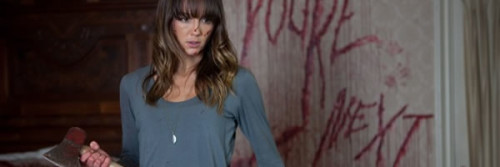
This myth and the tropes within were the status quo for many, many years until Jennifer’s Body came along in 2009  and did something that even I didn’t see coming. It showed a different side of female possession. Sure, Jennifer Check (Megan Fox) gets possessed, and true, she does some horrible things while under the influence of her demon and, yeah, she only got possessed because she did something that good little girls and nice young ladies don’t do, but what’s great about the whole situation is that in the midst of all of the horrible that follows the possession you don’t feel sorry for her. At least, not in the traditional way; you’re actually amused at all the carnage that follows because she looks like she’s having fun and she turns the tables on every horror movie trope you knew you hated or thought was laced with misogyny and seasoned with a heaping spoonful of the requisite female apologetics. Jennifer is bad, but she wasn’t made that way by the possession; had this been a regular old teen movie she would have played the anti-hero that you loved to hate and once possession takes hold she’s like Regina George in demonoid form.

One of the best things about Jennifer’s Body is how inappropriate it is and unapologetic it is for its inappropriateness. Jennifer’s Body is filled with pure naughty, campy fun.  But it’s also filled with something even more interesting. It holds a mirror up to society and the dynamics of not only female friendships but also female sexuality. Not only is it the story of a girl “gone wild” in different kind of way, we get treated to two female possessions that have two totally different results. The first one is the possession of the film’s namesake, the flirtatious, wild child Jennifer Check and the second is that of her friend the quiet, good girl next door, Anita “Needy” Lesnicki. Jennifer pushes through and has fun with it and Anita tends to be fearful of the change and eventually comes to grips with her new interior angel and begins to embrace it and relish in her newfound freedom, even if that freedom starts off with her behind bars at a mental hospital.

Jennifer's Body
Jennifer’s Body


The film gives us two different views of the same story. When it comes to Jennifer, on one hand she does seem to get “punished” in what feels like the generic, horror film, female possession fashion for ditching her friend and going alone into a van with a group of boys (GASP), but unlike every other female possession film this demon makes her not only stronger but more fearless and she knows how to use her powers. She turns the tables on every guy who crosses her path and takes to her new self like a champ. She doesn’t cry out for help or to be saved, she plays along and enjoys the freedom that the possession gives her and actual enjoys herself a bit. The demon doesn’t take control of Jennifer’s body, or force her to do something that you can sense she really doesn’t want to do. It engages the parts of her that were already there. No one flinches at Jennifer’s post-possession overt sexuality because that was a quality that she possessed before. In fact, her previous overt sexuality is what the demon uses to seduce her prey and from the first ingestion of the school’s football captain to the last man the demon leaves standing she wields her sexuality like an artist. She didn’t get taken over and changed into something opposite of what she was before, i.e. the usual nice girl who should be saved because she was so sweet before; instead it just turns her up to 11.

Needy, possessed but free


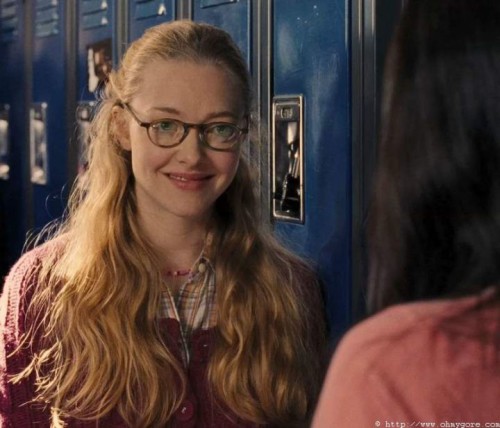
The other possession in Jennifer’s Body happens to the title character’s best friend, Anita , who gets possessed as an accidental side effect of trying to save  Jennifer.  Anita knows who her friend is and finds herself attached to her, hence the nickname “Needy,” in a super codependent way. After all of the killings that the possessed Jennifer commits, she shows up at Anita’s house, drenched in blood after her last male kill and tries to seduce Anita as a preamble to the demon, or is it Jennifer 2.0, telling the tale of how she came to be possessed. This confession leaves Anita a little more than freaked and she sets out to help her friend. She does everything that the good girl is supposed to do, including going to the library and researching what has become of her friend Jennifer. The film ends with Anita being forced to stab her best friend in the heart to kill her because she is a succubus and she killed her boyfriend along with a slew of other horny teenage boys. Of course, the good girl, Anita, who has actually saved the day, gets caught by her bestie’s mother wielding the knife over her now dead, or re-dead, daughter, and she’s shipped off to an asylum. It is from that asylum that Anita retells the story and it is also where she will escape from and set out to find the band that turned her friend into a murderous succubus and she kills them all.

Anita’s possession comes from a place of the girl who did everything good and right. She was a good friend, loyal girlfriend, smart, nice, modest. Pretty much everything that girls are supposed to be in these movies. When she gets possessed and retains Jennifer’s powers via a non-fatal bite during the catfight, literally, from hell she goes on to seem happy about it. She’s finally free. She is no longer “needy” or insecure. She finds strength in the knowledge that she can do anything. But, the question lingers does Jennifer want to be saved? Does Anita? Killing and cannibalism aside, what’s so wrong with a girl enjoying herself? Why does it need to be punished?

In movies where female possession is used as the main form of horror, it has always been hard for me to decipher if the reason that so many people attempt to save the “damsel in distress” is because she’s so altered that she needs it, or if it’s because she has become powerful, unstoppable, cognizant, aware, and free. Is it so much better to put the genie of strength back in the box? Is it so necessary for women to conform to society’s norms and expectations that any deviation from these norms causes society to feel fear? Is the dread coming from the empathy we have for the poor girl being possessed, from the feeling that it could happen to us, or from the knowledge that being powerless is a feeling that most women have? It’s should scare us that in movies like this we are only allowed power through artificial, usually male allowed or induced means, and when we become too powerful, the power gets taken away because we can’t handle it or shouldn’t have it. There is often an undertone in these films that the real problem isn’t the demon, it’s the vessel.

Jennifer possessed
Jennifer possessed


The thing that makes Jennifer’s Body so great is that even though Jennifer dies, Anita, the girl who probably needs the strength that possession carries, gets to live and keep her power. There is something empowering about watching her joyfully skip away from the asylum and hunt down the band responsible for her current condition and Jennifer’s possession. She knows that she has the strength that she needs to survive and carry on but also that she’s no longer afraid. The fear of speaking her mind or exploring and existing outside the lines is gone. The possession allows her to speak and live freely, to live outside the lines and define her own goals, needs, and desire. The empowerment comes not from watching her go medieval on the men behind the curtain, but from the innocence on her face as she confronts them. There is something beautiful about taking a genre that has long punished women and turning it on its head. There was no man to save Jennifer here, only another woman, a friend, and she stands tall in victory when the dust settles. And now Anita  is “needy” no more because she has tasted the power, lived to tell the tale and will use her new demon passenger to right the wrongs that she sees fit. Even though she’s possessed, you can sense that she will guide herself and the demon within and take control of it. Freedom is a beautiful thing, even if you have to be possessed to make it happen.


Shay Revolver is a vegan, feminist, cinephile, insomniac, recovering NYU student and former roller derby player currently working as a New York-based microcinema filmmaker, web series creator, and writer. She’s obsessed with most books, especially the Pop Culture and Philosophy series and loves movies and TV shows from low brow to high class. As long as the image is moving she’s all in and believes that everything is worth a watch. She still believes that movies make the best bedtime stories because books are a daytime activity to rev up your engine and once you flip that first page, you have to keep going until you finish it and that is beautiful in its own right. She enjoys talking about the feminist perspective in comic book and gaming culture and the lack of gender equality in mainstream cinema and television productions. Twitter: @socialslumber13.
 

The Notion of “Forever and Ever and Ever” in ‘The Amityville Horror’ and ‘The Shining’

The nightmare that Jack and George share signifies their innate fear—the possibility of destroying the family they, as men, have built.
The Amityville Horror


This guest post by Rachel Wortherley appears as part of our theme week on Demon and Spirit Possession.

Two families in search of fresh start move into new homes: the Torrance family to the “Overlook Hotel” in Denver, Colorado, and the Lutz family to a beautiful Dutch-Colonial home in Amityville, New York.  Unbeknownst to them, they will encounter horror in the form of demons and evil spirits attempting to destroy their “traditional” family dynamic.

Stuart Rosenberg’s The Amityville Horror and Stanley Kubrick’s The Shining focus on the prospect of renewal.  Rosenberg’s film focuses on newlyweds George and Kathy Lutz (Josh Brolin and Margot Kidder) as they move into a new home with their three children and dog, Harry.  There is one catch.  The home’s previous inhabitants (two parents and their children) were killed by their son and brother.  Audiences were also being presented a “tweaked” version of the nuclear family being that George is the children’s stepfather.  It is noted that they have only recently begun to call him “George” rather than “Mr. Lutz.”  George’s wish is for them to address him as “Dad.”  The new marriage and their determination to make new memories inside a tainted house is George and Kathy’s attempt at growing closer as a family.

The Amityville Horror


The Shining also begins similarly. Jack Torrance (Jack Nicholson), a schoolteacher turned writer, moves with his wife Wendy (Shelley Duvall) and son Danny (Danny Lloyd), to the “Overlook Hotel” where he is hired as the winter caretaker.  While this is Jack’s opportunity to write in solitude, it is also an opportunity for their family to start anew–at least in the eyes of Wendy.  Wendy reveals to Danny’s pediatrician that Jack, a recovering alcoholic, accidentally dislocated Danny’s shoulder in an attempt to pull him away from ruining important school paperwork.  This unfortunate incident prompts Jack to quit drinking.  As a result, Wendy forgives him and attributes it to being “just one of those things.” While the Lutz family in Amityville wants to create new memories, the Torrances want to erase their pasts.  However, the memories within the walls of their respective households become imbued in the minds of the families, leading to madness and terror.

It should be noted that children and fathers appear to be greatly affected by the supernatural beings in their homes.  Because of the innocence of children, the spirits readily reveal themselves.  For example, seven-year old Amy Lutz in Amityville is seen conversing and playing with “Jody,” her imaginary friend who lives in the house.  There is one pivotal moment when Amy sings “Jesus loves me” as her and Jody’s chairs rock back and forth.  This suggests that the spirit is not evil, but in search of a companion. Jody also wants Amy to stay in the house “forever and ever,” presumably in the same ghostly state that Jody has taken.  While Amy’s brush with the afterlife is playful and innocent, the same cannot be said for Danny Torrance.

The Amityville Horror


Danny is a seven-year old boy who has the capability described as “shining.”  He has terrifying premonitions and can telepathically communicate with others who “shine,” specifically the hotel chef, Dick Hallorann, who enlightens Danny to their capabilities.  Danny’s gift materializes in the form of his imaginary friend Tony who Danny describes as “the little boy who lives in my mouth.”  Tony appears to be a being that fosters Danny’s gifts, yet encourages him to conceal it from others, for fear of no one believing him.  When Danny’s first premonition of blood cascading through the hallways of the Overlook Hotel occurs, Danny is unable to remember.  Tony also appears when Danny is attacked by the demonic figure of the woman in the bathtub in the forbidden “Room 237.”  It is also Tony who communicates the infamous word, “redrum” (murder spelled backward) to Danny to warn his mother of the pending murder that Jack wants to inflict upon their family, as well as the gruesome murders from the past.  Wendy recalls that Tony made his first appearance after Danny’s incident with Jack.  This suggests that Tony exists as a source of protection for Danny to shield his innocent consciousness.

The Shining
The Shining


While these otherworldly figures engage with children in a mild manner or as a scare tactic, they react entirely different with the fathers in the respective films.  Rage and violent behavior are triggered within George and Jack.  George, who desperately wanted the children to call him “Dad,” exclaims that Kathy needs to “discipline her children.”  George’s physical appearance goes from strong to sickly.  He sweats profusely, incessantly chops wood, and neglects work.   The process of George’s descent into madness is a slower process whereas Jack’s descent appears to occur immediately. He also appears angrier than George. Kubrick goes from a casual scene when Wendy brings Jack breakfast in bed and he jokes about the ghosts in the hotel to a penultimate scene where Jack rages at her to never disturb him when he writes.  This further suggests that while Jack wants to be with his family, he does not want to be “with” them.  Sane Jack in the beginning of the film looks forward to the isolation of a large, empty hotel, yet this is impossible because his family is present.

The Shining
The Shining


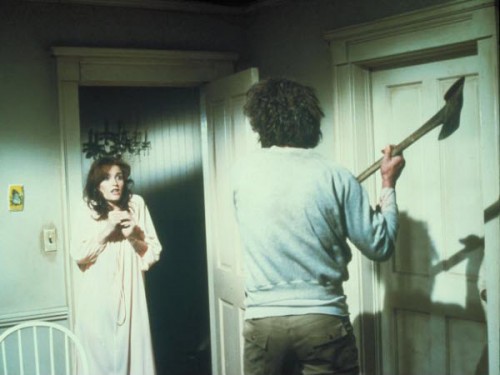
The distance between Jack, his wife, and child is noticeable before his descent.  Jack has minimal scenes with Danny and when sharing scenes, Danny is glued to Wendy.  Jack barely interacts with him apart from instilling fear into Danny while in a trance-like state.  In this scene, he simultaneously assures Danny that he would never hurt him while leering at him in a murderous manner.  In comparison to George and Kathy’s marital bliss and passionate love scenes, Jack and Wendy appear too casual with each other. They almost seem like strangers.  There is a sense that Wendy distrusts Jack. A scene that supports this occurs when Jack, screaming and crying in his sleep, awakens from a nightmare in which he murders and chops Wendy and Danny into pieces with an axe.  As Wendy comforts him, a disheveled and traumatized Danny walks in with bruises on his neck–bruises inflicted by the ghostly woman in room 237.  Remembering Jack’s drunken rage three years prior, Wendy immediately accuses him of abusing Danny.

As a result, Jack retreats in anger to the hotel bar where he encounters the ghost of Lloyd, the bartender.  There he is satiated by alcohol while commiserating to Lloyd the complications of his marriage, specifically Wendy’s inability to forgive him for something that occurred “three goddamn years ago.” Unspoken anger and resentment clouds their marriage.  In Amityville, George has the same nightmare and confesses it in tears to Kathy.  The nightmare that Jack and George share signifies their innate fear—the possibility of destroying the family they, as men, have built.

The Shining
The Shining


The Lutz family manages to escape physically unscathed in the aftermath of their battle with the forces embedded within their house, whereas Wendy and Danny are the only two who escape their haunted home.  A murderous Jack, wielding an axe, attempts to find his wife and son and ultimately succumbs to the bitter cold of Denver.   Wendy is officially a single mother to Danny.  However, a photograph from the Overlook Hotel in the 1920s depicts a smiling Jack with partygoers.  He has found his new family.

Stuart Rosenberg’s The Amityville Horror (1979) and Stanley Kubrick’s The Shining (1980) are films that are released around the same time as family-centric films; specifically films that deal with the subject of divorce and single parenting. In Robert Benton’s 1979 film, Kramer vs. Kramer, audiences witness how a single father deals with raising his son in the absence of a mother, almost losing his child to the mother, and the mother ultimately granting him full custody. The parents also become civil toward each other. Audiences who are rooting for the father, played by the likeable Dustin Hoffman, gain a sense of satisfaction in the end.  Meanwhile in its predecessor, Paul Mazursky’s An Unmarried Woman (1978), we watch how Jill Clayburgh’s character deals with a multitude of events: her husband divorcing her for a younger woman, teaching her teenage daughter to feel empowered, and having to start her dating life from scratch.  While these images were progressive in its time, audiences were not shown the other perspective; the sometimes horrific nature of broken homes.

The Shining
The Shining


In Rosenberg and Kubrick’s respective films, outside forces attempt to help keep the nuclear family alive.  In Amityville this materializes in the form of Father Delaney, who attempts to warn them about the house, yet is quelled by being struck mute and blind by the supernatural forces.  This is reminiscent of the Catholic Church’s strict laws against divorce in favor of marriage counseling.  In The Shining Dick Hallorann acts as a guardian to Danny.  He comes to their rescue only to be cut down by Jack’s axe.  Outsiders are not allowed to interfere.  The family must deal with the uncomfortable and painful feelings within their household, as well as the aftermath.  There lies the true test and the meaning of “forever and ever” as a family.


Rachel Wortherley is a graduate of Iona College in New Rochelle, New York and holds a Master of Arts degree in English.  Her downtime consists of devouring copious amounts of literature, television shows, and films.   She hopes to gain a doctorate in English literature and become a professional screenwriter.


‘The Shining’: Demon Selection

Jack is both a victim and perpetrator of domestic violence. Jack’s father was an abusive alcoholic who beat and berated him. When Jack drank he used to parrot his father’s words (“take your medicine” “you damn pup”). He is primarily verbally abusive. The last incident of drinking that pushed him to sober up was accidentally breaking Danny’s arm. Wendy, perhaps like Jack’s mother, lied for him but swore she would leave if he didn’t sober up.

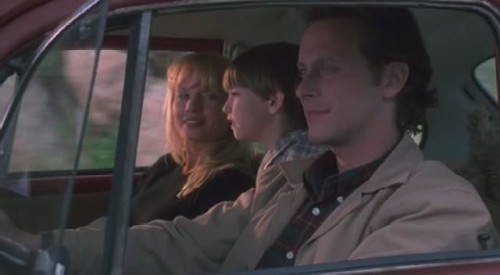
The Torrance family happily driving to the Overlook Hotel


This guest post by Wolf appears as part of our theme week on Demon and Spirit Possession.

Stephen King’s The Shining miniseries debuted almost 17 years ago.  King’s take was made to follow closer to his original novel and as a rebuff of Kubrick’s classic (King still disliked the movie). The miniseries is often criticized for being long, needing more scares, and having too much detail and long dialogue. While these points have merit, King’s version has a better Wendy, more background, and far more character development.  The story itself is well known – The Torrance family moves into the Overlook Hotel for the winter. Father Jack is an alcoholic, out-of-work teacher, and amateur playwright. Young Danny has psychic abilities. The Overlook is haunted. Wendy is along for the ride with no job to perform nor psychic abilities. She has also lead a fairly charmed life, minus Jack’s problems, and is not possessed by the Overlook at any point. *

But why does the Overlook not chose Wendy? Or why can’t it reach her the way it can Danny and Jack?

The Hotel wants Danny. Wendy knows it. Jack is already “infected” by the hotel and refuses to believe it. Danny knows it as well. This suggests that his power will live on in the hotel after he is dead and a ghost. The hotel might seek out people who Shine and their Shining stays with their spirits trapped in the Overlook. It is never fully explained how Danny got his gift or his Shining – which includes telepathy, telekinesis, visions, and the ability to regenerate a haunted hotel and its ghosts.  Some fans have assumed Jack himself might have the Shining.**

Jack drinking with Grady at the party where all the guests and the band have been dead for years


Danny is never fully taken over by the hotel, but it grows stronger with his presence. It uses what it can take of his Shining and, being a little boy, he unintentionally feeds it. He has a false sense of security since he was told by Dick Hallorann, who works at the hotel and explains to Danny what the Shining is, that the things one might see at the Overlook are like “pictures in a book.” Soon the pictures become physical manifestations and the hotel has its own puppet to use when it takes full control of Jack.

There is one other very big reason why Jack might have been the one the hotel fully possessed (to the point where Jack tries to control himself and can’t–only once does he break through and tells Danny to run, but loses this battle within minutes): Jack is both a victim and perpetrator of domestic violence. Jack’s father was an abusive alcoholic who beat and berated him. When Jack drank he used to parrot his father’s words (“take your medicine” “you damn pup”). He is primarily verbally abusive. The last incident of drinking that pushed him to sober up was accidentally breaking Danny’s arm. Wendy, perhaps like Jack’s mother, lied for him but swore she would leave if he didn’t sober up.

With the hotel influencing Jack, but not yet controlling him, he begins to act like the alcoholic he once was and uses the same words. This was more intense than his last incident as a dry drunk; this is full drunk Jack with no alcohol. Eventually the hotel has the power to conjure objects that torment the family – party favors and panties in an elevator that turned on by itself (“There is something that wants us to join the party, Don’t you understand that?” Wendy explains to Jack) and a bar with alcohol for thirsty Jack.

Jack possessed by the Overlook
Jack, possessed by the Overlook


The hotel preys on Jack’s past problems. Even as a grown man, he still loves his father and speaks to what sounds like his ghost on the radio. The emotional conversation where Jack acts like a crying boy and is berated once again, culminates in Jack smashing the family’s one means of communication with the outside world. Jack carries the scars of abuse, the confusion of loving your abusive parent, and guilt over continuing the cycle of alcoholic abuse.*** He also confides that he feels like he belongs at the Overlook. He lashes out at Wendy in jealousy over her good life and unleashes all of his frustrations with his own life. His fear of them living on the street if he can’t fulfill the duties of this job are probably exaggerated, but his feelings of failure and concern for his family never being able to obtain a comfortable lifestyle are genuine.

Jack isn’t an evil man. He is damaged and the hotel takes full advantage of it. He is alone, hurt, guilty, and has a past full of enticing cruelty and trauma for the sinister hotel to enjoy.  We do not know about other victims of the hotel. Did the woman in 217 who has sexually charged scenes, including the way she kisses and then strangles Danny, have some sexual abuse in her past before she committed suicide at the Overlook? Did she even plan on killing herself before checking in or was the suggestion given to her during her stay? Does this shed light on how the hotel that has killed so many remains open and functioning with its “indiscretions” covered up by management?

Without the word of the (Stephen) King, we can only guess that the hotel wants people who Shine or who have emotional issues that make them susceptible to the demonic influence and also please he sadism of the Overlook. And this is why Mr. Jack Torrance was possessed by the hotel and not his wife. This is why Jack let the hotel in, while Danny tried to keep it out.


*In the DVD Wendy isn’t the only one to hold this honor; Dick Hallorann never subcomes to the Overlook. In the book, however, when the hotel is at its strongest, Dick has a moment where he is compelled to kill Danny.

**This theory gains momentum since Dick’s grandmother had it. Perhaps it skips or is weaker in some generations.

***! ! ! SPOILER ! ! ! Danny grows up to be an alcoholic in King’s latest novel.


Wolf is known to her friends as the Pop Culture Queen and loves to read books, watch movies, and keep up on her TV shows. She is a perpetual psychology student who hopes to finish her schooling before she’s 90. She occasionally finds the time to write for fun and win trivia contests. Criticism, questions and suggestions are always welcome in her email: hairdye_junky@yahoo.com.


She’s Possessed, Baby, Possessed!

When Phoebe is taken over by the deadly sin lust in “Sin Francisco,” she sexually assaults her professor and has sex with a policeman on the job, while Piper dances on her bar during her high school reunion when she’s possessed by an evil spirit. And almost all the evil women in the show are sexualized: the succubus, shapeshifter Kaia, the Stillman sisters in “The Power of Three Blondes,” the seer Kyra, etc.

6x01-Sisters-Valkyries


This guest post by Scarlett Harris appears as part of our theme week on Demon and Spirit Possession.

It seemed like one Halliwell sister or another was possessed by demonic forces every week on Charmed.

There was Phoebe and the Woogeyman, the Banshee and the ghosts of Lulu and Grams, as well as Cole’s demonic spawn; Piper was possessed by the evil spirit of Terra in “Coyote Piper,” as well as the Valkyries and Hindu goddess Shakti (who ever said possession had to be evil?); Paige was overcome by her boyfriend Richard’s dead fiancée Olivia’s ghost (phew!), the Evil Enchantress from her childhood fairytale fantasies, and by a witch doctor’s voodoo magic; while Prue gets turned into a fairy, an empath and embodies the deadly sin, pride. Not to mention all manner of innocents who get taken over—mostly—by evil.

It also seemed like whenever a possession occurred, the sisters’ clothing went the way of Prue in season 3’s “Look Who’s Barking”: to the dogs. While the Charmed Ones’ sartorial choices were minimal at the best of times (perhaps a side effect of living in one of the most sexually progressive cities in the world, San Francisco) this is not necessarily done with the male gaze in mind.

ms-hellfire

Being a show that focused on women’s lives, Charmed was screened on the WB network to a primarily young female audience, many of them raised by second-wave mothers. Stereotypes tell us that these young women were probably brought up to believe in free love and the burning of the bra, both of which the Halliwell sisters certainly subscribed to. And in the ’90s, “girl power” and “having it all” were the terms du jour which Charmed played in to. If you believe it shouldn’t matter what you look like to be able to do your job, Charmed offered that up in spades: the Charmed Ones could kick (mostly male) bad guys’ butts and look like they were heading to the club doing it. (Oftentimes they were, as Piper owned the club, P3.)

The episode “Blinded by the Whitelighter” explicitly addresses this lack of practicality in the Halliwell Manor’s presumably shared wardrobe: Natalie, Leo’s whitelighter colleague, puts the sisters through boot camp, which includes a demon-fighting makeunder with appropriate support for both their ankles and their breasts.

cpyote-piper

But back to possession. Charmed is not the first piece of pop culture to sexualize possession. Jennifer’s Body, Ghostbusters, and the modern remake of The Exorcist come to mind, whilst io9 rounds up another seven films that do much the same. This is probably because sexuality, specifically a woman in charge of her sexuality, is deemed evil or, at the very least, uncouth. We see it when it comes to famous women, such as Rihanna, Miley Cyrus, and even Beyoncé’s recent self-titled musical ode to married sex, and Charmed is no exception. When Phoebe is taken over by the deadly sin lust in “Sin Francisco,” she sexually assaults her professor and has sex with a policeman on the job, while Piper dances on her bar during her high school reunion when she’s possessed by an evil spirit. And almost all the evil women in the show are sexualized: the succubus, shapeshifter Kaia, the Stillman sisters in “The Power of Three Blondes,” the seer Kyra, etc. We seldom see the same—both in Charmed and pop culture at large—when men are on the receiving end of possession. It’s more likely to be framed in humorous or serious ways, such as when Leo succumbs to the sin of sloth or Cole’s numerous evil turns. Even when the spirits that possess the sisters aren’t evil per se, the Halliwells are still scantily clad; take, for example, Phoebe as a mermaid, genie, fairytale character, Lady Godiva, Mata Hari… so pretty much Phoebe in general! The show does take pains, though, to show the Charmed Ones being sexy and sexual in their normal lives, not just as the means to an end of an evil plan (in “The Devil’s Music,” for example) or becoming part of that evil plan themselves. It seldom shames them for their desires, either.

5x01-PhoebeMermaid

While Charmed doesn’t always get it right when it comes to sex, gender politics and morality, it makes an effort to show the sisters four in all elements of their lives, including sex. Maybe the myriad “sexy possessions” the Charmed Ones succumb to are part of a wider “protest statement” of the objectification of women? We can dream.


unnamed

Scarlett Harris is a Melbourne, Australia-based freelance writer and blogger at The Scarlett Woman, where she muses about feminism, social issues, and pop culture. You can follow her on Twitter.


Direct from Hell: ‘Paranormal Activity’ and the Demonic Gaze

Micah’s patriarchal control through the first half of the film is omnipresent as he mocks, coerces and films his girlfriend’s descent into possession. The second half of the film deals with the demon taking control of the film. Micah and Katie are too weak to properly deal with the situation and they lose sight of their safety. The audience see what the demon wants them to see; it is in control of not only Katie’s mind and body, but also what the audience is exposed to, creating an unstable and terrifying experience.

MV5BMjY1NjcxODQ4MV5BMl5BanBnXkFtZTcwMzUxNjM4Mg@@._V1_SX640_SY720_

This guest post by Alexandra West appears as part of our theme week on Demon and Spirit Possession.

Oren Peli’s Paranormal Activity became a worldwide sensation and one of the most profitable films ever made. Shot in 2007 but not officially released until 2009, the independent film made its mark on filmgoers and helped popularize the found footage horror format which began with the likes of Cannibal Holocaust (1980) and The Blair Witch Project (1999). After filming was completed, director Oren Peli had it tour the festival circuit where it generated a fair amount of buzz. Universal acquired it and the film languished in development hell. There were talks of a full-on remake doing away with the found-footage aspect and turning it into a traditional narrative with celebrities starring. But it would be Steven Spielberg who saw the film while Universal and Dreamworks were figuring out what to do with it and he suggested leaving it as it was, but re-film the ending so that it was open-ended and sequel ready.

life-paranormal-activity-edited

The film opens with a couple, Micah (Micah Sloat) and Katie (Katie Featherston) who live together and are “engaged to be engaged”. Strange things have been happening in the house so Micah decides to take control over the situation and buy a camera to capture the events and determine the culprit. Katie invites a psychic over and tells him things like this have been happening to her since she was little. Things begin to escalate with the cameras capturing not only supernatural occurrences but also the deterioration of Micah and Katie’s relationship. Then the demon takes control.

In Laura Mulvey’s ground-breaking essay “Visual Pleasure in Narrative Cinema,” she posited the idea of the “male gaze.” Looking closely at cinema from the 1930 through 1960s, Mulvey traces a pattern of fetishizing the female body, the camera examining and idolizing it which created an objectification of the body engendering the gaze as decidedly male.  This creates the idea of woman as object rather than a human being with her own thoughts, concerns and motives. She is held captive by male desire. As Mulvey writes, “The alternative is the thrill that comes from leaving the past behind without rejecting it, transcending outworn or oppressive forms or daring to break with normal pleasurable expectations in order to conceive a new language of desire.” Mulvey’s essay was published in 1975 and has gone on to become a staple of film studies course and film criticism.

paranormalactivity2

Paranormal Activity, for the first half, is completely submerged in the male gaze. Micah’s camera picks up what he wants to see and what he demands of his only consistent participant, Katie. As the film begins, the unexplained incidents–which are the catalyst for Micah purchasing the camera–are dispersed with the couple’s normal life; Katie is annoyed at Micah following her around and filming her, Micah goads Katie for sex and brags about it and in one instance, when Katie is in the washroom, she screams. Micah runs for the door, pauses, returns to get the camera, and then runs to check on Katie. Katie, having been scared by a large spider in this case, surmises that Micah went and got the camera before helping her. His need to capture all the events that pass that could explain away Katie’s fear is surpassing his instinct to actually help her.

The tone of the film begins to shift when Katie invites a psychic over to help. Katie says this isn’t the first time this has happened to her as she was visited by something as a child and she’s worried that it’s all happening again. Micah continually scoffs at the psychic, making it clear that he’s threatened by his girlfriend turning to someone else for help rather than him. The psychic agrees with Katie that something is going on and that it has been following Katie for all these year. He fears that it is demonic, meaning it wants to possess Katie. The psychic also warns that constant filming and playing with this entity is inviting it in, encouraging it to enter their world. He gives Katie the number of a demonologist and tells her to get in contact with him. While Katie feels she finally has answers, Micah convinces her that it’s nothing he can’t figure out. Katie agrees to forgo calling the demonologist for the time being.

Some of Paranormal Activity’s most iconic scenes are of the couple sleeping.  Micah sets the camera on a tripod and the film shows us a time-lapse version of them sleeping. The first few nights reveal small occurrences such as the door to the bedroom moving slightly though no windows in the house are open. Micah pores over the footage, reveling in the fact that he’s onto something and catching it all on camera.

The film takes a stark turn. Katie is sleeping less and less, weakening her and putting a strain on her and Micah’s relationship. They decide to go out one night. Before they leave, Micah sets up a Ouija board to try and communicate with the entity. Katie walks in on him setting it up and angrily tells him that this is exactly what the psychic told them not to do. As she storms off, Micah follows, leaving the camera filming the Ouija board. The camera captures the Ouija board moving on its own and eventually bursting into flames which extinguish on their own. The events escalate with Katie being pulled out of bed by an unseen force and bite marks appearing on her back. Micah, determined to make things right, decides to get them out of the house though they have been told the demon will follow. Before they leave, Katie tells him that they should stay. Micah, frustrated, says fine, leaving the camera behind to catch an eerie grin on Katie’s face. On the final night Katie gets up from bed, goes downstairs and screams. Micah runs to help her and several loud thumps are heard. Katie returns to their bedroom, hurls Micah’s body at the camera crawling toward the camera and in the final moments of the film, her face morphs into something demon-like. The epilogue text states that Micah’s body was found a few days later and that Katie is still missing.

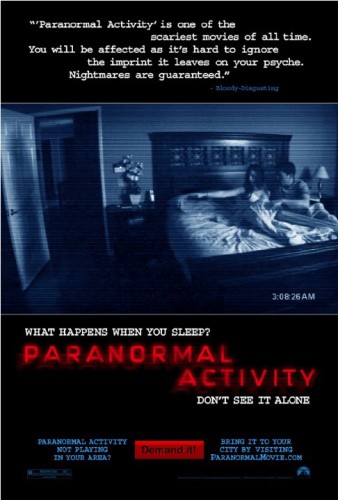
Paranormal Activity

The gaze of the film is subverted from the first night they film themselves sleeping. It is the demon’s entrance into their lives. Though Katie says she experienced something similar as a child, Micah’s involvement causes it to grow worse. The film becomes terrifying because the audience knows Micah is no longer in control. As he says in the film, “I’ve been doing my research. I’m taking care of this. Nobody comes in my house, fucks with my girlfriend, and gets away with it.” Micah’s insistence on controlling the situation is precisely what allows it to escalate. Rather than heed the psychic’s warning, Katie trusts Micah and leaves herself open and vulnerable to the external entity. The film takes a decisive turn after the Ouija board scene. The demon has become more powerful and is wreaking havoc on their lives. No longer are we viewing this world through Micah’s male gaze, we are viewing it through a demonic gaze. The biggest similarity between Micah’s gaze and the demonic gaze is that Katie is the subject. She is either being followed by Micah’s camera or the demon. The only time she takes control of the narrative, first by getting Micah to stay in the house and then by killing him, is when she is possessed.

Mulvey posited that something radical must shift in film to escape the dominant male gaze toward a more equalized gaze. While the film industry’s awareness of the lack of complicated female characters, female directors, and writers is growing there is still work to be done. Paranormal Activity is a fascinating examination of this shift, though not ultimately a successful one. Micah’s patriarchal control through the first half of the film is omnipresent as he mocks, coerces and films his girlfriend’s descent into possession. The second half of the film deals with the demon taking control of the film. Micah and Katie are too weak to properly deal with the situation and they lose sight of their safety. The audience see what the demon wants them to see; it is in control of not only Katie’s mind and body, but also what the audience is exposed to, creating an unstable and terrifying experience.

1350748544_paranormal_activity2c

Katie’s only real power comes when she is possessed. Because Micah isolated them, he has no one to protect him. Katie who ultimately kills him and throws his body into a camera knocking it over and creating a Dutch Angle within the film and skewing the look and feel of the night-vision sleeping arrangement that the audience has become so used to throughout the film, signalling the dawn of something new that we are perhaps not ready to see quite yet. Katie’s (or what used to be Katie) greatest act of defiance is escaping the camera view. In the final moment of the film, “Katie” lunges at the camera and it goes black before the final text appears. All the audience knows is that she is gone and has escaped the camera’s gaze. It is no longer able to monitor her.

Paranormal Activity achieved a shift  by mocking Micah’s machismo. His comments and actions when he is control fail to protect either of them. Film fans recognize the trope in horror films of not heeding direct warnings, which leads characters to danger. Micah’s male gaze is so out of control that he convinces Katie to ignore the help they have been given until it is too late. His hyper-masculinity is so performative that the audience can’t help but be weary of him and his intentions. Micah partially succeeded in his goal which was finding out the cause of the disturbances but failed because the answer was only revealed because the demon let it.


Alexandra West is a freelance horror journalist and playwright who lives, works, and survives in Toronto. Her work has appeared in the Toronto Star, Rue Morgue, Post City Magazine and Offscreen Film Journal. She is a regular contributor to Famous Monsters of Filmland and a columnist forDiabolique with “The Devil Made Us Watch It.” In December 2012, West co-founded the Faculty of Horror podcast with fellow writer Andrea Subissati, which explores the analytical side of horror films and the darkest recesses of academia.

‘Twin Peaks’ Mysticism Won’t Save You From the Patriarchy

I do believe that Lynch and Frost meant to use BOB as “the evil that men do” and as a means to understand family violence and abuse, but they jump around the issue so much that it only reflects uncertainty. The show’s inability to hold evil men responsible for their actions is too reminiscent of our own society. As soon as we answer “Who Killed Laura Palmer?” the show does its best to rebury the ugly truth that we so struggled to uncover. After that it fully commits to understanding the mythos behind it. This is troubling to me.

unnamed

This guest post by Rhianna Shaheen appears as part of our theme week on Demon and Spirit Possession.

(MAJOR SPOILERS AHEAD!)

I have a Twin Peaks problem. I love Twin Peaks (1990-1991). In college, I was so obsessed with the show that I animated a Saul Bass-inspired titles sequence and wrote a spec script for my screenwriting class. However, as I became a better feminist, I awoke from my stupor of admiration for the show. I began to question the dead girl trope and ask myself, what is so funny about the sexual abuse and torture of an adolescent girl? I’ll admit I was thrilled about its announced return in 2016, but I wonder if a continued story will do more harm than good. Will the show continue to pull the demonic possession card when it comes to violence against women?

In the TV series, Special Agent Dale Cooper first encounters the evil spirit BOB in a dream. However, no one seems to see BOB in real life except for Sarah Palmer, who becomes increasingly unstable and otherworldly after her daughter’s murder.  Much of this is due to her terrifying visions of BOB as well as her husband’s recent, strange antics. When Maddy Ferguson, Laura’s lookalike cousin, comes to support the Palmer family she sees similar visions of BOB in the house.

unnamed

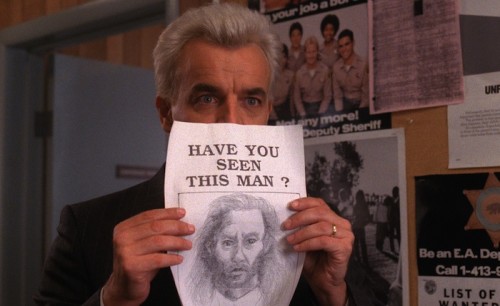
In the hunt for Laura Palmer’s killer, the local Sheriff’s Department is absolutely useless. As soon as Agent Cooper turns them on to Tibetan method and Dream Logic, all serious detective work goes out the door.  It also doesn’t help that the town chooses to project this crisis outside of “decent” society. According to Sheriff Truman:

“There’s a sort of evil out there. Something very, very strange in these old woods. Call it what you want. A darkness, a presence. It takes many forms but…it’s been out there for as long as anyone can remember and we’ve always been here to fight it.”

unnamed

But this old evil is within the town as well as outside of it. The show’s “quirky allure” tricks viewers into believing that Twin Peaks is different. That some places remain untouched by patriarchal evil. When we discover that it was Leland Palmer we are shocked.  Leland’s mirrored reflection of BOB exposes the threat as one within the confines of the domestic space.  It is patriarchy passing itself off as the loving and benign father of the nuclear family.

unnamed

But what is even more shocking is that an entire community allows this to happen. In the prequel film, Twin Peaks: Fire Walk With Me (1992) we follow Laura Palmer through the final seven days of her life. Unlike the series, Laura has a voice here. We get to see her walking, talking, and acting like a teenager. When pages from her secret diary go missing she confides in her friend Harold that “[BOB] has been having [her] since [she] was 12” and “wants to be [her], or he’ll kill [her].” Harold does not believe her. It’s an extremely painful scene, because not only do we know she will die, but we know that many real-life victims of childhood abuse are often not believed either.

unnamed

Days before her death, Laura finally discovers that it is her father. At dinner, Leland torments his daughter’s dirty hands and questions her about her “lovers.” Leland then pinches his daughter’s cheek. The sheer look of horror on Laura’s face is heartbreaking as she looks into the eyes of her abuser. Her mother, Sarah All-I-Can-Do-Is-Scream Palmer, tells her husband to stop, saying, “She doesn’t like that.” He replies, “How do you know what she likes?” It’s absolutely chilling, but even then the mother remains ignorant. How can everyone be so clueless?

As viewers, the warning signs seem obvious. The only way Laura can cope with this parasitic spirit is through copious amounts of cocaine and promiscuous sex with strange, older men. Why would a Homecoming queen who volunteered with Meals on Wheels, and tutored disabled Johnny, act this way?  Well, to anyone schooled in recognizing sexual abuse the answer seems obvious. As many as two-thirds of all drug addicts reported that they experienced some sort of childhood abuse. The link between prostitution and incest or sexual abuse has also long been established.

Now this brings us to the question: Who’s at fault for Laura Palmer’s murder?  Was it poor Leland or the demon that possessed him?

Moments before his death, Leland confesses his guilt to Agent Cooper:

“Oh God! Laura! I killed her. Oh my God, I killed my daughter. I didn’t know. Forgive me. Oh God. I was just a boy. I saw him in my dream. He said he wanted to play. He opened me and I invited him and he came inside me.”

unnamed

With fire sprinkler water pouring over him, Leland seems cleansed of his sins. Lynch paints a pretty sympathetic portrait of Leland. He is cursed and tormented rather than murderous and abusive. He is blameless for his actions. Leland gets to go “into the light” while Laura is condemned to the purgatory of the Black Lodge.

In Diane Hume George’s essay Lynching Women: A Feminist Reading of Twin Peaks she perfectly discusses the problem with Leland’s poignant ending:

“We are instructed regarding how to situate our sympathies and experience our sense of justice. But this is just another clever use of the simplistic formula by which lascivious misogyny is presented in loving detail, […] scapegoating offenders whose punishment casts off the guilt that belongs to an entire culture ethos. And that ethos, both pornographic and thanatopic, not only goes free. It gets validated.”

Things become even more fucked up after Leland’s funeral where people remember him as a victim. Agent Cooper gives Mrs. Palmer some words of comfort:

“Sarah. I think it might help to teII you what happened just before LeIand died. It’s hard to realize here [points to her head] and here [points to her heart] what has transpired. Your husband went so far as to drug you to keep his actions secret. But before he died, LeIand confronted the horror of what he had done to Laura and agonized over the pain he had caused you. LeIand died at peace.”

I’m sorry, but death does not absolve you. Horrible people die and somehow we’re supposed to forget the history of horrible things they have done? We all die. This does not erase our actions, even if you’re a white cis male.

For a minute, let’s forget that BOB is a thing (ESPECIALLY when you consider that most of the town has no knowledge of these spirits and how their worlds work). These people are celebrating the memory of Leland Palmer after (I assume) finding out that he murdered and raped his own daughter (along with Maddy Ferguson and Teresa Banks). Excuse me, is anyone else bothered by how much denial these people are in?

Like many fans, I turned a blind eye, preferring to seek refuge in the myth of Killer BOB and the Black Lodge rather than identify the clear signs of abuse in front of me. As Cooper says: “Harry, is it easier to believe a man would rape and murder his own daughter? Any more comforting?”

unnamed

While I no longer indulge the BOB theory, I do read BOB as patriarchal oppression. Its truth is one that women (Laura, Maddy, Sarah) see and know too well. Cooper only solves the mystery when he FINALLY believes and listens to a woman. Laura Palmer must whisper in his ear, “My father killed me” for him to finally understand.

M.C. Blakeman writes:

“While he may ultimately let Leland off the hook by claiming he was “possessed” by the paranormal “Bob” the show’s resident evil force, the fact remains that the women of Twin Peaks and of the United States are in more danger from their fathers, husbands and lovers than from maniacal strangers.” 

unnamed

I do believe that Lynch and Frost meant to use BOB as “the evil that men do” and as a means to understand family violence and abuse, but they jump around the issue so much that it only reflects uncertainty. The show’s inability to hold evil men responsible for their actions is too reminiscent of our own society. As soon as we answer “Who Killed Laura Palmer?” the show does its best to rebury the ugly truth that we so struggled to uncover. After that it fully commits to understanding the mythos behind it.  This is troubling to me. As one of the most influential shows on television, Twin Peaks created a narrative formula that will forever shape the way this country looks at rape and child abuse. It’s important that as viewers we constantly question this, even if it is disguised as harmless, intellectual programming.


Rhianna Shaheen is a recent graduate from Bryn Mawr College with a BA in Fine Arts and Minor in Film Studies and Art History. Check her out on twitter!

Because Being Female is Frightening Enough: #YesAllWomen and ‘The Exorcism of Emily Rose’

In the film a young girl, Emily Rose, perishes following a protracted period of “attack” by demons while under the protective care of Father Moore, a Catholic priest. Female attorney Erin Bruner is chosen to defend Moore against charges of negligent homicide in Emily’s death. Through the two’s connection to the girl throughout the film, each undergoes what I’ve called here a “conversion experience,” as they learn more about the possibility that demons really do exist—demons that can be read to correspond to the challenges that women face in culture every day. Even before the advent of #YesAllWomen, a film like ‘The Exorcism of Emily Rose’ shows us how to overcome skepticism and create a connected community of individuals committed to sharing troublesome experiences in the service of awareness and activism.

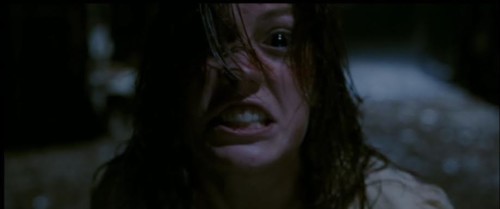
Emily possessed
Emily possessed


This guest post by Rebecca Willoughby appears as part of our theme week on Demon and Spirit Possession.

Elliot Rodger’s killing spree in Isla Vista, California in May of 2014, incited much controversy, as did the Twitter hashtag #YesAllWomen, which subsequently emerged as a forum for women to share experiences of sexism and misogyny in everyday life.  Yet, attitudes of skepticism persisted: many Twitter users seemed resistant to the idea that ALL women, at one time or another, experienced circumstances and situations that made life difficult, if not downright annoying or even unbearable.

What’s frightening is that some of the most prevalent types of experiences women reported using the hashtag could be considered normal, everyday occurrences. But female Twitter users describe these moments as uncomfortable, and sometimes terrifying. Perhaps this is why it seems useful to examine the hashtag within the context of the horror film, particularly possession films, which tend to emphasize women’s bodies being acted upon by external forces. The use of the supernatural—specifically, the presence of demons— in Scott Derrickson’s The Exorcism of Emily Rose (2005) can be illustrative of the horror of #YesAllWomen’s sexist experiences, and the skepticism with which they are sometimes met. The film’s unique combination of courtroom drama and horror film emphasizes its investment in skepticism and seems to allow the film to ask: how can we, as viewers, ever really believe this might be “based on a true story”?

In the film a young girl, Emily Rose, perishes following a protracted period of “attack” by demons while under the protective care of Father Moore, a Catholic priest. Female attorney Erin Bruner is chosen to defend Moore against charges of negligent homicide in Emily’s death. Through the two’s connection to the girl throughout the film, each undergoes what I’ve called here a “conversion experience,” as they learn more about the possibility that demons really do exist—demons that can be read to correspond to the challenges that women face in culture every day. Even before the advent of #YesAllWomen, a film like The Exorcism of Emily Rose shows us how to overcome skepticism and create a connected community of individuals committed to sharing troublesome experiences in the service of awareness and activism.

Skepticism in possession films, or films about [usually female] mental instability certainly isn’t unusual. One of the best examples may come from classical Hollywood, in the form of George Cukor’s 1944 classic, Gaslight, wherein the heroine is convinced by her con-artist husband that she is going crazy, when in fact he is manipulating her environment. Bitch Flicks guest writer Elizabeth Brooks usefully points out that possession films, specifically, often make a point of “gas lighting” female protagonists. While audience members may begin to share the heroine’s perceptions and doubts about her reality, often other characters in possession films are skeptical: the parish priest, the victim’s family, boyfriend, sister, you name it.  Emily Rose and Erin Bruner exemplify an oppressive truth: that violence, misogyny, and sexism experienced by one woman—represented in the film as demonic attacks on Emily—initially divides these two women from any sort of communication concerning those issues. In fact, in the film the two never meet. By the end of the movie, however, Erin’s own trials have linked her physically and emotionally with Emily via several terrifying incidents.

Emily's long walk
Emily’s long walk


The first occurrence of otherworldly forces and their attack on Emily look a lot like a rape. Emily is alone in her dorm room at night, smells something burning, and goes to check it out. We see Emily alone at the end of the long hallway, and we’re startled along with her when a door slams at the end of the corridor; she latches it and returns to her room. She gets back into bed, and suddenly her blankets begin to slip off. Indentations appear in her mattress on either side of her body, and she is forced down onto her back.  Her night-shirt is slowly lifted up toward her midriff. As she tries to force it back down, she grapples with an invisible assailant, but her hands are forced to her sides. Then, suddenly the weight is lifted, and she vaults out of bed and onto the floor, screaming. It reads like a rape to me, even if a spiritually-coded one. Weirdly, no one on screen involved with Emily’s case voices this opinion as a possibility. Instead, the lawyers, doctors, and other professionals involved in Emily’s case collectively move right from superstition and spiritual attacks to illegal drugs to epilepsy and psychosis.

The film vacillates between having viewers believe that Emily’s trials are the machinations of the spirit world, and entertaining the possibility that Emily may be psychotic and epileptic. This balance alone, along with the combination of horror film tropes with courtroom drama, makes the film unusual. Additionally, a wide range of female types populate the margins of this film, leaving viewers with perhaps an atypically rich tapestry of female experience. We see a female judge, and a madam fore-woman of the jury. We see Emily’s traditional, devout housewife mom, her encouraging and faithful sister, the female family doctor, and a female anthropologist expert witness. Professional women and homemakers; average citizens and hopeful youth, even with a reasonable range of representation of racial and ethnic backgrounds. In other words, the population of #YesAllWomen in a microcosm, all represented in a world with flaws Emily’s possession calls stark attention to.

Dr. Briggs, a medical expert witness for the prosecution, provides a glaring example. While under cross-examination, he asserts that he would have tranquilized Emily, force-fed her, and administered electro-shock treatment (against her will if necessary) to save her life. Certainly such a course of action would have completely deprived Emily of dominion over her own body—as the “demons” do. “Possession” in this film is not only a spiritual, but physical term: Emily’s welfare and control over her own treatment is repeatedly assaulted by the prosecution and the (usually male) representatives of the medical community. Though Emily aims to become an educated, professional woman herself, her choices are frequently disparaged, and anyone who supports them—her father and Father Moore specifically, are—forgive the pun—demonized.

Father Moore allows Emily to reject the traditional, patriarchal view that medical illness must be treated with drugs and doctors. Additionally, he chronicles her resistance to these oppressions in the form of a tape of the exorcism, which eventually finds its way to Erin. This archive serves as evidence of Emily’s experience that can be shared with a wider community, making it more difficult to refute. Like Twitter archives, Father Moore attempts to preserve and disseminate proof of Emily’s attacks, just as #YesAllWomen serves as proof of the multitude of challenges women face in everyday existence.

Erin's talisman
Erin’s talisman


To rebut the over-zealous doctor witness and his extreme stance on Emily’s treatment, Erin locates an anthropologist studying contemporary cases of demon possession in the third world. Erin believes this woman may “see possession for what it really is. Maybe we’ve taught ourselves not to see it. Maybe we should try to validate the alternative.” This alternative is learning to see Emily’s plight as what Dr. Sadhira Adani calls a “basic human experience,” which we might read as the situations and circumstances of #YesAllWomen.

Sadhira Adani believes Emily is “hypersensitive,” which we may see as a positive framing of Emily’s resistance or sensitivity to the flaws of patriarchal culture. In other words, Emily’s “problem” is NOT hysteria, psychosis, or epilepsy, but rather clear vision. Further, while it’s certainly a production decision not to use extensive special effects in the film, a lack of effects may also indicate that what happens to Emily is all the more “realistic.” Without what reviewer Liese Spencer calls “Linda Blair fright makeup” Emily’s plight is more relatable to the average audience member—especially female audience members who might more readily pick up on the alignment of Emily’s possession with a more universal women’s issue.

Two sequences from the film tie Erin to Emily through their experiences of fear. After learning that a man Erin previously helped to acquit has killed again, she rushes into a restaurant ladies’ room to compose herself. Visual parallels to Emily’s rape scene abound: the doors of the stalls echo the dormitory doors lining Emily’s hallway, and square mirrors mimic the hallway’s bulletin boards. As Erin splashes her face with water, we hear another door slam—a woman emerges from a stall to check her makeup.

At Erin’s home, the clocks stop, she smells something burning, lights go out when she tries to investigate, she breaks a glass, and finally the door to her apartment seems to open on its own. The significance of the open door should not be missed: like the unlatched door in Emily’s first attack—which this scene also closely mimics—it could mean an intruder has entered Erin’s apartment, intending her harm. She is alone, as Emily was.

Finally, as Erin recounts her experience of finding a locket to Father Moore, she describes a moment after these events which seems to push her to the realization that she and Emily may be more connected than Erin initially imagines.

We see Erin in flashback as she recounts the experience of finding the locket. She considers what it might mean if “demons really do exist.” But just then she finds the locket on the sidewalk, coincidentally inscribed with her own initials. At this moment, she does not feel alone. Instead, she says, it made her feel as if “no matter what mistakes I’d made in the past, at that moment, I was exactly where I was meant to be; like I was on the right path.” This is the purpose of female community, of which #YesAllWomen is a prime example. Erin’s conversion experience is underway after she’s been made to feel some of the same fears as Emily, to be made to feel lost, alone, and even under “attack,” and also after finding this talisman that acknowledges these feelings and knits her to something larger than herself.

Visiting Emily
Visiting Emily


However, Erin’s conversion is not so simple; her privilege and ambition run deep. Soon she is back to her power-hungry and results-oriented self, speaking in purely legal terms and seeming to ignore the communicative experience she’s just recalled. One last frightening experience seems to be what is needed to get Erin fully on board with the female community Emily signifies.

Erin awakes late at night, alone in her bedroom. We hear whispering, which quickly turns into a distant-sounding scream. When she gets out of bed to investigate, she finds that the tape of Emily’s exorcism is in her living room playing, having turned on by itself. She turns it off, mouthing Emily’s name. Emily’s story has now become her focus.

Emily’s final vision of the Blessed Virgin (the ultimate female symbol of sacrifice) is recounted in a letter that Father Moore gives to Erin once he’s sure her conversion is complete. In it, Emily tells of a dream she has the day after her exorcism. In another flashback, an unseen force leads Emily through a mist. Viewers see Emily have an out-of-body experience. As she leaves her physical body behind, THIS Emily looks beautiful and healthy, not battered, twisted, and weak. Yet the Virgin gives her two avenues of action: she can relinquish her body and die, achieving peace; or stay in her body and suffer. It seems a simple choice, but the Virgin assures Emily that if she stays, her suffering will mean something; her story will help others.

It is for this reason that Father Moore has risked his freedom, for this reason that Erin jeopardizes her powerful position to help in sharing Emily’s experiences—but only after she’s had frightening experiences of her own. Their exposure to Emily’s case initiates a conversion experience by which they are both then unable to deny the pitfalls of women in patriarchy, even from their privileged positions.

In the final scenes of the film, Erin and Father Moore appear vulnerable and displaced, if satisfied. He says he cannot go back to his parish, and Erin has refused her law firm’s offer of partnership. Where will they go now? What will they do? They appear at Emily’s grave, as if on a pilgrimage, observing her epitaph, which reads “work out your own salvation with fear and trembling.”

Ostensibly the goal of any horror film is for the viewer to experience some fear and trembling; the combination of these goals with the framework of logic and justice found in the courtroom drama allows The Exorcism of Emily Rose to achieve a broader aim. We can read Emily’s “hypersensitivity” as vulnerability, a vulnerability that she must summon the courage to share in order to communicate a broader, societal concern that would otherwise remain in the shadows. Spiritual trials aside, Emily’s plight is indeed the plight of all women.  Father Moore and Erin Bruner may be the first who achieve symbolic salvation through describing and disseminating Emily’s fear and trembling to others. The Exorcism of Emily Rose and #YesAllWomen illustrates that communication, supportive community, conversation, and awareness are often the first step to activism.


Rebecca Willoughby holds a Ph.D. in English and Film Studies from Lehigh University.  She writes most frequently on horror films and melodrama, and is currently a lecturer in Film/Media Studies at Bucknell University in Lewisburg, Pennsylvania.  


‘The Conjuring’: When Motherhood Meets Demonic Possession

Punishment is the main objective of the demon Bathsheba in ‘The Conjuring,’ and specifically she seeks to punish the mother figure of a family. The hauntings and road to possession begin when in 1971, Roger and Carolyn Perron move into an old farmhouse in Rhode Island with their five daughters. Slowly, they begin to experience paranormal disturbances.

This guest post by Caroline Madden appears as part of our theme week on Demon and Spirit Possession.

Punishment is the main objective of the demon Bathsheba in The Conjuring; specifically, she seeks to punish the mother figure of a family. The hauntings and road to possession begin when in 1971, Roger and Carolyn Perron move into an old farmhouse in Rhode Island with their five daughters. Slowly, they begin to experience paranormal disturbances.

8679151

Carolyn, the mother, is the most affected and punished by these disturbances. She is physically punished when she wakes up one morning to see bruises on her back. Other bodily harm occurs throughout the hauntings. The spirit goes so far as to pretend to be Carolyn’s daughter when playing a family game with her. She is then dragged to the cellar and attacked.

the-conjuring-lily-taylor- carolyn perron possess basement cellar

Carolyn is the only one who is constantly singled out by the demon. The father is not dealt with at all. While the daughters are also horrified and attacked by the spirit, punishing the daughters is just another way for the demon to get at Carolyn. Carolyn cares for her daughters, and it is devastating for her to see them attacked. This is quite a simplistic characterization, for Carolyn is written to merely serve the theme of the story rather than as a dynamic female character. Being a mother is her main characteristic, but she is established as warm and caring one, thus allowing the demon to prey and try to destroy her strong bond with her daughters.

But why is the demon attempting to destroy this relationship between mother and child? Why is the demon trying to attack this loving family and destroy their content life? When Carolyn brings in paranormal investigators Lorraine and Ed Warren, with some research they discover that the demon is that of a woman named Bathsheba. They learn that in the 1850s, Bathsheba was married to a rich farmer named Sherman. Together they had a child, and when it was a week old the father caught Bathsheba sacrificing her baby to the devil. Bathsheba then hanged herself after proclaiming her love for Satan, cursing anyone who tried to take her land. Carolyn learns that Bathsheba specifically seeks out the punishment of mothers, all who have lived on this property before her, in order to have them sacrifice their children to the devil.

While female characters are often the ones singled out for possession, The Conjuring takes another interpretation by viewing possession through the lens of motherhood. We have often had possessed fathers who go on to wreak havoc on their family, such as The Amityville Horror (who the real-life Warrens also investigated) and The Shining. The mother character is often the one to protect her child against the man. (Most notably, Shelley Duvall as Wendy Torrance in The Shining.)

072113conjuring-dngnk

It is perhaps more believable and less horrifying when a father figure turns on their family, for it is more common or widely seen for fathers or stepfathers to be abusive to a family. While mother abuse does happen, it is thought to be quite rare. It is far more horrifying for a once loving mother to turn into an evil, abusive, and psychotic one. When we hear of heartbreaking stories of child abuse or murder at a mother’s hand we often exclaim, “How could a mother EVER do that?” whereas if we hear about a man committing abuse, it is merely shrugged upon and seen as something that always happens. In reality, women who hurt children are not worse than men who hurt children; both are equally awful.

Motherhood in society is more often debated upon and mothers are seen as the sole caretakers for a child. Mothers have to live up to often highly unrealistic standards. If they fail, they are criticized and condemned. Those who rise to those magic standards are seen as noble, for they are doing “the most important job a woman can do.” It is more “acceptable” for a father to walk out on a family or fail to rise to the occasion of fatherhood; you won’t hear much criticism or outcries. But if a mother does, she is deemed horrible and selfish. So in all, it is seen as more shocking and thrilling for a mother to turn against her children in violent and horrifying ways.

the-conjuring-lili-taylor-joey-king-kyla-deaver-warner-bros

After being attacked by Bathsheba, Carolyn is eventually possessed by her. When she wakes up from a nap, she sees Bathsheba lying on top of her. Bathsheba then vomits in her mouth in order to get inside Carolyn and possess her to elicit her last final punishment. Bathsheba will use Carolyn to kill her children and sacrifice them to the devil, as she has so many times before with other mothers. The now possessed Carolyn behaves as normal, conspiring with her husband and the Warren’s to take the children back to the hotel where they will be safe. Then we see Carolyn take two of her daughters, Christine and April, back to the house. The girls are frightened and do not know what is wrong with their mother.

The Warrens and Carolyn’s husband rush back to the house where they find Carolyn trying to stab her daughter Christine with scissors. They eventually are able to tie the possessed Carolyn to a chair to perform an exorcism. Despite being tied up, Bathsheba continues to punish Carolyn with the most painful physical abuse thus far. Carolyn spits and vomits huge amounts of blood, nearly choking on it. When anyone tries to take her outside, Bathsheba makes Carolyn’s skin sizzle and mottle with severe burns. Bathsheba levitates the chair and quickly slams it down on the hard concrete basement floor. Her husband begs Carolyn to “be strong” and “fight” against the demon, but it is clear that it is beyond her power to try and stop this.

unnamed-4

The possessed Carolyn eventually escapes and goes to try and kill her other daughter April, who is hiding under the floorboards. Lorraine Warren tries the final act to bring Carolyn back. Lorraine recounts a special memory with her daughters at a lovely day on the beach. Through the power of the special relationship between mother and child, Ed Warren is able to complete the exorcism and Carolyn is able to return to her normal self. For at her heart, Carolyn is a good and caring mother, and there can be nothing to sever that.

The demon attempts to destroy (what is seen as from society) the most sacred bond, the bond between a mother and child. The demon wants to completely destroy all of those relationships, as she had destroyed that idea of motherhood when she killed her child for Satan. But in the end Bathsheba still slightly wins. Even if she was exorcised and Carolyn’s role as a caring mother won out in the end, her daughters still have scarring memories of their mother while she was possessed. Although only for one night, they still suffered from the hands of abuse. Those memories may linger on and alter the viewings of their mother. Bathsheba was still able to alter the mother and daughter relationship but not in the way that she had hoped.

The-Conjuring-1024x421 carolyn perron basement cellar hide and clap bathsheba hands

The Conjuring is one of the unique horror films where possession is examined through the eyes of motherhood. We have seen possessed fathers wreaking havoc and terror on their families but not as many mothers. A violent and uncaring mother will always be scarier than a father. An abusive and evil father, we see those horrors more often in everyday life. The Conjuring plays on the already pre-existing attitudes we have to see violence inflicted by mothers on their children as to be of a most evil nature.


Caroline Madden is a recent graduate with a BFA in Acting from Shenandoah Conservatory. She writes about film at Geek JuiceScreenqueens, and her blog. You can usually find her watching movies or listening to Bruce Springsteen.


Seed & Spark: The Revolution Will Be Streamed: Why Underrepresented Communities Need to Find, Fund, and Forge the Streaming Media Landscape

The statistics are startling, but the silver lining is promising: The conditions that brought women to the forefront in early film now exist in streaming media. Now is the time for marginalized communities to claim their most significant share yet of the media landscape by finding and funding streaming projects and investing in/forming streaming media companies.

This is a guest post by Kathleen Wallace. 

Being a woman in and around the entertainment industry can feel like being in an unhealthy relationship: They’re just not that into us.

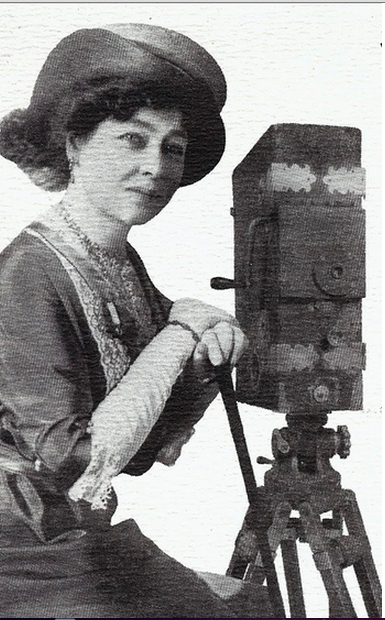
It wasn’t always this way. According to Dr. Jane Gaines, a film professor at Columbia University and one of the editors of the Women Film Pioneers Project, women in the film industry in America between 1916 and 1923 were more powerful than in any other business. In fact, in 1923, the number of women-owned production companies outnumbered those owned by men.

AliceGuyBlache
Alice Guy Blache, filmmaking pioneer, film studio owner, director of over 1,000 movies including some with interracial casts.


LoisWeber_BehindCamera
Lois Weber, silent film actress, screenwriter, director, producer, bane of censors; founded her own movie studio in 1917.

Fast forward 90 years to 2013, and only 23 percent of producers and a stunningly mere 7 percent of film directors are women (Geena Davis Institute on Gender In Media).

Sobering statistics about women in film.


The statistics are startling, but the silver lining is promising: The conditions that brought women to the forefront in early film now exist in streaming media. Now is the time for marginalized communities to claim their most significant share yet of the media landscape by finding and funding streaming projects and investing in/forming streaming media companies.

When the moving image was uncharted territory, roles were less defined, which left greater room for minorities to take on more responsibility and to have more of a voice. According to Dr. Gaines, to meet the “booming demand” for fiction films between 1895 and 1925, “Women were given many, many more chances to direct and produce.”

The better part of a century later, streaming media outlets present an unprecedented demand for content. For example, in 2013, the average time spent on digital surpassed the time spent watching television. Soon mobile viewing will surpass digital viewing. Also unprecedented is the access content creators have to distribution via streaming media. And thanks to the advent of crowd-funding, the financial barrier to filmmaking is lowered and audiences have greater access to filmmakers and therefore greater say in what media is produced. What a time to be both a filmmaker and an audience member!

Digital has overtaken TV and mobile on on track to overtake digital.


History teaches us, though, that this golden time will not last. In the 1920s and 1930s, as the film industry matured and companies figured out how to monetize films, underrepresented communities were squeezed out. Streaming is still, just as film was a century ago, the new frontier of media, but the “Streaming-TV Gold Rush,” as deemed by New York Magazine, is on: HBO announced recently that it will offer a streaming-only service. Lionsgate and Tribeca Enterprises (which runs the Tribeca Film Festival) announced the creation of a subscription VOD service. And it’s been over a year since Jason Kilar, ex-Hulu CEO, and Richard Tom, ex-Hulu CTO, announced the creation of their company, Vessel, a premium streaming platform specifically for short-form video content.

Deep pockets are searching for ways to make money in digital media. And the money is there to be found; earlier this year, digital ad revenues surpassed television ad revenue. The question is, when the big companies do find the money, what will happen to the level of diversity we enjoy in streaming media now?

This is not to say that studio executives are maliciously excluding underrepresented groups. Studio executives just aren’t that into us, so they don’t see as great a need to represent us. As Justin Simien, the director of the movie Dear White People (which incidentally was crowd-funded), said in a recent NPR interview, “It’s taken as given that a white cast represents everyone.”  Organizations like the Geena Davis Institute on Gender in Media are drawing strong attention to the issue, but the statistics on equal representation are still depressing.

With streaming media, we don’t have to see ourselves through someone else’s lens anymore. And if we take the reins of streaming media now while the gold rush is on, we can help ensure that it stays that way.

Here are three steps to take those reins:

First, find streaming content that speaks to you. There is seemingly limitless content on the big platforms like YouTube and Vimeo. There are also smaller companies like Seed&Spark, which cater to independent filmmakers. This company definitely harkens back to the early days of film: Seed&Spark is a female-lead company helps filmmakers fundraise as well as distribute their films, and 58 percent of the projects crowd-funding in their studio have women in prominent positions. (Full disclosure: I am currently crowd-funding my own web series through Seed&Spark. It’s called Settling Up.)

Second, when you find a project you like, support it. Throw money behind it. It doesn’t have to be a lot; truly every bit helps. Then spread the word. A Facebook post or tweet to your followers helps raise the project’s profile. Large numbers of both donors and followers signal to the streaming studios to come – like Vessel – that there is an underrepresented audience out there craving more content tailored to them.

Supporting projects also helps you build a relationship with your favorite streaming filmmakers, which helps ensure their projects’ longevity, since funding for streaming is still largely grassroots-based. “Relationships have made the most successful web series what they are today,” says Amy Kersten, an independent streaming producer whose work centers on women and women’s issues. When you subscribe to a series, when you post about an indie VOD film, when you comment on a video, you are creating dialogue between yourself and the filmmaker which helps ensure content is of the people. (Again, full disclosure, Amy is producing and co-directing my web series.)

Third, make streaming media yourself or get involved in a streaming media company. If this last one is for you – and it may not be – I  strongly urge you to go for it. Underserved communities need more representation behind the camera as well as behind the studio desk. My web series, Settling Up, is the first streaming media I’ve created, and I’ve learned tons along the way – made plenty of mistakes, too. But at the end of the day, I’m telling stories that have gone untold for too long, and I’m very proud that our female to male ratio on the crew ranges between 2:2 and 4:1.

It’s media for women, by women. And I’m definitely into that. Long may it last!


__________________________________________

KathleenWallace_legit_1

Kathleen Wallace is a NYC-based writer-producer-actor. Her web series, Settling Up, premieres in early 2015. She works with Amios Theater Company and Barefoot Theater Company, teaches fitness and public speaking, and is founder and Chief Cape Advocate of Be A Superhero Day, a day of public service. Kathleen holds degrees from Yale and the National Theater Conservatory and certificates from multiple schools in Germany. This winter she appears as Amanda in Private Lives at the Walnut Street Theater in Philadelphia.

Choice Within Fashion and Fundamentalism: ‘The World Before Her’

In making ‘The World Before Her,’ Pahuja chooses to walk the neutral line by avoiding a personal stand and trying to hold up a mirror instead. In an interview with ‘First Post,’ she says that she made this documentary in an attempt to create a dialogue. Her humanizing, vérité cinema approach works to that effect.

This is a guest post by Nandini Rathi. 

Chinmayee, a young girl at the Durga Vahini camp in Aurangabad, takes pride in the fact that unlike before, she has no Muslim friends anymore since her thoughts have matured in Hindutva at Durga Vahini. She takes exclusive pride in Hindu culture and looks forward to strengthen her thoughts about it in the future camps.

In another part of the country, Ruhi Singh, a 19-year-old Femina Miss India 2011 aspirant laments that her hometown, Jaipur, is not supportive of her ambitions as many people fear that allowing girls to get educated and choose their own careers will be tantamount to a loss of culture. “As much as I love my country and my culture,” she says, “I consider myself to be a very modern, young girl. And I want my freedom.”

This freedom, which is echoed by other characters in the The World Before Her (Pahuja, 2012), is of being who they want to be and living as they choose to live, without constantly having to worry about safety. Even though many institutions nurture the dream and promise to fulfill it, they come with strings attached. Indo-Canadian director Nisha Pahuja works hard in this phenomenal documentary to reveal some tensions within a rapidly modernizing India, through the microcosm of the Miss India beauty pageant and the Hindu nationalism of Durga Vahini. Apart from raising questions about objectification of women in the glamour industry, the movie also touches upon the state of communalism and religio-nationalism in India.

unnamed

After stumbling upon its fascinating Kickstarter pitch video almost two years ago, I finally watched The World Before Her on Netflix. It was thoroughly engaging and every bit worth the time as Pahuja juxtaposes two diametrically opposite, extreme worlds of modern Indian women — behind the walls of the Miss India pageant boot camp in Mumbai and the Durga Vahini physical training camp in Aurangabad. Durga Vahini is the women’s wing of Bajrang Dal, a subsidiary of the Vishva Hindu Parishad (VHP), a Hindu right-wing organization in India.

Beauty pageants deem all their critics to be a singular species from the “Old World.” Right-wing Hindu organizations see beauty pageants as a sign of Western attack on their frozen-in-time, monolithic conception of “Indian culture.”  Archival footage informs the audience of the Hindu right wing’s various physical attacks on girls in pubs, in the name of desecration of this “Indian/Hindu culture.” In making The World Before Her, Pahuja chooses to walk the neutral line by avoiding a personal stand and trying to hold up a mirror instead. In an interview with First Post, she says that she made this documentary in an attempt to create a dialogue. Her humanizing, vérité cinema approach works to that effect.

The narrative of The World Before Her cuts back and forth between a Miss India crown aspirant, the sweet 19-year-old Ruhi Singh and a Durga Vahini camp youth leader and staunch VHP supporter, the 24-year-old Prachi Trivedi. It is full of ironies along the way, as the two radically opposite worlds come out to be more similar than what we initially imagined.

The doors of opportunity and exposure open far and wide for the Miss India crown-bearers. Pahuja claims early on that the beauty and glamour industry is one of the few avenues in India where women stand at par with men. Ruhi has the drive to win and the full moral support of her family. However, for many girls, to make it as far as the Miss India pageant is a difficult task of overcoming family reluctance as well as personal resistances. These girls understand that culture is, and was, never a fixed entity — but one that constantly evolves with time and contact with other cultures.  Contestant Shweta says that that they are often accused of becoming “American,” to which she smartly argues that she isn’t becoming American for wearing jeans or eating a burger, anymore than Americans are becoming Indians for taking up Yoga.

42 Durga Vahini camps veteran and leader Prachi Trivedi is easily the most fascinating character, who likes to command others and talks to Pahuja with breathtaking candor. Prachi strongly believes in her Hindu nationalism which is based on the idea that the golden age of Hindu India was marred by outsiders who are still the enemy within. She has no qualms about killing any moment for her religion. Her father is cheerfully antagonistic to what she wants to do with her life. He fulfills his duty towards Hindutva by teaching the young girls in the camp — who the “bad guys” are, aka Muslims and Christians. Unlike Ruhi’s parents, Prachi’s father believes that she doesn’t have any rights besides what he gives her. One gets goosebumps when Prachi says that she forgives him for all the bullying, because it’s enough for her that he let her live — and didn’t kill her at birth for being a girl child, like many others do.

Prachi does not think her life is intended for marriage and family. She wants to dedicate her whole life to the Parishad (Vishva Hindu Parishad). But she is not sure if, being a girl, she has the freedom to make such a choice. The choice of a woman to stay single and not produce children is completely outrageous to the Parishad as well as her father. Her candid self-awareness reveals her vulnerable side in that poignant moment; it is so easy to forget then, that her ambition is to become the next Sadhvi Pragya Singh Thakur of the Malegaon bomb blast notoriety.

There is a palpable tension in the values inculcated at the Durga Vahini camp. “Sher banne ki prakriya yahan se shuru hoti hai (the process of becoming a lion begins here)”, says one of the camp instructors to the girls. On one hand, they want to increase young women’s confidence so they can be independent enough to rise to the call of action for the religio-nation. On the other hand, they are taught the dharma (duties) of a Hindu woman — in which chasing careers is a futile, corrupting, Western pursuit and only a “high moral character” matters, especially in the role of a wife and mother. Women’s action and power matters and is extremely important, but only while it actively and appropriately services the religious nationalism. They are nowhere expected to take liberties or choose their own paths. A conflict from this is likely underway in the future, as it is for Prachi.

On the occasion of Nina Davuluri’s crowing as Miss America, Rediff columnist, Amberish K. Diwanji noted that India’s beauty pageants do not reflect its diversity. Although the issue of inclusion of an Indian dalit or tribal woman in a beauty pageant is much more complicated (keeping in mind, the economic disparities, rural/urban divides and cultural clashes), simply speaking, the definition of beauty in pageants (and the glamour industry) is disturbingly narrow. I was shocked by Cosmetic Physician Dr. Jamuna Pai’s ease in administering Botox injections to achieve some ‘golden rule’ in the facial proportions of the contestants. Add to it, the application of face-whitening chemicals to burn through their tans. Miss India trainer, Sabira Merchant, describes the Miss India pageant boot camp as a factory, a manufacturing unit where beauty is controlled and prepared to meet the demands of the national and international fashion industry. The rough edges have to be straightened out and polished. The routine of the camp makes sure that any personal inhibitions on the woman’s part have been overridden. “The modern Indian woman” is produced for the world to look at.

“… I always had this vision of putting cloaks on women so we can’t see their faces, only their legs — and then decide who has THE best pair of legs. Sometimes you may get thrown — beautiful girl, lovely hair, she walks so good, she has a great body — we don’t want to see all that! I just want to see beautiful, hot legs!” –Marc Robinson, former model and Pageant director

Out of context, this would read as a perverted person’s fetish fantasy. I am trying to remind myself that Robinson speaks for the beauty industry– and so I shouldn’t think of only him as a creep. The parading Ku Klux Klan-esque figures are the contestant ladies, who ought to feel hot when they catwalk up to him like that.

unnamedScreen Shot 2014-10-23 at 2.06.17 PM

What about self-respect and dignity, one is forced to wonder. Contestant Ankita Shorey, who felt claustrophobic during the cloak session, reflects on her feelings about bending over backwards for the sake of success.

“Aurat ko maas ke tukde ki tarah plate par rakhkar serve kiya jaaye, aur taango, breast aur hips ke aadhaar par taya kiya jaaye – ye toh poori duniya ki aurat zaat ke liye be-izatti ki baat hai, khaali Hindustaan ke liye nahin.” — an Activist in the 1996 archival footage of demonstrations against hosting Miss World in India

(To serve a woman like a piece of flesh on the plate, and to judge her on the basis of the size of her legs, hips and breasts – it is disrespectful to the womankind all over the world – not just to women of India)

unnamed

My roommate’s and my reaction was — that’s true, she’s right. She expressed a genuine concern that would resonate with anyone who is even mildly concerned about the male gaze and the objectification of women’s bodies in media/glamour/film industry. Her saffron clothes suggest that she could be from a Hindutva-espousing party that sees pageants as a plain attack on “Indian culture”. It’s that awkward moment when feminists and right wingers find themselves to be bed fellows on this cause.

The formidable Ms. Merchant says in the second half: “There is a dichotomy and the girls seem like very with it, but they have traditional values. Should we go with the Old World or should we go with the New World? When they ask me that question, I always tell them to go with the New World, because the only thing constant in life is what? Change.” Just as Hindutva-espousing groups like VHP have no reason to not promote a blind hatred of Muslims and Christians, the beauty industry has no need or desire to parse out what the “New World” values really are.


P.S. While there is definitely a dichotomy between the old ideas and the new ones, Pahuja has chosen extreme, contrasting examples for the most narrative oomph. It creates a better story, which I am all for. The documentary is also timely as it is being viewed at a time when the Hindu right in India is gaining power and popularity (since Narendra Modi’s victory at the center). That said, it is crucial to remember that girls who participate in beauty pageants and those who participate in the likes of Durga Vahini camps are extreme minorities. They do not represent the majority.


Nandini Rathi is a recent graduate from Whitman College in Film & Media Studies and Politics. She loves traveling, pop culture, editing, documentaries, and adventures. Now living in New York city, she wants to be immersed in filmmaking, journalism, writing and nonprofit work to ultimately be able to contribute her bit toward making the world a better place. She blogs at brightchicdreams.wordpress.com.


You Never Want to Do Something Interesting: How ‘You’re Next’ Became One of the Most Empowering Horror Films for Women

It has been dissected time and time again on the way the horror genre has misrepresented women both on the screen and off, but whenever a film comes along and represents a female character as something different, we immediately bring praise to the filmmakers. While this practice is admittedly problematic, the only reason we stress the importance of these “strong female characters” is in large part due to the lack of positive female representation.

This woman comes from a land where they eat Vegemite by choice. Of course she's tough.
This woman comes from a land where they eat Vegemite by choice. Of course she’s tough.


This guest post by BJ Colangelo previously appeared at her blog Day of the Woman and is cross-posted with permission.

It has been dissected time and time again on the way the horror genre has misrepresented women both on the screen and off, but whenever a film comes along and represents a female character as something different, we immediately bring praise to the filmmakers.  While this practice is admittedly problematic, the only reason we stress the importance of these “strong female characters” is in large part due to the lack of positive female representation.  The “weak” female character has proven to be a safe staple within the horror genre, and somewhat of a requirement in the slasher genre.  Simply put, no one ever wants to do anything interesting.  Witness Simon Barrett, Adam Wingard, Sharni Vinson, and the creation of You’re Next.

I wonder what George Orwell would say about this...
I wonder what George Orwell would say about this…


We’ve all seen the advertisements, a majority of us own those damn animal masks, and some of us horror geeks have giant boners for AJ Bowen and Barbara Crampton.  You’re Next was the talk of the horror world, and the overall consensus is that the film kicks all sorts of ass. (It does, trust me.) People keep bringing up how You’re Next has taken the home-invasion sub-genre and spun it on its head.  Most importantly, however, is the fact You’re Next may very well be one of the most empowering horror films for women, ever.

(NOTE: If you haven’t seen You’re Next, you need to 1. stop what you’re doing and see the film and 2. understand that this piece is an analysis and events of the film WILL be spoiled.)

Oh my god, adopt me.


Starting with the matriarch of the family, we have horror demi-goddess, Barbara Crampton as “Aubrey.”  While this character on the surface seems to be following the trend of every other not-exactly-sober mother in a slasher film, Aubrey brings something that few other maternal horror figure has: heart.  Aubrey is one of the most well-constructed mother characters because of her undeniable love for her family. Mothers in horror films are often seen as skeptical, heartless, drunk, or cruel.  Aubrey is very protective of her family and showcases this throughout the entire film.  She questions things when no one else will and despite the obvious dysfunction of her children, she dedicates herself to them just the same.  What struck me as the most empowering, is the fact Aubrey actually mourns.  Most horror movie mothers are seen as women flying off the handle with absolutely no control of their lives. They panic and make stupid decisions.  Aubrey on the other hand realizes the situation at hand and mourns for her family. Her true dedication and love for her family is admirable, and unlike most of the mothers we see in horror films.

But bringing home a starving artist was my extent of rebellion!


Aimee, the golden daughter of the family (played by Amy Seimetz) is one of the more minor characters and is killed off early because of it.  The daddy’s girl and “princess” of the children appears to do no wrong.  She is immediately shown as the least liked of the siblings, but the most adored by the parents. Her death brings out the strongest reaction from the parental units, but the weakest reaction from the rest of the family.  Her good-girl persona seems to be something she uses to her advantage (overly excited introductions to other people, extreme affection towards her father) but is also something she desperately wants to rid out of her life (meet my starving artist/filmmaker boyfriend wearing the douchiest scarf this side of a Bright Eyes concert played by Ti West, TAKE THAT DAD!). However, she represents an ideal that a lot of women strive to possess. How do we treat ideals, ladies and germs? WE KILL THEM OFF AS QUICKLY AS POSSIBLE.  Ideals are boring, one-dimensional, and unrealistic.

I may look like Olivia Wilde in TRON, but I will bone you in ways Freud could never interpret.


Wendy Glenn as “Zee” makes for an incredibly interesting female villain.  Most female villains are seen as nothing more than pure evil, while Zee represents the true complexity of the female mind.  Although she is originally viewed as an unenthusiastic familial girlfriend being dragged against her will to a gathering with her dysfunctional potential in-laws, we quickly discover her character is actually quite unique.  It’s important to note that throughout the entire first 3/4 of the film, Zee is acting.  She is playing into the roles assigned to her and does them effortlessly. Once the big twist is revealed, Zee is no longer the doting girlfriend. She is 100 percent handling her instincts and her motives. At this point, her boyfriend, Felix, is no longer her motivator. She has done her best to comfort him in his time of need, but her demands are her demands.  She tries to seduce Felix while laying next to the corpse of his dead mother, and when he declines she responds, “You never want to do anything interesting.”  While it may be a bit exaggerated, Zee stomps on the idea that women are not sexually aggressive and the idea that women aren’t as sexually creative as our male counterparts.  Hate to out my lady friends, but women are just as big of perverts as men. Showing this sexually progressive woman was refreshing to see (even if her kink was a little TOO far for my comfort zone). This progressive attitude is thanked by being the only female character not murdered by an animal, but instead by her fellow woman.

OH MY GOD! I WILLINGLY WORE A RUFFLED COLLAR TO A DINNER PARTY!


The snobbish WASPy lover of Joe Swanberg, Kelly, is played beautifully by Margaret Laney.  Kelly is the woman everyone knows and plays nice with even though they can’t stand her.  Entitled, selfish, judgmental, and a total prude, Kelly represents that rich girl who lives off of Mommy and Daddy’s money and therefore feels like she’s better than everyone else.  She completely hits the panic button when disaster strikes and runs purely off of emotion, a very stereotypically “girly” reaction to chaos.  She also serves as the two-sided opposite to Zee and Erin.  Zee and Erin both want what Kelly and Aimee have (money and an established life of stability).  This is represented physically by the fact that both Kelly and Aimee wear their hair up (a symbol of a dignified and “put together” lady) while Zee and Erin don their hair down.  Although, Kelly is not perfect as she DOES show the most skin of any of the characters in the film, and does pop pills.  How is this woman thanked for her attitude? The judgmental bitch is thrown like a stone in a glass house — through a glass window.

Don't let Step Up 3D fool you, she's a bonafide badass.
Don’t let Step Up 3D fool you, she’s a bonafide badass.


Most obviously, we were given the most bad-ass final girl this side of Nancy Thompson. Sharni Vinson’s “Erin” ushered in an entirely new form of female final girls.  Unlike the virginal final girls that only survived because they fell into the trope of being pure and exactly what society wants women to be (sexually attainable without having sex), Erin was a strong-willed female character capable of defending herself using a combination of beauty, brains, and brawn.  She remains cool and collected when necessary but not without the guts to completely bludgeon to death anyone that crosses her.  With the booby trap preparation skills that would make Kevin McAllister proud, Erin understands that in this life, you’ve got to take care of yourself.

Erin is never once dressed scantily (not that there’s anything wrong with that) and she’s never over-sexualized. She’s merely your everyday woman living the way she chooses.  She’s progressive in that she left a TA position (meaning, this is where her mentioned student loans are coming from as this would forfeit any scholarship) to be with the professor she had fallen in love with.  Whether or not Barrett made this intentional, there’s also a remarkable feminist analysis of Erin’s strength.

*I’m about to put on a psychoanalytical/psychosexual hat, you’ve been warned.* Erin is a female fighting a bunch of male animals with incredibly phallic weapons.  In the Animal Kingdom, the alpha male is always seen as a dominant and physically aggressive creature while the alpha female is important for breeding purposes. Erin completely changes the game. Her male animal attackers are shooting arrows at her (reminiscent of the way animals “mark their territory” and determine things to be off-limits to other animals) or trying to insert overly long phallic machetes (hurray for wiener imagery) into her body.  99.99 percent of the time, female horror victims express pains in sounds that resemble an orgasm.  Erin expresses pain with barbaric wails or subdued sounds of pain; never once does she sound post-coital. This simple action shows that Erin is a woman that is not defined by the male sexuality, but secure in her own identity. *Takes off psychoanalytical/psychosexual hat.*

The “strong female lead” we were promised with the Evil Dead remake and didn’t get was hand delivered on a silver platter in the form of Sharni Vinson.  Kudos, Barrett/Wingard. You hit one out of the park for women in horror.

YOU’RE NEXT PASSES THE BECHDEL TEST. HOLY MOTHER OF GOD.


BJ Colangelo is the woman behind the keyboard for Day of the Woman: A blog for the feminine side of fear and a contributing writer for Icons of Fright. She’s been published in books, magazines, numerous online publications, all while frantically applying for day jobs. She’s a recovering former child beauty queen and a die-hard horror fanatic. You can follow her on Twitter at @BJColangelo.


Bitch Flicks’ Weekly Picks

Check out what we’ve been reading this week–and let us know what you’ve been reading/writing in the comments!

recommended-red-714x300-1

One Feminist Critic’s Battle With Gaming’s Darker Side at NPR

The tyranny of maternity on TV by Mary McNamara at Los Angeles Times

Lena Dunham Adapting YA Novel ‘Catherine, Called Birdy’ Into Movie by Julia Zdrojewski at BUST

Wonder Woman’s Kinky Feminist Roots by Katha Pollitt at The Atlantic

Elizabeth Peña paved the way for Latinas in Hollywood at PRI’s The World

Frances McDormand is much more than the role in Fargo that made her famous at PRI

How Gail Simone changed the way we think about female superheroes by Alex Abad-Santos at VOX

How One Casting Director Made Television More Diverse by Jennifer Keishin Armstrong at Fast Company

Director Justin Simien on Dear White People and Black Stories in Hollywood by Jesse David Fox at Vulture

“Pride” is a Joyful Film About the Need for Unlikely Allies by Sarah Mirk at Bitch Media

Jane Campion’s ‘Top of the Lake’ to Return for Season 2 by Inkoo Kang at Women and Hollywood

5 Things to Know About Jane the Virgin by Nolan Feeney at TIME

London Film Festival Review: ‘Honeytrap’ – Engaging Story of a Young Woman Who Lets Yearning for Acceptance Spiral Out of Control by Wendy Okoi-Obuli at Shadow and Act

Working with Laverne Cox, Standing in Solidarity with Trans Women of Color by Mitch Kellaway at The Advocate

Everything We Know About ‘XX,’ The All-Female Horror Anthology You’ve Been Waiting For by Kate Erbland at Film School Rejects


What have you been reading/writing this week? Tell us in the comments!