‘Fight Club’ As a Classic Romantic Comedy and Closeting Drama

What happened to the romcom? Apparently, men started to enjoy them. Should we feel flattered by this male appreciation of a genre created in its modern form by women like Jane Austen? Or insulted that male appreciation of the romcom can only occur by refusing to appreciate it as romcom? “You show me your sensitive side, then you turn into a total asshole.” Is that a pretty accurate description of the attraction and sneering rejection of the male audience for romcom?

unnamed

This is a guest post by Brigit McCone.

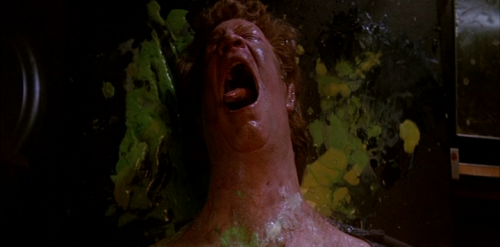
Although it opens boldly with the statement “all of this: the guns, the bombs, the revolution… has got something to do with a girl named Marla Singer,” the romance plot of David Fincher’s cult masterpiece Fight Club (1999) is rarely treated as central. Partly, this reflects our cultural bias that the love interest of a male film (particularly one chock-full of testosterone) is incidental, where the love interest of a female film must be integral. Yet, perhaps, the most gleefully subversive statement of this gleefully subversive film is that it ultimately adds up to “Zen Buddhist Romantic Comedy. FOR MEN!” It is in this light that I would like to analyze Fight Club: as a classic romantic comedy structured by the template of Jane Austen’s Pride and Prejudice, and a drama of closeted sexuality on the template of Oscar Wilde’s The Picture of Dorian Gray. Restoring the female and gay male origins of the film’s themes may raise interesting questions about the ways we interpret such similar subject matter so differently, depending on the speaker.

“This is cancer, right?”: The Meet-Cute

unnamed

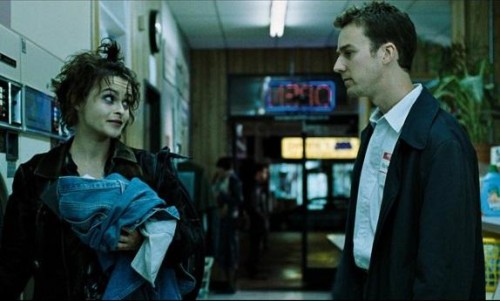
The meet-cute of Pride and Prejudice occurs at its first ball. Elizabeth Bennet, a character  established by a series of laughing jokes and superior judgements at the expense of society around her, is dismissed in a single sentence by the superior and judgmental Mr. Darcy: “She is tolerable, I suppose, but not handsome enough to tempt me.” The friction is established: it is the characters’ unbearable similarity that creates the irresistible irritation between them, sustained through tense debate and a famous dance as they struggle to resist each other. For Elizabeth, Darcy is that little scratch in the roof of her mouth that would heal, if only she could stop tonguing it. This was Austen’s great romcom innovation: where previous romance plots treat external problems as the only obstacles to true love, Austen’s protagonists are separated by their own flaws and lack of self-knowledge. Unlike Shakespeare’s The Taming of the Shrew, in Pride and Prejudice there can be no question of one character’s submission, as they are the image of each other and their challenge is rather to submit to greater awareness of themselves. It is not surprising that a woman writer would develop the theme of similarity between male and female as the basis of attraction, where the male had a greater vested interest in asserting the charm of female weakness and subordination as the foundation of successful love.  Fight Club, however, follows the feminine Austen mould. Our painfully unaware protagonist meets Marla memorably at a testicular cancer support group. The smoking woman’s unfitness to be there is as flamingly obvious as Darcy’s overbearing ego, while our hero’s secret, fraudulent testicular completeness is as carefully concealed as Elizabeth Bennet’s superiority complex. The narrator may even perceive himself to be faking while actually suffering from the same crippling emasculation as the group. Either way, it is the similarity between these two that drives their mutual irritation and banter for the first section of the film.

 “I am Jack’s Raging Bile Duct”: Protagonist Rejects Love Interest

unnamed

The first turn in the relationship comes when Marla reveals vulnerability by phoning the protagonist during a suicide attempt. He apparently rejects her, only to find the charismatic Tyler Durden has answered the call and bedded the girl. Feeling like “Jack’s Raging Bile Duct” gives our first hinted admission of the hero’s desire for Marla, but this period is marked by his sustained emotional and sexual rejection of her, based on his misunderstanding that she desires Durden, when Durden is in fact (SPOILER) an imaginary character created by our hero’s psychosis. Romantic misunderstanding caused by mental illness puts Fight Club in the tradition of Benny & Joon, As Good As It Gets, or even the spectrum of obsessive compulsive and neurotic behaviors displayed by the typical Meg Ryan protagonist. In other words, Fight Club’s use of dissociative identity disorder as romcom obstacle is an extreme example of a canonical romcom trend; it is personality flaw as romantic rival and allows Norton to spend the film’s middle section beating himself up for failing to be Brad Pitt. The effect is to shift the romantic relationship from a mutual friction towards the pursuit of a resistant, misunderstanding protagonist by an emotionally vulnerable love interest. Or, in other words, the same effect Austen generates by the misunderstandings that climax in Darcy’s proposal and rejection.

 “You’re the worst thing that ever happened to me”: Love Interest Rejects Protagonist

unnamed

The second turn comes when Norton’s character realizes the source of the misunderstanding and his true feelings for Marla. By then, however, his cumulative mistakes make the relationship unsalvageable and Marla takes a bus out of his life. This may be compared with Darcy’s abandonment of Elizabeth following her sister’s elopement, as the moment at which “all hope is gone” and the heroine fully realizes her romantic desire only as the love interest seemingly leaves forever. For Elizabeth, this acceptance of Darcy as love object parallels her own acceptance of herself as flawed and arrogant, just as Norton’s character is only able to care for Marla through the recognition and acceptance of his flaws, crippling dissociative identity disorder among them.

“My eyes are open”: Sacrificing the Ego

unnamed

Jane Austen had a dilemma. Her mirroring love interests, Darcy and Elizabeth, each needed to sacrifice their egos to be together. Darcy had achieved this by proposing to Elizabeth. Yet, the restraints placed on female behavior in the 19th century, which reduced woman to passive love object in most plots, prohibited Austen’s heroine the romantic agency required to sweep her man off his feet. So, she cheated. Introducing the figure of Lady Catherine DeBourgh as a test of pride, Austen required Elizabeth to resist denying her feelings for Darcy in the face of intense provocation. In effect, Lady Catherine allows Elizabeth to propose by proxy while suffering public humiliation. This public humiliation/proposal would become the clichéd heart of “the airport dash” in romcom lore. Fight Club offers an original spin. Our hero shoots himself in the face, a public disfigurement as well as painful sacrifice, to destroy the alter-ego who is a visible embodiment of the most toxic aspects of his pride. In that state of bloody vulnerability, Marla finds herself unable to reject him and the two hold hands as the phallic towers crumble before them.

“I”m free in all the ways that you are not”: The Closeting Drama

unnamed

Apart from the central romance, there are two major concerns in Fight Club: philosophical debate between Norton’s hero and Tyler Durden, and the depiction of Durden’s dangerously seductive, corrupting influence on the wider world. The Picture of Dorian Gray opens with lengthy philosophical debate between Basil Hallward, the vulnerable, sincere artist and lover, and Henry Wotton, the cynical, corrupting wit and charmer. Their friendship seems odd, as Hallward  disapproves of Wotton and Wotton scorns Hallward. In Fight Club, the relationship between the  hero and his Durden is made clear: Tyler, with the face of “millionaire, movie god” Brad Pitt, is free in all the ways the hero is not, yet trapped by the hero’s imagination. Wilde explained the strangely static relationship between Hallward and Wotton in a similar way: “Basil Hallward is what I think I am; Lord Henry what the world thinks me.” In other words, Lord Henry is Hallward’s Durden: a romantically impervious, socially masterful alter-ego who effortlessly dominates and corrupts society, while Hallward is Wilde’s most open portrait of homosexual romantic vulnerability. The main thrust of The Picture of Dorian Gray is a war between alter-egos Wotton and Hallward for the soul of the vulnerable Dorian Gray. The main thrust of Fight Club is a war between alter-egos Tyler Durden and Jack’s Inflamed Sense of Rejection for the soul and body of the vulnerable Marla Singer.

Although this comparison illuminates Fight Club as closeting drama, in this case the closeting of male insecurity and romantic vulnerability, the contrasts say as much as the parallels. In The Picture of Dorian Gray, Hallward, whose feelings for Dorian are presented as noble, romantic and capable of saving him, is viewed by Dorian with pity and contempt for expressing a “friendship so coloured by romance,” then savagely stabbed to death, his social isolation affirmed by the fact that nobody notices his absence – the reels have changed but the film carries on with Wotton in the driving seat. The book shows the total corruption of Hallward’s loving image of Dorian (the portrait itself) and the triumph of the cynical values of Wotton at the expense of both the vulnerable, true self, and of the love interest. Where love dare not speak its name, the mask must devour the face. Fight Club takes its modern, heterosexual manhood on a journey from emasculating self-loathing and testicular cancer to violent nihilism and rebellion but, ultimately, reveals the source of their grievance to be a figment of their own imagination. The painful split between inadequate hero and super-cool alter-ego is shown to be farcically self-imposed when Marla dismisses the godlike Durden as “Mr. Jackass.” Where Dorian chooses Wotton, Marla Singer has chosen Jack’s Raging Bile Duct all along. The romantic reconciliation which concludes Fight Club was literally impossible for Wilde’s novel, already savaged by censors, which neatly illustrates the contrast between the self-imposed crisis of modern masculinity and the socially imposed crisis of gay identity in the past. It is Wotton and Hallward’s “Dorian Gray Club” that one does not talk about, and Fight Club that is free in all the ways Dorian Gray is not.

“I can’t get married, I’m a 30-year-old boy”: Recognizing Male Romantic Comedy

Male romantic comedy has always been a major part of the genre: consider Frank Capra’s It Happened One Night, Billy Wilder’s The Apartment, Hal Ashby’s Harold and Maude, or Woody Allen’s Annie Hall.These works generally enjoyed greater critical esteem than that accorded to female romcom directors such as Elaine May, Nora Ephron, Amy Heckerling, Darnell Martin, Sharon Maguire, Gurinder Chadha, or Nancy Meyers. Now, critical successes As Good As It Gets and Fight Club join a golden age of male romantic comedy: There’s Something About MaryEternal Sunshine of the Spotless Mind, Shallow Hal, The 40-Year-Old Virgin, Knocked Up, (500) Days of Summer, Hitch, Zack and Miri Make a Porno, Wedding Crashers, Silver Linings Playbook, I Love You Phillip Morris, and Don Jon to name a few. And yet, in recent times, we have seen articles such as Tatiana Siegel’s 2013 piece for the Hollywood Reporter lamenting the “death” of the romantic comedy. What happened to the romcom? Apparently, men started to enjoy them. Should we feel flattered by this male appreciation of a genre created in its modern form by women like Jane Austen? Or insulted that male appreciation of the romcom can only occur by refusing to appreciate it as romcom? “You show me your sensitive side, then you turn into a total asshole.” Is that a pretty accurate description of the attraction and sneering rejection of the male audience for romcom?

Recognizing male romantic comedy as classic romcom is not only vital for a fuller appreciation of male romantic vulnerability, but also of female romantic comedy and gay male social comedy as more than “mere” romance and frivolity. As much as Fight Club, The Picture of Dorian Gray is a blistering critique of a decadent society that rewards toxic masculinity at the expense of true intimacy. As much as Fight Club, Pride and Prejudice is a psychological journey and a protagonist’s confrontation with and reconciliation with their own self. And, as much as any female romcom, Fight Club is a romance. And a damn funny one.


Brigit McCone has a degree in Russian and Drama, writes and directs short films and radio dramas and is the author of The Erotic Adventures of Vivica under her cabaret pseudonym Voluptua von Temptitillatrix. Her hobbies include doodling and irritating Fight Club fanboys.
Seed & Spark: ‘Actress’ and the Messiness of the Moving Image

In the film I follow Brandy’s unfolding drama as-it-happened, hanging the film on her trained actor expressions and captivating ability to theatrically display fragility, anger, and force of will. The film is a documentary in the sincerest way; Brandy’s performance is the truth I was observing. ‘Actress’ is about the roles we play and how we get trapped in them; the role the viewer sees Brandy wrestle with most vigorously might be the role of documentary subject.

unnamed

This is a guest post by Robert Greene and Brandy Burre.

From Director Robert Greene:

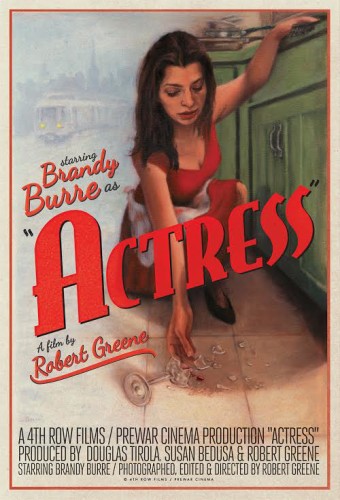
How does a man make a movie about a woman who is going through a crisis in her life that he, despite being the same age (with the same ambitions, the same number of children that are the same age in the same town), will never have to deal with because he’s a man?  That’s what I’ve tried to do with my new nonfiction film Actress, which stars my neighbor and friend Brandy Burre as she tries to balance motherhood and artistic dreams in the face of a suddenly tumultuous domestic situation. The answer in this case: you wind up the toy and hold on tight.

Brandy got pregnant when she was filming her final appearances on HBO’s legendary show The Wire, in which she played political consultant/vixen Theresa D’Agostino. Her life didn’t immediately settle (at one point she was doing a theater run far away from Tim, the baby’s father), but she eventually moved to Beacon, New York to raise a growing family. I moved next door to her a few weeks after she came to Beacon. Five years later we began filming what would become the movie. Its original title was Mother As Actress.

In the film I follow Brandy’s unfolding drama as-it-happened, hanging the film on her trained actor expressions and captivating ability to theatrically display fragility, anger, and force of will. The film is a documentary in the sincerest way; Brandy’s performance is the truth I was observing. Actress is about the roles we play and how we get trapped in them; the role the viewer sees Brandy wrestle with most vigorously might be the role of documentary subject.

unnamed

The project started from the formal question, “What happens when you film an actor in an observational documentary?” before the story took us in unexpected places. I also know that women, especially mothers in their later 30s, are harshly under-represented in movies. In general, too, I begin from the point of view that documentaries are inherently exploitative, that a power exchange is created when one person films another, not to mention when a man films a woman. This may be especially true when that man is exploring genres such as melodrama, which have traditionally been called “women’s films.”

The best way to short circuit the potential calamity of this exchange is to foreground the exploitation, to make it part of what the viewer is watching while they follow the story. The way a man can make a documentary about a woman in this situation, then, is to dive deep into the contradictions of the nonfiction form and display the mess onscreen. Documentaries are made of the tension between order and chaos, between directing and living. Letting these tensions show (and allowing space for the viewer to think about these tensions, including questions of gender and exploitation) cedes some of the power of the image to the person in front of the camera.

That person in this case is Brandy, a complex, theatrical, mercurial force of nature. It was not always easy to “cede power” of my film to this magnificent creature, and I wasn’t about to do it just because she was a woman. She was hesitantly stepping forward, too, though I wouldn’t have been able to tell; by the time she said yes I had already become somewhat obsessed with the possibilities of filming her and how my ideas would mingle with what I could never have predicted. What happened, of course, was that Brandy’s force, her power, her fragility, her ability to make every scene crackle was the film I wanted to make. Soon my ideas were dwarfed by this bright star and it was now our film, though it obviously never could have remained just mine.

unnamed-1

This film was very hard to make, but ultimately I think we’ve arrived at something productive and meaningful. I think Brandy agrees, but let’s see what she thinks in her own words.

From Subject/Star Brandy Burre:

Indeed being the subject of a documentary, actor or no, is a dicey proposition. When Robert first introduced the idea that he “follow my journey of getting back into acting,” I declined. The problem as I saw it: I’ve never had the desire to trudge into the business of acting as it formally exists.  End of story.

The fact that Robert couldn’t, in many ways, understand my views as a woman and mother further distanced me from the idea. The assumption I inferred in Robert’s scheme was that I had lost my way as an actor and was in need of finding it, that my life without acting was lacking in some way and needed to be rectified, as if my career had been on a clear path, I had been derailed by having children, and I simply needed to hop back on the train and resume my efforts where I had left off.

Clearly he didn’t understand my rogue path to landing the role on The Wire. Nor did he understand the extent of my other work as a theater artist and musician. How could he know I had made definitive choices, defying the one size fits all rigmarole allotted to aspiring artists in America (those without lineage or trust funds, that is)? I had no desire to prop up a false perception of a typical actor’s life, or worse, come across as a failure or desperate in some way.

But then there is Robert, a persistent hornet of a person. Taking a different approach with me, he threw down the gauntlet: we just start filming. We turn on the camera and see where it leads, even if that destination is nowhere. We film for the sake of filming, make art for art’s sake, he the filmmaker and I, the muse to his musings. Hmm… Now this got my mind a-churning.

How could I say no to this exercise? What is it to play the role of one’s self? What actions define me as an individual, and what are the boundaries of my existence that I’m forced to question when confronted with a camera lens as witness?

unnamed

I was sufficiently stung by Robert’s passion and commitment to the potential of this project. If he accepted me with all my contradiction and parody, force and feebleness, without need for outcome, who was I to deny him? From this moment on, Robert found in me his willing cohort, conspirator, and collaborator. And once I commit to a project, I invest my entire soul to it.

I am endlessly proud of Actress and the bravery it took to make this film.  The bravery to be as truthful and raw as I knew how to be.  Robert met me as a fellow artist without definition of gender, and this was his greatest gift to me and to women in general. The fact that Actress might be considered a “woman’s film” is because my story was truthfully told within the context of itself, not with a male-dominated agenda. And in case it needs clarifying, the context of me is ALL woman.

Actress is currently building an audience and raising funds for music rights on Seed&Spark.com.


unnamed

Brandy Burre is an American actress best known for her portrayal of Theresa D’Agostino on the HBO Series The Wire. Currently, she is the subject of Actress, the critically acclaimed documentary from Robert Greene. Other recent credits include Alex Ross Perry’s Listen Up Philip and Phil Pinto’s “Diplo Revolution” music video. Also a musician and mother of two, Brandy has performed many great roles on professional stages across the country. She has an MFA in Acting from Ohio University.


unnamed

Robert Greene is a filmmaker and writer. He was named one of the 10 Filmmakers to Watch in 2014 by The Independent and received the 2014 Vanguard Artist Award from the San Francisco DocFest. Robert’s films include Actress (2014), Fake It So Real (2012) and Kati With An I (2010). He has edited over a dozen films, including Alex Ross Perry’s Listen Up Philip and Amanda Rose Wilder’s Approaching the Elephant. Robert writes for Sight & Sound and other outlets.


The “Blurred Lines” of Body Horror and Rape Culture

The idea of “coulda, shoulda, woulda, didn’t” in regard to the source of most body horror films is very reminiscent of the way we as a society deal with victims/survivors of rape. Why is it that people immediately feel bad for MacReady and the boys when they’re attacked by The Thing without ever telling them they were “asking for it” by playing with a stray animal, but at the same time we’re still seeing news reporters and politicians try and discredit rape victims and assume it was the victim’s fault? Body horror is very closely related to rape culture because it puts a mask on the violence of rape by putting it in the context of an “other worldly invasion” and makes it permissible to revel in the other person’s destruction.

Still from John Carpenter's The Thing
Still from John Carpenter’s The Thing


This guest post by BJ Colangelo previously appeared at her blog Day of the Woman and is cross-posted with permission.

Body horror is undoubtedly one of the most complex horror movie subgenres. Rooted in the innate fear of meeting our demise, body horror films have played a prominent role in the expansion of practical effects and social commentary within the horror genre. Body horror can also be called “biological horror,” “organic horror,” or “venereal horror,” classified as a work of horror fiction where the horror is predominately extracted from the graphic destruction or degeneration of the body.  The subgenre includes disease, decay, parasitism, mutilation, mutation, anatomically incorrect limb placement, unnatural movements, and fantastical expansion. The fear of the unknown is one thing, but when that fear lives inside of you, there’s no escaping or hiding from one’s own mortality.

Poster for 1958's The Fly
Poster for 1958’s The Fly


1958’s The Fly is arguably the film that pushed body horror into the threshold of the horror pantheon, and the films have only gotten more unsettling and graphic with its successors. Advertising with a slogan of “100 pounds to the first person who can prove it can’t happen!” The Fly took away the fear of “other” and instead rooted horror in the realm of possibility. What separates body horror from the other subgenres is perhaps theirrefutable future of destruction. Afraid of sharks in the sea? Don’t swim. Afraid of Jason Voorhees? Don’t have anything to do with Crystal Lake. Afraid of ghosts in the house? Call a priest or move. Afraid of the monster growing within you? Pray that medical science can assist you, or enjoy feeling yourself crumble to pieces. In body horror, there are no “rules” for survival. Body horror forces us into the world of the unknown, and there would appear to be no way out. In fact, most people will look to other unknowns to help with their own unknown.  Religion, theoretical science, voodoo, ancient texts, astrology, and many others have all been cited as resources for those struggling with some sort of internal ailment.

Rick Baker's phenomenal make-up work for The Incredible Melting Man
Rick Baker’s phenomenal make-up work for The Incredible Melting Man


Perhaps the most intriguing aspect of body horror is that the line between victim and hero is very much often blurred. Those suffering are literally the ones to blame for their predicament. Sure, Dr. Brundle in The Fly should have double checked his Telepods before experimenting upon himself and perhaps the kids from Cabin Fever should have been a little more careful about how they dealt with the infected drifter, but do they deserve the horror inflicted upon their bodies for not being overly cautious? The idea of “coulda, shoulda, woulda, didn’t” in regard to the source of most body horror films is very reminiscent of the way we as a society deal with victims/survivors of rape. Why is it that people immediately feel bad for MacReady and the boys when they’re attacked by The Thing without ever telling them they were “asking for it” by playing with a stray animal, but at the same time we’re still seeing news reporters and politicians try and discredit rape victims and assume it was the victim’s fault? Body horror is very closely related to rape culture because it puts a mask on the violence of rape by putting it in the context of an “other worldly invasion” and makes it permissible to revel in the other person’s destruction. If we see a person raped in a film, we immediately feel a sense of sympathy, but when we see someone invaded by an alien pod or even a tree, we are filled with extreme delight. The over-exaggerated and graphic nature of body horror presents a safe distance for the audience to feel a great sense of schadenfreude.

Ripley 7 in Alien: Resurrection looking a lot like Brother Fred in Monster Man


Body horror is a parallel to rape toys with those “infected” with the taboo subject of sometimes enjoying their transformation and again being demonized for it. Rosemary in Rosemary’s Baby was actually as excited as she was naive, Ripley enjoyed using her conjoined alien DNA to her advantage in the Alien franchise, and Ginger Fitzgerald in Ginger Snaps greatly enjoyed “snapping” into a werewolf.  When this happens, our sense of compassion is toyed with and often muddled within the story. How could anyone possibly be okay after enduring something like this? How could they get better? Wouldn’t it be more comfortable for everyone if they just died? — and that’s what’s really screwed up.  We champion survivors, but they always seem to have that smell of tainted goods from then on. In the end the “thing” that took over the body is what becomes the defining characteristic of the victim almost to the point of overshadowing the victim. What do you remember about Dawn in Teeth other than the fact she has vagina dentata? Do you care about the demised futures of the people sewn up in The Human Centipede, or are you forever remembering them as the people forced to go ass-to-mouth for eternity? We remember all of the infected folks in Night of the Creeps, but what about their dates? Do you know any of their names? No, because they’re not important. The victim is what is important. Throw that parallel on every rape revenge movie and the picture becomes a little clearer. This isn’t trying to say rape victims “liked” it or anything like that but rather that there are plenty of rape victims who don’t allow the situation to completely destroy and ruin them. Like Ginger embracing her werewolf transformation and making it her own, there are plenty of survivors of rape who live their lives like something other than a character on Law & Order: SVU.

I'm surprised this shot from Slither doesn't have a BRAZZERS logo on it
I’m surprised this shot from Slither doesn’t have a BRAZZERS logo on it


Body horror also offers the most thinly veiled solution to the “invader(s)” — kill them. We kill The BrundleFly, we torch The Thing, we squash the Slither slugs, and we kill the “host” of The Brood.  This, by proxy, is what also justifies all rape revenge movies. Based cinematically, rape should be a capital crime. The other undiscussed side to body horror is once something is “birthed,” the person that served as the “host” is crazy or unstable if they want to keep it alive and in their care. Madeline is seen as insane for wanting to continue to feed human blood to her baby in Grace when logical people would assume she should just destroy her. Even after knowing the truth about the child, Rosemary smiles and rocks her baby. These actions are seen as shocking and terrifying, but if a rape victim with the ability to become with child wants to rid themself* of their rape-caused pregnancy…they’re monsters.  (*Day of the Woman accepts that not all people with the ability to have children are women or identify as women and are continuing to become more open and educated with identification pronouns.) What degree of ownership and responsibility is attached to Body Horror? Audiences often spend the film screaming KILL IT! KILL IT! and find people like Blair in The Thing crazy for wanting to keep the parasite alive. We as humans like to think of ourselves as the most valuable creatures in the universe, but to The Thing, we’re nothing more than a host.  In the same regard, human children see “Mother” as nothing more than a host and a means of survival. That’s why most babies cling to their mother more than their fathers. It’s not a matter of preference, it’s a survival tactic. If someone implanted you with a demon baby, you’d be screaming for it to go, but if someone implants you with a rape-caused baby, you’re a demon if you don’t want to raise it. With few exceptions, there aren’t many body horror movies where society has tried to coexist with the issue.

My junior year prom date, or Three Fingers in Wrong Turn 2


So what about victims/survivors of body horror that continue to walk amongst us?  The most general way to examine these individuals is to look at mutants. Mutant horror films are just whitewashed body horror. These individuals cannot control the way that they are but because they live unconventionally and are seen as “damaged,” they are treated as lesser thans. Not exactly horror, but think about the X-Men. We’ve got people that can’t help what has happened to them and are fighting for the right to coexist with the general public. Play that card on rape victims, and their endless fight for better laws and after treatment, and it becomes clearer that we treat rape victims less like humans and more like mutants. These are people to feel sorry for and to try and “fix.” These are people who are inspiring simply for existing, or terrifying for being proud of it.

A still of Bob Costas at the Sochi Olympics...I mean Najarra Townsend in Contracted
A still of Bob Costas at the Sochi Olympics…I mean Najarra Townsend in Contracted


(IF YOU HAVE NOT SEEN THE FILM DO NOT READ AHEAD) What happens when we have a film that deals with both body horror and rape culture?  Eric England’s Contracted shows a film about quite possibly the most terrifying disease a person can contract from sexual contact. We only assume at the end of the film she became a zombie, but what if it was something more? What if that wasn’t even her final form? At the moment of her transformation, she’s finally taking control of her life in all aspects–from her mom, her lover, her friend, but because she’s now a deteriorating mess, we’re meant to see that change as a bad thing. Much like rooting for the last man on earth in I Am Legend even though he’s the parasite to the new world, who are we to say that Samantha in Contracted isn’t now exactly who she’s meant to be? Sounds a bit like that Justin Bieber, “everything happens for a reason” quote in regards to rape, doesn’t it?

The Act of Killing was Oscar snubbed, but I promise there are reasons to live, Bio-Cop!


Rape culture is a complex thing to understand, and it will always be interpreted differently by other people. However, I firmly believe that whether infected by an other worldly creature, contracting a disease, becoming the product of an accident, or simply being born with it, body horror is an exaggerated reflection of rape culture in Western civilizations. While we may not have to worry about being implanted with pod people, we do have to worry about becoming a victim of rape. The only difference is that unlike a Pod Person or an Alien chestburster, we can’t teach these creatures to “not chestburst”; but we do have the ability to teach people not to rape.


BJ Colangelo is the woman behind the keyboard for Day of the Woman: A blog for the feminine side of fear and a contributing writer for Icons of Fright. She’s been published in books, magazines, numerous online publications, all while frantically applying for day jobs. She’s a recovering former child beauty queen and a die-hard horror fanatic. You can follow her on Twitter at @BJColangelo.

‘Broad City’: Girls Walking Around Talking About Nothing

While ‘Broad City’ is about girls, it isn’t “About Girls.” It’s not a show that makes it its mission to make statements about modern young womanhood, it’s a show that makes it its mission to be funny as all fuck and depict an incredibly sweet friendship between two well-drawn female characters. And that’s just as important.

This guest post by Solomon Wong previously appeared at Be Young & Shut Up and is cross-posted with permission.

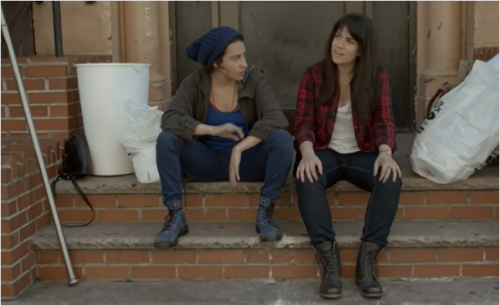
Comedy Central’s Broad City, created by Abbi Jacobson and Ilana Glazer, is a show about underpaid 20-something white girls in New York. Kinda like Girls, only Broad City doesn’t give me that rather unpleasant feeling of existential dread that would be probably five times worse if I were a woman. I’ll be honest, that dread kept me from watching past the first episode of Girls, so I don’t have an informed opinion on it. What I will say is that whatever Girls’ place and importance in the TV landscape, Broad City matches in value and exceeds in entertainment. While Broad City is about girls, it isn’t “About Girls.” It’s not a show that makes it its mission to make statements about modern young womanhood, it’s a show that makes it its mission to be funny as all fuck and depict an incredibly sweet friendship between two well-drawn female characters. And that’s just as important.

broad-city-1-04

A while ago, we reviewed Michael J. Fox’s sitcom, The Michael J. Fox Show, and came to the conclusion that while the show was boring, hackneyed, every word for generic and un-creative, its value was in showing it could be done. A cookie-cutter family sitcom where the main character has Parkinson’s. Broad City, on the other hand, is excellent, but similarly, in a field women typically don’t stand inthe genre of slacker/gross-out comedy.

Representation is the big media issue of the past couple years. Women have less than 45 percent of speaking parts in prime time TV, and less than 30 percent of speaking roles in film. Some parts rise to the topwe can all name phenomenal woman characters in television. But it’s rare that a show, particularly a comedy, focused on women gets to be so goofy and small. A friend watched one of the original webisodes (the show is derived from a YouTube series) and read the comment “Who would want to watch a show about girls walking around and talking about nothing?” Well, like, a lot of people. Walking around and talking about nothing is generally reserved for male-dominated casts, and while that’s a combination of words designed to be unattractive, it describes a coveted set-up where the interest comes solely from the characters being themselves. With no gimmicks and no real premise, Broad City draws from its central friendship between Ilana and Abbi to be an intensely character-based show. And let’s be real, they do more than just walk around.

[youtube_sc url=”http://youtu.be/1WavVwnEFhw”]

That said, one of the show’s biggest strengths is its willingness to be petty. These characters have small lives, and pathetic problems. Abbi has a meltdown over her roommate’s live-in boyfriend recycling her big stack of expired Bed, Bath and Beyond coupons (they don’t actually expire!). There’s a whole episode about Abbi trying to buy weed and Ilana struggling with her taxes. In an episode that takes place during a hurricane, the biggest conflict is that Abbi’s toilet won’t flush after she takes a dump with company over. The pilot is about Ilana convincing Abbi that they have to scrounge up $200 to buy tickets and weed for a Lil Wayne show. Nobody is trying to get or keep a job, the stakes are low, but the characters lead themselves on an adventure anyway, “returning” stolen office supplies to Staples and cleaning an adult baby’s apartment in their underwear.

Small problems, but the kind everyone has. What do people in their 20s worry about? Getting drugs, seeing Lil Wayne, having sex, struggling to come up with the motivation to do anything worthwhile. We all have gross, stupid lives, sometimes. The dialogue is often pointless, but it’s the kind of relatable pointless conversation you and your friends take pleasure in. This show, despite the zany heights its plots reach, is authentic and genuine. Ilana is the kind of pseudo-political millennial we all love to hate, taking issue with Staples playing “What a Wonderful World” because “it’s a slave song, look it up,” and referring to her supervisor as “Mr. George Bush.” At one point, Abbi tells her “Sometimes, you’re so anti-racist, you’re actually…really racist.”

tumblr_n33z4kwfyl1qci9uio2_500tumblr_n33z4kwfyl1qci9uio1_500

Broad City carries with it the themes of decline and aimlessness and disenfranchisement that a more serious and self-important show might, but they’re part of the fabric of this show, not the focus. Abbi folds towels and cleans pubes out of gym shower drains for a living. Ilana gets high at her telemarketing job. One episode opens with the two strutting into a bank to Drake’s “Started From the Bottom” as Abbi deposits an $8,000 check. At a fancy seafood prix-fixe, Ilana eats as much as possible, despite a serious shellfish allergy. At one point, they call in a locksmith to help them into Ilana’s apartment, but he’s so gross and creepy that Ilana gives a fake name and ends up having him get them into her neighbor’s apartment instead. In a montage of their morning routines, Abbi sits next to an old man reading the same book as her. He takes this as a sign and tries to kiss her, and flips her off angrily when she rebuffs him. These themes aren’t often directly explored, but they’re always there in the background and driving the characters.

At the end of the day, Broad City is just a goddamn delight. Abbi and Ilana have an adorable friendship, and the supporting characters are hilarious, especially Ilana’s fuck buddy Lincoln, a dentist played by Hannibal Burress. It’s confidently pointless and gross, willing to show its protagonists at their worst and most brandy-sick, most unmotivated and selfish. With shades of It’s Always Sunny in Philadelphia and WorkaholicsBroad City carries on their tradition of ludicrous character-based catastrophe from a perspective that until now has been excluded from the genre.

[youtube_sc url=”http://youtu.be/jwt3em9NSZk”]

Broad City has been renewed for a second season. Check this show out, please.


 Solomon Wong is a writer and a graduate of UC Santa Cruz. He is the co-editor of Be Young and Shut Up, author of the cyberpunk serial novel Stargazer. He likes cooking, fishkeeping, and biking around Oakland.


Bitch Flicks’ Weekly Picks

Check out what we’ve been reading this week–and let us know what you’ve been reading/writing in the comments!

recommended-red-714x300-1


6 topics for an HBO TV series on Brazil more original than “high end (white) sex workers” by Juliana at Feministing

Where The (Queer) Girls Are Gonna Be On Your TV This Year by Riese at Autostraddle

Cover Exclusive: Jennifer Lawrence Calls Photo Hacking a “Sex Crime” at Vanity Fair

Malala’s Nobel is ‘for all girl students of Pakistan’ by Naila Inayat and Caesar Mandal at USA Today


What have you been reading/writing this week? Tell us in the comments!


‘Two Days, One Night’: Marion Cotillard’s Insight From the New York Film Festival

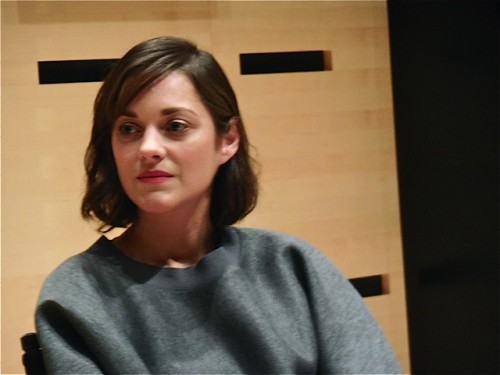
Cotillard did triple duty at the New York Film Festival Sunday to promote ‘Two Days, One Night,’ which had its U.S. premiere. (The film is Belgium’s submission for best foreign film.) At 1, in jeans and a casual but chic top, Cotillard participated in a Q&A for a standing-room crowd. At 3 she changed into Dior and walked across the street to Alice Tully Hall and joined the Dardenne Brothers as they introduced ‘Two Days, One Night’ to a sold out audience, and afterward participated in a Q&A.

unnamed


This is a guest post by Paula Schwartz

In Two Days, One Night, Marion Cotillard plays Sandra, a worker in a solar panel factory who returns to work after medical leave for depression to learn she has lost her job after management forces her co-workers to choose between keeping her on staff or receiving their  1,000-Euro bonuses. After the owner of the factory agrees to a revote, Sandra spends the weekend trying to meet with each of her 12 co-workers to plead her case and persuade them to change their minds.

Jean-Pierre and Luc Dardenne, the veteran filmmakers who wrote and directed the film, raise global issues like wage stagnation, financial inequality, and the declining middle class, while focusing their story on a financially strapped woman desperate to keep her job.

“She’s a simple woman and very complicated at the same time,” Cotillard explained at a Q&A Sunday. “She’s just recovering from a very deep depression and she’s fragile and she’s going to discover things about herself that she didn’t expect.”

unnamed-1

Cotillard, who received an Oscar for disappearing into her role as Edith Piaf in La Vie En Rose, in which she affected the singer’s nasal warble and her sickly hunched over physicality, makes Sandra, in her tank top and with her weary eyes, just as believable. A rare combination of movie star and character actress, Cotillard chooses roles in high-profile Hollywood films like Christopher Nolan’s Inception (2010) and The Dark Knight Rises (2012), along with parts in foreign and independent films, notably Jacques Audiard’s Rust and Bone and James Gray’s The Immigrant, just to mention a few.

Cotillard did triple duty at the New York Film Festival Sunday to promote Two Days, One Night, which had its U.S. premiere. (The film is Belgium’s submission for best foreign film.) At 1, in jeans and a casual but chic top, Cotillard participated in a Q&A for a standing-room crowd. At 3 she changed into Dior and walked across the street to Alice Tully Hall and joined the Dardenne Brothers as they introduced Two Days, One Night to a sold out audience, and afterward participated in a Q&A. As soon as the discussion ended she glided along the red carpet in the lobby for photographers and posed for selfies with fans, some who got a bit too chummy and close, but she never flinched.

unnamed-2

Six things I learned about Marion Cotillard Sunday during the Q&A.


The Dardenne brothers have a long rehearsal process and take lots and lots of takes, and the actress is fine with that:

“Sometimes we would have already done 70 takes and I would ask for more… because some were sequence shots, which have to be perfect because you cannot edit… I trust them (the Dardennes) a thousand percent, so if they would have asked me to do 200 takes I would have done it because I knew there was a reason behind this amount of takes, and that was one of my best experiences as an actresses. They really offered me everything that I had always wanted in terms of relationships with directors, and today when I talk about the amount of takes, I’m like, ‘Oh yeah, this is a lot,’ but on set it was never overwhelming, it was never exhausting, it was just the process of getting something, getting what they wanted to have, and for me giving them exactly what they wanted to have.”


On whether she worried about going too deep into a role and how hard it was for her to come back when the movie is over:

“For Piaf it was kind of difficult because it was the first time I went that deep, and I immersed myself entirely for months into somebody else’s… But I’ve learned a lot trying to get back to my life after La Vie en Rose, so now I know that I need a process to come back to my life, and this process is as interesting as getting into someone, and now it’s part of how I work.”


On how she prepared for celebrity:

“I don’t think you are prepared for this very real weird thing actually… But at the same time it, when you’re an actor you’re looking for a connection with a lot of people you might never meet, but you want to tell a story, and you want this story to touch many people as a kind of connection… When I started in acting and people recognized me in the street it was so weird, but I didn’t know how to take it so I would run away. That was super weird. I felt very paranoid. I didn’t know what to say. I didn’t know what to do. And I’m a very sensitive person, and sometimes it would be too much, but I’m kind of used to it. It’s just a different connection to people. (She laughed.) And I like it.”


She admits to being drawn to playing dark and difficult women with big problems. (Next up is Lady Macbeth.):

“Unfortunately yes. When they offered me the role of Macbeth, Lady Macbeth, I said yes right away without my brain being involved in this decision, and then I started to think, and I was like, ‘Oh wow, yeah, here we go again. Drama! Drama! Drama!’ I must be, yeah, attracted to the darkness for sure. But sometimes I’m having very sane, not schizophrenic conversations with myself, but still conversations with myself, thinking when are you going to stop playing people who are so fucked up? And I have no answer. I’m just waiting for sudden light. It’ll come. It’ll come.”

She did have a brief but memorable appearance in Anchorman 2 starring Will Ferrell and directed by Adam McKay, but it seems she needed help loosening up:
“All these guys are my idols, so that was kind of crazy for me. When they asked me I didn’t even read anything, I was like, ‘Oh yeah, yeah, I’ll be there.’ I mean being on a set with Will Ferrell was a dream, and I was freaked out in that huge field, and Adam McKay was like super far away giving me lines, like new lines over this megaphone, I could barely understand what he was saying. Can I say that I was hungover? So it was part of me being in a disastrous state and at the same time having a lot of fun.”

She doesn’t think she was that great in Woody Allen’s Midnight in Paris:
“That was a tough experience for me actually because it took me a long time to actually believe that I was on a set with Woody Allen… I met Woody Allen five days before we started shooting, and we didn’t really exchange things. We discussed a little bit about the vision of this character, but I had very little information, and then being on set with him I was so scared that I wouldn’t be good enough… I was always scared that he wouldn’t get what he wanted because we had talked so little, and I think that I might have misunderstood what he wanted at the beginning, and I knew that he was not very happy, which does stay with me and so yeah, I felt very uncomfortable… It was not very easy for me either to be in front of an actress like an rabbit in the light (sic)… I’m very happy that I worked with him… I could have done better.”

Paula Schwartz is a veteran journalist who worked at the New York Times for three decades. For five years she was the Baguette for the New York Times movie awards blog Carpetbaggers. Before that she worked on the New York Times night life column, Boldface, where she covered the celebrity beat. She endured a poke in the ribs by Elijah Wood’s publicist, was ejected from a party by Michael Douglas’s flak after he didn’t appreciate what she wrote, and endured numerous other indignities to get a story. More happily she interviewed major actors and directors–all of whom were good company and extremely kind–including Brad Pitt, Angelina Jolie, Morgan Freeman, Clint Eastwood, Christopher Plummer, Dustin Hoffman and the hammy pooch “Uggie” from “The Artist.” Her idea of heaven is watching at least three movies in a row with an appreciative audience that’s not texting. Her work has appeared in Moviemaker, more.com, showbiz411 and reelifewithjane.com.

Seed & Spark: Fearlessly Pursuing a Film Career at 43

At the age of 40, I returned to school, to Fitchburg State University’s undergraduate film/video production program, to learn the craft of directing films. During my two years at Fitchburg State, I took as many classes as I could, while writing and directing two short films. I also discovered a new passion for screenwriting, which led me to the low-residency MFA program at New Hampshire Institute of Art: Writing for Stage and Screen, where I am currently enrolled.

Left to right: Actor Will Bouvier and Jennifer Potts on the set of Jennifer Potts' short film, Home.
Left to right: Actor Will Bouvier and Jennifer Potts on the set of Jennifer Potts’ short film, Home.


This is a guest post by Jennifer Potts.

I am a woman who has never felt the need to conform to the norms of society.

I am my own person doing this life my way and I do not want to ever be the same as anyone else…man or woman. I do not necessarily identify as a feminist, although my husband may proudly tell you that I am a female chauvinist. Sometimes I am, sometimes I’m not. I am myself. And I am a woman. I have strengths and weaknesses. I speak my mind. I am bold and often outspoken. I have secrets. I have fears. I have dreams. I am human and I am going to do this life my way.

At the age of 43, I am launching a career as a screenwriter and film director. In many ways you could say that I am starting over in the middle, but truthfully it is hardly starting over. I graduated from Drew University 23 years ago with a degree in theatre. I put my career on hold to stay home with my four biological children until they started kindergarten. A decision that was, by the way, very unpopular at the time. When my youngest started kindergarten, I looked for opportunities to work in theatre, but the closest professional theatres were over an hour away, and I had small children. I knew that I had to take life by the reigns and build a theatre.

Left to right: Producer, Jessica Killam, and Jennifer Potts on the set of Jennifer Potts' short film, Home.
Left to right: Producer, Jessica Killam, and Jennifer Potts on the set of Jennifer Potts’ short film, Home.


I started forming a small theatre company out of a church and, within five years, filed for nonprofit status and was the co-founder of Cornerstone Performing Arts Center in Fitchburg, Mass., with a small professional non-equity theatre. During my time as the artistic director, I produced and directed over a dozen productions, built an arts training program with youth theatre and dance companies, and oversaw the annual season of productions. After 10 years total building this theatre company, I was hungry to grow as an artist.

At the age of 40, I returned to school, to Fitchburg State University’s undergraduate film/video production program, to learn the craft of directing films. During my two years at Fitchburg State, I took as many classes as I could, while writing and directing two short films. I also discovered a new passion for screenwriting, which led me to the low-residency MFA program at New Hampshire Institute of Art: Writing for Stage and Screen, where I am currently enrolled.

Jennifer Potts on the set of her short film, Home.


As I begin to make my own mark on the movie world, I watch a lot of movies. The movies that resonate with me the most always have a story that I just cannot get out of my head like Lars and the Real Girl and What’s Eating Gilbert Grape. I am also a huge fan of Beasts of the Southern Wild and Moonrise Kingdom. For me, it all comes down to a really good story that is executed well. I have been experimenting with my own style as a screenwriter and filmmaker. My first two shorts were completely different: a quirky comedy and a suspenseful drama. I am filming my last short movie, Charlie & Poppy, this November. This is a family/coming of age drama that captures the magical relationship between a grandfather and grandson over the period of 20 years. Writing and directing shorts has given me the opportunity to hone my own style before embarking on my first feature film. The screenplay that I am working on right now will be the first feature film that I direct and it will build on the foundation I created with my shorts. I will truly begin to make my mark on this movie industry once I take this giant leap into the world of feature films. I will introduce my voice to the world, the voice of a woman with more than 40 years of stories ready to be told.

Actress, Michele Egerton, on the set of Jennifer Potts' 1st short film, Free Time.
Actress, Michele Egerton, on the set of Jennifer Potts’ first short film, Free Time.


I am aware that the road will be tough as a female filmmaker in a male-dominated industry. But what industry isn’t male-dominated? I have spent years navigating my way through life as a woman. I am independent and strong and, when I get rejected and knocked down, I will get up and fight even harder. I know that, at the end of the day, I am the only person who can get in the way of my career and my goals. I am the only person whose actions I have control over.

Someone recently commented on my ability to pursue my dreams stating that I was fortunate to have a husband to support me. The female chauvinist inside me started screaming and kicking and swearing. I did, by the way, choose to marry my husband. I did also stay home and raise the children that he participated in impregnating me with while he pursued his career. I did support him when he returned to graduate school twice. He is a great man – that is why I married him. He is not, however, the reason I am pursuing my career. I am the reason.

Actor, Will Bouvier, on the set of Jennifer Potts' 2nd short film, Home.
Actor, Will Bouvier, on the set of Jennifer Potts’ second short film, Home.


I am the woman who wakes up every morning and fearlessly pursues a career where women are lucky to ever be seen or heard. I am the writer who has the discipline to spend every morning writing the stories that have lived in my head for 43 years. I am the filmmaker who pulls together the logistical and creative aspects of the films I make, while boldly asking people for money to support each film.  I am the one and only person who can make my dreams happen and I refuse to let someone else take that power away from me. This is my life and I will live it fearlessly.


Jennifer Potts
Jennifer Potts


Film director and screenwriter, Jennifer Potts, graduated from Drew University in 1992 with a BA in Theatre Arts. After running a theatre for years, at age 41, Jennifer attended Fitchburg State University’s film/video program where she wrote and directed two short films and received 2014 Film Student of the Year. Jennifer is working toward an MFA in Screenwriting at NH Institute of Art. Jennifer lives in Fitchburg, Mass. with her husband and five children.


‘Gone Girl’: How to Create the Perfect Female Villain

Seeing a female character like Dunne on screen is fantastic–a word she would deem “a little flippant,” but there has yet to be a female villain quite like her. Fincher draws us into this world, Dunne’s world, where everything is this perfect shade of monochrome with tungsten lighting, where the camera moves in slow and methodical push-ins and pull-outs just as calculating as Dunne is, where things change with such swiftness–a kiss to a tongue swab, just like real life. And as we return to real life, we have to wonder: What will Amy Elliott Dunne do next?

This is a guest post by Alize Emme

SPOILER ALERT.

Kudos to the 20th Century Fox exec who decided to market Gone Girl (2014) as a great date movie. This is not a date movie. This is a horror story about the sensationalized pitfalls of a doomed marriage.

As good horror stories go, this one has the perfect villain: Amy Elliott Dunne.

Calculating. Manipulative. Patient. Sinister. Genius. Female.

Dunne (Rosamund Pike) is perhaps one of the greatest female fictional villains portrayed on screen, with bonus points for doing something her male counterparts rarely ever achieve: getting away with it. Dunne, with the help of a highly colored narrative penned by Gillian Flynn, manipulates a vibrant cast of stereotypes as she weaves the perfect crime web and literally gets away with murder.

After feeling like her husband, Nick Dunne (Ben Affleck), has taken her “pride, dignity, hope, and money,” Dunne sets out with fierce discipline and a detective’s eye for detail to frame her unsuspecting husband for her own murder. She befriends “a local idiot,” tells tall tales about fear and the threat of violence, authors a journal’s worth of history–some true, some false, simulates a pregnancy, lights “a fire in July,” and sets the perfect crime scene. She transforms herself into someone “people will truly mourn.”

The premise of Gone Girl works because it plays off our preconceived notions about loss and tragedy. The Pretty Murdered Wife. We as an audience know this story: she’s missing, feared dead, might be pregnant. The narrative needs no back-story, but we do get a glimpse.

Nick Dunne. He is done. Gone. Finished. We know this about Nick the moment we meet him just by his name as he’s standing in the middle of the street next to garbage bins. He is something to be taken out and disposed of with the trash; he is never getting his life back, and Flynn wants us to be aware. The Nick Dunne we are introduced to is a schlubby, beer drinking, ice cream eating, 5 o’clock shadow kind of guy with a dissatisfied marriage and a concubine on the side.

The Smug Accused Husband


When Dunne goes missing and morphs into the Pretty Murdered Wife stereotype, Nick Dunne’s general disposition puts him right into the Smug Accused Husband category. He’s too charming; he’s too arrogant; he’s too suspicious. He’s a man with secrets. “He’s being a good guy, so everyone can see him being a good guy,” Officer Gilpin (Patrick Fugit) observes. He’s a man whose marriage has taught him how to fake it, who happens to be surrounded by women. There’s lead detective Rhonda Boney (Kim Dickens) who gives him a fair run. A fictionalized Nancy Grace clone, Ellen Abbott, (Missi Pyle) who pulls him apart every night on her nationally syndicated television show, and his twin sister Margo (Carrie Coon) who’s been with him since before they “were even born” and offers a stable voice of reason.

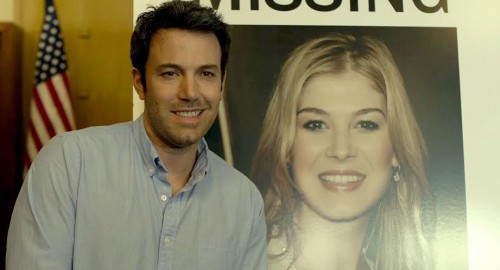
“I am so sick of being picked apart by women,” Nick Dunne says. And he’s right, that’s exactly what’s happening now that he’s been labeled the Smug Accused Husband. This stereotype exists because there are men who do kill their pregnant wives and then go on TV and lie about it, and society remembers them. The case of Laci Peterson was one of the first things that came to my mind. And Affleck is clear to note that Scott Peterson was one of the models for his character. Even the “Missing” photo of Dunne is reminiscent of Laci’s with the bright smile, dangling earrings, and glossy lipstick. Gone Girl is a story that already lives on the edge of our thoughts.
As a couple, Nick and Amy have been pretending from the start. They have a perfect meet-cute, perfect dates, perfect celebratory rituals; they even buy the same sheets. He plays “hot, doting husband,” to her “sweet, loving spouse.” None of it is real; “I forged the man of my dreams,” Dunne says. And in doing so, she herself became the Cool Girl. Another stereotype of how women manipulate themselves to land a man.

Eating cold pizza, drinking beer, remaining “a size 2.” Dunne tailored herself to fit Nick’s taste. But “Nick got lazy.” Not holding up his end of the bargain was never the deal. When she sees that Nick’s sweet romantic gestures were not improvisations made up for her, but rather a well-rehearsed ruse easily tailored to the girl in front of him, Dunne makes a decision. She realizes her husband is no longer the man she married and decides to teach him a lesson he will never forget. “No fucking way,” she says, “He doesn’t get to win. Grown-ups suffer consequences.” She takes charge. She doesn’t let herself be walked on by this man. “Why should I die?” She asks, “I’m not the asshole.”

It’s an easy, cop-out that barely scratches the surface of accurate to diagnose Dunne as a psychopath. To say she’s an overly emotional, crazy woman who can’t handle daily life and descends into a PMS-filled rage, is falling pry to gender stereotypes. Dunne exhibits a perfectly cool demeanor, her emotions are consistently even, she is meticulous and complex. The layers of this character are masterful; she is the opposite of what every gender stereotype says women should be like. She is simply a great villain. “Show me that Darling Nicky smile,” Dunne coos like the Wicked Witch of the West as she stares at a video of her husband on a computer. She’s fascinated by her own work.

Amy Elliott Dunne, the perfect villain


Pike’s performance is mesmerizing; she delivers Dunne’s words in this breathless manner like she’s seductively blowing out a candle. Pike makes us believe from the very beginning that Dunne is both sane and capable of deception. But seeing a female character portrayed so strongly on screen earns Dunne the unfortunate label of “controlling bitch.”

If Dunne were a man, none of these character and sanity accusations would hold true. Male characters that go on rampant murder sprees in movies are never labeled as psychopaths, when clearly they display the same behavior. Dunne is not a psychopath. Crazy people cannot mastermind murders and crimes and not get caught. Even her past acts of “insanity” should be taken with a grain of salt. The ex-boyfriend who calls Dunne a “mind fucker of the first degree,” still keeps a picture of her in his wallet. This woman has allegedly ruined his life, yet he’s still holding her image so close? This calls his authenticity into question while giving Dunne credibility.

Dunne is fiercely intelligent. She has plotted the perfect crime. And while she doesn’t succeed with her original plan, she still sets her husband up for decades of suffering with her pregnancy. For all the betrayed wives out there, Dunne is a hero with the perfect revenge. Her crime is personal, not random, which gets her sanity questioned. Flynn doesn’t touch the subject of Dunne’s mental state. She leaves that up to the audience. David Fincher also helms this story in a nonjudgmental way. He is respectful of Dunne and all the female characters. Dunne is never put on display as a woman, though several male characters make mention of her impressive physical attributes. The supporting female characters, which are all various stereotypes, are never blasted for it; they’re handled with care.

Detective Boney, for example, is the coffee drinking, slick talking lead on Dunne’s missing persons case. She’s an interesting foil to the other female characters that assume Nick Dunne is guilty from the start. Boney gives him the benefit of the doubt, refusing to arrest him because some “blonde dunce” on TV says so. Instead it’s her male partner, Officer Gilpin, who immediately makes up his mind when finding blood splatter in The Dunne’s kitchen that he is guilty.

Through Boney, we are offered the idea that not all women jump to conclusions and hate men. But as the story progresses, we discover that Boney didn’t properly handle her case. “We stained the rug,” she says “with a national spotlight” on her. Had Nick Dunne been left in Boney’s “deeply incompetent hands,” he would be on death row, Dunne conveniently points out. Therefore, Boney’s word is useless in bringing Dunne to justice. Men botch investigations all the time, but for Boney to do so, it’s suggesting a woman can’t properly handle the responsibly of performing a traditionally male job.

Noelle Hawthorne (Casey Wilson) is the wonderfully entertaining suburban mom down the street with triplets and another baby on the way. We know this woman. Everyone has that one inquisitive neighbor that if something were to happen, she would be the first one knocking on the squad car window trying to help the cops. There’s a sense of comedy to this hyperbolic character and her triple-decker stroller, but she is never mocked. We take her seriously. It’s a real feat.

Nick Dunne’s twin, Margo, is a cool girl who’s not the Cool Girl. She drinks bourbon with her brother at ten in the morning, she covers his back with Dunne’s mother, she knows the truth but that doesn’t change her opinion of him. She always speaks the truth with her perfectly snarky comments. “You look like hammered shit,” she tells Nick. He likes her. We like her. She is perhaps the one female character that deviates from a hardened stereotype and could exist in the real world.

Somewhat of a mysterious supporting character, Greta (Lola Kirke) acts as a catalyst for Dunne. She’s complex and calculating just like Dunne; she sees an opportunity, and she seizes it. “Did he put you up to this?” Dunne asks as Greta and her male accomplice rob her blind, “I put him up to it,” she replies. She’s a survivalist and essentially forces Dunne to abort her plan and switch to survival mode herself. Yes, Dunne then murders a man and fakes a sexual assault, but in the world of a villain, she’s just adapting to survive. And as someone who is “skilled in the art of vengeance,” Dunne doesn’t just survive; she thrives.

Dunne, as Nick asks: What are you thinking?


Seeing a female character like Dunne on screen is fantastic–a word she would deem “a little flippant,” but there has yet to be a female villain quite like her. Fincher draws us into this world, Dunne’s world, where everything is this perfect shade of monochrome with tungsten lighting, where the camera moves in slow and methodical push-ins and pull-outs just as calculating as Dunne is, where things change with such swiftness–a kiss to a tongue swab, just like real life. And as we return to real life, we have to wonder: What will Amy Elliott Dunne do next? We’re left with the image of her head, just where we started, much like a few scenes earlier; we are left with Nick Dunne standing before trash cans, just like we started. So much has happened, but what do we really know? And more important, what will we learn next?


Alize Emme is a writer and filmmaker living in Los Angeles. She holds a B.A. in Film & Television from NYU and tweets at @alizeemme.

20 Facts Everyone Should Know About Gender Bias in Movies

To discuss their findings, the Institute hosted its second annual Global Symposium on Gender in Media, which I attended. The primary response I had was, how is it possible that people, especially people in this industry, remain unaware of these facts and what they mean? My second was, how do we get this information to audiences who live with the effects of this bias, but are demonstrably unaware?

geena-davis-header


This guest post by Soraya Chemaly previously appeared at The Huffington Post and is cross-posted with permission.

A new study, Gender Bias Without Borders, was released by the Geena Davis Institute on Gender in Media this recently. Conducted by Dr. Stacy Smith and a team at USC’s Annenberg School for Communications and Journalism, it looks at 120 films in the 10 most profitable film markets, globally. These films, rated G, PG, or PG-13.5 or their equivalents, were compared to similar films in the U.S. A category for U.S./UK collaboration was created since it was so common. The U.S. ranks consistently low in almost every metric.

To discuss their findings, the Institute hosted its second annual Global Symposium on Gender in Media, which I attended. The primary response I had was, how is it possible that people, especially people in this industry, remain unaware of these facts and what they mean? My second was, how do we get this information to audiences who live with the effects of this bias, but are demonstrably unaware?

Studies, other studies, show that everyday sexism is invisible to most people. One form that sexism takes, including vis-a-vis media, is that people overestimate the presence of women and their speech. It happens everywhere. It’s not that we think women are necessarily apparent or speaking as much as men, but that we expect them to be, relatively speaking, invisible and not speaking, so, by comparison, any appearance and speech is “too much.” This says a lot about status and mainstream cultural assumptions about social roles and of power.

GEENA-Geena-Davis-Institute-on-Gender-in-Media

Despite decades of research, it is apparent that we are, as a culture, so used to women being marginal that we don’t even notice. Women, as Davis points out, are only 17 percent of the people in movie crowd scenes, and yet viewers assume they are almost equally represented. That 17 percent number is super interesting, since it is also roughly the percentage of women found in leadership positions in government and business.

With very small changes, the ratio of men to women in film has remained fundamentally unchanged since 1946. As Davis put it, at this rate, “It will be 700 years before we reach parity” in U.S. media. And that parity is crucially important, not the least of which is because, as she explained, “Eighty percent of media we consume is made in the United States. We are responsible for exporting these images of girls and women to the world.” It is not a pretty picture.

20 Facts About Gender and Film in 2014

Read them and weep.

And then share widely.


      • Globally, there are 2.24 male characters for every 1 female character.


      • Out of a total of 5,799 speaking or named characters 30.9 percent were female, 69.1 percent male.


      • Films for children had similar ratios, with only 29.2 percent having female protagonists.


      • Less than a quarter of films surveyed (23.3 percent) had a female lead or co-lead.


      • The U.S./UK hybrids and Indian films were in the bottom third for gender-balance, with less than a quarter of speaking roles going to female characters. In the U.S./U.K. hybrids, 23.6 percent and in Indian films, 24.9 percent.


      • These on-screen ratios mirror behind the camera realities. Out of 1,452 filmmakers whose gender was identifiable, 20.5 percent were female compared to 79.5 percent who are male.


      • Females are 7 percent of directors, 19.7 percent of writers, and 22.7 percent of producers.


      • France has the worse gender ratio, 9.1 men to 1 woman.


      • Brazil has the best, 1.7 men to 1 woman. The U.S.? 3.4 men to 1 woman.


      • When women direct films there are 6.8 percent more women in them. When women are screen writers, there are 7.5 percent more women. As the report points out, however, this may not be a good thing. “This explanation reflects the old age, “write what you know.” On the other hand, women maybe given these projects to write and direct that include more female characters. This second and latter explanation is more problematic, as it restricts the range of open directing and writing opportunities given to women.”


      • How gender is represented is also consistently problematic, particularly when you consider the influence media has on children’s imagination and self-conception. Female characters are more than twice as likely to be wearing sexy and sexualizing clothes (24.8 percent vs. 9.4 percent).


      • Female characters are more than twice as likely to be skinny (38.5 percent vs. 15.7 percent).


      • Female characters are more than twice as likely to be either partially or fully naked (24.2 percent vs. 11.5 percent).


      • In films, comments made by characters that refer to appearance are directed at women at a rate of FIVE times that of comments directed at men.


      • For films with fictional characters for younger children, in which the characters were aged 13-39, females are equally disproportionately sexualized. Even worse, however, is that in kids films, female characters are even more likely than in adult films to be thin.


      • In the U.S., for example, although women make up 46.3 percent of the workforce, they are only 23.2 percent of characters who work on film. This is one of the largest representational differences among all the countries measured. Needless to say, nowhere were women overrepresented as working for pay.


      • India had the smallest discrepancy in depictions of work: women make up 25.3 percent of the off screen workforce and 15.6 percent on the onscreen one.


      • When researchers looked at characters who were executives, as a marker of leadership representation, women made up 13.9 percent. There were not enough of them to have country breakdowns. While the study notes that “Across the global sample, occupational power is at odds with female participation,” that number, 13.9 percent is actually not too far off the mark. In the U.S. 17 percent of executives in the Top 100 companies are women, internationally that number is 24 percent. Women make up only 3 percent of CEOs globally.


      • Men are much more likely to be seen as attorneys and judges (13 to 1), academics (16 to 1), doctors and medical practitioners (5 to 1). Just three female characters were represented as political leaders with power. One didn’t speak. One was an elephant. The last was Margaret Thatcher.


      • Men were represented in STEM jobs area at a ratio of 7 to one. In the U.S., where women make up 24 percent of the STEM workforce, men made up 87.5 percent of STEM job workers.


I am grateful for organizations like the ones that came together (the UNWomen and the Rockefeller Foundation sponsored this work) to do this study, but I am tired of reading statistics like this.

Executives at the meeting I attended, women, expressed being “startled” by the data and I had to ask, “How is that possible in 2014?” Men have disproportionate industry potential to be change agents. Where are they? The room I sat in was 90 percent women. Media and entertainment management, like most other industries’, is lacking in diversity. Men with influence and the ability to raise these questions and do something about them probably strive, as individuals, to be good parents to their kids and make sure their daughters are healthy, happy, educated and ambitious. Not doing anything about this problem, from an institutional perspective, undoes all of that effort. The argument that there is some kind of benign “neutral” position is misguided. Same goes for parents.

Boys and men are done a massive disservice from these media portrayals as well. The flip side of these biased portrays contribute to inhumane, unrealistic stereotypes about masculinity based on control, violence, dominance and the active erasure of empathy as an acceptable emotion. A narrow, frequently violent, power-over-others male heroism comes at a very high price for everyone. As filmmaker Abigail Disney, a panelist, asked, along with women, there is another notable absence, “Where are the men who solve problems by thinking?”

Abigail Disney
Abigail Disney


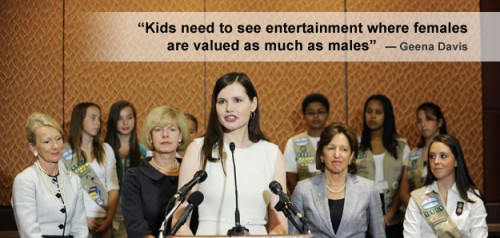
Doing nothing perpetuates a discriminatory and harmful status quo. When progressive movie stars, the most prominent and well-paid being men, sit at a table, when liberal-minded executives review scripts, when open-minded producers are hiring — why is this not front and center? Davis recommends two very simple steps when scripts are being reviewed: change “he” to “she” for characters and make sure crowd scenes are gender balanced.

“Film executives were raised on this media, too. Just as women are underrepresented on screen they are missing in the real world,” explains Davis. These are not unrelated realities.

You may at this point be saying, “It’s all about the money.” Except, it’s not. Films featuring women in meaningful roles make more money. What does that leave us with? Consumer education. When will we draw a line? It’s not just about withholding money, but actively supporting women filmmakers and movies that feature diversity, fully dimensional female characters such as those featured in the annual Athena Film Festival.

The-4th-Annual-Athena-Film-Festival-is-Celebrating-Female-Leadership

Many made the point that, for the most part, moviegoers are unaware of the biases. Consumers are not going to theaters thinking about gender or how its representation impacts their and their children’s lives, boys and girls both. Media is how we train girls and women to have low expectations and train boys to have high ones. Girls to exhibit submissiveness and self-objectification, boys to express dominance and control. This isn’t a passive process.

“Filmmakers make more than just movies,” explains Smith. “They make choices. The choice could be for gender equality.” There is no excuse for not having this information and using it.

Researchers took pains to explain the limitations of their study and make good recommendations for improvement, further courses of inquiry and necessary steps that can be taken to address what is clearly a significant problem in our story-telling, especially for children.

What can you do? Share these facts, talk about them with educators, coaches, family, friends. Family friendly films are among the biggest problems. Talk to your kids. Don’t let this everyday sexism go unremarked upon. Vote with your wallet. Tell your local theatre to improve their programming.

The representation of gender in these films shapes imaginations and identity, aspirations and ambition.  These depictions teach girls and boys about how culture sees them: their worth, their relative value, the roles they “should” play. Girls and women, infinitely diverse in their interests, appearance, ambition, ability, aspirations, make up more than 50 percent of the human population, but you would never know any of this watching our top grossing films.  Really, how can we continue telling these fundamentally destructive stories to children?

Print


Soraya L. Chemaly writes about feminism, gender and culture. Her work appears in The Huffington Post, The Feminist Wire, BitchFlicks, Fem2.0, Alternet and Feministe among other media. She considers it a major accomplishment that the people in her house dance with abandon. Follow on Tumblr, Facebook, Feminism’s Fantastic, Twitter @schemaly  


What Country’s Film Industry Has the Best Gender Equity?

The study from the Geena Davis Institute on Gender in Media and a group of partner organizations analyzed 120 films from the 10 countries with the most profitable film industries in the world. On average, women don’t fare much better in films internationally than they do in the United States: only 30 percent of characters with speaking parts or names are women. However, the cinematic gender balance varies greatly between countries. In Korea, for example, 50 percent of leading parts went to women while women played only 10 percent of leading roles in Russian films.

French film "Blue is the Warmest Color" centered on compelling female stories—but behind the camera, men outnumber women in the French industry nine to one. Film still from Sundance.
French film Blue is the Warmest Color centered on compelling female stories—but behind the camera, men outnumber women in the French industry nine to one. Film still from Sundance.


This guest post by Sarah Mirk previously appeared at Bitch Media and is cross-posted with permission. 

We know that women woefully make up only 30 percent of speaking roles in American films. But a new study looks at how women fare in cinema internationally.

The study from the Geena Davis Institute on Gender in Media and a group of partner organizations analyzed 120 films from the 10 countries with the most profitable film industries in the world. On average, women don’t fare much better in films internationally than they do in the United States: only 30 percent of characters with speaking parts or names are women. However, the cinematic gender balance varies greatly between countries. In Korea, for example, 50 percent of leading parts went to women while women played only 10 percent of leading roles in Russian films.

screen_shot_2014-10-01_at_4.05.09_pm

One thing that’s frustrating about this disparity is not just that women aren’t reflected in our media but that films featuring women in speaking roles are often better movies. When a film has few women in speaking roles, that’s usually a red flag to me that it’s a poorly written film. That was backed up by American box office revenues last year: major films that passed the Bechdel test made far more money, overall, than films that failed to have two named female characters who talk to each other about something other than men.  I’d be excited about a plan for American theaters to follow the example of a few theaters in Sweden that post whether a film passes the Bechdel test—then I’d be able to know which films to skip.

When thinking about gender representation in media, it’s essential to look at who is making our media. Female directors are more likely to work on projects with more women on screen. There’s no country that has gender balance behind the scenes in the film industry, but some do better than others. At the bottom of the pile is France, where male directors, writers, and producers outnumber women nine to one. Brazil is the most equitable overall, but the UK gets the special distinction of being the only film market where women make up a majority of film writers.

screen_shot_2014-10-01_at_4.05.19_pm

The study also looked at how women are portrayed on screen, including what jobs they hold. Discussions of how women are portrayed in film are endless, but I think the most interesting part of this analysis is its number-crunching on the actual jobs women hold in films. The researchers looked at the number of characters who hold jobs in science, technology, engineering, and math (STEM) fields and other male-dominated careers. The results are telling. In the United States for example, women hold 24 percent of jobs in STEM fields. But onscreen, only 12.5 percent of characters with jobs in STEM fields are women. Women are also absent onscreen from high-level political positions: only 9.5 percent of high-ranking politicians in films internationally are women. These onscreen representations are important because they offer role models for the viewer—not always good role models, of course, but even if women are playing nefarious scientists or politicians plotting global domination, people sitting in the audience understand that women are a vital presence in the laboratories and capitol buildings of the world. As the study notes, “Filmmakers make more than just movies, they make choices. Those choices could be for balance, for less sexualization, and for more powerful female roles. The choice could be for gender equality.”


Related Reading: Sweden is Now Rating Films for Gender Bias.


Sarah Mirk is Bitch Media‘s online editor. Right now, she’s really into watching Elisabeth Moss in Top of the Lake.


Violence Against Indigenous Women: Fun, Sexy, and No Big Deal on the Big Screen

Over and over, violence against indigenous women is made to titillate, built into narratives along with action, suspense, swashbuckling, and romance. Indigenous women become exotic props, and when we are identified with these dehumanized caricatures, it becomes easier to treat us inhumanely.

Captain Hook kidnaps Tiger Lily in Peter Pan


This guest post by Elissa Washuta previously appeared at Racialicious and on her Tumblr and is cross-posted with permission.

The body of 15-year-old Tina Fontaine, a member of Sagkeeng First Nation, was pulled from the Red River in Winnipeg on Aug. 17. Her murder has brought about an important conversation about the widespread violence against First Nations women and the Canadian government’s lack of concern.

In her Aug. 20 Globe and Mail commentary, Dr. Sarah Hunt of the Kwagiulth band of the Kwakwaka’wakw First Nation wrote about the limited success of government inquiries and her concerns about other measures taken in reaction to acts of violence already committed, such as the establishment of DNA databases for missing persons. Dr. Hunt writes:

“Surely tracking indigenous girls’ DNA so they can be identified after they die is not the starting point for justice. Indigenous women want to matter before we go missing. We want our lives to matter as much as our deaths; our stake in the present political struggle for indigenous resurgence is as vital as the future.”

Violence against indigenous women is not, of course, happening only in Canada. In the U.S., for example, the Justice Department reports that one in three American Indian women have been raped or experienced an attempted rape, and the rate of sexual assault against American Indian women is more than twice the national average. This violence is not taking place only in Indian Country.

In the Globe and Mail on August 22, Elizabeth Renzetti wrote about three recent murders of First Nations women.

“What unites these three cases is that the victims – Tina Fontaine, Samantha Paul and Loretta Saunders – were all aboriginal women. What else unites them, besides the abysmal circumstances of their deaths? What economic, cultural, historical or social factors? Anything? Nothing?”

Jeffords holding the murdered Sonseeahray


I can’t answer that, but I know that all of these women—and every other indigenous woman in Canada and the U.S.—lives in a society that includes images of violence against indigenous women in its entertainment products. Over and over, violence against indigenous women is made to titillate, built into narratives along with action, suspense, swashbuckling, and romance. Indigenous women become exotic props, and when we are identified with these dehumanized caricatures, it becomes easier to treat us inhumanely.


John Smith points a rifle at Pocahontas


Take as an example Disney’s Pocahontas. Released in 1995, the cartoon feature has replaced the historical figure’s life story in the minds of many Americans. Much has been made of Disney’s exotification of Pocahontas. John Smith is only compelled to put down his gun because of her beauty. Pocahontas is imbued with animal qualities throughout the film as she scuttles, bounds, swims, creeps, and dives. This reinforces a long-held conception of Native peoples as being “close to nature” at best, “more animal than human” at worst—and the latter is a view that makes us easier to abuse.


Emily and Sam in New Moon


The recent depiction of Emily (a Makah woman) in the Twilight series offers viewers a direct representation of violence in a fictional Native community. Emily’s broad, visible facial scar is said to be the result of her partner Sam’s (a Quileute man/werewolf) outburst of rage: he was a younger werewolf, with difficulty controlling his “phasing” from human to wolf, he became angry, and she was standing too close. The presentation of this story is problematic in its shrugging absolution of Sam of his responsibility in maiming Emily, and the aftermath is heartbreaking: in the more detailed version of the story presented in the Twilight books, after Sam mauls Emily, she not only takes him back, but convinces him to forgive himself. This sends the message that an episode of violence can and should be overlooked for the sake of romance. Emily, a Native woman, becomes expendable. Her safety is of little concern; the fact that Sam has “imprinted” on her, cementing his attachment, is more important than the reality of recidivism.

In a Globe and Mail editorial, “How to Stop an Epidemic of Native Deaths,” the author brings up the many social factors at work in the epidemic of violence against Native women. I bring up the problematic and pervasive imagery above not because I think it is the most problematic issue, but because it is what I know, and because we can start solving it with our individual actions. We don’t need to call Native women “squaws” and joke that they were “hookers” when forced into prostitution, as Drunk History did last year. We can make better choices than “naughty Native” costumes on Halloween. We have the freedom to choose the representations we make in the world, and when we perpetuate damaging stereotypes of indigenous women as rapeable, we are using our autonomy to disempower others.

Karen Warren wrote in “A feminist philosophical perspective on ecofeminist spiritualities”:

“Dysfunctional systems are often maintained through systematic denial, a failure or inability to see the reality of a situation. This denial need not be conscious, intentional, or malicious; it only needs to be pervasive to be effective.”

Tiger Lily faces Hook


I’m tired of hearing that these images aren’t harmful. I’d rather see how much they’re missed when they’re gone than continue to listen to the insistence that the image of Pocahontas at the end of a gun barrel is wholesome while, every day, more and more indigenous women die while we are told that this is not a phenomenon, not a problem, nothing more than crime.


Elissa Washuta is an adviser in the Department of American Indian Studies at the University of Washington and a faculty mentor in the MFA program in creative writing at the Institute of American Indian Arts. Her first book, a memoir called My Body Is a Book of Rules, was recently published by Red Hen Press.


Women with Disabilities: The Undiscussed Horror Staple of Female Characters

The slut, the virgin, the bitch, the girl next door, the mother, the creepy old lady, the evil little girl, and the final/survivor girl. Female archetypes and stock characters within the horror genre are rampant and well known. From a movie poster alone, we can often times figure out exactly what a woman’s place and purpose is in a horror film. However, there’s another “type” of woman that we frequently see in horror films that no one seems to want to talk about.

"God closed my eyes so I could see only the real Gwynplaine"

This guest post by BJ Colangelo previously appeared at her blog Day of the Woman and is cross-posted with permission.

The slut, the virgin, the bitch, the girl next door, the mother, the creepy old lady, the evil little girl, and the final/survivor girl.  Female archetypes and stock characters within the horror genre are rampant and well known.  From a movie poster alone, we can often times figure out exactly what a woman’s place and purpose is in a horror film.  However, there’s another “type” of woman that we frequently see in horror films that no one seems to want to talk about.

Physically, sensory, or mentally disabled women have been popping up in horror films from the very beginning. The Man Who Laughs is often regarded as the first horror film, and the female lead was a beautiful, blind woman.  From the very beginning of the horror genre, the damsel in distress character was the quickest way to write a story.  “Girl needs saving from someone or something, man saves girl from someone or something, girl is indebted to man and thanks him by kisses or marriage, the end.”  Whether it was because male writers needed to make their female characters SUPER vulnerable or whether they needed an excuse to make a woman “weaker,” adding a physical/mental/sensory disability to a woman became a quick way to differentiate female characters from the usual damsel in distress.  The beginnings showcased disabilities as a major reason for the demise of female characters.  1959’s The Tingler had a creature that could only be killed by screaming.  The death in the film that acts as the catalyst for the entire movie was centered around a woman who was a deaf/mute, and therefore, could not “scream for her life.”  We can’t have a woman be brave enough not to scream when frightened, so we must make her mute.

Fiona Dourif as "Nica" in Curse of Chucky

Physical disabilities appear in many films as a way to hinder otherwise “strong” female leads.  The 1979 midnight movie The Visitor showcases a woman forced into a wheelchair by her evil daughter in order to prevent her ability to escape her child, and to make her a weaker target for her boyfriend to impregnate her.  More recently, we’ve been exposed to a protagonist who uses a wheelchair in Curse of Chucky, who also plays the only character with any sort of intellect and moral compass.  Putting a character in a wheelchair completely raises the stakes.  Stairs are out of the question, speed is a major concern, the ability to hide is greatly reduced, and the fact someone could easily come behind and control the movement and direction of a character is horrifying.  However, throwing a wheelchair on a character immediately develops a sympathetic relationship between the character and the audience.  We immediately understand the difficulties that can be present for being in a wheelchair, and before anything happens, we immediately feel for her.  This concept presents itself regardless of the age of the woman in the wheelchair.  Would You Rather contains an elderly woman in a wheelchair and from the very beginning of the film; she is immediately the character the victims of the game of “Would You Rather?” want to protect.

Jennifer Lynch's Boxing Helena


This then brings us to the characterizations of amputees.  In horror films, amputated women seem to fall into two categories.  We have women who have been amputated as some sort of a punishment, and women who have turned their amputations into something of empowerment.  In Jennifer Lynch’s controversial directorial debut, Boxing Helena, we see a woman who is amputated solely so she cannot run away.  In Saw VI, Tanedra Howard’s character must amputate her own arm to survive one of Jigsaw’s traps, and is later shown in Saw 3D as a painfully angry victim who, although survived death, has been forever punished as a one-armed woman, only gaining a positivity in the form of better parking at the mall.  To counteract these women punished with amputation, we have characters like Cherry Darling in Planet Terror who have taken a very Ash J. Williams approach to amputation by replacing the missing limb with a weapon.  Her machine gun leg has made her character an iconic figure and one of the most recognizable women with a disability in horror.

The mute protagonist of Ms. 45


Sensory disabilities (blindness, deafness, muteness) are often used as a catalyst to further along story lines. Ms. 45, The Eye, The Beyond, Julia’s Eyes, and even Orphan included either sensory disabled protagonists or supporting characters. The loss of sight, sound, or speech is something that many people fear to begin with, so much like having a character with a physical disability, presenting a major character unable to see, hear, or speak immediately raises their stakes.  Female characters are often blind or deaf, giving the freedom for story tellers to write circumstances they would normally be unable to construct.  Why can’t Ms. 45 call the cops and find justice for her attack?  She cannot speak.  Why can’t little Max tell when her adopted sister Esther is plotting her demise?  She cannot hear.  Characters in horror films vitally depend on their senses for survival.  Taking one of their senses away change the way the protagonist must play the game to be alive at the end of the film.

Fairuza Balk after going "crazy" in The Craft


However, the most problematic portrayal of women in horror lies in the representation of mental illness and mental disabilities.  Unfortunately, society already has a stigma in place for mental illnesses, and artforms reflect this poor mentality.  In 2012, Bitch Flicks ran an AMAZING piece by Megan Kearns titled “That ‘Crazy Bitch’: Women and Mental Illness Tropes in Horror” that encompasses everything that I could possibly write about this topic.  My favorite quote from the piece states:

“And the Crazy Bitch trope helps perpetuate mental illness stereotypes. It has many sister tropes infesting horror too. Like the Hysterical Woman, where female characters are depicted as overly emotional and irrational, The Madwoman in the Attic, a trope where a character with mental illness is locked away, isolated from society, and the Nervous Housewife, where men doubt women’s paranormal experiences and patronize them. Jen Doll at The Atlantic Wire gives us “10 tropes about women that women should stop laughing about,” including “the crazy.” As Doll astutely observes, calling someone “crazy” is a way to put people (often women) down and for the accuser to feel better about themselves, all while being insulting to those who who struggle with mental illness.”

Ultimately, it appears that the growing awareness of ableist behavior is changing the way we treat people with disabilities in cinema, especially with female characters in horror films.  Female tropes and archetypes will always exist, but gaining a stronger educational grasp on why characters are written the way they are is the most sure-fire way to learn how to provide better portrayals and influence less offensive media.  I must thank comic artist and Day of the Woman reader Shannon LeClerc for suggesting that I tackle this topic.  Of course I in no way scratched the surface of disabled women in horror films (is there a book on this subject?), but the best way to make a change and gain a better understanding is to open a dialogue and actually discuss the situation.  Women with disabilities are a prominent character type, and we will only gain a solid understanding if we talk about it.


BJ Colangelo is the woman behind the keyboard for Day of the Woman: A blog for the feminine side of fear and a contributing writer for Icons of Fright. She’s been published in books, magazines, numerous online publications, all while frantically applying for day jobs. She’s a recovering former child beauty queen and a die-hard horror fanatic. You can follow her on Twitter at @BJColangelo.