You see it all the time, actors kissing passionately on screen. It looks like they really mean it. But have you ever thought about what it is like for them – the first time they have to conjure that passion in a roomful of cameras, equipment, and onlookers?
This is a guest post by Kim Wilson.
You see it all the time, actors kissing passionately on screen. It looks like they really mean it. But have you ever thought about what it is like for them – the first time they have to conjure that passion in a roomful of cameras, equipment, and onlookers?
For me, what started as sheer terror at the thought of my upcoming sex scene for my latest film, Cleave, actually turned out to be not as scary as I thought, AND… okay, I’ll admit it—it was even a little bit hot. When I helped write this film, I didn’t know I’d be cast in it. Only in the preparation for the scene did I chastise myself for writing a sex scene: What. Was. I. Thinking?!
Even my own mother asked what it was going to be like. In the weeks prior to filming, I searched the internet incessantly on what to expect. Most searches ended up taking me to porn sites, which I can say definitely did NOT help my self-confidence. I needed something to draw from, something to ease the irrational fears bouncing around in my head. It was all-consuming. It terrorized me hourly.
I was anticipating the worst: bad kissing, missed queues, awkward touching. Sometimes I would have to pull over on the side of the road flushed with anxiety, beads of sweat pooling on my upper lip, trying to catch my breath in a panic. Could I really pull this off? My mind manically raced. What if my partner is dreading kissing ME? After multiple (hundreds of) calls to my acting coach and a few hundred self affirmations I found on YouTube, I finally convinced myself that I would get through this with flying colors because, after all, I am a goddamn professional.
My acting partner and I met before our scene. This was a good thing. Even though we knew each other already, it was nice to remember he was an actual human being and not this sex demi-god I had made him out to be in my head. And, what I realized immediately was that this meeting was imperative. If any of you reading this are actors and you have a racy scene coming up heed this one piece of advice: You must trust your partner implicitly in a scene like this. They have to have your back. Your vulnerability is just out there flapping in the wind for the world to see. And by god, we were going to fly high in that windstorm. How do you develop that trust?
COMMUNICATION
We both agreed we wanted the scene to be authentic as possible. No robot kissing, but to be “in the moment “ and authentic. And that meant really allowing us to lose ourselves in each other. Gulp. We discussed our boundaries in detail: “Yes, you can feel me up.” (That’s an actual quote.) And while we awkwardly laughed at ourselves during these conversations, it really helped us feel just a wee bit more comfortable. On the day of filming, I was still terrified. I don’t know exactly where my head was, but between my mantras and my power posing, I decided to wear sweatpants to set. Hideous sweatpants. Old sweatpants. I have no idea why I wore sweatpants. I must have thought that I would come off as “casually cool” and “I’m totally okay with this scene that’s about to happen–see? I’m sooooo comfortable.” Yeah. My “day after thanksgiving” outfit might not have been the best way for me to communicate to the crew and my scene partner “I’m ready to get sexy!” One hour before our call time, I had already had the self-talk in the bathroom before the scene – you know the one I’m talking about: the “pull your shit together” talk in the stall.
It’s YOU and HIM (or HER)
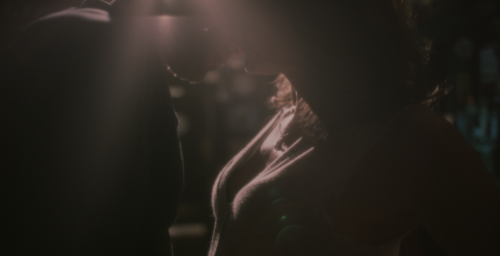
My partner and I are in our places. We stand facing each other inches apart. It’s literally minutes until the director calls “action.” I can tell he is nervous. He can tell I am too. All of a sudden, this wonderful thing happens: we comfort each other. I stroked his arms. He stroked my neck. I reached for his shoulders, he reached for my back. This touching was actually calming us down. It was helping prepare us mentally and er…physically for the impending scene. There were new beads of sweat forming on my lip now. “Action!” the director called out. We lean in and we kiss. It was effortless. I was surprised. Best of all, it was authentic. We had built our own little world of intimacy.
As the scene unfolded it went from kissing into more passionate stuff that became less and less awkward. Even when the director called out, “OK, now arch your back here” and “drag your hand there,” it felt effortless. Yes, think about that for a moment. Someone calling out your next sex move as you’re in the throws of passion in a strange bar. Believe it or not, it was a relief. What could have been robotic and canned, felt natural and easy. I trusted my partner and he trusted me. And I admit, there were mortifying moments as well, such as being taken aside discreetly and told my breathing was too loud during the sex scene. Yeah. That happened. (That could be my new all-time low.) But it’s proven one of the funniest stories I can pull from my hat at parties lately, so I’ve got that going for me. You learn a lot from fake sex. I am not particularly looking forward to seeing myself on screen and thinking to my horror, “I make THAT face?” Fingers crossed I will be able to use it at parties soon as well.
SUPPORT MATTERS MOST
Looking back, I realize one of the biggest reasons that I felt comfortable on set besides my partner was the incredibly gracious crew who didn’t laugh or make eye contact (thank god) with me during those scenes. Our director had set the stage for all of us, having all of our best interests and safety as her priority. She was the one that was responsible for the mood, the tone and the professionalism. She met with the crew beforehand, giving them strict instructions on her high expectations during each take. She met with my partner and me before the scene to assess our comfort levels and allow us to express any concerns. The fact she was a woman was a huge comfort to me. Honestly, I couldn’t have done it without her support as well.
What I learned most of all, was that acting wasn’t so much about myself as it was about the other person. My partner and I learned how to put each other at ease, how to work together as a team to “give and receive” from the each other and how to turn our mortification into laughter. I am forever grateful to the director, crew and to my acting partner.
So, did I use my tongue in my kissing scene? I’ll never tell.
To learn more about Kim Wilson and the film Cleave, visit the following sites:
Still searching for a way to answer our question of fairness, the young woman of Jumla, sitting wearily before me, looked quizzically at our translator.
Our translator said: “She’s asking what ‘fair’ means.”
This is a guest post by Sophie Dia Pegrum.
A voice. After filming a day in the life of a young woman of Jumla, Nepal, we asked her whether she considered the physical burdens of her life fair in comparison to her young husband. She thought about it for a long time. I sat, exhausted, watching her thoughts pass across her face from my position behind the camera. As the co-director and DP, I had spent what I considered a fairly grueling day arising before dawn, hauling my first world gear several miles up a mountain pass to follow this young woman while she searched for firewood, chopped it, and carried a seemingly impossible load back down the steep mountain path. The morning’s trek was engaged at a rather leisurely pace by her standards due me getting all the shots I wanted while desperately searching for my inner mountain filmmaker goat. This was just the beginning of a long day which also involved her journey across the village to milk a cow, cook meals for her husband’s family, and to hand clay wash the front of their stone house using freezing water. Her husband had been hanging out in the village most of the day and had decided to go to the river to fish in the afternoon.
Families in Jumla will often spend their limited resources educating their sons, for as soon as a young girl is married, she goes to live with the family of her husband, and essentially becomes their scullion. Why use the little assets a family has to educate the daughters who will essentially marry into a life of drudgery?
Still searching for a way to answer our question of fairness, the young woman of Jumla, sitting wearily before me, looked quizzically at our translator.
Our translator said: “She’s asking what ‘fair’ means.”
How do you find another way to ask this question? For us, the educated women of the industrialized nation, who stand on the shoulders of our sisters who have fought for our equality, we cannot un-know this history. We are as puzzled by the idea of not conceiving of equality, as the young woman of Jumla, who knits her eyebrows, trying to comprehend the concept. Moreover, what good will it do her to try to answer this question. For even if her life was unfair, what could she do to change it?
We spent time on and off over the next three years, embedded in the same village, observing many similar stories and capturing the immense spirit and strength of the women in this remote place in the foothills of the Himalaya. In the beginning, some women were too shy to even consider talking to us, but often, many women who had never been asked their opinion, began to express themselves in front of the camera, and we saw a subtle shift.
I had often questioned our presence as two women filmmakers, and the impact we may be having. Certainly, both being about six feet tall, we were often a source of local entertainment as we constantly hit our heads on low ceilings and doors and crammed ourselves into small corners of smokey kitchens to film. Though loaded with irony for my own personal reasons, being lovingly referred to by the locals as the “cameraman,” I enjoyed the moniker that to them, represented professionalism.
Over time, we recorded the myriad voices of women here, especially in their song. Women sang in the fields as they worked together, their strains echoing uphill as they disappeared with their baskets to collect wood. They sang in their kitchens in the evening after the days work was done and they sang together while they pounded corn. They sang for us and asked us to share our songs. My co-director and I tried to figure out if there was another song aside from “Happy Birthday” that we both knew the words to.
Women who had never been asked to air their opinions were sometimes surprised by their own voices. Often uneducated, they hadn’t had the opportunity to create the thought patterns which allowed them to form their own judgements and ideas, or create a view of themselves in the world. One woman told us that she didn’t feel that she could take a free class being offered by a local charity because she didn’t think she was capable of learning.
One of the most poignant memories I have was at the end of an interview we did with a man who was running a tea shop and inn with his wife and children. As I was packing away the camera he came to us and said that he would reconsider the education of his own daughters. He said that watching us operate “technical things” made him appreciate that perhaps his daughters had more potential than he had realized. He now understood and believed that women could do things like that and he wanted his daughters to have this opportunity.
Women will still have to find their voices, but within this complex and embedded societal structure, men will need to stand alongside them too and this requires better education for all and a deep shift in thinking.
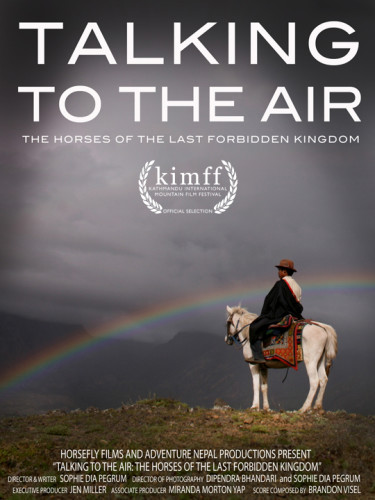
Our film, Daughters of the Curved Moon, will be coming out in the next year and I am looking forward to sharing the inspiring story of these communities with a wider audience. I am also finishing up another documentary I shot on the roof of the world called Talking to the Air, which I am crowd-funding at Seed&Spark. My ability to articulate my voice as a filmmaker comes from the determination of so many others before me. In turn, I wish to use this channel to tell authentic stories of humankind that promote a sense of wonder in us all, and to share the voices of those that are still struggling to find their forum. After working in the high Himalaya, I am now also determined to learn some new songs.
Sophie Dia Pegrum is a director and cinematographer who has produced and shot films in the Antarctic, at the North Pole and in the Himalayas including 77 Below and Daughters of the Curved Moon. Sophie co-owns Horsefly Films and the Rare Equine Trust and produces docs about rare horses and fragile horse cultures worldwide. She is currently finishing a film she shot on the Tibetan border titled Talking to the Air: The Horses of the Last Forbidden Kingdom.
A Peter Pan syndrome, or in Jungian terms, the “puer aeternus” complex (forever young), is active here for Megan’s character as she fears personal and professional commitment; the term is “puella aeterna” for women. The appeal of this complex is to stay “forever young,” a girl-woman without adult-level commitments. Her complex is strongly activated by her friend Allison’s (Ellie Kemper) bridal shower and large wedding.
Laggies, a new comedy written by Andrea Seigel and directed by Lynn Shelton, explores how indecision and passivity wreak havoc in the personal life of Megan (played by Keira Knightly), a Seattle woman in her late 20s. Various themes and motifs explored in the film include: the desire to be “adolescent forever” or the appeal of the “puella aeterna” complex; the meaning of animal spirit guides; and complications of father-daughter relationships in terms of female identity. In the growing body of work from talented filmmaker Shelton, this movie’s theme could be categorized under a general umbrella of healing troubled family ties, as seen in her previous films Touchy Feely (2013) and Your Sister’s Sister (2011).
Megan (hilariously portrayed by Keira Knightly) is still part of a circle of friends formed in high school. As 30-ish young adults, they are collectively moving on to marriage, parenthood, and ascending careers. Floundering Megan, who quit grad school therapist training, lives with her serious boyfriend Anthony (Mark Webber), and works for her accountant father (Jeff Garlin) by waving signs on the street to advertise his business. Her friends and her mother express impatience with Megan’s inability to “grow up” and commit to a solid direction in life, be it by marrying, getting career counseling, or finding a new interest of any kind.
A Peter Pan syndrome, or in Jungian terms, the “puer aeternus” complex (forever young), is active here for Megan’s character as she fears personal and professional commitment; the term is “puella aeterna” for women. The appeal of this complex is to stay “forever young,” a girl-woman without adult-level commitments. Her complex is strongly activated by her friend Allison’s (Ellie Kemper) bridal shower and large wedding. When boyfriend Anthony proposes to her at the wedding reception, Megan takes a moment to consider things and goes outside, where she catches her father passionately kissing another woman.
Upset Megan, in true “puella” style, flees the wedding without explanation, and drives away alone. In front of a store, teenaged Annika (Chloë Grace Moretz), asks Megan to buy alcohol for her lively group of high school friends. Megan agrees, saying it’s a “rite of passage” since someone once did it for her; Megan ends up spending the rest of the evening drinking with the teenagers outside, and even TPing a house. When she returns home, Megan finds that Anthony, her friends and parents were understandably alarmed by her abrupt disappearance from the wedding reception. However, Megan and Anthony seal their elopement plans and look forward to getting married in the next week or so in Las Vegas.
This first “regression” sequence for Megan, of hanging out with high school kids, leads to more, as Megan eventually fakes attending a business conference for a week, while in reality, hanging out with Annika’s crowd, staying at her house and getting to know Craig (Sam Rockwell), Annika’s charismatic father. Megan poses as Annika’s mom for a conference with a school counselor, trying on the role of “mother.” Megan’s ongoing vocational interest in “healing” is foreshadowed here as she inquires about the credentials needed to work as a school counselor.
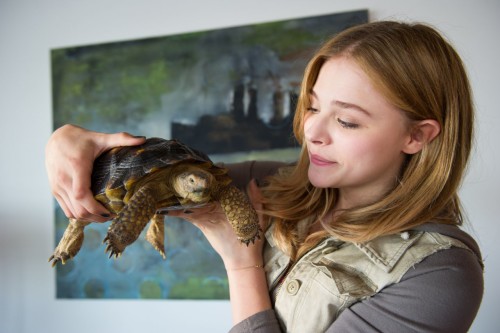
The leitmotif of animal spirit guides is present in the film, used to metaphorically probe the undercurrents of character. Anthony learns, while attending a conference, that his animal guide is “Shark,” a motivating image for him in terms of personal/professional growth. But what is Megan’s spiritual animal avatar? During her weeklong “secret residency” at Annika’s house, Megan takes care of a pet tortoise left behind by Annika’s mother, who moved away. Although the pet has feeding issues, Megan gets on the ground with it in the back yard and cures its eating disorder – another sign of her continued interest in the act of healing. Megan declares to Craig that “Tortoise” is her animal spirit guide. At the teenager’s request, Annika and Megan visit estranged mom Bethany (Gretchen Mol), by tracking her down from a return address on checks sent to Craig. Inside Bethany’s apartment, there are tortoise images on the walls, heading downward towards the floor – a symbolic tie to the family Bethany left behind. Megan, in the encounter in Bethany’s apartment, tries to help both mother and daughter connect, a third instance in the film of Megan promoting a healing process.
In the end of the film, Megan falls in love with Craig while engaged to Anthony, without either of the men knowing about each other. She declares herself to be “a Snake,” but one in the act of transformation, shedding skin. Although some have interpreted the film’s ending to be in the “romantic comedy” vein, the animal imagery here signals that it’s more about Megan’s understanding of herself. More than a simple “happily ever after” ending, she comes to terms with who she really is. Her admission of her own “slow pace” (Tortoise) and duplicity in romance (Snake), along with an articulation of a desire to change (her connection to the “snake’s skin”) leads her to break free from the passivity of her “in-between” life and the stereotypical social pressures of her friends, to go for what she really wants. Siegel and Shelton remind us that our “animal” instincts connect to personal identity and self-acceptance.
Father-daughter relationships get a lot of screen time in Laggies. Two daughters, with loving dads, struggle with identity issues and passivity. Ed has always loved Megan unconditionally, cutting her slack when others judged her “laggie” ways harshly. He never “pushed” her towards easy answers as others in the film seem to do. But Megan cuts off all contact from her dad after seeing him kissing another woman. In the film’s third act, Megan admits that she is like her father with her own recent bout of cheating; she confronts Ed about his “cheating” incident, and also listens to his advice about the changing nature of relationships, and the ongoing need to work at maintaining them. She’s also happy that he told her mother the truth about what happened, and her parents are going to work through their relationship issues.
Craig and Annika also have a paired focus in the film. Craig’s initial alarm upon finding the adult Megan hanging out in his daughter’s bedroom highlights his role of “protector.” But Annika is protective of her father, too; she cuts off her friendship with wayward Megan upon learning that she’s engaged to another man while becoming involved with her dad. Annika misses her mother; Megan functions as a surrogate mother-mentor figure to her in a large portion of the film, but facilitates a reconciliation visit between Annika and Bethany.
Laggies investigates how a Peter Pan syndrome might lose its appeal, and what happens, at the quarter-life mark, when one outgrows a circle of former high school friends. The film begins with old footage of Megan and her friends jumping into a fenced off pool on their high school prom night. In Act Three, Megan ends up at Annika’s prom night, and mentors her by urging Annika to “take action” at the dance and disclose her romantic interest in high schooler Junior (Daniel Zovatto) to him. Megan realizes that she must take her own advice. The clear emphasis on the need for women to claim agency in the final moments of Laggies elevates its message beyond a “romantic” ending. Megan regrets her own passivity; she learns, by the end when she finally knocks on Craig’s door, that she’s the one who’s responsible for what happens in her life, and doing something about it.
Laura Shamas is a writer, film consultant, and mythologist. Her newest book is Pop Mythology: Collected Essays. Read more at her website: LauraShamas.com.
I would argue that genres dominated by female scopophilia and sexual tension, such as the YA Supernatural Action Romantic Comedy (SARCom) genre, challenge Mulvey’s paradigm and allow us better understanding of the role of desire in shaping visual media.
This is a guest post by Brigit McCone.
With so much feminist discussion of the Objectifying Male Gaze(TM) and its effects, we often fail to consider the hetero-female objectifying gaze, or scopophilia, in visual media. Indeed, feminist film critic Laura Mulvey effectively denied its existence in her influential 1975 essay “Visual Pleasure and Narrative Cinema,” which states that women “cannot view the decline of the traditional film form with anything more than sentimental regret” as female onscreen presence must monolithically serve as passive erotic fetish for the Male Gaze, unless scopophilic pleasure is disrupted by radical techniques. I would argue that genres dominated by female scopophilia and sexual tension, such as the YA Supernatural Action Romantic Comedy (SARCom) genre, challenge Mulvey’s paradigm and allow us better understanding of the role of desire in shaping visual media.
SARCom was created in 1987 by the manga artist Rumiko Takahashi’s Ranma 1/2. Her mixture of kung-fu demon-of-the-week fights, romance and comedy, with a supernaturally strong heroine, dual shapeshifting supernaturally strong love interests and sarcastically quipping sidekicks, was then a completely unique story and rapidly became popular in the West and Japan. Takahashi’s creative control as visual and story artist (particularly after the success of the slapstick Urusei Yatsura) meant that the aesthetics of SARCom were shaped by the female gaze from the outset. Among its innovations, Ranma 1/2 introduces an Ice Prince/Wolf love rivalry between the hero Ranma and his rival Ryoga, a trope Takahashi would develop in her next SARCom Inuyasha. Joss Whedon’s Buffy the Vampire Slayerpopularized the SARCom in mainstream Western culture, developing its own Ice Prince/Wolf rivalry with the characters Angel and Spike. The Ice Prince/Wolf dynamic now dominates teen girl cinema, after Catherine Hardwicke’s Twilight made her the most commercially successful female director of all time.
Twilight‘s inversion of Mulvey’s gendered model of cinema, with Hardwicke’s camera continually privileging Kristen Stewart’s gaze as Bella Swan, and offering Robert Pattinson’s Edward Cullen as erotic spectacle, would be interesting to analyze. Twilight also almost fails a reverse-Bechdel through the intense Bellacentrism of all its characters. In this essay, however, I would like to focus on the Ice Prince/Wolf rivalry itself, as a generic trope of SARCom, and its illuminating parallels with the male Madonna/Whore complex.
Celebrating Celibacy: The “Ice Prince” Archetype
The defining characteristic of the “Ice Prince” is his combination of emotional fidelity and sexual unavailability, generally accompanied by emphasized superiority and by physical threat. Ranma, the hero of Ranma 1/2, not only rivals the heroine Akane in martial arts, but periodically transforms into a girl more sexually attractive than she is. This tantalizing superiority in femininity enhances the character’s sexual unavailability; the world of Ranma 1/2 plays with gender but is strictly heteronormative with biological sex. His loyalty and rescuing of Akane go alongside Ranma’s constant sexual frigidity. Ranma 1/2 occupies an intermediate position between the shounen (boys’ manga) harem plot of Takahashi’s previous Urusei Yatsura and the love rivalries of her later Inuyasha: as a shounen hero, Ranma is the center of a harem of sex-crazed women, but as a shoujo (girls’ manga) “ice prince” he must be sexually attracted to none of them.
Inuyasha tames its threateningly feral hero, while maintaining his sexual unavailability, by making him frustratingly in love with a previous incarnation of the heroine Kagome – thus, he loves Kagome as a reincarnation, but cannot consummate this love due to his fidelity to the original.
The most extreme “Ice Prince” archetype in Takahashi’s work is Sesshomaru, the haughty, aristocratic pureblood demon introduced as a villain, accompanied by a sycophantic toady, and attempting to cheat his socially inferior, half-brother Inuyasha out of his inheritance; that is, almost exactly the set-up of Fitzwilliam Darcy in Pride & Prejudice. The character is also redeemed by Austen’s strategy: meeting an open-hearted, mischievous and unintimidated girl whom he struggles to scorn as inferior; having his flaws contextualized by introducing his controlling, snobbish mother; finally, risking everything to rescue the redeemer-girl. Introducing a poison-clawed Demon Dog Darcy, with the power to raise the dead and blast his enemies to hell, unbalances Inuyasha: Sesshomaru’s well-written redemption arc commences just as Inuyasha’s own arc grinds to a halt, spending a hundred chapters randomly upgrading his sword while the fandom sways toward the narratively marginalized Sesshomaru. Demon Dog Darcy is then forced to hand his emotionally-earned powers over to Inuyasha in an exasperatingly contrived plot twist. But Sesshomaru’s very marginalization in Inuyasha‘s narrative, and total detachment from the main heroine, function to intensify fangirl emotional and sexual frustration: the ultimate aim of any Ice Prince. Although Demon Dog Darcy progressively thaws emotionally, the character’s sexual unavailability is emphasized by spiked armor encircling his chest and maintained by filling the “Elizabeth Bennet” role with a pre-pubescent girl (one fervently hopes).
In Buffy the Vampire Slayer, Angel loves and saves Buffy but is made sexually unavailable by a curse that he will lose his soul if he has sex with her. This loss of soul also allows the intensification of Angel’s physical threat and sadism, while permitting the ‘real’ Angel to remain a dutiful lover. Twilight likewise presents Edward Cullen as a deeply loving and loyal ‘Ice Prince’ who threatens Bella repeatedly by mentioning his urge to devour her and, of course, is sexually unavailable through his fear of ‘losing control’.
Demon-in-Distress: The “Wolf” Archetype
The defining characteristic of the ‘Wolf’ is his combination of desperate emotional and sexual availability with repeatedly emphasized vulnerability and animalism. The most exaggeratedly vulnerable is Ranma 1/2‘s Ryoga, a little boy lost in the literal sense that he farcically lacks any sense of direction. The fanged, impulsive Ryoga’s regular transformations into a small, cute piglet add to his vulnerability. His inability to tell the heroine Akane of his true nature and feelings, out of fear of losing his privileged access as her pet pig, forms a near-perfect satire of the “Friendzone” phenomenon.
Inuyasha‘s impulsive, hotheaded Koga, a Ryoga lookalike, is a wolf-demon. In contrast to the elusive, emotionally conflicted hero Inuyasha, Koga falls for the heroine Kagome almost immediately and pursues her consistently. The manga is notable for constantly placing Koga in helpless ‘demon-in-distress’ situations requiring rescue, and for counterbalancing Sesshomaru’s spiked, hug-repellent armor and Inuyasha’s loose robes with Koga’s skimpy armor and furred micro-miniskirt, concealing his crotch only by careful choice of viewing angle.
Although Buffy‘s Spike is a vampire, theoretically an “ice prince” archetype, the character bears a dog’s name and typical ‘wolf’ impulsiveness and romantic vulnerability. In his second season introduction, he is confined to a wheelchair and forced to watch his beloved Drusilla seduced by “Ice Prince” rival Angel. In the third season, he’s pathetically dumped and weeping. In the fourth, he’s neutered by a brain chip that zaps him for attacking, so ‘he doesn’t chase the other puppies anymore’. In the fifth, the trope of Spike’s nakedness is introduced as vulnerability; he bares his chest to Buffy’s stake and confesses his love. This sequence is revealed as Spike’s dream; he is stripped and Buffy is fully clothed even in his own sexual fantasies. Spike is also stripped and tortured for love of Buffy by the dominant, female deity Glory in this season. In the sixth, after their first sexual encounter, Buffy is again fully clothed, abusing Spike verbally while he sprawls naked and defenseless. She repeatedly violates his sexual boundaries from a position of dominance; his attempt to force himself on her is presented as a crime of pathetic desperation. Though “Ice Prince” Angel wishes to torment and kill Buffy when he is soulless, Spike’s soulless state is no obstacle to his love – the emotional dependence of the ‘wolf’ knows no bounds.
Twilight’s Jacob Black is another wolf defined by constant loyalty, before attempting to force himself onto Bella in an act portrayed as pathetic desperation. Where Edward’s brief moment of toplessness is a dramatic, suicidal act that will dazzle a watching crowd, Jacob’s toplessness and skimpy attire are chronic, underlining his availability.
Shishihokodan! Or, Why Team Jacob Loses
Comparing the fandom of all four series reveals an interesting trend: fangirls are roughly equally divided between Team Jacob and Team Edward, Team Spike and Team Angel, Team Ryoga and Team Ranma, Team Koga and Team Inuyasha; nonetheless, the “Ice Prince” always gets the girl. It would be easy to blame the creators. Yet, Stephenie Meyer claims to be “Team Jacob.” Both Marti Noxon and Jane Espenson Buffy‘s main female writer/directors have made statements in support of the BuffyXSpike romance. Rumiko Takahashi’s writings in the romcom genre, Maison Ikkoku and One Pound Gospel, alsoreward and root for heroes in the vulnerable ‘wolf’ mode, and it is Takahashi who provides a structural explanation for ‘ice prince’ triumph with Ranma 1/2‘s Shishihokodan arc.
The “Shishihokodan” is a blast of energy which enables perpetual loser Ryoga to defeat the hero Ranma by harnessing his heartbreak. Ranma attempts to defeat the all-powerful Shishihokodan with a confidence-blast, but can only triumph by giving Ryoga momentary hope of sexual opportunity. In other words, Ryoga loses not because he is inferior, but because losing is the paradoxical source of his power. Any woman attracted to the “wolf” archetype is inherently drawn to vulnerability; her attraction is intensified by the wolf’s heartbroken rejection. Any woman attracted to the ‘ice prince’ is inherently drawn to dominance; her attraction is conversely reduced by his loss of mastery. As such, pursuing the resistant hero and resisting the pursuing hero create positively and negatively charged polarities to an explosive battery of sexual tension, a narrative trap which dooms the “wolf,” as Takahashi showed herself sympathetically aware with the Shishihokodan arc.
The wolf is difficult to dispose of: any alternative love interest would undermine his painful availability, thus one must be introduced with unsatisfactory suddenness at the last minute. The sudden arrival of a pig-fetishist marks Ryoga’s sidelining in Ranma 1/2; a wolf-girl for Koga is a last-minute addition to the Inuyasha anime, while Koga simply loses his previously foolhardy fighting spirit, forgets his long-established vengeance vendetta and slinks out of the original manga after admitting that Kagome should be with Inuyasha. Most disturbingly, the newly-arrived love interest for Jacob Black is literally newly-arrived as a newborn; his obsessive need to psychologically groom an infant into a future bride doesn’t bother the infant’s parents, presumably merely relieved that the wolf has been disposed of. More satisfyingly, rather than slinking away Koga-style, Spike’s acceptance that Buffy can’t love him “but thanks for saying” allows him to destroy the Hellmouth and be redeemed, incinerating himself in a spectacular blast of purest Shishihokodan.
Shishihokodaaan!!
What does this mean for our reading of film representations of male Madonna/Whore complex? It implies the continual defeat of the Whore as structural necessity – as a pursuing character she must be resisted to generate sexual tension, regardless of whether the author is Team Madonna or Team Whore. So, is womankind’s reading of a value judgement in the Madonna’s triumph flawed, like the hetero-male audience’s resentment of SARCom as poisonously emasculating? In fact, mankind’s Whore is generally portrayed as more empowered than womankind’s Wolf, probably because our culture sees male sexuality as common weakness but female sexuality as social rebellion. It is the female audience’s model of dominant-resistor/submissive-pursuer that aligns the rivalry dynamic of triumphant dominant with the love dynamic of triumphant resistor in a perfect feedback loop that structurally maximizes sexual tension (hence the squealing). But if male readers fail to appreciate Ice Prince/Wolf, are we likewise misreading Madonna/Whore? When Marlene Dietrich’s Frenchy hurls herself in front of a bullet and dies in James Stewart’s arms, is this the patriarchal punishment of a promiscuous woman or is it merely a blast of purest Shishihokodan?
With her gray curls and thick, veined ankles, unadorned on screen as she is in the book, Olive, captured by McDormand, is a fascinating and complicated character. She is ferocious, intelligent, tactless, cruel, and achingly kind, sometimes all at once. The actress is not physically alike Olive, who Strout described as stout and big, but she inhabits the spirit of the character so completely – a fact sure to be recognized awards season – that you cannot take your eyes off her even as you wonder what cringe worthy thing she will say or do next.
Frances McDormand is magnificent as the title character of the four-part HBO miniseries Olive Kitteridge, based on the Pulitizer Prize-winning novel by Elizabeth Strout that chronicles the illicit affairs, crime, hilarity and tragedy that ensures in the seemingly placid and hardscrabble New England town of Crosby over a 25-year time span.
The story begins when Olive is in her early 40s and teaches seventh-grade math. She is married to the kindly pharmacist, whom she often badgers and insults. The miniseries is as much a story of Olive’s journey as a portrait of an ordinary marriage with its trials and tribulations, petty resentments, and minor victories. Richard Jenkins is terrific as Olive’s long-suffering husband, Henry, who is as easy-going and relatively sunny as Olive is curmudgeonly and negative.
The action continues until Olive is in her early 70s, retired, and reconciled to the rhythm of an uneventful but relatively happy marriage. During the years she tries to find balance in her relationship with her son (John Gallagher Jr.), whom she loves but who resents and fears her sharp tongue and mood swings. Life takes cruel and typical twists for Olive as it does for most people.
Director Lisa Cholodenko
Romance enters unexpectedly in late life in the form of wealthy widower Sam (Bill Murray), a bald-headed old man with a big belly she discovers one morning slumped over on her walking path, possibly from a heart attack. “Are you dead?” she asked him. “Apparently not,” he replied. Tragedy and comedy co-exist naturally in Olive’s world.
With her gray curls and thick, veined ankles, unadorned on screen as she is in the book, Olive, captured by McDormand, is a fascinating and complicated character. She is ferocious, intelligent, tactless, cruel, and achingly kind, sometimes all at once. The actress is not physically alike Olive, who Strout described as stout and big, but she inhabits the spirit of the character so completely – a fact sure to be recognized awards season – that you cannot take your eyes off her even as you wonder what cringe worthy thing she will say or do next. The miracle is that Olive, who is unbelievable rude and unlikeable, slowly grows on you and you come to love her honesty and heart. McDormand captures this without sentimentality.
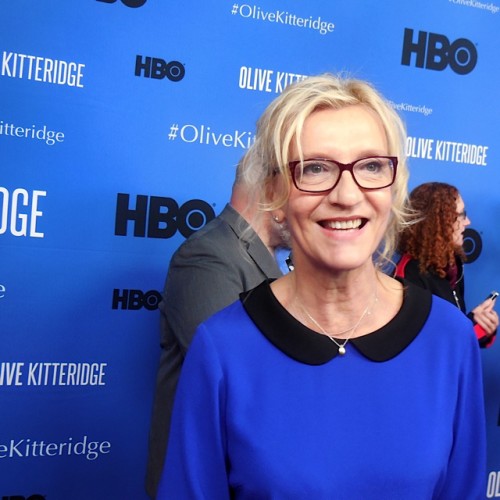
McDormand and Tom Hanks executive produced the miniseries, which hews to the spirit of the book that has been gracefully adapted by Jane Anderson and expertly directed by The Kids Are All Right director Lisa Cholodenko. Except for Hanks, they all turned up last week at the show’s premiere at the SVA Theater in Manhattan, along with cast members Rosemarie DeWitt and Cory Michael Smith.
On the red carpet, I asked author Elizabeth Strout who inspired her for the character of Olive:
“People always wonder if it’s my mother. It’s not. I grew up in Maine. Even though I’ve lived here for over 30 years I grew up on a dirt road with many older relatives, old aunts, mostly aunts, often grumpy, and it was just the air I breathed as a child, so it was sort of natural for me to find that character as a compilation I think of many of these different people that I grew up with.”
Writer Jane Anderson
I asked Strout how she came up with Olive’s physicality, her large size and ungainliness:
“Olive just came to me as somebody who was large. She’d gotten larger and she knew that and was uncomfortable with that, but wasn’t going to stop her from eating. I could almost feel it and sometimes, even now, I guess because there’s been so much written about Olive, all of a sudden – this is already a few years ago in my writing career – I just looked at my ankles the other day and I thought, ‘Oh, they’ll get bigger, like Olive’s,’” she laughed. “There wasn’t any particular person that I based her on. I just saw her and felt her.”
At the end of the book Olive seems to be embarking on a romance. I asked Strout if she had any plans for a follow-up book on Olive:
“I’ve actually found some old Olive stories that I hadn’t used. I’m such a disorganized person but I don’t know. I think maybe I better just let her go and have people hope the best for her.”
Strout told me the project for the series became with a phone call three years ago from her agent who told her,
“You know, Frances McDormand is interested in this,’ and I was like, ‘Really? Wow! That’s great.’ I met with Frances a few times in New York and we talked about Olive. We talked about different things. She’s an amazing person and actor and she got it. She knew about it because Olive’s very interior. There’s a lot that goes inside without her speaking it. And Frances does that. She shows us in her minimalist motions and her facial expressions.”
Frances McDormand and Rosemarie DeWitt
I asked if McDormand asked for tips on portraying the character but her only questions were unsurprisingly about adapting the book:
“She asked me about the timing. Like how did I think they would get the 25 years in? I said I had no idea. I don’t know anything about film. I was no good,” Strout laughed.
The author told me she never envisioned her book as a movie:
“No. I did not. The Burgess Boys, which I just wrote, I actually can see that as a movie because the narratives much clearer and the characters are very distinct in certain ways. But with Olive I didn’t. I did not think of it, so it’s extra special for me.”
I asked screenwriter Jane Anderson about how she became involved and about the challenges of adapting the book:
“I read the book for pleasure and when Fran called me up and said, ‘Are you interested in adapting it?’ I said absolutely. But it took me a couple of years to get it right because it’s a great piece of literature and the better the piece of literature, the more profound and subtle the piece of literature, the harder it is to adapt for screen. And because my parents are in Olive and Henry I saw the theme of the book as the theme of making a marriage work and I think ultimately they do work as a couple. I think often the pessimistic, difficult people and tender, easy people often work together as a unit. They need each other.”
The main goal was to be true to the book’s lack of sentimentality. Olive is a character you can’t stand at first but she grows on you. Anderson agreed:
“That first chapter she’s terrible. You can’t bear the woman. She’s cranky. She’s cruel. She’s dismissive. But then there’s the brilliance of Fran. Because Fran didn’t just want to just make her sentimental. Fran didn’t care if you liked her not and that’s what made her so good. Fran has no vanity. It was lovely to have her voice, the voice of Olive.”
Poster for Olive Kitteridge
Jenkins, who is so terrific as Olive’s husband, told me he didn’t worry about his character coming across as one-dimensional or too much of a milquetoast:
“I think the time made it possible, the movie’s four-hour length. You get to see a complex life, not just certain characteristics of a person. You get to see the whole person. Nobody is just one thing, so I think that helped.”
Director Lisa Cholodenko told me how she became involved in the project when McDormand called her three years ago and told her about the book, which she then sent:
“She said read it. I’m going to play it. It hasn’t been published. I’m going to deal with HBO, see if you’re interested in adapting it.” The director told me she loved the book and heard McDormand’s voice but the timing wasn’t right for her. “I told Frances, I don’t know how to adapt this. Go with God. I hope you find somebody awesome to do it. I don’t think I’m the person to do it now, but I would love to talk to you if you get a script. And three years later I got a call form HBO saying hey we have this script. Are you still interested? I said yeah I’ll read it. I was hooked.”
I asked about the casting choice of Bill Murray as Olive’s possible love interest. He has a legendary reputation for being difficult to contact and refusing most movie parts, so his casting is particularly intriguing.
“What’s not to love about Bill Murray?” Cholodenko chortled. “What was more wonderful is you never know if he’s going to show up, so you’re like, Yeah, Yeah, no Bill’s going to do it! Yeah let me know when he lands. And he did!”
Paula Schwartz is a veteran journalist who worked at the New York Times for three decades. For five years she was the Baguette for the New York Times movie awards blog Carpetbaggers. Before that she worked on the New York Times night life column, Boldface, where she covered the celebrity beat. She endured a poke in the ribs by Elijah Wood’s publicist, was ejected from a party by Michael Douglas’s flak after he didn’t appreciate what she wrote, and endured numerous other indignities to get a story. More happily she interviewed major actors and directors–all of whom were good company and extremely kind–including Brad Pitt, Angelina Jolie, Morgan Freeman, Clint Eastwood, Christopher Plummer, Dustin Hoffman and the hammy pooch “Uggie” from “The Artist.” Her idea of heaven is watching at least three movies in a row with an appreciative audience that’s not texting. Her work has appeared in Moviemaker, more.com, showbiz411 and reelifewithjane.com.
Not only does this kind of stereotyping delegitimize Black women’s feelings, but it functions as a racist and misogynistic social policing tactic that pressures black women to self-censor their opinions, feelings and needs, or else be written off as a “type.” In fictional representations, the Angry Black Woman labeling and policing limits the types of black women we see in film, literature, comics, television, and other media.
This guest post by Corinne Gaston previously appeared at the Ms. blog and is cross-posted with permission.
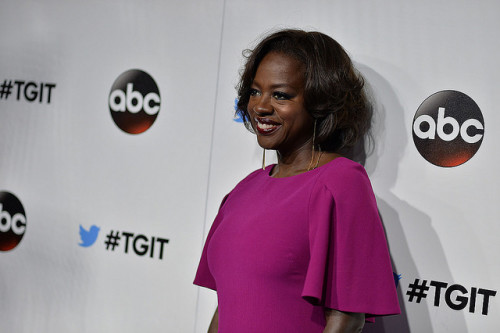
After the weeks of hype and speculation leading up to the premiere, How to Get Away with Murderhas been the show to watch on Thursday nights. Viola Davis stars as Annalise Keating, a law school professor and criminal defense attorney, whom you can tell from the get-go is not a person to be crossed.
She expects 100 percent from her students when she walks into Middleton Law School’s Criminal Law 101–or, as she likes to call the class, How to Get Away with Murder. Their first assignment? Come up with a defense for the attempted murder case she is working on. The only catch is that not one of the dozens upon dozens of students can repeat another student’s idea. She takes these students under her wing but she does not mother them; after all, the business of defending criminals is a hard one.
While many have praised Davis’ characterization of Keating, others, such as The New York Times critic Alessandra Stanley, boxed-in Keating as an “Angry Black Woman” before a single episode of the show had even aired. Keating was portrayed as “strong” and confident in the show’s trailer, which was enough for some folks to write her off. But in the pilot we see her actual character, and from the second she steps in front of the camera she is a force to be reckoned with. Keating’s gaze is unflinching and penetrating, her voice unwavering and, I must admit, I found her character to be menacing. But that does not obscure her creativity, brilliance and charisma. She openly expresses anger, dissatisfaction, sexuality and high expectations, and it should go without saying that stereotyping her would be a huge misstep.
Given the relative lack of diversity on television, particularly with show leads, characters like Davis’ Keating already have the limited representation of Black women in television (and film) working against them—it leads to extra pressure to “represent” or act as “spokespeople” for Black women, even if that is an unfair expectation. But then the double whammy comes in the form of racial biases. If you’re a Black woman actor and your character is too sexual? Jezebel. Cares too much for others? Mammy. Loud or expressive? Ratchet. Reveals any emotion that can be linked to displeasure OR (and here’s the kicker) personal standards? Angry Black Woman.
Not only does this kind of stereotyping delegitimize Black women’s feelings, but it functions as a racist and misogynistic social policing tactic that pressures black women to self-censor their opinions, feelings and needs, or else be written off as a “type.” In fictional representations, the Angry Black Woman labeling and policing limits the types of black women we see in film, literature, comics, television, and other media.
Despite the public criticisms that are sure to arise over Davis’ character—that she is too tough or aggressive—I am personally thankful that her character exists and that Davis plays Keating the way she does. It’s not often you see a Black woman character exude so much fearsome, respected power and confidence and not be portrayed as an over-the-top Sapphire stereotype, like many of the women in Tyler Perry’s movies. She is a hard, dynamic, and mysterious person. However, she does have her moment of vulnerability when one of her students finds her crying over the state of her strained marriage–because, of course, she’s human.
Oftentimes it feels like writers, producers and directors are afraid to show truly complex depictions of Black women for fear that audiences will not accept them. Which is funny, because white men are given huge amounts of freedom to depict complex, questionable and even immoral protagonists. Beyond that, these white male characters are often praised, loved and lionized—all without being written off as Angry White Men (even when they are very, very angry). Characters like Walter White from Breaking Bad and Dexter Morgan from Dexter, for example,amassed huge fan followings, even though one is a meth kingpin and the other is a straight-up murderer.
White male television characters can be crime bosses, murderers, meth manufacturers, drug dealers, drug users and thieves and be lauded, while in real life some of those identities (such as drug user and thief) have been used to dehumanize Black individuals and argue away their murders. Clearly there’s a racial representation issue that goes deeper than television, but as it stands, Black women actors should have the freedom to play as complex and troubling characters as white men and have their acting expertise applauded.
The first episode of How to Get Away with Murder laid the groundwork for twisting story lines to come: murder, affairs and, of course, more murder. If the plot line follows the path I think it will, the second murder, supposedly committed by four of Keating’s students, will be discovered, the four will go to trial and Keating will end up either defending or prosecuting her very own students. The show has the flexibility to go in many directions and so does Annalise Keating, who doesn’t tolerate the word “failure” in her personal dictionary, but will be forced to reckon with her own secrets.
At this point, I don’t know much of who she is, to which side her complex character skews in terms of general morals, or even if I’m rooting for her yet in the storyline. What I am rooting for, however, is her existence.
Corinne Gaston is an editorial intern at Ms. Follow her on Twitter @elysehamsa or go to her personal blog.
The films that depict terrifying little girls are acting out the deep-seated fear of the loss of our culture’s goodness and purity, virginity and innocence. There’s also a collective discomfort surrounding the fact that little girls become women, and that womanhood is unpredictable and uncontrollable. Little girls in films like ‘The Exorcist’ and ‘The Bad Seed’ embody a premature, preternatural womanhood that is powerful, sexual, and taboo.
Both the horror and thriller genres are rife with terrifying little girls. Sometimes these girl children are possessed by malevolent spirits. Sometimes they’re changelings or aliens, impersonating sweet, innocent beloved daughters. Other times, they’re ambiguous ghosts, haunting our protagonists for justice or revenge, and sometimes they’re just sociopaths who murder and torment their victims.
Scary children are certainly a prolific trope, articulating our culture’s fear of the loss of innocence as well as the unknowable, even alien, qualities of children. However, when we examine why the trope of creepy little girls is so prominent, we’re presented with an even more complex psychology. Little girls embody all that is good and pure; they are innocence and vulnerability. They are viewed separately from women because they symbolize all the potential that our culture embeds in the ideal of womanhood.
The films that depict terrifying little girls are acting out the deep-seated fear of the loss of our culture’s goodness and purity, virginity and innocence. There’s also a collective discomfort surrounding the fact that little girls become women and that womanhood is unpredictable and uncontrollable. Little girls in films like The Exorcist and The Bad Seed embody a premature, preternatural womanhood that is powerful, sexual, and taboo. And they must be stopped, killed if necessary, to neutralize their threat. The logic: though we can’t truly stop little girls from growing up into those subversive creatures known as women, we can engage in the futile fantasy that destroys them before that happens time and time again.
Feel free to use the examples below to inspire your writing on this subject, or choose your own source material.
We’d like to avoid as much overlap as possible for this theme, so get your proposals in early if you know which film you’d like to write about. We accept both original pieces and cross-posts, and we respond to queries within a week.
Most of our pieces are between 1,000 and 2,000 words, and include links and images. Please send your piece as a Microsoft Word document to btchflcks[at]gmail[dot]com, including links to all images, and include a 2- to 3-sentence bio.
If you have written for us before, please indicate that in your proposal, and if not, send a writing sample if possible.
Please be familiar with our publication and look over recent and popular posts to get an idea of Bitch Flicks’ style and purpose. We encourage writers to use our search function to see if your topic has been written about before, and link when appropriate (hyperlinks to sources are welcome, as well).
The final due date for these submissions is Friday, Nov. 21 by midnight.
Punishment is the main objective of the demon Bathsheba in The Conjuring, and specifically she seeks to punish the mother figure of a family. The hauntings and road to possession begin when in 1971, Roger and Carolyn Perron move into an old farmhouse in Rhode Island with their five daughters. Slowly, they begin to experience paranormal disturbances.
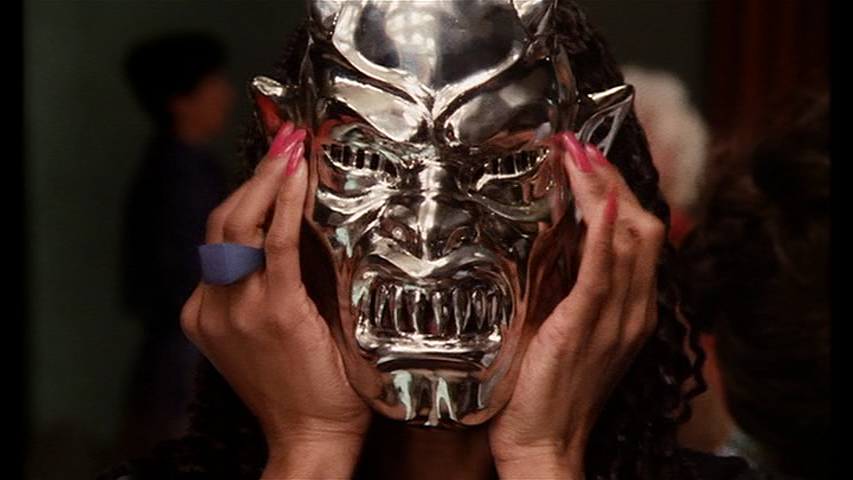
In the film a young girl, Emily Rose, perishes following a protracted period of “attack” by demons while under the protective care of Father Moore, a Catholic priest. Female attorney Erin Bruner is chosen to defend Moore against charges of negligent homicide in Emily’s death. Through the two’s connection to the girl throughout the film, each undergoes what I’ve called here a “conversion experience,” as they learn more about the possibility that demons really do exist—demons that can be read to correspond to the challenges that women face in culture every day. Even before the advent of #YesAllWomen, a film like The Exorcism of Emily Rose shows us how to overcome skepticism and create a connected community of individuals committed to sharing troublesome experiences in the service of awareness and activism.
I am a horror fan and most times I root for the monster. There, I said it. I root for what should be the feared. The dreaded Other. With all the loaded symbolism that the horror genre represents (fear of sex, fear of the unknown, fear of death and decay, xenophobia etc), I find it cathartic and often liberating to root for the disruption of life as we know it. I love watching humans deal with chaotic change.
I do believe that Lynch and Frost meant to use BOB as “the evil that men do” and as a means to understand family violence and abuse, but they jump around the issue so much that it only reflects uncertainty. The show’s inability to hold evil men responsible for their actions is too reminiscent of our own society. As soon as we answer “Who Killed Laura Palmer?” the show does its best to rebury the ugly truth that we so struggled to uncover. After that it fully commits to understanding the mythos behind it. This is troubling to me.
Part of what makes the excellent 1961 film The Innocents different is the main character, the governess, Miss Giddens (played by Deborah Kerr), is thrust into a parental role suddenly. We see her at the beginning in an interview with the children’s uncle, a handsome playboy (played by Michael Redgrave, Vanessa’s father) who tells her he spends much of his time traveling and the rest in his home in London. When he offers her the job at his country estate, he takes her hand (a bold move for the Victorian era, when the film takes place) and asks if she is ready to take full responsibility for the children, because he doesn’t want to be disturbed during his adventures in London and abroad.
Micah’s patriarchal control through the first half of the film is omnipresent as he mocks, coerces and films his girlfriend’s descent into possession. The second half of the film deals with the demon taking control of the film. Micah and Katie are too weak to properly deal with the situation and they lose sight of their safety. The audience see what the demon wants them to see; it is in control of not only Katie’s mind and body, but also what the audience is exposed to, creating an unstable and terrifying experience.
When Phoebe is taken over by the deadly sin lust in “Sin Francisco,” she sexually assaults her professor and has sex with a policeman on the job, while Piper dances on her bar during her high school reunion when she’s possessed by an evil spirit. And almost all the evil women in the show are sexualized: the succubus, shapeshifter Kaia, the Stillman sisters in “The Power of Three Blondes,” the seer Kyra, etc.
Jennifer’s Body is not a traditional female possession film. The genre is generally typified by mild mannered asexual women who begin to act in overt and sometimes pathologized sexual ways once they become possessed. Jennifer’s sexuality, on the other hand is firmly established at the beginning of the film, from her clothing, the way she interacts with both her best friend Needy and the males in her school, to where she casually mentions that she is “not even a back door virgin anymore.”
Jack is both a victim and perpetrator of domestic violence. Jack’s father was an abusive alcoholic who beat and berated him. When Jack drank he used to parrot his father’s words (“take your medicine” “you damn pup”). He is primarily verbally abusive. The last incident of drinking that pushed him to sober up was accidentally breaking Danny’s arm. Wendy, perhaps like Jack’s mother, lied for him but swore she would leave if he didn’t sober up.
To what extent does a woman, pregnant or otherwise, “own” her body? To what extent can or should a woman’s (pregnant) body be subject to social concerns? Physically and socially, where is the divide between the mother’s body and the baby’s body? By raising these questions, Rosemary’s Baby is not only concerned with the spiritual but, also, the social possession of the female body.
And now Anita is “needy” no more because she has tasted the power, lived to tell the tale and will use her new demon passenger to right the wrongs that she sees fit. Even though she’s possessed, you can sense that she will guide herself and the demon within and take control of it. Freedom is a beautiful thing, even if you have to be possessed to make it happen.
Mark’s doppelgänger reflects Anna’s fascination with Heinrich’s persona: narcissism, religion, imagination, and his sexual freedom. Anna’s doppelgänger, Helen, is a pure, calm, and collected woman. That’s precisely what Mark wants–the opposite of Anna.
Mark’s doppelgänger reflects Anna’s fascination with Heinrich’s persona: narcissism, religion, imagination, and his sexual freedom. Anna’s doppelgänger, Helen, is a pure, calm, and collected woman. That’s precisely what Mark wants–the opposite of Anna.
Trouble in paradise
This guest post by Giselle Defares appears as part of our theme week on Demon and Spirit Possession.
Possession in horror is often linked to the control of a person by a demon or spirit. It’s an impending revelation of an evil outside one’s self. Why are we so enthralled with this concept in horror? If you follow the “Beast Within” approach, Joseph Grixti argues that horror stories evoke a certain catharsis as an important mechanism to give a place to deep psychoanalytic and suppressed desires. He believes that “human beings are worried at the core.” In other words: the catharsis within the horror genre can in this way serve as a safety measure. Is that not precisely what Aristotle said on tragedy: “Catharsis through tragedy accounts for the transformation of what would be painful in real life to what is deeply enjoyable when embodied in the structure of a work of art. ” Possession (1981) is often shelved with the other classic horror movies of the 1970s and ‘80s–think of The Exorcist (1973) or The Amityville Horror (1979)–but the horror genre doesn’t fully reflect the intricacies of the movie. Possession is a cult-drama-psychological-thriller- horror to the max.
The Polish director Andrzej Żuławski left his homeland after his second movie, The Devil (1972), was banned. He moved to France and his project Possession got financial backing from a French production studio and was shot in West Germany.His success in France gave Żuławski the opportunity to move back to Poland and work on a project of his own choice. Unfortunately, the Ministry of Cultural Affairs halted the production of his movie On The Silver Globe (1988).
Possession is inspired by real life events (well, sort of). Żuławski penned the script after his marriage to Malgorzata Braunek (Polish star of his first movies) crumbled down and he was left with the care of their son Xawery– who is now a celebrated director in his own right. After its release, the film was heavily cut in the US and banned in Britain, until an uncut VHS release in 1999. Isabelle Adjani received accolades for her role and she won the Best Actress award at the Cannes Film Festival, and vowed that she would never play a similar role again.
An unpleasant surprise
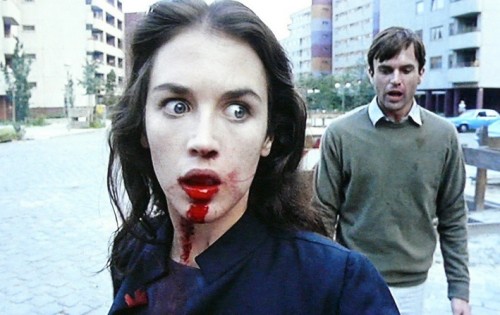
Possession takes place in gloomy, washed out Berlin. Mark (Sam Neill) comes back from a duty journey–as an international spy does–to his wife and young son, and finds that in his home nothing is as it seems. The opening scene of Possession is focused on the end of a marriage. Anna (Adjani) tells Mark that she feels that she has to leave him. Although she doesn’t quite understand why, she laments “Maybe all couples go through this..?” The tone is set in the first three minutes, and the unraveling of the marriage begins. Anna shows disruptive behavior, becomes unhinged, and sneaks off to her unseen lover. While Mark was away, she had a relationship with Heinrich (Heinz Bennent), who is a kung fu practicing psychiatrist and apparently sexually superior to Mark. Slowly the “family” drama is unfolding.
Possession gives us a marriage where the protagonists are conjuring the demons that we have within ourselves. It was interesting to see Mark decompose himself when Anna asks for a divorce. You slowly see him breaking down, rocking back and forth on his bed, the fear and despair seeping out of his pores. He can’t hold on to his idyllic image he created of Anna. He has to let go, but he can’t. The first half of the film focuses on the dissipation between Mark and Anna. We are voyeurs in their claustrophobic apartment. The second half has a sudden psychedelic and macabre feel. The events are more in the open and all the craziness bursts out. Mark hires a private detective to check on Anna’s whereabouts. She’s been living in an abandoned apartment where she–literally–can hide her monster. Slowly we see the monster evolving and his appearance becomes more human while Mark and Anna fall into despair, violence, and hysteria. The apocalypse is coming.
The movie is filled with metaphors. In one of their numerous shouting matches, Żuławski directly puts a car crash into the shot. Every action in Possession has a double meaning. Whether it’s the location (divided Berlin), or Anna’s hysteria, which is countered by Mark, who remains stiff and stoic. There’s a lot of excess in the movie, whether it be bodily fluids such as vomit, blood, milk, mucus, or the over spilling of emotions from Mark and Anna. While emotions run high, we’re introduced to the presence of the couple’s doppelgängers. Mark’s doppelgänger reflects Anna’s fascination with Heinrich’s persona: narcissism, religion, imagination, and his sexual freedom. Anna’s doppelgänger, Helen, is a pure, calm, and collected woman. That’s precisely what Mark wants–the opposite of Anna. Helen exclaims she comes “from a place where evil seems easier to pinpoint because you can see it in the flesh.” Alright.
“What I miscarried there was Sister Faith and what was left was Sister Chance.”
The relationships are complex. Anna is depicted as the hysterical one in the relationship. Their son Bob functions as their bridge. Bob is the sole reason Anna keeps being lured back into Mark’s arms. Bob spends a lot of time underwater, while practicing his “world record in tub diving.” Anna is driven by a primal instinct, which is repressed by Marks’s cold conservatism. Mark proclaims “God is evil” and succumbs to adultery and abuse. Throughout the film there’s a shot of him gripping his wife and son’s torso, a way to out his dominance and control their body. After the infamous subway passage scene, Anna is finally able to let go of her inner evil and embraces it.
Żuławski’s directorial style is electric yet graceful. The DOP, Bruno Nuytten, uses imaginative camerawork. In various points, he shifts from handheld and shaky camerawork to fluid, kinetic shots while following the couple around. The music by Andrzej Korzunski gives the movie an extra layer of uneasiness while we see the interwoven lives of Mark and Anna unravel and we’re speeding alongside them crashing to a forceful split. Neill and Adjani’s performances are mesmerizing, and they completely submerge themselves in the unfolding hysteria. The FX master Carlo Rambaldi’s humanoid-tentacled-sex-quid monster is mainly shown in dark, shadowy shots which amps the level of gore (Rambaldi is also responsible for giving us the cuddliest of aliens E.T. The Extra- Terrestrial).
It almost seems redundant to mention it, but the comparison is easily made. Possession was the inspiration for Lars von Trier to make Antichrist (2009). Both directors use the horror genre to capture marital strife; the scenes are sexually explicit, and show self-mutilation and gruesome gore.
Żuławski kept the atmosphere dense with subcutaneous tension throughout the film. Possession is a two-hour rollercoaster of emotions and wailing, screaming, violence, sex, and bodily fluids. It shows the complexity of human relationships. Żuławski doesn’t give you the answers. The film is open to interpretation. The demons are not an outside force, but sleep in the hidden depths of our being. At least it will give you some food for thought on your intimate relationships.
Giselle Defares enjoys Googling random things, late night conversations, and can’t stray far from the impulse to write it all down. She writes on fashion, film and pop culture here.