But don’t let the buzz mislead you into thinking ‘Fury Road’ is some sort of feminist watershed, a 21st century cinematic ‘Feminine Mystique’ with monster trucks. I would have enjoyed this flick even if it had typical gender politics, because I love car chases and over-the-top action sequences and the sort of high camp that yields a vehicular war party having its own flamethrower-enhanced metal guitarist. If you don’t love those things, you probably don’t want to see this movie. But if you are into that kind of action flick, this is a really good one that has the bonus of a thick layer of sweet, sweet feminist icing.
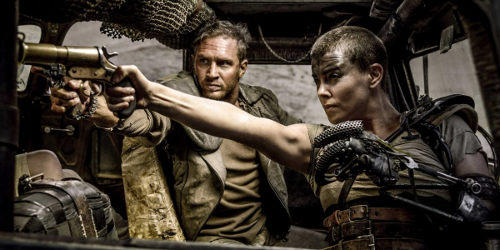
Tom Hardy and Charlize Theron in Mad Max: Fury Road
This review contains some minor spoilers for Mad Max: Fury Road.
Thank you, MRAs, for calling for a boycott of “”feminist piece of propaganda” Mad Max: Fury Road. You certainly got this feminist fired up to see it opening weekend, and I loved it just as much as you promised me I would.
But don’t let the buzz mislead you into thinking Fury Road is some sort of feminist watershed, a 21st century cinematic Feminine Mystique with monster trucks. I would have enjoyed this flick even if it had typical gender politics, because I love car chases and over-the-top action sequences and the sort of high camp that yields a vehicular war party having its own flamethrower-enhanced metal guitarist. If you don’t love those things, you probably don’t want to see this movie. But if you are into that kind of action flick, this is a really good one that has the bonus of a thick layer of sweet, sweet feminist icing.
If you like double-neck guitar flamethrowers, you’ll like Fury Road
Even though it is his franchise and his name is right there in the title, Max (Tom Hardy) is really the sidekick to Fury Road‘s true hero, Charlize Theron’s Furiosa. Furiosa is the one with the mission and the character arc, Max is pretty much just along for her ride. He ends up feeling like a gender-flipped version of the Hot Action Chick, a Studly Action Dude of sorts. Now, Furiosa isn’t the most well-rounded character you ever did see, but there’s precious little downtime between bouts of vehicular warfare for serious character development (though Charlize does put her acting chops to work in the moments she has). But she is 100 percent glorious badass, the kind of female action star I could never get enough even if Hollywood didn’t churn out only a couple every decade.
Charlize Theron as Imperator Furiosa
And what sets Furiosa apart from her cinematic foremothers Ellen Ripley and Sarah Connor is that she is surrounded by other strong women. She was raised in what appears to be a matriarchal community, and the women we meet from her home are, like her, fearsome warriors. The plot (other than “cars explode”) of Fury Road concerns Furiosa smuggling out the “wives” (sex slaves/”prized breeders”) of evil warlord Immortan Joe. These five beautiful women (supermodel Rosie Huntington-Whiteley and perfect genetic specimen Zoë Kravitz among them) wear strategically placed strips of white fabric, and are the only people in this universe with access to soap, hot wax, and hair brushes.
The escaped wives
In a lesser movie, the wives could be an embarrassing cliché of damsels in distress. But in Fury Road, they are women with agency, choosing their own liberation as they experience a feminist awakening (when one considers going back, she’s reminded “we are not things”). They’re not as capable as Furiosa or the other women from her homeland, but they don’t shy away from the fight either. I was surprised to see one (several months pregnant) become a causality of war, not killed off in a particularly dramatic fashion. It’s strangely humanizing to see a pregnant woman be killed among the hoards of other victims in a movie where countless cars crash and things blow up. (However, I did not think her dead son being cut out of her dying body added anything to the film, and suspect it would trigger some people in the audience.) But that death underscored that women are people in Mad Max: Fury Road, not just plot constructs: because people can get killed in a tornado of violence, even if they’re eight months pregnant.
And ultimately, Fury Road is a parable about bringing down the patriarchy, which makes all of its orgiastic destruction a thoroughly satisfying outlet for feminist rage. I saw the movie with a mixed group of male and female friends, who all loved it, but it was the women who walked out saying things like, “I’m so pumped up I could run home right now” and “I might name my daughter Furiosa.”
Patriarchy go boom
So is Mad Max: Fury Road going to bring us equal pay, sexual liberation, a woman in the White House, and ladies’ jackets with inside pockets? Probably not. In fact, it’s probably better news for women that Pitch Perfect 2, a film by, about, and marketed to women, soundly beat Fury Road at the box office (HT to my friend @MattMarcotte to pointing this out to me). But a teenage boy leaving the theater behind me shouted that Fury Road was the “MOST F***ING AWESOME MOVIE EVER!” He might not have realized it was about women destroying male power structures, but I can rest easy tonight knowing that he enjoyed his experience with this feminist piece of propaganda. I hope he gets to see many more.
Robin Hitchcock is a writer based in Pittsburgh who was in an improv troupe with one of the stunt performers in this movie. DROP. (Hi, Anneli!)
The difference between ‘Bessie’ and the similar bio-pics about Black performers of the Jim Crow era is in the details. We see Bessie (played by Queen Latifah, in the affable, spirited persona she usually brings to roles: she’s also in good voice even though no one could be Smith’s equal) fail the “paper bag test” a Black impresario uses for the women he recruits to his revue. Smith is darker than the paper bag (as is Latifah, though not as dark as Smith was) so in spite of her talent, she’s out. Later, when she has her own revue, she uses the same test, but this time the recruits have to be darker than the bag, eliminating the women Bessie calls, “high yellow bitches.”
In some ways writer-director Dee Rees’s Bessie(showing tonight on HBO) about “The Empress of the Blues” singer Bessie Smith, is a story we’ve seen before, complete with feathers, spangles, and bootleg liquor as the action meanders through the 1920s, but a script (written by Rees, the late white playwright Horton Foote, plus Christopher Cleveland and Bettina Gilois) about a queer Black woman (Smith was bisexual) by an out queer Black woman who also directed is unusual, especially on a platform as popular as HBO. The only other recent example I can think of is Rees’s last film, the theatrically released, indie, coming-out drama, Pariah.
The difference between Bessie and the similar bio-pics about Black performers of the Jim Crow era is in the details. We see Bessie (played by Queen Latifah, in the affable, spirited persona she usually brings to roles–she’s also in good voice even though no one could be Smith’s equal) fail the “paper bag test” a Black impresario uses for the women he recruits to his revue. Smith is darker than the paper bag (as is Latifah, though not as dark as Smith was) so in spite of her talent, she’s out. Later, when she has her own revue, she uses the same test, but this time the recruits have to be darker than the bag, eliminating the women Bessie calls, “high yellow bitches.”
We see Bessie mentored by the slightly older blues singer Ma Rainey (also the subject of one of August Wilson’s most famous plays) and with Mo’Nique in the role we get a taste of the complex interplay of Black women we saw in Pariah between the main queer character, Alike (played by Adepero Oduye) and her homophobic mother (Kim Wayans). Rainey (Mo’Nique is terrific in the role and made me wish she were in more films) at first is a mother/teacher figure showing Smith that she should deliver her songs teetering at the front edge of the stage as she explains, “If you not riskin’ nothing, neither will they.” She also instructs her to find people in the audience to focus on and sing to, “The blues is not about people knowing you. It’s about you knowing people.”
Mo’Nique as Ma Rainey
With these two characters Rees is, again, one of the few filmmakers showing an audience one queer Black woman (Rainey, though she had a husband who was also her business partner, was as out as one could be in those days, singing, “Went out last night with a crowd of my friends/They must’ve been women, cause I don’t like no men”) offering guidance to another (we see Smith in multiple scenes with a girlfriend, Lucille, played by Tika Sumpter). When the two singers are relaxing in a saloon, Rainey is openly affectionate with her girlfriend and when she notices Smith nervously looking around, afraid to be seen in public with her girlfriend, Rainey tells her she shouldn’t care what other people think. Rainey and Smith are both presented as sexual, desirable beings (Latifah in one non-sexual scene reminiscent of Viola Davis in How To Get Away With Murder, removes her wig and makeup while also topless) in spite of both Latifah and Mo’Nique being over 40 and neither possessing the model-thin body type that is the default for most modern-day actresses.
But as Smith develops her stage presence and her great voice (we see the performers don’t have microphones, a condition which favors those who can easily reach the back row with no amplification, as Smith, and later in musical theater, Ethel Merman, did) we see Rainey look warily at her and eventually demote her from a starring role in the revue. Smith with her brother strikes out on her own and eventually outshines her mentor, both because of her talent, but also because of timing. The peak of her popularity as a live performer was just right for the nascent recording industry, which made better quality records of Smith’s work than of Rainey’s.
We see that Smith is reluctant to release “race records” because of the racist imagery used to promote them. But when she fails to be “respectable” enough for the Black nationalist record company during her audition (after a fawning invitation letter the very light-skinned president of the company signs “Yours in negritude”), she makes records for Columbia, a white-owned company, which offers her a flat fee, but no royalties, and features her photo, not a caricature, on the covers. The records become so popular, the Black farmworkers in the fields all stop their work to wave to her train car as it makes its way from town to town for live shows.
The real Bessie Smith
Smith grew up in a violent household (like many children of that era) and we see that she doesn’t hesitate to use her fists or a makeshift weapon at hand if she needs to. When we first meet her she receives a scar from one of these fights and we see it throughout the rest of the film, to remind us of these beginnings. I could have used fewer flashbacks to violent incidents when she was a little girl, especially since, unlike the at times violent mother in Pariah, Smith’s abusive older sister Viola (Khandi Alexander) is neither as nuanced in the script nor in her performance as Kim Wayans’s Audrey.
We also see Smith’s relationships with men (even as Lucille remains a member of her revue as well as Bessie’s girlfriend, a portrait of, for a time, fairly happy polyamory) including her husband Jack Gee (played by The Wire’s Michael Kenneth Williams, his distinctive facial scar perfect for this volatile character) who becomes her manager and, because of his propensity for violence, her sometime protector in the business deals that commonly cheated Black performers. We see both how she should get far away from this man and how his presence works to her advantage–and that she may very well have seen this paradox too.
I wish the film had used more period music (as well as more music that includes Smith’s voice, not Latifah’s) instead of the score which could have been lifted from pretty much any movie covering any era, the orchestra always intruding, telegraphing to us what we should be feeling instead of letting us feel. The last time I heard a score that distracted and irritated me to this extent–while still being completely forgettable–it was by the same composer: Rachel Portman. I know we need more women composers in film, but I much prefer the work of innovators like Mica Levi. I also wish the film had made its center the relationships with Rainey and Lucille (the publicity for the film, especially that targeted to queer women makes these two roles seem much bigger than they turn out to be). We’ve seen the story of the abusive husband-manager before (though Smith’s was probably one of the earlier examples) and the performer whose fortunes fall as her popularity does as surely as we haven’t seen complicated relationships between queer Black women, especially not on HBO.
Ren Jender is a queer writer-performer/producer putting a film together. Her writing besides appearing every week on Bitch Flicks has appeared in The Toast, xoJane and the Feminist Wire. You can follow her on Twitter @renjender.
I owe a great debt to Tomlin for helping me discover comedy, for helping shape my sense of humor, and for helping me define a sense of identity that might not have ever emerged without her. How can anyone argue that women aren’t funny, when my sole entire reason for making people laugh was inspired by a (funny) woman?
At this year’s annual Golden Globes, Jane Fonda and Lily Tomlin presented the award for Best Actor in a Comedy or Musical Series. While it was nice to see the stars of one of the best comedies ever made, 9 to 5, it was also exciting to see these two talented actresses reunite on stage in what was of course a quick promotion for their soon-to-debut Netflix series, Grace and Frankie. But what was most notable was the tongue-in-cheek banter they had on stage, discussing how “nice” it was to finally put at rest the “negative stereotype” that men aren’t funny. Of course, it is not exactly true that men have never been funny, but for some reason it has always been heavily debated whether or not women are funny. What I found most ironic was the fact that Tomlin led this conversation, because of all the talented comics out there—male or female—I have always regarded her as my greatest (and funniest) comedic muse.
It is no secret within my social circle that I am absolutely bananas over Lily Tomlin, and from an early age to boot. While I was in grade school, I was introduced to Tomlin from a Laugh-In reunion special that aired in the early ’90s and upon being exposed to her widely popular Ernestine the telephone operator and Edith Ann characters, I found Tomlin’s comedic creations imitable. From that moment, I was hooked. Back before the days of IMDb, I would spend hours in a video rental store, searching through the “Comedy” section for her name or her face on a VHS sleeve (remember those?). It wasn’t before long that I found a “best of” compilation of a little sketch comedy show called Saturday Night Live that featured two of Tomlin’s hosting stints. This newfound discovery of nostalgic humor led me to my first love of comedy. To put it simply: I owe my adoration of sketch comedy and my obsession with SNL to Lily Tomlin. Because of Tomlin, I found the courage to move to the land of improv, Chicago, in the hopes of performing sketch comedy and turn it into a career. Ya hear that? A woman—a FUNNY woman—inspired me to find a career in making people laugh.
And why not? Lily Tomlin is one our most premier comediennes as of all time. Hell, The Laugh Factory includes an artist’s rendering of her among many of the greatest comedians who ever lived. Why we are even still debating this “women are/aren’t funny” theory is beyond my own belief, because as an aspiring comedic performer, I have always touted Tomlin as one of the greats.
First and foremost, Tomlin revolutionized comedy for women. Before Tomlin, most female comics were self-deprecating (Phyllis Diller) or performed material regarding marriage and children (Joan Rivers). Tomlin’s turn in the spotlight did away with joke-telling and produced sketch comedy acts involving a variety of characters inspired by people she had known while growing up in the diverse, blue-collar environment of Detroit. Tomlin’s act embraced the counterculture of the 1960s, during the time of the civil rights movement and the sexual revolution. Gender dynamics were changing, and Tomlin was at the forefront of the women’s lib movement in comedy. She performed material that focused on the working class and the poor, material that required an edgy intelligence that did not go for punch lines or cheap laughs. She certainly didn’t limit her comedy to material about her looks or motherhood or married life—though her sketches didn’t shy away from such matters either. Tomlin was not a standup-comic, but a cerebral comedic performer.
Tomlin’s talent for creating eccentric, offbeat characters landed her a spot on NBC’s Laugh-In, and her prolific career took off overnight. Some of her most beloved characters came about on this variety show, including Ernestine, a snorting, nasally-voiced telephone operator who controlled the phone lines with her sharp tongue and smart-alecky insults. She also gave us Edith Ann, a philosophizing seven-year-old who sat in an oversized rocking chair spouting off words of wisdom while sticking out her tongue. Tomlin’s knack for producing dozens of three dimensional characters would eventually provide her enough material for her own television specials, of which landed her several Emmy awards. These specials reflected the changing times involving racial and gender politics, material that did not involve a lot of punch lines or pratfalls but certainly served as intelligent yet controversial material that not even Louis CK or Chris Rock would have the balls to produce back in the day (and if anyone can track down these specials in DVD format, please let me know!). I would even say Tomlin should be given credit for introducing comedian Richard Pryor (whom collaborated with Tomlin on a few of these specials) to the mainstream when most producers were too scared to let Pryor have any air time. Tomlin was an underground comic almost too dangerous to showcase amid the still-shrewd comedy scene of the 1970s.
Throughout the ’80s, Tomlin starred in films that showcased multidimensional females that could lead to strong box office returns. She has always chosen roles that project a strong persona, never submissive to authority let alone a male figure. Tomlin’s characters are in essence Tomlin herself: offbeat, eccentric, but always strong and independent. Tomlin proved she could stand toe-to-toe with comedy legends like Art Carney in The Late Show. She had a physicality that could keep up with the comedic ferocity of Steve Martin in All of Me (and possess his body no less!). Tomlin’s strong sense of humor and femininity also proved successful alongside other actresses, sharing the screen as well as countless laughs. In 9 to 5, Tomlin’s Violet Newstead is one of three women who take down their “sexist, egotistical, lying, hypocritical” male boss, Franklin Hart. Violet delivers a speech of disgust towards Hart that’s one of Tomlin’s most pivotal moments in her acting career:
“Okay, okay, I’m gonna leave, but I’m gonna tell you one thing before I go: don’t you ever refer to me as ‘your girl’ again…I’m no girl, I’m a woman. Do you hear me? I’m not your wife or your mother—or even your mistress. I am your employee and as such I expect to be treated equally with a little dignity and a little respect!”
Violet’s demand for equality was a calling that every working woman heard loud and clear, and with the chemistry between Tomlin, Jane Fonda, and Dolly Parton, women AND men came to the movie theaters in droves, paving the way for comedic actresses in film that proved female-driven comedies could bring the masses to the box office. Without Tomlin’s collaborative talent in 9 to 5, there would be no Outrageous Fortune, no Big Business (another Tomlin film—this time paired up with the Divine Miss M, Bette Midler), no Baby Mama, Bridesmaids, or The Heat.
Even as an older actress in today’s Hollywood—when most “women of a certain age” are relayed to playing mothers—Tomlin has never been one to play a matriarch as paper thin. She portrayed Mary Schlicting, Ben Stiller’s mother in Flirting with Disaster, as a post-’60s hippie living in a ’90s world and still producing LSD. In Eastbound & Down, her Tammy Powers character was a bowling champion that could spout out more profanity than Danny McBride’s Kenny Powers while exchanging pharmaceutical drugs. In Admission, her Susannah character is a highly renowned feminist author who nearly kills Tina Fey’s date with a shot gun. In Web Therapy, her Putsy Hodge dons an array of costumes, from a fu Manchu beard to a prisoner jumpsuit, to the annoyance of her daughter Fiona, as played by Lisa Kudrow. These performances certainly don’t read as “motherly matriarch,” but as performed by Tomlin, they certainly scream “hilarious.”
With her new comedy, Grace and Frankie, Tomlin proves again how relevant and hilarious her talents still are in a series co-starring Jane Fonda involving two older women whose husbands come out as gay and have fallen in love with each other. For Netflix to add a comedy series (from Friends co-creator Marta Kauffman I might add) about two older women beginning anew, it proves that the old adage of women not being funny is untrue, and with Tomlin in tow, this comedy series will no doubt succeed in continuing to prove that theory wrong.
Late last year, Tomlin was awarded a Kennedy Center Honor for her contribution to the American arts. As one of Tomlin’s biggest fans, I had been petitioning for this recognition for years. Yet the moment was bittersweet, because while this was certainly good news for one of my favorite all-time idols, the fact was I would not be there to salute her at the event. One of my career goals in life was to speak on Tomlin’s behalf at the Kennedy Center. Tomlin and I have a few similarities: we both have southern roots planted in Kentucky, we both have an eye and ear for characterizations and impressions, and we both happen to be gay (in fact, Tomlin became the first outed lesbian to received the Kennedy Center honor in its entire history). I owe a great debt to Tomlin for helping me discover comedy, for helping shape my sense of humor, and for helping me define a sense of identity that might not have ever emerged without her. How can anyone argue that women aren’t funny, when my sole entire reason for making people laugh was inspired by a (funny) woman? Women may not have always been considered funny, but thanks to Tomlin’s efforts, women (as well as men) have reason to be funny.
Kyle Sanders lives in Chicago and plans to take improv classes at the Improv Olympic (as soon as his rent gets paid). In the meantime he occasionally contributes to NewsCastic: Chicago and GiGa Geek Magazine among other blogs that deem his thoughts worthy.
Bleeding Heart, written and directed by Diane Bell, stars Jessica Biel and Zosia Mamet as two sisters who have never known each other. Biel plays May, a reserved and disciplined yoga instructor who has enlisted a private investigator to help her track down her long-lost biological sister, Shiva (Mamet). She discovers her younger sister is a prostitute in an abusive relationship with a boyfriend who is also her pimp. May feels protective and driven to rescue Shiva from her chaotic and dire financial and personal situation.
Bleeding Heart begins as a character study of two very different women and turns into a revenge thriller. The movie features two strong female roles by actresses who are usually typecast. A deglamorized Biel get a chance to show of her acting range instead of coasting on her looks, while Mamet is convincing as a hooker with a heart of gold trapped in a toxic relationship, a role world’s away from the whiny, privileged Shoshanna she plays in Girls.
The cinematography is particularly beautiful, especially in an early scene where May is practicing yoga and her body is framed by a gorgeous Los Angeles sunrise. In a shot that feels like it could only be directed only by a woman, the camera pans over every part of Biel’s body as she does her yoga routine and rather than sexualizing her, reveals her strength and power, something May is not even aware of at that moment.
Bleeding Heart recently premiered at the Tribeca Film Festival, which screened 119 features, of which only 30 were by women filmmakers. Bleeding Heart was one of 12 narrative films by women directors screened. This is an improvement over the previous year but not good enough. (Biel, who is married to Justin Timberlake, had just given birth to a baby boy and was unable to make the movie’s premiere at Tribeca.)
Zosia Mamet
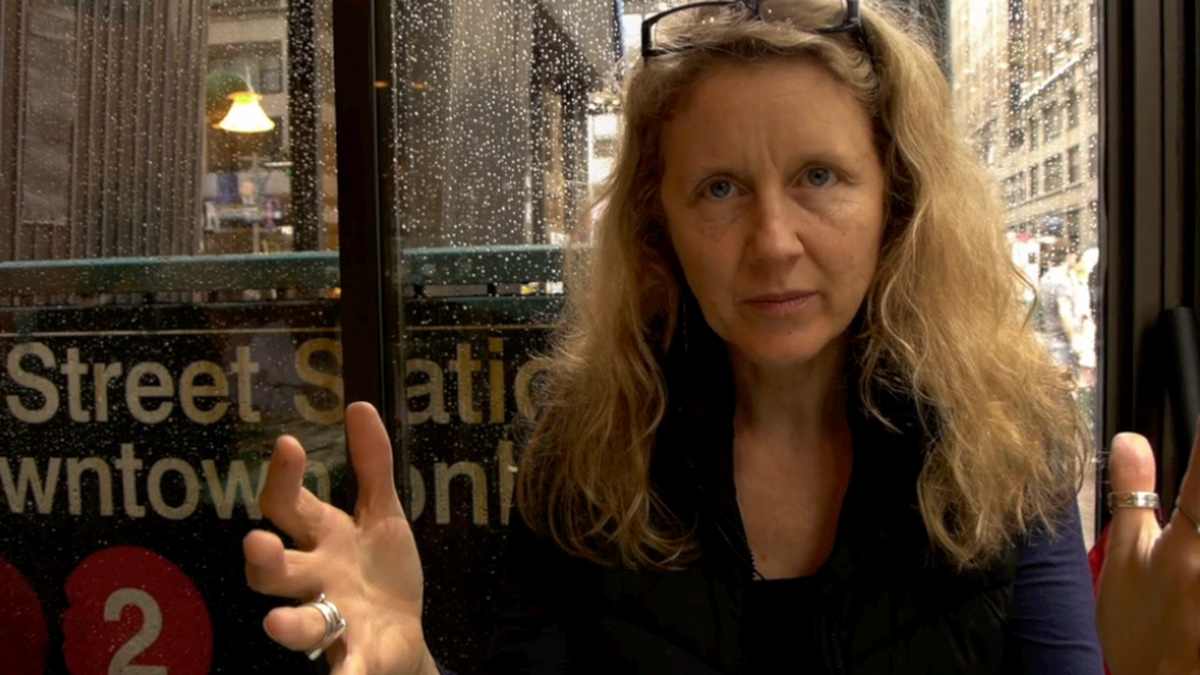
During the festival I met with Bell at a restaurant in the Meatpacking district to chat about her film and following are edited highlights:
Talk about the opening shot of the film, where Jessica is practicing yoga and the sun rises. The camera focuses on different parts of Biel’s body and it feels like only a woman filmmaker could get a shot like this.
This is why we need more female filmmakers, because it’s a different perspective. Everyone’s got a different perspective, and we have different stories and different ways of looking at the world. I feel that the stories we have on film just don’t reflect our reality; they also create it. They also change how we see things.
I was very blessed with Jessica that when she got onboard the film she probably had about three months in which she completely immersed herself in the yoga practice.
Jessica hadn’t done much yoga before the film?
She’d done some yoga but like I was very specific with this film that she’s an Ashtanga Yoga practitioner, which is what I taught and which I practiced, so she immediately started practicing Ashtanga every single day. And she started working out in the gym. She completely committed to it and she became vegetarian, and she went the whole way with it.
The thing that’s different with Ashtanga than with other kinds of yoga is you do a self-practice. You learn the sequence of positions and you do them. So when she came to shoot it she knew the sequence… I’ve done it every day for 15 years or something. We knew what it was that we were doing. And I think the thing that really comes across in those scenes is her level of concentration. She’s in that zone.
And Zak (Mulligan) and I, my DP, was just phenomenal, and we knew the kind of lighting that we wanted. The film both starts and ends with that moment of dawn, of the sun coming up. Ashtanga yoga is typically practiced in the very early mornings so ideally you’re practicing from when it’s dark until when it’s light. And that was something that was really important to me, so in the opening sequence it goes back and forth between her teaching a class and also her doing her own practice. When she’s doing her own practice, it’s just that cool light of like pre-dawn, before the sun comes out when it’s a little bit blue. And then when she’s teaching, it’s light and it’s just past the sun coming out. And that’s typically what Ashtanga teaches.
Diane Bell
Jessica Biel is usually typecast, especially in roles that focus on her looks and being sexy. In the film she hardly wears makeup and her hair is pulled back in a simple ponytail. Were you worried she’d be able to pull this off?
My concern when she was suggested was that she’s so glamorous. My impression was that she’s so perfect and glamorous and I didn’t think she’ll be able to do this, you know, and the first thing she said to me when I met her was, “I understand May because everybody thinks my life is perfect, but I’m a human being.” I asked her if she would be happy to have no make up and she said, “100 percent.”
What was your production schedule?
We shot the film in 19 days, 12 hours a day normally. As a director I will not go over time. It’s not fair to cast. 12 hours a day is plenty for everybody, and I’m absolutely rigorous, being lucky in both my films working with great first ADs, and then just absolutely rigorous about just keeping it going and keeping that momentum and getting our days every day. Talk about the chemistry between Zosia Mamet and Jessica Biel since that is crucial for the story since it focuses on their relationship.
Everybody connected and bounded very quickly. And I think a lot of friendships came out of the film. I know Zosia and Jessie became really close. They didn’t know each other before, but the moment they met, and this is one of those things, you just say, “Oh my God, I’m so lucky!” They really clicked. They somehow brought out something great in each other. On set, as human beings too, they just had that connection. They were just like sort of goofy together. There were lots of laughs and you could see they had a bound.
Did you test them together?
No. The funny thing about that sort of chemistry between people, like I feel the movie is partly a love story. It’s about these two women falling in love with each other. And I knew it had to have that chemistry. It’s just like a love story. There’s got to be that sort of spark and I feel they really had it. I felt it every day on set. The two of them together are so charming and sweet and funny.
In the film their characters are both controlled by men although in different ways. Shiva’s boyfriend is her pimp, and he is violent and abusive, while May’s partner is gentle and good to her, but he also tries to control her life. Talk about that.
It was just something that I was interested in. There’s explicit violence and then there’s sort of like another kind of violence, which is sort of implicit.
May’s boyfriend wouldn’t identify himself as being a controlling person and would hate to think of himself as that, and she wouldn’t think of herself as being in that relationship, but that’s what they are. Those are the mechanisms of their relationship and that was definitely something I kind of wanted to say of these two women. They’re two opposites, yin yang, but they’re really the same.
Zosia Mamet
In the production notes it says you are fascinated by violence. What do you mean?
There’s so much of it in our society. How do we actually deal with it? I don’t like violence at all. I absolutely detest it. I’m a complete pacifist. And for me one of the questions driving this film from my perspective was, okay, if you’re completely committed to peace, it’s easy to be peaceful if everyone around you is peaceful. It’s super easy, it’s great. But what if you have to deal with somebody who’s really violent? How far do you go to help someone, protect someone from someone who’s really violent?
In our society domestic abuse and the murder of women by spouses or boyfriends are epidemic. And it’s something we don’t want to talk about. I looked up the actual statistics of it before coming here because I thought, I better get it right. In my head I thought it was about 30 women a month are killed in America by their partners right? That was the figure I had in my head. I looked it up. It’s really three women a day. On average spouses or ex-boyfriends are killing three women everyday. That’s an epidemic! What is your next movie?
The next one I’m going to shoot in July. We’re Crowdfunding right now in a totally off the grid way. It’s a micro-budget movie. It’s called Of Dust and Bones. It’s about a widow of a war journalist and her husband was killed in Syria. She had decided to just retreat from the world. She lives a monastic kind of life in the desert where she wants no part of what she views as this crazy world, basically. Then her husband’s best friend and colleague, Alex, who actually sent her husband to Syria, comes to visit her. He has come with an agenda. He wants the rights to her dead husband’s last photographs. She feels very strongly that there’s no hope to be good in this world and every time we try to make things better we actually end up making things worse creating more suffering. The film is about what unfolds between them in the desert over these days. It’s these two wildly different viewpoints clashing.
Paula Schwartz is a veteran journalist who worked at the New York Times for three decades. For five years she was the Baguette for the New York Times movie awards blog Carpetbaggers. Before that she worked on the New York Times night life column, Boldface, where she covered the celebrity beat. She endured a poke in the ribs by Elijah Wood’s publicist, was ejected from a party by Michael Douglas’s flak after he didn’t appreciate what she wrote, and endured numerous other indignities to get a story. More happily she interviewed major actors and directors–all of whom were good company and extremely kind–including Brad Pitt, Angelina Jolie, Morgan Freeman, Clint Eastwood, Christopher Plummer, Dustin Hoffman and the hammy pooch “Uggie” from “The Artist.” Her idea of heaven is watching at least three movies in a row with an appreciative audience that’s not texting. Her work has appeared in Moviemaker, more.com, showbiz411 and reelifewithjane.com.
The film also focuses on the relationship between Smith and Ma Rainey, who mentored Smith and gave her guidance on developing her stagecraft. Mo’Nique portrays Ma Rainey, known as the “Mother of the Blues,” in a rich and layered performance and has so much charisma she steals every scene she’s in.
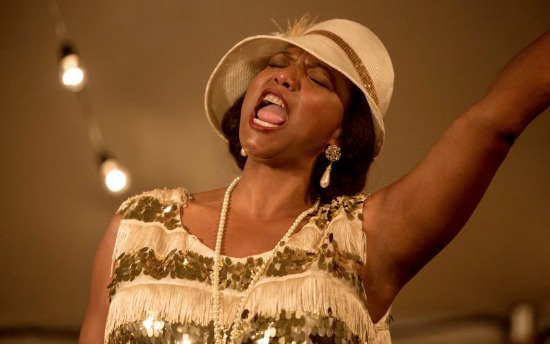
Queen Latifah was born to play the Empress of the Blues. Queen Latifah stars in Bessie, the new biopic about the early life of legendary blues singer Bessie Smith. The film will premiere Saturday on HBO. Mo’Nique, who has her first stand out role since Precious, reminds us why she won the Oscar in 2010.
Directed by Dee Rees (Pariah) from a screenplay by Rees, Christopher Cleveland, and Bettina Gilois, the story is by Rees and acclaimed playwright Horton Foote, who died in 2009. The film focuses on Smith’s early years as she struggled as a young singer to eventually become one of the most successful recording artists of the 1920’s. She earned $2,000 a week – an unheard of sum – at the height of her career.
The film also focuses on the relationship between Smith and Ma Rainey, who mentored Smith and gave her guidance on developing her stagecraft. Mo’Nique portrays Ma Rainey, known as the “Mother of the Blues,” in a rich and layered performance and has so much charisma she steals every scene she’s in.
Both Queen Latifah and Mo’Nique received Critics Choice nominations the other day and the Golden Globes and other accolades are sure to follow.
The cast includes Michael Kenneth Williams (Boardwalk Empire, 12 Years a Slave) as Bessie’s husband; Khandi Alexander (Scandal) as Bessie’s abusive older sister, Viola; Mike Epps (The Hangover) as the singer’s bootlegger romantic interest; Tory Kittles (True Detective) as Bessie’s older brother Clarence; Tika Sumpter as Lucille, Bessie’s longtime lover.
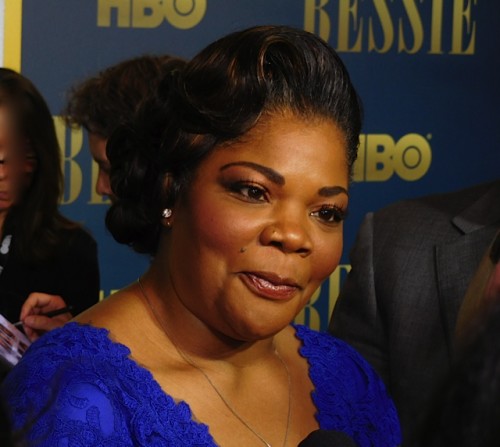
At the recent premiere at the Museum of Modern Art, nobody worked the red carpet harder than Mo’Nique, who talked to all the journalists clamoring for her attention.
Bessie has many explicit sex scenes and Queen Latifah’s character has a nude scene that’s integral to the story but sure to get audiences talking. Ma Rainey was gay and Bessie Smith was bisexual, and the film doesn’t shy away from showing scenes of their characters having sex with both men and women. A standout is a scene early in the film where Mo’Nique and Queen Latifah dress up in drag, smoke cigars and do a song together to a boisterous audience.
Director Dee Rees
Here’s a red carpet interview with Mo’Nique, who looked terrific in a blue lace gown, and was warm and thoughtful in her replies to all the journalists:
Were gay women who performed on stage more open about their sexuality in the time of Ma Rainey and Bessie Smith? (Of course they didn’t have to contend with social media.):
Mo’Nique: I think back then there was a strength that said I’m unwavering about who I was born to be. Don’t we still fight with it today? But figure what she had to walk through then? It was illegal. They got locked up. If you were seen with the same sex so to have that kind of strength back then is absolutely beautiful.
What was the key to finding her character?
Mo’Nique: Her music, (I found it) through her music. If you listen to Ma Rainey you’ll really understand Ma Rainey because she sang from her soul. She sung her truth and that’s how I really got to understand who that woman was because there’s really very little written information about this woman. She’s so hidden and now history, you have to dig really deep to get that little bit…. And she told the truth. And even back then, she was fighting for wage equality, so we’re still having that fight today but definitely she kicked open the doors so we can even go to the meetings to have those discussions.
They were friends. And she was Bessie Smith’s mentor and she was very motherly but she was that type of mother that knew when she had to let go and let that baby fly and go see it for herself. And when the bird flew back home she was right there waiting for her. That’s what that relationship what. And what I so appreciate about her, we don’t often times see those relationships anymore, you don’t see it where two friends go through it, they fall out, but they’re still willing to love each other through it and come back together.
Queen Latifah
What does she see as Ma Rainey’s influence on A&R and jazz?
Mo’Nique: It’s truthful. It’s very honest. It’s very from the soul. When you listen to those singers back then, they couldn’t pretend. They couldn’t fake it because the people would know it and they were those singers that when you sat there, you know how they say music moves you? That was that type of music that moved you and made you make a decision, may it be the right, wrong or indifferent, but when you listen to that music it was like you know what? OK, “I’m gonna finish this darn liquor and I’m gonna make a change.” That’s what that music was back then. Absolutely beautiful!
What were the key factors that made her want to take on the role of Ma Rainey?
Mo’Nique: It was Ma Rainey’s strength. Her integrity. You know when you read that script and you understand that the sacrifices that woman made for little girls like us, and she had no idea that she was doing it, it was just the right thing to do. So when you read those lines, and you understand that that woman is talking to me for me, off the pages, and she’s saying Monique keep pushing. Keep going in the right direction and don’t waver from what you know is right. Look at my story and when you look at that woman’s story it’s not like most of our stories, where we die broke, alone, miserable. When you look at her story she had a very full life.
Before she made her way into the theater, I asked Mo’Nique if she actually sang.
Mo’Nique: All day long!
Later at the after party I asked the 36-year-old director about how she discovered Bessie Smith’s music, she told me it was through her grandmother: “She played Bessie Smith’s records all the time.”
Paula Schwartz is a veteran journalist who worked at the New York Times for three decades. For five years she was the Baguette for the New York Times movie awards blog Carpetbaggers. Before that she worked on the New York Times night life column, Boldface, where she covered the celebrity beat. She endured a poke in the ribs by Elijah Wood’s publicist, was ejected from a party by Michael Douglas’s flak after he didn’t appreciate what she wrote, and endured numerous other indignities to get a story. More happily she interviewed major actors and directors–all of whom were good company and extremely kind–including Brad Pitt, Angelina Jolie, Morgan Freeman, Clint Eastwood, Christopher Plummer, Dustin Hoffman and the hammy pooch “Uggie” from “The Artist.” Her idea of heaven is watching at least three movies in a row with an appreciative audience that’s not texting. Her work has appeared in Moviemaker, more.com, showbiz411 and reelifewithjane.com.
First person documentary filmmakers Ed Pincus and Lucia Small are no strangers to letting an audience in on their family “secrets”: Small in ‘My Father, The Genius,’ a film about her own father and their ambivalent relationship, and Pincus in ‘Diaries,’ in which he filmed both his girlfriend and wife in 1970s Cambridge, the latter–in one scene that seems to sum up the post-hippie atmosphere of the time and place–nude and playing a flute.
Artists who use their own lives as the subject matter for their art always have to make a decision about how much revelation is too much. David Rakoff, whom many know from his work on This American Life, wrote frankly and transcendentally about his declining health (including an inability in his last years to use one of his arms) after he was diagnosed with the cancer that would eventually kill him. But Rakoff didn’t have to worry that his revelations would hurt those closest to him; he lived alone, without a partner or children.
When they reveal “everything,” those artists who are in relationships aren’t just exposing their own lives to the public–they can’t help also exposing intimate details about their loved ones. Author Ayelet Waldman has received criticism for revelations about both her husband (author Michael Chabon) and her kids in her work. Sex writer and essayist Susie Bright swore off using her personal life as fodder for her work years ago and though she seems to be in a successful decades-long relationship (and sometimes collaborates with her now adult daughter), her writing doesn’t have the same spark as it did earlier in her career.
First person documentary filmmakers Ed Pincus and Lucia Small are no strangers to letting an audience in on their family “secrets”: Small in My Father, The Genius, a film about her own father and their ambivalent relationship, and Pincus in Diaries, in which he filmed both his girlfriend and wife in 1970s Cambridge, the latter–in one scene that seems to sum up the post-hippie atmosphere of the time and place–nude and playing a flute.
Near the beginning of their excellent documentaryOne Cut, One Life(which will be in theaters starting Wednesday, May 13), Small and Pincus, each seeming to take a turn behind the camera, discuss plans to collaborate on their final film together (they had previously worked on the post-Katrina documentary The Axe In The Attic). Ed has been diagnosed with a fatal disease which would eventually turn into leukemia. Lucia is working through her grief over the deaths of two of her close friends, one from a hit-and-run driver, the other murdered by an ex-boyfriend.
Ed and Lucia
Ed, who is over 70, has other health issues (he was diagnosed with Parkinson’s some years before and speaks slowly and carefully), but they agree that they can probably work around them. The problem is Ed’s wife, Jane, who is adamant that she doesn’t want them to film what might be the last months of his life. We’re so used to wives being a drag on “great” men in film (Pauline Kael referred to this role as the “‘please don’t go up to break the sound barrier tonight, dear’ type”) that we’re ready to think of Jane as the villain until she tells us, “I have enough to deal with in my life right now. My husband has received a death sentence, and I don’t see why I have to give him over to anybody else.”
Jane, who was filmed over five years in Diaries, is familiar with the intrusion a camera is in one’s day-to-day life and has no desire to relive it. She’s also insecure about Ed’s feelings for Lucia.
Ed documented his and Jane’s open marriage in the 70s, but after Diaries was completed they moved to Vermont to run a flower farm. When they made an appearance at a screening of Diaries in the 90s, with matching glasses and grey hair, their arms around each other, they seemed to have become a more conventional couple.
In the 2000s, Ed’s introduction to Lucia reignited his interest in filmmaking (though he still kept the farm). Lucia tells us that she became close to both Ed and Jane (who was a member of the feminist health collective that wrote the original Our Bodies Ourselves) during the making of Axe, but then they, by mutual agreement, distanced themselves when the film was finished. Lucia tells us that aside from a few “flings” she hasn’t been in a relationship in years and that working together for as many hours as a film takes, mixes up her feelings of love and intimacy, though she clarifies that her relationship with Ed is platonic.
Ed Pincus
Ed seems less intent on keeping boundaries clear. He tells Lucia he loves her and at one point Jane catches them alone in a situation that sets off alarm bells for her–and like photographers in a war zone, Ed and Lucia immediately pick up their cameras and start shooting the conflict. Whenever we see Lucia talking to the camera, she looks drained; the elements in her life that might distract her from her grief instead serve as reminders. Her big, black dog originally belonged to the woman who was murdered. Her cute New York apartment was the one she shared with the woman who was killed in the hit-and-run. But when Jane looks at Lucia she sees a blonde 25 years younger than she is, whom her husband seems to adore.
Mixed up in all of this drama is Ed’s worsening health. Receiving bad news on camera he simply says, ” Well, that’s sobering.” In stunning cinematography we see the seasons at the farm: fall, winter, spring, summer and then spring again, when a newly cue-ball-bald Ed tells the camera that the doctor had said he probably wouldn’t live past March, so he’s grateful. Ed lived two seasons longer and died in November of 2013. When I saw the film last year as part of the Independent Film Festival of Boston, Small did a poignant Q & A after the screening. One of the first things she told us was Jane had chosen not to attend.
Ren Jender is a queer writer-performer/producer putting a film together. Her writing besides appearing every week on Bitch Flicks has appeared in The Toast, xoJane and the Feminist Wire. You can follow her on Twitter @renjender.
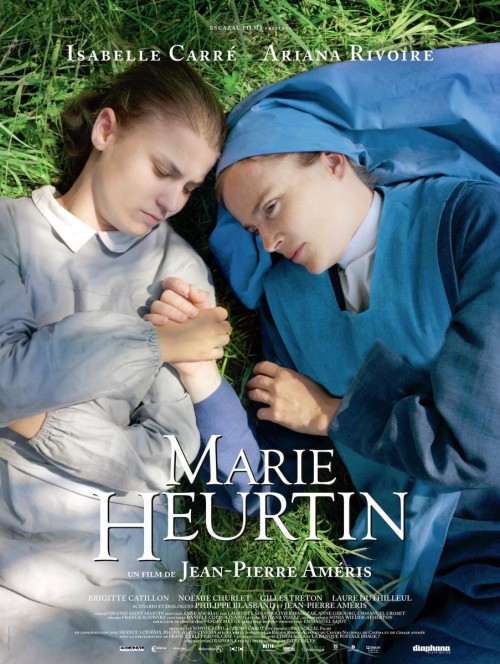
‘Marie’s Story’ dramatizes the real-life biography of Marie Heurtin, a deafblind girl who was taken in by a convent in the late nineteenth century. It’s an intimate portrayal of an unusual relationship between two young women.
The relationship between Christianity and disability is complex and many-sided, encompassing stigma and pity, aid and condescension, systematic exclusion and the creation of refuge spaces – and it’s not just an academic concern for scholars of religion. Societies that took shape under the influence of western Christianity still reflect and perpetuate Christian philosophical and ethical ideas, both in cultural attitudes and in policy and law. Disability is no exception. Levitical purity codes, New Testament healing narratives, and Augustinian theology of original sin all contribute to the mishmash of ableism that pervades twenty-first century US culture.
Disability scholars and cultural critics are doing some terrific work to examine and dismantle ableism. Some of my favorites include Andrew Pulrang at Disability Thinking (and his podcast, Disability.TV), the Disability Visibility Project, and the BBC’s Ouch podcast. You don’t have to spend long reading disability criticism to learn that one of the most hated forms of disability representation in popular culture is inspiration porn. The late, wonderful, deeply mourned Stella Young put it like this:
Ugggghhhhh
“[In inspiration porn] we’re objectifying disabled people for the benefit of nondisabled people. The purpose of these images is to inspire you, to motivate you, so that we can look at them and think, ‘Well, however bad my life is, it could be worse. I could be that person.’ But what if you are that person?”
Hollywood in particular loves inspiration porn, to that point that watching a movie about a disabled person is a source of dread for anyone who cares about disability studies. Will the disabled person be a precious angel, too good for this sinful earth? Will they exist primarily to teach the non-disabled protagonist a lesson? Will they be a bitter cripple who gradually triumphs over this dreadful tragedy? Will I throw up in my mouth?
I approachedMarie’s Storywith less trepidation than usual, though, both because it’s a small French film rather than slushy Oscar-bait, and because the titular Marie is played by a Deaf actress, the talented young Ariana Rivoire. For the most part, thankfully, my confidence was well-placed.
Marie’s Story dramatizes the real-life biography of Marie Heurtin, a deafblind girl who was taken in by a convent in the late nineteenth century. The convent educated deaf children, but felt ill-equipped to teach a deafblind child who had no communication skills – until one very determined nun, Sister Marguerite, insisted on giving Marie a chance.
So far, so Miracle Worker, and in the early stages the film certainly hits a lot of beats familiar from popular narratives of Helen Keller’s life: the terrible fights with the strong-willed mentor, the transformation from wildling to neatly-coiffed well-mannered young woman, the come-to-Jesus moment of language comprehension. What’s distinctive about Marie’s Story is its convent setting and the normalization of the deaf environment (how many movies have you seen that pass the Bechdel Test in sign language as well as spoken words?).
Wisely, given popular Christianity’s reprehensible enthusiasm for the doubly nauseating Inspiration Porn With Added Jesus, Marie’s Story treads lightly around the religion aspect. No miracle healings or trite theodicies here – the most explicitly theological sequence in the film is a conversation around mortality, when Marie asks in frustration: “Who is God? Where is he? I can’t touch him.” The film as a whole functions as a panentheistic affirmation that she absolutely can touch God: despite Christianity’s emphasis on sight and sound as the primary senses for divine encounter, Marie’s alternative embodiment is the locus for divine encounter through touch and scent. From the opening sequence, in which Sister Marguerite climbs a tree and, looking for all the world like The Creation of Adam, extends a hand to a frightened Marie, this film stresses the power of bodily touch.
The film doesn’t entirely escape certain inspiration porn pitfalls, primarily in voiceovers of Sister Marguerite’s diary entries where she gushes about how much she’s learned from Marie and describes Marie’s transformation in weird racialized and colonial terms of “savagery” and “imprisonment.” However, Marguerite’s own chronic illness keeps the relationship from being too one-sided. It’s in the final third that the film really shines, as Marie develops agency and character of her own, even tending to Marguerite just as the nun had previously cared for her. In perhaps the most moving sequence, Marie teaches her parents how to greet her in sign language, with Marguerite translating and facilitating but never speaking for or over Marie.
Ultimately, this is not a film about Saint Sister Marguerite and her noble civilizing mission to help a poor deafblind girl. Instead, it’s an intimate portrayal of an unusual relationship between two young women (watch for a scene where they lie in a meadow together like Bella and Edward), a quietly beautiful story of faith and female friendship.
Max Thornton blogs at Gay Christian Geek, tumbles as trans substantial, and tweets at @RainicornMax. He studies theology, disability, and gender, and gets really excited when they all come together.
Whedon and director Jeunet thus systematically demolish Ridley Scott’s original metaphor by consistently representing Ripley’s experience of forced maternity as akin to both chosen motherhood and loss of self, and essentially different from the forced impregnation and reproductive coercion of the male characters.
Ripley, loving her “beautiful, beautiful little baby”
The Alien saga offers some of the most powerful images of bodily violation in pop culture, from the metaphorical rape of the facehuggers to the victim’s resulting fatal impregnation. Ridley “Thelma and Louise“ Scott* fostered male empathy by casting John Hurt as the victim of this violation, while Sigourney Weaver’s badass Ellen Ripley defeated the monster. The sequel, Aliens, saw Ripley voluntarily assume maternal responsibility for a young girl, Newt, and fight an iconic battle against the Alien Queen to save her adopted child. In Alien3, Ripley realized she had been impregnated with an Alien Queen, and made a conscious decision to destroy herself and it. Then, in 1997, celebrated male feminist Joss Whedon scripted a fourth film in the series, Alien: Resurrection, which revived Ripley as an Alien/human hybrid clone.
When her identity is challenged, Ripley/Alien smiles, “I’m the monster’s mother,” equating motherhood with forced cloning in a lab. Realizing that Aliens have escaped, Ripley/Alien grins, later clarifying, “I’m finding a lot of things funny lately, but I don’t think they are.” Merging with the Alien has rendered her emotional responses irrational. As Ripley/Alien is anguished at being forced to destroy a room full of fellow clones, Ron Perlman’s pirate snorts “must be a chick thing”, in a franchise founded on transgressive gender-bending. Ripley/Alien weeps openly at the death of the Newborn, an Alien/human hybrid which has already devoured the brains of two people (including the film’s final person of color), which Brad Dourif’s scientist described as her “beautiful, beautiful little baby.” Whedon and director Jeunet thus systematically demolish Ridley Scott’s original metaphor by consistently representing Ripley’s experience of forced maternity as akin to both chosen motherhood and loss of self, and essentially different from the forced impregnation and reproductive coercion of the male characters.
Classic reproductive coercion
Maternity may be forced, but motherhood is always voluntary. An adopted mother is a true mother, as Ripley is to Newt. An egg donor, a surrogate or a clone is not automatically a mother, as Ripley is not to the Newborn. Reducing the complexity of motherhood to automatic biology also implies that bad mothers are unnatural, rather than flawed humans, which aspiring writers may wish to explore in this Theme Week. As for Alien: Resurrection, Whedon’s ending was changed and he claims “they said the lines…mostly…but they said them all wrong. And they cast it wrong. And they designed it wrong. And they scored it wrong. They did everything wrong that they could possibly do.” However, three aspects of Whedon’s role as author of Alien: Resurrection stilldeserve scrutiny. Firstly, that it consistently rewrites and undermines the original feminist purpose of Ridley Scott’s Alien. Secondly, that it is only one of numerous dehumanizing portraits of forced maternity in the work of Joss Whedon. Thirdly, that Whedon’s status as a vocal male feminist does not restrain him from perpetuating this trope.
Sixteen percent of pregnant women surveyed by Lindsay Clark M.D. had been subjected to reproductive coercion (the sabotaging of birth control or the use of threat by male partners to force pregnancy). In a survey of women using family planning services, fully 35 percent of those who experienced partner violence had also been subjected to reproductive coercion. Glenn Close’s Alex Forrest in Fatal Attraction is an iconic representation of terrifying reproductive coercion, but I can think of no equivalent portrayal of reproductive coercion by male characters targeting women, despite its staggering frequency in reality. Nobody wants to confront the possibility that a child might be unwanted, especially by their own mother. However, if we can’t admit that an acid-spitting, brain-eating Alien-child might ever, possibly, be unwanted, our denial has become dehumanizing. Male-authored horror, focusing disproportionately on women as victims of supernatural possession, almost invariably implies that women can be drained of selfhood and controlled by reproductive coercion, supporting the ideology of real-life abusers.
In The Omen, Gregory Peck’s father must confront and attempt to destroy his demon spawn while, in Rosemary’s Baby, Mia Farrow’s mother gently rocks her demon spawn’s cradle with a tender smile. Paternity is an emotional bond mediated by rational judgment, while maternity inevitably entails loss of the rational self. Some female directors have challenged this trope. In Lynne Ramsay’s We Need to Talk About Kevin, a mother’s love is alienated by her child’s sadism, joining the conflicted but humanized mothers of Jennifer Kent’s The Babadook, and Kimberley Peirce’s reimagined Carrie. Meanwhile, Roman “Rosemary’s Baby” Polanski, self-confessed rapist, has stated publicly that the birth control Pill “chases away the romance from our lives.” While celebrated male feminist Joss Whedon probably wouldn’t endorse that statement, his romanticized reproductive coercion nevertheless reflects that ideology.
“Instinct”
Sady Doyle has praised Whedon’s Dollhouse for its exploration of the sinister implications of reducing women to manipulable male fantasy. As Doyle argues, Dollhouse can even be read as an interrogation of Whedon’s own role, as a writer who converts living actresses into creations of his fantasy. However, Doyle also highlights problems with the second season episode “Instinct,” which suggests that Echo’s being forcibly imprinted, to believe herself a mother, produces a biological response that cannot be erased, even though the woman’s entire personality can be erased, “because the Maternal Instinct has magical science-defying powers of undying devotion which are purely biological and not at all circumstantial” (Doyle’s words). Although the show’s entire point is the essential creepiness of depriving a human of consent, ‘Instinct’ suggests that the maternal instinct is capable of converting forced maternity into a positive experience. Nor is Dollhouse the only example of this.
Dawn, inBuffy the Vampire Slayer, is conceived by monks reprogramming the characters’ memories and emotions, echoing Dollhouse‘s premise. Since Dawn is an innocent and vulnerable being, Buffy’s decision to protect her is consistent with her established character as a natural rescuer, akin to Ripley’s decision to protect Newt at any cost. However, the show barely allows Buffy five minutes of outrage over the monks’ traumatic violation of her memories and emotional self (without even considering the implications of her fake robot pregnancy in the comics, or Black Widow’s becoming “monster” by sterilization because… dude). Like Echo’s positive experience of forced maternity, Buffy’s maternal instinct towards Dawn effectively cancels out the violation of Dawn’s conception. In the third season of Whedon’s Angel, the evil Darla’s entire personality alters through pregnancy, as she becomes mysteriously infected by the soul of her Prophecyfetus, recalling Ripley’s personality shift through Alien impregnation. Not only is Darla/Prophecyfetus redeemed by an explicitly unwanted pregnancy, but expresses her redemption through self-annihilation, staking herself to allow her baby’s birth.
Self-annihilation is likewise the ultimate expression of Buffy’s maternal instinct, the heroine killing herself for Dawn, her corpse bathed in the hopeful light of a new dawn (subtle). I can’t recall any comparable example of voluntary, fatherly self-annihilation as redemptive in the work of celebrated male feminist Joss Whedon (and even Michael Bay gave us Armageddon). Simon’s sacrifices, as adopted father-figure (and safeword-wielding controller) of sister River Tam, are rewarded with Kaylee’s love in Serenity, while Angel heroically chooses to wipe his son’s memory when paternity becomes too troublesome, and Giles dramatically rejects Buffy when she becomes too independent. Sure, there are complex undercurrents of male self-loathing and idolized female sacrifice going on here, but I can’t see how that actually empowers Whedon’s (routinely mind-controlled) women. As Angel points out in Angel‘s fourth season: “our fate has to be our own, or we’re nothing.” By this measure, Whedon’s women are constantly reduced to “nothing” by maternity.
Buffy Summers, model mother
When it comes to reproductive coercion, nothing beatsthe treatment of Cordelia Chase on Angel. Already forcibly impregnated by mind-controlling demon spawn in the first season’s “Expecting,” Cordelia agrees in “Birthday” to become half-demon herself, as an act of self-sacrifice to spare Angel from head-splitting visions. She eventually “transcends love” to become an omniscient “higher being” of pure light, but finds herself “so bored” by this power, echoing the vocal dissatisfaction of Whedon’s Ripley, Call, Buffy, Willow, Faith, and River Tam. If Whedon’s superstrong women didn’t all commiserate with each other about the terrible burden of power, they’d barely pass a Bechdel. In Season Four’s opener, Angel is trapped at the bottom of the sea, hallucinating visions of happiness with Cordelia. In one vision, Cordelia pledges her love as self-annihilation, foreshadowing the amnesia inflicted on her when she rejoins Angel, “I can’t remember what it was like, not knowing you”, before Angel vamps and drains her blood. At another vision’s cheerful feast, Cordelia exclaims “kill me now before my stomach explodes,” foreshadowing her next demon pregnancy, in which Cordy’s mind will be possessed yet again by the soul of her Doomfetus, just as Darla/Prophecyfetus and Ripley/Alien were.
Jasmine, the possessing being, forces Cordelia to seduce Angel’s son, Connor, primarily to provoke conflict between the male heroes, but also to conceive Jasmine’s Doomfetus vessel. Appearing in a vision, as the maternal mouthpiece of The Powers That Be, a reproductively purified and ex-evil Darla informs her son, Connor, that the fate of the world now depends on his choice, since Cordelia’s agency has been reproductively annihilated (Darla merely implies that last part). Cordelia is then forced into a coma by the birth of her demon spawn, just as Darla was dusted while giving birth, or Whedon’s Alien Queen decapitated by her Newborn. Meanwhile, Cordelia/Doomfetus has found time to bring forth a Doomsday Beast to destroy the sun (women are great at multitasking), forcing our hero, Angel, to lose his soul for various complex reasons, but mainly to confirm Cordy’s boundless power as mindless maternal mouthpiece. Powerful as she is, Cordelia’s lack of agency nevertheless reduces her, by Angel’s own logic, to “nothing.” Incidentally, Whedon’s treatment of actress Charisma Carpenter did nothing to dispel this impression.
Unmarried, pregnant Cordelia Chase is literally demonized
This feels familiar to an Irish viewer. Our feminine ideal, the “Wild Irish Woman,” gave us warrior goddesses, but never prevented pregnant girls being institutionalized as slave labor (a cultural demonizing of unmarried mothers criticized by Dorothy Macardle and Mairéad Ní Ghráda, before Peter Mullan’s The Magdalene Sisters and Stephen Frears’ Philomena drew international attention). Our pirate queen got her nationalist anthem, but our women had their pelvises broken by crippling symphysiotomy until the 1980s without anesthetic, for fear caesareans would encourage use of birth control. We boast history’s second female minister in government, army officer Constance Markievicz, but just last year, a woman raped by the murderers of people close to her underwent forced hydration (she was on hunger strike, becoming suicidal after five months pleading for an abortion) before a coerced C-section (her visa status prevented travel). Believe us, there is no connection whatsoever between celebrating women’s warrior spirit and respecting their reproductive rights. I’m a fan of Buffy. I also understand that teams of writers are involved, though Joss Whedon is ultimately responsible for the content of his television shows. I hate his portraits of reproductive coercion because this ideology repeatedly tortures and kills the most vulnerable women in my country. It’s nothing personal. Images of late-term abortions are commodified by Ireland’s forced maternity lobby, while the faces of suicidal rape victims and the corpses of women who died, denied medically necessary abortions, cannot be shown, ironically out of respect for their personhood; this is why fictional images of forced maternity become a battleground for hearts and minds. Ultimately, this torture of Ireland’s most vulnerable women is also the end goal of America’s forced maternity lobby.
* Yes, I know the rape scene in Ridley Scott’s Blade Runner is problematic. It’s not like the rapid rise in ass-kicking heroines was matched by a rise in female authorship. Time for a “Microscope on Male Feminists” feature?
Brigit McCone writes and directs short films and radio dramas. Her hobbies include doodling, ducking and covering in anticipation of Whedonite backlash.
In a radically empathic way, we feel the emotional pain both women face when Evelyn’s desire to be dominated is greater than Cynthia’s will to dominate. This deftly expressed when we see identical scenes enacted from each woman’s perspective. Take the golden shower scene: the door closes, we hear water running, and then the sound of Evelyn choking. Since we’ve just been introduced to them, its Evelyn who wins our sympathies and Cynthia that seems aggressive in punishment.
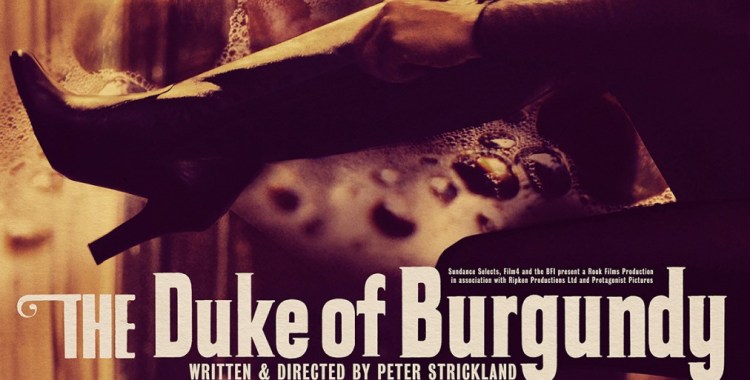
If one were to judge the film based on its trailer alone, it would be tempting to assume The Duke of Burgundy could be categorized as a lesbian 50 Shades of Blah Blah Blah, only with lots of butterflies and gorgeous cinematography. (Full disclosure: this reviewer has not seen the latter but puts her total trust in J. Jack Halberstam’s takedown.) More impressive than the cinematography, though, is how the film explores the complex relationship between love and power in a lesbian couple’s BDSM role-play.
Cynthia is an entomologist who lives in a sprawling, ivy-covered home. She writes books, attends lectures on her subject, and employs a woman named Evelyn as her maid. Cynthia is rarely satisfied with how Evelyn completes her chores, and disciplines her charge with humiliating labor, like hand-washing her undergarments and polishing her boots. When Evelyn inevitably fails to satisfy, Cynthia subjects her to physical punishment, much of which happens with Evelyn lying prone. Cynthia sits on her head, ties her hands, and urinates in her mouth.
It soon becomes clear that the humiliation we see is carefully orchestrated by Evelyn. The couple has a deep intimacy that is co-created through Cynthia’s total devotion to pleasing her partner’s voracious desire to be dominated. Although Evelyn is the sub, she is the architect of their fantasy play. Through non-linear storytelling, the perspective shifts from Evelyn to Cynthia. For example, when we first see Evelyn arrive for work as maid, Cynthia presents as a formidable, disapproving master who exacts total control in words and actions. Soon, however, the scene is replayed from Cynthia’s point of view and we see her reading a set of instructions for how to behave when Evelyn arrives. Cynthia diligently fashions her wig just so, and her eyes betray a measure of anxiety. She is an actress taking care to craft her appearance just before walking onstage. Their performance is about to begin.
Through flashbacks and fantasy sequences, the depth of Cynthia and Evelyn’s relationship is revealed. We learn they are both entomologists who bring the same degree of precision to their role-play as they do to their research. Evelyn is unrelenting in her commitment to creating opportunities for Cynthia to dominate her, which both emotionally and physically wears on her partner. And it is these moments when the staging of their role-play makes for surprising instances of comedy and tenderness. An especially titillating scene wherein Cynthia whispers commands in her lover’s ear as Evelyn masturbates turns humorous when, post-orgasm, she tells Cynthia to have more “conviction” in her voice next time. Though Evelyn often delivers her requests with a sweet but deliberate earnestness, these pieces of constructive criticism have the cumulative effect of wearying her lover. When Cynthia’s ambivalence tips toward frustration, we see how much negotiation is required by both partners to maintain the artifice of their role-play.
In a radically empathic way, we feel the emotional pain both women face when Evelyn’s desire to be dominated is greater than Cynthia’s will to dominate. This is deftly expressed when we see identical scenes enacted from each woman’s perspective. Take the golden shower scene: the door closes, we hear water running, and then the sound of Evelyn choking. Since we’ve just been introduced to them, its Evelyn who wins our sympathies and Cynthia that seems aggressive in punishment. Later, when Cynthia is carefully reviewing her index cards of instructions, we see her guzzling glass after glass of water—and now we know what’s coming. When the door closes again to replay the scene, all is quiet. And then Evelyn suggests the Cynthia turn on the tap. It’s not every day that we see a film that elicits two opposing and equally felt reactions: “Don’t pee in her mouth!” and “Why can’t she just pee in her mouth?” Such is the contradictory nature of desire.
Plus, things got in the way–like jobs, schedules, coworkers, relationships, disappointments and distance…basically just growing up. So when I sat down to create ‘Young Like Us,’ an original series that I wrote with Chloe Sarbib, my real college roommate, this is exactly what we (and the rest of our all-female production team and main cast) wanted to explore.
This is a guest post by Cleo Handler.
Remember how you felt at the end of a big sleepover, when you’d wake up with a Sour Patch Watermelon and Junior Mint hangover and the DVD menu for Mean Girls back up on the TV, still blaring the same few bars of “Overdrive” on repeat? You’d reach around groggily for your glasses, not wanting to leave, but feeling kind of sick and realizing you had a full day of homework ahead of you. That’s just what graduating college is like.
Mean Girls – the sleepover classic
Or at least, that’s how I felt. When I found myself alone in New York City, after four years of playing a Little League game of “Adult” and winning participation trophies, I was disoriented and overwhelmed. But most of all, I was no longer at one giant, constant slumber party with my friends, where no one told us what to eat or when to go to bed. Friendships suddenly required work (and hours on the train!) and I wasn’t sure how to adjust. Plus, things got in the way–like jobs, schedules, coworkers, relationships, disappointments and distance…basically just growing up. So when I sat down to create Young Like Us, an original series that I wrote with Chloe Sarbib, my real college roommate, this is exactly what we (and the rest of our all-female production team and main cast) wanted to explore.
Young Like Us characters on the stoop with their landlord Larry (Brad Dourif) in the pilot episode
When the main characters Mia, Ava, and Charlie realize that post-college life is pulling them in very different directions, they are forced to give up their shared Brooklyn apartment (with their creepy landlord Brad Dourif) and maybe more. In a last-ditch effort to stay in Neverland, Charlie convinces her reluctant friends that the best way for them to hang out more is to become a girl band – because bands never break up, right? Through the songs the girls (try to) write each week, they are able to explore the confusion of being a semi-adult, the same confusion we often struggled to articulate in our own lives.
Many shows out there deal with similar issues of shifting female friendships and navigating the transition to the real world (like gems Broad City and of course Girls, but we still felt that something was missing – and that’s where the music came in. The Young Like Us characters, like most 20-somethings we know, are too self-aware, self-deprecating, and defensive to address many of the serious issues they’re wrestling with in conversation. But the songs could take the characters to places where dialogue could not. In their music, the girls can more honestly explore crises of sexuality, identity, and piercing loneliness, as well as a nostalgia for the past and an anxiety about the future.
The Young Like Us girls writing a song in their studio, in Episode 2 – “High-Waisted”
Of course, there are many great musicals out there that do this, like the incredible Fun Home now on Broadway (speaking of Alison Bechdel and powerful feminist stories, check this) but there’s one key difference – for them, the songs are (largely) supposed to be unconsciously interwoven with reality, an external projection of their inner angst, expressed when their feelings are just too large to be contained by dialogue. What we found with our series is that music is not only a powerful tool when it’s supposed to be invisibly intertwined or employed effortlessly. Our characters do not have the power to burst into fully formed, gorgeous songs through theater magic; they sit there working it out consciously, struggling and writing together, and the material they come up with is not always great. They have some successful moments and some nice turns of phrase, but basically they don’t know what they’re doing and it doesn’t really matter. (Not only did this take some pressure off us as writers, but it also gave us the cool opportunity to actually finish the girls’ incomplete song fragments post-episodes, in collaborations with some generous and extremely talented friends of ours on a full album). But most importantly, this let our characters grapple with the idea that writing music takes work, as does friendship. Neither is about the finished product because the thing that really counts is the struggle to put your feelings into words, the give and take along the way, the collaboration.
So I’m not necessarily saying that the cure-all for keeping your shifting friendships alive in the real world is to form a band. BUT–if you’re thrust out into a new situation, finding yourself a bit lost, and feeling that familiar sugar high post sleepover crash coming on, you might as well break out the old Rock Band game and let yourself ease into real life with another round of “Island in the Sun.”
Cleo Handler is an actress, writer, and lyricist in Brooklyn, NY. She has written several original plays and musicals, including Glass Act and From the Fire, and co-created and starred in the musical web series Young Like Us. She is a member of the Advanced BMI Musical Theater workshop, and has recently acted in projects such as the upcoming TNT drama Public Morals (Barbara) and the sitcom Honest Living. Cleo can be found on her website and on Twitter.