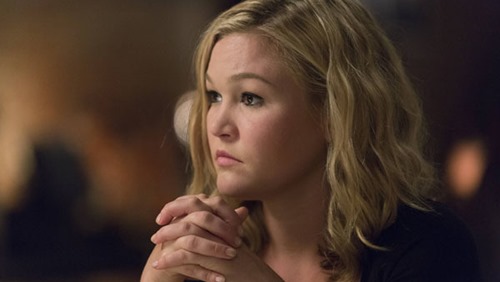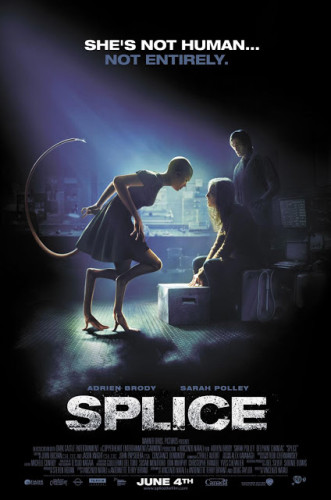
‘Splice’ explores gendered body horror at the locus of the womb, reveling in the horror of procreation. It touches on themes of bestiality, incest, and rape. It’s also a movie about being a mom.
NSFW | Trigger warning for survivors of sexual assault
Warning: Spoilers abound!
Splice explores gendered body horror at the locus of the womb, reveling in the horror of procreation. It touches on themes of bestiality, incest, and rape. It’s also a movie about being a mom.
Though it received somewhat lacklusterreviews, I encourage anyone interested in feminism and film to give Vincenzo Natali’s sci-fi body horror film a try. Splice features female characters who are intelligent, emotionally complex, and in control. They’re not perfect, but they are three-dimensional characters whose decisions drive the story. (One of them morphs into a male, but we’ll get to that.)
Splice asks a lot of questions about the terms and conditions of conception, gestation, birth, and motherhood, all without stabbing the viewer in the eye with reductive answers.
It also features some campy moments. Hipster scientists shout things like “It was the only way!” Academy Award winning actor Adrien Brody expresses his frustration by throwing down not just his jacket, but his scarf as well!
If you can stomach the juxtaposition of big thinky concepts and stilted clichéd dialogue, you will find Splice a thoroughly enjoyable mindfuck of a film.
Elsa Kast (Sarah Polley) and Clive Nicoli (Brody), long-term partners in romance and biochemistry, have developed a method to splice the DNA from various animals together to create hybrid creatures.
Viewers are actually birthed into the film from the perspective of Fred, the couple’s latest scientific endeavor, a male companion to their first hybrid, Ginger.
Splice
Elsa and Clive aspire to splice human DNA to develop cures for genetic diseases, but the pharmaceutical company funding their research puts a halt on all splicing until the duo can synthesize the medicinal protein necessary to create a commercially viable lifestock drug.
Newstead Pharma’s financial interests are represented by Joan Chorot (Simona Maicanescu), who insists Elsa and Clive begin “Phase Two: The product stage.”
Joan Chorot (Simona Maicanescu) in Splice
Joan doesn’t get a lot of screen time, but her brief appearances are a pleasure to watch. She’s articulate and always in control. It’s awesome to see a woman kicking ass in the role of the money-grubbing corporation, and Joan is a stellar example of how to do it right.
After their splicing research is shut down, Clive suggests they quit, but Elsa convinces Clive to proceed with the human splicing and to generate an embryo.
Clive Nicoli (Adrien Brody) and Elsa Kast (Sarah Polley) in Splice
In both the romantic and the professional relationship between Clive and Elsa (and this is a movie very much interested in the conflation of work and sex), Elsa is in charge.
Over and over, Elsa insists that they take the next step. She is the opposite of what I call the Male Protagonist’s Girlfriend — a pretty lady bystander who supplements the male protagonist’s story arc.
Elsa and Clive also deviate from the typical representation of long-term monogamous heterosexual partners: it is he, not she, who desires to have a child:
Elsa: “You are talking about having a kid.”
Clive: “Is that so unreasonable?”
Elsa: “Yeah, because I’m the one who has to have it…”
Clive: “Come on. What’s the worst that can happen?”
Elsa: “How about after we crack male pregnancy?”
Meaningfully, this discussion is cut short by an alert sent from the machine housing the hybrid fetus. When they arrive at the lab, the embryo is all grown up and preparing to evacuate the biochemically engineered womb.
Though Elsa doesn’t gestate and birth the baby from her own body, the birth experience is physically traumatizing for her. She becomes trapped in the birth canal and is injected with poisonous serum. In a rare moment of control, Clive saves Elsa. But after the birth, Elsa again takes charge: she refuses to allow Clive to kill the female hybrid and insists that they raise her in the lab.
Weirdly, the couple begins to function less like scientists and more like normal parents: frustrated because the baby won’t eat, stressed out because it won’t stop crying. However, unlike most parents, their baby has a stinging whip tail, and they are forced to relegate their progeny to the laboratory’s basement to keep her existence a secret.
Elsa (Sarah Polley) in Splice
Elsa becomes more and more emotionally attached to the creature, and eventually names her Dren. Clive is worried about their secret being revealed and disturbed by Elsa’s displays of maternal affection. Nevertheless, he resigns himself to raising her, and Dren grows to be a young adult in a matter of months.
One night, Clive and Elsa realize they haven’t boned down lately. Clive doesn’t have any condoms, but Elsa says, “What’s the worst that could happen?” – suggesting that she’s decided she wouldn’t mind gestating a child, maybe? – and they have at. This is the first of three sex scenes in Splice.
Cinematically, their lovemaking is depicted as underwhelming. Neither Elsa nor Clive take off any clothing. Creepily, Dren watches.
Meanwhile, pressure is building at the pharmaceutical company.
Their presentation at the shareholders’ meeting goes disastrously wrong. Unbeknownst to Clive and Elsa, their specimen Ginger has changed into a male, and Ginger and Fred tear each other apart and splash guts and blood all over the audience. Not good PR.
In deep shit with the company, Clive and Elsa are forced to relocate Dren to Elsa’s deceased mother’s farm.
Here we learn the backstory of Elsa’s childhood; themes of feminism, motherhood, and family history come into play.
We learn that Elsa’s mother forbade Barbies and makeup. Elsa explains that “She said makeup debased women.” The word “feminist” is never used in Splice, but Elsa’s mother’s Barbie-banning and makeup-denying seem emblematic of a certain type of feminist parenting.
We also learn that Elsa’s mother raised her in substandard living conditions, relegating her to a ramshackle, barely furnished bedroom.
Initially I viewed this as a problematic conflation of being a feminist with being a neglectful person and bad mother. But it’s far more complicated than that.
Elsa expresses her love for Dren by giving her the very things her mother denied her.
Dren (Delphine Chanéac) and Elsa (Sarah Polley) in Splice
But the Barbie and the makeover don’t make Dren happy; in fact, the Barbie explicitly makes Dren sad. Looking into a mirror, she holds the doll’s long blonde tresses against her bald head and becomes upset.
Over the course of the film, Elsa locks Dren up in a lab, then a basement, and eventually her mother’s barn, and Dren resents her for it. Elsa seems unable to break the cycle of her own mother’s physical and emotional neglect.
Perhaps the idea is that makeup is not a substitute for ideal living quarters and engaged parenting. What matters isn’t whether or not you give your daughter a Barbie, but whether or not you lock her in a barn.
And it turns out, Dren really is Elsa’s genetic daughter. To his chagrin, Clive discovers Elsa used her own DNA to create Dren: “Why the fuck did you want to make her in the first place? Huh? For the betterment of mankind? You never wanted a normal child because you were afraid of losing control. But an experiment…”
He doesn’t finish the sentence, but it seems clear that Elsa is using science as a way to disassociate herself from motherhood while still being able to create and raise a child. Presumably we’re to understand that Elsa’s desire for complete control stems from her tragic upbringing: “Look at your family history,” Clive exhorts.
Elsa tries to convey her genetic connection to Dren by explaining to her: “You’re a part of me, and I’m a part of you. I’m inside you.” She strives to smooth over their mother-daughter animosity, but the two wind up in a physical altercation that results in Elsa knocking Dren unconscious, tying her up, stripping her naked, and removing her tail and stinger. This scene has undertones of both castration and rape. Elsa has become a monstrous mother scientist.
Clive is horrified by Elsa’s actions, but she informs him that she is going to use Dren’s amputated stinger to finally synthesize the protein and heads to the lab, where she succeeds.
Elsa (Sarah Polley) in Splice
She tells off her obnoxious supervisor: “When some real scientists get here, come take a look.”
While Elsa’s away, Dren seduces Clive. If Elsa’s sin is her obsessive need to control, Clive’s sin is his inclination to relinquish control.
This is the film’s second sex scene. Cinematically it is sensual, queer in a fantasy-mythical-creature sort of way, strange but beautiful. Ominously, Dren grows back her tail stinger. Then Clive notices Elsa has come back and is watching them. She storms out and he chases her. Back at their apartment, Clive and Elsa decide that they finally have to kill Dren.
But when they return to the barn, it turns out Dren is already dying. After she dies, Clive’s brother (who also works in the lab) and their supervisor show up. He announces he knows their secret and demands to see the human-spliced creature. Elsa informs him that Dren is dead, throws a shovel at him and says, “See for yourself.”
Except Dren is no longer buried behind the barn. Like Ginger, she has morphed into a male, and in the film’s climax, he kills everybody but Elsa.
Dren as male in Splice
A note on the gender transition: I am uncomfortable with the representation of Dren’s metamorphosis from female to male. It is predicated on the idea that transitioning from a female body to a male body is horrific, and it exploits trans individuals by sensationalizing the transitioning body as evil and freakish. It’s not trans positive. I understand that Splice’s story necessitates this metamorphosis and that Dren isn’t exactly a human, but let’s call out problematic shit when we see it.
Chasing women through the woods at night is a staple of slasher flicks, but this movie isn’t about slashing – it’s about splicing. Dren chases Elsa through the woods, but instead of slaughtering Elsa, Dren rapes her.
This is Splice‘s third sex scene. Cinematically it is gut-wrenchingly horrifying, as any rape depicted onscreen needs to be in order to convey the awfulness that is sexual violation. Dren’s rape of Elsa is as disgusting and awful as Dren’s sex with Clive is beautiful and sensual.
When Elsa screams, “What do you want?” Dren replies: “Inside…of…you.”
Clive stabs Dren with a branch (wielding the metaphorical phallus) as Dren orgasms, but Dren is not killed, and attacks Clive. Elsa pulls her pants back on and bashes Dren in the head with a big rock. This critically injures Dren, who takes a moment to survey the situation – then stabs Clive with his tail. Elsa bashes Dren in the head again, killing Dren once and for all.
Elsa is the character who cut off Dren’s stinger and the one who deals Dren the death blow. And yet in his final moments, Dren chooses to kill Clive. Why?
Because inside of Elsa is a womb, the growing space for a new creature. And sure enough, in the film’s resolution we discover that Elsa is pregnant. Of the three sexual encounters that take place in this movie, the reproductively viable encounter is the rape. Elsa lives to be the final girl not because she wields a chainsaw, but because she wields womb. (And a big rock.)
I appreciate both The Fly and Prometheus because each asks its audience to empathize with a woman who desperately needs an abortion. I also appreciate Splice for asking its viewers to honor Elsa’s decision not to abort. Joan makes it clear that Elsa has a choice: “Nobody would blame you if you didn’t do this. You could just put an end to it and walk away.” (Would that this were the standard response to women experiencing unwanted pregnancies!)
But Elsa does not to put an end to it. Why does she decide to bring it to term?
Sure, the company’s giving her a shitload of money for gestating Dren’s offspring. But throughout the film, Elsa has insisted on moving forward with human splicing experiments. Perhaps she sees this as a necessary extension of that research.
Or maybe this is another chance for Elsa to use science to mediate motherhood. Is the pregnancy Elsa’s punishment, or her redemption? We’ll never know. All she says is, “What’s the worst that could happen?”
The film closes with a shot of the two women, the film’s only surviving characters, looking out a window.
Mychael Blinde is not a scientist, but she is afraid to give birth. She is interested in representations of gender in popular culture and blogs at Vagina Dentwata.
For women, male anxieties over female abusers combine great risk of demonization with great opportunity to forge connection. Men, like women, understand boundaries primally through their own bodies and identification. Rejecting one’s own abuse teaches one to fight against all abuse; excusing it teaches one to abuse.
Viy was the USSR’s first horror film
Trigger Warning: Discussion of maternal incest, paternal incest and the rape of men.
Ukrainian writer Nikolai Gogol disassociated himself from his 1835 story Viy by framing it as an unaltered “Little Russian” (Ukrainian) folk tale, but it is actually a strikingly original, vividly visual and deeply felt Gothic horror that bears only slight resemblance to folklore. Though Mario Bava’s 1960Black Sunday is officially based on Viy, the most faithful adaptation is a 1967 Soviet production with effects by stop-motion legend Aleksandr Ptushko. I’m analyzing this classic, not the recent remake.
Trainee monk Khoma Brut “never knew his mother,” while the story’s vampiric witch (she drinks baby’s blood) is introduced in a maternal, housewife role. As Katherine Murray discusses on Bitch Flicks, “the substitution of witch for mom or giant for dad is a safe way of exploring children’s fears about their parents.” Gogol’s major source is Zhukovsky’s translation of Robert Southey’s “A Ballad, Shewing How An Old Woman Rode Double, And Who Rode Before Her,” where a monk reads prayers over his cursed mother’s corpse, while demons lay siege to the church. Though not literally mother, Viy‘s vivid witch is the archetype of horror’s monstrous mothers. In 1893’s The Death of Halpin Frayser, the hero blunders into the “blank, dead eyes of his own mother, standing white and silent in the garments of the grave!” While struggling with his undead mother in a haunted forest, Halpin dissociates and views events “as a spectator” before dying horribly. In Carl Theodor Dreyer’s 1932 horror classic, Vampyr, Joseph Sheridan Le Fanu’s alluringly lesboerotic Carmilla is reimagined as a menacing, maternal vampire-hag, while in “Lies My Parents Told Me,” (Season 7) of Buffy the Vampire Slayer, Spike vamps his mother and she accuses him of sexually desiring her, forcing him to stake her. The event is so traumatic that Spike can be controlled by it, until he defuses his trigger by facing the memory (contrast the show’s dismissive treatment of Faith’s attempted rape/murder of Xander in Season 3’s “Consequences” and Buffy’s violation of Spike’s stated sexual boundaries in Season 6’s “Gone”).
In her discussion of the female Gothic, “The Madwoman’s Journey From The Attic Into The Television,” Bitch Flicks‘ guest writer Sobia notes, “while male writers of the time were tackling subjects like rape and sexual assault head on, the women were using complicated metaphors to confront these issues. I would argue that for the male writer, given the distance they already have and maintain from these topics, it was easy to tell the story of the assault happening to an Other.” Just as Godzilla‘s semi-goofy lizard embodied Japan’s nuclear trauma, so Gogol’s fantasy creations are not necessarily trivial, as unreal displacements of real anxiety. Viy parallels the female Gothic’s allegorical approach to rape, contrasting sharply with unreal yet realist rape fantasies like Murmur of the Heart (flippant maternal incest for shock value), White Palace (Susan Sarandon’s rape of an unconscious James Spader, who refused consent before passing out, as romantic liberation), and Wedding Crashers (Vince Vaughn’s rape by Isla Fisher as hilarious).
Nikolai Kutuzov’s witch transfixes Khoma
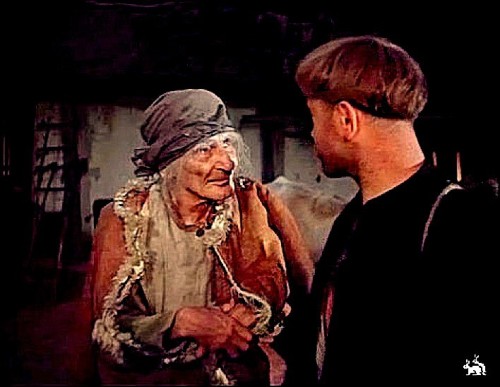
The boisterous tone of Viy‘s opening fades rapidly, as three seminary students, lost in the dead of night, draw up to a housewife’s misty gates and are allowed to stay on condition that they sleep separated. Leonid Kuravlyov’s robust and jolly Khoma beds down alone in a stable. His placid chewing is paralleled with the stable’s cow, reducing him metaphorically to livestock. Initially, Khoma views the looming witch as a joke: “It’s getting late, Granny, and I wouldn’t corrupt myself for a thousand in gold. *laughs* You’ve gotten old, Granny.” Gogol’s prose: “the sophomore [lit: ‘philosopher’] shrank back; but she still approached, as though she wished to lay hold of him. A terrible fright seized him, for he saw the old hag’s eyes glitter in an extraordinary way.” Filming the witch’s stare in uncomfortable close-up, the Soviet adaptation achieves a viscerally uncanny effect, intensified for hetero-male audiences by male actor Nikolai Kutuzov’s playing the witch, until the stumbling Khoma knocks the cow’s yoke symbolically onto his own neck. Khoma appears stunned. In Gogol’s prose, his reaction is more clearly tonic immobility, or freeze response: “the sophomore tried to push her away with his hands, but to his astonishment he found that he could neither lift his hands nor move his legs, nor utter an audible word.”
Finally, the witch grasps him and forces herself onto his back. After a dizzying aerial ride, Khoma drives the witch to earth by invoking Christ and beats her with savage anger, until she transforms into a weeping damsel-in-distress, who dies as he staggers away. The sexual dimension of the riding is clearer in Gogol’s prose: “his legs… lifted against his will… a wearying, unpleasant and at the same time sweet feeling… a demonically sweet feeling… suddenly he felt some kind of refreshment; he felt that his step began to grow more lazy… her wild cries… became weaker, more pleasant, purer.” Gogol uses supernatural paralysis and running motion to allegorically express concepts as crucial to understanding male rape as they are widely disbelieved: firstly, the effectiveness of sexual threat in inducing an involuntary freeze response and, secondly, the possible coexistence of “demonically sweet” arousal with traumatic mental repulsion and violation.
The eerie repulsion of Natalya Varley’s undead witch
Once dead, the witch can become youthfully beautiful, revealing her aged ugliness as a device to emphasize the unwanted and repulsive nature of the pseudosexual encounter. Khoma is forced to read prayers over the dead witch, as her dying request. Gogol’s witch is as pitiful as she is aggressive, crying a tear of blood and inducing Khoma’s guilt for killing her – “he felt as though those ruby lips were colored with his own heart’s blood” – before demonically rising to violate him again. Khoma is told of Mikita, a huntsman whose infatuation with the witch “completely sissified him” before he allowed her to ride him; he was “burned completely out,” leaving only ashes, proving the fatal seriousness of the riding Khoma has survived. The film’s church scenes are masterpieces of brooding Orthodox iconography, steadily ratcheted tension and jolting jump scares. As the witch rises from her grave, Khoma desperately draws a chalk circle around himself, bolstering its charmed impenetrability by fervent prayer as demons fumble for him.
The frail boundary of chalk serves as a powerful imaginary line of bodily autonomy that the hero desperately defends, and our anxiety over its penetration drives the film’s second half. Khoma is forced to return on the third night by threats and the promise of a thousand in gold (for which he earlier refused to “corrupt himself”), being caught as he tries to flee. After dancing in wild abandon, his macho bravado drives him to return to the scene of horrors, intoxicated, to prove that “Cossacks aren’t afraid.” Khoma thus strives for some sense of control by proactively inviting a seemingly unavoidable threat. This is a common response to chronic abuse. On the final night, gigantic grasping hands grope for Khoma, while a wild assortment of nightmare ghouls crawl out of the church’s woodwork. The witch orders them to bring the Viy, a stumbling grotesque with dangling eyelids, from under the earth. Ghouls raise the Viy’s eyelids, unveiling his glittering stare. Khoma swears he will not look, but cannot resist turning as the Viy’s heavy footfalls approach. The Viy immediately stabs his finger at him, ghouls descend and Khoma dies of fright beneath their grasping hands. In a coda, his friend declares, “If he had not feared her, the witch could have done nothing to him.” As with Spike’s vampire-mother, it is Khoma’s fatal fear of facing the buried monster that is his doom, not the supernatural itself.
A frail circle of chalk is all that protects Khoma from gigantic grasping hands
Gogol’s earlier 1832 horror, Terrible Vengeance, shares deep parallels with Viy. Like Viy‘s beautiful witch, its sorcerer is superficially attractive, amusing crowds until a religious icon exposes his monstrous true face. The heroine, Katerina, fears the sorcerer and is ambivalently detached from her father, suffering horrifying dreams that he incestuously desires to marry her. Her husband, Danilo, eventually discovers that the father and the evil sorcerer are one, and are conjuring Katerina’s spirit from her body by night. That spirit’s statement that Katerina “does not know a lot of what her soul knows” remarkably suggests repressed memory and dissociation. Like Khoma’s pity for the weeping witch, Katerina feels bound to liberate her father even after realizing his true nature, yet simultaneously self-loathing for her inability to separate from him. Terrible Vengeance portrays a nightmare vision of intergenerational abuse, where ancestors feed forever on each other’s corpses in a deep abyss. The original sinner gnaws his own flesh and shakes the earth in his efforts to rise, eternally growing and distorting into a buried grotesque like the fearful Viy. In Mikhail Titov’s 1987 animated adaptation, Katerina, maddened by the loss of her husband and child, dances in wild, defiant intoxication, as Khoma does after his night terrors, even drawing a circle of fire to ward off her father, like Khoma’s of chalk. Such profound parallels between the quasi-maternal incest of Viy and the explicitly paternal incest of Terrible Vengeance send a clear message: it’s not about gender. Though Gogol’s sexually monstrous mother-figure has captured male imaginations and spawned imitations in a way that his sexually monstrous father has not, because of the overwhelming male authorship of our culture, yet both images are rooted in a potentially interchangeable empathy for survivors of sexual abuse.
For women, male anxieties over female abusers combine great risk of demonization with great opportunity to forge connection. Men, like women, understand boundaries primally through their own bodies and identification. Rejecting one’s own abuse teaches one to fight against all abuse; excusing it teaches one to abuse. When Alex Forrest of Fatal Attraction spooked male audiences, we could have pointed out that her behavior is stalking, experienced by one in six women in the USA, and her attempt to force Dan’s paternity is reproductive coercion, experienced by 16 percent of pregnant women. Instead, Susan Faludi’s Backlash read Alex as representing the demonization of feminism. Yet, Alex is an abuser. As Stephanie Brown points out for Bitch Flicks, you may meet Alex as you progress through life. Society does not technically favor men over women in intimate relationships. It favors abusers over victims, and codes abusive behaviors as masculine. As for bad mothers, Freud’s Oedipal “seduction theory” was created under intense pressure from the psychiatric establishment, as an alternative to his earlier exposure of parental incest’s links to PTSD in “The Aetiology of Hysteria.” So, why do feminists apply Oedipal interpretations, that evolved by mirror logic from rape apologism, to dismiss texts like Viy? Ultimately, whatever nightmares they fuel, bad mothers are neither monsters nor demonically unnatural women. They are flawed humans. By resisting the gendering of abuse, can we evolve human understanding?
Misogyny?
The paranoid repulsion towards female sexual aggression that pervades the work of Nikolai Gogol has seen him uncritically labeled a misogynist, by virtually all modern commentators. Yet, renowned misogynist Nikolai Gogol formed intense friendships with women like Alexandra Smirnova-Rosset, corresponding on philosophical topics with rare respect for her intellectual equality, and addressing her as “drug” (“buddy”). Renowned misogynist Nikolai Gogol wrote the 19th century’s most psychologically insightful and empathetic portrait of a female experience of paternal incest. Renowned misogynist Nikolai Gogol understood abuse far better than mainstream feminism. Time to stop dismissing and listen to the boys. Time to face Viy without flinching.
Brigit McCone freely admits to being a Gogol groupie, writes and directs short films and radio dramas. Her hobbies include doodling and social justice warring.
Though the remake provides plenty of scare factor and makes excellent use of new technology (both at the level of cinematography and within the narrative itself with various nods to iPads, iPhones, drones, etc), it lacks the critical edge of the original.
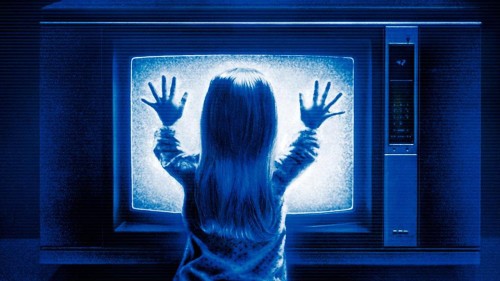
The Poltergeist remake functions as an old-fashioned haunted house movie gussied up with new special effects, new technology, and a fair dose of contemporary references. For horror buffs, it’s a worthy scare-fest, but if you like political bite in your horror, give it a miss. At a slight 93 minutes, a lengthier run time would have allowed a heightened focus on the critical undercurrents which only serve as VERY subtle background in director Gil Kenan’s version.
The original 1982 film, co-produced and co-written by Steven Spielberg, was more directly political in its depiction of an “all American family,” the stultifying effects of suburbia, and the dangers of “burying” ugly historical realities. As this review notes, the original provided “a sly commentary on the tribulations of suburban life, colonialism, the ill-treatment of Native Americans, the break-down of the nuclear family unit, and the damaging excesses of capitalism and consumerism.”
Though the remake provides plenty of scare factor and makes excellent use of new technology (both at the level of cinematography and within the narrative itself with various nods to iPads, iPhones, drones, etc), it lacks the critical edge of the original.
In the remake, economics are the driving factor forcing the Bowen’s move to a new house. While this review argues the film “works well as a study of a squeezed middle-class American family struggling to survive in a punishing economic climate,” I didn’t find the film studied this climate so much as dropped references to foreclosures and the current economic downturn, all while having the Bowen family live in a house that exudes middle-class comfort, technological upgrades, and plentiful yard-space.
If this is “the least sucky house” the family can afford, they hardly hold up as economically deprived. In one scene, Eric, the father (played by Sam Rockwell) is depicted as painfully embarrassed that two of his credit cards are declined at the filmic equivalent of Home Depot. To assert his ability to purchase (a key part of new American manhood), he then goes on a shopping spree at the mall, bringing home an iPhone for his teen daughter, jewelry for his wife, and a drone “toy” for his son. The Bowens are thus far from economically oppressed – rather, their white middle-class lifestyle is not as easy as it once was. In fact, the street name of their new digs, “Paradise,” ironically points to the fact their economic hardship is pretty slight compared to many.
The original film, in contrast, focused not on economic hardship but on the stultifying effects of suburban life with a trailer that ominously intoned their new house “looks just like the one next to it, and the one next to that, and the one next to that.” Like other Spielberg films, ET, and, more recently, Super 8, Poltergeist revealed suburbia is not all it’s cracked up to be and that perhaps we would be better giving up the notion of the “all American family.” In one telling scene between the parents, the dad is holding the book Reagan: The Man, The President while the mom smokes pot and reminisces – a scene that Eye for Film argues represents “succumbing to middle-class conservatism.” While the original bucked such conservatism, the remake instead pines for its loss.
Admittedly, the remake depicts domesticity as similarly stultifying – especially via mom Amy, played by Rosemarie DeWitt , who is in a writing rut and berates herself for being a bad mother. Though DeWitt is compelling, her role does not live up to JoBeth Williams’ portrayal due to the film’s troubling return to “traditional family values.” While the original included reversals of gender norms, with the mom depicted as far more proactive and powerful than the father, and even had the mother venturing to the “Other Side” to save her daughter Carol Anne, the remake returns the power to the father and has the son, Griffin, be the “superboy” that ventures to the “Other Side” to save his sister. Sadly, the iconic swimming pool scene with the mother fending off an array of skeletons is absent – so too is the powerful and enigmatic medium Tangina Barrons (played by Zelda Rubinstein).
In her place we have Carrigan Burke (played by Jared Harris) — meaning the film takes the largely female-driven paranormal team from the original movie and centers it on a white male reality TV ghost-busting star who insists, macho-style, “I am the only one who can lead those souls into the light” (why didn’t the filmmakers take a page from the forthcoming female remake of Ghostbusters??). To add insult to feminist injury, Dr. Powell (played by Jane Adams) is Carrigan’s ex-wife who clearly longs to rekindle their romance and her job in academia is presented as a sadly lackluster in comparisons to Carrigan’s reality TV fame. Ugh.
Given the remake emphasizes closets as particularly dangerous, another lost opportunity is the chance to play up “being closeted” – why not, for example, have some character, any character, be “out,” and use this as a vehicle to extend the stultifying family norms the remake fails to fully explore? There is a great electric drill scene in the closet in the remake, but it would have been all the better if instead of typical hetero-dude Boyd, they coded the character Boyd as a gay “Boi” – just think of the closet jokes and shenanigans that could have ensued!
Further, given we have a new ending (I will avoid overt spoilers), why not emphasize cars and our reliance on oil as death trap? Why not play up our seeming cultural inability to escape the horror of suburbia and the lure of the shopping mall? Why jettison the original cemetery back-story instead of putting it to more political use? Indeed, it would have been more powerful to address the politics of race head on this time around – something the original (and its sequels) failed to do. Instead, Indigenous Peoples are put under erasure – yet again – with only a trite joke during a dinner party scene about “sacred burial grounds.”
The remake also jettisons any commentary on sexism. Whereas the original had the teen daughter rebuke street harassers, a rebellion that is tied to her mother’s similar subversive streak, the remake makes no reference to gendered harassment (except if you count the somewhat awkward exchange the dad has with the female employee of the quasi-Home Depot as his credit cards are turned down). Here, the film could have taken guidance from the recent It Follows, a film which similarly harks back to old-school horror while offering a condemnation of rape culture. To its credit, the film’s shift towards young Griffin as the savior is well-done, especially via its emphasis that it is normal for boys as well as girls to be nervous, scared, emotional, and in need of reassurance. Notably the dad emphasizes the normality of this, admitting he too is scared, and, in so doing, denies the gendering of fear/emotion. Indeed, Sam Rockwell is great in the role – wish that he could have been paired with a mom more akin to the feisty one from the original!
While the original holds its own as a classic fright-fest, even being deemed “one of the scariest horror movies ever made,” the remake has plenty of good scares but lacks political punch (as do MOST horror films, admittedly). While the remake offers a more immersive view of the “Other Side,” making very good use of 3D to evoke threatening fleshy corpses as far as the eye can see, it fails to unearth what lies beneath our “sucky houses” in suburban “paradise.”
A trailer for the original film intoned “Poltergeist. It knows what scares you” – sadly, the remakes knows this too, but only on a visual level – the deeply buried socio-political realities that provide potency to horror are as absent as that infamous corpse-filled swimming pool…
Natalie Wilson teaches women’s studies and literature at California State University, San Marcos. She is the author of Seduced by Twilight and blogs for Ms., Girl with Pen and Bitch Flicks.
‘Bessie’ is one of the rare mainstream films that shows an unapologetically Black, female and queer protagonist. That alone is groundbreaking in an otherwise straightforward biopic.
See-line woman
Wiggle wiggle
Turn like a cat
Wink at a man
And he wink back
Now child
See-line woman
Empty his pockets
And wreck his days
Make him love her
And she’ll fly away
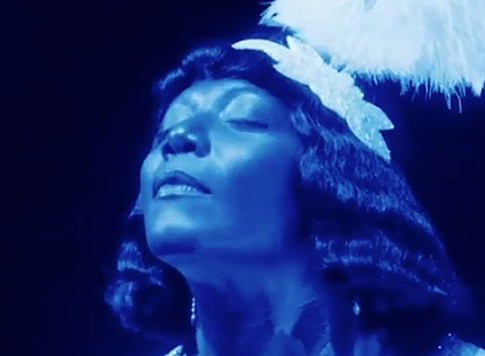
Writer/director Dee Rees opens the film Bessie with the Nina Simone classic “See-Line Woman” playing as the camera takes in Queen Latifah in close-up, her face drenched in resplendent blue lighting. The color, framing and music told me from jump that the narrative would be coming from a place of womanist Blackness. Nina Simone, the High Priestess of Soul, was signifying musically the proper introduction to Bessie Smith, the woman known in her day as the Empress of the Blues.
The story of Bessie Smith has been a long time coming, and it was quite timely that she should be given her due just a few days after the passing of the Blues legend B.B. King. Most people know very little about Bessie Smith, and it is almost a given that biopics are never truly satisfying, typically following a rise to fame and falling into trouble narrative. All I wanted to know was, would Rees be true to the highly unorthodox life of Smith? Or would we be subjected to a safe narrative that tip-toed around the raunchy, bisexual and profane realness of the Bessie Smith I read about in college?
Rees kept it real. Bessie is one of the rare mainstream films that shows an unapologetically Black, female and queer protagonist. That alone is groundbreaking in an otherwise straightforward biopic. Within ten minutes of the film, we see Bessie fooling around with a male paramour whom she beats up after he gets a little too fresh for her tastes, and then we see her in bed with her longtime female lover, Lucille (the gorgeous Tika Sumpter). It comes off natural, not some forbidden plot device to be used later to create conflict. It is what it is, and Bessie doesn’t waste time fretting over it. When she jumps on a train owned by Ma Rainey (Mo’Nique) to beg for a singing job and observes Ma interacting with her own female lover who prances around comfortably topless, Ma asks her straight out, “Watchu know about it?” Bessie tells her, “Same thing you do.” And that is that.
It was very powerful to see Black queer women openly affectionate with one another, and openly sexual in private spaces, especially for that time period. Black queer women, hardly ever get to see themselves on film without the narrative making them act secretive of fearful. Throughout the viewing, I kept waiting for Bessie’s bisexuality to become a big issue with her family, her band, or even her husband (and many lovers). It didn’t.
Ma Rainey takes Bessie under her wing, teaches her the ropes and how to sing the Blues to make the audience want more. She even teaches Bessie how to dress as a man and enjoy the thrill of smoking and gambling with men dressed that way. It reminded me of the stories I read that told of private clubs where women could be gender fluid and embrace masculine expressions without fear of bodily harm from violent homophobes.
Black love in all forms is front and center, and a new love comes in the form of Jack Gee (Michael Kenneth Williams being fierce and nuanced in this role), a man who sees Bessie perform, and goes to her hotel uninvited. As Bessie lies in bed, still in her nightgown and headscarf, her brother and business partner Clarence (Tory Kittles) watching her back, Jack Gee tells her his personal stats and proclaims without haste, “I’m auditioning to be your man.” He’s bold as brass and Bessie eventually marries him, and keeps her girlfriend Lucille too.
Jack seems very much Bessie’s equal, and they do go toe to toe with their hard loving, hard fighting and hard drinking. It’s a fragile relationship that hinges on Bessie’s Achilles heel, which is a bottomless hunger that stems from the loss of a mother at an early age, and the dysfunctional relationship she has with her older sister Viola (Khandi Alexander). Viola used to lock up food in the family refrigerator and beat on Bessie. This back-story told in flashbacks is the key to Bessie’s insatiable need for more success, more money, more lovers, and more control over her family. She eventually buys a large house without telling Jack, bringing everyone (including her sister Viola and Lucille) under one roof. She ignores her husband’s complaints and forces her will on everyone. She will live the life she felt was denied her, and even brings home a little boy on Thanksgiving to be her and Jack’s son. It’s Bessie’s world and everyone is expected to fall in line and gravitate around her.
The best part of Bessie is how she handles the intrusion of the White Gaze on the storyline. Bessie’s world seems insulated from white intrusion, and this allows us to focus on the Black characters just being themselves without having to focus on the known and ubiquitous racism. Whiteness does seep in through the colorism issues that Bessie encounters with the infamous paper bag test (Black performers, even in Black entertainment spaces of the period, did not hire darker skinned Black women who were not lighter than a paper bag). White intrusion is most prominent in two scenes, one involving the Klan showing up at one of Bessie’s performances, and the other at a prominent white patron’s home.
In the Klan sequence, Bessie simply walks outside and cusses the white men out and chases them away. She doesn’t quake in her boots or shrink behind the protection of Black men. She then turns around and goes back to performing, winning over the respect of the frightened Black men and women who were prepared to run away from White terrorism intruding onto Black space. In the home of Carl Van Vechten (Oliver Platt), a controversial patron of Negro artists whom he finds crude, primitive, and folksy, Bessie turns the White Gaze (and cultural appropriation) on its head by being true to her unfiltered Blackness. When a white woman puts her hands on Bessie in an attempt to hug her and says, “I heard that you were wild,” Bessie pushes her away and says, “Get the fuck off me.” Bessie in one fell swoop refused to let the white woman turn her body into a commodity. She turns on Carl Van Vechten too when he tells her about his book Nigger Heaven. This is a tremendous sequence because Bessie doesn’t allow the White characters to hijack the narrative and center the story on Bessie having to impress Van Vechten to get something from him for her survival. Bessie doesn’t give a fuck about anyone in that room except for herself and the two lovers she brought with her. In fact, Bessie doesn’t even care what Langston Hughes (Jeremie Harris) has to say when he tries to warn her about Van Vechten’s fetishizing of Black culture and Black people.
I found it fascinating watching Hughes take in Bessie’s behavior towards Van Vechten, because Hughes had to depend on White patrons much like Van Vechten to supplement his income in order to write and survive. Bessie didn’t. She had her voice and she had regular working class Black people who came out to see her when she travelled. Eventually she made records, (there’s the hilarious moment where she goes to a Black record company called Black Swan Records and discovers the company isn’t as Black as she thought, and that she is too Black for them), and was able to gain new revenue from vinyl sales. Bessie never had to water down her personality to make White folks feel comfortable. Unfortunately Hughes and other writers of their time (like my favorite Harlem Renaissance writer, Zora Neale Hurston) had to walk a thin line of creating the art they wanted without offending Whites who funded that art. It still happens today. Recently, poet and Buzzfeed Literary Editor Saeed Jones wrote about this same issue with his recent piece Self-Portrait Of The Artist As Ungrateful Black Writer.
Bessie is a good primer movie for people who know nothing about Bessie Smith, and it is a breakthrough performance for Queen Latifah. The cast is flawless and I expect Emmy nods for Queen Latifah, Mo’Nique and Khandi Alexander. (Khandi can do anything and just be dynamite. Period.) It was a pleasure watching unapologetic Black, female, queerness. I hope HBO takes more chances on projects like this. Somebody get Dee Rees financing for a new movie stat. It is maddening to think that she hasn’t had an opportunity since Pariahin 2011 to show us her voice. She has more radical stories to tell. I can feel it.
Non-white characters get the short end of the stick in other ways, too: Cynthia Rose (Ester Dean) amps up the predatory lesbian angle (an outdated, unfortunate motif); Lilly (Hana Mae Lee) keeps whispering shockers as if that joke never gets old (it does); and the only lines Guatemalan Flo (Chrissie Fit), another new Bella, gets are about how she prefers the United States to her native country. Can you say aca-propaganda? Such political incorrectness is an unfortunate default to early second-wave feminism, which marginalized women who weren’t straight and Caucasian.
Here at Word and Film, we are not in the business of grading movies. But if I were to grade Pitch Perfect 2, the much-anticipated follow-up to the breakout 2012 musical comedy, I’d give it a solid B. As sequels go, that’s not bad, and the film deserves extra points for sidestepping the meta-movie trap into which so many comedic sequels fall. (Here’s looking at you, 22 Jump Street.) But, though I’m a huge fan of its pop-feminism and hip a cappella (no, that’s not an oxymoron), Pitch Perfect 2 doesn’t quite hit the high notes of its predecessor. Chalk that up to a too-many-cooks-in-the-kitchen plot and a disappointing profusion of micro-aggression.
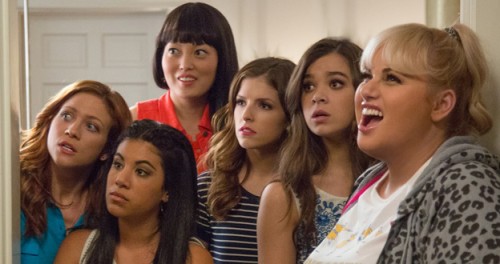
The film begins as the Barden Bellas, the prize-winning all-female a cappella group from a fictional Georgia college, become a national joke when Fat Amy (Rebel Wilson) suffers a spectacular wardrobe malfunction during a concert for the Obamas and Shonda Rhimes. (Insert Scandal joke here.) In order to claw their way back to good standing, the girls have to win the a cappella world title. The problem? No one’s been able to beat Das Sound Machine, a German group led by Kommissar (Birgitte Hjort Sørensen), a sort of BDSM Barbie.
Most of the gang from the first movie is still in place – Chloe (Brittany Snow) is now in her third senior year – and there’s a new Bella, legacy Emily (Hailee Steinfeld, sunnier than we’ve ever seen her), who is bummed the group is in such disrepute. Also still in attendance: commentators John (John Michael Higgins) and Gail (Elizabeth Banks, who now doubles as director). John’s bad-taste humor, a throwback to Fred Willard’s shtick in the dog mockumentary Best in Show, is more problematic in this film, especially at the international competition, where he throws out nearly every ugly stereotype about minorities under the sun. Because Banks has fewer good lines this time around (in the spirit of ill-advised modesty?), John’s racism goes unchecked. The effect, for example when an Indian group leaves the stage, is a tacit endorsement of such comments as “they’re running offstage to take more of our jobs.”
Non-white characters get the short end of the stick in other ways, too: Cynthia Rose (Ester Dean) amps up the predatory lesbian angle (an outdated, unfortunate motif); Lilly (Hana Mae Lee) keeps whispering shockers as if that joke never gets old (it does); and the only lines Guatemalan Flo (Chrissie Fit), another new Bella, gets are about how she prefers the United States to her native country. Can you say aca-propaganda? Such political incorrectness is an unfortunate default to early second-wave feminism, which marginalized women who weren’t straight and Caucasian.
At times, Pitch Perfect 2 is so diffuse and so packed with random cameos that it seems like a mildly funny SNL 40. An underground aca-contest between Das Sound Machine, some (real-life) Green Bay Packers, the Bellas, and the “Tone Hangers” (featuring such comedians as Reggie Watts and John Hodgman) is admittedly hilarious, especially with a Southern-fried David Cross at the helm. But other sidebars fall flat, as they draw focus from the barely there main story: Beca (Anna Kendrick) tries to keep her recording internship secret; Fat Amy and Bumper (Adam DeVine) embark on a surprisingly dull courtship (who knew there could be too much Fat Amy?); and we’re subjected to a super-dull flirtation between Benji (Ben Platt) and Emily, which feels like a sidebar to a sidebar. One plot that gets no screen time this go-round: the romance between Jesse (Skylar Astin) and Beca, which is just as well as their chemistry always seems forced. (Sexually, Beca only perks up when Kommissar comes onscreen; now there’s a plotline that could’ve been interesting.) In general, Beca seems incapable of connecting with others although she’d supposedly cleared that hurdle in the first movie. Kendrick plays this suspiciously convincingly, as if a sequel wasn’t exactly her bright idea.
But sisterhood is still powerful, and it all gels whenever the girls sing and dance together. Despite my misgivings, I teared up when the Bellas performed an original song co-written by Beca and Emily – “Flashlight” is the new “Cups,” trust me – especially when other generations of the group joined the stage; the idea of celebrating an “old girls network” on the big screen is still revolutionary. So maybe it’s good news that, given this film’s blockbuster opening weekend (it edged out Mad Max domestically), we can expect a Pitch Perfect 3 – ideally with those sophomore-slump kinks worked out. Hollywood can always use more ladies-first ladies.
A former labor organizer, Lisa Rosman has reviewed film for such outlets as Time Out New York, Salon, Us Magazine, Flavorwire, LA Weekly, RogerEbert.com, and CBS News. She appears weekly on the NY1 film review show Talking Pictures and writes on film, feminism, and eavesdropping for SignsandSirens.com. Most notably, she once served as an assistant for Elmo on Sesame Street.
Aside from being lazy, careless depictions like this are dangerous. They desensitize people to an issue that is still very pressing. It’s not that rape shouldn’t exist in fiction, but they must be framed responsibly. Fictional female characters are forever being raped as retribution against the ills of the men they’re connected to, or as punishment for not being submissive to the men around them. And this happens time and time again across genres and media. So while the denotative reading of these acts might be that “evil men rape” the connotative interpretation over time becomes “rape is a valid punishment for women.”
This guest post by Cate Young previously appeared at her blog BattyMamzelle and is cross-posted with permission.
I’m sick of talking about rape.
Forcible rape, date rape, grey rape, acquaintance rape, spousal rape, statutory rape and now fictional rape. I’m sick to death of explaining why the callous rape of women and girls in media is a very bad thing for our culture and why we should cut it out. *wags finger*
This Game of Thrones storyline is just the latest in a long line of excuses and equivocations for why the depiction of brutal and gendered violence against women is a storytelling necessity. People are sticking their heels in on both sides but to me the moral position is clear: there is nothing to be gained from lazy representations of rape in a media landscape that already devalues women and reduces them to objects and property.
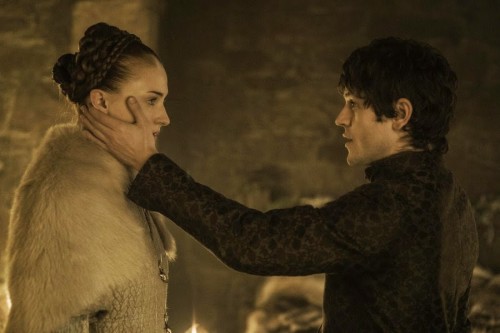
Now I’ve read the arguments in favour of the narrative value of Sansa’s rape. That it showed that Ramsay was a sadist. That it would help Theon come back to himself and help Sansa escape. That it would motivate Sansa to seek vengeance. But it’s all bullshit.
What did that scene add that we didn’t already know? Did the writers think that cutting Theon’s penis off was too subtle to indicate Ramsay’s sadism? Did they think the brutal murder of her mother and brother were not strong enough motivators for Sansa to want revenge against the Boltons? Could they not conceive of a single other way in which Theon might be able to mentally recenter himself? What about this particular rape scene added such probative narrative value that it had to be transposed from one character to another even as the original victim is excised from the story? All it was is more rape on a show already replete with rape, for the sake of having rape. None of this is new information.
And it’s not that rape should never be represented in fiction. Rape is everywhere. It’s unfortunately an all too real danger of the world we live in. But it’s not as though there is some dearth of rape representation in media. Using rape as a narrative tool is lazy, and especially so when it’s invoked this many times in the same show. We are now at three female characters (all of whom are considered major point of view characters in the novels) who have been raped in the series, two of whom weren’t raped in the source material. It’s just rapes on rapes on rapes up in this bitch…
And then to add insult to injury, the framing of the scene takes the emphasis off of Sansa and her trauma and places it firmly on Theon and his anguish and having the witness the act. That slow close up to Theon’s face as we hear Sansa scream and cry in the background places him and his emotions squarely at the centre of the scene. We see not, Sansa’s emotional turmoil at being humiliated and degraded by her new husband, but Theon’s tortured face as his guilt consumes him. So on top of Sansa being raped in the first place, that violation is used not to make us feel sympathy for her, but for a man who betrayed her and her family. She doesn’t even get to be the subject of the violence that is happening to her. Her pain instead gets used as a device to advance a man’s character arc instead of her own (the perils of which I talked about back in December in this essay about the rape plot in the CW show Reign).
Aside from being lazy, careless depictions like this are dangerous. They desensitize people to an issue that is still very pressing. It’s not that rape shouldn’t exist in fiction, but they must be framed responsibly. Fictional female characters are forever being raped as retribution against the ills of the men they’re connected to, or as punishment for not being submissive to the men around them. And this happens time and time again across genres and media. So while the denotative reading of these acts might be that “evil men rape” the connotative interpretation over time becomes “rape is a valid punishment for women.”
“Now instead of raping a buxom, weeping young woman, your Extremely Bad Dude is now raping a terrified six year old boy. Does it still feel like it deserves to be there? To use the usual fictional rape apologist arguments, there’s no reason this scene shouldn’t exist. Child rape exists, and no doubt happens in times of war. It probably happens even more in third world countries that are at war. Historically speaking, I’m sure there have been thousands of child rapes since the dawn of humanity. Maybe millions. Practically speaking, it would be remiss not to include a child rape scene or two, right? It happens. We must be truthful to reality. It’s our duty. Or, wait – is it possible you’re using this horrific, degrading, monstrous act as window dressing?”
Why is it that sexual violence against women is the only kind of violence seen as such an inevitability that not including it raises suspicions?
And for all the people who keep harping on about how much worse Jeyne Poole’s fate was in the novels, you’re missing the point. We’re at the juncture now where the series will likely deviate wildly from what George R. R. Martin wrote in the novels and from what he intends to write in the future. This gives the show’s writers enormous latitude to readjust the moral compasses of these characters. Evil men will stay evil, and good men will stay good. But how evil and good they may be is up to them. I find it very upsetting and frankly offensive that in all the retooling that was done to this storyline, the rape scene was the one thing that just had to stay. We’re literally talking about an entirely different character with a different history and experiences, but she just had to get raped because…. “realism?” It’s amazing to me that we can accept a fictional world where dragons are real and men kill their brothers by shadow proxy, but a world without rape (or even just a little less rape!) is unfathomable to some people’s imaginations.
But when it comes down to it, I’m sick of talking about rape because it’s exhausting. I don’t think the men who are disingenuously barging into these conversations understand how truly exhausting this new cultural trend can be for female viewers. And often they bring up the many, many murders on Game of Thrones as a counterpoint, but that isn’t a 1:1 comparison. For one thing, nothing is preventing men from “making a stink” about the excessive violence of these shows. We as women aren’t required to not care about something that affects us because men don’t care about something that affects them. But I digress…
In our daily lives, murder is not something that most people are actively protecting themselves against. For most men, unless they’re in the people-killing business, getting murdered is not exactly a daily, top of mind concern. But for women? Getting raped is a daily concern. Women have whole routines built around not making ourselves vulnerable to rapists and sexual predators even for a second. Every day we have to think about getting raped. We self-police what we wear, where we go, when we go, how we go, with whom we go, all in an effort to make sure that we’re taking every possible precaution against being raped. And then we’re raped anyway and society tells us it’s our own fault for not having a more effective rape routine.
So for women to then come home, (hopefully having managed to not get raped) and have to watch ALL THE TV SHOWS be about women getting raped? It’s too much. The men defending Sansa’s rape don’t get that this depiction is yet another reminder that rape is everywhere, there’s no escape and that we could be next.
If you really to make a leap, we can see this uptick is the engagement of rape tropes as an element of social control. Because it isn’t just Game of Thrones that’s doing this. From House of Cards to Scandal to Reign, lots of shows are adding rape “for flavour” and it serves as a constant reminder of danger. When we look at it like that, is it really too much to ask that creators are at least responsible with their use of rape in fiction? When you’ve created a scenario where an entire segment of your audience is actively debating whether or not Sansa was even raped because “she chose to play the Game of Thrones” you’re being irresponsible with your craft. These discussions are not fun rhetorical games. They have an active effect on our lives as women. It’s disheartening as a feminist lover of television to find that this is the new status quo. Rape your women, king your men. And watch TV behind your fingers.
I gotta say, I don’t know how many more television shows I can watch while quietly mumbling “please don’t rape her please don’t rape her” under my breath.
Can we please stop raping our fictional women?
I’m all raped out.
Cate Young is a Trinidadian freelance writer and photographer, and author of BattyMamzelle, a feminist pop culture blog focused on film, television, music, and critical commentary on media representation. Cate has a BA in Photojournalism from Boston University and is currently pursuing her MA in Mass Communications so that she can more effectively examine the symbolic annihilation of women of colour in the media and deliver the critical feminist smack down. Follow her on twitter at @BattyMamzelle.
It likes to think of itself as a progressive, meritocratic industry, but I don’t think any thoughtful person would dispute the fact that Hollywood remains a racist cultural institution. It continues to produce racist films, and it continues to shut out talented people of color. In fact, even those of us who have not bought the myth that Hollywood’s a liberal place full of cool, open-minded individuals have not fully recognized how deeply ingrained its racism really is. Here are just a few sobering reminders from history and the recent past.
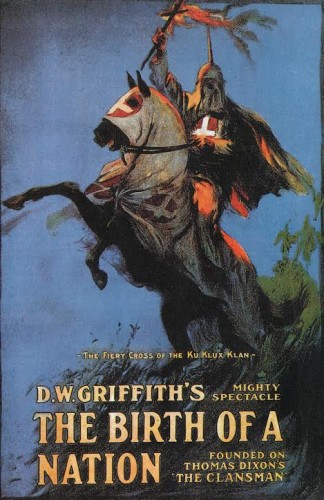
Poster of Birth of a Nation
Promoting a White Supremacist Ideology
The two most repellent films I have ever seen are Leni Riefenstahl’s Triumph of the Will (1935) and D.W. Griffith’s TheBirth of a Nation (1915). Both films have been long recognized by film critics and scholars as technically innovative and both prompt feelings of overpowering nausea. Triumph of the Will is a German propaganda film that (re)produces Nazi discourse. Experiencing the terrifying soullessness of Nazi ceremony on display is a simultaneously sickening and numbing experience. Praised by generations of film scholars as a masterpiece, The Birth of a Nation is the most rabidly racist movie ever made in the United States. Set in the Civil War and Reconstruction era, it is, in fact, a revisionist, white supremacist movie that portrays the Klan as the good guys. The story of the The Birth of a Nation’s reception is also astonishing. One of the first films to be screened at the White House, it reportedly received this response from President Woodrow Wilson: “It was like writing history with lightning and my only regret is that it is so terribly true.” The racism in The Birth of a Nation is of the vilest kind: Black men are portrayed as rapacious creatures fixated with white women while the Klan are celebrated as gallant saviors. Promoting a Fascist racist ideology, the film seeks to normalize ideas of white superiority. Its poisonous impact cannot be overstated. The Birth of a Nation was a huge commercial success and hugely influential. In fact, it was used as a recruiting tool by the Klan. Think about this: this was one of America’s first “great films.”
Tippi Hedren
Propagating Racist Norms and Ideals of Feminine Beauty and Sexuality
Alfred Hitchcock is one of the accomplished directors in cinema history but he has also played a dominant role in constructing and reinforcing Anglocentric norms and ideals of female beauty and sexuality. It is well known that Hitchcock preferred blonde actresses to play his leading ladies–they were part of his sadomasochistic aesthetic vision and the object, it is said, of a quite pathological obsession in his personal life–but I have yet to read any film scholar or critic underscore the director’s essential racism. In an interview with fellow director Francois Truffaut, Hitchcock explained, “You know why I favour sophisticated blondes in my films? We’re after the drawing room type, the real ladies who become whores once they’re in the bedroom.” There is, you can see, a strong linkage between Hitchcock’s racism, sexism, and classism. The director, moreover, espouses a very specific white self-love. Consider the following statement: “I think the most interesting women sexually are the Englishwomen. I feel that the Englishwoman, the Swedes, the northern Germans, and the Scandinavians are a great deal more exciting than the Latin, the Italian, and the French woman. Sex should not be advertised. An English girl, looking like a schoolteacher, is apt to get into a cab with you, and to your surprise, she’ll probably pull a man’s pants open.” His take on Anglo-Saxon and Nordic women is an expression of his own fantasies but he also advocates here the chauvinistic, Anglo notion that non-WASP European women are sexually vulgar. Women of color are noticeably absent from his misogynistic erotic musings, as they were from his films. Hitchcock’s blonde, WASP female characters–slender blonde women, I should add–typified by Tippi Hedren in The Birds should not solely be seen as fetishistic products of his imagination. They are a product of a racist, sexist, and classist mindset. It could be argued that Hitchcock played a key role in Hollywood in propagating narrow, racist ideals of feminine beauty. The attitudes he propagated have had a toxic, long-lasting influence on the American cultural imagination.
John Wayne
Romanticizing Racist Stars
John Wayne was not only one of the most popular movie stars of his time; he also represented a romanticized kind of robust, individualistic American masculinity. Wayne, indeed, personified the country itself for both compatriots and viewers internationally. Behind the mythic America the star was intended to embody, are, however, the historical truths of genocide and slavery. The icon himself never recognized these truths. In a 1971 Playboy interview, John Wayne stated, “I don’t think we did wrong in taking this great country away from them. Our so-called stealing of this country from them (Native Americans) was just a matter of survival. There were great numbers of people who needed new land and the Indians were selfishly trying to keep it for themselves.” This mind-blowing comment is worth breaking down. Wayne employs a Darwinian justification for the atrocities of his ancestors, an ideology devoid of morality and humanity. It is also, quite simply, as perverse as siding with a rapist calling his rape victim the aggressor. In the interview, he also shifts attention away from contemporary American atrocities in Vietnam, namely the My Lai massacre. On the civil rights struggles of Black Americans, he ever so vaguely acknowledges the anger of his fellow citizens before making this statement: “I believe in white supremacy until blacks are educated to a point of responsibility.” Here we have a Hollywood icon clearly articulating white supremacist thinking as late as 1971.
Black Hawk Down
The Utter Indifference to the Deaths of Enemies and Civilians of Color in Hollywood War Movies
You can find numerous illustrations of American exceptionalism and selective empathy in Hollywood movies. The wildly popular, revisionist American Sniper (2014) is only the most recent dangerous example. From The Deer Hunter (1978) to The Hurt Locker (2008), there are many unsettling cases but there is one that I would like to presently highlight–the racism informing Black Hawk Down (2001). Directed by Ridley Scott, Black Hawk Down concerns the 1993 raid on Mogadishu. Like the vast majority of American war movies, Black Hawk Down never attempts to explore war from the perspective of the enemy soldier or civilian. It is solely dedicated to glorifying the sacrifice of American blood. The close of the film perfectly sums up white Hollywood’s absolute indifference to the deaths of enemies and civilians of color. We are told, “During the raid over 1,000 Somalis died and 19 American soldiers lost their lives.” Black African Somali Muslim deaths are solely an afterthought.
Diane Keaton and Morgan Freeman
Erasing Interracial Relationships
Over the years, Hollywood has done an effective job in erasing interracial relationships from mainstream American culture. The lack of interracial relationships in Hollywood movies not only shows shameful cowardice on the part of the studios; it also reinforces racist norms and denies an increasing demographic reality. Every kind of relationship–sexual, romantic, and marital–has been deliberately obscured. With movies like 5 Flights Up (2015) and Focus (2015), there are indications that this may be changing but current depictions only serve to highlight the shortage. Certainly TV programs such as Grey’s Anatomy have depicted interracial relationships with greater regularity but Hollywood still has a long way to go. At the moment, they are not fully representing intimate human relationships in America.
Hollywood is, as you can see, an industry that has, from its very infancy, regurgitated racist cultural products, as it has shamelessly sought to provide narcissistic identification for white people. If there was ever an industry that needs to face its past and recognize its essentially backward, intolerant nature, it is America’s dream factory.
‘Girlhood’ starts on a peak note: a slow-motion scene of what looks like Black men playing American tackle football on a field at night, wearing helmets, shoulder pads and mouth guards, so we don’t realize–until we notice the players’ breasts under their uniforms–that they are all girls.
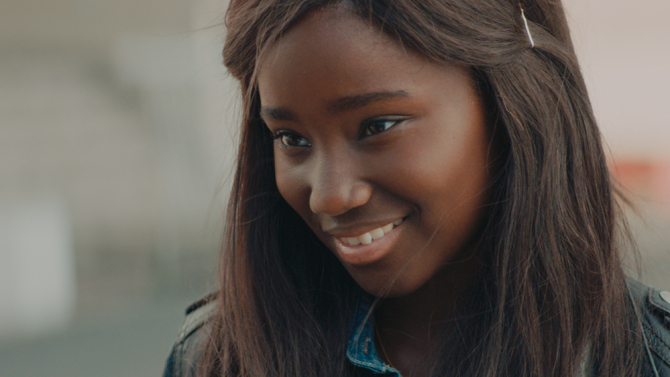
When Boyhood was making its victory lap through critics’ circles and award ceremonies, I wasn’t the only person who thought, “I want a film called Girlhood.” We all got our wish near the beginning of this year when the out, writer-director of Water Lilies and Tomboy, Céline Sciamma, gave us the art house US release Girlhood about a French, Black teenager, Marieme (Karidja Touré). The English title isn’t an exact translation of the original French Bande de Filles (“Group of Girls”) which was in production long before Boyhood was released–and perhaps even before that film was called Boyhood: the original title was 12 Years. Still, I was eager to see Sciamma’s film–until I read about its “bleak” ending and some talk from women of color that they found the writer-director’s take on Marieme’s life lacking. When the film played at my local art house as a revival months after its first run, I went to see it. I’m glad I did, but now I understand both reactions: the effusive praise and the cringing.
Girlhood starts on a peak note: a slow-motion scene of what looks like Black men playing American tackle football on a field at night, wearing helmets, shoulder pads and mouth guards, so we don’t realize–until we notice the players’ breasts under their uniforms–that they are all girls. Marieme and the rest of the team all live in the same neighborhood so after the game they walk home together with each saying “Good night” to the rest as she leaves the group to go home. Marieme is the only one left at the end, making her way up to her family’s apartment, where we see that she and her sister, who is a couple of years younger than she is, (Marieme is 15 or 16 at the beginning of the film) are the ones raising their much younger sister, cooking her meals and doing the dishes while their mother works. Their older brother is a physically abusive, petty dictator who kicks Marieme out of the living room when he comes home, so he can have the computer soccer game she was playing to himself.
Marieme finds out that she is flunking out of school and an unsympathetic counselor won’t listen to her excuses, or allow her to redeem herself. Dejected, she leaves, then just outside the school meets up with a group of three girls about her age, also not attending classes, who invite her to go to Paris with them (the film seems to mostly take place in the Parisian suburbs). At first she turns them down but when she notices the attention they receive from a group of local boys (including a friend of her brother’s she’s attracted to) she decides to go to Paris with the other girls after all.
Lady and “Vic”
In the city the girls unapologetically take up space, whether blasting music and teaching each other dance routines in a crowded metro car (with the white passengers turning their backs on them, pretending not to notice) or shaming and shoving a white clothing store clerk who profiles them. Marieme is entranced and becomes a permanent part of the group. She exchanges her long braids for the long straight weave/wig similar to that of the leader of the group Lady (Assa Sylla) and intimidates one of her former football teammates into giving her money that the group pool into a night in a motel room (with extra for food and booze). While she’s partying with her friends her brother calls, but Lady, while taking a bath, instructs her not to answer. She tells Marieme, “You do what you want.” When Marieme repeats the words back to Lady, she says she should look in her bag for a gift, a necklace that spells out “Vic.” “As in ‘victory,'” Lady tells her. We later find out “Lady” isn’t her real name either: it’s “Sophie.”
In another highlight the girls lip sync to “Diamonds” (the Sia Furler song sung by Rihanna) while in the room, wearing the new dresses they’ve shoplifted, dancing (shot stunningly by cinematographer Crystel Fournier) like they are in their own music video. But the high life never lasts–afterward when Marieme, now known as “Vic” returns to the apartment her brother chokes her, telling her to never ignore his calls again.
The girls dance and lip sync to “Diamonds”
By this time Vic’s nearly silent mother knows that she is out of school and has arranged for her to join her at her job cleaning hotel rooms. We see the defeated expression on Vic’s face as she scrubs a bathroom sink but aren’t prepared when, at the end of the shift, Vic grabs the supervisor’s hand, as in a handshake but squeezes and twists it until the supervisor agrees to tell her mother that she doesn’t have a position for Vic after all.
We’re used to seeing teenaged protagonists, especially those who suffer physical abuse at home, turn to petty crime and violence in film, but they’re rarely girls: the only other unapologetically violent, girl-protagonist that comes readily to mind is Reese Witherspoon’s Vanessa in 1996’s Freeway. We see Lady and the others in the group call out insults to other groups of Black girls which sometimes leads to nothing and sometimes culminates in scheduled fights (complete with a crowd of spectators filming the event with their phones). One of these fights leads to a humiliating defeat for Lady and the chance for Vic to avenge it. In Vic’s fight, she not only takes off the other girl’s shirt, as the girl did to Lady, she takes out her switchblade and cuts off the girl’s bra as well. When she comes home, her brother, who apparently saw the fight on YouTube, instead of hitting her (as he usually does when he calls her into a room) invites her to play computer soccer with him.
When Vic sees her younger sister with a group of other girls her age robbing a woman’s purse she ‘s upset. On the train ride home she implies she too will swear off stealing and fighting–only to find her brother waiting for her in the apartment with a beat-down, angry that she’s had sex with his friend (this boyfriend is one of the only Black men or boys in the film who is presented as more than a cardboard thug).
Sciamma is at her best when the girls are alone together (including an early funny scene between Marieme and her slightly younger sister) and also as in her earlier films when her characters seem to be exploring their sexual orientation and gender expression. Unlike every other woman or girl character in a movie, when Vic is in a dress and high heels it’s only until she can change into sweats and sneakers. At one point she wears her hair in short cornrows and binds her breasts, to protect herself as a woman alone on the street, but she continues to wear her “disguise” when she is at home as well. The scenes when she talks to Lady in the bathtub as well as a later dance with a sex worker/roommate have a sexual tension to them that Vic’s scenes with her boyfriend (even as she, just before they have sex together for the first time, objectifies his bare ass) don’t equal.
But during other scenes I felt Sciamma was observing these girls as a sociologist or tourist might, as opposed to truly seeing and understanding them or giving their scenes the same nuance the white male director of Our Song gave to the girls of color who were his main characters. The sometimes careless cinematography doesn’t help; although Touré is photographed beautifully in most of the first part of the film (she’s never lovelier than when, in the presence of the boy she likes, she looks down and smiles) in some latter parts she’s poorly lit (a persistent problem of white photographers and cinematographers with dark skinned actresses/subjects), so we can’t clearly make out her features.
Other reviews made me dread a downer ending. Needlessly degrading or deeming “hopeless” a woman or girl character is one of the biggest clichés writers, especially male ones, have at their disposal and I’m not the only woman who is sick of it. But the last shot of Vic isn’t any more hopeless than the one of another, very famous teenaged protagonist in French film who had also gotten into a lot of trouble, Antoine Doinel in François Truffaut’s The 400 Blows.And unlike him, Vic wears a look of determination on her face as she walks purposefully away from us.
Ren Jender is a queer writer-performer/producer putting a film together. Her writing besides appearing every week on Bitch Flicks has appeared in The Toast, xoJane and the Feminist Wire. You can follow her on Twitter @renjender.
However, not all of its episodes are comedic, and the show contains a number of adult themes, addressing serious issues both directly and metaphorically. Villains Slade, Brother Blood, and Trigon are patriarchal figures who physically, psychologically, and often (metaphorically) sexually attack, abuse, and assault the Teen Titans, causing them severe and often long-lasting psychological trauma.
Trigger warning for physical abuse and sexual assault.
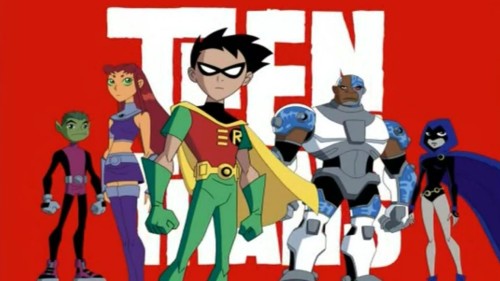
DC’s comic book superhero team Teen Titans has been adapted and readapted as an animated series in recent years, and has a live action TV pilot in the making. The team gained newfound popularity due to Cartoon Network’s animated series Teen Titans(2003-2007), created by Glen Murakami. The show is rated TV-Y7 (for children aged 7 and up), and contains a lot of silly and, well, cartoonish humor. However, not all of its episodes are comedic, and the show contains a number of adult themes, addressing serious issues both directly and metaphorically. Villains Slade, Brother Blood, and Trigon are patriarchal figures who physically, psychologically, and often (metaphorically) sexually attack, abuse, and assault the Teen Titans, causing them severe and often long-lasting psychological trauma.
(Left to right) Beast Boy, Starfire, Robin, Cyborg, and Raven
The protagonists often internalize this trauma, thereby hurting themselves, and externalize this trauma by lashing out at and causing harm to each other. An example of this is in the episode “Haunted” in which Robin, metaphorically suffering from PTSD and having hallucinations of the villain Slade, yells at his love interest Starfire and hurts her arm. Trauma due to patriarchal figures is also experienced by the villainess Blackfire and anti-heroine Terra, who internalize the abuse, and try to find stability, success, and happiness by taking on patriarchal roles themselves. Blackfire, as queen of a planet and people looked down upon and, as evidenced in “Troq,” called racial slurs by the rest of the galaxy, attempts to force her sister into an arranged marriage for political reasons in “Betrothed.” When Starfire refuses to go along with the marriage, Blackfire physically attacks her. Starfire, and other female characters, realistically face abuse and oppression from male characters, whether strangers, enemies, friends, family, or love interests, as well as abuse and oppression from fellow female characters. It is then no wonder that this abuse is often internalized, such as when Starfire needlessly apologizes to Robin at the end of the first season for having “doubted” him.
Robin, Cyborg, and Beast Boy struggle to define their own masculinity after experiencing patriarchal abuse for themselves, but particularly upon witnessing patriarchal abuse of their female teammates. This is especially true of Robin and Beast Boy after recognizing their own abusive behavior toward Starfire and Raven, respectively, and apologizing for it. As Robin is the team’s leader and is arguably the main character, his character arc is one of the most developed, and much of the show’s commentary on patriarchy is done through Robin’s storylines, which most often put him in opposition to Slade, especially in the first season.
Before Slade, Brother Blood, and Trigon, another patriarchal figure affected the five Teen Titans, due to having trained their leader. Batman is often alluded to in the story, though never mentioned by name. Robin, who is White, male, and able-bodied, has privilege over the other superheroes in the show due to Batman having taken him under his (bat)wing. Though Robin would still have been talented without Batman’s help, Batman provided him with a level of intense training and real world experience in crime fighting that his other teammates lack. This extra training and experience made Robin the most qualified of the team to be its leader, and he becomes a patriarch due to the privilege afforded him by a patriarch.
Starfire, Beast Boy, Cyborg, and Raven dressed up as Robin.
Robin struggles with this patriarchal identity, and as the team becomes more experienced and Robin learns to deal with his control issues, the team becomes more of an ensemble with less of a hierarchy. This change in Robin’s leadership role and his relationship to the rest of the team is particularly examined in the episode “The Quest,” in which Robin feels confident enough in the team’s abilities to leave them for a time while he goes on a personal mission. While he is gone, all four remaining team members dress up in Robin’s extra uniforms and act out their envy of Robin’s “cool” position as their leader, taking turns on his motorcycle and referring to each other as “Robin.” When Robin returns and catches them in the act, they at first fear punishment, but Robin instead sits down and joins them in eating pizza together, which greatly surprises them.
In the first episodes of the series, Robin doesn’t give the team enough leeway or support, sometimes treating them more as tools or his own personal soldiers, as opposed to individual people. The team needs Robin’s leadership, due to his training and experience, as evidenced in “Final Exam,” when the team thinks they have lost him. However, it is Robin’s over-controlling personality and his emotional distance that almost leads members of his team to quit. In order to keep Cyborg, his second-in-command, from leaving the team in “Divide and Conquer,” Robin has to apologize for his actions and relinquish some of his patriarchal (and White supremacist, as Cyborg is Black/Biracial Black and White) control. In the next episode, entitled “Sisters,” Robin has to show respect for Starfire, an orange-skinned immigrant from the planet Tamaran, in order to keep her on the team, connecting with her on an emotional and personal level. Due to these changes in Robin’s leadership style, the team becomes more cohesive and functional in their crime fighting, and more supportive of each other as friends. The show continues to promote integrationist values throughout the rest of its run, sometimes challenging White supremacist capitalist patriarchy, but often supporting heteronormativity.
Later in the first season, particularly in the episodes “Masks,” “Apprentice Part 1,” and “Apprentice Part 2,” it is clear that Robin still struggles with arrogance and a lust for power, control, and independence, often feeling that the team holds him back from reaching his full potential. The villain Slade taps into these desires and weaknesses for his own gain. Slade, an adult man with an army of robots, immense resources, and incredible influence and privilege, tells Robin that he sees his “potential,” and offers Robin the position of his “apprentice,” claiming he will be “like a father” to him. Robin responds that he’s “not interested,” as it would mean betraying his friends and siding with a known villain. However, when Slade threatens to kill Robin’s friends/teammates by putting his destructive “probes inside their bodies,” Robin is forced to accept Slade’s offer.
Starfire confronts Robin
Many of the scenes between Slade and Robin have a distinctly sexual and predatory vibe, with Robin being metaphorically raped by Slade and then internalizing the trauma due to Slade insisting that Robin “enjoy[s]” the abuse. In battle, Robin lowers his stun gun when Starfire confronts him. This angers Slade, who tortures her and the rest of the team with his “probes inside their bodies” until Robin physically harms her himself. Thus, a patriarchal figure forces a patriarch-in-training to enact violence against a young woman, who is arguably coded as a Woman of Color. Enacting this violence shows Robin’s loyalty to Slade/patriarchy, and Starfire becomes “the ball” in what media critic Anita Sarkeesian has said is “the game of patriarchy.”
In order to defeat Slade, Robin claims he will find a way to “get [the] controller” of the “probes” away from Slade. This shows Robin’s desire to have control and power, as he does not want to destroy the controller, but to own it himself. Much to Robin’s chagrin, Slade notices this, and points out his and Robin’s patriarchal similarities. Robin eventually realizes that the only way to save his teammates from torture and eventual death is to give up the protection, privilege, and power over others that he has under Slade. Robin puts the same torture devices that are inside the rest of the team inside himself, and Slade is forced to stop the torturing of everyone in order to spare Robin, whom he calls “ungrateful.” The Teen Titans then, for the most part, defeat Slade as a team. The episode ends with Robin admitting that he and Slade are “a lot alike,” though, unlike Slade, who is “alone,” Robin is happy and thankful that he has friends. Though this arc reinforces heteronormativity, often through Robin’s budding relationship with Starfire, it also addresses capitalist patriarchy and its view of people as obstacles, tools, and possessions, a subject which the rest of the show’s seasons continue to address.
Terra and Slade
While Robin, a White male character, was offered a position of power and privilege by Slade, Slade does not show the same respect to other characters, even including his second apprentice, Terra. Terra, who debuts in the second season in the episode aptly titled “Terra,” is a skinny White girl with blonde hair and blue eyes. While Slade referred to Robin by name, he often addresses Terra by her position of “Apprentice,” especially in “Aftershock Part 2.” This shows how Slade ignores her identity and personhood, even though he empathized with Robin’s. The episode also creates an even clearer metaphor for sexual assault than the show did earlier with Robin. When Terra learns that the uniform Slade gave her allows him to control her body with his own body, causing her pain and controlling her movements, she tries to rip it off, and starts to cry when she can’t. When Beast Boy finds her like this, he asks Slade what he did to Terra, and Slade claims that he didn’t do anything to her that she didn’t “want [him] to.” In a particularly disturbing moment, Slade lifts a seemingly unconscious Terra by her breastplate.
Robin comforts Raven
Slade only respecting fellow White men is a trait he shares with other villains. In the third season, Cyborg, who is Black/Biracial, is seen as a “machine” and not a “man” by the villain Brother Blood, who is White. In the fourth season, the demon Trigon sees his daughter Raven as a “vessel” and not a human being. In the fifth and final season, the team faces the villain The Brain and his Brotherhood of Evil, who see everyone as tools, or pieces in a game of chess. Robin learns to respect and support his teammates throughout these storylines, and develops an especially close friendship with Raven, who can arguably be interpreted as being coded as a Woman of Color. The series’ strongest metaphor for sexual assault occurs in the fourth season in the episode “Birthmark,” in which Slade, who is revealed to be working for Trigon, rips off Raven’s cloak and much of her clothing. Robin, a fellow survivor of assault from Slade, supports Raven, and keeps the rest of the team from asking her invasive questions.
This storyline breaks down many barriers in media. Two fellow survivors of rape and assault support each other. A male rape survivor is shown and not shamed. A close platonic friendship between a young man and woman is also incredibly rare. A White young man is also being respectful of a (coded) Woman of Color, supporting her on her own terms, allowing her agency in what she feels she does and does not want to tell him and the rest of the team. Whiteness, maleness, and heteronormativity are still praised and privileged in Teen Titans, but hopefully future media, especially the coming pilot of the live action Teen Titans, continue to address patriarchy and the issues that the animated Teen Titans addressed.
‘Blue’ is either an amazing bait-and-switch or (more likely) a series that changed its mind about what it was part way through. Either way, what began as an inferior, online version of ‘Secret Diary of a Call Girl,’ has grown into a powerful, subtle, and well-acted drama about the long-term effects of sexual abuse, and the shadow that misogyny and the threat of violence casts over women’s sexuality in general. It’s also a big achievement for the WIGS channel, whose mission is to create more female-led programming.
Blue is either an amazing bait-and-switch or (more likely) a series that changed its mind about what it was partway through. Either way, what began as an inferior, online version of Secret Diary of a Call Girl, has grown into a powerful, subtle, and well-acted drama about the long-term effects of sexual abuse, and the shadow that misogyny and the threat of violence casts over women’s sexuality in general. It’s also a big achievement for the WIGS channel, whose mission is to create more female-led programming.
If you think you can’t read her expression, that’s just the tip of the iceberg.
I wouldn’t blame you if you’ve never heard of Blue – I hadn’t heard of it until CTV starting promoting it as part of its online video service this winter. The series began life in 2012 as a group of short webisodes on the WIGS YouTube channel, before switching to an hour-long format and moving to Hulu in its third season (in Canada, it’s now on CTV Extend, along with several other WIGS series).
WIGS, in itself, is pretty cool. It’s a free, online channel that offers original programming, focused on female leads. In addition to Julia Stiles, who plays the title role in Blue, WIGS has produced shorts and web series led by Anna Paquin, Jenna Malone, and America Fererra, among others. Blue seems to be the one that’s got the most traction, and it’s fair to say that it’s WIGS’ flagship show.
The premise of Blue (and it’s not a great premise, so bear with me for a minute) is that Stiles’ character is a single mom who sometimes resorts to prostitution in order to make ends meet. All of the commercials and advertising for the show feature a clip from the series’ first webisode, where Blue, in sexy lingerie, explains to a client, “I gotta provide.” During the early episodes, there’s a sense that Blue is going to play out a lot like Secret Diary of a Call Girl – that is, it seems like the point of the show is to voyeuristically peer inside a middle class version of sex work. We watch Blue interact with a wide range of clients who are all set apart by peculiar habits and fetishes, and we watch her cagily hide this part-time job from everyone else in her life. It seems, at first, like the only major conflict the show’s setting up is a love interest slash frenemy of Blue’s who learns the truth about her job, and might spill the beans to her family. Otherwise, the story doesn’t seem like it’s going anywhere until late in the first season, when suddenly it goes everywhere – to places I haven’t seen many shows go at all, let alone in such an honest, thoughtful way.
Blue’s son, Josh, is good at math, hiding pregnancies, and asking normal-sounding questions that have terrible, terrible answers.
Late in season one, after some foreshadowing has prepared us, we learn that Blue was sexually abused by one of her mother’s boyfriends when she was in middle school, and that there’s a good chance that guy is the father of her son. That revelation cracks the story wide open and, from that point forward, Blue is a lot less about watching Julia Stiles be sexy, and a lot more about watching her struggle with the long term effects of trauma – the way it interferes with her relationships, the way her lack of boundaries shapes the dynamic she has with her son, the way she blocks things out and dissociates under stress.
Blue is a series that builds up slowly, over time, rather than dropping everything on us at once. The complex social and psychological dynamics between the characters are like sediment, accumulating layer by layer, until the third season feels like a careful, complex dissertation on human behaviour.
When Blue’s abuser returns to the picture, it’s disturbing that she doesn’t stand up to him – that he still has so much power over her – but it’s also realistic. So is the way he explains, with no trace of shame, anger, or guile, that he didn’t do anything wrong, and he’s the real victim, because she’s let other people convince her that he’s a bad person, when they both know the truth is different.
The show also takes its time in revealing how Blue’s own memory of these events is fragmented and hard for her to access. In one scene, she’ll struggle to remember anything about her childhood, and come up short on details when someone asks. In another, she’ll have a sudden emotional outburst, as she remembers that her mother betrayed her trust by leaving her alone with the man who raped her. After that, she’ll forget the outburst happened, and wonder why her son suddenly seems to be so careful and delicate about her feelings.
Depicting a character who doesn’t have a constant sense of self and doesn’t understand her own feelings, or remember her own experiences consistently, requires a great deal of patience and restraint on the part of the writers, directors, and actor. Julia Stiles has always been a pretty understated actor, and it works for her, here, as a character who’s built a protective shell so strong that it separates her from her own emotions. Blue never tells us how to interpret the characters’ feelings, but it has a keen eye for detail in how trauma can be expressed through words and behaviour, and there’s at least one sequence in which sound and video editing are used to create a pretty convincing impression of dissociation, which no explanation needed.
A professional musician who’s actually good at singing is the best surprise of season three.
In the third season, Blue expands its view of female sexuality through two new characters: Blue’s sister Lara, and Lara’s girlfriend, Satya. Season three is a winner on all counts, but the introduction of these characters allows the show to add a few more layers to its sediment, and flesh out the themes that are already there.
Satya, played by Canadian singer-songwriter Alexz Johnson, is a bad news musician who systematically leaches off her partners in lieu of getting a job. When we meet her, she’s leaching off Lara (which means leaching off Blue, by proxy), and trying to track down a lowlife who owes her some money. The most terrifying scene in the show comes where Satya and Lara confront the lowlife’s friends, looking for the money he owes them, and realize too late that they’re in a locked apartment with guys who want to rape them. The scene is a lot more low-key that what you’d get on HBO, but that’s what makes it scary – a normal conversation suddenly tips into something more sinister, and, before anyone makes a move toward them, Lara runs to the door and starts screaming for help.
It’s a moment that’s powerful and disturbing, and underscores the threat of violence that runs underneath interactions between men and women. When I started writing this review, I was going to say, “Blue is bad at being a show about prostitution, but it’s good at being a show about sexual violence” – in retrospect, I think maybe it’s good at being a show about prostitution because it’s good at being a show about sexual violence, and presenting a world where no one’s choices are ever fully disentangled from the misogynist threads in our culture.
There’s an argument that says, in order to be sex-positive people, we need to stop stigmatizing prostitution, and challenge the idea that women only get into sex work because they’ve been kidnapped, coerced, or abused – that we instead need to promote the empowering idea that women can be sex workers because they choose to be, in an utterly untroubled way. And, while it’s true that some people get into sex work without any trauma or exploitation and, while I’m happy for them if they have a positive experience, the reality is that, at this point in history, most prostitutes don’t enter the profession because things are going so well in their lives. While it’s fine to have Secret Diary of a Call Girl – while that’s a legitimate experience that can be explored – it’s also important to keep telling stories like this – stories that highlight how even sex work that looks, on the surface, like it’s voluntary, is still an artefact of the same culture in which women are disproportionately the victims of sexual assault and domestic violence. Sex work doesn’t exist in a separate reality where none of the other bullshit about sex and gender affects what goes on.
On a less ideological level, Blue also pulls off a pretty risky narrative feat by building up Satya’s talent all season long – telling us that she’s this amazing musician, who’s obviously special, and captivates you as soon as you hear her play – and then delivering on that promise, when Johnson sings a song that she wrote for the show in a clear, strong voice that instantly shows us why all of these characters see something special in Satya. That doesn’t seem like such a hard thing to pull off, but look at all the times Smash and Glee tried to tell us that someone was good at singing, and see how that turned out.
If you are intrigued by complex characterization, explorations of sexual violence, or convincingly good singer-songwriter stuff, you can catch up on Blue at the WIGS website, on Hulu in the United States, or on CTV Extend in Canada.
I would extend this – the film actually details how EVERYONE is enslaved by patriarchy – yes, the women are the sex slaves whose bodies are raped as well as forced into producing breast milk to feed male troops, but the male minions are also enslaved to the dystopian war machine and turned into heartless warriors and slave-laborers.
Much has been made of the call by Aaron Clarey in his piece “Why You Should Not Go See Mad Max: Feminist Road.” As many pieces have discussed Clarey’s ridiculous, hyper-macho douchery (as here, here, here, and here), I will instead offer a counter call – instead of “mancotting” the film as Clarey begs “real men and real women” to do, I urge you to GO SEE IT! Go now!
“[D]o yourself and all men across the world a favor. Not only REFUSE to see the movie, but spread the word to as many men as possible. Not all of them have the keen eye we do here at ROK. And most will be taken in by fire tornadoes and explosions. Because if they sheepishly attend and Fury Road is a blockbuster, then you, me, and all the other men (and real women) in the world will never be able to see a real action movie ever again that doesn’t contain some damn political lecture or moray about feminism, SJW-ing, and socialism.”
In response, here is my counter feminist call to action:
Do yourself and others a favor – See Mad Max: Fury Road and tell as many humans as you know to see the film, to discuss it on social media, to decry the Men’s Rights Activists aiming to make the world a hyper-patriarchal dystopia where heterosexual macho types horde all the power with their weapons of choice, namely violence, oppression, rape, enslavement, and hatred.
Not all people will recognize the importance of supporting this film, many may go for the special effects and the popcorn, but even if they don’t attend wearing “This is what a Feminist Looks Like” t-shirts, they will still be treated to a great action movie which enacts feminism in both content and form. Those who see the film will help to pave a future where real humans can enjoy movies that reflect the real world, which is made up of women AND men, boys AND girls, where gender is a continuum and, NO, romance and baby-making is not the be all and end all of life.
See Mad Max: Fury Road. See it as soon as possible.
See it because Charlize Theron is amazing, Tom Hardy is a new and improved Max, because the action is breathtaking and achieved with very little CGI, see it to piss-off the nay-saying Men’s Rights Activists and calling for a boycott of “feminist propaganda.”
See it because it was edited by a woman, Margaret Sixel.
See it because Eve Ensler led workshops about violence against women with the cast and crew.
See it because, as MRA Clarey readily admits (perhaps his one correct point), Hollywood DOES condition us. As Carolyn Cox of The Mary Sue puts it,
“By admitting they’re threatened by Charlize Theron…Clarey and his commenters are also agreeing that the media we consume and the stories we tell are hugely important.”
See it because while Clarey worries women might be conditioned to want to be like Imperator Furiosa rather than Sophia Loren (I know, WTF???) we can use the conditioning that is part of entertainment to feminist purpose so that, as Melissa Silverstein puts it,
“a little girl can dream of being a hero just as much as a little boy can because she sees multiple examples of heroic women.”
See it because, as Peter Howell says, “Hollywood doesn’t often let females star in its big ‘tent-pole’ films” because “Male-dominated movie studios don’t believe female action movies make money.” See it because we need to remind Hollywood and MRAs this is false (as Hunger Games, Insurgent, Alien, Terminator and so many other films prove).
See it to disprove Neanderthal thinking on the part of Marvel Comics CEO Ike Perlmutter and Sony Entertainment CEO Michael Lynton who in a leaked email correspondence “proved” female superhero films don’t make money by naming three such films while ignoring the many female-driven films that have made money and ignorning just how many male led superhero films have tanked.
See it because Clarey’s assertions are laughable, and contrary to his claim that “feminism has infiltrated and co-opted Hollywood,” we still have a Hollywood machine driven by a privileged male elite who don’t seem to want to give up their own little version of the world, their very own MRA movement – the “Men Rule Art” hold on the entertainment machine.
See it because there is a culture shift happening in media, a wave that includes GamerGate, calls to stop online harassment (#StoptheTrolls), an evergrowing feminist blogosphere, and a growing call to Hollywood to wake up and smell the feminism.
See it because while some see MRAs as a non-threatening fringe, they DO warrant attention because they consistently and vehemently offer sexism as the answer and their websites and organizations garner thousands of followers. (For some truly horrifying evidence about MRAs beliefs, you need look no further than David Futrelle’s piece on We Hunted the Mammoth which documents some truly horrifying comments running the gamet from espousing beating one’s wife to denouncing one’s daughters if they dare to have college aspirations.)
See it because, as noted by Nicole Sperling in her piece on the film for Entertainment Weekly, it is “one glorious, relentless assault” that may make us “never look at action movies quite the same way again.” As Sperling notes, the film “challenges our perceptions about women and freedom, heroism and extremism.” However, while Sperling claims the film focuses on the “slavery endured by all women,” I would extend this – the film actually details how EVERYONE is enslaved by patriarchy – yes, the women are the sex slaves whose bodies are raped as well as forced into producing breast milk to feed male troops, but the male minions are also enslaved to the dystopian war machine and turned into heartless warriors and slave-laborers. And see it because it does not pit “the matriarchy against the patriarchy” as Ty Burr claimed in his Boston Globe review, but rather brims with relevant political undertones about oppressive political regimes, rape culture, access to clean water, the end of oil, and the ways we are bleeding our planet dry.
See it because Furiosa is not a “degendered…eunech warrior” (as claimed in the Sperling review) but rather a gender-queer, disabled, bad-ass feminist hero who proves that heroism has no one gender, no one body type, no one sexuality.
See it because it suggests it will take collective action rather than one lone (male) hero to save the future. In the film, it takes Furiosa, five female “breeders,” a group of badass gun-toting grannies, as well as Mad Max and other males turned to the feminist cause, to bring down the likes of Immorten Joe – the villain at the heart of this iteration whose names speaks to the fact patriarchy is not “immortal” nor is the concept of your average (macho) Joe a thing to espouse.
See it because we are all on this tiny spinning planet together and only together can we find the “Green Place” espoused in the movie where the water will be clean and people will not be oppressed.
See it because if you have ever doubted the acting chops of Charlize Theron, this movie will convince you of her incredible talent. She is absolutely fierce as Furiosa. In a movie with very little dialogue and limited characterization, Theron is able to exude an intensity of will and palpable strength of character that is on par (if not exceeding) other female heroines such as Ripley and Sarah Connor.
See it for the grannies with their mad survival skills, for the fierce “Breeders” who refuse to be sex slaves; see it for its championing of the one-armed sharp shooter Furiousa. See it because how often do we see women portrayed as better survivors, snipers, and drivers than men?
See it because it is the best feminist road movie since Thelma and Louise. See it because Furiosa’s story is so much more powerful than Black Widow’s. See it because we need to prove Hollywood big wigs wrong and make Clarey and his MRA minions STFU..
Finally, see it to piss off MRAs and show them feminists will not be stopped by their testicle-clutching pleas of superiority. See it for their daughters, and sons, and partners, who can hopefully grow into a world free of their “Immorten Joe” mentality.
See it because, yes, movies matter, and if we want more feminist-friendly blockbusters, we have to prove there is an audience willing to support such movies.
Natalie Wilson teaches women’s studies and literature at California State University, San Marcos. She is the author of Seduced by Twilight and blogs for Ms., Girl with Pen and Bitch Flicks.