2013 Golden Globes Week: It’s “Impossible” Not to See the White-Centric Point of View

Written by Lady T, originally published at The Funny Feminist.

So this is a trailer for the upcoming film, The Impossible, telling the story about the 2004 tsunami:

There are a few title cards in the trailer that provide the necessary background for the story. The trailer helpfully tells you, “In 2004, tragedy struck southeast Asia.”

However, I don’t think those title cards are specific enough. I’d like to revise those title cards so they read, “In 2004, tragedy devastated entire nations, but we’re going to focus on one white family that was on vacation there.”

The Impossible is based on a true story of a real family that was separated during the tsunami and eventually reunited, each family member miraculously surviving. I can easily see why this story would appeal so much to filmmakers. “Family separated, in peril, in a devastated nation that is completely foreign to them” is such a great hook that it’s practically Captain Hook. Who wouldn’t be interested in the story of a family who have to survive in a country that isn’t their own?

On the other hand, this is a real-life tsunami that affected entire nations, that devastated the lives of the citizens who lived there, and the first prominent film about the tragedy is about white people who were staying at a hotel?

The family in The Impossible

Landon Palmer at the Culture Warrior has more to say on this:

“There is no reason to say that this experience wasn’t any less traumatic and devastating for those visiting (regardless of their particular race) than the inhabitants (once again, regardless of their particular race) of any of the affected nations. The problem with The Impossible trailer isn’t the depiction family’s experience of the tragedy itself, but its implications about what happens when, say, the film ends. While watching the trailer for the first time, an image kept appearing in my head of an exhausted, scratched-up family sleeping comfortably on a plane returning them safely to their home of origin. Being able to survive and then leave a tragedy is altogether different than having everything that is familiar, including one’s home, fall apart before your eyes. However, years of uncertain reconstruction and rehabilitation doesn’t fit the formula of a Hollywood ending quite like a welcome return to a home far, far away from moving tectonic plates.”

Or, you can read a briefer, much more blunt article at 8Asians here, titled “The Impossible Trailer Features Pretty White People Surviving Indonesian Tsunami.”

There are some who might say that one can’t judge a film before seeing it, but to quote our illustrious vice-president, that’s a bunch of malarkey. The purpose of trailers is to market the film and let viewers decide whether or not they want to see it. If a person does not want to see The Impossible because they don’t want to see, as my friend put it, “the tsunami from the perspective of the 1%,” that is a legitimate reason to not see the film.

You tell ’em, Joe.

As for me, I will probably see The Impossible. Naomi Watts scored a Best Actress nomination for the part , and I’m a huge Oscar fan who likes to see as many nominated films as possible from the Picture, Director, Acting, and Screenplay categories. The film also looks beautifully shot. Who knows? The Impossible could be a legitimately good movie.

Still, I can’t help but feel that the real impossible task is making a movie about tragedies that affect non-white people and expecting the film to get the same attention as one that stars Naomi Watts and Ewan McGregor.

———-
 Lady T is a writer with two novels, a play, and a collection of comedy sketches in progress. She hopes to one day be published and finish one of her projects (not in that order). You can find more of her writing at www.theresabasile.com, where she picks apart entertainment and reviews movies she hasn’t seen.

2013 Golden Globes Week: "I Misbehave": A Character Analysis of Irene Adler from BBC’s Sherlock

Written by Amanda Rodriguez
Spoilers ahead
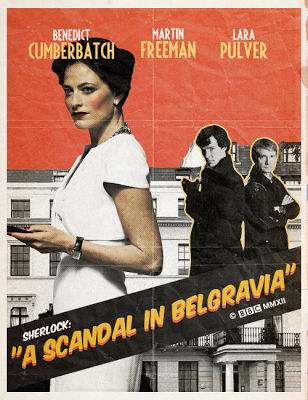
Benedict Cumberbatch is up for another Golden Globe for his leading role on the BBC’s hit show Sherlock. Season Two Episode One “A Scandal in Belgravia” is adapted from Sir Arthur Conan Doyle’s Holmes story “A Scandal in Bohemia.” The storyline focuses on Irene Adler, portrayed brilliantly by the arresting Lara Pulver, who has incriminating photographs of a member of nobility that Sherlock must retrieve.
In the original version, Adler is an opera singer who had an ill-advised affair with the prince of Bohemia, and he discontinued the affair because he was to become king and thought she was beneath his station. Adler threatens to expose the photos if the now king announces his engagement to another woman. In the updated TV episode, Adler is a high-priced lesbian dominatrix who operates under the pseudonym “The Woman” and holds photos of a high-ranking female member of the British nobility.
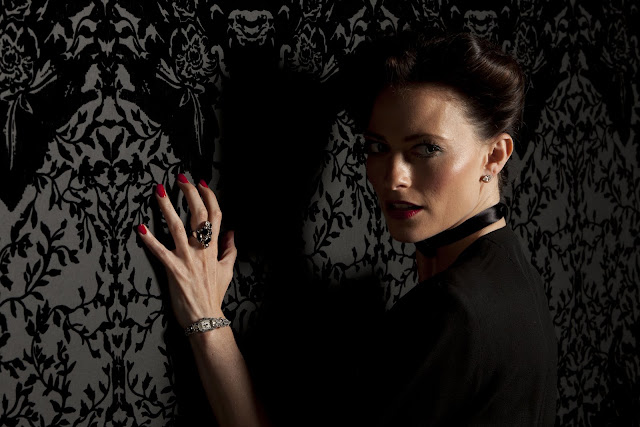
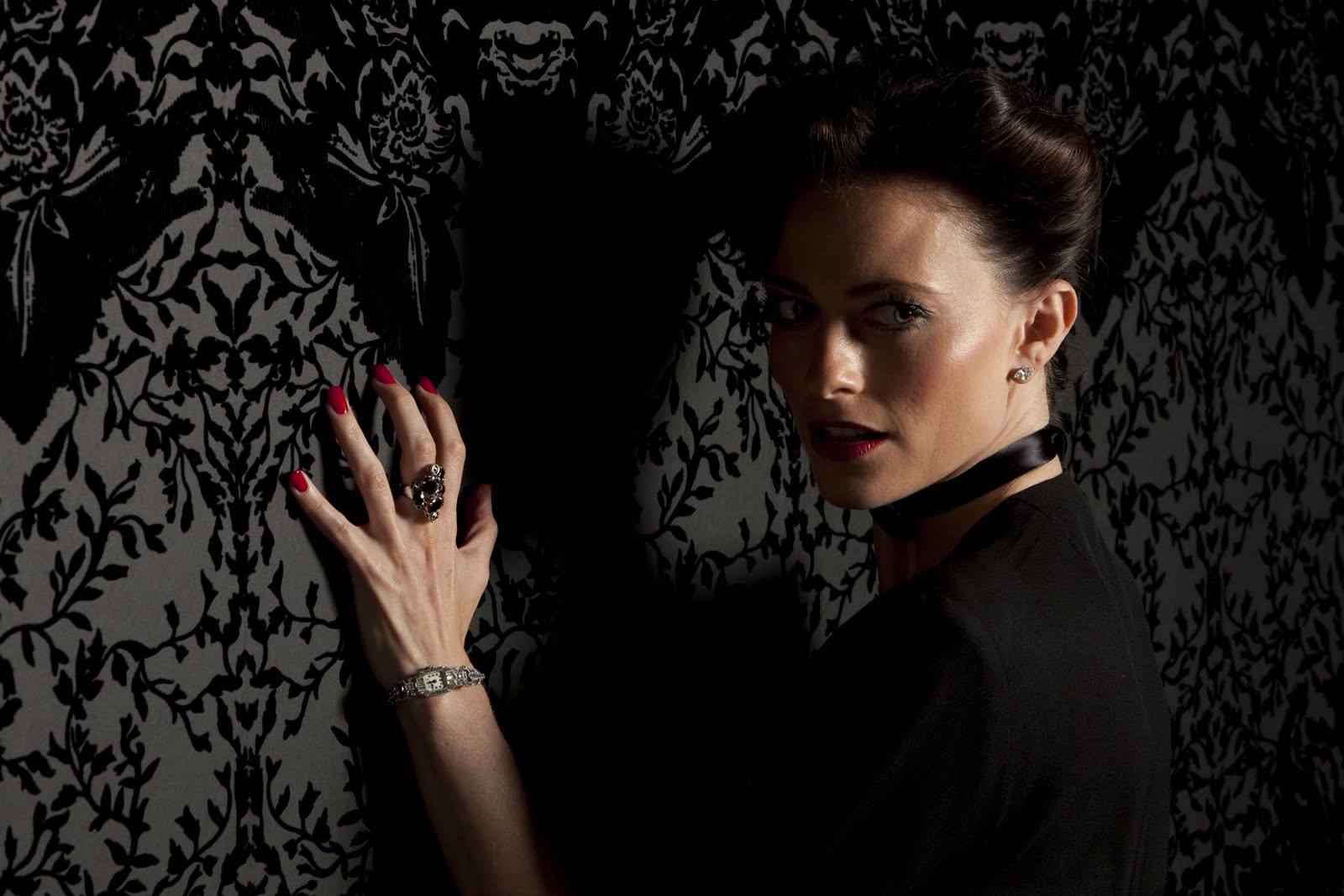
Irene Adler: lesbian dominatrix and general BAMF
Confession: I love Irene Adler. She’s infamous for her sensuality, independence, intelligence, and her ability to manipulate. Throughout the episode, Adler and Sherlock match-up wits, and Adler proves to be the cleverer one right until the very end. Adler establishes herself as the quintessential femme fatale. When contrasted with the other female characters throughout the series, she is the only one who is given a strong representation. The coroner, Molly Hooper, is a doormat, waiting for Sherlock to notice her and her inexplicable affection for him. Mrs. Hudson is a doddering old lady whom Sherlock abuses but takes umbrage if others treat her in a similar fashion, in a way claiming her as his property to abuse or reward at his own whim. Finally, there’s the recurring character of Detective Sergeant Sally Donovan, a tough, but mistrustful police officer who always thinks the worst of Sherlock and is too simple-minded to follow his deductions. 
Though Sherlock doesn’t know it, Adler is well-prepared for their first encounter when Sherlock shows up on her doorstep impersonating a mugged clergyman. In parody of his earlier nude appearance at Buckingham Palace, Adler presents herself to Sherlock in her “battle dress,” i.e. completely naked. This proves to be a cunning ploy because Sherlock can deduce little about her character without the aid of clues from her clothing. Not only that, but Adler maneuvers Sherlock to help her ward off some C.I.A agents by using her measurements as the code to open her booby trapped (har, har) safe. Adler then drugs and beats Sherlock until he relinquishes her camera phone, which contains a host of incriminating evidence that she claims she needs for protection. She ends their memorable first encounter by saying, “It’s been a pleasure. Don’t spoil it. This is how I want you to remember me. The woman who beat you.”
Illustration by Hilbrand Bos
Minus all the sexy dominatrix stuff, this is where the original Holmes story ends. Irene Adler disappears, retaining her protective evidence, and Sherlock must forevermore admire and be galled by The Woman who beat him. The BBC episode, however, takes creative license to continue the story, having Adler fake her own death only to show up six months later demanding Sherlock give back the camera phone that she’d sent to him presumably on the eve of her death. For six months, Sherlock has done his version of mourning, as only an admittedly high-functioning sociopath can (becoming withdrawn, composing mournful violin music, smoking, etc.). Does he mourn, we wonder, the death of a woman for whom he’d grown to care, or does he regret the loose end, the loss of a chance to ever reclaim his victory and trounced ego from such a superior opponent?
Before her faked death, Adler sent frequent flirtatious texts to Sherlock, with the refrain, “Let’s have dinner.” Sherlock responded to none of her messages, lending increased weight to the significance of their relationship. Upon her resurrection, Adler confesses that despite the fact that she’s a lesbian, she has feelings for Sherlock. Her feelings, in a way, mirror those of Watson, a self-proclaimed straight man who clearly has a deep emotional attachment to Sherlock. Sherlock then forms the apex of a peculiar love triangle at once sexual and cerebral.  
“Brainy is the new sexy.” – Irene Adler
Adler tricks Sherlock into decoding sensitive information on her camera phone. After breaking the code in four seconds that a cryptographer struggled with and eventually gave up on, Adler feeds Sherlock’s ego.
Irene Adler: “I would have you, right here on this desk, until you begged for mercy twice.”
Sherlock Holmes: “I’ve never begged for mercy in my life.”
Irene Adler: “Twice.”
She then follows up on all her sexual attentions toward Sherlock by sending the decrypted code to a terrorist cell. She reveals to Mycroft and Sherlock Holmes that she’d played them both and consulted with Sherlock’s arch enemy Jim Moriarty to do so. It turns out, she was playing a deep game, exerting endless patience in her long con with blackmail as her goal all along. She demands such a sizeable sum for the code to her valuable camera phone that it would “blow a hole in the wealth of the nation.”
At this point, Irene Adler has won. She’s literally and figuratively beaten Sherlock Holmes repeatedly at his games of deduction and intrigue. She’s planned for and obviated every contingency. Adler is the only woman to arouse Sherlock’s sexual and intellectual interest all because she proved to be better than him. Adler masterfully manipulates the emotions of a man who cannot understand how and why people feel, a man who seems incapable of anything but his own selfish pursuits. Her problematic confessions of interest in Sherlock despite her sexual orientation are negated in light of her schemes.
Unfortunately, this is where it all goes to shit.
Just as Mycroft is giving his begrudging praise of Adler’s plot (“the dominatrix who brought a nation to its knees”), Sherlock reveals that he took Adler’s pulse and observed her dilated pupils when interacting with him. He deduces her base sentiment has influenced her into making the passcode more than random, into making it, instead, “the key to her heart.”
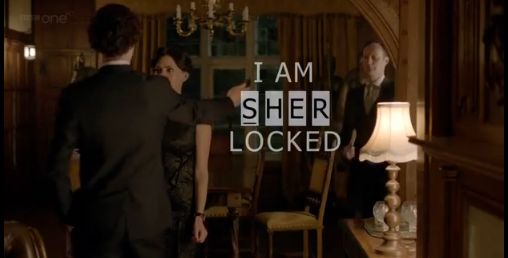
Sherlocked…get it? Get it? Snore.
With that simple, inane phrase, Adler is undone. Sherlock has broken into her hard drive and her heart. Depicting a lesbian character truly falling in love with a man is a complete invalidation of her sexual identity. Not only that, but it has larger implications that are damaging and regressive. It advances the notion that lesbians are a myth, that all women can fall in love with men if given the right circumstances.
Having a female opponent who is more cunning than Sherlock ultimately lose due to her emotions also implies that women are incapable of keeping their emotions in check. Sherlock insists that her “sentiment is a chemical defect found in the losing side.” While he can detach from his emotions, she cannot, and thus he will always be better than her at the so-called game. Not only that, but this emotion versus reason dichotomy further reinforces the destructive gender binary that assigns certain traits to men and others to women, giving privilege to those assigned to men. Even Adler’s seductiveness, her cunning, her manipulation of the Holmes brothers, these characteristics are coded as female. Adler even enlists the aid of the male Jim Moriarty with the implicit reasoning that he is smarter, slicker, and more capable of handling the Holmes brothers.
Irene Adler must make her way in the world as a sex worker who deals in secrets. (Remind you of Miss Scarlet from Clue at all?) Capitalizing on sex and thriving on the power dynamics inherent in sex (especially heterosexual sex, in which we know Adler engages) are attributes generally assigned to women even though they are fabrications. Having to engage in sexual activity for money does not give women power. It, instead, forces women to exploit themselves and conform to a regulated form of femininity as well as other people’s sexual desires and fantasies (regardless of what the woman herself wants, likes, or doesn’t like). Considering the appalling number of rapes each year, each day, each hour, we also know that power dynamics (from a hetero standpoint) don’t truly favor women. Though the episode doesn’t get into it, presumably Adler is finally cashing in on all her secrets in order to make a better life for herself, a life in which she does not have to sell her body to survive. 
When Sherlock outwits Adler, he forces the dominatrix to beg for her life, which is worth little without her secrets. Though he feigns indifference, he ends up finding her after she’s gone into hiding and been captured by terrorists in Karachi. He then saves her from a beheading and falsifies her death in a completely untraceable way.
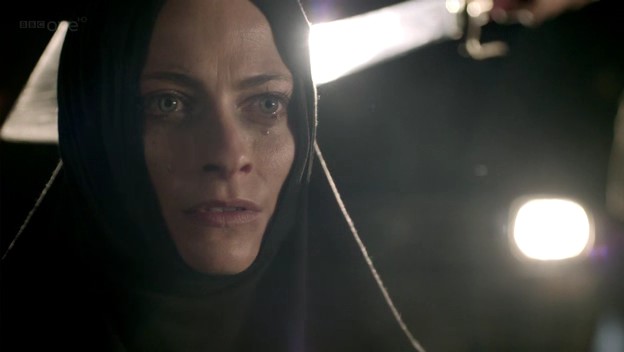
It’s poignant that Sherlock holds the sword over Adler’s neck, choosing whether she lives or dies.
At the end of the episode, Sherlock stands before a window chuckling to himself about how handily he settled the whole scandal with The Woman. He doesn’t only best her at their game of wit, but he debases and de-claws her. Divesting her of all her power, all her secrets, Irene Adler is completely at his mercy and must to be rescued like a damsel in distress or, worse, like a naughty little girl who’s gotten in over her head and must be dug out by her patriarch.
Despite the frequent declaration that “things are better for women now,” it’s hard to ignore that a story written in 1891 created a larger space for a woman to be strong, smart, and to escape. It’s also hard to ignore that Sherlock doesn’t just outwit Adler, he systematically dismantles all her power and only then does he graciously allow her to live. We can wish the last ten minutes of the episode had been cut, allowing for an ending in keeping with the original story, an ending that empowered a woman as one of Sherlock’s most formidable foes. A potentially more fruitful wish would be that Irene Adler returns in future seasons, stronger and more prepared to play the game against Sherlock Holmes, a game we can only hope she will win the next time around.
———-
Amanda Rodriguez is an environmental activist living in Asheville, North Carolina. She holds a BA from Antioch College in Yellow Springs, Ohio and an MFA in fiction writing from Queens University in Charlotte, NC. She writes all about food and drinking games on her blog Booze and Baking. Fun fact: while living in Kyoto, Japan, her house was attacked by monkeys.


2013 Golden Globes Week: Jessica Chastain’s Performance Propels the Exquisitely Sharp But Aloof ‘Zero Dark Thirty’

This is a guest review by Candice Frederick and is cross-posted with permission from her blog Reel Talk.
Zero Dark Thirty teaser
With her latest film Zero Dark Thirty, filmmaker Kathryn Bigelow continues her charge of completely eliminating any doubt that she’s going to be to that type of female director. You know the kind, the one that purposely tries to connect with her female audience by yanking tears from them or providing any real nuance or connectivity.

And she has beaten any expectations to the contrary out of the audience with this movie that exhausts the hunt for and ultimate death of terrorist Osama bin Laden. Jessica Chastain stars as Maya, a smart CIA operative who’s made it her sole mission to lead the search for bin Laden and ensure that he will no longer be a threat to anyone ever again. When we first meet her, however, she’s squeamish at even the sight of blood as she watches her male counterpart (Jason Clarke) brutally interrogate a possible terrorist lackey.

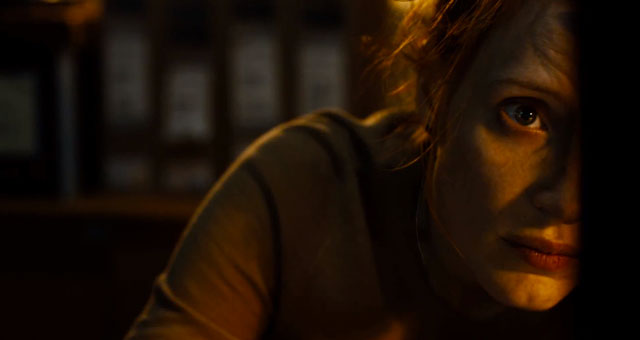
Jessica Chastain in Zero Dark Thirty
But when it seems like she’s played all her cards, she’s the single woman left standing among a weary team of men and bravely rises to the occasion. Though the audience follows her decade-long ordeal to capture and eliminate bin Laden, not without witnessing many innocent deaths, rarely does she ever emit any emotion from the audience. In fact, with the exception of Chastain’s emotionally spent final scene, which is more of a release than anything else, few areas in the film waste time tugging at the heartstrings. Rather, Maya’s relentless journey seems more stressful and high-pressured than wrought with emotion and painful to endure. There could have been more of a balance, rather than a ruler-sharp portrayal of a woman tackling her position. Granted, this is expected from a character in this line of work, but it made for a very detached commitment to the character from the audience. Just when we get to see a trace of personal struggle from Maya, Bigelow quickly snaps us back to the matter at hand.

Even though that’s just not Bigelow’s style, she surprisingly grips audiences in the first few minutes of the film when they listen to the barrage of frightful phone calls to 911 during the September 11th attacks. Reliving those tragic moments, then following it with the scene to Chastain huddled in the corner of the interrogation room sets the tone of the movie and leaves no questions about the intentions of the story. It’s clear, steady and deliberate retaliation. And there is simply no time for fear.

Chastain leaps into the role, completely shedding any remnant of every other character she’s played, and attacks it with the vigor and confidence it needs. Think Carrie on TV’s Homeland minus the glimmer of insanity (though it would have been understandable given her circumstances).

Jessica Chastain in Zero Dark Thirty
Unfolding like a timetable of harrowing events during this time, the movie might not elicit much empathy but it does successfully manage to push audiences to the edge of their seats, creating a heart-pounding thriller that is suspenseful despite the fact that you know what’s going to happen. Alexandre Desplat’s affecting score further heightens that effect. Bigelow’s stark but realistic approach to Mark Boal’s (with whom she first collaborated on The Hurt Locker) story is gritty and firm, leaving no room for fluff scenes (though the fleeting scene between Chastain and Jennifer Ehle, who plays a member of the retaliation crew, is much welcomed).

With a cast, which include James Gandolfini, Kyle Chandler, and Mark Strong, that’s committed to the increasingly tense dialogue and demanding story, Zero Dark Thirty offers audiences a look at the much meticulous investigation that was shrouded in secrecy, one which led to the ultimate capture of bin Laden. But it is Chastain’s performance, as restrained as it is powerful, that may just be the cherry atop this massive and meticulous film.

———-

Candice Frederick is a former NABJ award-winning journalist for Essence Magazine, and the writer for the film blog, Reel Talk. She is also the TV/Film critic for The Urban Daily. Follow her on Twitter

‘The Hobbit’: A Totally Expected Bro-Fest

Written by Erin Fenner

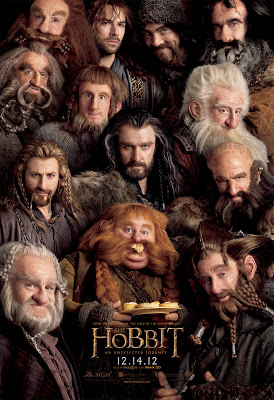
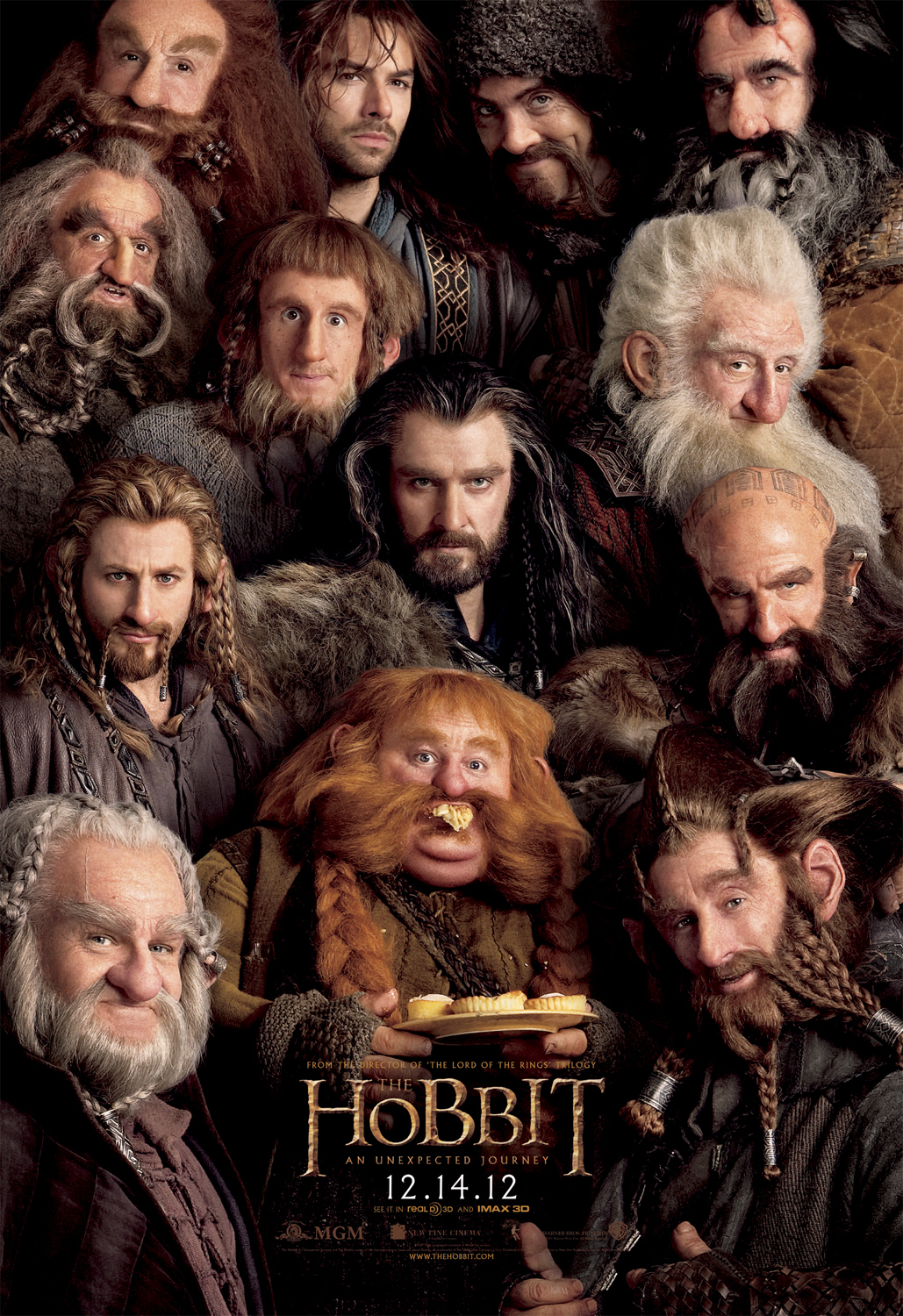
Is there enough dude on this poster for you?
Bad Taste, 1987, was Peter Jackson’s first dip into epic nerd movies and his first film. While he may be best known for his specially affected J.R.R. Tolkien interpretations, I personally will always love Jackson for his exploding sheep and (literally) brain-snatchy/gory aliens in Bad Taste.  The film is about a group of investigators who discover that a town is being overrun by aliens who are harvesting humans for their fast food franchise. It was extremely low budget – less than $30,000 – and Jackson recruited his friends to play starring roles. Jackson, himself, actually plays two lead characters in the movie. The aesthetic is that of a film school project – rough and cleverly stupid. It’s gruesome; on of the heroes repeatedly squishes his brain back into his skull and keeps it in with a hat and belt.
Its cheeky absurdity fits snugly into a cult/b-movie-lover’s tastes.
But.
But, it has no female characters. The only women in the film are extras – two extras in huge alien suits.
So, in 2012, one quarter-life-crisis after Jackson’s first feature-length film, we saw a pretty similar problem.
The Hobbit is well acted with predictably great special effects, humorous dialogue and a compelling arc.
But.
But, there is only one female character with a speaking part and maybe a couple female hobbit extras who you see behind a frolicking Frodo (Elijah Wood) or Bilbo (Martin Freeman/Ian Holm).
Galadriel (Cate Blanchett) is the only woman with a speaking part in The Hobbit. And really, her role is little more than a cameo. While men are talking, Galadriel elegantly paces around the room – her gauzy dress seemingly slowing her down by the unnecessarily long train. Gandalf (Ian McKellen) steals a word with her to talk about his plan with Bilbo and the dwarves. She supports him and smiles slowly. While I like the unexpected sexual tension between Galadriel and Gandalf – it’s less than gratifying to see a woman plugged into a movie with no purpose other than to be a magical validator.
This lack of lady in the film has not gone unnoticedor uncontested. But, Alyssa Rosenburg with the XX Factorsaid in her piece, “We Don’t Need Women in the Hobbit” that women shouldn’t be included for the sake of equity. Rosenberg writes: 

“All-male spaces and social circles existed in the kind of medieval settings Tolkien was commenting on, they exist today, and stories that are set in those environments aren’t uninteresting to me because I’m a woman — in fact, just the reverse. My hope isn’t that they go away, but that intellectually curious men should be able to find stories about femininity, and female spaces, whether they’re fantastical or not, just as fascinating, even if there aren’t male characters in the mix.”

Unfortunately Rosenburg’s argument is just as indolent as Jackson’s move to include only one woman for less than a ten minute scene to balance the dudeness of The Hobbit, an almost three-hour-long movie.
If Jackson was really sticking to the details of Tolkien’s novel for accuracy’s sake then Bilbo would have been fatter and the dwarves all hairy and large-nosed. While Fili (Dean O’Gorman) and Kili (Aidan Turner) were adorable; their delicate five-o-clock shadows did not resemble anything dwarf-like. So, since Jackson Hollywooded this story up anyway, you think he could have included some women’s voices and stories instead of lazily inserting a suspiciously always-glowing Galadriel.
All male spaces exist, but that doesn’t mean that the surrounding non-male space shouldn’t be included – or that the story shouldn’t be updated to stay relevant. And the idea that women ought to expose themselves to more male-only spaces is giggleable. Since infancy girls are exposed to story books, movies and television shows that have few if any female characters. And hey, what about action movies, Westerns, superhero flicks and on and on. While women sneak a peek into these films here and there; they are usually a romantic interest or the object that can sexily swagger.
Women are a small percentage of the roles in Hollywood movies. In 2011 women made up only 33% of all movie characters of the top 100 domestic grossing films, and only 11% of protagonists were women. In the same year women only made up 18%of writers, directors, producers, executive producers, editors and cinematographers of the 250 domestic top grossing films.
We do need to include more women in stories that originally didn’t include women because if we’re not proactive about representing women it won’t happen.
So – even though Jackson’s tantalizing nerdy films are pleasing – more needs to be demanded from them. More women.


‘Bachelorette’ Proves Bad People Can Make Great Characters

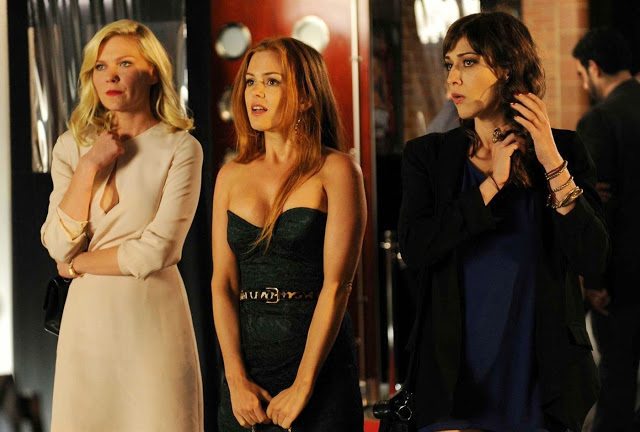
Kirsten Dunst, Isla Fisher, and Lizzy Caplan in Bachelorette
Written by Robin Hitchcock.
[Warning: spoilers ahead!]
When I saw The Hangover, around the time its sequel came out, I was disappointed they didn’t make the sequel the story of “meanwhile, the bride and her girlfriends had an even MORE wild adventure.” Some of us hoped we’d get something along those lines with Bridesmaids, which certainly was an enjoyable movie and huge step forward for female-focused comedies in mainstream Hollywood, but sometimes felt forced when it veered into the “shocking” territory of ladies pooping.
So three cheers for Bachelorette, which certainly stands on the shoulders of Bridesmaids, but makes it look tame in comparison. Bachelorette doesn’t just have its female characters do shocking things, it has the shocking characterizations. For once, we have a movie full of female characters allowed to be the horrifically selfish jerks that routinely populate dude comedies like The Hangover. It’s delightfully bracing.
For some, the ladies of Bachelorette will be too bitchy, or too similar to sexist stereotypes, to bear. Maid of Honor Regan (Kirsten Dunst) is a Type-A ice queen, joined by bridesmaids Gena (Lizzy Caplan), a self-centered fuck-up, and airhead Katie (Isla Fisher). All three enjoy drugs and casual sex, and all three can be jaw-droppingly mean. All are horrified that the bride Becky (Rebel Wilson) is getting married first among them, because, well, she’s fatter than they are. They still use the cruel nickname (“Pig Face”) they gave her in high school, and spend the first act showing shocking disregard for the her well-being and the success of her wedding. [Fortunately for the bride, there are other women in her bridal party lurking on the sidelines of the story, theoretically taking care of most of the wedding business while these three cause trouble].
Rebel Wilson is unfortunately not given much to do as Becky, but I really enjoyed how the movie didn’t just victimize her as the “fat friend”, subverting that dynamic by making it clear that Becky’s size is much more of an issue for her skinnier friends than it is for Becky herself.  Although Gena awkwardly jokes in her rehearsal dinner speech about meeting Becky when she was making herself vomit in the high school bathroom, it’s later revealed that Regan is actually the one with a history of bulimia. It’s made clear that Becky doesn’t tolerate strangers being cruel to her: she puts a stop to her bachelorette festivities the moment the male stripper Katie brought in calls her “Pig Face.” Becky retains her dignity, while Gena, Katie, and Regan pathetically retreat to have their own private coke-fueled hotel room bender without the bride or the other members of the bridal party.
Rebel Wilson as the bride, a well-adjusted foil for the main characters
During this party, the girls cruelly mock the size of Becky’s wedding gown, and Regan and Katie both try to climb into it. But Becky is only twice their size in their demented imaginations, so the gown rips.  The rest of the plot follows their misadventures as they attempt to fix the gown before the next morning.
Gena, Katie, and Regan never stop being selfish bitches in their quest to undo this huge wrong. A potential solution is reached when they are able to get into a bridal shop after hours and there’s another dress available in nearly Becky’s size, but it’s rejected because that dress is Regan’s favorite, and she can’t let her friend wear it instead of her. They’re also all distracted by their own romantic subplots, particularly Gena (who is paired against her former Party Down co-star Adam Scott, to the same irresistibly watchable effect).
But through all of this shocking meanness, there’s a true-to-life thread of the genuine friendship between these women. It may be hard to imagine how these characters became friends in the first place, but who didn’t build some unlikely friendships through the happenstance of high school classroom seating charts and locker assignments? And despite all their nasty behavior, it’s not hard to understand why they are still friends after all these years: Bachelorette masterfully illustrates the bond we feel with the people we’ve known the longest, even if they aren’t the closest people in our present lives. Becky and Regan will always have a bond because Becky covered up for her high school bulimia; Regan and Gena will always have a bond because Regan took Gena to get an abortion when her high school boyfriend (Scott) chickened out. In the final scenes, Regan bounces between finally putting her bitchiness to good use by chewing out Becky’s floundering florist, and saving Katie’s life after she overdoses on Xanax. Gena assures Katie’s bewildered suitor that even though he’s right that Regan is a “head case” it’s also true that “she’s a good friend.” It rings true. Regan is the kind of friend you’d never want, but you would nevertheless be grateful for if you did have her in your life.
Bachelorette has a happy ending without absolving the characters
Still, Regan, Gena, and Katie sit out Becky’s wedding ceremony, beat-down and vomit-covered on a bench, unneeded by Becky the beaming Bride. The film ends with a wedding reception coda that’s appropriately joyful, but there’s no clear-cut redemption for our troubled trio. Bachelorette strikes a delicate balance, getting us to like and root for these flawed characters without denying their shortcomings (as The Hangover and its ilk are wont to do).  It’s a rare feat for any film, and almost unheard of with a female-centric comedy.

The Great ‘Freaks and Geeks’ Rewatch of 2012

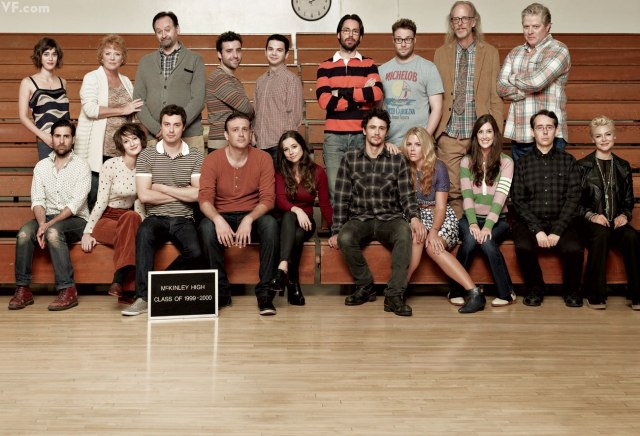
Written by Max Thornton. There is a delightful Freaks and Geeks special in Vanity Fair this month, with set photos, a cast reunion, and an interview in which creator Paul Feig discusses what would have happened had the show not been canceled. I recommend savoring all of it, but be warned – you may find yourself compelled, as I was, to hasten to Netflix and marathon the whole series once more.

The Vanity Fair reunion.
Not that a Freaks and Geeks marathon takes very long. For the uninitiated, F&G is one of the great unjustly-canned, widely-mourned, single-season shows, right up there with Firefly in terms of squandered brilliance. Set in a Michigan high school in 1980, it focuses on sister and brother Lindsay and Sam Weir and their respective groups of friends, the freaks and the geeks.
To some extent, F&G feels like an improved version of My So-Called Life – not that My So-Called Life couldn’t be charming, or speak the truth of the adolescent condition, but it undeniably succumbed to schmaltz and caricature in a number of ways. Freaks and Geeks nails absolutely everything it tries.
I do wish there were more female characters. Of the eight core characters – five freaks, three geeks – only two are women. The more general lack of diversity, particularly in terms of the overwhelming whiteness and straightness of the characters, can be attributed to the fact that the show is based on Feig’s personal experience of an overwhelmingly straight, white Michigan suburb in the late seventies and early eighties. This, of course, feeds into a larger and still ongoing conversation about whose experiences get put on television; but, assuming we can accept the show’s premise and the whiteness and (ostensible) straightness inherent therein, I still think there could be more female characters.
Kim isn’t even in this picture, dammit.
The female characters that are included are fantastic. Lindsay Weir is one of my all-time favorite TV protagonists: blisteringly intelligent and world-weary, yet still a vulnerable and confused teenager searching for an identity and a place, Lindsay kicks off the series with a paradigm shift brought on by her grandmother’s death. Losing her religious faith and quitting the mathletes, Lindsay ditches long-time best friend and inveterate goody-two-shoes Millie in order to befriend the “freaks,” the “burnouts,” a laid-back group of stoners who cut class to hang out and passionately discuss their favorite bands (something that resonates with me personally: I may have attended high school 20-25 years later than these characters, but I was just as enthusiastic about the Who, Pink Floyd, and Rush!). Lindsay doesn’t truly fit in with the freaks, but the more her parents and her guidance counselor and Millie press her on this, the more determined she is to make a place for herself among them.
Lindsay’s place among the freaks becomes secure once she makes a true friend out of Kim, the only other girl among them. The episode in which their friendship solidifies, “Kim Kelly Is My Friend,” was supposed to be the fourth, but was shelved from airing because of its intense subject matter. Lindsay rolls her eyes at her parents’ narrow suburban existence and hopeless squareness, but witnessing Kim’s violent and abusive relationship with her mother causes her to reassess her own life. Most of the freaks have difficult home lives, and they expand Lindsay’s horizons even as she expands theirs. Kim – fierce-tempered and hotheaded, unashamedly sexual, a total spitfire – shows Lindsay that a person’s worth is not dependent on the school system’s assessment of them, but Kim also gains from Lindsay a sense of ambition and motivation.
“You’re like my only friend, Lindsay, and you’re a total loser!”
The relationship between Lindsay and Millie is one of the most beautifully observed and painful aspects of the show. Millie, who initially seems like a caricature of the strait-laced goody-two-shoes, proves to be an unfailingly loyal friend who loves Lindsay enough to let her go. In my favorite episode, number 13, “Chokin’ and Tokin’,” Lindsay smokes pot just before a babysitting job, and Millie steps up to care for both the child and an increasingly paranoid Lindsay. During the comedown, the following conversation ensues:
I love you, Millie. Why aren’t we friends anymore?”
I thought we were friends.”
We are. But just, you know, not really. But we’re still the same people we were when we were five. It’s just different now.”
You’re different now.”
Yeah, you’re right. But I’m not gonna be different anymore. I’m gonna be the same. And we’re gonna be best friends.”
You know what, Lindsay? I feel sorry for you.”
Why?”
Because tomorrow, when you’re not loaded anymore, you’re not going to believe in God, and you’re not going to want to be my friend anymore.”
It’s heartbreaking.
Awww, Millie.
I don’t think Freaks and Geeks has a hidden feminist agenda, but it has a core of real decency and generosity toward its characters. It tries to walk the line of portraying kids honestly, warts and all, without necessarily condoning their behavior. They’re high-school kids; they can be misogynistic, essentialist, bigoted, and the show portrays this honestly, sympathizing for them in their ignorance while gently revealing the flaws in their thinking.
 
Nowhere is this clearer than in two storylines that dovetail neatly in the penultimate episode, “The Little Things”: geeky Sam’s courtship of his dream girl Cindy, and sarcastic freak Ken’s relationship with Amy. Sam has long been the Nice Guy, worshiping all-American cheerleader Cindy from afar and slowly becoming the friend she can talk to “like a sister.” When Cindy tires of her jock boyfriend and decides to give Sam a shot, it seems like every little geek’s (and every Nice Guy™’s) dream come true – except that they turn out to have nothing in common, to bore each other, and to have no fun at all. It’s a nifty subversion of what initially seems to be a straightforward idealized Nice Guy™ trajectory from friendship to dating: without any kind of heavy-handed moralizing, the show suggests that the Nice Guy™ routine is not the way to a happy relationship.
It could never have lasted. Look at the terror on his face.
Ken, on the other hand, doesn’t spend too much time mooning after Amy before asking her out. They click immediately, and seem very happy together. In pursuit of full disclosure, Amy tells Ken that, although assigned female and comfortable in her gender identity, she was born intersex. Ken reacts the way you might expect a teenage boy ignorant of all things intersex to react: by freaking the fuck out. He worries that this makes him gay (and experiments, hilariously, with disco and a dirty mag) and figures he will have to break up with Amy. It’s only on hearing Sam list the reasons he has to break up with Cindy (“we don’t have anything in common… she thought The Jerk was stupid… we don’t have anything to talk about… she doesn’t like anything that I like… we never have any fun together”) that Ken realizes that he’s being ridiculous.
 
The handling of the whole intersex storyline is wonderfully sensitive (this episode actually got nominated for a GLAAD award). Ken’s initial insistence that “It’s over, move on” is not how Amy views her intersex status. He has to go through the stages of denying it completely and then letting it take over completely before he can come to acceptance: “I’m sorry, and I don’t care, and I’m sorry.” Had the show lasted, I don’t doubt that there would have been other queer or queer-adjacent storylines, and that they would have been handled with a similar tact and delicacy.
 
Freaks and Geeks is long dead, but with each rewatch I find new things to appreciate about one of the best television shows ever aired. Long live Freaks and Geeks.
 
 
Max Thornton blogs at Gay Christian Geek, and is slowly learning to twitter at @RainicornMax.

Gender and Food Week: Scarlett Johansson Tired of Sexist Diet Questions

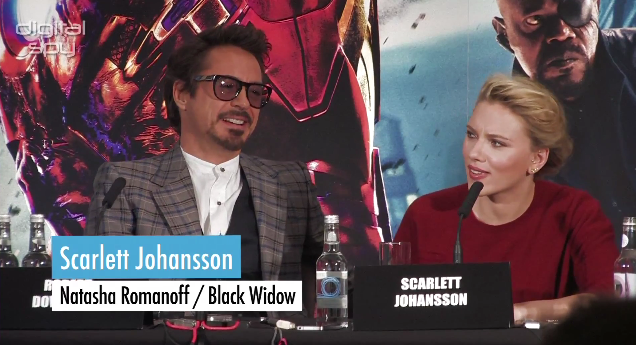
Robert Downey, Jr. and Scarlett Johansson at The Avengers press conference in London

This post written by Megan Kearns originally appeared at Bitch Flicks on May 31, 2012. Cross-posted at Women and Hollywood.

Wow, who knew I could love Scarlett Johansson so much?? I posted this on Bitch Flicks‘ Facebook page but thought it was too great not to post here too.
At The Avengers press conference in London, a reporter proceeded to ask Robert Downey Jr. an in-depth, thought-provoking question about his character (Tony Stark/Iron Man) and then asked Johansson about her diet. I shit you not.
Reporter:I have a question to Robert and to Scarlett. Firstly to Robert, throughout Iron Man 1 and 2, Tony Stark started off as a very egotistical character but learns how to fight as a team. And so how did you approach this role, bearing in mind that kind of maturity as a human being when it comes to the Tony Stark character, and did you learn anything throughout the three movies that you made?
“And to Scarlett, to get into shape for Black Widow did you have anything special to do in terms of the diet, like did you have to eat any specific food, or that sort of thing?”
Scarlett:How come you get the really interesting existential question, and I get the like, “rabbit food” question?
Amen, sister! If you watch the video, you’ll see just how perturbed Johansson is to be asked. As she should be. Why the hell did the reporter save the diet question for one of the two women on the panel??

Johansson has spoken in favor of feminism (yet doesn’t necessarily call herself a feminist) and female friendship, supports Planned Parenthood and condemns Hollywood’s ageism against women calling it “a very vain, vain industry.”  So it’s no surprise she calls out this bullshit. I only wish more actors and members of the media would follow her lead.

The reporter’s question particularly rubs me the wrong way because lots of women have such a contentious relationship with food. Eating should be a fun, sensual, pleasurable experience. But too many women fear food, afraid of what it will do to their bodies. The media monitors and polices women’s consumption. Between diet books, exercise DVDs, weight loss shakes, low-fat foods – the dieting industry is a money-making juggernaut. And it’s geared towards women.

In response to the asinine question, Sarah at Pop Cultured astutely asserts:

“The respect given to you if you’re a man in the entertainment business, and the respect given to you if you’re a woman in the entertainment business: all perfectly summed up in one idiotically thought out line of questioning.”
It’s ridiculous — not to mention offensive and sexist — Hollywood, the entertainment industry, and the media lavish praise on men for their minds and their talents while objectifying women and reducing female actors to their appearances. As we recently witnessed with Ashley Judd fighting back against toxic bodysnarking and the heinous criticism of Jennifer Lawrence’s body, the media constantly scrutinizes, visually dismembers, critiques and polices women’s bodies. The media wreaks havoc on women’s body images, telling us we’re too fat or too skinny. Never just right.

This constant bombardment of objectification of women leads to normalizing sexism and violence against women. It reinforces the notion that women are nothing more than sex objects for the male gaze.

So reporters, think twice before you ask a woman yet another stupid diet question. Ugh.

———-
Megan Kearns is a Bitch Flicks Editor and Staff Writer. She’s a feminist vegan blogger and freelance writer living in Boston. Megan blogs about gender, media, food and politics at The Opinioness of the World, a feminist vegan site she founded. She writes about gender, media and reproductive justice as a Regular Blogger at Fem2pt0. Megan’s work has also appeared at Arts & Opinion, Everyday Feminism, Feminist Magazine on KPFK radioFeministing’s Community Blog, Italianieuropei, Open Letters MonthlyA Safe World for Women and Women and Hollywood. You can follow her on Twitter at @OpinionessWorld.

Gender and Food Week: ‘Arresting Ana’: A Short Film about Pro-Anorexia Websites

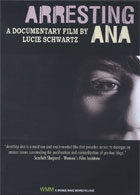
Arresting Ana (2009)
This post written by Amber Leab originally appeared at Bitch Flicks on April 10, 2012.

In February of this year, Tumblr made news when it announced it would no longer host “self harm” sites–which promote anorexia or bulimia as a lifestyle choice, among other subjects–and would pop up a public service announcement (PSA) whenever someone searches for a keyword associated with self harm.

Recently I participated in a feminist film festival in which Arresting Ana, a short documentary by Lucie Schwartz, was shown. Here’s a synopsis of the film:

Arresting Ana tells the story of the potential criminalization of the pro-anorexia movement in France. The film follows two women: Sarah, an 18-year-old college student with a ‘pro-Ana’ blog, an online forum on which she shares tips and tricks with other young women on how to become anorexic, and Valerie Boyer, a passionate legislator who is proposing a ground-breaking bill that aims to ban pro-Ana websites by issuing $30,000 fines and 2-year prison sentences to members of this online underground movement.”

The film was made in 2009, and at the time of its completion the proposed bill had stalled in France’s legislature. The issue of censoring pro-ana sites is interesting and controversial for numerous reasons, I think. While Boyer’s intention with the bill seems good and particularly in the interests of young women, there are some major flaws to this kind of legal activism–which essentially criminalizes people who are suffering from a serious illness and expressing themselves in various ways online. 
While I would stop short of defending someone who is instructing an audience on how to be a “better anorexic,” the free speech aspect–and the idea of criminalizing certain speech online–has serious ramifications. Though I agree with the idea that one person’s freedom ends when it impinges on another person’s freedom, I question whether pro-ana sites are actually harming or violating their readers’ freedom or personal liberty. Let me be clear: I am not in any way celebrating or defending self-harm sites; rather, they strike me as a cry for help, and maybe a manifestation of an illness, rather than criminal behavior. In the case of Tumblr, the free speech issue is largely avoided, since it is a private company, free to set its own terms of service. To me, this seems a more reasonable response in the battle against promoting self harm and eating disorders.
The question also arises as to why websites written and maintained by people suffering from eating disorders are being targeted at all. There are certainly sites on the web that are just as, if not more, harmful to people–sites that use hate speech, or promote hate or violence. Although I’m no expert, I haven’t heard about legislation–or even private companies’ terms of service–against anti-woman websites. Remember Facebook’s Occupy a Vagina event page? In this context, it seems that young women’s freedom of expression is specifically being targeted–even if the subject is a harmful and even dangerous one. (Note: Men suffer from eating disorders too, and I’m not trying to minimize that; the film focuses entirely on young women.)
Fighting eating disorders is important work, and the fact that the subject is being discussed at all in France’s legislature is a good thing. However, criminalizing illness isn’t. Better reforms seem to be the ones directed at body image: banning excessive photoshop use in magazines and advertisements, requiring models to be at a healthy weight, and speaking out against body policing and shaming–whether it happens in media or in our private conversations.
Watch the trailer for Arresting Ana:


———-
Amber Leab is a Co-Founder and Editor of  Bitch Flicks. She is a writer living in Asheville, North Carolina. She holds a Master’s degree in English & Comparative Literature from the University of Cincinnati and a Bachelor’s degree in English Literature & Creative Writing from Miami University. Outside of Bitch Flicks, her work has appeared in The Georgetown Review, on the blogs Shakesville, The Opinioness of the World, and I Will Not Diet, and at True Theatre.

World Champion Eaters: The Paradox of the Gilmore Diet in ‘Gilmore Girls’


Guest post written by Amanda Rodriguez.

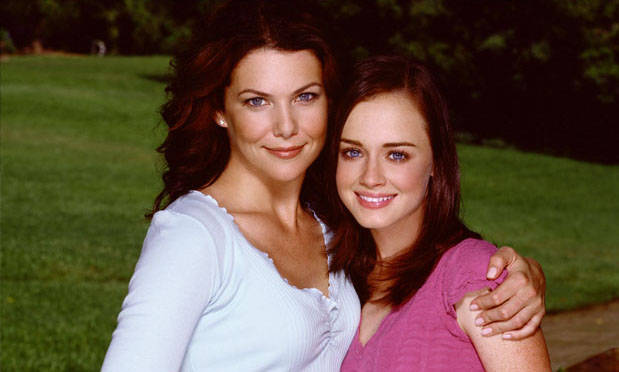
The long-running TV series The Gilmore Girls followed the lives of a single mother who got pregnant at 16 and her daughter as they live and grow in a small town. The mother and daughter duo (Lorelai& Rory) are unconventional, confident, independent, smart, capable, and fun-loving. In Lorelai’s words, “That’s because I’m not orthodox. I’m liberal with a touch of reform and a smidgen of zippity-pow.” The way in which Lorelai and Rory relate to food, however, is a complex issue that can function as a microcosmic reading of the entire show.

First of all, it’s important to establish Rory and Lorelai’s eating habits.
The Gilmore Girls like junk food.

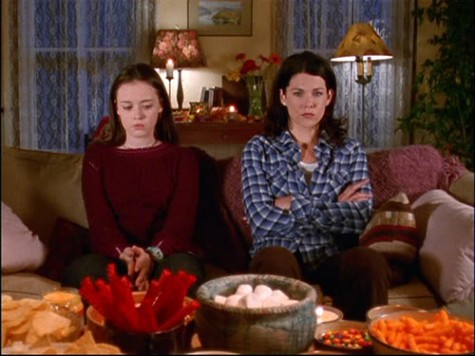
The pair is infamous for not knowing how to cook and always ordering take-out or going out to eat. They eat burgers, pizza, or Chinese food for dinner nearly every night. For breakfast, it’s donuts, pancakes, bacon, pop tarts, or four bowls of cereal. They avoid vegetables at all costs. When they have movie nights (which is often), they stock up on a bevy of sugary snacks, including (but not limited to) Red Vines, marshmallows, cheesy puffs, potato chips, tater tots, and mallowmars. Not only that, but they drink copious quantities of coffee. Refusing to eat any sort of healthy food while indulging consistently in junk food is only half of it…
The Gilmore Girls can seriously eat.
This mother/daughter team has the capacity to consume mass quantities of food, out-eating their much larger male counterparts. They’re always up for round three or even four when the boys have thrown in the towel. In addition, they despise exercise and ridicule other women who either enjoy or feel compelled to workout.

Other characters constantly crack jokes that revolve around their disbelief surrounding the quality and quantity of the food the Gilmore Girls consume. The Gilmore Girls themselves refer to their eating habits with startling frequency. In fact, their diet is referred to in one way or another in nearly every single episode. Why is this theme so central?

Ostensibly, the way the Gilmore Girls eat is intended to be commensurate with the way in which they live their lives. Lorelai is not a traditional mother. She doesn’t grocery shop for healthy foods; nor does she prepare meals.
Lorelai’s refusal to conform to what society expects a mother to cook is symbolic of her rebellion against society’s expectations of what a mother should be. Instead, Lorelai is a hot, fast-talking, coffee guzzling, career-oriented woman whose relationship with her daughter is more like that of a friend than a parent. She encourages her daughter to think for herself and to make her own decisions. Both Lorelai and her daughter are extremely successful and well-respected with an intense emotional bond, proving that their unconventionality is not only endearing, but it works.

The pair’s notorious consumption habits act as a rejection of the notion that women must be so body obsessed that they strictly monitor their food intake, which can devolve into an unhealthy eating disorder and/or suck the enjoyment out of food and of life. These two women flaunt a freedom, self-acceptance, and pleasure-seeking attitude that are all expressed through their love of food. 
Rory (Alexis Bledel) and Lorelai (Lauren Graham) in Gilmore Girls
Rory and Lorelia embrace the lowest common denominator types of food, preferring high quantity and low quality. Though Lorelai was raised in a wealthy household, she has rejected the upper class lifestyle. When eating their weekly Friday night dinners with Lorelai’s parents (Emily & Richard Gilmore), Lorelai and Rory often have trouble eating or enjoying the gourmet delicacies that they’ve been served. This is an expression of the way in which they’ve embraced their working class status.

Unfortunately, this is where the positive interpretations of the Gilmore diet end. On the surface, eating junk food and tons of it may seem subversive in its rejection of traditional values surrounding womanhood, motherhood, and class, but it is, in truth, an enactment of the male fantasy of the beautiful, slender woman who loves to eat and doesn’t worry about her weight. Within this context, their eating habits seem more in-line with an idealized concept of womanhood rather than a dismissal of it.
Gilmore Girls


The most disturbing and possibly damaging facet of the Gilmore diet is that it is patently unrealistic. Yes, there are thin women out there who have naturally high metabolisms or don’t exercise or prefer junk food. The combination of all three, however, is rarer. Regardless, there is a distinction between weight and health. For example, someone can be“underweight” or at “optimum weight” and be unhealthy, while another person can be “overweight” and still be healthy. It’s hard to imagine a nutrient deficient lifestyle like the one the Gilmore Girls practice resulting in copious energy, brain power, and a healthful appearance.
If so much focus wasn’t placed on Rory and Lorelai’s diet, we could chalk all this up to the combination of “good genes” (as often claimed on the show), a cute personality quirk, and Hollywood magic. The emphasis on the Gilmore diet, however, ends up creating yet another unrealistic expectation of how women should be and look. Many women lament online that they wish they could eat like the Gilmore Girls and not gain weight. Blogger with the handle“Leah (The Kind of Weight Watcher”) even created something she calls “The Gilmore Girls Diet” where she lays out her plan to eat like the Gilmore Girls in an attempt to lose weight. Even Lauren Graham (the actress who portrays Lorelai) struggles with food, her weight, and self-confidence. Not only that, but she loves being athletic and relies on exercise to keep her body healthy and within the Hollywood ideal. This underscores the fact that the Gilmore diet isn’t even realistic for the Gilmore Girls themselves.

For countless women around the world suffering from eating disorders and unhealthy relationships with food, the Gilmore diet is another detrimental example of the paradox insisting women should be naturally thin and beautiful while not paying attention to what they eat or how they take care of their bodies. This paradox contributes to many women’s struggles with body image and self-worth. It also promotes a negative relationship with food, where some women no longer view food as simply life-sustaining sustenance, but as a huge force in life. Some may see food as an enemy to be managed or starved, or, conversely, some women may develop an emotional dependence on food so that they must indulge in order to derive comfort. All the positive facets of the Gilmore diet are washed away in the face of its reinforcement of unhealthy body and food issues.
Now consider how unconventional the Gilmore Girls really are. They’re well-dressed, slender, and typically attractive. They live in a quaint, small town that they adore. Rory receives an Ivy League Yale education. Lorelai has no mechanical or home repair skills so must always ask Luke (the local diner owner) to be her handyman. Even their eschewing of the upper class lifestyle has its limits; they often enjoy the benefits of having wealthy family (expensive gifts, education, trips, etc), and the two generally fit in quite well at Emily and Richard’s upper crusty social functions. They obsess over boys and men, and both of them seek traditional heterosexual romances that will lead to traditional marriage and a traditional family.
In the end, the Gilmore diet says the same thing the show itself is saying: Yes, the Gilmore Girls are quirky, independent, and smart. Yes, the Gilmore Girls refuse to bend to society’s ideas of how a woman should be and what should be expected of her. At heart, though, the Gilmore Girls want that traditional life, and by the end of the series, they have that traditional life. Though the Gilmore Girls claim to be nonconformist, though they take an unconventional path to get there, they end up in the same place with the same kind of traditional life as other, less rebellious TV heroines. Their diet, like their lifestyle, may seem subversive at first glance, but instead reveals itself to be another expression of their internal acceptance of ideal, traditional womanhood.

———-

Amanda Rodriguez is an environmental activist living in Asheville, North Carolina. She holds a BA from Antioch College in Yellow Springs, Ohio and an MFA in fiction writing from Queens University in Charlotte, NC. She writes all about food and drinking games on her blog Booze and Baking. Fun fact: while living in Kyoto, Japan, her house was attacked by monkeys.
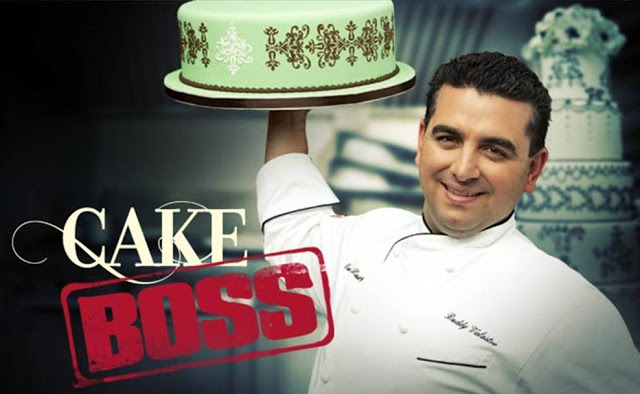
Gender and Food Week: ‘Cake Boss’: A Sweet Confection with Dark Filling

Guest post written by Lauren Kouffman, originally published at her blog Ex Ovum Omnia. Cross-posted with permission.
Fan favorite and global hit, Cake Boss, first aired on the TLC Channel on April 19, 2009, and has returned for five consecutive seasons, building to some of the highest ratings the network had ever seen. Syndicated episodes of the first four seasons are currently available on Netflix, and TLC’s homepage is saturated with clips highlighting new season drama. Clearly the network has found a hit in this off-beat show, following the daily life of a classically-trained Italian baker and his cohorts, in Hoboken, New Jersey. 
But just beneath a sweet premise of an Italian-American hero living out his American dream, is the nagging question of gender politics, and just how much “old-school” female subjugation is still the modus operandi, especially when mixing food and entertainment.
Catering mainly to an upwardly mobile female audience, familiar with a society-approved cultural narrative (i.e.: engagement, wedding, baby, family), TLC’s lineup of keystone programs including What Not To Wear, Say Yes To The Dress, A Baby Story, and 19 Kids and Counting, has helped create a name for itself, not only as The Learning Channel, but also — in my house, anyway — The Lady Channel. Based solely on TLC’s network profile then, we must assume that the intended audience demographic for any one of their programs is largely female, with ample leisure time for daytime or afternoon programming, and an interest in culturally dictated stereotypical “female” pursuits.

Cake Boss

On the other hand, along with newer programs such as Breaking Amish, Strange Sex, and Flip That House in rotation, which shift the focus away from the domestic and instead focus on either culturally deviant lifestyles or hands-on, “do-it-yourself-ism”, certain elements of Cake Boss’ structure seem to be reaching out towards a unique segment of otherwise non-initiated TLC viewers: namely, straight men. 

While Bartolo “Buddy” Valasco, Jr., and his posse of bakers based out of Carlo’s Bake Shop in Hoboken, have built a local reputation for churning out their old school Italian style of intricate cakes and pastries (a decidedly un-macho affair in itself), most episodes also include more modern and outrageous cakes in the style of Duff Goldman, network television’s other famous “bad boy” baker, presented in a more masculine, post-modern style. A far cry from hand-made roses and intricate lace details, these cakes are about as literal as you can get; In season one alone, we’ve seen a zombie cake with corn syrup “blood” oozing down the side, a firehouse cake with actual smoke puffing out of the “windows,” and a life-size blackjack table with spinning wheel, painstakingly painted to approximate mahogany wood and presented with some theatrical fanfare to a bunch of “wise guys,” as Godfather-esque music wound through the scene. 
In presenting his narrative, Buddy (along with his Cake Boss production team) takes great pains to keep the concepts of masculine and the feminine separate; the irony being that within the traditionally female realm of the kitchen, and especially in dealing with sweet and pretty baked goods, a man rules the roost… and it only fortifies his masculine identity meanwhile. 
Playing up his Italian heritage for maximum effect, we see Buddy expertly calming his four high-strung sisters and mother, dealing with difficult customers (often female), alternately reaming out and playing practical jokes on his male employees, and of course, exercising technical precision in creating stunning works of edible art.

Interestingly, though Carlo’s Bake Shop seems to employ a fleet of women as “cake decorators” (the distinction is clearly drawn here, in contrast to the male bakers), more screen time is paid to the colorful personalities of the few men that work there: Mauro the number two, Hothead Joe, Danny “The Mule”, and Cousin Frankie. Their characters have been fleshed out enough to act as Buddy’s consigliere, while the women are granted occasional group reaction shots. Moreover, all of the male bakers wear chef’s coats and white pants -even the delivery boy is dressed in all white — and none of the women are required to be in uniform. In Carlo’s Bake Shop, baking is a serious business, and the visual and social cues here reveal that women are neither taken seriously, nor considered a real asset to the business. 

Cake Boss
While Cake Boss itself falls more into the docu-drama category than most other food television programming, it is interesting to consider the implications of how food, and eating, are depicted throughout. Cakes and pastries are more than just everyday sweet treats, but are planned and purchased to mark special occasions, and meant to be shared among family and friends. Family is clearly at the heart of Buddy’s food and life philosophy, and he considers his customers and program viewers by extension, to be a part of that. Program viewers too, being treated to an intimate behind-the-scenes look into Carlo’s Bake Shop, are meant to feel like Buddy considers them a part of la familglia. 
Assuming most of us are lacking an authentic Italian grandmother at home to bake all of the traditional pastries from scratch, Carlo’s Bake Shop fills a nostalgic place in our hearts, where food, family, and deep emotions entwine. Media capitalizing on the relationship between food and feelings is nothing new; in fact, specifically because many of the thematic motifs presented in Cake Boss are less-than-politically-correct (i.e., the unspoken subjugation of women), watching them play out before us on television can be a healthy, even cathartic, way to indulge and explore our feelings on these subjects. As loyal viewers tune in for a half hour-long segment of bakery antics, they are treated to a free therapy session as well. 
More than just the boss, Buddy seems like Cake Dad… and of course father — especially The God Father- always knows best. Nearly every episode ends with the Valasco family smiling and laughing around a dinner table, with Buddy at the helm: a very Freudian image, indeed. 
While all the filming quirks and mafia references imply TLC Channel’s attempt to expand their viewership, it seems impossible to deny that the show’s success has already been secured, with a global viewership in over 160 countries, and most recently, product tie-ins with Cake Boss-inspired ready-to-sell cakes based on Buddy’s designs. A spin-off series called Next Great Baker has also seen some network success and continues to pick up traction, promising a $100,000 prize and a coveted internship at Carlo’s Bake Shop for the winner. Ironically though, the two first Next Great Baker winners have been women; although a cynic might question if any type-casting came into play in determining the winner (setting the stage for maximum drama), it will certainly be interesting to tune in for Cake Boss’ next season, as we witness a network-backed female baker navigate the male-dominated waters of Carlo’s Bake Shop.
———-
Lauren Kouffman is a first year MLA Gastronomy student at Boston University. Particularly interested in the intersection of media, technology and food, much of Lauren’s writing explores how food communities are built and maintained using new media tools. Lauren spends her free time collecting more cookbooks than she has space for, and searching for the perfect Old Fashioned.

Gender & Food Week: Extreme Weight Loss for Roles is not "Required" and not Praiseworthy

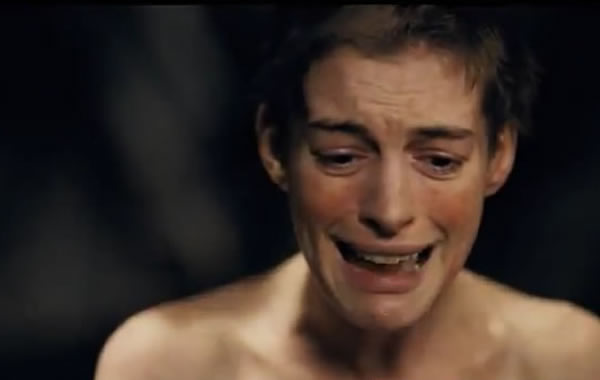
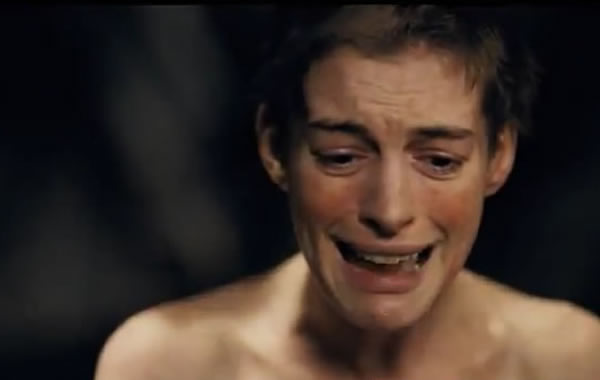
Anne Hathaway as Fantine in Les Miserables
This post written by Robin Hitchcock previously appeared at Bitch Flicks on November 16, 2012 and was cross-posted at Women and Hollywood.

Kale and dust. Hummus and radishes. Two squares of dried oatmeal paste a day.

If you recognize any of these phrases, then you’ve probably been hit by the Anne Hathaway starvation-diet-for-her-craft marketing blitz.

In the unlikely event that you haven’t heard about this already, I’ll catch you up: Anne Hathaway, slim to begin with and already leaned down to catsuit size for The Dark Knight Rises, lost 25 pounds to more realistically inhabit the role of starving-and-dying-of-tuberculosis Fantine in the upcoming movie musical Les Misérables. Actors forcing dramatic body weight changes for roles is nothing new and nothing unique (see the similar-yet-tellingly-different coverage of Matthew McConaughey’s weight loss to play an AIDS sufferer in The Dallas Buyers Club), but Hathaway’s weight loss has become The Story of the production of Les Mis: a subject of endless discussion on celebrity gossip sites, the talk show circuit, and the cover story in the December issue of Vogue magazine.
Why is a skinny person getting skinnier garnering so much media fascination? Are hummus and radishes so much more fascinating than Les Mis director Tom Hooper’s decision to have the actors sing live for the cameras? And even if we insist on reducing an actress to her physical appearance, couldn’t we just talk some more about Anne Hathaway chopping off all her hair? 
When discussing her weight loss with Entertainment Tonight’s Mark Steins, Hathaway says, “It’s what is required. It doesn’t matter if it’s hard.”
“Required”? Really?
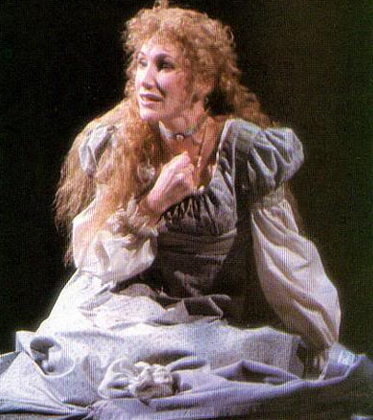
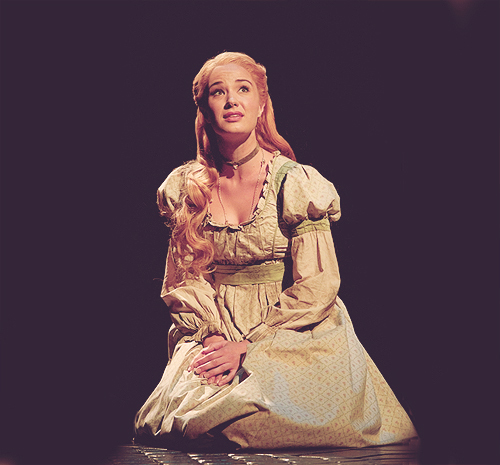
This makes two gigantic assumptions: 1) That physical frailty is necessary to properly play the character Fantine.
Patti LuPone as Fantine, 1985 London production
Randy Graff as Fantine, 1987 Broadway production
Sierra Boggess as Fantine, current West End production
An assumption I think it is fair to reject: these women are slender, but not emaciated, and they are able to play the character convincingly.
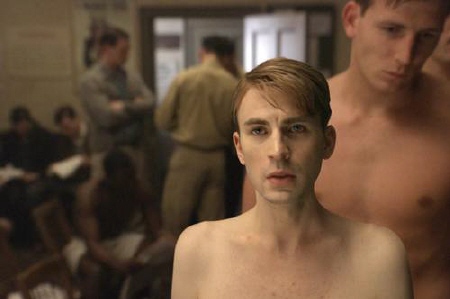
But let’s give Hathaway the benefit of the doubt and say the intimacy of a filmed adaptation requires more stringent realism when it comes to Fantine’s body size. This still assumes that the actor actually losing weight is the only way to portray her extreme physical condition.
Brad Pitt in The Curious Case of Benjamin Button
Skinny Steve Rogers in Captain America: The First Avenger
Yeah, nope.
So let’s be clear: Anne Hathaway’s extreme weight loss for Les Mis was in no way required.  But while it is artistically a wash; as a career choice, it was clearly a good move.  The film benefits from all this attention, and Hathaway enjoys the “she so devoted to her craft” kudos that often translate into statuettes.
But it is bad for women, and bad for our culture. More diet talk, more body talk, perpetuation of the myth that weight loss is a noble pursuit and merely a matter of dedication.  Voluntary adoption of disordered eating is not praiseworthy. These types of body transformations are not artistically necessary, and certainly not “required.” So let’s hope actors stop endangering their health for roles. We can suspend our disbelief over a few dozen pounds.

———-
Robin Hitchcock (no relation to the Master of Suspense) is a Bitch Flicks weekly contributor. In May 2012, she reluctantly left her home of Pittsburgh, Pennsylvania to move to Cape Town, South Africa with her husband. Robin is a Contributing Editor foLeWeekley.co.za, a weekly guide of things to do in Cape Town. You can also find her writing at the mostly-dormant feminist pop-culture blog The Double R Diner and her personal blog HitchDied.com.

Gender & Food Week: ‘The Hunger Games’ Review in Conversation: Female Protagonists, Body Image, Disability, Whitewashing, Hunger & Food

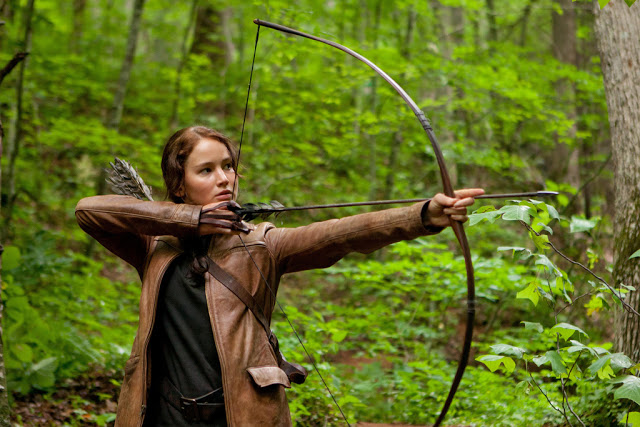
Jennifer Lawrence as Katniss Everdeen in The Hunger Games

This Review in Conversation on The Hunger Games with Megan Kearns and Amber Leab previously appeared at Bitch Flicks on April 19, 2012.

Megan’s Take:
In a dystopian future, the nation of Panem stands where North America once existed. The government at the Capitol, which controls the country, mandates a girl and boy between the ages of 12 and 18 are selected by lottery in each of the 12 Districts as tributes to compete in a fight to the death called the Hunger Games aired on live television. 16-year-old Katniss Everdeen volunteers when her little sister Prim’s name is called. But in the Hunger Games, only one person can survive.

I devoured The Hunger Games trilogy, reading all 3 books in a matter of 2 days. Katniss descends from a line of strong literary female protagonists (Karana in Island of the Blue Dolphins, Miyax in Julie of the Wolves, Jo March in Little Women, Anne Shirley in Anne of Green Gables, Jane Eyre, Meg Murray in A Wrinkle in Time, Hermione Granger in Harry Potter) for young adult readers. The story echoes themes in The Lottery, The Most Dangerous Game, Gladiator, 1984, Island of the Blue Dolphins and Battle Royale, yet forges a new path. The female-centric series’ haunting themes – poverty, war, sacrifice, love, starvation, media influence, government control, class difference, and economic inequity – riveted me. The books’ memorable characters lingered long after I closed the pages. I didn’t want to say goodbye. So my expectations for the film were high when I saw the midnight premiere.
Jennifer Lawrence as Katniss
While other female film franchises exist, no female-centric movies aside from Twilight, Bridesmaids and Mamma Mia have experienced this meteoric success. Some people pit Katniss and Bella against each other as if there isn’t room in this world for both. While I’m no fan of the Twilight Saga (I’ll admit it makes me want to gouge my eyes out), putting them in a dichotomy implies girls and women can only identify with either Katniss OR Bella, not both or neither. Thankfully, others question this comparison.

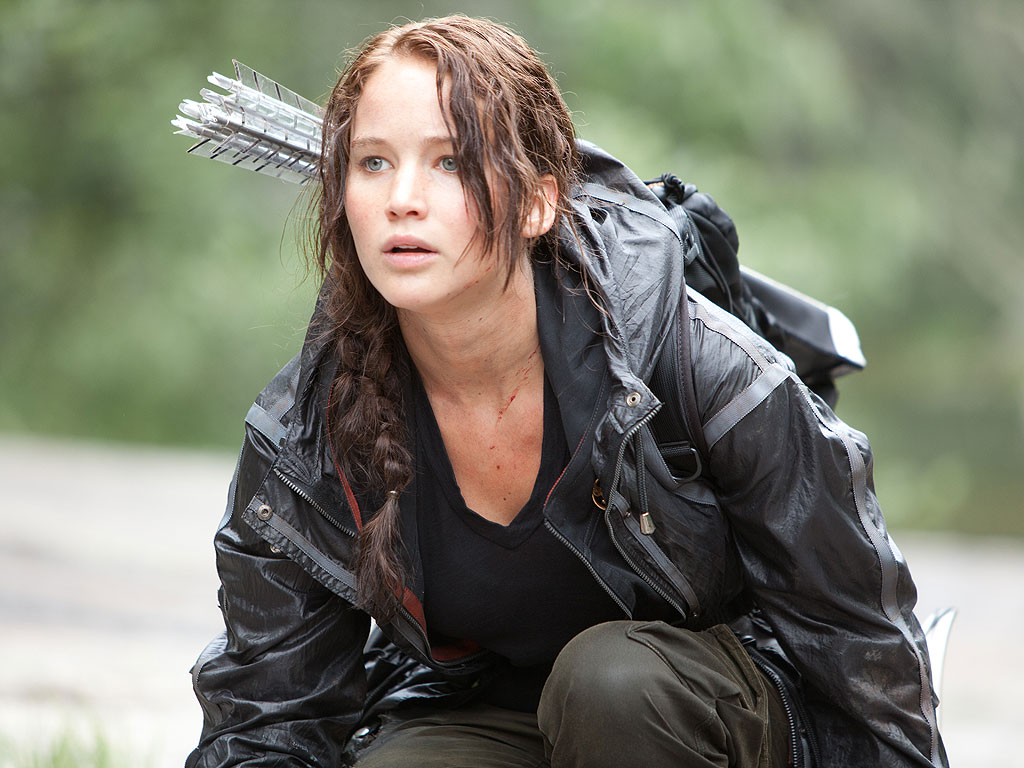
I thought the movie was fantastic. I often lament the lack of strong female protagonists in film. We desperately need more characters like Katniss on-screen. A skilled archer, Katniss is smart, stubborn, brave, abrasive and self-reliant. She not only fights for her own survival; she’s compelled to protect her family. Living in the most impoverished neighborhood in the poorest of the 12 Districts, Katniss is the resourceful breadwinner, illegally hunting for food to feed her family. She’s a surrogate mother to her sister Prim and even her own traumatized mother, grief-stricken over the death of her daughters’ father. Despite her tough exterior, she possesses a vulnerability. What makes Katniss unique is that she “feels empathy when nobody else does.” She’s compelled to defend others, even her competition.

Jennifer Lawrence as Katniss

Jennifer Lawrence’s powerful performance as the “Girl on Fire” has been lauded by critics. And rightfully so. She’s stunning, perfectly conveying strength, rage, fear, and vulnerability through her body language, a flick of her eyes, never needing to utter a single word. She trained in archery, free running, yoga, climbing and combat. Regarding Lawrence’s casting as Katniss, director Gary Ross, moved by her powerful audition, called it “the easiest casting decision” of his life. Author Collins also fully supported Lawrence as Katniss. 
The casting call, however, wanted an “underfed but strong” actor, and was limited only to “Caucasian” women. What. The. Fuck. I mean really, Hollywood?? No, women of color could even audition?! Collins describes Katniss’ appearance in the book as olive skinned with black hair. Hello…that could be tons of female actors of color! Why the hell must she be white?! You’re going to exclude young women of color and, on top of that, you only want malnourished-looking women?! Yes, starvation is a vital issue in the series. But in the book, Katniss says she possesses lean muscles from hunting. 
Lawrence is receiving an assload of toxic bodysnarking from the misogynisitc media. The NY Times’ Mahnola Dargis claimed “her seductive, womanly figure makes a bad fit for a dystopian fantasy about a people starved into submission,”Hollywood Reporter’s Todd McCarthy commented on her “lingering baby fat,” Hollywood Elsewhere’s Jeffrey Wells accuses Lawrence of being “big-boned” and “seems too big for Hutcherson” as male romantic partners should at least be as tall as their female counterparts (heaven forbid a woman is bigger or taller than her love interest…gasp!). The media constantly tells women we must be skinny. This toxicity destroys women’s body image.

Jennifer Lawrence as Katniss
Amber’s Take:
I agree with all your comments on Katniss being a strong female protagonist, and what a relief it is for a franchise fronted by a young woman to win the box office (as of this writing) four weeks in a row. Although the Twilight comparisons irk me, too, they almost seem inevitable, as so few big Hollywood releases have featured female protagonists. As with so many Hollywood franchises, however, this one takes a small step forward: a strong young woman is in the lead, but she is whitewashed to “play it safe” with the viewing public. Although the film is set in—and was filmed in–modern-day Appalachia, I see no reason why the lead needed to be “Caucasian.”
I have to talk about the “body snarking,” because while I would never call Jennifer Lawrence “too big” to play Katniss, she is older than Katniss. The 17-year-old Lawrence who starred in Winter’s Bone would have been a more convincing 16-year-old Katniss than the actor at age 21. Women in their 20s playing teenagers certainly isn’t a new thing (how many times have you watched a movie or TV show and noticed twenty-somethings playing high school students?), but the tendency for this to happen does create unrealistic expectations for teenage girls and conflate girlhood with womanhood. I think this problem will only become more apparent in the following two films of the series, too.

Jennifer Lawrence as Katniss

Much has been said about Lawrence’s body, but I’m not really interested in analyzing it—the incessant discussion of female bodies is part of the problem. What I do want to discuss is the film’s handling of food and hunger (a conversation I think many people are sincerely trying to have who end up derailing into critiques of Lawrence’s body). Everyone in District 12 is hungry, including Katniss. Winning the Hunger Games isn’t just about surviving; it’s also about bringing extra food home to your district—especially important for the poorer areas. The Capitol uses hunger as a political tool—a fact that doesn’t come through clearly enough in the movie. (An anecdote: The person who saw the movie with me didn’t understand why it was called The Hunger Games.)

In the book, Katniss eats and enjoys the plentiful food provided to her in the lead up to the game. She finds a particular lamb stew rich and delicious and she enjoys eating it until she’s full. For a girl who’s been hungry much of her life, the food available on that train trip would be irresistible. Yet in the movie, Katniss seems uninterested, even immune to the lavish spread. Is there a reason Katniss can’t enjoy a hearty stew to fortify herself for the impending game?  This de-emphasis of food changes the character of the story dramatically. Remember the moment when Gale presents a roll to Katniss in the woods and she exclaims “Is this real?!” and they break the roll to enjoy together? The berries Katniss and Peeta threaten to eat in their Romeo-and-Juliet-style sabotage of the game? The story of nourishment and consumption takes a major hit when the movie doesn’t permit Katniss to eat and enjoy food and, for me, this might trump whatever positive body-image message might be implied by the decision to cast Lawrence without regard to the “underfed” description in the casting call, and without regard to her adult status.

Megan’s Take:
I didn’t really have a problem with Lawrence being older than Katniss. Although I totally agree about the concern for girls “conflating girlhood with womanhood.” But I suppose it didn’t bother me so much because Katniss is never sexualized. She cares about archery, not what she’s wearing. While Katniss receives a pageant-style makeover, so do the male tributes. While it hints at it, I just wish the movie had conveyed the book’s satire of toxic beauty standards.
I could NOT agree more with you on the themes of hunger and food or rather how they’re severely diminished almost to the point of erasure in the film. As a feminist vegan, I’m passionate about food justice and our relationship with food. Food and hunger are vital themes in the trilogy. Food is used as a reward while withholding food a punishment wielded as a weapon against Panem’s citizens. While the movie hints at these themes through the Capitol’s citizens’ garish costumes versus District 12’s simple garb or the lavishness of food at the Capitol, it doesn’t fully capture the book’s themes of food justice, food shortages, hunger and class inequities.

Elizabeth Banks as Effie Trinket and Jennifer Lawrence as Katniss Everdeen
It’s rare to see an impoverished protagonist and a film contend with economic inequities. Even within the impoverished District 12, there are class distinctions. In the book, Katniss tells Peeta he doesn’t understand her desire to not owe anyone anything because he’s not from the Seam, the poorest neighborhood in District 12. The reason Gale had his name in the Reaping 42 times was so he could obtain more rations for his family. Katniss continually describes food and she always gorges herself like she’ll never eat again…because she doesn’t know if she will. 
Jennifer Lawrence and Amandla Stenberg as Rue

I too didn’t understand the de-emphasis of food and hunger. In reality, 1 in 6 children suffer from hunger. And I too loved Collins’ descriptions of food, like Katniss relishing her favorite nourishing lamb (dislike) stew with dried plums (yum!) and the sweetness of hot chocolate touching her lips for the first time. And of course there was the continual symbol of bread — the warm and fragrant bread accompanied by Prim’s cheese Katniss eats with Gale, or Peeta’s burned bread that saves her life years earlier, or District 11 sending Katniss a loaf of bread for her alliance with Rue (who was from District 11) as a symbol of solidarity and quiet revolution, which the film eliminates, showing the citizens (many of whom are people of color) rioting instead. 

Society equates food with morality — healthy food is good, decadent food sinful. While eating should be a sensual experience, through diet ads the media constantly tells us that women shouldn’t enjoy food. Food is constantly a threat to women’s bodies and we must resist its seductive allure. That’s why it was so refreshing to read Katniss’ delight in savoring food.
Beyond nourishment, I saw hunger serving as a metaphor for consumption — consumption of merchandise and media with its gravitational pull of reality TV and celeb culture. To eliminate the message of food, hunger and consumption dilutes its powerful message.
Speaking of parts eliminated from the book, I was disappointed the film eliminated the leads’ disabilities. In the book, Katniss loses her hearing, becoming deaf in one ear, and Peeta has his leg amputated. The movie hints at her hearing loss with sound effects but doesn’t actually address it. People often say that losing their hearing would be the end of the world but Katniss must adapt as a hunter and survive. It’s also a powerful message that in the book the Capitol “fixes” people’s disabilities without their consent. Sadly, it says even more that the film erases disabilities altogether. The fact that a movie can’t have a disabled protagonist or a disabled love interest is pathetic.
Amber’s Take:
The film really diminished a lot of powerful themes and messages from the book, and I couldn’t agree more with you about minimizing injury, or what equates to erasure of disability. Ironic that the book has the Capitol “fixing” disability, but the film itself erases it–making the filmmakers the Capitol. We — the viewers — are already in the uncomfortable position of watching the Games much like the Capitol citizens (something else the film minimizes, I think).

In a way, it’s funny that we haven’t really talked about violence, and how — in order to get a PG-13 rating — the film sanitized violence. The books are intended for a Young Adult audience, but are filled with brutal murders. The movie is, too, and I think we could see the de-emphasis of violence as either positive or negative: Positive in that the movie doesn’t glorify violence, or depict it graphically (which movies do too much of in general), but bad in that the movie isn’t as dark or complex as it could have been. While I realize that a filmmaker must make difficult choices when adapting a book (series), every choice made about The Hunger Gamesmade it safer — and more likely to not put off, offend, or disturb mainstream viewers. In essence, making it a successful blockbuster.

———-  
Amber Leab is a writer living in Asheville, North Carolina. She holds a Master’s degree in English & Comparative Literature from the University of Cincinnati and a Bachelor’s degree in English Literature & Creative Writing from Miami University. Outside of Bitch Flicks, her work has appeared in The Georgetown Review, on the blogs Shakesville, The Opinioness of the World, and I Will Not Diet, and at True Theatre.

Megan Kearns is a Bitch Flicks Editor and Staff Writer. She’s a feminist vegan blogger and freelance writer living in Boston. Megan blogs about gender, media, food and politics at The Opinioness of the World, a feminist vegan site she founded. She writes about gender, media and reproductive justice as a Regular Blogger at Fem2pt0. Megan’s work has also appeared at Arts & Opinion, Everyday Feminism, Feminist Magazine on KPFK radioFeministing’s Community Blog, Italianieuropei, Open Letters MonthlyA Safe World for Women and Women and Hollywood. You can follow her on Twitter at @OpinionessWorld.