Gender & Food Week: A Woman’s Place in the Kitchen: The Cinematic Tradition of Cooking to Catch a Man

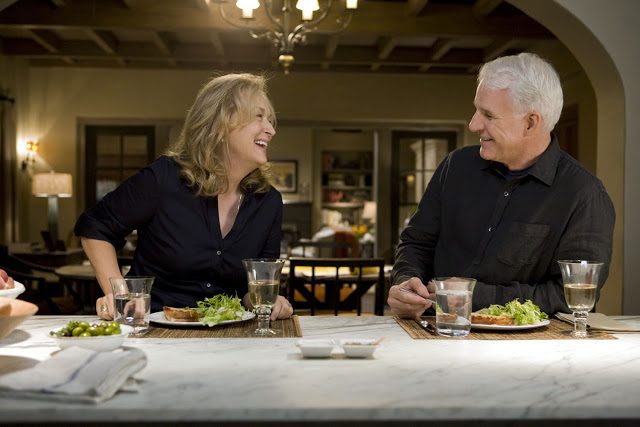
Meryl Streep and Steve Martin in It’s Complicated
This guest post is written by Jessica Freeman-Slade.

Early in the 1954 film Sabrina — the original, starring Audrey Hepburn and Humphrey Bogart — the titular ingenue finds herself at a cooking school in Paris. Sent over as a gift from her father’s employer, the wealthy Larabee family, Sabrina continues to nurse her crush on the younger Larabee son, David (William Holden), even from Paris, and it shows in her cooking. The head chef inspects her souffle, and declares it “Much too low.” “I don’t know what happened,” she moans pitifully to herself. “I know what happened,” her colleague, a much older French gentleman, says, “You forgot to turn on the oven.” She cries out, and he guesses that she is in love—unhappily in love. “A woman happily in love, she burns the souffle. A woman unhappily in love, she forgets to turn on the oven.”

Audrey Hepburn in Sabrina
As centuries of unequal domestic duties have shown us, women who are happy in the kitchen must, by extension, be happy in love. Having fallen in love with the 1995 version of Sabrina long before seeing the original, I had assumed that Sabrina’s (Julia Ormond) maturity and allure upon returning from Paris were indebted to a haircut, long walks by the Seine, and a new passion for photography — not a new talent at whipping up souffles in perfect capris and ballet flats. The ascription of her romantic desirability to her talent with food is an uncomfortable, backward narrative, one that’s hard to escape from even in modern cinema.Young women have heard throughout time that “the way to a man’s heart is through his stomach,” and film and television have done an excellent job of backing up this assumption. Not all women who can cook were taught to do so at the behest of future matchmakers, but the prevailing attitude, taught to us in women’s magazines and through the constant refrain of mainstream narratives, is that if you catch a man, you’d better make a decent meal. The loathsome popularity of dishes such as “engagement chicken” carry with them the promise that women need only master the kitchen to hook a man. DIY domesticity, maybe, or just cooking to couple up, but either way, it’s an uncomfortably old-fashioned message.

Cooking has always been a creative act, no matter who’s doing the dishes — it requires careful thought, imagination, and precision. It is, in short, one of the most skilled professions that anyone can take on, and also one of the most generous professions, because it requires thinking deeply about another person’s needs and desires. However, when a woman cooks for a man, and in doing so wins his heart, the woman appears conventionally domestic and feminine — traditional in her skill sets, understanding of her appropriate role in the house and in the relationship, and so subservient to the man’s needs. When a woman cooks on film, even when she cooks something extraordinary, there’s something profoundly submissive when she does it to please a man.
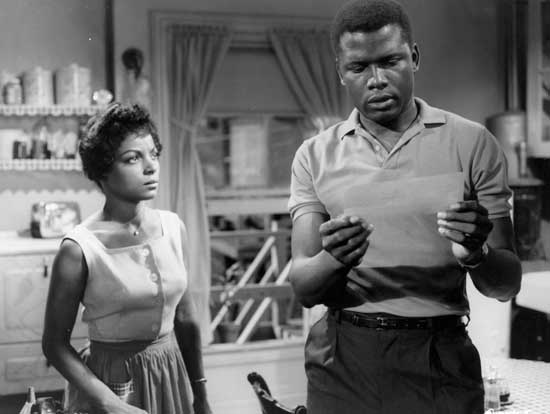
Ruth Younger (Ruby Dee) and Walter (Sidney Poitier) in A Raisin in the Sun

In the very beginning of the 1961 film A Raisin in the Sun, Ruth Younger (Ruby Dee) is trying to stir her husband Walter (Sidney Poitier) to start his day — he wants to talk about his dreams, his ambition, and she keeps reminding him to eat his breakfast. He lambasts her for her intolerance, but her means of affecting change — and her means of keeping the family together — have been limited to the kitchen.
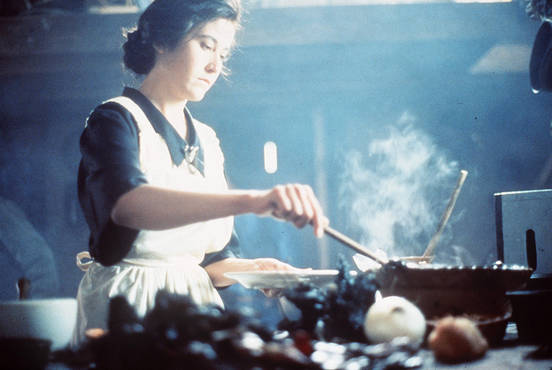
Like Water for Chocolate
But cooking for a man, as shown on film, isn’t without its rewards — for good food is one of the best (and cheapest) means of seduction. When someone takes you into their kitchen, hands you a glass of wine, and promises you a delicious meal, it’s a method of flirtation that’s hard to resist. The pairing of womanly passion and culinary skills has been present as long as women’s emotions were captured in fiction: because a woman’s place has been primarily in the kitchen, her expression of whatever feelings or agency she may have comes by way of what she cooks. Look at the way Tita expresses her passion in Like Water for Chocolate, her emotions dripping into the food and infusing each bite with lust, sorrow, and joy. Her desires, forbidden by her family, cannot help but find their way into her cooking.(When this is later adapted into the romantic comedy Simply Irresistible, Sarah Michelle Gellar’s restaurant chef is accused of being a witch, manipulating her love object with the delicious meals she prepares. Just as women would be kept out of the boardroom for fear of their emotions, so too is she kept from running her own kitchen.)

This impulse, to cook to incite pleasure and admiration, even surfaces in more modern films when women would be seemingly more self-sufficient. As recently as 2011’s It’s Complicated, Meryl Streep’s pastry chef gets to be the object of two men’s lusts, in part, in no small part because she’s a spectacular cook. The scene of her late-night date with a new love interest (Steve Martin), where she makes him chocolate croissants from scratch, shows her at her most ebullient (and sexiest) throughout the film. And it’s only a few scenes later that her ex-husband (Alec Baldwin) tells his kids that their mother is the “best cook in the world.” Her talent equals her desirability, displayed in her gift to create a warm, indulgent space for the men in her life.

These scenes aren’t so disquieting on their own—after all, who wouldn’t want to be served a meal infused with lust, or have Meryl Streep bake you croissants at 2am? But the inverted message also comes that, when a woman lacks warmth or compassion, it shows in her cooking.

In Clueless, as Cher (Alicia Silverstone) prepares for a date, her voiceover tells us that “When a boy is coming over, you should always have something baking.” The punchline is then seeing her unwrap an entire roll of frozen cookie dough and dropping it onto a baking sheet. (No surprise later that the entire roll burns to a crisp. “Aw, honey, you baked,” her date condescends. “I tried,” she whimpers.)

The heroine in Mostly Martha, the spectacular 2001 German film, is a good cook, the head chef of a great restaurant, but her cooking doesn’t translate when she has to take care of her niece, Lina. It takes a more genial Italian sous-chef (and Martha’s future love interest) to get the child to eat, and instead of a sophisticated dish, it’s a simple plate of spaghetti that does the trick.

Where Martha’s ambition is rewarded in the restaurant world, it’s punished when she has to act as a surrogate mother (and potential girlfriend). Only once she’s later softened in the film does her cooking — and her parenting — relax to the point of acceptance. But in reality, women don’t just cook for themselves — most of the time, the act of cooking is done as an expression of survival, rather than seduction. Preparing a meal is one indication that a person is fully self-sufficient. It’s a biased opinion, I know, but I raise an eyebrow at anyone, male or female, who tells me that they don’t ever cook for themselves. While making boeuf bourguignon or baking a seven-layer cake takes a greater level of culinary ambition, preparing a series of simple, satisfying dishes show the difference between someone who can take care of themselves, and someone who requires a babysitter.
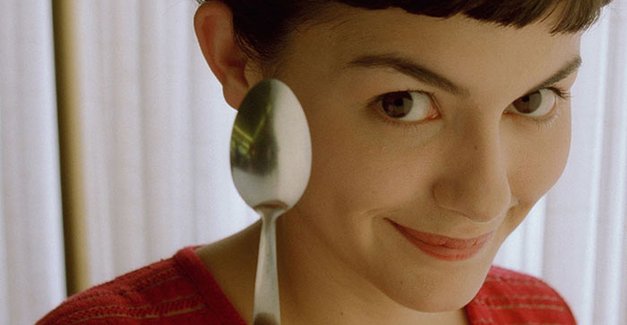
Amelie (Audrey Tautou) in Amelie

The brief scene in Amelie of the heroine preparing her dinner shows us what adulthood looks like — even when adulthood also comes with skipping stones and playing pranks on the local butcher. And no model proves more inspiring than Janette deSautel, the female chef from HBO’s Treme, whose narrative about her New Orleans’s restaurant is entirely without romantic motivation. Even when her restaurant crumbles due to the post-Katrina economy, she rebuilds her reputation in the hard-scrabble New York restaurant scene. By bringing her New Orleans roots to bear in standout dishes at David Chang’s fictionalized restaurant Lucky Peach, she reestablishes herself as a chef to watch — and finds a new avenue toward her culinary career back in her hometown.

Chef Janette deSautel (Kim Dickens) in Treme
Julie Powell (Amy Adams) and Eric Powell (Chris Messina) in Julie & Julia

And finally, there is Julie & Julia, the story of a modern-day woman (Julie Powell, played by Amy Adams) finding inspiration in Julie Child (Meryl Streep, yet again), and using cooking to dig herself out of her personal and professional ennui. Cooking in this story threatens to tear Julie’s marriage apart — not for her lack of skill, but her preoccupation with what the cooking might mean. Her husband (Chris Messina) doesn’t mind being fed, but he does mind her obsession with letting her cooking skill transform her life. When redemption comes, you know it’s arrived when her husband gives in, asking with a smile “What’s for dinner?” Food becomes a means of personal empowerment, rather than seduction…even if it’s ultimately the husband being fed. And, at least in Julie & Julia, it puts the husband in the role of the sous chef, the kitchen support system, even when the cook is melting down over her lack of trussing ability.
So we’re getting a lot of mixed messages here — can a woman ever cook on film without it looking old-fashioned? Will preparing a meal ever been completely self-satisfying, for the benefit of the chef rather than the diner? Or, like an apron, will the function of cooking on film be forever tied to an expression of gender norms and traditional divisions of domestic labor? I don’t know if we can ever really have much of a distance from Sabrina’s souffle, for depictions of cooking will almost always be expressions of generosity, love, and compassion, no matter who holds the whisk. But for now, I’m hoping for more characters like Janette and Julie, cooking for their own satisfaction and survival rather than someone else’s. That, at least, is a dish that can be served any time of the year.

Jessica Freeman-Slade is a cookbook editor at Random House, and has written reviews for The Rumpus, The Millions, The TK Review, The Los Angeles Review of Books, and Specter Magazine, among others. She lives in Morningside Heights, NY.

Gender & Food Week: Pop-Tarts and Pizza: Food, Gender, and Class in ‘Gilmore Girls’

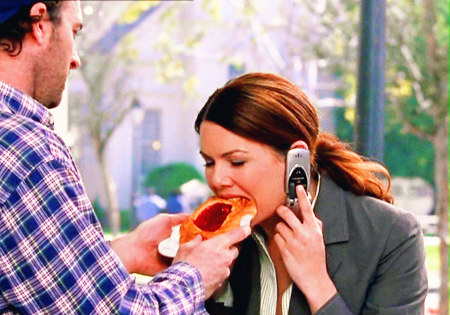
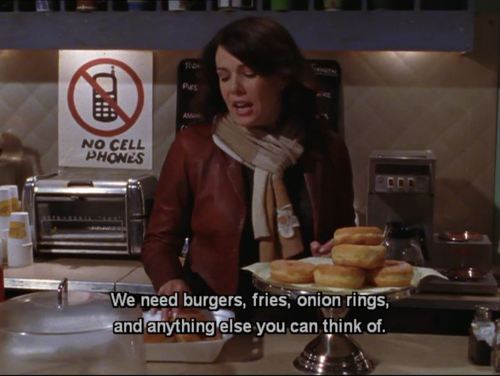
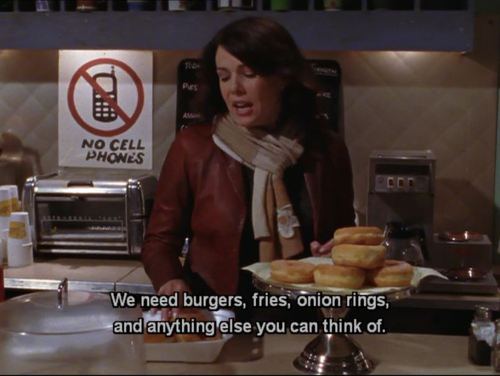
Lorelai Gilmore (Lauren Graham) in Gilmore Girls

Guest post written by Brianna Low.

Throughout Gilmore Girls’ seven seasons, mother and daughter duo Lorelai and Rory Gilmore are often seen eating vast quantities of junk food and ordering copious amounts of take out, which they consume together, often in front of the TV. From the series’ pilot episode it is made clear that neither Lorelai nor Rory have any interest in cooking, and the only things in their refrigerator are frozen fish sticks and leftover take out boxes. Their idiosyncratic approach to food is framed as just another endearing quirk instead of irresponsible, unhealthy, or an example of bad parenting.
While it could be argued that it is somewhat progressive of the Gilmore Girls series to portray two women who have no hang-ups about publicly consuming large amounts of food, it is important to remember that despite their voracious appetites, Rory and Lorelai are still conventionally attractive, thin, white women. Living in the quirky, depoliticized utopia of Stars Hollow, there is no real examination of the way in which the Gilmore’s racial and class privilege exempt them from the social condemnation that is frequently directed at poor single mothers and women of color whose food choices or weight are often criticized without any real consideration to the inequalities in accessibility to healthy, affordable food. Poor single mothers who rely on social programs like food stamps and have children who suffer from obesity and other related health problems are often publicly vilified for being irresponsible, unfit mothers despite the well-documented structural inequalities in food access and affordability.
Despite their objectively unhealthy diets, Rory and Lorelai manage to escape this specific stigma, both within the context of the show and in its outside criticism; this is due largely, I would argue, to their privilege and even the size of their bodies. While I don’t personally find it problematic that Rory and Lorelai are allowed to eat whatever they want with relative impunity, I do think it is important to place their unhealthy-diet-as-plot-device into a larger social and political context when critically examining the relationship between gender and food within the series.

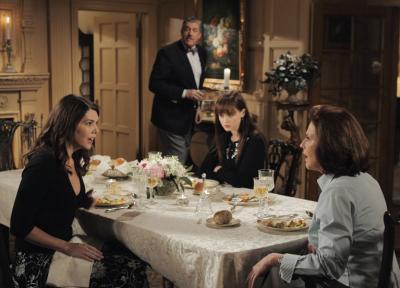
Lorelai (Lauren Graham) and Rory Gilmore (Alexis Bledel) in Gilmore Girls; image via Emily Grenfell
Lorelai and Rory are not the only ones in the Gilmore Girls universe that have well-documented relationships with food. The diets of many of the supporting cast are intrinsic parts of their identities and function as important aspects of their characterization. The mother of Rory’s best friend Lane, Mrs. Kim, is a strict vegan who makes her daughter drink salad water instead of soda. Michele Gerard, concierge of the Independence and Dragonfly Inn, is a health nut that exhibits an almost fanatical devotion to calorie counting and exercise. The diets of these characters in contrast to Rory and Lorelai’s junk food addiction seem to highlight the drastic differences in the way the Gilmore girls like to eat.

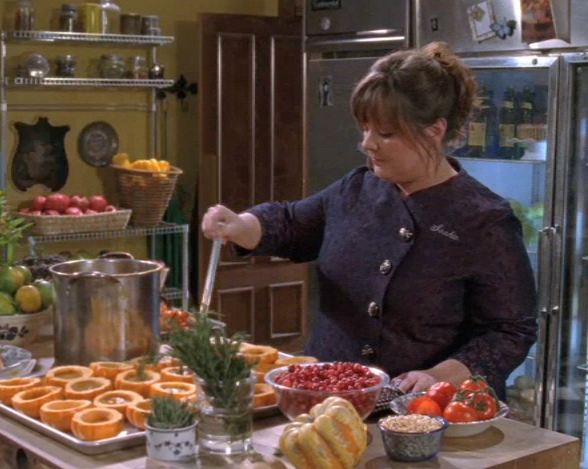
Of all of the supporting characters that are connected in some way to food, two of the most notable examples are Lorelai’s best friend and business partner, Sookie St. James, and Lorelai’s friend and romantic interest, Luke Danes. Sookie, played wonderfully by Melissa McCarthy, is the head chef and co-owner with Lorelai of the Dragonfly Inn. She is an extremely talented cook and a compassionate and loyal friend to Lorelai. Her scenes often take place in the kitchen, where she is seen cooking and dispensing advise to Lorelai. While the kitchen has always been a stereotypically feminine space, Sookie’s fixture there does not come off as regressive. Socially, the world of cooking has been sharply demarcated along gender lines, with the personal and domestic sphere belonging to women and the public and professional sphere being dominated by men. Sookie, a master chef and a woman, is portrayed as a highly skilled and respected cook who demands perfection from herself and her employees.

Sookie St. James (Melissa McCarthy) in Gilmore Girls

Much has been said about the fact that the character of Sookie, a fat woman who is often surrounded by food, is never reduced to her body-size. It’s true that Sookie is never once shamed for her size or subjected to lazy fat jokes, nor does she express any self-hatred or desire to lose weight. It is somewhat sad and telling that Gilmore Girls has received so much praise for treating a plus-sized character with humanity and compassion, but Sookie’s portrayal is indeed remarkable in a popular culture landscape that almost always essentializes fat women to their bodies and positions those bodies as barriers to happiness and love. Sookie is portrayed as an attractive, confident, and competent woman who is deserving of both romantic attention and respect. Her burgeoning relationship and eventual marriage to Jackson, a vegetable farmer, is fully explored and is not framed as some sort of miracle or only chance at love.

Luke Danes, the gruff and grumpy owner of the local diner, possesses many stereotypical markers of traditional masculinity. Seemingly unsentimental, he is often shown shouting angrily at his neighbors and even his customers, he never changes out of his flannel shirt and backwards baseball cap, and often escapes Stars Hollow on fishing and camping trips in order to relieve his stress. Despite this potentially flat characterization, Luke emerges as a complex character that does in fact care deeply about his friends and his community despite his gruff exterior. Luke is an interesting study when looking at the presentations of masculinity and food in the fictional world of Stars Hollow, particularly in the way he is cast as a nurturer who uses food in order to reach out to and comfort his friends and neighbors.

Lorelai Gilmore (Lauren Graham) in Gilmore Girls

Throughout all seven seasons Luke is often shown bringing food to the Gilmore’s when they are in need. For example, when Lorelai’s father is hospitalized after a heart attack, Luke brings food to Lorelai and her family at the hospital. Inasmuch as food can be gendered, diners and diner food fare with its burgers, fries, and malts often tend to be coded as masculine, however Luke is an interesting case in that he refuses to eat his own food. Although he is never explicitly referred to as a vegetarian, Luke is shown refusing to eat hamburgers and often refers to meat as “dead cow”. When Luke and Lorelai start dating and eventually move in together, Luke is decidedly more active in their domestic affairs, taking charge of the cooking and their home remodel. While this might not be the most shocking or unheard of example of stereotypical role reversal in heterosexual relationships, it’s definitely interesting when examining Luke and Lorelai’s relationship with food and each other.

Luke’s Diner itself is also integral to the series as it serves as the physical and communal space in which much of the community gathers. Episodes often open with Lorelai and Rory sitting and eating together in Luke’s Diner. Throughout the series, food serves as the unifying agent that brings people together. When Lorelai is unable to afford private school tuition for Rory, she goes to her wealthy parents, Emily and Richard, in order to ask them for a loan. The elder Gilmores agree to the loan, their only stipulation being that Lorelai and Rory attend weekly “Friday night dinners”. These dinners are an attempt to fix the strained relationship between Lorelai and her parents.
Gilmore Girls
Like their daughter, neither Emily nor Richard Gilmore are ever shown cooking, instead the extremely wealthy Gilmore’s have their food prepared for them by personal chefs. The class distinctions between Lorelai and her parents are blatantly obvious and are exhibited in the type of food they consume and the way in which they consume it.

Throughout its seven series run, food plays an integral role in the Gilmore Girl’s universe. While representations of food within the context of the show seemingly transcend stereotypical gender division, food and diet choice are still used to identify and characterize the different personalities that make up the world of Stars Hollow. In the words of Lorelai herself, “It takes years to learn how to eat like we do.”
———-
Brianna Low is currently a student living in Chicago. She enjoys watching movies and reading about feminism.

ABC Family’s Consumerist Christian Ethic

Creepy Christmas critters compel you to watch non-stop holiday-themed specials

ABC Family airs its corporate hamfast, 25 Days of Christmas, every December. To ease the fretful nerves of holiday-addicts, they even have a pre-countdown countdown, Countdown to 25 Days of Christmas (my redundancy nowhere near matches theirs.) If you need a fix that can’t be soothed by old classics – if you need something new, artificial with Christian platitudes intact – ABC Family has your back.

Disney understands its market. It knows how to manipulate traditional values into palatable family fun with high profit returns. And, as ABC Family is owned by Disney, they follow the family-fun exploitation model ardently.

Most of the specials they air have just been derivative rom-coms, but they have also are comfortable exposing embarrassing sequels to Rankin-Bass movies to the public. No, Rudolph the Red-Nosed Reindeer did not need to be revisited in lazy 3-D animation. It already had two sequels, anyway. We don’t need Rudolph the Red-Nosed Reindeer and the Island of Misfit Toys. We don’t need to check back in with Rudolph unless he and Hermey are entering a domestic partnership and challenging Santa’s Judeo-Christian approach to distributing goods to minors of the world.

On top of a continuous mind-melting block packed with classics reruns, jingle bells, stop-motion ice monsters and family weeping around indoor trees – ABC family also produces its own new specials yearly with C-actors (or used-to-be-almost-an-A-actor).

For whatever reason, they try mainly to appeal to an older age bracket with contrived romantic narratives. So we get the same poke-your-eyes-out story about a woman whose main concept of success is wrapped up in pursuing romantic love with a dude. And it’s called a Christmas special because mistletoe and other thematic flourishes are thrown in.

In the 12 Dates of Christmas we follow Kate Stanton (Amy Smart) as she relives the same day over and over. A holiday movie about a person inexplicably repeating their day over and ultimately learning a profound lesson about life – surely not a rip-off of anything. So, why Kate’s counterpart in Groundhog’s Day goes through stages of acceptance that mirrors philosophical growth and an acceptance of the complexities of life and what we owe the world – Kate in The 12 Dates of Christmas just really really wants to not be alone. While annoyed that she is stuck on Christmas Eve over and over again Kate doesn’t spend a lot of time considering her situation. She does sigh a lot – and even more than sigh, she looks longingly at a strong-jawed fellow while blinking glassy eyes.  

Desperately Seeking Santatried on the workaholic-woman-chooses-man-over-job trope. Jennifer Walker (Laura Vandervoort) is ambitious, but always with a sad faraway look in her eye. She’s not sure what she’s missing, but we know. To be complete, she needs a tender, but still macho, dude to romance her and restore her Christmas faith. Her job almost destroys the family business of her love interest. Don’t worry folks. She gives a speech about goodness to her money-hungry boss, shuns a promotion and rushes to the arms of hunky sensitive sexy-Santa. Of course, she’s decrying capitalist morality while being in a movie that was packaged efficiently and cheaply to make some quick bucks for ABC Family.

ABC Family is just a part of the consumerist holiday problem. They’re just playing into an existing formula that has already been embedded into our culture. But, they do it really well. And really bad.  

The Gender Situation in ‘Pulp Fiction’

Written by Leigh Kolb.To celebrate the 20th anniversary of Quentin Tarantino’s major directorial debut, Reservoir Dogs (1992) and Pulp Fiction (1994) were shown in theaters on Dec. 4 and 6, respectively, as special engagements.

While Reservoir Dogs solidified Tarantino’s spot in Hollywood, Pulp Fiction made him a star. It won the Palme d’Or at the Cannes Film Festival, the Academy Award for Best Screenplay (it was nominated for Best Picture) and John Travolta, Samuel L. Jackson and Uma Thurman were nominated for Academy Awards.
The film opens with a couple (Pumpkin/Ringo and Honey Bunny/Yolanda) eating at a diner. The two are discussing their next robbery attempt and realize robbing a restaurant would maximize their profits. The banter between the two shows that they are partners, and are in love.
As they enact their plan, they stand up with their guns. Pumpkin announces that this is a robbery, and Honey Bunny screams:

“Any of you fucking pricks move, and I’ll execute every motherfucking last one of ya!”

Honey Bunny/Yolanda, left, screams and threatens restaurant patrons as Pumpkin looks on.
The iconic sounds of “Miserlou,” by Dick Dale and His Del Tones begin, and the audience quickly realizes that unlike Reservoir Dogs, women will have a voice in Pulp Fiction.
Like Reservoir Dogs, Pulp Fiction examines masculinity–glorifying and critiquing it. Instead of conversations about women, however, women have integral roles in each of the intertwining narratives.
Vincent Vega & Marcellus Wallace’s Wife
 
When Vincent and Jules discuss the meaning of a foot rub, they are speaking about intimacy and what it means to touch a woman’s feet. The rumor is that their boss, Marcellus Wallace, had a man pushed off a building for rubbing his wife’s feet. They’re exploring something beyond a foot rub (although Tarantino himself does love feet). On some level, they’re exploring male/female interactions and levels of intimacy.
Vincent tells Jules that Marcellus asked him to take his wife Mia out, and it’s clear that this woman invokes intimidation in men. Vincent goes to Lance’s house (his drug dealer) to purchase some heroin. He self-medicates before going to pick up Mia. She’s left a note on the door to come in, and she watched Vincent enter the house on security camera footage and speaks to him over an intercom. She is god-like in this scene (and while it fits the narrative, we know that Uma Thurman is also a god/muse to Tarantino).
Mia self-medicates with cocaine, and the scene at Jack Rabbit Slim’s makes the audience feel high. Mia chooses the restaurant and made the reservation (she is in control), and the two engage in friendly banter. She was an actress, and tells him about her failed television series, Fox Force Five. Vincent confronts her about the foot rub rumor, and she denies it, pointing out that a husband protecting his wife is “one thing,” but that was ridiculous. She says:

“Truth is, nobody knows why Marsellus threw Tony out of that fourth-story window except Marsellus and Tony. When you little scamps get together, you’re worse than a sewing circle.”

Here, the men are gossiping and being “silly,” which are most often the stereotyped flaws of female characters.
The two dance in a twist competition–upon her insistance–and win the trophy. The dance itself is one in which no one really leads; they are partners.
Mia and Vincent dance as equals.
Back at the Wallace mansion, Mia finds the baggie of heroin in Vincent’s coat pocket, mistakes it for cocaine, and snorts a long line, immediately overdosing. She’s a modern-day damsel in distress, whose distress is really a simple mistake.
Vincent rushes her to Lance’s house, and Lance yells, “You fucked her up, you fix her!” But we know this isn’t the case. Again, the assumption is that the man is at fault, and the woman is helpless, but that isn’t how they end up here. Everyone bumbles around the apartment, trying to figure out the adrenaline shot (at one point Lance is in a cluttered room looking for a medical book, and the board game “Chauvinist Pigs” is perched atop a pile). No one in this scene is truly heroic or capable, which makes it feel realistic. Vincent successfully injects the adrenaline into Mia’s heart, and Vincent takes her back home. They, and we, sober up fast.
The Gold Watch
 
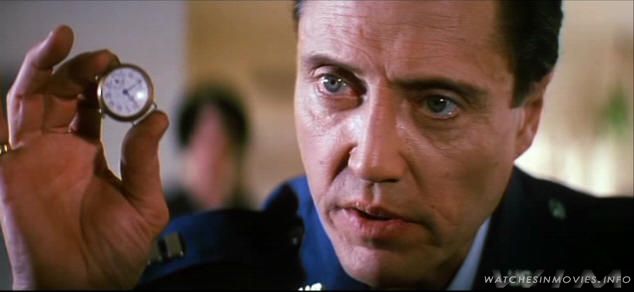
The story of the gold watch, passed down to Butch from his great-grandfather, to his grandfather, to his father and then to him, is essentially a story about the decline in traditional American manhood. By the time the watch got to Butch’s father in the Vietnam War, he was a POW and had to “hide it in his ass” for years so he could pass it down to his son. The shift in American war culture/patriotism between WWII and Vietnam was stark. The “Greatest Generation” of American men in the second world war gave birth to boys who would serve in Vietnam, a war that utilized a draft and was met with protest and hostility. By the time Butch becomes an adult man, he is fighting, yes, but for money and not his country. His war is internal, and devoid of the heroism from a few generations ago. (This crisis of a lack of clearly defined masculinity is the cornerstone of Gen X novels/films such as Fight Club, which explores at length this generation of young men with no great war.)
Captain Koons presents a young Butch with his father’s watch.
Butch’s desperation to have that gold watch with him, even eventually risking his life to do so, is indicative of his desperation to hold on to this generationally diluted manhood.
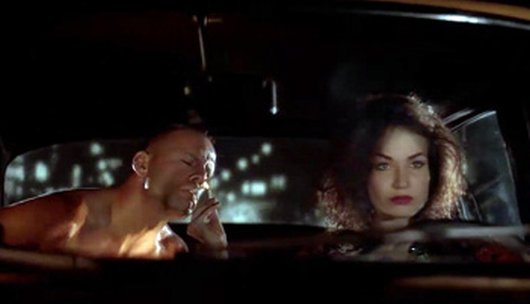
Butch doesn’t throw the fight that he’d fixed with Marcellus, and instead wins and accidentally kills his opponent. In the getaway cab ride, the female cab driver asks him what it’s like to kill a man, because it’s a subject she’s “very interested” in. She seems more interested than he does, in fact.
Esmerelda lights Butch’s cigarette.
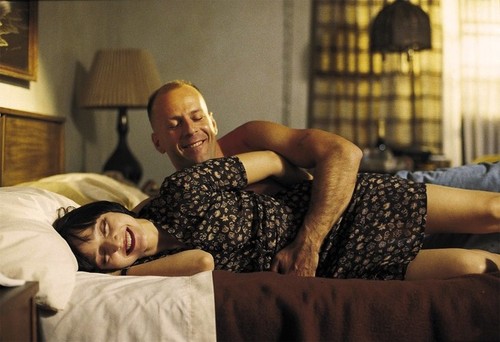
When he’s back at the hotel room with his girlfriend Fabienne, the two share intimate moments and comedic dialogue. Fabienne seems silly and child-like, but Butch is sweet and respectful to her (although he erupts when he realizes she’s forgotten the watch, he quickly apologizes and says he was to blame). As she’s lying on the bed wishing for a pot belly, she says:

“I don’t give a damn what men find attractive. It’s unfortunate what we find pleasing to the touch and pleasing to the eye is seldom the same.”

Fabienne and Butch.
She requests and receives “oral pleasure” from Butch, and in the hotel room scenes, the audience sees more of Butch’s body than Fabienne’s. Again, she seems naive and childish, but their relationship is equitable and for the most part, enjoyable to watch. Maybe Butch has a similar innocence, but it is well-guarded under his outward masculinity.
The next morning, when he flies into a rage about the watch, warfare and explosions blast on the television in their room, another reminder of the distance between Butch and that celebrated masculine pastime.
He goes off on a quest to retrieve the gold watch before they flee to Knoxville (since Marcellus will be trying to find him and kill him for not throwing the fight). He takes off in a Honda hatchback, and gets to his apartment. Vincent is already there, sent to kill him, but he’s on the toilet reading Modesty Blaise, who debuted as a female action hero in a comic strip, collection of stories/novel and films of the same name in the 1960s. (Tarantino is a Blaise fan, and certainly Kill Bill‘s The Bride shares many similarities with the female protagonist.)
Modesty Blaise, a 1960s crime series with a female protagonist.
Butch picks up Vincent’s gun and kills him as he steps out of the bathroom. When he escapes, he runs into Marcellus (women flock to the sides of Butch and Marcellus to help them), and the two end up in a depraved dungeon of a pawn shop with a racist owner. When Butch breaks free as Marcellus is being raped by security guard Zed, he can’t leave. He goes back down and kills the shop owner with a sword, and breaks Marcellus free (who then shoots Zed in the groin). There are obvious masculinity issues here, from the anal rape (my gosh what would Freud do with Butch’s narrative) to the phallic sword, Marcellus and Butch agree that they are even, and Butch will never utter a word about the rape.
Butch takes off on Zed’s motorcycle and arrives back to pick up Fabienne. Some kind of post-modern manhood has been achieved, and he’s free to go on–with the gold watch.
The Bonnie Situation
 
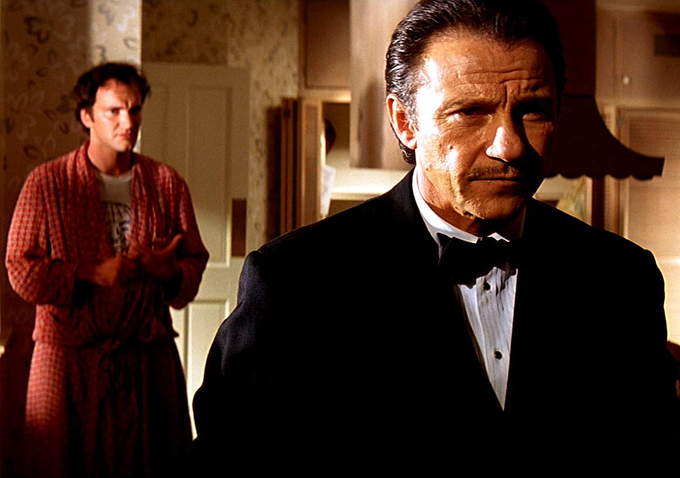
When Jules and Vincent are saddled with the problem of a dead man in their car, they turn to Jimmie and go to his house. He is adamant that they take care of their situation soon, because his wife Bonnie is about to come home. He says:

“Now don’t you fucking realize man that if Bonnie comes home and finds a dead body in her house, I’m gonna get divorced, all right. No marriage counselor, no trial separation. I’m gonna get fuckin’ divorced. Okay? And I don’t wanna get fuckin’ divorced. Now then, you know, I mean, I wanna help you but I don’t wanna lose my wife doin’ it, all right.”

This honest admission of a husband who doesn’t want to lose his wife is refreshing. She’s not a nag, she’s not a bitch, but she’s his wife and he wants to be married to her.
Marcellus calls Winston “The Wolf” Wolfe, who is the antithesis of Jimmie. The Wolf is partying with glamorous women at 9 a.m., clearly living like James Bond and speeds to Jimmie’s in a silver sports car. Jimmie is waiting for his wife to get home from work, brews fancy coffee and is hesitant to give The Wolf their best linens to clean up the mess. As a trade, The Wolf gives him a stack of bills to buy themselves a new bedroom set.
Jimmie’s “feminine” tendencies and The Wolf’s classic masculinity complement one another.
These two men–Jimmie and The Wolf–exist in opposite worlds and diametrically opposing masculinities. However, the two of them working together solves problems. This acceptance of and need for different shades of stereotypical masculinity and femininity reminds the audience that Tarantino is aware and critical of gender performance.
When they drop the cleaned-out car to Monster Joe’s Truck and Tow, Joe’s daughter Racquel comes to meet them. The Wolf says, “Someday, all this will be hers.” This is a nod to the next generation of gender roles–whether it be women running junk yards, crime rings or killing sprees, Tarantino’s women are not shut in dainty boxes.
Racquel, the heiress to Monster Joe’s Truck and Tow.
During the epilogue, we are again in the diner where Pumpkin and Honey Bunny/Yolanda are holding up the customers. Vincent and Jules are there (Vincent is in the bathroom during most of the scene), and Jules engages in a stand-off between the two while trying to talk Pumpkin out of doing what they’re doing. He allows them to collect the customers’ cash without hurting anyone. Yolanda becomes unhinged and pitiful in this scene, and a viewer may be dismayed at Tarantino’s decision to make the woman fall apart at this very moment, and that this shows her weakness. However, we must realize that many of the characters throughout the film have shown fallibility or been in positions of weakness (Vincent’s self-medication and debilitating nerves about Mia, Mia’s overdose, Marcellus’s sexual assault and Jimmie’s anxiety about his wife). This does not mean anything except that the characters are human.
Jules and Vincent have been scrubbed clean and left to look like “dorks,” somehow emasculated without their black suits.
Humans are not one-dimensional caricatures. They commit crimes, they overdose, they are racist, sexist and complex. As long as men and women alike are portrayed in all aspects of the human experience in a film and are reflections of reality (no matter how unpleasant that reality is), then authenticity can be achieved. Pulp Fiction, in all of its gore, turns a critical eye on masculinity and femininity and offers a more nuanced take on its male and female characters than films of similar genres. And as Tarantino’s later films went on to have female characters who take active and leading roles, The Wolf was right in pointing out that “all this” will someday be a woman’s, too.


Leigh Kolb is a composition, literature and journalism instructor at a community college in rural Missouri. 

Twenty Years Later: ‘Reservoir Dogs,’ Masculinity and Feminism

Written by Leigh Kolb.

Quentin Tarantino’s Reservoir Dogs turned 20 this year, and was re-released in select theaters on Tuesday, Dec. 4.
In the introductory interviews that preceded the feature film, actor Eli Roth said that what was most powerful to him in Reservoir Dogs was that “Everybody had a voice.”
Discerning viewers may, at this point, remember that there are no women who have voices in the film. Women are talked about at length, but aren’t players in the film.
However, by analyzing these discussions about women and looking closer at the masculinity of the characters, one can certainly come to the conclusion that Tarantino has a nuanced view of gender and is a feminist filmmaker.
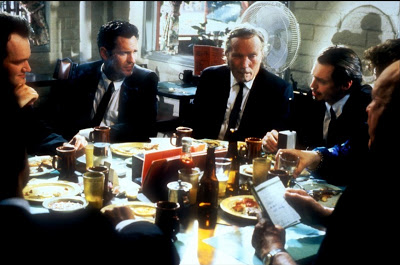
In the opening diner scene, the men are discussing the true meaning of Madonna’s “Like a Virgin.” Most of the men reflect upon their varying degrees of fandom for Madonna. Mr. Brown delivers a brutally vivid description about how he thinks the song is all about a big dick (“dick, dick, dick, dick, dick…”) and making a woman who has had a lot of sex feel like she’s having sex for the first time again. While the language is crass, there’s no clear judgment of the woman in question, or applause for the well-endowed man. It’s just a song analysis.
The diner conversations illuminate misunderstanding of and respect or disrespect for women.
At the very least, the topic Tarantino chooses to open his film with is intriguing. Their understanding, or misunderstanding, of women shows up again a few minutes later, when Eddie brings up K-Billy’s Super Songs of the 70s, and the fact that he’d never realized that in “The Nights the Lights Went Out in Georgia,” the female narrator is the one who kills Andy. Again, they analyze and comment on song lyrics that are sung by women and center around a woman. They are–on some level–interested in understanding women.
The tipping scene at the diner is integral in showing the audience how we are supposed to feel about certain characters. When Mr. Pink adamantly refuses to tip, and goes on a tirade against tipping, Mr. White says:

“These people bust their ass. This is a hard job… Waitressing is the number-one occupation for female non-college graduates in this country. It’s the one job basically any woman can get and make a living on. The reason is because of their tips.”

“Fuck all that,” Mr. Pink says, later adding that “This non-college bullshit, I got two words for that: Learn to fuckin’ type.”
A few minutes into the film, we think that Mr. Pink is an asshole and Mr. White is compassionate. And we’re right. The characters have been shaped during this exposition by their thoughts about women. The less they respect and understand women, the less we are supposed to respect them.
Mr. Orange gets shot when he attempts to carjack a woman (“Who’d have fuckin’ thought that?” he cries, while bleeding in the back of Mr. White’s car) and she shoots him. He then kills her. His instinct is to think the woman in the vehicle is helpless and would be easily overtaken, but he was wrong.
There are various scenes during flashbacks that further explore issues of women and femininity. Mr. White tells Joe that he and his former partner, Alabama, split up due to tensions of pushing “that woman-man thing to far,” but he also adds that she was a really good thief. Mr. Orange (an undercover cop mentored by a black man) concocts a story in which a woman is his drug dealer. Mr. Pink whines about the feminine moniker assigned to him (“It sounds like Mr. Pussy”). Mr. Blonde and Eddie wrestle and spar, showcasing their over-hyped masculinity and their different stations (Mr. Blonde having just been released from prison, and Eddie being the coddled son of Joe, the boss). Mr. Pink’s simplistic views on black women and white women leads Eddie to delve into a story about a cocktail waitress who glued her abusive husband’s penis to his stomach.
The women in Reservoir Dogs exist almost completely off screen, but they wield power in their stories (and literally in their actions, in the case of the woman who shoots Mr. Orange).
Originally, Tarantino had a female police officer briefly appear in the film (this scene is on a special edition DVD extras disc). The absence of female characters doesn’t make the film anti-feminist, though (in fact, considering Tarantino’s treatment of most of his police officers, a female cop may not have done much for the feminist argument).
Reservoir Dogs is not just a violent film about a diamond heist-gone-bad. And while its discussion of women helps the audience to navigate the characters, what makes this film truly feminist is its deconstruction of masculinity.
Analyses have focused on the homoerotic nature of Mr. Orange and Mr. White’s relationship, and of  the demonstration of “new queer cinema” theories present in the film. On its surface, this is a film entirely dedicated to white heterosexual masculinity–from the sharp black suits, to the guns, to the violence, to the racism–but that masculinity is largely a show.
Mr. Orange and Mr. White, however, both embody the most stereotypically feminine traits of their colleagues. Mr. White is the nurturer, and Mr. Orange the child, pleading for Mr. White to “hold” him and take care of him. They both share vulnerability, their names and are physically close and intimate. They cry together.
Mr. White comforts and nurtures Mr. Orange. He is heroic because of this.
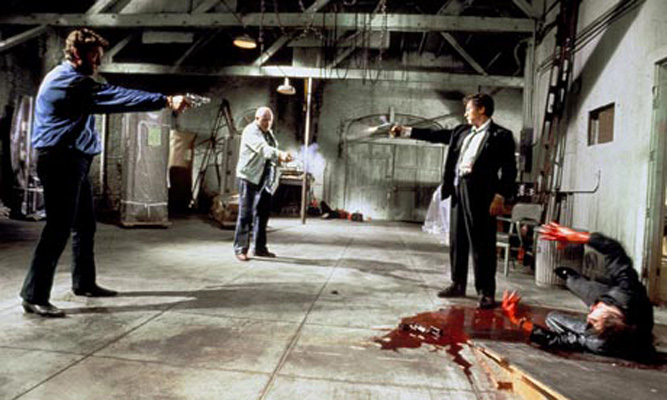
In one of the final scenes where Joe, Eddie and Mr. White are in a triangular stand-off. This shot in itself provides interesting commentary on traditional masculinity and the threat that deviations prove to be to those in charge. Eddie is protecting his “Daddy,” Joe is protecting his patriarchal business and Mr. White is protecting Mr. Orange. Mr. White (“Mr. Fucking Compassion,” Eddie calls him) is the most empathetic and kind, and he wins that battle.
From left, Eddie, Joe, Mr. White and Mr. Orange.
And while no one wins in the end, Mr. Orange and Mr. White come the closest. They survive the longest (if we agree that Mr. Pink is shot as he escapes), and if the audience sees anyone in this film as heroic, it is them. As the cops are coming into the warehouse, Mr. Orange tells Mr. White that he is an undercover cop, and Mr. White is clearly devastated, and pained when he goes to kill Mr. Orange (which his professional code dictates that he must).
The peripheral value of women and the value of the feminine provide a strong, feminist subtext to Reservoir Dogs.
Before the Dec. 4 screening, there were the aforementioned interviews, and there were also previews hand-picked from Tarantino’s collection: Mean Streets; Mother, Jugs & Speed and The Duellists. Harvey Keitel (Mr. White) is in all of these films.
When Tarantino and his friend and producer, Lawrence Bender, were starting the process of making Reservoir Dogs, they were asked who their top choice would be if anyone in the world would be in the film. They answered with “Keitel,” although they realized that would never happen. Bender’s acting coach knew that his wife, Lily Parker, worked with Keitel at the Actor’s Studio, so they gave her a script. Parker loved it, so she gave it to Keitel, and he was on board.
Between Parker’s power and the incredible contributions of Tarantino’s long-time editor, Sally Menke (she worked with him until her death in 2010), one could go so far as to say that Reservoir Dogs as we know it exists because of women.
In any case, feminists should not shy away from Tarantino’s work (even if we can’t sufficiently answer whether or not Tarantino is a feminist–which I believe he is); instead, we should note the power of the women in his films (as Bitch Flicks has in the past), the power of the women who are not in his films, the power of the women who make his films happen and the power of deconstructing and commenting on American masculinity.


Leigh Kolb is a composition, literature and journalism instructor at a community college in rural Missouri. 


Six Essential Christmas Specials

This Christmas will be my second in a row spent 5000 miles away from my family and the happy, traditional celebrations that characterized the first 21 Christmases of my life. I am feeling pretty okay about this, though, because I’ve discovered the essential ingredients for Christmas to be Christmas. They’re not family or presents or a big meal or the baby Jesus. As it turns out, all I really need to get into the holiday mood is my little list of essential Christmas viewing.
This is an exact depiction of the Lukan birth narrative, right? Look, I’m a theologian, not a biblical scholar.
For your viewing pleasure – particularly if you are far distant from family traditions – I share with you my Six Things To Watch Otherwise It’s Not Christmas.
(Sorry, Die Hard not included.)
Mystery Science Theater 3000 season 5 episode 21: “Santa Claus”
This is a deeply, profoundly, horrendously painful movie to watch. If you ever wanted to watch Saint Nick best Old Nick, where Saint Nick is the creepiest non-serial-killer Santa in cinematic history while the devil is just flat-out incompetent, then there’s something very very wrong with you, but there’s also a movie that caters directly to your reprehensible tastes. For everyone else, enjoy that endless beginning sequence of Santa’s sweatshop flagrantly flouting child labor laws – a timely reminder that the gifts you give and receive this holiday season were probably made by actual child laborers in actual sweatshops. Merry Christmas!
 Also, the best holiday song ever.

Mystery Science Theater 3000 season 3 episode 21: “Santa Claus Conquers the Martians”
This one, on the other hand? Is just so stupid, I can’t even. Yes, it is literally a movie about Martians kidnapping Santa Claus. Yes, it’s terrible on every conceivable level. And yet, to my shame, I find it immensely watchable. Honestly, if this movie had never appeared on MST3K, I would probably watch it every year anyway. Luckily, it was not only featured on MST3K, it was re-riffed by the same team with all-new jokes a couple years ago, which means I get to watch it twice without looking like a person who enjoys watching this movie.
 Also, the second-best holiday song ever.
The Muppet Christmas Carol
I don’t need to say anything about this. It’s The Muppet Christmas Carol. Who ever heard of a Christmas without The Muppet Christmas Carol?
Pictured: Christmas.
A Colbert Christmas: The Greatest Gift of All!
I’ll be honest, the rewatch value on Stephen Colbert’s 2008 Christmas special is not that high, and your patience for the songs is likely to vary wildly depending on your ability to stomach the assorted musical guests. (Goddamn, the Toby Keith bit is painful.) But the opening number is pretty great, and I sometimes have these cynical moments when “There Are Much Worse Things To Believe In” is my favorite Christmas song ever.
Community season 2 episode 11: “Abed’s Uncontrollable Christmas”
So what if it’s only two years old? It’s super amazing forever! Songs! Feelings! Stop-motion, of which it is legally mandated that every list of favorite Christmas specials must include at least one! The Christmas pterodactyl! Also, it’s freaking Community!!
Did you know it’s coming back on February 7???


The Snowman
A very British entry to round out the list. If you’re unfamiliar with The Snowman, it’s a short, wordless, entirely lovely animated film about a boy whose snowman comes to life. You should watch it this Christmas and have a good cry.
Happy hols, everyone!
Max Thornton blogs at Gay Christian Geek, and is slowly learning to twitter at @RainicornMax.

‘Once Upon a Time,’ Women Were Friends


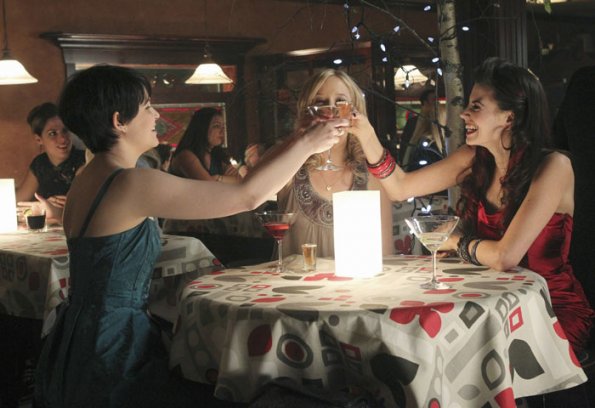
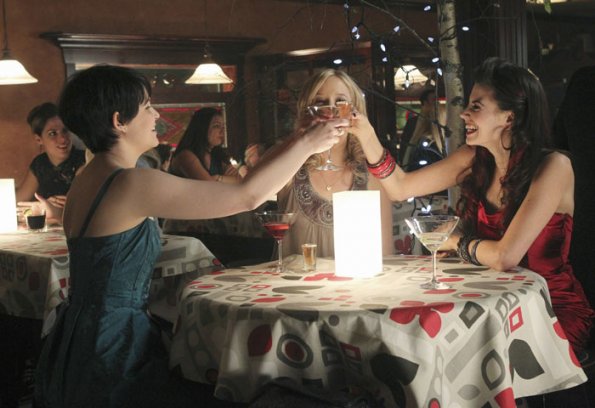
Mary Margaret (Ginnifer Goodwin),  Ashley (Jessy Schram), and Ruby (Meghan Ory) enjoy a girls’ night out
Written by Lady T.
Once Upon a Time, last year’s big ABC hit now in its second season, is like Lost with fairy tale characters. Created by two former Lost writers, Once Upon a Time is also a show about strangers in a strange land, with only a few key characters aware of the world’s rich history. Both shows combine flashbacks and present-day stories to portray how characters have changed over time. Both shows slowly reveal bits and pieces of the mythology and backstory in a non-chronological fashion. Both shows combine fantastical situations with real-life emotions, and emphasize the importance of community.

There is one way, however, where Once Upon a Time is far superior to Lost: its portrayal of female friendships. As the show becomes more complex in its mythology and introduces more characters, we see even more positive interactions among women.

One of the first relationships we’re introduced to is the strange friendship between Emma Swan (Jennifer Morrison) and Mary Margaret Blanchard (Ginnifer Goodwin). Their friendship is a little unusual because Mary Margaret is, in fact, Snow White with an altered memory, and Emma’s mother. (Mary Margaret/Snow has been frozen in time while Emma has not, which explains why the mother and daughter are the same age.) They strike up a friendship when Emma moves to the town of Storybrooke at the request of her biological son, Henry. Neither woman believes Henry’s fantastical tales about every person in Storybrooke being a fairy tale character, but they quickly grow to like each other. Mary Margaret provides Emma with a home when she needs it, they discuss their failed relationships with men, and when the town turns against Mary Margaret when she is accused of murder, Emma alone continues to defend her.

Now that the spell on Storybrooke has been broken, Emma and Snow are aware of each other’s identities. Snow’s maternal instincts have kicked in, and she is much more protective of Emma, but neither woman has forgotten their previous bond. Their mother-daughter relationship is now on even firmer ground because of the friendship they established before the spell was broken, and watching them rediscover each other has been a heartwarming joy to watch. 
Mother and daughter, together again (Jennifer Morrison and Goodwin)
Still, it’s no surprise that Snow White is able to have a good relationship with her daughter, because she has a history of valuing her friendships with women. Several flashbacks on Once Upon a Time have shown that Snow has a casual but supportive friendship with Cinderella (Jessy Schram), and a deep and fulfilling friendship with Red Riding Hood (Meghan Ory). When Once Upon a Time throws a twist in the traditional fairy tale and reveals that Red and the Big Bad Wolf are, in fact, the same person, Snow supports her friend through her changes and doesn’t judge her for her wolf side. Red, for her part, helps Snow in her quest to rescue Prince Charming. (Another cool thing about Once Upon a Time? The women rescue the men just as often as the men rescue the women.) 
Red, for her part, is also loyal to Cinderella’s Storybrooke counterpart, Ashley (see what they did there, with the naming?) While Snow and Emma are briefly trapped in the enchanted forest, Red quickly bonds with Belle (Emilie de Ravin), helping her ease the transition into a more steady, normal life. Red may be separated from her bestie, but she still makes new friends.
BFFs for life (Goodwin and Ory)
Perhaps the best example of the complex female relationships on the show can be found in the first part of this sophomore season, where four women traveled through the forest on a quest together. Two new characters, Princess Aurora (Sarah Bolger) and Mulan (Jamie Chung). The women, at first, are rivals who are both in love with Prince Philip, but after a wraith sucks out his soul, they quickly bond in a shared goal to punish the people who let the wraith into their world – Snow and Emma.
The outlook is bleak for this new friendship, as Mulan and Aurora first see Snow and Emma as enemies, but this changes very quickly. Aurora soon understands that Snow is not at fault for what happened to her beloved Philip, and the women find common ground, as they have both been victims of the terrible Sleeping Curse. The mother-daughter team and Aurora/Mulan trek across the forest, with different goals that sometimes clash with each other – Snow and Emma want to return to Storybrooke, and Mulan wants to keep Aurora safe – but in the end, they all succeed by working together.
Forget Philip – I ship THIS (Sarah Bolger and Jamie Chung)
The quest across the forest was satisfying to me on so many different levels. I loved seeing four women travel together as a group. I loved that Aurora and Mulan’s love for the same man bonded them together instead of tearing them apart (though, to be honest, I’d rather see the two women as a couple at this point). I loved that each woman had different ways of contributing to the mission – Snow and Mulan through fighting skills and physical dexterity, Emma through strategizing and working with the enemy (the disturbingly sexy Captain Hook), and Aurora through communication in the netherworld. I loved that their conflicts were organic to the characters and situations, not stereotypical catfights among competitive women. 
Most of all, I loved that Once Upon a Time took characters from different fairy tales and classic stories, characters who have traditionally lived in male-centric stories with female villains, and made them discover complex and varied female bonds. They find strength in themselves and with each other.
The trek across the forest is now over, and I’m happy to see Snow/Emma reunited with their family, but I hope this isn’t the end of female bonding in Once Upon a Time. I hope and trust that the writers are only going to show more examples of women interacting positively with other women. 
Princesses, doin’ it for themselves…
Lady T is a writer with two novels, a play, and a collection of comedy sketches in progress. She hopes to one day be published and finish one of her projects (not in that order). You can find more of her writing at www.theresabasile.com.

‘Once Upon a Time,’ Women Were Friends


Mary Margaret (Ginnifer Goodwin),  Ashley (Jessy Schram), and Ruby (Meghan Ory) enjoy a girls’ night out
Written by Lady T.
Once Upon a Time, last year’s big ABC hit now in its second season, is like Lost with fairy tale characters. Created by two former Lost writers, Once Upon a Time is also a show about strangers in a strange land, with only a few key characters aware of the world’s rich history. Both shows combine flashbacks and present-day stories to portray how characters have changed over time. Both shows slowly reveal bits and pieces of the mythology and backstory in a non-chronological fashion. Both shows combine fantastical situations with real-life emotions, and emphasize the importance of community.

There is one way, however, where Once Upon a Time is far superior to Lost: its portrayal of female friendships. As the show becomes more complex in its mythology and introduces more characters, we see even more positive interactions among women.

One of the first relationships we’re introduced to is the strange friendship between Emma Swan (Jennifer Morrison) and Mary Margaret Blanchard (Ginnifer Goodwin). Their friendship is a little unusual because Mary Margaret is, in fact, Snow White with an altered memory, and Emma’s mother. (Mary Margaret/Snow has been frozen in time while Emma has not, which explains why the mother and daughter are the same age.) They strike up a friendship when Emma moves to the town of Storybrooke at the request of her biological son, Henry. Neither woman believes Henry’s fantastical tales about every person in Storybrooke being a fairy tale character, but they quickly grow to like each other. Mary Margaret provides Emma with a home when she needs it, they discuss their failed relationships with men, and when the town turns against Mary Margaret when she is accused of murder, Emma alone continues to defend her.

Now that the spell on Storybrooke has been broken, Emma and Snow are aware of each other’s identities. Snow’s maternal instincts have kicked in, and she is much more protective of Emma, but neither woman has forgotten their previous bond. Their mother-daughter relationship is now on even firmer ground because of the friendship they established before the spell was broken, and watching them rediscover each other has been a heartwarming joy to watch. 
Mother and daughter, together again (Jennifer Morrison and Goodwin)
Still, it’s no surprise that Snow White is able to have a good relationship with her daughter, because she has a history of valuing her friendships with women. Several flashbacks on Once Upon a Time have shown that Snow has a casual but supportive friendship with Cinderella (Jessy Schram), and a deep and fulfilling friendship with Red Riding Hood (Meghan Ory). When Once Upon a Time throws a twist in the traditional fairy tale and reveals that Red and the Big Bad Wolf are, in fact, the same person, Snow supports her friend through her changes and doesn’t judge her for her wolf side. Red, for her part, helps Snow in her quest to rescue Prince Charming. (Another cool thing about Once Upon a Time? The women rescue the men just as often as the men rescue the women.) 
Red, for her part, is also loyal to Cinderella’s Storybrooke counterpart, Ashley (see what they did there, with the naming?) While Snow and Emma are briefly trapped in the enchanted forest, Red quickly bonds with Belle (Emilie de Ravin), helping her ease the transition into a more steady, normal life. Red may be separated from her bestie, but she still makes new friends.
BFFs for life (Goodwin and Ory)
Perhaps the best example of the complex female relationships on the show can be found in the first part of this sophomore season, where four women traveled through the forest on a quest together. Two new characters, Princess Aurora (Sarah Bolger) and Mulan (Jamie Chung). The women, at first, are rivals who are both in love with Prince Philip, but after a wraith sucks out his soul, they quickly bond in a shared goal to punish the people who let the wraith into their world – Snow and Emma.
The outlook is bleak for this new friendship, as Mulan and Aurora first see Snow and Emma as enemies, but this changes very quickly. Aurora soon understands that Snow is not at fault for what happened to her beloved Philip, and the women find common ground, as they have both been victims of the terrible Sleeping Curse. The mother-daughter team and Aurora/Mulan trek across the forest, with different goals that sometimes clash with each other – Snow and Emma want to return to Storybrooke, and Mulan wants to keep Aurora safe – but in the end, they all succeed by working together.
Forget Philip – I ship THIS (Sarah Bolger and Jamie Chung)
The quest across the forest was satisfying to me on so many different levels. I loved seeing four women travel together as a group. I loved that Aurora and Mulan’s love for the same man bonded them together instead of tearing them apart (though, to be honest, I’d rather see the two women as a couple at this point). I loved that each woman had different ways of contributing to the mission – Snow and Mulan through fighting skills and physical dexterity, Emma through strategizing and working with the enemy (the disturbingly sexy Captain Hook), and Aurora through communication in the netherworld. I loved that their conflicts were organic to the characters and situations, not stereotypical catfights among competitive women. 
Most of all, I loved that Once Upon a Time took characters from different fairy tales and classic stories, characters who have traditionally lived in male-centric stories with female villains, and made them discover complex and varied female bonds. They find strength in themselves and with each other.
The trek across the forest is now over, and I’m happy to see Snow/Emma reunited with their family, but I hope this isn’t the end of female bonding in Once Upon a Time. I hope and trust that the writers are only going to show more examples of women interacting positively with other women. 
Princesses, doin’ it for themselves…
Lady T is a writer and aspiring comedian with two novels, a play, and a collection of comedy sketches in progress. She hopes to one day be published and finish one of her projects (not in that order). You can find more of her writing at The Funny Feminist, where she picks apart entertainment and reviews movies she hasn’t seen.

On Sex, Disability, and Helen Hunt in ‘The Sessions’

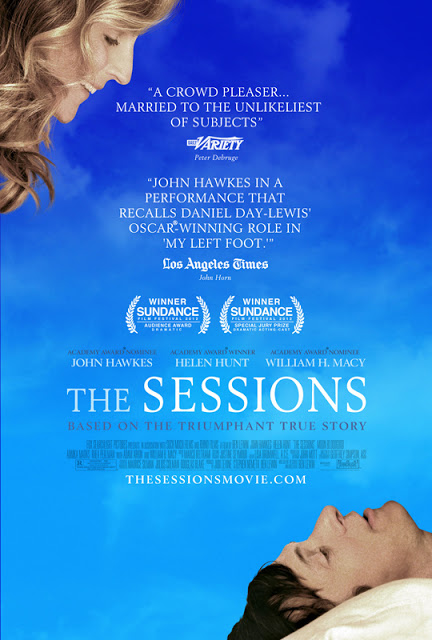
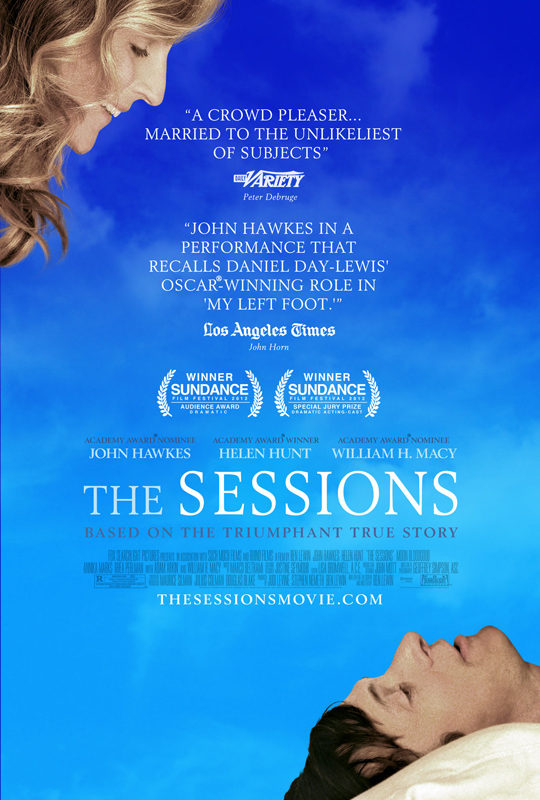
Movie poster for The Sessions

Written by Stephanie Rogers


I hadn’t heard of Mark O’Brien before I saw The Sessions. I only knew that the film starred John Hawkes (of Deadwood, Winter’s Bone, and Martha Marcy May Marlene fame) and Helen Hunt, who I’ve always admired because of her role as the rebellious, dance-obsessed Lynne Stone in the 1985 film Girls Just Want to Have Fun. I was seven years old when I saw that shit, and I’d now consider it one of my first introductions to (somewhat problematic) pop culture feminism. I refuse to let go of it. Also, Helen Hunt was in Twister, a movie about storm chasers who say stuff like, “It’s coming! It’s headed right for us!” and “Debris! We got debris!” Oh yeah, and she won that Best Actress Oscar for As Good As It Gets in 1997.

What I’m trying to say is: Helen Hunt is awesome.

Her latest Sundance Film Festival hit is based on an essay Mark O’Brien wrote for The Sun called, “On Seeing a Sex Surrogate,” which chronicles his experience losing his virginity in his late thirties. Hunt plays Cheryl Cohen Greene, the sex surrogate, and Hawkes plays O’Brien, a man who contracted polio at the age of six and became paralyzed except for limited use of muscles in his right foot, neck, and jaw. He couldn’t spend more than a few hours outside of an iron lung (a metal chamber that forces the lungs to inhale and exhale) and, despite that fact, went on to earn a graduate degree in journalism from UC Berkeley—by traveling back and forth between the university and the iron lung at home. With the ability to move only his head, he wrote articles and poems by holding a stick in his mouth and tapping out letters on a computer.

The audience learns all this within the first ten minutes of the film, and that’s about the time I started telling myself to stop going through life like a lazy fuck. 

Helen Hunt as Cheryl Cohen Greene and John Hawkes as Mark O’Brien in The Sessions

That’s some pretty intense subject matter … not me being a lazy fuck—that’s for my therapist and me to work out SOMEDAY—but the serious exploration of a disabled man’s sexuality. While the focus remains on O’Brien throughout, The Sessions also gives us several comedic moments with other physically disabled characters as O’Brien interviews them for an article he’s writing about the sex lives of the disabled. I can’t tell you how refreshing it was to see an on-screen depiction of people with disabilities who do things like omg have sex and who also enjoy talking candidly and unapologetically about having sex. O’Brien’s reactions are hilarious; he gets fairly embarrassed and weirded out during the interviews, but the stories he hears ultimately empower him to think seriously about his own sex life, or lack thereof.

Enter the inimitable William H. Macy (yes!). He plays O’Brien’s priest, Father Brendan, who listens to O’Brien’s confessions every day while guiding him through the guilt he feels about seeking out a sex surrogate. That relationship soon evolves (once O’Brien begins spending time with the surrogate) into more of a friendship, and it’s wonderful to see those lines blurred; watching Macy go from praying with O’Brien in church for the first half of the film to showing up in sweats with a six-pack at O’Brien’s house in the later half got the whole theater cracking up. That friendship grounds the film and keeps it from veering into sentimental territory; the audience looks forward to their light-hearted conversations about some truly heavy subject matter. At the same time, their friendship adds emotional depth to the characters. We realize it isn’t just O’Brien’s physical disability that complicates his sexual exploration, but his Catholic faith as well. These two immensely likeable men clearly like each other—and their pontifications about the role of religion in their lives, and what God will and won’t forgive—keeps this from turning into yet another film about a dude just trying to get laid. 

William H. Macy as Father Brendan and John Hawkes as Mark O’Brien in The Sessions

Before seeing the movie, I hadn’t heard about sex surrogates. The real Ms. Greene (who still practices at the age of 68) describes the difference between her profession and prostitution as follows

If you go to a prostitute, it’s like going to a restaurant. You read the menu, you choose what you want, they prepare, they hope that you love it, and hopefully you want to come back.

With a surrogate, it’s like going to cooking school. You get the ingredients, you learn to make a meal together—and then the point is to go out into the world and share that and not come back.

I love that explanation, mainly because it doesn’t denigrate prostitutes (or sex workers in general). From what I’ve read, the people who appear to take issue with the sex surrogate profession are running around like, “… but … but … PROSTITUTION WHORES SLUTS BURNING IN HELL,” and regardless of what one thinks about prostitution as a profession, I hope we can all agree that it’s a much more complicated issue than “Prostitution bad. Waiting till marriage for sex good.” (For me, personally, it boils down to the question, “What more can we do to keep sex workers safe?” But, yeah.) 

Helen Hunt as Cheryl Cohen Greene in The Sessions

Most reviews I’ve read of The Sessions focus on Hawkes’ ridiculously good performance as O’Brien—after all, his acting essentially comes from nothing more than his voice and facial expressions. Oscar nomination? Probably. But I’d like to focus on the women in the film, particularly Hunt’s portrayal of Cheryl Cohen Greene.
Helen Hunt ultimately brought The Sessions to life for me. She treats O’Brien with such care, both emotionally and physically, while always maintaining a directness with him that undercuts any potential melodrama. One of my favorite scenes in the film happens right after O’Brien’s first, very brief moment of vaginal penetration. Afterward, he asks, “Did you come, too?” to which she responds, “No, Mark, I didn’t.” I fell in love with the film right then; the innocence of his question and the honesty of her response created more intimacy than most faux-passionate, desperation-filled Hollywood sex scenes could ever hope for.

And that’s the thing about Hunt’s performance. Hawkes, while indisputably great, wouldn’t be half as good in this role if he weren’t playing opposite Helen Hunt. She portrays Greene as confident and self-assured, with no lacy-underweared attempts at sexiness, and with only a tinge of sweetness. This isn’t a film about seduction. It’s mechanical and complicated and wonderful—at one point he has to stop performing cunnilingus because he can’t breathe; at another, she goes to the bathroom in front of him with the door open. Though she forges a strong bond with O’Brien emotionally, the goal always lingers: to help him lose his virginity and help him discover new ways to use and appreciate the human body, his own especially. Hunt says as much in an interview with the L.A. Times

Maybe it all gets blurry near the end for a second … But I think that’s life—you can have some errant arrow prick your heart, but these two characters have an intention to keep to their mandate that this all is supposed to serve him. And both of them stick to that, painful as it is.

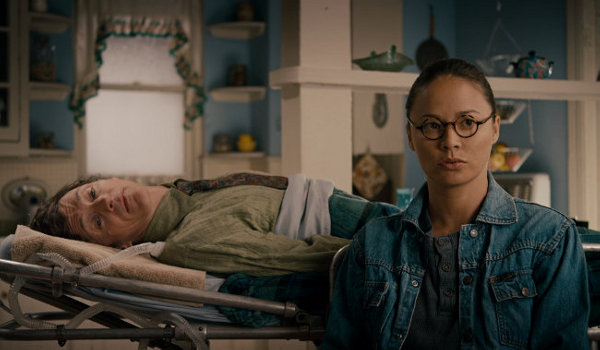
John Hawkes as Mark O’Brien and Moon Bloodgood as Vera in The Sessions

I’d like to say that all the women in the film were as wonderfully fleshed out and complex as Hunt’s character, but that isn’t true. O’Brien works with three women caretakers throughout, the first (and least conventionally attractive of which) he fires because she just kind of huffs around acting like an asshole. The second is a beautiful woman whose name I can’t remember, and her character development consists mainly of O’Brien gazing longingly over dreamy sequences of her hair blowing in the breeze and shit. Of course he proposes to her (why not!), at which point she quits … but then randomly shows up again later for an impromptu picnic in the park. Okay. The third woman caretaker, well, I kind of loved her. Vera (played by Moon Bloodgood) eases his anxiety more than anything, often making funny quips about sex and the not-a-big-dealness of it as she transports him to and from his sessions with Greene. That affords her an authentic intimacy that the other women characters—other than Greene, of course—don’t get to have. While the previous caretakers exist as shallow plot points to move O’Brien’s story forward, Vera shares a true friendship with him; in many ways, their relationship mirrors the directness and openness of his relationship with Greene.

John Hawkes as Mark O’Brien in The Sessions

For all the bodies on display and the frank sexual discussions, The Sessions deals mostly with trust—how to trust that another person can accept our flaws and cracks and insecurities without judgment; that we’re loveable; that it’s okay to need things from people, and to ask for them. In the end, the graphic sex scenes take a back seat to the emotional connections the characters develop with one another. It’s the expressions on the actors’ faces that tell us everything we need to know.


In Praise of Sally Field as Mary Todd Lincoln

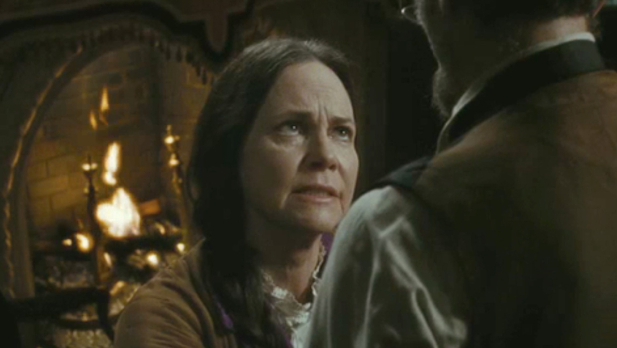
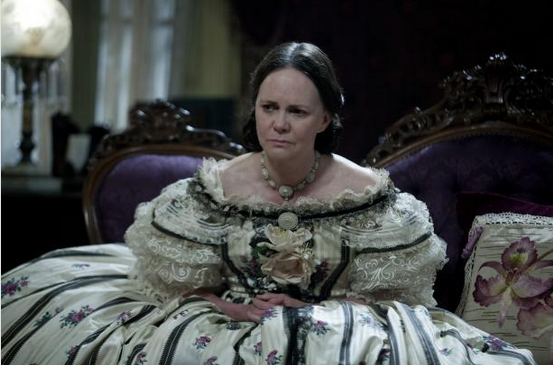
When Mary Todd Lincoln, played by Sally Field, first appears in Steven Spielberg’s Lincoln, I got nervous. With a weary voice and a far-off manner, she analyzes one of Mr. Lincoln’s dreams as a portent of doom. Looks like we’re getting the “batshit crazy” take on Mary Lincoln, I thought.

Sally Field as Mary Todd Lincoln in Lincoln

I was particularly upset by this because the characterization of Mary is especially crucial to the success of the film from a feminist perspective, because it is otherwise almost entirely focused on men (although Gloria Reuben is great in her small role and S. Epatha Merkerson brings as much as she can to her even smaller one). 

But as the film progresses, it becomes clear that just as it does with her husband Abraham, Lincoln is merely incorporating the legend of Mary Todd—stated eloquently by the character herself as “all anyone will remember of me is that I was crazy and that I ruined your happiness”—into a much more nuanced depiction of a complex character.

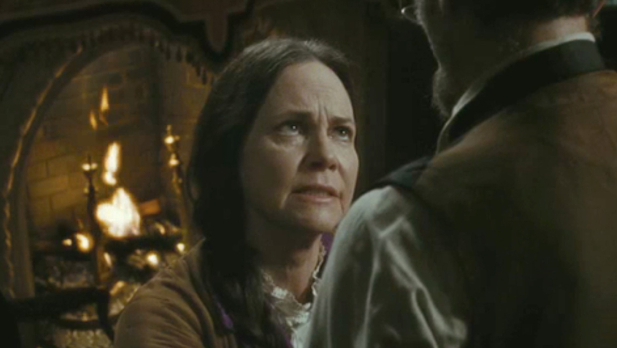
Sally Field as Mary Todd Lincoln in Lincoln

I have to admit, my initial reaction to the Mary in Lincoln was not helped by my preconceived opinion on the casting of Sally Field. My issue was not the age difference (Field is 10 years Day-Lewis’ senior, the reverse of the real-life age difference between the Lincolns) that required Ms. Field to fight to keep her role. I was rather concerned with the contrast in acting style between Field and Day-Lewis. I recalled the film version of A Streetcar Named Desire, where Marlon Brando’s then-revolutionary method realism left Vivian Leigh’s remarkable (and Oscar-winning) yet much more theatrical performance as Blanche DuBois in Stanley’s dust. 

In an interview with Sharon Knolle, Sally Field insists:

“Listen: People don’t know what method is. I am method! I studied at the Actors’ Studio. I studied with Lee Strasberg. That’s where the term “method” came from. Daniel and I work exactly the same way. I always stay in character. Any good actor does that.” 

Ms. Field obviously knows her own technique better than I do, but I doubt I am alone as a moviegoer in thinking of her as an actress whose screen presence is largely defined by her personal charm and her ability to turn the melodrama up to eleven rather than an ability to disappear into a character.

But Field’s performance style actually fits in well among a universally strong but stylistically-varied ensemble. While Tommy Lee Jones is uncharacteristically reserved even playing the bombastic abolitionist Thaddeus Stevens, and the inimitably restrained David Strathairn does fantastic work as Secretary of State William Seward [Tangent: my greatest beef with this film is that Seward is largely absent from the third act—just when his story gets really good!—because it diminishes Strathairn’s awards chances, and I think he’s still owed statues from Good Night and Good Luck]; there’s also plenty of delightful scenery chewing among the supporting cast, from Lee Pace as pro-slavery Democrat Fernando Wood, who ought to have a mustache just for twirling at the appropriate beats in his racist speeches on the Congressional floor, to James Spader’s cartoonishly uncouth political trickster.

Although Field plays most of her scenes against Day-Lewis, they play off each other surprisingly well. Lincoln as a whole walks a fine line between humanizing and further mythologizing one of the greatest figures in American history. Despite Day-Lewis’s historically-accurate adoption of a slouched posture and gentle high-pitched speaking voice, the film unquestionably presents Lincoln as the Great Man of the Lincoln Legend. But these indulgences are brilliantly counterbalanced by having the character aware of his place in history and the inevitable myth-making about him. 
Fittingly, this vulnerability is no more apparent than when he is with his wife. Playing off Field, Day-Lewis is perhaps at his most actorly, but the effect is subtly demonstrating to the audience that Abraham is the one acting as the character of President Lincoln when he is politicking and speechmaking. Field’s work in Lincoln makes the central performance and consequently the film itself better, which is exactly what a supporting actor should do. My misgivings about her casting could not have been more wrong.

And thankfully, neither could my first impression of the film’s overall take on the character. While Lincoln‘s Mary is indeed emotionally erratic, occasionally difficult, and haunted by grief, the film doesn’t damn her the way some historical accounts have by making these her only characteristics. She’s treated as an intellectual equal by her husband, we see her watch the congressional debates on the 13th Amendment from the balcony with keen interest, and in Field’s best scene, she epically takes down Thaddeus Stevens with a smile while playing the role of First-Lady-as-Gracious-Hostess.

Field’s best scene in Lincoln

Tony Kushner’s script and Sally Field’s game performance evade the two traps of fictional portrayals of Mary Lincoln: she’s neither the crazy shrew undermining her great husband nor the equally sexist and hoary cliche of the Great Woman Behind a Great Man. Instead, Sally Field’s Mary Todd Lincoln is one of the many compelling elements that make up Spielberg’s excellent Lincoln.

"Pregnancy Brain" in Sitcoms

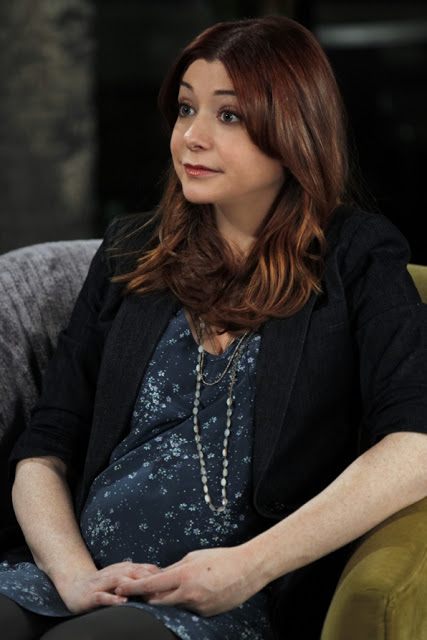
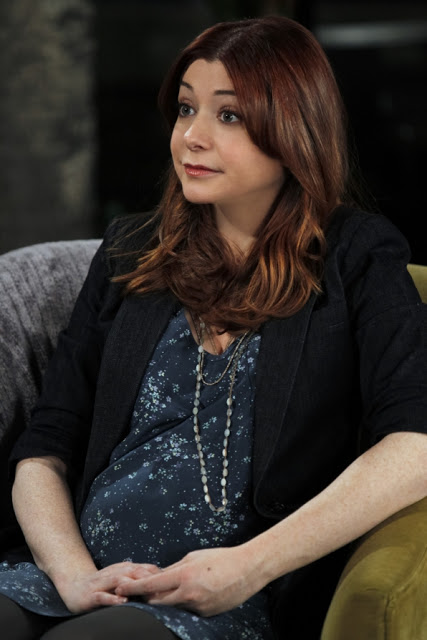
Alyson Hannigan as Lily Aldrin in “How I Met Your Mother”
Pregnancy brain. Momnesia. Preggo ladies be cray-cray. Call it what you want, but the idea that pregnant women lose their minds while their hormones go whack is a popular stereotype based on questionable evidence. Some mothers recall feeling forgetful during their pregnancy, while others don’t. (Wow, you’d think different women have different experiences with pregnancy, or something.)
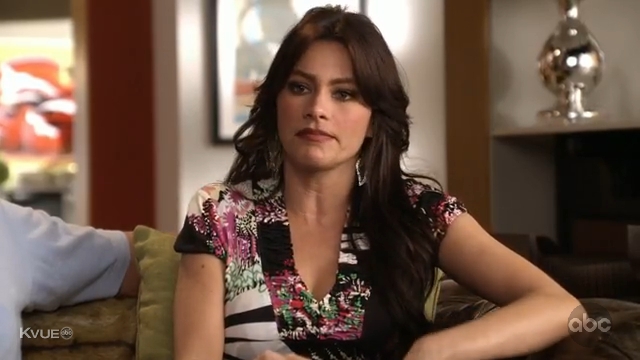
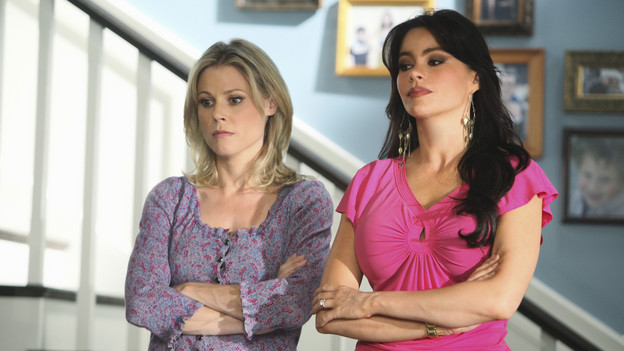
Regardless of how true pregnancy brain is or isn’t, or how different women react to the changes in their bodies, sitcom writers have taken this idea and run with it. Last year, Lily Aldrin experienced an episode’s worth of pregnancy brain on How I Met Your Mother, and this year, Gloria Delgado-Pritchett struggled with her own pregnancy brain problems on Modern Family. The setups were similar: the women had short-term memory problems as a result of their pregnancy hormones. The results, however, were a little different.
On How I Met Your Mother, the characters first notice something different about Lily when she agreed to move to the suburbs, after years of insisting that she would never move to the suburbs and wanted to stay in New York. Marshall, suburban-born and raised, is thrilled that Lily has changed her mind, but Robin warns him that Lily only wants to move because of pregnancy brain. Marshall doubts that pregnancy brain is even a “thing,” and Robin insists that it is: “Her brain is marinating in a cocktail of hormones, mood swings, and jacked-up nesting instincts.” Then Marshall and Robin recall a few incidents of Lily acting strangely: putting her keys and wallet in the freezer and ice cubes in her purse, texting Robin to ask for directions back from the bathroom, and saying “fungus” instead of “fetus” and “metal factory” instead of “mental faculty.” Robin cautions Marshall against letting Lily make any major life choices while pregnant.
This is all just in the first five minutes of the episode, by the way. The point is clear: Lily, while pregnant, is completely incapable of making any decisions for herself and has a more impaired short-term memory than Dory from Finding Nemo. Robin doesn’t think “that moron” can do anything. (Sidebar: why is Robin “I never want kids and have no interest in ever being pregnant” Scherbatsky suddenly an expert in pregnancy brain, anyway?)
Fortunately, Lily has a man by her side! (Hannigan and Jason Segel)
A year later on Modern Family, Gloria experiences similar symptoms of pregnesia, at a much later stage at her pregnancy than Lily’s. She puts soap in the fridge and butter in the shower. Jay calls his daughter Claire to “babysit the stupid pregnant lady” (Gloria’s words), but he claims that Gloria called Claire and forgot, and she initially believes him. She drives with Claire to Costco and laments over her pregnesia: “I have two brains in my body and I’ve never been so dumb.” Claire tells her not to be too hard on herself: “You have another human being growing inside of you competing for resources.” Claire herself struggled with forgetfulness when pregnant with her daughter Alex (but not so much with her daughter Haley or son Luke). The women exchange a nice moment until Gloria tries to get out of a moving car.
The setup here is slightly different: Gloria is forgetful and scattered, but self-aware enough to know when people are pandering to her. Still, she’s not at her best.
Back on How I Met Your Mother, the plot continues with Lily acting even more ridiculous. She tries to make waffles using a laptop, and Marshall takes advantage of her lapse in judgment by convincing her to buy things for the apartment that she doesn’t really want. Soon, though, she turns the tables on him. She tricks him into thinking that she called a broker to sell her grandparents’ house in the suburbs. Instead, she’s led him to the suburbs on Halloween so they can hand out candy to trick-or-treaters. She’s trying to manipulate him with cute children to convince him to move to the suburbs. It looks like the silly pregnant lady has more “metal factories” than meets the eye.
Meanwhile, on Modern Family, Claire and Gloria go shopping at Costco. Claire has to run to a different part of the store to find a sweater to wear, because Gloria’s been standing in the frozen food aisle for half an hour and can’t remember what she wanted to buy. When the two women finally go to the parking lot after their shop, Gloria accidentally almost closes the door of the minivan on Claire’s head – after all that time, she forgot the eggs. Claire lectures Gloria: “You are purposely turning your brain off!” Then Claire is interrupted by a store’s security guard: she forgot to return the sweater she wore while Gloria stood in the frozen food aisle, and accidentally stole the sweater. Claire tries to plead her case, but the security guard takes her back inside the building.
Sofia Vergara as Gloria Delgado-Pritchett on “Modern Family”
In the third act of the Marshall/Lily plot on HIMYM, Lily has convinced Marshall to move to the suburbs. Then a few trick-or-treaters come to her door, and she hands them a stapler, scissors, and a bottle of pinot noir. She doesn’t realize what she’s done until Marshall points it out to her, and then she cries because she’s going to miss the stapler. Lily admits that she can’t make any big decisions right now, at least not until she’s done being affected by hormones.
On Modern Family, Claire argues with an overly vigilant store detective. Gloria stands, panicked, and announces that her water broke. Claire and the store detective rush her to the car. As Claire drives, Gloria reveals that she dumped a water bottle on the floor and pretended to go into labor in order to help Claire: “I couldn’t sit there and watch you suffer just because you turned your brain off.” Claire apologizes for pandering to Gloria and doubting her abilities.
Two sitcom episodes, less than a year apart from each other, both dealing with forgetful pregnant women who don’t know how to manage their lives without help, but the message of each episode is very different. The How I Met Your Mother episode is sexist and cliched, while the Modern Family episode attempts to treat the pregnant character with humanity, and mostly succeeds.
Look at the way the other characters talk about Lily and Gloria. Lily is “marinating in a cocktail of hormones,” a “moron,” and acting like the “drunk girl at the bar” – descriptors that would be perfect for a pregnant character on a darker or more satirical comedy, but seem out of place and mean-spirited on a feel-good show like How I Met Your Mother. Claire, on the other hand, initially sympathizes with Gloria, pointing out that pregnancy is draining and of course her memory would be on the fritz.
Lily is also treated like an infant during this pregnancy. She’s not just forgetful – she can’t make any major decisions while these hormones are affecting her brain. SHE IS NOT TO BE TRUSTED. Gloria, meanwhile, is forgetful and scattered, but she hasn’t completely lost her mind, and cleverly saves Claire from the repercussions of her own brain fart.


More similar than you might think (Vergara and Julie Bowen)
But I think the biggest reason that the Modern Family storyline mostly succeeds and the How I Met Your Mother episode doesn’t is because the first show remembers to show the female perspective on a woman’s issue (imagine that). The episode of How I Met Your Mother isn’t about how Lily deals with pregnancy brain; it’s about how Marshall deals with Lily’s pregnancy brain. Let’s empathize with the poor, long-suffering husband while he deals with the changes in his wife’s body (yawn). Modern Family at least shows us pregnancy-related forgetfulness from the perspective of the female characters. I liked seeing two women bond over their different pregnancies, and I especially liked that Claire didn’t have the exact same experience with every pregnancy.
I don’t know if pregnancy brain is a real thing or not. I’m skeptical, but I’ve had at least two currently pregnant or formerly pregnant friends tell me that they were constantly forgetful during their pregnancies. My impression is that it’s true for some women and not true for others. Both shows exaggerate the concept for for comic effect, but How I Met Your Mother reduces the pregnant woman to an infant and Modern Family remembers that Gloria is still an adult. I know which episode I prefer.
Final thought: if walking into a room with a specific purpose, and then immediately forgetting said purpose for being in that room, is a sign of pregnancy brain, I have been pregnant for the last twenty-eight years. I do this at least twice a day. Maybe pregnant women and scatterbrained artist-writer types are cut from the same cloth.
Lady T is an aspiring writer and comedian with two novels, a play, and a collection of comedy sketches in progress. She hopes to one day be published and finish one of her projects (not in that order). You can find more of her writing at The Funny Feminist, where she picks apart entertainment and reviews movies she hasn’t seen.

"Pregnancy Brain" in Sitcoms

Alyson Hannigan as Lily Aldrin in “How I Met Your Mother”
Pregnancy brain. Momnesia. Preggo ladies be cray-cray. Call it what you want, but the idea that pregnant women lose their minds while their hormones go whack is a popular stereotype based on questionable evidence. Some mothers recall feeling forgetful during their pregnancy, while others don’t. (Wow, you’d think different women have different experiences with pregnancy, or something.)
Regardless of how true pregnancy brain is or isn’t, or how different women react to the changes in their bodies, sitcom writers have taken this idea and run with it. Last year, Lily Aldrin experienced an episode’s worth of pregnancy brain on How I Met Your Mother, and this year, Gloria Delgado-Pritchett struggled with her own pregnancy brain problems on Modern Family. The setups were similar: the women had short-term memory problems as a result of their pregnancy hormones. The results, however, were a little different.
On How I Met Your Mother, the characters first notice something different about Lily when she agreed to move to the suburbs, after years of insisting that she would never move to the suburbs and wanted to stay in New York. Marshall, suburban-born and raised, is thrilled that Lily has changed her mind, but Robin warns him that Lily only wants to move because of pregnancy brain. Marshall doubts that pregnancy brain is even a “thing,” and Robin insists that it is: “Her brain is marinating in a cocktail of hormones, mood swings, and jacked-up nesting instincts.” Then Marshall and Robin recall a few incidents of Lily acting strangely: putting her keys and wallet in the freezer and ice cubes in her purse, texting Robin to ask for directions back from the bathroom, and saying “fungus” instead of “fetus” and “metal factory” instead of “mental faculty.” Robin cautions Marshall against letting Lily make any major life choices while pregnant.
This is all just in the first five minutes of the episode, by the way. The point is clear: Lily, while pregnant, is completely incapable of making any decisions for herself and has a more impaired short-term memory than Dory from Finding Nemo. Robin doesn’t think “that moron” can do anything. (Sidebar: why is Robin “I never want kids and have no interest in ever being pregnant” Scherbatsky suddenly an expert in pregnancy brain, anyway?)
Fortunately, Lily has a man by her side! (Hannigan and Jason Segel)
A year later on Modern Family, Gloria experiences similar symptoms of pregnesia, at a much later stage at her pregnancy than Lily’s. She puts soap in the fridge and butter in the shower. Jay calls his daughter Claire to “babysit the stupid pregnant lady” (Gloria’s words), but he claims that Gloria called Claire and forgot, and she initially believes him. She drives with Claire to Costco and laments over her pregnesia: “I have two brains in my body and I’ve never been so dumb.” Claire tells her not to be too hard on herself: “You have another human being growing inside of you competing for resources.” Claire herself struggled with forgetfulness when pregnant with her daughter Alex (but not so much with her daughter Haley or son Luke). The women exchange a nice moment until Gloria tries to get out of a moving car.
The setup here is slightly different: Gloria is forgetful and scattered, but self-aware enough to know when people are pandering to her. Still, she’s not at her best.
Back on How I Met Your Mother, the plot continues with Lily acting even more ridiculous. She tries to make waffles using a laptop, and Marshall takes advantage of her lapse in judgment by convincing her to buy things for the apartment that she doesn’t really want. Soon, though, she turns the tables on him. She tricks him into thinking that she called a broker to sell her grandparents’ house in the suburbs. Instead, she’s led him to the suburbs on Halloween so they can hand out candy to trick-or-treaters. She’s trying to manipulate him with cute children to convince him to move to the suburbs. It looks like the silly pregnant lady has more “metal factories” than meets the eye.
Meanwhile, on Modern Family, Claire and Gloria go shopping at Costco. Claire has to run to a different part of the store to find a sweater to wear, because Gloria’s been standing in the frozen food aisle for half an hour and can’t remember what she wanted to buy. When the two women finally go to the parking lot after their shop, Gloria accidentally almost closes the door of the minivan on Claire’s head – after all that time, she forgot the eggs. Claire lectures Gloria: “You are purposely turning your brain off!” Then Claire is interrupted by a store’s security guard: she forgot to return the sweater she wore while Gloria stood in the frozen food aisle, and accidentally stole the sweater. Claire tries to plead her case, but the security guard takes her back inside the building.
Sofia Vergara as Gloria Delgado-Pritchett on “Modern Family”
In the third act of the Marshall/Lily plot on HIMYM, Lily has convinced Marshall to move to the suburbs. Then a few trick-or-treaters come to her door, and she hands them a stapler, scissors, and a bottle of pinot noir. She doesn’t realize what she’s done until Marshall points it out to her, and then she cries because she’s going to miss the stapler. Lily admits that she can’t make any big decisions right now, at least not until she’s done being affected by hormones.
On Modern Family, Claire argues with an overly vigilant store detective. Gloria stands, panicked, and announces that her water broke. Claire and the store detective rush her to the car. As Claire drives, Gloria reveals that she dumped a water bottle on the floor and pretended to go into labor in order to help Claire: “I couldn’t sit there and watch you suffer just because you turned your brain off.” Claire apologizes for pandering to Gloria and doubting her abilities.
Two sitcom episodes, less than a year apart from each other, both dealing with forgetful pregnant women who don’t know how to manage their lives without help, but the message of each episode is very different. The How I Met Your Mother episode is sexist and cliched, while the Modern Family episode attempts to treat the pregnant character with humanity, and mostly succeeds.
Look at the way the other characters talk about Lily and Gloria. Lily is “marinating in a cocktail of hormones,” a “moron,” and acting like the “drunk girl at the bar” – descriptors that would be perfect for a pregnant character on a darker or more satirical comedy, but seem out of place and mean-spirited on a feel-good show like How I Met Your Mother. Claire, on the other hand, initially sympathizes with Gloria, pointing out that pregnancy is draining and of course her memory would be on the fritz.
Lily is also treated like an infant during this pregnancy. She’s not just forgetful – she can’t make any major decisions while these hormones are affecting her brain. SHE IS NOT TO BE TRUSTED. Gloria, meanwhile, is forgetful and scattered, but she hasn’t completely lost her mind, and cleverly saves Claire from the repercussions of her own brain fart.


More similar than you might think (Vergara and Julie Bowen)
But I think the biggest reason that the Modern Family storyline mostly succeeds and the How I Met Your Mother episode doesn’t is because the first show remembers to show the female perspective on a woman’s issue (imagine that). The episode of How I Met Your Mother isn’t about how Lily deals with pregnancy brain; it’s about how Marshall deals with Lily’s pregnancy brain. Let’s empathize with the poor, long-suffering husband while he deals with the changes in his wife’s body (yawn). Modern Family at least shows us pregnancy-related forgetfulness from the perspective of the female characters. I liked seeing two women bond over their different pregnancies, and I especially liked that Claire didn’t have the exact same experience with every pregnancy.
I don’t know if pregnancy brain is a real thing or not. I’m skeptical, but I’ve had at least two currently pregnant or formerly pregnant friends tell me that they were constantly forgetful during their pregnancies. My impression is that it’s true for some women and not true for others. Both shows exaggerate the concept for for comic effect, but How I Met Your Mother reduces the pregnant woman to an infant and Modern Family remembers that Gloria is still an adult. I know which episode I prefer.
Final thought: if walking into a room with a specific purpose, and then immediately forgetting said purpose for being in that room, is a sign of pregnancy brain, I have been pregnant for the last twenty-eight years. I do this at least twice a day. Maybe pregnant women and scatterbrained artist-writer types are cut from the same cloth.
Lady T is a writer with two novels, a play, and a collection of comedy sketches in progress. She hopes to one day be published and finish one of her projects (not in that order). You can find more of her writing at www.theresabasile.com.