Too often, sex work and sex workers on screen aren’t represented three-dimensionally. Media representation is a mirror to our own cultural attitudes and norms, and we’d like to use this theme week to explore and analyze the good, the bad, and the dangerous of representations of sex workers in film and television.
Our first Theme Week for 2014 will be Representations of Sex Workers.
Feminism has a complicated relationship with sex work. Even the most sex-positive sometimes stop short at embracing voluntary sex work as a (potentially) sex-positive, feminist venture. Subjectifying female sexuality–from recent SlutWalks through generations of fighting for reproductive choice–is a cornerstone of feminist activism, but how do we respond to sex work, which is maligned and complicated? How can we draw clear lines between voluntary and involuntary sex work, and listen to and hear stories from sex workers themselves? And how do film and television represent sex workers?
Whorephobia remains pervasive in the social psyche, showing its ugliness even in sex-positive communities. The positive emphasis on sex work confuses “straights” into thinking that sex work is about sex, not work. That cognitive dissonance — the deep chasm filled with stereotypes and prejudices — interferes with the capacity of civilians to hear sex workers speak about their experiences. Stories that don’t conform to the “superhappyfunsexysexwork!” narrative tend to flummox pro-sex feminists; they can identify with privileged exotic dancers, porn performers and professional dominants (even fantasize about being one), but think “junkie whores” need to be rescued and should be prevented from working in their gentrifying neighborhoods. Such disrespectful treatment leads to silencing, ignoring, or rewriting what sex workers have to say.
Too often, sex work and sex workers on screen aren’t represented three-dimensionally. Media representation is a mirror to our own cultural attitudes and norms, and we’d like to use this theme week to explore and analyze the good, the bad, and the dangerous of representations of sex workers in film and television.
(For more reading on the topic, see this Ms. article and this wonderful round-up of articles at POSTWHOREAMERICAand check out the conversation on Twitter at #notyourrescueproject. For commentary/ideas about sex work on film, see this Alternetarticleand links from the London Sex Worker Film Festival.)
We’d like to avoid as much overlap as possible for this theme, so get your proposals in early if you know who or what you would like to write about. We accept both original pieces and cross-posts, and we respond to queries within a week.
Most of our pieces are between 1,000 and 2,000 words, and include links and images. Please send your piece as a Microsoft Word document to btchflcks[at]gmail[dot]com, including links to all images, and include a 2- to 3-sentence bio.
If you have written for us before, please indicate that in your proposal, and if not, send a writing sample if possible.
Please be familiar with our publication and look over recent and popular posts to get an idea of Bitch Flicks’ style and purpose. We encourage writers to use our search function to see if your topic has been written about before, and link when appropriate (hyperlinks to sources are welcome, as well).
The final due date for these submissions is Friday, Jan. 24 by midnight.
A sampling of films/shows that highlight sex workers:
Too many times, films singularly depict abortions as religious immoral decisions or heavy emotional burdens, but such a topic does not always have to be heavy hitting and controversial.
In the saccharine land of rom coms, plots can be trite, characters undefined and sappy sweet endings all too predictable for most movie-goers. And the worst part is that rom coms are usually geared toward women. No one wants to watch the same movies with the same formulas. If you’re like me, you’ve been looking for something different, endearing, and more in touch with reality.
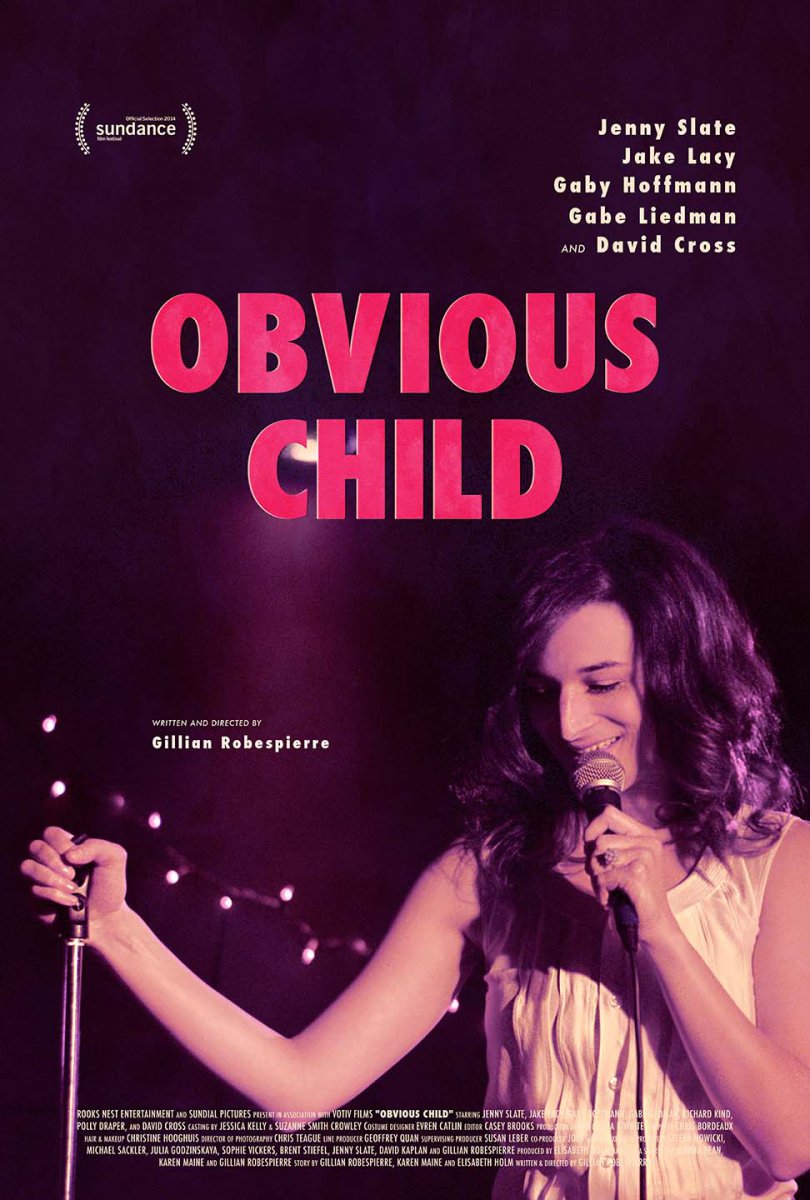
That’s where Obvious Child (2014), by writer and director Gillian Robespierre, comes in. Unlike rom coms centered around getting the boy or choosing love, Obvious Child is about what a woman chooses for herself–in this case, an abortion. It follows Brooklyn comedian Donna Stern (Jenny Slate), who “gets dumped, fired, and pregnant just in time for the worst/best Valentine’s Day of her life.” The best part about the film’s description is that it focuses on the nature of Donna’s choice and how after everything, she ends up all right.
With the help of Robespierre’s friends and coworkers, Anna Bean and Karen Maine, they wrote and produced a short film version in 2009. Robespierre said, “We were frustrated by the limited representations of young women’s experience with pregnancy, let alone growing up. We were waiting to see a more honest film, or at least, a story that was closer to many of the stories we knew.” Too many times, films singularly depict abortions as religious immoral decisions or heavy emotional burdens, but such a topic does not always have to be heavy hitting and controversial.
What I loved about the idea to this film (and why I chose to donate to it) is how imperative it is to see women’s issues addressed in different ways–with humor and wit. I also loved the women power behind this film, something we seldom see. Kathryn Bigelow is not the only female director tackling hard issues in interesting ways.
The film has been accepted to the upcoming Sundance Film Festival, but it still needs financial support to be complete (donations support final touches and distribution). It is currently seeking funding on Kickstarter. $10 gets you an online screening of the original short film. It’s a few thousand dollars short and just has 11 days to go! Sometimes, women have to go to extra lengths to support their sisters and get better pop culture representation. Ladies, give the gift that will give back to yourself! The best part is that you can do this from the comfort of your own home. In a time when abortion rights and access become increasingly limited in the United States, sometimes it’s movies like Obvious Child that can entertain us, but also send an important message that when it comes to abortion, whatever we choose, we’ll be all right.
Read Bitch Flicks’ review of the original short film here.
_____________________________________ Katrina Majkut is the founder and writer of the website TheFeministBride.com. As a “wedding anthropologist,” she examines how weddings and relationships are influenced by history, pop culture and the media. Her goal is to bring to light the inherent gender inequality issues that couples may not even be aware of within wedding traditions and the wedding “industry,” and to start dialogue around solutions that empower women to take positive action toward equality in their relationships and marriages.
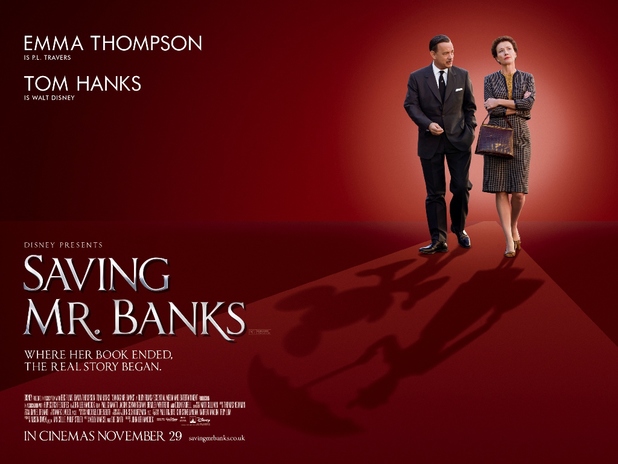
When I saw Disney was making a movie about Walt Disney convincing P.L. Travers to sign over the rights to Mary Poppins, I was expecting to come away at least slightly annoyed. As much as I adore Emma Thompson, who plays Travers, I thought this was going to be a story about a stubborn artist who’s convinced by the magic of Disney to stop being so up-tight.
Surprisingly, it wasn’t quite that simple and I found a lot to like about the movie, Saving Mr. Banks.
When I saw Disney was making a movie about Walt Disney convincing P.L. Travers to sign over the rights to Mary Poppins, I was expecting to come away at least slightly annoyed. As much as I adore Emma Thompson, who plays Travers, I thought this was going to be a story about a stubborn artist who’s convinced by the magic of Disney to stop being so uptight.
Surprisingly, it wasn’t quite that simple and I found a lot to like about the movie, Saving Mr. Banks.
First off, both Disney and Travers are portrayed as complicated and imperfect human beings, though obviously she’s got more serious issues to resolve here than he does. The film moves back and forth between her trip to Los Angeles to see Disney, having been pushed into it by financial need; and her childhood in Australia struggling with an alcoholic, big-dreaming father (Colin Farrell).
And the film pokes fun at the whole candy-coated Disney empire, mostly through Thompson as a delightfully bitter, acerbic, stiff Travers, who’s appalled at the mountains of cakes and donuts brought in for lunch and the way her hotel room is crammed full of stuffed Disney cartoon characters.
Second, the supporting actors, particularly the women, are outstanding. Ruth Wilson plays Travers’ mother in her flashbacks and every single facial expression and word out of her mouth shows her internal conflict and struggle to get by taking care of three children and worrying about her husband. Disney’s female staffers–Kathy Wilson as Tommie and Melanie Paxson as Dolly–also make a lot out of their relatively small roles.
– Spoiler alert –
Third, while I wouldn’t call it a feminist film on the whole (there’s not a single person of colour to be found, and ultimately it’s still about a woman whose life is defined by men), there are some feminist scenes. In one, Disney asks his staffer, Tommie, to help him decipher what’s really going on with Mrs. Travers.
“You’re a woman, aren’t you?” he asks. Tommie basically responds that he’s wrong to think all women have some innate inability to decipher one another, and he’s wasting his time trying to figure out Travers.
In another scene Travers gets angry at the writers for making Mrs. Banks a suffragette. The choice to portray Mrs. Banks as a suffragette has been debated by feminists. Some see the very mention of the suffrage movement as feminist, while others (including myself) see the ending, where Mrs. Banks gives up her “Votes for Women” sash for her kids’ kite tail, as a refutation of women working and campaigning outside the home.
In Saving Mr. Banks, the writers tell Travers they felt they needed Mrs. Banks to have a “job” or occupation outside the home to justify there being a nanny there. One of the songwriters outright says he feels Mrs. Banks is neglectful. But Travers snaps at them that “being a mother is a job. It’s a very hard job.” The audience knows she’s talking about her own mother as much as Mrs. Banks, and it’s a really poignant moment to see that solidarity.
Oh! And the film actually passes the Bechdel Test, since Tommie and Dolly talk about Travers’ temper, and Travers talks to Dolly about the ridiculous food she keeps bringing in.
On the down side, I found the use of flashbacks a bit over-done, like we were being spoon-fed all the connections. That said, the visuals and acting were enough to keep you hooked in.
There’s a satisfying ending but thankfully it’s not overly simplified or magical. Travers might be satisfied with the new ending that redeems the character of Mr. Banks (and thus her father), but she’s still never going to approve of everything about the movie, especially not the silly, cartoon dancing penguins.
Overall, if you’re looking for a film to see over the holidays, you could do a lot worse than Saving Mr. Banks.
From the get go, female sexuality in Coven is positioned as dangerous, sometimes deadly and something that people will try over and over again to control. In the first episode, a young witch, Zoe Benson, comes to the knowledge of her powers by accidentally killing the boy she chooses to have her first penetrative sexual encounter with, one of the few fully consensual sex acts we see on Coven. She literally kills a man with her vagina. The message that female sexuality is dangerous if not deadly is hammered home with the language Cordelia uses to welcome Zoe to the school for witches. The other girls claim that Cordelia wants them to suppress their witchy powers, and she responds, “Not suppress–control.” She expresses the idea that their powers are dangerous unless they are strictly controlled. This is not a subtle metaphor for the repression and control of women’s bodies and sexuality.
This is a guest post by Gaayathri Nair.
The horror genre is not commonly kind to women. It has a tendency to rely on violence against women for cheap thrills and is notorious for positioning women as passive objects. Ryan Murphy and Brian Falchuk have claimed that American Horror Story: Coven is an explicitly feminist season of American Horror Story. Previous seasons of American Horror Story have attempted to address sexism and misogyny in the horror genre. However, both American Horror Story: Murder House and American Horror Story: Asylum relied heavily on both the objectification of and violence against women as a plot device.
There are definitely cool things about Coven. The core cast is made up entirely of women, and each one of them is richly developed and three-dimensional. Overall, the show is deliciously complex and there are many plotlines that attack certain issues in an interesting way. One of the key concerns of Coven appears to be bodily autonomy, both in terms of gender and race, and many of the storylines can be read as explorations of the issues surrounding bodily autonomy. I think that the first episode of Coven serves as a great microcosm for how the show handles these issues so I will focus my analysis on that while bringing in content from later episodes where relevant.
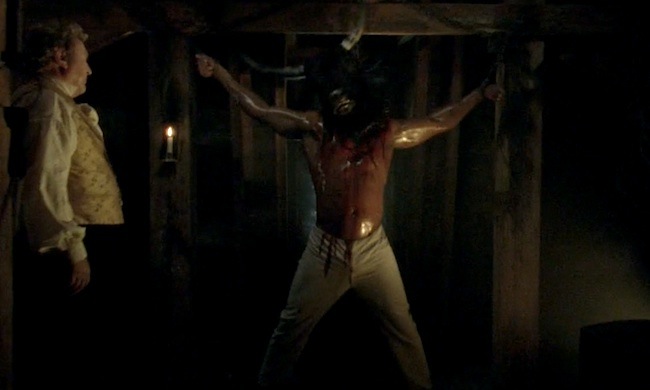
Coven opens in 1834 New Orleans in the house of Madame Delphine LaLaurie, a real historical figure. She is having a dinner party and over the course of the dinner party we are introduced to the fact one of her daughters has her eye on Bastian, a house slave. Later that night, La Laurie’s nighttime ablutions are interrupted by her husband telling her that during the dinner party her youngest daughter Pauline had sex with Bastian. What follows next is horrifying. La Laurie abuses Pauline physically and verbally and then says, “You know what we’re gonna say? We’re gonna say that he took you by force like the savage he is.” Bastian pleads his innocence stating that “Pauline came on to me and I told her I belong to someone else.” Bastian is a helpless victim in a power game being carried out by two white women. Bastian is taken upstairs to La Laurie’s torture chamber where she says, “Bastian, if you want to act like a beast then we’re gonna treat you like one.” She then proceeds to place a bull’s head over his own and turns him into a Minotaur, the literal embodiment of racist assumptions about black men–part man part beast. The whole scene is thick with imagery that calls to mind the myth of the black buck or brute .
From the get go, female sexuality in Coven is positioned as dangerous, sometimes deadly and something that people will try over and over again to control. In the first episode, a young witch, Zoe Benson, comes to the knowledge of her powers by accidentally killing the boy she chooses to have her first penetrative sexual encounter with, one of the few fully consensual sex acts we see on Coven. She literally kills a man with her vagina. The message that female sexuality is dangerous if not deadly is hammered home with the language Cordelia uses to welcome Zoe to the school for witches. The other girls claim that Cordelia wants them to suppress their witchy powers, and she responds, “Not suppress–control.” She expresses the idea that their powers are dangerous unless they are strictly controlled. This is not a subtle metaphor for the repression and control of women’s bodies and sexuality. She emphasises that the world they live in is dangerous and they must protect themselves as best they can by only using their powers in tightly controlled situations.
Coven’s exploration of the repression and control of female sexuality falls down for me later on in the episode where there is a graphic depiction of a drugging and gang rape of one of the young witches. Madison Montgomery is a character who appears to be modeled on Lindsay Lohan–a once successful film star whose career has become overshadowed by substance abuse problems and her eccentric behaviour is drugged and gang raped by frat boys who film the attack on their phones. This is obviously meant to call to mind the Steubenville case.
Madison sizzles on the screen; she is sexy, confident, and aggressive. It is unsurprising, from an analytical perspective, that she is the one who is raped. The manner in which it happens and her interactions with the instigator before the fact, where she commands him to go get her a drink, makes it seem like she is being punished for her confidence and sexual availability by being drugged and raped by a pack of frat boys. This ultimately serves to support rape culture narratives. I cannot see anything subversive about this story arc. Madison gets her revenge when the frat boys try to escape on their bus by using her telekinetic powers to flip it over–killing most of them. I think the writers view this as the ultimate feminist payback fantasy, especially as Madison is the quintessential imperfect rape victim, one who would be unlikely to ever see justice through the court system.
There are some positives; for example, it is made exceedingly clear that it is the frat boys who are at fault. However the damage is done, regardless of intention the show reinforces, not subverts the myth that only “bad girls,” i.e. girls that have sex on their own terms and dress provocatively, are the ones that get raped. This flies in the face of the truth about rape–that it is something that can happen to any woman regardless of her dress or demeanour. The show does get one thing right: drug-facilitated rape is one of the most common forms of rape, but that type of rape doesn’t just happen to sexually aggressive beautiful girls.
Rape culture positions women generally (because of the impossible standards) but “bad women” in particular as being deserving of or asking for their assaults. While we know that it is the frat boys who are at fault, the juxtaposition of Madison’s actions with the rape creates a certain subtext. If only she was nicer, if only she wasn’t so rude and arrogant, this would have never happened to her. The lead frat boy clearly wanted to take her down a peg. At its core, the whole story arc serves to reinforce rape culture tropes. Furthermore, the depiction of the gang rape is deeply disturbing, cutting between Madison’s point of view and the rapists. It is fundamentally objectifying and serves to glamorise violence against women.
These lessons about female sexuality are followed through in later episodes, particularly episode three where Queenie, the only fat and black witch that lives in the house, attempts to seduce the Minotaur that has been sent by Marie Laveau, the voodoo practitioner, to attack the witch school in episode three. She winds up being attacked; we don’t know exactly what happens to her but it is severely debilitating. Once again a woman who was, perhaps problematically, trying to own her sexuality is punished for it. Queenie also equates herself as a fat black woman as something analogous to Bastian the Minotaur–society sees them both as something monstrous. I can’t decide if presenting this actually subverts or supports the idea. Fat women generally and fat black women in particular are constantly dehumanized in our society and this scene could be read as purely reinforcing that; at the same time it holds up an uncomfortable mirror to the world we live in. Queenie is not being mocked or used for laughs, she is expressing her sadness at the way the world sees her. The fact that the words are coming from Queenie’s own mouth makes them a powerful indictment of a world that treats women like her as less than human. At the same time, Queenie is just another sad fat chick reinforcing dominant narratives about fatness. At least Queenie is not a “sassy black woman” a trope that confines most fat black women in pop culture.
Another way in which Coven explores bodily autonomy and sexuality is in how ageing affects women. It speaks to the way in which women of a certain age are made invisible in our society. Jessica Lange’s character, Fiona, is the supreme, the most powerful of all the witches and therefore their leader. Over the course of the season we learn that a new supreme is rising and that means her power is waning. In the first episode we are treated to the sheer desperation she feels. She pays a doctor to give her experimental treatments that have never been used on humans, and her anxiety is more pronounced with each moment she is on screen. When the injections do not work she resorts to sucking the life force out of the doctor and killing him. This gives her what she craves for about a minute. Delphine La Laurie also goes to extreme lengths to preserve her youth using blood and pancreases harvested from her slaves to make a poultice to keep her young.
The portrayal of these two women is very much wrapped up in the male gaze. A large part of what is making Fiona unhappy is that she no longer gets the attention she craves, especially from men, and in Delphine’s case her need to keep the roving eye of her husband is reinforced throughout the season. These women reveal the obsession with youth and beauty that is forced upon women, but Coven fails to truly capture the ways in which these are societal expectations–not ones that are innate to women on their own. Delphine and Fiona are evil or morally complex in their own ways and the dire lengths they go to for youth and beauty are just another expression of their ruthless natures. The idea of the “vain sorceress” is as old as Snow White and I was a little disappointed to see it play out in Coven. A fixation on youth and beauty is not something that makes women evil; it is something that is pushed on to women by a culture that only values women for their youth and beauty, no matter what other qualities they might have. Women’s bodily autonomy is constrained by the narrow social roles that are enforced upon us.
The failings of Coven are unsurprising considering it is a mainstream television show in the horror genre. I think that a pro-woman intention has tangled with the male gaze to create a product that both supports and subverts misogyny and is as objectifying as it is empowering. I have to give Murphy and Falchuk credit for creating a vehicle for so many talented women and giving them interesting and nuanced storylines. My hope is that things only get better from here.
________________________________________________
Gaayathri Nair is a freelance writer and feminist activist. You can find more of her work at her blog A Human Story and on twitter as @A_Gaayathri.
So if I knew all that, why did I even bother? Shame on me, right? Well, I try to keep an open mind when it comes to Scorsese. He’s a brilliant director capable of surprising his audience and expanding our sense of what a cinematic experience can be. He’s so good that I can even forgive him for making films that consistently fail the Bechdel test. The Wolf of Wall Street, though, is not Scorsese at his best. It might even be at his worst. And that’s because we all know how great he can be.
If you’re thinking about going to see The Wolf of Wall Street, you might just consider staying home and watching Goodfellas, which you’re sure to catch on TV (because it’s never not on TV). Or get The Departed on Netflix. Or Raging Bull. Or Taxi Driver. Even better, Alice Doesn’t Live Here Anymore. There are numerous other fixes to sate a Scorsese appetite without forking over your holiday cash to this three and a half hour slog through wealth, uppers, downers, hookers, orgies, scumbags, and more scumbags. Let me first say that I went into the film expecting to be disgusted. About all I knew was that the story was based on the memoir The Wolf of Wall Street, written by Jordan Belfort, a former stockbroker convicted of securities fraud and money laundering. Throughout most of the 1990s, Belfort ripped off stock buyers to the tune of $110.4 million dollars. He trafficked in penny stocks, and founded a brokerage house called Stratton Oakmont, and as a result of his scams many people suffered—and continue suffering. So if I knew all that, why did I even bother? Shame on me, right? Well, I try to keep an open mind when it comes to Scorsese. He’s a brilliant director capable of surprising his audience and expanding our sense of what a cinematic experience can be. He’s so good that I can even forgive him for making films that consistently fail the Bechdel test. The Wolf of Wall Street, though, is not Scorsese at his best. It might even be at his worst. And that’s because we all know how great he can be.
Let’s set aside that there are many, many, more beautiful naked women than men in this film, and that they are often acting out porn fantasies for the delight of devastatingly unattractive males (sorry Jonah Hill and Henry Zebrowski!). There’s also much casual misogyny expressed in small talk about women’s shaving habits and a lengthy explanation of the three types of hookers, “classified like publically traded stocks,” which Scorsese couldn’t seem to help but dramatize in particularly cringe-worthy scenes. Worse than all that, though, are the thinly drawn relationships between Jordan (Leonardo DiCaprio) and the women in his life. First, there’s his first wife Teresa, played by Cristin Milioti. When we first meet the couple, Jordan is nowhere near as addicted to drugs, sex, and money as he’ll soon become, and we see them both as young upstarts trying to make their way. Once Jordan gets his penny stock racket under way, so follows the debauchery. Surely, we think, Teresa must know at least some of what the audience knows: that Jordan’s “working late” is not motivated by the pure drive to provide superior service to his customers. Surely there are more than a few popular culture instances of wives being fully aware of the compromises they’re making with their high-powered husbands (Mellie Grant, anyone?). If Teresa knows the score, Scorsese never tells us. It’s not until Naomi, played by Margot Robbie, enters the picture that Teresa finds out Jordan is a dog. Then she disappears from his life and the narrative.
If there was a ever a woman who should know the deal she’s making with a man like Jordan it’s Naomi. She’s every bit as materialistic and entranced by wealth as her husband, yet Scorsese give us nothing like the fire or toughness that Sharon Stone’s Ginger had in Casino or that Lorraine Bracco’s Karen had in Goodfellas. And it’s not Robbie’s fault—she’s tremendous and does the best she could with the role—it’s Scorsese’s for missing the opportunity to go beyond the trope of the trophy wife to a create a character with just a touch a more depth.
The real kicker for me comes in the film’s final act. During the Jordan’s last speech to his staff—and there are more than a few speeches—he turns his attention to a woman named Kimmie, a character we have never met before this scene. He tells the staff Kimmie’s story: she came to him as a desperate single mother in need of a job and a $5,000 cash advance to pay her son’s tuition. She tells everyone that Jordan gave her $25,000, changed her life, made her rich, and tearfully says, “I fucking love you, Jordan!” Is this just another moment of dark comedy, or are we supposed to be manipulated into believing our main character has a generous soul, especially when it comes to women?
I will say there are two good things about this film: 1) Sharon Jones and the Dap-Kings are on the soundtrack and make a cameo at Jordan and Naomi’s wedding, and 2) Fran Lebowitz makes an appearance to set Jordan’s $10 million bail. But make no mistake: that’s not a reason to see this film. Just stay home and watch Scorsese’s documentary about her, Public Speaking, a couple of times. That’s just enough to cleanse the palette.
Heather Brown lives in Chicago, Ill., and works as a freelance instructional designer and online writing instructor. She lives for feminism, movies, live music, road trips, and cheese.
Almost 20 years later, we need more of what My So-Called Life gave us a taste of. We need teenage girl protagonists to be sexual, not sexy. We need honest portrayals of what it is to be a teenager–not only for teenagers who need to see themselves in faithful mirrors, but also for adults who are still trying to figure themselves out.
The expectations for girls in film and television are incredibly mixed. It is naïve to say that girls nowadays are just expected to be a sexy sidekick or afterthought. With more strong female roles popping up in bigger budget films such as Harry Potter and The Hunger Games, there is the expectation that girls should also be intelligent and incredibly clever (while also being visually pleasing)… There isn’t really a place for the all-around average girl. The first two examples of strong female protagonists that I could think of are in fantasy franchises. Are real female characters really that difficult to come up with? Real female characters are often created with good intentions but tend not to work on a larger scale.
…Lisa takes a stand against the sexism spouting from the mouth of the new talking Malibu Stacy doll. Frustrated with the doll’s collection of sexist catchphrases that include “Let’s bake some cookies for the boys,” “Thinking too much gives you wrinkles,” and “My name’s Stacy, but you can call me *wolf whistle*,” Lisa collaborates with the creator of Malibu Stacy to create their own talking doll, Lisa Lionheart. When Malibu Stacy outsells Lisa Lionheart, our creator feels temporarily dejected, until she hears her own voice speaking behind her: “Trust in yourself and you can achieve anything.” She turns to see a girl her age hold a Lisa Lionheart doll in her hand and smile.
Delightful Tina. Shy, painfully weird, butt-obsessed, quietly dorky, intensely daydreamy Tina. Tina is a little bit like all of us (and–cough–a lot like some of us) at that most graceless, transitional, intrinsically unhappy stage of life that is early adolescence. She is also a wonderfully rich and well-developed character, both in her interactions with her family and in her own right, and she’s arguably the emotional core of the whole show.
It’s common wisdom that maintaining relationships requires constant work, but there’s often an assumption (in TV, movies, and real life) that this only applies to romantic relationships. Platonic relationships are rarely the focus of a story, and when a storyline deals with issues in these relationships, they’re often easily dealt with, and the friendship goes back to being simple. Exceptions to this are problems that are caused by romantic relationships. Veronica Mars is an exception to this; for its first two seasons, it depicts many platonic relationships, and explores the many issues involved in navigating them (some of these problems are related to romance, but many are not, showing platonic relationships have their own complexities, separate from romance).
My Sister’s Keeper is a story about growing up, identify, family, death, and life (how can we truly tell any story about life when death isn’t the costar?), but its uniqueness is that it is told primarily through two young girls.
So, these are the important things in Sixteen Candles: Samantha’s family forgets her birthday; she’s in love with a hot senior who’s dating Caroline (the most popular girl in school); and there’s a big ol’ geek (Farmer Ted) from Sam’s daily bus rides who won’t stop stalking her. Oh, and Long Duk Dong exists [insert racist gong sound here]. Seriously, every time Long Duk Dong appears on screen, a fucking GONG GOES OFF on the soundtrack. I suppose that lines up quite nicely with the scene where he falls out of a tree yelling, “BONSAI.”
Since the entire movie is like a machine gun firing of RACIST HOMOPHOBIC SEXIST ABLEIST RAPEY parts, the only way I know how to effectively talk about it is to look at the very problematic screenplay. So, fasten your seatbelts and heed your trigger warnings.
My main issue with the film is that it is speckled with meaningless platitudes and clichés about girl empowerment when the film simply isn’t empowering. The women in the film are portrayed as oversexualized, helpless, damaged goods. Though there are metaphors at work that symbolize abuse or objectification of women, nowhere does the film stress an injustice or seek to dismantle its source. It is just like any other formulaic action movie complete with boobs, guns, and explosions, but it has a shiny, artificial veneer of girl empowerment. The false veneer is the aspect of the film that truly infuriates me, along with the side of artsy pretentious bullshit.
Early in the film, Dawn is a nymph-like virgin committed to “saving herself” until marriage. She is the poster child for the “good” girl: a loving daughter who obeys the doctrines of the church and spends her time spreading the gospel of virginity. Everything Dawn knows about the world and herself changes when her falsely pious boyfriend Tobey takes her to a far off swimming hole and tries to rape her. A confused and terrified Dawn reacts by screaming and then—much to everyone’s surprise—cutting off his penis to interrupt the rape. Little does Dawn know that her lessons about Darwin in her biology classes are taking hold in her own body.
What disappointed me most, I think, was that Black Swan could easily have been a progressive film with a positive, young woman-centered journey out of repression at its center. It could have recouped that gender-centric childhood ballerina dream of so many little girls into a message about determination, hard work, personal strength, and emotional growth. Instead, Darren Aronofsy has produced an Oscar-winning horror film. That’s right: I said HORROR. While that might seem like a stretch, it seems clear to me that the horror I refer to is the possibility of changing an age-old story. The horror of Black Swan is the absolutely terrifying idea that a young woman might make it through the difficult process of maturation, develop a healthy, multi-faceted sexuality, and be successful at her chosen career at the same time.
While most teen movies revolve around coming-of-age stories, gang movies reveal the extreme side to adolescence—the misfit, criminal, and violent side. Gang movies are rather simple, either focusing on episodes of gang debauchery, or revolving around rivalry and jealousy. Usually the viewpoint is that of the ring leader, or the “new girl,” who is initiated into the gang but is still an outsider. Yet, among the plethora of girl gang movies, every decade has produced stories involving specific issues and specific types of teenage girls.
Kiki’s Delivery Service carefully constructs a world where a girl’s agency is expected, accepted and supported, while Disney movies typically present a girl’s agency as unusual, forbidden, and denied. The difference between these two messages is that Kiki’s world anticipates and encourages her independence, while the women of Disney are typically punished for this.
For example, in The Little Mermaid Ariel wants to “live out of these waters,” but her father forbids her exploration of the human world and punishes this dream. Sea witch Ursula exploits Ariel’s desire to discover another world beyond her own as well. This is hardly an isolated incident.
Liesel, unlike so many young heroines, resists romance—from her friend Rudy’s early problematic insistence and then throughout the remainder of the movie. Instead of being positioned in relationship to romantic partners, she has three male best friends—Rudy, Max and Hans (Papa)—as well as two females of great importance to her life, Rosa (Mama) and Ilsa Hermann (the mayor’s wife who, transgressively, supplyies Liesel with books). As for Liesel, like her futuristic counterpart, Katniss Everdeen, she is a life-saving heroine and inspirational rebel.
Terri sets out to explore the luxury of male privilege disguised as a young man. Just One of the Guys smacked us straight in the face with the unspoken universal knowledge that sexism was real, it existed and the film gave us tangible proof. Terri decides to use her parents’ trip out of town to switch things around for herself by getting another shot at the newspaper internship with another article, an expose of sorts. She switches high schools and uses her brain, and as much as she can, is herself.
Initially the girls of Troop Beverly Hills are portrayed as clueless and privileged, but they are allowed to grow and transform themselves over the course of the movie. The film writers don’t do it unrealistically by turning them into tomboys overnight or at all. The girls retain their femininity, which they are made fun of for by the Red Feathers, throughout the film.
Immortality is not what makes a world better. Hope, friendship, and love do, and love is not limited by sex, gender, ethnicity, or race. Women like Homura and Kyoko can fall in love with other women like Madoka and Sayaka respectively. We have the responsibility to stand up with people like them. This series is part of the reason I try to do that and more. I hope that many others to do the same.
Is Wanda a girl/teenage female protagonist? Technically she is not “young” as she is 1,000 years old and seemingly immortal, but she is new to Earth so that makes her young in some sense. Also, why would the Souls even have genders that mirror that of humans or have genders at all? The Souls look like beams of light and they probably aren’t even a carbon based species and yet somehow Wanda is a female? So. Frustrating. Nonetheless she is controlling a person’s body who identifies as a teenage girl and is thus somewhat restricted to her occupied body’s feelings, emotions, and categorizations.
Ten questions between filmmaker Morgan Faust and 13-year-old actress Rachel Resheff.
Morgan: The truth is when I was growing up in the 1980s, the child actresses were often given pretty syrupy roles (with the exception of Journey of Natty Gann and Labyrinth). It was the boys who got to have the cool movies–Goonies, Stand by Me, even The NeverEnding Story and E.T., which did have girls, but the boys were the heroes. That is why I write the movies I do–adventures films for girls–because that’s what I wanted to do when I was a kid, go on adventures, be the hero. I still do want that. I mean, who doesn’t?
The Hunger Games, saturated as it is with political meaning (the author admits her inspiration for the trilogy came from flipping channels between reality TV and war footage), is a welcome change from another recent popular YA series, Twilight. As a further bonus, it has disproven the claim that series with female protagonists can’t have massive cross-gender appeal. With the unstoppable Katniss Everdeen at the helm (played in the films by the jaw-droppingly talented Jennifer Lawrence), perhaps the series will be the start of a new trend: politically themed narratives with rebellious female protagonists who have their sights set on revolution more than love, on cultural change more than the latest sparkling hottie.
The CW is a rarity among the many networks of cable television. Its target demographic is women aged 18-34, and as a result has a majority of its original programming centered on the lives of young women. On paper, this sounds like a noteworthy achievement to be celebrated. However, the CW produces content devoid of any sense of the reality of its young audience, and as a result actually harms its most devoted viewers. The CW creates an unattainable archetype for what a teenager should look like and fails to maturely handle issues of murder and rape.
OK, sure, my big sister didn’t have superpowers, and as far as I know she did not save the world even one time, much less “a lot.” But from my perspective as her bratty little sister, I felt like I could never escape her long and intimidating shadow. I could never be as smart as her, as special as her; I couldn’t hope to collect even a fraction the awards and accolades she racked up through high school. And she didn’t even properly counteract her super smarts with social awkwardness: she always had a tight group of friends and the romantic affections of cute boys. She was the pride and joy of my family, and I always felt like an also-ran. Trust me: this makes it very hard to not be at least a little bratty and whiny.
The protagonist of Wizards is a girl who acts like girls really act: she has boyfriends and broken hearts, but isn’t overly boy-crazy or dependent on them; she’s curious and smart enough to ask questions when other people are telling her not to; and throughout the series she faces a lot of the struggles women really do face throughout their lives.
Power dynamics mean something in comedy. Making fun of someone less powerful than you is sort of like beating up someone who’s small, or taking advantage of someone naive. It’s not very sporting, and it makes you look mean. The problem is that the same person can be powerful in some contexts and not in others. A rich, white 17-year-old girl, for example, might be very powerful in contexts where she’s bullying her classmates at school, but less powerful in contexts where she’s trying to meet the demands of a sexist culture. If you’re an adult man nearing 40, it’s hard to make fun of the way a teenage girl dresses, flirts, and moons over boys without starting to look kind of petty.
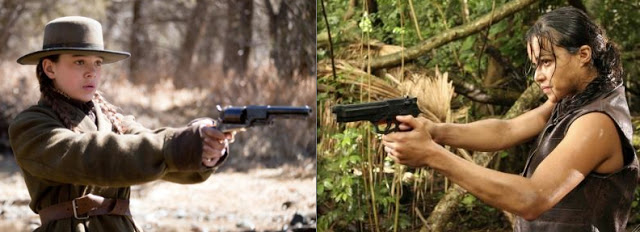
Mattie wears dark, loose, practical clothing. She climbs trees and carries weapons. She shows utter disdain for male privilege or La Boeuf’s pervy allusions to sexual contact. She has no interest in the older men for romance or protection. She is only concerned with their usefulness to her task, and she uses her will and her reasoning rather than seduction to convince them. Steinfeld’s Mattie emanates competence and confidence.
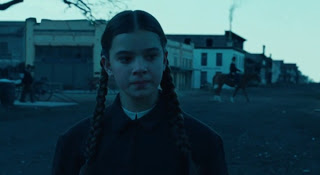
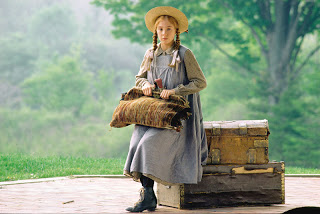
Not since Megan Follows played Anne of Green Gables in the 1985 adaptation of the novel with the same title have girls had a young protagonist on screen who fights against social conventions that are designed to limit her because of her age and gender. Mattie’s similarity to Anne doesn’t end at their indignation and fearlessness, they both also share a love of long braids, both can be found wearing ill-fitting clothes, both of their stories are set in a similar time period, and finally, both girls are orphans.
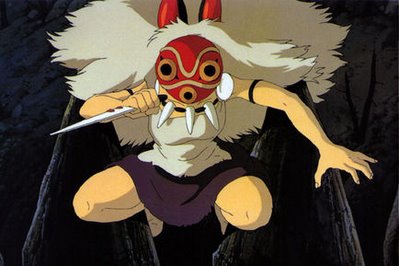
Granted, Ashitaka (voiced by Billy Crudup) is an important character. Even so, it is a bit disconcerting when the IMDb blurb about this movie only mentions him, and almost none of the female characters who are equally, if not more, important to the story. Princess Mononoke (voiced by Claire Danes) is the title character, but is only mentioned toward the end of the blurb. This movie is so much more than yet another “save the princess” quest!
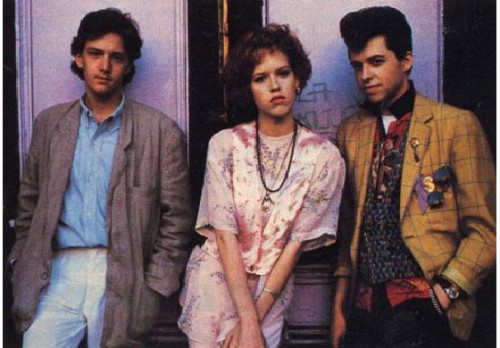
In Pretty In Pink, Andi is a self-sufficient, seemingly self-aware teenage girl who lives in a little cottage with her single father. Andi isn’t the type of girl who goes gaga for cocky, linen suit-wearing Steff (James Spader). She’s too busy at home sewing and stitching together her latest wardrobe creations. To her fellow girl students, she’s just a classless, lanky redhead who shouldn’t dare be caught dead at a “richie” party. So, she spends her time at TRAX, a record shop she works at, and a nightclub that showcases hip new wave bands like Ringwald’s real-life fave, The Rave-Ups. Her best friends Duckie (Jon Cryer) and Iona (Annie Potts) admire and envy Andi.
What is clear is that Campion is interested in the strategies women use to survive in patriarchy. But she is not only interested in the fate of women. She is also interested in how girl-children negotiate their way in a male-dominated world. It is through Ada’s daughter as well as Ada herself that Campion explores the feminine condition in the 19th century. Her rich, multi-layered characterization of Flora is, in fact, one of the most remarkable features of The Piano. She is as interesting and compelling as the adult characters and, arguably, the most convincing. The little girl also has huge symbolic and dramatic importance. This is, of course, unusual in cinema. There are relatively few films where a girl plays such a significant, pivotal role.
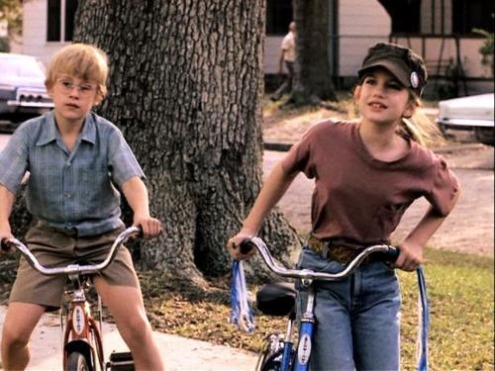
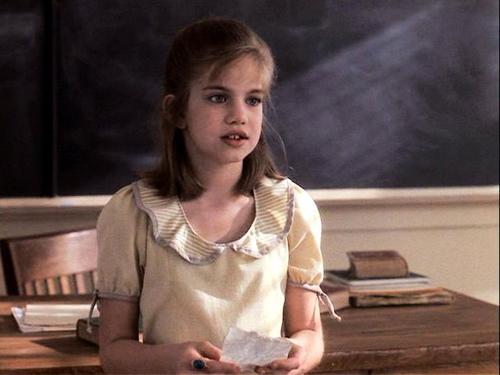
However, the tomboy was a prominent figure in two well-loved films of the period aimed at young girls, though both presented her as a transitional stage in development. My Girl (1991), is the story of precocious 11-year-old Vada Sultenfuss (Anna Chlumsky) who grew up in a funeral parlor and is obsessed with death, while in Now and Then (1995) four childhood friends reunite as adults and remember (in flashbacks) the summer they were 12.
Basically, Brave isn’t really that brave of a film. It’s traipsing through a well-established trope that, though positive, is stagnant. Don’t get me wrong; I love all the prepubescent female power fantasy tales I’ve listed, and I’m grateful that they exist and that I could grow up with many of them. However, we can’t pretend that Brave is pushing any boundaries. It sends the message that little girls can be powerful as long as they remain little girls. The dearth of representations of postpubescent heroines who are not objectified, whose sexuality does not rule their interactions, and who are the heroes of their own stories is appalling.
However, the tomboy was a prominent figure in two well-loved films of the period aimed at young girls, though both presented her as a transitional stage in development. My Girl (1991), is the story of precocious 11-year-old Vada Sultenfuss (Anna Chlumsky) who grew up in a funeral parlor and is obsessed with death, while in Now and Then (1995) four childhood friends reunite as adults and remember (in flashbacks) the summer they were 12.
This guest post by Elizabeth Kiy appears as part of our theme week on Child and Teenage Girl Protagonists.
Young girls have little power.
Controlled by their parents and teachers as well as financial and societal restrictions, often their only agency is the refusal to obey and to fit into standard gender roles. In early adolescence, they mature physically and socially but have yet to assume real adult responsibility.
A clear example of the the transitory nature of this period is the frequent presence of the tomboy character in coming-of-age films.
Though in real life many girls maintain masculine identities into adulthood, in these films as in much of society, the tomboy is a temporal figure tied to early adolescence that girls are expected to grow out of it order to be a healthy, happy (and inevitably heterosexual) adult. And in coming-of-age films, a genre where characters go through moral tests and life-changing tragedies and emerge stronger and wiser, the proof of her growth is her adoption of a female identity.
Because of female liberation movements in the 1970s, media scholars tend to see the decade as the heyday of the tomboy character in popular culture, with stars such as Jodie Foster, Christy McNichols, and Tatum O’Neal. Female-focused narratives gradually tapered off at the end of the decade, with a rise in powerful male protagonists, effects-driven blockbusters and action heroes in the 80s. In the 90s, “Girl Power” movements brought about an increase in female-directed media, but with a different framing. Gay and lesbian films encouraged positive portrayal of masculine women, but were directed exclusively to adults and others in the community.
Tomboy Roberta in her element, the lone girl who can challenge the boys
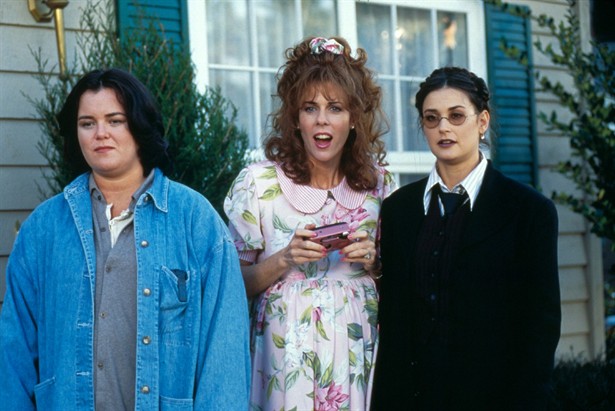
However, the tomboy was a prominent figure in two well-loved films of the period aimed at young girls, though both presented her as a transitional stage in development. My Girl (1991), is the story of precocious 11-year-old Vada Sultenfuss (Anna Chlumsky) who grew up in a funeral parlor and is obsessed with death, while in Now and Then (1995) four childhood friends reunite as adults and remember (in flashbacks) the summer they were 12. The girls each fill a particular character archetype, with Christina Ricci and Rosie O’Donnell playing child and adult versions of tomboy Roberta Martin.
As adolescents, both characters are depicted as going through the early stages of puberty, where their female body and nascent sexuality are becoming impossible to ignore and they must come to terms with their gender identities.
Their tomboyism is only a cause for fear or treatment, when the girl appears to have extreme male identification or her tomboyism threatens to extend into adulthood. In this vein, it is acceptable for Roberta and Vada to climb trees, play sports and dress like the boys, but fear of puberty is a step too far.
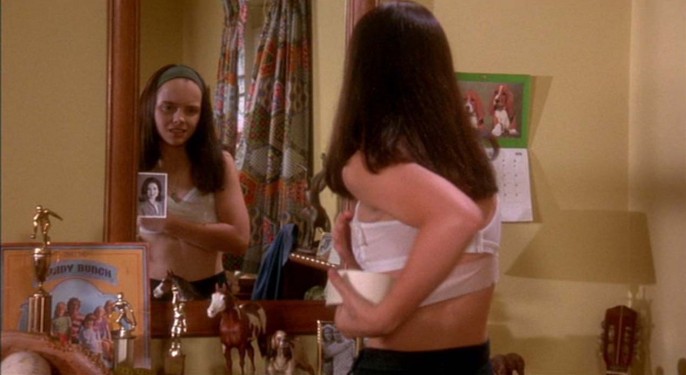
Roberta pushes the limits of acceptable tomboyishness by binding her breasts
Roberta is panicked about the growth of her breasts and regularly measures them and binds them. Although it is not explained exactly why she is sensitive about them, the film portrays her anxiety as irregular. The other girls, all more acceptably feminine, tease her about their size and tell her she is lucky because men will like them. In this discussion, Roberta is clearly uneasy and disgusted by the idea.
Similarly, Vada is horrified when she learns about her period rather then feeling pride at becoming a woman as girls often do in coming-of-age narratives. She tells her father’s girlfriend Shelly (Jamie Lee Curtis) that it isn’t fair because nothing happens to boys and kicks her friend Thomas J (Macaulay Culkin) out of the house until it is over. As with Vada, a girl’s crisis of gender is because of her difficulty reconciling her view of herself with that of her new sexualized body and differences from male playmates. In both cases however, unease with the tomboy’s female body is portrayed as transitory or naiveté, rather than indication of transsexuality, while her lack of interest in boys is because of her youth, not lesbianism.
Both girls are also established as outsiders who are different from their peers and attempt to be independent from them. Roberta is the only one of her friends who is not feminine and who isn’t interested in romance. Likewise, Vada is neurotic and is a hypochondriac who always feels she is sick. In both cases, they have lost a parent, which leaves a gulf between them and their friends that they cannot possibly understand. As such, the masculine girl often functions as a lone outsider rather than as part of an elaborate subcultural group.
Hotheaded Roberta leads the group to fight the local boys
In both films, the tomboy takes on a leadership role within their group as well. Roberta constantly places herself in the front and distributes things to the other girls; she is also the first to act and suggest new ideas. In this fashion, My Girl begins with Vada selling tickets to a tour of the funeral home, attempting both to scare the boys and make money off them. Vada goes a step further, not only being the protector in her group but the protector of a more feminine boy. Tomboy characters are often paired with effeminate male characters, as it reinforces the binary of masculinity and femininity, suggesting there is no grey area between them.
Vada’s tomboyishness is balanced by effeminate Thomas J
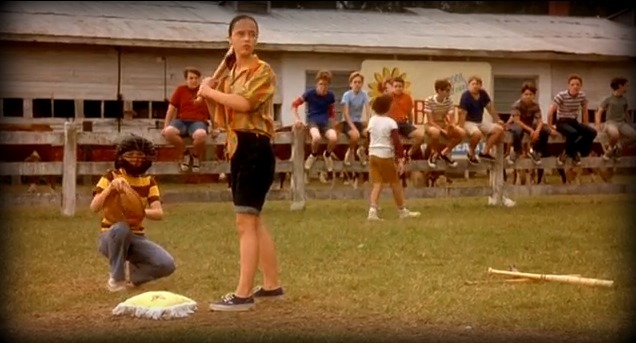
Roberta also transgresses into what is consider boy’s territory by placing herself in direct conflict with the boys, most notably after they steal the boys’ clothes. Later at the baseball game, she gets in a physical fight after one of the boys tells her she needs to remember to act like a girl and says she needs a mother to teach her how to be one. She tries to defend her right to be present in the masculine space, but her friends restrain her, supposedly to keep her dignity.
Moreover, both girls grew up without mothers or a feminine influence on their lives. Instead, each has a father who encourages her tomboyishness rather than attempting to suppress it. Vada’s father (Dan Aykroyd) is portrayed as well meaning but incapable of raising her properly alone. The film suggests he has done a fine job to this point, but he does not know what to say about as she is going through puberty. Likewise, Roberta grew up with a father and three older brothers.
This familial structure suggests their tomboyism is acceptable because they have no female role models. It is suggested, at least in Vada’s case, that her tomboyism is because she doesn’t know how be a woman, rather than a conscious decision.
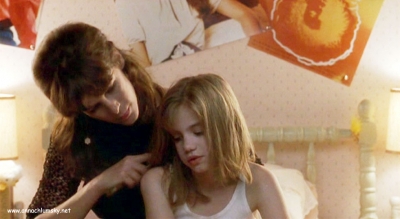
Shelly acts as Vada’s mother, comforting her and teaching her a beauty routine.
That the film begins with the introduction of an older woman to become Vada’s female role model/motherly influence suggests she couldn’t go on living this way without it.
Shelly is the epitome of femininity–she is a makeup artist, well-versed in fashion and romance. Vada sees Shelly as fascinating and exotic and allows her to take on a motherly role, showing her how to put it on lipstick and reassuring her boys will think she is pretty. In the next scene Vada, wearing full makeup, is trying to walk in an exaggerated impersonation of a movie star’s walk and posing for Thomas J. His next line, asking where her bike is, subtly suggests she will begin to abandon her tomboy qualities as she discovers femininity.
The transformed Vada in a party dress and pretty hair
Both Thomas’s death and Shelly’s influence bring her to a point where, by the end of the film she has nearly abandoned her tomboyishness. At the film’s end, she shows up at her last writing class with her hair out its ponytail, having abandoned her t-shirt and jeans for a frilly dress. Yet she retains some of her old self, still riding bikes, even in her dress.
In contrast, Roberta receives no new mother figure or female role model and could be viewed as what Vada might have become with Shelly. The adult Roberta, though straight, is portrayed as a stereotypical lesbian, a doctor who wears masculine clothes, drinks beer, and plays softball.
Adult Roberta continues to dress in a masculine style, while Chrissy is overtly feminine
Despite this, in the scene where Roberta finds the newspaper with her mother’s death notice in it, she remarks at how beautiful she was. Though she is usually portrayed as strong, this makes her cry and because she keeps repeating the comment, it seems as if she is yearning to be like her mother, but she does not know how to get there without her.
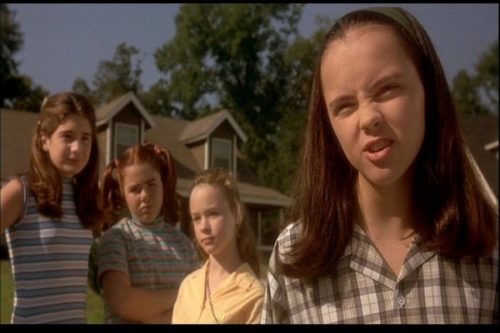
The film uses Chrissy (Ashleigh Aston Moore), Roberta’s childhood friend, as her “mother figure.” Chrissy is naïve and sheltered, to the point where most of what she says is clearly something parroted from her mother. She reminds Roberta to “be a lady” rather than fight and reminds her to “act like a girl” when she is splashing in the mud. In a sense, Chrissy’s mother, though not present in these scenes, is sort of a mother figure to Roberta.
Though best friends, Chrissy and Roberta seem to be opposites. While Roberta is a tomboy, Chrissy is the most stereotypically feminine in the group, easily scared and weak. In the future scenes, where Chrissy is having her baby, they are coupled, with Roberta taking on the husband role. While Chrissy’s actual husband only arrives to hold the baby after its born, Roberta drives her to the hospital and delivers the baby. After it is born, rather than sharing a look with her husband, Chrissy and Roberta are shown looking at each other mouthing “I love you.”
Furthermore, in both films, their first hint of romance is used to suggest a softening of their personalities and movement into a feminine disposition. Early on, Roberta is disgusted by the love quiz her friends are completing.
Roberta and Scott bond over basketball
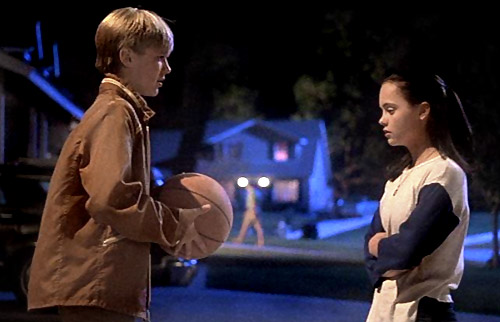
Her kiss with Scott Wormer plays on her need to question masculinity as he tells her she is good at basketball, not just for a girl but for a guy. Though she threatens to beat him up after if he tells anyone about their kiss, it is revealed later that she has stopped taping her breasts as a result.
Likewise, Vada has a crush on her teacher, an impossible object with no real hope of a future. At the same time, she is disgusted by Shelly’s romance novels and doesn’t understand why people have sex and get married.
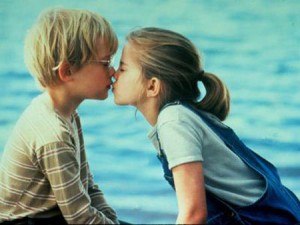
When she kisses Thomas J, it is approached as an experiment to see what it is like. Magical sounding music plays as they kiss, as if this kiss will result in a big moment where a spell is broken. Though nothing happens immediately afterward, the kiss marks a change as she is now able take him, someone her age, as a realistic love object.
Vada and Thomas J’s kiss and her first step into a feminine adulthood
His death soon after suggests that his function was merely to pull her out of her tomboyishness and introduce her to heterosexual romance. Indeed, only after Thomas J’s death is she able to make her first female friend. In this sense, the kiss could be seen as breaking a spell.
Though these films make no mention of links between tomboyism and lesbianism, as tomboy characters are given romantic subplots in films where more feminine characters are not; it is suggested that these romances are included as proof they are heterosexual.
Though Now and Then shows the adult Roberta as a fairly masculine woman, it reinforces her heterosexuality as she is referred to as “living in sin with her boyfriend.” Interestingly, this character was based on a real person who did grow up to be a lesbian, but all references to this were edited out at the last moment. This inadvertently serves to tell viewers that even the most masculine girl can grow up heterosexual.
As such, these tomboy characters emerge at the end of their respective films with more submissive feminine gender identities, the experience of their first love, and close female friends or role models. Due to this, the young girl viewer is meant to assume they fit comfortably into society and are no longer outsiders or ostracized. As such, she is give the message that she too, can only grow up straight and feminine.
Hopefully she realizes it is in her power to question it.
Elizabeth Kiy has a degree in journalism with a minor in film from Carleton University. She lives in Toronto, Ontario and is currently working on a novel.
In Pretty In Pink, Andi is a self-sufficient, seemingly self-aware teenage girl who lives in a little cottage with her single father. Andi isn’t the type of girl who goes gaga for cocky, linen suit-wearing Steff (James Spader). She’s too busy at home sewing and stitching together her latest wardrobe creations. To her fellow girl students, she’s just a classless, lanky redhead who shouldn’t dare be caught dead at a “richie” party. So, she spends her time at TRAX, a record shop she works at, and a nightclub that showcases hip new wave bands like Ringwald’s real-life fave, The Rave-Ups. Her best friends Duckie (Jon Cryer) and Iona (Annie Potts) admire and envy Andi.
Blaine, Andi, and Dickie in Pretty in Pink
This guest post by Kim Hoffman appears as part of our theme week on Child and Teenage Girl Protagonists.
Molly Ringwald was to John Hughes what strawberry jam is to sliced bread. As a forever fan of Hughes and his muse, it took me a long time to warm up to Pretty In Pink, in part because I’ve always played favorites for my first love, Sixteen Candles, followed by the untouchable Breakfast Club. That said, I’m a prideful observer of all Hughes films, having watched each countless times over the years—the aesthetics constantly taking new shape despite knowing the plot will end the same each time. Hughes wasn’t a particularly public man, but his genius mind left traces of secret suburbia and the endless topic of teenagers. Ever since I first watched a Hughes film at summer camp, I’ve been hovering over the wide shots of gymnasium school dances, yuppie keg parties, and high school girls with pink drapes covering their bedroom windows.
In Pretty In Pink, Andiis a self-sufficient, seemingly self-aware teenage girl who lives in a little cottage with her single father. Andi isn’t the type of girl who goes gaga for cocky, linen suit-wearing Steff (James Spader). She’s too busy at home sewing and stitching together her latest wardrobe creations. To her fellow girl students, she’s just a classless, lanky redhead who shouldn’t dare be caught dead at a “richie” party. So, she spends her time at TRAX, a record shop she works at, and a nightclub that showcases hip new wave bands like Ringwald’s real-life fave, The Rave-Ups. Her best friends Duckie (Jon Cryer) and Iona (Annie Potts) admire and envy Andi.
Andi’s style
The divide between the protagonist and the antagonist in Pretty In Pink isn’t among clear-cut stereotypes (i.e. cheerleaders, football players, nerds, rebels) but between the size of your house and the make of your car, or the price tag on your pastel peach prom dress. Steff comes off like this unreachable asshole who will never be able to grasp real feelings, but does somehow sense Andi’s pure nature and wants to squash the blossom so as to feel just an inch more powerful on his gross social high school hierarchy tree. Subconsciously, I used to think about this dark versus light dynamic between Andi and Steff when I was a teen warding off unwanted boys.
Andi’s the girl I’m sure an impassioned Cher Horowitz modeled her Daddy care-taking after. Andi’s father, whose wife has since left him, wants so much to please his daughter, to reinventing himself as a stable middle-aged man who can and will support his Andi and not the other way around. Many of the men in Andi’s life are floundering without her guidance—like Duckie. The Duckman is a ball of energy, an equal match in his fashion ingenuity, pining after Andi though it’s pretty clear she’ll never bat an eye back at him. Duckie has this gender queer vibe that feels free and unapologetic. His childlike abandon is admirable—endlessly riding past his crush’s house on his bike. He may not appear buff like the other popular dudes, but he’s stronger than each of them, especially insecure Blaine.
Iona reminisces about her prom
Blaine is a popular guy with rich parents, a BMW, a similar wardrobe to his sucky best friend Steff, and he is totally smitten over Andi. He wants to take her to prom. He kisses her. She melts and buckles. But there are glimpses of deception. Is Blaine just bored with his uppity lifestyle and his judgmental friends? Is he trying to get revenge on his parents who he thinks still believe in “arranged marriage”—and by that he means “date someone rich, Blaine.” Frankly, there’s nothing cheaper than Blaine. He has everyone on his back about being seen with Andi. She is seen as an outsider based on the geographical location of her house. Forget how Blaine feels—what about Andi? He can yo-yo back and forth between what’s acceptable and what his heart is telling him to do, but Andi is dealing with a ball of feelings to. She doesn’t have her mother to talk to about these kinds of things. All of her roles as a teenage daughter have been repurposed.
In many of John Hughes’ films, the girls at the party draped over their boyfriends are never the role models. A teenage girl like Andi is supposed to show young girls watching Pretty In Pink that you can be pretty, but only if you’re proud. Like so many teens—especially the ones laced up in 1980s Hughes films–pride isn’t something that’s understood in the first act. Andi has to feel betrayed first. She has to confront Blaine in the hallway after he doesn’t return her calls and claims he is taking someone else to prom. She has to have a heart-to-heart with her dad on the couch about whether or not he’s doing his best to be both a dad and a mom. Her dad somehow has to tell her that being with Blaine and suffering from the ebb and flow of love is all worth it, even from where he’s sitting. And Andi has to let Blaine drop her off at her front door. Most importantly, she has to just be a teenager—a girl who will make mistakes, need to rely on other people, and can’t always be there to pick up the broken pieces at home. She has to experience this moment, even if it’s a stupid prom. But she has to experience something true to this time in her life.
Andi begins to make her prom dress
Andi also has to have a kick-ass comrade who she can look up to, vent to, and play dress-up with. That girl is Iona, owner of TRAX. Oh, rockin’ beehive babe Iona. She’s a sassy broad and she doesn’t believe in wasting lip-gloss after 7 o’clock. She plays a chameleon of personalities through her wardrobe and she’s drenched in nostalgia, always. But, it seems Iona’s sense of the world is a little bit dreamy and drippy like a push-pop creamsicle on a hot afternoon. Iona, being the older girlfriend who still swoons hard over her prom, convinces Andi she needs to go to prom, warning her: “I have this girlfriend who didn’t go to hers, and every once in a while, she gets this really terrible feeling—you know, like something is missing. She checks her purse, and then she checks her keys. She counts her kids, she goes crazy, and then she realizes that nothing is missing. She decided it was side effects from skipping the prom.”
Let’s set one thing straight—I never went to my own prom. Sure, it’s this American classic, but it’s so patriarchal—a prom queen and a prom king to rule the ball. There’s so much emphasis on prom in teen films. Will her crush ask her? Will she find a dress in time? Will she be humiliated when and if he ditches her? Iona kind of becomes a sell-out when she starts dating a rich, preppy looking guy, and you can see the next ten years of her life like a moving picture in front of her—a kid, a house, certainly not her chic Chinatown studio. I had higher hopes for Iona. Does she know how to be Iona? Or is it easier to play a new role each day? She was better off smooching Duckie (and pondering if he practices on melons). But it’s also clear that she could learn a thing or two from Andi. And who knows, maybe she snapped out of it and eventually did.
Duckie and Andi at the prom
So, Andi gives into the brouhaha of prom. It’s true. However, she makes her own dress, she decides to still go alone, even after Blaine dumps her, and when she arrives—there’s Duckie, looking dapper as ever. “May I admire you?” Andi asks Duckie, a question Duckie frequently adorns Andi with. Inside prom, Blaine has showed up after all—and dateless. He looks like a baby deer in headlights, but he’s finally pieced together that his buddy Steff, who’d been calling Andi “lowgrade” behind her back but kept insisting she give him a chance when he hounded her in private, was just mad he couldn’t have her—mad because he gets whatever he wants. Blaine does have good intention, but he doesn’t know how to break the cycle, because then he tries getting Andi back. He should have left it alone. But that’s the hunk of the meat in Hughes films—characters realizing important lessons.
Andi won’t let anyone tell her what’s best, make her feel cheap, dumb, used, or objectified. And when she’s standing under the prom lights while OMD’s “If You Leave” swells in the background, her broad shoulders finally fill with pride. Should Andi have stayed with Duckie? Why did she chase Blaine out to the parking lot—because he told her he loved her and looked so sad and regretful? For one, this is high school—we all know she and Blaine didn’t end up getting married and settling down. We know that Duckie remained her best friend long after the corsages came off. We know that Andi drove home at a reasonable hour and made sure her dad was OK. Andi taught me that it’s cool to just be yourself—however that looks, inside and out. If people think you’re weird or different—that’s honorable. If a lover doesn’t know your worth—that’s because they can’t possibly reach your higher self. Not everyone can be pretty in pink, just the ones who are proud to wear it.
Kim Hoffman is a writer for AfterEllen.com and Curve Magazine. She currently keeps things weird in Portland, Oregon. Follow her on Twitter: @the_hoff
Granted, Ashitaka (voiced by Billy Crudup) is an important character. Even so, it is a bit disconcerting when the IMDb blurb about this movie only mentions him, and almost none of the female characters who are equally, if not more, important to the story. Princess Mononoke (voiced by Claire Danes) is the title character, but is only mentioned toward the end of the blurb. This movie is so much more than yet another “save the princess” quest!
San
This guest post by Jen Thorpe appears as part of our theme week on Child and Teenage Girl Protagonists.
Often, when an animated movie has the word “Princess” in the title, the storyline focuses on how she found, and married, her Prince. Princess Mononoke, however, doesn’t stick to that old, predictable, scenario at all. Instead, viewers are presented with several very strong female characters and a Princess that has absolutely no desire to marry a Prince.
The English version of Princess Mononoke was released in 1997. It was written and directed by Hayao Miyazaki, who is known for his beautifully animated films that tell detailed, unexpected, stories. It has been said that his films present the world in “shades of gray,” ethically speaking. Important characters can be good, and bad, at the same time. Who is the “bad guy”? That’s up to you to decide.
One of the things I love about Princess Mononoke is that it includes so many very strong female characters. They aren’t sitting on the sidelines, either. Much of the direction of the story is driven by women. This is the main reason why I think that Princess Mononoke is an excellent movie for female teens to watch. Here are animated examples of powerful women who are taking action (instead of waiting for their Prince to come).
Oddly enough, most of the reviews of this film that I have read focus on Ashitaka, a male character who is presented at the beginning of the movie. It is as though people are so used to seeing a male character as the focus that they do not know how to discuss a film that is very female-driven.
Granted, Ashitaka (voiced by Billy Crudup) is an important character. Even so, it is a bit disconcerting when the IMDb blurb about this movie only mentions him, and almost none of the female characters who are equally, if not more, important to the story. Princess Mononoke (voiced by Claire Danes) is the title character, but is only mentioned toward the end of the blurb. This movie is so much more than yet another “save the princess” quest!
Princess Mononoke is a human who was abandoned by her parents when she was an infant. (Note: There are “spoilers” from this point forward.) Moro, a giant, white, wolf (voiced by Gillian Anderson) was angered when these two humans “defiled the forest.” In order to escape from her, Princess Mononoke’s parents threw their baby at the giant wolf and ran away.
Moro chose to adopt this human infant. She named her San, and raised her just like her two male cubs. Over time, San became less human. She still looked like a human, of course, but gained the heightened sense of smell and fighting ability of the wolves. San considered herself to be a wolf, and developed a deep hatred for humans.
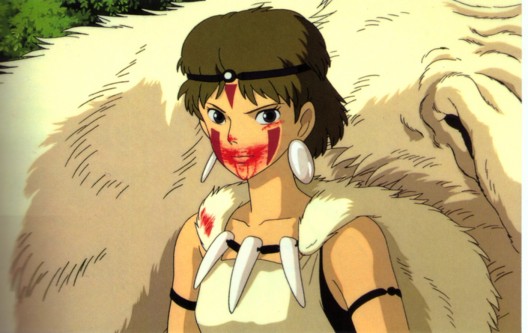
The first time San and Ashitaka meet, it is by accident. He is on a quest to find a cure for the curse that was placed upon him after a demon touched him. Ashitaka is the last Prince from his village, and will die if the curse is not removed. San is trying to help her mother to heal from a bullet wound in her chest. She is sucking out the poisoned blood from the wound, spitting it on the ground, and getting her face covered with blood in the process.
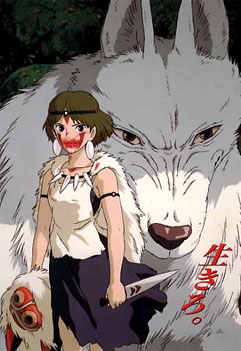
San, covered in blood
Ashitaka tries to talk to San, at first, to see if she could confirm where he thought he was at. San silently stares at him for a while, and then yells “Go away!” She leaves with her mother and “brothers.”
San has good reason to hate the humans. Not too far away is Tatara, which is run by Lady Eboshi (voiced by Minnie Driver). It is a mining colony. Lady Eboshi is intentionally cutting down the forrest, and harvesting iron ore, in order to make a fortune. San, who lives in and loves the forest, wants nothing more than to kill Lady Eboshi.
At the same time, Lady Eboshi is doing some wonderful things. She buys the contracts of female prostitutes and hires them to work in her iron forge. These women are bold, strong, and unafraid. There is a scene where many are openly flirting with Ashitaka. They call him handsome. None of the men dare to harass these women (who are quick to “trash talk” right back at the men).
Lady Eboshi has also set up a very comfortable building for lepers to live in. She provides health care, feeds them, and employs them. They are designing rifles that are light enough for women to comfortably use. She hopes to destroy the forest so the animals will go back to being “small and stupid.” The large, intelligent ones who live there now pose a threat to her town (and all humans).
It is worth noting that Lady Eboshi runs her town by herself. She’s not married to the “mayor,” and is not the daughter of a king or other powerful man. She, herself, is powerful enough to run the town and to do it her way.
San launches an attack while Ashitaka is in town. She is much faster than than the male guards in the town, and easily evades them. Someone warns Lady Eboshi that San is there and intending to kill her. Instead of hiding, Lady Eboshi stands in the middle of the street, and calls a challenge to San. At her side are two women, armed with guns. These women lost their husbands to the wolves in San’s tribe, and are looking for revenge.
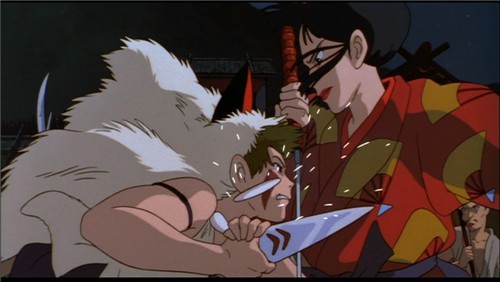
Lady Eboshi and San fight
Soon, San and Lady Eboshi get into a fight. San uses a knife, and Lady Eboshi has a sword. Ashitaka doesn’t want them to fight, so he gets in the middle and knocks out both of the women. He calls for someone to take Lady Eboshi from him, and then, basically kidnaps San. He fell in love with her the first time he saw her.
San holds a knife to Ashitaka’s throat
When San wakes, she immediately tries to kill Ashitaka. She still wants nothing to do with him. This is yet another example of a female character who, when presented with the possibility of starting a relationship with a Prince, chooses not to. San has a life that is quite full without him. She doesn’t need a “boyfriend.” San holds a knife to Ashitaka’s throat. He tells her “You’re beautiful.” She recoils in horror.
Long story short, there is a point where San saves Ashitaka’s life. Moro allows him to stay with them, and heal, and then kicks him out when he is strong enough. The next morning, Ashitaka is escorted out of the forest by one of San’s “brothers.” He gives the wolf his necklace, and asks that the wolf cub bring it to San.
The cub arrives home, necklace in mouth, just as San is about to leave for battle. She learns the necklace is from Ashitaka. San stares at it, says “pretty,” puts it on, and heads off to join the fight.
Later, Moro asks Ashitaka to “save the girl you love.” Without giving too much of the story away, San has jumped into battle to be the eyes of a giant boar who is blind. He gets tricked, and ends up possessed by demons (who curse San in the same way that Ashitaka was cursed). He manages to save her life, but cannot remove the curse.
These two play an important role in… shall we say, saving the forest from complete destruction. It is a dramatic, powerful, moment, that results in knocking both of them out. They awake, later, lying in the forest together.
They awake together
This could have turned into the “happily ever after” moment that many stories about Princesses do. Instead, San and Ashitaka have become close friends. They aren’t getting married, and they aren’t going to live together. Each continues his or her own life, with a new connection to a good friend.
There is so much more going on in Princess Mononoke that I have left out. The story is complex, and interwoven. I will note some of the other strong female characters, though.
The most powerful person in Ashitaka’s town is a Wise Woman. His little sister tried to defend her friend from a demon, by pulling a knife and blocking the friend with her own body.
Protecting her friend
Toki (voiced by Jada Pinkett Smith) is basically the “woman in charge” while Lady Eboshi is away. I highly recommend this movie as an alternative to the stereotypical Disney Princess movies. It is rated PG-13, likely because some of the imagery could be too disturbing for younger viewers.
Jen Thorpe is a freelance writer who also spends a lot of time podcasting and playing video games. The majority of her writing work (and video game blogging) can be found at No Market Collective. http://www.nomarket.org
Not since Megan Follows played Anne of Green Gables in the 1985 adaptation of the novel with the same title have girls had a young protagonist on screen who fights against social conventions that are designed to limit her because of her age and gender. Mattie’s similarity to Anne doesn’t end at their indignation and fearlessness, they both also share a love of long braids, both can be found wearing ill-fitting clothes, both of their stories are set in a similar time period, and finally, both girls are orphans.
This cross-post by Vicky Moufawad-Paul appears as part of our theme week on Child and Teenage Girl Protagonists.
Every once in a while a role comes along for a young woman who is at that tough age–that age that makes her adult-like, but before she’s realized the limiting effects of the male gaze. She is smart enough to know what is right and young enough to not know that the world doesn’t work according to right and wrong. She speaks truth to power, and expects power to accede to what would be justice. She sees what is incongruous and expects that if she shows it to others, they will correct their ways. If they don’t correct their ways, she is old enough, and in her own power enough to be able to resist their attempts to make her follow their ways. She is interested in freedom and is often called willful, clever, argumentative. It is a window that, for most women, opens as puberty hits and then shuts as puberty ends. For many women, the social relations of feudalism and capitalism make us bend and transform under patriarchal control.
Mattie Ross in True Grit, played by a 14-year-old Hailee Steinfeld, looks unimpressed and determined.
Independence, Over-Sized Clothes, and Olden Times
I recently saw True Grit, and although I don’t usually enjoy Coen brothers films, I did enjoy this film. Let me get it out of the way: I don’t connect with most of the Coen brothers’ films and I was flabbergast when a few men in my Film Studies classes during my master’s programme listed Barton Fink as one of their top ten films of all time. At the risk of sounding essentialist, in my mind the Coen brothers make “guy” films–films that guys love, but women rarely rave about. Enter: True Grit. Or, more accurately, enter the star of the film, Mattie Ross, a 14-year-old girl played by a feisty 14-year-old mixed-race Hailee Steinfeld.
Not since Megan Follows played Anne of Green Gables in the 1985 adaptation of the novel with the same title have girls had a young protagonist on screen who fights against social conventions that are designed to limit her because of her age and gender. Mattie’s similarity to Anne doesn’t end at their indignation and fearlessness, they both also share a love of long braids, both can be found wearing ill-fitting clothes, both of their stories are set in a similar time period, and finally, both girls are orphans.
Orphans were shown wearing over-sized clothes, braid, and hats.
Orphans also were shown as liking to carry things. This is why we find similarities in adaptations of novels set at the turn of the 20th century.
Although Mattie’s mom is still around, her father has recently been murdered, and thus she has to fend for herself in situations that her father ordinarily would. Instead she is settling her father’s business affairs and searching for his killer. A whip-smart character scene shows Mattie negotiating the selling and buying of her father’s property with an adult male horse dealer. She uses fast-talking, stubbornness, sharp instincts, and the occasional appeal to getting a lawyer involved to keep her from getting taken advantage of, and in fact, gets what she wants.
Mattie shows that she can cross a river on horseback, climb trees, cut a dead hanging man down, and most importantly, keep her mouth shut when appropriate. She’s the sidekick who runs the show. Even when her interests don’t dovetail with those she has hired, she re-convinces them that their interests do coincide.
The Braid Connection: Intersecting Race, Gender, and Age
Cowboy films, as a genre, are not only male-dominated, but they also have troubling relationships to Aboriginal peoples. Critiques of the implicit and explicit issues with representation of First Peoples by Hollywood has been amply put forward elsewhere, notably by film critic Jesse Wente. I wonder what the Coen brothers were thinking when they included two scenes with Aboriginal people in them. The first seems to be a critique of racism: an Aboriginal man is hanged without being allowed to say his last words, unlike the white men being hanged beside him. I applaud this implicit critique of the differential treatment of criminals of different racial backgrounds.
The second depiction of frontier relations with Aboriginal people is a scene about halfway into the film, when the character Rooster, played by Jeff Bridges, kicks two First Nations youth. This unmotivated violence could have been another critique of racial violence (simply by making it visible), if it were not for unfortunate editing choices. Rooster is climbing the porch stairs of a house he wants to enter. There are two First Nations boys sitting on the edge of the porch of the house. Out of nowhere, Rooster kicks one of the boys and he falls off the porch onto the ground. The camera focuses on the facial reaction of the other boy who is still sitting. He laughs. Seconds later the boy who laughed meets the same fate. In the theater when I watched the film, the first reaction shot established the tone for the audience reaction to the action when it was repeated. The senseless abuse of native children by an old white man got the biggest laugh of the film. And it’s worth noting that this is one of the only laughs in a film that is mostly stern and quick.
I also have to express disappointment in the choices made around the casting and direction of the adult Mattie. I would have hoped that the young fearless girl would grow up to be someone who could have been played by Michelle Rodriguez.
It’s like looking in a mirror: Michelle Rodriguez and Hailee Steinfeld looking quite similar at the end of a gun.
Elizabeth Marvel, who was cast to play the adult Mattie, embodies a conventionally strong womanliness, that is more like the unhappy stern and uptight spinster, Marilla Cuthbert, who adopts Anne in Anne of Green Gables.
Unmarried women get stern in a male-dominated genre. Characters Marilla Cuthbert and the adult Mattie Ross.
As I’ve mentioned, I usually have a “ho-hum” attitude toward Coen brothers films and toward cowboy genre films. But True Grit is saved by a fierce tween. Maybe the Coen brothers should cast Willow Smith in their next film? Based on how a tween rocked their script, I’d love to see them give ten-year-old Willow a chance to whip her hair on the silver screen.
Ten-year-old Willow Smith in the “Whip My Hair” video. Eat your heart out Jackson Pollack.
Willow already wears braids, so she’s half way there. I’d ask the Coen brothers to give Anne of Green Gables a watch first, though. Come on, even in 1985 they let a girl have a little roll in the hay with her bosom friend.
Young women enjoying each other’s company. Are Anne and Diana just bosoms? Or is the roll in the hay a vital part of their youthful strength?
Vicky Moufawad-Paul is a curator, artist, film programmer, and the artistic director at A Space Gallery in Toronto. She earned a Masters of Fine Arts from York University, where she conducted research on the visual culture of Palestine. She was previously the founding executive director of the Toronto Arab Film Festival, and has worked at the Toronto International Film Festival Group. She was a member of the Visual and Media Arts Committee at the Toronto Arts Council, a founding member of the Advisory Board of the Palestine Film Festival, and a member of the Board of Directors at Trinity Square Video. Her writing has been published by Fuse Magazine, E-Fagia, the Arab American National Museum, and the Journal of Peace Research. She was also a contributor to the anthology Decentre: concerning artist-run culture/a propos de centres d’artistes (YYZ Books, 2008). Moufawad-Paul’s video art has been exhibited nationally and internationally.