Guest Writer Wednesday: You Know What I Was Just Thinking?

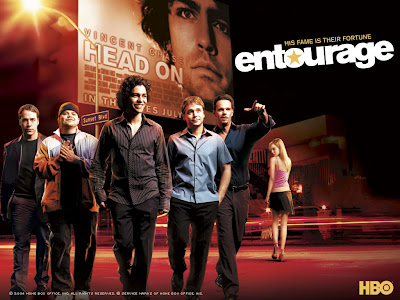
HBO’s Entourage
 
This cross post by Melissa McEwan originally appeared at her blog Shakesville.

That if President Obama REALLY wants to convince me that he’s totally an ally to ladies, he would definitely agree to a cameo in Entourage: The Movie.

SO THIS IS VERY GOOD NEWS FOR ME!

Adrian Grenier, star of the hit series “Entourage,” says he’s made a deal with President Obama.

“I promised to make the ‘Entourage’ movie if he would do a cameo. He agreed. Seriously,” Grenier wrote on Facebook on Friday.

Obama was a big fan of the HBO show.

NEAT! That is such a FUN FACT about the President, and also a very cool show for dudes to like!

For the record, yes, I realize that this is just some shit that some douche who starred in a horrible show about horrible people based on Mark Wahlberg’s real horrible life wrote on his Facebook page, but it has been three days and no horrified press release has been issued saying that the President categorically is not interested in appearing in the horrible movie spin-off of this horrible show, because no doy it’s fun to just let the cool bros think the prez is totes gonna do it and WHO ARE YOU GOING TO VOTE FOR, WOMEN WITH SELF-RESPECT, IF NOT FOR THE PRESIDENT WHO LOVES ENTOURAGE EVEN MORE THAN ROE V WADE?! Answer me that!

———-

Melissa McEwan is the founder and manager of the award-winning political and cultural group blog Shakesville, which she launched as Shakespeare’s Sister in October 2004 because George Bush was pissing her off. In addition to running Shakesville, she also contributes to The Guardian‘s Comment is Free America and AlterNet. Melissa graduated from Loyola University Chicago with degrees in Sociology and Cultural Anthropology, with an emphasis on the political marginalization of gender-based groups. An active feminist and LGBTQI advocate, she has worked as a concept development and brand consultant and now writes full-time.

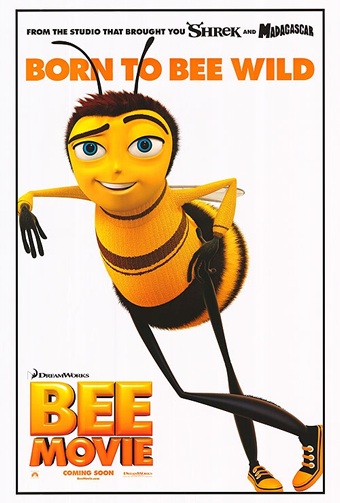
Guest Writer Wednesday: Bee Movie

Bee Movie (2007)

This is a guest post from Nicola Mason.

While shopping one day recently, I happened upon and purchased Bee Movie, the 2007 animated film featuring characters voiced by Jerry Seinfeld and Renee Zellweger. I had taken up beekeeping a few months before—had a hive of some 10,000 bees in my backyard—and I’d been educating my four-year-old daughter on how a hive’s vast population of wee six-legged arthropods work together to produce that delightfully sweet amber end-product, honey. I thought Bee Movie would be the perfect mom-daughter flick, and that it would reinforce much of what my little girl had been learning over the course of our bee-centric summer. To my horror, the movie not only presented a slew of factual inaccuracies, it also imposed a decidedly male worldview on the most successful matriarchal society in nature.
The movie begins on the graduation day of young Barry B. Benson (Seinfeld), who, along with the rest of his class (including his best friend, Adam, voiced by Matthew Broderick), must choose a job within New Hive City. A tour guide takes the class—made up of male and female bees—through the bustling inner complex and describes the choices available as we view (largely male) bees hard at work in the Honex industry.
The problem here is that, in actuality, male bees don’t work in the hive. At all. There are only a few drones in any given bee population, and their only “job” is to meet at a designated outdoor spot every afternoon in the hope that a virgin queen will pass by so they can fertilize her in an insect-world version of a gang bang. When the queen returns to the hive, she is so well fertilized that she need never mate again. All the eggs she will lay within the course of her life are already primed with the necessary genetic material to make the burgeoning brood of daughters that is necessary for the group’s survival. I feel compelled to point out that drones are considered so . . . inessential . . . that when winter sets in, they are summarily forced out of the hive and blocked from re-entering. The workers don’t want to waste precious honey on them, since it takes on average 40 lbs of the sweet stuff to sustain a hive through the cold months until nectar flows again. Drones would be an unnecessary drain on resources—and the workers can easily make a new bevy of boy-toys in the spring.
Weirdly, Barry lives in a private residence inside the hive with both a mother and father bee. The mother stereotypically worries over him and scolds him: “Don’t fly in the house!” Later in the film, the fact that the queen is his “real” mother is made clear. The Bensons are his adoptive parents. It seems worth mentioning, however, that this most powerful female force—the queen bee—is never seen and rarely mentioned. In essence, her role, and her significance, are downplayed because the movie is centered on its male hero—Barry—who, unwilling to be simply subsumed by predestined bee duties, dreams of a life of adventure.
In search of this life, he fixates on the “pollen jocks,” an eponym the film pins on forager bees, which in actuality are, of course, female. Here is where the movie takes, to my mind, a flat-out appalling testosterony turn. Its foragers are depicted as a military battalion of super bees—much larger than the workers, uniformly male, their chests puffed out with muscle and, one gathers, masculine pride. They are referred to by their drill sergeant as “monsters” and “sky freaks” as they line up at “J Gate” for their daily mission while a throng of starry-eyed female bees giggle and wave and gasp admiringly nearby. Moreover, these jocks are equipped with “nectar packs” that they carry on their backs. When Barry joins them one day (on a dare), we discover these are collection devices that, held like guns, violently siphon nectar from the flowers without the bees even having to land. Barry looks on in wonder as nature is raped and laments that he was not bred to be a pollen jock. (Insert retching sound.)
As the moviegoer expects, Barry finds a way to make his own mark. He takes the forbidden path and communicates with a human—a ditzy female florist (Renee Zellweger), who then largely drops out of the film as Barry pursues his solo crusade to keep humans from “stealing” the honey that bees work so hard to produce. The scandal goes public, and Barry, interviewed by a bee version of Larry King, becomes famous. A lawsuit ensues (bee world and human world collide), Barry wins, yadda yadda. There is an additional plot twist that brings his florist crush—with her oh-so-feminine love of lots and lots of pretty flowers—back into play, but even my four-year-old had lost interest at this point, so I will not bore you with the details.
Clearly the movie was intended as a star vehicle for Seinfeld. Obviously a male conceived of the movie (David Moses Pimental is listed as Head of Story). The writers of the screenplay—all seven of them, including Seinfeld—are, big surprise, male. What they created was not just a fiction but a male fantasy. The human female is even lured away from her big hunky boyfriend by tiny-but-charming Barry. Sure, you can give the film credit for a cross-species romance, but how difficult would it have been to simply reverse these roles? How about a female bee nonconformist hero? A male florist who adores all things prettily petaled and whose greatest aspiration is to attend the annual flower festival/parade, manning his own float? Humor could still be the heart of the film, but a slant, surprising, and more fulfilling humor that arises from challenging culturally-ingrained gender expectations instead of reinforcing them—emphasis on the forcing. I would give my weight in honey to see a film like that.


Nicola Mason is the managing editor of The Cincinnati Review, a lit mag based at University of Cincinnati. Her fiction has been widely published and anthologized. She is also a visual artist:www.nicolamason.com

TEDx Women: Rachel Simmons

We know that one of the causes of the lack of diverse representation of women in media and film is that there are not enough women behind the camera, not enough women telling their stories, and not enough of these stories being produced. 
We also know that media both reflects and shapes the culture. The (excellent) tagline of the documentary film Miss Representation comes to mind here: “You can’t be what you can’t see.” From childhood, girls see representations that reinforce the idea that girls are secondary to boys. As they grow up, the disparity continues. Geena Davis’ Institute on Gender & Media has reported that in family films males outnumber females 3 to 1 and females are almost four times as likely as males to be shown in sexy attire. We know that these statistics don’t improve in media for young or adult women.
Rachel Simmons’ talk at TEDx Women suggests that as young women grow up, the media barrage telling them that they can be powerful, as long as they don’t offend anyone, sends mixed messages that, along with institutional sexism, prevents women from achieving leadership positions:

I’m convinced a psychological glass ceiling exists as well. And it begins as a product of a culture that is telling girls “Yes, but.” Yes, you can be powerful, but you still be nice while you do it. Yes, you be smart, but make sure you don’t make anyone uncomfortable with your intelligence. Yes, you can be active, but you be sexy and skinny while you do it.

In other words, Simmons argues that enlightened sexism is holding women back, even at a time when women in the United States outpace men in education (women have higher rates of high school graduation, college attendance, and college graduation), women remain a significant minority in positions of leadership.
In Hollywood? We know how women currently fare there.
Watch the Rachel Simmons video, with an introduction and personal story about female friendship from Claire Saninni:
Also check out TEDx talks from the founder of Girls Club Entertainment, Jennifer Siebel Newsom, and filmmaker Tiffany Shlain, two women who have taken the reigns to make media of their own.

Lena Dunham’s HBO Series ‘Girls’ Preview: Why I Can’t Wait to Watch

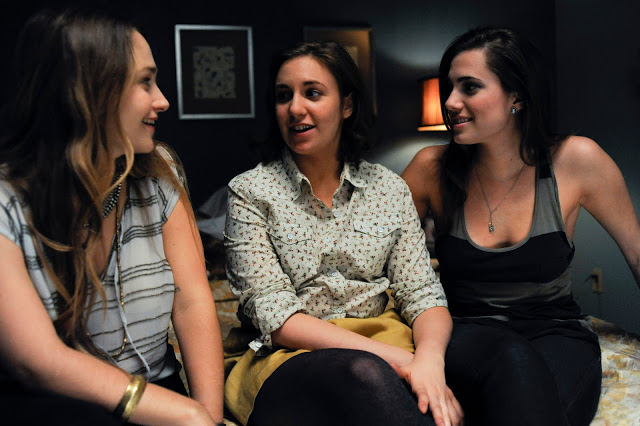
(L-R): Jemima Kirke, Lena Dunham, Alison Williams in HBO’s ‘Girls’
I cannot tell you how ecstatic I am to see Lena Dunham’s new HBO series Girls. I mean, April 15th…hurry up and get here already damnit! After the first 3 episodes received rave reviews at SXSW, the buzz swirling around the indie darling’s new show has grown even louder. And with good reason.
From the trailer, here are just a few of the clever lines that made me laugh out loud:
“I’ve been dating someone who treats my heart like it’s monkey meat.”

 “I think I may be the voice of my generation. Or at least, a voice of a generation.”

“This is why you have no friends from pre-school.”
“I have a lot of friends from pre-school. I’m just not speaking to them right now.”

“You could not pay me enough to be 24 again.”
“Well, they’re not paying me at all.”

Created by the ridiculously talented Dunham, who wrote, directed and starred in Tiny Furniture, and executive produced by Judd Apatow and Jenni Konner, some have called Girls a “game-changer” and claim it “solidifies Dunham’s place as a bold new voice in American comedy.” Considering there’s so few leading roles for women, so few films or series that showcase female friendships and even fewer women in Hollywood write and direct, it’s refreshing to see Dunham spearhead an HBO series.
Explaining her motivation to create Girls, Dunham said:
“I felt like there wasn’t a pop culture mirror reflecting girl my age experiencing the trials and tribulations of being female at this specific time.”

Dunham plays editorial intern and aspiring writer Hannah, “a post-college Brooklynite with big if uncertain ambitions, a perpetual lack of money and a coterie of friends with personal lives as jumbled and complicated as her own.” While Dunham’s vision – she writes, directs and stars in Girls – this appears to be very much a female ensemble. The other female characters include Marnie (Alison Williams), Hannah’s “seemingly perfect,” “more put-together roommate” working at a PR firm looking to practice environmental law; Jessa (Jemima Kirke), a “headstrong,” “loosey-goosey free spirit” who yearns to be an artist/educator; and Jessa’s “innocent” cousin Shoshanna (Zosia Mamet).
“These characters are a really funny mix of sort of highly educated and very naïve…Every woman I know is such a bundle of contradictions. It was so important to me that there could be a girl who was confident but sex made her incredibly anxious, or a girl who respected herself but was using sex to push boundaries to understand herself better.”

As to why the show is called “Girls” and not “Women,” which I gotta admit is probably the one thing that irked me about the show (I hate the infantilizing term “girls” for grown ass women), Dunham says the female characters wouldn’t self-identify as “women” yet and occupy “that specific in-between space (not a girl, not yet a woman).” Okay, that makes sense.
But haven’t we seen this before? What about Sex and the City or Gossip Girl? Or 30 Rock and Parks and Rec? Or the new slew of female-centric comedies like 2 Broke Girls, The New Girl, Whitney or Up All Night? Well first of all, that’s sexist (and just plain stupid) to assume all shows featuring women are the same. I mean, how many shows feature vampires in love triangles or middle-age-men-who-act-like-boys or DNA-examining crimefighters?? But nope, Girls looks different. And here’s why. In all those shows, women have established their careers and/or relationships or at the very least know the direction they want to go. Most of them also sound painfully forced, lacking any shred of authenticity. Dunham wanted to address that confusing, nebulous time in women’s post-college lives when they don’t have a clue as to who they are or know what the hell they want to do (for some of us, this continues into our 30s…). It’s about trying new things, fucking up, and finding yourself along the way.
Talking about Girls and other shows, Dunham said:
“I really like all the new network “girl” shows. But someone once described the attitude of women on network TV as “Check it out, guys: ladies be talkin’!” And I think we were really careful about anything that rung false…

“The stuff that I’m naturally drawn to writing is stuff I’ve felt but haven’t seen. I’d seen “Gossip Girl,” which was an aspirational high school story. And “Sex and the City,” which I grew up on and completely respect, was about women who had figured out the career, figured out their friendships and were really trying to lock the love thing down. To me there’s this time of life where you don’t even know what you want, and you don’t know how to want it. It’s much more abstract and wandering.”

Exploring female friendship, sex, dating douchey guys, abortion (SO few shows deal with abortion…huzzah!) living in the ridiculously expensive yet awesome NYC – it looks like Girls contains awkward, painful yet ultimately funny moments that “resonate” with many of us. I may not be 24 anymore and I’m not financially privileged. I supported myself after high school, paid my own way through college and don’t live in NYC (yet). But watching the clips – hearing Dunham’s thoughts and the way the female characters interact with one another – feels like A LOT of my life. In the trailer, Hannah says,  “My entire life has been one ridiculous mistake after another.” YES!!! I mean, aren’t we all trying to figure shit out and find ourselves or our path in life??
Dunham clearly looks at the world through a feminist lens (does she call herself a feminist? I hope so…that would be badass) as she wants to focus on female relationships. In addition to Girls and Tiny Furniture, she curated a film series called “Hey Girl! Lena Dunham Selects” (running April 2-8) for the BAMcinématek, the film program of the Brooklyn Academy of Music.
Lena Dunham possesses a fresh, hilarious, intelligent and raw voice. Buoyed by funny dialogue, her must-see film Tiny Furniture makes astute commentaries on gender, body image, sex, dating and female relationships. But I also found myself irritated it didn’t move at a faster pace. I eventually realized I was partly annoyed because Dunham makes you witness uncomfortably awkward moments and doesn’t let the audience off the hook. She forces you to squirm right alongside her compelling characters, feeling their pain. After reading interviews and watching the trailers, it sounds like Girls will continue her theme of candor, humor, poignancy and self-discovery.
We desperately need to hear more feminist voices. I’m delighted Dunham’s getting a bigger stage in which to share her hilarious observations and vision of the lives some women lead.
Girls premieres on April 15 on HBO.

‘Friends with Kids’: Witty & Touching…But Is It a Feminist Extravaganza?

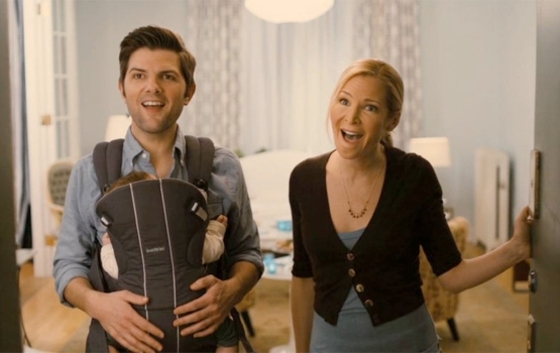
Adam Scott and Jennifer Westfeldt in ‘Friends with Kids’

I was deliriously drunk with excitement to see Friends with Kids. I mean, a film starring Kristen Wiig, Maya Rudolph, Jon Hamm AND written and directed by a woman?? And not just any woman but writer Jennifer Westfeldt?! Yes, please!  And yes, it’s funny. Really funny. I laughed so hard my face hurt. Literally. Oh, and of course I cried. It’s not a complete movie-going experience unless I’ve devolved into a sobbing hot mess. But did it live up to my feminist expectations?
Westfeldt plays cheery, talkative and self-deprecating Julie who’s best friends with Jason (Adam Scott) a fantastic loyal friend who happens to be an objectifying womanizer in his dating life. Julie and Jason are the kind of besties who live in the same apartment building, have known each other forever, can finish each other’s sentences and continually debate hypothetical situations such as which is the best way to die.
After their circle of friends (Maya Rudoph, Chris O’Dowd, Kristen Wiig, Jon Hamm) get married and have babies, Julie and Jason witness the decline of spontaneity, romance and apparent happiness in the couples’ lives. Both Julie and Jason want a baby but they don’t want to lose romance. What if they could have a child but skip that part? Why must you have a baby with the same person you’re romantically involved with? And so they decide to have a baby together while remaining platonic friends.
Not only did she star in the film, Westfeldt also wrote, directed and produced Friends with Kids, which also happens to be the first film from Westfeldt and partner Jon Hamm’s production company. The writing (Westfeldt drew upon her own personal experiences with friends) is sharp, intelligent and witty. The two leads banter with ease. Westfeldt is super likeable and if you adore Scott as Leslie Knope’s adorbs BF Ben Wyatt (um, yes, yes I do!!), you’re going to loooove him here. He’s fricking hilarious. Westfeldt wanted the dinner scenes where all 6 of the friends sit around and talk to echo those in Hannah and Her Sisters. And those feel effortlessly authentic. But don’t let the posters and trailer fool you. If you’re going to see this supposedly ensemble film because of Wiig, Rudolph and Hamm, you might be disappointed. There’s just not enough of them in the movie. But maybe I’m greedy.
As the film unfolds, it encompasses shades of light and dark as it explores the characters’ lives. It’s funny yet brutally honest, never pulling any punches about life including babies with explosive diarrhea, stinging (sometimes cruel) spousal arguments and juggling romantic relationships while being a parent. It felt like a raunchier When Harry Met Sally… had a baby with a more mature Sex and the City.
I loved that Friends with Kids showcases different women and mothers at different stages of their lives. We see Leslie (Maya Rudolph) and Alex (Chris O’Dowd) bicker but in a joking and loving union. Leslie’s a loving and supportive friend to Julie, comforting her when she’s down and forever trying to set her up with a man, whether it’s a criminal or a hunky dad (Ed Burns). Sidebar, Julie’s singledom isn’t a death knell, people. There’s nothing wrong with being single! We see a different marriage in Missy (Kristen Wiig) and Ben (Jon Hamm). When they’re newlyweds, they can’t keep their hands off each other. After kids, they’re exasperated and miserable. It’s sad but realistic watching their marriage unravel. Whether she’s uttering a witty quip or evoking her character’s inner turmoil and pain (her scene standing in the window…dagger in the heart), Wiig makes every moment count.
Beyond the three female friends, we also see MJ (Megan Fox), a self-described “gypsy” free spirit dancer openly states she never wants kids. Yet she’s refreshingly never demonized for her choice. We also see Julie’s and Jason’s mothers: one who adores her child and dotes on her grandchild, the other swoops in at the baby’s birth leaving a check and then swoops out again.
Westfeldt’s 3 films that she’s written all tackle relationships from a unique angle differing from the societal norm. The unconventional exploration of parenthood is an intriguing premise. As Westfeldt told Melissa Silverstein at Women and Hollywood:
“…I’ve never understood why things always have to be just one way when I’ve seen so many people in my life struggle tremendously to fit into those boxes or to live up to those expectations or pressures put upon them by whatever society’s concept of ‘normal’ is…I’m frustrated by things that are exclusive to one particular life choice…I think that, in all three of my films, I’ve been trying to explore these different milestones, and the idea that there are a lot of valid ways to live your life and make decisions to find happiness on your own terms.”

I love that Westfeldt questions and explores individual paths to happiness. It’s refreshing to witness Julie and Jason as single parents yet parenting as an egalitarian team. While the friends all outwardly support Julie and Jason, only Alex (the adorbs Chris O’Dowd) actually thinks it’s a great idea. In fact, Julie and Jason’s parenting decision offends Leslie (Rudolph). She believes it’s “insulting” to their “way of life,” “to all normal people who struggle and make sacrifices and make commitments to make a relationship work.” Her teddy bear husband Alex responds with the humorous line, “We’re not Mormons or old-timey people. We don’t exactly have a way of life, babe.” While she pokes fun at everyone, Westfeldt never vilifies married parents or single people. Her film evokes the message that you never know where your choices in life will take you.
As someone in their 30s who isn’t married, doesn’t have kids and doesn’t want kids, I’m always glad to see alternative lifestyles. Although to be honest, the more radical choice would’ve been to depict a childless woman who wants to be childless rather than succumbs to the stereotypical ticking biological clock. But hey, at least we’re seeing a single mother in a favorable light…that’s a huge step. It also would have been great to see greater diversity, such as gay or lesbian parents or more people of color (I mean this is NYC, c’mon!), although I’m glad to see a woman of color (Rudolph) in the film.
While Westfeldt depicts complex female characters, I wish she had delved deeper into the female relationships. Instead, she chooses to focus on the romantic aspect of the comedy. Which is fine of course, in fact that component is quite compelling although at times conventional. And I’m delighted Julie doesn’t wait around for a man or the perfect scenario to lead her life. But as awesome as Friends with Kids is, there’s just not enough lady interaction. No real sisterhood or female bonding.
Considering that Kissing Jessica Stein, Westfeldt’s first screenplay and her breakout role, a wonderful romantic comedy of a straight and bisexual woman who enter a relationship together, passes the Bechdel test repeatedly, I assumed Friends with Kids would too. But it just barely does. The only times we see two women talking together are when Julie cries to Leslie about Jason dating, when Julie’s mom tells her that she’d love to babysit more, and when Jason introduces MJ to Julie and Julie tells her that she feels like she knows her cause she’s washed her thongs (ha!). In two of those three scenes, women might be talking to women but they’re talking about men. Even one of the most pivotal scenes, a verbal showdown at dinner on a ski trip, happens between Jason and Ben…two dudes.
Why must almost every film, even awesome movies starring and created by amazingly strong and talented women, perpetually revolve around men?
When a film is written and directed by a woman who launched her career on a pretty feminist film, my expectations for her directorial debut are high. Friends with Kids is a touching and hilarious film. And Westfeldt is an incredibly talented writer and director with a knack for capturing nuanced dialogue and raising thought-provoking questions. For a movie created by a woman who believes we should support female filmmakers and women’s voices, I just wish it had been the feminist extravaganza I had hoped and envisioned.

Happy International Women’s Day: 11 Films that Celebrate Inspiring & Trailblazing Women

You can’t be what you can’t see. That’s just one of the reasons we need more women filmmakers and more diverse portrayals of complex women on-screen. At this year’s Oscars, actor Gabby Sidibe astutely declared:
“The way I watch movies, I’m really searching for myself because I don’t get to see enough of myself and I don’t, I kind of don’t get to like myself enough. But if I can see myself on-screen then I know I exist.”

We need to see a greater representation of women, especially women of color, queer women and trans women. Women’s history doesn’t exist separately. Yet media often writes women out of history.
Today marks International Women’s Day, a day to celebrate women’s achievements economically, politically and socially as well as to reflect on what still needs to improve. Too often, women and their stories are somehow seen as lesser than men’s: less important, less noble, less substantial. We must stop undermining their experiences and lives. So today, let’s celebrate all of the wonderful accomplishments women have achieved. Let’s embrace the stories and experiences of women…of our mothers, sisters, daughters, grandmothers, friends…and ourselves.
Later this month, Bitch Flicks is publishing a series on Women in Biopics and Documentaries. So here are just a few films honoring the many women who inspire and blaze trails:
1. Pray the Devil Back to Hell – Last month, three women won the Nobel Peace Prize, including activist and social worker Leymah Gbowee and President Ellen Johnson Sirleaf (along with Tawakkul Karman in Yemen) who fought for women’s rights and helped achieve peace in war-torn Liberia. Director Gini Reticker and producer Abigail E. Disney, chronicles their battle for peace in their Tribeca Film Fesitval-winning documentary. Pray the Devil Back to Hell tells the powerful and uplifting story of the Liberian women who joined together and peacefully protested, helping end the civil war ravaging their country. Their activism should inspire us all to realize we can each create change.
2. Iron Jawed Angels – One of my absolute fave films, Iron Jawed Angels tells the powerful true story of indomitable activists Alice Paul (played spectacularly by Hillary Swank) and Lucy Burns (Frances O’Connor) and the fight for women’s suffrage. Director Katja von Garnier showcases their tireless struggle, from protesting in the freezing cold outside the White House to arrest and force feedings in prison. My only complaint? While Ida B. Wells is in the film, it only touches upon how many white women didn’t want African-American women to participate as well as diminishing the role African American women played. An amazing film about the women who refused to give up until they won equality and “revolutionized the American feminist movement.”
3. Miss Representation – Challenging sexist stereotypes, warped beauty standards and misogynistic imagery, the documentary “explores how the media’s misrepresentation of women has led to the underrepresentation of women in positions of power and influence.” An eye-opening look at the power of the media and the toxic messages it too often sends to women and girls. A labor of love written, directed and produced by Jennifer Siebel Newsom. Miss Representation will forever change the way you view films, TV shows, advertisements and the news.
4. Chisholm ‘72: Unbought and Unbossed – Feminist icon Shirley Chisholm became the first black woman elected to Congress in 1968, serving from 1969 to 1983. In 1972, she became the first black woman to run for president and the first woman to run for the Democratic presidential nomination. A dynamic powerhouse, she tirelessly advocated for inner city residents, children and healthcare. Directed and produced by Shola Lynch, Chisholm ‘72: Unbought and Unbossed chronicles Congresswoman Chisholm’s passionate and trailblazing campaign. She may not have won the presidency but she continues to inspire generations of women.  
5. Off the Rez – This documentary tells the story of Shoni Schimmel, a high school basketball phenom living on the Umatilla Indian Reservation. When Shoni’s mother Ceci, a strong and powerful woman, gets a job coaching a basketball team in Portland, Oregon, Ceci and her 7 children move. Exhilarating to watch, Shoni’s basketball skills transcend athletics, becoming art. Balancing her goals and her familial ties, it’s inspiring to see this young Native American woman represent her community both on and off the court.
6. The Whistleblower – Starring Rachel Weisz as Kathryn Bolkovac, a UN peacekeeper in Bosnia, “this gripping expose” reveals the harrowing plight one woman risking her life to combat human trafficking. Directed by Larysa Kondracki, the film depicts Bolkovac’s struggle to save women trafficked and uncover the truth amidst widespread corruption. Powerful and disturbing, The Whistleblower will haunt you long after it ends.
7. My Mic Sounds Nice: A True Story of Women and Hip Hop – A BET documentary, director Ava DuVernay “explores the demise of the female MC in today’s music.” Consisting of interviews with Missy Elliott, Trina, Eve and Salt-n-Pepa, the interesting and thought-provoking film celebrates and gives voice to black female musicians navigating the terrain of male-dominated hip-hop.
8. War Redefined – The 5th and final installment in Women, War & Peace (WWP), War Redefined is the capstone of the groundbreaking series featuring politicians, military personnel, scholars and activists discussing how women play a vital role in war and peace-keeping. Narrated by actor Geena Davis, a phenomenal gender media activist, this powerful film threads stories told in the other parts of the series: Bosnian women surviving rape camps, Liberian women protesting peace, Afghan women demanding their rights in negotiations and Afro-Colombian women contending with internal displacement. War Redefined, and the entire WWP series, challenges the assumption that war and peace belong to men’s domain.
9. !Women Art Revolution – A stunning and visionary documentary 40 years in the making, !Women Art Revolution, chronicles the convergence of feminism and art, fueled by anti-war and civil rights protests and the inception of the Feminist Art Movement in the 60s. Director Lynn Hershman Leeson, a performance artist and filmmaker, combines “intimate” interviews along with visceral visual images of paintings, performance art, installation art, murals and photography. The documentary depicts how women activists have fought to express their vision and have their voices heard in the art scene.
10. Gloria: In Her Own Words – Feminist icon Gloria Steinem lays her life out in this documentary:  her triumphs, accomplishments, woes and heartbreak. She speaks candidly about fighting for reproductive justice, her own abortion, her journalism career, facing sexual harassment, rallying for equality and the feminist movement. I didn’t think it was possible to be even more inspired by Steinem than I already was…but I am.
11. Pariah – My pick for the best 2011 film, Pariah won the Independent Spirit Award for the John Cassavetes Award and the NAACP Image Award for Outstanding Independent Film. Written and directed by Dee Rees and produced by Nekisa Cooper, tells the story of Alike (Adepero Oduye), a young black lesbian in Brooklyn. An exquisitely beautiful coming-of-age film about a woman discovering her sexuality and asserting her identity. We so rarely see positive portrayals of black women and queer women on-screen. Pariah broke my heart with its beauty and uplifted my soul. Yeah, it’s seriously that amazing.
What films inspire you??
Head wtch in charge: Revisiting The Witches

     Since the premiere of NBC’s new musical comedy, Smash (think: Glee for adults that are embarrassed to admit that they watch Glee), interest has been renewed in the legendary actor Anjelica Huston. While Huston boasts a laundry list of screen credits, including a handful of Emmys and an Academy Award win for Prizzi’s Honor, the least attention of all has been given to her worthwhile portrayal of the High Witch in the 1990 film adaptation of Roald Dahl’s The Witches.
   
     The film centers around the parallel lives of Helga Eveshim (Mai Zetterling) and her recently-orphaned grandson, Luke Eveshim (Jasen Fischer). Each night before bed, Luke begs to hear a story about witches. “Real witches dress in ordinary clothes and look very much like ordinary women. They live in ordinary houses and they work in ordinary jobs[…]for all you know, a witch might be living right next door to you,” Helga tells him in foreshadowing. For a moment, she sounds a bit like Fred Phelps, warning his minions about the dangers of lesbians.

     Grandmother’s distaste is very much warranted, however. As a child, she witnessed the witches turn her close friend into a character in a painting, where she spent the rest of her days, aging along with the canvas.

     Bad news strikes the Eveshim family thrice within the first fifteen minutes of The Witches. Shortly after the car crash which kills Luke’s parents, Helga is diagnosed with diabetes and urged to go on a holiday. The two relatives travel to a majestic hotel in Cornwall, England. Their relaxing vacation soon turns anything but as Helga and Luke realize that witches from every corner of the globe are having their annual convention in the very same hotel!

     These are hardly JK Rowling’s witches. They have beady purple eyes, scabbing scalps, square toes, not to mention a gross distaste for children–so much, that kiddies give off the scent of “dog’s droppings” whenever they are near. These supernatural women have one mission, and one mission only: To eradicate the world of these sticky-fingered, no good nuisances.

     Huston’s character spends the majority of her time on-screen berating the common witches  for not doing more to reduce the world’s K-12 population. When a commoner protests, “We can’t possibly wipe out all of them!,” the High Witch effortlessly turns her to ash. She then unveils a tiny bottle containing 500 doses of a potion called Formula 86, which is designed to assist in the complete annihilation of children in a very thorough and gruesome manner.
“Vitches vork ONLY vith magic!” the High Witch asserts. Funny, so do btches.

While Huston’s High Witch may be no Professor McGonagall, she serves as an excellent prequel to Bellatrix LeStrange:

     Fortunately, Grandmother Helga has schooled young Luke on witches’ wiles. Between her vast knowledge and Luke’s big-eared eagerness two learn, the two have no choice: They must take on the High Witch and–without giving away too much–offer her a taste of her own medicine.

     While The Witches did not fare well in box offices 22 years ago, the film holds two unplanned titles: In addition to being the Swedish bombshell Mai Zetterling’s last film, it was also Jim Henson’s final production before his untimely death in May 1990. As someone who grew up squished between episodes of Sesame Street and the pages of Roald Dahl’s novels, I would’ve loved to see this collaboration continue. The puppetry and cosmetic effects used in The Witches are so uniquely Henson that it’s impossible to not reminisce on Labyrinth while watching the film.
     Mai Zetterling ultimately pushes the plot forward, and in true feminist fashion. She’s everything I would want to be as a grandmother, from the bone-chilling bedtime stories to adventurous holidays in England. She educates and guides Luke, passing the witch-burning torch onto him when she’s no longer able to carry it.

     Despite The Witches having a large group of women serving as a collective antagonist, the film passes the Bechdel Test with flying colors: There is more than one female character who has a conversation about something other than men (in this case, the extermination of children); and while the High Witch uses her powers for evil, she earns Bonus Bechdel Points (BBPs) in my book for holding her own for as long as possible with a large and often critical group of colleagues.
__

While she doesn’t quite have the accent, Sarah Fonseca’s been known to accidently type ‘ya’ll’ in her articles. Thank g-d for copyeditors.

Sarah runs frantically between writing and feminist club meetings on her university’s campus. Fortunately, those two spheres collide more than one would think. She is heavily involved with National Organization for Women, Creative Writing Club, and Random Acts of Poetry at Georgia Southern University.


Sarah is a staff writer for Georgia Southern’s George-Anne newspaper, and occasionally contributes to other publications within the community. Her fiction has been published in The Q Review and recognized by the Harbuck Scholarship committee.


Sarah is currently applying for fellowship with Lambda Literary, and plans to present her paper entitled On the Queering of Hair at next year’s National Women’s Studies Association Conference. 


Call for Writers: Biopics/Documentaries About Women

March is Women’s History Month. In honor of that, we’ve decided to feature reviews of biopics and documentaries about women. Many biopics about women tend to focus on their relationships and love lives exclusively, in a way that biopics about men usually don’t. So, we’d love to read reviews that praise these films, but feel free to write about biopics and documentaries that seriously fail the women being depicted. (Check out Gabriella Acipella’s analysis of the Margaret Thatcher and Marilyn Monroe films for an example of this.) There are currently TWO Linda Lovelace biopics in the works, yet we rarely see biopics or documentaries about women who changed lives (and cultures) … and there are plenty of women who did.

Here’s a very, very brief list of biopics–many of which are terrible, ha, and include lots of singers and entertainers–to think about, but please propose your own ideas for film reviews–including reviews of documentaries about women, too.

Helen Mirren as Queen Elizabeth II in The Queen

Meryl Streep as Julia Child in Julie & Julia

Angela Bassett as Tina Turner in What’s Love Got to Do With It?

Julia Roberts as Erin Brockovich in Erin Brockovich

Marion Cotillard as Edith Piaf in La Vie En Rose

Reese Witherspoon as June Carter Cash in Walk the Line

Diana Ross as Billie Holiday in Lady Sings the Blues

Angelina Jolie as Gia Carangi in Gia

Faye Dunaway as Bonnie Parker in Bonnie and Clyde

Jennifer Lopez as Selena in Selena

Sissy Spacek as Loretta Lynn in Coal Miner’s Daughter

Charlize Theron as Aileen Wuornos in Monster

Halle Berry as Dorothy Dandridge in Introducing Dorothy Dandridge

———-

Here are a few basic guidelines for guest writers on our site:

–We like most of our pieces to be 1,000 – 2,000 words, preferably with some images and links.
–Please send your piece in the text of an email, including links to all images, no later than Friday, March 23rd.
–Include a 2-3 sentence bio for placement at the end of your piece.

Email us at btchflcks(at)gmail(dot)com if you’d like to contribute a review. We accept original pieces or cross-posts.

2012 Oscar Nominations Roundup

The Oscars air this Sunday night on ABC.

Thanks to all who contributed reviews of this year’s Academy Award nominees!

Best Picture:
The Descendants reviewed by Stephanie Brown
Extremely Loud & Incredibly Close reviewed by Jennifer Kiefer
The Help reviewed by elle
Hugo reviewed by Scott Mendelson
Midnight in Paris reviewed by Megan Kearns
Moneyball reviewed by Robin Hitchcock
The Tree of Life reviewed by Lesley Jenike
Best Documentary:
Hell and Back Again
If a Tree Falls: A Story of the Earth Liberation Front
Pina reviewed by Ren Jender
Paradise Lost 3: Purgatory
Undefeated

Best Actress:
Glenn Close in Albert Nobbs
Viola Davis in The Help
Meryl Streep in The Iron Lady reviewed by Gabriella Apicella
Michelle Williams in My Week With Marilyn reviewed by Danielle Winston
Best Supporting Actress:
Berenice Bejo in The Artist reviewed by Candice Frederick
Jessica Chastain in The Help
Melissa McCarthy in Bridesmaids reviewed by Janyce Denise Glasper
Janet McTeer in Albert Nobbs
Octavia Spencer in The Help

Best Original Screenplay:
The Artist
Bridesmaids
Margin Call reviewed by Jessica Pieklo
Midnight in Paris
A Separation

Best Adapted Screenplay:
The Descendants
Hugo
The Ides of March
Moneyball
Tinker Tailor Soldier Spy

Be sure to join us on Twitter during the Oscars!

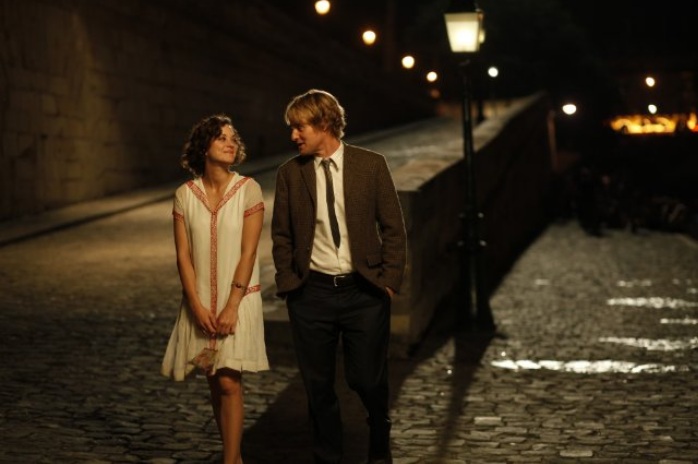
Oscar Best Picture Nominee: ‘Midnight in Paris’ and Its Woman Problem

Marion Cotillard and Owen Wilson in ‘Midnight in Paris’
I’ve never understood why people adore Woody Allen and lavish him with accolades. I’ve never liked his films. Nope, not even the adored Annie Hall, aside from the FABulous fashions donned by Diane Keaton. I know, I know…I’ve braced myself for the verbal lashings that will undoubtedly ensue. Besides his creepy penchant for dating and then marrying his daughter, I loathe the way Allen generally depicts women in his films. Yes, his movies make some interesting gender commentaries and contain phenomenal female actors (Diane Keaton, Meryl Streep, Patricia Clarkson, Penelope Cruz). But it irritates me that the myriad interesting and intelligent female characters in his movies seem to be punished for their strength or continually fall for the neurotic chump’s charm bullshit.

In Allen’s latest Oscar-nominated endeavor, Midnight in Paris, Gil Pender (Owen Wilson) is a successful Hollywood screenwriter struggling to write his first novel. He visits Paris with his constantly complaining fiancé Inez (Rachel McAdams), as he yearns to live amongst his literary idols in the Roaring Twenties. Gil discovers that at midnight, he is able to transport to 1920s Paris and hobnob with writers, musicians and painters. A love letter to Paris and artists, Midnight in Paris explores the dichotomy between illusions of nostalgia and pragmatically embracing the present.

Allen has a knack for evoking the visceral beauty of a city: NYC in Annie Hall and Manhattan, Barcelona in Vicky Cristina Barcelona, Paris in Midnight in Paris. With lush cinematography, Allen capturesthe seductive allure and breathtaking romance of Paris. He also infuses the film with myriad authors and artists from the 1920s, a bibliophile’s dream. These delightful distractions almost made me forget (almost) that while an okay film, it’s certainly not a great one.

Now, I didn’t hate Midnight in Paris like my kick-ass colleague Stephanie. But I totally understand why she did because it royally pissed me off too. The portrayal of women in this film is fucking problematic.

Kathy Bates is fantastic as writer and art collector Gertrude Stein. Yet she’s highly underutilized, striving to make the most of her small role. Incredibly influential, we witness Stein’s Parisian salon which attracted talented writers, like Ernest Hemingway and Ezra Pound, whom she advised and mentored. After reviewing his manuscript, Gertrude bestows Gil with her wisdom: “We all fear death and question our place in the word. The artist’s job is not to succumb to despair but to find an antidote for the emptiness of existence.” Aside from Gertrude, none of the female characters are either truly likeable, interesting or complex individuals.

Audacious Zelda Fitzgerald (Alison Pill, who tries her best to imbue her with charm), F. Scott Fitzgerald (Tom Hiddleston)’s wife and a writer in her own right, diminishes her artistic talent by saying, “…and I realize I’ll never write a great lyric and my talent really lies in drinking.”

An “art groupie” muse, Adriana (Marion Cotillard) designs couture fashion and becomes the object of Gil’s affection, despite his fiancé. When Gertrude reads the first line of Gil’s book aloud, Adriana praises it saying she’s “hooked” and later calls his musings on the “City of Light” poetic. Enamored with her, they begin to spend their evenings talking and walking around Paris. Cotillard is a divine actor. But her character is beige and boring. Although I must admit I’m glad Adriana ultimately chooses her own path.

In addition to seeking Stein’s advice on his book, Gil turns to another woman, an art museum guide (Carla Bruni), for advice on being in love with two women at the same time. Oh, and he also flirts with 25-year-old Gabrielle (Léa Seydoux) (cause you know, that’s what middle-aged dudes do) who sells old records from the Jazz Age and shares his love of Paris in the rain.

Owen Wilson and Rachel McAdams in ‘Midnight in Paris’

But the worst female depiction – yeah, if you’ve seen the film, you know who I’m talking about – was Inez (Rachel McAdams). Inez complains about Paris’ charming bistros, getting wet in the rain, living outside the U.S. and Gil not purchasing $20,000 chairs. She undermines Gil’s talent in front of him to her friends saying, “He’s not sure he can write a novel.” Inez criticizes everything Gil says and does all while gushing over her crush, academic Paul (Michael Sheen), going so far as to shush Gil when he speaks in order to hear Paul’s pretentious diatribes. When Gil talks about Inez to others, he highlights her beauty (of course) and adds that she possesses a “sharp sense of humor.” Watching their relationship, it’s painfully obvious that there’s absolutely nothing keeping them together as the only thing they share is a mutual like of Indian food.

Now, I don’t automatically have a problem with a villainous or unlikeable female character, especially since there are so many female roles in the film. In fact, I often lament how unlike men, women are not allowed to play unlikeable or unsympathetic characters. But I have a huge problem with the “nag” role. The cliché of women as “nags” permeates pop culture.

I also have a huge problem that the seemingly sole reason Inez was made so horribly despicable was to “allow” Gil to cheat on his fiancé. The audience would sympathize with Gil for kissing another woman, buying her trinkets, baring his soul to her and planning to sleep with her even though he was engaged because his fiancé was such a shrew. Oh that’s right, I forgot! It’s okay to cheat on someone as long as they’re an asshole.

Allen told Rachel McAdams that she should play this role as she should “want to play some bitchy parts” as they’re more interesting. Maybe. But not this part. I didn’t find her character interesting at all. Yes, McAdams tries her best with the material she’s given. But the character is one-dimensional and annoying, lacking any depth or complexity.

Midnight in Paris, like pretty much all of Allen’s films, lacks diversity. They’re a sea of white with no people of color anywhere in sight. Oh I take that back. There’s a black woman in a car that Gil gets in on his “way” to the 1920s, one shot of Josephine Baker (Sonia Rolland) dancing that lasts all of 30 seconds and a few black people watching her dance.

Along with race, sexual identities are also omitted. The film contains three famous lesbians: Gertrude Stein, Stein’s life partner Alice B. Toklas (Thérèse Bourou-Rubinsztein) and writer Djuna Barnes (Emmanuelle Uzan). Of all three, Gil only alludes to Djuna’s sexuality when he says she led when they danced together. So lesbianism is almost completely erased, paving the way for good ole’ heteronormativity.

The only overt gender commentary occurs when Ernest Hemingway (Corey Stoll) says, “Pablo Picasso thinks women are only to sleep with or to paint,” but he believes “a woman is equal to a man in courage.” Which is interesting since Allen is a person who in his personal life doesn’t always believe equality in relationships is desirable: “Sometimes equality in a relationship is great, sometimes inequality makes it work.” (???) Yeah, this explains a lot. He also has a penchant for younger women, in his movies and in reality, because younger women are more innocent, “before they get spoiled by the world.” Gag. 

This attitude that older women are less desirable as romantic partners seems to echo throughout the film, particularly in its ending. Don’t stay with the older (relatively speaking) jaded woman. Get with the young, innocent girl! While numerous women abound, everything in the film revolves around Gil, a stand-in for Woody Allen. Women are merely a buffet to be sampled – if one doesn’t work out, oh well, try another!
I’ll admit; the book lover in me was almost seduced. It felt like a light-hearted, whimsical, bibliophile remake of Purple Rose of Cairo. Instead of film characters leaping off-screen, novelists from the past reside in alongside the present. But there is no way in hell this should ever be nominated for a Best Picture or Director Oscar. It’s nothing more than an esthetically pleasing diversion.

I swear people nominated Midnight in Paris for so many awards because Hollywood is lazy. Rather than nominating ground-breaking, intelligent films like Pariah, The Whistleblower or Young Adult, this gets nominated because Allen is a famous, old, white male director. Good job, Hollywood. Way to keep perpetuating the dude machine.

The film suffers from a major woman problem. The women in the film are just as intelligent and talented as their male contemporaries. Gil turns to women for advice and guidance. Yet Allen reduces almost all of them to love interests and arm candy, nothing more than satellites to a dude.

2012 NAACP Image Awards Nominations

The 43rd NAACP Image Awards air Friday, February 17th

In the midst of awards season, it’s easy to become overwhelmed with which awards are happening and when, and it’s easy to start thinking that the same movies/shows/actors/directors are being nominated for all the awards (for example, there are striking similarities between this year’s Academy and Independent Spirit Award major category nominees). 

However, the Image Awards offer a break from the monotony of many other mainstream awards shows–and, more importantly, they highlight the cultural contributions of people of color, who are so often pushed aside, ignored, or rendered practically invisible by Hollywood and mainstream entertainment complexes. The Image Awards celebrate: 

the outstanding achievements and performances of people of color in the arts (television, recording, literature, motion picture and writing & directing), as well as those individuals or groups who promote social justice through their creative endeavors.

One could look at this year’s list of Academy Awards nominees and think that there are very few people of color acting in films, and even fewer writing or directing–and when you specify women of color, the list gets even shorter (the women of The Help are this year’s exception that proves the rule). While there is truth in that statement, the Image Awards show us people who are making movies (and making television, and writing books), and they also show us how these contributions still aren’t as culturally valued. 
Here are some nominations from a few of the film categories (find a complete list on their website, including awards for Television, Recording, Literature, Motion Picture, and Writing & Directing).
Outstanding Motion Picture
Jumping the Broom
The First Grader
Tower Heist
Outstanding Actress in a Motion Picture
Adepero Oduye for Pariah
Emma Stone for The Help
Paula Patton for Jumping the Broom
Viola Davis for The Help
Zoë Saldana for Columbiana

Outstanding Supporting Actress in a Motion Picture
Bryce Dallas Howard for The Help
Cicely Tyson for The Help
Kim Wayans for Pariah
Maya Rudolph for Bridesmaids
Octavia Spencer for The Help
Outstanding Independent Motion Picture
I Will Follow
MOOZ-lum
Kinyarwanda
The First Grader
Outstanding Directing in a Motion Picture
Alrick Brown for Kinyarwanda
Angelina Jolie for In the Land of Blood and Honey
Dee Rees for Pariah
Salim Akil for Jumping the Broom
Tate Taylor for The Help

The 43rd NAACP Image Awards air live on NBC this Friday, February 17th, at 8 PM EST. Will you watch?

‘Game of Thrones’ Season 2 Trailer: Will Women Fare Better This Season?

Luckily, Season 2 will see an influx of new characters, including lots of female roles. Huzzah! The “Red Priestess” Melisandre of Asshai (Carice van Houten), female warrior (!!!!) Brienne of Tarth (Gwendoline Christie), noblewoman Lady Margaery Tyrell (Natalie Dormer), Ygritte (Rose Leslie), the Ironborn captain (double !!!!) Yara Greyjoy (Gemma Whelan) named “Asha” in the novels. Wait, a sorceress, warrior and ship captain?? More women in leadership roles?? Sounds promising!


When I wrote about HBO’s Game of Thrones last year, I had no idea that my critique would ignite such a fire storm.
In the 2 years I’ve been blogging, my post “Here There Be Sexism? Game of Thrones and Gender” holds the rank as my blog’s second most commented post. Readers commenting had visceral reactions to my criticizing the TV show, based on the beloved series by George R. R. Martin, and its depiction of gender and its treatment of women.
Now, while I know the TV series is pretty faithful to its source material, I haven’t read the books yet. So I can’t speak to how the books depict the female characters, only the TV show. But should I have to read the books in order to enjoy the show? Nope, I don’t think so. A TV series or film should be able to stand on its own accord. But people keep telling me to wait until season 2 as the books get even better regarding the gender roles.
Last week, HBO aired its trailer for the much-anticipated Season 2. The trailer is narrated by Varys (Conleth Hill):

“Three great men: a king, a priest and a rich man. Between them stands a common sell sword. Each great man bids the sell sword kills the other two. Who lives? Who dies? Power resides where men believe it resides. It’s a trick, a shadow on the wall. A very small man can cast a very large shadow.”

Ugh. A dude…talking about more dudes. Yet another dude-fest.
In the very 1st teaser trailer that premiered in December, narrated by Stannis Baratheon (Stephen Dillane), Robert Baratheon’s brother who’s gunning for the Iron Throne, again it’s the voice of a dude we hear.
But Game of Thrones boasts a lot of strong, intelligent, powerful women. Luckily in the trailer, we see and hear my two favorite badass female characters. Caring yet steely Dragon Queen Daenerys Stormborn (Emilia Clarke), whose transformation in Season 1 truly was the best part of the show for me, assertively proclaims:

“I am Daenerys Stormborn and I will take what is mine with fire and blood.”

Gender-bending, spunky, sword-wielder Arya Stark (Maisie Williams), says:
 

“Anyone can be killed.”

Daenerys and Arya stand out as my fave characters period, regardless of gender.
Aside from them, no other women speak. Although to be fair the only other man who speaks is Golden Globe winner Peter Dinklage as Tyrion Lannister (he’s seriously amazeballs). We see assertive matriarchs Lady Catelyn Stark (Michelle Fairley) and Cersei Lannister (Lena Headey). But of course there’s a bit of misogyny in the trailer with King Douchbag (er, Joffrey) pointing a crossbow at Sansa Stark (Sophie Turner), threatening her life.
Misogyny and sexism tainted Season 1 of Game of Thrones with rape, abuse and objectification. While it pissed some people off, nudity on a show doesn’t really bother me. What did irk me was all the brothel scenes that focused on the male gaze and male pleasure. Aside from Daenerys and Arya, even the strong and powerful female characters are ultimately deferential to the men around them. It implies women’s lives revolve around men. So many films and TV series focus on men and their perspectives with women as secondary characters rarely talking to other women.
Luckily, Season 2 will see an influx of new characters, including lots of female roles. Huzzah! The “Red Priestess” Melisandre of Asshai (Carice van Houten), female warrior (!!!!) Brienne of Tarth (Gwendoline Christie), noblewoman Lady Margaery Tyrell (Natalie Dormer), Ygritte (Rose Leslie), the Ironborn captain (double !!!!) Yara Greyjoy (Gemma Whelan) named “Asha” in the novels. Wait, a sorceress, warrior and ship captain?? More women in leadership roles?? Sounds promising!
But with so many new women, why did I only see 1 new female face in the 2nd trailer? Why do the trailers revolve around the men??
Now, I love Game of Thrones. Really, I do. It contains complex characters, compelling plots and political intrigue. But as stellar as the show is (and it truly is), doesn’t mean it’s inoculated from sexism. In fact, my expectations are higher because it’s so good. As I previously wrote:

“Throughout the first season…women are raped, beaten, burned and trafficked. I suppose you could chalk it up to the barbarism of medieval times. And I’m sure many will claim that as the show’s defense…or that the men face just as brutal and severe a life. I also recognize that there’s a difference between displaying sexism because it’s the time period and condoning said sexism.

“But this IS a fantasy, not history, meaning the writers can imagine any world they wish to create.  So why imagine a misogynistic one?”

I can’t stress this enough. This is fantasy, people, NOT history. So why create a sexist world rife with misogyny?? Medieval fantasy, even while incorporating accurate historical elements, is not synonymous with history. As Blood Fiend astutely writes at The Book Lantern:

“I want to read more fantasy. Really, I do. But I’m unable to read it when women are constantly oppressed and seen as lesser beings in a world based on fantasy. Writers, you can create a world with any rules you choose. Yet, you continue to write sexist worlds to have your characters overcome the sexism. Can a girl fight monsters without having to deal with sexism? Does every girl have to disguise herself as a boy to fight in a war? This has nothing to do with cultural or social constructs. In your world, you don’t have to have those.”

I might not be so hard on Game of Thrones if misogyny didn’t surface in almost every movie and TV show. In most films and shows, women’s lives revolve around men. Women talk to men and if they happen to talk to another woman, it’s about men. Too many films and shows sexualize women and show women subjugated by men via violence. Even when strong, intelligent, capable women exist (as in Game of Thrones), they are continually depicted as not possessing dominion over their bodies, families and lives.
If writers and directors utilize sexism to provide social commentary, that’s one thing. And not every movie or TV show must convey a profound message. But the media continually relies on and perpetuates sexism. While a fantastic series, Game of Thrones suffers from sexist tropes and would be even stronger without them.
I hope I’m wrong. I hope Season 2 is more of a lady-fest. And it sounds like it might be with the progression of Daenerys’ reign and the addition of so many new female characters. But with rampant sexism inherent in media, including in the 1st season, I’m not going to hold my breath.

Game of Thrones Season 2 airs Sunday, April 1st at 9pm, EST on HBO.