Arresting Ana: A Short Film about Pro-Anorexia Websites

Arresting Ana (2009)
In February of this year, Tumblr made news when it announced it would no longer host “self harm” sites–which promote anorexia or bulimia as a lifestyle choice, among other subjects–and would pop up a public service announcement (PSA) whenever someone searches for a keyword associated with self harm.
Recently I participated in a feminist film festival in which Arresting Ana, a short documentary by Lucie Schwartz, was shown. Here’s a synopsis of the film:

Arresting Ana tells the story of the potential criminalization of the pro-anorexia movement in France. The film follows two women: Sarah, an 18-year-old college student with a ‘pro-Ana’ blog, an online forum on which she shares tips and tricks with other young women on how to become anorexic, and Valerie Boyer, a passionate legislator who is proposing a ground-breaking bill that aims to ban pro-Ana websites by issuing $30,000 fines and 2-year prison sentences to members of this online underground movement.

The film was made in 2009, and at the time of its completion the proposed bill had stalled in France’s legislature. The issue of censoring pro-ana sites is interesting and controversial for numerous reasons, I think. While Boyer’s intention with the bill seems good and particularly in the interests of young women, there are some major flaws to this kind of legal activism–which essentially criminalizes people who are suffering from a serious illness and expressing themselves in various ways online. 
While I would stop short of defending someone who is instructing an audience on how to be a “better anorexic,” the free speech aspect–and the idea of criminalizing certain speech online–has serious ramifications. Though I agree with the idea that one person’s freedom ends when it impinges on another person’s freedom, I question whether pro-ana sites are actually harming or violating their readers’ freedom or personal liberty. Let me be clear: I am not in any way celebrating or defending self-harm sites; rather, they strike me as a cry for help, and maybe a manifestation of an illness, rather than criminal behavior. In the case of Tumblr, the free speech issue is largely avoided, since it is a private company, free to set its own terms of service. To me, this seems a more reasonable response in the battle against promoting self harm and eating disorders.
The question also arises as to why websites written and maintained by people suffering from eating disorders are being targeted at all. There are certainly sites on the web that are just as, if not more, harmful to people–sites that use hate speech, or promote hate or violence. Although I’m no expert, I haven’t heard about legislation–or even private companies’ terms of service–against anti-woman websites. Remember Facebook’s Occupy a Vagina event page? In this context, it seems that young women’s freedom of expression is specifically being targeted–even if the subject is a harmful and even dangerous one. (Note: Men suffer from eating disorders too, and I’m not trying to minimize that; the film focuses entirely on young women.)
Fighting eating disorders is important work, and the fact that the subject is being discussed at all in France’s legislature is a good thing. However, criminalizing illness isn’t. Better reforms seem to be the ones directed at body image: banning excessive photoshop use in magazines and advertisements, requiring models to be at a healthy weight, and speaking out against body policing and shaming–whether it happens in media or in our private conversations.
Watch the trailer for Arresting Ana:

‘Best Friends Forever’ TV Series Focuses on Two Female Friends, Which Must Infuriate Sexist ‘Two and A Half Men’ Creator

Lennon Parham and Jessica St. Clair in NBC’s Best Friends Forever


 “Hey, you always have a choice when it comes to your vagina.”
So says Lennon on NBC’s new sitcom that premiered last night, Best Friends Forever. And yes, you do have a choice, when it comes to vaginas and other things. So should you choose to watch the new female-fronted show?
When I first saw the trailer, I was ecstatic. I mean, a TV show putting two women front and center, even in their title??? Yes, please! 
Written, produced and starring real-life friends Jessica St.Clair and Lennon Parham, it also features Alexa Junge as producer and showrunner. After her husband serves her divorce papers, Jessica (St. Clair) moves from California back home to Brooklyn to live with her best friend Lennon (Parham) and her live-in boyfriend Joe. As Jessica and Lennon reminisce and bond, Joe (Luka Jones) feels left out.
Best Friends Forever is witty, funny and surprisingly sweet and tender. Parham and St. Clair share an effortless chemistry. The characters are likeable and interesting. While it seems like it might suffer from predictability – a Three’s Company premise, Joe seems like he might be a stereotypical man-child (like when he creates a female video game avatar with ginormous boobs), vagina talk between Jessica and Lennon – it possesses realistic dialogue and its humor isn’t mean-spirited. Jessica is snarky but not deemed a shrew. Lennon is nurturing but not a doormat. Lennon and Joe’s relationship is refreshingly egalitarian and uber adorbs as they bond over their shared love of Braveheart and Medieval Times. Neither gender is portrayed as superior and as Rachel Stein at Television Without Pity points out, “it weighs men and women equally.”
Best Friends Forever passes the Bechdel Test, which so few films and TV shows do. The female friendship is clearly  front and center. Talking about the show’s premise:
Lennon: “Essentially it’s a story about two best friends who are so close — it’s like that romantic relationship that girls have in middle school that travels with them.”
Jessica: “Someone brought this up to us: The word ‘friendsbians.’ You’re so close you might as well be having sex, but you’re not. [Laughs.] So really it’s a love story about two women. It’s a romantic comedy, but instead of a boy and girl, it’s Jessica and Lennon.”
Parham and St. Clair hope the series “fills the void” that Sex and the City, Gilmore Girls and Anne of Green Gables has left. Okay, as a huge SATC and Anne Shirley fan, I so heart that.
You can sense that the two leads share a history, finishing each others’ sentences, discussing dinner parties and whipping up homemade Scoops (um, which sound delish btw), and using a movie (in this case weepy Steel Magnolias and “pulling a Shelby” if you rush into major life decisions) to give advice about life, which is unusual in the pilot as most shows take at least a season or two to sink into the camaraderie. 
Yes, it’s problematic the characters are white and straight, aside from neighbor Queenetta (Daija Owens), the ubiquitous precocious child and the stereotypical sassy black girl…as if all black girls must be sassy. Although I’ve got to admit, she delivered one of the funniest lines of the episode when she said, “There’s a new baby in my house and I don’t like the way it smells!”
“Enough, ladies. I get it. You have periods…But we’re approaching peak vagina on television, the point of labia saturation.”
Oh that’s right. Women shouldn’t write, create, act or do anything. Cause you know all we ladies care about? Our fucking periods. Silly me for forgetting that. Thankfully fab feminists Martha Plimpton and Lizz Winstead among others called out this douchebaggery.
While it seems that there’s been a surge in female-centric comedies, Aronsohn’s bullshit sexist comments about vagina saturation is just that. Bullshit. Because if you look at the actual numbers, it’s not so. If you look at the female-fronted TV shows, they may be ensembles but they rarely focus on female friendship. 2 Broke Girls and Parks and Recreation(although not really this season) are the only other TV shows on right now that revolve around 2 female best friends.
As Amy Tennery at The Jane Dough, using data from Women’s Media Center, points out last TV season, women only comprised 15% of writers (!!!) and “the closest we’ve ever come to having parity with guys was in 2009 when women comprised 39% of television entertainment producers.” So there must be surge of women as TV characters then for Lee’s tirade, right?? Nope. Women constitute approximately 40% of TV characters (41% according to WMC, which doesn’t include last season, and 43% according to GLAAD). Um yeah, douchebag…that’s not exactly “peak vagina” season, whatever the fuck that is.
Is it the best comedy on TV right now? No, although it might be too early to tell. Parks and Rec still holds that title for me, followed closely by Community and Up All Night. But that doesn’t mean it doesn’t have oodles of potential. It made me laugh out loud. Something very few comedies actually do. And we desperately need more women writers and female characters. With two smart, funny ladies at the helm, I’m curious to see where Best Friends Forever goes.

Biopic and Documentary Week 2012: The Roundup

What’s Love Got to Do With It? by Candice Frederick

Bassett’s was not only one of the defining performances for women in cinema; it was also one that became a benchmark for actresses of color. Her riveting portrayal role was further punctuated by the remarkable writing. Many lead roles for women of color since then are often subordinate characters. And in many other instances, they’re the tough, ever wise figures, which don’t often allow them inhabit any other emotion. Even in the heavily lauded yet divisive drama, The Help, we saw the stories of two African-American characters glossed over and unrealized, lacking the measure of which they were worthy. Overall, too many roles written for African-American actresses have them simply orbiting around the larger story of the movie without actually being a part of it and making any real impact.

The Fat Body (In)Visible by Stephanie Rogers

The New York Times published an article by Roni Caryn Rabin in 2008 titled, “In the Fatosphere, Big Is In, or at Least Accepted.” The author highlights several writers in the blogosphere who focus on Fat Acceptance and the HAES (Healthy at Every Size) Movement.

Rabin describes the Fatosphere as follows:

The bloggers’ main contention is that being fat is not a result of moral failure or a character flaw, or of gluttony, sloth or a lack of willpower. Diets often boomerang, they say; indeed, numerous long-term studies have found that even though dieters are often able to lose weight in the short term, they almost always regain the lost pounds over the next few years.

She continues:

Fat acceptance bloggers contend that the war on obesity has given people an excuse to wage war on fat people and that health concerns—coupled with the belief that fat people have only themselves to blame for being fat—are being used to justify discrimination that would not be tolerated toward just about any other group of people.

Undesired by Martyna Przybysz

Undesired, with interviews and images shot by Walter Astrada, whom I believe to be a very courageous photojournalist, brings to light this painful and current social issue still faced by many. According to Reuters, modern day India is the fourth most dangerous place in the world for women to live, but it seems like it is also one of the most difficult ones for a female life to even begin. Gender inequality and the desire to rectify it, let alone feminism, seem like completely foreign concepts for certain classes. There is also a seeming contradiction in this entire predicament – if a woman is to be perceived as the bearer of life, how can she be made to bring about this life’s actual end?

The September Issue by Amber Leab

Grace Coddington is a former model and the creative director at Vogue. She even started working there on the same day as Wintour. She is intelligent, reflective, and an artist to Wintour’s manager persona. Coddington isn’t afraid to stand up to Wintour (whose lack of empathy was famously fictionalized by Meryl Streep in 2006’s The Devil Wears Prada) either, and flawlessly uses her every resource, including the documentary film crew, to her advantage. Viewers may see her as being cutthroat, but she’s an artist fighting for her vision, her work, and she’s earned it. She’s 68 and has spent her whole life in this industry, working for British Vogue and Calvin Klein before joining Wintour.

Monster by Charlie Shipley

We know the mass-culturally-sanctioned narrative about Patty Jenkins’ directorial debut, Monster: Charlize Theron got “ugly” and delivered a tour de force turn as serial killer Aileen Wuornos that was hailed by Roger Ebert in an effective, rare use of Travers-esque hyperbole as “one of the greatest performances in the history of the cinema.” That quote made it to countless one-sheets and adorns the DVD cover of the film, and perhaps rightly so; Theron’s performance (or “embodiment,” as Ebert puts it) so overwhelms the mise-en-scène and soundscape of the film that Christina Ricci’s stern gaze on the DVD packaging seems little more than a futile attempt to market the film visually as a buddy film gone terribly wrong. Thelma & Louise, this is not.

Poster Girl by Amber Leab and Stephanie Rogers

Nesson also juxtaposes photos of Robynn prior to her Army experience–where she’s in a cheerleading uniform, smiling and having fun with friends–with the post-Army Robynn, a tattooed, pierced, PTSD victim who stares at the former photos as if they couldn’t possibly be her. And they aren’t anymore. The new Robynn is an activist who speaks out against war and gun violence, even while dealing with debilitating panic attacks.

Marie Antoinette by Megan Kearns

Women were reduced to their vaginas, only valued if they got pregnant so they could produce an heir. No one bothers Louis XVI about this, even though he’s the one who doesn’t want to have sex. Nope, just the woman; of course she’s to blame. Eventually after 7 years with no children, Marie Antoinette’s brother, the Holy Roman Emperor, talks to him. But Marie Antoinette is repeatedly blamed for not becoming pregnant. Clearly her body and reproduction are her only salient attributes in the eyes of society. 

American Violet by Amber Leab

It’s impossible to not love Dee–a beautiful woman, a kind and patient mother, a hard worker, and a caring friend. Her temper gets the best of her once in the film, but she’s protecting her children from their alcoholic father and his accused child molester girlfriend, and can hardly be faulted for it. I’m inclined to think the movie tries too hard to make her character likable. In contrast, Dee’s friend and neighbor Gladys–who is not a conventionally attractive woman, and does not have four adorable children trailing her–is a compelling and empathetic character, but the film completely drops the ball, even failing to credit the actor who plays her. Gladys is Dee’s inspiration for continuing to fight the DA even after her charges are dropped (because Gladys took a plea deal, while Dee would not), but we don’t get to explore Gladys or her situation. I’m curious as to why she’s part of the story, but not really allowed to be a character in the film. While the movie is about Dee, I would’ve liked to get to know Gladys a bit.

Gorillas in the Mist by Carrie Nelson

But as the film goes on, the references to beauty cease, and it becomes clear that these lines are not comments on Dian’s gender identity but on the materialism that she gradually gives up as she becomes committed to living among the mountain gorillas. The lines about clothing and make-up eventually stop, and Dian lets go of the previous signifiers of her femininity. It isn’t that she becomes masculine, as Weaver’s character in the Alien series is often perceived – it’s that she no longer needs these material possessions and outward signifiers to feel comfortable in the world and convey her identity. Dian’s transformation is subtle, but it adds significant depth to her characterization as she becomes comfortable in her new surroundings.

Joan Rivers: A Piece of Work by Amber Leab

Rivers is an odd character. Being a superstar female comic alone is odd in the U.S.–only a few came before her–but we get a very real look at her life, at the troubles she has faced  (her husband’s suicide) and continues to face, and at the loneliness that certainly helps her drive to fill her daily calendar. She is vulnerable and still nervous when going on stage, especially when pursuing what she calls the one sacred part of her life–her acting–in which she hasn’t seen a lot of personal success. I came to find her more compelling and interesting than my initial perception of her, and encourage anyone to see this film and learn more about a woman who refuses to stop.

Persepolis by Amber Leab
As much as I like this movie, I can’t help but write this review through the lens of an interview Satrapi gave in 2004, in which she claimed to not be a feminist and displayed ignorance of the basic concept of feminism. I simply don’t believe gender inequality can be dissolved through basic humanism—especially in oppressive patriarchal societies like Iran. I wonder if feminism represents too radical a position to non-Westerners, and if her statements were more strategy than sincerity. Making feminism an enemy or perpetuating the post-feminist rhetoric isn’t going to help anyone. That said, this is a very good movie and I highly recommend it. 

Gloria: In Her Own Words by Megan Kearns

Gloria: In Her Own Words covers Steinem’s childhood in a working-class neighborhood in Toledo, Ohio and her early career as a journalist. One of her assignments involved going undercover doing an expose on the Playboy Club. Through the unfolding of her history, she discusses gender disparity in wages and sexual harassment. In 1970, women earned half of what men earned. Women were told that they couldn’t handle responsibility or couldn’t maintain the same level of concentration as men. And of course, women were told their place was in the home. She said that if you were pretty, people assumed you got assignments based on your looks. Of course it couldn’t be due to a woman’s intelligence or work ethic. Silly me. Steinem also revealed that her boss sexually harassed her at the Sunday Times.

Heart Like a Wheel by Melissa Richard

Coming from a family of amateur drag racers (and a family where women outnumber men), it’s no surprise that my super-duper #1 female idol as a kid was Shirley Muldowney. A three-time National Hot Rod Association Top Fuel champion, Muldowney has been a part of professional drag racing since the mid-1960s and faced innumerable obstacles gaining entry into the boy’s club of the NHRA. Although not the first woman to race, she was the first to be licensed as a professional competitor and ran cars for the better part of nearly four decades, retiring only due to lack of sponsorship in 2003. Naturally, at the height of her career in the 70s / early 80s, her gender made excellent material for a biopic of her life, Heart like a Wheel (1983). And, perhaps just as naturally, the film does a pretty disappointing job of capturing the complexity of a woman who struggled to break the gender barrier in professional drag racing. 

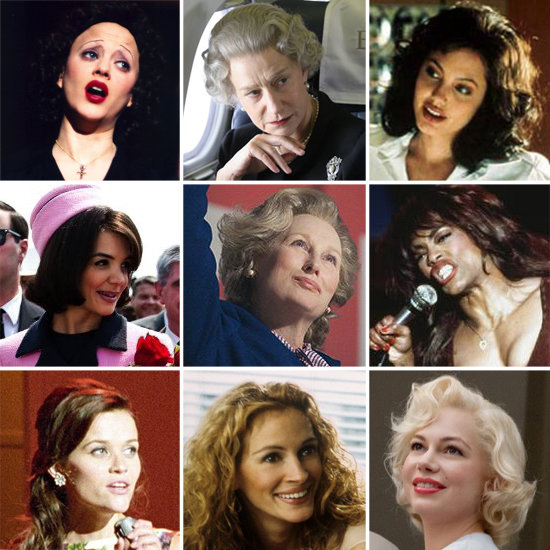
Women and Biopics–Where Are the Best Picture Nominations? by Stephanie Rogers

I don’t have much analysis to offer here because it feels quite obvious to me that 1) Hollywood doesn’t care that much about women’s stories (gasp!) and 2) the stories that Hollywood does manage to tell about women often get much less critical praise. Is that because the films about women are just … worse? Or is it that, again–as is the case with everything from parenting to politics–we hold women to a much higher standard, imposing a level of scrutiny that makes it impossible to focus on women’s successes in the same ways we showcase the achievements of men? 

The Blind Side, Take 1 by Stephanie Rogers

No. No to the over-abundant racial stereotypes showcased throughout the film. No to the kind-hearted southern woman as the Black man’s White Savior. No to the shallow, embarrassing, surface-level portrayal of class issues. No to the constant heavy-handed references to God and prayer and sexual morality. No to falling back on the tired tropes of wives as mommies and women as over-bearing and emasculating ball-busters. No to this film’s best picture nomination. Just … no.

The Blind Side, Take 2 by Nine Deuce

Let me say up front that I’m aware that I’m supposed to feel sorry for Sandra Bullock this week. She’s purported to be “America’s sweetheart” and all, she has always seemed like a fairly decent person (for an actor), and I think her husband deserves to get his wang run over by one of his customized asshole conveyance vehicles, but I’m finding it difficult to feel too bad. I mean, who marries a guy who named himself after a figure from the Old West, has more tattoos than IQ points, and is known for his penchant for rockabilly strippers? Normally I’d absolve Bullock of all responsibility for what has occurred and spend nine paragraphs illustrating the many reasons Jesse James doesn’t deserve to live, but I’ve just received proof in the form of a movie called The Blind Side that Sandra Bullock is in cahoots with Satan, Ronald Reagan’s cryogenically preserved head, the country music industry, and E! in their plot to take over the world by turning us all into (or helping some of us to remain) smug, racist imbeciles.

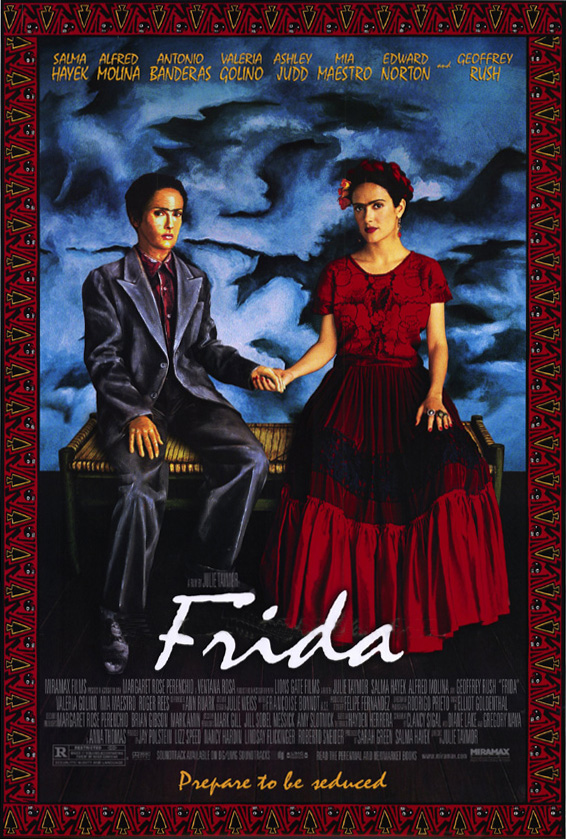
Frida by Amber Leab

The film isn’t just about living with disability, though; it’s about thriving in spite of it, about having a full life in which disability is only a part. Kahlo does not “overcome” her physical problems; she spends a lot of time painting in bed, she has good times and bad, and all of this she channels into her work. As a person who lives with disability, it’s damn near inspiring to see a character–based on a real-life person–who struggles and who achieves great things. And great things Kahlo did achieve. Her body of work includes 143 paintings, 55 of which are self portraits. One of her paintings was the first work by a 20th century Mexican artist to be purchased by the Louvre in Paris, she had a one-woman show in Paris, and has become significantly more famous since her death in 1958. Her work is intensely personal, representing most often pain and the broken self. Not only is this work autobiographical–depicting her own pain and suffering–but it is also overtly feminist. Kahlo painting herself in surrealistic representations of womanhood and pain legitimizes female experiences as worthy of high art. Like so many culturally valued enterprises (filmmaking, for one), men tend to dominate the art world. Kahlo–and the film Frida–challenges those patriarchal norms.

Two Documentaries About Aileen Wuornos: The Selling of a Serial Killer and Life and Death of a Serial Killer by Gabriella Apicella

Aileen Wuornos’s story is the antithesis of the American Dream and highlights the causality of crime: abused, abandoned, neglected, poverty-stricken, violated, exploited, shunned, condemned, tormented and eventually killed. It seems understandable that after being repeatedly raped by a family member as a child, living homeless in woods until teenage years, turning to prostitution to make enough money for food and shelter, and then being beaten and raped brutally, that she would, in desperation, reach for a gun and kill. The mythology around serial killers demonstrates that there is a perversion and obsession that perpetrators feed with their crimes, yet in Wuornos’s case that does not appear to have been true, as the killings she committed were apparently borne from fury and, in at least one case, from self-defence. If she had not experienced so much abuse and neglect, would she have gone on to kill?  This can never be known, and her crimes can never be excused. Indeed, it is not possible to know what really happened on the nights of the killings.

Biopic and Documentary Week: Frida

Frida (2002)

I’ll confess to being a little bit obsessed with Frida Kahlo. A copy of her journals sits on my bookshelf. A postcard of one of her numerous self portraits gazes at me from a bedroom wall. A quote from the movie about her life made an appearance in my wedding ceremony. Hell, I even named my dog “Kahlo.” Personal bias notwithstanding, I love the film Frida, for a myriad of reasons.
In my opinion, biopic is an extremely difficult genre. A person’s life doesn’t fit the narrative arc of a standard movie, so we typically see parts of a person’s life excised, heteronormative relationships emphasized, and vast simplification of an often-famous personality. The best biopics play with the narrative arc, bring in some element of creativity, and allow formal aspects of the film to reflect the subject’s personality. Frida does a good job at this by incorporating surrealism—a reflection of Kahlo’s work—and skipping most of the first eighteen years of her life, in favor of beginning near her artistic awakening. (Two other biopics that also subvert standard moviemaking immediately come to mind: Fur: An Imaginary Portrait of Diane Arbus, about art photographer Diane Arbus, and Beyond the Sea, which looks at the life of singer and entertainer Bobby Darin).
In identity politics terms, Frida tells the story of a disabled bisexual socialist woman of color who became one of Mexico’s most famous painters. That description alone tells you that this isn’t standard fare that the Hollywood machine typically churns out. The film is a decade-in-the-making labor of love for lead actress Salma Hayek, directed by Julie Taymor, and also starring Alfred Molina (as Diego Rivera, fellow painter and husband to Frida), with cameos by Ashely Judd (playing friend, political ally, and photographer Tina Modotti) and Edward Norton (playing Nelson Rockefeller; Norton is also said to be an uncredited writer of the script, and quite a bit of controversy about his role in the making and editing of the film sprung up when he and Hayek ended their romantic relationship).
There is much to admire about Frida as a film, and Kahlo as an artist, for that matter. Although Frida Kahlo was prettied up by the gorgeous Hayek, who did sport Kahlo’s signature unibrow and unbleached/unwaxed moustache, slightly de-emphasized, the difficulties of her life certainly weren’t softened. When Kahlo was six, she contracted polio, which left her with physical difficulties into adulthood. When she was eighteen, she was in a terrible bus accident, leaving her with life-long debilitating pain which required numerous surgeries to resolve (and resolve they never did). The scene below begins with an unconscious Kahlo, immediately following the accident, and takes us through a Day-of-the-Dead-inspired montage of her three weeks in the hospital, until she regained consciousness (warning: the opening image is bloody and disturbing):


Calaca Hospital


Frida

— MOVIECLIPS.com

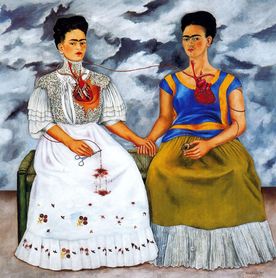
The film isn’t just about living with disability, though; it’s about thriving in spite of it, about having a full life in which disability is only a part. Kahlo does not “overcome” her physical problems; she spends a lot of time painting in bed, she has good times and bad, and all of this she channels into her work. As a person who lives with disability, it’s damn near inspiring to see a character–based on a real-life person–who struggles and who achieves great things. And great things Kahlo did achieve. Her body of work includes 143 paintings, 55 of which are self portraits. One of her paintings was the first work by a 20th century Mexican artist to be purchased by the Louvre in Paris, she had a one-woman show in Paris, and has become significantly more famous since her death in 1958. Her work is intensely personal, representing most often pain and the broken self. Not only is this work autobiographical–depicting her own pain and suffering–but it is also overtly feminist. Kahlo painting herself in surrealistic representations of womanhood and pain legitimizes female experiences as worthy of high art. Like so many culturally valued enterprises (filmmaking, for one), men tend to dominate the art world. Kahlo–and the film Frida–challenges those patriarchal norms.

Le due Frida
While the film certainly highlights her work as the central element of her life, romantic relationships play a major role as well. Kahlo married the older and more established Mexican muralist, Diego Rivera, when she was 21, and they had a tumultuous relationship, divorcing and remarrying, and having plenty of extra-marital affairs. Their marriage, though, is a kind of model of an artistic pairing; both understanding the other’s devotion to painting and belief in “marriage without fidelity.” Kahlo is known to have had affairs with both men and women, and the film doesn’t gloss over her bisexuality, including a scene with a woman who both Kahlo and Rivera had been sexually involved with. Early indication in the film of her admiration of men and women comes in a somewhat playful party scene, in which Kahlo steps in and wins a drinking contest between Rivera and David Alfaro Siqueiros (played by Antonio Banderas) with the prize of a dance with the lovely Modotti (Judd). The super-sexy tango the two women dance is shown below:


Frida and Tina Tango


Frida

— MOVIECLIPS.com


The film, like so many, isn’t without its flaws; one could argue the problem of having a major motion picture about one of Mexico’s most famous artists in which the characters all speak English, for example. Since ten years have passed since the film was made, I can’t be sure whether the same would be true today. Problems aside, this is a visually stunning film, made by a woman, about a woman, and it’s remarkable in nearly every way. If you haven’t seen it, what are you waiting for?

Biopic and Documentary Week: The Blind Side, Take 1

This piece on The Blind Side, by Stephanie Rogers, first appeared at Bitch Flicks on March 3, 2010.

———-

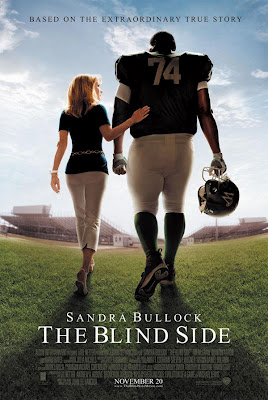
The Blind Side movie poster

No. No to the over-abundant racial stereotypes showcased throughout the film. No to the kind-hearted southern woman as the Black man’s White Savior. No to the shallow, embarrassing, surface-level portrayal of class issues. No to the constant heavy-handed references to God and prayer and sexual morality. No to falling back on the tired tropes of wives as mommies and women as over-bearing and emasculating ball-busters. No to this film’s best picture nomination. Just … no.

imdb synopsis, as composed by Anonymous:

The Blind Side depicts the story of Michael Oher, a homeless African-American youngster from a broken home, taken in by the Touhys, a well-to-do white family who help him fulfill his potential. At the same time, Oher’s presence in the Touhys’ lives leads them to some insightful self-discoveries of their own.

Living in his new environment, the teen faces a completely different set of challenges to overcome. As a football player and student, Oher works hard and, with the help of his coaches and adopted family, becomes an All-American offensive left tackle.

The real synopsis, as composed by me:

The Blind Side depicts the story of a white woman who sees a Black man walking down the street in the rain. She tells her husband to stop the car, and he obliges—oh, his wife is just so crazy sometimes!—then, out of the goodness of her white heart, she allows him to spend the night in their offensively enormous home.

Unfortunately, she can’t sleep very well—the Black man might steal some of their very important shit! But the next day, when she sees that he’s folded his blankets and sheets nicely on the couch, she realizes that, hey, maybe all Black men really aren’t thieving thugs.

Then she saves his life.

There’s a way to tell a true story, and there’s a way to completely botch the shit out of a true story. Shit-botching, in this instance, might include basing the entire film around an upper-class white woman’s struggle to essentially reform a young Black man by taking him in, buying him clothes, getting him a tutor, teaching him how to tackle, and threatening to kill a group of young Black men he used to hang out with.

Click here to read the full piece on The Blind Side.

Biopic and Documentary Week: Women and Biopics–Where Are the Best Picture Nominations?

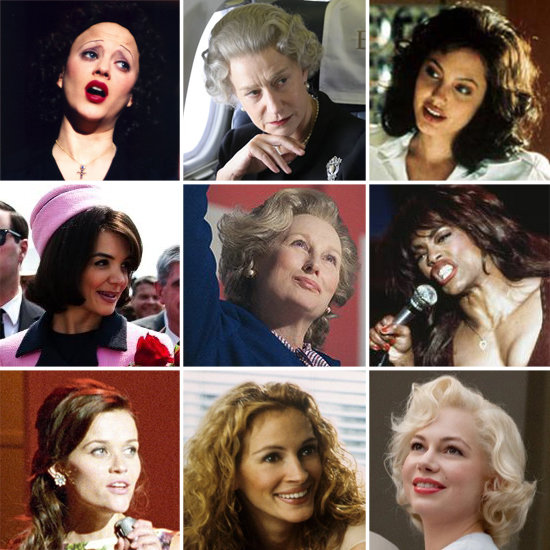
Women in Biopics
In November 2009, I wrote a brief analysis of the films that won the Academy Award for Best Picture between 2000 and 2010, ultimately asking the question, “What do these films have in common?” The answer is, of course, men. With the exception of Crash (which qualifies as an ensemble drama in all its racist glory), the Best Picture-winning films all center around men, with women either showcased as sidekicks or merely fulfilling one of the ridiculous tropes that drives the (male) narrative forward.
We’ve talked here before about the importance of looking at and analyzing pop culture–like the Academy Awards–even though we’re all well aware at Bitch Flicks that these types of ceremonies don’t actually honor The Best in Cinema. However, paying attention to what’s happening in pop culture helps us understand what society values as important. And according to the past 40 years or so of Oscar-nominated biopics, society thinks pretty highly of White Dudes.
Here is a list of Oscar-nominated biopics about men (since 1976), accompanied by critics’ ratings on Rotten Tomatoes. Asterisks denote Best Picture Winners.

*Patton (97%)

Lenny (100%)

Bound for Glory (88%)

The Elephant Man (91%)

Raging Bull (98%)

Reds (94%)

*Gandhi (88%)

*Amadeus (96%)

*The Last Emperor (91%)

Born on the Fourth of July (89%)

My Left Foot (100%)

Bugsy (88%)

JFK (84%)

In the Name of the Father (95%)

Shine (91%)

*A Beautiful Mind (78%)

The Aviator (87%)

Finding Neverland (83%)

Good Night, and Good Luck (94%)

Ray (81%)

Capote (90%)

Milk (94%)

Frost/Nixon (92%)

The Fighter (91%)

*The King’s Speech (95%)

The Social Network (96%)

127 Hours (93%)

Moneyball (94%)

———-

Here is a list of Oscar-nominated biopics about women (since 1976), accompanied by critics’ ratings on Rotten Tomatoes. Asterisk denotes Best Picture Winner.

Coal Miner’s Daughter (100%)

*Out of Africa (63%)

Elizabeth (82%)

Erin Brockovich (83%)

The Queen (97%)

The Blind Side (66%)

———-

So the only biopic about a woman to win the Oscar for Best Picture is Out of Africa, which–based on Rotten Tomatoes scores–critics disliked way more than any other nominated biopics within the past 40 years. 
I don’t have much analysis to offer here because it feels quite obvious to me that 1) Hollywood doesn’t care that much about women’s stories (gasp!) and 2) the stories that Hollywood does manage to tell about women often get much less critical praise. Is that because the films about women are just … worse? Or is it that, again–as is the case with everything from parenting to politics–we hold women to a much higher standard, imposing a level of scrutiny that makes it impossible to focus on women’s successes in the same ways we showcase the achievements of men?
However …
We love our women entertainers! I remember taking a class in college in which we discussed the dynamics of visibility in the patriarchy; we love women and minorities who sing for us, make us laugh, dance for us, play sports for us–but do we want them in leadership positions? Fuck no. And if one looks at a list of biopics in general (i.e. biopics that weren’t necessarily nominated for Oscars or other major awards), it’s easy to see the disproportionate number of biopics and documentaries focusing on women in the entertainment industry. That isn’t to say, of course, that entertainers don’t influence society in significant ways, but they’re less able to directly do so than, oh, women in high government offices, for instance.
I’m reminded of an important documentary, Miss Representation, which we wrote about here, and the astute tagline, “You can’t be what you can’t see.” We’ve got two Linda Lovelace biopics on the way. Wouldn’t it be nice to get, like, a Harriet Tubman biopic?

Biopic and Documentary Week: Blast from the Past: Jonathan Kaplan’s Heart like a Wheel

Heart Like a Wheel (1983)

This is a guest post from Melissa Richard.

Coming from a family of amateur drag racers (and a family where women outnumber men), it’s no surprise that my super-duper #1 female idol as a kid was Shirley Muldowney. A three-time National Hot Rod Association Top Fuel champion, Muldowney has been a part of professional drag racing since the mid-1960s and faced innumerable obstacles gaining entry into the boy’s club of the NHRA. Although not the first woman to race, she was the first to be licensed as a professional competitor and ran cars for the better part of nearly four decades, retiring only due to lack of sponsorship in 2003. Naturally, at the height of her career in the 70s / early 80s, her gender made excellent material for a biopic of her life, Heart like a Wheel (1983). And, perhaps just as naturally, the film does a pretty disappointing job of capturing the complexity of a woman who struggled to break the gender barrier in professional drag racing. 
Shirley Muldowney behind the wheel

Directed by Jonathan Kaplan and written by Ken Friedman, Heart like a Wheel hits the high points of Muldowney’s rise to prominence in the racing world: her beginnings as an amateur drag racer (which she did for extra money as a young, newly married waitress); her desire and ability to race professionally with the help of her first husband, mechanic Jack Muldowney, and son John; her divorce from Jack and relationship with fellow racer / crew boss Connie Kalitta; the failure of that relationship and, of course, the movie’s climax in which Muldowney beats Kalitta to take the NHRA U.S. Nationals championship in 1982. Heart like a Wheel has a certain B-movie quality to it, but garnered a 1984 Golden Globe nomination Best Performance by an Actress for Bonnie Bedelia, who plays Muldowney in the film. While not tremendously popular at the box office, it received favorable critical acclaim at film festivals and, among racing aficionados at least, still holds significant underground popularity.

Like most “women breaking barriers” films, especially those involving sports, Heart like a Wheel has a sort of against-all-odds feel to it that makes you want to like it, even if you know hokey story lines like that tend to be amped up by filmmakers for the benefit of paying audiences. This is no surprise. What is surprising, however, is that viewers are privy only to a watered-down version of the significant odds that Muldowney really faced. There are the typical sexist lines that a female drag racer could’ve expected to hear in a male-dominated sport (like when an announcer decries Muldowney receiving a kiss from her husband prior qualifying for her competition license ) and scenes that illustrate the roles Muldowney had to play as an hyper-sexualized novelty in order to do something she loved and was good at (including taking on the exotic name conferred on her by Connie Kalitta, “Cha Cha,” which she later rejected as a racing moniker). 
The “Cha Cha” version of Muldowney, 1972

Instead of developing important moments, like those in which she has trouble getting sponsorship because of her gender or struggles to make ends in the furious balance between a burgeoning racing career and a family, the film aims most of its dramatic focus on Muldowney’s romantic relationship with Kalitta.  In all of the drama of her seven-year fling with her hot-headed, womanizing guy, the lines and scenes that purport to represent the barriers Muldowney broke down seem pale and artificial, like they’ve been inserted only for the sake of occasionally reminding the viewer that Muldowney had to put up with a lot of macho crap in order to race.  

In all fairness, Muldowney and Kalitta’s relationship did have a significant impact on her career. They were involved professionally as well as personally, and her decision to cut him from her crew once the romance died made her even more of an underdog that she already was in the NHRA (since she couldn’t make it in racing without a bigger name than her own, apparently—or a man). In life and in the film, Muldowney took advantage of Kalitta’s license suspension (for fighting) and asked if she could race his top-fuel dragster with him as her crew chief, which put her on the road (literally) to three NHRA top-fuel championships. In fact, Kaplan and Friedman’s decision to organize the movie’s plot around Muldowney’s relationships with men is not unwarranted and lends an interesting masculine frame to a movie about a woman who came from and broke into, well, a masculine-framed world. From the opening black-and-white scene in which we see a young Shirley sitting on her father’s lap as he drives “too fast” down a deserted road through to the end when she shakes her fist in victory alongside her son / mechanic, this is a movie about a woman who lives in a world of men, is influenced by men, is supported and abandoned by men.
However, the male relationships that fostered Muldowney’s confidence and faith in her abilities hardly go noticed—especially the encouragement of her father.  One of the more touching scenes occurs in the first 10 minutes of the film, when a young Shirley Roque and her then beau Jack Muldowney approach her burly father to ask for permission to marry.  Tex Roque, a rough-and-tumble Country and Western singer, does not necessarily object to the marriage based on Shirley’s age—she’s sixteen—nor does he object to her choice of husband—he says that Jack is a really nice kid. What he objects to instead is that Shirley’s decision to marry so young will thwart her development as a self-sufficient woman. He advises her that “there’s not a man anywhere who’s worth giving up your ability to take care of yourself.”  Tex died fairly early in his daughter’s racing career, so perhaps there just wasn’t enough of a presence there to make it a bigger part of the film, but his advice – that Shirley take care of herself – doesn’t necessarily serve as the story arc that it seems set up to be.  Muldowney certainly gets things some things done herself: soliciting sponsorship, getting those needed signatures of support for her license application, and generally making it known that she would “mouth off” when she needed to.  But the crucial lesson for Shirley behind Tex’s advice gets lost in the development of her relationship with Kalitta, who is important in telling the Muldowney story, but who is certainly not the whole of it. 
Connie Kalitta (played by Beau Bridges) in Heart Like a Wheel

The relationship with Kalitta, of course, sets up the film’s narrative climax: the 1982 U.S. Nationals race in which Muldowney beat Kalitta to claim her third national title. They’d separated before the ’82 race, and the romance – in the film, but also to NHRA fans at the time—injects the duel with a provocative rivalry in which the little lady who can drive fast beats not just a male competitor, but a cheating, lying bastard.  It’s one of those convenient moments from Muldowney’s life story that make for a good Hollywood story, but the real victory there is overlooked by the film.  In 1982, no one had won three national NHRA titles and suddenly, someone had.  And it happened to be a woman. This achievement, though, is lost behind the drama of Muldowney beating a former lover who treated her badly and, by the film’s end, you wonder if Heart like a Wheel was really about a woman breaking into the male-dominated world of racing to begin with.

Maybe Heart like a Wheel is just a love story with fast cars in it—something for the boys and the girls in the Hollywood mindset. But the real story here is one about a woman who loved to drive and compete, inaugurated the participation of women in a sport decidedly “for boys,” and dealt with a mountain of complexity in the process (the usual accusations of being a bitch that go along with being an ambitious woman, the failure of her first marriage because of her racing career, and the emasculating threat a woman with a great ability posed to her male competitors). As someone who watched this movie over and over as a kid, and who could still watch it over and over as an adult, I can’t help but love Heart like a Wheel because I love Shirley. But I don’t love what Heart like a Wheel says about a woman who had a tough row and has served as a significant influence to those who follow in her footsteps– and what it doesn’t say about the challenges of women in a world dominated by men.


Melissa Richard is a PhD candidate at the University of North Carolina at Greensboro and a part-time English instructor at High Point University in the Piedmont Triad area of North Carolina. She writes about nineteenth-century factory girls in British literature and culture, likes to take photographs of things and stuff, and thinks that dancing is really fun. 

Biopic and Documentary Week: Gorillas in the Mist

Gorillas in the Mist (1988)

This piece is from Monthly Contributor Carrie Nelson.

This post contains spoilers about the film Gorillas in the Mist.
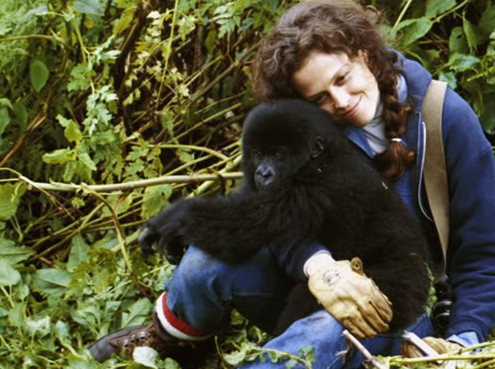
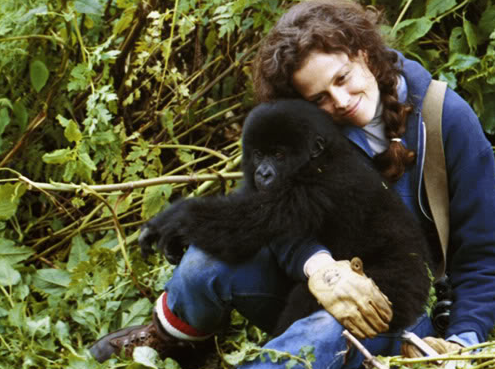
For nearly 20 years, zoologist Dian Fossey lived and worked among the mountain gorillas in Africa. Her work as a researcher and animal rights activist is responsible for raising awareness about Africa’s gorilla population and the threat of their extinction. Gorillas in the Mist, a film directed by Michael Apted in 1988, follows Dian (Sigourney Weaver, in an Oscar-nominated role) as she works in the Congo and Rwanda to study the behavior of mountain gorillas and protect them from poaching. As the film was produced after Dian’s untimely death (she was murdered in 1985; to this day, the precise circumstances and perpetrators remain unknown), it is impossible to know how she would have responded to the film. However, based on what I understand about Dian’s real life, I believe she would appreciate the film. I believe she would see it as an honest portrayal of her life, and I also believe she would be happy to see that the film avoids common clichés that are typically found in mainstream films about the lives of women.
Over the course of the film, Dian experiences a radical transformation in gender presentation. At the beginning of her travels, she is incredibly conscious of her appearance. When she meets her mentor, Dr. Louis Leakey (Iain Cuthbertson) at the start of her mission, he explains that there isn’t room for all of the luggage she’s brought with her, to which she stubbornly replies, “Those cases contain my hairdryer, my makeup, my underwear and my brassieres. If they don’t go, Dr Leakey, I don’t go.” I thought this was a throwaway line, so I was surprised that there were several additional mentions of her interest in make-up, hair products and clothing soon after this exchange. I was frustrated with this focus on materialism, thinking that the writer was using these moments as shorthand to remind the audience that the protagonist is, indeed, a woman; I felt as if the filmmakers were saying, “Well, what woman wouldn’t want to bring her cosmetics to the jungle?”
But as the film goes on, the references to beauty cease, and it becomes clear that these lines are not comments on Dian’s gender identity but on the materialism that she gradually gives up as she becomes committed to living among the mountain gorillas. The lines about clothing and make-up eventually stop, and Dian lets go of the previous signifiers of her femininity. It isn’t that she becomes masculine, as Weaver’s character in the Alien series is often perceived – it’s that she no longer needs these material possessions and outward signifiers to feel comfortable in the world and convey her identity. Dian’s transformation is subtle, but it adds significant depth to her characterization as she becomes comfortable in her new surroundings.
A similar transformation occurs in Dian’s romantic life. When she moves to Africa, she leaves behind her fiancé, David. Over the course of the film, her mentions of him become fewer and fewer, until a passing remark reveals that they have ended their engagement. She does, however, meet photographer Bob Campbell (Bryan Brown). Bob is married, but his and Dian’s shared passion for studying the gorillas leads them to start a passionate love affair. His work as a photographer makes him travel frequently, but he always returns to visit Dian, until he finally reveals to her that he is divorcing his wife to marry her. Initially, Dian is thrilled with this proposal; though she is devoted to her career, she often expresses an interest in wanting a family. But ultimately, she chooses her career over Bob anyway. He is offered a job that would take her away from Africa and the mountain gorillas, and she tells him that if he accepts the job and leaves, he should never write or come back to her. It’s a tragic moment, as the film demonstrates how much Dian and Bob love each other, but it is ultimately a refreshing and honest one. Given how many films feature women sacrificing ambitions and goals in order to preserve romantic relationships, Dian’s lack of compromise is a welcome change of pace.
Fossey represented as maternal
The most fascinating and complex depiction of Dian’s gender identity, however, is her portrayal as a maternal figure. Dian never has children of her own, and her interactions with children in the film are troubling. At one point, she catches a young boy found among gorilla poachers, and in an attempt to uncover information about the poachers, she has his hands tied and dresses as a witch to scare him into talking. Dian is not above torturing children to get what she wants; it would seem, therefore, that she is not particularly maternal. However, this is not entirely accurate or fair. Rather than being maternal in a traditional sense, Dian channels that energy toward the gorillas. At one point, she saves baby Pucker from capture, and she takes care of her in her home until Pucker is healthy and taken away to a zoo. In the moments when she is seen taking care of the gorillas, particularly the young ones, it is clear that there is a certain maternal sensibility to Dian that remains constant throughout all of her other personal transformations. Though it is common to see women presented as mothers and caretakers in cinema, Dian’s role as one is untraditional. It may echo common tropes, but it remains a unique facet of her life and work.
Gorillas in the Mist does not always paint Dian Fossey in a positive light. It does, however, present her in a realistic one. She’s often portrayed as stubborn, unfriendly and even abusive; these traits, however, reflect the reality in which she lived. Dian did not have time to be feminine or nice or accommodating. She was too busy focusing on her work and dedicating her life to ensure the protection and well being of the mountain gorillas. Gorillas in the Mist constantly references the usual clichés of films about women – namely, an overwhelming focus on beauty, romance and children – but rather than reaffirming them, the film counters them. Dian’s characterization proves that there is no single way in which to be a woman and that, often times, it is women who step outside of the boxes of conventional femininity who are able to create the most radical change in the world.


Carrie Nelson is a Bitch Flicks monthly contributor. She is a Staff Writer for Gender Across Borders, an international feminist community and blog that she co-founded in 2009. She works as a grant writer for an LGBT nonprofit, and she is currently pursuing an MA in Media Studies at The New School.

Biopic and Documentary Week: American Violet

This piece on American Violet, by Amber Leab, originally appeared at Bitch Flicks on April 5, 2010.


American Violet (2008)

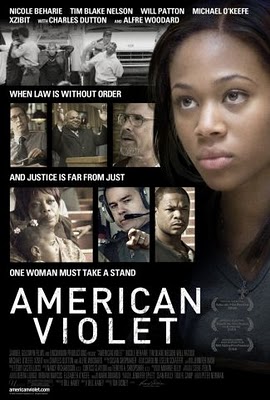
American Violet tells the true story of an African-American mother of four girls arrested and falsely accused of selling crack cocaine. Set in a fictional Texas town with the 2000 presidential election as a fitting backdrop of confusion and corruption, we see Dee Roberts fight–with the help of ACLU lawyers–to clear her name and the names of other innocent people arrested in a broad sweep that day.
Newcomer Nicole Beharie gives a powerful performance as Dee, and the supporting cast, including Alfre Woodard as Dee’s mother, and Tim Blake Nelson and Malcolm Barrett as lawyers for the ACLU, do an equally good job. 

It’s impossible to not love Dee–a beautiful woman, a kind and patient mother, a hard worker, and a caring friend. Her temper gets the best of her once in the film, but she’s protecting her children from their alcoholic father and his accused child molester girlfriend, and can hardly be faulted for it. I’m inclined to think the movie tries too hard to make her character likable. In contrast, Dee’s friend and neighbor Gladys–who is not a conventionally attractive woman, and does not have four adorable children trailing her–is a compelling and empathetic character, but the film completely drops the ball, even failing to credit the actor who plays her. Gladys is Dee’s inspiration for continuing to fight the DA even after her charges are dropped (because Gladys took a plea deal, while Dee would not), but we don’t get to explore Gladys or her situation. I’m curious as to why she’s part of the story, but not really allowed to be a character in the film. While the movie is about Dee, I would’ve liked to get to know Gladys a bit.

Biopic and Documentary Week: Monster

Monster (2003)
This is a guest post from Charlie Shipley.

“Well, I’ve walked these streets / A virtual stage it seemed to me / Makeup on their faces / Actors took their places next to me”
-Natalie Merchant, “Carnival”

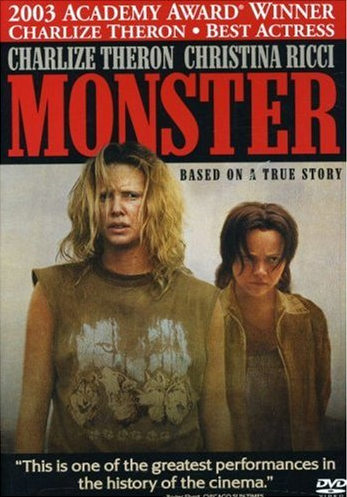
We know the mass-culturally-sanctioned narrative about Patty Jenkins’ directorial debut, Monster: Charlize Theron got “ugly” and delivered a tour de force turn as serial killer Aileen Wuornos that was hailed by Roger Ebert in an effective, rare use of Travers-esque hyperbole as “one of the greatest performances in the history of the cinema.” That quote made it to countless one-sheets and adorns the DVD cover of the film, and perhaps rightly so; Theron’s performance (or “embodiment,” as Ebert puts it) so overwhelms the mise-en-scène and soundscape of the film that Christina Ricci’s stern gaze on the DVD packaging seems little more than a futile attempt to market the film visually as a buddy film gone terribly wrong. Thelma & Louise, this is not.
As is so often the case with art films that reach a wide audience, these cultural metanarratives surrounding the film as a consumer object threaten to overwhelm our consideration of the film itself. For that reason, I’m less concerned with the well-documented “bravery” of Theron’s transformation than I am with the question of whether this film does justice to Wuornos, or if that’s even possible.
It’s not difficult to argue against that possibility. Anytime there are agents in positions of relative privilege attempting to dramatize the life of a person at society’s margins, it’s so easy to colonize and reimagine those lives without regard to their complexity. Even with that enormous caveat, though, Jenkins does a remarkable job here of letting Wuornos the character speak for herself using canny structural and sonic devices to centralize her experiences; we can interpret her opening voiceover – “I always wanted to be in the movies” – as both a wish we know will be fulfilled and a bitterly ironic reminder of the aphorism “be careful what you wish for.” This and other voiceovers serve as a latticework within Monster, lending structure and even beauty to the narrative while allowing us to get a glimpse of Wuornos’s inner life.
This distinction between voiceover monologues and spoken dialogue is crucially important because Wuornos speaks in a desultory, often self-contradictory way that conceals a labyrinthine underlying psychology driven by the opportunism of someone in a literal and emotional fugitive state. In a powerful scene late in the film when Selby (Ricci) finds out the extent of Wuornos’s crimes and tries to plead ignorance, Wuornos makes the seemingly contradictory claims within the span of a few minutes that “you don’t know my life” and “you know me.” The first quote is Wuornos’s attempt to claim that her killings were justified, the second an appeal to Selby to trust her. In this dramatic context and in the context of the biopic genre generally, this distinction (knowing the events of a life vs. knowing a person’s “essential self”) is a subtle but important one. In the world of this film, when spoken dialogue resists clear meanings as in this scene, voiceover serves not to explain away the ambiguity but provide the emotional context for it. 
Charlize Theron and Patty Jenkins both gave interviews implicitly confirming that both of these modes of narrative – factual reportage and emotionally honest characterization – were of paramount importance in telling this story about Wuornos. In a way, the titular epithet, “monster,” bridges this gap by taking a label that many undoubtedly applied to Wuornos and giving her the agency within the film to choose the identification for herself in the voiceover at the Fun World carnival. 
Just as voiceover provides a fantastical cinematic refuge for Wuornos to articulate her feelings and meanings without worrying about the judgment of others, so too does pop music provide a visual and temporal escape hatch into the realm of fantasy. There is an instrumental score for the film that is used in a somewhat traditional way to heighten dramatic, dialogue-driven scenes, but these music cues are used more often in the latter part of the film. By contrast, the film’s opening and the first meetings between Aileen and Selby are characterized by a deep sense of naïve wonder, culminating in their first kiss at a roller skating rink set to Journey’s “Don’t Stop Believing.”
Selby (Ricci) and Wuornos (Theron) at the roller rink
This scene subverts the traditional biopic form by supplementing documented events in Wuornos’s life with a scene that would just as easily fit into a more traditionally feminine-identified genre, romance. It’s placed in the narrative before Wuornos has killed anyone, so the dream of class mobility and migration away from small-town life is especially bittersweet in light of what the viewer knows is to come. This is a theme of Aileen’s pledges to Selby throughout the movie; the promises-turned-fantasies of a better life “far, far away” echo the escapism promised by “a midnight train going anywhere.” There are elements that stretch the bounds of plausible reality as well. To give one example, women participating in a couples’ dance in 1980s Florida and openly kissing in an iconically “family-oriented” space such as a skating rink would presumably not be met with the same level of indifference as it is here. Furthermore, while the songs before “Don’t Stop Believing” are 100% diegetic – that is, coming from within the world of the film – “Don’t Stop Believing” begins as a song being played in the skating rink but continues as the film cuts to Selby and Aileen passionately kissing against the outer wall of the building. Just like Wuornos’s voiceovers provide relief from the naturalistic tension of the more narratively straightforward scenes, the pop music that plays here widens the bounds of what is possible. 
These liberties – voiceover and pop music – are often derided as lazy narrative fillers by film critics and screenplay-writing guides alike, but in the case of Monster, they give Wuornos’s character a space within the otherwise relentless film to express herself clearly and put words to her desires. 
A powerful intertext to Monster is the song “Carnival” by Natalie Merchant, which is used to great effect in the documentary Aileen: Portrait Of a Serial Killer and which Wuornos requested to be played at her funeral. (It also, if only by association, brought to my mind Bakhtin’s concept of the “carnivalesque,” which one can find in Monster’s elements of interclass contact and vernacular speech but not in its tone.) Merchant’s lines “Makeup on their faces / actors took their places next to me” eerily and concisely summarize the dilemma we face when asking whether a film like Monster can do justice to its subject. I think it can, and I think it does, for while Charlize Theron has indeed “taken her place” next to Aileen Wuornos in the collective consciousness, her commitment along with that of Patty Jenkins to giving center stage to Wuornos and channeling a conscientiously rendered version of her truth leaves us with a complex characterization – deeply flawed, and deeply human.


Charlie Shipley has a B.A. in English with a minor in Women’s and Gender Studies from the College of Charleston. He blogs about mental health, fat acceptance, feminism, and all the things at A Mind Unquiet

Biopic and Documentary Week: The September Issue

This review of The September Issue, by Amber Leab, first appeared at Bitch Flicks on March 7, 2011.


Anna Wintour has Power. She jokes that her siblings find what she does for a living “peculiar,” because maybe editing a fashion magazine doesn’t affect world politics, or cure diseases, or save the world. But high fashion is art, and art is peculiar. Amid the ads for cosmetics (which probably contain ingredients that no one should be putting on her or his skin) and accessories few of us can afford, there are stunning photographs of beautiful clothes. Most of the clothes aren’t really meant to be worn in Real Life, but they are pieces of art, and the people who make this wearable art fall all over themselves hoping that Wintour will notice them. They cater to her every whim, her every pointed critique.
Perhaps Wintour finds her position a bit peculiar, as well. There’s a drive viewers can see in her, and it seems as if she’s blindly plowing ahead, following success after success with little reflection about the why of it all. Her daughter appears to have no interest in the fashion industry, even though there’s a simple, ready-made path for her there. Like her mother, she doesn’t elaborate on her opinions, but knows that the industry isn’t for her. Wintour herself doesn’t really have much to say about what she’s achieved; she’s not the type to wax philosophically. Instead she states–and shows viewers–very plainly that she works hard and that the magazine has earned her a lot of money.
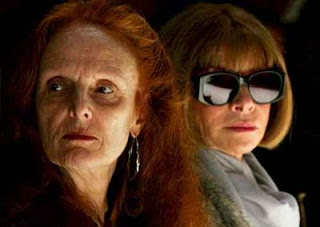
Grace Coddington and Anna Wintour
Fortunately, the movie also features Wintour’s team at Vogue, one of whom emerges to become the real star of The September Issue.
Grace Coddington is a former model and the creative director at Vogue. She even started working there on the same day as Wintour. She is intelligent, reflective, and an artist to Wintour’s manager persona. Coddington isn’t afraid to stand up to Wintour (whose lack of empathy was famously fictionalized by Meryl Streep in 2006’s The Devil Wears Prada) either, and flawlessly uses her every resource, including the documentary film crew, to her advantage. Viewers may see her as being cutthroat, but she’s an artist fighting for her vision, her work, and she’s earned it. She’s 68 and has spent her whole life in this industry, working for British Vogue and Calvin Klein before joining Wintour.

Biopic and Documentary Week: The Fat Body (In)Visible

This piece on The Fat Body (In)Visible, by Stephanie Rogers, first appeared at Bitch Flicks on December 21, 2010.


I was thrilled to run across a fat-positive documentary by Margitte Kristjansson called The Fat Body (In)Visible, in which she interviews Jessica and Keena about the experience of being a fat woman in a society that doesn’t value—and even openly discriminates against—fat women. 
Quotes from the documentary:

Jessica, on Fat Acceptance:  Fat acceptance is just the radical idea that every body is a good body and that regardless of your shape or your size that you deserve just as much respect as the next person.

Keena, on Fat Acceptance:  Fat acceptance is just accepting your body where it is at.  Whether you’re bigger or you’re smaller. Just accepting what it is, your arms, your double chin, your thighs, and just not worrying about how other people may view you.

Click here to read the full piece and to watch The Fat Body (In)Visible.