Guest Writer Wednesday: ‘The Lady’ Makes the Personal Political

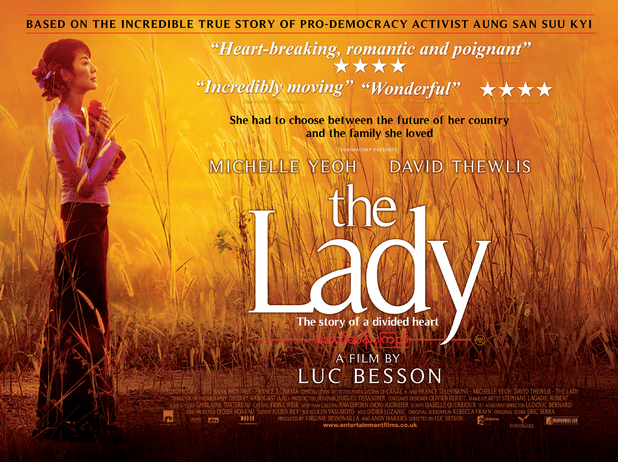
Movie poster for The Lady

This piece by Jarrah Hodge is cross-posted with permission from her blog Gender Focus.

French Director Luc Besson’s new biopic The Lady is a moving portrait of the life of Burmese activist and political leader Aung San Suu Kyi. However, for a movie that clearly has a political goal (to raise awareness of the situation in Burma*), it focuses mainly on Suu Kyi’s family and personal life. As a result, while I enjoyed the movie overall it still left me feeling unsatisfied.

The movie opens in 1947 with the assassination of General Aung San, Suu Kyi’s father, who had just negotiated Burma’s independence from Britain. While it’s a poignant scene and crucial historical event it’s really all we see of Suu Kyi’s early life.

From there we go forward to meet the main characters in the movie’s romance, Suu Kyi (played by Michelle Yeoh) and her professor husband Dr. Michael Aris (David Thewlis). They and their two sons are living in Oxford when she receives the news that her mother has had a stroke. When she returns to Burma she witnesses the military-run government massacring protesting students in the streets. When she is then approached to lead a pro-democracy movement she decides to stay.

From this point the film becomes a bit plodding, seeming a bit like a visual representation of an encyclopedia article. It moves through every interaction Syu Kii has with the military junta and their attempts to intimidate and imprison her and her followers, leading to her 15-year house arrest and years of separation from Aris and their children. While we also see Syu Kii touring the country and speaking to locals about democracy, for the most part her Burmese allies and followers in the film remain nameless and voiceless.

Ultimately while the film brings the audience to tears more than once, it’s not over the plight of Burma or ordinary Burmese citizens, but over Suu Kyi and her husband’s drawn-out separation.

That’s where I thought the focus did the subject an injustice. Interestingly, The Lady could be said to suffer from some of the same issues as The Iron Lady, which was also a movie about a woman politician that was criticized for being more concerned with sentimentality than political substance.

In some ways, though, The Lady has less excuse for this. Thatcher is elderly and ailing now but Suu Kyi is still fighting a crucial fight. It’s clear from the rallying cry at the end of the movie that one of the film’s goals is to get Westerners more involved in aiding the continuing fight for true democracy in Burma (Aung San Suu Kyi will finally take the oath of office to sit in the parliament this year, though the current structure still ensures the military maintains majority control and human rights violations continue). However, this could have been further advanced by giving voices to the Burmese non-military characters other than Suu Kyi: the students being massacred in the streets, the villagers in rural areas, and the monks who joined the protest.

As Yeoh’s Suu Kyi says in the film, she dislikes the cult of personality around her, and yet that’s what the movie reinforces by failing to broaden the depiction of the struggle. At the same time, it also in some ways diminishes her strength by tieing her identity so strongly to her family. At a couple points in the film people mention a lack of experience before coming to Burma, saying she was just an “Oxford housewife and mother of two”, not mentioning she also had a PhD, extensive academic honours, and had worked at the UN.

Would I recommend the movie for someone who had only a cursory knowledge of the situation in Burma? Yes. But Do I think it featured a strong woman role model and did justice to Aung San Suu Kyi’s cause? Not as well as it could have.

*Note: In case you’re wondering why I’m using Burma instead of Myanmar, that’s because many pro-democracy groups and activists refuse to recognize the legitimacy of the name Myanmar, which was introduced by the military government. It’s also the name they used in the film.

———-

Jarrah Hodge is the founder of Gender Focus, a Canadian feminist blog. Jarrah also writes for Vancouver Observer and Huffington Post Canada and has been a guest blogger on “feminerd” culture for Bitch Magazine Blogs. Hailing from New Westminster, BC, she’s a fan of politics, crafts, boardgames, musical theatre, and brunch.


Reproduction & Abortion Week: ‘Roseanne’s’ Discussion of Abortion Nearly Twenty-Five Years Ago Highlights the Current Feminist Backlash

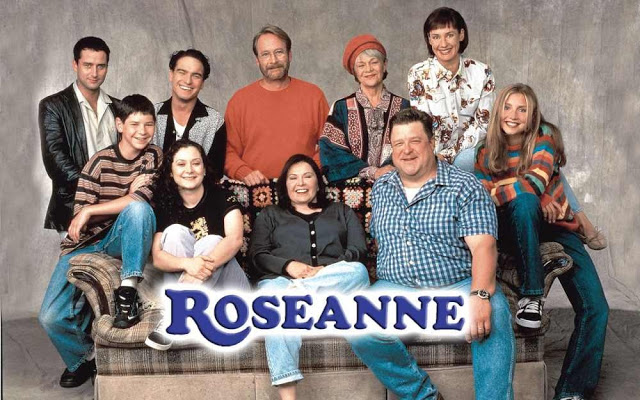
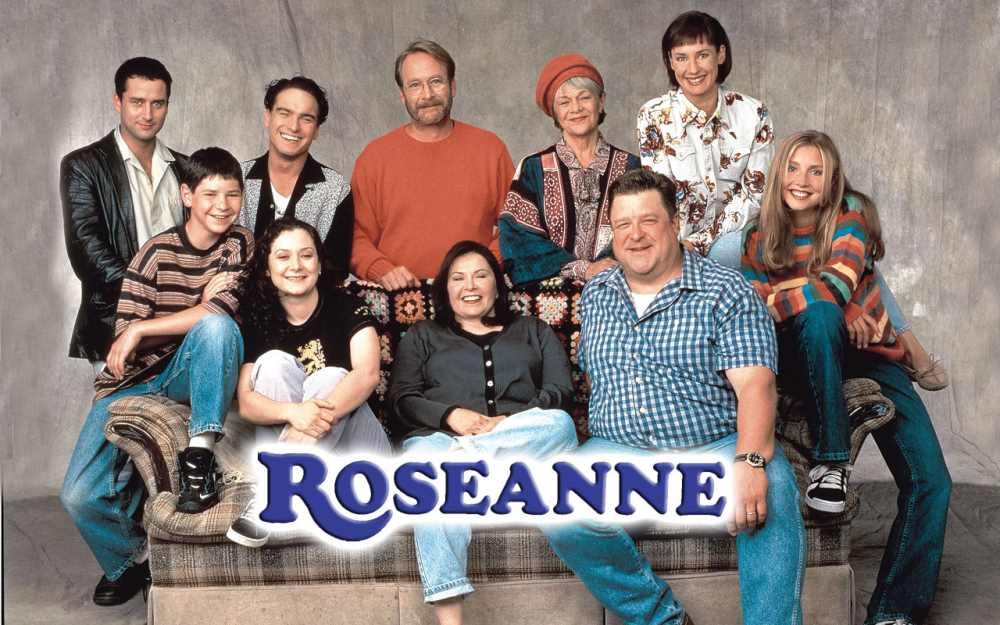
The cast of Roseanne
I grew up watching Roseanne. The show first aired in 1988—when I was ten years old—and it ended after 9 seasons, around the time I graduated high school. The fact that the show now appears in reruns on various television stations, during all hours of the day and night, often makes me feel like the Conners have never not been a part of my life. I saw myself (and my family) in that show, and I identified with the characters and their struggles, particularly surrounding financial issues and social status.

Unfortunately, families like the Conners just don’t exist on TV now, which is extremely problematic considering families today—and women in particular—continue to feel the never-ending effects of Wall Street tanking our economy. We simply no longer see the realities of women’s lives accurately reflected back at us in the media. In fact, I’d go as far as to say that Roseanne, a television show starring a fat, working-class, unapologetically outspoken matriarch; a television show that effectively dealt with racism, classism, feminism, gay marriage (depicting the very first gay marriage in the history of television); a television show openly addressing sexism and misogyny, and yes—a woman’s right to choose; and finally, a television show that first aired nearly 25 years ago, is a far more progressive television show than anything currently gracing the network airwaves in 2012.

I grew up in Middletown, Ohio—a small town that very recently made the Forbes’ Top Ten List of Fastest Dying Towns—and the characters on Roseanne appeared all around me in my day-to-day life in the form of factory workers, cashiers, fast-food employees, friends and family members who lived in trailer parks, those of us graduating from high school who had no idea how we’d ever pay for college, and those struggling to pay bills in a community that didn’t offer much in terms of employment opportunities aside from the local steel mill, where a majority of our parents worked. I especially identified with Darlene, who I watched morph from a snarky young tomboy who played basketball and had a close relationship with her father, into a successful young woman with a college degree who fought for animal rights, never let men control her life (unlike her older sister Becky), and who ultimately ended up with the same strong personality traits as her mother Roseanne, even though their relationship suffered through serious rough patches over the years.

Roseanne working as a server

While I managed to leave Middletown, Ohio and attend college, (by taking out a shitload of student loans) most of my family still lives there, and over the years I’ve been forced to watch my hometown crumble (literally, businesses are falling the fuck apart) like so many other Midwestern cities that’ve been ignored by our government and taken advantage of by big banks and Wall Street tycoons. I suppose my inability to identify with most characters, families, and storylines on current network television led me to begin my Netflix marathon of Roseanne last year. I craved seeing the reality of a family (and a woman!) negatively impacted by the economy doing their best to make ends meet. While vampire and zombie TV creates a nice little escape (and interesting metaphors, for sure) from the bullshit most of the country is experiencing right now, I wanted to watch a show that didn’t merely offer escape but reminded the world that these families exist; this is a serious crisis; and we are not going to ignore it.

And so that’s how my love affair with Roseanne and the Conner family re-began.

Darlene Conner

Most of the time I played it in the background while I ate dinner or washed the dishes, because, for the many reasons I stated above, I found the hilari-dysfunction of the Conner family comforting. Then one night while I surfed the net, barely paying attention to the show, I heard Roseanne’s sister Jackie say, “Do you think you might have an abortion?” I honestly don’t think I’ll ever forget that moment—I looked up from my computer in shock, like, Did someone just fucking say the word “abortion” on TV?

Many writers gave wonderful examples during Reproduction & Abortion Week of how abortion—both the portrayal of abortion and the word itself (see Knocked Up)—have been all but avoided in recent films and television, although current shows like Friday Night Lights and Grey’s Anatomy certainly offer hope. But Roseanne’s two-episode arc about a woman’s right to choose—which aired in 1994 (almost 20 years ago)—discussed abortion so openly and unapologetically, especially in its acknowledgment of men’s role in the decision-making process (hint: it’s the woman’s decision, always), that it honestly floored me. 

 
Roseanne taking a pregnancy test

The premise goes like this: Roseanne and Dan want to have another baby, and she becomes pregnant. They find out from a nurse after Roseanne’s amniocentesis (to determine the sex of the baby), that there might be complications in her pregnancy. They can’t get in touch with the doctor to find out the exact problems (because it’s Thanksgiving!), and that sets up the catalyst for a long, two-episode discussion about whether Roseanne—depending on the extent of the complications—would want to have the baby or have an abortion. Roseanne feels as though Dan is pushing her to have an abortion, whereas she’s leaning toward having the baby, regardless of the circumstances. The two episodes illustrate the problems that arise when several characters weigh-in on Roseanne’s decision. 

 
One of the first conversations about Roseanne’s pregnancy happens between Roseanne and her sister Jackie: 
Roseanne [talking about her husband Dan]: All’s he thinks about is himself, you know. He’s worried that a sick baby might be an inconvenience to him, so he’s trying to hint around that I should have an abortion.

Jackie: Oh, I’m sure he knows it’s your decision. I mean, he must respect your right to choose.

Roseanne: Yeah, as long as I choose to agree with him.

A few minutes later, Dan enters the kitchen, interrupting their conversation, and Roseanne asks him to start painting the baby’s crib. He suggests that they wait to paint the crib until they hear back from the doctor. Roseanne gets angry, and after he leaves the kitchen (presumably to begin painting the crib), Jackie and Roseanne pick up where they left off:
Jackie: You’re right, you know, he was pushing you. I thought Dan was better than that.

Roseanne: Why? He’s a man. You know, this is the only area in the world [circles stomach with her hand] that they can’t control, and it drives them crazy ’cause it doesn’t come with a remote. [audience laughter]

I particularly like this interaction between Roseanne and Jackie because it shows two women talking about a woman’s right to choose (using that exact language!) as if it’s obvious that it’s her right. And neither of them lets Dan off the hook for putting pressure on Roseanne, however subtle it may be, to have an abortion. We find out later though, during a discussion at a bar between Fred (Jackie’s husband) and Dan, that Dan does seem to understand that the decision about the baby ultimately resides with Roseanne:
Fred: I just don’t think you’d be a terrible person if you demanded some control over what Roseanne’s gonna do … Look, having a kid, it’s half yours, this is a 50/50 proposition.

Dan: Yeah, when it finally comes out. You gotta admit, Fred, this is different.

I like this interaction between Dan and Fred, too, because it illustrates a larger cultural problem in the conversation surrounding abortion and a woman’s right to choose: where do fathers fit into the equation? Even though Fred thinks men have the right to “demand some control” (yikes, current War on Women!) over what a woman does with her body, Dan, regardless of his personal feelings about abortion, understands that he—and men—should not exercise control over women’s bodies.
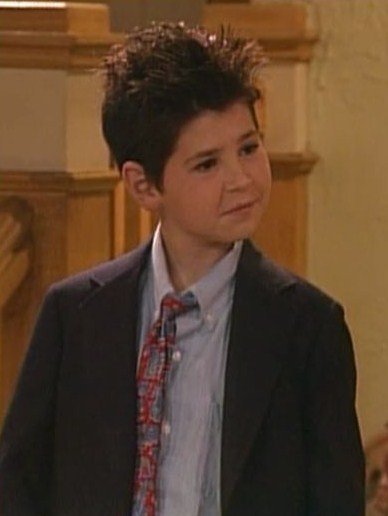
DJ Conner
The most compelling conversation about Roseanne’s right to choose surprisingly occurs between Roseanne and DJ, her twelve-year-old son. After hearing so much yelling and whispering between his parents over the course of several days, DJ becomes concerned that his mom might be sick. Roseanne decides to tell DJ the truth about the situation.
Roseanne: Okay, I’m gonna tell you the truth because you’re not a little kid anymore. I’m okay, but, um, there’s a chance that something’s wrong with the baby.

DJ: Oh.

Roseanne: Yeah. So I have to, uh, make a decision whether to have it or not.

DJ: You mean you might have an abortion?

Roseanne: Uhh, yeah, that. Maybe. I don’t know. It’s just a very, very complicated decision, DJ.

DJ: Why?

Roseanne: Because I have wanted to have a baby for a long time.

DJ: Well if you decide not to have the baby, when you come back from the hospital, we can take care of you.

Roseanne: Hey, I know you’re gonna be a man someday, but see, you cannot do this.

DJ: Do what?

Roseanne: No man has any right to tell any woman what she should do in a situation like this.

DJ: I’m not, I’m just saying that if you do have the baby and it’s sick, we can take care of the baby too.

Roseanne: So you mean you’re saying like, uh, saying what—that you would support any decision I make?

DJ: Yeah.

Roseanne: Oh, well [audience laughter] … thanks. Thanks a lot, DJ. It really makes me feel better that you can handle the truth.

This scene in particular moved me. DJ—a young boy who hasn’t yet been negatively influenced by the Mass Cultural Ownership of Women’s Bodies—reserves all judgment regarding his mother’s decision about the baby. He says the word “abortion” in a matter-of-fact way, as if he’s asking his mother what time it is. He offers to support her, no matter what she decides, and he makes it clear that he understands the decision is only hers. This scene also represents the first time Roseanne says outright, “No man has any right to tell any woman what she should do in a situation like this.” Admittedly, DJ can’t fully comprehend the complexity of such a decision, or how life might change for the entire family if a new baby needed special attention; however, it never occurs to him to try and influence Roseanne’s choice. Again, I attribute that to DJ’s innocence, specifically surrounding his ignorance of the dominant cultural narratives. (See the recent all-male birth control panel and the mostly male-dominated GOP’s attack on Planned Parenthood and, you know, women’s healthcare in general.)

Roseanne and Dan eventually find out that their baby is healthy. Roseanne decides to give birth to her. But that isn’t the point of this episode arc at all. The discussion of choice, especially when 1 in 3 women chooses abortion, matters. The media, including television and film, needs to accurately reflect the realities of women’s lives because it matters. The more we see what women truly struggle with, depicted in an honest way, the more we can erase the stigmas associated with abortion and women’s reproductive rights in general. These episodes aired 25 years ago, and—amid the absolutely embarrassing and unacceptable War on Women—puts the current (undeniable) feminist backlash in perspective.

Reproduction & Abortion Week: Mother and Child

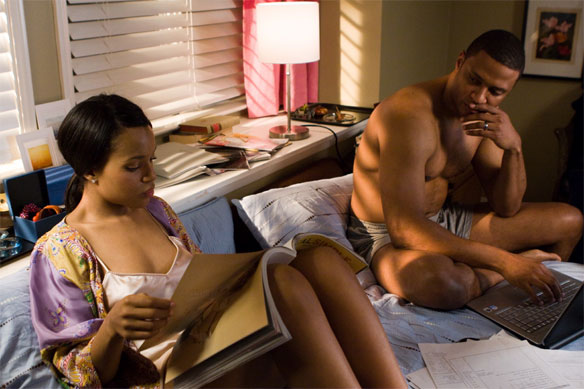
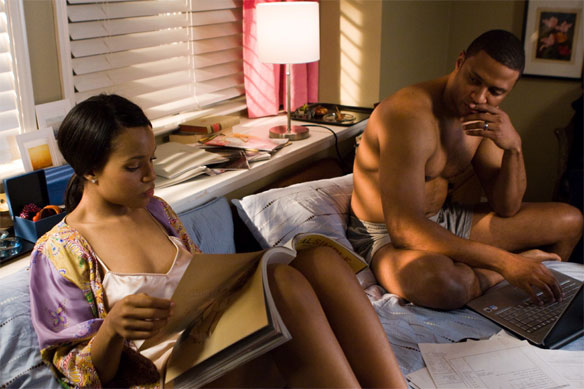
Kerry Washington and David Ramsay in Mother and Child
This is a guest post by Candice Frederick
While many continue to castigate the HBO series, Girls, for its lack of female diversity (with good reason), I’d like to look back at a 2009 film which gave voices to an assortment of female characters, a gem that eloquently showed both the beauty and plight of motherhood in extraordinary fashion.
Shareeka Epps as Ray in Mother and Child, along with Washington
In writer/director Rodrigo García’s Mother and Child, something as complex and precious as motherhood is broken up into a kaleidoscope of elegant vignettes capturing the lives of several mothers—hopeful, expecting and recovering mothers.

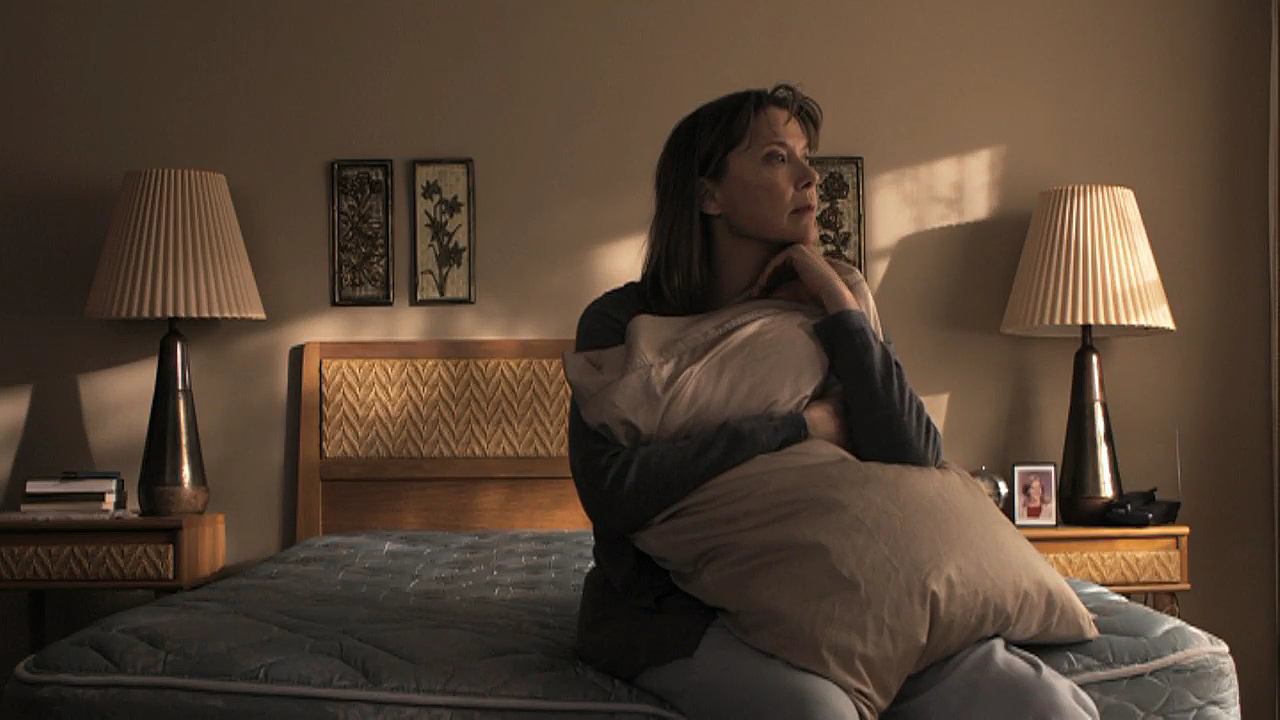
Annette Bening stars as Karen, a woman who remains deeply affected by the baby she gave up for adoption as a pregnant teen. At 50 years old, childless, and significant other-less, Karen begins to feel the emptiness of the child she once carried. As she continues to take care of her dying mother, Nora (Eileen Ryan), who encouraged her decision to give her child to another, she feels her first pangs of regret exacerbated by years of resentment.

Annette Bening as Karen in Mother and Child
Bening bestows the ornery characteristics we’ve all come to know and love from past performances in her vast oeuvre. But this particular role stands out in the natural way she sheds Karen’s bitter exterior, and finds the strength to move past the loss that’s been eating away at her. Her impressively nuanced portrayal by the end of the film brings the audiences to their knees even after pushing them away for the better course of the movie.

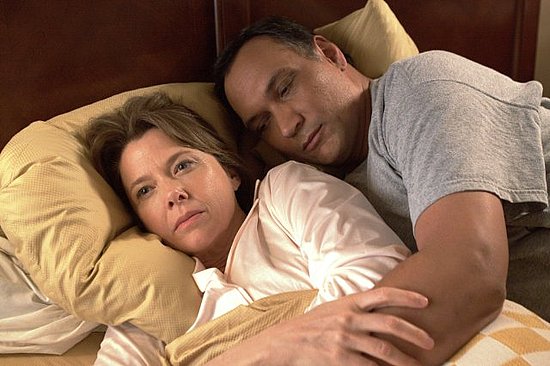
Part of that recovery to self is attributed to Jimmy Smits’ character Paco, Karen’s reluctant love interest, who sees more in Bening than she sees in herself. While Smits is very subtle in this role, the gentleness he brings to Paco is one that few critics remarked on but was pivotal to the emotional compass of Karen’s character (but does not define it).

Bening with Jimmy Smits as Paco in Mother and Child
Kerry Washington plays Lucy, a married woman who’s unable to conceive a child of her own with her husband Joseph (David Ramsay). Desperate for motherhood, she dreams of being able to rock her very own baby to sleep at night. She thinks she’s finally found the child she’s always wanted from a young mother who’s putting her child up for adoption but, in a drastic change of events, her dream is snatched away from her. And it’s the single most devastating moment in the film, marked by a performance by Washington that’s so raw and heart wrenching that it would move even the most jaded viewer.

To me, this is Washington’s best performance to date, and it—as well as this film—goes entirely unnoticed, which is a crying shame. Her portrayal is crushing, real, and simply mesmerizing to watch unfold. The only comparable performance I can think of is that of Jennifer Garner in Juno, another performance that fell right through the critical cracks.

Samuel L. Jackson and Naomi Watts in Mother and Child
The talent Washington brings to this role isn’t the only thing that’s wonderful about it. It’s the fact that her character is so relatable to watch. I’m not sure if García intentionally sought an African-American woman for this role, but Lucy’s story—like all the characters—is drawn in a way that every woman could appreciate. Also, García doesn’t shy away from highlighting black love onscreen. While mainstream Hollywood nowadays often ignores black love in films by neglecting it altogether by creating somewhat asexual black characters or only showing an interracial romantic angle (i.e. Will Smith and Eva Mendes in Hitch, or Zoe Saldana and Michael Vartan in Colombiana), Mother and Child refuses to hide behind the Tinseltown taboo with Lucy’s character.

As a matter of fact, Lucy and Joseph are really the only married couple in the movie who are shown having sex. Though Lucy and Joseph don’t exactly have a happy fairy tale ending, at least we get to see a black couple getting busy. So yes, Hollywood, two black people do have sex. Passionate, unapologetic sex in a committed relationship, and it’s about time we see that again.

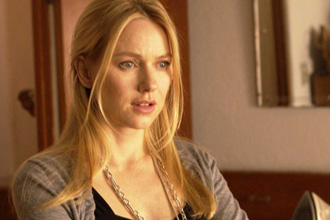
Naomi Watts as Elizabeth
But let’s get back to some of the other characters. The eternally underrated Shareeka Epps (Half Nelson) plays Ray, a pregnant teen who decides, mostly with her mother’s influence, to give her child up for adoption. While she awaits the birth of her baby, she mulls over the decisions she’s made and will make, decisions that will have a major impact on her life. She genuinely seems to be a good kid, but, like Karen, she seems to be conceding to the outcome of her actions, without really thinking about them. It’s a very subtle performance by a young talent who’s known for playing young women struggling with their own sense of identity, which works well for this role. In her performance here, you see the charm of her youth and the complexity of her womanhood.

This brings us to Naomi Watts’ Elizabeth, whose role we don’t fully learn until nearly the end of the movie. She touchingly steers the film full circle. But Elizabeth is a woman who’s suffering from bouts of desolation as an emotionless attorney at a law firm. She gets involved with Samuel L. Jackson’s character, Paul, a fellow attorney, and what happens next can only be described as a full realization of her own character, which leads her to make a decision that will not only change her life, but also Paul’s. This is the perfect role for Watts, whose quiet ferocity works well here simply because she tries to remain in such tight control of her life that when it begins to blossom, we finally get to see her heart.

Smits and Bening
I’d be remised if I didn’t mention the ever talented Jackson. Yes, the guy who has been in a plethora of movies—both great and terrible—can file this particular performance under great. The sensitivity and compassion he brings to Paul perfectly complements Elizabeth’s emotional impotence. Jackson aptly tucks away his signature swagger and wild fury found in many of his roles to reveal a softer side for Paul. He reminds is of why we fell in love with his talent in the first place. You can see the love in his eyes each time Elizabeth enters the scene, and it’s enough to crush your soul.

Alluring, delicate and simply exquisite to watch, Mother and Child tackles the inspiring and sometimes heartbreaking aspects of motherhood with a range of characters in which every woman, whether or not she’s a parent, can see themselves. Perfectly intertwined stories yield a gorgeous singular concept of love and maternal grace that steals your heart.

———-

Candice Frederick is an NABJ award-winning journalist, film critic, and blogger for Reel Talk. Follow her on twitter

Reproduction & Abortion Week: 16 and Pregnant: Degrassi and Abortion

This is a guest post by Lee Skallerup Bessette.

When I saw the call for submissions for this month’s feature on abortion and reproductive rights, I knew right away that I had to write about Degrassi. I grew up in Canada (suburban Montreal to be precise) and Degrassi was the show everyone watched. Even if you didn’t catch the episodes in primetime on the Canadian Broadcasting Corporation (or the CBC), they were on after school every afternoon. When Spike got pregnant, I was in grade 5 and all the grade 6 girls came to school with their little “Eggberts.” While I was a little young for the show, I rushed home after school to watch them in the afternoon as I was beginning to see myself as “too old” for the cartoons my younger brother wanted to watch.

I realized very quickly however that there would be a number of challenges in writing about these episodes (Spike’s pregnancy in Degrassi Junior High, Erica’s abortion in Degrassi High, and Manny’s abortion in Degrassi: TNG): untangling my emotional connection to the show and dealing with the different history of abortion and reproductive rights in Canada. While a co-production with WGBH (the Boston PBS affiliate), this show was about as Canadian you could get in terms of its look and attitude toward all of the issues dealt with.

(For an excellent analysis of how Degrassi has become less Canadian, read Amy Whipple’s insightful post.)

In 1987, when 14-year-old Spike was having sex with her boyfriend at a party, the Supreme Court of Canada was getting ready to rule that the current laws limiting access to abortion (a panel of three doctors needed to approve the procedure in a hospital setting) were unconstitutional. This was brought before the court by Dr. Henry Morgentaler, who had been brazenly flaunting the law since 1973 in Quebec. Dr. Mongentaler had been unsuccessfully brought to trial three times in Quebec; the juries in each case had been unwilling to convict, leading the government to declare the law unenforceable. The CBC has an excellent digital archive of news footage and interviews of Morgentaler and his cases in the courts.

In 1989, when 16-year-old Erica was getting an abortion because of a fling at summer camp, Chantal Daigle was fighting for the right to terminate her pregnancy against the wishes of the father. Once again, this case originated in Quebec and made national headlines. The case was expedited all the way to the Supreme Court of Canada, who ruleD in Daigle’s favor. Daigle had already obtained a late-term abortion in the United States when the ruling was handed down. It was seen as a victory for women’s reproductive rights in Canada. Although there were a number of attempts, there are currently no laws in Canada governing abortion.

I vaguely remember, as an 11 and 12 year old, the Chantal Daigle case, but I have absolutely no memory of the Morgentaler case. It’s notable that both these cases originated in Quebec, in particular the unwillingness of three Quebec juries to convict. After the tyranny of the Catholic Church ruling over the province for approximately 150 years, the 1950s, with the Quiet Revolution, and the 1960s, with everything that came along with that, saw the outright rejection of any and all Catholic religious influences. Including their disapproval of abortions. As a result, I grew up in an environment that while not embracing abortion, at the very least it was treated as being not a very big deal.

(It should also be noted that the period when Morgentaler was being brought before the courts in Quebec, the Separatist movement was gaining popularity, and thus there may have also been some residual resentment towards the federal government leading to the refusal to convict.)

I know this, so far, has read like a long history lesson cribbed for Wikipedia; it is. But it’s important to contextualize the culture in which these shows were being produced and in my case, consumed. For instance, I didn’t understand why Erica, when visiting the abortion clinic, was aggressively confronted by pro-life demonstrators, waving a plastic fetus at her (go to the 4:30 mark). This was more common in the rest of Canada, as compared to Quebec. But these types of protests outside of abortion clinics were common, even in Canada.

Notably, it’s Erica’s twin sister Heather who is scarred by the ordeal, and she has nightmares about the protests. But it is also Heather who stands beside her sister, as well as stands up for her sister when Erica receives threats from a pro-life student at Degrassi. What’s interesting is that the storyline isn’t wrapped up at the end of the two-part premiere (the abortion was one of the main storylines for the premiere episodes of the “new” Degrassi High series); it continues on across the entire first-half of the season, in the same way Spike’s decision to keep baby Emma is dealt with throughout the show’s run. The arguments are nuanced and the kids are treated with respect. The pro-life side is seen as being the destructive force, bullying, scaring, and shaming, while Spike puts it best: “It’s great to have high ideals and stuff, but when you’re in that situation, right and wrong, they can get really complicated.”

Fast-forward to 2004. Degrassi: The Next Generation (or TNG) has been airing on CTV in Canada and The N (originally Nick Teen) in the United States for three and a half seasons. The new iteration of the show started with Spike’s daughter Emma starting junior high herself. Emma’s best friend Manny, midway through season 3, who is trying to change her image from good girl to party girl, gets pregnant. She, too, struggles with what to do, eventually opting to get an abortion. Emma, at first, doesn’t approve of the decision, being the child of young, single mother herself. Spike once again offers wise council, telling Manny to do what is best for her. This upsets not only Emma, but also Craig, the father. Ultimately, Manny (who is identified as Filipino) goes to her mother and is surprised to receive her support, even taking Manny to get the abortion.

This was another two-part episode and it initially didn’t air in the United States. 2004 was during the height of the so-called Culture War in the US, while Canada still maintained a more open and liberal position on abortions. The article linked just above points out that, unlike most shows about teens that were airing at the time, Degrassi: TNG had the courage to take abortion seriously and handle it realistically; neither Manny nor Erica conveniently lose the baby, thus avoiding the reality of having to get an abortion. In both cases, the rights of the mother are given priority; even the women around them who may disagree with their decision ultimately defend the right to choose. And, as pointed out by Sarah, a blogger at Feminists for Choice, each girl goes on to have rich and varied (if, at times, melodramatic) storylines; Manny eventually lives her dream of becoming an actress, while we see Erica briefly during Degrassi: TNG looking happy and fulfilled (and notably not at all in distress when holding someone else’s baby).

So what, then, can we learn from this particularly Canadian perspective on abortion? Certainly, the idea of a woman’s right to choose is forefront in each portrayal, but it doesn’t trivialize the decision, either. The characters are shown dealing with the aftermath of the abortions, but not in a sensational way, either. In fact, it is often those around them who have the most difficulty with a profoundly personal decision. The bullying and shaming methods often used by the pro-life movement are shown as being ultimately counter-productive, both in the late 1980s and in the mid-2000s. Abortion, however, is just one decision in the long and full lives of these young girls, who are shown to go on and have relatively happy and fulfilled lives.

For that, I am glad that Canada has the history it has in regards to abortion, so that we may have these complex and ultimately, to my mind, satisfying portrayals of women’s reproductive rights. 

———-

Lee Skallerup Bessette has a PhD in Comparative Literature and currently teaches writing in Kentucky. She also blogs at College Ready Writing and the University of Venus. She has two kids, and TV and movies are just about the only thing she has time for outside of her work and family. She also contributed a piece for Mad Men Week at Bitch Flicks called, “Things They Haven’t Seen: Women and Class in Mad Men”  and a review of Friday Night Lights for Emmy Week 2011.

Reproduction & Abortion Week: ‘Where Are My Children?’

This is a guest post by Erik Bondurant. Long before established reproductive rights, including the right to contraception and abortions, were being challenged, there was a long battle to earn these rights in the first place. Half a century before Griswold v. Connecticut would mark a real turning point for reproductive rights, director Lois Weber offered a powerful commentary, inspired by Margaret Sanger, on the morality of contraception in her 1916 silent feature Where Are My Children?

 
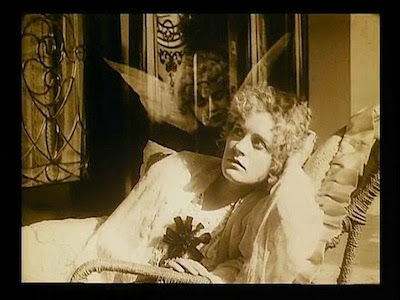
The film opens in heaven, where the souls of babies dwell, awaiting conceptions that will bring them down to Earth. These souls are divided into three groups. There is the highest order, granted to those who desire having children, there are chance babies, and then there are the unwanted babies, noted as being quick to return due to the intervention of either contraception or abortion. This casts the film in what may be an uncomfortably religious and moralistic tone for many.The issues of contraception and abortion are handled from a variety of angles. Richard Walton, a District Attorney, is taken with the idea of birth control primarily in its potential to weed out the supposed poor and unfit, perhaps preventing crime. This endorsement of eugenics was quite popular before the Nazi’s embrace of the concept made such support untenable. No less than Supreme Court Justice Oliver Wendell Holmes, writing for an 8-1 majority, would claim that “three generations of imbeciles are enough” in upholding a forced sterilization law. Sanger herself was not above seeing the eugenic appeal of contraception. Eugenics remains tightly bound to the debate over abortion, with anti-abortion groups often citing drastically higher abortion rates among Black women as a form of eugenics and economist Steven Levitt arguing in Freakonomics that the legalization of abortion was a primary cause of the subsequent fall in crime rates.

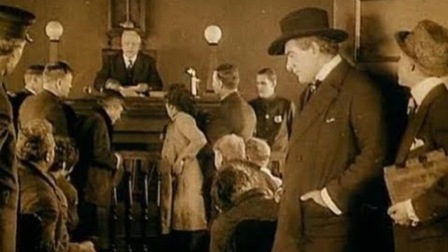
Intellectually, the film hits its peak with its focus on Dr. Homer and his testimony at a trial in support of contraception. Through his eyes we see various large families stuck in poverty and women suffering the grinding fate of being pregnant every year, until menopause or death. With a bit too much symmetry to the recent all-male Congressional panel on the matter, we are told “a jury of men disagreed with Dr. Homer’s views.” Thus a pamphlet discussing family planning is ruled obscene.The emotional heart of the story takes place within the District Attorney’s own household. He is desperate to have children, but his wife enjoys the freedom to remain in the social scene. This is a group of women who, in contrast to the poor families that Dr. Homer discussed, are curiously unladen with children. This, we find out, is because they have access to an illegal abortion provider named Dr. Malfit. When one of his patients dies from complications and the District Attorney’s prosecution unveils the client list, the film roars to its dramatic conclusion with Walton condemning his wife, asking her the titular question.

Like Vera Drake, this film shows class divisions within reproductive services in an environment where those services are illegal, and the cost that can come from illegal abortions. However, unlike Mike Leigh’s film, this film is decidedly anti-abortion, which may be off-putting to some watching it from a modern perspective. Ultimately, the important pro-contraception aspect of the film and the compelling dramatic construction in portraying the heavy moral component to abortion, no matter what one ultimately thinks of abortion, makes Where Are My Children? a must-see film. Lois Weber, one of the first and greatest directors in cinema history, provides a much-needed woman’s voice and eye on the topic.Where Are My Children? is available to stream for free.

———-

Erik Bondurant is a political scientist and a film blogger at The Movie Review Warehouse and contributor to Sound on Sight, with a primary focus on the portrayal of politics, gender and sexuality in cinema.

Reproduction & Abortion Week: Mad Men and The War on Women, 1.0

This is a guest post by Diana Fakhouri.

It’s not easy being a lady in the working world today. We’re still fighting for equal pay for equal work, freedom from workplace harassment, and the right to decide what grows (or implants itself) in our uteruses. In all honestly, it’s not terribly different from the drama unfolding at Sterling-Cooper-Draper-Pryce every Sunday night, which is exactly the reason my baby boomer mother can’t stand Mad Men: “I lived it,” she says with exasperation, “why would I enjoy watching it over again?”

Do the liberal-arts educated, Anthropologie-clad millenials fawning over Betty Draper Francis’ silk scarfed bouffants see the irony my mom pointed out? As a card (or more accurately, BA) carrying member of the club, I’d like to say that we do. I’d be hard pressed to find a ladyfriend without a reproductive rights war story of her own, from sanctimonious pharmacists offering unprescribed admonitions to early morning drives across state lines to a clinic. While the scarier aspects of Mad Men-era reproductive health (Betty’s twilight sleep birthing experience from season three, for starters) seem like a far-off nightmare to today’s twentysomethings, neo-conservatives’ war on women makes it clear that such arcane threats may not be so distant.

Betty awakes from her twilight sleep after giving birth to Draper’s third child
Take abortion. Considering it’s still a litmus test for sociopolitical values, you’d think among pre-civil rights Americans the topic, let alone the execution of the procedure, would be a taboo subject. Right? Not quite. When mad man Roger Sterling impregnates his on again, off again secretary side piece Joan Harris (née Holloway), he immodestly assumes she’ll want an abortion and offers to pay to “fix” the situation. But Joan decides to keep the child, leaving her husband, surgeon Greg Harris, in the dark as to the child’s paternity, thereby reclaiming her body and sense of agency. By her own admission, Joan’s terminated two prior pregnancies, so her decision isn’t based on moral grounds. Craving motherhood and disappointed by a number of fertility misfires with Greg, Joan forges her own path. The implicit consequences of Joan’s choice are clear, but Roger and Joan’s extramarital affair is far healthier than her wedded life, and it seems fitting that the baby Joan seeks is born from her relationship with Roger.

Joan introduces her son Kevin to the office, and his father

It doesn’t take much to beat Joan and Greg in the healthy relationships department, though.  Shortly after introducing Greg, and depicting his less-than-chivalrous behavior, creator/writer Matthew Weiner blows the lid off Greg and Joan’s curious courtship with a maddening rape.  Forcing himself on an unwilling Joan in her boss Don Draper’s private office, viewers come to understand Joan’s options: quietly endure sexual violence to be a respected doctor’s wife and mother, or continue in limbo as a single working woman with no respectable chance at a family. While it’s Greg who commits the rape, it’s the cultural castigation of single, working mothers that forces Joan’s hand, leading her into the arms of a sexual predator.

This same stigma precludes Peggy from motherhood, leading the (sometimes) Catholic secretary-cum-copywriter to go through with her pregnancy but put her child up for adoption. Resident Sterling-Cooper-Draper-Pryce cad Pete Campbell (runner-up to Dr. Harris for most egregious husband of the 20th century) is the father of Peggy’s child, sure to be the first in a line of many illegitimage offspring for the the account executive. Though their dalliance has little effect on Pete – with the exception of a few seasons’ worth of sidelong glances and shifty elevator rides between the two – Peggy’s determined resilience to continue her career unblemished is both a triumph and a tragedy. As one of the agency’s brightest creative stars, Don’s up-and-coming ingenue, Peggy conveys confidence in choosing her career over motherhood. But she isn’t without regrets, which she reveals to Don over diner coffee: “Do you ever think about it?” he prods. “I try not to,” Peggy reflects, “But it comes out of nowhere sometimes. Playgrounds.” The line is drawn out, mumbled, underscoring Peggy’s pain. Elizabeth Moss (who plays Peggy) told Vulture.com that it was her favorite line of the season, suggesting how strongly modern women relate to Mad Men‘s female characters.

Peggy and Don share grief, and coffee

In Rosengate‘s aftermath, the conversation on working mothers is more fraught than ever. “’Working mother’ is a redundant phrase” is the neo-conservative right’s new mantra, and I won’t begrudge them the satisfaction of believing it. But let’s not pretend that the stay-at-home-mom is the equal of the working mother. It’s an affront to parents of all backgrounds: those with the luxury to choose an at-home parent over a second income and those whose finances dictate the decision. Mad Men‘s place on the cusp of this working mother’s revolution is telling, yet quietly disheartening for its glaring proof that we’ve entered a regressive era for reproductive rights.

———-

Diana Fakhouri holds a BA in English Literature from The College of William and Mary. Baltimore born and Virginia bred, she now lives in Richmond and has never turned down a Mimosa. Say hey on Twitter and Tumblr!

Reproduction and Abortion Week: Friday Night Lights

In many shows, pregnancy is a simplistic and glossed-over story line, a plot device that comes nowhere near to a realistic depiction of a woman’s experience. How many times have you seen a woman in a television show or movie throw up and know: She’s pregnant! Then you see montages, baby bumps, pregnant women behaving like silly pregnant women, birth, happiness. The end. 
In five seasons on the air, Friday Night Lights featured at least three characters who had to make difficult choices about pregnancy: Erin, Tami Taylor, and Becky Sproles. (Mindy Collette is another character who struggles with pregnancy in the show.) We’ve published pieces about Friday Night Lights before, but I want to talk about the show’s excellent handling of pregnancy and abortion in regard to these three particular characters.
Tamara Jolaine as Erin
Erin

When Jason Street has a blind date with a woman who has an odd fetish related to men in wheelchairs, waitress Erin comes to his rescue–giving Jason a hiding place and telling his date that he left the restaurant. Jason and Erin hit it off, spend the evening together, and end up having what she believes to be a one-night stand. At this time Jason thinks he’s sterile due to his injury, and the two throw caution to the wind and have unprotected sex. 
When Erin turns out to be pregnant, she tells Jason and he immediately pressures her, saying that this may be his “only chance” to be a father. Erin, a very minor character who isn’t even given a last name (as far as I know), nails him on his attempt at emotional manipulation:

You need to stop … You do not get to put that on me. I’m not some experiment for you to prove your manhood, Jason. This is my body. I am going to make the ultimate decision.

Sarah Seltzer, writing for RH Reality Check, nicely analyzes this moment:

Erin pinpoints the way women’s bodies are so often used as battlegrounds for men trying to advance an agenda, personal or political. Jason’s injury has made him so desperate for a chance to be strong and important and yes, masculine again, that he loses any sense that she is a person, too. Jason can’t control his own body, so he wants to control hers.

While Erin does decide to carry the pregnancy to term, and later marries Jason Street (after he experiences a string of improbable successes), it isn’t without debate and discussion. We don’t see much of Erin’s pregnancy, but Jason seems to be a supportive partner in the matter. While happily ever after for these two isn’t the most realistic storyline, the way the unplanned pregnancy is handled isn’t particularly groundbreaking, but it’s not too bad for a network show supposedly about small-town high school football.
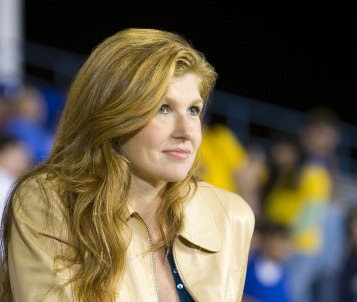
Connie Britton as Tami Taylor
Tami Taylor
In the final episode of the first season, an already-frazzled Tami (dealing with an impending move for her husband’s job, among other things) fears she might be pregnant. She enters a Planned Parenthood clinic and asks for a pregnancy test. Though she doesn’t have an appointment, nurse Corinna Williams sees the distraught woman, takes her back, gives her the test, and tells her, in an excited voice, that she is, indeed, pregnant.

“How pregnant do you want to be? Because you’re extremely pregnant.”

When Tami looks less than happy about the news, Corinna asks her, “Do you want to be pregnant?” A teary-eyed Tami responds:

Do I want to be pregnant? Do I want to be pregnant? I don’t know. […] We planned it, like, thirteen years ago. And then twelve years ago, and then eleven years ago, and then ten years ago. 

Even though Tami is financially stable, married, educated, has a job as a guidance counselor, and already has a teenage daughter–is the example of success and stability in the community–her answer to Corinna isn’t an unequivocal yes. Why? Because choosing to have a child, when it’s unplanned, is always a difficult decision. Tami struggles to even have the conversation with her husband, busy as he is with the state football championship. The pregnancy affects the entire family, too, something else for which FNL deserves praise.

The show skips most of Tami’s actual pregnancy (it occurs during the break between the first and second seasons), but picks up the story and closely follows her experience as a new mother, even if it is her second time around. With all her privilege and advantages, balancing work, family, and her own personal life is still a challenge. Her teenage daughter proves less than supportive, her husband is largely absent due to work, and she certainly could have benefited from some on-site childcare when she returns to her job at the school. Overall, Friday Night Lights does an excellent job of portraying a family that believed it was complete dealing with an unplanned pregnancy and a new baby.


Madison Burge as Becky Sproles

Becky Sproles

In season four (my personal favorite), Becky, a 10th grade girl who has a one-night stand with football star Luke, chooses to have an abortion. This is the only abortion featured in the show, and was one of the few on network television since Maude in the 1970s (Roseanne took on abortion in the 1990s, too). That alone is a bold statement about choice, but the show also handles the story line very well. Becky tells Luke, and seeks advice from Tami (who at this point is the principal of East Dillon High). In a most careful and professional way, Tami lays out Becky’s options, mentioning support available for teen mothers, adoption, and, only when Becky mentions not wanting to give birth, some pamphlets available for that (she doesn’t speak the word “abortion”). Becky’s decision is deeply personal, and she chooses to go through with an abortion with the support (one could argue pressure) of her mother, a single woman who gave birth to Becky when she was a teenager.

Becky struggles with her choice, and goes back and forth with her decision, wondering if she could actually care for a child. The show allows her to explore her conflicting feelings and emotions; in another talk with Tami, Becky says:

We don’t have any money. I’m in the 10th grade, and it’s my first time. And I threw it way, and I don’t want to throw my life away. It’s just really obvious that my mom wants me to have this abortion. Because I was her mistake and she has just struggled and hurt everyday, and she wanted better and I knew better. And then I was just thinking, you know, forget what she wants, like, what do I want? And maybe I could take care of this baby, and maybe I would be good at it, and I could love it and I would be there for it. And then I was just thinking how awful it would be if I had the baby and then I spent the rest of my life resenting it, or her.

The women face a mandatory waiting period at the clinic, which forces Becky’s mother to take another day off work–the only overtly political commentary on Becky’s own experience. The ripple effects in the community, however, quickly turn political. When Luke’s mother finds out about Becky’s abortion and Tami counseling her on the decision, she starts  a chain of events in the community that ends in the call for Tami to leave her job as principal. In her analysis of the women in the show, guest writer Lee Skallerup Bessette says:
Those around her (her mother, the mother of the baby’s father, the community) seem more upset and emotionally reactionary than Becky herself. It also seems that the extreme reactions of those around her affect her more than the abortion itself […] Abortion, it would seem, is not the issue; the hysteria surrounding it is.

Decisions surrounding reproductive choice are difficult and emotional enough without state-mandated barriers and interest groups pressuring women to carry all pregnancies to term. While Friday Night Lights had a majority of its pregnant characters give birth, and some story lines were more convincing than others, the show was careful to depict each one as an individual choice, and give the women dignity and autonomy. 

Reproduction & Abortion Week: Obvious Child

This piece on Obvious Child, by Amber Leab, originally appeared at Bitch Flicks on November 4, 2009.

———-

Abortion is a legal medical procedure, and it’s presented as such in this film. That alone is a welcome change–as others have stated–from recent film and television. Obvious comparisons have been made to Knocked Up and Juno, as both completely failed in their representations of options for a woman facing an unplanned pregnancy (the former refusing to even speak the word abortion, and the latter representing a dumpy and disturbing clinic).

The star of Obvious Child, Donna (played by Jenny Slate), is a freelancer who lives in hipster Brooklyn. Others have mentioned the “indie sensibility” of the film, and Donna is the kind of privileged hipster many of us love to hate–and she’s a little bit like Juno in this regard, with toned-down dialogue and ten years added. She has an immature sense of humor (her use of “fart-face” and “fucktard” come to mind), and she just wants to go out and have a good time after the ugly end of her two-year relationship with Joe.

Click here to read the full piece on Obvious Child

Reproduction & Abortion Week: Procreation at the End of Civilization: Reproductive Rights on ‘Battlestar Galactica’

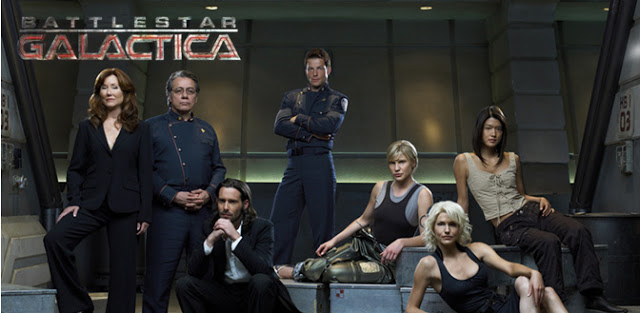
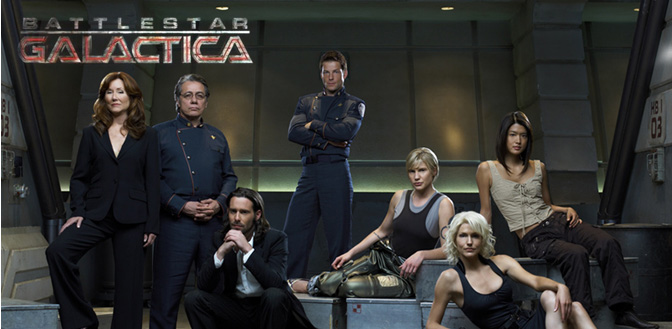
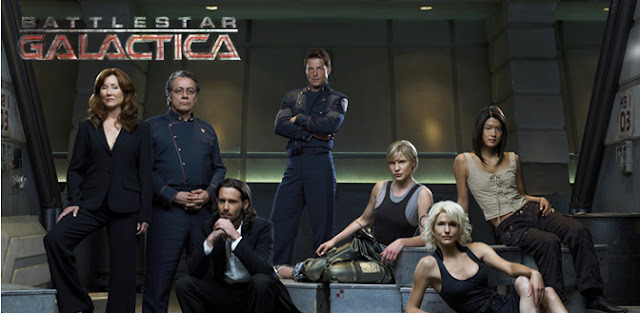
The cast of Battlestar Galactica

This is a guest review by Leigh Kolb. 

“All of this has happened before, and all of this will happen again.”

The opening credits of each episode of Battlestar Galactica, which aired from 2004 – 2009, set the premise for the plot: “The Cylons were created by man. They evolved. They rebelled. There are many copies. And they have a plan.” During a few episodes later in the series, the plight for humans’ survival is highlighted with the announcement: “The human race. Far from home. Fighting for survival.” Most of the beginning credits also show the population tally, which dwindles after each battle. President Laura Roslin says at the beginning of their journey, “The human race is about to be wiped out. We have 50,000 people left and that’s it. Now, if we are even going to survive as a species, then we need to get the hell out of here and we need to start having babies.”

When a society is thrust into time of struggle and chaos and its existence is threatened, reproductive rights and bodily autonomy are among the first rights to be taken away by those in power. Battlestar Galactica shows us, as good science fiction does, the moral struggles we face now, and what they might look like in the future.

There are moral issues at stake throughout the entire series, including the erosion of prisoners’ and laborers’ rights so that others may live more comfortably. The same critical lens is cast on forced birth, forced abortion, eugenics and abortion restrictions.

Early in the second season, Kara “Starbuck” Thrace has returned to Cylon-occupied Caprica (home planet for the crew of Battlestar Galactica) to find her destiny and aid the resistance, a group of humans who have stayed behind to fight the Cylons. She is kidnapped and knocked out, and wakes up in a hospital bed. Her “doctor” (who later is revealed as a Cylon) tells her she was shot in the abdomen and they have removed the bullet. As she drifts in and out of consciousness, she becomes suspicious. The doctor has excuses for every inconsistency. He tells her they’d operated because they suspected she had a cyst on her ovary. He says, “You gotta keep that reproductive system in great shape… it’s your most valuable asset these days. Finding healthy childbearing women your age is a top priority for the resistance. You are a very precious commodity to us.”

Starbuck replies, “I am not a commodity. I’m a viper pilot.”
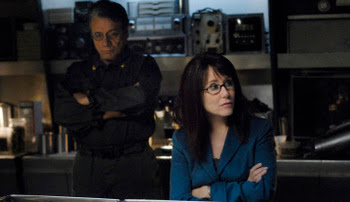
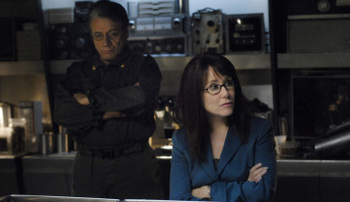
Admiral William Adama, left, and President Laura Roslin

He persists, and finally says, “The human race is on the verge of extinction. Potential mothers are a lot more valuable right now than a whole squadron of viper pilots.” He keeps pushing her into more vulnerable territory by bringing up old scars that suggest she was abused, and perhaps that’s why she’s afraid to have children. This pushes Starbuck over the edge and she screams at him to get out.

Her reproduction has become a commodity; it takes precedence over anything that she might be as an individual. When she pushes back against these ideas, she’s made to feel shame and vulnerability, as if that will guilt her into wanting to procreate. This philosophy is consistent among anti-abortion groups—if women are perceived as too strong, independent and resistant to motherhood (as Starbuck certainly is), they simply need to be coerced into realizing the importance of that goal. It’s their responsibility to mother more than anything else.

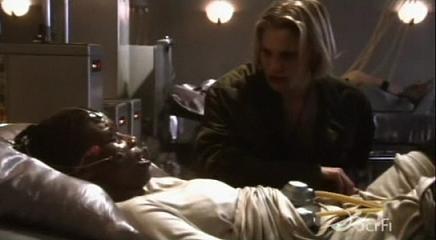
When she wakes again, she has a new scar and the doctor tells her “We’re just about done with you, Starbuck.” He attempts to put her back under, but she has removed the IV—she’d never told him her handle was Starbuck. She stumbles out of the room—the hospital used to be a mental institution, which begs the audience to consider the implications of maternity and captivity—and overhears the doctor and a Cylon talking about her ovaries, suggesting that her eggs had been harvested or were about to be.

Eventually she kills the doctor, takes his keys and stumbles into a room full of drugged, barely conscious women with their knees up and machines and tubes coming out from under their hospital gowns. She recognizes a friend from the resistance, Sue-Shaun, and tries to start freeing her from the machinery. Instead, she begs Starbuck to kill the power. “It’ll kill you,” Starbuck says, but Sue-Shaun pleads, “I can’t live like this—they’re baby machines. Please. Please.” Starbuck takes a surgical instrument and smashes the power supply; sparks fly, and the women die.

Sharon, a Cylon who has joined ranks with the resistance after falling in love and becoming pregnant with Helo, another viper pilot, informs Starbuck that this was one of the Cylons’ Farms, where human women were taken and inseminated to attempt a human/Cylon breeding program, which hadn’t yet been successful. The Cylons had failed to reproduce naturally, so they were finding other means. Sharon says, “Procreation is one of God’s commandments—be fruitful.” Starbuck fires back that “raping women” is what they’re doing, and Sharon defensively counters that love was the missing component, since she and Helo have successfully become pregnant.

Sue-Shaun’s insistence that the power be shut off, thus killing every woman-turned-incubator, further shows the lengths that women will go to resist reproducing unwillingly. Sharon’s insistence that if love were in the equation, and if a Cylon and human were “set up,” like she and Helo were, that the forced reproduction would somehow be more palatable, shows the ideology that allows these atrocities to be committed—procreation above all. It’s what God wants.
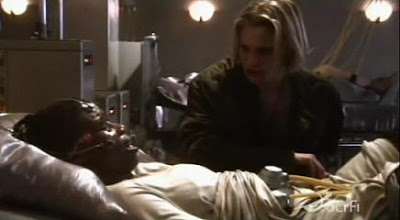
Starbuck “rescues” Sue-Shaun from forced reproduction

All Starbuck wants to do at this juncture is get a raider ship and liberate every Farm—but she’s reminded this is not her destiny. The women, the audience sees, will have to wait. Because while procreation is so important to a threatened species that women’s bodily autonomy and choice can be set aside, righting those wrongs are not among the first priorities.

Later in season two, there is much turmoil surrounding the Sharon and Helo’s pregnancy. Back on Battlestar Galactica, Sharon is in a holding cell because she is a Cylon. President Laura Roslin, who is on her deathbed (she was diagnosed with advanced breast cancer before the attack), orders that Sharon’s baby be aborted after Dr. Cottle tells her that there are some genetic abnormalities showing up in the fetus. Dr. Gaius Baltar disagrees (for self-serving, political reasons). Roslin says, “Allowing this thing to be born could have frightening consequences for the security of this fleet—I believe the Cylon pregnancy must be terminated before it’s too late.”

As Admiral Adama and the men around her question her decision, she remembers something Caprica’s former president said to her and says, “The interesting thing about being president is that you don’t have to explain yourself to anyone” (most certainly a reference to the same quote attributed to President George W. Bush). She is in control, and will use that control over another woman’s body because, being half-Cylon, the fetus is “the other,” and represents the enemy.

As Adama tells Helo the abortion must take place, Helo asserts, “We’re talking about a child—a part of me. I guess it’s easier to kill when you call it a Cylon.”

Sharon reacts with anger and rage, screaming “Let them try and take my baby” to Helo before she starts banging her head bloody into the thick glass keeping her separated from the rest of the fleet. Armed guards come to get her and she uses her chair as a weapon, and they must hold her down and sedate her.

As Sharon is wheeled into the medical unit for the procedure, Baltar bursts into the room saying that the fetal bloodwork has a resistance to disease, and seems to kill cancer cells on contact. Instead of receiving an abortion, blood is drawn from Sharon’s fetus and injected into Roslin. Roslin seizes as Sharon gazes at her from her nearby bed—as Roslin comes to and instantly heals, she and Sharon make eye contact. Two women, utterly in control of one another’s futures.

The cancer is gone. The half-Cylon, half-human is safe.

Back in her holding cell, Sharon’s belly has grown larger, and she strokes her much-wanted future child lovingly. Roslin sees her, and has a pained look on her face.

Again, power, fear and desperation lead those who can to make decisions for other people, especially when those people are “the other.” Procreation is necessary and blessed, unless it’s not.

And just as Sue-Shaun was willing to die instead of mother without her consent, Sharon was willing to kill before losing the baby she wanted.

Later in the series, Sharon’s baby will be taken from her again and, while she has been told the baby is dead, given away to another couple to raise. Starbuck will be haunted by who she’s made to believe is her little girl from her egg harvest, and she’s thrust into a (false) motherhood and personal turmoil. The choices they did not get to make tear them from the life they desired.

Toward the end of season two, after the audience has been presented with the reproductive issues of attempted forced births and abortion, the question of choice in the face of societal turmoil is posed. A stowaway teenager has made it on to Galactica from her colony of Gemenon, where abortion is illegal. Cottle tells Adama that he performs abortions for women: “I do my work, she leaves, I don’t ask a lot of questions.” “You’re going to start,” says Adama, who has been contacted by the frantic parents of the missing young woman.

The young woman says, “It doesn’t matter what you say, I’m not going to change my mind,” and then begs them to not send her back, because she is afraid of her parents and the fundamentalist religious rules of her colony—she wants asylum on Galactica.

“Some might say,” says Cottle, “she was the victim of political persecution.”

Adama glares at him, and the doctor walks away.

As is so often the case in matters of reproductive decision-making, the doctor is pushed out of the picture because of politics.

The colonial representative from Gemenon, Sarah, comes to Roslin to plead for the young woman. She says that abortion “is an abomination in the eyes of the gods” and threatens to remove support for Roslin’s campaign unless the young woman is released back to Gemenon.

Roslin is strong in her convictions (at first) that abortion was legal in the Colonies, and it must be legal still. “I’ve fought for woman’s right to control her body my entire career,” she says, clearly struggling with the tension of political and seemingly practical ramifications of her orders.

As she makes these assertions, the white board with 49,584 written on it looms behind her. The population, Adama reminds her, is a consideration, and reminds her that she herself had said, “We’d better start having babies.”

Roslin researches demographics, and Baltar tells her that if humans continue on their present course, they would be extinct in 18 years.

The audience then hears Roslin’s voice at a press conference making a radio address, saying that while people have enjoyed the rights and freedoms they had before the attack, “One of those rights is in direct conflict with the survival of the species.” The pregnant teenager touches and looks down at her swollen abdomen as Roslin says, “We must repopulate the fleet.” She then announces that she’s making an executive order that “anyone seeking to interfere with the birth of a child—mother or medical professional—will be subject to criminal charges.”

Sharon reacts violently to the news that her fetus will be aborted without her consent

However, before the executive order is in place, Roslin is sure that the Gemonese teenager is granted an abortion and asylum.

When Sarah confronts Roslin with this information, she says “Word has it you’re not going to prosecute the Gemonese girl.” Exasperated, Roslin says, “She has a name, Sarah—I think she’s suffered enough… Take your victory and move on.”

Another press conference, another political power play by Baltar on Roslin, and we come full circle again—women’s reproductive rights reduced to a political wedge, to keep support, win voters, and attempt to repopulate the fleet. It’s not about the woman.

Nor is it in 2012 America, on Earth, far away from the notion of battleships and humanoid machines.

While America is still in the throes of economic decline, already in 2012 944 reproductive health and rights provisions have been introduced by legislatures, including many that restrict access to abortion and contraception. Much of the rhetoric used by anti-abortion and anti-contraception factions (like the monotheistic Cylons) includes the ideology that women should be mothers, should embrace motherhood and fulfill their purpose as a procreating species.

At the same time, the US has a legacy of eugenics and sterilization. Even as recently as 2011, a Louisiana lawmaker proposed legislation that would give incentives to poor women to be sterilized. He also has proposed a ban on all abortion—again showing that reproduction is beautiful and necessary—unless the state says otherwise. Modern society is also no stranger to forced adoptions.

The Cylons, throughout the series, demonstrate a monotheistic religion that has similar rhetoric to fundamentalist Christianity. On the other hand, the Colonies are polytheistic—seemingly more progressive and inclusive, having legalized abortion. President Roslin is clear in her personal struggle to make decisions that go against a lifetime of pro-choice activism. Eventually, though, the rhetoric all converges. Women must reproduce for the greater good. Their individual autonomy must be put aside for the fleet, for God/the gods, for politics and for others to live.

At the end of the opening credits of Battlestar Galactica, there is an intense teaser reel of what was coming up in the episode. We would always close or eyes, or look away from the screen, because we didn’t want to see what was coming. It’s easy to do that with every issue that science fiction and dystopian fiction bring before us—look away, because we don’t want to know what’s coming. In reality, these political and moral dilemmas are not taking place in some star system light years away; they are taking place here. They are taking place now.

———-

Leigh Kolb is an English and journalism instructor at a community college in rural Missouri, and has an MFA in creative nonfiction writing. She lives on a small farm with her husband, dogs, chickens, and garden, and makes a terrible dinner party guest because all she wants to talk about is feminism and reproductive rights.
With a Complex Black Female Protagonist Created by a Black Female Showrunner, I’m Rooting for ‘Scandal’

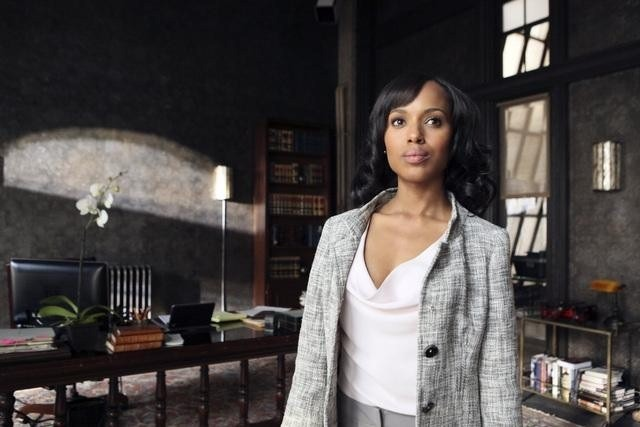
Kerry Washington as Olivia Pope in Scandal

I love Grey’s Anatomy. Is it melodramatic? Absolutely. But its dramatic storylines, sharp dialogue and diverse cast have hooked me from the very first episode. So when I discovered writer, producer, showrunner Shonda Rhimes created Scandal, a political thriller TV series revolving around a woman of color, I knew I had to watch.

Kerry Washington (a feminist in real life…huzzah!) plays Olivia Pope, an assertive attorney who’s a “crisis management expert,” inspired by former George H.W. Bush administration press aide Judy Smith (who also happens to be a producer of the show). Olivia runs a small organization of lawyers who fix scandals and clean up messes like murder charges and infidelity. With a subtle and nuanced performance, Washington is definitely the best part of the series.
What’s so interesting (and fucking sad) is that Scandal is the only prime-time TV show on right now centering around an African American woman. And it’s the first network show with a black female lead in 30 years (that is horrifying). I’ve often heard Washington is a fantastic actor and she was great in the heartbreaking For Colored Girls. Here she commands the screen with confidence and poise. Olivia is an intelligent, successful and empowered woman. Others look up to her, revere her and even fear her shrewd insights and relentlessness to finish a job. She’s demanding, requiring her staff to pull all-nighters and enforcing rules like no crying in the office and not answering “I don’t know” to a question she asks. Powerful politicians turn to her for advice. She negotiates deals on her terms. While new employee Quinn (Katie Lowes) idolizes her, Olivia is far from a paragon of perfection. She’s vulnerable with a messy and complicated love life. She’s flawed, not always likeable (although I personally love her!) and uses Machiavellian tactics to complete a job. But this mélange makes her all the more interesting.
Washington was recently on The Melissa Harris-Perry Show (one of my absolute favorite feminist icons EVER!!!). She talked about inclusivity and how she and Harris-Perry, as two women of color on TV, are “expanding the idea of who ‘We the People’ is.” She also discussed playing a complex female character on-screen:
“…When I read this script, I was so blown away by this woman who in one area of her life, in her professional life, she’s brilliant and sophisticated and in power. And then in her personal life she’s vulnerable and torn and confused. And I thought this is an incredible challenge for any actor. But we also don’t get to do that often — as women in this business, as people of color in this business — to have all of that complexity to explore.”
And she’s right. We too often don’t see complex women, especially women of color, on-screen.
I loved the political intrigue and the focus on a single, accomplished, career-driven woman. And of course how could I not be delighted that Henry Ian Cusick (aka dreamy Desmond from LOST) has found a new series. I was thrilled that the show opens from Quinn’s perspective, taking a job with Olivia because of her reverence for her stellar reputation. I also loved that within the first 7 minutes, a character derided a potential client because he was an anti-choice, anti-gay Republican. While many people assume the media suffers from a liberal bias, too few shows actually discuss abortion or LGBTQ issues. 
While most of it is good, some of the dialogue felt a bit staged or forced. I cringed when Olivia body polices and chastises new employee Quinn for displaying too much cleavage and when Abby (Darby Stanchfield), one of Olivia’s employees, gleefully calls a female murder victim a whore…and drops the whore word a few more times in the next episode too. While there are several female characters (none of whom are really fleshed out yet beyond Olivia), most of the time they’re interacting with men. Although Olivia does have conversations with a young woman who claims is having an affair with the president (Olivia’s former boss) and with the wife of a Supreme Court nominee. No strong female friendships emerge yet. But we’re only 2 episodes into the series. Female friendships comprise the cores of Rhimes’ other shows, Grey’s Anatomy and Private Practice. So I’m hopeful that we’ll see more female interaction as the series progresses.
Much like its complicated protagonist, the series isn’t perfect yet. But it’s got potential. I’m rooting for it because we can never have too many sharp political dramas. And we can never have too many female leads, especially with women of color. 
Scandal is a big deal. Not only do we have a woman of color protagonist, we have a series written and created by a woman of color. With Grey’s Anatomy, Private Practice and Scandal, Rhimes belongs “in an elite group of TV show runners who have multiple series on the air at the same time.” In each of Rhimes’ television shows, she puts women at the forefront. While she has held open casting calls for all ethnicities and has African American, Latina, Asian American and white women in her shows, she’s never had a series revolve around a woman of color. Until now.
In an Essence interview, Kerry Washington said she felt “lucky” to be a woman of color in Hollywood right now:
“I think it’s a really special time to be a woman of color in this business. The landscape of who has the power is changing. We are in more influential positions and are able to have a say in the stories that are told. I feel very lucky to be in the business now…”
But The Grio’s Veronica Miller asserts that it’s hard to have faith in “Hollywood’s relationship with black actresses:”
“It will be easier when black actresses become more visible in roles across the spectrum, (think fantasy hits like Harry Potter, or romantic dramas like The Notebook) and not just ones that call for an African-American female.”
Racialicious’ Kendra James points out the pressure TV shows like Scandalwith black leads face:
“It’s risky for a network that depends on millions of viewers for advertising revenue to cast a lead that the majority of viewers (read: white people) may not relate to. While a show like Pan Am (fondly known as Carefree White Girls Explore the Third World) can fail to take off without consequence, it feels, at times, as if the fate of every black actor and actress on television rides on the success or failure of one show each season.”
Here at Bitch Flicks, we talk a lot about the need for more women in film and TV, in front of and behind the camera. Women comprise only 15% of TV writers and 41%-43% of TV roles are female. But we also desperately need more women of color. 
In a time when Trayvon Martin was shot for being a young black man wearing a hoodie…when racist Hunger Games fans can’t empathize with a black character in the film adaptation…when accomplished and ridiculously talented black female actors like Viola Davis have a hard time finding roles…when black female actors must play either maids or drug addicts or sassy best friends…when female actors of color get sidelined from the cover of Vanity Fair — our society tells people of color over and over and over again implicitly and explicitly that their bodies and their lives don’t matter.
It’s time to change that. It’s time for our media to stop revolving around white men’s stories and reflect the diversity of our world.

Up with Chris Hayes: News Program Has a Conversation about Women and Media That Lasts Longer Than 90 Seconds

Last week Megan wrote an excellent post in response to Ashley Judd’s op-ed piece in The Daily Beast and the national conversation started by the actor speaking out about the treatment of women’s bodies, in particular, in the media. 
Of the many conversations sparked by Judd, this roundtable discussion on MSNBC’s Up with Chris Hayes strikes me as particularly good. As alluded to in the title, the program focused on the issue of women and media longer than the usual sound bite allows. While the entire show wasn’t dedicated to the topic, the group did discuss cultural expectations for women and the treatment of women in the media for more than 15 minutes. Included in the discussion are writer, director, and producer of Miss Representation, Jennifer Siebel Newsom; director of Washington public policy center Demos, Heather McGhee; and Princeton University professor Betsey Stevenson.
Watch the clip here, and please share it widely!

Quote of the Day: Actor Ashley Judd Takes on Bodysnarking Media

ashley-judd

Written by Megan Kearns.


After media speculation over her allegedly “puffy face” caused a “viral media frenzy,” actor Ashley Judd decided to speak out against the media’s misogynistic accusations. Beyond her career as an actor, Judd is a humanitarian and philanthropist, a global ambassador for YouthAIDS and a Harvard graduate. The feminist activist — who dialogues about rape culture and proudly supports reproductive justice — confronted sexism, patriarchy and the media’s incessant scrutiny of women’s faces and bodies. In Judd’s must-read post for The Daily Beast, she writes:

“The Conversation about women’s bodies exists largely outside of us, while it is also directed at (and marketed to) us, and used to define and control us. The Conversation about women happens everywhere, publicly and privately. We are described and detailed, our faces and bodies analyzed and picked apart, our worth ascertained and ascribed based on the reduction of personhood to simple physical objectification. Our voices, our personhood, our potential, and our accomplishments are regularly minimized and muted.”

Love, love, LOVE this! I mean, who the hell cares if an actor has gained weight? Judd shouldn’t have to justify or defend her appearance. The media needs to cease the destructive commentaries and obsessive deconstruction of women’s bodies, debating whether or not a celeb has gained weight or had plastic surgery. And don’t even get me started on those god awful “baby bump patrols” in the tabloids. Bleh.

Controlling women’s bodies consumes our sexist and ageist society. Women obsess over their appearance because they see unhealthy and unrealistic depictions of female actors and models in film, TV, magazines and on billboards. Photoshopped faces and bodies saturate the media, creating unattainable images of beauty. We’re supposed to wax and tweeze body hair, slather on age-defying creams, diet and exercise curves into submission. Between diet books, exercise DVDs, weight loss shakes, low-fat foods – the dieting industry is a money-making juggernaut. And it’s geared towards women. On the flip side, the media chastises women for being too bony or thin. The media constantly dissects, critiques and polices women’s bodies.

In her Daily Beast article, Judd also succinctly defines patriarchy, reminding us that men aren’t the sole perpetrators of sexism. Women are too:

“That women are joining in the ongoing disassembling of my appearance is salient. Patriarchy is not men. Patriarchy is a system in which both women and men participate. It privileges, inter alia, the interests of boys and men over the bodily integrity, autonomy, and dignity of girls and women. It is subtle, insidious, and never more dangerous than when women passionately deny that they themselves are engaging in it.”

Judd couldn’t be more spot on. Patriarchy puts the needs of white men and boys first. Patriarchy silences and constrains women and girls yet makes them culprits in policing other women’s bodies and behavior. Women need to stop tearing down other women.

It’s interesting Judd’s patriarchy media manifesto comes out right after some asshole critics deemed Jennifer Lawrence’s body too fat, too curvy and not emaciated enough to play Hunger Games’ Katniss from the starving and impoverished District 12.

The New York Times’ Mahnola Dargis claimed “her seductive, womanly figure makes a bad fit for a dystopian fantasy about a people starved into submission,” The Hollywood Reporter’s Todd McCarthy commented on her “lingering baby fat,” Hollywood Elsewhere’s Jeffrey Wells accuses Lawrence of being “big-boned” and “seems too big for Hutcherson” as male romantic partners should at least be as tall as their female counterparts (I shit you not).

Thankfully, others like Melissa Silverstein at Women and Hollywood, Slate’s L.V. Anderson, LA Times’ Alexandra Le Tellier, LA Times’ Patrick Goldstein, as well as many others have called out this bullshit bodysnarking. Jennifer Lawrence, who chose not to diet for the role (good for her), has also apparently laughed off the media’s criticism of her body.

And of course there’s been an onslaught of racist commentary surrounding Rue. Her character’s innocence and purity and the audience’s ability to empathize with her apparently went out the window the minute racist filmgoers saw a Black girl.

Sophia Savage for Thompson on Hollywood points out that audiences called Kate Winslet “too fat” for the 3-D rerelease of Titanic. Winslet “responded that she’s now thinner than co-star Leonardo DiCaprio.” Winslet has spoken out about her weight and body image before, particularly her disdain for magazines’ overzealous photoshopping to make her look unrealistically thin. And I remember when Titanic originally premiered in 1997, audiences and film critics taunted Winslet’s weight. Clearly some things don’t change. Sigh.

But cruel commentary on women’s appearances isn’t just reserved for those in Hollywood. And not everyone can just shrug off the media’s mockery. Conservative pundits Glenn Beck and Laura Ingraham as well as others in the media have skewered columnist and blogger Meghan McCain for her weight and appearance. McCain said that it’s as if “all women in the media should lose a bunch of weight if they want to go on television to talk about anything.” She admitted she’s seen a therapist because of the media’s “really weird reaction” to her body. Omg I don’t blame her — I freak out when someone doesn’t like one of my blog posts! And of course I’ll never forget the horrific misogynistic dissection of both Hillary Clinton and Sarah Palin (their clothes, hair, bodies, faces, sexiness) during the 2008 presidential election.

We don’t see this level of relentless scrutiny and bodysnarking of male bodies. Women and girls are continually held up to unattainable toxic beauty standards, punished and criticized if they transgress these warped norms. A positive body image eludes many of us as a result. We can be anything we dream of, so long as we’re thin and sexy — and of course “sexy” means white women with long-flowing hair. Society continually places importance on womens’ and girls’ appearances over their merit and intellect, reducing us to sex objects. The media tells us our value and self-worth reside in our beauty.

We’re teaching future generations to wage war with their bodies. Nearly half of all 3- to 6-year-old girls worry about being fat and “eating disorders having risen steadily in children and teens over the last few decades.” According to the documentary Miss Representation, the average age of plastic surgery is 17 years old. Girls internalize self-hatred. They grow up thinking they must alter and transform their appearance in order to achieve acceptance and happiness.
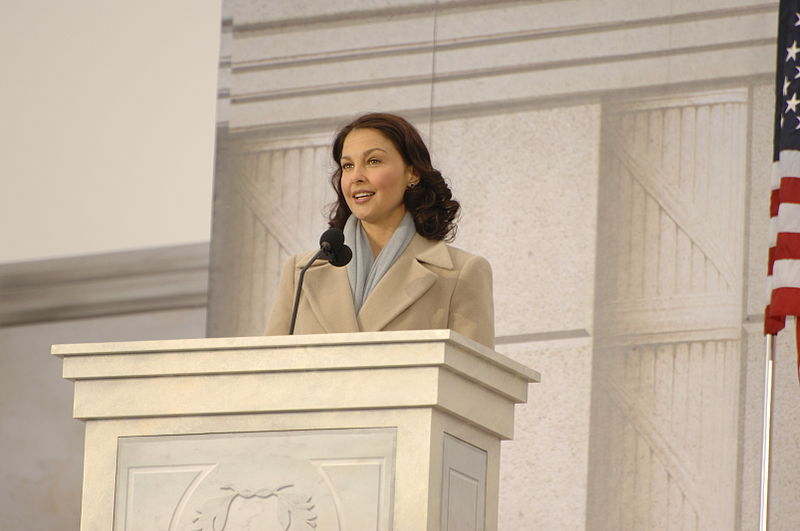
Having met Ashley Judd on a few occasions, I can say she is every bit as impassioned in person as she appears in-print or on-screen. We need more celebs — like Judd, Geena Davis, Kerry Washington, Martha Plimpton, Margaret Cho, Jennifer Siebel Newsom, Roseanne Barr — who are outspoken staunch feminists, unafraid to call out sexist bullshit. We all need to challenge the media’s misogynistic attacks on women’s bodies.


Image by the U.S. federal government via the public domain in the U.S.