Viola Davis Rules the Night: Women, Race & Gender at the 2012 SAG Awards

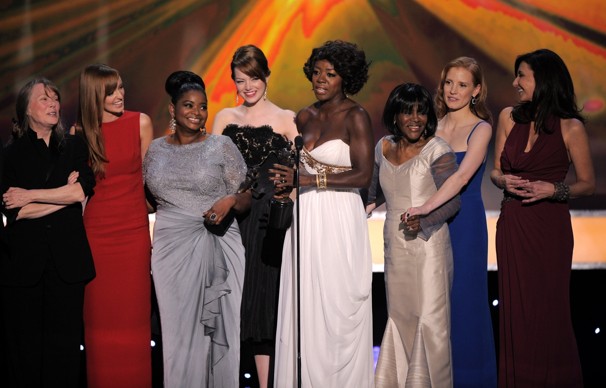
Viola Davis and the cast of ‘The Help’ at the 2012 SAG Awards
Lately, it seems awards shows vacillate between moments of cringe-inducing sexism and feminist clarity. And the Screen Actors Guild (SAG) Awards were no different. Stripped of pomp and circumstance, with no host, the SAG Awards focus strictly on acting in TV and films. As with most media I consume, some parts pissed me off while others delighted me.

When Christopher Plummer won Outstanding Male in a Supporting Role for his performance as a gay man coming out to his son in Beginners, he began his acceptance speech by saying he’s “had such fun in the world’s 2nd oldest profession.” Ah, a sex work joke. Then Plummer called the film’s female producers “girls.” Oh Christopher Plummer. Yeah, calling female producers “girls,” even if they are way younger than you, not cool. But he almost redeemed himself when he again thanked his wife of 43 years who “came to his rescue and saved his life.” Swoon!

Dick Van Dyke presented icon Mary Tyler Moore with a Lifetime Achievement Award. I’ll start with what I liked. I LOOOVE that Van Dyke mentioned that Mary Tyler Moore is an animal rights advocate!!! The vegan in me cheered with delight. Ah, but the feminist in me shook my head at this:

“She’s one of the few performers, women, who can do a flat out comedy scene, slapstick and still be beautiful, feminine and adorable.”

Sigh. I so wanted to like his touching speech but it pissed me off. What does her appearance or femininity matter? Who cares what the hell a woman looks like, Dick Van Dyke? And who the fuck cares if she’s “feminine?!” Ugh.

Now, I realize he’s old and comes from another era. Don’t care. When discussing someone’s work or talent, male or female, their looks shouldn’t be mentioned. Society focuses too much on women’s appearances. People often assume women can only embody one quality: smart or sexy, funny or beautiful. As if a talented woman isn’t a success unless she’s pretty and feminine too.

Luckily, the rest of the evening contained inspirational and humorous moments through a feminist lens.

When Octavia Spencer won Outstanding Female in a Supporting Role for The Help, she honored civil rights activist Medgar Evers in her poignant acceptance speech. She also said,
 

“Thank you for putting me in a category with so many beautiful women…It was really a privilege to work on a film that gave a voice to so many women…By honoring me, you honor them…

“I want to thank all the people out there who went to support this movie and, after watching it, felt something. You felt compelled to make a change in your lives. So I’m going to dedicate this to the downtrodden, the underserved, the underprivileged, the overtaxed, whether emotionally, physically or financially.”

I absolutely adore Spencer mentioned women’s voices as well as class. And I love that she’s getting all this attention. Just wish it wasn’t for The Help. Ugh. Regardless of my opinions of The Help, I hope this catalyzes Spencer’s career and she gets lots and lots and lots of roles. She deserves them.

Other great moments included winner Alec Baldwin giving a shout-out to Tina Fey for her witty writing on 30 Rock (damn straight) and winner Betty White thanking her 3 female co-stars, Valerie Bertinelli, Jane Leeves and Wendie Malick, on Hot in Cleveland. Loving the female camaraderie!

And speaking of female camaraderie…love, love, LOVE Maya Rudolph, Kristen Wiig and Melissa McCarthy as presenters!!! The comical trio sauntered on stage to present the clip of Bridesmaids, one of my favorite 2011 films, nominated for Outstanding Ensemble. In describing the film, Maya Rudolph said,

“Our cast tells the story of strong female friendships.”

Yes, yes it does. Hilarious, raunchy, bittersweet and touching, Bridesmaids depicted a group of women as friends and one woman trying to find her way in the world. It’s rare for a movie to feature a female protagonist. It’s even rarer for a film to contain multiple female characters where women aren’t portrayed as catty and competitive but actually like and respect each other. In the funniest part of the evening, the women alerted the audience to a Scorsese Drinking Game where you drink each and every time you hear Martin Scorsese’s name uttered. Kristen Wiig said,
“Do you think Scorsese saw Bridesmaids??”

If he’s smart, he sure as hell has.

When presenters Tina Fey and John Krazinski discussed advice given to actors, Fey hilariously said,

“And I believe it was the TODAY show’s fourth hour co-host Kathie Lee Gifford who said, ‘If drag queens love you, you’ll have the longest career in the world. They know phony and they know real.’”

Ha! One of the best quotes of the night. But the SAG Awards belonged to Viola Davis who completely stole the night.

When Viola Davis won Outstanding Female Actor in a Lead Role, the audience gave her a standing ovation. Davis is a phenomenal actor who makes the most of any role she plays. Whether on-screen for hours (The Help) or mere moments (Doubt), her quiet strength mesmerizes and enthralls. Christ she almost made Nights in Rodanthe watchable (almost). Davis shared how she decided to become an actress at 8 years old. Cicely Tyson inspired her, and she was thrilled she could see her idol sitting in the audience as she won her award. Davis said,

“What is there but a dream? You can’t trade in your dream for another dream…Dream big and dream fierce.”

While I wish awards shows weren’t based on a binary gender divide, I often worry and lament that if they weren’t, women might never win. However this year, 2 of the 5 films nominated for Outstanding Performance by a Cast, Bridesmaids and The Help, both boasted predominantly female casts. It’s a huge step in the right direction.

Bolstered by a female ensemble, The Help was the big winner of the evening. Not only did it win the two female acting awards. And I have to say that I’m ecstatic two unbelievably talented African-American women won. But it also won Outstanding Performance by a Cast. At first, I was pissed Bridesmaids didn’t win. Then I was even more pissed that The Help won; a film touted as showcasing black women’s experiences but actually revolving around a white woman “saving” black women. But then I let Davis’ eloquent and inspiring words wash over me.

After calling working on The Help “a labor of love,” Davis articulated:

“The stain of racism and sexism is not just for people of color or women. It’s all of our burden. It’s all of us. I don’t care how ordinary you may feel. We all of us can inspire change. Every single one of us.”

I sat in my living room and applauded. And cried. Davis’ speech contained THE best, most feminist declaration I’ve ever heard on any awards show. Period. Davis blew me away with her poise, grace and intelligence. I’m thrilled she addressed racism and sexism on a national platform. And she’s absolutely right.

Racism and sexism affect us all. More people must realize racism and sexism still exist, stripping people of equality. We need white allies and male allies working with people of color and women towards eradicating racial and gender discrimination. We must speak out whenever we see or hear prejudice or injustice if we ever hope to combat it. But all is not lost. We can all make a difference.

People often go to the movies for entertainment, to escape their mundane lives. But films can also inspire you to act boldly and dream big. And sometimes, awards shows can too.
Ava DuVernay Wins Directing Award at Sundance Film Festival

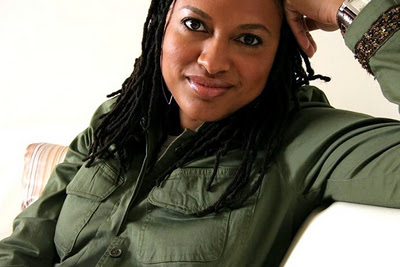
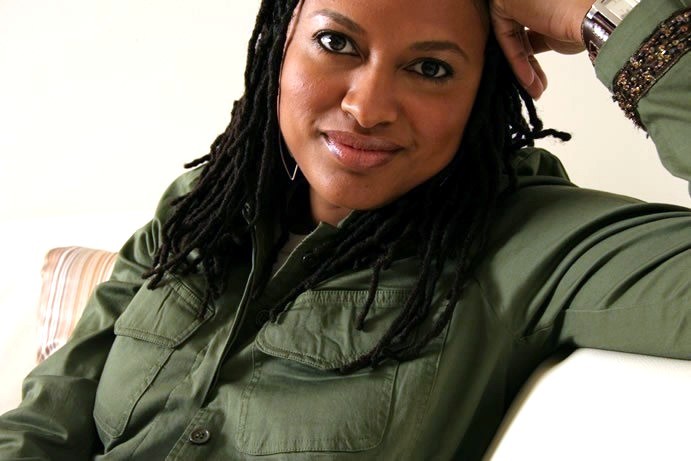
Ava DuVernay, director of Middle of Nowhere

From Essence Magazine:

Congratulations are in order for filmmaker Ava DuVernay, who over the weekend became the first African American woman to take home the U.S. directing award at the Sundance Film Festival.

DuVernay received the award for her second feature film, “Middle of Nowhere,” which tells the story of a young woman who struggles to maintain her identity while her husband serves an eight-year prison sentence.

YES!
Here’s a wonderful interview with Ava DuVernay in which she discusses Middle of Nowhere:

Quote of the Day: Julie Dash

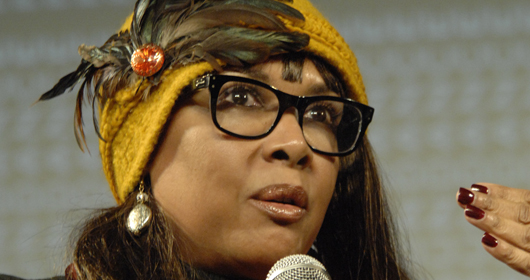
Julie Dash speaking at the 2012 Sundance Film Festival
In 1991, Julie Dash won the Sundance Excellence in Cinematography Award for Daughters of the Dust. Set in 1902, the film examines the lives of a family’s Gullah (also sometimes called Geechee) culture, which still thrives on the Sea Islands, off the coast of South Carolina and in coastal Georgia. 
Recently restored, Daughters of the Dust screened at this year’s Sundance Film Festival, and Dash was interviewed by Nelson George.
George: You grew up in a household with this [Gullah] culture around you even though you grew up in New York City. What’s the journey from there as a child to you deciding to make the film? 
Dash: Once I decided I was going to tell stories through film, and once I decided that I was not going to be a documentary filmmaker, but I was going to tell narrative stories (because I was excited about the literature of Alice Walker and Toni Morrison and all the poets of the time), I decided that I wanted to tell a story that was authentic to African American culture – authentic to the point where it was not like something you could turn on the television and see. I wanted it to be more like a foreign film and so deeply into the culture that it appeared to be foreign.
I’m fascinated by her statement about wanting Daughters to be “more like a foreign film.” While it’s safe to say that Gullah culture might be “foreign” to some people in the U.S., I think she’s saying something more. It’s not simply a lack of familiarity, a different language, or a setting outside one’s home country that makes a “foreign film.” It’s a certain quality, a certain uniqueness. When Dash speaks of authenticity, what remains unspoken is reference to depiction of African American experience in other films–she speaks of novelists and poets–and, perhaps, that is what she’s talking about when she talks about the desire for Daughters to appear foreign.

More than 20 years after Julie Dash made Daughters of the Dust, how many “authentic” films do we see?

Guest Writer Wednesday: ‘2 Broke Girls:’ How NOT to Respond to Criticism that Your Show is Racist

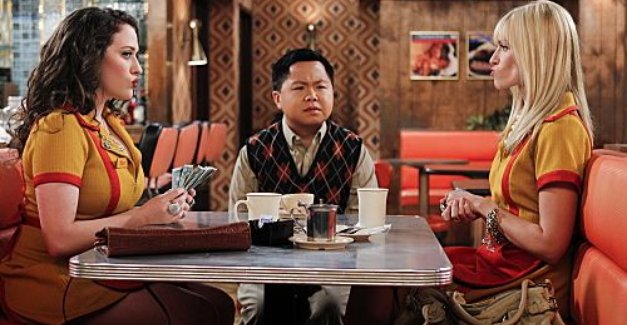
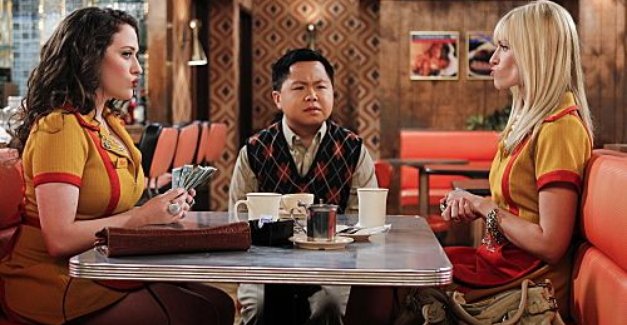
(L-R): Kat Dennings, Matthew Moy, Beth Behrs; ‘2 Broke Girls’ still frame

Written by Lady T. Originally published at The Funny Feminist. Cross-posted with permission.
I watch 2 Broke Girls. Do you watch 2 Broke Girls?
Watching that show from a social justice perspective is a bizarre experiment in emotional whiplash. On the one hand, it’s a show about a complementary friendship between two smart, hardworking young women, whose storylines do not revolve around dating or shopping, but about their entrepreneurship and growing bond. It’s one of the few shows in my recent memory that frequently passes the Bechdel test.
On the other hand, it’s a show about two white girls who work at a diner with a supporting cast of racial stereotypes that make the crows from Dumbo cringe in secondhand embarrassment.
That’s really the problem with 2 Broke Girls right there. Max and Caroline are allowed to be fairly complex (at least for a sitcom), but Earl, Oleg, and Han seem like they’re on a completely different program. They have very few (if any) character traits that exist outside their designated stereotypes.
Fans and critics (not that those two things are mutually exclusive) asked questions about the ethnic/racial jokes and stereotypes at the press tour, to which Michael Patrick King (co-creator of the show) essentially said, “I’m gay so that makes it okay for me to make fun of other marginalized people!”
That’s not an exaggeration. Read more here.

Of course, someone pulled out the “equal opportunity defender” card. Someone always pulls out the “equal opportunity defender” card. We make fun of all groups! FREE SPEECH STOP REPRESSING ME WAAAAH!
I’m so glad Michael Patrick King and his defenders can use the “free speech/equal opportunity” defense for their so-called “irreverent” comedy that “pokes fun at all groups.” Because if there’s something that comedy really needed desperately, it was another sexless Asian male character. Han Lee is a pioneering character in the comedy world, because Michael Patrick King said so.
Reading about this controversy over 2 Broke Girls was oddly refreshing, to tell the truth. King’s butthurt response to the criticism was not refreshing, but the criticism itself was. I was pleasantly surprised to see several members of the mainstream media push forward with the “Seriously, what’s up with all the racist stereotypes?” questions.
In response, King did what any socially responsible or creative person would do: he made a creative decision to add a “hot” Asian male character to his show so people would shut up about the stereotyping in his existing characters.
*facepalm*
This is not an exaggeration, people. Read more at The A.V. Club:

“Keeping CBS’s promises that the future would see 2 Broke Girls creator Michael Patrick King attempt to “dimensionalize” some of its racist stereotypes—this despite King being gay, which means he doesn’t have to—the show recently put out a casting call for a “hot Asian guy” to come and romance Beth Behrs’ character with some of his hot Asianness. The arrival of this hot Asian guy would provide a much-needed balance to the comedy’s Korean caricature Han, demonstrating that there are many colors in the Asian rainbow: hot, hilariously indecipherable, unable to drive, etc. Of course, the blog that first picked up the casting call, Angry Asian Man, argues that showing that Asians can also be hot and worthy of making out with Beth Behrs doesn’t exactly make up for 2 Broke Girls’ egregious, simplistic Asian stereotyping. But then, he’s probably just upset that he’s an angry Asian man instead of one of those hot ones.”

As a feminist and someone who cares about social justice, I feel like I should be outraged. But I don’t have it in me to be outraged because I’m just overwhelmed by the cluelessness behind this P.R. move.
I really need Seth Meyers and Amy Poehler (and Kermit the Frog) to help me with this, because…Really?!
King is criticized because his character Han Lee, the Asian male stereotype, is…well, nothing but an Asian male stereotype. Instead of, I don’t know, fleshing out his existing character, he decides to add a Hot Asian Guy character – like he’ll get EXTRA token points for having TWO Asian characters on the same program, and that it will shut up all those HATERZ who don’t like Han Lee!
Brilliant move, Mr. King. I’m sure Asians will be completely pacified and pleased knowing that you’re throwing in an obligatory Non-Stereotype Character whose sole purpose will be to sex up a white woman and prove that you are TOTALLY NOT RACIST.
I could point out how stereotypical characters just continue to perpetuate stereotypes and how harmful those stereotypes can be, but forget about that for a moment. When you get right down to it, the use of these stereotypes shows a complete lack of imagination.


Lady T is an aspiring writer and comedian with two novels, a play, and a collection of comedy sketches in progress. She hopes to one day be published and finish one of her projects (not in that order). You can find more of her writing at The Funny Feminist, where she picks apart entertainment and reviews movies she hasn’t seen.

2012 Oscar Nominations


I just watched the live announcement of the Oscar nominations. My only thoughts right now are 1) Where the hell is Tilda Swinton’s nomination for We Need to Talk About Kevin? 2) Did Woody Allen’s piece of shit film Midnight in Paris seriously get a best picture nomination? 3) Yay Melissa McCarthy! 4) The Help? Really? 5) Did Hollywood miraculously get more racist this year?

Best Picture

  • The Artist
  • The Descendants
  • Extremely Loud & Incredibly Close
  • The Help
  • Hugo
  • Midnight in Paris
  • Moneyball
  • The Tree of Life
  • War Horse

Best Actress

Best Supporting Actress

Best Actor

  • Demian Bichir, A Better Life
  • George Clooney, The Descendants
  • Jean Dujardin, The Artist
  • Gary Oldman, Tinker Tailor Soldier Spy
  • Brad Pitt, Moneyball

Best Supporting Actor

  • Kenneth Branagh, My Week With Marilyn
  • Jonah Hill, Moneyball
  • Nick Nolte, Warrior
  • Christopher Plummer, Beginners
  • Max von Sydow, Extremely Loud & Incredibly Close

Best Director

  • Michel Hazanavicius, The Artist
  • Alexander Payne, The Descendants
  • Martin Scorsese, Hugo
  • Woody Allen, Midnight in Paris
  • Terrence Malick, The Tree of Life


You can view the rest of the nominations as a PDF or on the Web site for the Academy Awards.

Saying Goodbye to ‘Prime Suspect’ and One of My Fave Badass Female Characters

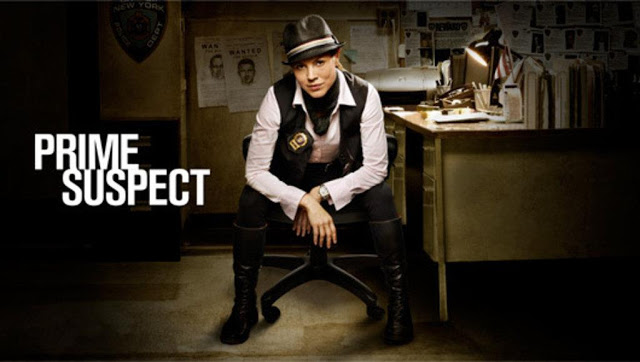
Maria Bello as Detective Jane Timoney on NBC’s “Prime Suspect”
Some argue women fare better on television than in films. The roles are more complex, with more feminist issues explored. One of the most interesting female protagonists I’ve watched in a long time? Detective Jane Timoney on Prime Suspect. A show I love that sadly comes to an end this Sunday night (1/22.)
Prime Suspect centers around NYC Homicide Detective Jane Timoney, played spectacularly by Maria Bello. I’ve been a long-time fan of Bello’s work from ER and A History of Violence to Payback and The Private Lives of Pippa Lee. Bello gives a tour-de-force performance as Detective Timoney, a role she personally identifies with since she envisions herself as Jane, only “nicer.”
It’s a gritty, raw and surprisingly funny show. Detective Exuding strength and keen intelligence, Jane Timoney is tough and self-reliant. She’s fearless and complicated with a big mouth and a bitingly sarcastic sense of humor. She drinks a lot and shoots perfectly at the firing range. She possesses a sharp mind that thinks of scenarios others might overlook when solving a homicide. Timoney doesn’t give a fuck what other people think about her and she’s not afraid to be herself. And that might be the most refreshing aspect of all.
Having a show revolve around a female detective isn’t a groundbreaking concept. Following in the footsteps of the original British series with Helen Mirren playing the lead, it echoes The Killing, The Closer, Saving Grace, Cold Case, Rizzoli & Isles, and Cagney & Lacey. But a show created and written by women, with a strong female lead who’s willing to say fuck you to anyone and everyone? You don’t see that every day.
Female protagonists aren’t often allowed to be unlikeable or do despicable things. Even rarer are the characters who don’t give a shit what anyone thinks of them. The female roles on TV I can think of include Roseanne Conner (Roseanne), Captain Kara Thrace (Battlestar Galactica), Maude Findlay (Maude), Elaine Benes (Seinfeld), Christine (New Adventures of Old Christine), Xena (Xena Warrior Princess) Jackie Peyton RN (Nurse Jackie), Dorothy Zbornak (Golden Girls) and Patty Hewes (Damages). Although, I happen to like almost all of these female characters.
Detective Jane Timoney (Maria Bello) “Prime Suspect”

In the premiere, the sexism Timoney faces jars and appalls. As a woman, she’s entered a perceived male domain. Her male colleagues insinuate and (some outright say) that she doesn’t deserve to be in homicide as she only got transferred to the department after sleeping with a chief. She faces the wrath of her co-worker, Detective Duffy, who accuses her of leading a homicide case only because another detective died of a heart attack.  To their chauvinistic paradigm, she’s transcended boundaries and they’re going to make sure she knows it. When Timoney finds another angle to the case and gets information out of a witness that the previous detectives hadn’t. Calling her a bitch (by implying she’s a witch), Detective Carter snarkily asks her:

Carter: You ever worry that someone’s gonna drop a house on you?
Timoney: Car’s not going to drive itself, is it?
Carter: I guess you don’t.
The original British series premiered in 1991, evolving out of sexism in Scotland Yard. When writer Lynda La Plante discovered only 4 women were Detective Chief Inspectors (DCIs), she created the show. The first season (or “series” in the UK) contends with sexism in the workplace and the hostility that Detective Jane Tennison (Helen Mirren) faced due to her gender.
While the premiere focused heavily on workplace sexism, the rest of the series shied away. Matt Zoller Seitz at Salon reports that Alexandra Cunningham and Peter Berg made a conscious decision to “tone down” the sexism in subsequent episodes. Before the show premiered, Cunningham said:

“Obviously, it’s 2011. There’s no institutionalized sexism. There’s human resources. Women have recourse at work when things happen. “Prime Suspect” [will] try to make it more realistic, because sexism isn’t gone. It’s kind of more subtle and insidious in a modern world, and that’s what we’re going to try to do.”

What? No institutionalized sexism?? I’m not sure what world Cunningham lives in but sexism, both blatant and subtle, still very much exists.

As the show progresses, we see Detective Timoney collaborate with her colleagues. We see the hilarious friendship and banter between Detectives Blando and Calderon. We also see Timoney clash with her co-workers, boss, her loving boyfriend, her protective father and her vegan sister (yay a vegan!). Detective Timoney might be a hard-ass. But she’s also funny as hell. Here are some of Jane Timoney’s quips throughout the season:

Timoney: I love to know where the crime scene isn’t.
­­­­­­­­­­­­­­­­­­­­
Timoney: Ever seen a duck? Yeah, they don’t chew either. You just ate that hot dog like a duck.
Hypnotherapist: You don’t seem to be in the right head space to quit smoking right now.
Timoney: I don’t just want to smoke right now. I want to shove a pack of cigarettes in my mouth and light it with a blowtorch.
Timoney: You look tired means you look old. You look short. How’s that feel?
Duffy: Do you know what your problem is?
Timoney: Oh, why limit it to just one?

Detective Jane Timoney (Maria Bello) in “Prime Suspect”

In addition to sexism, the show also broached racism. In one of the episodes, 10 of Detective Timoney’s colleagues get pulled from a case of a murdered Latina to work on the murder of a pretty white female who’s an NYU student. Timoney tells the Chief:

“You’re making their point for them. You couldn’t have done it better…When it’s a missing brown girl, from a nobody family, it’s an afterthought.”

While I wish the show had delved deeper, I was thrilled this line appeared at all. Rarely does a TV show with a white protagonist tackle the intersection of racism and sexism.

Prime Suspect also makes interesting gender commentaries when Detective Timoney interacts with other women. There’s another female detective, Detective Carolina Rivera, who all the men flirt with. She’s coquettish and friendly in return. It’s a stark contrast to Detective Timoney’s no-nonsense, straight-forward style. She doesn’t care if the men like her. She’s there to do her job. Timoney also differs from her boyfriend’s ex-wife, Trish, who she often has to communicate with since her boyfriend and Trish share a young son. Trish often makes snide remarks about her carrying a gun or her line of work, especially when it co. Timoney isn’t a girlie girl. And she’s no pushover. In a great scene, after Trish asks Timoney what happened to her face (which is cut and bruised from fighting with an arrested suspect):


“Listen to me: I work terrible hours, often have to leave things early, I arrive to things late. I get phone calls in the middle of the night and all day long. I’ve never been shot, but I’ve been stabbed. I’ve had lye thrown in my face once, and I’m a homicide detective, Trish. Not a policeman or a policewoman. I’m also not a divorce lawyer, but I know about going to court.”

In “Underwater,” my fave episode so far, Timoney and Duffy go on a road trip to protect a little girl. Timoney grows fond of her, telling her she doesn’t like many people but that she likes her. While she’s close with her father and boyfriend, she has seemingly chosen not to have children of her own. In an episode where a man has beaten his wife and murdered her, he asks Detective Timoney why she doesn’t have children. She replies:

“I don’t know. Lucky.”

It’s rare for a female protagonist not to want children. Films, TV series and ads perpetually tell us all women want to have babies. If they don’t, they must be damaged, deluding themselves or they just haven’t found the right man yet. Because you know silly ladies, our lives revolve around men.

One of my favorite moments occurs in the premiere. In a heart-breaking scene, Timoney comes home to her boyfriend, after a grueling day. The two of them fought earlier. She asks him to hold her even though he’s mad because she had a rough day. In a rare moment of exasperation and tenderness, Timoney quietly cries in his arms. She’s not a caricature. She’s a fully developed, complex character who knows she can’t let down her guard and weep at work.

Detective Jane Timoney (Maria Bello) in “Prime Suspect”

In “The Sad Death of Prime Suspect,” Melissa Silverstein laments Prime Suspect’s cancellation. She also talks about the difficulties of centering a show around a female protagonist:


“One thing this show made me notice is how it is easy to write a TV show starring a man and have female and male supporting characters surround that lead, but that it is way harder to write a show about a female lead and to create a realistic ensemble around her.

“One of the issues with this show is that there were no other female credible characters on the show. It’s too much baggage for the female lead. She has to respond to the pretty cop who comes in and flirts, she has to deal with the crazy demands of her boyfriend’s ex, she has a crazy sister (where did that come from?). None of those women was a peer or someone she could have a decent conversation with to get her away from all the testosterone.”


That’s my one complaint of the show too: the lack of strong and interesting female characters for Timoney to interact with. No female camaraderie. No best friend to vent to. I wish the show contained a multitude of female characters or sexism in the workplace remained a central theme. But who knows where the show might have taken us.
Prime Suspect is a compelling show with a memorable female character. I’ll be sad as I watch the last 2 episodes Sunday night. I’m going to miss Detective Jane Timoney. We need more badass women like her.

2012 Golden Globe Analysis

Since yesterday was Martin Luther King, Jr. Day, a federal holiday, I thought it was more important to post something specific about race in the United States than an analysis of the Golden Globes. However, it turns out there’s still a lot to say about race with regards to the awards. More about that–and my picks for highlights and lowlights of the cerermony–after a quick rundown of the night’s winners.

Motion Picture
Best Picture – Drama: The Descendents
Best Performance by an Actress – Drama: Meryl Streep for The Iron Lady
Best Performance by an Actor – Drama: George Clooney for The Descendents
Best Picture – Comedy or Musical: The Artist
Best Performance by an Actress – Comedy or Musical: Michelle Williams for My Week with Marilyn
Best Performance by an Actor – Comedy or Musical: Jean Dujardin for The Artist
Best Animated Feature Film: The Adventures of Tintin
Best Foreign Language Film: Asghar Farhadi for A Separation
Best Director: Martin Scorsese for Hugo
Best Screenplay: Woody Allen for Midnight in Paris
Best Performance by an Actress in a Supporting Role: Octavia Spencer for The Help
Best Performance by an Actor in a Supporting Role: Christopher Plummer for Beginners
Best Original Score: Ludovic Bource for The Artist
Best Original Song: “Masterpiece” by Madonna, Julie Frost & Jimmy Harry for W.E.

Television
Best Series – Drama: Homeland
Best Performance by an Actress – Drama Series: Claire Danes for Homeland
Best Performance by an Actor  – Drama Series : Kelsey Grammer for Boss
Best Series – Comedy or Musical: Modern Family
Best Performance by an Actress – Comedy or Musical Series: Laura Dern for Enlightened
Best Performance by an Actor – Comedy or Musical Series: Matt LeBlanc for Episodes
Best Mini-Series or Motion Picture: Downton Abbey
Best Performance by an Actress in a Mini-Series or Motion Picture: Kate Winslet for Mildred Pierce
Best Performance by an Actor in a Mini-Series or Motion Picture: Idris Elba for Luther
Best Performance by an Actress in a Supporting Role: Jessica Lange for American Horror Story
Best Performance by an Actor in a Supporting Role: Peter Dinklage for Game of Thrones

Cecil B. DeMille Award: Morgan Freeman

A few brief thoughts about the nominees and winners:

  • No women were nominated in the score, screenplay, best picture, or directing categories.
  • The only woman to win an award outside of acting was Madonna, for best original song.
  • Two people of color won acting awards–Octavia Spencer & Idris Elba–which seems better than previous years, though perhaps still not good enough. 
  • Modern Family won yet another award, this time in a category that did not include Parks and Recreation, which I would argue is the best comedy on television.
  • Matt LeBlanc & Kelsey Grammer?! I didn’t realize the 1990s were experiencing such a resurgence, and these were some of the biggest surprises of the night for me.
Highlights:

Meryl “I can’t believe I said shit on TV” Streep
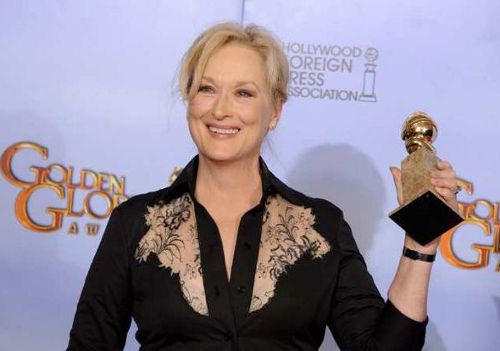
Meryl Streep
Her acceptance speech was exuberant and funny. She forgot her glasses, was possibly drunk, swore, and was censored. She then proceeded to deliver the best speech of the night. She mentioned not only the other women nominated in her category, but gave a shout-out to Pariah star Adepero Oduye and Jane Eyre star Mia Wasikowska. She is lovely, classy, funny (with two references to host Gervais), intelligent, and willing to step out of her comfort zone to take on challenging roles (like this one). 
Here’s a clip of the speech from YouTube, which will probably be taken down soon:

Tina Fey & Jane Lynch
Tina Fey and Jane Lynch
Two very funny women presented an award and proceeded to joke about how little they resemble the characters they play on television. But the best moment came at the end, when they not only got in that penis joke,* but highlighted the “triumph” with an in-unison “penis joke!”
Felicity Huffman and William H. Macy sing
Felicity Huffman and William H. Macy
Another favorite moment involved the presentation of an award, rather than an acceptance speech or anything the host said. The duo sang their teleprompter speech, giving us all a pleasant surprise. In a show that can be–and often is–boring and too serious (which is why a host like Gervais is brought in at all), their moment was fun, light-hearted, and playful. If only there were more moments like this in the 3-hour ceremony…
Lowlights:
Ricky Gervais being…funny?
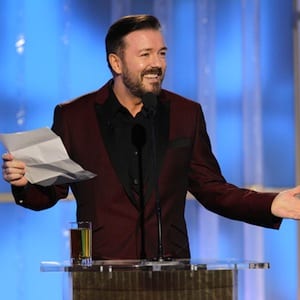
Ricky Gervais
Gervais tells sexist, homophobic jokes and thinks (?) it’s funny to say he “can’t fucking understand” native Spanish speakers (who also speak perfectly clear English) Salma Hayek and Antonio Banderas. However, he also skewers  celebrities during the very awards ceremonies that laud them and treat them like royalty. I like this dynamic very much, and think it captures the way many of us feel about movie stars: we simultaneously adore them and find them utterly ridiculous. The Golden Globes needs a host who is funny and irreverent if the show is to be of any interest to average viewers. I’m convinced this person exists, and I’m also convinced that Gervais is not this person.


Meltem Cumbul on the red carpet

Meltem Cumbul

Ordinarily I’d be pleased to see an international film star who isn’t from the United States appear at the Golden Globes. However, I was puzzled by the appearance of Meltem Cumbul, who made a brief statement and then left the stage. She didn’t present an award, and she didn’t introduce a presenter. While it was wonderful for the Globes to acknowledge that films are made outside of Hollywood, it struck me as a cynical move–to have us believe that the organization is more progressive and inclusive than it actually is. Perhaps I’d be more convinced if she’d have served a purpose on stage, or if the HFPA had more than one category recognizing filmmaking around the world.
Queen Latifah introduces Best Picture nominee The Help
Queen Latifah introduces The Help
Queen Latifah is a talented, confident, and beautiful Black woman, and it was good to see her on stage. That the Globes brought her on stage to introduce the only Best Picture nominee that remotely deals with the experience of Black people…well, that looks like the same kind of cynical move I saw with Cumbul’s appearance. I also can’t help but think that this was the HFPA’s way to avoid or sidestep the real backlash against this movie. Octavia Spencer won for her performance in The Help–and, as I tweeted during the ceremony, I’m glad she won–but it would be nice to see a Black woman win an award for playing something other than a maid, and it would also be nice to see a Black woman introduce a Best Picture nominee that isn’t an extremely problematic story mainly about a White Savior.
Dishonorable Mentions
Penis Jokes*
As seems more and more the norm on television today, we can’t seem to get through a program without implicit or explicit penis jokes. I actually liked Fey and Lynch’s ironic joke, as I mentioned above, but because it was done in the spirit of acknowledging and ironically commenting on the comic trend. Whether you’re watching The Daily Show or the Golden Globes, you’re going to hear about penises. Sunday night, Seth Rogen sexually harassed his co-presenter Kate Beckinsale with a “joke” about having a “massive erection.” Later, George Clooney “joked” (though this seems timid compared to Rogen’s offense) that Michael Fassbender could play golf with his hands tied behind his back. All I can say about this is ENOUGH ALREADY.
Miss Golden Globe
Why oh why oh why oh why do we STILL have to have a lovely young woman stand on stage to occasionally usher off a confused star? Why? WHY?
That’s it from me. What are some of your favorite and least favorite moments from the 2012 Golden Globes?

YouTube Break: Meryl Streep on 60 Minutes

I love this 60 Minutes interview with Meryl Streep. She won the Best Actress Golden Globe on Sunday for her performance in The Iron Lady (stay tuned for our review!), and she talks here about sexism in Hollywood and what drew her to the role of Margaret Thatcher. (I’ve linked to the clip above in case the embedding doesn’t work.) 
Amber will have a recap of the Golden Globes later today.

George Lucas Couldn’t Make a Movie with an All-Black Cast

A week ago today, George Lucas appeared on The Daily Show to discuss Red Tails, which opens in theatres this coming weekend. Since Lucas is promoting the film, one might mistakenly call it “his film,” and he certainly seems to claim ownership of it (at least in the interview below). However, Lucas is one of four producers; Anthony Hemingway directs, and John Ridley & Aaron McGruder share writing credits.
Red Tails tells the story (at least a portion of it–Lucas alludes to a prequel and sequel) of the Tuskegee Airmen–a group of heroic Black pilots in World War II–who aren’t really as well known here in the U.S. as they should be. 
An action movie centering on a group of men, and targeted at teenage boys, isn’t typical terrain for Bitch Flicks. However, it’s shocking and remarkable that Lucas claims he couldn’t get this project of the ground because it stars an all-black cast and studios didn’t see a foreign market for the film.
Watch the Daily Show clip:


The Daily Show With Jon Stewart Mon – Thurs 11p / 10c
George Lucas
www.thedailyshow.com
Daily Show Full Episodes Political Humor & Satire Blog The Daily Show on Facebook

Many people in the United States like to imagine that we’re a post-racial society, and are quick to point out our current Black president and a handful of Black celebrities as evidence. But when one of the biggest and most powerful names in Hollywood can’t get a studio interested in a movie about a group of heroic Black military men, we should all be reminded that racism is alive and well, and that it remains institutionally embedded in our culture.
Going to see a movie in the theatre is, in some way, a political act. Where you choose to spend your movie dollars influences the kinds of movies that are greenlighted in the future. And, in our age of hyper-capitalism, the opening weekend means everything. 
Here’s the official movie trailer:

Red Tails opens this Friday, January 20th. Will you go see it?

Question of the Day: Biopic Wishes

Every week the Women’s Media Center hosts a tweetup–called #sheparty–to discuss issues of women and, uh, media. Last Wednesday the topic of biopics came up–specifically, the fact that there are currently two films in production about Linda Lovelace. Who? I had to look her up to remind me of where I’d heard that name before (it’s not the math genius, Ada Lovelace, who immediately came to mind for me). Linda Lovelace was the star of perhaps the most notorious porno of all time: Deep Throat.
Now, in theory I don’t think it’s unacceptable for a biopic to be made about a woman who happened to star in a famous porn film, though I’m immediately concerned about characterization, whose perspective we’ll see, who viewers will be encouraged to sympathize with, and all those other things that make films not just entertainment but social commentary.
What is unacceptable is that Lovelace herself testified that she was coerced into making porn. In 1986, she testified before the Meese Commission that “Virtually every time someone watches that movie, they’re watching me being raped.” While we can’t know the content of the films until at least scripts are released, this fact should give us pause, and make us consider Hollywood’s motivations for greenlighting two projects based on her life.
What is also unacceptable is that two films are being made, when there are so many other women out there–who’ve had major social, cultural, scientific, or political impacts–who haven’t had major motion pictures made about their lives.
During the tweetup, we asked participants who they’d rather see as the topic of a biopic–and the suggestions poured in. Below I list some–though not all–of the responses we received, and want to open the question up to all our readers.
Who would you like to see a Hollywood biopic made for?
Here are some of the suggestions that came to us via Twitter:
Emma Goldman
Alice Walker
Betty Friedan
Bette Davis
Alice Coltrane
Minnie Riperton
Hannah Arendt
Gloria Steinem
Nellie Bly
JK Rowling
Harper Lee
Margaret Atwood
Hillary Clinton
Margaret Mitchell
Mary Shelley
Gertrude Ederle
Louise Erdrich
Marilyn Monroe
Ellen Johnson Sirleaf
Victoria Woodhull
Margaret Chase Smith
Amelia Earhart (better than Amelia and less focused on her love life)
Vita de Sackville West
Aayan Hirsi Ali
Audre Lorde
Marie Curie
Margaret Sanger
Eleanor Roosevelt
Thanks to all who suggested these women. Add your wishes in the comments!

From the Archive: Tiny Furniture

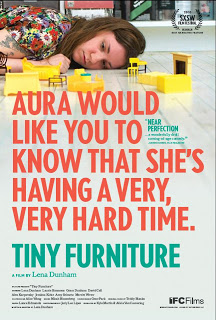
I’m still in the process of getting my shit together in 2012, so here’s a review I wrote in January 2011. Basically, I loved Tiny Furniture. Check it out if you can — it’s streaming on Netflix.
The film follows Aura (played by writer/director Lena Dunham), a 20-something self-described misanthrope who, after graduating from a film program at a small liberal arts school in Ohio, moves back to New York City to live with her famous-artist mother, Siri (played by Dunham’s real-life mother Laurie Simmons) and her budding-genius sister, highschooler Nadine (played by Dunham’s real-life sister Grace Dunham). The film wants to show that Aura is, in fact, Having a Very, Very Hard Time, as the tagline reveals, and it puts her through the typical hell that’s common in the heterosexual coming-of-age stories of early twenties womanhood: the struggle to find a reasonably paying job, a desire to make that college degree mean something, and, of course, a few random hookups with emotionally unavailable men. 
But more than anything, Tiny Furniture is a film about the relationships among women.
When Aura arrives home from college, she’s immediately confronted with her mother photographing her younger sister among a setup of, literally, tiny furniture. And, while the first indication of sibling rivalry appears, it already seems more refreshing and complicated than the traditional cliched portrayal of sister-hate and woman-on-woman divisiveness. The women converse with one another as if Aura hadn’t been in Ohio for four years; in fact, the casualness of their interaction–her mother barely looking up from her photography, her sister making sarcastic comparisons about her slender legs versus Aura’s heavier frame–suggests a comfort with one another that transcends their almost performed familial coldness. 
Perhaps most intriguingly, the on-screen relationships feel so authentic that the unmentioned absent father is hardly noticeable. Who cares, after all?  Women rock the screen, and, unlike a couple of recent woman-centric films (The Kids Are All Right, Winter’s Bone–both arguably feminist) it has nothing to do with a need to compensate for the failings of the men in their lives. 
Almost immediately when Aura moves back to New York, she meets up with her childhood friend Charlotte (played by Jemima Kirke) at a party. Charlotte is portrayed as a spoiled, drama-craving brat, but Aura clings to her, at one point even referring to Charlotte as her best friend. (Her mother later says sarcastically in response, “After two weeks?”) They hang out in Charlotte’s apartment, getting high together and talking about art, men, joblessness, addiction, their parents–and they flatter each other; the audience is never encouraged to view these women as rivals. The point of their friendship is to illustrate the absolute aloneness of being an aimless twenty-something and not knowing what the hell to do in life. In several hilarious scenes, Charlotte begs Aura not to leave, once going as far as to roll around on her bed saying, “Please stay,” which the audience is meant to find both endearing and pathetic.
And while the relationship between Charlotte and Aura works mainly because of their shared loneliness and need to connect, the onscreen relationship between the two sisters thoughtfully investigates the obstacles inherent in familial relationships. In fact, it didn’t surprise me at all when I discovered that they’re actually real-life sisters because their sibling rapport feels incredibly authentic. While Aura drinks bottle after bottle of her mother’s wine with her friends, Nadine runs on the treadmill, does crunches while reading a book, writes award-winning poetry, and teases Aura about her directionless existence. But the back-and-forth nitpicking between them is perfectly juxtaposed against scenes exhibiting such tenderness as can only occur in close relationships.
One of my favorite scenes in the movie involves Nadine throwing a party while her mother is out, leaving Aura to supervise things. Of course, the party gets out of hand–we’re dealing with a slew of highschoolers railing against Aura-as-Authority-Figure (because, let’s face it, if Aura is anything, Authority Figure isn’t on the list)–and Aura starts to have a panic attack. She does the only thing she can think to do, call Charlotte to come over and help her get the party under control. Which is hilarious. Because Charlotte is more of a disaster than Aura is. So, it isn’t surprising at all when Charlotte starts giving lap dances and Aura starts walking around the party in her underwear.
The screaming match that ensues between Aura and Nadine could’ve been taken from a direct transcript of a real-life sibling fight. I cringed at the truthfulness of Nadine’s accusations as she criticized Aura for craving the attention of high school boys. (Those boys, however, reciprocated by making fun of Aura and dissing her body.) And when Nadine starts smacking Aura with a spatula and storms off, the audience feels sympathy for both sisters; neither is the villain in this film, and Dunham’s navigation of that terrain seems effortless from beginning to end. I won’t spoil the brief make-up scene between Aura and Nadine because the film is worth watching for that moment alone.
Aura spends much of the film, when she isn’t fighting with her sister, thinking of herself as somewhat of an artist/filmmaker, as evidenced by her YouTube videos (where she usually wears only her underwear or a bathing suit). Since Aura isn’t traditionally beautiful, and isn’t a size two like most of the half-naked women we’re used to seeing onscreen, at first it’s almost shocking to watch her walk around barely clothed throughout the film (which further illustrates the level of comfort and intimacy she feels with her mother and sister). But Dunham doesn’t include those scenes merely for shock value. The comments left on her YouTube videos consistently make fun of her weight and her looks. She reads the insulting feedback aloud to Charlotte, and they both try to blow it off, but not without Aura remarking on how difficult it is to put that negativity out of her mind.
For anyone who’s ever browsed the comments on YouTube videos, it’s impossible not to notice the disgusting misogyny and homophobia that plague them. Not only does Dunham subtly comment on that, but she also manages to reinforce the importance of supportive women friendships as a way to help combat the barrage of bullshit women deal with daily, especially when it concerns unattainable beauty ideals. It’s interesting to note, too, that Charlotte is traditionally attractive, and yet their friendship never digresses into any sort of competition, least of all one that involves some stereotypical competition over men.
The film doesn’t completely shy away from the subject of men, though, and the two men Aura meets both basically suck. One spends the first half of the movie mooching off Aura–and she lets him–staying in her house, eating her food, drinking her mother’s wine, but when she tries to take their “friendship” to the next level, he refuses. For Aura to attempt to hook up with such a caricature of a loser further drives home her loneliness and desire for connection. With anyone. So it isn’t surprising either when she goes after the chef she works with, who likes “Asian tentacle rape” pornography–whatever the hell that is–and exploits Aura’s obvious crush on him to get her to give him pills (even though he has a girlfriend).
Watching the film, one can’t avoid thinking, “C’mon, Aura, you know better than this.” But the material is so impossible not to relate to–who hasn’t lusted after the entirely wrong person, and known it?–that one can’t fault her for putting herself through it.
Those interactions with men accompanied by Aura’s reading aloud of her mother’s diary (written during her twenties) give further insight into the relationship Aura has with her mother. In many ways, regardless of how often the two women clash, Aura admires her. She’s a successful artist who’s clearly independent. She’s rich. She has no apparent need for a man in her life. Yet her diary reveals many of her obsessions in her twenties: with body image–she constantly journaled her food choices, with men and their inadequacies, and particularly with feeling like she wasn’t living up to her potential as an artist.
The final scene of the film, with Aura curled up with her mother in her mother’s bed, discussing the diary, openly discussing Aura’s horrid sexual encounter from earlier in the evening (completely absent of judgment from her mother–her only concern is that Aura practices safe sex), discussing Aura’s own fears of failure, which her mother squashes with, “Oh, you’ll be much more successful than I am,” feels so heart-wrenchingly honest it’s almost difficult to watch. And the ending, which features a literal ticking clock that could’ve felt contrived and artificial, totally works. It isn’t that the two women desire to stop time; they just don’t want the obvious reminder of its passing. 
As Aura struggles with all these issues, reading her mother’s diary (and sharing it with the audience) serves to remind us that even though coming-of-age ain’t fun, particularly for young women navigating the patriarchy, it’s still possible to come out on the other end fairly unscathed. 

In ‘The Girl With the Dragon Tattoo’ Remake, Rooney Mara’s Captivating Portrayal Proves Lisbeth Salander Still a Feminist Icon

Lisbeth Salander (Rooney Mara) in “The Girl With the Dragon Tattoo”
Cross-posted from The Opinioness of the World.

Lisbeth Salander consumes my thoughts. I’ve spent the last year and a half reading, writing, analyzing, debating and discussing the punk hacker. As a huge fan of the books and the original Swedish films, I was NOT excited to see The Girl With the Dragon Tattoo Hollywood remake.

Plagued by sexist marketing that seemed to focus solely on Mikael and depict Lisbeth as a sexpot damsel in distress, I feared Hollywood would wreck one of the most unique female protagonists in pop culture. With trepidation, I watched David Fincher’s take on Stieg Larsson’s epic. While some gender problems arose, I’ve got to admit I was pleasantly surprised. And it all hinges on Rooney Mara’s performance.

For those who don’t know, The Girl With the Dragon Tattoo, the first part in the global phenomenon of The Millennium Trilogy, features disgraced crusading journalist Mikael Blomkvist (Daniel Craig) and brilliant researcher Lisbeth Salander (Rooney Mara) who unite to solve the mystery of a woman who disappeared 40 years ago. The gritty, tense plot fuses with social commentary on violence against women, sexuality and gender roles.

Do we really need an American remake? Fincher, a notoriously obsessive and detailed filmmaker, creates a gorgeous film evoking a macabre ambiance. Trent Reznor’s eerie and haunting score punctuates each slickly stylized scene perfectly. Phenomenal actors fill the screen: Craig, Robin Wright (who I will watch in absolutely anything), Christopher Plummer, Stellan Skarsgaard, Vanessa Redgrave. While everyone does their best, the remake isn’t quite as compelling as the original. I never really felt invested in any of the characters. Except for Lisbeth. The sole reason to see the film is Mara’s stellar portrayal.

Lisbeth Salander is a role of a lifetime. Both Noomi Rapace (in the original film) and Mara underwent grueling auditions and year-long transformations including haircuts, body piercings (ears, eyebrow, lip, nose, nipple), nudity, kickboxing workouts, and learning skateboarding and motorcycle riding. A sullen introvert, Lisbeth is strong, fiercely independent and self-sufficient. She possesses a razor-sharp intellect and relentless survivor instincts. She’s endured horrific trauma and betrayal yet refuses to be a victim.

Fincher obstinately fought for Mara as Sony Studios didn’t want her for the part. After watching the film, I can see why Fincher refused to concede. It’s hard to dissect Mara’s Golden Globe-nominated performance and pinpoint precisely what she does that makes her so compelling. And that’s because as Melissa Silverstein writes, she “disappears into the role.” When Lisbeth greets the people she cares about, her guardian Holger Palmgren and Mikael, she frenetically says, “Hey, hey,” a small detail adding depth and nuance to the character. It’s in the clipped cadence of her voice, her slumped shoulders, her wounded eyes. Mara doesn’t merely play Lisbeth. She becomes her.

Lisbeth Salander (Rooney Mara) and Mikael Blomkvist (Daniel Craig)
People have asked my thoughts on Hollywood’s The Girl With the Dragon Tattoo, wondering if I loved or hated it. More importantly, they want to know if I prefer Noomi Rapace’s subtle yet fiercely badass warrior (which is how I envisioned Lisbeth) or Rooney Mara’s vulnerable yet quietly powerful portrayal. I was prepared to hate Mara. How could anyone surpass or even equal Rapace’s critically acclaimed performance?

But I loved them both. For me, neither one is better. Both bring something unique conveying different facets of Lisbeth’s personality. They belong to two sides of the same coin. Mara, who had ginormous shoes to fill with Rapace’s ferocious portrayal in the original, gave a captivating performance. I’m glad the shitty marketing didn’t keep me away or I would have missed one of the best performances of the year.

People have simultaneously praised and condemned The Girl With the Dragon Tattoo for its graphic depiction of rape. The American version doesn’t shy away from the brutal scene. We live in a rape culture often glorifying or dismissing rape and violence against women. Author Larsson tried to show the epidemic of misogyny. The book (originally entitled Män Som Hatar Kvinnor, which translates to “Men Who Hate Women”), original Swedish film and Hollywood remake confront the stigma of sexual assault. Yet it never feels exploitative. Lisbeth refuses to be victimized. She follows her own moral compass exacting vigilante justice. She doesn’t possess traditional power. So she works within the confines of patriarchy to assert herself and take control of her life.

A huge part of the book (and the entire trilogy) is Lisbeth and Mikael’s friendship. Despite his social nature and her private behavior, they both stubbornly follow their own moral code. He’s continually surprised and amused by her unconventional comments and reactions. Mikael’s openness, humor and honesty allow Lisbeth to trust him, something she does so rarely. The movie doesn’t shirk their sexual relationship yet never captures their emotional bond. Lisbeth and Mikael also exhibit overt sexualities. Lisbeth possesses a sexual fluidity, sleeping with both women and men. Yet society views Mikael’s philandering as socially acceptable and perceives Lisbeth as an outcast. It’s a crucial gender commentary absent from the film.

But my biggest problem with Hollywood’s The Girl With Dragon Tattoo lies in one sentence. One teeny tiny sentence that threatens to unravel all of the painstaking work Mara put into her performance. SPOILER!! -> In the scene where Mikael has been cut from the noose, Lisbeth intends to run after his murderous perpetrator. She asks him, “May I kill him?”

Lisbeth Salander (Rooney Mara)
In an interview with Charlie Rose, Fincher shared what he found so compelling about Lisbeth. Oh, but it’s not her feminist persona as he insists this is NOT a feminist story:

“I think that she is many things to many different people…I was fascinated by the fact that 60-year-old men, you know 58-year-old women, 17-year-old girls were all finding something about her that was you know freeing or empowering in some kind of way. And it had been kind of sold to me as this you know misogynist avenger. But what I felt about it was ultimately that there wasn’t any kind of real feminist tract to it all.

“To me, it was very human. It’s a story of being oppressed, a story of being marginalized, a story of being made to feel less than, it’s a character that’s been made to feel less than who she thinks she is…”

I don’t think Fincher has any clue what a feminist actually is. Newsflash, a feminist story is a “human” story. Neither Fincher nor Mara perceives Lisbeth as a badass feminist (even though she is) because she doesn’t do “anything in the name of any group or cause or belief.” But they’re fucking wrong.

Lisbeth combats misogyny and sexism. She abhors violence against women and avenges injustice. She refuses to be taken advantage of, always asserting her control. She surrenders to no one. She strives for empowerment, living life on her own terms. I agree Lisbeth wouldn’t call herself a feminist, just as she doesn’t identify as bisexual, since she doesn’t want labels confining her identity. Neither her gender, her appearance, nor her sexuality define her. Lisbeth defines herself. Every single one of these components reinforce a feminist message.

Despite Fincher and Mara’s insistent refusal, both The Girl With the Dragon Tattoo and its heroine are feminist. Saying otherwise completely misses the point of what makes Lisbeth Salander such an exhilarating icon.