Trill Gender and Sexuality Metaphors in ‘Star Trek’

Written by Amanda Rodriguez
In many ways, science fiction is the perfect medium for the exploration of social, cultural, political, gender, racial, class, etc. issues. Because it takes place in the distant future and/or because all the commentary is veiled in metaphor through the use of aliens or monsters, the often questioning and even progressive messages slip beneath the radar. I am sometimes critical of the use of aliens/monsters to represent racial Others, as it often magnifies racist stereotyping as demonstrated by the violent, war-like Black Klingons or the greedy, sniveling (read: Jewish) Ferengi. It’s an oft denied luxury, however, to say what we mean when we say it, and while metaphor and allegory may seem somewhat indirect and occasionally cowardly, it’s a much more artistically pleasing approach that allows a freedom of thematic inquiry often denied other genres.
In the case of the Trill race from the Star Trek universe, gender, gender identity, and sexuality are the primary tropes being examined. The Trill are a symbiotic alien race who bond with various host bodies, allowing the “symbiont” to live multiple lifetimes and accumulate a wealth of experiences. The first Trill appearance is in The Next Generation episode “The Host” wherein Dr. Beverly Crusher falls in love with Trill ambassador Odan.
Even Dr. Crushers honeymoon stage it up.
Odan’s host body dies as a result of an attack on his peace mission shuttle craft, and the symbiont is temporarily transferred to the ever ridiculous Lieutenant Commander William Riker. Dr. Crusher struggles with the transition for a time, feeling betrayed, deceived, and questioning what exactly she loved about Odan. Was it his physicality, which has changed so much, or something more? Eventually, she gets over it, embracing her transcendent love for Odan (she even does the nasty with Riker…gag). However, all bets are off when Odan’s permanent host body arrives.
Odan’s new host body is a woman.
Odan’s transition from male to female proves too much for Beverly. Despite Odan’s insistence that her love for the doctor hasn’t changed nor has her personality, Dr. Crusher rejects her, saying, “Perhaps it is a human failing; but we are not accustomed to these kinds of changes.” This is a very apparent exploration of transgender issues. Beverly accepts her lover’s physical changes until Odan’s gender transition. Though Dr. Crusher blames it on her humanity, it is her personal inability to see beyond the gender binary. Not only that, but Beverly’s discomfort with engaging in a bisexual or lesbian relationship robs her of a love that had made her so very happy before. 
Does TNG itself agree with Dr. Crusher’s choice? I think it does. It presupposes that the demands of loving someone while they go through gender transition are unaskable, unthinkable. Not only that, but the show appears to support her ultimate incapacity to stomach lesbianism. 
 
The Deep Space Nine take on Trill love, replete with its sexuality/gender fluidity, evolves beyond that of its predecessor. In the episode “Rejoined,” science officer Lieutenant Commander Jadzia Dax, a Trill, must work with Lenara Kahn, another Trill, on creating the first artificial wormhole. However, Dax and Kahn were a heterosexual married couple in previous host bodies. It is forbidden for Trill symbionts to reconnect with people from their former hosts’ lives. During the course of working closely on their project, Dax and Kahn rediscover their passionate love for one another.
“When you’re not around, it’s like a part of me is missing. I want to be with you more than anything.” – Lenara Kahn
They engage in a lesbian romance that remains unjudged by DS9 friends and crew members. We’ve evolved beyond the thinking of TNG in that the validity of the relationship is not in question. However, the episode focuses on the Trill “taboo” surrounding symbionts reforming bonds with people from past lives. Dr. Julian Bashir says, “The Trill feel very strongly that it’s unnatural.” Major Kira Nerys responds incredulously, “Unnatural? I don’t understand how two people who’ve fallen in love and made a life together can be forced to just walk away from each other because of a taboo.” This so-called taboo is a metaphor for the stigma surrounding homosexuality (and even gay marriage).
The punishment for transgression is banishment from the Trill homeworld. This is tantamount to a death sentence because the offending symbiont will not be given access to any other host bodies and will permanently die within its current host. Captain Benjamin Sisko is one of Dax’s oldest and best friends. He gives her the advice, “It didn’t matter whether [you] agreed with the taboo or not because the price for violating it was too high.” Though pretty much all the characters view this punishment as absurdly excessive, none of them attempt to appeal, ratify, or circumnavigate it.
One of the 1st ever on-screen lesbian kisses.
While DS9 goes a step or two further than TNG, it doesn’t go far enough. While Dax throws caution to the wind to be with the love of her lives (plural intended), Kahn is unwilling to sacrifice her career and her future lives. Their tragic parting is inevitable. On the one hand, this injustice highlights the cruelty of the stigma, laws, and mores surrounding homosexuality while showing no other, better model. On the other hand, this shit takes place in the future. The United Federation of Planets claims to be beyond consumerism, sexism, racism, and speciesism, where diplomatic missions of peace, science, and exploration have supplanted warlike agendas of aggression, fear, and resource appropriation. Then why the hell can’t two chicks get married?
Imagine instead an ending that featured the two women taking their case to the Trill ruling body. They would insist that it’s a crime to limit such long-lived symbiont beings to relationships and experiences that are as short as a human lifespan. The couple would demand that Trill culture re-evaluate the way in which it values multiple, short experiences over the unknown potential of a love that transcends many lifetimes. Being wise and humane, the Trill governing body would realize the error of its ways and undergo a paradigm shift. That’s the kind of enlightened future I’d like to watch on a show and dream might one day come to pass.

Bitch Flicks’ Weekly Picks

Women and Minorities Snubbed by TV Academy’s Hall of Fame by Chris Beachum via Gold Derby

Lena Dunham and Democratic Nudity by Ta-Nehisi Coates via The Atlantic 

Diablo Cody on the Challenge of Directing While Raising a Toddler, and Women in Film (Q&A) by Jordan Zakarin via The Hollywood Reporter

The Liz Lemon Effect by Jen Chaney via Slate

An Observation by Melissa McEwan via Shakesville

2013 Women-Created TV Pilots by Karensa Cadenas via Women and Hollywood

“Girls,” “Scandal,” and TV’s New Crop of Flawed Women by Sarah Seltzer via RH Reality Check

Bollywood Actress Sonam Kapoor on Women’s Portrayal in Indian Movies by Nyay Bhushan via The Hollywood Reporter

Feminism, King Arthur, and Disney Come Together in ‘Avalon High’ by Margot Magowan via Reel Girl

Reel Girl’s Gallery of Girls Gone Missing from Children’s Movies in 2013 via Women and Hollywood 

What ‘Girls’ and ‘Shameless’ Teach Us about Being Broke, and Being Poor by Nona Willis Aronowitz via The Nation

Sundance 2013: Female Directors Discuss the Challenges They Face by John Horn via The Los Angeles Times

2012 Celluloid Ceiling Study Results Are In. Spoiler Alert: They Aren’t Great by Melissa Silverstein and Karensa Cadenas via Women and Hollywood

Where Are the Girls in Children’s Media? by Laura Beck via Jezebel

Chatting With Diablo Cody About Film, Feminism, and the Right to Be Mediocre by Katrina Pallop via Bust Magazine

‘Mama’ Tackles the Psychotic Mother Trope and Makes It Less Problematic in the Process by Alex Cranz via FemPop

MTV’s ‘Catfish’ Show Tackles Fake Online Profiles, Villainizes Transgender Women: #Fail by Breanne Harris via QWOC Media

‘Girl with the Dragon Tattoo’ Sequel Could Ditch Daniel Craig, Feature Female Lead Instead by Jill Pantozzi via The Mary Sue 

Hollywood — Don’t They Want the Money? by Martha Lauzen via Women’s Media Center

A Black Feminist Comment on ‘The Sisterhood,’ the Black Church, Rachetness, and Geist by Tamura A. Lomax via Racialicious 

5 Female Characters Who Should Star in ‘Star Wars Episode VII’ by Alyssa Rosenberg via ThinkProgress

Thank You, Liz Lemon, for Being You by Madeleine Davies via Jezebel

Guest Post: ‘Women Without Men’: Gender Roles in Iran, Women’s Bodies and Subverting the Male Gaze

Guest post written by Kaly Halkawt.

The author Sharnush Parsipur wrote 1989 a novel that would become what could be called a modern classic in contemporary feminist literature. The book entitled Women Without Men is a story about how five women living in Iran during the 1950s end up in exile from the male-dominated society they live in that has in different ways deprived them their freedom. Although along their path into exile is not a simple one. They must all go through a painful metamorphosis and accept that the freedom they ask for alienates their bodies from society. All five protagonists come together in a garden which serves them as a space free from male domination.

This story has been visualized once as a video art installation consisting of five different videos by the artist Shirin Neshat. The video installation went under the name “Women Without Men” and was created from 2004-2008. The five different videos where entitled after the characters names; Mahdokht (2004), Zarin (2005), Munis (2008), Farokh Legha (2008) and Faze (2008). However the content of the entire constellation has varied based on where the installation has been exhibited.
Based on these five videos, Neshat retold the story once again but this time in a more linear narrative film. However this time she choose to exclude the story of the character Mahdokt, although one could argue that she appears in the film in form of a tree, but before we go into that I want to share my experience of the video installation that I saw at the Stockholm Culture Institute in 2009.
The video for Mahdokht was told through three different screens. Mahdokt fantasizes about planting herself like a seed in the garden and growing into a tree and literally erasing her body into the idea that manifests her spiritual character. Her desire is to through detaching her body from civilization, intellect and culture touch the freedom that seems impossible to gain with a female body in the world the way she experiences it. Mahdokt’s story can also be seen as a comment to the myth about the nymph Daphne who figured in Roman mythology. The myth of Daphne has been told in many different ways, but basically it goes something like this: The god Apollo is captivated by the beauty of Daphne. She refuses to give in for his sexual desire and as punishment the god Zeus transform Daphne into a tree.
A still image from the video Mahdokt

Mahdokt’s character can here be read as a representation of the female body and an attempt to erase the values and symbols the female body has embodied in mythology as the object. Parsipur/Neshat has rewritten the myth of the female body by making it the subject and not the object of the story. Mahdokt is the narrator of her story and she is not a victim. She actively chooses to offer her body to her ideal by becoming a tree in contrast to Daphne who is a victim who is being punished for not sacrificing her body.

Mahdokt’s action is stating that we can imprison bodies, but not ideas.
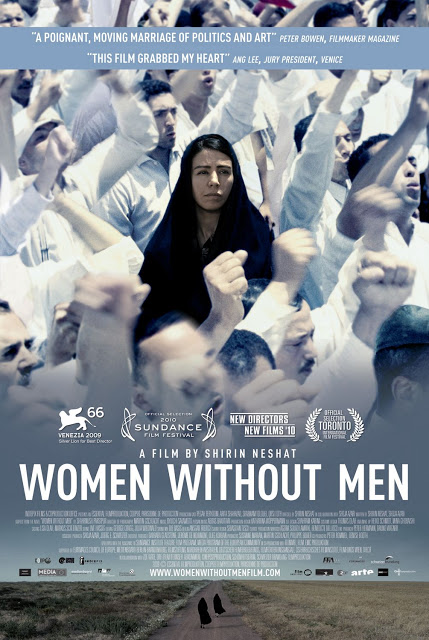
From a book to video installation and narrative film, Women Without Men is a work in motion. The adaptation for the screen that was directed by Neshat was highly praised by film critics all around the world and won the Silver Lion at the 2010 Venice Film Festival.

The film takes place in 1953 which politically is an unforgettable year in Iran’s history. The democratically chosen Prime Minister Mossadghe was overthrown by the CIA which created enormous protests. The political background story serves as a tool for creating what will be the revolution in the mind of the characters.

Shabnam Toloui (Munis)

In the first shot we see the character Munis committing suicide by jumping down from a roof, however she lives on in the story as the narrator. Later on in the film, we learn that one of the reasons for why she committed suicide was because she lived with a conservative brother who aggressively wanted her to stop following the protests by listening to the radio. He encouraged her to instead get married and “start a real life.”

The day of Munis’ suicide, we learn that her brother organized a suitable man that would come and ask for her hand in marriage. When Munis’ brother refuses to let her go out of the house, she decides to take control over the situation. By sacrificing her body for the sake of her integrity and political conviction, her death does not necessarily need to be read as a forfeit. Munis’ death leads to her freedom and becomes her politics. Its through her eyes after her death that we get to see the protests and demonstrations on the streets of Tehran.

 Pegah Feridony (Faezeh)

It is also Munis action that leads to the awakening of her friend Faezeh. From the beginning, Fazeh is portrayed as a traditional girl who wants to live a “normal life” aka get married and have children with Munis’ brother. However when she finds Munis’ dead body on the street and sees how her brother digs it down in his garden to prevent the news of her suicide spreading and leading to an official shaming of the family name, Faezeh’s world is turned upside down. She gives up the idea of marriage and men and just decides to look for her own piece of mind. Munis’ ghost serves literally as the guide and takes Faezeh to the garden and leads her into exile.

Arita Sharzad (Fakhri)

Fakhri is the eldest of the gang and arguably embodies what Second Wave feminism has criticized: upper-middle class ladies who are bored serving as some sort of poupée (doll) for their husbands. Fakhri’s journey towards change starts when she meets an old friend who reminds her of the freedom that can be the price of getting married. She remembers how she used to write poetry and hang out with people who believed in culture as a political tool for change, an opinion that makes her husband laugh. So in her own “eat-pray-love” escapade, she buys a big house in the garden and leaves her relationship so that she can put energy and time into rediscovering and recreating herself.

Jean-Auguste Dominique Ingres’ The Turkish Bath via Amiresque

The fourth character Zarin is a prostitute who decides to escape the brothel when she sees a client’s deranged face while they are having sex. Zarin never talks during the film and like Munis, she uses her body to free herself from the societal norms. Zarin is just her body, we don’t get her background history. I think one possible reading of why she is just reduced to a body in this film is a comment on the stereotypical images of women that have been created within the frames of Orientalism.

Some of the films key scenes are focused on Zarin. In one of the most visual scenes, Zarin is in a Turkish hamam (Turkish bath) and scrubbing her body until it starts bleeding. The misé-en-scene is an exact copy of Jean-Augustue Dominique Ingres’ painting The Turkish Bath (1862). This is a direct comment on the representational prevail of white upper-middle class men. This painting, among others, led to the creation of myths about women from the Middle East. Neshat literally tries to erase this myth in this particular scene.

Orsolya Toth (Zarin)

Another important scene that serves as a commentary for the male gaze is an image of Zarin floating in a river, alluding to John Everett Millais’ painting Ophelia (1852). In Millais’ painting, we see the suicide of Hamlet‘s Ophelia where she falls into the river and dies. Ophelia has been the subject of a lot of debate. How should we interpret her character? What values does she embody? This Shakespearian character is either referred to as a sick young damsel in distress or completely ignored and just seen as an object for male dominance in Hamlet. I think Neshat is trying to criticize the fact that Ophelia is almost never seen as her own character and only read in relation to Hamlet. Once again, Neshat tries to turn the female object into the subject.

Neshat uses Zarin’s body to criticize the stereotypical imagery of women in a few key scenes of the film by reproducing the exact same scenery as some historical paintings. However Neshat transforms Zarin’s body from object into subject, thus giving her the tools to go through a metamorphosis and take control over her body so that she can erase the values and ideas represented by men.

By giving each character their own voice to tell their story, Neshat questions the classical representation of women in Arab and Persian cultures. These women start off by being dominated in the patriarchy they live. Socially and politically, Munis is restricted by her brother. Intellectually, Fakhri does not have the freedom and the hope she had before she got married with an idiot (ie a man with power) and Zarin, before entering the garden, is just reduced to a sexual body used as a tool to control her position on a bigger scale since being a prostitute doesn’t always receive a lot of respect from society. But they all find their way to reinvent themselves in space free from male dominance. In case it’s not clear enough, this film is the queen of awesome films about women.

However one thing a bit fuzzy in Women Without Men is the portrayal of men. To sum it up, this is how Iranian men are characterized: men that live in Iran are uncultivated, uneducated rapists who crave control over women with no nuance of humanity in them. This contrasts with the Iranian men who have moved abroad, cultivated by the Western World and who see the value in educating women and treating them equally. But this is a post about the female characters so I won’t comment further other than to say the stereotype of men from Iran is not being questioned.

I never thought I would write an essay where I would find the female characters more well-written then the men. Deux point, Neshat.

———-
Kaly Halkawt is 24 years old and has a BA in Cinema Studies. Before starting work on her Master’s, she moved to Paris for two years, working as a Montessori Teacher and studying French at the Sorbonne. Planning a big academic comeback this semester, she is currently writing her Master’s thesis on a geneology of the Manic Pixie Dream Girl trope in Cinema Studies at Stockholm University.

Let’s All Take a Deep Breath and Calm the Fuck Down About Lena Dunham

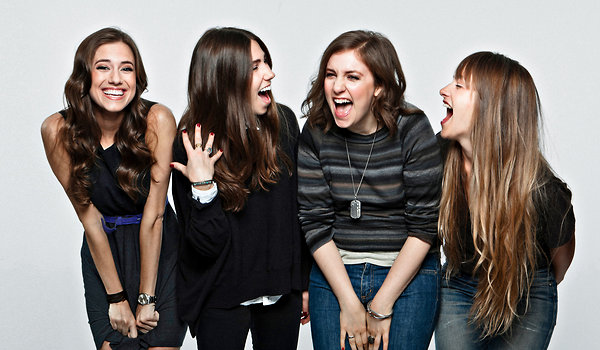
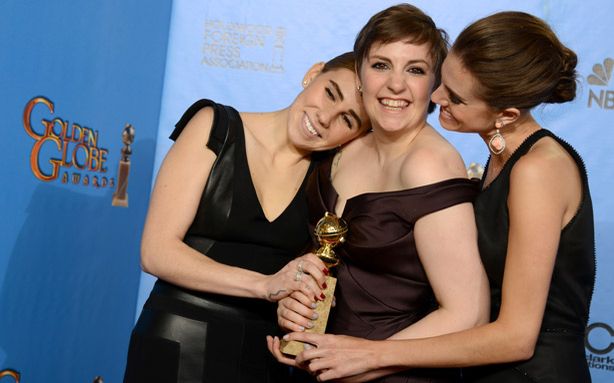
Lena Dunham and the cast of Girls

Written by Stephanie Rogers. 

Dear Lena Dunham Haters,
I’m sick of the Lena Dunham hate.
I’m not referring to the criticisms of Dunham, which are—in most cases—valid and necessary critiques of her privilege, especially how that privilege translates into her work. The first season of Girls in particular either ignored people of color entirely, which is problematic enough since the show takes place in Brooklyn (a predominantly Black neighborhood), but when it did include people of color, they tended to appear as stereotypes (nannies, homeless, etc), and Dunham absolutely deserves to be called out for that.
But I’m sick of the Lena Dunham hate
Just take a moment and Google the phrase “I hate Lena Dunham.” Feel free to spend some time browsing through the more than a million results. Searches related to “I hate Lena Dunham” include such gems as “Lena Dunham annoying,” “how much does Lena Dunham weigh,” and “what size is Lena Dunham.”
We live in a society that constantly undervalues and devalues the work of women while simultaneously expecting that the work we do—from mothering to directing movies—is performed fucking flawlessly. That said, we can’t sit back and pretend the vitriol directed at Dunham isn’t largely about a young woman breaking barriers in an industry that doesn’t like women (especially women who aren’t conventionally attractive and who aren’t gasp! spending all their waking hours apologizing for it). We shouldn’t pretend either that we, as a culture—and that includes women and feminists—haven’t internalized a little bit of this uneasiness surrounding successful women. It makes sense, then, that the undercurrent bubbling beneath all this Dunham hate is the very sexist notion that somehow Dunham doesn’t deserve her success.

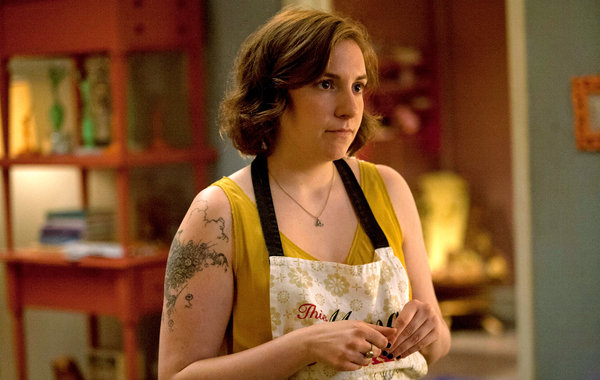
Lena Dunham, looking all ungrateful for her unearned success

Elissa Schappel wrote an interesting piece for Salon two weeks ago, right after the Golden Globes ceremony, called “Stop Dumping on Lena Dunham!,” in which she puts forth some excellent counterarguments that a hater might want to consider.
On how Dunham doesn’t deserve the gigantic advance she got for her book deal:
I have yet to hear anyone react to the news of an advance with, “Yep, that seems about right.” It would be great if the writers and books that deserved the most money got it—ditto the same amount of attention and praise. And all the gripe-storming about how slight her book proposal was, and how she’ll never make back her advance—when did we start reviewing book proposals? When did writers start caring so passionately about publishers recouping their losses?

On how Dunham doesn’t deserve her success because she has inside Hollywood connections:
The entertainment industry is not a meritocracy. From before the days of Barrymore to our present age of Bacons and Bridges, Sheen-Estevezes and Zappas family has, for better and worse, equaled opportunity. The Coppola family’s connections and influence are so vast they’d make the mob envious.

On how Dunham doesn’t deserve her success because her show lacks diversity:
I hear the diversity criticism. However, to suggest that “Girls”—a show whose charm lies in part in its documentary-like feel—presents the universe these young women inhabit, working in publishing and the arts, as rich in racial diversity, would be, sadly, to lie. Besides, did anyone ever kvetch about Jerry Seinfeld’s lack of Asian friends?

To take the conversation surrounding non-progressiveness of television in general a bit further, Carly Lewis wrote last April about the sexism behind the Dunham/Girls backlash, and I agree with her:
It’s cute (read: pretty hypocritical, actually) to see this sudden spike in concern over television’s portrayal of women, but this fixation is propelled by the same sense of threatened dudeness that makes a show written by and about women so “controversial” in the first place. If television were an even playing field, Dunham would not be on the cover of New York magazine atop the subheading “Girls is the ballsiest show on TV,” nor would the debut of this series be such a massive deal. (Where are the cultural dissections of CSI: Miami?) The critics calling Girls disingenuous because it stars four white women should redirect their frustration toward misogyny itself, not at the one show trying to fight it.

Lena Dunham, probably getting ready to annoy people with her incessant whining

Admittedly, I have a soft spot for Dunham, having written about her wonderful film Tiny Furniture way back in 2011, before she’d manage to offend the entire nation with her giant thighs and sloppy backside. I think she comes across as genuinely funny and interesting, and I hope that her success—and the hard hits she’s taking because of it—will make the next woman who dares to step out of line (where “line” means “the patriarchal framework”) do so with just as much fearlessness.  

Girls continues to evolve in season two, although I haven’t seen the new episodes yet, and it seems that Dunham has taken the criticisms of racism and lack of diversity seriously. In response to the question from the New York Times Magazine, “Should we expect to see an episode in which the girls get a black friend in Season 2?” she said:
I mean, it’s not going to be like, “Hey guys, we’ve been out looking for a black friend or a friend in a wheelchair or a friend with a hat.” The tough thing is you kind of can’t win on that one. I have to write people who feel honest but also push our cultural ball forward.

And people already have lots of opinions about Dunham’s attempt to accurately represent Brooklyn’s diversity in the second season with the casting of Donald Glover as Sandy, Hannah’s love interest, so I’ll treat you to a few.
Here’s what I think, after watching the first half hour of the season: I admire that Dunham took the criticism she got last year to heart. There are so many examples of how Hollywood ignores this type of thing. In fact, there are whole websites devoted to it. It really seems like she listened; I can’t tell from thirty minutes that everything has been solved, but it seems to be off to a good start? Lena Dunham isn’t so bad? Maybe? I say that with reservation but enthusiasm. Before I go, a couple thoughts on the good and the bad:

Good: I’ll start with positive reinforcement: Girls is definitely more diverse this season!

Bad: That definitely wasn’t the hardest thing to do.

Good: Donald Glover as Sandy! Hannah’s new, fleshed-out, not at all T-Doggy boyfriend.

Bad: I’m just hoping Donald Glover won’t simply be this show’s Charlie Wheeler.

Good: About the extras: A marked improvement in the representation of Brooklyn’s racial mix. So, Lena Dunham created a popular show, a critically acclaimed show, and instead of being, like, “Whatever. They’re all going to watch me anyway!” she actually made an effort to improve her show. That’s good. Very good. And to be honest, she probably realizes that a more realistic mix equals a more realistic world for her characters to live in.

Bad: Again, this is about the extras: There are definitely more black people on the show, but … I mean … I’ll put it this way. Realistic diversity is definitely not in your first season, girl. But it also not this. It’s definitely realistic here. But—it’s not this either, so don’t go overboard.

White Women

Laura Bennett at The New Republic said this:

Dunham uses the Sandy plot line as an opportunity to skewer both the complaints of her critics—Hannah herself echoes them with the misguided assumption that her essays are “for everyone”—and her characters’ blinkered worldview. Glover’s arc on the show is brief, but he is key to illustrating the limited scope of Hannah’s experience. “This always happens,” Sandy tells Hannah during their fight. “I’m a white girl and I moved to New York and I’m having a great time and oh I’ve got a fixed gear bike and I’m gonna date a black guy and we’re gonna go to a dangerous part of town. All that bullshit. I’ve seen it happen. And then they can’t deal with who I am.” Hannah responds with an explosion of goofy knee-jerk progressivism: “You know what, honestly maybe you should think about the fact that you could be fetishizing me. Because how many white women have you dated? Maybe you think of us as one big white blobby mass with stupid ideas. So why don’t you lay this thing down, flip it, and reverse it.” “You just said a Missy Elliot lyric,” Sandy says wearily.

It is wholly unsubtle, but it is still “Girls” at its best, at once affectionate and credible and lightly parodic. There is Hannah: impulsive, oblivious, tangled up in her own sloppy self-justifications. And then there is Lena Dunham, the wary third eye hovering above the action. “The joke’s on you because you know what? I never thought about the fact that you were black once,” Hannah tells Sandy. “I don’t live in a world where there are divisions like this,” she says. His simple reply: “You do.”

Feministing, of course, has been talking about the show since its inception, and Sesali Bowen had this to say about “Dunham’s attempt to introduce racial discourse into her show”:
And I find myself back at the same place I was when Maya and I talked about Beyonce. No, Dunham’s attempt to introduce racial discourse into her show doesn’t suddenly make it diverse, but I think she still deserves some credit. If it sounds like I’m saying: the white girl gets a pass for not painting an accurate portrait of Blackness because she doesn’t have lived context/experience, that’s exactly what I’m saying. Why do we expect “all or nothing” from anyone who dares to align themselves with a few feminist values, even if they don’t call themselves feminists? When will we begin the process of meeting people where they are?

And, as Samhita wrote on this topic, maybe we should spend less time “scrutinizing [Dunham’s] personal behavior instead of looking at the real problem—the lack of diverse representations of women in popular culture.” Do we need to see realistic representations of Black girlhood on television? Yes, that’s why we need more Black girls writing shows. *raises hand* Do we need examples of diversity in film? Yes, that’s why we need more people from diverse backgrounds writing them. Truthfully, I’d rather not leave that task up to a white girl with “no Black friends.”

I love these important conversations! Please, let’s keep having them!
But how about we leave the I HATE LENA DUNHAM BECAUSE SHE SEEMS ENTITLED AND KINDA HORRIBLE AND WHINY AND ISN’T DOING THINGS THE WAY I WOULD DO THEM IF I WERE LENA DUNHAM grossness off the table for five seconds.

Lena Dunham, being all entitled and shit
When I was 26, I was spending my fifth year failing undergrad, drowning in student loan debt (that’s still happening), smoking pot incessantly, binge-eating pepperoni rolls, sleeping through most of my classes on a broken futon, and shoving dryer sheets in my heating vents because my shitty always-drunk neighbors wouldn’t stop chain smoking. Occasionally, out of nowhere, a giant fly would swoop down from some unseen cesspool where flies live and attack me. Those are my memories of being 26. Maybe your memories of being 26 suck way less, and if so, congratulations! But you’re allowed to make mistakes at 26. You’re allowed to learn from those mistakes and evolve into a person who looks back and thinks, “Wow, 26 was rough, and I sucked at it.” That’s a general goddamn life rule, and we aren’t taking it away from Lena Dunham just because she’s a young woman who dares to make her mistakes in public. (Read Jodie Foster’s thought-provoking essay on society’s disgusting unsurprisingly misogynist reactions toward young women acting like young women in public.)
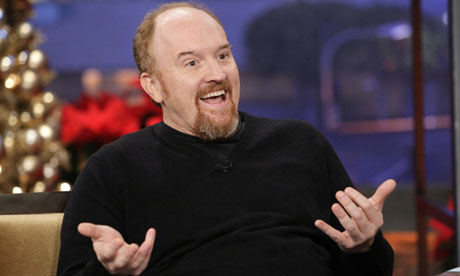
I mean, just to double check, we’re all still cool with Louis C.K., right? I haven’t yet seen season three of Louie, that award-winning show that C.K. writes, directs, produces, edits, and stars in (sound familiar?), but I remember the first few episodes or so of this New York City-set critics’ darling being fairly fucking White, except for a few peripheral characters outside of Louie’s inner circle. And the Black people who do exist (at least in the first season) pretty much serve as vehicles to illustrate Louie’s uncoolness by comparison. (Has anyone given a name to that trope yet?) So, did I miss the accompanying INTERNET FREAKOUT, or does this bro maybe represent—I dunno—society’s favorite quintessential middle-aged, balding white dude who can’t get laid, that we all find so endearing and impossible not to love?
Did I also miss the 100% JUSTIFIED NOT REALLY BECAUSE IT NEVER HAPPENED OUTRAGE over C.K. exposing his huge gut and sloppy backside to the masses—whether he’s climbing on top of hot women (duh) or getting a totally unnecessary (because assault is funny!) rectal exam from doctor-character Ricky Gervais? And we’re all still cool with his awkward and embarrassing sex scenes, right? Because they’re just … so … what’s that word people keep railing against when it’s used to describe the sex scenes in Girls … oh yeah … “REAL” … ?

“Eh, what are you gonna do?” –privileged White dudes everywhere, in response to rarely getting called out for their bullshit

My bad. I’m probably missing something, since Chuck Bowen called Louie “possibly the most racially integrated television show ever made,” (I’ll admit “Dentist/Tarese” is an interesting episode toward the end of season one) and there isn’t at all an inkling of a double standard at play here regarding what we consider “acceptable” bodies to display onscreen. (Sidenote: I love, not really, how groundbreaking it is that C.K. cast a Black woman to play his ex-wife in season three of Louie, yet we’re still treated to that “schlubby dude landing a hot lady” trope. I can’t keep suspending my disbelief forever, boys.)
Sorry, tangent. But seriously.
If I sound like a Lena Dunham apologist aka “a fucking pig who can go to hell,” let me clarify (again): Lena Dunham should be—and certainly has been, I mean fuck—criticized for her show’s failings. Most television shows and films for that matter would benefit even from a miniscule amount of the kind of intense anger flung at Girls over its racism and lack of diversity. But I’m angry that people—including women and feminists—can’t seem to criticize Lena Dunham’s show without launching into sexist attacks against Lena Dunham, in the same way I was angry when people couldn’t (and still can’t) separate their criticisms of Sarah Palin’s conservative policies from their sexist attacks against Sarah Palin.
So, if nothing else, I give you these few words and phrases to move away from when talking about Lena Dunham: “whiny” … “annoying” … “ugly” … “gross” … “frumpy” … “hot mess” … “neurotic” … “slutty” … you get the idea.

NEPOTISM NARCISSISM LENA’S BODY UGH

The truth is, ultimately, it doesn’t matter to me who likes Girls and who doesn’t. For what it’s worth, I liked the first season, mainly because I’ve been writing about representations of women in film and television for five years, and it was nice for once to know I wouldn’t have to analyze every scene to figure out whether this show passed The Bechdel Test. It sort of blew my mind to hear women talk to one another about abortion, HPV, colposcopies, virginity, and menopause, like, repeatedly—and with no unnecessary mansplainy perspective involved. I think the show actually makes a pretty serious case against living like an entitled, culturally insulated hipster, while still managing to love its characters. But I understand, even excluding the criticisms regarding lack of diversity, that people still legitimately dislike the show for other reasons. That’s allowed. I hate Two and a Half Men and Family Guy and The Big Bang Theory and How I Met Your Mother and every other White-dominated show on television that keeps pretending women exist merely as fucktoys and mommies to their manchildren, and that’s allowed too.
But if you’re having an epic conniption over HOW HORRIBLE GIRLS IS OMG WHY DOES ANYONE LIKE IT LENA DUNHAM IS THE WORST, maybe it’s time to evaluate the hate—not dislike of, or boredom with, or ambivalence toward—but the actual hatred of Girls Lena Dunham, and why it’s really there.

When Dumb Fun Turns Nasty: Sexual Violence in Stupid Movies

Written by Max Thornton.
[content note: explicit discussion of violence and rape]
Mick LaSalle of the San Francisco Chronicle: “Violent media poisoning nation’s soul.
Is it, though? To his credit, LaSalle recognizes that it’s pretty fatuous to blame movie violence for real-life violent crime, but that doesn’t stop him from calling for blanket R ratings for movies with “any violence at all.” I honestly don’t see how that will help. An R rating won’t stop anyone from seeing a film they’re determined to see (hi there, internet!), and it definitely won’t encourage critical thinking (the trouble is, you can’t legislate for that).
Also, you know, Adam Lanza – the motivation for LaSalle’s piece – was 20. He could have seen the most brutal NC-17 movie he wanted.
It’s an old complaint that MPAA ratings are seriously messed up, mired in disturbing double-standards around male and female sexuality, straight and queer sexuality, sex and violence. However, if you happen to believe that violent movies contribute to a “culture of violence,” age-based restrictions don’t accomplish a thing. Except perhaps to make under-seventeens desperate to see movies just because you say they can’t.
I really don’t think the problem with movie violence is that too many superhero flicks are rated PG-13. I don’t even think the problem is the existence of movie violence. I think the problem is the context and presentation of the violence. MPAA ratings, audiences, and filmmakers themselves overwhelmingly fail to distinguish between cartoonish violence and realistic violence, or between sex and sexual violence, and this is what I find truly alarming.
I have a shameful love of really stupid gory movies. I have a dumb but almost limitless enthusiasm for the subgenre lovingly dubbed “splatstick.” Evil Dead II. Peter Jackson’s Braindead. Tim Burton’s Sweeney Todd. Appendages being severed in improbable ways, fountains of dyed corn syrup gushing forth, heads and eyeballs rolling all over the place… That stuff cracks me up, and has done ever since I was an eight-year-old at home with septicemia, watching videocassettes of Tom & Jerry and bringing my mother running with every yell of sympathy that quickly dissolved into peals of laughter.
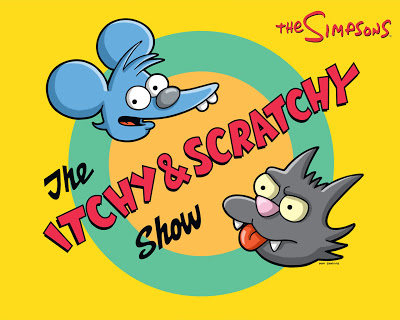
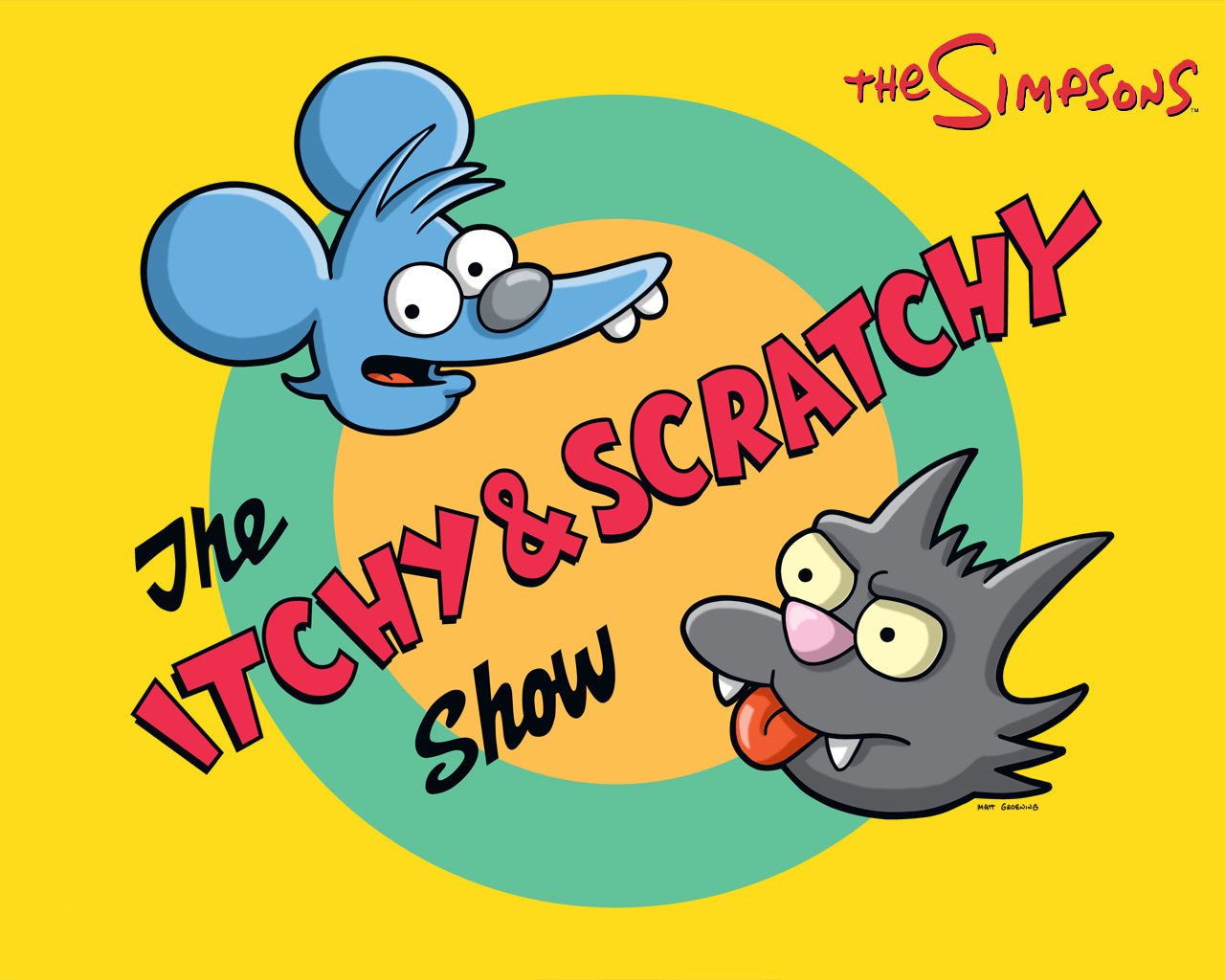
And I respond just like Bart and Lisa Simpson.
 
Realistic movie violence disturbs me, of course, in films like City of God or Irreversible. These are movies intended to confront you with the utter awfulness of the events they depict, with no interest in minimizing or trivializing their horror. They’re hard to watch, and they should be.
Cartoon violence, on the other hand, is outlandish, clownishly over-the-top, and nothing like real life. A scene like the possessed hand scene in Evil Dead II or the zombie baby scene in Braindeadis funny in the way that a cartoon character slipping on a banana peel is funny. It’s an outlet for Schadenfreude in a really goofy setting.
It really, really bothers me when cartoon violence turns sexual.
When a tree rapes a woman in the original Evil Dead. When a tentacled zombie-slug-man rapes a woman in Slither. When a snowman serial killer rapes a woman with his carrot nose in Jack Frost(no, not that Jack Frost). Most recently, when zombie Nazis turn rapey in Nazis at the Center of the Earth.
Goddammit, it’s called Nazis at the Center of the Earth, not Rapists at the Center of the Earth.
 
I’m watching a movie called Nazis at the Center of the Earth because I want to laugh at a lousy special effect of Zombie Josef Mengele ripping a guy’s skin off in one elegant motion. That’s funny to me, because no one in real life gets their skin ripped off by Zombie Josef Mengele, and if they did it wouldn’t look like that. The sudden inclusion of sexual violence is just grim.
We’re all feminists here, so I don’t need to repeat the stats, but here they are again: 1 in 6 women. 1 in 33 men.
Comical beheadings with fountains of unrealistic blood are funny to me in the way that Laurel & Hardy dropping the piano again is funny. Sexual assault IS NOT FUNNY. Jack Frost (again, the killer-snowman one, not the family film or the bizarre Russo-Finnish fairytale that was on MST3K) is rated R for “violence and gore, language and some brief sexuality.” For “brief sexuality.” CALL IT WHAT IT IS, MPAA.
I get that plenty of people don’t find splatstick funny. That makes sense and is valid, and I can respect that opinion. What doesn’t make sense, isn’t valid, and does not merit my respect is thinking that sexual violence belongs in splatstick humor. Contra George Carlin, Porky Pig raping Elmer Fudd is not funny to me. Cartoon sexual violence isn’t funny in the way cartoon splatstick can be, because of the whole rape culture thing. The difference is crystallized in the fact that the MPAA doesn’t call a nose-breaking punch “brief face-touching,” but it does call carrot-rape “brief sexuality.”
In the end, what crosses the movie-violence line depends largely on your personal taste. A really cheesy special effect of a sharktopus eating a person makes me laugh; others won’t find that funny. But I don’t think sexual violence is a matter of personal taste. When I sign up for some cheesy splatstick movie fun, I want cheesy splatstick fun, and that does NOT include sexual assault of any kind. What’s so hard to understand about that?


If you’re more of a words person, this might help.

Max Thornton blogs at Gay Christian Geek, and is slowly learning to twitter at @RainicornMax.


Classic Literature Film Adaptations Week: ‘We Need to Talk About Kevin’

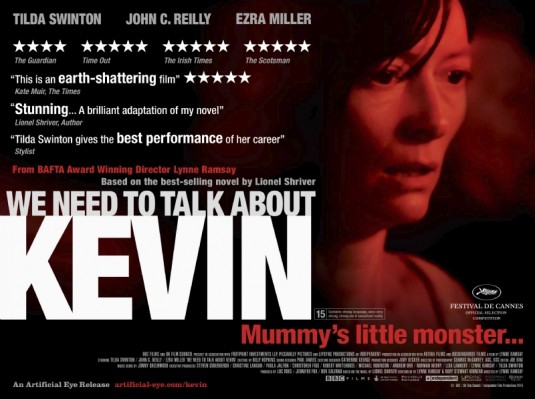
Official movie poster for We Need to Talk About Kevin
This is a guest post by Amanda Lyons and is cross-posted with permission from her blog Mrs Meow Says.

You know how I said in my review of Into the Wild that it was one of the most recent books I’ve read that disturbed me? We Need to Talk About Kevin is the most recent book I’ve read that disturbed me.

The reason for this (apart from the obvious fact that it’s about a child psychopath that you know is going to do something very, very bad, thus every event, every word is soaked in a weighty, dull dread) is that if you are a woman who is ambivalent about having children, Kevin represents your absolute worst nightmare, the zero sum of all your fears of what could happen once you’ve heaved a child from your bloody body.

Tilda Swinton and John C. Reilly in We Need to Talk About Kevin

It’s a fascinating and minutely detailed account from Eva Katchadourian of her mothering of Kevin. It’s also an examination of her own soul and an attempt to parse what she may and may not be responsible for during the long build up to the ultimate flowering of Kevin’s violence.

Eva is a very cerebral person, and accordingly Kevin is a very cerebral book, following Eva’s long monologue (confession?) to her absent husband as she makes a hard and painful analysis of what has happened. In a wider sense, it is also an examination of the cultural notion of a mother’s guilt for the actions of her children—Eva is punished by her community for the crimes of her son and ends up living almost as a fugitive from her old life. She is wracked by guilt and horror, analysing events and their lead-up with painful clarity.

But it is soon very clear that though Eva is aware very early on that something is “wrong” with Kevin, she is isolated both by Kevin’s insidious nature and her very role as a mother—and is utterly powerless to do anything about it. Her All-American, trad values-craving husband Franklin coerces her into moving away from her beloved New York to an extravagantly ugly house in the suburbs for the sake of their “family.” Every time she tries to raise her concerns about Kevin, he is disbelieving, and disapproving—he is easily manipulated by his savvy child; because he is not Kevin’s primary caregiver, he only sees what Kevin wants him to see. On top of this, he is a devotee at the shrine of the inviolable nuclear family and refuses to acknowledge anything that could endanger this dream. Instead, he equates Eva’s misgivings with what he perceives as her untrustworthy wanderlust which he fears will take her away from him.

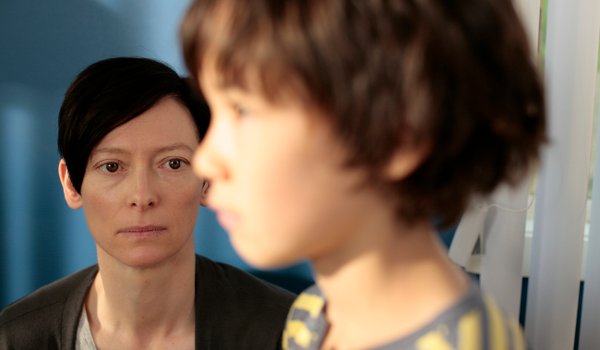
Tilda Swinton glaring

And this is what was so terrifying to me about Kevin—its worst-case scenario of motherhood. The woman enslaved, powerless, first by the very presence of the baby growing inside her and then trapped in the four walls of the home, slave to a psychopathic child who is the ultimate tyrant. Disbelieved by her partner, having to cope alone, cut off from the socially accepted positive experience of motherhood. Forced to nurture a child that has nothing but hate and contempt for you.

And yet, in a lot of ways Eva and Kevin are very alike. This is why Kevin knows it’s easier to get around Dad, but not around Mum—because she understands him in a way Dad never can. Kevin embodies the darker elements of Eva that she herself is unaware of until she starts her minute analysis in the aftermath of his arrest. This feeds her sense of guilt—but also her understanding of him, and her eventual coming to terms with his nature.

Shriver has obviously done her homework. Her construction of Kevin’s childhood reminded me very much of undiagnosed schizophrenic Nancy Spungen’s in her mother’s memoir And I Don’t Want to Live This Life. And when I read this NY Times article about child psychopaths, I thought right away of Kevin and how much the behaviour of the children in it echoed his. It also made me think of Lionel Dahmer’s memoir and how he searched for the answer to Jeffrey’s crimes in his parenting, the dark twists in his own personality and the ways in which he and his son were alike.

Tilda Swinton looking uneasy

We Need to Talk About Kevin is a dark and disturbing, dread-filled book. It consumed my thoughts while I was reading it and terrorised my brain. There are imperfections that mar its surface, the main one being some narrative trickery that I won’t reveal as it’s something of a spoiler. But I will say that I thought it was a bit gimmicky and a slight betrayal of the reader.

This aside, though, it’s an amazing book: painful, scary, intelligent, and unforgettable.

So when I heard there was a film coming out, I thought, “Crikey! Good luck!”

This is because, as with The Hunger Games, We Need to Talk About Kevin is narrated as an internal monologue. Recreating the same effect in a film is very difficult, if not impossible, to do. But the distinctive voice of Eva Katchadourian is essential to the story, is the story.

However, there was one very positive factor—the film was directed by Lynne Ramsay, who is absolutely fantastic. Her films are always creative, individual, and beautifully made.

Tilda Swinton and tomato soup

But hearing about the casting of Tilda Swinton gave me some pause. Don’t get me wrong—I love me some SWINTON. She is astonishingly awesome. I also really liked her interview with W Magazine about the film, in which she said:

It’s every pregnant woman’s nightmare to give birth to the devil. And every mother worries that she won’t connect to her children. When I had my children, my manager asked me what project I wanted to work on next. I said, “Something Greek, perhaps Medea.” Nobody quite understood what I meant, what I was feeling…

You have twins, who are now 13. Did you worry about becoming a mother?

When I first saw the twins, I really liked them. And, at the same time, there was a ghost over my shoulder saying, What if I hadn’t liked them? Kevin spoke to that feeling. It is that nightmare scenario: What if you don’t feel that connection to your children? There’s no preparation for having children. In Kevin, the woman I play is in mourning for her past life, and yet she looks at this dark, nihilistic kid and knows exactly where he comes from. He isn’t foreign to her; she sees herself. And that is, quite literally, revolting to her.

Predictably the gossip rags were like, “WTF! Bitch be crazy!” but I thought she nailed the hammer on the head (or whatever that saying is). She understood the book perfectly, and it was obvious that Eva Katchadourian was in safe hands.

And of course, she is fantastic in the film. She is such a great actress, so lacking in vanity and unafraid to plunge into whatever is needed for a role. It’s just, that … well, Eva is of Armenian descent. And this is quite important in the books. She’s olivey and dark, and Swinton is a long cool glass of milk.

Tilda Swinton and John C. Reilly and balloons in We Need to Talk About Kevin

Obviously these things can be rectified by certain techniques, and duly Swinton’s hair was dyed, and I’m pretty sure they made her wear dark contacts, an attention to detail which I appreciate.

This might have been okay, if I didn’t feel so uneasy about the casting of the other central characters as well. John C. Reilly, I love you, so please forgive me for this, but I imagined Franklin as handsome (I think he’s actually described as such in the book)—albeit in a ruddy, slightly chunky sort of way, but handsome nonetheless. Not only did Reilly not at all correspond with how I thought Franklin should look, but I just completely could not buy he and Swinton as a couple, no matter how hard I tried. He didn’t do a bad job, but I just did not believe it. And there wasn’t a lot of chemistry between them to help the situation out, either.

And then we arrive at the titular Kevin himself. With Kevin, I had the opposite problem: he is described as being quite good-looking in the books. But movie-Kevin goes beyond this; he looks like an underwear model. Ladies and gentlemen I present to you, Ezra Miller:

Ezra Miller, star of We Need to Talk About Kevin
Once again, though, I must praise their attention to detail. Kevin clearly has zits in some of the shots, and he is wearing the too-small clothes that Shriver describes in the books. But he is just so ridiculously gorgeous that I couldn’t help snorting in the theatre at the sight of him. It’s also impossible to believe that he sprung from the loins of John C. Reilly and Tilda Swinton. So some suspension of disbelief issues there.
These issues aside, however, Ramsay makes a solid effort of adapting this story for film. She doesn’t try to oversimplify the story, nor does she bang you over the head with detailed explanation, which I really appreciated. The attention to detail that I’ve mentioned several times earlier shows respect for and a real dedication to the source material. Her technique is as exquisite as her previous films, and I love that the movie isn’t overly shiny looking like so many American movies—she doesn’t try to gloss over the ugly bits.

However, it’s impossible to overcome the central problem—the way the story is told in the book just can’t be replicated in a film. But I also found that having read the book, there was just no tension in the story and the characters didn’t quite gel enough for me to get pulled into their story anyway. It’s a well-made film, but I’ll have to declare the winner unequivocally: BOOK.

———-

Amanda Lyons is a writer from Middle Earth (AKA New Zealand). By day she writes on finance, by night whatever takes her fancy at http://mrsmeowssays.blogspot.co.nz/.

Classic Literature Film Adaptations Week: Mrs. Danvers, or: ‘Rebecca’

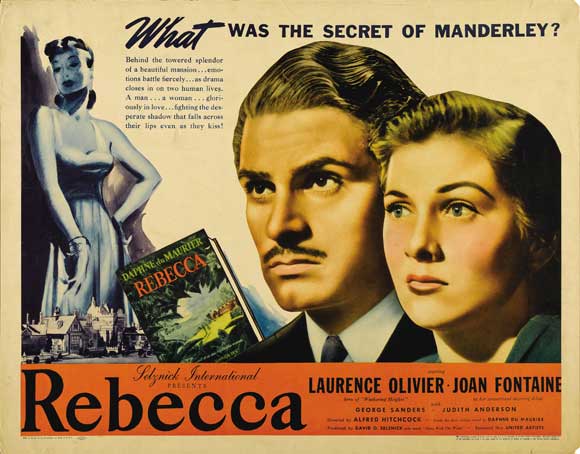
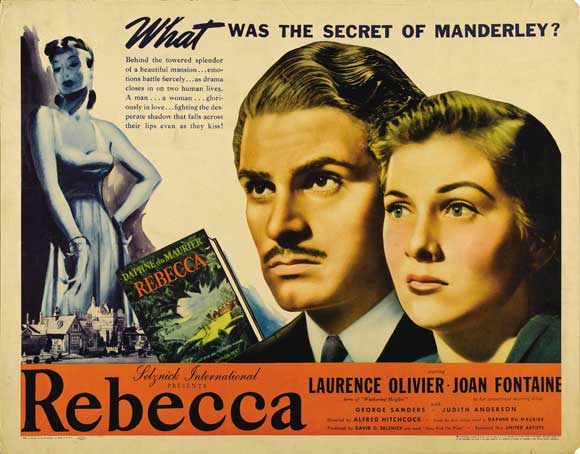
Movie poster for Alfred Hitchcock’s Rebecca
This is a guest post by Amanda Civitello.

There is a trio of women at the heart of Rebecca. There’s a male love interest, to be sure – the dashing, wealthy, ostensibly noble Maxim de Winter – but at its most essential, Rebecca is a story of women: the unnamed protagonist, the second Mrs. de Winter; Rebecca de Winter, Maxim’s first wife, whose seeming omnipresence at the de Winters’ country seat, Manderley, haunts her replacement; and Mrs. Danvers, Manderley’s housekeeper, and Rebecca’s personal maid, devoted to her mistress even after death. The narrator of Daphne du Maurier’s 1938 novel and Alfred Hitchcock’s 1940 film adaptation might be the second Mrs. de Winter, but Rebecca – particularly the novel – doesn’t belong to her in the slightest. Despite a script which departs from the novel in several crucial instances and the talent of Laurence Olivier and Joan Fontaine, the story is Mrs. Danvers’s, and the film is Judith Anderson’s.

Rebecca recounts the story of the second Mrs. de Winter (Joan Fontaine), the new bride of the wealthy widower Maxim de Winter (Laurence Olivier), who married him after a whirlwind courtship. Though not especially acquainted with her frequently secretive, moody husband, she nevertheless adores him and, despite her modest upbringings, resolves to do her best as lady of the manor at Manderley. She meets with resistance, of course, from a likely corner, the housekeeper Mrs. Danvers (Judith Anderson), as well as from a more unlikely one, Maxim’s late wife Rebecca de Winter, who drowned tragically but whose ghost seems to haunt Manderley and its inhabitants in more ways than one. The second Mrs. de Winter finds herself at odds with Mrs. Danvers, who is by turns cruel and falsely sweet, and utterly bent on removing Mrs. de Winter from Manderley, at one point attempting to coax her into suicide. The film is something of a thriller, and so of course there are questions surrounding Rebecca’s mysterious drowning – particularly about Maxim’s part in it. Fortunately for our heroine and her romantic lead, Maxim is miraculously exonerated, in a disappointing departure from the novel, and Mr. and Mrs. de Winter, it is presumed, enjoy something of a happy retirement after the closing titles, despite a final act of revenge.

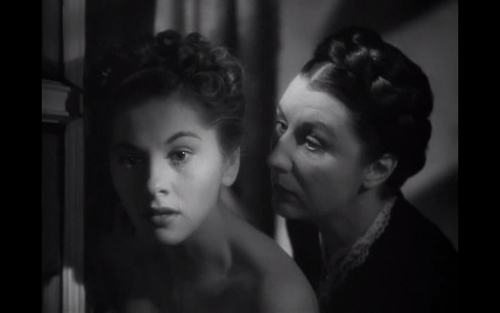
Mrs. Danvers (Judith Anderson) and the second Mrs. de Winter (Joan Fontaine)
Rebecca is frequently described as Joan Fontaine’s film, and while she’s excellent in her role, and clearly has the most screen time, her role is not, by far, the most interesting of the film. Her character, the second Mrs. de Winter, is never allowed to grow up: in spite of everything, by the close of the film, she’s much the same frustratingly childlike shrinking violet she was at the beginning. Fontaine carries off the ingénue type very well, and it’s not her fault that her character has bursts of growth – short-lived instances in which she takes her staff in hand, or speaks her mind to her husband – but then, inevitably, regresses. She’s beautiful and even sympathetic in her persistent naïveté, at least to a point, but as a woman, the second Mrs. de Winter is ultimately disappointing. Part of the problem lies in the fact that she’s consistently portrayed as the opposite of Rebecca de Winter, who is never seen and never speaks for herself, in the film or the novel. She is the sweetness and light to Rebecca’s coldly Machiavellian, sinister calculation. The second Mrs. de Winter is innocent, concerned only for her husband, and perpetually unsure of herself, which makes her rather nice, but somewhat simpering, and sadly, not especially interesting. Rebecca de Winter is not, by anyone’s account, nice, but she’s certainly more interesting than her wide-eyed replacement, and hers is the silenced voice.

Rebecca, Hitchcock’s first Hollywood film, is beautifully shot and wonderfully acted, but it’s also caught, somewhat uncomfortably, between genres. It doesn’t quite want to be a true Gothic thriller, because it shies from the moral ambiguity that makes the novel such a rich book, but nor is it a straightforward romance, for nothing is ever straightforward with Alfred Hitchcock. Unfortunately, the major casualty of this uncertainty is the novel’s most interesting female character: the housekeeper, Mrs. Danvers, a brilliant turn by Judith Anderson. In the novel, Mrs. Danvers haunts each page just as much as the ghost of Rebecca de Winter. In Hitchcock’s hands, Rebecca becomes a cross between a Gothic thriller and a mannered romance, ultimately tending towards the latter, but even this does not fully temper Mrs. Danvers’s omnipresence: she is the link between the unnamed protagonist and the unseen antagonist, not the husband they share in common. However, the novel is full of contradictions in its characterization of Mrs. Danvers which the film does not address. Through the second Mrs. de Winter’s eyes we see Mrs. Danvers as “tall and gaunt,” with “great, hollow eyes,” a “skull’s face set on a skeleton’s frame,” and possessing of “limp and heavy, deathly cold” hands. While Judith Anderson’s costuming is not, perhaps, as skeletal as du Maurier intended, she nevertheless embodies the chilly lifelessness of her character. Her Mrs. Danvers is ghostly in her carriage, but terrifyingly real in her interactions with her new mistress. Yet in the film adaptation, the other-worldliness never leaves her, and Anderson plays it masterfully, creating a character who is deeply unsettling and deliciously spooky. But du Maurier’s novel tempers this description; the Danvers of the novel is not always an evil, unbalanced ice queen. She’s desperate and half-mad with grief, still living in the past and passionate about her mistress.

Mrs. Danvers (Judith Anderson) in Rebecca de Winter’s bedroom
In the film, Danvers is well written, but nevertheless tends towards one-dimensional in the part the script allows her to play; in the book, Danvers’s complexity is far more difficult to ignore. A novel of Rebecca‘s length must necessarily be condensed; the kind of explicated description possible in page upon page of prose is simply untranslatable for the screen. Much of Mrs. Danvers’s complexity in the novel, therefore, is sacrificed so as to streamline the narrative. Where the film paints Danvers as more sadistic than anything else, the Mrs. Danvers of du Maurier’s novel is significantly more multifaceted. She becomes the definite antagonist in the film, the cruelly calculated, disconcertingly creepy nemesis of the wide-eyed ingénue. This is necessary: the viewer needs to believe that, not only would Danvers definitely set fire to Manderley, but that she would perish in Rebecca’s bedroom and deserve it. (On this point, the novel says very, very little, and it’s only one possibility among many that it’s Danvers who torches the great estate, and no mention is made of her fate.)

Hitchcock, however, is a director unafraid of ambiguity and a master of great subtlety, and he addresses the Rebecca-Danvers relationship most decisively in the pivotal bedroom scene, which prompts the second Mrs. de Winter into assuming more control of her household. Throughout, Judith Anderson keeps her delivery crisp and preternaturally calm, conveying Mrs. Danvers’s madness only with her eyes and movement, to great effect. The scene is as utterly disquieting on screen as it is in the novel, perhaps even more so, given the refinement of Judith Anderson’s performance. Danvers catches the second Mrs. de Winter in Rebecca’s closed-off bedroom in the west wing, and then proceeds to show her new mistress Rebecca’s personal things: her furs, still hanging pristinely in the armoire; her hairbrush, laid in exactly the same place; her nightdress, still laid out for the mistress who won’t return. It’s very easy to make it entirely Gothic in character – a bit of ghostly theatre to unsettle the new bride – but really, there’s much more at play. Again, however, the film and the novel are at odds: in the novel, there’s an undercurrent of grief for the late Rebecca that cuts through Danvers’s cruelty, such that the housekeeper is mad with grief, and motivated by love for her mistress. Death has not relinquished the hold Rebecca had on Mrs. Danvers; in fact, it’s intensified it. Judith Anderson is frighteningly convincing as she caresses Rebecca’s lace underwear, such that the scene is laced with an almost palpable degree of sexual tension and lesbian subtext. Mrs. Danvers’s passion for her mistress is undeniable, and the nature of that passion is left unspecified. The question of a lesbian subtext to the Danvers-Rebecca relationship is one to which the novel alludes as well, and it gives a layer of richness to Mrs. Danvers’s character. If there was a degree of romantic passion on Mrs. Danvers’s part, her grief becomes more sympathetic; her madness, more understandable. But in Rebecca, the scene must be viewed within the context of the film as a whole. Where, in the novel, the reader ultimately feels a degree of pity and sympathy for Mrs. Danvers, despite the assessment of the narrator, on screen, it’s simply, in the end, a briefly penetrating look into an unbalanced, hostile, malicious woman’s madness.

Mrs. Danvers showing Rebecca’s furs to the second Mrs. de Winter, part of the subtext-laden bedroom scene
These perplexing editorial choices in the novel’s adaptation for the screen make for a viewing experience which leaves audiences with a distinctly different perception of the characters and the story. The viewers are denied the absolutely disquieting story of the novel. What’s so disturbing – and so Gothic – about Rebecca isn’t Rebecca herself, and not even the image of Rebecca, the spectre of her, that the different characters construct, but the moral ambiguity surrounding the characters we’re supposed to like and dislike. If a novel – or a screenplay – is meant to be a constructed world, one that functions according to its own rules, then du Maurier’s Rebecca wreaks havoc with that framework. The reader is guided to like certain characters, to dislike others, only to find those perceptions entirely spun on their heads: by the last few pages, the reader realizes that the romantic hero she’s come to like and defend is a murderer. Changing the ending removes the ambiguity around Maxim, and turns Rebecca into a Gothic-tinged romance, and casting Mrs. Danvers as, for the most part, the cruelly sinister, unsympathetic antagonist paradoxically makes Rebecca spookier but far less disquieting, far less unsettling, than the novel. 
———-

Amanda Civitello is a Chicago-based freelance writer and Northwestern grad with an interest in arts and literary criticism. She has recently written on Jacques Derrida and feminist philosopher Sarah Kofman for The Ellipses Project and has contributed reviews of Sleep Hollow, Downton Abbey and Eternal Sunshine of the Spotless Mind to Bitch Flicks. You can find her online at amandacivitello.com.

The Tragedy of Masculinity in ‘Romeo + Juliet’

Written by Leigh Kolb.
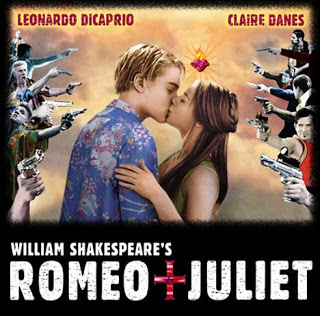
The opening scene of Baz Luhrmann’s William Shakespeare’s Romeo + Juliet is an intense display of masculinity. While in the original text the Capulet and Montague men draw swords and taunt one another, Luhrmann’s rivals pull guns, rev car engines, smoke, shoot, and light fire to gasoline.
Luhrmann’s 1996 film takes Shakespeare’s text–he stays truer to the language than other modern adaptations–and places it in a decidedly modern world of gang violence, guns, and ecstasy.
It’s Baz Luhrmann. It’s over-the-top and gorgeous, and perfectly encapsulates the timeless themes of the tragic story. At 15, audiences see violent action, young love (lust) and parents who just don’t understand. Older audiences, however, see a tragedy borne out of patriarchy and a culture that expects and respects traditional masculine power.
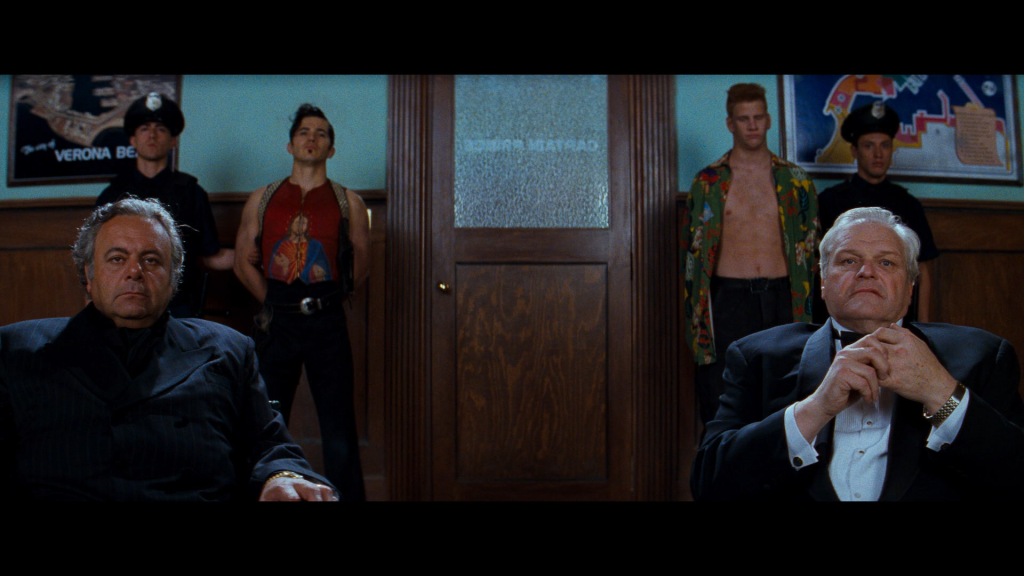
Capulet and Montague, business moguls and patriarchal forces. Jesus looks on.
While Romeo’s Montague cousins are tied up fighting Capulets and taunting nuns, Romeo (Leonardo DiCaprio) is emoting on the beach over a recent breakup. His father references Romeo’s “tears augmenting the fresh morning dew,” and Romeo is seen smoking a cigarette, sweeping blond hair out of his eyes. Romeo doesn’t seem to be like his cousins, and even when they play pool together, he’s lamenting his lost love.
The feuding men.
When he meets Juliet (Claire Danes) at her family’s costume ball, they are equally smitten and she is forward with her feelings–“you kiss by the book,” she says, as they attempt to escape her meddling mother (who’s attempting to set her up with Paris, played for laughs by Paul Rudd). In discussions about marrying off Juliet, her father indicates to Paris that while mothers are made at her age, it usually doesn’t bode well for a good life. Her mother–who knows her less than her nurse–seems to want to push her into marriage because she had to marry young. Her bitterness and desire to push Juliet into an arranged marriage and young motherhood is portrayed as villainous.
Luhrmann’s take on the balcony scene isn’t for purists, but it’s great for feminists. Instead of Juliet being separated from him on her balcony, elevated literally and figuratively as Romeo struggles to hang on, Juliet walks down to the pool as Romeo waits for her, and the two deliver their lines in the pool–on equal footing, intertwined.
A nontraditional balcony scene places Romeo and Juliet closer together.
Juliet is continuously more mature than Romeo. While she falls for him as he does for her, she wants to know that he’s serious. Romeo stumbles, he’s clearly much more juvenile than Juliet is. They represent youth, yes, but also a departure from not only their fathers’ patriarchal social order and the gendered expectations placed upon them. Juliet’s world is protected and arranged for her; she’s expected to have a life like her mother’s (arranged and out of her control). Romeo’s effeminate nature goes against his father’s powerful corporate position and his cousins’ violent outbursts.
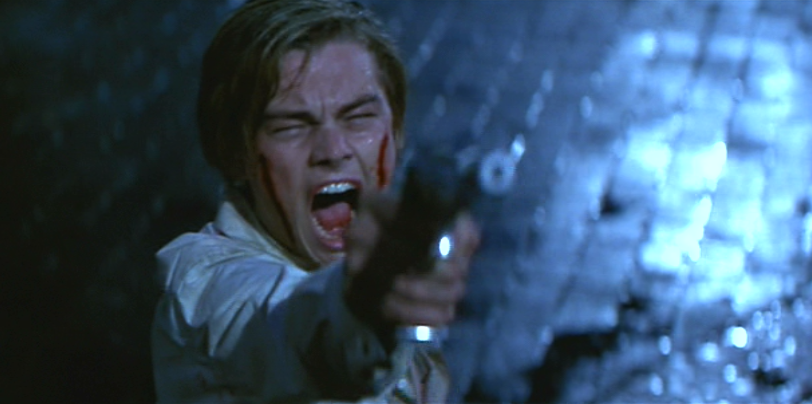
Romeo changes, however, when Tybalt (John Leguizamo) kills Mercutio (Harold Perrineau). Mercutio is frequently played flamboyantly–he doesn’t adhere to masculine norms and makes bawdy jokes at the expense of both Montagues and Capulets–and he represents a neutral party between the two families. Luhrmann’s Mercutio is played by a black man who convincingly cross-dresses for the costume party and attempts to bridge ground between the families. His death, then, is tragic to Romeo, but it’s also a sense of lost hope to the audience. Romeo gets behind the wheel of his car–he’s now part of this violent, masculine world–and chases after Tybalt. He maniacally shoots him as tears stream from his eyes.
When Romeo enters the violent, masculine sphere, the story changes completely and tragically.
He drops the gun, and the rain that has been approaching finally falls.
This crisis is what leads to the couple’s downfall–Romeo stepping into the patriarchal, violent world of senseless feuds pulls him away from the feminine that he’d so willingly embraced and embodied before.
As Juliet’s father drunkenly promises his daughter’s hand in marriage to Paris, he’s surrounded by guns and mounted hunting prizes on the wall behind him. As Romeo and Juliet sleep upstairs, she, too, is being pulled into the patriarchal order against her will.
When Juliet first refuses, her mother turns away from her and her father throws her to the ground, screaming, “I give you to my friend.” Juliet sobs, begging her mother to delay the marriage–but she refuses, and walks away.
Even those closest to her betray her desires–Father Laurence (Pete Postlethwaite) and her nurse (Miriam Margolyes) encourage her to marry Paris.
Juliet goes to Father Laurence and holds a gun first to her head, and then points it at Father Laurence to prove her determination to not marry Paris. Juliet takes control, even when all is working against her. Juliet refuses to bend to the will of the men (and world-weary women) around her.
Noteworthy in Luhrmann’s adaptation is his profuse use of religious symbolism, specifically Catholic iconography. This is another set of patriarchal rules they live under. The images in the film have meaning but not depth; they are as threatening as they might be comforting. Jesus looms over the city (he’s under repair when Tybalt lies dead in the fountain below him). Christianity is present in the city, in Juliet’s room and around Romeo and Juliet’s necks, but it doesn’t save them.
The modernization of key plot points–the certified letter that wasn’t delivered, the dealer that supplies Romeo with poison (fetched from the base of a Virgin Mary lamp), Captain Prince surveying the city in a helicopter–work remarkably well. And the soundtrack–oh, the soundtrack.
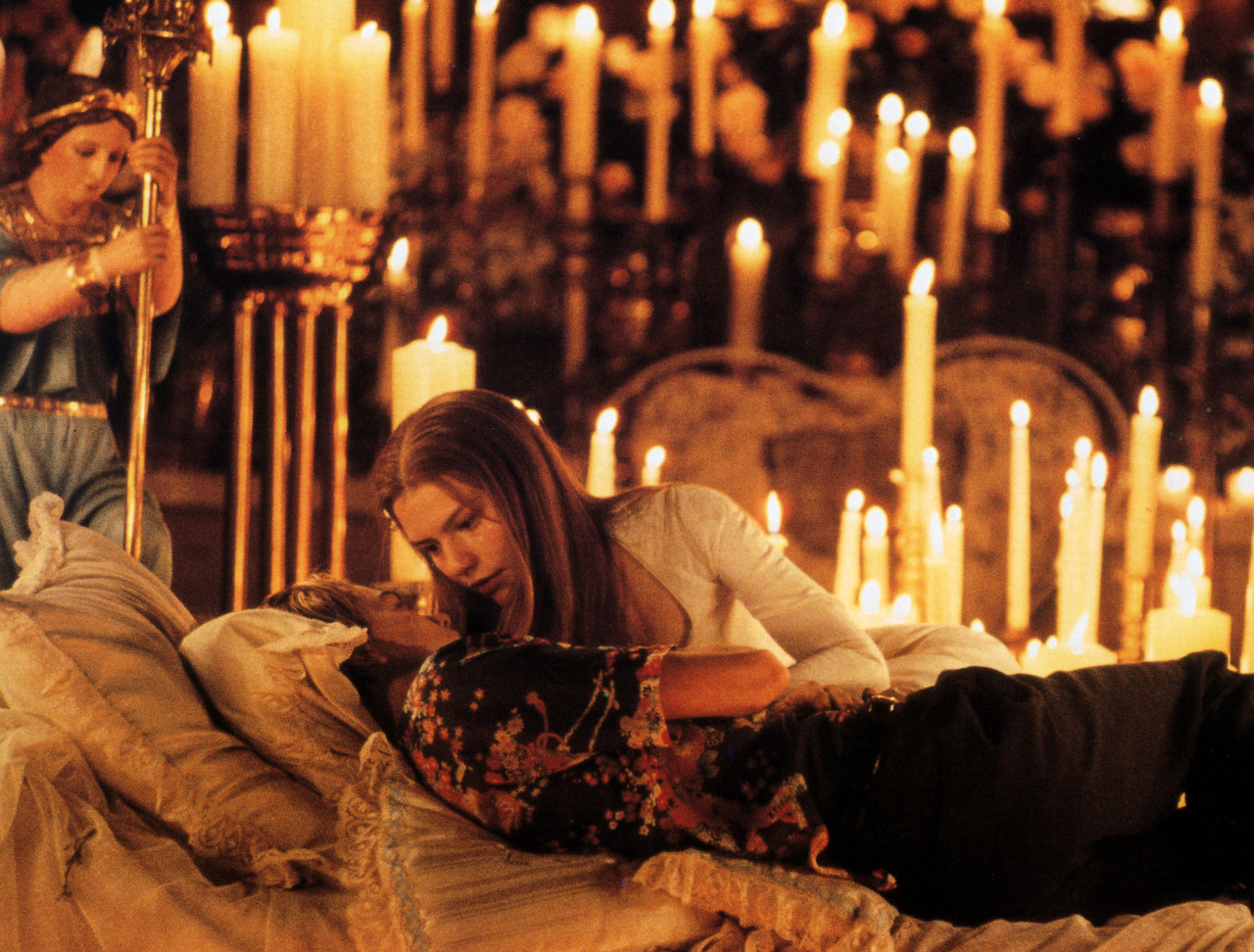
In the original text, there is a span of time between Romeo’s suicide and Juliet waking to see him lying dead. Luhrmann plays this scene much more dramatically–she wakes as he’s about to take the poison, and in his shock his hand bumps it into his mouth. They are both alive for a moment, and she kisses him while he’s dying. The lack of bystanders or spectators in this scene makes it more powerful–even a Shakespeare purist could attest to that fact.
The death scene is altered from the original text, and adds to the emotional impact.
Juliet shoots herself with no comment, and the camera pans up, looking at their dead bodies below while flashing back to moments of happiness.
Captain Prince screams “All are punished,” while their dead bodies are put into ambulances and the fathers look on bewildered.
In the original text, Friar Laurence gives a lengthy monologue, explaining all that had happened. Capulet and Montague shake hands and commit to peace.
In most Shakespearian tragedies, while there may be a pile of dead bodies at the end, there’s a sense of closure that things will be better in the future, or that the tragic tale will serve to teach others a lesson.
Not here.
There’s simply bewilderment, and the sense that the patriarchy, the violence, the incessant masculinity of Verona Beach has won, and everyone has lost because of it.
The story, then, isn’t about tragic young love. It’s about the tragedy of adhering to codes of behavior that are inherited and not freely chosen.
Luhrmann–by capturing a time and place that was at the same time specific and completely timeless–reminded a new generation of these messages that are as important and poignant today as they were in 1996, and as they were in 1595.
—–
 
Leigh Kolb is a composition, literature and journalism instructor at a community college in rural Missouri. 

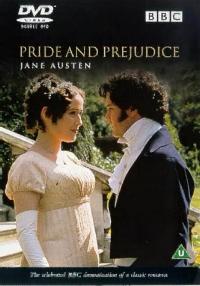
Classic Literature Film Adaptations Week: Comparing Two Versions of "Pride and Prejudice"

Written by Lady T. Some of this piece was originally published at The Funny Feminist

Is there any literary comfort food better than Pride and Prejudice? No, there is not. Every time I read it (about once a year), I have to force myself not to swallow the whole thing in one gulp. I try to pace myself, but I can’t. Watching the 1995 BBC miniseries presents the same problem. I can only watch it when I have nothing else to do that week because I will watch all six hours in one night if I’m not stopped.

I feel less inclined to watch the 2005 version again. I somewhat enjoyed it the first time I watched it, and especially liked Rosamund Pike as Jane, but when I watched the proposal scenes from both versions back to back, I almost felt embarrassed. The 2005 version just doesn’t compare.

Let’s take a look at the proposal scene from the 1995 version:

I love Colin Firth in this scene. His agitation and struggle is such a marked difference from Darcy’s too-cool-for-school attitude in the beginning of the miniseries. He shows just how much his love for Elizabeth completely rattles and unravels him, and when she rejects him, he’s shocked, shocked, I tell you. He may be in love with her, but he’s so arrogant that he had absolutely no doubt she would accept him. He fully believes that, given the disparity in their connections, he’s doing her a favor by bestowing his love and admiration.  Jennifer Ehle as Elizabeth is also perfect. She’s all cool civility in the beginning, bowled over by his profession of love, and calmly biting until he pushes her to the edge.

I cringe in this scene and feel pity for both characters, but importantly, the comedy still comes through. I can’t help but laugh at Darcy’s mention of how he loved her against his will. “Your family’s an embarrassment. I make much, much more money than your family does. Being united with your family would be shameful and I would be humiliated to be associated with them. But I love you, so marry me?” Oh, Darcy.

Meanwhile, ten years later, we have this:

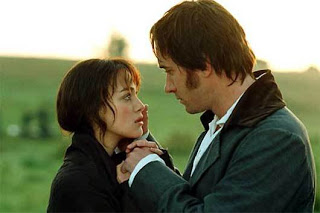
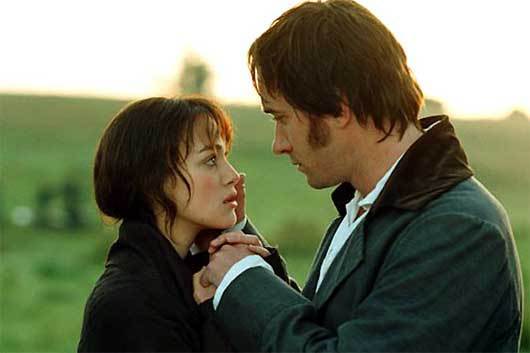
Marvel at Elizabeth and Mr. Darcy having a passionate conversation in the rain (because people were doing that all the time in the Regency period, don’t you know). Watch as Matthew MacFadyen and Keira Knightley rush through their dialogue and steamroll over each other – I mean, show Darcy and Elizabeth’s deep! passion! for! each! other! Weep as Mr. Darcy gives Elizabeth his best wounded puppy look because he’s so insecure (just like Darcy in the book…riiiiight), and watch as Elizabeth stares wetly back at him looking like she would love nothing more than to kiss him – because she certainly doesn’t completely loathe him at that point in the story.

I had a bad feeling about the 2005 adaptation even before I saw it, because Keira Knightley said something in an interview comparing Darcy and Elizabeth to two teenagers who don’t realize how much they actually like each other…and that’s exactly how she plays it. It’s such a disservice to both characters, especially Elizabeth, to describe them in that way. Elizabeth’s problem is not that she’s SEKRITLY IN LUUV with Darcy from the very beginning but in denial about her feelings. Her problem is that she’s almost as arrogant as Darcy is, so impressed with herself for being a wonderful judge of character, that she doesn’t revise her opinion of him until given evidence that she’s wrong. She’s not a teenage girl who just can’t decide which boy she likes better omg. She’s a grown-ass woman who is more flawed than she realizes. Knightley plays her like a petulant teenager. FAIL. And MacFadyen plays Darcy as insecure and wounded and emo. DOUBLE FAIL.

Pride and Prejudice or Wuthering Heights? Who can tell?

(I don’t think I even need to mention that the movie is just so lush and gorgeous and Romantic with a DOUBLE Capital R, with heightened emotions, Elizabeth and Darcy meeting each other at daybreak on the moors and staring at each other lustfully. Never mind that Jane Austen spent an entire book and a half – Northanger Abbey and Sense and Sensibility – mocking and satirizing all of those Romantic conventions.)

Anyway, long story short, it used to bug me that the 2005 Pride Ampersand Prejudice (as I like to call it, to differentiate it from the superb BBC version) even existed, because it felt so very un-Austen to me. There were too many lingering shots on beautiful countrysides and Elizabeth spinning in her family’s swing, and not enough conversation, when conversation is at the heart of what makes Austen Austen. Looking at the film again, though, I realize that I have another reason to prefer the 1995 version: the treatment of the female characters.

One character I’ve always found fascinating is Elizabeth Bennet’s best friend, Charlotte Lucas: wise and calculating, a careful observer of human behavior and social norms, who won’t have a chance to marry someone worthy of her because of the social restrictions for women during the Regency period. She marries Mr. Collins knowing that he’s a ridiculous fool who can never make her truly happy, but resignedly accepts her fate anyway. She tells her dear friend, “I’m not romantic, you know. I never was. I ask only for a comfortable home – and, considering Mr. Collins’ character and situation in life, I am convinced that my chances of happiness with him are more than most people can boast on entering the marriage state.”

Lucy Scott as Charlotte Lucas

Charlotte’s lines in the 2005 Pride Ampersand Prejudice are similar, but with a few key differences. She tells Elizabeth, “Not all of us can afford to be romantic. I’ve been offered a comfortable home and protection. There’s a lot to be thankful for. I’m 27 years old. I’ve no money and no prospects. I’m already a burden to my parents. And I’m frightened. So don’t judge me, Lizzy. Don’t you dare judge me.”

The first Charlotte is calm, cool, and collected in explaining her reasons for marrying Mr. Collins. The second Charlotte is bordering on desperate, openly admitting that she’s frightened.

Claudie Blakley as Charlotte Lucas

I understand why Pride Ampersand Prejudice portrays Charlotte in this way. Women in the Regency period had very few options in their lives. Unless they were independently wealthy heiresses, like Austen’s own Emma Woodhouse in Emma, they had to marry well or suffer the consequences. Pride Ampersand Prejudice wants us to feel for Charlotte’s limited circumstances.

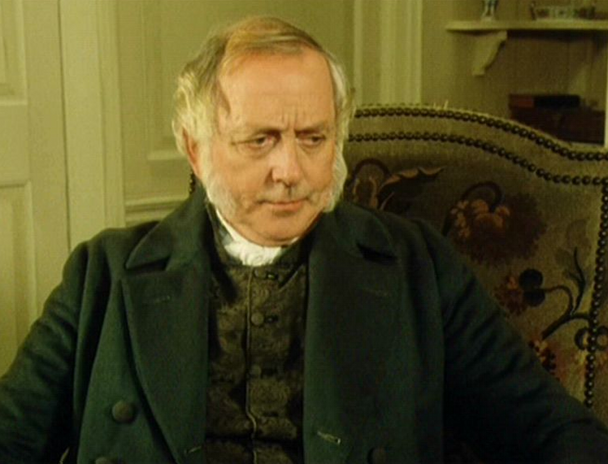
But I know Pride and Prejudice too well, and I can’t accept this change in Charlotte’s character. The Charlotte Lucas I know in Austen’s text would never have wanted to be pitied for her marriage. The Charlotte Lucas I know probably would not have been very romantic even if she could afford to be. The Charlotte Lucas I know is entirely practical, unapologetic in her choice of husband, and determined to make a comfortable life for herself – and she does. Charlotte in the BBC Pride and Prejudice is portrayed as less pitiable than the Charlotte in the Joe Wright film, even though the first Charlotte has a much less appealing Mr. Collins to put up with. David Bamber’s Mr. Collins is an inspired comic performance – unctuous, slimy, entirely lacking in self-awareness – while Tom Holland’s Mr. Collins is…short. And kind of awkward.

Watching the Joe Wright film, I can’t help but feel that Charlotte in the BBC version would feel insulted by her counterpart in 2005 (through no fault of Claudie Blakley, who gives a lovely performance). Original Recipe Charlotte would not want people to feel sorry for her, and would insist that she has a perfectly decent life. I’m inclined to agree with Original Recipe Charlotte that her happiness is “more than most people can boast upon entering the marriage state.” Charlotte will certainly be happier than Mr. Bennet, who married a woman just as silly as Mr. Collins, but wasn’t nearly as well-acquainted with his partner’s true character.

Mr. Bennet: less happy in marriage than Mrs. Collins

Charlotte Lucas isn’t the only female character who’s softened or changed for the 2005 feature film, however. Mary Bennet is comforted by her father when she makes a fool of herself at the Netherfield party, presented as nothing more than a little shy and awkward, even though she’s pretty much the female equivalent of Mr. Collins – pompous and not as smart as she thinks she is. Mrs. Bennet has a moment where she’s portrayed as a heroine in disguise (um, NO) who needs to marry her daughters off to protect them. Even Georgiana Darcy rushes to Elizabeth and greets her eagerly when they first meet – even though, in the book, she’s so shy she can barely breathe in front of new people.

When I look at the way the female characters are presented in the 2005 film version, I see Regency characters with modern attitudes thrust upon them. Elizabeth is no longer spirited, but spunky. Charlotte is no longer practical, but pitiable. Mary is no longer pretentious, but geeky and awkward. Mrs. Bennet is no longer a hilarious comic character, but a desperate woman trying to protect her daughters. Georgiana can’t be shy anymore, but a spunky, miniature version of Elizabeth.

I appreciate the attempt to shed some light on the limited options of women during the Regency period, but much of the humor is lost from the original text when turning comic characters into sympathetic ones. I will always prefer the BBC Pride and Prejudice because it remembers that Jane Austen wrote a comedy, and doesn’t feel the need to lament over the fates of her female characters. All things considered, Charlotte Lucas is going to be fine, and it’s okay to be a feminist and still laugh at Mrs. Bennet. 

Lady T is an aspiring writer and comedian with two novels, a play, and a collection of comedy sketches in progress. She hopes to one day be published and finish one of her projects (not in that order). You can find more of her writing at The Funny Feminist, where she picks apart entertainment and reviews movies she hasn’t seen.

Classic Literature Film Adaptations Week: Comparing Two Versions of "Pride and Prejudice"

Written by Lady T. Some of this piece was originally published at The Funny Feminist

Is there any literary comfort food better than Pride and Prejudice? No, there is not. Every time I read it (about once a year), I have to force myself not to swallow the whole thing in one gulp. I try to pace myself, but I can’t. Watching the 1995 BBC miniseries presents the same problem. I can only watch it when I have nothing else to do that week because I will watch all six hours in one night if I’m not stopped.

I feel less inclined to watch the 2005 version again. I somewhat enjoyed it the first time I watched it, and especially liked Rosamund Pike as Jane, but when I watched the proposal scenes from both versions back to back, I almost felt embarrassed. The 2005 version just doesn’t compare.

Let’s take a look at the proposal scene from the 1995 version:

I love Colin Firth in this scene. His agitation and struggle is such a marked difference from Darcy’s too-cool-for-school attitude in the beginning of the miniseries. He shows just how much his love for Elizabeth completely rattles and unravels him, and when she rejects him, he’s shocked, shocked, I tell you. He may be in love with her, but he’s so arrogant that he had absolutely no doubt she would accept him. He fully believes that, given the disparity in their connections, he’s doing her a favor by bestowing his love and admiration.  Jennifer Ehle as Elizabeth is also perfect. She’s all cool civility in the beginning, bowled over by his profession of love, and calmly biting until he pushes her to the edge.

I cringe in this scene and feel pity for both characters, but importantly, the comedy still comes through. I can’t help but laugh at Darcy’s mention of how he loved her against his will. “Your family’s an embarrassment. I make much, much more money than your family does. Being united with your family would be shameful and I would be humiliated to be associated with them. But I love you, so marry me?” Oh, Darcy.

Meanwhile, ten years later, we have this:

Marvel at Elizabeth and Mr. Darcy having a passionate conversation in the rain (because people were doing that all the time in the Regency period, don’t you know). Watch as Matthew MacFadyen and Keira Knightley rush through their dialogue and steamroll over each other – I mean, show Darcy and Elizabeth’s deep! passion! for! each! other! Weep as Mr. Darcy gives Elizabeth his best wounded puppy look because he’s so insecure (just like Darcy in the book…riiiiight), and watch as Elizabeth stares wetly back at him looking like she would love nothing more than to kiss him – because she certainly doesn’t completely loathe him at that point in the story.

I had a bad feeling about the 2005 adaptation even before I saw it, because Keira Knightley said something in an interview comparing Darcy and Elizabeth to two teenagers who don’t realize how much they actually like each other…and that’s exactly how she plays it. It’s such a disservice to both characters, especially Elizabeth, to describe them in that way. Elizabeth’s problem is not that she’s SEKRITLY IN LUUV with Darcy from the very beginning but in denial about her feelings. Her problem is that she’s almost as arrogant as Darcy is, so impressed with herself for being a wonderful judge of character, that she doesn’t revise her opinion of him until given evidence that she’s wrong. She’s not a teenage girl who just can’t decide which boy she likes better omg. She’s a grown-ass woman who is more flawed than she realizes. Knightley plays her like a petulant teenager. FAIL. And MacFadyen plays Darcy as insecure and wounded and emo. DOUBLE FAIL.

Pride and Prejudice or Wuthering Heights? Who can tell?

(I don’t think I even need to mention that the movie is just so lush and gorgeous and Romantic with a DOUBLE Capital R, with heightened emotions, Elizabeth and Darcy meeting each other at daybreak on the moors and staring at each other lustfully. Never mind that Jane Austen spent an entire book and a half – Northanger Abbey and Sense and Sensibility – mocking and satirizing all of those Romantic conventions.)

Anyway, long story short, it used to bug me that the 2005 Pride Ampersand Prejudice (as I like to call it, to differentiate it from the superb BBC version) even existed, because it felt so very un-Austen to me. There were too many lingering shots on beautiful countrysides and Elizabeth spinning in her family’s swing, and not enough conversation, when conversation is at the heart of what makes Austen Austen. Looking at the film again, though, I realize that I have another reason to prefer the 1995 version: the treatment of the female characters.

One character I’ve always found fascinating is Elizabeth Bennet’s best friend, Charlotte Lucas: wise and calculating, a careful observer of human behavior and social norms, who won’t have a chance to marry someone worthy of her because of the social restrictions for women during the Regency period. She marries Mr. Collins knowing that he’s a ridiculous fool who can never make her truly happy, but resignedly accepts her fate anyway. She tells her dear friend, “I’m not romantic, you know. I never was. I ask only for a comfortable home – and, considering Mr. Collins’ character and situation in life, I am convinced that my chances of happiness with him are more than most people can boast on entering the marriage state.”

Lucy Scott as Charlotte Lucas

Charlotte’s lines in the 2005 Pride Ampersand Prejudice are similar, but with a few key differences. She tells Elizabeth, “Not all of us can afford to be romantic. I’ve been offered a comfortable home and protection. There’s a lot to be thankful for. I’m 27 years old. I’ve no money and no prospects. I’m already a burden to my parents. And I’m frightened. So don’t judge me, Lizzy. Don’t you dare judge me.”

The first Charlotte is calm, cool, and collected in explaining her reasons for marrying Mr. Collins. The second Charlotte is bordering on desperate, openly admitting that she’s frightened.

Claudie Blakley as Charlotte Lucas

I understand why Pride Ampersand Prejudice portrays Charlotte in this way. Women in the Regency period had very few options in their lives. Unless they were independently wealthy heiresses, like Austen’s own Emma Woodhouse in Emma, they had to marry well or suffer the consequences. Pride Ampersand Prejudice wants us to feel for Charlotte’s limited circumstances.

But I know Pride and Prejudice too well, and I can’t accept this change in Charlotte’s character. The Charlotte Lucas I know in Austen’s text would never have wanted to be pitied for her marriage. The Charlotte Lucas I know probably would not have been very romantic even if she could afford to be. The Charlotte Lucas I know is entirely practical, unapologetic in her choice of husband, and determined to make a comfortable life for herself – and she does. Charlotte in the BBC Pride and Prejudice is portrayed as less pitiable than the Charlotte in the Joe Wright film, even though the first Charlotte has a much less appealing Mr. Collins to put up with. David Bamber’s Mr. Collins is an inspired comic performance – unctuous, slimy, entirely lacking in self-awareness – while Tom Holland’s Mr. Collins is…short. And kind of awkward.

Watching the Joe Wright film, I can’t help but feel that Charlotte in the BBC version would feel insulted by her counterpart in 2005 (through no fault of Claudie Blakley, who gives a lovely performance). Original Recipe Charlotte would not want people to feel sorry for her, and would insist that she has a perfectly decent life. I’m inclined to agree with Original Recipe Charlotte that her happiness is “more than most people can boast upon entering the marriage state.” Charlotte will certainly be happier than Mr. Bennet, who married a woman just as silly as Mr. Collins, but wasn’t nearly as well-acquainted with his partner’s true character.

Mr. Bennet: less happy in marriage than Mrs. Collins

Charlotte Lucas isn’t the only female character who’s softened or changed for the 2005 feature film, however. Mary Bennet is comforted by her father when she makes a fool of herself at the Netherfield party, presented as nothing more than a little shy and awkward, even though she’s pretty much the female equivalent of Mr. Collins – pompous and not as smart as she thinks she is. Mrs. Bennet has a moment where she’s portrayed as a heroine in disguise (um, NO) who needs to marry her daughters off to protect them. Even Georgiana Darcy rushes to Elizabeth and greets her eagerly when they first meet – even though, in the book, she’s so shy she can barely breathe in front of new people.

When I look at the way the female characters are presented in the 2005 film version, I see Regency characters with modern attitudes thrust upon them. Elizabeth is no longer spirited, but spunky. Charlotte is no longer practical, but pitiable. Mary is no longer pretentious, but geeky and awkward. Mrs. Bennet is no longer a hilarious comic character, but a desperate woman trying to protect her daughters. Georgiana can’t be shy anymore, but a spunky, miniature version of Elizabeth.

I appreciate the attempt to shed some light on the limited options of women during the Regency period, but much of the humor is lost from the original text when turning comic characters into sympathetic ones. I will always prefer the BBC Pride and Prejudice because it remembers that Jane Austen wrote a comedy, and doesn’t feel the need to lament over the fates of her female characters. All things considered, Charlotte Lucas is going to be fine, and it’s okay to be a feminist and still laugh at Mrs. Bennet. 

Lady T is a writer with two novels, a play, and a collection of comedy sketches in progress. She hopes to one day be published and finish one of her projects (not in that order). You can find more of her writing at www.theresabasile.com.

Classic Literature Film Adaptations Week: How BBC’s ‘Pride & Prejudice’ Illustrates Why The Regency Period Sucked For Women

How BBC’s ‘Pride & Prejudice’ Illustrates Why The Regency Period Sucked For Women

By Myrna Waldron

Pride & Prejudice DVD Cover (Source: Wikipedia)


It is a truth universally acknowledged that those in pursuit of an English degree must be familiar with the works of Jane Austen. Fortunately for me, she is one of my favourite authors, and Pride & Prejudice is one of my favourite books. (And that’s saying something, as I read a lot.) It is one of the great novels of English Literature that can be utterly boring with the wrong teacher. Many times people fail to pick up on the social satire woven throughout the novel, especially since the language and culture is so different now that it’s 200 years later. Once you understand the social context in which the novel was written/published, and get used to Austen’s subtle brand of sarcasm, one can understand why Pride & Prejudice has endured so long. It doesn’t hurt that Mr. Darcy is one of the quintessential Byronic heroes too.
The 1995 BBC miniseries adaptation is by far the most popular, and the reason why can be summed up in two words: Colin. Firth. I first watched the miniseries when I was 10, and read the novel for the first time at 15. I can say quite confidently that the miniseries strongly helped me to understand the novel better, but…that’s not the only reason why it was memorable for me. Puberty already had its iron grip on me at that time, and when I saw Mr. Firth as Mr. Darcy for the first time…let’s just say I realized I liked boys. Colin Firth has had a wonderful sense of humour about his signature role, more-or-less reprising it in the Bridget Jones series (Side note: Colin Firth is an actual character in the 2nd novel.) and in an interview with a French magazine that asked him who the women in his life were, he answered, “My mother, my wife, and Jane Austen.” Unusually for a western media production, the makers knew their audience, and presented the miniseries for the female gaze. Firth is shown bathing, fencing, and, most famously, swimming in the pond near Pemberley and emerging from it with a wet white shirt.
Regretfully leaving Mr. Firth’s impact aside, he is not the only reason why the BBC adaptation is culturally important. The 6 episodes of the miniseries grant far more lenience in terms of time constraints, and thus one of the most important themes of Austen’s novel is retained: Her feminism. The protagonists in her novels were all women, and she wrote them for a mostly female audience. Her primary goal was to create sympathy for the status of women and the little rights they retained. Reminder: This is an era where women could not vote, had no bodily autonomy, could not freely marry whomever they chose, were restricted to domestic spheres, and, in some cases, could not even inherit their father’s estate.  Pride & Prejudice, and the BBC adaptation, touch on several of these issues, subtly and sometimes directly condemning them from a feminist outlook. In addition to this feminist subtext, part of Austen’s social satire is pointing out the ridiculous class restraints in which the characters had to endure.
The Bennet Sisters, From Left To Right: Lydia, Jane, Mary, Kitty, Lizzy (Source: http://ladylavinia1932.wordpress.com/)
The protagonist of Pride & Prejudice, Elizabeth Bennet, usually called Lizzy, is the 2nd of 5 sisters and the favourite of her father because she is witty, intelligent, and well-read. Her older sister Jane is sweet natured and the most beautiful, middle sister Mary is plain, sanctimonious and withdrawn, and youngest sisters Kitty and Lydia are boy crazy and impulsive. Lydia most closely resembles her mother in personality and is thus her favourite. Mrs. Bennet is absolutely obsessed with the idea of marrying off her 5 daughters as soon as possible, and to rich men if they can manage it. The girls must endure their mother’s constant conspiring to marry them off – the elder sisters are resigned to their mother’s obsession, but the teenage youngest sisters are thoroughly swept up in their mother’s enthusiasm.
The major issue the Bennets face is that none of the daughters can inherit their father’s estate. They are confined to an entailment, which is a legal inheritance document stipulating that a hereditary estate can only be passed on to a certain person, usually the eldest living male relative. Unfortunately, the closest male relative to Mr. Bennet is Mr. Collins, a minister who is insufferably smug while pretending to be caring. When he suddenly descends on them for a visit, he is met with a certain degree of resentment, for when Mr. Bennet dies, Mr. Collins is fully within his rights to immediately throw out the grieving widow and daughters onto the streets. Thus, there is a practicality to Mrs. Bennet’s obsession – if her girls do not marry, they will be helpless and homeless.
Mr. Collins in this adaptation is utterly revolting. Greasy and simpering, he constantly brags about his rich patroness, Lady Catherine de Bourgh, (who is also Mr. Darcy’s maternal aunt) fawning about her even while miles away. He has visited with a mission – Lady Catherine thinks he should marry, so he figures he might as well choose from one of the Bennet sisters. Vainly, he sets his sights on Jane first as she is the most beautiful, but after being persuaded that Jane has another suitor (more on him later) he instead moves on to Lizzy, the next prettiest daughter. His attempts to woo Lizzy are incredibly repulsive and shortsighted, for he has chosen the worst possible match for him out of the 5 sisters. A bootlicking and hypocritical minister could not possibly be happy with a headstrong and brutally honest intellectual. It’s kind of sad he never noticed Mary and tried to court the sisters solely based on their looks, for although she’s plain she would have been a far better match for him.
Pemberley (Source: austenprose.wordpress.com)
Lizzy rejects his proposal with disgust, and he quickly moves on to proposing to the next closest target – her best friend Charlotte Lucas. She accepts, not out of even remote attraction, but because she felt she had no better option. At 27, she is already considered an old maid. She is not wealthy, she has no wealthy relatives, and she is not considered beautiful. So Charlotte explains to Lizzy, with a heartbreaking look of resignation, that she took all that she could get, and that she’d at least live in relative comfort. Later, when Lizzy visits her, she admits that she encourages her husband to spend as little time as possible with her. The social commentary exhibited here is staggering – I could not help but feel desperately hopeless and sympathetic for Charlotte’s situation. How awful to have to agree to marry such a repulsive man in order to prevent a future of poverty.
Jane and Lizzy fortunately have other potential suitors. Jane falls in love with Mr. Bingley, a relatively wealthy young man who has bought a manor nearby to their home. He is charming and amiable, contrasting sharply with his best friend, the brooding and proud (and even wealthier) Mr. Fitzwilliam Darcy. They meet the Bennets at a ball, where Mr. Darcy offends the others by refusing to dance with anyone. He later reveals that he was feeling more socially awkward than disdainful, but he has already done the damage of appearing arrogant and snobbish, and Lizzy immediately develops a bad opinion of him (she is the “Prejudice” to his “Pride”). Jane and Bingley are very well matched, but their presumed engagement is for a time derailed due to societal restraints. At a ball held at Bingley’s manor, Mrs. Bennet brags loudly about Jane’s not yet confirmed engagement, Mary monopolizes the piano and performs poorly, Mr. Bennet publicly admonishes her for it, and Kitty and Lydia loudly and childishly flirt with the visiting soldiers. Jane is also shy and emotionally reserved, and so Mr. Darcy concludes that she is not especially interested in Bingley. He thus uses these excuses to convince Bingley not to propose to her, which is the first of many plot points where an individual is unfairly judged by the actions of her family.
Although at first Mr. Darcy is not particularly impressed with Lizzy, he quickly grows an attraction to her. At subsequent balls he asks to dance with her, compliments her to others, and will not hear any criticisms against her. Bingley’s younger sister Caroline hopes to gain Mr. Darcy’s affections by putting Lizzy down, and thus tries to find as many physical faults with her as possible. This is a commentary on how there is societal pressure for women to compete with each other, and to only value their physical attractiveness – not much has changed in 200 years. Nevertheless, Darcy proposes to Lizzy, and it is an infamous disaster. He begins by expressing his ardent love for her, but then starts ranting about how his love goes against his character, upbringing, and will. He also states that his social status is likely to take a hit since she is neither wealthy nor well-connected. Unsurprisingly, Lizzy rejects his proposal with anger and disgust. She criticizes his arrogance and pride, and condemns him for what she believes is a particularly heartless act – the cold treatment and cutting off of his childhood friend Mr. Wickham.
Mr. Darcy and Lizzy (Source: bbc.co.uk)
Mr. Wickham is one of the local soldiers, and catches Lizzy’s attention because he is of similar intellect to her and is charming. She already has a poor opinion of Mr. Darcy, so she readily believes Wickham’s sob story about how Mr. Darcy stopped his ambitions of becoming a minister, denied the small inheritance that Darcy Sr. had promised for him  (Wickham’s father was Darcy’s father’s steward), and forced him to live in poverty, despite them having grown up together. Although Darcy cannot deny that he has acted arrogantly, he defends his actions regarding Wickham in a letter to her. In a flashback, we see Mr. Darcy at Cambridge walking in on Wickham fooling around with a young woman. Mr. Darcy explains that Wickham then left university, and requested a lump sum of 3000 pounds rather than an annual stipend. He thought they had then parted ways for good, but then found out the depths of which Wickham could descend.
Wickham likes to prey on teenage girls. He locates Darcy’s much younger sister Georgiana and seduces her, promising to elope with her. Darcy was never sure if Wickham’s aim was to get at Georgiana’s fortune, or to get revenge on Darcy. Fortunately, Darcy discovers the elopement in time to prevent it (and prevent Georgiana’s being sexually exploited) but both siblings would remain traumatized by the memory of how close she came to ruin. Lizzy is forced to believe Darcy’s story since it involves his younger sister, but she and Jane resolve to keep the truth of Wickham’s behaviour quiet since they have not been authorized to reveal the details, nor do they want to damage Georgiana’s reputation. Yes, Georgiana would be the one who would suffer from this, not the grown man who preyed on a teenage girl. This decision to keep quiet would come back to haunt the Bennets in the worst of ways, for it was not just Lizzy whose attention was caught by Wickham…but Lydia’s as well.
Lydia is given permission to follow the soldiers’ regiment to Brighton and stay with a friend of hers (much to Lizzy’s reluctance). She is not supervised at all, and Wickham convinces her to run away with him one night. She believes he is going to marry her, and is excited and anticipates how jealous her elder sisters will be that she has married first. (There’s that competing between women for male affections again.) We get short vignettes of her exile with Wickham – they are staying in a small room in a disreputable part of London. Lydia is shown wearing her dressing gown, but it is never directly implied nor stated whether she had premarital sex with him. Most likely she has, as since she is not wealthy there was only one thing about her Wickham would be interested in. Notably, none of the characters even dare to directly mention the worst-case scenario of Lydia’s behaviour, but Mary sanctimoniously summarizes the inequality of gender dynamics of the time: “The loss of virtue in a woman is irretrievable … A woman’s reputation is no less brittle than it is beautiful, and therefore we cannot be too guarded in our behaviour towards the undeserving of the other sex.”


We interrupt this essay to bring you some fanservice. (Source: telegraph.co.uk)
The other sisters believe their chances of making a good marriage are now nonexistent, as the news of Lydia’s “loss of virtue” have tainted her family by association. The best that they can hope for is that Lydia and Wickham have at least married, preferably before his bedding her. Mr. Collins even smugly states that it would have been preferable if Lydia had died. It is very damning that a family has to hope that a possibly sexually exploited teenager has married her seducer. Nowadays there would at least be an attempt to arrest Wickham for statutory rape, but society has not changed so much that there wouldn’t still be shaming of Lydia for being a sexually active teenage girl. We can look to the recent tragic case of Amanda Todd, a very young teen enticed by an adult into posing topless on a webcam, blackmailed, and driven to suicide by the public shaming of her actions.
Mr. Darcy, humbled by Lizzy’s dismissal of him as arrogant and feeling responsible for not exposing Wickham’s character, decides to intervene. He locates the pair (Lydia is foolishly amused by this, Wickham angered), and makes Wickham agree to marry Lydia by offering to pay off his many debts. They are married with only Mr. Darcy and Lydia’s maternal aunt and uncle, the Gardiners, in attendance. Mr. Darcy insists on letting the Gardiners take the credit, and swears them to secrecy. They return home and are enthusiastically welcomed by Mrs. Bennet (whose opinion of people tends to revert back and forth to opposite extremes depending on whether they are useful to her regarding marrying off her daughters). Lydia brags about her marriage to her sisters, and never learns just how close she came to permanently ruining her reputation and her family’s as well. But she lets it slip that Darcy was involved in arranging her marriage.
These altruistic actions, and a visit to Mr. Darcy’s manor Pemberley, where he is adored and praised by his servants, gradually change Lizzy’s opinion of him. Eventually, a rumour spreads to Lady Catherine de Bourgh that Lizzy and Mr. Darcy, her nephew, are engaged. In a fury she comes to the Bennets’ home and verbally abuses Lizzy, adamant in her belief in her social superiority. She vehemently objects to the engagement as Lizzy is far beneath her nephew in both social status, familial connections and wealth, not to mention that she believes that her daughter Anne and Mr. Darcy have been betrothed since childhood. Lizzy is headstrong and defiant, however, and counters all of Lady Catherine’s insults. In reference to their social status she she states, “He is a gentleman. I am a gentleman’s daughter. So far we are equal.” Not only has Lizzie skewered the ridiculous standards of class distinction in her era, she has made a subtle feminist statement as well. She also refuses to promise not to become engaged to Mr. Darcy, which is a solid social commentary on not letting the upper classes use their status to bully others.
The Double Wedding (Source: blogspot.com)
In the meantime, Mr. Darcy has told Mr. Bingley that he was mistaken in thinking that Jane Bennet did not return Bingley’s affections, and gives his blessing to their engagement. Bingley then takes the earliest opportunity he can to propose to Jane, which makes the normally reserved girl deliriously happy. When Mr. Darcy and Lizzy next meet, she reveals she knows who saved Lydia’s and her family’s reputations, and thanks him profusely. He tells her that he was only thinking of her happiness, and restates his love for her, promising never to bring it up again if she still feels the same way she did before. She has since realized that she has gradually fallen in love with him ever since visiting Pemberley, and accepts his proposal this time. There are many interpretations of the implications of this famous ending, but this time I’m going to do a feminist one: We know that Lizzy is progressive and headstrong, and likely as feminist as her creator. She could then possibly see Mr. Darcy’s actions as feminist ones, as he has directly prevented the fallout of a misogynistic society’s double standards. He has also demonstrated generosity and a willingness to help the most vulnerable. So she and Jane have a double wedding with Bingley and Darcy – all pairs as inseparable as they have always been.
As a whole, Pride & Prejudice and its miniseries adaptation strongly posit some feminist criticisms and subtly satirize the social standards of the time. Most notably, the story condemns entailments/inheritances that favour only male relatives instead of more direct (and equally rightful) female relatives, viewing relatively young women as old maids, forcing women into unwanted marriages to avoid homelessness and poverty, judging entire families on the basis of an individual’s actions (or judging an individual on the basis of their family’s actions), encouraging women to compete with each other for the affection of men, putting a woman’s entire worth on her virginity, allowing grown men to prey on teenage girls, and condemning a young woman for having premarital sex instead of her exploiter. Whew. It really sucked to be a woman during the Regency Period. For a 200-year-old book…that’s a whole lot of feminism. Bless you, Jane Austen. (And bless you, Colin Firth.)
Full disclosure: I recognize that this is more of a literature essay than a television review. My only excuse is that throughout high school and university I have written more essays about Pride & Prejudice than I can remember. Good habits are hard to break.
 
Myrna Waldron is a feminist writer/blogger with a particular emphasis on all things nerdy. She lives in Toronto and has studied English and Film at York University. Myrna has a particular interest in the animation medium, having written extensively on American, Canadian and Japanese animation. She also has a passion for Sci-Fi & Fantasy literature, pop culture literature such as cartoons/comics, and the gaming subculture. She maintains a personal collection of blog posts, rants, essays and musings at The Soapboxing Geek, and tweets with reckless pottymouthed abandon at @SoapboxingGeek.

 

Classic Literature Film Adaptations Week: ‘The Uninvited’ (1944) and Dorothy Macardle’s Feminism

Movie poster for The Uninvited
This is a guest post by Nadia Smith.
[contains spoilers]
When I told a horror-fan friend in his early twenties that I was writing about The Uninvited, he said he had seen it. This came as a surprise, since it’s mostly older viewers and film historians who are aware of it. It turned out that he thought I was referring to the recent Korean film The Uninvited: A Tale of Two Sisters, and not the classic haunted house movie that had audiences screaming in the 1940s and drew comparisons to Alfred Hitchcock’s Rebecca (1940).
The Uninvited (1944), directed by Lewis Allen and released by Paramount Pictures, is an adaptation of a popular Gothic novel by the Irish writer Dorothy Macardle (1889-1958), also a playwright, historian, journalist, and prominent feminist campaigner. It was adapted for the screen by the British writer Dodie Smith, best known for 101 Dalmatians. The Uninvited, which easily passes the Bechdel Test, features some sexist characterizations and a conventional ending, stemming from Macardle’s complex views on gender as well as the demands of commercial romantic fiction and film production. Nevertheless, the film opens itself up to alternative readings and valuations of the characters.
In the film, siblings Rick, played by Ray Milland, and Pamela Fitzgerald, played by Ruth Hussey (who might at first be mistaken for a married couple), learn that the old house in Cornwall they have just purchased is haunted by two ghosts, one warm and benevolent and one cold and dangerous, and investigate the mystery surrounding the house’s previous residents in an attempt to end the hauntings. Rick falls for the much younger Stella Meredith (Gail Russell), whose parents, artist Llewellyn and his wife Mary, had once lived in the house with Carmel, an artist’s model from Spain who had an affair with Llewellyn. The Merediths and Carmel died when Stella was a small child, Mary by falling off a nearby cliff, and the shy, repressed, immature Stella, who idolizes her late mother, lives an isolated existence in the village with Commander Beech (Donald Crisp), her stern, morbid maternal grandfather. The Commander has an unhealthy obsession with his daughter’s memory, and Stella is virtually imprisoned in the house as the Commander tries to mold her in Mary’s image. So far, so Gothic. Local informants, as well as Mary’s friend Miss Holloway (Cornelia Otis Skinner), praise Mary’s virtue and angelic beauty to the Fitzgeralds, and denounce Carmel’s depravity. Rick’s frustration grows as he worries that Stella’s intense emotional investment in her mother’s ghost will lead to a psychological breakdown and prevent her from ever caring for him.
The Fitzgeralds initially think that Mary is the warm ghost, and Carmel the cold ghost endangering Stella, but a séance proves them wrong. Carmel, the warm ghost and Stella’s biological mother, refused to be silenced and unfairly maligned, instead returning to tell the truth, while Mary, the cold malevolent ghost, tried to prevent the exposure of family secrets about her true nature and adoption of Stella after Carmel gave birth in secret. In life, Carmel had been a nurturing mother who truly loved Stella, and Mary had been cold and uncaring, as well as asexual. Rick symbolically kills the “evil mother” Mary, banishing her ghost through ridicule, while Stella’s acceptance of the truth about her biological mother’s identity allows her to move forward and ensures that Carmel will no longer haunt the house. Commander Beech dies, and the film concludes with Rick announcing that he and Stella will marry, while Pamela will marry a local doctor who helped solve the mystery. The final frame shows the two couples together in the drawing room; Stella appears rather uncomfortable, with a forced smile, recalling her discomfort when Rick forcefully kissed her earlier in the film. Whether this was a directorial decision or simply reflective of the limitations of the young Gail Russell’s acting remains uncertain, but it opens up the happy ending to alternative interpretations, as is often the case in Gothic romances.
Dorothy Macardle used a ghost-story plot and Gothic conventions to frame a narrative about troubled marriages and mother-daughter relationships, family secrets that haunt the present, and transgressive sexuality, thereby setting up a critique of domestic ideology. The unsettling implications of such a critique in Gothic romances, though, are foreclosed by conventional endings in which the heroine embraces marriage and domesticity. While the novel refers to several alternative relationships and domestic arrangements, these are closed off at the end in favor of “normalization.” Although Stella has been traumatized by her upbringing—her grandfather was overbearing and repressive and her parents’ marriage was characterized by hatred and power struggles—her impending marriage to Rick is a foregone conclusion that meets the narrative demands of the Gothic romance. However, some readers and viewers of Gothic romances find the endings unconvincing and read beyond the ending, and may imagine that the naïve, inexperienced Stella, like the nameless narrator of Rebecca, will find that her real problems begin with her marriage to an older man she hardly knows, leading to a new Gothic narrative in the formerly haunted house they intend to live in. 
Dorothy Macardle
The Production Code affecting films in the 1940s meant that homosexuality, extramarital affairs, and out-of-wedlock births were referred to cryptically in The Uninvited to meet the imperatives of censorship. Viewers learn that Mary “feared and refused motherhood,” and is therefore blamed for her husband’s affair with Carmel. Mary, Carmel, and Miss Holloway are all punished for their respective sexual transgressions – asexuality, heterosexual promiscuity, and lesbianism – with death or, in Miss Holloway’s case, a mental breakdown. The character of Miss Holloway was recognized as a lesbian by the Legion of Decency, whose (male) leaders complained to Paramount executives about the scenes in which she speaks romantically to Mary’s portrait. Lesbian audiences in the 1940s also grasped the inferences and characterizations in The Uninvited, and film scholars note that it became a cult hit with lesbian communities in wartime America. Mary is depicted as asexual or possibly a lesbian by being non-maternal and too close to Miss Holloway, and the novel describes her as “unnatural,” tying in with discourses about motherhood and gender essentialism. Later film scholars have seen even more lesbian connotations, suggesting that the mother-daughter trope in the film can be a cover for lesbianism, since Stella has been in love with another woman, Mary, her whole life, much to Rick’s frustration.
Dorothy Macardle’s views on gender roles and motherhood were crucially shaped by her own family dynamics, and reflected in her Gothic novels. She perceived her English mother, Minnie, as a classic late-Victorian hysteric, or fake invalid, who used her fragility as a weapon to prevail in marital power struggles and prioritize her own needs, and viewed her Irish father, Thomas, as Minnie’s helpless and long-suffering victim. Her fiction is inattentive to alternative power dynamics in marriage; husbands are depicted as generally chivalrous figures vulnerable to abuse by manipulative women feigning fragility, rather than subjecting fragile, vulnerable women to abuse. Her novels all end with the metaphorical destruction of a malevolent maternal figure and her baleful power, suggesting that Minnie, like the vampires to whom a prominent Victorian doctor compared hysterical women, took a lot of killing. Macardle’s fiction overturned sentimental and politically useful Victorian notions of the mother’s gentle influence in the home, as her feminist convictions stemmed from the belief that women’s exercise of power should be transparent and directed outside the home. It enraged her that outwardly conformist women like her mother and the fictional Mary Meredith were praised for their virtue, and she tried to show the transgression and complexity behind simplistic notions of good and bad women in a novel in which an icon of conventional womanhood is exposed as a fraud.
The tensions and limitations of Macardle’s feminism and her use of hostile sexist tropes about predatory lesbians, frigid wives, and bad mothers in her fiction seem to stem not only from her understanding of her family dynamics, but also from her sense of herself as an Exceptional Woman, informed by social class privilege. She never married and spent years living alone or with other women, and spent some of her early life in female institutions, including an all-girls school and a women’s prison (for her Irish republican activism). While she enjoyed being a university-educated, professionally successful unmarried woman with no children, she thought most women should be wives and mothers, with their sexuality safely contained within marriage, a view shared by many interwar-era “maternal feminists” in Europe and the United States.
The two main (living) female characters in The Uninvited are Pamela Fitzgerald and Stella Meredith. Pamela demonstrates wit, assertiveness, and intelligence, especially when she solves the mystery of the two ghosts that had confounded the others. Stella is fragile and childlike, which greatly appeals to the older Rick. The circumstances of her upbringing have created a repressed, insecure personality who idealizes the vague memory of a loving mother. Despite Stella’s timidity, she demonstrates courage at the novel’s end when she confronts and reassures Carmel’s ghost. While normative heterosexuality is restored in the conclusion with plans for marriage, Rick’s love for Stella in the novel is unsettling, as he has constantly infantilized her and describes her as a child.
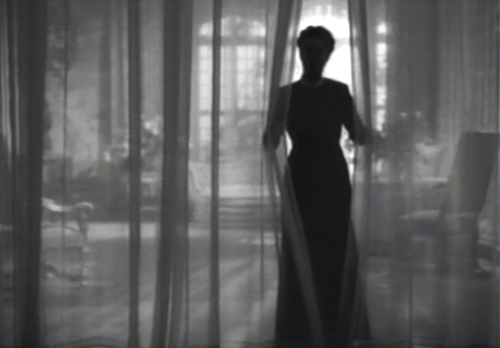
Miss Holloway, an “unfeminine” single woman and nurse who had been infatuated with her friend Mary and still worships her memory, is significant as a lesbian character in the days of the Production Code. Her name recalls London’s Holloway Prison, where suffragists were incarcerated earlier in the century, and the convalescent home she operates is a prison of sorts where female patients lose agency and autonomy. While Miss Holloway’s narrative seeks to contrast Mary’s moral perfection with Carmel’s depravity, the Fitzgeralds are so put off by this stereotypical sinister lesbian that they begin to think that things were not all that they seemed. The character of Miss Holloway shows The Uninvited’s indebtedness to Daphne du Maurier’s popular Gothic novel, Rebecca (1938; released as a film in 1940), as she bears a strong resemblance to Mrs. Danvers. Both are portrayed as sinister lesbians who idolize the dead woman at the center of the mystery and play a key role in reinforcing her iconization.
Overall, The Uninvited reflects a range of tensions and negotiations that intersected with contemporary discourses about gender, sexuality, feminism, and film censorship. While it falls prey to some hostile and stereotypical female characterizations common in the 1940s and later, it is complex and multilayered enough to allow for a range of readings and interpretations as it attempted to speak the unspeakable and represent the unrepresentable. Now that it’s finally available on DVD, maybe it will become at least as well known as The Uninvited: A Tale of Two Sisters.

———-
Nadia Smith is a historian and writer based in the Boston area. She is the author of Dorothy Macardle: A Life.