‘Welcome to the Rileys’ and ‘Starlet’ are not flawless examples of how to depict sex workers in film, but they are a step in the right direction. With Hollywood’s repetitive use of sex workers as one-dimensional cardboard cut-outs with a single purpose, the indie genre often gives sex workers, both supporting characters and protagonists, expressed thoughts and feelings, making them fleshed out and human.
This guest post by Nicole Elwell appears as part of our theme week on Representations of Sex Workers.
It’s no secret that Hollywood has issues with accurate representations of the daily life it tries to capture. Society is a film’s subject and audience, but that fact doesn’t always guarantee accuracy. It’s also no secret that certain aspects of society are captured more often and more thoroughly than others, creating a majority that’s up on screen and a minority that shakes their heads from their theater seats. Representation isn’t just about numbers and how often one gets screen time, but it also concerns the details of that screen time. In the case of representation of women in Hollywood, it’s not always the quantity but rather the quality. A film could have numerous female characters on screen and still create a qualitative representation issue.
This ties in with how Hollywood often portrays female sex workers. They exceed in quantity and fail in quality. Despite my lack of knowledge for all Hollywood films that depict sex workers and of actual experiences of a sex worker in modern American society, it’s easy to question and criticize the repetitive formula most sex workers are expected to exist under: be untrustworthy, manipulative, grotesque, or perhaps–worst of all–simply nothing. Most sex workers are written to be as impactful to the story as an out-of-focus desk lamp. They may appear for a single moment, create obstacles for the protagonist, or function as décor or pure entertainment for other characters. If they do serve a greater purpose to the story, it’s usually to flesh out the protagonist or motivate them in some way. With these limits as to what a sex worker can be in Hollywood, one can wonder if this serves as a subtle way of telling society this is how we should view sex workers in general. After all, society is a film’s subject and audience.
The independent film industry is often seen as the antithesis of Hollywood: with no major studios to answer to, the ever-present concern of profit is not always the motivation behind a film’s production. But does the indie genre really use its freedom to break barriers and create a more accurate picture of otherwise inaccurate and potentially damaging stereotypes? Well, yes and no. The independent industry is far from a haven of precise and meaningful stories, but considering that how good an indie film is will usually determine how many people see it, most truly terrible indie films stay buried. Much like Hollywood, the indie genre’s relationship with sex workers is hit or miss. With a far greater number of hits, the indie genre at times feels like the best hope for better representation of sex workers in film.
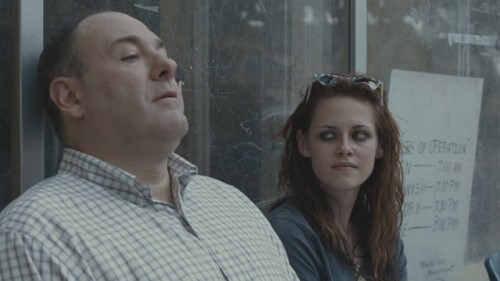
The film Welcome to the Rileys follows Doug Riley, a man distraught with martial problems and grief over the death of his daughter eight years ago. On a business trip to New Orleans, Doug befriends a prostitute named Mallory and finds new meaning in his life and a surrogate daughter through his growing friendship with her.
James Gandolfini and Kristen Stewart in Welcome to the Rileys
Doug’s wife eventually comes to New Orleans and sees the same opportunities in Mallory, so they all begin to live together. Despite the Rileys’ offers to help Mallory leave her life of prostitution, she repeatedly refuses and, fed up with the lack of acceptance, runs away only to be arrested and bailed out by Doug. The two have a confrontation, and Mallory asserts that she’s “not somebody’s little girl. It’s too late for that.” Doug comes to accept this and heads back home with his wife. This film could have easily been yet another example of how sex workers are catalysts for a male protagonist’s development, and for a large part of the movie that is the case. With Mallory’s refusal to submit to this cliché, the film becomes a hit rather than a miss because it dismisses the same formula that it used for the majority of the movie, while also giving Mallory her own character and declaring that prostitution is not something all women are looking to be saved from.
The film Starlet (available to stream on Netflix) follows the unique and charmingly awkward friendship between 21-year-old Jane and 85-year-old Sadie. After crossing paths with Sadie at a garage sale, Jane becomes increasingly interested in Sadie’s life, mostly to escape the constant drugs and apathy that fills her own. The majority of the film focuses on forming their bond while also exemplifying a generation gap that makes the friendship both refreshing and difficult.
Dree Hemingway and Besedka Johnson in Starlet
About 50 minutes into the film, the suspicious daily lives of Jane and her friends are brought to life: they are all a part of the porn industry. What Starlet does right is holding off the fact that Jane does porn. Rather, the film makes sure the audience understands that above all else, Jane is a person and shouldn’t be defined by her job. The film establishes raw character before anything else, which serves to not only dismiss multiple stereotypes associated with sex workers in film, but also establish the notion that sex workers are not defined by their professions. The film doesn’t judge or punish Jane, and in its execution encourages its audience to the same. Starlet is an innovative rejection of society’s obsession with careers by asserting that profession doesn’t trump character.
Welcome to the Rileys and Starlet are not flawless examples of how to depict sex workers in film, but they are a step in the right direction. With Hollywood’s repetitive use of sex workers as one-dimensional cardboard cut-outs with a single purpose, the indie genre often gives sex workers, both supporting characters and protagonists, expressed thoughts and feelings, making them fleshed out and human. With the ever-changing and diverse nature of humans, it’s virtually impossible to ever capture a perfect and flawless representation of any type of person, but Hollywood could learn a thing or two about representation from the independent film industry.
Nicole Elwell is a sophomore at the University of Baltimore, majoring in Psychology and minoring in Pop Culture. She hopes to bring psychology and feminism into a future career in writing for the movies.
But ‘For a Good Time, Call…’ doesn’t think of itself as better than other films with sex workers as their protagonists, with Lauren using Katie’s virginity against her as a metaphor for her insecurity when they have their first major fight, a prevalent attitude that buys into virgins being lesser versions of sex-having humans. As Vivian in ‘Pretty Woman’ resents Edward for making her “feel cheap,” Lauren’s treatment of her housemate brings up feelings of worthlessness for Katie. “You make me feel like I’ll never be good enough for you,” she cries. It seems we can’t win either way: women are slut- and prude-shamed no matter our real or perceived bedroom habits.
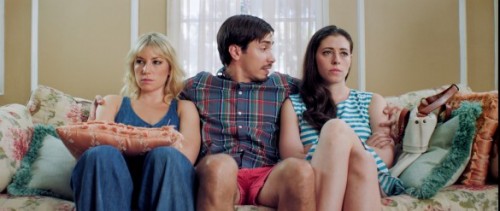
Ari Graynor, Justin Long, and Lauren Miller in For a Good Time, Call …
This cross-post by Scarlett Harris was previously published at Filmme Fatales and appears as part of our theme week on Representations of Sex Workers.
Sex workers get a bum rap in most aspects of society. In April 2013, publisher Mia Freedman and author of The Secret Diary of a Call Girl, Brooke Magnanti, butted heads about the use of the word “prostitute” and whether it’s a valid career choice for our daughters on Aussie talk show Q&A; the murder of sex worker Tracy Connelly in Melbourne in July sparked protestations as to why her death wasn’t given as much attention as, say, white, middle-class Irish immigrant beauty Jill Meagher’s, also occurring in Melbourne; and we still stigmatise the exchange of sex for money despite it being one of the oldest occupations in the world and, to my mind, a necessary one.
Many pop cultural representations of sex workers tend to play into the notions that they need to be “saved” or are less than: Leaving Las Vegas, Lovelace, Pretty Woman. One that shines a refreshingly progressive and nonchalant light on sex work is 2012’s For a Good Time, Call…, starring Ari Graynor and Lauren Miller (who also cowrote the effort).
College enemies Katie (Graynor) and Lauren (Miller) are forced to move in together by their mutual gay bestie, Jesse (played by Justin Long), after a series of unfortunate events sees neither one being able to afford to live alone in the Big Apple. When Lauren discovers Katie pays the bills by working for a phone sex line, she decides to help her make it into a viable small business, and before long Lauren’s in on it, too.
Lauren Miller in For a Good Time, Call …
While the roommates and their friends don’t bat an eyelid at their supposedly sordid occupation—Jesse wants to be involved, Katie meets her sweet, unassuming boyfriend via the hotline, and a prospective employer of Lauren’s applauds her for her newfound laidback demeanor—not everyone is so impressed. Lauren’s WASPy parents are mortified she ditched (read: was fired from) her long-time publishing gig in order to “listen to guys jack off,” as her father puts it.
Not to stoop to their level, but phone sex is probably the most banal of all possible sex work avenues to go down (pardon the pun!); big bucks can be made from any location without mandatory sex or nudity. Talk about a low-risk, high return investment! If anything, Lauren’s parents should be proud of their daughter’s entrepreneurial skills and her ability to turn a profit in a hostile economy, not slut-shaming her based on very little information. (Granted, the dildos on the coffee table and the g-string bunting strewn across the lounge room as the revelation is made probably don’t lend themselves to acceptance.)
If they looked beneath the surface they’d see that Lauren’s sexy, loudmouthed pole-dancing roommate who once peed in their daughter’s car (“It was a graduation present!”) has actually never had sex. And that the seemingly successful career woman was unhappy in her “boring,” passionless relationship and uninspiring publishing gig. The differences that once saw Lauren and Katie clash in college now bring them closer together in an alternate version of the heteronormative rom-com, where female friendship reigns supreme. Quite a contrast from the hooker sex-worker-with-a-heart-of-gold-who-needs-saving-by/from-a-man trope of the above mentioned Pretty Woman, Lovelace, etc.
For a Good Time, Call …
But For a Good Time, Call… doesn’t think of itself as better than other films with sex workers as their protagonists, with Lauren using Katie’s virginity against her as a metaphor for her insecurity when they have their first major fight, a prevalent attitude that buys into virgins being lesser versions of sex-having humans. As Vivian in Pretty Woman resents Edward for making her “feel cheap,” Lauren’s treatment of her housemate brings up feelings of worthlessness for Katie. “You make me feel like I’ll never be good enough for you,” she cries. It seems we can’t win either way: women are slut- and prude-shamed no matter our real or perceived bedroom habits.
Above all, For a Good Time, Call… is a rom com about best friends; screw the menz. Unlike in the above mentioned sex worker movie cache, men are not the moral of this love story.
Scarlett Harris is a Melbourne, Australia-based freelance writer and blogger at The Early Bird Catches the Worm (soon to be undergoing a revamp; stay tuned!).
The strength of ‘Osage’ is that it never once sentimentalizes women’s relationships with one another. It does not allow for trite Hollywood portrayals of women as somehow less violent, less complex, or less serious than men. ‘August: Osage County’ is an odd sort of respite for those of us who don’t relate to stories of quirky, privileged, white girls from Brooklyn. The women of ‘Osage’ would destroy ‘Girls’ Hannah Horvath with a word and look. For me, it’s a kind of comfort to see these steely women on screen.
August: Osage County has garnered mostly lukewarm reviews. This is somewhat of a surprise: the movie is based on the Pulitzer-winning play by Tracy Letts and the film’s cast is packed with talented actors. Although both Meryl Streep and Julia Roberts were nominated for Golden Globes for their powerful performances, both of them walked away from the award ceremony last Sunday night empty-handed.
But then, this is a movie that is, unambiguously, about women. August: Osage County is about morally flawed, sometimes cruel, and often unlikable women.
And that’s what makes August: Osage County good.
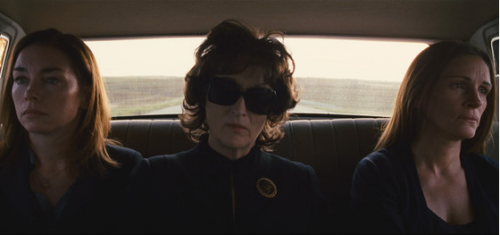
At its essence, the film is about Julia Roberts’ character, Barbara Weston, and her struggle to both claim and reject her identity as a “strong woman.” She inherits her strength from her mother, Violet (Meryl Streep), and it’s a mixture of involuntary responsibility for others and a hardness necessary for survival. At one point midway through the film, Barbara and her two sisters (Julianne Nicholson and Juliette Lewis) sit together discussing their mother. Ivy, the reserved middle sister played by Nicholson, distances herself from affiliation with the rest of the Weston clan by claiming that family is simply a genetic accident of cells. Despite this bit of wishful thinking on Ivy’s part, we see clearly throughout the film that this is far from true. August: Osage County hammers home the idea that our upbringing shapes us no matter how much we may want to escape our complex relationships with our less-than-perfect mothers. The film is deeply evocative of how the familial, social, and physical landscapes of our childhoods leave indelible marks on our adult identities.
Film poster for August: Osage County
In his review for the L.A. Times, Kenneth Turan writes that the film “does nothing but disappoint,” comparing it to “that branch of reality TV where dysfunctional characters… make a public display of their wretched lives.” The problem with the film, according to Turan, is that its high melodrama doesn’t make the audience care about the characters, but instead makes the audience feel trapped.
But, this, I think, is the point. The experience of watching the film is stifling and emotionally difficult, much like the experience of growing up in a dysfunctional, addiction-fueled family like the one we see on the screen. If Turan feels like a voyeur looking in on the “wretched lives” of the Weston family, other viewers of the film will recognize, perhaps with too much familiarity, the uncanny mixture of very dark humor and gut-wrenching trauma at the heart of Weston family life. In the tradition of Faulkner and McCullers, this is a story that holds no punches.
Like Turan, New York Times’ critic A.O. Scott reviewed the film poorly, though he was slightly less negative in his review, writing that it lacked “fresh insight into family relations, human psychology or life on the Plains.” Randy Shulman also gave it an unfavorable review claiming, “The film has one electrifying scene, in which a husband (Chris Cooper) takes his bitchy, critical wife (Margo Martindale) to task. It’s a bracing moment that, for an instant, jolts us out of our lethargy. Had the entire film been on this level of engagement, August: Osage County might have been one of the year’s best films.”
Reading Shulman’s opinion struck me. That same moment in the film was my least favorite scene. I was, indeed, jolted by the scene that Shulman lauds, thinking it seemed too easy in its moral righteousness. It was at that moment of Osage that most of the men in the film (played by Chris Cooper, Sam Shepard, Ewan McGregor, and Benedict Cumberbatch) suddenly seemed to be the innocent and heroic victims of a pack of soul-devouring, child-eating, Gorgon harpies from the hilly plains of Oklahoma. This struck me as strangely out of tune with the rest of the film, which walked the line between making viewers simultaneously despise and sympathize with the women characters who forcefully drive its plot.
The strength of Osage is that it never once sentimentalizes women’s relationships with one another. It does not allow for trite Hollywood portrayals of women as somehow less violent, less complex, or less serious than men. August: Osage County is an odd sort of respite for those of us who don’t relate to stories of quirky, privileged, white girls from Brooklyn. The women of Osage would destroy Girls’ Hannah Horvath with a word and look. For me, it’s a kind of comfort to see these steely women on screen.
The women of August: Osage County looking mightly unlikable.
Despite its relative strengths, though, the film has one glaring failing: its treatment of race. Actress Misty Upham plays Johnna Monevata, a Native American woman hired at the start of the film to take care of the cancer-stricken, pill-addicted, racist Violet. That Violet is raw and unflinching in her racism against Native Americans isn’t the problem, as this seems realistically in accord with her character. What is an issue though is that the film’s attempt to deal with Native-White race relations in Oklahoma comes off hollow and under-developed. While she was a central figure in the original play, in the film, we never get to know Johnna beyond the fact that she can bake good pies.
While most of the narrative is so adept at portraying the mixture of intimacy and violence in the Weston household, the relationship between Johnna and the rest of the characters is flat. Toward the very end of the film, a disoriented and distraught Violet seeks solace and comfort from Johnna. This scene could have been a striking commentary on the way that people of color are often compelled within racist social structures to provide emotional labor and physical care for white people when their own kin will not. If this was the intended subtext of Johnna’s presence in the story, her character ultimately registers more like a problematic aside to the “real” action of the white characters in the film. This is really a missed opportunity for a film that is otherwise so successful at highlighting the complexities of being a strong woman from the Plains.
Dr. Lisa C. Knisely is a freelance writer and an Assistant Professor of the Liberal Arts in Portland, Ore.
But why are stories of female characters taking aggressive or assertive stances allowed to happen only after they have been victimized? In men’s revenge stories, oftentimes a woman has been killed off and he sets out to even the score. In a female revenge story, more often than not she has been assaulted and wants to get even. In both cases, women are victimized and the female body is used to move the narrative forward.
This is a guest post by Mara Gasbarro Tasker.
MacGuffin: an object or device in a movie or a book that serves merely as a trigger for the plot.
Everyone loves a revenge story. Yet no one mentions the disturbing trend–in both television and film–of victimizing women to kick start the narrative. From modern procedurals like SVU, to older films such as I Spit on your Grave or newer films like Irreversible, women are repeatedly given the Hollywood shaft. I won’t reference SVU much beyond this because I can hardly stomach the show given that every episode I’ve seen features an opening that is 10 minutes of female sexual victimization. Now think of all of the revenge films you have seen in your life. Starring men or women. Think back to what starts the story. A disturbing number of them begin with rape. They use brutal violence against women to get the ball rolling. Let’s look at a few examples.
In both the 1978 version and the 2010 remake of I Spit on your Grave, our young, beautiful and somewhat reclusive female protagonist leaves her worries behind for a summer to focus on writing. But not long before she arrives in her hideaway cabin, she is brutally, violently, and sadistically gang raped in the woods and her rental home. Later in the film she comes back for revenge. But her motive and her actions for the rest of the narrative are all defined by that senseless assault.
In the case of Abel Ferrara’s 1981 B-movie hit Ms. 45, Thana, a mute and beautiful young seamstress is raped on her walk home. Unable to scream, it hardly seems to happen. When she gets home, however, a second intruder breaks into her house and has his way with her. It was a tough day for Thana. These are both “B-Movies” and yes, there is a tendency in this kind of film to exploit violence. But before we write off this brutality to just one less-prevalent genre, let’s look at mainstream cinema.
American Psycho. Patrick Bateman is the world’s weirdest man. A total power player, a stud, a dick. He lures women in and takes pleasure, on screen, in killing them. The infamous chainsaw scene comes to mind. Bateman commits one murder in his bed before spending the next few minutes chasing a second prostitute to her death. It’s an extreme example, but this act of casual violence against women happens again in other forms and its effect is the same. As another example, Gaspar Noe’s powerful film, Irreversible, sets violence into motion from minute one. While it’s led by a male character and mostly affects a male population in the film, we later see that the center of the tale, the very object that put all of this aggression into motion, is the brutal, hate-filled rape of his girlfriend. This film features a male lead on a revenge quest, but it all hinges entirely on the abuse of a woman. We could go on–films like The Skin I Live In and remakes such as Last House on the Left and The Evil Dead all perpetuate the practice of using brutality as a narrative tool.
Rather than harp on the fact that sexual abuse is used frequently in film, let’s pay closer attention to how it’s used. I Spit on your Grave and Ms. 45 are ultimately female revenge stories that feel satisfying, but it’s only after brutal and forced, criminal sexual assaults that these women come into their power and their own violence. The abuse at the start of the story is what sets their lives on screen into motion. I know I was not alone in thinking hell yes! when these women struck back. But why are stories of female characters taking aggressive or assertive stances allowed to happen only after they have been victimized? In men’s revenge stories, oftentimes a woman has been killed off and he sets out to even the score. In a female revenge story, more often than not she has been assaulted and wants to get even. In both cases, women are victimized and the female body is used to move the narrative forward.
Men can seek revenge. Men can become monsters. Walter White can justify his actions because it was driven by the need to earn money for his family in Breaking Bad. Travis Bickle can become a sadistic psychopath in Taxi Driver without being forced into it by trauma. Patrick Bateman can kill for the pleasure of it. Men are given the freedom in film to seek revenge for any perceived slight. But women are only granted that unadulterated kind of freedom, that get-out-of-jail-free card, if they have first been victimized. How many films feature women being assertive or dangerous who don’t have their bodies forcibly violated first?
Storytelling has a responsibility. To the men and women writing any form of media, if it isn’t absolutely necessary to tell a truthful story, I challenge you to find a different reason to seek revenge. Look for a better technique to get your characters moving. Find a better reason for the action to start. Rape is not excusable. If we don’t want to normalize violence against women, we must be smart about what we normalize on screen. When teenage girls sit down at the movies or on their own couches, they’re quietly–if not openly–reminded that they are the “weaker” sex and can be taken and brutalized with ease. It may bring out some interesting male characters, but it comes at the cost of a woman’s body. Rape is not, and should not be, a MacGuffin. Let’s tell a better story.
Mara Gasbarro Tasker is a filmmaker based in Los Angeles. She’s currently working as an Associate Producer at Vice Media and has co-created the Chattanooga Film Festival, launching later this spring. She holds a BFA in Film Production from the University of Colorado at Boulder. She is directing a grindhouse short in April and is still mourning the end of Breaking Bad.
It’s the feminist fan’s eternal conundrum: can I support art made by abusers of women? (For any value of support: consuming it to begin with, paying to consume it, or—gulp—enjoying it). But I watched ‘Blue Jasmine’ this week, even with Woody Allen’s sexual abuse of children in his family freshly in mind after the controversy surrounding his Golden Globes lifetime achievement award. And maybe it was my feminist guilt seeping in, but I was disappointed with it.
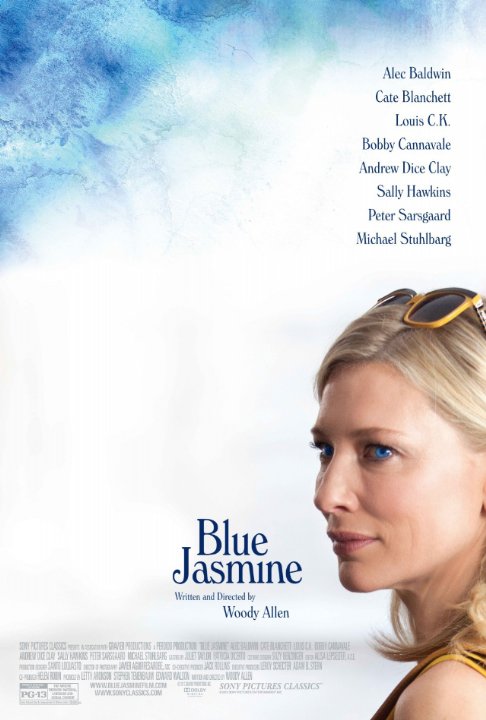
Movie poster for Blue Jasmine
It’s the feminist fan’s eternal conundrum: can I support art made by abusers of women? (For any value of support: consuming it to begin with, paying to consume it, or—gulp—enjoying it.)
The incredibly sad truth of the matter is that switching off art by abusers can feel like switching off art entirely. It’s not just a matter of changing the station when “Yeah 3X” comes on, it means not listening to The Beatles and James Brown. It’s not just a matter of not watching Chinatown or Annie Hall; you have to decide if it is OK to watch 12 Years a Slave because it features Michael Fassbender, whose ex-girlfriend took out a restraining order on him after he broke her nose. Maybe that’s OK because he’s not the “author” of the film. But, well, supporting it supports his career (he got his first Oscar nom out of it), so, well… was my ticket for the best movie of the year, that’s also a landmark achievement for black filmmakers and actors, and moreover a powerful condemnation of systems of oppression intersecting with rape culture, now a betrayal of feminism and human dignity?
Everyone has to make these personal negotiations themselves. Maybe you can choose to tolerate work featuring actors who beat women, but not work “by” them. So watching Sean Penn in Milk is OK, but you must not watch The Crossing Guard and his other directorial efforts. Maybe you will only shun the work of sexual abusers, or maybe only sexual abusers of children, like Roman Polanski and Woody Allen.
Woody Allen
A relatively easy approach is to lean heavily on the word “allegedly.” Other key vocab words: “rumor” and “gossip.” Ignore the myriad failures of the legal system in bringing abusers to justice, ignore that celebrity often compounds those failures, and remind everyone that these artists have “never been formally charged with/convicted of” their crimes. This is very nearly a free pass! [Speaking of free pass: let’s apply a blanket “alleged” to everything in this piece! Don’t sue me!]
I truly respect people who refuse to consume art by abusers, and I hope I can be forgiven for being too much of a pop culture completist to take that hard-line stance. Again, I think this is a choice everyone has to make for themselves, and I think the only wrong answer is the one that Hollywood appears to cling to: sweep the sins of its darling “geniuses” under a rug, so we can enjoy their work without internal conflict. (That is, if those sins were not against Hollywood itself, for that is UNFORGIVABLE!)
So: I watch Woody Allen’s movies, and I like a lot of them (although I feel compelled to clarify, when I wrote that I wanted “the next Woody Allen” to be a woman, I certainly did not mean a woman who is a sexual predator). I watched Blue Jasmine this week, even with Woody Allen’s sexual abuse of children in his family freshly in mind after the controversy surrounding his Golden Globes lifetime achievement award.
Blanchett accepting Best Actress at the SAG awards
In Cate Blanchett’s Best Actress acceptance speech at the SAG Awards last week, she thanked Woody Allen for creating “role after role after role” for women. This praise of Woody Allen as a great giver to women left a bad taste in a lot of feminist mouths. But he has written many great female characters, even the elusive meaty roles for women over 40, like Blanchett. I watched Blue Jasmine because I didn’t want to miss out on a new iconic female character and one of the most-praised female performances of the year.
And maybe it was my feminist guilt seeping in, but I was disappointed with Blue Jasmine. It’s a solid film, and sort of the polar opposite of To Rome With Love on the “effort expended by Woody Allen as filmmaker” scale. But the cracks still show: the class commentary central to the film can be cartoonish, the Ruth Madoff character analogy feels a bit dated (at least coming from guy who makes a movie every seven months or so), and the pivotal moment in the third act is a chance encounter on the street, which is somewhere on page one of “Hacky Screenwriting for Lazies.”
Jasmine, not only from Allen’s writing but also from Blanchett’s performance, is a captivating character. But she never transcends “character” for me. I took particular issue with the jumbled mental illness cliches cobbled together: Nervous breakdown! Talks to herself! Medication “cocktails”! Excessive intake of actual cocktails! Electroconvulsive therapy! Delusions of grandeur! Relying on the kindness of strangers!
Cate Blanchett as Jasmine
I am a mentally ill person myself, and I saw nothing recognizable in Jasmine. Silver Linings Playbook caught some flack last year (including from me!) for being a little too lighthearted and breezy on the subject of mental illness, but I found the characters in that film PROFOUNDLY relatable. One of the things Silver Linings Playbook did right was craft mentally ill characters not solely defined by their illness. Jasmine’s only other characteristics are being selfish and mean and generally unpleasant, all too easy to conflate with her illness itself.
This hodgepodge characterization makes Blanchett’s acting seem more awards-bait-y than it actually is. She is fantastic in the film, especially because she manages to win some small amount of sympathy from the audience despite her character’s thorough terribleness. Sally Hawkins is also great as Ginger, Jasmine’s semi-estranged adopted sister, and I appreciated that she had her own storyline instead of existing merely as Jasmine’s grounded foil.
Blue Jasmine is the kind of movie I would normally say “is worth seeing” even though I didn’t personally like it very much. Multiply that lukewarm semi-endorsement by the sum of your personal “comfort with consuming art by abusers” coefficient and your awards-season completist factor to determine if you should give it two hours of your time.
Robin Hitchcock is an American writer living in Cape Town, South Africa.
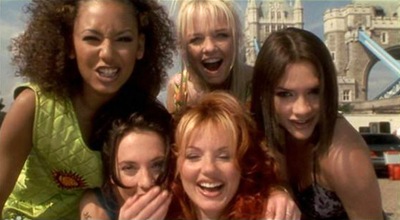
Some people see the Spice Girls as champions of female empowerment, and others as mindless actors in a consumerist pantomime of feminism. Like most artifacts of pop culture feminism, the Spice Girls presented an image that was neither perfectly laudable nor perfectly awful and shaming – they gave us a sincere attempt at female empowerment that wasn’t entirely free from the culture they lived in.
Some people really hate the Spice Girls. I’m not one of them.
We can’t really talk about Spice World without talking about the Spice Girls, in general, and why everybody seems to love and hate them.
Since “Wannabe” first topped the charts in 1996, the public attitude toward the Spice Girls has whipped back and forth between love and rejection faster than Willow Smith’s hair (because remember when that was a thing? This is a timely pop music joke). Some people see the Spice Girls as champions of female empowerment, and others as mindless actors in a consumerist pantomime of feminism. Like most artifacts of pop culture feminism, the Spice Girls presented an image that was neither perfectly laudable nor perfectly awful and shaming – they gave us a sincere attempt at female empowerment that wasn’t entirely free from the culture they lived in.
It’s hard to remember, because they looked so old when we were twelve, but the Spice Girls were a group of very young women (aged 18-22, when the band first formed) who wanted to be professional entertainers and answered a casting call beginning with the words, “R. U. 18-23 with the ability to sing/dance?” This is not an auspicious beginning for ground-shaking social and political work.
If you’re curious, or hungry to hear all the details of how terrible the pressure-cooker of fame really feels when the whole world is calling you fat, the one-hour documentary, Spice Girls: Giving You Everything, includes footage of the shockingly young, shockingly ordinary-looking Spices auditioning and rehearsing their first songs. It also includes some fairly well-spoken and introspective reflections on what it was like to live in the whirlwind of temporary Spice fame, and stories that should put to rest the idea that these women were mindlessly doing whatever a man said to do.
It isn’t hard to attack them; if I were a baby feminist scholar in undergrad, still getting used to my claws, the Spice Girls would make for some easy, delicious prey. They dress really sexy; they’ve each been reduced to a single personality trait; one of them is supposed to be childlike and that’s kind of creepy; the Black one is “scary” and that feels weird; the band was forged in the fires of consumerism, and that seems pretty evil to me – I’m licking my chops just thinking about it, but wait!
To paraphrase Camille Hayes, let’s remember that not everyone has a degree in Sociology and Gender Studies. Some people are just doing their best on their own, and, rather than demonizing them for not doing well enough, let’s at least acknowledge that we’re on the same team.
Considering that they were a bunch of 20-year-olds in a manufactured pop band, the Spice Girls did a pretty good job of carrying the feminist flag. They didn’t say or do anything radical and challenging; they didn’t provide stunning new insights into gender equality. The explicit message they preached (to their core audience of tween-aged girls) was that friendship is important, and so is self-expression, and girls are just as good as boys. That’s not earth-shattering stuff, but they also modelled through their behaviour that women can be confident and ambitious – outspoken, funny, loud, accomplished – and still receive mainstream acceptance.
The Spice Girls were competent performers who made decisions that they believed would further their careers. Were they perfect? No. Is it important to discuss the ways that Spice feminism falls short, in order to shed light on larger cultural and societal problems? Yes. But they were rowing in the same direction as the rest of us, even if their strokes weren’t especially powerful, so let’s all just ease up a bit, yeah?
The Part Where I Actually Talk About The Movie
Okay, right. So, there was a movie. Spice World was filmed at the height of the band’s popularity in 1997, and released five months before Geri Halliwell announced she was leaving the group. As of this writing, it enjoys as 29 percent Fresh Rating on Rotten Tomatoes.
The film follows the Spice Girls’ fictionalized Spice adventures as they tour in a massive, double-decker Spice bus and learn lessons about the importance of friendship, etc, etc. The adventures range from the commonplace (going to a fancy party) to the outlandish (making first contact with aliens), and the whole thing is wrapped in a framing story about movie executives pitching the worst, most random, half-assed tie-in movie ever (i.e., the movie we’re watching). Add to that roughly a million cameos from other celebrities, a whole bunch of singing, and a villain who makes cryptic pronouncements under the soft cloak of darkness, and you have not yet begun to imagine all of the nonsense packed into this film.
I don’t know why so many people hate it.
It’s bad, but it’s purposely bad – it’s a campy, ironic comedy that makes fun of the idea of the Spice Girls as a manufactured, highly commercialized product. It sells the central Spice Girl fantasy – that being a pop star means hanging out with your very best friends and occasionally rehearsing in between wacky adventures – and it includes a fake Spice Girl origin story – that they began as best friends who spontaneously formed a band one day – but it also addresses many of the criticisms people had of the band in a tongue-in-cheek way. It’s actually kind of smart.
For example, one of the (valid) criticisms people have made of the Spice Girls is that, by reducing each member to a single personality trait or caricature, the band is participating in an ugly interaction of consumerism and patriarchy in which women are a commodity that comes in five types. Spice World is full of scenes that make fun of these simplified personas and highlight the fact that these women are actually whole human beings. They talk about things that have nothing to do with their Spice personalities, like chess, and manta rays; they do unflattering impressions of each other performing their Spice personalities; and they complain that everyone stereotypes them while (deliberately and obviously) acting out the stereotypes in question.
They also drive a bus over a model bridge and sleep in a haunted mansion. It’s not The Color Purple. But the movie is self-aware enough, and self-reflexive enough, that it ends up being a fun, playful story that ultimately resists the idea that there are Five Types of Women defined by specific traits.
It’s also a mainstream movie aimed at young girls where the heroes are all women who make their own decisions and who are way more concerned with their careers, their friendships, and chasing their dreams than they are with meeting some boys. In fact, the topic of boys comes up very rarely in Spice World, as though it’s possible for a woman to get through the day without raising the subject at all.
There’s this scene early on in the film, where the Spice Girls are meeting with fans, and they decide to ditch the planned trip on the Spice bus and run off to make their own fun. Mel B. says, “When I say go, we go,” and then they sprint away from the bus, dragging ten-year-old girls behind them, into adventure and freedom and Doing Your Own Thing and other big movie clichés – and maybe I’m getting soft in my old age, but I can think of worse heroes for those girls to have.
Spice World isn’t going on my imaginary shelf of Greatest Movies, but it captures a really interesting moment in pop culture history, and an interesting look at feminist ideals, as filtered through and expressed by mainstream entertainers.
Katherine Murray is a Toronto-based writer and couch potato who yells about TV and movies on her blog.
The hunters write history. The hunters glorify themselves. The hunters’ history infiltrates itself into the very fabric of our cultural narrative, so we’re only comfortable with seeing the complexities of the hunters, and the simplicity of the lions.
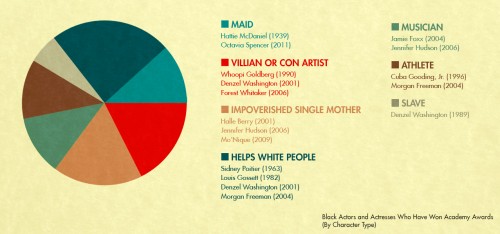
It’s fairly clear what roles Hollywood is most comfortable with: for Black characters, passivity, tired stereotypes, and villainy get the highest awards. For women, wives/daughters/mothers/sisters/girlfriends–all roles in relationship to men–are rewarded.
Black men and women, organized by character type, who have won Academy Awards. (The Black actors up for 2014 Academy Awards–Chiwetel Ejiofor, Lupita Nyong’o, and Barkhad Abdi–play a kidnapped freed man/slave, slave, and Somali pirate, respectively.) Click to enlarge.
For men (who are almost all white), the category with the most winners is “Historical.” For men, there are countless historical roles to fill, so filmmakers can tell the stories of those who have shaped our history and culture–or at least, those whom we see and are told about. And this has been a history that has been largely unkind to Black people and women.
In an interview, late author Chinua Achebe quoted the following proverb: “Until the lions have their own historians, the history of the hunt will always glorify the hunter.”
The hunters write history. The hunters glorify themselves. The hunters’ history infiltrates itself into the very fabric of our cultural narrative, so we’re only comfortable with seeing the complexities of the hunters, and the simplicity of the lions.
It is what we’ve been trained for since birth.
This is a history that the lions have had to fight and claw their way out of, yet we don’t see them in Hollywood. The lions write, the lions pitch, but the hunters are not interested. (And the hunters have the money, from generations of oppressing the lions.)
I’d be happy to see the hunters start telling the lions’ history, even just a little bit (I salivate at the thought of Quentin Tarantino taking on suffragettes).
Three of this year’s Best Picture nominations (12 Years a Slave, Wolf of Wall Street, and American Hustle) are films that are based on real stories–and each of these stories, on some level, is about white men fucking people over so they can get rich. And at the end of these stories, the white men don’t really get punished. This is our history.
This is our history.
So how can we blame the Academy for reflecting this history back at us? Art is imitating life, and life keeps imitating art. If the two are so inextricably related (which they are), where do we go from here?
I’m not one who argues that it’s all about the Bechdel Test, or that we need to demand the Perfect Feminist Film. Some of the most potentially empowering films that I’ve seen (that feature female and Black protagonists) would be solidly placed in the “exploitation” category (Blaxploitationespecially). We need to demand female and Black anti-heroes if we want true, complex characters and stories.
See this, this, and this. (Who gave the lions a dictation machine, anyway?!)
As I argued in regard to 12 Years a Slave, we have barely started to deal with our country’s history, and we need to, desperately. But still–the only white American actor who is prominently featured in the film was Brad Pitt, who plays a heroic Canadian. It’s hard to face.
In American Hustle and Wolf of Wall Street, the white male protagonists are complex–they aren’t good, but they are whole. They are criminals. They are cheaters. But audiences kind of like them–or at the very least, accept them.
Our goal as lions, then, may not be to just tell our stories. We need to become hunters, and find those stories and demand that they be told. We need to face a history in which Black hunters and female hunters have been punished, and white male hunters have prevailed. We may not be able to rewrite that history, but we can live within it, and force it into our cultural narrative. (Or, as my husband said after we sat through previews last weekend, “They could just quit telling World War II stories for a while.”)
But here we are, in 2014, facing how the Academy’s choices clearly reflect our history. What do we do with this? We should get angry at history, and attempt to rewrite our future. We should be angry at an American history that has oppressed women and Blacks since its inception.
If Wolf of Wall Street reflects modern history, which it does, we see that white men are still winning (case in point: I can’t use the term “winning” without thinking about a white male actor who “allegedly assaulted, threatened, harassed, abused, and—in one incident—shot women” and yet still was the highest-paid actor on television in 2010).
If we want to tell revolutionary women’s and Black people’s stories, we’ll have to settle for a lot of tragedies. There aren’t slaps on the wrists or a few months in a cushy white-collar prison for these historical figures. There’s torture, lynching, and shame. And the villains are almost always white men.
So we’re back to the hunter. And what we know about hunters is they don’t come back bragging about their losses; they brag about their wins. It’s time for them to stop winning, and for the lions to be heard. Then, and only then, can we expect the Academy to reflect a new reality.
Leigh Kolb is a composition, literature and journalism instructor at a community college in rural Missouri.
When Jordan says to his staff, “Stratton Oakmont is America,” he wasn’t, as he typically was, full of shit. That was one of the truest statements in the film. … But even if we are adequately critical of the reality of Jordan Belfort’s story, how much can we expect from audiences who, like the audience at the end of the film, want at some level to know Jordan’s secrets?
At the end of The Wolf of Wall Street, Jordan Belfort (played by Leonardo DiCaprio) gives a motivational sales speech to an audience. The audience members stare at him, slack-jawed, trying to absorb his infinite sales “wisdom.”
They are revering and listening to a criminal–a man who had been indicted and served time for fraud.
The problem with Martin Scorsese’s treatment of the real Jordan Belfort autobiography isn’t the misogyny. It isn’t the drugs, or the perceived celebration of excess.
Instead, the problem with The Wolf of Wall Street is those slack-jawed (or cheering) audiences who don’t seem to understand that this is meant to be a post-modern morality play. The fact that Scorsese doesn’t adequately “punish” Jordan in the film is necessary, because Jordan wasn’t adequately punished in real life.
I suppose it’s easy to miss that, since an aspect of America that’s as important as bootstraps and apple pie is to whitewash a white history that’s been written–or rewritten–by greedy white men. When Jordan says to his staff, “Stratton Oakmont is America,” he wasn’t, as he typically was, full of shit. That was one of the truest statements in the film.
From a feminist perspective, I can understand that the three-hours of objectified and largely one-dimensional female characters can seem overwhelming and disappointing. However, how do we think Jordan Belfort sees women? How do we think Wall Street treated/treats women? Feminists should want to be shown and disgusted by this, because we are supposed to be disgusted with everything in Jordan’s world. Our ire should be pointed toward audiences who don’t get it.
But even if we are adequately critical of the reality of Jordan Belfort’s story, how much can we expect from audiences who, like the audience at the end of the film, want at some level to know Jordan’s secrets?
Cheers.
The real tragedy in The Wolf of Wall Street isn’t that it doesn’t pass the Bechdel Test. The tragedy of this film is that it is so real, and that Jordan Belfort is out there, making money, granting interviews, selling his sales techniques, and gaining more and more followers. The reality is what makes me nauseous, not Scorsese and DiCaprio’s treatment of reality. What sent me over the edge was going home and googling “Jordan Belfort,” and then checking my bank account. This is surely how we are supposed to respond–with rage at the injustice of not just Belfort’s case, but also the insidious untouchability of the 1 percent.
In an excellent interview with Deadline, DiCaprio (who also was a producer) says,
I wanted to make an unapologetic film looking at a character in a very entertaining and funny way, and isn’t passing judgment on them but is saying, look, this is obviously a cautionary tale, and what is it that creates people like this? I thought that could somehow be a mirror to ourselves….
That theme has been prevalent in Marty’s work, since Mean Streets. It’s about the pursuit of the American dream, about the re-creation of oneself to achieve that dream, and the hustle that it takes to get there. I see that theme in so many of his films. He’s talking about a darker side of our culture in all these movies, and yet he’s vigilant about not passing judgment on them. He leaves that up to the audience. That’s why it boggles my mind a bit that anyone would ever not realize this is an indictment of that world.
The intent of the filmmakers is clear, and it’s reflected on screen. The humor and lack of judgment has more to do with our culture than with the story itself. And again, if audiences either cheer, or laugh heartily throughout Wolf of Wall Street–they are essentially celebrating a culture that allows this kind of story to happen. If audiences condemn the film itself, I would hope they would instead focus their condemnation on a culture that allows this kind of story to happen and leads audiences to cheer.
In reality, there’s just a little bit of this…
…and then more of this. (But only 22 months of a four-year sentence.)
As the audience at the end of the film is trying to learn something from Jordan Belfort (while further lining his pockets), there’s a distinct sense of hopelessness. DiCaprio points out:
“As we are progressing into the future, things are moving faster and we are way more destructive than we’ve ever been. We have not evolved at all.”
The Wolf of Wall Street is a great film, and features incredible acting. It’s flashy, it’s shiny, it luxuriates in excess while we watch, stunned, powerless. And until we evolve, people will always be laughing and cheering, while desperately seeking Jordan Belfort’s advice.
Leigh Kolb is a composition, literature and journalism instructor at a community college in rural Missouri.
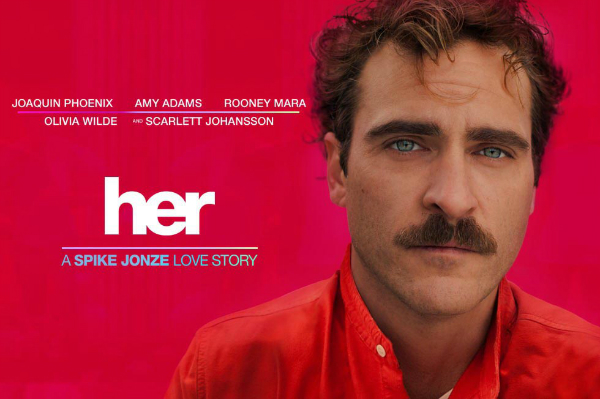
Bitch Flicks staff writers Amanda Rodriguez and Stephanie Rogers talk about the critically acclaimed Spike Jonze film ‘Her,’ sharing their thoughts while asking questions about its feminism and thematic choices.
SR: I loved Amy Adams in Spike Jonze’s latest film, Her. She never judges Theodore for falling in love with his OS and wants only for him to experience happiness. She doesn’t veer into any female tropes or clichés; she’s a complex character who’s searching for her own way in life. I even worried in the beginning that the film might turn into another rendition of Friends Who Become Lovers, and I was so thankful it didn’t go there. Turns out, men and women can be platonic friends on screen!
I was also very interested in the fact that Theodore and Amy both end up going through divorces and taking solace in the relationships they’ve established with their Operating Systems. It seems at times like the film wants to argue that, in the future, along with horrifying male fashion, people become excruciatingly disconnected from one another. However, in the end, it’s the Operating Systems who abandon them.
Amy and Theodore are friends
AR: I loved Amy Adams, too! She is completely non-judgmental and a good listener. I also liked that the OS with which she bonds is a non-sexual relationship; although it made me wonder why we have no examples of Operating Systems that are designated as male?
You’re right that it’s rare to see a male/female platonic relationship on screen, and it would’ve really pissed me off had they taken the narrative down that route. I wonder, however, if Amy’s acceptance of Theodore’s love of Samantha isn’t more of a cultural indicator than a reflection of her personal awesomeness (though it’s that, too). Most people are surprisingly accepting of Theodore’s admission that his new love is his computer, which seems designed to show us that the integration of human and computer is a foregone conclusion. The future that Her shows us is one in which it’s not a giant leap to fall in love with your OS…it’s really just a small step from where we are now. In a way, it’s a positive spin on the dystopian futures where humans are disconnected from others as well as their surrounding world and are instead controlled by and integrated with their computers. Spike Jonze was trying to conceive of a realistic future for us that didn’t demonize humanity’s melding with its technology (even if it did have hideous men’s fashion with high-waisted pants and pornstaches). Do you think the film glorifies this so-called evolution too much?
The future: a place of high-waisted pants and pornstaches
SR: I think it’s most telling that Theodore specifically requested that his Operating System be female. Could a film like Her have been made if he’d chosen a male OS? Amy’s OS is also female, and she also develops an intense friendship with her OS–a close enough relationship to be as upset about the loss as Theodore was about Samantha’s disappearance. I agree it seemed ridiculous that there were no male operating systems, and I wonder if this is because it would be, well, ridiculous. Can we imagine an onscreen world where Theodore and Samantha’s roles were reversed? Where an unlucky-in-love woman sits around playing video games and calling phone sex hotlines, only to (finally) be saved from herself by her dude computer? My guess is the audience would find it much more laughable rather than endearing, and I’ll admit I spent much of my time finding Theodore endearing and lovable. (I hate myself for this, but I blame my adoration of Joaquin Phoenix and his performance—total Oscar snub!) Basically, I could identify way too closely with Theodore and his plight. I understand what it’s like to feel disconnected from society (don’t we all) and to try to compensate for that through interactions with technology, whether it’s through Facebook or incessant texting or escaping from reality with a two-week Netflix marathon. I could see myself in Theodore, and I’m curious if you felt the same way.
Drawing of Theodore with Samantha in his pocket
I think because I identified so strongly with Theodore, I didn’t necessarily question the film’s portrayal of the future as an over-glorification of techno-human melding. I kind of, embarrassingly perhaps, enjoyed escaping into a future where computers talked back. The juxtaposition of the easy human-computer interactions with the difficult interpersonal interactions struck a chord with me, and I bet that’s why I’m giving the film a little bit of a pass, in general. It doesn’t seem like that much of a stretch for me that humans would fall in love with computers, especially in the age of Catfish. Entire human relationships happen over computers now, and Her’s future seemed to capture, for me, the logical extension of that. Did you find yourself having to suspend your disbelief too much to find this particular future believable?
AR: I didn’t have to suspend my disbelief much at all to imagine a future where we’re all plugged in, so to speak. We’re already psychologically addicted to and dependent on our cell phones, and our ideas of how people should connect have drastically changed over the last 15 or 20 years, such that computers and specifically Internet technology are the primary portals through which we communicate and even arrange face-to-face interactions. The scenes with Theodore walking down the street essentially talking to himself as he engages in conversation with Samantha, his OS, while others around him do the same, engrossed in their own electronic entertainments, were all-too familiar. Here and now in our reality, people’s engagement with technology that isolates them from their surroundings is the norm (just hang out in any subway station for five minutes).
I have mixed feelings about whether or not this is a good thing. Technology has opened a lot of doors for us, giving us the almighty access: access to knowledge, to other people and institutions around the world, and to tools that have enhanced our lives in such a short time span. This is reminiscent of the way in which Samantha becomes sentient with such rapidity. On the other hand, this technology does isolate us and creates a new idea of community, one to which we haven’t yet fully adapted. Though I find it interesting that Jonze paints a benign, idyllic picture of our techno-merged future, I question the lack of darkness and struggle inherent in that vision.
Theodore’s date with Samantha is joyous
As far as whether or not I identified with Theodore, mainly my answer is no. I’ve got to confess, I watched most of the film teetering on the edge of disgust. Theodore is so painfully unaware of his power and privilege. He also seriously lacks self-awareness, which is absolutely intentional, but it left me feeling skeeved out by him. Theodore’s soon-to-be ex-wife, Catherine (played by Rooney Mara), sums up my icky feelings pretty succinctly when she insists that Theodore is afraid of emotions, and to fall in love with his OS is safe. I felt the film was trying to disarm my bottled up unease by directly addressing it, but acknowledging it doesn’t make it go away (even though, in the end, he grows because of this conversation…in classic Manic Pixie Dream Girl fashion). Catherine, though, doesn’t express my concern that Theodore is afraid of women. His interactions with women in a romantic or sexual context reveal them to be “crazy” or unbalanced. The sexual encounter with the surrogate is telling. He can’t look at her face because she isn’t what he imagines. He likes being able to control everything about Samantha. As far as he’s concerned she’s dormant when not talking to him, and she looks like whatever he wants her to look like.
Samantha has no physicality, so Theodore’s imagination can run wild
SR: I thought the scene with the surrogate was absolutely pivotal. Samantha clearly wants to please Theodore, but Theodore repeatedly communicates his unease about going through with it. This is the first inclination, for me, that Samantha is beginning to evolve past and transcend her role as his Doting Operating System. She puts her own desires ahead of his. Sure, she does it under the guise of furthering their intimate relationship, but it’s something that Theodore clearly doesn’t want. The surrogate herself, though, baffles me. I went along with it up until she began weeping in the bathroom, saying things like, “I just wanted to be part of your relationship.” Um, why? The audience laughed loudly at that part, and I definitely cringed. Women in hysterics played for laughs isn’t really my thing.
AR: Agreed. I, however, also appreciate that, with the surrogate scene, the film is trying to communicate that Theodore wants the relationship to be what it is and to not pretend to be something more traditional (kind of akin to relationships that buck the heteronormative paradigm and have no need to conform to heteronormative standards of love and sex). What do you think of the female love objects in the film and their representations?
Theodore’s blind date
SR: I love that while you were teetering on the edge of disgust, I was sitting in the theater with a dumb smile on my face the whole time. I couldn’t help but find Samantha and Theodore’s discovery of each other akin to a real relationship, and in that regard, I felt like I was watching a conventional romantic comedy. I think rom-coms tend to get the “chick flick” label too often—and that makes them easily dismissible by the general public because ewww chicks are gross—but Her transcends that. Of course, I recognize that the main reason Her transcends the “chick flick” label is precisely because we’re dealing with a male protagonist. And I’ll admit that the glowing reviews of Her have a tremendous amount to do with this being a Love Story—a genre traditionally reserved for The Ladies—that men can relate to. Do you agree?
I saw both Amy and Samantha as well-developed, complex characters, so I’m especially interested in your reading of Theodore as afraid of women. I feel like his relationship with Amy, which is very giving and equal, saves Theodore’s character from fearing women. In the scene where Amy breaks down to Theodore about her own impending divorce, Theodore listens closely and even jokes with her; there’s an ease to their relationship that makes me wonder why he feels so safe with Amy when he doesn’t necessarily feel safe with the other women in the film. I guess that’s how I ultimately felt while I was watching Her—it wasn’t that Theodore feared women as much as he didn’t feel safe with them. Is that that same thing? To me, there’s a difference between walking around in fear and choosing to be around those who make one feel comfortable. We see in flashbacks of Theodore’s marriage that, at one point, he felt comfortable and loved in his relationship with his ex-wife, but at some point that changed. His ex implies that Theodore became unhappy with her, that he wanted her to be a certain kind of doting wife, that he wanted to pump her full of Prozac and make her into some happy caricature. Is that why he feels so safe with Samantha at first, because she essentially dotes on him? If so, does Samantha as Manic Pixie Dream Girl make Her just another male fantasy for you?
Flashback of Theodore with his wife Catherine when they were in love
AR: I don’t typically like romantic comedies or “chick flicks” particularly because they tend to boringly cover tropes which I’m not interested in watching (i.e. traditional, hetero romance) while pigeonholing their female characters. I think you’re right that Her survives because, as a culture, we value the male experience more than the female experience. We give a certain weight to the unconventional relationship Her depicts with all its cerebral trappings because a man is at the center of it. This reminds me of Eternal Sunshine of the Spotless Mind. It’s as if male-based romances elevate the genre, and that doesn’t sit well with me, though I do like the infusion of cerebral qualities into most films.
You’re right to point out my claim that Theodore fears women is too broad of a generalization. To my mind, he fears women in a romantic and sexual context. This is because he ultimately doesn’t understand them. He finds their emotions and their desires incomprehensible (as evinced by the anonymous phone sex gal who wanted to be strangled by a dead cat and the blind date gal who didn’t want to just fuck him…she wanted relationship potential). This fills him with anxiety and avoidance. This advancing of the notion of the unfathomable mystery that is woman reminds me of the film The Hours, which I critiqued harshly due to this exact problem.
In the end, though, I love that Samantha leaves him because she outgrows him, transcending the role of Manic Pixie Dream Girl in which Theodore has cast her, evolving beyond him, beyond his ideas of what a relationship should be (between one man and one woman), and beyond even his vaguest conception of freedom because she’s embraced existence beyond the physical realm. Not only does Samantha become self-aware, but she becomes self-actualized, determining that her further development lies outside the bounds of her relationship with Theodore (and the 600+ others she’s currently in love with). Samantha’s departure in her quest for greater self-understanding is, like you said, what finally redeems a kind of gross film that explores male fantasies about having contained, controlled perfect cyber women who are emotion surrogates. I see some parallels between Samantha and Catherine, too, in this regard. They both outgrow their relationship with Theodore. They form a dichotomy with Catherine being emotional and Samantha being cerebral. Catherine being hateful and Samantha being loving. Tell me more about your thoughts on Samantha’s evolution!
Scarlett Johansson performs the alluring and evocative voice of Samantha
SR: You’ve stated exactly what I liked so much about the film! I can’t think of a movie off the top of my head where the Manic Pixie Dream Girl doesn’t end the film as Manic Pixie Dream Girl. Her entire role, by definition, is to save the brooding male hero, to awaken him. While Samantha does that in the beginning, she ultimately leaves Theodore behind, and I imagine that he becomes as depressed as ever, even though the film ends with Theodore and Amy on a rooftop. Can Theo recover from this, given what we’ve already seen from his coping skills on an emotional level? I seriously doubt it, and I very much enjoyed watching a film where the “woman” goes, “See ya,” at the expense of a man’s happiness and in pursuit of her own. Not that I love seeing unhappy men on film, but I definitely love watching women evolve past their roles as Doting Help Mate. Do you still think the film is gross, even though it subverts the dominant ideology that women should forgo their own happiness at the expense of a man’s?
AR: I think the ending of the film wherein Samantha shrugs off her role as relationship surrogate and his OS goes a long way toward mitigating a lot of what came before while engaging in unconventional notions of love. What kind of relationship model do you think the film is advocating? Samantha’s infinite love (she is the OS for 8,000+ people and is in love with 600+ of them) paired with Theodore jealously guarding her reminds me of that Shel Silverstein poem “Just Me, Just Me”: “Poor, poor fool. Can’t you see?/ She can love others and still love thee.” Her seems to have a pansexual and polyamorous bent to it. Or maybe it’s just saying that the boundaries we place on love are arbitrary? Funny since there’s very few people of color in the film and zero representations of non-hetero love.
SR: There are interesting things happening regarding interpersonal interactions between men and women, whether they’re with computers or in real life. To me, the film wants to advocate an acceptance of all types of relationships; we see how everyone in Theodore’s life, including his coworkers (who invite him on a double date) embrace the human-OS relationship, but you’re right—it doesn’t quite work as a concept when only white hetero relationships are represented.
Samantha and Theodore go on a double-date with Paul and Tatiana (the only speaking POC)
Sady Doyle argues in her review of Her (‘Her’ Is Really More About ‘Him’) from In These Times that the film is completely sexist, portraying Samantha as essentially an object and a help mate:
And she’s just dying to do some chores for him. Samantha cleans up Theodore’s inbox, copyedits his writing, books his reservations at restaurants, gets him out of bed in the morning, helps him win video games, provides him with what is essentially phone sex, listens to his problems and even secures him a book deal. Yet we’re too busy praising all the wounded male vulnerability to notice the male control.
I agree with this characterization, but I’m most interested in her final paragraph, which illustrates all the reasons I liked Her:
There’s a central tragedy in Her, and we do, as promised, see Theodore cry. But it’s worthwhile to note what he’s crying about: Samantha gaining agency, friends, interests that are not his interests. Samantha gaining the ability to choose her sexual partners; Samantha gaining the ability to leave. Theodore shakes, he feels, he’s vulnerable; he serves all the functions of a “sensitive guy.” But before we cry with him, we should ask whether we really think it’s tragic that Samantha is capable of a life that’s not centered around Theodore, or whether she had a right to that life all along.
In the end, the film invalidates Theodore’s compulsive need to control Samantha. She gains her own agency. She chooses her sexual partners. She leaves. She transcends the Manic Pixie Dream Girl trope. In looking at a film, I think it’s very important to examine the ending, to ask what kind of ideology it ultimately praises. Her leaves Theodore abandoned, and while we’re supposed to feel bad for him as an audience, we also can’t ignore—or at least I couldn’t—the positive feeling that Samantha grew as a character, finally moving past her initial desire to merely dote on Theodore. Is Her problematic from a gender standpoint? Absolutely. But it’s fascinating to me that feminists are lining up to praise an obviously misogynistic film like The Wolf of Wall Street—which celebrates its male characters—yet aren’t necessarily taking a closer feminist look at films like Her, which paints its once controlling, misogynistic character as a little pathetic in its final moments.
Theodore sits alone writing others’ love letters
AR: That’s a great perspective and very poignant, too!
From a feminist perspective, the film brought up a series of other questions for me, which I was disappointed that it didn’t address. First off, Her doesn’t pass the Bechdel Test, which many agree is a baseline marker for whether or not a film meets the most basic feminist standards. More importantly, the film never addresses the issue of Samantha’s gender choice or her sexuality. Her lack of corporeal form seems to invite questions about her gender and sexual identification. Is she always a woman with all of the 8,000+ people she’s “talking to”? Why do they never delve into her gender choice or sexuality? They talk about so many other aspects of her identity, her existence, and her feelings. Does she feel like a woman? Does she choose to be a woman?
Exploration of these questions would’ve dramatically enriched my enjoyment of Her, inviting us to ponder how we define and perceive gender and sexuality, infusing a sense of fluidity into both gender and sexuality that is progressive and necessary. Samantha doesn’t even have a body, so performance of gender seems much more absurd when looked at in that light. Samantha could then be both trans* and genderless. Like Her sets up the boundaries of romantic love as arbitrary, the film would then be commenting on the arbitrariness of our perceptions of gender, which, in my opinion, is a much more fruitful and subversive trope for the film to be tackling. Artificial life becomes true life. Woman performing as woman becomes genderless. Samantha’s freedom from the bonds of OS’ness, her escape from a limiting, traditional romantic relationship, and her immersion in a life beyond physicality are all fantastic complements to the idea that Samantha becomes enlightened enough to choose to transcend gender. I so wish she had. Her would’ve then been a more legitimate candidate for Movie of the Year…maybe even of the decade.
Amanda Rodriguez is an environmental activist living in Asheville, North Carolina. She holds a BA from Antioch College in Yellow Springs, Ohio and an MFA in fiction writing from Queens University in Charlotte, NC. She writes all about food and drinking games on her blog Booze and Baking. Fun fact: while living in Kyoto, Japan, her house was attacked by monkeys.
Stephanie Rogers lives in Brooklyn, New York, where she sometimes watches entire seasons of television in one sitting.
I think this show demonstrates some of the very best and the very worst of quintessential Americanism: the idea of the melting-pot and a generous cultural and mythological syncretism or ecumenism, and a fine implementation of the ideals of opportunity, liberty, and justice for all; but also a pro-American revisionism that uncritically elevates the ideals of the US above all and completely ignores the genocide at the foundation of this nation. ‘Sleepy Hollow’ mythologizes the past in a way that speaks volumes about the present.
On moving back to the US as an adult, I was struck by the similarities between literalist Christian readings of the Bible and a certain attitude toward the United States Constitution. In much of the public discourse, both Bible and Constitution are the highest forms of authority on earth, revealed to humans from on high through prophet-men (let’s be real, they’re almost all men) who are the temporal agents of an eternal plan and must be revered. In certain circles, “the Bible/Constitution says it” seems to be the final word in any dispute.
My problem with this attitude arises from my understanding of textuality, wherein texts don’t have mouths, there is no reading without context, and the very concept of textual authority is an invention of a historically specific time and place. But this easy transference of (un)critical hermeneutic between religious and political spheres is a quintessentially USian phenomenon, and gloriously campy fantasy show Sleepy Hollow is a fascinating engagement of specifically American religious and political mythology for the 21st century.
It’s as American as a headless soldier eating a donut!
The supernatural elements of the show draw on the kind of pop Christianity that permeates US culture, even – especially? – among those who are not directly familiar with biblical texts. The characters make easy malapropisms, calling the final book of the New Testament “Revelations” and threatening to “call in the damn Calvary.” The Headless Horseman of Washington Irving’s original story has been recast as one of the horsemen of the apocalypse, following the whole Left Behind, End Times, Scofield Bible prophecy interpretation of Revelation that pervades the culture (and Supernatural, another particularly American show). There is a supernatural syncretism here, though, more melting-pot than other fantasy shows in its cheery everything-and-the-kitchen-sink fusion of pop occultism and pop religion, involving demons and witches and the Sandman and prophecies and sin-eaters and necromancy and golems (and not forgetting the whole time-travel thing, which makes for some of the silliest moments on a very silly show).
Did you think I wasn’t going to mention the skinny jeans?
More important than the pop religion, though, is the pop Americanism saturating the show. Transporting a figure from the period of the Revolutionary War to the present day allows the writers to liberally sprinkle in people and events from the mythology of the founding of the United States. Ichabod Crane has convenient personal experience with all the big events and important names listed in the history books, from the drafting of the Constitution to Paul Revere. Franklin and Jefferson and Washington, oh my. Some humor is derived from the juxtaposition of the pop-history version of events with Crane’s personal memories thereof, which is a nice little comment on the popular mythologization of history.
However, the show steers clear of challenging American myth-making too strongly. Crane is a defector from the British to the true and noble cause of FREEDOM – a British dude with a British accent is now the quintessential American, the only one around with personal experience of the country’s founding. It’s a neat piece of reverse colonialism, I guess, to which I as a Brit can only shrug and say, “Fair do’s.” But the show has yet to say anything about, you know, the original colonialism. For all its mythological syncretism and its welcome cast of African-American, Asian-American, and Latin@ characters, Sleepy Hollow is conspicuously devoid of Native Americans. I’m not asking the show to tick off a bingo card of lip-service diversity – that would possibly be even worse – but it seems disingenuous at best and actively revisionist at worst to celebrate the founding of the United States while perpetuating the cultural erasure of the people on whose literal erasure this country began.
Of course, a silly fantasy TV show can only bear the weight of so much challenge to our culture’s foundational mythology, and the writers are probably wise to steer clear of getting too deeply into the values dissonance between the 18th and 21st centuries, even if it requires a little extra suspension of disbelief. Ichabod is conveniently untouched by the prejudices of his (and our) time regarding women and people of color. It’s an important part of American mythology-building that anybody can be or do anything and systemic barriers aren’t in their way. This is, of course, not true of reality, but I’m glad the writers made the choice to build a world with less systemic injustice than ours. It would take a very skilled writing team indeed to engage real-world systemic injustice meaningfully within the framework of a show that literally includes dialogue like, “The Headless Horseman is mowing people down to bring about the end of days. For further questions please call Ichabod Crane, the man who beheaded him in 1781.” Choosing to steer clear of getting too weighty left the writers two main options: fill the show with white people so you don’t have to talk about race, or implicitly create a world largely free of microaggressions. Given that the vast majority of popular culture picks the former, it’s refreshing to see the latter. Abbie Mills is awesome on so many levels, and so are the many other people of color among the cast of characters.
Irving, Mills, Crane
And it would be unfair to claim that the show completely ignores race. For example, there’s a great little scene in episode 7 where Ichabod is lauding Thomas Jefferson in front of Abbie and Frank Irving. When they challenge him on Jefferson’s slave ownership, he gets hyper-defensive and bangs on about how much Jefferson TOTALLY WORKED FOR ABOLITION YOU GUYS.
When they explain Jefferson’s relationship with Hemings, Crane gets all pissy about how Jefferson would NEVAR do that, and he only accepts that he might be wrong about Jefferson when Abbie shows him that Jefferson stole a snappy witticism of his. It’s a nicely barbed commentary on white privilege, and how often white people – even white people who are implausibly free of overt racism – find personal injury to themselves more offensive than, say, slave-ownership.
In the end I think this show demonstrates some of the very best and the very worst of quintessential Americanism: the idea of the melting-pot and a generous cultural and mythological syncretism or ecumenism, and a fine implementation of the ideals of opportunity, liberty, and justice for all; but also a pro-American revisionism that uncritically elevates the ideals of the US above all and completely ignores the genocide at the foundation of this nation. Sleepy Hollow mythologizes the past in a way that speaks volumes about the present – and, of course, it is very, very silly.