First Jane Tennison DCI: Revisiting ‘Prime Suspect’s Complex Lead

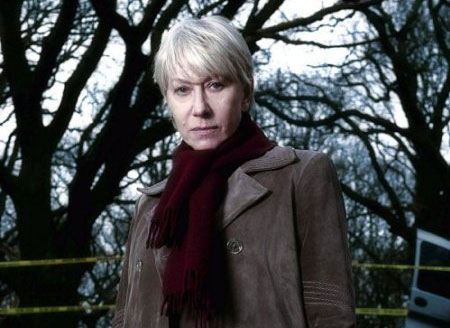
In the final episode of ‘Prime Suspect,’ the long-running British series, Jane Tennison (Helen Mirren), a hardworking, hard drinking detective who has sacrificed so much of her life for her job and made more than a few enemies, skips her own retirement party and walks out and into the rest of her life. In the other room, her colleagues are jovial, waiting for the stripper they hired, preparing balloons, and liberally dipping into the refreshments.
But Jane is uncertain.

In the final episode of Prime Suspect, the long-running British series, Jane Tennison (Helen Mirren), a hardworking, hard drinking detective who has sacrificed so much of her life for her job and made more than a few enemies, skips her own retirement party, and walks out and into the rest of her life. In the other room, her colleagues are jovial, waiting for the stripper they hired, preparing balloons, and liberally dipping into the refreshments.
But Jane is uncertain.

Jane in the final episode, the weight of everything she’s seen finally catching up with her.


She’s triumphant as she’s solved her last case, but it’s taken a clear toll on her. She’s tired, she’s unsure what else she can be other than a cop, is struggling with her alcoholism and the reality of how few people she has in her life to lean on, and yet, she’s free of the relentless politics and bureaucracy she’s faced throughout her career and has finished it she way she intended. For all she’s sacrificed, she’s lived the life she wanted and refused to compromise either personally or professionally. And after seven series of watching and cheering her on, we’re sure she’ll be okay. If she’d gone to the party, there’d be cause to worry about her.

Prime Suspect ran for seven series airing between 1991 and 2006, earning Emmys, Golden Globes, and BAFTAs as well as serving as an inspiration of several character-driven and female-led police dramas. The series was created by mystery writer Lynda La Plante after discovering there were only four female Detective Chief Inspectors (DCIs) in Scotland Yard at the time and Tennison was based on Jackie Malton, a celebrated officer with success in homicide, fraud, and robbery divisions.

Prime Suspect Title Card
Prime Suspect title card


The first series followed Jane’s journey to gain the respect of her male colleagues as she leads her first investigation, fighting to be taken seriously at every turn. The idea of the police force as a boys’ club colors much of the first series and  continues to a gradually lessening degree throughout the rest of show’s run as Jane earns respect (and contempt) for her own merit. Subsequent series feature groundbreaking investigations for a show of the time period, probing into institutional racism, pedophilia, agism, genocide, police brutality and misconduct and well as a rather shakily handled portrayal of gay prostitution, a mistreated Transwoman character, and a sensitive depiction of abortion.

Prime Suspect relentlessly delves into dark territory; the cases are horrific and the victims ghettoized by police bureaucracy, and without Jane at its centre, never losing focus of the goal of obtaining justice for the victims and securing convictions and Mirren’s fierce portrayal of her, it could easily become depressing and marred by its focus on interviews and interrogations over of gun fights and chases. Jane is the rare female character who is allowed to be flawed, yet continues to be likable both in the perspective of the narrative and in the viewer’s eyes. Even if you dislike her as a person, it’s impossible not to respect her and to be a bit awed by what she does. And she is not always easy to like.

The show doesn’t shy away from graphic forensic evidence and interesting police science, such as reconstructing a face from this skull
The show doesn’t shy away from graphic forensic evidence


From the start, Jane is abrasive and difficult, as in the first episode, she begins angling for a promotion right after her colleague dies. Frequently, she is too harsh on suspects after deciding their guilt and asked variations of, “What kind of person are you?” She also feigns empathy to get information, a tactic that works even accidentally as it becomes her default mode (notably in series 4). Most interestingly, Jane is often wrong and insensitive: she commits the cardinal sin of a woman in power by not supporting other women, goes after the wrong man and causes a hostage situation, appears racist for not wanting to work with a her former lover, a Black detective, as well as several other incidences.

In series 4, Jane’s breakthrough case is reopened and with her entire career called into question, she goes off investigate on her own. This involves visiting her suspect’s elderly mother, pretending to be a family friend and bringing her out to an isolated pier when Jane harshly interrogates her, in a manner bordering on abusive as the old woman grows increasingly frightened. In the end, she proves her suspect’s guilt but in a manner that sets her in the worst possible light for the audience.

Before she is given an investigation to lead, Jane is invisible to her male coworkers, who talk about cases around her, but never asking for her opinion
Before she is given an investigation to lead, Jane is invisible to her male coworkers, who talk about cases around her


As a leader, her refusal to compromise means she is determined to catch the guilty party, while her co-workers urge her just to get someone to confess, guilty or not. She’s tough, telling her squad in her first briefing, “All I ask is your undivided loyalty and attention. … You don’t like it, put in for a transfer.” She is also very clever, shown in series 2, when she eliminates a possible identity for a murder victim by putting her own watch with the victim’s effects and allowing her mother to falsely claim it.

Mirren’s acting skills are highlighted in tense interrogation scenes


But for all her prickly meanness and seeming detachment, Jane really cares about getting justice for victims and becomes deeply emotionally involved. After long periods of procedural drama, the show imbues a great deal of cathartic release in the moments when she celebrates a victory by pumping her fists and cheering and in the private moments where Jane, overwhelmed and exhausted, breaks down and cries.

It’s her frustrations dealing with bureaucracy or snags in her investigations that frequently lead her to do things like snap at her subordinates, splash wine on her supervisors, and find solace in smoking, drinking, and sex.

Prime Suspect is also noted for its straightforward depiction of workplace sexism. Rather than catcalls, pranks, or groping, sexism manifests itself in subtle gestures meant to undermine her authority, such as suggestions that she is irrational or hormonal and her male coworkers being promoted over her.

Jane’s biggest detractor is Detective Sergeant Bill Otley, while DI Frank Burkin and DS Richard Hawley become two of her supporters


Moreover, as the first series goes on, Jane slowly gains the respect and support of her colleagues, they take orders willingly and the entire squad sign their names on a petition to keep her on the case when their superiors threaten to remove her. Throughout the program, Jane’s constant refrain (made humourous thanks to Mirren’s role in The Queen) is: “Don’t call me Ma’am I’m not the bloody queen.” She tells people she wants to be called “boss or guv,” but never ma’am. At the end of the first series she knows she has gained their respect once the squad calls her guv.

Jane is an interesting character to examine in a feminist critique as it doesn’t seem that she would consider herself a feminist. Even as Jane advances through the force, within the show’s narrative, the pinnacle of her success is not when she reaches the highest rank but when she gets to a point where her colleagues complain about her and her supervisors sabotage her not because she’s a woman but because of her personality and her leadership. In the last episode, as she prepares to retire, she is celebrated as the first female DCI, to which she responds, a detective first, woman second: “First Jane Tennison DCI.”

Still, there are several incidences when Jane uses her gender to her advantage. Notably, in the first series, she hides in the women’s locker room when she knows her supervisor is looking for her to pull her off the case, knowing it’s the only place he can’t go. Later, when interrogating her suspect’s girlfriend, she fusses over her appearance to uncharacteristic degree as she knows the girlfriend will be less contrary if she believes Jane is concerned with her appearance. In another series, she gets information unavailable to a male officer when she has a drink with two prostitutes and talks to them about their friend’s murder, establishing a friendly bond when a man propositions her that makes them comfortable with her.

Hyperaware of how she is perceived, Jane knows that if she shows any weakness, she will lose all the respect she’s gained. In series 4, she has difficulty dealing with DS Christine Cromwell (Sophie Stanton), a woman who does things a lot like she did in earlier series: going off on her own to investigate, losing her temper in front of the press, and sharing a close relationship with a male colleague. These things make Jane fearful both of associating herself with a woman who could be perceived to be sleeping her way to the top, and of the perception that she could be giving Cromwell special treatment or unearned sorority. As a result, Jane in harsher to female subordinated than males and sets them to a higher standard as she believes they need to be tougher to make it in the department.

After Cromwell proves herself, Jane takes her under her wing and acts as her mentor


Eventually Cromwell proves herself clever and determined, leading Jane to develop a productive partnership with her, as the two investigated in a pair for much of the rest of the investigation.

Another recurring theme in the series is Jane’s struggle maintaining stable relationships. Her relationship in the first series is introduced as loving and supportive, with Jane excited to meet his son, but quickly crumbles with the stress of her new job. Jane, as anyone who knew her would expect, puts the investigation first, complains when he laughs about what the tabloids are saying about her, and is unable to make dinner for his business partners. The boyfriend yells at her that she cares more about “your rapists and your tarts” than him, and leaves her without discussion after a fight. In the next series, she has moved on and taken the break-up in stride, but in the rest of the  program Jane seems lonely when she is given silent moments, begins to a routine of eating frozen dinners and drinking alone and puts up with less before ending her relationships. In series 4, she has new boyfriend, who makes question her priorities: “This is the first time in my life I’ve had the feeling that I don’t want to get up, go to work, don’t want to screw up another relationship.” Still though, he refuses to support her when things get difficult and is gone by the next series. Without fail, Jane refuses to stay in a relationship with any man who can’t acknowledge the importance for her career.

The pressure begins to get to Jane as she talks a moment to collect herself.


At the end of series 3, Jane finds herself pregnant and despite realizing this is her last chance to have a child, decides to have an abortion. It’s a difficult decision for her and not one she takes lightly, but it’s presented as the right thing for her to do based on where she is in her life and what she wants for her future. True to the character, Jane’s decision-making process is not fraught with meaningful glances at mothers with babies or discussion with her friends or family; instead, she when she calls the doctor to arrange it, she is calm and businesslike. Only after it’s arranged does she take a minute to mourn, turning away from the camera and the audience to cry,  showing only her shoulder moving up and down for an extended shot.

Jane Tennison is a fascinating character whose DNA is found in several of its predecessors. Notably, the failed American remake, a serviceable cop show with Maria Bello as its strong lead and The Closer, whose creators have acknowledged the debt they owe to Prime Suspect. Gillian Anderson has also compared her role in The Fall to Jane Tennison

But there is only one Jane, the kind of woman who leads with a quiet integrity who manages to be both poised and ruthless, who tries to wear different lives that don’t fit her and has the courage to cast them off, always knows what she wants and what she values: giving justice to her victims, and solving crimes instead of succeeding in departmental politics and earning promotions. It’s a series that deserves revisiting.

Recommended Reading: Saying Goodbye to ‘Prime Suspect’ and One of My Fave Badass Female Characters ; The Haunting New Serial-Killer Thriller Heading to Netflix

_______________________________________________________

Elizabeth Kiy is a Canadian writer and freelance journalist living in Toronto, Ontario. She recently graduated from Carleton University where she majored in journalism and minored in film.
How ‘Frozen’ Fails Where ‘Catching Fire’ Succeeds

While this will probably be remembered as the “Winter Of The Polar Vortex,” it’s also fair to call it the “Winter Of The Feminist Blockbuster.” Grossing a combined total of more than $700 million domestically, ‘Catching Fire’ and ‘Frozen’ have definitively proven that films with female leads can attract a major audience. Even better, they’ve inspired think pieces about everything from Katniss’ movie “girlfriend” to queer readings of Elsa. Yet as I cheered on the strong ladies at the center of both films, I couldn’t help but notice something troubling. While ‘Catching Fire’ presents a diverse supporting cast, ‘Frozen’ rounds out its ensemble with a disappointing parade of white, male characters.

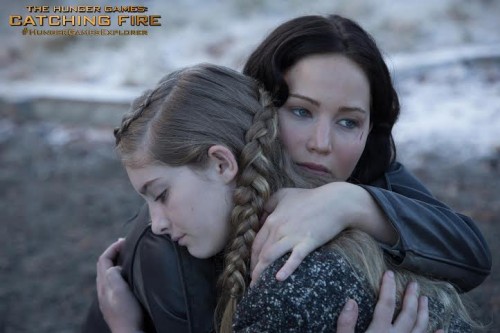
Catching Fire sisters


This is a guest post by Caroline Siede.

While this will probably be remembered as the “Winter Of The Polar Vortex,” it’s also fair to call it the “Winter Of The Feminist Blockbuster.” Grossing a combined total of more than $700 million domestically, Catching Fire and Frozen have definitively proven that films with female leads can attract a major audience. Even better, they’ve inspired think pieces about everything from Katniss’ movie “girlfriend” to queer readings of Elsa. Yet as I cheered on the strong ladies at the center of both films, I couldn’t help but notice something troubling. While Catching Fire presents a diverse supporting cast, Frozen rounds out its ensemble with a disappointing parade of white, male characters.

Geena Davis’ Institute On Gender In Media recently commissioned a study that concluded that for every female-speaking character in a family-rated film, there are roughly three male characters. Davis explains, “We are in effect enculturating kids from the very beginning to see women and girls as not taking up half of the space.” Like many films before it, Frozen subtly suggests that the only women who deserve screen time are the ones with exceptional stories. Men, on the other hand, don’t need to be extraordinary to appear on screen; their maleness is justification enough for their presence. Davis’ study determined that while women make up roughly 50% of the population, most crowd scenes contain only 17% of female characters.

Frozen sisters
Frozen sisters


Don’t get me wrong I adored Frozen. I’ve had the soundtrack on repeat since I saw it a few weeks ago, and I’m fully prepared to perform a karaoke duet of “Love Is An Open Door” at the drop of a hat. But for all of its feminist subversion, Frozen’s supporting cast falls in line with Davis’ study. Despite its dual female protagonists, men still outnumber women: There’s a wise Troll King, a repressive father, a brave ice cutter, a friendly shop owner, a scheming prince, a manipulative dignitary, an open-hearted snowman, and a dog-like reindeer. Men aren’t limited to being good or bad, heroes or villains, rich or poor; they are all of these things. Women, however, are almost entirely absent from supporting roles. Elsa and Anna’s mother remains silent and inactive while her husband takes control, a female troll gets a brief solo, and a townswoman delivers a line or two to Elsa. As far as I can recall, these are the only supporting women of note, and I’m really stretching it with that townswoman.

And in case you didn’t notice, there are also no women (or men) of color in Frozen. Some are quick to claim it would be historically inaccurate to depict racial diversity in the film’s medieval Scandinavian setting. Putting aside the ice powers, anthropomorphized reindeer, and magical trolls for a moment—Arendelle is depicted as a major trading city with ties to countries around the world. It seems perfectly logical that it would be a bustling metropolis with a diverse population. And to be perfectly frank, the benefit of a child of color seeing herself represented onscreen far outweighs the danger of someone being confused about the demographics of Scandinavia.

Catching Fire tributes


It’s difficult to say whether Frozen’s creators subconsciously mimicked the gender and racial disparity we’ve become accustomed to onscreen or whether the white male-dominated world was an intentional choice meant to keep the focus on Anna and Elsa. (After all, audiences are used to seeing white men as business owners and dignitaries so there’s no need to justify their appearance in these roles. Perhaps the creators feared a female shop owner would be too much of a distraction.) Either way, the homogenized supporting cast feels like a huge oversight for a film that otherwise goes out of its way to craft a feminist story. Frozen subverts Disney clichés, celebrates female friendship, and even promotes asking for consent as an act of romance (swoon!), but it utterly fails when it comes to creating a world that accurately reflects our own. Perhaps most frustrating, it would have been so, so easy to improve representation. Make the Troll King a Troll Queen. Make Anna and Elsa’s mother the active parent. Make the shop owner a black woman. Make Kristoff an Asian man who traveled to Arendelle yet never quite fit in. Make half of the visiting dignitaries women. And heck, make some of those female dignitaries corrupt, just as the men are allowed to be!

Frozen dignitaries
Frozen dignitaries


If Frozen required a template, it need only look to the winter’s other female-driven powerhouse film, Catching Fire. In fact, the entire Hunger Games franchise seems to deliberately demand diversity. The parameters of the titular Games require each District to send one male and one female tribute, a fictional mandate that matches nicely with Davis’ suggestion that writers dictate all crowd scenes contain 50% women. There are still more male characters overall, but it’s a huge step in the right direction for gender parity onscreen.

In addition to everyone’s favorite bow-and-arrow wielder (sorry Legolas), Catching Fire depicts a beautifully varied array of female characters. There’s the vapid, wealthy women of the Capitol; the hardworking, poor women of District 12; Katniss’ emotionally-fragile mother; aggressive Johanna; tech-savvy Wiress; vicious Enobaria and Cashmere; old but brave Mags; young but brave Prim; Snow’s impressionable granddaughter; Rue’s stoic mother; the drug-addicted tribute from District 6; and a career-driven socialite named Effie Trinket. Even better, many of these characters have agency and arcs of their own. Effie slowly learns to question the society she once worshipped, and her growth is one of the most moving elements in an all-around exceptional film. Effie’s subtle resistance to the Capitol is a foil to Katniss’ aggressive frustration—an acknowledgement that women can show strength in many ways, not just through traditionally masculine pursuits like hunting and fighting.

Effie Trinket


Though Catching Fire is still predominately white—and the whitewashing of Katniss is problematic—it does take some important steps to represent racial diversity. Beetee (Jeffrey Wright), Cinna (Lenny Kravitz) and Rue (Amandla Stenberg) are not only essential characters of color; they effortlessly defy the racial stereotypes of aggressive black men and sexualized black women that too often fill our screens. The film could and should present more persons of color, but it’s certainly an improvement over Frozen’s all-white ensemble.

So does all this mean Catching Fire is a more feminist film than Frozen? Of course not. Representation is just one way we can examine feminism onscreen. Simply counting up the number of women will not indicate how well written they are or how actively they impact the story. Like the Bechdel test—which both films pass, by the way—representation is one feminist lens. But it is an important one. As Davis asks, “Couldn’t it be that the percentage of women in leadership positions in many areas of society — Congress, law partners, Fortune 500 board members, military officers, tenured professors and many more — stall out at around 17 percent because that’s the ratio we’ve come to see as the norm?”  Couldn’t Frozen’s homogenized world teach its audience that women are only worthy if they are “exceptional”?

Frozen shop owner
Frozen shop owner


Frozen just took home the Golden Globe for Best Animated Feature, and I’m thrilled that such an overtly feminist film has been embraced by mainstream culture. It’s especially exciting because Frozen has not one, but two female leads, and both of these ladies are wonderfully nuanced and complex. So let’s continue to celebrate Frozen and Catching Fire for everything they get right. Let’s use Elsa, Anna, and Katniss as examples of fantastic female protagonists who are allowed to be both strong and weak. Let’s demand positive female relationships like the ones between Elsa and Anna or between Katniss and Prim. But let’s also continue to point out flaws in the films we love. Let’s demand more representation of women from all walks of life, not just brave, pretty heroines. Let’s demand more representation of persons of color. Most importantly, let’s demand more fully realized human beings onscreen, especially ones who just happen to be ladies.


Caroline Siede is a freelance writer living in Chicago where the cold never bothers her anyway. She frequently contributes to The A.V. Club and documents her experiences in the city on her blog Introverted Chicago. When not contemplating time travel paradoxes, she often tweets sarcastic things @CarolineSiede.


Seed & Spark: What If?

It’s been a big season for African American cinema. With movies such as ’12 Years A Slave,’ ‘The Butler,’ ‘Fruitvale Station,’ and ‘Best Man Holiday,’ a shift was felt in audiences going to the movies that hasn’t been felt before. But what about a woman’s place in the realm of films starring women of color as protagonists?

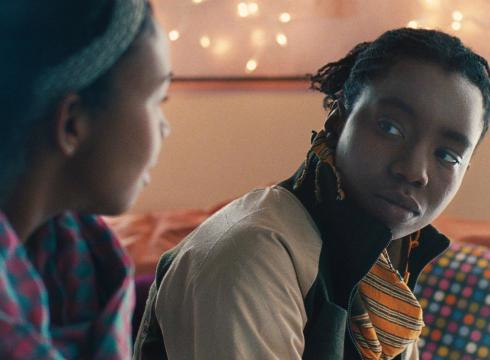
Adepero Oduye in Pariah


This is a guest post by Eljon Wardally.

It’s been a big season for African American cinema. With movies such as 12 Years A Slave, The Butler, Fruitvale Station, and Best Man Holiday, a shift was felt in audiences going to the movies that hasn’t been felt before. But what about a woman’s place in the realm of films starring women of color as protagonists?

tumblr_mrox9eEX3F1r0320so1_500

While the films I mentioned have supporting women, there are no protagonists who are women of color. Where are they? Besides Mother of George, can you name a film from this year where the main character was a woman of color? What if we turned some of this year’s blockbuster hits into stories about women of color? What would Fruitvale Station be if Oscar Grant was a woman? (Spoiler alert. Don’t read ahead if you want to know what happens!) Would the film have started as it did with Oscar’s death? As an audience, if we see a woman die a violent death at the start of a film, we are a little more than taken aback. It sets the tone for the entire film, one that is very different from the death of a male. Even though this was real event, the director may not choose to see it play out the way it did. One could argue that a gunshot would just be heard, not shown and while female Oscar may have had the same day and lived the same life as male Oscar, the director may have chosen to tell a different story. Female Oscar would have stopped for the dead dog on the road next to the gas station and cried profusely. She would have stroked his hair. Would female Oscar have been as rugged looking or portrayed as a sex symbol? The actress playing her would probably be fit and toned with hair shiny and done. This is what Hollywood would focus on. I can see her now gracing the cover of Entertainment Weekly and People, hair blowing in the wind with the focus on why she took the part rather than what the story is. Oscarella sold drugs but she’s doing it for her family, for her daughter, so she wouldn’t have the same life she did. Does that message come across clearer because she’s a Mother and not a Father? Personally, I automatically feel more sympathetic to her doing it for her kid because she’s a Mother which is something I didn’t feel for Oscar in Fruitvale Station. Oscarella would still cheat, but audiences would look at her differently. I don’t recall anyone focusing on male Oscar being a cheater in the film. Would the message of mistreatment and tragedy over a senseless murder reign supreme or would we be taken by the other themes in the film?

Danaii Gurira in Mother of George


What if The Butler was called The Maid, would you watch it or do audiences feel as though they know that story already? Cecilia wouldn’t be the focus because Cecilia is the main breadwinner of the family. No one wants to feel for the wife of a drunk husband for almost three hours in a theater that smells like stale popcorn and flat soda. Why don’t audiences want to see films with women of color as protagonists? Where are our stories? We are compelling and we have more to offer. I would like to see more films that didn’t focus on a woman who was heartbroken over love, looking for love, or scantily clad for 80% of the film. I long to see these break through into mainstream theaters and have big producing backers and become so successful they blow the minds of just about everyone! So where are they? It’s not as though there isn’t a lack of talent. Bring on more films like Frances Ha, more films like Philomena with a Latina, Black or Asian woman as the star! Why aren’t these stories being told and why aren’t they being marketed? Companies are so afraid to break out of the norm that steps are tiny. They are afraid that audiences wouldn’t go to see a Frances Ha starring someone they aren’t used to seeing on the big screen. Curiosity doesn’t outweigh what they are used to watching in a theater for two hours. “Is it worth my $15 risk?” they must be thinking; same story, different skin tone. Again, I bring up the African American film market. This season has brought a surge of films, some good and some bad but the point is that these films are out into the mainstream world, something no one could say 10 years ago or even 5 years ago. The same comes for leading ladies of color in film. The surge is coming. Our women of color protagonists are not going to lay low and go quietly forever. Film festivals are full of these masterpieces. We are on the cusp of an upswing. I see the rise coming . I see more films like Pariah and Middle of Nowhere in the future and I can’t wait to sit in a theater with the snack that I smuggled in from home, taking in stories where a woman of color is the star.


Eljon

Eljon Wardally is a Playwright and Screenwriter living in New York City. She holds a BA in Communications and Culture from Clark University and will graduate with her MFA in Playwriting from Fordham University in May 2014. Eljon is the writer of the award winner short Docket 32357 which is now being turned into a Docket 32357- the series which was successfully crowdfunded on Seed&Spark. She’s currently obsessed with The Twilight Zone, The Golden Girls, and American Horror Story.

‘Miss Navajo’: A Different Kind of Beauty Pageant

Sunny Dooley, one of the primary narrators, as well as the writer and performer of Changing Woman Poem that is woven throughout the film, is also a former ‘Miss Navajo’ (1982-83). During the second opening sequence where photos and archival footage of the contest flash across the screen, Sunny narrates, “You have to speak your language, you have to have a skill, you have to have a talent, and I think that’s what makes our pageant one of the few that really taps into the whole woman.”

Beauty pageants are often the butt of jokes and the subject of mocking derision in American society, but Miss Navajo (2006) provides a glimpse into a much more serious and culturally important beauty pageant that changes the very meaning of such an event. According to Rebecca Tsosie (Yaqui), a law professor at Arizona State University, “Indian nations are fighting to preserve not only their remaining lands and resources, but also their cultures and lifeways” (Indigenous Women and Feminism, 38). The Miss Navajo Nation competition seems to be an exercise in cultural sovereignty, attracting ambitious, young, Diné (Navajo) women and encouraging the maintenance of language and lifeways knowledge. The 60-minute documentary by Billy Luther and World of Wonder Productions follows contestant Crystal Frazier, 21, during the 2005 Miss Navajo Nation, an event that began in 1952, as she competes to be the top goodwill ambassador for the Nation by demonstrating traditional skills, knowledge, talents, spirituality, and Navajo language acuity.


[youtube_sc url=”http://www.youtube.com/watch?v=u9t-0SWvtmY” title=”Miss%20Navajo%20trailer%20(2006)”]


Opening with a pre-dawn image of the Days Inn where the competition is being held, the first language heard is from a woman speaking Diné (Navajo). The female voiceover continues as the camera shifts to inside the hotel, finally showing us the female judge who is asking Crystal Frazier a question. The woman goes on as the camera shifts again to show Crystal in a beautiful forest green dress with silver details, adorned with a long, three-strand turquoise necklace, sun-like throat pendant, and earrings. Crystal exhales in concentration and mild frustration as she looks down and away from the speaker. This is the language fluency test and Crystal is struggling.


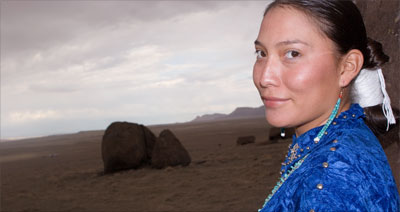
Crystal Frazier, 21, a 2005 contestant for Miss Navajo Nation, and our guide through the pageant experience.


When the Diné speaker finishes, Crystal looks up, smiles, and asks in English, “Could you repeat that question in Navajo, or English, please?” This slight misspeak reveals Crystal’s nervousness. She is not as fluent in Navajo as the contest demands, but like the other contestants, she does the best she can. “One thing I need to work on is my Navajo speaking,” Crystal says as she prepares at home beforehand, “It’s the only thing I’m insecure about. I can talk to my grandma, but I’m not fluent.” The default to English for most of these young women in the film makes clear the need to preserve Diné language and the Navajo Nation Department of Diné provides this language education for Navajo peoples and, ostensibly, anyone interested in learning the Diné language. However, in the film, the girls seem to obtain most of their language skill from their families and home environments where Navajo may be spoken more often.

Sunny Dooley, one of the primary narrators, as well as the writer and performer of Changing Woman Poem that is woven throughout the film, is also a former Miss Navajo (1982-83). During the second opening sequence where photos and archival footage of the contest flash across the screen, Sunny narrates, “You have to speak your language, you have to have a skill, you have to have a talent, and I think that’s what makes our pageant one of the few that really taps into the whole woman.”


Sunny Dooley, former Miss Navajo (1982-83), is one of the primary narrators for the film, Miss Navajo.


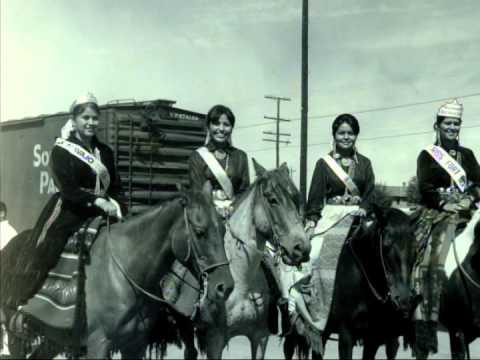
As Sunny and other former winners narrate their experiences with the contest, images from the early days of the competition show Navajo women on the rodeo grounds being selected by audience applause. The competition has changed a bit since those early days and now involves a more formal process, but the opportunities to travel and be a role model remain the same. Former winners talk about meeting Liberace and Senator Robert Kennedy, being invited to Senate hearings on Indian education, and experiencing places only seen on TV or in the movies. One former winner states, “It was an experience to be able to tell the dominant society here we are, we’re Native Americans, we’re very much alive, it’s a responsibility we will take all our lives.” Listening to these former winners provides a dose of reality and a specific antidote to mainstream American education and general knowledge, which mostly ignores contemporary Native peoples, and Native women in particular.


Former Miss Navajo Nation contestants, one of many such images featured in the documentary, Miss Navajo.


Instead of barely-there swimsuits, Barbie-fied bodies, and perfect mascara, the Miss Navajo Nation contestants compete primarily in culturally significant categories focused on skills and knowledge that a Navajo woman should possess such as a clear understanding of the traditional matrilineal construct of the Nation, how the tribal government operates, creation mythology, and the ability to butcher and cook a sheep. And yes, the ladies are dressed in brightly-colored finery wearing aprons as they prepare the fires, tie up and butcher the sheep, and then cook different parts along with freshly-made tortillas. Former winner, Tina James Tofoya (Miss Navajo, 1992-93), explains, “That’s one of the things about Miss Navajo, you just never know what you’re going to be asked to do. A lot of the times, people will ask you to do things that they think that Miss Navajo or a woman, a Navajo woman, skills and talents that she should possess and that’s probably one of them. It’s all part of the cooking process and feeding people.”


Photo credit: Laura Morales/Fronteras. Butchering scene from the 2012 Miss Navajo Nation competition.


While this aspect of the competition and this portion of the film may horrify vegetarians and vegans, the significance of sheep to Navajo culture is immense and the inclusion of the butchering and cooking skill in this pageant honors that importance. Sunny Dooley acknowledges how scary this element of the competition can be for the contestants, saying, “I’m sure it terrifies a lot of people to butcher a sheep, it’s quite a traumatic event. It is a part of our culture, sheep is life to the Navajo people, we use every aspect of that sheep from spiritual purposes all the way to signs of family wealth and success. And it also teaches a lot of discipline.”  In fact, the documentary clearly suggests that every element of this pageant is culturally and practically significant to the Navajo Nation. These demonstrations take precedence over physical beauty and clothing, although physical appearance and styling, particularly the wrapping of their hair, certainly play a part in the competition.


Miss Navajo Nation contestant butchers her sheep.


About five minutes into the film, viewers see Crystal at home on the reservation in Table Mesa, New Mexico. Scenes shift between wide open, red rock spaces and the farm where Crystal, dressed in a yellow sweatshirt, shorts, and white “Grand Canyon” ballcap, feeds and shears sheep with her father, and discusses the importance of animals and her comfort with reservation life. “I don’t really enjoy city life. Living out here, you get used to having quiet and privacy, this is what you call home. I’m a reservation person,” Crystal says. She is an introvert who loves new challenges, explaining that her parents were raised with traditional teachings. “My mother always tells us that animals are valuable. It teaches you so many things from respect to even discipline, and a reason for getting up in the morning, learning how to actually care for something that’s living, something that depends on you.” This respect and care for animals, as well as their importance to Navajo lifeways play a part in the Miss Navajo pageant, which is just one characteristic that distinguishes it from other beauty pageants.


Miss Navajo (2006) is a 60-minute documentary well worth your time.


Winner of the 2007 Special Founders Prize in the Traverse City Film Festival, winner of the Best Indigenous Film at the 2007 Santa Fe Film Festival, and an Official Selection at the 2007 Sundance Film Festival, Miss Navajo is available to stream through Amazon (commercial-free rental at $2.99 for three-days), Hulu (free with six commercial breaks), and Snag Films (free with four commercial breaks). The easy availability and shortness (60 minutes) of this film make it a sensible addition to any teaching plan that focuses on Indigenous peoples or on women. The women of Miss Navajo Nation demonstrate that inner beauty, cultural knowledge, respect for history, and traditional skills are more important than external physical attributes, and that is a preferable message for our young people, especially our girls.


_____________________________________

Dr. Amanda Morris is an Assistant Professor of Multiethnic Rhetorics at Kutztown University of Pennsylvania with a specialty in Indigenous Rhetorics.

“Movie Heroes” Not a Brave Theme for The Oscars (Plus a Quick Noms Reaction)

The Academy has announced the theme of this year’s Oscars ceremony. Producer Neil Maron announced in an Instagram video, “It’s going to be a celebration of movie heroes: the popular heroes, the real life heroes, the animated heroes, and the superheroes.” Here’s what I’m guessing this will look like: montages juxtaposing Nelson Mandela with Luke Skywalker and Norma Rae with Optimus Prime. Ellen DeGeneres wearing a Captain America costume (‘The Winter Soldier’: in theaters April 4!). Bumpers before the cuts to commercial in which stars talk about their heroes. Someone will say Woody Allen and someone will say “my mom.” Lots of commercials for ABC’s Marvel’s ‘Agents of S.H.I.E.L.D.’ It feels like another desperate attempt to get a younger, male-er audience for the telecast (and, truthfully, one I vastly prefer to hiring Seth MacFarlane to host).

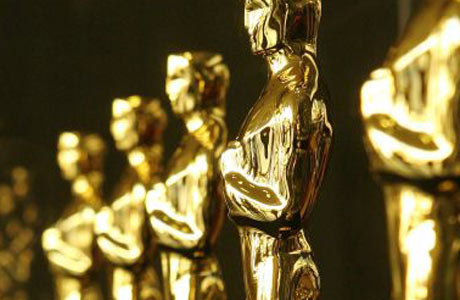
White hands holding Oscar statuettes

The Academy has announced the theme of this year’s Oscars ceremony. Producer Neil Maron announced in an Instagram video, “It’s going to be a celebration of movie heroes: the popular heroes, the real life heroes, the animated heroes, and the superheroes.”

Here’s what I’m guessing this will look like: montages juxtaposing Nelson Mandela with Luke Skywalker and Norma Rae with Optimus Prime. Ellen DeGeneres wearing a Captain America costume (The Winter Soldier: in theaters April 4!). Bumpers before the cuts to commercial in which stars talk about their heroes. Someone will say Woody Allen and someone will say “my mom.” Lots of commercials for ABC’s Marvel’s Agents of S.H.I.E.L.D.

All those corporate possessives highlight the blatant commercialism behind the selection of this theme. And not just the obvious aforementioned synergy opportunities for host network ABC (which like Marvel Entertainment, is owned by Disney). It feels like another desperate attempt to get a younger, male-er audience for the telecast (and, truthfully, one I vastly prefer to hiring Seth MacFarlane to host).  Even if the superheroes part of the equation doesn’t get the most play (and who are we kidding, it will), I suspect the Oscars ceremony will present myriad objectionable approaches to the concept of heroism. I am adding “Lara Croft appears in a montage of movie heroes” to my drinking game.

Feminist frustration aside, “Movie Heroes” is also simply a BORING theme. It’s too loose a category: it could mean “Characters Who Achieve Greatness” or “Characters Who Triumph Over Evil” or simply “Protagonists!”

I should probably roll my eyes and let this one go. The “theme” of an Oscars ceremony is one of the most forgettable and frivolous parts of a largely frivolous event. I had to look up last’s years theme (it was “The Music of the Movies,” which is what to that Jaws theme-as-orchestra-playoff-music debacle), and I’m not even sure how many of the Oscar ceremonies even HAVE themes, and to my horror I cannot find a list anywhere on the internet.

But my endless mining of the Academy’s database of acceptance speeches reminded me that the 65th Academy Awards in 1992 had a theme of “Oscar Celebrates Women and the Movies.”  So at least at one point, the Academy was willing to celebrate themes that could generate actual, you know, interesting content.

12 Years a Slave actors Lupita Nyong'o and Chiwetel Ejiofor and Director Steve McQueen
12 Years a Slave actors Lupita Nyong’o and Chiwetel Ejiofor and director Steve McQueen

I had hoped that the Academy would use this year’s ceremony to celebrate Black cinema. Even more so after last weekend’s surprising shut-out of actors of color at The Golden Globes (see this great piece by The Root‘s Keli Goff on that disappointment).

Annnnnnnnd I just deleted a paragraph I wrote about how it would be the perfect year for that considering the expected nominees, because the nominations just came out, and, well, why again did I think the Academy would celebrate Black cinema?


The white cast of American Hustle, four of whom are nominated for Academy Awards this year
The white cast of American Hustle, four of whom are nominated for Academy Awards

While 12 Years a Slave did nab nine nominations, it is knocked out of the headlines by American Hustle and Gravity, with 10 nods a piece. Nothing for Lee Daniels’ The Butler. Nothing for Fruitvale StationLong Walk to Freedom couldn’t even get a Mandela death bump  to get more than a “Best Original Song” nod for U2. (Hey, remember that time Bono sang “Tonight thank God it’s them instead of you” with the “them” being Africans?)  I guess I’ll try to take some comfort in Pharrell Williams getting a Best Original Song nomination instead of Taylor Swift.

I’m not playing by my own rules. I shouldn’t expect the Oscars to nominate the worthiest performances or meaningfully reflect on our cultural moment and current place in the history of cinema. I should expect circus performers wearing capes doing interpretive aerial dance to a montage of John Williams themes. I should expect clips of Disney’s Bolt interspersed with Mr. Smith going to Washington. Maybe this year, instead of cutting off speeches with the Jaws theme, Superman will swoop in to pluck those verbose Sound Effects Editors right off the podium and fly them back to the nosebleed seats.

2014 Academy Award Nominations

Check out the 2014 Oscar Nominees and our feminist commentary!

oscar.jpeg

Best Picture

American Hustle

Nebraska

Captain Phillips

Philomena

Dallas Buyers Club

12 Years a Slave

Gravity

The Wolf of Wall Street

Her


Best Actress

Amy Adams, American Hustle

Judi Dench, Philomena

Cate Blanchett, Blue Jasmine

Meryl Streep, August: Osage County

Sandra Bullock, Gravity


Best Actor

Christian Bale, American Hustle

Chwetel Ejiofor, 12 Years a Slave

Bruce Dern, Nebraska

Matthew McConaughey, Dallas Buyers Club

Leonardo DiCaprio, The Wolf of Wall Street


Best Supporting Actress

Sally Hawkins, Blue Jasmine

Julia Roberts, August: Osage County

Jennifer Lawrence, American Hustle

June Squibb, Nebraska

Lupita Nyong’o, 12 Years a Slave


Best Supporting Actor

Barkhad Abdi, Captain Phillips

Jonah Hill, The Wolf of Wall Street

Bradley Cooper, American Hustle

Jared Leto, Dallas Buyers Club

Michael Fassbender, 12 Years a Slave


Best Animated Feature Film

The Croods

Frozen

Despicable Me 2

The Wind Rises

Ernest & Celestine


Best Director

David O. Russell, American Hustle

Alfonso Cuarón, Gravity

Alexander Payne, Nebraska

Steve McQueen, 12 Years a Slave

Martin Scorsese, The Wolf of Wall Street


Best Documentary

The Act of Killing

Cutie and the Boxer

Dirty Wars

The Square

20 Feet from Stardom


Best Foreign Language Film

The Broken Circle Breakdown

The Great Beauty

The Hunt

The Missing Picture

Omar


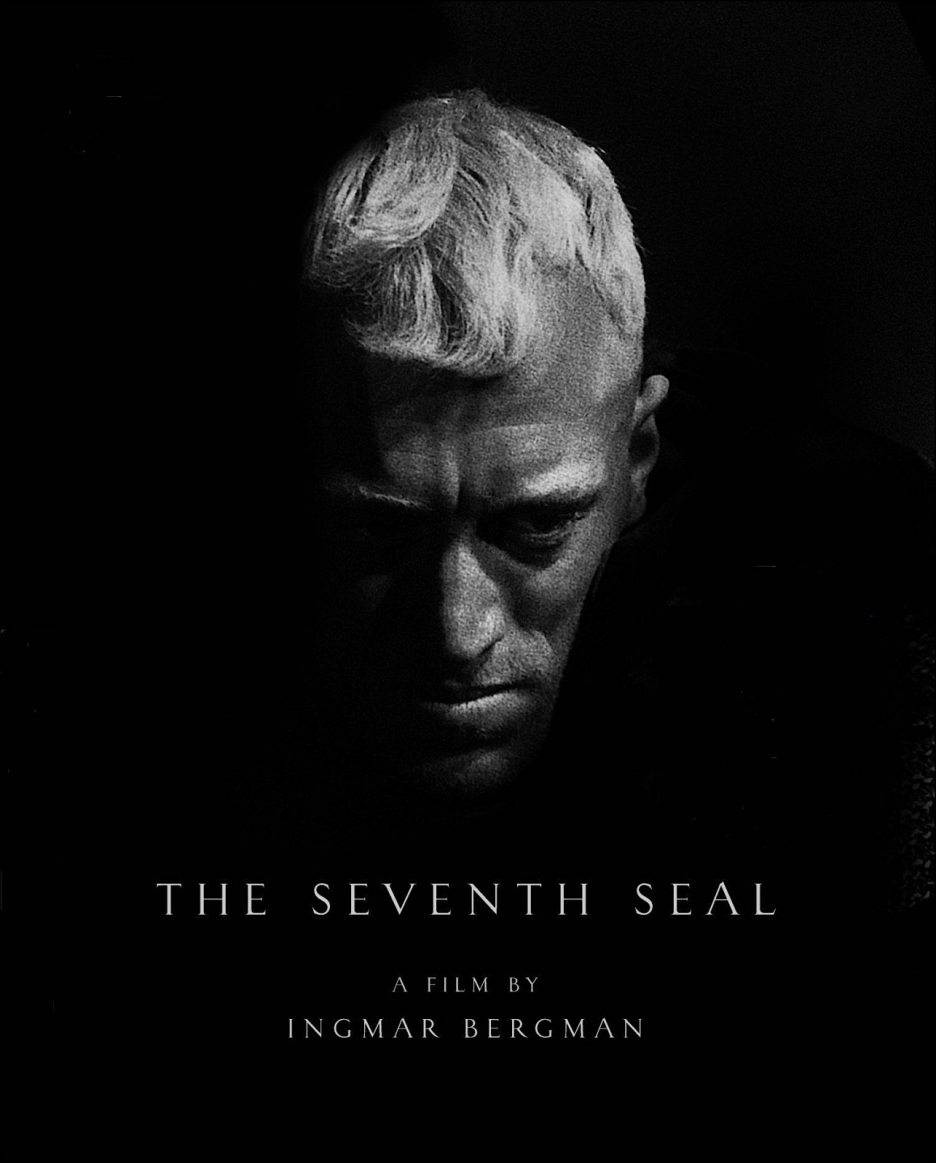
‘The Seventh Seal’: A Skull is More Interesting Than a Naked Woman

‘The Seventh Seal’ was released in Sweden in 1957. The title is a reference to the Book of Revelation (Rev. 8:1): “And when the Lamb had opened the seventh seal, there was silence in heaven about the space of half an hour.” Ingmar Bergman’s 17th film examines the big question: where is God? Set in Sweden in the 14th century during the Black Plague, the film documents the travels of the knight Antonius Block (Max von Sydow) and his squire, Jöns (Gunnar Björnstrand), as they return home from the Crusades (this is one of many useful anachronisms in the film, just go with it). Block is literally pursued by Death (Bengt Ekerot). Along the way, Bergman also muses on love, isolation, and death.

The Seventh Seal Poster

Written by Andé Morgan.

The Seventh Seal was released in Sweden in 1957. The title is a reference to the Book of Revelation (Rev. 8:1):  “And when the Lamb had opened the seventh seal, there was silence in heaven about the space of half an hour.” Ingmar Bergman’s 17th film examines the big question: where is God? Set in Sweden in the 14th century during the Black Plague, the film documents the travels of the knight Antonius Block (Max von Sydow) and his squire, Jöns (Gunnar Björnstrand), as they return home from the Crusades (this is one of many useful anachronisms in the film, just go with it). Block is literally pursued by Death (Bengt Ekerot). Along the way, Bergman also muses on love, isolation, and death.

This film is a classic. If you think you haven’t seen it, you are wrong. You have seen it by way of parody in The Colbert Report, Bill and Ted’s Bogus Journey, Last Action Hero, Monty Python and the Holy Grail, and others. Bergman’s mastery of dialogue and symbolism is on constant display in the film. While not typically considered Bergman’s best work, it was a critical success and solidified his position as a leading director and screenwriter of the post-war era. Continue reading “‘The Seventh Seal’: A Skull is More Interesting Than a Naked Woman”

‘Orphan Black’: It’s All About the Ladies

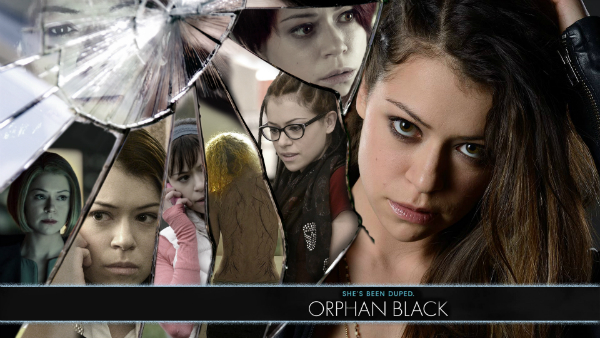
‘Orphan Black’ is gritty sci-fi with layered mysteries, mistaken (and impersonated) identity, and lots of complicated female characters. The most intriguing part of the show is that many of those multifaceted female characters are played by the same woman, Tatiana Maslany. She portrays all the clones involved in a seemingly nefarious scientific experiment.

Orphan Black Poster Cracked 600

Spoiler Alert

Canada’s compelling show Orphan Black will be airing its second season on BBC America this spring, and though Ms Misanthropia reviewed it on Bitch Flicks, I had to weigh in now that I’ve finally had a chance to finish watching the series! Orphan Black is gritty sci-fi with layered mysteries, mistaken (and impersonated) identity, and lots of complicated female characters. The most intriguing part of the show is that many of those multifaceted female characters are played by the same woman, Tatiana Maslany. She portrays all the clones involved in a seemingly nefarious scientific experiment.

Welcome to Clone Club.

At first, I was skeptical of Maslany’s acting abilities because there’s a lot of subtlety and nuance required to play at least nine characters with different upbringings, nationalities, socioeconomic backgrounds, and habits. Not only that, but the clones do a lot of impersonating each other. I was sold when I could tell one clone was impersonating another before the narrative announced it. Each clone’s mannerisms, body language, and even facial expressions are different. Damn. My hat’s off to Maslany who can make her smile different enough that I can tell which character she is without context.

Bravo, Tatyana Manslany. Bravo.
Bravo, Tatiana Maslany. Bravo.

In Orphan Black, the clones are often wildly different from one another, really hammering home the nature over nurture angle, which is an important representation of how women (and other marginalized groups) are affected by their environment. Orphan Black shows us women who thrive due to their environment (Cosima with her scientific brilliance), struggle because of it (grifter Sarah Manning), or become deviant and destructive as a result of it (religious serial killer Helena). There are tweaks made to each of their genetic code that explain away Katya’s respiratory disease, Cosima’s need for glasses as well as her gayness, and perhaps other anomalies among the clones yet to be introduced, but the message is clear that the DNA of these women is virtually identical making the entirety of their development environmentally-based.

The show even tries to give social reasons for the expression or dormancy of homosexuality.
The show gives social reasons for the expression or dormancy of homosexuality.

I also want to take a second to talk about big brained science nerd Cosima, my favorite clone.

Cosima Collage
Cosima rules.

Maybe it’s because I, too, am a queer nerd girl, but Cosima’s aptitude for science and her lesbian sexuality are awesome. Where Sarah must use her body to get what she needs (like seducing Paul to distract him from realizing she’s not Beth Childs), Cosima uses her intellect. Cosima is the glue. Without her, the clones wouldn’t be able to do DNA testing or crawl down the rabbit hole of the scientific experimentation that created them. Not only that, but she is the one who discerns that each known clone has a “monitor” to observe and report back on clone activities. This means that Cosima is also capable of understanding and anticipating the psychological factors involved in genetic testing and cloning. It’s great to get to see the nerd girl shine and not be deemed sexless because of her brain power, as her affair with her monitor Delphine is the most engaging of the romances played out in the show.

Delphine & Cosima bond over science geekoutery

Orphan Black showcases great female characters who are strong or interesting or smart or even infuriating, but they’re all unique and full of depth. The series also shows that the path of each clone’s development is dependent upon her environment, which is a huge statement about how oppression and opportunity are what shape us. In order for women to succeed, we must cultivate an environment that encourages achievement, and that means we’ve got to bust up gender norms.

Aggressive & unpredictable serial killer clone Helena
Aggressive and unpredictable serial killer clone Helena

Orphan Black exists on the strength of one actress’s ability to play multiple characters convincingly. Most importantly, it’s a show about a group of women: their lives, their families, their loves, their history, their interaction with each other, their deaths, and, most poignantly, their quest to solve the mystery of their existence. Good stuff, no? It’s getting harder and harder for the media to claim that people won’t watch stories about women, especially in the face of Orphan Black‘s gripping action, great story telling, and superb acting.

——————
Amanda Rodriguez is an environmental activist living in Asheville, North Carolina. She holds a BA from Antioch College in Yellow Springs, Ohio and an MFA in fiction writing from Queens University in Charlotte, NC. She writes all about food and drinking games on her blog Booze and Baking. Fun fact: while living in Kyoto, Japan, her house was attacked by monkeys.

Hollywood Woman: Revisiting ‘Ellie Parker’

‘Ellie Parker’ offers a knowing, humorous take on Hollywood. The routines, processes, and lifestyle of its performers–male and female–are mocked but the film never satirises the professional anxieties and ambitions of Hollywood actresses in a punishing, misogynistic fashion. Ellie is considerably self-conscious, self-absorbed, and kind of nutty, but this is unsurprising, if not pardonable, as her psyche and spirit have been impacted by countless frustrations and disappointments. Really, God knows what it’s like to be constantly appraised and objectified at work.

Another crazy role
Another crazy role


Written by Rachael Johnson.

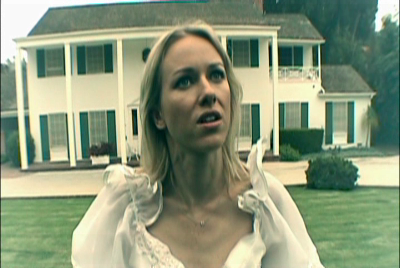
Written and directed by Scott Coffey, Ellie Parker (2005) is the tale of a talented Australian actress struggling to survive, and get ahead, in one of the strangest places on the planet. Naomi Watts is charismatic, fearless, and entirely credible in the title role. Interestingly, the story is partly autobiographical. Coffey and Watts were in David Lynch’s Mulholland Drive (2001) together, and they both produced Ellie Parker. The film is all the more curious, of course, to those familiar with the career of the Australian actress. It is said that Watts had a difficult, frustrating time in Hollywood before landing her break-through role in Mulholland Drive–as a very different aspiring Hollywood actress–and gaining great reviews for her tour de force performance. Her charged acting in Ellie Parker resonates too–and has perhaps been more celebrated than the film itself. I want to, however, appreciate not only Watts’s performance but also Coffey’s Hollywood story. This entertaining tale by insiders about the acting profession offers a satirical and perceptive take on the movie industry and it deserves greater consideration.

Another unsuitable mate


Coffey adopts a somewhat naturalistic, slice-of-life approach in Ellie Parker. We see the actress go on auditions, perfect her craft in acting lessons, visit her therapist, hang out with her best friend (another ambitious Australian performer), break up with her cheating slacker-musician boyfriend, and meet another unsuitable mate. The somewhat harsh look of the film–it was shot on digital video–gives it a naturalistic, immediate feel as well. Coffey, however, marries the everyday with the incongruous and wacky. His satirical comedy is not without incongruous and bizarre images and moments. We are, after all, talking about Hollywood. This self-reflexive tale, most crucially, provides insightful and sympathetic insights into the professional and personal lives of female performers. Sometimes realistic and sometimes surreal, they are, for the most part, telling and convincing.

Ellie Parker, 2005
Ellie Parker, 2005


Ellie Parker offers a knowing, humorous take on Hollywood. The routines, processes, and lifestyle of its performers–male and female–are mocked but the film never satirises the professional anxieties and ambitions of Hollywood actresses in a punishing, misogynistic fashion. Ellie is considerably self-conscious, self-absorbed, and kind of nutty, but this is unsurprising, if not pardonable, as her psyche and spirit have been impacted by countless frustrations and disappointments. Really, God knows what it’s like to be constantly appraised and objectified at work. Ellie explains to her therapist that “pleasing people” has been a particular problem all her life. Hollywood also, of course, encourages self-estrangement. Ellie feels disconnected in the city: “You can’t be yourself because you’re always being judged.” In conversation with her best friend Sam (Rebecca Rigg), she observes, “I don’t know who I am.” Sam, for her part, steals stuff from chic stores and lies about her sense memory examples in acting class. The women may be somewhat unhinged and self-regarding–they are products of Hollywood too–but it is the city’s men who come across as particularly deluded, narcissistic, and foolish in Ellie Parker. Along with the cheating, dopey boyfriend and the “cinematographer” suitor who invents a twin brother to cover his lies, we have Ellie’s surgically improved, philandering agent (Chevy Chase) and a pretentious peroxide blond filmmaker who gives the actress the precious call back.

Hanging out with Sam


Coffey’s portrayal of Ellie is candid and benevolent at heart. The constant bullshit refrain that she delivers at auditions–“I love the script”–should be understood as an endearing, thinly veiled plea. The insecurities of female performers regarding industry ageism are quite eloquently articulated too. “I remember when the future was a promise. Now it’s a threat,” Ellie says to Sam. Coffey also satirizes the breath-taking stupidity, sexism and mediocrity of Hollywood story-telling. Ellie and Sam’s scripts are crammed with both silly and offensive female characters and impossible story-lines.

Having a smoke
Having a smoke


There’s a driving scene in Ellie Parker that amusingly encapsulates the life of the aspiring Hollywood actress. Singing along to Blondie en route to yet another audition for yet another crap movie, Ellie negotiates traffic, applies make-up, changes clothes and shoes, takes calls on her cell, does vocalization exercises and gets into character. In her best New York accent, she screams, “I sucked your cock, I sucked Vinnie’s cock, I sucked them all.” Ellie is trying for the part of a “junkie whore” mob girlfriend in a movie called The Cruel City. She has, of course, no illusions about the future masterpiece. “It’s a piece of shit, anyway. But, you know, it’s a good part,” she reasons.

Perfecting her craft


Fitting, of course, for a Hollywood-set movie, the car scene serves as a vivid illustration of her personal and professional commitments and pressures. Ellie’s life is a juggling act and, as she tells Sam at one point, it can also be likened to “a big rehearsal for something bigger.” Playfully self-reflexive, the scene also idiosyncratically and magnificently showcases Watts’s exceptional versatility. It is, moreover, one of the most entertaining examples of multi-tasking in movie history.

Preparing for an audition


Ellie Parker does not deliver a darkly funny view of Hollywood. Nor is it a politically charged critique of the industry’s often degrading treatment of actresses. The satirical comedy does, however, recognize the specific stresses and anxieties of female performers as well as acknowledge that Hollywood’s story-tellers do not generally serve women well. The story should not be dismissed as a navel-gazing insider joke. A funny, observant movie about movies, featuring a fantastic performance by a gifted actress well-acquainted with both disappointment and opportunity, Ellie Parker very much deserves a second look.


Fandom, Feminism, and One Direction

One Direction is, first and foremost, a product. And yet I think the consumption of 1D by fans demonstrates that young women are not completely manipulable by corporatocracy, but rather comprise a powerful grassroots movement capable of taking what they are fed and reappropriating it on their own terms, often in ways that defy the design of the corporate media producers.

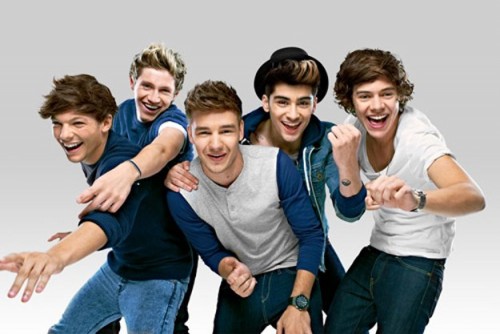
L-R: Louis, Niall, Liam, Zayn, Harry

As feminist critics, we get very frustrated by the constant cultural devaluing of media aimed primarily at girls. It goes farther than just a lot of people saying, “Twilight sucks,” because Twilight does suck, but it’s not always clear if people are making a legitimate critique. Are they saying, “Twilight is poorly written and full of problematic assumptions and messages,” or are they saying, “Ew, it has a female creator, a female protagonist, and a predominantly female fanbase”?

Even the former can contribute to the cultural devaluing of girl stuff. I’ve read literally dozens of feminist critiques of Twilight, some of them very detailed and very thoughtful; but I just don’t see an equivalent barrage of critique leveled at, say, Transformers (which could be considered the masculine-coded equivalent of Twilight). Of course the reason for this is that Twilight, being “for girls,” is more interesting from a feminist standpoint than Transformers and offers a richer vein of potential for feminist analysis; but the upshot is a net contribution to the vastly greater cultural scrutiny of products for girls than of products for boys.

One solution is to quit scrutinizing stuff for girls so closely, but if we do that we lose valuable feminist analysis. Another is to start scrutinizing stuff for boys with the same critical eye, but Jesus Christ, have you seen a Michael Bay Transformers movie? Nobody should be subjected to that. Perhaps the correct counterbalance to feminist critique of bad stuff for girls is the feminist championing of good stuff for girls.

Caveat: when I say “for girls” or “for boys,” I am not being prescriptive. I’m a 24-year-old man writing publicly about my love of One Direction. I do not believe that any book, movie, music, TV show, article of clothing, color, website, philosophy, job, hobby, interest, or anything else is inherently “for girls” or “for boys.” I use the terms advisedly, to refer to the demographic towards which a product is primarily marketed and the demographic that comprises the majority of its consumers (which are not always the same demographic).

one-direction-rudd-1 one-direction-rudd-2 one-direction-rudd-3 one-direction-rudd-4

Let’s get the unavoidable critiques out the way first. One Direction is the product of a cynical capitalist empire and when you buy your 1D concert tickets (assuming you can – they’re way outside the grad student price range) you are lining the pockets of Simon Cowell and perpetuating the manufacturing of lowest-common-denominator entertainment where artistic merit is firmly subjugated to the concern of profit margins. The band is designed as a hegemonic artifact servicing the production of heteropatriarchal capitalist values: five cute but non-threatening boys for barely-adolescent girls to swoon over and spend their (parents’) money on.

One Direction is, first and foremost, a product. And yet I think the consumption of 1D by fans demonstrates that young women are not completely manipulable by corporatocracy, but rather comprise a powerful grassroots movement capable of taking what they are fed and reappropriating it on their own terms, often in ways that defy the design of the corporate media producers.

Fan participation is key to how 1D is consumed by its fans. Fanfiction platforms are abuzz with works about 1D, some of it even officially endorsed, and there’s even an iPhone app specifically for 1D fanfiction. Even the lead animator for Archer has gotten in on the action. Of course, it would be remiss of me to talk about 1D fandom without mentioning the Larry shippers – the people who want Louis and Harry to be in a relationship. Obsessive shipping of real people is damn creepy, and when the shippers try to bend reality to their will it gets a little horrifying. But I think for the most part, barring the tinhat fringe, it’s not the “real people” that many shippers are interested in. It’s “Harry” and “Louis,” the public personae, who are by design not real people. The artifice is part of the point. The fantasy of fan participation is the way in which fans, mostly young women, can reclaim agency by writing themselves and their desire into the corporate product they are fed.

Like this one.
Like this one.

The movie One Direction: This Is Us is just one part of the 1D package. It’s a bit of fluff comprising ninety minutes of concert footage and squeaky-clean depictions of the 1D lads being Nice Boys. As an official production, it naturally doesn’t address fan reappropriations, but there’s the kernel of something interesting there. The boys repeatedly thank their fans, claim to have the best fans in the world, say they would be nowhere without the fans. On the one hand this is kind of true, but on the other hand they are a manufactured group who started on a reality TV show and are in the pocket of the most powerful mogul in pop music. The fans may have made the band, but the media empire made the fans.

This is why I think it’s so important to see the fans reacting in ways the media empire couldn’t predict or endorse. These fans are an extremely powerful force, sometimes for ill, sometimes for good, and that cannot be ignored.

Of course, all the focus on the behavior of the fandom can obscure the basic fact that 1D are feelgood and fluffy. Even taking them at face value, they don’t on the whole have a bad message. In a pop milieu that elevates Robin Thicke, 1D are noticeable for their deference to female agency. Every song on their first album, and most of the songs on the subsequent two, are addressed to a non-specific (but usually female) “you.” They are all expressions of blisteringly sincere emotion within the completely artificial framework of the manufactured boy band talking to the generic listener, but the emotions are always gentle. There are the Sad Songs, where the singer (who is, it must be noted, never singular: the five lads divide up lines in all the songs) laments his deep, sincere, unrequited feelings for You; and there are the Happy Songs, where he/they rejoices in deep, sincere, requited love. The subtext of many of these Happy Songs is pretty explicitly sexual, but it’s always entirely reliant on Your – the implied young female listener’s – consent. Take one of my favorites, “Kiss You”:

 [youtube_sc url=”http://youtu.be/T4cdfRohhcg” title=”One%20Direction,%20%22Kiss%20You%22″]

Tell me girl if every time we touch
You get this kind of rush
Baby say yeah, yeah, yeah

If you don’t wanna take it slow
And you just wanna take me home
Baby say yeah, yeah, yeah

And let me kiss you

You’ll never convince me that this song is actually about kissing. Not only do the opening lines talk about “turn[ing] your love on,” that stuff about not taking it slow and taking the singer(s) home is language more usually associated with sex. Even if you accept the naivety of “kiss” at face value, though, rather than reading it as coy metonymy for sex, the song is explicitly about consent and communication. From the opening verse’s “Tell me how to turn your love on” to the chorus’ exhortation to “say yeah, yeah, yeah,” this whole song is about talking about what you want and making sure your partner is enthusiastically consenting before anything happens. Almost all of the songs, Happy or Sad, grant the (female) listener agency. The narrator lays his feelings bare, and You can prolong or end his misery or joy by reciprocating or not; but the decision is always Yours, and You are never coerced or ill-treated. “Blurred Lines” this is absolutely not.

Let’s get back to the gay shipping though. This Is Us doesn’t address it directly, but it takes care to show the lads’ uniquely close relationship with one another, in a way that’s surely grist to the shippers’ mill. There’s a certain queerness inherent to the homosocial structure of the boy band, noticeably in the collectivity: 1D don’t harmonize all the time, nor do they take turns on songs, but they share lines within the songs. Their songs seem to have a clear, singular narrator, but the five boys take turns being that narrator. The 1D collective addresses the (collectively-singular) listener. In some ways you’re being invited into a relationship with all five of these fellas, even though it is the done thing to have a favorite.

And Zayn is clearly the best.

I’m not saying that One Direction is a feminist triumph. It’s still a manufactured boy band, and as such it’s not reinventing the wheel, and the fandom can be absolutely vicious. But I think it’s about time we started giving young girls a little more credit for the way they consume the things they like.

Max Thornton blogs at Gay Christian Geek, tumbles as trans substantial, and is slowly learning to twitter at @RainicornMax. He’s not afraid of all the attention, he’s not afraid of running wild.


Upcoming Theme Weeks for 2014

If you’d like to submit to one of our theme weeks, please see our Submission Guidelines.

If you’d like to submit to one of our theme weeks, please see our Submission Guidelines.


January: Representations of Sex Workers

Deadline to receive submissions: Friday, January 24.

Pretty_Womanloverboy_ver2leaving_las_vegas_ver1


February: Women and Work/Labor Issues

Deadline to receive submissions: Friday, February 21.

north_countrynorma_rae_ver2working_girl


March: The Great Actresses

Deadline to receive submissions: Friday, March 21.

annex20-20hepburn20katharine_17bette_davisIngrid_Bergman_1940_publicity


April: Rape-Revenge Fantasies

Deadline to receive submissions: Friday, April 18.

teeth_ver2last_house_on_the_lefti_spit_on_your_grave_ver2


May: Representations of Female Sexual Desire

Deadline to receive submissions: Friday, May 23rd.

fish_tank_ver2pariahsomethings_gotta_give


June: Children’s Television

Deadline to receive submissions: Friday, June 20th.

sesame_street_wallpaper_1278413620mylittlepony_splash_2048x1536_en iCarly-Trio-3-icarly-24621966-1280-800


July: Movie Soundtracks

Deadline to receive submissions: Friday, July 18.

TheBodyguardSoundtrackbig-chill_STghost_world_wallpaper_by_raven_pryde-d4g52fy


August: The Brat Pack

Deadline to receive submissions: Friday, August 22.

Brat+Pack+Collagebreakfast-club-2PrettyInPink_ST


September: Female Friendships

Deadline to receive submissions: Friday, September 19.

The_Color_Purple_poster intro1thelandlou1


October: Demon/Spirit Possession

Deadline to receive submissions: Friday, October 24.

MV5BNzYwMDA0NTA3M15BMl5BanBnXkFtZTcwMDcwNDY3Mg@@._V1_SX640_SY720_MV5BNDc4Mjk2MjA0NF5BMl5BanBnXkFtZTcwMzMyNjQ3Mw@@._V1_SX214_onesheet


November: The Terror of Little Girls

Deadline to receive submissions: Friday, November 21.

Silent_hillthe-shining-originall_298130_e35503e6


December: Reality Television

Deadline to receive submissions: Friday, December 19.

the-bachelorettebiggest-loser-logo1vibe-vixen-basketball-wives-logo

Bitch Flicks’ Weekly Picks

Check out what we’ve been reading this week–and let us know what you’ve been reading/writing in the comments!

recommended-red-714x300-1

Laverne Cox flawlessly shuts down Katie Couric’s invasive questions about transgender people by Katie McDonough at Salon

7 Movies That Changed Your Political Views, According to Science by Asawin Suebsaeng and Chris Mooney at Mother Jones

A Way to Stop Abortion Threats, Get Women Behind the Camera: As Directors, Writers, and Cinematographers by Ariel Dougherty at Media Equity

Stomaching “Girls”: Why I Regained an Appetite for the Show’s Third Season by Kerensa Cadenas at Bitch Media

Are TV Networks Fully Realizing The Ratings & Profit Potential In Producing Content for Black Women? by Tambay A. Obenson at Shadow and Act

Meryl Streep attacks Walt Disney on antisemitism and sexism by Ben Beaumont-Thomas at The Guardian

“Catching Fire” Is The First Film With A Female Lead To Top The Annual Box Office In 40 Years by Adam B. Vary at Buzzfeed

“SNL’s” best move yet: Hiring black female writers by Carolyn Edgar at Salon

“Am I Crazy for Even Considering This?” Stuntwoman Zoë Bell Says, “Yes,” Then Does It Anyway by Matt Zoller Seitz at MZS. at RogerEbert.com

Amy Poehler and the ‘Broad City’ Team Demonstrate Why ‘Television’s Such a Great Medium for Women’ by Alison Willmore at IndieWire

Joseph Gordon-Levitt on Being a Feminist on ellen

2013 Was A Good Year For Women In Movies. What Will 2014 Hold? by Megan Gibson at TIME

Golden Globes by gender: where are all the women? by Clara Guibourg at The Guardian

Watch the Athena Film Fest 2014 Trailer by Inkoo Kang at Women and Hollywood


What have you been reading/writing this week? Tell us in the comments!