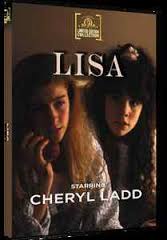
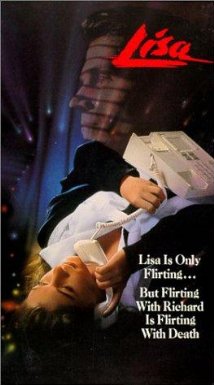
I’ve recently taken to revisiting some of these forgotten (or culty, depending on who’s looking) classics with a new, more grown-up and feminist eye, and I’ve been examining the lessons that each of these gems showed us. One of my recent new/old film crushes is a 1990 film called Lisa (starring Cheryl Ladd, Staci Keenan, and DW Moffet). It has all the teen angst that a gal could hope for. At first glance you expect this to be a typical thriller, but this film is so much more. It is an open exploration of a young woman coming into her own, exploring her sexuality, rebelling against traditional convention, and if that weren’t interesting enough, Lisa’s story runs parallel to the exploits of a serial rapist/killer. One of the things that makes this film so different is the point at which these two stories intersect, and Lisa proves herself more capable than imaginable and saves herself and her mother from the killer’s clutches. The ending of the film flipped the traditional damsel in distress cliché on its head.
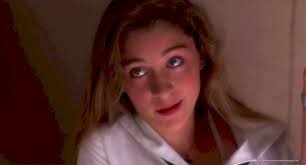
Staci Keenan stars as the teen protagonist in Lisa
This is a guest post by Shay Revolver. Spoilers and Trigger Warning for discussions of rape.
The 90s were a confusing time for pre- and full-on teenage girls. The 80s teen flick era had ended and left us a legacy of lessons on male-female relations that was nowhere near empowering. Mostly girls learned that if a guy really loves you then he’s got to stalk you to show it, and if you love him you’d better take off those glasses and ditch that ponytail. That was the extent of teen girl roles in movies; we were objects and trophies. When the 90s rolled around, girl power (pre-Spice Girls) was bubbling under the skin of society, and we were about to boil over. There are a few movies that I can think of that hinted at the dawning of the age of girlquarius, where teenage girls were thinking for themselves, acting how they wanted, living on screen on their own terms.
I’ve recently taken to revisiting some of these forgotten (or culty, depending on who’s looking) classics with a new, more grown-up and feminist eye, and I’ve been examining the lessons that each of these gems showed us. One of my recent new/old film crushes is a 1990 film called Lisa (starring Cheryl Ladd, Staci Keenan, and DW Moffet). It has all the teen angst that a gal could hope for. At first glance you expect this to be a typical thriller, but this film is so much more. It is an open exploration of a young woman coming into her own, exploring her sexuality, rebelling against traditional convention, and if that weren’t interesting enough, Lisa’s story runs parallel to the exploits of a serial rapist/killer. One of the things that makes this film so different is the point at which these two stories intersect, and Lisa proves herself more capable than imaginable and saves herself and her mother from the killer’s clutches. The ending of the film flipped the traditional damsel in distress cliché on its head.
Staci Keenan and DW Moffett in Lisa
In case you missed this one, Lisa is the story of a super curious 14-year-old girl named Lisa Holland. Lisa has started growing into her sexuality and, like many teenage heterosexual girls, she is more than a little boy crazy. Her sexual awakening is made more complicated by the fact that her mother, Katherine, a single mom who had Lisa at 15 and has raised her on her own, is having no part of Lisa dating–until she’s 16. Katherine understandably doesn’t want her daughter to make the same mistakes, and she is worried that dating will lead to sex, which might lead to her daughter ending up being a single mom. Most films would have taken this situation and made sure that the mother has a horrible life, thoroughly punishing her for her choice to have premarital sex. Instead, the writer and director take a rare approach to female yearnings and desires. The mother comes off sympathetic; she gives guidance more than criticism. There is also no slut shaming. Her mother actually acknowledges that her daughter has these very natural urges. At first glance, the conversations between them might come off as an all-out attempt at suppressing Lisa’s sexuality, but the way it is handled is beautiful. Her mother is honest with her reasoning and is very clear that she feels her daughter is too young to have sex. The openness attached to their conversations is refreshing, and it is kind of nice to see a young woman trying to come to terms with her feelings and sexuality. Katherine, in her role as single mother and successful working woman, who didn’t end up a statistic despite being a young single mother, is even involved in a relationship. She straddles a line, however, and keeps it from her daughter in an effort to protect her.
Staci Keenan in Lisa
Lisa’s best friend is another young woman named Wendy Marks. There is a beautiful contrast between the two of them. Wendy’s parents aren’t as strict as Lisa’s mother. Wendy is allowed to date, and Lisa is fascinated. Having all of these new feelings and no outlet or experience, Lisa creates a fantasy world in which she can express herself and explore these new feelings. She and her friend Wendy keep a scrapbook of men that they see and would like to date, much like the heart covered Mr * Mrs. (or Mrs. & Mrs.) notebook that many of us had when we were growing up. Lisa and her friend Wendy see men they like and follow them to gain more information about them. Sometimes they even phone the men and record their intel in the scrapbook. This notebook helps Lisa explore new feelings in a more private way and allows her to explore the qualities that she wants her future beau to have. She gains her outlet and comes to an understanding of her sexuality and, in some ways, her relationship desires. I also found it lovely that while the girls’ budding sexuality is growing at different rates there is no pressure to compete or follow or judge.
All of these explorations combined with a protagonist portrayed by a young woman trying to figure out relationships and sexuality would have been more than enough to satiate my wish list for a good film, but this thriller threw in a serial rapist and murderer dubbed The Candlelight Killer, who stalks women and then calls and kills them after discovering where they live. This added a whole new level to the film. First of all, the film does something super rare; the rapist isn’t some worn, wrinkled , unattractive guy who can’t get a date. Richard, played by DW Moffett, is a hottie. It highlights a fact that is often overlooked in these types of characters when they are portrayed on TV or film: rape isn’t about a guy who can’t get a date, or about a woman being an undercover seductress who was asking for it. Rape is about power and hatred of women. This fact is reinforced by the psychological torture that Richard inflicts upon these women before he rapes and ultimately brutally murders them. He leaves messages on their answering machine telling them that he is in their house and announces his plans to kill them. He strips these women of the safety that their homes are supposed to provide. It is a clear, honest portrayal–and a parallel to rape itself. Having such a violation of sexuality portrayed in a storyline that runs parallel to the story of Lisa’s budding sexuality is an odd but brilliant choice. It doesn’t just use the message that all men are monsters, or blame the victims for their beauty taunting him. They portray this heinous crime as what it is: an attempt to remove a woman’s power.
You can pretty much see where the story is headed. Richard is going to end up in Lisa’s scrapbook, and she will be punished for her desires. Of course you would think that because that’s the message we’ve been shown. Good girls have no desires; if you have them you will be punished. I would have thought it too, but this film has already bucked every trend. You’ve got an attractive rapist, a former teen mom who is successful and raising a brilliant daughter, and a young woman having her budding sexuality acknowledged. When the stories intersect, they continue this realistic trend. Lisa accidentally bumps into Richard when he’s coming from a kill. He aids her and flirts with her a little bit, and she awkwardly flirts back, making him scrapbook worthy. She goes about her usual routine, follows him and gathers his license plate number and uses that to track him down and get his phone number from the DMV. After another failed attempt at bypassing her mother’s bothersome no-dating rule, she has to turn down a chance for a double date with Wendy and a boy her own age. Lisa locks herself in her room and decides to call Richard. She flirts with him some more, pretending she’s an older woman, and she piques his interest.
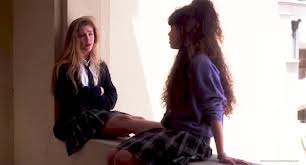
Tanya Fenmore and Staci Keenan (as Wendy and Lisa) enjoy some girl talk
Lisa keeps up her game, and with Wendy’s help, she continues to stalk him, which isn’t that smart of an idea, but it is age appropriate and realistic. She even continues her phone conversations after nearly getting caught. The plot progresses as Lisa reveals more and more about herself with every conversation, and soon Lisa realizes her game is going to have to end because Richard begins to push for a face-to-face meeting. The film doesn’t shy away from the more manipulative ways of teenage girls, but it gives a rationale and adds method and logic to the madness. There is no right or wrong, but a whole lot of gray. There is no punishment for Lisa’s actions per se; her actions do cause her mother to become Richard’s next and final victim. But, the film doesn’t end as bad as it could have. Katherine doesn’t get killed. Lisa isn’t punished for having desires or growing up and trying to figure out who she is going to be as a woman. After sneaking away to go on a trip, Lisa returns just in time to see the stage set for her mother’s murder at the hands of The Candlelight Killer, and she is forced to defend her life and the life of her unconscious mother. She doesn’t play damsel in distress or fall down the stairs; she chooses to fight, and even though she doesn’t initially come out on top, her mother wakes in time to come to her aid. The fight and movie ends with Richard going out of the window thanks to a handy baseball bat and the women holding each other in solidarity and love.
There are so many things about Lisa that make it interesting. The honest portrayal of a young woman’s burgeoning womanhood. The open expression of Lisa’s sexuality and desires. The over protectiveness of a single mother that truly rides a fine line between cautionary and plot building without delving into the gray area of slut shaming, a teen pregnancy, or portraying the mother as a failure whose life went wrong because she had sex at a young age. All in all this film , even at its campiest, showed strong women, and in the end, Lisa and her mother saved themselves from the clutches of the killer. They relied on each other to overcome the situation; there were no cops or men rushing to their rescue. And, there is something super awesome about watching two women surviving after killing a serial killer/rapist. Thank you Lisa for giving us a movie that didn’t shame young women for having urges and desires but instead giving us a movie that showed life as it often is: filled with areas of gray. Lisa showed independence and strength in the face of danger. And there is something truly beautiful about a young woman coming into her own, making and learning from her mistakes.
Shay Revolver is a vegan, feminist, cinephile, insomniac , recovering NYU student and former roller derby player currently working as a NY-based microcinema filmmaker, web series creator and writer. She’s obsessed with most books , especially the Pop Culture and Philosophy series and loves movies and TV shows from low brow to high class. As long as the image is moving she’s all in and believes that everything is worth a watch. She still believes that movies make the best bedtime stories because books are a daytime activity to rev up your engine and once you flip that first page, you have to keep going until you finish it and that is beautiful in its own right. She enjoys talking about the feminist perspective in comic book and gaming culture and the lack of gender equality in main stream cinema and television productions.. Twitter @socialslumber13
It started when I was 13. Some friends and I went to see Buffy the Vampire Slayer. It sounded like a lovely idea. A movie with a cheerleader as lead for my more “girly” friends, a vampire flick with a female heroine for me and the guy friends who were dragged along on this group “date” and just wanted to see vampires. It wasn’t like we had a choice–none of us had a car, and this was the only thing playing that we were old enough to watch at the theater our parents dropped us off at. I thought it would be perfect until it occurred to me in the lobby, while procuring nachos and popcorn, that this film was devised to please everyone, and usually when movies set out to please everyone, they pleased no one. But, it was a movie, and on a hot summer day that meant air conditioning; plus, there would be vampires, a female heroine and that was all I needed to give it a try.
It started when I was 13. Some friends and I went to see Buffy the Vampire Slayer. It sounded like a lovely idea. A movie with a cheerleader as lead for my more “girly” friends, a vampire flick with a female heroine for me and the guy friends who were dragged along on this group “date” and just wanted to see vampires. It wasn’t like we had a choice–none of us had a car, and this was the only thing playing that we were old enough to watch at the theater our parents dropped us off at. I thought it would be perfect until it occurred to me in the lobby, while procuring nachos and popcorn, that this film was devised to please everyone, and usually when movies set out to please everyone, they pleased no one. But, it was a movie, and on a hot summer day that meant air conditioning; plus, there would be vampires, a female heroine and that was all I needed to give it a try.
I sat, I watched, I was stuck somewhere between annoyance and amusement that my nachos weren’t the only thing in that theater covered in cheese. It seemed like for every great thing about the movie there was something equally as bad, if not worse. Even at that age, I worried that the film would be remembered more for the five-minute vamp death rattle scene at the end than for the female lead. Being the resident cinephile, or film-loving smart ass, I tried to save the film by saying it was supposed to be campy. In my head that was the only way I could wrap my mind around what had just occurred. I worried that if the film wasn’t successful there would be no more films with strong female leads–that we would have to keep being arm candy and damsels. Everything that made her complex, easy to relate to and bad ass was turned into a joke. I left the theater feeling sad.
In the interim, there were other films with strong female leads that caught my eye. Some of them were American but most of the time, I had to turn my gaze to the art houses and screening rooms of the East Village and Lower East Side. The women I was looking for could only be found in indie and foreign films. Sure, there was the pop up complex, bad ass heroine (or antihero) here and there beaming in beauty once in a while on the big screens of the mainstream, but they were so few an far between that I could count them on one hand and very rarely did they resonate in the way the other films did. Then something different happened. Studying in my dorm for midterms, during a very crazy junior year with my brain frying and a cold brewing, I turned on my TV and on some random network, there was Buffy. Buffy 2.0. to be exact, and in all of its campy goodness I could not turn away.
Summer Glau as River Tam
There was a woman on TV, being bad ass and somewhat complex (as complex as a teenage girl could realistically be), and I along with millions of other people ate it up. On the surface, it was beautiful and a pleasure to watch. In my philosophy studying brain it was full of conflicts, ideas and other interesting complexities. As the series progressed there was less complexity in Buffy and more complications. During the series run, much like the movie, I found that for every step forward there was a step sideways, often back. But, I couldn’t turn away. In my head I juggled with the bizarre coincidence that Buffy’s “virtue” was linked to the sanity of all the men around her. Her virginity literally turned Angel evil. It was a pattern that played out throughout most of the show. Her sexuality was a prize to be given and taken at will. It was also her downfall. She would be punished for choosing to express her sexuality, for having desires, for not being the “proper girl.” It was one of the themes that bothered me throughout the show.
When discussing how male writers and directors portray women and their “complexities,” the name that gets called out the most is Joss Whedon and his strong, complex female hero Buffy Sommers. I, for one, was always team Faith. She was way more complex and realistic than Buffy. I could relate to her. While Buffy spent most of her non-training conversations lamenting over wanting a relationship and kicking ass in between sessions of just trying to get a date, Faith was more concerned with finding herself, being independent, and if love came along, that’d be cool too. She wasn’t nice all the time, she straddled the line of morality and was okay with who she was. She was a creature of pure impulse, turning into the woman she was going to be, who never tried for perfection. Watching her evolve was fascinating. She was like Catwoman to Buffy’s Batman and I could relate. While Buffy went on to have “relationships” that mimicked the plot line of almost every Lifetime movie, Faith was content to be alone instead of settling for the sake of not being alone. She was punished with being labeled as insane for expressing her independence and sexuality.
Sarah Michelle Gellar and James Marsters as (everyone’s favorite dysfunctional couple) Buffy and Spike in Buffy the Vampire Slayer
When the short lived Firefly and its companion movie Serenity came to us, in true to Whedon form, the “virgin” lives and is strong. The “whore” is ultimately punished for her ways and although she does manage to survive and ride off into the sunset with Mal, her redemption comes only with settling down with a man to make her honest. While I will forever love the females in power aboard the ship, they were often led astray by their desires. The message often came off as, sorry ladies you can’t have it all. Even the hard-hitting River Tam was as bad ass, complex and brilliant as they came; she was also a virgin and very broken. She had passed the age where her sexuality should be expressed. She was incapable of expressing herself, and she went insane for contact. At the end of the day, the only woman who could save herself was the one who let go of her sexual identity or any idea of companionship, and she remained isolated and broken. Despite her strength, her survival often depended on the men around her.
This trend continued with Dollhouse, where the female bodies were literally used as objects and in a way that can only be expressed as soul rape, they are forced to forget the trauma and sleep until their bodies are called upon to be used again. Yes, in some scenarios these women were called upon to be more than just a warm body in the bed of the highest bidder, only worth what someone else was willing to pay for them, but the disturbing part was that they had no choice in what was happening to them, making it akin to a psychic roofie-style rape. I’ve heard the arguments that men were kept in the dollhouse as well , or that women were in power in the dollhouse, but none of that makes the situation any less horrifying. In the end, Echo is saved by a man. She was rendered incapable of saving herself. I looked away.
Kristy Swanson, the original Buffy
That has always been my issue with Joss Whedon’s work. As strong as his female characters are, they’re often on some level tortured and in some ways punished for being exactly what I was looking for in a female lead on TV. They seemed unable to find completion without having a man in their lives. That is what completed them. That was how they found themselves. It was also how they were punished. Buffy couldn’t save the world until she fell in love with her series-long tormentor and almost-rapist Spike. River Tam would collapse under the weight of her own strength. In Dollhouse, all of his female characters were used as pleasure objects and shells for men, and other women were serving as their pimps. There was no end to his female characters’ suffering; their worlds just got grimmer. There was no chance for redemption. Yes, they’re all strong in the traditional sense of the word because it is such a rare thing to see in media, but they’re also all still traditional archetypes.
Don’t get me wrong; I’m happy that he keeps creating these strong female characters, I wish more male creators would do the same. Gender equality in casting, Salt withstanding, is often hard to come by. I just know that I would love it even more if he wouldn’t make them set up to fail, if he wouldn’t put them in situations where their survival is dependent upon men, or where their happiness was aligned with or subject to the men in their lives. I’m hoping that the Agents of S.H.I.E.L..D. proves me wrong in the long run, and a shift is coming now that he has proved his weight. But so far we’ve already seen one damaged woman, one about to fall prey to her romantic desires, one who lacks sexuality, and another who has been mind controlled. For a very long time Whedon was the only game in town for seeing a continuous flow of strong women in power. Now there are other options, and most of them are women writing and creating roles for other women. It has been proven that there is a market for the characters that Whedon has often said that he wants to create. I see glimpses of these women in the characters that he does portray. Now that he has reached the level that he has in his career, hopefully he will show us these women that he wishes he could have created, shown and brought to fruition as he often laments. I can’t wait to see them.
Shay Revolver is a vegan, feminist, cinephile, insomniac , recovering NYU student and former roller derby player currently working as a NY-based microcinema filmmaker, web series creator and writer. She’s obsessed with most books , especially the Pop Culture and Philosophy series and loves movies and TV shows from low brow to high class. As long as the image is moving she’s all in and believes that everything is worth a watch. She still believes that movies make the best bedtime stories because books are a daytime activity to rev up your engine and once you flip that first page, you have to keep going until you finish it and that is beautiful in its own right. She enjoys talking about the feminist perspective in comic book and gaming culture and the lack of gender equality in main stream cinema and television productions.. Twitter @socialslumber13
I’m really inspired these days by filmmaker, entrepreneur, community builder Ava DuVernay – inspired about film and about life. IndieWire named her one of their 40 top Industry Influencers and they definitely got it right when they put her in their “Shapeshifter” category. She IS indeed a shapeshifter. She’s not only transforming herself, but she’s calling into being a highly fluid, passionately creative era in filmmaking. She’s inviting us all to shift our perceptions and change our world. She’s calling on us to step out of a sense of desperation and lack, look around, notice what we have available to us, and begin to create.
Ava DuVernay
This is a guest post by Barbara Ann O’Leary.
I’m really inspired these days by filmmaker, entrepreneur, community builder Ava DuVernay – inspired about film and about life. IndieWire named her one of their 40 top Industry Influencers and they definitely got it right when they put her in their “Shapeshifter” category. She is indeed a shapeshifter. She’s not only transforming herself, but she’s calling into being a highly fluid, passionately creative era in filmmaking. She’s inviting us all to shift our perceptions and change our world. She’s calling on us to step out of a sense of desperation and lack, look around, notice what we have available to us, and begin to create.
In a recent interview during her visit to Indiana University Cinema, Ava shared about her approach to actively engaging with what she has access to in the moment: “I HAVE an idea. I HAVE the passion. I HAVE friends. I HAVE this little bit of money. I HAVE this location. I HAVE access to this camera. OK, I can make something with those things I have instead of focusing on all the things I did not have. All the things I wanted. My needs start to change. And my posture became much more active. And I was moving forward as opposed to standing still.”
This is a radical act of power. Saying YES to what is available in this moment. We have what we need right now. Begin!
She expanded on these themes during her incisive Film Independent Forum Keynote speech in October. Have you taken time to really watch and listen to what she shared there? I hope you’ll let her insights sink into your consciousness and start to inform how you move through your life. Here it is. Go ahead and soak it up. I’ll wait.
[youtube_sc url=”http://youtu.be/-pFoBks5ly0″]
What sparked you? Something she shared that resonated strongly with me was what she wants to say to people when they’re feeling and acting desperate: “Knock it off. It doesn’t work. It’s never going to work for you, that feeling of, ‘I need help. I need all these things to proceed.’ And when I got that, a revolution happened for me and that’s when things started to change.”
She went on to stress: “I didn’t stop being desperate because things started to go my way, I changed my mind and things started to go my way.”
It thrills me to hear a filmmaker stand on such a public stage and make the clear, bold statement that perceptual shifts change our lives. It reminded me of something Alberto Villoldo shared in his book Shaman, Healer, Sage: “Shamans are people of the percept. When they want to change the world, they engage in perceptual shifts that change their relationship to life. They envision the possible, and the outer world changes.”
Filmmakers are people of the percept too. They change the way we see the world. Ava’s calling on us to shapeshift our awareness to create new experiences for ourselves. She’s a bold example of how perceptual shifts lead to transformation. Let’s change the way we see ourselves as creators and watch our experiences truly shift. I’m ready for a revolution in consciousness about creativity and authenticity.
But I also know that this is a process that benefits from concrete practice as we move from old ways of seeing ourselves and the world around us. Even though I work extensively with perception and consciousness, I still find myself in need of reminders to wake up to this moment and what’s arising right now. As I sat down to write this blog post this morning, I caught myself thinking, “Oh, no! I don’t have enough time.” When I noticed the thought, I got a good laugh out of it. I took a breath and assured myself that I HAVE what I need. I HAVE this little bit of time. I HAVE these things to share. I HAVE the opportunity to share them with this community of film makers and film lovers. I HAVE the passion to share what arises from the depth of my being. I HAVE what I need at this time.
And so do we all. Join me in shifting perceptions and opening up to our creative potential. I can’t WAIT to see what we all bring forth.
Addendum: Just as I was completing this I felt drawn to look at Facebook. I found this link to a brand new blog post by my friend Jenn Will about the nature of grasping: Aparigraha (Non-possessiveness, Non-grasping). It relates to what I’ve been writing about here, so I’m passing it along. It’s a sign that what we need arrives when we need it. Enjoy.
Barbara Ann O’Leary
Barbara Ann O’Leary, Indiana University Cinema’s Outreach Specialist, loves to help people engage authentically. Recent projects include: Every Everything: The Music, Life & Times of Grant Hart (Executive Producer), Indy Film Festival (Screening Committee), Indiana Filmmakers Network Made in Bloomington Film Series (Programmer), Bloomington Screenwriting Community (Founder/Facilitator). A Film Explorer/Blogger, Barbara shares her adventures in film and reports on her initiative A Yearlong Film Viewing Balancing Act at O’Leary’s Reel Life: http://olearysreellife.tumblr.com/. She’s available to work one to one with people who would like support in making the perceptual shifts that will align them more deeply with their authentic creative core.
We thought it might be a fun note to end the year on, with the exploration of films like Harry Potter and Matilda, while also taking a closer, more serious look at portrayals of adolescence and girlhood in films and TV. Some questions to think about include, what are Hollywood’s expectations of girls and teenage girls in films and TV? And how do those expectations feed into the public’s acceptance of a teenage girl’s sexuality, for instance. Further, how might a girl character impact a young girl who’s viewing her on screen?
Our final theme month for 2013? Child and Teenage Girl Protagonists.
We thought it might be a fun note to end the year on, with the exploration of films like Harry Potter and Matilda, while also taking a closer, more serious look at portrayals of adolescence and girlhood in films and TV. Some questions to think about include, what are Hollywood’s expectations of girls and teenage girls in films and TV? And how do those expectations feed into the public’s acceptance of a teenage girl’s sexuality, for instance. Further, how might a girl character impact a young girl who’s viewing her on screen?
We’ve seen very recently how difficult it is for girls to make their transition from young girl star to teenage sex symbol—see Hannah Montana/Miley Cyrus for one example. (And why is that always the trajectory for girls and young women, anyway?) We’ve also seen the media’s abhorrent reaction to girl child stars, Oscar nominee Quvenzhané Wallis, for one, who got called the C word in a “hilarious” and “satirical” tweet by The Onion.
We’d also like writers to explore how expectations differ for boy childhood stars versus girl childhood stars and the significance of those differences. And lately, it seems that our childhood girl stars get to grow up and play Pick Your Own Princess Movie … why is that?
There’s so much to explore with this month’s theme, and those are just a few ideas to get you started. We’ll also include a list of films below that are worth analyzing, but this certainly isn’t an exhaustive list. Please propose your own ideas as well. Animated heroines count, too!
We’d like to avoid as much overlap as possible for this theme, so get your proposals in early if you know who or what you would like to write about. We accept both original pieces and cross-posts, and we respond to queries within a week.
Most of our pieces are between 1,000 and 2,000 words, and include links and images. Please send your piece a Microsoft Word document to btchflcks[at]gmail[dot]com, including links to all images, and include a 2- to 3-sentence bio.
If you have written for us before, please indicate that in your proposal, and if not, send a writing sample if possible.
Please be familiar with our publication and look over recent and popular posts to get an idea of Bitch Flicks’ style and purpose. The final due date for these submissions is Friday, Dec. 20 by midnight.
Tarantino has created dynamic and interesting female characters throughout his cinematic career, celebrating their strengths, personalities, and never presenting gender as an obstacle—instead, being a woman in his stories is often an advantage.
It’s exhausting to consume any media as a trans* person. It’s not really a matter of if I will become a punchline, but when. This goes triple or quadruple for comedy, and Louis C.K., for all his good qualities, is no exception.
So, yes. Raleigh Becket is a Strong Female Character. Sure, he’s not female, but as far as our understanding of SFCs goes–which here means well-written female and feminine characters–he’s aces. Raleigh Becket is supportive, sweet, intuitive, and loving, and there is absolutely nothing wrong with that. Not a damn thing.
And in a society where male revelations about abuse, physical, emotional, or sexual, are still considered a mark of weakness, it’s fantastic that such a successful figure is willing to set an example. Especially when that person is Captain Jean Luc Picard, a super smart, sexy, sensitive, nerves-of-steel spaceship captain. I have a feminist daydream of Kirk (Shatner), Janeway (Mulgrew), Sisco (Brooks), and Picard (Stewart) doing a women’s rights PSA: I would make it my ringtone forever.
Adelle, Willow, Zoë, Natasha–you name her, Joss Whedon offers a multitude of heroines with a wide range of diverse identities. A topic as extensive as this, regarding a person with as much output as Joss Whedon’s, would serve to fill entire volumes.
Canadian-born Ryan Gosling is a talented actor, charismatic movie star and global sex symbol. The Notebook (2004) made Gosling a romantic screen icon but he has also, of course, given a number of inspired, thought-provoking performances in both independent and mainstream movies. His roles have been mostly varied and complex, but if you want a general sketch of his screen persona, I would say it’s a potent mix of melancholy, vulnerability, romanticism and sensuality. There is also an aggressive side. While they may retain a vulnerable aspect, he has played quite a few violent men. A seductive presence on the screen, Gosling is also an object of desire for multitudes of women around the world.
Vedder has spent his career fighting for a modern world that accepts and promotes women–he’s fought for reproductive rights, spoken out against sexual assault, and worked for worldwide safe pregnancy/childbirth.
Caroline somehow knows that Adam is not a typical young man simply working for minimum wage at a local diner in Minnesota; he is a heavenly catalyst sent not to offer completeness in Caroline’s life, but to remind her that she is worth loving, even in his absence.
… Kang seems to be a strong advocate for feminism in film. Though South Korea cinema (and the country as a whole) clearly needs far more women in off-screen positions of power, Sunny seems like a small but hopeful step towards equality, and may well inspire girls in today’s high school cliques to one day demand those positions.
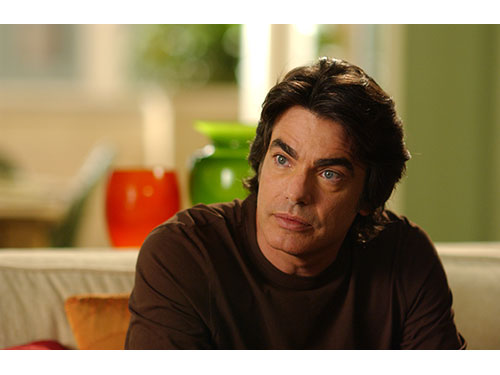
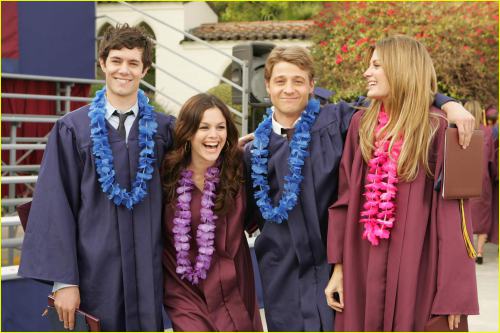
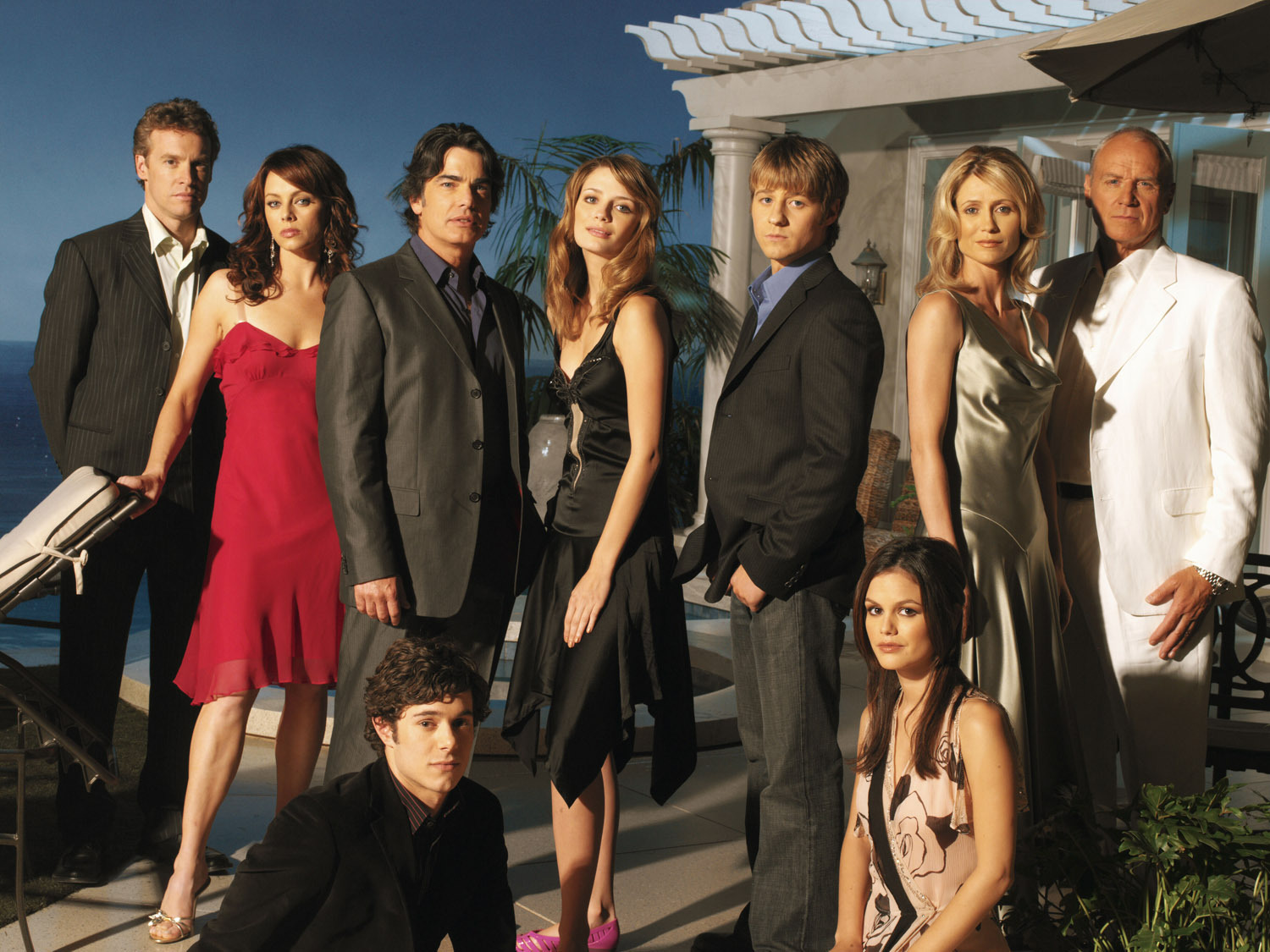
When you think about feminism in television, The OC and teen soaps in general are probably not the first example to come to mind. If you’re not familiar with The OC, it’s about a troubled youth named Ryan Atwood (Ben McKenzie) who is taken in by the Cohens, a very wealthy family, after his own family has abandoned him. I’m very passionate about The OC and it is much more than that, but I shall not digress (or at least try not to). The Cohens are comprised of Kirsten (Kelly Rowan), a wonderful mother as well as a successful architect and businesswoman, Seth (Adam Brody), the awkward and endearing pop-culture-referencing son, and Sandy (Peter Gallagher), a righteous public defender, father, and husband.
My first introduction to Matt Damon was the same as many movie viewers – Good Will Hunting, a film that he starred in and co-wrote with Ben Affleck. It was my favorite film of 1997 and still holds a special place in my heart for its humor, poignancy, and moving portrayal of the lasting effects of abuse.
So what’s feminist about it? Although the word “feminist” is never uttered, Michael plays Dorothy as a bold, liberated woman. At the audition, slimy director Ron Carlisle (Dabney Coleman) tells Dorothy she’s too “soft and genteel” and “not threatening enough” for the part. Dorothy replies: “Yes, I think I know what y’all really want. You want some gross caricature of a woman. To prove some idiotic point, like, like power makes women masculine, or masculine women are ugly… Well shame on the woman who lets you do that.” Right out of the gate, Dorothy not only speaks her mind, but also openly protests sexism.
So what’s feminist about it? Although the word “feminist” is never uttered, Michael plays Dorothy as a bold, liberated woman. At the audition, slimy director Ron Carlisle (Dabney Coleman) tells Dorothy she’s too “soft and genteel” and “not threatening enough” for the part. Dorothy replies: “Yes, I think I know what y’all really want. You want some gross caricature of a woman. To prove some idiotic point, like, like power makes women masculine, or masculine women are ugly… Well shame on the woman who lets you do that.” Right out of the gate, Dorothy not only speaks her mind, but also openly protests sexism.
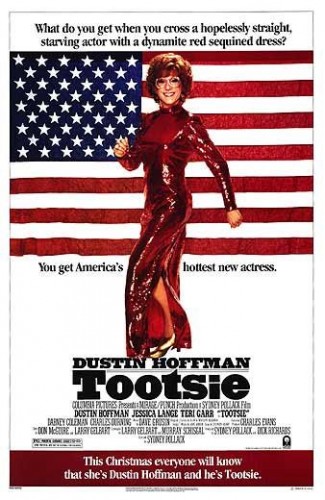
Movie poster for Tootsie
This guest post by Rebecca Cohen appears as part of our theme week on Male Feminists and Allies.
Have you seen the 2012 AFI interview with Dustin Hoffman, where he gets emotional about his role in the cross-dressing 1982 comedy Tootsie? In the video clip, Hoffman relates his disappointment in discovering that, although makeup artists could help him pass as a credible woman, he would never be a beautiful woman. Hoffman says he cried, realizing that if he were at a party he would never approach a woman who looked like him. He concludes tearfully, “There’s too many interesting women I have … not had the experience to know in this life because I have been brainwashed.”
The video of those remarks went viral recently, and most reactions were enthusiastically positive. Hooray for Dustin Hoffman, breaking through his social conditioning to see the world from a woman’s perspective. Thank you to Dustin Hoffman, for expressing the harshness of beauty standards in such a concise and heartfelt way. Making Tootsie made Dustin Hoffman a feminist ally.
Right?
Well… yes and no. Hoffman’s statements, like the movie Tootsie itself, are a good start. They’re a sincere attempt by a well-intentioned man to address feminist issues. Still, both his words and the movie fall short in many ways.
The Good
In Tootsie, Hoffman plays unemployed actor Michael Dorsey, who disguises himself as a woman to land a job on a daytime soap opera. After winning the role, Michael must continue to pretend to the world that he’s actress Dorothy Michaels. Hilarity, as you might expect, ensues.
So what’s feminist about it? Although the word “feminist” is never uttered, Michael plays Dorothy as a bold, liberated woman. At the audition, slimy director Ron Carlisle (Dabney Coleman) tells Dorothy she’s too “soft and genteel” and “not threatening enough” for the part. Dorothy replies: “Yes, I think I know what y’all really want. You want some gross caricature of a woman. To prove some idiotic point, like, like power makes women masculine, or masculine women are ugly… Well shame on the woman who lets you do that.” Right out of the gate, Dorothy not only speaks her mind, but also openly protests sexism.
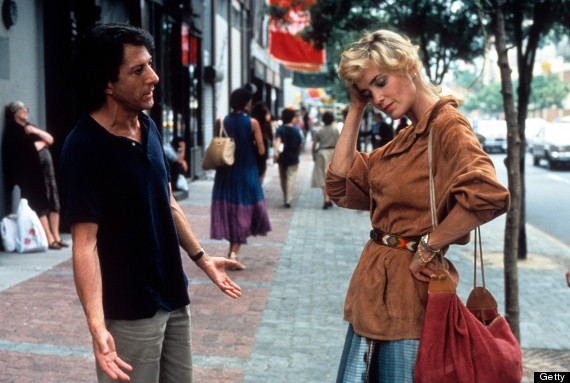
Michael non-apologizing to Julie
Although the role she’s auditioning for, Emily Kimberly, is written as a ball-busting harridan, Dorothy plays her with both fire and vulnerability. Director Ron remains unimpressed, but producer Rita Marshall (Doris Bellack) is obviously moved by the portrayal, and Michael/Dorothy gets the job.
This in itself is pretty layered and rather feminist, if you think about it. The role of Emily Kimberly is written as a sexist stereotype, a cardboard cutout of an unfeminine woman – basically, a man in a dress. But when presented with an actual, literal man in a dress, Ron declares him too feminine. The film thus (probably unintentionally) unpacks some complex ideas about gender and performativity. In order to pass as a woman Michael must play Dorothy as delicate and refined; in a way, he has to present as more feminine than a “real” woman. And this, ironically, almost costs him the role.
From there, the movie continues to develop an overtly feminist narrative. In order to avoid kissing a male co-star, Michael refuses to perform a scene as written. Instead of swooning, the character asserts herself. Producer Rita loves it. Michael/Dorothy continues to depart from the scripts, insisting on making Emily Kimberly feisty and self-assured, and Rita continues to allow it. The character’s popularity grows, Dorothy’s fame grows, and soon Dorothy becomes an outright feminist role model, even appearing on the cover of Ms. Magazine (and Cosmopolitan too, perhaps so we can be assured she’s not that militant). At one point, Rita marvels at what Dorothy has accomplished: “You are the first woman character who is her own person, who can assert her own personality without robbing someone of theirs. You’re a breakthrough lady for us.”
Dorothy also becomes a personal role model for co-star Julie (Jessica Lange). Through her friendship with Dorothy, Julie gains the strength and self-confidence to break up with Ron. She tells Dorothy, “You wouldn’t compromise your feelings like I have. You wouldn’t live this kind of lie, would you?… I deserve something better, you know? I don’t have to settle for this.” Through the movie, Julie repeatedly expresses how Dorothy has taught her to stand up for herself.
At the same time, Michael learns his own lessons about feminism, drawn from his experiences living as a woman. He’s taken aback by the effort and expense required of women to keep themselves attractive. He attempts to voice concerns on set, but gets frustrated when Ron dismissively talks over him. Experiencing the world as Dorothy, Michael comes to believe he really has a new understanding of what women endure. He tells his agent, George (Sydney Pollack): “I feel like I have something to say to women, something meaningful,” explaining how he knows what it is to feel helpless and not in control.
In one of the most memorable moments of the film, Michael/Dorothy, fed up with Ron’s patronizing treatment on set, stands up to him:
Michael/Dorothy: Ron, my name is Dorothy. It’s not Tootsie or Toots or Sweetie or Honey or Doll.
Ron: Oh Christ.
Michael/Dorothy: No, just Dorothy. Now Alan’s always Alan, Tom is always Tom, and John’s always John. I have a name too; it’s Dorothy. Capital D, O, R, O, T, H, Y. Dorothy.
Titling the film Tootsie emphasizes that Michael’s experience of being marginalized, of struggling to demand respect, is meant to be understood as a focal point of the film.
So, clearly it’s a feminist movie. In some ways.
Dorothy and Michael
The Bad
So why does Rita Marshall, a seasoned and capable TV producer, never include independent, assertive women on her show until Dorothy Michaels comes along and steamrolls her into it? Did it never occur to her that such a thing was possible, or that her mostly female audience might enjoy it? Similarly, why is Dorothy the only woman who stands up to Ron’s harassment, even though it’s evident he’s been behaving this way with impunity for years?
The film seems to imply that Michael, coming from a position of male privilege, is uniquely positioned to call out sexism. He isn’t accustomed to enduring second-class status. Women deal with it grudgingly, because, you know – that’s how the world works. But Michael hasn’t been conditioned to accept it. So he doesn’t.
Here’s the thing. This situates Michael as the White Knight, the male savior of women’s rights. Spending only a few months experiencing how the world treats a woman, he’s better able to challenge the status quo than the women who’ve spent their entire lives experiencing it. Like many cross-dress comedies, Tootsie falls into the trap of implying that a man is better at being a woman than any woman knows how to be.
Also, what does Michael do with his newfound understanding of the struggles women face? He sees how Ron mistreats Julie, lying to her yet claiming it’s to spare her feelings. But Michael does essentially the same thing to his longtime friend Sandy (Terri Garr). He sleeps with Sandy to cover up his secret, then lies to her and strings her along even as he’s steadily falling in love with Julie. It’s women, specifically Sandy and Julie, who bear the brunt of the harm caused by Michael’s deceit. Recognizing how men use lies to abuse women doesn’t stop Michael from doing it himself.
Dorothy shaving
Even after the truth is revealed, Michael never apologizes to Julie for deceiving her. (Interestingly, he does apologize to her father in suitably man-to-man fashion.) He tells Julie, “I just did it for the work. I didn’t mean to hurt anybody.” In other words, instead of acknowledging her hurt and owning the harm he caused, he tries to explain and justify. He tells her, “I was a better man with you as a woman then I ever was with a woman as a man.” This is the lesson Michael draws from his experience as Dorothy: it has made him a better man… somehow.
Thus the film undercuts its early feminist promise. Michael never has to answer to the women who admired him as a feminist icon, only to find out he was a man all along. He never apologizes to the women he deceived on a very intimate level. He doesn’t, when all is said and done, make anything better for women. But that’s not important. What matters is that he has become a better man. “I just gotta learn to do it without the dress,” he explains.
Terri Garr, speaking to the Onion AV Club in 2008, shared her thoughts about Dustin Hoffman’s Tootsie-inspired insights about gender: “They put a man in a dress, and he’s supposed to know what it feels like to be a woman. But of course he doesn’t. I think what Dustin [Hoffman] says is, ‘I realize now how important it is for a woman to be pretty. And I wasn’t pretty.’ God! That’s all you realized? Jesus Christ. Oh well. Don’t quote me. Actually, quote me.”
Dustin Hoffman’s epiphany about women being judged based on their looks is most certainly A Good Thing. So is his acknowledgment of his own role in marginalizing women who don’t meet a certain beauty standard. But even as he laments all the interesting women he never took the time to know, Hoffman’s comments still center on himself. It’s about his loss in not getting to know these hypothetical women. It’s about his regret. And fundamentally, as Terri Garr points out, something is still missing.
[youtube_sc url=”http://youtu.be/Ch57pIuYhbM”]
I’m genuinely pleased to know that making Tootsie taught Dustin Hoffman to be a better man, just as his character Michael Dorsey learned to be a better man. But being a male feminist or feminist ally isn’t primarily about men’s personal character growth. It’s supposed to be about liberating and empowering women. And it’s frustrating to see people respond as though Hoffman has discovered some earth-shattering truth, when women have already spoken and written about these issues at length. Why does it carry more weight when a straight, white, cis, wealthy, famous man expresses it?
Of course, like it or not, people listen when straight, white, cis, wealthy, famous men speak. So I can’t criticize Dustin Hoffman for using the platform he has to amplify a feminist message, even if what he says should be obvious to everyone by now. Terri Garr is absolutely right: Dressing as a woman for a day does not convey the entirety of what it means to be a woman in a patriarchal society. But I wouldn’t object if more men wanted to give it a try.
Rebecca Cohen is the creator of the webcomic “The Adventures of Gyno-Star,” the world’s first (and possibly only) explicitly feminist superhero comic.
When you think about feminism in television, The OC and teen soaps in general are probably not the first example to come to mind. If you’re not familiar with The OC, it’s about a troubled youth named Ryan Atwood (Ben McKenzie) who is taken in by the Cohens, a very wealthy family, after his own family has abandoned him. I’m very passionate about The OC and it is much more than that, but I shall not digress (or at least try not to). The Cohens are comprised of Kirsten (Kelly Rowan), a wonderful mother as well as a successful architect and businesswoman, Seth (Adam Brody), the awkward and endearing pop-culture-referencing son, and Sandy (Peter Gallagher), a righteous public defender, father, and husband.
This guest post by Victor Kirksey-Brown appears as part of our theme week on Male Feminists and Allies.
When you think about feminism in television,The OC and teen soaps in general are probably not the first example to come to mind. If you’re not familiar with The OC, it’s about a troubled youth named Ryan Atwood (Ben McKenzie) who is taken in by the Cohens, a very wealthy family, after his own family has abandoned him. I’m very passionate about The OC and it is much more than that, but I shall not digress (or at least try not to). The Cohens are comprised of Kirsten (Kelly Rowan), a wonderful mother as well as a successful architect and businesswoman, Seth (Adam Brody), the awkward and endearing pop-culture-referencing son, and Sandy (Peter Gallagher), a righteous public defender, father, and husband.
Now that we’ve got some of the basics down, I’ll get to why Sandy Cohen is a feminist and an ally to the movement. First of all, as previously mentioned, he is a public defender and is always fighting for the underdog. He strives for equality and justice for all, even if it’s for his ruthless neighbor Julie Cooper (Melinda Clarke) or coldhearted father-in-law Caleb Nichol (Alan Dale). He simply never refuses to help and always tries his best to do what’s right. Judging from that description alone, it’s clear to see that Sandy is an ally.
When it comes to married life, Sandy and his wife Kirsten break all conventions. Kirsten is the main and sometimes sole financial provider. She helps run her father’s company, the Newport Group, a company mostly involved in real estate and housing development, making her and her family millionaires. Kirsten is also a terrible cook and by far the stricter parent. She does the majority of the grounding and often says Sandy has a “hippie” way of parenting. However, Sandy is always supportive of her; he loves that Kirsten is successful at what she does. The only time he ever wants Kirsten to quit her job is when he sees that it’s making her unhappy, and still he doesn’t tell her to quit and stay at home, he knows she values work and suggests she goes into business for herself and get away from her manipulative and controlling father. As long as Kirsten is happy with what she’s doing, Sandy could care less about who makes more money. He’s happy doing the cooking and being a stay-at-home dad. When Kirsten’s ex Jimmy Cooper (Tate Donovan) tells him, “You live in a fantasyland, you’re married to the richest girl in the county, you live in a house you’ve never paid for, you get fired–Kirsten wouldn’t even notice it! You have no idea what it’s like to provide for a family!” Sandy simply responds, “I think there’s more to providing for a family than money.” This stands out because it not only displays that a father can have a role in a family other than bread winner and still be a great dad, but it also says the same for mothers. This statement stands up for all the stay-at-home moms, arguing that just because you may not bring in a lot of money, doesn’t mean that your role is any less important in the family.
Another testament to Sandy and Kirsten’s marriage as well as Sandy’s inner feminist, is the way that they dealt with their marital problems. When another man threatens to come between them in the second season, Sandy never goes the route of slut shaming Kirsten or attacking her character in anyway. He chooses to trust Kirsten, to look at the things he’s done wrong that could have caused a rift between him and his wife, and he and Kirsten work together to fix their problems. No matter what issues they’re facing, whether it be Sandy’s law firm suing the Newport Group, differences in parenting techniques, Kirsten’s drinking problem, or deciding whether or not to move back to their small home in Berkley (small being relative to their Newport mansion), Sandy never tried to pull being the alpha or “man of the house.” Sandy and Kirsten always effectively communicated with one another and made decisions together as a team.
Sandy was a man that many people went to for help, and he would provide guidance time and time again without judgment. Instead of vilifying Dawn (Ryan’s biological mom, played by Daphne Ashbrook) and casting her out as a bad mother, Sandy searched for her and when he found her, he sympathized and tried to understand the reasons she left Ryan. Sandy never judges her for her decisions, even when Kirsten does. He and Kirsten do their best to help Dawn get back on her feet and reunite Ryan and his mother. In the end, for the sake of the show, Dawn decides that Ryan is better off with the Cohens, but Sandy never attacks her character and he and Kirsten continue to encourage Ryan to reach out to Dawn when he’s ready.
In the second season, when that ruthless neighbor Julie comes to Sandy for help because her ex, a porn producer, is trying to extort her with a pornographic film she starred in, Sandy helps her without question. Despite Sandy and Julie being far from buddies, Sandy never judges her for making a porn film and doesn’t think any less of her for it. He understands why she made it, and understands why she would like to keep it secret from her husband and two daughters (,though he does encourage her to tell her husband and allow him to help her.) He also lets her know that, even though she may view the film as a mistake, she shouldn’t be ashamed of it and she should try to trust her family with it.
Also in the second season, when Renee Wheeler (Kathleen York) reveals that she and Caleb have a love-child together, Lindsay (Shannon Lucio), from an affair they had while she was his secretary, Sandy helps her. Even though she’s going to cause a major divide in his family, he doesn’t attack her or judge her, he helps her do what’s right and pushes to make the reveal as easy of a process as it can possibly be.
Sandy never tires to coerce or manipulate any of the women who he helps. His help isn’t always selfless, but he doesn’t try to use his help as a play for power which is a route often taken by men in positions to help women on television.
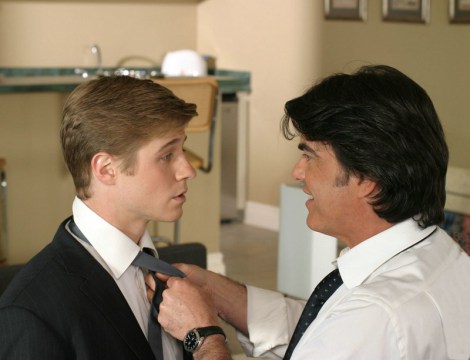
Another great thing about Sandy is that he does his best to dissuade Ryan from being hyper-masculine and thinking he always has to save the day. To Ryan’s defense, this doesn’t come from him thinking he has to be a macho man, but rather from the fact that he grew up being the most responsible person in his household. He’s used to stepping in and taking control of a situation and Sandy helps him to realize that that isn’t always his job. When Sandy sees that Ryan is involving himself too much with Marissa’s (Mischa Barton) problems in the first season he tells him, “Marissa is going to have to figure this out on her own, and you gotta let her. You’re here with us now. You don’t have to be the parent anymore.” When Ryan finds out Theresa’s (Navi Rawat) boyfriend is physically abusing her, Sandy encourages Ryan not to resort to violence to try and resolve the problem, but to use his head. “Theresa has to decide on her own to leave Eddie. You can’t force her. …I’ve seen way too many kids just like him and I know that it will not be you to suddenly make him change.” Though it takes Ryan until the third season to fully take these teachings to heart, he does eventually get it. With Sandy’s help Ryan realizes that women are fully capable of handling their own problems and that he doesn’t always have to step in. Everyone needs help now and then, but you have to also allow people to help themselves.
There are a other, more obvious male feminist allies I can think of in television, Ron Swanson, Eric “Coach” Taylor, and Cliff Huxtable to name a few, but I grew up watching soap operas with my mom and I LOVE teen soaps. Seeing a character like Sandy Cohen in the teen soap genre is rare and something I consider very important. It shows young women (the core audience of this genre) that they should not allow the men in their lives, whether it be their brothers, fathers, uncles, boyfriends, teachers or whoever, to view them as someone always needing to be guided and saved. It allows them to see that a relationship should be a partnership and that they shouldn’t be expected to aim low to avoid hurting some guy’s ego or stand on a higher moral ground because they’re a woman.
I grew up surrounded by an abundance of strong female role models and seeing a male character on television that respects women, doesn’t consider powerful women to be a threat to his manhood, and just generally treats women as equals is something that stood out to me and that I admired. As a male viewer I looked up to Sandy Cohen because he exhibited all these traits and helped to further instill them in me. I still strive to one day be at least half the husband, father, and friend that Sandy is.
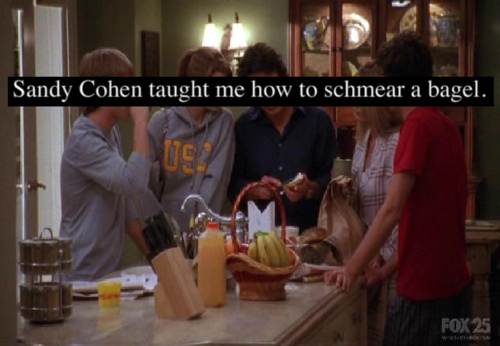
If you’ve never seen The OC, I highly recommend giving it a try and if you have, I recommend watching it again…and again…and again. I’ve learned a lot from it and fell in love with its characters and I think that you will too. I’ll leave you with a mash-up I found of some of Sandy Cohen’s best advice.
… Kang seems to be a strong advocate for feminism in film. Though South Korea cinema (and the country as a whole) clearly needs far more women in off-screen positions of power, Sunny seems like a small but hopeful step towards equality, and may well inspire girls in today’s high school cliques to one day demand those positions.
This guest post by Ben Cowburn appears as part of our theme week on Male Feminists and Allies.
Despite the recent election of the country’s first female president, South Korea isn’t the easiest place to find examples of gender equality. The country has one of the world’s largest gender gaps (1), a corporate culture still shaped by patriarchal Confucian traditions, and extreme pressure on young women to conform to very particular beauty standards. At first glance, Korean cinema appears to mirror this lack of progressiveness, as in terms of behind-the-camera power, the country’s film industry, which boomed with the Korean Wave of the late 90s, seems to be as much a boys’ club as Hollywood (2). However, the situation for on-screen representations of women and girls seems to be steadily improving in South Korea, driven in part by successful filmmakers who could easily be described as male feminists.
Korea’s most internationally visible writer/directors Park Chan-wook and Bong Joon-ho, and festival favourite Lee Chang-dong, have all crafted films based around female characters at least as complex as the men they come into conflict with. Park’s Lady Vengeance gave Lee Yeong-ae a role as starkly uncompromising as Choi Min-shik’s in Oldboy, and his films I’m A Cyborg but it’s Okay and Stoker both feature female protagonists. Bong’s film Mother is based around a searing performance from celebrated TV actor Kim Hye-ja, and even the seemingly male-dominated Snowpiercer features strong roles for Ko Ah-sung, Octavia Spencer, Alison Pill and Tilda Swinton, who gives one of her most memorably strange performances. Lee’s Secret Sunshine and Poetry feature complex, unglamorous, down-to-earth female protagonists, portrayed in award-winning fashion by Jeon Do-yeon and Yun Jeong-hie.
In the less internationally prestigious corners of the industry, South Korean cinema has developed a crowd-pleasing line in modestly budgeted films with predominantly female ensemble casts. Though often determinedly formulaic, films such as Forever the Moment, based on a women’s handball team, and Harmony (3), set in a women’s prison, are relentlessly entertaining, easily pass both Bechdel and Maki Mori tests, and have proved very popular. The most commercially successful example of this mini-genre is Sunny, released in 2011, and directed by Kang Hyeong-Cheol, who co-wrote the script with Lee Byeong-Heon (4). Both Kang and Lee are men, but Kang reportedly based the story on his mother’s recollections of her high-school life (5), and the film, which is powered by the memorable performances and excellent chemistry of its largely female cast, has a strongly feminist message.
Sunny centres around a clique of seven friends in a Seoul girls’ high school sometime in the 1980s (the film is a little hazy with the actual continuity), who are reunited in the present day, after being estranged for more than 25 years. The film is structured to give equal weight to the friends’ time in high school and to their eventual reunion, and cheerfully ticks off most of the tropes viewers would expect from its set-up. In the high school scenes friendships are forged, sisterhood is strained, bullies are bested, cute guys are crushed on, and families are fought with. In the present day, nostalgic jokes and reveries are shared, disappointments and failures are revealed, and the bonds of friendship are shown to be timeless. All pleasantly predictable and satisfying for fans of coming-of-age stories, and elevated by the playful zest of the film-making, entertaining plot absurdities, and most of all, by the irresistible energy of the cast.
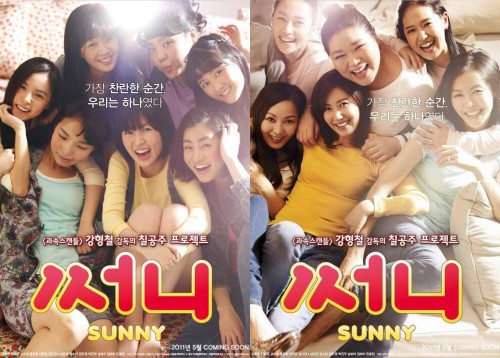
The cast of Sunny’s 80s (left) and present-day scenes (right).
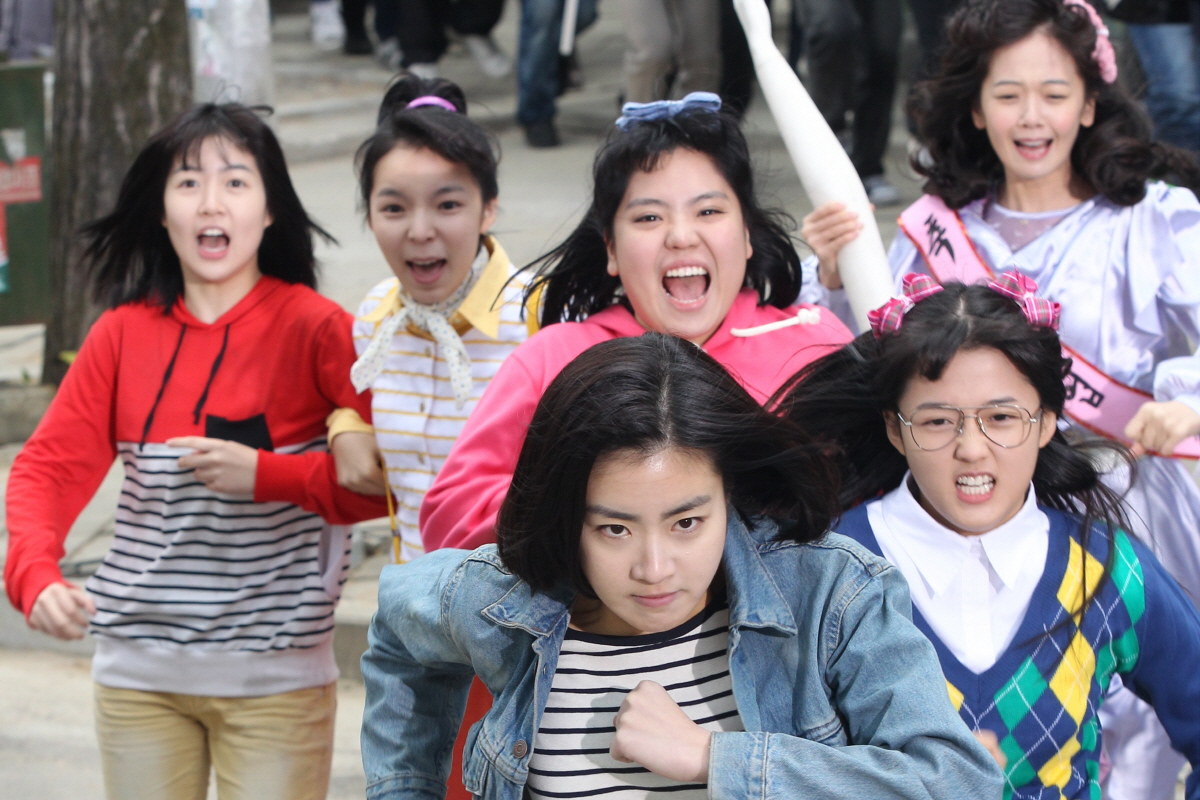
The film is told from the perspective of Na-mi, a newcomer to the school in the 80s, and an under-appreciated wife and mother in 2011. A chance present-day encounter with old friend Chun-hwa leads Na-mi into a series of flashbacks, and sparks an attempt to get the old gang back together. Gang is the right word, as in the flashbacks we see the seven girls trade insults, and eventually punches and flying kicks, with a rival posse from another school. Chun-hwa, the group’s charismatic leader, brings Na-mi into the fold when she proves useful in squaring off against the enemy. Despite some friction (there has to be some friction) with another member, Na-mi is soon initiated into the group, which is given the name Sunny by a radio DJ, and practising a chaotic dance routine to accompany Boney-M’s version of Bobby Hebb’s ode to looking on the bright side.
The 80s scenes are a blur of logo-strewn sports bags, candy-coloured sweaters, synthed-up disco tunes and reverb-heavy ballads. The script mixes in references to current K-pop groups, as well as winking predictions for a future of professional video gamers and “portable phones.” Anachronisms are also cheerfully thrown around: characters mention watching MTV, which wasn’t broadcast in Korea until 1991, and the story plays out against a backdrop of civil unrest, which seems to suggest the student-led June Democracy Movement that flared up in 1980. This turbulent background seems to mainly be set up to allow for a highly entertaining slow-motion fight between the two gangs amidst a melee of riot police and protesters. The ridiculous bravado of the scene, which is clearly filtered through the older characters’ memories of the fight, makes the clunky exposition and obvious expense of the extra-strewn scene completely worthwhile.
Na-mi, Chun-hwa and friends in action.
The heightened, highly-charged nature of the flashback scenes reflects Na-mi’s nostalgic (and sometimes painful) recollections of her school days, and contrasts nicely with the slightly more subdued style of the present day scenes. At times, the two time periods are swirled together, as in another deliriously weird fight sequence, and in a touching montage in which Na-mi’s teenage disappointment over an unrequited crush is cross-cut with her mid-40s acceptance of a path not taken. Mostly, though, the streams are crossed with playful in-camera transitions, which employ doorways, walls, and windows as time portals, and music as a bridge between periods. A pivotal (and probably obligatory) scene in which Na-mi watches a video recording of the teenage gang members addressing their older selves is adeptly realized, thanks to the vitality of the girls’ ensemble work, and the weaving of on-going conflicts into the video.
There are few scenes in the 80s storyline in which Na-mi doesn’t face an elemental teenage challenge, either from within the gang or from the outside world, and this helps sustain a charged and immediate atmosphere. Though the present-day scenes aren’t quite as potent, they provide plenty of opportunities to underline the important role the girls played in each other’s formative years, and what they have missed out on since high school. The easy, affectionate chemistry between the older actors nicely mirrors the frenetic fellowship of the younger cast, and the present-day scenes deliver plenty of abrasive humour to complement dollops of well-earned sentiment.
Na-mi and Chun-hwa in a present-day scene.
The actors in both story-lines brilliantly unify their linked performances, and this was clearly a major focus of the casting and Kang’s work with his cast. Particularly compelling are Sim Eun-kyeong and Yu Ho-jeong as the younger and older Na-mi, and Kang So-ra and Jin Hee-kyung as Chun-hwa, but each member of the gang is sharply defined, especially in the 80s scenes. The characterisation is mostly archetypal, but the girls are all shown to be witty, smart and determined, and no one is bodily humiliated or slut-shamed. In fact, sexuality has only the briefest of roles in proceedings, which is perhaps a little unrealistic, but helps to keep the focus firmly on the friendship between the girls. The single romantic complication is swiftly dealt with, so that the gang can get on with the real business of practising their dance moves, kicking ass and keeping the world at bay with a combination of mutual support and bag language.
Swearing plays a surprisingly important role in the film. Early on Na-mi’s possibly senile grandmother spews out a stream of backwoods invective, which Na-mi later copies to help the gang scare off their rivals and gain acceptance. In both time periods, the friends routinely refer to each other as ‘shibal nyun’ (usually translated as ‘fucking bitch’), and one of the younger gang members dreams of writing a swearing dictionary. The film’s original cut had so much cursing that it to be edited to ensure a PG-15 certificate, which seems to have been the right choice, as the film presents some very positive messages for teenage girls. The director’s cut restores the characters to their full, foul-mouthed glory, which gives scenes in the past and present bite and authenticity, and could be seen as a challenge to the subservient role women are often still tacitly expected to perform in Korean society. Other satirical touches include digs at South Korea’s enduring obsession with very specific beauty ideals, such as “double eyelids,” and the undermining of a male teacher’s army-derived methods of corporal punishment.
The Sunny girls face off against a rival gang.
The teenage characters have a refreshingly diverse range of ambitions (most of which remain unfulfilled in their present day lives, of course), and they are never objectified or marginalised, with costume design and shot choice underlying another important theme: that each of the girls needs to become the protagonist in her own story. This is somewhat unnecessarily spelled out out at several points, but the film mostly follows through with the idea, only fudging things a little in its final scene, which seems to present money as a key to solve everyone’s problems. More importantly, though, the resolution shows the women learning to take inspiration from their teenage selves, and vowing to reclaim agency in their lives.
Although seemingly machine-tooled to yield maximum comic and emotional impact, Sunny has plenty of rough edges and plot contrivances: Na-mi’s husband is mysteriously called away on a two-moth-long business trip, to give her more time to bond with her estranged friends, and the climactic event that closes the 80s storyline doesn’t convince as a reason for the girls to completely lose touch for a quarter century. The director’s cut, which I watched, could certainly use a trim, with a few unnecessary side stories adding little to the main characters’ arcs. None of this really matters, though, as Kang and his cast manage to cram in plenty of heady scenes of triumph, defeat, affection and antagonism into the 80s storyline, most of which are paid off in the present-day scenes. Do the 40-something friends reunite to perform the dance to Sunny they practised as teenagers? Does each woman find solace and strength in her re-invigorated friendships? Does the dictionary of swearing ever get written? I couldn’t possibly say.
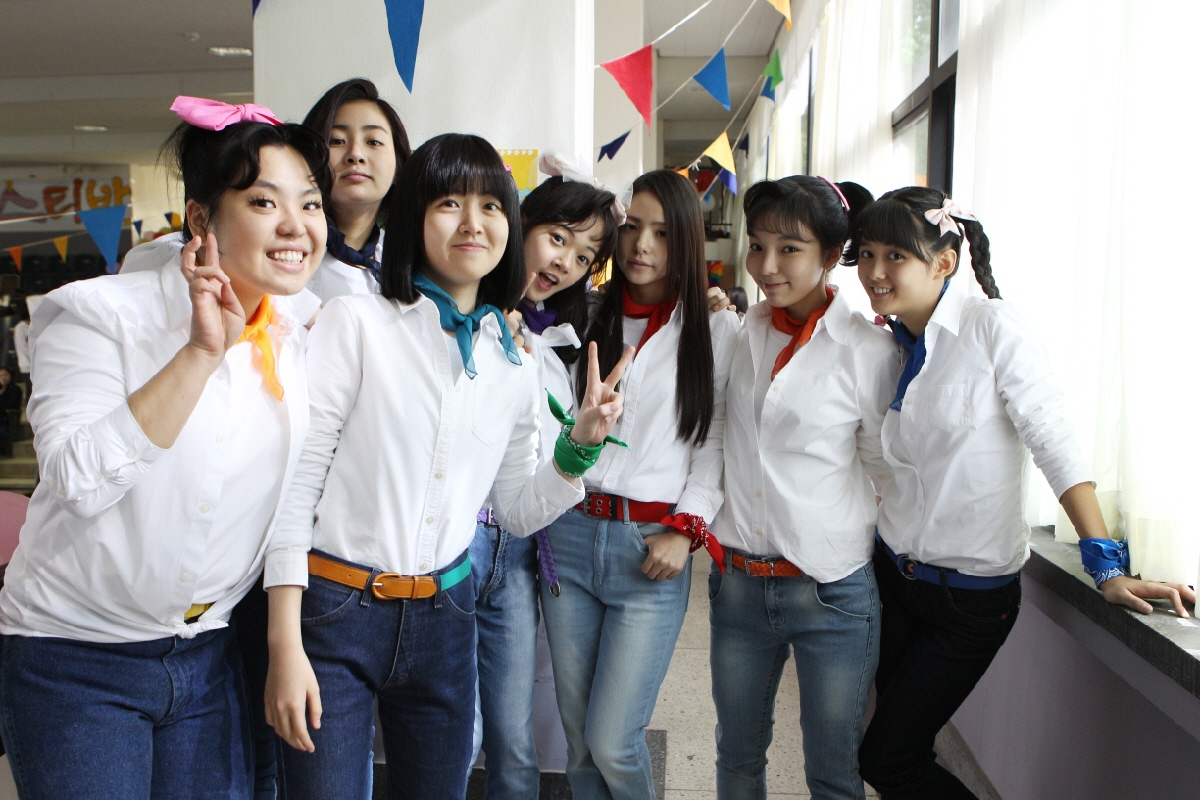
The 80s cast in off-duty poses.
Sunny proved endearingly popular on its cinema release (6), and became the second highest grossing domestic film in Korea of 2011, due in part to a surge in nostalgia for the culture of the 7080 generation, but mainly to strong word-of-mouth. As with Bridesmaids and The Heat, the film clearly shows the huge demand for female-lead films, and like those film’s director, Paul Feig, Kang seems to be a strong advocate for feminism in film. Though South Korea cinema (and the country as a whole) clearly needs far more women in off-screen positions of power, Sunny seems like a small but hopeful step towards equality, and may well inspire girls in today’s high school cliques to one day demand those positions.
3 – One of the most successful Korean films with a female director, Dae-gyu Kang, Harmonymade me weep repeatedly when I saw it on a plane a few years ago. I blame the altitude.
4 – Not the devilishly handsome actor of the same name, best known to international audiences from The Good, The Bad and The Weird.
6 – The film opened at number in the Korean box office, stayed there the following week, and returned to the top spot five weeks later.
Ben Cowburn is from England, and currently works as an English language teacher in Jinju, South Korea. He also writes and takes photos. Words and pictures, can be found at: thelightthroughthewindow.tumblr.com.
Caroline somehow knows that Adam is not a typical young man simply working for minimum wage at a local diner in Minnesota; he is a heavenly catalyst sent not to offer completeness in Caroline’s life, but to remind her that she is worth loving, even in his absence.
This guest post by Jenny Lapekas appears as part of our theme week on Male Feminists and Allies.
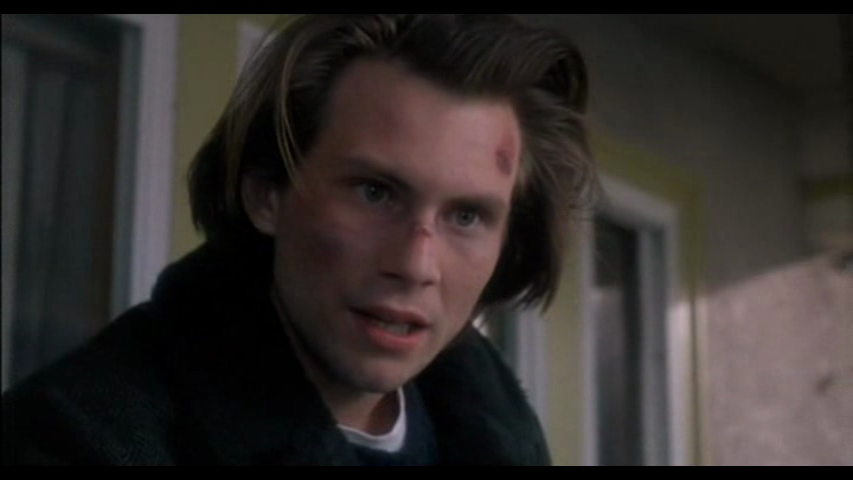
In Tony Bill’s romance Untamed Heart (1993) Adam (Christian Slater) is very much a Christ-like figure throughout the film–he carries an aura of secrecy, we see him consistently bathed in light in many scenes, and he saves Caroline (Marisa Tomei) from her would-be rapists in a dark park in Minneapolis. In fact, Adam–whose name echoes the biblical Adam of the Garden of Eden–saves Caroline throughout the film, and it only makes sense, after proving his sacrificial love for the waitress, that he dies at the film’s conclusion. The film immediately focuses on Adam as it opens with his upbringing as an orphan raised by nuns. When the juvenile Adam has medical issues with his heart, one of the concerned nuns pleads, “Don’t you break our hearts,” a clear indication of his divine links as a person and a child of the church.
When Caroline questions Adam about fighting off the pair of drunken men, she is almost accusatory: “You follow me home?” After her attack, the last thing she wants to believe is that Adam’s sweet gaze is actually predatory. Adam interrupts her charming babbling with a sobering, “I wasn’t finished,” which becomes his mantra throughout the film; Caroline tends to talk herself in circles, but Tomei has a way of winning over viewers with her cyclical monologue when interacting with the dreamy Christian Slater.
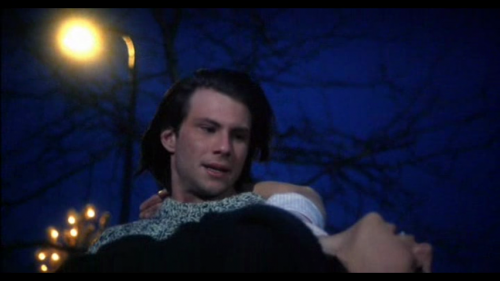
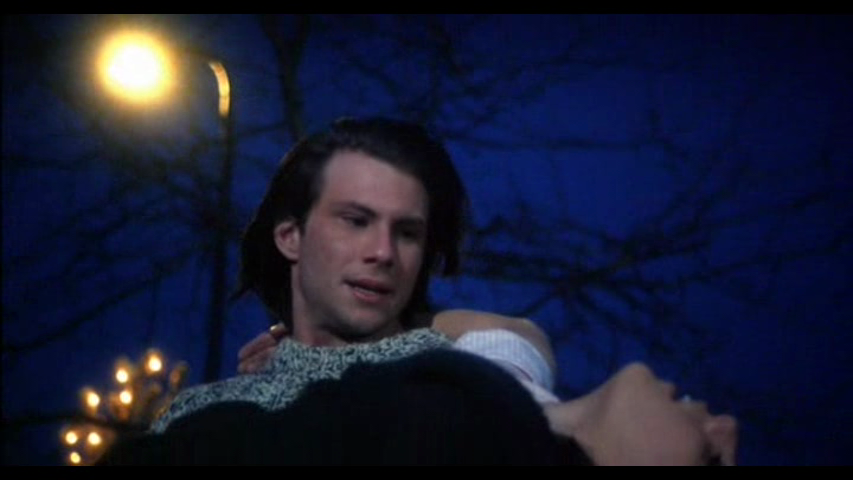
The street lamp looks almost like a halo above Adam’s head as he carries home an unconscious Caroline, post-attack.
To further emphasize Adam’s goodness, all other male characters found in Untamed Heart are in some way flawed: Two men who show interest in Caroline end up as her assailants, Caroline’s father is uptight and largely absent, and her immature little brother fails to pick her up from work, causing her to walk home alone. After her attack, we see a defeated-looking Caroline at the mall amidst the holiday bustle. As she rises on an escalator, we see Adam pass by on the descending side–we’re almost surprised to see such a saintly man traveling downward rather than ascending upward, albeit in the space of a mall. Caroline is taken by surprise when he lovingly places his hand over hers.
Most noticeable is that Adam is bathed in light as he floats downward and gazes at Caroline.
“If you look up long enough, you’ll see a shooting star,” Adam tells Caroline when he begins walking her home from work: not only evidence of his virtue but also a pleasant reminder that Caroline can take a break from suspiciously looking around her long enough to look above her. The couple’s nonverbal agreement to walk home together after their shifts secures Adam’s placement as Caroline’s guardian, protector, and confidante. While the men Caroline typically encounters are quick to dismiss, forget, or victimize her, Adam is fixated and irrevocably in love with her.
Even as the two first become intimate, Adam appears “too good” to engage in earthly pleasures. Because Caroline is studying to be a beautician, she invites Adam over to cut his hair, but it’s delayed when Adam begins touching Caroline’s breasts as he sits before her; rather than sexual attraction, this scene highlights the awe Adam feels for Caroline. Although she leads him to the bedroom, it is Caroline that is being led to understand what true love looks like. After Caroline undresses and sits with Adam on her bed, he begins to cry, and she tells him, “I’m gonna fall in love with you,” which halts any possibility of sex or foreplay we anticipate in this scene; rather, this vow is their foreplay. As he continues to cry, she explains that he doesn’t have to return her love; this scene can be read as the couple merging as one, giving themselves to each other, in a landscape of celibacy.
When Caroline explains to Adam that his heart is diseased, visibly agitated, he exclaims, “No one is taking away my heart!”
When Adam dies, he does so peacefully, and not so unexpectedly. After he is stabbed by Caroline’s attackers while taking out the garbage, he leaves the hospital early and finds Caroline. He believes that he has the heart of a baboon and that he will survive, despite what doctors tell him. Because Adam knows that his love is innocent, he equates this to the state of his heart, and ultimately, how he feels about Caroline. Because Adam seems to exist on a different plane than those around him, it only makes narrative sense that he passes away after he and Caroline have fallen in love. We don’t expect any violent or traumatic death; rather, Adam sort of burns out, like the sun. At his funeral service, Caroline describes him as an angel and attributes agency to herself within the romance: “I was good at loving him.” Adam enters Caroline’s life not only to care for her but also to prove that she is not as flaky as she may have thought.
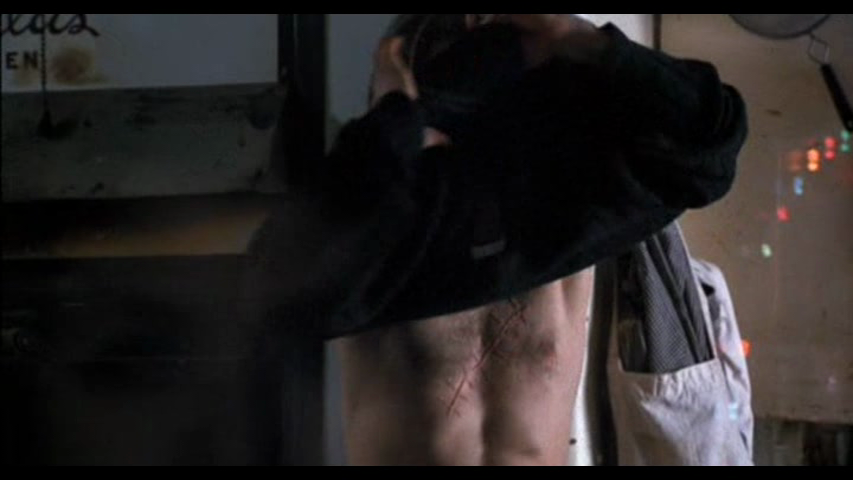
Caroline spots Adam’s massive scar as he changes at work.
The pair find one another amidst rude customers, raucous holiday gatherings, and those who fail to understand their young relationship. Caroline tells her best friend Cindy, “I don’t make sense, he doesn’t make sense, together we make sense!” Slater brings instant mystery to this role as the quiet busboy who secretly admires his waitress co-worker, and ensures that she arrives home safely every night after making the walk from work. We also fall in love with Tomei’s vulnerability and her willingness to trust the newness of a young romance after so many failed relationships. Caroline somehow knows that Adam is not a typical young man simply working for minimum wage at a local diner in Minnesota; he is a heavenly catalyst sent not to offer completeness in Caroline’s life, but to remind her that she is worth loving, even in his absence.
We love Adam because he comes to Caroline quietly, modestly, seeming to have always existed in the shadows, behind the scenes, loving her selflessly from afar, making his presence known only out of necessity. In a busy city that seems to challenge our mousy heroine at every corner, Adam is an ally, a soul mate, and a reason to watch the not so tired plot of “boy meets girl.”
Jenny Lapekas has a Master of Arts degree in English, and she teaches Composition at Alvernia University in Pennsylvania. Her areas of scholarship include women’s literature, menstrual literacy, and rape-revenge cinema.