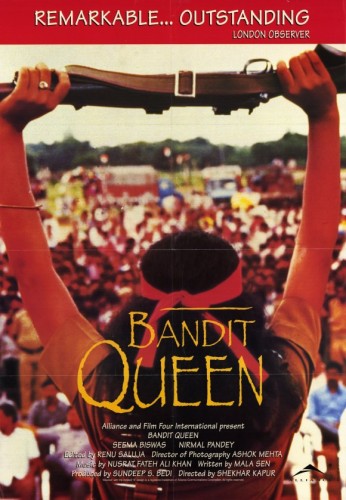
When Biopics Go Awry: ‘Bandit Queen’ as Rape Revenge

When considering female agents of violence in a film, there is a troublesome tendency that plays to the audience’s anxiety about a women disrupting the essentialist notion that women are naturally gentle and nurturing: the tendency to have the woman acting in response to sexual violence, that only after a woman is overpowered and assaulted can she find a place of violence in her. Once the naturalness of a woman is disrupted by an outside force—a (usually male) perpetrator—she is no longer required to be viewed as “womanly.”

Bandit Queen movie poster

This guest post by Colleen Lutz Clemens appears as part of our theme week on Rape Revenge Fantasies.

When reading articles about the rape revenge genre, one sees cited I Spit On Your Grave, Teeth and other western films.  But I would like to put forth that Shekhar Kapur’s 1994 film Bandit Queen should be considered a rape revenge film, even if the film that is supposedly putting forth the “truth” exploits the rape of the main character Phoolan Devi, an Indian gang leader who was murdered in 2001, to drive the plot of the “biopic.”

Phoolan Devi herself did not authorize the making of the film depicting her life and filed a lawsuit against the filmmakers.  In a 1999 interview with AkasaMedia, she bemoaned the fact that more people talked about the mythology of Phoolan Devi than of Phoolan herself:  “It’s unfortunate that they don’t talk much about me, they don’t write much about me, the real Phoolan Devi. Of course the movie is also a part of the story of my life, but it’s not the real thing. I wish they could have done it more realistically. I also wonder why they focus so much on the movie, instead of on the real person.”  When explaining why she filed the lawsuit, she explained, “The case is over, I’ve withdrawn it. What I wanted was that, in India, they shouldn’t show four scenes of the movie. One was the rape scene. They should not show that, because people feel very disturbed about it–society can’t take it.”  Devi herself did not want the rape scene shown.  This scene (and other shorter scenes of brutality against the character of Phoolan) works to transform the film from a biopic to a rape-revenge film; the protagonist’s actions are motivated by a desire to make her rapists suffer, leading to the climax of the film.

Halfway through the film, Phoolan is captured, thrown on a boat, and taken to an enemy’s hideout where her bloodied body is tossed into an outbuilding.  The first man enters the building (1:14) and the viewer is on the floor with Phoolan as she watches him approach.  A beam splitting the screen makes us feel trapped with her.  Her feet are untied so her legs can be splayed.  Her cries continue as the other men come to watch her being raped.  The camera lingers on rusty debris between the rapists’ entrances and exits.  The light softens on her battered face while the rest of the room is dark and dusty.

rape light on her

Man after man enters the building during the three-minute scene pierced by her cries and their grunts.  The audience is to assume that the assaults last for another three days until the bloodied, naked Phoolan is forced to walk in front of the village, arriving at the well where she must fill the urn thrown at her feet.

bandit post rape

Her main perpetrator, Thakur Shri Ram, grabs her by the hair and drags her through the square while young girls watch and receive the message that no woman should ever dare to desire a position of power in a gang.

well better one

From this point in the film, Phoolan becomes larger than life.  As her body heals, her desire for revenge grows. She cultivates a new gang.  She collects weapons.  She earns the moniker of the hero, “The Bandit Queen.”  When she arrives at a wedding attended by Shri Ram (1:37), she exacts her revenge.  She has her gang line the men up so she can harass and beat them.

bandit finding the men

The sound of a girl child’s screaming permeates the scene.  As Phoolan shoots the men, the camera cuts to the naked child wandering the scene.  She and Phoolan are the only females present.  The audience sees Phoolan’s intense desire for revenge in her eyes as she punches and kicks the men who raped her or stood by as she was raped.  As the child screams, Phoolan’s gang shoots the men dressed in white, pulverizing them into bloody mounds.  Gunshots are juxtaposed with the toddler’s cries. The camera follows Phoolan’s eyes as she watches the men being executed.  The naked child stands at the well, an empty bucket behind her, forcing the viewer to connect the screams of Phoolan to the screams of the child, linking this scene to Phoolan’s rape earlier in the film.  The scene ends as the child walks alone across puddles of blood.

Again, Phoolan Devi herself did not want the rape scene in the film.  Yet the final rape scene becomes the defining moment in the film, the turning point when the character Phoolan begins her trajectory to becoming the legendary Bandit Queen.  In the film’s depiction of Phoolan, she acts out of revenge and also helps other lower caste people along the way.  Her motivating desire is to gun down those who raped her, who demeaned her, who humiliated her.  Arundhati Roy, an Indian writer and activist, wrote a scathing piece in which she claims those responsible for the film silenced their subject and disallowed Devi from even having a claim to her own life story.  In “The Great Indian Rape Trick,” she says the film should be entitled Phoolan Devi’s Rape and Abject Humiliation: The True half-Truth?, arguing that the “centerpiece” of the film—the rape scene—is exploitative and not “tasteful” as the critics have said.  Mala Sen, the film’s screenwriter, told The Independent in a reply that Phoolan did give consent for the film and signed the contract willingly and argues that Roy herself is using Phoolan as a pawn in another ideological debate.

All of the debates leave me with the same questions:  Why does Phoolan Devi need to be repeatedly raped in the film?  Why does the film shift into the rape revenge genre instead of acting as the biopic that the filmmakers claimed it to be?

When considering female agents of violence in a film, there is a troublesome tendency that plays to the audience’s anxiety about a women disrupting the essentialist notion that women are naturally gentle and nurturing:  the tendency to have the woman acting in response to sexual violence, that only after a woman is overpowered and assaulted can she find a place of violence in her.  Once the naturalness of a woman is disrupted by an outside force—a (usually male) perpetrator—she is no longer required to be viewed as “womanly.”

Is it so “unnatural” to see a woman leading a violent gang that we require a monstrous reason to allow us to rationalize her existence?  Would audiences be unable or unwilling to go along with the narrative if there weren’t some reason, some thing we could all point to and say “Aha!  That is why she isn’t acting like a woman anymore.  Because the thing that made her a woman was taken away from her,” as if a woman cannot have access to violence as a form of resistance?

I teach The Bandit Queen along with Teeth and ask students to consider both as rape revenge films.  While the latter is a little easier for students to connect with contextually, they are able to see the former for what it is:  a rape revenge film.  While not a successful biopic, as a rape revenge film The Bandit Queen offers the audience a satisfying conclusion following the genre’s plot and character development.  Phoolan finds agency in violence and is able to make those who wronged her regret their actions.

bandit first image


Colleen Lutz Clemens is assistant professor of non-Western literatures at Kutztown University. She blogs about gender issues and postcolonial theory and literature at http://kupoco.wordpress.com/. When she isn’t reading, writing, or grading, she is wrangling her two-year old daughter, two dogs, and on occasion her partner.

The Fractured Rape/Revenge Fantasies of Julie Taymor’s ‘Titus’

Julie Taymor’s contemporary approach to creating a film of ‘Titus Andronicus,’ then, has to address a variety of factors: 1) she has set up for herself the challenge of filming a Shakespeare play that has been called both an “early masterpiece” and an “Elizabethan pot-boiler”; 2) she’s a female director approaching a play that has, at its center, a ritual killing, a rape, and revenge cannibalism; and 3) she’s creating this piece of art during a historical moment during which entertainment media is rife with violence and there much alleged desensitization, as well as within a culture full of complex and problematic attitudes about rape.

unnamed

This guest post by Rebecca Willoughby appears as part of our theme week on Rape Revenge Fantasies.

It might seem a bit archaic to look to a Shakespearean text for an answer to any question about rape/revenge fantasies—that is, unless you’re a student of Shakespeare.  As Leigh Kolb has already usefully pointed out, it seems the Bard knew a thing or two about the deeply affecting rage felt by survivors of sexual abuse, and how patriarchy perpetuates that rage by blocking their ability to feel that justice is served in their honor.  He knew about it so well, in fact, that even during the time of performances of Titus Andronicus, a play penned relatively early in Will’s career that revolves around rape and revenge, stage productions included a strange conglomeration of historical periods, all of which were oppressive to women in varying degrees.  Witness the Peacham drawing, an early-modern representation of the costuming and staging of Titus Andronicus, and you’ll see a combination of classical Roman and Elizabethan garb, where Titus Andronicus, the play’s titular general, appears in traditional Roman costume, and his soldiers appear in armor worn in Shakespeare’s day.  Both the classical Roman and Elizabethan periods were two moments in time when women (with the possible exception of the Queen) were literally the property of their fathers, brothers, and husbands, and had little recourse of their own if they were misused in any way, except through these societally approved male allies.

So it’s not truly surprising that the raped woman in this play, Titus’s daughter Lavinia, has to rely on her male relatives to enact revenge for her violation.  After all, this isn’t I Spit on Your Grave.  It’s more like The Last House on the Left, which—like Ingmar Bergman’s The Virgin Spring—is after all based on a 13th century ballad about a girl raped by ruffians who then arrive for a respite at her family’s home.  When her parents find out about her rape, they torture and kill her rapists in retaliation.  If this origin story tells us anything (at least initially) about rape revenge narratives, it’s the unfortunate fact that sexual violence has been around for a long, long time.

unnamed

Julie Taymor’s contemporary approach to creating a film of Titus Andronicus, then, has to address a variety of factors: 1) she has set up for herself the challenge of filming a Shakespeare play that has been called both an “early masterpiece” and an “Elizabethan pot-boiler”; 2) she’s a female director approaching a play that has, at its center, a ritual killing, a rape, and revenge cannibalism; and 3) she’s creating this piece of art during a historical moment during which entertainment media is rife with violence and there much alleged desensitization, as well as within a culture full of complex and problematic attitudes about rape.

Taymor’s answer to these challenges is to mimic the pastiche represented in the Peacham drawing, with a bit of updating: her film, Titus (1999), is a lush visual mash-up of classical Roman architecture, iconography that vaguely recalls both Stalinist Russia and Hitler’s Germany, avant-garde symbolism, Fellini-esque mise-en-scene, and even Degas ballerinas.  The influence of the Peacham sketch draws attention to the fact that the classical setting of Titus Andronicus reflects the violence of the Elizabethan period of the play’s production, as well as bringing to mind the violence of classical Rome, the coliseum as a theatre of violence, and the excessive, often despotic rulers of the classical period.  The overall look of Taymor’s film, with its naturalistic color palette, its blending and layering of historical periods and iconic imagery, and its direction and photography lends itself to a mode in which the grotesque is presented with utmost beauty, unsettling the viewer and increasing the tension between what the audience knows to be real and fiction.  Each of these symbols, referents, and cultural touchstones emphasize the powerlessness of women in those cultures (and, by extension, our own), and the fragility and repression that can characterize the feminine experience.  But perhaps most importantly, this approach destabilizes any complicity the audience might bring to these representations of violence.  Taymor wants her viewers to FEEL these wrongs, and feel them deeply.

unnamed-1

Enter what Taymor calls the “Penny Arcade Nightmares.”  Although the film is brimming with gorgeously realized but horrifying images happening in the play proper—such as Marcus’s discovery of Lavinia that has been much discussed—these sequences are the most obviously symbolic, and are meant to illustrate the intense emotions surrounding the events that drive the revenge plot: the supposed honor-killing of Goth Queen Tamora’s eldest son; her younger sons’ subsequent rape of Lavinia in retaliation; Titus’s murder of Chiron and Demetrius in vengeance; and finally the epically terrifying final scenes, where Titus has ground the  boys’ bones “to dust” and baked them into pies, which he’s fed to their mother Tamora, whose enraged husband slaughters Titus (but not before Titus kills his own daughter to save her from “surviv[ing] her shame”)… yeah.  Pile of bodies on the stage at the end of the play: check.  Taymor takes these remarkable cruelties, mingles them with horror’s libidinal audience reactions, and controls those reactions through unexpectedly stunning imagery to produce an increase of empathy.   In Taymor’s adaptation, each act of violence is an image that is hauntingly beautiful and still highly disturbing.  The Penny Arcade Nightmares illustrate not only acts of torture, dismemberment and cannibalism, but also their internal consequences, their effects on those who execute them, and how victims and those close to them are changed by such extreme violence.

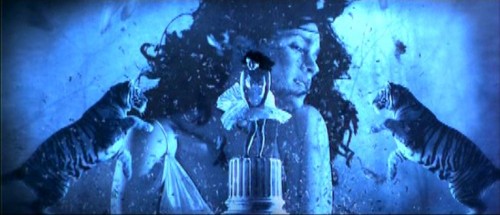
Lavinia’s rape, though it occurs “off-stage,” is represented in one of these stylized vignettes.  Bathed in icy hues of blue, white, and grey, Lavinia appears at once as a sort of Old-Hollywood female icon, a suitable eye-rest for the male gaze, but also as a wounded deer, with a deer head placed atop her head, and deer hooves replacing her dismembered hands.  Twisting and cowering on a pedestal as if she’s trapped within a snow globe, she dodges the sharpened claws of Chiron and Demetrius, represented as man-tigers bent on consuming their herbivore prey.  Chaotic rock music and fast-paced editing underscores the brief scene, highlighting the jagged edges of Lavinia’s memory of her trauma, evoking her anger and her frustrating helplessness.  It’s also significant that this moment appears in the film as her male allies encourage her to write the names of her rapists in the sand, revealing their heretofore elusive identities in order to facilitate vengeance—by performing an act that will lead to justice for the violated girl, she is violated again by her own memory of the event.

unnamed-2

But what can this film teach us about rape culture?  The film and its source material are chock full of horrible acts of violence, including rape.  The problem is not that Lavinia doesn’t get justice—she does.  The problem is that this justice is achieved through additional violence, a fact that Taymor emphasizes by placing the final bloodbath in the setting of an arena, populated with viewers.  They signify us, those watching at home, and implicate this violent justice through their blank faces and silent stares.  They do not cheer.  Lavinia’s plight is finished, but the cycle of violence has claimed nearly everyone on “stage.” Taymor’s revision leaves the children to potentially clean up the massacre.  Taymor’s insistence on unmooring our expectations of representational violence through her painterly compositions, and her use of the audience suggest that she not only wants to change our ideas about rape culture and revenge, but about violence in general.  The very construction of the term “rape culture” includes that word, “culture”—a concept that is all-inclusive, encompassing all people, regardless of your place on the sexual spectrum.

Lavinia’s attack and subsequent mutilation is a horrifying, physical manifestation of how broken we are as a society in regards to rape and other forms of sexual violence, and Titus’s attempt at justice—however well intentioned—doesn’t really solve the problem.  The problem is not only rape culture. In Shakespeare’s text Lavinia is our center of empathy, the character through which we experience tragedy on a grand and grotesque scale.  But Titus himself is guilty of perpetuating the cycle of revenge that ends with that pile of (albeit mostly despicable) bodies on stage, and the layered representation of various historical moments in original performance and the contemporary film speaks to the agonizing continuation of these flawed approaches to healing. Extreme?  Sure.  But this text seems to ask audiences through the centuries: is more violence really how we want to handle terrible, soul-crushing, self-negating violence?  With everyone dead, does anyone really learn a lesson?  In her modern re-vision, Taymor’s use of the coliseum audience seems to refute the idea that rage unleashed in additional violence is any kind of cure for deeply felt pain.  Their silence, and perhaps ours, is a thoughtful one, one that might include some consideration of alternatives to perpetuating the cycle of violence that leads down a deep rabbit-hole to oblivion.


Rebecca Willoughby holds a Ph.D. in English and Film Studies from Lehigh University.  She writes most frequently on horror films and melodrama, and is currently a lecturer in Film/Media Studies at Bucknell University in Lewisburg, Pennsylvania.  


“I’ll Make You Feel Like You’ve Never Felt Before”: Jennifer’s Power in ‘I Spit on Your Grave’

No movies ever had to justify a cowboy going on a rogue revenge kick after his log cabin was burned to the ground or his family was killed; certain sufferings of injury, murder of loved ones, robbery, etc., have been accepted throughout cinematic history to merit revenge at all costs. ‘I Spit on Your Grave’ was a large part of a relatively new phenomenon, possibly born out of the feminist movement, to add rape—based on the woman’s experience of rape, whether validated by law or not—to that list of worthy harms, which is an important statement in our rape culture.

Jennifer, before she murders the final man


This guest post by Sophie Besl appears as part of our theme week on Rape Revenge Fantasies.

I got into exploitation films through Quentin Tarantino’s Kill Bill. I liked the Bride’s unapologetic rampage, and was thrilled to learn that Tarantino’s work emerged from a rich tradition of female-fronted films starting in the early 1970s. What interested me most was that this tradition was created by men for the entertainment of a predominately (young, urban) male audience. Yet these exploitation films, such as Coffy, Foxy Brown,[1] Lady Snowblood,[2] and dozens of low-budget slasher films[3] where the “last man standing” was almost always a woman, felt like some of the most empowering, pro-women films I had ever seen. No subgenre of exploitation films brings up the question of whether these films empower or exploit more so than the rape revenge genre. While there is evidence on both sides, as a feminist woman, I greatly enjoy films that follow this plot formula, seeing them as explorations of women’s potential to be fierce and powerful in the face of horrific abuse.[4]

I Spit on Your Grave, originally released as Day of the Woman[5] in the late 1970s, is to me the flagship film of the rape revenge genre. A woman named Jennifer rents a house in the country to spend some quiet time to herself writing and relaxing, but is trapped, tormented, raped, and almost killed by a group of four men from the small town. She then plans and exacts gruesome revenge on each of them. The film was torn apart by critics, yet decidedly not from a feminist angle. A review decrying the scene where Jennifer castrates one of her rapists as “one of the most appalling moments in cinema history,”[6] also calls out the double standard of sexual violence in film–rapes in other films, or even the rape of Jennifer earlier in the same film, did not rile up even close to the same level of distaste at the time it was released.

But while reviews were mixed for an understandably disturbing horror/exploitation film, this film importantly caused viewers to identify with a rape victim in ways previous films did not allow. In her book Men, Women, and Chain Saws, Professor Carol Clover suggests that I Spit on Your Grave is an example of the movement away from how rape was treated in films prior to the 70s, which typically caused the viewer to adopt the rapist’s point of view, such as with somewhat titillating close-ups of a woman’s face as she is strangled.[7] In this film, the viewer adopts Jennifer’s perspective. The camera reveals the ugliness and uncouthness of the male perpetrators from her point of view, and the acts are depicted in such a violent and unpleasant way that there is little discernable sexuality in the assaults. The filming reverses prior conventions in a way that could cause even male viewers to side with the victim rather than the rapists.

The bathtub scene
The bathtub scene


Another element that enables male viewers to identify with Jennifer is her victim-to-hero character, not commonly seen fully realized in female characters. Films from earlier in the century tend to have “victim” and “avenger” as separate characters—and often female- and male-gendered, respectively—but in rape revenge films, these roles are unified in one character. Without the “assumption that all viewers, male and female alike, will take Jennifer’s part, and…‘feel’ her violation…the revenge phase of the drama can make no sense” (Clover, 1992). If viewers want to cheer for Jennifer as a hero in the second half of the film, then they have inherently sided with her during her victimization in the first half.

Other than these new and progressive ways of considering female rape victims in film, I Spit on Your Grave provides three fantastic and thought-provoking elements:

The entire movie operates outside the realm of the law

Unlike many other rape revenge films (such as Last House on the Left, where the rapist is a criminal actively hunted by police; The Accused, which is entirely about the legal system and rape; or even the 2010 remake of I Spit on Your Grave, where one of the four men is a police officer), I Spit on Your Grave takes place without any sign of law enforcement. Jennifer does not go to the police after her attack. There is an interesting scene where she prays briefly at a church, but mostly the film recounts, somewhat objectively, the play by play of her attack, followed by the play by play of her revenge killings (though the trailer does proclaim “There isn’t a jury in this country that will convict her!”). No movies ever had to justify a cowboy going on a rogue revenge kick after his log cabin was burned to the ground or his family was killed; certain sufferings of injury, murder of loved ones, robbery, etc., have been accepted throughout cinematic history to merit revenge at all costs. I Spit on Your Grave was a large part of a relatively new phenomenon, possibly born out of the feminist movement, to add rape—based on the woman’s experience of rape, whether validated by law or not—to that list of worthy harms, which is an important statement in our rape culture.

Jennifer uses feminine seduction to exact her revenge

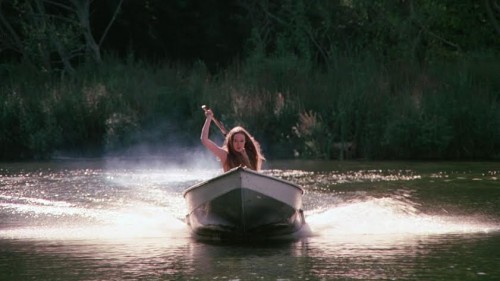
In rape revenge films, the feminine experience of rape often, notably, is the cause for the hero-victim to take on masculine qualities, such as low emotionality and physical brutality. However, in I Spit on Your Grave (while she is undoubtedly brutal in committing murder), Jennifer gets her first “victim” by softly entreating him, “I’ll give you something to remember for the rest of your life.” She actually begins to have intercourse with him (interestingly, he was the only one of the four men who did not want to assault her—he had been a virgin, is cognitively challenged, and caves to peer pressure) so she can slip a noose around his neck and hang him. She simply drives up to her next “victim” and beckons him into her car. He goes willingly because he believes she wants some more. When she pulls a gun on him, he tries to talk her out of shooting him. She complies and invites him back to her house, which he also willingly does due to her coy demureness. At her house, they take a bath together, and while touching him underwater saying, “Relax, I’ll make you feel like you’ve never felt before,” she subtly slips a knife into the tub and cuts his genitals off. Jennifer swims up to the next man’s boat in her bikini and seductively climbs in. Caught off guard, he is pushed into the water, and Jennifer kills him and the last man with an axe and the boat’s motor as they flounder. Her sexuality is her means of entering the situations that enable her to execute each man.

I find it interesting that the castration scene was removed in the remake (as was another such scene in the remake of Last House on the Left), and I’m not sure why. Castration seems to be on an equal plane with the level of violence in these films. (Was it too distasteful to male viewers? Something to think about.) There is also no seduction during the revenge in the remake, with Jennifer instead relying on torture/murder tactics similar to the Saw movies. While perhaps this rewrite to agendered violence is feminist in that she can use the same cunning, engineering, and brutality as men, I think the significance of 1978’s Jennifer using female sexuality, the root of her attack, as part of her revenge technique should not be overlooked.

Jennifer, going to church


All four of the men must die, no matter their physical role in the gang rape

During their attack on Jennifer, three of the men constantly “offer” her to the cognitively challenged man, who is visibly horrified by what his friends are doing and avoids participating at all costs. The other three men commit different acts trying to impress and show off to one another, sickly showing that this is more of a sport or game to them than a sexually driven act. When Jennifer confronts each man alone, he pleads and blames the other men. The group dynamic may have caused the men to do things they otherwise wouldn’t have, and the film could serve as a sick warning to men in our rape culture. However, it is important and noteworthy, especially because some reviews at the time described “three rapes” and “three rapists,”[8] that there is no doubt in Jennifer’s or the viewer’s mind that all four should be punished.

I don’t believe the anti-feminist trope that women need attacks like this to make them strong. Many of these films involve gang rapes, or other situations where the woman is at a serious disadvantage due to the men’s weapons or physical strength. To me, the message in these films is that if men choose to take advantage in these sick ways, they will be punished beyond their imagination. A common question is, What do men get out of watching these films (made for men, by men)? I think, because rape is based in extreme powerlessness, degradation, and humiliation, it gives audiences a free pass to fully experience and enjoy the revenge half of the film. In a rich history of movie characters avenging murders of loved ones and all types of suffering, the rape revenge fantasy should only take second place to someone being able to avenge their own murder. Anything the media or society can do to enforce the idea that rape is a paramount crime is a step in the right direction, and I Spit on Your Grave played a large role in building that case through film.


See also at Bitch FlicksRape as a MacGuffin: The Hollywood Cop Out

Recommended reading: I Was Wrong About I Spit on Your Grave


Sophie Besl is an exploitation film fanatic with a day job in nonprofit marketing. She has a Bachelor’s from Harvard and lives in Boston with her feminist boyfriend and three small dogs. She tweets at @rockyc5.


[1] Coffy (which Tarantino cites as a direct precursor to Kill Bill) and Foxy Brown, both star Pam Grier, a darling of Blaxploitation whom Tarantino later directed in Jackie Brown. (For more on the fantastic Pam Grier, please read these Bitch Flicks articles on her unfinished legacy and her time in another exploitation subgenre, women in prison). A similar discussion of racism is relevant with Blaxploitation movies—while these films use excessive nudity and do confirm stereotypes, they star Black protagonists who are in themselves empowered in fighting personal battles, and viewers of all backgrounds identify with these protagonists.

[2] Lady Snowblood stars a fierce female protagonist, and is part of the chambara subgenre of exploitation, a revisionist, non-traditional style of samurai film popular in Japan in the early 1970s (Wikipedia).

[3] Slasher films are an exploitation and horror subgenre. While they too are arguably feminist, in that the murderer is usually defeated by the “Final Girl,” in these films, the female protagonist fights because she has to. Rape revenge plots have women calculate revenge, then choose to engage in violence as an avenger, rather than a continuation of being a victim.

[4] When a female character is the attacked avenger, I prefer films that focus on rape revenge fantasy as the entire plot, as opposed to a story like The Girl with the Dragon Tattoo, where it is a part of a larger story. A story where it is simply part of the plot sends me the message that rape is part of what women have to deal with on a daily basis; it is inescapable. The extreme treatment of and sole emphasis on rape in films like I Spit on Your Grave and Last House on the Left enables these films to be an exploration of power plays and humanity’s darker sides, rather than a statement about the prevalence of rape in women’s lives.

[5] The original title of this film is significant. The “day of the woman” to me clearly refers to the day of her vengeful murders. By using the phrase “the woman” instead of the character’s name, this seems to imply that her revenge is not just on behalf of herself against her attackers, but on behalf of all women against all men who have perpetrated crimes like this.

[6] Review from Mick Martin and Marsha Porter, Video Move Guide: 1987, as cited and described in Men, Women, and Chain Saws: Gender in the Modern Horror Film, by Carol J. Clover (Princeton University Press 1992).

[7] See Clover (1992, p. 139) for more. She argues that, in films made before 1970, rape was “construed as an act of revenge on the part of a male who has suffered at the hands of the woman in question (to have been sexually teased, or to have a smaller paycheck or lesser job, is to suffer).”

[8] Clover, 1992.

Revenge Is a Dish Best Served … Not at All?

Tarantino’s narrative requires The Bride to murder her rapist and to defend herself with some of the masculine characteristics that are used as institutionalized power to oppress women, such as physical strength and aggression. The film insists that she seek revenge, instead of demanding that men simply do not rape. This is barely better than teaching rape avoidance. It dictates that women must assimilate to a male culture of violence in order to have autonomy over their own bodies.

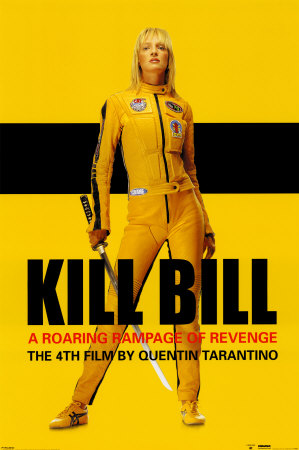
Kill Bill movie poster


This guest post by Angelina Rodriguez appears as part of our theme week on Rape Revenge Fantasies.

The words “female hero” are likely to fill one’s media-enthused mind with images of scantily clad, predominantly white women wielding weapons–like Lara Croft, Xena, or Wonder Woman. Quentin Tarantino contributes many modernized reincarnations of this caricature in his films. One of his most famous films Kill Bill, starring Uma Thurman as Beatrix Kiddo (also referred to as The Bride) is a prime example. As a result of the male gaze, female heroes that fit a format created by men often fail as heroes in their own right as a result of the male gaze. Even though The Bride is a fierce warrior and martial artist, she is repeatedly raped and must step over the bodies of other women, specifically women of color, on her way to her implied equal, a man.

tarantino_13

While The Bride is comatose, the hospital orderly rapes her and accepts money from people in exchange for access to her room so that they can also rape her. It is suggested that he has done this a number of times and the dialogue is delivered as darkly humorous. Why do we rape our female characters? Is it to show exactly what women must overcome? It is concerning that this is seen as an empowering message. Watching a woman, such as Beatrix, repossess her body is moving, but all reactions to rape are valid and require strength. During the film, Beatrix must overcome her foes in an order that mirrors the racial and gender hierarchies that exist within our culture. Her rapist is the first to die; he is at the very bottom of the barrel. His offense transcends race and gender and he is the lowest of the low.

Uma-Thurman-Confirms-Kill-Bill-III-2

Tarantino’s narrative requires The Bride to murder her rapist and to defend herself with some of the masculine characteristics that are used as institutionalized power to oppress women, such as physical strength and aggression. The film insists that she seek revenge, instead of demanding that men simply do not rape. This is barely better than teaching rape avoidance. It dictates that women must assimilate to a male culture of violence in order to have autonomy over their own bodies. In this scenario responsibility remains on the victim. If she does not prevent her rape she must avenge it. Although rape revenge fantasy can be cathartic, we must question the messages at work within these scenes. This scene, in particular, delivers her rape in a way that is almost humorous. It is disrespectful to our hero and to the countless victims of rape that have viewed the film. Despite Tarantino’s belief in the necessity of rape on the heroine’s journey, our female characters do not have to be raped to find liberation from the chains of rape culture and patriarchy.


Angelina Rodriguez studies Sociology at Fairmont State University. In her free time she thinks about things and pets puppies.

Bitch Flicks’ Weekly Picks

Check out what we’ve been reading this week–and let us know what you’ve been reading/writing in the comments!

recommended-red-714x300-1

Watch Shonda Rhimes Talk About ‘Scandal’s’ Season Finale by Jamilah King at Colorlines

Megan Ellison to Develop TV Show about Marlene Dietrich and Greta Garbo by Inkoo Kang at Women and Hollywood

When Women Take to the Sea to Provide Safe Abortions by Jessica Luther at Bitch Magazine

Heroines of Cinema: Mimi Leder and the Impossible Standard for Women Directors in Hollywood by Matthew Hammett Knott at Indiewire

Interview: Nadine Patterson’s Talks Her Reimagining Of Shakespeare’s ‘Macbeth’ Which Screens 4/23 In Harlem by Sergio at Shadow and Act

An Ode to My Four Favorite Women on Mad Men by Emilly Prado at Bitch Magazine

DreamWorks’ Latest Movie Will Have Something No Pixar Film Has Ever Tried by Zak Cheney-Rice at PolicyMic

How Many Of These Movies By Female Directors Have You Seen? by Alison Willmore at BuzzFeed

VIDEO: The “Orange Is The New Black” Season Two Trailer Is Here, Lovely, Amazing by Riese at Autostraddle

Naked if I want to: Lena Dunham’s body politic by Soraya Roberts at Salon

10 Women Directors to Watch in 2014 by Shannon M. Houston at Paste 


What have you been reading/writing this week? Tell us in the comments!


Bitch Flicks’ Weekly Picks

Check out what we’ve been reading this week–and let us know what you’ve been reading/writing in the comments!

recommended-red-714x300-1

What Women-Led Movies Can Do for Hollywood by Stephanie Hallett at Ms. blog

“Strong Female Character” Comic at Gyno-Star

New documentary: Mexican women incarcerated for “homicide” after aborting gain their freedom by Katie at Feministing

The Lego Movie Makers Pledge to Do Better on Female Characters in Sequel by Susana Polo at The Mary Sue

Tina, Amy, and the Female F-ckup: A Filmography by Molly Lambert at Grantland

Julianne Nicholson on August: Osage County, Masters of Sex, and Aging in Hollywood by Laura Berger at Women and Hollywood

In Mainstream Media,  Polyamory is Getting Attention by Erica Thomas at Bitch Media

Daenerys Targaryen is Back to “Save the Coloureds” Tour De #GameofThrones 2014 by Shane Thomas at Media Diversified

What have you been reading/writing this week? Tell us in the comments!

Seed & Spark: Gaslighting, Demonic Possession, and the Unreliable Female Brain

I love a good psychological thriller, especially if it involves insanity. The fear that I might be insane, that my perception might be warped, that instead of calmly walking to the bus stop, I am actually muttering to myself (scraping my clawed fingers along the yellow wallpaper) is a driving force in my creative process. The boundary between perception and reality is fertile ground for filmmaking, but I wonder why it’s always women whose brains get warped or permeated? I know our lady parts are conduits to Satan, and old Hollywood liked us vulnerable and prone to hysteria… But are we really getting tricked all the time, or is there a feminist edge to the gaslight thriller?

Juno Temple in "Magic Magic"
Juno Temple in Magic Magic

This is a guest post by Elizabeth Brooks

I love a good psychological thriller, especially if it involves insanity. The fear that I might be insane, that my perception might be warped, that instead of calmly walking to the bus stop, I am actually muttering to myself (scraping my clawed fingers along the yellow wallpaper) is a driving force in my creative process. The boundary between perception and reality is fertile ground for filmmaking, but I wonder why it’s always women whose brains get warped or permeated? I know our lady parts are conduits to Satan, and old Hollywood liked us vulnerable and prone to hysteria… But are we really getting tricked all the time, or is there a feminist edge to the gaslight thriller?

Gaslighting is a psychological term that actually comes from cinema. In the 1944 film Gaslight, an evil husband convinces Ingrid Bergman that she’s losing her mind, so he can steal her inherited jewels. (That film was based on an earlier film and a play before that, but let’s give the credit to Ingrid B. because she made it glamorous). Gaslighting is a form of manipulation and abuse where the victim’s sanity is questioned, and they are made to doubt their perception of reality. In real life, the use of gaslighting to undermine a victim is the terrain of deranged psychopaths and sociopaths, but like a lot of twisted stuff, it makes a great film plot.

Ingrid Bergman in "Gaslight"
Ingrid Bergman in Gaslight


Take, for example, The Innocents from 1961. Miss Giddens, a blonde and naïve nanny accepts a job to care for orphans at a creepy English estate. The children behave strangely, and we’re not sure if Miss Giddens is insane or if ghosts have possessed the little ones (spoiler: the kids are possessed). Gaslighting creates unstable narration, a protagonist who doesn’t trust her own brain. The trick works best when it catches the audience. We see through the eyes of the heroine, and it makes us paranoid: Is she crazy? Am I crazy? The tension delights us.

Deborah Kerr in "The Innocents"
Deborah Kerr in The Innocents


In the classic film Rosemary’s Baby, Rosemary Woodhouse is paranoid about her pregnancy pain, her neighbor’s herbal remedies and her husband’s secret plotting. The trick to good gaslighting is to hover on the edge of normalcy, to implicate the audience in the character’s insanity. But, like Miss Giddens, Rosemary was right to be paranoid. She had been raped by the devil and was carrying his child.

Mia Farrow in "Rosemary's Baby"
Mia Farrow in Rosemary’s Baby


What I’m trying to say is that classic cinema is really hostile towards women, constantly questioning their ability to perceive reality, calling up the old “hysterical women” stereotype. These women, though, aren’t crazy. They live in fucked-up supernatural worlds. In that sense, a film like The Innocents actually affirms its female characters: Miss Giddens is a capable detective, in spite of her swooning and fainting.

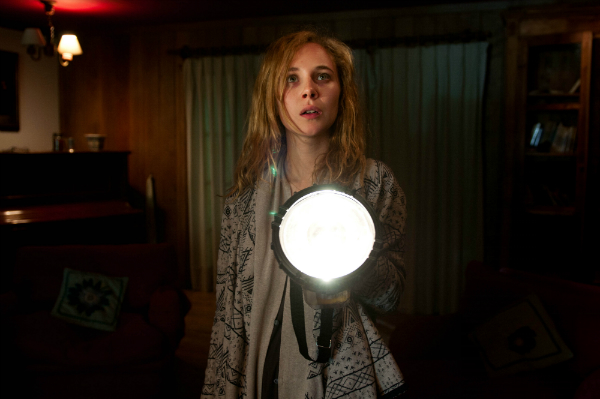
Magic Magic, the best film you didn’t see in 2013, plays on some of the traditional gaslighting structures, but takes them in new directions. (You didn’t see the film because Sony got pissed that it wasn’t an out-of-the-box horror thriller and chose not to release it). Like The Innocents, it stars a young blonde, Alicia (Juno Temple), in the creepy and isolated environment of a vacation cottage on an island in Southern Chile. Her companions are hostile strangers, friends of a cousin who mysteriously left the group and returned to the city. The camera lingers in mirrors and paranoia blossoms.

Michael Cera’s character, Brink, relentlessly hits on Alicia in deranged and unsettling ways, one of them involving a dead parrot. Alicia retaliates by pussificating him, i.e. suffocating him in her crotch, but it’s not really her who’s doing it—she is in some kind of a hypnotic trance. The film hovers on the edge of sanity, builds layers of unreality, but it doesn’t reveal and redeem. Magic Magic ends with a sharp turn; instead of affirming good female detective work, it doubles back and eats its tail. I won’t say more because I want you to see the film, but it’s a real creeper.

Gaslighting isn’t inherently gendered. It’s just that our culture prefers watching a woman on the brink. Weird films, art films and experimental cinema have been writing weak-minded men for decades. My favorite example of a man in the gaslight is Possession, a 1981 French horror film by Andrzej Zulawski.

Isabelle Adjani in "Possession"
Isabelle Adjani in Possession


The basic plot is that this guy, Mark, comes back from a sketchy business trip (briefcases stuffed with cash) and notices that his wife Anna is acting really strange. She tells him that she wants a divorce and then she moves out. He hires a private investigator to follow her, and reality starts to shimmer like the tarmac on a hot day. Actors play multiple characters. Dialog becomes disjointed. Turn a corner, and you’re back where you started. We’re not sure if we’re inside Mark’s paranoid mind.

It’s hard to say that Possession is a true feminist film because it does turn out that Anna is having lots of sex with a demon/alien and she pukes extraordinary amounts of green, slimy bile in a subway station…but at least it’s Mark who gets confused. And Anna and the alien do win in the end, though it’s hard to say if she wins or if the alien devours her completely like it does Charlize Theron in The Astronaut’s Wife.

Given these examples, one might conclude that men can gaslight women, but only aliens can gaslight men. I say: stay hopeful, female fans of the supernatural thriller. One of these days, the women will overpower the aliens.


headshotElizabeth Brooks is the director of Kibuki: Spirits in Zanzibar. She is a mixed media artist and a member of the San Francisco experimental cinema community. Her work explores the boundary between fact and fiction, using film, video, writing, and sound to blur the line between memory and imagination. She holds an MA in African Studies from the School of Oriental and African Studies at the University of London and an MFA in Photographic and Electronic Media from the Maryland Institute College of Art. She was a 2010 recipient of a Fulbright grant to Tanzania. She currently works as the Youth Curriculum Manager at the San Francisco Film Society, and her bilingual children’s book, Mama Has a Job, was recently selected for publication by Mkuki na Nyota publishers in Tanzania.

Kickstarter: ‘Yeah Maybe, No’ Questions the Meaning of Rape

While women are generally underrepresented in the media, stories about domestic and sexual violence overwhelmingly place women in the roles of the victim. In a world where men play the heroes and villains, the damsel in distress is an on-screen role where women are positively overflowing. Breaking that stereotype with strong women is crucial, but for true gender equality, men need to be seen in vulnerable positions as well.

Kickstarter photo of Yeah Maybe, No


This is a guest post by Kelly Kend. 

While women are generally underrepresented in the media, stories about domestic and sexual violence overwhelmingly place women in the roles of the victim. In a world where men play the heroes and villains, the damsel in distress is an on-screen role where women are positively overflowing. Breaking that stereotype with strong women is crucial, but for true gender equality, men need to be seen in vulnerable positions as well.

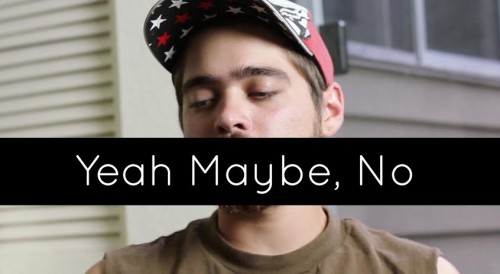
It is with this in mind that I’m making Yeah Maybe, No, a documentary about a male survivor’s experience with sexual assault. Our story centers on Blake, a student at Reed College in Portland, Oregon, who had found himself in a “crappy situation” with his first boyfriend. In a story that any survivor will recognize, he was hesitant to immediately call it a rape and still doesn’t love using the word. He feels that because his attacker used coercion rather than brute force, it somehow doesn’t really count.

Popular movies about female rape victims don’t particularly help with this situation. The Girl with the Dragon Tattoo has a particularly violent rape where Lisbeth Salander ties down and brutalizes a man who brutally raped her. In the more recent Divergent, Tris is tested through a simulated rape and applauded for fighting back.  While this might be great wish-fulfillment for many survivors, it creates an unrealistic picture of what rape looks like in the real world. While some rape is very violent, many more women report being scared and lying still, waiting for it to be over, and having a hard time speaking. These reactions are the body freezing up in response to a traumatic situation. This is a biologically normal and potentially life-saving response, but one that we don’t see very often, likely in part because it is much less dramatic on-screen.

Rape scene from Girl with the Dragon Tattoo


In Yeah Maybe, No, Blake says that a lack of awareness about non-violent rape is a reason why he didn’t immediately recognize this assault for what it was. But this isn’t the whole story. Due to feminist activists, the definition of rape has shifted over the last century. In 1920, it was defined specifically as something that happened to a woman, and necessarily used force. In 2012, the FBI defined rape as any unwanted penetration, of any orifice, with or without force. According to this definition, what happened to Blake is a crime. However, Blake has no intention of reporting. He calls his experience an assault so he can get support and understanding from his peers, not so he can bring anyone to justice.

This situation is what some might call a “gray rape.” It is different from a “rape rape” in that it’s not a “forcible rape,” but more like “date rape.” Feminist activists would counter that it’s just a rape because “rape is rape.” The truth present in all of these terms is simply that people don’t really know what rape is. For Blake, he stays out of it as much as possible and generally avoids using the word altogether. Instead, he says it was an assault, a crappy situation, or a bad relationship. It’s a situation where he kind of, maybe gave a silent-implied yes to, but inside it was definitely a no. There was no enthusiastic consent, but there was no fighting either. Blake is left with emotional scars, but he doesn’t want to press charges.

So, is it really a crime? As an activist and a survivor, I want to tell him that yes, yes it is. But as a filmmaker, I need to ask harder questions. Am I really seeking justice for Blake, or for my own unresolved experience? Who am I to tell someone else how to interpret one of the most intimate and emotionally charged experiences of his life?

Through asking these questions, Yeah Maybe, No  tells a story of ambiguity in one survivor’s experience. By looking at research and talking to experts, we can establish that yes, his experience was a rape, but by also looking at his struggle with what that means, we can learn so much more. Please join us at KickStarter to help tell his story.


Kelly Kend
Kelly Kend


Kelly Kend is a documentary filmmaker living in Portland, OR. She has a background in anthropology and has worked on educational and research-based projects for higher education and government agencies. Her work tends to be focused on the details of human interaction and seeks to amplify quieter voices. Yeah Maybe, No is her first independently produced documentary. Her website is www.kellykend.com or you can follow her on Twitter. https://twitter.com/projectid

There Are Roles and There Are Roles: Reminders and Expectations from 1992’s ‘Orlando’ (and the “Boo Box” in ‘Hook’)

Despite our limited options and scope in the world of movies, many cinematic characters get their fair share of explorative opportunities. But most of these characters, as many of us know, are male, right down to who we see standing in the frame. This is why for me, the core question of potential is most intricately entwined with female characters in popular movies. Although there have been many great female roles out there, there is much to do nonetheless, and this in turn reminds me of the progress that needs to be made for both sexes and all gender identities.

telegraph.co.uk

This is a guest post by Ian Boucher.

Drama is an incredible thing, and it is universal. It provides humans with opportunities to experience a myriad of journeys within themselves through the journeys of others. These journeys can be serious or comedic, grounded or nonsensical, yet they all have the potential to demonstrate the reflections and rabbit holes of humanity.

Unfortunately, in Western culture, due to the now largely industrial nature of storytelling, it’s all too easy to forget about that potential. The film industry represents one of the largest sets of conveyor belts, delivering the same handfuls of story and character elements over and over again in its scramble to stay ahead above the cacophony of story products. Even many of the best movies, whether produced by a studio or independently, largely use archetypes, and many film studios pour the majority of their efforts into blockbuster films, which are generally even simpler in nature.

orlando1992photobyliamlongman6

These are not completely new developments. Rather, they are a result of Western culture’s evolution over thousands of years. The majority of drama has always been produced as entertainment for commercial purposes, and our ideological journey, our cumulative human story explored over thousands of years, has simultaneously been going in wide thematic circles. These developments have also created inherent expectations for the films we watch.

This article, however, isn’t about originality. This is about potential.

I’m a student of the field of communication. I embrace the fact that the perceptions of humanity evolve like a meandering brook, naturally and gradually through time. We do make progress. It just takes us a while. Also, as a film scholar, I understand and love familiarity as well as freshness.

As a Padawan librarian, though, I can’t help but think that we can be more self-aware about how we go about all of this—that, like any activity, the results could be much better if more of the parties involved were conscious about what they were doing, whether creatively or administratively.

orlando1992photobyliamlongman2

Despite our limited options and scope in the world of movies, many cinematic characters get their fair share of explorative opportunities. But most of these characters, as many of us know, are male, right down to who we see standing in the frame. This is why for me, the core question of potential is most intricately entwined with female characters in popular movies. Although there have been many great female roles out there, there is much to do nonetheless, and this in turn reminds me of the progress that needs to be made for both sexes and all gender identities.

Take the recent trailer for Marvel’s Guardians of the Galaxy, for instance. Like many of our outings in the Marvel Cinematic Universe so far, the trailer told me that what I need to know about Zoe Saldana’s character Gamora—one of two females I noticed in the trailer—is that she can fight and that she might be a romantic interest, in this case for Chris Pratt’s Star-Lord.

Guardians of the Galaxy will be an action movie, and there are a lot of humans out there who love violence and sex, but female characters are very much utilized within those two categories for male characters to experience more often than vice versa, or focusing on the internal experiences of those involved. After all, Hollywood wants its movies to appeal to the most people possible, and this is what has largely worked so far. It is well known that the film industry is very averse to risk-taking.

orlando1992photobyliamlongman3

To make female characters appear more dimensional in recent years, the violent part has been more prominently emphasized, marketed to us as something that makes current female characters different.  Hollywood actresses in interviews across the board cite “toughness” as the primary character trait for their roles, even when their roles hold more than that. These roles and the statements about them very much reinforce the larger culture.

And yet, not only are humans three dimensional, but they also like variety, whether they agree with it or not. Just look at the ratings for any national news channel in the United States, where “controversy” abounds.

This is why, when I think about all of this, two movies especially come to mind. For me, they represent the tip of the iceberg where female characters are concerned—the hint of humanity’s dramatic potential. They vividly remind me both of the strength of expectations and the excitement of what movies can work toward. Each film occupies a vastly different place on the filmmaking spectrum—one on the fringes and the other a blockbuster, one a drama and the other a comedy, one a critical success and the other more on the infamous side, but for a few moments, they are inextricably connected, and their different places on the spectrum is precisely the point. They balance each other out.

orlando1992photobyliamlongman5

These movies are Sally Potter’s Orlando (1992) and Steven Spielberg’s Hook (1991).

Stay with me here.

Both movies starkly demonstrate just how far we have to go with our roles, for they each contain a character that transcends the idea of gender, and I don’t mean because these characters are women playing men. Changing gender and sex in the arts is nothing new. The characters I am about to explore represent a great deal of potential for both women and men in storytelling, because they are just about humans playing humans. They both represent the further possibilities of that journey that we are all always taking, and, more inspiringly, do not fall into convention in the process. Additionally, neither is about gimmick, novelty, or even agenda. They are just drama and comedy.

They each fulfill the promise of characters in cinema.

“We are joined, we are one with the human face.”

Orlando is based on the Virginia Woolf novel Orlando: A Biography. The film follows the experiences of a young man named Orlando for about 200 years until one day, he is a woman, and lives out the next 200 years as such. The role of Orlando—for it is one character—is played with perfection by Tilda Swinton, and the movie is strikingly superb from beginning to end in every possible filmmaking dimension, both as a work of art and in legitimate entertainment value. It somehow manages to be abstract and full of reality at the same time, and expertly addresses numerous complicated themes, making them look incredibly simple to explore. This film profoundly captures Orlando’s vast and variegated experience of life as a man and a woman in dramatic and comedic moments as Orlando searches for the understanding of it all along many nuances of human connection. The movie is of course not perfect, but it is moviemaking at its best.

orlando-1

Orlando is a film that can, and has, been viewed in many different ways, especially and understandably so about sex and gender roles, and especially on the feminine side of things. But I see this movie as being about more than sex or gender, whether female or male. Although the film is certainly about all of that, I see it more as being about humanity and the larger human experience. The character of Orlando brings that home in spades, and Tilda Swinton brings it out wonderfully.

On one hand, Orlando certainly is subjected to new injustices from society when she becomes a woman.  But although Orlando may finish the film as a woman (with a companion), who is to say that she (or her companion) will stay that way? The film visits the journey of one person experiencing and exploring the whole spectrum of humanity through changing perspectives. Orlando herself says it all when she first becomes a woman: “Same person. No difference at all. Just a different sex.”

Orlando and the movie itself are grand poetry that push our journey forward. They take what Marilyn Monroe’s Roslyn Taber in The Misfits (1961) started saying over half a century ago and bring it to the next level. Both Roslyn and Orlando are indeed misfits, and Orlando hits the humanity that Roslyn is still trying to tell us all about. Orlando does so by being able to transcend sex, gender, mortality, and time, so that we can look at life with a greater amount of understanding.

orlando1992photobyliamlongman4

Orlando is about destiny for men as much as it is for women. The last shot is the most striking of all, because it forces us to face that truth and leave the theater with it. It allows us to look past the lines of gender and just see a human as an adapting organism. As the music says at the end of the film, Orlando really does come “across the divide.” By the end of the film, she is more than male or female. We can move productively toward the future and forget the different kinds of cultural shackles that keep us all down.

It’s so full of possibility.

And yet! Not all movies can or should be so deep all the time. Do all female roles have to so completely change our views?

orlando1992photobyliamlongman

That’s why my next point in this article is Hook.

“NOT THE BOO BOX!”

One of the elements of Steven Spielberg’s Hook that has proven to best stand the test of time is Glenn Close’s cameo as Gutless the Pirate. (Let the discussion ensue if you just realized this!) Regardless of where many opinions fall when it comes to Hook as a whole, this scene on its own is nevertheless widely regarded as comedy gold.

It is the scene in which we first get to see Captain Hook in the flesh. The “Bad Barracuda,” as he is sometimes evidently known, zeroes in on the one person who doubted his plan to bring Peter Pan’s children back to Neverland. Just one pirate. This pirate is Glenn Close’s Gutless, who seems to hold some kind of shockingly defiant, petty disdain for Captain Hook. Almost immediately after displaying this, Gutless hilariously breaks down into tears, and is subsequently thrown into the dreaded “Boo Box,” or for those uninitiated to Neverland, a treasure chest where they drop scorpions on you.

This is not a scene about the novelty of a woman playing a man, because, before the Internet anyway, most people didn’t even know that Gutless was a woman playing a man. I still see new articles popping up all the time celebrating this realization—each of these realizations not only has clear respect for it, but also enthusiasm. It’s not because Close’s role is about a statement, nor is it because of an agenda on anyone’s part. Gutless’ scene doesn’t particularly mean anything—although I’m sure people can come up with some great analyses for it. It’s just a funny scene. The character is hilarious. Glenn Close’s performance is hilarious. The term “Boo Box” is hilarious. It all just ties together into good comedy.

The grand majority of people love this scene, and they love it even more when they realize it’s Glenn Close. It’s a good actor bringing a character to life that supports and augments the rest of the movie’s sense of humor.

And I know there is more room for this kind of thing in other movies, regardless of genre. Why shouldn’t anybody be able to play any kind of part? (There’s a mouthful.) That is the journey.

unnamed

Reminders and Expectations

Reminders can go a long way. Business and creativity can move hand in hand. But regardless of what movies do or the power they hold in cultures around the world, what it all comes down to is the stories we tell each other—what we tell each other is what counts.

Orlando and Hook are wonderful reminders that so very little has been explored in storytelling. They both can remind us of the journey that not only women, but humans, can take. Despite what all of the prophesies in movies may tell us, none of us need be, as Orlando put it, “trapped by destiny.” The possibilities for looking at each other as just people are endless.

So where are we now? Where do we want our culture to be? What stories do we want to tell ourselves? What do we want to expect? What do we want to be aware of?

I’m going to go out on a limb here, but it seems to me that the gutlessness of Western culture will only serve to keep us inside the box.

Eh???

We all know the journeys are still out there. Whether you’re a filmmaker or in the audience, why not do something about it today?

What stories remind you?


Trained in communication, film, and television theory and production, Ian Boucher is developing his interests in library science with a focus on information literacy. He enjoys reading, writing, watching movies, exploring the outdoors, and endlessly contemplating the psyches of comic book characters. Feel free to get in touch with him anytime on Twitter (https://twitter.com/Ian_Boucher) — he can talk about this stuff all day! 

Bitch Flicks’ Weekly Picks

Check out what we’ve been reading this week–and let us know what you’ve been reading/writing in the comments!

recommended-red-714x300-1

Hey, Hollywood: Pay Attention to Female War Heroes by Christina Paschyn at Feministing

An Interview with “Saturday Night Live” Writer Katie Rich by Anne McCarthy at Bitch Media

Essie Davis: On Playing A Sexually Liberated ‘Superhero’ Without Apology by Linda Holmes at NPR

The Dollar-And-Cents Case Against Hollywood’s Exclusion of Women by Walt Hickey at FiveThirtyEight

Cate Blanchett Was Right: 5 Reasons The Numbers Are on The Side of Women in Film by Alice Lytton at /bent

The Sexual Evolution is Coming, Thanks in Part to TV by Alicia Lutes at Bustle

MMA Fighter and Action Star Gina Carano On In the Blood and What Makes a Good Heroine by Laura Berger at Women and Hollywood

Hillary Clinton: Media ‘double standard’ on women by Maggie Haberman at Politico

A Million Things We Loved About 10 Things I Hate About You by Kate Dries at Jezebel

Still Very, 25 Years Later: The Bleak Genius of Heathers by Alan Zilberman at The Atlantic

Top 10 women-centric films of Bollywood at India Today

Did a Woman Invent Superheroes? by Molly Freeman at Hollywood

Watch Episode 1 (Series Premiere) Of ‘First’ – New Project from the Ever-Expanding Issa Rae Empire by Karen Marie Mason at Shadow and Act

Women and Hollywood Summer 2014 Preview by Inkoo Kang at Women and Hollywood


What have you been reading/writing this week? Tell us in the comments!


Seed & Spark: The United States of Femerica

Recently, I interviewed for a position on a short film with the director of the project. During the interview, the man, probably 10 years my senior, openly shared with me his experiences as a filmmaker so far, which I can relate to, being a maker of films myself. Needless to say, the conversation was easy-going and I didn’t think twice when I uttered something along the lines of, “I’m a feminist.”

The words had barely fallen out of my mouth when suddenly, instant panic appears in his eyes, train of thought screeching to a stop, sirens, the whole nine. For the rest of the meeting he tip-toed around everything, terrified to set me off on a man-hating rant, or whatever he thought might happen. His reaction almost made me want to apologize for saying it (almost). What the frack? Two minutes ago you were confiding in me and now, that one little word has changed me into an intimidating, unapproachable person?

Downtown production still by Caitlin Machak


This is a guest post by Jaclyn Gramigna.

Recently, I interviewed for a position on a short film with the director of the project. During the interview, the man, probably 10 years my senior, openly shared with me his experiences as a filmmaker so far, which I can relate to, being a maker of films myself. Needless to say, the conversation was easy-going and I didn’t think twice when I uttered something along the lines of, “I’m a feminist.”

The words had barely fallen out of my mouth when suddenly, instant panic appears in his eyes, train of thought screeching to a stop, sirens, the whole nine. For the rest of the meeting he tip-toed around everything, terrified to set me off on a man-hating rant, or whatever he thought might happen. His reaction almost made me want to apologize for saying it (almost). What the frack? Two minutes ago you were confiding in me and now, that one little word has changed me into an intimidating, unapproachable person?

I don’t think this guy quite grasps what feminism is and I suspect he’s not alone. If you don’t have a clear idea of what it is, or even if you think you do, I’ll save you the trouble of looking it up. The Merriam-Webster dictionary[1] defines feminism as, “the belief that men and women should have equal rights and opportunities.” It is as simple as that, or it should be…

But wait—hold the phone! Shouldn’t we, as a modern society, have progressed beyond this? Especially, when surveys[2] say that 96 percent of Americans believe men and women should be equal. Why am I nervous to call myself a feminist when most Americans are technically feminists too?! I can’t tell you exactly why. I could theorize, play the blame game, rant about how it makes me want to punch things (and believe me, I have) but frankly, all it would amount to is more hot air. I will take this moment, however, to quote Oscar Wilde: “Life imitates art far more than art imitates life.” I have a hunch that how men and women are portrayed differently on screen (in the films, TV shows and videos we watch on a daily basis) is at least partly at fault for the lack of progress.

To spell it out, the fact that women are “subtly” portrayed as one note stereotypes, the butts of sexualized jokes and downright inferior to their male counterparts in (particularly) Hollywood movies, instills in our minds that that is how it should be. We grow up seeing this as truth and many people still think there isn’t a problem at all (women can vote, so…)! Of course, there are exceptions, like with everything, but in the end they are exceptions.

Let’s change gears and look at a common “field study.” There’s a lot being written about street harassment right now and it’s about damn time! Despite its “adorable” nickname, “cat calling,” is something that nearly every woman living in a city is victim of. Whether they come from someone homeless or suited up, “Smile, you’re beautiful,” “You got big ass titties!” or, “Come here, I want to get wet between your legs,” all garner a similar reaction: self-consciousness, anxiety and fear, to name a few. No matter if you grow up to be a post office worker a CEO or Beyoncé you’re conditioned by movies and advertisements to have body issues (i.e. “it’s a good thing she’s smart”), which gives men the power to make you feel uneasy and vulnerable and if you stand up for yourself, you’re the bitch because it was meant as a compliment. It is definitely the kind of thing that if we don’t laugh we’ll cry. Especially, because it was not considered to be a legitimate issue until very recently[1] (pardon me while I scream and beat my pillow to a pulp).

Comic illustrating a woman being harassed on the street


I’m going to go out on a limb and say something (not so) radical…if female characters are given the same care (portrayed as more well-rounded people on screen) like male characters generally are (whether they’re good, evil or just lazy), then (life imitating art…) women will be respected and treated as equals in real life!

This is a fantastic thought but it’s an issue whose roots run deep and cannot be changed over night. The fact that Eleonore Pourriat’s short film, Oppressed Majority, (Majorité Opprimée by Eleonore Pourriat) which reverses gender roles, went viral, gives me hope. The fact that some of my male friends who watched it said that it changed their perspective on how women vs. men are portrayed on screen, revs me to action!

A huge reason why I started making films was because they have an unparalleled capability to inspire thought, emotion and change by simulating experiences an audience might never otherwise have. When I first set out to be a filmmaker I didn’t grasp how lopsided the industry was or even why that was a problem. Now that I’ve seen “life imitating art,” I, as a woman and a filmmaker can see how important a voice like mine can be and I feel a responsibility to make work that aligns with these beliefs. (In a world, where women don’t have to fear their own sex appeal…comes a shameless plug, for my short film, Downtownabout a girl who has a very private moment in a very public place—streaming on Seed&Spark.)

Production still from Downtown, taken by Vladimir Weinstein


I’ll take leave with a final call to action: Humans of the world, remember that feminism is inclusive, it’s about equality, not supremacy! I urge you to make art that reflects the world you want to live in and do your best to champion the work that takes care to do so!


Jaclyn Gramigna
Jaclyn Gramigna


Jaclyn Gramigna is a filmmaker and food enthusiast residing in Brooklyn, NY where she is part of the feminist majority and Love is her religion. Follow her at @JACoLYNtern.


‘Nymphomaniac’ Is a Lars von Trier Film That Is Actually a Little Bit Fun

As it turns out, ‘Nymphomaniac: Vol. 1’ is delicately told with both humor and sentimentality. Granted, we are given a rapid sequence of tight close-ups on male genitalia which lasts several minutes, but Gainsbourg’s detached voiceover makes the whole thing feel comical. In fact, we view all the sex acts through Joe’s curious, discerning lens. We’re not just looking at the life of a sex addict, but instead at the intertextual experience of a specific woman who feels she is addicted to sex, but not love. Joe recalls significant moments in her life and analyzes them; in one instance, she wonders why her virginity was taken in a number of thrusts equal to numbers in the Fibonacci sequence.

screen_shot_2014-03-31_at_12.44.10_pm

This guest post by Emily Gaudette previously appeared at Bitch Media and is cross-posted with permission.

In the two weeks before the theatrical release of Lars von Trier’s Nymphomaniac: Vol 1, I watched every film von Trier has ever written and directed. This included the three hardcore pornographies produced by his company Zentropa. I will neither confirm nor deny whether the porn films are successful in their intent.

Some of von Trier’s films are moody and lyrical (Melancholia, Breaking the Waves), and others are gory and severe (Antichrist). Some are musicals (Dancer in the Dark) and others have a noir aesthetic (Europa trilogy). What binds von Trier’s work together is the sense that he’s just experimenting with different variables. Nymphomaniac’s protagonist Joe—played in the present by Charlotte Gainsbourg and in flashbacks by Stacy Martin—simply throws ideas about her sexual desire against a wall to see if anything sticks. She recounts the events of her life to Seligman (Stellan Skarsgård), an academic who finds her unconscious in the film’s opening sequence. The film doesn’t hammer home a central message on female sexuality or even nymphomania, but I’d wager that we’re better off without films making a monolithic message on female sexuality.

von Trier’s films tend to be more literary and nuanced than most critics will admit. Yes, a woman’s clitoris is sliced off in Antichrist, and yes, I shrieked watching it and had to pull my sweater over my head. But the film is a four-part funeral pyre for a dead child whose parents cannot cope with their guilt. There’s so much more at work in Antichrist than the infamous, bloody pair of garden shears (featured prominently on promotional posters). Selling films like Antichrist as torture porn is a disservice to the full text. It’s true that von Trier is obsessed with dark sex acts; in fact, his explicit images of intercourse in 1998’s The Idiots are cited as the genesis of non-simulated sexual films like Catherine Breillat’s Romance (1999) and Vincent Gallo’s The Brown Bunny (2003). However, the classification of these films as “porn” is questionable, especially since the actual pornography affiliated with von Trier’s company differs in tone from his other films. Sex doesn’t have thematic weight in films like Pink Prison (1999), which German Cosmopolitan calls “the role model for the new porn-generation.” I’m not entirely sure what a porn-generation is, but I’m pretty sure I belong to it now that I’ve seen the Zentropa movies.

But what do we do with images of people entering each other on screen, as they do over and over in Nymphomaniac, if these scenes are not intended to arouse us? von Trier’s intent can feel murky in many of his projects (I still don’t know what Europa was about), but the objectives in Nymphomaniac: Vol 1 feel less complex.

I’d like to identify a gaping disconnect between the actuality of Nymphomaniac: Vol 1 and the way it was marketed. The film’s posters feature each of the film’s stars in mid-orgasm. One might assume looking at them that Nymphomaniac is just about a bunch of white people cumming all over the place. There’s even a poster of Christian Slater, who heartbreakingly plays Joe’s father in flashbacks. To my great relief, he doesn’t play a sexual role in Joe’s life, unless you subscribe to Freudian readings of desire (to which I say, “stop doing that”). Considering Uma Thurman’s role as an emotionally ravaged mother and wife, her poster image (shot from above) isn’t logical, or even helpful. In fact, most of the players in the film don’t engage in sex—their personal issues are too emotionally crippling. This discord in tone is the kind of information I would have appreciated before I walked into the theatre gripping my popcorn carton with anxiety. I assumed I was about to watch a grim, brightly-lit orgy featuring actors like Stellan Skarsgård, with unapologetic shots of penises abounding.

florida-children-accidentally-shown-raunchy-trailer-for-nymphomaniac

As it turns out, Nymphomaniac: Vol. 1 is delicately told with both humor and sentimentality. Granted, we are given a rapid sequence of tight close-ups on male genitalia which lasts several minutes, but Gainsbourg’s detached voiceover makes the whole thing feel comical. In fact, we view all the sex acts through Joe’s curious, discerning lens. We’re not just looking at the life of a sex addict, but instead at the intertextual experience of a specific woman who feels she is addicted to sex, but not love. Joe recalls significant moments in her life and analyzes them; in one instance, she wonders why her virginity was taken in a number of thrusts equal to numbers in the Fibonacci sequence.

Notably, after Joe has considered the golden ratio as a metaphor for her sex life, she says simply, “it hurt like hell” to signify the end of her analysis on the matter.  There is a quiet poetry in what von Trier does with seduction in Nymphomaniac. In one scene, we see Joe fellating a penis, preceded by a beautiful sequence in which Joe perceives men on a train as fish in a river. As each man looks up to regard Joe in her shiny red hotpants, his face is illuminated with overlaid footage of running water and long, rippling weeds.

Interestingly, Joe maintains agency in her sexual experiences almost 100 percent of the time. In one sequence, she has sex with three young men in split-screen and tells each of them that they’ve figured out how to give her an orgasm for the first time in her life. It’s clear that this is not true.

Though the New Yorker calls Nymphomaniac a “joyless sexual tantrum,” there are distinct glimmers of happiness littered through the film. As a child, Joe runs bathwater onto the floor, and she and her best friend B (played later by Sophie Kennedy Clark) pretend to be frogs, sliding back and forth on the wet tile, laughing. Joe closes her eyes intently, clearly enjoying the sensation of rubbing her body against the wet surface, and sunlight streams into the bathroom. There is playful, childlike joy here, and the scene is not filmed in a predatory manner. In fact, when the New Yorker’s Richard Brody writes, “the average male art-house viewer emerges from the first part of Volume I filled with the pleasant idea that there are young women out there—young, pretty, sleek, and determined—who will suck him off in a random train compartment even though he’s forty,” he seems to discount the reaction of more than half the film’s audience. The problem is, the conclusions of art-house dudes aren’t relevant in Nymphomaniac. I’d point to the scene in which a young Jerôme takes Joe’s virginity upon her request, painfully and without concern for her pleasure. Before she hobbles outside, she makes a small adjustment on the motorbike Jerôme is attempting to fix, apparently solving his problem. Later, as adults, Joe and Jerôme argue about a parking space which only Joe is able to get into. Jerôme is visibly frustrated in both scenes, but Joe doesn’t seem to care.

The power in Nymphomaniac has nothing to do with any male character’s reaction to Joe; in fact, we never see any of her partners for more than a few moments on screen, discounting only Jerôme, the man she says she loved. von Trier instead fills the film with weighty female characters like B, Mrs. H, or the other young women in Joe’s sex-without-love cult, which calls itself the “little flock.” I felt genuine joy hearing the little flock’s chant: “mea vulva, mea maxima vulva.” Joe builds her personal, erotic mythology in disregard of any man’s opinion. When she is unable to discount the emotions of male characters in her life because of her connection with them, she reevaluates her ethical framework to fit them in. The film’s whispered refrain seems to haunt Joe: the secret ingredient to sex is love.

nymphomaniac-mea-vulva-600x421

I’d argue that Nymphomaniac: Vol 1 is one of von Trier’s most sentimental projects, and I’d point critics to Joe’s meditation on love as an example. She remembers masturbating on a public bus, looking desperately for details on her fellow passengers to remind her of Jerôme. When Jerôme returns to the narrative, pulling Joe to him from above as he does in an earlier scene, Seligman interrupts the flashback and calls the whole situation unbelievable and ridiculous.

“Ask yourself how you’ll get more out of my story,” Joe says. Does Seligman have to believe every part of Joe’s narrative for it to have meaning? Probably not. Do we have to believe her or come to a conclusion about her character? I hope that this isn’t the case, as watching Joe categorize her lovers according to their roles in a polyphonic, sexual spree is enjoyable enough. The film’s interwoven themes of desire and guilt coalesce in its final image, as Rammstein’s “Führe Mich” thunders into the room, the shot cuts to black, and we’re left wondering if Joe’s sex life meant anything philosophical or ethical at all.

Watching Nymphomaniac: Vol. 1 was, weirdly enough, a relief for me, after wading through von Trier’s other works, back to back. It’s certainly the least emotionally exhausting installment in what von Trier calls his “depression trilogy,” which includes Antichrist and Melancholia. Though von Trier’s focus on female characters began in his early work, his attention to detail makes Joe feel more fully realized than his other protagonists. Joe’s femininity is built around her curiosity, and von Trier seems to enjoy watching her experiment with others and fail to achieve emotional intimacy. Though Joe suffers the way von Trier’s other women suffer, she also causes suffering in others, which is a dynamic give-and-take not afforded to characters like Melancholia’s despondent Justine. Most refreshingly, there is more humor in Nymphomaniac than in von Trier’s other work, in its Wes Anderson-style titled chapter structure and the scenes shared by young Joe and Jerôme. in Nymphomaniac, sex remains fodder for von Trier’s dark commentary, but the question of love is a bright spot in his analysis. von Trier seems as transfixed by love as Joe is, and watching both storytellers parse out this confusion is actually fun.


Related Reading: Dark of the Matinee—A Review of Melancholia.


Emily Gaudette is a writer from New Mexico who lives in Boston. She tweets as @genghis_blonde.