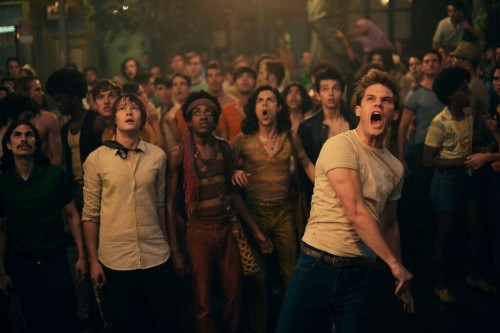
The movie adaptation of the Stonewall Riot entitled ‘Stonewall,’ directed by Roland Emmerich, is harboring unprecedented criticism from the entire LGBTQI community. Countless blogs, online publications, and social media pages have each blasted the movie with comments on whitewashing and altering of the historical facts.
Huffington Post Gay Voices released an article with the headline title “#NotMyStonewall: Why I’m Not Giving the Movie “Stonewall” a Chance.” The bbc.com entertainment section focused on the petition against the movie that reached more than 20,000 signatures.
I personally feel embarrassed for the director. No matter how hard he and his team try to damage-control this situation, I don’t think they will have any way out.
Stonewall movie
This is a guest post by Jethro.
The movie adaptation of the Stonewall Riot entitled Stonewall, directed by Roland Emmerich, is harboring unprecedented criticism from the entire LGBTQI community. Countless blogs, online publications, and social media pages have each blasted the movie with comments on whitewashing and altering of the historical facts.
I personally feel embarrassed for the director. No matter how hard he and his team try to damage-control this situation, I don’t think they will have any way out. The director released this statement on his Facebook page:
“When I first learned about the Stonewall Riots through my work with the Los Angeles Gay and Lesbian Center, I was struck that the circumstances that lead to LGBT youth homelessness today are pretty much the same as they were 45 years ago. The courageous actions of everyone who fought against injustice in 1969 inspired me to tell a compelling, fictionalized drama of those days centering on homeless LGBT youth, specifically a young midwestern gay man who is kicked out of his home for his sexuality and comes to New York, befriending the people who are actively involved in the events leading up to the riots and the riots themselves. I understand that following the release of our trailer there have been initial concerns about how this character’s involvement is portrayed, but when this film – which is truly a labor of love for me – finally comes to theaters, audiences will see that it deeply honors the real-life activists who were there — including Marsha P. Johnson, Sylvia Rivera, and Ray Castro — and all the brave people who sparked the civil rights movement which continues to this day. We are all the same in our struggle for acceptance.”
Marsha P. Johnson
No matter how he reassures his audience against his misappropriation of a widely known struggle for civil rights, it’s almost impossible to fictionalize an important and pivotal piece of LGBT history. This is utterly unforgivable in my opinion.
Where did this director grow up? Does he live on the same planet as us? Did the civil rights movement just pass him by, and he hardly even noticed?
As a filmmaker, I would seek to educate myself about historical movements that are intersectional or closely interrelated to what I am conveying in a movie, especially one that’s so pivotal in LGBT history.
This is not ignorance but unconscious racism on the part of the director and screenwriter, which plagues most big-budget Hollywood films. The first person that threw a brick at the Stonewall Riot is Marsha P. Johnson, an African-American, transgender woman. Why on earth would you replace her with a White, cisgender gay man?
Jose Sarria
This is not only dumbfounding but outrageous. Is it because White, cisgender gay men have more commercial value than African-American, transgender women?
Why is this still an issue we fight at our level of cultural awareness and gender identity critical-mindedness? It’s possible that this could be a reflection of a deeper problem that exists within our cultural consciousness. Interestingly, this parallels events that are taking place today, with most of the media transfixed on Caitlyn Jenner and Black Lives Matter.
I find it ironic that on one hand we have a transgender woman who single-handedly takes the world by storm, and on the other, black people continue to be brutally discriminated against, harassed, even killed by criminal authorities.
In the eyes of Hollywood, some historical events cannot be adapted into a multi-million dollar blockbuster movie. Perhaps, the Stonewall riot is one of them. It’s impossible to replace iconic personalities in history when the point is to cater to a wider audience. I consider this a crime.
Denying younger generations the truth of history only allows it to repeat. Sadly, this isn’t a new trend in the film industry. Hollywood is known to appropriate and alter history for the sake of profit. I believe this has to stop.
When dealing with history, filmmakers have a responsibility to be accurate about the facts and events. A movie adaptation such as the Stonewall is nothing short of a failure, and it’s downright disrespectful to a movement that is still continuing at present.
Imperial Council of San Francisco
Recently, I came across a short film that promises a more accurate portrayal of the Stonewall Riots, entitled Happy Birthday Marsha, written and directed by Reina Gossett and Sasha Wortzel. It’s a film about the transgender artist and activist, Marsha “Pay it No Mind” Johnson and her life in the hours before Stonewall.
Like any other historical event, the story of Stonewall did not start at the Riot itself. The LGBT movement had been brewing years before. In the 1960s, when it was illegal to be gay, there had been an insurgence and uprising against institutionalized discrimination both in the East and the West.
In San Francisco, a man named Jose Sarria became the first openly gay individual to run for public office in an attempt to counteract the hatred that was the norm. He later founded an organization called the Imperial Council of San Francisco, the oldest surviving LGBT charity organization in America, which later gave birth to the International Court System composing of 64 affiliates in the US, Canada, Hawaii, and Mexico.
My documentary film 50 Years of Fabulous: The Imperial Council Story chronicles the 50-year history of the organization that became the pioneering nonprofit organization fundraising millions of dollars for HIV and AIDS organizations and causes throughout the decades. The film is set for postproduction and is raising funds to finish.
Jethro is a filmmaker/video producer based in San Francisco, California. He is currently working for Adecco at Google producing marketing and training videos for Google Maps Street View and Business View. He is the director of the award winning documentary film My Revolutionary Mother and two upcoming documentaries 50 Years of Fabulous: The Imperial Council Story and My Name Is Protest.
The realm of sci-fi and fantasy offers many possibilities to challenge the status quo. It’s the ultimate platform to show diversity and portray a more nuanced characterization of people. Let’s hope that ‘Sleepy Hollow’ can pull of what it has planned and there will be no need to dust off the #AbbieMillsDeservesBetter hashtag.
Television as an mirror that reflects the cultural dynamic that’s present in our society. Ha. There are a few shows that get it right–see the socio-economic depiction in The Wire or the gender politics in Mr. Robot–but more often than not, television formats succumb to trite stereotypes and travel the well-trodden path of TV tropes. The recent change in the TV landscape, “The Golden Age of diversity and representation,” made it seem that there were more roles for actors of color. Yet, the numbers from the 2015 diversity report on Hollywood, Flipping the Script – from UCLA’s Ralph Bunche Center for African American Studies – are only marginally better than previous years.
Veteran showrunners Alex Kurtzman and Roberto Orci are known for their teamwork in sci-fi – see Fringe, Cowboys & Aliens,Star Trek: Into Darkness. They took a chance on a script by Phillip Iscove, who was toiling away as an assistant at UTA, and Iscove sold his pitch based on the “man out of time” element. They teamed up with director/executive producer Len Wisemen, mostly known from his work on the Underworld franchise, to create one of the more kooky TV formats: Sleepy Hollow (2013).
The conversation has shifted in recent years when it comes to the portrayal of Black women who have graced our screens. From the groundbreaking start with the working single mother Julia Baker on Julia, to the mid-1970s with the working-class housekeeper Florida Evans in Good Times, followed by educated womanhood in the form of Clair Huxtable in the 1980s with The Cosby Show, to the Black professionals such as Maxine Shaw in Living Single, independent women Pam and Gina in Martin, to Whitley in A Different World. Funnily enough, in the 1990s most channels featured shows with a diverse cast. However, once the ratings were high enough they would replace them with mostly white-orientated shows after the network got traction – see UPN, CW, WB, FOX.
Most would say that the reign of Shonda Rimes and her Shondaland production company paved the way for Black characters such as Miranda Bailey in Grey’s Anatomy, Olivia Pope in Scandal, Annalise Keating in How to Get Away with Murder. Other networks followed suit and there’s Mary Jane Paul on Being Mary Jane, Rainbow Johnson on Black-ish, and we can’t forget about Ms. Cookie Lyon on Empire. It’s refreshing to see a variety of Black women represented on the screen. Characters who’re not molded in the archetypes that are damaging society’s perception of Black women – think Strong Black Woman, Mammy, Jezebel, Video Vixen, and so on.
Not every (main) Black character gets the treatment they deserve and debunk archetypes. Characters such as Tara Thornton in True Blood, Bonnie Bennett in The Vampire Diaries, Lacey Porter in Twisted, Iris West in The Flash, and Abbie Mills in Sleepy Hollow, are coming together as captivating women who are used to promote diversity in the show and are slowly pushed aside when the fan base is secured and TPTB still think they have to cater to a certain demographic. Well, it seems that the bait and switch tactic never went out of style.
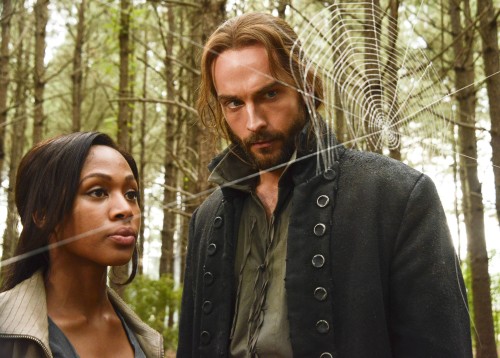
Abbie, Ichabod, and Frank
The premise of Sleepy Hollow sounds farfetched, but somehow it work(s)(ed). The show is loosely based on The Legend of Sleepy Hollow by Washington Irving. Ichabod Crane (Tom Mison) wakes up in our century and has to stop the Headless Horseman from starting the Apocalypse. He meets Lieutenant Abbie Mills (Nicole Beharie) and together they are the “Witnesses” who will stop the Apocalypse as is written in the Book of Revelation. The duo gets help from Abbie’s sister, Jenny Mills (Lyndie Greenwood), who has in-depth knowledge on the evil forces and artifacts. The stern Captain Frank Irving (Orlando Jones), Abbie’s boss, who reluctantly starts to believe in their cause; and finally the whispery Katrina Crane (Katia Winter), Ichabod’s wife, who “tries” to help the team whilst being stuck in ‘a world between life and death’ a.k.a purgatory, which is ruled by the main antagonist Moloch.
In essence, it’s a tried formula. There’s the overarching mythos of Sleepy Hollow, sprinkled with an ‘army of evil, Lt. Abbie Mills as the reluctant character who works hard and suppresses her own demons and deals with family concerns. Of course her partner is a snarky, knowledgeable yet flawed British hero who fully believes in the mythology. Nevertheless, the chemistry between Mison and Beharie is electric and lured fans in to join the duo on their (un)believable journey. Credit also goes to the multi-racial supporting cast with John Cho as police officer John Brooks, Nicholas Gonzalez as Detective Luke Morales who’s also Abbie’s ex-boyfriend, Jill Marie Jones and Amandla Stenberg as respectively Frank Irving’s ex-wife Cynthia and daughter Macey.
Season 1 was fun, period. It was accepting of all the cheesiness and ran with it in order to create solid (cult) television. Sure, the dialogue was clunky, there were small loose ends, the pacing was off, but it didn’t matter. The diverse cast really made it work. In October 2013, executive producer Heather Kadin even joked: “[..]because we have so much diversity in our cast and we’ve had the freedom to cast our villains and victims however we want, so we can kill as many white people as we want.” It now turned out that it was too good to be true.
Sleepy Hollow became the surprise freshman hit of the season. Fox quickly renewed the show after only two episodes aired and didn’t order the back nine episodes – usual concept for network shows – and kept the show at 13 episodes. Fox later upgraded the show to a total of 18 episodes for season 2. So, the showrunners had the time – there are 10 months between the first and second season – to focus on season 2 in order to make it bigger and better. Right. From the mediocre promotion for the second season, to the casting announcement of Matt Barr as Indiana Jones’ reject Nick Hawley who essentially plays the same role as Jenny Mills, to Alessandra Stanley’s inaccurate NYT article that unjustly called Beharie a sidekick. It was merely the alarm that showed us how season 2 would play out. The bait and switch was almost a self-fulfilling prophecy.
Solving crime with the Mills Sisters
Season 2 has aptly been named by some as “the screenwriters guide of how not to write a show.” One of the catalysts of the demise of season 2 is the fact that Kurtzman and Orci left to do other projects and instilled their faith on showrunner Mark Goffman. Sure, Goffman earned his stripes with series such as White Collar, but he couldn’t handle Sleepy Hollow.
It’s mindboggling that the Juilliard-trained Beharie, who proudly advocated for her character in an interview with Essence – and didn’t expect to portray a tough, cop character with her 5′ 1″ stature and African American background – was pushed aside in favor of “The Crane family drama.” Katrina Crane’s story arc was deplorable. She was touted as a powerful witch from the start. Instead she was only used as a plot device in the first season. They tried to flesh her character out in season 2 and failed. Ichabod Crane became a moping know-it-all (more than usual) who ignored Abbie’s advice to keep focused on their common goal. Fringe’s John Noble was wasted as Ichabod and Katrina’s son who turned out to be The Horseman of War and got his mother pregnant with an evil, demon baby – don’t ask. Not to mention that the Headless Horseman became a woobified character, “grew” a head, and turned out to be Katrina’s ex instead of a menacing villain. The Powers That Be (TPTB) molded Katrina into a damsel in distress that ate up the screen time that should have further explored the relationship between Abbie and Jenny, Abbie and Ichabod, basically everything surrounding Abbie Mills.
The other members of “Team Witness” didn’t fare better. Lyndie Greenwood was promoted to series regular, but was most of the time nowhere to be found in favor of Nick Hawley. Captain Frank Irving and his family’s storyline was cast aside, only to be shortly revived in the most ridiculous way. The show was at its best when Team Witness came together to fight evil and showed the underlying dynamic between the different characters. Add that with the casting of House of Cards actress Sakina Jaffrey as Sheriff Leena Reyes, who has an connection with Abbie’s past, but was severely underused throughout the show.
The diversity of the cast gave the wobbly storyline that extra spunk. Characters of color who seamlessly worked together and aren’t focused on anyone’s race and color – though the show doesn’t hide from commenting on race. Abbie and Jenny are normal, intelligent, layered characters with flaws who’ve showed their vulnerable side, thus debunking the archetype of “The Strong Black woman.” Most fans – and critics- were frustrated after eight episodes had aired of the second season. The diversity and representation went right out of the window with the start of season 2.
Social media further added fuel to the fire within the fandom. At the start of the first season, Orlando Jones quickly broke the fourth wall. He created his own Tumblr page and participated in fandom discussions. Jones actively created more promotion for the show than whatever the Sleepy Hollow PR department was/is trying to do.
Nicole Beharie’s Instagram Post
The unrest in the fandom sparked the #AbbieMillsDeservesBetter hashtag, where fans could vent their frustrations and asks the writers and staff of Sleepy Hollow why Beharie has been pushed to the background in a show in which she’s a lead character. Sleepy Hollow writer Raven Metzner came under fire on social media when he lashed out to the “haters” of the show. The show slightly redeemed itself with the last four episodes – even with the plot where Abbie was transported back to Ichabod’s time and was seen as a slave, they tiptoed the line with the racial insensitivity, but handled it well. Now, not only was Abbie shelved in the show, apparently Beharie was initially left out on the DVD commentary for season 2.
Sci-fi and fantasy writer Genevieve Valentine at io9 made some valid points when it comes to the trajectory of the show. In a series of Tweets she explains, “The unexpected success of season 1 relied heavily on tweaking tropes – not least of which was the trope of the white mythical heroes. [..] This show cannot be trusted with its own story, and that’s a sad place of no-faith to be coming from with the cast and potential it has.” So, the bait and switch from season 2 didn’t work out as planned. Fans and critics alike have voiced their opinions, but will the necessary changes be made?
The criticism didn’t go unnoticed. During the TCA press tour in January, Fox TV chairman and CEO Dana Walden mentioned that the show will be less serialized and have a slightly lighter tone in the future. Well, one of the first changes is a cross-over with the crime procedural show Bones (!). Soon after came the news that Orlando Jones involuntarily left the show. This is a blow for the promotion of Sleepy Hollow. Neither Mison nor Beharie are very active on social media whether it’s promoting the show or engaging with fans; however, Greenwood picked up the baton from Jones.
Furthermore, on August 2, the new showrunner Clifton Campbell (The Glades), told TV Guide that the Headless Horsemen won’t return this season. He said, “But we have a new framework and a new set of rules for the mythology.” Yeah, look how that previously turned out.
The storyline will jump one year ahead. This will give Ichabod the time to grieve over his wife and son, and maybe get a job to start paying the bills. Abbie will be more focused on her job now as an FBI agent. Still, the casting for season 3 went off with a rough start with the announcement of Nikki Reed (Twilight) as series regular Betsy Ross (the legendary seamstress apparently had a thing with Ichabod back in the day), and she will bring a “smart and sexy edge” to the show. Wayward Pines’ Shannyn Sossamon will play the mysterious woman Pandora who asks Ichabod and Abbie for help. It almost seems that TPTB didn’t get the memo. Fans and critics alike asked for more focus on Ichabod and Abbie and Team Witness. Luckily some recent additions seem promising. Lance Gross (Crisis) makes his debut as Abbie’s boss and we’ll see the return of fan-favorite Zach Appelman as Joe Corbin.
So, why stick with Sleepy Hollow? First off, Nicole Beharie is captivating as Lt. Abbie Mills and we need to see more diverse Black leading women on tv. After all, that’s true representation. Secondly, the nuanced relationship and charm between Tom Mison and Nicole Beharie. It’s a natural chemistry that seems so effortless. It would be a waste not to enjoy it while you can. Thirdly, the bait and switch tactic was disastrous for the show; TPTB are still trying to recover from that, it’s only onwards and upwards from here.
The realm of sci-fi and fantasy offers many possibilities to challenge the status quo. It’s the ultimate platform to show diversity and portray a more nuanced characterization of people. Let’s hope that Sleepy Hollow can pull of what it has planned and there will be no need to dust off the #AbbieMillsDeservesBetter hashtag.
Giselle Defares comments on film, fashion (law) and American pop culture. See her blog here.
Does Claire have to forgo her more gentle side to have some form of agency in the corporate world? Does she have to exhibit traditionally masculine traits in order to operate within a male dominated realm? Is she less of a woman because she’s not very interested in kids or having kids? There’s a dichotomy going on here that’s worth exploring.
This is a guest post by Ashley Barry.
Jurassic World‘s opening cinematic had me starry eyed and shivering with excitement. The familiar but epic score accompanied by grand, sweeping shots of Costa Rica transported me right back to my childhood. I’m surprised my face didn’t fracture because a smile was perpetually plastered on it during the entire length of the introductory cinematic. I was home and temporarily lost in the labyrinth of my own nostalgia.
The first installment of the series was released in 1993 and, for some unknown reason, my parents allowed me to watch it. I was five years old and an easily spooked kid (I was afraid of shower drains for crying out loud). With the exception of the infamous tyrannosaurus rex scene, during which I hid underneath a heavy blanket I couldn’t see through, I was blown away by the idea of a dinosaur park and I idolized Ellie Sattler. The franchise itself later evolved into a familial tradition, my dad toting home the newest installment from the rental store whenever I came down with some form of the plague.
It’s difficult to outdo the original movie and, at times, Jurassic World seemed like it was trying to do just that. Though Jurassic World was filled with throwbacks, even going so far as to revisit the original park, I preferred the first film because it didn’t focus so much on gender politics. They were in a crisis situation and there was no time to argue or zone in on such things. Anybody could be a dinosaur’s dinner. Jurassic Park was the first of its kind and, for me at least, the character development was more organic and believable.
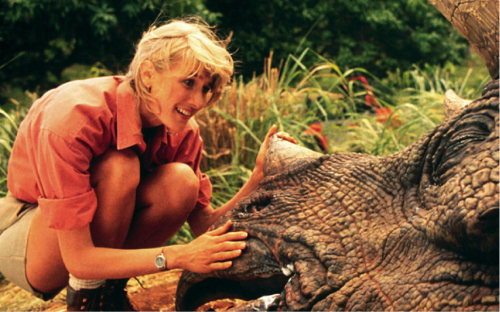
Ellie, an empowering character, was never required to forgo her femininity or empathy to be strong and capable. Though she adhered to the final girl trope during the scene in which she had to override the controls in the control room (the most inconveniently placed control room ever), she was an expert in her field and, whether she was working in the dirt or reaching into a colossal pile of triceratops dung, she was unafraid to literally dirty her hands. Though she was just as capable as her male counterparts and coworkers, she still rocked her neatly pinned hair and cut off shorts.
Ellie was never criticized for having a career or not being maternal enough, as if there’s some kind of scale in existence that makes such a determination. She was able to retain her femininity and empathy whereas Claire, in Jurassic World, switched from a hardened non-maternal figure to a maternal figure, a transition that felt forced. I truly believe Claire was assigned a negative and unforgiving reputation. Whether it was the digs at her femininity or her disinterest in having children of her own, it was an unfair reputation she didn’t deserve.
Claire Dearing, the parks operations manager, is a great example of a modern if not progressive woman in that she’s highly career-oriented and ambitious. I reveled in the fact that she’s a female identifying person who’s in a position of power in the corporate world, which is a typically male-dominated space. It’s great to see her acting as her own agent, but in selecting a career over a family, Claire is often distracted and, at times, disconnected from what’s really going on behind the scenes. She’s usually awkward around and sometimes indifferent toward her nephews, which the film presents as a flaw. Does Claire have to forgo her more gentle side to have some form of agency in the corporate world? Does she have to exhibit traditionally masculine traits in order to operate within a male dominated realm? Is she less of a woman because she’s not very interested in kids or having kids? There’s a dichotomy going on here that’s worth exploring.
Claire is either presented as cold and uptight, seeing the dinosaurs as investments rather than actual animals, or she’s warm and caring and inherently maternal. It’s problematic because the film reinforces the idea that all women are inherently maternal and to unlock a woman’s maternal instinct is as simple as triggering an on/off switch. At the beginning of the film narrative, Claire not only forgets how old her nephews are, but she leaves them in the care of her assistant due to her hectic schedule. Is it really a problem? Is it really her problem? Why are the other characters passing such harsh judgment on her? Are they exempt from judgment? Consider, for a moment, the reality of how busy Claire must be. Her career is obviously important to her but she’s also in an authoritative position, meaning she’s likely under a lot of stress. Why are her duties cast aside? Despite her success, the other characters often scrutinize her for not being maternal enough.
There’s a scene in which she has a heated discussion with her sister, Karen. When Karen stresses the importance of close familial ties, she’s operating under the assumption that Claire will have children someday. Claire’s response is short and to the point, but firm. Not all women want children and that should never be viewed as a shameful or selfish want. Motherhood does not make a woman. Though Claire corrects her sister, she’s still viewed as the quasi-villain of the film. She’s under constant scrutiny from other characters, characters that want to alter her in some way.
“When you have kids of your own—“
“’If,’ not ‘when.’”
There’s a shift at one point in the film when the hybrid dinosaur escapes its enclosure and becomes a real threat. Claire’s transition from cold business woman to maternal figure is more apparent at this point. I recall a moment where Claire looks at one of the security monitors and watches a mother comfort her child. This instance may or may not be the thing that triggers Claire’s inherent maternalness. However, the unlocking of Claire’s inherent maternalness aligns with the trope of the fierce or ferociously protective mother. When Claire presents as an active agent of the corporate world, she relies on her intelligence to carry her through. When her maternal side is unlocked, she goes from being an uptight business woman to a sexy action hero. It raises a few questions. Is her womanhood only a cause for celebration when she accepts her maternal side? Is she more of a woman now that she has taken on the protective role of the mother figure?
After luring the t-rex out of its enclosure, there’s a sexualized shot of Claire lying on her side. The shot itself is clearly intended for the male gaze. With her red hair all mussed and her arms bare, the audience is viewing and consuming a very different version of Claire. It’s a version that doesn’t quite line up with her original character. Does she want to revel in her sexuality? Does she even have time to do so? In becoming a more protective figure, she has become more traditionally feminine. Is she only able to loosen up when adopting a more protective role?
There has been a lot of backlash in regards to Claire’s outfit, especially her stiletto footwear. She’s receiving backlash from both the fictional people in her own world and real life movie-goers. It’s a hard and definitely unfair burden to bear. Visually, Claire is dressed in all white towards the start of the film, which might be a nod to John Hammond but it’s also the very picture of sterility. This image circles back to Claire not wanting children and could be read as a visual representation of her neutralized attitude towards them. When she commits to saving her nephews, she ties her shirt in a fashion that’s similar to Ellie’s shirt. Though my childhood self appreciates the throw back, especially because it’s a throw back to my idol, Owen ruined it for me because he made fun of her “impractical” outfit. Instead of being taken seriously, she became the punch line of a joke and it’s not the first instance in which she served as the punch line of a joke. Is that her only purpose? Is she there to be poked, prodded, and laughed at?
Lastly, there’s something to be said about her stiletto footwear. Too often we’re taught to view and interpret symbols of femininity as things that are weak, vain, and impractical. Personally, I would have rolled my ankles had I been running away from dinosaurs in those heels. Claire impressed me with how well she managed in those nude colored heels of hers. It might have been a painful experience, but she endured the pain to not only save her own skin but to save others as well. There’s a kind of strength in that and it’s a strength that needs to be acknowledged and celebrated.
Claire isn’t a bad character. She’s smart and strong, but she operates in a world that wants to change her and back her into a wall. Ellie was feminine and caring, but that was OK. Though Jurassic World had some great parts, I struggled with the film as a whole because everyone was trying to make a villain out of Claire and a hero out of Owen. Oddly enough, I felt as though the first installment was more progressive in its presentation of deeply developed male and female characters. It’s 2015. Shouldn’t we be moving in a forward direction?
Ashley Barry works at a publishing house in Boston and holds a master’s degree in children’s literature. Though her background is in the book business, she loves writing about all mediums. She’s also a contributing writer for a video game website called Not Your Mama’s Gamer. She can be reached at abarry4099@gmail.com.
The concept of the female gaze emerged in response to that of the male gaze, wherein the female viewer, and often the female creator, are the focus for a piece of media. However, finding instances of film or television that are truly representative of the female gaze is tricky. Just because something is about women doesn’t mean it is for women or even a realistic portrayal of how women see themselves.
Our theme week for August 2015 will be The Female Gaze.
Feminist critic Laura Mulvey coined the term “male gaze,” which asserts that most of film and television are created for a male viewer. This art for the male viewer is also typically created by a man as well, and the depictions of women within this art are then a masculine interpretation of what women are. This often relegates women to the status of passive, sexual objects.
The concept of the female gaze emerged in response to that of the male gaze, wherein the female viewer, and often the female creator, are the focus for a piece of media. However, finding instances of film or television that are truly representative of the female gaze is tricky. Just because something is about women doesn’t mean it is for women (Kill Bill or Sucker Punch) or even a realistic portrayal of how women see themselves. Often, despite a female creator or even female audience, pieces of work fall victim to the male gaze because it is so entrenched in our culture (The L Word, The Hours, Blue is the Warmest Color, or The Kids Are All Right).
For example, Orange is the New Black is based on source material by a woman, directed by a woman, and depicts predominantly women. The first season does a surprisingly good job of illustrating the inner lives and interactions of women from the female gaze. However, in the second season, gratuitous nudity and sex are shown with disturbing frequency, which exploits the characters and shifts more into a voyeuristic male gaze that objectifies women. Like so many others, OitNB goes from portraying women as sexual beings to turning them into sexual objects.
Are there strong examples of the female gaze emerging? Which films or TV shows are successful representations of the female gaze? What makes them successful where so many others have failed? What examples render women as sexual beings without turning them into sexual objects? How can popular culture avoid reverting to representations of the male gaze?
Feel free to use the examples below to inspire your writing on this subject, or choose your own source material.
We’d like to avoid as much overlap as possible for this theme, so get your proposals in early if you know which film you’d like to write about. We accept both original pieces and cross-posts, and we respond to queries within a week.
Most of our pieces are between 1,000 and 2,000 words, and include links and images. Please send your piece as a Microsoft Word document to btchflcks[at]gmail[dot]com, including links to all images, and include a 2- to 3-sentence bio.
If you have written for us before, please indicate that in your proposal, and if not, send a writing sample if possible.
Please be familiar with our publication and look over recent and popular posts to get an idea of Bitch Flicks’ style and purpose. We encourage writers to use our search function to see if your topic has been written about before, and link when appropriate (hyperlinks to sources are welcome, as well).
The final due date for these submissions is Friday, August 21 by midnight.
Sarah meets Reese (Jai Courtney) knowing that she will need to have sex with this man, regardless of how she feels, to save the human race. It’s an awkward problem that’s dealt with in Schwarzenegger one-liners about mating and a weak attempt at a narrative theme of free will versus destiny.
How do you solve a problem like dystopian science fiction? It’s been around for about as long as the film industry and yet, politics and society still won’t stop producing warning signs for the decay of humanity, providing directors, writers, and “artists” with almost inexhaustible opportunities for critiquing the current state of the world community, or showing what the present state of things might turn into if not handled consciously and carefully.
While the men are shopping, Francine is left alone to fend off a zombie with no means of self-defence. As she attempts to escape onto the roof, the others return to save her from the zombie and bring her back inside. She is dismayed to realize that they intend to stay there indefinitely. While the men enthusiastically describe the mall as a “kingdom” and a “goldmine,” Francine describes it as a “prison.”
Though this happens in a future in which cosmetic surgery has become much more than a matter of lift and tuck, Koh’s struggle with whether and how to change her body for the sake of her daughter and her career, combined with the behind-the-scenes machinations of the corporation, casts a complicated light on the present struggles of women trying to succeed in both career and motherhood while facing the social pressure to stay young and be perfect.
R and Julie have opted out of the capitalist conveyor belt that turns humans into braindead zombies and or war-mongering huddled masses. While it could also be read as a fundamental laziness to even stand up for themselves, the two succeed by not fighting.
And just as the film articulates these contrasting attitudes and dilemmas with regard to controlling powers and zero sum attitudes, so too does it address these issues within themes of gender, sexuality and authority.
And, although The Citadel is ruled by powerful men with disabilities, we understand it to be a fundamentally ableist society. Immortan Joe is questing for a “perfect” son and has clearly chosen The Wives for their beautiful, unblemished, able bodies in an attempt to breed one. We understand that this is a patriarchy in its most extreme form where women have no personhood at all.
Though we get a sense of District Thirteen’s manipulations in the novel, Katniss savvily negotiates with them, resists their orders, and remains distrustful of their motivations, in contrast to her comparatively slight unease in the film. While these changes leave most of the major plot elements intact, they undermine our sense of Katniss as an intelligent political actor who is connected to and moved by the revolution itself, rather than just her personal stake in the events.
But, at the end of the day—at the end of a lot of days—I’m tired of watching these shows and seeing women as props and symbols used to push the hero along his way. I’m tired of watching these shows and seeing the massive chasms between what they present, what they claim to represent, and what their fans insist they represent.
It certainly isn’t a feminist world she lives in, but she does her level best to undermine her husband in an enclosed space. As Noah himself veers away from his family tradition of life-supporting environmental husbandry, Naameh continues to practice what he (used to) preach, preserving her daughter-in-law, the animals, and the land once they find it again.
I can’t keep count of the number of times the fact that women menstruate has been used as a reason to render us incapable of doing something. However, the fact women can have children (while cis-men cannot) is arguably our greatest power in a time of crisis.
In rejecting Lexi, Anne perpetuates the false solidarity and universal acceptance Butler points out in the above passage. Anne sees Lexi as failing to perform the necessary gender of her body. Lexi is the very symbol of a failed body, the failed universal woman Anne has expected of her daughter.
I mean, she doesn’t wrap her arms around some guy’s waist to hold on for the ride of her life or even jump onto a Vespa or something weak. Nope, she’s a zombie-fightin’ shoulder-padded biker who escapes danger on her own and looks just as feathery-haired good when she gets to her destination as when she put down her attacker in the alley (although this was the early 80s while CFCs were being phased out, so big hair treated with a half-bottle of AquaNet always had some hold).
What helps ‘Evangelion’ continue to grow its popularity is not the focus on religious or sci-fi elements, but its commitment to showcasing the fragility of humanity through its flawed and destructive characters tasked with saving the world and themselves. And how does the franchise show this? By literally placing the future of what’s left of the world in the hand of dysfunctional and emotionally fragile children.
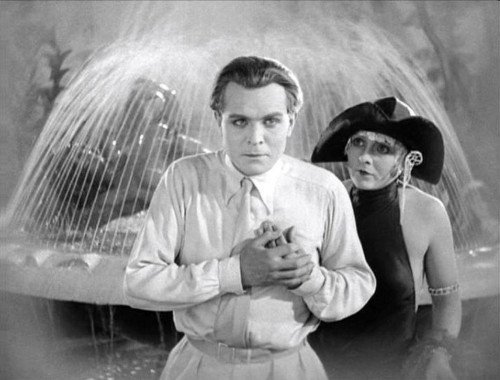
Maria essentially makes Freder the chosen one—she inspires him to go underground and gives him his purpose when he awakens to the dystopian system in which he lives. Without her, the story does not proceed and the system continues unopposed.
As she has an older brother, her birth was unauthorized and when she was discovered she was sent directly to the SkyBox. And so on. While some of the crimes are legitimate, many are the result of children growing up in a totalitarian state. So clearly it’s going to be better here on the ground, right?
Dystopia, in its futuristic escapism and its contemporary relevance, is an ideal genre for the young adult demographic. By pushing the boundaries of disturbing content and reflecting on youthful idealism, dystopian narratives trust the YA consumer to be both literary in their consumption of the book or film, but also socially and morally insightful in their view of the imagined world they hold.
In these moments, and in those unspoken moments when she savors placing long sweet kisses on Jules’s cheek, we see Gwen’s resistance. “Know your value,” Gwen tells Jules. It’s not found in good grades, not in getting into the best school, not in a newer and “better” body, but in sensory and emotional human pleasures.
When speaking over the phone, Sharon’s enthusiasm for this pioneering adaptation of a Caribbean Canadian sci-fi novel emanates as though this was a fresh and newly discovered idea. In fact, Sharon has been working on creating this film for the past 15 years (while also establishing herself as a published playwright, writer, actor and award winning director) and although the journey has been long, she strongly believes that now is the perfect time to transition this well-nurtured idea into tangible reality.
By creating her own worlds where she is a force to be reckoned with, Babydoll reclaims that very thing that was taken away from her by her stepfather and the hospital: her humanity.
By creating her own worlds where she is a force to be reckoned with, Babydoll reclaims that very thing that was taken away from her by her stepfather and the hospital: her humanity.
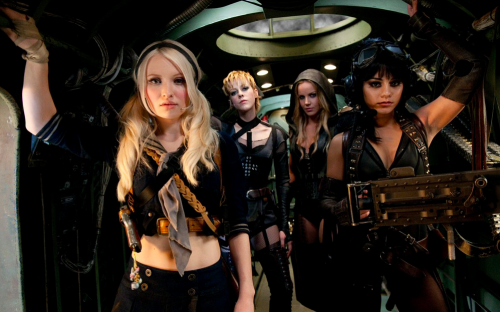
The women of Sucker Punch
This guest post by Toni McIntyre appears as part of our theme week on Dystopias.
At first glimpse, I’ll admit that Sucker Punch looks like little more than Zach Snyder’s latent schoolgirl fantasies brought to life. That Emily Browning, who plays main character Babydoll, has: A) that patronizing name and B) the dewy wide eyes of an anime heroine don’t exactly help. That said I’ve never been one to dismiss a film on wardrobe choices alone, even if they do cater a whole buffet’s worth to the male gaze. Snyder himself has even hinted that the aesthetics of Sucker Punch were chosen deliberately to mock geek culture’s sexualized fantasy version of women. Whether he was successful in that endeavor or not is fodder for another essay. The point is that as waifish as Babydoll appears, and however we may be tempted to dismiss Sucker Punch as just another male fantasy, a close look at the dystopian spaces within the film and how Babydoll exists in those spaces reveals a more woman-friendly, if bittersweet, reading.
The tragedy that starts the movie in earnest takes place in a very tight space. Babydoll attempts to shoot her abusive stepfather as he breaks down the door to a closet where Babydoll’s sister is hiding. The shot misses its intended target, ricochets in a way only bullets in movies can, and fatally wounds Babydoll’s sister inside the closet. Taking immediate advantage of the situation to unburden himself of his remaining stepdaughter, Babydoll’s stepfather carts her off to a mental hospital. Babydoll trades one menacing patriarchal force for another as crooked orderlies loom menacingly over Babydoll and the other broken but beautiful patients.
Rocket, Sweet Pea, and Blondie in the bordello world of Babydoll’s creation
Unable to cope with the reality of being in the hospital, Babydoll escapes inward and creates the first of two imagined worlds in her own mind. The first space is a richly adorned bordello and exists as the real world askew. The women from the hospital are still trapped, to a degree, in the bordello, but they have noticeably more power in how they present themselves to each other and to their male customers than they do in the hospital. It’s enough for Babydoll to become much more vocal once she’s imagined to be in the bordello—she becomes a plotting, rallying force for the other women.
It’s Babydoll’s second imagined world, one she accesses while she dances and enters a trance-like fugue state within the bordello, that Babydoll acts out her readiness to fight. While in the bordello everything is secrets and plans, in this second world, it’s all action. This second space is where things expand, where we get wide shots of extravagant landscapes—feudal Japan, a dragon’s den, a maze of soldier’s trenches. This second world is the tiny space of the closet where Babydoll fought her first battle, and where she lost in every sense of the word, blown wide open, given the space Babydoll needs in order to imagine battles she can fight and win.
Babydoll in her second world, armed and ready
Famed author and neurologist Oliver Sacks was observing a patient who experienced “transports” similar to Babydoll’s. Sacks pitied his patient and described the man’s imagined worlds as a “deceiving surface of illusion” that lacked anything deep or true. I’m not going to say Oliver Sacks is wrong in his observation, but I think it’s a simple way of looking at mental worlds or spaces—as untrue. I don’t think we’re meant to view any of the worlds Babydoll creates as false. And to quote another very wise and bearded man, Albus Dumbledore, even if something is happening only in your head, “Why on earth should that mean it’s not real?”
Babydoll had to travel within herself to worlds she created and could control, in order to discover a truth. We get a glimpse of what that truth is in a bit of dialogue delivered by the older matriarch figure the bordello:
“You see, your fight for survival starts right now. You don’t want to be judged? You won’t be. You don’t think you’re strong enough? You are. You’re afraid. Don’t be. You have all the weapons you need. Now fight.”
By creating her own worlds where she is a force to be reckoned with, Babydoll reclaims that very thing that was taken away from her by her stepfather and the hospital: her humanity.
Sucker Punch strives for optimism. The film wants to tell us that we have all the power within ourselves to rally against an unjust system. For a film bleeding special effects, it hits a real gut-punch worthy note of reality when we watch Babydoll fight—and fail. Again. The patriarchal forces at the hospital resurface and Babydoll sacrifices herself to ensure the escape of one of her fellow patients. Babydoll is lobotomized, her physical being trapped in the hospital, her mind free to sink down within the worlds she made for herself. Sucker Punch wants to tell us we have all the power we need to fight a unjust system, but, also, that that system sometimes still wins. It’s honest and brutal. Babydoll is made a prisoner twice over, and it’s a cold comfort that at least the second time, the decision to become locked in her own mind is hers. Sucker Punch is a story of finding your strength. It’s about looking in when those in control take away your ability to look out. It’s about making your own space when the space they give you is too small and too controlled for you to actually be. It’s equal parts a suggestion and a warning of what happens when you travel far enough into your own subconscious to really know yourself and all you’re capable of when the world outside may still beat you down. When I think about Babydoll, locked in her own mind, I think about when Gatson Bachelard warned that “he who buries a treasure, buries himself with it.”
Toni McIntyre is a native of Philadelphia but a Pittsburgh hockey fan. She once wrote a paper in grad school on Inception and couldn’t sleep for a week. She’s very often, too often, on Twitter.
When speaking over the phone, Sharon’s enthusiasm for this pioneering adaptation of a Caribbean Canadian sci-fi novel emanates as though this was a fresh and newly discovered idea. In fact, Sharon has been working on creating this film for the past 15 years (while also establishing herself as a published playwright, writer, actor and award winning director) and although the journey has been long, she strongly believes that now is the perfect time to transition this well-nurtured idea into tangible reality.
This guest post by Amanda Parris appears as part of our theme week on Dystopias.
Interview with the filmmaker below.
I was in my first year of university when I first read Nalo Hopkinson’s critically acclaimed novel, Brown Girl in the Ring as part of a Humanities course entitled Cultures of Resistance in the Americas. It had never occurred to me to think of futuristic dystopias and sci-fi literature as part and parcel of a resistance culture that has sustained African Diasporic cultures in the Americas until I was introduced to this work. A few pages into the novel, I was hooked. Located in the city where I have spent most of my life, the story is set in Toronto, a downtown core cordoned off from the surrounding suburbia where the rich and wealthy have fled. In the opening pages Hopkinson sets the scene:
When Toronto’s economic base collapsed, investors, commerce, and government withdrew into the suburb cities leaving the rotten core to decay. Those who stayed were the one’s who couldn’t or wouldn’t leave. The street people. The poor people. The ones who didn’t see the writing on the wall, or who were too stubborn to give up their homes. Or who saw the decline of authority as an opportunity. As the police force left, it sparked large-scale chaos in the city core: the Riots. The satellite cities quickly raised roadblocks at their borders to keep Toronto out. The only unguarded exit from the city core was now over water, by boat or prop plane from the Toronto Island mini-airport to the American side of Niagra Falls.
Nalo Hopkinson
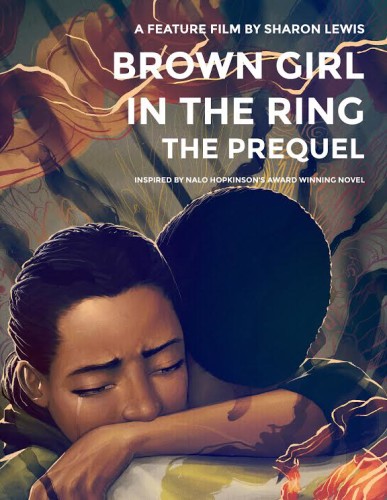
Seventeen years after the publication of Brown Girl in the Ring, Toronto was named the No. 1 city in the world to live in by The Economist. But who benefits or lives the reality of this status? The rise of condo-mania in the downtown core has also led to the rapid gentrification and resulting dislocation of numerous communities – the individuals affected fit a disturbingly similar profile to the ones that Nalo envisioned eventually cordoned off from health care, electricity and technology. Her description of The Burn, that walled-off section of Toronto, feels hauntingly familiar and it is this resonance that writer/director Sharon Lewis feels will hook people into the film adaptation of the novel that she is currently working on: Brown Girl in the Ring – The Prequel.
The Prequel puts the coming-of-age story of the novel’s protagonist, a young girl named Ti-Jeanne, front and center. The film will illustrate her first steps as she moves into the role of the heroine that she becomes in the novel. Beyond an exploration into the particular otherworldly gifts Ti-Jeanne possesses and her ability to navigate the dystopian landscape that defines her home, Ti-Jeanne’s character is also challenged by a more familiar narrative of conflict between her Caribbean and Canadian cultural identities. When speaking over the phone, Sharon’s enthusiasm for this pioneering adaptation of a Caribbean Canadian sci-fi novel emanates as though this was a fresh and newly discovered idea. In fact, Sharon has been working on creating this film for the past 15 years (while also establishing herself as a published playwright, writer, actor and award winning director) and although the journey has been long, she strongly believes that now is the perfect time to transition this well-nurtured idea into tangible reality. Last week Sharon successfully completed a crowdfunding campaign to support the film. Achieving this recent milestone has affirmed her belief that there is an audience out there excited for a story like this and that the moment is now for the film to be realized. She says,
Well I think we’re in the zeitgeist. I think that the novel and the film are coming to life in an appropriate time. I’m not sure if in 1998 we would have understood that this is so relevant to our present day lives. I think that with the rise of social media and technology we have a lot more access to those images so all of a sudden Ferguson, Baltimore, Detroit, all of those are in our consciousness in a way that it wouldn’t have been in 1998 because we didn’t have the same kind of access and the people living within those situations didn’t have the same kind of access. We see the rise of public videos being used in legal battles. That was never the case in the late 1990s. So all of a sudden police officers are being held accountable according to public videos. It doesn’t mean that they’re always being held to justice but they’re actually being held accountable which again is being used as a catalyst for people to riot. In the film that is the trigger for all of the things that happen. There is an economic collapse and the poor people are tired of being poor and they rise up. I think that if you look at why they are rising up it’s because there’s an access to social media in a way that they didn’t have before and then the only way to shut them down is to seclude them and cut off their electricity and cut off their ability to communicate with the outside world where their reality is going on.
Corporate and government decisions to seclude a section of the population following their mass politicized mobilization as a result of increased connectivity and communication feels eerily prophetic in the current era recently dubbed “Black Spring.” Sharon revealed that part of Nalo’s inspiration for the novel came from poignant observations of the harsh realities occurring south of the border:
When I talked to Nalo she was inspired by Detroit in terms of what post-apocalyptic Toronto would look like and this is 1998. So she was in Detroit and looking at a city that basically had an invisible wall around it. You had all the wealthy industrialists living in a particular area and then all the Black neighbourhoods were burnt out, abandoned, policed – heavily policed and the public school system was on its way down. So that’s the Toronto that you’re going to see in my film.
Although set in Toronto, Sharon recognizes that this story of economic flight and extreme disconnection and alienation is one that can resonate beyond the city’s borders. As a child of the Caribbean Diaspora, the extremes of wealth and poverty sitting side-by-side in an imbalanced yet normalized fashion is disconcertingly familiar for Sharon:
I spent a lot of my childhood in Jamaica and Trinidad and a lot of that reality is already there. There were already people that were cut off from technology or cut off from electricity who were having to make do. And right across the street they were seeing the glistening lights. I remember in Jamaica driving through Kingston and on the hillside you’d see people living in zinc shacks, still walking to the river to get water and then just a couple of feet down from them was this massive, beautiful house with satellite dishes and massive technology.
Sharon Lewis
Prescient in the film will be the way that these kinds of divergences in experiences create walls between people – sometimes physical but often subconscious – thereby separating them from each other in ways that enable the current world order:
There is a wall but like any ghetto there’s an invisible wall. There’s a wall that basically you don’t step into the other world because you don’t belong there. And you won’t see the wall in the film because again my whole point is your own psychological barriers are much more destructive than any actual physical wall that’s built.
The setting constructed by Nalo Hopkinson in her novel was, as are many dystopian landscapes, a prophetic warning of what will come to be if we continue to ignore the signs of the times. And yet it sets itself apart from other popular dystopian literary tales with a distinctly Caribbean Diasporic influence, one which director/writer Sharon Lewis is excited to push aesthetically in the cinematic adaptation. She cites Marcel Camus’ 1959 Oscar Award-winning film Black Orpheusas a key inspiration in imagining an aesthetic that is steeped with a heavy Carnival influence:
I’ve never seen a Caribbean set in a dystopia. I’ve never actually seen a dystopia that has a Caribbean aesthetic. For me it makes sense because what I saw in the reality of Jamaica or Trinidad where people had to adapt with little resources…it’s dystopia. Aesthetically it will be interesting because you’ll see Caribbean people and that will affect the way they dress and you know the food and all of that, but also in the way that they talk and the way that they relate to each other in terms of what those moral values are.
To step into the unchartered territory of Caribbean-Canadian sci-fi film, Sharon has cast a wide net in considering her aesthetic and story inspirations. She celebrates the rise of female heroines in Sci-Fi and Fantasy film such as Bella Swan in Twilight, Katniss Everdeen in The Hunger Games and Imperator Furiosa in Mad Max: Fury Road. Although an avid fan of sci-fi, the unbelievable dearth of Black female heroines in the film genre has meant that Sharon has had to look elsewhere for reference points when conceptualizing the heroine Ti-Jeanne for Brown Girl in the Ring – The Prequel. She cites Julie Dash’s seminal film Daughters of the Dust as a key inspiration in seeing Black women as magical, full, and rich characters.
With the success of her crowdfunding campaign, Sharon has launched a Brown Girl Movement, led by women of colour who are coming together to tell this story in a new genre that will inevitably feel strangely familiar for so many: that of the Caribbean-Canadian sci-fi.
To learn more about Brown Girl in the Ring – The Prequel, visit the website.
Amanda Parris is writer from the 6ix who dreams of screenplays to come, has a couple of theatre plays under her belt and sometimes really geeks out and writes for “the academy.” In her spare time she is an actor, Critical Hip Hop educator, and producer of all things cool, creative, and disruptive that started from the bottom. You can follow her on Twitter at @amanda_parris
Dystopia, in its futuristic escapism and its contemporary relevance, is an ideal genre for the young adult demographic. By pushing the boundaries of disturbing content and reflecting on youthful idealism, dystopian narratives trust the YA consumer to be both literary in their consumption of the book or film, but also socially and morally insightful in their view of the imagined world they hold.
This guest post by Rowan Ellis appears as part of our theme week on Dystopias.
Dystopian narratives can generally be described as “An imaginary place where people lead dehumanised and often fearful lives,” which is accurate, but does not fully express key characteristics of the genre.[1]The Hunger Games, for example, is temporally situated in a future version of America, and this relationship between time periods affects the causes of the dystopian societies and the extent to which our own world is responsible for their making. In this way, and especially looking at The Hunger Games as a Young Adult series, we can examine how dystopian landscapes are an overwhelmingly apt vehicle for social awareness in the younger generation by interacting with their world and self-identity.
What Would Katniss Do?
The Young Adult label is a recent one, with a distinctive lack of research on the genre; even its definition is contentious as a mixture of both a self-styled labelling by authors themselves, and a marketing tool for publishing companies. Intended readership is perhaps the most useful way of understanding the Young Adult literature, with the genre then defined as those books, films, or TV written and produced specifically for young adults.
The contemporary relevance of YA protagonists ensure that the exploration of self-identity for characters within these films is inevitably reflected back onto the YA audience, helping to shape their own views of themselves and the world around them. By exclusively using protagonists who are young adults themselves, films like The Hunger Games are able to emphasise the need for social change, and the possibility of it, by giving power to its viewers; as the protagonists create a better world, so too can the audience. At a talk at Cadogan Hall, John Green asked for questions from the audience of young readers. On receiving insightful and pertinent questions, and reading aloud one on the pain of writing about unfulfilled lives, and another comparing the use of water in his book to that of James Joyce in Ulysses, he remarked “I wish all the journalists who tell me my books are too complex for teenagers could hear this.” Dystopia, in its futuristic escapism and its contemporary relevance, is an ideal genre for the young adult demographic. By pushing the boundaries of disturbing content and reflecting on youthful idealism, dystopian narratives trust the YA consumer to be both literary in their consumption of the book or film, but also socially and morally insightful in their view of the imagined world they hold. By extrapolating a possible future from wider themes of importance in the contemporary age, the need to change current society is heightened.
Literary critic Robyn McCallum prefaces her work on adolescent identity by proposing the relative truism that “concepts of personal identity and selfhood are formed in dialogue with society, with language and with other people.”[2] The implication of this for The Hunger Games, however, is far more significant, as the reaction to and rebellion against Panem shapes not only the self-identity of the characters, but also the audience’s attitudes toward them. Dystopian worlds are often a product of mankind’s inability to learn from history, and The Hunger Games utilises this by mirroring its world building with Ancient and contemporary civilisations while creating the new history of Panem. Penelope Lively’s argument that “to have a sense of history is, above all, to have a sense of one’s own humanity” ties Katniss’ identity to distant history, as much as to her father’s death in the recent past.[3] The use of the name Panem for the dystopian world Collins creates, gives a multi-layered sense of antiquity and contemporary history. The Latin translation of Panem as “bread” is most notably tied to the quintessential Roman phrase “Bread and Circuses,” directly paralleling the Games and historical Gladiatorial contests, with the pre-Games feast even mirroring the cena libera in Roman culture. However, there is also a similarity with the famous Pam Am airline, evoking the past glamour of American globalisation, ironically contrasted with the static divisive state of the future America. Similarly the Capitol ties together ancient Rome and modern Washington with the utopian setting of the high society in Collins’ novel. The film’s costumes and design has a similar relationship with history; District 12 has a distinctive feel of dustbowl America, as if stepping out of the Depression-era photograph of an impoverished farming community.
Although set in our future, Katniss’ outfit undeniably echoes the past.
McCallum argues that “to displace a character out of his/her familiar surroundings can destablise his/her sense of identity,” yet Katniss does her growing within the hostile and unfamiliar landscape of the Arena, as she refuses to mirror the career tributes bloodthirsty methods, even though we as an audience know she is already skilled in hunting and killing.[4] The Arena is a form of anti-society, as The Games encourage a distrust of society via a distrust of individuals and alliances on which communities are based. By placing Katniss in such a space, it ensures a shaping of her social identity as a victor, but also her internal one, as her compassion is not completely destroyed by the mistrust and cunning she demonstrates in order to survive.
For a dystopian society to flourish there needs to be, as a characteristic of its ruling elite, the ability to block out natural empathy, or to remove the lower citizens from full human status deserving of empathy, in order for these hardships to be justified.[5] For the Games in The Hunger Games to achieve their purpose, they have to be watched both in horror by the Districts, and with delight and wonder by the Capitol. The Hunger Games uses the Games as an extreme image of where desensitising an audience potentially extrapolates to. The most immediate reflection of empathy within The Hunger Games is the relationship between Katniss, Rue, and Prim, as Katniss finds herself unable to detach her feelings for her sister with those for her fellow Tribute. This creates a sense of her as an unexpected maternal figure, sensing a gap between the younger girls as small children, and herself as an adult with responsibilities to them. Haymitch, as a representation of the experienced, and therefore jaded, adult character, is able to comprehend consequences of Katniss’ actions, whereas she reflects the stereotypical teenage attitude of living in the present, allowing her to focus on empathy over practicality and preserving her as a moral character as she teams up with the defenceless Rue.
The Other is a vital component of social (rather than ecological) dystopian fiction, as the propensity of the ruling elite to create such a nightmarish reality often relies on the subjugation of those who are deemed different. Going through the physical gendering process of puberty emphasises gender divides for YA characters and viewers. Gender in Panem is never raised as an Othering principle, indeed both male and female tributes are treated with the same objectification and callousness, and both genders display compassion and ruthlessness equally. However, the problems of patriarchy are so present in our own society that we project these values onto the characters. TheAtlantic magazine, for example, described Katniss as “the most important female character in recent pop culture history”and the success of the film franchise has bolstered support of an increase in films with female protagonists as both morally and financially justified.[6] In The Hunger Games, Katniss’ unbridled contempt for her Mother’s mental state, shapes her into becoming a traditional father figure, assuming the patriarchal rather than matriarchal role in the house. Similarly, although ostensibly the tribute Johanna Mason subverts the traditional gender stereotypes when fakes a meek sensibility in her own Games before revealing her bloodthirsty nature in order to win, there is a sense within the books that the same ploy would have worked had Joanna been Joseph.
Those of a high social rank in the Capitol become characterised by an extreme aestheticism, mirroring the turn of the Century upper-class preoccupation with art and beauty explored by Oscar Wilde and other Decadent artists. Cinna’s team work relentlessly on Katniss, as the ideals of beauty are vital to gaining support in the Capitol; looks help you win. In Finnick’s storyline, this preoccupation is given an added sinister twist, as he confesses Snow allowed Capitol citizen’s to rape him, inviting a comparison with the sexual exploitation of both men and women from the working-class backgrounds in Panem, with the sex industry in our own world.
Having Katniss act as the face of a building revolution, young adult viewers can see reflected in the films images of fictional young adults with the ability to change the world. They use a combination of fear and hope to allow young adult viewers to feel empowered, both in their internal self-identity and their engagement with the contemporary issues reflected in the films. Hope is traditionally the driving force in children’s fiction–to prevent despair from becoming the ultimate end of the experience, thereby preventing the impetus for creating a better alternative, and the same can be seen in Young Adult fiction. The actor Donald Sutherland, who portrays President Snow in the film adaptations of The Hunger Games has noticed the story’s “potential to catalyse, motivate, mobilise a generation of young people who were, in my opinion, by and large dormant in the political process,” through this combination of alarm and optimism.
Dystopian films relate the horror of the fictional worlds to the future of their own; in The Hunger Games the starvation in the Districts is a clear reflection of the poverty and famine experienced world-wide, even within contemporary America, where 57 percent of American children live in a home which is designated “poor” or “low income” and 20 percent live in poverty. Moreover, the extravagance of the Capitol’s food and clothes holds a mirror to the wasteful culture in the Western World, where up to half of all food produced is never eaten. Furthermore, the life or death conditions for children chosen as Tributes can be associated with the problems surrounding the use of child soldiers in countries such as Indonesia and the Democratic Republic of Congo. The empathetic fear of young adults towards these issues was illustrated clearly in the viral awareness campaign “Kony 2012,” where the plight of child soldiers captured the attention of hundreds of thousands of young people world-wide. Although critic Downey wrote in 2005 that “one of the great difficulties in teaching about horrific periods of history […] is addressing how to help students comprehend the incomprehensible,” she simplifies the abilities of young people by supposing that what is viewed as “incomprehensible” is relegated to the past, and that as adults, teachers are able to better understand these events.[7]
Hardships endured can both build and destroy characters, and although destruction can be viewed as a more realistic reaction to living in a dystopian society, forming positive identities around interacting with a society and set of values one finds unfair or lacking is a YA viewer’s reality. As the brilliant YA author Patrick Ness puts it, “Teenagers don’t see dystopias as dystopias; they see them as barely fictional representations of their day-to-day lives,” through their own powerlessness and fear. A fear which is inevitable in our world, and a reality to YA viewers–Atwood’s dystopian novel The Handmaid’s Tale, for example, famously composed its terrifying society from real cultures and historic movements. Dystopian narratives gives a YA audience a way of processing this reality at a distance, while potentially using it for personal inspiration, to foster an empathy which allows them to create their own morality separate from and informed by imperfect societies.
[1]Merriam Webster Encyclopedia of Literature (Springfield, MA: Merriam Webster Inc, 1995)
[2] Robyn McCallum, Ideologies of Identity in Adolescent Fiction: The Dialogic Construction of Subjectivity (New York: Garland Publishing Inc, 1999) p.3
[4] Robyn McCallum, Ideologies of Identity in Adolescent Fiction: The Dialogic Construction of Subjectivity (New York: Garland Publishing Inc, 1999) p.190
[7] Downey, A.L., “The Transformative Power of Drama: Bringing Literature and Social Justice to Life” English Journal, 95/1, (2005) p.33
Rowan Ellis is a British geek using her YouTube videos to critique films, TV, and books from a queer and feminist lens.
As she has an older brother, her birth was unauthorized and when she was discovered she was sent directly to the SkyBox. And so on. While some of the crimes are legitimate, many are the result of children growing up in a totalitarian state. So clearly it’s going to be better here on the ground, right?
Ha!
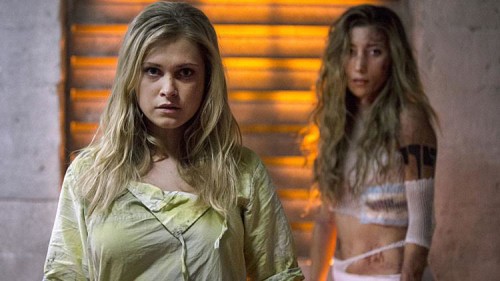
Clarke Griffin (Eliza Taylor) and Anya (Dichen Lachman) in one of The 100’s many dystopias
This guest post by Deborah Pless appears as part of our theme week on Dystopias.
The first scene of The 100 makes it pretty freaking clear that this is a show about dystopia. We are introduced to a pretty blonde girl drawing a landscape scene using only the dirt and grime of her prison cell. The voiceover narration informs us that this picture, and all of the other pictures that ornament her solitary confinement, is drawn from imagination. She has never set foot on Earth, and she will almost certainly die in space like all the rest of her people.
Cheerful stuff, huh?
The girl, Clarke Griffin (played by Eliza Taylor), is our main character and the voice of reason in The 100, a CW show that came on as a midseason replacement last year to middling reviews, but has continued to improve and now, after the completion of its second season, officially qualifies as a “cult hit.” Based on the novel series of the same name by Kass Morgan, you would be forgiven for assuming this is just another Hunger Games ripoff. It isn’t.
The 100 is a show ostensibly about teenagers falling in love and making poor choices against the backdrop of an ever-changing dystopian landscape, but in reality the show is far less concerned with emotions than with social commentary. The dramas and frivolities of the first few episodes fade away as the show goes on, being replaced instead by a compelling and gripping drama about political power, the ethics of war, medical experimentation, torture, the values of indigenous cultures, imperialism, and, occasionally, hope for the future.
It is also unquestionably a show about dystopia. Though evident in the first scene, it wasn’t until well into the second season that I realized that the show wasn’t just an exploration of one particular dystopian future, however, but instead an exploration of all of them. Really. All of them. Every organized culture or civilization that our heroes encounter in the course of the series is a different exploration of dystopia. And while this can make the show rather bleak and hard to watch, it’s fascinating.
The Ark
The basic premise of the show is inherently dystopian. Our heroes all live on the “Ark,” a cobbled together mush of space stations in orbit over the Earth. They’ve lived there for 97 years, since a nuclear war wiped out all life on Earth. The people of the Ark know that they are just a waiting generation who will live and die on the Ark with the understanding that in another hundred years their descendants will be able to go down and live on the planet once the radiation levels have decreased.
Because they have limited supplies, the Ark is run as a totalitarian dystopia. There is never enough food, water, air, or medicine. All food is rationed, all parents may have only one child, and medicine is reserved only for cases when the alternative is death. Even their shoes and underwear are handed down from one generation to the next. Break a law on the Ark – and there are many – and you die. No trial, no reprieve, just a sad farewell to your loved ones, the removal of all shoes and useful clothing, and then a swift death being shot out the airlock.
If a minor commits a crime, then they are sent to the “SkyBox,” a holding detention center where they await turning 18. Once 18, they face a panel, and that panel will decide if they should be “floated” or returned to the Ark’s main population.
Our story starts when Clarke and her fellow inmates in the SkyBox are hustled out of their cells and onto a dropship. Confused and terrified about what is happening, the teenagers (and children) soon realize that they are going down to Earth. Why? Well, as they and we learn, because the Ark can no longer support life and they must find out if the Earth has healed enough to sustain them. In other words, Clarke and all of her friends, 100 of the most vulnerable members of this society, are used as canaries in a coal mine.
The Ark kids reach the ground
So obviously the Ark is a dystopian place. As the show goes on – obviously the kids survive their trip to the Earth’s surface – it become increasingly clear that the governmental situation on the Ark is hellish at best. One child was incarcerated for hitting the guards who held her back as her parents were executed. Another character, Octavia (Marie Avgeropoulos), committed no crime but being born. As she has an older brother, her birth was unauthorized and when she was discovered she was sent directly to the SkyBox. And so on. While some of the crimes are legitimate, many are the result of children growing up in a totalitarian state. So clearly it’s going to be better here on the ground, right?
Ha!
As the kids quickly learn, the ground is no more hospitable than the Ark was. While there is no totalitarian rule, their society quickly devolves in a Lord of the Flies situation. A hundred teenagers and children who have been locked up in prison and forced to live in a police state their whole lives suddenly have complete freedom? Yeah, it goes pretty Lord of the Flies. Then, just when they’re starting to get their act together, it becomes clear that the Ark children are not the only ones alive on the ground. There are others.
That brings us to the Grounders, as the people of the Ark come to know them. The Grounders represent another form of dystopia, this one more similar to Mad Max. The Grounders are the humans who developed an immunity to the radiation poisoning the Earth and so rebuilt society.
Grounder leader Indra (Adina Porter) and her warriors
They hunt with bows and arrows and spears, wear an amalgamation of clothes they found and animal leathers, paint their faces to look scarier, and even speak a completely different language. Heck, they even have a village called “ton DC” built in the bombed out ruins of Washington DC. In other words, they appear at first to the Ark kids as “savages,” a dystopian view of who they could become if they lose all of their “civilization.”
Fortunately, the truth turns out to be much more complicated than that. While the Grounders are genuinely savage, they also have an artistic and healing tradition that is complex and beautiful, as well as a culture that is distinct and clearly quite functional. Though tribal and very divided by factions, the Grounders quickly become the least dystopian society on the show, and the Ark kids even cease their war and try to make a truce.
Unfortunately for our heroes, though, the Grounders are the least of their problems. As the story progresses, the kids run into another dystopian hellscape, this one called “Mount Weather.” Mount Weather is a bunker, or system of bunkers, hidden inside a mountain and home to a large population of seemingly nice, decent people. They’ve lived inside the mountain, sheltered by its radiation shields, for the past hundred years. They have abundant food, shelter and safety, and even flourishing art and culture. It’s the first place the kids go that is, well, beautiful.
But that beauty covers over the horrible truth that Mount Weather is just another dystopia. This time it’s a medical one, where the people of Mount Weather are basically vampires, kidnapping Grounders and draining them of their blood in the hopes of building up a radiation immunity. When the scientists at the mountain discover that the Ark kids have an even better immunity, they decide to harvest the kids’ bone marrow, whether they consent or not.
Inside Mount Weather’s medical research facility
Not to be outdone, by this time the bulk of the Ark’s population has reached the ground and formed a camp called “Camp Jaha,” which operates under the same dystopian rule as the Ark did. And across the mountains we discover a desert wasteland of outcasts and landmines and pilgrims searching for the “City of Light.” That City of Light? Turns out to be just another terrifying technological dystopia.
What’s the point of all of this? Well, aside from the writers of The 100 clearly enjoying the bleakness of their world, these competing dystopian futures actually manage to form a cohesive picture not of dystopia but of how we ought to respond to it.
Like I said above, our main character for the show is Clarke. Clarke is smart, caring, incredibly pragmatic and kind of scary. She quickly becomes the leader of the kids she came down with, but goes on to become the leader of all of the people of the Ark, a symbol of resistance for Mount Weather, and more. While there are other characters whose lives we follow, the story revolves around Clarke, particularly around how Clarke reacts to dystopian societies. Namely, how she never reacts well.
On the Ark, Clarke was locked up in solitary confinement for the crime of treason. She and her father discovered that the life support of the station was failing and tried to warn everyone. He was executed; she was locked up. At the dropship, when the kids go all Lord of the Flies, Clarke is the voice of reason, foraging for food and medicine while the others let the world burn.
Clarke and her mother, Abby (Paige Turco)
When captured by the Grounders, she resorts to diplomacy. When captured by Mount Weather, she speaks out against their propaganda and escapes, taking a former enemy with her. She quickly establishes herself as the real power of Camp Jaha and, with the help of her friends, brokers a deal with the Grounders to go to war against Mount Weather. Not bad for a 17-year-old girl. Not bad for anyone.
Clarke clearly believes in the values of a good society, but what makes her a fantastic character is how strongly she believes in speaking out against a bad one. She has no qualms about speaking truth to power. And she will not abide a dystopia. By showing Clarke butting heads with so many different kinds of failed societies, we’re given a look at what it means to stand up for our own rights and the rights of others in any situation. I’m not saying that the show is perfect or completely unproblematic, but I do think that it has something very interesting to say when it comes to how we ought to react to dystopian landscapes.
It says that we should react with understanding. We should figure out what’s wrong, what about the society is making it so unbearable, and then seek to fix that. Clarke doesn’t believe necessarily in blowing up bad societies, though she does sometimes do that. Literally. It’s more that her arc is about seeking the good and using these visions of failed places to figure out what will work and what should be.
This is especially meaningful considering that Clarke is, well, a teenage girl. She’s the demographic of our society that we pay the least attention to and give the least credence. And yet the whole show is centered around proving how much value Clarke and the other kids that society originally deemed expendable actually have.
Maya (Eve Harlow), Octavia (Marie Avgeropoulos), and Monty (Christopher Larkin) fight together in Mount Weather
It’s not just Clarke, either. The show centers on the kids the Ark sent down, the ones society had abandoned, as they explore different kinds of dystopias. They’re a pretty diverse bunch and their reactions to these different situations give us a wealth of commentary on those dystopias.
So while Clarke’s not perfect and neither is the show, they’re clearly trying. Clarke sometimes falls into white savior behavior, and the show occasionally tries to force storylines that feel disingenuous and frankly kind of weird. But whatever. I don’t need a perfect show or a perfect heroine. I’d rather have this, a meta-commentary on the different types of futures we envision for ourselves as a species. Even better, it’s a meta-commentary where each future is torn down and reassembled by the children who will actually inherit it.
As The 100 shows us, the point of dystopia isn’t to look at the future and weep. The point of dystopian landscapes is to give us a vision of what our future could be and then to explore how to make sure it never is.
Deborah Pless runs Kiss My Wonder Woman and works as a freelance writer and editor when she’s not busy camping out at the movies or watching too much TV. You can follow her on Twitter and Tumblr just as long as you like feminist rants, an obsession with superheroes, and the search for gluten-free baked goods.
Maria essentially makes Freder the chosen one—she inspires him to go underground and gives him his purpose when he awakens to the dystopian system in which he lives. Without her, the story does not proceed and the system continues unopposed.
This guest post by Julia Patt appears as part of our theme week on Dystopias.
Contemporary audiences best know Fritz Lang’s Metropolis for its unlikely restoration after museum workers discovered several missing scenes from the film in Brazil in 2008, 80 years after the film’s 1927 release. An archetypal depiction of the class struggle, Metropolis continues to influence dystopian landscapes, from George A. Romero’s Land of the Dead to The Hunger Games.
In the opening scenes of the film, we learn that the Metropolis is in fact two cities: the wealthy city above and the workers’ city below. Our protagonist is Freder (Gustav Fröhlich), son of the Metropolis’ Master, Joh. Freder differs little from the other men of his class—indulging in meaningless contests in the city’s stadiums, enjoying the comfort of elaborately dressed and painted women in the Eternal Gardens, and completely oblivious to the trials of the working class. It’s only when Freder encounters Maria (Brigitte Helm) that he deviates from the course set for him.
Freder in the Eternal Gardens.
In this first scene, Maria brings a large group of children up to the Eternal Gardens so that they may see the people who live there. “These are your brothers,” she says again and again, perhaps addressing both groups. While the other visitors seem alarmed by the newcomers and move away, Freder stands transfixed, watching Maria.
Maria.
He then learns of the deplorable conditions in the city, but only because he follows Maria underground. There he sees terrible accidents, men lagging with fatigue at their posts—all the horrors of the industrial world with its vast inequalities. Afterward, he tries to explain the conditions to his father, who is unconcerned, so much so that he casually dismisses one of his own employees to go join the ranks at the machines.
Although he prevents the man’s suicide and saves another from exhaustion, Freder can find no overarching solution or purpose apart from pursuing Maria and at several moments bids these other characters to wait for him. He’ll find answers, he seems sure, when he finds the woman who has so shaken him. He’s not wrong, either. When he later finds Maria—more than 30 minutes after her first appearance—she is delivering a modified sermon about the Tower of Babel, ending with the maxim: the mediator between the head and the hands is the heart.
Maria essentially makes Freder the chosen one—she inspires him to go underground and gives him his purpose when he awakens to the dystopian system in which he lives. Without her, the story does not proceed and the system continues unopposed.
Joh, Freder’s father, immediately recognizes the danger she presents and turns to the inventor, Rotwang, to help him discredit her. They decide to give Rotwang’s greatest creation, the Machine-Man, Maria’s face. It’s worth noting, however, that the Machine-Man had a female form well before this plan—Rotwang created it to replace the woman he loved. Joh and Rotwang are naturally delighted with the Machine-Man version of Maria, calling it the most perfect and obedient tool. Each believes that the Machine answers only to him, although it is ultimately unclear whether the Machine has motivations of its own. (“Let’s watch the city go to the devil!” it exclaims toward the film’s conclusion with noticeable glee.)
The perfect woman, apparently.
It does, however, fulfill its joint purpose, which is to bring chaos to both the city above and the city below. In the Metropolis’ nightclubs, the Machine dances, driving the upper-class men to violence and delirium. Below, it incites the workers to revolution and encourages them to destroy the machines that keep both cities alive and functioning.
Men lose their minds for this move.
Thanks to the Machine’s efforts, the Metropolis comes close to complete destruction, with the workers’ children trapped in a flooding city below and the wealthy stalled by massive power outages above. Rioting breaks out as the two classes encounter each other on the surface. However, Maria saves the workers’ children—with Freder’s assistance—and later, the mob unwittingly destroys the Machine-Man. After seeing his son nearly die, Joh has a somewhat convenient change of heart and, with Freder’s help, joins hands with the worker’s foreman.
All this comes at the hands of one woman and her doppelganger—equal forces for peace and chaos. But Maria isn’t a character with much agency or screen time. Freder’s pursuit of her dominates our attention throughout the film. And ultimately she is not the mediator, rather only the inspiration for him, the original Trinity to Neo’s Chosen One in The Matrix.
Maria is an unusual character in other respects. It’s unclear what her position or profession is, although it seems likely she might be a teacher or a minder for the children, and she doesn’t quite seem to belong to the working class. Neither does she seem to spend time with other women. Only men come to the meetings she calls; in fact, we see no women workers at all until the film’s final act.
There seems to be a suggestion, then, that only men can overthrow the oppressive society—we see three men clasp hands at the end of the film to show that peace is possible. Aside from the women in the mob of workers, women in Metropolis remain isolated, surrounded by crowds of men. Perhaps unsurprisingly, there is no moment of: “These are your sisters.” However, without Maria, revolution seems unlikely. She threatens the status quo by calling her meetings; she inspires Freder to leave the city above and witness the city below. Her image—properly manipulated—is enough to create division within both societies, but she also contributes to the unity.
We need you! Just not as a leader.
The Machine-Man, of course, has even less control over its destiny. Its appearance is stolen, an appropriation of Maria’s body for the benefit of the patriarchal upper class. If it loves chaos and seems devious, we should remember that it was designed to behave as it does. It is an ideal tool because it appeals as women as meant to appeal without any desires or notions of its own. But it’s worth noting that the other women of the upper city are also tools of the patriarchy, used for a particular end other than their own determination, however willing their participation in the system might appear.
Ultimately, Metropolis gives us two images of how women function in repressive societies—as revolutionary visionaries and unholy temptresses. However, it falls short on both sides: they can neither overcome nor create the dystopian world as they choose.
The Machine-Man mirrors Maria.
We find a similar duality of character in François Truffaut’s adaptation of Fahrenheit 451, based on the novel by Ray Bradbury. The film deals similarly with a male hero of the dominant society awakening to the realities of the world around him: Guy Montag (Oscar Werner). Montag belongs to the enforcement class—he burn books—and lives a comfortable if unhappy life with his wife, Linda (Julie Christie).
Linda is the picture of complacence. She consumes the media her society dictates, wants what her culture tells her to want, and questions little.
Linda.
We wouldn’t know anything of her unhappiness, save for the fact that in her second appearance in the film, she has apparently overdosed on pills. It’s never settled satisfactorily whether she did this intentionally or by accident. The emergency crew treats it as a routine occurrence, so it seems likely that Linda represents the typical woman of her station—lonely, uneducated, and lacking control over her life in any meaningful way.
Montag is visibly shaken by the episode, but only to a point—he is in the midst of a transformation inspired by Clarisse, a woman he meets on the train. In a deft move by Truffaut, Christie also plays Clarisse, distinguished from Linda only by her short hair.
Although he is not as immediately taken with her as Freder is with Maria in Metropolis, Montag clearly finds himself drawn to Clarisse. (She is often regarded as one of the original manic pixie dream girls.)
He seems happy to see her again and goes so far as to visit the school where she works with her after she’s fired. He particularly seems moved by her emotional response when the children don’t remember her—she cries the tears Linda can’t.
But most importantly, Clarisse puts Montag on the path to his awakening by asking him, “do you ever read any of the books before you burn them?”
Don’t mind me…just here to inspire you to a revolution.
Clarisse, like Maria, is an active participant in a movement to change the way her society works. She warns a man at the beginning of the film that the firefighters are on the way to his house. She doesn’t teach the way she is directed to and she challenges all of Montag’s preconceptions about the world in which he lives. However, as with Metropolis and Maria, Fahrenheit 451 is not Clarisse’s story. And strikingly, the dual casting of her and Linda suggests that the two play complementary roles in Montag’s life. One represents the inadequate if safe life he’s lead and the other the intellectual freedom and curiosity he learns to want. But under slightly different circumstances, Clarisse might have been Linda or vice versa. Their individual desires, while relevant, do not drive the narrative the way Guy’s do. Rather, like Maria and the Machine-Man, they represent the two possibilities in particular dystopian systems—their roles largely determined by the needs of men in those societies, be they revolutionary or otherwise.
Ultimately, what are we to make of these manic pixie dream girls with their unusual ideas? Is there a moment when they might do more than inspire others and take real revolutionary action on their own? And is it possible to tell the story of a woman coming to the same realizations that Freder and Guy do?
Or, does it all come back to the creation of the Machine-Man—the ultimate symbol of society’s desires with no identity of its own?
Julia Patt is a writer from Maryland. She also edits 7×20, a journal of twitter literature, and is a regular contributor to VProud.tv and tatestreet.org. Follow her on twitter: https://twitter.com/chidorme