‘Girl Soldier’: Trauma, Terror, and Reconciliation

Jonathan Torgovnik, South-African based award winning photographer and filmmaker, was drawn to these women’s stories and from them created the short film, ‘Girl Soldier.’ ‘Girl Soldier’ features interviews with several ex-child soldiers from the Sierra Leone civil war—women who managed to survive their traumatic history and have now been reintegrated back into their communities.

Kadiatu Koromoa sits for a portrait in Jonathon Torgovnik's 'Girl Soldier'
Kadiatu Koromoa sits for a portrait in Jonathon Torgovnik’s Girl Soldier

Written by Rachel Redfern.

Trigger Warning: Sexual Assault, Violence

After the viral video Kony 2012, there was a whole slew of renewed interest in the problems of child soldiers–the trauma, abuse and the horrors that accompanies such a twisting of childhood innocence and trust into a weapon all came to light. Eventually, Kony 2012 and its creators fell out of favor with activists, and the continuing problem of child soldiers and its life-long effects on its victims and their communities faded to the background.  Unfortunately, to date, there are still over 300,000 child soldiers worldwide with half that number fighting in African conflicts.

There is a surprising and often unspoken fact that over 40 percent of all child soldiers worldwide are girls. The images we normally see of child soldiers always feature young boys stoically gripping an AK4; they rarely feature girls and never show the women these soldiers later become.

Jonathan Torgovnik, South-African based award winning photographer and filmmaker, was drawn to these women’s stories and from them created the short film, Girl Soldier. Girl Soldier features interviews with several ex-child soldiers from the Sierra Leone civil war—women who managed to survive their traumatic history and have now been reintegrated back into their communities.

From 1991-2001 Sierra Leone was the site of a massive civil war that resulted in the death of 50,000 people. Thousands of children were abducted and forced to fight for rebel forces—the atrocity of utilizing children for an armed conflict was doubled by the horrors they were forced to commit.

In the Sierra Leone Civil War, 30 percent of all child soldiers were girls.

Torgovnik spends much of the film with the women recounting their personal experience as child soldiers; this is an unnerving experience for the viewer as well, especially in the easy way that each woman shares the horrific events of her childhood. And for many of the women, their lives as a child soldier didn’t necessarily end with the war; many were left with babies after being impregnated by their captors.

As the end of the film shows, these women were able to deal with the trauma because of their shared experience and the group-counseling sessions organized by shelters and NGOs.

While the beginning of Girl Soldier is a stark reminder of the sickening crimes committed in the name of war, the end of the film covers the sad, but uplifting aftermath. It is inspiring to watch the human ability for forgiveness that these women demonstrate: despite the horrific acts committed against them by their captors, these men now walk free after Sierra Leone’s reconciliation hearings. In order for their country to survive and to have peace, these women had to learn to live with the men who had brutalized them in the first place.

The 2006 film Blood Diamond featured a gritty Leonardo DiCaprio and impassioned Jennifer Connolly against the backdrop of the Sierra Leone civil war; despite its Hollywood origins, Blood Diamond did expose the horrors of child soldiers through the story of Dia. Large-scale Hollywood epics such as these are important, as they bring awareness on a massive level; however, while many of the women in Girl Soldier had similar experiences during the war, the faces, the photos of children and friends, the context of women in their home villages, makes their stories even more horrifying, and ultimately more personal.

To watch Girl Soldier and read an interview with Torgovnik click here.

_____________________________________________

Rachel is a traveler and teacher who spent the last few years living in Asia. Now back in her native California, she focuses on writing about media, culture, and feminism. While a big fan of campy 80s movies and eccentric sci-fi, she’s become a cable acolyte, spending most of her time watching HBO, AMC, and Showtime. For good stories about lions and bungee jumping, as well as rants about sexism and slow drivers, follow her on Twitter at @RachelRedfern2.

We’re All Stars: A Feminist Retrieval of ‘High School Musical’

I am not here to argue that the ‘High School Musical’ franchise is a feminist triumph. But I continue to believe that popular cultural products beloved of young women and girls receive an inordinate amount of vitriol because of misogyny, and that they merit close and generous examination for the retrieval of positive messages.

Written by Max Thornton.

First things first: I am not here to argue that the High School Musical franchise is a feminist triumph. But I continue to believe that popular cultural products beloved of young women and girls receive an inordinate amount of vitriol because of misogyny, and that they merit close and generous examination for the retrieval of positive messages.

(At least, that’s what I tell myself to justify my love of One Direction.)

The first time I saw High School Musical, I classified it as “basically Grease with worse songs but a better message,” and that holds true. As the RiffTrax snarks: “At last, a high school movie that tackles the issue of cliques.” But let’s be real, there are an awful lot of teen movies out there with pretty terrible messages (like, um, Grease), and HSM isn’t actually one of them.

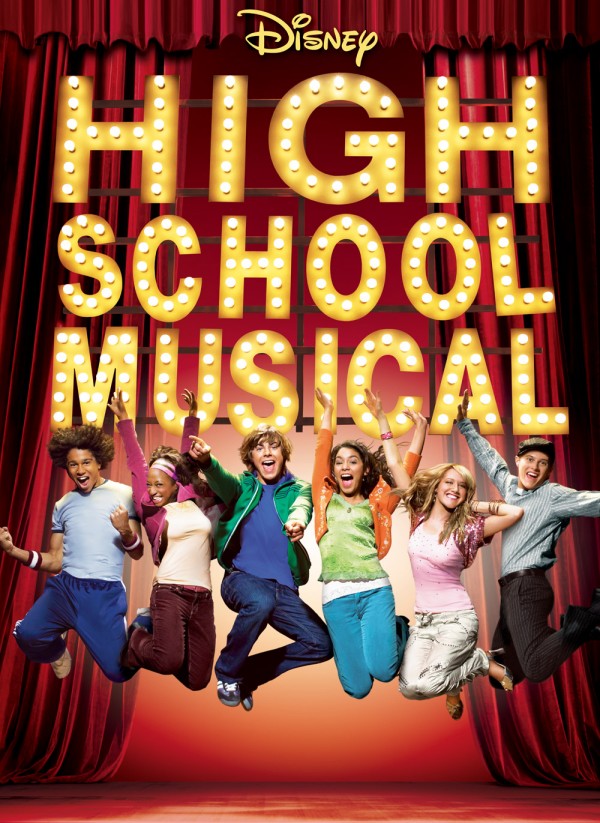
There's so much pep in this poster, I'm exhausted just looking at it.
There’s so much pep in this poster, I’m exhausted just looking at it.

Sure, it’s cheesier than a four cheese pizza with extra cheese, setting up potential conflicts only to resolve them through ~the power of friendship~ ten minutes later. And sure, it has plot holes you could drive a bus through. My personal favorites are (1) the notion of theater nerds being obsessed with punctuality and (2) the fact that antagonists Ryan and Sharpay are in every way demonstrably better performers than the heroes Troy and Gabriella. (In fact, they are such breakout characters that Sharpay even has her own spinoff movie, Sharpay’s Fabulous Adventure, which, the montage of two dogs falling in love to a Justin Bieber song notwithstanding, undoubtedly has the most narrative cohesion of any film in the High School Musical franchise.)

However, let’s take our cue from Johnny Mercer and ac-cent-tchu-ate the positive. Latina Gabriella’s friendship with African-American nerd Taylor ensures that the film easily passes both the Bechdel test and the race equivalent. Then there’s the fact that, as a Tumblr post that eludes my search skills put it, the master narrative is that of a rom com about a popular boy “giving up his swag” to be with a nerdy girl. Of course, this is Disney at its Disneyest, so even the nerdy kids are bright-eyed and pimple-free, but it’s still essentially a gender inversion of a common trope.

Plus, the film kind of takes the hoary message about being true to yourself to a logical endpoint by being so ridiculously optimistic about the consequences. Standout number “Stick to the Status Quo” is all about kids reinforcing a system that disadvantages them because it’s all they know. The homework enthusiast who loves hiphop, the basketballer player who bakes, the stoner (/skateboarder, because this is Disney) who plays the cello – all are shouted down by their fellow students who want them to remain within their boxes. And yet surely nobody is fully defined by a single interest. Even the nameless masses of kids who insist that their bolder peers “stick to the stuff you know” must have other hobbies, pastimes, passions, facets to their personalities; but they are so invested in the clique system that they insist upon it, even when they logically should not. I’m not going to suggest that this is a trenchant critique of repectability politics and systems of normativity, but it is an illustration of how these things work. The system’s greatest trick is its internalization by those who suffer under it.

 [youtube_sc url=”https://www.youtube.com/watch?v=ZYZpZr3Cv7I”]

This being Disney, as the RiffTrax says, “high-schoolers’ secrets are ‘I like rap,’ not ‘Dissecting the fetal pigs gave me a boner.’” Everyone is afraid that doing something different will make their friends dislike them; their friends are jerks (“worse than jerks… mean jerks,” as Taylor The Academic Decathlete so incisively expresses it) for all of ten minutes before feeling bad, apologizing, and joining forces to enable the lead characters to excel at a truly implausible number of extracurriculars. In a corny, contrived way, the film presents a world in which being yourself really is the best option. Admit to your secret love of singing, and not only will your jock buddies accept you, they will actively scheme to enhance your time-management skills. Within the schema of the “be yourself” story, it’s at least consistent to the notion that being yourself always makes life better – even if it does this in a hopelessly rose-tinted manner. If the message of your fictional story is “things will be best if you are always true to yourself,” it makes logical and moral sense for your protagonists to get to have their cake and eat it once they have learned this lesson.

It’s also pretty easy to read this film as a coming-out story in disguise. The jock is concerned that his love of musical theater will alienate his teammates and his jock dad? Yeah. OK, it’s a stereotype, but what in this movie isn’t? Plus the movie goes out of its way to code Troy and Gabriella’s relationship as nonsexual: they bond over the idea of being in kindergarten, they never actually kiss until the sequel, their rival counterparts are a literal brother and sister (the brother of whom is as gay as you could get in a Disney Channel original film)… On one level, of course, this is simply a rather extreme version of boy-band attractiveness rendered as non-threatening, desexualized cuteness – being a 90s kid, I still think of Hanson as the zenith of such things – but the queer reading can certainly coexist. (Note also that gay-coded musical theater enthusiast Ryan and scoffing dudebro jock Chad inexplicably show up wearing each other’s clothes in a scene in High School Musical 2.)

You think I made that up? I did not make that up.

A major philosophical concern of recent decades has been the coexistence of unity and diversity. How do we balance our commonalities as human beings and our differences as individuals? As complex and difficult as this topic often gets, I ultimately can’t express it more succinctly than the lyrics to “We’re All In This Together”:

We’re not the same, we’re different in a good way.”

_________________________________________

Max Thornton blogs at Gay Christian Geek, tumbles as trans substantial, and is slowly learning to twitter at @RainicornMax. He wrote this piece for his partner, because it’s their anniversary and they watched High School Musical on their first date. Romance!

Call for Writers: Female Friendships

Female friendships are the bedrock of feminism. The ideal of a community of women who support, understand, and love each other is a source of succor for sisters in need and a dream towards which the feminist movement strives. There are endless power and agency in female friendships. There is purpose in those bonds, a purpose outside the pursuit of men, even if Hollywood doesn’t see it.

Call-for-Writers

Our theme week for September 2014 will be Female Friendships.

Female friendships are the bedrock of feminism. The ideal of a community of women who support, understand, and love each other is a source of succor for sisters in need and a dream towards which the feminist movement strives.

The notorious Bechdel Test judges films based on three simple criteria: 1.) More than one woman must appear in the film 2.) They must talk to each other 3.) Their conversation must be about something other than men. The Bechdel Test has become a yardstick for measuring the most basic feminist standards for filmmaking because very few movies actually manage to pass the test’s very simple criteria. This means that female friendships, nevermind female-centric or matriarchal communities, are all but erased from cinema.

Classic films like the entire Star Wars franchise present women as anomalous, isolated Others who are likely love interests. If women happen to appear together in films, they usually don’t even rate love interest status; instead they’re decorative, sexualized objects without meaningful lines or personalities. On the rare occasion that we see women interacting on screen together, they are all too often in competition for male attention, which sets up female relationships as necessarily adversarial. This erasure of women from entertainment media along with their sexual exploitation and the stereotype of “catfighting” girl vs. girl are extremely damaging representations. If these examples are all young women see reflected around them, how will they know there are other ways of being?

There are endless power and agency in female friendships. There is purpose in those bonds, a purpose outside the pursuit of men, even if Hollywood doesn’t see it. Tell us about your favorite female friendships on screen or skewer a depiction that fails to show us meaningful female relationships.

Feel free to use the examples below to inspire your writing on this subject, or choose your own source material.

We’d like to avoid as much overlap as possible for this theme, so get your proposals in early if you know which film you’d like to write about. We accept both original pieces and cross-posts, and we respond to queries within a week.

Most of our pieces are between 1,000 and 2,000 words, and include links and images. Please send your piece as a Microsoft Word document to btchflcks[at]gmail[dot]com, including links to all images, and include a 2- to 3-sentence bio.

If you have written for us before, please indicate that in your proposal, and if not, send a writing sample if possible.

Please be familiar with our publication and look over recent and popular posts to get an idea of Bitch Flicks’ style and purpose. We encourage writers to use our search function to see if your topic has been written about before, and link when appropriate (hyperlinks to sources are welcome, as well).

The final due date for these submissions is Friday, September 19 by midnight.

The Runaways

The Women

Sucker Punch

Girl, Interrupted

Heathers

Xena Warrior Princess

Thelma & Louise

Now and Then

Pretty Little Liars

Foxfire

Voilet & Daisy

The First Wives Club

Beaches

The Little Princess

Steel Magnolias

Waiting to Exhale

Boys on the Side

Frozen


The Brat Pack: The Roundup

Check out all of the posts for our Brat Pack Theme Week here.

Mannequin: A Dummy’s Guide to True and Everlasting Love by Karina Wilson

By any regular standards, even the 1980s, Mannequin is a TERRIBLE movie.  It never should have been green lit, let alone hit wide release.  It’s often lumped in with other Brat Pack pics, thanks to the presence of Andrew McCarthy and James Spader, but it really should be categorized separately, as a romcom gone wrong. Showroom dummies that come to life after hours should be the stuff of horror movies, or episodes of Doctor Who, not fluffy fantasies starring a nearly naked Kim Cattrall.  John Hughes wouldn’t have touched this material with a ten-foot pole.


Sixteen Candles, Rape Culture, and the Anti-Woman Politics of 2013 by Stephanie Rogers

Holy fuck this movie. I started watching it like OH YEAH MY CHILDHOOD MOLLY RINGWALD ADOLESCENCE IS SO HARD and after two scenes, I put that shit on pause like, WHEN DID SOMEONE WRITE ALL THESE RACIST HOMOPHOBIC SEXIST ABLEIST RAPEY PARTS THAT WEREN’T HERE BEFORE I WOULD’VE REMEMBERED THEM.

Nostalgia is a sneaky bitch.


A Brain, an Athlete, a Basket Case, a Princess, and a Criminal: How The Breakfast Club Archetypes Set Standards for High School in Brat Pack Cinema and Beyond by Kylie Sparks

While today’s entertainment sources a lot of inspiration from Brat Pack Cinema, especially the high school-coming-of-age era of Brat Pack Cinema, we have to be very aware that we do not fall into the trap of embracing multifaceted male characters and yet only providing a Princess/Oddball dynamic with female characters. Not all of us fall into The Brain, The Athlete, The Basket Case, The Princess, and The Criminal, and while we can look to Brat Pack Cinema for inspiration to create new projects for our generation and generations to come, archetypes are suggestions, not the end-all be-all for characters in entertainment.


After The Brat Pack: Ally Sheedy in High Art by Ren Jender

Although a few who had fallen under the brat pack sobriquet (like Demi Moore) continued in mainstream star-vehicles well into the 90s (and Rob Lowe, dismissed as another pretty face in the ’80s, was able to sustain a TV career into the present), most had faded from the public view by then, including Ally Sheedy (after starring in 1987’s Maid to Order, her own Weekend At  Bernie’s) –though earlier in her career she, of the whole “Pack,” received some of the best reviews for her work. Sheedy went on to reinvent herself–and make good on her earlier promise–in a series of meaty roles in independent films in the late 90s: the most well known one (for which she won several awards) was Lucy Berliner in writer-director Lisa Cholodenko’s 1998 feature debut High Art.


What They’re Going Through: The Brat Pack Gave Teens a Voice by Caroline Madden

Whatever the Brat Pack actors did with their fame in real life does not reflect the impact they ingrained on our culture. They helped put a face and a voice to teen struggles. These talented young actors gave teenagers an identity and platform for their problems that will stand the test of time. We will always thank the Brat Pack for that.

‘Mannequin’: A Dummy’s Guide to True and Everlasting Love

By any regular standards, even the 1980s, ‘Mannequin’ is a TERRIBLE movie. It never should have been green lit, let alone hit wide release. It’s often lumped in with other Brat Pack pics, thanks to the presence of Andrew McCarthy and James Spader, but it really should be categorized separately, as a romcom gone wrong. Showroom dummies that come to life after hours should be the stuff of horror movies, or episodes of ‘Doctor Who,’ not fluffy fantasies starring a nearly naked Kim Cattrall. John Hughes wouldn’t have touched this material with a ten-foot pole.

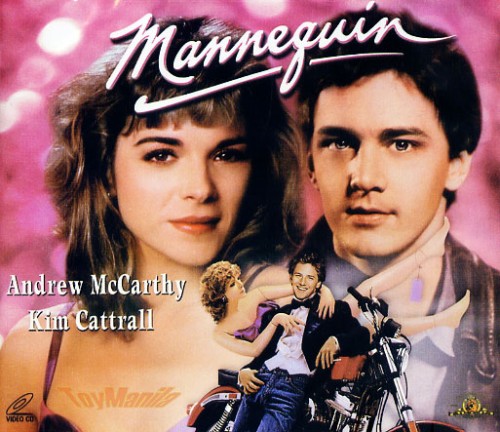
mannequin-remake-movie

This guest post by Karina Wilson appears as part of our theme week on The Brat Pack.

By any regular standards, even the 1980s, Mannequin is a TERRIBLE movie.  It never should have been green lit, let alone hit wide release.  It’s often lumped in with other Brat Pack pics, thanks to the presence of Andrew McCarthy and James Spader, but it really should be categorized separately, as a romcom gone wrong. Showroom dummies that come to life after hours should be the stuff of horror movies, or episodes of Doctor Who, not fluffy fantasies starring a nearly naked Kim Cattrall.  John Hughes wouldn’t have touched this material with a ten-foot pole.

It’s hard to believe the filmmakers ever thought audiences would fall for the outrageous plot. An Ancient Egyptian princess, Emmy (Kim Cattrall), escapes arranged marriage to a camel dung salesman by disappearing in a puff of smoke and reincarnating as a showroom dummy in 1987 Philadelphia, where she finds true love with the career-challenged Jonathan (Andrew McCarthy) inside a glittering retail palace (Wanamaker’s, now Macy’s Center City).  She exploits the well-documented Philadelphian obsession with classy department store window displays to turn Jonathan’s life around, defeat the bad guys, and [SPOILER ALERT] get married (in a climactic window display!) and live happily ever after.

mannequin028oz4

Critics, understandably, hated it.  Roger Ebert thought it was, quite literally, DOA (“Mannequin is dead. The wake lasts 1 1/2 hours, and then we can leave the theater”).  Janet Maslin in the New York Times lamented the lack of substance (“In place of a real story, there is just the spectacle of stock characters being put through their paces to fill up the time”) and lousy performances (“It’s never a disappointment when the mannequin, which comes to life only intermittently, turns back into wood”).  Leonard Maltin called it “absolute rock-bottom fare. Dispiriting to anyone who remembers what movie comedy ought to be.”   Yet it was a hit – grossing more than $42 million off a $6 million budget – and was nominated for an Academy Award – for Starship’s theme song, “Nothing’s Gonna Stop Us Now.”

I willingly confess to loving Mannequin. It’s so wrong, it’s absolutely right.  It’s a big, tatty rescue pooch who plants her paws on your chest and gives you a slobbery kiss of a movie: certain people, dog people, Mannequin people, can’t help but be charmed.  Even now, watching it as a hard-bitten 40-something, it invokes my inner impressionable teen.

mannequin

I adore the unromantic hero, Jonathan Switcher, because he manages to be simultaneously weird and endearing. There’s something a bit off kilter from the top: when we first meet him, he’s salivating over a naked clothes dummy.  He exudes every which way of warning signal, from the pronounced doll fetish to the Frankenstein complex to the social ineptitude. When the dummy-making gig doesn’t work out, he is hired and quickly fired from a succession of menial occupations, which consequently causes him to be dumped by his improbably put-together girlfriend, Roxie (Carole Davis).  Poor Jonathan would drown instantly if forced to dive into the perilous depths of the 2014 dating pool.  However, this was the 1980s, when you could splash about in the shallow end and still qualify as Kim Cattrall’s dream date.  On the plus side, Jonathan rides a Harley, lives in a sweet studio apartment (obviously comes from money, yay 1980s!), and he’s Andrew McCarthy. Andrew fucking McCarthy. Be still, my perpetual adolescent heart.

For those of you who don’t recall, Andrew McCarthy was the Beta Male of the Brat Pack.  He wasn’t as beautiful as Rob Lowe, or as badass as Judd Nelson, or as peppy as Robert Downey Jr., but you’d take him over Anthony Michael Hall or Jon Cryer any day.  He had a burning blue stare, a voice that dropped to a creaky growl when – as often happened – his character was wracked with emotion, and a lift to his chin suggesting a stubborn streak a mile wide.  He was cool enough to pop his collar and run with the in-crowd, but he was also sensitive enough to be an individual, even (shock!) an artist, and follow his dream.  He was the Nice Guy before the term became so ridiculously devalued.  He was the boy who might, quite unexpectedly, offer to walk you home after prom turned to tears, and then turn misery and humiliation into the most enchanted evening of your life through the power of his goofy grin and kind eyes.  I loved him then and I love him still.

mannequin022he8

He’s wasted in Mannequin. He does his best with the material, and manages to make Jonathan geeky and adorable, a whisper away from quietly insane: in lesser hands, the guy would be plain creepy.  McCarthy makes it halfway believable that Emmy, who has had her pick of hot dates (Christopher Columbus!) throughout history, might finally settle for the lowest status employee in the store.  And Cattrall keeps up Emmy’s end of the deal, regarding Jonathan as a feline would a toy stuffed with catnip – with unadulterated delight.  She bats him between her paws, chews on him gently, and, when the montage is done, curls up beside him and goes to sleep.  Girl clearly likes to dominate, and there’s a coy whiff of BDSM about some of their dress-up-and-play.  What else are they going to do with those tennis racquets other than spank each other’s ass?

In a cute subversion of romcom norms, then, Emmy is the Alpha Female who picks out the Nice Beta Male early on in the narrative and seduces him with a plastic smile.  She has been dating for millennia. When she sees it, she knows exactly what she wants – and it ain’t the traditional alpha hero. Jonathan and Emmy are perfect for one another from the moment they lay eyes on one another.  There’s no need for a makeover montage. This is due to bad storytelling rather than feminist innovation, but it’s so refreshingly unusual, it works.  She’s content to dazzle, he’s content to be awed – and when required, he saves her life.  We should all aspire to such a Mr. Right.

mannequin1

The writers, Michael Gottlieb and Edward Rugoff, manage to throw a few obstacles in the happy couple’s way (the course of true love never did run smooth) in the form of manic supporting characters. Forget three-dimensional, thinking, feeling, human beings – crass stereotypes abound. There’s flamboyant, gay, black, promiscuous Hollywood (Meshach Taylor), the set designer who takes Jonathan under his sateen wing.  Estelle Getty pops up as the store’s owner, Claire Timkin.  G.W. Bailey reprises his Police Academy shtick as Felix, the bumbling security guard – Cattrall was a fellow alumni, best known for her sex kitten turns in Porky’s and Police Academy at this point, so he must have felt at home.  And there’s the villainous Richards, James Spader abandoning his usual sexy-husky bad-boy turn in favor of playing a rival storeowner with cartoonish slicked-back hair and outsize spectacles.  None of it makes much sense. But somehow Jonathan and Emmy win and Richards and Roxie lose and the finale is all “Nothing’s Gonna Stop Us Now” most triumphant good.

That’s all, folks. Mannequin is fun, but wafer-thin.  Although considered a cult classic, it has zero cultural significance, especially when compared to the canon Brat Pack hits that defined a generation.  It’s a vapid Technicolor fantasy that, by being so poorly conceived and written, accidentally manages to subvert all the other Pygmalion stories.  Flimsy as she is, Emmy is the romantic heroine who doesn’t have to be reshaped or reinvent herself in order to deserve her adoring swain.  All she needs is for us to believe she’s real.


Karina Wilson is a British writer and story consultant based in Los Angeles.  She writes a regular column on horror fiction at Litreactor and can also be found at Horror Film History.

‘Sixteen Candles,’ Rape Culture, and Anti-Woman Politics

Holy fuck this movie. I started watching it like OH YEAH MY CHILDHOOD MOLLY RINGWALD ADOLESCENCE IS SO HARD and after two scenes, I put that shit on pause like, WHEN DID SOMEONE WRITE ALL THESE RACIST HOMOPHOBIC SEXIST ABLEIST RAPEY PARTS THAT WEREN’T HERE BEFORE I WOULD’VE REMEMBERED THEM.

Nostalgia is a sneaky bitch.

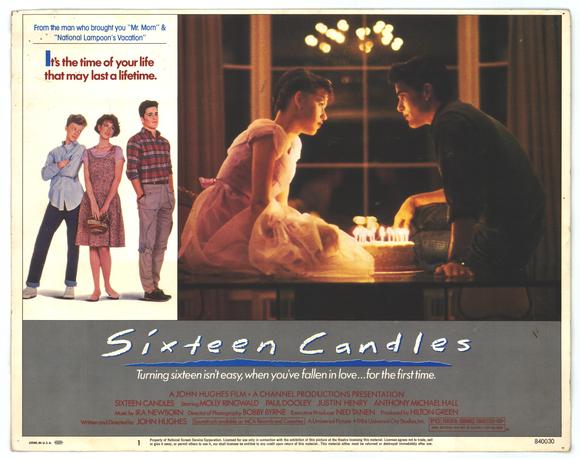
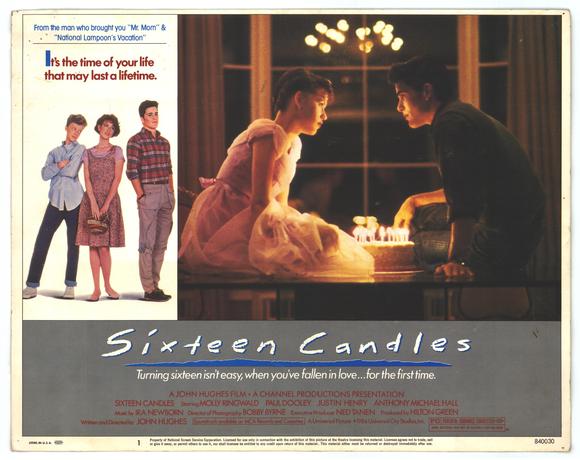
Movie posters for Sixteen Candles

This post by Stephanie Rogers appears as part of our theme week on The Brat Pack. 

Holy fuck this movie. I started watching it like OH YEAH MY CHILDHOOD MOLLY RINGWALD ADOLESCENCE IS SO HARD and after two scenes, I put that shit on pause like, WHEN DID SOMEONE WRITE ALL THESE RACIST HOMOPHOBIC SEXIST ABLEIST RAPEY PARTS THAT WEREN’T HERE BEFORE I WOULD’VE REMEMBERED THEM.

Nostalgia is a sneaky bitch.
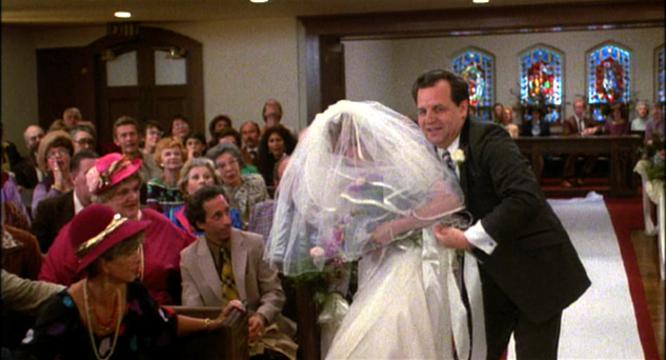
I wanted to write about all the wonderful things I thought I remembered about Sixteen Candles: a sympathetic and complex female protagonist, the awkwardness of adolescence, the embarrassing interactions with parents and grandparents who JUST DON’T GET IT, crushing hard on older boys—and yes, all that stuff is still there. And of course, there’s that absolutely fantastic final wedding scene in which a woman consents to marry a dude while under the influence of a fuckload of muscle relaxers. OH WAIT WHUT.
Ginny Baker getting married while super high


Turns out, that shit ain’t so funny once feminism becomes a thing in your life.
The kind of adorable premise of Sixteen Candles is that Molly Ringwald (Samantha Baker) wakes up one morning as a sixteen-year-old woman who still hasn’t yet grown the breasts she wants. Her family, however, forgets her birthday because of the chaos surrounding her older sister Ginny’s upcoming wedding; relatives drive into town, future in-laws set up dinner dates, and poor Samantha gets the cold shoulder. It reminded me of the time my parents handed me an unwrapped Stephen King novel on my sixteenth birthday like a couple of emotionally neglectful and shitty assholes, but, you know, at least they REMEMBERED it.
Anyway, she rides the bus to school (with all the LOSERS), and in her Independent Study “class” the hot senior she likes, Jake Ryan, intercepts a note meant for her friend Randy. And—wouldn’t you know it—the note says, I WOULD TOTALLY DO IT WITH JAKE RYAN BUT HE DOESN’T KNOW I’M ALIVE. Well he sure as fuck knows NOW, Samantha.
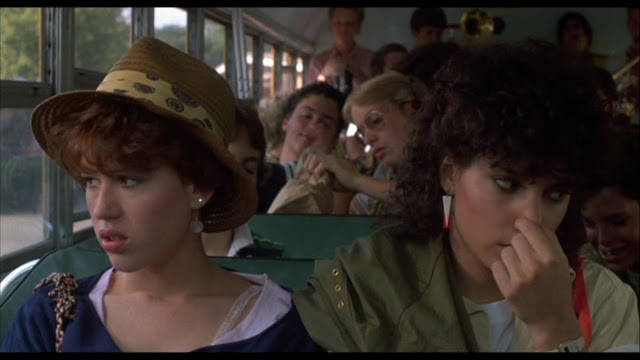
Samantha and Randy, totally grossed out, ride the bus to school


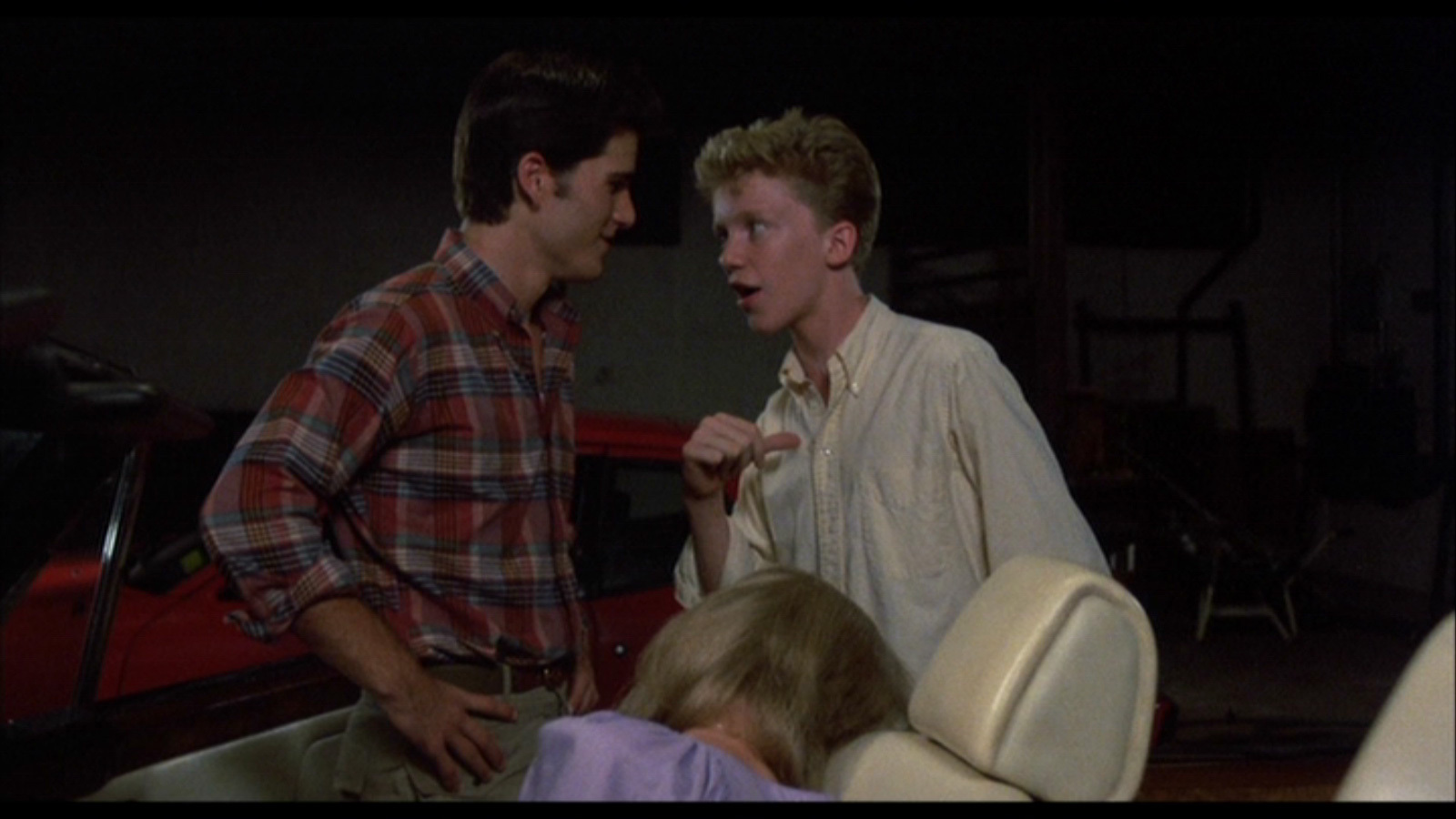
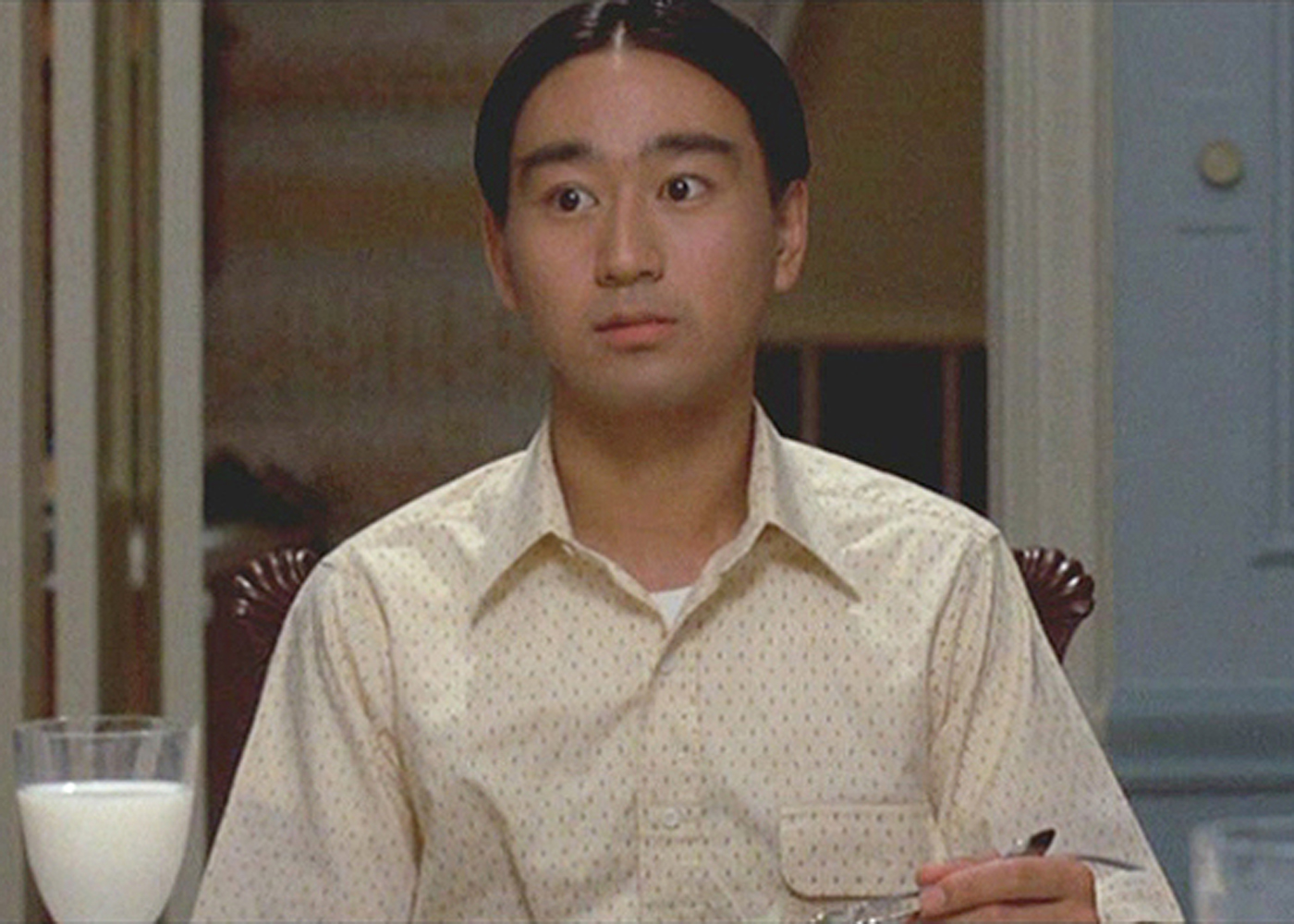
So, these are the important things in Sixteen Candles: Samantha’s family forgets her birthday; she’s in love with a hot senior who’s dating Caroline (the most popular girl in school); and there’s a big ol’ geek (Farmer Ted) from Sam’s daily bus rides who won’t stop stalking her. Oh, and Long Duk Dong exists [insert racist gong sound here]. Seriously, every time Long Duk Dong appears on screen, a fucking GONG GOES OFF on the soundtrack. I suppose that lines up quite nicely with the scene where he falls out of a tree yelling, “BONSAI.”
Since the entire movie is like a machine gun firing of RACIST HOMOPHOBIC SEXIST ABLEIST RAPEY parts, the only way I know how to effectively talk about it is to look at the very problematic screenplay. So, fasten your seatbelts and heed your trigger warnings.
The 80s were quite possibly a nightmare.
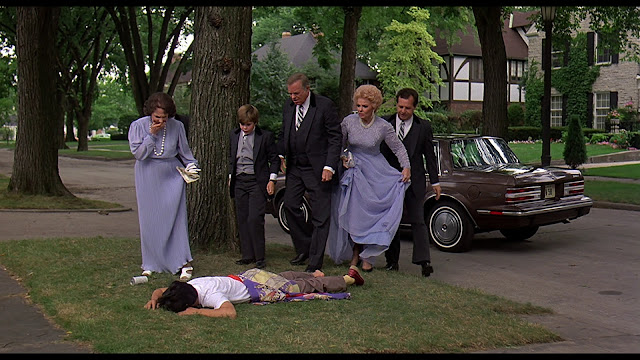
Long Duk Dong falls out of a tree (BONSAI) after a drunken night at the homecoming dance
The first few scenes do a decent job of showing the forgotten-birthday slash upcoming-wedding fiasco occurring in the Baker household. Sam stands in front of her bedroom mirror before school, analyzing her brand new sixteen-year-old self and says, “You need four inches of bod and a great birthday.” I can get behind that idea; growing up comes with all kinds of stresses and confusion, especially for women in high school who’ve begun to feel even more insecure about their bodies (having had sufficient time to fully absorb the toxic beauty culture).
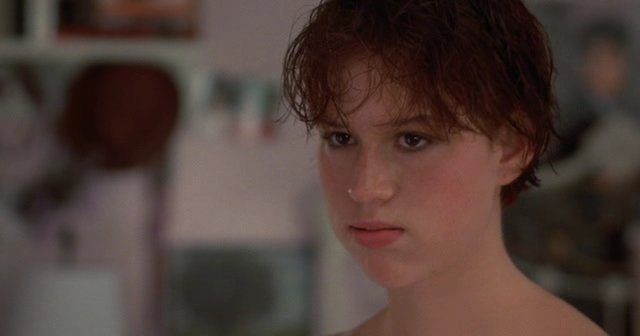
“Chronologically, you’re 16 today. Physically? You’re still 15.” –Samantha Baker, looking in the mirror


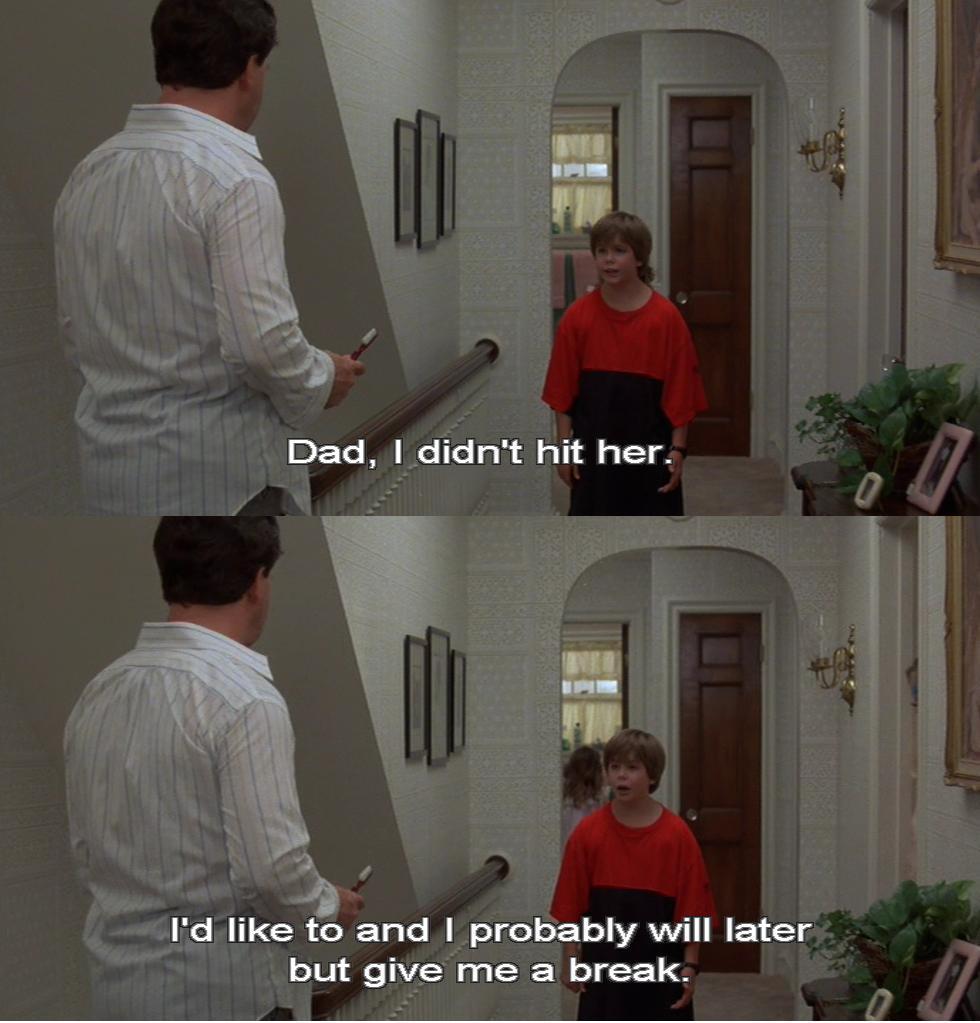
While Samantha laments the lack of changes in her physical appearance, her little brother Mike pretends to almost-punch their younger sister. When he gets in trouble for it, he says, “Dad, I didn’t hit her. I’d like to very much and probably will later, but give me a break. You know my method. I don’t hit her when you’re just down the hall.” It’s easy to laugh this off—I chuckled when I first heard it. But after five seconds of thinking about my reaction, I realized my brain gave Mike a pass because of that whole “boys will be boys” thing, and then I got pissed at myself.
The problem with eye-rolling away the “harmless” offenses of young boys is that it gives boys (and later, men) a license to act like fuckers with no actual repercussions. The “boys will be boys” mantra is one of the most insidious manifestations of rape culture because it conditions both boys and girls at a young age to believe boys just can’t help themselves; violence in boys is inherent and not worth trying to control. And people today—including political “leaders”—often use that excuse to justify the violent actions of men toward women.
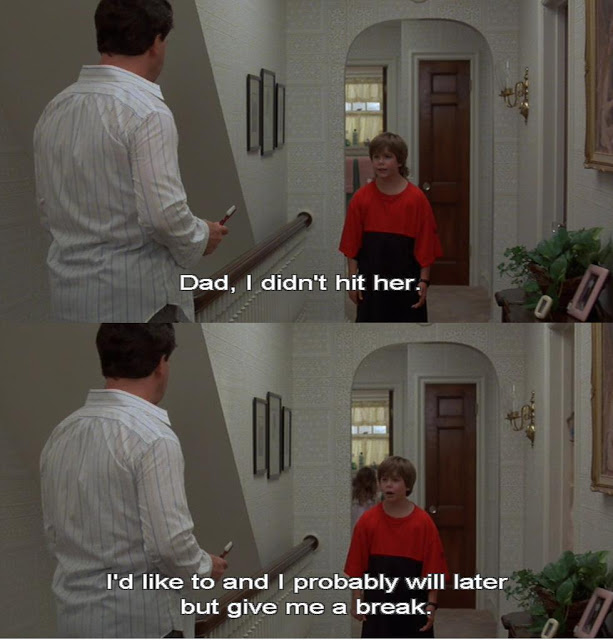
Mike Baker explains to his dad that he hasn’t hit his younger sister … yet


Unfortunately, Sixteen Candles continues to reinforce this idea throughout the film.
The Geek, aka Farmer Ted—a freshman who’s obsessed with Samantha—represents this more than any other character. The film presents his stalking behavior as endearing, which means that all his interactions with Samantha (and with the popular kids at school) end with a silent, “Poor guy!” exclamation. Things just really aren’t going his way! And look how hard he’s trying! (Poor guy.) He first appears on the bus home from school and sits next to Samantha, even though she makes it quite clear—with a bunch of comments about getting dudes to kick his ass who “lust wimp blood”—that she wants him to leave her alone. Then this interaction takes place:

Ted: You know, I’m getting input here that I’m reading as relatively hostile.

Samantha: Go to hell.

Ted: Come on, what’s the problem here? I’m a boy, you’re a girl. Is there anything wrong with me trying to put together some kind of relationship between us?

[The bus stops.]

Ted: Look, I know you have to go. Just answer one question.

Samantha: Yes, you’re a total fag.

Ted: That’s not the question … Am I turning you on?

[Samantha rolls her eyes and exits the bus.]

POOR GUY! Also homophobia. Like, all over the place in this movie. The words “fag” and “faggot” flood the script and always refer to men who lack conventional masculine traits or who haven’t yet “bagged a babe.” And the emphasis on “Man-Up Already!” puts women in harm’s way more than once.
Samantha looks irritated when her stalker, Farmer Ted, refuses to leave her alone. Also Joan Cusack for no reason.


The most terrifying instance of this happens toward the end of the film when Ted ends up at Jake’s party after the school homecoming dance, and the two of them bond by objectifying women together (and subsequently creating a nice little movie template to last for generations). The atrocities involve a very drunk, passed-out Caroline (which reminded me so much of what happened in Steubenville that I had to turn off the movie for a while and regroup) and a pair of Samantha’s underwear.
This is how we get to that point: After Jake snags Samantha’s unintentional declaration of love during Independent Study, he becomes interested in her. He tells a jock friend of his (while they do chin-ups together in gym class), “It’s kinda cool, the way she’s always looking at me.” His friend responds—amid all that hot testosterone—that “maybe she’s retarded.” (This statement sounds even worse within the context of a film that includes a possibly disabled character, played by Joan Cusack, who lacks mobility and “hilariously” spends five minutes trying to drink from a water fountain. Her role exists as nothing more than a punch line; she literally says nothing.)
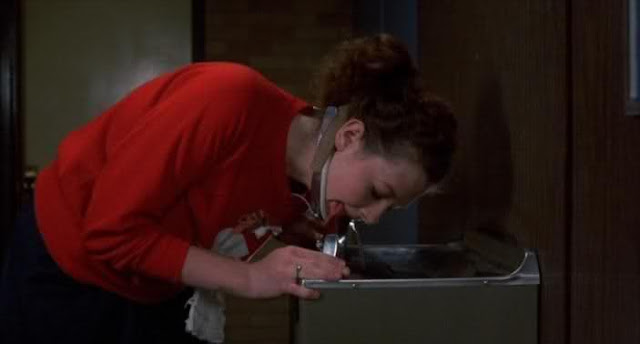
Joan Cusack drinking water (queue laughter)
Joan Cusack drinking a beer (queue laughter)
Jake’s girlfriend, Caroline, picks up on his waning interest in her and says to him at the school dance, “You’ve been acting weird all night. Are you screwing around?” He immediately gaslights her with, “Me? Are you crazy?” to which she responds, “I don’t know, Jake. I’m getting strange signals.” Yup, Caroline—IT’S ALL IN YOUR HEAD NOT REALLY.
Meanwhile, in an abandoned car somewhere on school premises (perhaps a shop lab/classroom), Samantha sits alone, lamenting Jake’s probable hatred of her after their interaction in the gym where he said, “Hi!” and she freaked out and ran away. Farmer Ted stalk-finds her and climbs into the passenger seat. Some words happen, blah blah blah, and a potentially interesting commentary on the culture of masculinity gets undercut by Ted asking Samantha (who Ted referred to lovingly as “fully-aged sophomore meat” to his dude-bros earlier in the film) if he can borrow her underwear to use as proof that they banged. Of course she gives her underwear to him because.
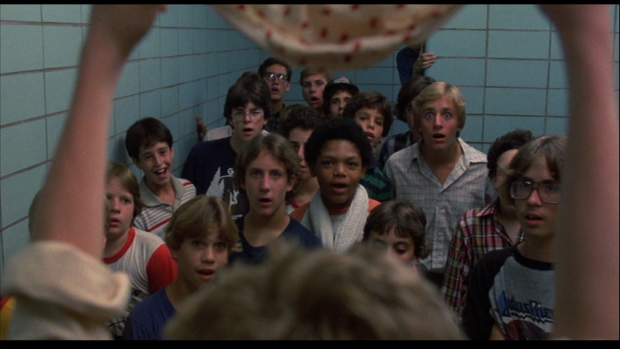
Ted holds up Samantha’s underwear to a group of dude-bros who each paid a buck to see them


Cut to Jake’s after-party: everyone is finally gone; his house is a mess; Caroline is passed out drunk as fuck in his bedroom; and he finds Ted trapped inside a glass coffee table (a product of bullying). Then, at last, after Jake confesses to Ted that he thinks Samantha hates him (because she ran away from him in the gym), we’re treated to a true Male Bonding Moment:

Ted: You see, [girls] know guys are, like, in perpetual heat, right? They know this shit. And they enjoy pumping us up. It’s pure power politics, I’m telling you … You know how many times a week I go without lunch because some bitch borrows my lunch money? Any halfway decent girl can rob me blind because I’m too torqued up to say no.

Jake: I can get a piece of ass anytime I want. Shit, I got Caroline in my bedroom right now, passed out cold. I could violate her ten different ways if I wanted to.

Ted: What are you waiting for?

C’MON JAKE WHAT ARE YOU WAITING FOR GO RAPE YOUR GIRLFRIEND. Or wait, no, maybe let’s let Ted rape her?

Jake: I’ll make a deal with you. Let me keep these [Samantha’s underwear, duh]. I’ll let you take Caroline home … She’s so blitzed she won’t know the difference.
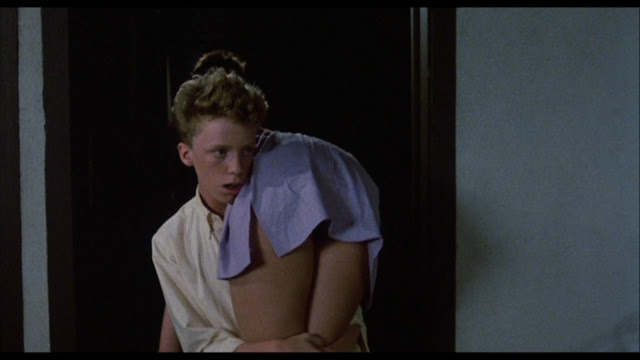
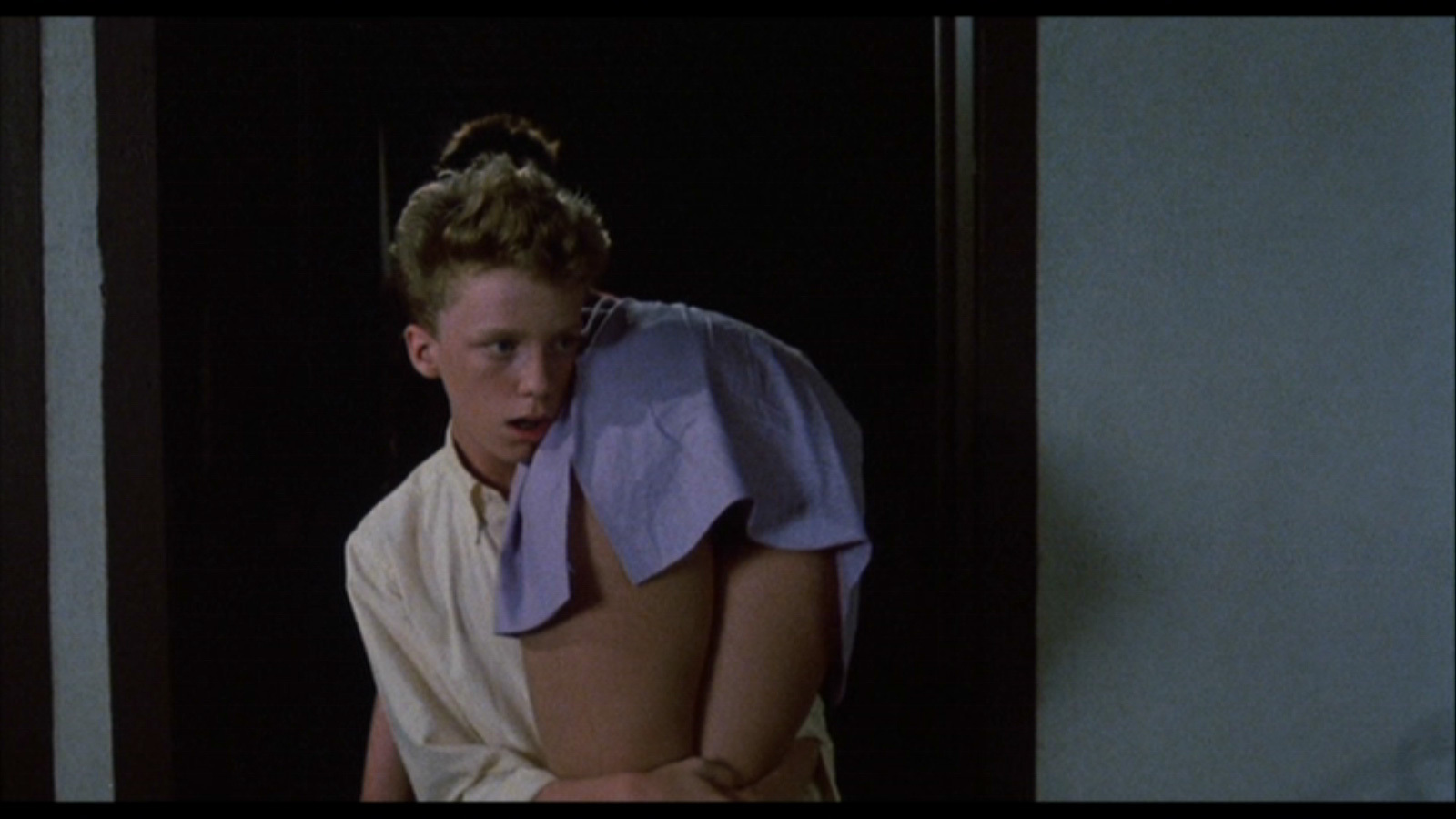
Ted carrying a drunk Caroline to the car

And then Ted throws a passed-out Caroline over his shoulder and puts her in the passenger seat of a convertible. This scene took me immediately back to the horrific images of two men carrying around a drunk woman in Steubenville who they later raped—and were convicted of raping (thanks largely to social media). This scene, undoubtedly “funny” in the 80s and certainly still funny to people who like to claim this shit is harmless, helped lay the groundwork for Steubenville, and for Cleveland, and for Richmond, where as many as 20 witnesses watched men beat and gang rape a woman for over two hours without reporting it. On their high school campus. During their homecoming dance.

Jake and Ted talk about how to fool Caroline

People who claim to believe films and TV and pop culture moments like this are somehow disconnected from perpetuating rape need to take a step back and really think about the message this sends. I refuse to accept that a person could watch this scene from an iconic John Hughes film—where, after a party, a drunk woman is literally passed around by two men and photographed—and not see the connection between the Steubenville rape—where, after a party, a woman was literally passed around by two men and photographed.

Caroline looks drunk and confused while Ted’s friends take a photo as proof that he hooked up with her


And it only gets worse. Caroline wakes up out of nowhere and puts a birth control pill in Ted’s mouth. Once he realizes what he’s swallowed, he says, “You have any idea what that’ll do to a guy my age?” Caroline responds, “I know exactly what it’ll do to a girl my age. It makes it okay to be really super careless!”
It makes it okay to be really super careless. 
IT MAKES IT OKAY TO BE REALLY SUPER CARELESS.
So I guess the current anti-choice, anti-contraception, anti-woman Republicans found a John Hughes screenplay from 30 years ago and decided to use this cautionary tale as their entire fucking platform. See what happens when women have access to birth control? It makes it okay to be really super careless! And get drunk! And allow dudes to rape them!
Of course, believing that Caroline is raped in Sixteen Candles requires believing that a woman can’t consent to sex when she’s too “blitzed to know the difference” between her actual boyfriend and a random freshman geek. I mean, there’s forcible rape, and there’s not-really rape, right? And this obviously isn’t REAL rape since Ted and Caroline actually have THIS FUCKING CONVERSATION when they wake up in a church parking lot the next morning:

Ted: Did we, uh …

Caroline: Yeah. I’m pretty sure.

Ted: Of course I enjoyed it … uh … did you?

Caroline: Hmmm. You know, I have this weird feeling I did … You were pretty crazy … you know what I like best? Waking up in your arms.

Fuck you, John Hughes.
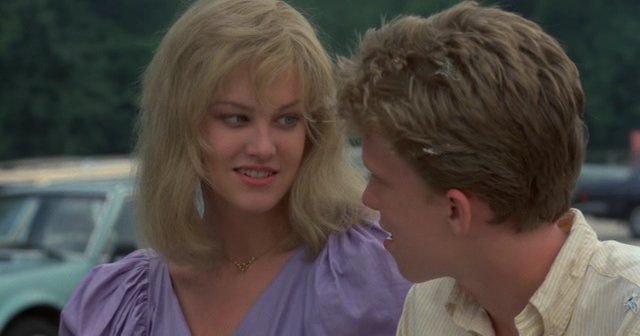
Caroline wakes up, unsure of who Ted is, but very sexually satisfied
And so many more problems exist in this film that I can’t fully get into in the space of one already long review, but the fact that Ginny (Sam’s sister) starts her period and therefore needs to take FOUR muscle relaxers to dull the pain also illustrates major problems with consent; her father at one point appears to pick her up and drag her down the aisle on her wedding day. (And, congratulations for understanding, John Hughes, that when women bleed every month, it requires a borderline drug overdose to contain the horror.)
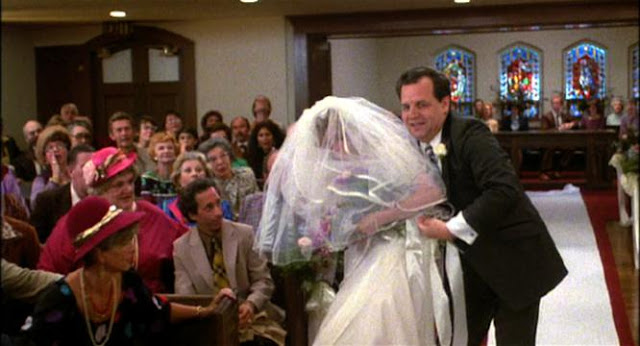
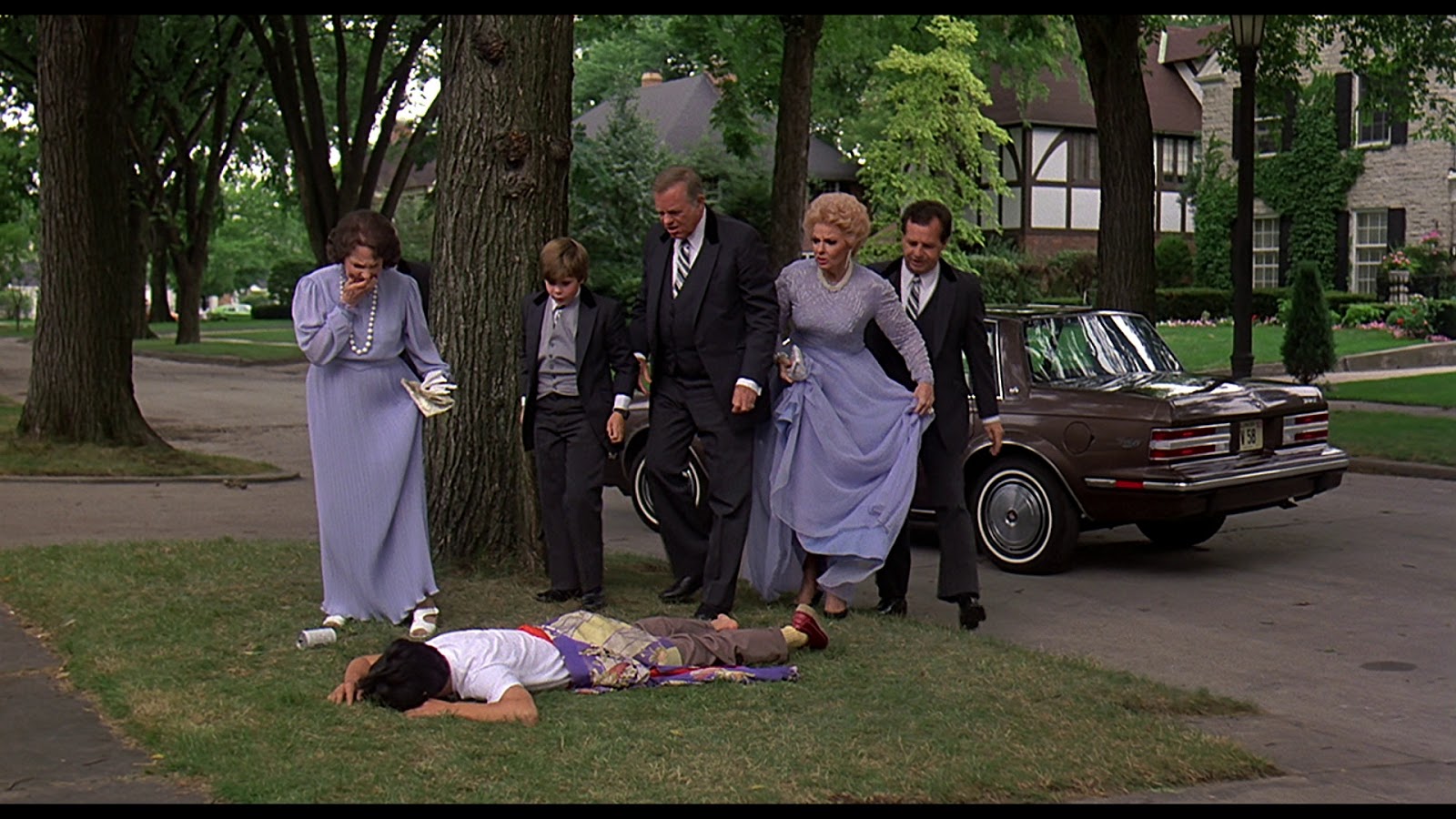
Ginny’s dad drags her down the aisle on her wedding day
The racism, too, blows my mind. Long Duk Dong, a foreign exchange student living with Samantha’s grandparents, speaks in played-for-laughs broken English during the following monologue over dinner: “Very clever dinner. Appetizing food fit neatly into interesting round pie … I love, uh, visiting with Grandma and Grandpa … and writing letters to parents … and pushing lawn-mowing machine … so Grandpa’s hyena don’t get disturbed,” accompanied by such sentences as, “The Donger need food.” (I also love it, not really, when Samantha’s best friend Randy mishears Sam and thinks she’s interested in a Black guy. “A BLACK guy?!?!” Randy exclaims … then sighs with relief once she realizes the misunderstanding.)
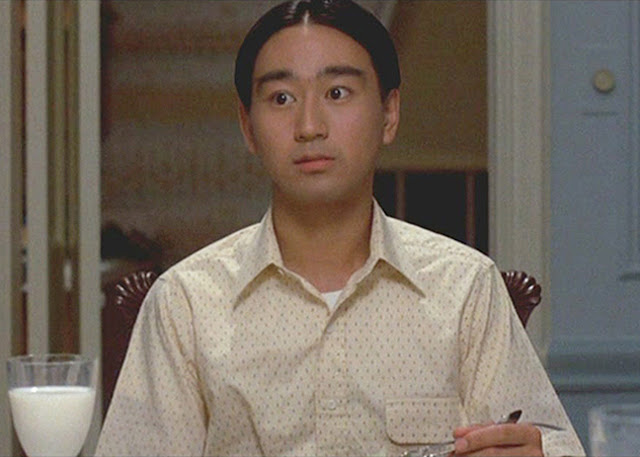
Long Duk Dong talks to the Baker family over dinner
And I haven’t even touched on the problematic issues with class happening in Sixteen Candles. (Hughes does class relations a tiny bit better in Pretty in Pink.)
Basically, it freaks me out—as it should—when I watch movies or television shows from 30 years ago and see how closely the politics resemble today’s anti-woman agenda. Phrases like “legitimate rape” and “forcible rape” shouldn’t exist in 2013. In 2013, politicians like Wendy Davis shouldn’t have to stand up and speak for 13 hours—with no food, water, or restroom breaks—in order to stop a bill from passing in Texas that would virtually shut down access to safe and legal abortions in the entire state. Women should be able to walk down the street for contraception in 2013, whether it’s for condoms or for the morning after pill. The US political landscape in 2013 should NOT include talking points lifted directly from a 1984 film about teenagers.
I know John Hughes is a national fucking treasure, but please tell me our government officials aren’t using his screenplays as legislative blueprints for the future of American politics.

 

A Brain, an Athlete, a Basket Case, a Princess, and a Criminal: How ‘The Breakfast Club’ Archetypes Set Standards for High School in Brat Pack Cinema and Beyond

While today’s entertainment sources a lot of inspiration from Brat Pack Cinema, especially the high school-coming-of-age era of Brat Pack Cinema, we have to be very aware that we do not fall into the trap of embracing multifaceted male characters and yet only providing a Princess/Oddball dynamic with female characters. Not all of us fall into The Brain, The Athlete, The Basket Case, The Princess, and The Criminal, and while we can look to Brat Pack Cinema for inspiration to create new projects for our generation and generations to come, archetypes are suggestions, not the end-all be-all for characters in entertainment.

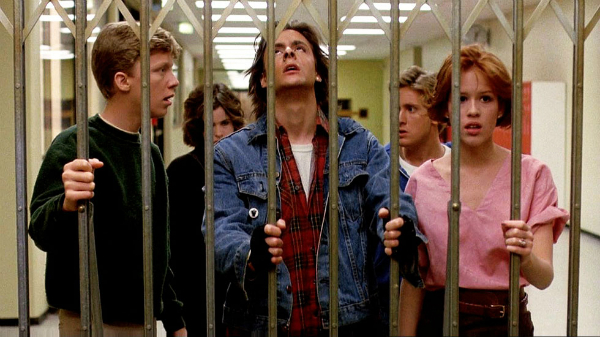
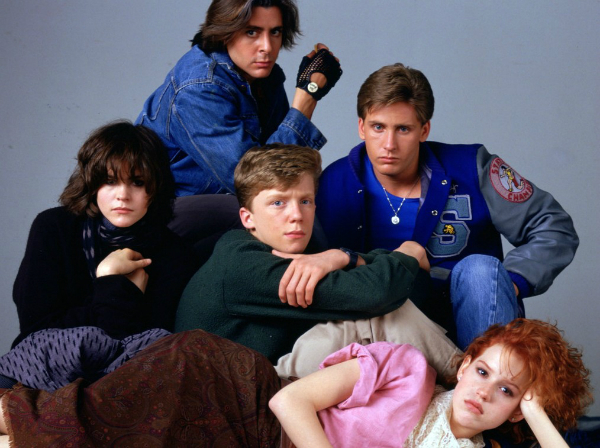
Breakfast Club Cast Photo
The Breakfast Club


This guest post by Kylie Sparks appears as part of our theme week on the Brat Pack.

We all remember the first time we saw The Breakfast Club, that wonderful John Hughes ode to Saturday morning detention at Shermer High School (and as a full disclaimer, it’s one of my favorite films).

At first, we saw five teenagers as the Brain, the Athlete, the Basket Case, the Princess, and the Criminal–perfectly neat archetypes in the basic high school caste system, but they actually were five kids who saw the world more than just through their own designated lens. As Brian Johnson (Anthony Michael Hall, or the “Brain”) narrates, “You see us as you want to see us – in the simplest terms, in the most convenient definitions.” At the end of the film, each character grew to explore what would happen across party lines (the Athlete and the Basket Case, the Princess and the Criminal, the Brain becoming his own entity of independence, and the Basket Case being “made over” by the Princess to become another Princess) and we knew their lives were forever changed by that one Saturday in detention.

It’s awesome to see teenagers explore their own identities and not conform to their own archetypes, but if we examine Brat Pack Cinema and how archetypes are portrayed throughout the 1980s coming-of-age films, there is a common trend. High school boys in Brat Pack films are allowed to be the jock, the nerd, the best friend, the weirdo, the leading male, and any other category a person would see themselves in and be multifaceted, while high school girls in Brat Pack Cinema fell under two categories: the Princess or the Oddball. While The Breakfast Club is a classic example of defining the Princess and the Oddball, several other films in Brat Pack Cinema cling to this dynamic, only showcasing that high school girls fall into these two categories with no in between.

Cast Still from Sixteen Candles
Sixteen Candles


Sixteen Candles, which starred Breakfast Club alums Molly Ringwald and Anthony Michael Hall, as well as Michael Shoeffling, Gedde Watanabe, and Brat Pack regulars John Cusack and Haviland Morris, showcases classic archetypes in Brat Pack Cinema: the Athlete/All-American (Shoeffling), the Awkward Princess (Ringwald), the Prom Queen (Morris), the Geek (Hall, Cusack), the Exchange Student/Geek (Watanabe), and the female Oddball (Deborah Pollack, playing The Donger’s girlfriend Marlene or “Lumberjack”). While Ringwald’s character is supposed to be an “awkward” girl on the verge of turning 16, she is cast as our Girl Next Door Princess to be a contrast to Morris’ Prom Queen Princess as “everything she isn’t.”

Given Ringwald’s prominence in the Brat Pack as a leading lady (no matter if she is deemed “awkward,” “poor,” or the “every girl”), she is still viewed as a Princess. Ringwald’s sister in the film is also a classic Princess, as everyone is preparing for her beautiful wedding and forgets Ringwald’s birthday is at the same time. Our only female character who is not billed as a Princess is our Oddball, Marlene. Marlene is also called the “Lumberjack” as she is a strong female athlete who begins dating The Donger (Watanabe), but because of her stature and strength, she is not classified as a Princess, leaving her to be relegated to Oddball status.

While the argument can be made that Sixteen Candles came out a year before The Breakfast Club, the archetype lines are solid. You can categorize the men in various archetypes in Sixteen Candles, but women can only fit inside the boxes of Oddball or Princess with no in between. Pretty in Pink follows a similar archetype map to Sixteen Candles, with Ringwald as the “Poor Outcast” Princess and Andrew McCarthy as the “All-American,” James Spader as “The Douchebag/Criminal” and Jon Cryer as the “Best Friend/Brain.”

Still from Ferris Bueller's Day Off
Ferris Bueller’s Day Off


Other films in Brat Pack Cinema that don’t include The Breakfast Club stars and feel worlds apart from the triumvirate of The Breakfast Club, Sixteen Candles, and Pretty in Pink also follow this same archetype map of Princess/Oddball versus more diverse male archetypes in High School. Ferris Bueller’s Day Off is a classic example. Ferris Bueller (Matthew Broderick), although he’s viewed as a “snot-nosed punk” by Principal Rooney (Jeffrey Jones), actually also falls into the “Popular Everyman” archetype of the high school caste system, adored by all the students –“the sportos, the motorheads, geeks, sluts, bloods, wastoids, dweebies, dickheads…they think he’s a righteous dude” as Rooney’s assistant Grace (played by Edie McClurg) informs Rooney. Ferris’ best friend is Cameron Frye (Alan Ruck), who on first appearance would fall into the “Freak” archetype, also falls into different archetypes as the Rich Kid, and by being Ferris’ best friend, Popular by Association.

Charlie Sheen’s appearance as the kid in the police station falls under the classic “Criminal” archetype, but we don’t know the rest of his background and he could fall under different archetypes. While our male characters are multifaceted, our two prominent female high school characters, Jeanie (Jennifer Grey) and Sloane (Mia Sara) are seen solely as Princesses. Sloane is a classic Princess–pretty and popular. Jeanie, although misunderstood and somewhat of an outcast, is also a Princess falling in line with Ringwald’s classic “every girl” princesses she portrays in Sixteen Candles and Pretty in Pink.  Neither one would be classified as Oddballs based on the criteria presented in Brat Pack Cinema, and Ferris Bueller’s Day Off does not provide any leading, prominent female characters in the high school caste system other than various forms of Princesses.

John Cusack as Lloyd Dobler from Say Anything
John Cusack as Lloyd Dobler from Say Anything…


Say Anything… is also an interesting film to look at in terms of male archetypes versus the Female Princess/Oddball structure since its male lead, John Cusack, played different high school archetypes in Brat Pack Cinema. In this case, in Say Anything… Cusack played iconic underachiever Lloyd Dobler, making millions of hearts break by lifting a boom box playing “In Your Eyes” by Peter Gabriel outside Diane Court (Ione Skye)’s window. Diane is a classic Princess–beautiful, rich, high school valedictorian, and the object of Lloyd Dobler’s dreams. Although Lloyd and Diane have a rocky relationship the summer after high school–between falling in love and breaking up, ultimately–Lloyd has crossed party lines, the Underachievers, to date and fall in love with the Princess, eventually going with her to London for her fellowship. Our female Oddballs are Lloyd’s fellow underachiever friends Corey Flood (Lili Taylor) and D.C. (Amy Brooks); however, with the focus of the film being the relationship between the Underachiever and the Princess as well as the Princess’ father being investigated by the IRS, this is a love story between two classic crossing archetypes we see in Brat Pack Cinema, especially since a few years before, we saw The Princess and The Criminal fall in love in The Breakfast Club.

While we examine character archetypes in High School Brat Pack Cinema, it is also important to examine the actors. Previously, Cusack played a geek (Bryce in Sixteen Candles) and the Artistic Romantic in One Crazy Summer, and with his role as the Underachiever in Say Anything…, it highlights a point that men in Brat Pack cinema may get the opportunity to portray different archetypes in the high school era. Only one female Brat Pack regular comes to mind in portraying both the Princess and the Oddball in High School: Ally Sheedy. Sheedy played Matthew Broderick’s girlfriend Jennifer in WarGames, but also played Allison Reynolds in The Breakfast Club. Every other female in the high school era of Brat Pack films plays either the Princess or the Oddball.

comparison of Allison Reynolds before and after the Princess makeover in The Breakfast Club
Comparison of Allison Reynolds before and after the Princess makeover in The Breakfast Club


After examining these four films (as well as looking at several others), there is the question of how we present teenagers in entertainment today so we do not fall into the trap of basing characters on the Brat Pack high school female archetypes of Princess and Oddball, especially since very rarely do we allow girls to cross these lines unless the Oddball is given a makeover into a Princess and not vice versa. While today’s entertainment sources a lot of inspiration from Brat Pack Cinema, especially the high school-coming-of-age era of Brat Pack Cinema, we have to be very aware that we do not fall into the trap of embracing multifaceted male characters and yet only providing a Princess/Oddball dynamic with female characters. Not all of us fall into the Brain, the Athlete, the Basket Case, the Princess, and the Criminal, and while we can look to Brat Pack Cinema for inspiration to create new projects for our generation and generations to come, archetypes are suggestions, not the end-all be-all for characters in entertainment.


Kylie Sparks is an actor, producer, writer, singer and USC Alumna living with a pug and a pug mix in Los Angeles. She’s passionate about entertainment, pancakes, pugs, coffee, college football and feminism. You can find her @kyliesparks on Twitter and her official website is kyliesparks.com.

What They’re Going Through: The Brat Pack Gave Teens a Voice

Whatever the Brat Pack actors did with their fame in real life does not reflect the impact they ingrained on our culture. They helped put a face and a voice to teen struggles. These talented young actors gave teenagers an identity and platform for their problems that will stand the test of time. We will always thank the Brat Pack for that.

This guest post by Caroline Madden appears as part of our theme week on The Brat Pack.

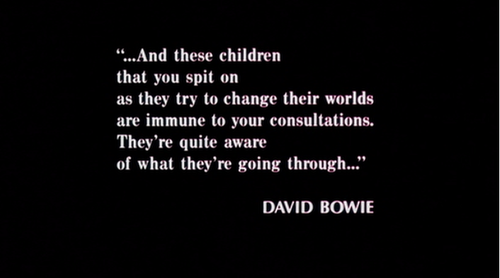
The Breakfast Club opens with a title card quoting David Bowie’s “Changes”:

Changes Title Card The Breakfast Club

The song lyrics express what The Breakfast Club and many of the Brat Pack films were portraying–that teenagers have as much of an understanding, inner conflict, and a place in this world as adults do. Their characters fight the ignorance of their principals, teachers, and parents who don’t bother to listen to what they’re dealing with inside.

David Blum’s 1985 article “The Birth of Hollywood’s Brat Pack” had him acting just like the adults Bowie sang about. He spit upon the young actors of the beloved teen films, and undermined them because they were young. He believed they were not entitled to fame and money and that their talent was not valid, all because of their youth.

The phrase for the group stuck, but Blum was met with scathing criticism from actors and journalists alike. Emilio Estevez, Judd Nelson, and Rob Lowe were the focus of the article, with mentions of other actors. The who’s who of the Brat Pack varies, but most consider those who star in both The Breakfast Club and/or St. Elmo’s Fire. After the article’s release, the Brat Pack actors were angry and humiliated. Their group refused to hang out together anymore, feeling that their reputation as a group was tarnished. Reading the article, it’s easy to see why they were so mad. It paints all of the young actors in the same brush stroke, making them all out to be shallow and money-hungry narcissists.

The cast of St. Elmos Fire

John Hughes himself even expressed distaste for the group name in a 1986 Seventeen magazine interview with Molly Ringwald interviewing him.

JH: I think that this clever moniker was slapped on these young actors, and I think it’s unfair. It’s a label.
MR: People my age were just beginning to be respected because of recent films such as yours, and now it’s like someone had to bring them down a peg or two, don’t you think?
JH: There is definitely a little adult envy. The young actors get hit harder because of their age. Because “Rat Pack” – which Brat Pack is clearly a parody of – was not negative. “Brat Pack” is. It suggests unruly, arrogant young people, and that description isn’t true of these people. And the label has been stuck on people who never even spoke to the reporter who coined it.
MR:  Such as myself. I’ve been called the Women’s Auxiliary of the Brat Pack.
JH: To label somebody that! It’s harmful to people’s careers. At any rate, young people support the movie business, and its only fair that their stories be told.

The Breakfast Club Behind the Scenes

David Blum admonishes the actors for their lack of formal training, addressing how they do not idolize or try to live up to famous method actors Pacino and De Niro: “If I were a Hollywood star I would spend more time working on my craft instead of chasing girls as the Hard Rock.” But even the most famous well-crafted actors also occasionally enjoy the perks of fame.

And so what if they’re not method actors? All you have to do is watch the scene in The Breakfast Club where they all describe how they got detention (which was completely improvised by all of them) to see their impressive talent, regardless of training or not. Blum acts as if they were handed everything on a silver platter, as if they didn’t work hard or even care about their profession.

He goes on about their fame and wealth: “They make major movies with big directors and get fat contracts and limousines. They have top agents and protective P.R. people. They have legions of fans who write them letters, buy them drinks, follow them home. And, most important, they sell movie tickets. Their films are often major hits, and the bigger the hit, the more money they make, and the more money they make, the more like stars they become.” Did the young Brat Pack actors enjoy the perks it came with being Hollywood stars? Of course they did, and that’s nothing new. We’ve seen it time and time again with some of the most famous and well-respected stars.

It is overall an ugly article that portrays them in an unflattering light. Most importantly, what David Blum fails to see is why those films were such big hits, why they were selling so many tickets. People have always been fascinated with the celebrity life, but what the fans cared about more than their off-screen lives was the people that they portrayed onscreen. That is why they were drawn to them in the first place. The Brat Pack actors portrayed the types of characters that teenagers of that time could relate to. They were the faces of thousands of all the teens out there, bringing to life the stories that they had all been dying to hear.

The Breakfast Club

Before the 80s, teen movies were often good vs. evil stories, such as Rebel Without A Cause, or nostalgic looks at teenage lives of the past, such as American Graffiti. Films were rarely marketed or made for teens because executives felt that audiences didn’t care about them, and teenagers weren’t taken seriously. John Hughes comments on this in his Seventeen magazine interview:  “My generation had to be taken seriously because we were stopping things and burning things. We were able to initiate change, because we had such vast numbers. We were part of the baby boom, and when we moved, everything moved with us. But now, there are fewer teens, and they aren’t taken as seriously as we were.”

80s teen films expressed the plights and anxieties of that Regan-era generation, the ones who grew up after Woodstock and before YouTube; there was a huge lack of respect for their generation. 1980s America was suffering from high divorce rates and economic setbacks and unemployment that led to an obsession with money and a huge divide of class distinctions.

Pretty in Pink

1980s teens were very aware of who had money and who didn’t and how painful that divide can be. That is the crux of Blaine and Andie’s relationship in John Hughes’ Pretty in Pink. She’s poor and he’s a rich yuppie–how could it work?  Duckie and Andie drive through a ritzy neighborhood as Andie exclaims about how beautiful a house is: “You know what the really sad thing is? I bet the people that live there don’t think it’s half as pretty as I do.” The Breakfast Club also focuses on that divide, especially between rich girl Claire and rebel Bender over an argument about her earrings. Bender says, “I bet he bought those for you! I bet those are a Christmas gift! Right? You know what I got for Christmas this year? It was a banner fuckin’ year at the old Bender family! I got a carton of cigarettes.”

But for all the statements they made about teenage life in the 80s, these stories are timeless. They changed the world then and remain renowned today. The Breakfast Club is nearly 30 years old and still relatable to teens of this generation. These films had teens that were here to say, “Even though I’m young with my whole life ahead of me, there are things that I have to deal with and I have problems that affect me too.”

Andy The Breakfast Club

These characters talked about how their parents have failed them or hurt them, the pressure to do well in school or have the right friends. Just look at the heartbreaking scene in The Breakfast Club when Bender describes his abusive dad. Or Andrew the jock screaming about how his father so desperately needs him to “Win! Win! Win!”  Think of how many kids in that audience could relate to that. They saw the Brat Pack actors up on the screen, speaking aloud something that they were struggling similarly with deep down inside.

Teenagers are often seen as self-centered brats, and it certainly doesn’t help if they’re also rich and famous. David Blum saw them as brats, as most adults see those who are younger than them. So yes, they are a pack of young kids. But the word “brat” doesn’t have to refer to what they are, but what they’re seen as. Call them brats all you want, but that’s not what they are inside.

Whatever the Brat Pack actors did with their fame in real life does not reflect the impact they ingrained on our culture. They helped put a face and a voice to teen struggles. These talented young actors gave teenagers an identity and platform for their problems that will stand the test of time. We will always thank the Brat Pack for that.

_______________________________

Caroline Madden is a recent graduate with a BFA in Acting from Shenandoah Conservatory. She writes about film at Geek Juice, Screenqueens, and her blog. You can usually find her watching movies or listening to Bruce Springsteen.

Bitch Flicks’ Weekly Picks

Check out what we’ve been reading this week–and let us know what you’ve been reading/writing in the comments!

recommended-red-714x300-1


Emmys Rundown: The Good, the Bad, the Gender Disparity by Sara Stewart at Women and Hollywood

Women Make Up Only 26% Of Nominees for 66th Primetime Emmy Awards by Rachel Larris at Women’s Media Center

Girls on Film: 5 ways movies can be as diverse as television by Monika Bartyzel at The Week

Margaret Atwood has faith in Hollywood by Doug Camilli at The Gazette

Watch: “Women in Refrigerators” Supercut: Female Characters Killed to Give Male Characters Depth by Laura Berger at Women and Hollywood

Did Lois Lowry Sell Out Your Childhood? by Andé Morgan at Bitch Media

Film Adaptation of Opera Classic ‘La Boheme’ w/ All-Black Cast Begins Production… by Tambay A. Obenson at Shadow and Act

This is the Summer of Lesbian Web Series by Anna Miller at Bitch Media

 by ReBecca Theodore-Vachon at Film Fatale NYC

Black Feminists Respond to Ferguson by Miriam Zoila Pérez at Colorlines


What have you been reading/writing this week? Tell us in the comments!


Family, Friendship, and Getting By: The Two Mrs. Harts of ‘Reba’

Like many of us, I’m a child of divorce, and I saw firsthand the lasting effects of infidelity and separation. For years, I’ve turned on ‘Reba’ because I find it comforting; everything from the stills of the cluttered kitchen to Reba’s adorable southern twang make me feel very tranquil as I clean or type on my laptop. I detect similarities to my own experiences, such as living in close proximity to a parent’s ex or a father who seems to abandon his former life for a newer, shinier one. ‘Reba’ normalizes these experiences and reminds viewers that every family has its issues.

Written by Jenny Lapekas.

Like many of us, I’m a child of divorce, and I saw firsthand the lasting effects of infidelity and separation.  For years, I’ve turned on Reba because I find it comforting; everything from the stills of the cluttered kitchen to Reba’s adorable southern twang make me feel very tranquil as I clean or type on my laptop.  I detect similarities to my own experiences, such as living in close proximity to a parent’s ex or a father who seems to abandon his former life for a newer, shinier one.  Reba normalizes these experiences and reminds viewers that every family has its issues.

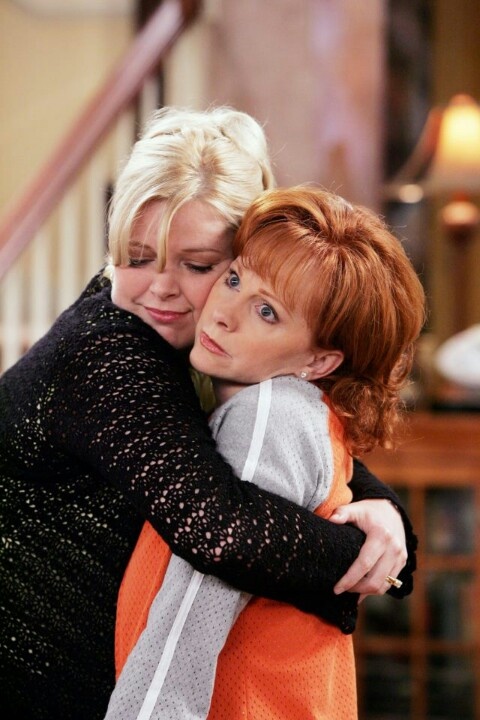
Reba McEntire herself is a sort of meta presence on the show since she plays herself, in a sense–her character’s name is Reba Hart, she sings the theme song at the beginning of each show (“I’m a Survivor”), and her own values seem to be infused into the show’s script and episodes.  The character of Reba also seems to be a direct reflection of Reba the person and musician:  genuine, caring, and down-to-earth.  We enjoy her interactions with Barbra Jean, whether they’re volatile or pleasant.  We like it when they bond and get along (not just for the family but because they are true friends), but we also like it when the two fight or when Reba expresses her annoyance at the tall blonde’s routine antic behavior.  Certainly, the show’s plot is unrealistic, but I’d argue that it’s still worthwhile to explore this unique friendship shared by two very different women who discover they indeed have more in common than Brock.

It took Reba several seasons to warm up to BJ's manic energy.
It took Reba several seasons to warm up to BJ’s manic energy.


The impossibility of the “new wife” (and former mistress) and ex-wife becoming best friends is at the forefront of this implausibility.  Brock is a good father and still “visits” as if he never moved out.  Rather than focus on the unbelievable nature of this female friendship, I’d suggest we turn our attention to the healthy post-divorce relationship we see between Reba and Brock.  Sure, it’s fantastical and silly, a departure from reality, a pleasant vision of what could be, but also an image of maturity and sophisticated understanding amongst adults–although Kyra usually ends up being the only “adult” when familial conflict arises.  The show’s framework suggests not that this type of female friendship is possible (especially involving rivalry and “sharing” a man, in some sense), but that families function even when they don’t function, that hostility and resentment are normal and even healthy components of any family unit.

BJ and Reba in a 'Single White Female' moment.
BJ and Reba in a Single White Female moment.


When Reba’s friend asks her, “How can you even let that woman in your house?!” Reba calmly explains that the kids need to see their father and BJ (go ahead and giggle) is now “part of the package.”  However, the relationship between the two Mrs. Harts grows into something more complicated than that:  Reba genuinely likes BJ.  Contrary to the fear that she may be seen as a powerless doormat, Reba displays incredible strength, patience, and maturity by inevitably becoming BJ’s best friend, despite Reba’s best attempts to prevent the pair’s apparent non-relationship from evolving into anything greater.  Viewers may interpret this move as a decision to lay down and endure Brock’s adultery; however, the friendship the women share is an acknowledgment of forgiveness, a radical surrender that frames the world as one that keeps spinning in the face of conflict.  There is in fact life after divorce.

BJ represents a very negative stereotype and a cliche:  the mistress who ruined a marriage by having an affair with another woman’s husband.  However, BJ challenges this stereotype we long to hate so much; she is a larger than life presence, a walking, breathing caricature that we come to adore.  As the family celebrates Jake’s birthday party, Kyra eloquently explains that it’s not enough for BJ to plan or attend the party, she is the party.  She substitutes the ogre we imagine her to be, the “type of woman” who breaks up a marriage, who sleeps with a married man.  BJ humanizes the typecast role assigned to her–she’s charming, she longs to help those around her, and she’s a genuinely good person.  Reba explains, “This hasn’t been easy for me, Barbra Jean,” and BJ retorts, “It has just been a freaking picnic for me!”  As BJ explains that she’s the “other woman” and is affected by the gossip and phoniness that surround her as well, we’re allowed a glimpse of what it’s like to be blamed for destroying a marriage.  Deep down, all BJ wants is to be liked and accepted.  In fact, sometimes it seems that she’s willing to forfeit her marriage with Brock in favor of taking on Reba as a permanent partner instead.

The pair attend a women's self-defense class, but inevitably beat up each other.
The pair attend a women’s self-defense class, but inevitably beat up each other.


When an elderly babysitter proves incapable of managing the kids and the household in Reba’s absence, BJ steps in, cooking delicious meals, organizing the kitchen, and even pouring Reba a glass of wine to help her relax after a long day.  Inevitably, Jake hugs BJ and calls her “Mommy,” and Reba is left bitter and horrified.  During “girl talk,” Brock wanders in and asks BJ if she’s ever coming home, and BJ informs him that she didn’t make enough food to include him in dinner.  Thrilled with BJ’s domestic skills, Reba tells Brock, “I’m starting to see why you left me for her,” and Brock says, “You’re the one with the new wife.”  As a result, the house becomes a venue to celebrate this pseudo lesbian relationship, where the needs of the kids are put first, and yes, Brock is still a guest.  Although none of the characters realize it, this short-lived partnership is one of great power, demonstrating household productivity and childcare at its zenith.

At times, the trio also seems to mimic a polygamous relationship, such as when Reba tries to repair Brock and BJ’s rocky marriage by counseling them and even offering tips on how to improve their sex life.  Much of Reba’s advice is comically common sense, such as instructing Brock to tell BJ that he reversed his vasectomy or telling BJ not to have an emotional affair with the OnStar guy inside the couple’s car.  Despite Brock’s past indiscretions, Reba’s priority is the wellness of her family, which includes a successful second marriage for her kids’ father.  It’s no mistake the family’s last name is Hart; Reba is clearly the heart of the family, the force around which the others gather, the light BJ finds herself so drawn to.

BJ is eager to exploit Reba's temporary blindness in order to gain her trust.
BJ is eager to exploit Reba’s temporary blindness in order to gain her trust.


Even if mine isn’t a popular assessment of BJ’s character, we must admit that we need BJ’s wacky shenanigans to counterbalance Reba’s responsibility, earnestness, and sophistication; there’s no denying that the women’s joint energy creates a dynamic force that carries much of the show.  BJ’s character challenges our assumptions about the labels we quickly and often unfairly place on women both real and fictional:  home-wrecker, whore, gold-digger, etc.  While Reba offers guidance to the naive BJ, the nutty blonde often includes Reba in her misadventures, such as setting up Reba on a blind date or caring for the stubborn redhead after undergoing corrective eye surgery.  Regardless of how we feel about the plot of Reba, BJ bursting through the door unannounced and uninvited, along with Brock freely coming and going in a house he no longer lives in draws not an image of turmoil but one of family.  BJ’s involvement as a stepmother doesn’t spell dysfunction; rather, the relationships we see on the ABC Family show are nothing if not healthy and honest.  In fact, the unlikelihood of the Hart clan’s situation may be exactly why Reba has had such success.  My advice:  Let the marital stuff go; sit back and enjoy the fact that we’ve been drugged by a witty script, inspiring messages, and a variety of comedic personalities who easily suspend disbelief, all on one lovely show.

________________________________________________

Jenny holds a Master of Arts in English, and she is a part-time instructor at a community college in Pennsylvania.  Her areas of scholarship include women’s literature, menstrual literacy, and rape-revenge cinema.  She lives with two naughty chihuahuas.  You can find her on WordPress and Pinterest.

Working My Way Through Feminist Film History: Art and Intimacy in ‘I’ve Heard the Mermaids Singing’

This post is inspired by Alison Nastasi’s “50 Essential Feminist Films,” an excellent survey of films that is a kind of resource guide for those of us interested in exploring feminist film history. Though not exhaustive, Nastasi’s list is an exciting place to extend the conversation about the ways that feminist questions and concerns have been depicted in films in and outside of Hollywood in the past several decades. What’s more, this list is also a site for discovering films I didn’t even know to look for.

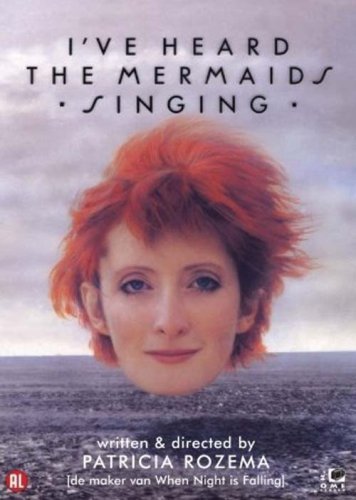
This post is inspired by Alison Nastasi’s “50 Essential Feminist Films,” an excellent survey of films that is a kind of resource guide for those of us interested in exploring feminist film history.  Though not exhaustive, Nastasi’s list is an exciting place to extend  the conversation about the ways that feminist questions and concerns have been depicted in films in and outside of Hollywood in the past several decades. What’s more, this list is also a site for discovering films I didn’t even know to look for. I’ve Heard the Mermaids Singing, which Natasi ranks at #45, is one I might not otherwise have found. I’m so glad that I did.

The Canadian director Patrica Rozema directed this quietly charming film, which stars Sheila McCarthy. McCarthy plays Polly, whose videotaped confession frames the story and immediately establishes our curiosity. What crime could this anxious and seemingly guileless woman have committed? Polly is in her early 30s and enjoys a solitary life filled with frequent bike rides to various spots around Toronto, which she eagerly absorbs in her photography. She develops the pictures in her darkroom, and we see her still images enlarged by her imagination into elaborate fantasies wherein she can fly like a bird, engage in erudite conversation about psychoanalysis, and conduct magnificent symphonies. Although there is something slightly melancholy about her, Polly appears content with the simplicity of her life.

ddBKMJxvEgcoXlxEfLubvr6WC9y

As she tells the video camera, “It all started” when she begins working as the “Girl Friday” for a curator, Gabrielle. Polly rapturously describes how taken she is with Gabrielle, who Polly exclusively refers to as “the curator.” Gabrielle is sophisticated, confident, and serious. Most of all, she is generous toward Polly, who falls under a spell of childlike adoration. Remarkably, their dynamic is one of mutual respect, even despite their differences. Gabrielle appreciates Polly, and offers her a permanent position. However, Polly is as innocent and naïve as Gabrielle is weary and cautious, and this contrast intensifies when Mary enters the scene. An artist and former lover of Gabrielle’s, Mary is young enough to make Gabrielle feel too old to be with her, and we soon learn that the curator has an inner life that is fraught with insecurity about both aging and art.

ive_heard_the_mermaids_still

On the latter, Polly feels a kinship with Gabrielle, who drunkenly confides to Polly that despite her accomplishments and status, she craves not to “die with her body.” Gabrielle tells Polly that she desires the immortality of creating a beautiful painting that will endure after she is gone.  Polly’s openness and curiosity is a marked contrast to Gabrielle’s self-centeredness, but the intimacy of this scene makes it hard not to sympathize with both characters. When Gabrielle expresses shame around have her paintings rejected for acceptance in a university art course, Polly lovingly asks if Gabrielle will show her a painting.  Gabrielle is flattered by her request, and opens the door to a room with a shining canvas that Polly finds enchanting. Even though Gabrielle and Mary are lovers, it is with Polly that Gabrielle can express her deep yearning to be known as an artist.

At the risk of spoiling this film any further, I’ll just say that what follows is an act that Polly commits with the most heartfelt of intentions but leads to a series of betrayals compelling her to document her account on video in the hopes of sharing the truth. Though not fundamental to enjoying nor understanding the film, it is interesting to revisit the poem from which the title of Rozema’s film is lifted: “The Love Song of J. Alfred Prufrock.” Just like T.S. Eliot’s narrator, Polly dares to “disturb the universe.” In so doing, she illustrates the sacrifice inherent in sharing one’s art.


‘Violet & Daisy,’ ‘Sucker Punch,’ and Poe’s Law

And the main thing about ‘Violet & Daisy’ I couldn’t puzzle out is what we’re meant to make of the incessant and brutally unsubtle reminders of the title characters’ schoolgirl trappings: popping bubble gum while blasting machine guns, stopping to play hopscotch on the way to pick up ammo, sucking lollipops while chatting with their boss and sharing cookies and milk with their target, giggling while jumping on the bellies of their victims to see blood spew from their mouths. I get that there is a “shocking contrast” between these innocent activities and their professional murdering, but could Fletcher really think that was novel or interesting enough to warrant a whole movie?

And then I think: Oh god, is this a sex thing? This is probably a sex thing. Wait, that’s too gross. This can’t be a sex thing. But oh god, lollipops. Lollipops are always a sex thing.

People who know me and know I write for Bitch Flicks love to give me suggested post topics. “I watched this movie and there was a girl in it—you should totally write about that!” Sometimes it is a case of “I can’t tell if this is sexist, could you sort that out for me in ~1000 words?” (I tease, but I actually really appreciate these suggestions because deciding what to write about is often the hardest step. Dance Academy is in my Netflix queue, KDax!)

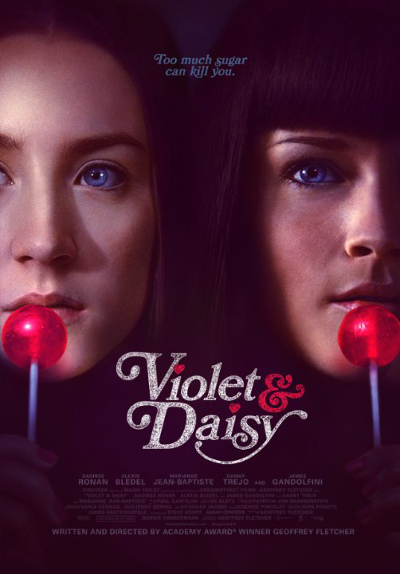
Movie poster for 'Violet & Daisy'
Movie poster for Violet & Daisy

Yesterday was my husband’s birthday, so I am finally yielding to a long-standing request and reviewing the film Violet & Daisy. Collin’s gchat-transmitted review of the film is “I just liked that it was about two killer women and it had Tony Soprano in it.”

A slightly longer synopsis: Violet (Alexis Bledel) and Daisy (Saoirise Ronan) are young, girlish assassins, who take a new assignment because they want to buy dresses from the fashion line of a pop singer named Barbie Sunday. For contrived reasons, they fail to kill the target (James Gandolfini) initially and form a strong emotional bond with him while periodically fending off other assassins after the score. Gratuitously violent dramedy ensues.

Alternate title: Cutesy Murderesses!

The whole thing is rather twee and aggressively quirky, Tarantino-by-way-of-Wes Anderson (down to the Futura title cards). It’s so patently derivative I started to wonder if that was The Point somehow. Did writer-director Geoffrey Fletcher (who also wrote Precious, the polar opposite of this film in terms of tone) get carried away with a style mimicry writing exercise and actually make the movie?

Violet and Daisy play a hand clapping game

And the main thing about Violet & Daisy I couldn’t puzzle out is what we’re meant to make of the incessant and brutally unsubtle reminders of the title characters’ schoolgirl trappings: popping bubble gum while blasting machine guns, stopping to play hopscotch on the way to pick up ammo, sucking lollipops while chatting with their boss and sharing cookies and milk with their target, giggling while jumping on the bellies of their victims to see blood spew from their mouths.  I get that there is a “shocking contrast” between these innocent activities and their professional murdering, but could Fletcher really think that was novel or interesting enough to warrant a whole movie?

And then I think: Oh god, is this a sex thing? This is probably a sex thing. Wait, that’s too gross. This can’t be a sex thing. But oh god, lollipops. Lollipops are always a sex thing.

Daisy sucks a lollipop.
Lollipops are always a sex thing.

But wait, the guy who wrote Precious couldn’t possibly think the sexualizing little girls is the key to a winning film. That doesn’t make any sense. This must be a critique of these sexist and icky tropes. The punchline is coming any minute.  Any. Minute. Now…

This sort of Poe’s Law experience is probably familiar to many feminist film-watchers: is this patriarchal trash or is it secretly a critique of patriarchal trash? A classic example is Sucker Punch, a movie that scientists have proven cannot be written about without using the word “masturbatory.” Most feminists (including myself) barfed all over the movie and its icky initialization and objectification of victimized women, but director Zack Snyder insists his film was meant to be a critique of the audience’s desire for such content. Which makes my bullshit meter go off. The sad truth is we live in a world where it seems more likely that a movie about abused women with names like “Baby Doll” and “Sweet Pea” fighting fantasy steampunk wars is much more likely to be catering to the perverted male gaze than challenging it.

'Sucker Punch'
Sucker Punch

And ultimately, Sucker Punch was too unpleasant a viewing experience for me to worry too much about the validity of its claims to feminism: it is a terrible movie either way. Thankfully, Violet & Daisy isn’t nearly as gross as Sucker Punch, but if anything that makes me even less bothered to decide if the movie was trying to deconstruct these tropes or just replicating them. Either way, Violet & Daisy is not really worth watching unless doing so will somehow make your partner happy.

Have you experienced Poe’s Law at the movies?


Robin Hitchcock is an American writer living in Cape Town who will write a negative review of a movie you like as a birthday present.