The Enemy: Race and Gender In Andrea Arnold’s ‘Wuthering Heights’

Heathcliff illustrates the brutalization of the non-white male; his every attempt to integrate is rejected, so he grows embittered and alienated, forced to exploit others to achieve his goals. If Harriet Beecher Stowe’s Uncle Tom is often criticized for being implausibly forgiving and accommodating to racist slave-owners, then surely Heathcliff is the anti-Tom, an openly angry and defiant agent of revenge against the racist patriarchy that has killed his love.

This is a guest post by Brigit McCone.

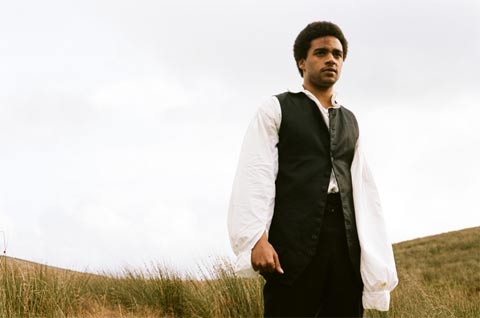
Heathcliff is not white. Though his exact race is never defined, racial stigma is used to mark him as a threatening, “dark-skinned” outsider throughout Wuthering Heights. It is significant that this interracial aspect of the novel’s passionate romance wasn’t addressed on screen until Andrea Arnold’s 2011 adaptation, over 160 years after the book’s publication. Arnold foregrounds the issue of Heathcliff’s race by casting Black actors in the role, rather than the conventional “white-Anglo-Saxon-gypsy” dodge. The swearing, which was considered shocking by Brontë’s contemporaries, has been updated by Arnold to retain its impact for modern audiences, as has the racist language. Essentially, her film is a partial retelling of the novel, exclusively from Heathcliff’s perspective. Where Catherine makes a stray remark in the book about Heathcliff’s dull silence compared to Linton, Arnold’s film embodies that silence in wordless scenes on the Yorkshire moors. When Heathcliff is cast out of doors, Arnold’s camera forces us to share his exile and peer through windows at events within. When Heathcliff is beaten, we experience his pain in flinching close-up. When Heathcliff leaves in the middle of a dramatic speech, we are likewise denied its conclusion.

The result is fragmentary and sometimes frustrating, perhaps not satisfying as a standalone film. But it achieves what no previous adaptation has: to be a real enhancement to the book, rather than a pale reflection of it. Where Brontë’s novel filters our impression of Heathcliff through the narration of Lockwood’s smug, educated gentleman and Nelly’s commonsensical servant, each sometimes presenting him as incomprehensible, barbarous or threatening, Arnold flips this narrative to show us the incomprehensible barbarity and threatening cruelty of the dominant society itself, as seen through the outsider’s eyes. From this alienated perspective, Heathcliff’s descent into cruelty appears an inevitable and almost overdue reaction to the constant, painful brutality he suffers. Arnold’s interpretation might be compared to Steve McQueen’s approach to 12 Years A Slave, stripping away the rationalizing aimed at 19th century readers, to lay bare oppression in the most raw and physical way possible. In a world where an unarmed Black youth can be interpreted as more threatening than an armed representative of “mainstream” society, film’s potential to challenge our identification and flip our perspective is as timely as it is rarely used. By the time Mumford & Sons’ “The Enemy” plays over the film’s final moments, the song’s sentimental regret feels earned.

unnamed

I Am Not the Enemy; It Isn’t Me, the Enemy

The question is, does Arnold’s sympathetic portrait of Heathcliff reflect Brontë’s own view of the character, or does it re-imagine the original author’s racist view, as reflected in Wuthering Heights’ narration? Firstly, it must be said that the story Arnold unearths is taken straight from the original book, although there it is diluted by the perspectives and interpretations of others. Perhaps the book’s most crucial speech is Catherine Earnshaw’s “whatever our souls are made of, his and mine are the same… Nelly, I am Heathcliff,” placing Brontë’s white heroine in absolute solidarity with the non-white hero, which Arnold highlights by letting Cathy’s “I am Heathcliff” echo after her film’s end credits. This is more than a declaration of love; it is a radical declaration of interchangeability. The fundamental similarity of Heathcliff and Catherine allows the book to present their divergent outcomes as a product of divergent treatment, linking the actions of their adult selves to the experiences of their childhoods. Catherine is Heathcliff, therefore their pairing allows Brontë to explore how differently the same behavior is interpreted, rewarded or punished, when acted by different bodies.

Heathcliff illustrates the brutalization of the non-white male; his every attempt to integrate is rejected, so he grows embittered and alienated, forced to exploit others to achieve his goals. If Harriet Beecher Stowe’s Uncle Tom is often criticized for being implausibly forgiving and accommodating to racist slave-owners, then surely Heathcliff is the anti-Tom, an openly angry and defiant agent of revenge against the racist patriarchy that has killed his love. His interchangeability with Catherine undermines easy dismissal of that anger as “natural” barbarity, while Arnold’s focus on Heathcliff’s rejection presents his anger as justified response.

Catherine, by contrast, illustrates the psychological pressures of the pedestalization of white womanhood. She is harshly punished for rebelling, roaming the moors or obeying her instincts, being explicitly told by her beloved father that his love is conditional on her being a “good lass,” while that father hypocritically rewards adopted son Heathcliff for the behavior he rejects in Catherine. Catherine is, however, extravagantly rewarded with social approval for acting traditionally feminine. Her fear of suffering the same degradation as Heathcliff forces her to attempt to assimilate as Linton’s wife, where she suffocates and dies from the frustrations of that role. Through its image of an oak tree struggling to thrive in a flower pot, the book attributes Catherine’s suffering to her entrapment, in contrast to her natural strength and potency. The novel’s portrait of Catherine’s existential struggles is glimpsed in Arnold’s adaptation but cannot be explored; we are not permitted to understand her reasons for marrying Linton because Heathcliff does not understand them. But the roots of Heathcliff’s alienation, as the direct result of his treatment, are exposed by Arnold with more clarity than ever before.

unnamed

So Why Did You Choose to Lean on a Man You Knew Was Falling?

Wuthering Heights is a book intimately concerned with learned cycles of intergenerational abuse, a theme Arnold’s film captures by ending with the striking image of young Hareton hanging a dog in the same way Heathcliff did earlier in the film. The novel’s dainty and feminine Isabella and Catherine Linton become embittered and abusive in the dysfunctional environment of Wuthering Heights, just as Hindley, Hareton and Heathcliff do – Brontë rejects any limitation of abusive behavior to a single race or gender, attributing it rather to a toxic environment. The Isabella subplot in Wuthering Heights also offers a radical affirmation of a wife’s right to flee an abusive husband with her child, a century before the establishment of the first women’s shelters. This theme would be expanded in Anne Brontë’s The Tenant of Wildfell Hall, where it caused a storm of controversy (it was possibly overlooked in Wuthering Heights because readers were distracted by the interracial necrophilia. Ellis Brontë: epic punk). To claim that Brontë’s portrait of Heathcliff romanticizes abusive behavior is to ignore the Isabella subplot’s explicit denial of a loving woman’s power to rescue an abusive man, which urges the reader to heed warning signs of cruelty (Heathcliff hanging Isabella’s dog) rather than satisfying their ego by struggling to redeem a lost soul. Heathcliff and Catherine share a profound love and affinity, but they are both too damaged to save each other; the novel demands the reader’s understanding of the roots of abusive behavior, and recognition of the human potential for love and unselfishness, but never demands approval of abuse itself.

The fundamental interchangeability of Heathcliff and Catherine Earnshaw also lends the novel to transmasculine readings, where Heathcliff’s racial stigma might symbolize Catherine’s stigmatized masculinity, without which she cannot thrive and which she must sacrifice to conform to a traditional, wifely role. Ellis is recorded by Charlotte as the only Brontë sibling to oppose being publicly assigned a female name; Ellis’ masculinity is also suggested in Charlotte’s biographical sketches and her fictionalized portrait of her sibling as Shirley. Wuthering Heights’ potential as lesbian closeting drama may also be demonstrated by comparison with Virginia Woolf’s Orlando, dedicated to Woolf’s lover, Vita Sackville-West. Orlando asserts the interchangeability of the womanizing male Orlando and his female alter-ego (whose male lover Shelmerdine is distinctly feminized, and encountered while Orlando pledges herself to 19th century moors in an apparent nod to Wuthering Heights), allowing Orlando to maintain superficial heterosexuality while being both woman and lover of women. Wuthering Heights is preoccupied with Catherine Earnshaw’s interchangeability with both Heathcliff and Hareton Earnshaw, while her feminized lover Edgar Linton is variously incarnated as Heathcliff’s lover Isabella and Hareton’s lover Catherine Linton. The novel’s final reconciliation is only achieved by divorcing Catherine Earnshaw and Heathcliff from society, through death and ghostly dematerialization, and by whitewashing and re-gendering them as happy couple Hareton Earnshaw and Catherine Linton; this “happy ending” upholds its heroes’ ultimate incompatibility with a racist, sexist and heterosexist society, ending by contemplating their “unquiet slumbers.” As a heterosexual tomboy, however, I also found Wuthering Heights fully expressed my own teenaged frustrations and craving for passionate equality with a male lover (Heathcliff represents the primary love object in most heterosexual interpretations, but alter-ego in lesbian and transmasculine readings); Ellis’ recorded wish for an ungendered name might equally reflect perceived prejudice against female writing, rather than transmasculine identity. This multiplicity of meaning is one of the book’s enduring fascinations, indicating how deeply Brontë cuts to the universal, metaphysical bone of the struggle to love ourselves through the mirror of another. Arnold’s film must sacrifice some of this multiplicity; Heathcliff’s racial stigma might represent the stigma of female masculinity or lesbian sexuality, but the visceral impact of a Black body brutalized onscreen can represent only itself.

unnamed

Give Me Hope in Silence; It’s Easier, It’s Kinder

Wuthering Heights is one of the greatest novels in the English language: enigmatic, passionately sincere, spare, and magnificently disregarding of social convention. It is also cunning in its use of the educated Lockwood to voice dominant ideology and disarm rationalizing criticism, and plainspoken Nelly to disarm common-sense objections. In resisting the judgments of these narrators, readers reach out towards Catherine and Heathcliff’s perspectives rather than defending against them. The fact that this is a first novel, by a writer not yet thirty, is mind-blowing. The book’s confrontation of racist and sexist ideologies feels incredibly modern; its unflinching portrait of the psychology of abuse retains its impact. Andrea Arnold’s brutal, stripped-down take on Wuthering Heights does justice to these elements, rather than fossilizing the book into a cozy classic or tamed romance.

Just as we must mentally resist the book’s judging narrators, so Wuthering Heights resists depicting Heathcliff and Catherine on the moors, allowing that image to haunt through suggestion alone. Arnold cannot avoid directly depicting the moors; rather, she complements the book by boldly visualizing the submerged spaces of Brontë’s novel. Arnold’s moors are an expressionist landscape, filled with the tumult of wind and rain like a storm of passions, and the harsh poetry of sex and death in animal life; the oppressively amplified sound resembles a cross between The Piano and Das Boot. In any other 19th century novel, the reader would demand whether Catherine and Heathcliff had sex during their unchaperoned time on the moors; it is one of Brontë’s achievements that Wuthering Heights makes this question simply irrelevant. It is a drama of love and being, not of sex and marriage. Arnold’s film follows the same oblique model; suggestive shots leave Catherine and Heathcliff’s physical relationship open-ended. The leap between child and adult actors is jarring (especially as it represents a gap of only three years), but it satisfyingly reflects the novel’s conceptual leap: Heathcliff and Catherine are victims of circumstance before Heathcliff’s departure; when he returns, they are adults who must wrestle with their childhoods’ legacy and suffer the consequences of their choices.

Nineteenth century writers used their romantic plots to explore diverse philosophical and political concerns. Just as Wuthering Heights confronts sexism, racism, and intergenerational abuse through a central love story, so Elizabeth Gaskell’s North and South uses its love plot to propose a progressive model of industrial revolution, combining libertarian profit incentive with social welfare investment, with women as equal business partners and strikes averted through bilateral negotiation between masters and union leaders, while pioneering African-American writer Frances Harper’s Iola Leroy flips the trope of the “tragic mulatto” by using a love plot to affirm Iola’s positive choice of Black identity.

Andrea Arnold’s 2011 adaptation of Wuthering Heights points the way for more challenging and political exploration of the female canon’s classic authors, revitalizing them by blowing the cobwebs from safe romantic cliché. Bravo.

[youtube_sc url=”https://www.youtube.com/watch?v=30XKzxnTYK8″]


Brigit McCone refuses to be embarrassed by the emo associations of Wuthering Heights fandom, writes and directs short films, radio dramas, and The Erotic Adventures of Vivica (as cabaret pseudonym Voluptua von Temptitillatrix). Her hobbies include doodling and eating sushi.
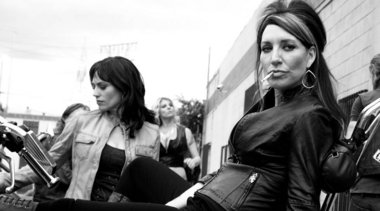
‘Sons of Anarchy’: Female Violence, Feminist Care

At the end of season 6, Gemma violently clashes the spheres of power. She’s in the kitchen. She’s using an iron, and a carving fork. Using tools of the feminine sphere, she brutally murders Tara, because she fears that Tara is about to take control and dismantle the club—the life, the style of mothering and living—that she brought home with her so many years ago.

10308701-large

Mothers of Anarchy

This post by Leigh Kolb originally appeared at And Philosophy and is cross-posted with permission.

Sons of Anarchy revolves around the chaotic yet highly methodical world of a motorcycle club and the forces around them—from law enforcement and crooked cops to gangs and organized crime rings. The entire series focuses on politics, power, violence, and authority in incredibly masculine spaces.

However, these are sons. And to be a son is not only to be a son of a father—the cornerstone for so many monomyths in Western literature—but also to be a son of a mother. While Sons of Anarchy was ostensibly about Jax’s atonement with his dead father and monstrous father figure (thus the countless accurate comparisons to Hamlet), who really is “anarchy” in this world?

If we look at the definition of anarchy— “a state of disorder due to absence or nonrecognition of authority”—and focus in on the word “nonrecognition,” we can think about how throughout Sons of Anarchy, Gemma has been an authority figure in the domestic sphere—”fiercely” mothering her biological and nonbiological sons (she references wanting to have had a dozen sons in the final season, and really, she managed to do so through the MC), cooking meals, managing paperwork, and tending to children, all in the feminine sphere. Though she cannot ride, she and is seen as the ultimate “old lady.” She has power, and the men of SAMCRO, on some level, fear her.


Machiavellithemommy15

Gemma’s violence

Her true authority, however, is not recognized. From the beginning, we understand her power in Charming. She ran off when she was a teenager, and, as Wayne Unser says, came back “ten years later with a baby and a motorcycle club.” There is implied ownership here; the club is Gemma’s. In reality, Gemma herself can be seen as embodying and perpetuating anarchy—in that she is an authority figure, but not recognized as such. The masculine sphere—the bikes, the guns, the gavel, the long table (hello, phalluses)—is seen as powerful. Violence, politics, gun deals, drug deals, more violence: masculine. Powerful.

At the end of season 6, Gemma violently clashes the spheres of power. She’s in the kitchen. She’s using an iron, and a carving fork. Using tools of the feminine sphere, she brutally murders Tara, because she fears that Tara is about to take control and dismantle the club—the life, the style of mothering and living—that she brought home with her so many years ago.

Anarchy is then truly unleashed; both parts of the definition resound throughout the final season. Jax’s authority is misguided (some might say absent) as he leads the club down a path of disorder and destruction. Because no one—not Jax, not Unser, not Sheriff Jarry—could recognize Gemma’s capabilities for brutality., Her authority, or rather her control of the situation, is left unchecked for most of the season. Had Abel not overheard her confess, she may well have gotten away with it. The Sons all underestimate the capabilities of women.


gemma-tara

Tara cannot escape Gemma


In “Anarchism: The Feminist Connection,” Peggy Kornegger points out that

“Anarchism has been maligned and misinterpreted for so long that maybe the most important thing to begin with is an explanation of what it is and isn’t. Probably the most prevalent stereotype of the anarchist is a malevolent-looking man hiding a lighted bomb beneath a black cape, ready to destroy or assassinate everything and everybody in his path. This image engenders fear and revulsion in most people, regardless of their politics; consequently, anarchism is dismissed as ugly, violent, and extreme. Another misconception is the anarchist as impractical idealist, dealing in useless, Utopian abstractions and out of touch with concrete reality. The result: anarchism is once again dismissed, this time as an ‘impossible dream.’”

This anarchy dichotomy is at the heart of the central conflict of Sons of Anarchy: the “malevolent” club that Clay and Gemma wanted versus the “impossible dream” club that John Teller and Jax wanted. We now know that John Teller’s death was at his own hand (albeit somewhat forced), when he realized that the former was the fate of SAMCRO. As Jax rose up the ranks of SAMCRO leadership, he wasn’t just fighting Clay’s philosophy of anarchy—he was also fighting Gemma’s. After Jax killed Clay, the fight wasn’t over, even though he initially thought it was. But the club wasn’t his. Anarchy was his mother.

As Tara plots and schemes to get herself and her sons away from the world Gemma had created and helped sustain, Gemma sees her as a threat, and resorts to fully embodying that destructive, violent anarchy that could uphold the status quo.

Because she has operated within this culture of masculine violence, Gemma adopts the patriarchal problem-solver of violent destruction. Since Tara is a threat to the malevolent anarchy that Clay and Gemma desired, she—in Gemma’s mind—had to be eliminated. Whereas Tara worked with other women as she was trying to make her plans to escape Charming with Abel and Thomas, Gemma consistently alienated herself from other women.

In “Socialism, Anarchism And Feminism,” by Carol Ehrlich, she says that the “debate over ‘strong women’” is closely related to leadership, and summarizes radical feminists’ position to include the following:

“1. Women have been kept down because they are isolated from each other and are paired off with men in relationships of dominance and submission. 2. Men will not liberate women; women must liberate themselves. This cannot happen if each woman tries to liberate herself alone. Thus, women must work together on a model of mutual aid. 3. ‘Sisterhood is powerful,’ but women cannot be sisters if they recapitulate masculine patterns of dominance and submission.”

Tara could have checked off all of those goals easily; she was of a new generation of old ladies. Gemma, on the other hand, isolates herself, acts alone, and in attempting to be dominant and in control, adopts masculine ways of doing so. Clay, as a harbinger of evil, wanted Tara dead. But the other Sons accepted and respected her. Her role wasn’t club mother, it was club healer. The power that she held—that she could and did save Sons’ lives (and Abel’s life in the series pilot)—was a restorative power that ran counter to what Gemma offered. And the more Tara worked with other women, the more of a threat she became to Gemma and the club.

Gemma embodies Sigmund Freud’s “masculinity complex,” which posits that girls identify with their fathers but eventually must assume female social roles. Gemma’s mother, Rose, died of the same heart defect that Gemma has and that her son Thomas died from. Gemma remembers Rose in a conflicted way, and says in season 7 that she thinks Rose had never wanted to be a mother. Gemma, by contrast, says that all she ever wanted to do was to be a mother (to sons).

Her father, Nate, was a pastor. She speaks of him with love and admiration, and one can easily see (just as easily as critics have seen the Oedipal parallels with Jax and Gemma) her own Electra complex—the Jungian theory that girls identify with and have a fixation with their fathers. While Nate leads a church and congregants, Gemma leads an outlaw club and outlaws—her dozen sons are different kinds of apostles.

In Sigmund Freud’s lecture, “Femininity,” he says,

“A mother is only brought unlimited satisfaction by her relationship to a son; this is altogether the most perfect, the most free from ambivalence of all human relationships. A mother can transfer to her son the ambition which she has been obliged to suppress in herself, and she can expect from him the satisfaction of all that has been left over in her of her masculinity complex.”

In making Jax believe the Chinese killed Tara, Gemma is both preserving herself and continuing—whether consciously or not—the legacy that Clay would have wanted: destruction, violence, and chaos. She wants her son to live out her ambitions, to fully give himself up to the anarchy of her rebellious desires.

Tara’s rebellion—that Gemma could not seem to get over—is the antithesis of Gemma’s. Tara left Charming as a teenager, leaving Jax and the club because she wanted to escape. She became a talented doctor, and later returned to Charming. When she wanted to “transfer to her son(s) the ambition which she has been obliged to suppress in herself”—escaping Charming and the grasp of SAMCRO, Gemma sees this desire as running counter to her own ambition for her son and grandsons: to stay in Charming, and to stay in the MC.

SoA_503_0698_FULL

Wendy and Tara collaborate

Both Tara and Gemma are underestimated by the men, in terms of the lengths they will go to in order to preserve their desires for their lives and their sons. Because women aren’t included in the ultra-violent, masculine club scene (and are instead relegated to being porn stars, escorts, or old ladies—all very “private” roles), Tara’s plots shock Jax. Gemma brutally killing Tara is out of the realm of possibility for feminine force.

Freud added in the aforementioned lecture:

“There is one particularly constant relation between femininity and instinctual life which we do not want to overlook. Suppression of women’s aggressiveness which is prescribed for them constitutionally and imposed on them socially favors the development of powerful masochistic impulses, which succeed, as we know, in binding erotically the destructive trends which have been divested inwards. Thus masochism, as people say, is truly feminine.”

Gemma almost got away with murder because the expectation of women is that they are nonviolent and are not aggressive. Specifically, the brutal way she killed Tara was, according to law enforcement and Jax, in keeping with gang violence because it was so horrifying and malicious. When Gemma and Juice convince Jax that it was one of Lin’s men who killed Tara, Jax kills him in the same way Tara was killed, thinking he was enacting just revenge. He was, instead, simply doing as his mother taught him.

Showrunner Kurt Sutter said, “This is a story about the queen and the prince.” It seemed as if Jax had been trying to reconcile with his father and father figure all of these years; instead, we realize he needs to reconcile with his mother. When he finally realizes this, it’s too late—Gemma has killed Tara, Juice killed Eli to protect her, and they lied and set off a series of massacres and gang violence. Everyone immediately believed Lin’s crew was responsible for Tara’s death, because it looked like brutal gang violence—certainly not something a woman could do. There was no Mayhem vote for Gemma, because she isn’t at the table. However, even in her final moments, Gemma gives Jax permission to kill her, because she knows it must be done. She’s mothering—and controlling—until the very end.

As Hannah Arendt points out in On Violence, “Violence can always destroy power. Out of the barrel of a gun grows the most effective command, resulting in the most instant and perfect obedience. What never can grow out of it is power.” As soon as Gemma kills Tara, her power starts rapidly declining. A conglomeration of Gertrude and Lady Macbeth, Gemma vacillates between justifying her actions and apologizing for them (but mostly justifying). As soon as she sets the stage for Jax to enact revenge upon the Chinese, his rage and misplaced revenge—without the understanding or agreement of the club—makes him less and less powerful. In the last episode, as he ties up all of his loose ends (see: killing everyone), he is losing power. By the end, he gives up himself, and his power—just like his father did—and commits suicide. Violence robs Gemma and Jax both of their power, their dignity, and their lives.

So who—and what—wins in this modern Shakespearean tale? Certainly not those who rely on a sense of vengeful justice and violence to ride through this life. In a patriarchal framework of understanding, these actions are seen as desirable and just. Instead, we must work toward a feminist ethic of care. Feminist psychologist and philosopher Carol Gilligan defines a feminist ethic of care as

“an ethic of resistance to the injustices inherent in patriarchy (the association of care and caring with women rather than with humans, the feminization of care work, the rendering of care as subsidiary to justice—a matter of special obligations or interpersonal relationships). A feminist ethic of care guides the historic struggle to free democracy from patriarchy; it is the ethic of a democratic society, it transcends the gender binaries and hierarchies that structure patriarchal institutions and cultures. An ethics of care is key to human survival and also to the realization of a global society.”

Gilligan’s research has shown that traditionally “feminine” approaches to care are about more than the individual—connectedness and care override a sense of individualism and justice. In Sons of Anarchy, the characters who most exemplify this care ethic are Nero and Wendy, who, at the end, are riding together to parent their children—biological and non—far away from Charming. They are friends, not lovers, and their goals are not for themselves, but for the safety of one another and their sons—sons who they desperately want to keep away from the individualistic, vengeful anarchy they were coming to know. Nero and Wendy are coincidentally both recovering addicts. In their recovery—from the literal and figurative drugs of their past—they care more deeply about one another and those around them than they care about their individual desires.


_1407357924

Wendy’s eventual ethic of care

Tara desired this kind of care for her sons, but couldn’t attain it in her lifetime because of the pull of Gemma and Jax’s patriarchal anarchy. After Gemma’s death, Jax is freed to fulfill Tara’s wishes, and legally makes Wendy the boys’ mother. As in so many Shakespearean dramas, women must die so that men will learn. However, what remains constant throughout Sons of Anarchy is that when the masculine ideals dissolve, and individuals cry, love, and care (exemplified in Tig and Venus’s powerful love scene in “Faith and Despondency”), intimacy and growth are possible.


tumblr_nc3fvi4be61tuvfjko2_500

Wendy and Nero escape with their sons, embodying the feminist ethic of care


As Nero and Wendy leave Charming, it’s clear that this, then, is the preferred way to ride—not “all alone,” as Jax does—but all together. Gemma stands by her way of mothering until the end. She’s distrustful and dismissive of teachers and school (whereas Wendy is passionate about Abel attending school), and she covertly gives Abel his grandfather’s SON ring, which he wears at the end of the finale. Jax, however, sees the dire need for care, not anarchy. “It’s not too late for my boys,” he says. “They will never know this life of chaos.” Ultimately, Jax is a tragic hero because he realizes that care, not justice, will heal and raise his children.

The feminism of Sons of Anarchy has been not only its complex, three-dimensional female characters and Gemma’s role as the rare female antihero, but also its tragic depiction of the end game of violent, individualistic patriarchy. Wrapped up in the tragedy of masculine justice and violent revenge, Sons of Anarchy lifts up of the feminist ethic of care.

__________________________________

Leigh Kolb is an instructor at a community college in rural Missouri, where she teaches composition, journalism, and literature. She wrote “Mothers of Anarchy: Power, Control, and Care in the Feminine Sphere,” for Sons of Anarchy and Philosophy, and recapped the final season of Sons of Anarchy at Vulture. She is an editor and staff writer at Bitch Flicks, where she has written about the feminism of Sons of Anarchy.

Read This Before You Rewatch ‘Friends’

The complete series of ‘Friends’ is coming to Netflix Jan. 1, 2015, and I’m sure many of you are planning to spend your NYE hangover with the old gang. Lucky for you, I started my personal ‘Friends’ series rewatch in September, and finished last night, just in time to warn you of some of the pitfalls you may experience over the coming months.

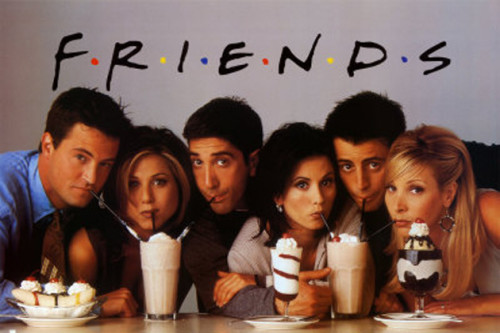
The cast of 'Friends'
The cast of Friends


The complete series of Friends is coming to Netflix Jan. 1, 2015, and I’m sure many of you are planning to spend your NYE hangover with the old gang.  Lucky for you, I started my personal Friends series rewatch in September, and finished last night, just in time to warn you of some of the pitfalls you may experience over the coming months:

1. Watching Friends means confronting 10 years of fashion mistakes.

Sadly this was not a trend.

“The Rachel” is only the beginning of this fashion shame. From the denim vests and cropped sweaters of season one to the handkerchief dresses of season 10, it is a whirlwind of everything you ever tried to pull off but could not. If you are like me, however, this is not so much of a warning as a promise. I especially liked being reminded of trends I’d forgotten, like those shirts with a pointless seam above the boobs, or that year when hard nipples were the must-have accessory.

2. The writers fail Phoebe time and time again.

Phoebe Buffay is a really cool person

Phoebe Buffay is a classic sitcom weird-o, and Lisa Kudrow is maybe the most talented member of the cast of Friends, but the writers didn’t know what to do with her other than make her say kooky things. The other characters get storylines and character arcs and romances and career changes and she gets to sing “Smelly Cat” a bunch of times. The best plot Phoebe gets is having triplets as a surrogate for her brother, and that was brought about by Kudrow’s real-life pregnancy. As the series winds down, it seems the writers suddenly realized that Phoebe’s been under-served, so they “make up for it” by quickly marrying her off to Paul Rudd. Because nothing says “character development” like filing joint tax returns.

3. Could this show BE any more homophobic?

It is funny because they are dudes and they are touching.

The very concept of homosexuality apparently topped the writers “never not funny” list. Ross’s ex-wife left him for a woman. EDGY! THIS AIN’T YOUR GRANDMA’S SITCOM! Everyone thinks Chandler is gay when they first meet him. HILARS! Joey and Chandler’s friendship resembles a romantic relationship. HEE HAW. Chandler’s dad is a gay drag performer in Las Vegas. CAST KATHLEEN TURNER IN THE ROLE! BRILLIANT!

The gay “humor” on the show is probably its most dated aspect (and that includes all the denim vests!) and it’s more pervasive than I would have thought (especially in the earlier seasons). If you hate the idea of homosexuality as an alleged punchline, don’t rewatch Friends.

4. It is even whiter than you remember.

It's pretty much just Aisha Tyler's Charlie, and she's in nine episodes. In the last two seasons.
There’s pretty much just Aisha Tyler’s Charlie, and she’s in nine episodes. In the last two seasons.

“Drink every time a person of color appears on Friends” is a drinking game that is safe for pregnant women.

5. You will be forced to care about Ross and Rachel.

Ross and Rachel kiss.

I have flames on the sides of my face level hate for Ross Geller. I was a tender girl of 12 when he first uttered the words “We were on a break,” and that was when I stopped believing in fairytale romance. Watching the show as an adult, you can see from the start there is no fairytale. Ross is a “Nice Guy” who makes himself feel better about being the reacher in his relationship with Rachel by putting her down for her intelligence. Their relationship falls apart entirely because of his jealousy, ostensibly of Rachel’s co-worker Mark, but he’s clearly most threatened by Rachel’s career. It’s a bad relationship. And Ross is pretty much a bad dude.

And watching Friends means signing up to ride this rollercoaster of toxic romance for 10 seasons. And you will get caught up in that ride sometimes, and you’ll hate yourself for it. The near-romance between Rachel and Joey was the only thing that had the chance to break the spell, but it was thrown under the bus so Joey could be single for his spinoff. Getting married couldn’t keep Ross and Rachel together. Having a baby couldn’t keep Ross and Rachel together. But the power of a series finale could.

6. It’s still really good.

Friends clapping!
Friends clapping!

If you can handle the above, then you’ll have a lot of good to take with the bad. The chemistry between the cast is as magical as you remember it, the writing takes sitcom tropes to their zenith, and now you’ll have a nice side of nostalgia to go along with it. So as you enjoy/tolerate the holidays, keep in mind that Friends is waiting for you on the other side of the New Year.

Happy viewing!
Happy viewing!


Robin Hitchcock is an American writer living in Cape Town, South Africa. Her favorite friend is Joey.

As Goes Missouri, So Goes the Nation: ‘The Pruitt-Igoe Myth,’ ‘Rich Hill,’ and ‘Spanish Lake’

Rural poverty and urban poverty are not the same. Individual racism and institutional racism are not the same. However, these forces are woven together as they are fiercely kept separate in our common mythologies of what America means. We avoid difficult stories that disrupt the narratives we’ve come to understand.

Pruitt_Web

Written by Leigh Kolb.

For over a century, Missouri was known as a bellwether state; a politically split swing state (blue urban Kansas City and St. Louis bookend red rural communities), the state’s presidential vote almost always reflected the outcome of the presidential election. In the Civil War, Missourians fought for both sides. Demographically, economically, socially, and politically, Missouri has often been seen as a microcosm of America as a whole.

In an NPR article, the term “bellwether” is defined:

“You might be wondering where the word ‘bellwether’ comes from. Just think about Mary and her little lamb… she’d tie a bell around the neck of a wether (a castrated male sheep) who would lead the little lamb and the rest of the flock around until Mary came back. And when she returned, the bell signaled the flock’s location.”

The bell around Missouri’s neck has been sounding, tuning a nation in to the economic and divisive realities of a nation divided, economically and racially. Three recent documentaries paint a portrait of tragic desperation that is not isolated to middle America; it’s the struggle of a nation faced with the staggering reality of deep divides in class and race.

_______________________________

The Pruitt-Igoe Myth

The Pruitt-Igoe Myth

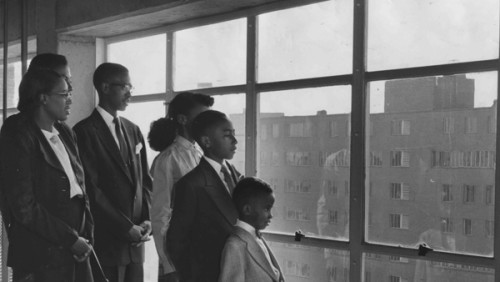
The Pruitt-Igoe Myth, directed by Chad Freidrichs and released in 2012, tells a more complex version of a modern myth. Pruitt-Igoe was a public housing development in St. Louis, built to be a shiny clean alternative to the tenements of the city. It was designed with the goal of “lifting residents out of poverty,” and was built using federal funding after the Housing Act of 1949. The documentary, which succeeds greatly in its usage of historical footage and current interviews with past tenants, paints a picture of a development full of hope. Those interviewed remembered Pruitt-Igoe as an “oasis in a desert,” and their time there had been incredibly exciting and happy. There was also fear, though. A complex portrait is drawn that leaves the viewer wondering, “What happened?”

The complex was segregated. Public housing was racially segregated until 1956; after that, many areas remained or became increasingly segregated due to redlining and “white flight” as suburbs became attractive options and were also subsidized heavily by government funding. Against the backdrop of a post-war economy that was not growing as expected, and the deep racism that permeated the country as schools were desegregated, Pruitt-Igoe was a socialist penthouse built on a racist, shaky free market.

Twenty years after its completion, it was fully demolished. The mythology that has surrounded its failure typically stigmatizes public housing and the residents; however, the real story has much more to do with the lack of maintenance and support, welfare policies that broke apart families, and decaying conditions coupled with increasing rent. While the government built the complex, the maintenance and upkeep was to be paid for with tenants’ rent. This model relied on a vibrant, growing city and economy.

That’s not what happened.

The government was also committed to pro-suburb housing policies, where middle class and working class whites went to live. The Pruitt-Igoe Myth does an excellent job outlining the history of economic decline and housing and zoning laws that were often unfriendly to poor and working class African Americans.

Another reality that the film reveals is the “control” that the welfare department had over those in the apartments who received aid, including the anti-family “man in the house” rule, which dictated that if an “able-bodied” man lived in the home, the family couldn’t receive assistance. For some of the interviewees in the film, that meant that their fathers had to leave the state, or hide when agents came to check and see if a man was living in the house. (And just a few decades later, conservatives decry the breakdown of the family as the cause of poverty and crime.) The rules were restrictive–telephones and televisions were not allowed. The theme of “control” runs through many of the former tenants’ narratives–the control that the housing authority attempted to have over them, and the lack of control they felt in their deteriorating living conditions.

Instead of fixing and maintaining the units, authorities made everything “indestructible” (caging in light bulbs for example). One former tenant said that that “made you want to destroy things.” While The Pruitt-Igoe Myth is ostensibly about a housing project, it is also about segregation, masculinity, poverty, distrust of law enforcement, racism, the decline of the American city, and whites’ deep fears of Black poverty and crime (the mythology of Pruitt-Igoe became a scapegoat to uphold those fears).

This iconic footage of Pruitt-Igoe being destroyed was used in the film Koyaanisqatsi. "Koyaanisgatsi" is a Hopi Indian word, and means "life out of balance."
This iconic footage of Pruitt-Igoe being destroyed was used in the film Koyaanisqatsi. “Koyaanisgatsi” is a Hopi Indian word, and means “life out of balance.”

_______________________________

Rich Hill

maxresdefault

On the other side of Missouri is Rich Hill, a rural town with a population of just over 1,000. A former coal mining town, the economy of Rich Hill has declined rapidly in the last few decades, and its inhabitants are faced with poverty and a lack of employment opportunities.

Filmmakers Tracy Droz Tragos and Andrew Droz Palermo (who are cousins), grew up visiting family in Rich Hill. They stress the importance of showing poverty in America, and that we cannot keep those living in poverty “at arm’s length.” They directed Rich Hill, a beautiful documentary that focuses deeply on the lives of three young teenage boys who are up against a world that seems hopeless.

Between 2000 and 2010, poverty rates in Missouri doubled, at a rate 3.5 times the national average. Rural areas have been hit by declining manufacturing opportunities. The three boys chronicled in Rich Hill are all faced with devastating family situations. Andrew is good-looking and charming, and seems optimistic amid the chaos of his life–a father who does odd jobs, sings country music, and moves his family around constantly. Appachey lives in rage, and chain smokes at age 12. His mother had him when she was a teenager, and his father left when he was 6. Harley’s mother is in prison because she tried to kill his stepfather after his stepfather had raped him, and the cops did nothing. Harley lives with his grandmother. “I don’t need an education,” he tells us. “I just need my family.”

The film spans a year, and it’s punctuated by Fourth of July celebrations. Toward the end, the fireworks are juxtaposed with scenes of Andrew and his father arm wrestling, and the town chanting “USA!” in celebration. These scenes are stunningly beautiful and deeply sad.

Andrew says, “I keep praying. Nothing’s came yet, but I keep trying…”

Tragos said that in making the film, they were trusted because they had their grandparents’ name. She explains that this was “less of a nostalgia piece than for an urgent piece about these kids’ lives.” It’s clear that the filmmakers were pulled in to these boys’ lives (their website features updates and fundraising links for the boys and other organizations).

The plight of the mothers and grandmothers is overwhelming. It’s difficult to watch the one father who is in the picture; he has delusions of grandeur, and we can see Andrew following in those charismatic, aimless footsteps (although most viewers are completely charmed and heartened by Andrew’s grinning confidence). The boys are all smart and funny, yet they are faced with a system–whether it be the juvenile system, or a free-falling economy–that is completely against them and their families.

Harley
Harley

_______________________________

Spanish Lake

Spanish Lake
Spanish Lake


Spanish Lake is an unincorporated township north of St. Louis eight miles away from Ferguson. Filmmaker Philip Andrew Morton lived there until he was 18. When he returned 10 years later, his childhood home and elementary school were abandoned, and he wanted to explore the phenomenon of “white flight” that occurred in St. Louis in the last half century.

He made Spanish Lake, which centers mostly on the white people who left Spanish Lake as they reflect upon the past. While these interviews make up the majority of the film, there is a bit of history that gives some context to the demographic shift. Spanish Lake was kept unincorporated due to anti-government sentiment, which led to a lack of social services and the building of Section 8 apartments, where many impoverished African Americans moved after housing developments like Pruitt-Igoe were destroyed. Realtors redlined neighborhoods, pushing whites in and out strategically. White people–fueled by racism and the lack of what had been strong, unionized labor opportunities–fled to other suburbs or rural areas.

In Spanish Lake, Morton captures a reunion of “Lakers”–former residents of Spanish Lake who have a reunion at Spanish Lake and drink beer while reminiscing about the past. Morton’s motivation in making Spanish Lake was his own nostalgia, as he remembers his childhood in Spanish Lake with a sense of pain and loss. While there’s no doubt that he also has a social awareness (that was certainly heightened as the timing of his film coincided with Ferguson making waves around the world, as Ferguson’s demographic shift has been similar to Spanish Lake’s), the overriding tone of the documentary is nostalgic, peppered with just enough history to give some context.

White former residents talk about the fights, and getting beaten up by “sisters,” and laugh about shooting a Black Santa off a new resident’s roof. The pain in these former residents’ comments is palpable, but it’s left unexamined. The documentary plays for more than 30 minutes before a Black person speaks. There are short clips of Black apartment residents thanking the local police force and their new (white) landlords.

Had Spanish Lake existed in a vacuum, it would have been a fine piece of nostalgic film that briefly illuminated a modern history of segregation and deeply entrenched racism and a decaying middle class as labor and manufacturing opportunities dissolved.

If viewers are looking for a nuanced commentary on “how Ferguson became Ferguson,” Spanish Lake is not enough. The Pruitt-Igoe Myth, full of authentic voices that speak to the fear and trauma of growing up in poverty and institutional racism, should be required viewing.

However, Spanish Lake itself does capture how many white Americans react and speak about a recent history of demographic changes, housing segregation, and school desegregation. It’s uncomfortable to hear their voices, but those voices are familiar and loud, all across America.

There’s a lot of talking, but not a lot of critical thinking. And when it comes to talking about race and class in America, that’s a painfully accurate representation.


White voices dominate Spanish Lake


Rural poverty and urban poverty are not the same. Individual racism and institutional racism are not the same. However, these forces are woven together as they are fiercely kept separate in our common mythologies of what America means. We avoid difficult stories that disrupt the narratives we’ve come to understand.

We don’t want to hear how, in so many ways, Pruitt-Igoe was set up for failure, and fit into a narrative that it was the residents themselves who were failures. We don’t want to listen to the young Black man who was a boy in Pruitt-Igoe, who loved quietly watching insects in a field before he saw his brother brutally murdered–then all he could think about was killing.

We don’t want to hear about rural poverty, and how the economy has gutted middle America and left in the rubble children who are failed by their parents, their schools, and the legal system. One audience member at a Rich Hill screening praised Andrew for his faith and encouraged him to keep praying, as if his optimism and charming smile would someday pay the bills.

We don’t want to hear the racism of former residents of a “nice area,” who can’t see that their own anti-government stance helped usher in low-income housing, which they were also against. Then there weren’t social services available–because they were against centralized government–and that lack of social services harmed everyone. In so many ways, Spanish Lake represents an entire nation of people who vote and scream against their own interests without any sense of introspection. What makes Spanish Lake jarring is the modernity of the footage. In The Pruitt-Igoe Myth, the footage of residents and officials of Black Jack, another township north of St. Louis who wanted to keep a certain “element” out of their neighborhoods is in black and white, grainy news reels of a time that seems so long ago. But it wasn’t. In Spanish Lake, former residents make the same arguments in broad daylight in high-definition.

We want to believe that it’s all simple. Segregated housing policies are a thing of the past, and we’re in a “post-racial” society. Poverty is due to laziness. People should just choose to live in better conditions and pull up their bootstraps, and ignore history. We want to ignore history.

That is the American mythology that has a chokehold on us all.

But the chain is tightening around Missouri’s neck, and the bell is sounding. We must leave the mythology in the past and deal with reality.

Because Missouri–its segregation, its poverty, and its denial–is America.


[youtube_sc url=”https://www.youtube.com/watch?v=g7RwwkNzF68″]

[youtube_sc url=”http://youtu.be/QNp0AuPiZ3Y”]

[youtube_sc url=”https://www.youtube.com/watch?v=Yw38xwWu3r4″]


See also: “Mapping Decline: St. Louis and the American City”; “St. Louis: A city divided” at Al Jazeera America; For its poverty rate, Missouri should be placed on child neglect registry. at the St. Louis Post-Dispatch


Leigh Kolb is a composition, literature, and journalism instructor at a community college in rural Missouri.


A Tender Tribute to Aaron Swartz: ‘The Internet’s Own Boy’

‘The Internet’s Own Boy’ is a passionate, intelligent tribute to the tragically short but brilliant life of the programmer and activist. The documentary successfully captures Swartz’s spirit and rightly underscores his visionary genius and socio-cultural importance. Recounting both his days of triumph and despair, it acknowledges his vulnerabilities and fears as well as his drive and passion.

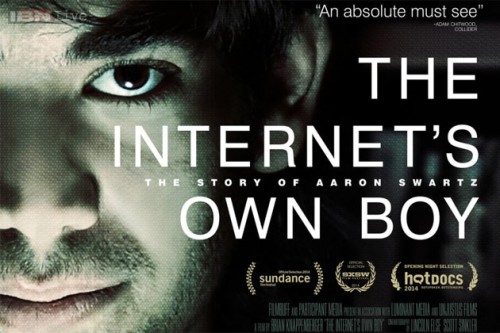
Film poster for The Internet's Own Boy
Film poster for The Internet’s Own Boy


Written by Rachael Johnson.

Directed by Brian Knappenberger, The Internet’s Own Boy (2014) is an involving and profoundly moving documentary about Internet icon Aaron Swartz. Swartz was not only an innovative and influential programmer, he was also a deeply committed Free Speech and Open Access advocate. In late 2010 and early 2011, Swartz downloaded academic documents from JSTOR at MIT. Arrested in January 2011, he was charged with wire fraud and theft of information. Facing up to 35 years in prison and a $1 million fine, he took his own life in his New York apartment on Jan. 11, 2013. He was 26 years old.

Examining both his private and public life, The Internet’s Own Boy intermixes home movies, stills, news footage, and interviews with friends and relatives. Home videos of Swartz as a child illustrate his intellectual precocity while family members recall his love of learning. At the age of 12, he created a Wikipedia-like information site before Wikipedia called info-org. The documentary comprehensively chronicles both his Internet and activist careers. Swartz programmed for Creative Commons, helped develop RSS and co-founded Reddit. When Reddit was bought by Conde Nast in 2006, the programmer relocated to California. But he literally recoiled from office life, and abandoned start-up culture. Peter Eckersley, a former roommate of Swartz and technological projects director at Electronic Frontier Foundation, tells us, “He was totally unexcited about starting businesses and making money.” Swartz was inspired by the example of World Wide Web inventor, Tim Berners-Lee, who wanted his creation to be used by all. He could have been like any other self-serving member of the 1 percent but he chose another path.

Prodigy
Prodigy


Swartz soon became a leading Open Access and Free Speech activist. He saw the Internet as an instrument of freedom and enlightenment, and his profoundly moral and generous vision is evident from his personal blog, excerpts of which are featured in the documentary: “I work for ideas and learn from people. I don’t like excluding people…I want to make the world a better place.” Swartz co-founded Demand Progress in 2010, an advocacy group that successfully fought the Stop Online Piracy Act (SOPA). That public information and records should be out of reach of the public struck him an absurd injustice. In 2008, he downloaded electronic federal court records from the expensive public access service PACER. (Although investigated by the FBI, Swartz was not charged.) Expressing unease with social and economic inequality, he became increasingly politically engaged. In 2009, he co-founded the Progressive Change Campaign Committee. Aaron Swartz offered–and still offers–another way of thinking and being.

Although The Internet’s Own Boy does not give a gender-aware reading of Swartz, it is clear that the programmer and activist embodied a certain egalitarian masculinity. Although Swartz possessed attributes that have been traditionally associated with masculinity–such as single-mindedness and risk-taking–he neither personified nor espoused ideals of dominant masculinity. Unlike the ruinous gambling of the bankers who wrecked so much havoc on the world’s economy during the financial crisis, his risk-taking sought to serve the greater good. Swartz simply did not want to be a prized exemplar of corporate masculinity. He seemed uninterested in exercising power, and he did not exhibit the customary misogyny of his industry. Indeed he challenged institutions of power and wealth, asking why they possess so much control over human knowledge. Men like Swartz expand modern definitions of masculinity. The other way of thinking and being that he offered transcends gender, race, age, and sexuality, and he remains an inspirational figure for all.

Fighting SOPA
Fighting SOPA


Critics may argue that the documentary offers a romanticized account of its subject. It sides with Swartz, that’s true, but the argument presented is utterly persuasive. Isn’t it, in fact, self-evident? How can anyone be locked away for 35 years for downloading academic documents? There is, also, no denying that Swartz is a romantic figure. He was an attractive, young man who wanted nothing more than to share knowledge. The Internet’s Own Boy chronicles this sad, shameful story of prosecutorial zeal with insight and compassion. It both angers, and moves the viewer. The prosecutors’ lack of imagination and humanity simply takes your breath away. If there is a modern-day American martyr, it is Aaron Swartz.

The Internet’s Own Boy is a passionate, intelligent tribute to the tragically short but brilliant life of the programmer and activist. The documentary successfully captures Swartz’s spirit and rightly underscores his visionary genius and socio-cultural importance. Recounting both his days of triumph and despair, it acknowledges his vulnerabilities and fears as well as his drive and passion. The story of Aaron Swartz is one of the most important of the millenium and it is encouraging that The Internet’s Own Boy is on this year’s Oscar shortlist. It’s a documentary about our time and we all need to see it.

Aaron Swartz
Aaron Swartz


Spirit Possession and Military Service: Talya Lavie Talks to Us About ‘Zero Motivation’

What were the biggest challenges in making a feature film? How do people see compulsory military service in Israel? Was that Russian girl really possessed by a ghost? Writer/director Talya Lavie answers our questions about her award-winning film.

What were the biggest challenges in making a feature film? How do people see compulsory military service in Israel? Was that Russian girl really possessed by a ghost? Writer/director Talya Lavie answers our questions about her award-winning film.

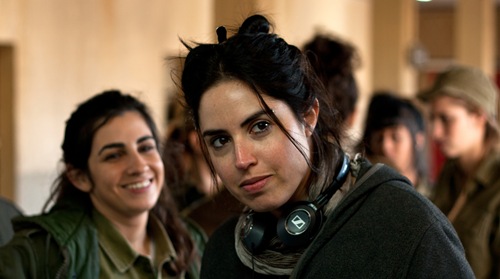
Talya Lavie writer and director of Zero Motivation

Zero Motivation, which won Best Narrative Feature at the Tribeca Film Festival, is a dark slacker comedy set in the Israeli military. You can read our review of it here.

The first feature-length film from writer-director Talya Lavie, Zero Motivation was inspired by her own military service. In the Director’s Note found in the movie’s press kit, Lavie writes that “Israeli women may of course serve in more glamorous roles, like pilots or tank crew instructors. But I wanted to focus on us office girls, the unseen and mostly ignored majority whose contribution is lacking any social or symbolic value.”

While promoting the film’s release in New York, she took the time to follow up on that statement, and to answer a few of our questions.

Bitch Flicks: Most of our readers are from the US and Canada, where the concept of mandatory military service is a little bit foreign, so I’m wondering if you could expand on that statement and talk about how you see the role of female conscripts in the Israeli military.

Lavie: Israel is one of the only countries that has mandatory military service for women as well as men. It creates a paradox because, on the one hand, it’s a symbol of equality but, at the same time, the IDF… still demonstrates real gender discrimination. There are women in combat roles but, as I said, the majority of women are still doing secretarial jobs. I believe this may change only if the army becomes less central in Israeli society – hopefully one day.

BF: In many ways, this is a coming of age story, but one that takes place within a very specific setting. (How) do you think that serving in the military has influenced the way these characters define themselves and develop as individuals?

Lavie: In a way, the army for those characters is what college is for Americans. Everyone participates and accepts it as a fact. It is, though, challenging to define your individual identity while having to wear the same uniform as everyone else, and to [live under these] rules. I guess it influences each person in a different way, like every other thing in life.

BF: While the film is very funny, there are a few darker moments in the story. How did you go about managing the changes in tone in the film?

Lavie: The film is defined as a “dark comedy” but, while writing the script, I didn’t want to lock myself into a specific genre. I put a large [range] of emotions in it, and was interested in mixing different spirits. Ultimately, my greatest challenge was to maintain the specific subtle tone of the film; to balance the transitions between humor, sadness, nonsense and seriousness. I felt like an acrobat in a circus walking on a rope, trying not to fall off, and yet to keep the film’s free spirit.

BF: I think the sequence where Irena is “possessed” by the spirit of the dead girl works really well on a metaphorical level, but inquiring minds want to know – was she really possessed by a ghost?

Lavie: All of the characters in the film have a very detailed biography that is not told in the movie – none of them gives a personal monologue. But their background is hinted at in many ways. In Irena’s character, we tried to hint that she has a history of violence. And when she sees Zohar nearly raped, it brings a very strong reaction out of her. Is she really possessed? I leave it for each viewer to decide for himself.

BF: What were some of the biggest challenges you faced in making this film, and do you have any advice for aspiring filmmakers?

Lavie: The biggest challenge was raising the budget for the film. It took several years. That stage in the creation of a film can be very frustrating for any first time filmmaker. My advice for filmmakers at this point is, in addition to applying anywhere you can, use that waiting time for learning and preparing for shooting. Eventually, when I look back on the process, that waiting period was frustrating but also useful for rewriting and studying. I came to the set very prepared. And since we had a very short time for shooting, [being prepared] was significant.


Thank you to Talya Lavie for taking the time to speak with us. Zero Motivation is currently playing in New York, San Francisco, Toronto, and other select cities in North America.

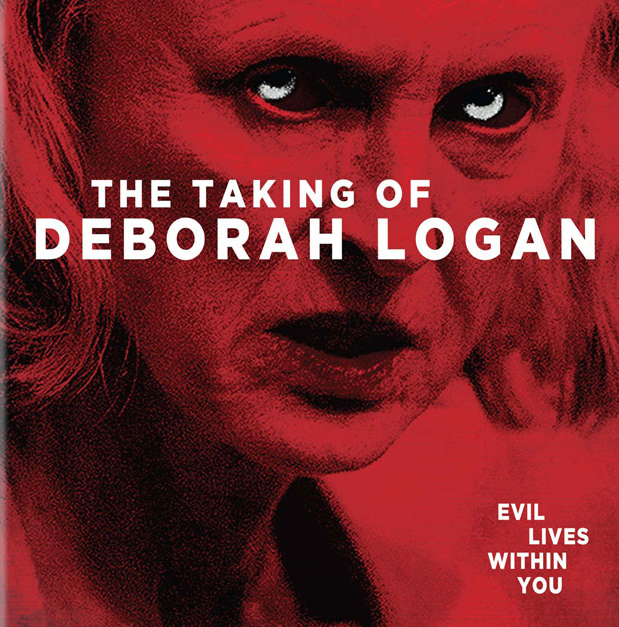
‘The Taking of Deborah Logan’: Alzheimer’s, Possession, and Mother/Daughter Love

‘The Taking of Deborah Logan’ is a story about the horror of evil afflicting a deteriorating mind, but it’s also a tale of the strength of a mother and daughter’s love. Deborah is driven by female characters, and while not a perfect film, it serves up the scares and aces the Bechdel test.

Evil Lives Within You, But Your Daughter Lives With You And She Will Kick Evil's Ass
Evil Lives Within You, But Your Daughter Lives With You And She Will Kick Evil’s Ass


Written by Mychael Blinde.

The Taking of Deborah Logan is a story about the horror of evil afflicting a deteriorating mind, but it’s also a tale of the strength of a mother and daughter’s love. Deborah is driven by female characters, and while not a perfect film, it serves up the scares and aces the Bechdel test.

First-time director Adam Robitel presents this found footage movie in the form of a medical documentary gone supernaturally screwy. In this interview, he explains:

What I always wanted to do was start in one space, with a very grounded medical documentary and by the end, turn the movie completely on its head as we careen into full horror movie realm.

Lots of horror fans profess irritation with found footage, but I find it fascinating. Unfortunately, Deborah doesn’t really add anything new to the sub-genre in terms of unique camera work (cf. Paranormal Activity III’s fan-cam or Chronicle’s telekineticams). And yes, the climax falls prey to the same problems as many other found footage films: lots of crashing around in confusion and crappy visibility. (There is, however, one fantastically shocking climactic horror moment like nothing I’ve ever seen before — I will not spoil it for you, but keep your eyes on Deborah because DAMN.)

Still, for the majority of the film Robitel does a solid job of utilizing standard found footage techniques (house cams, whip pans, night vision).

(Found footage fourth wall freakiness)


And Deborah manages not to feel too derivative, because the subject of this found footage film is uncommon within the genre: a mother, a daughter, and the sacrifices they make to save each other.

Mother Deborah and daughter Sarah in the beginning of the film


The strength of mother/daughter love is not the most obvious theme of The Taking of Deborah Logan. (The obvious theme is that the deterioration of the human mind is terrifying and akin to demonic possession.) But if we viewers take a step back, we can see how much this film is driven by mother/daughter love and sacrifice: the mother saving her daughter is the reason for the mother’s possession, and the daughter saving her mother is the arc of the entire film.

Michelle Ang as Mia, PhD student and first-time filmmaker


Deborah 
begins with PhD student Mia (Michelle Ang) introducing herself and her two-man camera crew to Sarah (Anne Ramsay), the adult daughter of Deborah Logan (Jill Larson). Deborah is in the early stages of Alzheimer’s, and in an effort to help her mother keep her house, Sarah has arranged for Deborah to participate in Mia’s documentary in exchange for money from the project’s grant.

Hello, Deborah! It's a pleasure to meet you...
Hello, Deborah! It’s a pleasure to meet you…


Here’s what we learn about Deborah when Mia introduces her in the documentary:

Mia: After the premature death of her husband…to a pulmonary embolism, Deborah was forced to provide for two-year-old Sarah on her own. She leveraged their house as collateral, and would go on to start a highly successful switchboard answering service for the town of Exuma.

In her preliminary interview with Mia, Deborah describes her role as switchboard operator: “I was the nexus of this town. Doctors, lawyers, town hall, everybody.”

Deborah also details the actions she takes to fight her deteriorating condition, and she expresses her frustration at the futility of her mind’s inevitable decline:

Deborah: I do all my little puzzles. I do crosswords. I’m lifting weights. I am doing everything that I have read will help to stave off the progression of this disease. Stave it off. There’s no cure.

Deborah's (lady!) doctor: "Deborah's not someone to go down without a fight."
Deborah’s (lady!) doctor: “Deborah’s not someone to go down without a fight.”


But Deborah’s not just fighting Alzheimer’s; she’s battling a spiritual parasite — and it’s a fucking EVIL one.

Jill Larson is most famous for her role as Opal on All My Children, and according to several different interviews, she had never seen a horror movie before filming Deborah. Nevertheless, as she absolutely nails her role as a savvy single mother afflicted with the frustrating and frightening deterioration of her once sharp mind.

Deborah in a moment of confusion and disorientation


Larson’s portrayal of Deborah’s possession is complex: she conveys a mixture of confusion and fear and desperation and anger and evil, and she appears pitiful, then horrifying, then pitiful again — sometimes in the same scene.

On her approach to the role, Larson says: “My time in soap operas…taught me to invest in situations that sometimes stretch the imagination.”

After a romp through the woods in the middle of the night, Deborah starts to look scary


There exists a cultural trope of the ugly old evil women — a trope which thrives on the notion that older women are scary and unnatural, grotesque, lusting for power and filled with an abject evil.

Evil crones as depicted by Disney and Sam Raimi


And yes, as the evil overtakes Deborah, she does become both ugly and powerful.

After a romp through an abandoned wing of the hospital in the middle of the night, Deborah's looking even scarier
After a romp through an abandoned wing of the hospital in the middle of the night, Deborah’s looking even scarier


But Deborah isn’t an evil crone — she’s a good person who is unhealthy of mind through no fault or moral failing of her own. In fact, Deborah is being targeted by the evil spirit as revenge for a brave, heroic deed she committed long ago. Her representation is a departure from the traditional (and trite) evil crone.

Sarah attempts to help her mother as the switchboard goes vengeful-spirit KABLOOEY


The moments we see Deborah naked are not played as gross-out moments (think, for example, the bathroom woman in The Shining). What’s striking about Deborah’s naked body isn’t that she looks gross, it’s that she looks so fragile, so frail.

Her neighbor and lifelong friend, Harris, says of Deborah and her plight: “She’s a fighter. And she’s brave…But how do you fight your way through something you can’t see or know?”

How does Deborah fight her way through Alzheimer’s and spiritual parasitism? With the help of her loyal, brave, determined daughter.

In the beginning of the film, Sarah makes sure the crew knows to say "thank you" to Deborah for her hospitality
In the beginning of the film, Sarah makes sure the crew knows to say “thank you” to Deborah for her hospitality


Sarah is there for Deborah every step of the way: from seeking financial aid to seeking an exorcism. At the beginning of the film, Sarah makes sure that the documentary crew is polite to Deborah, and at the end she makes sure that the evil corpse is burned to smithereens. In the climactic sequence, Sarah shouts at Deborah over and over: “Fight him, Mom! Fight him!” From start to finish, Sarah helps Deborah fight her way through.

Sarah is brave and faces the scary darkness and strange sounds of the house


Sarah is actually supposed to be the subject of interest and the true focus of Mia’s project:

Mia: The story of Alzheimer’s is never about one person. My PhD thesis film posits that this insidious disease not only destroys the patient, but has a physiological influence on the primary caregiver.

Sarah makes huge sacrifices for her mother. She is the character who figures it all out; she has the brains to find the dead body, the guts to grab it, and the presence of mind to destroy it. Sarah is the hero.

She’s also gay.

Reader, I do not identify as gay, and if you do and you think my thoughts are off base here, or if you have any thoughts to add, please share them with me. Here are mine:

I think it’s a great thing to see a gay lady occupy the role of the horror film hero, and I think Sarah is a great gay lady hero. She is a likable, brave, smart, and loyal. And because Sarah’s sexuality is not particularly relevant to her mother’s possession, we get a representation of a gay character who just happens to be gay — it’s not a plot point, it’s just the way things are. Of course I am not suggesting that this is what all representations of gay characters should look like — I’m just saying that I think it’s nice to see a character who happens to be gay, like a zillion other characters in a zillion other movie happen to be straight. I think that this is a positive, beneficial representation.

Speaking of positive, beneficial representations, let me add that I appreciate the number of women with key roles in this film. Deborah, Sarah, Mia, the doctor, and the sheriff — women drive this film. Women and Alzheimer’s.

Deborah struggles with a simple task


Robitel explains why Alzheimer’s lends itself so well to the horror genre: “Alzheimer’s deals with two of our most primal fears: Losing our minds and our own inevitable mortality.”

Reader, here’s another disclosure: I have no personal experience with Alzheimer’s. I have misgivings about enjoying this film, because I know that inherent within its plot is the potential for exploitation. But is the representation of Deborah Logan an exploitation or an exploration of the disease? Are we viewers exploiting people who are struggling with Alzheimer’s? Or does Deborah shine light on the challenges faced by people with Alzheimer’s, and celebrate the strength and sacrifice of both patient and caretaker?

Sarah helps Deborah with her medicine


The film seems aware that exploitation is a potential issue and addresses the concern head-on: in the opening scenes, when Mia and the crew are first speaking with Deborah about the project, Deborah explicitly states, “I’m not interested in being exploited. I’m not the butt of anyone’s joke.” Deborah never makes its protagonist or her Alzheimer’s the butt of any joke. The film asks us to admire her strength, to pity her deterioration, to fear her possession, and to root for her salvation — it never asks us to laugh at her.

Robitel on his approach to Deborah and the disease:

We wanted to treat Deborah with dignity because it makes her a nice, round character and it also makes her decline all the more upsetting. That said, at the end of the film we realize that this is something else entirely. We knew if we stayed too “real”, it would have felt exploitative. We wanted the audience to have the discussions and start a conversation, but were very mindful that it needed to go more into the expressionistic horror to provide the ‘escape valve’ of entertainment.

Not Alzheimer's.
Not Alzheimer’s.


The realization that Deborah’s sickness “is something else entirely” starts about a half an hour into the film. Her doctor examines a weird, scaley rash on Deborah’s back and then informs the documentary crew: “This condition is not typically associated with Alzheimer’s.  Although when the immune system is compromised sometimes co-infections can occur.”

The doctor’s line is example of one of the many parallels Deborah draws between physiological/psychological deterioration and demonic possession. Robitel states: “Alzheimer’s is a pretty organic metaphor for possession and I think the best horror films take the horrors of real life and then turn them on their head.”

Here’s Larson on what makes the film so scary:

I think a lot of the scary elements come from bringing the audience into a situation that many of us can recognize, because many of us have been touched by Alzheimer’s in one way or another and recognize how frightening it is.

And here she shares her personal experiences with the disease:

I had lost my mother three years before we shot the film. She had Alzheimer’s so I have a lot of feelings about the disease including genuine terror of ending up like that myself.

My instinct is to embrace possession as metaphor for mental deterioration (and vice versa), and to respect this film’s musings on the horror of degenerative diseases and the capacity for strength in a mother and a daughter’s love.

<3
<3


What do you think?

________________________________________________________________________________

Mychael Blinde writes about representations of gender in horror at Vagina Dentwata

‘Cinderella II’: The Gender Identity Romcom of ‘Some Like It Hot’

Jerry never leads with Joe or Sugar. This suggestion, that the character might be made more assertive and empowered by a female role, effectively challenges the patriarchal concept of femininity as necessarily submissive and disempowering; femininity in ‘Some Like It Hot’ is portrayed as empowering and liberating when it better expresses the individual’s natural impulses and identity.

This is a guest post by Brigit McCone.

Some Like It Hot topped the AFI poll as funniest film of all time, almost always ranking high in similar surveys. It is, beyond doubt, the most popular choice for the greatest cross-dressing farce of all time. While we regularly debate whether political correctness is killing comedy, it is worth remembering that the greatest cross-dressing farce is also the most humanizing (and, rather depressingly, unequaled since 1959). Where most cross-dressing comedies (except possibly those by Alice Guy) rely on the humor of insecure masculinity in a one-joke premise (“it’s funny because they think we’re gay/women, but we’re actually not gay/women, which is embarrassing because being gay/women is inferior”), Some Like It Hot expertly raises these anxieties, but has the courage to interrogate them by exploring the possible attractions of a female role. The film is still among the only cross-dressing comedies to feature a genuine gender identity crisis by a sympathetic protagonist; the human depths that this adds to the flimsy set-up are the key to its comedy. Jack Lemmon’s Daphne/Jerry is not the butt of the joke; Daphne/Jerry is an acid-tongued wit in hir own right and the film casually assumes our maturity to follow hir on hir gender journey, laughing along with its contradictions and pressures.

According to Wilder, he was unsure himself whether the legendary “nobody’s perfect” was strong enough to be the final line of the film. This suggests that Wilder was unaware of the extent to which he had crafted perfect romantic comedy between Daphne/Jerry and Osgood, along the lines of Jane Austen’s genre-defining Pride and Prejudice, which uses romance as a catalyst for confronting the self. Where Tony Curtis’ Joe and Marilyn Monroe’s Sugar Kane have a relatively flimsy romance, begun in lies and concluded with inertia as each reverts to their established type, the romance between Osgood and Daphne/Jerry is the catalyst for a psychosexual crisis as profoundly subversive as it is hilariously expressed. Although Daphne’s relationship with Osgood has been interpreted as a “low comedy flip” of the primary relationship between Curtis’s Joe and Monroe’s Sugar, I suggest that the brilliance of I. A. L. Diamond’s final line is how satisfyingly it flips that interpretation, revealing Daphne’s relationship with Osgood as the major love plot. I have explored how Austen’s template structures the psychological struggles of Fight Club; I’d now like to explore the way that it deepens and illuminates the gender identity struggle at the heart of Some Like It Hot.

Cinderella the Second: The Meet-Cute


The classic Pride and Prejudice meet-cute occurs when the judgmental Elizabeth Bennet is herself judgmentally dismissed by Darcy as “not handsome enough to tempt me” – its cuteness lies in the irony of the similarity at the root of the mutual hostility. The meet-cute of Some Like it Hot occurs when Osgood chivalrously leaps to restore Daphne’s lost stiletto, provoking her to comment  that she is “Cinderella the Second.” The irony is double: Jerry feels the ironic absurdity of being treated as a princess when he is really a man, yet the character’s story will genuinely serve as a comic twist on the Cinderella archetype. Jerry is the downtrodden servant, constantly bullied by Tony Curtis’ alpha Joe, the wicked stepbro of macho peer pressure; Daphne is the mysterious stranger who captivates the prince. Jerry loses the coat off his back because Joe demands it; Daphne is showered with diamonds. Jerry must watch Joe get all the girls (it is significant that hir attraction to Sugar never makes Daphne/Jerry consider attempting to woo her in male form, as Joe instantly does); Daphne is a sexually irresistible “firecracker.” Daphne is swept off her feet for a night of glamorous dancing, then bullied into becoming Joe’s “Jerry” again in the morning.

The stiletto heels play a significant symbolic role in this transition. When we first see Jerry in drag, he is complaining that he doesn’t understand how women can “walk in these things.” Despite his theoretical attraction to cross-dressing (Jerry suggests cross-dressing for cash even before the pair are forced to flee the mafia, and appears titillated by the idea), he is the one who panics and feels threatened by taking on a female identity – “it’s a whole different sex!” – which for Joe is only a meaningless disguise. Where Daphne wants to choose her own name, Joe apathetically takes the feminine form of his male name. The Cinderella meet-cute with Osgood turns Daphne’s clumsy inability to walk in heels into the beginning of her fairy-tale romance, rather than a betrayal of masculinity. It is therefore a stroke of genius that the mafia recognize Daphne, at the end of the movie, because she’s still wearing her heels even when fleeing in a male disguise. Jerry is not betrayed as “really a man” while attempting to be Daphne; rather, Daphne’s true nature is revealed by her heels as she attempts unsuccessfully to pass as male. Jerry’s transition into accepting Daphne’s heels as second-nature suggests Daphne may likewise accept Osgood’s love, a conclusion as taboo in the 1950s as it was satisfying to leave to the viewer’s imagination. If the shoe fits…

I'm a Boy. I Wish I Were Dead: Protagonist Rejects Love Interest
I’m a Boy. I Wish I Were Dead: Protagonist Rejects Love Interest


In Pride and Prejudice, Elizabeth’s initial aversion to Darcy’s arrogance is compounded by a series of misunderstandings that peak in her explosive rejection of him in the famous proposal scene. In Some Like It Hot, Daphne’s loudly stated aversion to the “dirty, old man” Osgood is, from the very beginning, comically insufficient to prevent her from repeatedly flirting with him. The climax of their relationship is also a proposal scene: the sweeping of Daphne off her feet in the film’s delirious tango sequence. Daphne can’t stop leading during the dance; that might be seen as a joke reflecting her actual maleness, but it is equally a sign of her growing confidence, spark and fire. Jerry never leads with Joe or Sugar. This suggestion, that the character might be made more assertive and empowered by a female role, effectively challenges the patriarchal concept of femininity as necessarily submissive and disempowering; femininity in Some Like It Hot is portrayed as empowering and liberating when it better expresses the individual’s natural impulses and identity.

After a night of zinging banter, heady admiration and dance, Daphne is seduced and agrees to marry Osgood. In the morning, Joe forces the male role back onto her: “You’re a guy! Why would a guy want to marry a guy?” and Daphne agrees to renounce her plan. It is true that Daphne’s claim to be marrying Osgood for “security!” ironically reflects Joe and Sugar’s relationship, where Sugar believes she is chasing money and Joe believes he is chasing sex. However, rather than simply parodying their shallowness, Daphne’s shining eyes and glee after the tango scene reveal that her own attraction to Osgood is more than mercenary, just as Osgood will later reveal that his attraction to Daphne goes far deeper than a comically blind urge to chase anything in a skirt. The key to Daphne’s decision to reject Osgood’s proposal is the unquestioned assumption that Osgood would reject Jerry if he discovered his true nature; this is the underlying misunderstanding that keeps the lovers apart, forcing Daphne to define her seduction as an impractical dream. Like Cinderella’s ball, it is magical but incompatible with her real self. Where she formerly chanted “I’m a girl! I’m a girl!” to resist her sexual attraction to women, now she must chant “I’m a boy! Boy, oh boy, am I a boy!” before sighing “I wish I were dead” as she renounces her fantasy self. The use of gender identity as romantic obstacle complicates the usual dynamic of love interests rejecting each other. It is more accurate to say that Daphne rejects herself on Osgood’s behalf.

The Omelet's About To Hit the Fan: Fate Intervenes
The Omelet’s About To Hit the Fan: Fate Intervenes


The psychological dynamics of acceptance and rejection in Pride and Prejudice are interrupted in the book’s final third by the dramatic elopement of Lydia, which brings relationships to crisis-point and a more dramatic conclusion; at first appearing to separate the lovers, it ultimately unites them. It is at roughly this same point in the plot of Some Like It Hot that the mafia re-enter. The mafia function throughout the film as a device to express transphobic anxieties without confronting them. By providing an urgent motivation for the characters’ cross-dressing, they allow the audience to avoid confronting the issue of any internal motivation. The intense, scrutinizing pressure and threat of violence which the openly transfeminine are subjected to, even today, is expressed through the extreme anxiety of the need to “pass” under mafia scrutiny, but it is not confronted: the characters of Some Like It Hot are never threatened with transphobic violence, only with murder as witnesses to the St. Valentine’s Day Massacre (although it could be regarded as symbolic that the mafia become murderous after flirting with the girls, then stripping Daphne’s curvaceous double bass to reveal her true identity – “there’s your valentine!”). Although the mafia threat appears to be a force that will drive Daphne away from Osgood, her fear of the sinister and shaming “ladies’ morgue” is ultimately the only catalyst strong enough to make her defy society’s conventions and to push her into his arms. Both the mafia and the ladies’ morgue represent exposure anxiety; they also represent an inevitable mortality before which a person’s greatest regrets are usually the things they have left undone.

Nobody's Perfect: Sacrificing The Ego
Nobody’s Perfect: Sacrificing The Ego


The final reconciliation of Pride and Prejudice is made possible when Elizabeth Bennet sacrifices her ego to make a humiliating admission of her feelings for Darcy to Lady Catherine de Bourgh. In an even more major sacrifice, Daphne risks murder by mafia as well as humiliation by confessing her true identity to Osgood. After a series of comically escalating confessions, she finally tears away her wig and announces “I’m a man.” Osgood replies, shrugging, “nobody’s perfect.” This might be an easy laugh at Jerry’s awkward entrapment, but we have already seen his glowing eyes after their night of tango. Rather, the line “nobody’s perfect” flips our assumption that we are watching a farcical romantic parody on its head, to become supremely romantic. In a trademark Wilderism, Some Like It Hot reveals cynicism to be a facade for romance rather than the reverse: Joe and Sugar’s “real” goals of sex and money give way to their “pretended” love; Daphne and Osgood’s “real” identities as fraud and womanizer give way to their human connection. A night of chemistry at Cinderella’s ball is as real as the enforced roles of our daytime reality. The oddball coupling of a cross-dresser and a wrinkled millionaire can seem more lovable than the photogenic pairing of Monroe and Curtis. It is the genius of Lemmon’s performance that he is able to make Daphne’s personality more vivid, enticing and three-dimensional than Jerry’s, so that Daphne seems seductively like the true self that Osgood appreciated all along. Finally, a character defined for the entire film by comically escalating discomfort with their own identity meets absolute and unconditional acceptance. Our image of what happens next is a Rorschach test of each viewer’s own assumptions, of their varying levels of ageism, transphobia and romantic cynicism. But in my own interpretation, Cinderella the Second has a ball.


Brigit McCone is a shameless Wilder groupie, writes and directs short films, radio dramas and The Erotic Adventures of Vivica (as Voluptua von Temptitillatrix). Her hobbies include doodling and making weird Pride and Prejudice analogies.


Bitch Flicks’ Weekly Picks

Check out what we’ve been reading this week–and let us know what you’ve been reading/writing in the comments!

recommended-red-714x300-1


Ava DuVernay Earns Her Way Into the History Books – First Black Woman Director to Be Nominated for a Golden Globe Award by Tambay A. Obenson at Shadow and Act

Shonda Rhimes: “I haven’t broken through any glass ceilings.” by Maya Dusenberry at Feministing

2015 Golden Globe Nominations at The Hollywood Foreign Press Association

Golden Globes Justifies Its Existence With Nods for ‘Transparent,’ ‘Jane the Virgin,’ Julianne Moore in ‘Maps to the Stars’ by Inkoo Kang at Women and Hollywood

The best new Strong Female Characters are the weak ones by Tasha Robinson at The Dissolve

Netflix Set to Debut Nina Simone Documentary Next Year by Yesha Callahan at The Root

The 39 Most Iconic Feminist Moments of 2014 by Elizabeth Plank at Mic

Top Ten Pre-Code Films by Brandy Dean at Pretty Clever Films

Gender Equal Genre: Women Filmmakers Spotlighted at Etheria Film Night by Kristofer Jenson at dig Boston

Four Lessons From The Media’s Conflicted Coverage of Race by Eric Deggens at NPR

A Timeline of the Abuse Charges Against Bill Cosby [Updated] by Matt Giles and Nate Jones at Vulture


What have you been reading/writing this week? Tell us in the comments!


Angelina Jolie Wins Over Manhattan Press to Promote ‘Unbroken’

Angelina Jolie: “I thought often in making this film about my children, my sons, who are of the age appropriate to see it – the older sons – and it’s a movie for everybody but I think it’s one you think about this great generation and the values they had and how they were as men and I think it’s one that we want to raise our children and remind this generation of their sense of family and community and honor and pay respect to them.”

Angelina Jolie
Angelina Jolie


This is a guest post by Paula Schwartz

Angelina Jolie swept into Manhattan last week for some serious Oscar politicking for Unbroken, her second time at the helm as a feature film director. She attended a dizzying round of luncheons, receptions, press conferences, and Q&As to promote the film and for some needed sizzle to propel it in the awards race. Treated like royalty – a week before those other Royals arrived – and even with more anticipation, the Maleficient star dazzled even the most jaded entertainment reporters.

Based on the best-selling book about Louis Zamperini by Laura Hillenbrand, the movie chronicles his life as Olympian runner, World War II bombardier, ocean castaway on a raft surrounded by sharks, and enslaved prisoner brutalized by sadistic guards. After the war, Zamperini struggled with alcohol addiction and PTSD but finally found redemption through faith and forgiveness. Jolie’s main concern is that the film honor Zamperini’s life and struggle and that it inspire audiences.

Oscar prognosticators hint Unbroken could bring Jolie a Best Director Oscar nomination and Universal has pulled out all stops to make that possible. With Ava DuVernay a shoo-in for her brilliant film Selma, an epic about another great man, Dr. Martin Luther King Jr., this could be the first year two women are nominated in this category. (Even more historic would be Ms. DuVernay’s nomination because shamefully no African-American woman director has ever received this honor.)

unnamed-1


Unbroken received an awards boast earlier in the week when the American Film Institute picked it as one of the outstanding 11 films of the year. (Selma is also on the list.) But two days later the Screen Actors Guild and the Hollywood Foreign Press left Unbroken off their list. This is especially surprising since the Hollywood Foreign Press loves glittery movie stars at their Golden Globe celebration.

In 2011 Jolie, who wrote and directed In the Land of Blood and Honey, a controversial film about a love affair between Bosnian woman and a Serbian solder, received a Golden Globe nomination for best foreign film. I spoke to her by telephone to get her reaction for the New York Times. She told me she knew the subject matter was a hard sell but it was a story she had to tell. “I didn’t want to be a director,” she told me, “I’ll just only do it if there’s something that I feel so compelling it must be told.” She also told me she never reads press about her or Brad Pitt. “It’s better not to know,” she said.

Both director and cast members, Jack O’Connell (Zamperini), Takamasa Ishihara (sadistic prison guard, Watanable), Garrett Hedlund and Finn Wittrock participated in a press conference last Friday at the Mandarin Oriental Hotel. Jolie choked up several times when she spoke about the subject of her film, with whom she became very close. Six hours later she teared up again at a Bafta screening when she discussed how she visited Zamperini in the hospital to show him the film and seek his approval. He died several weeks later in July of this year at age 97.

Jolie materialized at the press conference surrounded by her supporting and admiring cast, but she was the star attraction. Slender and fine boned, with her high cheekbones and saucer eyes, she is as spectacular in person as her pictures lead you to expect.

She was in New York a week before the leaked Sony e-mails in which producer Scott Rudin insulted her and the film.  She has chosen so far not to comment.

The cast of Unbroken


Here are selected quotes from the press conference last week featuring Angelina Jolie.


Why it was so important to you to make the film:

I thought often in making this film about my children, my sons, who are of the age appropriate to see it – the older sons – and it’s a movie for everybody but I think it’s one you think about this great generation and the values they had and how they were as men and I think it’s one that we want to raise our children and remind this generation of their sense of family and community and honor and pay respect to them. And I want my children to know about men like Louis so when they feel bad about themselves and they think all is lost, they know they’ve got something inside of them because that’s what this story speaks to. It’s what’s inside all of us. You don’t have to be a perfect person or a saint or a hero. Louis was very flawed, very human, but made great choices and in the end a great man.

I came into this because I felt it was an important story. I was drawn to the message of the story. If you’d asked me a few years ago what kind of a film do you want to make? I never would have assumed to make a film that included shark attacks and plane crashes. I would never have thought of myself handling that kind of cinematic filmmaking. I wouldn’t think I could do that or should do that (laughs).


What was it specifically about this book that made you so passionate about bringing it to the screen? Was there one specific thing abut this story that said to you, this is it, this is my next movie?

I think what it was, like everybody, we wake up, we read the news, we see the events that go on around the world and we live in our community and we’re disheartened by so much. We feel overwhelmed and we don’t what’s possible and we don’t know where… We want something to hold onto and something to give us strength. And I was halfway through this book and I found myself inspired and on fire and feeling better and being reminded of the strength of the human spirit and the strength of having a brother like Pete and what that is and to remind us to be that for each other and how important that is to have that in your life… I realized if this was having this effect on me and I knew it had this effect on so many people, isn’t this what we needed to put forward into the world at this time? And I believe it is and I’m very happy also it’s coming out during the holidays. I think it’s an important time. It’s the right time.


unnamed


Transforming the book into the film:

The Coen brothers (the screenplay writers) said something to me that helped me completely. They said when you put the book down you have a certain feeling and a certain understanding. That’s what they need to feel when they walk out of the theater. That’s your job. To literally put this book on film you won’t make a good movie and you’ll do no service to anyone. So know the themes and to us these themes, so then we would go back to the film and so for example, faith, faith is so important to him, instead of it being a specific chapter and how to put it all in, and all the experiences of his life, faith was represented from the beginning, from the little boy and represented all through the film in other characters but also in the sunrise and the darkness and the light and the struggle between them and him coming into the light. But it wasn’t literally, technically as it was in the book, but the things are the same, so that’s what we tried to do. But I think a lot of our favorite stories aren’t in the film.

It was tough. I’d be carrying the book, before we were doing the film, and a lot of people would say that’s my favorite book. You know what my favorite scene is?  And I started to say don’t tell me.


Your next movie is with Brad Pitt, By the Sea. Is that sort of an antidote to this epic?

By the Sea was emotionally difficult acting in it but it was logistically a walk in the park in comparison to Unbroken. It was a nice break.


On Zamperini  watching Unbroken in his hospital room:

Louis was 97 (when he died). He began skateboarding in his 80s. He was still living alone taking care of himself. He was very full of joy and love of life and very sharp. And he was doing speaking engagements for about two weeks prior to the day I got the call and he went into the hospital. So I put the film on my laptop – it was missing some of the special effects and music – (but it was) pretty much wrapped, and I went over to the hospital and I sat beside his bed and I held it over him and he watched the film and I watched him watch the film. I thought I would get some review, he would say good shot… and in reality I found myself in this extraordinary moment where I was watching this man at the end of his life reliving the moments of his life, remembering his mother, remembering his brother and all the friends he’d lost. He was the last alive, and preparing himself, as a man of faith… watching him cross the finish line while he was in this hospital bed and smiling…When it (the film) was over, he just looked at me and smiled. And then he told me a really inappropriate joke.


Paula Schwartz is a veteran journalist who worked at the New York Times for three decades. For five years she was the Baguette for the New York Times movie awards blog Carpetbaggers. Before that she worked on the New York Times night life column, Boldface, where she covered the celebrity beat. She endured a poke in the ribs by Elijah Wood’s publicist, was ejected from a party by Michael Douglas’s flak after he didn’t appreciate what she wrote, and endured numerous other indignities to get a story. More happily she interviewed major actors and directors–all of whom were good company and extremely kind–including Brad Pitt, Angelina Jolie, Morgan Freeman, Clint Eastwood, Christopher Plummer, Dustin Hoffman and the hammy pooch “Uggie” from The Artist. Her idea of heaven is watching at least three movies in a row with an appreciative audience that’s not texting. Her work has appeared in Moviemaker, more.com, showbiz411 and reelifewithjane.com.


Moving Us Forward: ‘Carmilla’ the Series

No, but seriously–at a time when the most popular gay ships on Tumblr are queer-baiting extravaganzas and TV lesbians have a tendency to be either invisible or dead, seeing not one, but at least three queer girls whose sexuality is present and normalized matters.

unnamed

This is a guest post by Kathryn Diaz

The YouTube web series Carmilla might just be the internet’s next best-kept secret. Often compared to Buffy, Carmilla is about a girl, her vampire, and her friends taking on life’s challenges with a dash of apocalypse-stopping on the side. But Carmilla is not a derivative of the 90s classic or anything else you’ve re-watched this year. Carmilla is the next step we have all secretly been waiting for. It is a treatise on the power of teamwork and love. In the words of one of its many heroines, it’s about girl-ing the hell up. And lesbians. We cannot forget the lesbians.

Laura and Carmilla
Laura and Carmilla

No, but seriously–at a time when the most popular gay ships on Tumblr are queer-baiting extravaganzas and TV lesbians have a tendency to be either invisible or dead, seeing not one, but at least three queer girls whose sexuality is present and normalized matters. Laura Hollis is a journalism student who has seen every episode of Veronica Mars. Danny Lawrence is an active member of the Summer Society, and a TA. Carmilla is a femme fatale in combat boots and heavy eyeliner who studies philosophy when she isn’t feeling Coleridge-y about her life. These young women have been written as women, not stereotypes or labels with legs. While ample time is given to their love lives and personal desires, it is neither the sole nor central part of their personalities and character arcs. We have seen this kind of character before, from Willow on Buffy to Cosima on Orphan Black. But these women, and many others on TV, inhabit a peripheral space as supporting characters. On Carmilla, they take center stage. As someone still working out their sexuality, I cannot emphasize enough how refreshing and heartening this is to see.

Besides its open queerness, the other big thing to consider when thinking about Carmilla is just how much of a reinvention of familiar stories and genres it is. Most obviously, this series is technically an adaptation of J. Sheridan Le Fanu’s 1872 gothic novella of the same name. For this reason, it is sometimes lined up with other YouTube modern retellings of classics such as The Lizzie Bennett Diaries. However, Carmilla shares more in common with the emergence of radical re-imaginings in media like Wicked and Maleficent. Further still, the new setting and plot that Carmilla adapts in its transformation nestles it in the same company as Buffy the Vampire Slayer.

Laura Hollis, being adorable


Like Maleficent, Carmilla consciously retools its plot and characters to chip away at oppressive elements in their source material and introduce feminist ideologies in the reinvented narrative. However, Carmilla takes things a step further by doing more than just turning the plot around and changing original antagonist into an anti-hero. The series transforms all the prominent characters into new, compelling versions of themselves. Where Le Fanu’s pure hearted heroine Laura timidly speculated about the horrors around her, web-series Laura starts her story as the only person at her university willing to investigate the mysterious disappearance of her roommate. The caretakers from Le Fanu’s story, Mme. Perrodon and Mlle. De Lafontaine, become neurotic maternal floor don, Perry, and genderqueer science whiz who isn’t afraid to face actual monsters in the library head on, LaFontaine. Carmilla gets what the production team of Maleficent did not:  creating an anti-heroine of awesome need not come at the expense of the rest of Team Hero (I’m looking at you, Knotgrass, Thistletwit, and Flittle) and when it doesn’t, the story can benefit greatly.

Perry and LaFontaine, also adorable


Because of its subject matter, “rag-tag group of heroes” makeup, and “stop the Big Bad” plot, Carmilla also shares many elements with Buffy, as earlier mentioned. Whether intentional or not, to look at the show without this comparison might be missing an important part of the picture. There is a snark-tastic sense of humor between both shows that keeps the story from falling into pure melodrama. Carmilla’s dialogue includes such genre references as “honest to Lestat” and a bout of black comedy involving sock puppets. Beyond this and the presence of a brooding vamp with a hidden heart of gold, we also have light haired spunky heroines, love triangles, brain-sucking baddies, even a Big Bad fake-out before the reveal of the true villain at the season’s halfway point. And yet here, too, Carmilla can be seen as an endeavor to go beyond what was done before. Here there be no burying of our gays or turning them into revenge monsters.

Also worthy of notice: there be no singling out of our heroine either. No one is a Chosen One and no one has to go into a big showdown alone. Laura is the central protagonist, but she is not inherently the Alpha girl of the team she assembles. On a more episode-by-episode scale, the dynamics between Laura and Friends rejects any hierarchal structure. In fact, it is precisely when some of the friends start to play “I Know Best” that tensions emerge. The essence of what commentary comes out of these debacles seems to be this: that when something is big enough, personal agendas come second to the greater good and that love should not come between individuals and their autonomy. Carmilla rejects the possessive or selfish facets of love as attractive. However, this does not mean that it makes flawless do-gooders out of its heroines. Without getting even more spoiler-y (because you need to watch this series and watch it now), many a member of Team Hero has their negative moment and, though the good fight and teamwork must continue, transgressions are not always forgiven easily. By the season’s finale, not every relationship has a happy closure. Understandably, it’s the differences in the Carmilla-verse that make it feel like its own place. More specifically, a place that is simultaneously more realistic and more optimistic than the Sunnydale Hellmouth.

This is not to diminish the good in either Maleficent or Buffy. Personally, I’m a shameless fan of both, flaws and all. They are both strong, impactful works that have influenced many. But we are settling for less than what we deserve if we believe that they are as good as it gets. Even Carmilla isn’t as good as it gets. What Carmilla is is the next step–one that is worth taking and seriously well worth watching.

unnamed


Kathryn Diaz is a writer living in Houston, Texas. She is currently pursuing a B.A in English at the University of Houston. You can follow her at The Telescope for more of her work.


‘The Babadook’: Jennifer Kent on Her Savage Domestic Fairy Tale

Jennifer Kent: “I didn’t start with motherhood being the primary focus, but it is a very important part of the film, and I’m very adamant not to make this woman the evil mother. That’s why I placed the film very much inside her experience.”

the-babadook-uk-quad

This is a guest post by Josh Ralske

Australian writer-director Jennifer Kent’s feature debut The Babadook is the surprise hit horror film of the year. (Read Sarah Smyth’s review here.) With no stars and a limited budget, Kent cannily tells the story of Amelia (Essie Davis), a widow still wracked with grief over the death of her husband six years earlier, and Amelia’s troubled young son Samuel (Noah Wiseman), whose obsessive fear of monsters verges on the manic. One night, Samuel pulls an unfamiliar book from the shelf for his mother to read to him, Mr. Babadook. Amelia reads the book, unleashing the titular monster into their home. The mother and son, and the movie, increasingly retreat into their own horrific private world, terrorized by a fairy tale-like creature that seems intent on driving Amelia into madness.

The narrative is simple, and pointedly familiar, but The Babadook is notable for the complexity of its two main characters, and the remarkable performances that bring them to such vivid life.

We spoke with Kent on the phone about the film’s creation and its success.

the_babadook

Bitch Flicks: Congratulations on all the acclaim that the film is getting.

Jennifer Kent: Thank you. It’s been a real trip. It’s been a long and fantastic journey for this film. It’s been amazing.

BF: How did you get the idea for the film? Are you a parent yourself?

JK: No. No, I’m not. Obviously the mother/child relationship is really important in the film, but what i was really focused on was her, on this woman and her suppression of something she found impossible to face. That was the starting point for me. I feel if you suppress things in life, you don’t just affect yourself; you affect everyone around you. So then the choice to have that little boy in the picture, and to make him a kind of mirror to her was how it worked out. But it wasn’t, for me, entirely a story about motherhood, although that is a really important factor in the film.

BF: I understand what you’re saying about it being a very personal story, and starting with Amelia’s character, and what’s refreshing about it is how complex her character is. She isn’t just one thing. She’s not the type of female protagonist that you see in a typical horror film.

JK: I didn’t start with motherhood being the primary focus, but it is a very important part of the film, and I’m very adamant not to make this woman the evil mother. That’s why I placed the film very much inside her experience. Even when the shit hits the fan later in the film, we’re still experiencing it largely from her perspective, and I wanted her to be complex. She’s trying so hard. She’s a loving person. She’s drowning. She’s a drowning woman in this situation, but she wants to do the right thing, and I was interested in exploring that. I’m the type of person, when I read or hear about these parents killing or harming their kids… Of course it’s a tragedy, and the act of those parents is abominable, but they’re not monsters. They’re human beings. And my empathy and my sensitivity around these things made me curious. How does one get to that place where they become this monstrous mother? How does that happen? And so that’s why, I guess, I feel proud of that character, of Amelia. No one’s saying that she’s a one note character.

maxresdefault

BF: Your empathy for the character really comes through. Could you talk a little bit about casting Samuel, and your conception of that character, because again, it’s not a child character that I’ve seen in any other film. He’s a very unique movie kid.

JK: Yeah. If you met [Noah], you’d be shocked, because he’s the opposite of Sam. He’s very quiet and sweet. That’s all acting. And he is an empathetic kid. He really loved Sam. He really felt sorry for Sam, because his mom wouldn’t listen to him. And he was right. And I think the quality that I was looking for in the little boy who would play Sam was that empathy. And of course, Sam’s a strange kid, and very annoying at times, but ultimately, he loves his mom and he wants to protect her. So I needed a child who could embody all those qualities. And someone who could be directed. A lot of kids that come into these auditions, they’re like machines. But they can’t necessarily change and give you a subtle performance. But Noah could, and the key to that for me was improvisation. So we played games and we imagined things with the boys who got down to the final short list. And Noah was a standout in that way: vivid imagination, very emotionally intelligent. And robust. You know, I didn’t want a kid that was going to collapse on the second day of shooting, saying “I wanna go home.” He was there for the six weeks of shooting, day in and day out, and when I think about what he did, it’s an extraordinary thing for a 6-year-old to achieve.

BF: Yeah, that’s amazing. I didn’t know if you’d found a kid who was just sort of like that, or if you’d found someone capable of bringing that character to life without necessarily being that way. That’s interesting.

JK: Yeah, he was really fun and sweet. And in fact, one interesting thing about that process is that kids don’t want to be disobedient, so it was really hard to get him to be that way in rehearsals. I had to give him permission to be naughty, because yeah, kids are socialized — unless they’re brought up badly — to be well-behaved. So yeah, it was a real process for him.

mister-babadook-the-babadook-30-07-2014-7-g

BF: Did you set out to make a horror film? Is that a genre that you’re interested in generally? I noticed the clips from Black Sabbath and House of Exorcism and of course, all those great George Méliès clips that Amelia sees on TV. Is that the type of work that drew you to this type of story?

JK: Yeah. I mean, I love horror. I love it! I even will see most of the modern stuff, and I always hope it’s gonna be good. But I definitely have watched a lot of Italian horror, lot of everything. So it’s in me. It’s in my DNA, but it isn’t the thing that rules me. And I have to say… I can’t speak for other filmmakers, but I imagine it wasn’t something that ruled them either. They start with an idea and a story and that’s what happens. I think there’s a danger in becoming subservient to a genre, going “Oh, I’m going to make a movie that’s going to scare everyone.” I needed to look deeper than that, and that’s why… It’s such an interesting thing, how bad horror can be, and I think when it’s really bad, it’s just made by people who don’t get it. Who don’t understand how powerful it is. You can really discuss deep issues with horror, in a way you can’t through drama. It’s one of the most cinematic genres as well, because it’s very closely linked with dreams. So yeah, I’m a fan.

BF: I agree with you that you can touch on these deep human issue through the genre. It doesn’t just have to be about saying “boo.” Amelia’s grief in the film is such a powerful thing that seems to be the genesis…

JK: Yeah. How would you discover that in drama? It would be very hard to not make it melodramatic. To put it in this realm actually makes people feel what Amelia’s feeling, on some level, and have empathy with her. I’ve noticed that the film doesn’t work with people who have low empathy [laughs] as human beings. It’s not a film for them. The people who it scares have more of that going on in their systems.

mister-babadook-53a4404decc07

BF: Well, I liked it. I thought it was scary. So, I guess I check out on the empathy scale.

JK: So you’re a decent human being. [laughs]

BF: Yeah, I guess. If that’s your barometer for that. It’s really interesting to me. It has these very classical elements to it with the sense of isolation and the darkness and the way the Babadook himself is portrayed. There’s an old-fashioned quality to it. Could you talk about how you decided to visualize this monster?

JK: It was something that just felt right, this kind of childlike world. I’m really drawn to myths, and I guess I wanted to create a new myth in a domestic setting. Old children’s books, old fairy tales — you know, the brutal ones, the real ones — they touch on something very primal. They look childlike and innocuous, but deep down, there’s something really savage and sinister there. So that was my starting point for the world of the film. The book is obviously a very important part of it, so I wanted the Babadook to spring from the book, in terms of its style as well. And there’s something about the old horror that is very childlike, because it’s done in what we would consider now a very simple way, all in-camera techniques, but there’s something still very powerful about that, I think. Sometimes even more powerful than CGI and a lot of complicated post-production work. When something happens in camera, and you’re seeing it with the naked eye, you feel — I feel, anyway — differently. It feels like it’s happening there and it’s more real to me.

BF: I think it’s very effective, and it is an extension of the book in a way that works really well. Could you talk about the book itself? It was great. Very memorable, very vivid work that Alex Juhasz did.

JK: We looked for ages for an artist. We looked at lots of Australian illustrators, and we even worked with a couple in developing the Babadook look, but Alex was unique in that he’s actually an American artist. I saw his work and it was beautiful but really strange. I was drawn to him and his work. He has this thing of being able to keep his work original, but also took direction. So we were able to develop the look of the creature according to how I needed it to operate. So it wasn’t just finding an illustrator to make these beautiful pictures. He really understood the need for it to support the story. He was a good storyteller. And he also had a lot of work in stop motion animation. He designed the opening credits for United States of Tara, and he’d worked a lot with Jamie Caliri, the stop motion animator who did Lemony Snicket‘s end credits. He had a lot of experience that proved invaluable when it came to animating the book. He’s a bit of a genius, Alex.

123206318

BF: The illustrations themselves really set the tone for what’s to come.

JK: They come to life, so they needed to be energetic and have an ambitiousness to them.

BF: For women filmmakers, in the states at least, it can be particularly challenging to get a first film made and shown. Is that something you want to address?

JK: I’m not so much aware. I don’t think of myself — I know I’m a woman, of course, but I don’t feel ruled by it. I think a film is hard to make, full stop. I think a person’s first feature is a real trial by fire, no matter if you’re male, female, or otherwise, and it’s not something that I feel really informed me. It certainly didn’t hinder me. Not in Australia, anyway. And I must say, I’ve had a lot of meetings with various people in America since Babadook premiered in Sundance, and admittedly, I haven’t done any work there yet, but I’ve never felt encumbered or restrained by my gender in that context. I’m not saying sexism doesn’t exist, but I don’t give it much time. I’ve got too much to do.

BF: Do you think, though, that — I don’t know, that scene where Amelia is using the vibrator… I’m not sure there are many male filmmakers that would’ve thought to include a scene like that, but it’s an important scene in terms of understanding who Amelia is and what she’s dealing with.

JK: My gaze and my way of looking at the world is inherently feminine, from a feminine perspective, and there are things in that film that probably wouldn’t be written by a male writer. But I don’t know. Isn’t that the way with all films? They come from the person who makes them. I understand what you’re saying, Josh, I’m just trying to… it’s a complex issue. Yes, there’s sexism in the world and there’s an incredible imbalance of males to females represented in all films. Most films are about male stories. So yeah, maybe I just put a female story out there, and the fact that it’s unique says that we still have a long way to go in terms of making more female stories come to life. I hope I can put a few more out there. Female stories with women at their core.

pan

BF: Me, too. Congratulations on this film. It’s very effective and well done. Do you know what your next project is going to be yet?

JK: I’ve got two films I’m working on, and I’ve come back from America with about 25 scripts to read, so I’ll be plowing through them. And it looks like I’m going to jump onto a TV series, to write and direct in America. A miniseries, but that hasn’t been announced, so I’m hesitant to talk about it. A lot of opportunities have come up. I’m in a very fortunate position at the moment, and hopefully we’ll be making something sooner rather than later.

BF: I’m looking forward to seeing what you do next. Thanks a lot for taking the time to speak with me.


Josh Ralske is a freelance film writer based in New York. He has written for MovieMaker Magazine and All Movie Guide.