Horror Week 2012: ‘Paranormal Activity’: The Horror of Waiting, of Watching, of Things Unseen

This guest review by Mychael Blinde previously appeared at Vagina Dentwata and is cross-posted with permission.
Please don’t film the demons!
I’m partial to the Paranormal Activity trilogy for three reasons: the clever camera work, the pitch perfect execution of tension building and release, and the films’ focus on women’s stories and histories. (The first half of this essay features only minor spoilers. You will be warned when the spoiler shit gets real.)
The first Paranormal Activity came out in 2007 during the outset of a scary thing called a subprime mortgage crisis. All three films tap into our anxiety about the bargains we make to ensure wealth and prosperity. Coincidence? Maybe.

But probably not.

Katie, Kristi, and Julie
Katie (in the first film), Kristi (in the second), and their mother ­Julie (in the third) all have ginormous houses because their mother/grandmother made a deal with the devil.
Grandma
Each film opens with a display of the sizable house and the occupants’ expensive accoutrements: PA 1 opens with Katie pulling up to the house in a fancy car on a beautiful suburban street, where her boyfriend Micah is filming his big screen TV. In the opening of PA 2, viewers take a tour with newborn baby Hunter and are introduced to multiple living rooms and “man caves,” flat screen TVs, a fireplace in the bedroom, a pool and a hot tub. PA 3 conveys the family’s wealth with both the size of the house and the expensiveness of the multiple cameras (it is 1988, after all).

Each film uses the hugeness of the house to create anxiety about the myriad dark corners and empty rooms. All three films exploit doorways; thresholds are the locus of fucked up shit:

These movies may be about the anxiety of wealth, but they were each made with a small budget relative to their box office intake. They do a lot with very little.

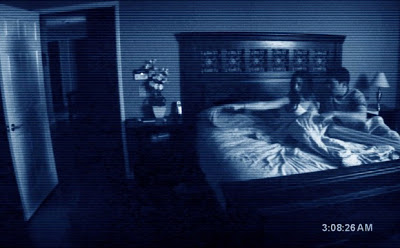
For example, the first film’s stroke of genius: the timestamp. Fucking brilliant. Here’s how it goes: The camera is on a tripod in the bedroom.

Katie and Micah are sleeping and time is fastforwarding and nothing’s happening, and time is fastforwarding and nothing’s happening, nothing’s happening, nothing’s happening. And then suddenly, the clock switches to REALTIME.
And you think, The clock must have stopped for a reason. Something’s going to happen. And they’re sleeping. And nothing’s happening. Nothing’s happening. Nothing’s happening. Fuck, what’s going to happen? Something’s going to happen! Let it fucking happen already! And then it happens and you’re startled – but the tension is released.
I call that a horrorgasm: tension builds and builds and builds and then finally the horrible thing happens, and it scares you but it feels good. The Paranormal Activity trilogy elicits multiples.

The timestamp from the first film still haunts me. Whenever I wake up in the middle of the night, my mind thinks OH FUCK I’M IN REALTIME WAS THAT A SOUND IN THE KITCHEN?

In the first film, the kitchen isn’t really a locus of horror. It’s featured in the requisite horror fake out: What’s that weird sound? Is it a demon? Nope, it’s the ice maker. Hahaha!

In the second and third film, horrible things happen to women in kitchens. Scary fucking things.

The second film’s genius is the multiplicity of cameras, capturing footage of the front stoop, backyard, the kitchen, the living room, the front door, and the nursery.
Add to that a handheld camera…
I told you, these people have money.

Here’s how it goes: Shot from the front door: nothing’s happening. Shot from the backyard: nothing’s happening. Shot from the kitchen: nothing’s happening. Shot from the living room: nothing’s happening. Shot from the foyer: nothing’s happening. Shot from the nursery: nothing’s happening. Shot from the backyard: nothing’s happening. Oh shit, did that pool cleaner thing move?

It’s tedious and somewhat irritating, but if the goal is to build tension before the real shit goes down, it works. Because boy does the shit go down…eventually.

In my estimation, the third film does an excellent job of utilizing both the timestamp and the multiple cameras – it was smart to use more than one camera like the first film, but also smart not to incorporate as many as the second film. To the cinematic mix, the third film adds an astoundingly effective method of capturing horrifying footage: strapping a camera to a fan. GENIUS.

If horror films have taught me one thing, it is that scary shit awaits behind corners. Liminal spaces are frightening places. The camera on the fan, constantly in motion, is constantly turning corners, showing you awful things, and terrifying you with the horror of the thing you cannot see. This is particularly well executed in a sequence involving the babysitter.
Speaking of the babysitter…let’s talk about the representation of female characters:

[WARNING: HEAVY DUTY SPOILERS AND CRITICAL ANALYSES AHEAD. ALSO NOT AS MANY PICTURES]

The horror genre has a tradition of terrorizing women, of chasing them through the woods and attacking them in houses. It also has a tradition of The Final Girl, a trope that is simultaneously empowering and reductive: the only survivor is a virginal woman who wields a phallic weapon and destroys the monster.

The PA trilogy features a different kind of Final Girl: she doesn’t kill the monster – she becomes it.

Here is the plot of each of the three films: a woman/women/girls are terrorized by a demon. A man puts cameras and captures scary-as-fuck footage until he is killed in a horrible way by a woman’s body powered by demonic forces.

“I’m a man and this is my house and I can protect it if I gain enough knowledge about my demonic adversary. Oh wait, no I can’t.”

Who is responsible for the demon’s success? Well, the demon itself, obvs, and the coven of women who made a bargain with it. But what about the three men who insist on filming the paranormal activity? Their actions certainly don’t seem to help the situation in any of the three films.

Micah (first film) is the cameraman most explicitly responsible for the escalation of the demonic presence. He insists on bringing a camera into their home, and he asks Katie “Do you know of any tricks to uh…make stuff happen?” and asks the psychic “Is there something we can do to like make stuff happen, you know, to like get it on tape?” Katie objects to Micah bringing home a Ouija board, but he does it anyway. He argues against bringing in an exorcist. He tells her, “This is my house, you’re my girlfriend, I’m going to fucking solve the problem.”

Micah’s actions and attempts to chronicle the demonic disturbances only seem to exacerbate those disturbances. James MacDowell at The Lesser Feat argues that Katie is subject to “a persecuted wife melodrama.” Jenn at XXBlaze claims that Micah is “a big stupid douche.” I agree with both of them.

I spent the entire movie thinking, “This asshole’s going to get his girlfriend killed.” But PA 1 flips it around, and it is demonically-possessed Katie who winds up killing Micah.

In the second film, Katie’s sister Kristi, Kristi’s husband Daniel, their toddler son, and his teenage daughter all live in the house afflicted by the paranormal activity. It is Daniel who decides to install cameras all over. He’s not a shithead like Micah; in fact, he isn’t even really excited by the activity. He’s the only one of the three cameramen who is a skeptic about its status as paranormal. He does fuck up by firing the nanny – the only person in the entire movie who actually understands how to engage with the demonic entity – because he doesn’t believe in “that stuff.”

Unfortunately, in Paranormal Activity 2, “that stuff” is real, and it really kills him.

The third film features footage of Katie and Kristi as children living with their mother (Julie) and stepfather (Dennis).

It is Dennis and his friend/employee Randy who take to setting up cameras all over the house. Dennis seems to have the least culpability – he neither desires the paranormal activity like Micah, nor does he deny that anything supernatural is going on like Daniel. Nevertheless, he winds up killed.

I don’t think the PA films suggest that the filmmaking is the catalyst for the paranormal activity, but I do believe they imply that the filmmaking exacerbates the demon’s antics.

In the first film, when Katie is frightened by the increase in the intensity of the activity, she tells Micah “Maybe we shouldn’t have the camera.” (Micah’s response is, “Uh, hello, this is some really golden shit.”)

In the second film, Katie tells Kristi: “It thrived on fear. The more we paid attention to it, the worse it got…You need to ignore it.”

In the third film, when a particularly fucking horrible thing is happening to Katie, Kristie shouts, “Just ignore it! Just ignore it!”

Focusing on the demon in one’s mind goads the demon; focusing on the demon with one’s camera seems to do the same. To varying degrees, each of these films implicates the man who set up the camera(s) – and by extension, the viewer.

See, Micah is an asshole, but we’re just like him: we want to see it, we want to see evidence of an entity. We strain to see it, to see any indication of it. We don’t sit down to see these films hoping to watch a bunch of people sleeping peacefully through the night. It’s called Paranormal Activity, not Paranormal Nothing’s Happening.

Micah winds up dead, and we wind up afraid of our ice makers.

Ironically, it is the physical manifestation of evil – when we see the demon possess a human body – that makes the endings of each of the three films so anticlimactic. The chief horror of these films lies in the visible invisibility of the entity.

Don’t get me wrong: a possessed person can be absolutely horrifying. But in a film so focused on the scariness of not being able to see the adversary, this sudden transition feels…weak.

My co-thinker on the matter pointed out to me that even though the lady becoming the demon (or the demon becoming the lady) kind of demystifies the evil, any visible adversary would have been anticlimactic. She points out that the filmmakers could have really fucked up by trying to show the audience a demon in demon form. I agree with her.

And despite the meh resolutions, the overall message of the trilogy is chilling: the compromises we make to ensure our wealth and prosperity may very well come back to bite us in the ass (or lower back). There Is No Such Thing As A Free Ginormous House.

The vast majority of these films are so cinematically strong (the horror of waiting, the horror of watching, the horror of things unseen) and so committed to the stories of their female characters (whose history is the catalyst for the events that unfold) that I’ll forgive them for their crappy endings.

I’m not sure I’ll be able to forgive Paranormal Activity 4.

I don’t have a problem with the fourth film departing from the first three by jumping forward in time. I think that featuring a woman filming herself via her laptop is a clever next-step in the PA tradition of innovative found-footage cinematography. I’m also glad that they’ve decided to continue keeping the focus on a female character.

So what’s the problem?

Look at the conventionally attractive young woman sleeping in her bed! It’s SEXY scary!

Yes, there are moments in the first three movies when the women are sexualized — but a sexualized woman’s body was never used to sell them.

I’m afraid to watch Paranormal Activity 4, but for the wrong reasons.

———-
Mychael Blinde is interested in representations of gender and popular culture and blogs at Vagina Dentwata

Horror Week 2012: Gender Roles in ‘The Cabin in the Woods’

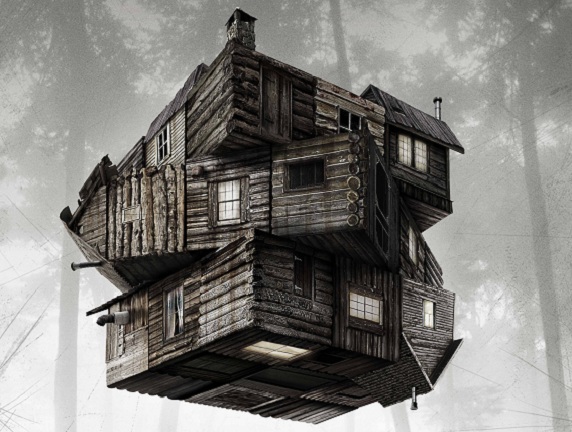
The Cabin in the Woods
A few months ago, the Joss Whedon-directed The Avengers was released, and there was much rejoicing. Fans seemed pleased. I saw it and enjoyed it, but I’m more obsessed with the OTHER Joss Whedon-directed film that came out this year. I loved The Cabin in the Woods and there are so many things I want to say about this movie, but for now I’m going to write about the interesting commentary on gender roles that was in the story.
WARNING: Spoilers ahead. Lots of them.
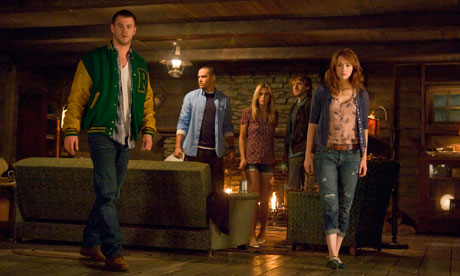
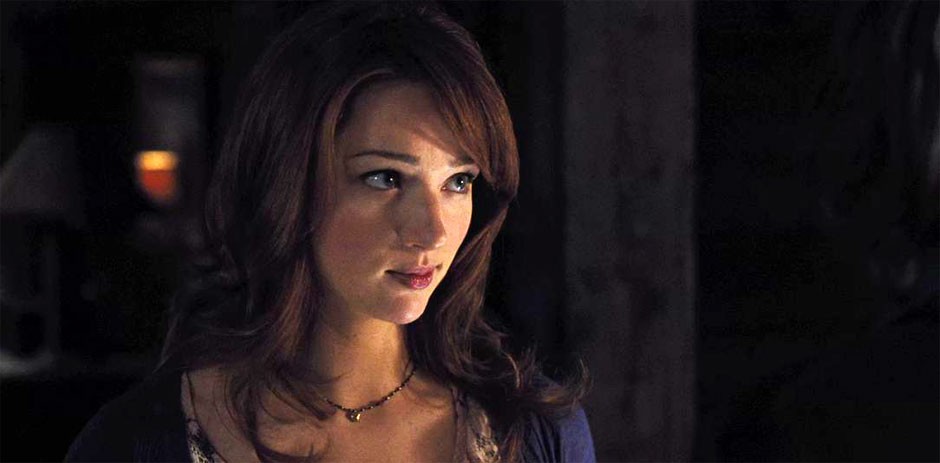
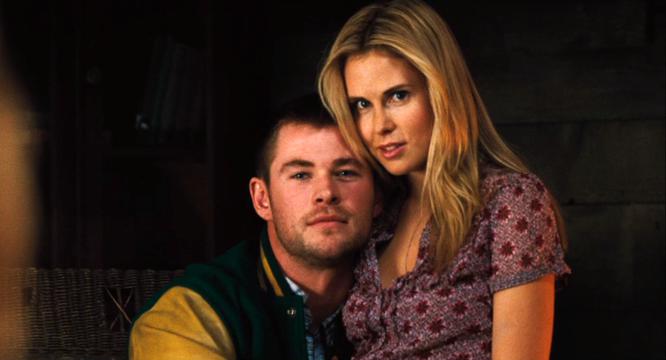
The Cabin in the Woods is more of commentary on horror films than a horror film in of itself, and the commentary comes to a head with the final scene, as the two survivors of the zombie attack confront the Director (played by Sigourney Weaver). She reveals that the five college students were selected to be killed as part of a ritual sacrifice to a group of ancient gods. Each student was meant to represent a different archetype: the Whore (Jules, played by Anna Hutchison), the Fool (Marty, played by Fran Kranz), the Athlete (Curt, played by Chris Hemsworth), the Scholar (Holden, played by Jesse Williams), and the Virgin (Dana, played by Kristen Connolly).
The five friends hear something in the basement.
Fans and critics have argued over the significance of the ancient gods and what they’re supposed to represent. I think the ancient gods are a metaphor for humanity’s deepest, darkest desires – the ugly side of human beings. This is why the final two survivors sit back and let the world end, instead of Dana killing Marty or Marty killing himself. As they say, if sacrificing people is the key to humanity’s survival, then maybe humanity doesn’t deserve to be saved. (I also think Joss really, really wanted to write at least one story where the world actually ends – there are only so many times that Buffy, Angel, Mal, or Echo can prevent the apocalypse before the writer gets bored.)
With that interpretation in mind, I started thinking about the five college students in The Cabin in the Woods and how their roles are defined by gender. The two women, Jules and Dana, are defined as The Whore and The Virgin – two opposite ends of the spectrum whose deaths are meant to serve as bookends for the others. The order of deaths is irrelevant except in the case of the women. Jules, as the corrupted Whore, has to die first, and Dana, the Virgin, has to die last, if she dies at all. As Hadley (Bradley Whitford) says, “The virgin death is optional as long as it’s last.” The female characters are defined only by their sexuality – nothing else about them really matters.
Dana (Kristen Connolly) will be very surprised to learn that she’s a virgin.
Still, the men don’t fare much better. Their prescribed roles are not based on how much sex they have and don’t have, but shoving them into the roles of The Athlete, The Scholar, and The Fool doesn’t give them much room to breathe, either. If you’re a woman, you can be the virgin or the whore. If you’re a man, you can be athletic or smart or funny. Complexity is not allowed.
What I find particularly interesting, though, is how the “puppeteers” (as Marty calls them) recognize that the five people they’ve selected for the sacrificed don’t easily fit into the prescribed archetypes.
Of the five, Holden is the closest to resembling his actual archetype. He’s able to calculate the distance in the gorge that Curt tries to jump on the motorcycle, and, well, he’s fairly quiet and wears glasses. He’s also ridiculously good-looking, which isn’t typical for the Scholar archetype, but other than that, he fits the role pretty well.
The athletic scholar (Jesse L. Williams) and the smart fool (Fran Kranz)
The same cannot be said for Curt and Jules. As Marty points out, “He’s a sociology major! When did he start pulling this alpha male bullshit?” The little we saw of Curt before the puppeteers started altering his personality was of a pretty intelligent young man who was nice to his friends. Similarly, Jules, a pre-med student, is a seemingly good friend who makes jokes with her boyfriend about anti-drug PSAs. But that won’t do – the puppeteers have to inject drugs into the air to make Curt more aggressive and alpha male, and they put cognition-lowering drugs in Jules’ hair dye to turn her into a dumb, overtly sexual blonde.
(On a side note, one of my favorite things about this movie is the moment where Jules comes onto Marty, calling him her old sweetheart, where he clarifies that they only made out one time. I completely expected a scene where Marty revealed his resentment towards the dumb whore who broke his heart and left him for the hot jock. Instead, Marty worried that this behavior was out of character for his good friends and seemed concerned for them. I really appreciated that Marty primarily saw Jules and Curt as his friends, and that once kissing Jules was such a non-issue for him.)
Curt (Chris Hemsworth) and Jules (Anna Hutchison) in happier times
Then there’s Dana, the so-called virgin – even though she slept with one of her professors, a fact that is mentioned in her first scene of the film. Dana’s behavior would probably be considered more “whorish” than Jules’s, as Dana is sleeping with a teacher and Jules is having sex within a monogamous relationship. But that doesn’t matter. Dana is still the virgin and Jules still the whore, because Dana is more quiet and subdued than Jules is, and American society thinks of virgins as quiet and subdued and sweet, and whores as brash and loud and more outgoing.
Finally, we have Marty, the Fool who is the first to understand that he and his friends are the victims of a conspiracy. In addition to being the most entertaining character of the five college students – because Fran Kranz is fantastic, even if he is playing a less creepy, more stoned version of Topher Brink in Dollhouse – he’s also the least subversive. Anyone exposed to a small amount of classical literature won’t be surprised to see the Fool as the smartest character of the group, which makes me feel like the puppeteers in The Cabin in the Woods all failed their English classes in high school. Still, he’s the one who throws the wrench in the plans to save the world by sacrificing a group of humans.
None of this analysis is new, but I brought it up because I want to return to my original point of the ancient gods representing our deepest, darkest desires. The ancient gods represent the ugliest traits of humanity – not only the lust for blood, but the need to categorize people into certain roles and to keep them there. We need to see men defined by one character trait and women defined by their sexual choices, and if these particular men and women don’t fit into the roles as we’ve prescribed them, we’ll make them fit. We’ll alter their personalities so they can easily fit into the Whore, the Scholar, the Athlete, the Fool, and the Virgin. And as we can see from the other countries’ failed attempt to appease the gods – including the Japanese tradition of unleashing one monster on a group of elementary school girls – this need to categorize into the Whore/Scholar/Athlete/Fool/Virgin is a uniquely American desire. The desires created by nature and nurture clash together in an ugly mix where we want to see these people killed one by one in a prescribed order.
Yeah, I really loved this movie.
The white board of monsters behind Richard Jenkins distinguishes between “witches” and “sexy witches.”
 
Lady T is a writer with two novels, a play, and a collection of comedy sketches in progress. She hopes to one day be published and finish one of her projects (not in that order). You can find more of her writing at www.theresabasile.com.

Horror Week 2012: The Nervous Wife: Horror Stereotype or Statement on American Masculinity?

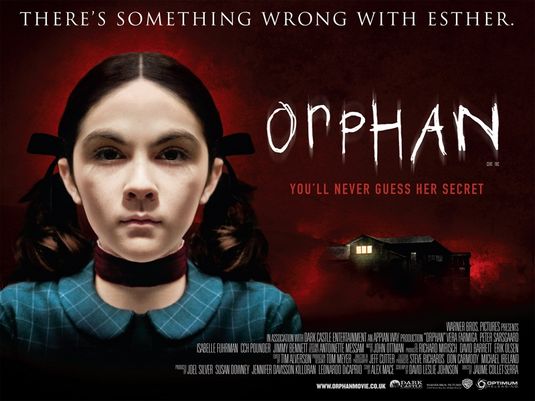
orphan_ver3

This is a guest review by Tamara Winfrey Harris. Includes spoilers for Paranormal Activity (2007) and Orphan (2009).

There, outside the window, in the dark, are those eyes again. Yellow. Animal, but at the wrong height to be a coyote or fox–human height. And those amber, animal eyes are locked on hers. She slams shut the kitchen curtains and races to the living room window. The eyes are there, too, peering from the family’s wooded lot outside of town. Family. She thinks of her sleeping child down the hall and her heart beats faster. She shuts off the lights, hiding herself and her little girl from the gaze of whoever, whatever, is outside, and she dials the police. They arrive, lights flashing, just as her husband’s truck pulls into the driveway. They find nothing. The head cop chuckles, patting her on the shoulder, while looking at her husband, “Don’t worry. I think we just have a case of nervous wife here.”

Thank you, Paranormal Witness (Syfy, Wednesdays, 10 p.m. ET), for giving me a name for a ubiquitous horror trope. It goes like this: Woman begins to experience disturbing things. She shares this with her male partner (or other man), who responds by patronizing her, saying she is tired, silly, imagining things, nervous. It is only when the occurrences escalate and the male protagonist himself experiences something otherworldly that he will believe.

Call it The Nervous Wife, which is more concise than “women are super emotional, illogical and fearful and cannot be trusted.”

The Nervous Wife is a staple of the haunted house film genre, and now that paranormal shows are slowly taking over the small screen, it can be found there, too. In the first season of the FX channel’s American Horror Story, the character Vivien Harmon had to be committed and impregnated with a devil baby, and her teenage daughter dead and haunting the family abode, before her husband would believe that something spooky was going down.

Yes. Yes. I know. Science says ghosts and goblins and such don’t exist. True enough. It is natural for a body to be skeptical of supernatural claims. Would you believe it if you were told the portal to hell was in your laundry room? Likely not. The problem is that women in horror films are rarely, if ever, the skeptical ones. Logic is portrayed as a man thing. Little ladies are quick to believe the unbelievable. And to be frightened by it.

An example of this can be found in the horror juggernaut Paranormal Activity. In it, a young couple, Katie and Micah, live in a subdivision tract house that is plagued by threatening phenomena. Katie, who endured a brush with the supernatural as a child, is fearful and seeks relief from a psychic, who counsels that the best thing to do, until the home can be cleansed, is not to engage the spirit. In this instance, the male protagonist believes in the haunting; he does not, however, believe anyone’s advice on handling the problem. In a perfect illustration of male privilege and bullying in action, Micah dismisses the expert advice and laughs off Katie’s fear of an increasingly-menacing spirit. As his girlfriend becomes more frightened, Micah becomes more oblivious to her and her concerns. By the end of the film, their relationship feels uncomfortably emotionally abusive, with Katie withdrawing and Micah seemingly doing everything possible to provoke the thing that is terrorizing his mate.

There is often another feature of The Nervous Wife trope. Once the male protagonist (partner of The Nervous Wife) realizes a place is infested with spectres, he will not be cowed. Like a drunken dude bro outside the bar at 2 a.m., a dog protecting his territory, or Tom Petty–he won’t back down. He will rage. He will threaten to beat a demon’s ass. (The manly crew on The Travel Channel’s Ghost Adventures is all about this method of posturing ghost busting, which makes them ripe for parody.) He will refuse to relocate. He will reject fear in favor of wrong-headed investigation. All this, even if it causes an escalation in dangerous activity or discomfort for his loved ones.
At first glance, the message is clear: Men are logical and brave protectors who do what needs to be done–even over the objections of lesser beings. Women, on the other hand, are emotional and fearful and need to be protected. But there is a twist. In most cases the female protagonist is proven right. And, as a result of his hubris and general assholery, the male protagonist sometimes meets a bad end, as in Paranormal Activity or Orphan, a horror/thriller where a doomed husband refuses to believe that his adopted child is really a murderous woman with hypopituitarism until he’s stuck on the end of her knife.

On Facebook, my buddy Barry pegged The Nervous Wife trope as “a statement against the traditional macho sexism of the American male.” Bravado, aggression and ignoring the needs of others is a losing approach–at least against the supernatural. I think he may be right, but The Nervous Wife trope is still troubling, even if it is a deserved jab at patriarchy.

The problem is that the trope, while weirdly subversive, is ultimately regressive. The aforementioned narratives all embrace rigid, traditional gender lines for male and female protagonists. They then reject masculinity as ultimately useless and harmful. But why are they so invested in base, simplistic and incomplete illustrations of masculinity and femininity in the first place? The women I know are far braver and more logical than their horror flick counterparts; the men more caring and thoughtful. And while I know Hollywood is not real life, I also know that it is possible to draw complex fictional characters that are not caricatures of their respective genders.

For once, I’d like to hear a horror husband respond to his wife’s concerns with “Let’s call the cops and check that out!” (because you are normally a really smart and level-headed woman and I trust your judgment), or a solicitous miss calm her demon-plagued boyfriend with a “Darling, you’ve been working too hard. Perhaps you’re just nervous.”


Tamara Winfrey Harris is a freelance writer living in the Indianapolis area. Her work focuses on race and gender, and their intersection with pop culture and politics. She is currently senior editor at Racialicious and a contributor to Clutch and Frugivore magazines. Tamara is working on her first book–a feminist exploration of black women and marriage, and the sexist and racist underpinnings of the “black marriage crisis” narrative.

Learn more about Tamara and her work at her website.

The Terror of Little Girls: Social Anxiety About Women in Horrifying Girlhood

Horror films have a long-standing tradition of commenting on the social fears and anxieties of their time.
Another universally recognized truth of horror is that scary children are terrifying–especially little girls.
While an analysis of “creepy children” in horror films usually proclaims that they are providing commentary on a loss of innocence, and it would make sense that a little girl is the “ultimate” in innocence, it can’t be that simple. We wouldn’t be so shaken to the core by possessed, haunted, violent little girls if we were simply supposed to be longing for innocent times of yesteryear.
Instead, these little girls embody society’s growing fears of female power and independence. Fearing a young girl is the antithesis of what we are taught–stories of missing, kidnapped or sexually abused girls (at least white girls) get far more news coverage and mass sympathy than stories of boy victims. Little girls are innocent victims and need protection.
In the Victorian era, the ideal female was supposed to be pale, fainting-prone and home-bound. Feminist literary icons Sandra M. Gilbert and Susan Gubar write about this nineteenth-century ideal in The Norton Anthology of Literature by Women:

“At its most extreme, this nineteenth-century ideal of the frail, even sickly female ultimately led to the glorification of the dead or dying woman. The most fruitful subject for literature, announced the American romancer Edgar Allan Poe in 1846, is ‘the death… of a beautiful woman’… But while dead women were fascinating, dying girl-children were even more enthralling… These episodes seem to bring to the surface an extraordinary imperative that underlay much of the nineteenth-century ideology of femininity: in one way or another, woman must be ‘killed’ into passivity for her to acquiesce in what Rousseau and others considered her duty of self-abnegation ‘relative to men.'”

The feminine “ideal” (and its relation to literature) coincided with women beginning the long fight for suffrage and individual rights. It’s no surprise, then, that men wanted to symbolically kill off the woman so she could fulfill her ultimate passive role. There was something comforting about this to audiences.
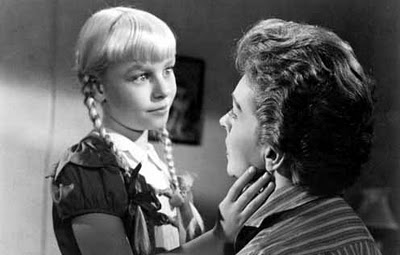
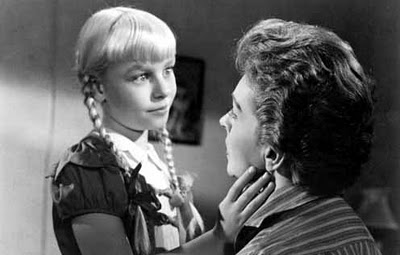
Rhoda Penmark will not lose to a boy. Or anyone else.
Fast forward to the 1950s and 60s, and the modern horror genre as we know it emerged and began evolving into something that provided social commentary while playing on audiences’ deepest fears (the “other,” invasion, demonic possession, nuclear mutations and the end of the world).
We know that horror films have always been rife with puritanical punishment/reward for promiscuous women/virgins (the “Final Girl” trope), and violence toward women or women needing to be rescued are common themes. These themes comfort audiences, and confirm their need to keep women subjugated in their proper place. It’s no coincidence that the 50s and 60s were seeing sweeping social change in America (the Pill, changing divorce laws, resurgence of the ERA, a lead-up to Roe v. Wade).
Terrifying little girls also make their debut in this era. Their mere presence in these films spoke not only to audiences’ fears of children losing innocence, but also the intense fear that little girls–not yet even women–would have the power to overthrow men. These girl children of a generation of women beginning a new fight for rights were terrifying–these girls would grow up knowing they could have power.
The Bad Seed‘s Rhoda Penmark (played by Patty McCormack in the 1956 film), genetically predisposed to be a sociopath, murders a classmate and the janitor who suspects her. Her classmate–a boy–beats her in a penmanship contest, and she beats him to death with her tap shoes. A little girl, in competition with a boy, loses, and kills. While in the novel Rhoda gets away with her crimes, the Hays Code commanded that the film version “punished” her for her crimes and she’s struck by lightning. It’s revealed that Rhoda’s sociopathic tendencies come from her maternal grandmother, a serial killer. This notion of female murderous rage, passed down through generations and claiming boys/men as its victim, certainly reflects social fear at the time.
In 1968, Night of the Living Dead premiered on big screens and has been seen as commenting on racism/the Civil Rights movement, Cold War-era politics and critiquing America’s involvement in the Vietnam War. However, little Karen Cooper’s (Kyra Schon) iconic scene has long disturbed audiences the most. Infected by zombies, she eats her father and impales her mother with a trowel. A horror twist to an Oedipal tale, one could see Karen as living out the gravest fears of those against the women’s movement/second-wave feminism. Possessed by a demon, she eats her father (consumes the patriarchy) and kills her mother (overtaking her mother’s generation with masculine force).
Little Karen Cooper consumes patriarchy and overtakes her mother.
Five years later, Roe v. Wade had been decided (giving women the right to legal first-trimester abortions), the Pill was legal, no-fault divorce was more acceptable and women began flooding the workforce.
Meanwhile, on the big screen, sweet little Regan MacNeil–the daughter of an over-worked, atheist mother–becomes possessed by the devil.
The Exorcist was based on a novel, which itself was based on the exorcism case of a little boy. Of course, the novelist and filmmakers wanted audiences to be disturbed and terrified, so the sex of the possessed protagonist changed (would it be as unsettling if it was a little boy?).
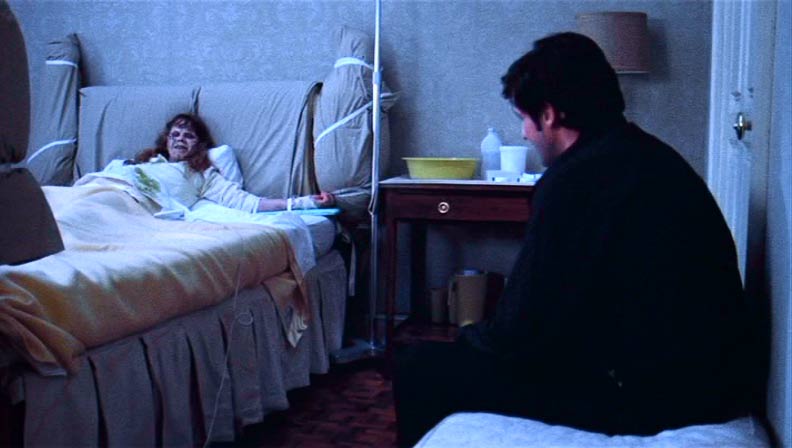
Chris MacNeil, Regan’s mother, goes to great lengths to help her daughter, and resorts to Catholicism when all else has failed. Regan reacts violently to religious symbols, lashes out and kills priests, speaks in a masculine voice and masturbates with a crucifix. This certainly isn’t simply a “demonic possession” horror film, especially since it was written and made into a film at the height of the fight for women’s rights (the Catholic church being an adamant foe to reproductive rights). Only after Regan releases her demon, which possesses a priest (who flings himself out of a window to commit suicide), does she regain her innocence and girlhood.
Tied and bound, Regan haunts and kills men, and reacts violently to religious images.
What her mother and her culture are embracing–atheism, working women, reproductive rights, sexual aggressiveness–can be seen as the “demons” that overcome the innocent girl and kill men (and traditional religion).
These films are have terrified audiences for decades, and for good reason. The musical scores, the direction, the jarring and shocking images–however, they also play to society’s deepest fears about women and feminism. For little girls to be possessed is the ultimate fall.
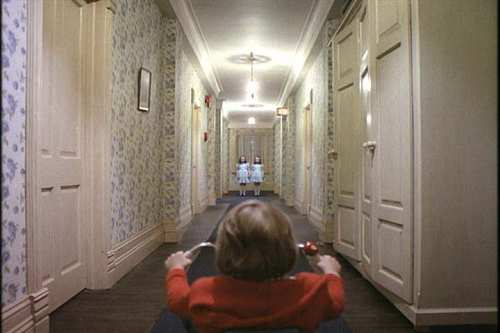
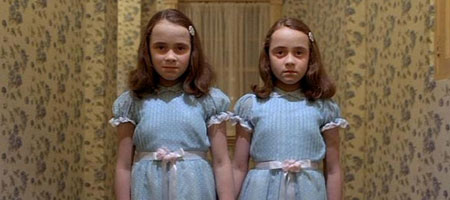
In 1980, The Shining was released. Yet another film adaptation of a novel (Stanley Kubrick’s treatment of Stephen King’s novel), this film contains two of the creepiest little girls in film history–the Grady girls. The Shining shines a light on crises of masculinity. Jack Torrance, played by Jack Nicholson, is a recovering alcoholic who has hurt his son, Danny, in the past. When he takes his wife, Wendy, and son with him to be caretakers of a hotel over a winter, his descent into madness quickly begins. Danny has telepathic abilities, and sees and experiences the hotel’s violent past. As he rides his Big Wheel through the hotel, he stops when he sees two little girls begging him to “Come play with us Danny. Forever.” These girls–dead daughters of Grady, a previous caretaker who killed his family and himself–are trying to pull Danny into their world. Danny sees images of them murdered brutally, and flees in fear. Meanwhile, Jack is struggling with his alcoholism, violence and lack of control of himself and his sensitive wife and child. When he sees Grady, Grady advises him:

“My girls, sir, they didn’t care for the Overlook at first. One of them actually stole a pack of matches, and tried to burn it down. But I ‘corrected’ them sir. And when my wife tried to prevent me from doing my duty, I ‘corrected’ her.”

Danny is confronted with the horror of what men are capable of.
In this aftermath of the women’s movement, Jack (a weak man, resistant to authority) is being haunted and guided by a forceful, dominating masculinity of the past. He’s stuck between the two worlds, and succumbs to violent, domineering alcoholism.
But he loses. Wendy and Danny win.
While his predecessor succeeded in “correcting” his wife and daughters, that time has past.
Here, the flashing memories of the ghosts of the past are terrifying. The Grady girls provide a look into what it is to be “corrected” and dominated.
“Come play with us Danny,” the girls beg, haunting him with the realities of masculine force and dominance.
Starting with the late-70s and 80s slasher films (and the growing Religious Right/Moral Majority in politics), the “Final Girl” reigned supreme, and the promiscuous young woman would perish first. Masculinity (characterized with “monstrous” violence and strength) and femininity became natural enemies. These fights on the big screen mirrored the fights in reality. The Equal Rights Amendment was pushed out of favor and was never ratified, and a growing surge of conservatism and family values began dominating American rhetoric.
In the late 90s and early 2000s, we see a resurgence of the terrifying little girl. This time, she is serving as a warning to single/working/independent/adoptive mothers.
In The Ring (the 2002 American adaptation of a 1998 Japanese film), Rachel Keller (played by Naomi Watts) is a  journalist and a single mother. She unknowingly risks her son and his father’s lives by showing them a cursed videotape. A critic noted:

“If she had never entered the public sphere and viewed the cassette in the first place, she would not have inadvertently caused Noah’s death, nor would she have to potentially cause the death of another. Rachel would, perhaps, have been better off staying at home.”

Single motherhood has often been the driving force behind horror plots.
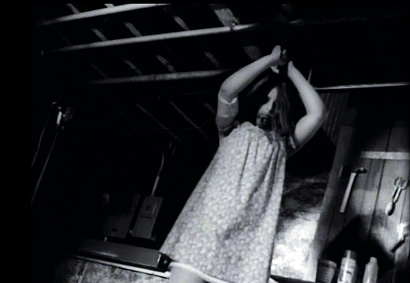
In her investigation into the video, she discovers the twisted, dark past of the video’s subject, Samara, a young girl who started life troubled (her birthmother tried to drown her). She was adopted by a couple, but her adoptive mother suffered from visions and haunting events due to Samara’s powers. They attempted to institutionalize Samara, but eventually the adoptive mother drowns her in a well after Samara cannot be cured of her psychosis. Her adoptive father, Rachel finds, locked Samara in an attic of their barn, and Samara left a clue of the well’s location behind wallpaper. (Bitch Flicks ran an excellent analysis of the yellow wallpaper and the themes of women’s stories in The Ring.)
Samara’s life was punctuated by drowning, which has throughout history been a way for women to commit suicide or be killed (symbolizing both the suffocation of women’s roles and the return to the life-giving waters that women are often associated with). While Rachel “saves” Samara’s corpse and gives her a proper burial, Samara didn’t want that. She rejected Rachel’s motherhood and infects Rachel’s son. Rachel–in her attempts to mother–cannot seem to win.
Rachel “saves” Samara from her watery grave, but she still cannot succeed.
The ambiguous ending suggests that Rachel may indeed save her son, but will have to harm another to do so. This idea of motherly self-sacrifice portrays the one way that Rachel–single, working mother Rachel–can redeem herself. However, the parallel narrative of the dangers of silencing and “locking up” women is loud and clear.
And in 2009’s Orphan, Esther is a violent, overtly sexual orphan from Russia who is adopted by an American family. Esther is “not nearly as innocent as she claims to be,” says the IMDB description. This story certainly plays on the fear of the “other” in adopted little girls (much like The Ring) and how that is realized in the mothers. In this film, Esther is actually an adult “trapped” in a child’s body. The clash of a childish yet adult female (as culturally, little girls are somehow expected to embody adult sexuality and yet be innocent and naïve) again reiterates this fear of little girls with unnatural and unnerving power. The drowning death of Esther, as her adoptive mother and sister flee, shows that Esther must be killed to be subdued. The power of mother is highlighted, yet the film still plays on cultural fears of mothering through international adoptions and the deep, disturbing duality of childhood and adulthood that girls are supposed to embody.
Like Samara, Esther is a deeply disturbed daughter, capable of  demonic violence.
In the last 60 years, American culture has seen remarkable change and resistance to that change. Horror films–which portray the very core of society’s fears and anxieties–have reflected the fears of women’s social movements through the faces of terrifying little girls.
While nineteenth-century literature comforted audiences with the trope of a dead, beautiful woman, thus making her passive and frail (of course, we still do this), twentieth and twenty-first century horror films force audiences to come face to face with murderous, demonic, murdered and psychotic little girls to parallel fears of women having economic, reproductive, parenting and marital (or single) power.
Little girls are supposed to be the epitome of all we hold dear–innocent, sweet, submissive and gentle. The Victorian Cult of Girlhood and Womanhood bleeds into the twenty-first century anti-feminist movements, and these qualities are still revered.
Horror films hold a mirror up to these ideals, distorting the images and terrifying viewers in the process. The terror that society feels while looking at these little girls echoes the terror it feels when confronted with changing gender norms and female power.


Leigh Kolb is a composition, literature and journalism instructor at a community college in rural Missouri. 

Horror Week 2012: Portrait of the Artist as the Demon’s Best Friend Forever

Jennifer’s Body (2009)
This is a guest post from Erin Blackwell.
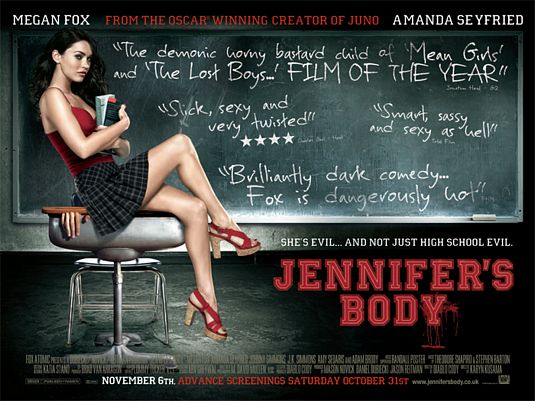
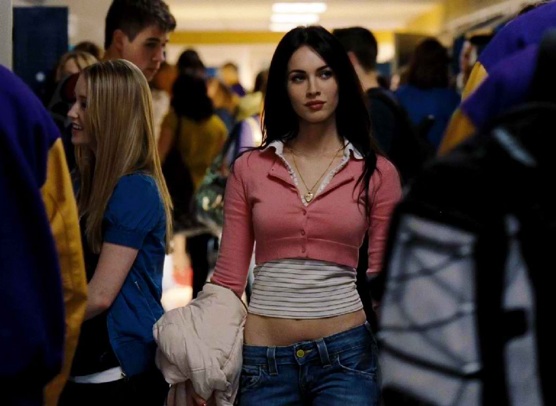
Jennifer’s Body, the 2009 horror chick-flick that was a coming-of-age for sex goddess Megan Fox after hyper-lucrative, career-building toil under the aegis of Michael Bay’s teenage-boy-centric Transformers franchise, now enjoys a cult following outside the Transformers demographic. And yet, on release, Jennifer’s Body was widely panned by reviewers who were oddly outraged by its unworthiness. (Maybe they were bought off, but that would be another story.)
Maybe the male critics and audience somehow sensed this was the break-up film. Simultaneous to its release, Fox untied her tongue in interviews, famously comparing the Transformers director to Hitler, a salvo that sealed her fate with the franchise and, at least initially, its fans. They felt betrayed.
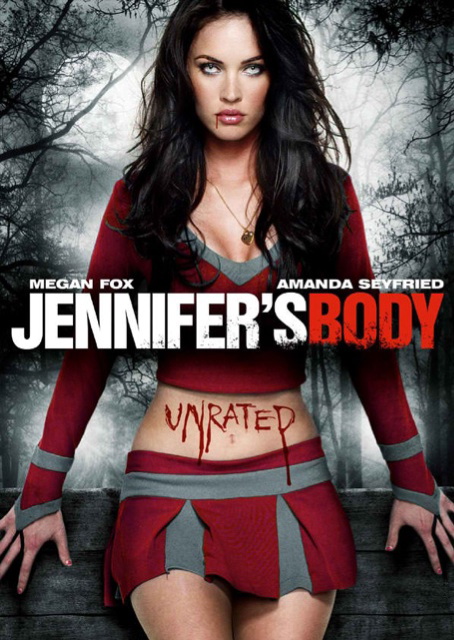
Megan Fox as Jennifer
They were right, they had been betrayed: by their own phallocentric delusion that women exist to serve men, and its tributary delusion that Megan Fox enjoyed performing the objectified sidekick to Shia LeBoeuf’s action hero, and more poignantly, that she intuited from the far side of the screen how hot she made them, each guy individually, and that meant something to her beyond a sense of power and a pay check. She was their admission-priced, inaccessible, fantasy, group girlfriend. Until she wasn’t any more. Sorry, Boys. Game over.
It took chutzpah to give Bay that well-publicized kiss-off. The same year Jennifer’s Body, directed by Karyn Kusama, grossed $30 million worldwide on a $15 million budget and uniformly dismal reviews, Transformers: Revenge of the Fallen, directed by Michael Bay, grossed $400 million on a $200 million budget. (But that’s yet another story.)
SPOILER ALERT: Out of respect to writer Diablo Cody’s wondrous storyline, I’m not pretending this movie is only worth seeing once and in total ignorance. In fact, it must be seen at least twice to be fully appreciated. Call it complex storytelling, hidden depth, flaws in the plot structure and/or direction, or all of the above.
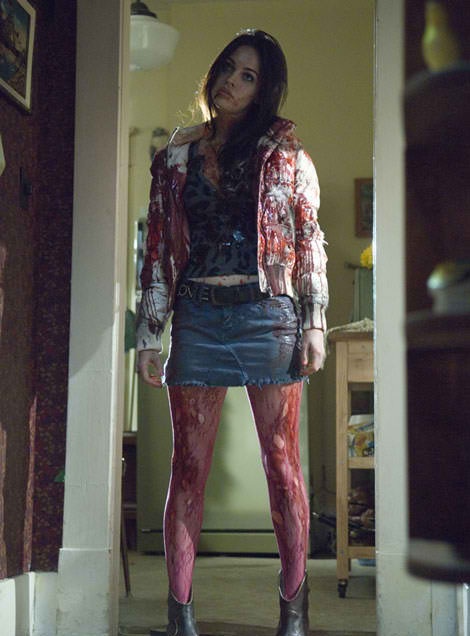
Jennifer’s Body is the story of a lush cheerleader ritualistically murdered by the cute lead singer of boy band Low Shoulder, in a pact with the Devil for fame and stardom. Unfortunately for the teenage males of suburban Devil’s Kettle, the cheerleader is thereby transformed into a bite’em’n’eat’em serial killer, selecting, seducing, and isolating male classmates before offing them at their most pathetically tumescent — on the brink, they think, of experiencing the private pleasures of her flesh. Bummer for the guys onscreen and a refreshing, amusing twist for a jaded female audience.
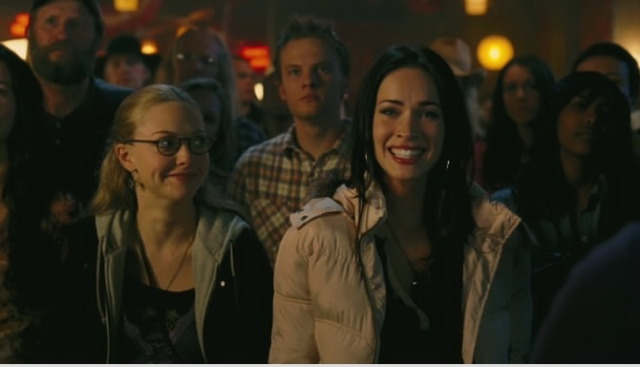
Needy (Amanda Seyfried) and Jennifer (Megan Fox)
Demon-Jennifer is a bodacious avatar of female rage — plus other less righteous emotions, hormones, and vanities. Her story is told by best friend Anita, nicknamed Needy, the gawky sidekick in glasses who’s a bit smitten by Jennifer’s “saltiness.” Needy eventually figures out her friend is “actually evil.” For her boyfriend Chip’s sake, Needy is forced to fight her to the death. As narrator, Needy frames the action, told in flashback, from her prison cell. This formal device complicates the plot but pays off in a clever denouement shown in a montage of stills and video under the closing credits. As I write that sentence, I have to wonder why this vital piece of story — Needy’s revenge massacre of Low Shoulder — is relegated to an afterthought.
So, it’s a (media) story within a (movie) story, a star within a character, and a film within a genre or two. Any way you slice it, Jennifer’s Body is disputed territory — which gives that awkward title the post-modern cachet of multiple readings. Is it slasher? Chick flick? Coming-of-age? Vampire? Feminist? Yes, yes, yes, yes, yes. It’s even vampire-lesbian, a tease it declines to exploit; teen psycho, cultural satire, and New Romantic.
Amanda Seyfried as Needy
Two things make the film hard to watch, or clearly “see.” First, Megan Fox’s bravura glamour. As Needy, Amanda Seyfried is every inch an actress and holds her own, but Kusama’s camera gives Fox’s fearsome symmetry the kind of attention ultimately detrimental to a storyline. No one’s going to complain, but droolworthy Fox detracts from Needy’s story, and that’s a problem because Needy is our low-profile protagonist, and she bookends the film. For the script to work, we have to root for both halves of this dynamic duo, until we let go of Jennifer and follow Needy, whose rage is less psychosis and more personal-is-political focus.
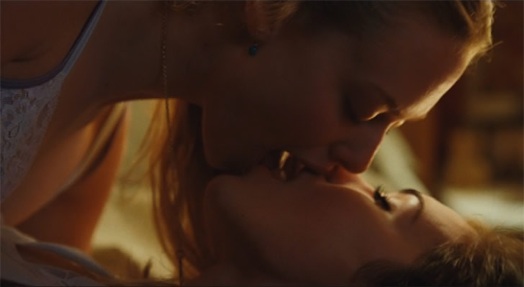
Second, Diablo Cody’s free-form plotting, with its gratuitous flashbacks and ill-timed exposition, impedes the film’s forward drive. The most glaring example comes three-quarters in, when Jennifer suddenly decides to let Needy and the audience in on the details of her own heinous murder. We don’t know why we’re suddenly watching a missing narrative chunk in flashback, but the footage is compelling and when it’s over, Jennifer suddenly comes on to Needy in their much hyped lesbian moment. Heat trumps logic, just like in high school. Are they going to do it? No. Was it actual lesbian heat? Um. Can hormonally unstable Jennifer’s power plays be assigned a stable orientation other than “on?”
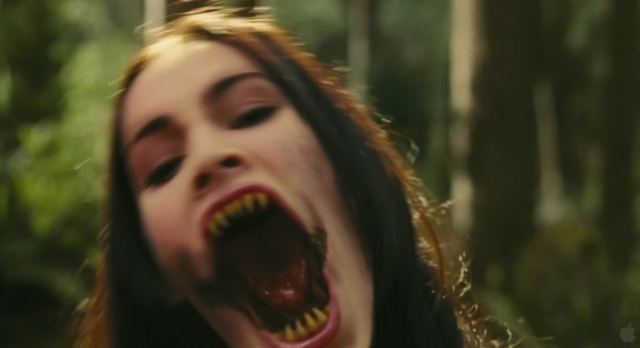
Demon Jennifer
Since Jennifer herself is clueless how she returned from the dead, Needy makes a trip to the Occult section of the campus library to discover “demonic transference happens when you try to sacrifice a virgin to Satan who isn’t an actual virgin.” Great. Now Needy’s best friends with a demon. She tries to warn Chip, who, as her boyfriend, is the obvious next victim on Jennifer’s list of perversions.
Needy: Jennifer’s evil.
Chip: I know.
Needy: No, I mean, she’s actually evil. Not high-school evil.
Such stock-in-trade dialogue wherein the danger to an individual or the community is willfully ignored, is kept to a minimum, yet it’s one of the treats of the monster genre. Remember the original Dracula (1931), with Bela Lugosi? It’s worth a look, in sumptuous black and white. Yes, it’s ham-fisted, stilted, stagey, featuring a bat on a string, but it’s pretty authoritative about Transylvanian vampire lore — sleeping habits (coffin, native soil, diurnal), telltale signs (no reflection in mirrors, fear of sunlight), and remedies (garlic, crosses, stake through heart). Tracking and dissecting vampire quirks is half the fun of having them around.
Vampire trope
The pleasure of recognition, that ghastly chill down the spine, is mostly missing here, because this is less a genre movie than a rite of passage dressed-up in the tropes of horror. Emotion, intuition, everyday telepathy between close friends are on a sliding-scale from everyday reality to full-blown inexplicable mayhem. Rules governing demons are introduced piecemeal, and Jennifer’s sudden new talents — like projectile vomiting black goo — are momentary gross-outs devoid of gravitas. Such tricks work less well a second time. Worse, Jennifer’s ability to rise in the air and hover is abruptly revealed in the climactic fight scene to no strategic advantage. Surprising but not really satisfying, the hovering trick later powers Needy’s prison escape. Is that why it was introduced when it wasn’t necessary?
So, okay, Cody’s script is loose-weave. It’s also fresh, grrrl-centric, fed-up with male ego/privilege, and full of satiric touches. And yeah, Megan Fox overwhelms the cast and crew with her performative beauty, but she’s both a great icon for most-popular-cheerleader-with-perfect-cheekbones and a recognizable teenager: a bipolar wreck under her foundation, an insecure bitch seducing her best friend’s boyfriend, a naive groupie seeking validation from a small-time boy band “from the city.”
The central pleasure of Jennifer’s Body — the confusing love Needy feels for Jennifer, and the trouble she takes to clarify that feeling, and act on it (revenging Chip), then act on it again (revenging pre-demon Jennifer) — might be precisely what turned off male reviewers. For all the promise of eye candy going in, this is a story about young women negotiating the horrors of the adolescent-to-adult obstacle course with some dignity, loyalty, and social conscience intact. The infamous male gaze has to work harder to appropriate a film told from the p.o.v. of cute but bookish, shy but self-respecting Needy, whose closest bond is, and might ever be, her friend Jennifer.
The two girls have four big scenes together:
Date with Destiny: Jennifer uses Needy as a disposable date in her quest for the Low Shoulder lead singer, to the annoyance of Chip, who had a date with his girlfriend. When bad things start to happen at the rustic Melody Lane Tavern, Jennifer ignores Needy’s screams to leave. Oblivious to danger or perhaps unconsciously courting self-destruction, Jennifer gets into the band’s scuzzy retro van. Cue: loss of innocence.
Jennifer and Needy’s much-hyped lesbian moment
Same-Sex practicum: Jennifer hides in Needy’s bed, confesses her own murder, then starts making love to Needy, who lets herself go until she jumps off the bed screeching, “What are you doing?” By scene’s end, Needy knows she has to be the adult.
Prom Night from Hell: in a swampy, abandoned public pool, Jennifer kills Chip and fends off a tongue-lashing from Needy before slithering away without eating his flesh. This climactic scene is less exciting than it should be, crushed under the weight of an overly elaborate set and Jennifer’s ho-hum hovering, but signals the beginning of the end.
Liebestod: Jennifer’s bedroom, when Needy comes in through the window to kill her. In this passionate encounter, the two young women fight like wildcats on the bed and in the air. The fight is physical, metaphysical, and deeply emotional. When Needy rips the BFF locket from around her neck, Jennifer’s eyes register defeat, loss, submission. If she’s not Needy’s best friend forever, what’s the point of immortality? With suddenly slack lids, she gazes into Needy’s eyes in eroticized surrender. How do you spell Romantic death wish? Finally, Needy has topped Jennifer. Maybe that’s all she ever wanted. Then comes the death blow: box cutter to the heart. Wow.
Online movie review clearinghouse Rotten Tomatoes gives Jennifer’s Body a measly 43% rating, which I take as an indication of factors, like misogyny and male entitlement, beyond the reach of wonderful filmmaking. Their summary judgment: Jennifer’s Body features occasionally clever dialogue but the horror/comic premise fails to be either funny or scary enough to satisfy. I guess it all depends on who you’re trying to “satisfy.”
———-

Erin Blackwell is a practicing astrologer who blogs at venus11house and pinkrush. Congratulations to Megan Fox and Brian Austin Green on their new baby boy.

Horror Week 2012: ‘The Strangers’: The Horror of Home Invasion and the Power of the Final Girl

 
Guest post written by Mychael Blinde. Originally published at Vagina Dentwata. Cross-posted with permission.
The home invasion horror film The Strangers received bad reviews. Like, really bad. Critics wrote things like:
“What a waste of a perfectly good first act! And what a maddening, nihilistic, infuriating ending!”

and:
“Kind of like what The Shining might be if you took out the ESP. And the ghosts. And the chilling atmosphere. So call it The Sucking.”

But The Strangers totally works for me as both a horror fan and a feminist. Here’s why: 
As a horror fan: 
The film opens with Kristin (Liv Tyler) and James (Scott Speedman) driving to his parents’ rural summer home in uncomfortable silence. We learn that they have come from a friend’s wedding, at which James proposed to Kristen. Kristen has rejected his proposal, not because she doesn’t love James, but because she isn’t ready to get married. 
The sense of discomfort and unease we feel at the couple’s awkward, painful situation transforms into a sense of fear and alarm with a loud knock on a large door at 4 in the morning. We are emotionally invested in the characters when the shit starts to go down — and boy does shit go down. But The Strangers takes its time. 
The cinematography contributes to the film’s tone of discomfort: the camera is never steady, and the subtly shaky hand held shots jostle the viewer. Director Bryan Bertino makes great use of wide angle shots, forcing the viewer to strain hir eyes looking for the killer in the peripheral screen space. 
Kristin (Liv Tyler) in The Strangers | I spy with my little eye a creepy-as-fuck guy!
The sound effects are equally disconcerting. The Strangers assaults the audience with banging and crashing, and most terrifying of all, with silence. It insists that its audience listen; diegetic sounds like a repeating record player situate the audience in the film’s world. And in case you had any doubts, Liv Tyler can scream. 
The aesthetic has a vaguely 70s feel (the car, record player), but The Strangers dates itself as late 00s by the two silver flip cell phones. The 70s props and look, paired with the strong sense of rural-areas-are-scary-places-full-of-psycho-killers urbanoia and the masked* assailants call to my mind The Texas Chainsaw Massacre. But in The Texas Chainsaw Massacre, it is not the psycho killers who invade the house, but their victims.  
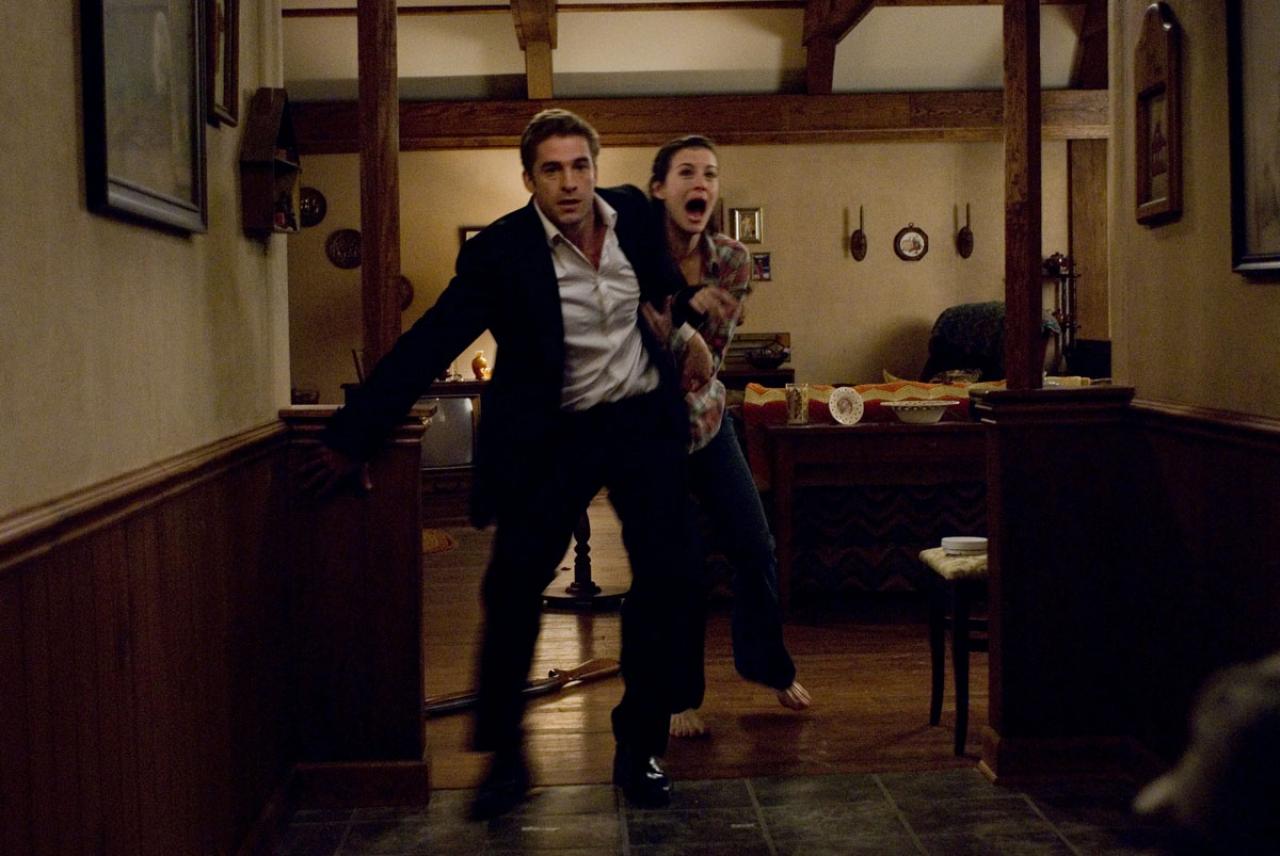
James (Scott Speedman) and Kristin (Liv Tyler) in The Strangers
 
The Strangers is a more like Funny Games: it’s a home invasion horror in which the violence is presented as horrible, inexplicable, and inevitable. Director Michael Haneke created Funny Games as a reaction to (and criticism of) the Quentin Tarantino style of glamorized violence. Funny Games explicitly asks its audience to think about why we enjoy watching horrible things being inflicted upon people.  
The Strangers doesn’t take things that level of meta cinematic criticism, but it makes its point. 
The Strangers | “Why are you doing this?” “Because you were home.”
Sometimes humans do awful things to other humans for no reason at all. Violence is always horrific, and sometimes it is senseless and inexplicable. In the wake of the shooting at the screening of The Dark Knight Rises — a movie that certainly falls into the category of stylized violence — the representation of violence as ugly and meaningless in The Strangers resonates strongly with me. 
As a feminist: 
Kristin is the character with whom we spend the entirety of the film. In the beginning, while James goes to get her more cigarettes, and later when he stupidly breaks the first rule of surviving a horror film and goes off on his own, the audience stays with Kristen. 
Not only is she the film’s protagonist, she’s a woman who is not presented as a helpless idiot. When the shit gets real, she puts on pants. 
The screenplay makes a point of establishing Kristin’s affinity for her bridesmaid’s dress. After the couple arrives at the house Kristin, takes a bath, and instead of changing into sleepwear she puts on her dress again. She explains to James that this is the only day she gets to wear it, and says, “It makes me feel pretty.”
Kristin (Liv Tyler) in The Strangers
Director Bertino could have easily left Liv in her flimsy pink dress for the duration of the film.** Not only would this have accentuated her vulnerability, it would have offered ample opportunity to include titillating look-how-sexy-she-is-while-she’s-being-attacked shots. 
But Bertino opts not to portray violence as sexy. When masked weirdos attack, pretty is not a priority; Kristin doesn’t hesitate to change into something more sensible for combating psychotic murderers: pants! 
 It is Kristin who loads the shotgun after James confesses he’d lied about going hunting with his father and doesn’t know how to work it. Ultimately, James fires the gun, but by loading it Kristin proves she isn’t an incompetent damsel-in-distress. Throughout the film she strives to fight back. 
Kristin (Liv Tyler) in The Strangers
In Men, Women, and Chainsaws, Carol Clover identifies a film trope common to the horror genre: the Final Girl, the last woman left alive who ultimately wields the metaphorical phallus and kills the monster. 
The Final Girl phenomenon is problematic because it is predicated on society’s sexist notion that women are the weaker sex. But scream time results in screen time, and while watching a movie like The Strangers, with whom is the viewer being asked to identify? The masked maniac? Or the woman frantic to survive? (Hint: it’s not the maniac.) 
The character of the Final Girl offers women a chance to play protagonists in films marketed to men, which offers men the chance to identify with female characters. Which is awesome. 
Kristin doesn’t exactly fit the requirements for Final Girl status, but she is the character with whom viewers of The Strangers are encouraged to identify, and she is presented as woman who is neither stupid nor incompetent. 
Yes, The Strangers is derivative. Films about home invasion have been made before, and a movie about a woman being terrorized by a masked assailant isn’t exactly original. But in spite of its myriad predecessors, The Strangers manages to keep things creepy as fuck — all without resorting to tired sexism or misogyny. 
* * *
*“Dollface,” “Pin-up Girl,” and “Man in the Mask.” What do you make of the way the masks gender the assailants? 
 **Liv does end up back in that pink dress in the film’s bleak climax, but she is never sexualized. 
———-
Mychael Blinde is interested in representations of gender and popular culture and blogs at Vagina Dentwata.  

Horror Week 2012: A Brief Feministory of Zombie Cinema

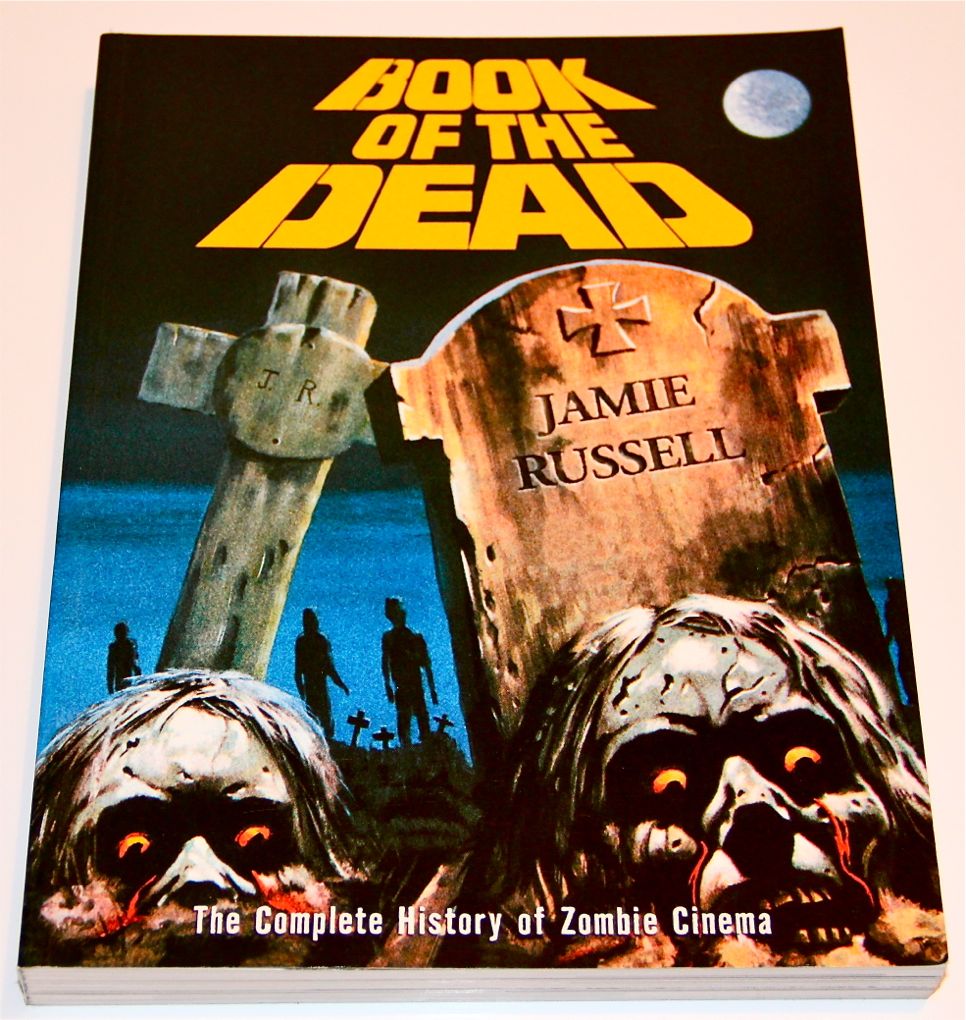
I spent my teen years hopelessly addicted to zombie movies. No matter how poorly made, no matter how artistically worthless, no matter how nasty and exploitative, if the movie had zombies in it, I would watch. The first thing I bought with the first paycheck from my first job at seventeen was Jamie Russell’s Book of the Dead: The Complete History of Zombie Cinema.
In 2006, it was indeed more or less complete, but a LOT of zombie movies have been made since then.

I should state upfront that I hold no truck with narrow, exclusionary definitions of “zombie.” To me, the zombie is a very broad church: if somebody has ever called it a zombie, it’s a zombie. The Deadites of Evil Dead? Zombies. The Somnambulist in The Cabinet of Doctor Caligari? A zombie. The Dead Men of Dunharrow? Zombies. (Don’t even try that 28 Days Later “infected” crap with me. Those are most definitely zombies, and you should trust me on this because I probably know more about zombie cinema than you.) (Unless you’re Jamie Russell, in which case thank you for stopping by, sir, and I love your book, and I wrote a paper about Zombie Jesus if you’d like to read it?)
As well as being a zombie aficionado, I spent my teen years deep in confusion and denial about sexuality and gender – and these two things are perhaps not unrelated. Vampires and werewolves are explicitly sexual and very gendered, but my movie monster of choice erases sex and gender entirely by its very nature. There are no alluring seductions, no monthly cycles, no explosions of pent-up masculine rage in the zombie: only a creeping sameness and inevitability, all social categories dissolved into nothingness, all physical difference literally consumed in the nightmarish Eucharist of undead cannibalism.
Of course, this erasure of sex and gender does not mean that sex and gender are not explored in zombie films. On the contrary, there are some very interesting things going on, as we shall see in our whirlwind tour of the Three Eras of Zombie Cinema.
Stage One: The Pre-Romero Era
The early stage of zombie cinema is the least popular (and it is also my strongest ammunition in the fight against the purists who insist that only the Romero flavor of zombie – the dead, resurrected, flesh-eating variety – counts as a true zombie). For the first 35 years of its onscreen existence, the zombie didn’t eat anybody’s flesh. Instead, a zombie – first seen in 1932 Bela Lugosi vehicle White Zombie was a mindless slave resuscitated by voodoo.
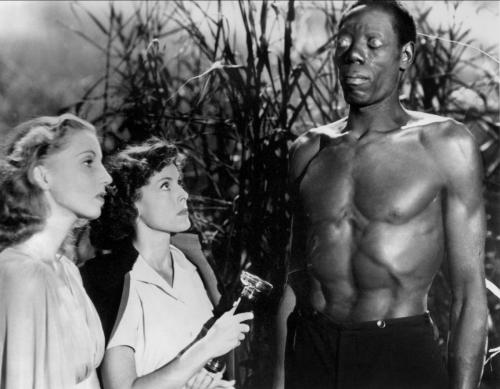
The words “voodoo,” “1932,” and “slave” all in the same sentence like that has probably alerted you to the most striking fact about these early zombie films, which is that they are hella racist. In White Zombie, Bela Lugosi plays a Haitian voodoo master who conspires with a plantation owner to zombify a white woman. I Walked With A Zombie (1943) and Hammer’s The Plague of the Zombies (1966) also draw on Haitian voodoo and slave plantations. Per Russell’s thoughtful postcolonial reading of these films, they play on colonial fears of white enslavement and Afro-Caribbean magical powers. In all three movies, the great threat posed by the zombies and their voodoo master is the enslavement of a young white woman.
I Walked With A Zombie: SO MUCH horrendous racial and sexual imagery in one little screencap.

In these early films, white women exist primarily to be threatened by a monster with a subtext of sexual violence, suggesting the racist narrative of predatory, animalistic black men preying on lily-white women. It’s pretty stomach-churning to watch, even if it’s fascinating fodder for students of gender, race, colonialism, and the cinema. Luckily, in 1968 zombies were revitalized, and their race and gender aspects completely transformed, by one remarkable movie.
Stage Two: The Golden Age
In Night of the Living Dead, George Romero’s most obvious innovation was actually cribbed from the Richard Matheson novella I Am Legend (in which the undead bloodsuckers are actually identified as vampires, though often read as zombies). Like their literary predecessors, Romero’s shuffling reanimated corpses fed on the living. The association of zombies with Haitian voodoo, slavery, and colonialism was jettisoned, and pop culture hasn’t looked back.
Calling this period the golden age is almost entirely a matter of personal preference, but good lord are there some terrific zombie films from the 1970s. Romero’s own Dawn of the Dead is the undisputed masterpiece of the era, but there are some wonderful movies from all across Europe: the Spanish Blind Dead series, Lucio Fulci‘s giallo gorefests in Italy (especially the splendid The Beyond), French film The Grapes of Death, the underrated and transnational The Living Dead at the Manchester Morgue
But it was Night of the Living Dead that set the tone for these movies, both in terms of the unremitting bleakness and in the heightened consciousness of social issues. Romero has always claimed that his choice of African-American actor Duane Jones for protagonist Ben was color-blind casting, but his own subsequent filmography displays a clear concern for class and race issues. The role of gender in golden-age zombie films is subtler, but no less present. One of the more shocking moments in NotLD is the reveal of the little zombie girl chomping on her dead father and murdering her own mother. The message is clear: the zombie apocalypse breaks down all social categories. The mother-child bond, so often inviolable in Hollywood, is broken in the most violent way imaginable. A little girl, the archetype of innocence, enacts the violence. Social roles cannot possibly hold in the face of the undead threat; in the end, the zombie makes equals of us all.
No wonder I am terrified of preteens.
Stage Three: The Great Comeback
The eighties and nineties saw a proliferation of slasher flicks, while the zombie fell out of favor. Russell ascribes the zombie resurgence of the past decade to the 2002 double-whammy of 28 Days Later and the video game Resident Evil. Before long, Dawn of the Dead was remade, while Shaun of the Dead gave the genre a simultaneous shot in the arm as the first self-styled “RomZomCom.” By the middle of the decade, zombies were well and truly mainstream.
It’s a curious fact, explored by Carol J. Clover in Men, Women, and Chain Saws, that lowbrow genre fare can sometimes push the boundaries of what’s socially acceptable by mainstream Hollywood standards. Arguably, the mainstreaming of zombies has actually defanged some of their ability to make interesting commentary on gender.
For example, the largely entertaining and in some ways surprisingly innovative 2009 zom-com Zombielandends with its previously strong, capable female characters screaming on an amusement park ride, needing to be rescued by the male protagonist. While 1970s zombie films didn’t exactly lack delicate fainting ladies, there was an overall thematic sense that the rising of the dead renders categories such as gender roles ontologically insignificant. A film like Zombieland manages to use the zombie apocalypse to actually enforce gender stereotypes. Similarly, I rage-quit AMC’s The Walking Dead after one season, in part based on a scene where the female characters had a discussion along the lines of, “Well, the apocalypse has hit; better revert to traditional gender roles, ’cause cavemen!!”
I still love zombies deeply. I love the wish-fulfillment aspect of imagining yourself as the last brave outpost of survival against the onslaught, creating your own beleaguered little society when this one collapses. I love the multiplicity of symbolic potential in the zombie, the seemingly endless variety of fears for which it can stand: the inevitability of death; infiltration of human-seeming replicants or pod people; fear of brainwashing or enslavement; loss of all particularity or individuality; uprising of the faceless proletariat; the revenge of Gaia; communism; enforced conformity; being overwhelmed by whatever force it is that you fear most (feminism or kyriarchy or theocracy or secularism or or or…). 
 
But I’m experiencing burnout. I don’t enjoy seeing such a rich, challenging, bleak, existential symbol stripped of all its nuance to cater to the same old reductive Hollywood tropes and narratives. I’m sick of the mainstream cultural attitude toward gender and social roles, and I am very sick of seeing things I love harnessed to serve this attitude.
It makes me want to eat somebody’s brains! Which is a thing invented in Return of the Living Dead in 1985.
Max Thornton blogs at Gay Christian Geek, and is slowly learning to twitter at @RainicornMax.

‘Pitch Perfect’ and Third-Wave Feminism

Written by Leigh Kolb

Social movements are not without their problems. America’s second- and third-wave feminists (the mothers from the 60s and 70s and their literal and figurative daughters, who have come to age in the 80s, 90s and 2000s) have often appeared to be at odds with one another, and even within themselves. Even though the “women’s movement” is often marketed as a monolith in our culture, it is far from that.
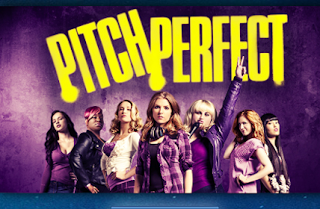
Pitch Perfect, a new musical comedy, is about the all-female a cappella group the Barden Bellas, who are vying for respect among their peers and for the title of best college a cappella group in the nation at the International Championship of Collegiate A Cappella. The core problem for them (besides the vomiting–we’ll get to that in a minute) is that they are stuck in the past. While other groups are showing off creative arrangements and flashy dance choreography, the Bellas have rigid movements, dress like stewardesses and only sing “classics” from the 80s and 90s (“The Sign,” “Eternal Flame,” and “Turn the Beat Around” is their standard set list). The Bellas are also uniform in their looks and body types–light-skinned and thin.

The original Bellas are uniform in appearance and skin tone.

As the two matriarchs of the group–Chloe (Brittany Snow) and Aubrey (Anna Camp)–recruit young women to audition at the back-to-school activities fair, Aubrey makes it clear that they are looking for women with “bikini-perfect bodies.” Chloe responds quietly with “How about we just get good singers?” Thus begins the Bellas’ journey into a new world filled with women of color, overweight women, “alternative” brunettes with lots of eyeliner and lesbians.

Aubrey remains steadfast in her traditionalism until almost the bitter end. Her insistence on the value of tradition, and how it’s always been and how they’ve always looked, could represent second-wave feminism, which was criticized for its lack of inclusion for women of color and lesbians.

The protagonist in the film, Beca (Anna Kendrick), desperately wants to be in LA to be a DJ, but is stuck at Barden University because her father is a professor there and she has a free ride (we’ll get to that in a minute, too). She represents third-wave feminism, which has been criticized for a lack of female camaraderie and a disregard for the past.

Beca as the “alternative” girl (black nail polish is a dead giveaway).


Pitch Perfect, on its surface (and even mostly below the surface), is a fun female-centered comedy with good music. It’s clearly co-produced by a woman (Hollywood feminist Elizabeth Banks) and written by a woman (30 Rock and The New Girl’s Kay Cannon). However, a feminist reading of the film suggests that far below the surface, viewers can take the plot of the film as an allegory of second- and third-wave feminism in America. 

The new members of the Bellas see early on that they have no chance of winning with their old routine. They learn it, they go through the motions, but it simply doesn’t work. Aubrey stands firm in the old choreography–she becomes more and more uncomfortable with the concept of changing their form, no matter how “tired” it is.

When the group arrives at their first competition of the season, the commentators (Gail, played by Banks, and John, played by John Michael Higgins) comment on their looks. “This does not look like the fresh-faced nubile Bellas…” John says. They are “refreshing, yet displeasing to the eye,”says Gail. (The interplay between these two judges provides some great one-liners throughout the film.)

John and Gail provide funny, and poignant, Christopher Guest-style play-by-plays.


The Bellas get on stage and perform the same, tired routine. Toward the end, however, Fat Amy (yes, we’ll get to that in a minute) shakes things up during her “Turn the Beat Around” solo, ripping off her jacket and growl-singing the once demure lines. The audiences and the judges love it, and they manage to place. At regionals, Beca sees the audience getting bored and injects some mash-up vocals toward the end of their set (“Titanium,” a bullet-proof anthem that weaves its way throughout the film). The audience enjoys it, but Aubrey is enraged and kicks her out.

The group suffers, but they have to pull it together because they need to perform at nationals after another team was disqualified. Beca comes back, and tells the fractured group, “I’ve never been one of those girls who had a lot of friends who were girls–now I do, and it’s pretty cool.” Aubrey hands Beca the reigns, and they perform Beca’s own mash-up of modern and older songs. She has been turned on, at first reluctantly, to The Breakfast Club by her love interest, Jesse, and includes “Don’t You (Forget About Me),” by Simple Minds, and also includes tween anthem “Party in the U.S.A.” Notably, Fat Amy interjects a line from “Turn the Beat Around” at the climax of their set.

The women have collaborated, and evolved. They’ve kept their individualism, and been frank about their desires and motivations. They dress differently, and they sing new music. However, they don’t leave the past in the dark, and become better and closer when they decide to move forward. At the end, they’re not dressed like one another, they don’t look the same, and they win (on stage and off).

As with the social movement, the film isn’t without its problematic aspects, which ultimately speak to the current state of feminism in our culture.

Gross-out humor: The Bellas are humiliated on the national stage at the beginning of the film when Aubrey projectile vomits on the stage and audience. Later, during the Bellas’ “let it all out” moment that brought them back together, Aubrey does it again. One member gets pushed into it, and makes a snow angel in it. Is this necessary? Was there no other way to symbolize Aubrey’s anal, yet out of control, nature? These scenes felt exactly like the gross-out scenes in Bridesmaids, which were written in by Judd Apatow to appeal to the male viewer. Women, at this point, surely have proven that they’re funny, and that women’s stories can be universally entertaining. OK, maybe we’re not there yet, but the only way into the boys’ club doesn’t have to be to play exactly like them. It’s not a matter of being prude, it’s simply a matter of these scenes–Pitch Perfect‘s vomit or Bridesmaids‘s diarrhea–feeling utterly out of place in the films. What could be more appropriate, and Pitch Perfect does enter into this territory, are jokes about gynecological visits or Gail’s college group, which was called the “Menstrual Cycles.” 

Fathers as idols: Yet again, we have multiple narratives of influential fathers and absent mothers. Beca’s father is the most prominent, as he is a literature professor at BU. Beca is surly and angsty toward him, and references her “stepmonster” and his divorce from her mother, yet doesn’t talk about her mother. Even when she goes to her father during spring break and they bond over tea, it’s all about him. He visits her in her dorm room more than once, which feels awkward, and clearly controls her future (bargaining with her that he’ll send her to LA after one year at BU). Aubrey, in the transformative scene where the Bellas bond, says that “My father always said, ‘If at first you don’t succeed, pack your bags.'” The two characters who most clearly represent the old and the new, in regard to the feminist movement allegory, are driven and inspired/controlled by their fathers. This trope is relentless with female protagonists–fathers are almost always more visible and more important than the characters’ mothers. This consistent story line makes sense if we examine opportunities for men and women in the decades leading up to these young women’s formative years. Girls are taught they can be anything, and too often it’s the man of the house who is represented as powerful, in work and at play. They are who are to be emulated in this culture.

Fat Amy is a star performer on stage and off.

Fat acceptance: Fat Amy (played by the the amazing Rebel Wilson) introduces herself as Fat Amy to Chloe and Aubrey at the activities fair so “twig bitches like you don’t do it behind my back.” Although jokes are made about her size (by her and by others), Amy has solos, sex and friends. Her body is used for comedy, as is the fat body of the male sidekick of the college’s a cappella organizer. It’s still acceptable in our culture to demonize and discriminate against people who are overweight (or use them as comic relief). Amy’s character skewered that with humor (while also reaffirming it), but audiences seem really happy to see a woman of size on screen. While these casting decisions provide great fodder for entertainment writers (and who doesn’t love clever word play: “In a sea of size-0 starlets, Wilson has the confidence of a performer twice her age and half her size”). While some coverage is obviously cringe-worthy at best and fat-shaming at worst, reviewers (and certainly feminists) are embracing this representation. Even if representation is problematic, or has “mixed messages,” it’s representing reality. Would it be believable to have a fat woman on screen and no one comment on it? Unfortunately, we’re not at that point yet.


Race issues: From early on in the film, the portrayal of Asian women is problematic. Beca’s roommate is Korean, and tinkers with a bonsai tree while quietly, solemnly glaring at Beca. She only opens up when around her Korean peers (although she does seem to warm to Beca toward the end of the film). She scowls one evening, “The white girl is back,” when Beca gets back to her room. The Bellas also have a Korean member, who is awkward, speaks in a muted whisper (and when she is audible she’s saying strange things) and only really opens up during their last number. There’s no clear defense for these character portrayals, but they do seem to line up with what’s happening in the greater world of entertainment and feminist conversations even in 2012. Visit the comments section on a feminist blog defending Girls (or simply read about the show’s problematic history). Too often the face of third-wave feminism–especially the early 20s crowd–is white and privileged. This is in lock step with second-wave feminism, which caused a rift with women of color (Alice Walker claimed the title “womanism” because of this), and even first-wave feminism, when early suffragists used racism to further their cause. It was a problem then, and it’s a problem now.


Sex and sexuality: When Beca first arrives on campus, she’s handed an “official BU rape whistle” by a perky upperclassman. She warns, “Don’t blow it unless it’s actually happening!” While many reviewers found this joke tasteless, the audience can’t help but think that it’s supposed to be startling and tasteless. We’re supposed to think, “That’s insane,” and then immediately think about how “legitimate rape” has been a talking point and male legislators have had to re-write laws to change “rape” to “forcible rape.” Instead of just being offensive, that joke has the possibility of satirizing how we are discussing rape on a wide scale.
The “original” Bellas have a rule that no Bella can be romantically involved with a Treblemaker (their all-male rival group). This strict sexual gatekeeping causes them to lose members at the beginning, but Beca speaks out against the rules and continues to fraternize with Jesse (a Treblemaker). The two don’t embrace and kiss until the end, but it’s another traditional rule broken. Women don’t want male legislators policing their bodies, but they also don’t want other women doing so either (in the name of tradition and virtue, or competition with men).
The group has one member who frequently makes jokes about her sexual exploits (“dude’s a hunter,” she says of her vagina, adapting to the double standard of being a stud) and wears revealing clothing and dances provocatively. She is not punished for this, and doesn’t have to change. Even Chloe is seen showering with a young man at the beginning of the film, with no judgment.
The Bellas’ token lesbian, a black woman, is whispered about and assumed to be gay. When they are all bonding toward the end of the film, they have a moment of honesty, when the members admit to secrets about themselves. Her secret isn’t that she’s gay, but that she has a gambling problem (that started after she and her girlfriend broke up, she says cavalierly, as it’s revealed that this ex-girlfriend is also a Bella). No big deal. Even if there were whispers at first, she didn’t find that to be part of her identity worth hiding. The joke about her sexuality was ultimately on the rest of the women.

As the Bellas wow the crowd at the finals, John says, surprised, “I would never expect it from an all-female group!” Gail responds, “Well, you are a misogynist at heart.” Even with its problems, Pitch Perfect ends on a note of women’s power. John gets put in his place, and while the all-male Treblemakers don’t win, they’re all working together at the beginning of the next school year. 

There are always tensions between generations, and when these generations are women who have essentially been at battle for rights and representation for hundreds–really thousands–of years, there are not going to be perfect transitions and easy paths.

Eight years ago, Bitch magazine co-founder Lisa Jarvis wrote a piece for Ms. entitled, “The End of Feminism’s Third Wave” (adapted from a speech she’d given to the National Women’s Studies Association). She adeptly breaks down the dichotomy of second- and third-wave, and argues that the “master narratives” are largely false, and no one can seem to focus on the similarities. She says:
The rap goes something like this: Older women drained their movement of sexuality; younger women are uncritically sexualized. Older women won’t recognize the importance of pop culture; younger women are obsessed with media representation. Older women have too narrow a definition of what makes a feminist issue; younger women are scattered and don’t know what’s important.Stodgy versus frivolous. Won’t share power versus spoiled and ignorant.

The Bellas at the end break out and win.

There are many similarities, though. And while Pitch Perfect isn’t perfect, it is not tone-deaf to feminism’s struggles, problems and potential. It passes the Bechdel Test with flying colors, and even challenges the idea of masculinity (Jesse’s roommate gushes about the Treblemakers, “That’s what being a man is all about”). The Bellas ultimately win because they blend the old with the new, and allow themselves to move past their guarded individualism and work together. At the end, the women of color get a strong voice, and Aubrey embraces the changes (and Fat Amy proudly sings, “Can you feel the passion?”).

Jarvis goes on:
We may not all agree on exactly what it looks like or how to get it. We should never expect to agree. Feminism has always thrived on and grown from internal discussions and disagreements. Our many different and often opposing perspectives are what push us forward… I want to see these internal disagreements continue. I want to see as much wrangling over them as ever. But I want them articulated accurately. And that means recognizing the generational divide for what it is — an illusion.

Jarvis’s words ring true for the larger feminist movement in 2012, and for what allows the Bellas to win the International Championship of Collegiate A Cappella at Lincoln Center. 

What feminism needs now is for everyone to get on stage.


Leigh Kolb is a composition, literature and journalism instructor at a community college in rural Missouri. 

Female Sexuality in Polley’s Disappointing ‘Take This Waltz’

This small, Canadian romantic indie film starring Seth Rogen, Michelle Williams and Luke Kirby and directed by Sarah Polley seems like it should a moving and insightful film about relationships (much like Michelle Williams earlier movie, Blue Valentine, was). However, despite its female centered love triangle, the film offers little of interest.

If you were to read the synopsis of this film on IMDB it would tell you that “A happily married woman falls for the artist across the street,” a pretty uninformative summary since it’s apparent from the first scene that Margot is unhappy and struggling in her marriage.  The film follows Margot (Michelle Williams) as a slightly off-kilter aspiring writer married to chicken cookbook-writer Lou (Seth Rogen). Margot meets Daniel (Luke Kirby) while doing research for a pamphlet she’s writing and then again on the plane, only to discover that he lives on the same street as her. And so begins their romance, full of clichéd significant looks and fevered whispers, as they get lost in the forbidden.

Unfortunately, my two sentence synopsis was far more interesting than the movie itself, since much of the movie was long shots of Williams looking confused and depressed and Rogen acting oblivious.  The music was a particularly pretentious brand of lackluster indie and on the whole, the film just felt like it was trying too hard to be profound.

In reality, the best parts of the film came from Margot’s interaction with her sister in law, Geraldine or the brilliant Sarah Silverman. Silverman’s character is a recovering alcoholic who, at the end of the film, offers one of the two best lines in the film, “Life has a gap in it, it just does, but you can’t go crazy trying to fill it.” (She’s also a part of a legitimately funny scene involving the incredible world of water aerobics, I tried to find a clip of it online, but alas, I failed).

It’s after the water aerobics scene when we get the second best line of the film, delivered by a naked older woman in the women’s locker room (a great scene by Polley that doesn’t shy away from the normally unsightly issue of aging and women’s bodies—read more about it here); Margot is wistfully considering the merits of “something new” with Geraldine and the woman smiles wisely and replies “New things become old.”

There was a subplot of the film that had some potential as well had it been developed a bit more, in particular the issue of Margot’s sexuality. It’s obvious that Margot and Lou are not the most sexually active of couples since we see Margot attempt to seduce Lou several times, only to be rejected in favor of his cooking. While the lack of sex doesn’t seem to especially bother him, it could be argued that one of the reasons Margot continues to seek after Daniel is the promise of sexual discovery that he offers her. At one point in the film, there is a montage of Daniel and Margot having sex  (it sounds spicy, but really, don’t get excited) where it becomes apparent that Margot is finally able to explore that part of herself; the premise was interesting and one that I think many women can identify with, however I think it could have been fleshed out a little more.

I wanted this film to be good; the trailer was interesting, all of the actors are talented, and Polley is a promising new director (and you know how Bitch Flicks feels about new female directors). While there were good moments and unique ideas being toyed with, the film was, in reality, a lukewarm portrayal of a good topic; in short, I was bored most of the time. 

**Cross posted from Not Another Wave

Rachel Redfern has an MA in English literature, where she conducted research on modern American literature and film and it’s intersection, however she spends most of her time watching HBO shows, traveling, and blogging and reading about feminism.

Counterreading ‘Here Comes Honey Boo Boo’

Reality television has never held much appeal for me. I get plenty of reality in reality, thanks – I like my TV fictional. Besides, hasn’t the last decade or more of respectable journalism assured me, in the shrillest possible tones, that reality TV is the very lowest form of entertainment, positively reveling in the filth of humanity’s worst, most voyeuristic excesses: a Coliseum for the digital age?
SATIRE!!!1111!1
Even without watching it myself, I’ve become less and less comfortable with the traditional critiques of reality TV as I’ve sharpened my critical apparatus. For a start, it seems predicated on the notion of a hierarchy of art, the assumption that some forms of entertainment are somehow innately higher or better than others. It’s a terribly condescending form of knee-jerk moralizing.And if you don’t ever watch it, it’s a bit presumptuous to be judgmental about the whole genre.
I’ve tried to stay in the moral middle ground, having no real opinion on reality TV other than that it’s not for me. I’d likely have continued my reality-TV-free existence, had it not been for this excellent piece at the incomparable Womanist Musings.
Renee and Sparky watched TLC’s infamous Here Comes Honey Boo Boo, the reality show about six-year-old beauty pageant contestant Alana and her working-class Georgia family, and their reaction was not necessarily what you’d expect. They make many terrific points about how repugnant the show is as a piece of television, how it “other[s the family] at every turn,” but they also offer an invaluable counterreading. They like this family – the four daughters aged between six and seventeen, the quiet father figure, and heroic matriarch June – and they’ll continue to like them, no matter what the show’s structure seems to want us to think.
I love them all, but “Pumpkin” is my favorite.
If you consume entertainment and have any conscience at all, you are a practiced counterreader. You have to be, if you’re going to stand up to the hateful kyriarchal bullshit with which 21st-century westerners are bombarded every minute of the day. All responsible entertainment consumption requires a risk assessment, weighing the potential value to be gained against the potential harm to be done, and everybody’s evaluation is slightly different. For one person, well-rounded white female characters but no characters of color is worth the trade-off; for another, it simply isn’t. And sometimes performing an adequate counterreading requires you to marshal all your critical resources.
Here Comes Honey Boo Boo is not a text that welcomes counterreadings with open arms. Operating well within the established format of reality television, it utilizes an arsenal of techniques – both subtle and not so much – to impel voyeurism. TLC makes it very, very easy to sneer at and judge Honey Boo Boo and her family. You have to work quite hard to counteract this compulsion. You really have to be on the critical ball the whole time. And is that okay?
All summer the debate has raged as to whether, or to what extent, the show is exploitative. Having watched all of it inside of a week, I’m still undecided. There are moments when June and the girls express a self-awareness and a confidence that has me cheering them to the skies, sure that their assertions of not caring what people think of them are sincere. At times, though – especially when outsiders arebrought in to interact with the family, an etiquette teacher or a pedicurist, and get all flustered and shocked by them – the whole thing seems enormously exploitative and gross.
It’s this indeterminacy, this openness to a multiplicity of different interpretations, that has the national conversation about Honey Boo Boo going so fiercely. As Time’s James Poniewozik observes:
overall, she has a kind of sassy sweetness to her. In the second episode, she gets a pet teacup pig as consolation for losing a pageant and decides to dress him as a girl, which she says will make him gay. The ensuing argument with her older sister is both ridiculous and oddly wise in a 6-year-old way: “It’s not gonna be gay.” “Yes it is, because we’re making it a girl pig! And it’s actually a boy pig!” “O.K., but it’s not gonna be gay.” “It can if it wants to. You can’t tell that pig what to do.”
You can’t tell that pig what to do. See, you can look at that scene, like you can most of Honey Boo Boo, several ways. You can laugh at the intensity of Alana’s conviction that she’s right. You can tut-tut at the gender-role signals this pageant girl must be getting to conclude that you can “make” someone or something gay by dressing it in girl clothes. But you can also see something kind of remarkable in it: a little country girl, whatever confusion and misinformation she has in her mind, fervently arguing a teacup pig’s right to determine its own sexual identity.
AWWW
There are plenty of other interesting aspects of this show (Salon considers the race angle; Slate tackles the class issue), but the two that can’t be ignored are the gender dynamic and the class factor. The gender dynamic is pretty glorious: five strong, opinionated women who love each other deeply and don’t take anyone’s shit. They do what they want to do, they look how they want to look, and they are happy. Dare I suggest that one of the reasons the country’s spent its summer in thrall to these people is that we just don’t see women like this in our scripted entertainment?
Of course, it’s rare to see poor white people portrayed sympathetically on US TV at all. My understanding of class in the US is much less nuanced than my understanding of the British class system, but I’m aware of this country’s distaste for its own working poor. “Rednecks” appear in the media as rapists, as racists, as the butt of jokes and the object of revulsion. Voyeurism and disgust motivate hate-watching in our culture to an obscene degree, and that is why I think it’s important to perform a counterreading, to celebrate this family and refuse to let your responses be dictated by classism and hatred. If you want to be truly horrified by your fellow humans, check outthe comments on this Gawker article (I hope you have a strong stomach). To me, this is the aspect of Honey Boo Boo that’s truly awful – not a happy family letting a camera crew into their lives in exchange for some money they surely need, but the legions of haters who judge Honey Boo Boo and her family to be less human, less worthy of dignity and respect for their life choices, than themselves.
The family certainly does not reciprocate that sentiment. Even in the throes of labor agony, when asked, “Do you recommend to anybody else to get pregnant at 17?”, oldest daughter Anna replies, “Do whatever you want to do.” She just refuses to tell anyone else what to do with their body or their life. The rest of America – from legislators to judgmental internet commenters – could learn something from her.
Max Thornton blogs at Gay Christian Geek, and is slowly learning to twitter at @RainicornMax.

‘The Master’: A Movie About White Dudes Talking About Stuff

Movie poster for The Master
Well this movie is a piece of shit.

Slim at Gone Elsewhere does an excellent job of explaining the plot, so if you don’t know the plot, go there first … then come back here and let me explain to you why this movie is a piece of shit.

I went into it thinking it had the potential to be good because Paul Thomas Anderson made Magnolia, and Magnolia has some wonderfully nuanced and well-developed women characters, so I know he’s capable of not creating films exclusively about white dudes talking about stuff, but fuck, I honestly couldn’t get over his absolute reveling in the incessant blathering of white dudes to other white dudes.

Don’t get me wrong; Joaquin Phoenix’s emotionally disturbed character, Freddie Quell, totally makes a sand-woman on the beach—complete with breasts and spread legs—that he then proceeds to hump and fingerfuck in front of a group of cheering white dudes (even they get uncomfortable after a few seconds of this) before beating off into the oh-so-vast and Oscar-worthy cinematographically-shot ocean, but as far as women characters go, the sexually assaulted sand-woman left a little to be desired.

Freddie Quell pinching a sand-woman’s nipple in The Master

Okay, okay, Amy Adams appears a few times, once to read a naughty sex passage from a book to Freddie—who wouldn’t want to hear Amy Adams say “opening the lips of her cunt” (or something) for no discernible reason?—and she shows up again to jerk off her husband (The Master!) Philip Seymour Hoffman over a fucking bathroom sink, so I don’t want to mislead anyone—women exist in this sea of white dudes talking about stuff, but in between giving handjobs, carrying around infants, defending their men, and gratuitously exposing their breasts to drunk and violent sociopaths, they’re just kinda blah.

I don’t want to mislead anyone. I’m not saying I haven’t exposed a breast or two to a sociopath in my day, but that doesn’t mean I found these ladies relatable, and that includes the violated sand-woman.

Amy Adams in The Master, looking pissed

And I wish I knew what to say about Freddie’s love for a 16-year-old girl named Doris, especially since he looks like he’s in his mid-50s throughout the film. Okay, in fairness, Freddie only interacts with Doris in his memories (because this is art, people), so it makes sense that we never actually get to see Doris age. (But still, Freddie was either like 30 when she was 16, or they should’ve hired some better fucking makeup artists.)

Regardless of the potential statutory rape situation, Freddie can’t seem to get over his First Love because then we wouldn’t have the quintessential white dude movie plot dilemma: there’s a girl he can’t have, or a girl who died, or a girl he lost, or a girl he has to save—if there’s one thing we all know about films about white dudes talking about stuff, it’s that women emotionally fuck up white dudes so hard!

Eeeek, bitches, can we cool it already?

Doris and Freddie in Freddie’s creepy memory/flashback in The Master

This film will probably win a million Oscars and other accolades because the people who determine award winners in Hollywood are white dudes who like watching movies about other white dudes talking about stuff. And the critics lauding this film? They’re mostly white dudes who like helping white dudes who determine award winners in Hollywood vote for movies about white dudes talking about stuff. So yeah, expect this to grace the list of Best Picture Oscar Nominees.

Getting back to this movie being a piece of shit, here’s the thing: a million people will say, “Stephanie, you obviously just don’t get this film. It’s genius! You don’t understand art! It’s a metaphor for the ways in which religion and absolute power corrupt! These dudes are supposed to be awful!” Perhaps all of that is true. Except, of course, for the fact that none if it is true.

Freddie Quell, boom

Okay, on a less pissy day, I might go along with the argument that Anderson is attempting a successful metaphor regarding men and religion and corruption, but that doesn’t blind me to the fact that he ultimately uses women characters tropes of women to move forward the fairly boring plight of white dudes struggling with … something. I certainly don’t buy the argument either that this is just how things were back then i.e. whenever this film is supposed to take place; there’s an important difference between depicting a time period and straight-up worshiping it.

The point is, if your film contains about three speaking women total (oh, and a woman made of sand), and each of these women is constantly doing one of the following—standing by her man, carrying around babies, jerking dudes off, existing only in the occasional flashback, lying on a couch and talking about how she remembers a penis poking her when she was still a fetus in the womb—or, if she’s a literal fucking object (i.e. she’s made out of sand), then your film suffers from, at the very least, lazy writing.

The Master and his ladies

Yes, I just said that Paul Thomas Anderson, creator of There Will Be Blood (white dudes all over the place), Boogie Nights (a movie about a white dude with a giant cock), Hard Eight (white dudes), Punch Drunk Love (a movie about a white dude phone sex operator pimp or whatever), and Magnolia (a movie in which we get to hear famous white dude Tom Cruise tell us to “respect the cock”), got particularly lazy with his women characters in this one. Movies made by a white dude about white dudes talking about stuff—stuff like power and corruption in capitalism and religion, for instance—can succeed (There Will Be Blood)—just leave the fucking recycled caricatures of women out of it (There Will Be Blood).

Of course, then we wouldn’t be treated to last-line-of-the-film-gems like this:

Freddie (talking to a woman while she’s riding him): “You’re the bravest girl I’ve ever met. Now stick it back in, it fell out.”

If you want a different, slightly more intellectual (ha) take on The Master, you should read this review by Didion, who writes “… this film shows that Anderson has a lot more sensitivity toward women than his prior films would suggest.”

Preach it!

Presidential Debate Update: Where Are the Women(‘s Issues)?

The first presidential debate between Mitt Romney and Barack Obama

The first presidential debate between Barack Obama and Mitt Romney was much less intriguing than every pundit and media ogler alike was hoping for. We wanted zingers and gaffes, but had to settle for the mildly miffed, but embarrassingly unassertive, Jim Lehrer. The NewsHour host may have gotten memed even more than the candidates since the debate. But, sorry Big Bird, even an outraged PBS isn’t that interesting.

Yes, many media followers, long for the days of primary debates when tom-foolery and missteps abounded. Those were the days when follow-up commentary was bountiful and hilarious. The Ricks, Herman Cain, and Newt Gingrich may have outraged feminists, but damn they made our job of dissecting dickery easy.

Yes, the debate was “wonky” but all three men involved didn’t seem keen on bringing up the social issues that have been driving political discourse this year.

So, we feminist bloggers have to talk about what wasn’t talked about. And, frankly, there’s only so much fascination I can draw up from between the lines. Women’s health was not just glanced over, but completely ignored. And that was a disappointment – not for gossip’s sake, but because our candidates should be representing these issues as valuable. No, women’s health and reproductive rights should not be categorized as a distracting issue, but should be recognized as fundamentally intertwined with the issues determining the health of our country.

See, our candidates seem to consider economic and health care issues separate from social issues. But, marginalized folks understand via experience that they are not. Moderate Romney and Moderate Obama both stuck to taxes and the role of government while referencing the Affordable Care Act (ACA) and Dodd-Frank but not addressing how social issues are connected.

Discounting social issues and focusing on the “real” issues like the economy misses the point that these issues are not exclusive. No, the economy is not more real than women trying to cover the costs of their health insurance while looking for work in a bad economy.

The ACA makes it illegal for insurance companies to discriminate among genders when providing coverage. And it makes contraception more easily accessible. It basically stops allowing the practice of treating men as the generic sex – as in; people should get good coverage for the same costs regardless of gender and/or sex. This is a pretty important aspect of the ACA that was not looked at during the debate.

So we can hope that we see these discussions happen in upcoming debates. Hopefully our candidates and moderators don’t shy away from these issues. Candy Crowley, we’re looking to you.