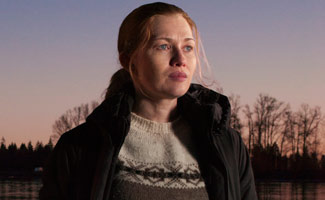
‘Star Trek: Deep Space Nine’ Explores Disability in "Melora"

This is a guest review by Jarrah Hodge. An earlier version appeared at her Tumblr, Trekkie Feminist.
“Melora” is one of many Star Trek episodes that uses an allegory about an alien to comment on an issue in our human society. In this case, Ensign Melora Pazlar comes to Deep Space Nine. She is unable to walk unassisted because she comes from a planet with very low gravity. 
There are some great moments in this episode, which was written by Evan Carlos Somers (and re-written by others), who himself uses a wheelchair. Somers has said:
“I always thought it would be nice to create a disabled character who’s accepted for what she is and doesn’t have to change…The best way to do that on Deep Space Nine was to have Bashir find a cure for the disability, and for the character to turn it down. That was the real driving force behind my wanting to do this episode.”

So how successful was it? I want to focus on a few key scenes featuring Melora and look at what they say about people with disabilities and expectations about their relationships with non-disabled people.
1. Bashir Can’t Wait to Meet Melora! 
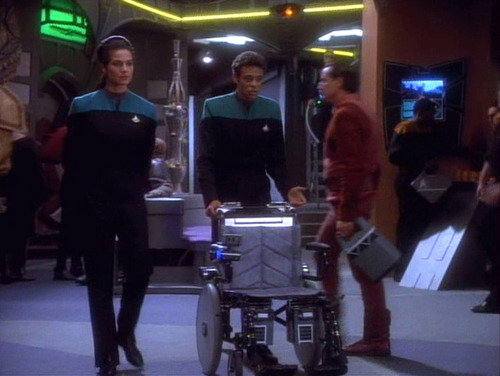
Still from Star Trek: Deep Space Nine
“Just think what she’s gone through to get here, Jadzia. What it must be like to adjust to our gravity after growing up on a planet with such low surface gravity,” Doctor Bashir effuses to Lieutenant Dax, who will be accompanying Melora on her surveying mission.
The crew sets up ramps for Melora to use, but there will still be places she can’t access in the wheelchair. Dax asks why they can’t just use the transporter.
O’Brien: It makes sense to me, but she sent word that it wouldn’t be acceptable to her.

Dax: I wonder why.

Bashir: I know exactly why. She went through the Academy the same way. Once her basic needs are met, she refuses any special assistance. She’s extraordinary.

There’s an implication here that people with disabilities are supposed to be self-reliant and avoid inconveniencing others … 

2. But Not Too Self-reliant

Melora from Star Trek: Deep Space Nine
Turns out Melora has a big chip on her shoulder. She’s fed up with people treating her as less capable, which makes what she’s saying totally understandable. For example, when she meets Commander Sisko she’s upset because the senior officers were discussing her mission without her. Sisko explains that’s normal and she replies:
Melora: I’m sorry if I seem overly sensitive, but I’m used to being shut out of the Melora problem. The truth is, there is no Melora problem until people create one. This may sound ungrateful, because Doctor Bashir has been wonderfully helpful in the preparations for my arrival, but frankly, I wonder why a medical opinion is necessary in this discussion.

Dax: Julian [Bashir] knows more of your capabilities than any of us.

Melora: I don’t need a medical opinion to tell me my own capabilities.

This is a great call-out of the medical model, which treats disability as an illness that needs to be cured (by contrast, the social model sees society as not adequately accommodating people with disabilities’ needs).

Unfortunately, after all of her outbursts, all the main characters get this look that seems to say, “Whoa! This lady is totally overreacting. What’s with the attitude?” One commenter on my original post said she thought the flawed response of the crew was written deliberately to reflect what many people with disabilities encounter today. That might be true, but I would’ve liked it to be more obviously challenged.


3. The Doctor Finds a Way In
Bashir and Melora
Bashir tells Melora he’s no longer her doctor, but he’s still trying to fix her by drawing attention to the way she uses sarcasm and criticism to stay at a distance from others.
He softens her up a bit and asks her to dinner. At the Klingon restaurant on the promenade, Melora surprises him by ordering in Klingon, definitely a good attempt to add a bit more complexity to the character.

4. The “Cure” 

Dax helps Melora after her fall
Melora falls attempting to get into a section of the station where there are no ramps. Dax finds and helps her to the infirmary.
There, Bashir (who’s now her doctor again, apparently) treats her and tells her she needs to let herself be dependent on others sometimes.
As he walks her back to her quarters, he says he thinks he might be able to adapt some previous work on “neuromuscular adaptation” that might be able to strengthen her muscles enough that she doesn’t have to use the chair.
She lets Bashir into her quarters and turns down the artificial gravity. Then they kiss and make out. My first thought was this is problematic because he’s her doctor again–he’s actually considering treating her disability!
On the other hand, the romance shows her as someone with sexual and romantic interests and desires, which helps counter the myth that all people with disabilities are uninterested in or incapable of sex.

5. Second Thoughts 
Bashir tries to “cure” Melora
Even though the treatments are starting to work, Melora has second thoughts, and the way that she expresses them gets at the idea that what might be seen as a disability can be part of who someone is–not something that can and should be “cured.”
Melora realizes how valuable she really is when she and Dax are taken hostage by a thuggish alien (part of the B plot in this episode).
The bad guy zaps her with a phaser, with Bashir and the crew in Operations watching via viewscreen, but somehow she revives. She turns off the gravity on the runabout and launches herself into the bad guy, saving the day. 
Melora stops the bad guy
It’s a neat little twist on what could’ve been a very damsel-in-distress-y scenario. It’s also cool that what had been seen as her disability was used in a powerful way. Unfortunately, it was kind of undermined by the explanation of why she survived the phaser blast: because of the neuro-stimulants she’d been receiving as part of her treatments to “fix” her mobility issues.

6. Melora and Bashir Part Ways
Melora and Bashir hold hands
Bashir and Melora have the final scene back in the Klingon restaurant. Bashir is disappointed that she won’t continue the treatment and Melora replies: 
“I like being independent, but to give up everything that I am to walk on land…Well, I might be more independent, but I wouldn’t be Elaysian anymore. I’m not sure what I’d be. Besides, maybe independence isn’t all it’s cracked up to be. I kind of like how it feels to depend on someone for a change. And I’m glad you got me to unlock the doors to my quarters so I could finally let someone into my life.”

And then we never hear Bashir mention her again for the rest of the series.
I think the motivation behind “Melora” was great, but overall I thought the messages were a little unclear. I saw that Melora doesn’t have to change her disability, but she does have to change her attitude. Ultimately, that personal transformation to being more “dependent” was what tied the story together more than a reaffirmation of her uniqueness.
There’s also the unfortunate fact that her relationship with Bashir can’t continue after she decides not to finish the treatments.
But ultimately, no matter what happened in this episode, you’re always going to have problems using a single character as a stand-in for an entire group of people. To really do justice to the diverse experiences of people with disabilities, we need more people with disabilities in TV shows generally (actors and characters), playing a range of parts, including recurring roles that give us a chance to see more complete and complex identities.


Jarrah Hodge is the founder of Gender Focus, a Canadian feminist blog. Jarrah also writes for Vancouver Observer and Huffington Post Canada and has been a guest blogger on “feminerd” culture for Bitch Magazine Blogs. Hailing from New Westminster, BC, she’s a fan of politics, crafts, boardgames, musical theatre, and brunch.
Disabilities Week: Blindness, Race and Love in ‘A Patch of Blue’

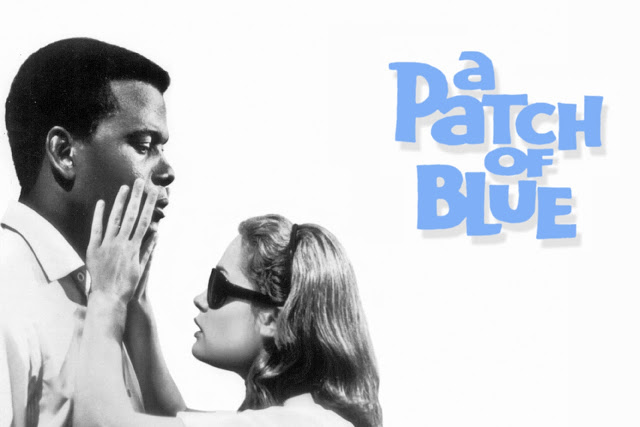
A Patch of Blue movie poster.


Written by Leigh Kolb

Director Guy Green said of the premise of A Patch of Blue: “basically it’s a very corny story, a blind girl falling in love with a black man.” He credits the writing of the novel it was based upon (Be Ready With Bells and Drums, by Elizabeth Kata) for ensuring that the story, and resulting film, were not corny in the least.


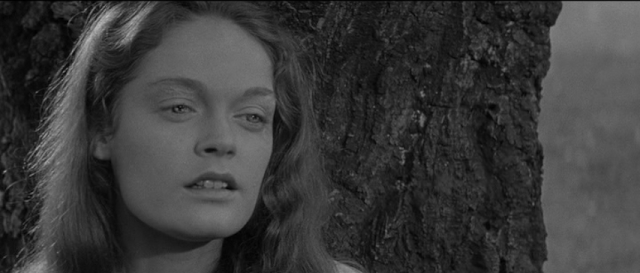
The 1965 film centers around a young blind woman, Selina (Elizabeth Hartman), who has been abused and sheltered, and neglected any formal education, by her family–her mother, Rose-Ann (Shelley Winters) and her grandfather, Ole Pa (Wallace Ford). 


She’s befriended by a black man, Gordon (Sidney Poitier), and they form a deep relationship, which centers on Gordon’s desire to help Selina lift herself up.

It would be easy to read that synopsis–blind girl falls in love with a black man–and come to any number of conclusions about the film, especially since it was released at the height of the civil rights movement, but the film manages to capture something much deeper than being a superficial morality play on racism, and it treats Selina’s blindness with care and dignity.
When Selina was five, her father came home unexpectedly while Rose-Ann was sleeping with another man (it’s insinuated that she worked as a prostitute, and still does). Her father killed the man, and when Rose-Ann threw a bottle–a chemical-laden cosmetic–from her dresser at him, it hit Selina in the face, scarring her eyes and leaving her blind.
Elizabeth Hartman wore opaque contacts to simulate Selina’s damaged eyes. Rose-Ann is the only one who berates her “ugliness”; even her grandfather explains that it’s just that people are nosy, not that she is ugly.
Selina’s life circumstances are desperate and miserable, but she is not. The opening shot of the film focuses on Selina’s hands, stringing together beaded necklaces–that’s what she does during the day to help her family (Mr. Faber, her boss, is presented as an important support person in her life). She yearns to spend more time in the park, and Mr. Faber takes her when he can.
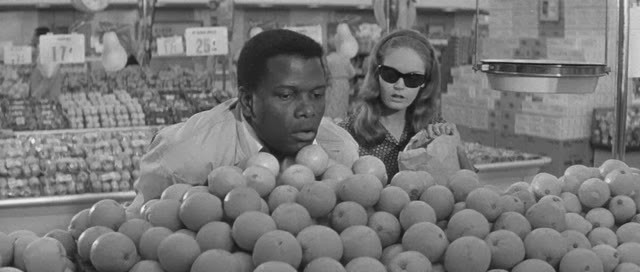
It’s in the park that she meets Gordon (a caterpillar dropped down the back of her shirt and she needed help–a problem not reserved for a person who can’t see–and he helps her retrieve it). He’s friendly and gentle without being condescending, and his generosity helps strike up a quick friendship. He buys her sunglasses because she’s self-conscious about her scarred eyes and tells her she looks perfect with them on (this is presented as a generous act for her confidence, not because he actually feels she needs them).
He’s shocked that she’s never heard of braille and was never formally educated: “You haven’t heard of all blind people can do?” he asks, and she is self-deprecating yet unashamed of her lot in life. 
Gordon and Selina eat lunch.
While Selina is uneducated (Gordon corrects her grammar when they first meet) and cannot live outside of her home independently, the audience never feels pity for her because she is blind and helpless. Instead, the focus of our pity is on her lack of support–she has an abusive home life and has been neglected. Her blindness isn’t pitiful; her family is. 
When Selina is shown doing tasks that she’s been entrusted with–changing linens, washing dishes, cooking, cleaning–she does so perfectly. This is a reminder that her blindness hasn’t been a hindrance to her life and that she is capable of doing what she’s allowed to do.
Hartman, in studying for the part, spent time at a school for the blind to be able to accurately get into character. She wore opaque contacts (Green said they helped because they naturally obstructed her vision), and her family says she wore them constantly and never left character while she was filming.
This careful and empathetic approach to “acting” blind paid off. Hartman’s performance was incredibly convincing and she was nominated for the Academy Award for Best Actress (A Patch of Blue was Hartman’s first film). 
Gordon helps Selina find directions by the sun’s location.
In the film, Gordon attempts to feel as Selina must feel shortly after meeting her. He’s shown at his job–working as a night-shift reporter–getting up from his desk, walking across the room, and attempting to return to his desk with closed eyes (he is unsuccessful, and runs into his coworker’s desk). This short scene is poignant in that it further reminds Gordon–and the audience–what it must feel like to be Selina, if only for a few moments. 
Gordon never tries to do things for Selina. From the beginning, he teaches her and empowers her to be able to completely take care of herself. Since it’s clear her limitations are environmental, not innate, she is capable. Her disability–caused and amplified by her family–is not what’s in her way. Her poverty and lack of support system are detrimental to her growth and development.
Gordon could have easily met Selina, befriended her, seen that she could clean and cook, and want to marry her, keeping her dependent and living simply for him. And while his romantic feelings for her are conflicted, he wants her to be independent and educated more than he wants her for himself. 
Gordon gives Selina very practical advice (counting steps, listening for traffic) so she can navigate streets by herself–which she finally does, after realizing she doesn’t have to take her home life anymore.
Gordon never belittles or gets frustrates with Selina.
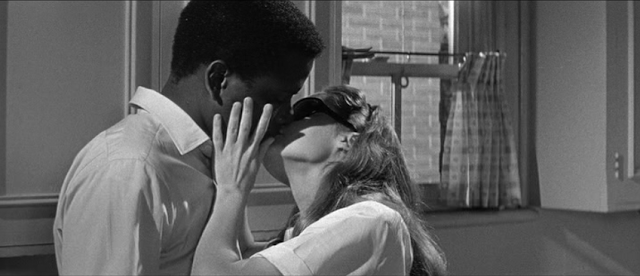
Gordon and Selina’s kiss–one of the first on-screen interracial kisses–was at the same time innocent and deeply passionate. When Selina references the fact that she’d been raped, and wishes she hadn’t so she could be with Gordon, he convinces her that she is not “bad” or “dirty,” like she worries she is. (Someone in 1965 understood how to not blame the victim.) 
Their kiss was one of the first on-screen interracial kisses.
The filmography often focuses on Selina’s point of view, and is effective in portraying the sensory details she enjoys (the canned peaches or the music box), and the terrors she lives through–her time alone for the first time on the street, or the memory of being raped (we “see” the man from her perspective–what she could have seen, but only felt).
The racial components of the film are also nuanced and effective. When Gordon tells Selina that “tolerance” is one of his favorite words (and explains that it’s not just putting up with something, but that you don’t “knock your neighbor just because he thinks or looks different than you”), she tells him that he must be full of tolerance. He quietly shakes his head and says that he’s not. He looks deeply affected when white people stare and glare at him and Selina walking together, and clearly has deep inner conflict being a black man in America in 1965 (of course, these aspects of the film don’t seem nearly as dated as they should be). His brother, a doctor, criticizes Gordon’s desire to help and educate Selina because she is white, and comments on the fact that she comes from a “trash heap” (to which Gordon responds, “She may, but she’s not trash”). Underneath the surface of the film is the fact that socioeconomic factors and family support systems are what determine a person’s opportunities.  
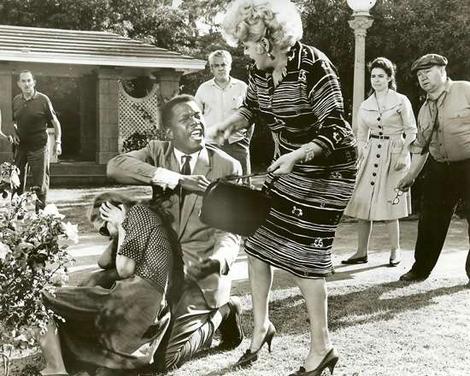
Rose-Ann is, unsurprisingly, violently racist. We know that she forbade Selina from spending time with the only friend she ever made because the little girl was black, so we also know that when Rose-Ann sees Selina and Gordon together, she will erupt–which she does. 
The characters to be despised are racist, abusive and neglectful. But Selina and Gordon aren’t perfect–they are complex, sympathetic characters who struggle with their own shortcomings and emotions. Selina is only 18, so her naivety and her quickness to fall deeply in love are believable. Gordon loves Selina as a friend, but is unsure of anything beyond that. He says he’s snapped back into reality after getting lost in their embrace. He deals with anger and frustration, too–not only because of his experiences at the hands of racism, but also because of the injustice of Selina’s mistreatment. 
By the end of the film, even the crowd of white people (who before had glared), realize that Gordon is no threat to Selina; Rose-Ann is.
The ending is hopeful, but not saccharine-sweet. The realness of the characters, their struggles and their emotions are highlighted by sparse, black-and-white film and a beautiful soundtrack.
Gordon has called a school for the blind and set up a space for Selina. Before the bus comes to pick her up, she is nervous, and wishes they could just get married. Gordon promises that in a year, they could see if their love has anything to do with marriage. He sits her down to tell her that he’s black, but she already knows.
She says, “I know everything I need to know about you.” As she feels his face she continues: “I know you’re good, and kind, and that you’re colored; and I think you’re beautiful.”
He’s shocked that she knows, and responds “Beautiful? Most people would say the opposite.”
“That’s because they don’t know you,” she answers.
A Patch of Blue portrays disability as a part of a woman’s life that only defines her because she’s grown up with an abusive and neglectful family. As soon as she gets access to a world (literally and figuratively) outside of their little apartment, she thrives, and we know she’s just going to continue to grow. She’s beginning her life–a life that won’t be defined by her blindness. 
Her relationship with Gordon allows him to also redefine his own life and helps him see himself for who he is–a beautiful, kind and generous man, who knows how to share life with someone who’s never experienced it.
Fifty years later, portraying disability on screen with empathy and respect is still rare. Showing an interracial couple is also extremely rare (Green says that some people sent terrible letters to him about the kissing scene; in fact, it’s reported that in some areas in the south the scene was edited out for theaters). 
A Patch of Blue manages to weave together themes of disability, race, socioeconomic issues and family dynamics with beauty and grace. It was nominated for multiple Golden Globes and Academy Awards; Shelley Winters won the Best Supporting Actress Oscar, and notably, Sidney Poitier was nominated for the Golden Globe, but not an Academy Award. 
A Patch of Blue is one of those films that manages to stay with you for years after you see it; and then, when you see it again, it’s just as beautiful as you remembered.


Leigh Kolb is a composition, literature and journalism instructor at a community college in rural Missouri.

Disabilities Week: Crazy Bitches Versus Indulgent Little Girls: The Binary of Mad Women in ‘Girl, Interrupted’

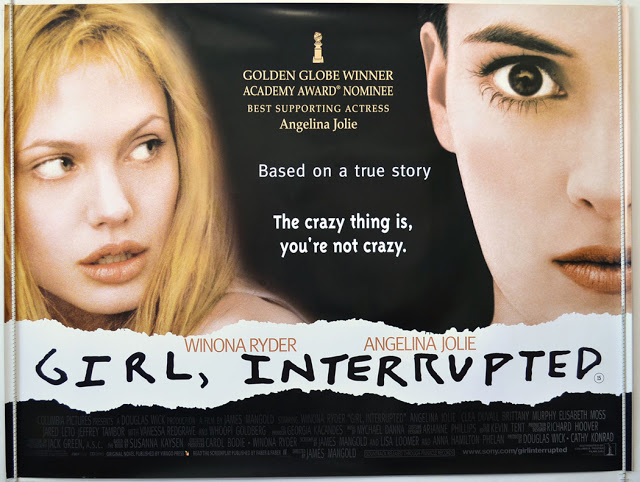
Movie poster for Girl, Interrupted

This is a guest review by Sarah Domet.

At first glance, Girl, Interrupted appears to be Hollywood’s version of feminist nirvana. It’s a veritable oasis in an industry where only 23% of speaking roles belong to women, an industry that tends to only depict women as supporting characters for the ever-important leading men. This 1999 film adaptation of Susanna Kaysen’s memoir of the same title features a strong core cast of women, some of whom went on to bigger stardom in the aftermath of the commercial success of the film.

Set to the backdrop of the late 1960s, Girl, Interrupted chronicles a fictionalized Susanna’s (Winona Ryder) year-long stint in the woman’s ward at Claymore, a private mental institution, after her attempted suicide and subsequent “break” with reality. Susanna is diagnosed with borderline personality disorder, a diagnosis she reluctantly accepts and from which she eventually “recovers.” Throughout the year, Susanna comes face-to-face with the “real” crazies in the form of sociopathic Lisa (Angelia Jolie), pathologically lying Georgina (Clea DuVall), schizophrenic Polly (Elizabeth Moss), and cocktail-of-issues Daisy (Brittany Murphy) who grapples with eating disorders, OCD, and a history of sexual abuse. The film suggests, sometimes overtly, that Susanna, by comparison to her ward-mates, isn’t doing so badly. In fact, Nurse Valerie (Whoopi Goldberg), in one of the most emotionally resonant scenes of the film, declares Susanna is “not crazy” but instead “a lazy, self-indulgent little girl who is driving herself crazy.” At this point, viewers are likely nodding their heads. Certainly, we’ve all met that girl. Or maybe we are that girl. 

Winona Ryder as Susanna Kaysen in Girl, Interrupted
Thankfully, Girl, Interrupted decidedly positions itself as not a love story. In fact, all of Susanna’s romantic interests are purely sexual, involving little emotion, a ”symptom” that gets her labeled as a borderline in the first place. Instead, Girl, Interrupted explores a young woman’s coming of age as she struggles in an uncertain world, meditates upon what it really means to be “mentally ill,” and, ultimately, discovers her sense of self. The equation is simple: the almost all-female cast + a story of female self-discovery = a feminist victory in a male-dominated Hollywood, right?

Well, yes and no.

At its core, Girl, Interrupted strives to be a feminist film. However, I find the film’s representations of “mad women” problematic, particularly the ways in which mental illness becomes so closely linked with eroticized otherness. And here is where the film’s deep ambivalence comes into play: it attempts to dispel the myth of what it means to be a mentally ill woman, while at the same time reinforcing cultural stereotypes that portray mentally ill women as hypersexual, dangerous, amoral, or inherently unfeminine. In the end, Girl, Interrupted posits mental illness as a choice from which one, like Dorothy from the Wizard of Oz, can always return.

As Susanna checks into Claymore, she catches a glimpse of her doctor’s case notes that indicate her “promiscuous” tendencies as one symptom of her ailment. Yes, she had an affair with a married man, and, yes, she slept with the brother of one of her classmates; she loves neither of these men. At one point Susanna notes, “What kind of sex isn’t casual?” Certainly, her disavowal of love as a necessary component of sex is a feminist gesture. In the free-loving 60s, that sweeping diagnosis—promiscuity—encompassed nearly every rally, march, or peace protest in America, or at least modern-day viewers might suspect from the comfort of our viewing couches.

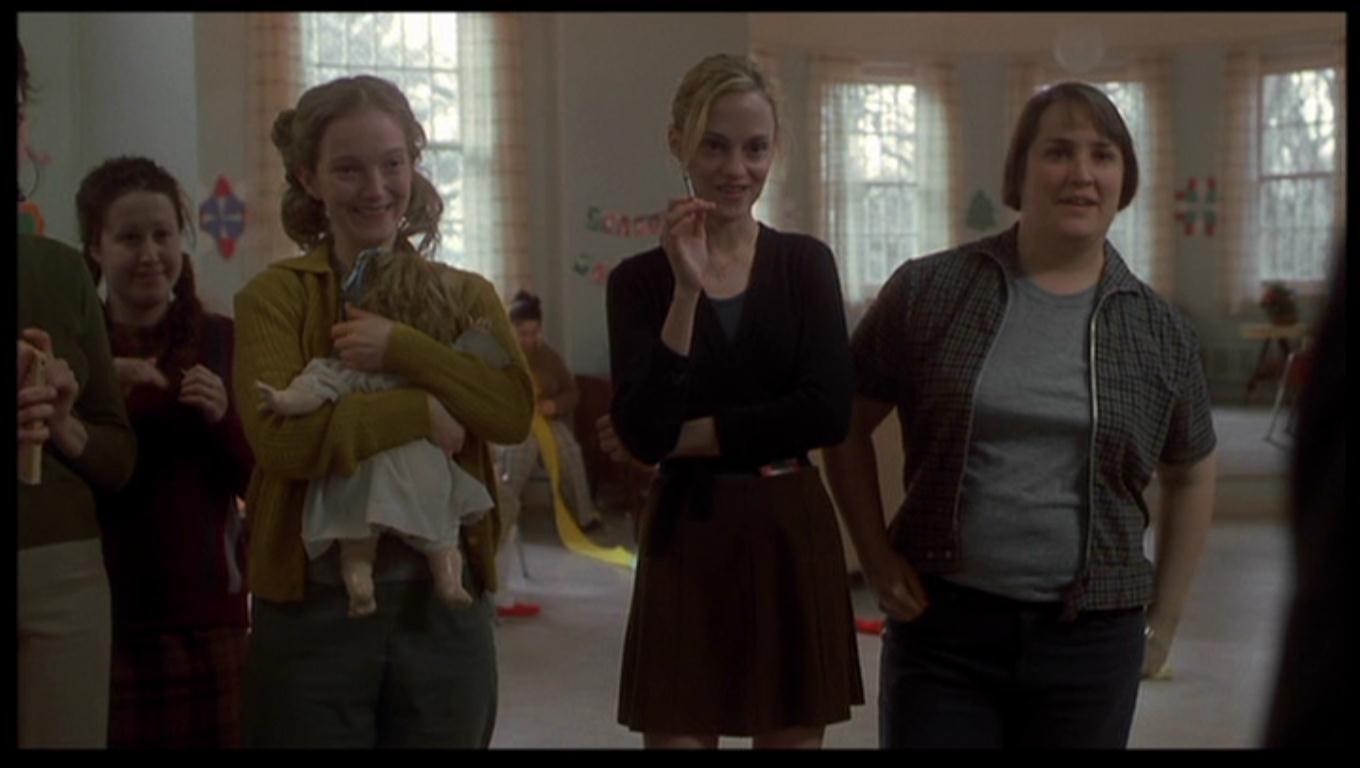
The women of Girl, Interrupted
Yet, her “promiscuity” continues, even at Claymore where Susanna engages in a physical relationship with a doting orderly. When challenged on this point by her therapist, Susanna becomes indignant, and rightly so. She argues, “How many guys would a girl have to sleep with to be considered promiscuous? Three, four, ten? How many girls would a guy have to sleep with? Fifteen? Forty? A hundred and nine?” Feminists across America high five each other.

At several junctures, such as this one, Girl, Interrupted positions itself firmly as a feminist film, shattering assumptions that there exists one “proper” behavior for women. We sympathize with Susanna and with her plight against The Man, against a gendered, cultural understanding of what is and is not appropriate sexual behavior for a young woman. In many ways, her “illness” manifests itself in the typical American teenage coming-of-age way. Susanna asks herself questions we all have asked, at one time or another: Where do I fit in? Who am I? What do I value?

Throughout the film, Susanna’s character works to unravel stereotypes about what it means to be a woman with a mental illness: she’s beautiful; she’s smart; she’s never threatening. She’s much like any other young woman as we watch her negotiate friendships, write in her journal, sneak out at night with her friends, smoke cigarettes, and, generally, protest authority. In most ways, she’s an ordinary girl, just like you might find on the “outside.” The viewer begins to question if Susanna even really needs to be at Claymore in the first place.

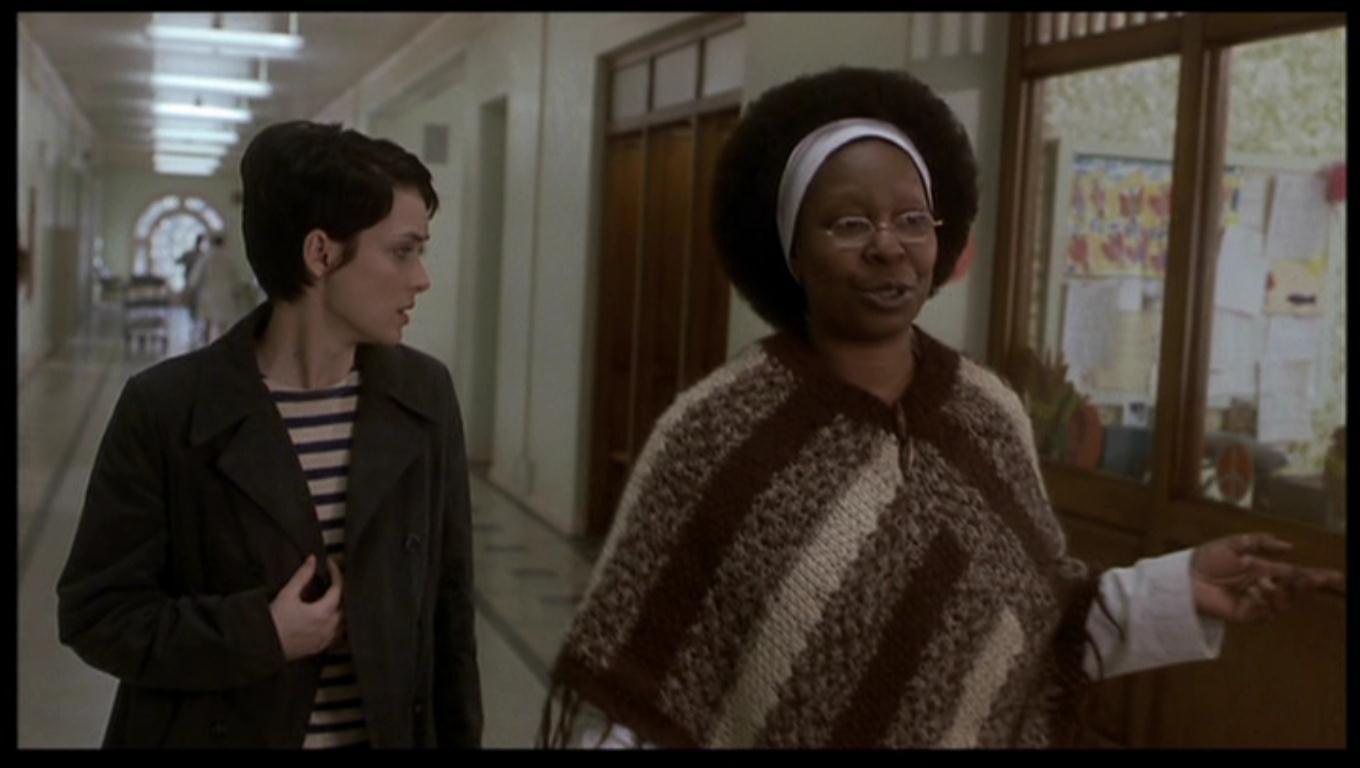
Susanna Kaysen (Winona Ryder) and Nurse Valerie (Whoopi Goldberg)
Yet, if Girl, Interrupted creates a binary with Susanna on one side, dismantling preconceived notions about mental illness and female sexuality, on the other side lies Lisa, who reinforces cultural narratives about “crazy bitches.” Let’s face it: Lisa is the real villain of the movie, a sociopath with no real moral compass, a young woman who is manipulative and unnervingly magnetic all at once. The moment she enters the film, returning from one of her many attempted escapes, we’re to understand that she’s a threat. She pins Susanna in the corner of her room shouting at her, demanding to know where her friend Jamie had gone, until she is physically restrained.

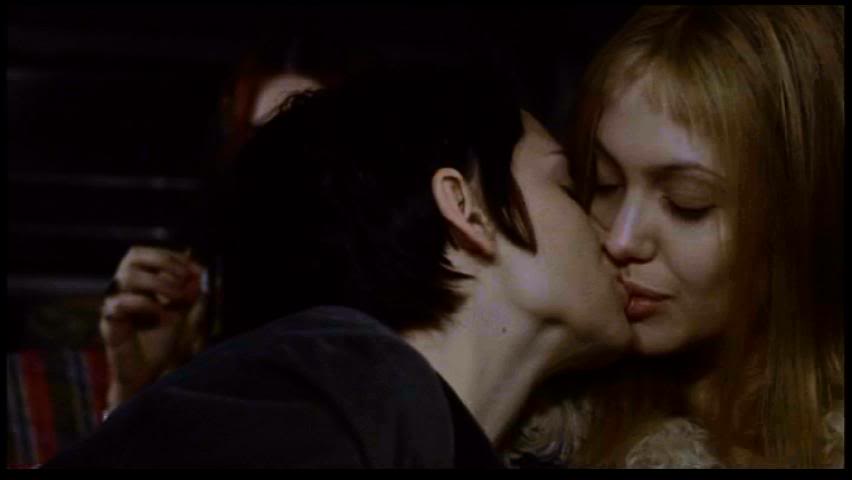
However, like many “crazy bitches” of cinema (Nina Sayers in Black Swan, Alex Forrest in Fatal Attraction) she exudes sexuality and charisma, deepened only by her sense of danger. As Susanna and Lisa spend time together, their growing friendship feels more like a courtship. Susanna herself can’t help but be drawn in by those pouty lips, her playfulness, her rabble rousing and bravado. At one point, as Susanna and Lisa are on the lam from Claymore, the two share a kiss. The moment is innocent enough, but the implications become clear. Lisa represents the eroticized other, the taboo, the forbidden, dark and amoral mad woman.

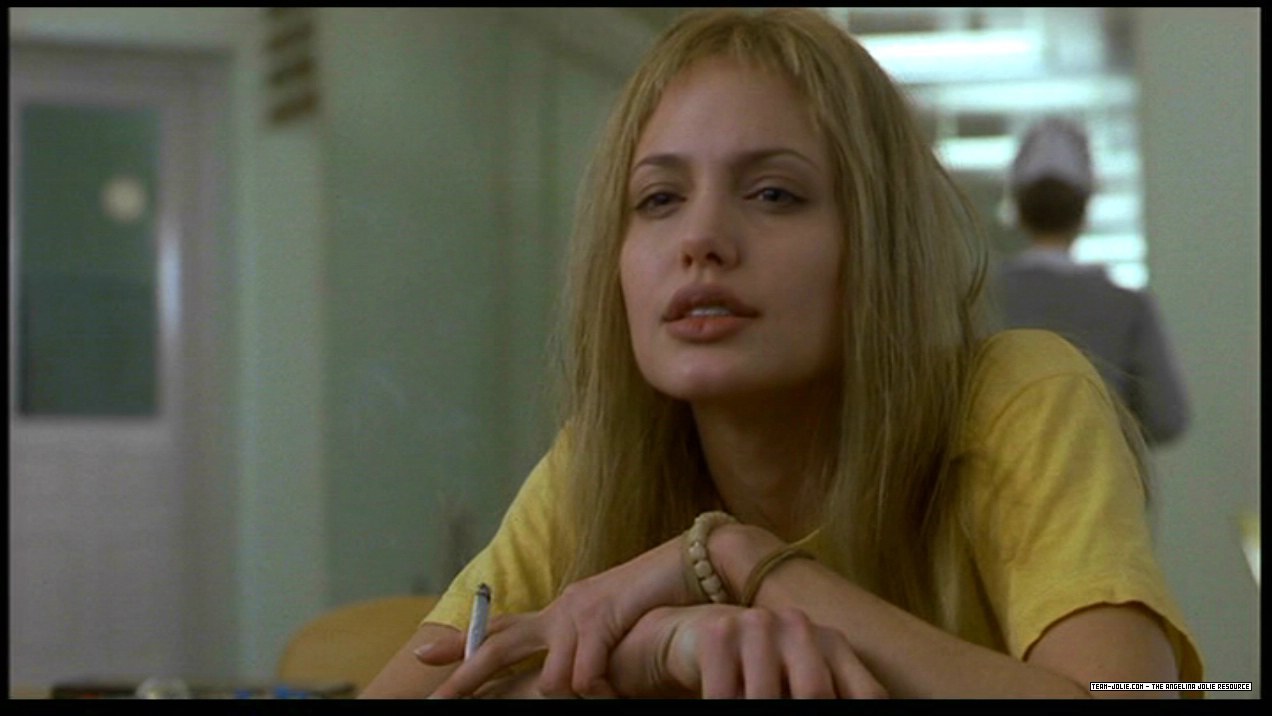
Angelina Jolie in her Oscar-winning role as Lisa in Girl, Interrupted
This stereotype becomes clearer a few moments later, in a pivotal scene of the film, when Lisa and Susanna crash at the apartment of Daisy, who has been newly released from Claymore. Susanna sits mute as Lisa taunts Daisy, exposing her deepest vulnerabilities. Lisa points out the cuts on Daisy’s arm, accuses Daisy of enjoying the sexual abuses of her father: “Everyone knows your father fucks you, what they don’t know is that you like it.” Lisa speaks the unspeakable, and Susanna watches doe-eyed, stunned at Lisa’s capacity for cruelty. The next morning, upon witnessing Daisy’s limp and lifeless body—she hanged herself—Lisa calls her an idiot, then picks her pocket for cash. Lisa, Susanna finally learns, has no capacity for emotion, no nurturing feelings at all. If anything makes her less than human—less than woman—it is this fact.
This scene in the movie, arguably the most important one, pits Lisa and Susanna against each other. But it also pits “good” against “evil,” and “feminine” against “unfeminine,” which is tied up in representations of mental illness. Susanna is faced with a choice: continue life with Lisa, a life that will certainly lead to chaos and casual sex and countercultural adventures, or return to Claymore to truly invest in her recovery. It’s a choice.
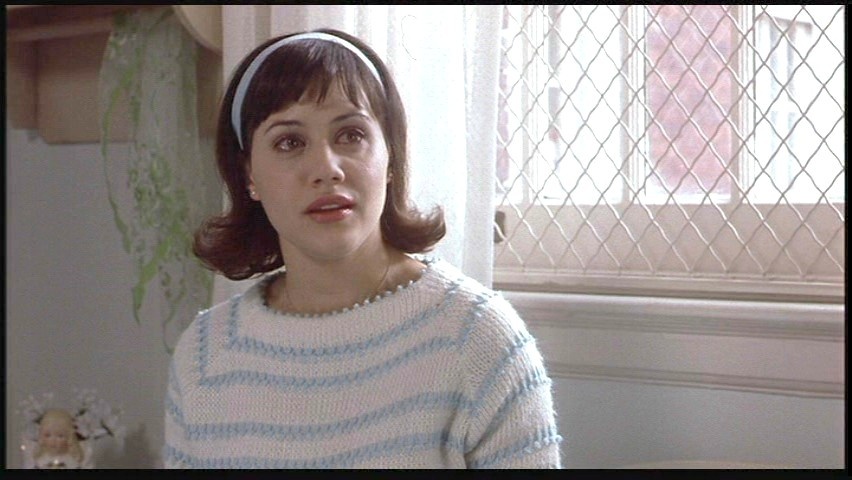
Brittany Murphy as Daisy in Girl, Interrupted
But is mental illness always a choice? And if so, between what and what?

Here’s a statistic: nearly 1 in 5 Americans suffers from mental illness of some sort, and a majority of these cases are women. This alarming number becomes even more important when recognizing that the film industry plays an important role in shaping public or cultural perception. In light of this, I wonder how detrimental a film such as Girl, Interrupted might be when questioning the legitimacy of mental illness and perpetuating stereotypes of those who suffer from these invisible diseases. Susanna’s renewed commitment to get better situates itself as a choice, and not necessarily one between health and illness or between one treatment and another. Instead, Susanna’s choice is oddly contingent upon morality, what’s right and wrong. Will she choose to return to Claymore? Or will she tread the darker path, represented by the villainous Lisa?

Which brings us back to Nurse Valerie’s diagnoses that Susanna is “not crazy” but, instead, “a lazy, self-indulgent little girl who is driving herself crazy.” The idea that Susanna is not really sick—that her invisible illness is a complete manifestation of her imagination or her culture—may be true. But it may be equally true that she, and young girls like her, are not just lazy and self-indulgent. That no amount of “trying harder” or “choosing to be well” necessarily helps, without the proper intervention. The movie wants to suggest that, yes, Susanna is a little confused, uncertain, depressed, even, but at least she doesn’t burn her face, or hide chicken bones under her bed, or require the padded room for her outbursts. At least she’s not crazy-crazy. Not like “them.” Girl, Interrupted paints a world where mental illness is not an invisible illness. Invisibility means conformity means health, and only when one adapts more culturally-sanctioned “moral” or “feminine” behavior will she be considered well again.

Susanna (Winona Ryder) and Lisa (Angelina Jolie) share a kiss
I wonder, too, why films depicting men with mental illness rarely cast their subjects in the same light. Films like A Beautiful Mind, or One Flew Over the Cuckcoo’s Nest, for example, present their flawed heroes as just that: heroes. Sure, these flawed fellows need treatment, but they are brilliant, misunderstood, complicated men. They are sympathetic precisely because of their mental states, not despite them. Viewers are never lead to question the sexuality, morality, or masculinity of these leading men. Moreover, films such as these don’t portray mental illness as a choice or a course of action, but as a circumstance. Hollywood afflicts male protagonists with insanity as a cross to bear, which makes them all the more heroic.

Susanna’s heroism, however, comes distinctly from her choice to overcome her diagnosis. To be fair, in real life, choice does play a legitimate aspect in the treatment of diseases. One can choose to be in treatment, or not to be. However, Susanna doesn’t simply learn to live with her personality disorder, she defeats it entirely. Toward the end of the film, the TV in Claymore’s living room flashes a scene from The Wizard of Oz as Glenda the Good Witch says, “You’ve always had the power to go back home.” Here, the film’s message reveals itself clearly: the power of recovery has always been with Susanna. 

Angelina Jolie and Winona Ryder in Girl, Interrupted
Susanna’s declared “recovered” by her doctors and ultimately joins the ranks of the “outside” world where she now belongs. It’s fitting that her penultimate scene at Claymore shows her applying make-up to look more suitably feminine. Her final act at Claymore is to polish the nails of a now drugged and restrained Lisa. “I’m not really dead,” Lisa says—and so the movie leaves us with a glimmer of hope that she, too, can choose to go home. If only all women could be cured of mental illnesses by clicking their heels together three times, painting on some Cotton Candy No. 7—and believing.

Viewers should be happy for Susanna, and I think most root for her. I know I do. But even as she’s being driven away from Claymore in the final scene, I wonder if she, herself, downplays the magnitude of the year she’s just spent under professional care. Perhaps she’s doing this because in the “outside” world, it’s still not okay to talk about such things or to admit to a mental illness without suffering stigmatization, or sideway glances, or nervous, sympathetic looks. 

Lisa (Angelina Jolie) confronts Susanna (Winona Ryder) on her first day at Claymore
She notes, “Being crazy isn’t being broken or swallowing a dark secret. It’s you or me, amplified.” That’s a nice thought. Mental illness is a reality for many, a part of their very composition, what makes many individuals unique, or creative, or sensitive. But the problem in the film—just like the problem in our real world, our post-Adam Lanza world—is that we must find ways to have conversations about mental illness, and not just within the confines of hospitals or therapy rooms. In real life. In the “outside” world. Susanna calls herself a “girl, interrupted,” and not a girl with a history of mental illness. What might the need for this euphemism say about the world that she’s rejoining? If 20% of Americans suffer from mental illness, a majority of these women, this issue is not just a cultural problem, but a feminist one.


Sarah Domet is the author of 90 Days to Your Novel. She writes fiction and nonfiction and currently teaches at Georgia Southern University.

Does Hollywood Revolve Around Men? ‘One Man’ Video Says Yes

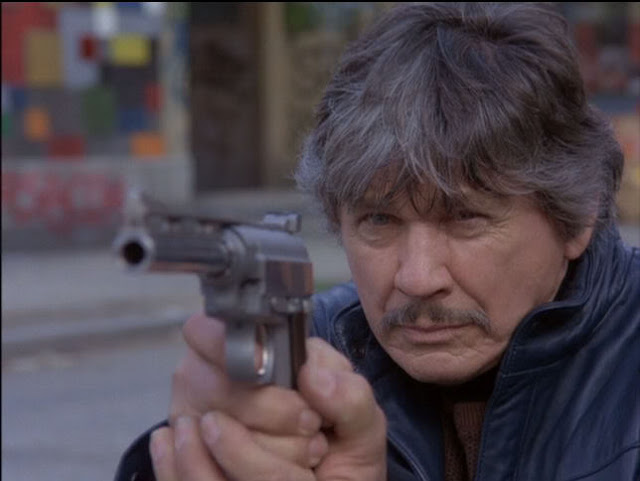
Deathwish‘s Charles Bronson, doing what dudes do

Is Hollywood really churning out the same movies, with the same stories over and over, revolving around men?? Yes, yes and yes. Geez, it’s called diversity, Hollywood. 

This “One Man” movie trailer supercut video posted on Upworthy (and sent to us by the fabulous writer Soraya Chemaly…thanks, Soraya!) splices together clips from trailers containing voiceovers. Watch it…

…and you’ll notice a disturbing trend. 
It’s all about THE MEN!!! 
Men saving the world. Men doing what no one else can. Men, men, men. Oh yeah, and it’s almost exclusively white men. Sure, two women do make an appearance as the focus of the narrator — “one reporter” and “one woman,” aka Linda Fiorentina … in one frame holding panties. But in that sea of men, seeing only two women doesn’t really cut it. Men are not the only ones whose stories are worth telling. They’re not the only ones making a difference or saving the world. But you’d never know it.
Writing about the video, Joseph Lamour said, “This montage of movie trailers may seem like just another funny supercut, but to me it plays like a highlight reel for what’s wrong with American cinema.”
I thought it was a bit strange that all the movies in this video are about 20 years old or older. But has that much really changed? Of the top 250 grossing films in the U.S. in 2012, 9% were directed by women and 15% of the scripts were written by women. Of the top 250 films, women comprise 18% of all directors, executive producers, producers, writers, cinematographers, and editors. Only 33% of speaking roles in movies belong to women.
You might also be thinking, “But these are just trailers. Who cares about the trailers??” But movie trailers, just like advertising in general, affect us. As I’ve written before about the prevalent sexism with Super Bowl ads: “Most people think they can ignore ads or that marketing is harmless. But advertisements splatter across billboards, buses, magazines, TV, radio and the internet. In Jean Kilbourne’s groundbreaking book Can’t Buy My Love: How Advertising Changes the Way We Think and Feel, she argues sexist and misogynistic imagery bombards us, inundating our senses even on a subconscious level. Whether we realize it or not, ads impact our choices and views.”

When we see movie after movie, ad after ad, revolving around men, it implies and reinforces the message that women don’t matter as much as men.

We talk A LOT at Bitch Flicks about the need for more women in film. More female protagonists, heroes, anti-heroes and villains. More films passing the Bechdel Test. More films focusing on mothers and daughters, sisters and female friendships. More female directors and screenwriters. More women of color. More queer women. More women of different sizes, ages, socioeconomic statuses, personalities, etc, etc, etc. More, more, more. We desperately need more.

Listen up, Hollywood. We’re tired of the same shit. We want to see more of all of our stories reflected on-screen. Not just white dudes.

Cool Robots, Bad-Ass Monsters and Disappointment in ‘Pacific Rim’

Pacific Rim movie poster.


Written by Leigh Kolb

Spoilers ahead!

The theme at the core of Pacific Rim is that collaboration and trust lead to success. And while the sweeping visuals of human-team-led robots (Jeagers) fighting with ocean monster-aliens (Kaiju) left me surprisingly entertained and satisfied, the dialogue and plot relied heavily on tired tropes.
Pacific Rim, directed and co-written by Guillermo del Toro, treads lightly around commentary on humans’ environmental abuse of Earth and allowing women in combat roles, but the bulk of the plot relies on trope after trope to support the larger-than-life action sequences between the Jaegers and Kaiju.
Overall, the film works, and it continues to get great reviews; however, it could have worked so much better had the writers tried a little harder to stay away from clichés.
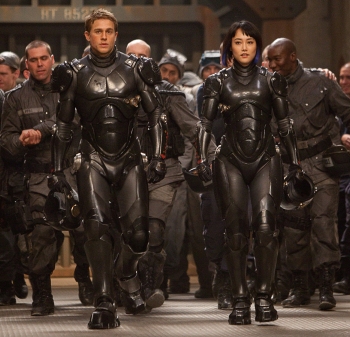
The film takes place just a decade in the future, in a world that’s been rocked and partially destroyed by the Kaiju coming from the depths of the Pacific Ocean and attacking cities. The international government is halting the Jaeger program (which puts two pilots–who must share a “neural handshake” mind-meld–in the driver’s seat of an enormous robot), and the crew has one more opportunity to fight the Kaiju. Marshall Stacker Pentecost (Idris Elba) leads a crew that includes his hand-picked choice of Raleigh Becket (Charlie Hunnam) and, eventually, Mako Mori (Rinko Kikuchi).
Stacker Pentecost.
Each of these three characters has an emotional weight–Pentecost feels protective of and responsible for Mori (he rescued and adopted her when her family was killed by the Kaiju), Becket lost his brother to the Kaiju while the two were mentally connected and fighting as co-pilots in a Jaeger, and Mori lost her family to the Kaiju when she was a little girl and has spent her life studying and training to become a pilot–and she’s “one of our brightest,” Pentecost says.
In his leadership position, however, Pentecost is concerned that Mori’s vengeance and difficult memories will impede her abilities to be a pilot, so he limits her career. Becket–who was literally in his brother’s mind when his brother was ripped from their Jaeger and brutally killed–and his memories are of no real concern to Pentecost.
Mako Mori.
While Pentecost’s fatherly feelings of protection and concern are justifiable, Becket is forceful in his desire to have Mori as a co-pilot. Her test numbers are strong and she fights him as an equal, which none of the male candidates could. With trepidation, Pentecost allows Mori to be Becket’s co-pilot.
The larger idea that women are “too emotional” for combat positions has been pervasive throughout the debate of women serving in combat positions (which the American military officially accepted in January 2013). Mori does get caught in her memories in her first major flight simulation with Becket; however, if she’s had hands all around her wringing about that possibility, certainly her anxiety over it would have helped push her over the edge. When anyone is told, over and over again, that she is fragile and emotional–chances are, some of that will be internalized.
Pentecost angrily dismisses her after her memory drift almost causes mass destruction (in fact, she asks to be dismissed, as she “respects” Pentecost, which she tells Becket is different than being “obedient”). Becket–after seeing her memories–tells Pentecost, “You rescued her, you raised her… now you’re holding her back.”
Mori is an equal to Becket.
Mori’s respect/obedience is troubling at times, but overall she is a strong female character. She’s excellent at what she does, and she is persistent at succeeding and meeting her goals. In fact, when Becket gets in a fight when another pilot is disrespectful to Mori, it feels odd and out of place–“nonsensical” and “unnecessary,” as Zev Chevat says at The Mary Sue. Otherwise, Becket is her greatest champion and leads with experience without being condescending.
And while the plot ebbs and flows in regard to its depiction of women (and I use that term broadly–Mori is really the only female character with lines), the film comes close to satisfying my desire for diversity and empowered female roles, but then it quickly regresses into tired tropes.
Becket is happy to see Mori is his co-pilot.
Becket seems to be the protagonist (and I almost thought at the beginning that there would be some interesting commentary on masculinity and military culture–from the monstrous masculine robots to the fact that Becket has to work in a dangerous menial construction job before being reassigned), but Mori is more fully developed, in terms of her memories and motivations. The two share a clear bond, and whether or not it’s a romantic one depends on the viewer (del Toro wasn’t totally sure, either).
At the end (after Pentecost has figured out that they need Mori and he asks her to “protect him”), Becket and Mori travel into the depths of the Pacific to Save Humanity. Once they get there to drop the bomb, their oxygen levels plummet and Becket tells Mori to retreat into a protective pod so he can drop the bomb. “I can finish this alone,” he says, giving her his oxygen.
So he does. His motivations are pure, but it still seems like a letdown to the viewer after all that Mori has accomplished. The final blow that does, indeed, Save Humanity, is dropped by our white male protagonist (the black man has sacrificed himself, and the Asian woman is protected in a little bubble).


I would have loved to at least see Mori giving Becket CPR to save him in the aftermath (instead of him just waking up), or something to level the heroism. Her role feels diminished at the end.
Becket and Mori are both heroes, but Becket is the default protagonist.
I don’t need a female protagonist in every film. However, when a film like this focuses on and develops the female lead without giving her the satisfaction of being a clear hero, something feels off. Either more needed to be done with Becket’s emotional baggage, or less with Mori’s. As it stands, the film perpetuated the notion that women’s emotions could be a hindrance in combat, and men’s emotions translate to strength in battle. Stuffing Mori into a pod at the climax of the film is symbolic of trying to shoo women back into their protected spaces so they don’t fly too close to the sun. I don’t think Becket as a character would have approved of that idea, nor would del Toro, probably. But that scene certainly left that taste in the viewer’s mouth–let the white guy finish the job!

I can’t stress enough how entertaining and well-done the visuals of this film are–and again, that’s coming from someone who did not expect to feel exhilarated while watching monsters fight robots. The lightly developed characters and don’t-blink-or-you’ll-miss-it female empowerment, however, left much to be desired. And while the optimistic ending and refreshing lack of American exceptionalism reinforce the idea that everyone–different ethnicities, genders, and races–needs to work together to succeed, the lackluster writing and reliance on tropes still sends the message that women’s emotions can be a hindrance and that they need to be protected.

Mori is instrumental in helping save the world–but she doesn’t get to set off the bomb. She’s not fully treated as a damsel in distress, but she comes too close for comfort. Maybe, just maybe, next time Becket can retreat to the pod while Mori fries the enemy.

In addition to having an almost-not-really female protagonist, Pacific Rim really only caters to the female gaze, in terms of mild sexual objectification. I guess I am simply perpetuating this.

Leigh Kolb is a composition, literature and journalism instructor at a community college in rural Missouri.

‘The Killing’ and the Misogyny of Hating Bad Mothers

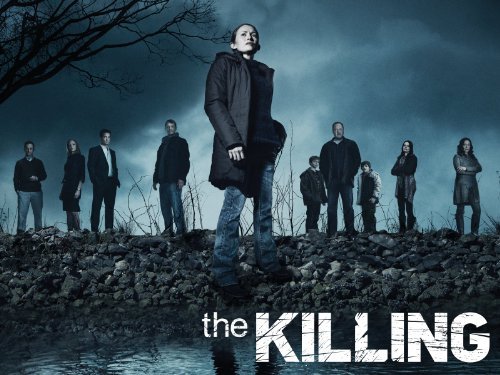
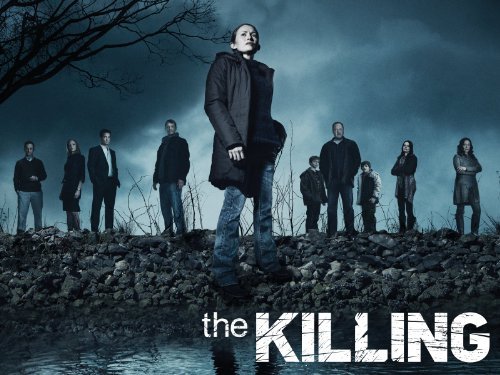
The Killing promotional still.


Written by Leigh Kolb

Vilifying mothers is a national pastime. Absent mothers, celebrity mothers, helicopter mothers, working mothers, stay-at-home mothers, mothers with too many children, mothers with too few children, women who don’t want to be or can’t be mothers–for women, there’s no clear way to do it right. 
In AMC’s The Killing, “bad” mothers have been woven throughout all three seasons. 
It would be easy to see this as a failing on the show’s part; instead, I think we can see it as a realistic depiction of how we treat mothers in our culture represented in both in the fictional world of the show and in critics’ responses to the series. 
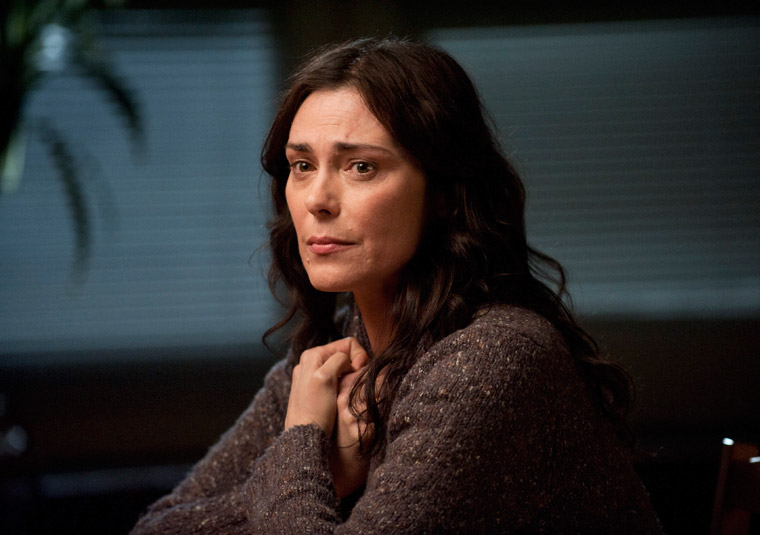
In the first two seasons of The Killing, the plot centers around the murder of Rosie Larsen, a 17-year-old girl. Her grieving parents–Mitch and Stan–have a difficult time (understandably) in the aftermath of her death and in the investigation. Mitch (Michelle Forbes), in the midst of a breakdown, leaves her two sons with Stan and her sister as she hits the road to try to heal or find something to ease the pain.

Mitch Larsen: bad mother.

In last year’s “The 10 Worst Moms on TV” on Yahoo TV, Mitch Larsen was featured as one of the worst. The critic wrote:
“Her daughter may or may not have been a prostitute or involved in some illegal doings at a casino. And she ended up dead seemingly because of it. But instead of hunkering down and paying more attention to her remaining children, Mitch left her sons to be raised by a depressed father and their hooker aunt while she went off to live in a motel and act creepy around wayward runaway girls.”

Mitch’s interaction with the runaway girl was a direct response to her feelings of inadequacy about her failings as a mother to Rosie. She was attempting to heal and grow. She mothered the runaway girl the best she knew how and was still abandoned and hurt. Mothering is difficult and complex–it’s not a simple equation of just being there all of the time.
In season 3, the victim pool has grown substantially–a number of teenage girls are found murdered, and the suspect appears to be a youth pastor at a homeless shelter.
One of the missing girls who is still unaccounted for, Kallie Leeds, has a terrible no-good single mother, Danette Leeds (Amy Seimetz), who seems to prioritize cigarettes, beer and getting laid over her difficult relationship with her daughter. Her neglect and indifference are seen as central to Kallie’s victimization.

Danette: bad mother.

As Danette and another mother of a missing girl sit next to each other at the police station, Danette notices that the other mother has a binder full of photographs and composite photos. She seems uncomfortable, as if she’s understanding the depth of her neglect. She recognizes that Kallie’s life trajectory closely mirrors her own, and the weight of that is pushing down on her. She was being the kind of parent she knew how to be, and she didn’t know how to be June Cleaver. Most mothers don’t.

While these supporting characters’ relationships with their daughters are troubled, and it would be easy for the audience to “blame” the victimization of the daughters on their mothers, it wouldn’t be correct. We are so used to complex, fallible male characters that we are also conditioned to see them as complex and fallible, not good or evil. When we’re presented with women with the same depth of characterization–especially mothers–we don’t know what to do except what we’ve been conditioned to do: criticize them and blame them.

This is blatantly obvious when we consider the show’s protagonist, detective Sarah Linden (played by the amazing Mireille Enos).

Linden has consistently been portrayed as a terrible mother in critics’ reviews of the series. She is a realistic female lead character–she is good at her job, works tirelessly and struggles with her failings in her personal life and professional life. Complex female characters are a good thing, and The Killing consistently delivers them (it can’t hurt that the show’s producer and many of the writers are women). 
In the first two seasons, Linden had custody of her young teenage son, Jack. Her work means long hours away from him and dinner from vending machines. Linden herself was a foster child and has difficulty negotiating her upbringing and being the kind of mother that she’s supposed to be, but cannot.  In the third season, Jack has moved to Chicago to live full-time with his father–he’s thriving, and living with his father. That’s good, right? No, Sarah Linden is evidently still a piece of shit mother.

Sarah Linden: bad mother.

In reviews of The Killing, writers often take an acerbic tone when mentioning her as a mother. 
For example, this reviewer seems to think taking a jog makes her a bad mother:
“We all struggle with the work-life balance thing, and detective Sarah Linden is hardly an exception. Finding time to mother her son, for instance, seems to be a challenge. Jogging, however, she manages to squeeze in. And it’s a good thing, too. Because Linden (finally) got a major break in the case this week, and it’s all thanks to the fact that she prioritizes cardio over sleep, parenthood, marriage, friendship, or updating a sweater collection that appears to have been sourced from Dress Barn circa 1997.”

This reviewer fails to make the connection that she’s preoccupied by an intense case, so she needs to stay in Seattle (or maybe the fact that she’s putting her career first figures into this assessment):

“But she’s still the World’s Worst Mother — her son lives in Chicago and she won’t visit because, well, he’s the only person she knows there. Wow, Linden. Just, wow.”

In a Salon review from last year (which, remarkably, denounces The Killing for not being “fun” enough), the reviewer slips in, “Yes, it’s still raining, and Linden’s still a bad mother…”

Even the New York Times, in a review from the first season, comes to the conclusion that the “scariest aspect” of the show is the theme of absent motherhood. Crooked politicians, murders, prostitution… those don’t hold a candle to bad mothers.
“Sarah Linden refuses to accept that her inattentiveness is gravely affecting her son until she is forced to reckon with her absence around him. And in Mitch Larsen (Michelle Forbes) we bear witness to a character who is present in her daughter’s life and yet still positioned at a significant remove from the darkest secrets of her adolescence. In the end, of course, this is the scariest aspect of all.”

And in the aforementioned Yahoo TV list, Linden gets first place. The manifesto against her begins: “She’s not actively trying to kill her son, but she may end up doing so anyway.”
OK then.
I’m not going to try to defend Sarah Linden’s parenting. That would be ludicrous–she doesn’t need defending. She’s a complex, realistic character with real issues.

At Bitch Flicks, Megan Kearns posted in the first season how it was “refreshing” to see this kind of character trying to navigate her different roles, and that the lead character is an accomplished single mom striving to keep her son out of trouble all while maintaining her demanding career.” She manages to do that by the third season, but it’s still not good enough.

Instead, audiences and critics alike focus much too closely on the female protagonist’s failings as a mother. We do not do that with male protagonists. (OK, six seasons in, after an episode highlighting parenting, Jezebel posted about how Don Draper was a “shitty dad.”)

Is Dexter a good father? What about Rick Grimes? Walter White?

Certainly there are lists of “bad dads” in TV/film, but the tone is different, more tongue-in-cheek. And a focus on these characters’ fathering abilities doesn’t run throughout conversations about the show, especially not with the same venom we see about Linden. When there’s a bad father in the mix, it’s just a poignant piece of a Joseph Campbell hero’s journey. Bad mothers, however, deserve to be burned at the proverbial stake.

There is a dearth of female antiheroes in film and television. The response to Sarah Linden shows why this is. When audiences see female characters, they think primarily in critical terms, especially about their roles as mothers and wives. (Of course this extends past fictional characters; there’s consistent and persistent hand-wringing about real-life women working too much and not being good enough mothers.) Women aren’t perfect (especially within the narrow confines of perfection that our society has put in place). Female characters shouldn’t be perfect.

My son is doing fine and my sweaters are warm and comfortable, assholes. 

Linden’s role as a parent, girlfriend and ex-wife is just one small part of the grand scheme of the show. Her partner, Stephen Holder, has a girlfriend this season. He forgets Valentine’s Day and is never home. He is not painted as a villain, because he’s out getting shit done. He’s doing his job. That is what is important in The Killing. So when critics focus (in depth, or just in passing) on how terrible a mother Linden is, that further erodes what should be good about having strong, complex female characters.

Sarah Linden may not be a full-time mother. But she’s a bad-ass mother, and that is what should matter the most.


Leigh Kolb is a composition, literature and journalism instructor at a community college in rural Missouri.

Wedding Week: The Roundup

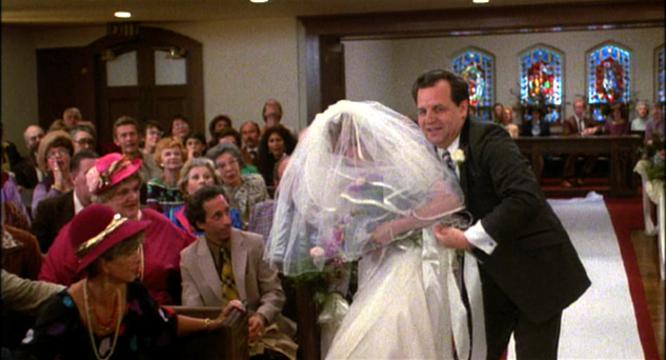
Father of the Bride (1991) is aptly named, as its focus is not on the wedding itself or the couple involved but on the titular character’s neuroses and journey to maturity. The wedding is the backdrop and the incident that provokes growth in the main character; it follows the wedding script in toto, so if you’re unfamiliar with any of the conventions of a traditional US wedding, this movie is a great primer. It’s an outrageously expensive, white wedding for thin, wealthy, white folks. People of color and gay men exist as support staff and magical queers. But the movie’s take on gender roles is constructive. Despite its focus on a male character, the movie is really about the affection a father feels for his daughter. He’s always recognized her as an individual person; now he must recognize her as an individual adult person.


The plot is pretty predictable. Female subservience is challenged, but standards of female beauty aren’t. The characters aren’t remarkably complex, but their motives are clear and almost always understandable. That said, this is a romantic comedy. I don’t mean to demean the genre as a whole, but I think it’s safe to say most blockbuster romantic comedies are pretty damn problematic, so to have a romantic comedy that subverts the notion of valuing wives who are simply beautiful and submissive while featuring a predominantly black cast and depicting Africa positively, I’d say that’s a win.

And this is where the real problem comes in. We’re clearly supposed to feel bad for Jack’s plight and the DOMA-fueled injustice being heaped on him. But as things escalate and Jack suddenly falls for Spanish architect Mano (Maurice Compte), the casual viewer is more likely to feel bad for Ali, who has to deal with him gallivanting all over the place and not even trying to make their relationship seem remotely realistic. Her future is on the line right along with Jack’s, but Jack never seems to have an inkling of just how big of a risk they’re taking for his sake.

Weddings in the movies and in television always seem to be more elaborate than those we experience in reality. Fictional characters with traditionally low-paying jobs somehow find a way to have a wedding that would cost literally a million dollars in the real world. They’re often over-the-top with hundreds of guests, extravagant meals and elaborate ice sculptures–you know, fluff.

This is the second time I’ve seen Lizzy Caplan in her easy portrayal of the emotionally damaged wild child, the first being in Bachelorette where similarly, the wedding brings up all of her feelings about past relationships and a surprise pregnancy. It’s a character I like, one that while not original, is also not the most common of characters (similar to Natalie Portman in Friends With Benefits, Charlize Theron in Sweet November). But I like the character; it’s one where, rather than neurotic, and desperately searching for love and marriage, she’s the opposite–skittish and non-committal, frustrating and sexy.

No, in Bride Wars that brand of madness is entirely female. This says nothing good or particularly realistic about the state of mind of the modern adult female. I mean, yes, we get hurt and pissed off when our friends do something that seems designed to cause pain to us, but how many of us who are not mentally ill follow them around, actively trying to ruin one of the most significant and expensive days of their lives?

Kristen Wiig’s character goes through the same kinds of ordeals we all go through—the kind that make us question who we are and what life is about. And her struggles are so frustrating and so moving that I found myself actually sobbing through the middle of the movie. The crazy thing about it is that while I was sobbing, I also started laughing. I’ve laughed and cried in a movie, but I’ve never before done both at the same time, and I did both while watching this movie more than once. I always tell my students that over-the-top comedy only works if it is paired with real, honest emotion, and my response proves that is something Bridesmaids does really well.


Fiona’s self-loathing over her ogre self goes extremely deep. When she confesses that she’s an ogre to Donkey, she says that no one would want to marry a beast like her. Shrek overhears this, and believes she’s talking about him. When he confronts her about it, and throws her words back in her face, she immediately assumes he’s talking about her. Fiona has overheard Shrek make comments about his identity as an ogre and the issues that come with it, so it wouldn’t be a huge leap for her to consider the possibility that Shrek overheard her and thought she was talking about him. But Fiona’s self loathing runs so deep that she doesn’t even consider the possibility.


Revisiting this film five years later (as a happily paired person once again), I find myself chafing against the film even as I enjoy the drama. The choices and mistakes that Carrie make from the time that she and Big decide to marry to the moment he leaves her at the altar about a third of the way through the story are the choices and mistakes that many modern American women make: ignore the man and his wishes, allow friends to convince you that you need a fancier dress, venue, event, and become more enamored with the grandeur and history of a luxurious location over the real fears and concerns your partner has about a large, intimidating, and ostentatious event.


To make matters more homophobic, in a move that makes absolutely no sense, George is press-ganged into playing the part of Julianne’s fiancé. It’s really gross to watch a gay man forced to play beard to a straight woman, shoved into a closet to suit her conniving privilege. Kimmy hyperventilates in relief that Julianne is apparently no longer her competition, because nothing promises a more stable marriage than making sure there are no hot women around to tempt your man. George gets his revenge by telling apocryphal stories about meeting Julianne in a mental institution where she was receiving shock therapy, because we might as well add mocking the mentally ill to this movie’s list of sins.

Leonato’s denunciation of Hero is the most disturbing moment of the film, as it should be. Verbal and physical abuse at the hand of a lover or boyfriend is traumatizing and life-altering, but there is something profoundly and uniquely painful in suffering at the hands of a parent. The casting of Clark Gregg, aka everyone’s favorite Agent Coulson from The Avengers, is a particularly brilliant move; any fan of Joss Whedon’s is conditioned to see Gregg as a good guy, and the moment of betrayal feels particularly pointed when coming from the mouth of such a likable actor.

So, is this a feminist film? Well, I think it highlights the significance of female friendship, but Carrie falling comatose when she’s jilted at the altar seems a bit much. While Carrie hires an assistant to organize her life, romantic love seems to be the ultimate goal. Meanwhile, Carrie bonds with the separated Miranda by telling her that she’s “not alone,” she reaches an understanding with the anti-marriage Samantha, and she celebrates Charlotte’s baby-bliss, even as she mourns her relationship, which has not actually ended. The film has its moments, and Carrie overcomes her obstacles without the direction or approval of any man. However, the film’s bigoted lines and treatment of Louise as a modern-day slave leave a bad taste in my mouth.


Even though I had fun with it, I have to say if you are engaged, you should probably limit your exposure to wedding movies. Because so many of them end with broken engagements or dramatic jiltings at the altar, you’ll start seeing potential wedding saboteurs in all your friends, family, and hired wedding professionals. You’ll see the obviously doomed engagements at the start of those movies and worry that if those characters could be so deluded, are you and your partner as well? You’ll think spending thousands of dollars renting chairs is ok because at least you didn’t invite random strangers from your mother’s past for an ABBA-scored paternity-off.


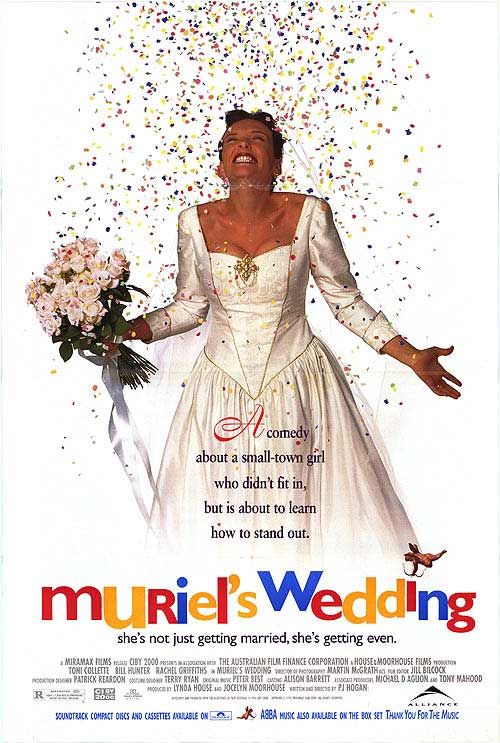
Muriel’s Wedding is basically a cautionary tale about valuing status and reputation over real connection. Muriel knows that she’s happy with Rhonda in Sydney, but by fulfilling her fantasies of beauty, wealth, and romantic achievement, she forgets her real strength: her honesty, decency, and kindness. These strengths were all there in her mother, Betty, whose cruel fate turns the movie from a girly romp into something much more meditative. She is talked over, pushed around, and utterly ignored, invisible even in her own home. Betty barely gets a moment of self-determination before she commits suicide, and her presence is felt most deeply in the frightening image of the Heslop backyard: a swath of literally scorched earth, where nothing can grow if nothing is tended and cared for.


There is one redeeming quality in this movie, and that is when Emma–who is a people pleaser for much of the movie–eventually starts to grow a backbone, while Liv–who is pushy and determined–softens up by the end. I’m hoping that the audience can take from these character shifts that women can be both determined and compassionate and that it is not disadvantageous to be both.

Jumping the Broom focuses on two strong customs — one being jumping the broom that has predated slavery, which Jason’s mother Pamela strongly supports, and saving sex for marriage. Sabrina and Jason obviously have strong physical desires for one another, but they’re willing to postpone physical intercourse and are continuing to know each other on various intimate levels — emotional primarily. This isn’t essentially common in most romantic films, especially an African American centric film.

Twenty years after Four Weddings and a Funeral, it strikes me that very little has changed. If this film were made today, Gareth and Matthew could enter into a formal civil partnership, but regardless, Charles may not have realized just how deep and committed their relationship had been all along. It’s still very bitter and chilling that it was the committed gay couple that was separated by death. The real theme of this film isn’t weddings and marriage, it’s commitment. Twenty years later, there’s still so little representation of disabled people in films. I honestly can’t think of another film I’ve seen with a deaf-mute character. There should have been more racial minorities in the cast, even in minor roles, instead of just one 5-second shot of a black extra at the funeral. And as comparatively progressive as this film is, all it does is make me think how ridiculous American films look. A film made in a country with a fraction of the US population is more representative of minorities than most films made in a country with 316 million goddamn people.


People who claim to believe films and TV and pop culture moments like this are somehow disconnected from perpetuating rape need to take a step back and really think about the message this sends. I refuse to accept that a person could watch this scene from an iconic John Hughes film—where, after a party, a drunk woman is literally passed around by two men and photographed—and not see the connection between the Steubenville rape—where, after a party, a woman was literally passed around by two men and photographed.

These posts about wedding films previously appeared at Bitch Flicks:

Movie Review: Rachel Getting Married by Stephanie Rogers

Rachel Getting Married: A Response by Amber Leab

Documentary Preview: Arusi Persian Wedding by Amber Leab

Review in Conversation: Sex and the City: The Movie by Stephanie Rogers and Amber Leab

Bachelorette Proves Bad People Can Make Great Characters by Robin Hitchcock

Feminism in Aiyyaa and Why It Ain’t Such a Bad Movie by Rhea Daniel

Realistic Depictions of Women and Female Friendship in Muriel’s Wedding by Libby White

Romantic Comedy (and Female Friendship) Arranged Marriage Style by Rachel Redfern

Movie Review: Something Borrowed by Megan Kearns

Movie Review: Melancholia by Olivia Bernal

The Five-Year Engagement: Exploration of Gender Roles & Lovable Actors Can’t Save Rom-Com’s Subtly Anti-Feminist Message by Megan Kearns

Bros Before Hoes, or How Kidnapping Makes for Great Dance Numbers: On Seven Brides for Seven Brothers by Jessica Freeman-Slade

Movie Review: Melancholia by Hannah Reck

Melissa McCarthy in Bridesmaids by Janyce Denise Glasper

“Love” Is “Actually” All Around Us (and Other Not-So-Deep Sentiments) by Lady T

Everything You Need to Know About Space: 10 Reasons to Watch (and Love!) Imagine Me & You by Marcia Herring

The Reception of Corpse Bride by Myrna Waldron

Movie Review: Room In Rome by Djelloul Marbrook

Movie Review: 500 Days of Summer by Stephanie Rogers

(95) Minutes of Pure Torture: 500 Days of Summer by Deborah Nadler

Gay Rights and Gay Times: Gender Commentary in Husbands by Rachel Redfern

Bridesmaids: Brunch, Brazilian Food, Baking, and Best Friends by Laura A. Shamas

‘Buffy the Vampire Slayer’ and Consent Issues (Seasons 1-2)

Sarah Michelle Gellar as Buffy Summers

Written by Lady T 

A year ago, I began writing a series called “Buffy the Vampire Slayer and Consent Issues,” looking at specific episodes of Buffy the Vampire Slayer that included a major plot point related to consent, rape culture, and sexual violence.

What I found was illuminating. The show explored sexual violence, misogyny, and rape culture in a number of episodes. Some of these episodes shone a light on problematic aspects of our society, while others perpetuated rape culture–and some managed to do both at the same time.

Here is a roundup of the posts analyzing specific episodes from seasons one and two of Buffy the Vampire Slayer:
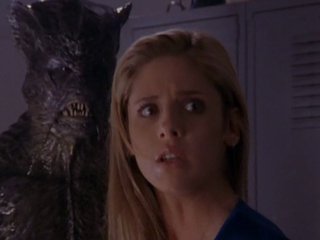
Episode 1.06, “The Pack”: Xander, possessed by the spirit of a predatory animal, attempts to rape Buffy. 

Xander (Nicholas Brendon) attacks Buffy while possessed

“Xander isn’t accountable for what he said or did under the hyena possession. I think unintentional, accidental possession by demonic spirits is about as extenuating a circumstance you can get …
I do, however, think that the attempted assault scene reveals something less than pleasant about Xander’s character. No, he would never attack Buffy when he was in his right mind, but he does believe that she’s attracted to dangerous men–that if he were dangerous and mean, she would be attracted to him.”
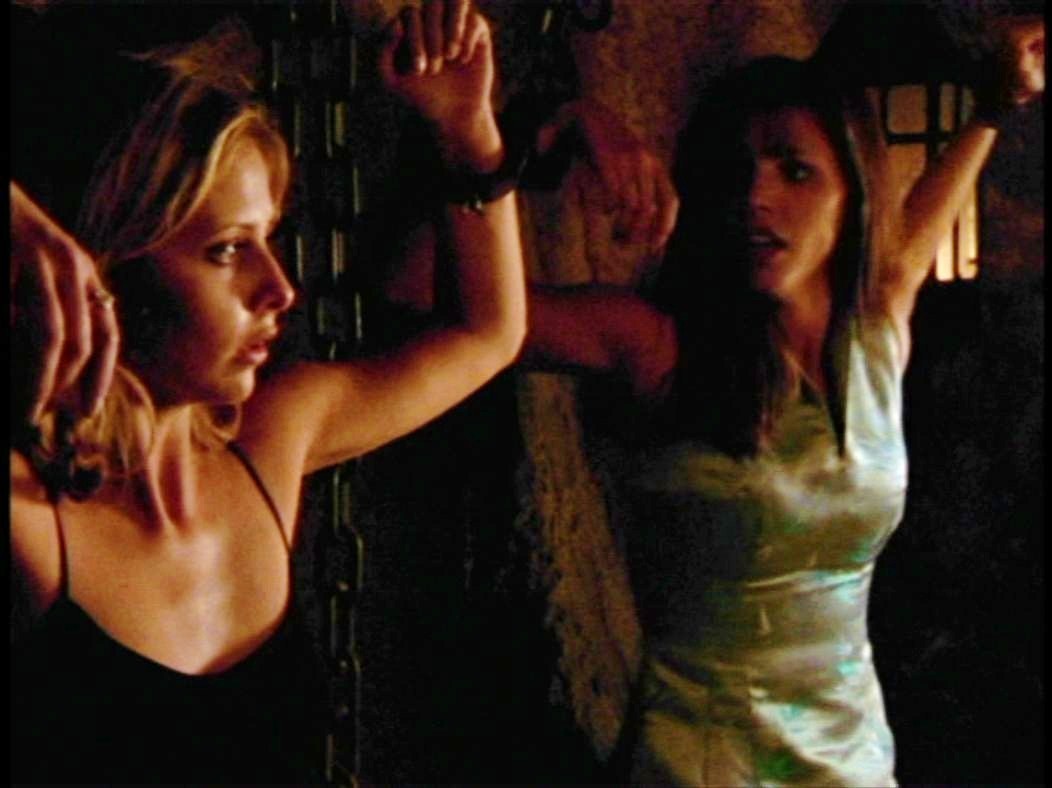
Episode 2.05, “Reptile Boy”: Buffy and Cordelia are offered as human sacrifices in part of a college fraternity’s ritual. 

Buffy and Cordelia (Charisma Carpenter) wait in terror for the frat boy demon to arise

“Even before this scene, we knew that Richard was a bad guy and that the Delta Zeta Kappa guys were up to no good, but we were also led to believe that Buffy’s date, Tom, was the nice guy of the group. We think he’s the only good one of a group of potential rapists, and when he pulls Richard off of Buffy’s unconscious body, our initial inference is confirmed–until we see that Tom is just as bad as the rest, if not worst of all. He was only pretending to be nice to make Buffy trust him. The message is clear: even guys who pretend to be nice and unassuming can be dangerous, and you can’t assume that a self-deprecating ‘nice’ guy is actually a good guy.”
Episode 2.07, “Lie to Me,” and Episode 2.10, “What’s My Line? Part 2”: Angel admits to his former torture of Drusilla, and she takes revenge on him. 

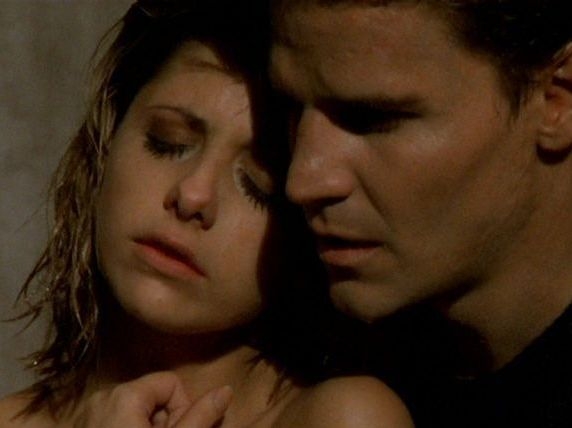
Drusilla (Juliet Landau) begins her torture of Angel (David Boreanaz)
 
“I’ve often thought that Drusilla is the most tragic character on Buffy, and that’s largely because of her relationship with Angel. I think her obsession with Angel is a commentary on molestation and Stockholm Syndrome. I’m not sure how old she was when Angel and Darla turned her into a vampire, but these episodes and a few flashbacks on Angel indicate that she was pretty young, maybe on the verge of turning eighteen. However old she was, the point is that she was ‘pure, sweet, and chaste’–qualities that made Angel obsessed with her, made him want to corrupt her innocence.”
Episode 2.13, “Surprise”: Buffy and Angel have sex, even though Buffy is still under the age of consent.

Buffy and Angel, shortly after escaping death and before sleeping together


“Even though Buffy and Angel sleeping together is wrong from a legal perspective, I have a hard time categorizing this incident as rape. Defining it as rape would rob Buffy of her agency in making that choice to sleep with Angel. She knew exactly what she was doing in the heat of the moment. She wasn’t under the influence of anything, she wasn’t hesitating for a second, and she wanted it to happen … At the same time, Buffy is barely seventeen, and Angel is two hundred and forty. Angel having sex with Buffy at her age and her level of experience is … well, it’s a little gross.”

Episode 2.16, “Bewitched, Bothered, and Bewildered”: Xander casts a love spell on Cordelia to get back at her for breaking up with him, but the spell affects every woman in town except Cordelia.

Xander walks down the hallway with every girl in Sunnydale High ogling him
 
“Xander temporarily making Cordelia fall in love with him just so he can break her heart is gross, cruel, and inexcusable (even though I do empathize with his hurt feelings). But imagine if he had wanted Cordelia to love him forever, if the love spell had worked and was permanent, that he slept with her, married her, spent his life with her, all while her feelings for him weren’t real.
A temporary love spell for the purpose of revenge is stupid and malicious, but a permanent love spell inspired by ‘pure’ intentions is a much, much bigger violation of consent and autonomy. Yet the second of the two would be considered more ‘romantic’ in our society.”
Episode 2.20, “Go Fish”: Buffy is offered as a “prize” to the members of the school’s swim team. 

Buffy worries more for her reputation than her safety

“This episode has a lot of victim-blaming and slut-shaming. Buffy is the one who is attacked, but she’s blamed for dressing inappropriately. She defended herself–something that assault victims are always encouraged to do–but only further incriminates herself in the process. Sure, Cameron does have a broken nose, and Buffy doesn’t appear to be injured, but his word is automatically taken over hers. He’s worth more to the school administration. He’s a successful athlete who brings acclaim and honor to the school, and she’s a violent troublemaker. Buffy’s not the ‘right’ kind of victim.”
After analyzing this batch of episodes from the first two seasons, I noticed a few common threads.

1. In two cases, Xander is an “accidental” predator. The circumstances in “The Pack” were truly not Xander’s fault, as he never intended to become possessed by a hyena. The love spell in “Bewitched, Bothered, and Bewildered,” on the other hand, was entirely his doing, even though he did not intend to use the spell to violate anyone’s physical consent. 

2. Buffy was a victim or intended victim in most of the episodes. She was a target of Xander’s hyena-possessed lust, chosen to be a human sacrifice, offered up to the swim team as a prize, and the first girl to fall under Xander’s love spell. The strongest girl in the world still faces victimization whenever she turns around.

What are the implications when one of the main male characters (and one of Buffy’s best friends) is shown to be an “accidental” predator? And what are the implications when our protagonist, a butt-kicking young woman, is a common target for misogynistic attacks? 

(Hint: these questions are open-ended for a reason, kids. Give your answers in the comments. Extra credit to those who show their work!)  


Lady T is a writer with two novels, a screenplay, and a collection of comedy sketches in progress. She hopes to one day be published and finish one of her projects (not in that order). You can find more of her writing at www.theresabasile.com. 

‘Sixteen Candles,’ Rape Culture, and the Anti-Woman Politics of 2013

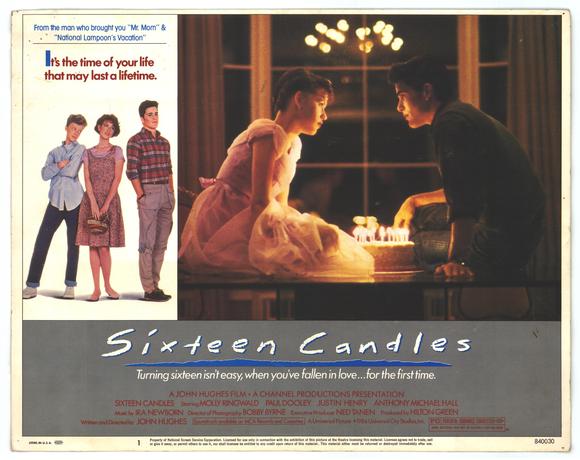
Movie posters for Sixteen Candles

Written by Stephanie Rogers (but not in time for Wedding Week).

Holy fuck this movie. I started watching it like OH YEAH MY CHILDHOOD MOLLY RINGWALD ADOLESCENCE IS SO HARD and after two scenes, I put that shit on pause like, WHEN DID SOMEONE WRITE ALL THESE RACIST HOMOPHOBIC SEXIST ABLEIST RAPEY PARTS THAT WEREN’T HERE BEFORE I WOULD’VE REMEMBERED THEM.

Nostalgia is a sneaky bitch.
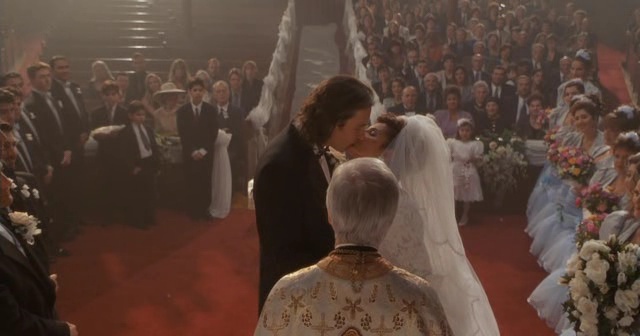
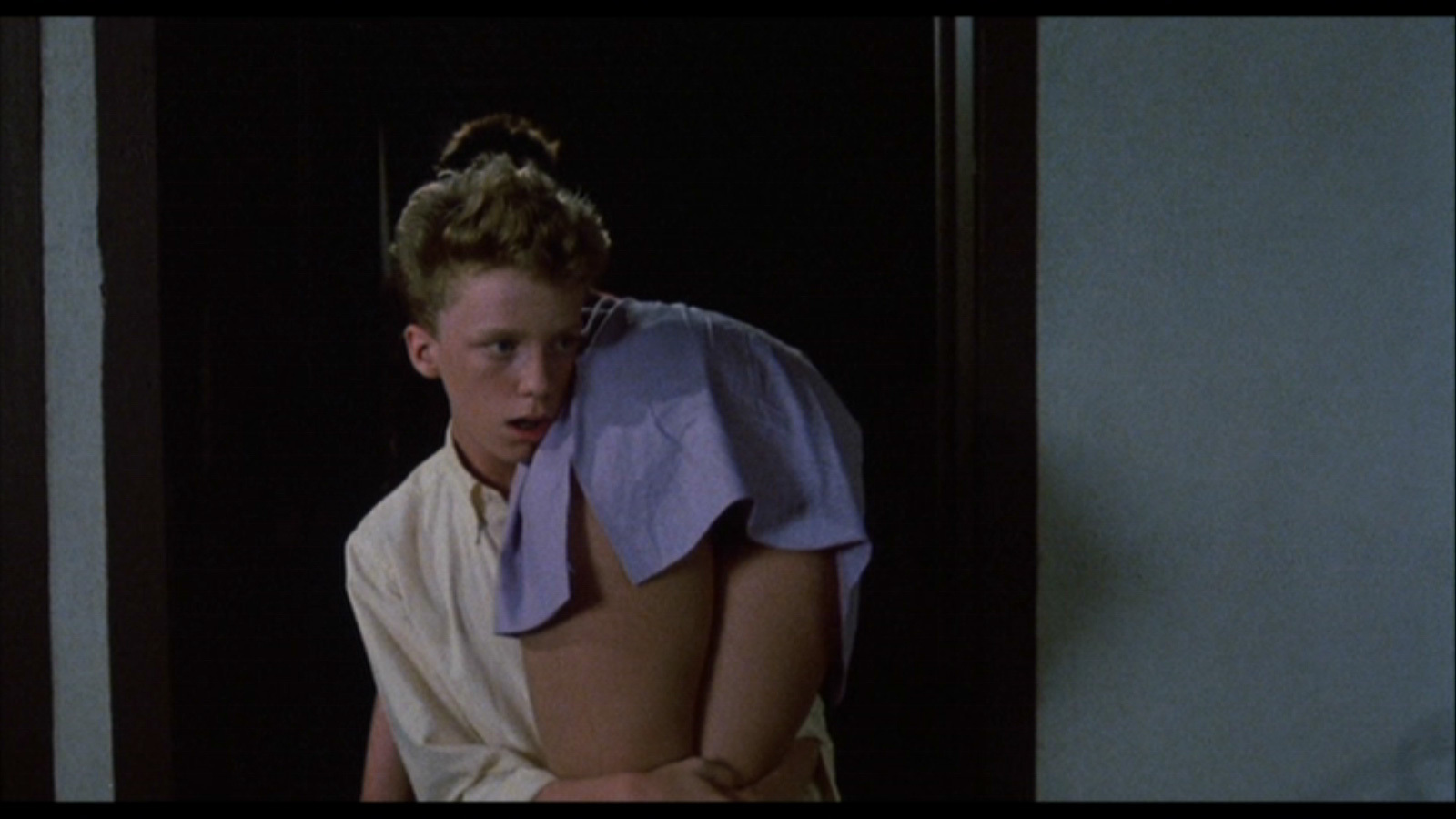
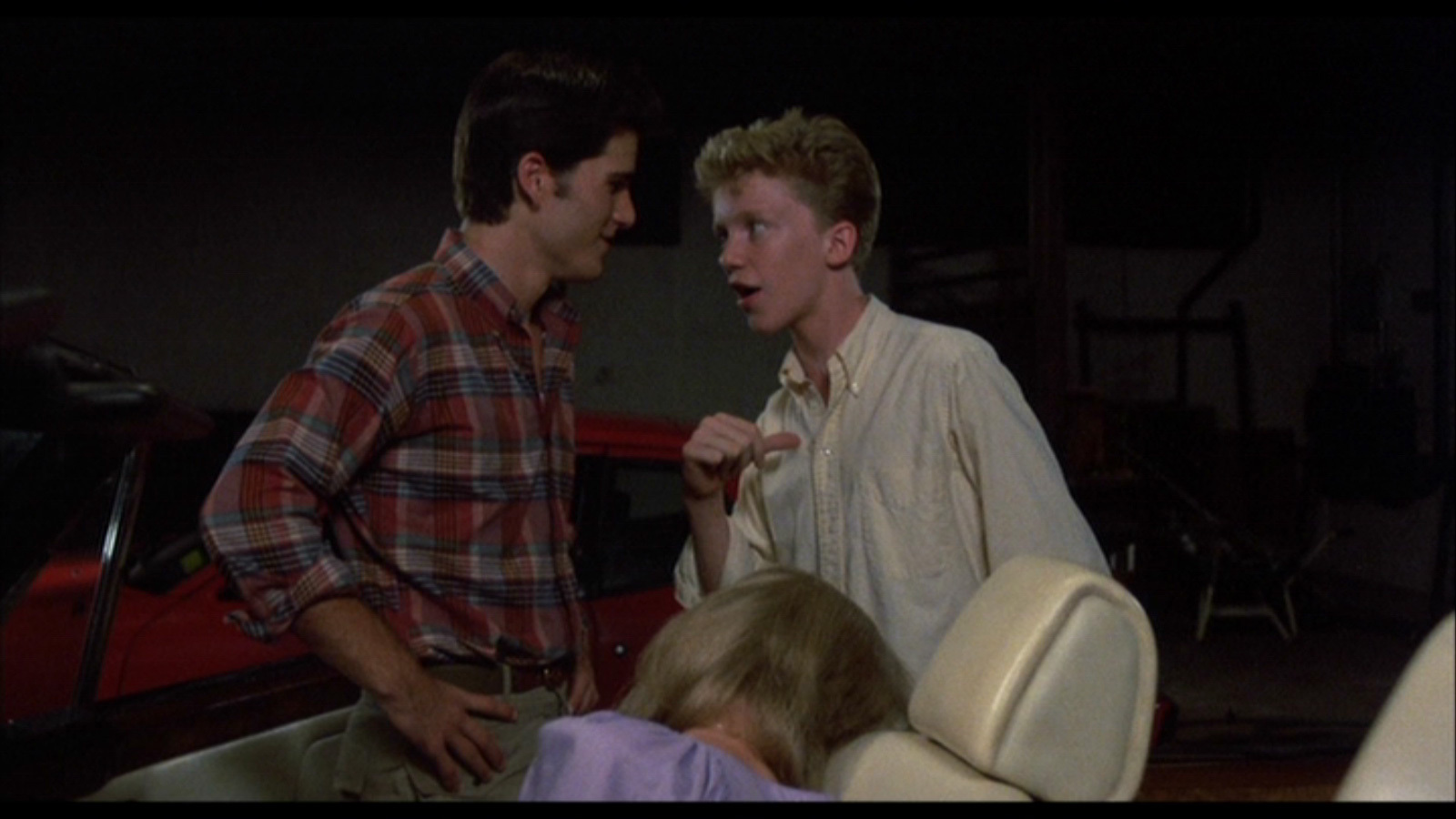
I wanted to write about all the wonderful things I thought I remembered about Sixteen Candles: a sympathetic and complex female protagonist, the awkwardness of adolescence, the embarrassing interactions with parents and grandparents who JUST DON’T GET IT, crushing hard on older boys—and yes, all that stuff is still there. And of course, there’s that absolutely fantastic final wedding scene in which a woman consents to marry a dude while under the influence of a fuckload of muscle relaxers. OH WAIT WHUT.
Ginny Baker getting married while super high


Turns out, that shit ain’t so funny once feminism becomes a thing in your life.
The kind of adorable premise of Sixteen Candles is that Molly Ringwald (Samantha Baker) wakes up one morning as a sixteen-year-old woman who still hasn’t yet grown the breasts she wants. Her family, however, forgets her birthday because of the chaos surrounding her older sister Ginny’s upcoming wedding; relatives drive into town, future in-laws set up dinner dates, and poor Samantha gets the cold shoulder. It reminded me of the time my parents handed me an unwrapped Stephen King novel on my sixteenth birthday like a couple of emotionally neglectful and shitty assholes, but, you know, at least they REMEMBERED it.
Anyway, she rides the bus to school (with all the LOSERS), and in her Independent Study “class” the hot senior she likes, Jake Ryan, intercepts a note meant for her friend Randy. And—wouldn’t you know it—the note says, I WOULD TOTALLY DO IT WITH JAKE RYAN BUT HE DOESN’T KNOW I’M ALIVE. Well he sure as fuck knows NOW, Samantha.
Samantha and Randy, totally grossed out, ride the bus to school


So, these are the important things in Sixteen Candles: Samantha’s family forgets her birthday; she’s in love with a hot senior who’s dating Caroline (the most popular girl in school); and there’s a big ol’ geek (Farmer Ted) from Sam’s daily bus rides who won’t stop stalking her. Oh, and Long Duk Dong exists [insert racist gong sound here]. Seriously, every time Long Duk Dong appears on screen, a fucking GONG GOES OFF on the soundtrack. I suppose that lines up quite nicely with the scene where he falls out of a tree yelling, “BONSAI.”
Since the entire movie is like a machine gun firing of RACIST HOMOPHOBIC SEXIST ABLEIST RAPEY parts, the only way I know how to effectively talk about it is to look at the very problematic screenplay. So, fasten your seatbelts and heed your trigger warnings.
The 80s were quite possibly a nightmare.
Long Duk Dong falls out of a tree (BONSAI) after a drunken night at the homecoming dance
The first few scenes do a decent job of showing the forgotten-birthday slash upcoming-wedding fiasco occurring in the Baker household. Sam stands in front of her bedroom mirror before school, analyzing her brand new sixteen-year-old self and says, “You need four inches of bod and a great birthday.” I can get behind that idea; growing up comes with all kinds of stresses and confusion, especially for women in high school who’ve begun to feel even more insecure about their bodies (having had sufficient time to fully absorb the toxic beauty culture).
“Chronologically, you’re 16 today. Physically? You’re still 15.” –Samantha Baker, looking in the mirror


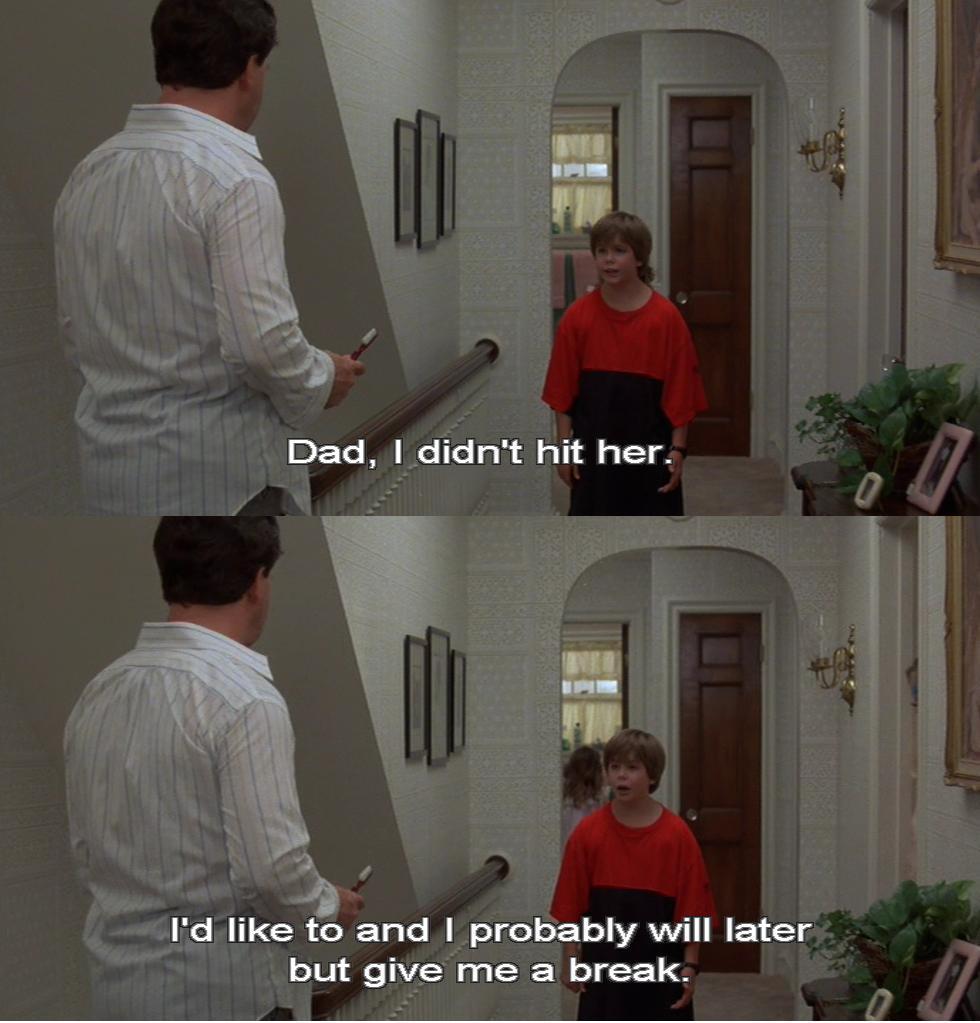
While Samantha laments the lack of changes in her physical appearance, her little brother Mike pretends to almost-punch their younger sister. When he gets in trouble for it, he says, “Dad, I didn’t hit her. I’d like to very much and probably will later, but give me a break. You know my method. I don’t hit her when you’re just down the hall.” It’s easy to laugh this off—I chuckled when I first heard it. But after five seconds of thinking about my reaction, I realized my brain gave Mike a pass because of that whole “boys will be boys” thing, and then I got pissed at myself.
The problem with eye-rolling away the “harmless” offenses of young boys is that it gives boys (and later, men) a license to act like fuckers with no actual repercussions. The “boys will be boys” mantra is one of the most insidious manifestations of rape culture because it conditions both boys and girls at a young age to believe boys just can’t help themselves; violence in boys is inherent and not worth trying to control. And people today—including political “leaders”—often use that excuse to justify the violent actions of men toward women.
Mike Baker explains to his dad that he hasn’t hit his younger sister … yet


Unfortunately, Sixteen Candles continues to reinforce this idea throughout the film.
The Geek, aka Farmer Ted—a freshman who’s obsessed with Samantha—represents this more than any other character. The film presents his stalking behavior as endearing, which means that all his interactions with Samantha (and with the popular kids at school) end with a silent, “Poor guy!” exclamation. Things just really aren’t going his way! And look how hard he’s trying! (Poor guy.) He first appears on the bus home from school and sits next to Samantha, even though she makes it quite clear—with a bunch of comments about getting dudes to kick his ass who “lust wimp blood”—that she wants him to leave her alone. Then this interaction takes place:

Ted: You know, I’m getting input here that I’m reading as relatively hostile.

Samantha: Go to hell.

Ted: Come on, what’s the problem here? I’m a boy, you’re a girl. Is there anything wrong with me trying to put together some kind of relationship between us?

[The bus stops.]

Ted: Look, I know you have to go. Just answer one question.

Samantha: Yes, you’re a total fag.

Ted: That’s not the question … Am I turning you on?

[Samantha rolls her eyes and exits the bus.]

POOR GUY! Also homophobia. Like, all over the place in this movie. The words “fag” and “faggot” flood the script and always refer to men who lack conventional masculine traits or who haven’t yet “bagged a babe.” And the emphasis on “Man-Up Already!” puts women in harm’s way more than once.
Samantha looks irritated when her stalker, Farmer Ted, refuses to leave her alone. Also Joan Cusack for no reason.


The most terrifying instance of this happens toward the end of the film when Ted ends up at Jake’s party after the school homecoming dance, and the two of them bond by objectifying women together (and subsequently creating a nice little movie template to last for generations). The atrocities involve a very drunk, passed-out Caroline (which reminded me so much of what happened in Steubenville that I had to turn off the movie for a while and regroup) and a pair of Samantha’s underwear.
This is how we get to that point: After Jake snags Samantha’s unintentional declaration of love during Independent Study, he becomes interested in her. He tells a jock friend of his (while they do chin-ups together in gym class), “It’s kinda cool, the way she’s always looking at me.” His friend responds—amid all that hot testosterone—that “maybe she’s retarded.” (This statement sounds even worse within the context of a film that includes a possibly disabled character, played by Joan Cusack, who lacks mobility and “hilariously” spends five minutes trying to drink from a water fountain. Her role exists as nothing more than a punch line; she literally says nothing.)
Joan Cusack drinking water (queue laughter)
Joan Cusack drinking a beer (queue laughter)
Jake’s girlfriend, Caroline, picks up on his waning interest in her and says to him at the school dance, “You’ve been acting weird all night. Are you screwing around?” He immediately gaslights her with, “Me? Are you crazy?” to which she responds, “I don’t know, Jake. I’m getting strange signals.” Yup, Caroline—IT’S ALL IN YOUR HEAD NOT REALLY.
Meanwhile, in an abandoned car somewhere on school premises (perhaps a shop lab/classroom), Samantha sits alone, lamenting Jake’s probable hatred of her after their interaction in the gym where he said, “Hi!” and she freaked out and ran away. Farmer Ted stalk-finds her and climbs into the passenger seat. Some words happen, blah blah blah, and a potentially interesting commentary on the culture of masculinity gets undercut by Ted asking Samantha (who Ted referred to lovingly as “fully-aged sophomore meat” to his dude-bros earlier in the film) if he can borrow her underwear to use as proof that they banged. Of course she gives her underwear to him because.
Ted holds up Samantha’s underwear to a group of dude-bros who each paid a buck to see them


Cut to Jake’s after-party: everyone is finally gone; his house is a mess; Caroline is passed out drunk as fuck in his bedroom; and he finds Ted trapped inside a glass coffee table (a product of bullying). Then, at last, after Jake confesses to Ted that he thinks Samantha hates him (because she ran away from him in the gym), we’re treated to a true Male Bonding Moment:

Ted: You see, [girls] know guys are, like, in perpetual heat, right? They know this shit. And they enjoy pumping us up. It’s pure power politics, I’m telling you … You know how many times a week I go without lunch because some bitch borrows my lunch money? Any halfway decent girl can rob me blind because I’m too torqued up to say no.

Jake: I can get a piece of ass anytime I want. Shit, I got Caroline in my bedroom right now, passed out cold. I could violate her ten different ways if I wanted to.

Ted: What are you waiting for?

C’MON JAKE WHAT ARE YOU WAITING FOR GO RAPE YOUR GIRLFRIEND. Or wait, no, maybe let’s let Ted rape her?

Jake: I’ll make a deal with you. Let me keep these [Samantha’s underwear, duh]. I’ll let you take Caroline home … She’s so blitzed she won’t know the difference.

Ted carrying a drunk Caroline to the car

And then Ted throws a passed-out Caroline over his shoulder and puts her in the passenger seat of a convertible. This scene took me immediately back to the horrific images of two men carrying around a drunk woman in Steubenville who they later raped—and were convicted of raping (thanks largely to social media). This scene, undoubtedly “funny” in the 80s and certainly still funny to people who like to claim this shit is harmless, helped lay the groundwork for Steubenville, and for Cleveland, and for Richmond, where as many as 20 witnesses watched men beat and gang rape a woman for over two hours without reporting it. On their high school campus. During their homecoming dance.

Jake and Ted talk about how to fool Caroline

People who claim to believe films and TV and pop culture moments like this are somehow disconnected from perpetuating rape need to take a step back and really think about the message this sends. I refuse to accept that a person could watch this scene from an iconic John Hughes film—where, after a party, a drunk woman is literally passed around by two men and photographed—and not see the connection between the Steubenville rape—where, after a party, a woman was literally passed around by two men and photographed.

Caroline looks drunk and confused while Ted’s friends take a photo as proof that he hooked up with her


And it only gets worse. Caroline wakes up out of nowhere and puts a birth control pill in Ted’s mouth. Once he realizes what he’s swallowed, he says, “You have any idea what that’ll do to a guy my age?” Caroline responds, “I know exactly what it’ll do to a girl my age. It makes it okay to be really super careless!”
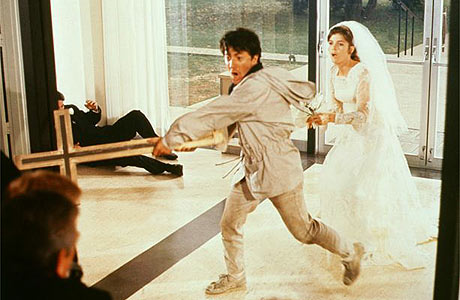
It makes it okay to be really super careless. 
IT MAKES IT OKAY TO BE REALLY SUPER CARELESS.
So I guess the current anti-choice, anti-contraception, anti-woman Republicans found a John Hughes screenplay from 30 years ago and decided to use this cautionary tale as their entire fucking platform. See what happens when women have access to birth control? It makes it okay to be really super careless! And get drunk! And allow dudes to rape them!
Of course, believing that Caroline is raped in Sixteen Candles requires believing that a woman can’t consent to sex when she’s too “blitzed to know the difference” between her actual boyfriend and a random freshman geek. I mean, there’s forcible rape, and there’s not-really rape, right? And this obviously isn’t REAL rape since Ted and Caroline actually have THIS FUCKING CONVERSATION when they wake up in a church parking lot the next morning:

Ted: Did we, uh …

Caroline: Yeah. I’m pretty sure.

Ted: Of course I enjoyed it … uh … did you?

Caroline: Hmmm. You know, I have this weird feeling I did … You were pretty crazy … you know what I like best? Waking up in your arms.

Fuck you, John Hughes.
Caroline wakes up, unsure of who Ted is, but very sexually satisfied
And so many more problems exist in this film that I can’t fully get into in the space of one already long review, but the fact that Ginny (Sam’s sister) starts her period and therefore needs to take FOUR muscle relaxers to dull the pain also illustrates major problems with consent; her father at one point appears to pick her up and drag her down the aisle on her wedding day. (And, congratulations for understanding, John Hughes, that when women bleed every month, it requires a borderline drug overdose to contain the horror.)
Ginny’s dad drags her down the aisle on her wedding day
The racism, too, blows my mind. Long Duk Dong, a foreign exchange student living with Samantha’s grandparents, speaks in played-for-laughs broken English during the following monologue over dinner: “Very clever dinner. Appetizing food fit neatly into interesting round pie … I love, uh, visiting with Grandma and Grandpa … and writing letters to parents … and pushing lawn-mowing machine … so Grandpa’s hyena don’t get disturbed,” accompanied by such sentences as, “The Donger need food.” (I also love it, not really, when Samantha’s best friend Randy mishears Sam and thinks she’s interested in a Black guy. “A BLACK guy?!?!” Randy exclaims … then sighs with relief once she realizes the misunderstanding.)
Long Duk Dong talks to the Baker family over dinner
And I haven’t even touched on the problematic issues with class happening in Sixteen Candles. (Hughes does class relations a tiny bit better in Pretty in Pink.)
Basically, it freaks me out—as it should—when I watch movies or television shows from 30 years ago and see how closely the politics resemble today’s anti-woman agenda. Phrases like “legitimate rape” and “forcible rape” shouldn’t exist in 2013. In 2013, politicians like Wendy Davis shouldn’t have to stand up and speak for 13 hours—with no food, water, or restroom breaks—in order to stop a bill from passing in Texas that would virtually shut down access to safe and legal abortions in the entire state. Women should be able to walk down the street for contraception in 2013, whether it’s for condoms or for the morning after pill. The US political landscape in 2013 should NOT include talking points lifted directly from a 1984 film about teenagers.
I know John Hughes is a national fucking treasure, but please tell me our government officials aren’t using his screenplays as legislative blueprints for the future of American politics.


A Letter to Hollywood: Keep Films Like ‘The Heat’ Coming

The Heat movie poster.

Dear Hollywood Movie Executives,
As I have driven by my local movie theater this summer, I’ve been struck by how I haven’t wanted to see most of the movies. You haven’t been getting much money from me.
But I’d like to talk to you about The Heat, which opened nationwide last weekend. 
I’m not a buddy-cop movie aficionado; in fact, I could count the number of films in that genre that I’ve seen on about a half of a hand, tops. But The Heat? I wanted to see it. So you got some of my money.
Judging from the crowded theater at a weekday afternoon showing–including a trio of dude-bros in front of me–and the fact that the film came in second at the box office, you got some of lots of people’s money.

The Heat promotional still.

There’s money in this for you. What’s “this”? This is producing and releasing blockbuster films with female leads. 
I know, I know. You’ve been hesitant to do so. Men’s stories have long been the standard-bearer of literature and film. Men’s stories are universal, women’s stories are for women. In the middle of June, 90 percent of feature films were about men or groups of men, and Man of Steel had about six times the number of showings as all of the films about women combined. 
Mullins (McCarthy) and Ashburn (Bullock) work together.
Stories about (white) men have been easy for you for a long time. Just because it’s easy, doesn’t mean it’s good or right–or even the most financially sound.
When Bridesmaids (directed by Paul Feig, who directed The Heat) was released, it passed up Knocked Up as Judd Apatow’s highest-grossing film. Pitch Perfect made almost $100 million worldwide. 
Is this just our petite lady-ration? One big female-fronted blockbuster per year? 
Please sir, I want some more.
The Heat delivers just the kind of big escapism that one would expect from a summer blockbuster. Melissa McCarthy is absolutely amazing. She is a national treasure. And while the film is fairly formulaic, the punch lines are not. 
Ashburn and Mullins also drink together.
Officer Mullins (McCarthy) roughs up and arrests a man soliciting a prostitute. He feels her full wrath because he tries to excuse his actions by saying his wife just had a baby and everything downstairs was messy. There is not one punch line about Mullins’s weight. More than one man comes to her in desperation because she’s not called them back. While Ashburn (Sandra Bullock) walks the stereotype line (she’s an “unlikable” but highly successful single woman), she’s a good agent, and she and Mullins complement one another.
Spanx (Ashburn’s, not Mullins’s), vaginas, areolas … the premise of the film may be masculine, but women weren’t just inserted into men’s roles. This female-centric comedy worked. Women are funny.
And I’ll tell you what–those dude-bros in front of me were laughing hard when Mullins was criticizing Ashburn’s Spanx (because her “furnace” couldn’t “air out” in them). 
Mullins is shocked by the concept of Spanx.
Women are funny. Female writers are funny (Parks and Recreation‘s Katie Dippold wrote The Heat). Female performers are funny. Jokes about strictly female experiences are funny–for everybody.

If women can laugh at men’s jokes–which doesn’t seem to be a problem–then men can laugh at women’s jokes. It’s pretty simple. The Heat shows us that. Cops, whiskey, drug rings, and a refrigerator full of guns and ammo may feel masculine, but Ashburn and Mullins show that women can wield it all.

The Heat made me laugh and cry.

I want more. I want theaters to be packed with genre films with women at the helm–in character, with the writing credits, as directors. The Heat 2 is already in the works, but there is so much opportunity for women in blockbusters. And I want dude-bros going to those movies in droves. I bet they will, too.

Now you need to believe it.

These female-led blockbusters are always “surprise,” hits, but how many times can you be surprised by the success of movies with female protagonists? At some point, you need to realize that people like this.

If you take up my plea and fund more female-centric films, I must warn you: some of them might not be awesome. Some may be mediocre, or bad. Just like movies with male leads. When Freddie Got Fingered bombed, the takeaway wasn’t that men can’t carry comedies. Remember that.

When the film ended, I stopped the trio of teenage boys and asked them if they liked the movie. It was unanimous: yes. I asked if they ever thought about not seeing it because the main characters were women. It was unanimous: no. (One exclaimed, “Not once.”)

If you don’t believe me and my dude-bros, here’s some recommended reading: NPR, Jezebel, Women and Hollywood, and Vulture all give the film favorable to glowing reviews.
One more thing: we need to talk about marketing. These movie posters are an atrocity. Mullins’s weight wasn’t an issue on-screen, but clearly your marketing departments felt the need to drastically change her.

Make them stop that.

No.

Sincerely,


Leigh Kolb is a composition, literature and journalism instructor at a community college in rural Missouri.

Wedding Week: Joss Whedon’s ‘Much Ado About Nothing’ and the Wedding That Wasn’t

Benedick (Alexis Denisof) and Beatrice (Amy Acker) in Much Ado About Nothing

Written by Lady T.
Joss Whedon’s adaptation of William Shakespeare’s Much Ado About Nothing is soaked in sex, languidness, and alcohol, as any decent adaptation of a Shakespeare comedy should be. It’s not a “wedding movie” in the traditional sense: there are no Bridezilla jokes, montages of wedding planning going hilariously wrong, or subplots about in-laws fighting each other.
But Much Ado About Nothing does have more than one wedding scene, and the film does employ the classic “left at the alatr” plot point. Claudio (Fran Kranz), in love with Hero (Jillian Morgese), abandons her on their wedding day. What follows is not the typical “wacky wedding hijinx” story, but a story that exposes the true nature of the characters involved in the ceremony, where several male characters reveal disturbing attitudes toward women, and one surprises us by being a little more enlightened than we expected.

Beatrice and Hero react to the behavior of the men around them.

Claudio doesn’t have cold feet because he’s nervous about marriage. At the beginning of the film, there’s nothing he wants more than to go to the chapel and get ma-a-a-a-aried. In fact, he wants to marry Hero the day after she accepts his proposal, prompting her father Leonato (Clark Gregg) to tell him to put on the brakes because he’s not quite ready to transfer ownership of his daughter to a husband…I mean, er, “watch his little girl grow up.”
Then the villain Don John (Sean Maher) tricks Claudio and Don Pedro (Reed Diamond) into believing that Hero is unfaithful to him. Don John stages a moment where his cohort Borachio (Spencer Treat Clark) seduces Hero’s lady-in-waiting, Margaret (Ashley Johnson), in Hero’s bedroom. Claudio and Don Pedro witness two shadowy figures going at it behind a curtain, and believe that Hero is disloyal. She is, as Don John puts it, “your Hero, Leonato’s Hero, every man’s Hero.” (Keep away from that Runaround Sue.)
So, naturally, Claudio and Don Pedro a) forget that Don John is the same villain who was in handcuffs at the beginning of the film for trying to stage a coup against Don Pedro, and b) decide that two shadowy figures in his fiance’s bedroom is concrete proof that Hero is cheating on him. They believe this because someone wrote “gullible” on every ceiling in every building they’ve ever been in.

Dumbass.

Feeling betrayed and resentful, Claudio doesn’t simply call off the wedding or privately ask Hero for an explanation. He manhandles her at the ceremony, shoves her back into her father’s arms, calls her a whore, and refuses to marry her. Don Pedro joins in on the slut-shaming, and once they’re done humiliating Hero in front of her friends and relatives, they stalk off with Don John (who hilariously steals a cupcake from the dessert platter before leaving the ceremony).
The scene is mostly played as serious; Whedon even eliminates Benedick’s Captain Obvious moment where he comments, “This is not a nuptial.” The film focuses on the horrifying behavior of Leonato, the previously affectionate father, who wishes for his daughter’s death after hearing the prince declare that she is nothing more than a “common stale.” Some of his exact words: “Let her die.”
Leonato’s denunciation of Hero is the most disturbing moment of the film, as it should be. Verbal and physical abuse at the hand of a lover or boyfriend is traumatizing and life-altering, but there is something profoundly and uniquely painful in suffering at the hands of a parent. The casting of Clark Gregg, aka everyone’s favorite Agent Coulson from The Avengers, is a particularly brilliant move; any fan of Joss Whedon’s is conditioned to see Gregg as a good guy, and the moment of betrayal feels particularly pointed when coming from the mouth of such a likable actor.

“Spoiler alert–I’m going to call my daughter a whore in half an hour!”

Meanwhile, only two men present at the ceremony believe Hero’s (accurate) version of the story without question. One man is a priest, who is not so much a character as a plot device, serving the same purpose as Friar Lawrence in Romeo and Juliet and coming up with the always brilliant “hey, let’s pretend the girl is dead!’ scheme.
The other man who immediately believes Hero is Benedick.
Remember Benedick? The man in the beginning of the play who proudly proclaimed his eternal bachelorhood to anyone who asked his opinion (and those who didn’t?). The man who only ever referred to Hero as “Leonato’s short daughter”? The man who, when pressed to think of a compliment for a woman, could only say, “That a woman conceived me, I thank her”?
He’s the only male character of note who takes Hero’s word.
Granted, Benedick did not witness Don John’s display of shadow puppet porn theater on Hero’s balcony–but then again, neither did Leonato, who immediately believes the accusations against his beloved daughter. Benedick also knows better than to trust anything that comes from Don John’s mouth.
But even though he believes Hero, he’s not willing to engage Claudio in a fight. He puts the blame on Don John. His position seems to be that even though Claudio and Don Pedro were wrong, they were tricked, and not entirely to blame.
After his conversation with Beatrice, however, Benedick changes his tune. He agrees to challenge Claudio.

Beatrice and Benedick shortly after he challenges Claudio
This is a complete role reversal from the beginning of the film. Claudio, the professed lover, and Don Pedro, seemingly a friend to women, think nothing of denouncing and humiliating a woman in public. Benedick, the proud bachelor and misogynist, prioritizes the woman he loves over his closest friends.
What can we learn about misogyny from the Much Ado wedding that wasn’t?
To put it in the most cliched terms, we can learn that actions speak louder than words. Claudio’s sweet professions of love mean nothing when compared to his behavior towards Hero, and Benedick’s rants against women and marriage are redeemed when he defends one woman on behalf of another woman he loves.
Or, to put it another way–the guy who says a lot of sweet things and seems genuine might turn out to be a gullible asshole with a lot of internalized misogyny, and the mostly-decent guy who stands up for you will still need to make a lot of sexist jokes for the sake of appearances and male ego.
Yay?
(Go see this movie immediately.)


Lady T is a writer with two novels, a screenplay, and a collection of comedy sketches in progress. She hopes to one day be published and finish one of her projects (not in that order). You can find more of her writing at www.theresabasile.com.

Wedding Week: The Top Hollywood Wedding Scenes

This is a guest post by Marcela de Vivo.
Weddings in the movies and in television always seem to be more elaborate than those we experience in reality. Fictional characters with traditionally low-paying jobs somehow find a way to have a wedding that would cost literally a million dollars in the real world. They’re often over-the-top with hundreds of guests, extravagant meals and elaborate ice sculptures–you know, fluff.
Wedding scenes on the big screen are a fantasy of what viewers would want if we had unlimited funds. But we don’t, so watching these top wedding scenes will have to do! 
Movie still from the wedding scene in The Princess Bride
The Princess Bride
Princess Buttercup may not have wanted to marry Prince Humperdink, but that doesn’t mean she couldn’t appreciate the fairy tale ambiance of her wedding. Flowers and candlelight decorated the large church, which was filled with the richest, most powerful wedding guests in the land. As Buttercup hoped the rebellion outside the doors was on her behalf, the most memorable priest in movie history spoke about the joy of “maawwaaage.”
The wedding itself didn’t end too well for many of the characters, but all-in-all, it was a memorable wedding.
Movie still from the wedding scene in The Godfather
The Godfather
The father of the bride traditionally feels obligated to grant favors on the day of his daughter’s wedding, at least according to Marlon Brando’s character, Vito Corleone. Apparently, that extends to the bride herself.
Corleone’s daughter is known to have one of the most extravagant weddings in movie history, with a large tent and vivacious celebration with singing, dancing and plenty of alcohol. The best part of all was having the entire family together to celebrate–after that enormous cake, of course. 
Movie still from the wedding scene in Bridesmaids
Bridesmaids
Lillian may not have been the main character, but when it came to her wedding, she was truly the star. Despite a case of terrible food poisoning, a disaster bachelorette party and temporarily losing her best friend and maid of honor, Lillian’s wedding was indeed spectacular, complete with a waterfront setting, designer wedding dress and colorful strobe lighting–something we could all admit to be somewhat jealous of.
The kicker was the entertainment: a surprise performance by Lillian’s favorite childhood band, Wilson Phillips. And best of all, she had all of her best friends by her side. 
Movie still from the wedding scene in My Big Fat Greek Wedding
My Big Fat Greek Wedding
Sometimes family can complicate what should be the best day of a person’s life. For Toula, the days leading up to her wedding were difficult due to her incredibly traditional family. But when it came to the day of the wedding, it seemed like the universe was doing its best to ruin everything.
It was Toula’s family, as big and loud as they were, that made the day so special. Toula’s parents finally accepted her new husband and even gave her a house as a wedding gift (an entire house!). This is one movie wedding that goes to show that it doesn’t take perfection to have a perfect wedding.
Movie still from the wedding scene in The Graduate
The Graduate
One of the most iconic wedding scenes in movie history is also one of the least successful. Although the church wedding was nearly empty, the bride, Elaine, looked beautiful in her classic white wedding gown–at least Benjamin Braddock thought so. Unfortunately for Ben, he wasn’t the groom, but that didn’t stop him from whisking away the bride!
Ultimately, Elaine and Benjamin run off together, just minutes after she says, “I do.” Sure, there was a brawl, and the bride and groom didn’t stay together for longer than 5 minutes, but at least it was memorable.
We might not always get the perfect wedding of our dreams, with the fancy sculptures, favors, gift bags and decorations, but at least we can appreciate and treasure what marriage is actually about more than these films do.


Marcela De Vivo is a freelance writer from California whose writing covers everything on health, travel, gaming and technology. Watching these films really reminds her of what marriage truly involves and the value of family. Follow her on Facebook and Twitter today!