‘Outlander’ and A Modern Man

“What is her power over you?” Randall chides Jamie during his psychological torture. As manly as Jamie likens to be, he long ago surrendered himself to Claire’s power over him. In his deteriorated state, only a woman can heal this broken man. While Jamie’s brokenness is wholly justifiable, his extremist way of thinking shows his ideas of masculinity will need to continue to evolve if he wants to fully regain his soul.


This guest post by Alize Emme appears as part of our theme week on Masculinity.


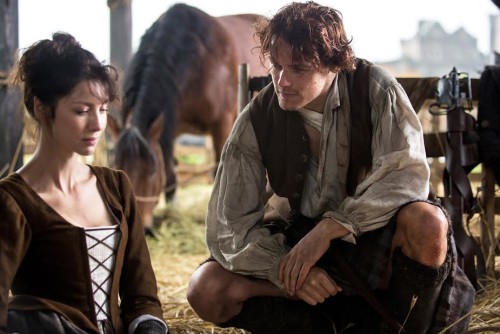
Setting aside everything there is to know about the current television landscape, the Starz series Outlander might seem like a completely modern story about two people navigating the start of a new relationship — minus the time travel, two husbands, and lack of indoor plumbing. Outlander, the tale of Claire Randall (Caitriona Balfe) the Englishwoman who accidentally leaves the 20th century and her husband when she travels 200 years back in time and meets Jamie Fraser (Sam Heughan) and a love she cannot deny, actually is a modern portrayal of sex and gender on TV. But what makes Outlander modern is also what makes it rare: Masculinity as told for the female gaze.

Ronald D. Moore, Outlander’s creator, deserves credit for fully developing the masculine men Diana Gabaldon established in the book series of the same name. On one end of the masculinity spectrum there are characters like Frank Randall (Tobias Menzies), Claire’s husband, the scholarly gentleman who is considerably more sexually timid than his wife, and Ian (Steven Cree), Jamie’s brother-in-law who is remorseful after murdering a man and befriends a criminal because he’s the only one who treats him like a man. On the polar opposite end of the scale are Dougal MacKenzie (Graham McTavish), kin to Jamie and recreational adulterer at large, and Captain Jack Randall (also Menzies), an 18th century version of Dog the Bounty Hunter mixed with one of the Hulks buttoned into a red tailored coat whose very layered homoerotic tendencies make him a predator for women and men alike. Somewhere in the middle of this virility brigade is Jamie Fraser.

“There has never been a man on screen quite like this Jamie character. He’s tough and brash, heroic and noble, but he’s also invested in love and intimacy.” 

Jamie completely redefines the nuances of masculinity and what it means to be a man on screen. Where the traditional television narrative would dictate Jamie pushes, he instead pulls; where he could take the easy road, he takes the high road. Jamie challenges Jamie as much as any outside force and reveals himself a better man each time. And it doesn’t hurt that he’s built like a Greek god, with the hair of a cherub, eyes like the sky, and more often than not is covered in blood, sweat, or mud. Outwardly, Jamie is masculinity personified.

It’s hard to look so good while wearing a skirt, let’s be honest.


Inwardly, Jamie reserves no ego about being a virgin exploring sex and sexuality with his new bride and more experienced partner, Claire, on their wedding night. He takes the warnings from his fellow male friends that women don’t care for sex to heart when he sees this could be true for Claire. Jamie doesn’t just use Claire for his own agenda and roll over and leave once he’s satisfied; he cares for her in every sense that there is to be a lover. He wants to learn from her. He is swept up by the mysticism of their unusual love and doesn’t mind how it looks to serve Claire publicly or please her privately.

To the hyper-masculine Dougal, who knows the “importance” of keeping a woman waiting so she doesn’t fancy herself with too much power or control over her husband, this is a sign of weakness. But Jamie’s defiance of the MacKenzie Clan’s male domineering agenda is clear. “I said I was completely under your power and happy to be there,” he tells Claire after eagerly returning to her.

The MacKenzie Men
The MacKenzie Men


The rules of how to be a man have been clearly ingrained in Jamie. He struggles with the idea of how to uphold a masculine image while also respecting his wife. While Claire persists with being a huge factor in challenging Jamie’s pre-set thinking. Where Jamie sees fit to reprimand Claire for putting herself and others in danger by archaically spanking her, Claire bucks at this tradition and uses it as an opportunity to renegotiate the rules of their relationship.

Claire will not remain idle while Jamie follows blindly the regressive ways of his predecessors. She challenges him. She reminds him a woman’s voice is just as important as a man’s, that wives are not property. She is the force that whispers in his ear to pull when the status quo says to push. Instead of digging in his heels, Jamie takes a vulnerable turn and admits to Claire that the thought of losing her scares him. He is a man who can show emotion and understands that love allows for forgiveness.

“I saw a ridged man bend,” Jamie says before realizing traditions are not set in stone. Jamie comes to the conclusion that in order to make his marriage with Claire formidable, he cannot continue to abide by the rules of older generations. His mindfulness leads to the pledge that he will never again raise a rebellious hand to his wife.

By nature Jamie is a protector and he fiercely protects women. He takes two floggings to protect his sister, he takes a beating to protect Leary (Nell Hudson), and he’s married Claire to protect her from the Red Coats. Jamie quite easily fills out the honorable male role of providing security. The idea that women want to feel secure is sometimes correlated with money, but as true love stories go, Jamie can offer Claire only the skill of his two bare hands.

“You need not be sacred of me nor anyone else as long as I am with you,” Jamie tells her shortly after arriving at Castle Leoch. Despite the wealth of safety Jamie provides for Claire, she also saves him. She is as much his savior as he is her hero. She sews his wounds, she rescues him when he’s captured, but most importantly, her love sparks new life within Jamie. She gives him something no one else can; with her he is whole. Jamie doesn’t shy away from Claire’s ability to help him. But he does show resignation when he cannot provide for her.

Healing hands.
Healing hands.


After realizing his father’s savings, originally endowed for Jamie and Claire to raise a family, must now go to staving off a low-life criminal out for the bounty on Jamie’s head, Jamie tells Claire, “I’ve let you down”–words most men on TV never utter. His humility shows the side of a man who understands the weight of his actions and the reach of their consequences.

Jamie is an amalgamation for this time. He has taken the old traditions of patriarchy and retained only what is needed to be a survivor. He has expanded his own notions of male dominance and marriage for the woman he loves. He is tender, but still commanding. In many senses, Jamie is the evolution of the perfect modern man. And instead of being the hero at the end of the story, he is in turn, the victim.

Throughout this first season of Outlander, Jamie and Randall have crossed paths in a twisted juxtaposition of showmanship. Both of these men tether the series as pillars of opposing masculinity. Randall is filled with brute strength fueled by a sadistic mind charging at anything he wants to possess. He holds a sadistic domination over Jamie having personally whipped Jamie within an inch of his life.

Jamie and Randall, a long and storied history.


During an exchange at Fort William, Randall taunts Jamie: “Who’s the man in this match, Fraser?” Jamie’s unwillingness to fight Randall is seen as weakness; he is less a man for not desiring bloodshed. While war and murder are commonplace in this time period, Jamie derives no pleasure from the passing of men, like Randall who feeds off the weakness of other. Jamie is a valiant warrior on the battlefield but when the opportunity presents itself for Jamie to avenge himself with Randall, he doesn’t follow through. “It never occurred to me to kill a helpless man, even one such as Randall,” Jamie says. This logic makes the brutality of their final meeting all the more agonizing.

As these things go on television, women are shown as the victims of rape and sexual assault. Outlander has plenty of this as well, and no matter how accurate it is to the time period, the bodice-ripping and men treating women like objects is still the show’s greatest fault. Men prove themselves in this era by taking whatever they can dominate, women or otherwise. And in a different twist on this theme, the show’s final culmination of sexual violence occurs not between a man and a woman, but between two men.

Through disturbing mind games and gruesome treatment, Randall breaks Jamie. For a series where the entire show is a metaphor centered on power and dominance — countries over countries, men over women, lairds over tenants — this is the ultimate domination.

The two men who have foiled each other the entire season act out the most gruesome rendition of good versus evil, Christ imagery and all, and evil triumphs. For Jamie and his traditional masculine mentality, this is a loss only death can free him from. He is defeated, victimized, and literally crippled, and the one person who can save him is Claire.

And love conquers all.


“What is her power over you?” Randall chides Jamie during his psychological torture. As manly as Jamie likens to be, he long ago surrendered himself to Claire’s power over him. In his deteriorated state, only a woman can heal this broken man. While Jamie’s brokenness is wholly justifiable, his extremist way of thinking shows his ideas of masculinity will need to continue to evolve if he wants to fully regain his soul. As will Outlander itself, if the series wants to show concern for victimization, parity is still needed.

How do you redefine masculinity on television? Outlander has only scratched the surface of potential for shows to portray more evolved men on screen. Jamie is the kind of man women want to watch. But he should also the kind of man other men want to emulate. A little old, a little new–a modern man for our modern world.


Alize Emme is a writer and filmmaker living in Los Angeles. She holds a B.A. in Film & Television from NYU and tweets at @alizeemme.


‘Mad Max: Fury Road’ Allows Audiences to Both Enjoy and Problematize Hypermasculinity

As the evil dictator of the territory he occupies in a post-apocalyptic world, he demands more and more gasoline (which is in rare supply), while withholding water from his starved and sickly citizens. He also has a collection of women that he imprisons and uses for breeding purposes. In this single character we see some of the worst aspects of rampant hyper-masculinity condensed into one truly horrifying man.


This guest post by Elizabeth King appears as part of our theme week on Masculinity.


When I went to see Mad Max: Fury Road, I didn’t know anything about the film except that it was supposed to be “really, really good.” After leaving the movie theater, I was completely stunned. The film takes such a unique approach to a very common Hollywood action plot that it would be difficult not to be impressed with the creativity of Fury Road’s director, George Miller. Fury Road is also stunningly self-aware, and that alone makes it stand out in its genre. But the true creative genius is that the film includes all of the problematic, hyper-masculine core elements of action movies, but they are portrayed in such a way that audiences are not merely entertained by those elements, they also cannot help but to recognize them as problematic.

Hallmarks of a typical action movie are scenes and characters that include violence, destruction, bulging muscles, fire, fast cars, and attractive (but mostly irrelevant to the plot) women. Action movies revel in and glorify hyper-masculine imagery, particularly violence, and have little to no self-reflection regarding the destruction, havoc, and exploitation that results from uncritically embracing hyper-masculine values. Titles like Die Hard, The Matrix, and Terminator quickly come to mind as exemplars of this type of entertainment.

hekhd7g1ddmnboxclncm

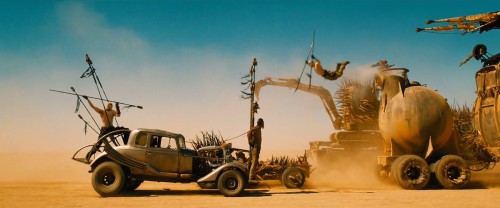
In Fury Road, oppressive violence and exploitation are personified in the legion of antagonists: the war boys and their villainous leader, Immortan Joe. Immortan is almost too perfect in this regard. As the evil dictator of the territory he occupies in a post-apocalyptic world, he demands more and more gasoline (which is in rare supply), while withholding water from his starved and sickly citizens. He also has a collection of women that he imprisons and uses for breeding purposes. In this single character we see some of the worst aspects of rampant hyper-masculinity condensed into one truly horrifying man.

MAD MAX: FURY ROAD

What’s more is that Immortan Joe and his warboys all drive huge, emissions spewing, weaponized vehicles, designed to easily rip across their barren desert landscape and kill their enemies in many creative ways. They thrive off of consumption, exploitation of resources, and find glory in killing. They are (of course) all armed with excessively rigged-up guns, and when their war party of cars is assembled, the image is so on the nose that it is almost comical. There are entire scenes that are so overly masculinized that they become absurd.

FURY ROAD

But this is, in large part, the beauty of the film. Fury Road delivers all the high speed vehicles, bloodthirsty men, car chases, and explosions we want and expect in action movies, but these images are intentionally presented in such an extreme manner, rendering them absurd; the audience can’t help but have their exhilaration filtered through criticism. Fury Road is not escapist like so many other films in the action genre. On the contrary, it uses the spectacle of action tropes as a means of calling attention to the problems with those tropes.

The character of Max also fulfills many stereotypical masculine traits. He is stoic, quiet, a loner, and not afraid to wield a weapon. Much of his dialogue is grunting. While he demonstrates many masculine qualities, these traits are not pushed to the extreme limits like they are with Immortan Joe. In addition to being gruff and stoic, Max is also cooperative, level-headed, and willing to defer to the expertise and skills of women. Max’s masculinity is nuanced. It is the product of the state of the society he lives in, but he does not buy into the oppressive/ destructive narrative.

mad-max-fury-road-tom-hardy-slice2-600x200

Max demonstrates that masculinity can embraced without it necessarily being brutish or a force force for destruction. Compared to Immortan and the warboys, Max’s character communicates that masculinity itself is not what creates oppression, but when the core features of traditional masculinity go unchecked and become dominant (a la Immortan Joe), it can only spell disaster.


Elizabeth King is a freelance writer based in Chicago, Ill. She is a feminist, environmentalist, and ice cream enthusiast. You can find her on Twitter @ekingc, and read more of her work on her website: www.elizabethcking.com.


Masculinity and the Queer Male: There’s Nowt So ‘Queer as Folk’

Yet this very concept of shaming queer men for their sexuality while society is praising straight men for their sexual conquests as a key element of “successful” masculinity demonstrates the way homophobia intersects with a devaluing of the feminine.


This guest post by Rowan Ellis appears as part of our theme week on Masculinity.


If we were being cliche about it, we’d start this essay with a nice textbook definition of masculinity. “The Oxford Dictionary defines masculinity as…” But the thing is, the dictionary defines masculinity as “possession of the qualities traditionally associated with men,” and queer media, of which Queer as Folk (North American version) is but one example, should surely take issue with this very premise considering how heavily it relies on assumptions around a gender binary that doesn’t really exist. Queer as Folk is overwhelmingly about men, but they are men living in a subculture with different “traditional qualities.” Queens, Bears, Straight-Acting, Leathers… any number of ideals of what it is to be a certain type of man in a certain type of tradition. When sexuality is bought into the mix, and the queer body is the one playing with these gendered constructs, we find an element of doubt: if what it means to be a man can change so easily between male identities, then there is no innate power behind it. Effeminate gay men, like Emmett Honeycut, are subverting gendered stereotypes, of course. But masculine gay men, like Brian Kinney, are also subverting preconceptions around sexuality, and are in turn fucking with gender in a similar way. If the power of masculinity is that it is the thing “ordinary” straight men are meant to aspire to, for a gay man to inhabit that aspiration is for the queer to encroach on and upset the accepted balance.

Brian Kinney is a “man’s man” in a different way to that masculine ideal...
Brian Kinney is a “man’s man” in a different way to that masculine ideal…


Queer as Folk, based on Russell T. Davies’ original British series of the same name, follows a group of five gay men, and their two lesbian friends, in Pittsburgh. The creation of the series was born of a desire to see the reality of modern gay life on screen, and the show doesn’t disappoint. There are story lines that deal with things such as coming out, marriage equality, gay bashing, HIV+ characters, assimilation vs. subversion of mainstream society, adoption, gay parenting, workplace discrimination, religion, accepting and condemning families, and, of course, sex–themes and ideas which were both universal to the gay experience, and specific to the life of gay people in the period between 2000 and 2005 when the show aired. This pioneering attitude toward sexuality across an entire ensemble cast in such a frank and explicit way cements its place as a cornerstone of queer media history, and an important series to explore in regard to sexuality and masculinity and how they connect.

The Queer as Folk Season Four Cast getting cosy.
The Queer as Folk Season 4 cast getting cosy.


The show balances characters across the spectrum of masculine and feminine, with people like Brian or Drew Boyd on one side, and Emmett on the other, with the rest placed somewhere in between. It demonstrates the differing elements of gender presentation, from looks to interests, and suggests these are innate parts of a person which are then packaged and labelled by society to the either one thing or another. Ben Bruckner’s interest in quiet peace and serenity might exclude him from the masculine, while the fact he is the top in his relationship with Michael might pull him out of the feminine; these labels become ultimately meaningless not just in queer characters, but in any characters. However the show doesn’t deny that social pressures can shape someone’s natural disposition and interests to conform to the expectations of gender. We can see how Drew’s intense masculinity is something which is tied to his vehement denial of his sexuality, creating a defensive barrier that keeps Emmett at a distance because he doesn’t fit with the artificially created version of Drew.

Ben: so studious, so Zen, so into Michael.


The show also addresses the issues that come with excesses in the physical power of traditional masculinity, through toxic masculinity and violence. As a show in the early 2000s, cases of this violence turned onto the queer community, like that of Matthew Shepard in 1998, were a very real fear. Justin’s gay-bashing at the end of the first season cut brutally through the softening of Brian’s distanced outward demeanor as they danced together at prom. Thus men who needed to use their masculinity against other people, rather than a genuine and internal reflection of their own identity, were clearly shown to be a problem, not an aspiration. This idea was bought even closer to home in Season 4 when Justin joins the Pink Posse, a group of vigilantes who forcibly strip homophobes in public, and his anger escalates to a horrific peak when he gets his chance at revenge.

Justin’s hypermasculinity spirals out of control while on the road to revenge.


When Justin brings home a gun, and later uses it to terrify and humiliate Chris Hobbs, he has reached the outer extreme of masculinity. That classic visual cliche of the gun as phallic symbol rings true, as he forces Hobbs to take the weapon into his mouth and “suck it” at his command. This extremity is ultimately condemned by the writers and framed as a downward spiral for Justin, rather than an upward journey to masculine perfection and strength. At a simplistic level he is working toward what society might deem desirable masculinity: he is attaining power both physically and sexually, he is defending himself, he is showing only the “strong” emotion of righteous anger. But when this is played out literally in front of us, as an audience, we recoil in horror at the reality that this hypermasculinity can produce, further undermining its apparent appeal.

Hypersexuality in the gay scene has long been a criticism leveled against the community as a whole, as well as the TV series itself. The stereotypes around gay life and promiscuity are arguably enforced in Queer as Folk, where we are introduced to our male leads in the omnipresent club Babylon, full of men looking for sex (especially contrasted to the domestic frame of motherhood given to Mel and Lindsay as we first see them in the delivery room). Yet this very concept of shaming queer men for their sexuality while society is praising straight men for their sexual conquests as a key element of “successful” masculinity demonstrates the way homophobia intersects with a devaluing of the feminine. Women, including the way their sexuality is viewed as precious and dirty at the same time, are traditionally tied to femininity, which is in turn linked to weakness. By linking gay men, femininity and sex together as the stereotype does, we can see how male sexuality can be condemned when it is with another man, but not when it is exclusively with a woman. However, the show occasionally falls in playing out the masculine/feminine dichotomy within its queer relationships, rather than subverting this heteronormative pattern entirely–the pinnacle of masculinity, Brian, refusing to bottom and the butch/femme dynamic of Mel and Lindsay’s relationship. Are the explicit queer politics of Brian, or the “we’re not like you” speech from Michael, enough to counter this? Maybe the answer to that, like our relationship with gender in the real world, isn’t clear cut.

The explicit sexuality of the show doesn’t allow for a sanitized and comfortable view of gay men.


Subverting this binary with masculine women, and indeed feminine men, has a complex history in fiction; from the villainous dandy to the “strong female protagonist,” character tropes are full of gendered workings. Masculinity is a difficult thing to pull apart in the real world, but in fiction it has been decided and crafted by a writer specifically to feed into that particular character. In a patriarchal world where masculinity is power, strength, and the ultimate goal, we might be tempted to see masculine characters as a sort of ultimate character. One of the clear strengths of Queer as Folk was the way it refused to be a show which played into the idea of there being only one way that queer people should play out their gender identity. It didn’t lay claim to sweeping generalisations that feminine gay men are out “giving us a bad name,” and that masculine gay men as assimilated traitors. Ultimately the portrayal of masculinity, and indeed femininity, in the show felt natural and unique for each character. It uses its ideas around masculinity, and indeed femininity, to expose the reality of gay life, and how it intersects with, and pulls away from, heteronormative society.   It is certainly true that if the show was remade now (and there are vague hints of that as a possibility) fans like myself would hope for a greater depth of diversity both within the queer spectrum (the L and G of the acronym were well-represented, but not so much anyone else) as well as in intersectional ways (not having an all white main ensemble would be a great start). But for a pioneering show of its kind, there was nowt so great as Queer as Folk.


Rowan Ellis is a British geek using her YouTube videos to critique films, TV, and books from a queer and feminist lens.


Masculinity in ‘Game of Thrones’: More Than Fairytale Tropes

Boys are judged on their ability to swing a sword or work a trade, criticised for showing weakness, and taught to grow up hard and cold. Doesn’t sound unfamiliar, does it? Masculinity is praised in Westerosi society, as it is in our own.


This guest post by Jess Sanders appears as part of our theme week on Masculinity.


HBO are not my favourite showrunners. They spoil Game of Thrones for me. They use rape as a plot device and women as decoration – I mean, there is a guy working on the show who openly admits to playing “the pervert side of the audience” for god’s sake. Numerous times, I’ve wanted to stop watching out of sheer anger… but I just can’t.

While the presentation of the show is so inherently misogynistic, I am too invested in the characters and the story they’re telling. I love how George R. R. Martin (GRRM) gives us a world we can believe in, and nuanced storylines to read and watch (I just wish the show had been put into better hands to do them justice!).

Game of Thrones is a medieval fantasy. It is set in the kind of world that fairytales and folklore are made of. We’ve got dragons, brave knights, and beautiful maidens – all the components are there. GRRM could have made some easy money writing a romance: the handsome prince rescues the helpless princess; they all live happily ever after, the end. But nobody lives happily ever after in Game of Thrones.

Much like a fairytale, there are plenty of recognisable male tropes: warriors, lotharios, noble heroes. Game of Thrones is a story of rich and powerful patriarchs raising sons to be rightful heirs and trading their daughters in political power-plays. Boys are judged on their ability to swing a sword or work a trade, criticised for showing weakness, and taught to grow up hard and cold. Doesn’t sound unfamiliar, does it? Masculinity is praised in Westerosi society, as it is in our own.

But instead of championing macho ideals, GoT presents a wide range of fully developed male characters who are vulnerable, have real problems and vices, and are not tall, dark, handsome or at all “chiselled.”

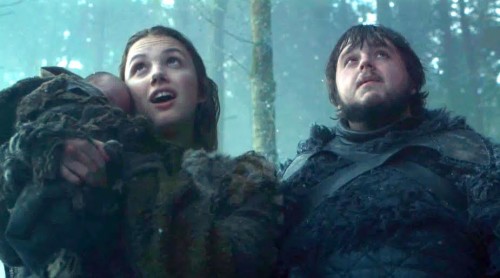
My favourite of these is Samwell Tarly, played by John Bradley. I love Sam. He is so much the opposite of any sort of hero stereotype: he’s a fat, pink-faced coward who’s terrified of, well – most things. He’s not strong, he hates fighting, and he’s painfully shy around girls. He just isn’t “masculine” in the traditional sense of the word. But it’s Sam who first kills a White Walker with Dragon Glass. Since then, we haven’t seem him miraculously transformed into a warrior – because he isn’t and doesn’t want to be one – but when the White Walkers finally get to the wall, he might’ve actually saved the day.

Sam finds his courage defending Gilly and Baby Sam against a White Walker.


Tyrion Lannister (Peter Dinklage) is another of my favourite unexpected heroes. He’s probably one of the best-loved characters on the show and, as a dwarf, could easily have had a loveable underdog story. But he’s not an underdog. Tyrion is an arrogant drunk who visits a lot of brothels. And he’s more than capable of being as cruel and calculating as the other Lannisters (just ask Maester Pycelle). On the other hand, he’s done noble things, like respecting Sansa’s wishes about consummating their marriage. He once slapped Joffrey in the face. Tyrion hasn’t become an all-around good guy or a complete “baddie” because his life has been hard, and we never have to feel sorry for or pity him – yeah, we’re on his side, but he’s not perfect and that makes him real.

“Never forget what you are. The rest of the world will not. Wear it like armor, and it can never be used to hurt you. “ – Tyrion Lannister


Then there’s Gwendoline Christie as Brienne of Tarth. I know we were talking about men, but I really couldn’t write an article on masculinity and not mention Brienne could I? I think Brienne might just be my idol. On the surface, she is the typical “Joan of Arc” character: a tall woman in men’s armour, hair cut short, stony faced and over-sincere. Brienne refuses to be outwardly feminine – not just because it isn’t in her nature, but because she’s got too much to prove to show anything that could be considered “weakness.” But even then, she’s not a caricature. Brienne loved Renly Baratheon, so much so that she was willing to die for him – albeit not in a helpless way but in a dies-in-bloody-battle kind of way. She doesn’t want to be anybody’s little wife, but she’s not afraid to feel. Like many of the male characters, she seems to be driven by a strong sense of pride and duty, but for Brienne that’s about doing what’s right – not gaining power or status as her male counterparts have been conditioned to do.

Just Brienne being her usual badass self.


It’s a difficult world to navigate for women. In contrast to Brienne, Cersei Lannister  (Lena Headey) uses her sexuality to get what she wants. Olenna and Margaery Tyrell (Diana Rigg, Natalie Dormer) work together, using a combination of Olenna’s wisdom and Margaery’s beauty as their weapon, to secure a future for their House. The women of Westeros live all their lives controlled by men – they use any tool available to take some of that power back.

“Tears aren’t a woman’s only weapon, the best one’s between your legs.” – Cersei Lannister


The more I’ve written about masculinity here, the more I could have written about. I feel like I could have done a whole article’s-worth of writing on each of the characters I’ve mentioned and more. I think that’s a testament to the overwhelmingly varied range of diverse and complex characters to be found in the show and books.

George R. R. Martin has presented us a patriarchy that’s falling apart, with men too wrapped up in their power struggles and wars to notice the impending threat of White Walkers, and the arrival of winter. Over the course of writing, I realised how many of the stereotypically masculine characters are now dead, while the thinkers and the “weaker” characters live:

  • King Robert Baratheon: warrior, womaniser, drunkard – suffered an “unfortunate hunting accident”
  • Ned Stark: noble Northman – had his head cut off,
  • Robb Stark: hero and “King in the North” – slaughtered at his wedding feast,
  • Stannis Baratheon: cold-hearted and dutiful “rightful King” – has (presumably) had his comeuppance at the hands of Brienne,
  • Khal Drogo: Dothraki warrior – cursed,
  • Jon Snow: (I know! I know! Sorry!); hero and dutiful Commander of the Night’s Watch – ambushed and stabbed to death (?) by his Brothers at the Wall,
  • Tywin Lannister: ruthless, formidable patriarch – shot with a crossbow on the toilet (by Tyrion, no less),
  • King Joffrey Baratheon: cruel, spoilt boy-king – poisoned on his wedding day.

It seems that, in Game of Thrones, being “manly” might get you glory, but it might also get you killed. Valar Morghulis, after all.


Jess Sanders is a 22-year-old feminist and writer from “The North” (otherwise known as Yorkshire, England). She can be found tweeting excitedly or angrily at @jsssndrs.

Strong in the Real Way: ‘Steven Universe’ and the Shape of Masculinity to Come

Steven, the title character, isn’t the troublemaking, reckless, pain-in-the-butt Boy-with-a-capital-B I feared I’d have to watch around to get to the powerful women and loving queer folk I really wanted to see. He’s unreserved, adventurous, and confident – all good traits that are fairly typical for boy leads in kids’ shows – but he is also affectionate, selfless, very prone to crying, and just plain effin’ adorable.


This guest post by Ashley Gallagher appears as part of our theme week on Masculinity.


I wasn’t very fond of boys growing up. Boys were agents of terror on my young life: my very first memory of body shame is from a summer school sprinkler day, when a 7-year-old boy chased me relentlessly around the courtyard trying to pull my bikini. (Next week, and every week thereafter that summer, I wore a one-piece to sprinkler day.) Even worse, the adults in my life – particularly men – often excused behavior like this as something natural and intrinsic to boyhood. When I’d complain of a boy at school teasing me, they’d tease me back, insisting that not only was this a boy’s way of expressing affection for me, but also that I must be crushing back, if I was so fixated on it. After that, I was far less likely to tell the adults in my life when, say, another group of boys chased me around my neighborhood on bikes, demanding that I admit to liking one of their friends, and scaring me so badly that I hid in a neighbor’s yard until they went away, instinctively feeling that I didn’t want them to know where I really lived. Boyhood as it’s commonly understood and treated is toxic: on the theater of the playground where children are trying on identities to see what fits, many boys are already skilled at assuming the sexist behaviors that will seem so harmless to them as adult men, because that’s how they were treated when they were children.

That’s a big part of the reason why I fell in love with Steven Universe almost as soon as I started watching it. Steven, the title character, isn’t the troublemaking, reckless, pain-in-the-butt Boy-with-a-capital-B I feared I’d have to watch around to get to the powerful women and loving queer folk I really wanted to see. He’s unreserved, adventurous, and confident – all good traits that are fairly typical for boy leads in kids’ shows – but he is also affectionate, selfless, very prone to crying, and just plain effin’ adorable. I mean, look at this clip from the first episode–how could I resist the charm of that plump little kid reciting the bizarrely detailed hip-hop ad jingle for his favorite novelty ice cream treat, all without an ounce of self-consciousness? I smiled and laughed like he and the Crystal Gems do in that moment, refreshed and entertained by the genuine joy that Steven seems to radiate.

Steven is truly the beating heart of the show, but it’s not because he’s a boy. In fact, many of his defining characteristics are distinctly un-boyish, as far as popular media tropes are concerned. Empathy and kindness, for example, are often depicted as especially feminine, and therefore less powerful traits than traditionally masculine ones like ambition or courage, but in the world of Steven Universe, not only are they not at all treated as weaknesses or internal conflicts, they are also frequently the source of his greatest powers.

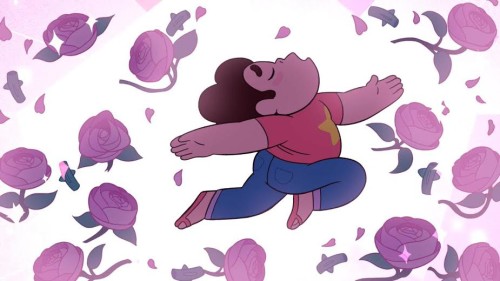
Unlike most boy “chosen ones,” Steven’s magical abilities are distinctly defensive: the very first weapon that Steven is able to summon in the first episode, “Gem Glow,” is not an offensive weapon at all, but an impenetrable shield – bright pink and adorned with a rose emblem, no less. (Which gendered toy aisle would an action figure like that end up in, I wonder?) He can form a pink glassy bubble to protect himself and others around him. And, perhaps most subversively of all, he has healing abilities. While that is obviously a very handy power to have, folks well-acquainted with fantasy genres in a number of forms, particularly video game RPGs, will also probably be aware of the ubiquitous idea that healing is for support characters, usually women, and therefore has the reputation of being a relatively uncool, even “useless” power. Not only is Steven – the only boy Gem that exists, as far as we know – the first Gem since his mother, Rose Quartz, to have these healing powers, the show treats this frequently feminized ability as the extremely vital asset that it is. Several of the first season’s episodes center on Steven’s healing abilities, including a very important two-parter, “Mirror Gem” and “Ocean Gem,” in which Steven heals a character named Lapis Lazuli who has been deeply injured both physically and emotionally, even though the Crystal Gems initially insist that he should fear and reject her. Partially due to this kindness, Lapis is later in a position to help Steven and the Crystal Gems in some very unexpected ways. In another episode, “Monster Buddies,” Steven attempts to befriend a baby monster that the Crystal Gems would normally destroy. In fact, it’s the infant form of a monster that once attacked Steven himself and his home – but despite that history, Steven is still determined to heal it, not with his powers (which he actually doesn’t discover until an episode or two later), but with his caring, a feat that even his legendary mother could never accomplish.

Steven’s kind personality is just as powerful in regular human contexts as it is in magical ones. Indeed, Steven reminds me of no other fictional character more than Usagi Tsukino, aka Sailor Moon, whose ultra-famous superpower is her ability to befriend literally anyone, and heal the world with the power of that love. (Even some of Steven’s poses are strongly reminiscent of magical girl moves.)

“Steven has a magical girl moment.”


Case in point: no one seems to notice the quiet, solitary Connie, but after Steven becomes best friends with her, she reveals herself to be a whip-smart, multi-talented, delightfully nerdy, wonderful kid. They clearly have more-than-friendship feelings for each other, but those feelings are allowed to comfortably coexist with their close friendship, and the show gracefully resists treating their crush as a source of conflict.

Honestly, Steven and Connie’s relationship is one of the best things about the show, because it is such a breath of fresh air. The twisted narratives of young love, whether in fiction or real-life, are so gut-wrenchingly familiar: they hate each other, but they’re secretly drawn to one another; or, he’s cruel to her because he doesn’t know how to express how he really feels. Not so in Steven Universe. From the very start, Steven treats Connie as a person who is interesting and dear to him as an individual, and whose well-being is vitally important to him, rather than as some sort of ideal love interest that he needs to maintain distance from to attain. There’s mystery and miscommunication, sure, but no fear, no hatred of oneself or the other, and lots of joy and discovery. In one of my favorite episodes, “Alone Together,” Connie tells Steven that she can’t dance around other people because she’s afraid of them staring at her. Steven invites Connie to dance with him, doing his best to help her feel comfortable: he holds out his hand to her, but steps back to give her space to make the decision, and even covers his eyes so that she doesn’t feel him staring. When they start dancing, they coordinate naturally and easily, resulting in some very special magic that makes them fuse into one beautiful, confident, genderqueer and very dance-y being: Stevonnie, the physical manifestation of Steven and Connie’s mutual affection and, most importantly, trust.

“Connie catches Steven in a dip right before they fuse.”


Lest you think that maybe all of Steven’s goodness, all of his sweetness and caring, is made possible solely by the naiveté of his youth, consider his family. Aside from the three ancient feminine aliens who raise him full time, Steven also has a great dad, Greg Universe, who is just as responsible for Steven’s strength of character. At first blush, Greg – kind of a Homer Simpson lookalike, in my opinion – seems to fit solidly into the “bad dad” type: not only does he not live with Steven as a primary caregiver, he’s also a pretty unambitious, aging, small-time ex-musician who lives in his van. However, Greg is very present in Steven’s life, offering unconditional support and love even when Steven is going through experiences that Greg both fears and doesn’t fully understand. In “Catfingers,” Greg watches over Steven through a scary incident of shape-shifting magic gone horribly wrong, and manages to help him get his son’s powers under control, despite his aversion to magic in general and shape-shifting magic particularly. On a couple of other occasions, Greg gives Steven the space (albeit reluctantly), to take on magical missions that only Steven can accomplish, but always makes sure to stay as close by as possible to offer help, or even just to welcome him home when he returns.

“Steven and Greg sing about their relationship.”


Greg isn’t perfect; even his possibly-soon-to-be-tattooed-on-my-body catchphrase says so. (“If every pork chop were perfect, we wouldn’t have hot dogs.”) But he loves himself, and he loves Steven, and he’s absolutely uninterested in making Steven or anyone else feel bad for his own flaws, for the absence of Steven’s mom, or for any of the personality traits and abilities that make Steven uniquely him. As a gentle, nurturing father who does his best despite often pretty crummy circumstances – including being homeless, a widower (for all intents and purposes), and having a hoarding problem – Greg Universe not only provides an excellent role model for his son, but also an interesting complement to the equally trope-bucking Crystal Gems.

Rebecca Sugar has said that her inspiration for the character of Steven is her own brother, which sheds a little light on the loving care that is put into creating him. (Steven Sugar is, notably, a background artist on the show, and boy, are those intimately detailed, fantastically colored backgrounds a delight to behold.) It’s easier to witness how bad people can be to each other in real life than ever before, and to be personally on the receiving end of much of it; sometimes it can feel like I’m barely surviving in a world full of suffering and ugliness. I admit that, at those times, I frequently expect to find fault in everything around me. I was concerned, before watching Steven Universe, that it would disappoint me – that a show about a little boy at the center of his own universe would end up following the familiar frightening paths and byways toward a narrow and troubling version of masculinity. Instead, I’ve found that Steven Universe is a show dedicated to showing that our lives don’t have to be ruled by rigid hetero- and cis-normative gender roles. Steven reminds me that not only can people in general, and men specifically, be good and kind and powerfully loving, and not only should expect I that from them, but that goodness is also right in front of me and all around me. I’m extremely fortunate to have many people in my life, including men, who are as caring and supportive and gentle as any of the literal light beings from space in this cartoon.

In “Lion 3 Straight to Video,” Steven finds an old VHS tape that his mom leaves for him to find, knowing that she will have to give up her physical form once he’s born. In it, she tells him that he is loved, that he is extraordinary, and that his planet and his people are special to her because of how full of possibilities they are. To me, Steven Universe is a boy who embodies the possibilities for masculinities that are rooted in love and pride rather than domination, and for a way of life where all gender expressions can be freed, little by little, from the oppressive baggage that so often tie them down.


Recommended reading: Steven Universe and the Importance of All-Ages Queer Representation” by Mey Rude


Ashley Gallagher is an aspiring adult magical girl who lives and writes in Austin, Texas. She co-hosts Moon Podcast Power MAKE UP!!, a feminist Sailor Moon Crystal podcast, and tweets @womyn_ebooks.


I Think We Need a Bigger Metaphor: Men and Masculinity in ‘Jaws’

The life Brody has lived is utterly different, if not entirely sheltered. What dangers or dilemmas he’s faced in his life simply haven’t left the kind of marks Hooper and Quint bear. And their lack prevents him from engaging in any stereotypical masculine posturing. He is, by that criteria anyway, untested.


This guest post by Julia Patt appears as part of our theme week on Masculinity.


Full disclosure: I love Jaws. 

I’ve loved Jaws since I was about 8 years old. (It was during my marine biologist phase.) Sharks are awesome. The movie that frightened people away from beaches in the summer of 1975 made me want to get my SCUBA certification. My first stop in any aquarium is still the shark exhibit.

As a lifelong member of Team Shark, I’ve never had much regard for the people who populate the movie and Amity Island. Let’s be honest — Chief Martin Brody (beautifully underplayed by Roy Scheider) is hardly an archetypal hero worthy of Homeric simile. He’s a quiet aquaphobe who moved to Amity to escape the upheaval of 1970s New York and raise his children somewhere peaceful. More than anything, in fact, we recognize him as a father. Not a stern authority figure but an affectionate, involved parent who at one point demands of his young son, “Give us a kiss.”

“Ask him to co-sign on your student loans, absolutely, but kill a shark?”

To his credit, Brody seems to understand he’s in way over his head (sure, pun intended) when it becomes apparent their quiet new home has a shark problem. He tries to close Amity’s beaches, is met with public uproar, and ultimately gets overruled by the island’s mayor, a consummate politician, who explains blandly: “We rely on the summer people.” (It’s just economics.) Later, after a particularly grisly attack involving a young boy, Brody accepts a harsh slap from the child’s mother for leaving the beaches open. From his perspective, he deserves it. He would do more, but he lacks standing, authority, and power. In fact, he doesn’t even know that much about sharks, only what he’s picked up by self-educating. Given our hero and his limitations, it seems like Amity Island will remain an open buffet for many years to come.

Then, 50 minutes into Spielberg’s carefully paced film, we meet Matt Hooper (Richard Dreyfuss), the young, wealthy scientist and shark enthusiast who comes to assess Amity’s shark problem based on the remains of the first victim. Hooper provides a stark contrast to Brody: he’s confident, fast-talking, and assertive. When the pair try to convince the mayor that it’s a Great White they’re dealing with, Hooper gives up, exasperated, and spits, “ I’m not going to waste my time arguing with a man who’s lining up to be a hot lunch.”

“Matt Hooper: Here for eye-candy and shark smarts”

While Hooper and Brody immediately form a friendly connection, their differences are readily apparent. They belong to different generations; they belong to different socioeconomic classes. “How much?” Brody asks after Hooper admits his high-tech setup in self-funded.

“Me or the whole family?”

And although he is hardier and — in some ways — braver than Brody, Hooper likewise cannot solve the problem of the shark. Like Brody, he is an outsider on the island. The mayor dismisses him out of hand as a fame-seeker. And his bluster primarily serves to cover up his own fears. E.g., during the film’s two autopsies, Hooper recoils, fighting the urge to vomit, and, in one case, shakily asks for a glass of water. In investigating a wrecked fishing boat, he is startled by a floating corpse and drops the massive shark tooth that would make their case. In a way, he creates no more momentum and has no more agency than Brody.

“I mean, I don’t necessarily blame him.”

It’s only after the Fourth of July, when the beaches are open and Brody’s own son is nearly a victim of an attack, that the story can advance and our would-be heroes take real action. This begins when Brody, more aggressive than we’ve seen him all film, forces the mayor to hire local shark-hunter Quint (Robert Shaw) to kill the animal.

Ah, Quint. Salty, idiosyncratic, shanty-singing Quint. He makes an initial appearance at a town hall meeting, announcing his presence by dragging his fingernails down a chalkboard and launches into one of his quintessential (I’m not sorry) monologues, concluding, “I don’t want no volunteers, I don’t want no mates, there’s just too many captains on this island. $10,000 for me by myself. For that you get the head, the tail, the whole damn thing.”

“The Greatest Generation here to save the day.”

Quint is our monster-hunter. Our Ahab, sans whalebone leg. He is, in fact, what we expect out of our hyper-masculine Hollywood heroes. He belongs to another era entirely, one far removed from the radar and shark darts and cages Hooper brings to the table. And unlike Brody, he has no family, no obligations, and no qualms doing what he believes must be done. Despite his statement about needing no volunteers and no mates, he acquiesces and allows Brody and Hooper to accompany him on his quest, but he is undeniably in charge.

Onboard the Orca, we see the ways in which the power dynamics among the three men develop. Although there is a clear conflict between Hooper and Quint — “You’ve got silly hands, Mr. Hooper” — Hooper’s established skills save him from the worst of the chores, such as ladling chum into the water. Instead, these fall to Brody, whose status as a novice places him at the bottom of the social hierarchy. This even leads to conflict between Brody and Hooper, who chastises him for mishandling equipment.

“Once a cop, now a cabin boy.”

Of course, they’re not alone out there. The shark’s appearance both divides and unites them. They work together to bring it to surface and yet Quint — in a moment of psychosis? desperation? — destroys their radio equipment with a baseball bat, preventing them from seeking help, and then kills the Orca’s engine by running it too hard. In the dark, they sit below deck in the galley, not sleeping, but drinking and trading stories about old scars.

Or rather, Hooper and Quint trade stories. This one from a moray eel. That one from a thresher shark. Brody has nothing to contribute to the conversation, although he considers sharing his appendectomy scar before deciding against it. Here we have the ultimate distinction between the three men. The life Brody has lived is utterly different, if not entirely sheltered. What dangers or dilemmas he’s faced in his life simply haven’t left the kind of marks Hooper and Quint bear. And their lack prevents him from engaging in any stereotypical masculine posturing. He is, by that criteria anyway, untested.

“It really hurt, though.”

Instead of participating in this proverbial measuring contest, Brody asks Quint about a removed tattoo on his arm. Quint relays the story in his final speech of the film — the sinking of the USS Indianapolis during World War II and the death of its many crewmen in shark-invested waters. It’s a chilling story, brilliantly delivered by Shaw and beautifully reflected by the reactions of Scheider and Dreyfuss, whose respective characters are both too young to have fought (and we can imagine both have missed Vietnam for other reasons). They are simply in awe of Quint as he speaks. “You know that was the time I was most frightened?” he muses. “Waitin’ for my turn. I’ll never put on a lifejacket again.”

This instance of admitted vulnerability is, I’d argue, what bonds the three of them in this brief moment. After a silence, Hooper starts singing “Show Me the Way to Go Home” and the other two join in, smiling. This feeling of camaraderie is, of course, immediately cut short when the shark attacks the boat for the penultimate time.

“We’re having a moment!”

This is the lead-up to the final showdown the next morning. They have settled on a final attempt to kill the shark: by sending Hooper down in the cage with a dose of strychnine. This could be a heroic moment for Hooper, but the shark gets the better of him and all but destroys the cage. From the surface, Brody and Quint can’t know he escaped and hid; they assume the attack was fatal. Meanwhile, the Orca is sinking and the shark remains undeterred. It launches itself onto the boat, tilting the deck and thus forcing a screaming Quint into his open mouth. It’s the goriest, longest death scene in the whole movie, which up this point has frightened us largely through suggestion and perspective.

“Mind you, Quint does go down swinging a machete.”

This, of course, leaves Brody alone to deal with the shark. Although he’s our protagonist, the audience doesn’t necessarily see this moment coming. Isn’t he doomed? Ingeniously, when the shark strikes next, Brody manages to get an oxygen tank into its open mouth. Rifle in hand, he climbs up the mast of the near-submerged Orca. The shark advances. Brody fires and misses. Again. “Blow up,” he mutters. “Blow up.” Then, another iconic line: “Smile, you son of a bitch.”

“Where has this steely-eyed action hero been all movie?”

That’s the lucky shot — the shark does indeed blow up. Of course, our hero doesn’t settle for some stoic, gunslinger pose at the end of this struggle. He cheers and whoops, celebrating his victory in open relief. When Hooper reappears, he is startled, then the two laugh together, all of their tension gone. “Quint?” Hooper asks.

“No,” Brody replies. Both fall silent. Then, they begin the long swim home.

What does it mean that Brody is finally successful in killing the shark? He is the last man standing, not necessarily because of his own survival skills, but because the men around him willingly put themselves into danger. They have done it before and succeeded — that they fail indicates the shark’s power rather than their lack of ability. However, it is Brody’s last desperate attempts that fend off the indomitable representation of danger. He kills the shark not to display any prowess or make any point, but simply because he wants to live.

Ultimately, it is the family man who hates the water and has never been to war who lives to tell the tale and saves the day. The grizzled ex-Navy shark-hunter, who survived the sinking of the USS Indianapolis dies screaming and terrified in the jaws of the beast he assured everyone he could defeat. The era for such men has passed, the film seems to tell us. And it is not quite the era of Matt Hoopers either. He survives, but it seems unlikely he would have made it back to shore if not for Brody’s success. His technology likewise does not save him. Rather, the film seems to aim for the middle. We are in a time of soft-spoken fathers who don’t have anything to prove and would just rather not go swimming, thank you very much.

“Happy right here.”

At first glance, Jaws appears to be a consummate man’s man type of movie — almost stereotypically masculine. After all, it’s about our struggle against nature. Women play a limited role in the drama, either as wives and mothers or victims. Our three male protagonists, different thought they may be, venture into the wild to protect the homestead. However, the film repeatedly asks us to reconsider our view of masculinity by presenting such disparate characterizations. We require all three men to overcome the deadly animal in the water. None of them in isolation likely could have accomplished it, despite Brody’s singular victory in the end.

Thus, in many respects, Jaws seems to deal more with the question of male helplessness. Remember how the film begins: a young woman asks a young man at a bonfire to go swimming with her. He is too intoxicated to make it off the beach; the shark attacks her and she disappears. Throughout the film, we see innumerable nods to male fragility, from Brody’s deputy vomiting when he discovers the young woman’s remains, to the elderly men wading into the water with their pasty bodies, to Quint’s undignified end. While Brody seems a more capable man at the end of the film, he is still at his most vulnerable as he fires that last shot from his position on a sinking boat.

How Jaws was and remains an incredibly successful horror film is how it masterfully evokes those feelings of helplessness and dread in the audience as well. The shark continues to frighten us because we recognize its power. And it matters very little how strong or capable the people around us are — they will always pale in comparison.


Recommended reading: “The men, monsters, and troubled waters of Jaws” 


Julia Patt is a writer from Maryland. She also edits 7×20, a journal of Twitter literature, and is a regular contributor to VProud.tv and tatestreet.org. Follow her on Twitter at @chidorme.

A Fragile Masculinity: Genderswapping Male Characters

Part of this belief comes from the assumption that casting women in these roles is always an attempt to tone down the masculine-coded characteristics associated with these characters. Vaguely omnipotent feminist forces are conspiring to emasculate hyper-masculine characters by recasting them as women, so the argument goes.

unnamed


This guest post by Alyssa Franke appears as part of our theme week on Masculinity.


Recasting major characters of beloved franchises is always tricky. Even when creative teams attempt to recreate the original character as closely as possible, there will inevitably be complaints that the new actor could never be as good as the original. But when creators attempt to radically change the character by, say, changing their gender or race, then shit really hits the fan.

Fans of established franchises are conditioned to expect men in certain roles. Starbuck and Thor are supposed to be portrayed by hyper-masculine men. John Watson and James Moriarty aren’t supposed to be Joan Watson and Jamie Moriarty. The Master from Doctor Who is supposed to be played by the likes of Roger Delgado, Anthony Ainley, and John Simm, not Michelle Gomez. Or so say some disgruntled fanboys.

But these iconic male roles have all been successfully portrayed by women. These women have received critical acclaim for their portrayals and have amassed male and female fans alike. However, there’s a certain segment of viewers that are fundamentally, irreversibly opposed to casting women in roles that were previously portrayed by men. To them, casting a woman in these roles isn’t just an affront to the franchise — it’s a direct attack on men and masculinity.

Part of this belief comes from the assumption that casting women in these roles is always an attempt to tone down the masculine-coded characteristics associated with these characters. Vaguely omnipotent feminist forces are conspiring to emasculate hyper-masculine characters by recasting them as women, so the argument goes.

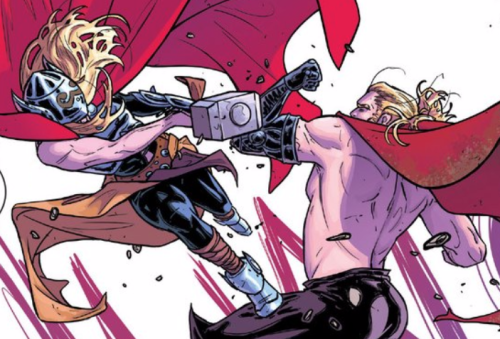
When Marvel announced that the new Thor would be portrayed by a woman, some readers argued that this was an attempt to create a more “politically correct” Thor. This argument was repeated so frequently and so loudly that the creators actually referenced it in Issue #5 in a battle between the new Thor and the villain Absorbing Man. When Absorbing Man learns that a woman is now Thor, he responds:

“Damn feminists are ruining everything! […] Thor’s a dude. One of the last manly dudes still left. What’d you do, send him to sensitivity training so he’d stop calling Earth girls ‘wenches’?”

tumblr_inline_no7k0rpLOQ1r4rbqj_500

Dirk Benedict, who portrayed the original Starbuck in the 1978 Battlestar Galactica series, made a similar argument when his character was recast and portrayed by Katee Sackhoff in the rebooted 2003 series. He argued that “the Suits” had attempted to tone down his cigar-smoking, womanizing character during the original series run, and when given the chance to recast his character, they accomplished their original aim by recasting Starbuck as a woman:

“The best minds in the world of un-imagination doubled their intake of Double Soy Lattes as they gathered in their smoke-free offices to curse the day this chauvinistic Viper Pilot was allowed to be. But never under estimate the power of  the un-imaginative mind when it encounters an obstacle (character) it  subconsciously loathes. ‘Re-inspiration’ struck. Starbuck would go the way of most men in today’s society. Starbuck would become ‘Stardoe’. What the Suits of yesteryear had been incapable of doing to Starbuck 25 years ago was accomplished quicker than you can say orchiectomy. Much quicker. As in, ‘Frak! Gonads Gone!’”

The particular irony in regard to Benedict’s argument is that the new Starbuck portrayed many of the same characteristics Benedict assumed “the Suits” were trying to eradicate from his portrayal of Starbuck. Sackhoff’s Starbuck gambled and smoked cigars. She was the best Viper pilot in the fleet, and made sure that everyone knew it. And she was freely, openly sexual. She flirted, she talked dirty, and she had sex without shame.

And although most media with a genderswapped major character does make a commentary on gender, they’re hardly making an attack on masculinity writ large.

The creators of Battlestar Galactica were certainly thinking of representations of masculinity and femininity when they recast Starbuck. Executive producer Ronald Moore commented that they decided to switch Starbuck’s gender in order to avoid the “rogue pilot with a heart of gold” cliche, and because the notion of women in the military was still a relatively new idea at the time. Portraying Starbuck as a woman was a way to broaden Starbuck’s story. It is a way of showing that the stories of soldiers, charming rogues who drink and smoke, and arrogant pilots don’t solely belong to men.

In the latest take on the Sherlock Holmes canon, the TV show Elementary offers a critique on infantilizing perceptions of women by genderswapping Holmes’ most infamous rival. Though most recent adaptations of the Sherlock Holmes canon introduce Irene Adler as a pawn of Professor James Moriarty, in Elementary Irene Adler is a persona used by Jaimie Moriarty in order to get close to Sherlock Holmes. She isn’t a damsel in need of saving, but she’ll play one if flattering a man’s ego gives her the advantage. When her identity is revealed, she comments that she often had a male lieutenant impersonate her in order to placate clients who may have dismissed her for her gender, “As if men had a monopoly on murder.”

In Thor, a very clear contrast is drawn between how Thor and his father Odin react to a woman becoming the new Thor. Odin is angry and threatened that Mjolnir has declared his son unworthy, and lashes out in increasingly aggressive and dangerous ways in an attempt to forcefully reclaim Mjolnir. Thor, though initially angry at becoming unworthy, ultimately accepts that he has been replaced, gives the new Thor the respect she deserves, and begins the hard work of examining how he became unworthy. This isn’t an attack on masculinity — it’s a commentary on a particularly toxic form of masculinity.

But even when no overt commentary is made on masculinity, simply having a woman portray a character previously portrayed by a man can be seen as challenging representations of masculinity. Allowing a woman to portray characteristics associated with that male character — strength, logical reasoning, aggression, obstinance — destabilizes the idea that these characteristics are inherently male.

And again, it’s Dirk Benedict who summarizes this perspective in his attack on Katee Sackhoff’s Starbuck. His argument that recasting Starbuck as a woman diminishes the character relies heavily on gender essentialist stereotypes:

“Women are from Venus. Men are from Mars […] Men hand out cigars. Women ‘hand out’ babies. And thus the world, for thousands of years, has gone round.”

Even when Sackhoff’s Starbuck portrays the same characteristics as his Starbuck, Benedict grants them less legitimacy as displays of power or dominance because she is a woman. For example, Sackhoff’s Starbuck smokes a cigar like a man — if she’s not smoking it casually for own enjoyment she’s puffing on it aggressively as a sign of power and dominance.

nkht2hb

But regardless, Benedict chooses to interpret Sackhoff smoking a cigar as something titillating for male enjoyment:

“I’m not sure if a cigar in the mouth of Stardoe resonates in the same way it did in the mouth of Starbuck. Perhaps. Perhaps it ‘resonates’ more. Perhaps that’s the point.”

This type of diminishing commentary is fairly common around genderswapped characters. In discussions about whether the Doctor from Doctor Who could regenerate into a woman, someone inevitably condescendingly asks whether the Doctor would have to be renamed “the Nurse.” Readers of Thor wondered if the new woman Thor would get a new name — a scenario the creators shot down decisively in the comic when the original Thor proclaimed that his replacement would simply be called “Thor,” not Lady Thor, Thorette, or Thorita.

Benedict also laments that this new version of Battlestar Galactica is “female-driven”:

“The male characters, from Adama on down, are confused, weak, and wracked  with indecision while the female characters are decisive, bold, angry as hell, puffing cigars (gasp) and not about to take it any more.”

I disagree strongly with his characterization that the men of Battlestar Galactica are universally confused, weak, or wracked with indecision. Like any good character, they have moments of indecision or weakness, but they also are firm, decisive, and commanding. They also have moments where they are challenged fiercely — particularly by women leaders — and must acquiesce to their leadership or admit they were wrong. And I think it says a lot about Benedict’s opinion of women if he believes being challenged or commanded by a woman is a sign that a man is weak or confused.

That’s one of the main reasons why genderswapping male characters can be so transformative in a franchise. Male roles are frequently written to portray men as active characters who drive their own lives and narrative arcs, while women are largely written as passive characters who are viewed, pursued, and driven by the actions of men. When a woman inhabits a role previously given to a man, that formula is reversed.

Though franchises that change the gender of major characters can offer compelling, insightful commentaries on gender, their greatest contribution to this discussion may lie in the way they reveal our various insecurities around representations of gender. We accept that so much about these characters can change. Thirteen different men can play the Doctor, a frog can become Thor, the Sherlock Holmes canon can be reinterpreted in a thousand different contexts — but we cling to the idea that these characters must be portrayed by men.

These genderswapped characters destabilize a gender binary which encourages us to think that certain characteristics and stories belong to men. Some, like Dirk Benedict, cling even more fiercely to those old representations of masculinity. But hopefully, these characters are pushing us to broaden our perceptions of masculinity and femininity.


Alyssa Franke is the author of Whovian Feminism, where she analyzes Doctor Who from a feminist perspective. You can find her on Twitter @WhovianFeminism.


The Blind (Drunk) Leading the Blind (Drunk): Masculinities and Friendship in Edgar Wright’s Three Flavours Cornetto Trilogy

Two distinct masculinities pull the Trilogy’s heroes in different directions. Given Wright’s frequent use of pop culture references, I’ve opted to borrow Dungeons and Dragons’ terminology and describe these extremes as lawful and chaotic. Lawful masculinity is characterized by competency and order; it is the hallmark of the responsible (but rigid) adult. Chaotic masculinity is characterized by hedonism and anti-authoritarianism, usually embodied in the series by characters in a state of adolescence (whether age-appropriate or not).


This guest post by Tessa Racked appears as part of our theme week on Masculinity.


This article contains extensive spoilers for Shaun of the Dead, Hot Fuzz, and The World’s End.

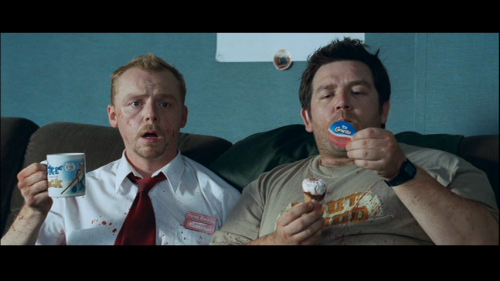
Edgar Wright’s Three Flavours Cornetto Trilogy stands apart from other genre parodies for many reasons, but of note is the films’ emotional authenticity. Simon Pegg and Nick Frost are the driving force of that component. They navigate friction in lifelong friendships in Shaun of the Dead and The World’s End, and fall in platonic love in Hot Fuzz. Their characters act as foils, obstacles, and supports for each other as they navigate problems as straightforward as a zombie epidemic and as existential as their own identities as men.

Two distinct masculinities pull the Trilogy’s heroes in different directions. Given Wright’s frequent use of pop culture references, I’ve opted to borrow Dungeons and Dragons’ terminology and describe these extremes as lawful and chaotic. Lawful masculinity is characterized by competency and order; it is the hallmark of the responsible (but rigid) adult. Chaotic masculinity is characterized by hedonism and anti-authoritarianism, usually embodied in the series by characters in a state of adolescence (whether age-appropriate or not). Characters are encouraged to adopt lawful masculinity in order to mature and survive. However, all three films express anxiety over lawful masculinity’s implications on a macro level through forces that threaten large-scale homogeneity: a zombie epidemic (Shaun), a cult obsessed with maintaining the ideal village (Hot Fuzz), and aliens who replace dissenting humans with complacent androids (The World’s End). In all three, the homogenizing force is personified by lawful masculine characters. Chaotic masculinity, on the other hand, is the balancing force that prevents lawful masculinity from metastasizing into doom. Although never in positions of power and rarely living sustainable lifestyles, chaotic masculine characters subvert and criticize the ossifying aspects of lawful masculinity and widespread order. Simon Pegg’s characters are always at the crux of this dynamic. The struggle to balance law and chaos expresses itself through his relationship with Nick Frost’s characters.

Shaun and Ed, Shaun of the Dead


At the beginning of Shaun of the Dead, the titular hero is in danger of becoming one of the walking dead before the outbreak even starts. His girlfriend Liz accuses him of not wanting to “live.” His daily routine begins with a shot that pays homage to Day of the Dead, where he staggers and groans like a zombie, having just gotten out of bed. This stagnation is influenced by his best friend Ed, who has been squatting in his flat for five years. Shaun is under pressure from everyone in the film, save Ed, to conform to the expectations of lawful masculinity. He has tense relations with his responsible housemate Pete, who pressures him to evict Ed, and his dour stepfather Philip, whom Shaun repeatedly describes as “not [his] dad.” Shaun can’t confront Ed for his irresponsible behavior, nor can he “be a man” (Philip’s words) and respect his mother Barbara’s relationship with his stepfather. Ed presents a more comfortable viewpoint for Shaun, constantly referring to Pete as a “prick” behind his back and joking about having sex with Barbara– crude, but apparently not as repugnant to Shaun as Philip having sex with her. It’s an alternative to the mindless, dead world which Shaun is on the verge of joining, considering that he goes through his routine walk to the convenience store without realizing that his neighborhood has fallen into shambles. Ed’s world is one of escapism, through video games, deflecting humor, and drinking, specifically at the Winchester Pub. Ed encourages Shaun to see the Winchester as the solutions to his problems: a place to bring Liz on a date, a place to get over Liz after she dumps him, a fortress against the zombie hoard.

The chaos of the zombie outbreak initially works in Ed’s favor. He convinces Shaun to deviate from the advice broadcast on the news. (Shaun: “But the man said to stay indoors.” Ed: “Fuck the man!”) He enacts praxis that appropriates modes of agency formerly exclusively accessible to lawful masculinity (ie. he takes Pete’s car, crashes it, and upgrades to Philip’s Jaguar). By the third act, the group has holed up inside the Winchester and both Pete and Philip have turned into zombies, the latter after telling Shaun that he was tough on him because he wanted to be a good father and motivate him “to be strong and not give up.”

With Ed’s support, Shaun blossoms as a leader. He formulates plans. He kicks zombie ass and selflessly distracts the horde away from his friends. He uncovers latent defensive skills gained from chaotic masculinity. His initial weapons are recreational items: his vinyl collection, then a cricket bat. When they finally get a gun, he and Ed are the most capable at using it due to their experience playing video games.

Shaun’s move into balanced masculinity parallels with the health of his relationships. Shaun’s goal is to help Liz survive because he loves her, which Ed dismisses as “gay,” and save Barbara from the infected Philip. Shaun begins the film overly protective of Ed, but eventually calls Ed out when he endangers the group through carelessness. He develops a balance between Ed’s chaotic criticism of social norms (in this case, blindly following directions from the television) and Philip’s lawful sense of appropriate behavior. When Barbara is about to turn into a zombie, Ed aids Shaun by holding off David who tactlessly insists on destroying her brain, but Liz is the one able to emotionally support Shaun in making the lawful decision to shoot her for the group’s safety. Ed later mirrors this maturity after he is bitten, holding off the oncoming horde while Liz and Shaun escape. Chaotic masculine to the end, Ed and Shaun’s tearjerking farewell includes a fart joke. The film ends with Shaun having survived, matured, reconciled with Liz, and zombie Ed playing video games in the garden shed. Their friendship has been appropriately repositioned: his and Ed’s bond transcends death, but Ed is no longer occupying the center of Shaun’s life.

PC Danny Butterman and Sergeant Nicholas Angel, Hot Fuzz


Hot Fuzz finds Pegg and Frost occupying the trope of adroit thin guy and bumbling fat sidekick, remnsicent of John McClane and Al Powell from Die Hard. Sergeant Nicholas Angel is a paragon of lawful masculinity. The opening montage of his achievements illustrates how excellence is deeply ingrained in who he is. His lawful masculinity is equated with competent police work. Unfortunately, his dedication to his job leads to the end of his romantic relationship and makes the rest of the Metropolitan Police Service look bad. He is reassigned to rural Sandford, where he is partnered with PC Danny Butterman. Their introduction to each other positions Danny as his chaotic, immature foil: Nicholas arrests him for attempted DUI, alongside a group of underage drinkers. From his first day, Nicholas’ hyper-adherence to lawful masculinity stands out in a station where officers atone for infractions by buying sweets for their co-workers and cases consist of rogue swans and illegally trimmed hedges.

Danny idolizes Nicholas, asking a litany of questions that assume his previous career in London looked like an American action film. Nicholas’ approach to their job doesn’t have the “proper action” that Danny longs for: he cites his notebook as his “most important piece of equipment” and snaps at Danny that “it’s not all about gunfights and car chases.” Despite initial friction, during a night at the pub, the partners reveal parallel pursuits of lawful masculinity as their motivations for being cops. Where Nicholas feels destined to prove that the patriarchal system of law is “for the good of humankind”; Danny wants to please his father, Inspector Frank Butterman. The scene plays out with romantic tension. Danny invites Nicholas up to his flat for another drink and teaches him how to “switch off” by introducing him to his passion: cop films full of violent, chaotic masculinity.

Nicholas eventually deviates from his adherence to lawfulness in order to investigate a string of bizarre deaths that are assigned to the incompetent Detectives Andy Wainwright and Andy Cartwright. He discovers that the Neighborhood Watch Association, led by posh, confident businessman Simon Skinner, has been orchestrating a conspiracy to maintain Sandford’s title of Village of the Year. Their focus on Sandford’s aesthetic homogenization is extremely myopic: Nicholas theorizes that their recent victims were killed to prevent a real estate deal, when they were actually targeted for being tacky. It is only by embracing the chaotic masculinity that Danny has introduced him to through cop movies that he is able to save Sandford from itself. Armed with weapons confiscated from a scofflaw farmer, he and Danny take on the NWA with spectacular action sequences. Danny deviates from his sense of obligation to his father, who is part of the conspiracy, recreating his favorite moment from Point Break in the process. After bringing the NWA to justice, Nicholas decides to stay in Sandford despite being asked to return to London. In Sandford, he is able to rein in his lawful masculinity by maintaining a better work-life balance and learning how to provide emotional support to someone he cares about; in the denouement, he brings flowers to Danny’s mother’s grave, in contrast to his failed relationship in London, where he missed his girlfriend’s father’s funeral because of work.

Left to right: Gary King, Steven Prince, Peter Page, and Andy Knightley (not pictured: Oliver Chamberlain), The World’s End


In all three films, pubs are an important site of male bonding, with The World’s End as the glorious, tragic culmination of that theme. The film begins with a recollection of the best day of Gary King’s life: a botched attempt at the Golden Mile, a 12-pub crawl, with his friends on the last day of secondary school in 1990. If Nicholas Angel is the paragon of lawful masculinity, Gary King is that of chaotic masculinity. He’s free to do what he wants, any old time–namely, to dwell in carefree adolescence with the assistance of drugs and alcohol. His goal: to relive that night and complete the Golden Mile. Gary convinces his friends to join him. The hardest sell is Andy Knightley, Gary’s former wingman, now partner of a corporate law firm. Andy is a dramatic shift from Frost’s previous Cornetto characters. As a fan of the previous films, seeing Frost for the first time– stone-faced, wearing a suit, and sitting in a corner office– felt like a punch to the gut.

The reunion reveals how the characters have shifted into lawful masculinity (except Gary) and revives old tensions (mostly regarding Gary). Even the Golden Mile has changed, having succumbed to “a nationwide initiative to rob small, charming pubs of any discernible character.” Andy throws a wrench into Gary’s revival of their youth by drinking water instead of beer, which Gary describes as “a lion eating hummus.” Andy responds by equating masculinity with his ability to order a tap water after a rugby game “at a bar packed full of big ugly bastards wearing warpaint.” Andy adheres to standards of lawful masculinity through responsibility, like Philip and Pete in Shaun, and professional competence, like Nicholas in Hot Fuzz, but asserts new principles as well: integrity and self-control.

Four pubs in, their hometown reveals some significant changes it’s undergone when Gary and his friends are attacked by robots. Andy displays surprising prowess and aggression, proving that he can be both sober and masculine. Gary suggests they continue the Golden Mile so as not to arouse suspicion; Andy, dealing with the stress of fighting assailants with blue blood and autonomous limbs and tired of arguing with Gary, embraces chaotic masculinity by downing several shots and insisting they press on. The robots (the group calls them “blanks”) are able to replicate new bodies from human DNA; Gary and his companions rely on their childhood scars, the vestiges of chaotic masculinity, to prove their humanity. Gary and his remaining friends are, after a second battle, invited to assimilate into the blank collective by their paternalistic former teacher-turned-blank, Mr. Shepherd. (Mr. Shepherd is portrayed by Pierce Brosnan and Mr. Skinner, from Hot Fuzz, by Timothy Dalton. Who better than James Bond to embody a masculinity characterized by capability and control?) While his friends fear for their lives, Gary focuses on finishing the Golden Mile. If the blanks are lawful masculinity gone awry, creating a society of so orderly it is made of artificial people, Gary is chaotic masculinity gone awry, answering to no man but rigidly adhering to addictive behaviors.

Finally at the World’s End Pub, Andy tries to physically stop Gary from drinking. The scuffle reveals a hospital bracelet and bandaged wrists. When asked to explain why he left rehab, Gary’s sorrowful response is the most heartbreaking moment in the entire trilogy: “They told me when to go to bed. Me!” He can’t let go of his chaotic masculine self-image long enough to save his own life. Comparably, clinging to lawful masculinity has hurt Andy. He reveals his wife left him because he “wasn’t present enough,” but he is fighting to save his marriage, apparently even if it means embracing chaos: “I just punched my wedding ring out of a robot’s tummy.” Together, they confront the alien force behind the blanks, known as the Network (voiced by Bill Nighy, who played Philip in Shaun). Gary rejects the Network’s tempting offer to turn him into a replicant of his idealized adolescent self, as it would require conformity. Steve, who had previously gone missing, rejoins them. As “the Three Musketeers,” they stand against an intergalactic movement to make planets uniformly peaceful and efficient. Their drunken, belligerent chaos eventually annoys the lawful Network into forfeit; it leaves Earth, destroying all advanced technology in the process.

The apocalypse turns out to be a blessing for the Three Musketeers. As the prologue was narrated by Gary, the epilogue is by Andy. Steve and Sam, his unrequited high school crush, get together; Andy reunites with his family, as the end of civilization has put their problems in perspective; and Gary becomes a cowboy-styled wanderer, the leader of a gang of surviving blanks (teenage versions of his friends). In the last scene, he brings his blanks into a human-only pub full of tattooed brutes and orders a glass of water.

This final scene provides a happy ending for Gary, but also a potential conclusion regarding the roles of masculinities and friendship in the trilogy. Shaun, Nicholas, and Gary are stagnant characters until they find balance between the lawfulness and chaos in themselves. The journey towards this balance is activated through conflict with homogenizing forces and stepping outside constructed systems, but can only reach completion with the support of their male companions.


Recommended Reading:

“Alcohol, Withnail, and Gary King”

“Handyman Competency Part II: “Fruity Bodies” in Film and Television” 


Tessa Racked is a previous contributor to Bitch Flicks. They blog about fat people in cinema at Consistent Panda Bear Shape.


Female Masculinity and Gender Neutrality in ‘Dexter’

Knowing that his son had and would continue to kill, Harry taught him to follow a strict code that only allowed Dexter to kill “bad” people. Instead of being chaotic, spontaneous, and killing out of pure rage, Dexter developed a more methodical approach. He is a neat monster who creates a pristine kill room with everything clean, tidy and in its place. All of this could be seen as a more feminine kind of control.


This guest post by Cameron Airen appears as part of our theme week on Masculinity.


Our dominant culture tends to subscribe to the notion that “masculinity” belongs to males and that “femininity” belongs to females. This makes it hard to recognize masculinity in females, thus a lot of female masculinity in film and TV goes unrecognized. The show Dexter challenges gender norms and stereotypes.

Its most masculine character is Dexter’s sister, Deborah Morgan. Deb is a carnivorous, straight, tough girl who catches “bad guys” for a living. She wears masculine clothing, is demanding, takes control and is the “hottest potty mouth in the South,” as her co-worker Masuka puts it. All of these traits could be considered stereotypically masculine.

Deb Morgan.
Deb Morgan.


Dexter Morgan, on the other hand, is not a character that I would describe as either masculine or feminine. Though he presents as male, he’s more gender neutral. His true identity is one of a serial killer, and most serial killers are male; however, Dexter doesn’t seem to have any kind of gender identity or is attached to one in any way. He is completely clueless to gender social norms and wears a mask, one of the “nice guy.”

However, it’s not a complete mask since Dexter is “nice” deep down. Dexter is affected by those who kill and harm others, and cares about those closest to him. His father, Harry, taught him to channel his darkness into something better, giving killers what he thinks they deserve: death. But, Dexter has no intention of harming those he sees as good, people who don’t kill, with a few exceptions that show how complex binary ideas of good/bad are. In order to hide this darkness, Dexter needs to try to fit in and present as more “normal,” strong advice that Harry gave him.

Dexter and Harry Morgan.


Part of Dexter’s gender-neutrality is that he’s far from macho; he is a lab geek after all. But he’s not exactly a hearts and flowers kind of person either. This gives him an interesting balance of masculine and feminine traits. And his naiveté prevents him giving into any sexist thoughts or beliefs, which is refreshing for a male character.

Dexter doesn’t seem to prize masculinity over femininity or maleness over femaleness in any way. Deb’s an insightful detective who earns success and honor as she moves up in leadership positions as the show progresses. She’s given the same opportunities and respect as her male counterparts, even more since she attains more power and prestige. Dexter becomes more in touch with his “human” side including his feelings that balance out the monster within him. I would argue that Dexter has been human all along and just lacked awareness of his feelings of love and compassion toward others. In any case, Dexter becoming more in touch with his feelings could be seen as becoming more in touch with his femininity, which is why his character is a balance of masculine and feminine.

Deb Morgan and Lundy, a man she dated.


There is a lot of pressure for women to marry and have children and it can show up onscreen as well, but not in Dexter. While Deb dates a variety of men, she doesn’t marry any of them.  Although she comes close, there is no pressure for her to “settle down.” All of the men she dates seem to accept Deb for who she is, not trying to change her or wanting her to be more feminine than she is. Deb has a strong sexuality and casual sex is a normal part of life to her. In most of her sex scenes, she is the one literally on top, which we don’t often see with women onscreen when they’re having sex with men. In addition, Deb doesn’t have children, nor does she seem to want any. Whether Deb wants or doesn’t want children was never a topic for discussion.

Men don’t have as much pressure placed upon them to marry and have children. However, this was a big part of Dexter’s journey. Dexter’s “nice guy” is successful with women. He ends up marrying and having a child with Rita. Dexter even began dating Rita when she already had two children of her own. This didn’t bother Dexter one bit; he likes children and is good with them. When Dexter’s biological son came along, it was important to him to be a good father and that became a focus of his character. After season 4, Dexter becomes a single parent, and embraces the responsibility (as much as he can as a blood analyst and killer).

Dexter Morgan with his son, Harrison.


Dexter also challenges violence as an inherently male trait, questioning this kind of “masculinity.” Dexter’s violence is shaped by the man who killed his mother, which he witnessed when he was 3 years old. Knowing that his son had and would continue to kill, Harry taught him to follow a strict code that only allowed Dexter to kill “bad” people. Instead of being chaotic, spontaneous, and killing out of pure rage, Dexter developed a more methodical approach. He is a neat monster who creates a pristine kill room with everything clean, tidy and in its place. All of this could be seen as a more feminine kind of control. Though Dexter has created a structure to help keep his killing habits a secret, he is not always able to maintain control.

Dexter Morgan in his kill room.


Another role in society that men are expected to play is one of protector. Men’s role to protect their families and loved ones puts a lot of unrealistic pressure on them. Dexter feels an enormous pull to protect those he loves but ultimately fails in huge ways. In this way, the show doesn’t give us the impossible superhero character that men are supposed to be. Instead, it reveals to us how men are human just like women–how Dexter is human just like anyone else and cannot always be expected to play superman.

But men aren’t the only protectors and heroes as Dexter clearly shows. While Dexter may be killing off “bad” guys, Deb saves the day too. In season 6, episode 2, Deb’s asshole male boss, Deputy Chief Matthews, calls her a “hero” for stopping a random shooting in a restaurant. As a result, she was promoted to lieutenant.

Throughout much of the series, Deb thinks Dexter is the “strong one” who has always been there for her. It’s not until Season 5, episode 1 when her story starts to turn upside down. When Deb finally lets her bottled up tears fall, her partner Detective Quinn tells her that he sees her as the “strong one,” not Dexter. This moment confirmed the rock that Deb has always been, even though she saw Dexter as her rock. This becomes even more apparent in season 7, when Deb finds out that her brother is a serial killer. Deb then becomes the “protector,” as conflicted as she is about it, and tries to protect anyone from finding out about Dexter’s darkness. And she succeeds. While Dexter couldn’t ultimately protect most of his loved ones, Deb did ultimately protect the person she loved most.

Deb Morgan.
Deb Morgan.


It’s important to recognize female masculinity onscreen because it’s often ignored, yet there’s plenty of it. It’s equally important to recognize male characters who have a balance of masculinity and femininity but that isn’t explicitly defined as such. Dexter comes off as more gender neutral because Dexter portrays the gender balance of masculine and feminine as human, as getting more in touch with one’s humanness and individual self. The terms “masculinity” and “femininity” aren’t easily defined and Dexter shows just how complex they are. In fact, the terms are difficult to use in relation to Dexter because of how much the show challenges gender norms and constructs. At the very least, Dexter is a great example of redefining these terms, but is perhaps more of an example of how it might not be necessary to use them at all.

Dexter and Deb Morgan.


Cameron Airen is a queer feminist with an M.A. in Anthropology and Social Change who is passionate about women and gender in film/TV. When she’s not binge watching, Cameron is experimenting in her kitchen with (mostly) vegan food in Berkeley, Calif. You can follow her on Twitter @cameronairen.


The Conflicting Masculinities of Frank and Claire in ‘House of Cards’

It is this point at which things significantly begin to shift in Frank and Claire’s relationship. This entire situation, which occurred in a succession of embarrassments for Frank, clearly served as a challenge to his dominance and an infringement on his masculinity, especially coming from his wife. For Claire, meanwhile, it is evident that while Frank is fighting desperately to enforce his masculinity and remain in power, she has lost all of hers.

Frank and Claire Underwood gaze at each other. ‘Like sharks love blood’
Frank and Claire Underwood gaze at each other. “Like sharks love blood”


This guest post by Tilly Grove appears as part of our theme week on Masculinity.


The attributes required to be a head of state and the attributes associated with masculinity have long been concurrent. Indeed, this is at least partly why so many heads of state, certainly in Western societies, are and historically have been men. Leaders are seen to be, or need to be, strong, rational, wise and assertive; these are also traits of masculinity, and considered to be the opposite of those associated with femininity and thus women. Women are seen to be peaceful, impulsive, weak-willed, timid and submissive. Though this is clearly untrue, the perception ensures that women are only able to succeed and be taken seriously in politics if they adopt masculine traits and disown feminine ones. They are placed under intense scrutiny by their rivals and the public to ensure that they do not revert back, and criticism will be invariably gendered.

Francis “Frank” Underwood (Kevin Spacey), the lead character of Netflix’s American remake of the British show House of Cards, is practically designed to showcase masculinity as he schemes his way to the President’s office. We are first introduced to Frank, who is then a congressman of the Democrat Party and House majority whip, finding out that he has not been appointed Secretary of State, an arrangement it is soon revealed that he had orchestrated by securing the election of President Garrett Walker. The show then follows his progression through the White House via less conventional means. He manipulates, exploits, backroom deals, and even kills his way from congressman to vice president and finally into the Oval Office itself. He has no qualms in disposing of his fellow congressmen, lovers, and even the President of the United States to get there, and no method is too underhand.

Frank’s ruthlessness is central to his masculinity. He is unashamed of his thirst for power and he will do anything to achieve what he wants. Even when we think we are seeing a softer side to him–for example when he takes young congressman Peter Russo under his wing to get him on the nominees list for Governor of Pennsylvania, or when he embarks on a symbiotic professional and then sexual relationship with the journalist Zoe Barnes–all is never as it seems. Frank makes reference to the fact, when he visits Barnes on Father’s Day, that he considers those he draws into his web as children when he responds knowingly to her statement that he doesn’t have any with, “Don’t I?” However, far from caring for his “children,” he uses them for his own gains and disposes of them when he is done or they threaten his dominance. When he sabotages Russo in order to fill the governor position with the incumbent vice-president, opening up that seat for himself, he sends the former alcoholic into a downward spiral and eventually kills him, making it look like suicide, when it becomes clear he is a liability. Likewise, when Barnes begins to suspect that Frank is behind this death and the other dealings occurring in the White House at that time, and after she has decided she no longer wants to sleep with him, he pushes her in front of a subway train.

In a more traditional story, we might expect Frank’s wife, Claire, to provide a feminine, maternal complement. Instead, we are given a character who at least on first appearances is every bit as ruthless and power-hungry as her husband. In her appearance, she opts for short, sharp haircuts, grey-blue outfits, and constant steely eyed determination. In her professional life, she is head of an NGO, the Clean Water Initiative, and her own career path seems very important to her. When she works together with Frank on an environmental bill designed to improve Russo’s public reputation and Frank does not give her the money she is expecting, she goes behind his back to ensure the legislation does not pass, and then goes to stay with her former lover Adam Galloway without informing Frank where she is. Considering that up until this point we have seen the two as a unit, sharing cigarettes and supportive words, this is a shock.

Frank and Claire Underwood stare off into the distance. ‘Trouble ahead?’
Frank and Claire Underwood stare off into the distance. “Trouble ahead?”


After this, it is difficult to gauge exactly the nature of the Underwoods’ marriage. At times, it seems healthy – mutually supportive, loving, and even where they both engage in extramarital affairs, this is only an issue when they are not open with the other about it. At other points, it seems that perhaps Claire is just yet another pawn in Frank’s game. He states in Chapter 3 that he loves her “more than sharks love blood,” but the image that this creates is not one of tenderness, but one of violent lust. Given the two rarely have sex with one another, this lust is defined by power instead. Frank uses Claire’s role with the CWI when he needs to, he uses her personal experiences of rape when he needs to, and he uses her support and her presence when he needs to. Claire is supposed to gain from this situation, too, but in Season 3 it becomes evident that she has not. Claire tries to get voted into a UN ambassadorial role and fails, so she relies on Frank to get it for her instead. When circumstances lead to a public fall-out between the US and Russia, she is then forced to resign, and performs only the role of First Lady. For Claire, this appears to be feminisation against her will.

For both of the Underwoods, we do get an occasional glimpse behind their masks of masculinity. With Frank, it is in his sexuality. Homosexuality is often regarded as being in direct opposition to masculinity, because it is both seen as taking on the traits of femininity and women and also because it requires that a man does not perform the task of dominating a woman. Perhaps this is why Frank is never open with anyone about his tendencies, but it is heavily implied in Chapter 8 that he had some kind of relationship with one of his old friends at military college, Tim Corbet. Later in the show, in Chapter 24, we see the Underwoods engaging sexually with their bodyguard, Edward Meechum. Claire remarks that Frank “needed that.”

For Claire, her struggle appears to be with her latent femininity. When she shows up at Barnes’ flat to demonstrate that nothing about her affair is secret, it is obvious that she is desperate for control, but given that she immediately restarts her affair with Galloway after learning of what is going on with Frank and Barnes, it is likely that there are elements of jealousy and insecurity too. In Season 2, when she uses her friendship with the then-First Lady Patricia Walker to enable Frank to continue to manipulate her husband out of the presidency, upon being told by Patricia that she is a “good person,” Claire puts down the phone and bursts into tears, clearly feeling guilt. Meanwhile, in Season 3, her decision to stay with a gay activist imprisoned in Russia as he starves on hunger strike ultimately leads the relations between America and Russia, that Frank had been working tirelessly on, to break down.

It is this point at which things significantly begin to shift in Frank and Claire’s relationship. This entire situation, which occurred in a succession of embarrassments for Frank, clearly served as a challenge to his dominance and an infringement on his masculinity, especially coming from his wife. For Claire, meanwhile, it is evident that while Frank is fighting desperately to enforce his masculinity and remain in power, she has lost all of hers. This was not the agreement on which their marriage was founded, symbolised by the argument they have on Air Force One after the Russia debacle where Frank states that he should never have made Claire ambassador, and she retorts that she should never have made him president. This conversation sets into motion a chain of events that ultimately leads to Claire packing her bags and leaving. There can be little doubt that the presence of this indomitable masculinity in their relationship, and the constant fight to retain it, played a significant part in the breakdown.


Tilly Grove writes about feminism, pop culture, mental health and more at That Pesky Feminist. She tweets too much about the same at @tillyjean_.


Misogyny Demons and Wesley’s Tortured Masculinity in Joss Whedon’s ‘Angel’

Not only does the characterization of this violent misogyny as “primordial” imply that violence toward women is the natural state of men, it also implies that gender itself is an essential and natural state of being. Men are men and women are women. In a universe that generally operates in gray areas, such a distinction is uncharacteristically black and white.

Untitled1


This guest post by Stephanie Brown appears as part of our theme week on Masculinity.


In their DVD commnetary on the season three Angel (1999-2004) episode “Billy” (3.6), writers Jeffrey Bell and Tim Minear explain that the episode has been both “widely acclaimed” and “much loathed.” Admittedly, my opinion of the episode changes almost every time I watch it. During the summer of 2012 when I binge-watched nearly all of Joss Whedon’s oevre, this particular episode stuck out to me with its oddly in-your-face treatment of misogyny, gender, and gendered violence. While such topics are generally treated with nuance and complexity in the Whedonverse, “Billy” ditches the usual complexity in favor of portraying the show’s good guys, namely Wesley, channeling their base (and as the episode seems to argue, natural), violent instincts. Not only do the episode’s final scenes resemble The Shining, with Wesley trying to kill Fred (a character he has had unrequited feelings for) with an ax, they also seems to take a dark pleasure in “allowing” him to act out in such a violently misogynistic way.

Evil Billy, in all his demon smarminess.


In case you haven’t seen this particular episode, the plot revolves around Billy, a demon from a rich and powerful family who has recently escaped from the hell dimension in which he was imprisoned. While Billy himself causes no physical destruction, he “infects” men who come into contact with him with violent misogyny. After handling Billy’s blood, Wesley becomes infected and tries to chase down and kill Fred. Though Fred ultimately forgives him, Wesley fears that Billy revealed a very real and violent part of his masculininty. The incident also sends Wesley’s character down a road of brooding intropsection, acting as a turning point in his series long character arc from a buffoonish Watcher (on Buffy The Vampire Slayer) to a troubled, interesting and complex character at the end of Angel’s run. In my humble opinoin, Wesley’s evolution is one of the most fascinating and masterful character arcs on television, and this episode is a key part of that arc.

Wesley: Before and After


Critics of “Billy” may see it as yet another instance of Angel’s problematic treatment of female characters, as this particular episode brings questions of gender and morality to the forefront in an especially unsettling manner. Billy, as Lilah puts it, brings out in men “a primordial misogyny” that causes them to react violently toward the women around them. Not only does the characterization of this violent misogyny as “primordial” imply that violence toward women is the natural state of men, it also implies that gender itself is an essential and natural state of being. Men are men and women are women. In a universe that generally operates in gray areas, such a distinction is uncharacteristically black and white.

“Billy,” of course, isn’t the only episode Angel to be critiqued for its treatment of women and gender more generally. While Whedon’s Buffy The Vampire Slayer is, as you likely well know, frequently heralded as feminist or is at least the topic of much feminist-based discussion (even meriting a theme week from this very site), some critics regard Angel as much more problematic in its portrayal of women. Though to be fair, just as Buffy is often an exploration of the complexities of feminity, Angel can be seen as a similar exploration of the complexities of masculinity, perhaps at times at the expense of its female characters. For instance, every major female character in the Angelverse dies by the series’ end, with Cordelia and Fred both being stripped of their identities and then killed by demon possession (in season four’s “Shiny Happy People” and season five’s “A Hole In The World”.

And while this episode and Billy’s character can be read as a reinforcement of masculinity as both essential and naturally violent, I think Billy’s character can also be read as a device through which the episode demonstrates how essentialist notions of masculinity can be dangerous. As I noted earlier, one of Whedon’s signatures is that he works in gray rather than black and white, and this applies to his villains as well as his heroes. Billy, though, is a notable exception and is one of a few villains that fall short of Whedon’s usual character complexity.

Spike and Lilah: Complex Villains


Rather than a fully formed character, Billy acts as an extreme symbol of the The Patriarchy with a capital P, who forces our flawed heroes to rexamine and start to grapple with their underlying ideas about gender and mascunilinty throughout the episode. For instance, the episode opens with a scene in which Angel is teaching Cordelia to fight. In her former life on Buffy the Vampire Slayer, Cordelia used to rely on handsome, strong men to protect her from the various demons of Sunnydale, but she is now ready to fend for herself. She faces, however, some resistance from Angel, as evidenced in their exchange about the reason for her defense training.

Untitled2

Angel: Then – just keep moving the line. You’ll be able to keep an attacker busy until, you know.

Cordelia: What? Until he dies of old age or until you swoop in to save me? Angel, I didn’t
ask you to train me so I could stave. I already know how to stave; now I need to learn how to fight!

Angel: You don’t think that I would?

Cordelia: Would what?

Angel: Save you.

Cordelia: Men-folk not always around to protect the women-folk, you know?

Angel is willing to give Cordelia the training she needs to stay alive, but he is more reluctant to give up his role as protector and savior. While this attitude may come from a place of caring, Cordelia rightly mocks him for his antiquated view of gender relations. Throughout much of the episode, Cordelia pushes back against both Wesley and Angel’s paternal concerns about her ability as a women both to fight and handle the violence that comes along with the job. Wes and Angel are both “good guys,” but they nevertheless struggle with predefined notions of what consitutes proper mascunilinty and femininity. While Angel and Wesley come from a place of concern; however, they still tend to treat Cordelia as inferior, unable to give up what they see as their masculine duty to protect her.

More troubling than Angel’s reluctance to trust Cordelia with full demon fighting responsibilities, though, is the ‘infection’ of Wesley by Billy’s misogyny-infused blood. Because Wesley is not only a white man from a wealthy family but also former member of the highly patriarchal Watcher’s Council, he’s prone to inner turmoil about gender, masculinity, and power.

The Watchers Council: Mostly Old White Men


Billy’s demonhood brings these latent issues violently to the forefront as Wes spends the final two acts of the episode first sexually harassing and then lashing out violently against Fred. As his generally affable, fatherly demeanor morphs into that of a terrifying, calculated killer, his once sweet crush on Fred is warped into a violently perverse sexual attraction. In this transformation we can see how seemingly benign characteristics of traditional masculinity and Billy’s twisted misogyny often fall under the same patriarchal umbrella. While they lie on opposite ends of the spectrum, they’re nevertheless symptoms of the same oppressive system.

While Wes is of course not actually a homicidal misogynist, his actions while under Billy’s spell do force him to face his inner demons (pardon the pun) and fundamentally change his relationship with both Fred and the rest of Angel Investigations. In the final scene of the episode, Wes sits alone in his dark apartment, staring at the wall when Fred comes to see him.

Wes: Fred, I tried to kill you.

Fred: That wasn’t you.

Wes: How can you know that? Something inside me was forced to the surface. Something primal, something…

Fred: Do you wanna kill me?

Wes: Oh, God, no.

Fred: It wasn’t something in you, Wesley. It was something that was done to you.

Wes: I don’t know what kind of man I am anymore.

Even though he was posessed by Billy, Wes nevertheless saw something of himself in his actions that he feels he must come to terms with. Wes of course is not only a victim of Billy’s, but also of the patriarchal definitions of masculinity that he was taught both by his father and by the Watcher’s Council. It’s these unresolved issues that Wes is now being forced to face.

Wesley and Fred talk after he is no longer possessed.


At the close of the episode, Fred seems relatively unaffected by the fact that her friend and boss nearly hacked her into little pieces, while Wes sits broken and weeping. His dejection shows us that while we tend to focus on the harm that befalls those who define themselves as feminine within a patriarchal society, rigid gender roles and misogny are just as harmful to those who define themselves as masculine.


Stephanie Brown is a television, comedy, and podcast enthusiast working on her doctorate in media studies at the University of Illinois, Urbana-Champaign. You can follow her on Twitter or Medium @stephbrown.


How ‘Avatar: The Last Airbender’ Demonstrates a More Inclusive Masculinity

All of them, even those that have more traditional male expressions than the others, end up rejecting more toxic expressions of masculinity.


This guest post by Aaron Radney appears as part of our theme week on Masculinity.


To call Avatar: The Last Airbender (ATLA) one of the best shows in recent memory isn’t a controversial statement. It’s been lauded, and rightly so, for its varied female cast, but that nuanced treatment of heroic depictions isn’t limited to the women of the show.

NICKELODEON AVATAR ANIME

It’s a generally understood in feminism that forced adherence to gender roles can hurt men as much as women with what we’d call traditional masculinity being celebrated to the detriment of other gender expressions. As a coming of age story I felt the young men in the show–Aang, Sokka, and Zuko–all demonstrated the struggle young men face journeying into manhood with Uncle Iroh providing a vision of what the end of that road might look like. All of them, even those that have more traditional male expressions than the others, end up rejecting more toxic expressions of masculinity.

As is typical with these sorts of things, spoilers of all types going forward.

aang-aang-35847710-341-416

Starting with Aang we have what I think could be the least stereotypical male lead I’ve ever seen in action fiction. Not the bumbling everyman hero, the sarcastic anti-hero or the brooding master, Aang is a guile hero with more in common with Bugs Bunny than Superman or James Bond, with a balance of competence and sensitivity. Then there’s his elemental bending. The four bending elements always seemed obviously gender coded to me with air and water being based on “soft” martial arts styles build more on evasion and redirection, and fire and earth being built on “hard” styles and as such more aggressive, direct and forceful. Far from playing these tropes straight, ATLA stands them on their head with a male hero using one of the two feminine elements. This doesn’t seem to me a fluke either as an episode late in the series, “The Ember Island Players” has Aang played in a stage performance by a woman both as a joke on typical voice casting but also in seeming acknowledgement of those aspects of his personality.

Rather than compensating for his element with extreme aggression as one might see in another show, Aang is the least aggressive member of his group. This is a kid who’d rather talk than fight, doesn’t enjoy combat when he has to do it, and prefers to evade and defend and trick rather than use brute force. Instead of a righteous chosen one or someone who identifies as a warrior, Aang’s primary expression is that of a pacifist monk and the narrative never tries to make him anything else. In fact, anytime he tries to ignore his emotions in favor of the cold reason and detachment we’d expect of someone in his role, the story actively rebuffs him for it. It’s not true to who he is.

Furthermore, many of Aang’s greatest moments come not through physical prowess but through doing what he can to help others. He even demonstrates that men can, and should, be advocates for women’s equality when he stands up to the sexist Master Pakku, who refuses to train Katara. Even going so far as to use his privilege as the Avatar to attempt to sway Pakku’s mind.

Not only does Aang have no problem training side by side with a woman, but he is later trained by that same woman when she surpasses his skills (and again has no problem being trained by another woman later in the narrative’s run). Never do we see him bothered by this or feel diminished by it. Aang’s far too secure in who he is as a person for anyone else’s success to bother him.

avatar-sokka-wallpapers-3

Sokka’s gender expression is a bit more conventional but his arc hits some of the same themes. Overtly sexist in a way he’s checked on more than once his macho streak reeks of a young boy trying too hard to be what he thinks a warrior and man of his tribe is supposed to be. His bravado in the face of the Fire Nation threat plays out like a typical wish fulfillment fantasy of a little boy desirous of glory in battle but in his first encounter with the antagonist Zuko he’s trounced almost comically. The show clearly demonstrates that direct physical prowess is not Sokka’s path.

Over time however, Sokka confronts his insecurities and matures into the team’s idea guy. He becomes a potent strategist and realizes his lack of formidable physique (he’s got a body type that, like the other young men on the show is not unreasonable for someone his age who engages in regular activity but it’s not the masculine ideal we’re used to seeing) and lack of bending skills does not preclude him from being both beneficial to the team and to others. He’s no less brave and no less noble than his friends and far from being the stoic analytic or cringing braniac we envision with a male in this role; Sokka embodies the goofy charmer. He’s the class clown who nevertheless gets straight A’s. He’s never made fun of for not conforming to what you’d expect in a show of this type.

Iroh_smiling

If Aang and Sokka demonstrate a non-traditional masculinity through growing up, I don’t think it’s unreasonable to say that Zuko and Uncle Iroh demonstrate the idea of shaking off patriarchal constraints. Both are of the Fire Nation, which is based heavily on imperialist Japan, is highly paternalistic and builds its masculine identity on ideas of domination and honor gained by conquest. Probably the most visible expression of this is the ritual duel of Fire Nation culture known as the Agni Kai. Iroh, however, gives us a vision of a different path of the Fire Nation male and how this expression is regarded, that is to say, not all that well.

Seen as a bit of an eccentric Iroh lost the throne to his more aggressive and conniving brother. Meanwhile, we discover that Iroh is probably one of the most decent people in the entire show. Though demonstrably able to respond to violence in kind being a former general in the Fire Nation army and originally the crown prince, Iroh, much like Aang, prefers to talk and avoid trouble when he can. Like Aang many of Iroh’s most memorable moments stem not from his physicality, but his empathy. Perhaps the most famous instance is one in which he disarms a would-be mugger easily, but rather than that being the end of it, or him punishing said mugger for the attempt, he first gives him pointers on proper stance when using a knife, and then proceeds to sit with him and show him kindness, encouraging him to pursue his dream of becoming a masseur. This is not a one-off for Iroh. He is calm rather than stoic and exemplifies a maturity that seeks to empathize and assist people when and how he can.

Prince_Zuko

Iroh’s nephew Zuko on the other hand begins as an antagonist determined to capture the Avatar to reclaim his honor. His brooding, anger, and attempts at stoicism make him the most stereotypically masculine teenage boy on the show. Over time, we learn that his father banished him both for showing compassion about a group of soldiers that would have been sacrificed in a military action AND for refusing to fight his father in an Agni Kai. It’s noted that Zuko’s unwillingness to fight his own father was seen as a sign of weakness. The Fire Lord, his father, and the literal patriarch of his family and his nation, burns Zuko’s face and he carries the scar throughout the show. One could say without irony he was literally scarred by the patriarchy and we see that Zuko’s rage and bravado is at odds with the compassion and empathy he exhibits in the flashback.

For two seasons Zuko pursues the Avatar to win his father’s approval. His adherence to the Fire Nation’s belief of fire’s power coming from rage keeps him in a constant state of hostility and his pride explicitly keeps him from bending lightning, a skill that he’s told requires absolute control of his emotions and one at which his sister excels. All through this, his Uncle is by his side attempting to show him a better way and encouraging him to set aside his anger and frustration.

Iroh even teaches him a technique for lightning redirection, a move he created by studying water benders and explains to his nephew that studying other elements and other cultures can help him become stronger. The show, subtly or not, through Zuko demonstrates the expectations under which he’s been placed holding him back.

Later, while living their lives as fugitives in another nation, Zuko begins to grow emotionally. No longer constantly hunting the Avatar we see him protect a village from bullying bandits, provide joy to a young woman in a town he’s staying in by lighting the candles of a town square with his fire bending and helping his uncle in a tea shop. Zuko begins to relearn the joy found in helping others.

However, in one of the most lauded fake-outs of the show, Zuko is seduced back to the dark side at the end of season 2 and when it looks as though he’s killed the Avatar he’s welcomed back into his father’s good graces but betrays his Uncle. At this point, Zuko has everything he ever wanted and yet his shame is too great and he doesn’t’ have the emotional tools to deal with it. This realization is plain and stark when he says, “I’m angry and I don’t know why.” It’s not long after this that Zuko has a change of heart.

He storms into his father’s chamber and renounces his father and the Fire Nation’s warlike ways. He proclaims the only way his nation’s honor will be restored is if they embrace a path of love and peace and that he will be leaving to join the Avatar. His father takes this about as well as you’d expect and launches a powerful blast of lightning at his own son.

Zuko responds with the lightning redirection technique he learned in the previous season and the weight of the moment is palpable. He embraces his Uncle’s path of peace, expresses his desire to help the Avatar, and when met with full masculine coded killing force, draws on a technique derived from the principles one of the two female coded elements to protect himself and redirects the aggression, rather than meeting it head on. In that moment he affirms that his father’s power over him is gone, and quietly demonstrates for boys that which is masculine and that which is feminine can coexist and strength can come from this.

18

All of this comes to a head in the show’s finale and as the primary foils I think it’s only right Aang and Zuko’s final acts parallel each other. Zuko battles his sister and Aang Zuko’s father, the Fire Lord. Previously, many of Aang’s closest friends, including Zuko, tell him that to save the world, the Fire Lord has to die. Aang is convinced there has to be a better way. He refuses to abandon the teachings of the monks who raised him. On a meta level, Aang’s killing of the Fire Lord would have done little good. Having been at war for 100 years, the world didn’t need more killing but rather a third option. In a distinct subversion of the “A real man is a killer” trope Aang eliminates the threat by removing his enemy’s bending rather than ending his life. It is in this moment that Aang can be said to become a man in the form of a fully realized Avatar. Even the domination aspect is rebuked. Aang doesn’t dominate the Fire Lord in their final battle of wills that is Energy Bending. Instead Aang’s own spirit proves indomitable. Aang succeeds because he refuses to be taken over himself and that distinction is an important one. The act that defines Aang as an adult and shows the kind of man he has become is not one of taking the life of another being, but remaining true to his own principles. The final moment we see for Aang where he ends the Fire Nation’s final act of destruction with a single waterbending move–an act of healing and putting out the fire of war.

Similarly, Zuko’s final act against his sister is not one of destruction but one of protection. He nearly sacrifices himself to protect Katara from a lightning attack by his sister. Zuko attempts to perform lightning redirection but isn’t grounded properly. This wasn’t a matter of saving the damsel but rather him recognizing he had a specific skill he could use to protect a friend. Another show would have had that be a moment of triumph for Zuko where he performed the move perfectly. Instead Zuko’s failure here becomes important because it wasn’t due to any inadequacy, but rather the complexities of the situation. To me, it felt like an acknowledgement that to be a man doesn’t mean one must be perfect.

I’m not entirely sure how much of this is intentional and how much is just the result of good storytelling, but ATLA manages to say great things about a type of masculinity you don’t always get to see. One that says there’s no singular way to be male and taken seriously. It doesn’t make the mistake of playing certain male archetypes for laughs or build its idea of what it means for these boys to grow into manhood on the domination of others, but rather stresses the need for empathy, constant personal growth and security in one’s own identity, and using our abilities to help others, rather than for abuse and subjugation.


Aaron Radney is an aspiring illustrator who attended Memphis College of Art and lives in St. Louis, Missouri. Though he spent far too long fighting against the impulse to let  his race and his feminism impact his work, he’s slowly beginning to more actively embrace both looks forward to doing more writing and art on both subjects. His work can be found on his website  http://aaronradney.com or on his Facebook page here.