No, You Can’t Watch: The Queer Female Gaze on Screen

The desire to show a complex version of yourself seen with male characters in the Male Gaze, alongside a desire for a complex version of your partner seen with male recipients of desire in the Female Gaze, combines in the Queer Female Gaze to produce sexual and romantic relationships often rooted in friendship.


This guest post by Rowan Ellis appears as part of our theme week on The Female Gaze.


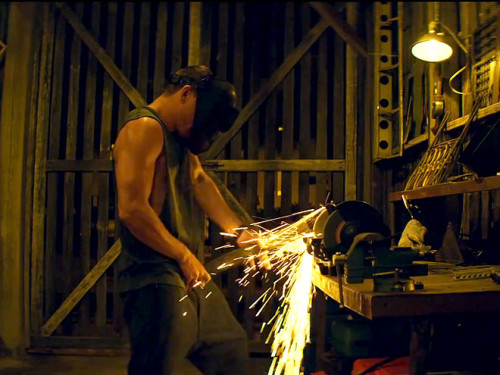
The Female Gaze, and scathing criticism of it, has come bursting into the world recently through Channing Tatum’s pecs. And not in an Aliens face-hugger way either (Magic Mike III anyone? No?). Magic Mike and its extra extra large sequel have been talked about as both a rare movie celebrating female sexuality, and as a prime example of feminist double standards. How can you complain about objectifying women’s bodies and then not criticise a film which seems to do the same to men? The whole debate was fascinating to me as a insider-outsider; sure I’m female, but I’m also a lesbian and so have very little interest in any part of Channing Tatum apart from his underrated comedic timing. I’ve talked before about the strange awkwardness of watching both Magic Mike films as a queer woman in the cinema (what are you doing with that spinning metal wheel of sparking fire, Mike? Do you want to burn your dick off? etc), so when this month’s Bitch Flicks theme was revealed to be the Female Gaze, I was ready and raring to go. But it turns out that the Female Gaze, and particularly the Queer Female Gaze, was a lot harder to pick through than I thought.

magic-mike-01-660

But let’s start at the beginning. Although the Male Gaze was a term coined in the 1970s, it was just a concrete name for an age old phenomenon. The Male Gaze is two-fold:

  1. The sexual objectification of passive female characters.
  2. More generally the tendency to default to male protagonists, points of view, and stories.

The Gaze can be seen literally as a gaze, the way the camera interacts with the women it looks on, doing things like introducing female characters by trailing slowly up their bodies rather than establishing them with their face and actions. This differing treatment of men and women can be seen to be both informed by a patriarchal social structure, but also to reinforce it. Women can be on screen in a sexual situation, and not be subject to the Male Gaze, provided it is plot-relevant and that they are not only there to be a one-dimensional character purely put there for men’s pleasure. Alice Eve’s controversial underwear scene in Star Trek Into Darkness would be a perfect example of how, although she was not a one-dimensional character in the film as a whole, she was given a pointlessly objectifying scene which established nothing about her character, and seemed oddly out of place. The scene was also an example of how the sexualisation of women on screen, as opposed to men, is often used to reduce their power or respect in some way, either by playing into the “whore as worthless” idea, or by making them physically vulnerable as happened with Carol in the film.

CAROL-MARCUS

The Female Gaze, however, is a trickier subject, partly because its a newer phenomenon–as Transparents Jill Soloway said last year, “We’re essentially inventing the female gaze right now.” Both women’s stories and their sexuality are much less likely to be the focus of screen time historically. Definitions, classic camera angles, a checklist of what the Female Gaze might be, are hard to find when only 29 percent of current movies have female protagonists, and all women creative teams are rarer than panda sex. Is The Female Gaze always found in films made by women, for women, or about women? And does that gaze have the same definition as the Male Gaze with the genders switched? Perhaps not. Is it really true that women don’t objectify men? That they always view them as complete and whole human beings? The popularity of the Chippendales suggests otherwise. And our old friend Magic Mike is surely the obvious example of that female sexuality in action, proving women’s sexual desires make them see men as objects just as much as men do to women in films.

set_magic_mike_matt_bomer

However, when we look at the story of Magic Mike and his magic mic, the fact the main characters are strippers means the lack of clothes is plot dependant, and the films revolve around an exploration of the men’s interests, personalities, desires, and dreams. They are sexual, but they are also three-dimensional characters. Moreover, romantic comedies are always an example cited by critics of feminist film theory of movies which reduce men to merely a female fantasy. If that’s the truth, then women’s fantasies of men are a lot more full, positive, and respectful than men’s are of women. Men in romantic comedies aren’t just one-sided sexual beings; the appeal of them is hinged on their personal compatibility and often flawed realness as well. Hugh Grant made a career out of playing the soft-eyed Englishman, who bumbled along and stuttered over his words, hardly a paragon of sexual virility you might expect from the directly switched Male Gaze. Conversely, if women’s sexual pleasure and desire is depicted on screen, it is seen as much less acceptable than a man’s, particularly telling in the differences of age rating given to films that show male vs. female orgasms and oral sex.

If the Female Gaze is hard to pin down, then Queer Female Gaze is near impossible. What I mean specifically with that term is the Gaze we might be able to see in work produced for and about women who are attracted to women. Queer female characters in films made for and by end are almost always either packaged in the same sexually objectified way as straight women, or they are the butt of jokes as “ugly butch lesbians.” So although ostensibly it could be assumed the Queer Female Gaze would be identical or at least hugely similar to its male counterpart, in fact it cannot be mapped directly onto the Male Gaze for a few crucial reasons:

  1. The number of films made for, by and about queer women in mainstream cinema is embarrassingly small, and is not compatible to that male default I mentioned earlier.
  2. The sexual desires of queer women are different to that of straight men.
  3. The male ownership of female bodies is something tied to male behaviour rather than an intrinsic reaction to female bodies by anyone who desires them.
  4. Queer women are interested to see interesting women on film, meaning having women be solely sexual objects is not necessarily going to fly with us.

So maybe it’s something in-between, or something new entirely. Maybe, as I have come to believe over the last few weeks, it isn’t something which has a real definition or direction, simply because it doesn’t have a present or strong enough canonical tradition in media. Instead I’ve tried to look at current examples of media for and containing queer women, to see where it differs or intersects with the Male/Female Gazes.

As a queer woman it might seem to any men who are attracted to women, that I would love images of half naked oiled up women, because they do. But while they may just see the object of their desire, I have to also see myself. So when I see sexualised women on screen who are given no agency, plot or power, I don’t get anything positive from that. It feels unbelievably naive and worrying that someone who is for all intents and purposes a pliant sexual object could be genuinely and maturely desirable. This is the source of a long held observation in the queer world that “lesbian porn” is so obviously and inexplicable made for straight men. It also may be why I have never been able to come out to a male stranger who is trying to chat me up without him immediately asking for a threesome. I am infinitely more interested in women who are allowed to make decisions, tell their stories, control the narrative, in addition to being autonomous sexual beings, because that’s how I see myself, my friends, my partners.

Secondary issues that comes with the Male Gaze are problems like a lack of movies that show meaningful female friendship (as shown most simply through a quick look at how many films don’t pass the Bechdel Test; although films that pass don’t necessarily show female friendship, it’s pretty hard to find a film that fails the test that does). Shows with a focus on queer women, like Orange is the New Black or the web series Carmilla, also have a strong emphasis on female friendship alongside female sexual or romantic relationships. The desire to show a complex version of yourself seen with male characters in the Male Gaze, alongside a desire for a complex version of your partner seen with male recipients of desire in the Female Gaze, combines in the Queer Female Gaze to produce sexual and romantic relationships often rooted in friendship.

Screen-Shot-2014-10-13-at-11.29.40-am

This is furthered by the prevalence of narratives in queer cinema about coming out and finding community, which can give a tentative and holistic treatment to attraction. In the quintessential lesbian teen movie But, Im a Cheerleader, Graham and Megan begin as friends and develop parallel to Megan’s own acceptance of her sexuality. Their relationship is more than just sex, because it is so tied to her understanding of herself, in a way which values Graham far more than the Manic Pixie Dream Girls of the “young straight man finding himself through romance” narratives of the Male Gaze. The showing of intimate, dirty, casual or loving sex in any queer narrative does not remove the possibility of the women participating in this sex being fully imagined characters. The Gaze means female desire, both sexually and the desire to see herself present and whole on screen, and this is even more effective the more women you present for those queer female audience members to align themselves with.

tumblr_mz411aylbs1r8vo7wo1_1280

Women can be seen on screen as sexual beings, without being sexual objects. Queer women’s position as both gazer and gazee give a brilliant opportunity to reject the tired reduction of female characters in and out of the fictional sheets. What remains to be see, as we make the slow journey towards mainstream queer media, is whether the defaults of The Male Gaze, with its dehumanising camera shots and need for a male presence on screen, will bleed into the Queer Female Gaze through what we take for granted as “just how cinema is made.”


Rowan Ellis is a British geek using her YouTube videos to critique films, TV, and books from a queer and feminist lens.


Catherine Breillat’s Transfigurative Female Gaze

Breillat’s complete oeuvre (which certainly demands our attention beyond these three films) delivers continually shocking treatment of female sexuality presented though the female gaze. She wants us to be uncomfortable and to be constantly questioning both representations of female desire and our responses to those representations, and how all of it is shaped by a religious, patriarchal culture.

This repost by Leigh Kolb appears as part of our theme week on the Female Gaze.

“… a person who can find the transfiguration of sex in her life is no longer a person who can be directed.”

– Catherine Breillat

French filmmaker Catherine Breillat has spent her career exploring female sexuality. She hasn’t done so in a comfortable, easy way. When The Woman says to The Man, “Watch me where I’m unwatchable” in Anatomy of Hell, this could very well be Breillat’s message to her audiences as she presents female desire in harsh, jarring narratives that completely subvert the male gaze.

Normally, if we talk about subverting the male gaze and focusing on the female gaze in film, it’s cause for celebration. Finally! We scream. We’re coming!

Breillat’s female gaze is different, though. It pushes us to places of complete discomfort and sometimes disgust, and forces and challenges us to think about the deeply twisted cultural expectations surrounding women and sex.

Sometimes a shock is what it takes to bring us to places of transfiguration. We can’t smoothly transition to the female gaze after centuries of being surrounded and objectified by the male gaze. Breillat delivers shock after shock that serve to transfigure how we see ourselves and our culture. This isn’t comfortable, but it’s powerful.

The grotesque is enmeshed with sexual pleasure and violent death–all images and storylines that patriarchal cultures have been weaving together for centuries. A woman’s sexual desire and her actions stemming from those desires are often presented as horrifying and punishable: “unwatchable.” Much of what Breillat shows supports the reality that female sexual desire is real, and the societies in which we must function are at best, uncomfortable with that desire, and at worst, violently hostile.

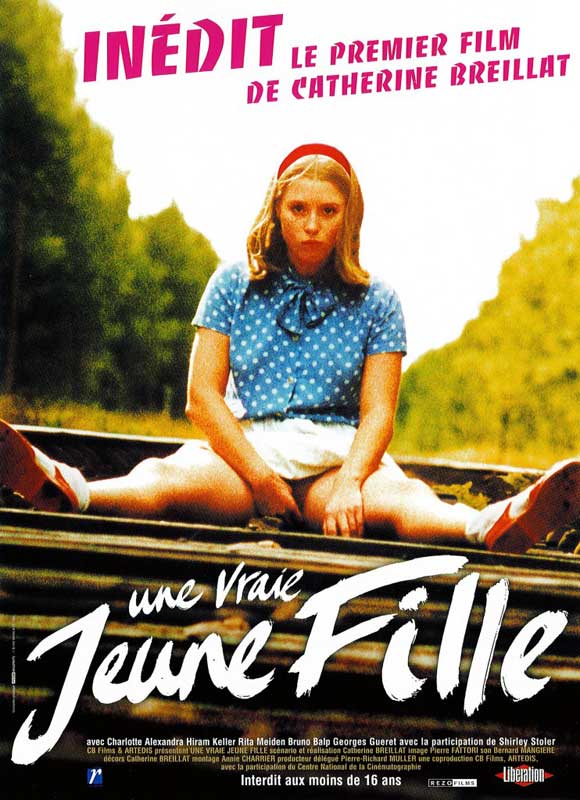
A Real Young Girl (Une vraie jeune fille)


Breillat’s first film, based off her novel, Le Soupirail, was A Real Young Girl (Une vraie jeune fille). Produced in 1976, it was quickly banned and wasn’t released in France until 1999. The film centers around 14-year-old Alice, who is discovering and attempting to navigate her sexual awakening. A Real Young Girl is avant-garde puberty.

[youtube_sc url=”https://www.youtube.com/watch?v=z4FXxS9VevE”]

There are moments in the film that are confusing and grotesque (most notably one of her fantasies that involves barbed wire and a ripped-up earthworm). While I found some of these scenes disturbing, I like being disturbed. The worm scene horrified me at first, but then I realized that when I was in high school, the hit teen comedy involved a dude literally fucking a pie. Teenage sexuality is weird and when we are faced with a teen girl’s sexuality–something we are not used to seeing (unless she is a sexual object)–in all of its confusion and vacillation between intense desire and disgust, we are uncomfortable. Breillat wants us to be uncomfortable; she wants to push us to the edge to that visceral experience that will challenge how we see both female sexuality and film depictions of female sexuality.

Fat_Girl_poster


Fat Girl (À ma sœur!), released in 2001, follows two sisters–Elena, 15, and Anaïs, 12–as they vacation with their parents. Elena is conventionally beautiful, and while she likes boys and has experimented sexually, she wants to remain a virgin until she’s with someone who “loves” her. She quickly develops a relationship with a young man who is frustrated with her desire to not have sex. He pressures her into anal sex (which hurts her), tries to force her to have oral sex, and finally convinces her he loves her and she has sex with him. In all of these instances, Anaïs is in the room–feigning sleep, asking them to stop, or, when they finally have sex, crying.

Anaïs’s views on sex are very different than Elena’s. She is starting to feel sexual–she’s not a teenager yet, but she’s not a child. Her desires range from banana splits to having sex just to get it over with. She has sexual desires, and her responses to Elena’s sexual experiences show both naiveté and jealousy. Their ages, their exterior looks, their sexual experiences (or lack thereof) all inform Breillat’s treatment of the sisters’ relationship with one another, with their own burgeoning sexuality, and with a culture that insists on sexualizing Elena and ignoring Anaïs. Their desires–Elena as internalized (and then disappointed) object, Anaïs as frustrated subject–are common categories for adolescent girls to fall into.

[youtube_sc url=”https://www.youtube.com/watch?v=rHRJRbM2EAg”]

Fat Girl (read Breillat’s commentary on the title here) is disturbing in its depictions of some of Elena and Anaïs’s experiences. However, the end of the film is shocking and violent. After Elena and her mother are brutally killed at a rest stop, the murderer rapes Anaïs in the woods. The next morning, she tells the police she wasn’t raped, and she looks at the camera, in an ending that clearly reflects The 400 Blows. Like the Truffaut classic, we are saddened and disturbed at the life trajectory of our young protagonists, and have no idea where their lives will go from here. We just have a frozen young face staring at us, implicating us in their fate.

Anaïs, at the end, seems to embrace her rape (as her meaningless loss of virginity that she wanted) and deny its violence. This is made even more traumatic since her rapist murdered her mother and sister (her sister who had just become sexually active, and her mother who wanted to punish her for it).

The message here is that girls cannot win. A patriarchal culture–full of boys who think they’re entitled to sex and men who violently rape and kill women–cares little for female desire and agency. This world is a dangerous place for girls. This world treats pretty girls like objects, and unpretty girls like nothing. Their desires are complicated and real, but are eclipsed by toxic masculinity.

Anatomy of Hell (Anatomie de l'enfer)


Released in 2004, Anatomy of Hell (Anatomie De L’Enfer) is a film that pulls together pornography, misogyny, and female sexuality in a way that shocks and disgusts (male reviewers in particular wrote scathingcondescending reviews of the film). The Woman visits a gay bar and attempts suicide in the bathroom–she is tired of being a woman and being hated by men, and surmises that gay men hate women the most. The Man, however, saves her and she offers to pay him to stay in her home for four days to “watch her where she is unwatchable.” What follows is, for some viewers, unwatchable.

The Woman is naked for most of the film (a body double is used for vaginal shots), and The Man is played by an Italian porn star. His homosexuality serves to completely upend the typical male gaze. He’s disgusted by much of what he’s seeing and experiencing, and the understanding that this primal, visceral, shocking female desire is at the focus of the film (and has absolutely nothing to do with male desire) reflects a culture that typically focuses only on the male gaze and male pleasure. In this culture, female sexuality isn’t a consideration.

[youtube_sc url=”https://www.youtube.com/watch?v=BbFSZiT2-a4″]

When The Man drinks a glass of water with a used-tampon teabag, certainly the audience is meant to feel disgust. Perhaps some audience members actually gagged at the sight. How many scenes, however, in porn (explicitly) or mainstream film (suggested), feature women swallowing male excretions? Do we blink? Or is it just part of what we expect it means to be a heterosexual woman?

Jamie Russell astutely observes at the BBC, “For all the shocks, though, this is a stoically serious movie: it’s anti-porn, a transgressive sex movie that’s not against pornography but against the (male-dominated) objectification of women’s bodies.”

Breillat’s complete oeuvre (which certainly demands our attention beyond these three films) delivers continually shocking treatment of female sexuality presented though the female gaze. She wants us to be uncomfortable and to be constantly questioning both representations of female desire and our responses to those representations, and how all of it is shaped by a religious, patriarchal culture.

In an interview with The Guardian, Breillat articulated that her female gaze should directly threaten the male gaze, and that men should examine their own sexuality in the face of female desire:

“It’s a joke – if men can’t desire liberated women, then tough. Does it mean they can only desire a slave? Men need to question the roots of their own desire. Why is it that historically men have this need to deny women to be able to desire them?”

The reporter points out that Breillat had said “that censorship was a male pre-occupation, and that the X certificate was linked to the X chromosome,” and Breillat goes on to discuss the religious and patriarchal reasons to censor female desire, which is directly connected to keeping power away from women.

Breillat’s 1999 Romance was originally given an X rating (or banned in some countries). At Senses of CinemaBrian Price notes that “Breillat’s statement was echoed in the French poster for the film, which features a naked woman with her hand between her legs. A large red X is printed across the image, thus revealing the source of the trouble: a woman in touch with her own sense of sexual pleasure.”

Romance


And that’s always the problem, isn’t it? Breillat’s work pushes boundaries and forces us to live in the intense intimacy and discomfort of a female gaze that we are unused to due to social oppression of women and women’s sexuality (at the hands of patriarchal religious and government systems). The literal and figurative red X over Breillat’s work–and female sexuality–needs to be stripped away to reveal what’s underneath–which isn’t always pretty.

[youtube_sc url=”https://www.youtube.com/watch?v=jpH-V6kkOwI”]

___________________________

Leigh Kolb is a composition, literature, and journalism instructor at a community college in rural Missouri.

Jo March’s Gender Identity as Seen Through Different Gazes

The male gaze either holds Jo back from the start, or else shows an “educational” transformation from an “unruly” female into a “desirable” young woman who knows her place.


Written by Jackson Adler as part of our theme week on The Female Gaze.


(Note: Louisa May Alcott’s novels Little Women: Meg, Jo, Beth, and Amy and Good Wives, published in 1868 and 1869, respectively, are often combined into one volume as Little Women Part 1 and Little Women Part 2. Henceforth, when I refer to Alcott’s novel Little Women, I refer to the combined novel as a whole.)

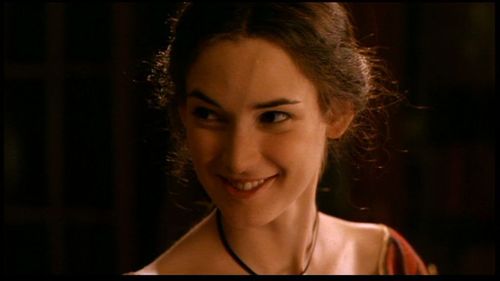
Many girls and women have loved Little Women and seen their ambitions, drive, or love of reading and writing reflected in Josephine “Jo” March. Harry Potter author J.K. “Jo” Rowling told the New York Times, “My favorite literary heroine is Jo March. It is hard to overstate what she meant to a small, plain girl called Jo, who had a hot temper and a burning ambition to be a writer.” In a world that privileges men and censors women, the largely female cast of Little Women and its main character Jo have naturally been a relief and an inspiration for women, serving as a feminist narrative to many. However, the male gaze has been applied to most of the film and TV applications of the story, despite the scripts often being at least co-written by women. The male gaze tends to twist the romantic ending to use as a weapon against female viewers – reminding them of their “place” in society, and the expectation for them to marry and become housewives. Gillian Armstrong’s 1994 film, as previously pointed out by Jessica Freeman-Slade on Bitch Flicks, is far superior to these adaptations in maintaining the female centric integrity of the story, allowing the characters dignity and freedom of expression, and emphasizing Jo’s choices and self-determination. In my research, I have only come across one lonely paper and one recent play that address the possibility that Jo could be transgender. However, I think the case for this view is strong, and that discussion of Jo’s gender and how it is and isn’t seen and represented is important.

1

Little Women follows four Massachusetts siblings coming of age during and directly after the American Civil War. The four siblings (and I cannot be the only person on Earth who has sorted them into Hogwarts houses) are: Margaret “Meg” March (the sensible Ravenclaw), Josephine “Jo” March (the brash Gryffindor), Elizabeth “Beth” March (the loyal Hufflepuff), and Amy March (the ambitious Slytherin). (Note: Amy and Slytherin both get a lot of haters, but Amy and many Slytherins are wonderful and sweet people, truly.) Though each sibling is allotted a fair amount of attention, the story mostly focuses on Jo, the “tomboy,” for whom I will henceforth use male pronouns. One of Jo’s first lines in the novel, and one repeated in many adaptions, is “I can’t get over my disappointment in not being a boy…”

At 15 years old, and the start of the story, Jo hates his “rapidly” developing body. His “one beauty” is his “long, thick hair,” and yet he “usually bundle[s] [it] into a net, to be out of [his] way.” The word “boyish” is often used to describe Jo, his preferred name (he hates when his aunt calls him “Josephine”), the habits he uses, and the activities he enjoys. He loves using “boyish” slang and exhibiting “gentlemanly” and “boyish” habits, such as keeping his hands in his pockets and whistling. He even says that he does these things for the very reason that they are “boyish.” Jo’s father (a reverend) and his mother (whom the children refer to as “Marmee,” which in their Eastern Massachusetts/Boston dialect is pronounced as the more common “mommy”) require each of their children strive to fix their bad habits, described as their “burdens” or “bundles” to bear. Meg has her vanity, Beth has her shyness (so great she often has difficulty voicing her own opinions or standing up to others), and Amy has her selfishness. As for Jo, he is heartbreakingly required to try to be more “ladylike” and “womanly.”

109958_0

This includes some useful habits, such as learning to control his temper so as to treat his siblings (namely Amy) better. However, while Laurie is allowed “Byronic fits of gloom,” Jo is encouraged to be “pleasant” because, as Amy herself states, “women should learn to be agreeable” so as to be “better liked” by society. Far from just Jo’s expressions of everyday emotions, Jo is pressured to police his words and actions every day, such as only barely resisting talking sports at a party. To please his family, Jo tries to adopt “ladylike” behavior, but often fails so miserably that he causes his family (especially Meg and Amy) embarrassment. Jo often feels “lonely” and misunderstood, even when surrounded by people who love him, and sometimes becomes “irritable” because of it. Jo finds some relief in his friendship with Theodore “Laurie” Laurence, with whom he skates, flies kites, goes rowing, and runs races. Laurie even often calls Jo “fellow” and other masculine terms of endearment. When Jo and Laurie feel particularly confined and restricted by their families and by societal expectations, they almost run away to be cabin boys together for the “adventure,” and only stop themselves due to their feelings of responsibility and love for their families. However, even Laurie’s friendly view and boyish treatment of Jo is limited. Laurie uses “sentiment” (flirtation) and is “wheedlesome” (manipulative) when pressuring Jo to marry him, proposing in large part because “everyone expects it.”

little-women-normal-columbia

At the end of the novel and in the sequels Little Men and Jo’s Boys, Jo and his husband Professor Friedrich “Fritz” Bhaer found a school and a college for diverse pupils, giving a home and love to children who would otherwise be overlooked or even discriminated against. These institutions are open to both boys and girls, include biracial students (one a quarter Black and one part Native-American), and students with mental and physical disabilities. One of his students is another “tomboy” who ends up becoming a doctor and never marrying. Jo is particularly close with the male students and the “tomboy,” as he “sympathize[s]” with boys more than girls.

4728475_l3

Out of the many portrayals of Jo March, I think June Allyson’s comes closest to being the “tomboy” of the novel, particularly evident when Allyson emphasizes the line about how “disappointed” Jo is at not “be[ing] a boy.” Not that Allyson’s goal was to portray the character as a transboy (the term didn’t even exist yet!), but a specific kind of heartbreak and frustration come through nonetheless. Katharine Hepburn’s (1933), Allyson’s (1949), and Susan Dey’s (1978) Jos were sadly glamoured up by their male directors. Susan Dey’s Jo feels especially constricted, as if Dey wasn’t permitted to express the character as she saw fit because directors David Lowell Rich and Gordon Hessler were constantly holding her back from showing Jo’s fire and rambunctiousness. While the TV movie still retains some feminist moments, Jo is often grabbed and physically held back by male characters, especially Laurie. Winona Ryder’s (1994) is less objectified or confined under the female gaze of director Gillian Armstrong. Though the characters of Jo’s sisters and mother are more developed and allowed room to breath under the female gaze, Ryder’s Jo is a spirited young woman who merely wants to express herself in whatever way she wants. This is somewhat comparable to director Gaby Dellal of About Ray, stating that she didn’t cast a transgender actor as the title character because that “isn’t what [the] story is about” and problematically refers to the character as “a girl who is being herself.” Ryder’s Jo does not have the same kind of yearning, heartbreak, anxiousness, and irritability that comes with being forced to hide from others (as well as oneself) one’s own true gender.

susan-dey-little-women-1978-pic-16

The male gaze either holds Jo back from the start, or else shows an “educational” transformation from an “unruly” female into a “desirable” young woman who knows her place. Under the male gaze, Laurie is often made into a combination of undesirable nerd and total creeper in order to justify Jo’s decline of his marriage proposal. It is implied in the 1949 adaptation that Laurie continues to have feelings for Jo, while in the 1978 TV movie it is implied that Susan Dey’s Jo realizes she has feelings for Laurie only after hearing of his marriage to Amy, I guess because the director wanted Jo to learn a lesson about how turning down men is bad? (Yeah, I was yelling at the screen.) Interestingly, this version has one of the best set-ups of Laurie’s and Amy’s relationship (Amy and the other sisters often being denied the screen time they deserve in other adaptations). However, this is because Laurie overcoming his feelings for Jo and realizing his love for Amy is used to punish Jo in this adaptation. Ironically, one of the most positive portrayals of Laurie is under Armstrong’s female gaze. This is because a more complex and autonomous Jo lends to more complex reasons for her turning down the love of his best friend. It’s not that he isn’t a good person, or that she isn’t fond of him, it’s just that she doesn’t love him as anything other than a friend, and she’s not going to commit to an-other-than-blissful relationship just because society thinks that grown men and women can’t be “just friends.”

tumblr_l8wl09A2E61qbacj7

While I think an adaptation of Little Women that portrays Jo as transgender is incredibly needed, providing representation and history for a marginalized and often silenced group, it would require a transmale gaze, ideally in the form of a transmale director. As Hollywood is so averse at diversifying its behind-the-camera positions in any way, it will probably take some time before a project such as this can be made. However, a historical drama featuring a leading trans character would make a big difference in the lives of young trans people. I know that Jo has made a huge difference in my own life as a transman. Jo and his creator Louisa May Alcott (who went by “Louis” as a young person) often feared being alone. But Jo, myself, and others like us, are not alone – and it’s important for us to know that.


‘A Girl Walks Home Alone At Night’ and Scares Us

Amirpour’s camera (the magnificent cinematography is by Lyle Vincent) lingers over Arash’s beauty–his high cheekbones and large, long-lashed eyes under a dark, curly version of James Dean’s pompadour–in a way few male filmmakers would.

GirlNightCover


This repost by Ren Jender appears as part of our theme week on The Female Gaze.


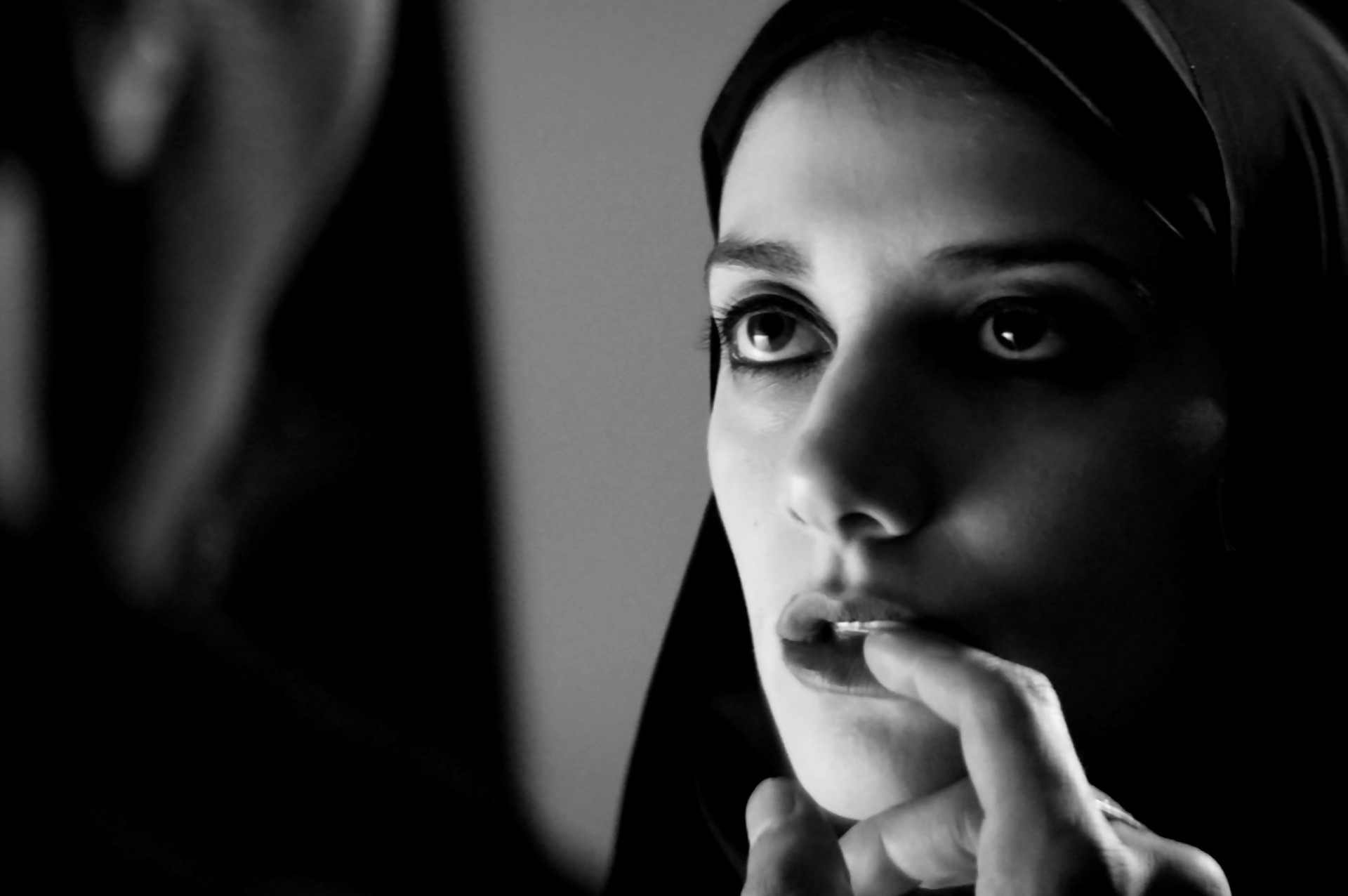
Nice girls aren’t supposed to walk alone in the dark, even in the movies.  So in the generically titled A Girl Walks Home Alone At Night,  the debut feature from writer-director Ana Lily Amirpour, we in the audience wonder what a woman in a black cloak (a traditional Iranian garment called a chador) is doing on the streets of a largely empty desert town in the wee hours. We see her witness a pimp (Dominic Rains) exploit and then cheat a sex worker (Mozhan Marnò). We soon find out the woman in the chador, The Girl–we never find out her name (played, unforgettably, by Sheila Vand) is no ordinary woman, but a vampire with fangs that retract like a cat’s claws–or a switchblade.

The film takes place in a parallel California which contains a Farsi-speaking, Iranian enclave called “Bad City.” We know we’re not in Iran because the pimp has visible tattoos and later we see a woman in public with her hair and much of her body uncovered. Also The Girl wears her chador in such a way that we see her hipster, stripey, boat shirt (too short for modest dress) and skinny jeans underneath.

In spite of its surface differences, the film to which Girl has the greatest parallel is probably David Lynch’s Eraserhead. Like that film, every sumptuous, black and white shot is framed and lit with care, creating an alternate universe for the audience to lose themselves in. And as in Eraserhead, even what we hear is fussed over in a way that grabs our attention: incidental sounds are recorded close. The proximity doesn’t alienate us, the way less skillful dubbing in other films often does, but gives us a heightened sense of intimacy, as if we are almost touching the characters.

GirlNightThroat

When The Girl interrogates The Street Urchin (a young boy played by Milad Eghbali) the film shows a truth that many films, including horror films, elide–but that the other recent acclaimed horror film directed by a woman, The Babadook, also addresses–the first person who scares us when we are children is often a woman, whether it’s a mother or another woman authority figure. Tilda Swinton has said that her character in Snowpiercer was based on a particularly terrifying nanny from her own childhood. Few lines in films this year have been more chilling than the one The Girl leaves The Street Urchin with after she threatens him: “Be a good boy.”

Like Michael Almereyda, who, in the ’90s made a stylish black and white film about a woman vampire among New York hipsters, Nadja (its star, Elina Löwensohn, had eyes you couldn’t look away from, much like Vand’s) Amirpour combines familiar elements in an unfamiliar way for maximum resonance. In Almereyda’s modern day New York Hamlet (from 2000), he famously incorporated a video of  Buddhist monk Thich Nhat Hanh talking about “being” in the background of a scene, priming us to later hear Hamlet’s most famous soliloquy.

In Girl Amirpour gets at how women in modest Muslim dress (including those from Iran) are used for xenophobic and anti-Islamic fear-mongering (often in the guise of “feminism”) in the US (like in the recent ad campaign for Homeland) but also uses a chador’s resemblance to a cape to give us an eerily familiar–but new–“Dracula” silhouette. When The Girl rides on the skateboard The Street Urchin leaves behind (after he runs away from her in terror) the chador billows around her as she rolls down the road, and she becomes, without CGI trickery, a bat in flight.

Americans often read chador on women to mean vulnerability, but like the frail-seeming, pale, young, blonde Mae in another beautifully-shot, vampire Western (also directed by a woman, the pre-Hurt Locker Kathryn Bigelow) 1987’s Near Dark, who, when her cowboy boyfriend lassoes her as a “joke” takes hold of the rope and pulls him in, The Girl has hidden reserves of strength. The Girl becomes an avenging angel in black, attacking the men we see abuse women, using her “traditional” quiet passivity to draw these guys close. As the abusive men do with the cat who is many times in the frame (rarely has a filmmaker caught how much of our daily lives our animals witness) they ascribe motivations and personas to The Girl which are more about their own perceptions than about who she is or what she is thinking.

Like a number of films Girl has an early scene, fast becoming a campy cliché, in which a woman suggestively sucks the finger of a man. But when The Girl takes the pimp’s forefinger into her mouth, he gets more than he bargained for.

And as we do with Mae, we see that The Girl is lonely, and a hapless, good-looking guy, Arash, played by Arash Marandi touches something in her. When they meet, he’s coming from a costume party where he’s taken some of the club drugs he was dealing and is still wearing a vampire cape as he stares into a street light. She immediately becomes protective of him.

GirlNightEyeliner

Vand’s presence burns through the screen. She has the intensity of the great silent actresses–and in many of her scenes, the ones in her room plastered with ’80s music posters, dancing by herself to Farsi synth-pop records or even when she interacts with other characters, she often does not speak. This film is low on back story but Vand’s face, especially her huge dark eyes (we see her put on her heavy eyeliner in the bathroom mirror before she goes out) tells us what she is feeling in every scene.

Amirpour’s camera (the magnificent cinematography is by Lyle Vincent) lingers over Arash’s beauty–his high cheekbones and large, long-lashed eyes under a dark, curly version of James Dean’s pompadour–in a way few male filmmakers would. His clothes (a plain white t-shirt and jeans that hug his muscled body) also evoke Dean’s. And even though the pimp, Saeed, is a villain, meant to repel us, Amirpour lets us take in the attractiveness of his body, especially in a shirtless scene with The Girl when his pants hang very low and we see the full extent of his tattoos–and his muscles.

LA has enough Iranian-Americans in it that some have nicknamed it “Tehrangeles” (after Iran’s capital), but I can’t think of another film produced near there (Girl was actually filmed in Bakersfield) in which most (or all) of the cast is of Persian descent, but no one is a terrorist or a relic from the old country.  These characters speak Farsi to each other but, except for Arash’s father, with his drug addiction and collection of pre-revolutionary framed photos of family (complete with 60s-style teased hair on the women), these people aren’t living in the past–even The Girl’s retro record collection, clothes and bobbed hair reflect present-day fashion.

We can never know for sure, but just as with Black actress Gugu Mbatha-Raw giving two terrific, completely different star-turns in movies in one year but the media still largely ignoring her, I wonder if  Amirpour’s flawless visual sense, skill with actors and unique reworking of a genre many of us thought didn’t have an original angle left would garner more attention if she were a white guy. Girl is distributed in partnership with VICE‘s film arm and has even made some year-end, top-10 lists, but I had to go to New York to see it and whole countries (like Canada) have yet to get even limited distribution. Nevertheless Amirpour continues to work on films unimpeded. Her next work is about cannibals. I can’t wait until its release.

[youtube_sc url=”https://www.youtube.com/watch?v=_YGmTdo3vuY” iv_load_policy=”3″]

___________________________________________________

Ren Jender is a queer writer-performer/producer putting a film together. Her writing. besides appearing every week on Bitch Flicks, has also been published in The Toast, RH Reality Check, xoJane and the Feminist Wire. You can follow her on Twitter @renjender

Shishihokodan: The Destructive Female Gaze of YA Supernatural Action Romantic Comedy

Recognizing the function of Ice Prince/Wolf in YA SARCom implies the continual defeat of the Whore as structural necessity in male writings also – as a pursuing character she must be resisted to generate sexual tension, regardless of whether the male author is Team Madonna or Team Whore. The destructive impact on the self-image of female viewers is pure collateral damage, just as our SARCom is poisonously emasculating for male viewers.

 Edward-vs-Jacob


This repost by Brigit McCone appears as part of our theme week on The Female Gaze.


YA Supernatural Action Romantic Comedy (SARCom) was created in 1987 by the manga artist Rumiko Takahashi’s Ranma 1/2. Her mixture of kung-fu demon-of-the-week fights, romance and comedy, with a supernaturally strong heroine, dual shapeshifting supernaturally strong love interests and sarcastically quipping sidekicks, was then a completely unique format and rapidly became popular in the West and Japan. Takahashi’s creative control as visual and story artist (particularly after the success of the slapstick Urusei Yatsura) meant that the aesthetics of SARCom were shaped by the female gaze from the outset. Among its innovations, Ranma 1/2 introduces an Ice Prince/Wolf love rivalry between the hero Ranma and his rival Ryoga, a trope Takahashi would develop in her next SARCom Inuyasha. Joss Whedon’s Buffy the Vampire Slayer popularized the SARCom in mainstream Western culture, developing its own Ice Prince/Wolf rivalry with the characters Angel and Spike. The Ice Prince/Wolf dynamic now dominates teen girl cinema, after Catherine Hardwicke’s Twilight set a new record for commercially successful female directors.

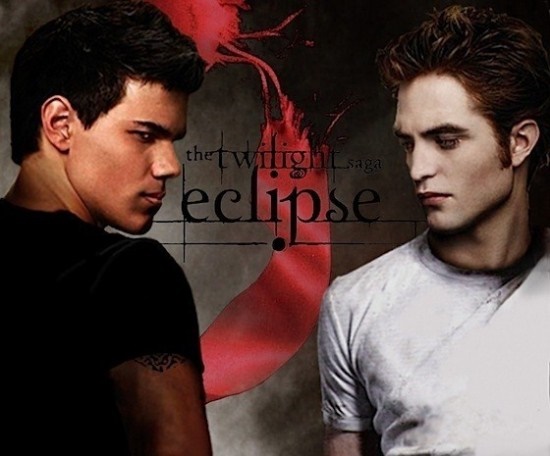
Hardwicke’s camera continually privileges Kristen Stewart’s female gaze as Bella Swan, moving with her and focusing on her lip-biting lustful reactions, while offering Robert Pattinson’s Edward Cullen as erotic spectacle, the camera panning over him lovingly. Twilight also almost fails a reverse-Bechdel through the intense Bellacentrism of all its characters. Male viewers react with defensive ridicule to the uncomfortable sensation that they are supposed to be lustful fourteen-year-old girls when watching this film. In this moment, they have a brief sensation of what it is to be the female spectator of 90% of Hollywood films, uncomfortably reminded by the Male Gaze that you are somehow supposed to have the reactions and expectations of a heterosexual man. Their unfamiliarity with the mechanics of the female gaze became obvious when Hardwicke was replaced in Twilight sequels by male directors, who fumbled uncomfortably to recapture her intensity. Not only excluded as unintended spectator, the male viewer of SARCom is more likely to identify with the always defeated “Wolf” (sexual pursuer, equivalent to female “Whore”), the vulnerable, openly desiring rival. The victory of the unrealistic “Ice Prince” (sexual resistor, equivalent to female “Madonna”) is therefore destructive to the male viewer’s ego, often provoking a hostility barely concealed under sneering ridicule, just as the Male Gaze’s Madonna/Whore logic has always been destructive to the female ego. So what, actually, is going on?

Celebrating Celibacy: The “Ice Prince” Archetype


 The defining characteristic of the “Ice Prince” is his combination of emotional fidelity and sexual unavailability, which amplifies gazing female desire and sexual frustration simultaneously, and is generally accompanied by his emphasized superiority and/or physical threat. That is, his sexual unavailability becomes a symptom of his overall domination. Ranma, the hero of Ranma 1/2, not only rivals the heroine Akane in martial arts, but periodically transforms into a girl more sexually attractive than she is. This tantalizing superiority enhances the character’s sexual unavailability; the world of Ranma 1/2 plays with gender but is strictly heteronormative with biological sex. Ranma 1/2 occupies an intermediate position between the shounen (boys’ manga) harem plot of Takahashi’s previous Urusei Yatsura and the love rivalries of her later Inuyasha: as a shounen hero, Ranma is the center of a harem of sex-crazed women, but as a shoujo (girls’ manga) hero, he must be sexually attracted to none of them. The sexual friction from these conflicting genre demands seems to have accidentally invented the “ice prince” archetype.

Inuyasha tames its threateningly feral hero, while maintaining his sexual unavailability, by making him frustratingly in love with a previous incarnation of the heroine Kagome – thus, he loves Kagome as a reincarnation, but cannot consummate this love due to his frustrating fidelity to her original.

The most extreme “Ice Prince” archetype in Takahashi’s work is Sesshomaru, the haughty, aristocratic pureblood demon introduced as a villain, accompanied by a sycophantic toady, who is attempting to cheat his socially inferior, half-brother Inuyasha out of his inheritance; that is, almost exactly the set-up of Fitzwilliam Darcy in Pride & Prejudice. She may have intended to create a villain, but Takahashi falls into Austen’s tried and tested Darcy arc: Sesshomaru meets an open-hearted, mischievous and unintimidated girl whom he struggles to scorn as inferior; his flaws are contextualized by introducing his controlling, snobbish mother; finally, he risk everything to rescue the redeemer-girl. Introducing a poison-clawed Demon Dog Darcy, with the power to raise the dead and blast his enemies to hell as a supporting character, unbalances Inuyasha: Sesshomaru’s well-written redemption arc commences just as Inuyasha’s own arc grinds to a halt, spending a hundred chapters randomly upgrading his sword while the fandom sways toward the narratively marginalized Sesshomaru. Demon Dog Darcy is then forced to hand his emotionally-earned powers over to Inuyasha in an exasperatingly contrived plot twist. But Sesshomaru’s very marginalization in Inuyasha‘s narrative, and total detachment from the main heroine, function to intensify fangirl emotional and sexual frustration: the ultimate aim of any Ice Prince. Although Demon Dog Darcy progressively thaws emotionally, the character’s sexual unavailability is emphasized by spiked armor encircling his chest and maintained by filling the “Elizabeth Bennet” role with a pre-pubescent girl.

In Buffy the Vampire Slayer, Angel loves and saves Buffy but is made sexually unavailable by a curse that he will lose his soul if he has sex with her. This loss of soul also allows the intensification of Angel’s dominating physical threat and sadism, while permitting the “real” Angel to remain a dutiful lover. Twilight likewise presents Edward Cullen as a deeply loving and loyal “Ice Prince” who threatens Bella repeatedly by mentioning his urge to devour her and, of course, is sexually unavailable through his fear of ‘losing control’. All these narrative devices intensify friction, rather than satisfaction. However, since a female viewer can never fulfil her own sexual desires for a fictional construct, her experience of frustrated sexual tension is most satisfyingly expressed by sexual tension within the narrative. Also, because society constructs men as permanent sexual pursuers, a woman is relieved of her need to resist, and able to fully and extravagantly express her lust in a safer space, when the male is reimagined as loving resistor.

Demon-in-Distress: The “Wolf” Archetype


The defining characteristic of the “Wolf,” the eternally rejected sexual pursuer, is his combination of desperate emotional and sexual availability with repeatedly emphasized vulnerability and animalism. The most exaggeratedly vulnerable is Ranma 1/2‘s Ryoga, a little boy lost in the literal sense that he farcically lacks any sense of direction. The fanged, impulsive Ryoga’s regular transformations into a small, cute piglet add to his vulnerability. His inability to tell the heroine Akane of his true nature and feelings, out of fear of losing his privileged access as her pet pig, forms a near-perfect satire of the “Friendzone” phenomenon.

Inuyasha‘s impulsive, hotheaded Koga is a wolf-demon. In contrast to the elusive, emotionally conflicted hero Inuyasha, Koga falls for the heroine Kagome almost immediately and pursues her consistently. The manga is notable for constantly placing Koga in helpless “demon-in-distress” situations requiring rescue, and for counterbalancing Sesshomaru’s spiked, hug-repellent armor and Inuyasha’s loose robes with Koga’s skimpy armor and furred micro-miniskirt, concealing his crotch only by careful choice of viewing angle. This ogling display of male flesh is characteristic of the Wolf, maximizing the friction between his overt desirability and the need to resist him.

Although Buffy‘s Spike is a vampire, theoretically an “ice prince” archetype, the character  bears a dog’s name and typical “wolf” impulsiveness and romantic vulnerability. In his second season introduction, he is confined to a wheelchair and forced to watch his beloved Drusilla seduced by ‘Ice Prince’ rival Angel. In the third season, he’s pathetically dumped and weeping. In the fourth, he’s neutered by a brain chip that zaps him for attacking, so “he doesn’t chase the other puppies anymore.” In the fifth, the trope of Spike’s muscular nakedness is introduced as vulnerability; he bares his chest to Buffy’s stake and confesses his love. This sequence is revealed as Spike’s dream; he is stripped and Buffy is fully clothed even in his own sexual fantasies. Spike is also stripped and tortured for love of Buffy by the dominant, female deity Glory in this season. In the sixth, after their first sexual encounter, Buffy is again fully clothed, abusing Spike verbally while he sprawls naked and defenseless. She repeatedly violates his sexual boundaries from a position of dominance; his attempt to force himself on her is presented as a crime of pathetic desperation. Though ‘Ice Prince’ Angel wishes to torment and kill Buffy when he is soulless, Spike’s soulless state is no obstacle to his love – the emotional  dependence of the “Wolf” knows no bounds.

Twilight’s Jacob Black is another wolf defined by constant loyalty, before attempting to force himself onto Bella in an act portrayed as pathetic desperation. Where Edward’s brief moment of toplessness is a dramatic, suicidal act that will dazzle a watching crowd, Jacob’s muscular toplessness and skimpy attire are chronic, underlining his tantalizing availability and maximizing mental friction in the female spectators, as the heroine resists.

Shishihokodan! Or, Why Team Jacob Loses

Screen-Shot-2014-11-03-at-12.09.13-PM

Comparing the fandom of all four series reveals an interesting trend: fangirls are roughly equally divided between Team Jacob and Team Edward, Team Spike and Team Angel, Team Ryoga and Team Ranma, Team Koga and Team Inuyasha; nonetheless, the “Ice Prince” always gets the girl. It would be easy to blame the creators. Yet, Stephenie Meyer claims to be “Team Jacob.” Both Marti Noxon and Jane Espenson, Buffy‘s major female writer/directors, have made statements in support of the Buffy/Spike (“Spuffy”) romance. Rumiko Takahashi’s writings in the romcom genre, Maison Ikkoku and One Pound Gospel, also reward and root for heroes in the vulnerable “Wolf” mode, and it is Takahashi who provides a structural explanation for ‘ice prince’ triumph with Ranma 1/2‘s Shishihokodan arc.

The “Shishihokodan” is a blast of energy which enables perpetual loser Ryoga to defeat the hero Ranma by harnessing his own heartbreak. Ranma attempts to defeat the all-powerful Shishihokodan with a confidence-blast, but can only triumph by giving Ryoga momentary hope of sexual opportunity. In other words, Ryoga loses not because he is inferior, but because losing is the paradoxical source of his power. Any woman attracted to the “Wolf'” archetype is inherently drawn to vulnerability; her attraction is intensified by the wolf’s heartbroken rejection, her frustration intensified by the heroine’s resistance. Any woman attracted to the “Ice Prince” is inherently drawn to dominance; her attraction would be reduced by his loss of mastery if he were defeated. As such, pursuing the resistant hero, and resisting the pursuing hero, create positively and negatively charged polarities to an explosive battery of sexual tension; a narrative trap which dooms the “wolf,” as Takahashi showed herself sympathetically aware with the Shishihokodan arc.

The wolf is difficult to dispose of: any alternative love interest would undermine his painful availability, thus one could only be introduced with unsatisfactory suddenness at the last minute to make a weak consolation price. The sudden arrival of a pig-fetishist marks Ryoga’s sidelining in Ranma 1/2; a wolf-girl for Koga is a last-minute addition to the Inuyasha anime, while Koga simply loses his previously foolhardy fighting spirit, forgets his long-established vengeance vendetta and slinks out of the original manga after admitting that Kagome should be with Inuyasha. Abandoning pursuit annihilates a Wolf’s narrative role. Most disturbingly, the newly arrived love interest for Jacob Black is literally newly-arrived as a newborn; his obsessive need to psychologically groom an infant into a future bride doesn’t bother the infant’s parents, presumably merely relieved that the wolf has been disposed of. More satisfyingly, rather than slinking away Koga-style, Spike’s acceptance that Buffy can’t love him “but thanks for saying” allows him to destroy the Hellmouth and be redeemed, incinerating himself in a spectacular blast of purest self-destructive Shishihokodan.

Shishihokodaaan!!
Shishihokodaaan!!


Recognizing the function of Ice Prince/Wolf in YA SARCom implies the continual defeat of the Whore as structural necessity in male writings also – as a pursuing character she must be resisted to generate sexual tension, regardless of whether the male author is Team Madonna or Team Whore. The destructive impact on the self-image of female viewers is pure collateral damage, just as our SARCom is poisonously emasculating for male viewers. In fact, mankind’s Whore is generally more empowered than womankind’s Wolf, probably because culture sees male sexuality as common weakness but female sexuality as social rebellion. It is the female gaze’s model of dominant-resistor/submissive-pursuer that aligns the rivalry dynamic of triumphant dominant with the love dynamic of triumphant resistor in a perfect feedback loop, structurally maximizing sexual tension (hence the squealing). But the collateral damage for a male viewer is the destruction of the character he most identifies with, in a blast of purest Shishihokodan. As women well know, it sucks to be the unintended spectator.


Brigit McCone is unapologetically Team Wolf, writes and directs short films and radio dramas. Her hobbies include doodling and making weird Pride and Prejudice analogies.


‘Female Perversions’ Still Strikingly Relevant Nearly Two Decades Later

Like ‘Mean Girls’, ‘Female Perversions’ script (co-written by Streitfeld and Julie Hébert) is an adaptation of a book of the same name of nonfiction, feminist psychology, the concepts and ideas of which are plugged into a fictionalized narrative (and, in this film sometimes into bus stop placards and advertisements that appear in magazines).

FemalePerversionsCover

While looking at a highly subjective list of 100 great films by women (which is itself a reaction to the subjective list the BBC released of “top 100 American films“–that included only three directed by women) I had a mixed reaction. I was gratified to see some films I thought would be overlooked (XXY), appalled to see one of the worst films I’ve had to sit through this year (Eden), disappointed that critics often don’t look beyond the obvious films for women with interesting, varied careers (Chantal Akerman, Gillian Armstrong, Jane Campion and Sofia Coppola have all directed better but less well-known films than the ones on the list) and skeptical critics actually saw at least one of the films included (Shirley Clarke’s The Connection). But I also thought of the films that were milestones in my own viewing history that didn’t make the cut: one of the most vivid that remains surprisingly relevant today is Susan Streitfeld’s Female Perversions.

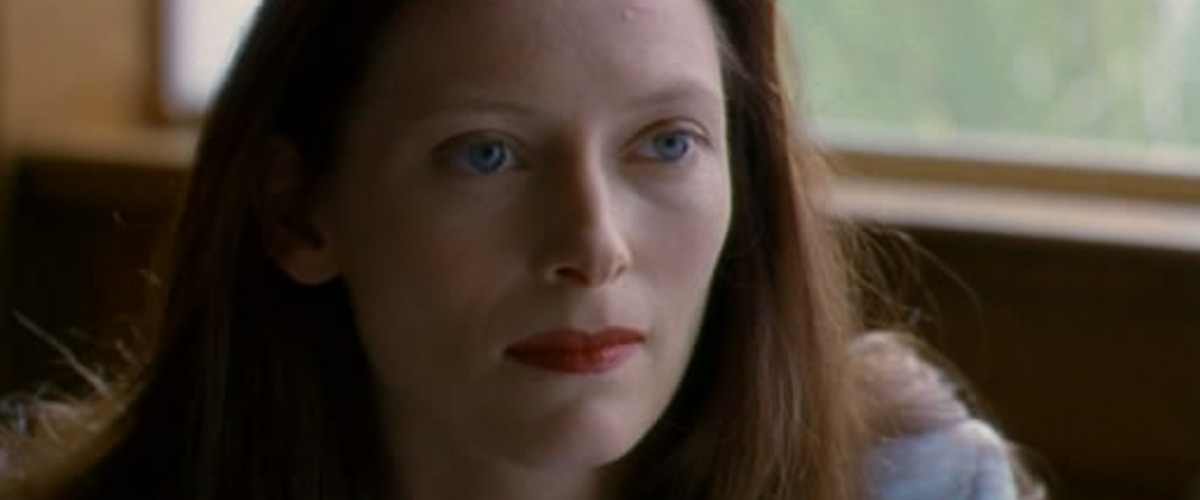
Like Mean Girls, Female Perversions’ script (co-written by Streitfeld and Julie Hébert) is an adaptation of a book of the same name of nonfiction, feminist psychology, the concepts and ideas of which are plugged into a fictionalized narrative (and, in this film sometimes into bus stop placards and advertisements that appear in magazines). The main character is Eve Stephens (Tilda Swinton, looking impossibly young and beautiful in her American film debut) a Los Angeles prosecutor who is widely thought to be the next person the governor will appoint as a judge to the appeals court. Her male boss assures her, “First of all, politically, he must appoint a woman,” and “he actually wants to appoint a woman,” reminding us of every paternalistic man who never stops reminding women how much he “supports” them.

We see Eve arguing a case as the men in the courtroom ogle her in her sharp, chic (for the mid-nineties) off-white suit and matching high heels as the camera lingers on a loose thread coming from a seam (the excellent cinematographer is, in a great rarity for a film directed and written by women, also a woman: Teresa Medina). Later she sees herself on television giving a statement to reporters after she has won the case and all she can notice is the dark lipstick staining her two front teeth.

SwintonPorizkova
Not only is Eve expected to perform impeccably and advance in her profession, she’s expected to have perfect hair, clothes and makeup– and an enviable personal life too


As an opening quote onscreen from the book makes clear, the “perversions” in the film are actually the contradictory and unattainable standards conventionally feminine women are supposed to aspire to. Not only is Eve expected to perform impeccably and advance in her profession, she’s expected to have perfect hair, clothes and makeup– and an enviable personal life too (and this pressure on women has only increased in the nearly 20 years since the film’s release). She eats M & Ms, as she stays in her office working until 9:30 p.m. (leaving only when the Latina cleaning woman comes in), ordering flowers for herself to show up the next day with a double-entendre message “from” her equally high-powered, career-focused boyfriend. She then picks up a woman (a psychiatrist, played by Karen Sillas) on the elevator as she leaves the building. Before they get off, we see Eve’s receptive body language and hear the flirtatiousness in her voice as she asks the psychiatrist out for a drink. The next day a real card (and considerably more modest flowers) await her in the office from “the young doctor” alongside the big bouquet Eve ordered for herself.

Being pushed and pulled in so many directions makes Eve sometimes behave erratically, raging when she isn’t in the presence of others and imagining figures grabbing her and whispering sometimes obscene insults into her ear. When she hallucinates an upscale clothing clerk is judging her body as “wide across the hips” she tries on a piece of sheer lingerie and comes sashaying out of the dressing room wearing it for all to see.

SwintonPerversions
I’m not sure I’ve ever seen nudity used as well in a film as it is in ‘Perversions’


I’m not sure I’ve ever seen nudity used as well in a film as it is in Perversions, as Renaissance-style art in the somewhat scary fantasies in Eve’s head when she has sex (these scenes are reminiscent of the work Swinton did with out gay director Derek Jarman) and to make the sex scenes themselves deeper and more realistic. We don’t see the first encounter with Sillas’s character but we do see another, which starts with Sillas’s character mock-analyzing Eve and her answering, in jest, “Finally someone understands me.” What follows is much more like the hot sex people have in real life than what we’re used to seeing passed off as “hot sex” onscreen–especially between two women. Eve’s bare bottom is used to show, in the scene the next morning, how discombobulated she is, when she wakes up alone, in the blouse she wore with her suit and nothing else.

We also see how the forced politeness of acceptable, feminine behavior not only fuels Eve’s rage when she’s alone, but also renders her relationship with the psychiatrist shallow and unsatisfying. When Sillas’s character visits Eve, Eve claims she wasn’t bothered when she suddenly left, the way a good guest says she’s enjoying her stay no matter how she really feels. When the two talk they have a choreography of crossed and uncrossed legs and offered drinks that underlies the complex choreography of emotions that Eve is, by adhering to norms (as well as using her work as a kind of shield and excuse to keep their interaction short) cutting herself off from.

We also see Eve’s sister, Maddie (Amy Madigan) who lives in the desert and is about to defend her Ph.D. Maddie gets an erotic charge from shoplifting even as we see, in one scene, she immediately throws away an item she’s stolen. Madigan holds her own in scenes with Swinton, no small feat since Eve is one of Swinton’s best performances: she frequently injects an almost slapstick physicality into the character though we’re not watching a comedy (the film does have one great funny payoff involving Eve’s “lucky suit”).

The film isn’t perfect. The ending is a mess (the film just stops instead of offering any real resolution) and I could have done without the only Latinas we see literally standing in silent witness to Eve’s behavior. But I was sad to see Streitfeld has barely worked as a director since the film was released, one of the many women who made one great film and was never allowed to make another.

[youtube_sc url=”https://www.youtube.com/watch?v=gN9Ca45l8cg” iv_load_policy=”3″]

___________________________________________________

Ren Jender is a queer writer-performer/producer putting a film together. Her writing, besides appearing every week on Bitch Flicks, has also been published in The Toast, RH Reality Check, xoJane and the Feminist Wire. You can follow her on Twitter @renjender

‘Older Than America’: Cultural Genocide and Reparations

Children are “the hope” of any culture. When entire generations of youth are traumatized or killed by the church and state, what is the remedy? ‘Older Than America’ looks for answers to this key question.

 older_thanamerica.jpeg.size.xxlarge.letterbox


This is a guest post by Laura Shamas.


In July 2015, Canada’s Truth and Reconciliation Commission released a major report entitled “Honoring the Truth, Reconciling for the Future” about the cultural genocide against aboriginal children, due to abuse in Canadian residential boarding schools run by churches and funded by the state. The report is based on testimony from over 6,000 survivors; there are 94 proposals for reparation recommended. The Canadian Broadcasting System notes that the odds of dying in a native residential school in Canada (“1 in 25”) were higher than dying as a Canadian serving in World War II (“1 in 26”).

One female-helmed film that directly addresses the horrific psychological, cultural, and spiritual legacy of native boarding schools on indigenous families in the United States is Older Than America, a 2008 release, directed and produced by and starring Georgina Lightning, from a script by Lightning and Christine Kunewa Walker. Lightning is a Canadian First Nations filmmaker, and a Maskwacis Cree, registered with the Samson Cree Nation. As the film begins, a graphic informs us: “This story is inspired by actual events.”

Tracing the devastating intergenerational effects of cultural and physical genocide, as part of colonialism, in a film about native people is difficult and daunting, but Lightning’s approach is original and compelling, aided by a strong ensemble cast that features native actors. The film begins on the Fond Du Lac reservation in northern Minnesota, as schoolteacher Rain O’Rourke (Lightning), awakes in the middle of the night from an ominous dream about a young man in a Sun Dance ceremony. Rain lives with her longtime boyfriend, reservation Police Officer Johnny Goodfeather (Adam Beach). She mentions to Johnny that they need to secure the door latch; it’s clear that “something” is getting in.

dvd-americanevil-splsh

The film’s storyline is bifurcated, propelled by time; the plot of the present is jarringly interrupted by traumatic, haunting memories of the past, depicted in grey flashbacks. And the present is also connected to the future, as few are able to take action until the truth about the past is acknowledged. Ghosts also populate the present, filmed in color.

We follow Rain, the film’s protagonist, as she comes to terms with her past through visions and dreams, and her future, too, when she learns the disturbing truth about what happened to her mother and uncle at the nearby Catholic native residential school. Rain’s journey is part of the collective story of her community and her tribe; until the facts about what happened to native students locked in a school cellar in the 1950s are revealed and the children properly mourned, Rain and the future of her tribe are in jeopardy. Children are “the hope” of any culture. When entire generations of youth are traumatized or killed by the church and state, what is the remedy? Older Than America looks for answers to this key question.

As Rain works in her job as a schoolteacher on the rez, she begins to have upsetting flashback episodes. An adult male spirit (Dan Harrison), the same one who was in her initial Sun Dance dream, appears more often, as her guide.

zPMTO5WW4fOgy5XVcoGew7RZcfI

The importance and condemnation of the Catholic church, in regards to what happened to the community, is explored early in the film. Rain’s guardian, Auntie “Apple” (Tantoo Cardinal), consults in confession with Father Bartoli (Stephen Yoakam). We learn that Apple feels guilty for helping to commit Rain’s mother Irene (Rose Berens) to the Penrose Psychiatric Hospital. Father Bartoli says that Irene is delusional and must remain there for her own good.

Luke (Bradley Cooper), a geologist from Minneapolis, embodies the “non-native” perspective in the film; as an outsider, Luke functions as a device to help a non-native audience understand what’s happening on the reservation, since he can ask a lot of questions. He arrives to investigate a strange earthquake near a cemetery on the old residential boarding school property on the outskirts of town—now closed and condemned. Luke connects with policeman Goodfeather, whose father Pete is the tribe’s medicine man (Dennis Banks). Luke has his own vision in his car when he suddenly sees a former college roommate with a gun to his head. A significant line of dialogue in the film is said by Pete to Luke: “Some stories never make the history books.”

Luke has a theory about “plate collisions” that he’s exploring through his research in the region—a concept with metaphorical resonance throughout the rest of the film, applicable to the tension between: native and white cultures; physical and spiritual worlds; Christianity and traditional native beliefs.

y2exmcfzBfZLhWo4RZ5zaX3fR5

It turns out that a wealthy developer is working with the current mayor of the town to turn the boarding school property into a deluxe resort. Luke continues his research at the Historical Society of Penrose County, where he eventually uncovers another earthquake story related to the school from the 1950s, involving native students who died in a cellar.

The haunting ghosts of these dead native students populate the film, and there’s a key line of dialogue that emphasizes “ghosts coming out of the closet.” Atrocities depicted in the film include a child being forced to swallow soap because she spoke in her native language, and native children called “base savages” and then beaten.

The old school site affects Luke, as he goes back later to investigate the quake. He descends into a haunted cellar, where he finds an weathered sign inscribed with General Richard H. Pratt’s famous motto: “Kill the Indian – Save the Man.” Pratt is the founder of the Carlisle Indian Industrial School; it’s considered the prototype for all native residential schools in the United States, and based on a military model.

older-than-america16

Luke asks Johnny, “Do you believe in spirits?” It’s revealed that Luke once had a native American college roommate who killed himself, after the roommate’s father killed himself. Here, the theme of intergenerational native suicide, due to the fracturing of families, is noted by a non-native character.

Throughout the film, Lightning explores what happens when the trauma of genocide is disbelieved or forcibly silenced. We learn that it is Father Bartoli, aided by a complicit Auntie Apple, who is responsible for Rain’s mother Irene receiving electric shock treatments, for revealing what happened at the Catholic native residential school. Irene was silenced through the shock treatments and sedation, and Rain realizes how wrong this is: “You want to talk about crazy…”

Medicine man Pete educates outsider Luke on how cultural genocide works on families and identity, starting with taking children right from their mothers’ arms: “They tried to beat the Indian right out of us.” And: “There are two ways to conquer a nation: kill ‘em or take away everything that defines who they are.” A mysterious murder near the school grounds in the present day is hushed up, related to what happened at the native school years ago and Christianity.

2oBbUMQCMhSOPTPSoXDDgyjcjcq

One poignant part in the Third Act illustrates why Rain didn’t marry earlier in her life: out of fear, because she thought there was something wrong with her and her fractured family. But she comes to understand that it was due to the unreported abuse from the boarding school – as Rain, too, was separated from her mother by Father Bartoli and Apple when Irene tried to out the abuse. Rain finally confronts Apple, whose name means in native culture “red on the outside, white on the inside.” Eventually, Rain frees Irene, and ensures that the children who had been killed at the native school in the 1950s are given a proper burial.

One of the important themes of this film is how to heal from a century of cultural and physical genocide—a topic entirely relevant to what’s happening in the world right now. Writer-director-actor Lightning provides several answers: truth, ceremony, and honoring the old ways – “things that are older than America.” In a sweat lodge ceremony, Rain learns that the adult male spirit who has guided her journey was her uncle, Walter Many Lightnings, who was punished at the school (Dan Harrison). In the sweat lodge, Rain is told, “Our dreams and our spirits cannot be taken.” Rain also learns the power of forgiveness: “The truths of the past…Forgive these people for what they don’t understand.”

Near the end of the film, rez radio announcer Richard Two Rivers (Wes Studi) observes, “Everything we Indians do is in a circle.” As Rain finally welcomes her mother Irene home, everyone gathers for a ceremony. Apple and Irene hug, a start on the road to forgiveness. But a card at the film’s end reminds us of grim facts: native Americans were forced to enroll in boarding schools are recently as 1975, and Amnesty International reports that the death rate of the native population is six times higher than any other ethnic group.

111252446_640

Older Than America traces the collective intergenerational trauma that cannot heal until the truth of it comes to consciousness, in a country, a community, a tribe, and in a family. The bond between mother and daughter is the main connection that galvanizes the reckoning of truth in Older Than America. Rain and Irene are united at the end, and we see the ghosts of the native school children and Uncle Walter fade away into the woods.

This film has been categorized as horror and sold under the title American Evil in the United Kingdom for its 2012 DVD release, probably because of its use of supernatural ghost characters. The atrocities that have been committed at native residential schools in the U.S. are horrific. The United States of America should follow Canada’s example and begin serious discussions about reparation in America for abuse at native residential schools. It is long overdue.


Laura Shamas, Ph.D., is a writer and mythologist. She is a member of the Chickasaw Nation. In 2014, she was part of “The Undisciplined Research Project” at the Autry Museum in Los Angeles and wrote about researching native boarding schools: “Memories That Haunt and Reaffirm.” Website: laurashamas.com.

‘A Gay Girl in Damascus: The Amina Profile’: Telling the Story of the Hoax Heard ‘Round the Blogosphere

Directed by Sophie Deraspe, ‘A Gay Girl in Damascus: The Amina Profile’ begins as a love story, turns into a story of fearless resistance, collapses into terror, and then transforms into the investigation of a…man who breaks strangers’ hearts.

poster


Written by Colleen Clemens.


Sophie Deraspe (click here to read an interview with her) wrote and directed this recently released documentary that moves the viewer through a large gamut of emotions. A Gay Girl in Damascus:  The Amina Profile begins as a love story, turns into a story of fearless resistance, collapses into terror, and then transforms into the investigation of a sure-to-be psychotic man who breaks strangers’ hearts. All in an hour and a half. The quick pace and the story left me with my mouth agape several times, even though I remember the story of the film’s eponymous blog–and the hoax that ensued.

The film begins as Amina Arraf in Syria and Sandra Bagaria in Canada begin an online relationship. They share stories of their studies, their sex drives, and quickly move to their concerns about the Arab Spring’s impact on Amina’s world. Amina decides to start a blog about being out in a dictatorship and she begins to write. “Gay Girl in Damascus” is born.

IMG_0104IMG_0103IMG_0102

Amina and Sandra are unable to meet, so they share the details of their lives over messaging. Amina tells Sandra Skype is blocked in Syria. And then Amina goes unheard from for several days. Sandra gets a message telling her Amina has been kidnapped.

IMG_0107
IMG_0105

Through interviews with reporters, social activists, and personal friends, the story moves from Sandra’s heart breaking to realizing she has been the victim of a months-long hoax enacted by a dude living in Edinburgh at the time. I won’t give too much away about how they come to learn this information, but watching the story unfold is worth watching.

The part of most interest to me is when the activists discuss how this white male hijacked the story of Syria for an entire week. Instead of focusing on the cluster bombs and mass arrests being recorded by citizen journalists, the news chose to tell the stories of Tom MacMaster, a guy who thought it was fun to create a persona and see how far he could go with it. We watch how a white, Western, male coopts the story of a marginalized woman for his own jollies and takes away the voice of men and women dying in the streets of Syria. If white male privilege needs a metaphor, the story of MacMaster sure seems like the perfect fit.

IMG_0119

Women Who Were Actually Jailed and Didn't Get the Attention a Fictional Woman Did
Women Who Were Actually Jailed and Didn’t Get the Attention a Fictional Woman Did


Once the movie turns on its heels, the viewer watches Sandra come to terms with the humiliation this man has foisted upon her. She works to confront him, and the film climaxes with them in a room together. While the beginning of the film sets the viewer up to think the climax of the film will be Sandra and Amina meeting and climaxing, the end feels creepily analogous as this guy talks about how he uses Sandra. I won’t say too much more because their conversation is a lesson in what-the-fuckery.

IMG_0136

So what feels like a film about the triumph of a young woman speaking truth to power morphs into a story of a white, Western male appropriating a marginalized voice for his own whims. Sigh. And sigh again. Watching the films feels like bearing witness to the sufferings of Syrians who want to be heard–and to the Western privilege that silences them.

IMG_0137

IMG_0149

See it. We all need to be vigilant about listening to those who are speaking. And those who are taking the mic for their own pleasure.


Colleen Lutz Clemens, Ph.D., is an assistant professor of Non-Western Literatures at Kutztown University in Pennsylvania. She earned her Ph.D. in Post-Colonial Literature at Lehigh University and is a Bitch Flicks staff writer.

‘I Am Ali’ : An Intimate Look At an American Icon

Ali was not, it seems, an uneasy, distant patriarchal figure. His masculinity was characterized by deep emotional expressiveness. Lewins’s employment of beautiful family photos, home movies and those engaging recordings serve to reinforce the impression.

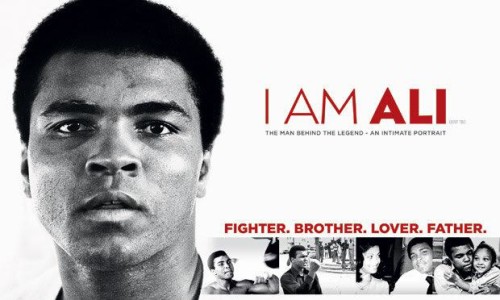
Poster of I Am Ali
Poster of I Am Ali


Written by Rachael Johnson.


Only children should have heroes and heroines, but if there is a hero worthy of worship it is Muhammad Ali. Ali was not only a supreme boxer; his extraordinary charisma granted him enormous celebrity outside the ring and he transcended his profession to become one of the most important cultural figures of the ’60s and ’70s. Ali was, and remains, a symbol of Black pride and consciousness in both the United States and abroad. Even today, young people from Cuba to Ghana are familiar with his name and achievements. Ali was diagnosed with Parkinson’s Disease in the early ’80s but it has not prevented him having an active public life. He became an advocate for those with the condition and devoted himself to humanitarian work. Ali is now a revered figure in the United States but this was not always the case. Many in the white establishment and mainstream media hated him. They saw Ali’s conversion to Islam as a threat and despised him for refusing to fight in the monstrosity that was the Vietnam War. The boxer was punished for refusing military service: his heavyweight title was taken away from him and he was banned from boxing for four years from 1967 to 1971. On the sorrowful day Ali leaves us, hypocrites who reviled him will, no doubt, express condolences and the mainstream media will try to depoliticize and deradicalize him like they did with Mandela.

With daughter Maryum


There have been numerous narrative and documentary films devoted to Muhammad Ali. The most well-known biopic of this century is probably Michael Mann’s Ali (2001) starring Will Smith in the title role. There have also been several excellent documentaries on the boxer. The recently released documentary, The Trials of Muhammad Ali (Bill Siegel, 2013) examines the political fight Ali had outside the ring when he refused to fight in Vietnam. Note that the television film Muhammad Ali’s Greatest Fight, also released in 2013, deals with the legal battle. Many documentaries have studied his legendary fights inside the ring. When We Were Kings (Leon Gast, 1996) examines Ali’s celebrated 1974 fight against George Foreman in the Central African nation then called Zaire (the present-day Democratic Republic of Congo) although it does so much more than anatomize the bout. It is a stirring portrait of an epoch-defining cultural and political event. Although it also examines the public, political Ali, Claire Lewins’s I Am Ali (2014) focuses on the boxer’s private self.

With Veronica
With Veronica


I Am Ali features interviews with people close to Ali, among them his former manager, Gene Kilroy, trainer, Angelo Dundee (who died in 2012), brother, Rahaman Ali and son, Muhammad Ali Jr. Crucially, the documentary gives voice to Ali’s ex-wife, Veronica Porsche, and daughters Hana and Maryum. There are not many profiles of male boxers that feature female public and/or private voices. Lewins has also greatly benefited from access to taped recordings of conversations Ali had with his children. Intended as childhood audio journals, they lend an incalculable poignancy to the film. I Am Ali is, in fact, extremely moving. Hearing the boxer singing Mamas and the Papas songs with 3-year-old Hana makes you cry. Commentary by his daughters indicate that Ali was a great father despite his hectic travelling schedule. Maryum and Hana describe a playful, loving personality. Ali was an inspirational man to his loved ones too. We hear him asking Maryum when she was little: “If everyone’s born for a purpose, what do think you were born for?” Ali was not, it seems, an uneasy, distant patriarchal figure. His masculinity was characterized by deep emotional expressiveness. Lewins’s employment of beautiful family photos, home movies and those engaging recordings serve to reinforce the impression.

With Veronica and Hana


As a husband, the younger Ali was, reportedly, more complicated.  Although an intimate portrait of the man, the documentary does not examine his marital and romantic life in depth. Lewins, however, rightly allows a tearful Veronica to describe her “fairy tale days” with Ali and more painful ones: “He’s a really good-hearted person, very sensitive, and I guess I’m crying because of his situation now. You know, and I’ll always love him, I mean not like ‘in love’…we’ve always been friends. It became hard to live with him because, everyone knows, the whole world knows, he wasn’t faithful as a husband. There’s a story to that too, but I think but he’s an incredible human being. He has a beautiful heart…”  Is I Am Ali hagiography? Perhaps. What is clear, though, is that Ali was, and is, much loved by people close to him.

Daughters Hana and Maryum


Clare Lewins not only incorporates private, female voices in her documentary; I Am Ali also features an interview with a boxing fan, Russ Routledge, from Newcastle in the North East of England who once stayed with Ali in his home in the States. In doing so, she exhibits both a feminist and populist consciousness in her portrait of the boxer. The British director, further, examines Ali’s warm relationship with the United Kingdom. Lewins tells the improbable tale of his visit to South Shields (also in the North East of England) where his marriage to Veronica was blessed in the local mosque. This is of personal interest to me as it is the town where I was born.

Brother Rahaman Ali
Brother Rahaman Ali


Although it focuses on the private Ali, the documentary also addresses the public and political aspects of the man. I Am Ali is graced with fantastic iconic shots of the boxer and remarkable archival footage of powerful old interviews and speeches. Ali spoke out against racial injustice and the documentary features a potent, witty speech on white supremacist indoctrination by the boxer. It examines his growing political awareness and chronicles his conversion to Islam as well as his refusal to fight in Vietnam. Ali’s refusal to fight, in my mind, remains the most courageous thing he has ever done in his courageous, wonderful life. I Am Ali features the boxer’s memorable statement about his decision: “Why should me and other so-called negroes go ten thousand miles away from home here in America to drop bombs and bullets on other innocent brown people who’s never bothered us and I will say directly no I will not go ten thousand miles to help kill innocent people.”

Clare Lewins with Maryum and Hana


I Am Ali is, perhaps, not the finest documentary about the legendary boxer. The fascinating and thrilling When We Were Kings remains a personal favourite. It is  is, nevertheless, an insightful and tender exploration of both the public and private Ali. Giving voice to the man himself and those closest to him, it is a deeply emotional ode to both family love and noble ideals.


‘Miss Julie’ Is My Very Worst Date, Nineteenth Century Style

It’s hard to avoid the sense that this is a story about how the rich are in decline – how complacency has made them helpless and weak enough for the poor to pull them down. It’s hard to know if we’re supposed to think that John has the right idea by using Julie as a stepping stone to move toward his goals – if we’re supposed to think she deserves what she gets because she was stupid and drunk and coming onto him. The play seems to think so – Chastain and Ullmann seem to disagree – the movie itself seems to be a confused mixture of the two viewpoints.


Written by Katherine Murray.


Now on DVD, Liv Ullmann’s adaptation of Miss Julie is a complicated, if not always very uplifting, exploration of the intersection between class and gender. Despite the best efforts of everyone involved, there’s still a thin angry thread of hatred for women and poor people vibrating under the surface. Spoilers for a story that’s over a hundred years old.

Colin Farrell and Jessica Chastain act out the boot-kissing scene in Miss Julie
I promise you, this is even more sexual in context


Miss Julie is a pretty straight-forward story about class differences at the turn of the nineteenth century. Based on the 1888 play of the same name, the movie follows Julie, the daughter of a wealthy Baron, as she tries to seduce her father’s Valet, John. It isn’t a romance story – Julie and John don’t love each other. In fact, they kind of hate each other, but they’re two people who happen to be in close proximity, and they’re bored. Because it’s based on a one-room play, most of the action consists of watching two people argue with each other long past the point when most of us would walk away, and the drama consists mostly of trying to figure out which of them is The Worst.

The film moves through roughly four stages, marked by unexpected changes in John’s behaviour.

In the first, and best, and most palpably uncomfortable stage. Julie sexually harasses John in a style I’d like to call 50 Shades of Awkward and Unpleasant. In Jessica Chastain’s portrayal, Julie pretends to be more confident than she is. She wants John to like her – she wants him to be infatuated with her – and, because he isn’t, she abuses her power over him by ordering him to behave as though he is. There’s a creepy and overtly sexual moment when she makes him start kissing her boots, but there are also much sadder and mundane requests. She makes him dance with her, bring her flowers, and offer her a glass of wine. And each time he grudgingly, angrily does any of these things, she smiles and thanks him as though it were his idea, trying hard to pretend that it was.

Even at this stage in the story, there’s a pitiable element to Julie’s power. It’s true that she can coerce John into doing whatever she wants him to do, but it’s also clear that she doesn’t know what she wants from him at all. John’s much more worldly, and, behind his clenched, contemptuous expression, we can tell that he sees her much more clearly than she sees herself. He’s annoyed mostly because she’s playing stupid, childish games with him – not because he feels threatened by her presence. There’s an uncomfortable vulnerability to Julie in these scenes, even on the first viewing, because we can see that she’s exposing all her weaknesses to John without knowing.

Jessica Chastain and Colin Farrell star in Miss Julie
The strangest part of the movie is the one, glittering moment when they seem to get along


The second stage of the story comes when John – quite suddenly, almost like he’s gotten fed-up and reached a breaking point – confesses that he’s actually in love with Julie. He has, in fact been madly, passionately in love with her for years, and that’s why it torments him so much when she teases him this way. Julie is surprised by this, but pleased, and there’s a bit of the normal Heathcliff what-will-your-family-think we-can-never-be-together stuff before they both cross a line and have sex.

In the third stage, John starts to look like a douchebag. He lies to and manipulates the kitchen maid he’s dating, and turns on Julie as soon as he has enough power to do so. Because she’s a woman, and this is 1888, she can’t ever tell anyone she had sex with a servant. Julie’s also afraid she might get pregnant, and she’s shocked that John would lie to her and pretend to be the perfect (which, in her eyes, means subservient) boyfriend just to get her into bed. John’s happy he wrecked her life and crows over the fact that she’s now just as gross as him. With the class barrier gone, he now has more power because of his gender, and he slut-shames her for, like, an hour in the middle of the movie. As Julie starts to get more panicked about what she’s done and what’s going to happen to her when everyone finds out, John tries to convince her that the only way to salvage the situation is to steal her father’s money and run away with him, so that he can start the business he’s always dreamed of. After a lot of coaxing, Julie goes along with this plan, but John changes his mind again.

In the final and shortest stage of the movie, the sun starts to rise and John sobers up and realizes that he’s been too ambitious for his own good. He doesn’t want to take the risk of running away with Julie anymore – he wants to stay in the comfortable little life he’s made for himself as the Baron’s servant. This is, after all, The Way of the World. Julie’s still in a state of total crisis, though, and he needs to stop anyone from finding out about what happened with her, so that he doesn’t lose his job. So, he convinces her to kill herself, and that’s the end.

Jessica Chastain sits at Colin Farrell's feet in Miss Julie
“The alternation of ascent and descent constitutes one of life’s main charms,” say Strindberg.


Miss Julie is really obviously interested in the intersection of class and gender – like, obvious to the point that Julie and John do a little bit of dream interpretation, discussing how they’re always climbing or falling in their sleep – but, because the author’s take on the situation is kind of horrible, it’s hard to tell where the movie comes down. If you don’t want to read Strindberg’s entire introduction to the play (which I am told is even more misogynist in its original version), suffice to say that John’s a special kind of Poor because he wants to be refined, but he’s still dirty and ignorant on the inside, and Julie is a man-hating half-woman who’s destroying the fabric of society because she doesn’t know her place.

It’s also not surprising that Chastain had a tough time with the idea that Julie kills herself because John tells her to. I have a tough time with that, too, and I’m not sure I buy her explanation that it’s ultimately empowering because Julie was suicidal all along and wanted John to help her self-destruct.

Director Liv Ullmann seems to want us to understand Julie not as a horrible deviant, but as a victim of her circumstance, reacting in an understandable way. The film opens with a sequence in which we watch a young Julie wander bored and alone through her father’s mansion, and implies that her interest in John is born from the same lack of playmates, coloured by a strange naiveté that comes from leading a sheltered life. (Chastain is also much older than Julie, making her awkwardness and innocence seem like a psychological outcome rather than the product of youth).

At the same time, it’s hard to avoid the sense that this is a story about how the rich are in decline – how complacency has made them helpless and weak enough for the poor to pull them down. It’s hard to know if we’re supposed to think that John has the right idea by using Julie as a stepping stone to move toward his goals – if we’re supposed to think she deserves what she gets because she was stupid and drunk and coming onto him. The play seems to think so – Chastain and Ullmann seem to disagree – the movie itself seems to be a confused mixture of the two viewpoints. This version of Miss Julie isn’t so much a reaction against or dialogue with the original as it is a faithful performance that tries to sneak in a more empathetic worldview around the sides. It’s very interesting, but I’m not sure it completely succeeds.

Aside from the movie’s weird politics, Chastain and Colin Farrell are both very interesting to watch, but it’s a long haul. I wasn’t kidding when I said it’s mostly two hours of people fighting in the kitchen. That’s something that doesn’t work as well without the visceral immediacy of a stage.

All in all, I’m not sorry I watched this, but I enjoyed the first leg of the story, which seemed to be uncomfortable on purpose, more than I enjoyed the last legs of the story, which seemed like the playwright’s ghost was giving us the finger.


Katherine Murray is a Toronto-based writer who yells about movies and TV (both real and made up) on her blog.


Vintage Viewing: Zora Neale Hurston, Open Observer

In her ethnographic films, Hurston, by contrast, strikingly resists fictions of objectivity and pointedly draws attention to herself as observer. A woman and a dancing child smile directly into her lens in extreme close-up, with shy pride or beaming pleasure at her clearly encouraging attention. Instead of merely observing their games, we join the circle of clapping children and they interact with the camera as it pans over their faces.

Part of Vintage Viewing, exploring the work of female filmmaking pioneers.

Zora Neale Hurston: Frame-Changer


“Mama exhorted her children at every opportunity to ‘jump at the sun.’ We might not land on the sun, but at least we would get off the ground. ” – Zora Neale Hurston

The seven principles of Kwanzaa (Nguzo Saba), designed to foster community empowerment in the face of racial stigma, include Kujichagulia, the right to “define ourselves, name ourselves, create for ourselves and speak for ourselves.” Though we often debate choice of imagery on Bitch Flicks, it is impossible to create an image that represents another group’s equality, because their right to define their own image is fundamental to that equality. Caribbean-American comedian Bert Williams became the first Black artist to write, produce, direct and star in a film, with 1916’s A Natural Born Gambler, having already broken boundaries as writer-star of In Dahomey (1902), the first Black musical on Broadway. Williams’ performances exploited the blackface conventions of his age to be acceptable to a wider audience, while illuminating them with humanity and subversive subtext, as he continually fought for greater creative control. At the climax of A Natural Born Gambler, his character plays an imaginary poker game in prison. By losing, even in his own fantasy, Williams makes virtuoso mime into poignant commentary on internalized stigma, also the theme of his hit song, “Nobody,” from the 1906 musical Abyssinia. The same year, Williams’ Fish cast himself, then in his 40s, as a young boy who escapes his chores to catch fish and is punished for his entrepreneurship. In a society where even Black children were often viewed as prematurely adult, Williams’ demand that audiences recognize the child in the man was challenging, and audiences reacted unfavorably. Neither of Williams’ surviving films feature significant roles for women.


  [youtube_sc url=”https://www.youtube.com/watch?v=naUN5L56Zg4″]

Bert Williams masked biting commentary under comic delivery


In 1920, Oscar Micheaux wrote and directed Within Our Gates, the oldest surviving feature film by a Black director. The film argues for education and against the unquestioned domination of the church, while breaking many taboos, including depicting a lynching and the attempted rape of a Black woman by a white man. However, its heroines remain stilted and rigidly defined by Madonna/Whore framing. Micheaux’s 1925 film, Body and Soul, features a powerful performance by Mercedes Gilbert as a rape victim, opposite a menacing debut by Paul Robeson. Yet, the heroine must demonstrate her virtue by dying of shame, harnessing the martyrdom of the female body to score Micheaux’ points about oppressive religious hypocrisy. 1910’s White Fawn’s Devotion by James Young Deer (the Nanticoke director of 34 Westerns, whose role in shaping the genre is rarely acknowledged), uses the martyred suicide of White Fawn to prove to her Euro-American husband that she is attached to homeland and kin, once more scoring its racial points through female martyrdom (even if the heroine recovers for a happy end).


Once tipped for an Oscar, Louise Beavers remained typecast as 'Maid'
Once tipped for an Oscar, Louise Beavers remained typecast as “Maid”


“As long as the plays are being written and produced by whites for whites, there will be the same chance for criticism. The only remedy is for such plays as would meet popular favor to be produced by us.” – Louise Beavers

Mabel Normand‘s star vehicle, Mickey, featured sympathetic scenes of bonding between Mickey and her foster mother, played by Cheyenne comedienne Minnie Devereaux, while Mae West’s films showed extensive, sympathetic banter with maids played by Louise Beavers (whose performance in Imitation of Life was acclaimed as Oscar-worthy, without promoting Beavers from supporting roles) and Soo Yong (cast as aunt to a yellowface protagonist in The Good Earth). Though these displays of interracial female solidarity by Normand and West would be considered progressive for their time, they limit women of color to supporting roles, reinforcing their heroines’ white supremacy. The fact that white female filmmakers tended to reinforce white supremacy with their representations, while male directors of other races utilized disempowering sexist tropes, surely illustrates why they cannot collectively represent women of color.

As Deborah Riley Draper points out in her Bitch Flicks post, “#EarlyCinemaSoBlack,” many Black women were striving to bring their perspectives to the screen at this time. Tressie Souders became probably the first Black woman to write and direct a film with A Woman’s Error in 1922, but her film is now lost. However, considering how Chinese-American writer-director Marion Wong’s 1916 feature, The Curse of the Quon Gwon: When the Far East Mingles With The West, turned up unexpectedly in a basement in 2005, Souders’ film might yet be similarly rediscovered. Wong showcased traditional Chinese ceremonies to satisfy Western curiosity about the exotic Orient, but she also explored Chinese-American cultural tensions with the nuance of an insider. The Curse of the Quon Gwon uses superimpositions and dissolves in a short fantasy sequence to represent the heroine’s own imagination, predating similar effects by Germaine Dulac. It’s worth remembering that Dulac made a series of conventional films before developing the impressionist and surrealist styles that she is celebrated for, while The Curse of Quon Gwon was Marion Wong’s only film (denied financing, distribution or promotion, despite her striving to secure them). With the same support as Dulac, how far could Wong have developed, described by the Oakland Tribune as “energy personified”?


 [youtube_sc url=”https://www.youtube.com/watch?v=xAxpLXP6O_M”]


Where they did not face the stigma of a racial minority, women of color found more filmmaking success. In India, Fatma Begum directed the first of eight fantasy epics in 1926. The following decade, Sakane Tazuko became the first female director in Japan, while Elena Sánchez Valenzuela directed a feature documentary in her native Mexico, acclaimed by journalists for “hundreds of the most beautiful, evocative scenes” but now lost. Esther Eng began writing and directing in Hong Kong in 1937 (documentary clip). Still, the ethnographic films of Zora Neale Hurston remain a rarity: vintage footage directed by a woman of color, available online. Better known as the playwright of 1925’s prize-winning Color Struck, as a leading light of the Harlem Renaissance, and as the author of novels including Their Eyes Were Watching God (see Bitch Flicks‘ review of Darnell Martin’s adaptation), Hurston also studied anthropology under Dr. Franz Boaz, who dedicated his life to challenging assumptions of Western cultural superiority. Believed to be part of Hurston’s wider research into African-American folklore, these ethnographic films were made in the Southern United States between 1928 and 1929. The footage is scored in the embedded video with Hurston’s own performance of folk songs that she collected. At first glance, her films seem like simple anthropological records. However, they are equally revealing when read as explorations of our ways of seeing, framing and interpreting others.


 Logging (1928) – Children’s Games (1928) – Baptism (1929)

“She pulled in her horizon like a great fish-net. Pulled it from around the waist of the world and draped it over her shoulder. So much of life in its meshes!” – Zora Neale Hurston

The Palestinian-American founder of postcolonialism, Edward Said’s Orientalism explored how the psychological needs of the observer shape their observations, as much as the nature of the thing observed. Criticizing the constant framing of “things Oriental in class, court, prison or manual for scrutiny, study, judgment, discipline or governing,” Said noted that imperial observers tended to interpret the Orient through “synchronic essentialism,” as something fixed and unchanging. Essentialist interpretations deny responsibility: if something is unchanging, it is impossible for oppression to impact it. If women are essentially and eternally nags, you aren’t responsible for your wife’s annoyance. If colonized people are hotheaded savages, they need no reason for rebellion. If dispossessed peoples are permanently lazy, it isn’t a symptom of their demoralizing dispossession. Oppressors become invisible to themselves through their interpretative framework.

Fictions of objective and invisible observers (oppressors?) are the traditional framing of anthropology. A “native” may be scowling because the photographer is intrusive, but their image will be frozen as an “objective” record of the “hostile native”, with viewers instinctively imagining themselves in the photographer’s place. Robert Flaherty’s Nanook of the North charmed audiences with its warm intimacy, popularizing the art of the documentary feature. But by claiming objectivity and obscuring his sexual relationship with his subjects, however, Flaherty distorted their shared banter and flirtation into essentialized features of the “happy-go-lucky Eskimo” and his “smiling one” wife, fueling a popular image of Inuit naivete and availability.

In her ethnographic films, Hurston, by contrast, strikingly resists fictions of objectivity and pointedly draws attention to herself as observer. A woman and a dancing child smile directly into her lens in extreme close-up, with shy pride or beaming pleasure at her clearly encouraging attention. Instead of merely observing their games, we join the circle of clapping children and they interact with the camera as it pans over their faces. Hurston’s camera is dynamic, tracking up a logging railway and lingering on tapping feet. We instinctively warm to her subjects, as we share Hurston’s sense of belonging through her camera’s gaze. She contrasts the work of an elderly lumberjack with the machinery of professional logging, showing a world of changing realities, and lingers on sawmill workers’ leisure rather than fetishizing their labor, casually noticing a woman among them. Is their mechanized modernity an improvement on the old man’s axe?

Faith Ringgold: 'In Picasso's Studio'
Faith Ringgold: “Picasso’s Studio”


“She had an inside and an outside now and suddenly she knew how not to mix them.” – Zora Neale Hurston

Of most interest for questions of self-representation, Hurston briefly portrays woman’s life in the community. Opening with the woman framed against her home environment, a wooden cabin, in the pose of a typical anthropological subject, Hurston’s woman then holds our gaze purposefully and walks up close. Hurston instructs her to smile, turn and present her profiles; she is reframed as a model, or an actress on a casting call. Compare Faith Ringgold‘s “Picasso’s Studio”: her nude heroine models against a backdrop of African “primitivism” that has been reframed by Picasso as “modernism,” while Ringgold playfully reframes Picasso himself in the African-American, feminine “folk art” of quilting, challenging the gendered and racialized ways art is interpreted and (de)valued, just as Zora Neale Hurston challenges the devaluing subtext of the anthropological frame through glamor modeling. As Hurston cuts to her woman sitting with another woman on the porch, laughing in each other’s company, this is surely the silent film equivalent of a Bechdel pass. Bouncing to a wide angle on the cabin environment, the next shot reframes the woman again, draping her over her porch railing in the “Venus reclining” pose. Hurston’s use of this classical pose recalls the 19th century African-American/Ojibwa sculptor Edmonia Lewis‘ use of Classical Grecian styles to visually code her African and Indigenous subjects as noble. From this static pose, Hurston cuts to the woman’s feet tapping as she rocks, adding musical sensibility. Hurston has thus reframed her subject five times: 1) as a product of her environment, 2) as a glamorous beauty, 3) within a community of female friendship, 4) as an iconic goddess and 5) as an appreciator of music. In total silence, in under a minute and with a mediocre camera, Hurston achieves a multi-faceted portrait. Imagine what she could have done with a budget and a distributor.


  [youtube_sc url=”https://www.youtube.com/watch?v=wtPrN-zYZc4″]


The world’s first animated feature film, 1926’s The Adventures of Prince Achmed, was a celebration of Middle-Eastern folklore, animated by Lotte Reiniger. Reiniger’s concept, for creating feature-length animations based on classic folklore, would become box office gold for Walt Disney, winning him a special Oscar for innovation, while he also patented a design for a multi-plane camera almost identical to Reiniger’s. Despite his debt to Lotte Reiniger, Disney would exclude women from creative work in his company. Next month’s Vintage Viewing: Lotte Reiniger, Animating Innovator. Stay tuned!


Brigit McCone writes and directs short films and radio dramas. Her hobbies include doodling and learning new things.


The Making of a Caribbean-Canadian Sci-Fi: ‘Brown Girl in the Ring’

When speaking over the phone, Sharon’s enthusiasm for this pioneering adaptation of a Caribbean Canadian sci-fi novel emanates as though this was a fresh and newly discovered idea. In fact, Sharon has been working on creating this film for the past 15 years (while also establishing herself as a published playwright, writer, actor and award winning director) and although the journey has been long, she strongly believes that now is the perfect time to transition this well-nurtured idea into tangible reality.

1


This guest post by Amanda Parris appears as part of our theme week on Dystopias.


Interview with the filmmaker below.

I was in my first year of university when I first read Nalo Hopkinson’s critically acclaimed novel, Brown Girl in the Ring as part of a Humanities course entitled Cultures of Resistance in the Americas. It had never occurred to me to think of futuristic dystopias and sci-fi literature as part and parcel of a resistance culture that has sustained African Diasporic cultures in the Americas until I was introduced to this work. A few pages into the novel, I was hooked. Located in the city where I have spent most of my life, the story is set in Toronto, a downtown core cordoned off from the surrounding suburbia where the rich and wealthy have fled. In the opening pages Hopkinson sets the scene:

When Toronto’s economic base collapsed, investors, commerce, and government withdrew into the suburb cities leaving the rotten core to decay. Those who stayed were the one’s who couldn’t or wouldn’t leave. The street people. The poor people. The ones who didn’t see the writing on the wall, or who were too stubborn to give up their homes. Or who saw the decline of authority as an opportunity. As the police force left, it sparked large-scale chaos in the city core: the Riots. The satellite cities quickly raised roadblocks at their borders to keep Toronto out. The only unguarded exit from the city core was now over water, by boat or prop plane from the Toronto Island mini-airport to the American side of Niagra Falls.

Nalo Hopkinson
Nalo Hopkinson


Seventeen years after the publication of Brown Girl in the Ring, Toronto was named the No. 1 city in the world to live in by The Economist. But who benefits or lives the reality of this status? The rise of condo-mania in the downtown core has also led to the rapid gentrification and resulting dislocation of numerous communities – the individuals affected fit a disturbingly similar profile to the ones that Nalo envisioned eventually cordoned off from health care, electricity and technology. Her description of The Burn, that walled-off section of Toronto, feels hauntingly familiar and it is this resonance that writer/director Sharon Lewis feels will hook people into the film adaptation of the novel that she is currently working on: Brown Girl in the Ring – The Prequel.

The Prequel puts the coming-of-age story of the novel’s protagonist, a young girl named Ti-Jeanne, front and center. The film will illustrate her first steps as she moves into the role of the heroine that she becomes in the novel. Beyond an exploration into the particular otherworldly gifts Ti-Jeanne possesses and her ability to navigate the dystopian landscape that defines her home, Ti-Jeanne’s character is also challenged by a more familiar narrative of conflict between her Caribbean and Canadian cultural identities. When speaking over the phone, Sharon’s enthusiasm for this pioneering adaptation of a Caribbean Canadian sci-fi novel emanates as though this was a fresh and newly discovered idea. In fact, Sharon has been working on creating this film for the past 15 years (while also establishing herself as a published playwright, writer, actor and award winning director) and although the journey has been long, she strongly believes that now is the perfect time to transition this well-nurtured idea into tangible reality. Last week Sharon successfully completed a crowdfunding campaign to support the film. Achieving this recent milestone has affirmed her belief that there is an audience out there excited for a story like this and that the moment is now for the film to be realized. She says,

Well I think we’re in the zeitgeist. I think that the novel and the film are coming to life in an appropriate time. I’m not sure if in 1998 we would have understood that this is so relevant to our present day lives. I think that with the rise of social media and technology we have a lot more access to those images so all of a sudden Ferguson, Baltimore, Detroit, all of those are in our consciousness in a way that it wouldn’t have been in 1998 because we didn’t have the same kind of access and the people living within those situations didn’t have the same kind of access. We see the rise of public videos being used in legal battles. That was never the case in the late 1990s. So all of a sudden police officers are being held accountable according to public videos. It doesn’t mean that they’re always being held to justice but they’re actually being held accountable which again is being used as a catalyst for people to riot. In the film that is the trigger for all of the things that happen. There is an economic collapse and the poor people are tired of being poor and they rise up. I think that if you look at why they are rising up it’s because there’s an access to social media in a way that they didn’t have before and then the only way to shut them down is to seclude them and cut off their electricity and cut off their ability to communicate with the outside world where their reality is going on.

Corporate and government decisions to seclude a section of the population following their mass politicized mobilization as a result of increased connectivity and communication feels eerily prophetic in the current era recently dubbed “Black Spring.” Sharon revealed that part of Nalo’s inspiration for the novel came from poignant observations of the harsh realities occurring south of the border:

When I talked to Nalo she was inspired by Detroit in terms of what post-apocalyptic Toronto would look like and this is 1998. So she was in Detroit and looking at a city that basically had an invisible wall around it. You had all the wealthy industrialists living in a particular area and then all the Black neighbourhoods were burnt out, abandoned, policed – heavily policed and the public school system was on its way down. So that’s the Toronto that you’re going to see in my film.

Although set in Toronto, Sharon recognizes that this story of economic flight and extreme disconnection and alienation is one that can resonate beyond the city’s borders. As a child of the Caribbean Diaspora, the extremes of wealth and poverty sitting side-by-side in an imbalanced yet normalized fashion is disconcertingly familiar for Sharon:

I spent a lot of my childhood in Jamaica and Trinidad and a lot of that reality is already there. There were already people that were cut off from technology or cut off from electricity who were having to make do. And right across the street they were seeing the glistening lights. I remember in Jamaica driving through Kingston and on the hillside you’d see people living in zinc shacks, still walking to the river to get water and then just a couple of feet down from them was this massive, beautiful house with satellite dishes and massive technology.

Sharon Lewis
Sharon Lewis


Prescient in the film will be the way that these kinds of divergences in experiences create walls between people – sometimes physical but often subconscious – thereby separating them from each other in ways that enable the current world order:

There is a wall but like any ghetto there’s an invisible wall. There’s a wall that basically you don’t step into the other world because you don’t belong there. And you won’t see the wall in the film because again my whole point is your own psychological barriers are much more destructive than any actual physical wall that’s built.

The setting constructed by Nalo Hopkinson in her novel was, as are many dystopian landscapes, a prophetic warning of what will come to be if we continue to ignore the signs of the times. And yet it sets itself apart from other popular dystopian literary tales with a distinctly Caribbean Diasporic influence, one which director/writer Sharon Lewis is excited to push aesthetically in the cinematic adaptation. She cites Marcel Camus’ 1959 Oscar Award-winning film Black Orpheus as a key inspiration in imagining an aesthetic that is steeped with a heavy Carnival influence:

I’ve never seen a Caribbean set in a dystopia. I’ve never actually seen a dystopia that has a Caribbean aesthetic. For me it makes sense because what I saw in the reality of Jamaica or Trinidad where people had to adapt with little resources…it’s dystopia. Aesthetically it will be interesting because you’ll see Caribbean people and that will affect the way they dress and you know the food and all of that, but also in the way that they talk and the way that they relate to each other in terms of what those moral values are.

To step into the unchartered territory of Caribbean-Canadian sci-fi film, Sharon has cast a wide net in considering her aesthetic and story inspirations. She celebrates the rise of female heroines in Sci-Fi and Fantasy film such as Bella Swan in Twilight, Katniss Everdeen in The Hunger Games and Imperator Furiosa in Mad Max: Fury Road. Although an avid fan of sci-fi, the unbelievable dearth of Black female heroines in the film genre has meant that Sharon has had to look elsewhere for reference points when conceptualizing the heroine Ti-Jeanne for Brown Girl in the Ring – The Prequel. She cites Julie Dash’s seminal film Daughters of the Dust as a key inspiration in seeing Black women as magical, full, and rich characters.

With the success of her crowdfunding campaign, Sharon has launched a Brown Girl Movement, led by women of colour who are coming together to tell this story in a new genre that will inevitably feel strangely familiar for so many: that of the Caribbean-Canadian sci-fi.

To learn more about Brown Girl in the Ring – The Prequel, visit the website.


Amanda Parris is writer from the 6ix who dreams of screenplays to come, has a couple of theatre plays under her belt and sometimes really geeks out and writes for “the academy.” In her spare time she is an actor, Critical Hip Hop educator, and producer of all things cool, creative, and disruptive that started from the bottom. You can follow her on Twitter at @amanda_parris