Women Doctors: Professionally Competent, Messy Personal Lives

Mindy Kaling as Dr. Mindy Lahiri in The Mindy Project
Originally published at The Funny Feminist.
You know what I’d like to see more of on television? Stories about women who are successful in their professional lives, but whose personal lives are a complete mess. I especially want to see more of these stories about female doctors.
Take Emily Owens, M.D., for example. Starring Mamie Gummer, Emily Owens, M.D. tells the story of a medical intern who discovers that life in a hospital is just like high school. In the first episode, she confesses to her old high school crush that she likes him only to be shot down, and realizes that her high school nemesis is interested in her high school crush, but she also diagnoses a condition and performs a life-saving procedure during her first day on the job.
Or let’s look at Mindy Kaling’s new sitcom. The Mindy Project, recently picked up for a full season, tells the story of Mindy Lahiri, a gynecologist whose dating life is a mess. In the first episode of the show, she rudely interrupts an ex-boyfriend’s wedding and drives a bicycle into a pool, but by the end of the pilot, she’s heroically delivering a baby to a patient who doesn’t have health insurance – even interrupting a date to do it.
Or let’s go back in time a few years to a show called Grey’s Anatomy, the drama that won’t die (even when most of its characters do). Ellen Pompeo plays Meredith Grey, an intern who accidentally sleeps with her boss the night before her first day. (By “accidentally sleep with,” I mean that the sex was intentional, but she did not know the man was her boss.) She struggles with a patient, but gets a sexy love interest and a guy crushing on her forlornly from the minute he meets her. She’s also the intern who makes the miraculous discovery of what’s wrong with her patient, and figures out how to help a fellow intern’s patient.
Am I mess or a rock star intern? I can’t remember! | Meredith Grey (Ellen Pompeo) in Grey’s Anatomy
Now, pretend you’ve been living under a pop culture rock for the last few years and know nothing about these three shows or the actresses who play these characters. Based just on the descriptions, would you be able to tell which program was the satire/comedy and which two programs took the “professionally skilled, personal mess” trope seriously?
…Okay, so maybe the bicycle in the pool was the giveaway. Fair enough. The point remains that television continues to have a problem with professional women. Showrunners don’t seem to know how to write professional women characters without turning them into neurotic messes who can control nothing about their personal lives, and lately, female doctors are getting the brunt of that particular cliche.
I like comparing these female doctor characters to a character like House on House, M.D. or Dr. Perry Cox on Scrubs (who has been compared to House by other characters on Scrubs, amusingly enough). These men are professional geniuses whose personal lives are also fraught with drama, but we’d never call them neurotic. They’re curmudgeonly assholes who bark perfectly crafted sarcasm at their professional inferiors, colleagues, and bosses. Their personal lives are messes because they’re misanthropic, or because they’re masking years of built-up pain. Women doctors have messy personal lives because they overanalyze and are neurotic and always pick the wrong men.
I don’t know if showrunners write women doctors this way because they lack imagination, or because they’ve internalized sexist stereotypes, or because they don’t know how else to make a professionally competent women sympathetic to an audience. “We’ve got a woman doctor here, because women can be doctors now, but women who are TOO put-together will be a turnoff, so we’ll make her a mess outside of work! INSTANT EMPATHY!”
Fortunately, Mindy Kaling is aware of this cliche, and the episodes of The Mindy Project following the pilot have veered away from “professionally competent, personally messy” plots.Show-Mindy is often portrayed as less neurotic and more of a jerk, and Kaling is more interested in making the character funny than making her likable. Show-Mindy is several steps in the right direction, and I hope we start seeing more characters like her, soon.
But not too soon, because I want there to still be a market for my own pilot about a professionally competent, neurotic female doctor. Doctor Love tells the story of Hilarie Love, a young physician who can’t seem to get her personal life together. In the pilot episode, Hilarie goes on her first date since high school, where her prom date stood her up to go have sex with the cheerleader. Unfortunately, she winds up wearing an outfit where none of the clothes match, and gets so nervous that she throws up on her date in the middle of a restaurant, and almost accidentally kills him when she stands up and knocks the table on him. Then she gets called into work, and performs a miraculous, life-saving surgery (even though she’s not a surgeon) on a young blind boy who’s been shot, removing the bullet with her bare hands and donating her own blood to rejuvenate the child. This catches the attention of a handsome attending physician who finds her competent and pretty, and is still intrigued by Hilarie even after she throws up on him, too.
What do you think? Do we have a hit?
Oh, I get it. It’s butterflies in the…er, ribcage. | Mamie Gummer in Emily Owens, M.D.
Lady T is an aspiring writer and comedian with two novels, a play, and a collection of comedy sketches in progress. She hopes to one day be published and finish one of her projects (not in that order). You can find more of her writing at The Funny Feminist, where she picks apart entertainment and reviews movies she hasn’t seen.
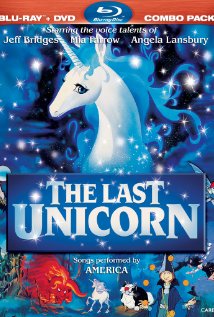
‘The Last Unicorn’ Is The Anti-Disney Fairy Tale

DVD Cover Art for The Last Unicorn
Warning: Spoilers ahead

I was probably 6 or 7 years old the first time I saw The Last Unicorn. And while I thought it was pretty, I found it incredibly boring. It wasn’t until much later in my life that I rewatched it and understood why it was so boring to Little Girl Me – this is not a film for children, and never should have been marketed as such. Such is the major pitfall of an animated film – unless it explicitly says it’s pornography (and sometimes not even then – people are stupid), people assume it’s for children. What makes The Last Unicorn so special is it might be one of the most bittersweet and poignant fantasy movies ever made. It is the Anti-Disney film – everything that Disney fairy tales are not.
  • The characters are incredibly well fleshed out. They are deeply, deeply flawed. The Unicorn is proud (perhaps even vain), Schmendrick is overconfident, Molly Grue deeply regrets her lost youth, King Haggard is depressed to the point of selfishness, and Prince Lir does not know the difference between real heroism and pointless posturing. There are no sweet singing Princesses who can charm the forest animals here. The handsome Prince must learn how to be valiant, it does not come naturally to him. The virtues the characters value are the ones that are hardest to achieve – sacrifice, acceptance of mortality, acceptance of regret, and the twofold rush of joy and pain that being in love causes.
  • The content of the story is very adult. Other than one brief bizarre scene (more on that later), there is no comedy here. The mood is melancholy and lonely. Death is very clearly discussed, and even depicted once the Harpy kills Mommy Fortuna and her assistant, Rukh. The film’s depiction of a Harpy does not shy away from visual adult content, as she is shown to have three large and pendulous breasts with nipples. The Harpy’s breasts are not the least bit sexualized, they serve only to show that she is terrifying and female. The scene in which Schmendrick accidentally enchants a tree into coming alive and falling in love with him is also very adult in content, and almost seems like a Big Lipped Alligator Moment because it clashes with the rest of the film. The tree squishes Schmendrick against her enormous enchanted breasts, and it is clear that he does not find this predicament the least bit desirable. It is hard to determine what the film’s goal in depicting the two characters’ breasts this way was, but my best guess is that they wished to depict breasts as mere visual signifiers of a character being biologically female, not as physical targets of sexual desire.
Various scenes from the film
  • Dreams don’t come true. Yes, The Unicorn succeeds in her goal to free her fellow Unicorns, but to do so she had to give up her newfound mortality, and must live forever knowing regret, and remembering the love she once had. This taint of humanity even separates her from the other unicorns, as they would have no comprehension of human emotions such as these. The other characters don’t achieve their dreams either. Schmendrick does eventually prove that he is a talented magician, but clearly will never have true control over magic. Molly Grue has finally met her unicorn, and found second love with Schmendrick, but her youth and innocence are long since gone. Even King Haggard never truly achieved his dreams of genuine happiness, as he never gained control of all of the unicorns, and was otherwise miserable when he wasn’t looking at them.
  • The handsome Prince doesn’t get the girl. Lir’s love for Amalthea is such that he tells her not to give up on her quest in order to be with him, knowing that once she becomes a unicorn again she cannot stay with him. His love is also unrequited for a time, and is only reciprocated once The Unicorn forgets what she truly is and mentally becomes human enough to feel love. So, unlike in many Disney films, the “love at first sight” situation does not go nearly as smoothly. Their love for each other does not end once Amalthea becomes The Unicorn once more, but there is now no hope for them to marry. Both sadly accept that they are to be forever separated, which is even more painful for The Unicorn because she is the only one who will experience “forever.”
  • Molly Grue’s life story is a particularly sad and poignant one. As the commonlaw wife of an infamous outlaw known as Captain Cully, she has watched her youth fade, and become endlessly frustrated with having no money, no food, and endless mouths to feed. She is incredibly kind, but deeply dissatisfied with her lot in life. When she finally meets The Unicorn, she is enraged because, unlike in fantasy lore where the unicorn always comes to a beautiful young virgin, The Unicorn has come to her when she is middle-aged and, perhaps, sexually ruined. (Being the lover of an outlaw could not have done great things for her reputation.) “How can you come to me now, when I am this?” Molly bitterly asks her. This, I think, is a commentary on how fairy tales always seem to only value the young and innocent, and see women who are no longer young and virginal as corrupted, tainted, and worthless. The Unicorn, however, recognizes Molly’s incredible kindness, and, comforting her the best she can, tells her, “I’m here now.”
The Unicorn in her forest
  • The two antagonists of the story, Mommy Fortuna and King Haggard, contrast strongly with Disney villains in that they are very morally ambiguous. Mommy Fortuna is a powerful sorceress, who is one of the few humans who can recognize The Unicorn for what she is, rather than just as a beautiful mare. She uses illusions in her traveling caravan to give her patrons what they want to see, which is visions of terrifying mythical creatures. The Unicorn and The Harpy are the only real magical creatures she has captured. Mommy Fortuna knows that The Harpy will one day kill her, and, unlike Disney villains, is fully ready to embrace her fate and is unafraid of death. Her only desire is a perverted form of immortality – her body will die, but The Harpy will forever remember that it was Mommy Fortuna who captured her. King Haggard is even more morally ambiguous. He is not truly evil, but desperately depressed to the point where it has made him selfish. The sight of unicorns are the only things that give him joy, and make him recapture his lost youth. Unable to face life without knowing that his source of joy was available to him at any time, he instructed his pet, The Red Bull, to gather all the unicorns together and imprison them in the sea next to his castle. He has not done this for the sake of evil, but as an absolutely desperate attempt to cure his lifelong depression.
  • The themes of this story are incredibly abstract and deep. In most Disney films, you can generally glean themes about kindness, true love, achieving dreams, and conquering evil. Here, there are themes surrounding (im)mortality, regret, memory, lost love, tragic flaws, broken dreams, possessions, mental illness, revenge, and the very nature of human emotions. This is not a happy movie. It is bittersweet, at best, even though things turned out as well as they could have without there being a deus ex machina to solve everything. It is and never was intended to be a movie for children. It’s a movie for teenagers and adults who have already heard all the fairy tale cliches, and want something that will make them think rather than something that might give a superficial emotional catharsis. This movie made me incredibly sad, but it might possibly be one of the greatest animated fantasy films ever made.
Myrna Waldron is a feminist writer/blogger with a particular emphasis on all things nerdy. She lives in Toronto and has studied English and Film at York University. Myrna has a particular interest in the animation medium, having written extensively on American, Canadian and Japanese animation. She also has a passion for Sci-Fi & Fantasy literature, pop culture literature such as cartoons/comics, and the gaming subculture. She maintains a personal collection of blog posts, rants, essays and musings at The Soapboxing Geek, and tweets with reckless pottymouthed abandon at @SoapboxingGeek.

Guest Post: ‘Skyfall’: It’s M’s World, Bond Just Lives in It

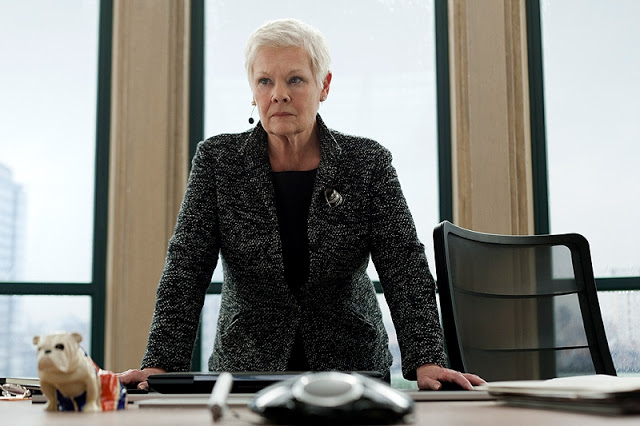
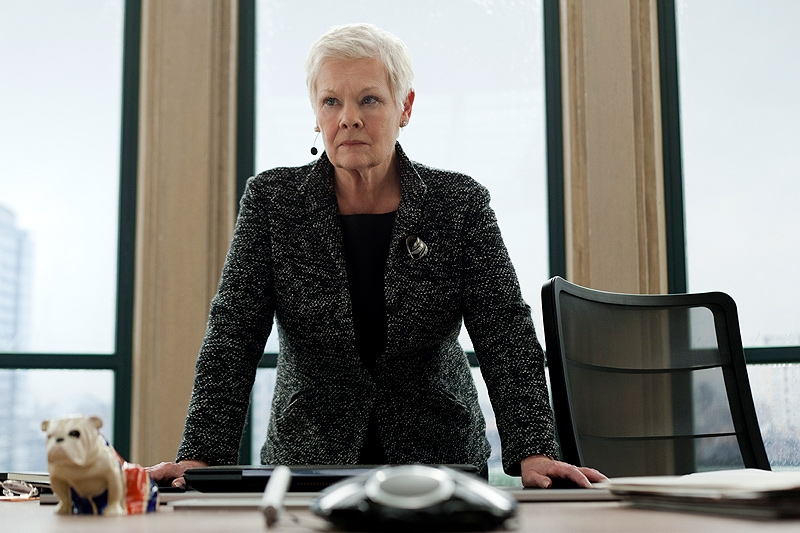
M (Judi Dench) in Skyfall


Warning: Spoilers ahead!

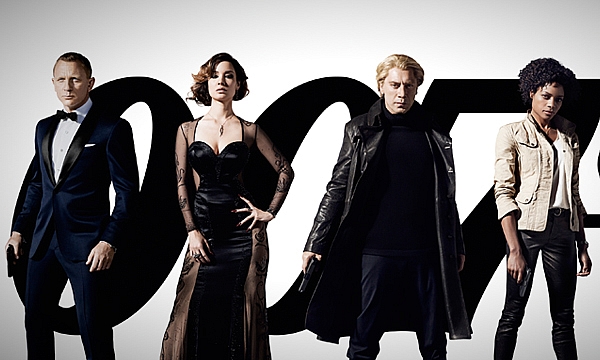
For fifty years, James Bond movies have varied wildly in quality, but not quantities. There’s always been plenty of punching, driving, drinking, smooth-talking, and seducing. This year’s release, Skyfall, features the fetching Bérénice Lim Marlohe and a blond-mopped Javier Bardem. But director Sam Mendes has done something different with his first punt at the series. While Bond still gets up to his usual japes, he’s not the centre of the film. Instead, Mendes has made a $150 million action blockbuster about a 77-year-old woman. It is her choices, not Bond’s, that shape the fates of those around her. Dame Judi Dench’s M is Skyfall’s steely heart.
You’d need a bulldozer to excavate the sexism generated by half a century’s worth of Bonds. But in his world, M is the single authority figure and the one woman who doesn’t start thinking with her knickers the moment he smirks at her. Not that their relationship is devoid of sexual undertones. Naomie Harris is capable as the lovely field agent Eve. But she and Daniel Craig don’t have any thing like the spark that he generates with M.
Allegedly inspired by Dame Stella Rimington, Director General of Britain’s MI5 in the mid-90s, Dench made her Bond debut in1995’s Goldeneye. Pierce Brosnan’s cocky Bond was properly introduced with her withering put-down, “I think you’re a sexist misogynist dinosaur, a relic of the Cold War.” It became one of the movie’s signature lines, establishing the tone of M’s relationship with her most difficult employee.

M (Judi Dench) in Skyfall

Skyfall’s opening sequence shows us M in action. She’s directing a mission in Turkey where Bond gets shot, presumed killed, on a fluffed order from her command. He chooses to stay dead and takes off to a beach to drink and sulk. It’s only the sight of M’s office under siege that lures him back to London. MI6 has been bombed, and its director is clearly the target. M returns to her house late at night, to discover Bond has dropped in to announce his resurrection. She is grumpy, frustrated, and exhilarated by 007’s return. He’s taciturn and flippant, but it says it all that she is his first port of call. She concludes their first scene together by throwing him out, snapping “You’re not bloody sleeping here!”
Mendes has worked with Dench before, directing her onstage in The Cherry Orchard. His camera lovingly dwells on her magnificently non-Botoxed features and silver hair. Unlike most directors, he doesn’t try to hide her slight 5’1 stature. There are many shots of her framed by large empty rooms, looking like a small black-clad anchor.
M’s nemesis turns out to be Raoul Silva (Javier Bardem), a former agent of hers, presumed dead. His experience was markedly similar to Bond’s at the start of the film. Abandoned by MI6 to preserve an operation, Silva endured torture and re-emerged as the leader of a terrorist cartel. Along with Bond, he could see their sacrifice by M as testimony to her fierce loyalty to her country. Only one of them chooses to. It’s not the one with the stupid hair.

L-R: James Bond (Daniel Craig), M (Judi Dench) and Raoul Silva (Javier Bardem) in Skyfall

Silva placed his trust in M, and she – according to his warped understanding of the game – betrayed him as a protector. You’d think building yourself up as a globe trotting mercenary would satisfy his wounded pride. But he nurses a vendetta against “the old woman”. Bardem doesn’t leave much to linger in the subtext with his predatory gasps of “Mother!” He is obsessive, inescapable, and possessed of the seemingly unlimited resources available to a Bond villain. When his six foot bulk looms over her it is as grotesque and terrifying as the Queen Alien going after Newt.
It is Silva’s similarities with Bond that makes him such an effective bad guy, crowned by his fixation on M. Together they make a combative threesome that would thrill Hitchcock or Buñuel. Silva attempts to pit the two of them against each other, revealing to Bond that M lied to him about his fitness for fieldwork. It’s a critically flawed tactic. Silva assumes that because many of their strengths and weaknesses run parallel, Bond will read M’s deceit as another symbolic death blow. Bond, of course,has never been averse to telling lies to get his way.
Perhaps that’s why M’s order to shoot in Turkey ultimately brought them closer. M’s failing made her more relatable to Bond, a master of duplicity, and someone who has spent significant amounts of celluloid treating people as if they’re disposable. Skyfall shamelessly draws on the Oedipus myth. Silva and Bond are wayward sons killed by and drawn back to the maternal figure. No wonder Q always hides in the agency
basement.
As Silva closes in to MI6, there are several forces working against its leader. One of them is Gareth Mallory, Chairman of the Intelligence and Security Committee. After the disaster in Turkey where Bond gets shot, he summons M to gently broach the subject of dignified retirement. She tells him in so many words to suck it and promptly exits. Mallory’s left hind wearing an expression of resigned affection. It’s not so different to how M has sometimes looked at Bond.

M (Judi Dench) in Skyfall
Mallory turns out to be more chivalrous than could be expected from a policy wonk. When M’s being raked over the coals by a stroppy MP (Helen McCrory in full Medusa mode), he reclaims the floor for her rebuttal. She rewards this with a floor-clearing defence rich in Tennyson and sass. We don’t get to see the pupils of his
eyes form into little love hearts before they get rudely interrupted by Silva’s gunfire. Mallory plights his troth to M by diving in front of a bullet. He goes on to support the comprehensively unofficial plan Bond hatches with Q (Ben Whishaw) and Tanner (Rory Kinnear) to smuggle her away from London.
Bond takes M to his childhood home in Scotland, and in case anyone missed the portentous meaning, we get a short speech about orphans en route. The Skyfall of the title turns out to be the unloved manor home of his youth. There she meets Kincade (Albert Finney). He is the gameskeeper and the man who taught a young James how to shoot. Within minutes of meeting M he’s macking on her, which makes us wonder what else Bond picked up from him.
L-R: James Bond (Daniel Craig) and M (Judi Dench) in Skyfall

Finney is comparable to Rory Kinnear’s Tanner, M’s right hand in MI6. In their scenes with her they demonstrate loyalty to M – or as Kincade calls her, Emily – without question. It’s different from the give-and-take between Bond and M.
Skyfall shows us M in the field, deftly assembling DIY cluster bombs and wielding a gun. But it is only to Bond that she shows vulnerability, and vice versa. Whatever the filmmakers try to make her stand in for – Queen, Country, Mother, Lover, Rosebud – the best part of M and Bond’s relationship is what exists just beyond their mutual snarking. By the end of the film, Dench can sag into an old chair and look tired and worn, admitting to her agent that she’s made big mistakes. Together, they have half a minute of screen time to be more mortal than James Bond usually is allowed to be.
By the end of the movie, she dies in his arms. They had shared something notably missing from their interactions with the other characters: a deep abiding respect and trust. Her legacy lives on, in the form of a ceramic bulldog and another totem of  loyalty – Mallory, newly installed as M’s heir.
——
Margaret Howie cheerfully lives with her love of Robert Mitchum and her feminist sensibility in South London. Her favourite Bond is Roger Moore, because he’s the only movie star with a name that is also a bad pick-up line.

‘Boardwalk Empire’: Margaret Thompson, Margaret Sanger, and the Cultural Commentary of Historical Fiction

In 1923, Margaret Sanger opened the first legal birth control clinic in America.
Almost 90 years later, HBO’s Boardwalk Empire is reminding audiences of those early struggles for women’s reproductive health and education, which don’t seem as foreign as they should.
In the premiere episode of season 3, Margaret (Schroeder) Thompson hears a radio story about Carrie Duncan, a woman who is about to take off as the first aviator to attempt a cross-continental flight.
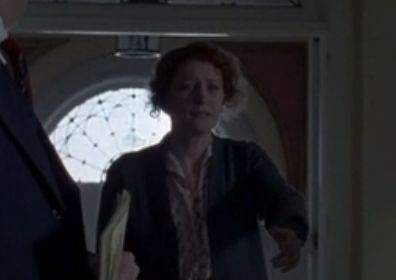
Later in the episode, she takes a private tour of the Enoch and Margaret Thompson Pediatric Annex in St. Theresa’s Hospital, as she and her husband (“Nucky”) are its benefactors. As she tours the halls, a pregnant woman comes in and collapses, and she’s obviously miscarrying. The doctors whisk her away and Dr. Mason later tells Margaret that the loss could have been prevented, but the woman (her name is later revealed as Edwina Shearer) drank raw milk that was infected with E.coli. He goes on to explain that pregnant women are not given any instruction about nutrition or hygiene. Margaret, horrified, wants to use her benefactor status to change this.
Edwina Shearer has a miscarriage in the first episode of season 3.
At her and Nucky’s New Year’s celebration–they are ringing in 1923–she approaches Dr. Landau (St. Theresa’s medical director) about the inadequate prenatal care at the hospital. He is insulted and condescending, and Nucky chastises her.
However, as her determination and tenacity in the last two seasons has proven, Margaret will not stand down.
At the end of the episode, Margaret gets up at dawn to witness Duncan fly over the coast. She smiles as she sees Duncan’s plane.
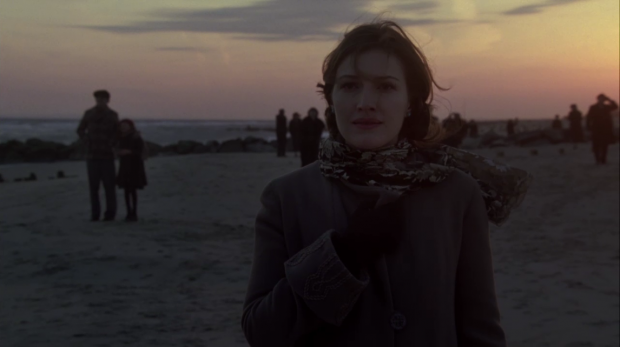
Margaret watches Carrie Duncan fly overhead.
While Margaret’s feminist activism is a sub-plot–in fact, it doesn’t even appear in every episode–the establishment of a prenatal education program (and evolving views on birth control) is an important, sobering reminder of our history and provides context for much of what propels current conversations on reproduction and women’s health.
Margaret manages to open the St. Theresa’s Women’s Clinic after going above the director’s head to appeal directly to the bishop (although he warns her that “delicate topics would have to be avoided”). Margaret has become a power player in season 3. Certainly it’s worth noting that the hospital’s namesake could either be found in St. Therese of Lisieux, who went directly to the Pope to beg to become a nun after priests and bishops had turned her away, or St. Teresa of Avila, who was forced into the convent by her father and then became a reformer and was posthumously declared a Doctor of the Church.
Margaret, also, has been dually wedged into circumstances by her own stubborn motivations and by the men in her life. In previous seasons, she has deftly navigated her world to provide better circumstances for her children and her community, but this season she is securing her place as more than just an activist–she is a leader.
In episode 4, she and Dr. Mason set up the women’s clinic and are met with resistance by the nuns. As they discuss the mission statement, a nun says, “This is rather infelicitous language, isn’t it?” “Vagina?” Margaret asks. The doctor says that it’s a medical term, and the nun replies, “I’ve never enjoyed the sound of it.” Dr. Mason says, “I’ve never liked brussels sprouts, but I don’t deny they exist.”
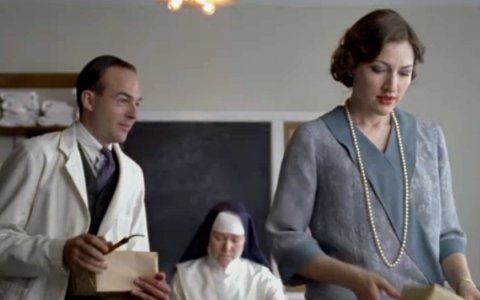
Dr. Mason, left, and Margaret prep for their evening women’s health class (they are holding boxes of Kotex, and the nun in the background disapproves).
“The entire area is problematic,” the nun scoffs, adding that she doesn’t approve of the term “pregnant.”
“You are at odds with ‘menstruation’?” Margaret asks.
The nun finally storms off after seeing brown packages that Margaret tells her are Kotex–a relatively new product–which are gifts for the women in the class. “Let’s hope our evening students aren’t quite so sensitive,” Margaret quips.
As she passes out fliers for the new class on the boardwalk, she runs in to Mrs. Shearer–the woman who inspired the clinic. She seems uncomfortable, and her husband interjects, “When she’s feeling better, we’ll try again.”
Margaret passes out flyers on the boardwalk.
At the end of the episode, Margaret is reading the newspaper. Wreckage of Carrie Duncan’s plane was found, and the headline reads “Aviatrix Presumed Killed During Ill-Fated Journey.” Duncan’s trip, which clearly was inspirational to Margaret, was unsuccessful. 
This moment in American history–the 1920s–was a promising time for women. The 19th amendment granted women the right to vote in 1920, and Margaret Sanger was making headway (and finding loopholes) to help women plan their reproduction.
However, there were no figurative cross-country flights completed during this era. It would be decades before the Pill was legalized and first-trimester abortion de-criminalized. Still in 2012, contraception is a divisive issue in America.
But women kept fighting, as does Margaret.
In the beginning of the next episode, she’s looking over a class flyer with a friend. “Do you wish for more knowledge? sounds mystical,” her friend teased.
Margaret responds, “I can’t very well say Let’s talk about your vagina.”
Later in the episode, Dr. Mason is wrapping up their evening women’s education class (a crucifix looms above him), and one of the few women in the class says, “I wish someone would have told me all of this when I was 13–I wouldn’t have thought I was dying!”
The need for comprehensive education was clear, and for the few women who came to the first classes, Margaret and Dr. Mason were making a difference.
When Dr. Mason is called into an emergency surgery during their next class, Margaret steps to the front of the room and smiles. “We have our book, we have our chart, we have ourselves–what else is needed?”
She’s gotten the permission she needed to open the clinic and fly under the radar of the conservative leadership, and she is comfortable taking the lead.
At the beginning of episode 6, Margaret opens the mail and pulls out a copy of the Birth Control Review (along with a letter signed by Margaret Sanger).
Margaret receives a copy of Margaret Sanger’s Birth Control Review in the mail,.
This isn’t the first time that Sanger has appeared in Boardwalk Empire. In season 1, the episode “Family Limitation” (named after a brochure of the same name that Sanger produced in the early 1900s) showed Margaret douching with Lysol to prevent another pregnancy (a method that was touted as a method of birth control). Season 1–with its focus on temperance leagues, suffrage and reproductive issues–offered a preview to the show’s complex sub-plots that focus on women’s issues.
Throughout the series, men’s reactions to birth control and family planning have been venemous (Nucky referred to Margaret as a “common whore” when he discovered she’d been trying to prevent pregnancy, and Mr. Shearer insists that he and his wife will continue to procreate). Dr. Mason is the exception thus far in his progressive attitudes about women’s health.
In episode 8, Mrs. Shearer comes to Margaret, pleading. “My husband won’t keep off me,” she says, and wants to know how to not get pregnant.
She says, “I don’t need a pamphlet, or some man to tell me what I already know.”
She hesitates, and says, “I wasn’t–I stored the milk, I waited. It wasn’t an accident, you understand? I drank it on purpose to lose the baby–I won’t go through that again.”
The E.coli was self-inflicted, because she refused to have another child. This example of self-induced abortion was nothing new or rare for the time, and it was one of the reasons Sanger pushed for education and birth control.
Without judgment, Margaret simply asks, “What do you need?”
“One of those Dutch caps, that go up here,” she answers (indicating a diaphragm).
When Margaret says that those need to come from a doctor, Mrs. Shearer says, “Doctors only listen to ladies like you.”
Wealthy women of privilege generally have always had access to family planning. Mrs. Shearer knows that, and finally trusts Margaret enough to be a connection between working class exclusion and upper class privilege.
Margaret waits for Dr. Mason outside of the hospital, and tells him directly, “I need your help with something and it’s rather delicate… I would like to ask you to help me obtain a diaphragm.” He understands that that is what Mrs. Shearer wanted. “Actually,” Margaret adds, “I suppose I need two–one for her, and one for me.” (Margaret’s need for a diaphragm isn’t because of her relationship with Nucky; Nucky has had a mistress in the city, and Margaret picks up her affair with his driver, Owen.)
The issues surrounding the female characters of Boardwalk Empire are instrumental in the male characters’ lives (the late Angela Darmondy and her lesbian relationship, Gillian Darmondy’s brothel the Artemis Club, Chalky White’s daughter’s resistance to marriage, Assistant Attorney General Esther Randolph–based off Mabel Walker Willebrandt, Nucky’s late lover Billie Kent’s desire for independence and of course, Margaret), and they also serve as history lessons for the audience.
Boardwalk Empire is, essentially, a boys club. So is American history. While Nucky’s world of politics, power, alcohol smuggling and bloody violence is central to the entire plot of the show, the women’s stories underneath the surface are integral to their stories and to the audience.
In 2012 America, a female legislator was punished for using the word “vagina” in a debate about reproductive choice. Religious groups are fighting the Affordable Care Act’s provision that contraception be covered by insurance as preventative medicine. States are attempting to close women’s health clinics that don’t even provide abortion, but provide women’s health services. Abstinence-only education is pushed nationwide. The same resistance that Margaret faces in Boardwalk Empire is the same resistance faced by activists and leaders in today’s fights to prioritize reproductive education, health and choice. 
By showing these struggles in an award-winning, critically acclaimed HBO drama, audiences are able to hold a mirror up to the failures of not only prohibition, but also limiting women’s reproductive choices. Boardwalk Empire serves as a reminder that when women’s options are limited, they will fight back–even if it means risking their lives. With only three episodes left in season 3, we can hope that Margaret will remain steadfast in her fight for women’s reproductive education and choice.


Leigh Kolb is a composition, literature and journalism instructor at a community college in rural Missouri. 

Please, ‘Turn Me On, Dammit!’

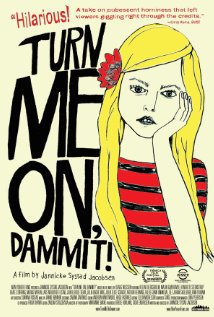
The 2011 Norwegian film, Turn Me On, Dammit! is, in a word, excellent. In the world of about a thousand American Pie films and cliched male teen sex comedies that usually revolve around bathroom jokes and well-endowed foreign exchange students, Turn Me On, Dammit! follows a more female centered theme that is as insightful as it is witty.
 
The star of Turn Me On, Dammit! is Helene Bergsholm who plays Alma, a 15-year-old girl who lives in a small town in Norway and is just realizing the amazing, albeit embarrassing, world of teenage hormones and sex. One night at a party, Alma’s crush, a boy at her school named Artur, exposes himself to her (or as the film’s refrain goes, “pokes her with his dick”) but when Alma excitedly tells her friends about the encounter, a jealous girl refuses to believe the story and spreads it around that Alma is a liar. Artur as well, embarrassed that he’s been confronted with the situation, denies that it ever happened, sending young Alma into the lonely world of high school drama.
 
The film’s writer and director, Jannicke Systad Jacobsen, fills the film with an excellent commentary on the fact that often, men are believed over women in situations of sexual harassment and assault. Now, while Artur and Alma’s situation is slightly different since it was youthful, consensual experimentation and not assault, the point is still there: women accuse, men deny. Jacobson however doesn’t strike an agressive tone with this theme, rather she couches the exposition of it in terms of courage and cowardice. Artur is a young coward too scared to admit the truth and instead just watches as Alma is increasingly shunned and ostracized from her friends.
Malin Bjorhovde, Helene Bergsholm, Beate Stofring in Turn Me On, Dammit!

This theme is one that avoids blame and victimization, focusing instead on the human propensity to make stupid (and even cruel or damaging) mistakes and either be a coward about it, or face the consequences. A gender-relevant argument that doesn’t feel aggressive, giving the film a wide appeal to audiences.

While there is some slight “slut-shaming” that occurs in the film (Alma’s new nickname, “Dick Alma” is called after her by even small children), there is more of a focus on how Alma’s sexual activities lead the people of the town, as well as her mother, to think that she must be crazy or abnormal in some way. It’s a familiar sort of idea in the teen sex comedy, the raging sexual hormones of youth leading to a certifiably insane son or daughter whose activities seem to be those of pervert. Take for example the famous scene in American Pie when Jim decides to have sex with an apple pie because he believes it will simulate how sex actually feels; naturally, that is the exact moment that his father walks in the room.
 
The scene in American Pie, however, is so extreme that it could never be real, a problem that Jacobsen doesn’t have. Alma’s scene’s of “sexual craziness” are awkward and embarrassing to be sure, but never outside the realm of possibility, grounding her characters in in a more realistic comedy. Because of this, Alma is ultimately able to attain something that most characters in a teen sex comedy never can: self-respect. Turn Me On, Dammit! is at its core a film about growing up and gaining confidence in ourselves, a true coming-of-age story where Alma reaches self-acceptance and Alma’s mother is able to do the same for her daughter.
 
So many parental-child relationships are sacrificed in teen movies, parents becoming bumbling idiots whose outdated slang and terrible educational sexual analogies feed into cliched humor. It’s a shame that’s the case since Alma’s mother’s quiet confusion and occasional fear of her daughters healthy curiosity in sexuality lends a lot of subtle humor to the film. Alma’s mother feels her daughter must be abnormal in some way and so all she begins to see is the apparent erratic and embarrassing behavior of her daughter, not realizing the social exclusion her daughter is experiencing. Alma as well doesn’t see her mother’s loneliness and attraction to her boss; it’s a moment of selfishness for each character in their unwillingness to empathize with the other.
 
While the mother and daughter relationship is a strong plot point for the film, my favorite exposition is the very female-centered, sex-positive demonstration of female fantasy. So often visual sexual fantasy in films remains squarely in the center of the male gaze: women in bikinis washing cars, licking ice cream cones, and rising silkily out of a swimming pool come to mind. Alma not only has a very sweet, male phone sex worker friend (who is willing to also just listen to the problems of a young girl, albeit his solution to those problems are “booze”), but also fantasizes about her crush in both the sweet and the sexy, her boss (hilarity with a bike helmet and  “I’m bringing sexy back”), and most notably, a fantasy about her female friend. Female fantasy is often kept in the overly dramatic (when it is portrayed at all) and rarely are same-sex fantasies expressed from a straight woman, a fact I find unfortunate since it’s been scientifically proven that most straight women are actually more sexually flexible in their arousal than men.
 
I suppose that my analysis has made the film sound like the only thing that is ever discussed is sex; this is however, not the case–obviously the issue of first love is important, drugs make an appearance, as does a surprising commentary on the American legal system. One of the main characters, Alma’s friend Saralou, is a social activist concerned with the plight of American prisoners on death row, she in fact writes letters to American prisoners, often discussing the local high school drama with various offenders.
 
The strengths (as well the flaws) of female friendships are portrayed in the film, giving a varied look at the silly and serious side of young people. Instead of a world bound by stereotype and cheap laughs, Jacobsen has created a rich and deeply human world filled with genuine characters and issues. And sex.
Rachel Redfern has an MA in English literature, where she conducted research on modern American literature and film and it’s intersection, however she spends most of her time watching HBO shows, traveling, and blogging and reading about feminism.

Weekly Feminist Film Question: Who Are Your Favorite Female Friendships in Film and TV?

Bromances, buddy films, buddy cop movies, — notice a theme here? Most movies about friendship are about dudes, usually white hetero dudes. Considering the sheer magnitude of films and TV series, it’s shockingly rare how often a movie or series showcases female friendships. So we asked you: Who are your favorite female friendships? We received an overwhelming response…especially from A LOT of Buffy and Parks and Rec fans! Without further adieu, here’s what you said!

——

Absolutely Fabulous Edina Monsoon (Jennifer Saunders) and Patsy Stone (Joanna Lumley)

Any Day Now — Rene Jackson (Lorraine Toussaint) and Mary Elizabeth “M.E.” Smith O’Brien (Annie Potts) 

Bones — Dr. Temperance “Bones” Brennan (Emily Deschanel) and Angela Montenegro (Michaela Conlin)

Buffy the Vampire Slayer — Buffy Summers (Sarah Michelle Gellar) and Willow Rosenberg (Alyson Hannigan), Buffy and Tara Maclay (Amber Benson), Tara and Dawn Summers (Michelle Trachtenberg)

Celine and Julie Go Boating — Celine (Juliet Berto) and Julie (Dominique Labourier)

Community — Annie (Alison Brie), Shirley (Yvette Nicole Brown) and Britta (Gillian Jacobs)

Daria — Daria Morgendorffer (Tracy Grandstaff) and Jane Lane (Wendy Hoopes)

Deadwood — Alma Garret (Molly Parker) and Trixie (Paula Malcomson)

A Different World — Whitley Gilbert (Jasmine Guy) and Kim Reese (Charnele Brown)

Friends — Rachel Green (Jennifer Aniston), Monica Gellar (Courtney Cox) and Phoebe Bufay (Lisa Kudrow)

Gilmore Girls — Rory Gilmore (Alexis Bledel) and Lane Kim (Keiko Agena), Lorelai Gilmore (Lauren Graham) and Sookie St. James (Melissa McCarthy)

Girl, Interrupted — Susanna Kaysen (Winona Ryder), Lisa Rowe (Angelina Jolie), Daisy Randone (Brittany Murphy), Georgina Tuskin (Clea DuVall), Polly Clark (Elisabeth Moss), Janet Webber (Angela Bettis) and Cynthia Crowley (Jillian Armenante)

Girlfriends — Joan Clayton, Esq. (Tracee Ellis Ross), Maya Wilkes (Golden Brooks), Lynn Searcy (Persia White) and Toni Childs Garrett (Jill Marie Jones)

Golden Girls — Dorothy Zbornak (Bea Arthur), Rose Nylund (Betty White), Blanche Devereaux (Rue McClanahan) and Sophia Petrillo (Estelle Getty)

Gravity Falls — Mabel Pines (Kristen Schaal), Candy Chiu (Niki Yang) and Grenda (Carl Faruolo)

Grey’s Anatomy — Christina Yang (Sandra Oh) and Meredith Grey (Ellen Pompeo)

Hannah Montana — Miley Stewart (Miley Cyrus) and Lilly Truscott (Emily Osment)

How I Met Your Mother — Robin Scherbatsky (Cobie Smulders) and Lily Aldrin (Alyson Hannigan)

Kate and Allie — Kate McArdle (Susan St. James) and Allie Lowell (Jane Curtin)

A League of their Own

Mad Men — Peggy Olson (Elisabeth Moss) and Joan Holloway Harris (Christina Hendricks)

Martin — Pam James (Tichina Arnold) and Gina Waters-Payne (Tisha Campbell)

The Mary Tyler Moore Show — Mary (Mary Tyler Moore) and Rhoda (Julie Kavner)

Me Without You — Holly (Michelle Williams/Ella Jones) and Marina (Anna Friel/Anna Popplewell)

Mystic Pizza — Kat Araujo (Annabeth Gish), Daisy Araujo (Julia Roberts) and Jojo Barbosa (Lili Taylor)

One Tree Hill — Brooke Davis (Sophia Bush), Peyton Sawyer (Hilarie Burton) and Haley James Scott (Bethany Joy Lenz)

Parks and Recreation — Leslie Knope (Amy Poehler) and Ann Perkins (Rashida Jones)

Romy and Michele’s High School Reunion — Romy White (Mira Sirvino) and Michele Weinberger (Lisa Kudrow)

Roommates — Billie (Samantha Fox), Joan Harmon (Veronica Hart), Sherry (Kelly Nichols)

Sailor Moon

Sex and the City — Carrie (Sarah Jessica Parker), Samantha (Kim Cattrall), Charlotte (Kristen Davis) and Miranda (Cynthia Nixon)

Sliding Doors — Helen Quilley (Gwyneth Paltrow) and Anna (Zara Turner)

Thelma and Louise — Thelma Dickinson (Geena Davis) and Louise Sawyer (Susan Sarandon)

True Blood — Sookie Stackhouse (Anna Paquin) and Tara (Rutina Wesley)

Xena: Warrior Princess — Xena (Lucy Lawless) and Gabrielle (Renee O’Connor)
Are you fave female friends on the list? Tell us in the comments!
——

Each week we tweet a new question and then post your answers on our site each Friday! To participate, just follow us on Twitter at @BitchFlicks and use the Twitter hashtag #feministfilm.

The Sun (Never) Sets on the British Empire: The Neocolonialism of ‘Skyfall’

Growing up, my little brother was an enormous James Bond fan. He rewatched the films repeatedly on video; he developed an encyclopedic knowledge of all the villains, plots, and gadgets from reading his glossy making-of books; and, in an anecdote our mother never tires of retelling, he wanted to be Bond “without the kissing.”

Thanks to his enthusiasm, and everyone else’s moderate enjoyment, each new Brosnan Bond film was cause for a Family Outing to the cinema (and we have never been big on Family Cinema Outings; our taste in films is too disparate). For me, this meant a couple hours’ quality nap time. I snoozed happily through Tomorrow Never Dies, The World Is Not Enough, and Die Another Day.
Me, watching a James Bond movie, 1997-2002.
Casino Royale, of course, famously upset some Bond fans who felt it was too serious, too Bourne-y, and unfaithful to the sense of fun that had always previously characterized the series. And maybe it is indeed a complete break with the rest of the franchise, because it’s the first Bond film that kept me awake for its entire (bladder-busting, 145-minute) runtime.
Bond is a British institution, and every new film is quite the cultural event back in Blighty. It’s a slightly different perspective from this side of the Atlantic, but in some ways the US is an appropriate place to be for the release of Skyfall: director Sam Mendes is a Brit, but he’s most famous for a film with “American” in the title. This latest offering turns out to be not only self-reflexive on the half-century-old Bond film franchise itself, but also a somewhat disturbing meditation on Britain’s role in the modern world.
Before I get into a geopolitical reading of the film, let’s talk feminism: this is NOT a good film for its women characters. The Craig Bond films have been weird about women in general. They don’t seem to be quite sure whether or not they want to get away from the traditional Bond treatment of women as interchangeable totty for 007’s shagging pleasure. On the one hand, Casino Royale won feminist plaudits for recapitulating Dr No‘s famous Ursula-Andress-rising-from-the-sea moment with a ripped Daniel Craig in the role of Anadyomeneeye-candy. On the other hand, Skyfall features Bond walking in on a former child sex slave in her shower, and that is objectively more squicktastic than most Bond seductions.
Even the one where he shags Honor Blackman straight.
Plus, without getting too far into spoiler territory, by the end of the film the role of women in the MI6 workplace is not exactly inspiring for one’s feminist sensibilities.
SPOILER: this is the final shot of MI6 at the end of Skyfall.
Having said all of which, the film does focus significantly on one female character. Dame Judi is of course a British icon, and – particularly in the wake of the Olympics opening ceremony stunt – it’s not a huge leap to see her M as representative of the queen (and, by extension, the UK as a whole): she’s talked about obsessively as a “little old woman” who holds people inexplicably in her thrall and power, and unfailing loyalty to her is presented as an irrational but ultimately very British characteristic.
I should make it clear that I am not a fan of monarchies, empires, or jingoism, and that my own British nationality is so compromised by my third-culture childhood that it doesn’t really have abstract, personal, emotional, or ontological relevance for me. As such, I don’t care much for the endless, usually racist and Islamophobic debates over what British identity IS or whether the Royal Family is relevant(IMO: this, and no).
However, I do think that there is a very good reason for the continuance of these discussions, and it is this: Britain has never really bothered to process the loss of its empire.
By this I mean both that Britain has failed to properly grapple with or repent for its imperial sins, and that it has not yet seriously reconsidered its place in the current global milieu. The former is the more difficult task, and I still don’t see anyone trying to do anything about it; on the contrary, imperialism, via western neoliberalism, looks to be reinscribed through the very public conversation on modern Britain’s role that has arisen in the past few years. Between the Royal wedding, the Jubilee, and the London Olympics, Britain has begun to gain something of a sense of itself in the 21stcentury, and I don’t know if that’s entirely a good thing.
The British brain. See, it does too exist.
21st-century Britishness is precarious and conflicted, but still deeply troublesome (and still, I think, built on a feeling of entitlement to control others). Skyfall beats you over the head with its theme of whether the Good Old Ways are useful in the modern world, but that’s because this is a question that has plagued Britain since at least WWII. Bond first meets young tech-savvy Q in front of Turner’s Fighting Temeraire, and the obsessive harping on the motif of Old vs. New doesn’t get any subtler, between the callbacks to Bond movies past and the, well, explicit conversations about whether the old ways are useful in the modern world.
And yet the film has a striking caginess about the real world. The London Underground hijinks almost entirely avoid evoking 7/7. The villain of the piece is a former British intelligence agent with a grievance about his mistreatment at British hands, but he’s played by Javier Bardem; and, while many of the world’s countries have legitimate grievances about their mistreatment at British hands, Spain is waaaaay down the list. Giving the villain a purely personal grievance against M allows for a paralleled symbolism: as M represents imperial Britain, so Bardem’s character represents any or all of the formerly colonized territories of the world.
The film chooses not to engage with the perspective of the colonized. Bardem’s desire for revenge on M is a Very Bad Thing, and Bond takes M “back in time” to defend her. Bear in mind that I’ve been reading M as a symbol of the British Empire, and you’ll realize that I do not love where this is going.
***Spoiler ho***
Bond loses M, but another M arises to take her place. The Union Jack still flies over London. MI6 still operates. The new M still has missions for Bond, offered in front of another painting, this time of an intact fleet of ships. The Good Old Way of territorial imperialism may be gone, but the same colonizing work can still be done in newer, slicker, more insidious ways.
 
The top-hatted octopus-man is James Bond. Okay, it’s not a perfect metaphor.


Max Thornton blogs at Gay Christian Geek, and is slowly learning to twitter at @RainicornMax.

Disney Buys Star Wars: A New Hope for Women and Girls

Disney logo with Death Star
Last week, one of the only news items to penetrate the horrifying coverage of Hurricane Sandy’s devastation and the nerve-wracking anticipation for the US Elections was the surprising, perplexing, but exciting news that Disney was buying Lucasfilm and planning to release Star Wars Episode VII in 2015. It was like a shot of adrenaline to this weary geek’s heart.
The Five Stages of Disney’s Buyout of Lucasfilm: 1) Denial. 2) Angst. 3) Cautious optimism. 4) Futility. 5) Resignation.
— Eric S. Donaldson (@EricJokes) October 31, 2012

Like every geek, I’m riding the wave of emotions that comes with this news, with renewed “no, there is another” hope for new GOOD Star Wars movies, and anxiety that those hopes will be dashed yet again (I mean, think about what the word “Disneyfication” means.) As a feminist geek, there’s a whole additional layer to conflicted feelings about Disney buying Star Wars: what does this mean for women?

The Opportunity for Women to Take Creative Control of Star Wars

Enormously successful female film producer Kathleen Kennedy is now president of Lucasfilm and “brand manager” of Star Wars after the sale to Disney.  A woman is now in charge of Star Wars.  I don’t know about you, but I’m hearing a chorus of angels sing.
And then an abrupt record scratch, because it’s a naïve fantasy to suppose that having a woman executive produce the new Star Wars films will meaningfully shift the gender balance of the larger creative team.  A quick overview of Kennedy’s credits on IMDb confirm that she’s mostly helped bring male voices to the screen, and a very discouraging (although unsourced and hopefully entirely dubious!) quotation in her personal trivia section has a very “binders full of women” tone:
But what I always find interesting is when you take the areas of writing, producing and directing. I don’t think there’s a great deal of discrimination — although I’m completely perplexed and confused as to why there aren’t more women. For instance, if we’re looking for new, young directors, which is something we do all the time, we certainly never go look at films because they’re directed by a man or a woman. We look at films because they are winning awards, they’re good, and it has nothing to do with gender. And women certainly have equal opportunity to get into a university like UCLA or USC, to get into the film department, to take the same courses to allow them to make films, to deal with a whole gamut of subject matter, and yet I don’t know what happens. There’s something that happens in the process of getting there that seems to turn many women away. – Kathleen Kennedy [Oh, bugger, here’s the source.]

But the fact remains that a woman now controls Star Wars, and moreover the door is now open for new writers, directors, and other producers to step into the Star Wars franchise, and a lot more diversity in the creative team continuing the franchise is now a possibility.
Gender Neutral Kids Entertainment or the Entrenchment of the Girl’s Ghetto?
Disney Princess Leia
My childhood pretty much exactly coincided with the Disney Renaissance, so even though the Disney Princess marketing machine hadn’t fully sprung to terrifying life, I was pretty obsessed with Disney’s lineup of plucky heroines.  I foolishly assumed they were a cultural touchstone for everyone in my generation, until I was in college and went on a date with a guy who had only brothers, who said he’d never seen an animated Disney movie. “I always thought that was just girl stuff,” he said.
While the Disney Princesses (and the Disney Fairies) get a lot of direct-to-video content and toys, the feature films branch of Disney seems desperate to get that somehow-more-valuable BOY MONEY.  First they bought Pixar, which made animated kids movies untainted by the “girl stuff” smear (this year’s Brave was the first Pixar film with a female protagonist).  Then Disney acquired Marvel’s film division, and went about developing films for even pretty obscure male Marvel superheroes while leaving the women to Smufette-y supporting roles (Though I’m still holding out hope for a She-Hulk adaptation, which could be the brilliantly postmodern Gremlins 2: The New Batch-style answer to the Avengers mega-franchise.)  And while Disney Animation Studios still creates princess-centered features like The Princess and the Frog and Tangled, they alternate these pictures with more boy-appealing fare like Wreck-It Ralph.  It’s easy to worry that Disney has cut its losses with girls, figuring they are only valuable viewers once they’re old enough to obsess over sci-fi/fantasy young adult novels with love triangles.
But while Disney Princess Leia was just an amusing meme for most of us, for me, it was a signal of hope that Disney buying Star Wars could help blur the distinction between “boy stuff” and “girl stuff” when it comes to children’s entertainment.  Bitch Flicks’ Megan Kearns’s excellent feminist character analysis of Princess Leia demonstrates that while the original Star Wars trilogy was extremely limited in its portrayal of women and fell into some harmful tropes with its central female character, what it got right about Leia, it got VERY right.
I firmly believe Star Wars is the cultural juggernaut that it is because it captures young girls’ imaginations as well as young boys’, largely in part because of the dynamic character of Princess Leia.  And given their history of creating female-centric (albeit sometimes problematic) entertainment, and despite recent moves away from that niche, Disney may be the best production company to capitalize on that aspect of Star Wars‘ appeal when making the next trilogy.
The next Star Wars films could bring us more than one—seriously, I swear it is possible—dynamic female character.  We might even see a woman as the central figure in the next trilogy.  Those oh-so-valuable boys will still be bought and payed for by the Star Wars name and universe.  In this brave new world where a “Disney Princess” is a diplomat who carries a blaster, the new Star Wars films might finally break us of gender-segregating our children’s entertainment.

Bitch Flicks’ Weekly Picks

Amber‘s Picks:

Question Time: Women & Screenplays via Wellywood Woman

Teen Beat! 8 Teen Film Versions of Classic Literature by Kelly Kawano via Word & Film

She’s Beautiful When She’s Angry by Mary Dore and Nancy Kennedy via Kickstarter

Leslie Knope’s sexuopolitical dreams are coming true by Chloe via Feministing

FFFF: Ellen Endorses “Bic for Her” Pens by Jarrah via Gender Focus

London Feminist Film Festival tickets now on sale! by Kyna Morgan via Her Film

Random Nerd Nostalgia: Wonder Woman for President by Aphra Behn via Shakesville

Stephanie‘s Picks:

Catching Up With Molly Ringwald by Shana Naomi Krochmal via Out

Portraying the Women Behind the Powerful Men by Hugh Hart via the LA Times

Mila Kunis Is Executive Producing a ’70s Period Drama About Feminism by Jamie Peck via Crushable

TV Show “Girls” Does More for Feminism Than Sex & the City Ever Did by Caroline Mortimer via Sabotage Times

Backlot Bitch: Flight Beyond Stereotypes by Monica Castillo via Bitch Magazine


Megan‘s Picks:

Martha Plimpton: Why Hollywood Activism Matters by Martha Plimpton via The Hollywood Reporter 

The 6 Best Moments for Women in the 2012 Election by Emma Gray via The Huffington Post

Skyfall Unquestioningly Belongs to Dame Judi Dench by Charlie Jane Anders via Jezebel 

Television Interview About Harassment in Gaming by Anita Sarkeesian via Feminist Frequency

Sexism in Hollywood: Where Are the Women in Argo? by Nico Lang via Women and Hollywood

The End of the Bond Girl and the Rise of the Bond Woman by Alyssa Rosenberg via Slate’s Double X

What have you been reading this week? Tell us in the comments!

‘Cloud Atlas’ Loses Audience

But how can a film with so many actors playing so many different roles go wrong?
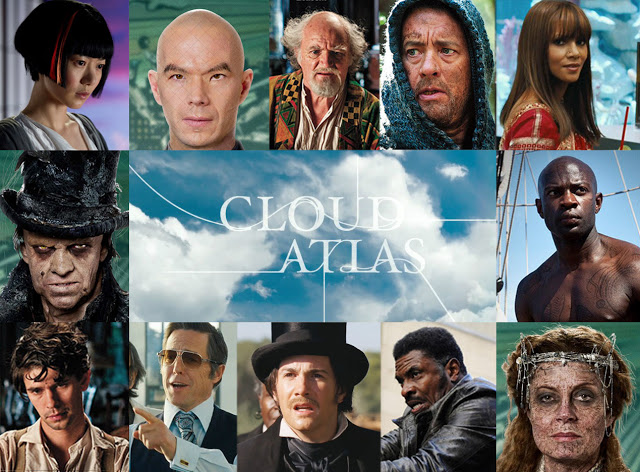
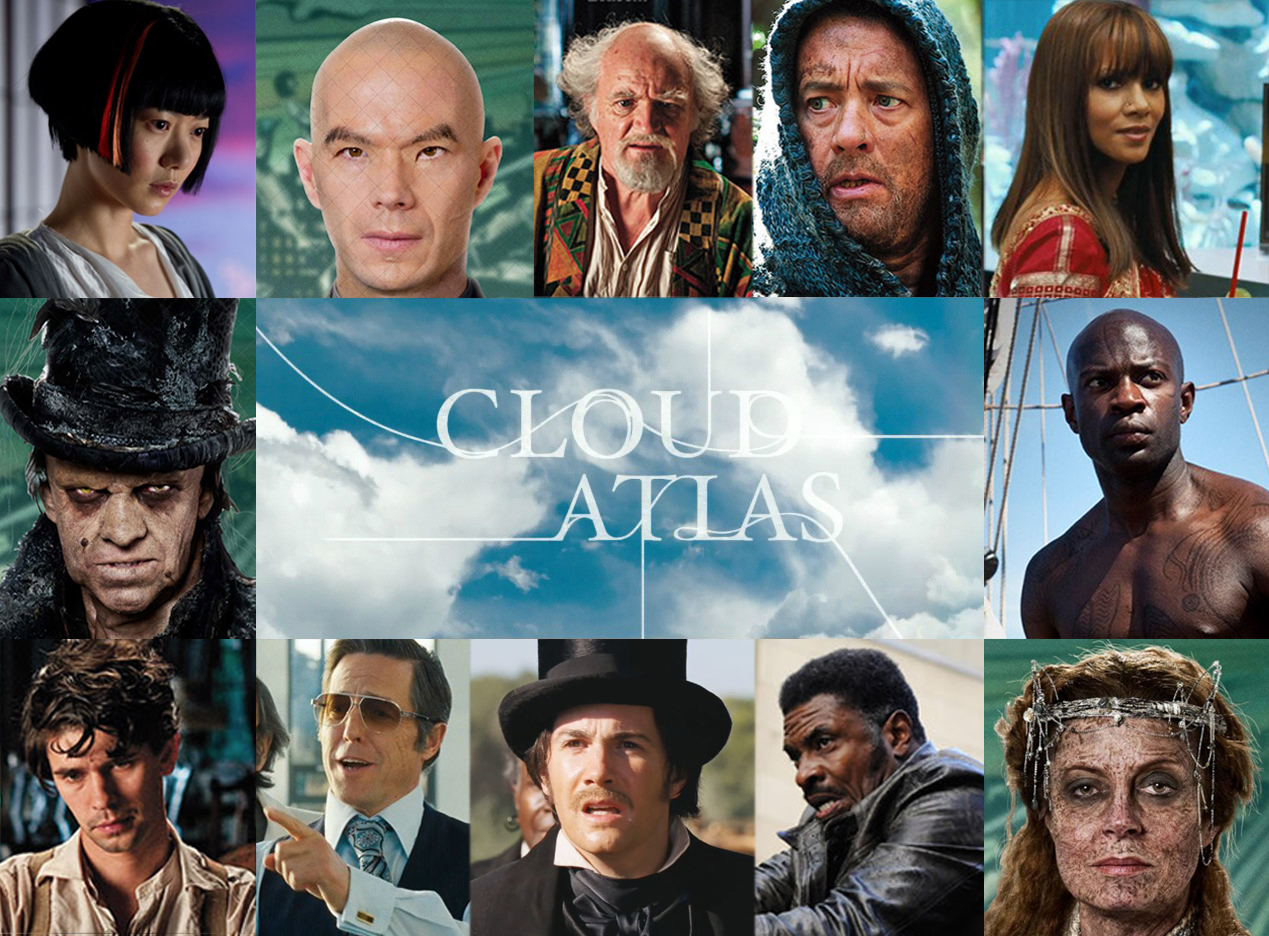
Cloud Atlas, directed by the Wachowskis and Tom Tykwer, portrays the pursuit of equality in a palatable way for the mainstream – soaked with platitudes. But, due to facially disproportioned prosthetics and a failed attempt at a postmodern structure it misses even the mainest of mainstreams. Tom Hanks, Halle Berry and a slew of other actors don different noses, teeth and skin colors to represent parallel souls traveling through generations of personal and cultural strife. Each protagonist challenges an authority or oppressive obstacle.

Cloud Atlas tries to transgress norms, but it fails because it spends too much time celebrating gimmicks. Even though it pushes an over-sentimental philosophy – I still want to like it because it tries to present a variety of underrepresented ideas and identities. But, I just can’t like the movie because the structure and devices weaken it.

We get several solid female characters, a tender and sympathetic portrayal of gay lovers and plenty of conversations (directly and indirectly) about the importance of empowering marginalized groups.

Berry plays (among other characters) a journalist in 1973, Luisa Rey, investigating a nuclear plant. She’s smart, complex and is following a story rather than romantic interest. She’s not a kickboxing Buffy-esque strong woman, but a typical adept character with strengths, flaws and personality.

We see a similar level of complexity in the relationship between two men in 1936 who are young and in love, but separated while one, Robert Frobisher (Ben Whishaw), unsuccessfully pursues his ambitions as a composer. They don’t have an ideal romance, and we only see them actually together once, but their affair may be the most intense of the film. They do not dwell on societally-imposed secrecy about their sexuality, but it is painfully clear what limits them. Also, while their story does end tragically, it is not because of sexuality, but because of Frobisher’s failed ambitions. It could be argued that the characters are experiencing indirect punishment for their sexuality – but their story isn’t the only tragic one, and their affection for each other is the happiest part of Forbisher’s narrative.

Also, we follow the story of a young American attorney who agrees to help a black man escape slavery and subsequently becomes an abolitionist. We also follow a commodified woman escape from slavery and fight against fascism in a dystopian world. These are cookie-cutter liberal narratives – not progressive. But, put together they create a tone that celebrates marginalized people rising up and making their voices heard.

Because the ideas behind the film are embracing multiculturalism I am also reluctant to say that actors playing different races is problematic. It doesn’t feel offensive against a back-drop of social justice themes – as much as naïve. Most of the main characters already share an easily identifiable birthmark – so there is no need for the characters to be played by the same actors. The birthmark itself could be heavy-handed, but the characters being played by the same actors puts it over the top. If the make-up had been skillfully done, it might be more compelling, but when Hanks plays a 19thcentury doctor, he has a clumsy set of fake teeth slapped under false freckles and complimented by a trying-too-hard nasally English accent (the accent is not the make-up artists’ fault, but it sure does negatively enhance the overall effect). All of the make-up looks hastily thrown together. And, reading an interview with the make-up artist backs up that idea. 

Jeremy Woodhead, a make-up designer for the film, detailed his process in an interview with the Los Angeles Times.

Susan Sarandon was away filming somewhere else, so we hadn’t got a life cast, and I had to turn her into a little old man from the Indian subcontinent. So I used James D’Arcy’s eyebrow blocker piece to change the shape of her forehead. On top of that, I put Jim Sturgess’ forehead. And I had two or three noses made of varying sizes, just hoping that one would fit. Luckily, one did. And then put a wig and a goatee beard and a mustache and then just a lot of paintwork on her. This was the first time she’d ever been a man, and she just sat there giggling.” 

Cloud Atlas looks like it is begging to be dubbed “groundbreaking” and reviewed with clichés intimating its unique and fresh take on culture. But, it’s just an over-layered overlapping story making comfortable stabs at conformity and glossy-eyed statements about the connectedness of all humans.

This is the trouble with unremarkable films; no matter how good the intention of their message – it will go unheard if communicated poorly.

‘Wreck-It Ralph’ Is Flawed, But Still Pretty Feminist

By Myrna Waldron
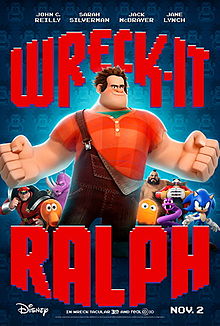
Wreck-It Ralph Movie Poster
I’m an animation geek. You probably know that by now. I also have played video games pretty much my entire life. (I read comic books and play DnD too, I’m basically der Ubergeek) So when I heard that Walt Disney Pictures were releasing a Roger Rabbit inspired movie about video games that would feature cameos from real video game characters, AND directed by Rich Moore, a veteran animation director from Futurama (my favourite show), I just about died. Wreck-It Ralph is one of three movies I was anticipating in 2012, the other two being The Hunger Games (meh) and The Hobbit (stay tuned). And, thank goodness, I wasn’t disappointed. Now, mind you, it’s not a perfect film. There were a lot of things I would have liked to have been done differently. But I was pleasantly surprised not only for the love letter to video games, but how Disney is slowly making progress towards some real representation of feminism. Here’s why.

SPOILERS FOLLOW HERE. FOR THE LOVE OF GOD, IF YOU HAVE NOT SEEN THE MOVIE YET, DO NOT READ FURTHER.

  • I tend to hate movie trailers, as I find them either to misrepresent the film, or spoil stuff I’d rather be surprised on. (How many times has a film put its best jokes in the trailer, leaving only the so-so ones unspoiled?) It must suck for filmmakers to watch their films be marketed so deceptively. So what I noticed with the trailers for Wreck-It Ralph is that they made it seem that the film was entirely about the two male protagonists, Ralph and Felix, and the video game cameos. The two female protagonists, Vanellope von Schweetz and Sgt. Calhoun, have maybe a few seconds of dialogue in each trailer, though at least it’s obvious Vanellope is meant to be a major character. The trailers do misrepresent the film in this case, since there are four protagonists and one villain, and the cameos are just that: cameos. Seriously, marketers, would you knock it off with trying to conceal that films sometimes have women in them? I promise you, a film will not instantly fail if the Girl Alarm goes off. It’s ridiculously stupid that The Princess & The Frog was considered a failure just because it didn’t make as much as Alvin & The Chipmunks: The Squeakquel did, and the blame was placed on Tiana being a woman. It made over $260 million! THAT’S NOT A FAILURE! You know what IS a failure? A MOVIE WITH THE WORD ‘SQUEAKQUEL’ IN THE TITLE. Anyway. Moving on.
  • The script has two writers, Jennifer Lee and Phil Johnston. Hooray! A female screenwriter! And you can tell, since the two female protagonists are really well written. Sgt. Calhoun is my particular favourite, because she does not fall into a traditional gender role. Yes, she dresses in the traditional white wedding gown and veil for her wedding scenes, but for the rest of the time, she’s a no-nonsense butt-kicker. There’s a lot of speculation that she’s based on the female version of Commander Shepard from the Mass Effect series, and I can definitely see where that’s coming from. According to TV Tropes, Sgt. Calhoun was originally written as a male character, but Rich Moore thought that would be too boring. And he’s right! Commander Shepard is famously a character you can play as either male or female, but most (enlightened) people feel that “FemShep” is the better written and better voiced character. What both characters have in common is that they are tomboyish military geniuses in positions of leadership (They also shoot aliens a lot too, that’s important), and this is important because most military games (and first person shooters) are so very masculinized. A woman being a leader, especially in a traditionally masculine field like the military, is subversive – how far video games and films have come, but how far they still have to go. But kudos to the film for bucking tradition.
Some racers from the Sugar Rush world at the starting line
  • Speaking of tomboys, Vanellope van Schweetz contrasts with her origin game, Sugar Rush, in a very interesting way. Now, notice that Sugar Rush is explicitly a game meant for girls – it’s pink, it’s cutesy, it’s got an almost entirely female roster of players. (King Candy being one of the few males, and not matching the other character designs, is your first clue that he doesn’t really belong there) I see the representation of Sugar Rush as an affectionate parody of how games for girls tend to be designed. My favourite console of all time is probably the Nintendo DS, and anyone who owned that system knows how frustrating many of the “shovelware” games were, most of which were cheaply made games meant for girl players. How can you tell they were for girls? Why, because they were about fashion, shopping, weddings, babysitting, cute pets, and cooking! (Gag.) Anyway, getting back to Sugar Rush, what sets this game apart from other traditional “girl games” is that it’s obviously meant to be really good. And I won’t lie, of all the original games written for this movie, Sugar Rush is the one I wanted to play the most. It’s also a little subversive in the gender role department in that it is a racing game. Some girls like cars too, whoda thunk it?
  • To get into Vanellope’s character, notice how very casual she is compared to the others. Her only real indication that she’s from a candy world is that she’s got a bunch of candy stuck in her hair. This is why she initially appears as an outcast – she’s not traditionally feminine like the others, nor is she explicitly candy-themed. But she loves racing just as much as the others, and not only (re)learns how to race, but how to manipulate her glitching to give her a distinct advantage. At the end, when it’s revealed she’s actually Princess Vanellope, the true ruler of Sugar Rush, she’s regenerated in a poofy pink dress and crown. It’s typical that a girly game like Sugar Rush WOULD have a Princess character. Then she does possibly the most subversive thing I’ve ever seen from a Disney film: She rejects the Princess label. She takes the dress off, saying that her tomboyish outfit with the green hoodie is the real her, and that she’d rather be President than Princess. Now what this is saying is that she’d rather be the leader based on her own merits, not on her birthright (or marriage). And that it’s pretty silly for her still to be a Princess when there’s obviously no King or Queen in the game. And think of it. A Disney film has a character who says she DOESN’T want to be a Disney Princess.
Ralph at the support meeting for video game villains
  • Another thing I liked in the film is that the gamer in the arcade is shown to be a young girl. Hell. Yeah. And not only that, she has a genuine interest in ALL the games in the arcade, not just the girly ones like Sugar Rush. In fact, she doesn’t even get to play it because there are two teenage boys hogging the game and planning to play it all day. Gee, teenage boys not letting a girl play a video game with them, where have I heard that before? Actually, come to think of it, teenage/adult males usurping entertainment explicitly meant for young girls, where have I heard THAT before? *coughcoughBroniescoughcough* But this same girl plays a retro game like Fix-It Felix Jr., and the modern FPS Hero’s Duty, in the same afternoon. This shows that female gamers play games of ALL types, not just the games designers (and their intended male customers) “think” we should be playing. And they make it clear that the female gamer is a regular at the arcade. How I wish there was an arcade near me that I could be a regular at. It was an obvious choice made by the filmmakers to have the gamer be depicted as female, and it’s such a breath of fresh air because almost every other media depicting video games almost always assumes that the player is male. We exist, people! Get over it already! (And while you’re at it, stop calling us Gamer Girls. The sexist moniker is one instance where alliteration is not welcome)
  • The relationship between the male and female protagonists is also fairly interesting. Ralph and Vanellope are the two main leads, but explicitly do NOT have a romance. At any rate, he’s more than twice her age, so that’d be really gross. What they have is a platonic friendship that has a big brother-little sister dynamic. Hey, a platonic friendship between a male and a female, imagine that! Now, the second leads, Felix and Sgt. Calhoun, DO have a romance. But this is another interesting depiction of male/female relationships, because Felix is almost kind of feminine in contrast to the almost masculine Sgt. Calhoun. Once again, we get a rejection of traditional gender roles. What is also important is how their attraction to each other also defies tradition – Felix is attracted to her almost instantly, marveling at her “high definition” graphics. And, of course, Sgt. Calhoun does not meet the standard definition of beauty. (Apparently she has an impossible hourglass figure, but I didn’t notice it – I do not always have my feminist film critic goggles on) At any rate, Felix likes her anyway, AND appreciates her determination, resourcefulness and mastery of her job. She likes him because he’s kind and caring, and does not mind that she’s almost twice his size. Women dating shorter men is STILL a social taboo for some reason, as if a person’ height has anything to do with what kind of personality they have. So hey, well done once again, movie.
Ralph offers some Pac-Man food to homeless video game characters
  • Now as I mentioned earlier, the movie does have a few flaws. We don’t get a Bechdel Test pass, but there is some justification plotwise for this, since each pair of protagonists (Ralph and Vanellope, Felix and Sgt. Calhoun) has their own side story that run parallel to each other right up to the end. Of course, passing the Bechdel Test does not determine if a film is good (and vice versa), nor does it immediately indicate whether a film is feminist or not. EDIT: seaofkittens has rightly pointed out that Vanellope and the other racers (mostly Taffyta) DO have conversations during the second act and the finale. So we do get a Bechdel Test pass, hooray!
  • There are also no racial minorities in the main cast at all, we can only count some minor speaking parts – the black General at the end of the Hero’s Duty game, who only appears in one scene, and if we consider the cameo characters from Japanese games to be “minorities.” That’s kind of inexcusable, movie. This is unsurprising given that it’s a kid’s movie, but there’s also no LGBTQ representation in the movie’s characters. However, we do have LGBTQ representation in the cast via the casting of Jane Lynch as Sgt. Calhoun. (Who was obviously always meant to play her since she looks just like her) And, once again, the main character is a white guy. He’s technically not a human, but he’s still white and he’s still a dude. The script is original, but it’s not really funny. The only time I laughed out loud was the bit with the Oreos doing the Winkie chant from The Wizard of Oz. They also spent way too much time in the Sugar Rush game (something like 2/3rds of the movie) – I would have liked to see other game locales. 
  • EDIT: A commenter reminded me that there is one scene in the 2nd act that is meant to be funny but is really very offensive. When Sgt. Calhoun and Felix are trapped in the quicksand, Felix persuades Calhoun to repeatedly hit him in order to make the Laffy Taffy vines laugh so hard they can be used to stretch out of the quicksand. Look, Disney, domestic abuse isn’t fucking funny. It doesn’t matter that he asked her to do it, it doesn’t matter that it’s a woman abusing a man (in fact, normalization of woman-on-man domestic abuse is a huge societal problem), and it doesn’t matter that he can instantly heal the effects. Your audience is young children, and they’re learning that a woman repeatedly physically abusing her soon-to-be-husband is not only acceptable, but funny. Don’t tell me that “woman beats the crap out of man” was the only possible solution to getting out of the quicksand.
  • Offensive domestic abuse jokes aside (let’s have a director’s cut excising that scene), it’s a very well made film, and fellow gamers like myself are basically going to geek out the entire time, so I do recommend it, albeit with some caution. Presuming that there will be a sequel, I really hope they include some minority characters in the cast next time, and never ever include a domestic abuse joke again. It’s 2012, we can do better than this.
Myrna Waldron is a feminist writer/blogger with a particular emphasis on all things nerdy. She lives in Toronto and has studied English and Film at York University. Myrna has a particular interest in the animation medium, having written extensively on American, Canadian and Japanese animation. She also has a passion for Sci-Fi & Fantasy literature, pop culture literature such as cartoons/comics, and the gaming subculture. She maintains a personal collection of blog posts, rants, essays and musings at The Soapboxing Geek, and tweets with reckless pottymouthed abandon at @SoapboxingGeek.