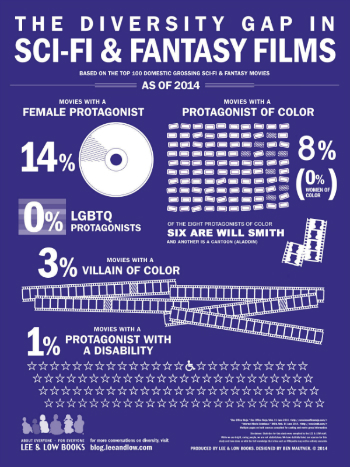
Examining the top 100 domestic grossing sci-fi and fantasy movies as reported by Box Office Mojo, the study finds that only 14 percent of the movies feature a female protagonist and only 8 percent feature a protagonist of color.
This is a guest post from LEE & LOW BOOKS.
As moviegoers flock to theaters this weekend to see Lucy and Guardians of the Galaxy, a new study released by children’s book publisher LEE & LOW BOOKS illuminates the dramatic lack of diversity in top-grossing Hollywood blockbusters in the science fiction and fantasy genres. Examining the top 100 domestic grossing sci-fi and fantasy movies as reported by Box Office Mojo, the study finds that only 14 percent of the movies feature a female protagonist and only 8 percent feature a protagonist of color.
Click for larger image.
The study also finds that no movies on the list feature a woman of color as the protagonist; lesbian, gay, bisexual, and transgender protagonists are likewise absent. Only one movie (Avatar) features a protagonist with a disability. Perhaps most surprising, the study reports that only two actors of color have appeared in lead roles: Will Smith, who plays six out of the eight protagonists of color, and Keanu Reeves (The Matrix Reloaded). The last protagonist of color is Aladdin, a cartoon character voiced by a white actor.
“The statistics are certainly striking, especially since sci-fi and fantasy belong to a genre that prides itself on creativity and imagination,” says Marissa Lee, co-founder of the international grassroots organization Racebending.com, which is dedicated to furthering equal opportunities in Hollywood and beyond. “Hollywood has managed to market some weird stuff, like a tentpole movie about talking teenage turtle martial artists, or cars that change into space robots. I don’t buy that when it comes to marketing diverse leads, suddenly this giant industry can’t do it.”
Imran Siddiquee, director of communications at The Representation Project, a movement that uses film and media content to expose injustices created by gender stereotypes, says Hollywood blockbusters are rarely accidental. “Just look at the top ten films in each of the last five years: nearly every single one had a budget of more than $100 million,” Siddiquee says. “Meanwhile, there hasn’t been a single film released this year starring a person of color with a budget of more than $50 million.”
For more than 20 years, LEE & LOW BOOKS has published award-winning children’s books that are “about everyone, for everyone” (including science fiction and fantasy under the Tu Books imprint). The company is committed to fostering conversations about race, gender, and diversity in publishing and beyond. For more information, visit leeandlow.com.
‘Guardians of the Galaxy’ is flat-out aggressively weird (up to and including its gigantic EFF YOU of a post-credits scene reminding us of the grand history of weird comic book adaptations). It has capitalized perfectly on this moment of comic book blockbusters and consumers’ particular faith in the Marvel Cinematic Universe. As a super-dork who loves her some space cowboys and space cowgirls and space nonbinary cow-wranglers, I just want to issue my most sincere and grateful slow clap. Way to take your moment, movie.
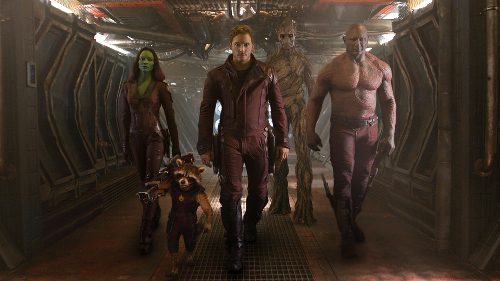
The cast of Guardians of the Galaxy
Marvel Studios made another gigantic pile of money last weekend with Guardians of the Galaxy. Even though it is based on a property that could kindly be referred to as “obscure,” the Marvel name plus a great trailer plus a genius week-after-ComicCon release = big opening weekend. Even for a movie about Andy Dwyer, a green badass chick, a beefy guy painted like a brocade tablecloth, a cyborg raccoon, and a sentient tree creature all getting their space opera on over a purple ringpop of a MacGuffin.
Guardians of the Galaxy is flat out aggressively weird (up to and including its gigantic EFF YOU of a post-credits scene reminding us of the grand history of weird comic book adaptations). It has capitalized perfectly on this moment of comic book blockbusters and consumers’ particular faith in the Marvel Cinematic Universe. As a super-dork who loves her some space cowboys and space cowgirls and space nonbinary cow-wranglers, I just want to issue my most sincere and grateful slow clap. Way to take your moment, movie.
Guardians of the Galaxy is so weird there are two chick on screen at one time!
And while Guardians of the Galaxy doesn’t make straight A’s on the feminist scorecard, as expertly detailed by my Bitch Flicks colleague Andé Morgan, it still represents an important moment for feminist fans of genre flicks. First, this is the first Marvel movie with a credited woman writer, Nicole Perlman. Male-dominated movie studios seem to be just now wrapping their heads around the idea that women actually pay to see movies, and that’s not necessarily moving them to cater to what the female audience wants. Getting more women on the creative end is vital, particularly women like Perlman who can make bizarre material palatable to mainstream audiences, because comic books sources are never short on w’s, t’s, or f’s.
“I’m a blue guy with a shiny mohawk and I still think that might be too weird.”
Guardians of the Galaxy must bear inevitable comparisons to Star Wars. Sidestepping their actual relative merits, these films collectively prove that the moviegoing public are, at large, huge dorks. If you have compelling characters and a decent level of whiz bang in your FX, we’ll happily embrace whatever nonhumanoid creatures and nonsensical mythos you hurl at us.
And with no disrespect meant toward the legions of FX engineers anonymously creating cinematic wonder for our consumption, it seems that the compelling characters are the tricky part; without those you’ve got a Transformers on your hands, or the film nodded toward in GotG’s post-credits sequence.
Too often, studios conflate “compelling character” with “white dude.” And yep, there’s a bright shiny White Dude at the center of Guardians of the Galaxy, acting as the sole representative of Earth to boot. But in case you haven’t caught my “wait, seriously?” drift yet, everyone else in the movie is some variety of alien including the dynamic duo of a CYBORG RACCOON and SENTIENT TREE.
Djimon Hounsou can play this alien dude but there’s still no T’Challa? Seriously?
All of which means that there’s no excuse left in the world to only make movies about the white dudes in comics. Don’t even begin to pretend with your “too unknown.” Please stop with your “not accessible to mainstream audiences.” And don’t think you’re going to get much further with Marvel Studio’s president Kevin Feige’s usual line about “timing” and “telling the right story,” because the time is obviously NOW to throw any and all Marvel pasta at the movie screen, and the “right story” is clearly irrelevant (I don’t think Guardians of the Galaxy got made because the studio just couldn’t sit on this brilliant yarn about a face-melting space ruby).
Unfortunately Feige is craftily spinning Marvel’s boon time as somehow making it even more difficult for them to release new properties:
I hope we [release a female-led film] sooner rather than later. But we find ourselves in the very strange position of managing more franchises than most people have — which is a very, very good thing and we don’t take for granted, but is a challenging thing. You may notice from those release dates, we have three for 2017. And that’s because just the timing worked on what was sort of gearing up. But it does mean you have to put one franchise on hold for three or four years in order to introduce a new one? I don’t know. Those are the kinds of chess matches we’re playing right now.
Well who would want to play a chess match with only white pieces and no queens? You need to shake up your board, Marvel. No more excuses.
The infamous Brat Pack of the 80s was and remains a huge cultural phenomenon. A term inspired by the Rat Pack of the 5os and 60s, the Brat Pack immortalized a group of young actors whose films had a tendency to overlap. Though the actors themselves disliked the moniker and some complained it hurt their careers, the term stuck.
Our theme week for August 2014 will be The Brat Pack.
The infamous Brat Pack of the 80s was and still remains a huge cultural phenomenon. A term inspired by the Rat Pack of the 5os and 60s (which included iconic names like Humphrey Bogart, Lauren Bacall, Sammy Davis, Jr., Dean Martin, Frank Sinatra, etc), the Brat Pack immortalized a group of young actors whose films had a tendency to overlap. David Blum coined the term in his New York article: “Hollywood’s Brat Pack.” Though the actors themselves disliked the moniker and some complained it hurt their careers, the term stuck.
Scholar Michael J. Palmer scathingly describes the Brat Pack as “the socially apathetic, cynical, money-possessed and ideologically barren eighties generation.” On the other hand, film critic James Thorburn claims that “Eighties teens drew instruction and inspiration” from Brat Pack films and “had their faith in society reinforced, and their moral fabric strengthened.” Author Susannah Gora weighs in, stating that Brat Pack films “changed the way many young people looked at everything from class distinction to friendship, from love to sex and fashion to music.” Whether identified as a positive or negative contribution to film, the Brat Pack is universally considered “among the most influential pop cultural contributions of their time.”
We’d like you to write about the Brat Pack. Examine a single film, a series of films, the actors’ careers or the effects that the Brat Pack had on an era. Some questions worth considering are:
Who constitutes the Brat Pack?
Did the grouping of these actors under the blanket term Brat Pack help or hinder their careers?
What did/do they stand for?
Was the Brat Pack influence good or bad?
How do these young actors and their works compare to the Rat Pack?
Feel free to use the examples below to inspire your writing on this subject, or choose your own source material.
We’d like to avoid as much overlap as possible for this theme, so get your proposals in early if you know which film you’d like to write about. We accept both original pieces and cross-posts, and we respond to queries within a week.
Most of our pieces are between 1,000 and 2,000 words, and include links and images. Please send your piece as a Microsoft Word document to btchflcks[at]gmail[dot]com, including links to all images, and include a 2- to 3-sentence bio.
If you have written for us before, please indicate that in your proposal, and if not, send a writing sample if possible.
Please be familiar with our publication and look over recent and popular posts to get an idea of Bitch Flicks’ style and purpose. We encourage writers to use our search function to see if your topic has been written about before, and link when appropriate (hyperlinks to sources are welcome, as well).
The final due date for these submissions is Friday, Aug. 22 by midnight.
We hear the song one more time in a moment that mimics the first, after Tom’s illusion is shattered. Instead of listing what he loves about Summer, Tom lists the things he hates about her, concluding with “It’s Like The Wind,” and yelling, “I hate this song!” The romantic illusions are finally cracked. This isn’t the movie he thought it was.
Tarantino’s vast knowledge of music is clear from the very beginning with Reservoir Dogs. However, it isn’t until the Kill Bill series when his soundtracks begin to drift away from pop and instead embrace more orchestral sounds like that of Ennio Morricone. Viewers need no knowledge of the genre to instantly recognize that spaghetti western feel. It’s that famous mix of Spanish guitar, orchestra, whistles, cracking whips, trumpet, flute and sometimes chorus that recalls images of Clint Eastwood clad in a green poncho and cowboy hat as the iconic Man with No Name.
The music throughout the film deals with the lost and rebellious feelings during coming of age for young women. The movie tells the story of these two individuals and how their lives were affected by fame, but underneath that is the coming of age experience for young girls realizing their power and sexuality within a culture that seeks to suppress them.
As evocative as the scene of the Puma Sisters doing their thing might be, and as culturally-charged a time as the release of Dominion Tank Police might have been, much of the success of this scene is owed to the music. “Hey Boy,” by Riko Ejima, is a haunting song that, while seemingly chaste in that it seems to be singing about dancing, captures something deep, deep in the soul.
Ugly singing; ugly make-up. ‘Les Misérables’ is deservedly known as the film that tried too hard to bum us out, and Anne Hathaway is known as the actress who tries too hard to be liked. But, isn’t it nice, sometimes, when somebody makes an effort?
Mike Nichol’s The Graduate has one of the most popular soundtracks of all-time. The songs reveal the dynamics of a character, theme, and a moment without the use of dialogue or a backstory, but simply through the lyrics of a Simon and Garfunkel song.
Love Jones does more than captures a moment in time in the late 90s. It creates the point when neo-soul established itself as the music of all of us with artistic inclinations, those of us leaving fantasies of teenage love affairs behind for a more realistic image of making a relationship work. And, yes, for some of us it brought about a sexual awakening that helped us accept that sex could exist outside a relationship if it’s truly wanted that way.
Lisa Gerrard of Dead Can Dance, one of the few successful women musicians who made the transition to film composer (she won a Golden Globe for her work on Gladiator), wrote and performed the music for 2002’s Whale Rider–and she didn’t have to date writer-director Niki Caro to do so. Gerrard might seem an unlikely choice: when I briefly worked in a women’s sex shop in the 90s, the store owner told me not to play Dead Can Dance on the sound system because they scared away customers. But Gerrard’s score for Rider does what the best movie music is supposed to do: reinforcing the drama of the film without calling unnecessary attention to itself.
Zeffirelli’s Romeo and Juliet is a tale told by the older generation. Luhrmann’s Romeo + Juliet is one told by “unfaded” youth. When Des’ree was singing “Kissing You” as Romeo and Juliet kiss (and oh, how they kiss), she is singing with deep longing and pain. When Glen Weston sings “What is a Youth?” he sings at Romeo and Juliet, about how youth–and female virginity–fades.
That Thing You Do! with its sly humor, strong performances and ultimately heartwarming romance makes for satisfying viewing. It’s a meditation on the tension between art and commerce that manages to acknowledge what can be good about temporary fame. It’s also a squeaky-clean antidote to sordid, drug-filled “Behind-the Music”-type stories both fictional and real.
My attachment wasn’t about Elle Woods or embracing hallmarks of traditional femininity that get belittled by western mainstream society (that would come later). I was all about lyrics like, “That’s not the way/ Nice girls behave/ Oh yeah I know/ You told me/ It’s not your choice/ I have a voice/ I guess you just don’t hear me.” It spoke to me on a spiritual level.
I’m a lot older now and I still squeal with excitement when Girls Just Want to Have Fun comes on. When it showed up on Netflix my daughter and I watched the movie over a dozen times. We would take “supreme silly” dance breaks whenever the music would play and when the Netflix purge occurred we found a DVD copy (OK we got two in case one got scratched or lost) of our very own on Amazon so that we could continue this tradition at will.
The Lost Boys is a classic 1980s vampire flick directed by Joel Schumacher. It is as famous for its soundtrack as it is for its content. The entire film in fact is exemplified in its main theme–“Cry Little Sister,” by G Tom Mac–from the typical horror themed sections to its classic 80s rock moments down to its choral moments. These sections sum up the film almost perfectly.
‘That Thing You Do!’ with its sly humor, strong performances and ultimately heartwarming romance makes for satisfying viewing. It’s a meditation on the tension between art and commerce that manages to acknowledge what can be good about temporary fame. It’s also a squeaky-clean antidote to sordid, drug-filled “Behind-the Music”-type stories, both fictional and real.
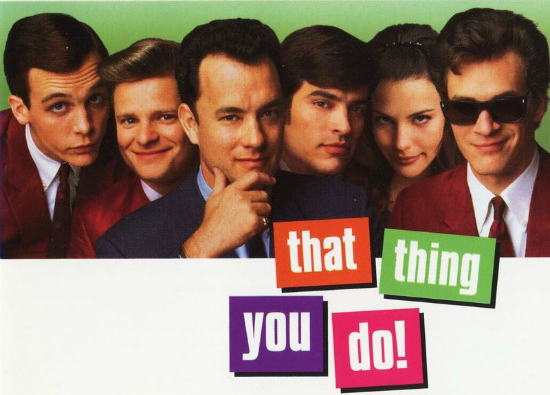
That Thing You Do! movie poster
This guest post by Lisa Anderson appears as part of our theme week on Movie Soundtracks.
What makes a film’s soundtrack memorable? Some beloved films, such as Pulp Fiction, pull together varying songs to capture the essence of a film, while others, like O Brother Where Art Thou? have artists covering existing songs specifically for the movie in question. That Thing You Do! (1996) took a novel approach somewhere in the middle. Writer/director Tom Hanks collaborated with others to create original songs in the style of various musical genres of the time and record them under the name of fictional musical acts from the movie. Despite its initial popularity and the success of the movie, the resulting album has fallen into relative obscurity, but I believe it still holds up.
The movie itself tells the story of a fictional “One-Hit Wonder” band from 1960s Eerie, Pennsylvania. Young Guy Patterson, played by Tom Everett Scott, is asked to sit in with a band for a local contest after their usual drummer (Giovanni Ribisi in a bit role) breaks his arm. Guy brings a new tempo to the band’s signature song, “That Thing You Do!” and also gives them their new name: The Oneders, which is pronounced “Wonders” but hilariously mispronounced “Oh-nee-ders” on multiple occasions.
Guy Patterson: drummer extraordinaire
The pepped-up version of “That Thing You Do!” becomes a hit, and the Oneders go from local radio play to the state fair circuit to the Billboard charts and national TV. Along the way, they have help from Andrew White (Tom Hanks), their manager with the fictional Play-Tone records, and Faye (Liv Tyler), the lead singer’s mistreated girlfriend, after whom Guy pines. Success turns sour, as it inevitably must (at least in the movies), but not before the audience is treated to many great songs that sound like they’re lifted straight from the 60s.
As the film opens, we hear “Lovin’ You Lots and Lots,” by the Norm Wooster Singers — a shout-out to the tame, almost muzak-like sound that’s about to be supplanted by rock ‘n’ roll. As the Oneders play gigs, we hear them perform not only “That Thing You Do!” (of course), but also “Little Wid One,” “Dance With Me Tonight,” and “All My Lonely Dreams.” The first two are up-tempo 1960s rock, while the latter is a slow ballad of the sort that the lead singer, Jimmy, apparently has a proclivity for. His post-Oneders band, the Heardsmen, also has two songs on the soundtrack: “She Knows It” and “I Need You (That Thing you Do),” although the latter is also attributed to the Oneders.
It’s when the Oneders go on a state fair tour with other Play-Tone artists that the music gets even more varied. “Hold my Hand, Hold my Heart” by the Chantrellines captures the sound of Black all-girl groups such as the Supremes. “Mr Downtown,” by Freddy Fredrickson, combines a lounge-lizard sound with the feel of a James Bond title song and a dash of Raymond Chandler. Diane Dane sings in the tradition of female soloist torch singers on “My World is Over.” The Vicksburgs, a rock band much like the Oneders, alludes to the era’s fascination with the automobile in “Drive Faster.”
The world of the Oneders is full of instrumental music, too. “Voyage Around the Moon,” by The Saturn 5, is a spot-on homage to surf music. Cap’n Geech and the Shrimp Shack Shooters provide the sound for the Beach-movie phenomenon in “Shrimp Shack,” and are portrayed by the Oneders in a metafictional movie. Not least of all, Del Paxton, Guy’s favorite jazz musician, performs “Time to Blow.” My only regret is that “I am Spartacus,” Del’s Jam session with Guy, didn’t make the cut.
The movie presents some interesting challenges to those interested in social justice analysis, and it’s hard to say whether that’s a weakness of the script or due to the restrictive cultural environment in which the story takes place. The only named Black characters are somewhat stereotyped — the sage Jazz musician Del and Lamar, the cheerful hotel concierge. But Guy expresses a deep respect for specific Black musicians on several occasions, and the movie seems very conscious of how much American music owes to Black musicians.
The movie does less, in my opinion, to redeem its depiction of women. Most of the female characters seem shallow and hyper-focused on their romantic relationships, with the exception of Faye, who is also very relationship-focused, but is given more substance and seems more genuinely interested in music. Unfortunately, this sets her up as an Exceptional Woman — the kind who you know is better than the rest because her friends are all men — and the movie only passes the Bechdel test by a brief early exchange between her and Guy’s girlfriend. She could have more agency in terms of her relationships, too, but the movie does a nice job of contrasting how Jimmy treats her with how Guy treats her. (On a more subversive note, “Little Wild One” is basically all about the sexual double-standard.)
Liv Tyler as Faye in That Thing You Do!
In the end, Guy must reconnect with his his love of making music in order to decide what to do with his life after the Oneders. That Thing You Do! is not the least predictable movie ever, but with its sly humor, strong performances and ultimately heartwarming romance makes for satisfying viewing. It’s a meditation on the tension between art and commerce that manages to acknowledge what can be good about temporary fame. It’s also a squeaky-clean antidote to sordid, drug-filled “Behind-the Music”-type stories, both fictional and real.
The soundtrack to That Thing You Do! was released by Epic Records under the name of the label from the movie, Play-Tone Records. Hanks later spun off Play-Tone as his own label, to release other movie and television soundtracks, including Bring It On and the soundtrack to The Sopranos. Almost 20 years later, I remain impressed by the quality of the songs and how closely they imitated the genres of the era, and I heartily recommend both the movie and its music.
This is not an article that will chronicle empty mother characters. This is for all the badass mamas out there—the honest mother roles that women have nailed. Hopefully this will present a case for why we need a million more. Here’s to the female characters who have outlived the digital revolution and will continue to. Characters that live with us and remain faulted heroes. And here’s to the women who made them so electric.
Women have been speaking the hell up about gender in Hollywood this year and it’s been an awesome uprising to see. There has been an outpouring of voices across multiple demographics in media getting aggressive about the lack of opportunities available in all of its platforms.
What I find challenging, though, is the near constant focus on scarcity—the highlighting of women missing chances to shape film and media.
Rather than dive into the dark abyss of what feels a regression of women’s roles in the world, I decided to focus this article on what is working. On our successes. It’s much easier to model our creative designs and ourselves after things that we can see. So, if I had a beer right now, I’d pour it all out for my female homies who have trail blazed contemporary cinema. Here’s to the women who are “crushing it” in complex roles, who take every opportunity on screen to serve as their own victory of what can be done.
Last week I went to see this summer’s hot blockbuster Dawn of the Planet of the Apes. Now I will fully admit that this black and white, Italian Neorealism nerd fully enjoyed the ride. Much to my surprise, the film actually had me thinking of Shakespeare and Greek tragedy because— in terms of technicalities of story and character structure— they pulled some classic tricks out of the bag and that’s always cool with me. But during the movie there was one note that kept hitting the wrong key. Can someone, anyone, please explain why Keri Russell had only a one line backstory (that she lost her child as the Simian Flu spread) but then was never touched on again in the film? She was prescribed the role of mother, lone survivor, who clings to others and is a surprisingly talented nurse on a whim. But where in the film did she represent what a woman who has lost her child in a bleak new world might actually be like? There was a human being missing in her character.
(Also brief aside, ladies we’re not really going to survive the apocalypse based on the ratio presented in the film. Because, uterus.)
Keri Russell in Dawn of the Planet of the Apes after walking into ape territory
This article is not one that will chronicle those empty characters. This is for all the badass mamas out there—the honest mother roles that women have nailed. Hopefully this will present a case for why we need a million more. Here’s to the female characters who have outlived the digital revolution and will continue to. Characters that live with us and remain faulted heroes. And here’s to the women who made them so electric.
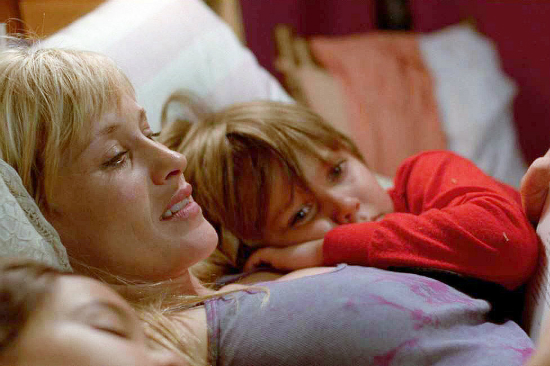
Boyhood is, by logline and poster art, a film about a boy. But I was not alone in walking out of the theater thinking, “Patricia Arquette, you are a baller.” She is undoubtedly the silent hero of the film. From the start, she’s energetic, imperfect, driven, smart (but not genius) and loves her kids even though she wants nothing more from them than to go the hell to bed. She was a single mom who worked hard, got tired, got things moving in her life, and kept on. We’ve seen the foundations of her role a thousand times. (I will hold my comments about any Tyler Perry rendering of real life.) As the film evolved, she made mistakes; her body changed; at times she was involved with her kids and at times she was distant. What to me makes this a successful female role is that if you were to remove the rest of the cast from her, she still has an identity. Motherhood is a part of what she does in the same way that being married or single is a part of what she does. But stripped of supporting cast, she remains a real person with ambitions that grow internally and thoughts that are driven by her own needs and wants.
You see, there was always a storyline that belonged privately to her. She was the master of her own life and the force behind her children’s. When they grew, she grew too. She was very much a mother character AND an individual. It’s roles like these that are needed time and time again in the process of redefining the women we want to see on screen. She is multidimensional and therefore, truthful. (And, yes, I realize the film spans a very real 12 years in the world but even so. ) Kudos to Arquette for rocking the mom jeans like a warrior for 12 years.
Mother and individual: Patricia Arquette in Boyhood
Definitely more overbearing but equally complex was Melissa Leo’s character in The Fighter. She was so nuanced. She got violent, volatile, and was packed with emotion. While she was unpleasant at many points in the story and her motivations were often outwardly selfish, she was honest. It was a straightforward portrayal of a mother not wanting to be outdone, even by her own children. She channels her own life through them and while this may not be a method condoned by any parenting books, she was very much alive and outspoken—faulted and capable of deep love. Again, if robbed of the other characters in the story, she was still a complete human being. There was nothing sexy added to her and yet her ferocious state of mind made her enigmatic and inescapable. (We need not bare tons of boob to get people to watch.) Her dynamic portrayal of a woman in a particular region and socioeconomic position, coupled with the hyper masculine surrounding pulls from her a wealth of complex emotions and decisions. And, let us not forget, unlikeable characters can still serve as outstanding representations of the depth of the female mind, soul, and existence. One of the elements ignored by women’s press this year is crowdpleasing. We want more opportunities. In every way. But I don’t care about crowd-pleasing characters. I go to the movies in search of truth. Give me that.
The pistol Melissa Leo in The Fighter
Taking it even farther into the realm of complex is Julianne Moore in her disturbingly on point performance as Amber Waves in Boogie Nights. Apart from the fact that the movie itself is genius, much of its success is brought out by the powerful performances of its all-star cast. Moore’s character is particularly wild to follow. She has the softness and natural nurturing quality of a mother who has always wanted to be a mother. She is a soothing source of support but this, in the world of Boogie Nights, of course becomes complicated and perverted by the fact that she is also sexually drawn to the very young Mark Wahlberg. Her attraction to him, their on camera sexploits, and her simultaneous motherly qualities make her immediately full of wonder, questions, and provocations.
Adding to that, she’s an exciting hot mess. The woman likes her cocaine as she proves when doing hearty lines with Heather Graham in the bedroom one fateful afternoon. While in this heightened state, if you will, her inner life comes bubbling out and she emotionally confesses about how much she misses her son. She may be all over the place and her nose miiiiight be white at the end of it but she’s given fair treatment by the filmmaker and audience alike. She is trapped by her history, moves in certain ways because of it and, like any fully formed human being, when in a vulnerable position (or totally f***ed up), her inner demons come out into the world. She misses motherhood and longs for her child. It’s a part of her wiring and yet she continues to live outside of it. A hot mess with a real history—it’s a beautiful, vital performance. She embodies multiple elements of a woman in the world in this time and place and she won’t let you look away from it.
Julianne Moore before the infamous coke binge in Boogie Nights
Compared to the Hollywood backup female roles we usually passively sit through, not one of these roles and not one of these women has created as a silent, flat, disturbingly calm character. That is an untruthful portrayal in this spectator’s opinion. They came out screaming. Their exuberance breathed into these will written roles the fiery heat of a person with a true life, true purpose and fluid identity. These are the kinds of roles that make more room for women to prove that we thrive in the complex—that we are complex and that we want truth on screen.
Examples of female roles that kick ass exist. Women who will not let their roles become secondary exist. It’s been done since the beginnings of film. Alice Guy Blache’ didn’t take any shit and that was at the turn of the 20th century. She directed, produced and wrote more than 700 films. She was doing it then, and women behind and in front of the camera have done it ever since. It’s our job now, in 2014, to recreate what we can accomplish based on our current industry model and find ways to make sure that truthful performances enter the marketplace. Hollywood films have always had plenty of fluff roles. But they’ve always had standouts. We are still in this position. We have model characters who broke ceilings once before in storytelling and will again. So…carry the torch and rock on.
In case you need further encouragement: Eva Khatchadourian in We Need to Talk About Kevin, Ofelia from Pan’s Labrynth, Kym from Rachel Getting Married, Nina Sayer from Black Swan. Marnie, Briony Tallis, Thelma Dickinson, Kate “Ma” Barker, Marge Gunderson, Bonnie Parker, Shoshanna Dreyfus, Nikita. Judy Barton/Madeleine Elster, Amelie, Evelyn Mulwray, Blanche Dubois, Betty Elms/Diane Selwyn, Coffy, Mia Wallace, Lisbeth Salander, Jackie Brown, The Bride, Hermione Granger, Clementine Kruczynski and Annie Hall.
Like Costner said in The Untouchables, “Let’s take the fight to them, gentlemen.” (ladies)
Mara Gasbarro Tasker is a filmmaker based in Los Angeles. She’s currently working as an Associate Producer at Vice Media and has co-created the Chattanooga Film Festival, launching later this spring. She holds a BFA in Film Production from the University of Colorado at Boulder. She is directing a grindhouse short in April and is still mourning the end of Breaking Bad.
‘The Lost Boys’ is a classic 1980s vampire flick directed by Joel Schumacher. It is as famous for its soundtrack as it is for its content. The entire film in fact is exemplified in its main theme–“Cry Little Sister,” by G Tom Mac–from the typical horror themed sections to its classic 80s rock moments down to its choral moments. These sections sum up the film almost perfectly.
This guest post by Bethany Ainsworth-Coles appears as part of our theme week on Movie Soundtracks.
Spoilers Ahead
The Lost Boysis a classic 1980s vampire flick directed by Joel Schumacher. It is as famous for its soundtrack as it is for its content. The entire film in fact is exemplified in its main theme–“Cry Little Sister,” by G Tom Mac–from the typical horror themed sections to its classic 80s rock moments down to its choral moments. These sections sum up the film almost perfectly.
The film itself seems pretty simple; Lucy (and her two sons Michael [Jason Patric] and Sam [Corey Haim] move to Santa Carla to live with Lucy’s dad in Santa Carla. However, Michael falls in with a bad crowd and is seduced into being a vampire by David (Keifer Sutherland), the pack’s leader. There is of course more to it than this (a pair of vampire hunters, a small child, and a generic love interest), but that’s the main gist.
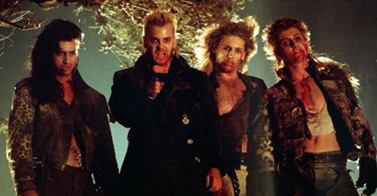
The vampire teens
“Cry Little Sister” links to this film perfectly, the way only the best movie themes do. I’m organizing this article in three subtitled sections, which employ quotes from “Cry Little Sister” in relation to parts in the film.
“Love Is With Your Brother”–Homoeroticism and Forgotten Women
In an article about The Lost Boys it would be a travesty to dare forget the amounts of male bonding and homoerotic tension. The vampires and their culture in particular is shown in this light with the androgynous (and gorgeous) David, the supposed leader of the gang as they steal and kill people to feed. He also seduces Michael into drinking the blood, thus beginning his transformation into a vampire. This is an interesting twist on the female seductress trope as seen in most vampire movies. This twist is best summed up Jeff Allard in his review: “Typically (especially today in our Twilight world), either Michael or David would’ve been written as a girl but in The Lost Boys you’ve got a male bringing another male into the fold.”
This is certainly true if we look at typical vampire stories–e.g. Edward turns Bella in Twilight, Dracula turns Lucy Westernra in Dracula, etc. The victim is often the woman and is seen as weak and inferior; by subverting this, Schumacher includes not only an equal playing field but also huge amounts of sexual tension. Especially as in most vampire novels, films etc. the transformation into vampire is often treated incredibly sexually. While this isn’t the first time a man has turned a man into vampire (Anne Rice’s Interview With a Vampire, which is also homoerotic) it is a very interesting occurrence that should not be avoided. David even takes him to his first feed on human blood.
Michael (Jason Patric) looking lovely
The women throughout this are mainly forgotten and depicted in two major roles: the sister or the mother. All the boys share a bond shown throughout the film. Through the vampires themselves, who are the “sons” of Max (Edward Hermann), to the actual brothers of The Frogs (Corey Feldman and Jamison Newlander) and of course are main brothers Sam and Michael. Most of the story revolves around Michael’s betrayal of Sam from trying to attack him when the first gets too great. Sam chooses to help him and save him from the Frogs’ vampire killing obsession. This is shown equally in the song “Cry Little Sister” with “love is with your brother,” which repeated several times throughout the song, reinforcing its importance in the piece.
“The Masquerade, Strangers Will Come”–Broken Families
Whilst brotherhood may be a strong point in the film, families themselves are not shown to be as sturdy. Lucy has had a messy divorce, which is the reason she and her boys have moved to Santa Carla. They themselves despite their non-functional new lives get along well and cracks only appear when Lucy dates Max and Michael becomes half vampire. However, this family is not the most interesting of the families. It’s not even the Frog family, who we only see very briefly as a whole unit.
Lucy and her family at the end
It has to be Max and the boys. Max is the head vampire but has lost control of his boys and is longing to find them a mother, a role he thinks Lucy would be just perfect for. He does genuinely love his boys though, especially when as he walks into the house the final time he sees David’s body.
However, this twisted family image also encapsulates the portrayal of women. During this film, both Star and Lucy take on maternal roles. Lucy, of course, is already a mother, and Star looks after Laddy (the child half vampire). They are both shown to be manipulated by the vampires into becoming family members and helping the group.
“Thou Shall Not Fall”–Innocence Lost
“Cry Little Sister” features a large section of choral vocals repeating religious-type phrases sung by what sounds like children. These are used to great effect during the final scene, where David is impaled and killed by Michael. During this section, once he is impaled, his face slowly regresses back to a child and how he was before he was turned into a vampire thus showing him as an innocent young boy rather than a dead monster. David’s death accompanied by “Cry Little Sister’s” faded choral section singing “thou shall not die” gives the audience just a glimpse of who he was before Max transformed him, probably like Michael against his will. The audience is presented with the horrible truth that David and all the vampires were just missing children shunned by their leader. In death for both David and Marko (Alex Winter, who is the first to be killed and youngest of the boys) they are taken back to being lost children.
David looks noticeably younger
“Cry Little Sister” is the perfect song for a fantastic horror movie. Whilst the movie certainly isn’t flawless, it really is an excellent take on the vampire genre (plus who in their right mind doesn’t like teen vampire with cool hair, leather jackets and motorbikes who lives in an abandoned hotel?). They are living the twisted teenage dream and the soundtrack portrays that perfectly.
Recommended reading: Boomer Beefcake and Bonding’s analysis of subtext in The Lost Boys
Bethany Ainsworth-Coles is a young writer from England who enjoys overanalyzing things and watching films. She tweets over at https://twitter.com/wierdbuthatsok.
I dreaded seeing this trite sexism applied to Saldana’s character, Gamora. To be fair, while she does require saving by male characters on multiple occasions, Gamora has moderately strong agency throughout, and her character is a load-bearing beam rather than a Trinity-esque distraction. If only her last lines could’ve been less deferential.
Guardians of the Galaxy(2014), one of the summer’s most anticipated blockbusters, was released today. It was directed by James Gunn and written by Gunn and Nicole Perlman.
Guardians stars Chris Pratt (Parks and Recreation) as Peter Quill, Bradley Cooper as the voice of Rocket Raccoon, Vin Diesel as the voice of Groot, Dave Bautista as Drax the Destroyer, and Zoe Saldana (Avatar, Star Trek) as Gamora.
Full disclosure: I’ve never read the comics and I knew nothing about the characters, their backstories, or their places in the Marvel Universe. I’m guessing that most viewers will share my ignorance. That’s OK, just go with it and let the tongue-twisters and blasters work their magic.
Make no mistake — Marvel Studios’ Avengers franchise is big business with plenty of big business oversight. Wisecracking animals, walking trees, pratfalls, space battles…it can be hard to fit in all of those beats while preserving some directorial distinctiveness. Fortunately, Gunn’s style comes through well and gives Guardians a joyful spark missing from its brethren (I’m looking at you, Iron Man 2). [Note: While writing this, I was unaware of the controversy surrounding Gunn due to the 2012 spotlighting of some awful, terrible, horrible, homophobic, misogynistic so-called satire that he spewed on his blog two years before before he was confirmed for GotG. I am now aware. The original post has long since vanished from the interwebs, but you can read about it here.]
Fans of Pratt’s Andy Dwyer will recognize the same genial man-child at the heart of Quill, but Pratt also shows that he can play the street smart pirate when necessary. More surprising is Bautista’s excellent performance as Drax. Athletes-turned-actors tend to have issues with timing and diction, but Bautista nailed it.
The most compelling characters in the movie are both animated. Rocket’s sullen abrasiveness belies palpable loneliness. Groot carries some of this sorrow as well. In the third act we learn just how strong the connection is between the two, and I was moved.
Quill is a thief and scavenger with a type of situational morality — sort of like a less violent, more personable Mal. He steals a blue orb that the Big Bad, Ronan (Lee Pace), covets. Pace lays the evil on thick, and it works. Ronan has genocidal ambitions, and wants to Death Star the peaceful planet Alderaan Xander. An aggressively shiny utopia, Xander looks like a cross between Dubai and a new outdoor outlet mall.
What unfolds is a standard space western, but with excellent performances, animation, and humor. It even has a female authority figure, Glenn Close (she’s the one with pieces of the set between her teeth) as Nova Prime, leader of Xander. You will be entertained. Aside from the somewhat clunky exposition sequences, I don’t really have much to criticize.
Except:
1. The first act features not one, but two disposable women. We learn that Quill suffers from parental abandonment. His father is absent, and his mother succumbs to cancer in the prologue. Later, Melia Kreiling portrays Bereet, a vaguely-alien humanoid whose key scene involves Quill shamelessly admitting to forgetting her existence even though they’d recently had sex. In the next scene (two of two for her), she speaks broken English and is servile to Quill; it struck me as an extraterrestrial variation of the Asian girlfriend trope. This was one of the few moments in the film where I actually didn’t like Pratt’s character. Unfortunately, this a-girl-in-every-spaceport sexism is leaned on for laughs throughout the film. Pratt is still playing a heterosexual white male lead, and Gunn won’t let you forget it.
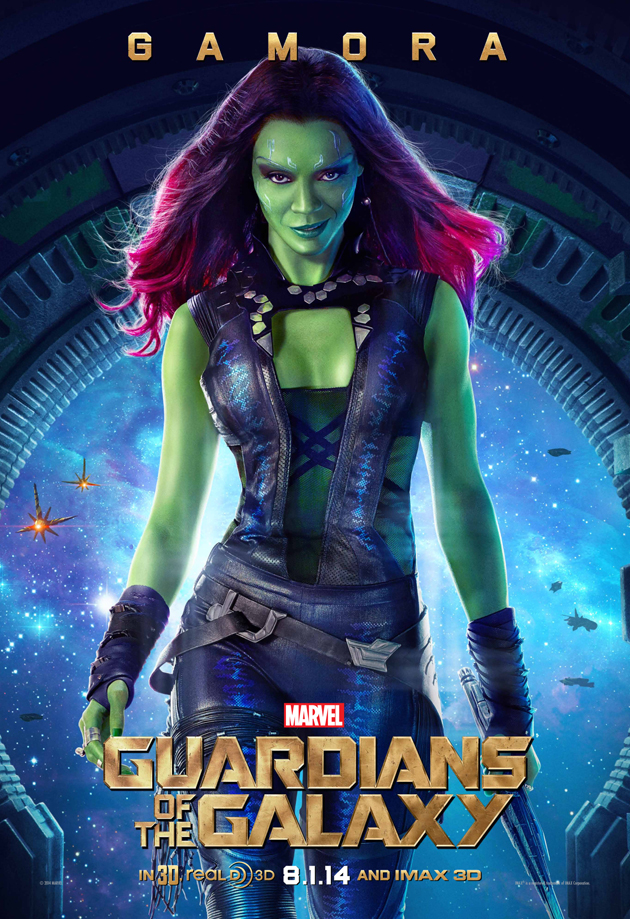
Saldana as Gamora.
2. I dreaded seeing this trite sexism applied to Saldana’s character, Gamora, the cybernetic assassin (why is it that sexy female aliens are always either green or blue?). When I saw her catsuit and a gratuitous booty shot towards the end of the first act, I felt that my fears were partly born out. To be fair, while she does require saving by male characters on multiple occasions, Gamora does display moderately strong agency throughout the film. Her character is a load-bearing beam rather than a Trinity-esque distraction. If only her last lines could’ve been a little less deferential.
More troubling are some of Saldana’s comments in recent interviews. For example, she told the Los Angeles Times that part of the appeal of the character was the chance to play someone “…so different from herself…”
“Gamora, she’s not feminine in the typical sense of how women are supposed to be. I feel like she has to melt that ice for you to find that little girl in there. She’s very tough, she’s able to relate to the hard talks of it all. When Quill comes at her with that luscious, ‘Hey baby’ [attitude], I’m pretty sure she’s throwing up in her mouth. I liked that, and I thought, ‘OK, that’s something I can incorporate of myself and just shave off a little bit of my femininity.’ Even though I like to believe I’m a tomboy, I’m very feminine, so I just always have to de-train myself and allow my masculinity to seep through because Gamora is much more masculine than I am.”
Her comments seem to imply that combat prowess and femininity are necessarily mutually exclusive, and that it’s not feminine to rebuff the advances of horny dudebros. Those connections elicited a little side eye from this critic.
3. There is a female character credited only as Tortured Pink Girl (Laura Ortiz). For some reason, Benicio Del Toro plays the sadistic Collector (kind of an older, huskier Ziggy Stardust), with whom Quill seeks to do business. We see that the Collector has enslaved at least two women; both are displayed in pigtails and pink jumpers. One is forced to wash the glass cage of the other. The woman in the cage is on her knees, bound and gagged with electric sci-fi ropes, a clear look of pain and fear in her eyes.
Quill and crew are less concerned with the fate of the women than with money and exposition. When the uncaged woman, Carina (Ophelia Lovibond), desperately attempts to use the power of an ancient artifact to free herself, she’s immolated instead. We’re left to assume that the other captive woman is also killed in the subsequent cataclysm (though a dog and an arguably misogynistic duck survive).
Despite these faults, the film is still just too good to skip. While its story and characters are hardly groundbreaking, Guardians of the Galaxy’s combination of dopey humor and frenetic action hits the sweet spot between stupid, exciting, and endearing.
I’m a lot older now and I still squeal with excitement when this film comes on. When it showed up on Netflix my daughter and I watched the movie over a dozen times. We would take “supreme silly” dance breaks whenever the music would play and when the Netflix purge occurred we found a DVD copy (OK we got two in case one got scratched or lost) of our very own on Amazon so that we could continue this tradition at will.
Janey and Lynne bond over Dance TV
This guest post by Shay Revolver appears as part of our theme week on Movie Soundtracks.
The year was 1985. A very young and impressionable Shay had grown quite fond of the moving picture shows. She watched anything and everything. Some of them only once, others she recorded and watched over and over again. She was particularly fond of movies with a great soundtrack. Her older sister’s old bootleg copy of Rock ‘n’ Roll High School with the defiant, audacious and energetic PJ Soles was at the top of her list.
Then one day she came upon a new girl-powered (and probably more age-appropriate) film to love. This film would seal her belief that music and moving images go together like PB and J. It would imprint on her that the tone of a film could be realized through music and create a process by which the older Shay would write every script and edit every frame to a song. It wasn’t the first film that helped her see this beautiful pattern and it wouldn’t be the last, but it would definitely be the most fun. It would be a movie watched over and over again by a feisty little girl after school almost every day for a month in her Catholic school uniform and triple laced LA Gears. She would down all of the Fun Dip, eat all of the popcorn, and drink all the iced tea in the fridge while hanging out on the couch staring up at the big screen TV watching Girls Just Want to Have Fun.
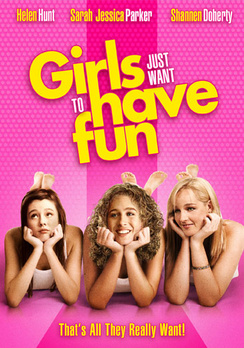
Girls Just Want to Have Fun poster
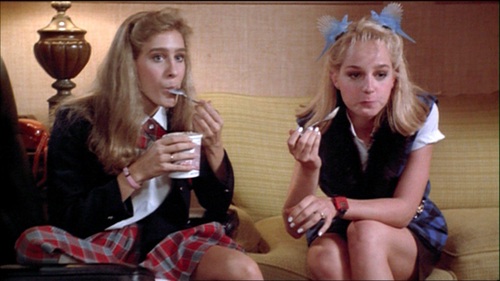
For those of you that haven’t had the awesome pleasure of seeing this film I’m going to break it down for you: Army brat Janey Glenn (played by a very young Sarah Jessica Parker) gets transferred to Chicago with her family. She meets Lynne Stone (Helen Hunt) at her new Catholic all girls school. They become instant friends over their love of Dance TV, a nationwide TV show. When the opportunity presents itself for them to audition to become dancers on the show they couldn’t be happier; that is, until Janey’s super strict military dad puts his foot down and says NO. The story could end there, but Lynne convinces Janey to do it anyway. A majority of the movie is spent with Janey going behind her father’s back to practice with her partner, thwarting (and retaliating against) the evil plots of her rich girl nemesis, Natalie , falling in love with her “wrong side of the tracks” partner Jeff, and finally standing up to her dad, doing things her way and making her dreams come true.
Janey, wishing she could be on Dance TV
I’m a lot older now and I still squeal with excitement when this film comes on. When it showed up on Netflix my daughter and I watched the movie over a dozen times. We would take “supreme silly” dance breaks whenever the music would play and when the Netflix purge occurred we found a DVD copy (OK we got two in case one got scratched or lost) of our very own on Amazon so that we could continue this tradition at will.
Striking back against Natalie
The thing about Girls Just Want to Have Fun is that it isn’t just about the girl power, female friendships, choosing your own destiny, standing up for what you believe in story line, it’s also about the music. In fact it’s so much about the music that it’s one of the few feature films whose soundtracks have their very own Wikipedia page. The music in the film isn’t just a soundtrack, it’s the story of their lives. It provides a freedom and excitement that is needed to propel the story (and in some ways the girls’ lives) along.
Each song plays at the perfect time in the story and the music gets more and more intense as Janey breaks out of her shell, pulls away from who her father and society expect her to be and becomes the person she wants to be, or has always been but, not had a chance to discover.
The music is Janey in some ways and follows her path throughout the film from the innocent pop music in the beginning as a naive and sheltered Janey begins to explore the world, to the woeful soul music as she faces disappointment, hopelessness, and obstacles on her way to accomplishing her goals, to the “punk” music that plays when she breaks out and begins to express and stand up for herself.
Each note, lyric, and melody seems carefully curated to what’s happening on screen. The soundtrack plays in the background like an extra character in the film. It goes so smoothly with the images on the screen that it seamlessly integrates with the film becoming way more than background audio.
Janey and Jeff go for the win
One of the things that makes this film and its soundtrack so memorable is that you feel every note. When the music plays you feel compelled to get up and dance along, which for the record is why it’s good that this film can be viewed in the comfort of your own home. The music even creates a freeing emotional release in the end when Janey’s father shows up to stop her from doing the final dance off to secure her spot on the show against her monied rival Natalie. As the song plays in the background you know before her dad does or even Janey does that despite seeing her dad, she isn’t going to be that good little girl she had always been. She’d grown up a bit and the defiance in the music shows that.
You could just feel through the music that she was going to acknowledge her father’s presence and do what she felt was right in her heart. She was going to dance, despite the consequences or incurring her father’s disapproval, disappointment, or wrath. When it was all said and done Janey grew up to the music and we all cheered and danced along with her. Even her hard-nosed father came around. He was proud of her and she had gained his respect.
Janey breaks free and flies at the finals
As an avid film (and music) lover, this was one of the films that inspired me. It was all about being bold, blazing your own path and figuring out who you are for you. The music didn’t overshadow the film or try to be hip by using the music of the “kids” and coming off as messy or chaotic. It helped tell the story in such a way that it became a part of the story and it taught me that sometimes you’ve just got to dance, a lesson that I gladly share with my little mouseling whether we’re watching this movie or just baking cookies in the kitchen. It also taught a nation of little girls that sometimes it’s OK to be different, to fight the system, to follow your heart, and let it lead you to your dreams. And in a world where girls are still often taught to be seen and not heard, to be obedient without question and to play nice, everything about Girls Just Want to Have Fun was a welcome wake-up call.
Shay Revolver is a vegan, feminist, cinephile, insomniac, recovering NYU student and former roller derby player currently working as a New York-based microcinema filmmaker, web series creator, and writer. She’s obsessed with most books, especially the Pop Culture and Philosophy series and loves movies and TV shows from low brow to high class. As long as the image is moving she’s all in and believes that everything is worth a watch. She still believes that movies make the best bedtime stories because books are a daytime activity to rev up your engine and once you flip that first page, you have to keep going until you finish it and that is beautiful in its own right. She enjoys talking about the feminist perspective in comic book and gaming culture and the lack of gender equality in mainstream cinema and television productions. Twitter: @socialslumber13.
My attachment wasn’t about Elle Woods or embracing hallmarks of traditional femininity that get belittled by western mainstream society (that would come later). I was all about lyrics like, “That’s not the way/ Nice girls behave/ Oh yeah I know/ You told me/ It’s not your choice/ I have a voice/ I guess you just don’t hear me.” It spoke to me on a spiritual level.
This guest post by Kathryn Diaz appears as part of our theme week on Movie Soundtracks.
I was 9 when Legally Blonde first sparkled in movie theaters. I didn’t understand what the Bend-and-Snap was all about, half the jokes went over my head, and I was only mostly sure that a sorority was some kind of real thing. What I did know was that “Watch Me Shine” by Joanna Pacitti was my new favorite song, like, ever.
Here was a song that felt commanding and fun, something that was opening a gate to me that my Mary-Kate and Ashley makeup set never did. I played “Watch Me Shine” in the car while my mom drove me to school every morning. I stumbled over the rapid-fire lyrics at the top of my lungs and whipped my pony tail back and forth with shameless enjoyment no matter how sleepy or cranky I’d woken up. At school, I replayed the montage over and over in my head. If I just thought about the song long enough, I was sure I would become as confident and fearless as Elle. When I met my challenges, I would march through them with determined glares and that song. If this was what the rest of Girl Power sounded like, I wanted to listen non-stop.
[youtube_sc url=”http://youtu.be/u5XRYBLfjhI”]
Studying never looked so fierce.
My love for the Legally Blonde soundtrack eventually expanded to include Hoku’s defiantly happy-go-lucky tune “Perfect Day,” “One Girl Revolution” by Superchick, and “We Could Still Belong Together” by Lisa Loeb. “We Could Still Belong Together” was, and still is, an unexpected win. Legally Blonde plays the song as Elle makes the trek from home to Harvard to kick off her quest to win back Warner, but the whole song is something of a give-away about the film’s real philosophy on love: couples that belong together are ones that let the partners be their imperfect, interrupting, complicated human selves without any fuss.
[youtube_sc url=”http://youtu.be/mdU40HDmkbg”]
Why yes, women can be in a relationship without walking on a perfection tightrope.
As I hit that sweet spot between anger and anxiety with the rest of puberty, “Can’t Get Me Down” by Lo-Ball climbed to the top of my favorites from the soundtrack. By this time, my life looked even less like the positive friendship-driven fairy tale Legally Blonde existed in, but my CD had transcended its origins. My attachment wasn’t about Elle Woods or embracing hallmarks of traditional femininity that get belittled by western mainstream society (that would come later). I was all about lyrics like, “That’s not the way/ Nice girls behave/ Oh yeah I know/ You told me/ It’s not your choice/ I have a voice/ I guess you just don’t hear me.” It spoke to me on a spiritual level.
[youtube_sc url=”http://youtu.be/Fzo1uqFS-jU”]
Much angst was set to this song.
One day some of my friends and I ended up pulling out our overstuffed CD collections and taking safety pins and paper clips to their surfaces. Scratching CDs, especially ones we’d had for a long time, was a common pastime whenever we felt “bored,” that heavy catch-all for everything we didn’t want to name or didn’t know how to. I didn’t have a lot of CDs in the first place, so my fun was usually in carving swirls and rain clouds over the discs everyone else had finished with, but that day I couldn’t get out of contributing something. I’d already pretended to complain about how much I hated my pink CDs. Surprisingly, my friends didn’t believe I had any, that they weren’t “me” and I was clearly making something up. This was true, but I was not about to correct them. My love for my pink CDs would stay a deeply guarded secret for a long, long time. Through the maze of 12-year-old peer pressure logic, I decided I had no choice but to show them something and dismantle the hell out of it.
I sacrificed my Princess Diaries soundtrack. It was pinker than pink and, more importantly, it was not Legally Blonde. Legally Blonde was hidden under my Evanescence album where no one would question my cool. I wanted to hold onto it more than I wanted to be approved of. My Legally Blonde soundtrack was important, even if that idea seemed ridiculous and bizarre.
I held onto it for as long as I could. When no one was around to listen, I made the CD the big mainstay in my Walkman. My favorite song circled through the tracks and my emotions fluctuated as much as the genres from track to track. It was my big, bolstering secret. But eventually I found other movies, other albums, and inevitably other means of listening to music. My head filled up with more ideas, more role models and anthems. I stopped worrying about having too many sparkles or not enough. By the time I lost my Legally Blonde soundtrack, I was more put out than crushed.
I was in college when I resolved to track it down again. I had finished my first Women’s Studies class, I had just bought a new iPod, and I wanted to party like it was 2001, or at least have a nostalgic dance session to commemorate my gateway ticket to feminism. I blasted all the old songs on YouTube and made my friends dance to “Perfect Day” with me.
[youtube_sc url=”http://youtu.be/84odSvKFrkY”]
This song still nails that “last day of term” feeling for me.
We were young women starting our lives for ourselves, and when I rocked out to cotton-candy light pop, I was going to do it without being ashamed of sparkles or silliness. I knew the Bend-and-Snap was a little problematic, at least one of the stereotypes employed for the side characters was unfriendly at best, and the movie that had lead me to my gateway ticket to feminism wasn’t perfect. But Legally Blonde was still about finding strength in yourself and female friendship and defying the patriarchy with style, and the sparkle-covered soundtrack was still bursting with a shameless power that made me feel like I could conquer the world. That was plenty of reason to shout, “watch me shine” just a few more times for me.
What started it all
Kathryn Diaz is a writer living in Houston, Texas. You can follow her at The Telescope for more of her work.
‘Love Jones’ does more than captures a moment in time in the late 90s. It creates the point when neo-soul established itself as the music of all of us with artistic inclinations, those of us leaving fantasies of teenage love affairs behind for a more realistic image of making a relationship work. And, yes, for some of us it brought about a sexual awakening that helped us accept that sex could exist outside a relationship if it’s truly wanted that way.
Love Jones movie poster
This guest post by Inda Lauryn appears as part of our theme week on Movie Soundtracks.
The summer of 2000. I share my extensive music collection with my friends. In this collection: a three-year-old soundtrack to a film I never saw in the theaters but caught on video in the dorm on a night that turned into a communal viewing. I and my summer buddies listen to this soundtrack so much that we even know the background noise to a spoken word poetry performance taken directly from the film, so when we watch the film on a bus trip to an amusement park, we not only recite the poem, but also the audience reactions. We have a great time and I have a personal memory associated with one of the best film soundtracks of the late 90s.
That film: Love Jones. The 1997 film has the distinction of providing the neo-soul generation with its soundtrack. Juxtaposing Lauryn Hill and Maxwell with The Lincoln Center Jazz Orchestra and the combination of Duke Ellington and John Coltrane practically captures the essence of the burgeoning “neo-soul movement” during the mid-1990s. As the unofficial neo-soul soundtrack, Love Jones also shares an honor with the classic Super Fly soundtrack by Curtis Mayfield: many who know the film and the soundtrack agree that the soundtrack is decidedly superior to the film. (A snippet of Mayfield’s “Give Me Your Love” even appears in the film set in his hometown of Chicago.) However, seeing the film again with nearly 20 years between its release and the present day gives me more appreciation for the film, what it captured during its time, and the soundtrack.
Soundtracks to Black-cast films have always been as important as the films themselves and often attracted some of the most popular acts of the day, much like the soundtracks for Jason’s Lyric, Panther, Waiting to Exhale, and The Best Man. In some cases, they are extensions of the story on film, letting the audience relive a moment in which the song plays a crucial part. In some ways, they are a form of fan fiction with tracks not found in the film still somehow becoming relevant to the story being told. Dionne Farris’ “Hopeless” playing over the opening montage of black-and-white photos depicting Black life in Chicago brings as much nostalgia to the listener as it does to Nia Long’s Nina Mosley as she laments the end of her engagement. It represents the state of Nina’s relationship with ex-fiance Marvin (portrayed by Khalil Kain) as well as her role as a photographer. The dialogue that introduces Larenz Tate’s Darius Lovehall and his friends (two of whom are portrayed by Bill Bellamy and Isaiah Washington) definitely draws its inspiration from the burgeoning spoken word scene that colored the Black coffeehouse scene before it was co-opted by the mainstream.
Nina and Darius on a date in Love Jones
Mellow and smooth, the Love Jones soundtrack creates that Black boho ambiance that permeated the flawed but still believable and enjoyable film. As a Black college student at an HBCU, seeing Black artists onscreen making a living as artists held a certain appeal even though my life was taking a drastically different trajectory at the time. But for me, the depiction of that lifestyle remains the most romantic aspect of it. The images of Nina and Darius heading off on their first date on his motorcycle (or scooter) is definitely a romantic image reminiscent of films such as Roman Holiday-only I’m seeing it with people who look like me. I’m seeing a Black woman wooed, looked at as if she could launch 1,000 ships and start a war between nations. I’m seeing a Black woman change a man’s life with the power of her existence.
Of course, in the romance genre, miscommunication drives the film, but it becomes irritating quite quickly. Seriously, the entire premise of the film relies on the understanding that Nina and Darius deny they are in a relationship, but rather they’re just kicking it. Interestingly, this uncertainty that things will work out in the end is actually one of the things I appreciate most in this film now that I’m in my mid-30s. But at least while watching Nina and Darius fumble around like teenagers for an hour and a half when I was in my early 20s, I got a depiction of a lifestyle few would achieve and a soundtrack that made it all worthwhile.
Furthermore, I saw Nina and Darius bond over music. Darius’ first meeting with Nina at The Sanctuary prompts him to rename his poem in honor of his newfound pursuit of the beautiful Nina. They meet again when Nina decides she needs an Isley Brothers CD and Darius tips her to a Charlie Parker track she’s never heard before. They go to a reggae club, The Wild Hair, on their first date, growing closer. The extradiegetic music works just as well. How many of us immediately think of the beautifully shot sex scene when we hear Maxwell’s “Sumthin Sumthin (Mellow Smooth)”? The jazz underscoring many scenes adds to the neo-soul, spoken word vibe permeating the film. The jazz score does more than create the background music all films use. It indicates sophistication, a film made for grown folks in an era when many Black films focused on coming of age or the second coming of Blaxploitation films.
Nina takes photos in Love Jones
In fact, the very essence of neo-soul comes together quite nicely in one collection. Lauryn Hill’s “The Sweetest Thing” gave us all that romance we wanted in our 20s: feeling the sensation of the kiss upon the collarbone and fingertips on the small of the back. Hill and the others in the neo-soul bracket gave us most of our music memories in our 20s. We were between enjoying our parents’ music that music such as Hill’s harkened back to and we were outgrowing the pop-radio oriented R&B of our adolescence that did not quite grow up when we did. Many of us first heard Duke Ellington’s and John Coltrane’s timeless duet “In a Sentimental Mood” on The Cosby Show, but the film brought it back to us in a new context, the rekindling of a romance between two young adults when Nina decides sex would cheapen a date that had been so perfect. (She was wrong by the way.) Cassandra Wilson’s incredible vocals on “You Move Me” evokes memories for the characters of what they lost and what they could have had if only they tried harder to make it work. Out of context for those of us revisiting the soundtrack, the sensuality of the track provides a perfect backdrop for one of those evenings.
Like many soundtracks of the time, Love Jones also includes songs not used in the film, usually to showcase new talent or to add more to the mood of the film. Trina Broussard puts a new spin on an old R&B staple and amazingly does not muck it up considering she covers a Minnie Riperton classic, “Inside My Love.” Admittedly, I heard her version before Riperton’s, but her version does the lyrics justice. The 20-somethings even got a taste of our adolescence with the Xscape cover of “In the Rain,” both because many of us first heard Keith Sweat’s version in our youth rather than The Dramatics and also because we grew up with Xscape (or Xscape grew up with us). While not used in the film, the song reminds us of the ways the rain itself added to the film at key moments, making Chicago an essential part of the film’s overall charm. In Chicago, we see Darius futilely running after the train to tell Nina goodbye as she heads for New York to pursue a career opportunity. In Chicago, we see Black communities going through their trials and tribulations in love and life.
Of course, the overarching theme of the Love Jones soundtrack is romance. But it is an adult romance differing from the lyrics we often heard in hook-up, club culture songs that still bang today. To borrow from George Michael’s assessment of his hit song “I Want Your Sex,” “It’s not about fucking. It’s about fucking within a relationship.” This is what Amel Laurieux sings about in Groove Theory’s smooth “Never Enough.” This is what Meshell Ndegeocello gets at with that below the belt bass line in “Rush Over” with Marcus Miller. It’s definitely what Cassandra Wilson croons about in her orgasmically magical “You Move Me.”
A shirtless Darius in Love Jones
Love Jones does more than captures a moment in time in the late 90s. It creates the point when neo-soul established itself as the music of all of us with artistic inclinations, those of us leaving fantasies of teenage love affairs behind for a more realistic image of making a relationship work. And, yes, for some of us it brought about a sexual awakening that helped us accept that sex could exist outside a relationship if it’s truly wanted that way. Of course, in the trajectory of a romance film, the relationship has to prevail. But there’s no judgment of Nina and Darius when they both tell themselves the other is just a temporary situation.
For me, the Love Jones soundtrack represents a trip back to my college days in New Orleans as much as it does a time when Black-cast films showed me images of my aspirations as well as an escape. It was my coming of age into adulthood and that awkward territory called relationships. It was the time when The Brand New Heavies began to speak to me more than Boyz II Men and other acts with hit machines behind them. The soundtrack represented the moment I entered the grown folks club.
Inda Lauryn has been previously published in Interfictions, Afropunk and Blackberry, A Magazine. She is currently working on a few fiction projects and blogs about women in music at cornerstorepress.wordpress.com.