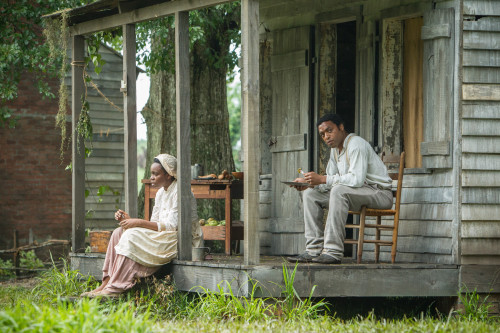
Normalizing the Black Family

When Solomon, Eliza, and her two children are both sold, she is sold away from her children. Their new slave owner, William Ford, (Benedict Cumberbatch), feeling guilty when he hears Eliza’s sobs of protests, tries to buy the children, but the auctioneer refuses to sell the them. William Ford takes Solomon and a devastated Eliza to his plantation, where she continues to cry on the journey to the plantation. When Ford’s wife, Mistress Ford, hears of new slave Eliza’s plight she callously responds, “Oh poor thing, well she’ll get over it in a day or two.”

This guest post by Atima Omara appears as part of our theme week on Black Families.

In 12 Years of Slave, the theme of family is a tie that binds throughout the story. While the film depicts the life of Solomon Northrup, a freeman captured and sold into slavery, and his struggle to get back to his life and his family. 12 Years also reflects the lives of other slaves he meets who too are separated from their families. 12 Years is very tightly focused on the systematic dehumanization of Black people in the American South during slavery. This film defines the subhuman view of the Black family in the antebellum South that remained pervasive post the Civil War and into the 20th Century where its effects have filtered into many films and TV shows.

12 Years A Slave is an autobiographical account told from the perspective of Solomon Northrup, after his capture into slavery. While sitting in his first prison, awaiting to be moved into the South, Solomon meets another slave, Eliza, who was essentially treated as a wife by her previous slave owner with whom she also has two children. After his death, Eliza and her two children are sold away and it is there, awaiting the auction block, she meets Solomon. When Solomon, Eliza, and her two children are both sold, she is sold away from her children. Their new slave owner, William Ford, (Benedict Cumberbatch), feeling guilty when he hears Eliza’s sobs of protests, tries to buy the children, but the auctioneer refuses to sell the them. William Ford takes Solomon and a devastated Eliza to his plantation, where she continues to cry on the journey to the plantation. When Ford’s wife, Mistress Ford, hears of new slave Eliza’s plight she callously responds, “Oh poor thing, well she’ll get over it in a day or two.”

TWELVE YEARS A SLAVE


Director Steve McQueen beautifully wove in the humanity of Northrup and the other slaves, which made their enslavement that much more heart-wrenching. When Eliza still sobs days later on the Ford plantation because she misses her children, Solomon tries to silence her. She chides him, “Have you stopped crying for YOUR children?!” He retorts, “They are as my flesh…..I survive…I will keep myself hardy until freedom is opportune.” And Solomon does, ingratiating himself to his Master, William Ford, for his work, he receives a violin in which he engraves the name of his wife and children. They are never far from his mind as he tries to desperately find ways to become a freeman again.

Eventually, because Eliza’s crying becomes to annoying to Mistress Ford, she is removed from the plantation. Mistress Ford’s dismissive comments and subsequent removal of Eliza from the plantation is reflective of the antebellum’s American South’s view of the Black person and the view of their family. There was the economic and biblical justifications for slavery, but eventually enslaving other human beings birthed an American ideology of race inferiority.  Nineteenth century US Senator John C. Calhoun famously said, “Never before has the Black race of Central Africa, from the dawn of history to the present day, attained a condition so civilized and so improved, not only physically, but morally and intellectually.”

In the minds of white slave owners and their supporters, slavery was a favor to Black people, who could not have lives of their own or feel loss or pain. This ideology is understandable when you consider the horror of what they were justifying. To acknowledge the humanity of Black people would have forced one to acknowledge that slavery was wrong.

Through the evolution of American film and later television, we see the variations of this view that the white slavers have of their Black slaves filter into the lens of white directors, producers, and writers of films and TV shows featuring Black people and their families.

The film that has the distinction of being the first 12-reel full motion picture film in America is D. W. Griffith’s Birth of a Nation in 1915. Commercially successful, the film was controversial due to its portrayal of Black men as unintelligent, barely human and sexually aggressive. The first talking motion picture in 1929 was Al Jolson’s The Jazz Singer, where Jolson performed as a white actor in Black face, recalling the minstrelsy

With those promising precursors films, films in the 1930s hardly shifted. With Gone with the Wind or The Littlest Rebel, audiences never knew the stories of the Black slaves who were supporting characters to Vivien Leigh’s Scarlett O’Hara or Shirley Temple’s little Virginia Carey. Scarlett’s Mammy (played by Hattie McDaniel) we know nothing about, whether she had husband, children, or siblings. Nor do we know much of Virgie’s Uncle Bill (Bill Robinson). Because Mammy and Uncle Billy do not need a family, because their duty is to serve their white families.

Untitled


From the 1930s to the 1950s, Hollywood’s “Golden Age,” these images of Black people and their families improve barely, especially when theaters refuse to show films with prominent Black leads. Look at the 1950s interpretation of Imitation of Life with actresses Lana Turner and Juanita Moore. At first glance, it is a story of two single women raising their daughters together. Lana Turner’s Lora is a struggling young actress with a daughter who befriends Sarah, the daughter of Juanita Moore’s Annie, who is a homeless Black widow. Because of the girls’ friendship, the women move in together. While you do see the humanity of Annie and the love she has for her daughter Sarah, you realize you don’t see much of Annie’s life outside of that. Annie becomes a maid to Lora and her daughter and is a momma to Sarah. Like Mammy or Uncle Bill, we know little of Annie’s friends, if she ever finds love again, in comparison we do see the love life of Lora’s, her friends, and her career become successful.

The height of the Civil Rights Movement in the 1960s and the conscience shift of the country raised awareness as to the plight and actual humanity of the Black American. With that it brought in some changes and new opportunities for Black characters in film. Actors like Sidney Poitier, Ruby Dee, Ossie Davis, Harry Belafonte, and others challenged the perception of the Black experience in film. In 1961, Black playwright Lorrain Hansberry’s play, A Raisin in the Sun, about a young Black man (Sidney Poitier) trying to find a better life for his family became a film. Behind the scenes it was a play that almost never happened, because it was a predominantly African American cast it took a long time to secure funding for its debut. And even with its final success on Broadway there was much argument between critics who were primarily white as to whether the experience was “universal” or particular to African Americans.

Untitled


While the movie industry addressed race glacially, television as a newer medium moved at a faster pace in providing more opportunities for Black family portrayal. In 1968, CBS debuted Julia, with Black actress Diahann Carroll as its lead. It was the first show to depict a Black woman in the lead of a show that was a non-stereotypical role. Julia was a single mother and nurse whose husband had been killed in Vietnam. Today, it’s considered “groundbreaking.” Then, critics (again mostly white) derided it for not being “realistic.” Used to seeing nothing but Black poverty on the news, critics held Julia up to that as the standard for Black American life. The Saturday Review’s Robert Lewis Shayon wrote that Julia’s “plush, suburban setting” was “a far, far cry from the bitter realities of Negro life in the urban ghetto, the pit of America’s explosion potential.” Other critics implied the show was a “cartoon.” Unsurprisingly, Ebony Magazine, whose magazine’s readership and staff are Black Americans, appreciated its significance in showing a “slice of Black America.”

The 1970s brought more Black family focused television; of significance was Good Times and The Jeffersons, both where productions from white liberal showrunner Norman Lear. The portrayals of the Black family vastly improved, if by virtue of the fact that they were getting time on major network television, some shows still would never entirely escape the stereotypical trope in the 1970s.

Good Times featured actors Esther Rolle and John Amos in the lead roles. They played Florida and James Evans, heads of a working class Black family who live in housing project in Chicago. Notably, African American writers conceived the idea and the initial script of the show Norman Lear picked up. Actors Rolle and Amos signed up for the project, interested in a regular series with a Black working class family at the center. Not too long into the show, one of the children of the Evans family, JJ Evans, became a popular character for his phrase “Dy-NO-mite” and his funny antics. As the show progressed, it increasingly focused on him and crazy antics, which recalled the days of Black minstrelsy shows in the early 20th century, where usually white actors in blackface exaggerated real-life Black circumstances in a cartoonish way and reinforced stereotypes of Black people. The Evans family, particularly JJ, became subject to the long line of stereotypical portrayal of African American family life much to the chagrin of actors Esther Rolle and John Amos. Behind the scenes Esther Rolle left the series in frustration and John Amos was fired.

Untitled


Lear’s The Jeffersons in comparison was an improvement upon Good Times, in that it showed a working class Black family, who made good and moved to the wealthy neighborhoods of New York. Even though the show took on political topics, it is notable for featuring more of the everyday life of this Black family with its colorful patriarch George Jefferson, played by Sherman Helmsley. The show enjoyed a successful 10-year run. In some ways, The Jeffersons was the grandfather of later Black family-centered shows like The Cosby Show and The Fresh Prince of Bel-Air, with Sherman Helmsley reprising his role as George Jefferson to appear on The Fresh Prince of Bel-Air.

As the 1980s dawned there were more Black family-centered shows like 227 and Amen, but one would be remiss in not mentioning the The Cosby Show in the 1980s, which came out of already established comedian Bill Cosby’s stand up act about his family. The Huxtables were an upper-middle class Black family who lived in Brooklyn. Cliff Huxtable (Bill Cosby) and Claire Huxtable (Phylicia Rashad) were the parents to their five children. The show was revolutionary for the Black family because it was distinct in featuring the everyday occurrences, drama, and humor of family life. The Cosby Show occasionally dealt with serious issues like dyslexia or teen pregnancy, but it was not a show that focused on racial politics; indeed, that may have been the point. Some criticized the lack of discussion around race or racial politics in the series, fearing that white audiences who embraced the show would consider “racism” a thing of the past. What is certain is that The Cosby Show was viewed as seminal in Black family portrayal on television. When it ended in the early 1990s, there was an influx of Black family-centered comedies that were greenlighted for major network television like In Living Color, The Fresh Prince of Bel-Air, Family MattersRocHanging with Mr. CooperSister, Sister, and the list goes on. Notably many of these shows had African American creators or writers, which allowed for more Black family storytelling.

We have come a long way in the normalizing of the Black American family, but given the diversity of the Black American family experience, it is clear we still have a long way to go in Black family storytelling.


Atima Omara is a political strategist of 10 years who has served as staff on eight federal and local political campaigns and other progressive causes. Her writings focus on gender, race, and politics but also how gender and race are reflected in film and popular culture. In her sparetime, she reads, watches movies and documentaries, and attends film festivals when she can. You can find more of her writing at www.atima-omara.com. She tweets at @atima_omara.
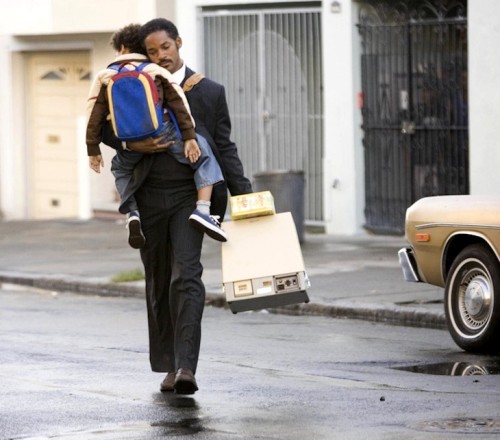
Debunking the Missing Father Myth in ‘Happyness’

While many of the film’s events differ from Gardner’s memoir, the film compensates for this with its extremely authentic and loving portrait of a Black father/son relationship that is rarely seen in mainstream media.

This guest post by Rhianna Shaheen appears as part of our theme week on Black Families. 
The Pursuit of Happyness (2006) is a film based on the true story of Chris Gardner, an on-and-off homeless father turned self-made millionaire. While many of the film’s events differ from Gardner’s memoir, the film compensates for this with its extremely authentic and loving portrait of a Black father/son relationship that is rarely seen in mainstream media.

In 1965, Senator Moynihan employed the stereotype of the absent Black father in a report on Black poverty in America called The Negro Family: The Case For National Action. In it, he blamed absent Black fathers for the socioeconomic inequalities faced by Black communities. Although his racist, sexist, and classist arguments have been debunked again and again, this myth is still just as pervasive in today’s media. On the news, film, and TV, Black men continue to be criticized and scrutinized for being violent, abusive, or missing. It is therefore very rare that blockbuster films like The Pursuit of Happyness are ever made.

unnamed


Set in San Francisco in 1981, we follow Chris Gardner (Will Smith) as he struggles to balance fatherhood with his contract business selling bone-density scanners. While he’s sold most of them the business no longer make ends meet for rent or daycare, creating added stress for his wife Linda (Thandie Newton) who works as a hotel maid. When Chris meets a stockbroker one day he decides to look into the job opportunities at Dean Witter.

While Chris sells scanners he must also jump through a ridiculous number of hoops just to impress the manager, Jay Twistle (Brian Howe). After personally delivering his resume, Chris only manages to get Jay’s undivided attention (and a job interview) when he solves a Rubik’s Cube in a short cab ride home. How messed up is that?

unnamed


In fact, his search for the American Dream becomes more and more like a nightmare: hippie girls steal his scanners, parking tickets get him arrested, the IRS seizes his earnings, and cars hit him in the street.

But these are the sacrifices Chris will make to protect his son’s happiness.

When he lands the internship at Dean Witter and finds out it’s unpaid, Linda reaches her breaking point. She leaves him and their 5-year-old son Christopher (Jaden Smith) for better opportunities in New York. It’s not an idealized fatherhood, but his actions are always validated in the film, no matter how drastic. While Chris may not be able to provide financially for his son, he is able to give him the emotional support that he needs.

unnamed


One of my favorite scenes (and the most heartbreaking) comes when Chris and his son find themselves homeless, forced to sleep on the subway floor. It’s a traumatic experience. How does any parent even begin to explain that to their child? Instead, Chris turns the dirty subway into his son’s imaginative playground where dinosaurs roam and the restroom is their prehistoric cave.

Never revealing his circumstances to his colleagues, he continues to work tirelessly at his internship until one day they offer him the coveted full-time position. He has finally achieved happiness.

It’s a sympathetic portrayal of Black fatherhood that also demonstrates the severely limited life opportunities that poor Black people faced in the 80s and continue to face today. But does the film know that?

While Hollywood can sometimes surprise us with these positive representations, they never quite gauge the complexities of race and class in these narratives.

Chris is often the only Black man on screen, and in a room full of white corporate businessmen his Blackness is never acknowledged.

As Diane Shipley from Bitch Media writes:

“The movie shies away from any exploration of intersectionality and the fact that Gardner is black isn’t acknowledged (he’s much poorer than the Huxtables, but he lives in a similarly ‘post-racial’ world).”

unnamed


This isn’t too surprising when you consider that the real Chris Gardner blames “place-ism” rather than racism for his early hardships. In an interview he says, “He didn’t have a college degree or parents who were professionals. He didn’t play golf or have a network of well-to-do friends who could be prospective clients.” While all of this may be true, Happyness suggests that these were the only obstacles in his way.

Even producer and star Will Smith admits, “In this film, racism is conspicuously avoided.” It’s a conservative pursuit to happiness that feeds the harmful myth used by many GOPers that poor Black people don’t work as hard as white people. And if only they did then maybe they would be just like Chris Gardner and not unemployed, incarcerated, or uneducated at higher rates.

While Chris is poor, Black, and a good father, the film also does nothing to address the crippling socioeconomic disparities that affect other Black men like him. From the beginning, Chris says:

“I met my father for the first time when I was 28 years old. I made up my mind that when I had children, my children were going to know who their father was.”

Chris may debunk the missing father myth in his own individual story, but he does little to hold the system behind it accountable. According to Donna Peberdy’s Masculinity and Film Performance the film stresses:

“that the power of the individual is limited and that change is also necessary on a political level. […] Despite personal sacrifices, Chris ultimately relies on the brokerage firm to help him achieve the American Dream. Foregrounding individual responsibility can be seen as a political manoeuvre to take the emphasis away from government accountability.”

unnamed


This can be seen quite literally when the film diverts all social anxieties with a clip of President Reagan delivering bad news about the struggling economy.

Yes, this is a film for all audiences, but it was made especially accessible for white audiences. The first time I saw The Pursuit of Happyness I was 15 years old. I sat in a theater with a mostly white audience in a conservative military town. As a young white girl, I laughed, cried, cheered with the audience through my then “colorblind” lens.

unnamed


I remember the film’s marketing hook banking on Will Smith’s new persona as the “family man” and his real son Jaden Smith playing his movie son. Even in many of the interviews, Will stressed the Smith family values of “communication, education, and truth,” as if to sell the film on the authenticity of his own fatherhood.

unnamed


Another issue is the negative portrait of the mother (the film’s only female character). The mom has her shit together. When things get tough she provides for the family by pulling double shifts for four months. Chris, on the other hand, does not work overtime. Instead, he has invested all his life savings into the risky enterprise of overpriced bone-density scanners. When Linda leaves the picture, the filmmakers and Chris seem glad to be rid of her:

Chris: “Get the hell out of here. Christopher is staying with me.”

Linda: “You’re the one that dragged us down. You hear me?”

Chris: “You are so weak.

Linda: “No. I am not happy anymore. I’m just not happy!

Chris: “Go get happy, Linda! Just go get happy.”

I’m sorry, isn’t happiness what this whole film is about? Why must the Black mother be the villain? Why must one positive representation of Black fatherhood forgo that of the mother? And why on Earth would you make the white savior stockbroker more likable than her? Even when his son asks about his mother’s absence, Chris says, “mom left because of mom” omitting himself from any blame. I understand that the focus of this film is a father/son relationship, but a film should not need to reinforce the “patriarchal order of things” in order to achieve that.

While The Pursuit of Happyness is an extremely rare and accomplished narrative, it’s important not to overlook its flaws. Its powerful portrayal of a father/son relationship both on film and in life is extremely valuable in shaping future media. However, with Black films still struggling to break Hollywood barriers–both at the box office and the Oscars–it becomes imperative that we get these stories right, even if they aren’t deemed popular by the mainstream.


Rhianna Shaheen is a graduate of Bryn Mawr College with a BA in Fine Arts and Minor in Film Studies and Art History. Check her out on twitter!


‘Desmond’s’: Roots, Culture, and the Black U.K. Experience

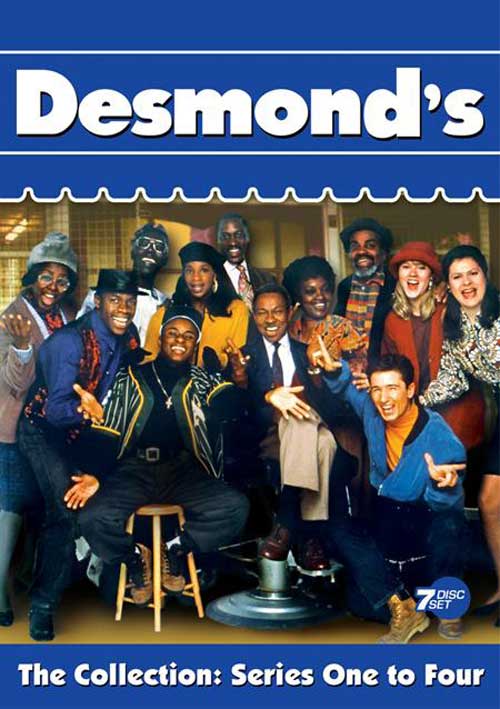
What makes ‘Desmond’s’ unique is its layered and often nuanced portrayal of immigrant Afro-Europeans and their assimilating progeny that are more closely connected to their African roots than any African American TV show I’d ever seen. It also has a cross representation of class in Black British society by showing retired, working class, upper-middle class, college-educated, college-bound, and not college-bound Black people interacting together all the time. Not only are different classes intermingling, but there are also four series regulars who are white, and their whiteness is not the punchline of tired racial jokes.

Desmond's: DVD Collection Seasons1-4
Desmond’s: DVD Collection Seasons 1-4


Written by staff writer Lisa Bolekaja as part of our theme week on Black Families. 

The first Black family sitcom (with under-aged children) I ever saw on TV was Good Times. For the majority of Black Americans raised in the 70s, The Evans Family was supposedly America’s first real exposure to a Black nuclear family on television, albeit one in extreme poverty living in the projects. I distinctly remember my mother and step-father sitting down with me to watch people who looked like us eating grits, turnip greens, or ribs on an old second –hand kitchen table the way we ate our own regular southern foods. Black families were such a rarity on television that Good Times became event viewing–the original must-see-TV in my neighborhood. The Evans family wasn’t as rich as The Brady Bunch, but they did go through comedic shenanigans that were solved at the end of the episode.

At the time I wasn’t aware of the problems actors James Amos and Esther Rolle dealt with trying to focus more attention on the family and not the stereotyped antics of J.J. (White producers and white writers wanted to up the ante on the clownish, uneducated, slapstick behavior of J.J, who eventually became the main focus of the show.) Good Times still had a nostalgic place in my heart. I used to own a Jimmy Walker J.J. Evans doll where you pulled the string in his back, and the toy would yell “Dyn-o-mite!” back at you. Even today, if TV Land or Centric plays re-runs, I will stop and watch it. On the heels of Good Times, came What’s Happening? and of course, the 80s brought the NBC savior/juggernaut, The Cosby Show, the 90s The Fresh Prince of Bel-Air, and in the new millennium, The Bernie Mac Show, Everybody Hates Chris, and now Black-ish.

But I’m going to write something that may hurt some Black Americans’ feelings.

The best Black Family sitcom in my non-humble opinion is a little-known gem from across the pond that debuted in 1989. A show about a Black British/West Indian family running a barbershop in Peckham, London, it was called Desmond’s (created by Trix Worrell) and you need to buy it on DVD and watch it right now.

Desmond’s on the surface looks like any early 90s family comedy that served up plenty of corny jokes, familiar plots we’ve seen in similar family shows, and raucous studio audience laughter. What makes Desmond’s unique is its layered and often nuanced portrayal of immigrant Afro-Europeans and their assimilating progeny that are more closely connected to their African roots than any African American TV show I’d ever seen. It also has a cross representation of class in Black British society by showing retired, working class, upper-middle class, college-educated, college-bound, and not college-bound Black people interacting together all the time. Not only are different classes intermingling, but there are also four series regulars who are white, and their whiteness is not the punchline of tired racial jokes.


West Indians and West Africans on the same show. Porkpie (Ram John Holder), Desmond (Norman Beaton) and Matthew (
West Indians and West Africans on the same show. Porkpie (Ram John Holder), Desmond (Norman Beaton) and Matthew (Gyearbuor Asante)


I was lucky to catch Desmond’s in the early 90s when Black Entertainment Television (BET) started airing re-runs in the states. I was cooking a box of mac ‘n cheese and flipping channels when I saw some Black actors I didn’t recognize. I had to turn the volume up to hear their voices because their patois sounded like the Jamaican folks I partied with at my local reggae dancehall. I watched every single episode BET aired.

Desmond Ambrose (Norman Beaton) was a popular calypso singer back in his native Guyana who immigrated to England with his beloved wife, Shirley Ambrose (Carmen Munroe). Desmond’s plan was always to work and live in England and then retire back to his native Guyana and build his dream home. Once settled in Peckham, Desmond and Shirley had three socially mobile children who were part of a wave of first generation Guyanese/Black Brits.


Tony (Dominic Keating), Desmond Ambrose (Norman Beaton0 and Shirley Ambrose (Carmen Munroe)
Tony (Dominic Keating), Desmond Ambrose (Norman Beaton) and Shirley Ambrose (Carmen Munroe)


Shirley Ambrose has spent more than half her life in Peckham, and has no desire to return to Guyana. Her children are British, and she often fusses with Desmond about not sharing his dream of returning back home. Home is with her children in this new country. Their oldest son Michael (Geoff Francis) is a bank manager, a Buppie, and social climber. He fancies himself cultured, classy, and sometimes above his West Indian Roots. The middle child, Gloria (Kim Walker) is a college student, fashionista, and later in the series a professional writer who always calls Michael out on his pretentious behavior. Then there’s the youngest son Sean (Justin Pickett, my favorite), the first black teen geek and computer coder I’d ever seen on TV. What makes Sean special is that he is a computer whiz without being the cliché nerd, and he is a rapper and a D.J. He is smart, cool, and respectful of his parents and culture. Imagine Will Smith’s Fresh Prince combined with Carlton sans the corniness of both characters and you get an authentic Sean. So refreshing.


Sean (Justin Pickett) explaining coding to his father Desmond on those big ass old school desk tops in the 90's.
Sean (Justin Pickett) explaining coding to his father Desmond on those big ass old school desk tops in the 90s.


Desmond’s takes place inside a barbershop in a sometimes rough working-class neighborhood. The Ambrose family (without Michael) resides in an apartment above the shop, and three of their regular friends (and occasional customers) hang out there most of the day with them. One regular is Desmond’s Guyanese childhood friend and former band mate Porkpie (Ram John Holder).  Another regular is Lee (Robbie Gee), a boxer and unofficial adopted son who often peddles goods inside and outside the shop. Still another drop-in is a West African from Gambia named Matthew (Gyearbuor Asante) who brings in his African culture and a grand sense of African pride. Matthew is also a university student who never seems to ever finish his studies, although he has been a student for many years. What I enjoy about Matthew is a new view of African characters. Often in Black American shows (especially the early TV shows in the 70s) African characters are made fun of, whether it is their names, food, or skin color. They are often depicted as being poor and overly grateful to be away from their homelands. Not Matthew. He has a superior air about him and comes from a wealthy family. He’s always chiding the West Indians that they need to respect their elder culture (Africa), while at the same time giving off the impression that he is delighted that West Indians have retained so many Africanisms in their own New World culture.


Matthew sharing an old African saying with Desmond, Shirley and Sean.


Desmond’s allowed me a peek into the world of my Black cultural cousins who wound up in England instead of the States. I learned West Indian history, I saw how Blacks over there also code-switched their language when they spoke among themselves and among outsiders. One minute the family would speak British Standard Vernacular English, and the next minute, flip into Guyanese patois, or even Black British Rude Boy Slang. This code-switching reminded me of my own people in the States where many of us speak Standard American English at work, African American Vernacular English (AAVE) at home or among friends, and can also slip into Southern Creole languages like Gullah (Geechee), or New Orleans Creole.

While Desmond’s was re-running in America, I was listening to a lot of British neo-soul music like Soul II Soul, Sade, Loose Ends, Tricky, Omar, The Young Disciples, and especially the songs of Caron Wheeler the singer whose voice put Soul II Soul’s sound on the map. Listening to Caron Wheeler’s album U.K. Blak, which was the title track, I was given a mini-history of how so many new West Indian immigrants landed in English ports. Caron Wheeler sang:

Many moons ago
We were told the streets were paved with gold
So our people came by air and sea
To earn a money they could keep
Then fly back home
Sadly this never came to be
When we learned we had just been invited
To clean up after the war
Back in ’49 never intended to stay here
Who could afford to leave these shores

UK Blak, ending the silence now
UK Blak, letting you know that we’re about


The opening credit sequence of Desmond’s shows actual black and white film footage of Blacks from the Caribbean on large British ships sailing into English ports after WWII. I watched Desmond’s, listened to Caron Wheeler sing some history to me, and felt an immediate connection to the characters on the show. I love Desmond’s more than most popular Black American shows I grew up with. It tells me more about my own history and roots from the viewpoint of my figurative cousins across the big water. Think about that for a minute. Every African American from enslaved America was merely one random port stop from being British, Brazilian, a Caribbean Islander, or a North American. Like Desmond’s people, African Americans migrated too, going North and West within America, leaving family back home in the deep south. Like Desmond’s people, we have strong roots in the south that some of us want to cut off and forget, and some of us have actually returned to retire there. A reverse migration. A returning to the old culture that sustained so many of us in the dark days from the Civil Rights struggles and back beyond that.

The younger siblings, Gloria and Sean, showed me that there was a cultural exchange of Black music and styles from the U.S. From the posters on their bedroom walls of Ice Cube, The Fresh Prince and Jazzy Jeff, Whitney Houston, and mentions of Michael and Janet Jackson, to the Malcolm X hats and T-Shirts that marked the debut of Spike Lee’s X. Rap music mixed into the ragamuffin sounds of Black England. The cultural cousins have been keeping in touch. As young Blacks in the States were calling out sexism and homophobia in rap culture, an episode of Desmond’s demonstrated that it was an issue in British rap too. Sean has to push back on his best friend Spider for selling rap/dancehall mash-up music that is sexist, misogynistic, and homophobic, making Sean’s openly gay university buddy Bernie feel uncomfortable around the school. Sean demands a safer space for his gay and female friends, even if it means cutting Spider out of his inner circle.


Gloria (Kim Walker) and Sean listen to their father impart West Indian wisdom to their Bicultural upbringing.


The show itself is available for purchase on DVD, but for only Seasons 1-4. A few years ago I was hunting for any copies of the series last two seasons. Luckily, I found Seasons 5 and 6 on YouTube. Desmond’s was a show that could’ve gone on for at least three more seasons. Unfortunately, the star of the show, Norman Beaton, died on a trip to visit his family in Guyana. There was an attempt to keep a part of the Desmond’s legacy alive with a spin-off series called  Porkpie with Ram John Holder, but it was short-lived, lasting only two seasons.


Actor Norman Beaton (Desmond Ambrose) passed away after Season 6.


Ram John Holder was given his own spin-off series called "Porkpie"
Ram John Holder was given his own spin-off series called “Porkpie”


Just to entice any potential new fans, you will spot some familiar faces in some of the episodes. The very cute white barber/ stylist Tony was played by Dominic Keating who later went on to star on the TV series Star Trek: Enterprise.

A brother-in-law of Gambian forever-student Matthew was played by Joseph Marcell, who later gained American fame playing Geoffrey the butler on The Fresh Prince of Bel-Air.

And for some real fun, if you watch an early episode called Veronica, you will see the child actress Amma Assante who grew up to direct the phenomenal movie Belle from last year.

Bet you didn't know Amma Asante, director of "Belle" was a child actress who appeared on "Desmond's"
Bet you didn’t know Amma Asante, director of Belle, was a child actress who appeared on Desmond’s


Do yourself a favor. Come ‘round the shop and listen to some Soca. There will be tea and toast and good times. I promise.


Tea, toast, and good times with the Ambrose clan and their extended family.


‘Killer of Sheep’ A Slice of Life of Watts in the ’70s

The son then picks on other kids, including his younger sister. Stan’s (nameless) wife yells at the kids too, because of her own frustrations, both with Stan’s depression and the “friends” of his who stop by, like the ones who talk about killing someone they know and ask for his help. After he turns them down she goes off on them, shouting, “Wait just a minute you talk about being a man. Don’t you know there’s more to it than your fists?”

KillerOfSheepCar

Written by staff writer Ren Jender as part of our theme week on Black Families. 

When I was a kid in the ’70s, Happy Days, which took place in ’50s, was one of the most popular shows on TV; my sixth-grade teacher showed daytime reruns to the entire class during lunch as a method of crowd control. My mother, who had grown up during the 1940s and ’50s told me, “The ’50s weren’t really like that.” I think of her whenever I see films (like the execrable Inherent Vice) that take place during the time I grew up. The differences between the ’70s and now are deeper than just a matter of hairstyles, fashion, and phones.

We can see that difference clearly, and beautifully, in Black writer-director Charles Burnett’s haunting first film, Killer of Sheep, shot on weekends in the late ’70s in the Watts section of Los Angeles (the cinematography, which features painterly black and white images, is also by Burnett). More than once we see kids (with no adults around; most kids in those days–including those in the suburban, mostly white neighborhoods where I grew up–were “free-range kids”) playing in groups in dusty, hazardous-looking outdoor spaces which reminded me of the bombed out ruins the London boys of the WWII-set Hope and Glory play in, right down to one boy using a tool to make a dangerous item go “bang”–in Glory, it’s a hammer and nail to a stray bullet. In Sheep, one young boy uses a plumber’s wrench to bang at the strip for a toy cap gun to set off its small traces of explosive material. The ruins in London were because of enemy bombing. In Watts they might have been a vestige of riots in the 1960s or just a sign of many cities’ general neglect of their Black neighborhoods. But the children do have the run of the place; the film captures an era before gun and police violence made the streets fatal for many of them. When one boy tells another he’s going home to get his BB gun, I couldn’t help thinking of 12-year-old Tamir Rice who, a few months ago, police shot and killed in a playground just for carrying the same item.

The neighborhood’s busted-up fences, dilapidated cars, and a garage with a big enough hole in the door that children slip easily in and out through it seem to have etched themselves into the careworn features of the title character, Stan (played by Henry Gayle Sanders, a familiar face from small and “guest-star” roles on ’70s and ’80s television). One woman tells him he’d be handsome if he smiled once in a while.

Stan works at a slaughterhouse (we see the animals first alive then killed, skinned and decapitated on the assembly line) and lives in a small one-story house (decades before the internet chic of “tiny houses“) with his wife and two children. We see that the family doesn’t have much, but like a lot of other low-income people, Stan points to others who are worse off. He tells an acquaintance, “Man, I ain’t poor. I give away things to the Salvation Army. You can’t give away nothing to the Salvation Army if you’re poor.”

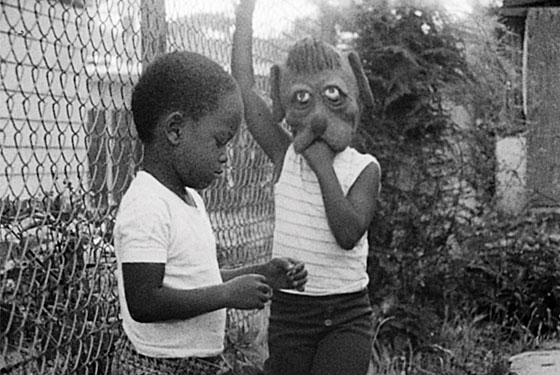
KillerOfSheepDogHead
Stan’s daughter (Angela Burnett) and a friend


Stan has to have a long discussion with a man and his array of family members to get a car motor for the amount of money he can afford. He and his friend painstakingly carry this heavy, unwieldy conglomeration of metal (the muscles in the arms and chests of the actors, when most people didn’t go to the gym, shows evidence of the hard, physical labor many Black men did for work at the time) down a couple of flights of stairs, resting more than once along the way and hoist it into the back of his friend’s pickup truck, which injures the friend’s finger. Stan asks, more than once, if they can push the motor all the way toward the cab but his friend says it will be fine where it is. When his friend starts driving the motor immediately falls into the street, sliding downhill a little. They both agree it’s ruined, so they drive away, leaving the motor where it fell.

Stan has a beautiful wife (Kaycee Moore who would later appear in Daughters of the Dust) who cares for and loves him, but she can’t make him forget his troubles. He dances with her to Dinah Washington singing “This Bitter Earth” (“What good is love/ Mmmmmmmm/ That no one shares”), but is too melancholy to have sex with her. She’s jealous as she watches him freely accept affection from their young daughter (Angela Burnett) in a way that he won’t with her. The audience understands that with the daughter the pressure’s off, but his wife cries as she watches the two of them.

Stan yells at his son (Jack Drummond) for being “country” when the son asks his Mom for money, specifically because he calls her “madea” (a form of address for mother figures Tyler Perry did not invent). The son then picks on other kids, including his younger sister. Stan’s (nameless) wife yells at the kids too, because of her own frustrations, both with Stan’s depression and the “friends” of his who stop by, like the ones who talk about killing someone they know and ask for his help. After he turns them down she goes off on them, shouting, “Wait just a minute you talk about being a man. Don’t you know there’s more to it than your fists?”

KILLER OF SHEEP (1977)
Kids leap across the gap between building roofs


No director has captured as well as Burnett does here the dynamics of children (of any race) at play. Stan’s daughter, for no particular reason, wears a cartoon dog mask as she stands in the house and goes outside (the way one of my best friends when we were about her age used to wear a long, blonde wig). In one moment, among a group of boys, a pretend fight turns into real one in which someone gets hurt. Kids leap back and forth between two low buildings about six feet apart in a way parents (and directors) would never, ever let happen now. We see children try to advance in the pecking order and find themselves literally beaten down afterward. A young boy on a bike tells two older girls doing The Bump on a street to get out of his way, but the two girls and their friends gang up on him until he runs away, leaving his bike behind.

One of the scenes most evocative of the ’70s I knew features Stan’s daughter playing on a cluttered floor with her (white) baby doll as she sings along to Earth, Wind & Fire’s “Reasons” on the radio, making up her own nonsense lyrics to replace the more sexually suggestive ones of the song (as kids today do with hip-hop lyrics). Filmmakers so rarely just hold back and let us see how little girls play, especially when they are by themselves. And this scene with different music and maybe a different doll (for me it was Barbie or Dawn dolls) could have come from the lives of young girls through the ages.

As in real life, the film has neither a happy ending nor a tragic one. A day at the racetrack is derailed by a flat tire. Stan goes in for another shift at the slaughterhouse. We again see the living sheep and the assembly line. As we hear “This Bitter Earth” once more, I burst into tears.

[youtube_sc url=”https://www.youtube.com/watch?v=-nXw-8MXhVE” iv_load_policy=”3″]

___________________________________________________

Ren Jender is a queer writer-performer/producer putting a film together. Her writing. besides appearing every week on Bitch Flicks, has also been published in The Toast, RH Reality Check, xoJane and the Feminist Wire. You can follow her on Twitter @renjender

The Popes and the White Patriarchy in Shonda Rhimes’ ‘Scandal’

While the show is not overt, at its core the story is about race and gender relations. Race- and gender-specific language is often omitted from the dialogue, yet the meaning is there. Rhimes takes the White patriarchy of America and individualizes its contributors so that neither (most of) the characters nor the audience realizes that they are contributing to harmful White patriarchal norms and internalizing them until the rare moments when they take a step back from the action.

park-624x361


This guest post by Jackson Adler previously appeared at his blog, The Windowsill, and appears as part of our theme week on Black Families. Cross-posted with permission.

Shonda Rhimes’ TV series Scandal is a political thriller about “fixer” Olivia Pope (played by Kerry Washington), who gets scandals in Washington, DC “handled.” All of the characters in the show have terrible flaws, do terrible things, question what is right, and whether the ends truly do justify the means. While the show is not overt, at its core the story is about race and gender relations. Race- and gender-specific language is often omitted from the dialogue, yet the meaning is there. Rhimes takes the white patriarchy of America and individualizes its contributors so that neither (most of) the characters nor the audience realizes that they are contributing to harmful white patriarchal norms and internalizing them until the rare moments when they take a step back from the action. Some of the characters claim to be colorblind, while others experience the effects of race in their everyday lives the way Black families across the country experience it.

Neither Olivia, nor her parents, nor the people she loves are free from this. The central relationship of the show is between Olivia Pope and U.S. President Fitzgerald (Fitz) Grant, with whom she has an ongoing affair. When Olivia, whose influence and position as a powerful African-American woman has often been challenged, confronts him about whether or not he is using her and in a position to control her (“I’m feeling very Thomas Jefferson/Sally Hemmings about this”), he skeptically responds, “You’re playing the race card on the fact that I’m in love with you?” and says that a comment like that “belittle(s)” their relationship and is “insulting and beneath [her].” “We’re in this together,” he says. However, he is in a more powerful position than she is, and he uses it. When he wants to speak with her and she doesn’t want to see him, he sends a private jet and secret service to collect her and bring her to him. He seems to claim to be colorblind in how he sees their relationship, and that he thinks of himself as just “a man,” but in other scenes proclaims himself as “the Leader of the Free World” in order to privately intimidate others and get his way. He says he would “give up” his position and influence to prove his love for her and start their life together, but each time it comes down to it, he chooses power – he chooses to be president instead of a loving and loyal husband to her.

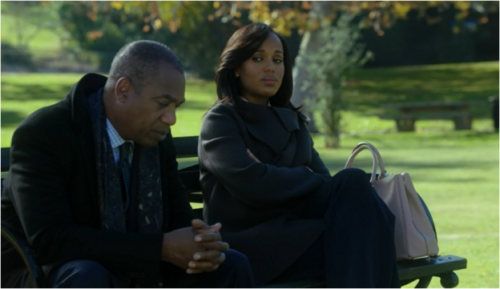
Rowan (Joe Morton) confronts Olivia (Kerry Washington)


Olivia’s father, Rowan, is often the one to point out these problems in their relationship. Rowan calls Fitz a “spoiled, entitled, ungrateful little brat,” to his face, and says that he is not “a man” but “a boy.” Rowan reminds Olivia that “[white] power got [Fitz] elected” in the first place, and that Fitz will always choose his white male power over her well-being. Fitz’s words and actions are highly reminiscent of white #AllLivesMatter hashtaggers who are stubbornly ignorant about the dangers of being Black in America, and of members of the GOP who say that Obama supporters use “the race card” (thereby attempting to silence the argument) when they treat Obama worse compared to how they would treat a white president. Olivia’s parents call out Fitz’s behavior, but while Rowan mostly verbally attacks it, her mother Maya physically attacks it.

Maya Lewis (Khandi Alexander)


Olivia’s father, Rowan Pope, achieved a powerful position in the government as Command of a CIA subdivision called B613, through sheer ruthlessness and brain power. Olivia calls her father and his position “the thing that goes bump in the night” – he is someone who does all the behind the scenes dirty work (including assassinations) for the government. He was the first in his family to go to college, and got his daughter into “the best schools” through his own hard work. He regretted not spending more quality time with her when she was younger, but – in Rhimes’ riff on the narrative of the absent Black father – he was not very present in her life because he was so protective of her. He kept her from seeing the terrible things he did as a part of his work and his attempts to gain influence, and ended up sending her to the same boarding schools as “the children of kings” because of it. One of the main reasons Olivia achieved her powerful place in DC is because of him, and he never lets her forget it. While Rowan technically works for the government, unseen but literally calling shots, Olivia’s mother, Maya Lewis, is a terrorist mercenary whose main goal is to take out the patriarchy/white male presidency of the United States. While Rowan pushed Olivia to participate in/assimilate into the government/patriarchy in order to further herself and gain influence of her own, Maya wishes Olivia was not involved in it at all, and says she wished “better for [her].” In one scene, Maya only refrains from blowing up the president and his family because Olivia puts herself in the way. Though Rowan and Maya have very different approaches in how to deal with the government/white patriarchy, they each remind their daughter that being colorblind will only lead to her getting hurt before she even realizes what has happened – “Whose victory do you think they will fight for [when it comes down to it]? Whose body do you think they will bury?”

Olivia’s relationship with her parents is beyond dysfunctional, but her parents still love her very much and make their love known. Rowan alternatively helps Fitz and her other love interest, Jake Ballard, due to Olivia’s affection for them. However, Olivia believes her parents are dangerous and cannot always trust them, let alone support them in their violence. When Olivia teams up with Fitz and Jake, two white and powerful men, to assassinate Rowan, he gives her the benefit of the doubt. He provides her with a gun and the chance to kill him in order to test her loyalty to family, as well as race. The gun turns out to be bullet-less, so Olivia does not succeed in killing Rowan. However, the pain in his face and entire body is evident in the scene as he says, “Are you kidding me?!” He is angry and deeply hurt that his own daughter would have killed him were the gun loaded. For the first time, he tells her “Now you’re on your own.” Olivia turns away from Black patriarchy, but her actions benefit white patriarchy.

Jake Ballard (Scott Foley), Olivia Pope (Kerry Washington), and President Fitzgerald Grant (Tony Goldwyn)


Olivia is constantly asked to choose and re-choose sides, and race is not something she can or even is allowed to ignore in those decisions. Her father particularly challenges her to think in terms of race and familial loyalty in his numerous aggressive monologues. Meanwhile, her mother does what she wants regardless of what anyone thinks – even shooting and killing her white male lover when forced to choose him or give up her goals. Olivia despises the aggression of her parents, and loves the white men in her life who continually hurt and use her. Her dream is to go to Vermont with Fitz, settle down and “make jam” in their perfect home in a small town, but she has come to realize that her dream of Vermont might never become a reality. Fitz is drawn to the presidency/power, and Olivia is compelled to continue being the powerful “fixer” that she is – firmly establishing herself as an African-American woman in control of her own destiny. The Pope family loves each other, but their different approaches to white patriarchy turn them against each other. Whether or not Olivia will “fix” the white patriarchy, or continue to inadvertently contribute to and be crushed by it, remains to be seen – though I’m certainly hoping for and excited to see the manifestation of the former. Scandal challenges the members of its audience to think of institutionalized and internalized patriarchal norms, and how best to face them – and to what lengths they will go to do so.


Jackson Adler is a transmasculine aromantic bi/pansexual skinny white middle class dude with an Auditory Processing Disorder and a Weak Working Memory who enjoys cartoons, musical theatre, and vegan boba drinks. Jackson has a BA in Theater, and is a writer, activist, performer, director, teacher, and dramaturge.

‘Love & Basketball’: Girls Can Do Anything Boys Can Do

Prince-Bythewood’s ability to draw commentary about the Black family experience in America is so well-integrated we, as the audience, are able to enjoy the emotional ride the characters take us on without the feeling that we’re watching a heavy-handed representation of the social issues of the time.

This guest post by Alize Emme appears as part of our theme week on Black Families. 

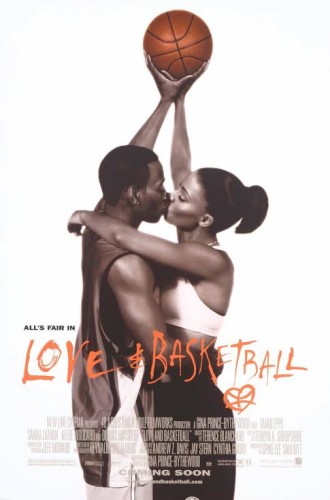
“I’m gonna be the first girl in the NBA,” proclaims a young Monica (Kyla Pratt). “No, I’m gonna be in the NBA,” replies a young Quincy (Glendonn Chatman). “You’re gonna be my cheerleader.” Breaking down the idea that women can’t play sports, can’t do the same things men can (like in that late 90’s commercial) is the overarching theme of Gina Prince-Bythewood’s debut feature film Love & Basketball (2000). This is the kind of movie you can watch, like I did as a teenager, and think, “what a nice love story” and it’s not really about anything more. Or, you can take a step back, and with a more seasoned eye, find a story that is rich with nuances about race, gender, and relationship roles and realize Prince-Bythewood’s artful commentary is so subtle you’ve spent the past 15 years just really enjoying this movie about a sports romance.

Love and basketball and so much else

As a film that revolves around 12 years in the lives of two African-American basketball stars, Monica Wright (Sanaa Lathan) and Quincy McCall (Omar Epps) and their neighboring families, it’s not really about basketball. “It’s about emotion,” as Robin Roberts says during a brief cameo. Prince-Bythewood’s ability to draw commentary about the Black family experience in America is so well-integrated we, as the audience, are able to enjoy the emotional ride the characters take us on without the feeling that we’re watching a heavy-handed representation of the social issues of the time.

This isn’t a Black film either. This is the Grey’s Anatomy approach to storytelling before Grey’s Anatomy existed. You look at these characters with a colorblind eye, only seeing their passion and emotion for basketball and each other. Race is directly mentioned a grand total of one time: at the start of the film when the two family’s matriarchs first meet. Nona McCall (Debbi Morgan), mother of Quincy, has just brought over a “freshly baked” cake for her new neighbors and Camille Wright (Alfre Woodard), mother of Monica, is happy to receive her. Nona explains their neighborhood at one time was “a little more mixed,” and jokes, “that was before the Black people down the street became the Black people next door, OK!” Camille, dutifully playing the role of good little domesticated housewife, looks at Nona with utter confusion – OK what? – before an embarrassed Nona quickly switches gears and that’s that.

Economic status is also never mentioned though it’s clear that both families are affluent. Both homes are spacious and have pools; the McCalls have a basketball court in the backyard. These are not struggling families; the passion Monica and Quincy share for the game comes from the heart, not the motivation to achieve a better life.

For the majority of the film, we see this very strained relationship between Monica and Camille. Monica is a basketball-obsessed, jersey wearing, make-up free tomboy whose mother “doesn’t know where [she] came from” because she “acts different” than her dress wearing, hair-styling sister and Camille, the classic country homemaker. Monica is our feminist heroine who personifies the idea that feminist women look down on women who choose more traditional roles. Camille has a longstanding belief that her daughter is disappointed in her “prissy” lifestyle, telling Monica she’s “a female superstar athlete whose mother is nothing more than a housewife.”

Misconstrued thinking creates nearly a decade of strife for these two women until it finally arises that Monica’s only shame for her mother lies in Camille’s inability to stand up for herself at home. Indeed, we see Camille falling deep into a submissive role with her husband. Camille has spent a lifetime silencing herself so her “husband can feel like a man.” The flip side of this coin is that Camille consciously put her life dreams on hold so she could “be there” for her family and create a loving home environment. But most importantly, we learn each woman was merely seeking the approval of the other. While Monica would rather “wear a jersey than an apron,” she wanted her mother’s approval both on and off the court.

Next-door to the Wrights, across a small grassy patch of lawn, resides the McCall family. Led by patriarch Zeke McCall (Dennis Haysbert) we find here another relationship being tested. From a young age Zeke has instilled in Quincy a resilience and confidence geared toward shaping a boy into a man he can be proud of one day. Quincy treats his father’s words as gospel and views him like “he [is] god.” Prince-Bythewood introduces this theme of “My Father Was a God” early and often throughout the film. Quincy wants to be just like his father, play for the same pro ball team, and wear the same number on his jersey and around his neck. But it is tantamount to Zeke that Quincy not be like him, to focus on school and not “care about the team.”

“'Can’t’ should never be in a man’s vocabulary.”
“’Can’t’ should never be in a man’s vocabulary.”


The crumbling of this immortal facade, the fall from grace, comes from the affirmation that all the years Zeke spent being the hyper-masculine bread winner, shutting out his wife, and running to business meeting after business meeting, were all actions masking a love affair which has now evolved into a paternity suit. What really gets to Quincy is that his father, his hero, addresses the accusation of infidelity head-on with a bold face lie. A lie their relationship will never recover from. The outcome is a harsh unveiling for the young phenom; he loses trust in all around him and no longer has an accurate idea of who his father was, and by extension, who he is himself. It’s clear to us that Zeke’s steadfast molding of Quincy was deeply rooted in the mentality that Zeke “just couldn’t” be that man himself. Quincy’s big revelation, and arguably a revelation many young men face, is that he can no longer try to be his father. He “needed ball when [he] was trying to be like [his] pop,” and now that the curtain has lifted, he must redefine himself on his own terms.

Young Monica and Quincy


The relationship between Monica and Quincy, while romantic and passionate at times, is Prince-Bythewood’s way of knocking down long enduring stereotypes about women in sports. Monica challenges everything Quincy thinks he knows about girls and life in general. He has never met a girl who not only knows how to ball, but balls better than he does. Monica won’t ride on the back of his bike and would rather have Twinkies than his apology flowers.

Monica is a ball player, and she knows how to “show emotion” on the court. But she continuously finds that those around her view her passion as aggression. If Monica were a guy, she’d “get a pat on the ass,” but because she’s “a female” she gets told to “calm down and act like a lady.” There is a huge double standard exposed here. Not only are men, on and off the court, encouraged to be aggressors, they are rewarded for it. But when a woman does the same, she’s seen as this negative force, a beast that needs to be tamed, which those around Monica try to accomplish.

“I’ve loved you since I was 11, that shit won’t go away.”

Despite Quincy being a serial offender of treating women like objects, he does share this very specific friendship, turned romance, with Monica. She gets him like no one else can. But the double standards in their relationship become clear when they arrive at USC to start their basketball careers. Quincy expects Monica to handle the spoils of his success, i.e., the friendly female fans eager to cheer him on, but he will not let her off the hook when she chooses a starting spot in her game versus “being there” for him. He’s already told her it doesn’t matter if she’s “not known as the first girl in the NBA,” she’ll “get more play” being “Quincy McCall’s girl anyway,” so it’s not surprising when he further diminishes her dreams by forcing her to make this decision.

Monica has spent her freshman year struggling on the court, she hasn’t had the “red carpet” treatment like Quincy, and when an opportunity finally does arise, her boyfriend guilt trips her. The idea that women must make this sacrifice between career and relationship is so antiquated but still so accurate. In a great twist of irony, Quincy, who has spent his childhood hearing Mom complain about how Dad doesn’t make time for her and always puts basketball first, accuses Monica of the same behavior and uses that as the catalyst in his hasty decision to break-up with her. Equally interesting, Monica at this point has fallen into a more submissive role in their relationship and blames herself for its demise, pleading, “Whatever I did, we can fix this.”

Lathan and Prince-Bythewood


As someone who grew up going to sports camps, I heard girls comment daily that they wanted to play in the NBA. So, it was completely lost on me that Monica’s constant repetition of “I’m gonna be the first girl in the NBA,” was because there was no WNBA at the time. There is this prevailing idea throughout the film that these female players are good enough to be playing with their male counterparts, but instead are relegated overseas where, as Monica finds, it’s alienating, uninspiring, and also, unfair.

At the end of the film, Prince-Bythewood has shown us the struggles a Black woman faces when entering a highly competitive arena, the breakdown of a Black father/son relationship, a Black mother who has finally given herself a voice, and a Black relationship that through time and maturity is able to advance into its own sort of “Destiny,” all while never feeling like these are Black issues. But mostly she has taught us that women can do anything men can do. This could be any woman’s triumphant story. The film’s final scene shows Monica as the starting guard in the newly formed WNBA while Quincy and their young daughter clap for her on the sidelines, begging the question: Who’s your cheerleader now?


Alize Emme is a writer and filmmaker living in Los Angeles. She holds a B.A. in Film & Television from NYU and tweets at @alizeemme.

‘Chef!’: The Perfectly Imperfect Marital Eroticism of Janice and Gareth

Gareth does not “happen to be Black”; the pressure on him to conform to white culture, to avoid limiting his own narrative, mirrors the show’s own need to conform to that culture, to avoid limiting its audience. This conflict is slyly embodied in plausibly deniable food metaphor.

Janice and Gareth's stressful ideal
Janice and Gareth’s stressful ideal


Written by Brigit McCone as part of our theme week on Black Families.

If I had to point to one screen marriage that shaped my childhood ideas about marriage’s potential as positive partnership and intense intimacy, it would be Janice and Gareth Blackstock on the first two seasons of the British sitcom Chef!. The original writer, Peter Tilbury (working from star Lenny Henry’s concept), left after two seasons, and the final season’s crude divorce drama only highlights what made Tilbury’s vision so brilliant. In the final season, Janice is not a fully rounded partner, but an obstacle and challenge for Gareth. Where her constructive criticism was a form of protective support, it is now scornful nagging and abandonment. Her desire for a child is now her main motivation and source of conflict with Gareth. The third season’s Janice is the irritating, castrating and baby-crazy screen wife that viewers have seen a thousand times before; the contrast illustrates everything that was subtle and human about Janice’s original characterization.

From a racial perspective, Chef! might be compared to The Cosby Show, as portraying an exceptionally talented, sophisticated, and wealthy Black family. But where the Huxtables effortlessly “have it all,” somehow combining two careers and a large family with inhumanly minimal friction, the Blackstocks acknowledge that their lifestyle demands real sacrifice. Janice had to leave a flourishing career in the city to accompany Gareth, after his promotion to head chef of a prestigious, rural restaurant; she is outspokenly frustrated and eager to work again. When the restaurant has financial problems, the couple must sacrifice their house and car to buy it, admitting that the resulting tension “feels like you’ve eaten a lorry-load of All-Bran.” They are childless, and the conflict between their workaholic careerism and their hopes for children is openly explored. Each has a defensive facade of toughness and hyper-competence, but their scenes together explore the toll that this facade takes and the vulnerability it conceals. The sitcom’s central comedy is the farcical exaggeration of Gareth’s intimidating facade – “totally driven. We’re talking severe personality disorder here” – and its contrast with his inner softness. The perfection of Janice and Gareth’s marriage is not based on a perfection of their lives or personalities, but on their shared concept of marriage as a space of solidarity that accepts flaws and conflict.

That model of acceptant marriage is the bedrock of the show. In the opening credits, the lyrics “I’m the best, so do not test, the top of my profession” play over a montage of Gareth’s hyper-competence – working out and preparing the immaculate tools of his culinary trade – broken only when he briefly strokes the glossy picture of Janice that hangs in his locker, as though for reassurance. This image of her face comes before Gareth’s own face, underlining her importance to the show. Janice’s character can be read as rewriting the Sapphire stereotype, exploring the loving foundations of constructive criticism and the emotional intimacy of openly expressed frustration. Gareth’s farcical posturing can equally be read as parodying hypermasculine models of Black manhood, as much as bad-tempered celebrity chefs, while his sensitivity and capacity for nurture is his character’s true strength. The show’s unusually erotic portrait of monogamous marriage compares with the marital eroticism of Beyoncé’s “Drunk in Love” which, along with the self-identified feminist’s proud adoption of Mrs. Carter as a title, radically rejects stereotypes of absent fathers in the Black community. John Legend’s “All of Me” video showcases similar aesthetics of marital eroticism, while that song’s description of loving “perfect imperfections” is a good summary of Janice and Gareth’s relationship. But reducing their relationship to a cultural trend of Black marital eroticism would be far too limiting: it is, quite simply, television’s most perfectly imperfect marriage.

Living the rustic, bourgeois drea
Living the rustic, bourgeois dream


As well as the strain of hyper-competence, Chef! confronts the cultural tensions in narratives of Black exceptionalism, mainly through Everton, Gareth’s never-really-liked-you-anyway-probably-flush-your-head-down-the-toilet-as-soon-as-look-at-you old schoolmate, who shares Gareth’s working class, British Caribbean background. Though Janice and Gareth help Everton, by offering him an unpaid apprenticeship in Gareth’s kitchen, it is clear that this is owing to the restaurant’s desperate finances, with Gareth particularly reluctant to take Everton on. On the surface, Everton fills the familiar role of goofy sidekick. Actually, although his unfamiliarity with restaurant etiquette causes some farce, he is capable and acquires skills steadily as the series progresses. The comical embarrassment that Everton causes Gareth is less a reflection of his foolishness than of his culture.

Gareth squirms at Everton’s pride in Caribbean cooking, having fully internalized cultural messages about the superior prestige of French haute cuisine and frequently boasting of his two Michelin stars. He automatically assumes that Everton is a “dope-head” (the marijuana belongs to a white co-worker) and fiercely attacks him for it, separating himself from that cultural stereotype with a barked “I hate dope-heads!” Gareth’s intense rejection of his own culture is rooted in personal conflict with his parents. Again, this tension is expressed in culinary terms: his mother’s neglect is illustrated by her incompetence as a chef, or perhaps by Gareth’s bitterness over that incompetence, while his father abandons the family for a short-order cook. When asked what he wanted to be when he grew up, young Gareth answered “an orphan.” Janice becomes insecure when Gareth shows admiration for the cooking skills of pretty, blonde sous-chef Lucinda, though he is otherwise “Mr. Monogamy.” Dominant stereotypes of Black life – absent fathers, neglectful mothers and attraction to blondes – are all slyly embodied by the show’s cooking metaphors, giving complicated symbolic resonance to Gareth’s determination to master society’s most prestigious cuisine.

Gareth’s broadly accented Caribbean father is introduced in the first season’s “Rice and Peas” finale, goading Gareth into trying to cook Caribbean food. The master chef is humbled by being forced to learn from Everton, highlighting his detachment from his roots, while Everton reveals a genius for Caribbean cookery that rivals Gareth’s own skill at haute cuisine. By the end of the second season, Everton has become a confident chef who combines Caribbean influences and haute cuisine, unapologetically owning his cultural identity but refusing to be limited by it. However, this is only made possible by the opportunity the Blackstocks have given him; their strained and self-conscious hyper-competence is a necessary first step to wider cultural change. Through Gareth’s complex relationship with Everton, Chef! foregrounds the tensions of so-called “choc ice” (British for “oreo”) cultural positions, without simplistically condemning them. The show’s Wikipedia entry commends Chef! as “a landmark programme in the sense that Henry plays a character who just happens to be black; the fact of his blackness does not limit the narrative or the audience the series reaches.” This misses the point. Gareth does not “happen to be Black”; the pressure on him to conform to white culture, to avoid limiting his own narrative, mirrors the show’s own need to conform to that culture, to avoid limiting its audience. This conflict is slyly embodied in plausibly deniable food metaphor.

Janice Blackstock: wet, snotty bawler


Back to Janice. Janice is all kinds of awesome as a character. A brilliant businesswoman, she is practical in all the ways the flamboyant artist, Gareth, is not, but shares his preoccupation with status. Janice is hilariously open about her materialism, yet prepared to sacrifice everything for Gareth if absolutely, absolutely necessary. Both Janice and Gareth are self-conscious social performers, but the basis of their relationship is their shared recognition of that performance’s artificiality, by no more than a quirk of a smile or a raised eyebrow. Their affinity, beautifully shown in their common flaws as much as in their virtues, creates the deep understanding between them. Janice is strong, but this doesn’t prevent her from admitting weakness: “I’m going to be brave in a minute. But, just right now, I’m going to break down completely, OK? I don’t mean a dignified tear or a trembling lip, I’m talking wet, snotty bawling!” With a sharp-tongued wit of her own, Janice may often play the foil to Gareth’s shrieking manbaby, but she is allowed to be his equal in comedy as well as in business. Gareth is also allowed to be Janice’s equal in emotional vulnerability: “I’m not going to cry because I’m a big boy now, but if I wasn’t, or if I was a ‘New Man,’ we could be talking wet, snotty bawling here.”

The Blackstocks’ relationship is physically intimate; Janice’s frustration is a running gag as Gareth’s workload leaves him too tired for sex, but the couple’s sex life remains “well above average.” Indeed, jokes about Janice’s sexual frustration only highlight how much more sex she’s depicted getting than other sitcom wives. It is less spectacular intimacies, however, that make the relationship convincing: Lenny Henry and Caroline Lee Johnson capture the subtleties of body language that convey affection and mutual reassurance in long-term relationships. Secure in this foundation of bodily affection, the Blackstocks are free to argue and vent their frustrations openly. Much of their relationship’s conflict springs from Janice’s sense of being neglected by her workaholic husband; that is, it is fundamentally rooted in the pair’s deep love for each other. When the final season’s (male) writers attempted to create drama by escalating the couple’s rows into full-blown separation, they could do so only at the expense of Janice’s character, flattening her into unsympathetic coldness. While this season shows how important Janice is to Gareth, through his devastation when she leaves and his desperation to win her back, that demonstration was unnecessary. Chef! wasn’t another clichéd show about a man who doesn’t appreciate what he has until it’s gone. The co-dependence of Janice and Gareth was fundamental to all their interactions.

Such co-dependence may be criticized. Janice would struggle to pass a Bechdel test, as she relates so exclusively to Gareth, though I see this as reflecting her rural isolation and the sacrifices she has made for Gareth’s career. Janice regularly complains about her loneliness, career frustrations and feelings of neglect; the insufficiency of a life that revolves only around her husband is core to her role. Such a portrait, of female frustration with the confines of a dependent role, can be as valuable as portraits of ideal female solidarity and independence. Janice needs a sense of vocation, which she gains by managing Gareth’s restaurant. Janice also needs friends and interests beyond her husband, which is explicitly addressed in the Tilbury-scripted episode Private Lives. In the finale of Chef!, Gareth’s underlying issues, his cultural identity crisis, and neglect of his private life, are tackled as he must sacrifice a trip to Paris to fly instead to Jamaica with Janice and work on their relationship. But the (so very male) writers of the final season are mistaken to interpret Janice’s relationship as the source of her frustrations. It is Janice’s life that is constricting, as she shares Gareth’s conflict between her materialist ambition and her emotional needs. But her marriage is a model of mutual support and open communication.

This is classic “patriarchy hurts men, too”: if a woman is understood only in relation to men, this means her male partner must be unfairly burdened with sole responsibility for her entire psychological well-being. The fact that the (oh so painfully male) writers could see no solution to Janice’s problems but a choice between divorce or more sex, with a romantic holiday to Jamaica thrown in, points to deeper problems in our concept of relationships and female roles. A chance for Gareth and Janice to grow as individuals, within the supportive framework of a relationship that needed no repair, would have been the more perfect ending for this perfectly imperfect marriage.


[youtube_sc url=”https://www.youtube.com/watch?v=xVBSKVsr0a0″]

Janice and Gareth: they’re the best, so do not test.


Brigit McCone has unrealistically gendered catering expectations, since her father was the chef at home. She writes short films, radio dramas and “The Erotic Adventures of Vivica” (as Voluptua von Temptitillatrix). Her hobbies include doodling and she now lives off baked potatoes.

Seed & Spark: ‘The Song the Zombie Sang’

This was perplexing to me. Were people actually more interested in the story of a dead man over a live woman?

unnamed

This is a guest post by Andrew Sayre.

The Song the Zombie Sang is going to be my second feature length film. It is also my second feature length film with a female lead character, which honestly is not something I’ve done intentionally. When I started writing my my first film, Whatever Makes You Happy, the idea was to make something that was more balanced, equal between two main characters, a man and a woman as they embarked on a tragic affair. But slowly, starting from the first time I scribbled notes on a piece of paper, through filming, and then editing it, the film started to lean far more toward her point of view than his. Watching it now, it is set up to be equal between the two of them, but it is still clearly more her story. I couldn’t even tell you when I noticed that I was doing it, or why, with any certainty. But there it is, and it felt right to me, so I didn’t think much of it.

Now, with The Song the Zombie Sang, I knew from the very start it was going to be a story centered around a female lead named Rhoda, a gifted musical prodigy. That was always the intent. The original story, as written by Harlan Ellison and Robert Silverberg, was more an equal perspective between her and the zombie of the story, Nils Bekh, an iconic dead musician who is reanimated nightly to perform. But what I always found most interesting about this story and wanted to expand on was Rhoda and what her life and her struggles were. That’s the aspect that I wanted to look into. Bekh is still prominent, still the person the ideas of the story are very deeply embedded in, but there isn’t much growth you can expect a character to have who is, well, dead. So he is more of an enigma, still a well-rounded character (I hope), but more of a thematic device than normal.

Anyone who has eyes, ears, and is able to notice even the most basic patterns in the world can tell you that films with a female lead are not common–not unheard of; they are out there and some of them rank among my favorites films ever. But it certainly isn’t what you could call standard. You can cut those numbers down even more if you negate the lame romantic comedies or other movies where it’s all about “finding your man” instead of some non-love centric goal, as I feel mine is. You can cut those down even further when you look at sci-fi stories with female leads.

Still, even knowing all that, I didn’t particularly worry about that with The Song the Zombie Sang or think it was any kind of hurdle I would have to get over. For me, good writing and good stories are what matters, and the gender of your lead shouldn’t be a factor. I’ve never cared when I watch something whether it’s a man’s voice or a woman’s voice, as long as it was a good voice. And on top of that, this indie film: it really shouldn’t be an issue here.

unnamed

After I finished the script, I did as I always do, and started showing it around to people to get their take on what I had done. Standard operating procedure. A lot of people never got back to me, as usual, others did, and there were some good points and bad ones. One of the things I was noticing with a few people was that a lot of them were not connecting with Rhoda well, and thought her struggle was not interesting to them. Okay, that can happen, in of itself it doesn’t mean much. Sometimes when you create a somewhat abrasive lead character like Rhoda is, some people will balk and not empathize with them and gender isn’t much of a factor in that.

But instead of suggesting ways to work on her character to make her more likeable or what have you, people wanted to know more about Bekh, the dead guy. They wanted to learn more about his story, what made him tick, what his motivations were. That was who they thought the story should have been about. One person actually thought the better story would be all about him deciding to become the zombie in flashbacks, with no story about Rhoda at all apart from when she interacts with him in the present day.

This was perplexing to me. Were people actually more interested in the story of a dead man over a live woman?

I don’t want to make too much of this, for a few reasons. One, while yes, these kinds of comments were coming only from some of the men I had given the script to read, I know these guys, they’re not misogynistic jackasses. They’re good people. Just as thoughtful and intelligent as a person could be. If there was any kind of prejudice towards male orientated stories on their part, it certainly wasn’t something I think they were doing intentionally.

Secondly, and this probably a bigger reason I didn’t make a stink about it or call out any one of them, it could just very well be my script sucks. Maybe none of the characters are particularly well crafted, I missed my themes completely, the structure is totally unsound, and that the only thing I did well in the whole ninety pages of it was I used proper format and type font. I mean, I don’t think any of that is true, but of course I wouldn’t. The script could just be a total misfire, and they were just trying to latch on to ways they could think of to salvage it.

unnamed

 But why did their attempts to give me ideas on how to fix it all center around diminishing my female lead in favor of a dead man? Why is it that this was the way some people saw to fix what they saw was broken, instead of working on the female lead to make her more relatable, or likeable, etc? That is what I couldn’t understand. I’ve gotten countless critiques of things I’ve written, some crazier than these, but at least I could always see why a person was saying what they said, could see their point of view. This time around it has me a little stumped. I don’t want to say its a bias towards stories with a male perspective, but I’m not sure what else I can point to.

In the end, obviously, I’m not doing any of that to my script. It just wouldn’t be right, and it wouldn’t be a story I want to tell. Even if it could hamper my chances of getting this made, I’d rather fail at what I want to make than succeed with something I don’t.

This whole thing has opened my eyes a bit more towards the problem of the lack of stories with women as the lead character. And also made me wonder if its not just a problem with the filmmakers, but with the audience as well. Most of the people I get feedback from are film folks, true, but they are way down at the bottom of totem pole in this business just like I am, and are still more audience than creator. So perhaps the problem isn’t so much the makers of content being backwards as much as they are reflecting a still sadly true fact about the people they are trying to cater to.


Andrew Sayre is a filmmaker from New Hampshire, currently living in Brooklyn.  He graduated from Keene State College in Keene, New Hampshire with a degree in Film Production and a minor in Philosophy.  He wrote and directed his first feature length film, Whatever Makes You Happy, in 2010, and is currently working on his second feature, The Song the Zombie Sang, based on the short story by Harlan Ellison and Robert Silverberg. 

The Golden Gogol Awards: Gender, Psychosis and Big, White Rabbits

“You’ve got a lot to learn, Myrtle Mae, and I hope you never learn it.” These words, from 1950’s ‘Harvey,’ apply equally to sex and sanity. Harvey’s young women, Myrtle Mae and Nurse Kelly, are open and assertive about their sexual desires and frustrations. It is the older woman, Veta, who is inhibited. She flinches when a bosom jiggles and squirms when discussing sex. Society’s usual concept of sexual inhibition, as a natural innocence corrupted by experience, is flipped in Harvey: female sexuality is the natural innocence that experience disciplines into inhibition. Myrtle Mae and Nurse Kelly have a lot to learn, and we hope they never learn it.

unnamed


This is a guest post by Brigit McCone.

“You’ve got a lot to learn, Myrtle Mae, and I hope you never learn it.” These words, from 1950’s Harvey, apply equally to sex and sanity. Harvey’s young women, Myrtle Mae and Nurse Kelly, are open and assertive about their sexual desires and frustrations. It is the older woman, Veta, who is inhibited. She flinches when a bosom jiggles and squirms when discussing sex. Society’s usual concept of sexual inhibition, as a natural innocence corrupted by experience, is flipped in Harvey: female sexuality is the natural innocence that experience disciplines into inhibition. Myrtle Mae and Nurse Kelly have a lot to learn, and we hope they never learn it.

As for sanity, Veta shares her brother’s ability to see Harvey, and hopes Myrtle Mae never learns the cost of socially unacceptable visions. Harvey‘s author, Mary Chase, won a Pulitzer for her dissection of the social stigma of insanity, but another aspect is less discussed: Harvey‘s insightful exploration of the gendering of madness. James Stewart’s Elwood P. Dowd accepts his rabbit visions without foreboding; Veta is haunted by the threat of losing social protection. Elwood is comfortable being stripped and bathed; for Veta, it is traumatic violation. Elwood’s accounts of Harvey receive sympathy from Doctors Sanderson and Chumley; Sanderson pathologizes Veta’s accounts as neurosis and cunning. In the midst of madness, we are in gender. Elwood P. Dowd has a lot to learn, and we hope he never learns it.

There is a contrast between the empowerment of psychotic males, in films like Fight Club and A Beautiful Mind, and the paternalist portrayal of psychotic females, in films like Benny & Joon and Barefoot. Insanity is open season for society’s most troubling ideas about controlling the female body. Bitch Flicks recently compared Black Swan and Birdman, highlighting their gendering of psychosis. The psychosis of Michael Keaton’s Riggan (Birdman) is existential, and ends with magic realist emancipation. The psychosis of Natalie Portman’s Nina (Black Swan) is psychosexual, and ends with masochistic self-destruction. If you want complex, autonomous psychotic heroines, you must look to life and not fiction: to Joan of Arc, Camille Claudel or Sylvia Plath.

so, Dude, "manic pixie dream girl" is not the preferred nomenclature
Also, Dude, “manic pixie dream girl” is not the preferred nomenclature


Full disclosure: several years ago, I was institutionalized for a psychotic breakdown. Psychosis is a state of waking dream. Most mystical traditions contain techniques for inducing it: sensory deprivation, sleep deprivation and fasting; hyperstimulation such as frenzied dance; the ingestion of magic mushrooms, peyote or ayahuasca. When these drugs, or synthetic chemicals like LSD, are ingested for secular purposes, that recreational psychosis is called “tripping.” When psychosis is induced by the hyperstimulation of bipolar mania, or by schizophrenia, it’s called mental illness. Like other disinhibited states such as drunkenness, psychosis can lead to violence, but murderous rage is not a direct symptom. Using “psycho” for both psychotic and psychopathic conditions adds to the confusion – see this Bitch Flicks article, which presents evidence that Gone Girls Amy is not psychotic to argue that she’s not psychopathic. Incidentally, the empathy deficiency that defines sociopaths (psychopaths) doesn’t necessarily cause sadism. Benedict Cumberbatch’s “high-functioning sociopath” Sherlock represents a real phenomenon: sociopathic emotional detachment suits high-risk, life-saving professions like surgery or criminal profiling. Who acknowledges the hardworking psychopaths that save lives daily? Homicidal maniacs are too dramatic; we’ve hardly seen a decent, pacifist maniac since Elwood P. Dowd.

The following Golden Gogol Awards are exclusively for cinematic representations of psychosis. So, no depressives from Girl, Interrupted or Prozac Nation, no sociopaths from Gone Girl. Films about insanity tend to be scrutinized for accuracy. Yet, what other issue does cinema represent accurately? Cinema does not represent. Cinema expresses, in the most visually dramatic way possible. Therefore, I’ll be awarding Golden Gogols, not according to technical accuracy, but according to the truth of a film’s overall message about mental illness. Actors like Josephine Hull, Isabelle Adjani, Russell Crowe and Natalie Portman have all scored Oscar nods for psychotic characters, but how will their films fare in the Golden Gogols?


First Principle: Audience Should Share the Psychotic Perspective

Golden Gogol for Disorienting: Black Swan


Nikolai Gogol’s Diary of a Madman is the original first-person narrative of psychotic breakdown. In the midst of hero Poprishchin’s confused ramblings, he reports finding a lapdog’s letters. The letters are clear, rational and fit the audience’s interpretation of the situation; readers can only be assured of their mental superiority by assuming that the madman is incapable of imagining these letters. The reader’s assumed mental superiority over madmen is thus made conditional on their believing that lapdogs can write (Gogol, how I love you).

One criticism of Ron Howard’s A Beautiful Mind was that it inaccurately portrayed Nash’s delusions. Nash heard voices, he didn’t see imaginary people. I don’t have a problem with this, though, because embodying Nash’s delusions serves a definite purpose: it allows the audience to share his perspective and his shock when the insanity is revealed. However, I think Fight Club is the film A Beautiful Mind wishes it was, seducing audiences into the hero’s paranoid empowerment fantasy without resorting to cheap sentiment.

So, how do narratives of female psychosis compare? Sylvia Plath’s novel, The Bell Jar, is an uncomfortably powerful, first-person portrait of psychotic breakdown. Bruno Nuytten’s film, Camille Claudel, by contrast, shows the inadequacy of realist cinema when portraying psychotic heroines. His film is beautiful, but fetishizes Isabelle Adjani’s fragility, presenting Claudel’s psychosis as pitiful spectacle and test of Rodin’s loyalty, rather than as psychological challenge for Camille herself. The approach of Julie Taymor’s Frida would have served better; Taymor’s visual blending of Frida’s art and life could have been used to center Claudel’s perspective, with its psychotic blending of imagination and reality. Black Swan wins the category as a great example of a film that shares the psychotic artist’s disorienting perspective.

Of course, one great psychotic heroine is Buffy Summers. In season six’s “Normal Again,” Buffy wakes on a psychiatric ward, where a psychiatrist explains all six seasons of Buffy the Vampire Slayer as manifestations of her psychotic empowerment fantasy. Meanwhile, in the Buffyverse, Buffy’s friends attempt to cure her of the hallucination of the psychiatric ward. The brilliance of this device is that the audience must confront their own desire for Buffy to reject reality, and return to the empowerment of the Buffyverse. We deeply want our heroine to be the Chosen One, not a pathetic, traumatized mental patient struggling with stigma. If you’ve ever wondered why a person with obvious mental problems was frustratingly resistant to interventions and cures, now you know: the same reason why we never acknowledge Buffy as psychotic heroine. This is why it is vital for the audience to share the psychotic perspective: Buffy’s resistance to recovery is incomprehensible from any perspective outside the Buffyverse, but totally sympathetic and rational to viewers who are emotionally invested in her female empowerment fantasy.


Second Principle: Protagonist Should Be Responsible For Recovery

Golden Gogol for Autonomy: Privileged, Misunderstood Genius Dude. Duh
Golden Gogol for Autonomy: Privileged, Misunderstood Genius Dude. Duh.


You cannot cure dissociative identity disorder by shooting yourself in the face. Kids, don’t try this at home. But the hero’s painful wounding while destroying Tyler Durden, like Buffy’s painful attempt to destroy her Buffyverse friends, gives vividly cinematic expression to the annihilation of self that is demanded when submitting to treatment. I love Fight Club‘s portrait of mental illness because the film never questions that Tyler is the hero’s own problem to confront and resolve. Similarly, it allows Marla Singer to be openly damaged while being wickedly witty, insightful and capable of asserting romantic boundaries. Tell me that’s not refreshing.

Buffy’s decision to return to the Buffyverse is also shown to be her own responsibility. It is a challenging cop-out: challenging, because it forces us to admit that we don’t want her cured, but a cop-out, because accepting her disempowerment and confronting harsh reality would surely be the heroic path. Elwood’s conscious decision to choose Harvey and alcoholism is equally challenging; it asks that we judge sanity by quality of life rather than by social evaluations.

Camille Claudel died in an asylum, but she wrote letters there, that wrestled the mental pressure of being institutionalized. If the film Camille Claudel had ended with this protesting voice, rather than the image of Claudel being carted away as pitiful spectacle, that would have asserted autonomy as effectively as any happy ending. I haven’t yet seen Camille Claudel 1915, but it sounds like a useful companion-piece redressing that balance. Screen representations of psychosis have never bettered 1928’s The Passion of Joan of Arc, featuring legendary psychotic artist Antonin Artaud. Brilliantly contrasting the stigmatizing of psychotic religious revelation with the acceptability of religious groupthink, the film portrays Joan’s psychosis with uncomfortable clarity (Maria Falconetti is perfection), while still making you root for her autonomy. It is also sensitive to gender: Joan is judged monstrous by a court of leering men, while crowds of women weep at her martyrdom as though female power itself is burning.

Though addiction is commonly acknowledged as an illness, I’ve never heard it called mental illness. Yet, addiction is a pattern of thought that has become compulsive. Recovery requires the addict to accept their condition as dysfunctional, submit to treatment, attend support groups, identify emotional triggers and adjust daily routines. That is true of most other mental illness. The reason we don’t tell addicts they’re mentally ill is because “mental illness” is a dehumanizing stigma, not an empowering diagnosis. A Beautiful Mind wins this category because it applies addiction’s recovery narrative to psychosis, while Russell Crowe’s raw performance rings true. Harvey gets special mention for paralleling Elwood’s addiction and his psychosis. But from a psychotic perspective, Black Swan is like an addiction narrative ending with the protagonist drowning in their own vomit. Not impossible, but a stone-cold bummer.


Third Principle: Social Stigma Should Be Realistic

Golden Gogol for Uncomfortable Paternalism: Camille Claude
Golden Gogol for Uncomfortable Paternalism: Camille Claudel


I’ve been criticizing Nuytten’s Camille Claudel, but it actually wins this category, along with The Passion of Joan of Arc, as the strongest examinations of society’s stigmatizing of female psychosis and its feminist connection to stigmatized female unruliness. Diary of a Madman is the brilliant male equivalent, challenging our instinctive mockery by the horror of the hero’s institutionalization. Psychosis is frequently flamboyant; it tests social tolerance. Our theoretical sympathy can’t withstand the actual outbursts of Amanda Bynes. For insight into this stigma’s impact on recovery, ask Sinéad O’Connor.

A Beautiful Mind, though, bends backwards to avoid challenging the audience’s comfort. Nash’s anti-Semitic outbursts are erased, making Super Crip easier to admire. Nash’s wife is easier to admire after erasing their 1963 divorce. The Nobel foundation is more admirable without their decision to prevent Nash’s acceptance speech. Nash’s colleagues admirably welcome him back. A Beautiful Mind is calculated, feel-good fellation of society’s savior complex. Gag.

By contrast, Harvey cunningly uses a non-threatening portrait of psychosis itself, to expose the irrational foundations of social stigma. Fight Club explores the attraction of Durden’s delusional conviction; society’s urge to fetishize Tyler as “Super Criptator” is a clear obstacle to his recovery. The mixture of visceral horror and pitying love on the faces of Buffy’s parents in “Normal Again” is equally spot-on. So far, Buffy ticks all boxes.


Final Principle: Heroine’s Psychosis Should Be Recognized

Golden Gogol: Best Psychotic Heroine (the Plathy)


Here’s where Buffy fails: critics, fans and feminists alike are uncomfortable acknowledging Buffy’s psychosis. If not Buffy, then who is womankind’s witty, psychotic Tyler Durden (Golden Gogol: Best Psychotic Hero)? Is it really more inspiringly feminist to wrestle vampires than to wrestle psychological challenges? I’m with Veta (Golden Gogol: Best Supporting Psychotic). Feminists have a lot to learn, and I hope they never learn it.


[youtube_sc url=”https://www.youtube.com/watch?v=CxJSGMK9yRE”]

Winner: Golden Gogol for Best Psychotic Film


Brigit McCone writes and directs psychotic short films and radio dramas and is the author of “The Erotic Adventures of Vivica” (as Voluptua von Temptitillatrix). Fight Club is her favorite psychotic romcom.


On Jonathan Glazer’s ‘Under The Skin’

It’s only until Laura begins to question herself and her place in the world when she observes the women around her in the next scene. She’s in her van and as she listens to the report of the missing couple and child she witnessed drowning, a scene of just women, conversing, talking, and walking begins. For a bit, it’s like the montage of her looking for her male victims, with the foreboding background music to match. Later on this same sort of montage occurs, but instead of the scary soundtrack, we hear the hustle and bustle of the street as our eyes scan the women on the screen.

undertheskin


This guest post by Jacqueline Valencia previously appeared at These Girls on Film and is cross-posted with permission.

Contains spoilers.

The mulling over of Jonathan Glazer’s Under The Skin is an entirely different beast than the actual watching of the film. In fact, I started writing this sentence a few months after writing the one before it. I had to re-watch it and digest it, read the original book by Michael Faber, and then re-watch it again. I have to backtrack a bit though (and please forgive the ramble or pleonasm, it always ends up somewhere…at least I hope it does for the reader). Since the film is very loosely based on the book, I won’t use the names of the characters from it, instead I will refer to Scarlett Johansson’s character as the alien, Laura, and Jeremy McWilliams as The Biker.

I’ve just finished reading Joanna Russ’s The Female Man. When the book first came out, it left a major impression on feminists and the science fiction community. The novel is set in various times and numerous dimensions within the varying perspectives of all the women that inhabit those worlds. Each character has her chance at inquiring and defining what it means to be a person living as a female. The book isn’t connected to Under The Skin, but it did open up some inner discourse about how gender identity is part of the film’s unsettling nature, thus making it a big part of this film.

In Under The Skin, we first witness a series of enigmatic shapes and sounds, some of them analogue or the voice of someone figuring out a language, and a flash of what seems like a space ship hurtling through the blackness. The images dissolve into The Biker riding a long stretch of road. The lights of  a city are reflected on his helmet (reminiscent of the psychedelic light show in Stanley Kubrick’s 2001). He then goes into a ravine and grabs the body of dead woman and places her in an unmarked van. In the next scene we see Laura, naked, taking off the dead woman’s clothes to put them on herself. This dead woman could possibly be another alien that Laura is replacing. The Biker’s job is to observe and keep tabs on Laura and since The Biker knew where to find this dead woman, it’s more than likely he was following her all along. The dead women also has the same body shape as Laura and looks like her.

0


Laura looks at the dead woman’s body, water from the river The Biker recovered her from, is released from her dead eyes, like tears onto the sides of her face. She picks up an ant from the dead woman’s body and watches it crawl over her fingers as she examines it. I think of formication here, the sensation of having insects crawling under your skin. The aliens here inhabit a foreign skin like a human suit to capture their prey. Laura will undergo a psychological transformation while in the suit and since we are unaware of her emotions or motivations, we witness her visibly struggling with the world that this human suit is made to navigate. Although she is a predator, she is like the ant, a tiny being away from its colony, defenseless in a foreign world.

Glazer displays a combination of completely silent moments with scenes plucked out of reality through the use of hidden cameras and non-actors. As Laura goes shopping for new clothes at the mall and The Biker goes about riding through the Scottish countryside, neither of them utters a word. It’s only when Laura goes about searching for and grooming her possible prey, that she speaks. She selects her prey (always male) by asking them if they are connected in any way to anyone or anything. If they are, she lets them go, if they aren’t, she seduces them by asking them back to her place.

Her place is an old building with decaying walls which is dank and dark. The men follow her in and out into a black room with a slick black floor. Laura walks provocatively away, coaxing them without letting the men touch her. Walking forward the men keep their eyes fixed on Laura even though the black floor soon becomes a liquid and they are swallowed up into it. Laura retraces her steps, picking up her clothes and the floor is still solid under her feet. The victim will look above to see her walking away, yet he seems unable to struggle or swim back to the surface. At one point, one of the victims observes another man’s innards sucked out, just before he goes through the same fate, only his outer later of skin left, floating in the jetsam. The meat of the victims then travels onto a conveyor belt of fleshy innards to a light source in the distance.

In the book, Laura the Alien is named Isserly, an extraterrestrial who is genetically modified by a corporation on her home planet to look human. Isserley “hunts” heavy set human males so her employer can harvest their meat. Human meat is a delicacy in her world. In the film, no mention is made about her job or who she is doing this for, just that this is what she does and what she is made to do. Her nature is subtly implied in two scenes. First, we see The Biker obdurately inspect her; an ominous beat plays in the background. Laura stands at attention while he examines her, carefully looking at her profile, then up close into her eyes in an intimidating stance. Her eyes are blank and looking off into the distance. In another scene, she brings home a disfigured man. He’s the only one she’s made herself completely naked for and as he descends into the black pool, an alien stares back at her from across the way. Is she looking at her real self or is she looking at a superior? It is unclear, but it is known that she is continually being watched to make sure she doesn’t deviate from her function: to capture men to bring into the black pool.

hqdefault


Laura doesn’t seem to question anything about herself for awhile, even when she witnesses a couple drowning and leaves their child alone to die with the tide coming in. There’s no empathy for her prey. She is given a rose by a stranger through a rose salesman. She notices blood on it and for a moment her expressions are of confusion. Does she believe the blood is hers? How can it be, if she isn’t human? Her breathing is laboured and she seems out of breath in the van. Then she looks around and sees that the salesman has cut himself with the rose thorns. Laura looks almost sad and disappointed.Was she beginning to think she was human after all?

00012-m2ts_snapshot_00-43-45_2014-07-15_15-13-48_original


It’s only until Laura begins to question herself and her place in the world when she observes the women around her in the next scene. She’s in her van and as she listens to the report of the missing couple and child she witnessed drowning, a scene of just women, conversing, talking, and walking begins. For a bit, it’s like the montage of her looking for her male victims, with the foreboding background music to match. Later on this same sort of montage occurs, but instead of the scary soundtrack, we hear the hustle and bustle of the street as our eyes scan the women on the screen. There are men in the montage, but overall there are mostly women. There’s a quick flash of Laura’s eye and instead of blackness, we see her pupil and the green-gold iris around it. A calming drone plays on as we watch women laughing and interacting with each other. Their images coalesce into collage of gold lights, much like the intricate gold in Gustav Klimt paintings. Laura’s face dissolves and eventually comes back to the surface among the golden images.

Scarlett Johansson Under the Skin


She is back on the hunt right after, but something feels a bit different. A roaring sound is heard as she waits in her van. A man knocks on her window and suddenly her van is surround by men trying to get in. She is indifferent at first until she realizes she might be in danger and drives off. The predator has all of sudden become possible prey.

After she has put the disfigured man in the pool, she catches her reflection in a small mirror on the way out of the building. She looks at herself closely. She turns to hear a fly buzzing to be let out by the door. The light from outside is reflected in her eyes as is the fly’s movements. This creates the effect of a galaxy in her eyes. From then on, her eyes go from blank and dark to shiny and much more prominent in her display of emotions.

These are all signs of her questioning her existence. Obviously, by the end of the film we are shown that her Johansson exterior is merely a suit to the similarly looking alien we see earlier in the film. Something compels her to explore herself as human and a woman on earth. Laura tries a piece of chocolate cake at a restaurant and chokes on it, frustrated that she cannot eat like humans do. She walks out and is taken in by the kindness of a stranger. In his home, she stands in the corner, like a helpless creature until he leaves her on her own. In a room by herself, she takes off her clothes and looks at her body: the movement of her joints, the curve of her back, are all a sort of scientific delight for her. Scarlett Johansson, besides being an incredibly talented actress is also known for her voluptuous and almost perfect beauty. Yet there’s nothing sexual about this scene. Here lies before our eyes a gorgeous woman, but the scene elicits more questions than physical reactions. It’s like when you’re a kid and realize, by some sort of infantile enlightenment, that you can move your hands just by thinking about it. The scene with its red porn lighting becomes absurd and odd in its rendering.

She tries to have sex with the kind stranger and something isn’t right there either. Laura stops him and looks between her legs with a flashlight. Upset, she leaves the house and treks into the woods. There she loses herself to the extreme wilderness of the area only to be found by a logger who eventually tries to rape her. As she tries to escape the ranger ends up tearing her clothes and eventually her human suit comes apart. This frightens the logger. Laura takes part of the suit into her hands and looks into the blinking eyes of her suit. The logger returns, pours gasoline on her, and sets her on fire. Laura runs off and surrenders to her fate as her ashes mix with the snow. In the book, the ending is similar, but she is in full control of her death because she sets off an explosion to eliminate any trace of herself.

The scariest part of this scene isn’t the final unmasking of her true alien form. The scariest part of this scene is the logger coming back so easily with gasoline and setting fire to her. Is this first thing that comes to people’s brains when confronted with the unknown? Or does this logger have a can of gasoline and a match ready to set his rape victims on fire? It came to mind because as I was watching this with my friend, they asked, “Who does that? Wouldn’t they call someone on the truck radio or a cell phone? Call the police?”

Another thing that’s quite odd and unsettling is that in both scenes where Laura finds herself in danger (her van being attacked, her attempted rape and eventual murder), we’ve gone from being frightened of her to being afraid for her. The audience is left empathizing with something that is responsible for the deaths of many people. Glazer accomplishes this feat by giving us a film where the main focus is the predator’s/Laura’s point of view. Without an inner dialogue the audience is forced to inhabit and decipher her movements and expressions. The hidden cameras utilized to film most of the movie and its spontaneous dialogues, adds to that foreign feel, especially with the thick Scottish accents of the town’s inhabitants. Laura is the only one we can readily hear and make sense out of, yet she’s an alien we know almost nothing about.

This brings me back to Joanna Russ’s The Female Man. All of the woman in the book, inhabit different worlds that they cannot make sense of, they are aliens in each others worlds as well, but they find meaning and motivations out of their struggle to identify away from men. Not only that, but the author herself has admitted that all the females within the book are facets of herself, at times, even she interjects as the narrator. There is much complex navigation required for the reader in the book, but there are clues throughout making the book more like an identity game, than a passive read. At one point, the characters all find each other in Whileaway, a world where men have died off from a plague eight hundred years ago. Women procreate using technologies and create a utopian world. As Joanna, Jeannine, Janet, and all the various Js interact on Whileaway, Vittoria, Janet’s wife tells the story about a girl raised by bears. The girl grows to find her difference to much and goes to live with the humans, but finds that unsatisfying as well. Through riddles and tribulations the girl continually struggles to find her place.

“Wait a minute,” said I. “This story doesn’t have an end. It just goes on and on….”

“I tell things,” said by dignified little friend (through Vittoria) “the way they happen,” and slipping her head under the induction helmet without further comment (and her hands into the waldoes) she went back to stirring her blanc-mange with her forefinger. She said something casually over her shoulder to Vittoria, who translated:

“Anyone who lives in two worlds, ” (said Vittoria) “is bound to have a complicated life.”

(I learned later that she had spent three days making up the story. It was, of course, about me). –  Russ, Joanna. The Female Man. Boston: Beacon, 1986. pg 99. Print.

The power Laura’s character finds to move away from her passive relationship with her employer is through her identification as a woman among men on earth. That power is in the male gaze and much has been written about it since the film came out in 2013:

Laura doesn’t have a man touch her or see her nude (except for the disfigured man). She merely lures them into the pool with her body, and the expectation from her sexuality. Reduced to her body as a passive weapon, she is also empowered by it. She doesn’t hunt women and she doesn’t interact with them, but she is one of them. It’s a very confusing process for her because she has been programmed to interact with only the male gender. Even when she exhibits wonder and emotions through observing other women does she look to interact with females, instead she goes off on her own and escapes the city, only to be at the mercy of her helpless female exterior. Surely she does run and she does hit back when she is being attacked. But she is shocked, demoralized, and it’s the first time that she finds herself fearing for her own life.

I am intrigued with the fact that The Biker is a male as well and the fact that towards the end, we see him with other bikers like himself. They search for her along the winding, treacherous roads of Scotland. In the end, The Biker is seen looking off into the snowy wilderness, probably aware that he’s completely lost Laura already to the elements. Are there more aliens like Laura out there since there are more Bikers, or were there just sent there to find her?

This film leaves more questions than it answers which has led to much speculations by critics if the movie is merely trying to be too art house by leaving everything up to interpretation or if it’s at its core and intelligently filmed and well-timed work? In its defence, I posit the analysis above and the divisive reviews that the film has garnered. It’s a slow moving narrative with blank spots filled in with thought and wonder. Today’s filmmaking world is out to feed the all encompassing instant gratification machine. However, not every book film or film will touch every audience member. Cinema, no matter if its blockbusting or if its high-brow, thrives on inhabiting difference and expressing it progressively, not stagnantly. There’s hope in films that question how to tell a tale, how to film a film, what makes up a film, and what is an artist’s intention. If anything films like Under The Skin, question the now and how through its premise. It definitely got me thinking more about how disenfranchised and alien-like woman can be in different portrayals of themselves as women.

The alien Laura is, confounds audiences, it makes them question why we have not had female characters like her before. She is a lonely woman in a lonely man film world. While her existence might astonish some, for some women, we find ourselves in her. Who am I, if not a woman who fulfils certain duties within her highly regulated domain? While laws, without question, are continually placed on how I use and make my body up, very rarely do we find ourselves combatting laws that place these same restricting laws on men’s bodies. Woman find themselves often as the meat on the conveyer belt, a delicacy to society’s standards, but here we are, alien in a world that negates that we are very much human. See? The thought or overthought is amazing when trying to decipher this film and in that I can see more than what lies beyond what is presented on the screen.

Much like the scene in Taxi Driver where a dyspeptic Travis Bickell walks through the wet streets of NYC, alienated from the city he must work on, there’s a gorgeous scene that sticks with me in Under The Skin. It’s this one:

[youtube_sc url=”https://www.youtube.com/watch?v=IrMP3yfF-Yw”]

Laura looks around herself and finds herself alone in a strange land. Her sight is obscured by the white fog that surrounds her. It’s an eerily calming scene. The film itself hints at dangers at every corner or a darkness that follows Laura, yet in this scene, she is still isolated, but on the verge of something entirely new to her. The possibilities beyond that moment are endless. She is human and can be anything and anyone.


Jacqueline Valencia is a Toronto-based poet and critic. She the author of The Octopus Complex  (Lyrical Myrical Press, 2013) and featured in the 2015 anthology Gods Memes And Monsters (Stone Skin Press). Jacqueline is  the senior staff film critic at Next Projection and the founding editor of These Girls On Film.

‘Inherent Vice’: The White, Male Writer-Director’s New Clothes

I can count on one hand the times I’ve fallen asleep in a theater; at ‘Vice’ I suspect my body was telling me this film was never going to get better, so why not do something more worthwhile with my time? I did rouse myself to catch the end of the scene and the rest of the film, but it never did improve. All of its scenes, save one, would have the same coherence if its talented actors barked instead of saying their lines–and if they did so, some Anderson fanboy would still (as I overheard one after the screening I attended) insist to the unlucky woman walking alongside him, “He’s playing with narrative!”

KatherineWaterstonVice

After I sat all the way through the adventures of Marky Mark and his 13-inch prosthetic penis in Boogie Nights, I thought I was finished with Paul Thomas Anderson films, but at the behest of a woman I was in a new relationship with, I absorbed the bullshit and bombast of her favorite film, Magnolia (though I remember very little of it), several years after it came out. As I watched, I remember thinking that the woman I’d dated years earlier who’d liked the same films I had (her favorite was The Unbearable Lightness of Being ) was otherwise a terrible girlfriend. So maybe the fact that this other woman (who would later become my spouse) loved Magnolia was a good sign. I was, of course, wrong.

Anderson’s latest film, Inherent Vice, takes place in a southern California hippie community just as the feel-good counterculture of the ’60s was slowly souring into the disillusionment and heroin and cocaine addiction of the ’70s. The main character, Doc Sportello (Joaquin Phoenix, decades too old for the role–the counterculture’s catchphrase was “Never trust anyone over 30”) lives by the beach and smokes a lot of pot, but he also works as a private detective, which is why his ex “old lady” Shasta (Katherine Waterston) comes to his place, in a sojourn from what was then known as the “straight” world, her hair pulled back with a barrette wearing the kind of clothes, the narrator (musician Joanna Newsom) notes, she had always sworn she never would. Shasta seems to be on the brink of tears as she says, “I need your help, Doc,” and we in the audience can imagine a complex history between these two.

Inherent_ViceCover
Katherine Waterston and Joaquin Phoenix try (and fail) to make sense of it all


In 1970, hippies were so commonplace, the guy who drove the ice cream truck in my suburban Kansas neighborhood had a ponytail, a beard and a mustache, but in another few years hardly any hippies would be left, except for some scattered on communes, farms and “intentional communities.” Ray Magliozzi explained the end of the counterculture era as: all the previously “unemployed bums” and “wackos” “went out and got jobs.” Although writer-director Olivier Assayas’ Something In The Air touches on a similar sea change in Europe, someone could make a good film about this largely unexplored time of transition (which could also be described as a defeat) in the US–but Vice is not that film and Anderson is not that director.

I don’t need a tight plot to have a good time at the movies, but I fell asleep during Vice. I couldn’t resist closing my eyes when Owen Wilson (whom many of us wish would go back to writing films: Rushmore and The Royal Tenenbaums are much better than any film he’s only acted in) playing one in a long line of the film’s ridiculously named supporting characters (none of whom I could keep track of or give a shit about) says, “And your question is: which side am I on?”

I can count on one hand the times I’ve fallen asleep in a theater; at Vice I suspect my body was telling me this film was never going to get better, so why not do something more worthwhile with my time? I did rouse myself to catch the end of the scene and the rest of the film, but it never did improve. All of its scenes, save one, would have the same coherence if its talented actors barked instead of saying their lines–and if they did so, some Anderson fanboy would still (as I overheard one after the screening I attended) insist to the unlucky woman walking alongside him, “He’s playing with narrative!”

INHERENT-VICEBeach
Parts of this film are pretty to look at. Not enough reason to see it though.


Anderson has claimed in interviews that he was influenced by Robert Altman’s The Long Goodbye and the original book’s author Raymond Chandler’s famous explanation to the screenwriters (including William Faulkner) who were adapting another of his novels, The Big Sleep, that he had no idea who the killer was. But Anderson hasn’t learned the first thing from either film or from Chandler who might not have known who the murderer was, but knew his characters inside and out, and let his readers know them too. Altman understood the value of a good script: he asked the same woman screenwriter who had adapted Sleep, Leigh Brackett to write Goodbye. Altman was also famous for encouraging his actors to improvise, but in his very best work (like Goodbye and McCabe and Mrs. Miller) he never sacrificed a deep attention to even minor characters’ moods and motivations–and probably also left a lot of flat, improvised dialogue on the cutting room floor. Altman knew that the audience needed to have a sense of the characters’ inner justifications, even if the audience disagrees with them or is shocked by them (as with the brutal violence against women Marlowe’s friend Terry Lenox and the gangster Marty Augustine perpetrate during Goodbye). Altman was a notorious pothead himself who was a part of the new school of directors who were able to thrive in the ’70s as a direct aftereffect of the counterculture, but even in his comedies (like M*A*S*H) he didn’t surrender story and character to some sort of vague, giggly, stoner aesthetic the way Anderson does in Vice.

For reasons I can’t fathom, Anderson always attracts good actors to his films and seeing the ones in Vice struggle to find something worthy in his shitty (Oscar-nominated!) script (based on the novel by Thomas Pynchon, whose work I’ve never read and, if it’s anything like the dialogue and narration in this film, never will) is painful. In odd moments with a gesture or line reading they succeed–Jena Malone chomping her teeth and Eric Roberts when he first catches the eye of Phoenix, but these shots last seconds and the movie lasts two and half hours. The only sustained rapport two characters have with each other (and the only time they connect with the audience) is in the scene when Shasta returns to Doc’s bungalow with her hair loose wearing the outfit the narrator has told us she wore when they were together. Waterston and Phoenix are both excellent as they talk and drink beer, sustaining a tension and a melancholy otherwise absent from the film. The sex they end up having isn’t the hearts and flowers we would expect from hippies either. But one good scene can’t save Inherent Vice, which seems more like a bet than a film. I can imagine Anderson stating to one of his cohorts, “$100 says I write a script that makes no sense and still get the money to make a movie out of it!” He won and everyone else–not just the audience but all the women and people of color whose great, coherent scripts are left unproduced–lost.

[youtube_sc url=”https://www.youtube.com/watch?v=wZfs22E7JmI” iv_load_policy=”3″]

___________________________________________________

Ren Jender is a queer writer-performer/producer putting a film together. Her writing. besides appearing every week on Bitch Flicks, has also been published in The Toast, RH Reality Check, xoJane and the Feminist Wire. You can follow her on Twitter @renjender


‘Mr. Jones’: Beautiful Nightmares and Bothersome Storytelling

There is so much potential within ‘Mr. Jones,’ and yet so little awesomeness, resulting in a convoluted found footage misfire, another tired story about a Male Protagonist and his Girlfriend.

ESCAPE YOUR NIGHTMARES — unless your nightmares are about confusing movies, in which case ENTER YOUR NIGHTMARES


Written by Mychael Blinde.

Lest you think I fall in love with every found footage film I see, I offer you my review of Mr. Jones — a film that takes fascinating approaches to its mythology, camerawork, and representations of gender, then smashes them on the ground into a boring, convoluted mess.

Written and directed by first-time writer/director Karl Mueller, Mr. Jones (2013) failed to impress reviewers:

Given the sloppiness of Karl Mueller’s directorial debut, it feels less like innovation and more like an attempt to cover up shortcomings, as if he had the kernel of an idea and only begrudgingly filled it out. (The Playlist)

Writer-director Karl Mueller has put in a lot of effort to make sure Mr. Jones looks different and is constructed differently from any contemporaneous indie-horror project and/or mockumentary. And that’s what makes Mr. Jones such a bummer. So much work, so much thought, put into something so shitty. (The Dissolve)

It’s difficult to write about Mr. Jones without revealing spoilers or my utter disdain for the two main characters, so here’s a recap:

A young, white, financially secure, beautiful, heterosexual, able-bodied, cis couple move to The Woods to live in a Cabin, isolated from society.

Meet Scott (Jon Foster), the Male Protagonist
and Penny (Sarah Jones), the Male Protagonist’s Girlfriend*


Scott has this vague but enthusiastic notion that he’ll create the most super best amazing nature documentary of all time, revive his relationship with Penny, and reinvent his entire life. This lasts for approximately one minute of the exposition, voiced by Scott as a narration for his documentary:

Scott: Do you ever dream of waking up to birds instead of your alarm clock? Have you ever wanted to blow all your money on extremely nice camera equipment to make a nature documentary so beautiful people who saw it would never want to watch another movie again?…Do you ever wish you could kiss your wife the way you did on the night you first met?

Then he reveals that he’s stopped taking his unspecified meds and has no idea what the hell he’s doing with this project. He worries that he has dragged his girlfriend away from her successful career and her emotional support system on a half-baked fame-seeking whim:

Scott: Have you ever started to suspect you made a huge mistake?…Have you ever moved to the woods for a whole year to work on your relationship, only a month in you missed your TV more than you thought?…What if Penny put her photography career on hold for you, so you are too ashamed to admit that the documentary you moved here to make wasn’t that well thought out anyway?

Scott spends his days immobile in a hammock while Penny encourages him to take up his camera and make an effort to film. After a month and a half of this behavior, Penny is understandably upset about Scott’s neglect of the project for which she has made so many sacrifices:

Penny: I gave up everything to come out here with you, I left my job, my friends. And you promised me, you PROMISED me that you would be responsible.

But we are asked to forget about Penny’s frustration with Scott when birds start flying smack into their cabin in the middle of the night. (Do you ever dream of waking up to birds instead of your alarm clock?)

Then Scott encounters a creepy figure creeping around creating freaky scarecrow-like statues out of natural elements:

Meet the creations of Mr. Jones


Scott’s like, Woah, dude’s a psychopath! And Penny’s like, He’s Mr. Jones — a famous reclusive artistic genius living off the grid! Let’s make him the subject of your documentary and hey — I’ll make a coffee table book!

Penny makes a list for Scott of all the Mr. Jones experts in the world — conveniently, every one of them happens to live in New York! Here the film takes a more formal approach to the documentary style and gives us several interviews with one woman (art historian) and five men (art dealer, anthropologist, newspaper reporter, metaphysical author guy, and an “Alleged Scarecrow Recipient” — seriously, that’s how he’s titled in the doc).

This film is a total Bechdel Test FAIL. There are only two women in the entire movie and they’re never even in the same room. Two women, seven men.


Thus proceeds a convoluted download of Mr. Jones info, and while some of it is truly creepy, lots of it just don’t make sense. (More on this later.)

Meanwhile, Penny is in The Woods, taking pictures of Mr. Jones’s statues for her book.

Perfect for your coffee table!


She has an awkward encounter with Mr. Jones during the day, then has a scary night in The Woods. Her takeaway from the experience, as she documents it, is a sense that Mr. Jones helped her get home to safety:

Penny: I just feel like I need to record this before I forget, ’cause I feel like I just woke up from a dream…You know how in a dream you can tell if someone is trying to hurt you or help you?…It’s like I could feel his intentions…and I don’t feel scared.

Scott returns to The Woods and he and Penny decide together that the obvious next step here is to break into Mr. Jones’s abode and film his home, his studio, and his art without his consent.

Yes, they’ve just learned that this guy is not only a respected figure in the art world, but also a potentially dangerous (but maybe also protective?) magic man, and their response is to  break in to his home and touch and film his things.

I understand that as a horror fan there are times when I must forgive a character’s blatant stupidity. Horror is a genre built on the backs of bad ideas. But the decision to violate Mr. Jones’s privacy and document his work without his consent is not only stupid, it’s disrespectful and douchey. Scott wants to make a famous documentary, Penny want to make a huge coffee table book; they want to create their own art, so they feel entitled to access his art and the space in which he creates it.

Their stupid and entitled plan gets even stupider and more entitled when Scott the brainiac decides to swipe one of Mr. Jones’s smaller creations. It just happens to be the creepy center piece in a huge creepy underground shrine, no big deal, he simply blows out its eye candles and shoves it in his backpack.

To steal or not to steal — that is the stupidest question ever OMG NOT TO STEAL


Scott and Penny make it back to their cabin safely, but now their car won’t start and the sun won’t rise and they’re trapped in a nightmare world in which alternate versions of themselves are evil enemies.

Here Mueller moves the film away from Scott’s POV documentary and features footage filmed by phantoms in the nightmare world — a surprisingly successful tactic.


Mr. Jones inexplicably gets sucked up into the sky (I THINK???). Ultimately, Scott must return to the shrine and replace the stolen figure, then don Mr. Jones’s mask and take on the role of creepy protector.

The only way to defeat the nightmare world is to don the trappings of nightmares and create nightmarish images — I love this concept, but alas! I found the execution super boring…

We watch Scott stumble around for a while, chased by his nightmare self, then — TA-DA!! — he’s the hero and he rescues his girlfriend! The Male Protagonist does it again: he makes a bunch of bad decisions and then he saves the day! Great job, Scott!

Scott maybe becomes the next Mr. Jones???  I’m not really sure because of the confusing final scenes and the mind-scramblingly frustrating mythology we’re offered throughout the film.

Let’s talk about the Mr. Jones mythology. First, the aspects I thought were great:

I love the concept of the Mr. Jones character: this amorphous being who is creepy as fuck in both aspect and artistry, and yet whose creepy creations actually offer protection from that which is truly terrifying, the real monster of this movie: the fear haunting our minds.

The statues are stunning, truly the scariest part of the entire film.


Mr. Jones suggests that creating something scary has the power to ward away fear. There’s a delicious paradox embedded in that idea, and a jumping off point for a conversation about the creation and consumption of horror movies. Why are horror fans drawn to scary stories? What purpose do they serve in our minds, our lives, our culture? Do we seek horrific images in order to confront and reject our fears?

Unfortunately, all of this is ruined by the sloppy slap-together of the convoluted, contradictory mythology presented in the film’s documentary-style interviews.

For example: In one of the interview-with-the-experts clips, we’re informed by the art dealer that “[t]here are nine verified Jones pieces in the world — nine.”

Yet in other clips, other experts make it sound like there are far more than nine Jones statues in existence:

Author: It is hard to believe that one person, after so many years, could be responsible for building all of these totems and sending them all over the world. So there’s some that posit that perhaps there is a secret group or a sect at work here, building these things and sending them out for ceremonial purposes.

So which is it? Are there nine Jones pieces, or dozens? And what exactly is the deal with the recipients of these statues? What is the impact of the Mr. Jones statues on their lives?

One of the experts, the art dealer, was a recipient of a Jones statue. He put it in his gallery window, experienced an uptick in gallery traffic for a while, then went back to life as usual.

Scott: So what happened next?

Art Dealer: Well, eventually they just stopped. And that was it. And I thought Mr. Jones was done.

Another expert, the metaphysical author guy, says that the people who received these statues went whackadoo and moved to The Woods.

Author: I met a lot of people that were mailed totems by Mr. Jones, and most of them just say that they were disturbed and moved on. But if you actually start talking to the people around them, their husbands, their wives, their friends, their colleagues, their parents — then you start to get a different story. And you dig deeper into the lives of these people, and you notice even more drastic changes, extreme personality shifts, disappearances, housewives leaving their families and moving into the woods, it’s disturbing.

The “Alleged Scarecrow Recipient” destroyed his Mr. Jones scarecrow, and now suffers from undisclosed life problems and ongoing nightmares that he’s chasing himself around and in danger of spilling evil out into the world:

Alleged Scarecrow Recipient: You have no idea what you’re dealing with, this guy — you don’t know what he’s capable of…You have no idea what these things do to your mind…they get inside your mind and they explode.

But according to the anthropologist, the scarecrows are protective figures:

Anthropologist: These talismans were created by the holy men to patrol the borders of these two worlds as they overlapped…to keep the chaos and insanity and nightmares of the dream world from entering our own.

So…are we to understand that the people who reject the scarecrow/dream-guardian figures go mad? Do they become the new versions of Mr. Jones? Is that what happens to Scott? If a recipient accepts the scarecrow, like the art dealer, nothing really happens? But if they are disturbed by the figures, then they abandon their families and move into the woods? And if they destroy the figures, then they live forever in a nightmare world of fear? Are we to understand that Mr. Jones is trying to protect the people to whom he sends his statues? Or is his aim to imbue more people with his magic powers and inspire them to create more creepy protective totems?

I can accept when a film refrains from explaining a major, obvious quandary — see, for example, my feelings about the final scenes of Mockingbird – but I cannot accept when a movie offers inconsistent, inconclusive explanations and paints a messy picture of its mythos. This shatters the credibility of the in-film documentary and craps on the interesting questions the movie raises about the creation and consumption of horrific images.

Speaking of horrific images, let’s talk about the camerawork in Mr. Jones.

First, the bad:

In the film’s exposition, we learn that Scott has rigged his camera so that it shoots both his POV and a close-up of his face, which Penny thinks is the most brilliant thing ever, and I think was a big mistake. Found footage films can be difficult enough to follow without jumping back and forth between a character’s POV shot and close up of the character. As one reviewer from The Dissolve puts it:

Also tedious: those two-way camera get-ups, which turn most of the action sequences in Mr. Jones into  a hard-to-follow assemblage of “shaky face shot,” “shaky first-person shot,” “shaky face shot,” and so on, for minutes on end.

Found footage films get a lot of shit, but one of the coolest things they can do is put the viewer in the POV perspective of a character experiencing nightmare circumstances. The sequence with Scott in the tunnel system in particular would have been way more effective if Mueller had kept the POV shot through the entirety. This scene was an opportunity to offer viewers the nightmarish experience of navigating through an ever-changing underground maze. It could have been disorienting in a way that approximated the sensation of the maddening dream logic Scott is experiencing. Thanks to the shifting back and forth between POV and character close-up, it wasn’t.

I will generally tolerate confusing and/or uncomfortable camerawork if I think it’s trying to do something interesting or if it resonates meaningfully within the context of the larger horror in the story. But all this approach did was and take me out of the nightmarish nature of the tunnel sequence, and reinforce my feeling that Scott is a narcissistic dreamer who cares more about navel gazing than putting effort into creating something.

The good:

I appreciate that Mueller found a way to transition his found footage film from personal POV shots to something more flexible without smashing the film’s premise. (Another example of success with this is the use of telekeneticams in Josh Trank’s Chronicle.) The inclusion of the phantom film shot by the nightmare universe version of Scott is a clever way to explain the shift away from jerky-hand-cam character POV shots, the frequent downfall of many a found footage denouement.

Phantom filmed footage


Unfortunately, most of these phantom film shots consist of Scott stumbling around in fear and confusion, and Penny as alternately a scary nightmare universe version of herself and a helpless damsel in distress. Then Scott the Male Protagonist leads the way and saves the day!

So…lets talk about this film’s approach to representations of gender.

The good:

Penny, the main female character, has energy and agency, intelligence and ambition.

The bad:

Penny uses all of her energy and agency and intelligence and ambition to serve Scott and his project. Her project, the coffee table book, is a supplement to his creation. The Male Protagonist’s Girlfriend is a depressingly pervasive trope in film and television: she is a character who has no real purpose in a story except to support the Male Protagonist in his chosen journey. Penny gets Girlfriended from the get-go: from start to finish, she serves to support Scott. That’s all she is and all she does.

Scott is the impetus for the film, the creator of the documentary, the voice of the exposition, the hero in the resolution (I THINK???). We’re in Scott’s world, and Penny’s there to be supportive and get rescued. (Never mind that she has to be rescued because Scott was an idiot who stole from his creepy neighbor’s underground tunnel shrine.)

There is so much potential within this film, and yet so little awesomeness, resulting in a convoluted found footage misfire, another tired story about a Male Protagonist and his Girlfriend.

*Is Penny Scott’s girlfriend or his wife? In his expository voice over, he says “Do you ever wish you could kiss your wife the way you did on the night you first met?” But at one point in the film she calls him her “boyfriend.” Just one more confusing thing about this movie. I don’t think it really matters; the point is that they’re life partners but all that really seems to matter in the film is his life.

____________________________________________________

Mychael Blinde writes about representations of gender in horror at Vagina Dentwata