‘The Boxtrolls’: Better Than Its “Man in a Dress” Jokes

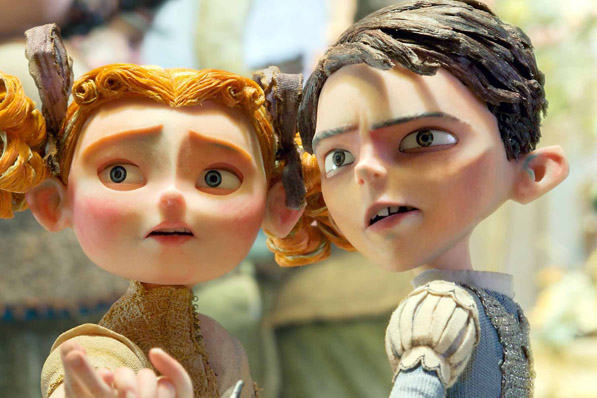
In a nice contrast to many children’s films and books, the character at the start who goes against the mob is a girl, Lord Portley-Rind’s daughter, Winnie (voiced by Elle Fanning in a mid-Atlantic accent passing as British). Although Winnie, in her pink ruffled dress and blonde ringlets might look like other storybook heroines, her fits over never being believed or taken seriously by adults and her morbid fascination with the boxtrolls make her more like Daria than Alice in Wonderland. When she asks another character if boxtrolls ate his parents, she adds, “Did they let you, I mean, make you, watch?”

The Boxtrolls

Written by Ren Jender as part of our theme week on the Academy Awards.

Critics are loath to say out loud that well-made (and even some not-so-well-made) films, like the rest of pop culture, influence us in every way–fashion, language, and politics. But the proof that critics understand the political power of film comes to light in indirect ways: critics aren’t giving much publicity to the racist but groundbreaking and, in its day, critically acclaimed film, The Birth of a Nation in this, the year that marks a full century since its premiere. And since a North Carolina man shot, execution style, his Muslim, charity-minded neighbors (and a rash of anti-Muslim actions have followed) the (mostly male) cadre of critics who previously were singing the praises of American Sniper, a film that depicts Muslims as perfectly appropriate, shoot ’em up targets, stopped doing so.

Deciding what to write about The Boxtrolls (directed by Graham Annable and Anthony Stacchi), a film I enjoyed on many levels but which contains some destructively retrograde messages–mixed in with its mostly progressive ones–was difficult. I should make clear that I’m not usually an eager consumer of entertainment designed for children. I don’t have kids of my own and although I liked the one Harry Potter book I’ve read I never felt the need to read the others. But The Boxtrolls is beautiful to look at (and comes from LAIKA, the same folks who gave us Coraline)–stop-motion animation set in a steam-punk version of 19th century England. With a great deal of economy (the clever script by Irena Brignull, Phil Dale, Adam Pava, and Anthony Stacchi is based on the book, Here Be Monsters! by Alan Snow) the film sets up the premise: boxtrolls, small monster-like creatures who get their name from the cardboard boxes they wear and draw themselves into, turtle-like, at the first sign of danger, scavenge the town streets at night for scraps and goods they can take to their underground lair. Archibald Snatcher (played, magnificently, by Ben Kingsley–it’s the best role he’s had since Sexy Beast; he should play villains more often!) is an opportunistic striver who seeks to elevate his station, first by demonizing the harmless boxtrolls and then capturing all of them, making the streets “safe” for the townspeople and collecting his reward from the town’s ruling elite, headed by Lord Portley-Rind (voiced by Jared Harris) who resembles the king in a deck of cards and has about as much depth.

In a nice contrast to many children’s films and books, the character at the start who goes against the mob is a girl, Lord Portley-Rind’s daughter, Winnie (voiced by Elle Fanning in a mid-Atlantic accent passing as British). Although Winnie, in her pink ruffled dress and blonde ringlets might look like other storybook heroines, her fits over never being believed or taken seriously by adults and her morbid fascination with the boxtrolls make her more like Daria than Alice in Wonderland. When she asks another character if boxtrolls ate his parents, she adds, “Did they let you, I mean, make you, watch?”

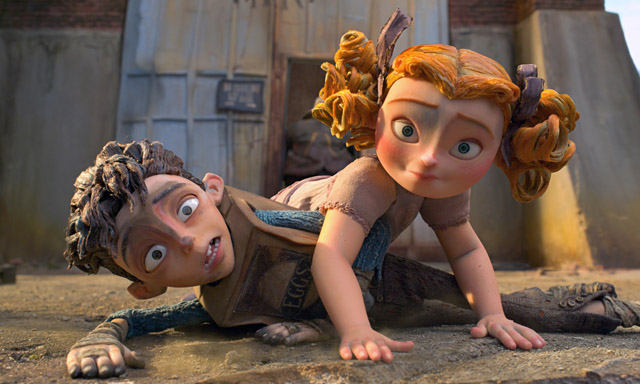
Winnie’s curiosity about the boxtrolls ends up with her encountering them in their own lair–and meeting Eggs, named after the box he wears, (and voiced by Isaac Hempstead Wright) a human boy adopted by the boxtrolls who doesn’t realize he’s not one of them, though he’s twice their height. After he disavows all the ways he is different from his adopted kin he can’t really argue when Winnie suggests, “Then let’s see you fit in your box.”

WinnieEggsBoxtrollsSmall
Winnie and Eggs


The two work together to try to stop the machinations of Snatcher (whose name, manner and appearance seem to be a tribute to the “child catcher” in Chitty Chitty Bang Bang) though as in most films, the boy takes on the main role in vanquishing the villain. In spite of how vivid the animators and Fanning make Winnie, this film does not even come close to passing the Bechdel test. One of the few women characters, Winnie’s mother, is played by the great Toni Collette but she barely gets a line in. And the boxtrolls must reproduce by cloning because we never see one who’s female.

But the huge problem at the center of The Boxtrolls are the scenes when the screenwriters, to show how propaganda can influence the actions of otherwise reasonable people, have Snatcher put on a corset and an evening dress and assume an alter-ego, a red-haired, French chanteuse who sexily sings about killing boxtrolls while she charms all the men in town (who don’t seem to see beyond the wig). I’ve written before about the history of murderous trans* women in film but I was particularly surprised to find this trope–along with the one in which a trans* woman hides her identity and the men who were attracted to her are chagrined once she is outed–in a film that aggressively courts a progressive audience.

Not only is The Boxtrolls full of messages about not dehumanizing those who are “different,” and that adoptive families are just as loving as other families, but it also has kind of an Occupy moment when its boy hero tell others, “Stand up for yourselves. Don’t be afraid anymore.” At the end of the film over the credits we hear “The Boxtrolls Song” an explicitly pro-queer-family anthem by Eric Idle (of Monty Python fame) that includes in its laundry list of different kinds of families those with two Moms or two Dads.

I was sad that this otherwise delightful, humorous (some of Kingley’s lines made me laugh like I haven’t since Obvious Child), anti-capitalist film nominated for a Best Animated Feature Oscar had to pollute itself with “man in a dress” jokes, especially considering that these jokes couldn’t be mere throwaways–stop-motion films take years of painstaking effort to create (which could also explain the “Occupy” theme). I wondered if anyone involved in the film knew that a generation ago, making fun of the rest of the queer community would have been considered acceptable children’s entertainment too.

[youtube_sc url=”https://www.youtube.com/watch?v=Q2dFVnp5K0o” iv_load_policy=”3″]


Ren Jender is a queer writer-performer/producer putting a film together. Her writing. besides appearing every week on Bitch Flicks, has also been published in The Toast, RH Reality Check, xoJane and the Feminist Wire. You can follow her on Twitter @renjender

Colleen Atwood’s Costumes in Disney’s ‘Into The Woods’

Atwood’s designs are stunning, but they also highlight the discussions of gender roles and racial relationships in America.

Written by Jackson Adler as part of our theme week on the Academy Awards.

Colleen Atwood is an Academy Award nominee for Best Costume Design for Disney’s Into The Woods. In order to represent the hodgepodge of characters, she based their costumes in differing time periods, ranging from Medieval European to 1930’s America. Each costume also has a bit of a modern flair, especially Cinderella and Cinderella’s Prince’s costumes. Atwood’s designs are stunning, but they also highlight the discussions of gender roles and racial relationships in America.

[youtube_sc url=”https://www.youtube.com/watch?v=MhbEMlFwxFE”]

The stage play of Into The Woods has feminist moments, with all characters written to be complicated, not just the men and boys. An example of this, as Bitch Flicks’ Katherine Murray has previously covered, is the role of The Witch as multi-faceted. While the Disney film retains many of the feminist moments and aspects from the original stage play, it has made some changes to the story that undermine them. This is representative in some of the costumes. Rapunzel’s costume is wrapped in ribbon and fabric, symbolically showing how Rapunzel feels tied up and trapped by her mother, barely able to breathe freely. While in the Disney adaptation, we see Rapunzel’s unhealthy relationship with her mother, The Witch, we never see the original production’s outcome for Rapunzel. Rapunzel is metaphorically tied up and restricted, but we never see her metaphorically undone and unraveled. Riding off into the distance with her prince does not free Rapunzel in the stage play, as being locked in a tower all her life has, understandably, lasting consequences on her psyche. Rapunzel’s restrictive life with her mother is shown beautifully through her costume, but Disney’s cut of Rapunzel’s ending undermines how telling that costume is of her emotional and psychological well-being.

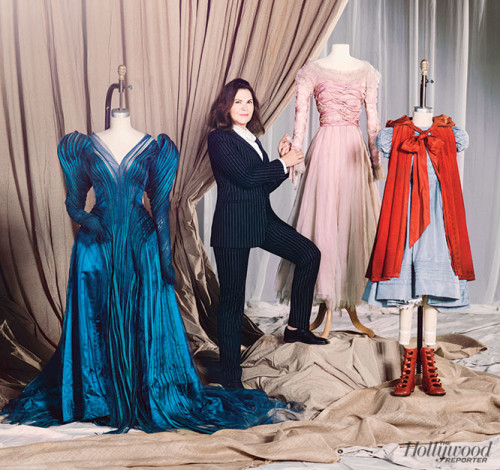
Colleen Attwood with her costumes for The Witch, Rapunzel, and Little Red.
Colleen Atwood with her costumes for The Witch, Rapunzel, and Little Red.


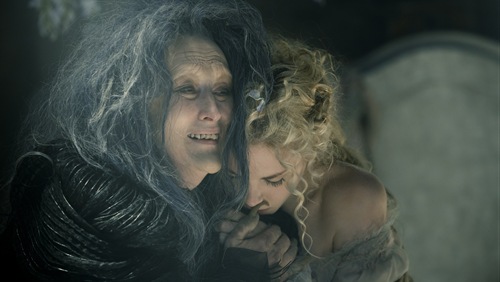
Rapunzel’s white and pink costume is contrasted beautifully by The Witch’s first costume (black) and her second costume (blue). The Witch’s costumes take up more space than Rapunzel’s, showing the freedom The Witch has to move in the outside world, contrasting with Rapunzel’s captivity. They are also masculinized, as the two princes have the same color scheme – Rapunzel’s Prince in black and Cinderella’s Prince in blue. In order to have influence and power, it is implied by these costumes that The Witch has taken on some masculine and patriarchal qualities. This is evident by her treatment and dress of Rapunzel, wanting to keep her daughter soft, sweet, and subservient. Atwood has praised Meryl Streep’s use of her costumes, creating a collaboration between actor and costume designer in telling the story. In her song “Stay With Me,” The Witch switches back and forth between patriarchal abuse and maternal love, with Streep physicalizing this by standing above Rapunzel and yelling at her, to sitting next to Rapunzel and embracing her. When The Witch regains her former beauty, her costume takes up more space and Streep stands taller, symbolically showing the confidence that The Witch has gained from her beauty. However, though she looks younger and more conventionally beautiful, she has unwittingly lost her magic powers and her ability to defeat Rapunzel’s Prince. Streep’s performance combined with her costumes show how The Witch attempts to form her own identity and destiny amidst conflicting messages of how to be a powerful and successful woman in a sexist and patriarchal world. That The Witch is punished by Disney’s ending of her story, symbolically being sucked into Hell, is problematic, as it seems to eternally condemn her for attempting to be a powerful woman.

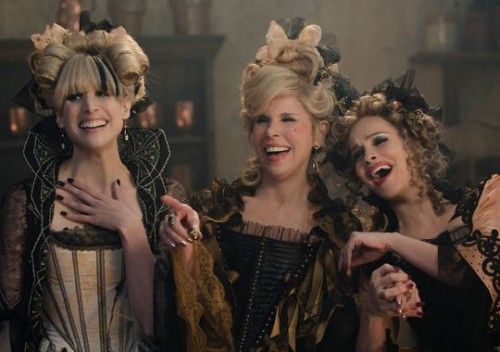
Cinderella's Stepmother, with Lucinda and Florinda.
Cinderella’s Stepmother, with Lucinda and Florinda.


This is echoed in the color scheme for Cinderella’s Stepmother, and her stepsisters Florinda and Lucinda. The Stepmother and her daughters are in black and gold, while Cinderella wears gold when she attends the ball. This codes gold as representative of female glamour, while black is representative of women adopting patriarchal actions. Interestingly, Florinda and Lucinda are physically punished (their eyes are picked out by birds), but The Stepmother is not. Cinderella’s Father is cut from the Disney film, and it is in the stage play that we see that Cinderella’s Father is alcoholic and severely neglectful of his daughter. The storyline of Cinderella’s family can be interpreted in two different ways. Was Cinderella’s Father driven to drunken ineffectiveness by a cruel and greedy second wife? Or was it Cinderella’s Father’s drunken ineffectiveness that made The Stepmother take control of and be the head of the family because someone had to? We know that Cinderella’s Mother was incredibly kind, and that she died. Perhaps it was the death of his beloved wife that lead Cinderella’s Father to drink, and The Stepmother is merely trying to survive in a patriarchal world. What else would lead her to do something so drastic as to mutilate the feet of her daughters in an attempt to marry them off to a prince – someone with money who will financially take care of the family? Florinda and Lucinda are punished, perhaps, for not standing up to their mother and treating Cinderella kindly and as an equal, while The Stepmother isn’t blamed, since her cruelty was merely a misguided attempt to achieve security for herself and her family. Cinderella never wears black or blue, and she ends up rejecting her prince’s patriarchy. At the end of the story, Cinderella works closely with The Baker, someone who fits in with her color scheme of earth tones (though still wears a bit of blue), and who earlier learned that “it takes two” (meaning equality) to have a healthy relationship.

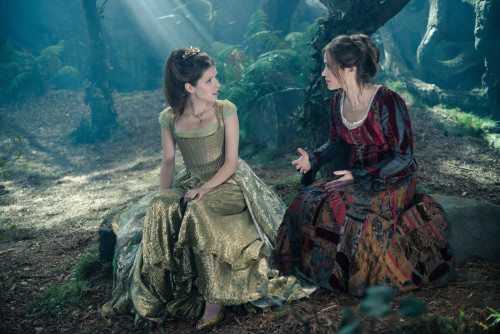
Cinderella and The Baker's Wife.
Cinderella and The Baker’s Wife.


The Baker’s Wife wears many different colors, with her main costume being mostly red, with a fair amount of blue, gold, and black. Atwood and Emily Blunt thought it important that The Baker’s Wife’s resourcefulness should be shown in her costume, and that it was made up of “whatever she could find.” The Baker’s Wife is a working class woman struggling to get by, who argues with her husband, who wants a child, and who also wants a fulfilling sex life. Her song “Moments in the Woods” debates the question of can women have it all? And should they? She has red for passion and sexual desire, blue and black for masculine traits that she adopts to get by, and gold because she would like a bit of glamour in her life. Disney arguably punishes her lust by making her a fallen woman via having her fall to her death from a cliff.

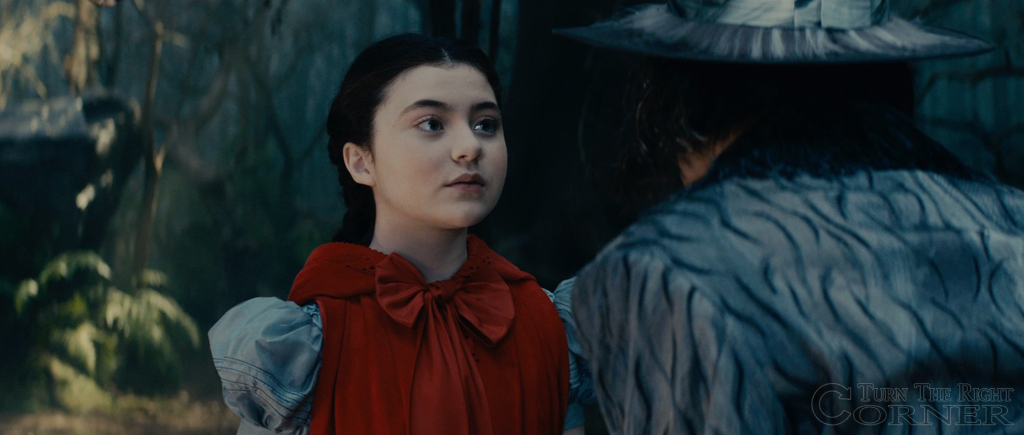
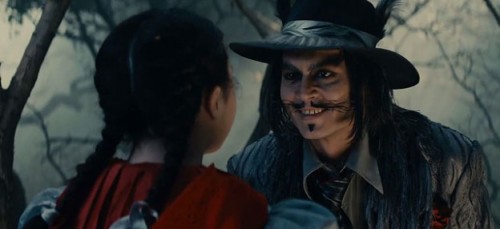
Red and blue are also the color scheme for Little Red Riding Hood, whose storyline with The Wolf is reminiscent of sexual assault. Little Red is more assertive than most of the other female characters, and her dress is blue and has puffed sleeves, and, in these ways, is similar to The Witch’s second costume. We never hear of Little Red’s male family members whether in the stage musical or the film adaptation. It is therefore implied that Little Red is raised solely by her mother (whom we never see) and her grandmother. With her black hair, blue dress, and cape of red, Little Red is an empowered and sexual woman in the making, guided by independent women. The Wolf is in black and blue, with a red boutonniere. When Little Red is hesitant about trusting The Wolf, he points her towards some (in the Disney film) blue and phallic looking flowers for her to gather – seemingly supporting her masculine independence. By taking Grandmother’s place in bed and wearing her clothes in order to attack Little Red, The Wolf is seemingly sensitive and more maternalistic – something he hopes will be attractive to Little Red. Though Little Red is wary, The Wolf deceives Little Red long enough to take her off guard and attack her, reminiscent of date rape.

Little Red and The Wolf


While the color scheme of The Wolf’s costume works well in telling the story, the design itself is incredibly problematic. As I have written before, The Wolf’s costume is a zoot suit, which has a rich racial history in The United States. In the 1930’s and 40’s, the zoot suit was a symbol of power among young people of color, and it was criminalized by the white populace and media. The Wolf wearing a zoot suit and attacking a white girl in Into The Woods is reminiscent of a white actor in blackface attacking a white woman in the controversial and highly racist Birth of a Nation. That Depp, Atwood, and director Rob Marshall all thought it was a good idea for the costume to be a zoot suit is upsetting to say the least.

As especially evidenced by the zoot suit, Atwood’s costumes are not all period appropriate to Medieval Germany. Many of them are similar to the neo-Medieval styles of British television series Merlin and Robin Hood, and the American series Reign. Merlin and Robin Hood have ethnic diversity, and Reign is (mostly) feminist. Into The Woods’ modernity highlights how relevant its feminist moments from the stage play are to contemporary audiences. However, Into The Woods has very little ethnic diversity. Even in a more period-appropriate adaptation, Into The Woods could have characters who are people of color, as centuries of trade, colonization, and war had brought diversity to Medieval Europe. While there are PoC extras in the film, as both peasants and royalty, any character with a line or a lyric is White. By Atwood making the costumes in varying time periods, with both contemporary and fantastical elements, it highlights that this is a story and a world in which anything goes – from talking wolves, to giants, to magic beans. However, evidently for Disney, the casting of people of color was too much.

Colleen Atwood’s costumes both contribute to the story of Into The Woods and, indirectly and directly, point out Disney’s flaws in the telling of it. Her costumes beautifully support the theme of gender roles in the story, and if it wasn’t for putting Johnny Depp in a zoot suit, I might support the idea of her winning an Oscar for her work on the film. Either way, I hope Hollywood does a lot of self-reflecting in regard to how it does and does not address gender and race.


The Academy’s White Noise: Silencing the Lions

I said that I had hoped this year would be different. However, when the Academy announced its nominations, I was not surprised.

Black men and women, organized by character type, who have won Academy Awards. This is an updated infographic after Nyong'o's win last year. We won't get to add "Historical Civil Rights Icon" as a category in 2015.    Click to enlarge.
Black men and women, organized by character type, who have won Academy Awards. This is an updated infographic after Nyong’o’s win last year. We won’t get to add “Historical Civil Rights Icon” as a category in 2015.   Click to enlarge.


Written by Leigh Kolb as part of our theme week on the Academy Awards.

Two years ago, after Django Unchained was largely snubbed at the Oscars (compared to the Golden Globes), I looked at the history of the Black actors/characters who were awarded by the Academy over the years. Last year, I revisited that history as 12 Years a Slave dominated the awards circuit.

It’s fairly clear what roles Hollywood is most comfortable with: for Black characters, passivity, tired stereotypes, and villainy get the highest awards. Complex, powerful Black characters–especially those who appear threatening to white supremacy in some way–typically get passed over.

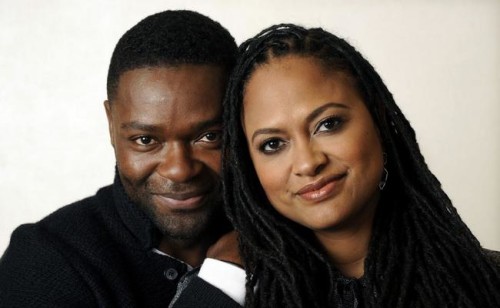
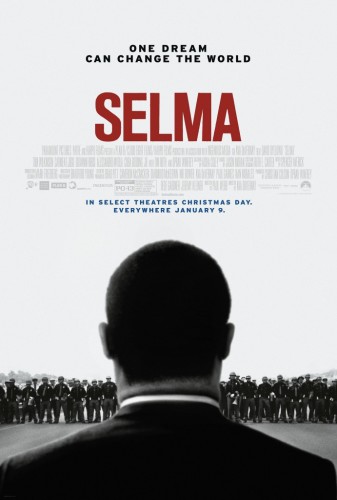
I hoped this year would be different. This year, institutionalized, implicit American racism seeped out of the pores of American cities and psyches post-Ferguson. This year, Ava DuVernay directed Selma, 5o years after the Selma to Montgomery march that led to the passage of the Voting Rights Act. The film is brilliant in its own right–DuVernay’s direction and David Oyelowo’s portrayal of Martin Luther King Jr. are incredible. Certainly the power of the film within the historical context would make the Academy sit upright and give credit where credit is due.

Instead, we got more of the same. Selma was recognized widely in Golden Globe nominations–best picture, best director, best actor, best original song (John Legend and Common’s “Glory,” which took home the award). And then, as always, the Academy turned up its white nose. While it’s up for best picture and and original song, DuVernay and Oyelowo were passed over.

At Rolling Stone, Peter Travers said,

“Why am I calling this year’s Oscars, on February 22nd, the ‘Caucasian Consensus,’ when Selma is one of the eight nominees for Best Picture? Because that landmark film about Martin Luther King Jr.’s 1965 civil-rights march has only one other nomination, for Best Song. Not one person of color appears among the 20 nominees for acting. Apparently, the Academy thought it gave last year when it awarded 12 Years a Slave the gold. The message from white voters? Don’t get uppity.”

Not one person of color.

I said that I had hoped this year would be different. However, when the Academy announced its nominations, I was not surprised.

I had to drive over an hour to watch Selma on the big screen, because none of the theaters in the small towns around me screened it (and they still haven’t).

This happened 20 minutes from my home.

The Voting Rights Act was gutted in 2013.

Writers had to defend DuVernay’s portrayal of an imperfect L.B.J.

In an interview, late author Chinua Achebe quoted the following proverb: “Until the lions have their own historians, the history of the hunt will always glorify the hunter.” This proverb perfectly, painfully illustrates Hollywood’s–and America’s–hegemonic forces at work.

The hunters write history. The hunters glorify themselves. The hunters’ history infiltrates itself into the very fabric of our cultural narrative, so we’re only comfortable with seeing the complexities of the hunters, and the simplicity of the lions.

Selma challenged that narrative. Oyelowo–who felt destined to play King–and DuVernay dared to glorified the lions.

And the hunters simply wouldn’t hear of it.

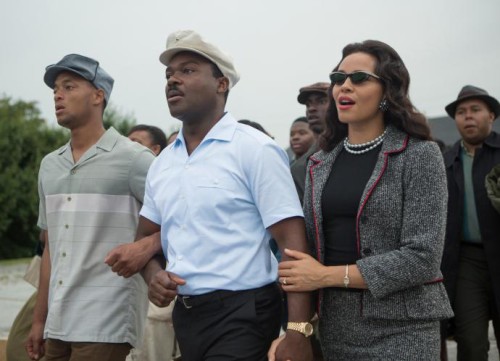
Oyelowo and DuVernay


See also at Bitch FlicksThe Academy: Kind to White Men, Just Like HistoryRace and the Academy: Black Characters, Stories, and the Danger of DjangoCaptain Uhura Snub: The Politics of Ava DuVernay’s Oscar 


Leigh Kolb is a composition, literature, and journalism instructor at a community college in rural Missouri. 


‘Big Hero 6’: Woman Up

The female team members are often shown as being more capable then the males, both as combatants and as scientists. Gogo Tomago , and Honey Lemon, are two bright, young scientists who exhibit strength of mind, body, and will. During a training montage, Gogo uses the phrase “woman up” to encourage one of her teammates to do better. This was a great, subversive line because it flowed naturally from the character and the context, rather than seeming like a forced injection of faux-feminism.

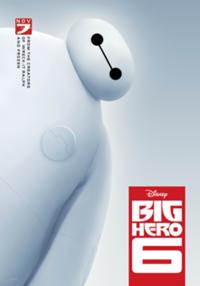
U.S. release poster.

This repost by Andé Morgan appears as part of our theme week on the Academy Awards.

Big Hero 6 (2014) is a cinematic snack, lighter fare to counterbalance heavier offerings like Christopher Nolan’s Interstellar (2014), much in the same way that Wall-E (2008) contrasts with The Terminator (1984), or a pile of disgusting feces compares with Jack and Jill (2011). Still, the film does touch on universal themes that adults will appreciate: the trials of adolescence, grief, our wonder at science, and our fear of unrestrained technological development.
Other recent Disney animated films, like Planes: Fire and Rescue (2014), and Alexander and the Terrible, Horrible, No Good Very Bad Day (2014), were not, for good reason, box office or critical darlings. But Big Hero 6 is different — it’s an offspring of Disney’s 2009 union with Marvel. Like Guardians of the Galaxy (2014), Big Hero 6 draws on a little-known corner of the Marvel universe. Directors Don Hall and Chris Williams took the heart of that original comic and created a Happy-Meal-ready sequel factory. Thankfully, they left the spandex boob socks and impractical armor behind.
Yeah, this is OG Gogo Tomago…
The story is set in the fictional city of  “San Fransokyo.” While the name is a bit clumsy, the visual fusion of Bay Area landmarks and American and Asian architecture is beautifully done. The influence of Japanese comics and science fiction is tastefully overprinted on all the animation, and it works. I wish I could say the same for the character design. While adequate, it suffers from the same Disney animation facial blandness found in Frozen (2013) and Wreck-It Ralph (2012).
This should be IRL.
This should be IRL.


If you’ve ever seen a Disney animated movie, particularly one of the more recent ones, then you already know the plot beats to Big Hero 6. This is too bad, because after establishing an interesting origin story, screenwriters Robert Baird, Daniel Gerson, and Jordan Roberts let the effort devolve into a decidedly unoriginal superheroes vs. villain story. Hiro Hamada (Ryan Potter) is a 14-year-old orphan (of course) and robotics prodigy, although the puffy robotic heart of the film is Baymax (Scott Adsit), who resembles (at least to this child of the 80s) a futuristic Stay Puft Marshmallow Man. Despite an appearance that may appear androgynous to Westerners, Hiro is definitely a male protagonist, and this is definitely not Frozen. However, gender plays little role in his actions or interactions, and this is where the film really shines.

After rescuing Hiro from certain doom, his brother, Tadashi (Daniel Henney), takes Hiro to the robotics lab at the local R1 university. There he meets Tadashi’s friends and fellow students (who will later become his wrecking crew) and the department head, Professor Callaghan (James Cromwell). Hiro is impressed by the tech, and very badly wants to join Tadashi in college. In order to gain entrance, he competes in a pro-level science fair. He wins, of course, but tragedy ensues and sets the stage for the rest of the movie.

The cast of characters is diverse. In a subtle and pleasantly subversive move, the only white male characters of note are the “villains.” The Black character, Wasabi (flatly voiced by Damon Wayans), did come off a little token-ish, but it’s hard to level that accusation considering the diversity of the entire cast. Also, I have to credit the writers for avoiding race or gender-based humor throughout. This film does not have exceptional voice acting, animation, or story, but it does stand out in one other major way: the relative parity between male and female characters. And I don’t just mean numerical parity, I mean parity in the intent and essence of the roles.
From left to right: Fred, Gogo, Baymax, Hiro, Honey Lemon, and Wasabi.
Several main characters, and an important ancillary character, are women. Aunt Cass (Maya Rudolph), is Hiro and Tadashi’s guardian. She’s a single mother, and not once does she complain about it. No references are made to some horrible tragedy involving her former husband; there are no jokes about her wanting a man. Rather, she’s shown as a happy, competent business owner and caretaker.
The female team members are often shown as being more capable then the males, both as combatants and as scientists. Gogo Tomago (Jamie Chung), and Honey Lemon (Génesis Rodríguez), are two bright, young scientists who exhibit strength of mind, body, and will. During a training montage, Gogo uses the phrase “woman up” to encourage one of her teammates to do better. This was a great, subversive line because it flowed naturally from the character and the context, rather than seeming like a forced injection of faux-feminism. Also of note, the villain’s daughter, Abigail (Katie Holmes), is depicted as a brave test pilot, and her fate is key to the film’s climax.
Big Hero 6 will most strongly appeal to older kids. The heavier questions may be lost on younger children, and some of the fight and chase scenes are a bit violent (bloodless, and no more so than similar films) and frenetic. Adults will (or at least should) appreciate the themes, the gender equity, and the racial diversity of the characters. Most importantly, the film excels at imparting a sense of wonder about science. By showing strong, capable female characters, this film will, I hope, encourage both girls and boys to develop an interest in science.
The film has a trim 102-minute running time, so a six-minute appetizer, Feast (2014), precedes it. The story is told from the visual perspective of a young Boston Terrier, and quickly jumps from a series of hungry-dog sight gags to a saccharine love-marriage-baby-carriage parable. Despite having the look of an experimental short, the animation and the story are deliberate, targeted, and all conventional Disney fluff.

Also on Bitch Flicks: Wreck-It Ralph is Flawed, But Still Pretty Feminist by Myrna Waldron

Andé Morgan lives in Tucson, Arizona, where they write about film, television, and current events. Follow them @andemorgan.

Child-Eating Parents in ‘Into the Woods’ and Every Children’s Story Ever

Your dad is an ogre or giant, your mom is a witch, and both of them want to kill you. Welcome to your fairy tale life.


This repost by Katherine Murray appears as part of our theme week on the Academy Awards.


Your dad is an ogre or giant, your mom is a witch, and both of them want to kill you. Welcome to your fairy tale life.

Meryl Streep and Mackenzie Mauzy star in Disney's Into the Woods
Also, you live in a tower and your mom pulls your hair all the time


If you’ve ever read a fairy tale before, the idea that mother figures end up being witches is not exactly news. Young, beautiful, kind, and loving parents (mothers, especially) are usually MIA or KIA before the action starts, and the child heroes instead interact with angry, powerful fantasy characters who are about the same age their parents would be, and fill some of the same roles their parents would fill, but also want to murder them in shocking and terrible ways.

The clearest example of this is probably Hansel and Gretel, where parents eat their own children through the proxy of a witch, but it’s a theme that repeats itself in children’s literature.

Disney’s adaptation of Into the Woods contains a smorgasbord of missing parents, one of whom is replaced by a bone-crushing giant, and one of whom is replaced by a witch. The giant comes into play during the movie’s riff on Jack and the Beanstalk, where fatherless Jack meets an oedipal complex a “big tall terrible lady giant” who behaves toward him as a mother would before her husband tries to eat Jack for lunch (as recapped in this song). The witch is a more developed character, and a better example of what Into the Woods has to offer as an adult-oriented fairy tale.

The witch, who isn’t ever named, plays a role in multiple plot lines, but her origin is in Rapunzel. After catching her neighbour trying to make off with her vegetables, she curses him and locks his daughter in a tower, raising the girl as her own. From there, the story progresses in the usual way – Rapunzel meets a prince; the witch becomes jealous and attacks them; Rapunzel is reunited with her prince and leaves the witch behind forever.

Some of the commentary on Into the Woods (both the movie and the pre-Disney musical) has painted the relationship between Rapunzel and the witch as one about parents struggling to let go of their children and wanting to shelter them from the dangers of the world. James Lapine and Stephen Sondheim even introduce the witch’s signature song, “Stay with Me” as a touching song about family relationships that’s supposed to show us a gentler side of the witch.

And, while it’s true that “Stay with Me” presents the witch as an emotionally complex person, it also presents her as a pretty shitty parent. If you listen to the whole thing, including how the scene begins and ends, she’s emotionally manipulative, self-centred, prone to sudden fits of anger, and unreasonably punitive.

Kind of like Rapunzel’s witch mom in that other Disney movie.

Rapunzel and Gothel in Disney's Tangled
Mother knows your weaknesses


In fact, I wouldn’t be surprised if the dynamic in Into the Woods influenced Tangled in some way.

Tangled is a lot less nuanced in its presentation – the witch in Tangled is purely self-interested and doesn’t show any signs of genuine affection for Rapunzel. In this version of the story, Rapunzel unknowingly has the power to rejuvenate people, and the witch wants her to stay in the tower and act as a personal fountain of youth. As part of her plan to keep Rapunzel under control, she systematically destroys Rapunzel’s confidence and self-esteem, convincing her that she’s so ugly, helpless, and stupid that she’d never survive on her own, and no one else would want her.

The turning point in the story comes when Rapunzel, who’s been raised by an abusive parent her entire life, without anything else to compare it to, realizes that her witch mother doesn’t really love her, and that she deserves to be part of a family that treats her with kindness and respect.

Into the Woods, which is intended for an audience of adults, is more layered. It’s clear that the witch feels more than one way about Rapunzel. It’s not a case where she’s just lying when she says she loves her daughter, but she displays a selfish, greedy kind of love that turns Rapunzel into an object whose feelings and needs aren’t important.

In the movie, their story arc ends when Rapunzel rides into the woods with her prince, vowing never to see the witch again. The second act of the musical, on stage, is much more explicit in showing us the long-term fallout of Rapunzel’s awful childhood – even though things are all right for her now, she can’t ever be happy because of the way she was raised. It’s an experience that’s going to haunt her forever.

Treating your children as things you own that exist to make you happy – and treating them as things that are defective, when they don’t make you happy – is an abusive form of parenting that more than one witch mother seems to exhibit.

Coraline and Other Mother in Coraline
She was being so nice just a second ago


Other Mother, the villain of Coraline, doesn’t have a pointy hat and a broom, but she’s a supernatural creature with magic powers who stands in for Coraline’s real mother in much of the movie.

In this case, the swap is more literal. Coraline, feeling temporarily neglected by her parents, finds a door behind the wallpaper in her house, leading to a world where everything is way more fun an interesting. The Other world is a copy of the world Coraline lives in, where everything revolves around her, and where she is (initially) welcomed by an alternate version of her mother, who’s far more attentive, warm and happy. The only thing Coraline has to do to stay in the world where everything’s awesome and great all the time is let Other Mother carve out her eyes.

When Coraline asserts herself by politely refusing to do that, Other Mother turns into a monster who rages at Coraline for disappointing her, kidnaps Coraline’s real parents, and tries to trap Coraline in the Other world forever. We then learn that Other Mother controls everyone else in the Other world, punishing them if they don’t seem happy enough, and forbidding them to talk to each other when she’s not there.

When Coraline asks why Other Mother is so determined to keep her in the Other world, one of the other characters explains that she wants something to love that isn’t her – or, possibly, “She’d just love something to eat.”

The story resolves when Coraline escapes from Other Mother, and realizes that her parents, although they’re not perfect, genuinely love her, care about her feelings and well-being, and, unlike Other Mother, would never hurt her on purpose. The smothering, overly-attentive “love” that Other Mother initially displays for Coraline is really a greedy, hungry desire for something to trap and control. Love doesn’t mean giving someone everything you have so as to buy the right to keep them.

Chihiro and Yubaba in Spirited Away
This is isn’t what love means, either


In most children’s stories, the substitution of witch for mom or giant for dad is a safe way of exploring children’s fears about their parents. Children need their parents to take care of them, which leaves them at their parents’ mercy; even good parents sometimes express sides of themselves that their children find frightening or confusing – stories where children are mistreated or endangered by mother and father figures who aren’t literally their parents provide a way to confront the fear of mistreatment or endangerment while also providing a safety net that says, “Your real mom and dad aren’t like this.” In other words, it’s too awful to think that your mother is evil, so she becomes two people – one that’s nice (and dead or gone) and one that’s really mean.

Because Other Mother looks and sounds just like Coraline’s real mother, the association between nice mom and mean mom is more obvious in Coraline, but the distance between Coraline’s actual mother and the monster behind the wallpaper is clear. One is a reasonable human being and one is an imposter.

Spirited Away, a Japanese film directed by Hayao Miyazaki, offers a more nuanced reading of the switch between nice mom and mean mom, with the witch grandmother Yubaba. Yubaba is murderous and terrifying, but is occasionally replaced by her kindly “twin sister” who invites the movie’s heroine to call her “grandma” and likes to make people tea and knit sweaters. In general terms, Miyazaki’s films seem comfortable with the idea that people aren’t all one way – that there are many, sometimes contradictory sides to our personalities, that are expressed at different times. By the end of Spirited Away, it’s strongly implied that Yubaba and her “sister” are actually the same person, each expressing different aspects of who she is.

The typical witch substitution removes all the negative aspects from mom, and sends them out into the world as a monster that can be defeated. It’s rare to find a mother figure who’s capable of both kindness and cruelty, and rarer still to find one who is predominantly cruel, without being wicked all the way through.

Where Other Mother and the witch from Tangled are pure evil wearing the mask of friendship, the witch from Into the Woods is the rare example of a mother figure who’s mostly bad, with occasional moments of goodness. That fits the story’s more mature approach to fairy tales, and its overarching message that right and wrong and good and bad are not as clear as children’s books would make them seem.

If the child-eaters of children’s stories are monsters, the ones in real life are more likely to be like the witch in Into the Woods: emotionally-immature adults with poor boundaries, who see their children as things that belong to them, like lamps and cars. They can be nice sometimes. They can elicit pity. They can express vulnerable emotions, and they can share common experiences with parents who are mostly good. They honestly do want something to love, but they’d also love something to eat.

We’re so used to seeing negative human qualities externalized into monsters, that’s it’s still surprising when a character is both monstrous and recognizably human. In a story that’s about adulthood, and coming to understand yourself and the world more clearly, the crucial move Into the Woods makes is in allowing Rapunzel’s witch mother to be her “real” mother – the only one she’ll ever know. The childhood projections of nice mom and mean mom collapse into one single person, and the thought that was too terrible to entertain in childhood – that maybe your mom is a witch – becomes real, layered and deepened through the knowledge that witches can also be people.


Katherine Murray is a Toronto-based writer who yells about movies and TV on her blog.

What’s Missing from the ‘Gone Girl’ Debate? Privilege!

‘Gone Girl’ has been called misogynist, an amalgamation of negative stereotypes of women, a text that perpetuates rape culture, and a narrative that fuels Men’s Rights Acivtists’ ugly depiction of the gender equality feminists are trying to achieve.

Putting the talent of the author aside – because I do think Gillian Flynn is an incredible writer – I want to address this feminist ire directed at ‘Gone Girl.’

To an extent, I agree with it. Yet, what is missing from the discussion is a focus on privilege.


This repost post by Natalie Wilson appears as part of our theme week on the Academy Awards.


gone-girl-white-title


WARNING: THIS PIECE CONTAINS SPOILERS!


Gone Girl has been called misogynist, an amalgamation of negative stereotypes of women, a text that perpetuates rape culture, and a narrative that fuels Men’s Rights Acivtists’ ugly depiction of the gender equality feminists are trying to achieve.

Putting the talent of the author aside – because I do think Gillian Flynn is an incredible writer – I want to address this feminist ire directed at Gone Girl.

To an extent, I agree with it. Yet, what is missing from the discussion is a focus on privilege.

Amy Elliot Dunne, the protagonist of Gone Girl, is white, wealthy, heterosexual, and conventionally attractive (many privileges which her creator, Gillian Flynn, shares).

gone-girl-whysoblu-6

Yes, Amy is a female, but she is an EXCESSIVELY privileged one, so privileged, in fact, that she has the necessary funds, skills, know-how, and spare time to concoct a near iron-clad story in which she convinces the media, the law, her community, and her family that she has been raped, abused by her husband, kidnapped, imprisoned, and possibly murdered.

Flynn, even given the worldwide success of her writing, is, I would guess, not nearly as privileged as Amy. Plus, if details at the author’s website are correct, she worked odd jobs throughout high school; Amy is not the type of female that had to work in high school, and especially not at anything where she would be made to dress up as a cone of yogurt.

In addition to her privilege, is Amy in fact a compilation of the evils MRAs spout on about in relation to “strong” women? In ways, yes. But this is just it – she is able to be strong – and, yes, to be evil – because she has the privilege to do so. As the saying goes, idle hands make the devil’s work.

gone-girl-df-01826cc_rgb_crop

Amy is narcissistic, vain, and shallow – and has enough time on her hands to fill her calendar with carefully labeled, color-coded post-its with details of her murder plot. And, once the plot is set in motion, handily has secured enough cash to buy a car, a new wardrobe, and keep her going for who knows how long. When that falls through, there is the very rich former boyfriend Dezi, who will put her up in his “lakehouse” – a spare house that makes many mansions look shabby.

Yes. This is fiction. Yes, it’s a dark, twisted, mystery. It is obviously meant to be. The author herself made it clear that she “wanted to write about the violence of women” after her first book, Sharp Objects. And this is not a problem – not at all – but what is vexing with Gone Girl is at the heart of its narrative is a woman that falsely accuses several men of rape and assault – and tries to frame one of them for murder. This story is a fiction. But rape and assault are at epidemic levels in our society – along with the horrible statistics is a pervasive narrative often called “blaming the victim.” At the heart of this narrative is the myth that females lie about rape. Not once in a blue moon. But often.

This is not what I want to focus on though – what I want to focus on is how privilege allows the fictional Amy to get away with all the atrocities she commits. If she “cried rape” (as MRAs and the media often suggest women do), would she be as readily believed if she were a woman of color? What if she were a prostitute? What if she committed murder and tried to convince the cops of her innocence via mere words? Would she be believed if she were, say, a young Black male? If she accused her partner of physical abuse and adultery would she become America’s media darling if she were not cisgender?

gonegirl5

The story of Kalief Browder, featured in The New Yorker, who served three years at Ryker’s Island, most of it in solitary confinement without trial before he was deemed innocent; of Renisha McBride; of Ferguson; is proof that innocence does not mean much for people of color in a society that frames those with non-white skin as born guilty (to borrow Dorothy Roberts claim made in her classic Killing the Black Body).

Gone Girl is not making a critique of privilege though, nor of how Amy’s whiteness and wealth – at least in ways – puts her above the law. Instead, Amy’s ability to frame others for crimes they did not commit and become America’s media darling has been acclaimed as a wonderfully concocted mystery by a talented author. As for Amy’s ability to pull off her fictive story within a story in the novel and the film adapation, this ability is never overtly linked to her privilege – unless you count the fact the film nods toward how wealthy she is, given her cat has its own bedroom. Rather, her success at framing others is presented as a very well-planned revenge plot carried out by a very smart, very malicious woman.

Admittedly, there are things the story does well in terms of critiquing societal problems. A key area in this regard is the portrayal of the media. As with the novel, the film delves into the media circus, giving us talking heads that spin hypotheses about Amy’s whereabouts and who is to blame for her disappearance – hypotheses that quickly lead to the narrative Amy intended: that her husband Nick is guilty, and she is the innocent, abused spouse all America should be routing (and praying) for.

GONE+GIRL+Movie+HD+Trailer+Captures00023_1_1

Amy clearly knows how to play straight into the hands of the of “The Ellen Abbot Show” – a fictionalized version of the likes of Nancy Grace. Amy notes, while concocting her plan, that “America loves pregnant women,” and, indeed, Ellen plays up Amy’s pregnancy to garner sympathy for her – and ire for her husband Nick. However, had Amy been a pregnant Latina, or working class, or a single woman, would she still be framed in this way by the real Ellen Abbots of the  world? Doubtful.

In fact, if Amy’s accusations of rape against not one, but three men, were to be reported in the real world media, it is likely she would blamed, interrogated, and have her reputation besmirched, especially if she lacked many of the privileges Amy’s character has. As noted in “Gone Girl and the Specter of Feminism,”

“Our society makes real-life survivors of rape into villains every single day. We assume ulterior motives. We invade and question their sexual history as if it’s relevant. We make rape survivors into whores and sluts, into evil, evil women who are only out to hurt and punish men. And that’s if we don’t ignore them altogether, or if they can summon the courage to report the rape at all.”

And though only 2 to 8 percent of reported rapes are determined to be unfounded, it is, as #2 reports, a “norm of the media to question the authenticity of rape victims that dare to step forward and seek justice.”

ben+affleck+and+rosamund+pike+in+GONE+GIRL

In the film, Tanner Bolt , the big-shot lawyer defending Nick, is portrayed as particularly media savvy. He says of Amy, for example, that “she is telling the perfect story.” And though his race is not highlighted as a factor, his know-how of the media and the key role public perception plays can be read as shaping the story he tells the world in public appearances.

Tanner advises Nick to do the same, telling him, “This case is about what people think of you,” and emphasizes the need for a huge re-alignment of public perception. Tanner knows this, and Nick should (especially given his former work as a journalist). Read through the lens of race, however (a lens, let me emphasize, the narrative itself does NOT interrogate), one can argue Tanner has to be more savvy than Nick and that Nick is allowed to live in a privilege bubble, one that leads him to assume people are going to believe him.

What people think of Amy – and Nick – is largely determined by their privilege. They live in a huge house, she is a “housewife,” they are both former writers, they are attractive, white, heterosexual, and have the requisite pet – as well as aspirations –  on Nick’s part at least – to have children. They are the picture-perfect American couple.

Gone-Girl-Trailer

But, this image is a fiction. And the fact the story plays around this fictive construct of what perfection is – and what a perfect marriage is – is one of its most intriguing features. Amy’s diary, a mixture of truth and fiction, is key here. In one telling scene, Detective Boney (my favorite character by far, perhaps as she has the most feminist gumption) goes through Amy’s diary, now being used as police evidence, and asks Nick what is true and what is fiction. The mixture of lies and truth within the diary, and within the entire narrative, make it hard to discern any reliability.

As argued in “The Misogynistic Portrayal of Villainy in Gone Girl,” Amy makes a magnificent unreliable narrator. Sadly though, she is believed – by the media, by the community, even by us, the audience.

If only her believability was tied to her privilege, Flynn could have had a narrative that did something feminists could applaud – a narrative that pulled back the sham of “perfect femininity” and showed the ugly undersides of unfair societal dictates.

gone-girl-rosamund-pike-ben-affleck-600x445

Instead, Flynn gives us a character that shares her own privileges – and her own penchant for spinning fictions – rather than one who lays bare the injustices that make the likes of Ellen Abbott believe her, that have lawyers running to defend Nick pro bono, that result in a media machine feeding off this one tragedy while ignoring wider injustices – injustice the camera actually lingers on at the start of the film, making the Missouri of Gone Girl remind one of the Detroit featured in Michael Moore’s Roger and Me.

While the narrative condemns what director David Fincher calls the “tragedy vampirism” of the media, it never takes the next step of pointing out how the poverty and homelessness of the community in which the story takes place plays a role in why Amy becomes a media darling and allows her husband to plausibly suggest the “homeless” are to blame for Amy’s disappearance.

The narrative also never takes any step toward addressing the reality of widespread sexual violence and domestic abuse, instead using this device as just one more piece of grist for its suspenseful, plot-twisting mystery.

Ben-Affleck-in-Gone-Girl

In one scene, Amy creates the “proof” of her rapes via thrusting a wine bottle inside herself as she icily gazes in the mirror (a scene also in the book). This comes after we learn she has destroyed the life of a completely innocent man by also framing him for rape, merely because he lost interest in her. And, in the most fraudulent, unbelievable plot point, this man tells us he was about to be put away for 30 years on a first degree felony. Guess how often rapists are put away for 30 years? Not often.

So, yes, Amy is a villain, some suggest a sociopath, but I heartily disagree that her horribleness could only come from a “female mind” – which is exactly what the actress who plays her – Rosamund Pike  – claims, that “the way her brain works is purely female.”

Instead, Amy’s villainy, and the fact she gets away with it, can be linked to her substantial wealth, her Ivy League schooling, her full immersion into the culture of “cool girls” and personality quizzes and, perhaps most of all, her sense of entitlement, revealed particularly in the way she expects to be treated, especially by Nick. In a key passage from the novel (also used in the film), Amy embodies the faux-feminism that defines her character, condemning constricting expectations of femininity on the one hand, but, on the other, hinting at  the narcissistic darkside of her anger:

“I hated Nick for being surprised when I became me. I hated him for not knowing it had to end, for truly believing he had married this creature, this figment of the imagination of a million masturbatory men, semen-fingered and self-satisfied. He truly seemed astonished when I asked him to listen to me. He couldn’t believe I didn’t love wax-stripping my pussy raw and blowing him on request. That I did mind when he didn’t show up for drinks with my friends… Can you imagine, finally showing your true self to your spouse, your soul mate, and having him not like you?

In ways, we want to applaud Amy for condemning the “cool girl” and demanding females deserve to be listened to – as this seems a feminist message. But, ultimately, Amy is far more like Ann Coulter than Amy Poehler.

goneg-girl-nick-and-amy

Though some might argue Amy is fully aware of and even using her privilege, I disagree. She is aware of being attractive, wealthy, and powerful, yes, but not any feminist way that questions or denounces or even deliberately deploys her privilege. One of the most telling parts of the narrative to display this is in her interactions with Greta, a working class character Amy assumes to be stupid and inept. Greta sees through Amy’s disguises though, and craftily separates her from her wad of cash (which is when Amy is forced to call on Desi to rescue her). The stark difference in the scope of their crimes can be linked to privilege – Amy’s excess verses Greta’s lack. Their experiences and attitudes toward violence are also telling, Greta is familiar with how common male violence against women is, where Amy is not – the violence she accuses men of is actually violence her privilege has protected her from. This is not to say priviledged women never experience violence – but Amy does not, at least not physical violence. Though this strand of the narrative has much feminist potential, the narrative overall does not offer a feminist critique of privilege, let alone violence.

Further, as argued in a post at Interrogating Media, there is a discernible backhanded attitude towards feminism littered throughout the novel. Amy condemns post-feminist men afraid of sexual roughness, for example. But, more than actual comments from Amy, there is a sort of post-feminist cheerleading in the narrative, one that is in keeping with Flynn’s discussion of why she is drawn to writing about the violence of women::

“Isn’t it time to acknowledge the ugly side? I’ve grown quite weary of the spunky heroines, brave rape victims, soul-searching fashionistas that stock so many books. I particularly mourn the lack of female villains — good, potent female villains. Not ill-tempered women who scheme about landing good men and better shoes (as if we had nothing more interesting to war over), not chilly WASP mothers (emotionally distant isn’t necessarily evil), not soapy vixens (merely bitchy doesn’t qualify either). I’m talking violent, wicked women. Scary women. Don’t tell me you don’t know some. The point is, women have spent so many years girl-powering ourselves — to the point of almost parodic encouragement — we’ve left no room to acknowledge our dark side.”

This passage seems to come from within a privilege bubble – one that allows the author to suggest that “fashionistas” or “WASP mothers” or “soapy vixens” – and of course “brave rape victims” – are rather dreary and boring, and that what is needed is to do away with this annoying “girl powering” so we can fill libraries with stories of generations of brutal women (something Flynn seems to envy about male stories). And, don’t get me wrong, like Flynn, I agree we need wicked queens and evil stepmothers and villainous women.  It is her reasoning I don’t agree with, that “women like to read about murderous mothers and lost little girls because it’s our only mainstream outlet to even begin discussing violence on a personal level.” Hello? Gillian? Have you heard of this little thing called feminism? Perhaps the phrase “the personal is political” rings a bell?

o-GONE-GIRL-facebook

You see, Flynn’s version of “girl-powering” feminism leaves out actual feminism. Like the stuff of an Ann Coulter dream, it points a finger at Amy, a “girl who has it all” and says, “look at what that women’s lib stuff has wrought!” What it does not point a finger at, not even give a quick passing glance, is those working in sweat shops to make the shoes the “fashionista” covets, the thousands of rapes that go unreported, not due to lack of bravery, but to do the complicated realities of living in a rape culture, the girls who don’t have access to the “parodic encouragement” of any sort of girl-power because they are poor, they are undocumented, or, to use Flynn’s fictive idea, they are nothing like the “Amazing Amys” of the world.

To be clear, I am not suggesting that all narratives need to pack a social justice punch. However, given that Flynn’s novel explores an extremely hot button issue, and created quite the intense feminist debate, it seems odd Flynn never directly addresses the key critique lobbied at Gone Girl, but instead made widely publicized claims the ending of Gone Girl would be changed in the film adaptation–suggesting the changes to the narrative would reframe the very things that angered readers. Though the screenplay is altered from the book, the ending remains the same overall – Amy is not arrested or even blamed – instead, she has manipulated Nick into staying with her and keeping mum about her guilt by impregnating herself with some of his semen she handily stored away. Ah, the privilege of access to sperm banks!

Such tales are not by any means unique in Hollywood – nor are they bad per se. Rather, Flynn’s keenness to defend her work while naming herself a feminist seems off somehow – at least – what seems missing – is a recognition of her own partial, and very privileged, viewpoint. Some women do in fact have  to discuss and think about violence all the time in order to survive, not to write bestselling novels. And I want her to keep writing – she is a great writer – but it would be wonderful if at some point she could address – specifically – some of the realities of the rape culture of our society in an interview or public appearance. Not addressing feminism is fine, but to do so in the vein of being so burnt out on “spunky heroines” and “brave rape victims”? Well, that doesn’t sit so well with this feminist.

GONE+GIRL+Movie+HD+Trailer+Captures00028_1_1_1

Perhaps the “parodic encouragement” Flynn refers to as defining feminism is her experience of feminism. Maybe this is partly what fueled the plot point in Gone Girl wherein Amy’s parents made their fortune via “Amazing Amy” books – a series whose main character is much like the real Amy, but better. In a sense, these books are parodying Amy’s life and encouraging her to be more amazing. A woman who has and does it all. A real go getter. This fact serves as an explanation as to why Amy “has never really felt like a person, but a product” (Gone Girl).

But, again, the story falls short of condemning this type of “you go girl” faux-feminism or the notion women can (and should) have it all. It also is not critical of celebrity, fame, and fortune – even though the fortune of Amy’s family comes at the expense of her happiness and sanity. Yes, at one point Amy notes that her parents exploited her childhood and she does seem bitter about this. But this exploitation, from parents she interestingly defines as feminist, is partly what leads to her ability to constantly be playing at being Amy – to live the role of cool girl, good wife, battered wife, and so on. We are not instructed to condemn Amy’s parents exploitation of her – instead we are encouraged to be angry at her parents for mismanaging their money and having to borrow from her trust fund – leaving poor Amy to survive in a Missouri mansion rather than a Manhatten brownstone.

Though much has been written about Flynn’s comments about feminism, her portrayal of women, and her writing, I have not come across her ever mentioning privilege being something she was interested in exploring, even though her characters and  her own discussions of why she chooses the focus matter she does drip with privilege.  Flynn comes from a privileged background herself, and perhaps this partly explains Gone Girl’s failure to own up to the role Amy’s privilege plays in her “success” in any overt way. Who knows. What I do know is this: not addressing Amy’s privilege directly – and Nick’s, and Dezi’s and Margot’s –  has the effect of making the novel seem to be – as argued in the “Gone Girl and the Specter of Feminism,” a piece that serves as a “crystallization of a thousand misogynist myths and fears about female behavior” as if we had “strapped a bunch of Men’s Rights Advocates to beds and downloaded their nightmares.”

20141001161815__Gone_Girl___Movie_Review_by_David_Morris__LATF_USA

In The Guardian piece, “Gillian Flynn on her bestseller Gone Girl and accusations of misogyny”, Oliver Burkeman writes “This is a recurring theme in Flynn’s life: the psychological bungee-jump that permits an author to plunge into barbarity precisely because she’s securely moored in its opposite.” Detailing how Flynn locks herself away in her writing basement for hours, Burkeman notes that “In the early afternoons, she surfaces from the gloom into daylight, to play with her son for an hour or two.” Then, in Flynn’s own words, “It’s back down through the basement again, to write about murder.” Ah, the joys of a post-feminist life!

So, to wrap up this privileged take on Gone Girl: is it a good film? Yes and no. Fincher is great director and Flynn is a great writer – they both tell dark stories well. The movie is compelling and Pike is great as Amy, as is Kim Dickens as Detective Boney, the most feminist character of the film and the one I would most like to see a spinoff series about!

It is good as a film, but it is not a feminist film.

As Esther Bergdahl asks rhetorically in her post, “Is a film feminist if a female character vindicates every men’s rights activist on Reddit?” Of course not. But, just as obviously, this doesn’t mean feminists shouldn’t see it – and discuss it – in fact, just the opposite.


Natalie Wilson, PhD is a literature and women’s studies scholar, blogger, and author. She teaches at Cal State San Marcos and specializes in areas of gender studies, feminism, feminist theory, girl studies, militarism, body studies, boy culture and masculinity, contemporary literature, and popular culture. She is author of the blogs Professor, what if …? and Seduced by Twilight. She is a proud feminist mom of two feminist kids (one daughter, one son) and is an admitted pop-culture junkie. Her favorite food is chocolate.
 

‘Two Days, One Night’: Marion Cotillard’s Insight From the New York Film Festival

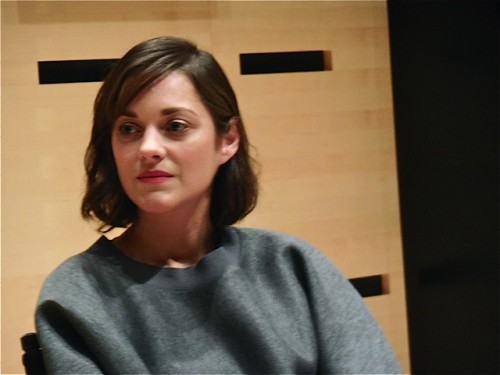
Cotillard did triple duty at the New York Film Festival Sunday to promote ‘Two Days, One Night,’ which had its U.S. premiere. (The film is Belgium’s submission for best foreign film.) At 1, in jeans and a casual but chic top, Cotillard participated in a Q&A for a standing-room crowd. At 3 she changed into Dior and walked across the street to Alice Tully Hall and joined the Dardenne Brothers as they introduced ‘Two Days, One Night’ to a sold out audience, and afterward participated in a Q&A.

unnamed


This repost by Paula Schwartz appears as part of our theme week on the Academy Awards.  


In Two Days, One Night, Marion Cotillard plays Sandra, a worker in a solar panel factory who returns to work after medical leave for depression to learn she has lost her job after management forces her co-workers to choose between keeping her on staff or receiving their  1,000-Euro bonuses. After the owner of the factory agrees to a revote, Sandra spends the weekend trying to meet with each of her 12 co-workers to plead her case and persuade them to change their minds.

Jean-Pierre and Luc Dardenne, the veteran filmmakers who wrote and directed the film, raise global issues like wage stagnation, financial inequality, and the declining middle class, while focusing their story on a financially strapped woman desperate to keep her job.

“She’s a simple woman and very complicated at the same time,” Cotillard explained at a Q&A Sunday. “She’s just recovering from a very deep depression and she’s fragile and she’s going to discover things about herself that she didn’t expect.”

unnamed-1

Cotillard, who received an Oscar for disappearing into her role as Edith Piaf in La Vie En Rose, in which she affected the singer’s nasal warble and her sickly hunched over physicality, makes Sandra, in her tank top and with her weary eyes, just as believable. A rare combination of movie star and character actress, Cotillard chooses roles in high-profile Hollywood films like Christopher Nolan’s Inception (2010) and The Dark Knight Rises (2012), along with parts in foreign and independent films, notably Jacques Audiard’s Rust and Bone and James Gray’s The Immigrant, just to mention a few.

Cotillard did triple duty at the New York Film Festival Sunday to promote Two Days, One Night, which had its U.S. premiere. (The film is Belgium’s submission for best foreign film.) At 1, in jeans and a casual but chic top, Cotillard participated in a Q&A for a standing-room crowd. At 3 she changed into Dior and walked across the street to Alice Tully Hall and joined the Dardenne Brothers as they introduced Two Days, One Night to a sold out audience, and afterward participated in a Q&A. As soon as the discussion ended she glided along the red carpet in the lobby for photographers and posed for selfies with fans, some who got a bit too chummy and close, but she never flinched.

unnamed-2

Six things I learned about Marion Cotillard Sunday during the Q&A.


The Dardenne brothers have a long rehearsal process and take lots and lots of takes, and the actress is fine with that:

“Sometimes we would have already done 70 takes and I would ask for more… because some were sequence shots, which have to be perfect because you cannot edit… I trust them (the Dardennes) a thousand percent, so if they would have asked me to do 200 takes I would have done it because I knew there was a reason behind this amount of takes, and that was one of my best experiences as an actresses. They really offered me everything that I had always wanted in terms of relationships with directors, and today when I talk about the amount of takes, I’m like, ‘Oh yeah, this is a lot,’ but on set it was never overwhelming, it was never exhausting, it was just the process of getting something, getting what they wanted to have, and for me giving them exactly what they wanted to have.”


On whether she worried about going too deep into a role and how hard it was for her to come back when the movie is over:

“For Piaf it was kind of difficult because it was the first time I went that deep, and I immersed myself entirely for months into somebody else’s… But I’ve learned a lot trying to get back to my life after La Vie en Rose, so now I know that I need a process to come back to my life, and this process is as interesting as getting into someone, and now it’s part of how I work.”


On how she prepared for celebrity:

“I don’t think you are prepared for this very real weird thing actually… But at the same time it, when you’re an actor you’re looking for a connection with a lot of people you might never meet, but you want to tell a story, and you want this story to touch many people as a kind of connection… When I started in acting and people recognized me in the street it was so weird, but I didn’t know how to take it so I would run away. That was super weird. I felt very paranoid. I didn’t know what to say. I didn’t know what to do. And I’m a very sensitive person, and sometimes it would be too much, but I’m kind of used to it. It’s just a different connection to people. (She laughed.) And I like it.”


She admits to being drawn to playing dark and difficult women with big problems. (Next up is Lady Macbeth.):

“Unfortunately yes. When they offered me the role of Macbeth, Lady Macbeth, I said yes right away without my brain being involved in this decision, and then I started to think, and I was like, ‘Oh wow, yeah, here we go again. Drama! Drama! Drama!’ I must be, yeah, attracted to the darkness for sure. But sometimes I’m having very sane, not schizophrenic conversations with myself, but still conversations with myself, thinking when are you going to stop playing people who are so fucked up? And I have no answer. I’m just waiting for sudden light. It’ll come. It’ll come.”

She did have a brief but memorable appearance in Anchorman 2 starring Will Ferrell and directed by Adam McKay, but it seems she needed help loosening up:
“All these guys are my idols, so that was kind of crazy for me. When they asked me I didn’t even read anything, I was like, ‘Oh yeah, yeah, I’ll be there.’ I mean being on a set with Will Ferrell was a dream, and I was freaked out in that huge field, and Adam McKay was like super far away giving me lines, like new lines over this megaphone, I could barely understand what he was saying. Can I say that I was hungover? So it was part of me being in a disastrous state and at the same time having a lot of fun.”

She doesn’t think she was that great in Woody Allen’s Midnight in Paris:
“That was a tough experience for me actually because it took me a long time to actually believe that I was on a set with Woody Allen… I met Woody Allen five days before we started shooting, and we didn’t really exchange things. We discussed a little bit about the vision of this character, but I had very little information, and then being on set with him I was so scared that I wouldn’t be good enough… I was always scared that he wouldn’t get what he wanted because we had talked so little, and I think that I might have misunderstood what he wanted at the beginning, and I knew that he was not very happy, which does stay with me and so yeah, I felt very uncomfortable… It was not very easy for me either to be in front of an actress like an rabbit in the light (sic)… I’m very happy that I worked with him… I could have done better.”

Paula Schwartz is a veteran journalist who worked at the New York Times for three decades. For five years she was the Baguette for the New York Times movie awards blog Carpetbaggers. Before that she worked on the New York Times night life column, Boldface, where she covered the celebrity beat. She endured a poke in the ribs by Elijah Wood’s publicist, was ejected from a party by Michael Douglas’s flak after he didn’t appreciate what she wrote, and endured numerous other indignities to get a story. More happily she interviewed major actors and directors–all of whom were good company and extremely kind–including Brad Pitt, Angelina Jolie, Morgan Freeman, Clint Eastwood, Christopher Plummer, Dustin Hoffman and the hammy pooch “Uggie” from “The Artist.” Her idea of heaven is watching at least three movies in a row with an appreciative audience that’s not texting. Her work has appeared in Moviemaker, more.com, showbiz411 and reelifewithjane.com.

Where Is the Female Version of ‘Whiplash’?

I’d really like to see more introspective films about the human experience where the humans experiencing things look like me.


This repost by Katherine Murray appears as part of our theme week on the Academy Awards.


I’d really like to see more introspective films about the human experience where the humans experiencing things look like me.

Miles Teller drums in Whiplash
Miles Teller as a person grappling with achievement


Two weeks ago, I made a special trip downtown to see Whiplash, a movie that is every bit as good as its rave reviews have promised. Whiplash is tense and thoughtful, with skilful pacing and a stunning conclusion, and it asks challenging questions about the human experience. What is achievement? What drives us? What is the value of love and approval?

I absolutely recommend it – but that’s not what I want to talk about, here.

Aside from having an awesome, introspective story that deals in universal human themes, Whiplash has one other prominent feature – 99.9 percent of it is dudes.

The music student and music teacher at the core of the story are dudes, the other people in their band are all dudes, the main supporting character – who is the music student’s father – is a dude. Melissa Benoist is there for about seven minutes, cumulatively, and then the rest of the movie is about men grappling with big, important questions.

There’s nothing wrong with that – and, in popular cinema, there’s also nothing unusual about that – but it did make me wonder: why can’t we have more introspective movies about the human experience where the humans experiencing things are women?

Like, speaking as a woman, I am just as interested in big, existential, philosophical, and psychological questions as men are. I spend just as much time trying to figure them out, and they have just as much relevance to my life – but you wouldn’t really guess that from going to the movies.

Most of the time, when you watch a movie about how A Person should deal with X, the person is a man. To the point that it really stands out, when it’s not.

Sandra Bullock drifts through space in Gravity
Sandra Bullock as a person grappling with loss


Gravity, for instance, aside from being a feast for your 3D glasses, is a story about how A Person should deal with loss. And it’s striking because the person is played by Sandra Bullock, and she’s on screen alone for most of the movie, grappling with universal human challenges like how to process grief, and how to find the will to live after experiencing trauma.

A lot of critics have argued that the film would have been better if it had just been about trying to fix a space shuttle without getting blown up, without making it a metaphor for how Sandra Bullock overcomes the loss of her child. It’s the loss and grief story, though, that takes this from being an action movie with a female protagonist – which is rare enough – to being an introspective movie about the human experience with a female protagonist – a genre that might be the rarest of all.

Depending which types of movies you’re analyzing, only 15 to 23 percent of top-grossing films have a female protagonist, despite the fact that women make up half the population. I’m willing to bet that, if we could easily cordon off and analyze the percentage of female protagonists in introspective movies about the human experience, the numbers would be even lower.

You’ve got your female action heroes, and you’ve got your female romantic leads – you’ve even got your female gross-out and/or buddy comedies, now. Occasionally, you even get your female everyman in the shape of Anna Kendrick. But, finding a woman as the stand-in for humanity is like finding a unicorn in a world where horses are already almost extinct.

Kirsten Dunst waits for the end of the world in Melancholia
Kirsten Dunst as a person grappling with depressive realism


If you look at this survey of Hollywood movies that came out in 2012, none of the ones with a female lead – except Brave, which is specifically about how there’s more than one acceptable way to be female – seem to be concerned with especially deep questions. This is the same year that brought us Cloud Atlas, Life of Pi, Looper,  and ParaNorman – male-led stories with varying levels of introspection that focus on questions of history and human connection, belief, our capacity to learn to care for others, and compassion in the face of fear. Female-led movies in the survey include a couple of horror movies, an instalment in the Twilight franchise, The Hunger Games (which was good, but not that deep), and whatever the hell Snow White and the Huntsman was supposed to be.

Casually searching the internet for lists of existential movies, or movies about what it means to be human also returns a lot of movies about dudes.

That’s not to say that there aren’t deep, introspective movies with female protagonists. It’s just that they’re few and far between.

Slogging through Melancholia is about as fun as slogging through real depression, but it’s an introspective movie about a person who’s grappling with Big Questions concerning depressive realism, and whether pessimism is just good sense. Similarly, Black Swan is (arguably) a movie about a person grappling with identity, and how we reconcile with our shadow selves.

Le fabuleux destin d’Amélie Poulain – or, Amélie – is an introspective story about a person who struggles with shyness and how to take risks. And, it works at least as well as The Secret Life of Walter Mitty, which is about exactly the same thing, only starring a male protagonist.

So, there are some introspective films about the human experience that feature a female protagonist. But, why do these stories so often default to male?

Audrey Tautou read a photo album in Amelie
Audrey Tautou as a person grappling with shyness and courage


The first explanation would be that most of the writers, directors, and producers working on movies are men, and therefore they’re more likely to create a male protagonist, because that’s the experience and perspective they’re most familiar and comfortable with.

Fair enough.

Though I hasten to add that Gravity, Melancholia, and Amélie were all written and directed by men,  I think it’s valid for a story-teller to gravitate to telling stories about characters of their own gender, race, ethnicity, and sexual orientation. In some cases, it can even seem arrogant for story-tellers to presume to speak for people with different life experiences. That’s why it’s important to make room for stories told by people who’ve been underrepresented in media. You know, instead of making it as hard as possible for those people to get in on the action.

The second explanation also goes a long way toward answering the question, “Why does this even matter, Katherine?” and concerns the way that media presents “male” as standard and “female” as a special variation on “male.”

This is feminist criticism 101 and I won’t get into a long discussion of it, but everyone reading this blog understands that we live in a culture where “person” defaults to male a hell of a lot more often than it defaults to female – where being a woman is a marked status that denotes something other than a normal/average/neutral individual. Men and women are so used to seeing men as the default human that it can create a self-perpetuating cycle where writers keep reaching for “a man” when they mean to say “a person,” and the constant presentation of “a person” as “a man” on screen just reinforces that bias.

True story: I’m a woman, and I write things, and unless I specifically stop myself and take stock of what I’m doing, I default to male characters when I just need some random person. This is a thing that happens without malice or even intent, which is why it’s important to bring the pattern to conscious awareness.

Introspective human experience movies are typically more about A Person than they are about an individual with really specific characteristics; there’s a good chance that men are the default just because nobody’s thinking about it that much.

The third explanation, and the one that bums me out the most, is that there may be a perception that women either aren’t interested in or aren’t as capable of answering philosophical questions – something that’s also suggested by the unfortunate pattern where male actors are asked deep questions about the issues raised by their movies, and female actors are asked about their bodies and clothes.

Happily, the solution is the same no matter what the explanation is: we need to balance things out by creating more movies like Gravity, and Melancholia, and Amélie, where the stories are about people grappling with problems that people must face, and the people in question are women.

Just like it’s right that Matthew McConaughey should be able to star in a movie that’s specifically about masculinity (Mud), and a movie that’s about the abstract question of human selflessness (Interstellar), female actors should be able to take the lead in movies that are specifically about women as well as movies that are about people in general – because they represent both of those things.

So, where is the female version of Whiplash? It’s 50 years forward in time, when “person” has an equal chance of meaning “woman.”


Katherine Murray is a Toronto-based writer who yells about movies and TV on her blog.

‘Boyhood’ (Feat. Girlhood)

Let’s face it, ‘Boyhood’ is a gimmick movie. Richard Linklater sporadically filmed it over a 12-year period so we could see the child actors in it actually grow up. If you loved Michael Apted’s ‘Up’ series but wanted more fiction and less wait, ‘Boyhood’ is for you. But if you just love coming-of-age dramas, I’m not sure I can recommend this one.

Ellar Coltrane as Mason at the beginning of 'Boyhood'
Ellar Coltrane as Mason at the beginning of Boyhood


This repost by Robin Hitchcock appears as part of our theme week on the Academy Awards. 


Let’s face it, Boyhood is a gimmick movie. Richard Linklater sporadically filmed it over a 12-year period so we could see the child actors in it actually grow up. If you loved Michael Apted’s Up series but wanted more fiction and less wait, Boyhood is for you. But if you just love coming-of-age dramas, I’m not sure I can recommend this one.

The child actors (Ellar Coltrane as central character Mason and the director’s daughter, Lorelai Linklater, as Mason’s sister, Samantha) are extremely natural and sufficiently likable. Patricia Arquette is fantastic as their mother, who faces a roller coaster of personal, professional, and economic ups and downs. And Ethan Hawke plays their intermittently available father as Ethan-Hawke-in-a-Richard-Linklater-movie, that is, opinionated and rambling and just-barely functioning as an adult human being, but I happen to like that character a lot.

Mason and Samantha's mother (Patricia Arquette) reads them a Harry Potter book
Mason and Samantha’s mother (Patricia Arquette) reads them a Harry Potter book


As strong as their performances are, the problem is that Patricia Arquette and Ethan Hawke are recognizable movie stars, in stark contrast with the kids at the center of the film and the unknown Texan character actors in the supporting cast. This evaporates the faux-documentary feeling of Boyhood, and leaves in its place an overlong, meandering, plain-old movie.

What’s left is essentially the non-dinosaur, non-Sean Penn-on-limbo-beach parts of The Tree of Life, with fewer shots of light shining through trees, and nostalgia from the last decade instead of the 1950s.  Six-year-old Mason rides his bike in endless loops around his block. Eight-year-old Mason plays Wii boxing. Twelve-year-old Mason finds out about internet porn. Fifteen-year-old Mason smokes weed and gets an earring. Seventeen-year-old Mason has sex with his girlfriend in his sister’s dorm room. Eighteen-year-old Mason wins a photography scholarship and does shrooms in the mountains and we can finally, FINALLY leave the theater. (Boyhood is two hours and 45 minutes long, with exactly zero explosions or giant robot fights. I do not have the patience for such things.)

Mason and his sister Samantha (Lorelai Linklater)


It is possible I lost interest because I never had a boyhood of my own. I kept wanted to see more of Samantha, because I could relate to her girlhood (my favorite scene in the movie was Samantha cringing through The Sex Talk with her dad at a bowling alley) and get my nostalgia kick. I was also more interested in Patricia Arquette’s mother character and her struggles because I could relate to them as an adult and as someone who plans to have children.

Sullen teenage Mason and his father (Ethan Hawke)


I may be placing too much importance on gender here, because there are loads of non-gendered experiences of childhood present in this movie. I played with dirt and found out my parents aren’t perfect and rejected authority figures and aggressively sulked, just like Mason. Maybe if Samantha and the mother hadn’t been there, just out of focus, I would have related more to his journey instead of yearning for more from the sidelined female characters.

And as I got bored with Boyhood, I got distracted by the logistics of its gimmick. The passage of time is largely expressed through changed hairstyles on the kids, and I wondered if that was mandated by the director (would Richard Linklater really make his daughter get a regrettable purple-red dye job? (ETA: he did not.) I morbidly wondered what kind of insurance they took out on the lives of the central actors and how they would have reacted to an untimely death. I tried to remember what year the songs on the soundtrack came out so I could figure out how much longer I had to wait to get out of there (I have never been so excited to hear that Gotye song. I turned to my viewing partner and whispered “only two years left!!”).

Eighteen-year-old Mason at the end of the film


Boyhood is a gimmick movie, but admittedly, the gimmick is pretty cool. If you don’t mind long runtimes and have a strong way to relate to this disjointed series of vignettes (having had a boyhood of your own, having a son around the age of the kids in the movie, growing up in Texas), you may well love Boyhood. I didn’t hate it. I just wanted to see more of the women in it and have it be over an hour earlier.  My own childhood felt shorter.


Robin Hitchcock is an American writer living in Cape Town who still plays with sticks in the dirt.


‘Selma’ Is Now

In so many ways, this film reflects the current moment, while also highlighting how things have and have not changed since the King family and their allies risked their lives to secure rights for all. Scenes in the film will jolt you into the present: watching Jimmie Lee Jackson’s mother grieve in 1965 for the son she will never see again made me immediately think of the family of Tamir Rice, the young black boy who was murdered by police officers this year for toting a toy gun in Ohio. ‘Selma’ is now.

selma-2


This repost by Nijla Mu’min appears as part of our theme week on the Academy Awards.


Historical dramas often stick to a tried-and-true formula: Important figures face struggles, then they triumph, becoming the great people we know today. We can usually count on a scene from their conflicted childhood, scenes showing their romantic troubles, any issues with drugs or alcohol, and how they persevered through it all to deliver whatever divine message or artistic gift they possessed.

Ava DuVernay’s new Martin Luther King Jr. biopic, Selma, avoids this formula—much to its benefit. It is one of the most effective, well-crafted historical biopics that I’ve ever seen because it goes off the traditional narrative about the Civil Rights Movement, giving us a moment in history that feels immediately familiar to the moment we are currently living in.

Selma captures the tireless efforts of Martin Luther King Jr. and a group of black activists attempting to secure equal voting rights for black people. These efforts led to the passage of the 1965 Voting Rights Act, signed into law by President Lyndon B. Johnson. The film takes its name from the series of marches that King and his followers embarked on at the Edmund Pettus Bridge in Selma, Alabama. One of those marches was infamously known as “Bloody Sunday,” after police and deputized locals descended on the protesters with nightsticks and tear gas.  DuVernay and Director of Photography Bradford Young capture that march in all its terror in a scene where young and elderly marchers are clubbed and chased by angry police on horses. Selma certainly doesn’t cast the history of the Civil Rights Movement in feel-good soft focus.

selma_movie_2

In a recent interview I conducted with DuVernay, she discussed the way she approached the humanity of Dr. Martin Luther King Jr., including his suspected infidelity. She was most interested in how this information affected his wife, Coretta Scott King, and how Martin Luther King would respond in the moment when questioned by Coretta. This emphasis on the intimacy in their relationship, rather than the scandal that the FBI sought to publicize, is something that informs the core of the film.

DuVernay is not interested in showing us montages of the unfaithful hero, his mistress, and the scorned wife, as was done in Mandela: Long Walk to Freedom. She is interested in the complex spaces of love and pain between two people. Coretta Scott King, played with an uncanny resemblance by Carmen Ejogo, takes on a central role in this film, not only as a wife and mother, but as a key player in the movement as she faces daily death threats made against her and her family. The attention and specificity paid to her character and her relationship to King is another gift that DuVernay brings to this film.

Further, there are so many ways this film could’ve become an extension of the Hallmark image that we see of Martin Luther King Jr., one that replays the same “I Have a Dream Speech” and tells us that nonviolence is the only way. While those elements are important, they are often overemphasized at the expense of the other work he did.

That is where Selma fills in the blanks. In this film, we get to know a methodical, intelligent, human Martin Luther King Jr; a man who just wanted to sit down at the end of the day and smoke a cigarette, or call Mahalia Jackson in the middle of the night to hear her sing a soothing gospel song. In the film, he invokes nonviolence but also cleverly provokes outward hatred in his opponents, helping people around the world witness this physical racism in the media. His tactics were risky, his negotiations with the likes of LBJ were grueling, and he was often put in positions of extreme discomfort, along with the many people he worked with.

03

This is not a film about a man and his followers, but about how a man’s work is informed by the respect he has for the people he works with—and even those he doesn’t. It reflects the movement by emphasizing distinct traits in each of the civil rights leaders it documents, from the youthful resistance of Jimmie Lee Jackson (played powerfully by Keith Stanfield), to the gentle persistence of Malcolm X (Nigel Thatch), who appeals to Coretta Scott King in a beautifully rendered scene. That scene and others completely reverse the rhetoric we’ve been fed about who these people were. The warring ideals between Malcolm and Martin aren’t the focus of this narrative, but rather how Malcolm X may have actually intentionally pushed many black people to follow Martin Luther King Jr., helping to strengthen the movement after all. Again, DuVernay utilized Coretta Scott King in a way that shows her role in the movement beyond being a supportive wife. She serves as a sort of peacemaker here.

In so many ways, this film reflects the current moment, while also highlighting how things have and have not changed since the King family and their allies risked their lives to secure rights for all. Scenes in the film will jolt you into the present: watching Jimmie Lee Jackson’s mother grieve in 1965 for the son she will never see again made me immediately think of the family of Tamir Rice, the young black boy who was murdered by police officers this year for toting a toy gun in Ohio. Selma is now. It lets us into the interior spaces of pain, progress, and movement that no formulaic historical drama could ever capture.


Selma opened Christmas Day in Los Angeles, New York City, Washington, DC, and Atlanta. It opens nationwide Jan. 9.

Related Reading: “The Butler, My Grandmother, and the Politics of Subversion. 


Nijla Mu’min is a writer and filmmaker. She writes and direct movies about black mermaids, black lesbians, black girls in-between worlds, and boys too.


‘Selma’ Shows Why We Need More Black Women Filmmakers

DuVernay has said in interviews that when she inherited Paul Webb’s screenplay, she altered it to decenter its focus on President Lyndon B. Johnson (even though the controversy surrounding the film managed to once again re-center the story on white male power and its portrayal). Rather than criticize the director for shifting her gaze away from whiteness (or for getting certain historical details wrong), it may be more useful to consider the difference a woman behind the camera—and a Black woman in particular—brings to a motion picture.

SELMA-movie-poster-691x1024


This repost by Janell Hobson appears as part of our theme week on the Academy Awards.


Last year was a stellar one for Black women filmmakers. First, there was Amma Asante’s exquisitely filmed Belle (starring an impressive Gugu Mbatha-Raw), followed later by Gina Prince-Bythewood’s emotionally layered Beyond the Lights (also starring Mbatha-Raw). The year finally closed out with Ava DuVernay’s critically acclaimed historical drama, Selma.

However, while Belle was summarily dismissed by movie critics as a “black Jane Austen drama,” and Beyond the Lights received more favorable reviews but was nonetheless ignored at the box office, DuVernay has a real shot at becoming the first Black woman to be nominated for a Best Director Oscar (having already made history with her nomination at the Golden Globes). Of course, there is something to be said for women receiving critical acclaim when the films they direct focus on the lives of men, but that’s another story. Nonetheless, the acclaim she has received is absolutely earned.

(Editor’s note: DuVernay was not nominated.)

SELMA-Main_t750x550

Selma is a rather subversive take on historical events: part sweeping epic drama, part intimate and domestic storytelling in its rendering of the voting rights march from Selma to Montgomery, Alabama in 1965 (led by Dr. Martin Luther King, Jr. and played in the film with an understated grace by David Oyelowo). DuVernay imbues this Civil Rights-era film with a black woman’s sensibility, which makes the storytelling all the richer.

There is the opening shot, featuring King practicing his acceptance speech for the Nobel Peace Prize, before he is joined by his wife Coretta (played by Carmen Ejogo in an uncanny resemblance to the late icon) fixing his tie. Here, an international milestone is seamlessly intertwined with the space of domestic intimacy, just as the following scene depicting the four girls in Birmingham decked out in their finest Sunday best—as they gossip about how Coretta Scott King does her hair while descending into a church basement—resonates on the most mundane level. Although we have the benefit of history, it is still jarring when the bomb explodes, and, as occurs throughout the film, each death is doled out in slow motion, the camera (aesthetically positioned by the accomplished cinematographer Bradford Young to capture the brilliance of dark skin) refusing to turn our collective eyes away from the bloodshed and the casualties of “racial progress.”

mlk-lbj

DuVernay has said in interviews that when she inherited Paul Webb’s screenplay, she altered it to decenter its focus on President Lyndon B. Johnson (even though the controversy surrounding the film managed to once again re-center the story on white male power and its portrayal). Rather than criticize the director for shifting her gaze away from whiteness (or for getting certain historical details wrong), it may be more useful to consider the difference a woman behind the camera—and a Black woman in particular—brings to a motion picture. Because of the rewrite, we not only get a redirection on King and how his Southern Christian Leadership Conference group came into conflict with the younger Student Nonviolent Coordinating Committee, but women are also added to the picture, including movement participants like Freedom Rider Diane Nash (played by Tessa Thompson), Amelia Boynton (Lorraine Touissant) and Annie Lee Cooper (Oprah Winfrey). They are still marginal to the main story, but at least they are visible and part of the grassroots movement critical to King’s leadership.

church-girls

We also see certain feminist approaches: from how the movement men can descend onto a woman’s home and make themselves quite comfortable as their very masculine dominance takes over her kitchen space (a subtle critique of the ways progressive men constantly rely on and exploit women’s labor, all wrapped up in the warmth of black Southern domestic comfort) to a scene featuring Amelia Boynton and Coretta Scott King discussing the struggles of activism and the challenge of maintaining hope (a scene Touissant has noted was DuVernay’s own conscious attempts at passing the Bechdel Test by including a scene where women are not talking about men). Through Coretta’s story, DuVernay also highlights how the iconic hero that we celebrate through King does not translate to admirable husband and father. King’s infidelities, however, are included not to tarnish his image but to undergird the real difficulties of committing to both a political movement and the personal sphere. King’s political involvement (including long stays away from home) also brings the constant fear of death, a fear Coretta quietly yet persistently underscores throughout her scenes.

More than anything, Selma is what we get when we intersect the personal with the political, the epic with the intimate, the historical with the present day (e.g. because King’s speeches were off limits, what we also get in the film are double entendres of what the Selma movement meant for 1965 and what present-day struggles mean for us here in 2015).

selma-march

While the film’s budget is tiny by Hollywood standards ($20 million), what DuVernay does with the film is a real triumph in not only quality filmmaking but in accomplished storytelling, where black people and their allies stand in all their brilliant humanity and where women’s stories hold equal weight against the heavyweight often accorded men’s histories. Let us hope her triumphs will open the doors wider for other women filmmakers.

Of course we may find solace on smaller screens, where diversity reigns and where Shonda Rhimes dominates Thursday television with her Black women leads and multiracial casting. Nonetheless, there is a power that is felt when viewing images in a much larger medium with its expansive and colossal screen and booming soundtrack. DuVernay has shown why Black women still matter on big screens and why they matter more so behind the camera.


Janell Hobson is an associate professor of Women’s, Gender and Sexuality Studies at the University at Albany, State University of New York. She is the author of Body as Evidence: Mediating Race, Globalizing Gender and Venus in the Dark: Blackness and Beauty in Popular Culture, and a frequent contributor to Ms.


‘The Theory of Everything’: A “Great Man” From The First Wife’s Point of View

Do great women exist? The film industry still hasn’t decided. We had ‘Frida’ a dozen years ago and that bio-pic about Margaret Thatcher (like ‘Frida,’ directed by a woman) from a few years back–which won Meryl Streep an Oscar, but tepid reviews along with a completely irredeemable main character kept me from seeing it. Usually the women in the “great man” films are great only by osmosis, because they married or otherwise provide emotional–and other–support to great men. The actresses who play these roles win Oscars too: they make the “supporting” category a literal one. ‘The Theory of Everything,’ the new bio-pic about astrophysicist (and best-selling author) Stephen Hawking seemed like it might be different since it’s based on the book written by the great man’s first wife, Jane.

TheoryEverythingCover


This repost by Ren Jender appears as part of our theme week on the Academy Awards.


Like a lot of women, I’m impatient with the “great man” films that invade theaters every year just in time for Oscar consideration. The main character is always a man whose name we all know, played by an actor who really wants an Academy Award. We see his earliest struggles then later, his triumphs. The addition of some failures never succeeds in making the film more interesting, just longer.

Do great women exist? The film industry still hasn’t decided. We had Frida a dozen years ago and that bio-pic about Margaret Thatcher (like Frida, directed by a woman) from a few years back–which won Meryl Streep an Oscar, but tepid reviews along with a completely irredeemable main character kept me from seeing it. Usually the women in the “great man” films are great only by osmosis, because they married or otherwise provide emotional–and other–support to great men. The actresses who play these roles win Oscars too; they make the “supporting” category a literal one. The Theory of Everything, the new bio-pic about astrophysicist (and best-selling author) Stephen Hawking, seemed like it might be different since it’s based on the book written by the great man’s first wife, Jane.

But the movie begins by focusing on him (Eddie Redmayne) not her, as he rides a bike, attends classes as a Ph.D. student in the early 1960s at Cambridge and acts as a coxswain (complete with megaphone) for the crew rowing on the river. Hawking meets Jane (Felicity Jones) at a student mixer and they become a couple. Hawking’s physical awkwardness could pass for that of any geeky man who considers his body merely a container for his brain, but we know what’s coming before the characters do when we see scenes in which Hawking trips and falls in a train station or his hand folds in on itself as he writes equations on a blackboard. When he has a fall in the yard he receives his diagnosis, ALS (also known as Lou Gehrig’s Disease), along with the news “Life expectancy is two years.”

At first he avoids Jane and holes up in his room, but after she finds out from his friends about his illness, in a scene we’ve all watched in countless other films, she marches into his room and declares, “I want us to be together for as long as we’ve got.” Stephen resumes his studies and for his thesis topic chooses “time.”  He and Jane get married and start to have children soon after.

What follows is a portrait of a marriage that combines all the elements of pre-second-wave feminism at once: Jane has to set aside her studies not just to care for her very young children, to make all the meals and clean the house, but also to care for her husband, whose mobility is rapidly deteriorating, even though he’s still a relatively young adult. At the point where he can walk only with the assistance of two canes and can maneuver the stairs in his house only by lying flat on his back and grasping with his few remaining functional fingers the railing to pull himself up or down, we see Stephen hand in a typed dissertation with a barely legible shaky signature; I couldn’t help wondering if the person who typed it was Jane, since he seems unlikely to have been able to do so himself–and so many wives in that era were also their husbands’ de facto secretaries. We’re also seeing an era in which care for disabled family members was often left to a wife or mother (as opposed to paid staff, unless the family was very wealthy), and no one, not Hawking’s family nor Jane’s, ever thinks of taking over his care for even a few hours at a time to give Jane some respite. On the drive back from a dinner at his family’s hillside cottage in the country, a teary Jane tells Hawking she needs help, but he cuts off any further discussion.

Eddie Redmayne as Stephen Hawking and Felicity Jones as Jane Hawking


Later Jane’s mother can see how stressed she is and (instead of offering to help) suggests she join a church choir (Jane is a regular churchgoer, a contrast to her outspoken, atheist husband). She then meets the handsome choirmaster, Jonathan (Charlie Cox) who becomes a family friend and also helps with Stephen’s care. Stephen seems to see the spark between his wife and Jonathan from the beginning and lets her know in an indirect way that she is free to pursue the relationship. Here the film is at its most interesting: too many “great man” films seem to sum up the wife or girlfriend character struggle of living with the great man as “she was a saint” without considering that she might have needs of her own. Jane’s situation also parallels many others of the 50s and 60s when women got married in their early 20s and found in their 30s and 40s their marriages did not fulfill their own expectations and ambitions. Jane remains devoted to Stephen but is at her happiest when she spends time with Jonathan. The closeness of their relationship invites the scrutiny of others at the christening of her third child, when her mother-in-law follows her into the kitchen and declares the family has a “right to know” whether the child is Jonathan’s. Jane replies that the child’s father could not be anyone but Stephen.
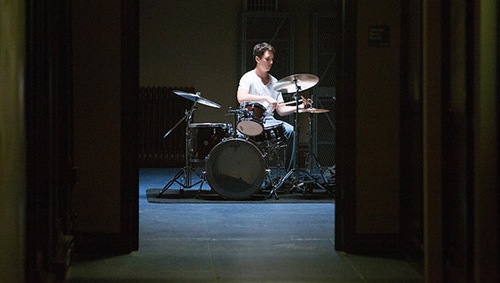
When Stephen has the health crisis that robs him of the ability to talk without assistance, Jonathan steps back and nurses come into the home to help Stephen, along with a man who designs a device through which Stephen can talk again, by slowly “typing” (actually clicking a monitor to choose letters and phrases) and having an electronic voice read the words. Stephen becomes very close to one nurse in particular, Elaine (Maxine Peake), who even helps him to look through the copies of Penthouse that come to his office. He eventually leaves Jane for her. An end title tells us that Jane eventually got her Ph.D., married Jonathan, and that she and Stephen are still friends.

Jane watches Stephen “speak” through a device while the woman who will be his second wife looks on.


What the film leaves out are the most interesting parts of the story–not just Hawking’s scientific work (we get explanations that are so oversimplified they don’t make much sense), but also that the nurse Stephen lived with (and eventually married and divorced) was the wife of the man who created his speaking device–and that she was also investigated after other caregivers alleged she physically abused Stephen (during their relationship he had unexplained bruises, broken bones and burns). When Jane did publicity for a previous movie based on her and Stephen’s relationship, she said she couldn’t comment on Elaine (who was still married to Stephen then) for legal reasons. She did admit during interviews that she was friends with Stephen mainly for the sake of the children. And she and Stephen weren’t a couple when he was diagnosed, their romance blossomed afterward, which Jane described as being in keeping with the great optimism of the early 1960s that ran parallel with the belief that nuclear war between the super powers could, at any moment, wipe out the world.

Redmayne does a credible job as Hawking (whose character in the film is much more sympathetic than Jane and news sources have portrayed him; this Hawking never runs over anyone’s toes “accidentally” with his electric wheelchair), especially in the later scenes where we see a certain impishness in his face (very like the real-life Hawking’s), while most of his features remain immobile. Jones as Jane does a serviceable job too, but I wish she had been allowed to look and dress less like Jean Shrimpton (the British supermodel popular in the era when the film begins). At least Redmayne (who is also more conventionally pretty than the person he plays) gets to mess up his hair and wear unflattering glasses; Jones, for much of the film, until she starts wearing a crappy short wig and half-assed “aging” makeup, looks like she could have stepped out of a stodgy, British clothing catalogue, even when Jane has three kids and a disabled husband to take care of, and, as Jane points out in her book, and is briefly referenced in the film, very little money. The filmmakers (screenwriter Anthony McCarten and director James Marsh) didn’t seem to think any of these details were worth including. The Theory of Everything is a good, if very conventional, film, but the real story it’s based on could have been made into a great one.

[youtube_sc url=”https://www.youtube.com/watch?v=x8QYUgO-tZo”]


Ren Jender is a queer writer-performer/producer putting a film together. Her writing. besides appearing every week on Bitch Flicks, has also been published in The Toast, RH Reality Check, xoJane and the Feminist Wire. You can follow her on Twitter @renjender