However, Vivian Maier–besides being an obvious genius–remains a mystery. ‘Finding Vivian Maier’ follows the narrative mystery as we pursue the reclusive and eccentric Vivian (or her personas of Ms. Meier, Mayer, Meyer, Meyers, Maier) across the US and through the streets of the 1950s and 1960s, attempting to discover more of a woman who is still unknowable.
This repost by Rachel Redfern appears as part of our theme week on the Academy Awards.
In April of 2009, one of the greatest street photographers of the 20th century died in a Chicago nursing home. Her passing was quiet and seemingly without notice, and the photographs that she left behind were dusty unknowns, auctioned off at a storage locker in Chicago. The buyer, John Maloof, began posting the photos on the Internet, hopeful that someone would recognize their quality. When the photographs went viral, Maloof began searching for the photographer, just a handwritten name on a few receipts stuck into the boxes, and stumbled upon a woman as fascinating as the art she produced.
Directed by John Maloof and Charlie Siskel, Finding Vivian Maier is an award-winning documentary exploring the art and artist discovered on an auction house floor, and whose prolific work has been subsequently shown all over the world. During her life, Vivian Maier produced over 150,000 photographs, as well as films and audio recordings, and did so while keeping her talents and work completely hidden from the world—choosing instead to work as a nanny in New York City and Chicago.
However, Vivian Maier–besides being an obvious genius–remains a mystery. Finding Vivian Maier follows the narrative mystery as we pursue the reclusive and eccentric Vivian (or her personas of Ms. Meier, Mayer, Meyer, Meyers, Maier) across the US and through the streets of the 1950s and 1960s, attempting to discover more of a woman who is still unknowable.
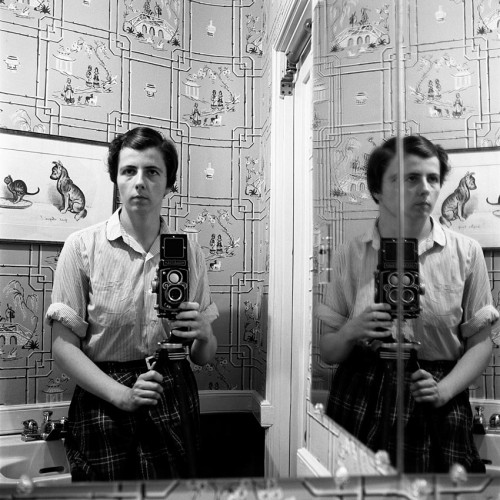
A portrait of the artist–Vivian Maier
Vivian Maier hid herself well during her life, and there has been some speculation: is it right to expose her now in death? Would Maier be pleased at the recognition of her talents? Her friends say no, but Maloof disagrees (for obvious financial reasons), arguing that since Maier corresponded with an art printer in France that she was obviously interested in displaying her work at some point.
Finding Vivian Maier embodies an art historian’s meta-dream of art exposing art and reveals the way that art can be lived in a person—empathetic, obviously political, socially conscious, occasionally gritty artwork, reflective of the woman behind the lens.
For photographers there is often the thought that we must be standing in front of the exotic to have something worth photographing; however, Maier exposes women, children, minorities, laborers, and other “background” faces in “normal” cities with a compelling charisma. As one historian states in Finding Vivian Maier, the fact that Maier was able to push so deeply into the personal space of her subjects and then photograph them with such an honest vulnerability, is remarkable. As an artist, her work is not a moment out of time, but instead occupies a contradictory grounded timelessness where we, the viewer, are included in a sympathetic, deeply personal interaction.
One of Maier’s beautiful, inclusive moments from the streets of Chicago
Despite the occasional self-congratulatory tone of the Maier discovery, the documentary is exceptional. Finding Vivian Maier is paced like a mystery film and viewers are drawn in to explore the fractured pieces of Maier’s secretive life along with Maloof. However, in a delicious, almost teasing way, after Finding Vivian Maier is finished, we’re still left with much to wonder about the enigmatic artist and spirited woman that was Vivian Maier.
Additionally, within the past few months a legal battle has surfaced over the right to print, publish, curate and sell Maier’s work by a Chicago lawyer (aptly) named Mr. Deal. Until the case is decided it seems that the unknowns surrounding Maier’s curious life and work will grow even more.
Finding Vivian Maier was released on DVD July 29 and can be viewed in theaters around the country. Collections of Maier’s photographs can be viewed at exhibitions in New York City, Chicago, Los Angeles and a host of other cities around the world. To view Vivian Maier’s work online, click here.
Rachel Redfern is a traveler and teacher who spent the last few years living in Asia. Now back in her native California, she focuses on writing about media, culture, and feminism. While a big fan of campy 80s movies and eccentric sci-fi, she’s become a cable acolyte, spending most of her time watching HBO, AMC, and Showtime. For good stories about lions and bungee jumping, as well as rants about sexism and slow drivers, follow her on Twitter at @RachelRedfern2.
So, you just saw a terrible movie and you want to tell the world about it – not so fast. How we frame our discussions about sucky movies depends on who’s listening, and whether we’ve got common ground.
This repost by Katherine Murray appears as part of our theme week on the Academy Awards.
So, you just saw a terrible movie and you want to tell the world about it – not so fast. How we frame our discussions about sucky movies depends on who’s listening, and whether we’ve got common ground.
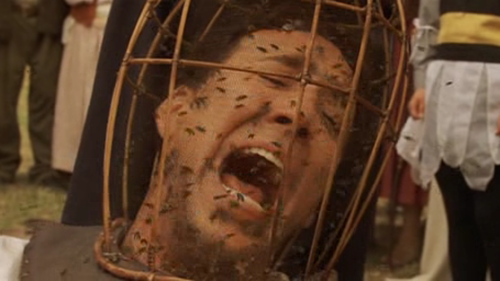
No not the bees not the bees they’re in my eyes
There’s no such thing as a movie that’s universally hated, or a movie that’s universally loved. No matter how awful something is, there’s always somebody who likes it and, no matter how wonderful something is, there’s always somebody who thinks it’s garbage – that is the wondrous variety of human taste.
Starring Nicholas Cage at his Nicholas Cage-iest, The Wicker Man is a two-hour exercise in casual misogyny, featuring a confusing and unsuspenseful plot. It’s so bad that the YouTube videos designed to make fun of it literally do nothing but show scenes from the movie, exactly as they played out.
It isn’t hard to find people who agree that The Wicker Man was terrible, and it isn’t hard to find people who agree that it was misogynist – what’s weird is that discussions of misogyny in the film usually begin and end with the statement, “Nicholas Cage dresses up as a bear and punches women in the face.” And, while that is entirely terrible on multiple levels, it’s not the most offensive thing about the movie. The most offensive thing about the movie is that it takesfor granted that there’s something disturbing and sinister about women who don’t take orders from men.
Billed as a horror story, The Wicker Man follows a detective who’s investigating a case outside his jurisdiction. That means that, when he travels to the remote community where the mystery’s taking place, he doesn’t have the power to make any of the citizens of that community – who are predominantly female – cooperate with him. Instead of adjusting his strategy and approaching them in a friendlier way, he starts off by screaming at everyone he meets, and then acts surprised when they don’t want to help him. Yet, the fact that the female characters recoil from him rather than scrambling to follow his orders is treated, by the movie, as though it’s a sign that Something Is Wrong.
The movie also features a large number of sequences where Nicholas Cage asks a woman a direct question, and the woman a) gives a vague answer that doesn’t help, b) answers with a total non-sequitur, or c) pretends not to understand what he’s talking about in a deliberate attempt to make him feel crazy. In other words, it’s just like talking to your wife – please, take my wife!
At the very end of the movie, when All Is Revealed, it turns out that Nicholas Cage’s ex-girlfriend purposely got pregnant so that she could guilt him into taking an interest in the welfare of their child, and use that as leverage to lure him to the freaky matriarchy she lives in, so that she and her womyn friends could sacrifice him to their pagan god, ‘cause women be bitches like that.
There’s no shortage of angles to take when you’re discussing the misogyny in this film, but the one that seems to resonate most with mainstream audiences is, “Nicholas Cage dresses up like a bear and punches women in the face” – which he does, for the entire final act – because we have achieved a state of gender-awareness in our culture where dressing up as a bear and punching women in the face is almost universally seen as a bad thing to do. Presenting a worldview in which powerful women are inherently threatening, women’s reasoning ability is suspect, and women use sex and pregnancy as a way to trap and manipulate men is actually more misogynist to me than having a guy dress up like a bear and punch women in the face, but that puts me out of step with the general discussion.
In other words, it’s really easy to get buy-in for the idea that The Wicker Man sucks, but we might not be adding much to the discussion of misogyny when we do that.
In fact, the truth is that I find myself not wanting to argue about exactly why this movie is misogynist, because I’m afraid that, if I start disturbing the soil around that one, I’ll quickly uncover the truth that most people don’t understand that misogyny is more than punching someone in the face. I’m afraid I’ll discover that most people hate this movie because it offends their sense that men should be chivalrous toward women – that they would be totally fine with everything else, if only he didn’t dress up like a bear and start punching.
I’m also afraid that the only reason people are really willing to criticize the content of The Wicker Man is because it’s also poorly made from a technical standpoint. If they were enjoying themselves more – if it were a little better-looking, and, technically, more well-crafted, I’m not sure it would be so easy to toss out this level of scorn.
SCORN
Sin City is a film that is technically well made (so, one step up from The Wicker Man) and still completely blatant in its misogyny (with racism added to spice things up). I can tell you from personal experience that it’s a lot harder to have a conversation about why you hate Sin City than it is to make fun of The Wicker Man.
The first thing that Sin City’s defenders will tell you is that it is hateful on purpose (as though doing it on purpose makes it better). Frank Miller and the movie are imitating film noir – that genre where dames were dames and the hero was a hard-luck, working class guy who was awesome at bare-knuckle boxing, and gay people arrived in a cloud of evil smoke. I get that that’s on purpose, but all it means is that Sin City did a really good job of mimicking something sexist. If it’s not challenging, or examining, or interrogating the sexist thing in any way, then I need another reason for why someone thought that was a good idea.
The problem with criticizing Sin City is that it gets us into a discussion about whether a work of art can be both technically proficient and fundamentally unworthy in some other way. In other words, it gets us into a discussion of what we mean when we say a movie is “good.” Given the history of moral censorship in the United States and Canada, people are rightly cautious of the idea that we should declare things good or bad based on whether or not we agree with their values. At the same time, completely removing yourself from the meaning of a movie, or the ideas it’s trying to express, and focussing just on whether the camera was in the right place, and the pixels were coloured correctly, seems to be missing the point.
Sin City is a staggering technical achievement, and the tone I use when I criticize it is different because of that. It’s not like The Wicker Man, where you can just write it off, and be satisfied that everyone agrees with the broad-stroke message, “This movie was totally bad.” People have passionate feelings about whether or not it’s possible for a misogynist story to be good if it’s also well-executed. They have passionate feelings about whether it’s even appropriate to consider a story’s misogyny (or racism, or homophobia, or other ideological content) in rendering a verdict about it. The truth is, philosophically, I don’t know if it should be possible for a misogynist movie to be “good” – but I know that I can’t quite hear myself saying, “I found this completely hateful and, oh my god, it was the best!”
Just to be clear, for anyone who doesn’t remember the film, Sin City is about three tough, underworld men who interact with subservient women – mostly prostitutes and exotic dancers. The women have no power, no ability to look after themselves, no ability to make decisions – whenever they try to act, they just make things worse. The Black one is “wild” and she thinks it’s sexy when a guy hits her in the face. The Asian one doesn’t talk and carries samurai swords. The one who’s a stripper is told that she’s “strong” because she can really take a beating without screaming or crying about it. All of the women are sexually available to the men at the centre of the story. At one point, the prostitutes tie up one of the men, and it seems like they have the upper hand, but he reveals that he could have escaped at any time and was just humouring them.
It is horrible.
And yet, unpacking the horribleness of Sin City requires a deftness and care that isn’t required for The Wicker Man. You don’t have the automatic buy-in that comes from Nicholas Cage in a bear suit. You have to start talking about what you mean when you say something’s “good.” Imagine how difficult it would be if the misogyny were just a shade less obvious.
Tastes like controversy
Gone Girl is the reason I’m writing this post because, holy shit, it is hard to talk about Gone Girl.
Megan Kearns did an admirable job of explaining what’s wrong with this movie, and I won’t re-tread the same criticisms, but my reaction, watching it opening weekend, was one of total shock. I could not believe the dedication with which this script was trying to score misogynist bingo. Like, I thought it was written by an MRA hate group. The overriding message, intentionally or not, is that, when a woman says a man attacked her, you should never, ever believe her, because it’s probably part of a nefarious scheme she cooked up just to get revenge on him for something, and women are crazy like that.
Unfortunately, we already live in a world where, every time a woman says a man attacked her, a thousand people who don’t even know her rush forward to call her a liar. We live in a world where guys I actually know said this Jian Ghomeshi stuff was probably a lie before any of us even knew what it was. We live in a world where one of the same guys said that whether you need a girl’s permission to punch her in the face during sex is “kind of” a murky issue (it’s not).
Watching Gone Girl spin out a misogynist fever dream about the lying liars we call women was unsettling enough, but a cursory search of the internet also revealed that this has been a longstanding argument since the novel came out, and that things seem to have settled in a place where it’s not cool to be annoyed by this story. In fact, trying to have a conversation about why you don’t like Gone Girl is like walking through a mine field that calls you a misandrist bitch. Don’t you believe that some men are trapped in abusive relationships? Don’t you believe that some women lie about rape? Don’t you think that people manipulate each other sometimes? Or can you just not handle the idea that any woman in a movie isn’t perfect? Does every woman in every movie that you deign to like have to be a role model? Can you handle the idea that some women aren’t very nice?
Honestly, it just makes me more entrenched in my original assessment that this wasn’t a very good movie.
Gone Girl is, I think, less well-made than Sin City, but worlds beyond The Wicker Man. What makes it difficult to talk about is that the problems with the story – as I’m choosing to call them – are much less concrete than dressing up like a bear and punching someone in the face. In order to talk about Gone Girl we have to talk about the much more abstract question of whether it seems appropriate, given the current political climate, and the rate of violence against women, and the difficulty women have in being believed when they report being assaulted by men – in that climate, do you think it’s appropriate, or do you think it necessarily constitutes a hostile act, to tell a story where the moral is that women are crazy liars and no one should ever believe them?
That’s harder to deal with than Nicholas Cage in a bear suit.
I don’t know the proper way to talk about movies that suck – or the proper way to determine whether they suck at all – but the answer might be that, instead of deciding whether or not something sucks, or how many stars it should have on a scale of one to five, we should talk about movies not as wholes to be judged, but collections of various elements, some of which are great (or fine) and some of which are problematic.
Don’t get me wrong – I love to say “suck,” and I doubt that I’m going to stop – but it occurs to me that I’m less prepared to argue for why any of these movies sucked than I am to argue for why I found particular elements troubling. I think that might be what I’m talking about, when I talk about suck. And I think I might be more eloquent, if I paid more attention to that.
It seems Disney is saying that The Baker’s Wife is a “fallen woman,” and that it is making a firm decision on how it wants the audience to interpret the affair that occurred. This is made more problematic by how the affair was shot and choreographed. In the film, Cinderella’s Prince pins The Baker’s Wife against a tree and kisses her. There is nowhere for her to escape, even if she wanted to.
This repost by Jackson Adler appears as part of our theme week on the Academy Awards.
CONTAINS SPOILERS for the stage musical and subsequent film adaptation of Into The Woods.
Previously, I have written on the racism in Disney’sInto The Woods, a film adaptation of the Stephen Sondheim and James Lapine musical that interweaves various European fairy tales into one tragicomedy. Sadly, while the movie certainly has its merits (and some great performances), it has a few more faults I would like to point out – particularly in regard to its subtle sexism towards women.
Much of The Baker’s Wife’s story is still the same as in the stage musical, with one major change – that of her death. Disney’s interpretation of her death has everything to do with the scene beforehand. Cinderella’s Prince uses his power as a nobleman, and the charm he has been taught to use, to seduce The Baker’s Wife. The Baker’s Wife is star-struck by The Prince, having even told Cinderella earlier that “[she] wouldn’t run if a prince was chasing [her].” However, when Cinderella’s Prince starts attempting to seduce The Baker’s Wife, she at first protests and even says “no.” He follows her protestations with “right and wrong don’t matter in the woods,” and continues to kiss her. While certainly attracted to him and star-struck, the question must be asked – What if she had continued to protest instead giving in and allowing herself to enjoy something that seemed inevitable? Would he have forcibly raped her? Would he have had her arrested on a trumped up charge? Did her consent matter at all? Certainly, he is more culpable in their affair, since he is an authority figure.
Cinderella’s Prince (Chris Pine) comes on to The Baker’s Wife (Emily Blunt)
After the brief affair, The Baker’s Wife sings “Moments in the Woods,” as a way of coming to terms with what has happened and to bring herself to return to the beauty of everyday life with her husband and child. In the stage version, as the Giantess walks by and her large feet make the ground tremble, a tree falls on The Baker’s Wife and kills her. The stage musical leaves the meaning of these events open to interpretation. I personally never interpreted The Baker’s Wife’s death as some sort of punishment. It seemed fitting to me that The Giant, who is avenging the murder of her husband and asserting her role as a wife, should accidentally damage/condemn the life of a woman who slept with a man other than her husband. However, while the stage musical leaves interpretations up to the audience, the film makes a firm judgment call. In the film, as the ground shakes, The Baker’s Wife falls off a cliff and dies.
It seems Disney is saying that The Baker’s Wife is a “fallen woman,” and that it is making a firm decision on how it wants the audience to interpret the affair that occurred. This is made more problematic by how the affair was shot and choreographed. In the film, Cinderella’s Prince pins The Baker’s Wife against a tree and kisses her. There is nowhere for her to escape, even if she wanted to. After some kissing, the affair seems over and the prince leaves (which is very different from most stage adaptations, where a lot more than kissing is implied). So The Baker’s Wife is condemned by Disney and made into a literally “fallen woman,” just because a prince kissed her? And even after she decides to return to her husband and child, content not to have another affair ever again?
Mackenzie Mauzy as Rapunzel
While only one major change is made to The Baker’s Wife’s story, half of Rapunzel’s story arc is cut, which in turn takes away from the character development of The Witch. Unlike in the stage musical, Rapunzel does not have a mental breakdown, and she does not get squashed and killed by the giantess (who was annoyed by her raving and screaming) in front of her mother and husband. In Disney’s film, the only consequence of Rapunzel having lived a sheltered childhood is that she runs away from her mother with the first guy she has ever met. The film even cut the fact that she becomes a mother to twins, something that would change anyone’s outlook on life, and certainly take a lot of responsibility – a responsibility for which Rapunzel is not ready. These cuts in the story take away entire conversations that are important for us to have as a culture. The Witch was trying to protect her daughter by sheltering her, but it is the fact that Rapunzel was so heavily sheltered that leads to her undoing, and ultimately leads to her death. Not only that, but Rapunzel develops a mental illness, something that still (and wrongfully) induces a terrible stigma in our society.
In addition, Rapunzel’s and The Witch’s story in the stage musical shows how our most well-intended actions can negatively affect those we care for most. Rapunzel was damaged by her upbringing in a way that made it impossible for her to be a functional human being in society. Not even her prince can help her. The Witch’s song “Witch’s Lament,” in which she sings about how “children won’t listen,” comes after Rapunzel’s death in the stage musical, but in the film it comes after Rapunzel and her prince gallop off into the sunset.
The song is still emotional, as her daughter has rejected her and left her forever. However, the pain within the song is incredibly undermined by the change in circumstances. The Witch then does not have as much justification for her breakdown in “The Last Midnight.” In the song, The Witch rages against all the “nice” people who have brought ruin upon her, her daughter, and the kingdom itself. She is fed up with the world, others’ treatment of her, and possibly of herself. The Witch then vaguely kills herself by goading the spirit(?) of her own mother, challenging her to curse her. Without the death of the person whom she loved most in the world, The Witch is denied what is arguably the most essential part of her character arc, and the story of Into The Woods is deprived of some of its most important themes.
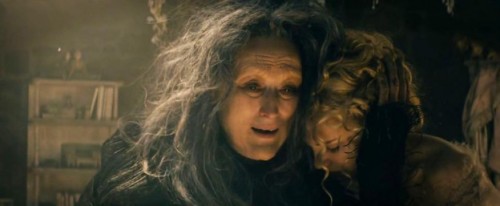
The Witch (Meryl Streep) watches as Rapunzel (Mackenzie Mauzy) rides into the distance with Rapunzel’s Prince (Billy Magnussen).
To make matters worse, the way the special effects were designed during The Witch’s death reminds one of images of Hell, as if to imply that The Witch was sucked down into Hell by the spirit of her mother. This most definitely goes against the messages of the story, and in fact even some of the lyrics in “The Last Midnight.” The Witch is not “good or bad,” but she is “right” about many things (though not about how she raised her daughter). It is the fact that she is “right,” and yet an older and powerful woman (a “witch”) that has drawn condemnation from the other characters, many of whom don’t even know about (most of) the drama between her and Rapunzel. The Witch not only has had a large part of her character arc taken away from her, but she is then metaphorically sent to Hell. For what? For being a complicated human being? By the same line of thinking, what about The Wolf whose only crime was doing what wolves do? What about the adulterous princes who were raised “to be charming, not sincere,” and therefore abuse their power and influence? No, none of them are sent to Hell. The older woman is. Not only is there sexism in this, but there is also ageism. After her death in the film, The Witch’s body is swallowed up by a bubbling tar pit. Women are already overly punished in this film, and it’s no small matter that one of the greatest examples of it is for an older and powerful woman. The stage adaptation took a character that is the villain in fairy tales, and focused on her as a human being, making her into one of the main characters and a complicated human being to be played by a leading actress. The audience is invited to sympathize with her and her intentions, despite the fact that some of them backfire on her and her daughter. To take away so much of her arc undermines what makes the story powerful, and it is a disservice to the role, to the actress (Meryl Streep), and to the audience.
Into The Woods is a complicated story about complicated people, ending with the understanding that no one is completely good or evil, and we all must love and support each other as best we can. It saddens me that the female characters’ stories were altered in the way they were. I can only hope that this newer generation of film-goers is inspired by the film to seek out the many adaptations of the stage version and appreciate the story for what it is – one of community and caring, and not judgment and debasement.
Jackson Adler is a transguy with a BA in Theatre, and is a writer, activist, director, teacher, dramaturge, cartoon lover, and vegan boba drinker. You can follow him on twitter @JacksonAdler, and see more of his writing on the blog The Windowsill at http://windowsillblog.com.
So what can women do about these smear campaigns directed at films by women? Go see films directed by women, support these filmmakers any way you can, whether it’s by filling theaters or participating in social media campaigns. We may not be able to change Academy voters’ minds, but we can continue drawing attention to gender disparities and focus on the positive changes.
This repost by Lauren Byrd appears as part of our theme week on the Academy Awards.
Oscar nominations haven’t been announced yet, but there’s already a campaign to dethrone an Oscar hopeful. Selma, directed by Ava DuVernay, is a solid choice for film critics (100 percent on Rotten Tomatoes), but in the weeks following its release, the film has come up against criticism for its portrayal of President Lyndon B. Johnson.
During a time when the holiday season detracts from awards season, historians and former members of the Johnson administration voiced their concerns with the film.
Three days before the film’s release, Mark K. Updegrove, the director of the Lyndon B. Johnson Library and Museum in Austin, Texas, wrote a piece in Politico, titled, “What Selma Gets Wrong”:
In the film, President Johnson resists King’s pressure to sign a voting rights bill, which—according to the movie’s take—is getting in the way of dozens of other Great Society legislative priorities. Indeed, Selma’s obstructionist LBJ is devoid of any palpable conviction on voting rights. Vainglorious and power hungry, he unleashes his zealous pit bull, FBI chief J. Edgar Hoover, on King, who is determined to march in protest from Selma to Montgomery despite LBJ’s warning that it will be “open season” on the protesters. This characterization of the 36th president flies in the face of history. In truth, the partnership between LBJ and MLK on civil rights is one of the most productive and consequential in American history.
Updegrove makes his argument about what is and isn’t right about this portrayal, but what the articles about the “Selma controversy” in The New York Times, The Wrap, and other media sites haven’t mentioned is that Updegrove also states that much of the film is correct and an accurate portrayal of the events of that time.
A former aide to Johnson Joseph A. Califano, Jr., wrote a similar piece in The Washington Post and on New Year’s Eve, The New York Times highlighted the charges of inaccuracy against the film in a piece by Jennifer Schuessler, which quoted several LBJ focused authors and historians.
Ava DuVernay on set of Selma
DuVernay isn’t standing silently in the face of the recent criticism. In a recent interview with Rolling Stone, she said, “I wasn’t interested in making a white-savior movie; I was interested in making a movie centered on the people of Selma.”
It’s hard not to compare the sudden firestorm of controversy surrounding a potential Oscar hopeful to the controversy in the 2013 Oscar season that befell Kathryn Bigelow’s Zero Dark Thirty.The debate about that particular film was based on its portrayal of torture and whether the film showed enhanced interrogation techniques producing intelligence that led to Osama bin Laden. Many journalists who had covered the wars in Iraq and Afghanistan, as well as national security, thought the film glorified torture, while film critics classified the film as an accurate depiction of the dark decisions made by the U.S. government during the murkiness of the post-9/11 decade.
It’s even more difficult not to note that both these films are directed by women. While questions about accuracy were also brought up about Lincoln during the 2013 awards season, which was directed by a man Steven Spielberg, the backlash against Zero Dark Thirty drowned out any questions around Spielberg’s film. As a result, Bigelow did not receive a Best Director nomination while Spielberg did. The inaccuracies in Argo, of which there were many, were not as widely discussed, and both Ben Affleck and the film went on to win Oscars.
Selma
This year, another film directed by a man, Bennett Miller’s Foxcatcher, has recently undergone criticism from Mark Schultz, one of the brothers whom the film is based on. But FlavorWire has already written a piece defending the film against Schultz’s remarks.
Compared to Foxcatcher, which has been in theaters since November, the controversy around Selma has received more media play and it’s possible the charges of inaccuracies from historians will affect how future audiences view the film. (It opens nationwide on Friday.)
These smear campaigns against films helmed by women are yet another sign of the disparity of the treatment of men and women in the film industry. So are these smear campaigns a gender issue or simply a coincidence?
As someone who knows enough about the industry to know that the Academy Awards are certainly not based on merit or artistry, but rather on money and publicity, it was still hard to believe smear campaigns were a reality until the 2013 Oscar race when Zero Dark Thirty‘s awards season chances quickly diminish.
Kathryn Bigelow moderating a Q&A with Ava DuVernay after a screening of Selma
So what can women do about these smear campaigns directed at films by women? Go see films directed by women, support these filmmakers any way you can, whether it’s by filling theaters or participating in social media campaigns. We may not be able to change Academy voters’ minds, but we can continue drawing attention to gender disparities and focus on the positive changes. Michelle MacLaren directing Wonder Woman, for instance.
While it’s unclear what effect the controversy will have on Selma and DuVernay’s Oscar chances, let’s hope that in the future, audiences and Academy voters learn how to think for themselves rather than be carried away by the most recent awards season smear campaign. Man or woman.
Lauren Byrd has a master’s degree from Syracuse University’s Newhouse School. She’s worked in television and recently worked as part of the education team at Brave New Films.
Women in films are even less likely to engage in this kind of dispirited struggle. Instead an actress usually plays the wife, mother, or girlfriend whose job it is to be “strong” and rub the hero’s back while he battles against his own obstacles. She talks reassuringly to him whenever he doubts himself, the exact same way Sandra’s husband does with her here.
This repost by Ren Jender appears as part of our theme week on the Academy Awards.
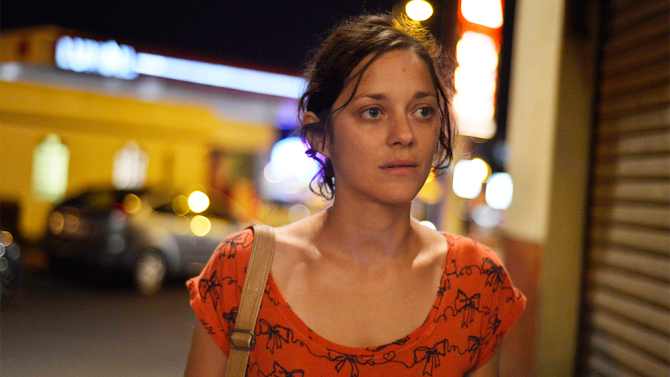
In one of the first scenes of Two Days, One Night, the newest release from the Belgian writer-directors Jean-Pierre and Luc Dardenne, we see the main character Sandra (played by a dressed-down Marion Cotillard) receive some bad news on the phone. She says out loud to herself afterward, “Don’t cry.”
Sandra, we later find out, has been on sick leave from her job for the past few months because of clinical depression. The phone call is from her friend at work, Juliette (Catherine Salée), who tells her that the rest of the laborers at their place of employment (which seems to be a small manufacturer of solar panels) have voted to accept a €1,000 bonus (about $1,200), which the foreman has offered in exchange for their agreement to lay Sandra off (Western Europe: a fairytale land where a boss asks his workers for permission to lay off their colleague–and offers them money to do so). The overwhelming majority of the workers (all but two of the 16 of them) have voted against her.
Juliette tells Sandra the foreman has misled the others into thinking if they didn’t agree to get rid of Sandra one of them might be laid off instead. So as the plant’s big boss is leaving the parking lot in his sports car to start his weekend, Juliette and Sandra plead with him to hold another vote, with a secret ballot, first thing on Monday morning. He just wants to get out of there, so he agrees.
Sandra (Marion Cotillard) and her husband (Fabrizio Rongione)
For the rest of the film Sandra, with the support of her husband (Fabrizio Rongione), and to a lesser extent, Juliette, tries to convince the others (after finding their home addresses and tracking them down) to let her stay. Of course voting against Sandra was easy when they didn’t have to face her and hear her say that she doesn’t want to be jobless and swear that she’s ready to go back to work (even as we in the audience, who have seen how frail she still is, wonder if she’s telling the truth).
One of her coworkers (part of the handful of Black and brown immigrants also more likely to be let go) is unexpectedly emotional; Sandra looks confused as he weeps about voting against her on Friday and thanks her for the chance to redeem himself. Others, including a woman Sandra had thought was her friend but refuses to see her, are surprisingly cold–or outright hostile. They want that €1,000 and don’t care if getting it means she will lose her job. Some make excuses and tell her they’re not the ones who set Sandra’s continued employment against their bonuses. She replies, quicker and more astutely than we expect, that the choice isn’t of her making either.
A coworker begs Sandra for forgiveness
Cotillard, her hair in a straggly ponytail, wears skimpy, summer tank tops, but is so slouched and tense for most of the film, her body is like a backwards “S.” She comes across as both convincingly desperate and working-class (not something all red-carpet actresses are capable of). Like Violette, Two Days, One Night isn’t afraid to show its protagonist at her worst. Sandra, like Violette, hates the thought that the concessions the others are making for her are motivated by pity. She constantly wants to give up, taking to her bed in the middle of the day, even as her husband gently pushes her saying, “Why not try?” and “Don’t give in. You have to fight.”
This film, like Violette, challenges the lie that most films tell, especially those released in time for awards season, that after a few minor setbacks a protagonist will, with uplifting music on the soundtrack, stand up straight and face adversity head-on with courage and maximum photogeneity. But the people who do extraordinary things often do them after a lot of bone-crushing rejection. They feel like miserable failures. They cry. They consider quitting all the time. We all like to think we face the trouble that comes our way like Wonder Woman, but when events take a turn for the worse we’re more like Dr. Smith on the old TV show Lost In Space, crying in an increasingly hysterical voice, “Oh dear, oh dear, oh dear.”
Women in films are even less likely to engage in this kind of dispirited struggle. Instead an actress usually plays the wife, mother, or girlfriend whose job it is to be “strong” and rub the hero’s back while he battles against his own obstacles. She talks reassuringly to him whenever he doubts himself, the exact same way Sandra’s husband does with her here.
Sandra’s quest is not just an indictment of capitalism but also touches on the responsibility we feel for our fellow human beings–how deep (or not) our empathy runs for the people we talk to and work alongside every day. Seeing Sandra’s surprise at who votes for her and who votes against her makes us wonder how well we know our own coworkers. We see her smile after one small triumph and in her next encounter we see her literally knocked down. We count with her as she accumulates four then five votes and when she talks to a man who just wants his money see her wisely clam up about which coworkers are voting for her. The long, frustrating, seemingly impossible task in front of Sandra could stand in for a number of others: writing a book, staying in a marriage–or making a movie.
And after we, along with Sandra, have nearly given up hope for her getting her job back, we see her become unexpectedly resilient–and the solution to her problem become more complex. Her late transformation reminds me of the redemption of another depressed character in a French-language film, Delphine in Eric Rohmer’s great Summer. Just as we hear the wonder in Delphine’s voice in the last line of that film, we hear a newfound strength and certainty in Sandra’s voice as she talks on the phone to her husband at the end. The two days and one night of the title have changed her, maybe forever.
The filmmakers (director Jean-Marc Vallée and screenwriter Nick Hornby) profess to be fans of Strayed’s work, but they were apparently so busy patting themselves on the back for not making this story of a woman alone into some kind of boy-meets-girl rom-com that they forgot to include everything else that makes the book distinctive.
This repost by Ren Jender appears as part of our theme week on the Academy Awards.
The reviews of Wild, the new film based on the bestselling memoir by Cheryl Strayed, make me think most men shouldn’t be allowed to review films based on women’s memoirs. Because more than one male critic has likened Cheryl Strayed and her grief-stricken, hardscrabble book about making her way up the Pacific Crest Trail to Eat, Pray, Love, Elizabeth Gilbert’s account of living a life of luxury in various spots around the globe and indulging in a little cultural appropriation along the way. I’m sure these same critics would never dream of arguing that Jack Kerouac, James Baldwin, and Michael Palin are basically the same person because they’re all men who also wrote about travel.
I went into the screening of Wild prepared to love it. I’m a big fan of Strayed, whose work I was first exposed to when she had an online advice column (which she started writing anonymously) “Dear Sugar,” in which she gave answers to readers’ questions that read more like selections from Best American Essays than “Dear Abby,” while still managing to offer solid guidance and empathy. The book that collected the columns, Tiny Beautiful Things, like Wild, was a bestseller. Strayed has done a lot of good with the fame and money Wild and “Sugar”have brought her, including using her name to publicize and raise funds for VIDA, the group that lobbies for more women to be published (and their books to be reviewed) in literary publications. I also wanted to be able to champion the film because of the male critics who have dismissed it; one of whom (thankfully now retired) took time in his review to comment on the real-life Strayed’s body, a supreme irony when, elsewhere Strayed has described men who disparage women’s bodies as not “worth fucking.”
Films don’t have to necessarily be very much like the books they’re based on to be good, even when those books have received a lot of critical acclaim and have sold a lot of copies. But the film version of Wild often leaves out or glosses over precisely the things that make Strayed’s story–and writing–so striking. A comparison of the film’s scenes to those that make up the original essay Strayed expanded into Wild or any of her writing in Tiny Beautiful Things (Strayed returns many times to her mother’s death and its aftermath, always detailing different, but still vivid memories), shows that Strayed’s version of events are not only more compelling on the page, but also leave us with more lasting visual images than the same or similar scenes in the film do.
The filmmakers (director Jean-Marc Vallée and screenwriter Nick Hornby) profess to be fans of Strayed’s work, but they were apparently so busy patting themselves on the back for not making this story of a woman alone into some kind of boy-meets-girl rom-com that they forgot to include everything else that makes the book distinctive. The mother’s death (Strayed tells a therapist in the film, “My mother was the love of my life”), the hook-up sex, the family violence that Strayed (played by Reese Witherspoon, who also produced the film) thinks back on as she hikes up the West Coast could have been cut and pasted from any other film. The staging for these scenes isn’t incompetent, but generic enough to leave us unmoved.
Hornby and Vallée also omit that some of Strayed’s hook-ups were with women (which makes Vallée two for two in erasing the queerness of his main characters: his previous film, Dallas Buyers Club, made its protagonist a straight homophobe, when in real-life he was an out bisexual). They cut out the sexual abuse Strayed endured as a very young child from her father’s father–as if this abuse had a minimal effect on her or her life.
Laura Dern plays Strayed’s mother, Bobbi
Witherspoon is significantly older than Strayed was when the events of the book take place, but physically embodies the role in a believable way. Though Laura Dern, who plays Strayed’s mother (she’s excellent–in her brief scenes we can see why her loss would affect her daughter so deeply) is less than a decade older than Witherspoon, their scenes together work, though again, Strayed in her book and other writing depicts their relationship much more compellingly.
In Wild, Witherspoon as Strayed can’t seem to summon the youthful energy that she had in movies like Freeway, when she was closer to the age she is supposed to be in Wild. This story is definitely a 20-something’s–thinking a three-month hike in the wilderness alone, thousands of miles away from home, will turn one’s life around is the sort of half-assed hypothesis a 30-something would never come up with–though in Strayed’s case, the miracle was this “cure” for her broken life worked.
Witherspoon’s Strayed also doesn’t have the recklessness or the inevitable shame that follows that recklessness the Strayed of the book had. When, in the film, a fellow hiker tells her that she seems like someone who beats herself up a lot, the observation comes as a complete surprise to the audience.
I skipped Dallas Buyers Club, in spite of its many awards, because of its straight-washing–the buyers clubs that the film depicts were a movement of queer people with AIDS, not the work of one “straight” homophobe– as well as its transphobia and general cluelessness about the issues the film is supposed to address (the makeup team when accepting their Oscar referred to “AIDS victims” when the preferred term, coined by those who have the disease more than 30 years ago, is “people with AIDS“). But in spite of my wariness, I didn’t expect Vallée to be the hack director he is here. Not just the flashback scenes but also the wilderness scenes in this film are nothing special–panoramas that should take our breath away look like faded, crappy postcards. Both Boyhood(a film I thought was otherwise vastly overrated) and Under The Skin (which I also had major qualms about) capture the beauty of nature (and in Skin the danger for a woman alone in it) on a level that Vallée seems incapable of–and those two films are in the“wild” for a relatively brief period of their runtimes.
I should probably add that Strayed herself has said that she is satisfied with the film and was allowed a lot of access to the film’s set; her daughter, Bobbi Strayed Lindstrom, even plays her as a young girl in flashback scenes. But Wild being better than most of the films in the multiplex doesn’t mean it’s nearly good enough. Maybe only when we have women writing the screenplays that adapt great books by women and women directing those films will we get the movies we deserve.
‘Foxcatcher’ is very serious meditation on men and masculinities, male relationships, and the white male experience of the class system in America. And I am so fucking bored with those subjects, even when they aren’t presented with a deliberately slow pace, sterile tone, and distracting amounts of face putty.
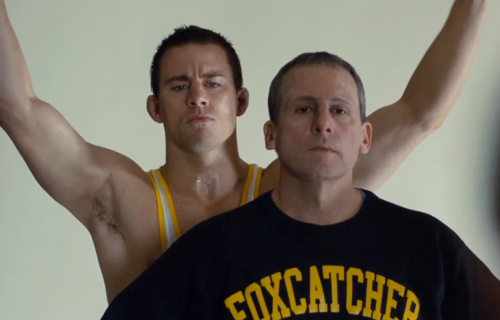
Channing Tatum and Steve Carell in Foxcatcher
This repost by Robin Hitchcock appears as part of our theme week on the Academy Awards.
Have you heard of “misandry”? If you read un-moderated comments on feminist websites you probably have. Misandry is the theoretical inverse of misogyny, so a systematic prejudice against and hatred of men. In a world chock full of systematic prejudices and hatreds, this is maybe the ONE form of oppression that doesn’t exist. Misandry is the unicorn of the kyriarchy: it isn’t real, but people still won’t shut up about it.
Because misandry is bogus, I know I can’t be a misandrist. But I really, really didn’t like Foxcatcher, a widely acclaimed film, and in my efforts to articulate why, the best I’ve really got is, “Ugh, men.”
Channing Tatum and Mark Ruffalo having dudely emotions in Foxcatcher
Foxcatcher is very serious meditation on men and masculinities, male relationships, and the white male experience of the class system in America. And I am so fucking bored with those subjects, even when they aren’t presented with a deliberately slow pace, sterile tone, and distracting amounts of face putty.
And I KNOW that masculinity is a feminist issue, and that the narrative of male greatness that shapes the neuroses of Steve Carell’s John Du Pont and Channing Tatum’s Mark Schultz is a byproduct of the patriarchy. I also feel that as a feminist I should also have some interest in whatever this movie was trying to say about the psychosexual component to their relationship. (Have you ever noticed that a lot of wrestling holds look like sex positions? Because Foxcatcher would like to make sure you are aware of this. Really, absolutely, 100 percent clear. WRESTLING LOOKS LIKE BONING, YOU GUYS. DUDES BONING. IN A GAY WAY.)
Just to be clear: wrestling at times presents images that resemble those of two men having sexual intercourse.
But I’m just so boooooooored by it. I’m tired of movies that are all about dudes, and movies that act like their characters’ very dudehood is the most interesting possible thing about them. I wasn’t planning on commenting on the controversy regarding Foxcatcher‘s departures from the facts of its true crime story, but I do think it is worth noting that John Du Pont’s schizophrenia was not included in the film. Maybe they were just trying to avoid the hoary cliche of mental illness as a catalyst for murder? (So they went with the incredibly novel repressed homosexuality motive instead… hm.) Or was mental illness just not MANLY enough of a subject for Foxcatcher?
John Du Pont’s paranoid schizophrenia gets edited out of the story, but that nose is VITAL to who the man really and truly was.
One of the first movies I reviewed for Bitch Flicks was Moneyball, also from Foxcatcher director Bennett Miller. It is another movie that is almost entirely about dudes. And at that time, I said:
Which is fine! There are stories, stories worth telling, that are just about men. (Likewise, there are stories worth telling that only involve women, but it’s hard to get Hollywood to bankroll those.) Telling a story about men in a men’s world isn’t inherently sexist.
Hmm, 2012 Robin sounds a lot mellower than 2015 Robin.
But I ALSO said in my Moneyball review that “I think it is fair to subject whatever scraps of portrayal of women we get in these male-dominated films to a slightly higher scrutiny.”
John Du Pont’s mommy didn’t hug him enough.
Well, this will be impossible with Foxcatcher, because it has exactly three female characters: 1) Vanessa Redgrave as Du Pont’s Ice Queen Mom (another example of the cutting-edge psychology Foxcatcher prefers to exploring the actual diagnosed condition Du Pont had), 2) Sienna Miller as Mom Jeans, and 3) The Maid.
Wait, I misspoke when I said there were three female characters (and not because one of Dave Schultz’s kids was a girl). There are three women (and one girl) in Foxcatcher. There are no female characters.
Which, like 2012 Robin said, is maybe OK. And maybe 2015 Robin IS a misandrist for finding Foxcatcher’s fascination with masculinity boring at best and annoying at worst. (No, I’m not. Misandry isn’t real.) But I need a movie by and about women STAT as a palette cleanser. Please offer suggestions in the comments!
Robin Hitchcock is an American writer living in Cape Town who does not actually hate men. In fact, she lives with a man, works with men, and even allows men to ride in the same elevator car as her.
And the worst of it is that awards recognition will probably just send Wes Anderson further up his own ass, if such a thing is even possible. I don’t think I’ll be rushing to see his subsequent films until I hear that he’s finally tried something different.
Ralph Fiennes in The Grand Budapest Hotel
Written by Robin Hitchcock as part of our theme week on the Academy Awards.
I used to love Wes Anderson’s style and now I hate it. Did I change? Did his movies change? Or have they not changed enough?
The Grand Budapest Hotel, Anderson’s eighth feature film, is his first to receive wide awards season attention. Although his screenplays have been nominated twice before (The Royal Tenenbaums and Moonrise Kingdom) and Fantastic Mr. Fox got a Best Animated Feature nod, The Grand Budapest Hotel is the first Wes Anderson film to amass a broad range of Academy Award nominations, including his first Best Picture and Best Director Oscar nods. And it won Best Comedy or Musical Film at the Golden Globes, beating out Oscar Best Picture front-runner Birdman.
So unless you are properly cynical about Hollywood awards, you’d probably guess there is something exceptional about The Grand Budapest Hotel compared to Wes Anderson’s other movies. But there isn’t. There’s pretty much nothing in The Grand Budapest Hotel you haven’t seen before if you’ve seen a Wes Anderson movie. It’s possible the Academy is so out of touch they’re just now noticing this young whippersnapper with a quirky vision and a fondness for Futura title cards.
How many perfectly symmetrical shots of a beautiful frown-faced women in an incredibly detailed set does this world really need?
But if you’ve been watching Anderson’s movies all along, I don’t know how you could not be sick of his schtick at this point. How many perfectly symmetrical shots of a beautiful frown-faced women in an incredibly detailed set does this world really need? And Anderson has become ever more indulgent in his stylistic quirks over the years, with diminishing returns.
I remember how excited I was by the offbeat humor and buzzing energy of Bottle Rocket and Rushmore. I remember being delighted by the bizarre world-building in The Royal Tenenbaums. Was it because I watched those movies as a teenager? Or has Anderson’s vision just gone off like expired milk? (I wanted to re-watch The Royal Tenenbaums before writing this piece, but I couldn’t find my copy. I was relieved. I don’t want to lose my happy memories of that movie.)
The oddball details in Wes Anderson’s movies, like this shot from The Royal Tenenbaums, used to delight me. Now I roll my eyes.
Maybe something that used to be there is now missing. Discussing Moonrise Kingdom, Molly McCaffery posited that Anderson’s first three films benefited much more than we realized from his collaboration with co-writer Owen Wilson: that the films “were as much about character development as they were about oddball behavior, unusual costumes, retro props, quirky sets, and elusive ingénues.” Whether or not Wilson was the source of it, those early movies certainly had a heart that has been lacking from Anderson’s later films.
Another issue is that Anderson’s slavish devotion to his form is without regard to its function. His quirky style is perfectly suited to the story of an oddball family like the Tenenbaums, but what does it bring to the narrative of The Grand Budapest Hotel? Moonrise Kingdom actually worked better for me than the other latter-day (sans-Wilson as co-writer) Wes Anderson films, because the twee tone and retro details suited the inherent nostalgia of small town childhood adventure story. For an ambitiously sprawling story like The Grand Budapest Hotel, Anderson’s attention to detail felt almost confining to what could have been an epic and sweeping tale. Is this the only way Anderson knows how to make movies?
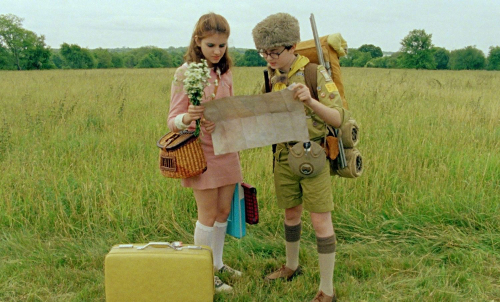
Anderson’s style was better suited to Moonrise Kingdom than The Grand Budapest Hotel
It is strange that the Academy seems to be only noticing Wes Anderson now, 20 years into his shockingly repetitive career, when his style feels so played out and empty. Maybe the Russian Doll framing device structure of The Grand Budapest Hotel (perhaps its only innovation) really knocked everyone else’s socks off (I found it showy and pointless, like the rest of the movie). Maybe it is just a really, really, really weak year for movies.
Anderson’s 2006 American Express ad poking fun at himself now feels like it could be a legit documentary
And the worst of it is that awards recognition will probably just send Wes Anderson further up his own ass, if such a thing is even possible. I don’t think I’ll be rushing to see his subsequent films until I hear that he’s finally tried something different.
Robin Hitchcock is an American writer living in Cape Town who can’t decide if she should stay up all night to watch the Oscars this year.
Kudos to the 20th Century Fox exec who decided to market ‘Gone Girl’ (2014) as a great date movie. This is not a date movie. This is a horror story about the sensationalized pitfalls of a doomed marriage.
This repost by Alize Emme appears as part of our theme week on the Academy Awards.
SPOILER ALERT.
Kudos to the 20th Century Fox exec who decided to market Gone Girl (2014) as a great date movie. This is not a date movie. This is a horror story about the sensationalized pitfalls of a doomed marriage.
As good horror stories go, this one has the perfect villain: Amy Elliott Dunne.
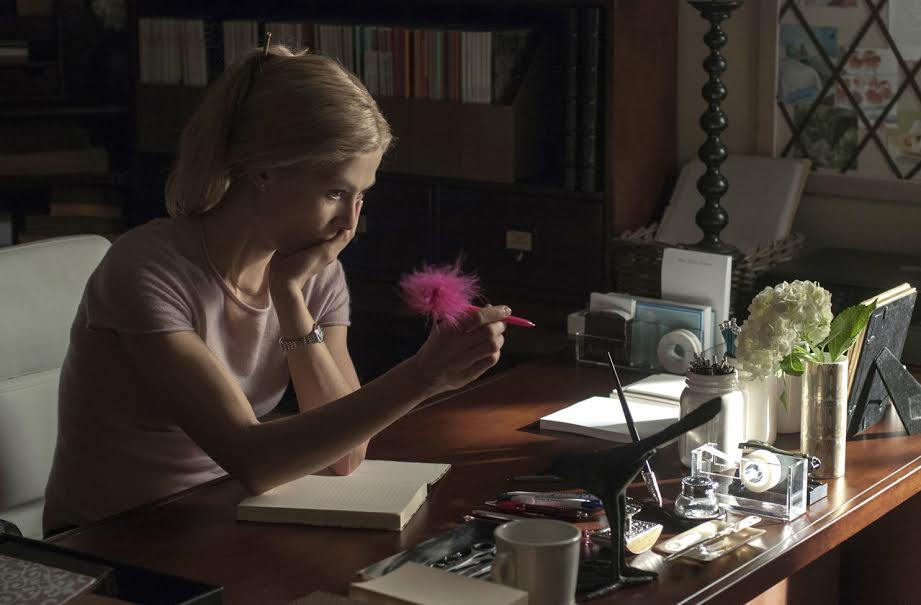
Dunne (Rosamund Pike) is perhaps one of the greatest female fictional villains portrayed on screen, with bonus points for doing something her male counterparts rarely ever achieve: getting away with it. Dunne, with the help of a highly colored narrative penned by Gillian Flynn, manipulates a vibrant cast of stereotypes as she weaves the perfect crime web and literally gets away with murder.
After feeling like her husband, Nick Dunne (Ben Affleck), has taken her “pride, dignity, hope, and money,” Dunne sets out with fierce discipline and a detective’s eye for detail to frame her unsuspecting husband for her own murder. She befriends “a local idiot,” tells tall tales about fear and the threat of violence, authors a journal’s worth of history–some true, some false, simulates a pregnancy, lights “a fire in July,” and sets the perfect crime scene. She transforms herself into someone “people will truly mourn.”
The premise of GoneGirl works because it plays off our preconceived notions about loss and tragedy. The Pretty Murdered Wife. We as an audience know this story: she’s missing, feared dead, might be pregnant. The narrative needs no back-story, but we do get a glimpse.
Nick Dunne. He is done. Gone. Finished. We know this about Nick the moment we meet him just by his name as he’s standing in the middle of the street next to garbage bins. He is something to be taken out and disposed of with the trash; he is never getting his life back, and Flynn wants us to be aware. The Nick Dunne we are introduced to is a schlubby, beer drinking, ice cream eating, 5 o’clock shadow kind of guy with a dissatisfied marriage and a concubine on the side.
The Smug Accused Husband
When Dunne goes missing and morphs into the Pretty Murdered Wife stereotype, Nick Dunne’s general disposition puts him right into the Smug Accused Husband category. He’s too charming; he’s too arrogant; he’s too suspicious. He’s a man with secrets. “He’s being a good guy, so everyone can see him being a good guy,” Officer Gilpin (Patrick Fugit) observes. He’s a man whose marriage has taught him how to fake it, who happens to be surrounded by women. There’s lead detective Rhonda Boney (Kim Dickens) who gives him a fair run. A fictionalized Nancy Grace clone, Ellen Abbott, (Missi Pyle) who pulls him apart every night on her nationally syndicated television show, and his twin sister Margo (Carrie Coon) who’s been with him since before they “were even born” and offers a stable voice of reason.
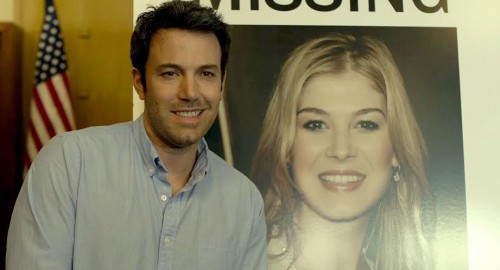
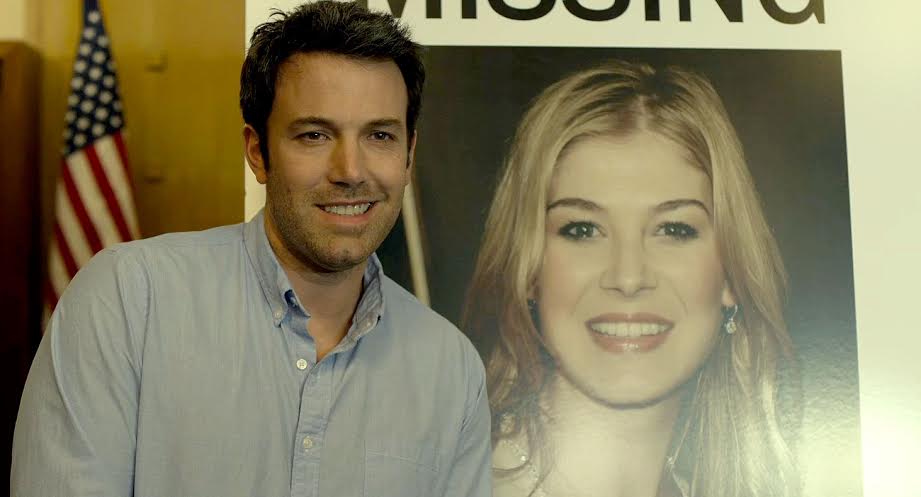
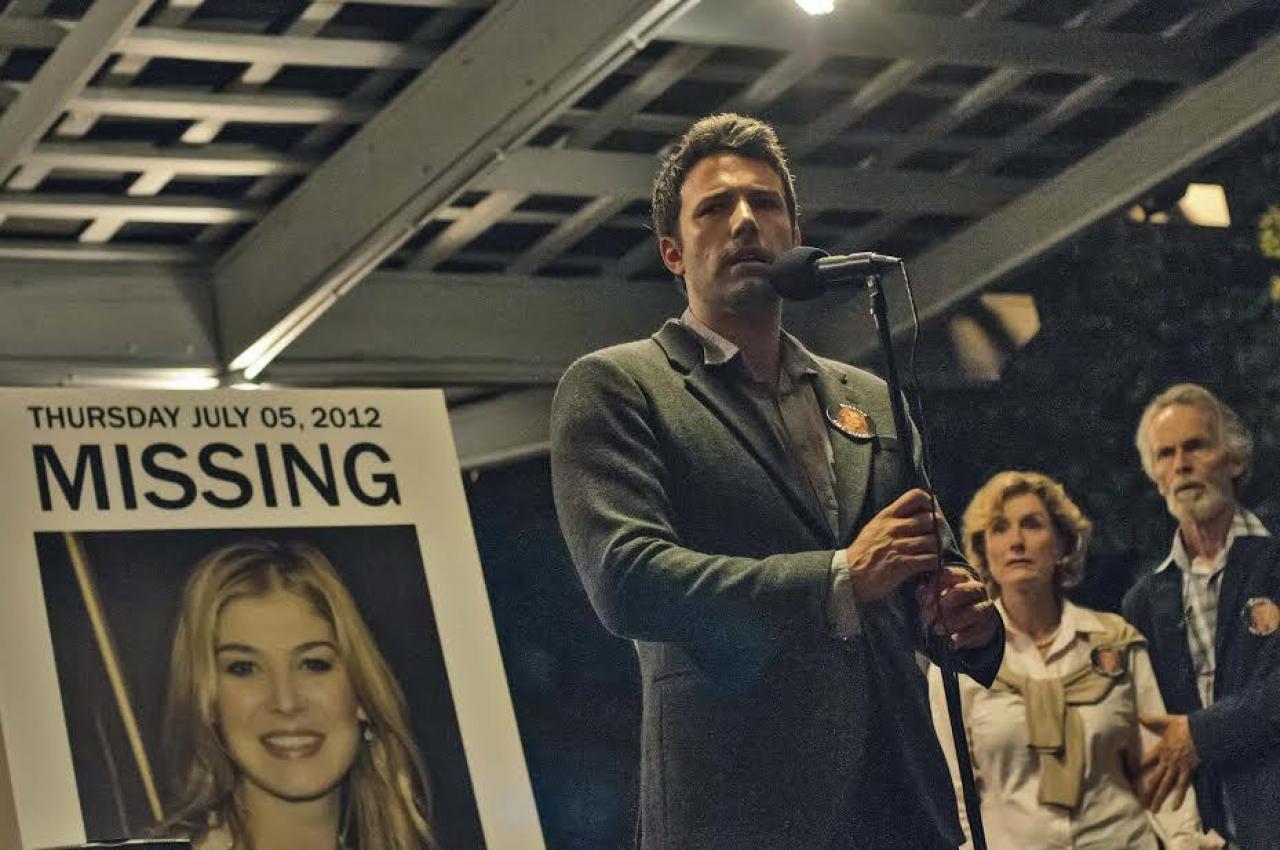
“I am so sick of being picked apart by women,” Nick Dunne says. And he’s right, that’s exactly what’s happening now that he’s been labeled the Smug Accused Husband. This stereotype exists because there are men who do kill their pregnant wives and then go on TV and lie about it, and society remembers them. The case of Laci Peterson was one of the first things that came to my mind. And Affleck is clear to notethat Scott Peterson was one of the models for his character. Even the “Missing” photo of Dunne is reminiscent of Laci’s with the bright smile, dangling earrings, and glossy lipstick. Gone Girl is a story that already lives on the edge of our thoughts.
As a couple, Nick and Amy have been pretending from the start. They have a perfect meet-cute, perfect dates, perfect celebratory rituals; they even buy the same sheets. He plays “hot, doting husband,” to her “sweet, loving spouse.” None of it is real; “I forged the man of my dreams,” Dunne says. And in doing so, she herself became the Cool Girl. Another stereotype of how women manipulate themselves to land a man.
Eating cold pizza, drinking beer, remaining “a size 2.” Dunne tailored herself to fit Nick’s taste. But “Nick got lazy.” Not holding up his end of the bargain was never the deal. When she sees that Nick’s sweet romantic gestures were not improvisations made up for her, but rather a well-rehearsed ruse easily tailored to the girl in front of him, Dunne makes a decision. She realizes her husband is no longer the man she married and decides to teach him a lesson he will never forget. “No fucking way,” she says, “He doesn’t get to win. Grown-ups suffer consequences.” She takes charge. She doesn’t let herself be walked on by this man. “Why should I die?” She asks, “I’m not the asshole.”
It’s an easy, cop-out that barely scratches the surface of accurate to diagnose Dunne as a psychopath. To say she’s an overly emotional, crazy woman who can’t handle daily life and descends into a PMS-filled rage, is falling pry to gender stereotypes. Dunne exhibits a perfectly cool demeanor, her emotions are consistently even, she is meticulous and complex. The layers of this character are masterful; she is the opposite of what every gender stereotype says women should be like. She is simply a great villain. “Show me that Darling Nicky smile,” Dunne coos like the Wicked Witch of the West as she stares at a video of her husband on a computer. She’s fascinated by her own work.
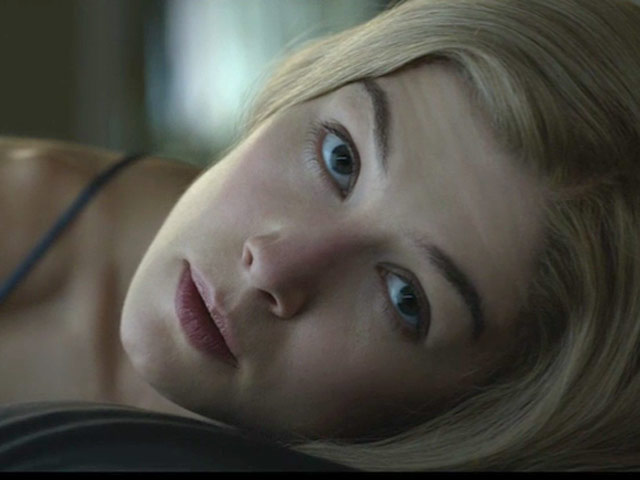
Amy Elliott Dunne, the perfect villain
Pike’s performance is mesmerizing; she delivers Dunne’s words in this breathless manner like she’s seductively blowing out a candle. Pike makes us believe from the very beginning that Dunne is both sane and capable of deception. But seeing a female character portrayed so strongly on screen earns Dunne the unfortunate label of “controlling bitch.”
If Dunne were a man, none of these character and sanity accusations would hold true. Male characters that go on rampant murder sprees in movies are never labeled as psychopaths, when clearly they display the same behavior. Dunne is not a psychopath. Crazy people cannot mastermind murders and crimes and not get caught. Even her past acts of “insanity” should be taken with a grain of salt. The ex-boyfriend who calls Dunne a “mind fucker of the first degree,” still keeps a picture of her in his wallet. This woman has allegedly ruined his life, yet he’s still holding her image so close? This calls his authenticity into question while giving Dunne credibility.
Dunne is fiercely intelligent. She has plotted the perfect crime. And while she doesn’t succeed with her original plan, she still sets her husband up for decades of suffering with her pregnancy. For all the betrayed wives out there, Dunne is a hero with the perfect revenge. Her crime is personal, not random, which gets her sanity questioned. Flynn doesn’t touch the subject of Dunne’s mental state. She leaves that up to the audience. David Fincher also helms this story in a nonjudgmental way. He is respectful of Dunne and all the female characters. Dunne is never put on display as a woman, though several male characters make mention of her impressive physical attributes. The supporting female characters, which are all various stereotypes, are never blasted for it; they’re handled with care.
Detective Boney, for example, is the coffee drinking, slick talking lead on Dunne’s missing persons case. She’s an interesting foil to the other female characters that assume Nick Dunne is guilty from the start. Boney gives him the benefit of the doubt, refusing to arrest him because some “blonde dunce” on TV says so. Instead it’s her male partner, Officer Gilpin, who immediately makes up his mind when finding blood splatter in The Dunne’s kitchen that he is guilty.
Through Boney, we are offered the idea that not all women jump to conclusions and hate men. But as the story progresses, we discover that Boney didn’t properly handle her case. “We stained the rug,” she says “with a national spotlight” on her. Had Nick Dunne been left in Boney’s “deeply incompetent hands,” he would be on death row, Dunne conveniently points out. Therefore, Boney’s word is useless in bringing Dunne to justice. Men botch investigations all the time, but for Boney to do so, it’s suggesting a woman can’t properly handle the responsibly of performing a traditionally male job.
Noelle Hawthorne (Casey Wilson) is the wonderfully entertaining suburban mom down the street with triplets and another baby on the way. We know this woman. Everyone has that one inquisitive neighbor that if something were to happen, she would be the first one knocking on the squad car window trying to help the cops. There’s a sense of comedy to this hyperbolic character and her triple-decker stroller, but she is never mocked. We take her seriously. It’s a real feat.
Nick Dunne’s twin, Margo, is a cool girl who’s not the Cool Girl. She drinks bourbon with her brother at ten in the morning, she covers his back with Dunne’s mother, she knows the truth but that doesn’t change her opinion of him. She always speaks the truth with her perfectly snarky comments. “You look like hammered shit,” she tells Nick. He likes her. We like her. She is perhaps the one female character that deviates from a hardened stereotype and could exist in the real world.
Somewhat of a mysterious supporting character, Greta (Lola Kirke) acts as a catalyst for Dunne. She’s complex and calculating just like Dunne; she sees an opportunity, and she seizes it. “Did he put you up to this?” Dunne asks as Greta and her male accomplice rob her blind, “I put him up to it,” she replies. She’s a survivalist and essentially forces Dunne to abort her plan and switch to survival mode herself. Yes, Dunne then murders a man and fakes a sexual assault, but in the world of a villain, she’s just adapting to survive. And as someone who is “skilled in the art of vengeance,” Dunne doesn’t just survive; she thrives.
Dunne, as Nick asks: What are you thinking?
Seeing a female character like Dunne on screen is fantastic–a word she would deem “a little flippant,” but there has yet to be a female villain quite like her. Fincher draws us into this world, Dunne’s world, where everything is this perfect shade of monochrome with tungsten lighting, where the camera moves in slow and methodical push-ins and pull-outs just as calculating as Dunne is, where things change with such swiftness–a kiss to a tongue swab, just like real life. And as we return to real life, we have to wonder: What will Amy Elliott Dunne do next? We’re left with the image of her head, just where we started, much like a few scenes earlier; we are left with Nick Dunne standing before trash cans, just like we started. So much has happened, but what do we really know? And more important, what will we learn next?
Alize Emme is a writer and filmmaker living in Los Angeles. She holds a B.A. in Film & Television from NYU and tweets at @alizeemme.
This cowboy motif is no accident, as it connects this film to the old John Ford Westerns and the nostalgia some folks feel about John Wayne flicks and the mythology of good white cowboys fighting off savage Indians who were keeping good white settlers from utilizing this “wilderness” that would become the U.S.A. Dehumanizing non-whites is the foundation for creating this nation. It’s the glue that holds apple pies and hot dogs together.
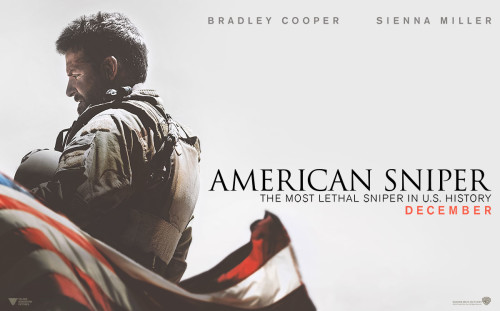
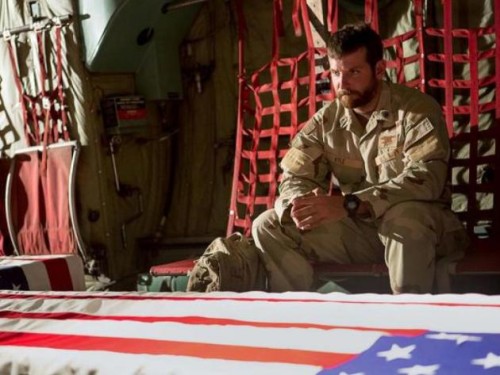
American Sniper poster. Starring Bradley Cooper.
This repost by Lisa Bolekaja appears as part of our theme week on the Academy Awards.
On Sept. 11, 2001, I was on the West Coast, living in the mountains of Southern Cali and preparing to go to work. A co-worker came running into our office screaming that the Twin Towers had fallen. Mind you, we were on West Coast time, and by the time I saw the attacks on television, the networks were on replay mode and editing footage deemed too gruesome for viewers.
Gathered around the one tiny TV in another office, my co-workers and I stared in disbelief, and the one thing I said out loud was something I remembered Malcolm X saying about chickens coming home to roost. “This is payback for something folks,” I said to them. While my co-workers were the flag-waving Patriotic types, I was already shaping this assault on American soil as retaliation for the untold dirt our military and government had done for years to countries who didn’t uphold our global agenda. This caused some ruffled feathers between me and some of my colleagues. It was a surreal moment. Our Pearl Harbor for the new millennia.
Looking back at the Sept. 11 attacks, it shouldn’t surprise me why American Sniper was such a big hit with the patriotic ‘muricah crowd. It is the military chicken soup of the soul cinema experience. It is propaganda of the highest order for viewers who need the Matrix blue pill to live with the lie of America’s War on Terror.
Men are war.
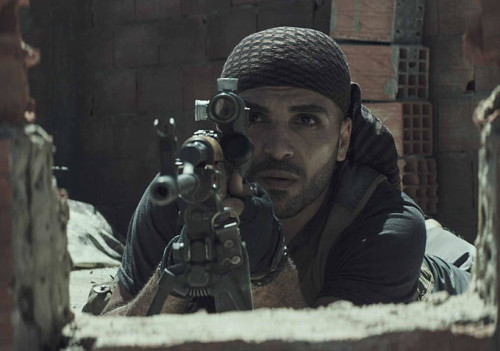
What makes American Sniper a disappointing viewing experience is not the ahistorical nature of the film, but quite frankly its generic storytelling. It’s downright boring. I may not agree with the politics of a film in order to enjoy it, but dammit, I have to be engaged with the content and its characters. The only time American Sniper really held my total interest was the appearance of a villainous character named Mustafa (played by Sammy Sheik), another sniper from Syria who we learn was a medal winning sharpshooter in the Olympics. He is for all intents and purposes Chris Kyle’s Arab counterpart. Sammy Sheik is riveting to watch in the brief moments we see him, although he never speaks. (Sidenote: every Arab character is a bad guy in this movie. There are no grays or complexity at all. Men, women, and children are all portrayed as evil, conniving, and dangerous. The idea that they could be defending their country from the cowboy antics of American soldiers is never even hinted at.)
Sammy Sheik as “Mustafa” and the only compelling character to hold my interest.
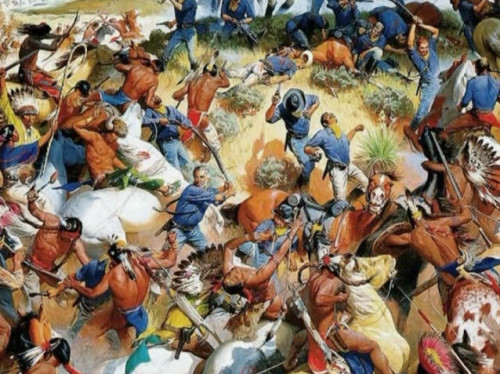
Bradley Cooper’s portrayal of Chris Kyle as a good ole boy going off to defend American citizens from the new Boogie-Men-of-the-Moment is pretty cut and dry. Usually Cooper is quite engaging to watch with his big baby blues and mega-watt smile. But here he’s not captivating at all, despite his eagerness to be serious and Oscar-worthy. His Kyle comes off as a big dumb reactionary bloke trying to find his manhood through “masculine” pursuits like bronco busting in rodeos and later a trumped up war (lest we forget, the excuse for bludgeoning Iraq was because U.S. intel claimed there was proof of W.M.D.’s—Weapons of Mass Destruction. There were no W.M.D.’s, and the 9/11 hijackers were from Saudi Arabia, but I digress). This cowboy motif is no accident, as it connects this film to the old John Ford Westerns and the nostalgia some folks feel about John Wayne flicks and the mythology of good white cowboys fighting off savage Indians who were keeping good white settlers from utilizing this “wilderness” that would become the U.S.A. Dehumanizing non-whites is the foundation for creating this nation. It’s the glue that holds apple pies and hot dogs together.
The original “Savages” that Cowboys fought. Actually Native people defending their land and liberty.
The new Wild West of the east. Actually American weapons of mass destruction.
Clint Eastwood, a veteran of old school cowboy flicks and the poster boy for conservative old boy politics, paints American Sniper as another addition to that long line of wild west nostalgia in contemporary war cinema. Unfortunately the script tells us nothing new or insightful about the American psyche in relation to war today. As it stands, the simplistic plot of American Sniper tells us what we already know. Men are war, and American men thrive on it under the guise of Democracy and helping other countries liberate themselves from tyranny–by ironically (maybe intentionally) becoming the new tyranny in places we are supposed to be helping. Every generation, America creates new evil henchmen: Native Americans on the frontier, The Yellow Peril, Red Scare Russians, Black people and Civil Rights, Communist Cuba, and renegade North Korea. Since the 90s and our first trumped-up invasion of Iraq, the Arab world is the new thing that goes bump in the night. Our penchant for war only teaches us that xenophobia and colonialism never went away. We just dress them up with new language like insurgents and failing diplomacy.
Kyle’s indoctrination into war comes when he sees the bombing of the U.S. embassy in Kenya on television, and he only feels bad when he learns some Americans were killed. When the Twin Towers drop, he is gung ho to go to war. Not to protect people, but really, just to have something to do. Before the war, Kyle appears aimless, searching for a purpose. War gives him purpose. He gets married because that seems to be what he is supposed to do. He goes through life following a script pre-written for him. There are obligatory flashback scenes to show his stern father and the simplistic philosophy he was raised to believe in. That there is evil in the world at all times. That there are three types of people in the world: Wolves, sheep, and sheepdogs. And of course, a real man uses a gun and beats the crap out of people. Kyle internalizes these ideals, and carries them with him throughout the rest of his life.
New marriage, but already thinking of battle. Chris and Taya get married. (Bradley Cooper and Sienna Miller)
The introduction of his wife, Taya (Sienna Miller), adds no meat to the story. She is regulated to being the good wife, the baby maker, the nagging spouse crying on the phone with an infant swinging off her breasts. (Let me say that the fake animatronic baby was creepy as hell and so distracting.) Although it probably wasn’t intended in the writing, you get the impression that Kyle preferred to be away from home not because he wanted to be a war hero, but because being a husband/father was a real drag for him.
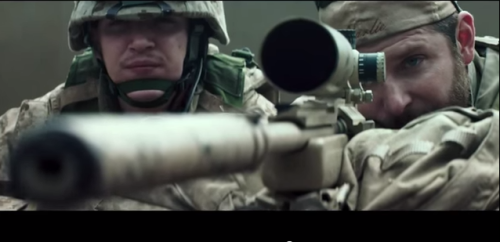
Kill shot. Marc (Luke Grimes) and Chris Kyle (Bradley Cooper)
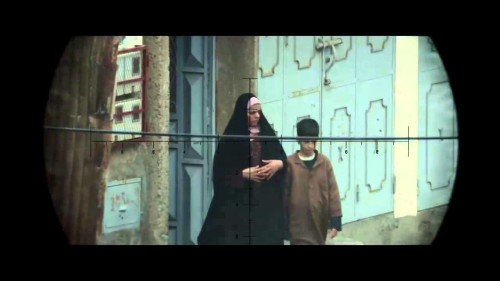
We are taken through Kyle’s four tour of duties, and each tour builds Kyle up as the sniper with the most kills. There are two scenes, one in the very beginning of the movie, and one later on, where Kyle is faced with the task of killing a child or not. These scenes are meant to show a moral dilemma, but they rang false to me because if someone is the deadliest sniper in American military history, they didn’t get that high body count by worrying about shooting children. There are no children in the Arab world according to this story. Just little insurgents ready to make war.
The “bad guys” in the sniper crosshairs. In America they would be considered Patriots for fighting back.
In the theater that I watched the film, a rotund older white gentleman (probably retired military by his crew cut) was actually rooting for Kyle to shoot a child. Because all the Arabs in the movie were considered “savages,” I have no doubt that Kyle never questioned or worried about assassinating children. They weren’t Americans, and therefore not human. (In real life, Chris Kyle bragged about shooting 30 Black people right after Hurricane Katrina in New Orleans. He bragged about killing fellow American citizens who I’m sure he didn’t view as human. His Katrina shootings were said to be a lie he made up, but his lies spoke volumes about his character. So his fictional quandary regarding Arab children rang false to me because we are never shown a man who questions anything ever. He’s just an unthinking workhorse used by the military.)
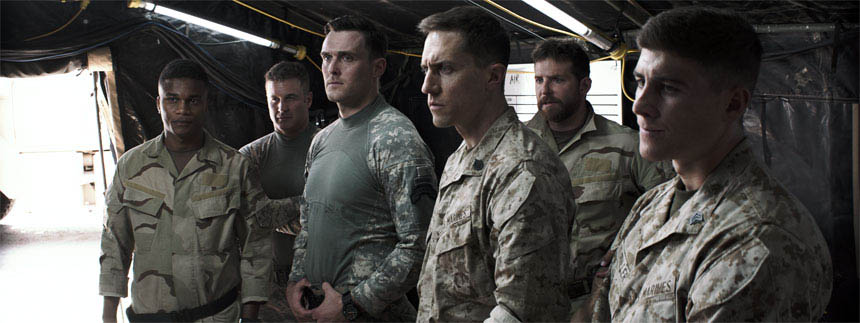
The concept of showing a man who just goes along with the war machine could be enhanced dramatically by having side characters who offer a different viewpoint. Unfortunately, we never spend too much time with side characters. The one character who does begin to question the meaning of this war, Marc ( Luke Grimes—who needs to be in more movies), barely registers a blip on Kyle’s radar of understanding. The plot drags on for over two hours until there’s a stand-off between Kyle and Mustafa. By then, when he’s about to get his ass handed to him by death, Kyle calls his wife and says he finally wants to come home. Not because war has changed his consciousness or philosophy, but because he’s losing a skirmish that he created by not following orders. He went rogue, it backfired, and now he wants out. That was the realest moment in the entire film. Not heroic, just honest human self-preservation.
Snipers in Ferguson, Missouri, their crosshairs on American citizens.
This is U.S. terrorism. Snipers against Americans.
Watching an audience root for snipers to kill humans defending their right to exist on their own land reminded me of images of American snipers here in the states pointing guns at Black American citizens and their supporters protesting murders by cops in the United States. This same audience that cheered the heroics of Bradley Cooper as Chris Kyle probably cheered the actions of police forces on American streets aiming gun sights on folks with extra melanin. Cognitive dissonance is entrenched in the Patriotic American psyche. It allows Americans to rally around American Sniper, turning it into a blockbuster, while ignoring the home grown terrorism white Americans perpetuated against Black Americans that was depicted in the film Selma. I saw Americans of all colors streaming in to view Selma. American Sniper was vanilla heavy. Not a big surprise to me. Because, history.
Director Clint Eastwood claims he made an anti-war film. He didn’t.
Clint Eastwood made spurious claims that American Sniper is an anti-war film. This disingenuous claim falls flat given the simplistic story-line, and the films ending dripping with flag waving from real-life footage of Kyle’s funeral. Had Eastwood really wanted to impress upon an audience the agonies of war, then he would be better off showing actual wounded veterans recovering from the various body traumas they come home with. A lot of flag-waving might become less vigorous when we see war up close and personal. Americans don’t know war. Not really. We watch it on TV like video games. We don’t sleep, eat, go to work, or go to school worrying about unmanned drones and bombs falling out of the sky from some hopped up dudebro with a military computer joystick thousands of miles away.
Unlike the rest of the world, Americans are spared from these continuous horrors and daily PTSD. We are coddled like babies, and this coddling has made us immature children in regards to war. So we deserve a movie like American Sniper. The only message it gives us (like it did Chris Kyle in real life), is that the war you perpetuate abroad will come back to haunt you in another form. Chickens coming home to roost indeed.
No one likes seeing the bodies coming home in movies or in real life.
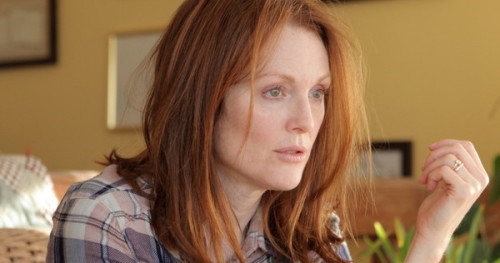
What works beyond a shadow of a doubt is Moore herself. For a long time now, she has demonstrated an uncanny range and power without ever subjecting us to a shred of vanity. Here, she outdoes herself, channeling Alice’s physical, mental, and emotional devolution with an alchemy that is as thrilling as it is harrowing. Her luminous features slacken, her cadences falter, her life force fades. Scenes with Stewart are especially heartbreaking.
This repost by Lisa Rosman appears as part of our theme week on the Academy Awards.
Without Julianne Moore, Still Alice might not be much of a film. This is not to say the adaptation of Lisa Genova’s 2007 novel about a 50-year-old woman stricken with early-onset Alzheimer’s disease is otherwise mediocre, although it is so unobtrusively constructed that its virtues may be overlooked. But because it focuses on the perspective of a person with Alzheimer’s rather than on the perspective of her caregivers, a uniquely gifted actor is required in the titular role. Who but Moore, with her radiant fusion of fortitude and empathy, could soldier us through a narrative whose unhappy ending is as inevitable as that of the Titanic?
Initially, Alice Howland seems like she has it all. A celebrated Columbia University linguistics professor, she is happily married to fellow academic John (an unusually muted Alec Baldwin), and the couple enjoys their three grown children as well as their well-appointed Long Island beach house and NYC brownstone. If she is a tad thorny when things don’t go her way – her youngest daughter, Lydia (Kristen Stewart), an aspiring actor, bears the brunt of her mother’s tenacity – it’s nothing extraordinary in a modern Type A woman. But when Alice can no longer write off her memory loss and growing confusion as mere middle-aged malaise (read: menopause side effects), her worst fears are outstripped: She is diagnosed with a rare strain of Alzheimer’s that is inherited and can be transmitted. “I wish I had cancer,” she weeps, and although some might take umbrage with her disease comparison-shopping, we understand what she means. Especially in her line of work, she does not know who she will be without her formidable brain.
Although this film is unwaveringly linear, we are quickly discombobulated. The film’s progression mirrors Alice’s decline so that time itself seems to dissolve, like all the rituals and goals to which she clings with a devastating inefficacy. Daily runs become impossible; soon she can no longer remember regular appointments without the aid of her smartphone. Sooner still she forgets the layout of her own house. One afternoon, she soils herself before she can find the bathroom. Every time Alice finds a way to manage a new set of limitations, the ground beneath her feet crumbles again, and we live right inside her growing panic and sorrow. As her ability to perceive her surroundings deteriorates, even the film’s clean lines grow fuzzy.
Because of Alice’s high intelligence, her Alzheimer’s has likely gone undiagnosed longer than it would have had she possessed fewer compensatory resources (ways to remember what she did not remember). The irony is she and her family possess very few “compensatory resources” once her now-rapid degeneration becomes evident; as cerebral people, they are especially ill-equipped to navigate her ever-increasing mental challenges. John, in particular, proves disappointing. “You are the smartest woman I know,” he tells her early on, and when their shared value of independence proves no longer possible, we learn that objectifying a woman for her brain is as problematic as objectifying her for her beauty. Marriage on any contingency plan is precarious.
It can be argued that Still Alice is too Lifetime-for-TV neat, that its secondary characters are too two-dimensional. While I’d never claim this film was avant-garde, I admire directors and screenwriters Richard Glatzer and Wash Westmoreland’s resistance to “fake stakes,” the peaks and valleys that normally shape a film narrative. Instead, the hurdles that Alice clears – an instance in which she successfully collects herself after dropping her notes during a speech, an aborted suicide attempt – only pave the way for our growing acceptance that there is no way to subvert her ultimate obstacle. Similarly, it makes sense that Alice’s family and friends don’t feel quite real; long before she actually forgets their names, her ability to distinguish personality nuance has been compromised. We’re there with her. Of course, this doesn’t excuse everything: a linguistics professor who loses her words is admittedly a smack on the nose, as is the discovery of Alice’s genetic disorder just as her eldest daughter (Kate Bosworth) is attempting to get pregnant.
What works beyond a shadow of a doubt is Moore herself. For a long time now, she has demonstrated an uncanny range and power without ever subjecting us to a shred of vanity. Here, she outdoes herself, channeling Alice’s physical, mental, and emotional devolution with an alchemy that is as thrilling as it is harrowing. Her luminous features slacken, her cadences falter, her life force fades. Scenes with Stewart are especially heartbreaking. The younger actor is finally returning to form after all that mucking about with vampires, and the careful attentiveness she displays as Alice’s daughter is key to the one hope that this film offers us: By definition, true love never changes form.
A former labor organizer, Lisa Rosman has reviewed film for such outlets as Time Out New York, Salon, Us Magazine, Flavorwire, LA Weekly, RogerEbert.com, and CBS News. She appears weekly on the NY1 film review show Talking Pictures and writes on film, feminism, and eavesdropping for SignsandSirens.com. Most notably, she once served as an assistant for Elmo on Sesame Street.
I wish I could say that ‘Gone Girl’ is a subversive feminist film exposing myriad gender biases and generating a much-needed dialogue on rape and domestic violence. Yet it reinforces dangerous myths rather than shattering them.
This repost by Megan Kearns appears as part of our theme week on the Academy Awards.
WARNING: LOTS OF SPOILERS AHEAD! | TRIGGER WARNING: DISCUSSION OF RAPE AND INTIMATE PARTNER VIOLENCE
Is Gone Girl a misandry fest, a subversive feminist masterpiece, or a misogynistic mess? All of the above?
I loved Gone Girl. It intrigued me with its labyrinthine plot, complex characters and noir motif. It simultaneously enthralled and enraged me. There is so much to unpack regarding gender. While a whodunit mystery revolving around the disappearance of Amy Dunne (Rosamund Pike), and whether or not her husband Nick (Ben Affleck) is the culprit, the crux of the film is the dissolution and destructive unraveling of a marriage. It begs the question: Do you ever really know the person you marry?
Deftly written by Gillian Flynn (who wrote the novel as well) and expertly directed by David Fincher, it’s an uncomfortable film that boldly examines the underbelly of love and marriage and how the media shapes perception. Told from the perspectives of both Amy (often through her diary) and Nick, Gone Girl cracks wide open and shines a spotlight on the often gendered expectations within a heteronormative marriage. Society pressures women to be flawless, never wavering in an aura of perfection. Gone Girl takes a sledge hammer to that.
In an outstanding and riveting performance by Rosamund Pike, Amy is a fascinating character. She’s brilliant, pragmatic and narcissistic. We watch her shift effortlessly from a devoted and then fearful wife to a calculating and fearlessly manipulative villain. A ruthless, Machiavellian anti-hero, Amy morphs into whatever persona she needs to don to obtain her objective. She wears personalities like a cloak, shrouding her true nature and intentions. Filled with rage, she discards the role of the docile wife. She’s not going to live on her husband’s or any man’s terms. She refuses to fulfill society’s expectations.
Amy uses her femininity to achieve her diabolical goals. She uses her sexuality, wielding it as a weapon. They are tools in her arsenal to ensnare and punish men. But just as she readily adopts stereotypical feminine traits when she needs them, she also utilizes stereotypical masculine traits of anger and violence. Her gender informs her actions and the way she perceives the world. However, Amy despises gender norms and doesn’t want to be constrained by them. She doesn’t want to be a satellite to a man. She wants to do whatever she pleases, regardless of the consequences.
I have to applaud Amy’s rage and defiance. Although I’m horrified by her disturbing, sociopathic and misogynist tactics. This is why I relish Amy’s notorious “Cool Girl” speech. “The cool girl. The cool girl is hot. Cool girl doesn’t get angry. … And she presents her mouth for fucking.” This is a scathing commentary on how men see women as objects, as vessels, as accessories, not as entities unto themselves. I couldn’t help but say, “FUCK YEAH,” while Amy recited it. Her speech succinctly encapsulates the Male Gaze and hetero men’s expectations of women, while shattering the illusion that women are never angry and that women merely orbit men, suffocating their own needs and desires. Amy’s speech illustrates that society tells women to contort themselves to seek men’s approval.
As much as I cheer for the astute and searing commentary in the “Cool Girl” speech, Amy also condemns women complicit in this charade. She despises how women fall into their prescribed roles, all for the enjoyment of men. When Amy recites this speech, she’s driving in a car, gazing at myriad women passing by. As David Haglund points out, director David Fincher chose the images, not of men but of women, to coincide with Amy’s words. So while the words condemn men, the corresponding images implicate women, making everyone culpable. It becomes a condemnation of women themselves, that they shouldn’t fall into the trap of pantomiming this performance.
What could have potentially been a feminist manifesto mutates into something ripped out of a misogynist’s or Men’s Rights Activist (MRA)’s warped fantasy.
The biggest problem with Gone Girl lies in the tactics Amy utilizes to punish men — by faking intimate partner violence and rape. Amy ties her wrists with rope, squeezing and tightening them while turning her wrists and she hits her face with a hammer to simulate abuse. She repeatedly shoves a wine bottle up her vagina to simulate the bruising and tearing from rape. Amy falsely accuses men of rape, stalking and abuse, all for her own ends. Amy convincingly plays the role of an abuse survivor. It’s scary because this is the kind of bullshit people believe — that women lie and make shit up to wreak vengeance on men.
Author/screenwriter Gillian Flynn said that Amy “knows all the tropes” and she can “play any role that she wants.” But therein lies the problem. Abuse victims and survivors are not merely “tropes” or “roles.” Amy pretends she is being abused in order to frame Nick by writing in her diary that she fears for her life and worries that her husband might kill her. She says she feels “disposable,” something that could be “jettisoned.” Women murdered at the hands of abusive partners are typically treated as disposable in our society. People tell victims/survivors that they should have known better, they must have provoked their abuse. People question why victims/survivors stay with abusive partners. People put the onus on women to prevent rape. These are the myths that films, TV series and news media reinforce. It’s extremely problematic to equate Amy playing “the role” of an abused rape victim with actual women abused and raped.
We also see victim-blaming underscored in the film from Amy’s neighbor Greta. When they first meet, Greta comments on the bruise on Amy’s face saying, “Well, we have the same taste in men.” Yet when the two women are watching a news program on Amy’s disappearance and how the leading cause of death for pregnant women is homicide (it is), Greta calls on-screen Amy (feigning ignorance that the real Amy is right next to her) a “spoiled,” “rich bitch.” She goes on to say, “While she doesn’t deserve it, there are consequences.” While this is a commentary on privilege and Greta has survived abuse too, this also amounts to victim-blaming 101.
But the victim-blaming doesn’t stop there. One of Amy’s exes talks to Nick and tells him how she falsely accused him of rape and had a restraining order placed on him. He tells Nick that when he saw her on the news missing, “I thought there’s Amy. She’s gone from being raped to being murdered.” Again this underscores the myth that women lie about rape and abuse. But the numbers are so low for reports of false rape and domestic violence that they are almost non-existent.
Victim-blaming myths permeate every facet of our society. Janay Rice’s abuse and the resulting #WhyIStayed conversation recently highlighted the myriad myths people believe about intimate partner violence, particularly when it comes to women of color. People feel they need “proof” to verify or corroborate a victim/survivor’s trauma. Society perpetually places the onus on women for their abuse rather than on where it belongs: with the abuser. As we’ve seen with Marissa Alexander, the legal system doesn’t reward but rather punishes domestic violence survivors. This happens again and again, over and over. Women are not believed. And it’s dangerous to keep feeding this narrative.
Rape is “an epidemic.” Violence against women is an epidemic. We live in a rape culture that inculcates the abuse and objectification of women and dismisses violence against women. Society makes every excuse for abusers while it unilaterally shames and blames victims and survivors of intimate partner violence, rape and sexual assault.
Some might try to assuage Gone Girl’s misogyny by declaring Amy’s misandry or by underscoring that there are two female characters – Detective Rhonda Boney and Margo Dunne – who are onto Amy’s game. But it doesn’t. When you have a protagonist doing despicable things, the film/TV series often straddles a fine line between condemnation and glorification. However, there is a way for a film/TV series to delineate their message: by the comments and perspectives of ancillary characters. Breaking Bad illustrates this beautifully. Despite what many fanboys got wrong, we are NOT supposed to identify with power-hungry, abusive, rapist Walter White. We may be fascinated by Walter’s fierce intelligence. But we are supposed to identify with Jesse and Skyler, both of whom are the heart and conscience of the show. They are the ones telling us the audience, both overtly and covertly, that Walter’s actions are despicable and monstrous.
In Gone Girl, almost every character condemns and despises Amy. They loathe her for her manipulations and how she has framed Nick. But no character comments on how Amy’s actions reinforce rape culture. Not one. Rhonda could have easily mentioned the stats for women reporting rape or domestic abuse, how few rape and abuse cases are brought to trial and even fewer convicted because of victim-blaming biases. Nick’s sister Margo could have said how horrible Amy’s schemes are not only for her brother but the implications for other women too. But everyone in the film only focuses on how Amy’s actions impact Nick. Nick even says at one point in the film, “I’m so sick of being picked apart by women.” (Boo hoo, poor Nick. Isn’t that every misogynist’s anthem??) So when Nick slams Amy’s head into the wall and calls her a “cunt” towards the end of the film — despite his abusive actions and misogynist language — we the audience are supposed to sympathize with him because he just wants to be a good dad, because he’s the one victimized by this manipulative shrew.
I wish I could love this film without reservations. I wish I could say that Gone Girl is a subversive feminist film exposing myriad gender biases and generating a much-needed dialogue on rape and domestic violence. Yet it reinforces dangerous myths rather than shattering them. The embedded “Cool Girl” speech rails against the patriarchal notion that women serve as nothing more than accessories and sexual objects to men. But the film falters by playing into a victim-blaming narrative reinforcing rape culture.
We need more complex female protagonists. We need more female anti-heroes and villains. If only we could have one in a film that doesn’t simultaneously perpetuate the misogynist notion that women lie about rape and abuse.