
![]() |
| Movie poster for Shut Up and Sing |
This is a guest post by Kerri French.
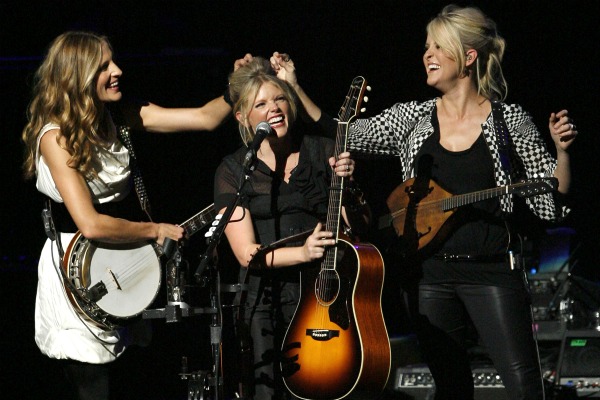
![]() |
| The Dixie Chicks messing around on stage |
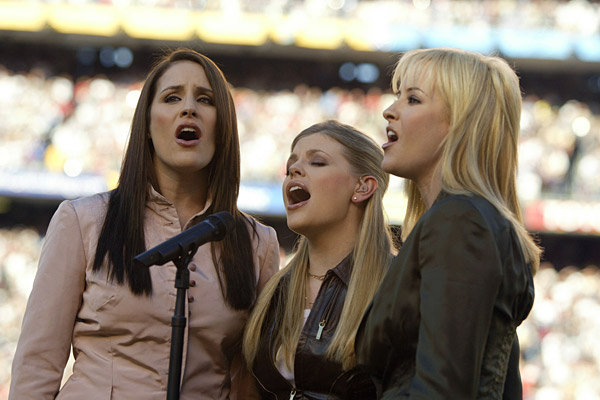
![]() |
| The Dixie Chicks on Entertainment Weekly |
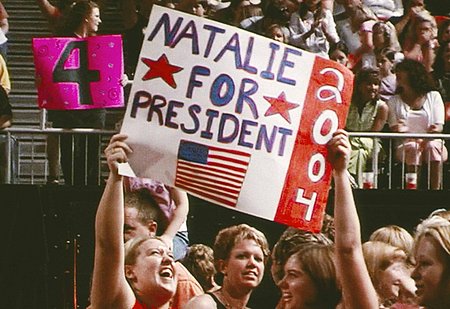
![]() |
| Fans unite in support of The Dixie Chicks |
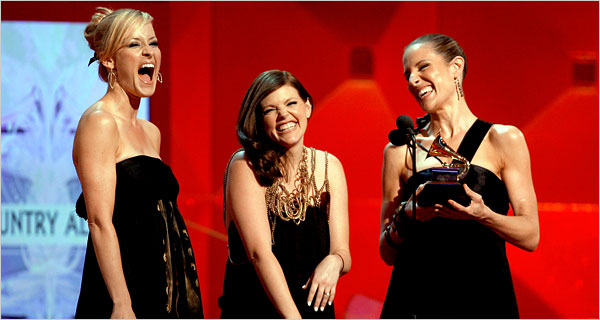
![]() |
| The Dixie Chicks sweep the 2007 Grammy Awards |
The radical notion that women like good movies
![]() |
| Movie poster for Shut Up and Sing |
This is a guest post by Kerri French.
![]() |
| The Dixie Chicks messing around on stage |
![]() |
| The Dixie Chicks on Entertainment Weekly |
![]() |
| Fans unite in support of The Dixie Chicks |
![]() |
| The Dixie Chicks sweep the 2007 Grammy Awards |
![]() |
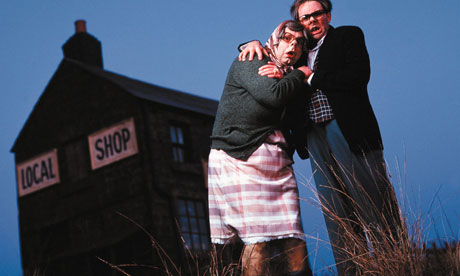
| This is a local shop for local people. There’s nothing for you here. |
![]() |
| Reece Shearsmith: yep and also yep. |
![]() |
| Lots of shots like this, but heaven forfend we see her face. We might think she was an actual human being. |
Barbara: “They dug something up working on the new road.”Mrs. Levinson: “Oh, Barbara, stop it. You’re giving me the willies!”Barbara: “Well, you’re very welcome to mine – it’s coming off in a fortnight anyway.”
![]() |
| But I sill love the show, and you should still watch it. |
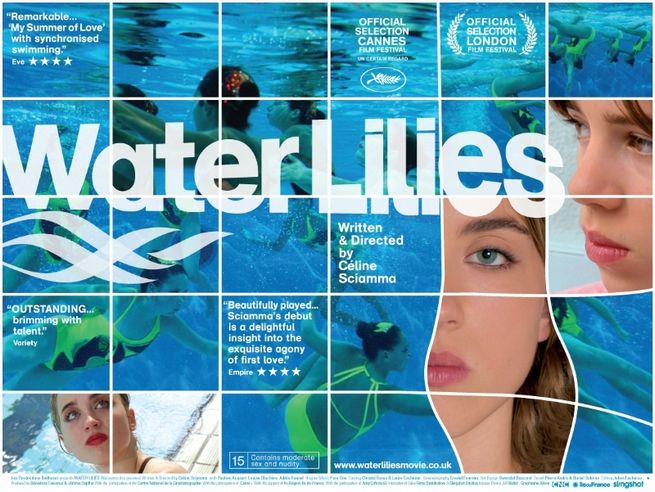
These techniques are uniquely suited to the onscreen portrayal of adolescence. It almost seems churlish to complain that Water Lilies and Tomboy lack full structural coherence, because that’s arguably intentional. Growing up, after all, is not a tightly-plotted three-act hero’s journey with clear turning points, tidy linear progression through the successive stages of personal development, and a satisfying ending. It’s a messy and confusing struggle to find a place in the world, littered with incidents that may or may not ultimately be significant (with no way to tell the difference), and most of the time the morals make no sense.
Sciamma instinctively understands this, and the little stories she tells of growing up queer are given vivid life through her two greatest strengths as a filmmaker: her ability to coax marvelously deep and naturalistic performances out of her young actors, and her eye for a strikingly memorable little scene that perfectly encapsulates a moment of overpowering adolescent emotion – the normally boisterous Anne clutching at a lamppost and weeping in Water Lilies, for example, or Tomboy‘s Laure curling up on the couch, thumb in mouth, suddenly overwhelmed by an earlier humiliation.
Both films are carried on the remarkably expressive faces of their lead actresses. There are no voice-over monologues or expository conversations, but both Water Lilies and Tomboy present the inner life of their protagonists with stunning depth and rawness.
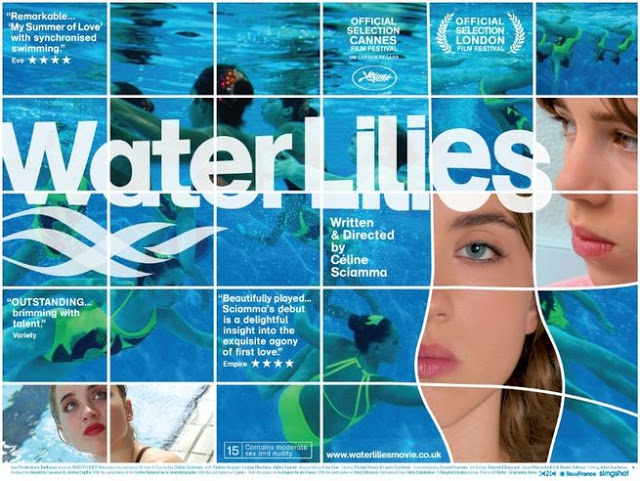
![]() |
| Movie poster for Water Lilies |
Anne, though less conventionally feminine than the other girls, is confidently heterosexual and determined to sleep with the boy she finds attractive. Marie is so eager to spend time with Floriane that she agrees to help her sneak out to meet François, and her yearnings for the lithe bodies slipping through the water are beautifully conveyed through moments such as the shot of Marie shifting, flustered, as Floriane unselfconsciously changes into a swimsuit right in front of her. Floriane herself, despite the reputation she cultivates (perhaps recognizing that denial would be futile – once branded a “slut,” a teenage girl is hopelessly trapped in a no-win morass of contradictory social pressures), eventually confesses to Marie that she has never actually had sex, and in fact is afraid to do so.
“If you don’t want to do it, don’t.”
“I have to.”
“Where did you read that?”
“All over my face, apparently. If he finds out I’m not a real slut, it’s over.”
![]() |
| Movie poster Tomboy |
Any ten-year-old lives in the present, and Mikael meets each challenge as it arises – sneaking away deep into the woods when the other boys casually take a pee break; snipping a girl’s swimsuit into a boy’s, and constructing a Play-Doh packer to fill it; swearing Jeanne to secrecy when Lisa unwittingly tells her about Mikael – even as it becomes increasingly clear to the viewer that eventually Laure’s parents must find out about Mikael. As loving as they are, they still exert some gender-policing of their oldest child: Mom’s delight at hearing that Laure has made a female friend (“You’re always hanging out with the boys”) might have been tempered if she’d remembered that “copine” can also mean girlfriend!
The relationships between the various children are superbly observed, and constitute reason enough to see Tomboy in themselves. The energetic activities of childish horseplay that give Mikael such joy in himself and in his body – dancing enthusiastically with Lisa, playing soccer shirtless, wrestling in swimsuits on the dock – are balanced by the many lovely domestic scenes demonstrating the closeness of Laure’s relationship with Jeanne. This is honestly one of the most moving and genuine cinematic portrayals of a sibling relationship in years, and after her initial shock Jeanne takes to the idea of Mikael like a duck to water, boasting to another child about her awesome big brother, and telling her parents that her favorite of Laure’s new friends is Mikael.
The parents themselves, unfortunately, are much less accepting of Mikael. The film’s ending is ambiguous, allowing for multiple readings of the exact nature of Laure’s queerness; indeed, the film has been criticized as “an appropriation of trans narratives by a cis filmmaker toward her own purposes”; but to me the ending is terribly unhappy. With deep breaths and with profound conflict on Héran’s preternaturally expressive face, the character is forced to claim “Laure,” the name and gender assigned at birth and not the ones of choice. The cissupremacy has won this round.
Though Tomboy is the better film, the two movies make excellent companion pieces. Between them they depict a range of queerness and explore a variety of strategies for growing up queer (and/or female) in a hostile world. And yet they offer no easy solutions, no cheap moralizing, no promise that it gets better. These films, and the characters they portray, simply are. And, in the end, isn’t that the one universal truth of queer people? There is no ur-narrative of queerness. There is no right or wrong way to be queer. We simply are.
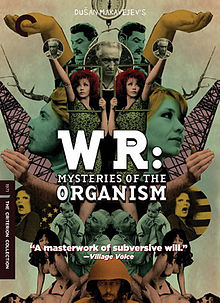
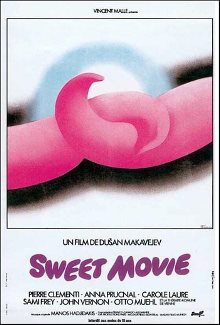
“Makavejev began his career by earning a psychology degree at a leading Serbian university, studying at Yugoslavia’s national film school, and making numerous shorts and documentaries… he set to work on the 1971 genre bender WR: Mysteries of the Organism, which anticipated Sweet Movie with its collagelike meditation on maverick psychologist Wilhelm Reich and his theories of sexual liberation.
“By this time, Makavejev was a leader of the so-called Black Cinema filmmakers, as they were dubbed by Yugoslav officials who didn’t like their negative view of official ideologies. The sexual politics of WR was more than those officials could take: the film was banned, and Makavejev fled the country, not working there again until 1988. He made Sweet Movie in Canada, the Netherlands, and France, with additional Swedish and West German funding. It is banned in various countries to this day.”
![]() |
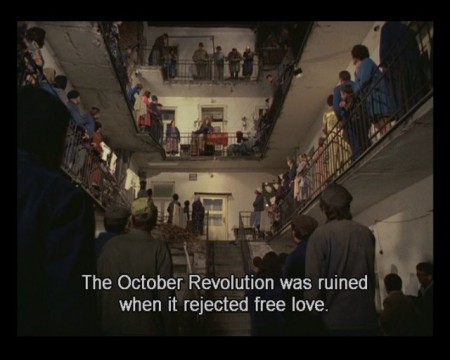
| Milena lectures workers about the failure of communism. |
“… Our road to the future must be life-positive. Comrades! Between socialism and physical love there can be no conflict. Socialism must not exclude human pleasure from its program. The October Revolution was ruined when it rejected free love. Frustrate the young sexually and they’ll recklessly take to other illicit thrills: Pilfering, burglary and assorted crimes, knifings, alcoholism, political riots with flags flying, battling the police like prewar communists! What we need is free youth in a crime-free world! If we are to achieve this, we must allow free love!…
“No excitement can ever equal the elemental force of the orgasm… Sweet oblivion is the masses’ demand! Deprive them of free love, and they’ll seize everything else! That led to revolution. It led to fascism and doomsday. How Man Became a Giant. Deutschland uber alles!… Deprive youth of their right to the sweet electricity of sex and you rob them of their mental health!… Restore to every individual the right to love!”
![]() |
| Milena sees fascism as a masculine force that represses freedom and sexuality. |
“Makavejev doesn’t exploit this material — Sweet Movie is anything but a sex film — but uses it to confront us in a very unsettling way. The unasked questions behind his film seem to be: Well, we’re all human, aren’t we? This is what we are and what we do. What do you think of these people? You go to the movies to be entertained by scenes of people killing each other, you watch wars on TV — do the basic bodily processes of these people offend you?”
![]() |
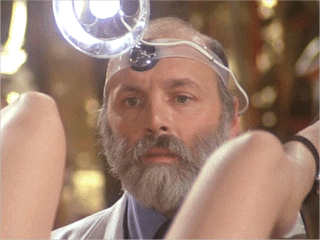
| The gynecologist examines the female contestants’ virginity. |
“Through the guidance of our sensational method, your own body kills the animal. We advocate simple triumph of the will. It is painless and ever so rewarding. No wild dreams. No – no peculiar behavior. Solid health and purposeful direction! … If not controlled and kept at bay, wild impulses will turn everyone into beastly animals, chaotic natural beings.”
“I’m gonna buy it from the Canadian Government. I will renovate it, redecorate it. Get rid of the water, turn off the falls. … I’m gonna install an electric, synthetic, laser moving image in livin’ color. In livin’ color, honey! Yeah. And we’re gonna have a huge quadraphonic sound system. Yeah!”
(Mortimer notes that “…years later, it would be comforting if this wild caricature of acquisition and ignorance were further from our own reality.”)
![]() |
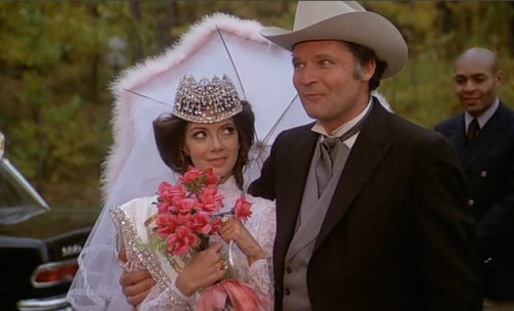
| Miss World and Mr. Kapital. |
Miss World is an acquisition to Mr. Kapital, nothing more. He preaches on purity, money, sex and waste (marriage and business seem interchangeable, all driven by deeply capitalistic and puritanical ideologies). Martha and her brigade of priests stand outside a glass plate window as the marriage is about to be consummated. Mr. Kapital disinfects himself, and rubs Miss World down with alcohol–there is nothing sexual or sensual about the scene; it’s sterile and lifeless. When he takes out his penis, it’s covered in gold, and he procedes to urinate on Miss World as she screams.
When Miss World attempts to get out of the marriage, her mother-in-law attempts to drown her and they send her away. She speaks out and tries to have some independence, only to be punished harshly. She represents this world where girls are prized for their virginity and derided for the outcomes of this anti-woman socialization. (“This is my only property, it’s my diamond!” she exclaims of her virginity when the tycoon’s bodyguard attempts to sexually assault her.)
![]() |
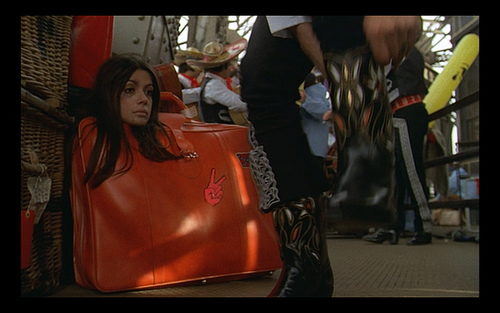
| She is now shipped off, just one of Mr. Kapital’s failed business ventures. |
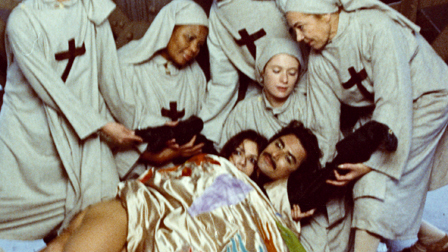
She’s damaged and broken–she attempts sex with a Latin pop star only to be confronted by nuns and stuck in “penis captivus.” She’s sent to the aforementioned Otto Muehl commune to “heal.”
![]() |
| Religious imagery surrounds Miss World when she attempts to have sex–another symbol of sexual oppression. |
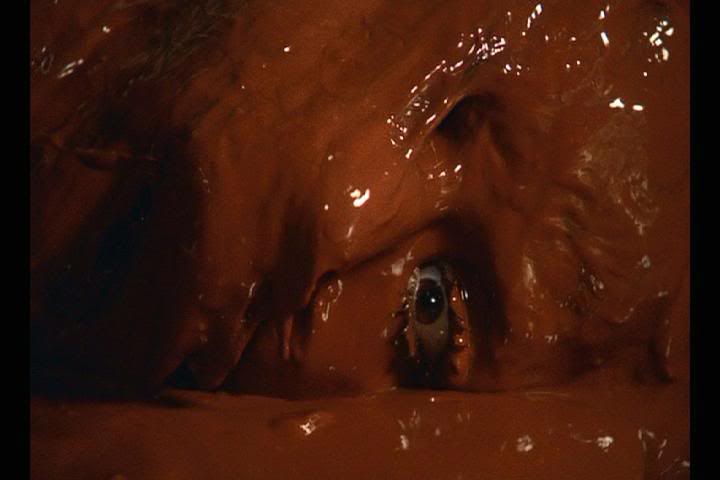
By the end of the film, she’s shown writhing around in a pool full of melted chocolate for a commercial.
The camera man directs her:
“Darling, this is going to be the highlight of your career. From now on, when people eat chocolate – I mean, the brand we advertise – they will not feel the same. I want them to feel as if they’re eating you!”
![]() |
| Miss World, now just using her body to sell chocolate. |
And here we are: the ultimate sexual objectification (she is naked, and attempting to seduce the camera) combined with commercialism–the indulgence of sweet chocolate (reminiscent of the toxic sugar on Anna Planeta’s boat) is confused with a kind of female sexuality that is supposed to be passive and proactive all at once, but certainly not for her. It’s supposed to be for the gold-encrusted penises, or the viewers, the consumers.
Miss World looks dead behind the eyes in this final scene. Her life was decided for her in a culture that prized her virginity and beauty above all else, and she couldn’t function when she attempts to be in another world.
She is punished, much like Milena is. However, Makavejev does not want us to think that they are at fault; instead, a society that represses and commodifies sexuality is the perpetrator of violence, masculine force and female suffering.
However, if we are to find any bleak hope here, it’s this: at the end of WR, Milena’s head is speaking to the audience, as if her life isn’t really over. At the end of Sweet Movie, Planeta’s victims are resurrected and brought back to life. Maybe–just maybe–Makavejev is showing that it’s not too late to find life in repressive societies and giving us the answer to Sweet Movie‘s lyrical refrain, “Is there life on the earth?
| Les demoiselles de Rochefort (1967) |
Guest post written by Lou Flandrin.
While I love this movie because of the catchy lyrics, colourful clothes and the giddy state in which it turns me, I also appreciate its depiction of women’s lives and family bonds. I am grateful to have had these depictions to look up to when I was growing up, of sisters and friends who didn’t fight against each other, but worked together towards their dreams to have an artistic career and to find happiness.
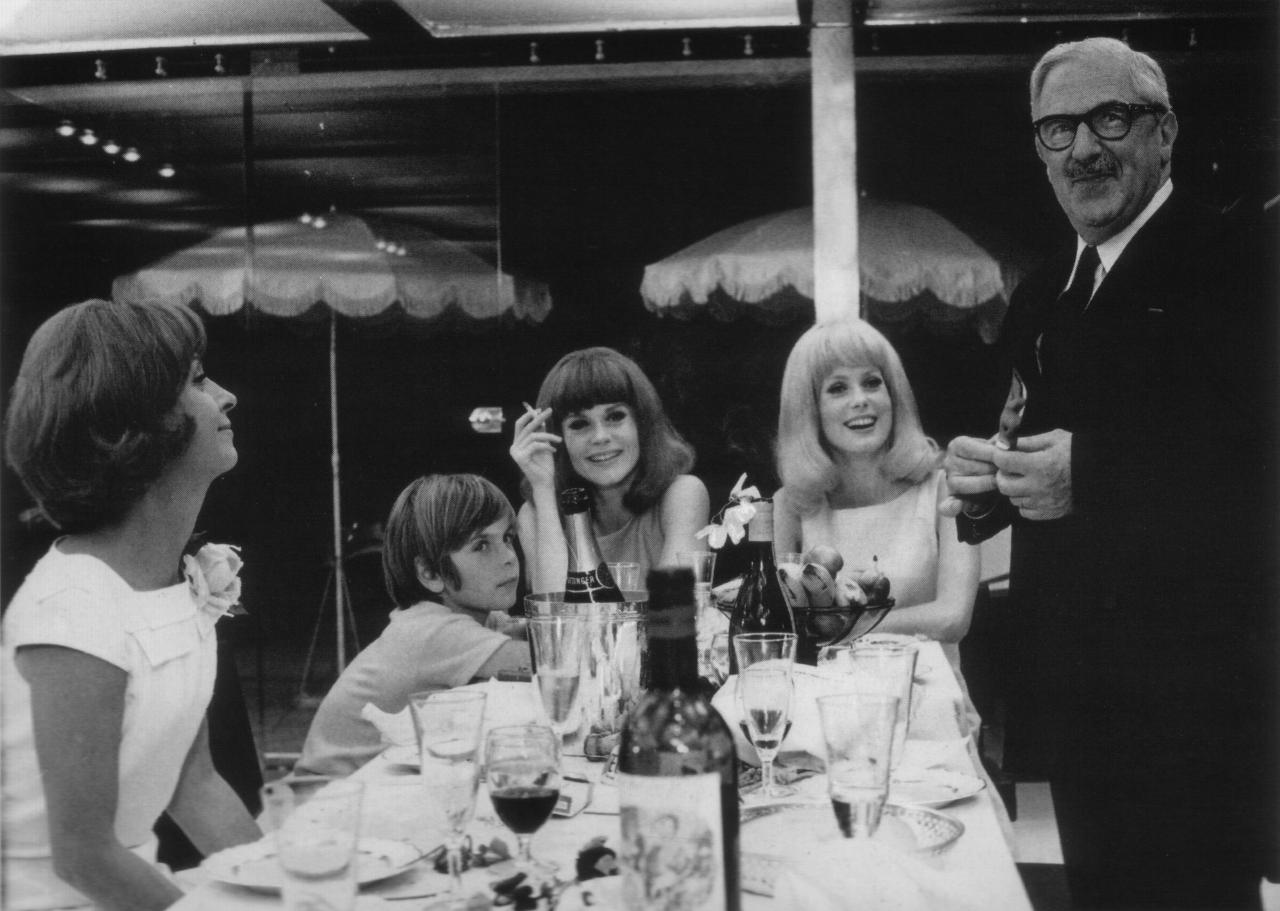
The plot of the movie is quite simple: the main characters, Delphine and Solange, are twins who are tired of their provincial lives and decide to go to Paris to start their artistic career. As they plan their departure, the summer fair is settling in the beautiful city of Rochefort – which was painted in pastel colours for the movie – and fair workers, sailors and musicians will cross their path, webs of stories will get intertwined, resulting in a wonderful puzzle of emotions, songs, and choreographed happiness.
A Celebration of Love in All its States
While this movie is about soul mates finding each other, it is above all a celebration of love in general, love of life and of all the little things that makes the world so amazing. A perfect illustration of this is the song that the twins perform for the fair’s big show, “La Chanson d’un Jour d’été” which is all about loving life, and as they sing it: “loving the world in order to be happy.” This positive philosophy is a recurring leitmotif in the movie. Two fair workers – played by George Chakiris and Grover Dale – contribute to the theme by singing about the joys of travelling and living life to the fullest in every city they visit, “running from one happiness to the next.” With such a positive outlook, it’s no wonder this movie makes me want to smile and dance around like a maniac!
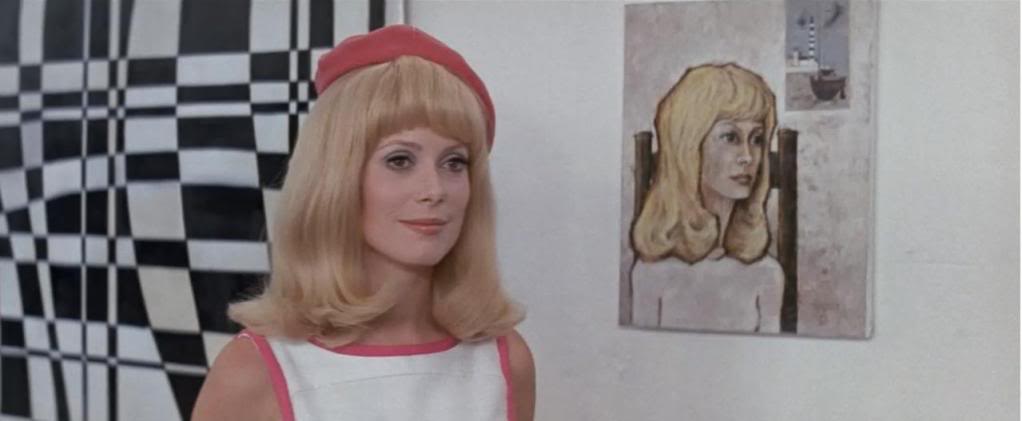
Being in love is obviously still a major theme, but it is presented as a complement to this love of life and freedom. Most of the characters are on a quest to find their true love in their own different ways. Yvonne, the twins’ mother, is longing for her lost love, whom she rejected years before because of his ridiculous last name. Andy, an American composer, is feeling incomplete after spending his whole life focusing on his musical career. Simon Dame, the dissed lover with a ridiculous name, is now back in Rochefort when he once was in love with Yvonne. Maxence, a young artist doing his military service in Rochefort, dreams about his feminine ideal, painting her portrait that looks eerily like Delphine.
![]() |
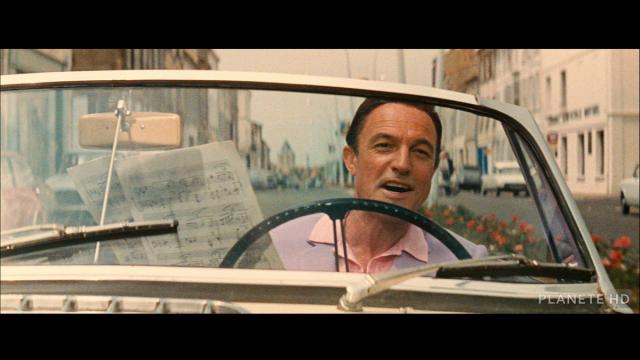
| Delphine (Catherine Deneuve) discovers Maxence’s painting |
There is no distinction between a feminine or masculine depiction of love, as lovers’ voices share the same intensity, and their songs echo each other. Love “is the sole authority” and erases the discriminations of gender, social class or even moral virtue.
The twins have their own expectations about love. While it is no secret that they have had their share of lovers – as sung in their famous “Chanson des Jumelles,” they are now both looking for someone to share their lives with, and will take action towards this goal. At the beginning of the movie, Delphine dumps her phony and creepy boyfriend Lancien in an amazing break-up song, in which she reproaches him of treating her like “just another doll” and not understanding anything about her dreams. Lancien gets a few lines in the song as well, but he misses the point entirely. He mistakes his desire to own Delphine with love, and will try repeatedly to get her back, including with a poor attempt to convince her that she would need someone like him to look after her in Paris. But Delphine knows better than that, and replies that she never wants to see him again. Good riddance!
A Celebration of Friendship and Family Ties
What I like about this movie is that it’s not all about true love, as friends and family are shown as equally important parts of life. The two sisters live together in harmony, they confide in each other, share their joys and fears, and sing to each other about everything. Another interesting duo is that of the two girls who were supposed to sing and dance at the fair. After discussing it with each other, they decide to leave Etienne and Bill, the two fair workers, because they are tired of being exploited and want to live their own lives. Sure, they have their own superficial reasons (Bill doesn’t have blue eyes, sailors are better lovers…) but still, the message is out there, they want to free themselves and they do it together.
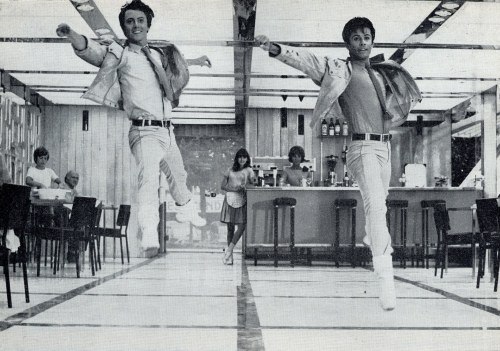
Guys are not excluded from this friendship pattern. Etienne and Bill have known each other for years, they travel together and share the same adventures and heartbreaks. They sing about their undying friendship, describing themselves as penniless knights with hearts of gold running from cities to cities. When the girls leave them for blue-eyed sailors, they echo their previous song about freedom, and leave the scene smiling at each other. Later on, when they very awkwardly ask the twins if they want to sleep with them and get rejected, they sing together about their bad luck with women.
![]() |
| True bros wear tight jeans and white boots, it is known. (George Chakiris and Grover Dale) |
As for family ties, they are not limited to the sibling relationship between Delphine and Solange. Their mother Yvonne has raised three children on her own, sacrificing her life in order to help her family become well-read. She owns a café, and spends her days behind the counter. While she is at work all the time, in what she calls her “aquarium,” the café becomes the family home. The twins come and go to chat, Yvonne’s father spends his time in a corner constructing models, and Booboo, the youngest son, is always brought from the café to school and vice-versa.
A Celebration of Art
Art is what allows the characters to escape the mundanity of their daily lives, as when Maxence evades from the army barracks every night to paint in his studio. Art and love are pictured as complementary. While Andy is a successful composer, he feels a void, and realises that Solange might be the one who can fill it. They fall in love at first sight, and their idyll is written in F-sharp minor, just like Solange’s concerto that she accidentally drops on the ground when they meet, and that will further charm Andy.
![]() |
| Andy (Gene Kelly) singing about his love for Solange and her concerto |
Art can be used negatively, for example in the case of Lancien, Delphine’s ex, who owns a gallery, and “creates” abstract paintings by shooting at balloons full of paint over white canvasses. Unlike the other characters, his art is depicted as destructive, and is echoed in his negative discourses on how he wants to own Delphine and control her life.
A Celebration of Freedom
What makes all the characters of this charming tale so unique is that they are all striving for freedom, and taking action to achieve their independence. Delphine doesn’t want to become Lancien’s doll and decides to leave to Paris to become famous on her own. While her reasons were questionable, Yvonne’s refusal to marry Simon can also be interpreted as a way to stay independent: she didn’t want to become Madame Dame, and chose to struggle on her own rather than becoming his wife.
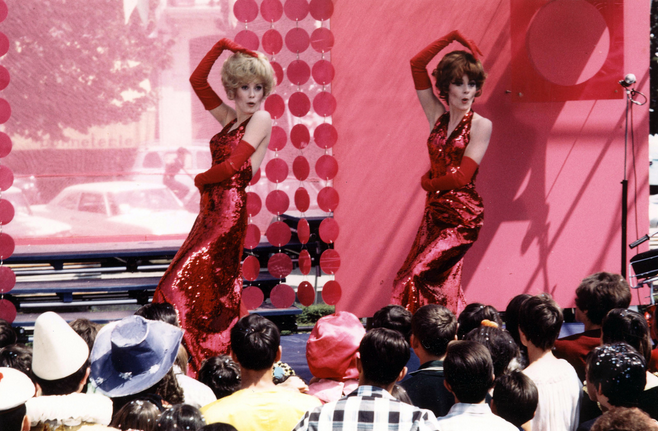
Throughout the movie, the twins keep saying what comes to their mind, and doing what they want. When the fair workers come to the twins’ door to ask them to take part in their show, they imply that they need their help to go to Paris, which scandalises the sisters. They don’t want to be patronised and don’t want to be mere substitutes either, which is why they will participate to the show in their own way. Delphine buys revealing dresses that she thinks are beautiful, and Solange wonders: “Aren’t you afraid we might look slutty?” Delphine dismisses the comment, and they end up wearing those dresses on stage, showing everybody that they do not care about what people might think. Similarly, Solange couldn’t care less that her dress’ lining is showing, despite everybody insisting on reminding her. The twins’ indifference to other people’s judgement is also seen in their anthem, in which they proudly sing that they were born from an unknown father, and that they had lovers at a very young age.
![]() |
| Who doesn’t love characters who sing in the face of slut-shaming? (Catherine Deneuve and Françoise Dorléac) |
Freedom is celebrated through the characters’ ability to travel the world to their fancy, like the fair workers who are happiest when they travel, or the sisters who decide to try their luck in Paris. Lack of freedom, for instance in Yvonne’s case, stuck in her “aquarium”, is depicted as the culmination of misery. She evades by dreaming of Pacific beaches, and will only be happy when she manages to get out of her café and find her former lover in front of Booboo’s school.
The musical has some darker notes, with the side story of a sadistic killer who killed a woman and cut her in little pieces because she refused his love for 40 years. Lancien’s obsession with Delphine echoes that of the killer, and we can only hope that he will not follow her to Paris to copycat the tragic event.
Paint Life in Pastel Tones
Haters will diss the cheesy dialogue, the ridiculous plots devices used to make characters miss or meet each other, and the overly cheerful singing. People might also argue that this movie is offering a false depiction of life, in which true love can always be found if one sings about with enough passion, and roams prettily the streets of France while dancing in colourful clothing.
But this very naivety is what makes Les Demoiselles de Rochefort so brilliant. Everything in the movie makes it clear that it is only a wonderful tale, far from reality. If you look at it that way, and decide to immerse yourself in Demy’s pastel singing city, you will end up happier and confident that while real life doesn’t have the same splendour, the ideals it promotes are very real.
Lou Flandrin is a French graduate in languages and international politics. Currently living in Chengdu (China), she is a volunteer translator and author at Global Voices Online, and sometimes tweets about Sichuanese food, robots, and other stuff.
![]() |
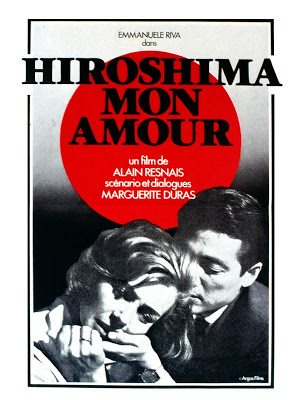
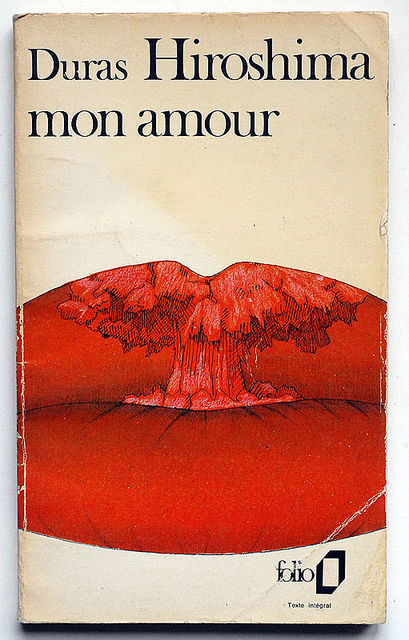
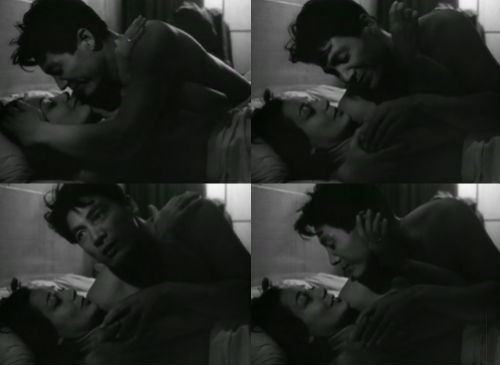
| Marguerite Duras wrote the screenplay, a stream-of-consciousness conversation with a focus on the feminine. |
![]() |
| Elle and Lui share passion and memory. |
![]() |
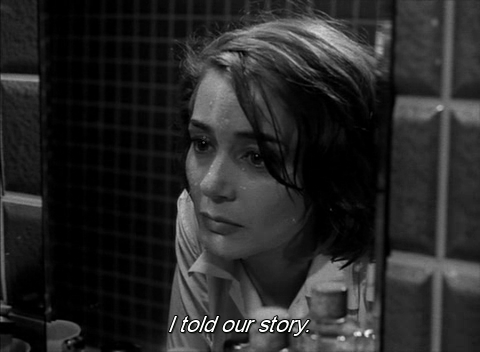
| Elle splashes water on her face and she is reborn after telling the story of her “youth” and “madness” in love. |
![]() |
| Charlotte Lu, Lizzie Bennet, Lydia Bennet, and Jane Bennet |
![]() |
| “Kitty” Bennet with Lydia and Cousin Mary |
![]() |
| Fitz William plays along with Lizzie |
![]() |
||
| William Darcy and Lizzie can’t believe there are only a few episodes left! |
![]() |
| Celebrate by NOT watching this atrocity. |
![]() |
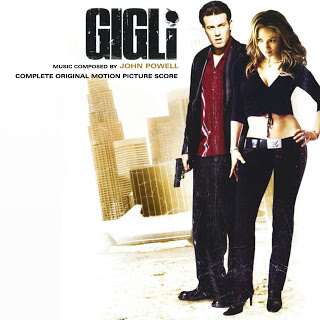
| Only he isn’t a “sissy gangster’; he’s a fuck-up with very few legitimate feelings in need of expression. |
“I got this fucking beautiful-sexy-gorgeous-hearthrob-o-rama-fucking-smart-amazing-bombshell-17-on a fucking 10 scale-girl sleeping in a bed right next to me and you know what? She’s a stone cold dyke. A fucking untouchable, unhave-able, unattainable brick wall fucking dyke-a-saurus rexi. So it’s sad.”
Can you believe her panties didn’t catch on fire at those Cyrano words of wooing? I guess we’re supposed be like, “Yeah, buddy, that’s rough…it sucks when a woman wants to not give her vagina to you.” Not only that, but Gigli attempts to seduce Ricki by flexing and showing off his bad tattoos after yelling at her that he’s the bull in their relationship and she’s the cow. A real charmer, eh?
![]() |
| A long sexay yoga scene replete with a monologue about the vagina. |
Inevitably (why it is inevitable I don’t know), Ricki and Gigli do the nasty, and boy is it nasty. It’s hard to imagine they dated in real life because their sex scene is awkward at best and more accurately described as “just plain gross.”
![]() |
| I never, ever want to see Ben Affleck mounting anyone ever, ever again. |
Ricki initiates the foreplay and asks Gigli to perform cunnilingus on her by saying, “It’s turkey time. Gobble, gobble.” More alluring words were never spoken on the silver screen. He hems and haws and never actually gives her what she asks for, which is the film’s way of subverting female desire and reasserting the supremacy of not only male desire but of the penis-vagina interface as the only true form of sexual fulfillment.
![]() |
| Celebrate by NOT watching this atrocity. |
![]() |
| Only he isn’t a “sissy gangster’; he’s a fuck-up with very few legitimate feelings in need of expression. |
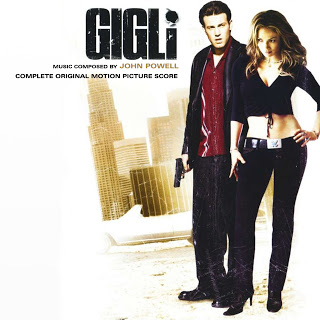
Jennifer Lopez’s Ricki is a sexay lesbian “contractor” on a job with the devoid-of-redeeming-qualities Larry Gigli. They mostly hang out in his dumb apartment (budget constraints perhaps) and share his bed at night. Ricki consistently baits Gigli with her unattainable sexuality, leaving him in a frenzy of sexual frustration. With much eloquence, he says:
“I got this fucking beautiful-sexy-gorgeous-hearthrob-o-rama-fucking-smart-amazing-bombshell-17-on a fucking 10 scale-girl sleeping in a bed right next to me and you know what? She’s a stone cold dyke. A fucking untouchable, unhave-able, unattainable brick wall fucking dyke-a-saurus rexi. So it’s sad.”
Can you believe her panties didn’t catch on fire at those Cyrano words of wooing? I guess we’re supposed be like, “Yeah, buddy, that’s rough…it sucks when a woman wants to not give her vagina to you.” Not only that, but Gigli attempts to seduce Ricki by flexing and showing off his bad tattoos after yelling at her that he’s the bull in their relationship and she’s the cow. A real charmer, eh?
![]() |
| A long sexay yoga scene replete with a monologue about the vagina. |
We also meet Ricki’s insecure, paranoid, stalker girlfriend, Robin, who proceeds to slit her wrists for effect when Ricki breaks up with her. After a trip to the emergency room, maybe the uncouth Gigli is looking a little more appealing? It’s hard to see this over-the-top interaction as anything other than hyperbolic stereotyping implying that lesbian relationships are nothing but drama.Inevitably (why it is inevitable I don’t know), Ricki and Gigli do the nasty, and boy is it nasty. It’s hard to imagine they dated in real life because their sex scene is awkward at best and more accurately described as “just plain gross.”
![]() |
| I never, ever want to see Ben Affleck mounting anyone ever, ever again. |
Ricki initiates the foreplay and asks Gigli to perform cunnilingus on her by saying, “It’s turkey time. Gobble, gobble.” More alluring words were never spoken on the silver screen. He hems and haws and never actually gives her what she asks for, which is the film’s way of subverting female desire and reasserting the supremacy of not only male desire but of the penis-vagina interface as the only true form of sexual fulfillment.
UN Women Through Women’s Eyes International Film Festival | April, 6-7 2013 | Sarasota, Florida, United States
The 14th annual presentation of Through Women’s Eyes will feature independent documentaries, narratives, and short films by directors that increase awareness of the lives of women throughout the world.
Mostra Internacional de Films de Dones de Barcelona (The International Women’s Film Festival of Barcelona) | June, 7-17 2013 | Barcelona, Spain
The International Women’s Film Festival of Barcelona, began in June 1993, has as its objective the promotion of cinema directed by women, making women’s audiovisual culture visible, showing films by women film-makers from all over the world, thus proving the importance of women’s contribution to the development in audiovisual creation.
Shashat Women’s Film Festival in Palestine: “I am a woman from Palestine” | September 17-December 6, 2012 | Ramallah, Palestine
10 films, 10 women filmmakers from the West Bank & Gaza Strip; 106 screenings\discussions in 14 cities & 4 refugee camps; in collaboration with 21 organizations & 8 universities and 6 satellite TV programmes.
Elles Tournent/Dames Draaien Festival | September, 20-23, 2012 | Brussels, Belgium
Elles Tournent/Dames Draaien is a four day festival that exhibits independent films directed by women from around the globe. The festival’s goal is to emphasizes visionary works that challenge the traditional notions of visual storytelling and provide innovative perspectives on a vast array of topics.
Films, Femmes, Mediterranée| September 25, 2012 – 3 Oct 2012 | Marseilles, France
Muestra Internacional de Mujeres en el Cine y la Television| September 25-30, 2012 | Mexico
Rocky Mountain Women’s Film Festival | 2 Nov 2012 – 4 Nov 2012 | Colorado Springs, CO, United States
International Women’s Film Festival Israel | 5 Nov 2012 – 11 Nov 2012 | Rehovot, Israel
Filmfestival FrauenWelten 22 Nov 2012 – 28 Nov 2012 Tübingen, Germany
Laboratorio Immagine Donna 30 Nov 2012 – 5 Dec 2012 Florence, Italy
International Women’s Film Festival KIN 3 Dec 2012 – 8 Dec 2012 Yerevan, Armenia
Women Make Waves Film Festival 9 Dec 2012 – 10 Dec 2012 Taipei City, Taiwan
Athena Film Festival 7 Feb 2013 – 10 Feb 2013 New York, NY, United States FrauenFilmTage 28 Feb 2013 – 8 Mar 2013 Vienna, Austria International Film Festival Assen 2 Mar 2013 – 3 Mar 2013 Assen, Netherlands Women+Film Voices Film Festival 3 Mar 2013 – 10 Mar 2013 Denver, CO, United States Portland Oregon Women’s Film Festival 7 Mar 2013 – 10 Mar 2013 Portland, Oregon, United States The Fusion Film Festival 7 Mar 2013 – 9 Mar 2013 New York, NY, United States International Film Festival of Creteil 22 Mar 2013 – 31 Mar 2013 Creteil, France Festival Internacional de Cine de Mujeres de Santiago, Chile 26 Mar 2013 – 31 Mar 2013 Santiago, Chile Bird’s Eye View Film Festival 28 Mar 2013 – 28 Apr 2013 England, London Dortmund | Cologne International Women’s Film Festival 9 Apr 2013 – 14 Apr 2013 Dortmund, Cologne, Germany Bluestocking Film Series 1 May 2013 – 27 Oct 2013 Portland, Maine, United States Flying Broom International Women’s Film Festival 9 May 2013 – 16 May 2013 Ankara, Turkey Entre Cineastas Arab – Iberoamerican Women Festival of Cairo 15 May 2013 – 19 May 2013 Cairo, Egypt International Women’s Film Festival in Seoul 24 May 2013 – 30 May 2013 Seoul, South Korea Queer Women of Color Film Festival 14 Jun 2013 – 16 Jun 2013 San Francisco, California, United States Femina – International Women´s Film Festival 1 Jul 2013 – 7 Jul 2013 Rio de Janeiro, Brazil Citizen Jane Film Festival 4 Oct 2013 – 6 Oct 2013 Columbia, MO, United States
Etheria Film Festival | 2013 | Somerville, Massachusetts
Celebrating female genre filmmakers with the very best new science fiction and fantasy films by women.
Viscera Film Festival | 2013 | Los Angeles, California
Celebrating female genre filmmakers with the very best new horror films by women.
![]() |
| Kerry Washington |
“Mammy, Sapphire, or Jezebel, Olivia Pope Is Not: A Review of Scandal“ by Atima Omara-Alwala
![]() |
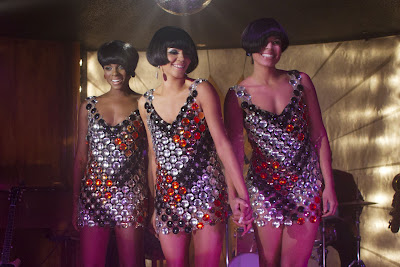
| Sumpter, Ejogo, and Sparks |
“Sparkle: Same Song, Fine Tuned” by Candice Frederick
![]() |
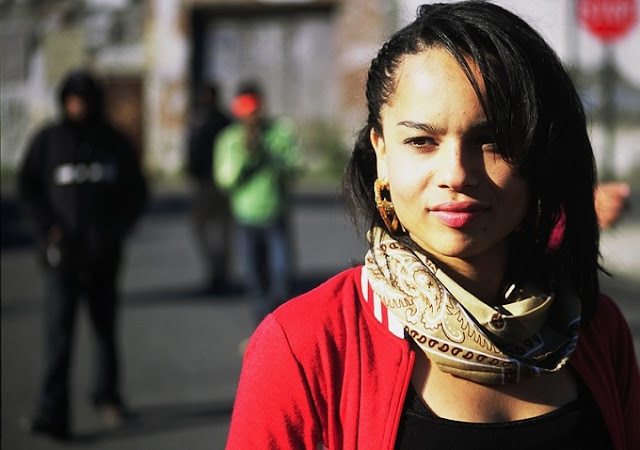
| Zoe Kravitz |
“A Girl Struggles to Survive Her Chaotic Homelife in Yelling to the Sky“ by Megan Kearns
![]() |
| Mindy Kaling |
“Thoughts on The Mindy Project and Other Screen Depictions of Indian Women” by Martyna Przybysz
![]() |
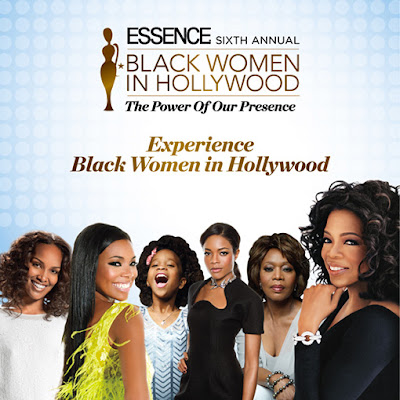
| Black Women in Hollywood Awards |
![]() |
| Kim Wayans & Adepero Oduye |
![]() |
| Shonda Rhimes’ Scandal |
![]() |
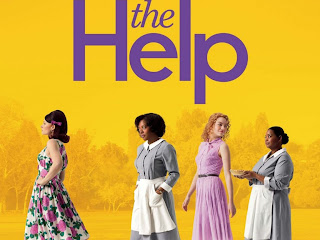
| Viola Davis & Octavia Spencer |
![]() |
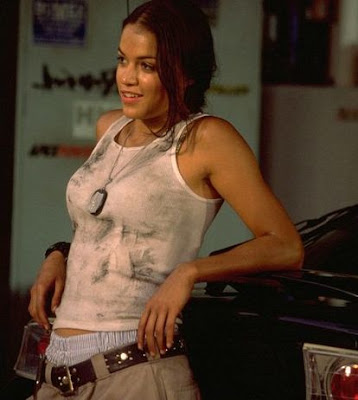
| Michelle Rodriguez |
![]() |
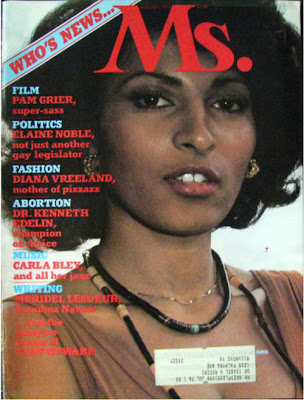
| Pam Grier on the cover of Ms. |
![]() |
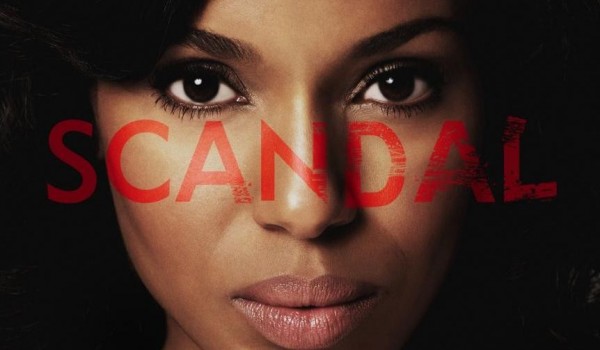
| Kerry Washington in Scandal |
It’s great to see a show that’s unabashedly female-centric and more concerned with telling stories than trying to be gimmicky (and which portrays performers with far more subtlety than Smash could ever manage). There are enough shows where women are nothing more than set dressing for it not to be an issue that all six leads in Bunheads are ladies.
But it is an issue that all six leads are white.
![]() |
| Quvenzhané Wallis |
![]() |
| Yvette Nicole Brown |
A Post About Community‘s Shirley? That’s Nice. by Lady T.
![]() |
| Sita Sings the Blues |
Conflicting Thoughts On Sita Sings The Blues by Myrna Waldron
![]() |
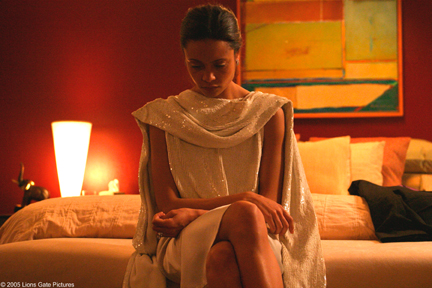
| Thandie Newton in Crash |
Deeper Than Race: A Movie Review of Crash by Erin Parks
![]() |
| The Good Wife |
So, is there a racial bias on The Good Wife? by Melanie Wanga
![]() |
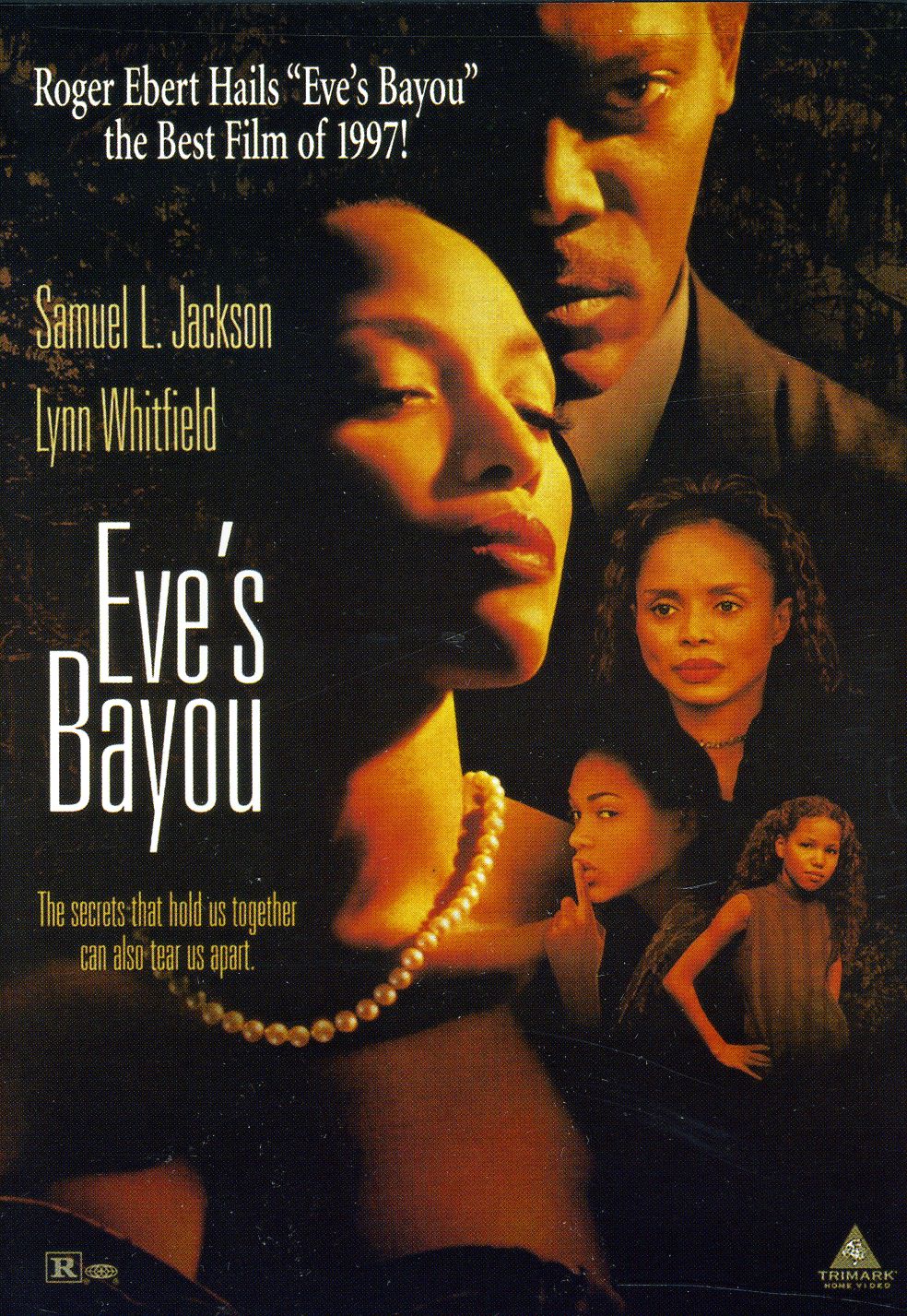
| Eve’s Bayou |
![]() |
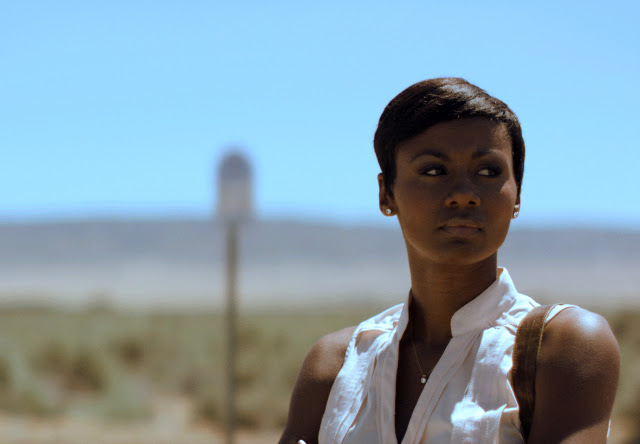
| Emayatzy Corinealdi |
Ava DuVernay’s ‘Middle of Nowhere:’ A Complicated, Transformational and Feminist Love Story by Megan Kearns
Written by Robin Hitchcock.
![]() |
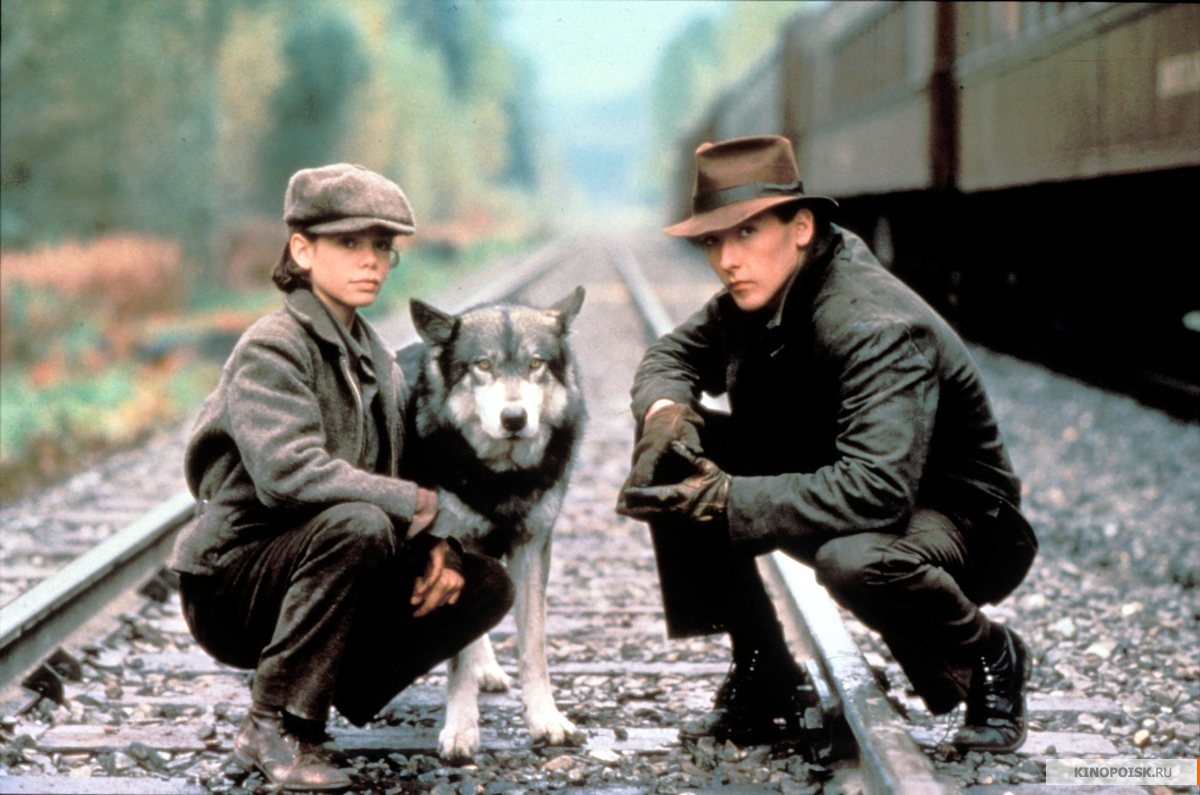
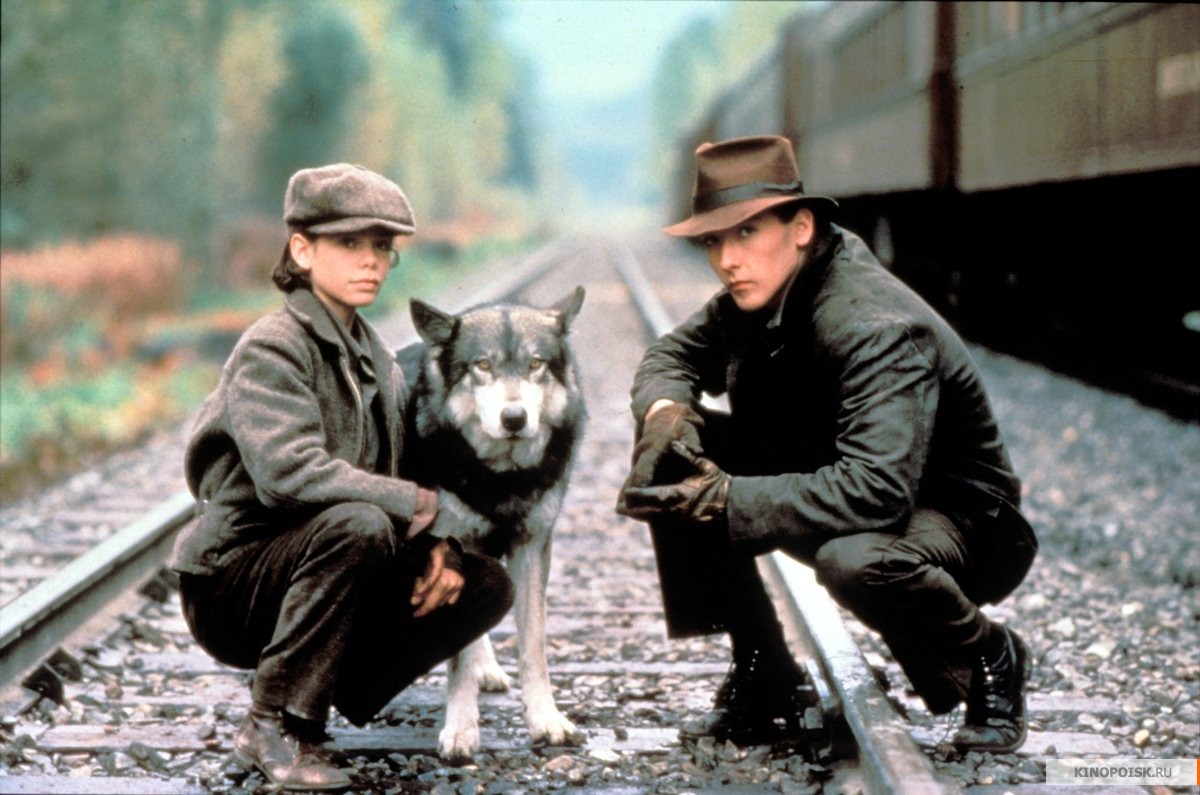
| The Journey of Natty Gann |
When I was a young girl, I was obsessed with the trailer for The Journey of Natty Gann (for which I will issue a spoiler warning, although I find it dubious that a Disney family film could be spoiled):
![]() |
| John Cusack as Harry |
![]() |
| Natty Gann (Meredith Salenger) gets her Katniss on |