I Love ‘Whip It!,’ But You Probably Shouldn’t: A Roller Derby Athlete Reflects

The cast of Whip It!
This review by Sarah Chamberlain originally appeared at her blog Sarah Chamberlain Does Things and is cross-posted with permission.

Whenever I meet a fellow skater, and they ask me how I got into roller derby, I get a little sheepish.

“I was in college and I saw Whip It!, and I decided I wanted to do that,” I say every time, hoping for a nonjudgmental reaction. Joining the sport post-Whip It! is not the coolest thing for a derby athlete to cop to. Unfortunately for me, my simple derby origin story is true. I walked into a movie theater expecting to see a frothy girl-power flick with my friend, and I did—but I also walked out figuring starter skates into my college budget. For at least the first year and a half of my derby career, until I was well past the point of knowing better, I’d watch Whip It! the night before every bout while I painted my nails in my team colors and sipped on a healthy, nonalcoholic beverage. And while I know that Whip It! Is not the best roller derby film out there, when I sat down a few nights ago to re-watch it for the first time in over a year, I cried at the same parts that always made me weepy. I love Whip It!, but I’m a sucker for it.
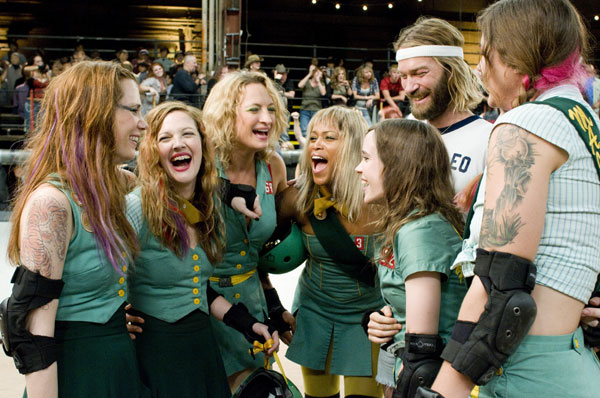
The cast of Whip It!

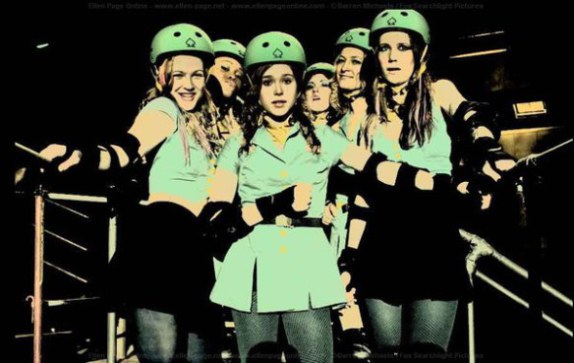
Whip It! Was Drew Barrymore’s directorial debut. Based on a young adult novel by Shauna Cross, the screenplay centers around a seventeen-year-old misfit named Bliss Cavendar (Ellen Page), who spends a lot of time screwing up at the beauty pageants her mom (Marcia Gay Harding) makes her do, until she discovers roller derby while on a shopping trip to Austin. Without permission from her mom or her sports-loving dad, Bliss lies about her age, joins the 21+ league, and becomes star jammer Babe Ruthless. Problems arise when she starts dating an indie rocker she meets at a bout, when she clashes with a member of an opposing team, and when her parents find out about her secret double life. While the plot is heavy on teen and sports movie cliches, it’s also generously sprinkled with esoteric cultural references and cameos. Jimmy Fallon has a minor role as Hot Tub Johnny Rockets, a perpetually hungover announcer who just wants to get laid, and Andrew Wilson (the elusive third Wilson brother!) faces off against opposing coach Har Mar Superstar. Many of the extras, skaters, and non-speaking roles are respected real-life derby skaters, including one of my coaches, who plays the deaf Manson Sister #1—hi, Krissy!

It barely broke even at the box office and drew mixed reviews. Mainstream critics were on point about the film’s predictability; however, their reviews lose credibility when they make uneducated comments about derby aspects of the film. For example, one critic questioned Page’s casting in the lead role, saying she seemed too small to play roller derby. Never mind the fact that Bliss is a jammer, a position traditionally (though certainly not always) assigned to small, agile skaters. More interesting criticism came from within the roller derby community. If you ask a skater about Whip It!, she’ll probably complain about the “Play #3” scene, when Wilson’s character fields a strategy combining an elbow and a 180-degree turn. In real-life regulation play, this move is grounds for immediate ejection from a bout.

Not okay.

However, the biggest problem with Whip It! isn’t the punches and elbows—if you watch closely, you’ll notice that Barrymore’s Smashley Simpson is always ejected, anyway—it’s the erasure of certain people and philosophies that make roller derby unique among modern sports. No visibly queer characters are included in the film, which is unrealistic for a sport known for its LGBTQ superstars and being relatively trans-inclusive a few years before anyone had ever heard of Fallon Fox. The grown women who drive both the skating and business aspects of competitive roller derby are weirdly two-dimensional. A big reveal happens when Bliss learns that her team captain, Maggie Mayhem (Kristen Wiig), skips afterparties because she needs to be with her young son, and another occurs when league bully Iron Maven (Juliette Lewis) snarls that she’s earned her derby stardom at age thirty-six—but after that, the film lets those characters return to the background. A large part of the criticism Whip It! received from the roller derby community regarded the age of its protagonist. Roller derby is so transformative and special for women who find it in their 20s, 30s and 40s, the criticism goes. Why make teenage Bliss the heroine, when Maggie’s and Maven’s stories are much more compelling?

Juliette Lewis as Iron Maven in Whip It!

This is where I begin to get soft on Whip It! When I started playing roller derby at twenty-one (not quite a grown-ass woman, to be fair), I became a teenager again. My body changed and I was hungry all the time. I worried about what to wear to practice. My new passion worried my mom, and I had to be a little bit sneaky to keep everybody happy. I had to make choices about relationships and priorities that I’d never had to make before. And I could think of nothing but roller derby: after class, I’d sit in my room ogling gear, watching and re-watching league promo videos. In class, I’d doodle pictures of skates and myself wearing a jammer star on my helmet. I felt about roller derby the way I felt about my crushes in middle and high school. Maybe it’s easier to translate that giddy feeling to non-skaters if you just make the main character a typical teenage girl who is still figuring things out.

Don’t give up on film depictions of roller derby if you’re less sentimental than I am. There are better representations of derby in film, but you have to go looking for them. Brutal Beauty, a documentary which follows Portland’s Rose City Rollers through their 2010 home and travel seasons, is a great introduction to the sport and is available for streaming on Netflix.

Trailer for Brutal Beauty

An upcoming documentary that promises to take a different approach to the topic of derby is Erica Tremblay’s The Vagine Regime, which will profile the titular pan-derby LGBTQ all-star team.

 Trailer for Vagine Regime

Finally, my current favorite roller derby film is Turner Van Ryn’s dialogue-free short film Skater 26, which follows San Francisco skater Chantilly Mace through the weekend leading up to a high-stakes home bout. It’s breathtaking to watch, and does an incredible job of quietly creating a detailed narrative out of what is still a niche subject. Best of all, it’s available in full on YouTube.

 Skater 26 (full movie)

Personal reasons for loving Whip It! aside—I’ve sat in the penalty box on delicate technical fouls enough times to scoff at “Play #3”—I can detect the tense, rehearsed quality of a new skater in many of the actors’ jumps and sprints. Johnny Rockets’s announcing places a little too much emphasis on the fishnet stockings the players wear, a trope that still crops up in mainstream coverage of derby. The underwater sex scene is truly unnecessary–so unnecessary that I won’t link to it. I cringe when Page’s Bliss tells her mom to “stop shoving your psychotic idea of ’50s womanhood down my throat,” because who actually says that?

But right after that, she throws out her hands and says, “I am in love with this.” I believe you, Bliss. I just understand why a lot of us don’t. Fortunately, there are just enough film options out there for the derby-curious.

Sarah Chamberlain (twitter.com/SChamberlainLA) graduated from DePauw University with degrees in creative writing and flute performance. She lives in Los Angeles, where she works in a charter school and skates and coaches for the Angel City Derby Girls. Her work has been featured on The Billfold and LAist.com.

‘Passion’ and ‘Crime d’amour’: Women and Corporate Power Plays

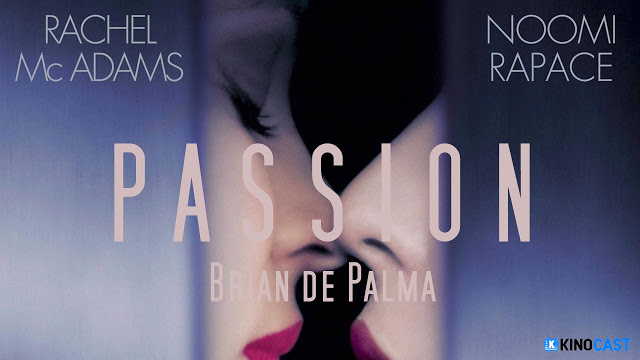
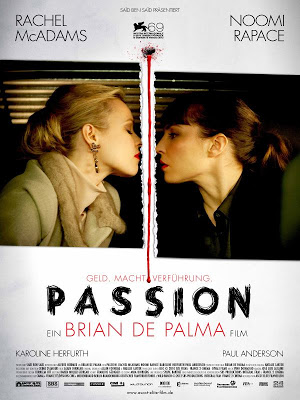
Brian de Palma’s Passion
Written by Amanda Rodriguez

Brian De Palma’s film Passion is a sleek, sexy, beautifully shot neo-noir thriller remade from Alain Corneau’s 2010 French film Crime d’amour (or Love Crime in English). 

Crime d’amour
I always think it’s valuable to examine how films deviate from their source material because those are indications of deliberate choices that can say a lot (whether accidentally or intentionally). Honestly, the films aren’t tremendously different in an overt way, as most scenes are shot-for-shot, line-for-line identical, the basic differences being the languages of each and the uniquely lush, decadent darkness De Palma brings to his works. However, there are a few intriguing, telling differences that bear noting, and therein lies the meat of my analysis.
In Crime d’amour, the manipulative, power-wielding character Christine is played by the acclaimed Kristin Scott Thomas, who is considerably older than her protege, Rachel (pictured above). This creates a more maternal relationship between them, giving Christine the additional power advantage of age. The sexual energy between the two is therefore more illicit and is unreciprocated by the younger Rachel. However, in Passion, the actresses Rachel McAdams as Christine and Noomi Rapace (whom I always love, love, love) as Rachel are much closer in age, so the power dynamic between them rests purely on the weight of Christine’s corporate power and her ability to manipulate people however she sees fit. The sexual energy between the two is complicated, but palpable with love, hatred, desire, and emulation thrown in the mix. This dynamic ensures that the entire film, including the “love crime” that occurs, is about the relationship between these two women and not the man between them (with whom they’re both having sex). He remains ever a pawn they both use against each other.
Christine and Rachel kiss and later, at Christine’s insistence, profess love for each other.
I won’t go into too great detail about the next difference between the two films because it’s spoiler-ridden, but they both approach the story’s murder in opposite manners. In Crime d’amour, we watch the plotting of the crime, unsure as to the perpetrating character’s sanity, motivation, and the final outcome of conviction versus acquittal. De Palma’s Passion, however, is more of a classic noir whodunit, where we’re constantly questioning guilt versus innocence, genuine emotion versus manipulation, and reality versus insanity/fantasy. Both approaches are engaging and enjoyable to watch, so I’ve got no complaints for either interpretation.
The murderer wears a mask that’s a mold of the victim’s face to chilling effect in Passion.
The last most significant change between the original film and its remake is the gender shift for Rachel’s assistant. In Crime d’amour, her assistant is Daniel, a man, and in Passion, her assistant is Dani (played by Karoline Herfurth), a woman. This shift makes only women the major players in Passion. We are left with a power struggle among three femme fatales, all smart, driven women who know what they want and use whatever means necessary to achieve their desires. This triumvirate of femme fatales, full of intelligence, secrets, and cunning, all battling for supremacy, is something I’ve never seen before on the silver screen. Their deep-laid game is impressive in its scope, and it is so exciting to watch three strong female characters unleashing their power. 
The power dynamic shifts as assistant, Dani, reveals her knowledge to Rachel, mirroring the power play between Rachel and Christine.
My major critique of both films, in particular Passion, is the very stereotypical female-ness of the power plays the films explore. Love, sex, desire, humiliation, as well as the manipulation of people and emotions for revenge or personal gain are all tactics traditionally coded as female. Though this tale takes place in the male-dominated corporate world, many (if not all) of the female characters’ actions are dictated by emotion. We are given to see the cycle of mentor and protege being corrupted, ending with the protege on top, first with the relationship between Christine and Rachel and then with Rachel and Dani. It is brutal, cutting deeper than the loss or gain of a promotion due to a superior’s greed, insisting that a hierarchy must exist between women; equality is not an option. Christine says to Rachel, “There’s no back-stabbing here. It’s just business”, and Rachel later repeats it back to her. Both times, the statement is a lie. Both times it shows the opposite to be true. The implication, of course, being that women aren’t capable of divorcing their feelings from business, that the manner in which they gain and keep success, even in a corporate setting, is through ruthless manipulation and, its darkest permutation: out-and-out emotional blackmail.
Rachel devolves after Christine emotionally violates and humiliates her.
Both Crime d’amour and Passion pass the Bechdel Test with flying colors. Unfortunately, these women are slaves to emotion, which is their ultimate weakness, their fatal flaw. I don’t think the films go so far as to suggest that women don’t belong in a highly competitive corporate work place and aren’t capable of being powerful, high-level executives, but I also think the films stop just short of insinuating that. However, Passion, in particular, really showcases strong female characters who are smart, successful, and ambitious without masculinizing them as is common in film portrayals of powerful women, especially in a corporate setting. These women are complicated and morally ambiguous people replete with compelling layers, leaving viewers wondering whether we hate or love them for their brash disregard for the rules and their deeply ingrained self-preservation instincts. Despite the films’ weaknesses (and our heroines’), it’s always refreshing to see powerful, multifaceted women taking charge of the big screen because it happens not nearly often enough.

‘Passion’ and ‘Crime d’amour’: Women and Corporate Power Plays

Brian de Palma’s Passion
Written by Amanda Rodriguez

Brian De Palma’s film Passion is a sleek, sexy, beautifully shot neo-noir thriller remade from Alain Corneau’s 2010 French film Crime d’amour (or Love Crime in English). 

Crime d’amour
I always think it’s valuable to examine how films deviate from their source material because those are indications of deliberate choices that can say a lot (whether accidentally or intentionally). Honestly, the films aren’t tremendously different in an overt way, as most scenes are shot-for-shot, line-for-line identical, the basic differences being the languages of each and the uniquely lush, decadent darkness De Palma brings to his works. However, there are a few intriguing, telling differences that bear noting, and therein lies the meat of my analysis.
In Crime d’amour, the manipulative, power-wielding character Christine is played by the acclaimed Kristin Scott Thomas, who is considerably older than her protege, Rachel (pictured above). This creates a more maternal relationship between them, giving Christine the additional power advantage of age. The sexual energy between the two is therefore more illicit and is unreciprocated by the younger Rachel. However, in Passion, the actresses Rachel McAdams as Christine and Noomi Rapace (whom I always love, love, love) as Rachel are much closer in age, so the power dynamic between them rests purely on the weight of Christine’s corporate power and her ability to manipulate people however she sees fit. The sexual energy between the two is complicated, but palpable with love, hatred, desire, and emulation thrown in the mix. This dynamic ensures that the entire film, including the “love crime” that occurs, is about the relationship between these two women and not the man between them (with whom they’re both having sex). He remains ever a pawn they both use against each other.
Christine and Rachel kiss and later, at Christine’s insistence, profess love for each other.
I won’t go into too great detail about the next difference between the two films because it’s spoiler-ridden, but they both approach the story’s murder in opposite manners. In Crime d’amour, we watch the plotting of the crime, unsure as to the perpetrating character’s sanity, motivation, and the final outcome of conviction versus acquittal. De Palma’s Passion, however, is more of a classic noir whodunit, where we’re constantly questioning guilt versus innocence, genuine emotion versus manipulation, and reality versus insanity/fantasy. Both approaches are engaging and enjoyable to watch, so I’ve got no complaints for either interpretation.
The murderer wears a mask that’s a mold of the victim’s face to chilling effect in Passion.
The last most significant change between the original film and its remake is the gender shift for Rachel’s assistant. In Crime d’amour, her assistant is Daniel, a man, and in Passion, her assistant is Dani (played by Karoline Herfurth), a woman. This shift makes only women the major players in Passion. We are left with a power struggle among three femme fatales, all smart, driven women who know what they want and use whatever means necessary to achieve their desires. This triumvirate of femme fatales, full of intelligence, secrets, and cunning, all battling for supremacy, is something I’ve never seen before on the silver screen. Their deep-laid game is impressive in its scope, and it is so exciting to watch three strong female characters unleashing their power. 
The power dynamic shifts as assistant, Dani, reveals her knowledge to Rachel, mirroring the power play between Rachel and Christine.
My major critique of both films, in particular Passion, is the very stereotypical female-ness of the power plays the films explore. Love, sex, desire, humiliation, as well as the manipulation of people and emotions for revenge or personal gain are all tactics traditionally coded as female. Though this tale takes place in the male-dominated corporate world, many (if not all) of the female characters’ actions are dictated by emotion. We are given to see the cycle of mentor and protege being corrupted, ending with the protege on top, first with the relationship between Christine and Rachel and then with Rachel and Dani. It is brutal, cutting deeper than the loss or gain of a promotion due to a superior’s greed, insisting that a hierarchy must exist between women; equality is not an option. Christine says to Rachel, “There’s no back-stabbing here. It’s just business”, and Rachel later repeats it back to her. Both times, the statement is a lie. Both times it shows the opposite to be true. The implication, of course, being that women aren’t capable of divorcing their feelings from business, that the manner in which they gain and keep success, even in a corporate setting, is through ruthless manipulation and, its darkest permutation: out-and-out emotional blackmail.
Rachel devolves after Christine emotionally violates and humiliates her.
Both Crime d’amour and Passion pass the Bechdel Test with flying colors. Unfortunately, these women are slaves to emotion, which is their ultimate weakness, their fatal flaw. I don’t think the films go so far as to suggest that women don’t belong in a highly competitive corporate work place and aren’t capable of being powerful, high-level executives, but I also think the films stop just short of insinuating that. However, Passion, in particular, really showcases strong female characters who are smart, successful, and ambitious without masculinizing them as is common in film portrayals of powerful women, especially in a corporate setting. These women are complicated and morally ambiguous people replete with compelling layers, leaving viewers wondering whether we hate or love them for their brash disregard for the rules and their deeply ingrained self-preservation instincts. Despite the films’ weaknesses (and our heroines’), it’s always refreshing to see powerful, multifaceted women taking charge of the big screen because it happens not nearly often enough.

An Emotional Response to ‘Lovelace’

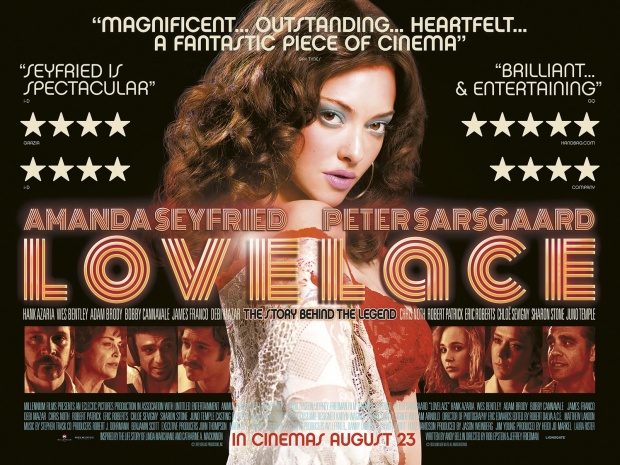
Amanda Seyfried as “Linda Lovelace”
This is a guest post by Gabriella Apicella.
When was the last time you cried in a movie theatre? The last time you were so moved by a film you needed everyone else to leave before ungluing yourself from the seat and attempting to process what you’ve experienced? Or the last time you saw something that made you feel that if enough people saw it, the world could be changed for the better?
None of these things happen to me too often, but this evening while watching Lovelace, I experienced all three.
I’ve been following the release of this film with some interest. As a dedicated feminist with a fiercely anti-porn stance, I was certainly not expecting anything particularly groundbreaking when I saw the movie posters plastered on the walls of my local underground station. Showing an objectified Amanda Seyfried in a lacy bra with wide eyes and an innocent pout, I very quickly assumed this would be a film for me to try and forget existed (much like the endless Fast and Furious rehashes). And then I heard that Gloria Steinem and Catherine Mackinnon were involved. For those who hadn’t heard, they were both consultants on the film, in their roles as caretakers of Linda Boreman Marchiano’s estate. 
Linda Boreman Marchiano (aka Linda Lovelace)
(This excellent article by Catherine Mackinnon explains a bit more about their involvement and is well worth reading.) 
Dreadful acts of abuse feature all too regularly on our screens. Even on television it has become increasingly common to see ever more graphic gore and sadistic violence. As Lovelace has an 18 certificate (equivalent to R in the US) and being superficially familiar with the story beforehand, I had braced myself for a barrage of scarring images, expertly shot and edited and due to reappear in my nightmares for weeks to come. This is one of the quandaries that I have wondered about as a screenwriter – how to depict scenes of distressing acts without compromising your viewer, or making them complicit with the abuse, or, in fact, abusing them as well. However, it may be that by their sensitive and elegant handling, the filmmakers of Lovelace have actually revolutionised an area of storytelling that has prevented some of the most shocking and distressing yet crucially important films from either being made or from being seen.
The film intelligently portrays a great deal of what Linda Boreman Marchiano experienced and yet does not subject the audience to the horror. Not only does this make it a safer viewing experience, it also puts the audience’s emotional identification with the protagonist first. Linda remains a whole character throughout rather than becoming a body upon which hideous acts are carried out. We do not shift into passive voyeur or spectator, as traumatising scenes in The Accused, Monster, Straw Dogs, Irreversible, or any number of other films depicting domestic and sexual violence force the audience to do. 
Adam Brody and Amanda Seyfried in Lovelace
One of the defending arguments the Director Michael Winterbottom employed when graphically depicting the violent beating of both female characters in his film, The Killer Inside Me was that: 
“It was intentionally shocking. The whole point of the story is, here is someone who is supposed to be in love with two women who he beats to death, and of course the violence should be shocking. If you make a film where the violence is entertaining, I think that’s very questionable.”

What Lovelace opens up is the possibility that it is not actually necessary to show violence – shocking, entertaining or otherwise, in order to interrogate these issues on film.
For people affected by domestic or sexual abuse and violence, either personally or otherwise, films about these subjects are of huge interest. The matters are of enormous concern, and knowing the power of the media, it is only natural that these same people would wish to watch any major productions tackling these issues. And yet, viewing violence onscreen has the potential to trigger traumatic responses, so this same audience frequently stays away from this material and is thereby excluded from the conversations (as if they need to be silenced any more than they are already!) 
Amanda Seyfriend as Linda Boreman Marchiano in Lovelace
As I attempt to process the devastating story of Linda Boreman Marchiano, only a fraction of which is actually covered in the film Lovelace (her activism and later years are not depicted), I am struck by the excellent performances, my enduring loathing for uber-pimp Hugh Hefner, and the exceptional influence of two feminist icons on the making of this important film.
What kept me sobbing in my seat throughout the credits and for some time in the lobby after the film, however, was the knowledge that this is not a one-off case, nor was it the worst case scenario. Porn has grown in both financial terms and in the levels of violence and degradation performers endure. What Linda experienced was horrifying. It continues, on an industrialised scale, and yet we are so very far from ensuring the safety of those who are exploited by it. Linda Boreman Marchiano’s mission was to raise awareness around domestic violence and the realities of the porn industry so that people who are being abused can reach safety. As part of realising her legacy, I urge you to watch this film and take a skeptical friend: they may just start to think differently after seeing it … 


Gabriella Apicella is a feminist writer and tutor living in London, England. She has a degree in Film and Media from Birkbeck College, University of London, is on the board of Script Development organisation Euroscript, and in 2010 co-founded the UnderWire Festival that aims to recognise the raw filmmaking talent of women. Her writing features women in the central roles, and she has been commissioned to write short films, experimental theatre and prose for independent directors and artists. 


‘The Quiet Girl’s Guide to Violence’: The Manic Pixie’s Perspective

Written by MaxThornton.
I have made a resolution. … People should not be allowed to get away with things.”
The Quiet Girls’ Guide to Violence poster
Actually creating matter by naming it might be the prerogative of the gods, but there’s a certain generative power in naming even the most mundane things. When something is named, it gets a categorization, a way for us to conceptualize and talk about it as we couldn’t before.
This happened memorably in early 2007, when then-A.V. Club reviewer Nathan Rabin coined the phrase “Manic Pixie Dream Girl” for a pop-culture phenomenon we didn’t know we needed a name for. Since, then the MPDG has been discussed extensively (not least on this very site), parodied extensively, and – as Amanda noted a couple of weeks agopronounced dead. All of this discourse proves, if nothing else, that (1) the MPDG is definitely a trope, and (2) we sure do like to talk about her, even though she irritates the heck out of us.
If the protagonist of Rafael Antonio Ruiz’s short film The Quiet Girl’s Guide to Violence can be considered a Manic Pixie Dream Girl, then she’s certainly my favorite example of the trope.
Holly (Jennymarie Jemison) wears a hideous Christmas turtleneck, a cardigan, a bow-shaped barrette, and thick-rimmed glasses. She’s a librarian and a barista, two quintessentially MPDG occupations. She speaks without using contractions and expresses an awkward naivety in her interactions. In a different movie, she would be a perfect storm of quirk, but both the superb acting and the stylish direction make it quite clear from the get-go that we should not expect cloying indie-pop adorkableness.
Jemison plays Holly with a chilly, staring intensity whereby every frame of her face can be frozen to show only a soulful, sorrowful thoughtfulness, but in motion her seething desperation is palpable. Holly’s flashbacks to an incident of harassment are heralded by a rhythmic pounding noise, signaling that her titular quietness is certainly only surface-deep.

Jennymarie Jemison as Holly.
The plot follows Holly’s revenge on two men who were responsible for a deeply scarring incident of harassment in her youth. Chance encounters with the men at her two places of employment spur flashbacks to the boys’ misogyny and sexual harassment, compelling her to take violent action.
Arguably, the film functions as a powerful feminist response to the MPDG trope. It is, of course, characteristic of the MPDG that she have neither agency nor personality of her own, existing solely as a corollary to the male main character. Holly upends that completely: She is a woman whose quiet, unthreatening quirkiness has been molded by misogynistic male dominance of her world, but she explodes that dominance and the identity it is has forced upon her. In a nifty stylistic touch, Holly’s glasses have lenses only in the scenes where she perpetrates violence. She can only see clearly when meting out her brand of vigilante justice; in the daily grind of her life, she is trapped in a role as false as any hipster’s empty frames. “I am seeing the world again, for the first time in a long time,” she declares to her coworker, a performance artist heavily influenced by Karen Finley.
In fact, this same coworker offers a rather blistering commentary on MPDG/boy relations: “No, I don’t think he likes you. I think he has a morbid fascination with you because he’s a fucking idiot.” It’s harsh, and motivated by her jealousy of the guy’s interest in Holly, but it’s not an unfair assessment of the usual trajectory of such films (heck, Joseph Gordon-Levitt said as much about his character in 500 Days of Summer). Holly herself seems to realize this, stepping back from harming the other woman too much. In a patriarchal society, other women are not the enemy.
Holly with a bat
  
My sympathizing with Holly is not a matter of condoning her violence, but of understanding its roots. A frightened Jeff can hardly believe that Holly is still so profoundly affected by one incident from years before, but he is overlooking the context. What seems to him an isolated instance of an awkward kid lashing out at a girl because he doesn’t know how to tell her he likes her is, to anyone with experience of being read as female in our society, the beginning of a lifetime of harassment and threats and abuse, a collective welter of misogyny that tries to force women to exist only in relation to male subjectivity. Beating men’s heads in is probably not a helpful real-world response, but it’s a cathartic fiction, and it is certainly not an unfathomable reaction to the pressures of being a woman in a sexist world.
The Quiet Girl’s Guide to Violence presents female rage with a nuance and sympathy rarely if ever seen in mainstream media. Holly’s actions are unsettling precisely because they are so understandable. It’s a brutal lesson, but one we men really need to learn: Women – even cute quirky MPDG-type women – do not exist for us.
The Quiet Girl’s Guide to Violence premieres online tomorrow at Fangoria.com as part of their “Screamers” program. More info at http://www.quietgirlsguide.com/.
Max Thornton blogs at Gay Christian Geek, tumbles as trans substantial, and is slowly learning to twitter at @RainicornMax.

Bitch Flicks Weekly Picks

Can You Tell If A Movie’s Sexist? The Mako Mori Test Can Help by Melanie Mignucci at Bust

America – You Really Don’t Matter All That Much To Hollywood Studios Anymore… by Tambay A. Obenson at Shadow and Act

Wonder Woman Can’t Have it All by Alexander Abad-Santos at The Atlantic Wire

Science fiction is no longer a boys’ club by Ghezal Hamidi at Salon

And The Emmy Goes To… Women Directors by Amelia Rosch at Ms. Magazine’s Blog

Summer’s Final Thoughts: Wonder Woman, Strong Women, Indie Women and All the Women in Between by Melissa Silverstein at Women and Hollywood

45 Women of Color in Science-Fiction/Fantasy Movies by Karishma at Racialicious

Back in Black by Emily Hashimoto at Bitch Media


But what about Syria? Why talking about Miley matters by Verónica Bayetti Flores at Feministing


A sexologist’s two cents on the 2013 MTV VMAs by Dr. Jill McDevitt at A Day in the Life of a Sexologist

What have you been reading/writing this week? Tell us in the comments!

Bitch Flicks’ Weekly Picks

Can You Tell If A Movie’s Sexist? The Mako Mori Test Can Help by Melanie Mignucci at Bust

America – You Really Don’t Matter All That Much To Hollywood Studios Anymore… by Tambay A. Obenson at Shadow and Act

Wonder Woman Can’t Have it All by Alexander Abad-Santos at The Atlantic Wire

Science fiction is no longer a boys’ club by Ghezal Hamidi at Salon

And The Emmy Goes To… Women Directors by Amelia Rosch at Ms. Magazine’s Blog

Summer’s Final Thoughts: Wonder Woman, Strong Women, Indie Women and All the Women in Between by Melissa Silverstein at Women and Hollywood

45 Women of Color in Science-Fiction/Fantasy Movies by Karishma at Racialicious

Back in Black by Emily Hashimoto at Bitch Media


But what about Syria? Why talking about Miley matters by Verónica Bayetti Flores at Feministing


A sexologist’s two cents on the 2013 MTV VMAs by Dr. Jill McDevitt at A Day in the Life of a Sexologist

What have you been reading/writing this week? Tell us in the comments!

Women in Sports Week: Five Reasons Why ‘A League of Their Own’ is “Feminism: The Movie”

image
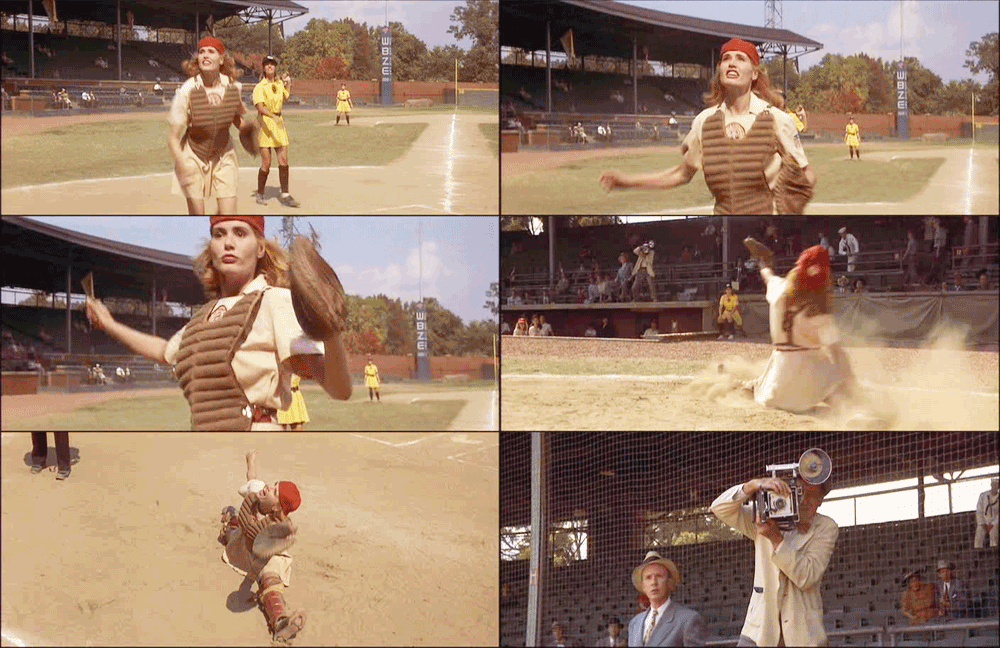
Dottie performs a catch while doing the splits.

Written by Myrna Waldron.

When one thinks of films featuring women in sports, A League of Their Own is probably the first title that comes to mind. It’s such a well known film that it has been preserved in the Library of Congress for being culturally significant, and “There’s no crying in baseball” is an oft-quoted line. The film stars Geena Davis, an outspoken feminist, and was directed by Penny Marshall, a well known comedienne/actress. ALOTO was a huge blockbuster, making $132 million in 1992 dollars. (Roughly $213 million in 2012 dollars) This film proves that a woman director can produce a blockbuster AND that films mostly about women (in a traditionally masculine field) can be successful.

It also beautifully illustrates a few of the core beliefs of feminist philosophy:

  • Freedom of choice is essential.
The film takes place during WWII, so it was not unusual for the members of the Rockford Peaches to be married with children. Although the men in the story are often contemptuous/sarcastic about the subject (including mentioning which players are married and which ones are single in newsreels), the women notably accept each other’s life choices wholeheartedly. Mae embraces her sexuality completely (Madonna’s basically playing herself with 40s hair), but no one condemns her for it. Marla chooses to leave the league early because she has fallen in love and gotten married. No one resents her; they are genuinely happy for her. Dottie chooses to leave the league to be a wife and mother, and the only one who objects is Jimmy, because he doesn’t want her to have any regrets. Each woman is free to choose how her life turns out, and they all accept and encourage each other.
  • The importance of female friendship, teamwork, and camaraderie.
The players of the Rockford Peaches have occasional moments of friction, but instantly come together when it’s time to play. They understand each other’s strengths and weaknesses, and are honest with each other when it counts. (Kit unfortunately doesn’t take brutal honesty and criticism very well.) Off the team, they help each other as well. Mae teaches the illiterate Shirley how to read by having her recite an erotic novel out loud. When Mae‘s choice of reading material is questioned, she points out that the important thing is that Shirley is reading. Dottie is also someone who stands up for others. She refuses to join the team unless Kit and Marla are included.
  • Women can do anything that men can do.
Much of the plot of the movie is concerned with the players of the Rockford Peaches proving what good athletes they are, and changing the minds of the skeptical men around them. Mr. Harvey sees the ‘girls’ as placeholders while many of the men’s major league players are overseas. On their first game, the audience jeers at and teases the players, only to be silenced by their talent. Mr. Lowenstein points out that the women will still play while nursing sprained ankles and broken fingers. The Rockford Peaches players demonstrate willpower, enthusiasm, and skill. Although they never reach the heights of popularity that the male teams get, they gain a devoted audience and respect amongst baseball fans.
  • Women are meant for more than just the domestic sphere.
Mr. Harvey, and many of the other men employing the women left behind while the men went off to war, failed to foresee the sociological implications of encouraging women to “get out of the kitchen” and fill her patriotic duty by working, and then expecting them to meekly go back into the kitchen once the men came home. This was an opportunity for women to prove that they had something to contribute to the world besides cooking, cleaning and birthing, and once they had a taste of ambition, they weren’t going to let that go. Dottie was perfectly happy being a wife and mother, and that was her choice to make. But for many of the others, they wanted more. Mae refused to return to her tawdry life as a taxi dancer, for instance. The All-American Girls’ Baseball League gave the players the opportunity to work for themselves, and many of them continued to do so well after the war ended.
  • Sexualization, objectification and gender roles suck.
Every single woman on the league was ticked off about the silly uniforms that they were forced to wear, with the frilly skirts instead of pants. They point out how impractical they are, and we see the results of the terrible uniforms when one player gets a severe bruise after taking a rough slide into a base. The newsreels, which constantly try to reaffirm the players’ femininity, come off as a total joke because of how little attention they pay to the players’ athletic abilities. Marla is constantly overlooked by others because she is plain, instead of being celebrated for being the best slugger in the league. One sequence involves a snooty middle-aged woman decrying the “masculinization” of women on the radio, complaining that things like the girls’ baseball team will have longstanding effects on home, children and country. She even calls the league “sexual confusion” and wonders what kind of girls the men overseas will come home to. Well, there WERE longstanding effects on home, children, and country…but hardly the destruction of life as we know it.

The Rockford Peaches

As for the type of girls waiting for their husbands, what the men came home to were independent women of free thought. There was enormous social upheaval in the decades following the war, and most of it devoted to getting women out of the constricting domestic sphere and out into the working world. The All-American Girls’ Baseball league is just one real-life example of the type of work women can do if only given the chance. Female athletes are hardly “sexual confusion.” Women are free to choose the homemaker life if they want, but this film’s story proves that women are capable of more than what society thinks they should be.


Myrna Waldron is a feminist writer/blogger with a particular emphasis on all things nerdy. She lives in Toronto and has studied English and Film at York University. Myrna has a particular interest in the animation medium, having written extensively on American, Canadian and Japanese animation. She also has a passion for Sci-Fi & Fantasy literature, pop culture literature such as cartoons/comics, and the gaming subculture. She maintains a personal collection of blog posts, rants, essays and musings at The Soapboxing Geek, and can be reached on Twitter under @SoapboxingGeek.

Women in Sports Week: ‘Sports Night’: That ’90s Show

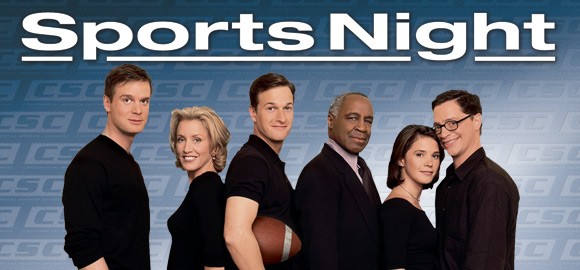
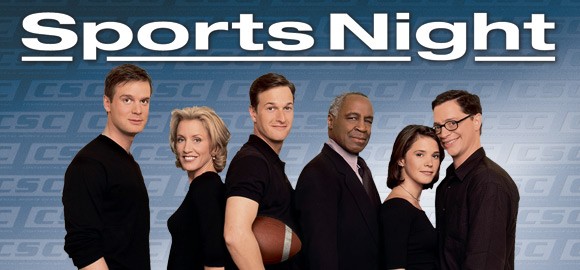
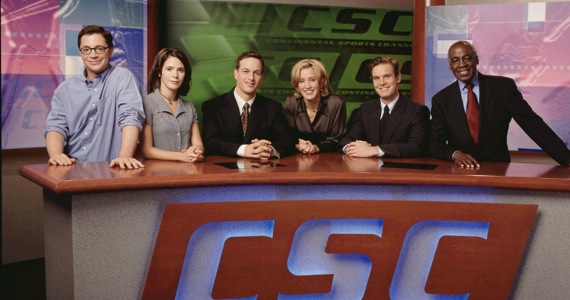
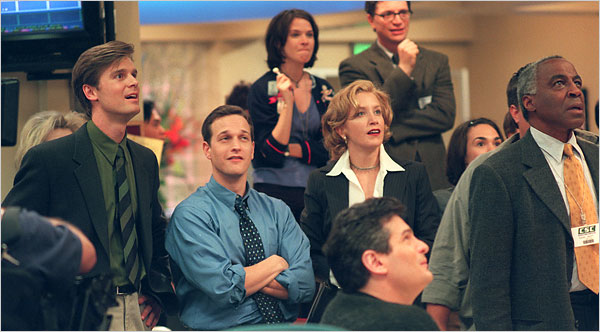
The cast of Sports Night

This is a guest post by Artemis Linhart.

“If you haven’t binge-watched Sports Night within one weekend, then you haven’t seen Shakespeare the way it was meant to be played.”*

This nuanced end-of-90s sitcom offers a peek behind the scenes of a cable sports news show, all the while mixing genuinely serious story arcs with brilliantly written characters and conversations. Captivating on many levels, the series experienced an untimely cancellation after just two seasons, which, for the most part, when it comes to television, is a sign of high yet underappreciated quality.
Taking a closer look at the female characters of the show, it is palpable that, while Sorkin views women as crazy, neurotic and flawed individuals, he sees all people as such.
This is precisely the reason why the show, not unlike his other shows, is said to be exceptionally well-written. While Sorkin is known to write most of his material himself (though it has been said that he is stingy when it comes to the sharing of writing credit), it is unsurprising that he has achieved just about cult status amongst fans for recycling whatever works. And work they do, the female characters of Sports Night–as women, as professionals, but most of all as believable human beings.

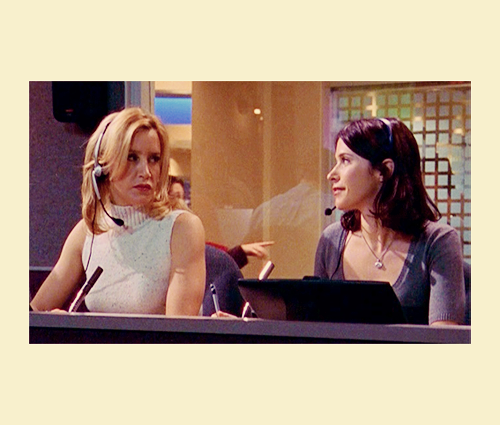
Felicity Huffman as Dana Whitaker and Sabrina Lloyd as Natalie Hurley in Sports Night

Like A Boss

On this show, it is the women who are in charge. The main characters besides the two male news anchors are Dana, the producer of Sports Night, and Natalie, her second-in-command and associate producer. They literally run the show, and not just on their network. From time to time, this is noted on a meta-level. At one point, after there has been a bomb threat to their office building, it is the guys who are freaking out, whereas the women remain calm.

As Dana tells them to pull themselves together, she concludes, “We’re in charge. We’re women in charge. And we’re keeping it together. That’s what we do.” Casey replies, sullenly, “Well, we’re men, and we’re petrified. That’s what we do.”

Dana meets with Casey (Peter Krause) and Isaac (Robert Guillaume)
Similarly, Natalie holds an important position and is well aware of it. She never seems hesitant with regard to decision making or apologetic about being in a position of control. As they are already dating, Jeremy playfully notes, “You’ve taken to bossing me around a lot, you know that?”

The following conversation ensues:
Natalie: Yes. You know why?

Jeremy: ‘Cause you’re my boss?

Natalie: Bull’s-eye, Jerome.

There is a mutual understanding about who’s boss, and there isn’t a moment in the series’ two seasons where women’s authority is questioned or dishonored.

Dana and Natalie are a team both on and off the air. They are not just coworkers but also very close friends and have a very strong bond akin to sisterhood. Team spirit is big on Sports Night as it is but, what is more, there is a very tangible solidarity amongst women. Not once do we see a cat fight, a trope so frequently employed in realms of television where women are involved. Arguments overflow with emotions at best, but never do they result in pettiness. They are invariably based at the very least on mutual respect and dignity.
Even Dana’s interactions with her coworker Sally Sasser, who turns out to be “the other woman” for both Dana’s long-time friend (with coveted benefits) Casey and her fiancé Gordon, are not spiteful but professional. The one time Dana attempts to confront Sally in rage results in the realization that it is not her place to reproach her. Halfway through her tirade, she ends up apologizing and they reconcile.

Natalie and Dana
Another particularly remarkable aspect is that these women are in no way portrayed as “butch,” highlighting the (seemingly little-known) fact that characteristics typically associated with femininity (physical and otherwise) and a genuine passion for sports are, in fact, not contradictory.

Between garbage can basketball and obsessing over stats, there is no way they could be mistaken for anything but authentic sports geeks. This is especially accentuated by the recurring role of Jenny, an adult film actress with a keen interest in sports and a solid command of baseball trivia.

While being the boss and being a woman do not pose a discrepancy on the level of the show itself, funnily enough, it is Dana, who, at one point, says:
“You know, you’re the boss all day long, and you’re barking out these orders and you just want… I don’t know. A check on your femininity, when you’re done.”

Coming from Dana, this is somewhat surprising, as it has never seemed to bother her in this particular way. She has always been the epitome of the gorgeous, desirable woman who just happens to be a sports nut (a type of person Sports Night is heavily populated with). As a matter of fact, just a few episodes prior, Dana appears in a revealing leather outfit, as she is on her way to a “biker chick” themed bachelorette party. While putting on her high heel boots, she asks Natalie:
“Tell me something. Why would the nickelback have set up five yards off the line on third-and-one inside the 50 and they’ve been going off-tackle all day?”

Clearly, this is a reference that only outright American Football enthusiasts would get. Her cascade of a monologue in sports jargon illustrates that her in-depth knowledge of sports goes hand in hand with her femininity, despite popular belief on and off television.

The cast of Sports Night (Joshua Malina as Jeremy Goodwin on the left)

Dana doesn’t just run the show that she produces, she actually runs the show everywhere else, as well. You might call her a bit of a control freak that, in all her neurotic ways, evokes comparison to Monica Geller on Friends. Dana is the center of the group who often speaks up for or makes decisions for others. Of all the women in charge in her group of friends and coworkers, she is without a doubt the leader. Just as she calls the shots on Sports Night, Dana does so in her private life. This is especially the case with her best friend Natalie, who looks up to her, and her long time love interest Casey. During the budding of Dana and Casey’s flawed romance there is barely a moment where Casey asserts himself. As he finally asks her out after 90 days of pondering, he receives a slight scolding for having waited too long.

Neil Finn’s song, “She Will Have Her Way,” is used in the Season 2 premiere as well as multiple times throughout the season. And, as is always the case with Dana, she will have her way. Right up until she doesn’t. On the night of what should be their first date, Dana claims to have had an epiphany and presents her new “dating plan”: instead of the two of them going out on a date as planned, they will postpone it, while Casey has to date other women for 6 months. The logic of this eludes everyone but Dana herself, yet she will not let go of the idea until it blows up in her face, as Casey finally decides to move on with one of the women he went on a mandatory date with.

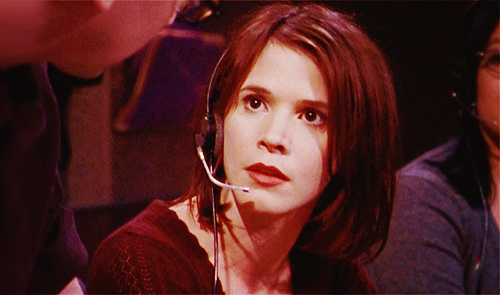
Natalie in Sports Night
With regard to Natalie, one might point out that she has certain qualities of a Manic Pixie Dream Girl. On looking more closely, however, it becomes clear that her character can rather be seen as a deconstruction of the trope. Bearing in mind that Sports Night premiered in 1998, a full seven years before the term was coined, Sorkin seems to have unwittingly been very much ahead of his time.

Besides being a stunningly beautiful and intelligent woman, she is portrayed as slightly quirky (though hardly any crazier than the rest of Sports Night‘s main characters). She often resorts to bizarre, impulsive behavior and clearly serves a purpose for Dan’s troubled character on several occasions. However, she is very well aware of her captivating charm and peculiarity and alludes to it every now and then. As for her relationship with Jeremy, she does partly hold the position of the vivacious, upbeat character that struggles to grab Jeremy by the hand, teach him to embrace life and, essentially, “live a little.” Yet, instead of reducing her to this function, Sorkin depicts her as an independent woman. It becomes clear that she is mainly looking out for her own interests. On an equally important note, Natalie doesn’t succeed in her efforts to get Jeremy to savor life and step out of his comfort zone until ultimately this is the reason they break up.

A Big Thing Badly

Sports Night experiences a crisis in one of the first few episodes, as Natalie is sexually assaulted by an athlete. In general, not a lot of backstory on Natalie is revealed in the course of the series, whereas we learn quite a bit about the family members of the rest of the ensemble cast. Consequently, this episode highlights her character in quite a meta way. It is established early on that Natalie prefers not to talk about private matters. She tries to dismiss the incident and only mentions it to her staff as they find out elsewhere. 
The cast of Sports Night watches a game
The incident poses a conflict on many levels. It is Dana who sends Natalie to do a pre-interview with a football player who happens to be a convicted felon. The objective is to question him about the off-limits topic of domestic violence against his girlfriend. Instead of sending Jeremy, Dana uses Natalie to “provoke a better response to the questions.”

As the assault is revealed, Dana exploits this to get an exclusive story. Realizing the highly problematic nature of her decision, she nonetheless makes a deal with the athlete’s representatives, having the ratings of her television show in mind:
Dana: “Despite a mountain of fairly immutable evidence, I am prepared to believe that what happened to Natalie didn’t happen to Natalie. And I’m confident I can persuade Natalie to see it the same way.”

In exchange for their discretion they would get 5 minutes of air time touching on the topic that would otherwise have been off limits.
Eventually, Dana calls off the interview altogether only three minutes before the show in an effort to do the right thing after all. Ultimately, the prospect of an exclusive news story makes way for decency regarding this sensitive subject. 
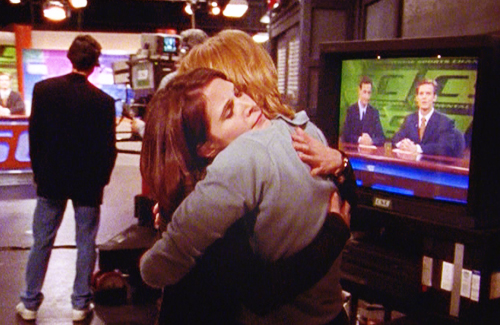
Natalie and Dana hug it out
Interestingly, the incident provokes a particularly adverse reaction in Jeremy, who at that time already carries a torch for Natalie. While the knight in shining armour attire certainly isn’t tailor-made for a type like Jeremy, he nonetheless feels compelled to take the athlete aside and warn him: “You touch her again, I’m gonna have you killed.” In a comment evidencing the show’s capacity to treat serious subjects with sharp and subtle humor, he goes on to say, “Do you understand what I’m saying? I’m gonna pay someone $50 to have you killed.”

Following the assault, Natalie gets death threats of her own. She literally gets slut shamed in the subsequent episode when a hateful message reaches her via email, saying “Dear slut, You should never have been in that locker room where men have just played the game of football.”
Felicity Huffman as Dana Whitaker in Sports Night
In the mean time, she receives special treatment from her co-workers. Initially, the crew wants to shelter her by giving her the rest of the night off. “Am I being fired?” she asks, assuming the position of being doubly victimized. As Natalie is distracted and makes mistakes later on, her staff is very understanding and refrains from calling her on it – very much to her distaste:
“Why not? Why aren’t you laughing at me? Why aren’t you mad at me? (…) Look, all I want is to get it right, and when I don’t, I expect to be treated like a professional. I expect to be yelled at. I want to be treated like the show is still important. I want to be treated like my job is still important!”

She sees her career in jeopardy, which she later explains to be the reason why she’d rather not have the public know about the incident. Natalie refers to a Boston Globe reporter whose story of sexual assault by an athlete was exposed, and asserts: “There isn’t a female sports journalist that didn’t learn their lesson from it.” 
Josh Charles as Dan Rydell and Peter Krause as Casey McCall in Sports Night
Clearly, being a female sports reporter bears certain considerations that being a male sports journalist generally doesn’t.

From parents’ disapproval (as Dana quotes her mother: “sports is no place for an educated woman”) to more serious issues as the one mentioned above, there are a myriad of reasons to become a woman working in the field of sports, to prove them all wrong, step by step, and take on this patriarchal society of ours.
* For those unfamiliar with the series: One of Aaron Sorkin’s many clever one-liners that keep resurfacing in his shows and are referred to as “Sorkinisms.”
 

Artemis Linhart is a freelance writer and film curator with a weakness for escapism.


Women in Sports Week: The Toughest Trio: A Review of ‘The Boxing Girls of Kabul’ (2011)

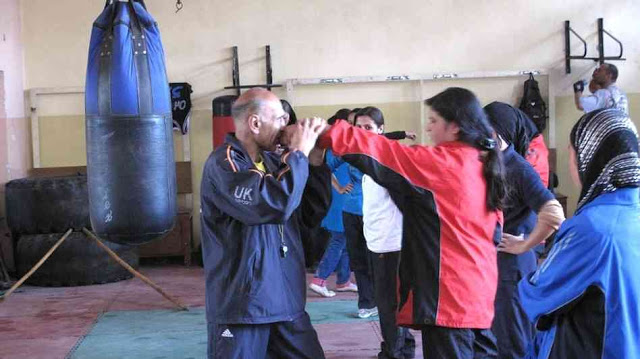
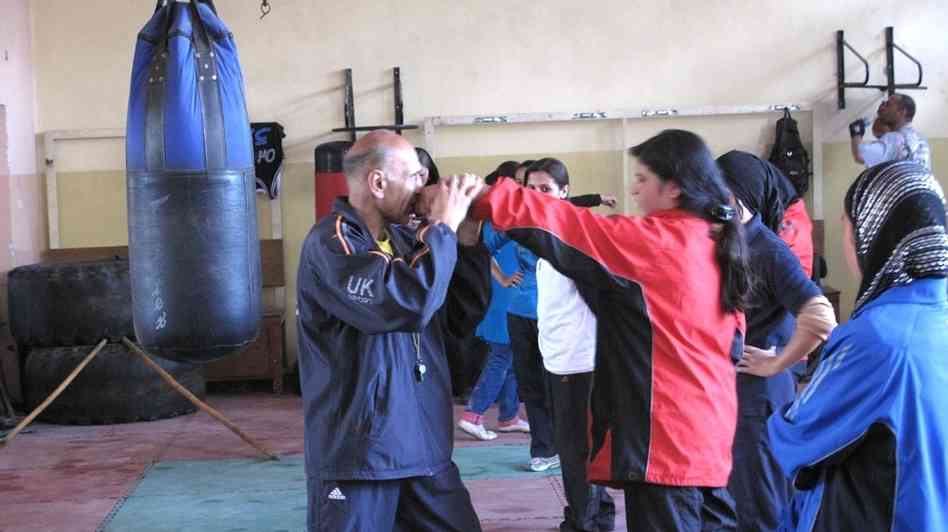
Saber Sharifi trains women boxers in The Boxing Girls of Kabul

This is a guest post by Rachael Johnson

The Boxing Girls of Kabul is a Canadian documentary about the boxing careers of three young Afghan women, sisters Sadaf and Shabnam Rahimi and Shahla Sikandary. It was written and directed by the Afghan-Canadian filmmaker Ariel J. Nasr. Based in Afghanistan, Nasr produced the recently Oscar-nominated live action short, Buzkashi Boys (2012).

The Boxing Girls of Kabul opens with harrowing archival footage of an execution of a woman at the Olympic Stadium in Kabul on November 16th, 1999. Many will recall this secretly-recorded film from news reports, but it will always disturb and haunt: the kneeling woman, clad in a pale blue burqa, attempts to turn her head to her executioner as she is about to be shot. Mercifully, the camera cuts to a blue sky and carries us directly to contemporary Afghanistan. We see, in close up, the determined brown eyes of a young female boxer training at the very same stadium where women were executed during the dark days of Taliban rule.

We are first introduced to Sadaf who tells us that she and her fellow fighters spar in the same gym where girls were imprisoned. She is somewhat frightened by the place itself but explains, “When we play sports, we forget our problems. When I box, I feel happy. I box because I want to advance myself, and advance Afghanistan.” Sincere and ambitious, the girls want to determine their own destinies. Shahla says, “In the future, I want to be the most progressive and bright of all Afghan girls…a champion.” All are hungry for medals. 
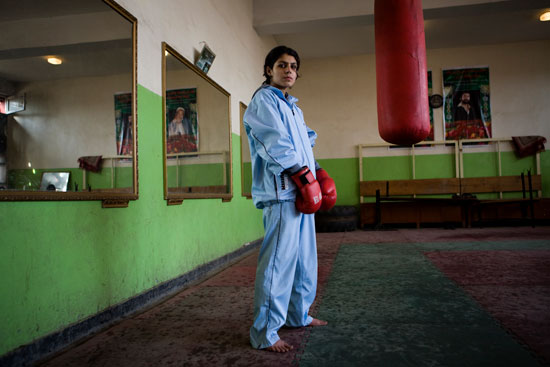
Image from The Boxing Girls of Kabul
Boxing has always, of course, been the most traditionally masculine, most brutal and most controversial of sports. Female boxing remains a divisive issue around the world and only became an Olympic event at the London 2012 Games. It is all the more remarkable that girls from a land scarred by gender discrimination have taken up the sport. The girls’ coach, Sabir Sharifi, explains, “The Taliban were absolutely opposed to sports. They had an especially strong opposition to boxing.” A girl boxer in a hijab is an incongruous image for many–or most–Westerners. For the Taliban, female boxing is simply sinful. Boxing has also, however, been the sport of the marginalized and oppressed so it is perhaps unsurprising that these young Afghan women have chosen boxing. The sport for the trio is identified with self-empowerment and female self-worth.

It is interesting to see the boxing girls of Kabul negotiate the streets and shops of the capital with their trainers–as well as journey abroad for competitions–but the interviews with them and their families at home and in the gym provide a more intimate and perhaps more illuminating portrait of the nature of their lives. In the locker room, we see the trio and their peers talk about exam results, tease each other about their hair and spray bottled water over each other. These glimpses serve to remind the viewer that their interests and aspirations are fundamentally the same as most young women around the world. They also give a strong idea of both their incomparable pressures and camaraderie.

Nasr also provides helpful insights into the attitudes of the men in the boxers’ lives. Their coach is a very likeable, middle-aged man. Sharifi formed the girls’ boxing team in 2007 with “a few brothers.” He himself was a victim of Afghan’s tragic, war-torn history. The 1980s Soviet occupation, he explains, put an end to his Olympic ambitions. Sharifi and his colleagues consistently demonstrate support and affection for their charges. He says he wants champions. There persists in the West an Islamophobic, racist belief–even among self-proclaimed progressive people–that all Muslim men in all Muslim lands dominate, control and persecute their daughters. The forward-thinking likes of men such as Sharifi constitute a formidable response to such bigotry. He is not alone. Shahla explains that it is her father who supports her the most in her family. “He thinks that a girl can be someone in the future,” she says. Sadaf and Shabnam Rahimi’s father is also encouraging while their progressive mother wants them to continue both their education and sporting career.
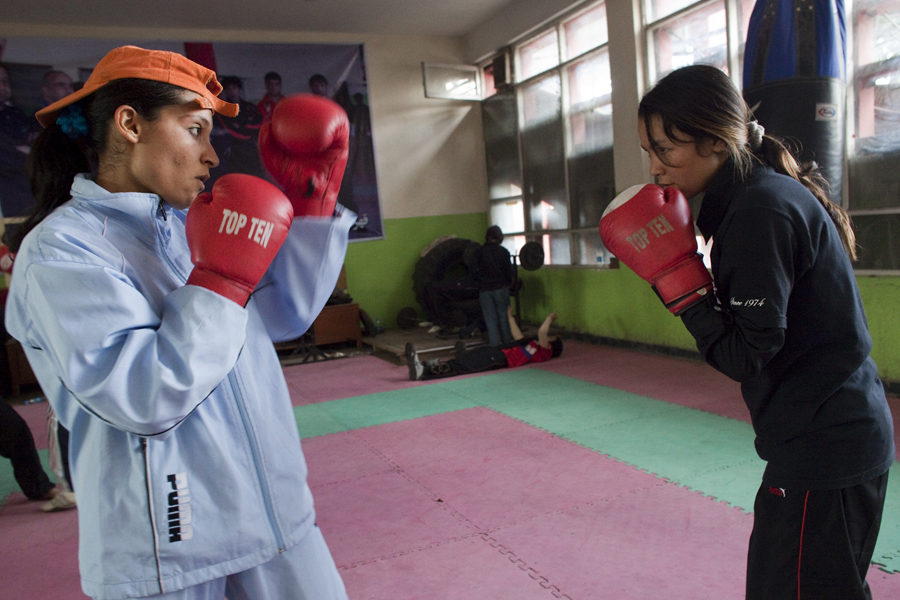
Image from The Boxing Girls of Kabul
Female boxing, of course, enrages the Taliban and Afghan conservatives in general. The girls are given the opportunity to compete in Vietnam and Kazakhstan. Unhappily, increased recognition brings increased intimidation for both trainer and coach. Sharifi is threatened on the street while Shahla experiences pressure to stop boxing from her brother. He is shown to be infinitely more conservative than her father. In English, he expresses concern that his sister’s boxing career will endanger the family in the event of a full-blown Taliban resurgence. He worries that the family will be accused of being “kuffar” (non-Muslim). “Nothing except this,” he insists. But is he merely motivated by concern for his family’s safety? He scorns his sister’s independence, accuses her of not praying with satisfactory piety and delivers this extraordinarily unsettling threat: “If I was in my father’s place, I would set so many restrictions she wouldn’t even be able to eat without being afraid.” But the girls bravely pursue their sport despite these difficult and dangerous circumstances.

There are other obstacles. Funds and facilities are inadequate. They do not even have a ring. In Vietnam and Kazakhstan, we see them outclassed and overwhelmed by their hosts. It is painful to watch, but I was reminded by a quote by the novelist and boxing writer Joyce Carol Oates: “Boxing is about being hit rather more than it is about hitting, just as it is about feeling pain, if not devastating psychological paralysis, more than it is about winning.” The girls, understandably, complain of inadequate training and resources, but they are also, of course, cutting their teeth. Shahla is fortunate to secure a bronze medal in Vietnam–there were only four in her weight class–gaining the attention of the Afghan media. Her father is proud of her achievement.

We learn, at the end of the documentary, however, that Shahla no longer competes. Pregnant with her first child, she visits the gym “when she can” and works part-time. You wonder if she will return. It is heartening though to hear that Sadaf continues to compete and that Shabnam aims to be a doctor. Perhaps they have been empowered by their mother’s words: “In Afghanistan, we have to fight against men to show we have pride.” 
Image from The Boxing Girls of Kabul
Documentaries like The Boxing Girls of Kabul are invaluable in that they give voice to the voiceless. These young women possess a rare courage. Spirited, ambitious and attractive, they make engaging subjects. The cinematography (by Nasr) is not particularly striking in The Boxing Girls of Kabul and it is a no-frills documentary formally. The director is modest and unadorned in both style and approach. The interviewer is a silent presence; the boxers as well as trainers and family members speak for themselves. This works well as they appear to reveal their hopes and fears quite openly. The documentary, however, is simply too short at 52 minutes. The trio’s stories could have been further developed. It is evident that they box for themselves, their gender and their country, but it would be have been rewarding if the filmmakers had explored their motivation more deeply. Their influences could also have been cited. Which fighters (male or female) inspired them?

The young women are trail-blazers in a patriarchal society still plagued by religious extremism. They are, equally, children of war. For decades, Afghanistan has been blighted by conflict. Bizarrely, the documentary does not mention that ongoing war between foreigners and the Taliban. The prolonged presence of the American military in Afghanistan is curiously absent from all conversation. It would have been interesting to know the boxers’ thoughts on the conflict as well as the role of the West in relation to the status of women in Afghanistan. The Boxing Girls of Kabul gives relatively little historical background and context. It does not explain how the Taliban came to power or shed new light on their mindset. (If you want to learn about the roots of Taliban, start with Ahmed Rashid’s 2000 book Taliban: Islam, Oil and the New Great Game in Central Asia.) 

Listening to Shahla’s conservative brother was, then again, quite enlightening. His obsession with what others think reveals a deep lack of imagination and reflects a fear of difference. Social conformity seems to have a tyrannical hold on him. The documentary does, however, unsettle stereotypes about both Afghan men and women. This is invaluable. Nasr has created an affecting, compassionate portrait of proud, independent Afghan womanhood in The Boxing Girls of Kabul. Ultimately, there are few things more moving than witnessing the endeavors of an oppressed group or people.


Rachael Johnson has contributed articles to CINEACTION, www.objectif-cinema.com and www.jgcinema.com.

Women in Sports Week: Bend It Like Bynes: Ambivalent Empowerment in ‘She’s the Man’

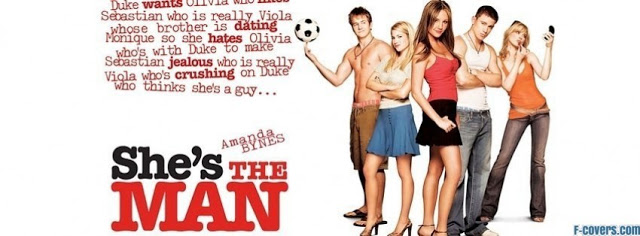
Everybody has a secret …
This is a guest post by Caitlin Moran.
The first time I saw She’s the Man, I was in the middle of a 23-hour band trip bus ride, and probably in the first stages of delirium. I had low expectations for the movie, and even lower expectations for what remained of my sanity—and yet, when one of the chaperones popped in the She’s the Man DVD, I found myself loving it. I was sitting next to my best friend and varsity soccer teammate, and we were both loopy enough from extended time on the road to enjoy the goofier moments of the movie while still reveling in the extended soccer scenes. Still, I wasn’t sure what to expect when I returned to the movie seven years later to examine its depiction of high school sports—watching Amanda Bynes change clothes and genders on a Spin the Apple carnival ride can only be funny so many times, right? (Wrong—I will never not laugh at that scene.) But whether the rest of the movie would uphold the integrity of the female athlete was a different story altogether.

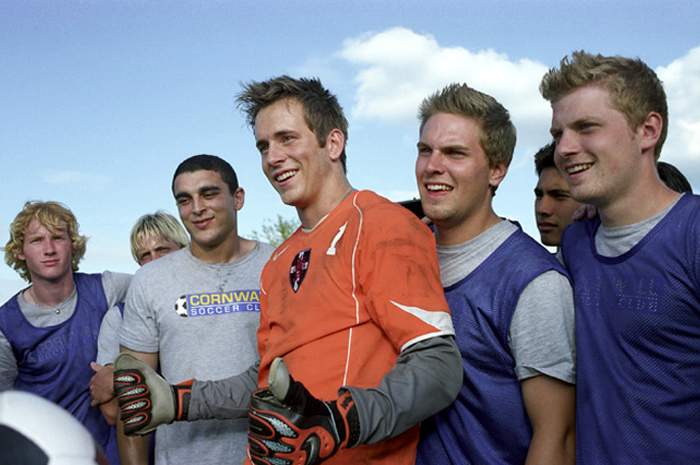
Justin and the rest of the Cornwall boys. You’re gonna regret this, bro.

Like that other perennial high school favorite set on an unbelievably beautiful campus, She’s the Man is based loosely—loosely—on Shakespeare, in this case Twelfth Night. Bynes plays Viola Hastings, a high school soccer star, living out the last days of summer playing the beautiful game with beautiful people, including her boyfriend Justin (Robert Hoffman), on the beach. But the start of school brings unwelcome surprises: in the first ten minutes of the movie, Viola and her teammates discover that their school, Cornwall Prep, has eliminated the girls soccer team, leaving them without a way to showcase their skills for prospective college scouts. (Viola harbors dreams of wearing the Carolina blue at UNC Chapel Hill, no doubt a nod to the women’s soccer legends like Mia Hamm and Kristine Lilly, among others, who played there.) If this were a very different movie, Viola would have brought a Title IX claim against Cornwall, and we would have been treated to courtroom montages instead of training scenes. But Viola takes a different route: after Justin laughs in her face at the idea of the girls trying out for the boys’ team—and gets himself epically dumped—Viola hatches a plan to impersonate her twin brother Sebastian (secretly in London with his bandmates) at rival high school Illyria, make the boys’ soccer team there, and beat Justin at his own game. Literally.

Hell hath no fury like a girls soccer team scorned

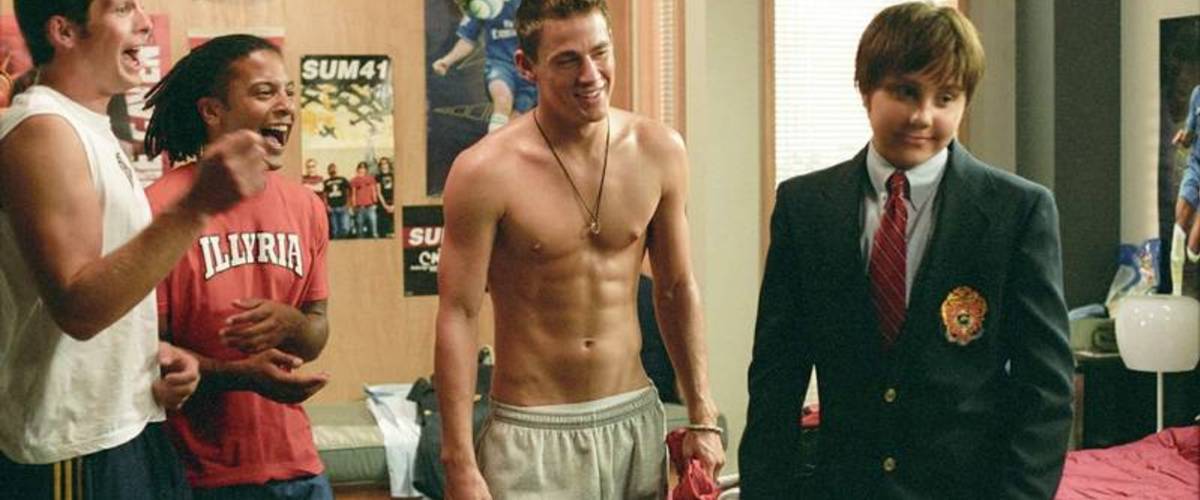
Complications ensue, as they must. Viola-as-Sebastian finds herself in the middle of a messy love triangle between her hunky roommate Duke (Channing Tatum, at his most bro-with-a-heart-of-gold) and Duke’s object of affection, Olivia (Laura Ramsey), who begins falling for “Sebastian” during intimate chats over dissected animals in science lab. Circling this sticky wicket are Monique (Alexandra Breckinridge), the real Sebastian’s horrid girlfriend who refuses to be dumped, and Viola’s mother (Lynda Byrd), who cherishes dreams of seeing her little tomboy walk across the stage as a debutante. Oh, and there’s a tarantula.
Even in the midst of all the hullabaloo, the movie does manage to devote a fair amount of time to soccer. Viola tries out for the boys’ team and makes second string, after informing Coach Dinklage, played by real-life footballer/testicle-grabber Vinnie Jones, that she is unable to play on the “skins” team in shirts v. skins because she is “allergic to the sun”—and yes, you can buy that phrase on a hoodie. Second string, however, isn’t good enough to get Viola on the field against Cornwall, so she strikes a bargain with Duke: he’ll help her up her game enough to make first string in time for the Cornwall game, and she’ll convince Olivia to give Duke a date. They both succeed, but when the real Sebastian returns from London the night before the big game, Viola’s tangled web begins to unravel. But still—I’m sure you can guess where this is going, in the end, right down to the final game-deciding penalty kick awarded to Viola against—surprise!—Cornwall goalie Justin.
Who is that handsome fellow?
 
Viola’s conquest of her gross ex is facilitated through this penalty kick, on a pitch where the winners and losers are clearly delineated. This isn’t a symbolic victory: Viola literally puts the winning point on the board. Unlike the weak, intolerable Monique, who is destined to storm in and out of scenes in a constant state of prissy frustration, Viola uses soccer to transcend her status as a girl, which otherwise would mark her as an idolized object of desire (Olivia), a walking punchline (her unfortunately headgeared classmate Eunice), or tokens of sexual conquest (her former teammates Kia and Yvonne, who pretend to be her desperate exes to increase her cred with the Illyria boys). Through her athletic talent, Viola gets to vanquish the boy who insulted and belittled her on a playing field where the subsequent victors are easily recognizable.

Amanda Bynes as Viola in She’s the Man

Interestingly, although Justin almost immediately becomes the villain who Viola must overcome, it didn’t start out that way. In fact, the first lines of the movie are Justin’s, emphatically celebrating Viola’s goal during the beach soccer game, before telling her that she’s better than half the guys on his team. Here is a perfect example of the affirming boyfriend that sunny, sassy Viola deserves. It’s only when Viola threatens to encroach on Justin’s (literal) turf that he changes his tune, agreeing with Cornwall coach Pistonek that girls can’t play sports at the same level as boys. Obviously we’re meant to revel in the downfall caused by his misogyny, and I certainly did, but we’re also meant to celebrate the willingness of Duke—and Coach Dinklage—to give Viola a spot on the team despite her gender once she’s found out. Yet I find myself unable to believe that the eminently “no homo” Duke we met in the first half hour of the movie would have reacted any differently than Justin did, if he knew that “Sebastian” was a girl all along.
In the end, She’s the Man is ambivalent about the role of soccer in Viola’s life. On one hand, Viola does prove that she can play with the boys, and at times even exceed them. She conquers Justin and Coach Pistonek, who doubted and mocked her. But everything about her soccer career is irreparably tangled up with her relationships with boys. When she decides to impersonate her brother, she’s doing it just to stick it to Justin—no UNC Chapel Hill scouts will come to see her as a boy. Even the side volley she uses to score on Justin in the final game wouldn’t have been possible without a setup from Duke (who taught her the move in the first place).

Viola (aka Sebastian) hanging with the guys

The last shot of the movie shows Viola and Duke together on the field in Illyria red, seemingly bearing out Coach Dinklage’s rather touching commitment to equality on the pitch. But whether this equality can be sustained long term—especially on a team of guys who were so impressed when Viola-as-Sebastian cruelly humiliated Monique in front of an entire restaurant—remains to be seen. And even if it can be, what happens to the rest of Viola’s former teammates, still stuck at Cornwall without a team or a twin brother to impersonate? Don’t they deserve a revenge penalty kick as well? For real-life Violas—and Kias and Yvonnes—the importance of Title IX protection can’t be overstated. What the movie could have done was show that all female athletes—not just the ones good enough to play with the boys—deserve their day on the pitch. Perhaps there will be a sequel—She’s the Man: Title IX Lawsuit. Now that’s a sports movie I would pay to see.

Caitlin Moran is a textbook editor with a penchant for sassy footnotes. After spending many years battling Western New York winters, she now lives in Queens with a cat and too many books for her apartment. Her work has appeared in Post Road, Pleiades, Pure Francis, and the Women’s Media Center blog.


Women in Sports Week: Documentaries That Inspire

This is a guest post by Marcela De Vivo.
The history of sports films goes back as far as the history of the cinema itself, starting with Thomas Edison’s silent celebrations of strongmen and prizefighters to cerebral sports dramas like Moneyball. Given the second-class citizenship afforded to women’s sports, it’s no surprise that few of the countless cinematic love-letters to athletics have showcased female athletes.
Over the past decade, however, a number of low-profile yet potent documentaries have arrived to stir up the rules. Here are five documentaries any fan of women’s sports—or sports in general—will not want to miss.


The Life of Million Dollar Babies (aka Golden Gloves), 2007. Directed by Leyla Leidecker

The Golden Gloves competition is the most storied amateur boxing tournament in the U.S. More than any other sport, however, boxing has been a true boys’ club, and an unspoken tradition barred females from entering since its inception in the 1920s. A new round of equality began in the mid-90s when a streetwise Brooklyn female pugilist named Dee Hamaguchi joined forces with the ACLU and pried the door of bias ever-so-slightly open.

Through a narrative pattern we often see in sports docs, we follow eight hopefuls striving for their personal bests as they keep their eyes on the prize of the 2005 finals in Madison Square Garden.

The Life of Million Dollar Babies is a powerful window upon the friction athletes often face not only on the field of gender, but also race and class. While male boxers are funded by the USA Boxing League, a technicality disqualifies females from financial support. When we witness the winner of the climactic quarter finals, a brassy Puerto Rican unable to go on to the finals simply because she can’t pay for it, we can’t help but feel the sting of social inequality.


The Heart of the Game, 2005. Directed by Ward Serrill

Perhaps a female-oriented cousin of the classic documentary Hoop Dreams, The Heart of the Game is at its core about the inspiring, unlikely relationship between African-American basketball player Darnellia Russell and tax lawyer-turned-coach Bill Rensler.

Russell’s remarkable journey begins with her struggle for identity at an almost exclusively white, privileged high school, plunges into her unexpected motherhood and the complications of being a teen mom and athlete, and climaxes with her graduation from high school and garnering of her region’s Player of the Year Award.

A movie as much about growing up as about sports, this gem will uplift anyone with a heart … and with its shoestring budget of $11,000, it’s a testament to the possibilities of independent filmmaking.


Unmatched, 2010. Directed by Nancy Stern Winters and Lisa Lax

A standout episode of ESPN’s ongoing 30 for 30 documentary series, Unmatched is a deftly-edited wealth of candid interviews that plays out like an epic clash of the titans. From their inauspicious entrance onto the women’s tennis scene in the early 1970s to their elevation to sports icons, Chris Evert and Martina Navratilova are bared to the audience in an intimate portrait of ardent competition and mounting admiration that matures across a span of over 80 fiery matches.

As a nuanced essay on the complex relationships obtained through time-ripened sports rivalries, this feature is truly “unmatched,” and along the way sketches the seismic shifts that have defined women’s tennis throughout the decades.


Training Rules, 2009. Directed by Dee Mosbacher and Fawn Yacker

Subtitled “No Drinking, No Drugs, No Lesbians,” the short, bittersweet Training Rules is an expose of another front on which female athletes face prejudice: discrimination based on sexual orientation.

Made as a political consciousness-raiser by a lesbian activist and a psychiatrist, Training Rules brings to light the paranoiac witch-hunting atmosphere that pervades Penn State’s women’s basketball team. (In light of the notorious sex abuse scandal that rocked that school’s football team, the film is a doubly potent indictment of hypocrisy and double standards.) By focusing on the especially tragic case of Jennifer Harris, a promising hoop-star whose career was crushed by bigotry, Training Rules makes the pain of discrimination personal and impossible to ignore.


Dare to Dream: The Story of the U.S. Women’s Soccer Team, 2005. Directed by Ouisie Shapiro

As with several of the docs already mentioned, Dare to Dream is not just about the struggle of individuals’ struggles for acceptance but also the grueling journey toward legitimacy within a particular sport. Over the course of the film’s duration, we get to know pioneering players Brandi Chastain, Mia Hamm, Julie Foudy, and Joy Fawcett, as well as the sweat and devotion they invested into making a once laughed-at franchise an Olympic spectacle.

All of these films are as packed with joy and pain as any glossy Hollywood product, and through the passions of their filmmakers, convey a sense of humanity few fiction flicks can compete with. By taking us through the lows as well as the highs, the crushing defeats as well as the delirious triumphs, these films inspire us by capturing the ineffable richness of sports and even life itself.


Marcela De Vivo is a freelance writer who works with Northwest to educate women on staying healthy and feeling their best. She enjoys getting outside and staying active with her daughter. Find her on Facebook today!