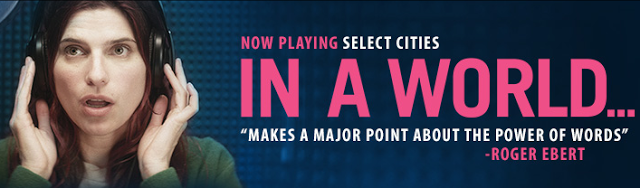
Top Ten Reasons Why I Am Thankful for Lake Bell’s ‘In a World’

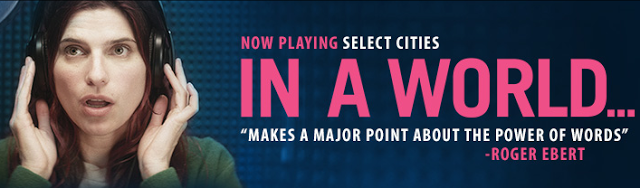
Movie poster for In a World …
This is a guest post by Molly McCaffrey.

1) Number one and most important of all, I’m thankful this movie was written and directed by a woman and that it’s a story about a strong, smart, interesting woman.
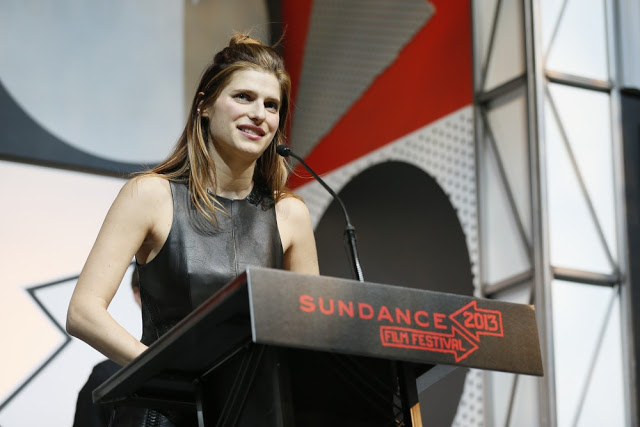
Director and screenwriter Lake Bell at the Sundance Film Festival

I am incredibly thankful about that.

2) I’m thankful this movie stars an actress who doesn’t look like every other Hollywood actress. Yes, Bell is beautiful, but she also doesn’t have the button nose, full lips, perfect posture, and blond hair that has become so annoyingly ubiquitous among our female movie stars.

Louis (Demetri Martin) and Carol Solomon (Lake Bell) sing their guts out in In a World …

And neither do her co-stars…

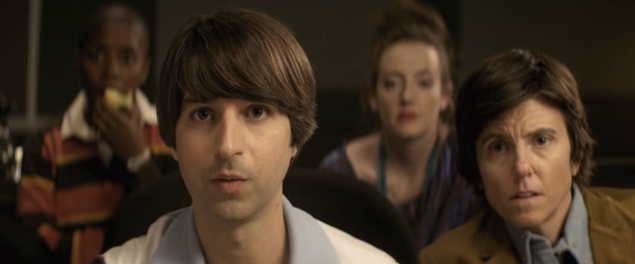
Louis (Demetri Martin) and Cher (Tig Notaro) watch Carol Solomon (Lake Bell) record a voice-over.

(You also gotta love a movie that has both Tig Notaro and Geena Davis.)

3) On a related note, I’m thankful Bell’s protagonist, Carol Solomon, doesn’t always act like a leading lady—she shuffles, lurches, and acts generally spazzy. She doesn’t always look glamorous either—she doesn’t always wear makeup or look perfectly primped and often wears regular-people clothes (sweatpants, thermal underwear, t-shirts, football jerseys, overalls, ill-fitting dresses, etc.)—just like the rest of us.
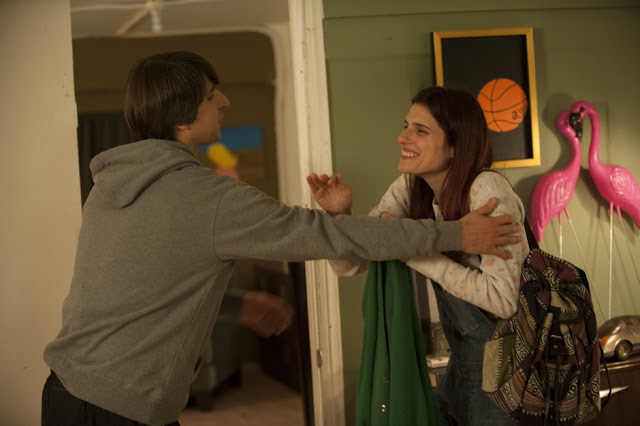
Louis (Demetri Martin) and Carol Solomon (Lake Bell) hatch plans to take over the voice-over industry.

At the same time, I’m glad Carol looks attractive when she wants to without looking trashy or showing off all the goods.

4) I’m also thankful that several men are attracted to Carol even though she doesn’t know how to dress or stand up straight (and that the men who are drawn to her are attractive but not perfect either).
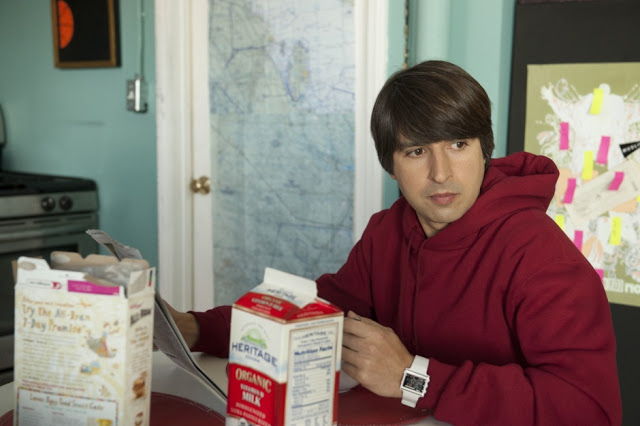
Carol Solomon’s love interest, Louis (Demetri Martin)

5) I love, too, that this film shows an intelligent, driven, attractive young female protagonist in a relationship, but it isn’t what defines her. Let me say that again: Thank God her relationship doesn’t define her!

I was equally thrilled that Carol had casual sex with some random guy she met at a party and celebrated it. And that she didn’t end up regretting her actions or have something bad happen to her as a result. In this movie, sex was just part of life—no big deal—much like it is in real life.
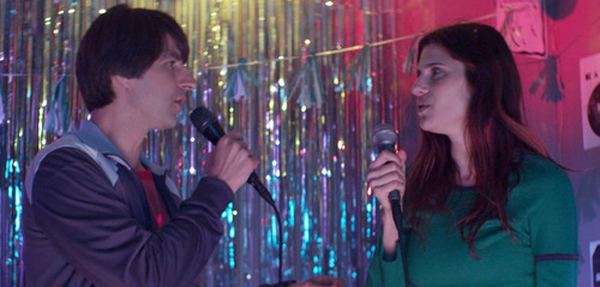
Louis (Demetri Martin) and Carol Solomon (Lake Bell) karaoke the night away in In a World …

6) I was also head over heels over the fact that the two sisters—Carol and Dani—were so close and leaned on each other for everything.
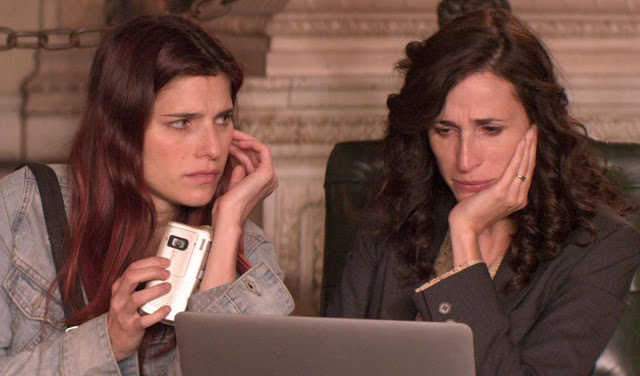
Carol Solomon (Lake Bell) and her sister, Dani (Michaela Watkins)

I was glad, as well, that the person who had an “affair” in this movie was a woman (rather than a man) and that she didn’t actually go all the way.

7) I really appreciate, too, that this movie shows a young person living at home with a parent and that she isn’t doing so because she’s a lazy, lost, unmotivated slacker.
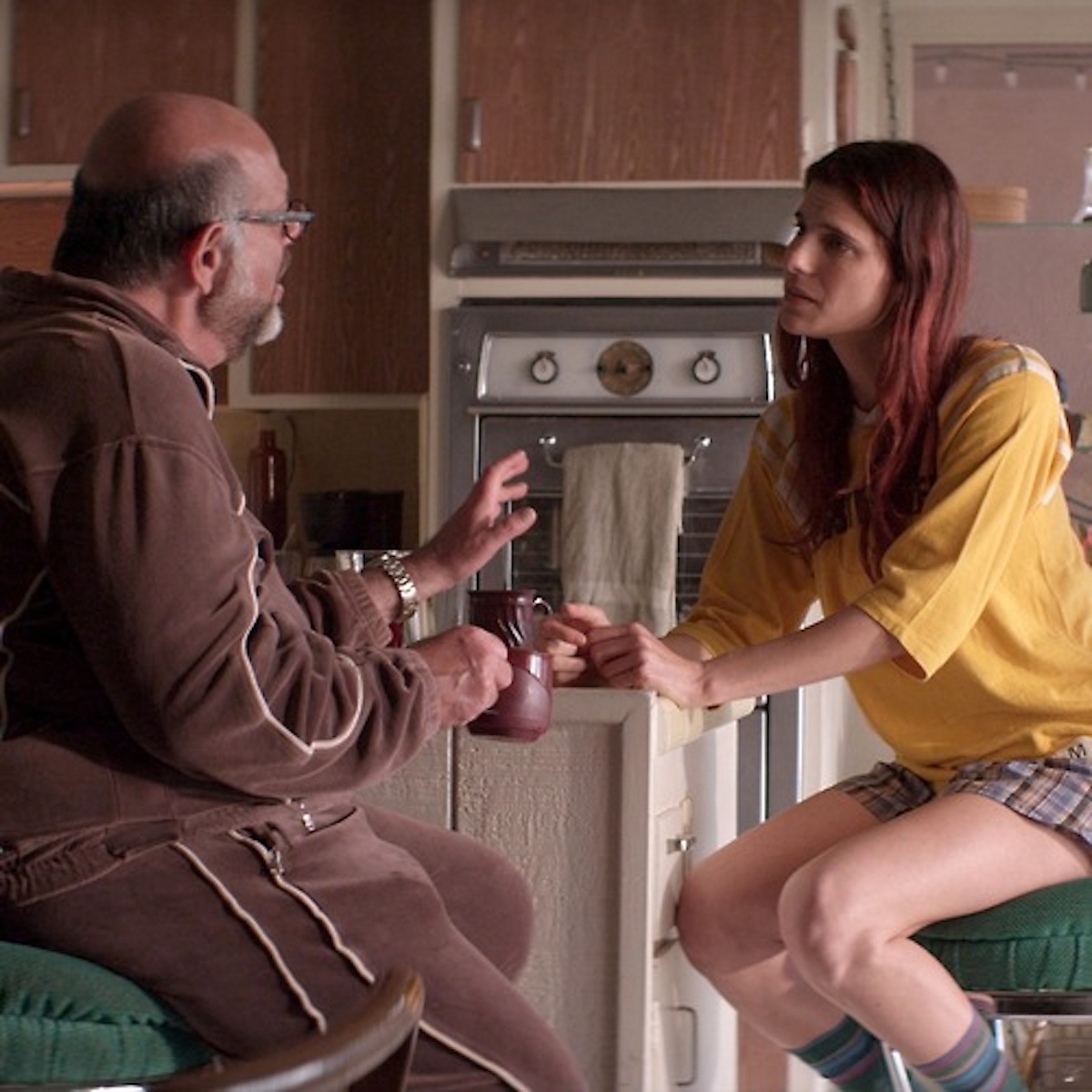
Carol Solomon (Lake Bell) and her father (Fred Melamed) argue about her career.

And I was truly blown away by the film’s characterization of Carol’s family—a real family having down-to-earth, regular problems.

No, nobody is dying of cancer, nobody is mentally ill or disabled, nobody is in prison, nobody is an alcoholic. The characters in this movie are just average people with average problems—like jealousy, resentment, miscommunication, and selfishness.

I am very grateful about that.
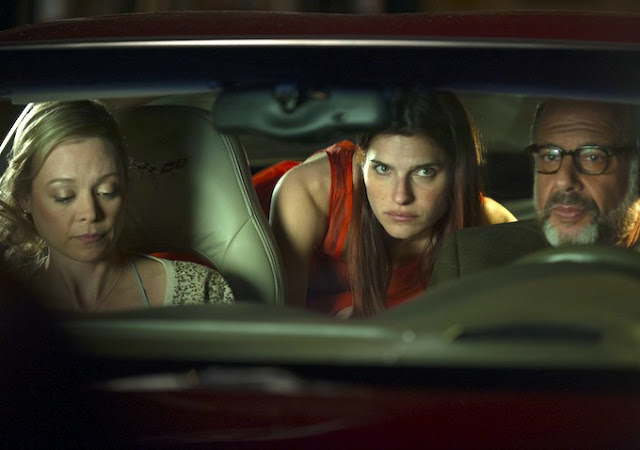
Carol Solomon (Lake Bell) and her father (Fred Melamed) on the way to an industry party.

8) I’m thrilled about several things relating to Carol’s job…

I’m relieved Carol works in a non-glamorous industry that we don’t usually see featured in movies—the voice-over industry.

Carol Solomon (Lake Bell) records a voice-over.

I love, too, that she cares so much about her work even though it doesn’t pay the bills.

And I’m glad that the film shows her having some success in that field without totally dominating it a la every other movie ever made (Erin Brockovich, Jerry Maguire, The Devil Wears Prada, Working Girl, etc., etc.).

9) I’m downright ecstatic about the fact that Carol didn’t have to trip or fall to make us laugh, avoiding the ridiculous formulas that often dominate movies about women.
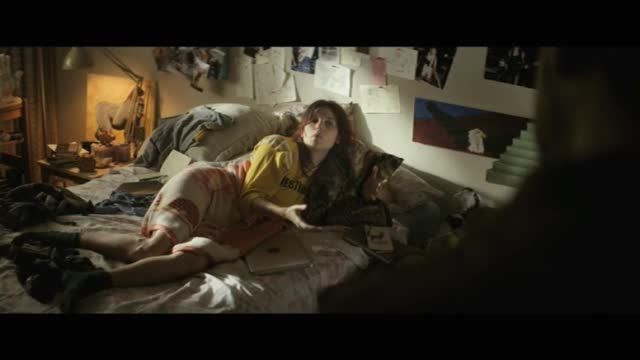
Carol Solomon (Lake Bell) surrounded by her work notes in her bedroom at her father’s house.

Thank you for that, Lake Bell!

Tangentially, it was also awesome that Carol was irritated by stupid people doing stupid things and didn’t apologize for that.

10) And last but not least, I’m incredibly thankful this movie made me laugh and feel and, for God’s sake, think.
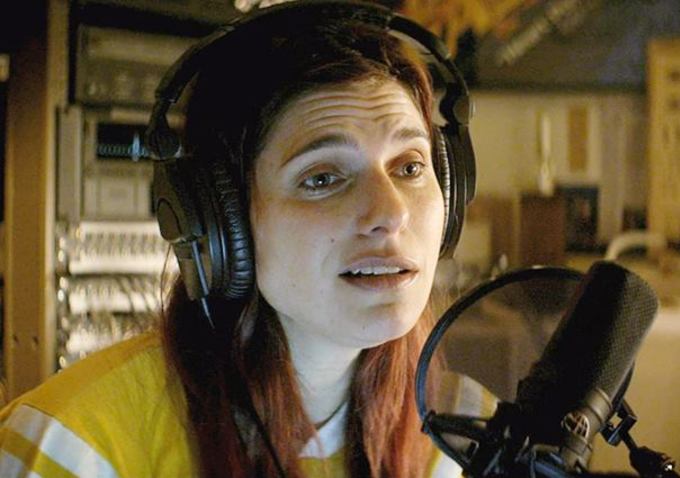
Carol Solomon (Lake Bell)

If only all movies did the same.


Molly McCaffrey is the author of the short story collection How to Survive Graduate School & Other Disasters, the co-editor of Commutability: Stories about the Journey from Here to There, and the founder of I Will Not Diet, a blog devoted to healthy living and body acceptance. She has worked with Academy Award winner Barbara Kopple and received her Ph.D. from the University of Cincinnati. Currently she teaches at Western Kentucky University and designs books for Steel Toe Books. She is at work on her first memoir, You Belong to Us, which tells the story of McCaffrey meeting her biological family. 

A (Bad) Teacher

Written by Max Thornton.
  
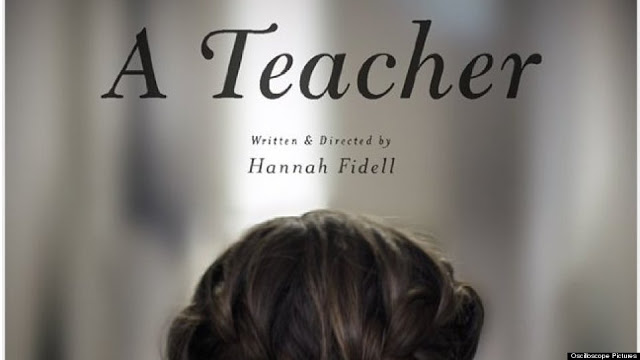
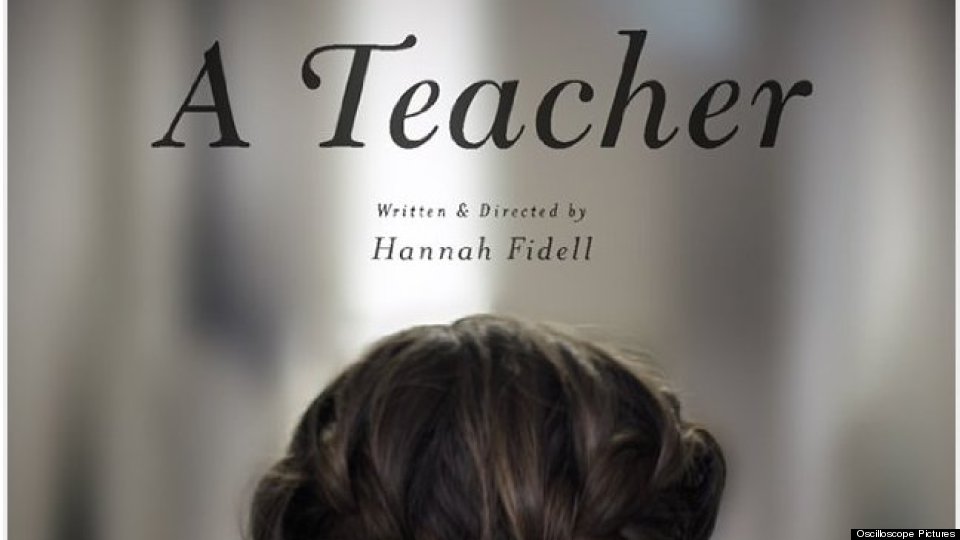
Movie poster for A Teacher
People sure like to make movies about teacher-student relationships. It’s always incredibly skeevy, of course, to watch someone in a position of authority abuse their power, but cinematic representations are rarely as nakedly awful as the reality.
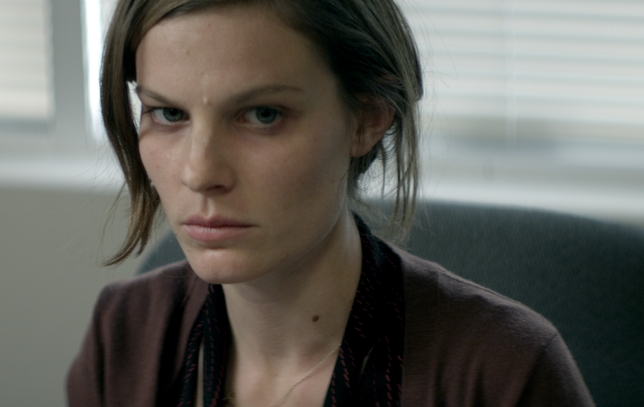
A Teacher consciously downplays the really appalling aspects of intergenerational classroom romance without ever intimating that it’s anything other than a very bad idea. As suggested by the title, the film focuses entirely on young English teacher Diana Watts (played by Lindsay Burdge), for whom the relationship is at least as destructive as it is for Eric, the pupil (who is, if it makes a difference, a high-school senior and significantly bigger physically than she is).
The total focus on Diana is signaled from the opening classroom scene, where the camera stays fixed on her, regardless of who is speaking. This directorial choice recurs throughout the film, and it serves to highlight her naïve solipsism. It’s tricky to maintain audience empathy for a viewpoint character while also drawing attention to her self-centered immaturity, so props to director Hannah Fidell for finding a deft way to put us inside Diana’s head (hearing other characters’ dialogue from her perspective) while still maintaining an outsider’s gaze (looking at her face).
Lindsay Burdge as Diana.
Overall, both style and acting contribute to an odd sense that Diana is not the one doing the victimizing in this circumstance. Factor out her job, and this movie would just be the story of dumb puppy love, a young woman so hopelessly smitten with the very idea of romance that she’s heedless of the realities of the situation. But, of course, her job is the point – the movie’s called A Teacher – and the experience, knowledge, and wisdom implied by that position are dramatically at odds with her incredibly adolescent attitude toward the whole relationship.
Early in the film, while hooking up with Eric in his car, Diana reminisces about similar trysts from her own high-school days. It’s a tellingly sad and uncomfortable little moment that kicks off a spiral of nonstop sadness and discomfort: Watching a grown-ass woman sext and Facebook-stalk a teenage boy is both tragic and kind of disturbing. There’s something Carey Mulligan-esque about Burdge’s face when she’s in bed with Eric, evoking (as does the title) another film in which the questionable sexual relationship is the other way around, age- and power-wise.
Perhaps the echo is deliberate. Diana never seems to have any power in this relationship, never acts like the teacher or the one giving the education. Even in the bedroom, Eric calls the shots (“Take your clothes off.” “Come here.”), and, while driving his car, he describes feeling as though his penis is getting bigger, coming into its own, “powering up.” For him, sex with an attractive young teacher is a power fantasy come true. The lovelorn look of the infatuated is notably absent from his face throughout the film, even as Diana is distracted from grading papers by soft-focus fantasies of him.
Oh girl.
Diana doesn’t have to be alone in these delusions of romance. The hand of friendship is consistently extended by her coworker and her roommate – both of whom are women, the latter of whom is even named Sophia– but she ignores this potential salvation in order to continue down the self-destructive path of reliving her high-school sexuality and daydreaming of underage man-meat.
That’s not really an unfair assessment of Eric, who is little more than a cipher. He’s just there to be strong and silent and sexy, a backdrop for Diana’s nostalgic projections, whose actual personality she never seems to take into account. Almost everything he says to her is to do with sex. By contrast, Sophia tells Diana she cares about her. In a heartbreaking pre-Thanksgiving scene, Sophia monologues anxiously about the upcoming holiday with her family, and Diana completely ignores her in order to text topless selfies to her teenage boyfriend.
Ultimately, the film’s lesson is of the value of companionship and empathy, and the danger of total self-absorption. Someone who only chases empty nostalgia for her former self (check her name, Diana, and in case you didn’t get it her brother’s called Hunter), and never bothers with the richness of female friendship that is right there in her life, is not going to end happily. A shallow focus on finding hunkitude in all the wrong places, instead of paying attention to your friends, is not the pathway to a fulfilling life. 
Max Thornton blogs at Gay Christian Geek, tumbles as trans substantial, and is slowly learning to twitter at @RainicornMax. He can never format this bio line correctly.

‘Touchy Feely’ Explores the Link Between Physical and Emotional Contact

Written by Lady T.

Josh Pais and Rosemarie DeWitt in Touchy Feely

A free-spirited massage therapist develops a powerful aversion to touch, alienating herself from her clients, her boyfriend, and even her own body. Meanwhile, her straitlaced, reserved brother develops an almost miraculous ability to heal jaw pain in the patients of his dental practice.

This is the premise of Touchy Feely, a new film by writer-director Lynn Shelton (Humpday, Your Sister’s Sister). Rosemarie DeWitt plays Abby and Josh Pais plays Scott in a story where sister and brother find themselves abruptly switching roles. Abby becomes isolated from the people around her, and Scott connects with his patients for the first time and finds a new source of energy and inspiration in his life.

Abby examines her hands after developing her aversion to physical contact

Shelton uses extreme close-ups of the human body to show the source of Abby’s fear of contact, focusing on thin, fine hairs and cracks in the skin. Her approach to depicting Scott’s sudden gift for healing is a little different, giving us a montage of grateful patients hugging the awkward dentist after he cures their problems.

As the film progresses, it becomes clear that Abby and Scott, though sharing relatively little screentime together, are two sides of the same coin. Their emotional health and sense of well-being are directly linked to their comfort with physical contact. Abby is emotionally connected to others and at peace with herself when she can make physical connections with people, and cut off and withdrawn when physical contact sends her running into the bathroom.

Sometimes, actual touch isn’t necessary to feel a connection. Inspired by his recent successes at work, Scott meets with Abby’s friend Bronwyn (Allison Janney) to learn about the Japanese art of reiki, where little hand-on-skin contact takes place. Abby, meanwhile, experiments with ecstasy, and while it doesn’t immediately cure her aversion to touch, she experiences the world in a different way, with her senses of sight and smell heightened. Jenny (Ellen Page), Scott’s daughter, is one of the only characters who can put her desire for human contact into words, saying, “Do you ever want to kiss someone so badly that it hurts your skin?”

Scott learns about the practice of reiki from Bronwyn (Allison Janney)

Shelton’s direction is careful, patient, and intimate, lingering on her actors’ faces and bodies, letting their physicality do the talking rather than overwhelming the viewer with dialogue. It’s a wise choice in a film that’s so focused on the relationships the characters have with their bodies and their comfort with physical contact.

What’s missing from Touchy Feely is the motivation. We know

Lady T is a writer with two novels, a screenplay, and a collection of comedy sketches in progress. She hopes to one day be published and finish one of her projects (not in that order). You can find more of her writing at www.theresabasile.com.

She’s Too Old: Sexuality and the Threat of Aging in ‘Adore’

Adore film poster.

Written by Erin Tatum.
The original title of Adore was Two Mothers, which should give some indication of its Freudian undertones. Best friends since childhood, Lil (Naomi Watts) and Roz (Robin Wright) remain close throughout their lives. They have sons the same age: Roz has Tom (James Frecheville) and Lil has Ian (Xavier Samuel). We see Lil’s husband pass away when the boys look to be about 10, the exposition also establishing the friendship between the kids. The boys soon grow into handsome, muscular young men. Roz’s husband Harold already accuses her of being emotionally distant in their relationship and implies she and Lil are secretly lovers. Multiple people assume that Roz and Lil are lesbians throughout the film, much to their amusement. Ambiguous lesbianism is arguably the only running joke. The fact that Roz and Lil look almost identical (minus hair length) and are constantly perceived as having romantic tension makes the ensuing pseudo-incest even creepier.

Lil (left) and Roz (right) raise their sons together.
Adore is about wanting what you can’t have and the resulting guilty titillation when you not only get what you want, but seemingly have total control over the situation. You could see the whole cougar betrayal thing coming a mile away, as soon as the two mothers talk about how collectively hot their sons are immediately after the age up transition. I would hope that my parents and my friends’ parents wouldn’t sit around calling us sexy the second we were legal. The social dynamics of the film are a bit off – are we really supposed to believe that two 18-year-old boys spend their entire day drinking on the beach with their moms? – but it’s that sort of isolation that sets up the forbidden fruit paradigm. Cross-generational lust is most exciting when there’s sexual or emotional deprivation going on, because apparently the only way we can fathom desire across a large age gap is to make one or both partners psychologically deprived.
Roz and Lil admire their genetic handiwork.

Lil’s husband is dead and Roz’s husband conveniently just accepted a new job far away, so the two women are ripe to…pick the fruit of each other’s loins. Yikes. Yes, they both sleep with the other’s son. If “Motherlover” didn’t pop into your head at this point, my review is a failure. I’d be more okay with this development if the two boys hadn’t grown up as next-door neighbors. Maybe Roz and Lil could have reunited for the first time since having kids and each is blown away by their attraction to the other’s child. I’m cool with a lot of weird shit, but you fundamentally shouldn’t have sex with someone you’ve known and cared for as a parental figure since they were in diapers. This isn’t Buster Bluth and Lucille 2. Ian makes a move on Roz for pretty much no reason. The justification for both May-December romances is essentially that it’s scandalous to watch a young man pursue an older woman, which insinuates that they’re tragically wasting their time and potential for masculine privilege by doing so. That has some extremely unfortunate implications as to the perceptions of older femininity, which is why I could never quite get on the cougar bandwagon here, even though the film tries really hard to convince its audience that older women are seductive and love is indiscriminate to age.

Things get steamy between Lil and Tom.
Shockingly, Tom witnesses his mother leaving Ian’s room sans pants and marches right over to Lil’s house to exact revenge. He awkwardly kisses Lil and tells her flat out that he’s doing it just to spite Ian and his mom for sleeping together. Tom is kind of a tool, but Lil eventually gives in after he silently climbs into her bed (boundaries???). Roz and Lil and have a heart-to-heart the next day. They are both surprisingly okay with having boned each other’s children, but they agree that the shenanigans need to stop. Naturally, both couples immediately have sex. They settle into dating and continue to hang out in their creepy foursome, their friendships strengthened by the new exchange of bodily fluids. The narrative then jumps forward two years to let us know that both couples are still together and it wasn’t just a summer fling.
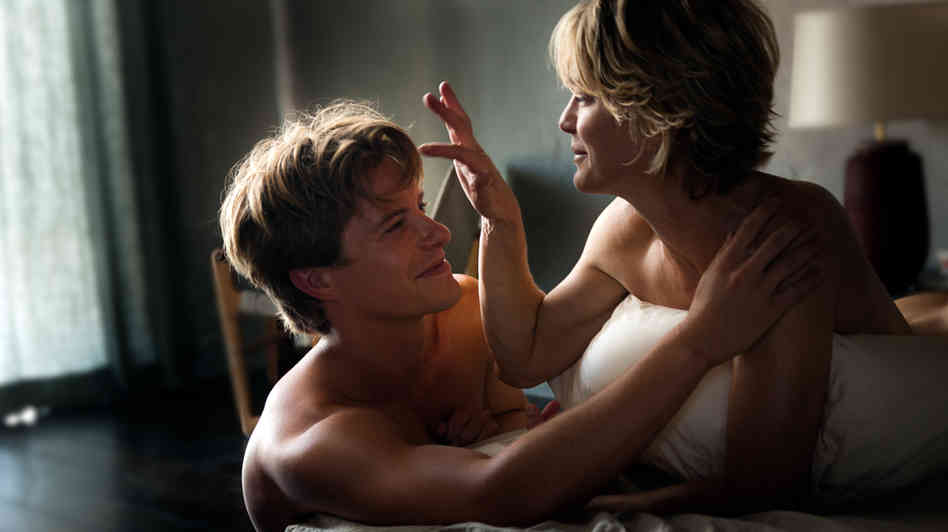
Ian comforts Roz about her aging anxieties.

Although you would think that the length of their relationships would be a testament against shallow fears, the threat of aging continues to plague Lil and Roz. Lil frets over her wrinkles in the mirror as she notices Tom’s attention straying towards a young theater ingénue. Ian sensuously traces his fingers up the back of Roz’s bare thigh as she remarks with chagrin that soon she won’t allow him to see her naked anymore. Ian assures her playfully that he won’t let her age. This type of garbage is supposed to be romantic, but I say fuck you, Ian. Validating your partner’s internalized insecurities, no matter how humorously, is not endearing or sexy. People always worry that their partner will leave them if they get old or gain weight or become disabled. Is your “true love” really that genuine if it could so easily be decimated by such superficial factors? As much as Adore attempts to champion the cougar, Roz and Lil walk a very fine line between empowered women with a healthy libido and self-martyrs consumed by their own overambitious sexuality. Tom cheats on Lil with the theater girl. That’s pretty ballsy, considering that Tom had to convince Lil to be bored/lonely enough to date him in the first place. Tom is a dick.
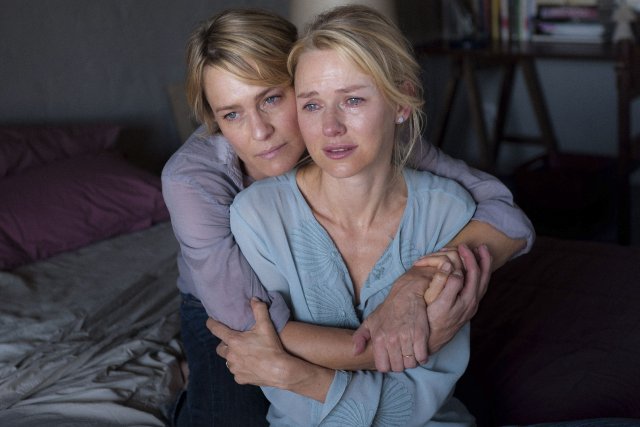
Roz comforts a distraught Lil after Tom cheats.

Lil is devastated, so in solidarity, Roz agrees that they should each dump their boyfriends at the same time since they agree it’s inevitable that they will both be ditched for a younger woman. Ian bitterly protests this decision because Tom fucking around is not his fault. I feel for him. Ian displayed a sincere passion for Roz from the start and remained committed to her, whereas with Tom, Lil was always merely a lukewarm personal pet project to piss off Roz and Ian. Tom gets married and Roz remains firm on her break up with Ian. Ian soon begins a fairly unenthusiastic courtship with a younger woman to spite Roz and try to move on. I’m glad everyone has such healthy coping mechanisms when it comes to relationships! Ian resolves to break up with the new girl until she tells him that she’s pregnant. Cringe.
Roz and Lil take their granddaughters to the beach.

A few years later, the boys each take their young daughters to the beach along with their respective wives and mothers. I half expected a flash forward to when the girls were legal and trying to seduce each other’s dads. Family fun. The dynamic is uncomfortable to say the least and the wives clearly dislike spending time with Roz and Lil. Long story short, Ian catches Tom and Lil having sex and is so outraged that he blurts out their entire history to the horrified younger women. Disgusted, they pack up the grandkids and leave, warning the group to never contact them again. I don’t think that’s how custody works. Roz and Lil decide they can’t fight fate and the foursome is shown sunbathing together once more, presumably coupled up again. Even if they had to jump through some stereotypical hoops, it’s nice to see relationships between older women and younger men taken seriously and given a legitimate future.

Bitch Flicks’ Weekly Picks

How Cartoons Inform Children’s Ideas About Race by Federico Subervi at Huffington Post

TV can make America better by Jennifer L. Ponzer at Salon

“Where’s the female Woody Allen?” by Heather Havrilesky at Salon

There’s No Excuse For Misogyny In Space by Helen O’Hara at Empire Online
Pondering Roseanne on its 25th Anniversary by Alyssa Rosenberg at Women and Hollywood
What have you been reading/writing this week? Tell us in the comments!

Bitch Flicks Weekly Picks

How Cartoons Inform Children’s Ideas About Race by Federico Subervi at Huffington Post

TV can make America better by Jennifer L. Ponzer at Salon

“Where’s the female Woody Allen?” by Heather Havrilesky at Salon

There’s No Excuse For Misogyny In Space by Helen O’Hara at Empire Online
Pondering Roseanne on its 25th Anniversary by Alyssa Rosenberg at Women and Hollywood
What have you been reading/writing this week? Tell us in the comments!

The Bronies Documentary is Borderline Propaganda


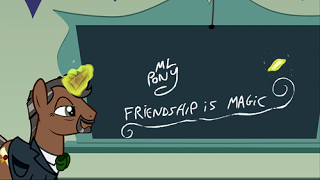
Professor Pony educates the audience about “My Little Pony: Friendship is Magic”


Written by Myrna Waldron.

I watched My Little Pony: Friendship Is Magic for two seasons. It’s a genuinely good show, with influences from Powerpuff Girls, Sailor Moon, and other television intended for young girls. It occupies an important cultural spot, since we all know just how hard it is to find well made, well written and non-condescending entertainment for young girls. Having been born in the mid-80s, I did watch at least one of the earlier generations of My Little Pony, but all I can really remember of it was that I found it pretty saccharine, (and I couldn’t have been older than 5 at the time, so that’s saying something). Lauren Faust, the original creator for MLP: Friendship is Magic, is a self-proclaimed feminist, who explicitly intended to create a series depicting female friendship. So thumbs up to the show just based on that.

Unfortunately, on the internet, the show isn’t really known for its quality. Nope, it’s known for its vocal teen/adult male fanbase. I commend these adult male fans (known as “Bronies” – bro + pony) for being willing to ignore traditional gender roles, and appreciate a show aimed at young girls, for what it is. “Bronies: The Extremely Unexpected Adult Male Fans of My Little Pony” is a feature-length documentary exploring these fans (and was financed by them via Kickstarter), and was executive produced by Lauren Faust (the series creator), Tara Strong (VA for Twilight Sparkle, the main protagonist) and John de Lancie (VA for Discord, a Q-like villain in the first two episodes in the 2nd season). de Lancie’s intent with this documentary was to provide a contrast to the strongly negative media depiction of Bronies and depict them positively. This documentary was also intended to serve as an introduction to the fandom for those unfamiliar with Bronies.

Unfortunately for them, I’m already familiar.

I honestly tried to come at this documentary with an open mind, knowing that much of the negative media attention is directed at Bronies simply because they are men who like a thing intended for little girls. I know a few Bronies and consider them friends, so I’m well aware that many Bronies are perfectly decent people. It’s also not really THAT rare for adult men to like cute things for little girls. Hell, go into any anime convention and you’ll stumble over guys like this everywhere you go.

But it’s very hard to shake my generally negative opinion of Bronies – at least, my negative opinion of the bad ones. And there are a lot of bad ones. The fandom started on notorious forum 4chan, when the first fans decided to watch the show as a joke and ended up loving it. 4chan is a hive full of racism, sexism, ableism and just about every other “ism” you can think of (mainly because posts are automatically anonymous – anonymity turns people into assholes so easily), so it’s not surprising that there are some shitty people amongst Bronydom. A few months back on Tumblr, someone asked me to explain why I have a generally negative opinion of Bronies. I am yet to see any sort of improvement on that front, and every time I speak out against shitty Bronies on Twitter, someone always inevitably replies to my tweet and complains that “We’re not ALL like that!” as if I wasn’t aware. Not one of them has ever said to me, “Yes, there are a lot of terrible people. And if I see someone acting like that, I’m going to call them out on it.” It’s always defensiveness rather than proactive behaviour to genuinely try to improve Bronies’ reputation.

This film sets out to present Bronies as decent people who are inspired by the show’s messages of friendship to be kinder, friendlier, and more accepting of people. Okay, great. I’m all for that. But this film is unfortunately borderline propaganda, because there are some editorial decisions that blatantly come off as disingenuous to anyone who actually pays attention to the media they consume. As I said after finishing my livetweet of the film earlier this week, this film would have been so much better if it were honest. It tries so hard to solely present Bronies as great people that it’s just insulting. It’s been a long time since documentaries had any sort of obligation towards objectivity, but there’s a limit.

THE GOOD:

  • I genuinely liked the Bronies they decided to interview for the film. I sympathized with how each one felt like a social outcast before discovering the series, and how much they appreciated how the fandom introduced them to friendships they never would have had otherwise. I was expecting to want to loathe these guys, (especially since within a minute of the film’s beginning there was already a stereotypical fedora) but, I didn’t.
  • A main objective of the film was to demonstrate how the series inspired creativity from its fans. “The Living Tombstone”’s music didn’t do a thing for me, but I could see why people liked it. There was one Brony who created custom laser shows, which were really cool. The lone female Brony (or Pegasister – more on her later) they interviewed also creates custom figurines for the characters. There’s an enormous amount of talent shown here, and it’s great that they found something that inspired them.
  • Two teenage Bronies who were extensively interviewed (one from Bar Harbour, another from England) have wonderfully supportive parents. The parents admit they don’t completely understand their children’s hobby, but they did what they could to make their sons happy. The Bar Harbour Brony’s parents actually came with him to BronyCon, and his father had an extensive conversation with another father of a Brony, and ended up enjoying the show when he finally sat down to watch it.
  • The English Brony also happens to have Asperger’s, which is depicted fairly here. Much of his “storyline” is concerned with his solo trip to the UK Brony convention in Manchester, and how he was trying to avoid as much social contact with others as possible until he got to the con. I wondered how this was going to work, since if he was too petrified to even ask for directions, how was he going to handle interacting with hundreds of strangers in an enclosed space? The happy ending to this was that he realized that asking strangers for directions was no big deal, and having met tons of other like-minded people, it gave him confidence he’d never had before. The latter event didn’t surprise me, as I’ve seen lots of introverted people blossom into confident and exuberant people while at geek cons. The drawback to this, though, was that they regressed back to their “usual” selves once they were back in the real world.

THE BAD:

  • Another teenage Brony, this time from North Carolina, had ordered some pony decals which he’d put in his car’s rear windshield. Unfortunately, a gang of rednecks accosted him while he was driving, and started bashing up his car with baseball bats and tire irons, and smashed in the rear windshield. This was a borderline hate crime, since the rednecks demanded that he give up his “gay Pony shit” (if I’m quoting them correctly). This was awful enough to hear about, but how the Brony decided to deal with this incident made me feel a further combination of sadness and anger. Instead of telling his father the truth, he told him that he’d gotten into an accident. He also did not report this crime to the police. I can certainly sympathize with how ashamed and mortified he must have been feeling, but his lying probably cost his parents extra in insurance costs, and allowed those rednecks to go on to attack someone else. He lives in a small town – he wasn’t obligated to report the crime, but he would have had an easier time than others identifying the perpetrators. I fear for those rednecks’ next victim, because I know there will be one.
  • More than a few of the Bronies were willing to lie to their parents about their hobby. And I see this as a failure on the parents’ part, because they should be willing to accept any of their children’s interests and not immediately jump to the “He’s gay/He’s a pedophile” conclusions. If there’s that little trust over merely liking a children’s television show, something’s broken there.
  • Near the beginning of the film, a “Professor Pony” (who is implied to be de Lancie’s character Discord in disguise) gives a quick run-down of the previous generations of My Little Pony. And bashes every single one. There were fans of the earlier generations of the show before Bronies came along. And he just insulted them. Film, meet finger. It was played off as comedy, but he actually refused to discuss the third generation of MLP entirely. The Professor Pony is supposed to be giving facts, not opinions. That whole “LOL the previous generations sucked” thing just put a bad taste in my mouth.
  • At no point did any of the fans discuss how they felt about the characters, their interactions, go in-depth about the messages of the show, etc. It was all “This show is good and it makes me want to be a good person.” None of them talked about how they gained a new appreciation or respect for girls/women. It was only a writer on the show who expressed that she liked that Bronies were learning that girls/women are capable of doing awesome things just as much as boys/men are. I would have liked to hear that from a BRONY.

THE UGLY:

  • I get that the film was about the unexpected male fans. But to ignore the female fans for a show intended for GIRLS was just insulting. There were two “Pegasisters” interviewed: “Purple Tinker,” the founder of BronyCon (so, not an average fan) and Nadine, a fan from Germany. Wanna know why Nadine was interviewed? Because she met her future fiance at a Brony meetup. (facepalm) And she was the fan designated to bring cupcakes to this meeting. (double facepalm)
  • And it got worse. Midway through the film, a quartet of female ponies interrupted the Professor Pony and angrily pointed out that Pegasisters contribute to the fandom too. Professor Pony stutters that “Girls liking ponies is expected.” And…then no examples of the Pegasisters’ creative efforts are explored, beyond Nadine’s figure sculpting. SERIOUSLY? A few female fans are interviewed at BronyCon, but NONE of them are named. Not one. Not even the one who discussed how the show helped her cope with cancer treatment. If I were a Pegasister I would have been insulted.
  • The subtitles used for some of the dialogue were inconsistent and even condescending/insulting. “The Living Tombstone,” a musician Brony from Tel Aviv, had every one of his lines subtitled, even though he was speaking ENGLISH. And his accent wasn’t that strong. I understood what he was saying just fine. Nadine’s stepfather was expressing a negative reaction to MLP and his stepdaughter’s hobby, but his words were not subtitled. For god’s sake, do they think the audience is stupid? His body language was angry/exasperated, and I understand enough German to know he wasn’t saying good things. Crap like that is why I consider this film borderline propaganda.
  • The Professor Pony briefly references fanfiction shipping and “clopping.” Clopping is masturbating to Rule 34 porn of the characters, sort of like “yiffing” for furry porn. But although the class halts and looks horrified, the Prof just skates right past the reference and ploughs on. Yeah, no. If they’re going to comedically reference the darker side of the fandom, it’s disingenuous to deliberately ignore it.
  • And that is my biggest issue with this film. It’s dishonest. It doesn’t acknowledge the racist, misogynistic, pedophile, homophobic, transphobic etc ponies. Purple Tinker is a transwoman, but they never discuss the hatred some Bronies have thrown at her. They don’t discuss the torrents of Brony abuse that was thrown at fanartist yamino because of the mistaken belief that she had something to do with Hasbro changing the in-show depiction of fan character “Derpy Hooves.” (I JUST checked her deviantART page and someone had actually posted a comment within the last few days saying “You killed Derpy. I hate you.” Oh my god.) Speaking of Derpy, they show her in the front row of the university scenes, but they don’t discuss her at all. Probably because she’s a creation that is ableist as hell and the producers know that if they bring that shit up it’ll make Bronies look bad.


There is merit in pointing out that there’s nothing wrong with adult males liking a well-made show for young girls, and there’s definite merit in trying to break down the gender barriers of entertainment. But I don’t like many of this documentary’s editorial decisions. If I were a Brony, I would have felt uncomfortable that each one who was interviewed was a social outcast, which perpetuates a nasty stereotype. If I were a Pegasister, I would have been insulted at how little the producers valued my contributions to the fandom. As an outsider with a large amount of familiarity with the series and its fandom, I’m insulted at how stupid the producers appear to think their audience is. If this is supposed to change public perception of Bronies, it’s doing a terrible job.

—-

This will be my final column for Bitch Flicks, at least for now. As I mentioned earlier this summer, my chronic illness is making it more and more difficult for me to write, and to keep to a regular schedule. I do not intend to stop blogging, but any future posts from me will be on my personal blog and will not be subject to any kind of deadline. (I may cross-post some of them however) The last few months have been much too stressful for me, and my condition is so unpredictable. I had to make a tough call, and reluctantly decided to walk away. But this is an “indefinite hiatus” as opposed to a “goodbye forever.”

I am tremendously grateful for the opportunity to share my thoughts with like-minded feminist film fans, and I’m grateful to every person who reads my work. I am hoping that someday my fibromyalgia will go into remission and I can go back to regular blogging, but for now, I have to put my health first.

Thank you.


Myrna Waldron is a feminist writer/blogger with a particular emphasis on all things nerdy. She lives in Toronto and has studied English and Film at York University. Myrna has a particular interest in the animation medium, having written extensively on American, Canadian and Japanese animation. She also has a passion for Sci-Fi & Fantasy literature, pop culture literature such as cartoons/comics, and the gaming subculture. She maintains a personal collection of blog posts, rants, essays and musings at The Soapboxing Geek, and can be reached on Twitter under @SoapboxingGeek.


‘Bend It Like Beckham’ And The Lesbian Hate Debate

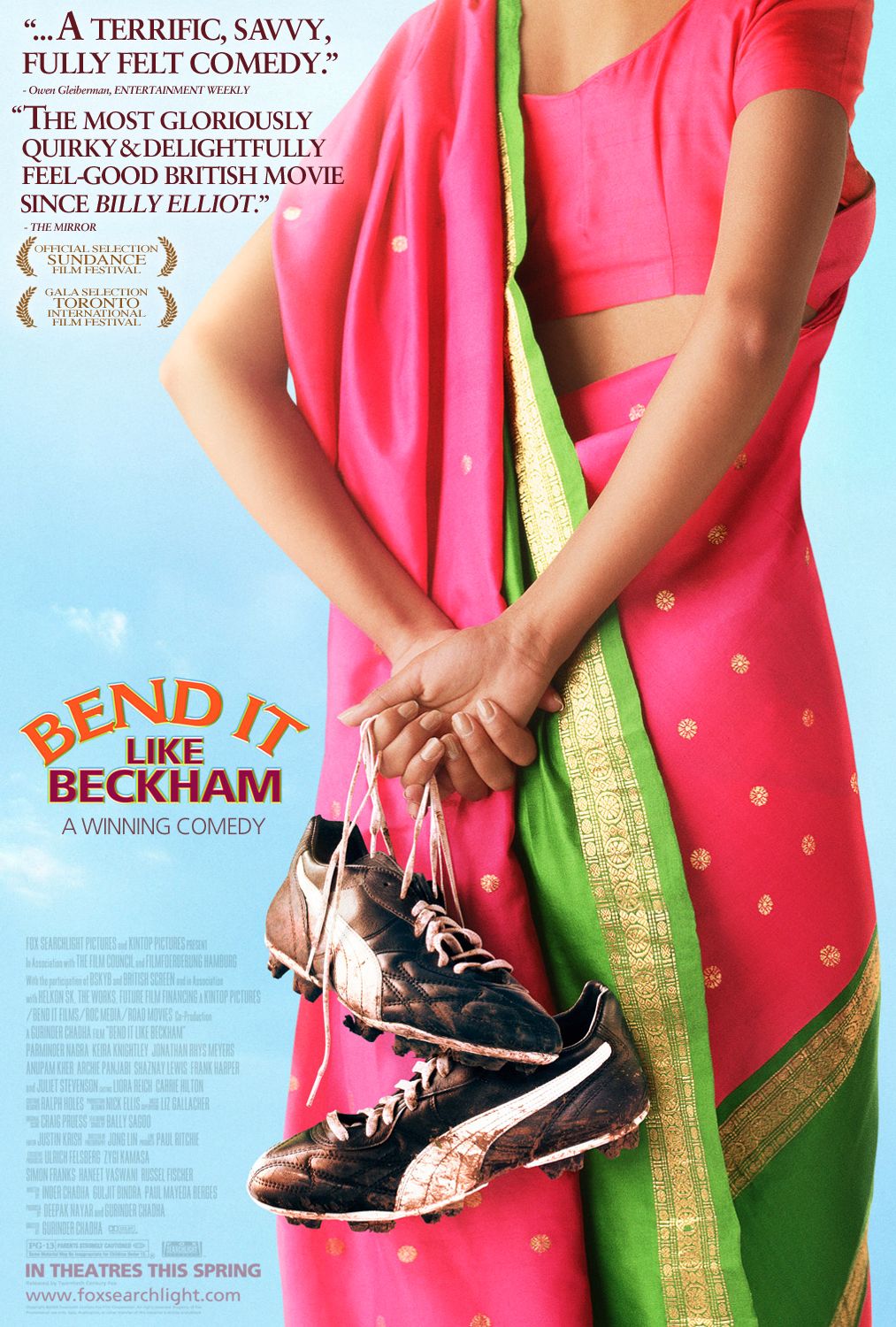
Bend it like Beckham film poster.

Written by Janyce Denise Glasper

“You bitch!”

This thunderous exclamation seems to occur every five minutes. If a girl is way prettier, she’s a bitch. If a girl “steals” a man of a girl who isn’t even dating that said man, she’s a bitch. If a girl is thought to be a lesbian, she’s a bitch. Twice Jesminder “Jesse” Bharma, Bend it Like Beckham’s football loving protagonist, has been on the receiving end of the blow, but I started to lose sight of this supposedly empowering feminist sports movie due to the infinitely alarming amount of lesbian hatred disguised as harmless humor. To be a lesbian is a bitch? Really? Why?

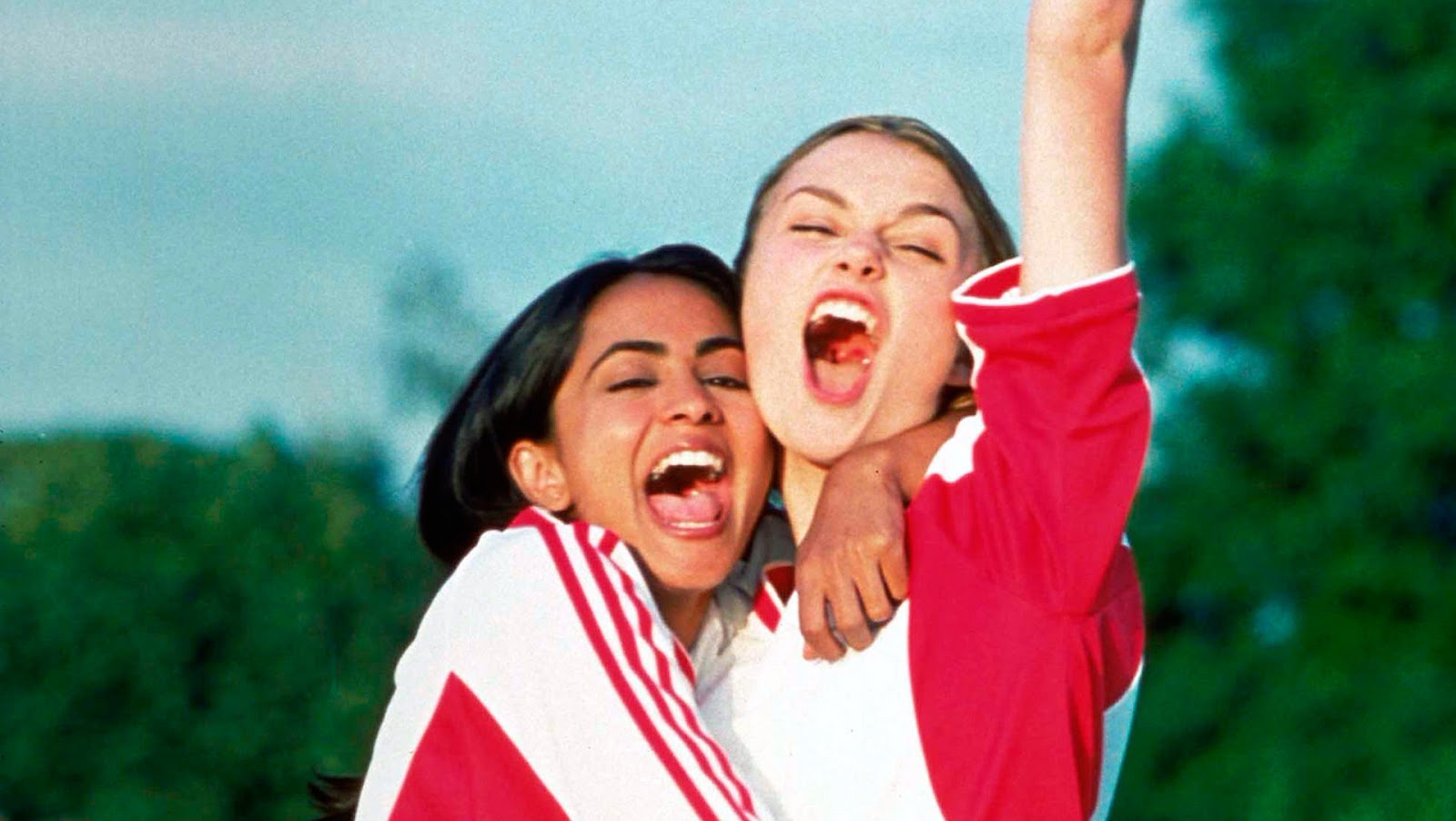
Joe the coach (Jonathan Rhys Meyers) makes damn sure that Jesse (Parminder Nadra) is no lady lover.

Lesbianism appeared to be an invisible villain to both Jesse and her equally talented teammate, Juliet “Jules” Paxton—a horrendous nasty vile “disease” that could only arise from women who enjoy contact sports.

In Gurinder Chadha’s debut feature film, Jesse is inspired by David Beckham and has his posters and jersey decorating bedroom walls. She wants to emulate his prowess and expertise on the football field and certain people think that it’s not only his athleticism that propels her. She might just like women too. Jesse’s mother hates that she doesn’t want to be called “Jesminder” or act more feminine and domesticated.

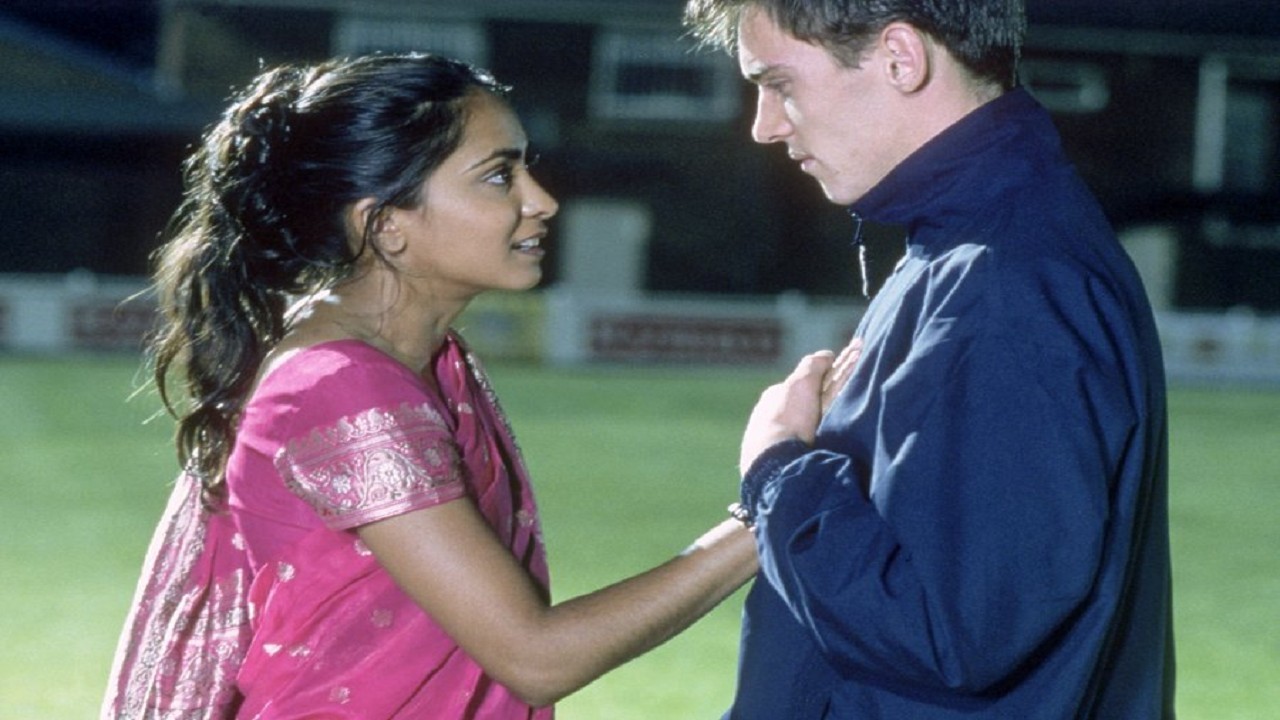
“We aren’t lesbians! We both love Joe!” Jesse (Parminder Nagra) and Jules (Keira Knightly) should have chanted.

Jules notices Jesse’s skills against the boys and asks her to join a local team. Jesse eagerly agrees and plays in secret, knowing that her parents would greatly disapprove. Jesse and Jules start to build a positive relationship with Jules schooling Jesse on the amazing Mia Hamm, one of many American women football players in action. The close twosome begin sharing dreams of becoming an active member of the overseas sports team.

Jesse’s parents and Jules’ mother Paula are horrendously incomprehensible characters for sexist views about women’s lock length.

“They wear their hair so short these days, you can never tell,” says Jesse’s mother, twice.

This supposed to be a joke, but why?

Hair length is such a sensitive topic to women, especially when length is close cropped and called “boyish.” No one ever seems to really comprehend the meanings behind hair and what it truly says about someone. Whether a woman likes it away from their face, hate strands touching their butts, donates tresses to worthy causes, wears a protective scarf, or battles cancer or other form of loss, hair is worn differently by all women of all cultures and creeds and shouldn’t be a mark set against them if it’s above shoulders or just plain bald. Feminism should not be marketed towards hair, but unfortunately it always has and will be. Lesbians also wear their hair in various styles and the short hair cut is so beyond stereotypical. It isn’t that powerful to make fun of a group of women or use them as a catalyst to drive laughter. Lesbians also are people too– not a dirty circumstance.

When Pinky’s wedding is called off due to her fiance’s parents seeing Jesse and Jules “kissing,” Pinky is enraged and calls Jesse a bitch for ruining her life. So yes, lesbianism is so treacherous, it gets in the way of events like holy matrimony. Chadra’s co-written screenplay entails all the wrongs of same sex pairings, using misunderstandings as trivial humor– seen by both Jesse and Jules’ reactions to hearing that their families believe them to be drawn together and not to boys. It fails miserably at being sentimental to lesbians as a whole.

Jesse (Parminder Nagra) and her sister Pinky (the awesome Archie Panjabi) both look surprised by Paula (offscreen Juliet Stevenson) announcing that Jesse is part of a lesbian couple with Jules.

“Mother, just because I wear trakkies and play sport does not make me a lesbian!” Jules tells Paula, as if lesbianism the most foul label ever.

Bitch is fine. But lesbian is a slap to the cheek.

Paula was the absolute worst.

Now what if Jules really were a lesbian? If I were in Jules’ shoes (or cleats), I wouldn’t explain a damn thing to rude, insensitive Paula. For Paula to coldly burst into Pinky’s wedding and “call out” Jesse wasn’t exactly classy even if she tells Jules that she wouldn’t have minded Jesse and Jules being a couple. However, didn’t she not just yell for Jesse to get her “lesbian feet” out of her shoes? That doesn’t sound like someone who would’ve been supportive.  Perhaps this is to be a humorous notion (still finding it hard to laugh), but politics on a woman’s style of hair and dress to be considered masculine instead of powerful and sophisticated is outrageous! Not only can’t women have short hair without being labeled manly, we cannot wear pants everyday because that’s an acute sign of lesbianism! Oh and if we play sports especially football, we might not like boys…..

It’s a shame that Jesse and Jules’ fallout had to be over a man– Joe, the coach.

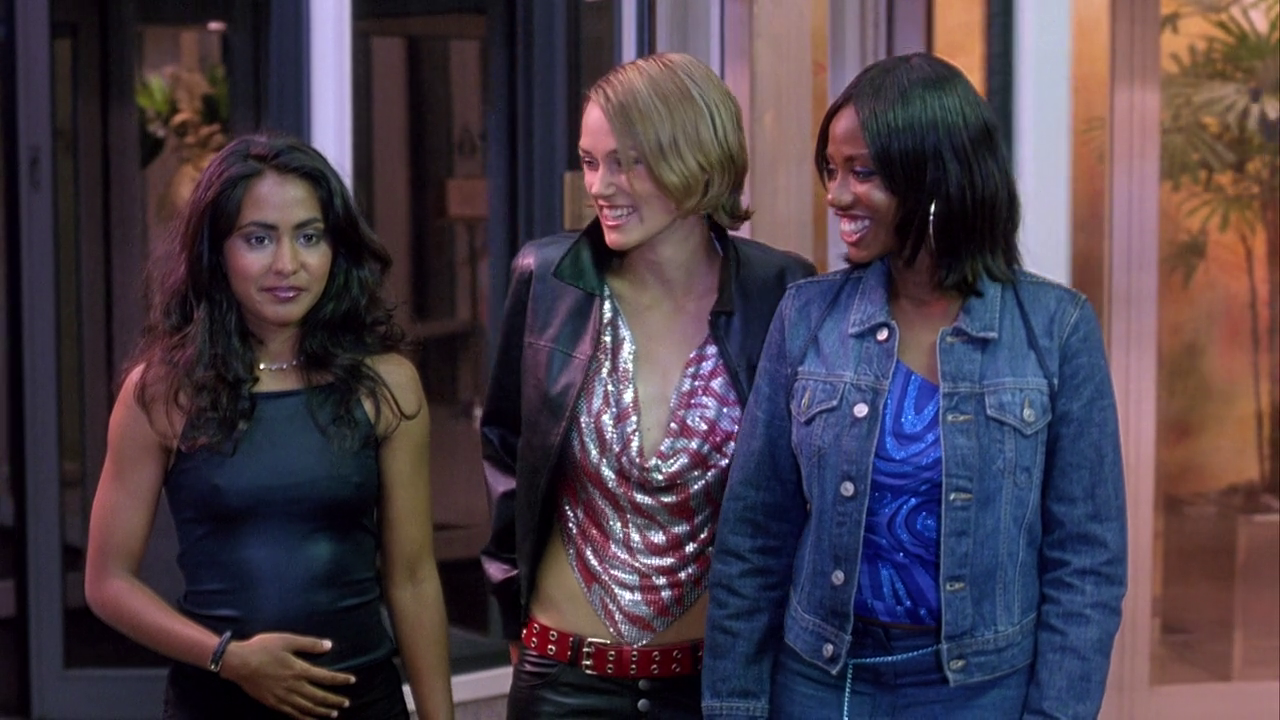
Joe is going to see Jesse (Parminder Nagra) in a new light thanks to “The Makeover” by Jules (Keira Knightly) and Mel (Shaznay Lewis). 

Joe trained Jesse hard on the playing field and shared a couple of his old football glory days prior to injury, but the moment Jesse wore makeup, a form fitting nearly backless number, and long wavy hair cascading about shoulders, he gazed in that beseeching manner that is supposed to be considered romantic. Awww. He really likes her outside of uniform and ponytails.

Pish posh!

This just truly means that her fuckability status moved up and sports took an immediate backburner!  All of a sudden Jesse is hot stuff and Joe wants to have his sample, asking her to dance and almost taking advantage of her drunken state at the club celebration. Now the film has switched over from thrilling lady sports to a man getting his power on–  thankfully for a few minutes at a time. A friendship gets spat on over a man. It becomes war between Jesse and Jules and that “you bitch!” comes bursting out like a launching torpedo—expected but crappy nonetheless. Jesse and Jules make it abundantly clear that they don’t want each other, but they sure do want that Joe.

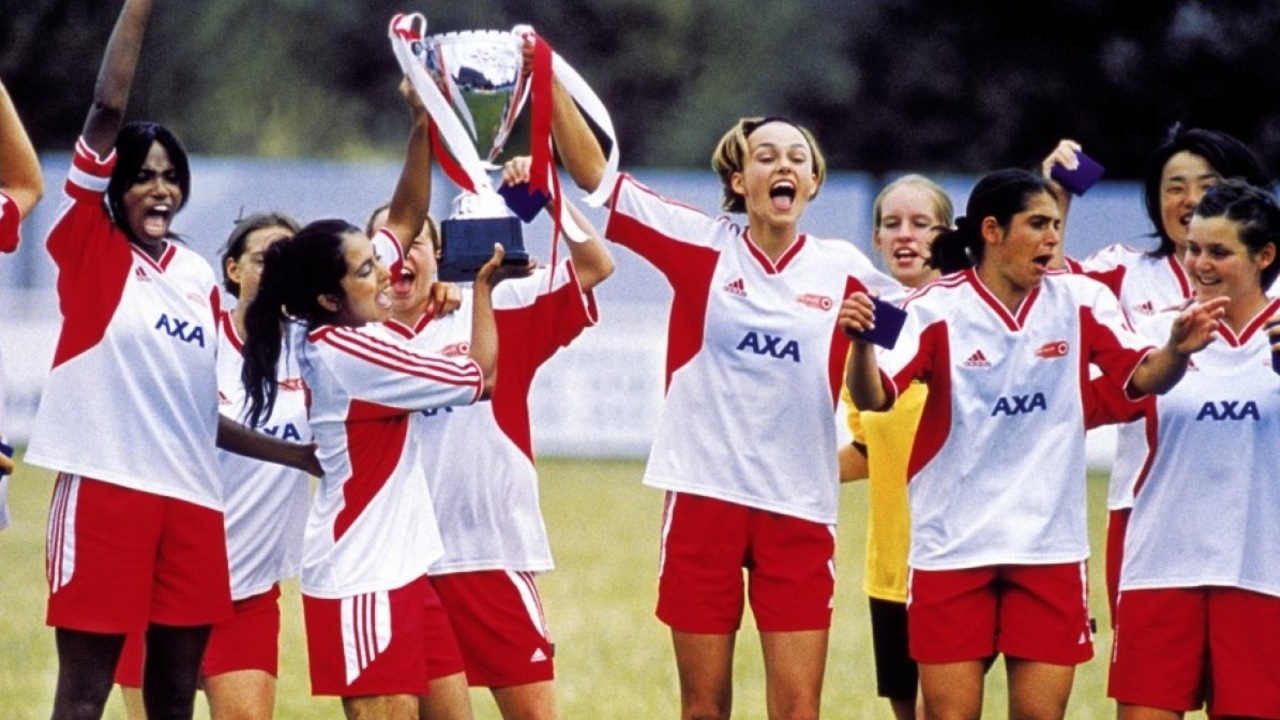
However, pissed over the typical women falling for the same man BS, I respect that they don’t battle over the spot for the American team. Irate Jules took the time to seek out Jesse because she knew that Jesse was needed. When they played football, they were in it together, functioning, reacting, and showcasing talents together, victorious champions on the field, telling the world that women can kick around a soccer ball, that their dainty feet can work just as craftily and aggressively as a man. They put differences aside with cleats, game faces, and their other female counterparts to take on one hell of a win! Jesse and Jules prove that just because playing sports is considered a masculine way of showcasing aggression, women too can be rough, wield scars, and sweatiness.

Those kisses? Those hugs? That’s a female’s version of the butt taps that male athletes do. Why factor more into that?

The girls win big!

After all, the moral of the story is that girls can play sports and like boys– not be one of those scary lesbians!

I applaud Chadha’s direction, but let’s lay off the meanness next time.

The Bechdel Test and Women in Movies

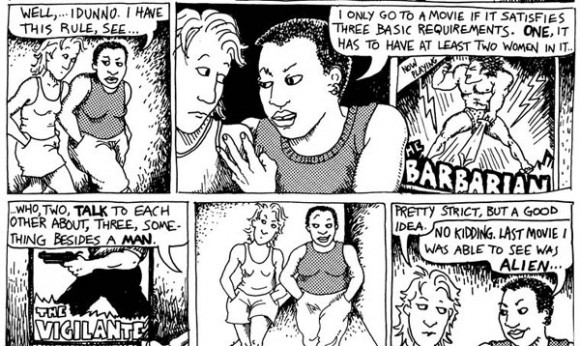
The original Bechdel Test

This piece by Magda Knight originally appeared at Mookychick and is cross-posted with permission.

A 1985 comic strip by US cartoonist Alison Bechdel, Dykes to Watch Out For, features a character who says they’d only go to see a movie on three conditions:

  • The film has at least two named women in it 
  • Who talk to each other at some point in the film
  • About something other than a man
The idea of the Bechdel Test caught on, and you can now visit the Bechdel Test Movie List, a giant community-run resource that catalogues over 4,000 films which have women talking to each other about not-man things. I highly recommend you check out it out. Partly because it’s really interesting and eye-opening (Straw Dogs just makes it), but mainly because you’ll see passionate and lengthy discussions of the merits of My Little Pony: Equestria Girls and whether the lead females, being ponies, pass the test. AND OH, THEY DO. THE NATURAL ORDER OF THINGS IS RESTORED.

My Little Pony: Equestria Girls

How do I feel about the validity of the Bechdel Test? My only reservation about it is that I think it’s terribly neat, and I fear tidy things because, as Erma Bombeck said, “My idea of tidy is to sweep the room with a glance.” Tidy is not something I demand of my hair, my house, my film theory or my beliefs. Tidy is rigid, and life ebbs and flows like a vast, floppy, wet and ultimately quite messy ocean teeming with potential and things with too many legs and other things, also with probably too many legs, all of which I’d honestly rather not have to tidy up. If you’re something with that many legs, you can tidy up after yourself. I’ll be on the sofa reading a book.
Einstein believed the universe would eventually boil down to just one universal constant, but I don’t even think art can be condensed into one neat little set of rules, however awesome they are. After all, Fight Club is one of many excellent movies that fails the Bechdel Test, and I’m not going to harsh on Marla the Magnificent’s buzz for not talking to any women in the movie. Hot damn, Marla.

Helena Bonham Carter as Marla in Fight Club

  
Bride Wars, on the other hand, gets a flying pass, and it’s a hideously cynical chick flick about two “best friends” who have sculpted their life ambitions around weddings. They discover they’re booked into the same hotel for a wedding on the same day and turn on each other like rabid dogs and dye each other’s hair blue without asking first because HEY THAT’S WHAT WOMEN BEST FRIENDS DO. The first rule of Fight Club is you don’t talk about Fight Club (unless it’s to gush about the wonderfully dark things it says about the human condition). The first rule of Bride Wars is, obviously, to just not watch it.

What I really do love about the Bechdel Test is the wonderful questions it encourages us to raise. I think it’s excellent for filmmakers and screenwriters to have in the back of their minds: Hey, wouldn’t it be nice if this film I’m creating had some women who talked to each other? Whose lives didn’t triangulate around men like bogeys on a radar screen?

Anne Hathaway and Kate Hudson in Bride Wars
A study by the University of California looking at the 100 most successful box office films in 2012 found that just under 30% of the speaking roles were for women, and nearly 30% of those had revealing clothes, a figure which jumped to 56% for teenage girls. And never mind the clothes–how many of those speaking roles were for first or second billing, I wonder, and how many of them involved saying something other than, “We showed each other our private parts yesterday so let’s talk about where this relationship is headed, Dave,” or “Honey, of course you’ll make it through the robot jungle alive. I knitted you a robot handkerchief for good luck; now kiss me, you great big loveable robot fool”?

Helen Mirren
2013 has been a particularly tricky and vocal year for women in films and visual entertainment: 
  • In March, Helen Mirren publicly criticised Sam Mendes for not including any women filmmakers in his list of inspirations and spoke out against the lack of women in the film industry when accepting her Empire Legend Award. BOOM.
  • Professor Maggie Gale of the University of Manchester revealed to the Daily Telegraph that more plays were written by women in the Sufragette era than there are today.
  • Thandie Newton told CNN how she’d been forced to have a movie camera stuck under her skirt as a teenager for a screen test. And how the resulting footage had been played to other people privately. Eurgh.
  • Audrey Tatou (Amelie, The Da Vinci Code) told the Radio Times that she decided not to pursue a Hollywood career because she did not want “every single millimetre” of her body being scrutinised, because the Hollywood approach to an actress’s figure was “unforgiving.” If even Audrey Tatou feels she can’t aspire to be Audrey Tatou, what chance does a young female actress following in her footsteps have?
  • It’s not just western cinema, either; Aruna Irani has spoken out against the lack of good roles for middle-aged women in Bollywood, saying, “There is no role for female characters, especially of my age group. Actresses like Hemaji, Rakhiji and Moushmiji, they all are just at home. And if sometimes they get the chance to be part of a film, then that is for three or four scenes.” 
Audrey Tatou

It’s almost a case of: if you’re a young and talented actress, you better make the most of those apples in your cheeks while you’ve still got them, apple-face, because only three women of your generation will get to be Maggie Smith or Helen Mirren, and you’re going to be expected to fight other actresses tooth and nail–almost as if you’d booked a wedding in the same place on the same day–to be one of them. And that percentage of women with speaking parts in film? The number’s been going down since 2009, not up. Speaking roles for women in film are currently at their lowest in five years.

Sony’s Amy Pascal, who ranks 14th on Forbes‘ 20 Most Powerful Women in Business list, gave a really interesting interview on closing the pay gap between men and women in Hollywood, and why women get paid less than men. I literally couldn’t figure out how to fit that into this article tidily (see above), so I’m just going to throw it in there. Enjoy!

Sony’s Amy Pascal

If we take some positives from this…
  • If you’re creating a film or play, consider the Bechdel Test. Could your script do with more speaking parts for women? Even older women? About non-man things?
  • If you’re not creating a film or play but have always wanted to, give it a go. There are more Jane Campions and Kathryn Bigelows out there in the filmosphere, and one of them might be you.
  • If you’re an actress, ALL POWER TO YOU. Things will be addressed, and they will get better. If it gets to the point where you’re giving an interview to CNN or accepting an Empire Legend Award? It’s not just acknowledgement for your talent and hard work, it’s a platform. If you speak out, people will hear you… 

@MagdaKnight is the Co-Founding Editor of Mookychick. Her YA fiction and other writings have been published in anthologies and in 2000AD. She likes you already, so Email her and say hi, or visit her blog. She is on Google+.

Queer Infatuation in ‘Farewell, My Queen’

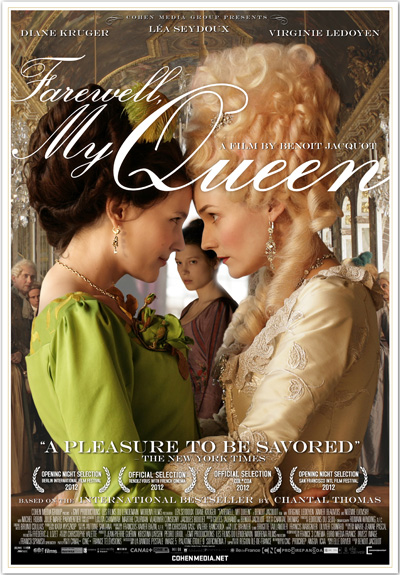
Farewell, My Queen

Written by Erin Tatum.

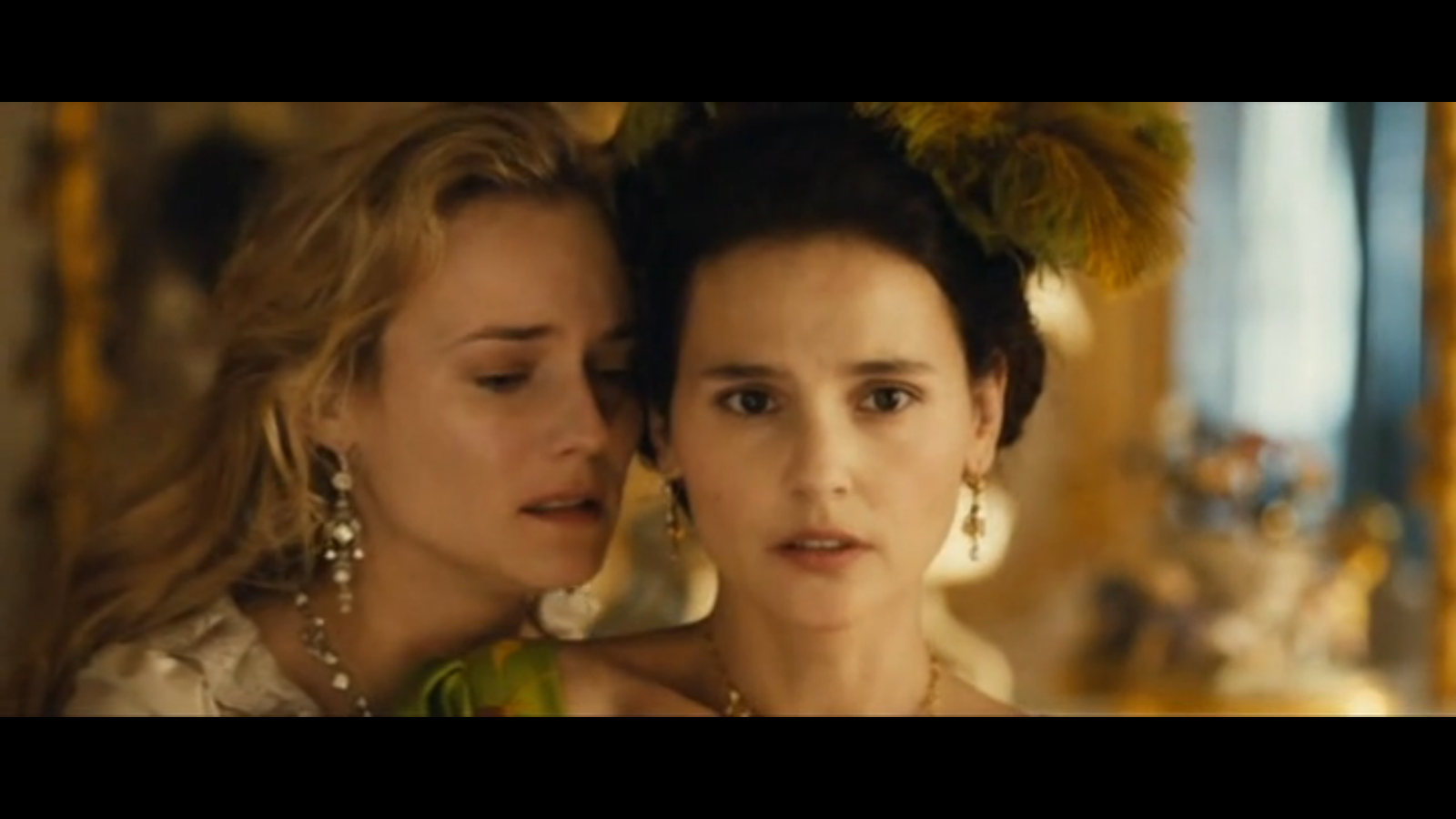
Farewell, My Queen has been on my to-watch list for a while. I’m a sucker for the opulence and pretty costumes of period pieces. Really, you could assemble the worst cast imaginable and I’d probably still watch to drool over the outfits. The narrative chronicles events in Versailles on the eve of the French Revolution from the perspective of the Queen’s reader, Sidonie Laborde (Léa Seydoux). Sidonie displays fervent loyalty towards Marie Antoinette (Diane Kruger) and jealously monitors the ups and downs of her intimate friendship with Gabrielle de Polastron, Duchess of Polignac (Virginie Ledoyen). Personally, I loathed Sofia Coppola’s airheaded incarnation of Marie Antoinette and found Kirsten Dunst to be insufferable. I understand that there is a popular perception of Marie Antoinette as childish and self-indulgent, but there’s a difference between that and feeling like you’re watching the 18th century equivalent of a Manic Pixie Dream Girl drop a tab of acid and run through fields for two hours while rap music plays in the background. Anyway, I digress. The point is that I was excited for an authentically French take on the story.
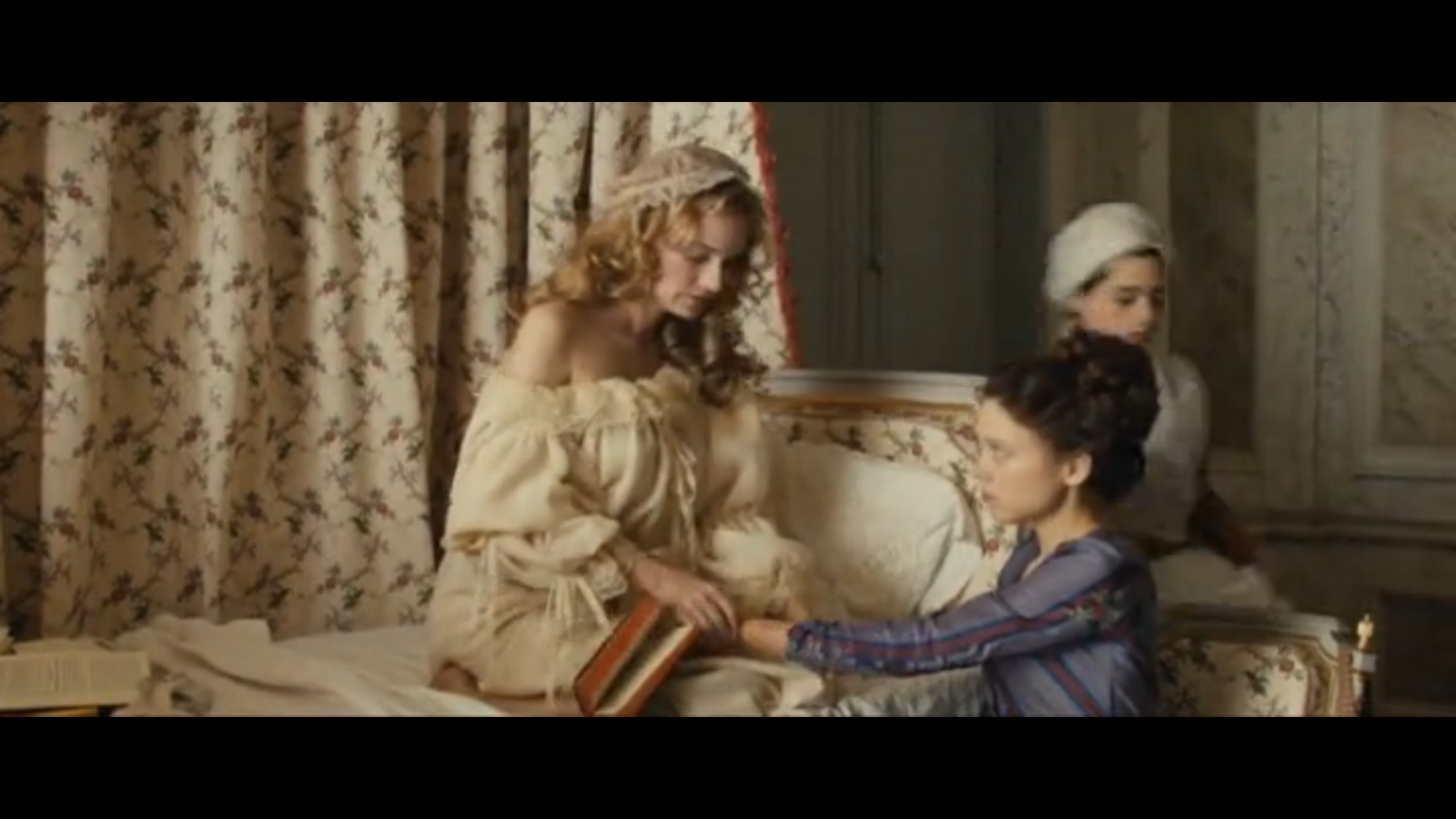
Marie Antoinette (left) and Sidonie (right) bond over medical treatment.

The trailer for the film would lead you to believe that the central plot is the lesbian love triangle to end all lesbian love triangles. As such, for once I may have gone into a film with my queer expectations a little too high. Sidonie has an ambiguously romantic obsession with Marie Antoinette, who in turn is fixated on Gabrielle, although none of the women’s feelings for each other are ever made explicit. Neither Marie Antoinette nor Gabrielle seems to notice their admirer in that way. This always ends well. Sidonie’s official duties include reading aloud to the Queen, which is a gangly metaphor for the former’s intellectualism and the allegedly cerebral bond between the two. Sidonie’s infatuation with the Queen is ignited after Marie Antoinette insists on rubbing rosewood oil on Sidonie’s pesky mosquito bites. Only in the personal hygiene vacuum of the 1700s would this gesture be considered sensual or sexy.
Sidonie takes a ride on a gondola and the suave gondolier attempts to hit on her by sharing juicy Versailles gossip. He mentions Marie Antoinette’s preoccupation with Gabrielle and insinuates that he has been sleeping with Gabrielle, all the while still trying to smooth talk his way into Sidonie’s stockings. Was it really that easy to sleep around in the 1700s? I’m assuming it’s meant to be a commentary on the boredom and hedonism of the French upper-class, but still, given the religious zealousness of the time, it’s difficult to believe that adultery is idle chit chat. Sidonie pouts in response to the outside confirmation of her worst fear – that Marie Antoinette loves someone else. The most bizarre thing is that we’ve barely been introduced to the women or any of their dynamics at this point, so her wounded reaction feels unwarranted. 
Sidonie approaches a group discussing a propaganda pamphlet. 

Meanwhile, the atmosphere at the palace becomes tense when everyone gets word of the storming of the Bastille. This is truly the heart of the film’s main thrust, as servants, aristocrats, and the royal family alike wait for their gilded world to come crashing down around them. The atmosphere teeters between nervous anticipation and chaos, even as the lavish rituals continue as normal. Farewell, My Queen really comes into its own as a critique of the vacuous and self-destructive denial of the elite with regard to the shifting status quo, which would have been more than substantial enough to carry the premise. I don’t understand why the love triangle was marketed and propped up as the core drama of the narrative, other than for poetic depth. Whether or not you buy into the rumors that Marie Antoinette was queer, the idea is undeniably fascinating. As a society, we tend to view Marie Antoinette’s lifestyle as the pinnacle of our materialistic fantasies, so it’s titillating that the woman who has it all would only find true fulfillment in love objects that were doubly forbidden by way of lesbianism and adultery. However, the execution is lukewarm and its intrigue pales in comparison to that of say, I don’t know, the French Revolution.

Everyone starts leaving the palace in droves as they fear the collapse of the government. Nonetheless, Sidonie repeatedly pronounces loyalty to the Queen and refuses to leave her despite the protests of her more levelheaded peers and superiors. Using this love triangle as the overarching B-plot doesn’t quite work because we get a lot of telling and not showing. Sidonie constantly talks about her devotion to the Queen and other characters comment on it, but we don’t see any interaction other than the early rosewood oil scene to justify her obsession. Maybe that’s the point. Infatuation requires very little kindling. Sidonie is falling in love with her own imagination and who she projects Marie Antoinette to be – not who Marie Antoinette actually is. The exact nature of Gabrielle’s relationship with Marie Antoinette is also unclear, but the Queen and Sidonie appear to be birds of a feather in that both women worship a mirage. This isn’t so much a love triangle as it is a chain of unrequited emotional overinvestment.

The Queen laments that Gabrielle is leaving her behind.

The king and queen hold court to announce they will not be leaving the palace. Gabrielle rushes up to the Queen for a dramatic embrace. They press their foreheads together in unspoken intimacy, ignoring the spectators as the rest of the court watches uncomfortably. Marie Antoinette pulls Gabrielle aside for a more private goodbye and Sidonie follows to eavesdrop. After some coquettish banter, Marie Antoinette abruptly changes the tone of the conversation to insist that Gabrielle leave Versailles. Gabrielle reluctantly agrees, causing Marie Antoinette to angrily accuse her of abandonment before sobbing uncontrollably. What a drama queen! Haha, bad monarchy puns.
Although Sidonie is discouraged by the clear extent of Marie Antoinette’s affection for Gabrielle, she remains determined to prove herself. The Queen asks her to go on one last, very important mission. She instructs Sidonie to dress in Gabrielle’s clothes and escape with Gabrielle and her husband in disguise so that any potential assassins will mistake Sidonie for Gabrielle and attack her instead. Sidonie balks at this plan and Seydoux effortlessly portrays the slow encroachment of betrayal and disillusionment across her features. She realizes too late that Marie Antoinette perceives her as little more than an expendable pawn to be manipulated to protect those whom she actually loves. Adding insult to injury, Marie Antoinette orders Sidonie to strip on the spot. A moment that may have once been erotic becomes filled with powerlessness and shame for Sidonie as the Queen carelessly glances over her nude body with disinterest.
Marie Antoinette pulls Sidonie back in for a little more humiliation.
As Sidonie prepares to exit Versailles as the decoy Gabrielle, Marie Antoinette calls her back. She asks Sidonie to tell Gabrielle that she’ll never forget her and gives her a chaste kiss on the lips. Given how much Sidonie purported to care for the Queen, the exchange is heartbreaking because it’s very obviously meant for someone else. The fact that the kiss is devoid of passion and occurs while Sidonie is passing as Gabrielle just pours salt in the wound. For all her starry eyed daydreaming, Sidonie learns that Marie Antoinette is just as callous and self-serving as everyone else. The Achilles’ heel of infatuation lies in the fact that you’re falling in love with your own self-constructed idea of the person and not the actual person in reality. Against the odds, Sidonie goes across the Swiss border unscathed with Gabrielle and her husband. In voiceover, she claims that she will be a nobody now since acting as the Queen’s reader was her whole identity. I guess old habits die hard.

Don’t Ignore ‘Trophy Wife’

Written by Robin Hitchcock
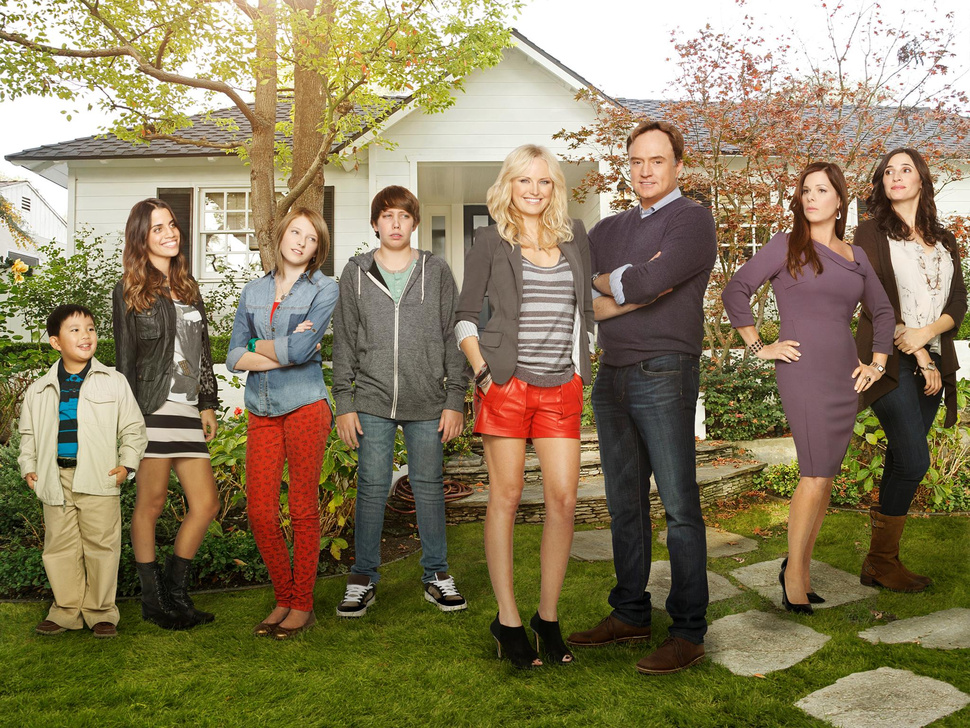
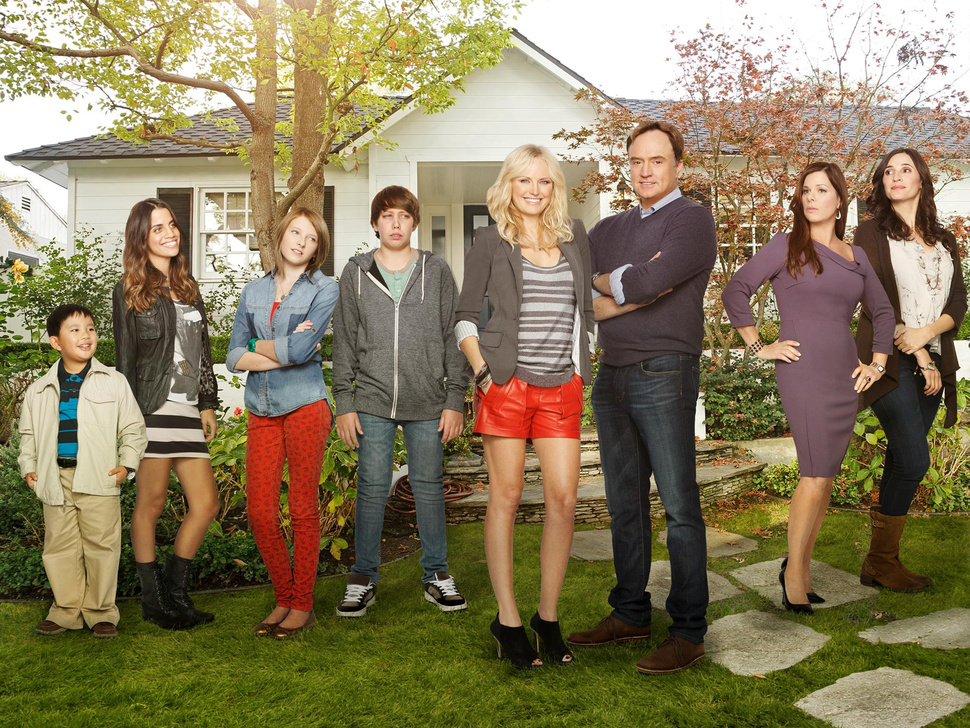
I probably could have gone an entire season, or, network willing, three or four, without really paying any attention to the existence of upcoming ABC sitcom Trophy Wife. To begin with, it is an ABC sitcom not called Happy Endings (RIP). And my cynical side assumes it got an instant greenlight for its passing resemblance to Modern Family:
The cast of Modern Family Trophy Wife
And it is called Trophy Wife. But do not ignore Trophy Wife! 
1. It is co-created by Sarah Haskins.
Of Target Women fame. I know you’ve missed her. You’ve probably cried while staring out a rainy window, silently begging for her to come back to us. And now she has. Haskins has an uncanny ability to hilariously dissect tropes, and family sitcoms are begging for the Target Women treatment. (She already got a head start with her Doofy Husbands segment, above.)
2. It is loosely based on her own life.

Bradley Whitford and Malin Akerman in Trophy Wife
Haskins married an older man who has three ex-wives, which is even one more ex than Trophy Wife‘s heroine Kate finds herself dealing with. But the important takeaway from this real-life inspiration is that Kate is loosely based on Sarah. Seeing Malin Akerman in the pilot was like watching Sarah Haskins wearing a very convincing Swedish supermodel mask. Akerman clearly sees what makes Haskins so charming and has adeptly built her character on those quirks. And the script sings with Haskins’s awkwardly funny voice.
3. The rest of the cast is also awesome! (And full of women!)
Supporting cast of Trophy Wife
The ex-wives are Oscar-winner Marcia Gay Harden and Michaela Watkins, who, incidentally, was in the same lass of short-tenured and utterly wasted SNL featured players as Casey Wilson. Right now their characters are broad stereotypes (Stern Doctor First Wife and Hippy Dippy Second Wife), but this is only the pilot, and the actresses have enough talent to develop these characters as the writing finds its footing. And it’s clear from the pilot that they aren’t just going to be antagonists to Kate, but co-parents and maybe unlikely friends.
Natalie Morales (the Middleman one, not the Today Show one) plays Meg, Kate’s best friend, still in carefree youth mode when Kate suddenly becomes a frazzled stepmother. It’s sort of the reverse of the dynamic that between Mindy and Anna Camp’s character on The Mindy Project. While that subplot never found traction, I hope we see a lot more of the changing relationship between Meg and Kate.
And the trophy husband, so to speak, is Bradley Whitford, if you’re into that sort of thing.
4. We are all getting older and maybe need to surrender to family sitcoms instead of “friendcore” (TM Emily Nussbaum) shows.
Ugh, and like, buy life insurance and wash our sheets more than once a month and stop eating Doritos for breakfast. NEVERMIND I hate this argument.
4, Take 2. It’s really funny.
You can watch the pilot now on ABC’s website.

Unconventional Women

Screening of Like the Water in Rockland, Maine
This is a guest post by Emily Best.

I am lying on the floor of a small bedroom in an East Village mansion in New York City. It’s the holding room of a site-specific production of Hedda Gabler in which I am playing Thea, and Caitlin FitzGerald (who is soon to co-star in Showtime’s Masters of Sex) is playing Hedda. We have been playing for about two weeks to sold out, packed crowds of 28 people who sit around the living room while the show happens so close to them they can feel us breathing (and we them).

We are warming up. I am reading over some sides that Caitlin is preparing for an audition the next day–for the role of a chronic masturbator. The dialogue is trite, the character non-existent. This woman who stands across from me every night in full possession of the force of her intelligence, complexity, delicacy, beauty, humor, and wrath is auditioning to play a trope. 

Director Caroline von Kuhn on set with Like the Water cast
I remember that day as the deciding factor for me. For Caroline von Kuhn–who wrote a piece for Bitch Flicks about directing Like the Water, the film we would eventually make together–I’m not sure what it was. Or for Caitlin, who was perhaps tired of being asked to audition for parts like that. Or for the other seven women who would join the production of our film, all of whom I count as dearest friends. But somehow, together we decided we would attempt to make a film about women we recognized. We would attempt to make a film about women who do not fall into one of two categories we typically see in films: the mouthy, too-smart for her own good teenager, or the emotionally stunted 35 year old for whom the solution to the world’s problems is a man. (You could add to this perhaps the oversexed Other Woman and the mean mom/stepmom.)
We wondered what it would be like to make a movie about situations familiar to us, with characters who react the way they do in life: imperfectly. But it was also important for us to include something about the nature of our friendships: funny, challenging, loving, and absolutely necessary.

DP Eve Cohen — Like the Water and Mana O’Lana: Paddle for Hope
We made Like the Water to lean against what we felt like were the conventional portrayals of women in their 20s and 30s. Until we made the film, I hadn’t gone out of my way to seek out the ways other directors were pushing the boundaries of female characters. It was only through my own experience producing Like the Water that I realized just how difficult a task it is to fund and lock down distribution for a film that bucks these conventions. So when we started Seed&Spark, I suppose it shouldn’t have come as a surprise that most of our early submissions both for crowdfunding and distribution were from women. It’s so exciting to be able to bring together a slate of films that I hope adds to the conversation about those conventions, and also what it means to be unconventional.

My good friend Anna Kerrigan made her directorial and acting debut with the film Five Days Gone, an exceptional screenplay she wrote which she turned into a feature film about family, sisterhood, and the subtle complexities in relationships between men and women. In The Sound of Small Things, Pete McLarnan found an actress who possessed so much of her own life, he turned the camera on her and for the most part, stayed out of her way. (This film has one of the most beautiful, intimate scenes of a deaf woman finding an unconventional way to connect to her musician husband.) In Café Regular, Cairo, Ritsh Batra trains the camera on a Muslim woman testing her relationship by playing with taboo. In I Send You This Place, Andrea Ohs opens her creative world to the audience as she explores her relationship to her brother’s schizophrenia. And in Mana O’Lana: Paddle for Hope, documentarian Eve Cohen enters into her mother’s story of arduous ocean paddling with a group of determined breast cancer survivors.

Film posters and stills
None of these women can be put in a box or labeled, reduced or diminished. In many ways, all of these films are political acts, though I am sure few intended them to be. I look forward to adding films to this conversation and learning from the discussions that ensue. Hopefully those teachings will filter back up through the chain, and the next generation of studio writers will give us new, broader conventions–ones we will happily defy with the next generation of independent films.
Like the Water, inspired Seed&Spark. Before producing Like the Water, Emily produced theater, worked as a vision and values strategy consultant for Best Partners, ran restaurants, studied jazz singing at the Taller de Musics, tour guided and cooked in Barcelona, and before that, was a student of Cultural Anthropology and American Studies at Haverford College. Recently, Emily was named one of the 2013 Indiewire Influencers, dedicated to 40 people and companies who are asking the big questions about what the independent film industry is today (and why) and, more importantly, what it will become. Emily is touring film and tech festivals around the world, Sundance and SXSWV2V to Sheffield and Galway, to educate filmmakers and learn their best practices in connecting with their audiences to build a sustainable career. Emily founded Seed&Spark to make a contribution to the truly independent community in which she would like to make moving pictures. In 2011, she had the great fortune of producing her first feature with a remarkable group of women. The spirit, the community and the challenges of that project.