The Screen Actors Guild and Golden Globe nominations are out. The 2013 Awards Season is underway. Whether you are an awards junkie like me or one of those weirdly mature and reasonable people who find the whole thing crass, Awards Season can present some challenges to feminist movie lovers.
They’re heeeeeeere!
The Screen Actors Guild and Golden Globe nominations are out. The 2013 Awards Season is under way. Whether you are an awards junkie like me or one of those weirdly mature and reasonable people who find the whole thing crass, Awards Season can present some challenges to feminist movie lovers. Sometimes your faves don’t get nominations, sometimes movies you can’t stand get tons of attention, and then there’s the general head scratchers, like what does the Hollywood Foreign Press Association think “comedy” means? Here’s some strategies for enduring the miles of red carpet that lay ahead:
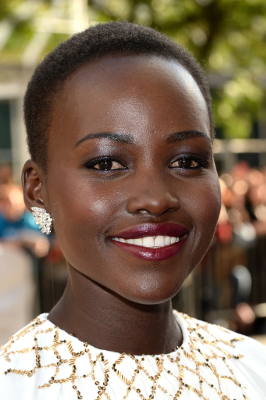
SAG and Golden Globe nominee Lupita Nyong’o
Focus on the wins, not the losses. Instead of thinking about how sad I am that Naomie Harris seems to be getting lost in this year’s statuette shuffle, I’d rather think about how great it is that Lupita Nyong’o is a front-runner. Sure, I wish The Heat got some play in the Globes noms (why separate out comedy if not to recognize films like this?), but hooray for Julie Delpy and Greta Gerwig’s nominations! Look on the bright side of the podium.
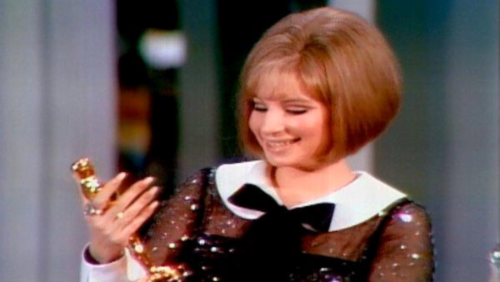
Barbra Streisand winning Best Actress
Revisit the Good Stuff from the past. The Academy has a database of transcribed Oscar Acceptance speeches, many of which are accompanied by video. 1968’s Best Actress 1-2 punch of “It’s a tie!” and “Hello, gorgeous.” Halle Berry powering through the emotional overload of her historic win to honor the legacy of black women in film! Emma Thompson talking about visiting Jane Austen’s grave to “talk about the grosses.” You can lose an afternoon (or ten) to reading and watching these, and you can SEARCH BY KEYWORD.
Make up your own awards. Naomie Harris is definitely gonna win a Robsie this year. And Jennifer Lawrence might not even be nominated for American Hustle, but she will be winning the award for Outstanding Achievement in GiF-ableness. Does this sound too bizarre to you? Keep in mind the Hollywood Foreign Press is only around 90 people. If you REALLY want legitimacy, hook up with 89 like-minded people to bestow accolades on your faves. You can probably get ten times that in fifteen minutes on Tumblr.
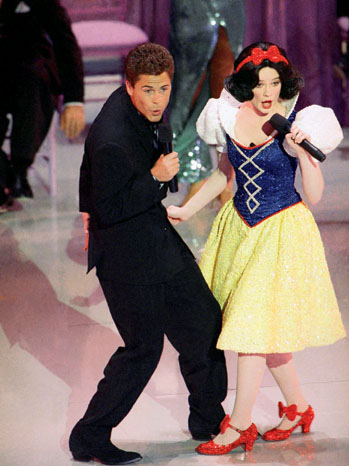
Rob Lowe and Snow White’s infamous duet at the 61st Academy Awards ceremony
Revel in the silly parts. Every year, cultural commentators toss around that “these awards are just a circus of self-congratulation” yarn. And you, savvy Bitch Flicks reader, know this isn’t true, that nominations and wins mean more money to the studios and mean new career opportunities for the talent. And that we’ve assigned huge cultural meaning to the Oscars which can’t be undone with a snap of the fingers. But save that potentially grim reality check for March.
For now, ignore the real-world implications. Focus on the office pool, the theme menus, the drinking games. Have a contest to see who can provide the creepiest answer to “Who are you wearing?” (“My enemies.”) Put a marshmallow in your mouth for every famous person on the In Memorium reel you didn’t know had died. Live Tweet with abandon. THEN you can roll your eyes at how a bunch more undeserving white guys won awards for unoriginal movies (if that does again happen! This could be the year it all goes right!).
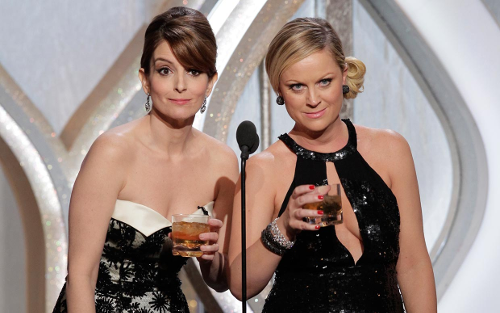
The Dream Team
And remember: we’ve got Tina and Amy bringing their magic to the Globes again and Ellen DeGeneres hosting the Oscars. The boob songs are going to be so much more tasteful and funny this year!
———————–
Robin Hitchcock is an American writer living in Cape Town who will happily stay up all night to watch these awards shows when they air.
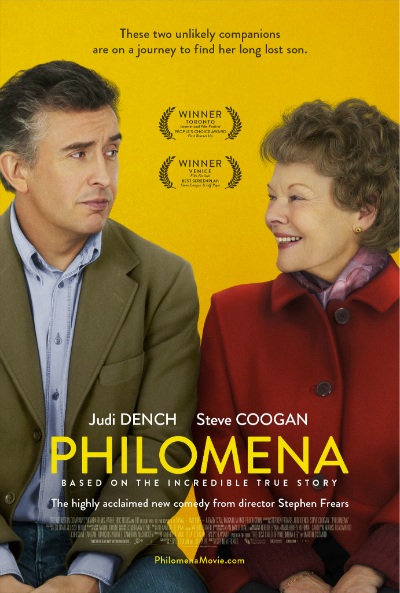
Philomena is based on the true story of Philomena Lee, an Irish woman who got pregnant as a teenager and was relegated to a convent where she was forced to perform grueling manual labor before her young son was sold to an adoptive US family. Fifty years later, Philomena works with a washed-up ex-journalist to find her son while he uncovers the dark truth behind her son’s adoption and the church’s betrayal. Overall, I’d say this is a feminist film that tries to expose oppressive gender roles that linger on today and allows its heroine, played by the exquisite Dame Judi Dench, to be her own person: a woman who makes her own decisions and mistakes while remaining irrepressibly full of humor and love.
I wouldn’t exactly characterize Stephen Frears much-praised film Philomena as a comedy. I’d describe it as more of a dramatized exposé of the corruption of the Irish Catholic church with moments of levity that give a desolate story warmth and humanity. Philomena is based on the true story of Philomena Lee, an Irish woman who got pregnant as a teenager and was relegated to a convent where she was forced to perform grueling manual labor before her young son was sold to an adoptive US family. Fifty years later, Philomena works with a washed-up ex-journalist to find her son while he uncovers the dark truth behind her son’s adoption and the church’s betrayal. Overall, I’d say this is a feminist film that tries to expose oppressive gender roles that linger on today and allows its heroine, played by the exquisite Dame Judi Dench, to be her own person: a woman who makes her own decisions and mistakes while remaining irrepressibly full of humor and love.
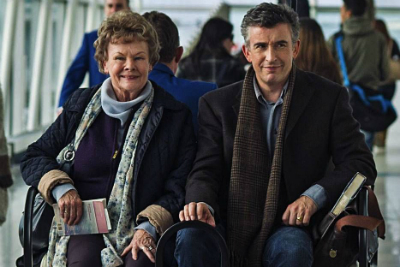
Philomena is in the business of critiquing institutions; specifically: religion, gender, class, and media. The interactions between ex-journalist Martin and Philomena highlight class disparity. Sometimes the exposure is subtle. Martin flies to the convent while Philomena drives with her daughter. Philomena is giddy at the prospect of free champagne on the flight to America as well as the complimentary grand breakfast buffet and the posh hotel room. She doesn’t “get” Martin’s sense of humor or cultural references, and she reads romance formula fiction, never guessing at the “formula” obvious in all her books. These moments are designed to make the audience chuckle at the sweetness of Philomena’s naivete while underscoring her lack of privilege, education, and wealth.
Philomena feels like royalty for riding on the airport transport service.
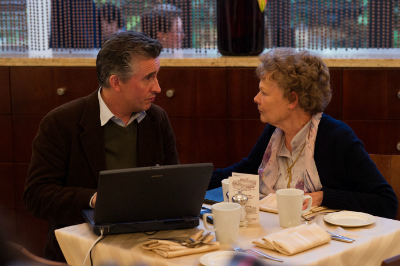
Other times, the class disparity is stark and painful. Philomena realizes she could never have given her son the opportunities and lifestyle he enjoyed as a result of his adoption. Martin is, on occasion, cruel to her because the things that excite her are old hat for him; he’s jaded and has come to expect a life of comfort and privilege. He also mocks Philomena for her faith, insinuating that her class status is why she believes in a higher power (because he is too learned and intellectual to believe in anything). The movie shows that though Martin is more worldly, wealthier, and better educated than Philomena, he doesn’t enjoy life the way that she does. She refuses to be bitter or angry like he is. He begins to understand and accept the fact that Philomena needs him, with his connections and his status as an upper-crusty white man, to find out the truth about her son.
Martin rebuffs Philomena & her excitement about an omelet station
Philomena‘s religion and gender critique go hand-in-hand. Religion judges and punishes young women (some as young as 14) for giving in to “carnal” desires that they haven’t been educated about to even understand the potential consequences. The film also highlights forced labor along with constant recriminations to show how religious forces incite fear, shame, and blame that Philomena and countless others carry for over 50 years. Philomena experiences a particular guilt because she enjoyed the sexual encounter that led to her pregnancy. The church teaches that female bodies and female pleasure are sinful, and many of the nuns are revealed to be bitter and vengeful, a perfect example of patriarchy-complicit female figures of authority. There is no discussion of the culpability of the male cohorts whose sperm was a necessary part of the baby-making equation. Sound familiar? The religious right continues this mentality with its abstinence-only education while heaping stigma galore onto young women who become trapped in pregnancy, insisting that the female body is a breeding ground for impurity and that all the fault lies within the woman, who is, in many cases, forced to suffer all the consequences.
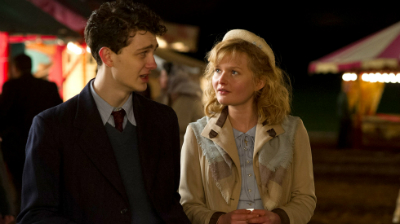
Young, inexperienced Philomena at the fair.
The kicker is that “female sin” is big business for the church in Philomena. The convent forces young women to “pay off” their debt/sin by working ungodly hours (pun intended) in the convent, and then they illegally sell the babies to the US for a great deal of money. The church destroys evidence and refuses to help families reunite even after 50 years of separation. The film claims that this was in part due to a continued resentment and desire to punish the sins of the young mothers, but it’s perhaps more true that the church is covering its tracks. Here, the church, a religious institution, takes advantage of the weak, the helpless, the poor, and the disenfranchised. Here, the church, targets women in particular using the notion of female sin to solidify their dogma and to reinforce their power (financial in this case). The exploitation of women by religious institutions is not new and continues today, as female reproductive rights are leveraged to cause divisiveness and to reinforce the power of political groups, religious groups, and the patriarchy.
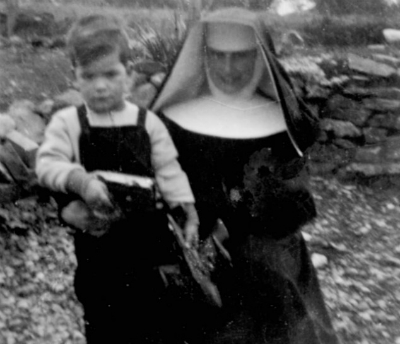
The real-life Anthony with a nun before he was sold.
Despite it all, Philomena remains a good-hearted person. She stands up to Martin when necessary, insisting that this is her story. She asserts that she’ll be the one who makes the decisions and that her reaction is her own, not his or a media that seeks only to capitalize on her tale of woe and exploit her for its own gain. She continues to love and accept her son regardless of the many things she learns about him that an old-fashioned religious person like herself could have found alienating. In the end, she forgives the convent, proving that she is the bigger person and more Christian than the nuns and religious institution that tormented her. While the circumstances of the film are tragic and devastating, Philomena’s doggedness, her bravery, and her journey have exposed wide-spread corruption and opened the door for other mothers to reunite with their long-lost children. Though she’s an ordinary woman without means, a fancy education, or influence, she stood up to a powerful institution steeped in centuries of history, and she said, “No more.” Philomena’s quest shows us that the personal is political and that one woman can make a difference in the the world.
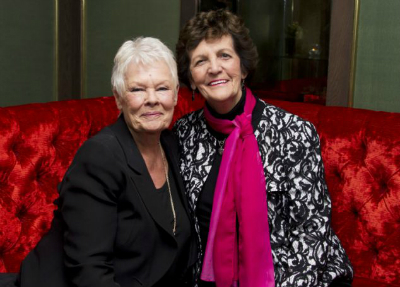
Judi Dench sits with the real Philomena Lee.
—————— Amanda Rodriguez is an environmental activist living in Asheville, North Carolina. She holds a BA from Antioch College in Yellow Springs, Ohio and an MFA in fiction writing from Queens University in Charlotte, NC. She writes all about food and drinking games on her blog Booze and Baking. Fun fact: while living in Kyoto, Japan, her house was attacked by monkeys.
The reality is that when I started to write about women I wasn’t trying to defend them; I was actually trying to connect with them. I thought to myself, “if I can understand where you’re coming from, I will be less likely to judge you.” However, the moment you attempt to expand on such a controversial concept, such as gender, you will inevitably undergo a huge learning curve. Your opinions and your stances will change over time, and that’s okay.
Art by Ricardo Cabret
This is a guest post by Zoé Salicrup Junco.
Hello there. My name is Zoé Salicrup Junco. I’m a film director in-the-making, but more importantly, I’m a woman in-the-making. I have a funny feeling that both the former and especially the latter will be never-ending journeys… Hit me up if that’s not the case.
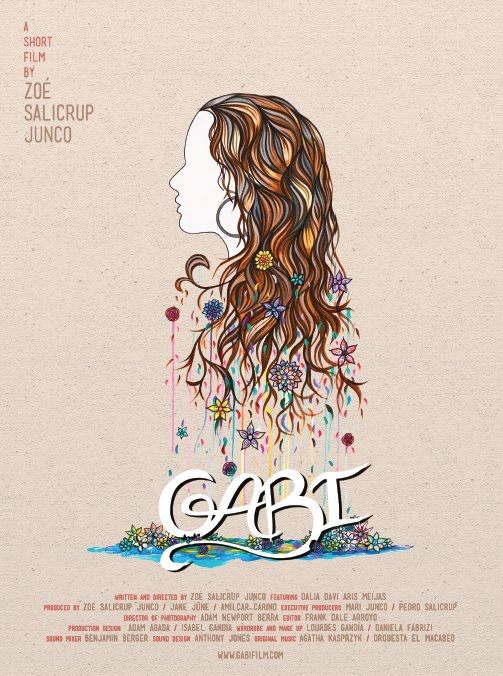
A couple of years ago, I wrote and directed a short film called GABI about women, sexuality, and my native island of Puerto Rico. Fortunately, the film had a great run in the 2012 and 2013 film festival circuit, having its international premiere at Clermont-Ferrand Film Festival, and its USA premiere at Tribeca Film Festival. Most recently, the short film joined the Seed&Spark family, as it was invited to screen in Christine Davila’s curated channel “Más American.” And at this very moment, I’m finishing up the feature-length script version of GABI.
The main concept behind both the short and the feature screenplays is to present a mid-thirties woman, who’s independent, financially stable, and is not in a hurry to settle down with a family. Oh, and she happens to enjoy sex openly (as in she’s not afraid to hide her sexual appetite). I particularly like her nickname because it’s neutral; it suits both male Gabriels and female Gabrielas. And as you might have already noticed, my character walks the very fine line between conventional male and female attributes.
Now here’s the irony- I built a female character who was fully confident and in control of her life because something was preventing me from feeling that way. For a very long time I had voiced my opinion against machismo, and then one day I caught myself upholding those same values. Judging women became way more easier than understanding them. But the moment I became aware of the fact that I was guilty of my own double-standards everything changed.
The short film’s writing began and I strived to live vicariously through Gabi. I allowed myself to live free like her, but I also allowed myself to feel judged like her. I’m not going to lie- all the “hater” attention from other female characters was somewhat thrilling, but it did get to a point where it was plain hurtful, and even the most liberated woman would’ve felt humiliated and worst, alone. I empathized with my protagonist and I vowed to defend all women like her.
Then the feature screenplay came along, and I caught myself feeling uneasy again. I still empathized with Gabi, but I was also starting to understand other women, who perhaps would frown upon Gabi. Did this mean I was abandoning my Gabi ways? Was I switching sides?
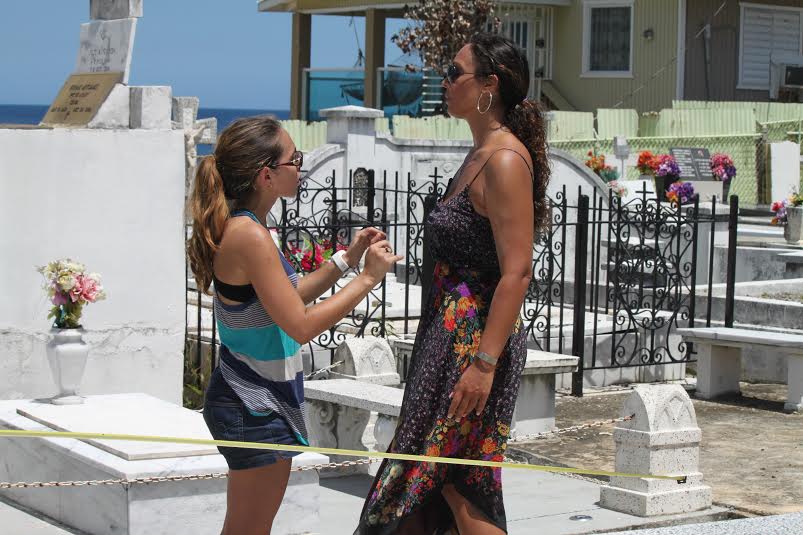
Zoe Salicrup Junco (left) directs lead actress Dalia Davi (right)
A few days ago, the ultimate example of beauty and brains, Rashida Jones, published and online article, “Why is everyone getting naked? The Pornification of Everything.” If you haven’t read it, it’s kind of an open letter to the media and the public where she voices her frustration about the year 2013 being “the year of the very visible vagina.” She expands on a few tweets she made a while back lashing out at the pornification, or better yet, the over-pornification of certain pop-stars and how this movement has got to stop. To be fair, she clarifies that she loves sex and is in no way asking us to be prudes; she’s simply asking to tone it down. As you might suspect, Rashida received both support and heat for her blunt opinions. She admits she was shocked to hear other women call her a slut-shammer and a misogynist.
Her article serves as the prime example of the great divide, and the grand fault behind women’s liberation: we don’t appreciate it when our own kind seems to sway back and forth between gender-classified opposing point of views. The moment we sense inconsistency in one of our sisters’ stances we fear to be viewed as weak, and we shun our sister out the club. But is this shifting pendulum really a weakening factor among us?
Sure, I don’t know Rashida personally, but to put all of this into perspective, let’s just bounce around these general facts about her: she’s a well-educated woman, she’s in her mid-thirties, she’s financial independent (we can’t blame all of her success on Quincy Jones), she openly admits to being promiscuous for some time in her life, she’s been linked to multiple high-profile relationships, but hans’t settled down yet, and surprisingly, even this kind of modern, sexually liberated woman is saying- “Enough with sex! Let’s get to know women on a more profound level!”
And that’s where the funny feeling about the never-ending journey through womanhood kicks in. Let’s forget about the whole “setting an example for other women” fiasco for now, and actually ask ourselves: What does getting to know a woman on a more profound level really mean? What are women interested to learn about other women? And more excitingly, what will evoke us to open up with one another?
The reality is that when I started to write about women I wasn’t trying to defend them; I was actually trying to connect with them. I thought to myself, “if I can understand where you’re coming from, I will be less likely to judge you.” However, the moment you attempt to expand on such a controversial concept, such as gender, you will inevitably undergo a huge learning curve. Your opinions and your stances will change over time, and that’s okay.
Perhaps the shifting pendulum should be embraced, rather than feared. Instead of crucifying each other over failed expectations, why not raise awareness about the fact that being a woman is an ever-changing, never-ending journey?
Awareness may just guide us to openness: “Hey! I’m a woman too, I’m not exactly sure what I’m doing here. Maybe you, another woman, can teach me a thing or two?” Why not tackle the real blurred lines amongst each other with this kind of dialogue?
Zoé Salicrup Junco was born and raised in Puerto Rico. GABI is her thesis film from NYU film school, under the guidance of film director Susan Seidelman. In June 2012 Zoé became one of “The Independent” Magazine’s top 10 filmmakers to watch in 2012. She is currently writing the feature-length version of GABI. You can read more about her and her film at www.gabifilm.com.
Best Foreign Language Film “Blue Is The Warmest Color” (France)
“The Great Beauty” (Italy)
“The Hunt” (Denmark)
“The Past” (Iran)
“The Wind Rises” (Japan)
Best TV Miniseries or Movie “American Horror Story: Coven”
“Behind the Candelabra”
“Dancing on the Edge” “Top of the Lake”
“White Queen”
Best Performance by an Actress in a Mini-Series or Motion Picture Made for Television Helena Bonham Carter, “Burton and Taylor”
Rebecca Ferguson, “White Queen”
Jessica Lange, “American Horror Story: Coven”
Helen Mirren, “Phil Spector” Elisabeth Moss, “Top of the Lake”
Best Performance by an Actor in a Mini-Series or Motion Picture Made for Television
Matt Damon, “Behind the Candelbra”
Michael Douglas, “Behind the Candelabra”
Chiwetel Ejiofor, “Dancing on the Edge” Idris Elba, “Luther”
Al Pacino, “Phil Spector”
Best Supporting Actress in a Series, Mini-Series, or TV Movie
Jacqueline Bisset, “Dancing on the Edge”
Janet McTeer, “The White Queen” Hayden Panettiere, “Nashville”
Monica Potter, “Parenthood”
Sofia Vergara, “Modern Family”
Who doesn’t love Catwoman? She’s smart, sassy, independent, has her own moral code, and often outfoxes (or maybe outcats) Batman, one of the greatest superheroes of all time. Though I’d be hard-pressed to label her skin-tight, uber-revealing outfit as feminist, Catwoman is a famous sex symbol who uses her sexuality to her own advantage. The figure of Catwoman has gone through dozens of iterations over the years, which goes to show that this iconic figure is a potent anti-heroine or villainess who continues to appeal to audiences throughout the generations. Now I’m answering the question: which of is the most feminist representation?
The many faces of Catwoman
Spoiler Alert
Who doesn’t love Catwoman? She’s smart, sassy, independent, has her own moral code, and often outfoxes (or maybe outcats) Batman, one of the greatest superheroes of all time. Though I’d be hard-pressed to label her skin-tight, uber-revealing outfit as feminist, Catwoman is a famous sex symbol who uses her sexuality to her own advantage. The figure of Catwoman has gone through dozens of iterations over the years, which goes to show that this iconic figure is a potent anti-heroine or villainess who continues to appeal to audiences throughout the generations. I’ve done a bit of meditating on these incarnations and questioned which of them is the most feminist representation.
Illustrated
First, we’ve got her comic book origin as The Cat in 1940’s Batman #1.
Old school comic book Catwoman
That’s right. Catwoman was birthed alongside the legend of Batman himself. Unfortunately, her creator Bob Kane was a misogynist and sought to portray traits that he coded as feminine:
“I felt that women were more feline creatures and…cats are cool, detached, and unreliable…You always need to keep women at arm’s length. We don’t want anyone taking over our souls, and women have a habit of doing that. So there’s a love-resentment thing with women. I guess women will feel that I’m being chauvinistic to speak this way…”
All I have to say is, “You’re right, Bob: you are a chauvenist,” and, “ew.” That said, Catwoman was designed as an unattainable love interest that personified the aloof and perhaps vindictive qualities her creators saw within female sexuality. Her depiction is more about drumming up some sexual interest and excitement for Batman than creating a nuanced character.
In her earliest incarnations, Catwoman is an attention-seeking naughty girl type.
Though I’m a bit of a comic book nerd who’s absolutely drawn to strong female characters, I’ve never been interested in reading any graphic novel Catwoman series. Her later depictions always struck me as a lot of tits and ass without substance, which I’m primarily basing on the cover art. Her sexuality is showcased to the extreme where it’s hard to imagine anything else beneath it. (If you’re a reader of Catwoman comics and feel differently, please set me straight in the comments!)
Those are some ridiculously large boobies.
I am, however, intrigued by her more recent, vicious comic book portrayals. Those have grit and make me curious about her.
Fierce Catwoman comic rendition
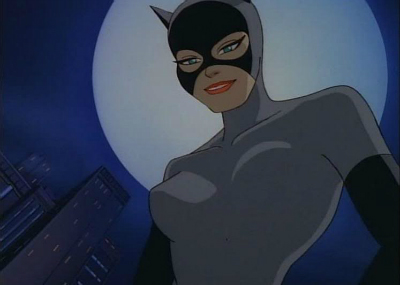
There are also multiple cartoon renderings of Catwoman that are more or less underwhelming. In Batman: The Animated Series, Catwoman does get to have layers in that she’s a jewel thief, an animal rights activist, and has her alter-ego as Selina Kyle, but her main role continues to be an elusive love interest for Batman as opposed to a compelling character.
Cartoon Catwoman
Television
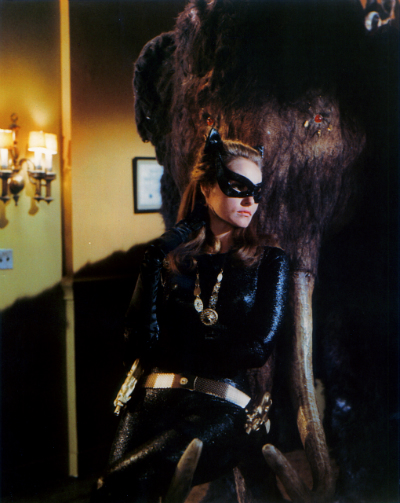
Catwoman made her television debut on the Batman series in 1966. Julie Newmar performed perhaps the most memorable version of Catwoman. I was certainly smitten with her. She was lovely, imposing, and “diabolical” (as Batman would say). She was a lone woman who commanded a group of male thugs. Among the great supervillains of the TV Batman mythology, she was the only woman, and she certainly held her own.
The (in)famous Julie Newmar Catwoman
Lee Meriwether was chosen for the film version of the Batman TV show. She, too, was stunning and very similar in appearance to Julie Newmar. Meriwether’s Catwoman also had a faux-alter ego as Miss Kitka, Russian journalist designed to seduce and lure “Comrade Wayne” into supervillain coalition custody to elicit Batman’s rescue attempts. This may have been the first sustained disguise Catwoman ever put on. She was never Selina Kyle in the TV show, which left her somewhat one-dimensional, but none of the other supervillains really had alter egos either.
Lee Meriwether: claws out
The last Batman TV show Catwoman is the late, great Eartha Kitt. A magnetic personality who brought more flare to the role than any before, Kitt was the first Black woman to play Catwoman…and, I believe, the first Black woman to prominently feature on the show. Race and inclusivity were and continue to be issues that most media fail to properly address. Eartha Kitt’s Catwoman was much like Nichelle Nichols‘ Uhura on Star Trek: a pioneer, a weather vane showing that times were changing, and a kickass character to boot. If it had been gratifying in Season 1 & 2 to see a solitary woman ordering around a gang of male minions, then it was even more so in Season 3 to see a Black woman calling the shots.
No other Catwoman purred quite like Eartha Kitt
Film
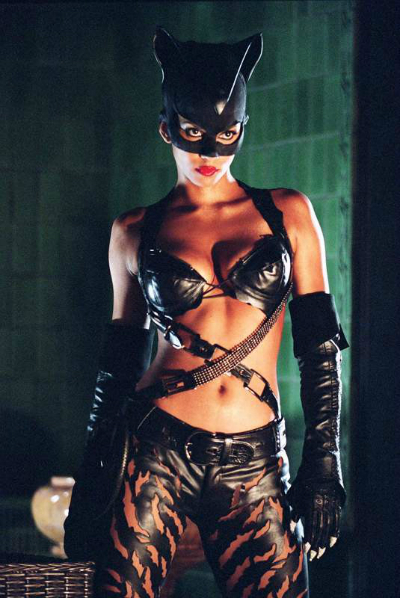
We got to see another talented Black woman, Halle Berry, reprise the role in 2004’s Catwoman. Unfortunately, the flick was universally considered a turd that was really a vehicle to showcase/exploit an Academy Award winning actress’s body with the most revealing catsuit of all time (and that’s saying something). I could really push the envelope to suggest a feminist reading of the film’s beauty industry critique, as Berry’s Patience Phillips struggles to destroy the anti-aging cosmetic corporation that employs her because it is selling a faulty and harmful product, but the fact that her boss (the one who kills her thus turning her into Catwoman) is a woman (Sharon Stone, no less) takes a lot of the steam out of that argument.
Halle Berry’s uber-revealing Catwoman costume
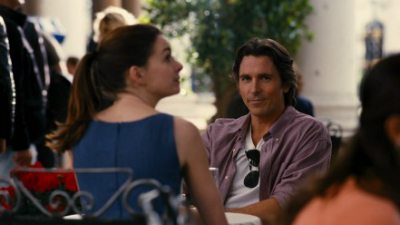
We also have the most recent depiction of Catwoman in Christopher Nolan‘s third installment of his Batman trilogy: The Dark Knight Rises in 2012. Though I’ve never been a fan of Anne Hathaway, I was nonetheless generally impressed with her Catwoman performance. Hathaway’s Selina Kyle was strong, independent, clever, and had a righteous sense of class justice, and in spite of the catsuit, she wasn’t quite as sexualized as earlier film incarnations.
Anne Hathaway’s tech-heavy Catwoman
That said, Hathaway technically isn’t Catwoman. She doesn’t give herself that name nor is she dubbed with it by an opponent or ally. Contrary to the opinion of fellow reviewer Kelsea Stahler, I think taking the title away from her divests her of some of the power, prestige, and legacy that is inherent in her name. Though I did admire Anne Hathaway’s smart-and-ruthless-with-a-smattering-of-conscience characterization, this version of Catwoman ultimately fails my feminist expectations because she ends up with Bruce Wayne in the end. She runs away to France and allows him to domesticate her. Stripping Catwoman of her counter-culture independence and settling her down with a man is tantamount to de-clawing her.
I bet Bruce Wayne will have a hard time housebreaking her
No, in this reviewer’s humble-ish opinion, the most feminist depiction of Catwoman is Michelle Pfeiffer from Tim Burton’s 1992 Batman Returns. Though this Catwoman is oozing sex, she always has her own agenda and is crafty enough to DIY-style make her own iconic cat costume. Pfeiffer’s Selina Kyle is mentally unstable and has periodic breaks with reality, which is a realistic rendering of a woman suffering post-traumatic stress disorder (PTSD) after being attacked and murdered by her boss.
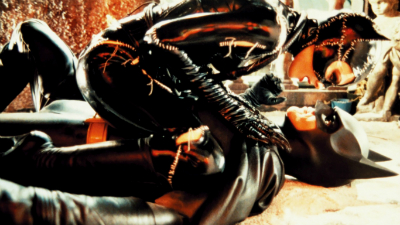
Catwoman mounts Batman and licks his face
The end of Batman Returns has Batman stripping off his mask and asking Catwoman not to kill her boss, but to leave town and come away with him instead. This is the inverse of what happens in The Dark Knight Rises as Hathaway’s Kyle begs Batman to abandon Gotham and run away with her. Pfeiffer’s response as Catwoman is, “Bruce, I would love to live with you in your castle forever just like in a fairy tale. I just couldn’t live with myself, so don’t pretend this is a happy ending!” She then claws Batman’s face and kills her boss, using up all but one of her nine lives to do so. Now, I’m not all about killing or anything, but the point is that Selina Kyle rejects Batman’s idea of who she should be, what her moral code should be, and how she should heal. She acknowledges the appeal of the traditional “fairy tale” conclusion that ends her story with a man and love, but her need for independence and for self-actualization becomes too important for her to sacrifice by relying on romantic love to save her as she once would have before her transformation into Catwoman. Instead, her story continues on, and we can imagine all the possible paths she may have chosen for her life.
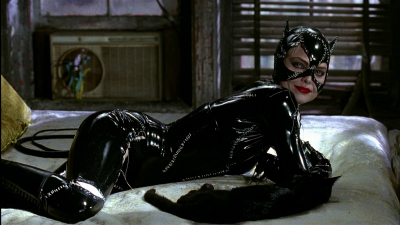
Catwoman lounges with Miss Kitty
All the Catwomen are hyper-sexualized and mysterious. All of them wield power over Batman and Gotham’s underworld. Though Pfeiffer’s Catwoman is my pick as the most feminist of all the iterations I’ve seen, she’s still problematic as are all her Cat sisters. I see the feminist strength and independence in her, but I also see the way sex is her weapon and that she mostly exists as a foil for Batman, a temptation and a lesson on what rampant desires can lead to. Maybe I’m more like Batman than I’d care to admit in that I, too, recognize the appeal of Catwoman as a mixed bag, and I, too, am drawn to her against my better judgement.
—————— Amanda Rodriguez is an environmental activist living in Asheville, North Carolina. She holds a BA from Antioch College in Yellow Springs, Ohio and an MFA in fiction writing from Queens University in Charlotte, NC. She writes all about food and drinking games on her blog Booze and Baking. Fun fact: while living in Kyoto, Japan, her house was attacked by monkeys.
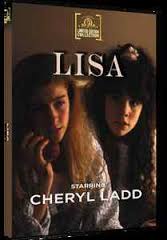
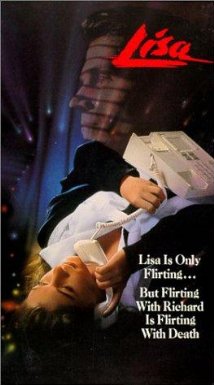
I’ve recently taken to revisiting some of these forgotten (or culty, depending on who’s looking) classics with a new, more grown-up and feminist eye, and I’ve been examining the lessons that each of these gems showed us. One of my recent new/old film crushes is a 1990 film called Lisa (starring Cheryl Ladd, Staci Keenan, and DW Moffet). It has all the teen angst that a gal could hope for. At first glance you expect this to be a typical thriller, but this film is so much more. It is an open exploration of a young woman coming into her own, exploring her sexuality, rebelling against traditional convention, and if that weren’t interesting enough, Lisa’s story runs parallel to the exploits of a serial rapist/killer. One of the things that makes this film so different is the point at which these two stories intersect, and Lisa proves herself more capable than imaginable and saves herself and her mother from the killer’s clutches. The ending of the film flipped the traditional damsel in distress cliché on its head.
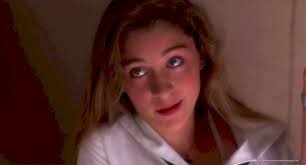
Staci Keenan stars as the teen protagonist in Lisa
This is a guest post by Shay Revolver. Spoilers and Trigger Warning for discussions of rape.
The 90s were a confusing time for pre- and full-on teenage girls. The 80s teen flick era had ended and left us a legacy of lessons on male-female relations that was nowhere near empowering. Mostly girls learned that if a guy really loves you then he’s got to stalk you to show it, and if you love him you’d better take off those glasses and ditch that ponytail. That was the extent of teen girl roles in movies; we were objects and trophies. When the 90s rolled around, girl power (pre-Spice Girls) was bubbling under the skin of society, and we were about to boil over. There are a few movies that I can think of that hinted at the dawning of the age of girlquarius, where teenage girls were thinking for themselves, acting how they wanted, living on screen on their own terms.
I’ve recently taken to revisiting some of these forgotten (or culty, depending on who’s looking) classics with a new, more grown-up and feminist eye, and I’ve been examining the lessons that each of these gems showed us. One of my recent new/old film crushes is a 1990 film called Lisa (starring Cheryl Ladd, Staci Keenan, and DW Moffet). It has all the teen angst that a gal could hope for. At first glance you expect this to be a typical thriller, but this film is so much more. It is an open exploration of a young woman coming into her own, exploring her sexuality, rebelling against traditional convention, and if that weren’t interesting enough, Lisa’s story runs parallel to the exploits of a serial rapist/killer. One of the things that makes this film so different is the point at which these two stories intersect, and Lisa proves herself more capable than imaginable and saves herself and her mother from the killer’s clutches. The ending of the film flipped the traditional damsel in distress cliché on its head.
Staci Keenan and DW Moffett in Lisa
In case you missed this one, Lisa is the story of a super curious 14-year-old girl named Lisa Holland. Lisa has started growing into her sexuality and, like many teenage heterosexual girls, she is more than a little boy crazy. Her sexual awakening is made more complicated by the fact that her mother, Katherine, a single mom who had Lisa at 15 and has raised her on her own, is having no part of Lisa dating–until she’s 16. Katherine understandably doesn’t want her daughter to make the same mistakes, and she is worried that dating will lead to sex, which might lead to her daughter ending up being a single mom. Most films would have taken this situation and made sure that the mother has a horrible life, thoroughly punishing her for her choice to have premarital sex. Instead, the writer and director take a rare approach to female yearnings and desires. The mother comes off sympathetic; she gives guidance more than criticism. There is also no slut shaming. Her mother actually acknowledges that her daughter has these very natural urges. At first glance, the conversations between them might come off as an all-out attempt at suppressing Lisa’s sexuality, but the way it is handled is beautiful. Her mother is honest with her reasoning and is very clear that she feels her daughter is too young to have sex. The openness attached to their conversations is refreshing, and it is kind of nice to see a young woman trying to come to terms with her feelings and sexuality. Katherine, in her role as single mother and successful working woman, who didn’t end up a statistic despite being a young single mother, is even involved in a relationship. She straddles a line, however, and keeps it from her daughter in an effort to protect her.
Staci Keenan in Lisa
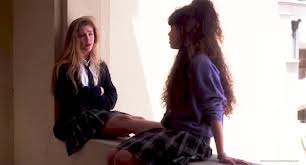
Lisa’s best friend is another young woman named Wendy Marks. There is a beautiful contrast between the two of them. Wendy’s parents aren’t as strict as Lisa’s mother. Wendy is allowed to date, and Lisa is fascinated. Having all of these new feelings and no outlet or experience, Lisa creates a fantasy world in which she can express herself and explore these new feelings. She and her friend Wendy keep a scrapbook of men that they see and would like to date, much like the heart covered Mr * Mrs. (or Mrs. & Mrs.) notebook that many of us had when we were growing up. Lisa and her friend Wendy see men they like and follow them to gain more information about them. Sometimes they even phone the men and record their intel in the scrapbook. This notebook helps Lisa explore new feelings in a more private way and allows her to explore the qualities that she wants her future beau to have. She gains her outlet and comes to an understanding of her sexuality and, in some ways, her relationship desires. I also found it lovely that while the girls’ budding sexuality is growing at different rates there is no pressure to compete or follow or judge.
All of these explorations combined with a protagonist portrayed by a young woman trying to figure out relationships and sexuality would have been more than enough to satiate my wish list for a good film, but this thriller threw in a serial rapist and murderer dubbed The Candlelight Killer, who stalks women and then calls and kills them after discovering where they live. This added a whole new level to the film. First of all, the film does something super rare; the rapist isn’t some worn, wrinkled , unattractive guy who can’t get a date. Richard, played by DW Moffett, is a hottie. It highlights a fact that is often overlooked in these types of characters when they are portrayed on TV or film: rape isn’t about a guy who can’t get a date, or about a woman being an undercover seductress who was asking for it. Rape is about power and hatred of women. This fact is reinforced by the psychological torture that Richard inflicts upon these women before he rapes and ultimately brutally murders them. He leaves messages on their answering machine telling them that he is in their house and announces his plans to kill them. He strips these women of the safety that their homes are supposed to provide. It is a clear, honest portrayal–and a parallel to rape itself. Having such a violation of sexuality portrayed in a storyline that runs parallel to the story of Lisa’s budding sexuality is an odd but brilliant choice. It doesn’t just use the message that all men are monsters, or blame the victims for their beauty taunting him. They portray this heinous crime as what it is: an attempt to remove a woman’s power.
You can pretty much see where the story is headed. Richard is going to end up in Lisa’s scrapbook, and she will be punished for her desires. Of course you would think that because that’s the message we’ve been shown. Good girls have no desires; if you have them you will be punished. I would have thought it too, but this film has already bucked every trend. You’ve got an attractive rapist, a former teen mom who is successful and raising a brilliant daughter, and a young woman having her budding sexuality acknowledged. When the stories intersect, they continue this realistic trend. Lisa accidentally bumps into Richard when he’s coming from a kill. He aids her and flirts with her a little bit, and she awkwardly flirts back, making him scrapbook worthy. She goes about her usual routine, follows him and gathers his license plate number and uses that to track him down and get his phone number from the DMV. After another failed attempt at bypassing her mother’s bothersome no-dating rule, she has to turn down a chance for a double date with Wendy and a boy her own age. Lisa locks herself in her room and decides to call Richard. She flirts with him some more, pretending she’s an older woman, and she piques his interest.
Tanya Fenmore and Staci Keenan (as Wendy and Lisa) enjoy some girl talk
Lisa keeps up her game, and with Wendy’s help, she continues to stalk him, which isn’t that smart of an idea, but it is age appropriate and realistic. She even continues her phone conversations after nearly getting caught. The plot progresses as Lisa reveals more and more about herself with every conversation, and soon Lisa realizes her game is going to have to end because Richard begins to push for a face-to-face meeting. The film doesn’t shy away from the more manipulative ways of teenage girls, but it gives a rationale and adds method and logic to the madness. There is no right or wrong, but a whole lot of gray. There is no punishment for Lisa’s actions per se; her actions do cause her mother to become Richard’s next and final victim. But, the film doesn’t end as bad as it could have. Katherine doesn’t get killed. Lisa isn’t punished for having desires or growing up and trying to figure out who she is going to be as a woman. After sneaking away to go on a trip, Lisa returns just in time to see the stage set for her mother’s murder at the hands of The Candlelight Killer, and she is forced to defend her life and the life of her unconscious mother. She doesn’t play damsel in distress or fall down the stairs; she chooses to fight, and even though she doesn’t initially come out on top, her mother wakes in time to come to her aid. The fight and movie ends with Richard going out of the window thanks to a handy baseball bat and the women holding each other in solidarity and love.
There are so many things about Lisa that make it interesting. The honest portrayal of a young woman’s burgeoning womanhood. The open expression of Lisa’s sexuality and desires. The over protectiveness of a single mother that truly rides a fine line between cautionary and plot building without delving into the gray area of slut shaming, a teen pregnancy, or portraying the mother as a failure whose life went wrong because she had sex at a young age. All in all this film , even at its campiest, showed strong women, and in the end, Lisa and her mother saved themselves from the clutches of the killer. They relied on each other to overcome the situation; there were no cops or men rushing to their rescue. And, there is something super awesome about watching two women surviving after killing a serial killer/rapist. Thank you Lisa for giving us a movie that didn’t shame young women for having urges and desires but instead giving us a movie that showed life as it often is: filled with areas of gray. Lisa showed independence and strength in the face of danger. And there is something truly beautiful about a young woman coming into her own, making and learning from her mistakes.
Shay Revolver is a vegan, feminist, cinephile, insomniac , recovering NYU student and former roller derby player currently working as a NY-based microcinema filmmaker, web series creator and writer. She’s obsessed with most books , especially the Pop Culture and Philosophy series and loves movies and TV shows from low brow to high class. As long as the image is moving she’s all in and believes that everything is worth a watch. She still believes that movies make the best bedtime stories because books are a daytime activity to rev up your engine and once you flip that first page, you have to keep going until you finish it and that is beautiful in its own right. She enjoys talking about the feminist perspective in comic book and gaming culture and the lack of gender equality in main stream cinema and television productions.. Twitter @socialslumber13
It started when I was 13. Some friends and I went to see Buffy the Vampire Slayer. It sounded like a lovely idea. A movie with a cheerleader as lead for my more “girly” friends, a vampire flick with a female heroine for me and the guy friends who were dragged along on this group “date” and just wanted to see vampires. It wasn’t like we had a choice–none of us had a car, and this was the only thing playing that we were old enough to watch at the theater our parents dropped us off at. I thought it would be perfect until it occurred to me in the lobby, while procuring nachos and popcorn, that this film was devised to please everyone, and usually when movies set out to please everyone, they pleased no one. But, it was a movie, and on a hot summer day that meant air conditioning; plus, there would be vampires, a female heroine and that was all I needed to give it a try.
It started when I was 13. Some friends and I went to see Buffy the Vampire Slayer. It sounded like a lovely idea. A movie with a cheerleader as lead for my more “girly” friends, a vampire flick with a female heroine for me and the guy friends who were dragged along on this group “date” and just wanted to see vampires. It wasn’t like we had a choice–none of us had a car, and this was the only thing playing that we were old enough to watch at the theater our parents dropped us off at. I thought it would be perfect until it occurred to me in the lobby, while procuring nachos and popcorn, that this film was devised to please everyone, and usually when movies set out to please everyone, they pleased no one. But, it was a movie, and on a hot summer day that meant air conditioning; plus, there would be vampires, a female heroine and that was all I needed to give it a try.
I sat, I watched, I was stuck somewhere between annoyance and amusement that my nachos weren’t the only thing in that theater covered in cheese. It seemed like for every great thing about the movie there was something equally as bad, if not worse. Even at that age, I worried that the film would be remembered more for the five-minute vamp death rattle scene at the end than for the female lead. Being the resident cinephile, or film-loving smart ass, I tried to save the film by saying it was supposed to be campy. In my head that was the only way I could wrap my mind around what had just occurred. I worried that if the film wasn’t successful there would be no more films with strong female leads–that we would have to keep being arm candy and damsels. Everything that made her complex, easy to relate to and bad ass was turned into a joke. I left the theater feeling sad.
In the interim, there were other films with strong female leads that caught my eye. Some of them were American but most of the time, I had to turn my gaze to the art houses and screening rooms of the East Village and Lower East Side. The women I was looking for could only be found in indie and foreign films. Sure, there was the pop up complex, bad ass heroine (or antihero) here and there beaming in beauty once in a while on the big screens of the mainstream, but they were so few an far between that I could count them on one hand and very rarely did they resonate in the way the other films did. Then something different happened. Studying in my dorm for midterms, during a very crazy junior year with my brain frying and a cold brewing, I turned on my TV and on some random network, there was Buffy. Buffy 2.0. to be exact, and in all of its campy goodness I could not turn away.
Summer Glau as River Tam
There was a woman on TV, being bad ass and somewhat complex (as complex as a teenage girl could realistically be), and I along with millions of other people ate it up. On the surface, it was beautiful and a pleasure to watch. In my philosophy studying brain it was full of conflicts, ideas and other interesting complexities. As the series progressed there was less complexity in Buffy and more complications. During the series run, much like the movie, I found that for every step forward there was a step sideways, often back. But, I couldn’t turn away. In my head I juggled with the bizarre coincidence that Buffy’s “virtue” was linked to the sanity of all the men around her. Her virginity literally turned Angel evil. It was a pattern that played out throughout most of the show. Her sexuality was a prize to be given and taken at will. It was also her downfall. She would be punished for choosing to express her sexuality, for having desires, for not being the “proper girl.” It was one of the themes that bothered me throughout the show.
When discussing how male writers and directors portray women and their “complexities,” the name that gets called out the most is Joss Whedon and his strong, complex female hero Buffy Sommers. I, for one, was always team Faith. She was way more complex and realistic than Buffy. I could relate to her. While Buffy spent most of her non-training conversations lamenting over wanting a relationship and kicking ass in between sessions of just trying to get a date, Faith was more concerned with finding herself, being independent, and if love came along, that’d be cool too. She wasn’t nice all the time, she straddled the line of morality and was okay with who she was. She was a creature of pure impulse, turning into the woman she was going to be, who never tried for perfection. Watching her evolve was fascinating. She was like Catwoman to Buffy’s Batman and I could relate. While Buffy went on to have “relationships” that mimicked the plot line of almost every Lifetime movie, Faith was content to be alone instead of settling for the sake of not being alone. She was punished with being labeled as insane for expressing her independence and sexuality.
Sarah Michelle Gellar and James Marsters as (everyone’s favorite dysfunctional couple) Buffy and Spike in Buffy the Vampire Slayer
When the short lived Firefly and its companion movie Serenity came to us, in true to Whedon form, the “virgin” lives and is strong. The “whore” is ultimately punished for her ways and although she does manage to survive and ride off into the sunset with Mal, her redemption comes only with settling down with a man to make her honest. While I will forever love the females in power aboard the ship, they were often led astray by their desires. The message often came off as, sorry ladies you can’t have it all. Even the hard-hitting River Tam was as bad ass, complex and brilliant as they came; she was also a virgin and very broken. She had passed the age where her sexuality should be expressed. She was incapable of expressing herself, and she went insane for contact. At the end of the day, the only woman who could save herself was the one who let go of her sexual identity or any idea of companionship, and she remained isolated and broken. Despite her strength, her survival often depended on the men around her.
This trend continued with Dollhouse, where the female bodies were literally used as objects and in a way that can only be expressed as soul rape, they are forced to forget the trauma and sleep until their bodies are called upon to be used again. Yes, in some scenarios these women were called upon to be more than just a warm body in the bed of the highest bidder, only worth what someone else was willing to pay for them, but the disturbing part was that they had no choice in what was happening to them, making it akin to a psychic roofie-style rape. I’ve heard the arguments that men were kept in the dollhouse as well , or that women were in power in the dollhouse, but none of that makes the situation any less horrifying. In the end, Echo is saved by a man. She was rendered incapable of saving herself. I looked away.
Kristy Swanson, the original Buffy
That has always been my issue with Joss Whedon’s work. As strong as his female characters are, they’re often on some level tortured and in some ways punished for being exactly what I was looking for in a female lead on TV. They seemed unable to find completion without having a man in their lives. That is what completed them. That was how they found themselves. It was also how they were punished. Buffy couldn’t save the world until she fell in love with her series-long tormentor and almost-rapist Spike. River Tam would collapse under the weight of her own strength. In Dollhouse, all of his female characters were used as pleasure objects and shells for men, and other women were serving as their pimps. There was no end to his female characters’ suffering; their worlds just got grimmer. There was no chance for redemption. Yes, they’re all strong in the traditional sense of the word because it is such a rare thing to see in media, but they’re also all still traditional archetypes.
Don’t get me wrong; I’m happy that he keeps creating these strong female characters, I wish more male creators would do the same. Gender equality in casting, Salt withstanding, is often hard to come by. I just know that I would love it even more if he wouldn’t make them set up to fail, if he wouldn’t put them in situations where their survival is dependent upon men, or where their happiness was aligned with or subject to the men in their lives. I’m hoping that the Agents of S.H.I.E.L..D. proves me wrong in the long run, and a shift is coming now that he has proved his weight. But so far we’ve already seen one damaged woman, one about to fall prey to her romantic desires, one who lacks sexuality, and another who has been mind controlled. For a very long time Whedon was the only game in town for seeing a continuous flow of strong women in power. Now there are other options, and most of them are women writing and creating roles for other women. It has been proven that there is a market for the characters that Whedon has often said that he wants to create. I see glimpses of these women in the characters that he does portray. Now that he has reached the level that he has in his career, hopefully he will show us these women that he wishes he could have created, shown and brought to fruition as he often laments. I can’t wait to see them.
Shay Revolver is a vegan, feminist, cinephile, insomniac , recovering NYU student and former roller derby player currently working as a NY-based microcinema filmmaker, web series creator and writer. She’s obsessed with most books , especially the Pop Culture and Philosophy series and loves movies and TV shows from low brow to high class. As long as the image is moving she’s all in and believes that everything is worth a watch. She still believes that movies make the best bedtime stories because books are a daytime activity to rev up your engine and once you flip that first page, you have to keep going until you finish it and that is beautiful in its own right. She enjoys talking about the feminist perspective in comic book and gaming culture and the lack of gender equality in main stream cinema and television productions.. Twitter @socialslumber13
Romance, lust, and dramatic intrigue are the antidote to our anxiety that we are just boringly adequate enough to make it through everyday life. The best part is that we can deny any accusations of shallowness or narcissism because at the end of the day, we don’t have to take responsibility for the actions of fictional characters. It’s a win-win!
If it’s true that people watch television and film to escape reality, show runners and writers have to know how to fulfill viewers’ fantasies. Why do you think they cast hot 25-year-olds as high schoolers? No one wants to remember their acne-induced social awkwardness or that time they got dumped the day before prom. The vast majority of viewers want to watch characters who are sexy, smart, and successful. In short, most of us want to be the most desirable person in the room or to be charismatic enough to possess the most desirable person in the room. Romance, lust, and dramatic intrigue are the antidote to our anxiety that we are just boringly adequate enough to make it through everyday life. The best part is that we can deny any accusations of shallowness or narcissism because at the end of the day, we don’t have to take responsibility for the actions of fictional characters. It’s a win-win!
The perpetual Will They Or Won’t They between Ross and Rachel was dragged out for a decade–yawn.
Writers have long capitalized on this escapist craving–and perhaps taken advantage of it to supplement their own lack of originality on occasion–to create hundreds of romances. However, once you make the fateful decision to break the sexual tension, popular belief dictates that happy couples stagnate and just don’t make for great entertainment after a while. You need to up the ante to keep things exciting. Luckily, you have one of the oldest tropes in the book at your disposal: the love triangle! Having two people crushing on a character totally highlights the informed awesomeness of the middle spoke and if you’re thrifty, you might even be able to use it to bypass pesky things like character development and individual growth for any of and up to all three of the spokes.
Coincidentally enough, love triangles tend to reinforce misogyny and uphold masculinity no matter their configuration (shocker). Listed below are some of the more recent love triangle configurations I’ve seen (with the shared love object in the middle) and the examples of them. Believe me, it’s far too many. Their implications predictably reinforce gendered hierarchies.
The Ashley-Craig-Manny love triangle went on for several seasons of Degrassi.
Woman/man/woman (everything ever, but most prominent in media marketed to teens)–two women compete for the attention of a man who often has no discernible personality traits. As we all know, masculine validation must be the keystone of a woman’s existence. If there’s anything we want to drill into young girls’ heads early, it’s that they need a man to assert their worth and social presence. Expect catfights and slut shaming. The phrase “You’re not like other girls” will be uttered at some point because the most romantic way to a girl’s heart is to tell her that her entire gender is largely off-putting and irritating. It’s okay though, since the guy is kind and generous enough to find the chosen girl mildly tolerable! Swoon.
Damon, Elena, and Stefan on The Vampire Diaries.
Man/woman/man (Twilight, The Mortal Instruments, Twisted, The VampireDiaries, True Blood, The Hunger Games, the list goes on)–ah, the “faux feminist” love triangle. Putting a lady in the center means that she calls the shots, right? Let those men fight it out for once. In theory, this configuration feels progressive. Women don’t have to tear each other down to win a man’s approval. Female agency can finally come into play. In reality, it’s about as liberating for female characters as choosing between folding laundry or making a sandwich. Masculine ideologies of possessiveness still dominate the scenario. The guys are hellbent on proving their manhood to each other, but usually don’t seem to care what the girl thinks. She’s preemptively demonized for rejecting whoever she doesn’t pick, while viewers venerate the shunned boy as a tragic nice guy undeserving of her conniving ways. Break out your Fedora–the accusations of friendzoning fly all over the place. Funny how a guy’s decision is respected and unquestioned but a girl becomes cold and callous in the same situation. The girl is set up for failure because the only right choice she can make is not to have one. That’s how we got Twilight.
Interestingly, the cast and crew of The Hunger Games have consistently resisted the media’s attempts to pigeonhole the franchise as romantically driven, arguing instead that the core theme of the films revolves around Katniss’ love for her family and her ability to inspire people. Media, take notes.
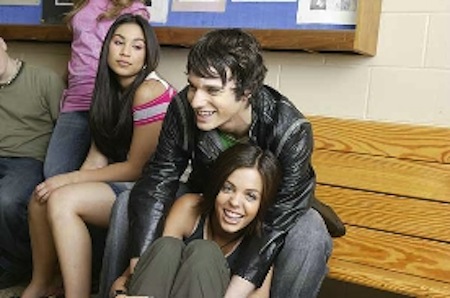
Ashley (right) finds herself torn over her feelings for both Aiden and Spencer (left) on South of Nowhere.
Woman/woman/man (Bomb Girls, Lost Girl, Glee, South of Nowhere, Skins ambiguously)–rather than handle queer desire tactfully, writers will often kill two birds with one stone and make both the contested woman and the side spoke female suitor look like terrible people. Double-bladed misogyny that transcends sexuality, yay! If the contested lady is queer, expect a lot of lecturing from both sides about how she needs to “grow out of her phase” of deluding herself into thinking she likes the other gender. This is particularly characteristic of the male suitor since he can’t fathom how bisexuality can exist outside of a performance for the male gaze. The queer lady suitor is portrayed as petulantly possessive or aggressive, whether or not she’s closeted. Alternatively, if it’s a case of incompatible orientation or denialism, you’ll likely see some variation of the butch savior, hopelessly yoked to an unrequited crush and yet still willing to sacrifice everything for a girl who could never love her back. Viewers perceive the woman caught in the middle as uncaring or just plain stupid in her shame or obliviousness. The butch savior is equally dehumanized as a deviant martyr.
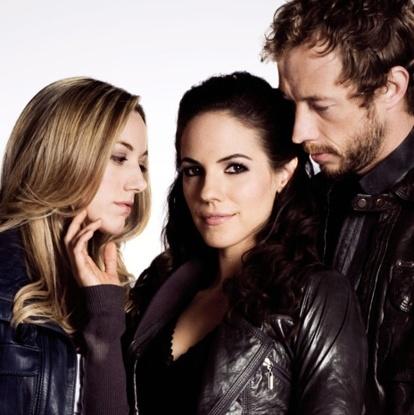
Bo (center) with Dyson and Lauren on Lost Girl.
To Lost Girl’s credit, Dyson views Lauren as a legitimate romantic rival for Bo, but masculine supremacy is implied in other subtle ways. Given that Bo is a succubus, she needs a constant supply of sex to keep herself strong, which Dyson (a werewolf) is better able to provide then Lauren (a human). Bo and Lauren’s relationship winds up dissolving simply because Lauren cannot keep up with Bo’s sexual appetites and Bo is literally killing herself trying to remain monogamous. Sure, the writers have a supernatural rationale behind the breakup, but it’s still uncomfortably analogous to both the promiscuous bisexual trope and the idea that queer women can’t have truly satisfying sex unless a penis is involved.
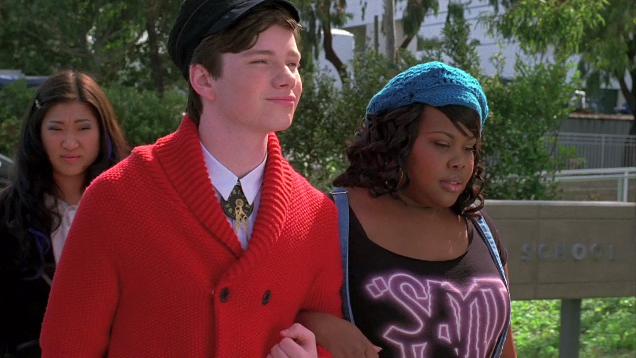
(On Glee) Remember when Mercedes had that cringe-worthy crush on Kurt?
Man/man/woman (most depictions of relationships between a straight woman and a gay man)–The only reason I am excluding bisexual man is because I have yet to see a genuine love triangle with a queer man at the center. The stereotypical desperate hag develops a pathetic crush on her gay friend and spends an episode or two being overly clingy and an effort to convince herself that they might be in a relationship one day. Hell, this is essentially the entire premise of Will and Grace. The woman might be territorial and try to stop guys from hitting on her friend. If he has a boyfriend, the couple will either act annoyed or be completely clueless. We are meant to see the woman’s feelings as sad and embarrassing and take the pointless crush that she has gone too long without a real love interest. It’s not even a love triangle really, it’s just another excuse to make fun of women and trivialize and shame them for their emotions.
Why are love triangles used so frequently? They’re empty plot devices that do little to nothing for character development and in fact can drive the audience to hate the characters involved by bringing out all of their most unflattering and indecisive qualities. Triangles may create titillating drama, but it can’t be that difficult to let characters stand on their own two feet individually or show already existing couples facing normal hurdles or, I don’t know, actually being content.
When women get the short end of the stick in love triangles, it perpetuates the belief that women can only be supplementary players in society and can never really be their own person. Women do not exist as a confirmation of masculine control. Women should not be expected to buoy everyone else’s confidence in their gender roles. Love geometry tries to work out the fear of female autonomy. Rather than subjugating women’s emotion to shore up manhood, triangles should explore everyone’s capacity for caring beyond gendered competition. Misogyny should not be the glue that holds supposedly epic romance together at its inception. When all is said and done, perhaps the ladies should simply choose themselves.
It’s fantastic that there is a “Blue is the Warmest Color” comic book French film adaptation that is receiving such praise. Not only that, but the graphic novel was written and drawn by a woman, Julie Maroh. However, because I really admire the graphic novel source material (…even though it is a bit overwrought…I mean, hey, what love story isn’t?), I feel compelled to critique the film for the myriad changes that were actively made from comic to screenplay, which remove much of the drama and complexity from the storyline.
Blue is the Warmest Color: comic vs. film.
Spoiler Alert
Though Bitch Flicks had a recent guest post by Ren Jender on the French lesbian film Blue is the Warmest Color called “The Sex Scenes are Shit, The Director’s an Asshole, but You Should Still See ‘Blue is the Warmest Color,'” I couldn’t help but weigh in on this graphic novel-turned-movie. Jender made a lot of really great points, namely that despite the director’s obvious prurience when it comes to lesbian sexuality, it’s still so important that we’re seeing a critically acclaimed three-hour film depicting the love affair between two women. I also think it’s fantastic that a comic book adaptation is receiving such praise. Not only that, but the graphic novel was written and drawn by a woman, Julie Maroh. However, because I really admire the graphic novel source material (…even though it is a bit overwrought…I mean, hey, what love story isn’t?), I feel compelled to critique the film for the myriad changes that were actively made from comic to screenplay, which remove much of the drama and complexity from the storyline.
Because they’re everyone’s pet topic, let’s go ahead and start with the sex scenes. Few will argue that the film’s sex scenes weren’t overly long and graphic. There were something like three repetitive sex scenes where nothing is happening to further the plotline or our understanding of the characters’ relationships, which makes the additional scenes seem gratuitous.
Check out this video of lesbians watching Blue is the Warmest Color sex scenes and evaluating them:
Though I personally thought the scenes were kind of icky and prurient and shot from an exploitative male gaze, they were also impersonal. There was a lack of intimacy between the two women that was obvious in that they rarely kiss, they don’t make eye contact, and they’re usually not facing one another. This dramatically contrasts from the sex scenes depicted in the graphic novel. Maroh’s sex scenes, like in the movie, are also quite graphic. The difference is that they’re not just about pleasure; they’re about connection, intimacy, and love.
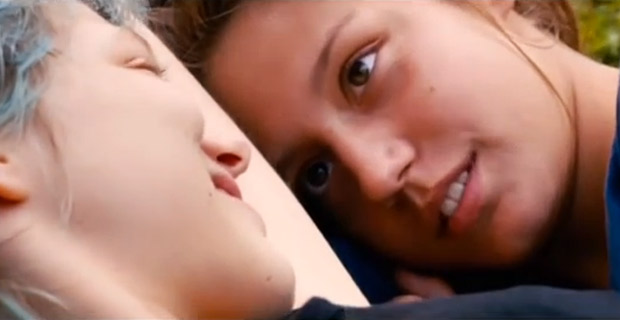
Emma performs oral sex on Clementine (aka Adele).
In case you’re not familiar with French, Clementine (Adele in the film) is saying, “I love you,” to Emma during sex. There’s also a bit of insecurity and talking/checking-in to alleviate those lingering fears. Not only that, but there’s a whole lot of kissing. As a queer woman, I found the graphic novel’s sex scenes to be far more sensual and sexy than the sort of rutting that the film depicts.
Clementine/Adele performs oral sex on Emma.
The sex of the film version of Blue is the Warmest Color translates into our understanding of their relationship, which didn’t strike me as particularly loving either. We see Adele doing a lot of work to prepare for a party, and Emma being ungrateful for that by critiquing Adele for her lack of creativity. The two of them also share a mutual fear of the other’s infidelity. The break-up scene with Emma hurling slurs at Adele like “little slut” and “little whore” after slapping her is not in the graphic novel either. That hatred and that domestic violence coupled with their loveless sex left me to believe that the director could not fathom two women’s love for one another. He could understand their lust, but not their love. Their reunion scene in the cafe (another movie write-in) cements my theory because it indicates that sex was the primary tether holding them together. Though Emma confesses she doesn’t love Adele anymore, their near public-sex-act shows that their sexual desire is still intact.
The romance of their film relationship dies as soon as they have sex.
Very little of the complexity of Clementine/Adele’s sexuality along with its struggles remain in the film. We see the brutality of her homophobic friends ostracizing her on suspicion of her gayness, but we don’t see her parents finding out she’s gay and kicking her out of her house and disowning her. We don’t see how Emma never really believed that Adele was queer and initially refused to break up with her girlfriend, Sabine, fearing that Adele would wake up one day and suddenly want to be with a man, which made Adele’s infidelity that much more painful. We don’t see how Adele repeatedly freezes Emma out early on in their relationship, asserting her immaturity, individuality, and ability to make choices. We don’t see how Adele feels she must constantly prove her sexuality to Emma. We don’t see that Adele actually hated gay pride events and refused to go to them. We don’t see that she hid her sexuality from her friends/colleagues and became something of a reclusive introvert, which caused strife with her extroverted partner. We don’t see the way Adele battles crushing anxiety and depression due to her slippery identity and relationship troubles. We don’t see how it drives her to drug use. We don’t see how this kills her.
Why did the film cut these moments of tension? Why did it de-complicate its heroine’s sexuality and her personality, for that matter? These details, these events are what make these cardboard characters into people. These questions, struggles, and anxieties are hallmarks of queer sexuality, of queer life. To remove them is to dismiss the difficulties endemic to coming out and being gay in our world. If you also take away the joy and love inherent in those relationships, as the film Blue is the Warmest Color does, what are you left with?
This kiss is full of pain, passion, and love.
I’m not saying all lesbian sex is romantic or that all lesbian relationships are loving, but I’m left wondering what I was watching for three hours? It mostly seemed like a lot of mouth-breathing, sleeping, eating, and fucking. Is that what the film wants us to believe lesbian relationships are all about? The party scene even mouths the director’s inability to understand queer female sexuality with its ignorant conversations about what women do in bed and why women are drawn to each other. I can’t help but feel that there was so much beauty, depth, and complexity to the relationship in the comic that is inexplicably missing from the film. I can’t help but feel the movie gives us scraps and that the queer community is so desperate for a reflection of itself, that we hungrily accept those scraps.
I understand people liking this film, especially queer women. I might’ve liked it, too, if I hadn’t read the graphic novel first. If you liked this movie, do yourself a favor and go to your local comic book store. Pick up a copy of Julie Maroh’s beautifully illustrated graphic novel Blue is the Warmest Color. If you don’t have a comic book shop, I beg you to buy it online. See what you’re missing. See what the film is missing.
—————— Amanda Rodriguez is an environmental activist living in Asheville, North Carolina. She holds a BA from Antioch College in Yellow Springs, Ohio and an MFA in fiction writing from Queens University in Charlotte, NC. She writes all about food and drinking games on her blog Booze and Baking. Fun fact: while living in Kyoto, Japan, her house was attacked by monkeys.
Nicole Kidman is one of the most accomplished actors working today and one of Hollywood’s most fashionable stars. Since 2006, she has also been a Goodwill Ambassador for UN Women. Formerly known as UNIFEM (the United Nations Development Fund for Women), UN Women promotes gender equality and female self-empowerment around the world. It advocates both economic and political advancement and works to end violence against women.
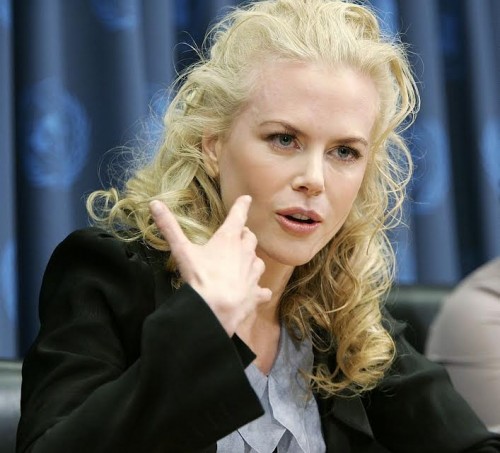
Goodwill Ambassador Nicole Kidman
Written by Rachael Johnson
Nicole Kidman is one of the most accomplished actors working today and one of Hollywood’s most fashionable stars. Since 2006, she has also been a Goodwill Ambassador for UN Women. Formerly known as UNIFEM (the United Nations Development Fund for Women), UN Women promotes gender equality and female self-empowerment around the world. It advocates both economic and political advancement and works to end violence against women. Kidman has also been involved in the United Nations’ anti-violence initiative as the spokesperson for Say NO- UNiTE to End Violence Against Women. The statistics cited by Say NO are deplorable: a staggering one in three of the world’s women and girls is a victim of violence. We are, in fact, currently in the middle of Say NO’s Orange campaign, a social media initiative that aims to increase awareness of VAW. From November 25 to December 10, individuals and communities around the world are encouraged to wear orange, the color of consciousness, organize actions and draw attention to positive initiatives that are presently tackling the issue. Check out the site and spread the word!
Nicole Kidman with Bon Ki Moon
The widespread, systematic rape of women in war zones is another issue that UN Women addresses and challenges. This appalling phenomenon has, historically speaking, only recently begun being addressed. It is astonishing to note that rape was only recognized as a crime against humanity in 2001 (Rape: A Crime Against Humanity, BBC, 22nd Feb, 2001). Kidman has visited Kosovo, a land scarred by sexual violence, on behalf of UN Women. There she heard testimony from rape survivors and highlighted its physical and psycho-social wounds. The actor has also underlined that “rape in conflict zones must be punished as a war crime.”
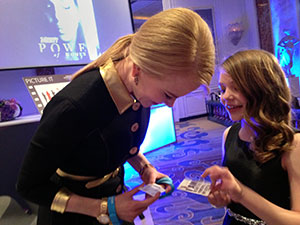
Kidman’s UN role should perhaps be more widely known and acknowledged but in October of this year, Variety magazine paid tribute to her commitment to women’s rights. In her acceptance speech at Variety’s 5th Power of Women lunch, she remarked, “No matter how long I devote my time to this, I will never be able to comprehend and I will never accept that one in three women and girls will be raped, beaten or abused in their lifetime.” Kidman does not, of course, have a radical political persona but her words here express a certain passion. Violence against women is, for the actor, ‘the greatest injustice and outrage of all.’ We actually need nothing less than rage from women in the public eye about gender-based violence but Kidman’s words should, nevertheless, be appreciated. We should also, perhaps, remind ourselves that the job of a Goodwill Ambassador is to draw attention to UN initiatives. It is an essentially ‘diplomatic’ role and this, no doubt, is reflected in the discourse of its celebrity advocates.
Role model Kidman at Variety Awards, 2013
Kidman’s commitment to women’s rights was fostered in childhood. Her mother, Janelle Ann Kidman- a former nursing instructor- was a primary model of influence. Kidman honored her mother in her Variety acceptance speech: “I became involved because I was raised by a feminist mother who planted the seed early in me to speak out against the fact that women are so often treated differently than men. She was very clear with me: she said stand tall, do not settle for less than what is fair.” As she further explained in an interview with Variety, it was, in fact, Janelle Kidman who told her about the work of UN Women (then UNIFEM). Kidman explained how she was inspired by a story her mother related about trafficked women in Cambodia who benefited from UNIFEM-sponsored training and education. When Kidman won her Best Actress Oscar for her role as Virginia Woolf in The Hours (2002), she celebrated both her mother and daughter in her acceptance speech: ‘I am standing here in front of my mother and my daughter, and my whole life, I’ve wanted to make my mother proud and now I want to make my daughter proud.’ This is, actually, no small thing. Specifically embracing your matrilineal line is still quite uncommon in mainstream public life.
Say NO Orange Your World Campaign
We should, of course, maintain a generous degree of skepticism regarding the public roles of Western celebrities. Their presence often reinforces patronizing- even culturally imperialist- attitudes towards non-Western societies and poorer nations. Gender inequality is, however, a global fact, and gender-based violence is a reality for women from Lagos to Los Angeles. Supporting an international entity dedicated to eliminating discrimination against women is a positive, essential endeavor. Nicole Kidman is a household name around the world and her support is all the more meaningful when you consider the irrational- or frankly spineless- refusal of certain female role models to identify as feminists. Cultivating an internationalist feminist consciousness is equally vital. As Virginia Woolf herself once wrote: “As a woman, I have no country. As a woman, I want no country. As a woman, my country is the whole world.” We should always try to embody those words.