‘Sucker Punch’ Might Leave You Wishing for a Lobotomy

My main issue with the film is that it is speckled with meaningless platitudes and clichés about girl empowerment when the film simply isn’t empowering. The women in the film are portrayed as oversexualized, helpless, damaged goods. Though there are metaphors at work that symbolize abuse or objectification of women, nowhere does the film stress an injustice or seek to dismantle its source. It is just like any other formulaic action movie complete with boobs, guns, and explosions, but it has a shiny, artificial veneer of girl empowerment. The false veneer is the aspect of the film that truly infuriates me, along with the side of artsy pretentious bullshit.

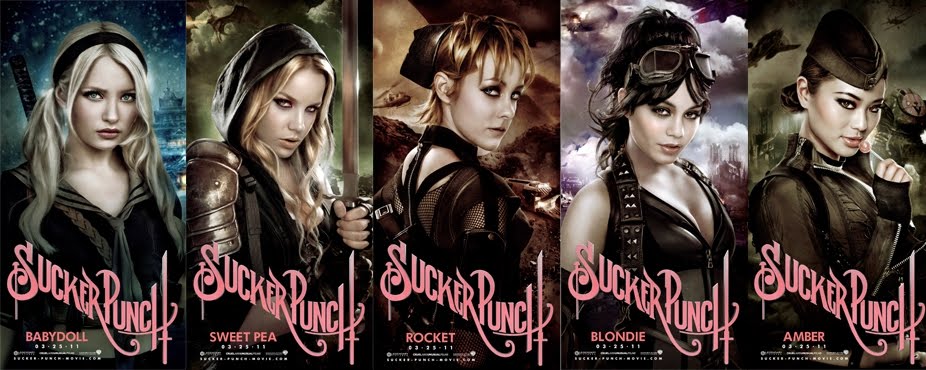
Sucker Punch posters


This guest post by Angelina Rodriguez appears as part of our theme week on Child and Teenage Girl Protagonists.

Sucker Punch (2011) was a visually beautiful film with little substance, cardboard characters, and a scattered plot. The film is layered in hollow, underdeveloped metaphors so that fanboys can feel intellectually superior (to feminists that just don’t get it) while they wank off to helpless, sexualized mental patients. There is so much garbage happening at once that it seems like Zack Snyder wanted to make a couple of different films but instead funneled all the ideas into one terrible concoction.

My main issue with the film is that it is speckled with meaningless platitudes and clichés about girl empowerment when the film simply isn’t empowering. The women in the film are portrayed as oversexualized, helpless, damaged goods. Though there are metaphors at work that symbolize abuse or objectification of women, nowhere does the film stress an injustice or seek to dismantle its source. It is just like any other formulaic action movie complete with boobs, guns, and explosions, but it has a shiny, artificial veneer of girl empowerment. The false veneer is the aspect of the film that truly infuriates me, along with the side of artsy pretentious bullshit.

Our hero, Baby Doll, played by Emily Browning, is an infantilized 20-year-old, sporting pig tails, doll make-up, and a sailor or school-girl outfit. Although she is technically supposed to be an adult, her demeanor, dress, and innocence is childlike. She looks like a young girl playing dress-up and her smallness is constantly emphasized while she is on camera with men. Her character is an eroticized child wearing a pouting or vacant facial expression throughout most of the film.
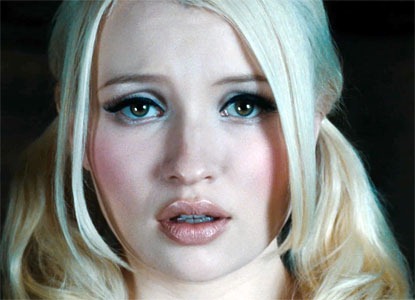
Helpless and pouty with closed mouth.. Helpless and pouty with open mouth…
Helpless and pouty with open mouth…


She is the image of the “pure innocent virgin” with both hair and skin white as snow. Her twisted, murderous stepfather wants to secure inheritance left to Baby Doll by her late mother for himself so he makes a shady deal with an orderly to get Baby Doll taken out of the picture for good, with a lobotomy in five days. She is damaged and abused but still holds onto her fantasies of freedom. We follow her through three realities: the mental ward, the brothel, and the battle arenas where she and the other girls fight giant samurais, undead Nazis, and dragons in high-intensity action sequences. In the brothel, Baby Doll and the other girls are forced into prostitution which is paralleled by the abuse she and the other patients are experiencing in the hospital at the hands of the orderly/pimp, Blue. In this reality, like the lobotomy, she is promised to the High Roller in five days.
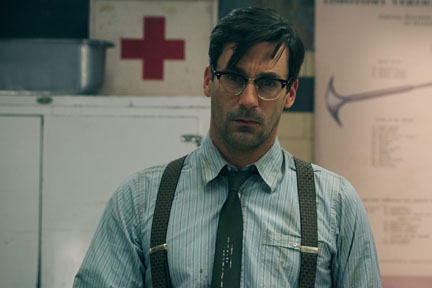
The High Roller/Doctor


The creators took the serious situation of forced institutionalization, already fraught with gratuitous abuse, and made it even more overtly sexually exploitative by throwing sex work into the mix. The entire portrayal of these girls’ abusive experiences drips with exploitation. This story doesn’t evoke feelings of sympathy for its boring, one dimensional, unrelatable female characters. If anything, the goal of this story of violence and abuse against women is to arouse the audience. Even during scenes of pain, vulnerability, hurt, or death, the girls appear sexually-charged, and the camera seems to be pawing at their ever-exposed skin.
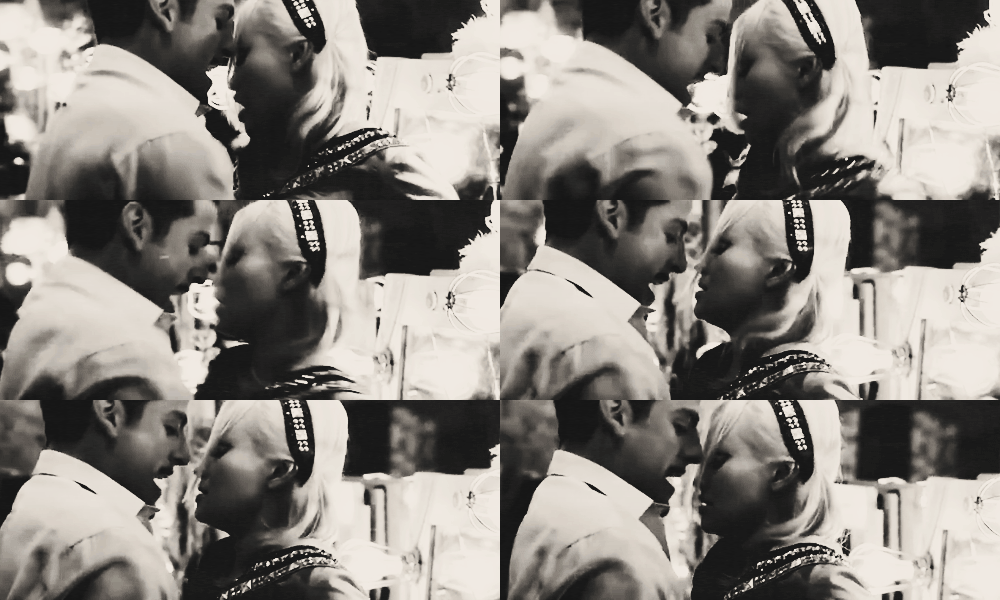
Blue: “You know what it feels like? Like I’m this little boy sitting in the corner of the sandbox while everyone gets to play with my toys, but me. So I’m going to take my toys, and I’m going to…”


As if there wasn’t enough objectification, Baby Doll has absolutely no character development or personality. We know nothing about her, aside from her life being A Series of Unfortunate Events. She acts as a tragic vessel, simply the embodiment of the mind-over-matter notion of freedom. Her only job is to symbolize patriarchal oppression and martyr male fantasies of female powerlessness. She occasionally does something badass like stabbing Blue or spitting in some dude’s face; however, she still lives a brutal life and meets a cruel end despite her strength and acts of protest. This communicates that the feminist objective isn’t reachable, that the patriarchy is inevitable, and that we should simply give into it.

Another huge issue I have with the faux girl power in Sucker Punch is the Guardian Angel, played by Scott Glenn, who directs the girls along their missions. He gives them orders during the battle sequences and tells Baby Doll the secrets to gain her freedom. The Guardian Angel tells Baby Doll how to be empowered and released from the torment of patriarchy, but his advice never offers true freedom. A recurring theme in the story is that, “You have all the weapons you need,” and that you decide your own destiny. In contrast, these women are constantly being acted upon by men, even when they make “their own” decisions to escape or to fight or even to accept a lobotomy (although what other option did she REALLY have). If women have all the tools that we need, then why do we need a paternal figure dictating our survival? Interestingly enough, Baby Doll’s Angel seems much more like a Charlie to me.
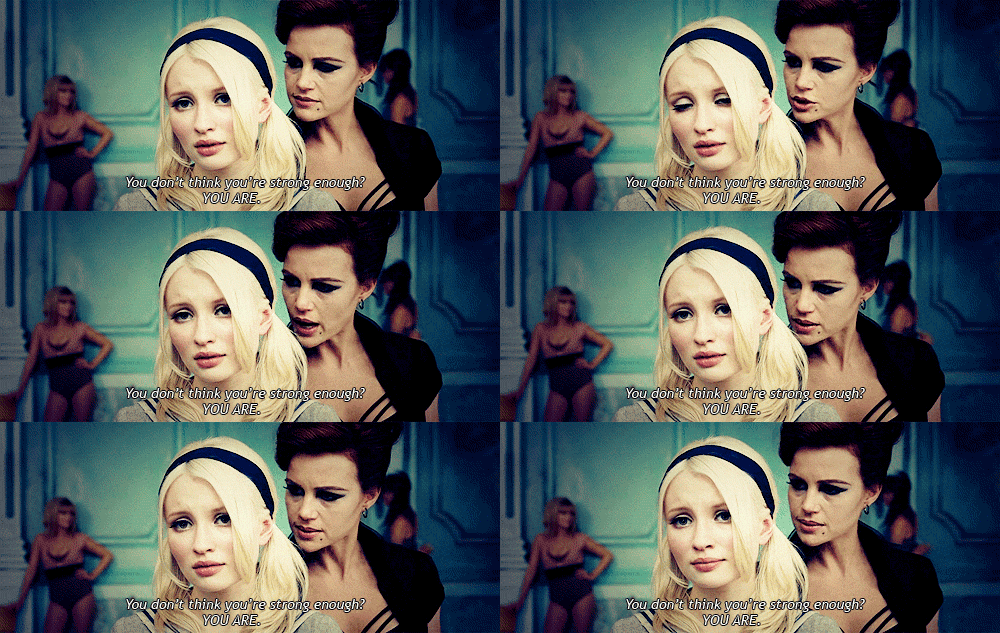
Baby Doll chooses to always fight her battles, as the narrator, therapist, and angel character repeatedly urge her to do, but it is all in vain.


tumblr_m02ekli0ur1qfa9ryo1_500


Baby Doll chooses to fight but still gets shafted, and all of her friends die. Baby Doll is only able to mentally escape this torment by “choosing” to accept a lobotomy. In a deleted scene, the penetrating lobotomy is tastelessly paralleled by a “consensual” sex scene with The High Roller in the brothel reality.
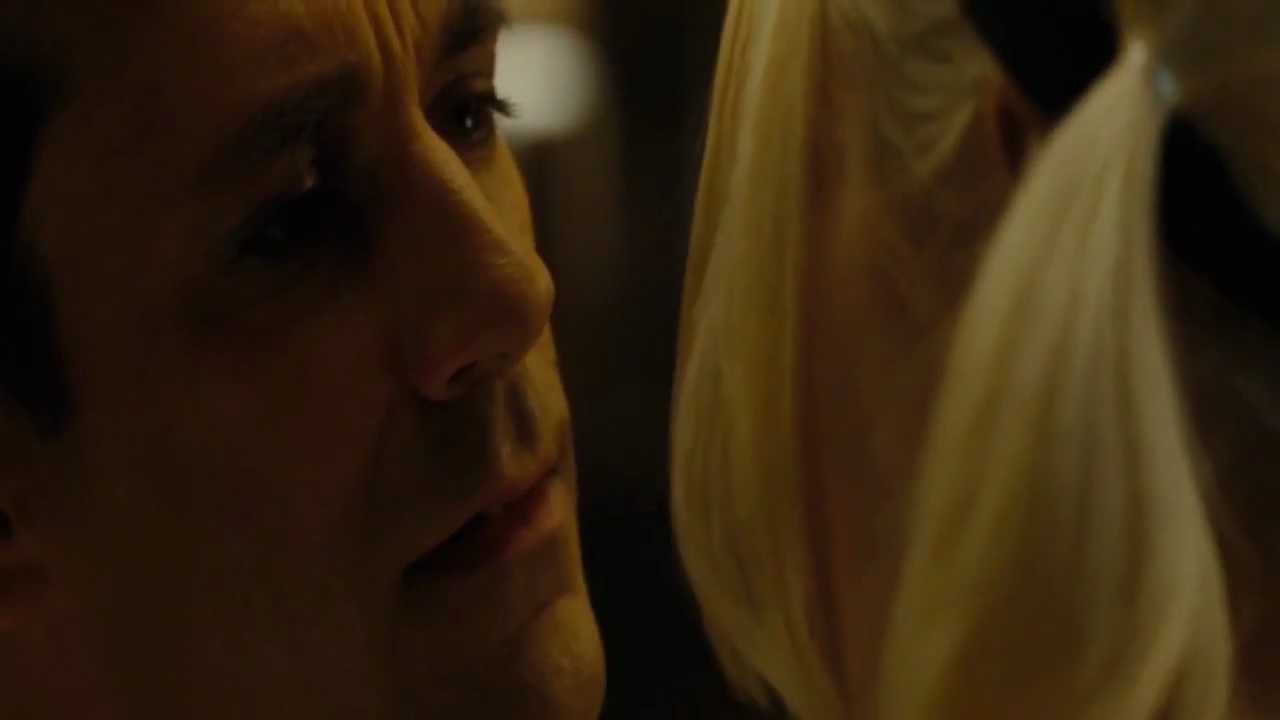
The High Roller and Baby Doll


Why is an invasive medical procedure preformed with a long, sharp metal tool likened to a sex act? Sexuality is often coded as violent. Maleness is portrayed as a weapon with a penis as a gun, sword, or knife. This creates a connotation of force. Women exist simply as props while men are the action and reaction. This notion of sexuality isn’t progressive or feminist, as it contributes to rape culture. And this was supposed to be her act of true rebellion?

She agrees to sex in an unbalanced situation that could be described as coercion or rape despite her seeming consent. What is the message? “You can take my body, but you can’t take my soul?” Well, fuck that. The entire premise seems to be communicating that women may not be able to subvert the patriarchy or avoid violence or exploitation, but that we have the power to rise above it and free ourselves internally, mentally, or spiritually. The story says that women should be able to mentally rise above rape and abuse. Of course, it’s so simple. Why didn’t we think of that? It’s a good thing we have Zack Snyder to make porn-y, pretentious movies to tell survivors how to get over their trauma and tell women how to be empowered like the “guardian angel” that he is.

This film puts the responsibility of survival and equality upon the shoulders of women instead of men, and the type of survival it offers is piss-poor at best. The effects of systematic abuse that seek to dehumanize and oppress can’t be avoided, regardless of a woman’s strength or will. Women have been fighting throughout history, and we continue to fight every day, although that information may be new and exciting to Zack Snyder. We need men to do their part completely and independently in order to create equality and freedom. The creators of Sucker Punch attempted to manipulate feminist ideas for profit and the fulfillment of male fantasies without doing any real feminist work. They had hopes of using feminism as an excuse for showing partially naked, ethereal waifs being intermittently badass and helpless, but failed miserably. This kind of “participation” in the feminist movement is damaging and despicable.


Angelina Rodriguez studies Sociology at Fairmont State University. In her free time she thinks about things and pets puppies.
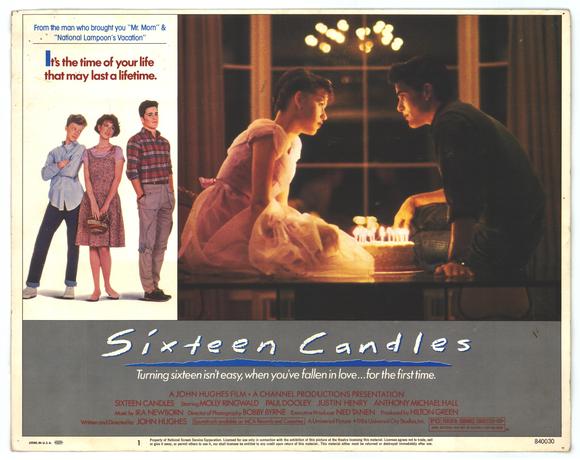
 

‘Sixteen Candles,’ Rape Culture, and the Anti-Woman Politics of 2013

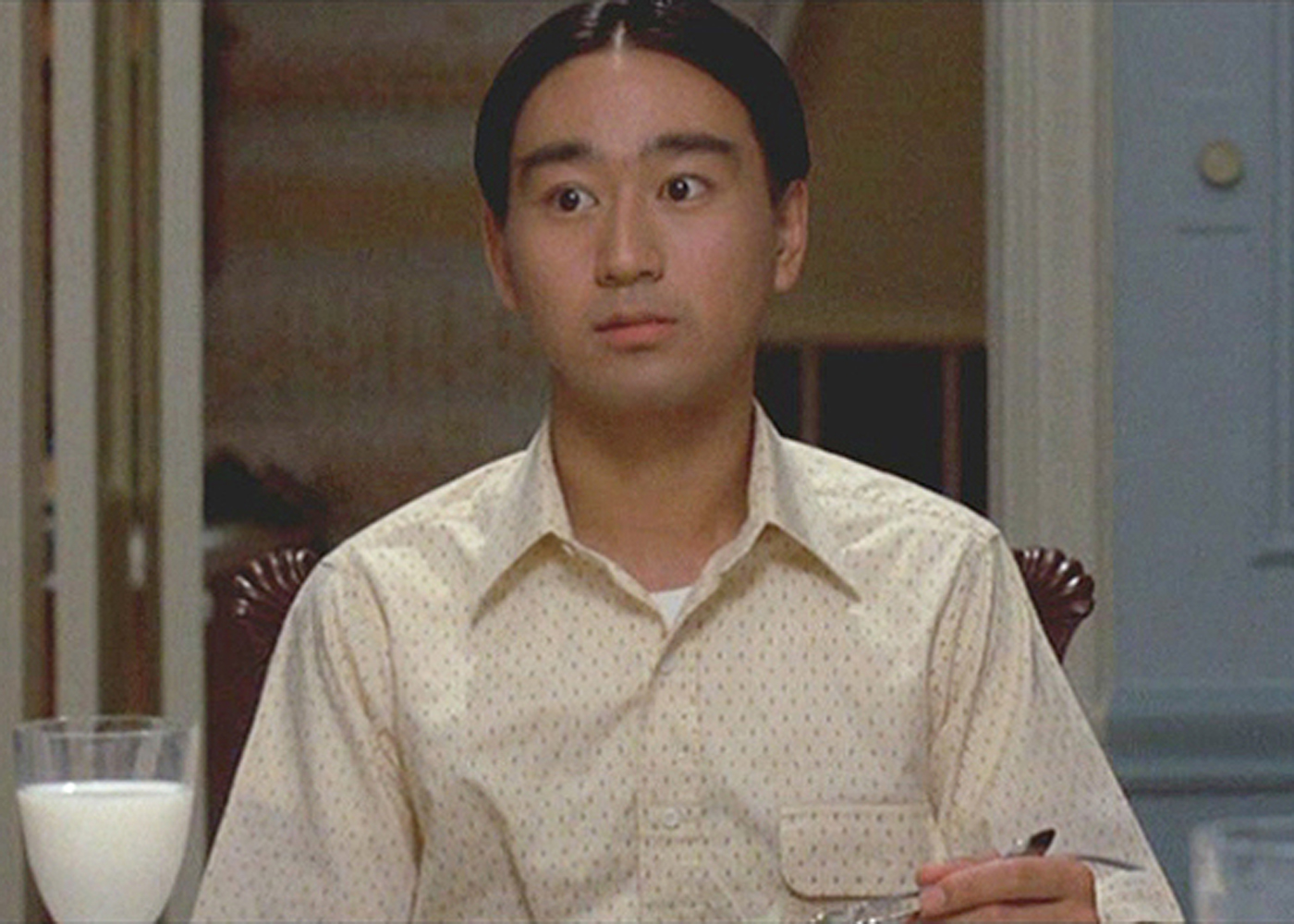
So, these are the important things in Sixteen Candles: Samantha’s family forgets her birthday; she’s in love with a hot senior who’s dating Caroline (the most popular girl in school); and there’s a big ol’ geek (Farmer Ted) from Sam’s daily bus rides who won’t stop stalking her. Oh, and Long Duk Dong exists [insert racist gong sound here]. Seriously, every time Long Duk Dong appears on screen, a fucking GONG GOES OFF on the soundtrack. I suppose that lines up quite nicely with the scene where he falls out of a tree yelling, “BONSAI.”

Since the entire movie is like a machine gun firing of RACIST HOMOPHOBIC SEXIST ABLEIST RAPEY parts, the only way I know how to effectively talk about it is to look at the very problematic screenplay. So, fasten your seatbelts and heed your trigger warnings.

The 80s were quite possibly a nightmare.

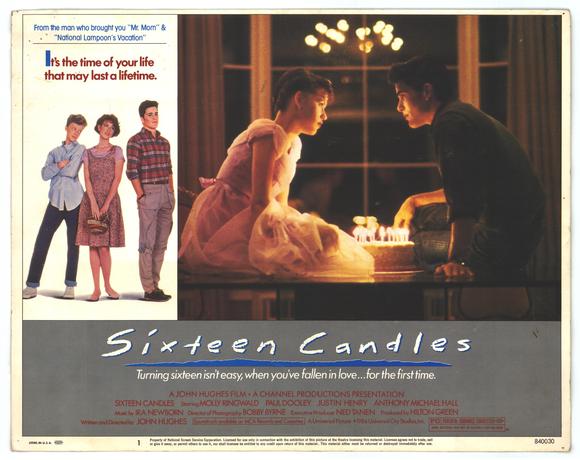
Movie poster for Sixteen Candles

This repost by Stephanie Rogers appears as part of our theme week on Child and Teenage Girl Protagonists.

Holy fuck this movie. I started watching it like OH YEAH MY CHILDHOOD MOLLY RINGWALD ADOLESCENCE IS SO HARD and after two scenes, I put that shit on pause like, WHEN DID SOMEONE WRITE ALL THESE RACIST HOMOPHOBIC SEXIST ABLEIST RAPEY PARTS THAT WEREN’T HERE BEFORE I WOULD’VE REMEMBERED THEM.

Nostalgia is a sneaky bitch.
I wanted to write about all the wonderful things I thought I remembered about Sixteen Candles: a sympathetic and complex female protagonist, the awkwardness of adolescence, the embarrassing interactions with parents and grandparents who JUST DON’T GET IT, crushing hard on older boys—and yes, all that stuff is still there. And of course, there’s that absolutely fantastic final wedding scene in which a woman consents to marry a dude while under the influence of a fuckload of muscle relaxers. OH WAIT WHUT.
Ginny Baker getting married while super high


Turns out, that shit ain’t so funny once feminism becomes a thing in your life.
The kind of adorable premise of Sixteen Candles is that Molly Ringwald (Samantha Baker) wakes up one morning as a sixteen-year-old woman who still hasn’t yet grown the breasts she wants. Her family, however, forgets her birthday because of the chaos surrounding her older sister Ginny’s upcoming wedding; relatives drive into town, future in-laws set up dinner dates, and poor Samantha gets the cold shoulder. It reminded me of the time my parents handed me an unwrapped Stephen King novel on my sixteenth birthday like a couple of emotionally neglectful and shitty assholes, but, you know, at least they REMEMBERED it.
Anyway, she rides the bus to school (with all the LOSERS), and in her Independent Study “class” the hot senior she likes, Jake Ryan, intercepts a note meant for her friend Randy. And—wouldn’t you know it—the note says, I WOULD TOTALLY DO IT WITH JAKE RYAN BUT HE DOESN’T KNOW I’M ALIVE. Well he sure as fuck knows NOW, Samantha.
Samantha and Randy, totally grossed out, ride the bus to school


So, these are the important things in Sixteen Candles: Samantha’s family forgets her birthday; she’s in love with a hot senior who’s dating Caroline (the most popular girl in school); and there’s a big ol’ geek (Farmer Ted) from Sam’s daily bus rides who won’t stop stalking her. Oh, and Long Duk Dong exists [insert racist gong sound here]. Seriously, every time Long Duk Dong appears on screen, a fucking GONG GOES OFF on the soundtrack. I suppose that lines up quite nicely with the scene where he falls out of a tree yelling, “BONSAI.”
Since the entire movie is like a machine gun firing of RACIST HOMOPHOBIC SEXIST ABLEIST RAPEY parts, the only way I know how to effectively talk about it is to look at the very problematic screenplay. So, fasten your seatbelts and heed your trigger warnings.
The 80s were quite possibly a nightmare.
Long Duk Dong falls out of a tree (BONSAI) after a drunken night at the homecoming dance
The first few scenes do a decent job of showing the forgotten-birthday slash upcoming-wedding fiasco occurring in the Baker household. Sam stands in front of her bedroom mirror before school, analyzing her brand new sixteen-year-old self and says, “You need four inches of bod and a great birthday.” I can get behind that idea; growing up comes with all kinds of stresses and confusion, especially for women in high school who’ve begun to feel even more insecure about their bodies (having had sufficient time to fully absorb the toxic beauty culture).
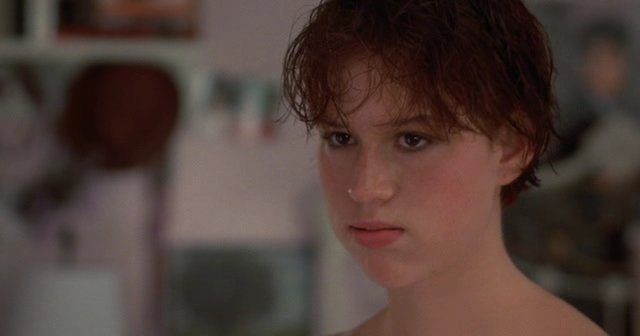
“Chronologically, you’re 16 today. Physically? You’re still 15.” –Samantha Baker, looking in the mirror


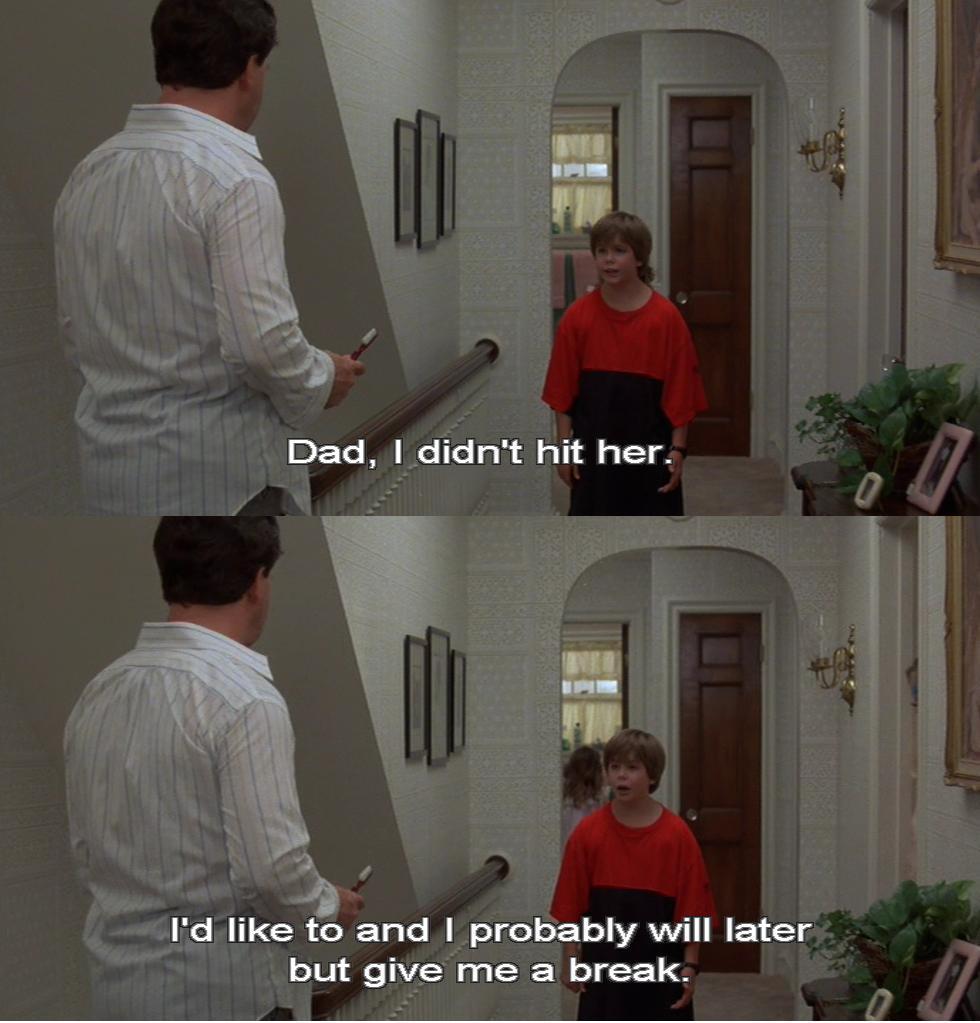
While Samantha laments the lack of changes in her physical appearance, her little brother Mike pretends to almost-punch their younger sister. When he gets in trouble for it, he says, “Dad, I didn’t hit her. I’d like to very much and probably will later, but give me a break. You know my method. I don’t hit her when you’re just down the hall.” It’s easy to laugh this off—I chuckled when I first heard it. But after five seconds of thinking about my reaction, I realized my brain gave Mike a pass because of that whole “boys will be boys” thing, and then I got pissed at myself.
The problem with eye-rolling away the “harmless” offenses of young boys is that it gives boys (and later, men) a license to act like fuckers with no actual repercussions. The “boys will be boys” mantra is one of the most insidious manifestations of rape culture because it conditions both boys and girls at a young age to believe boys just can’t help themselves; violence in boys is inherent and not worth trying to control. And people today—including political “leaders”—often use that excuse to justify the violent actions of men toward women.
Mike Baker explains to his dad that he hasn’t hit his younger sister … yet


Unfortunately, Sixteen Candles continues to reinforce this idea throughout the film.
The Geek, aka Farmer Ted—a freshman who’s obsessed with Samantha—represents this more than any other character. The film presents his stalking behavior as endearing, which means that all his interactions with Samantha (and with the popular kids at school) end with a silent, “Poor guy!” exclamation. Things just really aren’t going his way! And look how hard he’s trying! (Poor guy.) He first appears on the bus home from school and sits next to Samantha, even though she makes it quite clear—with a bunch of comments about getting dudes to kick his ass who “lust wimp blood”—that she wants him to leave her alone. Then this interaction takes place:

Ted: You know, I’m getting input here that I’m reading as relatively hostile.

Samantha: Go to hell.

Ted: Come on, what’s the problem here? I’m a boy, you’re a girl. Is there anything wrong with me trying to put together some kind of relationship between us?

[The bus stops.]

Ted: Look, I know you have to go. Just answer one question.

Samantha: Yes, you’re a total fag.

Ted: That’s not the question … Am I turning you on?

[Samantha rolls her eyes and exits the bus.]

POOR GUY! Also homophobia. Like, all over the place in this movie. The words “fag” and “faggot” flood the script and always refer to men who lack conventional masculine traits or who haven’t yet “bagged a babe.” And the emphasis on “Man-Up Already!” puts women in harm’s way more than once.
Samantha looks irritated when her stalker, Farmer Ted, refuses to leave her alone. Also Joan Cusack for no reason.


The most terrifying instance of this happens toward the end of the film when Ted ends up at Jake’s party after the school homecoming dance, and the two of them bond by objectifying women together (and subsequently creating a nice little movie template to last for generations). The atrocities involve a very drunk, passed-out Caroline (which reminded me so much of what happened in Steubenville that I had to turn off the movie for a while and regroup) and a pair of Samantha’s underwear.
This is how we get to that point: After Jake snags Samantha’s unintentional declaration of love during Independent Study, he becomes interested in her. He tells a jock friend of his (while they do chin-ups together in gym class), “It’s kinda cool, the way she’s always looking at me.” His friend responds—amid all that hot testosterone—that “maybe she’s retarded.” (This statement sounds even worse within the context of a film that includes a possibly disabled character, played by Joan Cusack, who lacks mobility and “hilariously” spends five minutes trying to drink from a water fountain. Her role exists as nothing more than a punch line; she literally says nothing.)
Joan Cusack drinking water (queue laughter)
Joan Cusack drinking a beer (queue laughter)
Jake’s girlfriend, Caroline, picks up on his waning interest in her and says to him at the school dance, “You’ve been acting weird all night. Are you screwing around?” He immediately gaslights her with, “Me? Are you crazy?” to which she responds, “I don’t know, Jake. I’m getting strange signals.” Yup, Caroline—IT’S ALL IN YOUR HEAD NOT REALLY.
Meanwhile, in an abandoned car somewhere on school premises (perhaps a shop lab/classroom), Samantha sits alone, lamenting Jake’s probable hatred of her after their interaction in the gym where he said, “Hi!” and she freaked out and ran away. Farmer Ted stalk-finds her and climbs into the passenger seat. Some words happen, blah blah blah, and a potentially interesting commentary on the culture of masculinity gets undercut by Ted asking Samantha (who Ted referred to lovingly as “fully-aged sophomore meat” to his dude-bros earlier in the film) if he can borrow her underwear to use as proof that they banged. Of course she gives her underwear to him because.
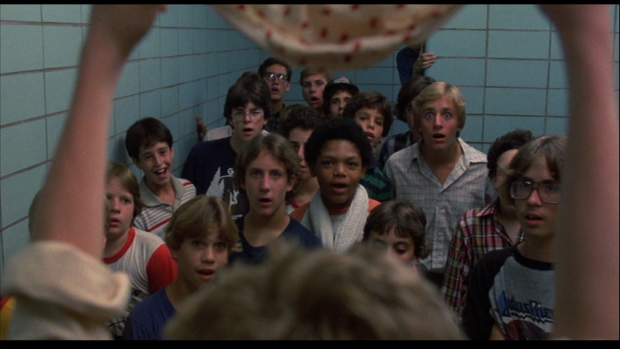
Ted holds up Samantha’s underwear to a group of dude-bros who each paid a buck to see them


Cut to Jake’s after-party: everyone is finally gone; his house is a mess; Caroline is passed out drunk as fuck in his bedroom; and he finds Ted trapped inside a glass coffee table (a product of bullying). Then, at last, after Jake confesses to Ted that he thinks Samantha hates him (because she ran away from him in the gym), we’re treated to a true Male Bonding Moment:

Ted: You see, [girls] know guys are, like, in perpetual heat, right? They know this shit. And they enjoy pumping us up. It’s pure power politics, I’m telling you … You know how many times a week I go without lunch because some bitch borrows my lunch money? Any halfway decent girl can rob me blind because I’m too torqued up to say no.

Jake: I can get a piece of ass anytime I want. Shit, I got Caroline in my bedroom right now, passed out cold. I could violate her ten different ways if I wanted to.

Ted: What are you waiting for?

C’MON JAKE WHAT ARE YOU WAITING FOR GO RAPE YOUR GIRLFRIEND. Or wait, no, maybe let’s let Ted rape her?

Jake: I’ll make a deal with you. Let me keep these [Samantha’s underwear, duh]. I’ll let you take Caroline home … She’s so blitzed she won’t know the difference.

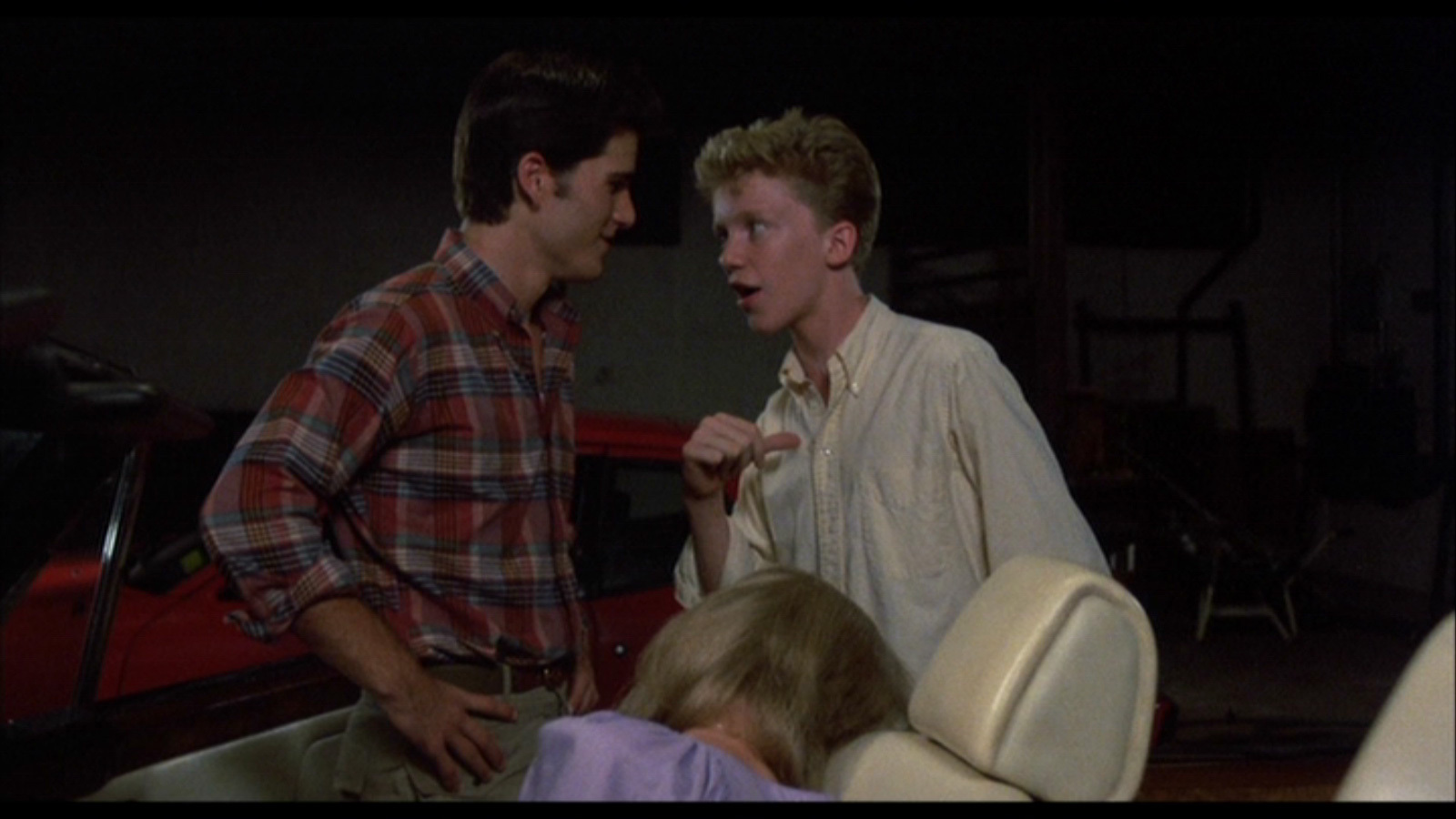
Ted carrying a drunk Caroline to the car

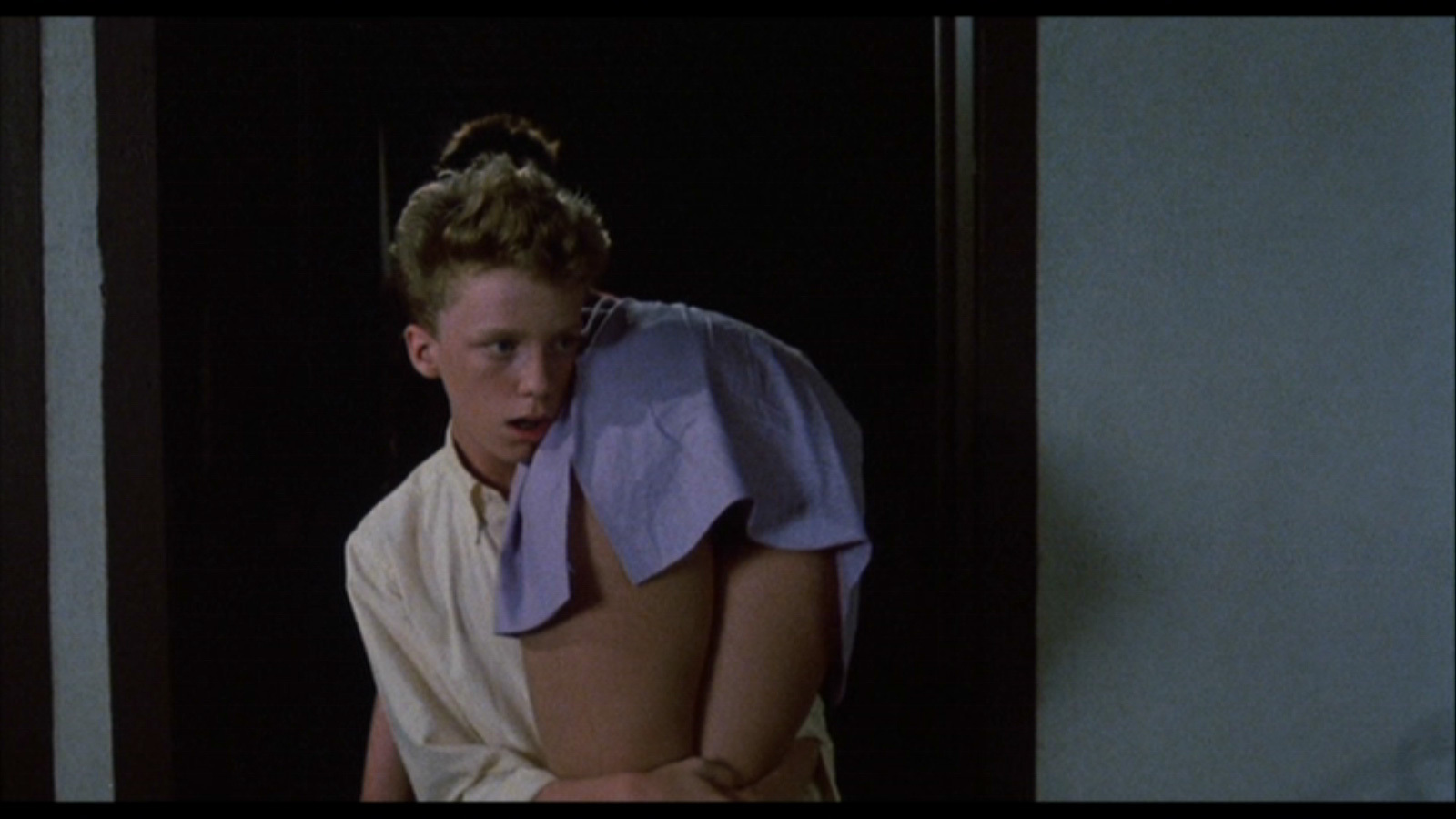
And then Ted throws a passed-out Caroline over his shoulder and puts her in the passenger seat of a convertible. This scene took me immediately back to the horrific images of two men carrying around a drunk woman in Steubenville who they later raped—and were convicted of raping (thanks largely to social media). This scene, undoubtedly “funny” in the 80s and certainly still funny to people who like to claim this shit is harmless, helped lay the groundwork for Steubenville, and for Cleveland, and for Richmond, where as many as 20 witnesses watched men beat and gang rape a woman for over two hours without reporting it. On their high school campus. During their homecoming dance.

Jake and Ted talk about how to fool Caroline

People who claim to believe films and TV and pop culture moments like this are somehow disconnected from perpetuating rape need to take a step back and really think about the message this sends. I refuse to accept that a person could watch this scene from an iconic John Hughes film—where, after a party, a drunk woman is literally passed around by two men and photographed—and not see the connection between the Steubenville rape—where, after a party, a woman was literally passed around by two men and photographed.

Caroline looks drunk and confused while Ted’s friends take a photo as proof that he hooked up with her


And it only gets worse. Caroline wakes up out of nowhere and puts a birth control pill in Ted’s mouth. Once he realizes what he’s swallowed, he says, “You have any idea what that’ll do to a guy my age?” Caroline responds, “I know exactly what it’ll do to a girl my age. It makes it okay to be really super careless!”
It makes it okay to be really super careless.
IT MAKES IT OKAY TO BE REALLY SUPER CARELESS.
So I guess the current anti-choice, anti-contraception, anti-woman Republicans found a John Hughes screenplay from 30 years ago and decided to use this cautionary tale as their entire fucking platform. See what happens when women have access to birth control? It makes it okay to be really super careless! And get drunk! And allow dudes to rape them!
Of course, believing that Caroline is raped in Sixteen Candles requires believing that a woman can’t consent to sex when she’s too “blitzed to know the difference” between her actual boyfriend and a random freshman geek. I mean, there’s forcible rape, and there’s not-really rape, right? And this obviously isn’t REAL rape since Ted and Caroline actually have THIS FUCKING CONVERSATION when they wake up in a church parking lot the next morning:

Ted: Did we, uh …

Caroline: Yeah. I’m pretty sure.

Ted: Of course I enjoyed it … uh … did you?

Caroline: Hmmm. You know, I have this weird feeling I did … You were pretty crazy … you know what I like best? Waking up in your arms.

Fuck you, John Hughes.
Caroline wakes up, unsure of who Ted is, but very sexually satisfied
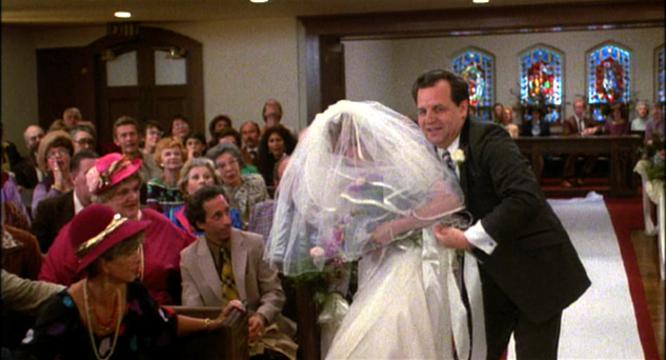
And so many more problems exist in this film that I can’t fully get into in the space of one already long review, but the fact that Ginny (Sam’s sister) starts her period and therefore needs to take FOUR muscle relaxers to dull the pain also illustrates major problems with consent; her father at one point appears to pick her up and drag her down the aisle on her wedding day. (And, congratulations for understanding, John Hughes, that when women bleed every month, it requires a borderline drug overdose to contain the horror.)
Ginny’s dad drags her down the aisle on her wedding day
The racism, too, blows my mind. Long Duk Dong, a foreign exchange student living with Samantha’s grandparents, speaks in played-for-laughs broken English during the following monologue over dinner: “Very clever dinner. Appetizing food fit neatly into interesting round pie … I love, uh, visiting with Grandma and Grandpa … and writing letters to parents … and pushing lawn-mowing machine … so Grandpa’s hyena don’t get disturbed,” accompanied by such sentences as, “The Donger need food.” (I also love it, not really, when Samantha’s best friend Randy mishears Sam and thinks she’s interested in a Black guy. “A BLACK guy?!?!” Randy exclaims … then sighs with relief once she realizes the misunderstanding.)
Long Duk Dong talks to the Baker family over dinner
And I haven’t even touched on the problematic issues with class happening in Sixteen Candles. (Hughes does class relations a tiny bit better in Pretty in Pink.)
Basically, it freaks me out—as it should—when I watch movies or television shows from 30 years ago and see how closely the politics resemble today’s anti-woman agenda. Phrases like “legitimate rape” and “forcible rape” shouldn’t exist in 2013. In 2013, politicians like Wendy Davis shouldn’t have to stand up and speak for 13 hours—with no food, water, or restroom breaks—in order to stop a bill from passing in Texas that would virtually shut down access to safe and legal abortions in the entire state. Women should be able to walk down the street for contraception in 2013, whether it’s for condoms or for the morning after pill. The US political landscape in 2013 should NOT include talking points lifted directly from a 1984 film about teenagers.
I know John Hughes is a national fucking treasure, but please tell me our government officials aren’t using his screenplays as legislative blueprints for the future of American politics.


‘My Sister’s Keeper’: Anna and Kate Growing Up On Screen and On the Page

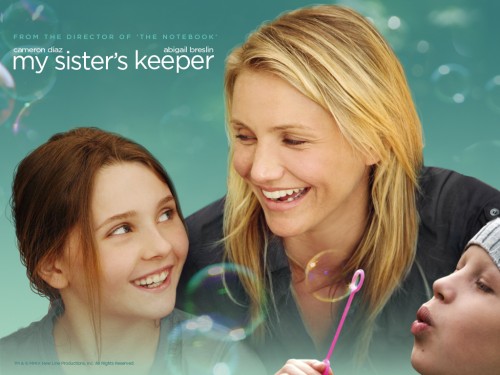
My Sister’s Keeper is a story about growing up, identify, family, death, and life (how can we truly tell any story about life when death isn’t the costar?), but its uniqueness is that it is told primarily through two young girls.

My Sister's Keeper poster
My Sister’s Keeper poster


This guest post by Wolf appears as part of our theme week on Child and Teenage Girl Protagonists.

My Sister’s Keeper is a film based off of a book of the same name. Books that become movies follow a set sequence of events: the book fans anticipate the film, new-comers are targeted by the studios, the choice of what to cut/what to keep is made, some movie fans read the book, and the endless debate over which is better ensues. Both versions of My Sister’s Keeper take the wonderful approach of letting the main characters take turns telling the story. Some people, myself included, learn to love both based on their own merit. The book has a goal and story to tell that differs from the movie. The movie has its own unique story and goals. The biggest difference is the main characters; the movie focuses on Kate and the book centers on Anna. The storyline of two sisters whose lives are entwined stays intact in either case.

Anna exists because of Kate, literally. Kate has cancer, leukemia to be specific, and was diagnosed when she was under 5 years old. She is almost certainly terminal. Her parents aren’t a match, much to their shock and dismay. Jesse, her older brother, isn’t a match. They are given the suggestion to create a designer baby, one who will be the perfect genetic match for Kate. This brings us to our second character, Anna (Andromeda in the book, named by her father, Brian, who is a firefighter and amateur astronomer). Kate takes the cord blood first, stem cells, blood, other small donations later, and by the time the story really begins Kate needs Anna’s kidney. Anna files a lawsuit for medical emancipation to prevent the forced donation.

I could honestly write half a book about the portrayal of this fictional family in both the book and film (Kate, the cancer-stricken crux of the family; Sara, the supermom; Brian, the level-headed father; Jesse, the forgotten child; Anna, searching for who she is). The idea that there is a pro-life/pro-choice metaphor (suggested by Roger Ebert in his review) is also interesting and perhaps a good subject for another day.

But the objective here is Anna and Kate, two children who are growing up and having to act more grown-up than they really are.

caption
Kate and Anna


Kate is a child, but she faces an event typically reserved for adults: death. Kate knows she is dying. She holds no illusions. She has even tried to kill herself. She also suffers for others, but not like Anna does; she lives through the agony of cancer for the sake of her family. She has a mature acceptance of death most of the adults around her do not. At times in the movie, she seems to be the only one living in reality. Her parents fail her in this aspect–they want to save her, even if that means denying the reality of her situation and keeping her in pain. She doesn’t only suffer physically. She has the emotional trauma of knowing her cancer is harming her parents’ marriage, her brother is ignored in lieu of focusing on her (in the book, Sara admits she gave up on him), and Anna’s life revolves around saving Kate.

Both daughters must grow up because their parents fail them. They love them, undoubtedly, but they do not always act in their best interest nor are they often granted agency. Sure, when Kate wants to miss school in the books because of her cancer-stricken appearance Sara allows this. She understands a teenage girls’ vanity. But her desire to end her suffering is ignored. Anna is granted small choices as well based on her desires, but despite her mother’s claims she is being forced to donate her body parts. By the very fact that Sara pushes her to donate and fights the case in court shows she doesn’t care about Anna’s wishes.

Anna’s well-being (the procedures are painful and dangerous) is not taken fully into account. In the books, Brian didn’t want her to donate again when Kate’s cancer reemerged. She didn’t remember the blood draws or injections, but if they had her donate again she would be old enough to remember. He is overruled and concedes to save Kate. The judge doesn’t find her parents guilty of any neglect or indifference but can see that this choice is complicated and Anna needs a voice of her own. (Sara and Brian will speak for Kate’s best medical interest; her wish to die isn’t considered valid.)

Kate wasn’t expected to live past 5. Sara plans as though she will survive in both versions, even telling Dr. Chance that he will come to her wedding one day. Brian stopped dreaming of milestones to avoid the pain when her cancer came back or became more aggressive. In the movie, Kate doesn’t talk about her future; even while “dating” Taylor they talk about their impending deaths. Kate is taken aback in the book when she is asked about her future plans–no one asks her that, even as they fight to keep her alive. She confides that she wants to be a ballerina because they have “absolute control. When it comes to their bodies they know exactly what will happen.” These small situations are more drawn out in the books. Kate hemorrhages from the leukemia; blood is gushing out every opening it can find, from head to toe. Sara gives her a pad and wonders if she will live long enough to get her first period. She will likely not live to experience growing up the way most people do before they die.

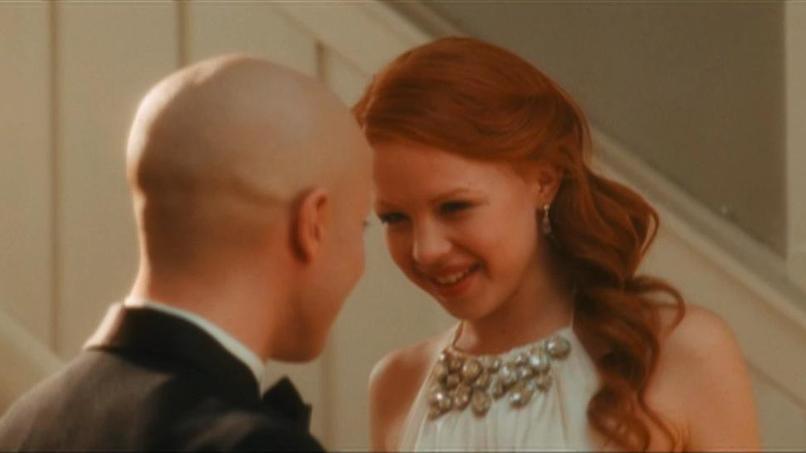
For this reason, in both versions, her parents allow her to go to a hospital dance for patients. Taylor, her “boyfriend,” is a rare joy for Kate. In the movie, she finds the perfect wig and dresses like a princess. In the book, she can’t stand wigs and must wear a mask because she is so compromised. Her sexuality is treated differently than it would be if she were cancer free. In the movie, Taylor and she either have sex or “do stuff” that is sexual in nature. But it’s hard to be upset by this. We can’t after all ask her to wait–she’s already living past her life expectancy. Fertility and STDs are not concerns for a girl with cancer. In the book, they only kiss. Sara allows this despite the medical risks, despite the fact that it might kill her–because she knows Kate needs this moment. Every girl needs her first kiss.

This point is driven home when Taylor dies soon after the dance.

It’s only a matter of time before Kate dies as well.

caption
Kate and Taylor


Anna could in theory save Kate. If she were willing, if the hospital signed off, if Kate’s body could handle surgery, and if her kidney functioned well in her sister’s body. Anna files the lawsuit because her sister wants to die and she was asked to “set [her] free.” Anna in all actuality would give her kidney or her right arm or everything she had to save her sister. But the guilt is real. Whether it’s cheerleading and soccer (movie) or hockey and studying abroad (book), Anna really does want her own life and future. She isn’t just expected to save her sister at her own expense but agrees with this prescription for her life. She doesn’t have any real friends nor does Kate. They have each other and that’s enough. But Anna had to give up hockey camp in the book because they wouldn’t let her leave the state in case Kate got sick and needed her. If she gives her kidney, no coach will risk her joining the team. She might have to forgo children of her own if the risks of pregnancy are deemed too severe for her with only one kidney. Anna had to choose between herself and her sister. Kate made the choice for her.

This still doesn’t mean Anna is an adult.  In the books Anna throws tantrums, serious tantrums, like opening a car door while it’s in motion to run away. Movie Anna has an outburst here and there but is far more composed and mature. She still falls asleep in her mother’s arms and is most distraught by people being disappointed by her. She wants her parents, but she doesn’t want them to make medical choices against her will. This still doesn’t mean she has adult foresight. When Campbell offers to make Sara stop talking to her about the case, she doesn’t stop to think that this means her mother will be removed from the home. Campbell, who was fine with referring her to Planned Parenthood before he knew the specifics of her case, forgets the fact that she is an adolescent and not a typical client.

The final change from book to movie is the ending.

In the movie, Kate dies. It’s expected and is so spot on for those who have lost a loved one. Kate never gets to grow up. Anna has to grow up without her sister, her best friend, her identity. And the family must come together without Kate’s gravitational pull holding them in and propelling them through their lives. We don’t know what Anna becomes as an adult; we only know the family gets together on Kate’s birthday and Anna gets to have all the choices every other girl does.

In the book, the last words we hear from Anna are about her future: “Ten years from now, I want to be Kate’s sister.”

Anna dies in a car crash on her way home from court immediately after her proclamation. Campbell is also injured, but since he holds medical power of attorney he sends her kidney to Kate upstairs. Her other organs go to help other families. Kate almost dies despite this, but claws her way back to life. She hates herself for this–for surviving. Sara falls apart and must live without the child she never thought she’d lose. Brian works overtime to avoid going home. He falls into alcohol. Somewhere in the mist of this tragedy, Jesse finds a way to turn himself around and becomes, of all things, a cop. Kate eventually becomes a dance instructor and takes Anna, by extension of her kidney, with her wherever she goes.

These girls are very relatable. They are more realistic in the books, but that’s also because there is more time and room to get to know them. Movies must be trimmed so they don’t run too long. Some cuts and differences are there to emphasize points that can’t be dwelled upon, but must be understood quickly. Sisterhood is a constant theme (Anna/Kate; Sara/her sister). The film is female-centric (Judge DeSalvo), despite cutting out a female character, Julia, and merging her role into a preexisting male character, Campbell. This may be one of the few films where common female tropes–the martyr, the mother, the savior–are displayed in a non-offensive, realistic manner. They are furthermore examined and challenged in the same fashion. Women do not have to be saviors or martyrs, but we understand why Anna and Kate fall into these roles. We also understand why they both feel so much guilt, especially Anna, who wonders if she is “rotten” for wanting a future, for wanting the things all girls growing into adulthood long for. Super-Mom is often hard to empathize with because of how single-minded she is about saving Kate. In both versions, it’s a miracle Jesse isn’t dead or in jail due to her and Brian’s lack of parenting. But we understand both her love and her fear of what will she be if she loses her daughter; can she go on if Kate dies and all of her sacrifices, namely her other two children and marriage, were for nothing?

My Sister’s Keeper is a story about growing up, identify, family, death, and life (how can we truly tell any story about life when death isn’t the costar?), but its uniqueness is that it is told primarily through two young girls.

Kate comforts Anna and Jesse


Wolf is known to her friends as the Pop Culture Queen and loves to read books, watch movies, and keep up on her TV shows. She is a perpetual psychology student who hopes to finish her schooling before she’s 90. She occasionally finds the time to write for fun and win trivia contests. Criticism, questions and suggestions are always welcome in her email: hairdye_junky@yahoo.com.

The Relationships of ‘Veronica Mars’

It’s common wisdom that maintaining relationships requires constant work, but there’s often an assumption (in TV, movies, and real life) that this only applies to romantic relationships. Platonic relationships are rarely the focus of a story, and when a storyline deals with issues in these relationships, they’re often easily dealt with, and the friendship goes back to being simple. Exceptions to this are problems that are caused by romantic relationships. Veronica Mars is an exception to this; for its first two seasons, it depicts many platonic relationships, and explores the many issues involved in navigating them (some of these problems are related to romance, but many are not, showing platonic relationships have their own complexities, separate from romance).

This guest post by Sarah Stringer appears as part of our theme week on Child and Teenage Girl Protagonists.

The opening monologue of Veronica Mars makes it sound like this show is going to stick very closely to the trope of the jaded heroine, whose job has shown her so much lying and cheating that she’s closed off to the possibility of relationships. This idea is reinforced throughout the show, as various characters make jokes about Veronica’s cold cynicism. She’s snarky and sarcastic, and does have trouble getting close to people, largely because of all the trauma she went through before the beginning of the show.

Veronica with her trusted camera and jaded attitude


However, Veronica Mars ends up subverting our expectations. Far from being a show about an aloof hero who can’t work with others, it ends up being largely about Veronica’s various relationships. It’s a running joke throughout the show that she’s constantly asking her friends for favours, but it’s also a running joke that people are constantly asking Veronica for favours, and the favours she asks for are usually to help her help others.

Her friends complain about constantly having to come to her aid, but they never refuse her requests, because they know the favours will be returned when they’re in need. This creates complications, as Veronica finds the line between relationships based on mutual usefulness and reciprocity, and relationships built on genuine caring and respect. As the first couple of seasons progress, she gets better at navigating the second kind of relationship, and mixing it with the first kind.

It’s common wisdom that maintaining relationships requires constant work, but there’s often an assumption (in TV, movies, and real life) that this only applies to romantic relationships. Platonic relationships are rarely the focus of a story, and when a storyline deals with issues in these relationships, they’re often easily dealt with, and the friendship goes back to being simple. Exceptions to this are problems that are caused by romantic relationships. Veronica Mars is an exception to this; for its first two seasons, it depicts many platonic relationships, and explores the many issues involved in navigating them (some of these problems are related to romance, but many are not, showing platonic relationships have their own complexities, separate from romance).

Veronica starts season one with no friends, but in the pilot episode, she befriends the new kid at school, Wallace Fennel. Her very first meeting with him involves her helping him out, by cutting him down from the flagpole where some bullies had duct taped him. She immediately lets him know that sitting with her won’t help his social standing, and he doesn’t need to be her friend just to reciprocate her gesture. He sits with her anyway, not because he feels like he owes her for the help, but because he likes her as a person.

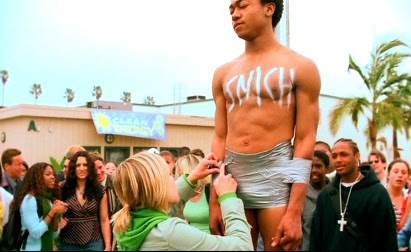
Veronica cutting Wallace down


Wallace and Veronica become best friends, and they’re a rare example of a show seriously dealing with the complexities of platonic relationships. As Wallace spends more time at the school, he starts to befriend other students, and get quite popular as a result of being a star on the basketball team. This creates problems in his relationship with Veronica, as they both try to navigate the jealousy, resentment, and time conflicts that come from vastly different social statures.

Another issue in Veronica’s relationship with Wallace is the same issue that exists in all her relationships: the balance between genuine friendship and trading of favours. She often uses his job in the school’s office to get information for her cases, and he’s put himself at risk in that way and other ways to help her. He grants all her requests, sometimes with no knowledge of why he’s doing it (and no questions asked), but he knows her resources will be put to his use anytime he’s in trouble.

Sometimes the balance starts to tip too far, and Wallace feels like she’s taking him for granted. This comes to a head several times, especially when his mother gets in trouble at her job because of something Veronica had him do, without telling him how dangerous it could be. He calls her out several times when she starts neglecting her friendship with him, blowing him off to work on her cases and just using him for the assistance he offers. Veronica tries to make up for this by doing things like baking spirit cookies for his locker, telling him she may have no school spirit but he does, and what’s important to him is important to her.

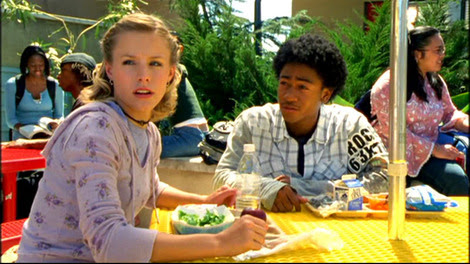
Veronica and Wallace, figuring things out together


The issue of one partner taking the other partner for granted is one that often comes up in relationships, and little gestures to show affection is a common (partial) solution to it. The depiction of this as a constant issue between two platonic partners is quite refreshing.

This dynamic is seen in several of Veronica’s other relationships, particular with Weevil, a local biker, and Mac, a computer nerd. She gets Weevil and Mac out of trouble when they need it, and they both help her out whenever they can. Working around the inherent potential for taking advantage of each other, as well as Veronica’s own cynicism, they forge genuine friendships that grow as much as any romantic relationship.

The show also devotes a lot of time to Veronica’s relationship with her father, Keith. She works for him at his private investigator practice, and there are times when it’s difficult for them to navigate the dual dynamics of father-daughter and detective-receptionist/junior detective. He wants to protect her, but also teach her, and he often needs her help. He wants to trust her, but there are times when she breaks that trust, and he has to decide how to deal with that as a father and as a boss.

Familial relationships aren’t rare in television or movies (though complex portrayals of them are still rarer than in-depth looks at romance), but they’re rarely dived into as deeply as with Veronica and her father. They joke together, work together, go through extremely difficult circumstances together, and work together to come back from the problems created when they both inevitably screw up.

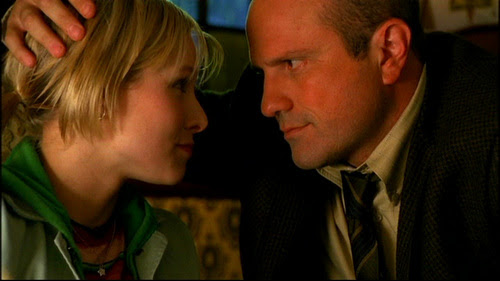
Veronica and Keith
Veronica and Keith


Veronica Mars portrays all these relationships, and their various issues, without touching romance. That’s not even getting into the relationships Veronica forms with whatever classmate she’s trying to help that week, or with other characters like Meg (her romantic rival, but also far more than that) and her dead best friend, Lily. In a subversion of a heroine who’s closed off and can’t get close to people, Veronica Mars is essentially a show about relationships of all types, and it’s at its best when it’s focusing on those.

The show deteriorated for many reasons in season three, but in my opinion, the major reason was the increased focus on romantic drama, at the expense of the many platonic relationships it built up previously. Weevil and Wallace have significantly smaller roles. Keith and Mac are still important, but mostly because of their own storylines, and they do a lot less interacting with Veronica. When Mac does talk to Veronica, it’s mostly so they can discuss their romantic lives, rather than develop their relationship with each other.

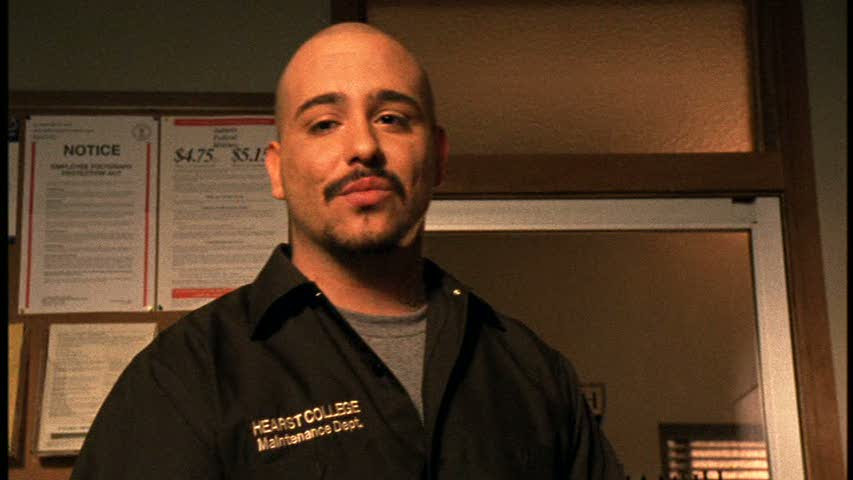
Season three's Weevil, aka "Who the Hell Is This Guy, Again?"
Season three’s Weevil, aka “Who the Hell Is This Guy, Again?”


Romance certainly existed in the show before season three. Veronica had three boyfriends in two seasons, and those relationships were in no way simple or small parts of the story. But they were portrayed quite similarly to the platonic relationships: the focus was on human interactions, and two people figuring out how to fit their personalities together. They even shared the issues about genuine caring versus using each other; Veronica’s first boyfriend was a cop who she met because she was trying to sneak past him to steal evidence, and she spent the better part of the second season trying to get her next boyfriend off for murder.

However, in the third season, most of Veronica’s romantic issues were more superficial. Her and her on-and-off boyfriend Logan spent more moping about each other than actually figuring out how to be together (or not be together). There’s drama about who’s sleeping with who that leads to more fights than resolutions. The show seems to lose its focus, particularly since so many of Veronica’s platonic relationships are neglected.

There were things I liked about the third season of Veronica Mars, and I await the upcoming movie with as much bated breath as the next fan. But I hope the movie put the focus back where I think it belongs: on complex relationships of all kinds, rather than romantic drama.


See also at Bitch Flicks: “Why Veronica Mars is Still Awesome,” by Amanda Rodriguez


Sarah Stringer is a psychology student in Ontario, with an interest in the political aspects of pop culture.


‘Bob’s Burgers’: The Uniquely Lovable Tina Belcher

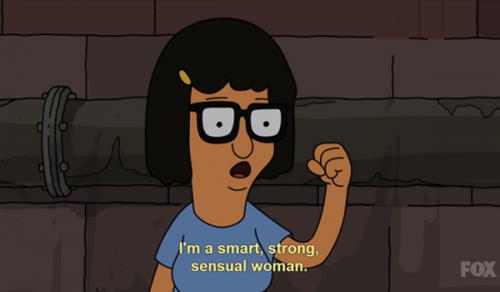
Delightful Tina. Shy, painfully weird, butt-obsessed, quietly dorky, intensely daydreamy Tina. Tina is a little bit like all of us (and–cough–a lot like some of us) at that most graceless, transitional, intrinsically unhappy stage of life that is early adolescence. She is also a wonderfully rich and well-developed character, both in her interactions with her family and in her own right, and she’s arguably the emotional core of the whole show.

tina-belcher

Written by Max Thornton as part of our theme week on Child and Teenage Girl Protagonists.

It might seem odd to be writing about Bob’s Burgers for Bitch Flicks‘ Child and Teenage Girl Protagonists week, but I can justify it. For the uninitiated, Bob’s Burgers is an animated comedy centered on the Belcher family,who run the titular restaurant: long-suffering paterfamilias Bob (Archer/Coach McGuirk!), his irrepressibly cheery wife Linda, and their three children–awkward 13-year-old Tina, genial 11-year-old Gene, and borderline-sociopathic 9-year-old Louise. The show is charming, warm, and very funny, and it’s no great leap to declare it the spiritual and comedic successor to The Simpsons. It’s also eminently possible, as A.V. Club’s Sonia Saraiya explains in a recent article, to read Tina as the show’s protagonist.

Delightful Tina. Shy, painfully weird, butt-obsessed, quietly dorky, intensely daydreamy Tina. Tina is a little bit like all of us (and–cough–a lot like some of us) at that most graceless, transitional, intrinsically unhappy stage of life that is early adolescence. She is also a wonderfully rich and well-developed character, both in her interactions with her family and in her own right, and she’s arguably the emotional core of the whole show.

tina-belcher-1

The typical oldest child on TV doesn’t look like Tina. Oldest children are smart and accomplished or bratty and rebellious, but always outspoken and confident: Becky from Roseanne, Sondra from The Cosby Show, Bart from The Simpsons, Haley from Modern Family… The oldest child is almost never the clear point of identification for the TV viewer, but Tina’s gentleness makes her the most relatable and in some ways the realest Belcher.In Saraiya’s words, “She’s sensitive and working-class and even possibly neuroatypical.” This might not seem like a recipe for a popular television character, but it gives Tina a depth, nuance, and a potential for growth in comparison to which her family seems a little, well, cartoonish.

Wait... you mean to say... they ARE cartoons??
Wait… you mean to say… they ARE cartoons??

Tina’s very existence is arguably an explicitly feminist triumph. To quote Saraiya once more:

In the original pilot for Bob’s Burgers, [Tina] was a teenage boy. That fundamental difference aside, Daniel Belcher and Tina Belcher are the same character—but looking back, that choice had enormous implications for the show, because a TV audience has never seen a girl growing up like this. She’s nothing like an archetypal teen, but she’s also unmistakably one. She daydreams about kissing her crushes—and also about touching the butts of all the cute boys in her class. She fantasizes about being a prettier, bolder version of herself, who talks politics with adults and is an object of affection among the guys at Wagstaff School. … Puberty and dating have a typical arc on shows about teenage girls, but Tina’s arc on Bob’s Burgers is something else entirely. It’s gross. It’s messy. It occasionally encourages threesomes. And it’s hilarious, but the show is careful to never make Tina the butt of any jokes. (Tina touching butts, however, is okay.) If the viewer is laughing, it’s most likely with Tina—or at the very least, with the people who love her.

Amen to that.

An oddity of Bob’s Burgers is the fact that Kristen Schaal, the voice of the wonderfully evil Louise, is the only woman among the cast for the Belcher family. John Roberts voices Linda, and Dan Mintz voices Tina. Metatextually, I’m troubled by yet another instance of women not getting work in the vastly male-dominated industry of film and TV; but within the world of the show, it’s simply one instance among many of gender norms being subverted, tossed aside, or merely ignored by the marvelous Belchers. Whether it’s Tina regretting waxing her legs because she mowed down her “furry little friends,” Bob delighting in the fact that he also waxed his, Linda and Louise bailing on a creepily womb-centric mother-daughter seminar to bond over laser tag, or Gene casually declaring which outfits in a fashion catalog would suit him–all examples from a single superb season 3 episode, “Mother Daughter Laser Razor”–the Belchers are not bound by the anxieties of conforming to strict gender roles, and it’s glorious to behold.

The whole Belcher family dynamic is the real reason to watch this show. As Saraiya notes (and I swear this is the last time I will quote her), “everybody watches out for Tina, because Tina couldn’t hurt a fly.” As someone whose siblings are my best friends, I love the Belcher kids more than any other set of TV siblings. They pester and needle and tease other, as siblings do, but they also scheme together, protect each other’s greatest vulnerabilities, and have huge amounts of fun together. Tina isn’t bossy or a bully, like so many TV oldest kids. She’s weird, she’s wonderful, she’s a 13-year-old girl voiced by a 32-year-old man, and she’s one of the best young female characters on TV.

Also, she's basically Tumblr in human form.
Also, she’s basically Tumblr in human form.

Max Thornton blogs at Gay Christian Geek, tumbles as trans substantial, and is slowly learning to twitter at @RainicornMax.

Six Lessons Lisa Simpson Taught Me

…Lisa takes a stand against the sexism spouting from the mouth of the new talking Malibu Stacy doll. Frustrated with the doll’s collection of sexist catchphrases that include “Let’s bake some cookies for the boys,” “Thinking too much gives you wrinkles,” and “My name’s Stacy, but you can call me *wolf whistle*,” Lisa collaborates with the creator of Malibu Stacy to create their own talking doll, Lisa Lionheart. When Malibu Stacy outsells Lisa Lionheart, our creator feels temporarily dejected, until she hears her own voice speaking behind her: “Trust in yourself and you can achieve anything.” She turns to see a girl her age hold a Lisa Lionheart doll in her hand and smile.

Written by Lady T as part of our theme week on Child and Teenage Girl Protagonists.

Lisa Simpson, influential eight-year-old

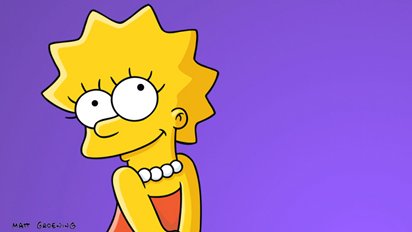
The Simpsons, now in its record-breaking 25th season, is one of the most influential comedies of our time with its excellent pop culture parodies, whip-smart writing, and brilliant satire on American culture. But the show is influential in other ways. Lisa Simpson, permanent eight-year-old and the emotional heart of The Simpsons, is an excellent role model for young girls. Here are a few lessons she’s taught me over the years.

“Trust in yourself and you can achieve anything.”  This is the stated message of “Lisa vs. Malibu Stacy,” the famous episode where Lisa takes a stand against the sexism spouting from the mouth of the new talking Malibu Stacy doll. Frustrated with the doll’s collection of sexist catchphrases that include “Let’s bake some cookies for the boys,” “Thinking too much gives you wrinkles,” and “My name’s Stacy, but you can call me *wolf whistle*,” Lisa collaborates with the creator of Malibu Stacy to create their own talking doll, Lisa Lionheart. When Malibu Stacy outsells Lisa Lionheart, our creator feels temporarily dejected, until she hears her own voice speaking behind her: “Trust in yourself and you can achieve anything.” She turns to see a girl her age hold a Lisa Lionheart doll in her hand and smile.

Lisa realizes that, despite the seemingly impossible task of standing up to big businesses, she’s made a big difference in the life of one person, and all of her efforts were worth it after all. And, not for nothing, she co-created a toy at the age of eight.

Lisa's rant against Malibu Stacy
Lisa’s rant against Malibu Stacy

“It’s okay to be sad.” “Moaning Lisa,” one of the earliest episodes of The Simpsons, is surprisingly dark for an animated sitcom. Lisa spends most of the episode in a depressive state. She feels sad and no one knows how to deal with it. Her teachers mock her sadness or brush it off. Her brother, being ten and pretty selfish, doesn’t want to deal with it. Her well-meaning but confused parents tell her to cheer up or repress her sadness so that she can fit in.

Lisa doesn’t start to feel better until she meets a jazz musician named Bleeding Gums Murphy. Finally, she has an outlet for her sadness and someone she can relate to. But it isn’t until Marge, in a burst of passion, tells Lisa that she can be sad as she wants to be, and doesn’t ever have to smile for the sake of another person, that Lisa finally feels happier and has a genuine smile on her face.

The lesson here? It’s okay to be sad sometimes, and girls shouldn’t have to paste fake smiles on their faces. The simple message that people are entitled to their emotions is a powerful one that I’m glad I saw at such a young age.

Lisa meets Bleeding Gums Murphy

“Stand up for what you believe in, but respect others’ beliefs as well.”  Lisa, like many a young activist, is passionate about many different causes. She’s a feminist, an environmentalist, and a vegetarian, and nothing invokes her ire more than social injustice or lies. Most of the time, she is right to fight for her causes, and is often the only person to stand up for what’s right.

Every once in a while, though, Lisa becomes a bit shortsighted and forgets that everyone around her doesn’t see the world the same way she does. She ruins her father’s barbecue because she doesn’t approve of his eating meat, but she gets a wake-up call when Apu, a vegan, advises her to “live and let live.” Lisa learns an important lesson about tolerance while still remaining true to her beliefs.

Lisa feels moral qualms about eating meat

“There’s no shame in being second.” Because she doesn’t have many friends, Lisa absorbs herself in her music and her academia. She becomes immediately threatened when a new girl shows up in her second-grade class and is a better student and better jazz musician. Lisa becomes jealous to the point where she collaborates with Bart to ruin Alison’s diorama in the school’s Diorama-Rama, admitting to her actions only when the guilt tortures her–and then they both lose to Ralph Wiggum.

At the end of the episode, Lisa finally learns that being “second” to Alison is nothing to be ashamed about. Having overcome her jealousy of Alison, she extends a hand of friendship instead–because why be jealous when you’ve finally found a person your age who shares your passions and interests?

Lisa and her rival, Alison

“Follow your passions, even when you experience setbacks.”  One of my favorite episodes of The Simpsons is season three’s “Separate Vocations,” an experiment in role-reversal. After hearing their results from a national standardized test about career aptitude, Bart becomes interested in police work and becomes the school’s tyrannical hall monitor. Lisa, meanwhile, discouraged by her test results and stubby fingers, quits the jazz band, stops playing saxophone, and acts out in class. She even pulls off one of the biggest pranks in school history and steals all of the teacher’s edition textbooks from the school classrooms.

When it seems like she’s going to get caught, Bart, in a rare display of brotherly loyalty, tells Principal Skinner that he’s the culprit. Later, he tells Lisa why he took the fall for her: “I didn’t want you to wreck your life. You got the brains and the talent to go as far as you want. And when you do, I’ll be right there to borrow money.” He takes his punishment–600 days of detention–and Lisa plays her saxophone outside to keep him company, enjoying music again.

With the help of her brother, Lisa realizes that the results of a standardized test don’t matter in the great scheme of things. She has ambition, talent, intelligence, and passion, and she’s going to go far in life as long as she keeps trying.

Lisa becomes a rebel

“Have fun and be silly.”  If all Lisa Simpson did was moralize about the world and fight for causes she believes in, she’d be a pretty admirable but rather boring character, but fortunately, the show rarely forgets that she’s still a kid and wants to act like one. She watches Krusty the Klown and Itchy and Scratchy with Bart and laughs just as hard at the cartoon violence. She fantasizes about boys named Cory and reads Non-Threatening Boys Magazine. She has sleepovers and reads The Baby-sitter Twins, and even though she’s concerned about the media portrayal of women and girls, she indulges in a princess fantasy from time to time and twirls around in fairy skirts. She’s not the most fun-loving character on The Simpsons, but at her core, she’s still an eight-year-old girl, and a fully realized human character, despite being a cartoon.

Lisa and Bart, horrified to hear they won't be going to Itchy and Scratchy Land
Lisa and Bart, horrified to hear they won’t be going to Itchy and Scratchy Land

___________________________________

Lady T is a feminist blogger, sketch comedy writer/performer, and author of Fanged, a young adult novel available for purchase today.

Are You There, Hollywood? It’s Me, the Average Girl

The expectations for girls in film and television are incredibly mixed. It is naïve to say that girls nowadays are just expected to be a sexy sidekick or afterthought. With more strong female roles popping up in bigger budget films such as Harry Potter and The Hunger Games, there is the expectation that girls should also be intelligent and incredibly clever (while also being visually pleasing). I love Harry Potter and The Hunger Games for giving women these intense and interesting character traits. However, I remember thinking after I saw/read the series, “Wow, I’m not nearly as clever as Hermione and could never be as brave as Katniss.” There isn’t really a place for the all-around average girl. The first two examples of strong female protagonists that I could think of are in fantasy franchises. Are real female characters really that difficult to come up with? Real female characters are often created with good intentions but tend not to work on a larger scale.

This guest post by Carrie Gambino appears as part of our theme week on Child and Teenage Girl Protagonists.

The expectations for girls in film and television are incredibly mixed. It is naïve to say that girls nowadays are just expected to be a sexy sidekick or afterthought. With more strong female roles popping up in bigger budget films such as Harry Potter and The Hunger Games, there is the expectation that girls should also be intelligent and incredibly clever (while also being visually pleasing). I love Harry Potter and The Hunger Games for giving women these intense and interesting character traits. However, I remember thinking after I saw/read the series, “Wow, I’m not nearly as clever as Hermione and could never be as brave as Katniss.” There isn’t really a place for the all-around average girl. The first two examples of strong female protagonists that I could think of are in fantasy franchises. Are real female characters really that difficult to come up with? Real female characters are often created with good intentions but tend not to work on a larger scale.

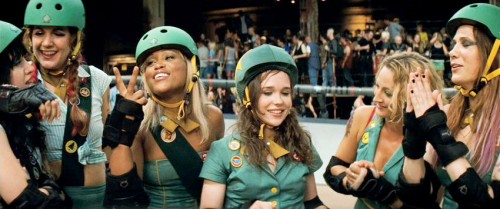
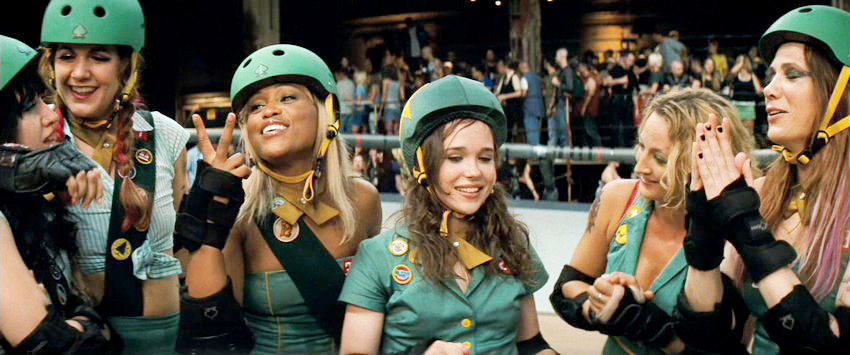
The underrated movie from 2009, Whip It, had a real-life storyline, but it wasn’t widely complimented for its feminist take-back, only for its poor performance at the box office. The plot surrounds Ellen Page’s high school-aged character who is bored with her small-town life in Texas and wants to branch out. She takes up roller derby against her parents’ wishes, meets a guy blahblahblah …

Except [spoiler alert] she finds out the guy is an asshole and ditches him after he comes crawling back to her. More on this later.

caption
Ellen Page in Whip It

Believable story lines with unique female characters aren’t known to sell at the box office, as shown by Whip It. It had all the makings for a feel-good movie–maybe not an Oscar winner, more like People’s Choice or a sleeper SAG award winner.

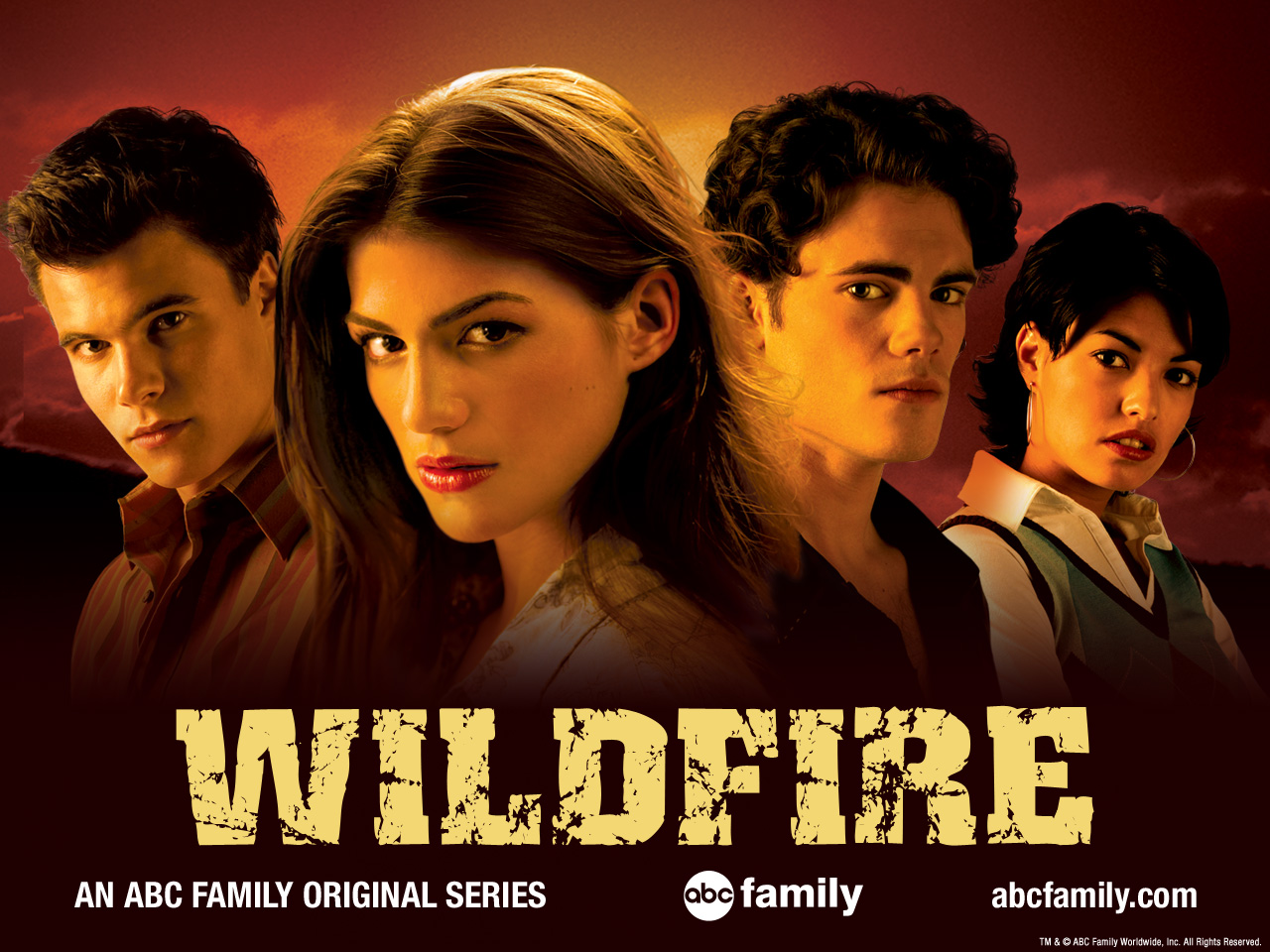
For the time being, the most relatable she-roes are on television. 30 Rock and Parks and Recreation show flawed, funny women in professional roles surrounded by a cast of misfits. Tina Fey, as described in her memoir, Bossy Pants, wanted the cast of 30 Rock to be a group of real-looking people, and not just young Hollywood copies. She mentioned that too many attractive people on a show is confusing. I can vouch for Fey on this theory (see: Pretty Little Liars and literally everything on the CW). Too many pretty people in one program loses the show’s integrity and the audience’s ability to relate. Remember the ABC Family original series, Wildfire? You shouldn’t but that’s beside the point. I couldn’t tell the characters apart in the commercials, much less the actual show. All I could gather was that there was a horse and a lot of pretty brunettes on a farm.

caption
Wildfire TV poster


30 Rock’s Liz Lemon was in a constant struggle of balancing her personal life and work life. We can all identify with that. I cannot identify with the sitcom aspect of her life, as no one can, but if my life had writers, it would go a lot like Liz Lemon’s—not always passing the Bechdel test and wondering how I could get a guy at a bar to buy me mozzarella sticks instead of another drink.

Yes, 30 Rock and Parks and Recreation are not meant for younger audiences but they serve as worthy role models. Their characters serve as extensions of both Fey and Poehler as well. Amy Poehler is an advocate for young girls’ empowerment as shown by her website, Smart Girls at the Party.

Another expectation that television and movies thrusts upon women is that having a romantic relationship is something that should be a common experience for all girls at a young age. I cannot really even name a movie or television show that doesn’t end in a happy, romantic way for the female lead. Both Liz Lemon and Leslie Knope found love despite their independent natures. I agree that it is much more appealing for audiences to see the characters happy in the end, but does that always mean that a romantic counterpart has to represent that happiness? I can’t help but think that this notion has seeped its way into the life of girls of all ages. At my grandmother’s wake, a distant relative of mine who I had literally just met asked me if I had a boyfriend. That was the follow-up question to “where did you go to school?” Could she not think of anything and figured the only commonplace question for a girl my age was if I had a boyfriend? Oof.

I don’t advise that film do away with romantic storylines because it can be educational as well as entertaining when done correctly. But a balance of the female protagonist’s plot should be heavier than that of the love interest. Drew Barrymore’s Whip It had a healthy balance of female empowerment and romantic sub-plot that didn’t leave the audience dwelling on Landon Pigg’s surprising display of douchebaggery in the film.

caption
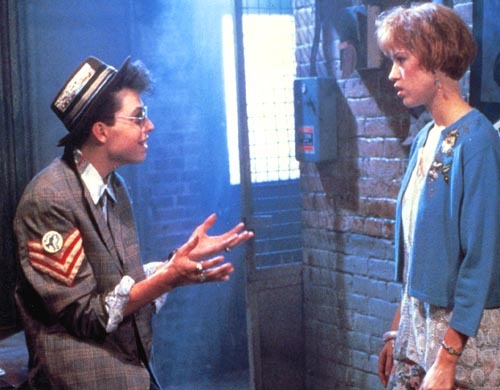
Molly Ringwald as Andi in Pretty in Pink

Young female protagonists who find “love” within the film and are additionally attractive by mainstream media standards, are more of a hindrance to a young girl’s self-esteem. The inner-monologue of comparisons begins: “If she found a boyfriend by looking like that, I should try to look like her.” It subconsciously shows teens that because the girl was pretty, the romantic relationship aided in the result. I remember watching Pretty in Pink for the first time. I couldn’t believe that Molly Ringwald’s character still ended up with the snobby, rich guy who was ashamed of her a few scenes earlier. Had I been a character in this movie, let’s be honest, I’d be Ducky.

Of course, it must be noted that the lack of women of color in film and television is astonishing and must be changed. Scandal and The Mindy Project are great but shouldn’t be the only ones I can think of. (However, I was pleased when I saw Doc McStuffins while babysitting–it’s the cutest kids show about an African American girl who is a doctor for her toys.)

There are a lot of problematic themes on television and in movies that cause young girls to try to live up to impossible expectations. One can only hope that the next generation knows enough to take a step back and make decisions based on its own set of values. The tag-line for the Whip It is “Be Your Own Hero.” While it’s the moral of the movie, it should also be a message that we hope young girls are taking in.


Carrie Gambino is a recent Mercyhurst University graduate hailing from snowy Buffalo, New York. She spends her time keeping up with politics while living that #postgradlife.


Powerful Realism and Nostalgia in ‘My So-Called Life’

Almost 20 years later, we need more of what My So-Called Life gave us a taste of. We need teenage girl protagonists to be sexual, not sexy. We need honest portrayals of what it is to be a teenager–not only for teenagers who need to see themselves in faithful mirrors, but also for adults who are still trying to figure themselves out.

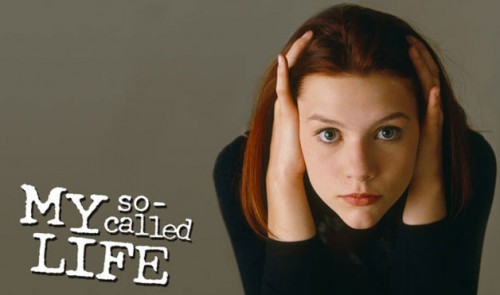
My So-Called Life
My So-Called Life


Written by Leigh Kolb as part of our theme week on Child and Teenage Girl Protagonists. 

Recommended listening: “Dreams,” by The Cranberries; “Spin the Bottle,” by Juliana Hatfield; “Return to Innocence,” by Enigma; “Late At Night,” by Buffalo Tom; “Genetic,” by Sonic Youth; “Blister in the Sun,” by Violent Femmes“Red,” by Frozen Embryos

Our teenage years are often unfulfilled and disappointing. We relentlessly try to find ourselves, to make things good, but those short years are over quickly, and we don’t truly get it until much later.

These years are much like the short-lived My So-Called Life, which aired from 1994 to early 1995, and was canceled after just one season. The protagonist of My So-Called Life, Angela Chase (Claire Danes), is a powerful representation of those short teenage years. She  is self-centered, horny, and emotional. She is pulled from every direction, trying to separate from her parents and evolve with new friends. She has high expectations and deep disappointments. Angela and her friends are painfully accurate portrayals of what it is to be a teenager.

As sad and unjust as it is that the show only lasted one season, there’s something poignant about how it was short and open-ended, yet packed such intensity into 19 episodes. My So-Called Life is, essentially, a mirror image of adolescence not only in narrative, but also in format.

Angela Chase
Angela Chase


My So-Called Life is a gold mine for feminist analysis–the show includes many thoughtful critiques of what it means to be a young woman in our culture, what it means to be a wife and mother, what it means to be a man, and what it means to be gay. Topics typically reserved for superficial after-school specials (sexuality, drug use, abuse, coming out) are treated with an intensely real humanity that many critics have argued completely changed the genre of adolescent and family dramas.

Being a teenage girl in our culture is fraught with cultural expectations and disappointments. Angela–along with girlfriends Rayanne and Sharon–are portrayed not as caricatures, not as virgins or whores, not as good girls or bad girls. They are complex and sexual; they are selfish and confused; they are wonderful and awful.

Teenagers are typically–biologically–self-centered and sexual, and the power of nostalgia drives us to consider and reconsider our teen years (in them and after them). My So-Called Life stands the test of time because it deals with these issues through characters and plot lines that reflect reality.

Self-Centered

Early in the season, the writers frame most episodes with lessons that the students are learning in school. Kafka’s Metamorphosis is juxtaposed with Angela changing her looks (dying her hair red) and feeling misunderstood by her parents. Angela sits in a class about JFK’s assassination, and says she’s “jealous” that she hasn’t had that defining moment in life that she’ll always remember where she was when it happened. Malcolm X’s words are turned into a lament about a zit. Students flirt and make out, ignoring the art on a field trip to the art museum.

On the surface, these woven-together stories seem jarring–we watch Angela turn everything into an insignificant comparison to her own life. But this is exactly what we do in adolescence. We pout that nothing important has happened in our lifetime without understanding the weight of history because we think that we are the center of history. There is scientific proof that teenagers’ brains function differently–it’s important to remind ourselves of that.

My So-Called Life, specifically through Angela’s narrative, portrays that era of life perfectly. Creator/writer/producer Winnie Holzman said, “I just went back to what it was like to be a teenager for me. Sure, Angela’s me. But at the risk of sounding. . . whatever, all the characters were me.” Holzman researched further by teaching at a high school for a couple of days, and realized that teenagers were “exactly the same” as they always had been (which is perhaps why the show still seems so real).

Defining self
The unending journey to define “self”


This selfishness is not presented with judgment or disdain, though. All of the characters–teens and adults alike–have human motivations, which we sometimes like, and sometimes don’t. Their selfishness is examined through the consequences and normality of being self-centered as a teenager, and how that looks and feels different when one is a parent or teacher. Angela worrying about a zit over Malcolm X’s words seems off-putting, but it’s painfully real.

Angela’s relationships with her friends–Rayanne, Rickie, Brian, and Sharon–also highlight the inflated sense of self that navigates us through those formative years.

Horny

One of my favorite aspects of the show is the way young female sexuality is portrayed. Angela is horny as hell. Those fresh, out-of-control adolescent sexual urges are clear and accurate throughout the series, and the writers deal with teenage sexuality with truth and nuance that is too rare in portrayals of teenage sexuality (especially teenage girls’ sexuality). Angela’s inner monologues about–and eventual makeouts with–Jordan Catalano reveal that intensity.

Intense
Intense


Angela is clearly sexual, but also struggles with the disappointing reality of teenage male sexuality when Jordan tongue-attacks her with a terrible, awkward kiss, or expects sex before she’s ready. She wants him so much, but the expectations and imbalance of sexual power are crushing. Angela is never anti-sex, but she is nervous. She speaks with her doctor about protection, and opens up to Sharon. Her reasons for not being quite ready don’t have to do with her parents or religion–it’s about her. And that’s just how it should be.

Meanwhile, straight-laced Sharon is getting it on constantly. She shares with Angela that the expectations that disregard female agency are problematic, but she enthusiastically enjoys sex. While Sharon seems the most judgmental and prudish, she has a fulfilling and active sex life. Angela realizes–as do we–that sexual acts don’t define a person, but sexuality is an important part of who we are.

Rayanne is known by her peers as promiscuous and “slutty,” but we are also challenged to look beyond that. She wants to define herself, and that’s the label that has stuck–so she decides to be proud of the designation (she and Sharon share sub-plots about their sexual reputations). Her sexual experiences–the drunken night with Jordan being the only time we know she has sex–don’t seem to be healthy or for her. All of the characters needed more seasons to have their stories fully realized, but Rayanne especially needed more than 19 episodes to be explored.

My So-Called Life turns the virgin-whore dichotomy on its head. Young women’s sexuality–the intensity, the confusion, the expectations–is presented realistically, and the message that when it’s good, it’s good, is loud and clear.

Intense
INTENSE


Angela and Jordan’s makeout scenes are, well, amazing, and the female gaze is often catered to. When Angela is skipping geometry study sessions to go make out with Jordan in the boiler room, we understand why she’s doing it. That episode has some excellent commentary on young women’s educational motivations, especially mathematics. When an instructor laments that it’s “so sad” when these smart girls don’t try, another instructor says that it’s because of their low self-esteem.

While that’s not an untrue assessment, it’s also important to recognize that in Angela’s case, she was horny as hell. We brush off boys’ behavior–the idea that they can’t stop thinking about sex in their teen years–but girls are right there, too.

As Angela tells a confused Brian, “Boys don’t have the monopoly on thinking about it.”

My So-Called Life reiterates that idea, which is heartbreakingly rare in depictions of teenage girl protagonists.

Commentary on the pressures that teenage girls face are woven throughout the show.
Commentary on the pressures that teenage girls face is woven throughout the show.


Nostalgic

The Greek roots of the word nostalgia are to return (home) with pain. We often think of nostalgia as telling stories with old friends, or looking through old yearbooks as we reminisce. But it’s much more than that.

Angela says, “I mean, this whole thing with yearbook — it’s like, everybody’s in this big hurry to make this book, to supposedly remember what happened. Because if you made a book of what really happened, it’d be a really upsetting book.”

My So-Called Life ends with Angela stepping into a car with Jordan and driving away. Jordan has just met her mother, Patty, and the two sit and visit. Patty has been waiting for her old high-school love interest to stop by for a drink (and a business conversation), but he doesn’t show up. Patty and Jordan share a fairly intimate conversation, and both seem to understand something they hadn’t before.

Jordan comes outside, asks Angela to come along with him, and says that her mom says it’s OK. In understanding her own trajectory from teenager to adult, Patty has released Angela.

It’s sudden, it’s unclear, and it’s vague. It–the show, and adolescence–goes by so quickly, and we can’t fully understand it until we look back at the literal and figurative pictures of our life. Not just the smiling yearbook photos, but those things that remain inside.

We don’t know exactly where Angela is going at the end of My So-Called Life, and neither does she. The restraints and possibilities of adolescence can be overwhelming, and as life changes into adulthood, the restraints and possibilities both tighten and grow. By looking back–in all of its pleasure and pain–into those years of intense growth and confusion, we can better know ourselves.

Angela rides away with Jordan at the end.


When My So-Called Life originally aired, I was in middle school. Our antenna didn’t pick up ABC, so I wasn’t able to watch it in real time. I knew, however, from the occasional Sassy magazine that I wanted to be Angela Chase, and I wanted Jordan Catalano. Years later, after living through almost all of the plot lines of the show, I watched the entire series. And then again, years after that. I’m struck by how much I can still feel what I felt at 15 by listening to Angela’s internal monologue. Good television, like good literature, can do that–take us, through fiction, back to times and places. Whether those times and places are crushing or celebratory, there is a distinct pain in going back–that nostalgia that shapes us and creates our realities.

asdf
Imagine the power in seeing this ad as a teenage girl: “Yes, I DO know how it feels!”


Almost 20 years later, we need more of what My So-Called Life gave us a taste of. We need teenage girl protagonists to be sexual, not sexy. We need honest portrayals of what it is to be a teenager–not only for teenagers who need to see themselves in faithful mirrors, but also for adults who are still trying to figure themselves out.

That season of our lives is fleeting, open-ended, and ends abruptly. It’s meaningful but unfortunate that My So-Called Life so accurately portrayed those particular aspects of adolescence.


Leigh Kolb is a composition, literature and journalism instructor at a community college in rural Missouri. 

Bitch Flicks’ Weekly Picks

Check out what we’ve been reading this week–and let us know what you’ve been reading/writing in the comments!

recommended-red-714x300-1


Women on screen aren’t allowed to grow old erotically by Lynne Segal at The Guardian

Infographic: Women and Hollywood – Better Luck Next Year… Or Next Decade by Inkoo Kang at Women and Hollywood

It Was a Good Year for Women on TV by Margaret Lyons at Vulture

TV’s (Slowly) Widening Race Lens by Teresa Wiltz at Colorlines

The Big O: Can a Woman Win an Oscar Without Falling in Love? by Susan Wloszczyna at Women and Hollywood

“Help, My Eyeball Is Bigger Than My Wrist!”: Gender Dimorphism in Frozen by Philip N. Cohen at Sociological Images

Watch Hour-Long C-SPAN Interview w/ ‘Free Angela’ Documentary Filmmaker Shola Lynch by Sergio at Shadow and Act

Paul Dini: Superhero cartoon execs don’t want largely female audiences by Lauren Davis at io9

Feminist Filmmaking Means NC-17 Rating from MPAA by Inkoo Kang at Women and Hollywood

Black Girls Hunger for Heroes, Too: A Black Feminist Conversation on Fantasy Fiction for Teens by Zetta Elliott at Bitch Media

TRICKED: A Chat With The Filmmakers by Melissa McGlensey at Ms. blog


What have you been reading/writing this week? Tell us in the comments!

Women as Love Objects in ‘The Hobbit: The Desolation of Smaug’ and ‘The Lord of the Rings’

I thought a lot about why Jackson created Tauriel. He’s already messing with the events, chronology, and mythology of the books, so why didn’t he just change the gender of a handful of major characters to make them into women? Why couldn’t we have a female dwarf or two? Why couldn’t the last remaining “skin-changer” the bear-man Beorn have been a woman? Or the Brown Wizard Radagast have been a lady forest foraging force of nature? Answer: Because none of those characters have the potential to be love interests. Instead, Jackson created a throw-away character that he could shape into a love object. I am so tired of seeing women have to give up their identity, their goals, their independence, and their power for love.

Desolation of Smaug Poster

Spoiler Alert

My fellow Bitch Flicks writer Rachel Redfern recently posted a review of The Hobbit: The Desolation of Smaug that was insightful, and I agree with most of her points. She touches on the discomfort surrounding creating a whole new major character for the film in the form of Tauriel played by the athletic Evangeline Lilly. As a purist, I was certainly uncomfortable with the idea. I got over it. I had to admit that without Tauriel, a brilliantly capable captain of the guard for the Mirkwood elves, the film would be a dwarvish sausagefest. Redfern also highlights the ick-factor in the love triangle in which Tauriel gets enmeshed. The important thing that I’d like to add to our Bitch Flicks conversation about The Desolation of Smaug is that the representation of Tauriel brings into sharp focus the primary purpose of women within the world of Middle Earth: to be love objects for male characters.

For some context, let’s take a look at the only other two women who have a character arc in all of Middle Earth. First, there’s Éowyn, shieldmaiden of Rohan.

Éowyn is a fierce warrior who longs for the life men are allowed.
Éowyn is a fierce warrior who longs for the freedom men are afforded.

Éowyn had the biggest role of any of the women in J.R.R. Tolkien‘s beloved fantasy novel series The Lord of the Rings. The books themselves as well as the films actually chronicle her regret at not having the freedom to fight to defend her people and win honor and glory in battle as men are allowed to do. Éowyn (in both the books and films) single-handedly takes down one of the Nine, a Nazgûl, a Ringwraith. She faces off against the debilitating terror it exudes, and she wins. That is so hardcorely badass. She was hands-down my favorite character in the books.

Éowyn & Faramir gaze lovingly into each other's eyes.
Éowyn & Faramir gaze lovingly into each other’s eyes.

The twist is that Aragorn then has to save her life from the poison of the Ringwraith, and Faramir, the second son of the Steward of Gondor (and Boromir’s little brother), saves her life again by showing her how to love…i.e. how to be a woman. The fire goes out of Éowyn when she settles down and learns her place as the consort of Faramir. All her dreams of being considered an equal to men, of standing side-by-side men on a battlefield and commanding respect goes out the window because, apparently, all women really want and are good for is love and marriage.

Then we have Arwen, the daughter of Elrond and elvish princess of Rivendell. Director Peter Jackson takes a lot of liberties with this character in the film version of The Lord of the Rings. He generally made Arwen more visible (I think she’s only in two scenes in the books) and more active in that she saves Frodo from death at the hands of the Nine, which seemed cool at first, but with the introduction of the similar character of Tauriel in The Desolation of Smaug, this whole healing trope gave me pause. In The Fellowship of the Ring, Arwen uses herbs and elvish magic to heal Frodo from the poisonous wound he took from a Morgul-blade, offering up her immortality in prayer for his life.

"What Grace is given me, let it pass to him."
“What Grace is given me, let it pass to him.” – Arwen

Tauriel abandons her quest to destroy the orc infestation at their source, and she also abandons Legolas, her friend of 600 years, to perform a similar healing rite on a dwarf she’s known for a couple of days. What could be more important than friendship? More important than the personal quest that she defied her sovereign to follow? Hmm…

Jackson also plays up the tragic love story between Arwen and Aragorn to a nauseating level, making her life tied to the fate of the quest to destroy the ring. This renders her helpless and in need of saving after he’d already built her up as an elvish warrior with mad healing abilities. Arwen is divested of her prowess as well as her immortality for love. In the end, she’s simply a prize for Aragorn to claim at the end of his journey because her story is completely suspended until the dudes can rescue her…Sleeping Beauty style.

Arwen & Aragorn get all lovey-dovey.

This brings us to Tauriel. I’m glad she was included in the storyline of The Desolation of Smaug. She’s an elegant, fierce, and brilliant warrior.

Fierce Tauriel in the heat of battle.

She’s strong, defiant, and makes her own choices.

Tauriel faces off against her elvish king.

I’m glad that Peter Jackson recognized that having a movie with no women in it is absolutely absurd.

Tauriel ready to let loose an arrow.

BUT. There it is, the big but. But Jackson, like so many other male storytellers, can’t imagine a path for Tauriel that doesn’t include love. Tauriel is the love object of two male characters creating a noxious love triangle, and she, like Arwen and Éowyn, must sacrifice everything for that love.

I thought a lot about why Jackson created Tauriel. He’s already messing with the events, chronology, and mythology of the books, so why didn’t he just change the gender of a handful of major characters to make them into women? Why couldn’t we have a female dwarf or two? Why couldn’t the last remaining “skin-changer” the bear-man Beorn have been a woman? Or the Brown Wizard Radagast have been a lady forest foraging force of nature? Answer: Because none of those characters have the potential to be love interests. Instead, Jackson created a throw-away character that he could shape into a love object. I am so tired of seeing women have to give up their identity, their goals, their independence, and their power for love. And why is female love synonymous with sacrifice?

Drawing of proud, strong Tauriel.

I can’t say how Jackson will tie it all up in his conclusion to the ridiculously drawn out trilogy of The Hobbit. Who knows? Maybe he’ll end the series with Tauriel having been instrumental, self-actualized, and above the pressures of our pitiful contemporary love culture that insists all a woman needs is love to be whole. Based on his current trajectory and track record, though, it’s not looking so hot. Sigh. It doesn’t look like a good day to be a woman on Middle Earth.

——————
Amanda Rodriguez is an environmental activist living in Asheville, North Carolina. She holds a BA from Antioch College in Yellow Springs, Ohio and an MFA in fiction writing from Queens University in Charlotte, NC. She writes all about food and drinking games on her blog Booze and Baking. Fun fact: while living in Kyoto, Japan, her house was attacked by monkeys.

Seed & Spark: Gettin’ Physical

There is an empowerment to seeing women use their bodies to intently serve their character’s purpose. There is honest recognition of the female form in all of its glory and trust in the actress, director, or writer to create that honesty. There is also a young little lady, up way past her bedtime, copying your every move as you high-kick your way into Saturday night.


Mary Katherine Gallagher as
Molly Shannon on SNL as Mary Katherine Gallagher


This is a guest post by Jessie Jolles and Tracy Soren.

When Molly Shannon threw herself into a pile of chairs as Mary Katherine Gallagher on Saturday Night Live, funny girls whose parents let them stay up past 11:30 p.m. were, from that point on, changed. Cheri Oteri as a Spartan Cheerleader, kicking her legs up high during an uncomfortable routine, or Ana Gasteyer, stiff but still dancing as Bobbi Moughan-Culp, one part of the trying-to-be-hip-music teacher duo, were telling us our bodies are for us.

Cheri Oteri as a Spartan Cheerleader (video)

As women, we are told we are meek and frail; we should be smaller, thinner, and able to fit in a spoonful of sugar so a man can put us in his coffee and swallow us down. There’s nothing new here that we are saying. I believe there’s an Upworthy post on your Facebook that’s exhibiting the notion right now (as they should be!). How many times have you watched a film or TV show where the woman is in some well-shaven, acrobatic position for the male gaze. So for us, Jessie Jolles and Tracy Soren, comedians and creators of the web series, DIBS, we enjoy nothing more than a woman allowing herself to transform her body for the sake of a well-earned laugh.

We should point out that we met in an improv class at the Upright Citizens Brigade and were improvisers before we decided to create something on camera. We are now on all-lady improv team named Gulf Oil, kickin’ ass, takin’ names, getting suggestions. This past weekend, we had a show where Tracy ended up with a bruised knee and Jessie actually flew across the stage in an all out physical improv fight. We had a blast! There is something very interesting that happens though when you are a woman very physical in your comedy… the audience becomes your collective mother. They are laughing BECAUSE WE ARE FUNNY (right?!) sure, but there is also a gasp of breath as if our lady bodies will disintegrate into Tinkerbell’s fairy dust. It is sometimes a shock to them when we get down and dirty on a down and dirty theatre floor in the East Village. We are guilty of this reaction too, I’m sure. I mean, boobs hurt when they are sliding across the ground but in improv, you can’t think, you just do. And that’s how we want to see filmmakers treat ladies when they are making funnies or not. Because the question really is: what would the character’s body actually do in this moment?


Tracy and Jesse “being physical” on the set of DIBS


Now that we are writing and preparing for the Season 2 of DIBS, we know the characters Joey and Emily deeply and we are excited to use the entire range of our physical comedy to get the laugh. But this doesn’t only apply to comedy of course. We want to see filmmakers and content creators let female actresses and female characters use their true range. Indie films and content respond to this more so then mainstream media (again, nothing new here). Imagine what it takes to decide you want to be an actress or a creator and go for your dream; the skin is already tough, we don’t need our character to be one-dimensional in their physical abilities. Of course, if the character calls for a delicateness then I’m sure the actress playing her can master delicate. But we women can take it! Molly Shannon threw herself into a bunch of fold-out chairs, than she made a movie doing it. Trust us to know our abilities.

The physicality of women cannot be spoken about without the sexualization and oppression of women’s bodies in media which is of course cyclical. They tell us our bodies are supposed to look like x (x can be thin, hairless, light-skinned, small, etc…). We think our bodies are supposed look one way so we then make our bodies look like that and people go, ah yes, that’s what women look like or what women want to look like so we will put out another film/ad/show/beer bottle representing women as x. So then our female characters are widely represented as x. But then there’s that special moment when we see Maya Rudolph shit her pants in a wedding dress on the street in Bridesmaids and it’s amazing, hysterical, and women go “See! That’s what America needs!”

There is an empowerment to seeing women use their bodies to serve intently serve their character’s purpose. There is honest recognition of the female form in all of its glory and trust in the actress, director, or writer to create that honesty. There is also a young little lady, up way past her bedtime, copying your every move as you high-kick your way into Saturday night. So audiences, filmmakers, friends, families, dentists, healthcare workers, Bugs Bunny, let’s let women get down already. We promise, you’ll laugh.


Soren&Jolles6

Jessie Jolles and Tracy Soren make up the comedic duo, Soren & Jolles. They are in pre-production for the second season of their web series DIBS and are crowdfunding here on Seed & Spark! They both study at the Upright Citizens Brigade and are on a wonderful improv team, Gulf Oil.


Maternal Grief in ‘The Truth About Emanuel’

I have a thing for creepy/taboo relationships in fiction. All I had to hear was “baby obsession” and I was sold on The Truth About Emanuel. I’m also familiar with Kaya Scodelario from her Skins years and I was curious to find out if she had range beyond troubled teen queen. On that front I was a bit underwhelmed. Thankfully, the true focus of the story extended far beyond her.

The Truth About Emanuel poster.

Written by Erin Tatum.

I have a thing for creepy/taboo relationships in fiction. All I had to hear was “baby obsession” and I was sold on The Truth About Emanuel. I’m also familiar with Kaya Scodelario from her Skins years and I was curious to find out if she had range beyond troubled teen queen. On that front I was a bit underwhelmed. Thankfully, the true focus of the story extended far beyond her.

emreflects
Emanuel reflects on her tragic origins.

Scodelario plays 17-year-old Emmanuel, a jaded teen disillusioned by the death of her mother during her birth, resulting in perennial survivor’s guilt that always seems to crop up around her birthday. Guess what time of year it is! In her opening internal monologue, she describes how the doctor brought her back to life with “the same rhythmic motions he had used to jerk himself off that morning.” This is a nit picky thing, but I’m so sick of sexual omniscience and perversity being a marker of worldliness or psychopathic tendencies in teens. Psychology and sexuality do tend to go hand in hand (no pun intended), but did we really need such an irrelevant detail? Also, since when can you evoke suspected obscure third-party masturbation as a metaphor for your own sadness? She literally says “he came and I came… back to life.” That just sounds unsanitary. Was he masturbating and performing CPR on an infant at the same time?

Anyway, Emmanuel’s life is turned upside down by the arrival of her new neighbor Linda (Jessica Biel) and her baby daughter Chloe. Before that, we get a nice preview of the forthcoming dysfunction as Emanuel bizarrely accuses her stepmother Janice (Frances O’Connor) of thinking she’s a lesbian and passively aggressively insinuates that she has had sexual dreams about Janice. As someone who relishes queer undertones, even I have to say I was baffled by the repeated references to Emanuel’s supposed sexual ambiguity. Same-sex desire seems to exist to fan the flames of anxiety around the unfulfilled Oedipal complex. More on that later.

Linda is affectionate towards Emanuel.

Linda is simultaneously evasive about Chloe, trusting Emanuel to be in the house alone with her despite never introducing the two. Linda and Emanuel bond one-on-one and it’s intentionally left unclear whether Emanuel is substituting her as a mother figure or developing romantic interest. The plot synopsis also piles on by pointing out the physical similarities between Linda and Emanuel’s late mother. Yes, because if I were mourning my dead mother and feeling responsible for her death, obviously the only logical way to cope with things would be to lust after her doppleganger. I’m fascinated by the thematic exploration of incest as arguably one of the deepest social taboos, but I’m really not feeling this compulsive equation of parental grief in itself to depraved Freudian sexual confusion.

Flakes on a Train – Emanuel and Claude.

To take some of the heat off the lesbian pseudo-incest, Emanuel has a boyfriend Claude (Aneurin Barnard) that she meets commuting on the train. It’s kind of a random place to have a romance and it screams try hard indie. The love interest aspect of this film in terms of Claude feels disjointed and doesn’t really add anything to the narrative, except to shore up Emanuel’s otherwise shaky heterosexuality. Clyde and Linda both spend a lot of time babbling reverent nonsense at Emanuel about her introverted mysteriousness to insist that the audience should continue to find her intriguing with very little character development. 21-year-old Scodelario has been stirring the rapidly cooling embers of stock manic pixie dream girl tropes (with the particularly offputting caveat of emotional unavailability) since she was 14, so the aloof informed attractiveness shtick is boring on a film-specific level and in the scope of her entire opus.

Linda cuddles her baby.

Something isn’t right about the baby from day one. Linda is initially reluctant to allow Emanuel to see Chloe and Emanuel frequently hallucinates ocean sounds or even rising water when near the nursery. We later learn this is an allusion to the peaceful swimming dream her mother had before starting fatal labor. It’s like a psychosis roulette! Emanuel soon discovers that “Chloe” is actually a lifelike doll, strangely contradicting a photograph she found earlier of Linda and her estranged husband holding a real baby. This is where a lot of critics checked out. The doll revelation is made 30 minutes in and the pacing of the remaining hour is admittedly clunky. If you can’t get past the LOL reflex of “I can’t believe they’re treating the doll like a real person,” this probably isn’t the film for you because everything after that becomes unbearably campy. And frankly, I think the impulse to treat things deemed inauthentic as laughable or not human exemplifies the callous ideology that the film is warning against. When viewed as a commentary on loss and mental illness, the story becomes poignant and heartbreaking.

Emanuel becomes increasingly occupied with caring for Chloe.
Emanuel becomes increasingly preoccupied with tending to Chloe.

Emanuel reacts to the doll with horror and disgust. Curiously, she stops short of questioning Linda, although she is mortified by and actively tries to thwart Linda’s attempts to introduce Chloe to the neighbors. Emanuel shrouds herself in secrecy as she and Linda develop a routine, caring for Chloe as if she were a normal infant. Her willingness to indulge Linda’s fantasy, perhaps a signal of her own dwindling sanity, increases as her infatuation with Linda intensifies. The parallel grieving metaphor here isn’t subtle. Emanuel always wondered what life would be like if her mom lived instead of her and she finds an unsettling possibility in Linda, surprisingly augmenting her guilt. By the same token, Linda states several times that she wants Chloe to grow up to be like Emanuel and sees Emanuel and Chloe as sisters, indicating that she perceives Emanuel as her child in a roundabout way. Emanuel appears to start independently believing in the realness of Chloe as she becomes more determined for her and Linda to rebuild their fractured families together, a shift cemented by her choosing to feed Chloe an actual bottle of milk when they are home alone.

Still, the lesbian element always remains forced back onto the periphery, for reasons I don’t understand. Emanuel’s stepmom even privately warns Linda that Emanuel might make a move because she didn’t have a mom and is therefore confused. Way to play on every gay stereotype ever. She awkwardly tries to confirm that Linda is straight and Linda hesitates for a second before we cut to the next scene. We get all of these cat-and-mouse subtextual moments throughout, but the weirdest thing is that none of it goes anywhere. Emanuel and Linda never act on their sexual tension, but it’s never denied or put to rest either. I question why that dynamic was included in the first place. Queer desire is demonized as facilitating incest and nothing more, which is extremely and almost needlessly unfortunate given the lack of narrative relevance.

Oh, and Janice (the stepmom) confides to Linda that she’s infertile and that’s part of the reason for her uneasiness with Emanuel. No one in this movie can have a positive relationship to childbirth.

Linda becomes distraught upon realizing that the doll isn't the real Chloe.
Linda becomes distraught upon realizing that the doll isn’t actually Chloe.

Things take an abrupt nosedive when Linda agrees to go on a date with Emanuel’s coworker, Arthur. Afterwards, she ignores Emanuel’s protests and excitedly suggests Arthur take a peek at the sleeping baby. He quickly points out that it’s a doll, shattering Linda’s carefully constructed bubble. She recognizes the baby as fake for the first time and immediately flies into a panic, demanding that Emanuel tell her Chloe’s true location and accusing her of stealing Chloe. I find it hard to believe that someone as delusional as Linda would snap back to reality the second someone brought up the tiniest shred of rational doubt, but Biel’s acting is phenomenal in this scene. Most intriguingly of all, Emanuel protectively cradles Chloe as both Arthur and Linda berate the doll as a lie, suggesting that she’s just as far gone if not more so than Linda.

Chloe comes to life at last.

Arthur drags Linda away and Emanuel curls up on the floor with the doll, suddenly finding herself swimming underwater. Emanuel’s mom appears in the distance and Chloe comes to life. The two of them swim away together, leaving Emanuel alone. After Emmanuel passes out and wakes up in the hospital, Linda’s husband explains that the doll was the culmination of Linda’s mental breakdown following the death of their infant daughter. Motherhood is just so healthy. Linda is sent to a mental institution.

Linda and Emanuel lay together calmly in the graveyard.

Undeterred, Emanuel enlists the help of her boyfriend to break Linda out. She tells Linda that Chloe isn’t okay, but she shouldn’t worry because Chloe is with her mom now. Together, they bury the doll on top of Emanuel’s mom’s grave and gaze at the stars together, their broken pasts now finally at peace.