The CW: Expectations vs. Reality

The CW is a rarity among the many networks of cable television. Its target demographic is women aged 18-34, and as a result has a majority of its original programming centered on the lives of young women. On paper, this sounds like a noteworthy achievement to be celebrated. However, the CW produces content devoid of any sense of the reality of its young audience, and as a result actually harms its most devoted viewers. The CW creates an unattainable archetype for what a teenager should look like and fails to maturely handle issues of murder and rape.

This guest post by Nicole Elwell appears as part of our theme week on Child and Teenage Girl Protagonists.

The CW is a rarity among the many networks of cable television. Its target demographic is women aged 18-34, and as a result has a majority of its original programming centered on the lives of young women. On paper, this sounds like a noteworthy achievement to be celebrated. However, the CW produces content devoid of any sense of the reality of its young audience, and as a result actually harms its most devoted viewers. The CW creates an unattainable archetype for what a teenager should look like and fails to maturely handle issues of murder and rape.

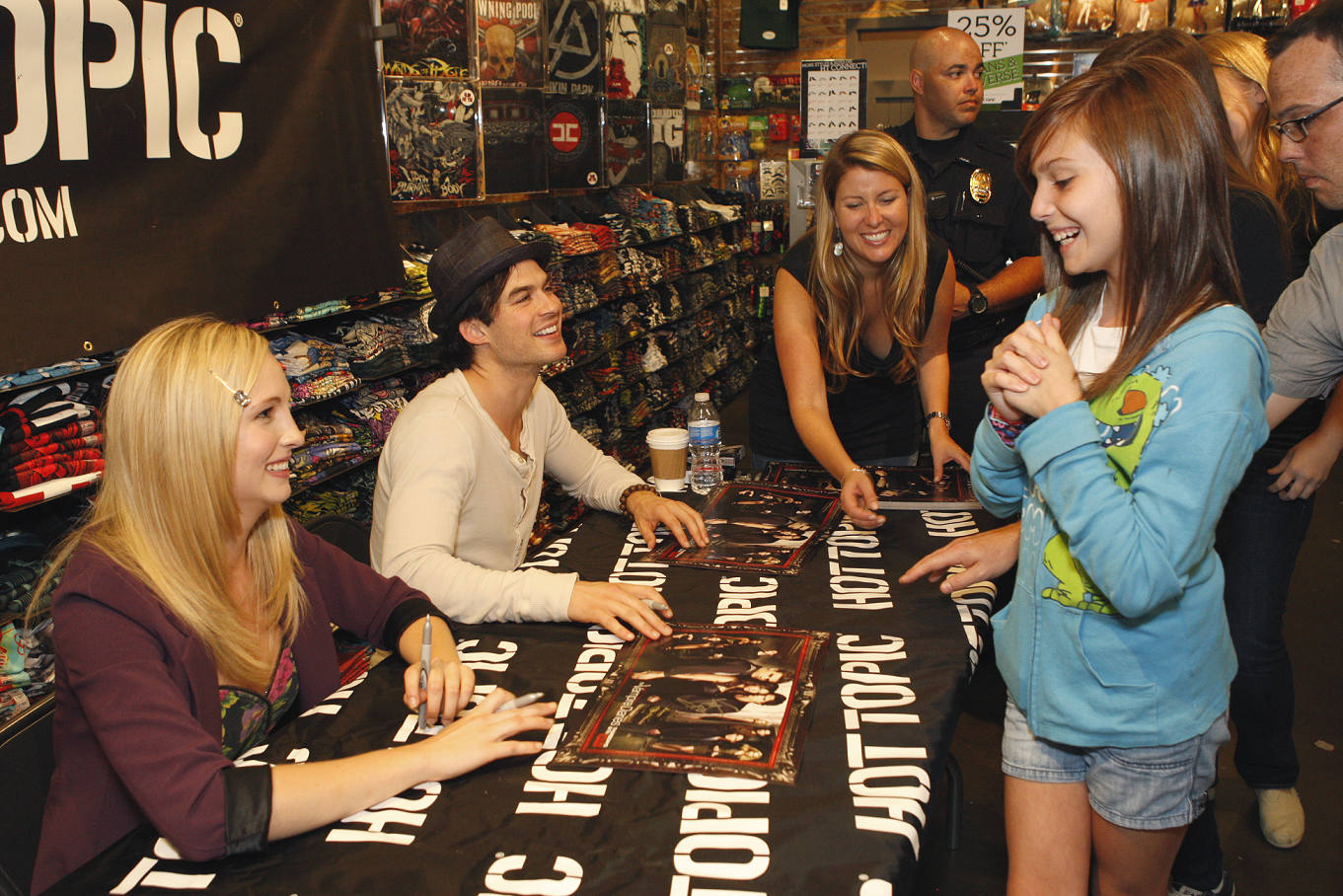
Despite the assertion that the CW’s programming is for adults aged 18-34, one look into the fervent fan bases of shows such as The Vampire Diaries suggests that audiences can be much younger.

Vampire Diaries fan base
The Vampire Diaries fan base


This makes sense when considering that the majority of the CW’s most popular programs are about teenagers. Because of this, it can be assumed that the basic plotlines of the CW’s best performing programs reflect what the network believes young women desire in a television show. IMDb describes The Vampire Diaries’ plot as “a high school girl is torn between two vampire brothers.” Newcomer Reign is gifted with the lengthy description: “chronicles the rise to power of Mary Queen of Scots when she arrives in France as a 15-year-old, betrothed to Prince Francis, and with her three best friends as ladies-in-waiting. It details the secret history of survival at French Court amidst fierce foes, dark forces, and a world of sexual intrigue.”

These simplistic plots offer a glimpse into the mindset of a network that claims to understand its audience: young women don’t want realism in their television but rather escapism into epic love triangles and even more love triangles amidst “dark forces.” Not to say that some young women don’t enjoy these themes (as is clear with the popularity of these shows), or that escapist television is wrong or harmful, but the CW has a habit of repeating its content due to popularity (perhaps the best example being the lovechildren of The Vampire Diaries, The Secret Circle and The Originals). When the same formula is used again and again, it becomes the norm and hurts both the audience and the network. Even the most far-fetching escapist stories need some base of reality in order to connect with a human audience, and the CW struggles with this. Because of its image to serve everyone’s inner teen, the CW’s content is also implicative of what teens actually want in their television. When looking at the basic plots of the CW’s programs, it can be established that female teen audiences want sensationalized love affairs and no substance.

The stereotyping of a young female audience isn’t even the CW’s biggest problem. The major problem is that the CW makes programs for a younger audience, but doesn’t understand the reality of their audience. According to the CW, an average teenage girl and boy should look something like this:

1252697025199

After School Special

This is not a problem specific to The Vampire Diaries. Any CW program that centers on the lives of teenagers casts 20-something or even 30-something actors to portray those roles. This creates a ridiculously unattainable archetype for both male and female teenagers to strive for. The inevitable inability to achieve televised perfection has the potential to damage self-esteem, confidence, and feelings of self-worth.

The sexualization of the teenagers in CW programming is also potentially damaging to a teenage audience. Despite my many years of viewership to programs on the CW, I never fully realized the extent to which perceived teenagers are sexualized on the network’s numerous shows. The realization came with one of the more recent episodes of CW’s newcomer Reign, which was recently picked up for a full season. The specific episode “Left Behind” involved Mary Queen of Scots’ home at the French castle under siege by a vengeful Italian who lost his son by French hands. After numerous episodes of love-triangle development, I felt I was finally getting what I came for with Reign–political plot lines and development into Mary Queen of Scots political history. Instead, I came to the realization that Reign has no intention of making Mary Queen of Scots anything more than an object of sexual desire. The show doesn’t even consider Mary exploring her sexuality, but has only shown others desiring her, and this fact coincides with her physical appearance. An opening scene in “Left Behind” shows Mary, the current queen of France, the current prince of France, and the one-dimensional vengeful Italian explaining his reasoning behind overtaking the French castle in the absence of the French king. The dress that Mary wears in this scene and throughout most of the episode, pictured below, is her most revealing dress to date and its distraction completely undermines both Mary’s character and the performance from actress Adelaide Kane.

tumblr_mwuxvpCuZZ1rb6wabo2_500

This particular episode of Reign was also problematic because of its rape theme and the connection to Mary’s drastic wardrobe change. The sexualization of Mary and the threat of rape aren’t new to Reign, but it’s important to note the coincidence of Mary’s revealing dress and the presence of the one-dimensionally savage Italian army who attacks Mary and her friends with no motivation other than to be evil. When analyzing the implication of changing Mary’s wardrobe in this specific episode, it can be argued that “Left Behind” is supporting the claim that rape victims are in part responsible for their rapes because of the clothes they wear. Whether intended or not, these two aspects of Reign’s plot coming together is detrimental because it reduces Mary to a sexual object and wipes away the legitimate characteristics of intelligence and strength expressed in previous episodes. It is also suggestive of inaccurate and damaging misconceptions about rape.

The sexualiazation of female characters has become an expectation in nearly all CW programming. With a dominant female audience, this becomes a problem to younger viewers who see these unattainable bodies and sex-fueled plots become the norm. Shows like Reign and The Vampire Diaries have the gift of a strong female lead, but never use that gift to develop strong and meaningful plots around their characters. The CW uses teenagers as a focal point for so many of their shows, but continues to shy away from the reality of being a teenager and instead treats teenage characters like they’re adults. Themes of rape and murder are constantly one-episode plot devices and never feel significant to the characters or to the audience. The CW’s audience isn’t made up of teens alone, but those 18 and under who do commit hours to their programs are receiving damaging subliminal messages about body image and issues of rape and murder. The CW has come to expect the impossible from its male and female characters: all must have flawless beauty, an acceptance and forgiveness of murder, and emotional strength that stems from accepting a dire situation rather than fighting against it.  The audience who witnesses this same formula is expected to accept these terms as well. But it’s just not reality.


Nicole Elwell is a sophomore at the University of Baltimore, majoring in Psychology and minoring in Pop Culture. She hopes to bring psychology and feminism into a future career in writing for the movies.
 

‘Catching Fire’: Positive Fuel for the Feminist Flame

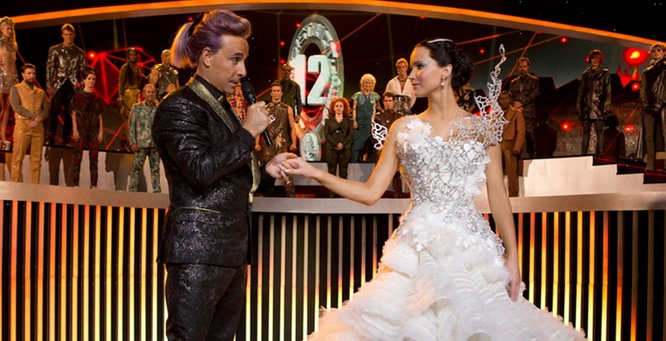
The Hunger Games, saturated as it is with political meaning (the author admits her inspiration for the trilogy came from flipping channels between reality TV and war footage), is a welcome change from another recent popular YA series, Twilight. As a further bonus, it has disproven the claim that series with female protagonists can’t have massive cross-gender appeal. With the unstoppable Katniss Everdeen at the helm (played in the films by the jaw-droppingly talented Jennifer Lawrence), perhaps the series will be the start of a new trend: politically themed narratives with rebellious female protagonists who have their sights set on revolution more than love, on cultural change more than the latest sparkling hottie.

caption
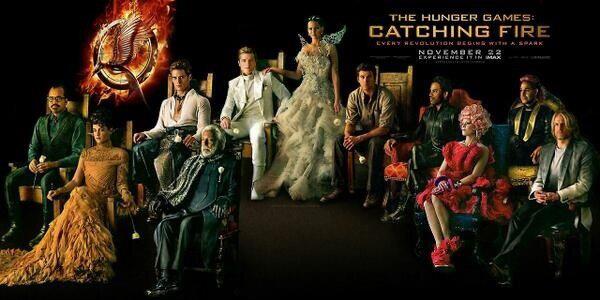
Catching Fire poster


This cross-post by Natalie Wilson previously appeared at the Ms. Magazine Blog and appears as part of our theme week on Child and Teenage Girl Protagonists.

I think most of us would agree there is no place on this planet that is utopian in the sense of being a perfect society (utopia literally means “no place”). Dystopia, on the other hand, exists to some extent every place. The Hunger Games trilogy is very apt in this sense of the word.

The post-apocalyptic nation of Panem’s bleak, poverty-stricken Districts echo so many other places on Earth today—West Virginia, inner-city Chicago, war-torn Afghanistan, to name just a few. Its beleaguered, starving, overworked, underpaid (or unpaid) citizens are akin to real-world fast-food employees, migrant workers and sweatshop laborers. The privileged citizens of Panem’s Capitol, in contrast, represent the figurative 1 percent—the haves who have so much that little is left for everyone else. They’re so comfortable in their having that they are not cognizant of dystopic Districts outside their utopian bubble—other than in the ways that citizens of those bad places can be exploited for their labor or their entertainment value.

caption
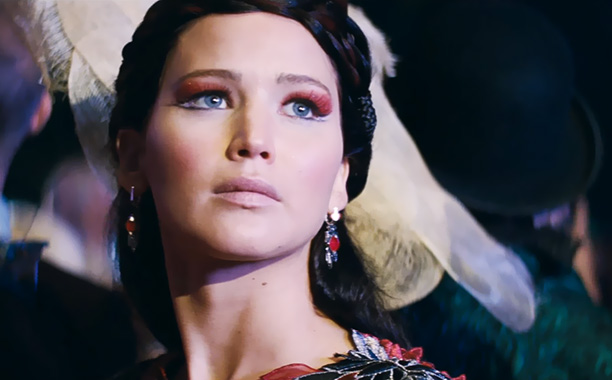
Jennifer Lawrence in Catching Fire


The Hunger Games, saturated as it is with political meaning (the author admits her inspiration for the trilogy came from flipping channels between reality TV and war footage), is a welcome change from another recent popular YA series, Twilight. As a further bonus, it has disproven the claim that series with female protagonists can’t have massive cross-gender appeal. With the unstoppable Katniss Everdeen at the helm (played in the films by the jaw-droppingly talented Jennifer Lawrence), perhaps the series will be the start of a new trend: politically themed narratives with rebellious female protagonists who have their sights set on revolution more than love, on cultural change more than the latest sparkling hottie.

The second book in the trilogy, Catching Fire, builds upon the themes initiated in the first book but pushes the themes of performance, corruption, excess, and defiance even further. The same is true of the film adaptation. Circulating around notions of the performance  of the self—not only the  gendered self but also the self as lover, as friend, as enemy—the film also functions as a critique of gender norms, consumer capitalism, staged warfare, and patriarchal power.

caption
Movie still from Catching Fire


Gender inversion is plentiful in the film, with Katniss carrying on in her heroic, savior role (typically a spot occupied by males) while Peeta and Gale are more akin to damsels in distress. Peeta (the baker, played by Josh Hutcherson) is saved repeatedly by Katniss (the hunter). Gale (with his “feminine” name, played by Liam Hemsworth) pleadingly asks Katniss, “Do you love me?”—a question usually posed by female characters. Katniss refuses to answer, indicating that the revolutionary times they live in deserve her attention more than romance.

Prim (Willow Shields), Katniss’s younger sister, also comes into her own in this film, telling Katniss, “You don’t have to protect me” and by stepping in to doctor Gale. Various other characters defy gender expectations, from Johanna’s (Jena Malone) wise and witty confidence to Cinna’s (Lenny Kravitz) nurturing and motherly care of Katniss. These non-stereotypically gendered characters highlight gender as performance, nodding to an overarching concern of the series—the ways in which performance can kowtow to social norms—as with the brightly colored hairdos and over-the top outfits of those in the Capitol who happily perform excess. Or, in contrast, how performance can be used strategically as a form of resistance, as when Peeta and Katniss perform the role of young lovers in order to game the system.

caption
Jennifer Lawrence in Catching Fire


Though Katniss is visibly suffering from PTSD from her first round in the Games, she, against her truthful nature, learns she must “play the part” so as to protect those she loves. Near the start of the film, when she emphatically answers “no” when President Snow (Donald Sutherland) asks her if she would prefer a real war to the Games, we, as audience members watching from the safety of our movie theater seats, sympathize with this answer. We, too, would rather watch war from afar, glimpsing it via our flatscreens or play at it via video games that allow us to be virtual soldiers, rather than actually face war’s real pain, loss, destruction, and dehumanization.

Alas, by the close of the film, we have changed our perspective along with Katniss, recognizing that revolutionary war may be the only way to bring down the Capitol—that the tributes–people from the Districts forced to play in the life or death Games  (or metaphorical soldiers) are mere set pieces in the Capitol’s plan, not the saviors that we and the citizens of Panem need and want them to be.

Will this revolutionary spark take hold, firing up audiences to question the ways in which the film is not so much set in a fictional future as an allegorical present? The excessive performance of consumer capitalism on display in the Capital of Katniss’s world is, sadly, not so far removed from the glut of glitter that adorns our own malls in the run-up to the winter holidays. The purging tonic which allows Capitol citizens to keep eating is not all that different from the reality in which some have far too much food at their disposal and others not even a cupboard in which to store food. The media of Panem is closer still to our reality, brimming as it is with surveillance, over-zealous pundits such as Ceasar Flickerman (Stanley Tucci) and mediated war that broadcasts just enough fear mixed with the right amount of hope to keep people transfixed and immobilized.

caption
Movie still from Catching Fire


Leave it to Haymitch (Woody Harrelson), the deceptively drunken mentor to Katniss and Peeta—functioning much as a Shakespearean fool—to lay bare this performance, telling Katniss, “Your job is to be a distraction so people forget the real problems.” This film is itself a distraction, with Hunger Games: Catching Fire paraphernalia already flooding stores and fueling our consumerist desires.

So is this trilogy so different from Twilight and its sparkling vampires? I say it is, not only because it gives us a complex, brave, indefatigable heroine (Katniss is not Bella!), but also because it reminds us that “every revolution begins with a spark.” Perhaps the revolutions it ignites will only be in the ways in which viewers envision acts of heroism, love or forgiveness, but such sparks are important. If we can imagine a world in which men do the baking and women the saving, in which young black girls are mourned by a community rather than shamed and blamed, in which the corruption and privilege embodied in the likes of President Snow are resisted rather than aided and abetted, then we are, if nothing else, adding fuel to the feminist fire.


Natalie Wilson, PhD is a literature and women’s studies scholar, blogger, and author. She teaches at Cal State San Marcos and specializes in areas of gender studies, feminism, feminist theory, girl studies, militarism, body studies, boy culture and masculinity, contemporary literature, and popular culture. She is author of the blogs Professor, what if …? and Seduced by Twilight. She is a proud feminist mom of two feminist kids (one daughter, one son) and is an admitted pop-culture junkie. Her favorite food is chocolate.


Q&A: Girlhood Behind and In Front of the Camera

Ten questions between filmmaker Morgan Faust and 13-year-old actress Rachel Resheff.

Morgan: The truth is when I was growing up in the 1980s, the child actresses were often given pretty syrupy roles (with the exception of Journey of Natty Gann and Labyrinth). It was the boys who got to have the cool movies–Goonies, Stand by Me, even The NeverEnding Story and E.T., which did have girls, but the boys were the heroes. That is why I write the movies I do–adventures films for girls–because that’s what I wanted to do when I was a kid, go on adventures, be the hero. I still do want that. I mean, who doesn’t?

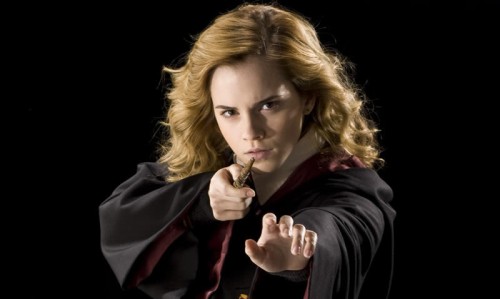
Hermione Granger
Hermione Granger


This guest post by Morgan Faust appears as part of our theme week on Child and Teenage Girl Protagonists.

In 2010, Morgan Faust, (a 35-year-old female award-winning filmmaker) directed Rachel Resheff (a 13-year-old actress recently seen on Orange is the New Black) in a short film.

They have been friends ever since.

Recently, they asked each other each five questions about young women in the movies.

Here are their answers.

Morgan: Who is your favorite teen girl character and why?

Rachel: One of my favorite teen girl characters is probably Hermione Granger from  the Harry Potter movies. She never failed to hold her own in these huge films, and it was so cool to watch Emma Watson grow more and more as an actress and as a character.
Rachel: When you are writing roles for teens, do you consider the current obsessions with social media and the current “hot topics”?

Morgan: Definitely.  A recent script I wrote is about a young girl who is on a hunt for her missing sister. Social media plays a huge part. As screwed up as it can be, social media gives young people a huge amount of power through community that they never had before. Since I write about young women, that is especially exciting since I think it is one of the many ways in which we are seeing barriers being torn down through technology. But I am also 35, so as you know from working with me, I spend a lot of time talking with young women to make sure my characters sound like real teenagers, not weird 35-year-old people trying to sound like kids, especially when I am talking about “hot topics”….

Emily Fields from Pretty Little Liars


Morgan: Which movie character is most like you?

Rachel: I think I am a lot like Emily from Pretty Little Liars (my favorite show). Emily is smart and driven. In the show, she faces many obstacles that can get in the way of her passion for swimming. I can relate to Emily because as I pursue my passion for acting, there are many obstacles that can get in my way and people who can try to put me down. Also, Emily, like me, finds time to still have fun and she stays close to the people who are always there for her.

Rachel: Do you ever write about experiences from your childhood?

Morgan: There is no other young woman I know better than the one still alive and kicking in my head. I often have to remind myself in situations that it is in fact I who is the grown-up.  So, yeah, a lot of my personal stories end up in my writing. I grew up a tomboy, playing in the mud and jumping car batteries, and a lot of my characters end up that way. Since I write adventure and fantasy, usually my characters’ experiences are elevated beyond my own, but the feelings and the reactions are the same. I want to fill the screens with self-reliant young women who use their brains to solve problems and learn how to make good decisions, so when I write young women characters,  I am often mixing “what I did do” with “what I wished I had done” (I think it’s only fair that my characters get to be cooler than me!).

Morgan: What do you think of the Disney Princesses?

Rachel: I think that the Disney Princesses made my childhood complete and I will forever be grateful for the impact they made on my life… seriously. But, I also feel that they can give little girls a false sense that every girl needs to be a princess with a Prince Charming. So much has changed with the idea of acceptance, and that’s why I think that the Disney Princesses are becoming a little bit different. They are not really the girls who get put into comas and need princes to come and wake them up anymore. Usually now, Disney Princesses are the ones doing the rescuing, which I think is symbolic of a lot of things that young girls should learn. Not that I have lived that long and I am that old, but I definitely have strong opinions about these sort of things.

The Princess and the Frog


Rachel: What is your opinion on the child starlets who have ended up in some trouble as young adults?

Morgan: As a woman old enough to be a mom, but without kids, I find myself torn on this issue. As the mom I will one day be, I see these young women expressing themselves often in incredibly sexualized ways and think, they have a responsibility as professional famous people to consider the impact they have on their fans. The unmarried, mom-less me can fully connect to the undeniable pressure they are under, the very real mental toll their lives have taken on them and their desire to just break free! All I can do as an artist is continue to try and create worthy, interesting and cool (which even using that word, I feel I am putting into question my ability to do so) young women on the screen that kids and teens (and grown-ups that like to watch teen movies…) connect with. Stories serve as more than just entertainment, they serve to help us invent our own codes of morality and integrity. I am not looking to make Little House on the Prairie-type characters devoid of darkness and flaws, but I do hope to put a lot more girls and women on the screen that don’t think their looks are the only important thing about them.

Morgan: What do you think of Miley Cyrus?

Rachel: I actually don’t have a problem with all of  Miley Cyrus’s recent actions. I looked up to her when I was younger because she was a very positive role model to young girls. Now, in her new phase, she is trying to send a different message by saying that everyone should just be totally comfortable in their own skin and no one should care what anyone else thinks. I completely support her new views but sometimes, like in her VMAs  performance or her appearance where she smoked a joint at the EMAs, she goes a little bit overboard.  But, the idea of doing what makes her feel happy and comfortable is fine as long as she’s not doing something that can get her in jail or under psychiatric evaluation. Sometimes it seems that with child actors/ actresses who grow up in the public eye, they don’t want to be perceived the way they were when they were kids as sweet and innocent, so they can take it to extremes. I try to keep myself balanced as a child actress, and when I grow up, I will try my best to not let myself go crazy. Personally, “Nobody’s Perfect” by Hannah Montana (Miley Cyrus) will always be my jam no matter what.

Miley Cyrus
Miley Cyrus, not Hannah Montana


Rachel: As a director, what do you look for in teens/young women, when you are casting?

Morgan: Personality, intellect, heart, a good work ethic, and connection. We’re going to be doing a lot of hanging out, so we better get along. They have to be right for the role, but if I connect with someone, I am willing to take a leap of faith that together we can grow the character to be a blend between the person I imagined, and the person they are.

Morgan: Do you think teenage girls are presented as too sexy or pretty normal in the way they dress and behave as compared to you and your friends?

Rachel: I don’t really feel that teens are presented as too sexy or anything like that. Typically, the teens in movies or TV shows usually dress and act similar to how my friends and I act at school or just in general. However, I find a lot of times that writers have the teens use a lot of text-talk and over-exaggerate the current  obsession with social media. Sometimes the writing can become unrealistic or unnatural. I often recognize as the actress in the scene when something sounds like it is something a kid in my school could say or if it isn’t.

Jennifer Grey in Dirty Dancing


Rachel: Which child actresses from when you were a kid have influenced you as a writer/director and why?

Morgan: OK, she’s not exactly a kid, but definitely Jennifer Grey. Her role in Dirty Dancing was this smart, goofy, fearless, normal looking girl that just felt so real on the screen, and who succeeded through hard work and following her heart. It was sweet. I think about her a lot. She was just the perfect actor for the perfect role.

The truth is when I was growing up in the 1980s, the child actresses were often given pretty syrupy roles (with the exception of Journey of Natty Gann and Labyrinth). It was the boys who got to have the cool movies–Goonies, Stand by Me, even The NeverEnding Story and E.T., which did have girls, but the boys were the heroes. That is why I write the movies I do–adventures films for girls–because that’s what I wanted to do when I was a kid, go on adventures, be the hero. I still do want that. I mean, who doesn’t? It’s exciting to see more Hunger Games (well, at least the idea of Hunger Games, I’d prefer a more active protagonist who makes a decision every once in a while instead of just having a series of gut reactions, but that is a different interview…) and Divergent. Let’s keep ‘em coming on every budget level!


Morgan Faust started working in film as an intern for the Squigglevision classic Dr. Katz and never looked back. A graduate of Columbia University’s MFA program, she now works as half of BroSis, a brother/sister writing and directing team with brother Max Isaacson in Los Angeles, where they are finishing up their first feature script (a female-helmed actioner), and ramping up to direct a pair of films in 2014. Her short film Tick Tock Time Emporium won numerous film festivals and is distributed in the US, India, Greenland, Denmark, the Faroe Islands and is available online at Seed & Spark. Her other credits include Gimme the Loot (Editor), 3 Backyards (Editor) and Mutual Appreciation (Producer).


Rachel Resheff, age 13, began working at age 8 when she appeared in the indie film, 3 Backyards, where she first met Morgan Faust. Since then, Rachel has appeared in four Broadway productions, numerous Off-Broadway plays, films, and television (most recently in Orange is the New Black as Young Alex).


Young Women and Heroism in ‘The Host’

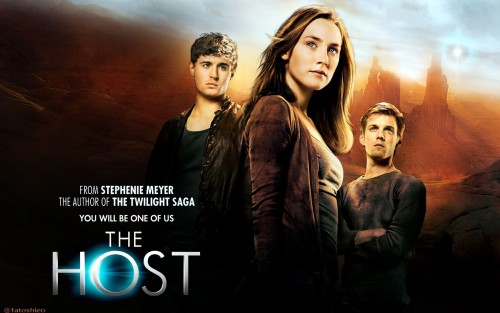
Is Wanda a girl/teenage female protagonist? Technically she is not “young” as she is 1,000 years old and seemingly immortal, but she is new to Earth so that makes her young in some sense. Also, why would the Souls even have genders that mirror that of humans or have genders at all? The Souls look like beams of light and they probably aren’t even a carbon based species and yet somehow Wanda is a female? So. Frustrating. Nonetheless she is controlling a person’s body who identifies as a teenage girl and is thus somewhat restricted to her occupied body’s feelings, emotions, and categorizations.

33316764-1280-800

This guest post by Sade Nickels appears as part of our theme week on Child and Teenage Girl Protagonists.

Whether or not The Host is “feminist” or not has been covered by Dr. Natalie Wilson in a particularly interesting piece, as Stephanie Meyers identifies as a feminist. I’m not too into the idea of calling the movie an anti-feminist piece, but its portrayal of young women and their relationships to men is deeply problematic. As Dr. Wilson has questioned and criticized this movie well,  I don’t have too much to  add except some thoughts about young women and heroism.  I do feel obligated to say that this movie is duller than toast and the onslaught of negative reviews it received was well-deserved.

So, this movie is about an Alien race called Souls that invade all the bodies of humans and turn the planet into a peaceful place. One Alien named Wanda gets put into the body of a young girl named Melanie. Melanie does not have control over her body but her presence is still there and she manipulates Wanda into running away from the Soul community to find her little brother and her boyfriend. They find them living with a bunch of other humans who are hiding from the Souls and just trying to get by. Wanda and Melanie work to protect this community from the Souls, but mostly their purpose and justification for their acts of heroism are largely done for the men they love or have fallen or are falling in love with. Very typical and trite, but there are some elements at play that tend to deviate from a traditional hero’s journey.

599316_10150910498372413_956210484_n

Is Wanda a girl/teenage female protagonist? Technically she is not “young” as she is 1,000 years old and seemingly immortal, but she is new to Earth so that makes her young in some sense. Also, why would the Souls even have genders that mirror that of humans or have genders at all? The Souls look like beams of light and they probably aren’t even a carbon based species and yet somehow Wanda is a female? So. Frustrating. Nonetheless she is controlling a person’s body who identifies as a teenage girl and is thus somewhat restricted to her occupied body’s feelings, emotions, and categorizations. It is hard to understand why Wanda is a “female” as the audience is given very little information as to what Souls are, where they came from, what their motivations are, or how this parasitic species procreates. Maybe it is covered in the book? Maybe Stephanie Meyer never really thought about it (unlike some authors I know).  Either way it a missed opportunity for talking about gender vs. sex or doing anything somewhat subversive.

The dynamic between the two female protagonists in this movie who have to work together and collaborate to be successful for their shared end goals (which is boy saving) is what is most interesting to me when thinking about their roles as heroes and the typical myth of the hero. Melanie is almost a mercenary type. Determined, very occupied with the preservation of her humanity, resistant, manipulative, brave and adept at lying and stealing. Wanda is naive and lost but operates under a strict moral compass of nonviolence and pacifism. The two react to most situations very differently but they learn skills and behaviors from one another. It is the collaboration of these two very different teenage girl characters that allow them to be successful in protecting and aiding the human community.

Jamie-1

As mentioned before, Wanda is a pacifist; her actions as a “hero” are conducted nonviolently. In fact her nonviolent action inspires her new community to start acting in the same way. This is a sort of nice refresher to all the kick-ass action heros that have been featured on the big screen.  Nonetheless, her character is extremely self-sacrificing and puts herself last in almost every situation. Would have been nice to see a hero who strikes a good balance between operating under a strong moral compass without that being overshadowed by their seemingly low self-worth.


Sade Nickels is a toddler teacher in Seattle who enjoys getting tattoos, reading children’s books and thinking about radicalism.


‘Puella Magi Madoka Magica,’ Declaration Feminism

Immortality is not what makes a world better. Hope, friendship, and love do, and love is not limited by sex, gender, ethnicity, or race. Women like Homura and Kyoko can fall in love with other women like Madoka and Sayaka respectively. We have the responsibility to stand up with people like them. This series is part of the reason I try to do that and more. I hope that many others to do the same.

caption
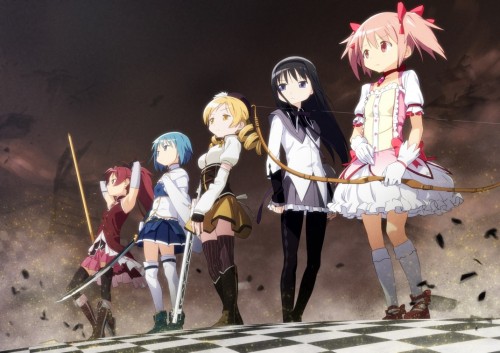
Promotional material for Puella Magi Madoka Magica, featuring (left to right): Kyoko Sakura,
Sayaka Miki, Mami Tomoe, Homura Akemi, and Madoka Kaname.


This guest post by Matthew Abely appears as part of our theme week on Child and Teenage Girl Protagonists.

It has been said over and over again that “Religion is the opiate of the masses;”[i] that is just not fair. It is not the masses, it is the privileged and powerful, and it is not just religion that is their opiate, it is anything that provides a perpetual escape from the reality that with power and privilege comes responsibility.  Today a lot of people use anime for this.  Beloved anime like Studio Shaft’s spring 2011 series, Puella Magi Madoka Magica (Madoka Magica for short), among others, are heavily feminist.  Go online and even suggest something remotely like this, however, and a virulent few will inevitably rise to shut such thoughts down.[ii] Not this time.

Madoka Magica has a sequel film premiering in theaters,[iii] and it is high time the series’ social criticism and advocacy were recognized. It is high time many an anime received such praise. Madoka Magica, however, is the right place to start. Why is rape and violence against women such a common cross-cultural occurrence that such a term as “rape culture” exists?[iv] Why is male supremacy likewise just as common that there is a term called “patriarchy”?[v]  Why does patriarchy inevitably stratify along class, race, and related social lines (this is called “kyriarchy”)?[vi] Why would anyone institutionalize evil like this?

Madoka Magica is not a perfect response. It does answer all of the above; however, it is in its subtext only. The merchandise its creators license also objectifies the teenage cast horribly.[vii]  The series, however, is still a good place to start. It may only answer these aforementioned fundamental questions of feminist theory through symbolism and allegory. It however also does something few others works of popular fiction seem to do. It gives an idea of what to do about its answers.

caption
Madoka Kaname, Age: 13.


Madoka Kaname sees herself as nothing more than average and plain.[viii]

Until the day an entity named Kyuubey informs her that she has dormant superpowers. Magic is real, and everywhere there are invisible monsters called witches instigating traffic accidents, suicides, natural disasters, and more. Kyuubey explains that he and his species, the Incubators, search endlessly for people with dormant magic in order to offer them a contract.  He will grant a person any one wish, and in return they must let him awaken their magic and pledge to do battle with witches as magical girls. Madoka finds out, however, that Kyuubey is not telling the whole truth.[ix]

He awakens magic by placing a person’s soul in a gem, thus making each magical girl the undead. Magical girls’ powers have limits. Should they exhaust all the magic of their soul gem, they die. Witches are born whenever a magical girl dies from soul gem exhaustion. Magical girls themselves can also transmogrify into witches should they succumb to madness, despair, or choose evil. The birth of a witch releases a lot of energy; the transmogrification of a magical girl even more. The Incubators use this energy to fuel the multitude of civilizations across the Earth and universe that they rule from behind the scenes. They do not, however, use everyone as a battery. The Incubators indirectly institutionalize it so that only pubescent girls must be sacrificed.[x]

It is the most efficient way; it is all for the greater good, Kyuubey claims.[xi]

caption
Kyuubey and Madoka in their penultimate of many “debates.”


He is not the only one who does. In the United States and Canada, a man rapes a woman every minute; another man hits a woman every nine seconds; men murder 1,000 women via domestic violence a year.[xii]  The law prosecutes less than 10 percent of these men, convicting and sentencing even fewer.[xiii]  Who cares? Steubenville and Pennsylvania State have football games to win.[xiv] Roman Polanski has too many great films to make and Julian Assange too many great secrets to reveal.[xv]  Society simply cannot afford to have any of these rapists waste away in prison.  People kill or sexually enslave at least 200 million women in and around China and India since the One Child Policy began.[xvi] No matter, class warfare—the population boom—must be stopped.[xvii]  Besides, if Senator Hilary Clinton became president of the United States of America[xviii] or Doctor Wangari Maathai a member of the Kenyan Parliament[xix], their “PMS and mood swings” would destroy progress.

It is all for the greater good. It is building a better, immortal, world, Kyuubey repeats over and over again.[xx]  In this better world, however,all four of Madoka’s friends die more horribly than the last.[xxi]

caption
Madoka’s friends unite only in martyrdom; from left to right clockwise: Mami Tomoe, Sayaka Miki, Homura Akemi, Kyoko Sakura.


Mami Tomoe, weighed down by the guilt of her parents’ death, attempts to atone by being the perfect school girl, perfect host, perfect warrior, perfect mentor, and perfect leader. She stretches herself too thin; a witch gores her to death.[xxii] Sayaka Miki, upon finding out that her contract made her a zombie, thinks herself too tainted to deserve the love of her secret crush, especially when it turns out he already loves, and is loved in return, by a much more conventionally feminine girl than she. Sayaka resolves to repress all her passion and desire.  She transmogrifies into a witch.[xxiii] Kyoko Sakura uses her magic to help her preacher father convert people to his new strand of Christianity. Ashamed to have needed magic’s help, he murders Kyoko’s sister and mother, and attempts to kill Kyoko as if they were property, before hanging himself. Kyoko becomes so belligerent and cynical that her attempt to befriend Sayaka Miki, whom Kyoko finds she may actually love, backfires. Kyoko commits suicide, battling the witch she helps push Sayaka into becoming.[xxiv]

Homura Akemi comes to love Madoka Kaname. The first time they meet, Madoka is a magical girl. Madoka dies in battle. Homura wishes for the power to change this. She travels back in time, over and over again, trying to save Madoka by any means necessary, including murder. No matter whom she kills, however, Homura makes Madoka’s fate worse with each loop. Madoka dies in battle. Madoka dies and give birth to a witch. Madoka dies and gives birth to a witch that destroys the earth.[xxv]

The Incubator’s desire for immortality and demands for perfect maximum efficiency affects more than just children’s attempts to find happiness. Only the relationship between Madoka’s parents is based on collaboration and equality.[xxvi] Every other adult relationship shown is based on competition and hegemony. Madoka’s teacher is constantly dumped for being an imperfect wife.[xxvii] Madoka’s mother Junko must constantly prove her worth as a business executive by drinking hard with the big boys.[xxviii]  Their neighbors and community forced Kyoko’s family into starvation and destitution when her father’s preaching diverted from Christian dogma.[xxix]  Sayaka breaks and transmogrifies when she encounters two men on a train waxing loudly about the importance of physical and emotional abuse.[xxx]

caption
It is the only shown moment of direct misogyny that pushes Sayaka past her limits.


There are beautiful walkways, malls, cafes, schools, apartment complexes in this better world the Incubators have built,[xxxi] yet there are few if any signs that there is community.  The streets are usually deserted.[xxxii] The cafes full of empty chairs at empty tables.[xxxiii]

caption
Sayaka and her friend/romantic rival, Hitomi Shizuki, meeting in a “crowded” café.


Pedestrians do not interact.[xxxiv]

caption
Other people once again ignoring Madoka, Sayaka, Kyuubey, and everyone else around them.


Only Madoka notices it when a witch’s curse induces a mass hypnosis in the middle of a street.[xxxv]  Sayaka and Kyoko have two loud battles, one that breaks a water pipe and one on a bridge over a crowded freeway.[xxxvi] Nobody notices them. When they die, no one realizes that Mami and Sayaka are even missing until days later.[xxxvii] No one ever noticed that Kyoko still existed after her father’s suicide.[xxxviii] Three characters (Mami, Homura, and Sayaka’s crush Kyouske) all suffer from traffic accidents. No one explains them, and likewise few people notice how common suicides, accidents, natural disasters, and general strife seem to have become.[xxxix]

caption
Mami explaining to Madoka and Sayaka where witches lurk.


This better world the Incubators have built may be immortal, yet there is no reason to live in it. There is no companionship nor trust nor love. Madoka sees this; Kyuubey however, continues to insist that short of returning to being naked in caves, there is no other way to live.[xl] He, again, is not the only one.  Even in the face of impending environmental catastrophe, President George H. W. Bush stated: “THE American way of life is not up for negotiation.” [xli] This same American Life has made its people less and less happy since the 1950s, while the amount of time they work has more than doubled.[xlii]  “Let some people get rich first,”[xliii] Chinese Vice-Chairman Deng Xiaoping declared this to be the way to build a modern China.  No one suffers from as much smog as the Chinese.[xliv] Still, men like this and Kyuubey continue to insist: it is foolish to think that there is another way live well. Madoka comes to disagree.

Madoka wishes for the power to stop all witches throughout space and time from being born, and save all magical girls from transmogrifying into them. It works. Madoka ascends to godhood and recreates the universe into one where Kyuubey cannot transmogrify anyone into a witch.[xlv]

caption
Madoka Kaname, Goddess of Hope.


caption
Homura Akemi shares her memories of Madoka with Madoka’s brother, Tatsuya Kaname.


Though she sacrifices her own mortal existence and all memory that she ever existed in every mind, except Homura’s,[xlvi] she opens a door. Kyriarhcy and its ilk seem to continue to exist in the new universe that Madoka creates.[xlvii] Homura and the now reborn Mami, Kyoko, and Sayaka, however, now have the freedom and so the responsibility to fight back. The same has been true the viewers this whole time.

Madoka Kaname is not the only one who found another way. Those people so often scored as too effeminate to lead:  like Wangari Maathai, Hilary Clinton, and more–they often have as well. Doctor Maathai and the Green Belt Movement toppled a 30-year dictatorship in Kenya. Their first move: empowering communities of impoverished women to plant trees.[xlviii]  They did not win it alone.[xlix] Those who have the privilege to experience art and anime, can choose to use them like drugs, and attempt to escape from reality. We can all stay individuals relating primarily by competition, pretending this will stave off environmental collapse,[l]  or we could choose to become communities, and continue to prove to everyone, human or otherwise, that there are always other ways to live well than violent sacrifice.

Immortality is not what makes a world better. Hope, friendship, and love do, and love is not limited by sex, gender, ethnicity, or race. Women like Homura and Kyoko can fall in love with other women like Madoka and Sayaka respectively.[li] We have the responsibility to stand up with people like them. This series is part of the reason I try to do that and more.  I hope that many others to do the same.

caption
Promotional material for the series; from left to right: Mami Tomoe, Homura Akemi, Madoka Kaname, Sayaka Miki, Kyoko Sakura.


Matthew Abely is a recent college graduate, longtime nerd, and novice ally to intersectional feminists. When not researching, writing, or working, he can be found attending comic book conventions with friends on the United States’ Pacific Northwest and Central Coast, or exercising.


[v] Ibid.

[vi] Ibid.

[xi] Ibid.

[xiii] Ibid.

[xiv] Ibid.

[xvii] Ibid.

[xxi] Ibid.

[xxii] Ibid, 1-3.

[xxiii] Ibid, 4-8.

[xxvi] Ibid, 1-12. 

[xxvii] Ibid, 1. 

[xxviii] Ibid, 1-6. 

[xxix] Ibid, 8. 

[xxx] Ibid, 8.

[xxxii] Ibid.

[xxxiv] Ibid, 5. 

[xxxv] Ibid, 4. 

[xxxvi] Ibid, 6-7. 

[xxxvii] Ibid, 11. 

[xxxviii] Ibid, 5-9. 

[xlvi] Ibid.

[xlvii] Ibid.

[xlix] Ibid.


‘Troop Beverly Hills’: What A Thrill

Initially the girls of Troop Beverly Hills are portrayed as clueless and privileged, but they are allowed to grow and transform themselves over the course of the movie. The film writers don’t do it unrealistically by turning them into tomboys overnight or at all. The girls retain their femininity, which they are made fun of for by the Red Feathers, throughout the film.

This guest post by Phaydra Babinchok appears as part of our theme week on Child and Teenage Girl Protagonists.

Sometimes revisiting a favorite film as an adult can be disappointing, but more often than not it isn’t. I find that I still very much enjoy my childhood favorites.

Troop Beverly Hills was released in 1989. If for no other reason, watch this film for the 80s fashion. It is absolutely fab and you can thank me now. I must confess that I watched it on the original VHS that my family has owned since it was released. And I must confess that I still absolutely love this film. Enough gushing though, let’s get into the nitty gritty.

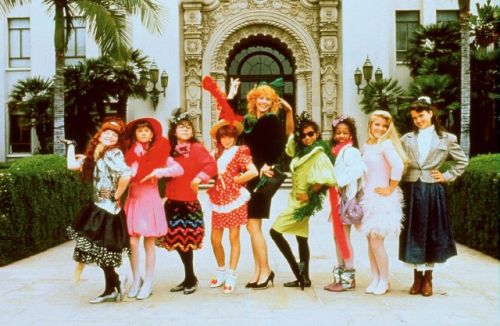
That fabulous 80's fashion
That fabulous 80s fashion


Shelly Long is the driving force in this movie. She plays a spoiled socialite who is getting a divorce from her rich husband. In an attempt to bond with her daughter and prove to her husband that she can finish what she starts she decides to become her daughter Hannah’s Wilderness Girls troop leader. I find myself identifying with Hannah because my mom was my Girl Scout troop leader. I however cannot identify with the Beverly Hills mansion.

Back to the plot. This is a classic story about the underdogs, who happen to be fabulously wealthy girls, triumphing over mean girls. I was curious about the background of this movie and discovered that it was written and produced by women. This definitely makes sense since it is almost entirely a female cast. The girls of Troop Beverly Hills are the outcasts of the Wilderness Girls troops. They are not taken seriously and made fun of because they are into fashion and don’t know how to camp. A hilarious scene ensues when they attempt to go camping. After being driven to the campsite and each girl bringing tons of luggage–I repeat luggage, as in suitcases instead of camping gear even though it is for only one night–it starts pouring rain. This is just too much for anyone to handle so they pack up and head to the Beverly Hills Hotel where roughing it is sharing one bathroom amongst nine of them.

Troop Beverly Hills’ mean-girl nemeses are the Red Feathers. The Red Feathers are real Wilderness Girls who have earned badges whereas the girls of Troop Beverly Hills don’t have any badges. They didn’t even have uniforms until Hannah’s mom took them shopping, because as a rich Beverly Hills housewife shopping is the one thing she knows how to do. She is also determined to help the girls earn badges in their own way. She teaches them how to survive in Beverly Hills. They earn badges in such varied activities as jewelry appraisal, shopping, sushi appreciation, and gardening with glamour.

Initially the girls of Troop Beverly Hills are portrayed as clueless and privileged, but they are allowed to grow and transform themselves over the course of the movie. The film writers don’t do it unrealistically by turning them into tomboys overnight or at all. The girls retain their femininity, which they are made fun of for by the Red Feathers, throughout the film.

Oh and those Red Feathers are a mean bunch led by a mean leader who happens to be one the mother of one of the girls. They are out to get Troop Beverly Hills because they don’t think they belong or deserve to be Wilderness Girls because they are too girly and spoiled. So what do the Red Feathers do? Instead of encouraging or mentoring Troop Beverly Hills they set out to sabotage them. They laugh and make fun of the Troop Beverly Hills craft project, which is a camping clothing rack. Troop Beverly Hills were the pioneers of “glamping” way before the term “glamping” even existed.

Would anyone like to go glamping?


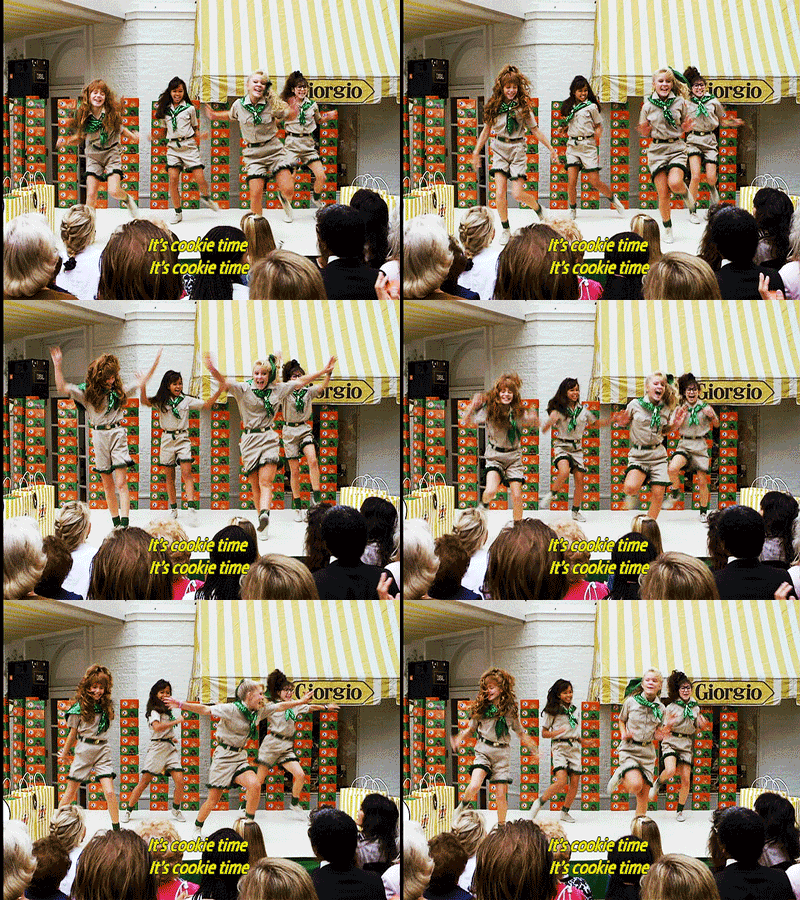
The Red Feathers’ troop leader is in a position of authority and strips Troop Beverly Hills of their badges because they aren’t “real” wilderness badges. However, this is not a devastating moment for the girls of Troop Beverly Hills. Instead they graciously surrender their badges. Their new goal is to sell the most cookies and make it to the Wilderness Jamboree competition. Being the mean girls that they are, the Red Feathers’ attempt to sabotage Troop Beverly Hills’ cookie selling by going into their neighborhood and selling cookies to all the rich folk in Beverly Hills first. This is devastating to the girls, but they manage to rally together and come up with some great cookie selling tactics like having a mini concert and a fashion show. Troop Beverly Hills is triumphant and sells enough cookies to go on to the Wilderness Jamboree competition.

They took a creative chance on a song and dance to sell cookies.


It is during the Wilderness Jamboree competition that the girls of Troop Beverly Hills are challenged and prove themselves as real Wilderness Girls despite the fact that they still like fashion. Again the Red Feathers do not try to win fairly, but instead try to sabotage Troop Beverly Hills. Their mean girl move is to switch the direction of the flags that help guide the troops to the finish. However, Troop Beverly Hills triumphs and finishes before the Red Feathers do. This infuriates the Red Feathers because Troop Beverly Hills does not deserve to win because they are spoiled and still too into fashion to be taken seriously as Wilderness Girls. So they bust out their biggest mean girl move yet and their troop leader who mapped the course is going to lead them on the course the following day to guarantee that they win.

Troop Beverly Hills is continuously sabotaged by the Red Feathers, but they remain optimistic and never give up. They learn to believe in themselves, how to be strong-willed and not give up, and how to work together as a team. When it seems as though the Red Feathers will win because of their cheating schemes, Troop Beverly Hills perseveres and wins the competition. And not in a ruthless way, but in a compassionate way. Troop Beverly Hills stops to help the injured Red Feathers’ leader who was abandoned by her own troop. Her troop abandoning her is a classic mean girls maneuver–when the going gets tough is each for her own–is the reason the Red Feathers lose. Of course the Red Feathers were sore losers and ran away with the trophy, but even that doesn’t upset Troop Beverly Hills. They have earned what is most valuable to them and can’t be taken away: self-confidence.

Proving in the end that you can be into fashion and a wilderness girl.
Proving in the end that you can be into fashion and be a Wilderness Girl.


Phaydra Babinchok is a feminist activist and comedy writer based in Chicago. She is chapter leader of WAM! Women, Action, and the Media Chicago. She tweets about cats and feminist porn @PhaydraAnnette.

‘Just One of the Guys’: Sexism, Gender Stereotypes, and the Rise of the Female Teenage Protagonist

Terri sets out to explore the luxury of male privilege disguised as a young man. Just One of the Guys smacked us straight in the face with the unspoken universal knowledge that sexism was real, it existed and the film gave us tangible proof. Terri decides to use her parents’ trip out of town to switch things around for herself by getting another shot at the newspaper internship with another article, an expose of sorts. She switches high schools and uses her brain, and as much as she can, is herself.

Just One of the Guys movie poster


This guest post by Shay Revolver appears as part of our theme week on Child and Teenage Girl Protagonists.

The 80s were a confusing time for young women. Not only were we bombarded with all of these images of female strength and the dawn of the power suit, but we also had the opposite images of bikini-clad bodies  bombarding us in film. While adult women were being objectified on film just like their teen counterparts, they still managed to also emit an air of (albeit limited) power. But, the teen female set was still stuck in the role of object or trophy. There were a few stand-outs that bucked the trend, but usually the female role–if she wasn’t the trophy–was never front and center and was some typecast girl playing the role of the quirky best friend. Sure, you could be a cool , confident, different, smart girl, but you couldn’t be the star.

In 1985 a new kind of teen flick came out. A film that handed us a smart teenage female protagonist who acknowledged and called out sexism and wasn’t used as background noise or the social conscience of the group. Just One of the Guys was an eye-opening surprise for me. Usually when films had a woman being diminished for being attractive it was a grown man doing the the diminishing and if a young woman was present she was being set straight by her strict father who was out to save her virtue. This film was unique in its portrayal of teen life and the perceptions that society has in regard to young women. It quickly became one of my favorite films when I was a child.

Terry and Buddy having a heart to heart


If you weren’t lucky enough to see it or just don’t remember it, Just One of the Guys is the story of high school student Terri Griffith played by Joyce Hyser. Terri is a stunner. She’s beautiful and everything that 80s teen movies led us to believe was the ideal when it came to popular girls. But, unlike most of these 80s poster girls she had dreams beyond moving to New York and becoming an actress or escaping their small town. Terri wants to be a reporter and no, not your typical eye-candy TV reporter but a hard-hitting journalist and she has no reason to believe that these dreams won’t come true because she’s smart and works hard. This is where the story takes a turn for the real, Terri doesn’t get what she wants. In fact the only thing that Terri gets is rejection. Her ideas are passed over for the school paper in favor of more simplistic ones that the male reporters have pitched. After her article for a coveted internship at the local Tuscan paper is passed over and her slime-ball adviser hits on her, Terri begins to come to grips with her reality. Seeking someone to vent to besides her supportive best friend, Denise, she tries to lean on her boyfriend, who continues the cycle of male dismissiveness that has permeated every bit of her life. She realizes that her problems stem from more than just her good looks–most of her problems stem from her being a girl in general.

Terri and Kevin in their traditional gender roles


This is the point in most 80s movie where a man would come in and save her or where she would wallow in her sadness and fall into a pit of despair. Or worse, try and change herself into an “unattractive” woman to perpetuate the myth that looks are the only thing that matter. She instead does something more proactive, daring, and wonderful. She acknowledges the and goes after the bigger-picture story. With the help of her best friend, Denise, and her younger brother, Buddy, she transforms herself from a beautiful teenage girl into a teenage boy. The thing that makes this decision so great is its intersectionality. It doesn’t just shed light on looksism, it calls out gender inequality and sexism.

Terri sets out to explore the luxury of male privilege disguised as a young man. Just One of the Guys smacked us straight in the face with the unspoken universal knowledge that sexism was real, it existed and the film gave us tangible proof. Terri decides to use her parents’ trip out of town to switch things around for herself by getting another shot at the newspaper internship with another article, an expose of sorts. She switches high schools and uses her brain, and as much as she can, is herself.

From Terri to Terry
From Terri to Terry


It’s interesting to watch the female-socialized Terri try and interact as a male-socialized teenage boy. She pulls a lot of typical stereotypical teenage boys moves. Her interactions with other teenagers in her new school are often comical but they’re understandable. Most (young) women, especially in the 80s, saw men through a very specific gaze and gender roles were clearly , even if often incorrectly, defined. Terri’s portrayal of a what she believed most teenage boys were like coupled with her feminine (female-socialized) tenderness and compassion created an interesting mix.

As expected in every teen 80s movie, our female teenage protagonist falls for a guy. In this case it is her new (as a teenage boy) best friend Rick. Rick, played by typical too-old-to-be-in-high-school Billy Jacoby, is as nerdy as they come and he offers Terri and this movie something different. Their relationship follows some of the same guidelines that most 80s films followed: nerdy teen gets made over by attractive teen and becomes instantly popular and they fall in love. The difference here is that the nerdy guy gets made over by the attractive girl in disguise and she falls for him. The love story in this film adds an extra layer of drama to the lighthearted teen fare that was usually thrust upon us. In the beginning of the film Terri starts out with a boyfriend–the sexist college guy dating a high school girl who he expects to become his trophy wife. But at some point she comes to terms with who she is and accepts it. She realizes that she wants more than to be someone’s arm candy. She no longer wants to rest on pretty or be someone’s cookie cutter ideal. Once she gets a taste of the freedom that being a teenage boy is, she finds herself wanting to be her own person even more than being a journalist.

Terri’s journey isn’t just an exploration of gender roles, it becomes her exploration of who she is as a person, what she wants in life, and on some levels, realizing what she wants and who she deserves to be with. Is it the super macho sexist guy like her boyfriend, who belittles her ambition and calls her babe? Or the “nerdy” Rick who despite not knowing that she is a she, supports her journalistic ambitions? After a lot of missteps and a scene after a fight during the prom that ends with Terri kissing and then flashing Rick and some awkward banter about how she’s not a homosexual because she’s a she, they part ways. Terri doesn’t let the loss of the guy she’s in love with, or the fact that she’s now single, hold her back from turning in her story and getting the internship she wanted. She writes her article and sheds light on her experience as a teenage girl pretending to be a teenage boy and essentially, gender inequality. She uses the pain of heartbreak to fuel an article about all of the good and the bad, the gender bias, and the rules that we’re all expected to follow.

Terri falls for Rick


The thing that makes Just One of the Guys so amazing is that the hero is a heroine and does, in fact, after a long hero’s journey, get everything she wanted. Outside of some minor humiliation at her unmasking, the honesty of her article helps her achieve her goals in the long run. She gets her internship, she finds herself, and she moves on to the next phase of her life. Rick even comes to terms with the whole situation and his feelings for her. There is a hint in the last scene of a possible first date and the thing that makes it even better is that there is no loss. The movie doesn’t punish Terri, or make her change to have it all. It doesn’t make her dreams seem unattainable or destined to fail. It just causes her to grow and it proved to a generation that the teenage girl can have it all. Society and gender roles be damned.

It was one the first films of the decade to bring feminist issues to light and the teenage feminist wasn’t portrayed as a yappy unlikable side character–she was a lead. They even cast a young woman who was the antithesis of every other mean spirited , stereotypical (save for the short haircut) caricature of what a feminist was supposed to look like. It showed her journey of self discovery and called out gender roles and society’s expectations for and biases toward young women. The film combats the myth that “pretty” girls can’t be smart or that young women can only fit into certain roles or that feminists are all man-hating bitches. It tore apart the typical movie idea that either you’re the smart, driven unpopular girl who isn’t pretty until someone changes you or you’re her hot best friend who doesn’t have enough of a brain to calculate change but all of the guys want to claim her. It showed that looks really don’t matter and women can be just as strong, determined, and focused as our male counterparts. It cracks open the shallowness that radiated from most 80s teen flicks and holds a mirror up to and then smashes that mirror. And for a teen movie to take this stance so early in the 80s, years before we saw grown up women take this stance on film, was a pretty awesome thing.


Shay Revolver is a vegan, feminist, cinephile, insomniac , recovering NYU student and former roller derby player currently working as a New York-based microcinema filmmaker, web series creator and writer. She’s obsessed with most books, especially the Pop Culture and Philosophy series and loves movies and TV shows from low brow to high class. As long as the image is moving she’s all in and believes that everything is worth a watch. She still believes that movies make the best bedtime stories because books are a daytime activity to rev up your engine and once you flip that first page, you have to keep going until you finish it and that is beautiful in its own right. She enjoys talking about the feminist perspective in comic book and gaming culture and the lack of gender equality in main stream cinema and television productions. Twitter: @socialslumber13

‘The Book Thief’: Stealing Hearts and Minds

Liesel, unlike so many young heroines, resists romance—from her friend Rudy’s early problematic insistence and then throughout the remainder of the movie. Instead of being positioned in relationship to romantic partners, she has three male best friends—Rudy, Max and Hans (Papa)—as well as two females of great importance to her life, Rosa (Mama) and Ilsa Hermann (the mayor’s wife who, transgressively, supplyies Liesel with books). As for Liesel, like her futuristic counterpart, Katniss Everdeen, she is a life-saving heroine and inspirational rebel.

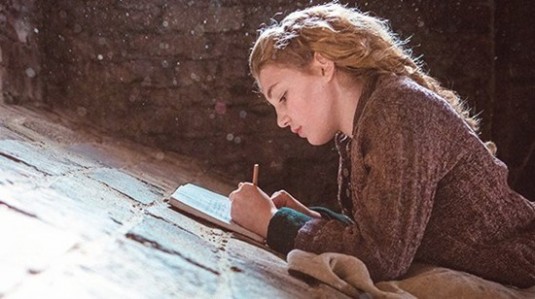
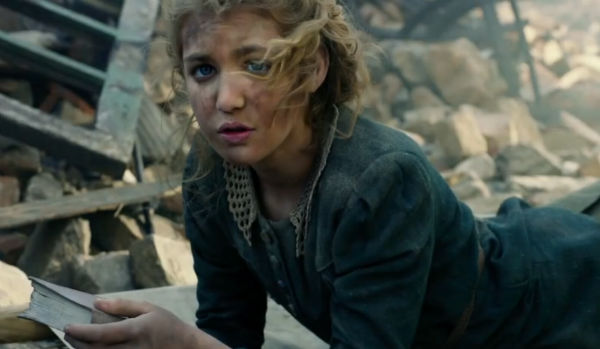
The Book Thief
The Book Thief


This cross-post by Natalie Wilson previously appeared at the Ms. Magazine Blog and appears as part of our theme week on Child and Teenage Girl Protagonists.

Though the film The Book Thief is narrated by Death (as is the book) and takes place during World War II—an era particularly riddled with death—the movie brims with life. A large part of this is due to the amazing young actress Sophie Nélisse who plays the protagonist, Liesel Meminger. It is not often that we get complex, brave female characters, especially ones who are not interested first and foremost either in romance or motherhood.

Liesel, unlike so many young heroines, resists romance—from her friend Rudy’s early problematic insistence and then throughout the remainder of the movie. Instead of being positioned in relationship to romantic partners, she has three male best friends—Rudy, Max and Hans (Papa)—as well as two females of great importance to her life, Rosa (Mama) and Ilsa Hermann (the mayor’s wife who, transgressively, supplyies Liesel with books). As for Liesel, like her futuristic counterpart, Katniss Everdeen, she is a life-saving heroine and inspirational rebel.

caption
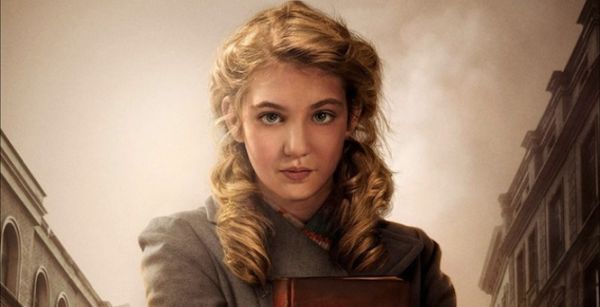
Sophie Nelisse as Liesel in The Book Thief


While I disagree with the The New York Times review, which likened the book to “Harry Potter and the Holocaust,” I have to concur with some of the suggestions the comparison implies, such as the importance of friendship, the love of whimsy and the existence of villainous persons that threaten all of humanity. The Book Thief has no wizards though; instead, its narrative rests on the shoulders of young Liesel, orphaned at the outset and taken in by a seemingly shrewish foster mother of the Disney wicked-stepmother-as witch variety. While Rosa is somewhat softened into a more likeable character by the end of the book, the film takes her character transformation in a more feminist direction, suggesting she was merely playing the part of shrew in order to protect the family during the tyrannical times in which they live.

Similarly, Hans, who at first comes off as too quick with the wives-are-such-a-nuisance type of comments, is revealed in the film to also be playing the role of a husband who bemoans his nagging wife, mocking her whenever the chance arises. As such, the two characters play out the role of a bickering married couple so as not to draw attention to their family or house. Here, the film hints at the social roles we are forced to occupy in order to not be singled out, to not be “other.” In so doing, it nods to the fluidity of identity and the ability to resist even the most tyrannical regimes via daily acts of transgression.

caption
Sophie Nelisse as Liesel in The Book Thief


Rudy also commits rebellious acts. On the one hand, as the book notes, he is “not the junior misogynistic type of boy at all,” something that has for too long been a norm of boyhood. On the other, his hero is the African American Olympic runner Jesse Owens—the man who refused to shake Hitler’s hand, though this direct political detail in the book is unfortunately not included in the film. The movie, does, however insist that racism is learned, and that Rudy has not learned it, as when his father tells him exasperatedly, “You can’t go around painting yourself black” when he does so in order to feel like Jessie Owens as he runs a race.

Similarly, though Death narrates the book, many of the characters refuse to give in to the death and destruction around them. Instead, they turn the toughest of times into opportunities for empathy and kindness—or, figuratively, to take the graveness out of death. Indeed, two of the book’s at the center of the narrative are very grave indeed, one being The Grave Digger’s Handbook and the other Hitler’s Mein Kampf. With one, Liesel learns to read; with the other, she learns to write. Thus books infused with death are used to give life to Liesel’s story and, more broadly, books, literacy and storytelling offer vital opportunities for transgression in an age of book burning.

caption
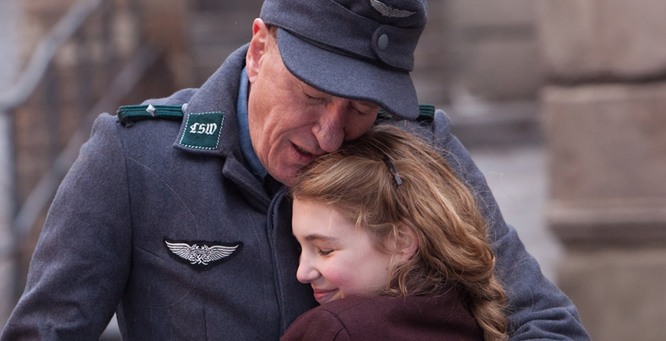
Geoffrey Rush as Hans and Sophie Nelisse as Liesel


That Liesel’s story is made possible by Max painstakingly painting the pages of Mein Kampf white, so as to create a “blank” journal in which Liesel can write is also key. Firstly, it visually negates Hitler’s heinous manifesto of hate, erasing his words with thick paint. Secondly, as the paint is white, it nods to the white Aryan supremacy promoted by Hitler and others in a way that suggests whiteness need not be the privileged, oppressive category it has been for so long. It can be, as indicated by Rudy—the white boy who paints himself black—covered over to tell a different story. Thirdly, the fact that Liesel uses the now-blank pages to write The Book Thief over the hidden words of Hitler suggests not that we “whitewash” history, but that we use what is at our disposal to make this often all-too-ugly world more bearable.

Reviews of the film thus far have been very mixed, with the most common criticism being that it’s  too slow and long. For contemporary audiences, this critique has some merit. However, the critique could just as well be directed at audiences, and the film industry at large, for its penchant towards action-packed, special-effects focused, razzle-dazzle types of films. Not everything need be in 3D or filled with explosions to be entertaining. I fear for the slow death of classic films that unfold via complex characters, quiet moments and the multifaceted feelings they bring forth in the viewer. On this count, The Book Thief gives me hope.

caption
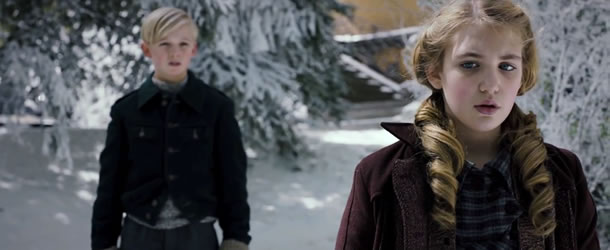
Movie still from The Book Thief


Directed by Brian Percival (who directed several episodes of the similarly classy Downton Abbey), the film holds a special appeal for book lovers, centering as it does on the power of a good book and how literacy changes lives and words shape our existence.

It also gives me hope that perhaps we are undergoing what Melissa Silverstein of Women and Hollywood calls “A Female Revolution at the Box Office.” Says Silverstein,

It is so rare to see a full-on, beautiful shot of a young woman to open a film. And from that first moment, this young woman just commands the screen and leads this film in every way.

Though Silverstein is referring to Jennifer Lawrence as Katniss in The Hunger Games: Catching Fire, the same can be said of Nélisse: She is the heart of the film, bringing the character of Liesel to life in a haunting and mesmerizing way.

If you can steal two hours and five minutes from holiday shopping and parties to see this film, I urge you to do so. Though different from Catching Fire, its talented lead actress and its emotional message might very well burn their way into your heart.


Natalie Wilson, PhD is a literature and women’s studies scholar, blogger, and author. She teaches at Cal State San Marcos and specializes in areas of gender studies, feminism, feminist theory, girl studies, militarism, body studies, boy culture and masculinity, contemporary literature, and popular culture. She is author of the blogs Professor, what if …? and Seduced by Twilight. She is a proud feminist mom of two feminist kids (one daughter, one son) and is an admitted pop-culture junkie. Her favorite food is chocolate.


What a Witch: Girlhood, Agency, and Community in ‘Kiki’s Delivery Service’ and ‘The Little Mermaid’

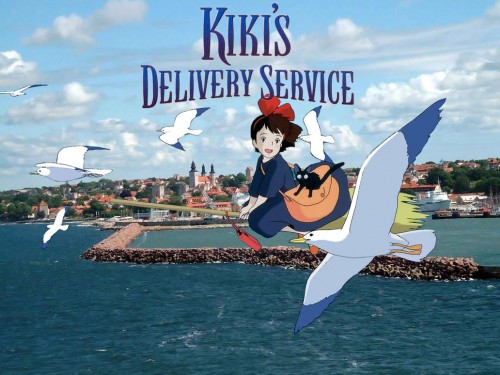
Kiki’s Delivery Service carefully constructs a world where a girl’s agency is expected, accepted and supported, while Disney movies typically present a girl’s agency as unusual, forbidden, and denied. The difference between these two messages is that Kiki’s world anticipates and encourages her independence, while the women of Disney are typically punished for this.

For example, in The Little Mermaid Ariel wants to “live out of these waters,” but her father forbids her exploration of the human world and punishes this dream. Sea witch Ursula exploits Ariel’s desire to discover another world beyond her own as well. This is hardly an isolated incident.

kikis-delivery-service

This guest post by Megan Ryland appears as part of our theme week on Child and Teenage Girl Protagonists.

If you haven’t met Kiki, you really should. She’s a 13-year-old girl who is about to start an adventure in Kiki’s Delivery Service (1989). As a witch, she must spend a year in an unfamiliar city, making her way in the world on her own and developing her skill or special talent. In the film, we meet her on the day she begins her journey and we follow her through her first steps in a new city, the development of her own flying delivery service, making new friends, and a crisis that only Kiki can solve. It’s a lovely story, but there’s something bigger at stake.

My interest is in what this story says about girls and agency as they step into the world. To highlight what’s special about Kiki’s adventure, I’ll be measuring it against The Little Mermaid (1989), released in the same year and also featuring a magical girl leaving home for the first time. Many things about Kiki’s Delivery Service set it apart from the standard fare, but I’m going to focus on the depiction of agency, the role of supportive women characters, and the protagonist’s motivation.

On My Own: Girls Leaving Home

Kiki’s Delivery Service carefully constructs a world where a girl’s agency is expected, accepted and supported, while Disney movies typically present a girl’s agency as unusual, forbidden, and denied. The difference between these two messages is that Kiki’s world anticipates and encourages her independence, while the women of Disney are typically punished for this.

For example, in The Little Mermaid Ariel wants to “live out of these waters,” but her father forbids her exploration of the human world and punishes this dream. Sea witch Ursula exploits Ariel’s desire to discover another world beyond her own as well. This is hardly an isolated incident. In Beauty and the Beast, Belle spends much of the movie trapped in a castle and any travel beyond of the control of the men in her life is punished by wolves, the Beast, Gaston, or townsfolk, depending on the transgression. In Aladdin, Jasmine wants to escape the palace that confines her world, but she is quickly returned – and then spends a not insignificant amount of the story imprisoned. Cinderella‘s world appears to be limited to her household, except for her secret, forbidden trip for a few hours of dancing, for which her stepmother punishes her. I am sensing a trend here.

Kiki begins her adventure with the blessing and support of her family, friends and community. Imagine that. In stark contrast to Disney movies, Kiki’s community gathers together to say goodbye and wish her well. They are excited and worried and happy for her, and this combination of support and concern is important. Kiki doesn’t live in a world of rainbows and sunshine where nothing could go wrong, but that doesn’t mean her parents (neither of whom are mysteriously absent) keep her locked up in a tower or hidden in the woods.

In fact, a neighbour who has come to see Kiki off asks her parents, “Aren’t you worried about Kiki living in a big city all alone?” and this type of concern is familiar to girls, who are often made aware that they are especially vulnerable. However, in this film, another townsperson immediately replies to this worry with an authoritative, “Of course they are, but Kiki will be just fine.” This matters. In this tiny moment, the film sets the rules of Kiki’s world from the start. It’s a world where independent 13-year-old girls can and do exist without punishment. They are not trespassing when they leave home. This is a girl’s world too.

-1

Compare the father-daughter moments in the films for a little more insight into how a girl’s agency is viewed by her family. Kiki’s Delivery Service immediately establishes a bond between father and daughter, in part by showing their sentimental parting. When he hugs her, he wonders at how fast Kiki has grown up and gives her a squeeze, but he also gives his blessing and encouragement. He believes in her. The story begins with a hug and a father supporting his daughter’s wishes.

-1

On the other hand, The Little Mermaid ends the movie with a father-daughter embrace, but this one arguably has a whole different set of meanings attached. Although it does indicate giving his blessing, King Triton is giving his daughter away at her wedding, which leaves a rather different impression. Ariel’s father spends most of story trying to force Ariel into the role and place he feels comfortable with, but eventually comes around to the idea of Ariel leaving the sea–to marry Eric. Safe in the arms of her husband, he can finally let Ariel go.

-1

Other characters follow the same approach to agency as the father in each movie; in Kiki’s Delivery Service, characters explicitly encourage Kiki’s independence, while Ariel’s community is generally (loudly) opposed to her exploration of the human world. These differing perspectives on the acceptability and safety of exploration offer two very different visions of the risks girls face when they leave the nest (or the sea). Kiki’s world falls squarely in the pro-exploration and self-discovery camp. Ariel’s? Not so much.

Women as Friends, Mentors, Advisors, and More

Kiki’s world is also populated with a very different crowd than the average Disney movie. By different, I mean there are women in this movie who all vary in their physicality, personality and treatment of Kiki, making the world it presents surprisingly familiar. There are friends and mothers and business owners and artists and spoiled granddaughters and spunky old women and designers and city girls and scientists and snobs. Kiki interacts with all of these women, alongside a cast of men of many ages, statures and temperaments as well.

In The Little Mermaid, women play a much smaller part. Ariel has a chorus of sisters and encounters a series of women servants, but these women are all largely indistinguishable from one another and exchange few words with Ariel. Ariel is surrounded by men–her father, her chaperone Sebastian, her friends Flounder and Skuttle, her love interest Prince Eric, palace staff like Grimsby and Chef Louis, et al–but Ursula is the only woman Ariel has any meaningful exchanges with.

Ursula is actually a particularly interesting example to pull out of each movie, as there is a character of this name in both. In The Little Mermaid, Ursula is the evil sea witch who lives alone, aside from her eels and the “poor unfortunate souls” she’s tricked. She lures Ariel into a poor deal by dangling her freedom in exchange for her voice as a part of a scheme to steal King Triton’s power. She is considered evil, ugly and cruel, so her eventual death is a cause for celebration.

-1

In Kiki’s Delivery Service, Ursula is a painter and recluse, living alone in her cabin in the woods except for the crows. She also makes a deal to help Kiki, but here she merely fixes a toy in exchange for Kiki completing chores. They become friends and when Kiki is later filled with self-doubt–so much so that she loses touch with her magic–Ursula offers her support and a place to stay. Ursula also explains how she has personally dealt with self-doubt about her paintings and encourages Kiki to stop putting so much pressure on herself and to believe in her abilities. In essence, she acts as a friend, mentor and role model to the younger girl.

-1

Kiki lives in a generally supportive community, yes, but it is important to note that this is a community where she receives friendship, guidance and support from the women around her–like many girls do in real life. Kiki’s role models are the women who provide supportive guidance but always allow her to make her own decisions, unlike the advisors for Ariel (King Triton, Sebastian, and Ursula) who try to force her hand. It isn’t even that the movie is paying special attention to the bonds of “Sisterhood” and Kiki certainly doesn’t get along with all of the girls she meets. We just rarely see women talking to women about something other than men in film, so it stands out as important.

Your Heart’s Desire

A final vital aspect I would like to highlight is the difference in goals between Kiki and Ariel. Kiki is looking to discover her own skills and train as a witch, so she begins her own small business and works hard to earn a living by helping people. Kiki’s desires are personal and internal, and so are her obstacles. The main difficulty Kiki faces is her own self-doubt, lack of confidence and depression, with some hijinks thrown in. Watching Kiki’s tale, we see a girl determining her own fate and discovering her strengths, with the help of friends. She saves the day by overcoming her lack of confidence and recalling her power to fly in time to save her friend Tombo from a surely fatal fall.

In The Little Mermaid, Ariel’s wish for freedom to see the human world very quickly becomes a quest for a kiss and we don’t get to see a return to her curiosity about the world during the rest of the tale. Ariel’s goal just becomes about winning Eric, particularly from Ursula’s tentacles.

-1

Unlike The Little Mermaid, romance is entirely optional and secondary in Kiki’s adventure, and not always desirable. Jiji, Kiki’s cat companion, actually falls in love, but his romance leads to his abandoning Kiki when she most needs him. Kiki’s own potential romantic subplot could be interpreted as an entirely platonic interaction, as Tombo is a persistent fan of the young witch, but Kiki’s feelings toward him are less clear. Kiki isn’t sure how to go about making friends in this new town, including a relatable uncertainty about how to approach Tombo. This growing relationship is slow moving and clearly secondary to Kiki’s obligations to her delivery service business. This makes her priorities seem practically opposite to Ariel’s concerns, as the mermaid gives up her fins and her community for a boy she’s known for three days.

-1

Ariel’s goals are relational and external, and her obstacles are set to match. In The Little Mermaid, the day is saved with little to no action by Ariel, who is a bystander to many of the events. Her friends drag her to the wedding and delay the ceremony, while Prince Eric is the one to defeat Ursula. However, you don’t necessarily miss her participation in the action, because Ariel does get what she wants: Eric. Her kiss. Kiki’s story could not be similarly resolved. We require personal growth and discovery to solve her problem and achieve her heart’s desire.

The divergence in the motivation of the protagonists highlights that the goals of each story are radically different. I’ll admit that I’m comparing apples and oranges. This could be a silly exercise, except that I grew up in an apple orchard, so of course that’s my reference point. Disney is the reference point for many children, especially girls. Although new stories have certainly been introduced since I was a little girl watching The Little Mermaid, I can’t say that Disney has loosened its hold over girls. My point here is to show how poorly served girls are when they don’t have access to tales like Kiki’s, which is constructed so differently from the Disney classics. Released in the same year, these two films present almost oppositional messages about girl entering the big bad world. What I wouldn’t give to hear more about Kiki’s narrative than Ariel’s.

Kiki’s Delivery Service is a coming-of-age story about finding your identity, stepping out on your own, falling and getting back up again. Kiki moves through this critical process with the help of the friends and family–particularly women–around her. In telling this story, it is a movie that supports the agency and power of girls, and doing it without making our protagonist into an Exception. Kiki is no rebellious wild child, no infallible hero, and no chosen one. She’s a 13-year-old girl who gets nervous, gets things wrong, and doesn’t always know what she’s doing. In making Kiki relatable, the film normalizes forging your own identity as something that every witch–or girl–must do.

What does it mean to build and depict a world where girls are supported in their growth and independence, instead of stymied? Among other things, it means that viewers (especially girls) get a chance to imagine a world that doesn’t eat you alive. Not a world without obstacles, but one where those who love you offer guidance and encouragement. It is a hopeful story about the challenges of girlhood and independence, and we need more of them. Kiki is doing what we all have to do: leave home, grow up, and find our place in the world. It’s scary thing, but it’s exciting too. It’s a story we are going to live and story we should be told.


Megan Ryland is a writer, feminist and nerd currently living Vancouver, BC. She recently completed her BA in Gender, Race, Sexuality and Social Justice & Political Science at the University of British Columbia. You can hear more from her at her blog Beauty vs Beast and as part of the team posting at The Body is Not an Apology.


Girl Gangs Are Mean: Teenage Girl Gang Movies Through the Years

While most teen movies revolve around coming-of-age stories, gang movies reveal the extreme side to adolescence—the misfit, criminal, and violent side. Gang movies are rather simple, either focusing on episodes of gang debauchery, or revolving around rivalry and jealousy. Usually the viewpoint is that of the ring leader, or the “new girl,” who is initiated into the gang but is still an outsider. Yet, among the plethora of girl gang movies, every decade has produced stories involving specific issues and specific types of teenage girls.

caption

This guest post by Emanuela Betti appears as part of our theme week on Child and Teenage Girl Protagonists.


One of Roger Corman’s first films, Swamp Women, was a 1955 crime story revolving around a gang of female convicts. There has hardly ever been a lack of female gangs in films — in particular, teenage girl gang movies became increasingly popular starting in the 50s, which led to numerous movies on the subject that span different generations. If there is a genre in which teenage girls have never been lacking representation, it’s gang movies.
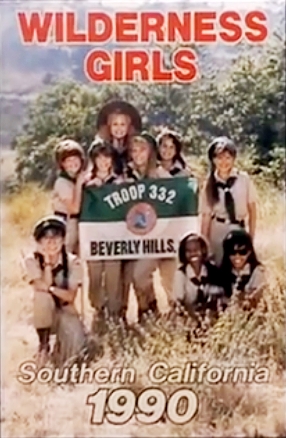
Yet, that representation has varied and changed throughout the decades, ranging from high school delinquents to outlaw bikers. While most teen movies revolve around coming-of-age stories, gang movies reveal the extreme side to adolescence — the misfit, criminal, and violent side. Gang movies are rather simple, either focusing on episodes of gang debauchery, or revolving around rivalry and jealousy. Usually the viewpoint is that of the ring leader, or the “new girl,” who is initiated into the gang but is still an outsider. Yet, among the plethora of girl gang movies, every decade has produced stories involving specific issues and specific types of teenage girls.

The 50s and the Rebellious Years

An abundance of films and B-movies related to gangs and juvenile delinquency was released in the 1950s. The films produced at that time reveal a growing anxiety about teen rebellion. While Reefer Madness was a propaganda film about the dangers of marijuana, movies such as The Violent Years and Girl Gang were propaganda films about the threat and danger of rebellious teenage girls, and the dramatic consequences of being part of a female posse. The girls were portrayed as violent criminals, on par with their male counterparts — driven by teen angst and restlessness.  Gang movies in the ‘50s were heavily moralistic: films such as The Violent Years and High School Hellcats blamed juvenile delinquency on parental neglect and dysfunctional families, while teenage gang members usually suffered a tragic fate. The Violent Years (written by Ed Wood) was particularly exaggerated in its tragic ending:  Paula, leader of the gang, becomes pregnant, is jailed for murder, and finally dies in childbirth — yet, still has the insolence to look at the screen and ask, “So what?”

The 60s and Biker Gangs

Girl gang movies of the ‘50s were particularly judgmental, until the 1960s rolled in with the biker film craze. Three all-female motorcycle gang movies were released in the same year: The Mini-Skirt MobShe-Devils on Wheels, and The Hellcats in 1968. Compared to ‘50s gang movies, female biker movies of the ‘60s indulged in the gang fantasy rather than pressing moral lessons on the viewer. There are no schools or parents in biker movies—the gang is the family. The girls in biker gangs are a tight-knit posse, led by an Alpha female who bosses and uses men to her liking; the idea of assertive and domineering girls has carried on from the ‘50s, but without judgment. Despite the popularity of the biker genre, the depiction of adolescence in biker films was essentially unrealistic, and indulged in a fantasy rather than a truthful portrayal of teenage girls.

70s and Switchblades

In the 1970s, gangs ditched their motorcycles and stocked up on switchblade knives, moving back into an urban setting instead of the open road. Probably one of the most iconic gang movies, Switchblade Sisters, is about the Dagger Debs, an all-female city gang led by Lace. The story revolves around the arrival of new girl Maggie, who joins the Dagger Debs and slowly begins to take over leadership. For a gang movie, Switchblade Sisters has a complex storyline, filled with power struggles between characters — Lace becomes increasingly jealous of Maggie, Patch is a sly manipulator, and Maggie goes from a quiet girl to a cold-hearted leader. Although the world of Switchblade Sisters is also unrealistic, the political turmoil of the ‘60s and ‘70s is strongly evident in the darker tone of the story and the characters’ actions. At one point, we are introduced to a Black Panther-inspired gang, which we also see in another popular gang movie, The Warriors.

Although The Warriors focuses mainly on male gangs, there is one female gang in the movie known as the Lizzies. They are also armed with switchblades and knives, and they lure gang members by seducing them. Again, female gang members retain the exaggerated image of the Alpha female that they have been given since the ‘50s.

Teenage Royalty

From the 1980s on, “gangs” become high school “cliques” led by the popular girls. We first see high school girl cliques in the Pink Ladies from Grease, which was a throwback to ‘50s teen gang movies. In 1988, Heathers presents us with yet another elite girl clique (the Heathers) who are the most popular and envied girls in school. Although Heathers is a humorous take on teen movies, Veronica (Winona Ryder) is the closest depiction to an “actual” teenage girl since the biker and switchblade girls: she vents her hate for the Heathers on her diary, and has a teen romance with the typical bad boy. Jawbreaker and Mean Girls are both told through the point of view of the new girl. They begins as a socially awkward outsiders but slowly (like Maggie from Switchblade Sisters) take over the spotlight of the original queen bee.
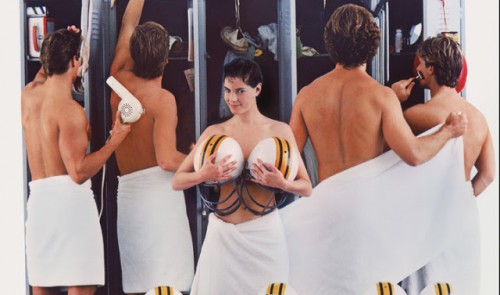
While previous gang movies were driven by gang rivalry and dominance for territory, the modern high school girl gangs are at war for social status. Teen angst is present, but rather than expressing it through vandalism and crime, it’s expressed through different means — they ditch the switchblades, and their weapons are gossip, manipulation, and backstabbing.

Notorious Teens

After a long period of “teenage royalty” girl gangs, in the 2010s, two movies tackled girl gangs in a different light: Spring Breakers and The Bling Ring. The stories still revolve around beautiful and privileged girls, but instead of fighting for high school popularity, they gravitate toward a criminal lifestyle. The girls in Spring Breakers commit armed robbery, while the members of the Bling Ring steal expensive goods from celebrities’ homes. Modern girl gang movies are not indulgent fantasies or exaggerated portrayals of high school life — the new girl gangs embody a sentiment among many teenage girls: the desire for material things, and most of all, notoriety. The girls in Spring Breakers feel entitled to wealth, while The Bling Ring girls follow their desperate obsession for celebrity status.


Emanuela Betti is a part-time writer, occasional astrologer, neurotic pessimist by day and ball-breaking feminist by night. She miraculously graduated with a BA in English and Creative Writing, and writes about music and movies on her blog.

The Horror of Female Sexual Awakening: ‘Black Swan’

What disappointed me most, I think, was that Black Swan could easily have been a progressive film with a positive, young woman-centered journey out of repression at its center. It could have recouped that gender-centric childhood ballerina dream of so many little girls into a message about determination, hard work, personal strength, and emotional growth. Instead, Darren Aronofsy has produced an Oscar-winning horror film. That’s right: I said HORROR. While that might seem like a stretch, it seems clear to me that the horror I refer to is the possibility of changing an age-old story. The horror of Black Swan is the absolutely terrifying idea that a young woman might make it through the difficult process of maturation, develop a healthy, multi-faceted sexuality, and be successful at her chosen career at the same time.

Natalie Portman in Black Swan


This guest post by Rebecca Willoughby appears as part of our theme week on Child and Teenage Girl Protagonists.

I don’t know what I was expecting when I settled in to watch Black Swanlong after its theatrical release and subsequent meteoric rise to Oscar stardom.  I knew there would be ballet (that quintessential representation of femininity and near-unattainable physical characteristics), and there had been much talk about a lesbian scene.  Plus, it wasn’t as if I didn’t know that Swan Lake ends in a suicide; there’s quite a lot of that in ballet, opera, or virtually any other artistic, dramatic work produced over a wide range of historical periods.  In the words of Tomas, the pretentious (male) genius ballet company director in the film (Vincent Cassel): “in death she finds freedom.”  Yep, I can see where this is going.

So I saw the tragic ending of Swan Lake coming, but the tragic ending of the film was kind of a surprise.  Or, maybe not so much a surprise as a disappointment. What disappointed me most, I think, was that Black Swan could easily have been a progressive film with a positive, young woman-centered journey out of repression at its center.  It could have recouped that gender-centric childhood ballerina dream of so many little girls into a message about determination, hard work, personal strength, and emotional growth.  Instead, Darren Aronofsky has produced an Oscar-winning horror film.  That’s right: I said HORROR. While that might seem like a stretch, it seems clear to me that the horror I refer to is the possibility of changing an age-old story.  The horror of Black Swan is the absolutely terrifying idea that a young woman might make it through the difficult process of maturation, develop a healthy, multi-faceted sexuality, and be successful at her chosen career at the same time.

Natalie Portman is no stranger to this maturation process, and she’s done most of it in the spotlight.  She has been acting since age 13, and in her first starring role she portrayed an orphan captured by a hit man in Leon: The Professional (1994).  It might also be worth noting that this first role, even, was a strange one in terms of sexuality: Mathilda is quite a precocious young girl, and in a fit of Stockholm syndrome does, weirdly, “fall in love” with her much older (though admittedly endearing) kidnapper, played by French actor Jean Reno.  Older man, French accent, I can understand.  We might say that she “rocketed” to stardom, however, due to her casting in the Star Wars prequels as Queen Amidala, a role encompassing conventions of action, romance, and motherhood.  While those films were slowly driving sci-fi fans mad, Portman was working on a Bachelor’s degree in psychology at Harvard, and it’s impossible to ignore the historic links between psychology, madness, and horror when watching Black Swan. We also need to remember, however, that Portman’s character Nina’s journey is viewed through the cinematic lens of a male director, and that seems to only lead… well, nowhere new.

Portman does not portray a young girl in this film, as much as she portrays a woman who has left her sexuality at the door in pursuit of being “perfect” at ballet.  When the film opens, she is “getting older,” which, in the world of ballet, means you’re about 25 with no body fat, which makes you look like a young girl.  But you certainly don’t feel like a young girl: you are a woman.  Nina seems to have missed that memo.  She is arguably already imbalanced when the film begins (not to mention frighteningly infantilized by her mother), but when she is cast as the Swan Queen in her company’s production of Swan Lake–a role that must embody both the “beautiful, fearful, and fragile” nature of the White Swan alongside the “dark impulse” of the Black Swan–her delicately constructed vision of herself begins to disintegrate.  She sees herself—clad in a pink coat and white scarf— stroll past herself—wearing a black coat and heels— in an alley.  Her reflection in the dance studio mirror stops mirroring and takes on a life of its own.  These are just some of many moments throughout the film where Nina is faced with her shadowy double.  Sometimes that double takes on horror-film qualities, as when she imagines herself as Beth, the ballerina whose place she has taken in the company, stabbing herself in the face with a nail file while screaming, “I’m nothing!” At these moments, things get a little harried in the genre department.

caption
Power play


Even given Nina’s sometimes horrifying hallucinations, it might be a hard sell to classify Black Swan as a horror film.  When we discuss films as horror, we’re usually talking about narratives chock-full of gore, jump-scares, suspenseful music, shadows, violence, and “stupid girls running up the stairs when they should be running out the front door.”* We get some of those conventions in Black Swan, but only because, in her stressed mental state, Nina imagines them.  Horror films also typically give us a heaping helping of misogynistic, male-gaze visuals, though that might be changing, albeit slowly.  I suppose we could say that there are a lot of female bodies to be looked at in a variety of ranges of sexual objectification in this film.  Dancers are, after all, performing.  The intent is that someone watches.

But these aren’t the real reasons I think it’s a horror film.  It’s a horror film not because Nina slowly descends into madness from the pressure of portraying the starring role in Swan Lake.  It’s not even because Aronofsy makes use of this madness in amazing visuals that leap over the bounds of realism into the realm of the surreal with scenes where Nina appears to literally be transforming into a swan.  It’s because at the very moment when it seems that Nina might recover from this nightmare and become a whole, happy person, the film kills her off in a twist of tragedy that is narratively as old as the hills. Isn’t there any other female story to be told? 

All the cracks in Nina’s psyche, which are brought to visual life by the film’s surreal images as well as real-world physical disintegrations—she constantly scratches at herself, picks at hang-nails, bandages her abused feet— viewers can see sympathetically as Nina struggles to find balance between the two sides of her leading role.  Some of these struggles manifest themselves in her relationship with fellow dancer Lily, with whom she forms a tenuous bond.  When she leaves her house to go “out” with Lily (Mila Kunis), her foray into social nightlife is encouraging— yes, I know she does drugs in this scene, and that we generally want to frown on potentially destructive behavior. But I was happy that in this scene Nina is, in some small way, controlling her own destiny for once, even if it means recognizing that she can use a bit of chemical assistance to escape the many forms of repression and oppression of which she finds herself a victim.  Though the drugs could be said to promote a few more slips between Nina’s reality and her fantasy world—where she has a satisfying sexual encounter with Lily, but where she also begins to sprout black swan feathers from her back—I would argue that those fantasies allow Nina to explore her budding sexuality.

It doesn’t help that Nina’s mother (Barbara Hershey) is the ultimate helicopter parent and, it seems, Nina’s only friend until she begins her relationship with Lily.  I cheered Nina as she literally bars her mother from her life (read: bedroom) so she can have enough privacy to even fantasize effectively.  The mother/daughter relationship in this film reminded me of Brian DePalma’s Carrie (1976)—another horror film about a young girl becoming a woman.  Nina’s mother not only lives vicariously through her daughter’s success in the ballet, but also tries to control her and prevent her from being a success, a competition stemming from the fact that Nina’s mother was never cast in a starring role.  These realities, as well as the creepy portraits her mom paints of her, and that bedroom decorated for a ten-year-old show that the maternal relationship does nothing but stifle Nina, and compound her problem with coming to terms with any type of sexual desire.

For Portman, this role is a mix of childlike body type and pubescent girl growing pains.  The casting choice brings to mind the warped sense of ageism experienced by dancers, as well as the stunted emotional development often suffered by young performers transitioning into adulthood.  Portman would ostensibly know the latter well. It’s a character that is both stuck in girlhood and desperately coveting the transformation that signifies becoming a woman.  That transformation is made flesh in the visual shifts that equate Nina with the swans she tries to portray through dance.

Nina's dark double
Nina’s dark double


On the opening night of the ballet, Nina apparently kills Lily, her understudy, in a jealous rage after almost being replaced.  As Nina chokes Lily (and then stabs her with a bit of shattered mirror), she exclaims, “It’s MY turn!” and partially transforms into a swan.  Surreal and horrifying: check.  A few moments later, she thrillingly dances the Black Swan, and comes completely out of the repressive shell she’s been trapped in for the whole movie.  As she moves, she “loses herself” in the dance, her arms transforming into wings, freed from her oppressive prison.  These scenes are the climax of the film, employing dizzying 360 shots, dazzling lighting effects, close-ups on Nina’s face, and stunning CG.  When she leaves the stage exhilarated, a good few moments are devoted to Nina’s ecstatic face and heavy breathing—it is an emotional orgasm.  So imagine my horror when she realizes that rather than stabbing Lily in the dressing room before the performance, she has actually stabbed herself, significantly with that piece of mirror.  She becomes not a whole, realized being, but her own fragmented, shattered worst enemy.  When she returns to the stage to dance the finale of Swan Lake, she is dancing to her own death.  While Swan Lake’s narrative is already known to include a suicide, slowly we learn that Black Swan also requires one.  For each to be “perfect,” Nina can live just long enough to complete one perfect performance.

Just for the record, there is a part of me that digs the catharsis and frustration in this ending.  I get it.  Really.  But I am classifying this film as horror for a few reasons: the disturbing imagery, the dark implications of Nina’s downward spiral, her obsession, her crazy mom, and the fact that the poor girl isn’t allowed to have a sexual awakening without dying.  Or, more accurately, it’s because she actually HAS that moment of fulfillment and is able to embrace her sexual nature for even an instant, the film punishes her.  Aronofsky’s narrative seems, therefore, to argue that women—especially those temperamental dancer-types—are perennially unbalanced, unable to maintain a healthy equilibrium between the Black and White Swans; the virgin and the whore.  Once Nina has felt the power of the Black Swan, her signifier for sexual assurance and agency, she can’t escape it; can’t return to the innocence and fragility that society prefers, so she has to be eliminated.  She is too dangerous, because she wants to tell another story: the story of a whole woman.  You could argue that it’s the classical tragic form I’m railing against, and you’d be right.  But this form has repressed and oppressed female characters for hundreds of years.  The very use of Swan Lake (circa 1875, people!) as a narrative to tell the story of a contemporary woman points to the fact that we’re revisiting a problem we can’t escape, rehashing the same gendered issues.  I hoped maybe this film could move beyond that.  Or, we could give it an Academy Award.

*A phenomenon pointed out by another female horror heroine, Sidney Prescott of Wes Craven’s Scream (1996).


Rebecca Willoughby holds a Ph.D. in English and Film Studies from Lehigh University.  She writes most frequently on horror films and melodrama, and is currently a lecturer in Film/Media Studies at Bucknell University in Lewisburg, Pennsylvania.   


On Milk-Bones, Toothed Vaginas, and Adolescence: ‘Teeth’ As Cautionary Tale

Early in the film, Dawn is a nymph-like virgin committed to “saving herself” until marriage. She is the poster child for the “good” girl: a loving daughter who obeys the doctrines of the church and spends her time spreading the gospel of virginity. Everything Dawn knows about the world and herself changes when her falsely pious boyfriend Tobey takes her to a far off swimming hole and tries to rape her. A confused and terrified Dawn reacts by screaming and then—much to everyone’s surprise—cutting off his penis to interrupt the rape. Little does Dawn know that her lessons about Darwin in her biology classes are taking hold in her own body.

Teeth movie poster
Teeth movie poster


This guest post by Colleen Lutz Clemens appears as part of our theme week on Child and Teenage Girl Protagonists.

Mitchell Lichtenstein’s 2007 comedic horror film Teeth plays to and with the audience’s anxiety about a young girl’s burgeoning sexuality.   In a town flanked by a nuclear power plant, the main character, Dawn, grows into her sexuality while coming to terms with having a vagina dentata–a toothed vagina.  In a time when toothed condoms called Rapex to prevent rape are coming onto the market, Dawn’s travails force the viewer to consider what is necessary for a woman to survive as a sexual being in a climate of violence and rape.

Early in the film, Dawn is a nymph-like virgin committed to “saving herself” until marriage.  She is the poster child for the “good” girl:  a loving daughter who obeys the doctrines of the church and spends her time spreading the gospel of virginity.  Everything Dawn knows about the world and herself changes when her falsely pious boyfriend Tobey takes her to a far off swimming hole and tries to rape her.  A confused and terrified Dawn reacts by screaming and then—much to everyone’s surprise—cutting off his penis to interrupt the rape.  Little does Dawn know that her lessons about Darwin in her biology classes are taking hold in her own body.

Toby loses his penis
Tobey loses his penis


Dawn turns to the Internet to learn what has happened to her body (and I suggest you, dear reader, might want to avoid Googling “vagina dentata” if you are faint of heart) and learns that her vagina—something she didn’t want to see the picture of even before the rape—is a tool of terror, in her opinion.

Dawn does some research


In a desire to learn about her body, to confirm what is normal or abnormal biology, she goes to another man whom should be trusted—her gynecologist.  During the exam, he also takes advantage of Dawn’s vulnerabilities and assaults her.  When he doesn’t listen to her protests, he loses a finger, and Dawn flees screaming at the fear she now has over her own body and it sexual nature.  With little to no information about her own body brought upon by her abstinence-only education, Dawn is left confused while her curiosity mirrors that of any young woman starting to learn about sex.

Dawn visits the gynocologist
Dawn visits the gynecologist


Viewers finally relax when they see Dawn in the hands of a loving partner, Ryan, who seems to care for her.  With loving embraces and tenderness, Ryan takes a nervous Dawn to bed.  Her vagina dentata seems to be reserved only for instances in which Dawn needs protection, so Ryan is safe in her embrace.  But when Dawn learns that Ryan has bedded her as part of a bet while he is still inside of her, Dawn’s evolutionary adaptation intercedes and Ryan is punished for his use and abuse of Dawn.  So now two trusted boyfriends and a doctor have initiated Dawn into the world of oppressive sex and violence, and all three times her vagina—the thing that has left her most vulnerable—has acted as a protector.

Ryan loses his penis


Finally, upon the death of her mother, Dawn starts to see her vagina as a tool not only for survival but also for justice.  Her awful stepbrother Brad is the first to be the victim of the vagina dentata used purposefully.  Having ignored the cries of his dying stepmother, Brad allows the most important woman in Dawn’s life to die a horrible death.  A coy Dawn seduces Brad to punish him.  His vicious dog gets to eat the spoils of the sexual encounter Brad had been taunting Dawn with for years.

Brad's penis (before the dog eats it)
Brad’s penis (before the dog eats it)


The final scene does the most interesting work in terms of considering Teeth as part of the rape-revenge genre (spoiler alert).  Dawn has left her home to begin a new life as she can no longer survive in her town.  After a succession of men whom Dawn should be able to trust take advantage of her, Dawn finally embraces her toothed vagina and uses it as a tool of resistance and justice as she works to protect other women from the awful men roaming the world.  When hitchhiking, she is picked up by the archetypal “dirty old man” that solicits sex from her as his dry tongue licks his even dryer lips.

Dirty old man
Dirty old man

In the film’s final moments, the audience sees Dawn smile and go toward this encounter, and we know that Dawn will use her vagina dentata as an act of vigilante justice.  She will sever the penis of this man so he cannot use it again and hurt other girls.  Instead of being surprised by her vagina or using it as a form of reactive self-protection, Dawn is now being proactive and seeking out the opportunity to use her “teeth” to act as a fighter.  She goes toward the encounter and accepts her body for what it is:  a powerful sexual being that has adapted to a world that is often harsh and dangerous for the female species.

I have taught this film several times in my college courses.  If I were to make a generalization, at the end of the film, the male students groan and the female students cheer.  I suppose that is a natural response to some degree.  After all, we did just witness a dog eat a severed penis as if it were a Milk-Bone.   However, this film always leads me to ask the question:  Is this the kind of agency that we as women want—access to violent acts? Is Dawn, as Tammy Oler calls Dawn in her Bitch article on rape-revenge films “The Brave Ones,” a “satisfying fantas[y] of power and fortitude”?

Dawn looks powerful
Dawn looks powerful


The film seems to argue that Dawn’s growth is a requirement, a form of natural selection–that a young woman growing up in a white, suburban, Christian, capitalist society MUST develop such a “mutation” in order to survive a patriarchal world.   Dawn’s vagina dentata is the epitome of her biology teacher’s earlier lesson on natural selection, that along with the help of the effects of the nuclear power plant combined with the need to survive, women will start to adapt and grow vaginal teeth.  Though she is still monstrous (the film isn’t called “Dawn,” but is instead named after the thing that makes her a monster), she also has access to mobility—she is leaving—and sexual power—she is about to control the sexual situation for the only the second time in her sexual life.  Sadly, though this situation is one of power, not of love.

We do see earlier in the film that she can control her teeth when having sex in a loving environment, so the adaption will not hold her back from having a healthy sexual encounter that is safe for both partners.  But when that safety is compromised, the audience is to assume that Dawn will always have the upper hand.  Or should we say the upper jaw?


Colleen Lutz Clemens is assistant professor of non-Western literatures at Kutztown University. She blogs about gender issues and postcolonial theory and literature at http://kupoco.wordpress.com/. When she isn’t reading, writing, or grading, she is wrangling her two-year old daughter, two dogs, and on occasion her partner.