Seed & Spark: The Naked Truth: Stripping in the Movies

We all know that women simply are not put on screen as much as men are. This is partially due to the fact that there are fewer women creating films than men and partially due to the beloved foreign sales model in the film industry that seems to reflect that men create more of a return at the box office. I have been on calls with producers where we could make the overall budget of a film lower if we cast a woman instead of a man because simply, we didn’t have to pay her as much.
The other element worth noting in today’s films is what women are given when we finally make it to the silver screen. 28.8% of women on screen wear sexually revealing clothes as opposed to 7% of male characters. 26.2% get partially naked as opposed to 9.4% of men. These numbers all but continue to increase.

This is a guest post by Mara Tasker. 

We all know that women simply are not put on screen as much as men are.  This is partially due to the fact that there are fewer women creating films than men and partially due to the beloved foreign sales model in the film industry that seems to reflect that men create more of a return at the box office.   I have been on calls with producers where we could make the overall budget of a film lower if we cast a woman instead of a man because simply, we didn’t have to pay her as much.
The other element worth noting in today’s films is what women are given when we finally make it to the silver screen:  28.8 percent of women on screen wear sexually revealing clothes as opposed to 7 percent of male characters;  26.2 percent get partially naked as opposed to 9.4 percent of men. These numbers all but continue to increase.

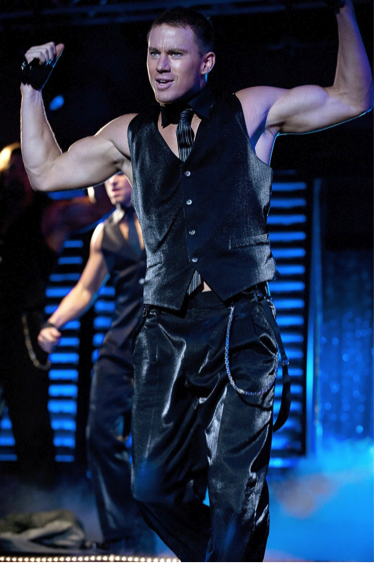
So since Hollywood likes to undress us, let’s peel off the industry’s clothes in return and look at how nearly naked women in films get to live compare to the more rarely seen nearly naked man.  On the male side, let’s look at the The Full Monty and Magic Mike, two completely entertaining and hilarious films where guys get to let loose in one way or another and genuinely enjoy the absurdity of their time as male strippers.  In Magic Mike, Mike Lane has bigger dreams than his stage life would suggest.  He’s not a career stripper but he definitely gets a kick out of what he’s doing.  He gets to party and he loves money, drinks and women.  While there are certain complications that arise in the film, he never quite doubts what his life choices have led him to and when he does have a change of heart, there is no sense of shame, no emotional disaster below the surface.  When Mike ultimately decides to leave the business, we feel that he is fully capable of another life.

Mike Lane fearlessly working the stage as "Magic Mike"
Mike Lane fearlessly working the stage as Magic Mike


The Full Monty comes from a slightly less sexed up, six-pack ab packed perspective, but this one, like many, uses a downtrodden town and crushed economy to force its crew of misfit male characters into a temporary life of stage nudity.  As much as I did enjoy The Full Monty for all of its quirky humor, I also find it frustrating that we can’t seem to find any humor when we put women on that same stage. Hell, we never really thought twice about Dirk Diggler in Boogie Nights and his business was far grimier.  We laugh because these adult males, who we’re used to seeing occupying positions of power, are putting themselves in absurdly powerless positions where they have to dance around for their female counterparts.

The gang finally giving us THE FULL MONTY

It’s not so funny when we switch gears to female strippers – the tragic, weather-beaten, emotionally tormented, broke and destitute – female exotic dancer.  In Gaspar Noe’s haunting film Enter the Void, Linda, our protagonist’s little sister, has turned to a life of prostitution in the neon lit Tokyo.  But from her mumbled, seemingly drug induced words to her devastating circumstances of being stuck with the wrong man and despondent post abortion, it’s hard to find any levity in her circumstances as compared to the above mentioned films.  There is a sense of finality to her situation.  That everything has led to this and now it’s over, she’s trapped,

In Michael Radford’s Dancing at the Blue Iguana, the women featured are largely propelled by their addictions, their desperate situations, or their general outlook that life can’t be anything more.  Not one of them has a future to really grab ahold of.   Striptease – Demi Moore’s character uses dancing as a way of getting funds to reclaim her life.  She was broke, so she danced.   While Striptease and The Full Monty share a downturned economy as a narrative driver, one is treated with absurdity while the other is treated as a desperate attempt to survive.  One reads like prostitution while the other reads like a night out.

Sandra Oh's standard expression from the stage in Dancing at the Blue Iguana
Sandra Oh’s standard expression from the stage in Dancing at the Blue Iguana
Daryl Hannah's solemn stage expressions mid dance
Daryl Hannah’s solemn stage expressions mid dance

Think quickly about the female strippers you have seen in films.  Generally, they are depressing, defeated, and done-for characters.  Think about who directed the above films.  They’re all men.   Think of the male strippers.  They are generally funny, cocky and have a life at the end of the film that takes them out of the bar.  So, what are our options? It seems that women who have to turn to these jobs never find their way out of that trap and yet men love to see us there.  So where does that put us on screen and who is controlling it?

Marisa Tomei as the tormented Cassidy in The Wrestler


Now let me introduce you to another kind of female stripper. Her name is Sheila Johnson – the tempting, murderous and alarmingly audacious title character of a short grindhouse film called Sheila Scorned, which I wrote and am directing. We’re currently crowdfunding at Seed & Spark (link below).

Sheila Scorned movie poster visually designed after Coffy and Faster Pussycat Kill Kill
Sheila Scorned movie poster, visually designed after Coffy and Faster Pussycat Kill Kill


Sheila is a dancer at a divey gentleman’s club.  And she’s there by choice.  It’s a means to an end that she is in control of.  She is well aware of the fact that her sexuality could entice someone to not only pay her, but to follow her into a rabbit hole.  In the opening scene, Sheila locks eyes with one particular patron.  As the soft lights dance against her soft skin, she nods at his hungry expression, cueing him.  The next moment we find Sheila, she’s in a back room at the club, climbing off this patron’s lap–revealing our man with a knife in his side.  As he grabs at his ribs, blood leaking between his fingers…

“Do you remember me Charlie?”

His eyes bulge and he grips his side. Choking on his words…

“You bitch”

She stabs him again.  Freeze frame on Sheila’s face.  Cue “Bitch, I Love You” from Black Joe Lewis and the Honeybears. She walks off, fixing her hair, leaving the strip club.

Storyboard from the final scene of the film -- Sheila and her bloody weapon of choice -- the metal pipe
Storyboard from the final scene of the film — Sheila and her bloody weapon of choice — the metal pipe


Sheila is in complete control of her sexuality. She is a reaction to standard practice tropes.  She goes against everything we’ve seen on a Hollywood screen.   She’s not fueled by a broken heart or economy; she’s fueled by revenge.  While her patrons are staring at her boobs, she’s planning their death. It’s a revenge grindhouse thriller about a woman who doesn’t give a shit and whose main goal, is to get even with one particular person.

She’s a pistol modeled after the sirens of the 70s grindhouse classics and Blaxploitation films.  But she doesn’t exist on screen yet.  If you like the sound of this woman and you like the sound of a female director, AD, producer, stunt coordinator, production designer and of course, leading lady, we ask you to please check out our site below.  Sheila is a woman on stage, written by a woman who has studied real women on stage.  She’s here to reclaim power.   Sheila and women like Sheila need to exist on screen to challenge the status quo.  It’s the start of a much larger conversation.  And we’d love to have your voice behind us.

http://www.seedandspark.com/studio/sheila-scorned

______________________________________

Mara Tasker is a screenwriter and filmmaker whose current project, Sheila Scorned, is  crowdfunding at Seed & Spark.

Bitch Flicks’ Weekly Picks

Check out what we’ve been reading this week–and let us know what you’ve been reading/writing in the comments!

recommended-red-714x300-1

Despite Katniss Everdeen, the Odds Are Not in Favor of Hollywood Heroines by Solvej Schou at TakePart

Women-Directed Films Win Top Prizes at SXSW by Inkoo Kang at Women and Hollywood

What have you been reading/writing this week? Tell us in the comments!


Bitch Flicks’ Weekly Picks

Check out what we’ve been reading this week–and let us know what you’ve been reading/writing in the comments!

recommended-red-714x300-1

“Strength” of Character: How the Silver Screen Perpetuates Gender Stereotypes by Emily Layden at Feministe

When Will the Women of the Documentary World Get Their Due? by Tom Roston at POV

It’s time for Hollywood to take advice from Octavia Butler and stretch its imagination by Syreeta at Feministing

The Oscars 2014 Tribute to Wieners, I Mean, Heroes by Roz Y. at The Plot Bunnies

‘Female Films Earn Money’: Cate Blanchett’s Awards-Season Crusade by Ashley Fetters at The Atlantic

100 Ideas That Changed Film by Maria Popova at Brain Pickings


What have you been reading/writing this week? Tell us in the comments!


‘Wonder Women: Sex, Power and the Quest for Perfection’: Feminism, Perfection, and Connection

“…Do young women want to be feminists, or not?” It’s a complicated question, without an easy answer. Because young women, of course, don’t speak with a single voice or share a common attitude. Some are quick to embrace the term feminist. Others despise it. And many – sadly, for the mothers and grandmothers who opened doors for them – no longer really have a sense of what the word implies.

1072100_381954011926800_1545096913_o

Cross-posted with permission from Barnard College.

Dare to Use the F-Word is a new monthly podcast series created by and for young feminists. Street harassment, food activism, body image and slut-shaming are among the diverse issues discussed in the series, which is produced by Barnard College and the Barnard Center for Research on Women and aims to spotlight contemporary issues and activists. The podcast is available for download on iTunes, where you can also subscribe to the series.

In a recent episode, Barnard President Debora Spar, author of Wonder Women: Sex, Power, and the Quest for Perfection, talks with feminist media activist Jamia Wilson about how the drive for perfection affects young women today. Following the interview, President Spar shared her thoughts on the direction of feminism for the next generation.

Jamia Wilson, left, and Debora Spar

Here are Spar’s thoughts:

Since the release of Wonder Women several months ago, one of the questions that I’ve consistently been asked is “how is feminism different today? What do you hear on campus? Do young women want to be feminists, or not?” It’s a complicated question, without an easy answer.  Because young women, of course, don’t speak with a single voice or share a common attitude.  Some are quick to embrace the term feminist. Others despise it. And many – sadly, for the mothers and grandmothers who opened doors for them – no longer really have a sense of what the word implies.

My own view – shaped, I’m sure, by the particular environment of Barnard College, a staunch and early defender of feminism in all its many guises – is that most young women today are feminist in nature if not in name. What I mean is that they implicitly assume that the goals that feminism fought for are theirs to claim. They assume, for instance, that they will work, for pay, for at least long stretches of their lives. They assume that all jobs – be they in finance or law or public office or industry – are open to them, and that they will receive roughly the same salaries as their male co-workers. They assume that their bodies are theirs to enjoy, and treasure, and share as they wish. They presume that birth control is widely available; that relationships are theirs to make, break, and determine; and that the world is every bit as open to them as it for their brothers.  In other words, they think, without even thinking about it, that they have equal rights with men. Which was, after all, the central goal of feminism.

What they don’t do, necessarily, is credit the feminist movement for this state of affairs, or eagerly claim the label of feminist for themselves. This is perhaps unfortunate but also understandable. Because how many young people generally race to thank their ancestors for bequeathing the world they did? How many adolescents want to attach themselves to the same political causes as their parents or grandparents – especially when they feel as if those causes have already been fought for and won? Or as one older woman once expressed it to me: how many hard-core feminists of the 1960s defined themselves as suffragettes?

To be sure, there are many young women today who proudly wear the label of feminism and are expanding both advocacy and theory in fascinating ways: leading the global fight against sex trafficking, for example, speaking out against domestic violence, and pushing at the very definitions of sex and gender and identity. But there are others, too, the reluctant feminists, who carry the mantle even if not the name.

___________________________________________

Listen to Barnard College’s Dare to Use the F-Word podcast series to hear how young women are reshaping feminism. http://bit.ly/IDIgGg

‘Mary and Lou and Rhoda and Ted’: Examining Feminism in ‘The Mary Tyler Moore Show’

When the show started, things were very different than they were even a few years later — it was a time of very fast change in gender politics. When they were pitching the show, the one female executive who championed it was such an anomaly that they had no executive restroom for women.

Screen Shot 2014-02-11 at 9.04.28 PM(1)


This is a guest post by Holly Rosen Fink.

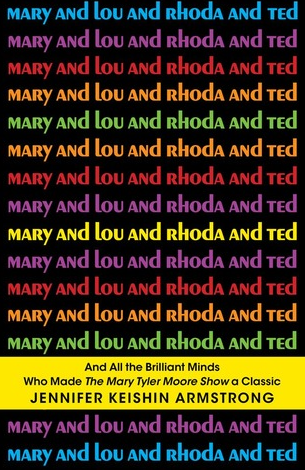
One of the greatest shots ever in the opening of a show has to be of Mary Tyler Moore tossing her hat into the air with the theme song “You’re Gonna Make it After All” in the background. The visual and audio combination is very telling of a time when women were breaking out of their shells in the 1970s. The show was ground-breakingly feminist in many ways – the two male producers hired a group of mainly female writers and took the show’s plot in daring directions every chance they got. I sat down with Jennifer Keishin Armstrong, the author of Mary and Lou and Rhoda and Ted: And all the Brilliant Minds Who Made The Mary Tyler Moore Show a Classic to find out how they did it.

MTM+hat+toss 

How did  The Mary Tyler Moore Show‘s producers get the scripts so right during a time of upheaval for women in American history?

JKA: They hired women, for starters. It’s a real testament to gender diversity, because they ended up being able to get the input of the female writers they hired, even as they hired plenty of experienced men who could write a killer script. This also allowed fairly inexperienced women who hadn’t gotten a shot before to get the skills and resume lines they needed to move up in the business. It made a huge ripple-effect difference in the industry in ways we probably can’t even begin to measure. That said, feminists at the time didn’t love the show — as with many groundbreaking shows, it was under tons of scrutiny as the only show of its kind. They hated Mary’s weaker moments and her propensity to call her boss “Mr. Grant” while others called him “Lou.” In the end, I think these chinks in Mary’s feminism made her a stronger character and a better ambassador. But it took the perspective of history to see her that way.


The Mary Tyler Moore Show show went on in 1970. All these years later, it’s still inspiring and influencing writers and characters on TV. Why is that?

JKA: I think it’s a writers’ show, to a large extent. It’s so character-driven, rather than just joke-driven. Writers respond to that and want to make their own shows that way whenever they can.


Originally, Mary Tyler Moore was meant to be divorced but the network refused. She still ended up single and working, which was a revolutionary story line in the 1970s. What was it like talking to the show’s creators about this period of the show’s history? Were they open about their experiences?

JKA: I am such a sucker for those stories of disgusting, blatant early sexism, and the Mad Men-type stuff! When the show started, things were very different than they were even a few years later — it was a time of very fast change in gender politics. When they were pitching the show, the one female executive who championed it was such an anomaly that they had no executive restroom for women. When she was on that floor, she just left her shoes outside the bathroom to let them know she was in there. And yes, the network folks had no interest in Mary being divorced. As one of the executives, Mike Dann, told me, he thought a divorcee would be “kind of a loose woman.” The fact that a few seasons in they could have references to Mary taking birth control and staying out all night on a date is a sign of quite rapid progress.

But they took risks when they could, writing divorce in later for Lou and a gay brother for Phyllis and Rhoda as a New York City Jew. Eventually, Mary was staying out all night and going on the Pill. How did the writers push these modern ideas through?

JKA: They were partially sneaky and partially lucky. A few years in, divorce seemed more palatable, and giving it to Lou instead of Mary certainly made a difference. It didn’t sully their sweet heroine. That said, All in the Family had since come on the air, which blew open a lot of previously closed doors in terms of subject matter. With both All in the Family and Mary doing well, the network was much less likely to mess with them. Network executives are only skittish when something isn’t raking in tons of cash. The gay brother storyline wasn’t originally part of the script; it was added when the actor playing him happened to be gay. But it was still possibly the most blatantly edgy the show ever got. The all-nighter and the Pill were couched in very subtle references that certainly a younger viewer would miss completely. Mary simply mentions offhand that she won’t forget to take her pill, which could, after all, be any kind of pill. And we know she stayed out all night only because we see her leave her apartment at night in an evening gown and return the next morning in the same dress. We never find out what really happened during those hours.

Mary-Tyler-Moore-Show

Most of the writers were women.  Were they active in the feminist movement?

JKA: They were. I don’t remember any saying they weren’t, and for most of them, it was just an obvious and standard part of life at the time. They went to regular meetings and some of them engaged in at least small forms of activism. I don’t think they had time to be major players in the movement because they were too busy working!

Why did you spend so much time focusing on their lives (which I loved, by the way)?

JKA: It seems like the only interesting way to tell the story, to me. For my tastes, I prefer stories about people rather than just a bunch of geeky trivia about a show. I wanted to write something that goes beyond a fan encyclopedia. There’s a place for that kind of book, for sure — and I used them in my research! I wanted the book to reflect the show, and I think if the writers of The Mary Tyler Moore Show had to write the story of their show, this is the way they’d do it — by focusing on the characters.

Ethel Winant was the only female executive at the show’s start.  There were so many men that she didn’t have her own toilet.  How did she know the show would be such a huge success?

JKA: She certainly had well-honed instincts, and the show is evidence of her impeccable casting skill. But I think she also responded to the material itself. It makes sense that she would see the value in a show about a career woman, given that she was such a pioneer, and my interviews with her son backed that up.

How did Mary Tyler Moore change the face of TV and women’s roles in the TV industry?

JKA: Like any success, it spawned many attempts at re-creation, which meant lots more shows about women. Some of them stuck, like Maude and even Mary’s spinoff, Rhoda. It also produced several female writers who could go onto other things, kind-of spreading the show’s influence that way. They went on to write for many shows, create some shows, produce, and work as TV executives. They also inspired that entire generation of women who’s currently kicking things up a level, producing in and starring in their own shows.

Was the network supportive of their efforts?

JKA: At first, the network was skeptical. But success is the best way to get the network off your back, and by the end of the first season, the show could mostly do whatever it wanted.

At the time Mary Tyler Moore was on, All in the Family and Maude were developed. Did they compete with these shows?

JKA: They didn’t really. They were all on the same network — CBS was it at the time. So they were able to enjoy each other as colleagues quite a bit and just admire each other’s work. The Mary Tyler Moore guys — Jim Brooks and Ed. Weinberger and Dave Davis — would actually watch All in the Family together and marvel at its greatness. They certainly wanted to keep up their own standards to stay in step with Norman Lear’s shows, but they couldn’t ever compete directly with them.

Did the actresses realize they were feminists at the time? Did any of them stay involved with the movement post 1970s?

Val Harper identified as a feminist, and continues to, while the others didn’t as much. Val was even interviewed by Gloria Steinem for a Ms. cover story during her Rhoda days!

Were the actors jealous of all the attention the actresses got?  They seemed like wonderful friends in the end.

JKA: They were, a little bit. They all mentioned it, in fact, but mostly in a good-natured way. They loved the women, but they felt like they were getting more attention, particularly from Jay Sandrich, the director, which is what really got to them. I told Jay that, and he said he never even realized it, but even now, his answer was a playful, “Tough luck.” Honestly, I was struck by how much the entire cast seemed to still love each other.

Is it true that Lou Grant became a feminist himself?

JKA: He did! He’s quite cantankerous and hard to pin down on this stuff, so even when I tried to ask him about it now, he was a little squirmy. But the fact is that feminism is among the many political causes Ed Asner has championed. He was involved with NOW and gave a radio address for them about men in feminism. He also made sure there were women working on Lou Grant and getting paid fairly.

Who are some feminist characters on TV today?

JKA: The feminist-or-not question is always such a hot one these days, but I adore The Mindy Project, which addresses issues like body image and women’s professional success without being too “issuey” about it. Same goes for Girls, where Lena Dunham’s constant nakedness alone is a huge statement.


Holly Rosen Fink is a writer and marketer living in Larchmont, NY. You can follow her on Twitter @hollychronicles.


Abortion Onscreen: Behind the Statistics

However, we did our analysis to counter the recurring popular narrative that abortion is totally absent from media representations. Abortion stories are there, and they’ve always been there. Now that we know that, and we’ve identified them, we can begin delving into more detailed analyses of these stories.

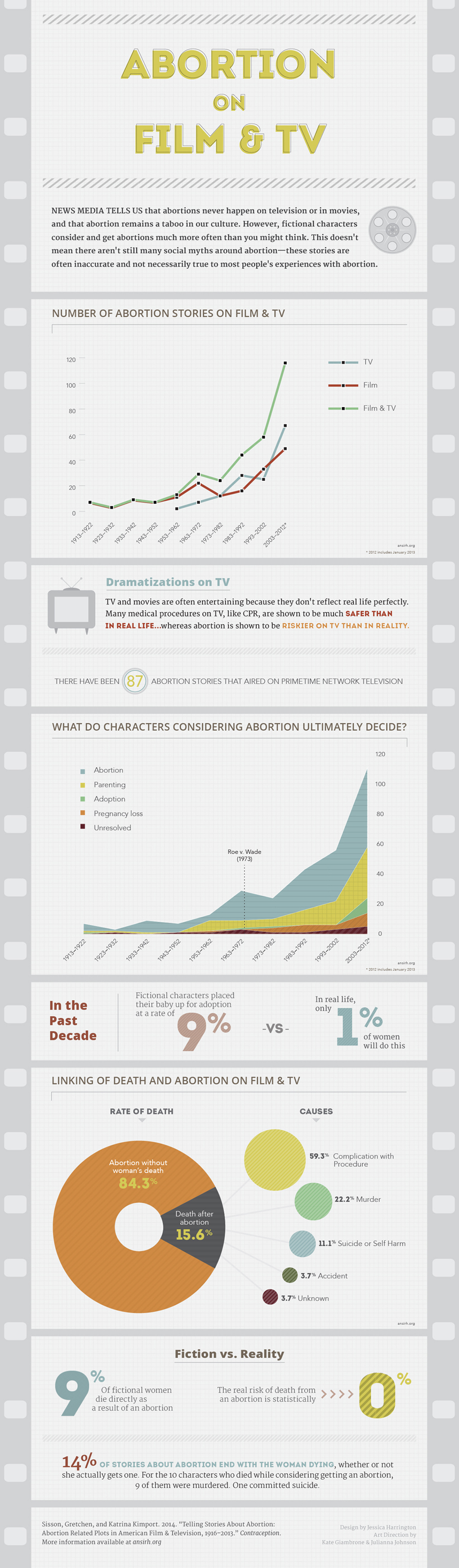
Abortion on Film and TV
Click on the infographic to view the full-size image. Designed by Jessica Harrington, Kate Giambrone, and Julianna Johnson.


This is a guest post by Gretchen Sisson. She is working on Abortion Onscreen, which involves research of depictions of abortion in film and television.

Whenever you set out to say something about abortion, you’re going to be faced with criticism; whenever you attempt to say something serious about popular culture, the rigor of your intellectual pursuit will likely be challenged. Despite that, we’ve been generally pleased with the response to the study. People seem interested in discussing what stories they’ve seen, and which they find most compelling. I thought that – for this audience of cinephiles – I might respond in more detail to some of the comments and questions that keep cropping up.

So, there are more examples of abortion on television and movies than there used to be. That does not seem that interesting.

True, it’s not. There are more movies being made, more television shows, more channels for distribution – unless the increase is in prevalence (it’s not), this isn’t inherently noteworthy. However, we did our analysis to counter the recurring popular narrative that abortion is totally absent from media representations. Abortion stories are there, and they’ve always been there. Now that we know that, and we’ve identified them, we can begin delving into more detailed analyses of these stories.

Movies and television are always more dramatic than real life. So why is this interesting?

 It’s true, lots of things are more dangerous on television and in movies. Cars and planes are more likely to crash; patients are more likely to slip into comas (and come out of them). There is more violence, more suspense, more drama overall – that’s what makes stories interesting.

However, it’s interesting that many medical procedures are less risky on television. CPR, for example, is consistently much more successful on television than in real life. Not only is it more effective at reviving people, it is also almost never shown to result in complications (such as broken ribs) that are fairly common in real life emergency situations. Yet, abortion is consistently shown to be more dangerous. (In this study, we specifically looked at the mortality rates of abortion on television; in future investigations we hope to look at other complications such as infertility and adverse mental health outcomes.)

It’s true that a dangerous abortion may be a more interesting story than a safe abortion. But why would a storyteller include an abortion, if their primary goal was to include medical complication? Why not have a character experience acute appendicitis? Or miscarriage with hemorrhage? Or any number of dramatic, possibly (but rarely) fatal conditions? The fact that abortion is often used in this way tells us something about why it’s included at all.

Furthermore, many of the deaths associated with abortion were not caused by the abortion itself. As you can see, many of the characters who got an abortion (or just considered getting one) later died as a result of accident or violence. This sort of karmic linking between characters associated with abortion and dramatic deaths is telling; it seems that abortion is used not as a way of creating drama in and of itself, but as a way of condemning characters.

Realistic abortion stories would be boring. Why would media makers want to include them?

This is the Chekhov’s gun principle. Why include an abortion if it’s not dramatic? But realistic abortion can be dramatic. It can involve drama if the character is conflicted and agonizing over her decision. It can involve drama even if she knows immediately that she wants an abortion, but must find a way to pay for it, or face protestors on her way to the clinic, or consider what the unplanned pregnancy means for the future of her relationships. Many movies and television shows have shown realistic abortions in compelling dramatic ways: Friday Night Lights, Parenthood, Fast Times at Ridgemont High, to name just a few. I don’t accept the premise that realistic abortions are inherently uninteresting. Furthermore, it seems that common, stigmatized experiences would provide ample opportunities for creative storytellers to say something new, interesting, dramatic – maybe even profound – without resorting to a bloody ending.

When, historically, are these abortion stories set? Shouldn’t some abortions be portrayed as dangerous?

This observation is exactly why we chose not to comment on the motivations of screenwriters and producers. For example, in Vera Drake, Revolutionary Road, and Dirty Dancing, illegal abortion is portrayed as dangerous. This could be a very progressive commentary on the importance of legal access to abortion. Conversely, the legal abortion story in Ides of March – which ends with the young woman committing suicide when she believes her abortion is going to be disclosed on the national stage – is, at its core, a message of stigma.

Furthermore, because our sample began in 1916 (when abortion was dangerous) and included the decades filmmakers had to follow the Hays Code (which said abortion stories could not have happy endings), we recognize that there are innumerable reasons and motivations for abortion to be portrayed as dangerous.

Ultimately, though, the aggregate linking of abortion and risk creates an ongoing social myth about abortion as dangerous. We do not live in a world where people talk openly about their abortion experiences. We’ve all driven in cars, so when we see crashes or chases in movies, we can integrate that into our overall idea of what “driving” is, and the fictional narrative, while entertaining, plays a relatively small part in shaping that idea. However, we don’t all have abortion, or talk to people we know about their abortions (or even know that we know people who’ve had abortions), which makes the stories we see in the media all the more important cultural understanding of what abortion is.

What’s next?

We really want to use this study as a jumping off more for exploring more detailed questions about abortion stories in film and television: Who gets abortions? Why? What does abortion care actually look like in popular culture? You’re welcome to check out abortiononscreen.org to see more about where we hope to go in the future.


Recommended Reading: “Films and TV Portray Abortion As More Dangerous Than It Is” at Bitch Media

_________________________________
Gretchen Sisson is a sociologist at ANSIRH, a reproductive health research group at the University of California at San Francisco, whose work focuses on abortion, teen pregnancy and young parenthood, adoption, and infertility. You can find her on Twitter @gesisson.

Seed & Spark: How to Save Film (and TV)? Women.

In 2012-13, women accounted for 28 percent of creators, executive producers, producers, directors, writers, editors, and directors of photography working on prime-time programs airing on the broadcast networks. This represents an increase of two percentage points from 2011-12 and a recent historical high. On screen, females comprised 43 percent of all speaking characters. This figure is even with the historical high set in 2007-08.

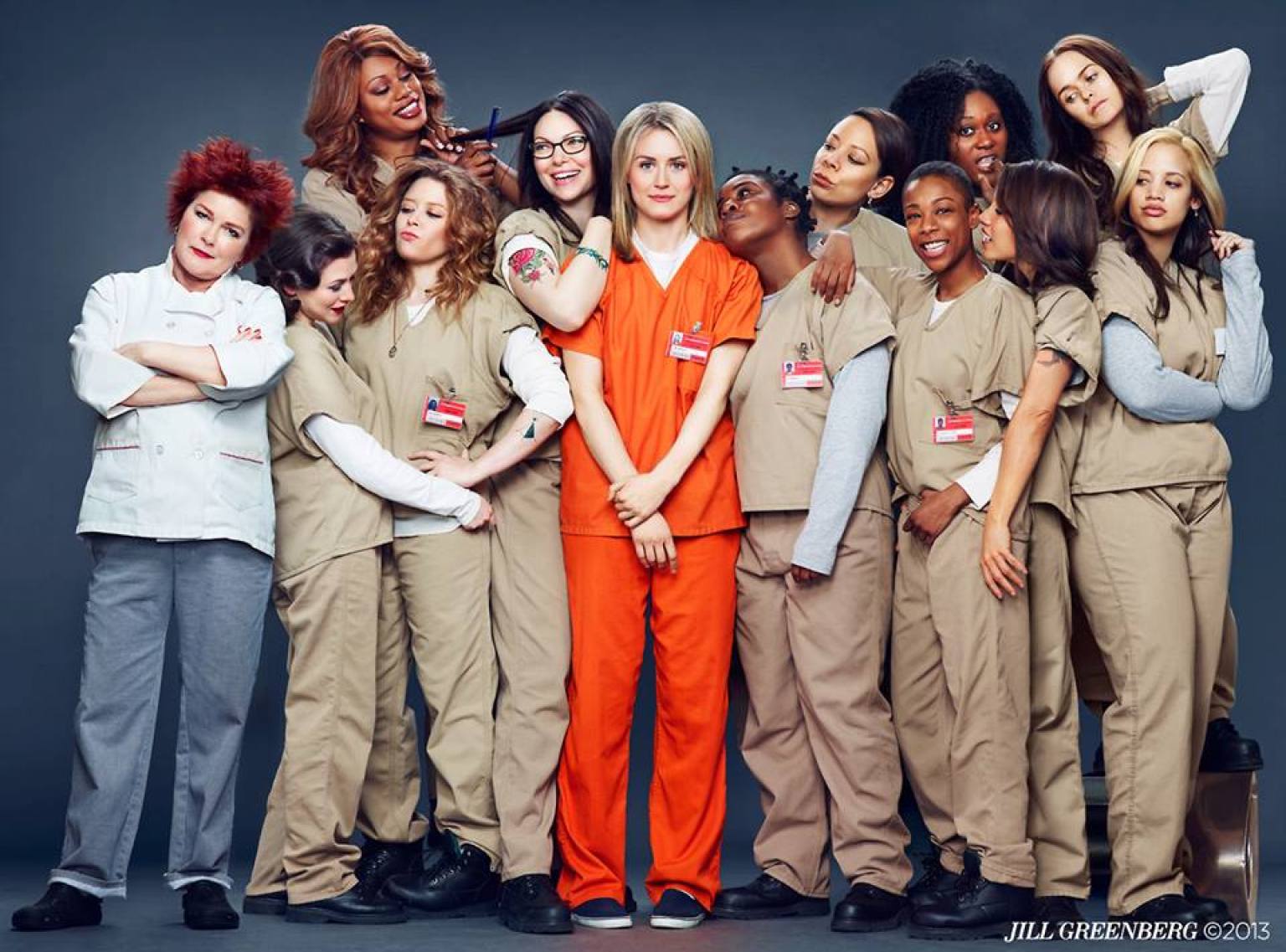
oitnb

This is a guest post by Mel Jones.

Last month, the Center For The Study of Women in Television & Film released some dismal numbers:

Women comprised 16 percent of all directors, executive producers, producers, writers, cinematographers, and editors working on the top 250 (domestic) grossing films of 2013. This figure represents a decrease of two percentage points from 2012.

In 2013, women accounted for 6 percent of (U.S.) directors. If foreign films in the top 250 are included, this figure increases to 8 percent. In other roles, women comprised 10 percent of writers, 15 percent of executive producers, 25 percent of producers, 17 percent of editors, and 3 percent of cinematographers.

However, there is always a silver lining: television. Television is producing some of the most innovative and diverse programming out there with bold storytelling, stellar characterizations, and tons of platforms for the audience’s viewing pleasure.

I’m convinced that I’m not the only one who acknowledges that television programming is now superior to most mainstream film. I’ve not done any studies on the topic, but it seems that most water cooler conversation centers on what happened on television the night before, or their Netflix binge weekend.  Culturally we are moving toward gathering around the television to watch the season premiere of our favorite shows as an alternative to a night out at the cinema.  And hell, I’ll venture to say that it’s due to the influence of women in the television industry.  Of course it could be a crazy coincidence but I doubt it.

In 2012-13, women accounted for 28 percent of creators, executive producers, producers, directors, writers, editors, and directors of photography working on prime-time programs airing on the broadcast networks. This represents an increase of two percentage points from 2011-12 and a recent historical high. On screen, females comprised 43 percent of all speaking characters. This figure is even with the historical high set in 2007-08. However, many gender stereotypes remain. Female characters are younger than their male counterparts, and are less likely than males to be seen at work and actually working.

Last fall, The Week featured an excellent article that goes in depth about how women fare better in television (behind and in the scenes) than they do on film.

If you don’t believe that TV is giving film a run for its money, check out Netflix’s Orange Is The New Black.  Coincidentally, the fish-out-of-water show about a middle class white woman finding herself in a female prison was created by a woman. And the ratings are off the charts. This is a prime example of how stories by women about women can have a deep impact.

Orange is the New Black isn’t the only female-led show and we’d be here forever if we went through them all.  It, like all the others, is a shining examples that when woman are included in the creative process behind the scenes, the stories are richer and in my opinion, more sophisticated. They aren’t just told from one point of view. And although this all must be challenging for our male counterparts who haven’t been used to seeing us at the table, I’m sure they do not mind when the big bucks start rolling in.

Of course, film is still very valuable; as a filmmaker, it’s my livelihood. But it’s important to note, that if film is going to find its way back to the number one position in our collective consciousness, women are going to have to be major contributors behind the scenes. So until that happens, be on the look out for independent projects where women are at the helm. Scour your favorite crowd-funding sites like Seed&Spark for those projects that need your support. And in the meantime, when you need a quick fix, you know where to find it.

_________________________________

Screen Shot 2014-03-03 at 3.16.57 PM

Mel Jones is a passionate independent content producer and storyteller.  She’s a Howard University and AFI Alumn as well as a Film Independent project involve fellow. Mel’s works have been shown on PBS, UK Channel 4, and the US festival circuit. She is the producer of the short film Charlotte, which is currently funding on Seed & Spark. Charlotte is a drama about those moments of childhood that never leave us.


Call for Writers: The Great Actresses

Great actresses have been gracing the silver and small screens since the birth of moving pictures. Though even today there are still far fewer defining roles out there for women than there are for men, some actresses continue to stand out for the magnificence of their performances, for their commanding onscreen presence, and for their ability to navigate a life in the limelight while still digging up those elusive roles that allow them to shine.

Call-for-Writers

Our March Theme Week for 2014 will be The Great Actresses.

Great actresses have been gracing the silver and small screens since the birth of moving pictures. Though even today there are still far fewer defining roles out there for women than there are for men, some actresses continue to stand out for the magnificence of their performances, for their commanding onscreen presence, and for their ability to navigate a life in the limelight while still digging up those elusive roles that allow them to shine. Who are these great actresses? What makes them great? Is it their craft, talent, hard work, dedication to quality roles, or something else entirely?

Though many “greatest actresses” lists are primarily comprised of white, classically beautiful women, we know that great actresses come in all shapes, sizes, colors, and ages. Write about an aging Meryl Streep, Glenn Close, or Susan Sarandon who have all consistently been powerhouses, drawing out a connection between themselves, the material, and their audiences for decades.  Or tell us about Australian Nicole Kidman who proves again and again that she is an imposing force with her ability to authentically inhabit any role. There are also amazing women of color who have been pouring genius and energy into their work for generations: Oprah Winfrey, Lucy Liu, Angela Bassett, Michelle Rodriguez, Halle Berry, Rinko Kikuchi, Natalie Portman, Lauren Velez, and Nazanin Boniadi, for example. Let’s also consider up-and-coming stars who are establishing themselves: Laverne Cox from Orange is the New Black, Quvenzhané Wallis from Beasts of the Southern Wild, Kerry Washington from Scandal, and Lupita Nyong’o from 12 Years a Slave. We would also love for writers to examine the actresses who paved the way for today’s leading women:

We will be spending a week celebrating these great actresses–actresses who are talented, break barriers, and inspire audiences, and have been doing so for over a hundred years.

We’d like to avoid as much overlap as possible for this theme, so get your proposals in early if you know who or what you would like to write about. We accept both original pieces and cross-posts, and we respond to queries within a week.

Most of our pieces are between 1,000 and 2,000 words, and include links and images. Please send your piece as a Microsoft Word document to btchflcks[at]gmail[dot]com, including links to all images, and include a 2- to 3-sentence bio.

If you have written for us before, please indicate that in your proposal, and if not, send a writing sample if possible.

Please be familiar with our publication and look over recent and popular posts to get an idea of Bitch Flicks’ style and purpose. We encourage writers to use our search function to see if your topic has been written about before, and link when appropriate (hyperlinks to sources are welcome, as well).

The final due date for these submissions is Friday, March 21 by midnight.


Evelyn Preer

Marilyn Monroe

Bette Davis

Katharine Hepburn

Madame Sul-Te-Wan

Ingrid Bergman

Vivien Leigh

Meryl Streep

Audrey Hepburn

Barbara Stanwyck

Elizabeth Taylor

Joan Crawford

Rita Hayworth

Judy Garland

Dorothy Dandridge

Lena Horne

Alfre Woodard

Ruby Dee

Natalie Wood

Judi Dench

Grace Kelly

Lauren Bacall

Sophia Loren

Marlene Dietrich

Ginger Rogers

Doris Day

Mae West

Halle Berry

Hattie McDaniel

Angela Bassett

Greta Garbo

Lillian Gish

Louise Brooks

Mary Pickford

Lois Weber


Bitch Flicks’ Weekly Picks

Check out what we’ve been reading this week–and let us know what you’ve been reading/writing in the comments!

recommended-red-714x300-1

The Gender Gap in Screen Time: Cinemetrics Extracts Statistical Data From Movies by Kevin B. Lee at The New York Times

Lupita Nyong’o Delivers Powerful Speech On Colorism, Self-Love [VIDEO] at NewsOne

Lifetime’s “Preachers’ Daughters” Shows Everything That is Wrong with Purity Culture by Wagatwe at Feministing

Top Quotes from ESSENCE’s Black Women in Hollywood Red Carpet by Sylvia Obell at Essence

Grading Hollywood: The Representation Test by Imran Siddiquee at The Representation Project

New Academy President Pushes for More Diverse Voting Members by Mandalit Del Barco at Code Switch

How the Demise of the Romantic Comedy Will Affect Women by Melissa Silverstein at Women and Hollywood

How “Girls” Explores Entitlement, Talent, and Failure by Kerensa Cadenas at Bitch Media

Interview: Yoruba Richen On Interesectionality of Race, Sexuality in ‘The New Black’ (At Film Forum) by Nijla Mumin at Shadow and Act

The Oscar Statue is Modeled After a Mexican Immigrant by Jamilah King at Colorlines 

“Broad City” Creators Talk About Comedy Writing and Their Hit Show by Phoebe Robinson at Bitch Media


What have you been reading/writing this week? Tell us in the comments!


Women and Work/Labor Issues: The Roundup

Check out all of the posts for Women and Work/Labor Issues Theme Week here.

A Plea For More Roseannes and Norma Raes: Addressing The Lack of Working-Class Female Characters on American Screens by Rachael Johnson

Working-class female protagonists remain rare, however. More often than not, working-class women play supporting roles as mothers, wives or lovers. Their characters are invariably underwritten or stereotypical.


The Power of Work/Life Balance in Charmed by Scarlett Harris

Phoebe and Paige’s evolution through their working lives is particularly poignant to the millennial Charmed audience; many people I know grew up watching the three (or is it four?) sisters flitting from job to job in their quest to find purpose and fulfillment. And we don’t even have daily demon attacks to contend with!

Insubordination and Feminism in Norma Rae by Amber Leab

A primary question about social fiction is whether the story remains relevant, or if the sociopolitical situation remains mired in the past. Norma Rae does retain relevance, though she’d likely be working in Walmart today instead of a textile mill (as I watched, I wondered how many textile mills still operate in the U.S.). While the movie seems to be a window on a past time in working America, it’s still relevant—and progressive—on many levels.


People who don’t work in the arts don’t realize how much work goes into it. Writers write hundreds of pages before any reader (who isn’t a blood relative) loves their work. Musicians practice for countless hours and write a lot of shitty songs before they compose a tune that makes someone want to sing along. Moms Mabley, the Black, queer woman comedian born in 1894 in the Jim Crow south, ran away at age 14 to become a performer and spent much of the next 66 years onstage, performing and polishing her own comedy routines. Her long experience may be why her work, nearly 40 years after her death, still elicits laughs.

Because Katharine steals Tess’s idea, we automatically pull for Tess, the lower-class underdog; consequently, we are forced to view Katharine, the upper-class princess, as the demonized, selfish boss, determined to achieve success no matter what. Hurt, yet motivated to take control of her career, Tess is now forced to lie in order to have her voice heard. This causes her to be pitted against a boss who has clearly abused her power. Even though Working Girl seems like a harmless, romantic drama, its female representation is firmly rooted in classism and sexism.


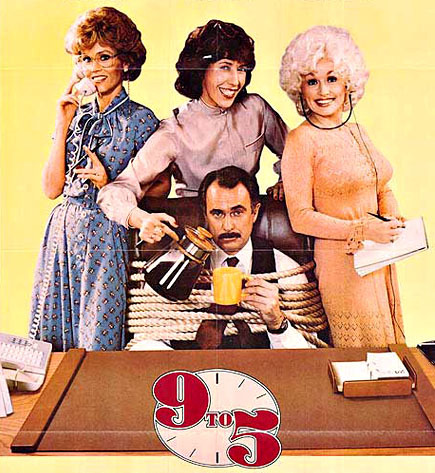
9 to 5: Still a Fantasy by Leigh Kolb

“Hey we’ve come this far, haven’t we? This is just the beginning.”

The beginning was in 1980, when this feminist comedy classic was released. Dolly Parton belted out the title song, which features a “boss man” who is “out to get her”–it’s an uplifting song, though, that echoes the closing celebratory sentiment: this is just the beginning. Things are going to change.

Well how have we done in 34 years?


The Devil in The Devil Wears Prada by Amanda Civitello

Our contempt for Miranda Priestly is due, in large part, to the way the film contextualizes her decisions, not just her personality. In making her into a shrill caricature of a woman executive whose single-minded focus on her career ruins her personal life, the film, like so many others, shortchanges the potential of a character like Miranda.


Women, Professional Ambition, and Grey’s Anatomy by Erin K. O’Neill

It is the overwhelming drive for excellence that makes the women on the show so real. It sometimes feels that this kind of ambition is not allowed to exist on TV. Sure, women can have high-powered careers and be very successful. But this is different. This is a show that not just portrays ambitious women, but is actively about professionally ambitious women and how they relate to each other and society.


Working Women in Film by Amber Leab

Women of color who are workers don’t weigh heavily in the American cultural imagination. When women of color appear in films, they tend to be secondary characters in low-paying jobs. Rarely do we see movies about working women who happen to be women of color.


Jessica, Rachel, and Donna are all women working in a male-dominated industry. Jessica has overcome the sexism in the workforce by out-thinking it and by dominating the competition. Rachel has chosen to forego any help from her father, in favor of trying (and failing) on her own. And Donna has seen the patriarchal systems of power, and used them to her own advantage.


Working Class Family With a Touch of Absurdity: Raising Hope by Elizabeth Kiy

TV families are generally presented as aspirational. They usually live an upper middle class livestyle and frequently live comfortably on a single salary, have college degrees and wealthy backgrounds.
Usually when characters work menial labor or minimum wage jobs, they are presented as being in a transitory period. This is the stage before the character gets their life together, when the artist waits for a big break or where a youth supplements their allowance with their earnings. It’s rare that this work is presented as the character’s real life, how it will likely always be.


‘Suits’: Secretly Subversive When It Comes to Talking About Women in the Workforce

Jessica, Rachel, and Donna are all women working in a male-dominated industry. Jessica has overcome the sexism in the workforce by out-thinking it and by dominating the competition. Rachel has chosen to forego any help from her father, in favor of trying (and failing) on her own. And Donna has seen the patriarchal systems of power, and used them to her own advantage.

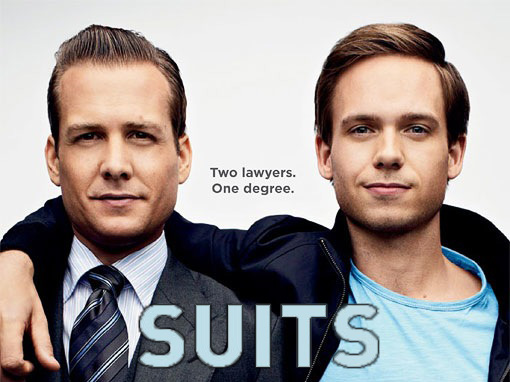
"Suits" poster
Suits poster


This guest post by Deborah Pless appears as part of our theme week on Women and Work/Labor Issues. It previously appeared at Kiss My Wonder Woman.

It only takes a single look at the posters to know that Suits, USA’s little darling show about inordinately attractive people doing morally ambiguous things, is a man’s show. Or, maybe more accurately, a show about men. The plot revolves around two white, straight, attractive men: Harvey Specter (Gabriel Macht), an egotistical but talented lawyer, and Mike Ross (Patrick J. Adams), his brilliant but undereducated associate.

The hook is that Mike doesn’t actually have a law degree. He was kicked out of Columbia and never finished college, and spent the last few years taking the LSAT for money. But Mike is smart–crazy smart–and Harvey knows that. Since Harvey needs to hire an associate (kind of like a baby lawyer assistant thing) when he’s promoted to Senior Partner, and because he hates all the other candidates, Harvey hires Mike, and they both collude to hide Mike’s real background.

Sounds catchy, right? But definitely a show about men. The central conflict is whether or not anyone will figure out that Mike is a fraud, and all the episodes revolve around a case that can only be fixed by one of the two men. Even the main antagonist, the divinely slimy Louis (Rick Hoffman), is a man.

What’s notable here, though, isn’t that a USA show chose to make the main conflict and storyline center around attractive white men (shocker), but that there are, as it turns out, so many female characters of worth in the show–women who are just as developed, interesting, and integral to the plot as the men. I’m not saying the show is a bastion of feminism, but I do think it’s worth noting how much the creator, Aaron Korsch, seems to have attempted to say here, specifically on the topic of women in the workforce, and how race, class, and gender all intersect to create a vision of discrimination, and, in some cases, triumph.

Jessica Pearson (Gina Torres), founder and managing partner of Pearson-Hardman


Pearson-Hardman (and later, Pearson-Darby), the firm at which most of the show’s action takes place, is represented as a top Manhattan law firm, pretty typical in its practices, gender dynamics, and hiring habits. What makes the show unique is that it criticizes these hiring habits: the firm’s conceit is that they always hire lawyers and associates with Harvard Law degrees, because presumably Harvard is the best. What this means, other than that Mike is doubly screwed because he didn’t go to law school anywhere, but he has to fake having gone to a school that everyone knows every detail about, is that there is an implicit class bias built into the hiring strategies at Pearson-Hardman. Harvard is a hard school to get into, yes, but it’s an even harder school to pay for. As a result, most of the lawyers at Pearson-Hardman are from privileged families, and used to trading on that privilege.

And when I say privileged, what I mean is that most of the men we see on the show, all of the associates, most of the lawyers, even most of the background characters, are young white men. While this seems like the casual whitewashing we can usually expect in shows like this, it actually appears to be something a little deeper.

Mike’s introduction as a lower-class, undereducated character is the first blow to this image of upper-class white male supremacy, but he’s certainly not the last or the most important. When it comes down to it, the intersectional struggle on the show is defined not by Mike, but by the women they work with. By their boss, Jessica Pearson (Gina Torres), a black woman who runs the top law firm in Manhattan, commands the respect of everyone she meets, and mentors the male lead (Harvey). By their coworker, Rachel Zane (Meghan Markle), a talented paralegal who desperately wants to be a lawyer, but can’t quite make the cut. And by their subordinate, Donna Paulsen (Sarah Rafferty), a seemingly all-knowing assistant who remembers exactly where the bodies are buried, can cry on cue and isn’t afraid to use it to her advantage, and who seems content to be the “power behind the throne.” All three characters represent very different images of what it means to be a woman at work in one of Manhattan’s top firms. And all three characters are vitally important to an understanding of women’s role in the workplace. Besides, did I mention? They’re all friends.

Gina Torres as Jessica Pearson


I first mentioned Jessica Pearson (Gina Torres) because, well, who wouldn’t mention Jessica first? She’s by far the most exceptional woman on the show, and also the most politically charged. By that I mean not that the character herself is political – she appears to have the same laissez-faire attitude towards politics that the show itself has, and has no moral compunctions about the extreme wealth and moral quandaries to which her occupation lends itself. Rather, I mean that making Jessica Pearson both a woman and a character of color is in itself a political statement.

Let’s talk implicit backstory, shall we? Now, we know from the very get-go that Jessica is both a powerful woman, and a smart one. We know that she’s the managing partner and co-founder of Pearson-Hardman and then later Pearson-Darby (note that it’s her name on the firms’ letterhead), and that she’s Harvey’s mentor. She found him in the mailroom and sponsored him all the way through Harvard, his first job at the DA’s office, and on until he made senior partner. Jessica is a tough lawyer, and she taught Harvey everything he knows.

That would be reason enough to stand up and cheer, since platonic female-male mentorships between non-relatives are virtually non-existent, but it’s not all. What we really want to get at here is the simple fact that Jessica, an African-American woman in her 40s, is the co-founder and managing partner of a top law firm in Manhattan. That means that not only did she achieve great things relatively early in her life, but also that she was the daughter of second-wave feminism, fighting her way through law school as it was only just starting to open up to women, and that she faced immense gender and race discrimination. She’s amazing. There’s no two ways about it.

Meghan Markle as Rachel Zane


And then we have Rachel Zane (Meghan Markle), a paralegal who’s been with Pearson-Hardman for years, but who longs to be a lawyer. Rachel has the money and the talent to go to law school, but she’s held back by a test anxiety that makes taking the LSAT virtually impossible. Still, Rachel perseveres and eventually manages to get a solid score on the test, only to later be turned down by Harvard Law School.

Rachel is also Mike’s closest friend in the firm, the first face he meets there, and one of the very few to know his secret. She later becomes his girlfriend, a relationship which seems to be good for both of them. She’s classy, well-educated besides her test anxiety, and a foodie. She has quirks. She’s complex. And she’s a biracial woman working in a highly sexist and more than moderately racist environment. But while Jessica is implied to have really worked her way up to the top with some help from her mentor, Daniel Hardman, Rachel is actively trying not to trade on her family name. It’s established that her father is a celebrated attorney, and that Rachel has intentionally chosen to go her own way through the legal world, not trading on her name, but doing it the hard way. That she fails is actually a more interesting story than if she were (at this point, the story’s not over yet) successful. She’s a woman working in a man’s world, trying to walk in her father’s shoes, and not really succeeding. Which is OK.

Sarah Rafferty as Donna Paulsen and Gabriel Macht as Harvey Specter


Rounding out the threesome, then, is Donna Paulsen (Sarah Rafferty), Harvey’s long-time assistant. Donna is arguably the least realistic female character we’re given, in that she’s presented as a submissive genius: beautiful, cunning, resourceful, and yet totally willing to subsume her career into Harvey’s, to devote her life to his success. I’m not saying that there aren’t women who do this, just that it’s a little unrealistic to think that with Donna’s skills, which are shown to be many and varied, she’s decided to be content with making Harvey the best lawyer he can be. It seems even that her character, by adhering to so many tropes of the white, attractive, submissive secretary, is a fetish object rather than a character in her own right. But, that’s not exactly the case here.

Donna is an interesting character. Her devotion to Harvey is actually matched by his devotion to her. When he made the leap from working as the Assistant Defense Attorney to working at Pearson-Hardman, he did so with the caveat that she came with him. He was the one who paid her salary until he made partner and the firm officially allowed him a legal secretary. And, while it is sometimes hinted that their relationship could tip over into romantic, it has stayed firmly platonic, making them life-partners without a sexual undertone, something hard to find on television.

What makes Donna compelling on the show, however, is her place in the world of Pearson-Hardman. It’s much harder to define than Jessica’s or even Rachel’s. Because Donna is a secretary, she’s under the radar most of the time. Like furniture. And she unabashedly uses that to her advantage. She acts sweet, she dresses sexy, she lets people underestimate her, and then she helps Harvey to destroy them. Donna is aware of the ways in which her sex and chosen profession try to limit her, but she has chosen to use those limitations to her advantage.

Donna Paulsen (Sarah Rafferty) and Rachel Zane (Meghan Markle) conspiring together


And, really, that’s what makes all of these women interesting. That’s what makes the show interesting. Jessica, Rachel, and Donna are all women working in a male-dominated industry. Jessica has overcome the sexism in the workforce by out-thinking it and by dominating the competition. Rachel has chosen to forego any help from her father, in favor of trying (and failing) on her own. And Donna has seen the patriarchal systems of power, and used them to her own advantage.

It’s no accident that the female characters we’re given represent a wide spectrum of female experience. Sure, Mike and Harvey are the nominal main characters on Suits, but they’re not the reason you should watch it. And I’m not saying the show is without its problems. By no means is this a feminist utopia of a show. But it’s interesting. It’s trying. And that’s more than you can say for most shows.


Deborah Pless runs Kiss My Wonder Woman and works as a freelance writer and editor in Western Washington, when she’s not busy camping out at the movies or watching too much TV. You can follow her on Twitter and Tumblr just as long as you like feminist rants, an obsession with superheroes, and sandwiches.

Working Women in Film

Women of color who are workers don’t weigh heavily in the American cultural imagination. When women of color appear in films, they tend to be secondary characters in low-paying jobs. Rarely do we see movies about working women who happen to be women of color.

career-women-split
This repost by Amber Leab appears as part of our theme week on Women and Work/Labor Issues.
Yesterday was Labor Day here in the U.S., and we wanted to highlight some films about working women.
When I sat down to write this post, I thought it would be relatively easy: brainstorm and research a list of movies about working women. But the more I searched, the more frustrating the list became. I kept coming across the same movies. These movies:
9 to 5

Baby Boom

Boomerang

Broadcast News

Clockwatchers

The Devil Wears Prada

Disclosure

Erin Brockavich

Frozen River

His Girl Friday

Julia

Legally Blonde

Mahogany

Maid in Manhattan

Marnie

Mildred Pierce

Network

North Country

The Proposal

Secretary

Silkwood

The Ugly Truth

Wendy and Lucy

Woman of the Year

Working Girl

A quick glance at the list and the most basic familiarity with the titles (which vary in decade and genre, and range from horribly anti-feminist to some of our personal favorites) reveals some disturbing trends:
The women featured in these films–the protagonists–are overwhelmingly white. Where are the women of color?
Professions in which women work–every imaginable profession–aren’t widely represented. Most of the women here have Careers rather than Jobs, although the careers are heavily in the secretarial /assistant arena. In the newer films, the women who are working class, as Caryn James points out in Slate‘s XXFactor,  are heavy on criminality:

The Hollywood working-class heroine is usually a Norma Rae or Erin Brockovich, a reformer making a grand social gesture. The new indie films more authentically depict their characters’ workaday lives. That’s why it’s so disappointing to find them undermining their own heroines, reinforcing an assumption that should have been blasted away long ago—that the poor are morally suspect and quick to steal.

Nobody gets ruder treatment than career women, who are routinely portrayed as bossy, uptight and utterly without personal lives. What they need, we’re supposed to think, is a man. But before they can get one, they must have a mortifying comeuppance.

These observations on my incomplete list lead me to a few questions:
How do we define “movies about working women”? First, I want differentiate movies that feature women who work from movies about working women. The former category could include almost any contemporary movie with a major female character. But, movies that are thematically about working women are a different, rarer thing. They question what it means to be a working woman in a culture that is both dependent upon and hostile to them.
How do we define “working woman?” A working woman is not a rare thing; nearly all women work. Women have professional careers and jobs of all sorts. There are lawyers, teachers, doctors, writers, police…the list is endless. Try to argue that a woman who cares for her children isn’t a working woman, even though, I suspect, many people tend to equate work with wage. How do we define work? What does our definition of work and its role in our lives mean for women? Does it mean something different for men? Do you think of yourself as a “worker”?
And a couple of possible conclusions:
Women of color who are workers don’t weigh heavily in the American cultural imagination. When women of color appear in films, they tend to be secondary characters in low-paying jobs. Rarely do we see movies about working women who happen to be women of color. Rarely have I seen it, at least, which may be a personal failing.
All in all, I’m not very happy with this list, and I’d love to enlist your help in making it more complete.
Readers, help out! What are some of your favorite movies about working women?

*Remember, we’re not just talking about movies that feature women who work, but ones that explore what it means to be a working woman. 


UPDATE: Readers have contributed additional films to the list. Here they are so far (we’ll continue to add any films you suggest):

All About Eve

The Apartment

Cleo from 5 to 7

Dancer in the Dark

Easter Parade

Gypsy

Mr. Mom

Places in the Heart

Showgirls

Sunshine Cleaning

Waitress

Winter’s Bone