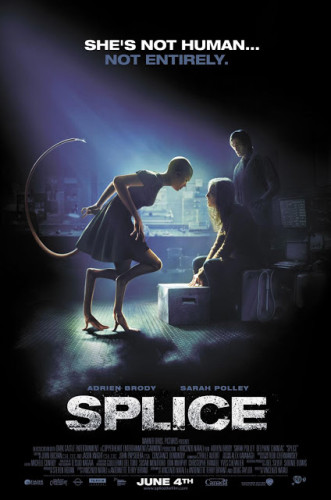
‘Splice’: Womb Horror and the Mother Scientist

‘Splice’ explores gendered body horror at the locus of the womb, reveling in the horror of procreation. It touches on themes of bestiality, incest, and rape. It’s also a movie about being a mom.

Splice+poster


This repost by Mychael Blinde appears as part of our theme week on Bad Mothers.

NSFW | Trigger warning for survivors of sexual assault
Warning: Spoilers abound!

Splice explores gendered body horror at the locus of the womb, reveling in the horror of procreation. It touches on themes of bestiality, incest, and rape. It’s also a movie about being a mom.
Though it received somewhat lackluster reviews, I encourage anyone interested in feminism and film to give Vincenzo Natali’s sci-fi body horror film a try. Splice features female characters who are intelligent, emotionally complex, and in control. They’re not perfect, but they are three-dimensional characters whose decisions drive the story. (One of them morphs into a male, but we’ll get to that.)
Splice asks a lot of questions about the terms and conditions of conception, gestation, birth, and motherhood, all without stabbing the viewer in the eye with reductive answers.
It also features some campy moments. Hipster scientists shout things like “It was the only way!” Academy Award winning actor Adrien Brody expresses his frustration by throwing down not just his jacket, but his scarf as well!
If you can stomach the juxtaposition of big thinky concepts and stilted clichéd dialogue, you will find Splice a thoroughly enjoyable mindfuck of a film.
Elsa Kast (Sarah Polley) and Clive Nicoli (Brody), long-term partners in romance and biochemistry, have developed a method to splice the DNA from various animals together to create hybrid creatures.
Viewers are actually birthed into the film from the perspective of Fred, the couple’s latest scientific endeavor, a male companion to their first hybrid, Ginger.
Splice
Splice

Elsa and Clive aspire to splice human DNA to develop cures for genetic diseases, but the pharmaceutical company funding their research puts a halt on all splicing until the duo can synthesize the medicinal protein necessary to create a commercially viable lifestock drug.

Newstead Pharma’s financial interests are represented by Joan Chorot (Simona Maicanescu), who insists Elsa and Clive begin “Phase Two: The product stage.”
Joan Chorot (Simona Maicanescu) in Splice
Joan doesn’t get a lot of screen time, but her brief appearances are a pleasure to watch. She’s articulate and always in control. It’s awesome to see a woman kicking ass in the role of the money-grubbing corporation, and Joan is a stellar example of how to do it right.
After their splicing research is shut down, Clive suggests they quit, but Elsa convinces Clive to proceed with the human splicing and to generate an embryo.
Clive Nicoli (Adrien Brody) and Elsa Kast (Sarah Polley) in Splice
In both the romantic and the professional relationship between Clive and Elsa (and this is a movie very much interested in the conflation of work and sex), Elsa is in charge.
Over and over, Elsa insists that they take the next step. She is the opposite of what I call the Male Protagonist’s Girlfriend — a  pretty lady bystander who supplements the male protagonist’s story arc.
Elsa and Clive also deviate from the typical representation of long-term monogamous heterosexual partners: it is he, not she, who desires to have a child:

Elsa: “You are talking about having a kid.”
Clive: “Is that so unreasonable?”
Elsa: “Yeah, because I’m the one who has to have it…”
Clive: “Come on. What’s the worst that can happen?”
Elsa: “How about after we crack male pregnancy?”

Meaningfully, this discussion is cut short by an alert sent from the machine housing the hybrid fetus. When they arrive at the lab, the embryo is all grown up and preparing to evacuate the biochemically engineered womb.
Though Elsa doesn’t gestate and birth the baby from her own body, the birth experience is physically traumatizing for her. She becomes trapped in the birth canal and is injected with poisonous serum. In a rare moment of control, Clive saves Elsa. But after the birth, Elsa again takes charge: she refuses to allow Clive to kill the female hybrid and insists that they raise her in the lab.
Weirdly, the couple begins to function less like scientists and more like normal parents: frustrated because the baby won’t eat, stressed out because it won’t stop crying. However, unlike most parents, their baby has a stinging whip tail, and they are forced to relegate their progeny to the laboratory’s basement to keep her existence a secret.
Elsa (Sarah Polley) in Splice
Elsa becomes more and more emotionally attached to the creature, and eventually names her Dren. Clive is worried about their secret being revealed and disturbed by Elsa’s displays of maternal affection. Nevertheless, he resigns himself to raising her, and Dren grows to be a young adult in a matter of months.
One night, Clive and Elsa realize they haven’t boned down lately. Clive doesn’t have any condoms, but Elsa says, “What’s the worst that could happen?” – suggesting that she’s decided she wouldn’t mind gestating a child, maybe? – and they have at. This is the first of three sex scenes in Splice.
Cinematically, their lovemaking is depicted as underwhelming. Neither Elsa nor Clive take off any clothing. Creepily, Dren watches.
Meanwhile, pressure is building at the pharmaceutical company.
Their presentation at the shareholders’ meeting goes disastrously wrong. Unbeknownst to Clive and Elsa, their specimen Ginger has changed into a male, and Ginger and Fred tear each other apart and splash guts and blood all over the audience. Not good PR.
In deep shit with the company, Clive and Elsa are forced to relocate Dren to Elsa’s deceased mother’s farm.
Here we learn the backstory of Elsa’s childhood; themes of feminism, motherhood, and family history come into play.
We learn that Elsa’s mother forbade Barbies and makeup. Elsa explains that “She said makeup debased women.” The word “feminist” is never used in Splice, but Elsa’s mother’s Barbie-banning and makeup-denying seem emblematic of a certain type of feminist parenting.
We also learn that Elsa’s mother raised her in substandard living conditions, relegating her to a ramshackle, barely furnished bedroom.
Initially I viewed this as a problematic conflation of being a feminist with being a neglectful person and bad mother. But it’s far more complicated than that.
Elsa expresses her love for Dren by giving her the very things her mother denied her.
Dren (Delphine Chanéac) and Elsa (Sarah Polley) in Splice
But the Barbie and the makeover don’t make Dren happy; in fact, the Barbie explicitly makes Dren sad. Looking into a mirror, she holds the doll’s long blonde tresses against her bald head and becomes upset.
Over the course of the film, Elsa locks Dren up in a lab, then a basement, and eventually her mother’s barn, and Dren resents her for it. Elsa seems unable to break the cycle of her own mother’s physical and emotional neglect.
Perhaps the idea is that makeup is not a substitute for ideal living quarters and engaged parenting. What matters isn’t whether or not you give your daughter a Barbie, but whether or not you lock her in a barn.
And it turns out, Dren really is Elsa’s genetic daughter. To his chagrin, Clive discovers Elsa used her own DNA to create Dren: “Why the fuck did you want to make her in the first place? Huh? For the betterment of mankind? You never wanted a normal child because you were afraid of losing control. But an experiment…”
He doesn’t finish the sentence, but it seems clear that Elsa is using science as a way to disassociate herself from motherhood while still being able to create and raise a child. Presumably we’re to understand that Elsa’s desire for complete control stems from her tragic upbringing: “Look at your family history,” Clive exhorts.
Elsa tries to convey her genetic connection to Dren by explaining to her: “You’re a part of me, and I’m a part of you. I’m inside you.” She strives to smooth over their mother-daughter animosity, but the two wind up in a physical altercation that results in Elsa knocking Dren unconscious, tying her up, stripping her naked, and removing her tail and stinger. This scene has undertones of both castration and rape. Elsa has become a monstrous mother scientist.
Clive is horrified by Elsa’s actions, but she informs him that she is going to use Dren’s amputated stinger to finally synthesize the protein and heads to the lab, where she succeeds.
Elsa (Sarah Polley) in Splice
Elsa (Sarah Polley) in Splice 
She tells off her obnoxious supervisor: “When some real scientists get here, come take a look.”
While Elsa’s away, Dren seduces Clive. If Elsa’s sin is her obsessive need to control, Clive’s sin is his inclination to relinquish control.
This is the film’s second sex scene. Cinematically it is sensual, queer in a fantasy-mythical-creature sort of way, strange but beautiful. Ominously, Dren grows back her tail stinger. Then Clive notices Elsa has come back and is watching them. She storms out and he chases her. Back at their apartment, Clive and Elsa decide that they finally have to kill Dren.
But when they return to the barn, it turns out Dren is already dying. After she dies, Clive’s brother (who also works in the lab) and their supervisor show up. He announces he knows their secret and demands to see the human-spliced creature. Elsa informs him that Dren is dead, throws a shovel at him and says, “See for yourself.”
Except Dren is no longer buried behind the barn. Like Ginger, she has morphed into a male, and in the film’s climax, he kills everybody but Elsa.
Dren as male in Splice
A note on the gender transition: I am uncomfortable with the representation of Dren’s metamorphosis from female to male. It is predicated on the idea that transitioning from a female body to a male body is horrific, and it exploits trans individuals by sensationalizing the transitioning body as evil and freakish. It’s not trans positive. I understand that Splice’s story necessitates this metamorphosis and that Dren isn’t exactly a human, but let’s call out problematic shit when we see it.
Chasing women through the woods at night is a staple of slasher flicks, but this movie isn’t about slashing – it’s about splicing. Dren chases Elsa through the woods, but instead of slaughtering Elsa, Dren rapes her.
This is Splice‘s third sex scene. Cinematically it is gut-wrenchingly horrifying, as any rape depicted onscreen needs to be in order to convey the awfulness that is sexual violation. Dren’s rape of Elsa is as disgusting and awful as Dren’s sex with Clive is beautiful and sensual.
When Elsa screams, “What do you want?” Dren replies: “Inside…of…you.”
Clive stabs Dren with a branch (wielding the metaphorical phallus) as Dren orgasms, but Dren is not killed, and attacks Clive. Elsa pulls her pants back on and bashes Dren in the head with a big rock. This critically injures Dren, who takes a moment to survey the situation – then stabs Clive with his tail. Elsa bashes Dren in the head again, killing Dren once and for all.
Elsa is the character who cut off Dren’s stinger and the one who deals Dren the death blow. And yet in his final moments, Dren chooses to kill Clive. Why?
Because inside of Elsa is a womb, the growing space for a new creature. And sure enough, in the film’s resolution we discover that Elsa is pregnant. Of the three sexual encounters that take place in this movie, the reproductively viable encounter is the rape. Elsa lives to be the final girl not because she wields a chainsaw, but because she wields womb. (And a big rock.)
Unlike Veronica of The Fly (“I want an abortion!”) or, more recently, Elizabeth of Prometheus (“Get it out of me!”), Elsa decides to gestate her monster progeny to term.
I appreciate both The Fly and Prometheus because each asks its audience to empathize with a woman who desperately needs an abortion. I also appreciate Splice for asking its viewers to honor Elsa’s decision not to abort. Joan makes it clear that Elsa has a choice: “Nobody would blame you if you didn’t do this. You could just put an end to it and walk away.” (Would that this were the standard response to women experiencing unwanted pregnancies!)
But Elsa does not to put an end to it. Why does she decide to bring it to term?
Sure, the company’s giving her a shitload of money for gestating Dren’s offspring. But throughout the film, Elsa has insisted on moving forward with human splicing experiments. Perhaps she sees this as a necessary extension of that research.
Or maybe this is another chance for Elsa to use science to mediate motherhood. Is the pregnancy Elsa’s punishment, or her redemption? We’ll never know. All she says is, “What’s the worst that could happen?”
The film closes with a shot of the two women, the film’s only surviving characters, looking out a window.
Splice

Mychael Blinde is not a scientist, but she is afraid to give birth. She is interested in representations of gender in popular culture and blogs at Vagina Dentwata.

Bitch Flicks’ Weekly Picks

Check out what we’ve been reading this week–and let us know what you’ve been reading/writing in the comments!

recommended-red-714x300-1


Visual Pleasure at 40: Laura Mulvey in discussion at BFI

My reaction to Mad Max: Fury Road and the Utter Perfection That is Imperator Furiosa at nospockdasgay
Jill Soloway to female filmmakers: ‘Let’s storm the gates’ by Katie Hast at HitFlix
Shonda Rhimes and Jenji Kohan Honored at 2015 Global Women’s Rights Awards at Ms. blog
85 Films By and About Women of Color, Courtesy of Ava DuVernay and the Good People of Twitter by jai tiggett at Women and Hollywood

Maggie Gyllenhaal: At 37 I was ‘too old’ for role opposite 55-year-old man by Ben Child at The Guardian

‘Girlhood’ Is Now Streaming on Netflix. We Spoke to the Director About Race, Gender & the Universality of the Story by Zeba Blay at Shadow and Act
Do you stand for gender equality in the film and television industry? (Petition) at ACLU

Cannes: Salma Hayek Talks Sexism in Hollywood at ‘Women in Motion’ Panel by Tatiana Siegel at The Hollywood Reporter

What have you been reading/writing this week? Tell us in the comments!

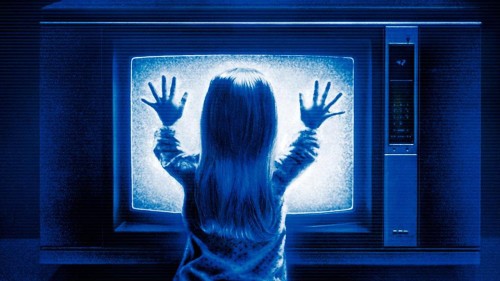
The ‘Poltergeist’ Remake Delivers Scares but Buries the Politics of the Original

Though the remake provides plenty of scare factor and makes excellent use of new technology (both at the level of cinematography and within the narrative itself with various nods to iPads, iPhones, drones, etc), it lacks the critical edge of the original.

poltergeist-remakejpeg-070d1e_1280w


This guest post by Natalie Wilson previously appeared at Skirt Collective and is cross-posted with permission.


The Poltergeist remake functions as an old-fashioned haunted house movie gussied up with new special effects, new technology, and a fair dose of contemporary references. For horror buffs, it’s a worthy scare-fest, but if you like political bite in your horror, give it a miss. At a slight 93 minutes, a lengthier run time would have allowed a heightened focus on the critical undercurrents which only serve as VERY subtle background in director Gil Kenan’s version.

635585847198986173-POLTERGEISTBIGHNADS.0

The original 1982 film, co-produced and co-written by Steven Spielberg, was more directly political in its depiction of an “all American family,” the stultifying effects of suburbia, and the dangers of “burying” ugly historical realities. As this review notes, the original provided “a sly commentary on the tribulations of suburban life, colonialism, the ill-treatment of Native Americans, the break-down of the nuclear family unit, and the damaging excesses of capitalism and consumerism.”

Though the remake provides plenty of scare factor and makes excellent use of new technology (both at the level of cinematography and within the narrative itself with various nods to iPads, iPhones, drones, etc), it lacks the critical edge of the original.

In the remake, economics are the driving factor forcing the Bowen’s move to a new house. While this review argues the film “works well as a study of a squeezed middle-class American family struggling to survive in a punishing economic climate,” I didn’t find the film studied this climate so much as dropped references to foreclosures and the current economic downturn, all while having the Bowen family live in a house that exudes middle-class comfort, technological upgrades, and plentiful yard-space.

If this is “the least sucky house” the family can afford, they hardly hold up as economically deprived. In one scene, Eric, the father (played by Sam Rockwell) is depicted as painfully embarrassed that two of his credit cards are declined at the filmic equivalent of Home Depot. To assert his ability to purchase (a key part of new American manhood), he then goes on a shopping spree at the mall, bringing home an iPhone for his teen daughter, jewelry for his wife, and a drone “toy” for his son. The Bowens are thus far from economically oppressed – rather, their white middle-class lifestyle is not as easy as it once was. In fact, the street name of their new digs, “Paradise,” ironically points to the fact their economic hardship is pretty slight compared to many.

hqdefault-1

The original film, in contrast, focused not on economic hardship but on the stultifying effects of suburban life with a trailer that ominously intoned their new house “looks just like the one next to it, and the one next to that, and the one next to that.” Like other Spielberg films, ET, and, more recently, Super 8, Poltergeist revealed suburbia is not all it’s cracked up to be and that perhaps we would be better giving up the notion of the “all American family.” In one telling scene between the parents, the dad is holding the book Reagan: The Man, The President while the mom smokes pot and reminisces – a scene that Eye for Film argues represents “succumbing to middle-class conservatism.” While the original bucked such conservatism, the remake instead pines for its loss.

Admittedly, the remake depicts domesticity as similarly stultifying – especially via mom Amy, played by Rosemarie DeWitt , who is in a writing rut and berates herself for being a bad mother. Though DeWitt is compelling, her role does not live up to JoBeth Williams’ portrayal due to the film’s troubling return to “traditional family values.” While the original included reversals of gender norms, with the mom depicted as far more proactive and powerful than the father, and even had the mother venturing to the “Other Side” to save her daughter Carol Anne, the remake returns the power to the father and has the son, Griffin, be the “superboy” that ventures to the “Other Side” to save his sister. Sadly, the iconic swimming pool scene with the mother fending off an array of skeletons is absent – so too is the powerful and enigmatic medium Tangina Barrons (played by Zelda Rubinstein).

In her place we have Carrigan Burke (played by Jared Harris) — meaning the film takes the largely female-driven paranormal team from the original movie and centers it on a white male reality TV ghost-busting star who insists, macho-style, “I am the only one who can lead those souls into the light” (why didn’t the filmmakers take a page from the forthcoming female remake of Ghostbusters??). To add insult to feminist injury, Dr. Powell (played by Jane Adams) is Carrigan’s ex-wife who clearly longs to rekindle their romance and her job in academia is presented as a sadly lackluster in comparisons to Carrigan’s reality TV fame. Ugh.

poltergesit2015-4_large

Given the remake emphasizes closets as particularly dangerous, another lost opportunity is the chance to play up “being closeted” – why not, for example, have some character, any character, be “out,” and use this as a vehicle to extend the stultifying family norms the remake fails to fully explore? There is a great electric drill scene in the closet in the remake, but it would have been all the better if instead of typical hetero-dude Boyd, they coded the character Boyd as a gay “Boi” – just think of the closet jokes and shenanigans that could have ensued!

Further, given we have a new ending (I will avoid overt spoilers), why not emphasize cars and our reliance on oil as death trap? Why not play up our seeming cultural inability to escape the horror of suburbia and the lure of the shopping mall? Why jettison the original cemetery back-story instead of putting it to more political use? Indeed, it would have been more powerful to address the politics of race head on this time around – something the original (and its sequels) failed to do. Instead, Indigenous Peoples are put under erasure – yet again – with only a trite joke during a dinner party scene about “sacred burial grounds.”

The remake also jettisons any commentary on sexism. Whereas the original had the teen daughter rebuke street harassers, a rebellion that is tied to her mother’s similar subversive streak, the remake makes no reference to gendered harassment (except if you count the somewhat awkward exchange the dad has with the female employee of the quasi-Home Depot as his credit cards are turned down). Here, the film could have taken guidance from the recent It Follows, a film which similarly harks back to old-school horror while offering a condemnation of rape culture. To its credit, the film’s shift towards young Griffin as the savior is well-done, especially via its emphasis that it is normal for boys as well as girls to be nervous, scared, emotional, and in need of reassurance. Notably the dad emphasizes the normality of this, admitting he too is scared, and, in so doing, denies the gendering of fear/emotion. Indeed, Sam Rockwell is great in the role – wish that he could have been paired with a mom more akin to the feisty one from the original!

Poltergeist-reboot

While the original holds its own as a classic fright-fest, even being deemed “one of the scariest horror movies ever made,” the remake has plenty of good scares but lacks political punch (as do MOST horror films, admittedly). While the remake offers a more immersive view of the “Other Side,” making very good use of 3D to evoke threatening fleshy corpses as far as the eye can see, it fails to unearth what lies beneath our “sucky houses” in suburban “paradise.”

A trailer for the original film intoned “Poltergeist. It knows what scares you” – sadly, the remakes knows this too, but only on a visual level – the deeply buried socio-political realities that provide potency to horror are as absent as that infamous corpse-filled swimming pool…


Natalie Wilson teaches women’s studies and literature at California State University, San Marcos. She is the author of Seduced by Twilight and blogs for Ms., Girl with Pen and Bitch Flicks.


‘Pitch Perfect 2’: Tuning Up for an Aca-Trilogy?

Non-white characters get the short end of the stick in other ways, too: Cynthia Rose (Ester Dean) amps up the predatory lesbian angle (an outdated, unfortunate motif); Lilly (Hana Mae Lee) keeps whispering shockers as if that joke never gets old (it does); and the only lines Guatemalan Flo (Chrissie Fit), another new Bella, gets are about how she prefers the United States to her native country. Can you say aca-propaganda? Such political incorrectness is an unfortunate default to early second-wave feminism, which marginalized women who weren’t straight and Caucasian.

Film Title: Pitch Perfect 2


This guest post by Lisa Rosman previously appeared at Word and Film and on her website Signs and Sirens. Cross-posted with permission.


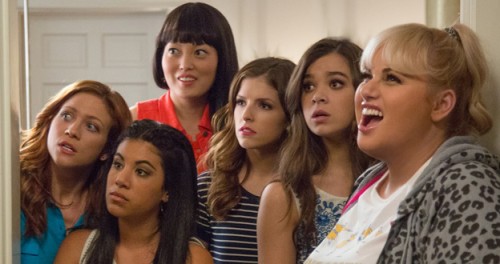
Here at Word and Film, we are not in the business of grading movies. But if I were to grade Pitch Perfect 2, the much-anticipated follow-up to the breakout 2012 musical comedy, I’d give it a solid B. As sequels go, that’s not bad, and the film deserves extra points for sidestepping the meta-movie trap into which so many comedic sequels fall. (Here’s looking at you, 22 Jump Street.) But, though I’m a huge fan of its pop-feminism and hip a cappella (no, that’s not an oxymoron), Pitch Perfect 2 doesn’t quite hit the high notes of its predecessor. Chalk that up to a too-many-cooks-in-the-kitchen plot and a disappointing profusion of micro-aggression.

The film begins as the Barden Bellas, the prize-winning all-female a cappella group from a fictional Georgia college, become a national joke when Fat Amy (Rebel Wilson) suffers a spectacular wardrobe malfunction during a concert for the Obamas and Shonda Rhimes. (Insert Scandal joke here.) In order to claw their way back to good standing, the girls have to win the a cappella world title. The problem? No one’s been able to beat Das Sound Machine, a German group led by Kommissar (Birgitte Hjort Sørensen), a sort of BDSM Barbie.

Cynthia_Rose1

Most of the gang from the first movie is still in place – Chloe (Brittany Snow) is now in her third senior year – and there’s a new Bella, legacy Emily (Hailee Steinfeld, sunnier than we’ve ever seen her), who is bummed the group is in such disrepute. Also still in attendance: commentators John (John Michael Higgins) and Gail (Elizabeth Banks, who now doubles as director). John’s bad-taste humor, a throwback to Fred Willard’s shtick in the dog mockumentary Best in Show, is more problematic in this film, especially at the international competition, where he throws out nearly every ugly stereotype about minorities under the sun. Because Banks has fewer good lines this time around (in the spirit of ill-advised modesty?), John’s racism goes unchecked. The effect, for example when an Indian group leaves the stage, is a tacit endorsement of such comments as “they’re running offstage to take more of our jobs.”

Non-white characters get the short end of the stick in other ways, too: Cynthia Rose (Ester Dean) amps up the predatory lesbian angle (an outdated, unfortunate motif); Lilly (Hana Mae Lee) keeps whispering shockers as if that joke never gets old (it does); and the only lines Guatemalan Flo (Chrissie Fit), another new Bella, gets are about how she prefers the United States to her native country. Can you say aca-propaganda? Such political incorrectness is an unfortunate default to early second-wave feminism, which marginalized women who weren’t straight and Caucasian.

1423594985_pitch-perfect-zoom-1024x618

At times, Pitch Perfect 2 is so diffuse and so packed with random cameos that it seems like a mildly funny SNL 40. An underground aca-contest between Das Sound Machine, some (real-life) Green Bay Packers, the Bellas, and the “Tone Hangers” (featuring such comedians as Reggie Watts and John Hodgman) is admittedly hilarious, especially with a Southern-fried David Cross at the helm. But other sidebars fall flat, as they draw focus from the barely there main story: Beca (Anna Kendrick) tries to keep her recording internship secret; Fat Amy and Bumper (Adam DeVine) embark on a surprisingly dull courtship (who knew there could be too much Fat Amy?); and we’re subjected to a super-dull flirtation between Benji (Ben Platt) and Emily, which feels like a sidebar to a sidebar. One plot that gets no screen time this go-round: the romance between Jesse (Skylar Astin) and Beca, which is just as well as their chemistry always seems forced. (Sexually, Beca only perks up when Kommissar comes onscreen; now there’s a plotline that could’ve been interesting.) In general, Beca seems incapable of connecting with others although she’d supposedly cleared that hurdle in the first movie. Kendrick plays this suspiciously convincingly, as if a sequel wasn’t exactly her bright idea.

But sisterhood is still powerful, and it all gels whenever the girls sing and dance together. Despite my misgivings, I teared up when the Bellas performed an original song co-written by Beca and Emily – “Flashlight” is the new “Cups,” trust me – especially when other generations of the group joined the stage; the idea of celebrating an “old girls network” on the big screen is still revolutionary. So maybe it’s good news that, given this film’s blockbuster opening weekend (it edged out Mad Max domestically), we can expect a Pitch Perfect 3 – ideally with those sophomore-slump kinks worked out. Hollywood can always use more ladies-first ladies.


A former labor organizer, Lisa Rosman has reviewed film for such outlets as Time Out New York, Salon, Us Magazine, Flavorwire, LA Weekly, RogerEbert.com, and CBS News. She appears weekly on the NY1 film review show Talking Pictures and writes on film, feminism, and eavesdropping for SignsandSirens.com. Most notably, she once served as an assistant for Elmo on Sesame Street.


I’m Sick to Death of Talking About Rape Tropes in Fiction

Aside from being lazy, careless depictions like this are dangerous. They desensitize people to an issue that is still very pressing. It’s not that rape shouldn’t exist in fiction, but they must be framed responsibly. Fictional female characters are forever being raped as retribution against the ills of the men they’re connected to, or as punishment for not being submissive to the men around them. And this happens time and time again across genres and media. So while the denotative reading of these acts might be that “evil men rape” the connotative interpretation over time becomes “rape is a valid punishment for women.”

unnamed


This guest post by Cate Young previously appeared at her blog BattyMamzelle and is cross-posted with permission.


I’m sick of talking about rape.

Forcible rape, date rape, grey rape, acquaintance rape, spousal rape, statutory rape and now fictional rape. I’m sick to death of explaining why the callous rape of women and girls in media is a very bad thing for our culture and why we should cut it out. *wags finger*

This Game of Thrones storyline is just the latest in a long line of excuses and equivocations for why the depiction of brutal and gendered violence against women is a storytelling necessity. People are sticking their heels in on both sides but to me the moral position is clear: there is nothing to be gained from lazy representations of rape in a media landscape that already devalues women and reduces them to objects and property.

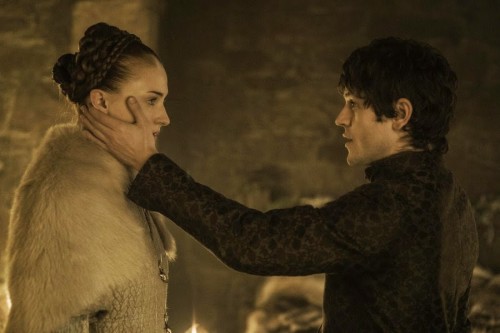
Now I’ve read the arguments in favour of the narrative value of Sansa’s rape. That it showed that Ramsay was a sadist. That it would help Theon come back to himself and help Sansa escape. That it would motivate Sansa to seek vengeance. But it’s all bullshit.

06180af7d1d0a6ad7a2c59840b34bd6d.jpg


What did that scene add that we didn’t already know? Did the writers think that cutting Theon’s penis off was too subtle to indicate Ramsay’s sadism? Did they think the brutal murder of her mother and brother were not strong enough motivators for Sansa to want revenge against the Boltons? Could they not conceive of a single other way in which Theon might be able to mentally recenter himself? What about this particular rape scene added such probative narrative value that it had to be transposed from one character to another even as the original victim is excised from the story? All it was is more rape on a show already replete with rape, for the sake of having rape. None of this is new information.

And it’s not that rape should never be represented in fiction. Rape is everywhere. It’s unfortunately an all too real danger of the world we live in. But it’s not as though there is some dearth of rape representation in media. Using rape as a narrative tool is lazy, and especially so when it’s invoked this many times in the same show. We are now at three female characters (all of whom are considered major point of view characters in the novels) who have been raped in the series, two of whom weren’t raped in the source material. It’s just rapes on rapes on rapes up in this bitch…

And then to add insult to injury, the framing of the scene takes the emphasis off of Sansa and her trauma and places it firmly on Theon and his anguish and having the witness the act. That slow close up to Theon’s face as we hear Sansa scream and cry in the background places him and his emotions squarely at the centre of the scene. We see not, Sansa’s emotional turmoil at being humiliated and degraded by her new husband, but Theon’s tortured face as his guilt consumes him. So on top of Sansa being raped in the first place, that violation is used not to make us feel sympathy for her, but for a man who betrayed her and her family. She doesn’t even get to be the subject of the violence that is happening to her. Her pain instead gets used as a device to advance a man’s character arc instead of her own (the perils of which I talked about back in December in this essay about the rape plot in the CW show Reign).

mary-and-catherine

Aside from being lazy, careless depictions like this are dangerous. They desensitize people to an issue that is still very pressing. It’s not that rape shouldn’t exist in fiction, but they must be framed responsibly. Fictional female characters are forever being raped as retribution against the ills of the men they’re connected to, or as punishment for not being submissive to the men around them. And this happens time and time again across genres and media. So while the denotative reading of these acts might be that “evil men rape” the connotative interpretation over time becomes “rape is a valid punishment for women.”

That is a dangerous idea to be spreading.

As author Robert Jackson Bennett puts it in his brilliant short essay on the subject:

“Now instead of raping a buxom, weeping young woman, your Extremely Bad Dude is now raping a terrified six year old boy. Does it still feel like it deserves to be there? To use the usual fictional rape apologist arguments, there’s no reason this scene shouldn’t exist. Child rape exists, and no doubt happens in times of war. It probably happens even more in third world countries that are at war. Historically speaking, I’m sure there have been thousands of child rapes since the dawn of humanity. Maybe millions. Practically speaking, it would be remiss not to include a child rape scene or two, right? It happens. We must be truthful to reality. It’s our duty. Or, wait – is it possible you’re using this horrific, degrading, monstrous act as window dressing?”

Why is it that sexual violence against women is the only kind of violence seen as such an inevitability that not including it raises suspicions?

f24f8cc1f43f425cb9cb4e3f16334c76

And for all the people who keep harping on about how much worse Jeyne Poole’s fate was in the novels, you’re missing the point. We’re at the juncture now where the series will likely deviate wildly from what George R. R. Martin wrote in the novels and from what he intends to write in the future. This gives the show’s writers enormous latitude to readjust the moral compasses of these characters. Evil men will stay evil, and good men will stay good. But how evil and good they may be is up to them. I find it very upsetting and frankly offensive that in all the retooling that was done to this storyline, the rape scene was the one thing that just had to stay. We’re literally talking about an entirely different character with a different history and experiences, but she just had to get raped because…. “realism?” It’s amazing to me that we can accept a fictional world where dragons are real and men kill their brothers by shadow proxy, but a world without rape (or even just a little less rape!) is unfathomable to some people’s imaginations.

But when it comes down to it, I’m sick of talking about rape because it’s exhausting. I don’t think the men who are disingenuously barging into these conversations understand how truly exhausting this new cultural trend can be for female viewers. And often they bring up the many, many murders on Game of Thrones as a counterpoint, but that isn’t a 1:1 comparison. For one thing, nothing is preventing men from “making a stink” about the excessive violence of these shows. We as women aren’t required to not care about something that affects us because men don’t care about something that affects them. But I digress…

Bellamy Youngin ScandalSeason 2 Episode 14

In our daily lives, murder is not something that most people are actively protecting themselves against. For most men, unless they’re in the people-killing business, getting murdered is not exactly a daily, top of mind concern. But for women? Getting raped is a daily concern. Women have whole routines built around not making ourselves vulnerable to rapists and sexual predators even for a second. Every day we have to think about getting raped. We self-police what we wear, where we go, when we go, how we go, with whom we go, all in an effort to make sure that we’re taking every possible precaution against being raped. And then we’re raped anyway and society tells us it’s our own fault for not having a more effective rape routine.

So for women to then come home, (hopefully having managed to not get raped) and have to watch ALL THE TV SHOWS be about women getting raped? It’s too much. The men defending Sansa’s rape don’t get that this depiction is yet another reminder that rape is everywhere, there’s no escape and that we could be next.

If you really to make a leap, we can see this uptick is the engagement of rape tropes as an element of social control. Because it isn’t just Game of Thrones that’s doing this. From House of Cards to Scandal to Reign, lots of shows are adding rape “for flavour” and it serves as a constant reminder of danger. When we look at it like that, is it really too much to ask that creators are at least responsible with their use of rape in fiction? When you’ve created a scenario where an entire segment of your audience is actively debating whether or not Sansa was even raped because “she chose to play the Game of Thrones” you’re being irresponsible with your craft. These discussions are not fun rhetorical games. They have an active effect on our lives as women. It’s disheartening as a feminist lover of television to find that this is the new status quo. Rape your women, king your men. And watch TV behind your fingers.

tv_rape_victims-43-638x425

I gotta say, I don’t know how many more television shows I can watch while quietly mumbling “please don’t rape her please don’t rape her” under my breath.

Can we please stop raping our fictional women?

I’m all raped out.


Cate Young is a Trinidadian freelance writer and photographer, and author of BattyMamzelle, a feminist pop culture blog focused on film, television, music, and critical commentary on media representation. Cate has a BA in Photojournalism from Boston University and is currently pursuing her MA in Mass Communications so that she can more effectively examine the symbolic annihilation of women of colour in the media and deliver the critical feminist smack down. Follow her on twitter at @BattyMamzelle.

Why You MUST Go See ‘Mad Max: Fury Road’

I would extend this – the film actually details how EVERYONE is enslaved by patriarchy – yes, the women are the sex slaves whose bodies are raped as well as forced into producing breast milk to feed male troops, but the male minions are also enslaved to the dystopian war machine and turned into heartless warriors and slave-laborers.

mad-max-750x400


This guest post by Natalie Wilson previously appeared at Skirt Collective and is cross-posted with permission.


Much has been made of the call by Aaron Clarey in his piece “Why You Should Not Go See Mad Max: Feminist Road.” As many pieces have discussed Clarey’s ridiculous, hyper-macho douchery (as here, herehere, and here), I will instead offer a counter call – instead of “mancotting” the film as Clarey begs “real men and real women” to do, I urge you to GO SEE IT! Go now!

fgtvlcgqktbcokxir9xd

Here is part of Clarey’s original call for a boycott of the film:

“[D]o yourself and all men across the world a favor. Not only REFUSE to see the movie, but spread the word to as many men as possible. Not all of them have the keen eye we do here at ROK. And most will be taken in by fire tornadoes and explosions. Because if they sheepishly attend and Fury Road is a blockbuster, then you, me, and all the other men (and real women) in the world will never be able to see a real action movie ever again that doesn’t contain some damn political lecture or moray about feminism, SJW-ing, and socialism.”

In response, here is my counter feminist call to action:

Do yourself and others a favor – See Mad Max: Fury Road and tell as many humans as you know to see the film, to discuss it on social media, to decry the Men’s Rights Activists aiming to make the world a hyper-patriarchal dystopia where heterosexual macho types horde all the power with their weapons of choice, namely violence, oppression, rape, enslavement, and hatred.

Not all people will recognize the importance of supporting this film, many may go for the special effects and the popcorn, but even if they don’t attend wearing “This is what a Feminist Looks Like” t-shirts, they will still be treated to a great action movie which enacts feminism in both content and form. Those who see the film will help to pave a future where real humans can enjoy movies that reflect the real world, which is made up of women AND men, boys AND girls, where gender is a continuum and, NO, romance and baby-making is not the be all and end all of life.

See Mad Max: Fury Road. See it as soon as possible.

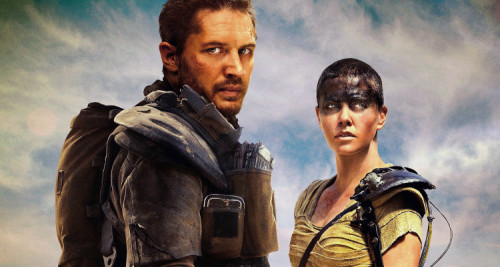
See it because Charlize Theron is amazing, Tom Hardy is a new and improved Max, because the action is breathtaking and achieved with very little CGI, see it to piss-off the nay-saying Men’s Rights Activists and calling for a boycott of “feminist propaganda.”

See it because director George Miller happily proclaims: “I Can’t Help but Be a Feminist” and believes women are capable as actors and directors and are essential to telling imaginative, important stories – something that is all too rare a belief in Hollywood, where in the last several years, women directed fewer than 2 percent of top-grossing movies.

See it because it was edited by a woman, Margaret Sixel.

See it because Eve Ensler led workshops about violence against women with the cast and crew.

See it because, as MRA Clarey readily admits (perhaps his one correct point), Hollywood DOES condition us. As Carolyn Cox of The Mary Sue puts it,

“By admitting they’re threatened by Charlize Theron…Clarey and his commenters are also agreeing that the media we consume and the stories we tell are hugely important.”

See it because while Clarey worries women might be conditioned to want to be like Imperator Furiosa rather than Sophia Loren (I know, WTF???) we can use the conditioning that is part of entertainment to feminist purpose so that, as Melissa Silverstein puts it,

“a little girl can dream of being a hero just as much as a little boy can because she sees multiple examples of heroic women.”

See it because, as Peter Howell says, “Hollywood doesn’t often let females star in its big ‘tent-pole’ films” because “Male-dominated movie studios don’t believe female action movies make money.” See it because we need to remind Hollywood and MRAs this is false (as Hunger Games, InsurgentAlien, Terminator and so many other films prove).

xmpavxz8ta8z8alifr1w

See it to disprove Neanderthal thinking on the part of Marvel Comics CEO Ike Perlmutter and Sony Entertainment CEO Michael Lynton who in a leaked email correspondence “proved” female superhero films don’t make money by naming three such films while ignoring the many female-driven films that have made money and ignorning just how many male led superhero films have tanked.

See it because Clarey’s assertions are laughable, and contrary to his claim that “feminism has infiltrated and co-opted Hollywood,” we still have a Hollywood machine driven by a privileged male elite who don’t seem to want to give up their own little version of the world, their very own MRA movement – the “Men Rule Art” hold on the entertainment machine.

See it because there is a culture shift happening in media, a wave that includes GamerGate, calls to stop online harassment (#StoptheTrolls), an evergrowing feminist blogosphere, and a growing call to Hollywood to wake up and smell the feminism.

kjzpd8yjnahmrtsxg0ie

See it because while some see MRAs as a non-threatening fringe, they DO warrant attention because they consistently and vehemently offer sexism as the answer and their websites and organizations garner thousands of followers. (For some truly horrifying evidence about MRAs beliefs, you need look no further than David Futrelle’s piece on We Hunted the Mammoth which documents some truly horrifying comments running the gamet from espousing beating one’s wife to denouncing one’s daughters if they dare to have college aspirations.)

See it because, as noted by Nicole Sperling in her piece on the film for Entertainment Weekly, it is “one glorious, relentless assault” that may make us “never look at action movies quite the same way again.” As Sperling notes, the film “challenges our perceptions about women and freedom, heroism and extremism.” However, while Sperling claims the film focuses on the “slavery endured by all women,” I would extend this – the film actually details how EVERYONE is enslaved by patriarchy – yes, the women are the sex slaves whose bodies are raped as well as forced into producing breast milk to feed male troops, but the male minions are also enslaved to the dystopian war machine and turned into heartless warriors and slave-laborers. And see it because it does not pit “the matriarchy against the patriarchy” as Ty Burr claimed in his Boston Globe review, but rather brims with relevant political undertones about oppressive political regimes, rape culture, access to clean water, the end of oil, and the ways we are bleeding our planet dry.

See it because Furiosa is not a “degendered…eunech warrior” (as claimed in the Sperling review) but rather a gender-queer, disabled, bad-ass feminist hero who proves that heroism has no one gender, no one body type, no one sexuality.

See it because it suggests it will take collective action rather than one lone (male) hero to save the future. In the film, it takes Furiosa, five female “breeders,” a group of badass gun-toting grannies, as well as Mad Max and other males turned to the feminist cause, to bring down the likes of Immorten Joe – the villain at the heart of this iteration whose names speaks to the fact patriarchy is not “immortal” nor is the concept of your average (macho) Joe a thing to espouse.

See it because we are all on this tiny spinning planet together and only together can we find the “Green Place” espoused in the movie where the water will be clean and people will not be oppressed.

See it because if you have ever doubted the acting chops of Charlize Theron, this movie will convince you of her incredible talent. She is absolutely fierce as Furiosa. In a movie with very little dialogue and limited characterization, Theron is able to exude an intensity of will and palpable strength of character that is on par (if not exceeding) other female heroines such as Ripley and Sarah Connor.

bsylulvaqs2zauyltnn5

See it for the grannies with their mad survival skills, for the fierce “Breeders” who refuse to be sex slaves; see it for its championing of the one-armed sharp shooter Furiousa. See it because how often do we see women portrayed as better survivors, snipers, and drivers than men?

See it because it is the best feminist road movie since Thelma and Louise. See it because Furiosa’s story is so much more powerful than Black Widow’s. See it because we need to prove Hollywood big wigs wrong and make Clarey and his MRA minions STFU..

Finally, see it to piss off MRAs and show them feminists will not be stopped by their testicle-clutching pleas of superiority. See it for their daughters, and sons, and partners, who can hopefully grow into a world free of their “Immorten Joe” mentality.

See it because, yes, movies matter, and if we want more feminist-friendly blockbusters, we have to prove there is an audience willing to support such movies.


Natalie Wilson teaches women’s studies and literature at California State University, San Marcos. She is the author of Seduced by Twilight and blogs for Ms., Girl with Pen and Bitch Flicks.


Bitch Flicks’ Weekly Picks

Check out what we’ve been reading this week–and let us know what you’ve been reading/writing in the comments!

recommended-red-714x300-1


ACLU Goes After Hollywood’s Gender Gap by Anita Little at Ms. blog

Cannes Review: Todd Haynes’ ‘Carol’ is a Masterful Lesbian Romance Starring Cate Blanchett and Rooney Mara by Eric Kohn at Indiewire

Watch: Samantha Bee is “Female as F-ck” and Crashing the Sausage Party That is Late-Night TV by Laura Berger at Women and Hollywood

What have you been reading/writing this week? Tell us in the comments!

“And That’s the Truth”: The Talent and Comedic Timeliness of Lily Tomlin

I owe a great debt to Tomlin for helping me discover comedy, for helping shape my sense of humor, and for helping me define a sense of identity that might not have ever emerged without her. How can anyone argue that women aren’t funny, when my sole entire reason for making people laugh was inspired by a (funny) woman?

unnamed


This is a guest post by Kyle Sanders.


At this year’s annual Golden Globes, Jane Fonda and Lily Tomlin presented the award for Best Actor in a Comedy or Musical Series. While it was nice to see the stars of one of the best comedies ever made, 9 to 5, it was also exciting to see these two talented actresses reunite on stage in what was of course a quick promotion for their soon-to-debut Netflix series, Grace and Frankie. But what was most notable was the tongue-in-cheek banter they had on stage, discussing how “nice” it was to finally put at rest the “negative stereotype” that men aren’t funny. Of course, it is not exactly true that men have never been funny, but for some reason it has always been heavily debated whether or not women are funny. What I found most ironic was the fact that Tomlin led this conversation, because of all the talented comics out there—male or female—I have always regarded her as my greatest (and funniest) comedic muse.

unnamed

It is no secret within my social circle that I am absolutely bananas over Lily Tomlin, and from an early age to boot. While I was in grade school, I was introduced to Tomlin from a Laugh-In reunion special that aired in the early ’90s and upon being exposed to her widely popular Ernestine the telephone operator and Edith Ann characters, I found Tomlin’s comedic creations imitable. From that moment, I was hooked. Back before the days of IMDb, I would spend hours in a video rental store, searching through the “Comedy” section for her name or her face on a VHS sleeve (remember those?). It wasn’t before long that I found a “best of” compilation of a little sketch comedy show called Saturday Night Live that featured two of Tomlin’s hosting stints. This newfound discovery of nostalgic humor led me to my first love of comedy. To put it simply: I owe my adoration of sketch comedy and my obsession with SNL to Lily Tomlin. Because of Tomlin, I found the courage to move to the land of improv, Chicago, in the hopes of performing sketch comedy and turn it into a career. Ya hear that? A woman—a FUNNY woman—inspired me to find a career in making people laugh.

unnamed

And why not? Lily Tomlin is one our most premier comediennes as of all time. Hell, The Laugh Factory includes an artist’s rendering of her among many of the greatest comedians who ever lived. Why we are even still debating this “women are/aren’t funny” theory is beyond my own belief, because as an aspiring comedic performer, I have always touted Tomlin as one of the greats.

First and foremost, Tomlin revolutionized comedy for women. Before Tomlin, most female comics were self-deprecating (Phyllis Diller) or performed material regarding marriage and children (Joan Rivers). Tomlin’s turn in the spotlight did away with joke-telling and produced sketch comedy acts involving a variety of characters inspired by people she had known while growing up in the diverse, blue-collar environment of Detroit. Tomlin’s act embraced the counterculture of the 1960s, during the time of the civil rights movement and the sexual revolution. Gender dynamics were changing, and Tomlin was at the forefront of the women’s lib movement in comedy. She performed material that focused on the working class and the poor, material that required an edgy intelligence that did not go for punch lines or cheap laughs. She certainly didn’t limit her comedy to material about her looks or motherhood or married life—though her sketches didn’t shy away from such matters either. Tomlin was not a standup-comic, but a cerebral comedic performer.

unnamed

Tomlin’s talent for creating eccentric, offbeat characters landed her a spot on NBC’s Laugh-In, and her prolific career took off overnight. Some of her most beloved characters came about on this variety show, including Ernestine, a snorting, nasally-voiced telephone operator who controlled the phone lines with her sharp tongue and smart-alecky insults. She also gave us Edith Ann, a philosophizing seven-year-old who sat in an oversized rocking chair spouting off words of wisdom while sticking out her tongue. Tomlin’s knack for producing dozens of three dimensional characters would eventually provide her enough material for her own television specials, of which landed her several Emmy awards. These specials reflected the changing times involving racial and gender politics, material that did not involve a lot of punch lines or pratfalls but certainly served as intelligent yet controversial material that not even Louis CK or Chris Rock would have the balls to produce back in the day (and if anyone can track down these specials in DVD format, please let me know!). I would even say Tomlin should be given credit for introducing comedian Richard Pryor (whom collaborated with Tomlin on a few of these specials) to the mainstream when most producers were too scared to let Pryor have any air time. Tomlin was an underground comic almost too dangerous to showcase amid the still-shrewd comedy scene of the 1970s.

unnamed

Throughout the ’80s, Tomlin starred in films that showcased multidimensional females that could lead to strong box office returns. She has always chosen roles that project a strong persona, never submissive to authority let alone a male figure. Tomlin’s characters are in essence Tomlin herself: offbeat, eccentric, but always strong and independent. Tomlin proved she could stand toe-to-toe with comedy legends like Art Carney in The Late Show. She had a physicality that could keep up with the comedic ferocity of Steve Martin in All of Me (and possess his body no less!). Tomlin’s strong sense of humor and femininity also proved successful alongside other actresses, sharing the screen as well as countless laughs. In 9 to 5, Tomlin’s Violet Newstead is one of three women who take down their “sexist, egotistical, lying, hypocritical” male boss, Franklin Hart. Violet delivers a speech of disgust towards Hart that’s one of Tomlin’s most pivotal moments in her acting career:

“Okay, okay, I’m gonna leave, but I’m gonna tell you one thing before I go: don’t you ever refer to me as ‘your girl’ again…I’m no girl, I’m a woman. Do you hear me? I’m not your wife or your mother—or even your mistress.  I am your employee and as such I expect to be treated equally with a little dignity and a little respect!”

Violet’s demand for equality was a calling that every working woman heard loud and clear, and with the chemistry between Tomlin, Jane Fonda, and Dolly Parton, women AND men came to the movie theaters in droves, paving the way for comedic actresses in film that proved female-driven comedies could bring the masses to the box office. Without Tomlin’s collaborative talent in 9 to 5, there would be no Outrageous Fortune, no Big Business (another Tomlin film—this time paired up with the Divine Miss M, Bette Midler), no Baby Mama, Bridesmaids, or The Heat.

unnamed

Even as an older actress in today’s Hollywood—when most “women of a certain age” are relayed to playing mothers—Tomlin has never been one to play a matriarch as paper thin. She portrayed Mary Schlicting, Ben Stiller’s mother in Flirting with Disaster, as a post-’60s hippie living in a ’90s world and still producing LSD. In Eastbound & Down, her Tammy Powers character was a bowling champion that could spout out more profanity than Danny McBride’s Kenny Powers while exchanging pharmaceutical drugs. In Admission, her Susannah character is a highly renowned feminist author who nearly kills Tina Fey’s date with a shot gun. In Web Therapy, her Putsy Hodge dons an array of costumes, from a fu Manchu beard to a prisoner jumpsuit, to the annoyance of her daughter Fiona, as played by Lisa Kudrow. These performances certainly don’t read as “motherly matriarch,” but as performed by Tomlin, they certainly scream “hilarious.”

unnamed

With her new comedy, Grace and Frankie, Tomlin proves again how relevant and hilarious her talents still are in a series co-starring Jane Fonda involving two older women whose husbands come out as gay and have fallen in love with each other. For Netflix to add a comedy series (from Friends co-creator Marta Kauffman I might add) about two older women beginning anew, it proves that the old adage of women not being funny is untrue, and with Tomlin in tow, this comedy series will no doubt succeed in continuing to prove that theory wrong.

unnamed

Late last year, Tomlin was awarded a Kennedy Center Honor for her contribution to the American arts. As one of Tomlin’s biggest fans, I had been petitioning for this recognition for years. Yet the moment was bittersweet, because while this was certainly good news for one of my favorite all-time idols, the fact was I would not be there to salute her at the event. One of my career goals in life was to speak on Tomlin’s behalf at the Kennedy Center. Tomlin and I have a few similarities: we both have southern roots planted in Kentucky, we both have an eye and ear for characterizations and impressions, and we both happen to be gay (in fact, Tomlin became the first outed lesbian to received the Kennedy Center honor in its entire history). I owe a great debt to Tomlin for helping me discover comedy, for helping shape my sense of humor, and for helping me define a sense of identity that might not have ever emerged without her. How can anyone argue that women aren’t funny, when my sole entire reason for making people laugh was inspired by a (funny) woman? Women may not have always been considered funny, but thanks to Tomlin’s efforts, women (as well as men) have reason to be funny.


Kyle Sanders lives in Chicago and plans to take improv classes at the Improv Olympic (as soon as his rent gets paid). In the meantime he occasionally contributes to NewsCastic: Chicago and GiGa Geek Magazine among other blogs that deem his thoughts worthy.


Director Diane Bell Chats about ‘Bleeding Heart’ Stars Jessica Biel and Zosia Mamet

During the festival I met with Bell at a restaurant in the Meatpacking district to chat about her film and following are edited highlights:

Director Diane Bell
Director Diane Bell


This is a guest post by Paula Schwartz.


Bleeding Heart, written and directed by Diane Bell, stars Jessica Biel and Zosia Mamet as two sisters who have never known each other. Biel plays May, a reserved and disciplined yoga instructor who has enlisted a private investigator to help her track down her long-lost biological sister, Shiva (Mamet). She discovers her younger sister is a prostitute in an abusive relationship with a boyfriend who is also her pimp. May feels protective and driven to rescue Shiva from her chaotic and dire financial and personal situation.

Bleeding Heart begins as a character study of two very different women and turns into a revenge thriller. The movie features two strong female roles by actresses who are usually typecast. A deglamorized Biel get a chance to show of her acting range instead of coasting on her looks, while Mamet is convincing as a hooker with a heart of gold trapped in a toxic relationship, a role world’s away from the whiny, privileged Shoshanna she plays in Girls.

The cinematography is particularly beautiful, especially in an early scene where May is practicing yoga and her body is framed by a gorgeous Los Angeles sunrise. In a shot that feels like it could only be directed only by a woman, the camera pans over every part of Biel’s body as she does her yoga routine and rather than sexualizing her, reveals her strength and power, something May is not even aware of at that moment.

Bleeding Heart recently premiered at the Tribeca Film Festival, which screened 119 features, of which only 30 were by women filmmakers. Bleeding Heart was one of 12 narrative films by women directors screened. This is an improvement over the previous year but not good enough. (Biel, who is married to Justin Timberlake, had just given birth to a baby boy and was unable to make the movie’s premiere at Tribeca.)

Zosia Mamet
Zosia Mamet


During the festival I met with Bell at a restaurant in the Meatpacking district to chat about her film and following are edited highlights:

Talk about the opening shot of the film, where Jessica is practicing yoga and the sun rises. The camera focuses on different parts of Biel’s body and it feels like only a woman filmmaker could get a shot like this.

This is why we need more female filmmakers, because it’s a different perspective. Everyone’s got a different perspective, and we have different stories and different ways of looking at the world. I feel that the stories we have on film just don’t reflect our reality; they also create it. They also change how we see things.

I was very blessed with Jessica that when she got onboard the film she probably had about three months in which she completely immersed herself in the yoga practice.

Jessica hadn’t done much yoga before the film?

She’d done some yoga but like I was very specific with this film that she’s an Ashtanga Yoga practitioner, which is what I taught and which I practiced, so she immediately started practicing Ashtanga every single day. And she started working out in the gym. She completely committed to it and she became vegetarian, and she went the whole way with it.

The thing that’s different with Ashtanga than with other kinds of yoga is you do a self-practice. You learn the sequence of positions and you do them. So when she came to shoot it she knew the sequence… I’ve done it every day for 15 years or something. We knew what it was that we were doing.  And I think the thing that really comes across in those scenes is her level of concentration. She’s in that zone.

And Zak (Mulligan) and I, my DP, was just phenomenal, and we knew the kind of lighting that we wanted. The film both starts and ends with that moment of dawn, of the sun coming up. Ashtanga yoga is typically practiced in the very early mornings so ideally you’re practicing from when it’s dark until when it’s light. And that was something that was really important to me, so in the opening sequence it goes back and forth between her teaching a class and also her doing her own practice. When she’s doing her own practice, it’s just that cool light of like pre-dawn, before the sun comes out when it’s a little bit blue. And then when she’s teaching, it’s light and it’s just past the sun coming out. And that’s typically what Ashtanga teaches.

Diane Bell
Diane Bell


Jessica Biel is usually typecast, especially in roles that focus on her looks and being sexy. In the film she hardly wears makeup and her hair is pulled back in a simple ponytail. Were you worried she’d be able to pull this off?

My concern when she was suggested was that she’s so glamorous. My impression was that she’s so perfect and glamorous and I didn’t think she’ll be able to do this, you know, and the first thing she said to me when I met her was, “I understand May because everybody thinks my life is perfect, but I’m a human being.” I asked her if she would be happy to have no make up and she said, “100 percent.”

What was your production schedule?

We shot the film in 19 days, 12 hours a day normally. As a director I will not go over time. It’s not fair to cast. 12 hours a day is plenty for everybody, and I’m absolutely rigorous, being lucky in both my films working with great first ADs, and then just absolutely rigorous about just keeping it going and keeping that momentum and getting our days every day.
 
Talk about the chemistry between Zosia Mamet and Jessica Biel since that is crucial for the story since it focuses on their relationship.

Everybody connected and bounded very quickly. And I think a lot of friendships came out of the film. I know Zosia and Jessie became really close. They didn’t know each other before, but the moment they met, and this is one of those things, you just say, “Oh my God, I’m so lucky!” They really clicked. They somehow brought out something great in each other. On set, as human beings too, they just had that connection. They were just like sort of goofy together. There were lots of laughs and you could see they had a bound.

Did you test them together?

No. The funny thing about that sort of chemistry between people, like I feel the movie is partly a love story. It’s about these two women falling in love with each other. And I knew it had to have that chemistry. It’s just like a love story. There’s got to be that sort of spark and I feel they really had it. I felt it every day on set. The two of them together are so charming and sweet and funny.

In the film their characters are both controlled by men although in different ways. Shiva’s boyfriend is her pimp, and he is violent and abusive, while May’s partner is gentle and good to her, but he also tries to control her life. Talk about that.

It was just something that I was interested in. There’s explicit violence and then there’s sort of like another kind of violence, which is sort of implicit.

May’s boyfriend wouldn’t identify himself as being a controlling person and would hate to think of himself as that, and she wouldn’t think of herself as being in that relationship, but that’s what they are. Those are the mechanisms of their relationship and that was definitely something I kind of wanted to say of these two women. They’re two opposites, yin yang, but they’re really the same.

Zosia Mamet
Zosia Mamet


In the production notes it says you are fascinated by violence. What do you mean?

There’s so much of it in our society. How do we actually deal with it? I don’t like violence at all. I absolutely detest it. I’m a complete pacifist. And for me one of the questions driving this film from my perspective was, okay, if you’re completely committed to peace, it’s easy to be peaceful if everyone around you is peaceful. It’s super easy, it’s great. But what if you have to deal with somebody who’s really violent? How far do you go to help someone, protect someone from someone who’s really violent?

In our society domestic abuse and the murder of women by spouses or boyfriends are epidemic. And it’s something we don’t want to talk about. I looked up the actual statistics of it before coming here because I thought, I better get it right. In my head I thought it was about 30 women a month are killed in America by their partners right? That was the figure I had in my head. I looked it up. It’s really three women a day. On average spouses or ex-boyfriends are killing three women everyday. That’s an epidemic!
 
What is your next movie?

The next one I’m going to shoot in July. We’re Crowdfunding right now in a totally off the grid way. It’s a micro-budget movie. It’s called Of Dust and Bones. It’s about a widow of a war journalist and her husband was killed in Syria. She had decided to just retreat from the world. She lives a monastic kind of life in the desert where she wants no part of what she views as this crazy world, basically. Then her husband’s best friend and colleague, Alex, who actually sent her husband to Syria, comes to visit her. He has come with an agenda. He wants the rights to her dead husband’s last photographs. She feels very strongly that there’s no hope to be good in this world and every time we try to make things better we actually end up making things worse creating more suffering. The film is about what unfolds between them in the desert over these days. It’s these two wildly different viewpoints clashing.


See also at Bitch Flicks: “Vive La Revolution!” by Diane Bell


Paula Schwartz is a veteran journalist who worked at the New York Times for three decades. For five years she was the Baguette for the New York Times movie awards blog Carpetbaggers. Before that she worked on the New York Times night life column, Boldface, where she covered the celebrity beat. She endured a poke in the ribs by Elijah Wood’s publicist, was ejected from a party by Michael Douglas’s flak after he didn’t appreciate what she wrote, and endured numerous other indignities to get a story. More happily she interviewed major actors and directors–all of whom were good company and extremely kind–including Brad Pitt, Angelina Jolie, Morgan Freeman, Clint Eastwood, Christopher Plummer, Dustin Hoffman and the hammy pooch “Uggie” from “The Artist.” Her idea of heaven is watching at least three movies in a row with an appreciative audience that’s not texting. Her work has appeared in Moviemaker, more.com, showbiz411 and reelifewithjane.com.


Mo’Nique Returns to the Spotlight in ‘Bessie’

The film also focuses on the relationship between Smith and Ma Rainey, who mentored Smith and gave her guidance on developing her stagecraft. Mo’Nique portrays Ma Rainey, known as the “Mother of the Blues,” in a rich and layered performance and has so much charisma she steals every scene she’s in.

Mo'Nique
Mo’Nique


This is a guest post by Paula Schwartz.


Queen Latifah was born to play the Empress of the Blues.  Queen Latifah stars in Bessie, the new biopic about the early life of legendary blues singer Bessie Smith. The film will premiere Saturday on HBO.  Mo’Nique, who has her first stand out role since Precious, reminds us why she won the Oscar in 2010.

Directed by Dee Rees (Pariah) from a screenplay by Rees, Christopher Cleveland, and Bettina Gilois, the story is by Rees and acclaimed playwright Horton Foote, who died in 2009. The film focuses on Smith’s early years as she struggled as a young singer to eventually become one of the most successful recording artists of the 1920’s. She earned $2,000 a week – an unheard of sum – at the height of her career.

The film also focuses on the relationship between Smith and Ma Rainey, who mentored Smith and gave her guidance on developing her stagecraft. Mo’Nique portrays Ma Rainey, known as the “Mother of the Blues,” in a rich and layered performance and has so much charisma she steals every scene she’s in.

Both Queen Latifah and Mo’Nique received Critics Choice nominations the other day and the Golden Globes and other accolades are sure to follow.

The cast includes Michael Kenneth Williams (Boardwalk Empire, 12 Years a Slave) as Bessie’s husband; Khandi Alexander (Scandal) as Bessie’s abusive older sister, Viola; Mike Epps (The Hangover) as the singer’s bootlegger romantic interest; Tory Kittles (True Detective) as Bessie’s older brother Clarence; Tika Sumpter as Lucille, Bessie’s longtime lover.

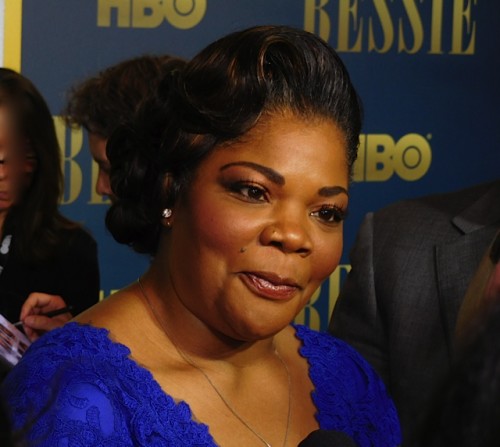
At the recent premiere at the Museum of Modern Art, nobody worked the red carpet harder than Mo’Nique, who talked to all the journalists clamoring for her attention.

Bessie has many explicit sex scenes and Queen Latifah’s character has a nude scene that’s integral to the story but sure to get audiences talking. Ma Rainey was gay and Bessie Smith was bisexual, and the film doesn’t shy away from showing scenes of their characters having sex with both men and women. A standout is a scene early in the film where Mo’Nique and Queen Latifah dress up in drag, smoke cigars and do a song together to a boisterous audience.

Director Dee Rees
Director Dee Rees


Here’s a red carpet interview with Mo’Nique, who looked terrific in a blue lace gown, and was warm and thoughtful in her replies to all the journalists:

Were gay women who performed on stage more open about their sexuality in the time of Ma Rainey and Bessie Smith? (Of course they didn’t have to contend with social media.):

Mo’Nique: I think back then there was a strength that said I’m unwavering about who I was born to be. Don’t we still fight with it today? But figure what she had to walk through then? It was illegal. They got locked up. If you were seen with the same sex so to have that kind of strength back then is absolutely beautiful.

What was the key to finding her character? 

Mo’Nique: Her music, (I found it) through her music. If you listen to Ma Rainey you’ll really understand Ma Rainey because she sang from her soul. She sung her truth and that’s how I really got to understand who that woman was because there’s really very little written information about this woman. She’s so hidden and now history, you have to dig really deep to get that little bit…. And she told the truth. And even back then, she was fighting for wage equality, so we’re still having that fight today but definitely she kicked open the doors so we can even go to the meetings to have those discussions.

They were friends. And she was Bessie Smith’s mentor and she was very motherly but she was that type of mother that knew when she had to let go and let that baby fly and go see it for herself. And when the bird flew back home she was right there waiting for her. That’s what that relationship what. And what I so appreciate about her, we don’t often times see those relationships anymore, you don’t see it where two friends go through it, they fall out, but they’re still willing to love each other through it and come back together.

Queen Latifah
Queen Latifah


What does she see as Ma Rainey’s influence on A&R and jazz?

Mo’Nique: It’s truthful. It’s very honest. It’s very from the soul. When you listen to those singers back then, they couldn’t pretend. They couldn’t fake it because the people would know it and they were those singers that when you sat there, you know how they say music moves you? That was that type of music that moved you and made you make a decision, may it be the right, wrong or indifferent, but when you listen to that music it was like you know what? OK, “I’m gonna finish this darn liquor and I’m gonna make a change.” That’s what that music was back then. Absolutely beautiful!

What were the key factors that made her want to take on the role of Ma Rainey?

Mo’Nique: It was Ma Rainey’s strength. Her integrity. You know when you read that script and you understand that the sacrifices that woman made for little girls like us, and she had no idea that she was doing it, it was just the right thing to do. So when you read those lines, and you understand that that woman is talking to me for me, off the pages, and she’s saying Monique keep pushing. Keep going in the right direction and don’t waver from what you know is right. Look at my story and when you look at that woman’s story it’s not like most of our stories, where we die broke, alone, miserable. When you look at her story she had a very full life.

Before she made her way into the theater, I asked Mo’Nique if she actually sang.

Mo’Nique: All day long!

Later at the after party I asked the 36-year-old director about how she discovered Bessie Smith’s music, she told me it was through her grandmother: “She played Bessie Smith’s records all the time.”


Paula Schwartz is a veteran journalist who worked at the New York Times for three decades. For five years she was the Baguette for the New York Times movie awards blog Carpetbaggers. Before that she worked on the New York Times night life column, Boldface, where she covered the celebrity beat. She endured a poke in the ribs by Elijah Wood’s publicist, was ejected from a party by Michael Douglas’s flak after he didn’t appreciate what she wrote, and endured numerous other indignities to get a story. More happily she interviewed major actors and directors–all of whom were good company and extremely kind–including Brad Pitt, Angelina Jolie, Morgan Freeman, Clint Eastwood, Christopher Plummer, Dustin Hoffman and the hammy pooch “Uggie” from “The Artist.” Her idea of heaven is watching at least three movies in a row with an appreciative audience that’s not texting. Her work has appeared in Moviemaker, more.com, showbiz411 and reelifewithjane.com.

Bitch Flicks’ Weekly Picks

Check out what we’ve been reading this week–and let us know what you’ve been reading/writing in the comments!

recommended-red-714x300-1


The Post-Colonial Politics of “Game of Thrones” by Vivienne Chen at Bitch Media

We Cannot Wait For The Emily Dickinson Biopic (Guess Who’s Starring?!) by Natasha Rodriguez at BUST

CBS’s ‘Supergirl’ Gets Greenlit, Will Likely Become Fall’s Only Female-Centric Superhero Show by Inkoo Kang at Women and Hollywood
15 Black Films From the 1970’s You Must See by Sergio at Shadow and Act
8 Reasons ‘Mad Men’s Peggy Olson Deserves A Spinoff When This Show Comes To An End by Chelsea Mize at Bustle
Abbi Jacobson and Ilana Glazer of ‘Broad City’ to Write and Produce Movie with Paul Feig by Laura Berger at Women and Hollywood

What have you been reading/writing this week? Tell us in the comments!

The Sleepover Paradigm: What to Do When the Party’s Over

Plus, things got in the way–like jobs, schedules, coworkers, relationships, disappointments and distance…basically just growing up. So when I sat down to create ‘Young Like Us,’ an original series that I wrote with Chloe Sarbib, my real college roommate, this is exactly what we (and the rest of our all-female production team and main cast) wanted to explore.


This is a guest post by Cleo Handler.


Remember how you felt at the end of a big sleepover, when you’d wake up with a Sour Patch Watermelon and Junior Mint hangover and the DVD menu for Mean Girls back up on the TV, still blaring the same few bars of “Overdrive” on repeat? You’d reach around groggily for your glasses, not wanting to leave, but feeling kind of sick and realizing you had a full day of homework ahead of you.  That’s just what graduating college is like.

Mean Girls – the sleepover classic


Or at least, that’s how I felt. When I found myself alone in New York City, after four years of playing a Little League game of “Adult” and winning participation trophies, I was disoriented and overwhelmed.  But most of all, I was no longer at one giant, constant slumber party with my friends, where no one told us what to eat or when to go to bed.  Friendships suddenly required work (and hours on the train!) and I wasn’t sure how to adjust.  Plus, things got in the way–like jobs, schedules, coworkers, relationships, disappointments and distance…basically just growing up.  So when I sat down to create Young Like Us, an original series that I wrote with Chloe Sarbib, my real college roommate, this is exactly what we (and the rest of our all-female production team and main cast) wanted to explore.

Young Like Us characters on the stoop with their landlord Larry (Brad Dourif) in the pilot episode


When the main characters Mia, Ava, and Charlie realize that post-college life is pulling them in very different directions, they are forced to give up their shared Brooklyn apartment (with their creepy landlord Brad Dourif) and maybe more. In a last-ditch effort to stay in Neverland, Charlie convinces her reluctant friends that the best way for them to hang out more is to become a girl band – because bands never break up, right?  Through the songs the girls (try to) write each week, they are able to explore the confusion of being a semi-adult, the same confusion we often struggled to articulate in our own lives.

Many shows out there deal with similar issues of shifting female friendships and navigating the transition to the real world (like gems Broad City and of course Girls, but we still felt that something was missing – and that’s where the music came in. The Young Like Us characters, like most 20-somethings we know, are too self-aware, self-deprecating, and defensive to address many of the serious issues they’re wrestling with in conversation. But the songs could take the characters to places where dialogue could not. In their music, the girls can more honestly explore crises of sexuality, identity, and piercing loneliness, as well as a nostalgia for the past and an anxiety about the future.

The Young Like Us girls writing a song in their studio, in Episode 2  - “High-Waisted”
The Young Like Us girls writing a song in their studio, in Episode 2 – “High-Waisted”


Of course, there are many great musicals out there that do this, like the incredible Fun Home now on Broadway (speaking of Alison Bechdel and powerful feminist stories, check this) but there’s one key difference – for them, the songs are (largely) supposed to be unconsciously interwoven with reality, an external projection of their inner angst, expressed when their feelings are just too large to be contained by dialogue.  What we found with our series is that music is not only a powerful tool when it’s supposed to be invisibly intertwined or employed effortlessly. Our characters do not have the power to burst into fully formed, gorgeous songs through theater magic; they sit there working it out consciously, struggling and writing together, and the material they come up with is not always great.  They have some successful moments and some nice turns of phrase, but basically they don’t know what they’re doing and it doesn’t really matter. (Not only did this take some pressure off us as writers, but it also gave us the cool opportunity to actually finish the girls’ incomplete song fragments post-episodes, in collaborations with some generous and extremely talented friends of ours on a full album). But most importantly, this let our characters grapple with the idea that writing music takes work, as does friendship.  Neither is about the finished product because the thing that really counts is the struggle to put your feelings into words, the give and take along the way, the collaboration.

So I’m not necessarily saying that the cure-all for keeping your shifting friendships alive in the real world is to form a band.  BUT–if you’re thrust out into a new situation, finding yourself a bit lost, and feeling that familiar sugar high post sleepover crash coming on, you might as well break out the old Rock Band game and let yourself ease into real life with another round of “Island in the Sun.”


Untitled

Cleo Handler is an actress, writer, and lyricist in Brooklyn, NY. She has written several original plays and musicals, including Glass Act and From the Fire, and co-created and starred in the musical web series Young Like Us. She is a member of the Advanced BMI Musical Theater workshop, and has recently acted in projects such as the upcoming TNT drama Public Morals (Barbara) and the sitcom Honest Living.  Cleo can be found on her website and on Twitter.