Reality Bites Slackers: and the Movies Made About Underemployed Youth

Occupy Wall Street started a year ago this Monday. The movement came out of a recession and an underemployed youth culture.

So, of course I want to look at a film that follows the frustrations that young people face in an economic crisis. Unfortunately, save for Lena Dunham productions, there isn’t a lot of that coming out right now – and that issue might be for another post. (As in: our economy is being dragged through the dirt, but our high grossing blockbuster hits are still mostly about rich white dudes. Maybe these rich white dudes observe the plight of the poor, but it is still from their vantage point. i.e. The Social Network/Wall Street: Money Never Sleeps/The Dark Knight Rises.)

Surprisingly there’s more films about frustrated-20-somethings in a bad job market from the early 90s. The 90s being the decade where a lot of people were pretty well off. But, there was that recession in the early 90s that influenced music, art and film in a lot of interesting ways.
Two films in particular, Slackerand Reality Bites, came out around the same time to address a youth culture that felt disenfranchised. They both ostensibly sought to delve into the coming-of-age story specific to disillusionment with the American dream. While Slacker is maybe a bit convoluted in its non-narrative narrative, it is far more successful in encapsulating a culture and economic climate that fed into each other. Reality Bites, on the other hand, just sort of bites.

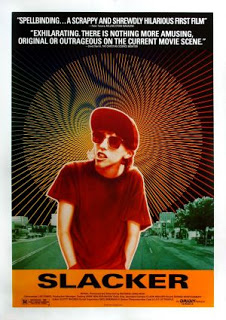
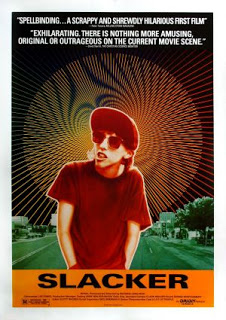
Movie poster for Slacker
Richard Linklater’s Slackerfollows various characters around Austin, Texas. Each person bumps into, or passes another conversation that leads the camera to another story. The characters all seem to share the same sense of detachment from mainstream culture and desire to pontificate in a typical Linklater fashion. There isn’t really an arc to the film, but there is a voice. And, that’s the point. Linklater is trying to capture something while also getting a chance to look at long semi-philosophically titillating tête-à-têtes.

Reality Bitesinstead uses the educated but wandering youth archetype to facilitate an easy-to-consume pop culture-inundated whine-fest where the characters seem a bit more concerned about their love-hate romances than anything else.

When talking about Reality Bites I will be using the abbreviated form of the term “romantic comedy” (i.e. rom-com) as a verb. Here is an example of how I will use this: In Ben Stiller’s directorial debut in the 1994 film, Reality Bites, about 20-somethings trying to get by in a recession-drenched economy, Stiller took what could have been an informative narrative about the emerging 90s youth culture, and instead he went and rom-commed it.

The woefully hip cast of Reality Bites
Reality Bites just about literally fetishizes the economic strife of the young by slapping romantic intrigue on minimum wage and unemployment.

It also seems to miss the mark on what that youth culture was at the time. Did Stiller think grunge meant jerk? Because the male love interest, Troy (Ethan Hawke), is not appealing in any way. He’s a pseudo-intellectual who seems to have plenty of gripes with “the Man,” but nothing much intelligent to say about it. He’s hung up on the female love interest (and yes, that’s how I’m identifying them, since they rarely rise above those archetypes) Lelaina (Winona Ryder), in the most jealous and obnoxious way possible. After he spies Lelaina hooking up with a guy after her date, Troy makes snide comments indicating she’s promiscuous. Lelaina, our primary protagonist, does seem pretty cool sans her narcissistic documentary. But, she’s drawn to the poorly written symbol of her culture, Troy, for inexplicable reasons.

It’s painfully rom-commed. Reality Bites seems so contrived and marketed to a counterculture demographic, but it still relies on lazy plot devices and expects the audience to be intrigued by sexual tension over everything else. Which leaves the audience without much to actually connect with.

These films are both trying to appeal to a specific demographic, but the tone of Reality Bites is one that is perpetuated even while drowning us in unnecessary hormones. 

‘Reality Bites,’ ‘Slackers’ and the Movies Made About Underemployed Youth

Occupy Wall Street started a year ago this Monday. The movement came out of a recession and an underemployed youth culture.

So, of course I want to look at a film that follows the frustrations that young people face in an economic crisis. Unfortunately, save for Lena Dunham productions, there isn’t a lot of that coming out right now – and that issue might be for another post. (As in: our economy is being dragged through the dirt, but our high grossing blockbuster hits are still mostly about rich white dudes. Maybe these rich white dudes observe the plight of the poor, but it is still from their vantage point. i.e. The Social Network/Wall Street: Money Never Sleeps/The Dark Knight Rises.)

Surprisingly there’s more films about frustrated-20-somethings in a bad job market from the early 90s. The 90s being the decade where a lot of people were pretty well off. But, there was that recession in the early 90s that influenced music, art and film in a lot of interesting ways.
Two films in particular, Slackerand Reality Bites, came out around the same time to address a youth culture that felt disenfranchised. They both ostensibly sought to delve into the coming-of-age story specific to disillusionment with the American dream. While Slacker is maybe a bit convoluted in its non-narrative narrative, it is far more successful in encapsulating a culture and economic climate that fed into each other. Reality Bites, on the other hand, just sort of bites.

Movie poster for Slacker
Richard Linklater’s Slackerfollows various characters around Austin, Texas. Each person bumps into, or passes another conversation that leads the camera to another story. The characters all seem to share the same sense of detachment from mainstream culture and desire to pontificate in a typical Linklater fashion. There isn’t really an arc to the film, but there is a voice. And, that’s the point. Linklater is trying to capture something while also getting a chance to look at long semi-philosophically titillating tête-à-têtes.

Reality Bitesinstead uses the educated but wandering youth archetype to facilitate an easy-to-consume pop culture-inundated whine-fest where the characters seem a bit more concerned about their love-hate romances than anything else.

When talking about Reality Bites I will be using the abbreviated form of the term “romantic comedy” (i.e. rom-com) as a verb. Here is an example of how I will use this: In Ben Stiller’s directorial debut in the 1994 film, Reality Bites, about 20-somethings trying to get by in a recession-drenched economy, Stiller took what could have been an informative narrative about the emerging 90s youth culture, and instead he went and rom-commed it.

The woefully hip cast of Reality Bites
Reality Bites just about literally fetishizes the economic strife of the young by slapping romantic intrigue on minimum wage and unemployment.

It also seems to miss the mark on what that youth culture was at the time. Did Stiller think grunge meant jerk? Because the male love interest, Troy (Ethan Hawke), is not appealing in any way. He’s a pseudo-intellectual who seems to have plenty of gripes with “the Man,” but nothing much intelligent to say about it. He’s hung up on the female love interest (and yes, that’s how I’m identifying them, since they rarely rise above those archetypes) Lelaina (Winona Ryder), in the most jealous and obnoxious way possible. After he spies Lelaina hooking up with a guy after her date, Troy makes snide comments indicating she’s promiscuous. Lelaina, our primary protagonist, does seem pretty cool sans her narcissistic documentary. But, she’s drawn to the poorly written symbol of her culture, Troy, for inexplicable reasons.

It’s painfully rom-commed. Reality Bites seems so contrived and marketed to a counterculture demographic, but it still relies on lazy plot devices and expects the audience to be intrigued by sexual tension over everything else. Which leaves the audience without much to actually connect with.

These films are both trying to appeal to a specific demographic, but the tone of Reality Bites is one that is perpetuated even while drowning us in unnecessary hormones. 

‘Seeking a Friend for the End of the World’: The Perfect Setting for a Manic Pixie Dream Girl Love Story

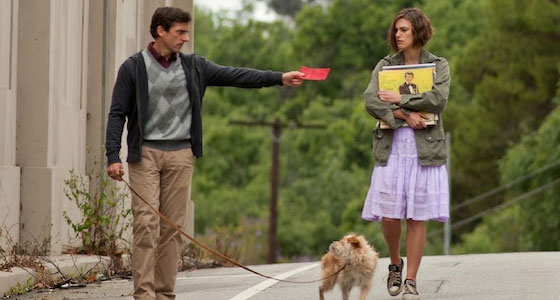
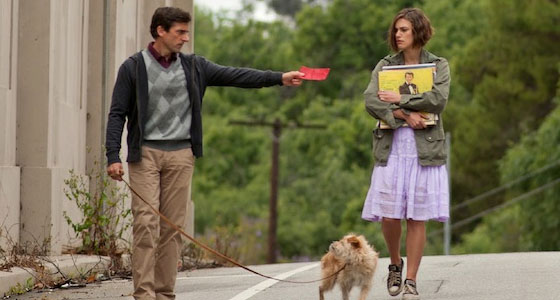
Steve Carell and Keira Knightley in Seeking a Friend for the End of the World
Seeking a Friend for the End of the World, from writer–director Lorene Scafaria (Nick and Norah’s Infinite Playlist), is a charming and oddly pleasant romantic comedy set against the backdrop of the last three weeks before the Earth is destroyed by an asteroid’s impact. Unfortunately, Seeking a Friend seems to have missed its cultural moment: it not only comes on the heels of 2011’s limited-perspective apocalypse dramas Melancholia and 4:44 Last Day on Earth, but it unironically presents a quintessential Manic Pixie Dream Girl in the year of her deconstruction, from Zoe Kazan’s Ruby Sparks to Parker Posey’s character Liz on the television series Louie. 2012 phenomena aside, Seeking a Friend feels like it ought to have come out around the turn of the millennium, the last time the cultural collective was fixated on The End. As it is, Seeking a Friend for the End of the World feels hopelessly dated and out-of-touch. 
Steve Carell stars as the too-on-the-nose named Dodge, the Inhibited Sad Sack who needs Keira Knightley’s Manic Pixie Dream Girl Penny to deliver him from his lonely joyless life.  Penny is 100 proof MPDG, from her introduction where she literally throws herself into Dodge’s arms through his apartment window when he checks in on her during a apocalypse/breakup-induced crying session on the fire escape, to her seemingly serious medical condition that’s presented as quirky and precious (hypersomnia); her misplaced priorities (fleeing her home as a rioting mob descends, she grabs as many vinyl records as she can carry and screams to the others, “Goodbye, Friends!”) to her improbably sunny disposition (when Dodge tries to prompt her to think of things she won’t miss about the world, she even finds sympathy for her dentist).
Keira Knightley as Penny
It is unusual to find such a classic Manic Pixie in a film written by a woman, but at least Scafaria crafts Penny so that she has her own motivation outside of fixing what’s left of Dodge’s life.  After missing the last of the commercial flights to the UK where her family is, she agrees to help Dodge get to the home of his high school sweetheart in exchange for him taking her to “someone I used to know who has a plane.”  In one of the most touching scenes, Penny is able to contact her family via satellite phone (cell service has been discontinued for reasons I didn’t quite understand), and in that moment she seems like a real person with a real history, completely independent from Dodge or any other man.
But for the rest of the film (most notably, the conclusion), Penny seems to exist to save the spirits of Dodge. If Seeking a Friend for the End of the World were just a touch more artful, I would surmise it was using setting to further deconstruct the Manic Pixie Dream Girl. Because what better time to meet an Manic Pixie than the last two weeks before the apocalypse, when everyone is acting on hedonist impulses, and long term consequences are not a concern?  At the end of most Manic Pixie Dream Girl films, the credits roll and the audience has to suppress cynical speculation as to how the rest of the MPDG and the Sad Sack’s relationship would play out, wondering how such a dynamic could possibly be sustained.  As Seeking a Friend for the End of the World fades to white, we’re free from these doubts.  Dodge and Penny’s whirlwind romance doesn’t have to work very hard to last until the end of time.  

The Zoe Saldana / Nina Simone Biopic Controversy Illustrates the Need for More Black Women Filmmakers

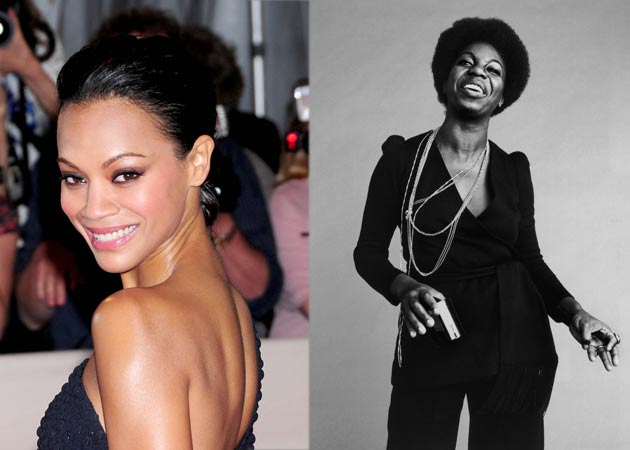
(L-R): Zoe Saldana and Nina Simone; image via Black Street

When Zoe Saldana was recently cast as legendary singer Nina Simone in her upcoming biopic, the decision ignited a firestorm of controversy. People have vehemently criticized the decision. Not because Saldana isn’t a skilled actor (she is). But because her skin is much lighter than the music icon.

I’ve wanted to write about this topic for awhile now. But how can I, a white woman, do justice to the complex issue of race?
I’ll never know discrimination or oppression based on the color of my skin. But I realized that while the whitewashing of Hollywood remains an ongoing conversation in the Black community, it’s not a discussion amongst everyone. And it should be.
Nina Simone’s daughter Simone spoke to Ebony about why skin color should matter in the casting of her mother’s biopic:

“I can guarantee that the sense of insecurity and the questioning of one’s beauty that results from a grownup telling you that as a child you’re too black and your nose is too wide, remained with her [her mother Nina Simone] for the rest of her life.” 

At The Huffington Post, Nicole Moore writes about Nina Simone and the “erasure of black women in film”:

“Because Simone’s blackness extended as much to her musical prowess as to her physicality and image, it’s perplexing that the film’s production team, led by Jimmy Iovine, expects anyone, particularly in the black community, to (re)imagine Nina Simone as fair-skinned, thin-lipped and narrow-nosed? I guess if you look at Hollywood’s history of casting black female roles, especially in biopics, it’s not all that surprising.”

Hollywood has a massive race and gender problem. Black women’s bodies belong to a dichotomy suffering from either fetishization or erasure. When Black women appear in media, which doesn’t happen nearly enough, they suffer from stereotypes of mammies, jezebels and sapphires. And too many producers and directors clearly don’t understand the nuances of race, thinking any person of color will suffice.

Clutch Magazine’s Britni Danielle writes about the biopic and Hollywood’s massive misunderstanding and insensitivity when it comes to women and race:

“In the past few years Hollywood has consistently gotten it wrong when it comes to telling black women’s narratives. From the questionable choice of casting Thandie Newton as an Igbo woman in the film adaptation of the novel Half of a Yellow Sun and Jennifer Hudson as Winnie Mandela, to Jacqueline Fleming, a biracial woman, playing Harriet Tubman, when other people are in charge of portraying us, it seems like any brown face will do.”

The Atlantic’s Ta-Nehisi Coates also finds the “bleaching of Nina Simone” problematic and reinforcing systemic racism:

“But this casting (with no shot taken at Saldana) manages to both erase the specific kind of racism Simone contended with and at the same time empower it.”  

Most white people probably don’t realize the painful history of colorism and skin shade hierarchy — dark vs. light skin — Black women continually face. When the media portrays Black women, we often see women with lighter skin and more Caucasian features. Both L’Oreal and Elle photoshopped Black women — Beyonce and Gabby Sidibe — to make their skin appear much lighter. In film, advertisements and magazine spreads, the media often whitewashes black women, continually perpetuating the unachievable attainment of the white ideal of beauty.

At The Daily Beast, Allison Samuels writes about “the myth of black beauty” and skin color:

“Skin color and its importance around the world—and particularly in the African-American community—has been a hot-button issue for generations. The debate over skin color and its painful origins dates back to the days of slavery, when lighter skin often equaled a better overall quality of life. With more pronounced European features, bearers of a lighter complexion were also considered more attractive than their darker-skinned peers. Possessing this trait was believed to open the cracked doors of opportunity ever wider.”

Due to white privilege, white people don’t agonize over their skin color. We don’t have to worry if someone will harass us or follow us around in a department store, thinking we’re going to steal merchandise simply because of our skin. If we move, we don’t have to worry about finding neighbors who don’t like us because of our skin color. We don’t have to fret over something as simple as putting on a Band-Aid which won’t match our skin tone.

My point is this: we don’t ever have to think about race. Sure, we can if we want to. But we don’t haveto. And therein lies the privilege.
But Spectra, an amazing Afrofeminist writer, asserts the dark vs. light skin in the Zoe Saldana/Nina Simone biopic debate misses the point about Black women in the media. She poses that Black women must create media in order to reclaim and tell their own stories: 
“The hard truth is this: if we spent more time creating media instead of criticizing it, there’d be way more diversity in representation, and way more stories and perspectives to which white people can be more frequently held accountable. 

“Pushing for ownership of both the infrastructure and content that portrays our lived experiences – that is the crux of the issue; not just the politics of light vs. dark-skinned actresses. So, whereas I am completely on board with calling out the colorism behind the biopic’s casting choices (and the harmful message that’s being sent to young, dark-skinned black girls everywhere by having a light-skinned woman play Nina Simone) there aren’t enough strong lead roles written for women of color in Hollywood for me to fairly tell Zoe Saldana, a hard-working, talented brown woman to ”sit this one out.”

Here at Bitch Flicks, we talk a lot about the need for more female filmmakers and women-centric films. One of the takeaways from the Zoe Saldana/Nina Simone controversy is that we desperately need more women of color filmmakers.

The Help crystallizes Hollywood’s problem with Black women. Sure, we see strong and complex Black women telling their stories of discrimination and hardship to writer Skeeter (Emma Stone). But even in a film containing the inarguably talented Viola Davis and Octavia Spencer giving phenomenal Oscar nominated and Oscar-winning performances, it still remains a racially problematic film. Even in a film that supposedly champions Black women, it ultimately revolves around a white female protagonist’s perspective.
While women filmmakers don’t merely depict female protagonists, when more women are behind the camera, we tend to see more women in front of the camera. Looking back at this year’s movies, female-fronted films such as Brave, The Hunger Games, Prometheus, and Snow White and the Huntsman graced the big screen. We saw women-centric indies like Your Sister’s Sister, Take This Waltz, For a Good Time Call… and Bachelorette. We even witnessed strong women in male-dominated movies like Catwoman in The Dark Knight Rises and Black Widow in The Avengers.
But when you look at the female protagonists — aside from Beasts of the Southern Wild, Sparkle, The Lady, Girl in Progress and Celeste and Jesse Forever which all featured women of color in lead roles — you’ll notice their overwhelming whiteness.
Perhaps if we had more Black women filmmakers, we would see more nuanced and diverse depictions of Black women on-screen.
Now, that doesn’t mean white women and men can’t or shouldn’t write strong, complex Black female characters. But it does mean white people have to stop appropriating Black women’s narratives, especially if we’re not going to take the time to attempt to understand the intricate and painful complexities of the light vs. dark skin stigma. And we’ve got to stop pretending we live in a post-racial society. We don’t.
We need more films from Black women directors like Ava DuVernay, Dee Rees and Julie Dash. But we aren’t seeing enough Black women in front of or behind the camera. In her Women and Hollywood cross-post, Evette Dionne wonders “Where are the black women film directors?” She explores the “exile of black women film directors” by studios that refuse to fund their work.

“So black women, one of the most sought after audience demographics for movie studios, aren’t behind the camera providing insight into our culture. This leads to a misrepresentation of the black community on the silver screen. Often, we are caricatures of ourselves, as evidenced in Jumping the Broom and other projects, which leads to resentment for what the media machine represents in our communities.”

When a young Black female tennis player is told she’s too fat to receive funding, when the Swedish Minister of Culture and rapper 2Chainz eat racist cakes of dismembered Black women’s bodies, when the media cares more about criticizing Olympic gold-medal winning gymnast Gabby Douglas’ hair than her performance — we as a society clearly have a fucked-up, racist and misogynistic problem denigrating and oppressing Black women.

Last year, I had the overwhelming privilege of meeting one of my feminist idols, Professor Melissa Harris-Perry (squee!!). After her brilliant and empowering speech on her must-read book Sister Citizen, she graciously stayed afterwards and spoke to each and every person. When I finally got my chance to talk to her, I gushed about how much I loved her and how she needed her own TV show (and this was BEFORE her fantastic MSNBC weekend show was announced!). I also asked her how to be a good ally to women of color. She gave the simplest yet hardest advice of all. Listen. When in a room with women of color, she said to be silent, listen and let them speak for themselves. When you find yourself in a space with no women of color, that’s when you need to speak up.
So we white women (and men) need to speak up against racism.
When people talk about the need for more women in media — sadly, they often mean white women. Many of us who write about the need for women’s representation in film or women-created media feel satisfaction when we see white female leads on-screen and white female writers and directors. But that’s got to change. We need films to portray women of all races, created by women of all races — not just white women and think we’ve somehow achieved some semblance of equity.
White women and men filmmakers need to realize the damage they wreak when they only cast light-skinned Black women (if they cast women of color at all), especially in a biopic of a famous Black woman with dark skin.
It’s time for us white women to listen. Listen to black women. Listen to their needs and wants and support them from the sidelines. We can’t merely be satisfied when any woman stands on-screen. Black women must be behind the camera, telling their own stories.


A Gilded Cage: A Feminist Critique of the ‘Downton Abbey’ Christmas Special

This is a guest review by Amanda Civitello and is published with permission. Note: this review contains no spoilers for Season Three.
“Christmas at Downton Abbey” (The Christmas Special). Downton Abbey: Season Two Original UK Edition. Writ. Julian Fellowes. Dir. Brian Percival. Masterpiece Classic/PBS Distribution, 2012.

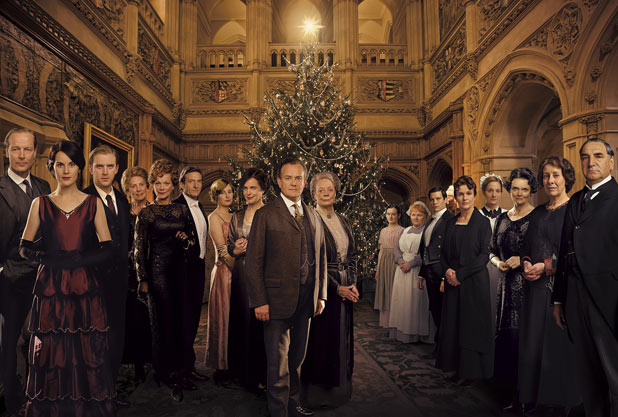
The cast of Downton Abbey
The Emmy-nominated second season of Downton Abbey opened with its characters on the precipice of the destruction of their rarified pocket of Edwardian English aristocracy, with the Great War at Downton’s doorstep. [i] The season’s final episode, “Christmas at Downton Abbey,” submitted as part of the PBS Masterpiece 2012 Emmy campaign, mostly avoids talk of social upheaval in favor of returning to the human drama that was so popular in the first season. The Great War, explored at length during the second season, has already wrought significant – though frequently indirect – change at Downton Abbey. Youngest daughter Lady Sibyl, who trained as a nurse during the War, is now married to the family chauffeur-turned-Republican-journalist and at home in Ireland for Christmas; heir apparent Matthew’s fiancée Lavinia has succumbed to Spanish flu, having outlived her usefulness once Matthew recovered from his battle injuries; and Lord Grantham’s wealthy, widowed sister Lady Rosamund has brought home a new beau for the holidays – and that’s just the news from upstairs.
Lady Rosamund’s narrative thread plays second fiddle to the episode’s main concerns, the murder trial of Lord Grantham’s valet, John Bates, and the imploding engagement of eldest daughter Lady Mary to newspaper magnate Sir Richard Carlisle. The tempestuous and controlling relationship between Lady Mary and Sir Richard is worthy of an in-depth feminist critique, but because its development occurs over several episodes, it’s not feasible to do it justice in this piece. However, the Christmas special’s treatment of Lady Rosamund and her love interest, fortune-hunter Lord Hepworth, encapsulates most concisely the paternalistic, patriarchal society in which they lived. Moreover, Lady Rosamund’s story serves as a useful way to begin a discussion about the way that Downton Abbey portrays two of the senior ladies of the family: Lady Rosamund and her sister-in-law, the Countess of Grantham.
In the first and most of the second seasons, Lady Rosamund is essentially a plot device who interferes in her nieces’ lives and runs reconnaissance for her mother when necessary to move the story along. Fortunately, the considerable talent of Samantha Bond rescues the character from marginalized oblivion. Lady Rosamund is compelling, even when her scenes don’t contain very much for her to do. There’s a complexity and nuance to Bond’s performance that makes Lady Rosamund someone worth caring about, in part because she’s an actor who makes excellent use of her voice. She’s very much like Maggie Smith in that respect: they are both cognizant of the voice as a flexible, powerful instrument and exercise it accordingly.
“Christmas at Downton Abbey” finally gives Lady Rosamund a storyline of her own, and one worthy of Bond’s thoughtful portrayal. Lady Rosamund’s suitor’s family fortune is so diminished that, as the Dowager Countess of Grantham puts it, “he’s lucky not to be playing the violin in Leicester Square.” Indeed, Hepworth only apprises Lady Rosamund of his dire financial straits at the insistence of the Dowager Countess. “I’m tired of being alone,” Bond’s Lady Rosamund says, and the brilliance of the portrayal is that she sounds exhausted; there’s only the barest glimmer of enthusiasm for a new romance. Lady Rosamund acquiesces to the best future she thinks she can buy: heartbreakingly, she adds, “And I have money.” In Bond’s hands, Lady Rosamund doesn’t sound desperate, as her words would suggest; rather, she’s resigned to an unfortunate, uncomfortable reality. She knows how society values her – and it’s not for her intrinsic merits, but rather for her late husband’s considerable fortune. She’s shrewd: she knows she’s entering into a business arrangement as much as anything else, but she’s motivated by her desire for a partnership as well. When she catches Hepworth bedding her maid, Shore, Lady Rosamund is certainly stung by the betrayal: “I just can’t stand it when Mama is proved right,” she declares, bitterly. She knew he wanted her for her money; she simply dared to hope for more.
But Lady Rosamund is not the only person charting her course. Unbeknownst to her, her mother and brother discussed the match and its ramifications before she discovers Hepworth’s duplicity. “Is a woman of Rosamund’s age entitled to marry a fortune-hunter?” the Dowager Countess asks her son. Yes, he concedes, providing she’s been made aware of the circumstances, “but for God’s sake, let’s tie up the money.” It’s clear that Lady Rosamund finds herself trapped in a gilded cage. She is twice damned: as a widow, she’s essentially passed back to her family, who permit her to make significant life decisions; and despite the independent image she presents, the final say regarding her finances rests with her brother. 
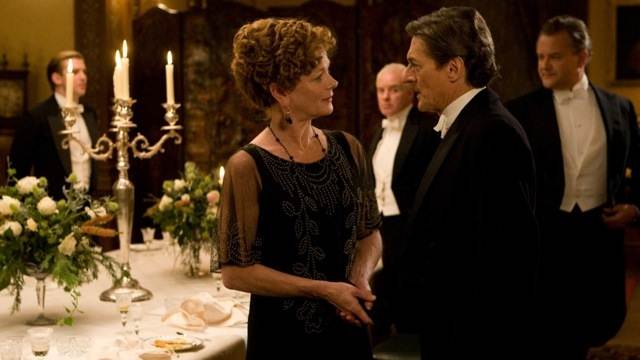
Lady Rosamund and her beau, Lord Hepworth
Of course, it’s not a personal slight against Lady Rosamund. The paternalism that Lord Grantham exhibits (and that his mother defends) isn’t the fault of the show: Downton Abbey is, after all, a historically-minded serial; writer Julian Fellowes can’t help the prejudices of the time period. While there’s historical precedent for a woman in Lady Rosamund’s position, the show is fictional and so functions within its own universe, with its own rules. We can watch with an eye toward parallelisms because the world of Downton Abbey is a carefully crafted one, and contrasting Lord Grantham’s handling of his own history and his sister’s nascent romance invites the viewer to realize the prevalence of paternalism in aristocratic families. It’s not accidental that Lord Grantham himself was a fortune-hunter actively searching for a bride wealthy enough to rescue Downton Abbey. The Countess of Grantham and Lady Rosamund are commodities, and their value is their net worth. Lord Grantham doesn’t much mind what his sister does with her affections so long as her money is tied up; some thirty years earlier, he didn’t much mind who he married so long as she balanced his accounts. Julian Fellowes’s use of parallelism in the narrative is shrewd: we discuss these issues because of the way he chooses to tell the story.
That’s not to say that Fellowes is waving the feminist flag; he’s not. He’s in the business of writing well-crafted, witty scripts that tell a good story and maintain as close a degree of fidelity to the historical record as possible. The choices he makes as the writer are entirely to that end. Sometimes, they’re pro-woman, whether in a roundabout way, as in asking the audience to consider what life used to be like, or in a more explicit manner, such as Sybil’s interest in woman’s suffrage and ambition to work and pursue a more autonomous life for herself.
In other instances, however, the show shies away from the most challenging of its subplots. The Christmas special is notable for the storylines which it does not address, and the three most prominent of these concern women: the unresolved question of Lord Grantham’s infidelity; Lady Grantham’s sense of purpose derived from running the hospital housed in her home during the war; and the inter-class intimacy that develops between Lady Grantham and her lady’s maid Sarah O’Brien following the former’s miscarriage in the season one finale.
The first two missed opportunities are linked: as presented in the season, Lady Grantham finds such meaning in her work for the hospital during the war that she initially can’t contemplate returning to her old life of attending to her social obligations. Her husband bristles at her newfound direction, which means she has less time for him. During the seventh and eighth episodes, his flirting with a housemaid, Jane, becomes more and more serious, culminating in an encounter halted only by the precipitous interruption of Lord Grantham’s valet. After Bates leaves, Lord Grantham seems to have reevaluated the situation and remembered his marriage vows – and the fact that his wife is next door, gravely ill with the Spanish influenza.
These two storylines, though linked, fail in their portrayal of women in different ways. In the instance of Lady Grantham’s independence, her narrative simply peters out. In the penultimate episode, Lady Grantham apologizes for “neglecting” her husband; by the Christmas special, she has happily returned to playing lady of the manor, worrying over whether there’s sufficient time to change for dinner.
The apology in question occurs just after Lady Grantham’s brush with death; in response, Lord Grantham simply says, “Don’t apologize to me.” But refusing her apology doesn’t absolve Lord Grantham of his guilt; nor does he seem to have any inclination to admit his indiscretion to his wife. From a feminist perspective, this is a perplexing editorial decision. The script allows Lady Grantham’s apology to stand, because she wasn’t the wife she was supposed to be. He might not accept it, but she’s the one who says the words. Lady Grantham’s tentative steps toward greater independence are immediately retracted; she apologizes for it. In a drama serial that deals primarily with interpersonal relationships, there’s no compelling reason to not address Lord Grantham’s infidelity. In the end, it’s Lady Grantham who’s punished and corrected.
The other missed opportunity in the “Christmas at Downton Abbey” concerns Lady Grantham and her lady’s maid, Sarah O’Brien. In the last episode of the first season, O’Brien’s anger at Lady Grantham’s perceived slight takes a fateful turn when she deliberately endangers her mistress and inadvertently causes Lady Grantham to miscarry. Throughout the second season, then, O’Brien channels her guilt into taking extraordinary care of her mistress; their relationship is characterized by increasing complicity and mutual affection. It is O’Brien who nurses Lady Grantham through her grave bout with Spanish influenza. The overtures of friendship are never quite realized, however, and O’Brien’s touching, climactic scene in which she asks Lady Grantham’s forgiveness occurs when the latter is delirious with fever. Having made the affection she feels for her mistress readily apparent (Mrs. Patmore, the cook, comments on it), O’Brien’s devotion is even acknowledged by Lord Grantham, who actively dislikes her. The Christmas special, however, never addresses the issue at all. It’s a missed opportunity to consider female friendship within a socio-economic context: after all, O’Brien has waited exclusively on Lady Grantham for over fifteen years, resulting in a curious master-servant relationship marked by necessary affinity and learned intimacy. Their tentative steps towards greater familiarity would be an interesting avenue for the show to explore, given the increasing social mobility that’s on the horizon. The fact that the storyline is wholly ignored in the Christmas special is disappointing.
Indeed, the lack of female friendships is a curious omission in Downton Abbey. There is minimal complicity between the main upstairs female characters: most relationships are marked by outright dislike or disinterest. It’s disconcerting; these ladies who are perfectly charming, each and all, around men, but who seem to lack any kind of amity with other women. When moments of camaraderie do come, they are typically between the ladies and their maids: Lady Sybil befriends Gwen, a housemaid, in the first season, but Gwen leaves Downton; eldest daughter Lady Mary has an affectionate relationship with her maid, Anna, that’s similar to her mother’s with her lady’s maid. What renders the dearth of female friendship so extraordinary is that it would have been unusual at the time. [ii] By rendering women either objects of desire or economic necessity, and essentially presenting them only vis-à-vis men, Downton Abbey doesn’t engage with its female characters as fully-realized people. They only rarely step outside of a male-defined paradigm, and when they do, they’re inevitably walked back. Gwen leaves Downton, content with her new job; Lavinia dies on the cusp of a budding friendship with Mary (complicated, of course, by Mary’s continued affection for Lavinia’s fiancé); O’Brien cries bitter tears at her mistress’s bedside and is treated no differently from anyone else on the receiving line for the staff’s obligatory Christmas presents. 
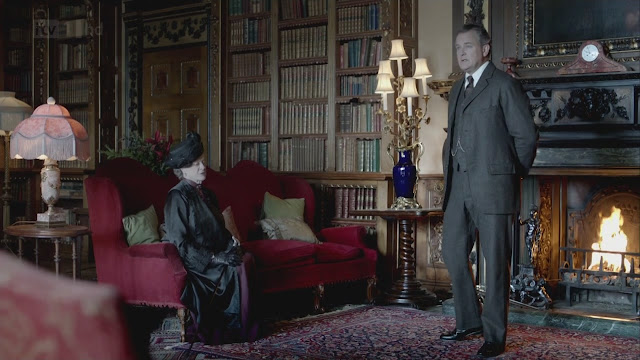
Lord Grantham and the Dowager Countess discuss Lady Rosamund’s finances
Ultimately, the lens of patriarchy influences the female characters’ understanding of their self-worth. Lady Grantham tells her daughter that she’s “damaged goods” in the first season after Lady Mary loses her virginity to a handsome, rogue diplomat. Initially we bemoan Lady Grantham’s inability to empathize with her daughter’s plight. As the series progresses, that opinion begins to change. By the Christmas special, when Lady Grantham’s steps to independence have been halted by her husband, it’s possible to see that early scene with Lady Mary in a new light: if Lady Grantham understands her daughter’s worth to be entirely wrapped up in her virginity (read: her marriageability), what does that say about her own sense of self? Julian Fellowes’s tendency to return to similar themes in new contexts enables his audience to reassess those early impressions. In this instance, the audience reconsiders the knee-jerk condemnation of Lady Grantham so as to sympathize with her plight as well. For all that she’s terribly wealthy and beautiful, she’s not expected to be much more than that. What’s sad is that she doesn’t expect to be, either; when she does, she’s put back in her place by her courtly – but no less paternalistic – husband.
Downton Abbey is, in effect, a thoughtful portrayal of the harsh reality of aristocratic women’s lives that lurked beneath the gilded exterior. They lacked autonomy and individual agency, were frequently treated as commodities, and the patriarchal, paternalistic society in which they moved colored their own self-worth. Men like Lord Grantham, as much a product of that society, nevertheless perpetuated their privilege, becoming active apologists for the very hierarchy that constrained their daughters. But beyond the beautiful clothes and the fabulous sets and the compelling acting is strong writing and purposeful manipulation of narrative structure. Julian Fellowes has rightly received glowing criticism for Downton Abbey’s plethora of witticisms and sharp one-liners, but the real achievement is in the narrative’s use of parallelisms to explore a single theme from different angles. 

———-

[i] While the term “Edwardian” derives from the reign of Edward VII of England (1901-1910), historians sometimes extend the upper bound to include the sinking of the RMS Titanic (1912) or the start of European hostilities in the First World War (1914). For aristocratic families like the Crawley family at Downton Abbey, the rigid classism and social hierarchy (and its attendant mores) continued well into wartime.

[ii] Sharon Marcus’s excellent 2007 Between Women: Friendship, Desire, and Marriage in Victorian England is a wonderful, immensely readable but rigorously scholarly exploration of the full spectrum of female friendships, from the platonic to the intensely erotic. However, Marcus’s data is primarily drawn from sources written by historical women of the middle class, and some of their experiences (going to school, e.g.) would not have applied to any of the Crawley daughters. Lillian Faderman deals with the spectrum of friendships in the United States in roughly the same time in 2001’s To Believe in Women: What Lesbians Have Done for America, which includes chapters on upper-class women.

———-
Amanda Civitello is a Chicago-based freelance writer and Northwestern alum. She’s written on Daphne and Eternal Sunshine of the Spotless Mind for Bitch Flicks. You can find her online at amandacivitello.com.


Listening and the Art of Good Storytelling in Louis C.K.’s ‘Louie’


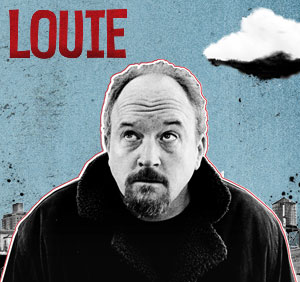
Louis C.K.’s Louie
“I remember thinking in fifth grade, ‘I have to get inside that box and make this shit better’… It made me mad that the shows were so bad. People have a right to relax and watch theater about themselves that makes them reflect and feel and have a good time doing it.” – Louis C.K.
The subversive feminism of a show is most striking when it is underneath, not necessarily a part of, the writing. From season 1 of FX’s critically acclaimed Louie, it has been clear that Louis C.K. isn’t trying to make some grand commentary on gender or social norms. He’s simply weaving stories out of life.

Louie–starring C.K. as Louie–is one of those shows that doesn’t leave a feminist audience balking at stereotypes or scrambling to celebrate its female empowerment (although C.K. is, in general, a feminist darling). In fact, its power lies in its ability to allow us to not think too much about gender; instead, we are focused on the stories and the sheer humanity of the characters. 

Louie is a single father co-parenting two daughters in New York City and working as a comedian. The obviously semi-autobiographical sitcom is wrapping up its third season next week. A TV auteur, C.K. produces, writes, directs, edits, and stars in each episode. He has been nominated for three Emmy awards for the series (for acting, directing, and writing).

Early on, audiences felt there was something different about Louie. The best way to describe the ebb and flow of comedy and dramatic genius would be intensely human. Everyone is flawed (not just Louie, and not just his love interests and friends), and his relationship with his on-screen daughters is particularly moving in its stark honesty. We worry, panic, yearn, laugh, and cry along with our protagonist.

Parenting–a subject most often reserved for the action and commentary of mothers–is central to C.K.’s stand-up and to Louie. In the show, Louie is consistently shown as a capable father who loves and is loved by his daughters. He’s no heroic single father, but we see him as a parent, nothing less. On the subject of gender roles in parenting, C.K. has said, “Roles have all changed. There’s a lot of fathers who take care of their kids, there’s a lot of mothers who have careers. But in culture, those roles are still the same. When I take my kids out for dinner or lunch, people smile at us. A waitress said to my kids the other day, ‘Isn’t that nice that you’re getting to have a little lunch with your daddy?’ And I was insulted by it, because I’m like, I’m f**king taking them to lunch, and then I’m taking them home, and then I’m feeding them and doing their homework with them and putting them to bed. She’s like, Oh, this is special time with daddy. Well, no, this is boring time with daddy, the same as everything.” This philosophy is clear in Louie.

Louie eats dinner with his two on-screen daughters.

C.K.’s stand-up acts frame the plot(s) of each episode, which are usually independent to what has happened in previous episodes. This season alone, Louie has dealt with being sexually assaulted on a date (although some bloggers problematically downplayed the assault in semi-celebration of the challenged double standard), wrestling with a friendly attachment to a young handsome man on a trip to Miami, and experiencing awkward encounters with women as flawed as he is. He is frequently depicted as having the more stereotypically feminine role in relationships (emotional, needy, and looking for serious companionship). Previous seasons have featured him having sex with (and being inspired by) Joan Rivers, dealing with childhood issues surrounding religion and sexual awakening, and being an adequate son and brother. His daughters are continually portrayed as empowered and fully realized (including one episode in season 2 in which his youngest daughter helps scare off some teenage thugs on Halloween). As the girls grow up, their character traits become more pronounced and realistic.

Parker Posey plays one of Louie’s love interests in season 3.

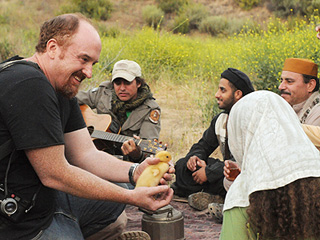
Season 2’s critically acclaimed “Duckling” was an hour-long episode that followed Louie on a fictional USO tour to the Middle East. According to C.K., it was an accurate depiction of his real experiences on a USO tour to Afghanistan, and the idea for the episode came from his daughter, who was four at the time.

And for his show in general, C.K. says, “I just like listening. I try to take people who are way far away from what I think or understand and put a representative of them on my show.”


Indeed, one of the aspects of C.K. as a comedian, producer/director/writer/actor, and person that makes him who he is and Louie what it has been is that he listens. He listened to a four-year-old little girl and created a television show that is up for an Emmy. It’s also clear that he spent his original trip doing a great deal of listening to his fellow USO performers and the soldiers he met. That is what leads to great storytelling.

C.K. used his own experiences and inspiration from his daughter to create “Duckling” in season 2.


Outside of the television show, C.K. has also made it clear that listening is key to everything he does. After Daniel Tosh’s rape joke went viral earlier this summer, C.K. was brought into the spotlight after tweeting a complimentary tweet to Tosh (which he said he sent not knowing about the rape joke or the backlash). In an interview with Jon Stewart, C.K. addressed the fact that he listened to the bloggers–feminists, comedians, feminist-comedians–and altered his thoughts about the situation. He said, I think you should listen when you read – If somebody has an opposite feeling from me, I wanna hear it so I can add to mine. I don’t wanna obliterate theirs with mine; that’s how I feel.” He went on to say that in being enlightened to the true ramifications of rape culture: Now that’s part of me that wasn’t there before.”

In an interview with NPR last winter, C.K. was asked about his thoughts on those who identify as “right-wing” (after a discussion about Christians often stumbling across his stand-up after seeing a mild clip and asking him to “clean up” his comedy): “There’s been a lot of simple vilification of right-wing people. It’s really easy to say, ‘Well, you’re Christian, you’re anti-this and that, and I hate you.’ But to me, it’s more interesting to say, ‘What is this person like and how do they really think?’ Do I have any common ground with people like that who find me really, really offensive? Do I have common ground with them? It’s worth exploring.” C.K. clearly explores every piece of life he encounters, and that seeking, that analysis, makes all of the difference.

It’s no secret that listening to others’ stories leads to better storytelling (listening well pretty much leads to better everything). However, it’s rare that we witness that kind of storytelling on half-hour TV sitcoms. On the surface, a show produced, written, directed, and edited by one man (who also stars as the protagonist and is a comedian) doesn’t sound like it would be the panacea for three-dimensional storytelling. But as C.K. continually shows his audiences, episode after episode, listening to others and thinking about life critically has led him to accurately tell stories in a fully human way.

In an interview with the New York Times last summer, C.K. said, “An uphill battle is just more interesting to me.” Choosing to not rely on tropes and recycled story lines and stock characters is an uphill battle, but as Louie demonstrates, what’s on top of that hill is well worth the climb.


Leigh Kolb is a composition, literature and journalism instructor at a community college in rural Missouri. 

Seeking the Alpha in ‘Breaking Bad’ and ‘Sons of Anarchy’

**I’m assuming that the people who are reading this article, have caught up pretty far into both of these shows, so some spoilers are present.

In the past few years I’ve noticed a shift in the televised portrayal of the villain. Character shows such as Mad Men, the Sopranos, Breaking Bad, Sons of Anarchy, Game of Thrones, and several other high-profile shows are now highlighting the complicated nature of humanity. Rather than black and white hero and anti-hero, we have character portrayals that feature more in-depth considerations of choices and the motivations that drive those choices. While few would agree with the behaviors espoused by these protagonists, neither can we hate them; instead, we’re drawn further into their world, a grittier one not shown on the mainstream shows. 

Breaking Bad


High school chemist turned god-like meth creator. Walter White’s (Bryan Cranston) journey from quiet grading to bloody drug kingpin is engrossing and incredibly well done. May I also say, that “Yo, bitch” and “Yo, Mr. White” have officially become standard in my vocabulary and I root daily for Jesse (Aaron Paul) to be a winner.

Sons of Anarchy 


Sons of Anarchy follows the misadventures of the original chapter of a motorcycle club in Central California, the Sons of Anarchy. Sons of Anarchy are an obvious reference to Hells Angel’s (which has been classified as a criminal organization by the US Department of Justice) and likewise the Sons are arms dealers who sell IRA guns to drug lords. The arrangement is more complicated than just some gun runners though, the Sons of Anarchy are a respected organization in their small town of Charming; they own the police and in exchange for their cooperation and silence, protect Charming from drugs and gang violence. The show is further complicated by it’s Hamlet-esque plot line for the young protagonist, Jax (Charles Hunnam), who begins to doubt the Sons actions and wants to move away from arms dealing (although he manages his fair share of brawls, murders and the occasional knife fight).

Being from Northern California, the backdrops and town names are familiar to me, as is the sight of a large group of bikers cruising down a California highway. Even the sights of New Mexico in Breaking Bad seem homelike, with that crisp desert and blue sky. I find it interesting that both shows take place in the West—the home of cowboy justice; the Wild West still holds some draw to us and remains the place where fortunes can be made and men become men.

Anyone would say that Walter White from Breaking Bad is a raging egomaniac trying to become an alpha male (“I’m the one who knocks”) and that the Sons of Anarchy are territorial egomaniacs who seek to maintain their alpha male status. Both groups of men, while able to beat-up various other bad guys with impunity and whose criminal activities just serve to fuel their need to do so, constantly reiterate that their violent activities are necessary for the protection of their families.

Each group uses family and honor as a justification for their own aggressive desires, espousing an almost medieval chivalric code of honor, one where “the family” is paramount, but pride, strength, and respect are the true priorities. This portrayal of such harsh masculinity is one where the only way to reclaim one’s sense of honor and control, is through violence.

The men in each of these shows maintain this violence with constant rationalizations about how they and their protection is needed by the ones they love. Jax puts a man into the hospital with a horrific beating when he discovers that he sold drugs to his ex-wife. Walt kills Tuco and his cousin, up close and personal, because he believes that they might hurt his family. Vigilantism and backdoor deals are treated as the only way to keep their families safe, despite the obvious truth that it’s that very behavior which has brought them to that point.

There is an obvious hierarchy displayed by each group: either you’re smart enough to live outside of the law, or you’re a sheep. These men who embrace a counterculture lifestyle, place themselves, their intellect, even their consciousness at a higher level than those around them, as if they are entitled to live the way that they do because they remain free from it’s taint. Their honor remains intact because their motivation (family, freedom, love) is pure (or so they believe), a fact that places them above common gangsters.

However, the reasons for the justification have to remain pure as well, meaning that gender roles, must be strictly upheld, otherwise, what are they fighting for? Walt resents Skyler’s need to work, only being supportive when she is actually laundering money for him. His sexual dominance towards her increases as well, needing to feel in control of her behavior.

Sons of Anarchy especially uses gender roles with women pushed into two groups, prostitutes to be played with and passed around the men, and the legitimate “Old Ladies” who are the matriarchs. While these women (in particular Gemma and Tara) are afforded great respect, they are still expected to oversee the comfort and maintenance of the families, while also turning a blind eye to any wayward straying of their men.

The women in Sons of Anarchy are complicated and full of their own issues and ideas and even their own unethical and immoral rationalizations. For me, one of the most interesting arcs of the show has been to see the change in Tara, an intelligent doctor who becomes dangerous in her own right when she attacks a hospital administrator who has suspended her. Gemma is likewise fierce, being gun toting, punch throwing, and threatening all on her own.

Skyler and Marie are complicated protagonists as well, and not fully innocent either. Skyler starts to launder money, has Saul on her speed dial, and arranges for Ted Beneke’s intimidation (even finishing the job herself).

Yet, even as these women are somewhat outside of the norm because of their lifestyles, I think that both shows do a great job at featuring women who are varied and interesting, many of who have reclaimed their sexual nature in spite of the way that they are manipulated and treated by the men in their lives (Bitch Flicks contributor Leigh has a great article discussing this trend).

However, those considerations are secondary to this article. Rather, the focus is this question, what does it mean to be an “alpha” among humans? Is that drive still as present as these shows say it is? And, can you be an “alpha” without being a criminal? 

Rachel Redfern has an MA in English literature, where she conducted research on modern American literature and film and it’s intersection, however she spends most of her time watching HBO shows, traveling, and blogging and reading about feminism.

Max’s Field Guide to Returning Fall TV Shows

The rosterof newtelevision shows premiering each year in the fall ought to be an exciting time for any TV fan. Unfortunately, I am a jaded, cynical curmudgeon, burned by my previous experiences in the field of new fall shows, and I read the previews with dread roiling in the pit of my stomach. In our age of podcasts, webseries, and countless other competing forms of entertainment, the networks seem to be getting more and more desperate, scraping the barnacles off the bottom of the barrel.
Broad stereotypes? Check.
Dominated by straight white men? Check.
God help us all, a new Ryan Murphy show? Check.
It’s predictably depressing and depressingly predictable. Once upon a time, as a starry-eyed viewer full of hope and gillyflowers, I had a “three-episode rule” for judging any show whose premise piqued my interest even a tiny bit. This year, I don’t expect to watch any of the new shows unless critical opinion snowballs in the course of the season.
However, fall still brings its sweet gifts even unto the cantankerous television fan, in the form of returning shows. Someof these shows have spiraled so far down the U-bend that I can’t even hate-watch them anymore, but there are still enough watchable returning shows to compensate for all the awful new ones (and to wreak havoc on my degree). In the absence of new shows that don’t make me want to claw my eyes out, here is a list of returning shows worth watching.
The Thick Of It (9/9)
I already covered this. It’s on Hulu. Watch it. (N.B. Because it is full of swears, Hulu will make you log in to watch it, and for some reason this entails declaring yourself male or female. If this disgusts you as much as it does me, and you wish to, ahem, seek out alternate methods of watching, I will turn a blind eye.)
Boardwalk Empire (9/16)
A questionable creative decision last season nearly made me rage-quit this show, but it drew me back in with a jaw-dropping finale. Slow, dense, and luscious, this isn’t a show to everyone’s taste, but I remain compelled by the epic-scale world-building of 1920s New Jersey, and especially by the way the show explores the lives of not only the rich white men who run things but also marginalized minorities: people of color, women, queer people. This is not a perfect show by any means, but it fascinates me.
Parks and Recreation (9/20)
Yaaaaay!

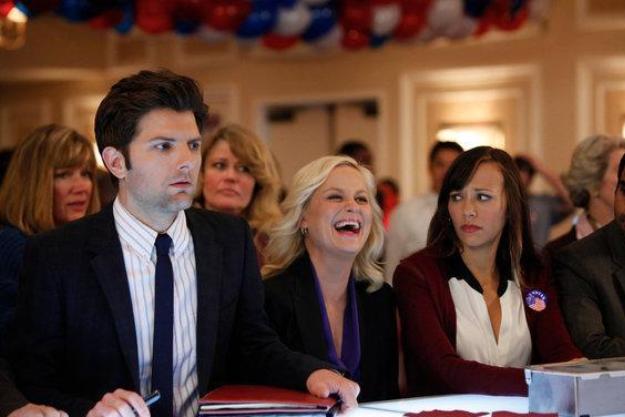
This, on the other hand, might well be a perfect show. Leslie Knope, April Ludgate, Ron F—ing Swanson… Just typing the names gives me a big goofy grin. Every episode is a half-hour ray of blissful sunshine, brightening my spirits with a healthy dose of feminism, Amy Poehler, and laughter. Roll on Thursday (by then I might even have stopped crying about the breakup of the century).
How I Met Your Mother (9/24)
I still watch this show, I guess. I can’t really remember why.
Bob’s Burgers (9/30)
The charming adventures of the most delightful animated family since The Simpsons deserve a full-length treatment on this site at some point. For now I simply say: Watch it. If the hijinks of close-knit siblings Tina, Gene, and Louise don’t fill you with joy, you have a shriveled husk in place of a soul. Also, Kristen Schaal! Eugene Mirman! H. Jon Benjamin, for crying out loud! (HEY, FX, WHEN IS ARCHER COMING BACK ALREADY?)
Tina’s my favorite. No, Gene is. No, it’s Louise. Oh, don’t make me choose!
The Good Wife (9/30)
For a sitcom-loving sci-fi nerd like myself, a legal drama is well outside the comfort zone, but this is about as good as they come. The juxtaposition of title and premise alone should grab any feminist’s attention: When her husband is embroiled in an Eliot Spitzer-style scandal, Alicia Florrick returns to the bar in order to make ends meet. The rich ironies and tensions suggested by the show’s title play out on Julianna Margulies’ understated yet beautifully expressive face as she navigates personal and professional life when she has so long been defined as Peter Florrick’s wife. And sometimes Michael J. Fox guest stars, and it’s awesome.
30 Rock (10/4)
For several seasons now, 30 Rock has been but a pale shadow of its best self, but laughs are still guaranteed, and my love for Liz Lemon is fierce and undying. I will almost certainly complain vociferously about every episode, but I wouldn’t dream of missing out on bidding farewell to the TGS crew.
It’s Always Sunny in Philadelphia (10/11)
In some ways, this is the anti-Parks and Rec: A crass and often vicious show about crass, wholly unlikeable people. You won’t see anyone hailing the Sunnygang as feminist icons anytime soon (though, for what it’s worth, the jokes are usually on the holders of prejudice rather than the victims thereof). I’d like to revisit the episodes featuring Carmen, a trans woman, to see how they stack up against the generally appalling mainstream pop-culture depiction of trans women, but I’m honestly a little afraid to do so. When Sunny misses, it misses hard, but it’s also capable of making me laugh until I cry; and, unlike a certain other 2005-premiering show mentioned above, I’m actually optimistic about the chance for creativity and entertainment in Sunny‘s eighth season.
Community (10/19)
The date is on my calendar and on my heart. Friday, October 19th, 8:30pm: The stars will align. The cosmos will come into harmony. Wars will end. Justice will prevail. God will be in his heaven and all will be right with the world.
ASDFSDALF;HDSLGJKHSJDK

Happy Birthday, Occupy Wall Street!

No, this is not a post about film or television. 
Today, September 17th, marks the one-year anniversary of Occupy Wall Street’s existence. I first wrote about OWS at Bitch Flicks on October 6, 2011 in a piece called, “We Interrupt This Broadcast … for an Occupy Wall Street Update,” in which I discuss my first experience marching and protesting with OWS. I wrote two more pieces for Bitch Flicks after that–once I started to feel a little disenchanted with the misogyny in the Occupy movement: “Occupy Wall Street and Feminism and Misogyny (Oh My?)” and “Why Facebook’s ‘Occupy a Vagina’ Event Is Not Okay.”
I published another piece I wrote about OWS at the Ms. Magazine blog, and I’ve decided to reprint it here. 
Contrary to what many people think, the movement is stronger than ever, and women have taken leadership roles and created Feminist General Assemblies (courtesy of WOW, which stands for Women Occupying Wall Street) and sites like Occupy Patriarchy. Much has been written about misogyny and feminism in the movement, and I’ve included links to articles at the Women Occupy tumblr (although I’m very behind on updating this, so the most recent pieces aren’t included here).
Basically, I want to say congratulations and thank you to all the women who’ve worked tirelessly to make OWS safer for women–and to push the needs of women to the forefront of the conversation. 

previously appeared at the Ms. Magazine blog on December 13, 2011

On the November 17th national day of action for the Occupy Wall Street movement, I was interviewed by a man from a Swedish newspaper who wanted to know why I was there. I smiled and said, “That’s the question, isn’t it?” Everyone wants to know, still, even after the two-month anniversary of a movement that’s only continued to grow stronger and gain more momentum, why people are occupying, who and what they’re protesting, and what they hope to change. I regurgitated what has effectively become The Message, “We want the power back in the hands of the people.” He seemed satisfied. But as he started to put his microphone away, I panicked.

“Wait!” I said. “There’s another reason I’m out here: I’m here to represent women.”

Dozens of articles have been written about why Occupy Wall Street matters for women. It boils down to one simple fact: Women suffer disproportionately in the current economic climate, which means that a protest for economic equality is a feminist protest—whether it admits it or not. A majority of the nation’s poor and unemployed are women, especially women of color and single mothers.

But the issue is not just what Occupy Wall Street can do for women; it’s what women have already done for Occupy Wall Street.

1970s feminists coined the phrase “the personal is political” when they noticed, by organizing a handful of women and sharing their private experiences, that their everyday struggles were embedded in larger political systems. For instance, women’s unacknowledged and unpaid labor, especially as caregivers for children, directly contributes to our country’s capitalist gains, yet women see no real compensation for it, only a persistent wage gap.

And one of the things I love most about the Occupy Wall Street movement is that it borrows so much of its activism, specifically pertaining to how the protesters interact with one another, from the feminist consciousness-raising model of the 1960s and ’70s. Like consciousness-raising, Occupy Wall Street started with small groups of oppressed people who spoke to one another about their personal struggles, and in doing so, learned they weren’t alone or insane or weak or lazy, the way Those In Charge suggested. That discovery gave them the strength to channel the individual anger and suffering they experienced into a larger collective call to action.

If the personal has ever been political in this country, take a look at the concerns driving the Occupy Wall Street movement: home foreclosures, college loan debts, health problems representing the leading cause of personal bankruptcy, lay-offs and skyrocketing unemployment rates, rapidly diminishing pensions, unaffordable education, unaffordable and inaccessible childcare. On the November 17th day of action, protesters hopped onto train cars and shared their personal stories of how the current economic inequalities have impacted them. One, using the people’s mic, said:

My name is Justin. I was a teacher before my school lost its budget and I was excessed. This is the United States of America, the richest country in the world, and somehow we can’t afford public high school teachers.

And another:

My name is Troy, and I’ve been unemployed for 10 years. Both my sisters lost their homes. I am here fighting for economic justice for everybody on this train … I am united with you in your struggle to pay your bills.

Other examples of consciousness-raising at Occupy Wall Street include discussion groups reminiscent of those started by ’70′s feminists. There’s the Divine Feminine, a group in which female-bodied or female-identified women talk about the oppressions they experience; Ambiguous UpSparkles, started by Eve Ensler, where people come together and share their personal stories of oppression using the people’s mic; and similar groups, like POCcupy (People of Color), a group for people of color to talk about oppression; WOW (Women Occupying Wall Street) and Safer Spaces, two groups that focus on the presence and safety of women in the movement.

Of course, a large part of consciousness-raising exists on the Internet, and I’ve heard people refer to Occupy Wall Street as the first-ever Internet revolution. Suffice it to say, Occupy Wall Street wouldn’t exist without the fast-as-hell sharing of information over Twitter, personal e-mail exchanges among both participants and skeptics, blogs such as We Are the 99% (a site that showcases photos of people from all over the world sharing personal stories of economic struggle), Facebook (where pages for new feminist groups devoted to Occupy camps crop up daily) and YouTube footage that captures precisely how personal struggle translates into collective political action.

It’s important to note that while early feminists focused much of their energy on gender oppression—and consciousness-raising groups later formed in which women discussed the impact of race—the protesters at Occupy Wall Street have turned the conversation toward class oppression. Of course, race, class, gender and sexuality remain interconnected, but as Felice Yeskel, who cofounded the nonprofit organization Class Action, argues:

Women talked about their experiences growing up in a gendered society as girls and the differential experiences of males and females. And when the issue of race was raised, feminists started to meet in same-race groups, with consciousness-raising for white women about white privilege … But it has never happened in any widespread way about issues of class.

By raising consciousness about the economic divide in this country, the Occupy movement protesters have the opportunity to finally start a conversation about an issue we rarely discuss in the United States—how the poorest people in this country, most of whom are women, manage to survive.

The simple fact? Without the feminist movement and discourse of the ’60s and ’70s, and the consciousness-raising tactics of the civil rights movement before it, Occupy Wall Street wouldn’t exist. We owe it to the women within the movement—and our feminist foremothers—to acknowledge women’s work, and to understand that a movement claiming to fight for the disenfranchised can’t afford to erase the contributions of women. And so I’ll leave you with the words of a woman from a 1969 consciousness-raising group, words that I can see plastered all over Occupy signs everywhere, “Women aren’t in a position to make demands now. We have to build a movement first.”

Weekly Feminist Film Question: Who Is Your Favorite Female Movie Villain?

Exploring dark complexity, spouting snappy one liners, or cruel and calculating — actors often say that villains are the most fun to play. So in this week’s Feminist Film Question, we asked you to tell us who’s your favorite female movie villain. With characters ranging from action and period drama to comedy and animation, here’s what you said!

Catwoman (Michelle Pfeiffer) in Batman Returns
Dolores Umbridge (Imelda Staunton) in Harry Potter and the Order of the Phoenix, Harry Potter and the Deathly Hallows: Part 1
Elle Driver (Daryl Hannah) in Kill Bill 
Bellatrix Lestrange (Helena Bonham Carter) in Harry Potter and the Order of the Phoenix, Harry Potter and the Half-Blood Prince, Harry Potter and the Deathly Hallows: Parts 1 & 2
Lady Kaede (Mieko Harada) in Ran
Mrs. Iselin (Angela Lansbury) in The Manchurian Candidate
Ursula (Pat Carroll) in The Little Mermaid 
 
Marquise Isabelle de Merteuil (Glenn Close) in Dangerous Liaisons
 
Mystique (Rebecca Romijn) in  X-Men, X2, X-Men: The Last Stand
 
Joan Crawford (Faye Dunaway) in Mommie Dearest
 
Annie Wilkes (Kathy Bates) in Misery
 
Maleficent (Eleanor Audley) in Sleeping Beauty
 
Velma Kelly (Catherine Zeta-Jones) in Chicago
 
Miranda Priestly (Meryl Streep) in The Devil Wears Prada
 
Nurse Ratched (Louise Fletcher) in One Flew Over the Cuckoo’s Nest
 
Lady Tremaine (Eleanor Audley), Cinderella’s Stepmother in Cinderella
Mitsuko Souma (Kou Shibasaki, Suzuka Tonegawa) in Battle Royale

Pris (Daryl Hannah) in Blade Runner
 
Mona Demarkov (Lena Olin) in Romeo is Bleeding
 
Ester (Isabelle Fuhrman) in Orphan

Heather Chandler (Kim Walker), Heather Duke (Shannen Doherty) and Heather McNamara (Lisanne Falk)in Heathers

Lian Nichang (Brigitte Lin) in The Bride with White Hair

Who are YOUR favorite female villains??

——

Each week we tweet a new question and then post your answers on our site each Friday! To participate, just follow us on Twitter at @BitchFlicks and use the Twitter hashtag #feministfilm. 

Bitch Flicks’ Weekly Picks

Megan‘s Picks:

“No Love in the Wild” [on Beasts of the Southern Wild] by bell hooks via NewBlackMan (in Exile)

Black Power Takes Center Stage at TIFF with Angela Davis Documentary by Melissa Silverstein via Women and Hollywood

Fox Host to Scarlett Johansson: “You’re Worth Millions” — Pay for Your Friends’ Contraceptives “Instead of Asking Me” via RH Reality Check

Gender, Power, and Chris Brown’s Battered Woman Tattoo by Lisa Wade via Sociological Images

James Cameron: ‘Hollywood Gets Action Women Wrong’ by Hadley Freeman via The Guardian

From Lena Dunham to Junot Diaz, How to Write People Who Aren’t You by Alyssa Rosenberg via ThinkProgress

Mandy Patinkin Left Criminal Minds Over Show’s Subversive Misogyny by Alex Cranz via FemPop

Everything You Need to Know About SNL’s New Lady Cast Members by Intern Scarlett via Bust Magazine 

Amy Poehler Teaches You to Feel Better About Your Body by Lindy West via Jezebel

Stephanie‘s Picks:

‘Marigold’ and ‘Moonrise’: Summer 2012 Indie B.O. Champs by Scott Myers via Go Into the Story

TIFF Programmer Dishes on Film Roles for Women, George Clooney and Saying No by Derek Carkner via CityNews Toronto

Is Parks and Rec the Most Feminist Show on TV? by Emily Heist Moss via Rosie Says

Beginning to See by Karina Longworth via Slate

Feminist Africa Issue 16. 2012: African Feminist Engagements with Film via African Gender Institute

A Woman Among Warlords via Indiegogo

In Defense of “Bachelorette’s” Mean Girls by Willa Paskin via Salon

The New New Girl: Mindy Kaling Promotes Herself Out of The Office and Into The Mindy Project by Jada Yuan via Vulture

Reagan as a Role Model in ‘Bedtime for Bonzo’

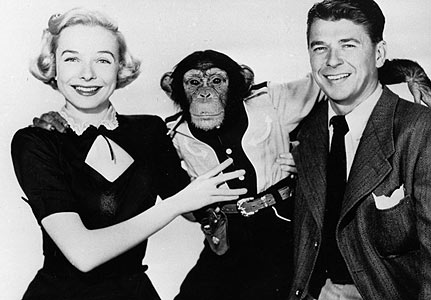
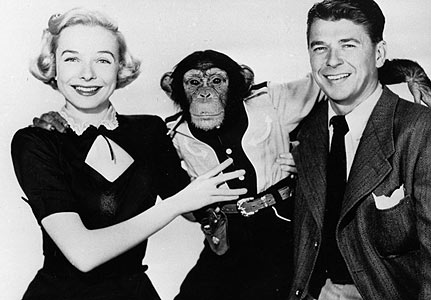
Diana Lynn and Ronald Reagan in Bedtime for Bonzo
I believe the GOP is using Bedtime for Bonzo as a template for how to govern the U.S.
The Republican National Convention brought out the best of the “we built it” catch-phrase slinging moralists. And they – in front of a crowd that was comprised of a high proportion of restrictive-gender-norm-appreciators– sought to influence a constituency by pushing the idea that “traditional values” and laissez-faire capitalism are inextricably connected.
This is how I get to Bedtime for Bonzo. It involves both the god of trickle-down economics and a fictional experiment that proves traditional gender roles are necessary for raising a good human being. Or, raising a good ape for that matter. 
Bedtime for Bonzo is one of those antic-filled flicks where the protagonist inevitably yells out the name of the main pet/animal/kiddo in a prolonged agonized tone. It was released in 1951 and starred Ronald Reagan. That means, among other indignities in the movie, our 40th president is featured whining angrily at a chimpanzee, “Bon-zo!”
Mr. President Protagonist, Peter Boyd (Reagan), is a psychology professor at Anytown University. To impress his should-be father-in-law he aims to prove that nurture has more sway than nature by teaching an emotionally distraught chimpanzee, Bonzo, the difference between right and wrong.
And, boy does he. Through lessons in table etiquette and much finger-wagging, Peter helps Bonzo becomes a good upstanding citizen. But, implicit from the beginning is that Bonzo needs a “mama” to make the shift between unruly depressive (we first meet Bonzo trying to commit suicide by jumping off a building) to a healthy contributing member of society.
The “mama” that Peter finds is pretty-young-thing, Jane (Diana Lynn). She maintains a peppy version of the maternal ideal while also swinging her impressive bust-waist-hip ratio into the role of romantic (can you say Fa-Fa-Freud?) interest.
Through Jane’s sensual domesticity and Peter’s academic masculinity – the pair manages a successful experiment and domesticates the ape by the power of traditional values.
Which brings us back to the RNC.
The conservative agenda remains consistently exclusive to Leave it to Beaver norms. This maintains a strong unified base that continues to vote in an obviously broken economic system. To keep up the agenda and unity, the GOP needs to also keep up the myth of “tradition=virtue” and make that appealing to women voters.
This year both parties knew they would have to talk about those notorious “women’s issues.” The Democrats lined up an obviously pandering (but still appreciated) group of women speakers highlighting the values of equal pay and reproductive rights. Republicans did not go the same direction. But, Ann Romney did speak on behalf of her husband. And she delivered a cozy message about how women are super important. As long as they have reproduced.
“It’s the moms who always have to work a little harder, to make everything right. It’s the moms of this nation – single, married, widowed – who really hold this country together. We’re the mothers, we’re the wives, we’re the grandmothers, we’re the big sisters, we’re the little sisters, we’re the daughters,” Romney said.
This does at least two things: reiterates the conservative narrative of women as relational beings (existing only as supporting characters) and pushes the notion that motherhood itself is more effective in its traditional state.
See, the GOP needs a “mama” to keep its base complacent and well-behaving. And “mama” is just the outmoded ideal of motherhood and womanhood.