Meet the Women of ‘The Flow’

The first season was released in February 2014, and features the animated banter of Linda Dianne, Delly P, Nicole Ryan, and Kelly Lyn. These women are earnest, joyful, and excited to talk with each and share their experiences about topics that include (but are not limited to): period shits, gender representation in the media, and their feminist roles models in real life and television.

The Flow Logo

If you’re in the mood for some candid and righteous yet light-hearted conversation among millennial feminists, then look no further than The Flow. Though the tableau is a familiar one—four women seated on coaches with mugs of tea in hand holding forth on popular culture—the content of their dialogue is far from the daytime registers of The View or The Talk, the likes of which I only catch when stuck in waiting rooms. That’s another way of saying The Flow is well worth your time (trust me, you have all of 20 minutes to spare). The first season was released in February 2014, and features the animated banter of Linda Dianne, Delly P, Nicole Ryan, and Kelly Lyn. These women are earnest, joyful, and excited to talk with each and share their experiences about topics that include (but are not limited to): period shits, gender representation in the media, and their feminist roles models in real life and television. Each of the three episodes has a companion confessional video wherein we get a snapshot of each woman’s perspective on the given topic of the main episode. This structure works well to help us viewers get to know each woman a bit more on her own terms, which isn’t something conveyed in the group discussions.

Delly P, Nicole Ryan, Linda Dianne, Kelly Lyn

Though season one is brief, The Flow manages to pack in a lot of intelligent talk about media that deserves the hype. Viewers will likely be familiar with films like Miss Representation, shows like Orange in the New Black, and especially the amazing actor/activist Laverne Cox, but I hadn’t heard of nor seen the video “Shark Week” by the Brooklyn-based rap group Hand Job Academy. Without spoiling too much—because there really are no words—let’s just say “shark week” is a euphemism for menstruation. But that’s where the politeness ends. This photo should be enough to entice:

Shark Week

In addition to running through their own shorthand, such as “Crimson Tide” and “The Original O.B.” (my favorite was always Antietam: the bloodiest day of the Civil War), the confessional episode reveals each women’s narrative of the memory of when she got her first period. Though the details differ from story to story, the common refrain was that Linda Dianne, Delly P, Nicole Ryan, and Kelly Lyn each took pride in their experiences, mostly made positive thanks to the supportive women who were there to supply them with reassurance and maxi pads(or in Delly’s case, chocolate, too). There’s a wonderful lightness and lack of shame in these stories that I found resonant and refreshing (particularly compared to the pain endured by many women of older generations; see The Vagina Monologues). Here’s to seeing where The Flows goes next month in season two.

The Flow group

‘Hannibal’s “Feminist Take on Horror” Still Has a High Female Body Count

Tip to showrunners: WE KNOW you can kill anyone off. We’ve been watching TV the last ten years. It is not that shocking anymore, and not even remotely surprising when it is a woman or person of color on the chopping block. Some cast members are more expendable than others, and it’s easy to guess who you think they are. Please stop sacrificing representation on the altar of high drama.

Hettienne Park as Beverly Katz

[Spoilers for all the aired episodes of Hannibal ahoy! Yar!]

Hannibal is a show about serial killers, so it’s no shock there’s a high body count. And it isn’t the usual death parade of butchered women that crime thrillers often present. Sady Doyle wrote that Hannibaltakes on the serial-killer cop procedural—one of the most irredeemably woman-hating genres on TV—from a feminist perspective.” Crime shows so often depict women as victims, and victims as bodies. (I’ve long been fascinated by the concept of struggling actresses getting the “break” of playing a cold, naked corpse on a medical examiner’s table, and their families excitedly tuning in to see her silently horizontal in blue-gray makeup, functioning essentially as a prop.)

Hannibal has flipped this archetype. The vast majority of the nameless victims, often naked, usually incorporated into inventively macabre art installations, have been men.

Equal-opportunity artful display of dead bodies.

But women are certainly not spared from violence on this gruesome show: the twist is that Hannibal‘s female victims have mostly been strongly developed as characters before being dispatched. The most devastating deaths on the show have all been women: last season’s long-time-coming murder of Abigail Hobbes, perhaps the only person we’ve seen Hannibal kill with any reluctance, and this season’s huge loss of FBI Agent Beverly Katz.

Even the one-off characters we’ve seen murdered (or at least victimized) have been given complex characterization over the course of their episode, for example the Cotard delusion-suffering Georgia Madchen (Ellen Muth), or Anna Chulmsky’s Clarice Starling stand-in Miriam Lass (recently revealed to be alive, although deeply damaged).

Kacey Rohl as Abigail Hobbs

Because the female victims on Hannibal are well-written, sympathetic, and interesting, the audience grieves for them. They are not merely dramatic beats to generate manpain for the dude heroes. (Will Graham nevertheless suffers epic amounts of manpain. This is his design.)

Hannibal clearly takes the murder of women seriously, and uses it as a source of dramatic pathos, not titillation. But an unfortunate consequence of this pattern is that midway through the second season, only one female character in the regular cast remains: Caroline Dhavernas’s Alana Bloom. And she’s a love interest for both Will Graham and Hannibal Lecter (which is not to say she’s been weakly characterized, but does seem to explain her survival).

Last woman standing: Alana Bloom

Hannibal is also running low on women in the recurring cast. Gillian Anderson’s Bedelia Du Maurier exited early in the second season, and the amoral journalist Freddie Lounds (one of several male characters from Thomas Harris’s novels that series developer Bryan Fuller rewrote as female) has only made brief appearances in two episodes this year.

The loss of Hettienne Park as Beverly Katz is particularly devastating, and not only because she was one of the precious stereotype-defying women of color on network TV. Katz’s sardonic sense of humor provided some much-needed comic relief, and her warm friendship with Will was perhaps one of the only psychologically sound relationships presented in the entire series.

Will Graham and Beverly Katz

And yes, it is immensely frustrating that when the powers that be decide someone important “needs to die” to up the stakes or prove “anyone is expendable” for that someone to be, yet again, a woman of color. (Tip to showrunners: WE KNOW you can kill anyone off. We’ve been watching TV the last ten years. It is not that shocking anymore, and not even remotely surprising when it is a woman or person of color on the chopping block. Some cast members are more expendable than others, and it’s easy to guess who you think they are. Please stop sacrificing representation on the altar of high drama.)

So while Hannibal has a refreshingly compassionate narrative approach to the murder of women (which is a phrase I never imagined I’d write), they’ve got to cool it with killing off the ladies in the cast. And they need to replenish the ranks with more well-crafted female characters, and they’re going to have to stay alive for a while. Because right now we’ve got too many dicks on the dance floor.


Robin Hitchcock is an American writer who is now afraid of mushrooms in the wild.

Doctor Who and the Women

Remember that uncomfortable moment when ‘Doctor Who’ became a story about how women destroy themselves to rescue an emotionally volatile man from his loneliness? It’s OK if you don’t; I’m going to remind you of it now.

Written by Katherine Murray.

Remember that uncomfortable moment when Doctor Who became a story about how women destroy themselves to rescue an emotionally volatile man from his loneliness? It’s OK if you don’t; I’m going to remind you of it now.

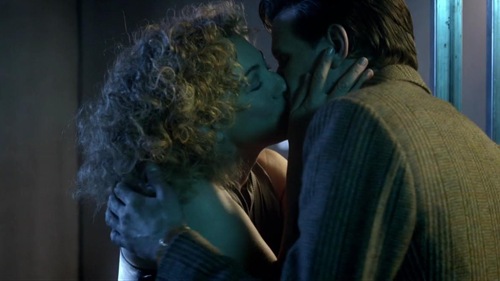
Doctor Who and River Song
Asexuality is so passé

Doctor Who runs on a pretty simple dynamic. There’s a wizard god alien called the Doctor who travels through time and space in a magic futuristic magic police box and defends humanity from other aliens while encouraging people to be better humans themselves. He is joined on his travels by a human companion who, at least in the new series, is always female (although secondary male companions sometimes tag along).

The human companion’s job is to: 1) stand in for the audience by expressing surprise / bewilderment / excitement / low-simmering sexual desire for the Doctor / etc; 2) represent that which is Good and Noble about humanity through displaying traits like bravery and compassion; and 3) throw herself on metaphorical grenades to save the world.

Part of the strength of the show, in its rebooted form, is that, while we enjoy watching the Doctor run around being clever and wacky, the real emotional heft comes from watching ordinary people perform small acts of heroism. The Doctor doesn’t save humanity just by outsmarting the aliens; he does it by inspiring human beings to become their better selves.

Because the Doctor’s companions are our primary touchstone with humanity, it isn’t entirely surprising, then, that they make a lot of sacrifices and endure a lot of suffering along the way. The Doctor’s companions die, or their brains are erased, or they get stuck in some pocket of time where he can’t reach them, or they’re visited by a thousand other miseries they have to endure in order to travel through time. One of the eleventh Doctor’s companions, Clara “I was born to save the Doctor” Oswald, is actually distinguished by dying multiple times – this is why the Doctor takes an interest in her in the first place; because she keeps getting killed as an indirect result of helping him, only to come back again.

On the one hand, it seems like this is the price of heroism – that the tally of things these women have sacrificed is the measure of what they’ve accomplished. If the price were too low, the achievement wouldn’t be as great (and, certainly, the show often reminds us of all the things the Doctor has lost as a measure of his greatness).

On the other hand, though, there’s also a sense that we’re watching mortals destroy themselves to feel close to God, or women destroy themselves to feel close to a man. We’re invited to pity the Doctor for being alone – for literally standing in the rain and feeling sad while his companions walk away from him. There’s a sense of tragedy around the fact that these women couldn’t hang – that, no matter how much they wanted to be The One who could save him, human frailty prevented them from rising to the challenge.

And you might say, “No, that’s not what the story’s about, Katherine. He’s alienated, for sure, but nobody’s proposing that these women should just follow him around and sacrifice their own interests in an ugly, codependent way so he can have a friend.” You might say that, if it weren’t for this one really horrible moment in “The Angels Take Manhattan.”

Doctor Who and River Song in The Angels Take Manhattan

That One Really Horrible Moment in “The Angels Take Manhattan”
The one really horrible moment happens like this: the Doctor and his companions and an honorary alien called River Song (who is more or less the Doctor’s girlfriend) are doing important time travel stuff in Manhattan when River gets her hand caught in a trap. The only way to get it out is to break her wrist, and the Doctor doesn’t want to do that, for important time travel reasons that would take too long to explain out of context. The point is that, instead of helping her, he leaves her there and tells her to find a way out of the trap without breaking her wrist.

In Doctor Who terms, it’s actually totally fine that he leaves River to find her own way out of the trap – she’s one of the most capable characters, and he’s respecting her as an equal by trusting that she can handle this herself. I have no problem with that.

It’s what happens after that that’s terrible.

River shows up again a few minutes later, free from the trap, and happily reports to the Doctor that she was able to escape just like he asked her to. He’s very pleased – and also, apparently, blind, because she’s holding her arm very stiffly through this – and he grabs her hand in joy only to have her scream like he’s pulling on her broken wrist, because – surprise – that’s exactly what he’s doing.

In the moments that follow, both the Doctor and his companion ask River why she didn’t just say her wrist was broken, and she explains – in this horrible, horrible moment – that the Doctor must be protected from knowing how much it hurts people to be around him; that humans must hide their weakness from him so that he will not feel upset.

In other words, a relationship is an endurance test where one person (here, a female person) has to pretend that everything’s OK when it’s not so that the other person (here, a male person) will be spared from either the inconvenience of having to deal with it, or the pain of feeling responsible, or the unwelcome reminder that the first person is not everything he hoped she would be. And, it’s his girlfriend who believes this. His girlfriend. Technically, she might even his wife. Oh, man.

The tenth Doctor’s girlfriend, Rose, never articulated the same idea, but their relationship was framed pretty clearly as one in which his magnificence rescued her from the boredom of leading a meaningless life and she, in turn, wanted to rescue him from the horror of being alone. The tragedy of their relationship, as it’s presented to us, is that, just as he allows himself to love her, and to carve out a place in his future for her to inhabit, she gets taken away. No matter how badly she wants to be the one to give him what he needs, she can’t live up to the challenge – she’s not alien enough to survive an attack from his enemies, and she’s trapped forever in a timeline he can’t enter. The icing on this tear-soaked cake is that he was never able to make himself say the words “I love you.”

So, now we have two women in romantic relationships with the same emotionally distant, volatile man, and one has to take it on faith that she’s loved, and one has to hide all her pain in order to save the relationship. Both of them are desperate that he shouldn’t feel alone.

If this sounds familiar to you, that’s because this is a pretty well-worn and disturbing trend in romance stories – the trend where women martyr themselves to win the hearts of isolated men. It isn’t a healthy dynamic in either direction, but it’s one that’s often repeated, and it’s a little bit uncomfortable to see it play out over and over again on what is otherwise a very fun, exciting, well-written show.

I don’t know what the solution is, exactly, because the premise of the series almost demands an asymmetrical relationship between the Doctor and his companions, and the attempt to balance gender by having a male and female lead means that that relationship will almost inevitably Say Something (awkward) about the dynamics between men and women.

That said, season four gave us a precedent for a female companion who at least didn’t want to sleep with the Doctor and told him when he was annoying (I miss you, Donna). It might be a nice change if more of the Doctor’s companions had a reason for travelling with him that wasn’t either total obsession with him or the belief they were born, in one way or another, to save him. I’d like to see more of that kind of thing and less of the thing where people hide their broken bones to be polite.


Katherine Murray is a Toronto-based writer who yells about movies and TV on her blog.

Friendship and Loneliness in ‘The Station Agent’

I can remember hearing about a study which found many people use the characters on their favorite television shows as surrogate “friends.” I wonder what those same researchers would make of our post-Televison-Without-Pity cultural landscape, in which a endless stream of writer analyses–sometimes accompanied by roundtable discussions–dissects every detail of every episode of popular television shows, making up a big chunk of the internet. If online effluvia is an indicator, many viewers now spend more time thinking about characters on TV than they possibly could about their real-life friends and maybe even their own partners, family members and selves. We spend so much time thrilling to drug dealing, beheadings, poisonings, secret identities, sudden, improbable career success, zombies, and vampires that we decry as “boring” the few series that have realistically explored issues that are more likely to affect us day-to-day: relationships, work and friendship.

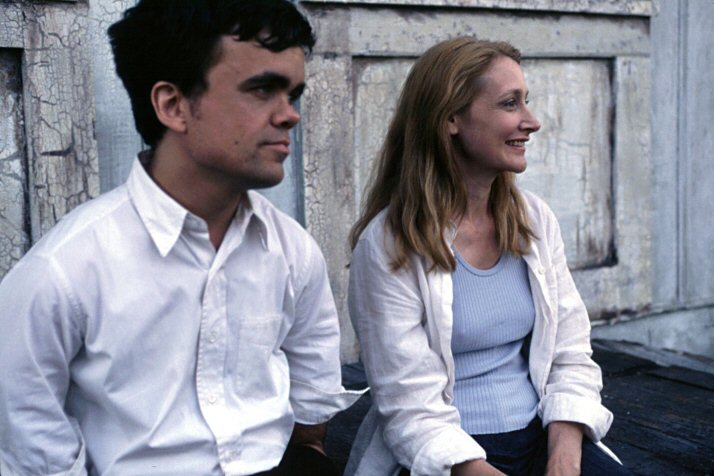
DinklageClarksonStationAgent

I can remember hearing about a study which found many people use the characters on their favorite television shows as surrogate “friends.” I wonder what those same researchers would make of our post-Televison-Without-Pity cultural landscape, in which a endless stream of writer analyses–sometimes accompanied by roundtable discussions–dissects every detail of every episode of popular television shows, making up a big chunk of the internet. If online effluvia is an indicator, many viewers now spend more time thinking about characters on TV than they possibly could about their real-life friends and maybe even their own partners, family members and selves. We spend so much time thrilling to drug dealing, beheadings, poisonings, secret identities, sudden, improbable career success, zombies, and vampires that we decry as “boring” the few series that have realistically explored issues that are more likely to affect us day-to-day: relationships, work and friendship.

Independent films are much more likely to explore these themes than the latest hit series on cable. But even those of us impatient with the contrivances of yet another Sunday night saga have to admit this so-called “Golden Age of Television” has given meaty roles and great acclaim to actors (and to a much smaller number of actresses) who have previously  done excellent but not widely seen work in independent films.

Peter Dinklage, who plays Tyrion Lannister on Game of Thrones (and has won several awards, including the Emmy and Golden Globe for the role and may very well win more) first came to my attention with his starring role in 2003’s The Station Agent (which is now streaming on Netflix) from writer-director Tom McCarthy . The cast is a who’s who of indie actors who have become more well-known through a variety of roles: Bobby Cannavale (from Boardwalk Empire), Patricia Clarkson (from Saturday Night Live‘s “Motherlovers”), a post-Dawson’s Creek but pre-Oscar nomination Michelle Williams and even, in a small role, John Slattery, years before Mad Men. But The Station Agent  isn’t one of those curiosities in which a great cast with promising material becomes a mess, but the much rarer occurrence of excellent actors in a film which knows exactly how to make the best use of them.

Peter Dinklage as Fin

Dinklage plays Fin, who lives in the building next to the model train shop in which he works. His boss, Henry (Paul Benjamin), a much older man, is his near-constant companion: he lives in the building as well, and they not only work together but eat lunch together, smoke together on the roof and roll their eyes in unison at the obsessives who gather in the shop after hours to watch homemade films of trains.

The boss is the first person we see defend Fin from the stares and harassment he receives. A teenager at the shop counter looks  at Fin as if he were a ghost and Fin’s boss, with an edge in his voice, asks the young man, “You forget something?”

When Fin walks on the street or goes into a supermarket we see people taunt him with “jokes” or stare and then, not quite out of earshot, comment to each other about his appearance. The resolute, straight-ahead gaze that Fin adopts in these situations will be familiar to many girls and women (of every size) who also dare to walk unaccompanied in public.

When Fin’s boss drops dead in the shop, Fin is out of a job and an apartment– and finds out that he’s inherited an abandoned rural railroad depot his boss never informed him about. The estate lawyer tells Fin “I’ve seen you around… You’re one of those memorable people.” He continues that he’s been to the town where the depot is located and “there’s nothing out there: nothing” which appeals to Fin in a way the lawyer could never understand, but we in the audience do.

ClarksonStation-agent
Patricia Clarkson as Olivia

With a suitcase in hand Fin walks on the train tracks (which, in real life, no one should ever do. A train recently killed a woman on the tracks at a movie location) to the station and despite its state of disrepair makes a home for himself inside. After spending his first night there, he meets and buys a café con leche from Joe (Cannavale) the chatty, nosy, relentlessly social man subbing for his sick father as the proprietor of a food truck near the depot.

Joe’s efforts to engage Fin first in conversation and then in friendship are never ending: he’s like the person in seventh grade who decided to be your friend without consulting you first, sitting next to you in class, talking to you, asking to hang out until, because of your own inertia and exhaustion you finally did become friends. Joe even enlists wary, solitary Olivia (Clarkson) as part of the clique: he cooks meals for the three of them at his truck or at her waterfront home. Finn and Olivia first meet when she almost runs him over–twice–as he walks along the woodland road. Later she brings a bottle of bourbon to the depot as an apology. When they are drinking, she asks how he acquired the depot and he tells her that his friend died three weeks ago leaving the place to him.

She responds, “My son, Sam, died two years ago,” then immediately shuts her eyes and asks, “Would you mind not looking at me right now?” Fin, who often wishes not to be seen himself, complies with her request, directing his gaze elsewhere.

Clarkson was the queen of indie film for a time starting with High Art and, in a body of outstanding work, Olivia is one of her best performances: skittish, kind and something of a fuck up all at once. Cannavale makes Joe’s neediness charming, growing on us, the way Joe’s puppy-like presence grows on Fin–and Olivia. But this film is Dinklage’s and its greatness resides as much in his handsome, expressive face as it does in its spare, exacting script. Fin is a man who thinks he will be better off keeping other people out of his life and psyche and then finds they creep in anyway, like sunlight through cracks in a roof. When he is without Olivia and Joe, he is surprised that he misses their company. He also, in spite of himself, befriends the little girl (Raven Goodwin) who plays by the depot.

Joe, Olivia and Fin
Joe, Olivia, and Fin

The Station Agent is one of the few films that not only focuses on a disabled  protagonist without condescension: it also doesn’t pretend non-disabled people behave better than they do–and unlike some other indie films doesn’t portray its small town as more tolerant and welcoming than the city. Although Olivia and Joe, the little girl and the town librarian (Williams) are good to Fin, and–in spite of Joe’s sometimes prying questions–they all treat him as a person, plenty of other townspeople, including Williams’ on-again, off-again boyfriend, the patrons at the town bar, at least one child at the little girl’s school and the woman behind the counter at the convenience store, treat him as a joke and sideshow oddity. The woman at the store even takes his picture, without his permission, as he shops. The film is also unusual among independent films–especially one that takes place mostly in a small town–in the matter-of-fact diversity of its cast: Fin’s boss is Black, as is the little girl, and Joe is Latino (Cannavale often plays Italian Americans, but is half Cuban).

McCarthy went on to make other stellar, independent films, the most recent of which was Win Win with Paul Giamatti and Amy Ryan and his next release is a movie starring Adam Sandler–which could either be very good for Sandler or very bad for McCarthy. But The Station Agent, his first film, is a bracing mixture of melancholy and uplift which deserves to be seen over and over again.

[youtube_sc url=”http://www.youtube.com/watch?v=nTGUP0JK1cU”]

___________________________________________________

Ren Jender is a queer writer-performer/producer putting a film together. Her writing has appeared in The Toast, xoJane, and the Feminist Wire. You can follow her on Twitter @renjender.

‘Hateship Loveship’: Mehship

With a slight tonal shift, this could have been a really interesting story. There are all kinds of interesting places this could go, but ‘Hateship Loveship’ doesn’t take this route. It’s a shame, because it winds up being rather a non-story.

We all know, and are deeply offended by, this story: the bad boy who is redeemed by the love of a good woman. We’ve spilled oceans of ink in our feminist critiques of the harm perpetuated by this cultural narrative. The man is allowed to have dimensions, flaws, agency, character; the woman can only be meek, conventionally pretty, good at traditional feminine pursuits like cooking and cleaning. She sacrifices all sense of self, existing only as a prop for his betterment.

It’s such a tedious cliché, we don’t even really need to rehearse the critiques anymore, taking them for granted as a baseline of feminist criticism. But have you ever wondered what this story looks like from the perspective of the woman?

Me neither.

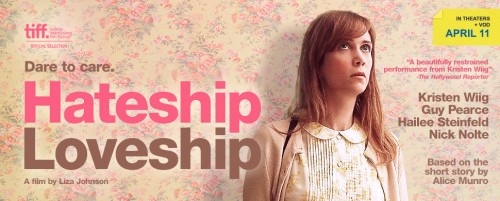
hateship-loveship-3

Hateship Loveship, the new film by Liza Johnson of Return (non-)fame, does an uneven job of answering this unasked question.

Kristen Wiig takes on her first fully non-comedic role as Johanna, the stiff and taciturn caretaker whose employer passes away in the film’s first scene. Johanna is hired to be housekeeper and vaguely parental influence for teenage Sabitha (Hailee Steinfeld), who lives with her grandfather in a fancy house where her deadbeat dad is persona non grata. After briefly meeting said deadbeat dad, Johanna enters into a passionate correspondence with an email address she thinks belongs to him, but is actually run by Sabitha and her smirking, bratty friend Edith. Emboldened by “his” professions of love, Johanna throws away everything in one daredevil move, and goes to live with a man who barely knows she exists.

This is right where you’d think the story would get really interesting. Unfortunately, it doesn’t.

Hateship Loveship isn’t wholly without its merits. The main draws for me were Wiig and Steinfeld, two actors I (alongside, it seems, every feminist on planet earth) adore. Wiig’s performance in Bridesmaids had enough emotional nuance to give me confidence that she could deliver on a purely dramatic role, and she is solid here, using pointed silences and soulful stares to convey a woman whose depths and complexities are deeply suppressed by a difficult past only hinted at. Steinfeld, who knocked all our socks off a few years ago in True Grit, succeeds in giving depth and plausibility to a role that in lesser hands would seem two-dimensional.

Sabitha (Hailee Steinfeld) and Edith (Sami Gayle)
Sabitha (Hailee Steinfeld) and Edith (Sami Gayle), being teens

Now, I have not read the Alice Munro story on which the film is based, and perhaps if I had the plot would have been more palatable to me, but it’s a poor film adaptation that cannot stand alone. I want to like a story centered on a woman who goes after what she wants and gets it, I really do. It’s just that apparently what this woman wants is to be a housewife for a hot mess of a man.

With a slight tonal shift, this could have been a really interesting story: a woman who has always been mousy and obedient is finally spurred to take decisive action to get what she thinks she wants, and her pride won’t let her back down from what, increasingly clearly, was not a very good idea. There are all kinds of interesting places this could go, but Hateship Loveship doesn’t take this route. It’s a shame, because it winds up being rather a non-story.

The screening I saw included a Q&A with Johnson and Wiig, and I had to fight the temptation to ask them: what was the point? What is the film trying to say?

Does Guy Pearce really deserve that look from Kristen Wiig?
Does Guy Pearce really deserve that look of devotion from Kristen Wiig?

As a potential subversion of the “bad boy saved by the love of a good woman” trope, it doesn’t subvert enough: Deadbeat Dad is a junkie and a crook, whose life is literally cleaned up by Johanna. Centering her doesn’t change the trajectory of the story. As a character study, it doesn’t give us enough character to work with: Johanna’s arc from quiet housemaid to, um, quiet housewife is frustratingly underdeveloped. As an unconventional love story, it has too much unexamined ick factor: who would actually enter into a relationship with a near-stranger who showed up on your doorstep claiming to have received love letters you definitely didn’t write?

There are a lot of angles this film could have taken to be something interesting, but it takes none of them and ends up as little more than a disappointment.

______________________________________

Max Thornton blogs at Gay Christian Geek, tumbles as trans substantial, and is slowly learning to twitter at @RainicornMax.

Bitch Flicks’ Weekly Picks

Check out what we’ve been reading this week–and let us know what you’ve been reading/writing in the comments!

recommended-red-714x300-1

What Women-Led Movies Can Do for Hollywood by Stephanie Hallett at Ms. blog

“Strong Female Character” Comic at Gyno-Star

New documentary: Mexican women incarcerated for “homicide” after aborting gain their freedom by Katie at Feministing

The Lego Movie Makers Pledge to Do Better on Female Characters in Sequel by Susana Polo at The Mary Sue

Tina, Amy, and the Female F-ckup: A Filmography by Molly Lambert at Grantland

Julianne Nicholson on August: Osage County, Masters of Sex, and Aging in Hollywood by Laura Berger at Women and Hollywood

In Mainstream Media,  Polyamory is Getting Attention by Erica Thomas at Bitch Media

Daenerys Targaryen is Back to “Save the Coloureds” Tour De #GameofThrones 2014 by Shane Thomas at Media Diversified

What have you been reading/writing this week? Tell us in the comments!

‘The Moon Inside You’: A Bloody Good Documentary

Menstrual studies is a discipline very close to my heart. While earning my master’s degree, I temporarily became obsessed with texts like ‘Periods in Pop Culture’ (Lauren Rosewarne, 2012) and ‘Flow’ (Elissa Stein and Susan Kim, 2010) as I composed my thesis. I was blessed with a supportive advisor who made me realize that those who shot me disgusted looks in the past were in fact the weird, misinformed ones. I find it perplexing that so many have capitalized on menstruation, yet many are still terrified of discussing it in any form or on any platform. Menstruation is uniquely female and yet suggestive of violence, sacrifice, and trauma: that’s compelling. The menstrual cycle reminds us all of our own mortality, the devastating truth that our bodies will eventually decompose or burn into ashes, and that’s terrifying for many people. Why has the “fairer sex” been assigned this burden?

Written by Jenny Lapekas.

Menstrual studies is a discipline very close to my heart.  While earning my master’s degree, I temporarily became obsessed with texts like Periods in Pop Culture (Lauren Rosewarne, 2012) and Flow (Elissa Stein and Susan Kim, 2010) as I composed my thesis.  I was blessed with a supportive advisor who made me realize that those who shot me disgusted looks in the past were in fact the weird, misinformed ones.  I find it perplexing that so many have capitalized on menstruation, yet many are still terrified of discussing it in any form or on any platform.  Menstruation is uniquely female and yet suggestive of violence, sacrifice, and trauma:  that’s compelling.  The menstrual cycle reminds us all of our own mortality, the devastating truth that our bodies will eventually decompose or burn into ashes, and that’s terrifying for many people.  Why has the “fairer sex” been assigned this burden?

The Moon Inside You (2009) is a documentary film written and directed by Diana Fabiánová.  I bought this film last summer at a conference organized by the Society for Menstrual Cycle Research, and I’ve waited far too long to watch it and offer my two cents.  The film contains English subtitles and also features interviews in French, Slovak, Portuguese, and Spanish.  When I briefly met Diana, I noted that she was very tall, very beautiful, and very accommodating to my questions about her film.

Diana opens her film by interviewing random men on the street so that we can witness their immediate discomfort at the mere mention of the word “menstruation.”  Some men actually walk away; clearly, for many men, menstruation simply isn’t real.  We are in Bratislava where we watch Diana visit the gynecologist, as she tells us that her menstrual cycle has caused her nothing but pain and annoyance for years.  “Being a woman was like punishment for a crime I didn’t commit,” she tells us.  She also explains that she doesn’t prefer to medicate herself, but rather to discover the source of her painful symptoms and put an end to them.  This introduction helps viewers to sympathize with those who experience painful periods that prevent them from attending school and work, and even cause some women to resent everyday life with a uterus.


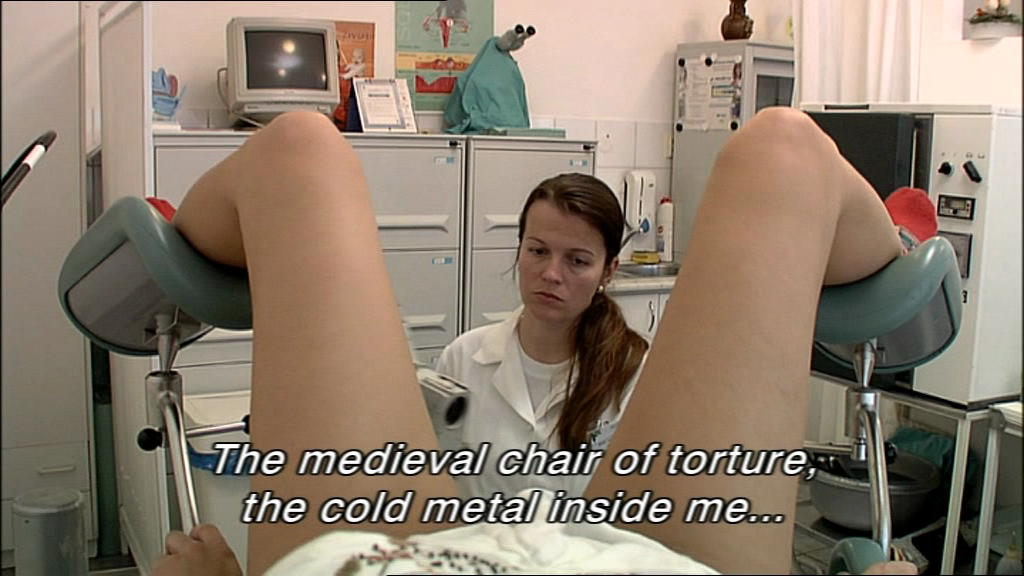
Diana gives us a nice view at the doctor's office.
Diana gives us a nice view at the doctor’s office.


Diana speaks to a group of girls at her old school, who explain that boys “have it easier.”  This is a useful place to begin, given that our attitudes toward menstruation are shaped from girlhood, and are typically negative.  Diana gives one girl a camera to record her “pre-menstrual” experiences.  Dominika tells us that a few girls in her class have already hit menarche, but there may be more who “haven’t confessed,” as if it truly is a crime to be a woman, as our narrator tells us.  Diana explains that she wants Dominika’s transition into menstruation to be more pleasant than her own was, and I find myself wishing the very same for this lovely young girl.  Toward the end of the film, via her video diary, we’re glad to hear that Dominika has in fact made a relatively painless transition into the world of menstruation.


Even the most "anti-menstrual" women will find themselves rooting for the adorable Dominika to get her first period.
Even the most “anti-menstrual” women will find themselves rooting for the adorable Dominika to get her first period.


After tackling some myths surrounding menstruation (such as the idea that menstruating women are capable of killing infants by merely holding them), Diana heads west to speak to academics and other knowledgeable Americans at prestigious universities such as Harvard.  Well-known menstrual scholar and author of The Curse (2000), Karen Houppert is interviewed.  Houppert touches on the terrifying impact menstruation as a taboo has on young girls and also summarizes how and why menstruation played a role in shaping America’s workforce and women’s placement in both the workplace and at home.  Martha McClintock, Professor of Psychology at the University of Chicago even explains that if we observe and study the moods of men, their moods are just as erratic as women’s; however, women are at an advantage since we can actually predict how we will likely feel at a given time of the month.  While this can and should be read as a sophisticated or evolved trait, women are still stigmatized as hormonal and irrational, especially when experiencing PMS.  The fact is that our bodies are wiser than us, and we must listen to our own.  If we feel that our stress is unbearable, it may be an indication that we must retreat and care for ourselves until we are prepared to tend to the needs of others.


Diana interviews a group of boys as well, who tell us that women can’t have sex while menstruating because “it gets in the man’s way.”


I found it moving to watch a group of women that Diana gathers to participate in an experimental belly-dancing class.  These strangers sit together to share their personal stories of pain and distress related to their cycles and then dance as a group before a large mirror.  The preconception that only young girls on the verge of menarche or new to its inconveniences gather in such a setting is misguided; fully developed women with children and years of experience menstruating can offer one another comfort and solidarity in a safe environment such as this one.

Chris Knight, another well-known scholar to academics and menstrual enthusiasts, author of Blood Relations (1995), tells us, “The most ancient thing is to keep women from knowing about their own power.”  If menstrual blood is a source of power–and I believe it is–then why has our culture gone to such great lengths to conceal this source of power to make us believe that the menstrual cycle is shameful?  In The Vagina Monologues (2007), Eve Ensler shares that she is worried about vaginas, and I think several more of us are worried not about menstruation but how women define themselves by its aura of culpability and self-condemnation.


Interspersed throughout the documentary, between Diana’s commentary and interviews, are fun animations of eggs making their way through the fallopian tubes.  These brief clips offer a whimsical retreat from the tension felt within much of the film.
Interspersed throughout the documentary are fun animations of eggs making their way through the fallopian tubes, brief clips that offer a whimsical retreat from the tension felt within much of the film.


Reminiscent of Gloria Steinem’s famous essay “If Men Could Menstruate,” Diana asks men on the street if they would try menstruating if they could.  While most men say no (and one even suggests that it’s not “cool” to bleed from your vagina), one man claims that he’d like to menstruate so he can finally understand what women experience.


We seem to have a social contract that our menstrual blood remains secret and concealed when in public...or anywhere, really.
We seem to have a social contract that our menstrual blood remain secret and concealed when in public…or anywhere, really.


Diana touches on the commodification of our cycles with the help of the birth control pill, acknowledging companies like Tampax that capitalize on the shame that pervades our media messages, and the onslaught of rhetoric that suggests women are somehow biologically flawed by this internal feminine clock that is ever-ticking.

We meet the inventor of the contraceptive implant, who tells Diana that menstruation is not “normal” or “natural,” that the scent of blood is “the scent of death,” and that menstruation is essentially a type of abortion or miscarriage.  He believes that once young girls reach menarche, they should experience menstruation once and then immediately prevent ovulation using an implant, since an ovulation that doesn’t result in conception is “useless.”  The dangerous and dogmatic recommendations we hear from the “good doctor” should remind us that he’s nothing more than a mechanic who has never owned a car.


A taboo image, the depiction of shit would likely be deemed more acceptable by most people.


Penelope Shuttle, co-author of The Wise Wound (2005), counters this by gracefully explaining, “The thing that’s being given birth to is a new you.  You’re giving birth to yourself.”  Contrary to what our male doctor claims, the uterus is a place of origins, not death; this doesn’t mean we should all feel inclined to belly-dance like Diana or participate in a drum circle, but it is certainly beneficial to recognize our own sacredness in our blood and to recognize this same light in the women around us.


Women are pressured to be kind and patient during times of hormonal imbalance, although some women experience debilitating pain that prevents them from being productive.


The Moon Inside You is an honest glimpse into how we frame menstruation around the world and how we situate ourselves within its contradictory rhetoric.  The destigmatization of menstruation should address the contradictory assessments we make of its appearance as girls and women work to untangle the prescriptive web woven by one-dimensional media, good old patriarchal conventions, and the people we may know who oppress women by regurgitating these haphazard messages of shame and body horror.  Young girls can be proud and delighted to reach menarche, just like I was, yet we’re told to bite our tongues as we grow into young women.  As Inga Muscio, author of Cunt (2002) explains, “How many bloody mysteries and future generations are hiding up there, somewhere?”

Recommended reading:  seeing red project, Adventures in Menstruating

________________________________

Jenny has a Master of Arts degree in English, and she is a part-time instructor at Alvernia University.  Her areas of scholarship include women’s literature, menstrual literacy, and rape-revenge cinema.  You can find her on WordPress and Pinterest.

When Girlhood Fantasy Turns Murderous: ‘Perfect Sisters’

It’s no easy feat to make a true crime film that rises above Lifetime schlock. It takes things like dark humor, broader social context, impressive cinematography and storytelling risks to breathe life into a stale murder plot. With that goal, ‘Perfect Sisters’ isn’t exactly a blazing success, often falling into the trap of domestic melodrama, but I think it’s still worth a watch.
Based on a notorious Canadian case where teenage sisters drowned their mother in a bathtub, it’s the story of Sandra (Abigail Breslin) and Beth (Georgie Henley), sisters whose whole world is each other.

It’s no easy feat to make a true crime film that rises above Lifetime schlock. It takes things like dark humor, broader social context, impressive cinematography and storytelling risks to breathe life into a stale murder plot. With that goal, Perfect Sisters isn’t exactly a blazing success, often falling into the trap of domestic melodrama, but I think it’s still worth a watch.


Sandra and Beth rely on each other for comfort and reassurance


Based on a notorious Canadian case , where teenage sisters drowned their mother in a bathtub, it’s the story of Sandra (Abigail Breslin) and Beth (Georgie Henley), sisters whose whole world is each other. These girls have faced a difficult childhood, forced to take care of their younger brother and Linda (Mira Sorvino), their depressed alcoholic mother; they see each other as their one constant. As Sandra says, “It was always me and my sister against the big bad world.”

Until the murder begins to unravel them, the sisters have an appealing symbiosis. They share a made-up language, shared fantasies and Beth knows to corroborate Sandra’s lies unprompted. For their shared point of view on the events, the girls make one singular person, constantly clinging to each other. Sandra also acts as Beth’s mother, holding her when she’s scared at night and fighting off Linda’s boyfriend Bowman (James Russo) when he attempts to attack her. Though they both have love interests, their primary bond is with each other.

Used to moving around when Linda loses jobs and to cramped apartments with roaches, they’ve learned to make the best of it with their rituals of setting up their shared bedroom. They’re quite skilled at interior design, arranging their possessions to mimic faded wealth and glamor, the private castle of two princesses trapped by their mother’s demons.


The girls make the best of their situation by decorating their room, making it into a refuge


The film is reminiscent of Heavenly Creatures–two girls who share a secret world that no one else can understand. As in that movie, also the true story of a murder committed by teenage girls, their fantasies bleed into reality as their lives grow bleaker, becoming more colorful and increasingly violent.

Perfect Sisters has been criticized by people familiar with the case, such as Bob Mitchell, the reporter who wrote The Class Project , the true crime book it’s based on, for playing down greed as a motive, instead suggesting the girls are driven to murder by their difficult circumstances.

Director Stanley M. Brooks has said his aim in the film was to show the sisters as sympathetic characters, not evil or sociopathic, but immature young women who make made bad decisions. He attempted to be accurate to the real events and says he fictionalized almost nothing about the case. Whatever the truth is, this approach is more cinematic, giving viewers likable (to a point) characters and room for discussion over their level of awareness of their actions and the nature of evil.

As in most true crime movies, viewers know going in both that the girls’ mother will be murdered and that they are guilty. The murder is not a shocking climax that has viewers on the edge of their seats and there is no real mystery or suspense, as the these’s never any doubt of the perpetrator. Brooks’ decision to challenge the audience to sympathize with girls we know will become killers is one that adds an intriguing element to the film, each bit of the girls’ inner lives, the minutia of teenage girlhood and idle lunchroom gossip is weighed against the knowledge of viciousness they are capable of.


Before school starts, the sisters give themselves makeovers, each attempting to be someone new and more desirable this year


It’s startling to watch the squeaky clean child stars of Little Miss Sunshine (Breslin) and The Chronicles of Narnia (Henley) move in darker, adult fare, playing the matricidal “bath-tub girls.” Automatically, the audience’s sympathies are aligned with these familiar faces we’re used to seeing as adorable children who believe in magic and fairness.

Here, they’re morbid (in one scene, Sandra is distracted from a kiss by the sight of a dead bird) and jaded. Still, they’re good girls with perfect disciplinary records and honor roll grades. Over the summer, they’ve each reinvented themselves. Beth dyes her hair matte black and wears heavy eye make-up to attract the gothic romance of her dreams, while Sandra yearns to be popular and lose her goody-goody rep. She makes up rumors about herself to get attention, strangely they are the type of things most girls would try to cover up. Sandra wants to be a bad girls, desirable and dangerous, so she tells everyone she’s pregnant by her therapist.

They’re used to their mother’s addiction and they’ve been dealing with it for a long time, propping her up, shuttling her through their routines and taking on her responsibilities. There are several hints that the girls and their brother have experienced earlier traumas because of their mother and her string of abusive boyfriends.

When Linda begins dating Bowman, a wealthy man who can support them, she puts up with beatings and cruelty, as well as his enabling of her addiction into a worse state than the girls can remember it ever being. They reach their breaking point when she does nothing to help them when Bowman hits their brother and begins to make sexual advances towards Beth.

It’s suggested that her alcoholism and refusal to leave her abusive boyfriend, even when he turns on her children, stems from low self worth. She doesn’t feel her life matters, so she allows Bowman to beat her. The girls have dealt with this situation so many times before that they are disturbingly able to write off their mother’s life. To their minds, she’s given it up already. They’d be fine to leave her to destroy herself, but as minors who depend on her, if she goes down, she takes them with her.


Together, the sisters imagine a perfect mother who will do anything to protect them


To cope, Sandra and Beth imagine their perfect mother, a vision they both interact with. Their perfect mother is impeccable groomed and shines with a halo of light and offers to make cookies and brush their hair. In their fantasies, she’s always there with to take care of them and provide comfort, something they have to find in each other instead. In reality, Linda is embarrassing. She tries to be her daughters’ friend and jokes around with their friends. At a party in their apartment, she gets drunk and babbles sexual things while their guests laugh at her.

When Sandra is called upon to be the adult of the family and attend her brother’s parent-teacher conference, she wears the same outfit as their perfect mother wears in their fantasies. Dressed in these clothes, Sandra clearly resembles Linda. She takes on her maternal responsibilities, using this perfect image of Linda as a role model and fixation on remaining in control to create as much distance as she can between her and her mother’s embarrassing weakness. Long after Beth has given up on her, Sandra continues to make excuses for Linda and try to understand her. In the wake of the murder, her prized control dissolves and Sandra repeats her mother’s self destructive mistakes, drinking and flirting and sharing her story with anyone who’ll listen. Beth becomes ashamed of her, in one scene saying, “You remind me of Mom.”

Before deciding to kill her, they attempt to find other ways to save themselves. They appeal to both their father and their wealthy aunt, asking to live with them but are denied. The girls quickly lose their faith in social services as they’re told no one can help them until there has been serious abuse. Beth speaks the truth about the cycle of trauma, “By the time they do anything, I’ll be the alcoholic neglecting my kids.” Through this frenzied attempts, Bowman’s threat of rape is treated as an inevitability. It’s a truly terrifying situation, sooner or later, they suppose, Beth will be vulnerable and alone. They have to do something before that happens.


Linda leans on her daughters, forcing them to take care of her even when they need her to take care of them


Though we see them trying to get out of their situation by finding a new place to live, the judge at their sentencing later in the film, rightly points out that there are teenagers who have been in much worse situations and not murdered anyone. After all, Sandra is a senior, soon she’d be an adult capable of living alone. This suggests that they are unwilling to do something hard, like work multiple jobs and live on minimum wage to support themselves. Their ideal situations are either to live on their own with an insurance payout or be taken in by their wealthy aunt.

Perfect Sisters is not afraid to show the cruelty of these girls. They are able to causally plot their mother’s murder, laughing about it with their friends, enthusiastically speculating about the freedom that will be available to them, chatting online and researching the pros and cons of different methods. Planning the murder takes on no more weight than speculating who’s dating who or what’ll be on the next math test. In one scene, the girls form an official “murder club” and gather in a school classroom writing ideas on the board. In another, the group gathers at the sisters’ home and practice attacking each other. It’s never entirely clear if their friends realize plotting the murder is more than just a game for the sisters.

In a darkly comic montage, the sisters crowd around a computer with their friends and watch their mother die over and over again in different scenarios. Part reality TV viewers, part judges scoring a performance, they watch and laugh as their mother is strangled and suffocated, pushed down the stairs and set on fire. In the end, they decide drowning will be quick, easy to make look like an accident, and it’d get the biggest insurance payout.

The murder itself creates a rift between them, when Beth leaves the bathroom while Sandra holds their mother’s head underwater. It also begins to reveal, for the first time, the fundamental difference between the girls, as shown by how they cope. While Sandra immediately panics and appears to regret what she’s done, Beth cries on cue as she calls 911, a smile on her face.


Sandra is crippled by her guilt, haunted by the memory of her mother face under the water


The knowledge of what they did hovers as an open secret through their high school and they reach a higher social status. Some classmates act like they are celebrities, having them pose for pictures, as the stroll down the hallway, while other gawk and retreat, afraid. The murder was so well planned that it seems like they would have gotten away with it if they weren’t gossipy, boy crazy and immature- basically if they weren’t teenage girls.

The last act of Perfect Sisters forms an intriguing portrait of how differently two people react to one event. Beth grows cold and introverted, while Sandra externalizes her guilt, partying and basking in her celebrity. She becomes the sloppy mess everyone secretly laughs at at parties, confessing the murder to anyone who’ll listen. The boy next door type who has loved her for years, biding his time, finally gives up on her and disgusted by what he sees as her lack of remorse, wears a wire to secure her confession.

Of course, they’re convicted and sentenced to jail time, but that’s not the real tragedy in the sisters’ eyes. In the end, they’re literally ripped apart, kicking and screaming by security officers and forbidden from communicating with each other for the duration of their sentences. In trying to save themselves, they each lost the one person who made them feel whole. Both girls are now released and attending college, and due to Canadian law regarding young offenders, their identities are protected (their names were changed for the film).


The girls only realize the gravity of their actions when they are found guilty and forbidden to see each other


In the last sequence, we are shown the girls as children changing in their teenage selves, as onscreen text explains their fates. This suggests the tragedy of their transformation from innocent children into convicted killers.


_________________________________________________________________

Elizabeth Kiy is a Canadian writer and freelance journalist living in Toronto, Ontario. She recently graduated from Carleton University where she majored in journalism and minored in film.


Seed & Spark: Gaslighting, Demonic Possession, and the Unreliable Female Brain

I love a good psychological thriller, especially if it involves insanity. The fear that I might be insane, that my perception might be warped, that instead of calmly walking to the bus stop, I am actually muttering to myself (scraping my clawed fingers along the yellow wallpaper) is a driving force in my creative process. The boundary between perception and reality is fertile ground for filmmaking, but I wonder why it’s always women whose brains get warped or permeated? I know our lady parts are conduits to Satan, and old Hollywood liked us vulnerable and prone to hysteria… But are we really getting tricked all the time, or is there a feminist edge to the gaslight thriller?

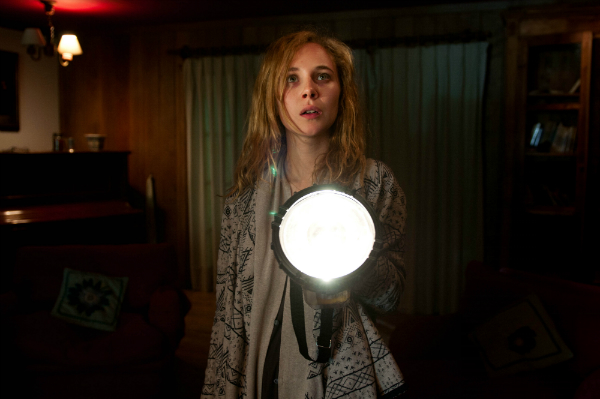
Juno Temple in "Magic Magic"
Juno Temple in Magic Magic

This is a guest post by Elizabeth Brooks

I love a good psychological thriller, especially if it involves insanity. The fear that I might be insane, that my perception might be warped, that instead of calmly walking to the bus stop, I am actually muttering to myself (scraping my clawed fingers along the yellow wallpaper) is a driving force in my creative process. The boundary between perception and reality is fertile ground for filmmaking, but I wonder why it’s always women whose brains get warped or permeated? I know our lady parts are conduits to Satan, and old Hollywood liked us vulnerable and prone to hysteria… But are we really getting tricked all the time, or is there a feminist edge to the gaslight thriller?

Gaslighting is a psychological term that actually comes from cinema. In the 1944 film Gaslight, an evil husband convinces Ingrid Bergman that she’s losing her mind, so he can steal her inherited jewels. (That film was based on an earlier film and a play before that, but let’s give the credit to Ingrid B. because she made it glamorous). Gaslighting is a form of manipulation and abuse where the victim’s sanity is questioned, and they are made to doubt their perception of reality. In real life, the use of gaslighting to undermine a victim is the terrain of deranged psychopaths and sociopaths, but like a lot of twisted stuff, it makes a great film plot.

Ingrid Bergman in "Gaslight"
Ingrid Bergman in Gaslight


Take, for example, The Innocents from 1961. Miss Giddens, a blonde and naïve nanny accepts a job to care for orphans at a creepy English estate. The children behave strangely, and we’re not sure if Miss Giddens is insane or if ghosts have possessed the little ones (spoiler: the kids are possessed). Gaslighting creates unstable narration, a protagonist who doesn’t trust her own brain. The trick works best when it catches the audience. We see through the eyes of the heroine, and it makes us paranoid: Is she crazy? Am I crazy? The tension delights us.

Deborah Kerr in "The Innocents"
Deborah Kerr in The Innocents


In the classic film Rosemary’s Baby, Rosemary Woodhouse is paranoid about her pregnancy pain, her neighbor’s herbal remedies and her husband’s secret plotting. The trick to good gaslighting is to hover on the edge of normalcy, to implicate the audience in the character’s insanity. But, like Miss Giddens, Rosemary was right to be paranoid. She had been raped by the devil and was carrying his child.

Mia Farrow in "Rosemary's Baby"
Mia Farrow in Rosemary’s Baby


What I’m trying to say is that classic cinema is really hostile towards women, constantly questioning their ability to perceive reality, calling up the old “hysterical women” stereotype. These women, though, aren’t crazy. They live in fucked-up supernatural worlds. In that sense, a film like The Innocents actually affirms its female characters: Miss Giddens is a capable detective, in spite of her swooning and fainting.

Magic Magic, the best film you didn’t see in 2013, plays on some of the traditional gaslighting structures, but takes them in new directions. (You didn’t see the film because Sony got pissed that it wasn’t an out-of-the-box horror thriller and chose not to release it). Like The Innocents, it stars a young blonde, Alicia (Juno Temple), in the creepy and isolated environment of a vacation cottage on an island in Southern Chile. Her companions are hostile strangers, friends of a cousin who mysteriously left the group and returned to the city. The camera lingers in mirrors and paranoia blossoms.

Michael Cera’s character, Brink, relentlessly hits on Alicia in deranged and unsettling ways, one of them involving a dead parrot. Alicia retaliates by pussificating him, i.e. suffocating him in her crotch, but it’s not really her who’s doing it—she is in some kind of a hypnotic trance. The film hovers on the edge of sanity, builds layers of unreality, but it doesn’t reveal and redeem. Magic Magic ends with a sharp turn; instead of affirming good female detective work, it doubles back and eats its tail. I won’t say more because I want you to see the film, but it’s a real creeper.

Gaslighting isn’t inherently gendered. It’s just that our culture prefers watching a woman on the brink. Weird films, art films and experimental cinema have been writing weak-minded men for decades. My favorite example of a man in the gaslight is Possession, a 1981 French horror film by Andrzej Zulawski.

Isabelle Adjani in "Possession"
Isabelle Adjani in Possession


The basic plot is that this guy, Mark, comes back from a sketchy business trip (briefcases stuffed with cash) and notices that his wife Anna is acting really strange. She tells him that she wants a divorce and then she moves out. He hires a private investigator to follow her, and reality starts to shimmer like the tarmac on a hot day. Actors play multiple characters. Dialog becomes disjointed. Turn a corner, and you’re back where you started. We’re not sure if we’re inside Mark’s paranoid mind.

It’s hard to say that Possession is a true feminist film because it does turn out that Anna is having lots of sex with a demon/alien and she pukes extraordinary amounts of green, slimy bile in a subway station…but at least it’s Mark who gets confused. And Anna and the alien do win in the end, though it’s hard to say if she wins or if the alien devours her completely like it does Charlize Theron in The Astronaut’s Wife.

Given these examples, one might conclude that men can gaslight women, but only aliens can gaslight men. I say: stay hopeful, female fans of the supernatural thriller. One of these days, the women will overpower the aliens.


headshotElizabeth Brooks is the director of Kibuki: Spirits in Zanzibar. She is a mixed media artist and a member of the San Francisco experimental cinema community. Her work explores the boundary between fact and fiction, using film, video, writing, and sound to blur the line between memory and imagination. She holds an MA in African Studies from the School of Oriental and African Studies at the University of London and an MFA in Photographic and Electronic Media from the Maryland Institute College of Art. She was a 2010 recipient of a Fulbright grant to Tanzania. She currently works as the Youth Curriculum Manager at the San Francisco Film Society, and her bilingual children’s book, Mama Has a Job, was recently selected for publication by Mkuki na Nyota publishers in Tanzania.

Kickstarter: ‘Yeah Maybe, No’ Questions the Meaning of Rape

While women are generally underrepresented in the media, stories about domestic and sexual violence overwhelmingly place women in the roles of the victim. In a world where men play the heroes and villains, the damsel in distress is an on-screen role where women are positively overflowing. Breaking that stereotype with strong women is crucial, but for true gender equality, men need to be seen in vulnerable positions as well.

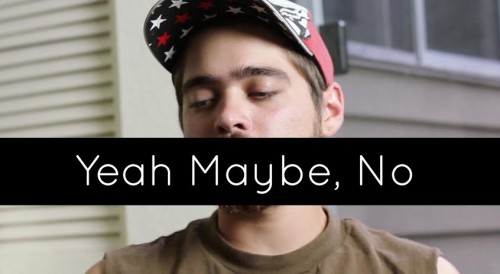
Kickstarter photo of Yeah Maybe, No


This is a guest post by Kelly Kend. 

While women are generally underrepresented in the media, stories about domestic and sexual violence overwhelmingly place women in the roles of the victim. In a world where men play the heroes and villains, the damsel in distress is an on-screen role where women are positively overflowing. Breaking that stereotype with strong women is crucial, but for true gender equality, men need to be seen in vulnerable positions as well.

It is with this in mind that I’m making Yeah Maybe, No, a documentary about a male survivor’s experience with sexual assault. Our story centers on Blake, a student at Reed College in Portland, Oregon, who had found himself in a “crappy situation” with his first boyfriend. In a story that any survivor will recognize, he was hesitant to immediately call it a rape and still doesn’t love using the word. He feels that because his attacker used coercion rather than brute force, it somehow doesn’t really count.

Popular movies about female rape victims don’t particularly help with this situation. The Girl with the Dragon Tattoo has a particularly violent rape where Lisbeth Salander ties down and brutalizes a man who brutally raped her. In the more recent Divergent, Tris is tested through a simulated rape and applauded for fighting back.  While this might be great wish-fulfillment for many survivors, it creates an unrealistic picture of what rape looks like in the real world. While some rape is very violent, many more women report being scared and lying still, waiting for it to be over, and having a hard time speaking. These reactions are the body freezing up in response to a traumatic situation. This is a biologically normal and potentially life-saving response, but one that we don’t see very often, likely in part because it is much less dramatic on-screen.

Rape scene from Girl with the Dragon Tattoo


In Yeah Maybe, No, Blake says that a lack of awareness about non-violent rape is a reason why he didn’t immediately recognize this assault for what it was. But this isn’t the whole story. Due to feminist activists, the definition of rape has shifted over the last century. In 1920, it was defined specifically as something that happened to a woman, and necessarily used force. In 2012, the FBI defined rape as any unwanted penetration, of any orifice, with or without force. According to this definition, what happened to Blake is a crime. However, Blake has no intention of reporting. He calls his experience an assault so he can get support and understanding from his peers, not so he can bring anyone to justice.

This situation is what some might call a “gray rape.” It is different from a “rape rape” in that it’s not a “forcible rape,” but more like “date rape.” Feminist activists would counter that it’s just a rape because “rape is rape.” The truth present in all of these terms is simply that people don’t really know what rape is. For Blake, he stays out of it as much as possible and generally avoids using the word altogether. Instead, he says it was an assault, a crappy situation, or a bad relationship. It’s a situation where he kind of, maybe gave a silent-implied yes to, but inside it was definitely a no. There was no enthusiastic consent, but there was no fighting either. Blake is left with emotional scars, but he doesn’t want to press charges.

So, is it really a crime? As an activist and a survivor, I want to tell him that yes, yes it is. But as a filmmaker, I need to ask harder questions. Am I really seeking justice for Blake, or for my own unresolved experience? Who am I to tell someone else how to interpret one of the most intimate and emotionally charged experiences of his life?

Through asking these questions, Yeah Maybe, No  tells a story of ambiguity in one survivor’s experience. By looking at research and talking to experts, we can establish that yes, his experience was a rape, but by also looking at his struggle with what that means, we can learn so much more. Please join us at KickStarter to help tell his story.


Kelly Kend
Kelly Kend


Kelly Kend is a documentary filmmaker living in Portland, OR. She has a background in anthropology and has worked on educational and research-based projects for higher education and government agencies. Her work tends to be focused on the details of human interaction and seeks to amplify quieter voices. Yeah Maybe, No is her first independently produced documentary. Her website is www.kellykend.com or you can follow her on Twitter. https://twitter.com/projectid

Recap: Season 4 Episode 1 of ‘Game of Thrones’

Daenerys has struggled so much to come into her own as both a Queen and a person it would be tragic for her aspirations to be upended by a juvenile love triangle storyline. That said it could be interesting for her to develop a romance with someone who respects her for who she is and is willing to be a real partner to her. Later on in the episode it seems as though Daario is coming out ahead when he presents Daenerys a bouquet of flowers that she initially reacts bemusedly scornfully to until he tells her the uses of each plant and pontificates on the fact that in order to rule a land one must first know it/understand it. Daenerys takes the lesson with good grace.

This is a recap therefore there are ALL THE SPOILERS

Please note that I recap from the point of view of not having read most of the books.

Sunday night’s premiere episode of season four of Game of Thrones got the season off to a promising start. The episode opened with heavy-handed symbolism with Tywin Lannister having Ned Stark’s great sword melted down and re-worked into two smaller swords. The scene ends with him tossing the wolf skin scabbard onto the fire to be consumed by flame. The message is clear; the destruction of the Starks is complete.

Next up, we are introduced to a new player in the politics of the realm, the Martells from Dorne. Tyrion is sent to greet the Dornish lords, and it is pretty clear that 1) they don’t like the Lannisters and 2) Tyrion’s position is still very precarious.

We find that the missing Martell, Prince Oberyn, has made his way to Littlefinger’s brothel where he was happily picking out sex workers with his lover (another chance for totally gratuitous female nudity) until he happened to hear some Lannisters singing “The Rains of Castamere”. Oberyn stabs one in the wrist after he insults him, but Tyrion arrives and manages to somewhat defuse the situation, allowing the Lannisters to leave with their lives and most of their limbs intact.

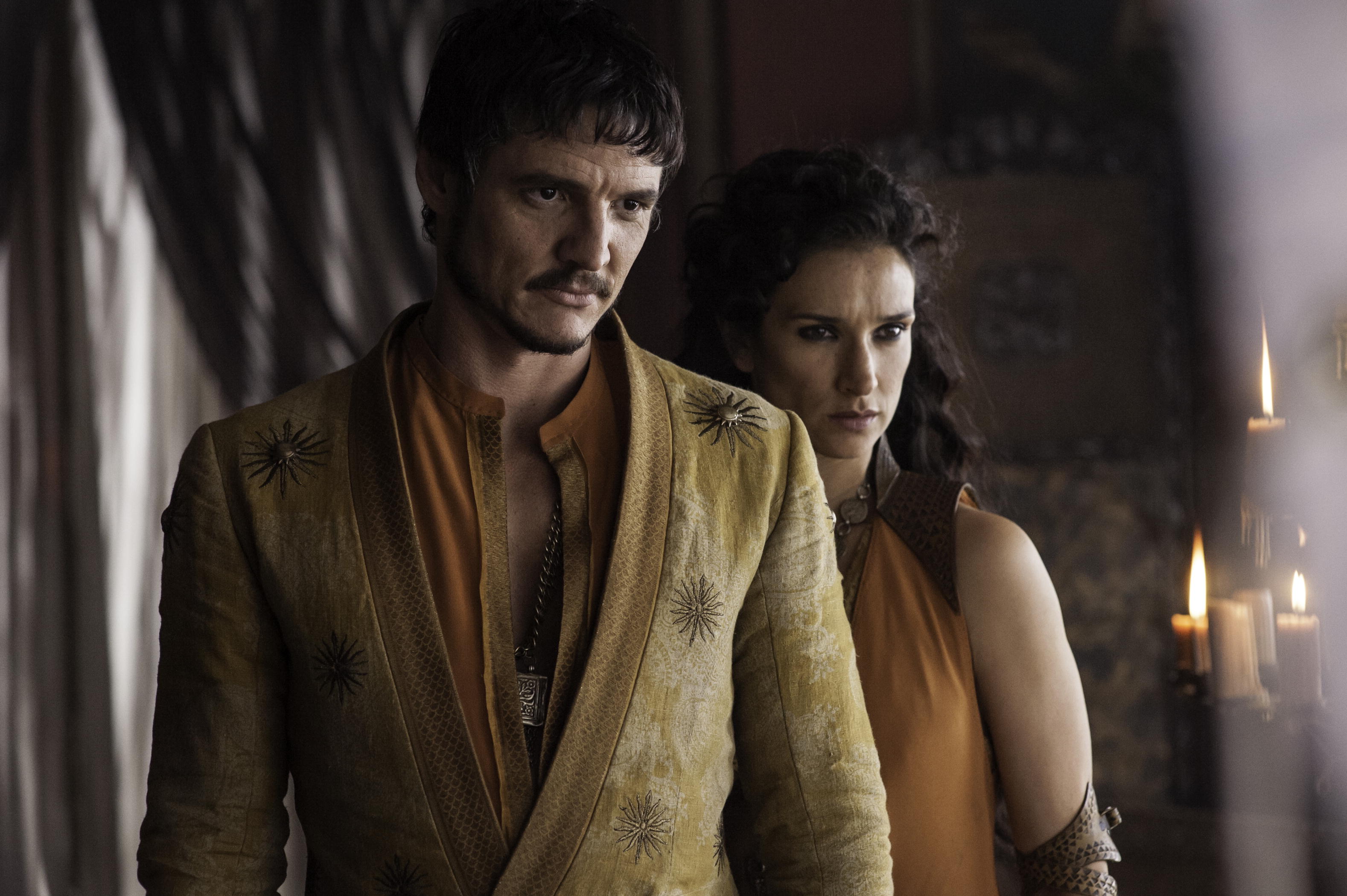
Oberyn’s introduction serves to educate us on a number of levels. In all of five minutes, we learn that the prince is forthright to a fault, a man who takes his pleasures seriously while also not being someone to trifle with. His introduction also provides us with much useful plot exposition when Tyrion asks him why he has come to King’s Landing. Oberyn happily provides a long-winded explanation that can perhaps be summarized as “you  bastards killed my sister, now you’re going to get what’s coming to you.” His particular grudge seems to be focused on Gregor, ‘The Mountain’ Clegane and Tywin Lannister, but I presume he will happily exterminate anyone who gets in his way. One thing is clear, Prince Oberyn is definitely a character to watch. He also happens to fill the void left by the Starks when it comes to man candy.

Pedro-Pascal-as-Oberyn-Martell-Indira-Varma-as-Ellaria-Sand_photo-Helen-Sloan_HBO

Catching up with Daenerys, we are introduced to a hinted-at love triangle between her, (a newly re-cast) Daario Noharis and Grey Worm. They keep her waiting because they are playing a game to settle who gets to ride with her, and she punishes them by banishing them both to the back of the Unsullied train. As is often the case, Daenerys is able to show good judgement in balancing their affection for her with maintaining her authority as their Queen. However there are definite hints that things are going to turn ugly between Daario and Grey Worm before long. I really hope the show doesn’t get bogged down in that particular storyline. Daenerys has struggled so much to come into her own as both a Queen and a person. It would be tragic for her aspirations to be upended by a juvenile love triangle storyline. That said, it could be interesting for her to develop a romance with someone who respects her for who she is and is willing to be a real partner to her. Later on in the episode it seems as though Daario is coming out ahead when he presents Daenerys a bouquet of flowers that she initially reacts bemusedly scornfully to until he tells her the uses of each plant and pontificates on the fact that in order to rule a land one must first know it/understand it. Daenerys takes the lesson with good grace.

Lest a single episode pass without a reminder that Daenerys is the white savior to save them all, we are treated to the gory sight of a dead slave girl hammered to a mile marker pointing the direction to Meereen. Apparently there are 163 of these grisly things in case you might happen to think Meereen was a town worth visiting. Daenerys specifically requests to see each of the dead girls before they are buried. I like Daenerys, but it is really hard to get the terrible, terrible final scene of last season out of my head. She really needs to go save some people who aren’t brown already. To be fair, the slaves of Meereen could be white, but I doubt it.

Grisly Mile Marker

Back at King’s Landing, things are still not going so great for Tyrian. Sansa is in mourning for her family and won’t eat or talk much to her Lannister husband. Tyrion does his best to comfort her and show that he’s not a bad guy and that she must do the best she can to keep on keeping on. Sansa, with her characteristic diplomacy, tells him to shut up in the most roundabout way possible – by saying that she is going to the Godswood because it is the only place where no one tries to talk to her. Generally, I think that Sansa is not really given enough credit for her ability to manage the terrifying intrigue and uncertainty and King’s Landing. We might not like how she does things, but you have to give her credit for how she has conducted herself in what are truly horrible circumstances. Shae is unhappy with what she perceives to be growing affection from Tyrion towards Sansa and takes the risk of going to his rooms to seduce him. It looks like the risk is going to end badly for one or both of them because Shae was snapped leaving his rooms by one of Cersei’s little spies.

Elsewhere in King’s Landing, Jaimie is surprised to find things have changed more than he ever could have thought while he was away. Cersei rejects his advances with a chilling “You took too long.” She may also have developed a drinking problem and has had mysterious symptoms that Qyburn has treated her for. Could the cooling in Cersei’s affections for Jamie signal that she is no longer interested in playing the games of court? Has Tywin’s indifference and Joffrey’s sociopathic tendencies finally broken her? It is difficult to reconcile this Cersei who drinks and lurks in the shadows with the Cersei who in season two smacked down Littlfinger by displaying her control of the King’s Guard, rebuffing his claims that knowledge is power with the line “Power is power.” Jamie continues to wonder what it was exactly he came back for when he is ridiculed by Joffrey and harassed by Brienne to remember his promise to Catelyn Stark to keep her daughters safe.

At The Wall, we learn that the Wildling alliance is perhaps a little tense and some of them (the Thenns) like to eat people. It also appears that Ygritte is a better shot than anyone ever thought and has let Jon Snow live on purpose. Jon on the other hand is facing an inquisition for his questionable decision in killing Qhorin Halfhand and joining the invading army. There is a lot of silly posturing. Reason wins the day, and Maester Aemon clears him to return to the watch.

The Thenn

Perhaps the most interesting part of the episode was Arya. She clearly lost her innocence a long time ago, but now we seem to be witnessing her lose her humanity as she becomes a creature of vengeance. The Hound tells her that he plans to sell her to her aunt Lysa in The Vale as she complains to him about not having a horse. They come across an inn, and Arya manages to instigate a brawl after she recognizes Polliver, one of Gregor Clegane’s men who murdered her friend Lommy with her own sword, Needle. What follows is quite chilling as Arya recites word for word what Polliver said as he killed Lommy. The look on her face after she stabs Polliver in the throat can only be described as glee.

Overall the episode got me very excited for the coming season; the episode was paced excellently and opened up a lot of intrigue. I would be really happy if they could stop beating us over the head with how awesome and savior-y Daenerys is. This episode has a comparatively low female nudity rating, but it was still there and completely gratuitous. It is interesting how the guys only seem to get naked for really important moments, but we are treated to bare breasts at every opportunity possible. Oh well, I live in hope that the show grows up from its initial TITS AND BLOOD!!!!!!! style of catching people’s attention.


Gaayathri Nair is currently living and writing in Auckland, New Zealand. You can find more of her work at her blog A Human Story and tweet her @A_Gaayathri.

There Are Roles and There Are Roles: Reminders and Expectations from 1992’s ‘Orlando’ (and the “Boo Box” in ‘Hook’)

Despite our limited options and scope in the world of movies, many cinematic characters get their fair share of explorative opportunities. But most of these characters, as many of us know, are male, right down to who we see standing in the frame. This is why for me, the core question of potential is most intricately entwined with female characters in popular movies. Although there have been many great female roles out there, there is much to do nonetheless, and this in turn reminds me of the progress that needs to be made for both sexes and all gender identities.

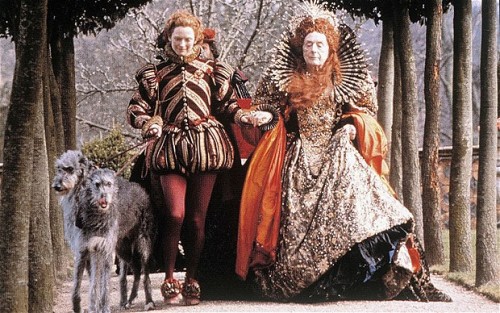
telegraph.co.uk

This is a guest post by Ian Boucher.

Drama is an incredible thing, and it is universal. It provides humans with opportunities to experience a myriad of journeys within themselves through the journeys of others. These journeys can be serious or comedic, grounded or nonsensical, yet they all have the potential to demonstrate the reflections and rabbit holes of humanity.

Unfortunately, in Western culture, due to the now largely industrial nature of storytelling, it’s all too easy to forget about that potential. The film industry represents one of the largest sets of conveyor belts, delivering the same handfuls of story and character elements over and over again in its scramble to stay ahead above the cacophony of story products. Even many of the best movies, whether produced by a studio or independently, largely use archetypes, and many film studios pour the majority of their efforts into blockbuster films, which are generally even simpler in nature.

orlando1992photobyliamlongman6

These are not completely new developments. Rather, they are a result of Western culture’s evolution over thousands of years. The majority of drama has always been produced as entertainment for commercial purposes, and our ideological journey, our cumulative human story explored over thousands of years, has simultaneously been going in wide thematic circles. These developments have also created inherent expectations for the films we watch.

This article, however, isn’t about originality. This is about potential.

I’m a student of the field of communication. I embrace the fact that the perceptions of humanity evolve like a meandering brook, naturally and gradually through time. We do make progress. It just takes us a while. Also, as a film scholar, I understand and love familiarity as well as freshness.

As a Padawan librarian, though, I can’t help but think that we can be more self-aware about how we go about all of this—that, like any activity, the results could be much better if more of the parties involved were conscious about what they were doing, whether creatively or administratively.

orlando1992photobyliamlongman2

Despite our limited options and scope in the world of movies, many cinematic characters get their fair share of explorative opportunities. But most of these characters, as many of us know, are male, right down to who we see standing in the frame. This is why for me, the core question of potential is most intricately entwined with female characters in popular movies. Although there have been many great female roles out there, there is much to do nonetheless, and this in turn reminds me of the progress that needs to be made for both sexes and all gender identities.

Take the recent trailer for Marvel’s Guardians of the Galaxy, for instance. Like many of our outings in the Marvel Cinematic Universe so far, the trailer told me that what I need to know about Zoe Saldana’s character Gamora—one of two females I noticed in the trailer—is that she can fight and that she might be a romantic interest, in this case for Chris Pratt’s Star-Lord.

Guardians of the Galaxy will be an action movie, and there are a lot of humans out there who love violence and sex, but female characters are very much utilized within those two categories for male characters to experience more often than vice versa, or focusing on the internal experiences of those involved. After all, Hollywood wants its movies to appeal to the most people possible, and this is what has largely worked so far. It is well known that the film industry is very averse to risk-taking.

orlando1992photobyliamlongman3

To make female characters appear more dimensional in recent years, the violent part has been more prominently emphasized, marketed to us as something that makes current female characters different.  Hollywood actresses in interviews across the board cite “toughness” as the primary character trait for their roles, even when their roles hold more than that. These roles and the statements about them very much reinforce the larger culture.

And yet, not only are humans three dimensional, but they also like variety, whether they agree with it or not. Just look at the ratings for any national news channel in the United States, where “controversy” abounds.

This is why, when I think about all of this, two movies especially come to mind. For me, they represent the tip of the iceberg where female characters are concerned—the hint of humanity’s dramatic potential. They vividly remind me both of the strength of expectations and the excitement of what movies can work toward. Each film occupies a vastly different place on the filmmaking spectrum—one on the fringes and the other a blockbuster, one a drama and the other a comedy, one a critical success and the other more on the infamous side, but for a few moments, they are inextricably connected, and their different places on the spectrum is precisely the point. They balance each other out.

orlando1992photobyliamlongman5

These movies are Sally Potter’s Orlando (1992) and Steven Spielberg’s Hook (1991).

Stay with me here.

Both movies starkly demonstrate just how far we have to go with our roles, for they each contain a character that transcends the idea of gender, and I don’t mean because these characters are women playing men. Changing gender and sex in the arts is nothing new. The characters I am about to explore represent a great deal of potential for both women and men in storytelling, because they are just about humans playing humans. They both represent the further possibilities of that journey that we are all always taking, and, more inspiringly, do not fall into convention in the process. Additionally, neither is about gimmick, novelty, or even agenda. They are just drama and comedy.

They each fulfill the promise of characters in cinema.

“We are joined, we are one with the human face.”

Orlando is based on the Virginia Woolf novel Orlando: A Biography. The film follows the experiences of a young man named Orlando for about 200 years until one day, he is a woman, and lives out the next 200 years as such. The role of Orlando—for it is one character—is played with perfection by Tilda Swinton, and the movie is strikingly superb from beginning to end in every possible filmmaking dimension, both as a work of art and in legitimate entertainment value. It somehow manages to be abstract and full of reality at the same time, and expertly addresses numerous complicated themes, making them look incredibly simple to explore. This film profoundly captures Orlando’s vast and variegated experience of life as a man and a woman in dramatic and comedic moments as Orlando searches for the understanding of it all along many nuances of human connection. The movie is of course not perfect, but it is moviemaking at its best.

orlando-1

Orlando is a film that can, and has, been viewed in many different ways, especially and understandably so about sex and gender roles, and especially on the feminine side of things. But I see this movie as being about more than sex or gender, whether female or male. Although the film is certainly about all of that, I see it more as being about humanity and the larger human experience. The character of Orlando brings that home in spades, and Tilda Swinton brings it out wonderfully.

On one hand, Orlando certainly is subjected to new injustices from society when she becomes a woman.  But although Orlando may finish the film as a woman (with a companion), who is to say that she (or her companion) will stay that way? The film visits the journey of one person experiencing and exploring the whole spectrum of humanity through changing perspectives. Orlando herself says it all when she first becomes a woman: “Same person. No difference at all. Just a different sex.”

Orlando and the movie itself are grand poetry that push our journey forward. They take what Marilyn Monroe’s Roslyn Taber in The Misfits (1961) started saying over half a century ago and bring it to the next level. Both Roslyn and Orlando are indeed misfits, and Orlando hits the humanity that Roslyn is still trying to tell us all about. Orlando does so by being able to transcend sex, gender, mortality, and time, so that we can look at life with a greater amount of understanding.

orlando1992photobyliamlongman4

Orlando is about destiny for men as much as it is for women. The last shot is the most striking of all, because it forces us to face that truth and leave the theater with it. It allows us to look past the lines of gender and just see a human as an adapting organism. As the music says at the end of the film, Orlando really does come “across the divide.” By the end of the film, she is more than male or female. We can move productively toward the future and forget the different kinds of cultural shackles that keep us all down.

It’s so full of possibility.

And yet! Not all movies can or should be so deep all the time. Do all female roles have to so completely change our views?

orlando1992photobyliamlongman

That’s why my next point in this article is Hook.

“NOT THE BOO BOX!”

One of the elements of Steven Spielberg’s Hook that has proven to best stand the test of time is Glenn Close’s cameo as Gutless the Pirate. (Let the discussion ensue if you just realized this!) Regardless of where many opinions fall when it comes to Hook as a whole, this scene on its own is nevertheless widely regarded as comedy gold.

It is the scene in which we first get to see Captain Hook in the flesh. The “Bad Barracuda,” as he is sometimes evidently known, zeroes in on the one person who doubted his plan to bring Peter Pan’s children back to Neverland. Just one pirate. This pirate is Glenn Close’s Gutless, who seems to hold some kind of shockingly defiant, petty disdain for Captain Hook. Almost immediately after displaying this, Gutless hilariously breaks down into tears, and is subsequently thrown into the dreaded “Boo Box,” or for those uninitiated to Neverland, a treasure chest where they drop scorpions on you.

This is not a scene about the novelty of a woman playing a man, because, before the Internet anyway, most people didn’t even know that Gutless was a woman playing a man. I still see new articles popping up all the time celebrating this realization—each of these realizations not only has clear respect for it, but also enthusiasm. It’s not because Close’s role is about a statement, nor is it because of an agenda on anyone’s part. Gutless’ scene doesn’t particularly mean anything—although I’m sure people can come up with some great analyses for it. It’s just a funny scene. The character is hilarious. Glenn Close’s performance is hilarious. The term “Boo Box” is hilarious. It all just ties together into good comedy.

The grand majority of people love this scene, and they love it even more when they realize it’s Glenn Close. It’s a good actor bringing a character to life that supports and augments the rest of the movie’s sense of humor.

And I know there is more room for this kind of thing in other movies, regardless of genre. Why shouldn’t anybody be able to play any kind of part? (There’s a mouthful.) That is the journey.

unnamed

Reminders and Expectations

Reminders can go a long way. Business and creativity can move hand in hand. But regardless of what movies do or the power they hold in cultures around the world, what it all comes down to is the stories we tell each other—what we tell each other is what counts.

Orlando and Hook are wonderful reminders that so very little has been explored in storytelling. They both can remind us of the journey that not only women, but humans, can take. Despite what all of the prophesies in movies may tell us, none of us need be, as Orlando put it, “trapped by destiny.” The possibilities for looking at each other as just people are endless.

So where are we now? Where do we want our culture to be? What stories do we want to tell ourselves? What do we want to expect? What do we want to be aware of?

I’m going to go out on a limb here, but it seems to me that the gutlessness of Western culture will only serve to keep us inside the box.

Eh???

We all know the journeys are still out there. Whether you’re a filmmaker or in the audience, why not do something about it today?

What stories remind you?


Trained in communication, film, and television theory and production, Ian Boucher is developing his interests in library science with a focus on information literacy. He enjoys reading, writing, watching movies, exploring the outdoors, and endlessly contemplating the psyches of comic book characters. Feel free to get in touch with him anytime on Twitter (https://twitter.com/Ian_Boucher) — he can talk about this stuff all day!