Fortunately for everyone, the show deliberately plays with archetype. She’s introduced as a singular image we all know, and over the course of the episode is shown to be sexy, amoral, vulnerable (Or is she? This is that kind of show; who knows!?), and an effective, if unorthodox, mentor. She’s a three-dimensional character that happens to fit the description.
Like everyone else on the Internet, I heard about the New York Times review of the first episode of How to Get Away With Murder, wherein the author used the phrase “Angry Black woman” to describe Viola Davis’ character in the show. Shonda Rhimes, show-runner of Grey’s Anatomy and Scandal, probably didn’t need anyone’s help getting her new project tons of viewers, but the furor certainly got me to check it out. Here’s the short version: I love it. It’s a really fun program, and there’s a good stable of characters that, despite their archetypal presentations, break out and distinguish themselves. Which brings me back to the Times review. While the actual phrasing leaves a lot to be desired, it’s kind of just that—bad phrasing.
“Oh wow, she wrote Crossroads!” – Me, researching Shonda Rhimes
Viola Davis’ attorney/professor character Annalise Keating introduces herself to her new class as pretty much the professor from hell. She’s Professor Snape, if you’re one of the students that isn’t a little snot like Harry Potter. There’s a chance to learn a lot, but you’re going to work really, really hard and she isn’t going to coddle you or be nice (at all) when you screw up.
“I don’t know what terrible things you’ve done in your life up to this point, but clearly your karma’s out of balance to get assigned to my class….”
Speaking of Harry Potter, the protagonist of the show is played by the former actor of Dean Thomas!
If this show were badly written, if all Keating did was be incredibly stern and severe to her students, it would have gotten tons of criticism from the same people criticizing the Times writer, saying that the character is an “Angry Black woman” and nothing more. That’s just the impression you get when she walks in and gives her first-day-of-class spiel. Fortunately for everyone, the show deliberately plays with archetype. She’s introduced as a singular image we all know, and over the course of the episode is shown to be sexy, amoral, vulnerable (Or is she? This is that kind of show; who knows!?), and an effective, if unorthodox, mentor. She’s a three-dimensional character that happens to fit the description.
Which is what the Times review was attempting to say. Black women are in a restricted cultural space, and representations of them are rather pigeonholed. Showing anger, period, is a risk, because it opens up the very real possibility of people labeling and dismissing the character as one of three types they’ve already assigned to black women. So to see the show’s writers rise to the occasion and go with a cold, borderline evil Black female lead is really quite heartening.
This doesn’t change the review’s incredibly bad opening line:
“When Shonda Rhimes writes her autobiography, it should be called “How to Get Away With Being an Angry Black Woman.””
Wow. Much inadvisable. Phrased in a less eye-jabbing way, it encapsulates what makes How to Get Away With Murder special. This show’s headlining character freely admits to defending guilty clients, and as her students see as they assist with her case, has no qualms about illegal or immoral methods of securing the not-guilty verdict. She sets murderers free because that’s how she’s chosen to make money.
**SPOILER ALERT** This guy gives a network-friendly rimjob to secure case-winning information
There’s a pretty rich tradition of this kind of character; it’s basically all we’ve gotten in the past decade or so of award-winning cable dramas. But like Broad City, How to Get Away With Murder is an entry into an established genre by a group (or two) generally shut out. By circumstance, by the genre’s conventions, or by the fear of falling into a stereotype, Black women don’t play the anti-hero role. Now we’ve got one, and she’s attached to a rip-roarin’-fun show.
I still haven’t gotten to the rest of the characters I like, but how much more do I need to say? Trashy legal drama with sexy law students behaving badly! At the end of the day, I just want everyone to watch this show so we can geek out about it. As for 11-year TV crit veteran Alessandra Stanley, go back…to…writing…school?
Solomon Wong is a writer and a graduate of UC Santa Cruz. He is the co-editor of Be Young and Shut Up, author of the cyberpunk serial novel Stargazer. He likes cooking, fishkeeping, and biking around Oakland.
In so many ways, this film reflects the current moment, while also highlighting how things have and have not changed since the King family and their allies risked their lives to secure rights for all. Scenes in the film will jolt you into the present: watching Jimmie Lee Jackson’s mother grieve in 1965 for the son she will never see again made me immediately think of the family of Tamir Rice, the young black boy who was murdered by police officers this year for toting a toy gun in Ohio. ‘Selma’ is now.
This guest post by Nijla Mu’min previously appeared at Bitch Media and is cross-posted with permission.
Historical dramas often stick to a tried-and-true formula: Important figures face struggles, then they triumph, becoming the great people we know today. We can usually count on a scene from their conflicted childhood, scenes showing their romantic troubles, any issues with drugs or alcohol, and how they persevered through it all to deliver whatever divine message or artistic gift they possessed.
Ava DuVernay’s new Martin Luther King Jr. biopic, Selma, avoids this formula—much to its benefit. It is one of the most effective, well-crafted historical biopics that I’ve ever seen because it goes off the traditional narrative about the Civil Rights Movement, giving us a moment in history that feels immediately familiar to the moment we are currently living in.
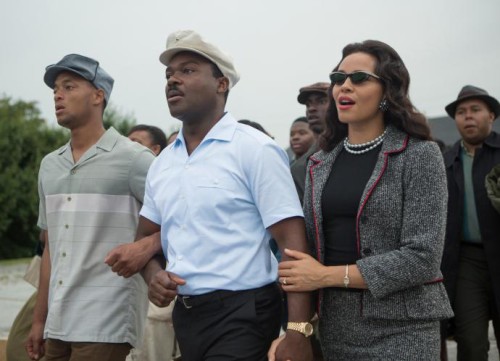
Selma captures the tireless efforts of Martin Luther King Jr. and a group of black activists attempting to secure equal voting rights for black people. These efforts led to the passage of the 1965 Voting Rights Act, signed into law by President Lyndon B. Johnson. The film takes its name from the series of marches that King and his followers embarked on at the Edmund Pettus Bridge in Selma, Alabama. One of those marches was infamously known as “Bloody Sunday,” after police and deputized locals descended on the protesters with nightsticks and tear gas. DuVernay and Director of Photography Bradford Young capture that march in all its terror in a scene where young and elderly marchers are clubbed and chased by angry police on horses. Selma certainly doesn’t cast the history of the Civil Rights Movement in feel-good soft focus.
In a recent interview I conducted with DuVernay, she discussed the way she approached the humanity of Dr. Martin Luther King Jr., including his suspected infidelity. She was most interested in how this information affected his wife, Coretta Scott King, and how Martin Luther King would respond in the moment when questioned by Coretta. This emphasis on the intimacy in their relationship, rather than the scandal that the FBI sought to publicize, is something that informs the core of the film.
DuVernay is not interested in showing us montages of the unfaithful hero, his mistress, and the scorned wife, as was done in Mandela: Long Walk to Freedom. She is interested in the complex spaces of love and pain between two people. Coretta Scott King, played with an uncanny resemblance by Carmen Ejogo, takes on a central role in this film, not only as a wife and mother, but as a key player in the movement as she faces daily death threats made against her and her family. The attention and specificity paid to her character and her relationship to King is another gift that DuVernay brings to this film.
Further, there are so many ways this film could’ve become an extension of the Hallmark image that we see of Martin Luther King Jr., one that replays the same “I Have a Dream Speech” and tells us that nonviolence is the only way. While those elements are important, they are often overemphasized at the expense of the other work he did.
That is where Selma fills in the blanks. In this film, we get to know a methodical, intelligent, human Martin Luther King Jr; a man who just wanted to sit down at the end of the day and smoke a cigarette, or call Mahalia Jackson in the middle of the night to hear her sing a soothing gospel song. In the film, he invokes nonviolence but also cleverly provokes outward hatred in his opponents, helping people around the world witness this physical racism in the media. His tactics were risky, his negotiations with the likes of LBJ were grueling, and he was often put in positions of extreme discomfort, along with the many people he worked with.
This is not a film about a man and his followers, but about how a man’s work is informed by the respect he has for the people he works with—and even those he doesn’t. It reflects the movement by emphasizing distinct traits in each of the civil rights leaders it documents, from the youthful resistance of Jimmie Lee Jackson (played powerfully by Keith Stanfield), to the gentle persistence of Malcolm X (Nigel Thatch), who appeals to Coretta Scott King in a beautifully rendered scene. That scene and others completely reverse the rhetoric we’ve been fed about who these people were. The warring ideals between Malcolm and Martin aren’t the focus of this narrative, but rather how Malcolm X may have actually intentionally pushed many black people to follow Martin Luther King Jr., helping to strengthen the movement after all. Again, DuVernay utilized Coretta Scott King in a way that shows her role in the movement beyond being a supportive wife. She serves as a sort of peacemaker here.
In so many ways, this film reflects the current moment, while also highlighting how things have and have not changed since the King family and their allies risked their lives to secure rights for all. Scenes in the film will jolt you into the present: watching Jimmie Lee Jackson’s mother grieve in 1965 for the son she will never see again made me immediately think of the family of Tamir Rice, the young black boy who was murdered by police officers this year for toting a toy gun in Ohio. Selma is now. It lets us into the interior spaces of pain, progress, and movement that no formulaic historical drama could ever capture.
Selma opened Christmas Day in Los Angeles, New York City, Washington, DC, and Atlanta. It opens nationwide Jan. 9.
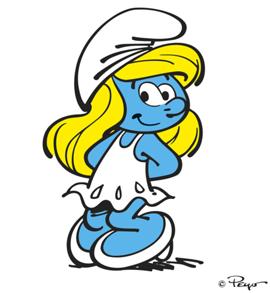
Far more than a common trend in cartoons and superhero teams, the Smurfette Principle is an ingrained interpretative framework that limits female achievement to a model for male imitation, rather than an argument for female inclusion. In comedy, “Smurfette Syndrome” is a bias that asks whether individual women are “as funny as men,” rather than assessing women’s collective contribution as creators of comedy genres.
Professional female comedians are still asked in interview after interview whether women are funny. The usual response is a defensive list of funny women. But proof of funny women is no proof that women are funny, thanks to the dreaded Smurfette Principle. The “Smurfette Principle” dictates that women who succeed in male fields must be interpreted as a) unique and isolated, and b) a variation on a male original. Far more than a common trend in cartoons and superhero teams, the Smurfette Principle is an ingrained interpretative framework that limits female achievement to a model for male imitation, rather than an argument for female inclusion. In comedy, “Smurfette Syndrome” is a bias that asks whether individual women are “as funny as men,” rather than assessing women’s collective contribution as creators of comedy genres. Such as…
Alice Guy’s irresistible piano syncs uncannily with Ray Charles
The Comic Novel
Murasaki Shikibu not only wrote the world’s first novel in the 11th century with The Tale of Genji, she included hefty doses of humor amidst all the karmic heartbreak. Whether revealing the bulbous nose of the mysterious Safflower Princess behind the silk screen, or working out the interpersonal dramas of a womanizer’s harem, Lady Murasaki wielded realism to puncture cliché. Murasaki Shikibu, along with Sei Shonagon (“the most natural wit in the history of Japanese literature”) and fiery, erotic poetess Ono no Komachi, became literary pioneers by accident: they were adopted as models for Japanese literature because their male contemporaries wrote in stilted Chinese to show intellectual superiority. As men switched to Japanese, women writers were squeezed out, leaving only their early classics.
On film and TV: Kozaburo Yoshimura’s 1951 adaptation of The Tale of Genji is a recognized classic. Peter Greenaway’s film inspired by Shonagon’s ThePillow Book reinvents it as a modern tale of a Japanese woman and an older Japanese man sexually servicing Ewan McGregor. A memorable riff on Shikibu’s “Princess Safflower” gag is featured in Who Framed Roger Rabbit?
Christian Comedy
Drama was strongly condemned by the Fathers of the early Christian church as immoral, in works like Tertullian’s De Spectaculis. It was a 10th century nun, Hrotsvit of Gandersheim, who revived the tradition of playwriting by arguing that it could have a moral function. Hrotsvit became the first recognized playwright of medieval Europe, adapting the popular sex comedies of the ancient Roman Terence into an entirely new genre: virgin martyr sex comedy. Chuckle as Dulcitius attempts to ravish the virgins, but ends up humping a sooty pot instead! Giggle as soldiers attempt to strip the virgins, but discover their robes are stuck on! Then feel sorta bad when the virgins get burned alive and shot with arrows anyway. Martyrdom replaced marriage as the culmination of a female empowerment fantasy that began with immunity to rape. The subtle relationship between hermit and prostitute in Hrotsvit’s Paphnutius inspired novelist Anatole France and Oscar Wilde, while Hrotsvit’s Callimachus is identified as one of the sources for Shakespeare’s Romeo and Juliet. Hrotsvit, however, gained acceptance by self-Smurfette: presenting her wit as an exceptional, divine gift contrasted with usual female witlessness.
On film and TV:Thais, a sexed-up rewrite of Paphnutius by Anatole France, was adapted into a faithful American silent film, and loosely inspired the only surviving Italian futurist film. Jane the Virgin is arguably a modern virgin martyr sex comedy.
Cabaret
In the 17th century, blacksmith’s daughter and shrine maiden Izumo no Okuni created kabuki as a mixture of cross-dressing sketches, sexual innuendo, musical performance, and titillating sensuality. It moved into the teahouses of the red-light district, allowing patrons to sit and drink while watching the show; that is, kabuki originally met the definition of cabaret. For empowering sex workers with social visibility and subversive self-expression, the Japanese authorities banned women from the stage to be replaced by all-male kabuki. Japan’s all-female Takarazuka revue, and witty writer-performers like Mae West and Gypsy Rose Lee in the Western cabaret/vaudeville tradition, carry on the legacy. Straight male comics often struggle to cross over into the diva humor of cabaret, yet it is female comic capability that is judged according to the masculine norms of stand-up.
On film and TV: Mae West defied ageism to become a Hollywood sex symbol in her late 30s, reportedly rescuing Paramount Studios from bankruptcy with She Done Him Wrong. The decadent culture of Weimar cabaret is depicted in the contemporary The Blue Angel, which introduced Marlene Dietrich, and the later musical Cabaret.
I seem to regularly rant on Bitch Flicks about Jane Austen’s role in defining romcom, so I’ll be brief: the meet-cute, the bickering couple who mirror each other, the misunderstandings, public humiliation and sacrificed ego – this is the template of Pride and Prejudice. Though her achievement is trivialized by treating “romcom” as a gendered slur, Austen’s formula is actually fundamental to the male romance of films like Fight Club, as well as classic comedies like Some Like It Hot.
“If the future development of motion pictures had been foreseen at this time, I should never have obtained his consent. My youth, my inexperience, my sex, all conspired against me” is how Alice Guy Blaché described being given her start in directing by Gaumont because no one else saw the potential of film: Alice Guy invented the close-up, she hand-painted color film in 1897, experimented with synchronized sound in 1906 and made over 1,000 films, owning her own studio (Solax). She made action films with swashbuckling female leads and boat explosions, but makes this list for creating the first parody films. Although the first comedy film is the Lumiere brothers’ The Sprinkler Sprinkled, about a sprinkler… who gets sprinkled (it predates the “don’t name it after the punchline” technique), it was Alice Guy who parodied the special effects films of George Melies with 1898 cross-dressing farce At the Hypnotist’s and the earnest scientific documentaries of her male peers with 1900 botched-surgery farceSurgery at the Turn of the Century. She brought in slapstick domestic strife with 1902’s An Untimely Intrusionand explored sexual harassment through comic role reversal in The Consequences of Feminism. Mabel Normand was an early slapstick star who directed her own films. Studio boss Mack Sennett (Keystone) is on record saying that Charlie Chaplin “learned [to direct] from Mabel Normand.” Neither Normand nor Alice Guy is regularly celebrated among cinema’s comic pioneers.
On film and TV: Though many of Guy’s films are now lost, many more can be viewed free online.
Stand-up Comedy
It’s difficult to say when the comic monologues of vaudeville transitioned into recognizably modern stand-up, but probably while Moms Mabley was headlining at the Apollo. To understand her contribution, witness the comics who acknowledge her influence: Flip Wilson, Richard Pryor, Joan Rivers, Eddie Murphy, Whoopi Goldberg, Chris Rock. Mabley exploited the freedom of old ladies to speak their mind, to confront taboos like alcoholism, poverty, racism, infidelity and sexual double standards, defining the comedian’s role as “truth teller” with a persona modeled on her grandmother, a former slave. Growing up Black and gay in 19th century North Carolina, Moms was bulletproof to hecklers before she ever hit a stage. Stand-up and fringe theater offer creative freedom to the minority perspective of queer comediennes of color, from the wild parodies of the Native American Spiderwoman Theater to figures like Wanda Sykes and Margaret Cho today. Mabley is sometimes called the “first female stand-up,” but still isn’t widely acknowledged for pioneering the modern art of stand-up itself, despite Bill Cosby admitting that “she opened that door for a different kind of solo” (Cosby should know; he was quite the groundbreaking comic before moving on to beloved sitcoms and sex crime allegations).
On film and TV: A young Moms has a brief cameo opposite Paul Robeson in The Emperor Jones, rocking a tuxedo in 1933, before starring in 1948’s Boarding House Blues and 1974’s Amazing Grace. Whoopi Goldberg made a documentary about Mabley. You can find Mabley’s later comedy routines, for the Smother Brothers Comedy Hour and the Ed Sullivan Show, on YouTube.
When Moms jokes about being forced into marriage, it’s because she was
Improv Sketch Comedy
The comic improv created in the post-war University of Chicago shifted the culture of comedy from stand-ups telling jokes to actors performing satirical sketches. This new style was introduced to the world by comedy duo “Nichols & May,” where Elaine May’s role in creating the skits was equal to Mike Nichols’. The sharpness of their satire and the danger from their live improvs brought improv skits mainstream, like a new art of comedy jazz. You might say that without Elaine May and Mike Nichols, there would be no Steve Martin, no Lily Tomlin, no Martin Short, no Saturday Night Live. In fact, Vanity Fair did say that.
On film and TV: Many classic “Nichols & May” sketches are available on YouTube. Elaine May brought geeky charm and Jewish humor to the romcom by writing, directing and starring in 1971’s A New Leaf, six years before Woody Allen’s Annie Hall. She was Oscar-nominated for writing Heaven Can Wait and Primary Colors, wrote The Birdcage and was an uncredited writer on Tootsie, but never got another chance to direct after Ishtar flopped (despite the film’s bad reputation being exaggerated).
Sitcoms
The first sitcom on network television, 1947’s Mary Kay and Johnny depicted Johnny and Mary Kay Stearns’ marriage, of which Variety said “much of the show’s charm is traceable directly to the femme half of the team.” The couple that defined the sitcom’s template was Lucille Ball and Desi Arnaz. Ball and Arnaz created “more tropes than anything on television before or since”--they filmed the episodes in front of a live audience using multiple cameras, a unique format at the time, making the first reruns possible and keeping I Love Lucy in syndication worldwide. Ball and Arnaz’s Desilu studios also produced Star Trek. After breaking up with Arnaz, Lucille proved she could do it solo with The Lucy Show. Jennifer Saunders’ Absolutely Fabulous, Roseanne Barr’s Roseanne (which launched Joss Whedon and Judd Apatow) and Tina Fey’s 30 Rock followed in Lucille Ball’s sitcomical footsteps.
On film and TV: I Love Lucy has many episodes and classic scenes available on YouTube.
A supernaturally strong girl hangs out with her sarcastic, quipping gang – including bitchy golddigger and sweet, motherly one – while carrying on a feud/flirtation with her supernaturally strong, shapeshifting love interest, being pined over by a more impulsive, supernaturally strong shapeshifter, and fighting off demons-of-the-week and sexual harassers. If you guessed Joss Whedon’s Buffy the Vampire Slayer you’d be right, but if you guessed Rumiko Takahashi’s Ranma 1/2 you’d be a decade earlier. Today’s explosion of sarcastic, bickering romcoms with supernatural martial arts was fresh when Takahashi developed it with 1987’s Ranma 1/2, and her later Inuyasha. Takahashi’s immense success at blending male and female genres, creating entertainment that offers integrated empowerment to both sexes, has been Smurfetted in Japan, segregating female mangakas into a female genre (shoujo).
On film and TV: both Ranma 1/2 and Inuyasha have been adapted into anime.
So that is the incredible true story of how women created the culture of modern comedy without being funny. “The Smurfette Principle” is still used to isolate female achievement, from cartoons to comedy clubs. We can only laugh.
Brigit McCone is grateful to the anarchic Rose Lawless and Emma Pearson’s Crash Test Cabaret for assisting at the comical birth of her cabaret alter-ego Voluptua von Temptitillatrix. Her hobbies include doodling and she will be linking to this article if anyone ever asks that bloody question about funny women again.
The lead character in BBC’s ‘The Fall’ is impervious to fear, but that’s OK. She’s doing the modern detective’s work of making us all feel safe in a world that’s anything but.
The lead character in BBC’s The Fall is impervious to fear, but that’s OK. She’s doing the modern detective’s work of making us all feel safe in a world that’s anything but.
Gibson (she’s gonna be OK)
The second season of The Fall just finished airing on the BBC and, while there’s been a slow decline in quality since the series premiere, it remains one of the only detectives shows – if not the only detective show – to acknowledge that violence against women is a built-in feature of patriarchal cultures rather than a random, strange coincidence. (Rebecca Solnit has a good essay about this in Men Explain Things to Me, if you want to get mad.)
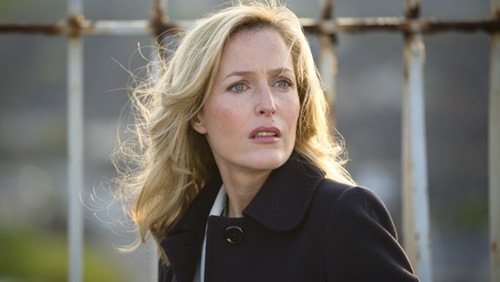
The Fall is about serial killer named Paul Spector and Stella Gibson, the Gillian Anderson-looking detective who hunts him down. In his own mind, Paul is a dark, fascinating genius who’s playing a clever game of cat and mouse with the Irish police force. In almost everyone else’s mind, he’s a loser who hates women, and the police figure out who he is almost as soon as they start looking.
What makes The Fall an amazing piece of television is that it spits in the face of conventional serial killer narratives. Rather than being fascinated with Paul and how tortured and interesting he is, it’s focussed on how his hatred of women fits into a larger societal pattern, and how the lessons we learn about gender inform our beliefs and behaviours in life. It can be heavy-handed, but it’s also refreshing because it’s so different from the narrative we most often see.
The show spends roughly equal time on Spector and Gibson, but it’s Gibson we’re supposed to cheer for, and Gibson who’s built up as the ideal feminist woman. In the middle of a show full of terrifying, realistic, often heart-wrenching violence against women, Gibson’s there to make us feel safe. Not only because we know she’s going to catch Paul Spector and put him behind bars, but because she is completely and utterly awesome at everything. Perhaps unbelievably so.
The main source of tension in The Fall comes from fear and vulnerability. Watching the show, as a woman, you have the same chilling thought you have, as a woman, every time you’re walking alone at night, or hear a sound in your house while you’re sleeping: “What would I actually do if someone attacked me right now?” And the answer, if you’re honest, is that, even if you learned some krav maga one time, you would be just as terrified and just as dead as one of Spector’s victims.
The fear that men will attack us is something women carry around 24/7; it’s always simmering in the back of our minds, and The Fall forces us to look at it directly. In the middle of that horror, like a lifeline, or a warm blanket, Gibson the Terribly Competent stands impervious to fear. She can’t be intimidated by a bunch of tough guys on the street; she doesn’t freeze in an emergency; she can’t be made to feel ashamed for having sex; she breaks your nose if you don’t back off when she tells you to; she isn’t scared of some guy in a bar, or some guy in a limo, or even some guy who chokes other women to death. She looks at those guys with contempt and moves on with her life, without thinking the problem is her. No matter what, we know, she’s going to be OK.
It’s not actually unusual for the hero of a genre story to be hypercompetent. Like, we all understand that Jason Bourne is not realistic, right? And the guy from Mission Impossible? And that one detective from True Detective who said that time was round like a beer can? He was also improbably good at things.
What interests me about Gibson isn’t that it’s weird for the hero to be competent – it’s that, in this instance, her competence speaks to me and comforts me in way that Rust Cohle didn’t manage. She reminds me of another detective I like.
One way or another, she’s gonna find ya, she’s gonna getcha getcha getcha getcha
Appropriately, since Veronica Mars is set in high school, the tension in that story’s less about the fear of being killed and more about the fear of public humiliation. And Veronica, its hero, is impervious to all embarrassment.
In The Fall, it’s been implied that Gibson may have been assaulted at some time in the past, and that that’s what motivates her to work with female victims of violence. In Veronica Mars, it’s made explicit from the start that Veronica was the victim of the cruellest forms of high school bullying before she became the cynical, hypercompetent girl we know.
Whenever someone tries to insult, intimidate, or make fun of her, she has a snappy comeback to put them down. Whenever someone seems to get the upper hand against her, she manages to turn the tables somehow, making them look foolish in her place. In maybe the most blatant example, some popular boys she’s investigating put her name on the karaoke list in an attempt to embarrass her and make her back off. With only seconds to think it over, Veronica jumps up and sings the Blondie song “One Way or Another,” turning potential humiliation into a triumph as literally no real person could do.
Knowing that Veronica’s going to land on her feet whenever someone tries to bully her has the same warm blanket effect as knowing that Gibson can’t get scared. It’s not entirely realistic – for all of us, life involves at least some moments of fear and humiliation – but it gives us safe harbour in stories that are otherwise designed to make us anxious. In these particular contexts, Gibson and Veronica always know what to do, and the things they do always work. They allow us to confront the things that make us anxious with the safety net of knowing that it’s going to be OK.
And, if you’re going, “Katherine, that’s what all detectives do,” you’re sort of right.
Remember when House was a thing?
Part of the point of detectives – at least modernist, soft-boiled detectives – is that they bring order to chaos and therefore restore our sense of safety. When Sherlock Holmes became popular, in Ye Olde Victorian England, it was in a context where urbanization, industrialization, and the expansion of the British empire had made people feel uncertain about what was happening. The world was changing really fast, there were a bunch of strangers around, and it felt like some random person could just murder you or steal your stuff and disappear into the crowd. (From a more racist point of view, it also seemed like a wizard from India could slip some potions in your tea, but that’s a different discussion from this.)
The calming figure of that era was a man with the superhuman ability to piece together tiny bits of information, and an encyclopaedic knowledge of literally everything that ever was, including scary foreign cultures. He was the safe harbour in the storm of modern living.
Flash forward about 100 years, and the same hero is reincarnated as House, a doctor who knows what’s wrong with you even when Web MD has no idea. Like Sherlock Holmes, House taps into our general fear that there is too much information for any one person to crunch. And, in a world where we are terrified that everything from our water bottles to our genes is trying to kill us in new, incomprehensible ways, the House version of Sherlock Holmes provides some safety, because House can see the pattern, House can understand what’s happening, and House can make some order out of chaos. Even if the MRI machine makes all your veins explode exactly in time for commercials, House will have the answer by the end.
The comfort of watching Gibson is both similar and different to the comfort of knowing that puzzles get solved. It’s the comfort of saying, “There’s someone who looks like me and, day to day, is not afraid to be alive. Someone who lives in the world I live in, that’s full of the terrors I face, and – realistically or not – is showing me what it could be like if I didn’t have to be scared.”
It’s a powerful counterpoint to the Man Kills Loads of Women – Is Special, Tortured Genius story that Spector thinks he’s starring in. This is Woman Is Not Afraid to Walk Down the Street; Woman is Not Afraid to Say No; Woman Isn’t Worried That She’ll Be a Total Drag if She Points Out What a Sexist Jerk You’re Being. It’s a different kind of fantasy than Knowing Lots or Solving Things – it’s Having a Right to Exist, opposite the story of a man who chokes women to death to feel strong. It’s the writers consciously and deliberately preventing this from being a story where you should have carried some mace to the bathroom, if you didn’t want to get killed in your house.
What’s different about Gibson isn’t that she’s extra specially good at stuff – it’s that the forces she’s facing off against are specifically aimed at women. The fear that she’s shielding us from is a fear that most men don’t carry around. The Fall, in its graphic and terrifying depictions of violence, would be unbearable to watch if Gibson wasn’t always at the centre, reminding us what life would be like if we didn’t have to feel afraid.
Different monsters require different kinds of heroes to defeat them. Gibson is the right kind of hero to face this kind of monster, and the strength of The Fall may be that it’s the first show to know which monster we’re trying to fight.
Katherine Murray is a Toronto-based writer who yells about movies and TV on her blog.
For filmmakers, the easiest way to make an audience like a character despite the fact that he’s a lazy failure of a human being is to steep that character in privilege. We’re always expected to root for young straight white cis men, whether their laziness makes them waste away their lives, or their ambition makes them endanger their entire family.
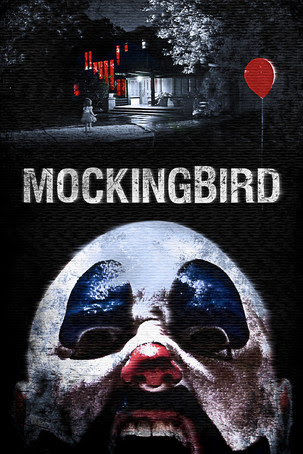
Unlike every other person who saw this movie, I think Mockingbird is a brilliant found footage horror film experiment. (OK, there’s one other guy who likes it, but most reviewers reallyreallydon’t.) Mockingbird takes a unique approach to horror film structure and tone, and it builds to an unforgettable climax. Unfortunately, itsapproach to representations of gender is totally forgettable and anything but unique.
***The majority of this post is spoiler free; I’ll give you a clear warning when I’m about to discuss the ending all the reviewers hate so much.***
Mockingbird (2014) is the second film written and directed by Bryan Bertino, whose first film, The Strangers (2008), though now beloved in certain horror film niches, was not well received by critics. Mockingbird went straight to VOD and the consensus of reviewers is that the production company buried this film because it’s not a good movie.
“How many trailers have you seen for the film? Probably not many. With the fan friendly Blumhouse behind the project, perhaps we should guess that something just isn’t clicking with this one. If there’s any company out there right now that’s definitely going to stand behind their releases, it’s Blumhouse. But they’re not standing behind this one, and yes, there is most certainly a reason for that, Mockingbird just isn’t the picture that fanatics are hoping for.”
Here’s the film as summarized on Netflix: “A woman, a man and a couple each receive a video camera and instructions to keep filming — or face terrifying consequences.”
I love Bertino’s The Strangersbecause it combines great horror storytelling with an awesome representation of a female character in a horror film.
Unfortunatly, Mockingbird does nothing to challenge tired, stereotypical representations of gender in film. It presents the wife as the character who freaks out, and the husband as the character who makes a plan and goes for the gun. It relies on the problematically gendered trope of the lovable loser dude.
So, if it doesn’t challenge representations of gender and pretty much everyone who reviewed it says it’s total crap, why on earth would I call Mockingbird brilliant?
Because its triple story structure builds toward the most heartbreaking ending I’ve ever experienced in a horror film.
Let me explain:
Mockingbird intertwines three storylines: two are perfectly parallel, but the third clashes completely with the tone, plot, and pacing of the first two.
While the couple and the woman become increasingly terrified in their own homes…
The couple, Emmy and Tom
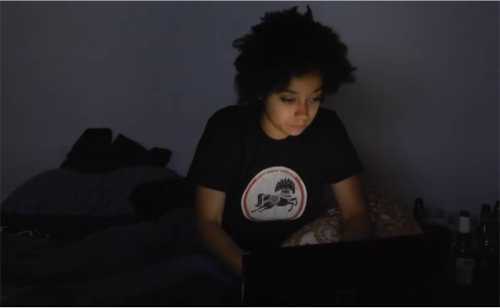
The woman, Beth
…the man is happily running around town dressed like a clown, super enthusiastic about this kooky quest he’s on and dreaming about winning $10,000.
The man, Leonard
First, let’s unpack the gendered trope of the lovable loser dude, and then I’ll explain why I like and root for Leonard in spite of the fact that he occupies this problematic Slacker role.
For filmmakers, the easiest way to make an audience like a character despite the fact that he’s a lazy failure of a human being is to steep that character in privilege. We’re always expected to root for young straight white cis men, whether their laziness makes them waste away their lives, or their ambition makes them endanger their entire family.
Am I saying that Mockingbird is totally the worst most stupid awful misogynist film ever? Not at all. I’m saying that it does nothing to think outside the box in terms of its approach to men and women in horror.
Am I saying that we can’t like Leonard? Quite the opposite, actually — my positive review of this film is predicated on how much I liked Leonard as a character.
We viewers need to notice the privilege afforded to the Slacker character, and we need to recognize that this is a gendered trope invested in oppressive sociocultural hierarchies. We need to take all of this into consideration, but that doesn’t mean we cannot like and root for Leonard.
There are lots of great lovable losers out there, characters like Parks and Recreation‘s Andy Dwyer — good-natured dudes who exhibit a stupid but endearing exuberance.
Andy Dwyer, loveable loser dude
Barak Hardley’s Leonard has an Andy Dwyer quality: a zany zest for life couched in total lack of ambition or drive. Like Andy, Leonard doesn’t hesitate to show gratitude to his peers. Like Andy, Leonard expresses his sexual desire for women while still managing to seem like he respects them.
From the moment we viewers are first birthed from the box on Leonard’s doorstep into his grungy world, we are met with his trademark mixture of excitement and nervousness about what he believes to be some kind of sweepstakes contest:
“Awesome! Awesome! Awesome!”
When he finds another box containing a clown costume:
“Yes! Yes! Yes! A clown outfit! Oh! I get to wear clown makeup! Yes!”
Any horror fan worth hir salt circle will realize pretty much instantly that Leonard’s excitement is misguided. Reviewers don’t like that Mockingbird telegraphs its ending so early; they don’t like that it’s obvious where all of these intertwined arcs are headed.
“Established as a cut-together game show of sorts, Mockingbird eliminates any appearance of legal enforcement since the baddies presumably edited all the remaining footage. From this hint we can immediately start determining how the contest may conclude, a situational assessment that Bertino all-but confirms by telegraphing plot-points hours before they happen (at least it felt like hours).”
But I thought that was the most fascinating aspect of Mockingbird: I knew where Leonard’s story was headed, but clearly he didn’t. Throughout the film, he functioned as the comic relief, but I knew that his comedy would ultimately wind up served back to me as tragedy, tragedy with a side of red balloons.
Leonard’s unbridled enthusiasm broke my heart; he was so excited and grateful to be a part of what he thought was a contest. He had no idea he was in a horror film until the final scene of the movie.
Lines like these in particular pulled on my heartstrings:
“I think this is gonna be a really good night for me.”
“This is without a doubt, the coolest moment of my life.”
And this line just broke my fucking heart:
“OK, just promise me that you guys aren’t just making fun of me. Just please be real.”
Then when he’s practicing his “Surprise!” in the mirror, smiling and nervously counting down — this moment made me SO SAD. Because what happens next is anything but a surprise.
* * * * * * * * *
Mockingbird reviewers also express frustration with the film’s unoriginal approach to home invasion terror: the boring banging outside the house, the standard-issue found footage shots:
“There seems to be a new film releasing every few weeks at this stage that takes on the same ‘shaky cam’ format, most with little success. Is it completely dead as a sub genre? I think not, as there is still room for greatness to be done. Mockingbird, however, is not the film that is going to win over the naysayers.” (Horror News)
I have to agree that the sequences of the couple and the woman bring nothing unique to the home invasion terror table. However, I think the banal nature of this approach to found footage terror serves to emphasize Leonard’s tragic exuberance, the most meaningful and fascinating aspect of the film.
Many films suggest that it’s totally worth it to risk it all and go for the gold; Mockingbird tells us that taking risks can be dangerous, that shooting for the stars can result in tragedy — even for young straight white cis men. It shows us the downside of relentless positivity, which is a surprising thing for a horror film to do.
And finally, BIG SPOILER TIME: Let’s talk about that ending everybody hates so much…
…….dun
………………………dun
………………………………………..DUN:
THE TORMENTORS ARE CHILDREN.
Most reviewers absolutely detest the final moments of the film:
“The climax feels insulting to the audience that has gone along for the ride, and is completely devoid of any meaning or merit. It just highlights all the issues you had throughout the viewing experience, and exposes the film for the poorly conceived idea it is.” (Horror News)
“With Mockingbird…I specifically remember that horribly dumb ending that retroactively ruins the best moment of in the movie.” (Horror Movie a Day)
Reader, I will forgive you if your mind can’t stomach the suspension of disbelief required to enjoy this film, because frankly, it is pretty damn ridiculous.
The tormentors are children? Really? Is this believable? NO, absolutely not.
Nor is it believable that Leonard would be so great at applying clown makeup, or that his face would stay so fresh throughout the rainy night. Nor is it believable that these 1995 cameras could sustain the battery power and footage capacity to document so many hours of activity. It’s all totally ridiculous.
BUT — if you can bring yourself to suspend disbelief, then you’ll be able to enjoy the way that Mockingbird turns an established horror story on its head:
Instead of the traditional tale of the Monster Clown attacking innocent children…
…Mockingbird is a story in which the clown is the sympathetic character and the children are the monsters.
And the revelation that the tormentors are children explains so much about strange things that transpire throughout the film:
It explains why Leonard is tasked with juvenile acts like, “I’m farting and I’m peeing in the women’s room,” and being kicked in the balls. It explains why the terror experienced by the couple and the woman consists of childish pranks with sinister twists: ding-dong-ditching, prank phone calls, chalk arrows leading the way.
What Mockingbird doesn’t explain is why these kids are going around making strangers kill each other. Yes, it’s frustrating that we don’t get an explanation, but maybe we should take a page from Leonard’s book: when he’s talking about his reluctance to enter a women’s restroom, he says, “Let mysteries exist. I don’t need to know all the answers.”
When you only share narratives from a small percentage of the population, chances are the stories might start to overlap. Only allowing a certain group of people access to representation is merely a way of securing total domination, and normalizing white supremacy. This trend is especially common in the comedy space.
This is a guest post by Aph Ko.
I am the actress, writer, and producer for the new independent web-series called Black Feminist Blogger. The show centers on the protagonist Latoya as she attempts to navigate the competitive terrain of the online feminist blogging marketplace.
She is a full-time blogger for the online feminist magazine Sapphire Mouth Magazine, which is run by a white woman named Marie. The show comically highlights some current issues within blogging culture such as the exploitation of writers, the overwhelming amount of under-paid writing positions, as well as the overt privileging of white women’s voices over minoritized women.
As the show unfolds, we see all aspects of Latoya’s life impacted by the massive amount of time she spends online catering to Marie’s requests for more sanitized, mainstream, “page-clicky,” commercial material. From not receiving regular paychecks, to having relationships fall apart, Latoya’s world spins upside down as she attempts to find a way to balance her love for feminism and writing, with the exploitative market inherent in many blogging spaces.
The struggles that Latoya faces are not all that different from many other bloggers online. Blogging is still largely seen as a hobby rather than a business, therefore, exploitation runs wild. Additionally, because so much of the labor is invisible to the mainstream, there are rarely any entertainment products that cater to bloggers. The blogosphere functions much like any other workspace, except much of the communication is done online. There are so many funny narratives lurking “behind the scenes” of blogging and I decided that I would start with some of my own stories.
I think it’s important that young women of color pick up cameras and film their own narratives, regardless if you don’t have a budget or camera experience. Hollywood shouldn’t have a monopoly on creativity and expression. I’m so tired of going to movie theaters or turning on Netflix and seeing that white people (predominantly men) dominate all stories. It’s not right, and frankly, it’s boring as hell.
When you only share narratives from a small percentage of the population, chances are the stories might start to overlap. Only allowing a certain group of people access to representation is merely a way of securing total domination, and normalizing white supremacy. This trend is especially common in the comedy space.
A lot of comedy today is politically, critically, and intellectually bankrupt.
Even when the media product is supposedly “progressive,” it still centers whiteness. Think about the Colbert Report or The Daily Show, where they say some of the most progressive commentary on television, yet they are the first to carry the torch of whiteness and continue on the tradition of white men dominating media. In fact, when I watch these shows, sometimes I feel like they’re explicitly talking to white people, so I laugh, but again, I laugh from the margins.
The privileging of whiteness is the underlying foundation for mainstream comedy today.
“Mainstream comedians like Louis C.K. are well known for acknowledging their white privilege, but they continue to use racism in their routines. Because people of color are not the intended audience, we are the targets for jokes.
White comedians’ refusal to acknowledge audiences of color has been painfully consistent. I’m tired of waiting for the Mexican joke to be over so that I can go back to listening to the rest of the show. Instead of hoping for white comedians to validate my experience, I have since begun to actively seek out comedians of color.”
It’s time we disrupt this trend and take over. If you really think #blacklivesmatter, then you should support the hell out of Black independent artists. Waiting for white people to “get it” doesn’t have to be the activism. Actively seeking out Black comedians, artists, musicians, intellectual thinkers, and filmmakers is the activism.
Being able to relax, being able to be entertained (without the drudgery of a thousand side-thoughts about how white-centric or sexist a program is), and being represented is revolutionary.
We must continue to cultivate, foster, and support Black independent media.
“Imagination is a powerful tool that white supremacy keeps trying to hijack. When imagination becomes institutionalized, corporatized, or white-washed, it can become a tool of violence that can shape reality. Black independent media is a revolutionary reclamation of imagination.”
The character development of Pina and Marina used by Rossellini shows the influence of the war on Italian life and femininity. The suffering women are the epitome of the country at war.
Italian neorealism. Who would have thought that a genre that existed for a short period of time–1944 to 1952 to be precise–could have such a significant influence in the world’s cinematic history? The quintessential works of the Italian neorealist directors such as Vittorio De Sica (Ladri di biciclette), Luchino Visconti (La Terra Trema, Ossessione) and Roberto Rossellini (Roma, città aperta) are now anchored in our cultural lexicon. The genre has influenced the work of famed directors such as Truffaut, Antonioni and Godard. After all, didn’t Jean-Luc Godard state “All roads lead to Rome, Open City”?
Roma, città aperta, the first part of Rossellini’s neorealistic trilogy, is often cited as the prime example of the neorealist genre. In ravaged Rome of 1945, recovering from Nazism and fascist oppression, Rossellini formed a team with Federico Fellini and Sergio Amidei to create two documentaries. Amidei and Fellini encouraged Rossellini to combine the scripts to create realistic fiction. The film was shot on location in Rome on a shoestring budget (mustered with many loans). Rossellini used parts of a 35 millimeter film and the scenes were silently shot–Renzo Rossellini would later post-synchronize the sound. Voilá, Roma, città aperta was born.
The neorealist movement arose as a reaction against the glamorous melodramas that had previously dominated the Italian film industry under the dictatorship of Benito Mussolini. The fascist Mussolini used cinema as a place where the Italian citizen could dream of the lush–unattainable–images and temporarily forget their own harsh reality a.k.a cinema of distraction.
The neorealist directors sought out to present a degree of unfettered realism that wasn’t presented on the Italian silver screen. The films addressed social problems such as the ravages of war, crime, unemployment, and poverty. The sense of immediacy throughout the film–scenes shot in locations where eight months before the city was occupied by the Nazis–had no correlation with any other Italian film produced in the 40s. Upon its release, Roma, città aperta, was received with mixed reactions in Italy. Luckily the rest of the world was transfixed by this form of new realism. The film won the Grand Prize at the Cannes Film Festival in 1946. Fellini, Rossellini, and Amidei were nominated for an Oscar for Best Adapted Screenplay.
“Franchesco”
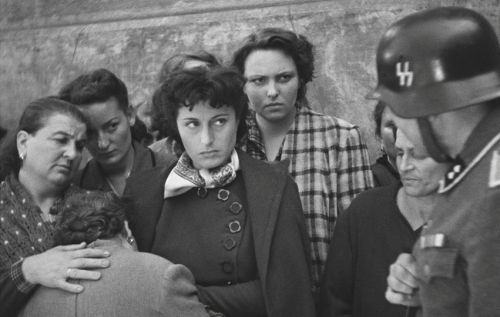
Roma, città aperta centers around the plight of the core members of the Italian resistance against the occupational Nazi government. We follow Giorgio Manfredi also known as Luigi Ferraris (Marcello Pagliero), a communist and leader in the resistance who’s wanted by the Nazis. His friend and underground Communist newspaper printerFrancesco (Francesco Grandjacquet); his fiancée, the widow Pina (Anna Magnani); and the priest Don Pietro Pellegrini (Aldo Fabrizi). The trio will help Manfredi get a new identity. Pina’s son, the young Marcello, has been active in the resistance against the Nazis. In the tumultuous events that follow, Francesco is arrested but later manages to escape. While Manfredi gets betrayed by his lover, femme fatale pur sang, Marina (Maria Michi).
Most research on the film–see for example the work of David Forgacs, Peter Brunette, Tag Gallagher–is focused on the politics of filming, the catholic church, or other neo-realist features. Not much is written on the archetypical roles of the women in this film (bar the work of Marcia Landy. The character development of Pina and Marina used by Rossellini shows the influence of the war on Italian life and femininity. The suffering women are the epitome of the country at war.
Fascism encouraged the rise of the so called New Italian Women (Nuova Italiana). During Mussolini’s reign, Italian women struggled with the dilemma of the lure of modernity versus the rut of tradition. Though their freedom was curbed: no voting rights for women, no female participation in the labor market, and a ban on abortion. The role of the women herein was in essence purely to bring forth children. These contradictions were emphasized by the gap that existed between the traditional Italian society of the First World War and the division of modernity that fascism entailed. In 1933, Mussolini’s stated, “ Woman must obey… My idea of her role in the State is in opposition to all feminism. Naturally she shouldn’t be a slave, but if I conceded her to vote, I’d be laughed at. In our State, she must not count.” Right.
Marina (Maria Michi)
In Roma, città aperta we are introduced to two archetypes. First, the headstrong Pina, the rock who supports her husband, yet is allowed to be vulnerable. Then there’s Marina, the “weak” and venal woman who will succumb to all her desires. This dichotomy between Pina and Marina is the classic example of the Madonna-whore complex. Marina is presented as the complete opposite of Pina. Pina can be seen as the new Italian woman. Her whole look and attitude throughout the film is that of an ordinary, disheveled woman. She almost seems stripped of her “femininity.” This is a stark contrast with Marina, who works as a showgirl and enjoys her silk stockings, fur coats, and cigarettes – all the finer things in life. Marina seems like the new embodiment of the earlier femme fatales that reigned in the Fascist cinema–women who lived by no discernible laws and destroyed men who crossed their paths. Although, Rossellini’s version of the femme fatale is portrayed as a frail woman. Marina doesn’t fully embody the vivacious and sexual role the previous Italian femme fatales had. She’s doesn’t sashay her way through life, instead she’s considered weak and unable to deny herself any desires. This is also illustrated by Rossellini’s portrayal of her “liaison” with the Nazi Ingrid (and to underline the “moral depravity” during the war). It’s important to note that while Marina is depicted as the sexual deviant, it is Pina’s motherly and devout character who ultimately comes across as impulsive and irrational.
In arguably one of the most famous scenes, Pina runs after a prison truck while shouting “Franchesco!” as her husband is taken by the Nazis. It’s a quick montage of short takes and one very dramatic tracking shot that underlines the abruptness and finality of death – the scene is inspired on a real life event in 1943 where Maria Teresa Gullace participated in a protest and was shot in front of her husband and son.
Roma, città aperta is one the most conventional films of Rossellini, well, at least in terms of narrative and dramatic structure. Through cinematic codes like shot / reverse shot, mise-en-scene, framing, and continuity montage, directors can reveal gender relations. Critic Laura Mulvey refers to it as the male gaze and states that cinema ideally is meant for the male audience. She divides the term in two: active male and the passive female. The problem lies in the fact that the woman is just a lust object on the screen, but that the male viewer meanwhile still has an irrational fear of the woman.
In Roma, città aperta the gaze shifted in the sense that the role of Pina and Marina is dialectical. The strong, motherly and modest woman knows her weak moments. Throughout the film the gaze lingers on the tired face of Pina. Marina realizes what she did, who she betrays and struggles to looks at herself in the mirror. Through this narcissistic gaze, the viewer is also hit with this realization. Pina is portrayed as the caring mother, and Francesco had found the perfect woman to start a family with. Marina is the epitome of the whore; she’s only there for men (or women) to have sex with, but cannot be tied down or feel true love. This is shown in her relationship with Manfredi. Manfredi’s looks and glances at Marina are nothing more than lustful. His gaze holds contempt for the fact that Marina is so weak, she’s willing to sell herself in order to establish a luxury life. Marina is clearly a passive female, but Pina has a more active stance. Nevertheless, her activity was not accepted and she comes to her untimely end.
Throughout the film, Rossellini leaves room for your own interpretation and strengthens the feeling of uneasiness that the story evokes – see the ambiguous “open” ending. The strength of Roma, città aperta lies ultimately in the images of Rome, the “amateur” actors (see the wonderful Magnani and Fabrizi), and the film’s aesthetic. It all lifts the film to the next level. Rossellini’s film depicts the reality of war and the displacement of women out their stereotypical roles during moments of distress.
Roma, città aperta has brought us some of the most indelible images in world cinema.
Giselle enjoys googling random things, late night conversations, and can’t stray far from the impulse to write it all down. She writes on fashion, film, and pop culture here.
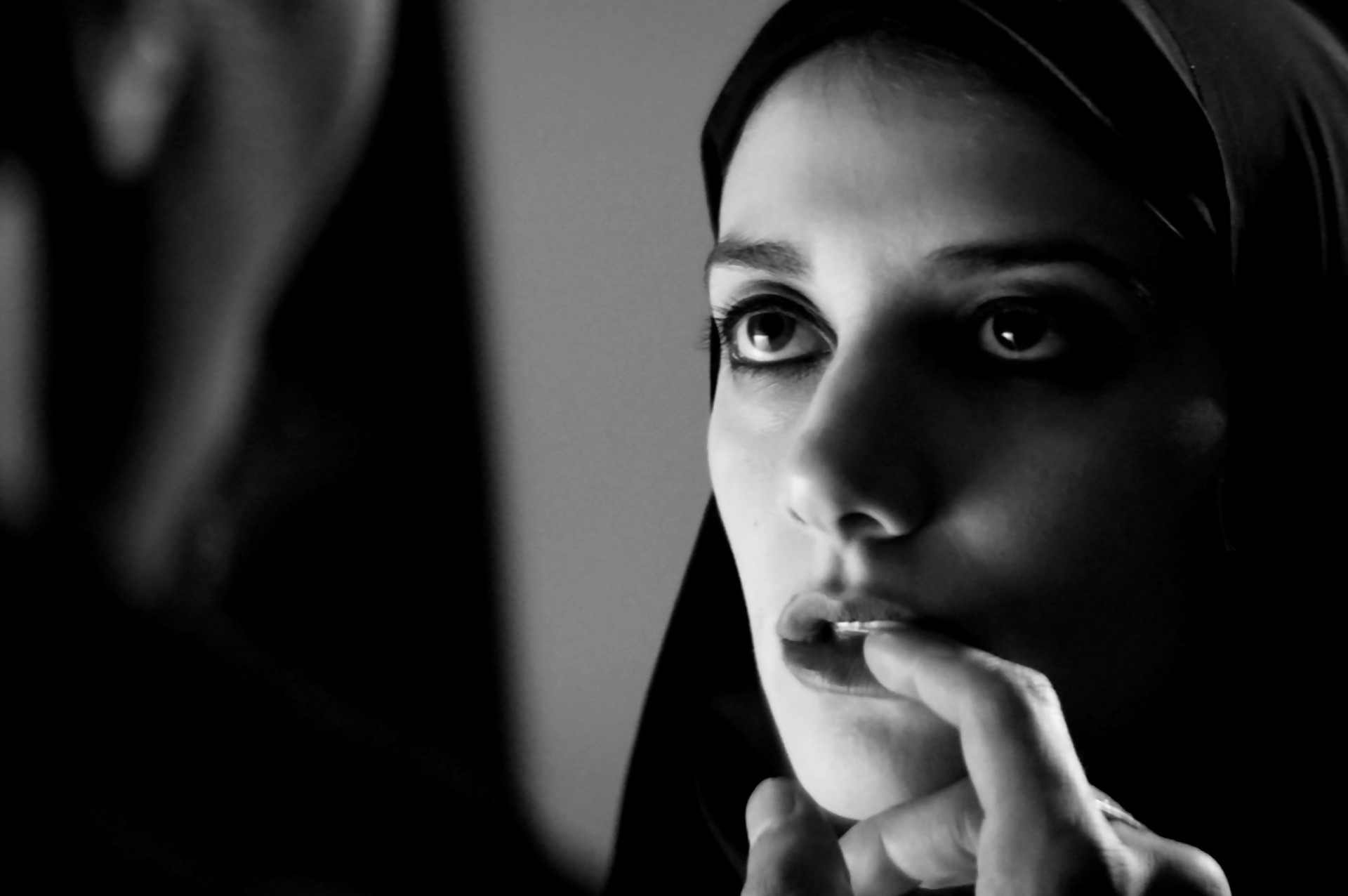
Nice girls aren’t supposed to walk alone in the dark, even in the movies. So in the generically titled ‘A Girl Walks Home Alone At Night,’ the debut feature from writer-director Ana Lily Amirpour we in the audience wonder what a woman in a black cloak (a traditional Iranian garment called a chador) is doing on the streets of a largely empty desert town in the wee hours. We see her witness a pimp (Dominic Rains) exploit and then cheat a sex worker (Mozhan Marnò). We soon find out the woman in the chador, The Girl–we never find out her name (played, unforgettably, by Sheila Vand) is no ordinary woman, but a vampire with fangs that retract like a cat’s claws–or a switchblade.
Nice girls aren’t supposed to walk alone in the dark, even in the movies. So in the generically titled A Girl Walks Home Alone At Night,the debut feature from writer-directorAna Lily Amirpour,we in the audience wonder what a woman in a black cloak (a traditional Iranian garment called a chador) is doing on the streets of a largely empty desert town in the wee hours. We see her witness a pimp (Dominic Rains) exploit and then cheat a sex worker (Mozhan Marnò). We soon find out the woman in the chador, The Girl–we never find out her name (played, unforgettably, by Sheila Vand) is no ordinary woman, but a vampire with fangs that retract like a cat’s claws–or a switchblade.
The film takes place in a parallel California which contains a Farsi-speaking, Iranian enclave called “Bad City.” We know we’re not in Iran because the pimp has visible tattoos and later we see a woman in public with her hair and much of her body uncovered. Also The Girl wears her chador in such a way that we see her hipster, stripey, boat shirt (too short for modest dress) and skinny jeans underneath.
In spite of its surface differences, the film to which Girl has the greatest parallel is probably David Lynch’s Eraserhead. Like that film, every sumptuous, black and white shot is framed and lit with care, creating an alternate universe for the audience to lose themselves in. And as in Eraserhead, even what we hear is fussed over in a way that grabs our attention: incidental sounds are recorded close. The proximity doesn’t alienate us, the way less skillful dubbing in other films often does, but gives us a heightened sense of intimacy, as if we are almost touching the characters.
When The Girl interrogates The Street Urchin (a young boy played by Milad Eghbali) the film shows a truth that many films, including horror films, elide–but that the other recent acclaimed horror film directed by a woman, The Babadook, also addresses–the first person who scares us when we are children is often a woman, whether it’s a mother or another woman authority figure. Tilda Swinton has said that her character in Snowpiercer was based on a particularly terrifying nanny from her own childhood. Few lines in films this year have been more chilling than the one The Girl leaves The Street Urchin with after she threatens him: “Be a good boy.”
Like Michael Almereyda, who, in the ’90s made a stylish black and white film about a woman vampire among New York hipsters, Nadja (its star, Elina Löwensohn, had eyes you couldn’t look away from, much like Vand’s)Amirpourcombines familiar elements in an unfamiliar way for maximum resonance. In Almereyda’s modern day New York Hamlet(from 2000), he famously incorporated a video of Buddhist monk Thich Nhat Hanh talking about “being” in the background of a scene, priming us to later hear Hamlet’s most famous soliloquy.
In Girl Amirpour gets at how women in modest Muslim dress (including those from Iran) are used for xenophobic and anti-Islamic fear-mongering (often in the guise of “feminism”) in the US (like in the recent ad campaign for Homeland) but also uses a chador’s resemblance to a cape to give us an eerily familiar–but new–“Dracula” silhouette. When The Girl rides on the skateboard The Street Urchin leaves behind (after he runs away from her in terror) the chador billows around her as she rolls down the road, and she becomes, without CGI trickery, a bat in flight.
Americans often read chador on women to mean vulnerability, but like the frail-seeming, pale, young, blonde Mae in another beautifully-shot, vampire Western (also directed by a woman, the pre-Hurt Locker Kathryn Bigelow) 1987’s Near Dark, who, when her cowboy boyfriend lassoes her as a “joke” takes hold of the rope and pulls him in, The Girl has hidden reserves of strength. The Girl becomes an avenging angel in black, attacking the men we see abuse women, using her “traditional” quiet passivity to draw these guys close. As the abusive men do with the cat who is many times in the frame (rarely has a filmmaker caught how much of our daily lives our animals witness) they ascribe motivations and personas to The Girl which are more about their own perceptions than about who she is or what she is thinking.
Like a number of films Girl has an early scene, fast becoming a campy cliché, in which a woman suggestively sucks the finger of a man. But when The Girl takes the pimp’s forefinger into her mouth, he gets more than he bargained for.
And as we do with Mae, we see that The Girl is lonely, and a hapless, good-looking guy, Arash, played by Arash Marandi touches something in her. When they meet, he’s coming from a costume party where he’s taken some of the club drugs he was dealing and is still wearing a vampire cape as he stares into a street light. She immediately becomes protective of him.
Vand’s presence burns through the screen. She has the intensity of the great silent actresses–and in many of her scenes, the ones in her room plastered with ’80s music posters, dancing by herself to Farsi synth-pop records or even when she interacts with other characters, she often does not speak. This film is low on back story but Vand’s face, especially her huge dark eyes (we see her put on her heavy eyeliner in the bathroom mirror before she goes out) tells us what she is feeling in every scene.
Amirpour’s camera (the magnificent cinematography is by Lyle Vincent) lingers over Arash’s beauty–his high cheekbones and large, long-lashed eyes under a dark, curly version of James Dean’s pompadour–in a way few male filmmakers would. His clothes (a plain white t-shirt and jeans that hug his muscled body) also evoke Dean’s. And even though the pimp, Saeed, is a villain, meant to repel us, Amirpour lets us take in the attractiveness of his body, especially in a shirtless scene with The Girl when his pants hang very low and we see the full extent of his tattoos–and his muscles.
LA has enough Iranian-Americans in it that some have nicknamed it “Tehrangeles” (after Iran’s capital), but I can’t think of another film produced near there (Girl was actually filmed in Bakersfield) in which most (or all) of the cast is of Persian descent, but no one is a terrorist or a relic from the old country. These characters speak Farsi to each other but, except for Arash’s father, with his drug addiction and collection of pre-revolutionary framed photos of family (complete with 60s-style teased hair on the women), these people aren’t living in the past–even The Girl’s retro record collection, clothes and bobbed hair reflect present-day fashion.
We can never know for sure, but just as with Black actress Gugu Mbatha-Raw giving two terrific, completely different star-turns in movies in one year but the media still largely ignoring her, I wonder if Amirpour’s flawless visual sense, skill with actors and unique reworking of a genre many of us thought didn’t have an original angle left would garner more attention if she were a white guy. Girl is distributed in partnership with VICE‘s film arm and has even made some year-end, top-10 lists, but I had to go to New York to see it and whole countries (like Canada) have yet to get even limited distribution. Nevertheless Amirpour continues to work on films unimpeded. Her next work is about cannibals. I can’t wait until its release.
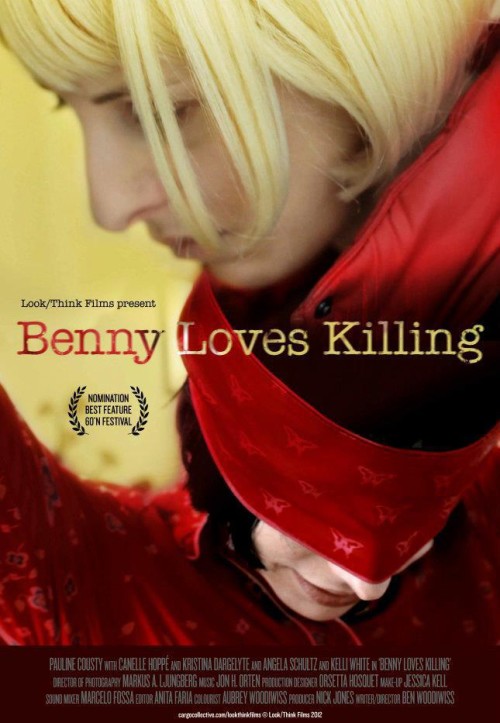
There are plenty of movies about making a movie, to the point where it’s arguably a little passé, and ‘Benny Loves Killing’ is careful not to ever be heavy-handed or obnoxious in its extra layer, addressing it obliquely – by which I absolutely don’t mean obscure or pretentious, but subtle and thought-provoking. This is one of those films where the more you think about it the better it gets.
“Because I think it’s the most flexible genre…the most malleable genre. You are able to experiment and discuss the text without interfering with the object itself.”
So say Benny and her professor in the first set of dialogue in Ben Woodiwiss’s quietly excellent indie feature Benny Loves Killing, setting the scene for the experimentation and discussion to come. Although it has won at least one award for “Best Horror Film,” Benny Loves Killing isn’t really a horror film as such. Or rather it is, to use Benny’s own words, “a meta-horror film. A horror film about horror film. More importantly, a horror film about cinema.” I think one could argue that, whether or not it’s explicitly meta (and there’s plenty of superb horror that is, from Peeping Tom to Cabin in the Woods), horror is always, to some extent, about cinema. As far back as The Cabinet of Dr. Caligari, horror films have been self-consciously Jungian, awash with dreamscapes and archetypes, exploiting the visual and sonic immediacy of the medium to inhabit and unsettle the viewer’s psyche.
Notice how, in this most visual of media, her eyes are obscured.
But Benny Loves Killing is a meta-meta-horror film, a film about somebody making a film about film. Benny is a French film student in the UK making a horror film for a class, but we don’t actually see very much of her film. There are plenty of movies about making a movie, to the point where it’s arguably a little passé, and Benny Loves Killing is careful not to ever be heavy-handed or obnoxious in its extra layer, addressing it obliquely.
“Oblique” is a good word for most of this film’s approach – by which I absolutely don’t mean obscure or pretentious, but subtle and thought-provoking. This is one of those films where the more you think about it the better it gets. It’s not quite psychological horror, but the narrative does largely follow Benny’s tenuous state: bumming from one friend to another, refusing to take a shower, stealing from those around her, doing way too many drugs, arguing with her mother, having some fantastically creepy nightmares. The direction of the film is gorgeously stylish and evocative, with uses of chiaroscuro and splashes of red that probably deserve scene-by-scene analysis.
There are a few conversations where the characters discuss the film they are making, but the meta-commentary never gets inelegant. In one scene, Benny and her colleague Alex argue about the workings of point-of-view shots: “You sympathize with who you’re looking at, not with the eyes you’re looking through,” Benny insists, invoking the classic killer’s-viewpoint horror shot. If up to this point in the film you had overlooked the subtleties of how point of view is used, from here on you would surely notice how often the camera stays on Benny, with her interlocutor barely in frame – especially when these are men, especially men with power (the professor, the board that controls Benny’s funding, a creeper at a party). The effect is a claustrophobically intense focus on Benny, emphasizing her overwhelming and precarious mental state, but there’s also a complex and nuanced commentary here about gender in cinema.
“You sympathize with who you’re looking at”
The most explicit discussion of gender and cinema occurs in the scene where Benny and Alex are screen-testing an actress who admits that their names had led her to expect two men, and then expresses her wariness of the widespread misogyny in the horror genre. Like any filmmaker who cannot step into the text of the film without thereby becoming a part of it, Benny allows the actress to speak without defending herself. There is no great rush to defend the feminist credentials of horror in general or of Benny’s film in particular, simply the opening of a conversation: is the camera necessarily a male gaze, even when wielded by a woman? Is a camera-on-camera the male gaze doubled or reversed or negated? How do the layers of agency and power operate in a male filmmaker’s film about a female filmmaker’s film?
Benny is surely to some degree an avatar for writer/director Ben Woodiwiss, and the different wigs she dons can be seen as a literalization of the different “hats” an independent filmmaker perhaps inevitable wears, as well as the multiplicity of her relationship to the camera eye. While Benny is not unsympathetic, she is certainly no wish-fulfillment self-insert, either in her personal or her professional life. Her cinematic ambitions are grandiose, but perhaps all talk: she constantly says she’s trying to do something innovative, to make a different kind of film, but nothing we see about the film-within-the-film suggests that it’s anything other than a conventional horror film, with its buckets of fake blood and negotiations with actresses about topless scenes. To what extent, the film seems to be asking, can the filmmaker have mastery over her film and its tropes? Or do film and tropes have mastery over the filmmaker?
The film couldn’t work without Pauline Cousty’s excellent performance as Benny.
The question is deepened by the mother/child imagery throughout the film. Benny’s fraught relationship with her mother doesn’t precisely parallel her relationship with her film, but it echoes it: despite, or perhaps at the root of, their conflicts, Benny comes from her mother, is shaped by her, inherits her flaws and characteristics. A creative work is its maker’s baby, and the mother gives the baby life but also, in the very life itself, life’s horizon of death, natality and mortality intertwined. The unleashing of the creative work into the world marks the author’s death, but for the auteur, it is also the death of her baby through her loss of control over it, birthed and killed at once in the cutting of the umbilical cord.
If Ben(ny) indeed loves killing, (s)he invites us, with a small smile and a gaze directly into the camera, to confront the lens and its powers of life and death: who, exactly, is being killed? And who, exactly, is doing the killing?
Some questions to consider: What constitutes a Black family in film or on television? Are representations of these families realistic or true to life? What are audiences who consume this media intended to understand about Blackness or the Black experience? What kinds of stories are allowed to be told and which are still suppressed?
Our theme week for January 2015 will be Black Families.
Though not as prolific as white families, Black families are a popular subject for television and filmmaking. Black family comedy makes up a large portion of that representation, from classic sitcoms like The Cosby Show and The Fresh Prince of Bel-Airto slapstick films like Are We There Yet? and Dr. Dolittle. Many films like Dr. Dolittle are remakes of older films that originally featured white people but now star a predominantly Black cast (Annie, The Nutty Professor, etc.). There’s even an entire sub-genre of Black comedy that involves men cross-dressing as a matron or the family matriarch (Big Momma’s House, Madea’s Family Reunion, etc.).
On the other hand, there’s a host of critically acclaimed dramas that involves Black families with at least an element of the tragedy (The Pursuit of Happyness, Roots, 12 Years a Slave, The Color Purple, etc.). Many of these celebrated stories deal with serious issues like slavery, dysfunction, poverty, gang violence, and/or abuse.
Some questions to consider: What constitutes a Black family in film or on television? Are representations of these families realistic or true to life? What are audiences who consume this media intended to understand about Blackness or the Black experience? What kinds of narratives are allowed to be told and which are still suppressed?
Feel free to use the examples below to inspire your writing on this subject, or choose your own source material.
We’d like to avoid as much overlap as possible for this theme, so get your proposals in early if you know which film you’d like to write about. We accept both original pieces and cross-posts, and we respond to queries within a week.
Most of our pieces are between 1,000 and 2,000 words, and include links and images. Please send your piece as a Microsoft Word document to btchflcks[at]gmail[dot]com, including links to all images, and include a 2- to 3-sentence bio.
If you have written for us before, please indicate that in your proposal, and if not, send a writing sample if possible.
Please be familiar with our publication and look over recent and popular posts to get an idea of Bitch Flicks’ style and purpose. We encourage writers to use our search function to see if your topic has been written about before, and link when appropriate (hyperlinks to sources are welcome, as well).
The final due date for these submissions is Friday, Jan. 23 by midnight.