Interesting Lives Made Dull: ‘Still Alice’ and ‘Queen and Country’

I had been curious to see what the filmmakers would do with this adaptation of the Lisa Genova novel. The writer-directors are a married gay male couple (Wash Westmoreland and Richard Glatzer) who not only made the underrated ‘Quinceañera’ (the rare film about Chicanos that doesn’t have a white savior or even a white main character), but also live with the relatively recent ALS diagnosis of Glatzer (whose disease has progressed enough that he can’t speak or eat without assistance). While ALS is not the same as the Early Onset Alzheimer’s Disease the title character has in ‘Alice,’ I thought Glatzer’s experience might give the film more insight than the usual able-bodied writer and director’s view of disability. What I didn’t expect from this film was how mild and polite it is about the challenges and loss Alice (Moore) faces.

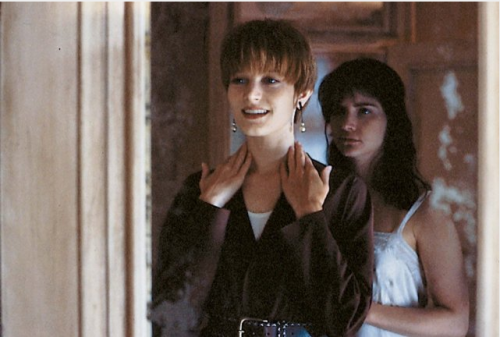
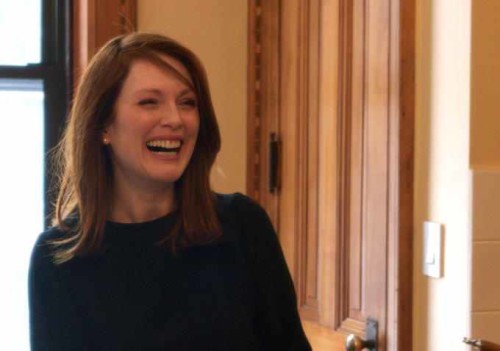
SmilingAlice


Written by Ren Jender.


Like apparently many others, I was avoiding this year’s blindingly white “boy” and “man”-centered Academy Awards, so I missed seeing Julianne Moore win the Oscar as Best Actress for her performance in Still Alice. Instead, at the suggestion of Indiewire’s Women and Hollywood I was on my way to see a film with a woman protagonist: Still Alice. I didn’t have a lot of choices. I’d already seen Wild, Two Days, One Night, and Ida and had no desire to see Gone Girl; the only other films about women nominated for major awards. I ended up going right back home: the theater was closed for emergency roof repair. When I saw the film the next Sunday, I thought maybe I should have taken the previous week’s circumstances as a sign.

I had been curious to see what the filmmakers would do with this adaptation of the Lisa Genova novel. The writer-directors are a married gay male couple (Wash Westmoreland and Richard Glatzer) who not only made the underrated Quinceañera (the rare film about Chicanos that doesn’t have a white savior or even a white main character), but also live with the relatively recent ALS diagnosis of Glatzer (whose disease has progressed enough that he can’t speak or eat without assistance). While ALS is not the same as the Early Onset Alzheimer’s Disease the title character has in Alice I thought Glatzer’s experience might give the film more insight than the usual able-bodied writer and director’s view of disability. What I didn’t expect from this film was how mild and polite it is about the challenges and loss Alice (Moore) faces.

As an expert on dementia writes, we should feel a lot more tension in the final diagnostic test Alice takes (and fails) because the stakes are so high. Similarly when one of Alice’s children is found to have the gene that means a 100 percent chance of developing the disease as well, we hear a phone call and then… nothing else, not even a hint, in later scenes, of how this information would affect the way an adult child would see and react to the deterioration of a parent.
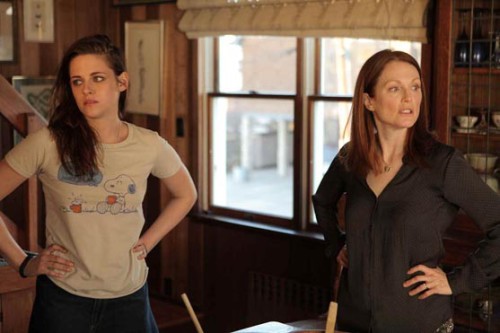
Lydia and Alice
Lydia and Alice


The only fire in this film are the interactions between Alice and her youngest daughter Lydia (played by Kristen Stewart in a performance that reminded me of her meaty roles in Adventureland and The Runaways). In a family of over-achieving professionals (brother Charlie is in med school, sister Anna is a lawyer), Lydia is a struggling actress who has always had a prickly relationship with her Type-A, college professor mother (even after she is diagnosed, Alice continues to teach at Columbia and prepares, alone, the entire Christmas dinner, from scratch, for the whole family).

After Alice has to leave her job, she tells Lydia all the things she wants to see while she can still take them in, ending with, ” I want you to go to college.”

Exasperated, Lydia tells her, “You can’t just use your situation to get everything you want.”

As anyone who has had family members who need care can attest, sometimes the people who step up and help can be as surprising as the ones who are suddenly “too busy” to stop by. Lydia is the one who asks her mother (as Alice again prepares food for the whole family–even moderately advanced Alzheimer’s can’t save women from doing all the work in the household) to describe what she is experiencing. Alice wears a “memory impaired” medical bracelet but also has moments of clarity. She answers, “I can see the words hanging in front of me and I can’t reach them.” Then she adds, “Thanks for asking.” If the film had made these two characters its main focus it could have been a worthy successor to Quinceañera and the unlikely, symbiotic duo at its core: a pregnant teenager and her macho, closeted, gay cousin.

[youtube_sc url=”https://www.youtube.com/watch?v=ZrXrZ5iiR0o” iv_load_policy=”3″]

Equally disappointing is Queen and Country, the latest–and what is being billed as the “final”–film, from 82-year-old writer-director John Boorman, whose long career includes Excalibur (probably due for a revival since its medieval setting is so much like Game of Thrones–and it features a young Helen Mirren) and the film to which Queen is a belated sequel, 1987’s great, autobiographical comedy, set in World War II London, Hope and Glory.

Queen begins with one of the closing scenes of Glory in which 9-year-old Bill, the director’s stand-in, finds, after an idyllic summer in his Grandfather’s house on the Thames, his friends dancing around the school building, on fire after the Germans bombed it. The opening day of school is postponed. “Thank you, Adolph,” says one of Bill’s friends as he smiles and looks to the sky.

Sophie and Bill
Sophie and Bill


Queen jumps to a decade later, when Bill is conscripted into the British Army to serve what was then the requirement of two years duty. Although Callum Turner (Glue) as Bill is physically believable as a grown-up version of Sebastian Rice-Edwards, who played Bill in Glory, he lacks the earlier Bill’s watchfulness: seeing his older sister let her boyfriend into her bedroom through her window or overhearing his mother and friend-of-the-family Mac talk about their romance (which predates and overlaps both their marriages). The earlier film was through young Bill’s eyes but we saw clearly into the lives of the other characters, especially the women and girls in the family.

This time around we are, for most of the action, stuck with just Bill and his erratic, “immoral” army friend Percy (Caleb Landry Jones, grating in a poorly conceived role) as they try, in small ways, to sabotage the small-mindedness and tedium of non-combat army life. They teach typing to fellow conscripts but stray from the official lesson plan, dictating to the class “Arses. a-r-s-e-s.” They conspire with Redmond (Pat Shortt playing the role of the funny Irish friend, which, in British productions has historically been the equivalent of the funny Black friend in American movies and TV) to get back at the officers who constantly malign them.

They also try to pick up women. After a double date with two nurses, Percy and Bill try to peep, Animal House-style, into the nurses’ dorm. Percy on the shoulders of Bill sees a more realistic scene than Animal House’s topless pillow fight: women in curlers and practical bathrobes but tells Bill he’s seeing “20 student nurses in various states of undress.” When Bill gets on Percy’s shoulders one of the nurses they went out with, Sophie (Aimee-Ffion Edwards) sees him and slides down her dress to press her bare breast to the window pane.

Bill pursues an upper-class older woman (of 24!) “Ophelia” (Tamsin Egerton playing a badly written role in the woman-with-psychological-problems mold) while Percy makes a connection with Bill’s married sister Dawn (Vanessa Kirby, every bit as irritating as Jones. She’s no match for the original Dawn, the sublime Sammi Davis). Bill’s other sister never appears or is mentioned. In the mother’s big scene she and Bill have a conversation about her affair that is two sentences long–as if Boorman wanted to remind us of her infidelity, but wasn’t quite sure why. After two long hours the film comes to its conclusion just as Alice does, not with a bang but a whimper.

[youtube_sc url=”https://www.youtube.com/watch?v=y5oVLWqRSUU” iv_load_policy=”3″]


Ren Jender is a queer writer-performer/producer putting a film together. Her writing. besides appearing every week on Bitch Flicks, has also been published in The Toast, RH Reality Check, xoJane and the Feminist Wire. You can follow her on Twitter @renjender
‘Glee’ and Transmen

As I hope is obvious by me being a writer for ‘Bitch Flicks,’ I am a feminist, as well as a transman, and it therefore positively enraged me when I found out which character ‘Glee’ was outing as a transman.


Written by Jackson Adler.


FOX’s Glee, a show about a high school glee club, its teachers, and, later, its alumni, is airing its final episode March 20, after six seasons. Glee has been a show aimed at families, teens especially, and has no doubt been an introduction to LGBT issues and representation to many. While not always perfect in how it addresses various issues, it has certainly raised awareness in America to LGBT rights and acceptance. Due to the show having had a fair amount of tokenism of various groups, although it has improved in terms of representation in regard to some of those groups, when it was announced that one of the show’s characters was going to come out as a transman, I was simultaneously unsurprised and excited. I was several seasons behind on the series, and that announcement made my ears perk up and lead me to binge-watching the show again. At that point in time, I had literally seen zero representations of transmen and transboys in fictional media, and it was going to mean a lot to me to see my identity validated. As I hope is obvious by me being a writer for Bitch Flicks, I am a feminist, as well as a transman, and it therefore positively enraged me when I found out which character Glee was outing as a transman.

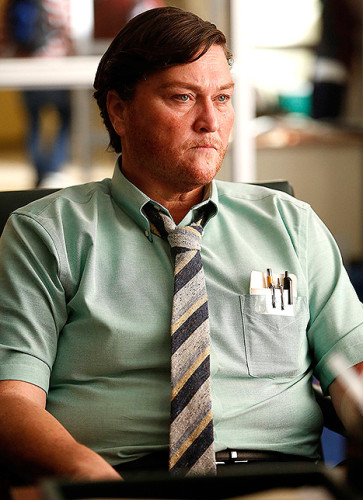
Dot-Marie Jones as Coach Beiste.


Football Coach Sheldon (formerly known as Shannon) Beiste has been one of my favorite characters on the show. Dot-Marie Jones is a phenomenal actress, and though the writing quality of her character is incredibly fickle, she commits beautifully to every moment. She and her character are tall, broad, muscular people, and much of Bieste’s character arc is about how every woman deserves to be respected, to feel pretty, and to have a chance at love. Her character has been repetitively bullied by those whose narrow definition of femininity and womanhood is beyond her character’s reach. It is therefore highly important that other characters started to acknowledge Beiste’s femininity, and to see Beiste as a woman who should be treated and respected like any other. When the writers of Glee decided to make Coach Beiste their token transman, it undermined her character arc and a powerful lesson about sexism and bodyshaming. It was a slap in the face to girls who had written to Dot-Marie Jones sharing their personal stories of being bullied for not meeting the narrow physical image of feminine beauty that is wrongfully promoted in our culture. I felt insulted for the actress, because it is her own body that is on display and is argued about in the episodes in which she stars. I felt awful for every woman and girl, and those raised as such, who has ever faced bodyshaming. There are so many other characters on the show from which the writers could have chosen to be their token transman, so choosing Coach Beiste was far from the only, and definitely not the best, option. In my opinion, two of the best characters the writers of Glee could have chosen to be a transman would have been Emma Pillsbury and Quinn Fabray.

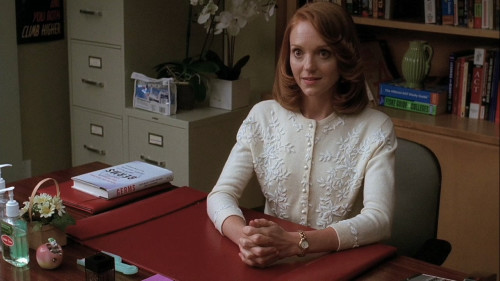
Jayma Mays as Emma Pillsbury.


School counselor Emma Pillsbury has anxiety and OCD, and for much of the show was terrified of sex. Many transpeople develop anxiety and OCD due to the pressures they have felt to present and pass as a gender that was assigned to them, and not their true gender. While it would have been great for the character to be out as asexual, another possibility would be that the character is uncomfortable with sex due to physical dysphoria in regards to their own body. Emma Pillsbury coming out as a transman would have also required glee club teacher Will Schuester to address his stance on homosexuality on a more personal level, due to his romantic relationship (and now marriage) with Emma.

Dianna Agron as Quinn Fabray.


Quinn Fabray was always obsessed with being the best girl at the school, the best cheerleader with the best boyfriend, the best hair, the best clothes, with being the homecoming and prom queen. Wouldn’t it be interesting if this obsession was revealed to be a way of compensating for not being a girl at all? What if her attraction to fellow blonde Sam Evans was because he was a representation of the type of boy Quinn secretly wanted to be? Then Quinn’s various past partners, including Quinn’s on and off boyfriend hypermasculine Noah “Puck” Puckerman, would have to contemplate their own sexuality and their opinions on homosexuality in a more personal way.

Dot-Marie Jones as Coach Beiste.


Both Emma and Quinn are skinny, White, and fit what society deems to be attractive. They often wear makeup and “feminine” clothing. Writing either Emma Pillsbury or Quinn Fabray as a transman would have challenged societal views and myths in regard to femininity and masculinity. It would have meant more thorough discussions about identity and sexuality, and the societal biases towards them. Glee so often provides “lessons” for its viewers, so why not address the subject of transmen in a way that thoroughly addresses issues surrounding that identity, instead of going the route that it did and promote a misogynistic message that Coach Beiste really isn’t and never was a woman who should be respected and treated like any other? Though Glee is ending, hopefully other shows, especially family and teen shows, will promote LGBT issues just as often, if not more so, than Glee – though hopefully in a more thorough and respectful way.


‘Unbreakable Kimmy Schmidt’ Is a Feminist and Comedic Triumph

White men are background players in the world of ‘Unbreakable Kimmy Schmidt’ (and, of those who do appear, there’s scarcely a one who isn’t either comically inept or flat-out evil). As the lyrics of the theme song state, “White dudes hold the record for creepy crimes, but females are strong as hell, unbreakable. They alive, dammit!” The show is fundamentally about the collective trauma of growing up female in a woman-hating world.


Written by Max Thornton.


Like sitcom enthusiasts all across America, I spent my weekend mainlining my latest obsession, Tina Fey’s new show Unbreakable Kimmy Schmidt. NBC’s critical darlings – The Office, 30 Rock, Community, and Parks and Recreation – have all trickled off our screens over the past few years, and Kimmy was to have filled the void; but NBC can’t let itself have anything nice without self-sabotaging, and passed the show on to Netflix. Someone in the network’s upper echelons has presumably spent the whole weekend in bitter self-recrimination for throwing away what would have been NBC’s best new show since 2009.

This poster promises to upend How I Met Your Mother's yellow umbrella and its white, heteropatriarchal norms.
This poster promises an inversion of How I Met Your Mother‘s yellow umbrella and the white, heteropatriarchal sitcom norms it represents.

A cynic might suggest that NBC’s cold feet had less to do with the show’s premise (a young woman adjusting to life outside the underground bunker in which she has spent the last 15 years as the captive of an apocalyptic cult) than with its profound lack of interest in the white men who so dominate the television landscape. The opening credits make this abundantly clear: only one white man’s name appears, that of co-creator Robert Carlock. White men are background players in the world of Unbreakable Kimmy Schmidt (and, of those who do appear, there’s scarcely a one who isn’t either comically inept or flat-out evil). As the lyrics of the theme song state, “White dudes hold the record for creepy crimes, but females are strong as hell, unbreakable. They alive, dammit!”

[youtube_sc url=”https://www.youtube.com/watch?v=WYNbp0u8WjA”]

All of the reviews I’ve seen have lauded the show for handling its dark premise so pitch-perfectly, attributing the comedic transmutation to the showrunners’ biting 30 Rock-honed wit or to Ellie Kemper’s wonderful performance as Kimmy. The real reason it works so well, though, is because the show is fundamentally about womanhood in general. Kimmy’s specific trauma is a reflection of, and metaphor for, the collective trauma of growing up female in a woman-hating world.

The underground bunker, into which Kimmy is forced as a newly pubescent 14-year-old, represents the constraints of heteropatriarchal gender norms, which are most fully embodied in Jon Hamm’s creepy cult leader. He emotionally abuses and manipulates the women he has imprisoned, gets inside their heads, interprets the Bible in a way that supports his lies, and – once he’s on trial – charms and dazzles everyone around him into accepting his nonsense. The bunker-as-patriarchy metaphor is made explicit more than once: in the pilot episode, when Matt Lauer observes, “I’m always amazed at what women will do because they’re afraid of being rude”; when Kimmy realizes her wealthy employer’s loveless marriage is a bunker in its own way; when a certain upscale fitness trend is revealed to be yet another way to keep women in a dark room doing what a man tells them to.
This robot is much more sympathetic than most white men on TV (and off it).

The women of Unbreakable Kimmy Schmidt, who have all been victimized by heteropatriarchy, use an assortment of coping mechanisms. Cyndee exploits her victim status to get free stuff from all the people who feel sorry for her. Donna Maria keeps her skills close to her chest and doesn’t let on that she’s savvier than the rest put together. Gretchen goes deep into denial. Kimmy tries to put her past behind her and get on with life. These different coping mechanisms sometimes bring them into conflict with one another; however, it’s only by working together that they can confront and defang their aggressor. This idea, of people who aren’t white men banding together to pull back the curtain and reveal the patriarchal Wonderful Wizard as a sham, is a major theme of the show. It’s as though Tina Fey took on board certain feminist criticisms of 30 Rock‘s tendency to be male-dominated and decided to do something very different.

The show addresses manhood, too, in a wonderful plot where Kimmy’s magnificently queeny roommate Titus takes classes on how to pass as a straight man. Hilariously, his mentor is Hank from Breaking Bad, a show which was also about the destructiveness of white male patriarchy, but which – because it chose to portray this from the perspective of the said white male patriarch – was dangerously susceptible to misreadings from misogynistic fanboys who found Walter White’s badassery admirable. No such danger with Kimmy, in which the reveal that Entourage 2 will not be happening causes a bar full of strangers to break out into cheering and applause. What Titus learns about heterosexual masculinity is that he possesses the ability to fake it, but it’s aggro, destructive, and (contra the sexist mythos of heteropatriarchy) more artificial than the fabulous femmeyness that comes so naturally to him.

We can all relate to this moment.

It’s worth mentioning that this show can be read as a metaphor for trans womanhood specifically, an idea suggested by the last line of the theme song: “That’s gonna be, you know, a fascinating transition.” Consider: after many years of being lied to about the world and her place in it, Kimmy moves to the big city, changes her name, and conceals her past for her own safety and peace of mind. She is an adult who is still to some extent an emotional adolescent, temporally out of sync with the world around her, which is not wholly unlike the experience of beginning transition as an adult. Again, it’s not a huge leap to read this as a deliberate correction of some of 30 Rock‘s missteps.

There are also ongoing threads skewering wealth and class, the immigration system, and white supremacy – Titus realizing he is treated far better on the streets of New York as a werewolf than a Black man is on the nose, but it’s timely and it’s very funny. I realize I haven’t said much about the actual comedy aspect of the show, but rest assured that it is absolutely hilarious. Unbreakable Kimmy Schmidt succeeds as a work of intersectional feminism, and it also succeeds as a comedy. It’s everything I want in my entertainment, and I can’t wait for season two.


Max Thornton blogs at Gay Christian Geek, tumbles as trans substantial, and tweets at @RainicornMax. A Buzzfeed quiz pegged him as Kimmy, but he feels like more of a Titus.

‘Marnie’: What We’d Like To Forget About Old Hollywood

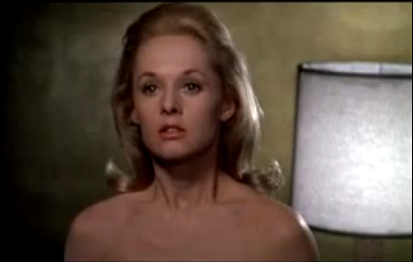
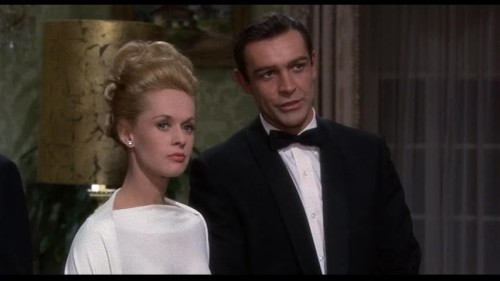
With all the talk of ’50 Shades of Grey’ in the past few weeks, boycotts and debates, and a planned re-release of the superior BDSM-romcom ‘Secretary,’ the film that has really been on my mind is ‘Marnie.’ The 1964 Hitchcock outing is about the capturing (through marriage) and breaking of a young, beautiful and damaged con artist, played by Tippi Hedren, the grandmother of ’50 Shades’ star Dakota Johnson. The cinematography is beautiful, the performances are captivating, but the story? Watching it, I keep expecting someone to jump out and scream that it was all a joke, that we weren’t expected to swallow this. Maybe it’s dated, but I want to believe that the relationship in ‘Marnie’ was recognized as horrific and abusive even then.


Written by Elizabeth Kiy.


With all the talk of 50 Shades of Grey in the past few weeks, boycotts and debates, and a planned re-release of the superior BDSM-romcom Secretary, the film that has really been on my mind is Marnie . Since I first saw it several years ago, I’m been intermittently perplexed by the film, a 1964 Hitchcock outing about the capturing (through marriage) and breaking of a young, beautiful and damaged con artist, played by Tippi Hedren , the grandmother of 50 Shades star Dakota Johnson. The cinematography is beautiful, the performances are captivating, but the story? Watching it, I keep expecting someone to jump out and scream that it was all a joke, that we weren’t expected to swallow this. Maybe it’s dated, but I want to believe that the relationship in Marnie was recognized as horrific and abusive even then.

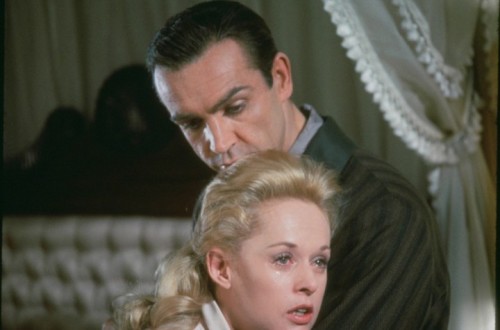
Mark dominates Marnie and breaks her down to reveal her weakness


If you didn’t already think Alfred Hitchcock was a horror movie villain , Marnie sure makes this clear. For starters, James Bond himself, Sean Connery plays Mark Rutland, is misogynist and unrepentant rapist who is the movie’s hero. Yes, he’s the hero. A wealthy industrialist and armchair zoologist, who discovers the young woman who just robbed a business acquaintance and blackmails her into marrying him.

As a con artist, Marnie slips and out of identities and hair styles, though blonde is always the constant, the “real” her. The one constant presence in Marnie’s life is her mother, who lives in a poor area down by the docks of an unknown town. She acts as the breadwinner for her mother, painting her as “unnaturally” masculinized. One of the things she brings her mother is a fur coat, a typical gift given by a rich lover at the time.

While Hedren was being abused by Hitchcock off-screen, on-screen Mark finds his new wife is cold and disinterested in sex. In Hitchcock world, this must mean there is something wrong with her. She is after all, the classic ice blonde taken to extremes. She holds her head high and meets men’s gazes and pulls her skirt down over her knees if she feels she is being gawked at. She’s disgusted and afraid of the thought of Mark touching her and extolls her hatred and mistrust of men, which lends the film to queer readings.

The rape scene casts Mark as a hero


He rapes her on their wedding night when she refuses to have sex with him. It is not at all ambiguous. She screams and tries to fight him off but he keeps going. It’s as explicit as it could be at the time. Never are we told that what Mark did was wrong, or that it makes him a bad person. Instead, we are meant to sympathize with his urges. He is a red-blooded American man, he can be patient about other things, can treat Marnie as an animal, a case study to be analyzed at arm’s length, but on his wedding night? Moreover, as he is presented as normal while Marnie is damaged, his actions are represented as markers of his psychological superiority. He know Marnie better than she knows herself, he can tell it’s what she wants even when she says no; the standard defense of the rapist, only we’re meant to take it seriously here. Even when Marnie attempts suicide the next morning, it’s portrayed as a symptom of the things that were already wrong with her, not a reaction to being victimized.

In married life, Mark continues to hold Marnie under this thumb. He tells her how to dress and act and forces her to attend parties and act as his supportive partner. She must live in his house, trapped like a captive animal and studied, by her husband, zoology or Freudian text in hand. Privately she screams how much she hates him, how much she wants to get away from him, but he owns her, both as a husband and blackmailer.
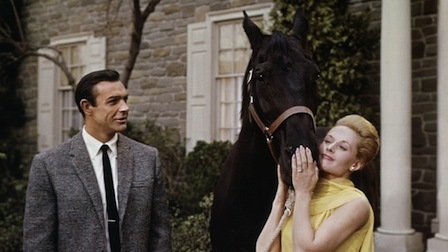
And though she puts up a strong act, she seems to need him. The slightest flash of the color red or crash of lightening send her into hysterics and Mark’s arms. She seems to get a sense of sexual release from riding her horse (a hamfisted Freudian touch) and it’s his death that finally breaks Marnie’s spirit, like she is indeed the wild horse in need of taming that Mark viewed her as.

Marnie is only truly happy with her horse


This all leads up to the final confrontation with Marnie’s mother, wherein Mark blames her for “ruining” Marnie. It begins when he literally drags her to her mother’s house, crying and weak from the earlier trauma and ends with the heavy-handed revelation that of repressed memories of a near sexual assault in her childhood. Hearing this, grown up Marnie regresses back to her childhood, a little girl crying for her mother’s love and leaning on her husband’s strong shoulder.

In the last scene they walk out into an uncertain future but it seems like things might be all right for these crazy kids. They’re ready to love each other. Mark is our hero, he’s fixed this girl and she can now have a normal sex life. She can be a wife, like a woman is supposed to be.

Marnie is forced to stand by Mark’s side as his society wife


Of course this is crazy and nauseating and its rightfully a lesser Hitchcock. But the film is beautiful and seductive, dressed up in Classic Hollywood glamour and its easy to be lulled into ideas of the unilateral superiority and wholesomeness of old films. But not everything a great director touches turns to gold. For all the ills of contemporary filmmaking and modern culture, at least you couldn’t make a film like Marnie anymore.

At least, I hope so.


Elizabeth Kiy is a Canadian writer and journalist living in Toronto, Ontario.


‘Her Side of the Bed’: One Bitch’s Story in Navigating the World of Indie Film Production

If I were to give any advice to indie filmmakers, and especially women in this industry it would be this: It’s going to be hard. Really, really hard. You must be unrelenting. But practice tact, learn how to read people, know when to to keep pushing and when to let go. You’re going to need to hustle. Grow a thick skin. Learn to take rejection gracefully, because it’s going to happen. A lot.


This is a guest post by Bryn Woznicki.


As a female, indie filmmaker, you must be a Jane of all trades. At once a benevolent monarch, the next minute kissing someone’s ass. Constantly selling yourself, but maintaining confidence (this makes you attractive). Toeing the line of being interested but not being too eager (we don’t want to appear desperate, after all) and keeping a stiff upper lip, and just the right amount of bend-or-else-you’ll-break attitude so you can adeptly navigate inevitable rejection and whatever Murphy’s Law may throw your way. Cake, right?

I’m Bryn Woznicki, director, co-producer and co-writer of Her Side of the Bed (if that isn’t enough, I’m also in the damn thing).

unnamed

Her Side of the Bed is about Rachel Nolan, a recently dumped, 20-something writer living in New York. She moves in with her best friend Nicole, who vows to get her over the heartbreak by any means possible, but after sharing an intimate night together their friendship is forever changed. It is a coming-of-age story that follows one womanʼs journey through self discovery and the evolution and ultimate deterioration of a friendship. The film channels the raunch, wit, and self-aware insecurity of Girls as well as the explorative vulnerability of Blue is the Warmest Color.

In the film, best friend Nicole (Bryn Woznicki) and Rachel (Chelsea Morgan) discover a lot about themselves, and each other.


The film was written by me and my my co-star, Chelsea Morgan, who plays Rachel. We began this journey in 2012, and the cultivation and birth of this film baby has been a real bumpy fucking road.

On set and in bed, Nicole mugs for the camera while Rachel sets her sights set on something else.


Both creators and performers by nature, Chelsea and I met in a musical theatre class in community college. Upon meeting each other, we both had the distinct feeling that we’d met somewhere before. We were sure of it, in fact. But in comparing our histories, we realized that we had never met. We agreed our previous meeting must have been in a past life and we left it at that. We created together. We had chemistry. We had fun. We both had an innate sense of humor and a penchant for “yes, and-ing.”

We found that we were vibrating on the same frequency. Creating together came naturally, and laughs were abundant. We shared common ground: we wanted to tell stories and we wanted to act, but we were left in limbo. Skimming through casting notices was always disheartening: not ugly or fat enough to play the ugly fat friend, and not perfect enough to play anyone else. And that’s what the casting notices focused on. Looks and body types. “Overweight best friend; she’s very happy despite never having had a boyfriend.” Or “Sexy, gorgeous legal assistant.” Or “Fit and pretty waitress.” Or “Girl next door… think Keira Knightly.”

Bryn Woznicki directs Rachel (Chelsea Morgan) as she walks home barefoot through the streets of Brooklyn.


We didn’t fit into the molds presented to us, and we weren’t sure we wanted to. And anyway, who’s to say we weren’t sexy and gorgeous? Who’s to say we must be happy in spite of never having had a boyfriend? Who’s to say any boyfriend, lack thereof, or any other person aside from OURSELVES should be in charge of our happiness? And where are the deep, layered, female roles? Characters with personalities, defining qualities outside of their outward appearance or ability to pull dudes? So we started creating our own projects and our own roles.

At the time, I was in film school and was spending a ton of time in production, learning every job on an indie set, the dynamics and idiosyncrasies, and the most important lesson of indie filmmaking: making something from nothing, creating with no money, little help and few resources.

In 2012, I teamed up with the talented Fiona Bates and together we produced Love On-The-Line, an 11-episode web series that I directed and produced. Chelsea and I also played supporting roles.

Love On-The-Line, an 11 episode web series produced and directed by Bryn, starring Chelsea and Bryn.
Love On-The-Line, an 11-episode web series produced and directed by Bryn, starring Chelsea and Bryn.


This was the first project where I directed and acted at once. It’s very difficult. At that point I had directed half a dozen projects and produced several dozen, and only then did I feel somewhat comfortable bridging the gap between actor and director. For those just starting out, I suggest you find strong footing in both roles before you perform both at the same time. It’s still a struggle, at once being the “watcher” and the “watched,” and it calls for a ton of grace under pressure.

Love On-The-Line was a lot of work. It was calling in all of our favors, asking our talented friends to work for free, giving up our weekend, every weekend, and hustling. Lots and lots of hustling. But we were creating. And we were being funny. And we were paving the road for ourselves.

The summer of 2012 we wrote and shot a pilot in two months. After a particularly adventuresome summer, we were high on life and our creative accomplishments. We wanted to do more. But bigger this time. We’d just shot a half hour pilot… next step, feature film! How hard could it be, right?

I called Chelsea one day. “I have an story for a feature film,” I told her. “So do I,” she countered. “You go first.” Much like our first meeting, by some strange, cosmic coincidence, our ideas for our features were eerily similar. We essentially both came up with the same idea, independently of one another. We took this as a sign, and we went to work.

For two months we overdosed on each other. We slept at each other’s houses nearly every night. We watched movies for reference, we drank a lot of wine. Sometimes, many times, the wording of a sentence wouldn’t ring true to us. We’d mull it over, turn it upside down, search for alternatives, and an hour later conclude that our original wording was the best. We sent our first draft around and had people read it. We revised it half a dozen times. Then a dozen. We acted scenes out to see how they felt. We lived and breathed this film.

In a way we kind of put the cart before the horse. We were so high on our idea, so confident, that we raised what money we could, flew to New York and shot what we could on our small budget. “The money will fall into place…” “Wait till they see this footage, investors will be chomping at the bit!” But that’s not what happened. We did capture some gorgeous footage, as well as some important lessons.

Armed with a small budget and a positive attitude, the crew flew to New York to begin shooting.


After we returned from New York, we used what little money we had left to shoot in L.A. We weren’t remotely close to being finished but we had enough footage to make a nice trailer for fundraising purposes. And we created a Facebook. And a Twitter. A Tumblr. We held and Indiegogo campaign, and a Kickstarter. And made a website. We got fiscal sponsorship from The Film Collaborative. We took meetings with anyone who would meet us. We showed the trailer to everyone. We get interviewed and written up, but still we could not finish the film.

Some of the players pose for a photo during Her Side of the Bed’s Film Finishing Fundraiser held in 2014, (L to R) Chris Ferro (playing “Ernest” in the film), Bryn Woznicki (“Nicole”), Chelsea Morgan (“Rachel”), and Steven Anthony Lawrence (who plays a caricatured, drug-dealer version of himself in the film)


Creation of an independent feature film and all that its production entails was outside of the scope of our understanding. It takes a LOT of money. And a LOT of people. Good, competent people. who believe in the work and who are willing to put in crazy hours and energy, probably getting paid a lot less than their worth.

After sitting on our footage and our social media campaigns for over a year, I was feeling very depressed. I’d heard it takes three years, start to finish, to make an indie film. But no one told me it would feel so long. We had almost everything in place that we needed to finish this film: gorgeous locations, talented crew, a few actors with recognizable faces… but we didn’t have the money. And we didn’t know where to get it.

Although we’d received a ton of support from friends online… even garnering a bunch of fans from around the world that we’d never met before, these numbers didn’t, unfortunately, translate to money. We didn’t know if the lack of financial support was due to the fact that most of our friends are starving artists like we are, or perhaps people weren’t so quick to advertise their support of such seemingly “subversive” material. All we know is we put in a ton of work for very little payout and we still didn’t have to resources to finish our film.

But the long, excruciating pause between bouts of production was also fruitful. It allowed our frenetic energy to settle a bit, giving us time and space to become more grounded. No longer in a race to the finish line, we had something very valuable: time. We had time to sit back and review what we’d done thus far. We made space for learning and for changes. We had time to reassess and then reassemble our team, hiring new crew where we found it beneficial, letting go of others that didn’t quite fit. The year plus of non-shooting allowed us to really appreciate this project, to yearn for its fruition, and to appreciate it in the way that you can only appreciate something that’s elusive, dangling attractively in front of you yet slightly beyond your grasp.

unnamed-1

By some stoke of luck, or as my grandmother would call it, “a little mazel,” we found a benevolent donor. A family friend. Someone with some cash and a belief in us, and we made budget. We will finish shooting in May.

What would we have done had we not received money from this gracious supporter? I shudder to think. It would have probably been a mix of grant applications upon grant applications (WHICH of course, is still on our agenda), scrimping and saving our own money, conducting another low-yielding fundraising campaign. And lots of hairs graying, and pacing, and panic attacks, and wondering, “Am I wasting my time? Should I just give this up and get a ‘big girl’ job with more security? Will I ever forgive myself if I abandon my dreams?” But the money did come. And we are moving forward, and this film, this child, which has given me so much hope, and joy, and anxiety and pain, will finally evolve into its next stage of being.

If I were to give any advice to indie filmmakers, and especially women in this industry it would be this: It’s going to be hard. Really, really hard. You must be unrelenting. But practice tact, learn how to read people, know when to to keep pushing and when to let go. You’re going to need to hustle. Grow a thick skin. Learn to take rejection gracefully, because it’s going to happen. A lot. You can’t let it break you and you can’t take it personally; you just need to learn whatever you can (all bad experiences are a chance to learn, dontchya know!), dust yourself off, and try again tomorrow.

Hold onto the people who build you up: positive people who believe in you. Dump the people who don’t. Learn positive self talk, at the very least create three positive thoughts for each negative one. Be kind to yourself. Be kind to others, but don’t be a pushover. Don’t be afraid to say exactly what’s on your mind, and ask for exactly what you need.

People will underestimate you. If you’re a woman, you may be labeled “bossy” or a “bitch.” Or more likely, the sexism won’t be blatant, but rather subtle and insidious. You won’t be exactly sure why, but you’re left with a bad taste in your mouth. I found that it most often rears its ugly head when I’m at a film festival; the program directors call the directors on stage and there’s one woman to every 10 men. Or it is manifest in the form of someone’s incredulity. “Oh, wow. A feature film? How did you manage that?” A subtle put down, that could almost be misinterpreted as kind. Or when speaking to people about your work, they won’t give you their full attention. As if you’re not worth it. As if you’re not to be taken seriously. “Oh, you’re a filmmaker? How fun!” Yeah, guy. Fun. Barrels of it.

Ultimately, it doesn’t matter what they think. Whether it’s filmmaking or shoemaking, directing or designing, if you’ve found something that calls to you… something that excites you, turns you on mentally and emotionally… something that makes you feel happy when you’re doing it… run toward it. Keep running. And don’t look back.


Bryn Woznicki is a writer, director, producer, and (although she doesn’t like to admit it) actor living in her hometown of Los Angeles, California. When not making art, she likes making people laugh, speaking Italian and experimenting in the kitchen. You can find her on IMDb here and on Twitter here


The Sublime Sadism in ‘Breaking the Waves’

Her role as sexual martyr is better suitable for Bess than the role that is expected of her: the patriarchal role of the woman. The religious community in which Bess is brought up is stifling and oppressive, in which male domination prevails in both the personal and public life of the community (the household and the entire commune is dominated by the elderly male church leaders).

Bess talks to God
Bess talks to God


This is a guest post by Giselle Defares.


The relationship between faith and love, the religious experience that is love, suffering and sacrifice, are themes that frequently recur in our pop culture. For some, love can be seen as the most powerful emotion we know, an emotion that can entail spiritual forces. In Breaking The Waves love and faith appear, despite the spiritual connotations, as matters proposed in a very earthly and physical manner. However, the age-old trope of the suffering woman who sacrifices herself so that the man triumphs is nothing new.

The Danish director Lars von Trier follows the beat of his own drum. Von Trier can be called many things: neurotic, shit stirrer and allegedly misogynist. In 2011 he was declared persona non grata after his ridiculous remarks in Cannes during a press conference for Melancholia: “I really wanted to be a Jew, and then I found out that I was really a Nazi… What can I say? I understand Hitler.” He took a “vow of silence” after this debacle. Not only did von Trier make various headlines in his career via his questionable, controversial statements, it’s also the result of the themes portrayed in his films. In most of his films the female characters are placed in violent and sexual situations. In an old interview with The Guardian, Von Trier said “Basically, I’m afraid of everything in life, except filmmaking.” Right.

Breaking the Waves centers round a strict Calvinist community in rural Scotland. Bess McNeill (Emily Watson) is a young woman who expresses her piety by cleaning the church. Here she holds various conversations with God. When Bess wants to marry Jan Nyman (Stellan Skarsgård), an outsider who works on the oil rigs, the church elderly are hesitant. Nevertheless, the first weeks of their marriage are successful. When Jan needs to get back to work at the rig, Bess becomes emotionally unhinged and begs God to bring him back. As a result of a fatal accident on the rig, Jan is brought back to the mainland. He is completely paralyzed, and his life is uncertain; both Bess and “God” blame themselves for Jan’s situation. When she asks God for help, he answers with the question: “Who do you want to save, yourself or Jan?” Bess then makes the fatal decision to save Jan.

Love
Love


Whether or not it was the intent of von Trier, Bess is frequently compared to the Christ figure in a modern tragedy. Her sacrifice was for a higher purpose and “not in vain.” In Bible and Cinema: Fifty Key Films, Adele Reinhartz gives two basic criteria that a movie character must meet in order to be seen as a Christ figure: “That there be some direct and specific resemblance to Christ and that the fundamental message associated with the possible Christ figure has to be consistent to the life and work of Christ, and contrary to his message about liberation and love.”

On the basis of these two criteria Bess can be seen as the female representation of a Christ figure. Her love, like that of Christ, is selfless and knows no boundaries. Bess commits herself entirely to sacrifice her being for this selfless love, even if it leads to death. However, this form of sacrifice is soon to be regarded as a specific element in her life. Bess is easily persuaded by Jan, because “God” commands her to fulfill his wishes. Jan’s requirements are so also God’s requirements. Bess is obedient and submissive to the male power, which forces her to place herself in unpleasant situations trying to save a man.

A representation of this point can be seen in the middle of the film when Bess prays directly to a hospitalized Jan. Bess exclaims, “I love you, Jan.” Jan answers, “I love you too, Bess. You are the love of my life.” Both Jan and God have the same voice, thereby Jan and God are put on the same pedestal. The masculine is the divine, the women must be submissive therein.

Bess and Jan
Bess and Jan


The female suffering in Breaking the Waves is deemed more important than the female existence. Her role as sexual martyr is better suitable for Bess than the role that is expected of her: the patriarchal role of the woman. The religious community in which Bess is brought up is stifling and oppressive, in which male domination prevails in both the personal and public life of the community (the household and the entire commune is dominated by the elderly male church leaders).

The position of the women in this patriarchal community is determined by the male counterparts. The imposed position of the wife doesn’t sit well with Bess; in the first chapter she goes against the grain by marrying Jan in the church, then she speaks in the church, which is forbidden for women. They also ask the women in the community that they remain calm and adhere to their men. Not the whimsical Bess: she beats Jan as he arrives late to their wedding, and is hysterical when he leaves her to work on the rig. This latter characteristic, hysteria, is considered as one of the “weakest” properties of a woman. Alyda Faber, a theologian, states in Redeeming Sexual Violence? A Feminist Reading of Breaking the Waves: “Von Trier creates the image of Bess as sexual martyr through a peculiar valorization of feminine abjection as madness, formlessness, malleability, hysteria. This common reiteration of femininity as weakness.”

Although Bess has more difficulty with the role of sexual martyr, she fulfills the role better than the imposed patriarchal role of a woman. Von Trier uses Bess as a sinner and as a martyr; archetypes that enable that Bess – from a feminist theological approach- is seen as a Mary Magdalene. Von Trier also literally refers to Mary Magdalene in Bess. This happens in the dialogue in which God speaks to Bess: “Mary Magdalene had sin, and she is my beloved.” Bess is caught between the two paradigms where Mary Magdalene was stuck as the virgin and the whore.

Her character begins as that of a virgin, which fits into the mold created by the church until she persists throughout the film and turns into a “whore.” It starts with her sexual relationship with her husband, where she learns to give her love of God over to Jan. Her faith and love into “the word” God has been replaced by the belief in carnal love. Bess at one point states: “You cannot love words. You cannot be in love with a word. You can love another human being.” Her faith for the greater good is stronger than the word of God; this faith in love has led her to sexual freedom–from virgin to whore. Despite Bess being often compared to Mary Magdalene and represented as a Christ figure she remains an ordinary woman who only has to offer her goodness.

Watson is phenomenal in her role as Bess and she deservedly received an Oscar nomination. She truly carries the film and has great chemistry with Skarsgård in the first chapters. Her suffering is stretched throughout the film causing pain and simultaneously pity for her character. Admittedly, the plot is very thin and at times feels illogical. The other characters feel like cardboard cutouts but the film is saved by Watson as the whimsical Bess.

Von Trier styled the film almost like a documentary while using the handheld camera work of cinematographer Robbie Müller. The images are grainy, gray and pale in color, and there’s almost no use of a musical score. At first, the angular camera work doesn’t seem to work with the emotional storyline nor the strict and rigid community in which it takes place. Only with the announcement of a new chapter in the film are images shown that almost resemble moving paintings in beautiful, vibrant colors. As if the gaze of God descends on rural Scotland.

Breaking the Waves is, in essence, just an good old fashioned melodrama. It’s captivating and moving, but there’s no room for false sentiment.

[youtube_sc url=”https://www.youtube.com/watch?v=NmcnddpruXM”]


Giselle Defares comments on film, fashion (law) and American pop culture. See her blog here.


You May Meet Alex and Hedy As You Progress Through Life

Though we might sympathize, mostly we reflect on them, after escaping them, with awe and terror. They are not good. They are not our lovers nor our friends; they do not have our best interests at heart.


This is a guest post by Stephanie Brown.


“‘I won’t be ignored, Dan.'”

As a new friend and I got to know each other during the past couple of years, this became our shorthand joke. We’d say it when we worried we were calling or texting too often. We used that line because the character Alex Forrest, who says the line (actually “I’m not going to be ignored, Dan!”)  in the film Fatal Attraction is the symbol for a person who doesn’t take a hint, let alone an outright declaration that a person doesn’t want an involvement. She’s a person who becomes a stalker because she’s delusions about her relationship with a married man. She becomes as destructive and vengeful as a witch in a fairy tale.

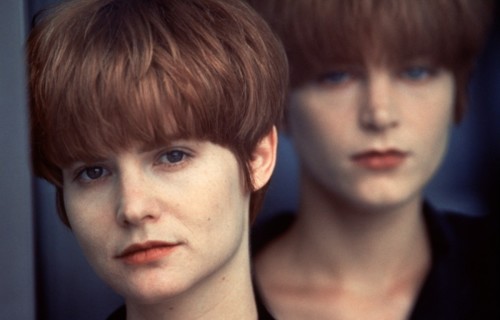
No one wants to be the person who has no common sense about other people. No one wants to be Alex Forrest, or Hedra “Hedy” Carlson in Single White Female, another film that gave us a character so needy and envious, she puts Snow White’s stepmother to shame. When someone “goes all Single White Female” on you, you know you’re dealing with someone who can suck the life out of you by copying your moves and destroying you in the process. Viewers, like the victims who surround an evil witch in a fairy tale, learn that it’s almost impossible to outwit these two, as their nasty feelings manifest into destructive actions, but outwit them we must.

tumblr_lswsyiRofY1qmxmrao1_r1_400

Both films are misogynistic. They depict women we hate and would hate to be like. If we knew more about them we’d probably feel compassion for what made them so evil–but like figures in fairy tales, the backstory is irrelevant to the action and to the victims facing their wrath. Alex and Hedy are symbols for those hatable people who are normal-on-the-surface-but-crazy-underneath. They are hatable because they are impossible to like once you get to know them. Their big, destructive personalities can be glimpsed in people we know, as we can glimpse Snow White and her stepmother, Cinderella, and her sisters, or Jack-in-the-Beanstalk’s father-son rivalry in families we know. Male screenwriters and directors developed these characters, and they can be dismissed as depictions of exaggerated, baseless male fears. But hatable women exist, be they one’s partner, relative, or friend. Like fairytale archetypes, Alex and Hedy harken back to significant relationships–and by being sort of preposterous they are kept at a safe remove. Alex is not our own wife or nightmare ex, she is only a one-night stand who lied to us and herself about having sex with no strings attached. Hedy is not the mother, sister or co-worker who envies us, she is someone we randomly met to share expenses on an apartment. We can displace our hatred on the fictional character, while we might not be able to admit hatred for those we are close to due to fate or necessity.

single-white-female3

I saw Fatal Attraction by myself when I was living by myself, an SFW (single white female, in the shorthand of classified seeking-roommate ads of the day) in Oakland, Calif. The theater was packed and the audience’s shout-outs to the screen funny and raucous as Alex’s behavior became increasingly bizarre.

Screen Shot 2015-03-03 at 10.25.52 AM

By the climax–where she is shot in the bathtub by the wife, Beth Gallagher–I was laughing out loud. The movie seemed ludicrous to me. Soon after seeing it, I tuned into the end of a radio show. The person speaking was animated about her subject, the movie Fatal Attraction, which she said was a hot conversation topic between men and women because the story reflected anxieties about feminism and working women. To me it seemed to be a cautionary tale for men about how the wages of sin (adultery) can lead them to ruin, but it was hard for me to believe that a person like Alex could even exist. But then, I lived alone (and was lonely) and had no one to really talk to about the movie, whether it was ludicrous or should be taken seriously, or about feminism or anything else.

What I did know about living alone was that it might make you go crazy. You forget how much you have been with your own thoughts when you finally talk to someone. Not having a romantic partner made me unhappy and disappointed with life, which are probably the feelings Alex and Hedy had, being alone in the world, looking for a connection. Why they did not have connections is only hinted at, and we can only guess why. I was in my 20s when I saw these films, the time of life when most people have temporary living arrangements, like the characters in Single White Female. I had lived in five different places by the time I was 26. You took chances on roommates and places and living alone in safe or unsafe neighborhoods. I had lived anonymously in two large cities. Like city dwellers Dan and Allie, in a city one has to take a person at her word when looking for a living arrangement or when meeting in the workplace. You don’t have a small town’s generational history to inform you that someone has been damaged by their childhood or was outcast by everyone. That’s also the reason why the city appeals to people–it’s a place to reinvent oneself, where no one really knows you, and where most relationships are friendly but safely superficial. This is the same in the large workplace, where one can observe another’s eccentric or charming or moody behavior at a distance. You only know what someone is really like by working closely with them. It’s amazing how personality deficits and disorders are revealed when one is in daily contact with someone else in the workplace. In all cases, your relationships are left mostly to chance.

At that time I still kept in touch with childhood friends and still felt close to them. Though we only saw each other a few times a year, we talked on the phone for hours sometimes, at long-distance expense, which I budgeted for; it felt so necessary to me. However, every time we got together I could feel us drifting apart.

The friend I was closest to called me soon after Fatal Attraction was released, and asked me what I thought of it. It had really struck a chord with her. She saw it by herself and then took her boyfriend to see it, because she wanted him to see her resemblance to Alex; she thought it would help him understand her better. In particular, the scene where Alex sits alone in her apartment and turns the light on and off is what she wanted him to see. She wanted him to understand how she felt–I suppose how she felt when she felt desperate? They were not in a cheating relationship and were not married, but she related to the character’s personality. I don’t remember if I told her this, but I found that very disturbing. I could not imagine relating to Alex at all, and I still don’t. Had I not known her for as long as I had, I would have dropped the friendship then and there. As it was, our friendship did not last and for me is was because of coming behaviors that did indeed evoke Alex’s. I also knew by that time that I ought not to live alone with few connections. It might make me into an Alex or a Hedy. I also knew that I had the capacity to be like Allie or Dan, using people and expecting them to not care, and I knew I had experienced envy from others, and I did not like how it felt.

These films were released within a few years of each other: Fatal Attraction in 1987, Single White Female in 1992. They are sometimes seen as mirrors of the era, especially as responses to ascending feminism. But to me, feminism had already ascended and was accepted–I suppose I was naive, but to me they were about women with damaged psyches whose gigantic wells of neediness and envy were so mythic they created tragedies because they did not know how to do anything else. In the 30 years or so since these films were released, I’ve come to know many women like both of these women–not that they’ve come to bloody conclusions, but they have created nightmares, migraines and heart attacks, for instance, as well as fear and anxiety and frustration. I wish we had had the characters’ back stories in the films. In the years since, I’ve become fascinated by what breaks people and makes them behave in such ways. I have learned compassion for them while still keeping them at arms’ length. The stories’ plots, however, depend upon us identifying with Dan in Fatal Attraction and Allie in Single White Female. It is possible to find yourself at a point in life where you must obtain a restraining order against someone. At that point, it is not hard to identify with these victims.

Screen Shot 2015-03-03 at 10.24.27 AM

Screen Shot 2015-03-03 at 10.27.27 AM

People like Alex and Hedy are people who feel dead and empty and hopeless; they can’t be helped, they push too hard, they want the impossible and don’t give up when they should. Someone who seems fun and lovely at first but who is impossible once the mask is taken off her face. We saw a few glimpses of Alex’s scrapbook in the film, but were not given enough to speculate about her background or what made her the way she was. We don’t know why they lack connections with others.

But maybe that is beside the point: the Alexes and Hedys I’ve known have few connections because everyone has left them behind and wants nothing to do with them. No one can stand them for very long. It’s hard to believe, because when you meet them, they are friendly and fun and have good heads on their shoulders. But after a while the mask slips and one finds oneself growing annoyed at giving the same advice to their requests for advice, or hearing the same complaints about the same person again and again, or finding out something that makes the hair stand up at the back of your neck: that the person was let go from a job because, you’re now told, the principal of the school did not understand how to discipline kids properly, the way she did. When your work acquaintance becomes your boss and you discover she yells and screams until you feel like you are living with an abusive mother in a tiny house where you are never fed or looked after, you know why she has gotten stuck at this particular rung in their career, and why you are likely to pass her as she drifts downward. People like her fake it by using buzzwords and speaking aggressively and sounding smart, while there is no substance to back it up. To mask their incompetence, they need to steal your ideas, block your ideas, exhaust your ears, or take on your mannerisms and demeanor because they see how others have a positive response.

Fairytales tell us how to make practical choices when faced with another’s envy or wrath. Children are instructed on what to do when faced with Snow White’s envy (leave home) or Cinderella’s sisters (wait it out–they will destroy themselves) or how to fell a jealous father-giant (be clever and nimble and you will cut him down eventually). There are people who wish us ill and mean us harm. There are people so envious and angry of those around them (usually those who are competent, gifted or kindhearted) that their satisfaction comes from seeing the envied fail and flail. As Jeanette Winterson wrote of her mother in Why Be Happy When You Could Be Normal, a book that uses fairytales tropes as a way to understand a destructive, cold mother: “She filled the phone box. She was out of scale, larger than life. She was like a fairy story where size is approximate and unstable. She loomed up. She expanded. Only later, much later, too late, did I understand how small she was to herself.” [1]

When we’ve escaped from an Alex or Hedy, we can look back and see how someone who destroys others is sad or desperate or lonely or feels small. I think Winterson is right–destructive women loom large, change size, extend themselves by loud voice, by taking things from you, by holding weapons because they feel small and overlooked. Though we might sympathize, mostly we reflect on them, after escaping them, with awe and terror. They are not good. They are not our lovers nor our friends; they do not have our best interests at heart.

Because I’ve  known them, I value my new friend all the more, the one with whom I can use a shorthand joke from Fatal Attraction. She also has known these kinds of people, who actually may be men or women.


1. Jeanette Winterson, Why Be Happy When You Could Be Normal?, p. 2-3. New York: Knopf, 2011.


Stephanie Brown is the author of two collections of poetry, Domestic Interior and Allegory of the Supermarket. She’s published work in American Poetry Review, Ploughshares, and The Best American Poetry series. She was awarded an NEA Fellowship in 2001 and a Breadloaf Fellowship in 2009. She has taught at UC Irvine and the University of Redlands and is a regional branch manager for OC Public Libraries in southern California.

‘Gotham’s Fish Mooney

What I believe she means to say by talking about “color” and “shadow” and being “politically correct,” is that with Fish Mooney, she can be a powerful Black woman without worrying about coming across as too threatening to a White patriarchal society.

[youtube_sc url=”[youtube_sc url=”https://www.youtube.com/watch?v=OJTjKhxFTXo”]


Written by Jackson Adler.


Mob boss and nightclub owner Fish Mooney is an original character in Fox’s Batman and Jim Gordon origin TV series Gotham. Jada Pinkett Smith understands Fish Mooney, and portrays her with intellectual, emotional, and visceral fervor. However, the writers and directors of Gotham don’t seem to understand the character as well, nor how she makes herself fit into the world of Gotham.

In her audition, Pinkett Smith walked in to “show” who Fish Mooney is, not to “talk” about her. She did this by walking into the audition in a short wig, a long gown, and a man on a leash. In an interview with Lance Carter on the Daily Actor, Pinkett Smith elaborates on what “room” she is allowed on set in terms of character input and improvised dialogue, since the writers and directors are still finding Fish’ “voice.” However, it seems that while the writers and directors are still figuring out Fish Mooney, Pinkett Smith has a firm grasp At San Diego Comic Con on the character. She pulls from the background and traumatic childhood of mob boss Griselda Blanco, using that for Fish Mooney’s “triggers” and “violence,” and the “classy” and “fabulous” Norma Desmond from Sunset Boulevard and the actor Joan Crawford for Fish Mooney’s “mask.” This creates what Pinkett Smith rightfully describes as “a scary chick” whom the audience can realistically believe will “go after Gotham” and “just might” succeed in taking it over.

In her interviews, Pinkett Smith uses the words “color” and “shadow” in describing her approach to the character, using a very different vocabulary in describing the character and her “voice” than the show’s creator Bruno Heller. Pinkett Smith states how fun it is for her to delve into “those shadow parts” of herself and not worry about being “politically correct,” like she has to be in her everyday life. What I believe she means to say by talking about “color” and “shadow” and being “politically correct,” is that with Fish Mooney, she can be a powerful Black woman without worrying about coming across as too threatening to a White patriarchal society. Fish Mooney can “hold her own” in the “male dominated Gotham,” and while “these men are no joke,” “Fish can handle” – and sadly, women in such powerful positions are something that we still “don’t see a lot.” She can delve into a fierce side of herself that she normally can’t show in front of the camera. As I’ve written before, as hard as Gotham tries (and fails) to be colorblind, it doesn’t work, because race is a huge part of people’s lives, and to ignore Fish Mooney’s Blackness is to deny much of her lived experiences.

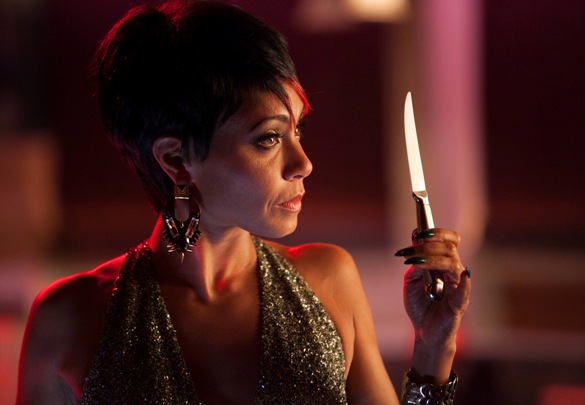
Jada Pinkett Smith as Fish Mooney


Fish Mooney doesn’t ally herself with White patriarchal characters and organizations under some delusion that doing so will protect her. She rightfully lives on the verge of paranoia, questioning those closest to her to be sure they won’t betray her. She states that head of the “family” mob boss Carmine Falcone has grown “soft” and “old,” even before his true decline because knows that even though she may be Falcone’s “favorite,” it is highly unlikely that he will give the position of head of the “family” to her. The rest of the higher ups in the “family” are White men, and when she asks one of them what they think of the idea of her taking on Falcone’s position, the man responds “sure, why not. Women’s lib and all that,” but that he doubts that Falcone will allow her to take the position, though he does not state why. Fish Mooney decides to take the position by force, but did not count on her underling Oswald Cobblepot/The Penguin to betraying her. She took Cobblepot “under her wing” and treated him “like a son,” but he developed strong resentment toward her. Cobblepot is a skinny and somewhat effeminate character who seems to have romantic feelings for Jim Gordon. (Honestly, when he presented Jim with an invite to his new club, it was like a seven-year-old presenting their crush with a homemade valentine.) A Black woman gave a job to and mentored a queer White boy, giving him an opportunity many of the other mob bosses would most likely have denied. She made him into the resourceful and crafty man he shows himself to be, and he resents her. For what? For verbally reprimanding him when he doesn’t do his job correctly? Perhaps he resents being her umbrella boy and confidant, but if he can’t hold an umbrella steady, why should she promote him? Perhaps Cobblepott has some sexist and racist tendencies, in addition to his apparent mommy issues due to his smothering mother.

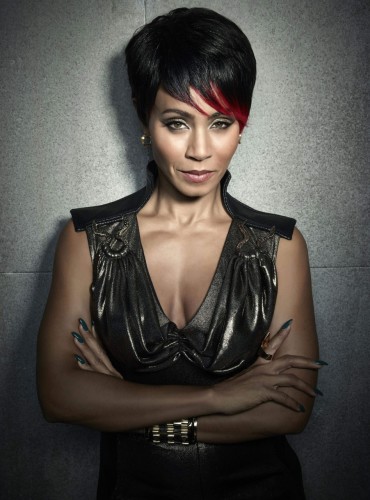
Jada Pinkett Smith as Fish Mooney


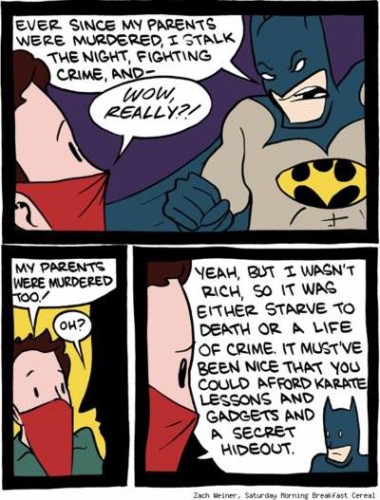
Fish Mooney embraces her femininity, as is evident even by her mob boss name. As the only female mob boss we see, her womanhood definitely stands out. She has evidently played on fear and hatred of women to create or adopt her name: “Fish” as in how many refer to the vagina as “smelling fishy,” and “Mooney” as in the menstrual cycle. This way of creating a name, by playing upon fear and hatred, and taking something meant as an insult and reclaiming it for ones own purpose. This is not just a nickname given to her. It is an act of power and defiance. This way of forming an identity is later used by The Penguin, her former protégé, as well as many other characters, including Batman himself. Sadly, character after character, mostly White men, is going to appropriate the actions of a Black woman, of Fish Mooney’s way of finding a new name. The focus of the show is undoubtedly upon the coming of age and the loss of innocence of White men and boys, specifically Jim Gordon, Bruce Wayne, and even Oswald Cobblepot. When Fish Mooney first meets Jim Gordon, a police officer hard on crime, she says “well aren’t you a tall glass of milk,” wary of him from the start. He is the equivalent of a White liberal who wants to “do good” without realizing how intersections of classism, racism, and sexism affect one’s life and career options. He sees her choices as “bad” without taking the time to understand what institutionalized biases lead her to make seemingly “bad” choices in the first place. In Batman lore, “heroes” Jim Gordon Bruce Wayne mostly arrest and lock up people, without noticing what Zach Wein’s comic points out – that crime is not just evil people looking to be evil. Hopefully, like in its somewhat sympathetic depictions Cobblepot and even future Riddler Edward Nygma, Gotham will thoroughly address Fish Mooney’s rough beginnings and her coming of age and loss of innocence, giving her more of the sympathy allotted for the White male leads.

bat comic

Fish Mooney does all she can for every interaction, every conversation, to be on her terms. She does not want to be used, betrayed, hurt, or killed, and she has no doubt had to fight harder than any of the other characters to be taken seriously. This is a woman who has literally gouged out her own eye and gone down on her own terms rather than be used and hurt by someone else (in this case, another White man). In Gotham, the crime families own the police, the judges, and the politicians, and decide who gets promotions and who ends up dead. These are mostly White men, and yet there is a surprising amount of Black women – perhaps the work of Fish Mooney. While there would no doubt still be violence and criminal activity in a Gotham run by Fish Mooney, all kinds of marginalized groups would be breaking through glass ceilings. A “fisheye” is a kind of camera lens, and the term comes from the way in which a fish sees the world above, looking from the water into the open air. Fish Mooney sees what lies beyond her glass ceiling, and she is going to smash through it or die trying, all played brilliantly by Jada Pinkett Smith. I can only hope that the writers, directors, and producers of Gotham keep giving her more chances to shine.


‘Inequality for All’: The Real American Horror Story

The film’s primary aim is to raise awareness. “Of all developed nations today, the United States has the most unequal distribution of income and wealth–by far–and we’re surging towards an even greater inequality,” warns Reich. The figures are astonishing: 400 Americans are richer than half the population of the United States. Reich is not a socialist. He does not want to jettison American capitalism but reform it.

unnamed


Written by Rachael Johnson.


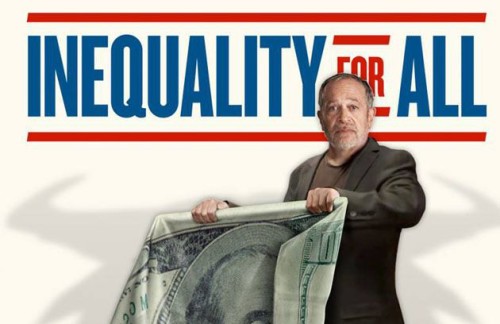
Inequality for All (2013) is not only one of the most important American documentaries made in the last few years; it is also–surprisingly, in light of its bleak subject matter–one of the most enjoyable. This is due, in great part, to its likeable presenter, political economist and academic Robert Reich. Inequality for All addresses the most burning issue facing the United States in the second decade of the 21st century–wealth disparity and the wage gap. It is a subject that has absorbed Reich for many years. Currently professor of public policy at UC Berkeley, Reich served as Secretary of Labor under Bill Clinton in the early nineties. Inequality for All is based upon Reich’s book Aftershock (2010) and structured around a wealth and poverty class he teaches at his university. The documentary features archival footage and moving commentary by middle-class Americans affected by the 2008 economic crisis as well as revealing interviews with members of the 1 percent. Directed by Jacob Kornbluth, it looks good, moves fast, and delivers its message plainly.

The film’s primary aim is to raise awareness. “Of all developed nations today, the United States has the most unequal distribution of income and wealth–by far–and we’re surging towards an even greater inequality,” warns Reich. The figures are astonishing: 400 Americans are richer than half the population of the United States. Reich is not a socialist. He does not want to jettison American capitalism but reform it. Although it is clear that he is morally driven, Reich underscores that the unfair state of things does not make economic sense: “What makes an economy stable is a strong middle class…The most important thing to understand is that consumer spending is 70 percent of the United States economy and the middle class is the heart of that consumer spending.” He also reminds us that extreme economic inequality endangers democracy.

Robert Reich lecturing


Expertly steering the viewer through modern US economic history, Reich chronicles the decline of its middle class. In fact, he argues for a return to the post-war past. The average American middle-class worker in the prosperous decades following World War II enjoyed good wages, and income disparity was not extreme. The income and wealth gap between those at the top and the average middle-class worker began to widen, however, with deregulation and union-breaking Reagan. Technology and globalization were other contributing factors. The American middle class, Reich explains, coped with their decline in three ways: Women began working in the late seventies in great numbers, workers worked longer hours and borrowing increased. Reich describes the entrance of young mothers into work a “social revolution” but asserts that the majority went to work out of sheer financial necessity, to bolster their household income, not because they were granted new professional opportunities. The coping mechanisms employed by the middle class masked an insecure economic system. An image of a suspension bridge and graph is used to illustrate two major peaks in wealth disparity–pre-crash 1928 and 2007. Crucially, the much-trumpeted trickle-down effect is exposed as a myth and the taxation system revealed as insanely unfair.

Robert Reich
Robert Reich


Through interviews with ordinary men and women affected by the 2008 financial crisis, we see the human face of this modern tragedy. They include Erika Vaclav, a  married woman with two children forced to live with friends of her husband after they lost their condo and he was laid off. A Costco employee, she earns $21.50 an hour and has $25 in the bank. Another woman interviewed, a litigation assistant who cannot save–although she and her partner work- speaks of single mothers she knows who work three jobs just to pay the rent. Incidentally, it would have been helpful if Reich had also addressed the criminal gender wage gap in the United States.

An interviewee at the other end of the socio-economic spectrum is venture capitalist Nick Hanauer. Hanauer is a refreshingly honest member of the 1 percent. He confesses that he makes a stupid amount of money and observes that fewer members of the majority middle class are buying his product. As Reich notes, this is a serious problem as a healthy economy relies on middle class spending power. Hanauer further makes the extraordinarily truthful statement that the wealthy are not, fundamentally, the job creators: “When somebody calls themselves a job creator, they’re not describing the economy…What they’re really doing is making a claim on status, privileges and power.” For both Hanauer and Reich, it is the middle class who are “the center of the economic universe.” A well-educated, unionized, well-paid labor force, Reich suggests, is the key to a just, prosperous society.

The peaks of disparity


There is not a dull moment in Inequality for All. The illustrative infographics employed are understandable and attractive while Reich, like all great teachers, communicates his ideas in a clear, dynamic fashion. He comes across as a charming man. From the start, he refers to his diminutive size (Reich has a condition called Fairbanks disease). Of the Mini Cooper he drives, he notes, “we are in proportion…together…facing the rest of the world”. Reich makes for a witty, erudite presenter but personally I would have liked more anger- and a call for accountability. The empathy is abundantly evident though. Reich explains that a Freedom Rider friend from childhood inspired him to stand up for those less privileged. The documentary ends with the professor celebrating his last class with his understandably admiring students. Some may find it a little too upbeat and cheesy when we see Reich do a little dance to Dolly Parton’s 9 to 5. He’s an encouraging rather than narcissistic teacher, however, and the end does fit with his populist message. It’s an invitation to dance and get involved.

Inequality For All is an absorbing, entertaining documentary as well as a valuable educational tool. Remember this insane truth: 400 Americans are wealthier than half the population of the United States.


Why ‘The 100’ Is a BFD

Bisexual protagonists, scenes that pass the Bechdel Test, women making choices that drive the action of the story – I’m still the only person who watches ‘The 100,’ but, boy, do I enjoy it when I do.


Written by Katherine Murray.


Bisexual protagonists, scenes that pass the Bechdel Test, women making choices that drive the action of the story – I’m still the only person who watches The 100, but, boy, do I enjoy it when I do.

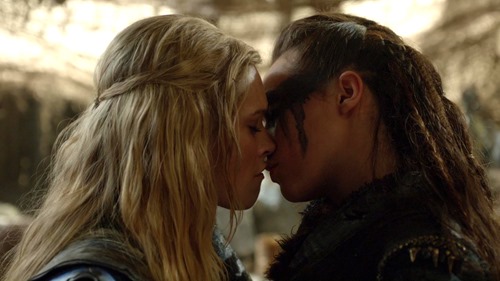
Eliza Taylor and Alycia Debnam Carey star and kiss in The 100
The day The 100 unironically became my favorite current show


Last year, I wrote about the first season of The 100, a dystopian YA science fiction series on The CW, based on a dystopian YA science fiction novel of the same name. While the first few episodes were laughably terrible, the series later took a sharp (and dark) turn toward being kind of good. The second season of The 100, which airs the first half of its two-part finale this week, is also laughably terrible in places, but also kind of surprisingly good.

One of the good surprises happened last week, when the series hero, Clarke, turned out to be bisexual in a low-key, fairly believable way, that didn’t involve any hand-wringing about her sexual identity. The major story line this season has been that Clarke’s group, the Sky People, are trying to forge an alliance with the Grounders – a group of clans native to the planet the Sky People have landed on. The Grounders’ leader, Lexa, is a girl Clarke’s age who’s also been pushed into a position of responsibility, and the two of them grow closer as the season progresses, because no one else understands the pressure of making life and death decisions for thousands of people, or of sacrificing those you love for the sake of the greater good. There’s tension between them, because they have different ideas about what it means to be a leader, and Clarke’s character arc this season is partly about whether she’s going to end up as cold as Lexa.

That’s already unusual for a network TV show, in that the story is about a serious philosophical difference between two female characters who talk to each other about it, and make life and death decisions based on their discussion, but it’s also unusual because the showrunners decided to let them kiss, and didn’t make a whole big deal about it.

It turns out that Lexa doesn’t make Clarke a cold, hard-hearted leader after all – the opposite happens, and Clarke gets Lexa to warm up a little – at least enough to admit that there’s a place in her hard heart for Clarke. And, rather than having her push Lexa away, or say, “I’m not gay – god, what if I’m gay?!” it turns out that Clarke’s been quietly bisexual all along, and it never came up before because it’s not all that noteworthy a thing. It’s exactly the same as if she were kissing a guy.

In other words, the fact that it’s not a big deal is what makes it a really big deal.

As Allyson Johnson writes in The Mary Sue: “It’s not pandering, or queer-baiting; it’s simply a part of [Clarke’s] characterization that’s played as if it’s totally and beautifully normal.” Series creator and executive producer, Jason Rothenberg, also went on Twitter to explain that people don’t get freaked out about bisexuals in the future world of The 100 and that “if Clarke’s attracted to someone, gender isn’t a factor. Some things improve post-apocalypse.”

We’ve already had bisexual characters on science fiction shows – Torchwood is notable for making bisexuality as part of its mission statement – but there’s still something surprising and refreshing about the easy-going way that The 100 made this happen. It’s a step forward in the portrayal of LGBT people in general, but of Bi people especially. That Clarke’s comfortable with who she is – that she already knew this about herself, and the only thing that’s new is that we’re learning it about her; that she doesn’t turn into a lesbian as soon as she kisses a girl – that’s a big deal.

Kendall Cross as Major Byrne in The 100
Major Byrne, looking for her chance to cause some conflict


Another pleasant surprise in the second season is how willing The 100 is to cast women in roles where they just need some generic person. Almost every time – if not every time – groups of random, redshirt, background characters convene, some of them – and some of the ones with speaking parts – are women. The show also fills a lot of secondary roles with women – the generically menacing doctor who works for this season’s enemy, the Mountain Men, is a woman; the super hard core Grounder who distrusts the Sky People and causes tension is a woman – but I was most impressed by Major Byrne.

Major Byrne is a cookie-cutter character who exists just to create conflict among the Sky People now that the conflict-creators from last year have been rehabilitated. The Major is the hard-ass, shoot first and ask questions later, “they are the enemy,” letter of the law, peace-hating, harsh justice head of security who keeps telling the other characters that they’re screwing up by being too lenient and soft-hearted. It’s the kind of role that casting directors usually fill with a male actor, because that’s the person we all picture in our heads when we think of this archetype. The reason I’m impressed that Major Byrne turned out to be a woman is that it shows that someone, somewhere along the line, thought past their knee-jerk reactions and made a deliberate choice about casting the role – and I think that’s indicative of the deliberate choices that The 100 makes in casting female actors in general.

That doesn’t mean that Major Byrne was more than a military stereotype, or that the doctor mentioned above was more than generically evil, or that female redshirts are any more useful than male redshirts as characters – it just means that rather than defaulting to “male unless otherwise specified” it seems like The 100 makes a conscious effort to present a world where both men and women are present and involved in what’s happening.

Marie Avgeropoulos stars in The 100
Octavia 3.0, now with added grime and bad-ass


The third good surprise, and the last one I’ll talk about – although I could mention the show’s humour, and its interesting grimdark twists – is that the writers seem to understand that there was a problem with Octavia in season one. They haven’t figured out the right way to fix it yet, but they’re trying, and I appreciate that.

If you recall, Octavia is the character who began the first season as a sassy, hypersexualized rebel, and then was rebooted as The Kindest Girl Who Ever Lived. In both incarnations, the main point of Octavia was how other people felt about her, and she constantly fell into danger and had to be rescued by other characters.

Season two reboots Octavia again as kind and rebellious, resourceful, independent, and brave. Her character arc this season is that she spends less time with her Grounder boyfriend, and more time training to be a warrior in the Grounder army, after proving herself to the really hard core Grounder, Indra.

There are some ooky colonial elements to Octavia 3.0’s story, and I don’t at all buy that she’s now an honorary Grounder because she started braiding her hair and lost a fist fight in a really spectacular way. She also looks hilarious when she tries to join them in a tribal yell, and she uses literally the worst strategy ever when she tries to take hostages during an early episode. Like, it’s really so bad that I have to believe Indra let her walk away with a hostage because she just didn’t like the guy Octavia was holding hostage very much.

That said, I appreciate that the show is trying to turn Octavia into a person rather than a chess piece in a game that other characters are playing. Right now, the character’s exhibiting a pretty superficial, and unrealistic form of girl power (“Let’s just make her awesome at everything!”), but it’s an improvement over the days when she used to trip over her feet and get knocked unconscious in the woods. If the producers were going to learn any lessons from season one, and latch onto anything as being the core of their show, I think trying to build strong female characters is a fine thing to latch onto – even if they haven’t quite got it right with Octavia.

The 100, like Battlestar Galactica before it, is still remarkable for having women make so many choices that drive the story, and I think that, once they find a way for Octavia’s choices to matter, things will finally slide into place.

And I haven’t even told you about the episode where the A-plot is that the characters go to the zoo and get chased by a monkey!

If you live in the United States, The CW airs The 100 on Wednesday nights. If you live in Canada, you can catch it on Netflix the following morning. Please watch it – I think it deserves to exist.


Katherine Murray is a Toronto-based writer who yells about movies and TV on her blog.

‘House of Cards’ Season 3: There’s Only One Seat in the Oval Office

“I’ve been in the passenger seat for decades. It’s time for me to get behind the wheel.”

Walking side by side in this season 3 promo still.


Written by Leigh Kolb.


Season 3 Spoilers Ahead!

See also: “Ruthless, Pragmatic Feminism in House of Cards


Season 3 of House of Cards, released Feb. 27 on Netflix, ends abruptly, as we dangle on the edge.

As Claire gives her blood in Iowa–literally for the Red Cross for a nice photo op and figuratively for Frank’s career–she gets lightheaded, and tells their biographer that she thinks about jumping of a bridge. Before she passes out, she tells him that when Frank proposed, she’d told him that “every seven years, if it’s still good enough,” they’d stay married for another seven years before reassessing the marriage.

They’ve been married for 28 years. And it’s time to take stock of the partnership, which has been feeling less and less like a marriage of equals. There’s only one seat in the Oval Office, after all.

Season 3, at its core, is about a series of clashes. Not only are the Underwoods clashing, but so also are countries, special interests, and air and water temperatures. These clashes of powers and contrasts of ideologies can be violent, but season 3 is less shocking, less violent, less sexy, than seasons past. Frank and Claire Underwood were maneuvering and clawing their ways to the top, but now they’re there. Or at least, Frank’s there. Season 3 concerns the delicate and perhaps less passionate dance of staying at the top, when the only place you have to go is down.

Because of this, Frank and Claire seem decidedly less evil than they have in the first two seasons. All of the characters are complex and none is simply good or evil–the show has always been excellent that way, and that writing certainly lends itself to being decidedly feminist, as I’ve argued for the last two seasons. Frank even seems like a tragic hero sometimes, more disheveled, more pitiful than he was while he was violently rising the ranks. Of course, he opens the season by pissing on his father’s grave–so Frank is still Frank–but his desperation to hold onto power weakens him.

Claire accomplishes very little on her own in season 3. She needs Frank’s help to appoint her as UN ambassador when she can’t get the votes from Congress. Her role as First Lady repeatedly overshadows her own goals, and she eventually must resign her UN role because President Putin Petrov bullies Frank. She then must launch full-force into First Lady mode, dying her hair to please focus groups, kissing babies, shaking hands, living and working solely for Frank. This is not Claire Underwood. She knows that this is not who she is. By the end of the season, she’s acknowledged this, and is leaving the White House. “Claire!” Frank shouts as she announces that she’s leaving him, and the credits immediately roll.

Claire must exist to support Frank.


As is suggested by the promo shots for season 3, Claire is becoming more and more an equal player in House of Cards (in season 1’s promos, she didn’t appear; in season 2’s, she sat behind Frank; in season 3’s, they are walking side by side, as they often do in the episodes). However, her role in the White House had to be for Frank, and it–and he–wasn’t enough. When Frank yells out for her to not leave at the end of the season, it’s because he also knows that he’s not enough. Without her, there will be no White House.

There are, as always, some incredible moments woven throughout this remarkably feminist political drama. Here are some of them:

Episode 1: They are sleeping in different bedrooms, and it’s clear that Claire is being left behind. She requests an appointment to be the UN ambassador, because the work of a First Lady is “not the same as contributing in a real way.” She says, “I’ve been in the passenger seat for decades. It’s time for me to get behind the wheel.”

Episode 2: Claire channels Hillary Clinton in during her nomination hearing, snapping that the “US military is irrelevant.” Of course, it’s taken completely out of context, just as Clinton’s “What difference does it make” statement was during the Benghazi hearings (the nods to current events in season 3 seem clearer than ever before). Claire is attempting to secure an incredibly important position in the UN, and at the same time, she has to pick two Easter Egg designs for the yearly Easter Egg Roll–a First Lady duty. The contrast between world power and decorative pleasantries is stark. “It’s too pink,” she says of one egg. “Girls like pink,” responds the woman with the eggs. Claire does not choose the pink egg.

Episode 3: Pussy Riot! Le Tigre! Russian President Petrov represents a time when “men were men.” He and Frank smoke Cubans and jockey for power while Ambassador Claire Underwood and Secretary of State Cathy Durant play beer pong and work toward peace. The masculine old guard often looks silly–the gifts, the games, the pride–but they too often still wield the power. By the end of the episode, Frank is lauding Pussy Riot and is flanked by Claire and Cathy (certainly not the last time he’s flanked by more powerful women in this season).

Episode 4: Solicitor General Heather Dunbar rises to power early on in the season. Frank asks her to consider his nomination for Supreme Court Justice, but she quickly realizes she wants to run for President instead. This episode deals with the US’s drone strike policies, and challenges the idea that killing innocent people to stop one guilty person is just. Meanwhile, a gay American activist is arrested and detained in Russia. In a bit of a heavy handed scene, Frank speaks with a priest in the church about justice and love, and ends up alone in the sanctuary, where he spits in Jesus’ face. The statue falls and breaks into a hundred pieces after he goes to wipe the spit off.

Episode 5: Dunbar starts campaigning, and takes the gay activist’s husband with her. She comes out strong on social issues that Frank has stayed moderate on. Frank’s dismantling of entitlement programs and his approach with America Works is Tea Party politics compared to the D next to his name. A powerful female reporter from The Telegraph replaces the former reporter whom Seth Grayson kicks out. He tries to silence one woman who asks challenging questions, and is faced instead with someone who is even more threatening. When Dunbar learns that Claire lied about her abortion on national TV, she says, “I would never do that to another woman,” in re: using the information against her. And in an incredibly powerful scene, Claire makes the Russian ambassador meet her in the woman’s bathroom while she puts on makeup, and then urinates with the door open. He’s uncomfortable, and she’s in control.

Episode 6: Claire goes with Frank to Russia to meet with Michael Corrigan, the imprisoned activist. They have a compelling conversation about marriage. Claire is unable to talk him into reading the prepared speech to be let free (he would have to apologize to President Petrov and Russia for parading nontraditional sexual ideas). Instead, he commits suicide while Claire sleeps in the cell, and he uses her scarf. She speaks out for him at the press conference–much to Frank and Petrov’s horror. “He had more courage than you’ll ever have,” she tells Frank.  “I should have never made you ambassador,” Frank says. She responds, “I should never have made you president.”

Episode 7: Tibetan monks will work for weeks on intricate sand paintings, mandalas, and then ritualistically destroy it to symbolize the impermanence of the material world. A group of Tibetan monks are in the Underwoods’ White House as part of a cultural exchange. The gorgeous, time-consuming nature of their work, and the beautiful destruction of it, serves as a backdrop to Claire and Frank deciding to renew their vows. Claire changes her hair color to the dark shade it was when they first met. She’s being honored by GLAAD and other gay rights organizations. They must show the world that they are a team, but they are feeling less and less like one. Frank visits the FDR Memorial and reflects upon their similarities to the Roosevelts (his revamped “New Deal” and Claire’s human rights and United Nations activities). Claire rises again in this episode, and while they renew their vows and sleep in the same bed again, the monks poured all of that beautiful sand down a flowing river. Nothing lasts forever.

During episode 7, Claire and Frank sit at the breakfast table reading the newspaper, reminiscent of this scene from Citizen Kane. Absolute power corrupts absolutely.


Episode 8: A hurricane is brewing, and it’s being narrated by two voices: novelist Tom Yates, whom Frank has asked to be his biographer; and Kate Baldwin, the enterprising Telegraph reporter. The feminine and masculine (not necessarily female and male) are frequently clashing in House of Cards. These forces–whether they be stereotypical ideals of compassion and power or embodied in figures like Tom and Kate themselves–are often at their best when combined. Freddy is back in this episode, and delivers a powerful message to his grandson after meeting with Frank: “He lied to you. You’ll never be president,” he says. “It’s good to have dreams, as long as they’re not fantasies.”

Episode 9: The women are always on top in season 3’s sex scenes. The sex scenes are less exciting than season 2’s, but this positioning doesn’t go unnoticed. On the campaign trail, Dunbar is taking a decidedly feminist approach: raising the minimum wage, fighting for gay rights, and ending corporate greed. Frank, on the other hand, chants “You are entitled to nothing,” and toes the individualistic, masculine line. Remy is faced with racism–from an Iowa lobbyist and the police. Doug–whose story line is terrifying and constantly uncomfortable, except for a few warm moments with his brother–is working for Dunbar to get info for Frank.

Episode 10: Claire sits between Israel and Palestine–she’s a powerful force. She’s tricked by Petrov, however (who has always clearly been threatened by her or anyone/anything that threatens the traditional order), and her fake intel leads to a US troop’s death. When Petrov and Frank meet in the Jordan Valley (the House of Cards version of the Gaza Strip), it’s a masculine scene–guns, ammo, tanks, kevlar, camo. Petrov tells Frank that Claire must not be an ambassador anymore. Frank agrees. This, then, is the beginning of what was already an end in sight. By the end of the episode, Claire is looking at a history of headshots, agreeing to go blonde because “Iowa in particular likes the blonde.” In what has become a necessity for each season, ambiguous sexual tension takes place between Tom and Frank. Tom admits that he used to “turn tricks” with men for a living, and got addicted to hearing their stories. They hold hands for a moment–it’s an incredibly intimate scene–and then it’s over. As others have noted, it’s refreshing to see sexuality treated with such nuance.

Claire Underwood
Claire Underwood


Episode 11: Blonde Claire gives a campaign speech at a fancy little ladies’ luncheon, quite the opposite of negotiating peace talks as she had been just days before. Claire is so much like Hurricane Faith, which was poised to make a huge difference, but then did nothing. Frank can’t control the weather, but he’s trying to control Claire. Jackie Sharp is also running in the Democratic primary, but only to split the vote to eventually be Frank’s VP. She doesn’t want to do what Frank tells her to–calling Dunbar sexist or bringing Dunbar’s children into the debate–but she does when Dunbar won’t promise her Secretary of Defense. So Jackie pulls the sexism card and pulls the private school card during the debate, and Frank attacks her for it. Shortly after, Jackie suspends her campaign and endorses Dunbar. Seth calls her a “Judas Bitch,” and Remy resigns as Frank’s Chief of Staff. Players are choosing sides, and Frank must rely on Claire’s likability to get the numbers he needs for Iowa. She’s reading children a book at story time now instead of attempting to broker peace between Israel and Palestine.

Episode 12: Claire is told to be more and more in the spotlight, even answering Q&As. She’s “favorable” to voters, and there are moments where it looks as if she’s the one running for president, and she certainly feels the sting of that not being the case. “I’ll keep waving my pom-poms,” she says. She spends time with a young mother in Iowa on the campaign trail. The Underwood signs in the yard are her husband’s, though. “I wish you were running for president,” she tells Claire. The exhausted young mother talks about her unhappy marriage, and laments to Claire that if it weren’t for the baby they took out two mortgages to have via IVF, that she would leave. Moments later, Frank calls Claire to tell her that Dunbar knows about her journal and the truth about her abortions. “No, Francis. This can’t happen. Whatever you have to do, fix it.” Doug brings the journal to Frank and burns the page, promising that he’d just gotten close to Dunbar to prove his loyalty to Frank. He requests, and gets, the position of Chief of Staff. Claire is rightfully furious, considering her reproductive choices have been used as political pawns by other people. Frank has stopped seeing Claire as an equal; as soon as he was in the Oval Office, she was just the First Lady.

Episode 13: Doug’s subplot of using Gavin to find Rachel climaxes in the last episode, as he buys a trash-heap of a white van to drive to her and avenge the fact that she’d beaten him almost to death in season 2 (after she had assumed–probably rightfully so–that he was going to kill her). These awful scenes are made more tragic by the fact that Rachel has escaped her former life and is helping other abuse victims in the process. Doug comes close to love and compassion when his brother stays with him while he gets clean, but he doesn’t come close enough. Claire tries to get Frank to “fuck her,” to “be rough,” but he won’t. He sends her back to DC, and we hear the screams and clapping for him campaigning while she gets back to the White House alone. Frank wins Iowa without her there, but he knows that she must be by his side for him to be successful. When he gets back, she’s sitting in his chair in the Oval Office–where she, and probably he, knows she should be. “For all these years,” she says, “I thought we were in this together. This is not what I thought it would be. It’s your office. You make the decisions.” He snaps back that she can’t have it both ways–to be an equal partner, and for men to control her (bringing up the sex scene in a powerful way). She feels “weak” and “small” and can’t feel like that any longer.

“Without me, you are nothing,” Frank snaps at her. “It’s time for you to do your job. You will be the First Lady.”

She looks at the picture of the Tibetan mandala–capturing a moment that was destroyed–and she packs her bags, but not for the campaign trail. Claire Underwood was meant to be first, not First Lady.


Leigh Kolb is a composition, literature, and journalism instructor at a community college in rural Missouri. 


Call for Writers: Asian Womanhood in Pop Culture

Asian women are often fetishized, objectified, eroticized, and/or infantilized in pop culture. “China doll” stereotypes that represent Asian women as compliant, doll-like sexual objects are still prevalent. Western attitudes are influenced by a history of exploitation and colonization of Eastern culture. This deep desire to possess seems to manifest in an eroticization of all things Asian, especially Asian Women.


Call-for-Writers-e13859437405011

Our theme week for March 2015 will be Asian Womanhood in Pop Culture.

Asian women are not safe from the generalized stereotypical rendering of Asian people as a whole, in that Asian women are often represented as very intelligent/nerdy or experts in martial arts. If we are to believe pop culture mythology, all Asian women are born with eyeglasses and an ability to kick ass in a school girl miniskirt.

Aging female Asian characters lean toward the wise, Old World crone trope, full of mysticism and tradition.

Asian women are often fetishized, objectified, eroticized, and/or infantilized in pop culture. “China doll” stereotypes that represent Asian women as compliant, doll-like sexual objects are still prevalent. Western attitudes are influenced by a history of exploitation and colonization of Eastern culture. This deep desire to possess seems to manifest in an eroticization of all things Asian, especially Asian Women.

Why do these female Asian archetypes exist, and why are they so popular? Are there examples of Asian womanhood that defy these archetypes? Is there space within these archetypes for nuanced characterization? Are Asian women allowed to be complex, multi-layered human beings, flawed heroines and villainesses?

Feel free to use the examples below to inspire your writing on this subject, or choose your own source material.

We’d like to avoid as much overlap as possible for this theme, so get your proposals in early if you know which film you’d like to write about. We accept both original pieces and cross-posts, and we respond to queries within a week.

Most of our pieces are between 1,000 and 2,000 words, and include links and images. Please send your piece as a Microsoft Word document to btchflcks[at]gmail[dot]com, including links to all images, and include a 2- to 3-sentence bio.

If you have written for us before, please indicate that in your proposal, and if not, send a writing sample if possible.

Please be familiar with our publication and look over recent and popular posts to get an idea of Bitch Flicks’ style and purpose. We encourage writers to use our search function to see if your topic has been written about before, and link when appropriate (hyperlinks to sources are welcome, as well).

The final due date for these submissions is Friday, March 20 by midnight.

Marco Polo

Lost

Monsoon Wedding

Gilmore Girls

Kill Bill

Agents of S.H.I.E.L.D

Grey’s Anatomy

The Mindy Project

The Joy Luck Club

Mulan

Big Hero 6

The Good Wife

Crouching Tiger, Hidden Dragon

Battlestar Galactica

Battle Royale

The Transporter

Wayne’s World

Rumble in the Bronx

In the Mood for Love

Slumdog Millionaire

Snow Falling on Cedar

Geisha

Shaolin Soccer

The Last Emperor

Bride and Prejudice

Street Fighter: The Legend of Chun-Li