And therein lies what makes the show such a wonderful example of fat positivity and feminism—Rae is, per her own description, mad and fat, but it takes less than a single episode to make it abundantly clear that she is so much more than that.
This guest post by Ariana DiValentino appears as part of our theme week on Fatphobia and Fat Positivity.
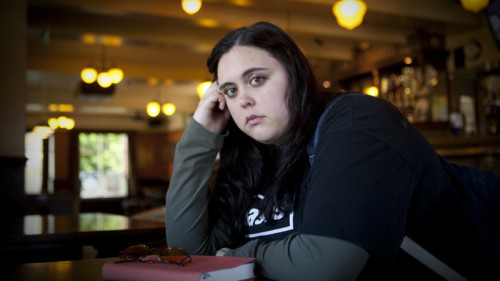
Considering the number of things media aimed at teenage girls typically gets wrong, it’s refreshing to see a mainstream TV program getting it very, very right. My Mad Fat Diary is a British series about Rae Earl (played by Sharon Rooney), a 16-year old girl who is big in size and bigger in personality. Having just been released from a stay in a psychiatric hospital after a suicide attempt, the show follows Rae struggling with mental health and body image issues alongside the slew of other issues that come with being a teenage girl: friends, school, sex, and family.
From the outset, the show’s approach to Rae’s weight is spot-on. She’s not particularly confident in her appearance (what 16-year-old is?), but she is trying her damnedest. Unlike the pitfalls many “lovable fat person” stories fall into, happiness and overall self-acceptance for Rae aren’t attached to her losing weight—not even under the common guise of “loving oneself enough to take care of your body.” Weight loss is rarely the question for Rae. Working toward her own mental health, with the help of her straight-talking therapist Dr. Kester (Ian Hart), constantly is.
What makes My Mad Fat Diary stand out is how it brings all of these topics to life in a way that is undeniably entertaining. For one thing, it’s set in 1996, with throwback outfits and a soundtrack to match. When it wants to be, the show is dead funny, and not in a slapstick or grotesque way centered around Rae’s size. When she makes genuine jokes at her own expense—on her own terms, it’s funny; when neighborhood hooligans do, it’s righteously nauseating. Rae herself is a clever, sharp-witted and outspoken character who pokes fun at everything and anything, making her friends laugh as often as viewers. Surrounded by a quirky band of friends and an unconventional home life (her flighty mother is harboring her younger, non-English-speaking, undocumented immigrant boyfriend Karim from Tunisia in the house), Rae may describe herself as “mad,” but she is often the sanest character of the cast.
Some of the show’s best jokes (as well as troves of heart-wrenching moments) stem from Rae’s fully budded sexuality. Here still, there’s much less temptation to laugh at Rae than with her. While Melissa McCarthy’s overt sexuality in Bridesmaids, for example, derives its humour at least as much from the idea of a horny but sexually undesirable woman as from McCarthy’s truly hilarious farcicality, Rae’s sexuality doesn’t position her size as the butt of its joke. Rather, her private thoughts read like a Cosmo column that’s more colorful than internet literotica and yet more relatable than either of the two. Anyone who’s been a sexually frustrated adolescent can appreciate phrases like “sculpted piece of testosterone wonder” and her general outlook on butts. If only we had all had Rae’s wicked sense of humour at 16, not to mention her complete comfort with her own desires.
Rae’s maturity is about on par for her age, and as such, we cringe as she blunders through conflicts with boys, friends, and worst of all, her mother, with youthful brashness. Her adolescent perspective is written to a T, best exemplified in the sixth episode of Series 2, “Not I,” in which Rae is forced to confront the events of the past several months through the eyes of her pretty, popular, but equally insecure best friend, Chloe. Rae may be naïve at times, but the show itself is far from myopic. Even older viewers will be along for the ride as Rae deals with anxieties—such as her aversion to eating in front of people—that are perfectly expressed and at times, truly heartbreaking in their honesty.
And therein lies what makes the show such a wonderful example of fat positivity and feminism—Rae is, per her own description, mad and fat, but it takes less than a single episode to make it abundantly clear that she is so much more than that. Rae’s character and her problems are just so real. It’s rare enough for teenage girls to see positive representations of themselves onscreen, and even less so for those outside the typical beauty norms. Rae Earl is an extremely well-developed, well-written character—one we could all afford to take a cue from now and then when it comes to speaking up for others and advocating for our own well-being. My Mad Fat Diary and shows like it deserve to flood the airwaves from here to Lincolnshire.
Ariana DiValentino is a lover and budding creator of all things film and feminism, based in New York. Catch her in action on Twitter @ArianaLee721.
I don’t think it would be quite the same barrel of laughs if the motto of Pawnee were “First in Friendship, Fourth in Poverty.” Fat shaming and fat jokes like the People of Walmart photos are often a socially acceptable stand-in for the classist shaming of poor people. Poor people are more likely to be fat, after all. We get paid less and we’re more likely to be fired. Oh, the comedy!
This guest post by Ali Thompson appears as part of our theme week on Fatphobia and Fat Positivity.
I’ve been binge watching Parks and Recreation episodes on Netflix over the past few weeks, and I really wanted to love it. But every time I am about to decide that I do, Parks and Rec makes a fat “joke.” I have to put the word joke in quotes because the punch line seems to be that fat people exist.
It’s weird that a show that is renowned for its kindness and feminism would rely so heavily on fat jokes, but it also isn’t. The discrimination and microaggressions that fat people endure are invisible to the wider culture, and Parks and Rec is a good example of this.
Fatphobia is a consistent presence in the show. In the “Sweetums” episode Ann Perkins says, “Pawnee is the fourth most obese city in America. The kids here are beefy. They’re just beefy, big-boned, chunk monsters. I call ’em like I see ’em.”
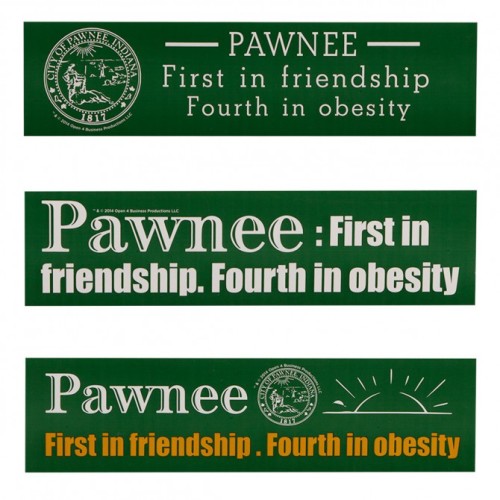
This happens in the second season, and apparently the writers found the existence of fat people so hilarious that they never let up after. Pawnee’s motto is “First in Friendship, Fourth in Obesity.” NBC is still selling shirts and bumper stickers featuring it.
I don’t think it would be quite the same barrel of laughs if the motto of Pawnee were “First in Friendship, Fourth in Poverty.” Fat shaming and fat jokes like the People of Walmart photos are often a socially acceptable stand-in for the classist shaming of poor people. Poor people are more likely to be fat, after all. We get paid less and we’re more likely to be fired. Oh, the comedy!
There are plenty of times that Amy Poehler will say the word “obesity” as the supposed punch line of a joke, and then smirk at the camera slightly, like—“See? Fatties! Amirite??” The joke here seems to be that just the word “obesity” is funny.
I don’t accept the idea that this mockery is ironic or satirical. The assumption here is that the very existence of fat people is funny. That’s not subversive in any way. It’s “What’s the deal with airplane food” of making fun of what people look like. It is tired and lazy and hacky. And it causes real damage.
The word obesity refers to the mere existence of a fat body as a disease that must be cured. This medicalization of fat bodies has led to an increase in the stigma against fat people. Fat people are constantly confronted with microaggressions related to inaccurate assumptions about our health, even—and especially—at the doctor’s office.
Multiple studies have shown that the majority of medical personnel have negative attitudes about their fat patients and are more likely to see them as lazy and noncompliant.
Parks and Recreation seems to find this stigma hilarious. I don’t. If you had to wade through the never-ending cesspool that is being a fat woman in public and online, you probably wouldn’t either.
Parks and Rec also makes the tired old claim that all fat people have diabetes, which is not only fatphobic but is ableist because it frames diabetes as a punishment for being fat.
In the “Telethon” episode, the telethon is supposedly a fundraiser to end diabetes, but what they really seem to want to get rid of is fat people. The show repeatedly conflates diabetes and fatness and seems to find this incorrect and ableist conflation a source of high hilarity.
“Tonight we’re hoping the people of Pawnee will dip their big chubby hands into their plus size pockets and donate generously… Coming up, a very special video presentation called Even My Tongue is Fat: The Story of Pawnee.”
The existence of the Sweetums factory, which makes high fructose corn syrup, is supposed to be the reason the characters are concerned about diabetes, but here’s the thing: you don’t get diabetes from eating sugar.
Framing diabetes as the punishment fat people get for their laziness and lack of self-control drains the empathy out of any conversation about the disease. It actively harms people with diabetes because everyone, even their doctors, think they have the disease because they did something wrong. It’s hard to get decent health care when even your doctor blames you for being sick.
The “Soda Tax” episode is an example of some of the worst fatphobia and ableism of the show. It uses what Dr. Charlotte Cooper calls “the headless fatty”- images that show fat people as symbols of fear and disgust, removing their humanity so that they can be more easily turned into objects—because bodies without heads are bodies without minds or voices.
“Soda Tax” also continues to conflate fatness and diabetes and to present both as problems to be solved, proposing that a tax on soda could get rid of diabetes, which is wrong and also ableist victim blaming. The reality is that diabetes existed before soda did. It existed before refined sugar did. The idea that getting rid of a source of sugar will get rid of diabetes is profoundly ignorant.
What it does demonstrate is the current trend of the government increasing revenues by targeting taxes at despised groups. We can’t raise taxes on businesses or the wealthy anymore because that option has been removed by anti-tax partisans, but the government needs money, so who can they get it from?
Why not fat people? Or people who smoke or drink? No one will complain about targeting those people. If you really wanted to offset the harm you believe soda manufacturers are doing, why not target them for taxes, at the point of manufacturer? But politicians know they could never challenge large corporations that way. So they pick an easy target.
Fat people are the easiest target. We are framed as deserving of every bad thing. We are always available to scapegoat and target.
And then there’s Jerry—the ultimate target.
Jerry Gergich is fat, and he portrayed as stupid and clumsy. He is constantly the butt of mean jokes around the office, bullied by people he considers friends, but who openly talk about how much they hate him.
He is constantly farting. His pants rip when he bends over. He’s so stupid that he will eat anything placed in front of him, including a bowl of glue substituted for his soup. He lies about being mugged in the park, but he really fell into a creek because he was trying to retrieve a breakfast burrito he dropped.
You know fat people! They go WILD over food. Why, they’ll even try to eat food that fell into a dirty creek! Har har har.
Jerry’s wife Gayle is played by supermodel Christie Brinkley. The “joke” is how could a good-looking person could find something lovable in fat, unattractive Jerry? Fat people are only supposed to be partnered with other fat people. How could someone so low status and of such little value as Jerry be married to a conventionally beautiful woman?
Comedy!
It makes no sense to me that a show that uses imagery like this, and refers to fat children as beefy monsters, can still be lauded as the “comedy of super niceness.”
The perception of Parks and Rec as super nice, which ignores the show’s constant, mean-spirited mockery of fat people and people with diabetes, is consistent with the media’s general unwillingness to engage with actual fat people. Reporters are obsessed with getting the other side on some topics, but when it comes to publishing the most recent press release from the Fat People are Terrible Monsters Think Tank (funded by Weight Watchers and diet pills), they just copy and paste whatever and call it a day.
I am a fat woman and the constant positioning of the existence of my body as a huge problem for the entire world to butt in and have a say in solving is insulting and exhausting. My body is not a disease or a problem.
When was the last time you saw someone advocating for the rights of fat people and fat kids? Probably never. What about our right to not be bullied, discriminated against, and shamed by an entire culture?
Everyone talks about fat people, but no one talks to us.
To be fat is to be invisible. Most of the time, I won’t see anyone who looks like me anywhere in the media. And if I do, that person is the subject of mockery. I believe this contributes to the hatred of fat people and the discrimination against us. We are not considered people. We appear nowhere, except as a mean joke or as a decapitated image of a body—another fat body to be used as an object in the cultural panic that is the Obesity Plague.
The invisible fatphobia of Parks and Recreation is just a symptom of a wider cultural problem. And that problem is that fat people are not treated like people who have feelings and thoughts just like everyone else.
Ali Thompson is an artist, a writer, a fat activist, and an unapologetic weirdo. She is the creator of ok2befat.com.
Its challenge to fatphobia is covered in fat jokes and gross-out humor, tailored to trigger our prejudices. We can laugh, if prepared to question why. We can sympathize, if braced against an awkwardly half-choked, giggling snort. Humor strikes faster than self-censorship.
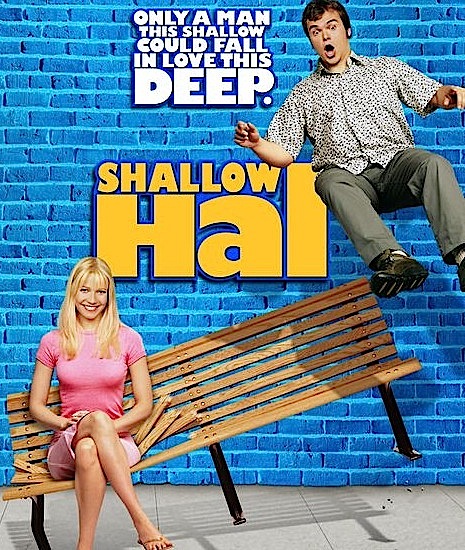
“Only a man this shallow could fall in love this deep.”
Written by Brigit McCone as part of our theme week on Fatphobia and Fat Positivity.
We are bad at multitasking empathy. When moved by Colin Firth’s Oscar-winning struggle with his stammer in The King’s Speech, you don’t want to recall cackling at Michael Palin in A Fish Called Wanda. As you congratulate yourself for noticing the rather obvious sexiness of Emmy-winning Peter Dinklage in Game of Thrones, you’d prefer to forget laughing at Verne Troyer in Austin Powers: The Spy Who Shagged Me. It’s more comfortable having your heart warmed by the Oscar-winning A Beautiful Mind, if you ignore that your ribs were tickled by Me, Myself and Irene. It’s easier to feel good about sympathizing with Jared Leto’s Oscar-winning trans heroine in Dallas Buyers Club, if you blank the comedy stripping of Sean Young’s trans villain inAce Ventura: Pet Detective. The result is that neither gross-out comedy nor award-winning pathos seriously challenges its audience’s comfort; the comedy, because we’re never asked to sympathize, and the Oscar-bait, because we’re never tempted to mock. In 2001’sShallow Hal, the Farrelly Brothers took Oscar-winning Gwyneth Paltrow, dressed her in a comical fat suit and demanded sympathy. The result was downright uncomfortable, and I loved it.
Shallow Hal comes with no genre cues or award endorsements to aid in compartmentalizing our empathy. Its challenge to fatphobia is covered in fat jokes and gross-out humor, tailored to trigger our prejudices. We can laugh, if prepared to question why. We can sympathize, if braced against an awkwardly half-choked, giggling snort. Humor strikes faster than self-censorship. The film has the boundless bad taste to remind viewers of their shallowness while daring to make them feel bad about it. The result can be a jarring viewing experience, provoking Rolling Stones‘ critic Peter Travers to declare “something condescending, not to mention hypocritical, about asking an audience to laugh uproariously at the spectacle of a fat person being sneered at and dissed as “rhino” or “hippo” or “holy cow,” and then to justify those laughs by saying it’s society’s fault.” Yet, is it truly hypocritical to remind an audience that they’re hypocritical?
The moment we see Jack Black’s Hal and Jason Alexander’s Mauricio hitting on “hotties,” the audience’s instinctive reaction is that they are too short and overweight to be justified in their shallowness. Hal is hypnotized into seeing inner beauty, and the hotties in fat suits and ugly cosmetics are utterly transformed into hotties without fat suits and ugly cosmetics. This premise allows Shallow Hal to become a forensic deconstruction of the fat joke. Do crushed chairs and giant meals remain funny, if acted by slim Gwyneth Paltrow? Or is it only the fat body that’s funny?
Many critics have pointed out that Shallow Hal uses tired, conventional fat jokes, without acknowledging how deliberately it targets thin bodies with those jokes. Left to imagine the fat body of Rosemary (Gwyneth Paltrow) only from bystander reactions and glimpsed body parts, we build a mental image of something hyperbolically monstrous. When Rosemary’s fat self is finally revealed, it is not to be mocked, but to relieve Hal and expose society’s dysmorphia. Of course, the Farrellys can’t control the audience’s response, only confront it. As Katherine Murray says of Chasing Amy and Dollhouse: “the power and relevance of both of these stories comes from the fact that objectifying women is a popular pastime in real life, and not everyone sees the problem with that – the discomfort and uncertainty of these stories comes from the fact that objectifying women is a popular pastime in real life, and not everyone sees the problem with that.”
Paltrow’s sympathetic performance blends spiky defensiveness and vulnerability. Seeing such low self-esteem in a slim, blonde “hottie,” Hal perceives it as “cuckoo.” Of course, it should be equally cuckoo for a fat woman to suffer pointlessly lower quality of life because of irrational stigma. Separating the body and the stigma raises interesting questions. Would it still be a dream to date Paltrow’s slender blonde, if onlookers reacted with the same judging, mocking and disbelieving scrutiny applied to obese girlfriends? Where Louie‘s “So Did The Fat Lady” wallows in the pathos of a fat lady that men won’t hold hands with in public, Shallow Hal questions whether men would feel comfortable publicly holding hands with Gwyneth Paltrow, if she were associated with lower status rather than higher. Or are they, actually, more shallow than Shallow Hal?
Hair-raising trials
Hal progresses through each hurdle of deconstructed shallowness, from defying public judgment to accepting Rosemary’s body in its real form, with “love grows where my Rosemary goes, and nobody knows but me” becoming his anthem of social defiance. Shallow assumptions that short, overweight Hal is ridiculous for chasing girls “out of his league” are equally challenged. Hal can attract conventional “hotties” once his desire is proved more than superficial; it’s just that then he doesn’t want them. Shallow Hal joins gross-out classic There’s Something About Mary, and the non-FarrellyDeuce Bigalow: Male Gigolo, as a romcom that dares to demand of men: “what is it about you that makes you deserve the girl?” It puts its hero through a trial of worth, without the usual, unquestioned entitlement to date whatever hottie the script provides (*cough* Forgetting Sarah Marshall). In There’s Something About Mary, a range of men try to seduce Cameron Diaz’s “hottie” using farcical exaggerations of classic wooing tactics: Matt Dillon’s sleazy Healy eavesdrops to discover and embody all her fantasies, Lee Evans’ emotionally blackmailing Tucker fakes a disability and an English accent to out-vulnerable the most vulnerable Hugh Grant fop, Chris Elliott’s stalking Dom manifests a passion so intense and persistent that it brings him out in hives, and hunky Brett Favre combines athleticism, wealth and fame. But it is only Ben Stiller’s continually humiliated Ted who, while making every technical error imaginable, loves Mary enough to place her happiness above his own desires, meaning he alone passes the film’s trial.
Conversely, the clients of Deuce Bigalow are farcical exaggerations of female anxieties: the narcoleptic fails society’s demand for women to be attentive; Amy Poehler’s Tourette’s violates expectations of ladylike behavior; the giantess is manly and intimidating; Fluisa is obese and unfit. Only by honoring the humanity and femininity of each of these extreme archetypes, and passing the final test of fully accepting his “hottie” girlfriend’s prosthetic limb, can Deuce prove himself worthy to be accepted and loved in his turn, as a flawed being. The shockingly honest self-scrutiny in gross-out comedy is one of the genre’s central pleasures. Farrelly Brothers movies are elevated above mean-spirited imitators (*cough* Norbit) by their dedication to conjuring and confronting anxieties on a path to purification. Though I didn’t include the Farrellys’ crude and absurdist Me, Myself And Irene in my survey of cinematic portraits of psychosis, and though it was slammed by mental health organizations, I must admit the film recognizes the psychosis of Jim Carrey’s Charlie Baileygates as his own responsibility, while allowing him to be a romantic and sexual being, which is as rare as it is refreshing. Since my psychotic break was flamboyant, I appreciate the Farrelly Brothers’ defiance of the respectability politics that plague mental health activism, just as Shallow Hal acknowledges and even exaggerates Rosemary’s overeating, while still challenging her dehumanization.
Rene Kirby as Walt
Crucially, Shallow Hal does not confine itself to the hypothetical thought experiment of imagining conventionally attractive actors as obese or cosmetically ugly, but introduces genuinely nonconforming bodies, including launching the acting career of Rene Kirby in a prominent supporting role. This tactic confronts viewers with the humanity behind the metaphor. Think of the audiences who empathized with Boris Karloff’s cosmetic monster in Frankenstein, but were appalled by the genuinely nonconforming bodies of Tod Browning’s career-destroying Freaks. Shallow Hal dares to sit Frankenstein and the real “freaks” at the same table, where all are celebrated as “one of us.” Does its casual conflation of fatphobia and ableism disturb some fat acceptance activists? The intense identification with nonconforming bodies that gay director James Whale showed in Frankenstein, or Oscar Wilde showed in “The Birthday of the Infanta,” faded from the camp aesthetic as gay rights advanced. The identification with Frankenstein shown by crossdressing director/star Ed Wood inGlen or Glenda, and transgender creator/star Richard O’Brien inThe Rocky Horror Picture Show, is fading from today’s trans* rights movement. Is the fat acceptance movement fighting to end body stigma, or merely to separate fat bodies from that stigma? Must every step of progress be accompanied by an act of exclusion?
The 1948 “race film” (that is, a Jim Crow era film with an African American cast, targeting African American audiences), Boarding House Blues, opens with Dusty Fletcher bringing a capering monkey into the boarding house to join his act. The monkey claims Dusty’s bed and forces him to sleep on the floor. It also bears a remarkable resemblance to King Louie, who would be talking jive and aping Louis Armstrong as the beloved “King of the Swingers” in Disney’s 1967The Jungle Book, fully 42 years before 2009’s The Princess and the Frog introduced Disney’s first Black princess (and, despite its jazz-age New Orleans setting, had less of Armstrong’s sound in its Randy Newman score than the ape did in 1967). It is uncomfortable to watch “King Louie” side by side with Dusty Fletcher, as it is uncomfortable to see Gwyneth Paltrow’s fake stigma side by side with Rene Kirby. It becomes even more uncomfortable when “King Louie” removes his head and reveals that he is another African American man, forced into a monkey suit to hustle a living. Good. Let’s be uncomfortable about that.
Erasure is too often the politically correct alternative to discomfort. By cutting blackface and Stepin Fetchit routines from classic films, we retain the sentimentalized self-image of racists, while erasing uncomfortably visible reminders of their racism (and groundbreaking African American stars, as collateral damage). Boarding House Blues also stars Moms Mabley, a middle-aged woman (and the major pioneer of stand-up comedy, whose taboo-busting routines were tamed for film). Today, her role would be played by Eddie Murphy, Martin Lawrence or Tyler Perry in drag and a rubber fat suit. How would Murphy’s Rasputia hold the screen against Mabley’s real deal? Doesn’t the safety of our laughter at Rasputia depend on Mabley’s substitution? One more star of Boarding House Blues deserves attention: Crip Heard. Crip is a dancer with one arm and one leg. Entering on a crutch, he tosses that crutch aside with a flourish and dances unaided. It is hard to imagine this celebration of Crip’s resilient body appearing in even the blaxploitation film of the 1970s, let alone the modern mainstream. Where could Crip dance today? If you’re honest, you know the answer: in a Farrelly Brothers movie.
There is no question that fatphobia is a vile, irrational and bullying stigma. But the commonly repeated mantra that it is the “last acceptable prejudice” is demonstrably untrue. From physical disability to mental illness to trans* status, there are numerous acceptable prejudices in today’s comedies. As Kathleen LeBesco points out, the Farrelly Brothers have “more than any mainstream moviemakers working today, fought hard against the devices of concealment, cosmetic action, and motivated forgetting, and as a result thrown into question the reassurance that public bodies are flawless bodies.” The runner-up? Jackass, of course. So, are we ready to embrace the anarchic Farrelly vision of squirming confrontation and broad-based solidarity? Or must our body politics become respectability politics?
Brigit McCone admits to having a thing for Jack Black and Rob Schneider. She writes and directs short films and radio dramas. Her hobbies include doodling and terrible dancing in the privacy of her own home.
However, the film musical is very different, dividing the women and telling the story from a male gaze, making it a romance instead of a story of female survival.
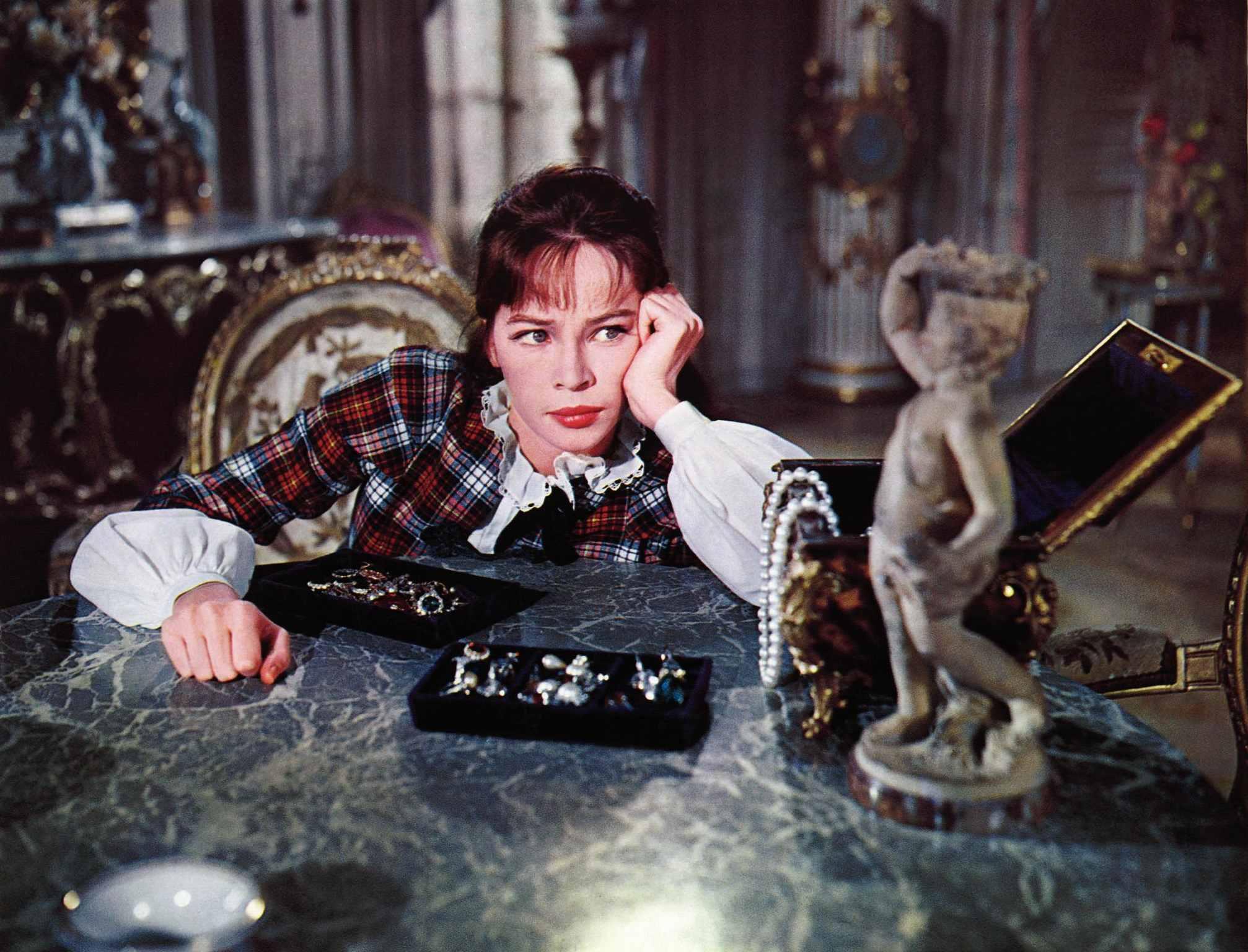
First made as a film musical in 1958 and then flopping as a stage musical in the 1970s, the revival of the Lerner and Loewer’s Gigi just opened on Broadway on April 8 with Vanessa Hudgens in the title role. This revival has brought more attention to the original film musical, which starred Leslie Caron as Gigi. The story Gigi, originally written as a novella in 1944 by Colette, takes place in Paris in the year 1900 and follows a girl coming of age while being pressured into becoming a courtesan to upper class men. Though her age was raised for the current stage adaptation, in Colette’s novella, Gigi starts the story at 15. At 15-and-a-half, her “lessons” in womanhood are completed, and she is expected to be a mistress to an old family friend – the wealthy and mustached 33-year-old Gaston. Instead of taking her on as his mistress and being her introduction to life as a courtesan, he asks for her hand in marriage. The novella ends there, and it is left up to the audience as to whether Gaston’s request was granted.
Colette’s novella focuses almost entirely on the domestic and “female” space of Gigi’s apartment, which she shares with her mother and grandmother (whom Gigi calls Mamita), and where her great-aunt (Aunt Alicia) often comes to visit. Her mother became a courtesan and then an actress/singer, and while she is often home late, she nonetheless cares deeply about her daughter and her future. She contributes to the income of the family, and is largely supported in her career choice by them. Alicia and her sister were courtesans, have since retired, and they are the ones who look after Gigi while her mother is working. Gigi’s full name is revealed in the novella to be Gilberta, a family name and one passed down by the women in her life. These women are independent due to having been courtesans, one of the very few ways a woman could be independent in France at that time. Yet, their independence has not kept them from being crushed and controlled by patriarchy. Another layer is that Gigi’s great-aunt and grandmother are Spanish, having immigrated to France. It is implied that their “dark” features resulted in their being othered, exoticized, and fetishized by French patriarchy.
Gigi’s older female relatives collaborate in deciding what is best for Gigi, and sometimes have one-on-one talks with Gaston about the family and Gigi. When Gigi has her own one-on-one talk with Gaston, it is evident that she is afraid of growing up into a woman, afraid of being sexually objectified and, even in the more independent choice of being a courtesan, having to constantly keep up a sexually gratifying façade to please the male gaze. Gaston felt out of place with his family and at his home, where everything felt cold and often just for show. He developed real friendship with Gigi’s family, who were always kind to him, and it is perhaps not just out of fondness for Gigi but also out of loyalty to Gigi’s family that Gaston proposes marriage, because by marrying Gigi he can personally and permanently help support the women who have been so kind to him. This story about women by a woman about female autonomy and the often lack of it ends with a man stepping forward to help support women. It is left up to the audience to decide whether Gaston should be trusted, and whether marriage under a kind master is or isn’t preferable to heartbreaking independence. This story is female-centric, pro-women’s empowerment, shows women supporting women, a man wanting to help these women’s well-being in the only way he knows how. However, the film musical is very different, dividing the women and telling the story from a male gaze, making it a romance instead of a story of female survival.
Gigi getting fitted for a dress, while her Aunt Alicia and Mamita examine.
While the novella shows women working together and supporting one another, the film divides them and shows them criticizing each other from afar and face-to-face, and competing and arguing with one another. The film musical removes Gigi’s mother almost entirely from the story (we hear her singing, but never see her), and it is implied that she is not a good mother because of her desire to pursue a career instead of staying home/marrying. The scenes often takes place in public and more “masculine” spaces, whether at nightclubs, barber shops, or in the streets of Paris. It also focuses more on Gaston (played by Louis Jourdan), as well as the new character from whose perspective the story is told – Gaston’s uncle, Honoré (played by Maurice Chevalier), who is around the same age as Gigi’s grandmother Madame Alvarez (played by Hermione Gingold). Through the male gaze, the complexity of Aunt Alicia (played by Isabel Jeans) and her warmth toward her family is largely taken away, making her into a cold stereotype, while her sister suffers a similar fate but in the opposite direction – becoming the stereotypical domestic mothering type always available to comfort and feed Gaston/men.
Gaston and Liane
The film also adds the character Liane (played by Eva Gabor), a courtesan who starts the story as his mistress. When Gaston realizes that she is having an affair with her ice skating teacher, she slut-shames her, has his men forcefully escort her lover off of the premises of the hotel at which she is staying, and dramatically dumps her. This leads her to attempt suicide. This entire story line is played for laughs, with the moral that men can sleep around all they want but women have to be faithful to one man (even if they are a courtesan) and let their men control them. However, this was not a relationship or a marriage, but a business relationship. Though Liane violated her contract, she had few choices in life open to her. She became a courtesan, assumedly to be independent. Being a courtesan was her career, and then she fell in love (or lust) with a man who was not rich. She kept her career with Gaston and then had a fulfilling relationship with an ice skating teacher. She fulfilled Gaston’s sexual fantasies, as it was her job, but he did not fulfill hers, nor was he contractually supposed to, so she got her fulfillment elsewhere. Gaston then publicly shames her for it, she attempts suicide, and the entire catastrophe is in the papers the next day. Liane’s attempt at suicide is implied to be a mean of vying for attention, and once again she is shamed. Gaston is then comforted, even by Gigi and her grandmother, over the break up, even though Liane is the one who is most hurt. Liane was a victim of a patriarchal society and who could not find self-fulfillment in even the most independent life choices that patriarchy allowed her due to its narrow confines.
The film even undermines the experiences of its own heroine. Gigi (played by Leslie Caron) has some character-driven songs in the film (many of which were originally cut for the musical, and then put back in for the recent revival), but these are still largely from the male gaze in order to show Gigi as “amusing” or beautiful. Though Gigi’s lessons in female etiquette are mocked by the film, it is far from a commentary of how women and girls are oppressed by what patriarchy demands of them. The story establishes these “lessons” in how to dress, speak, and act as necessary by showing in a positive light how Gigi eventually succeeds in being seen as a desirable woman by the men in her life.
Gigi being instructed by Alicia as to how to sit like a lady.
Gigi, though being trained to be a courtesan and a mistress, has been told very little about sex, fitting in with the standard of women remaining even mentally virginal and “pure.” However, in a scene that could have been feminist, Gigi finds this unfair. When Gigi and Gaston have their first talk about the possibility of Gigi becoming his mistress, and Gigi brings up sex; Gaston says, “You’re embarrassing me,” and tries to avoid the conversation. However, Gigi demands that she has a right to know what is expected of her. When Gaston tells her that he is in love with her, Gigi becomes horrified and calls Gaston cruel. She thought that the plan for her to become his mistress was made because it was just what was expected of them, just business. “You say you love me,” she says, but he would willingly have her sexually objectified and her every move criticized, and would dump her when he was done with her, leaving her like his last mistress to contemplate suicide. Gigi runs out of the room, crying. Instead of this being a commentary of how patriarchal expectations cause men to hurt the women they claim to love, the film ends up criticizing Gigi’s grandmother. Gaston turns to Madame Alvarez and yells at her for not making life as a courtesan seem more appealing to Gigi, then storms out.
Gigi as Gaston’s wife and arm candy
Gigi later decides she would rather be “miserable with [Gaston] than without [him].” She behaves elegantly on their first date, receiving many appraising stares. Gaston’s uncle proclaims that Gaston chose well, and that Gigi will keep Gaston “entertained for months.” It is this comment from his uncle that makes Gaston question the choice to have Gigi be his mistress. Gaston was raised to be a playboy, but he finds himself wanting more than just “months” with Gigi. He drags Gigi back to her home without explanation, putting her and her family into a panic, afraid of scandal and the ruin of Gigi’s reputation before it started. Gaston, after a long self-reflecting walk, proposes marriage and his request is granted. In the last scene, Gigi is shown in what must be a very uncomfortable outfit as Gaston’s permanent arm candy. While Colette leaves the ending up to us, asking us to reflect on patriarchal treatment of women and what the solution to it might be, the film gives the harmful message that marriage with the man in control and the woman looking pretty and being “entertaining” is the best life choice for all parties.
Heidi Thomas, who adapted the revival of the stage musical, has put more of the story’s focus back on the title character; the choreographer and the director of the revival are both men. As the character Gigi and the actress Vanessa Hudgens have been sexualized by men, and their careers often controlled by men, it seems an odd choice thematically to have men be the ones telling Vanessa Hudgens as her character Gigi how and where to move and working with the actress on how to express what Gigi is feeling. The release of semi-nude and nude photographs of Vanessaa Hudgens in 2007 and 2009 were sexual assaults, yet she was made to apologize for them and to feel ashamed and embarrassed by Disney, her publicists, and various journalists. Now here she is playing Gigi, whose sexuality and sexual expression are tightly controlled while she tries to fight for her own autonomy. Is this really something that the cismale director and choreographer can fully understand? As a transmale who grew up being told by society that I should try to fit myself into a narrow definition of femininity, empathizing with Gigi when she felt uncomfortable during her “lessons,” I still have trouble understanding female perspectives sometimes. Female perspectives are, of course, incredibly varied, which Colette attempts to explore in the novella. However, I am also not female or attempting to live as one anymore, and don’t as many shared lived experiences. Hopefully, an adaption of Gigi will eventually be made which is more fully from the perspective of women.
You probably know Garfunkel and Oates from their funny songs on YouTube, but you might have missed the eight-episode series they had last summer on IFC (I’m guessing most people did, because it got cancelled). But the series is now available on Netflix Streaming, and it is just the right level of quality where you’ll be happy you watched it but not miserable that there won’t be any more episodes.
It’s also an interesting study on some of the issues facing (caps-for-seriousness) “Women in Comedy.”
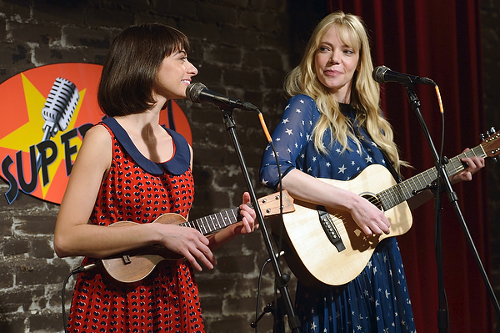
Kate Micucci and Riki Lindholme are Garfunkel and Oates.
You probably know Garfunkel and Oates from their funny songs on YouTube, but you might have missed the eight-episode series they had last summer on IFC. (I’m guessing most people did, because it got cancelled.) But the series is now available on Netflix Streaming, and it is just the right level of quality where you’ll be happy you watched it but not miserable that there won’t be any more episodes.
It’s also an interesting study on some of the issues facing (caps-for-seriousness) “Women in Comedy.” We’re nearly a decade out from Christopher Hitchens mansplaining why women aren’t funny and the tidal wave of backlash it wrought. Today, no one who is relevant doubts that women are funny, at least not out loud. But there are still issues of how women are permitted to be funny, and Garfunkel and Oates illustrates both the limitations and opportunities created by our expectations for female comedians.
1. How much can we talk about “girl stuff”?
Some people have the attitude that truly funny women prove their worth by not “relying on” their gender. (See also: white people praising Black comedians and other funny PoC for not “always talking about race.”) This is a fabulous silencing tactic, telling marginalized groups that their lived experiences are boring and unfunny while reinforcing the white male point of view as universal. The idea that telling jokes about “girl stuff” limits funny ladies to being “funny, for a girl” is predicated on the idea that womanhood is a deviation from the fundamental human experience. Which is sexist bullshit.
From the “Pregnant Women Are Smug” video
The good news is that this sexist, silencing notion means a lot of funny material has been under-explored and is ripe for the picking. Garfunkel and Oates is at its best when it deals directly with “girl stuff.” In one episode, a club manager gives Riki and Kate the unsolicited creative note, “Please, no material about your periods.” When he leaves, Riki asks, “Why do guys think we talk about our periods?” and then they immediately start sharing details about their periods. They aren’t even that funny, but I still laughed like crazy, just because NO ONE EVER MAKES JOKES ABOUT THEIR PERIODS. Even though periods are hella funny. And guys are WORRIED about hearing about periods from female comedians. Very, very concerned.
My favorite episodes are the ones about dating (especially the one where they test the “Little Mermaid theory” and see if the guys they date will notice or mind if they don’t say any words, at all), the pressures of “aging” (“29/31“), and family planning (“Sometimes my womb is all like ‘hey girrrl’ and my mind is like ‘shhhhhhhh’ but right now I feel like, ‘yeah, maybe?'”). This perspective separates Garfunkel and Oates from simply being a retread of Flight of the Conchords.
From the “29/31” music video
Fortunately, I think Garfunkel and Oates is part of a sea change for female comedians where it’s not only okay to tackle female experiences, but applauded, by both women and men (see this interview with writers forInside Amy Schumer). Of course I don’t think funny women should only cover “women’s issues” (G&O also get great mileage out of weed, awkward social situations, and adult immaturity), but I’m so glad that there is less pressure to shy away from it. Bring on the period jokes, ladies.
2. Is it OK to “use” our sexuality?
Sexy bathtub promo image for Garfunkel and Oates
If you’ll recall (and I’ll forgive you if you’ve blocked it from your mind), Hitchens’s main argument for the unfunniness of women was that men will have sex with us even if we don’t make them laugh. A corollary to this is that those rare funny women that exist are “making up for” being unattractive in some way. And it also follows that if an attractive woman succeeds in comedy (or in any other field, really) it isn’t on the basis of her talent, but rather her looks.
This is a tricky minefield to navigate, and it gets all the more complicated when you’re telling jokes about sex. Which Garfunkel and Oates do (my all-time fave of their songs is still “I Don’t Understand Job“). And all the bullshit of Hollywood, wherein these skinny, pretty, able-bodied white women would be considered too “weird looking” to be conventionally attractive, it is even more of a mess. Unfortunately, Garfunkel and Oates doesn’t seem to know how to approach these problems, either, yielding some of their flattest material. In the second episode, Riki and Kate meet their porn parody counterparts Garfinger and Butts, who briefly eclipse their fame with their innuendo-laden track “Come on Me.”
Garfinger and Butts (Abby Elliott and Sugar Lyn Beard) spell out the Garfunkel and Oates formula.
Garfinger and Butts crack the G&O formula, but are also portrayed as total idiots. The message is unclear: are Riki and Kate admitting that some of their success is owed to their sex appeal, or bemoaning that they’d be more famous if they landed somewhere else on the hot vs. cute scale.
And the attempts to explore the hot vs. cute spectrum through tall blonde Riki and short brunette Kate also generally fail. In one episode, they “swap hair” with wigs, and blonde Riki is treated nicely by women for the first time, where normally friend-zoned Kate seals the deal for once. It was a little over-the-top for me, as was the episode where Kate is accidentally sent to an audition meant for Riki and looks ridiculous trying to be sexy.
3. Haters gonna hate
Steve Little as anti-fan Dennis
I think my biggest disappointment with Garfunkel and Oates was the episode where an anti-fan trolls one of their shows. I thiiiiink the joke with Dennis is that if people did the stuff they do online (shout “make a sandwich”) in the real world it would be more obviously pathetic. Unfortunately, it wasn’t funny, and the cartoonishness of it felt like it was trivializing online harassment, and minimizing the harm of more subtle IRL sexism. The same episode has the “no period talk” manager and a hostile, condescending sound guy, who would have been more pointed characters without the straw man Dennis drawing attention away. And I would have loved to see more about the subtle forms of sexism women in comedy have to deal with (like in the first episode, where a male comedian Riki is seeing tweets her joke as his own, which if he’d done to a male friend would be a sin akin to murdering their mother).
Of course, all of this was of more interest to me because I am a woman who writes and performs comedy, but I think civilians would agree with my “good but not great” take on the Garfunkel and Oates series. Fortunately, one of the benefits of having more female-driven comedy out there is that it isn’t the end of the world when some of it comes out as just OK.
Robin Hitchcock is a writer based in Pittsburgh and a member of the all-female comedy troupe Frankly Scarlett. She is on an eternal quest for the perfect tampon joke.
Six brothers spent their lives cloistered inside a messy Lower East Side tenement in Manhattan where only their father had the key. Only once or twice a year were they allowed outside their claustrophobic apartment, subsidized by welfare checks their mother received from home schooling them. They spent the day watching movies. This went on for years and years. This is not the subject of some horror film. It’s a stranger-than-fiction story that is the subject of documentary, ‘The Wolfpack.’
Six brothers spent their lives cloistered inside a messy Lower East Side tenement in Manhattan where only their father had the key. Only once or twice a year were they allowed outside their claustrophobic apartment, subsidized by welfare checks their mother received from home schooling them. They spent the day watching movies. This went on for years and years. This is not the subject of some horror film. It’s a stranger-than-fiction story that is the subject of documentary, The Wolfpack.
Directed by Crystal Moselle, the documentary created a stir at Sundance where it premiered, where the brothers turned up for the screening but spoke very little with the press.
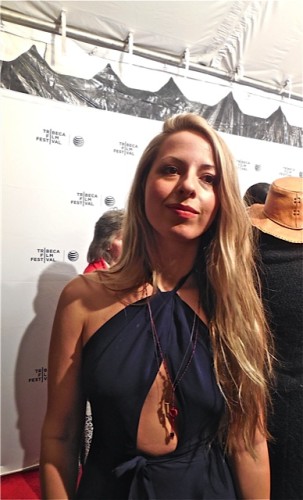
Last weekend, The Wolfpack made its New York premiere at the TriBeCa Film festival at the SVA Theater on 23d Street, not so far from where the boys spent almost all their lives inside the closed walls of their claustrophobic and unkempt apartment.
Five of six Angulo brothers
Everything that the six boys – whose surname is Angulo – knew of the world they gleaned from movies. Quentin Tarantino’s movies were favorites, along with those of Martin Scorsese, Christopher Nolan, and David Lynch. The boys – Govinda, Bhagavan, Narayana, Krisna, Jagadesh, Mukunda – spent their time watching movies and then reenacting scenes wearing costumes they created out of thrift shop clothes they retooled to resemble that of their characters.
One of the brothers described their existence as living in a prison. One sibling said they lived inside their minds.
As they got older, once or twice a year the siblings would walk in the streets. It was on one of their rare expeditions that Moselle found them. The production notes from the film said it was like “discovering a long lost tribe.” They were a vision in their waist-length hair and Pulp Fiction-inspired wardrobe, which featured a badly fitting dark suit, white shirt, and sunglasses. Over five years, Moselle gained their trust and recorded their story. She is still very protective of them.
On the red carpet, I asked the director if the boy’s father, Oscar, a Peruvian immigrant, who in the film was often drunk and ranted incoherently, had emotionally abused his sons. She replied tersely, “I’m not going to answer those questions.”
Moselle described her relationship with the brothers as sisterly, so they felt comfortable around her. (Their actual sister, to whom they are very close, is mentally disabled.)
“I watched them grow up,” Moselle told me. “There’s an incredible transformation that they went through so it was a beautiful thing to see this great transformation, and then now they’re making films in the world and socializing and happy people.”
Neither of the boys’ parents, including their mother Susanne, who seems as controlled as her sons in the film, appeared on the red carpet.
I spoke to Govinda, who is the second oldest and has a twin, what life is like now. “Life now is busy. It’s taken off cause this has pushed us to just start relationships with people, and in the filmmaking world it’s all about relationships,” he said like a pro.
Angulo brothers
“Offers are flowing in,” said the charismatic, handsome 22-year-old. “We’re starting our own production company, Wolfpack Productions. We’re working as assistants on sets, so there’s a lot happening for us. It’s opened up a lot of doors.”
The brothers still play out scenes from their movie scenes. “We’ll always do that,” Govinda smiled. “That’s the heart for us, so we’ll takes these movies with us wherever we go.”
They are still stunned by the Sundance success. “What could be more surprising and stupendous than that, the Oscars?” I asked. “You never know,” Govinda told me.
This red carpet stuff is something they’ve dreamed about since they were kids sitting on dirty mattresses watching movies, Govinda said. “This is something that we always dreamt about when we were 12 year olds and we’d turn on the TV and watch people on the red carpet and be like, ‘I want to do that some day! I want to be in front of those cameras some day and be on the red carpet!’”
The boys wore their signature outfits. “We actually thrift shop buy everything,” he told me. “We search around all New York City; we go to all the different stores and then we reference clothes from movies and this is like our Reservoir Dogs look.”
Soon, designers will be calling them and asking them to wear their suits, I told them. “That started already,” Govinda noted. They already have a fashion spread in the works. “We’re doing stuff with big magazines, so there’s a lot of talk in the works.”
Maybe because of years of being shut off from the outside world, the brothers’ speech is still a little off kilter, and Govinda speaks slowly and chooses his words carefully. I asked him how his parents were doing with all the media attention.
“They’re doing well. Dad’s more – he’s not a big public eye guy so he doesn’t like being in front of the camera and everything. You know how he was in the documentary, but mom is all for it.”
How did his Dad feel about the way he was portrayed? “We got a bunch of comments from people saying I wish I could do that to my children, in a joking kind of way,” Govinda laughed. “But my Dad, he loved the movie. The movie was an honest portrayal.”
Paula Schwartz is a veteran journalist who worked at the New York Times for three decades. For five years she was the Baguette for the New York Times movie awards blog Carpetbaggers. Before that she worked on the New York Times night life column, Boldface, where she covered the celebrity beat. She endured a poke in the ribs by Elijah Wood’s publicist, was ejected from a party by Michael Douglas’s flak after he didn’t appreciate what she wrote, and endured numerous other indignities to get a story. More happily she interviewed major actors and directors–all of whom were good company and extremely kind–including Brad Pitt, Angelina Jolie, Morgan Freeman, Clint Eastwood, Christopher Plummer, Dustin Hoffman and the hammy pooch “Uggie” from “The Artist.” Her idea of heaven is watching at least three movies in a row with an appreciative audience that’s not texting. Her work has appeared in Moviemaker, more.com, showbiz411 and reelifewithjane.com.
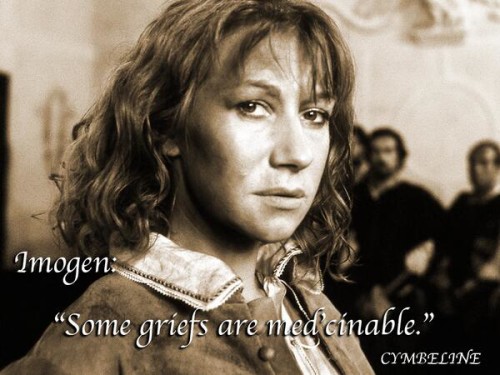
After recalling his greatest tragedies, Shakespeare suggests that all could end well, if men loved without defensive cowardice. “Some griefs are med’cinable.” Rising to such newfound greatness of heart, King Cymbeline describes himself as becoming “mother.” William Shakespeare: feminist punk?
Plots were not Shakespeare’s strong point. He borrowed most from history or other authors, before illuminating them with psychological insight and philosophical depth. One of his final plays, 1611’s Cymbeline, is particularly jarring because the Bard is actually plagiarizing (“reimagining”?) himself: King Cymbeline (King Lear) becomes enraged and imprisons his only daughter, Imogen (Desdemona/Cordelia), for daring to marry “poor but worthy gentleman” Posthumus (Othello), who is exiled and meets cynic Iochimo (Iago), provoking Posthumus to bet that Iochimo can’t seduce super-chaste Imogen. Iochimo fakes proof of Imogen’s infidelity, being Iago and all, so Posthumus flies into Othellish rage and orders Imogen killed. Imogen discovers the order and flees in drag (she’s also Portia and Viola) as “Fidele” (she’s faithful, get it?), taking a death-simulating drug along the way (did I mention she’s Juliet?) There’s a wise woman and a cryptic tree prophecy that comes true unexpectedly (unless you’ve seen Macbeth). We’re one suicidal Dane short of a Greatest Hits album here.
After five or six more annoying coincidences, the plot somehow resolves. But hang in there because, as ever, there’s human truth lurking in Shakespeare’s narrative tangle, and Cymbeline is probably his most feminist play. In theaters now: a radical new version with Ethan Hawke, that aims to prove the play really is interesting, by burying its interesting exploration of female fidelity and male double standards under guns! Bikers! Testosterone! And soldiers! If you watch the trailer closely, you may briefly glimpse Dakota Johnson, playing Shakespeare’s lead:
Centering the woman is admittedly a dramatic weakness of Cymbeline, though not as dramatically weak as its plot. The crushing double standards of Shakespeare’s age demanded purity from a heroine, unstained by the fascinating flaws of Lear, Othello, Hamlet or Macbeth. Imogen is, honestly, a little dull. Shakespeare’s good servant, Pisanio, pointedly calls Imogen “more goddess-like than wife-like” in her endless forbearance. But crucially, jealous Posthumus repents his rage before discovering Imogen’s innocence. Where murder was the conventional response to female infidelity, at least on stage, Shakespeare has his hero turn on the audience, while still believing his wife guilty, and demand, “you married ones, if each of you should take this course, how many must murder wives much better than themselves for wrying but a little?” (Screw biker gangs; where’s Deepa Mehta‘s update confronting arranged marriage and honor killing?)
Though Shakespeare is limited to absolute chastity in his heroine, he subversively tests the play’s men with Imogen’s dilemmas, demanding female fidelity be equated with male. Luckily for Bitch Flickers, there’s a 1982 BBC adaptation smart enough to cast Helen Mirren and let her rip. Mirren breathes full-blooded life and passion into Imogen, adding conflict and doubt to her dull purity. Her Imogen is faithful, not by natural chastity, but by choice. From the opening, Shakespeare evokes possessive claustrophobia, with Posthumus gifting Imogen “a manacle of love. I place it upon this fairest prisoner.”
Posthumus’ manacle of love
For her loyalty to Posthumus, Imogen is condemned as “disloyal thing” by her father, King Cymbeline, who demands that she marry his royal stepson, Cloten. Yet, when Cymbeline hears his own wife’s deathbed confession that she never loved him, only “affected greatness” (wanted his rank and wealth), he gasps: “but that she spake it dying, I would not believe her lips in opening it.” King Lear’s expectations clash with Othello’s. Imogen’s conflicting loyalties are embodied by Pisanio, a servant forced to swear loyalty to two masters, who justifies choosing the heart over vows: “wherein I am false, I am honest. Not true, to be true.” Compare Lady Macbeth: though stereotyped as a scheming manipulator, her inner monologues are devoid of personal ambition and filled with her need to fulfil her husband’s desires, taking the burden of his guilt upon herself. In her sleepwalking, she feels Macbeth’s victims sticking to her hands, even those of which she had no warning. Lady Macbeth ruins her husband, not out of selfishness, but out of a love so selfless that it sacrifices her moral judgment and her very identity. If only she had known when to be “not true, to be true.”
Imogen: “What is it to be false?”
As Iochimo claims Imogen has cheated with him, our “worthy” Posthumus seems eager to believe the oath of this stranger over his wife’s vows, even when reminded by bystanders that the proofs are not absolute. Convinced of Imogen’s guilt, Posthumus launches into a misogynist rant, revealing paternity fraud as the root of his anxiety – “we are all bastards!” – as well as scapegoating male flaws on women – “there’s no motion tends to vice in man, but I affirm it is the woman’s part.” But his bet’s true motive is rather suggested by Iochimo: “he must be weighed by her value.” Imogen’s virtue is Posthumus’ status symbol, while Iochimo himself seems driven to prove the falsity of all womankind, as if the mere possibility of female loyalty would imply Iochimo’s responsibility for provoking past disloyalty. As objectifying is a classic strategy for denying your own impact on another, so Iochimo longs to “buy ladies’ flesh” in some way that will guarantee its not “tainting.”
This insecure craving for guaranteed affection becomes the counterproductive engine of his repulsiveness. Robert Lindsay’s Iochimo is like polished igneous rock: the hard, glittering bitterness of a cooled eruption. As he smuggles himself inside Imogen’s bedchamber, to memorize its decorations and the moles of her body as proofs of infidelity, Iochimo even peers into her bedside book, finding “the leaf’s turned down where Philomel gave up.” Philomel was a mythical Grecian heroine raped by her brother-in-law, whose tongue was torn out to prevent her testifying, an image central to Shakespeare’s Titus Andronicus. Lindsay’s choked gasp makes it clear that his character interprets Imogen’s reading matter as rape fantasy. Is she reading Philomel’s story as a cautionary tale, or has the pressure of stifling chastity really provoked “hot dreams” (Iochimo’s words) about the release of imaginary ravishment? Is it any of our damn business?
Iochimo, wearing Imogen’s stolen manacle while being a creeper
Though restraining himself from rape, Iochimo’s compulsive need to test and “prove” Imogen’s virtue is itself a violation. By referencing Philomel, Shakespeare reminds us of Imogen’s vulnerability, which the 1982 production underlines by Iochimo’s hovering shirtless over her as she sleeps, monitoring her every sigh. We must remember that our noble hero, Posthumus, has given letters of recommendation to this total stranger, along with a hefty bribe to rape his wife (theoretically, “seduce” her), because Posthumus is willing to accept proof of sex (not of consent) as evidence of Imogen’s betrayal. Though Posthumus swears the deepest love for Imogen, his underlying misogyny (“there’s no motion tends to vice in man, but I affirm it is the woman’s part”) has driven him to betray her utterly, ironically to test her faithfulness. As Imogen howls, when she discovers his suspicion: “men’s vows are women’s traitors!” Posthumus’ vow of love betrayed Imogen into believing herself exempted from his misogyny. But conditional pardons are no security. As Mirren mutters, ripping up love letters, all his scriptures are turned to heresy. There are many ways to break faith.
Tragically, Imogen lived before the invention of chocolate chip ice cream
Meanwhile, in another part of the forest… meet Belarius, Cymbeline’s bravest soldier who, maddened by false accusations of treachery, kidnapped the king’s infant boys and raised them as his own. This apparently irrelevant subplot introduces the idea of unjust suspicion avenged by paternity fraud, just as Pisanio voiced Imogen’s divided loyalty. Belarius’ motive, “beaten for loyalty excited me to treason”, equally justifies Imogen in infidelity, by masculine logic. When his sons are returned to Cymbeline, the king asks if they are indeed his. Belarius does not answer “yes,” but “as sure as you your father’s.” Shakespeare proposes that no-one, male or female, can ever truly be verified. At least, not by the objective measure that Iochimo aspires to. Trusting their hearts alone, Imogen and her long-lost brothers love each other, without knowing their kinship.
Belarius, meanwhile, proves his “honest” courage fighting Romans, rallying fleeing Britons by yelling that only deer should be slaughtered while running away: “Britain’s harts die flying, not our men.” The pun is appropriate. Male culture promotes valor in warfare, but justifies defensive cowardice in love, provoking the very ruin it most fears. Britain’s hearts die flying, like its harts. Bayonets, bullets or biker gangs, they’re still metaphors for sexual insecurity. As in the battle, where some were “turned coward but by example” and needed only a rallying cry to regain courage, so Posthumus’ blistering “you married ones…” speech rallies Shakespeare’s audience to a more courageous love, where chastity is a faithful heart, not a flaunted status symbol: “I will begin the fashion, less without and more within.”
In a blind chaste test, three out of four women preferred Posthumus
Shakespeare not only explores the hypocrisy of chastity testing and daughterly duty, but the exhausting demands of unwanted attention. Imogen’s suitor, Cloten, seeks to win her by conventional expressions of love, serenading her with music to make her obligated. Tellingly, he describes this wooing as battle – “I have assailed her with musics” – urging his fiddlers and singer “if you can penetrate her with your fingering, so we’ll try with tongue too” to emphasize the violation of his unconsensual serenading. If she yields, Imogen betrays Posthumus. If she remains silent, her silence will be taken for yielding. Finally, she is provoked into telling Cloten that she hates him, that if every hair of his head were a man like him, she would prefer Posthumus’ rags to the lot of them. Cloten takes this insult as provocation to plot the rape of Imogen. There’s just no escaping the bind of his manacle of love. At least, not until he tries that arrogant attitude on a man, and gets his head lopped off. Gotta love Will. A fiery Helen Mirren dominates, as she battles through Shakespeare’s chastity gauntlet. If only her exasperated “but that you shall not say I yield, being silent, I would not speak” felt less familiar to today’s woman.
By the finale, the Queen and Cloten, heartless plotters of murder and rape, are dead. But what of Posthumus, whose insecurity would enable a stranger to rape his wife? What of Cymbeline, shocked at his own wife’s lovelessness, but demanding loveless marriage for his daughter? What of Belarius, honest warrior but paternity fraudster? What of Iochimo, self-loathing “tainter” of womankind? Forgiveness is their punishment, conscience their natural judge. Though Iochimo stole Imogen’s “manacle of love” as false proof of her infidelity, he accepts his heart must bleed in its trap. Karma’s a bitch. Britons make voluntary peace with Romans. King Cymbeline declares: “pardon’s the word… to all!” After recalling his greatest tragedies, Shakespeare suggests that all could end well, if men loved without defensive cowardice. “Some griefs are med’cinable.” Rising to such newfound greatness of heart, King Cymbeline describes himself as becoming “mother.” William Shakespeare: feminist punk?
Brigit McCone can rant for days about how misunderstood Lady Macbeth is. She writes and directs short films and radio dramas. Her hobbies include doodling and working “a breach in nature for ruin’s wasteful entrance” into everyday conversation.
This show doesn’t say that all women should not be kidnapped, murdered, and raped. It says White cisgender heterosexual women, particularly ones who are young, skinny, and meet current White cultural expectations of beauty, should not be kidnapped, murdered, and raped. While the show was not cancelled after its first season, the second season showed more “nice guy” characters, probably to placate White male viewers who had a problem with the basics of White feminism depicted in the first season.
During the Second World War, Bletchley Park was the UK’s central site of its Government Code and Cypher School. It was at Bletchley Park where Alan Turing and many others decoded Nazi and Axis intelligence, bringing the war to an end two to four years earlier than it could have stretched, saving thousands of lives. The BBC’s TV series The Bletchley Circle follows four (and later, five) fictional White female Bletchley Park code breakers in their lives after the war in the 1950s, during which they start solving crimes. The first season premiered in September of 2012, and the series did not return until April and May of 2014. During the second season there was a female director on the show, and, while there had always been White feminist aspects to the show, the writer Guy Burt’s theme of (White) women standing up for (White) women was taken to a whole new level under Sarah Harding’s direction. That this White (and somewhat) feminist show, which was written by and often directed by White men, was not renewed despite mainly addressing only the basics of White feminism – that (White) women shouldn’t be kidnapped, murdered, and raped (in the first season, the villain worked in that order) – is upsetting. This is the most palatable kind of feminism for rich White men, and yet even this story is silenced.
Not only is the story “palatable,” but the heroines themselves are written as overly “perfect” and not very “threatening.” They are kind, intelligent, empathetic, humble, and rarely confront the men in their lives for their condescension and sexist comments and actions. Meanwhile, shows about White men who solve crimes show the “heroes” as egotistic, unkind, confrontational, and violent. The shows about these male heroes and anti-heroes are everywhere on television, and they get renewed again and again. There is hardly a man or Woman of Color to be seen in The Bletchley Circle, and all of the romances of the characters, all of whom are cisgender, have been heterosexual. This show doesn’t say that all women should not be kidnapped, murdered, and raped. It says White cisgender heterosexual women, particularly ones who are young, skinny, and meet current White cultural expectations of beauty, should not be kidnapped, murdered, and raped. While the show was not cancelled after its first season, the second season showed more “nice guy” characters, probably to placate White male viewers who had a problem with the basics of White feminism depicted in the first season. Though the heroines were still standing up for each other and saving themselves from “bad” guys, the show started depicting more “nice guys” on which the heroines could not only occasionally rely, but also date. The most prominent of these “nice guys” was offended that the character Lucy did not trust him right away, and the show seemed to say that she should have trusted him. If this man is supposed to be an ally to women, a male feminist, then why was he so offended?
Lucy
It would have been different if this were the start of a character arc, one that showed a man just starting his journey as an ally, showing him making mistakes and learning from them. However, that’s not what happened, and was essentially a “not all men” argument displayed in story form. This is especially problematic because the writer chose Lucy out of all the other female characters to be put in this position. Lucy, played by Sophie Rundle, is quieter and seemingly more “submissive” than the other White female characters, seeming to more easily fit into what is traditionally desired of White women by the White patriarchy. However, being quiet, submissive, “feminine,” and marrying young does not save her from violence at the hands of men.
Lucy’s husband is verbally and physically controlling and abusive. In one day, she is almost raped by a man on the train, only to return home where her husband nearly kills her. And yet, she is shamed for not having trusted this “nice” male coworker in the second season right away? Made to feel embarrassed for being wary of this man who has been overtly flirting with her? Wary of this man who is sometimes condescending to her and gives backhanded compliments? This was seemingly a story line to comfort White male viewers who were made uncomfortable by the basics of White feminism and by White women saving and supporting White women. Instead of Lucy being “the ball,” as Anita Sarkeesian states, in a “nice” men vs “bad” men competition, she is saved from “bad” men by fellow women and her own strength. Though there are times when men assist and support the women of the show, the women are the ones leading the fight against sexism and violence against women. Evidently, many White cismale and (mostly) heterosexual viewers and studio execs were made uncomfortable by the notion that these White women are, for the most part, not saved by White men, but by themselves.
Susan
The first season has The Bletchley Circle, led by protagonist Susan (played by Anna Maxwell Martin), solving a serial murder case in which a man is killing women and raping them post-mortem. While the villain could easily have been made into a straw-chauvinist by the male screenwriter to make the other male characters look good, this is not the case. In fact, it is often in regard to the serial murder case that the misogyny in the other male characters surfaces. This underlines the fact that the allowance of microaggressions sets the stage for more blatant sexism, which then makes violence against women and girls more permissible in Western society, and thus creating a culture where rape and violence against women and girls by men and boys is often excused, not taken seriously, and not thoroughly addressed. When Susan’s husband accuses her of neglecting her duties as a mother due to her not staying home as often as he would like, the truth is that she was being a good mother by trying to make the world safer for their daughter and not as damaging to the character of their son.
In the first story arc of the second season, Susan is naturally still traumatized by events of the first season, which include almost being murdered and raped by the villain. Though she leaves the crime solving life behind, she does not leave it until she makes certain that the circle is in good and capable hands. This adds realism to the story in that trauma is not something that can just go away or be ignored, especially not at a moment’s notice. However, it is sad that this rare and realistic portrayal of a hero and the trauma they face was done with one of the few positive and complex female leads of television, while male heroes of similar shows are not shown dealing with their trauma in any where near as realistic a way. They stay on their shows and keep “fighting the good fight” for years despite whatever trauma they face.
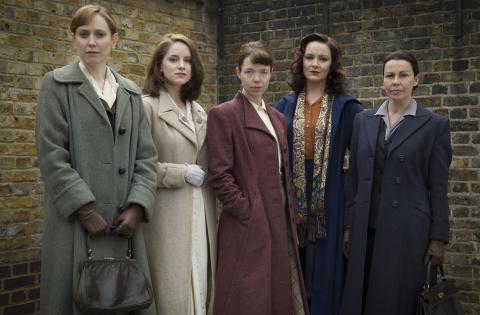
The Bletchley Circle, including Alice and Lizzie
Though the show’s cast were always a sort of ensemble, they become more so in the second season. The capable hands in which Susan leaves the circle belong to Alice (played by Hattie Morahan). Alice fits more easily into White cultural expectations of beauty than Susan does, being blonde, blue-eyed, taller and thinner. However, the character is complex, and instead of her “taking charge” of the team, she is welcomed into it, helps in the ways that she can, and the show becomes more of an ensemble than it was previously. This is not to say that Susan was always “taking charge,” just that she pulled the team together in the first place and the script followed her story more than the others. Susan had a child out of wedlock, and was forced to give up the child to adoption due to stigma and cultural standards. During the second season, she reconnects with her now adult daughter Lizzie (played by Faye Marsay), and the two form a sort of warm friendship rarely seen between women on TV and film. The other women of the circle never judge Alice for having sex and a child out of wedlock, nor do they judge each other for whatever choices they make. Shy and conservative Lucy never judges Millie (played by Rachael Stirling), the more outgoing one who likes tight fitting clothing, make-up, and the color red, and Millie never judges Lucy. Jean, the “mother hen” played by Julie Graham, is not judged for being a mature single woman, nor does she judge her younger female friends in their choices. Not only do these women save each others lives, but they also support each other as friends in their personal lives, outside life as code breakers and crime solvers.
Millie
In the second arc of the second season, which is the final arc of the show, the story follows Millie just as much if not more than Alice. This is possibly what lead more to the end of the show than other aspects of it. Millie has arguably more autonomy than any of the other characters. Though she is shamed for “getting in trouble” with the Greek mob, what lead her to it was not her fault. She was laid off from work with the government despite being one of the best workers there and having had a history with them, most certainly due to being a female employee. In order to stay financially dependent, she started selling unsanctioned perfume and stockings, not realizing that she was helping the Greek mob in the process. When she realizes that she is helping people who, among other things, traffic underage girls, she works with her female friends to bring the operation down, which they do with very minimal help from “nice” guys. That the female character who is seemingly most in control of her sexuality is the heroine of this arc was probably threatening to male viewers, and probably the reason why this story arc was the show’s last. In rape culture, women supposed to be sexualized but not be sexual. That Millie, a sexual woman, stopped the sexualization of women and girls was “threatening” to rape culture and patriarchy.
This show has strong feminist aspects and is arguably feminist. If it had been allowed to continue, its feminism would most likely have become stronger, and hopefully would have eventually shown Women of Color supporting each other. As it stands, this show that only really showed the basics of White feminism was cancelled, while shows that promote White male supremacy continue to air.
When looked at as a trilogy, the ‘Taken’ films are all about Bryan’s relationship with his daughter as she becomes a woman and he is no longer sure how to relate to her. It’s a common real life situation writ large, and a wholly unexpected through-line for an action franchise.
There are certain movies I watch whenever I visit my father. I would never chose to watch them on my own, but I enjoy them enough with him. These movies are instantly gratifying, explosions of car crashes and car chases, kidnappings and jewel thefts and mistaken identities and usually, the strong, comforting presence of his favorite movie star, Liam Neeson, the new model of masculinity.
With his soft Irish accent, his politeness and grooming, he’s a completely different animal from our old action heroes. He’s muscular but still human looking- not a steroid monster like 80s heroes like Stallone and Schwarzenegger. He can love, he can cry, but he can still seek revenge or save your life; however, like these old models, his heft still imposes. Though he kicks down doors and ends lives with violence, he’s smart, well-trained and tactical, outsmarting the villains as often as he actually comes to blows with them.
Liam Neeson is the new model for modern masculinity
In Taken, the film that established Neeson as “The New Man,” he’s Bryan Mills, an ex-CIA operative on a mission to save his daughter, Kim (Maggie Grace) from sex traffickers who have kidnapped her while on vacation in France. Besides Neeson’s emergence as a one-man killing machine, it’s not a wholly original film; it’s essentially a rape revenge plot where a daughter and her virginity are entrusted to the protection of her father.
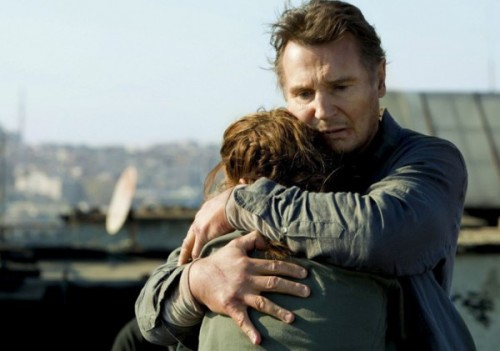
However, when looked at as a trilogy, the Taken films are all about Bryan’s relationship with his daughter as she becomes a woman and he is no longer sure how to relate to her. It’s a common real life situation writ large, and a wholly unexpected through-line for an action franchise.
The Taken films are really about Bryan’s relationship with his daughter
He tries to figure out how to balance being sensitive and being manly. He doesn’t know how to talk to his daughter anymore; in the first film, they have a strained relationship. He attempts to get through to her by getting her a meeting with her favourite singer who he is acting as a bodyguard for, but the real way he is able to show his love is by saving her life.
When they return home, she’s ready to love him and talk to him again, becoming so close as a family that she and her mother (Famke Janssen), his ex-wife, visit him in Istanbul in the sequel.
In the third movie, their relationship is showing growing pains again. Kim’s in college and Bryan buys her a giant teddy bear for his birthday, adorably excited about the gift. You can feel his heart break when she rejects the bear because she’s too old for it. He wants her to be his little girl, looking at him with stars in her eyes again; we find out she’s pregnant and there may soon be another little girl to look up to him.
In Taken, Bryan is on a time crunch to save Kim’s virginity as well as her life. While her sexually active friend is almost immediately left to die in a makeshift junkyard brothel with no one to care about her, as a virgin, Kim is saved to be auctioned off to a cabal of wealthy international men, which gives Bryan more time to save her. When Bryan finally tracks her down and takes her home, she seems undamaged by her ordeal. By Taken 3, when Kim discovers she is pregnant, it appears that her virginity was saved for the ultimate purpose of becoming a mother.
Kim helps save her parents
As a trilogy, the Taken films chronicle Kim’s apprenticeship with her father. After being a damsel in distress rescued in the first film, she returns in Taken 2 to fight against men related to her original kidnappers, getting her revenge on them as the attempt to get revenge on Bryan. When Bryan and her mother, Lenore, are kidnapped, Kim follows Bryan’s instructions over the phone, locating him in the city and providing him with weapons at risk of her life, instead of hiding out at the American Embassy like he originally instructs her to. In Taken 3, a riff on The Fugitive, Kim helps hide her father and investigates her mother’s murder. The culmination of her training is an interrogation scene where a cop questions her about Bryan’s whereabouts and his relationship with Lenore; as she answers him, she sounds exactly like her father.
Kim’s training is displayed in her interrogation
Famke Janssen, as Bryan’s ex-wife and Kim’s mother, fares less well across in the franchise. Bryan’s first indication in Taken–that something may go wrong on Kim’s trip to France–is his last minute discovery that Kim and her friend are planning to follow the band U2 on their European tour. It seems to have little to nothing to do with the actual human trafficking plot, but is used to paint Lenore as a bad mother who isn’t careful enough about her daughter’s safety. In the sequel, she waits around to be saved by the combined efforts of her husband and daughter and by Taken 3, she’s barely around, succumbing to Women in Refrigerators syndrome in the first few minutes of the film.
Famke Janssen’s role is to be only a victim and a bad mother
It seems that Kim’s pregnancy is intended to present her a both masculine and feminine, taking in a bit of both her mother (whose only real role was to have a daughter to be saved in the first place) and her father. Taken 3 flirted with Kim’s decision whether or not to have an abortion, though in the end, there wasn’t really a point. Of course, this big budget mainstream action film isn’t going to end with a character deciding to get an abortion, but it’s interesting that it was even presented as an option and that this new model for masculinity supported her right to chose either way.
One can only wonder if Liam Neeson will fight through Taken 4 with his new grandchild strapped to his chest in a Baby Bjorn.
Elizabeth Kiy is a Canadian writer and journalist living in Toronto, Ontario.
But as Sheryl Sandberg’s Ban Bossy campaign states, “When a little boy asserts himself, he’s called a ‘leader.’ Yet when a little girl does the same, she risks being branded ‘bossy.’” As a 28-year-old, I can vouch that it’s not just little girls that are affected by “bossy.” I’m trying to Ban Bossy in my own brain (or accept that I am a boss and it’s OK if I’m “bossy”) and it got me thinking about our society’s gender expectations and how they can hold all of us back.
This is a guest post by L Jean Schwartz.
Occasionally recently I’ve wondered, “Am I being bossy?” I’m a writer/director/producer, currently crowdfunding for my first feature film The Average Girl’s Guide to Suicide, and the sole manager of the LLC for our film. So, I am a boss. (Not like this, but a bit like a #bosswitch). But as Sheryl Sandberg’s Ban Bossy campaign states, “When a little boy asserts himself, he’s called a ‘leader.’ Yet when a little girl does the same, she risks being branded ‘bossy.’” As a 28-year-old, I can vouch that it’s not just little girls that are affected by “bossy.” I’m trying to Ban Bossy in my own brain (or accept that I am a boss and it’s OK if I’m “bossy”) and it got me thinking about our society’s gender expectations and how they can hold all of us back.
In Brené Brown’s book Daring Greatly, she writes that according to society’s rules women have to “be willing to stay as small, sweet, and quiet as possible, and use our time and talent to look pretty.” This made me laugh out loud, because A) I have often felt pressure to be as small, sweet, and quiet as possible, and use my time and talents to look pretty, and B) as a director you generally should not try to be as small, sweet, and quiet as possible or use your time or talents to look pretty. It’s not bad to be small/sweet/quiet/pretty if that’s your nature, but forcing yourself to be as small or quiet as possible is rarely conducive to getting a movie made. Personally I’m not small, not often quiet, I try to be kind (but not saccharin sweet), and I’m no beauty queen. As we’ve been expanding our team, talking to more people about the film, and crowdfunding, I’m constantly running into the societal expectations embedded in my brain. Self-promotion is not small, sweet, or quiet. Making a dark comedy about suicide is not small, sweet, or quiet. Asking people for money is not small, sweet or quiet.
Behind the scenes of making the teaser video for The Average Girl’s Guide to Suicide.
Luckily I’m not alone in this struggle. Brené Brown writes: “…every successful woman whom I’ve interviewed has talked to be about the sometimes daily struggle to push past ‘the rules’ so she can assert herself, advocate for her ideas, and feel comfortable with her power and gifts.” If you’re reading this, it’s likely that you can relate also. Think about how incongruous it is for female CEOs, doctors, or fighter pilots to be concerned with being small/sweet/quiet/pretty. I hope you just laughed. Perhaps the next time you feel pressure in your own life to be small/sweet/quiet/pretty, remind yourself of that laugh you just had.
Women aren’t the only ones who are hampered by society’s expectations; “the rules” for men can be just as suffocating as “the rules” for women. According to Brown these expectations for men can be summed up as: don’t be wrong, don’t be weak, and don’t show fear. If men step outside those lines, they are often shamed. The more I’ve leaned into leadership roles, the more I’ve felt these expectations too and they aren’t fun. Recently I felt so scared about whether we would hit our crowdfunding campaign goal, and felt like I needed to keep a brave face for everyone else and not show my fear. Then I realized the trap I was falling into. I’m lucky to have friends and family who are there for me, and even several friends who have told me that the middle of a crowdfunding is a terrifying desert. Getting support from friends and family and remembering that I’m not alone help me get out of shame spirals.
The ever-inspiring Brené Brown.
There have been several articles recently critiquing the concept of “Strong Female Characters.” The problem isn’t with realistic female characters who show resilience, but instead to women who are…basically dudes. From one such article: “A female character simply having typically masculine traits doesn’t necessarily strengthen her; it only promotes the view that men are the strong ones in the world, and that to be strong means to emulate them.” I would also argue that in real life, to be strong women we don’t need to try to be strong men. I’ve been that girl: trying to be stronger, tougher, and more foul-mouthed than the guys, and it’s exhausting. Because though I can be strong, tough, and sometimes rather foul-mouthed, I am also very empathetic, caring and sensitive. Trying to be as strong and tough as possible doesn’t leave room for empathetic and sensitive, and I believe it’s better to embrace your true nature rather than fake another. A friend has a poster that to me has good examples of how letting go of gender norms can ease the burden on both genders. I look forward to a world where we can accept and celebrate men and women equally for their sensitivity as well as their strength.
Recently there’s a new strong feminine heroine: the Unbreakable Kimmy Schmidt. She encourages others to pursue their dreams, and determinedly pursues her own. She likes helping people, she’s good at it, and she also takes care of herself. She’s strong because when she gets knocked down, she gets back up. Kimmy Schmidt shows that being kind, optimistic, and supportive can be part of being strong.
A little rain won’t stop the Unbreakable Kimmy Schmidt!
As a woman and a writer, it’s encouraging to see strong and empathetic characters. My film is about a young woman’s journey to accept herself and create a life she wants to live, and it took several years of working on the script (and “doing the work” in my life) to really understand what self-acceptance feels like. It’s easier to write about a character accepting herself than to accept myself, and it’s still something I work on every day. I love how fictional characters can help teach us in our real lives, and my characters continue to teach me. They push me and challenge me to be as brave as they are, and I hope they can inspire you too.
L Jean Schwartz makes comedies about things you’re not supposed to laugh about, such as LOVELY STALKING YOU, IN SEARCH OF MY FIRST EX-HUSBAND, and THE AVERAGE GIRL’S GUIDE TO SUICIDE. Hailing from San Clemente, California, she fell in love with filmmaking when she made a behind-the-scenes documentary about the film BRICK at age 17. She’s a graduate of USC’s School of Cinematic Arts, and is currently crowdfunding for her first feature film.
By introducing the audience to a tight-knit family with a very peculiar upbringing, the film allows a glimpse into socialization, explores gender politics, and shows how art can lead to individualism.
This is a guest post by Janie Contreras-Johnson.
On a micro level, Yorgos Lanthimos’s film, Dogtooth, is a portrayal of one family’s socialization, yet on a macro level, it challenges its audience to reflect on the ways in which society accepts and perpetuates social norms. By introducing the audience to a tight-knit family with a very peculiar upbringing, the film allows a glimpse into socialization, explores gender politics, and shows how art can lead to individualism.
The film is set in a non-descript location that—only by the language spoken—the audience knows is Greece. The film revolves around a family wherein the parents employ bizarre methods to keep their three adult children safe and obedient under their roof.
Lanthimos immediately introduces the audience to the unusual development of this family; the first scene finds the three adult children listening to a taped recording of their mother giving a vocabulary lesson. We hear common words, but the definitions the tape is providing are inaccurate (“Highway: a gently blowing breeze”). It is one of the many times in the film Lanthimos establishes the childlike innocence and obedience that puts the children at the mercy of those meant to care for them. This sentiment is reiterated later in the film, when the father speaks with a dog trainer who explains that “dogs are waiting for you to show them how to behave.” The children live in a world where yellow flowers are called “zombies” and one is old enough to drive and move out on their own when their “dogtooth falls out.” Through this family, we are shown that we process information and beliefs by what we are told, whether that is from parent to child, or on a larger scale, government to society, or media to audience.
Initiating one of the children’s many games and competitions
The film also illuminates the perpetuation and acceptance of patriarchy in society. We see the parents show a great deal of concern with the male child’s sexuality, even going to the lengths of hiring the father’s co-worker, Cristina, as a sexual partner for their son. Yet never is there any concern for the two female children’s sexuality. The girls accept this as normal and do not attempt to exercise any form of sexual freedom. When Cristina offers to trade a headband for oral sex from the eldest, the eldest sister does not question her sexuality, and acts on the arrangement but only in a perfunctory manner, devoid of any insight into the act she’s being asked to perform. When the son’s arrangement with Cristina dissolves, the parents allow their son to choose which sister he would like to sleep with, and at the cost of their daughter’s sexual freedom, encourage incest to satisfy the son’s sexuality. Again, neither sister fights their parents’ or brother’s decision to dehumanize and objectify them, and instead the sisters accept it—like many other things in their upbringing—as normal.
Cristina, being carefully taken to the family’s secluded home as part of the arrangement
But the film acknowledges the possibility of escape from these norms by establishing how art can lead to critical thinking. The only child to make an effort to leave is the eldest sister. We see her capacity for free thinking expand throughout the film, beginning with art’s influence. She is loaned two videos—Jaws and Rocky—by Cristina. We know that these are the only films the eldest has been exposed to, as it is established previously that the only videos the children have seen are home videos, which have been viewed so many times that the youngest can mouth every word as they are played. The eldest is transformed by these new films: she no longer participates in the other children’s games, and instead chooses to re-enact scenes from the movies. She holds a sip of water in her mouth and mimes being punched in the face while channeling Rocky Balboa, then cites lines from Jaws while lunging at her brother in the pool. Finally, after being forced into incestuous sex, we are shown the culmination of this exposure to new ideas. She mouths a phrase that is neither from the films nor the sheltered world she was raised in, but is inspired by the language of the art she has seen: “Do that again, bitch, and I’ll rip your guts out. I swear on my daughter’s life you and your clan won’t last long in this neighborhood.” From then on, we witness the eldest navigate the strange milestones she has been taught. In a disturbingly gory scene, she uses a dumbbell to knock out her dogtooth, and attempts to escape. In the ambiguous conclusion, we are never shown whether this escape is successful, but are left wondering, contemplating how warped socialization occurs and whether anyone is exempt from it.
Janie Contreras-Johnson is a Mexican American feminist who loves books, music, and movies, especially Charles Bukowski, Courtney Love, and GoodFellas. She co-hosts Fifth Opinion, the movie podcast dedicated to dissent, discourse, disagreement, and debate.