Click on the thumbnails to bring up reviews about each of the nominees!


The radical notion that women like good movies
Click on the thumbnails to bring up reviews about each of the nominees!
 |
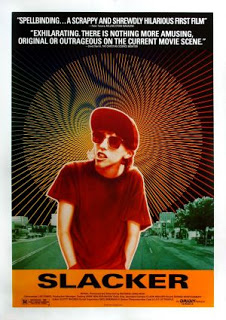
| Movie poster for Slacker |
 |
| The woefully hip cast of Reality Bites |
|
| Movie poster for Slacker |
|
| The woefully hip cast of Reality Bites |
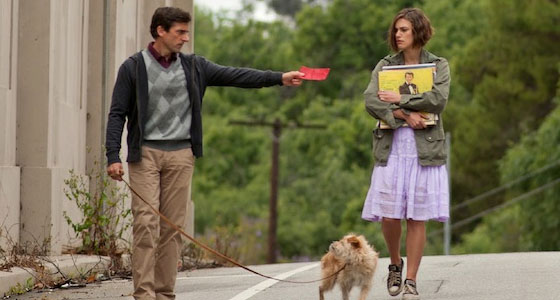 |
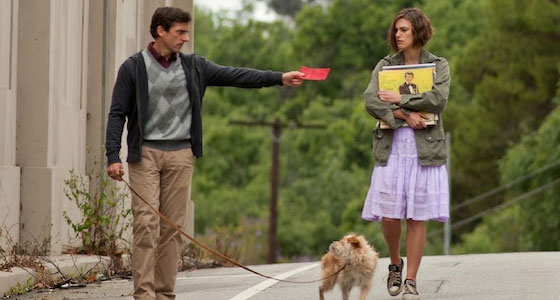
| Steve Carell and Keira Knightley in Seeking a Friend for the End of the World |
 |
| Keira Knightley as Penny |
 |
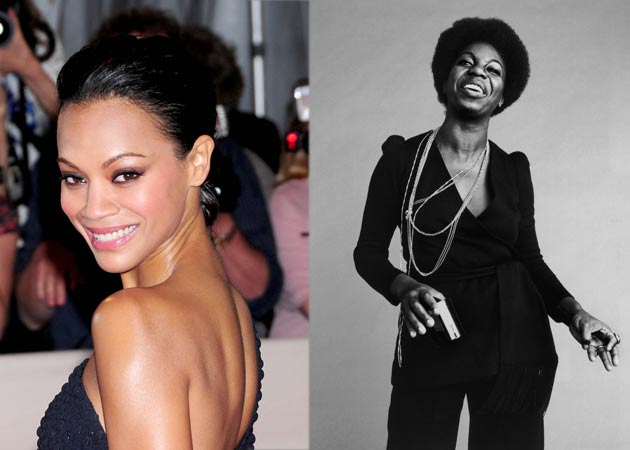
| (L-R): Zoe Saldana and Nina Simone; image via Black Street |
When Zoe Saldana was recently cast as legendary singer Nina Simone in her upcoming biopic, the decision ignited a firestorm of controversy. People have vehemently criticized the decision. Not because Saldana isn’t a skilled actor (she is). But because her skin is much lighter than the music icon.
“I can guarantee that the sense of insecurity and the questioning of one’s beauty that results from a grownup telling you that as a child you’re too black and your nose is too wide, remained with her [her mother Nina Simone] for the rest of her life.”
At The Huffington Post, Nicole Moore writes about Nina Simone and the “erasure of black women in film”:
“Because Simone’s blackness extended as much to her musical prowess as to her physicality and image, it’s perplexing that the film’s production team, led by Jimmy Iovine, expects anyone, particularly in the black community, to (re)imagine Nina Simone as fair-skinned, thin-lipped and narrow-nosed? I guess if you look at Hollywood’s history of casting black female roles, especially in biopics, it’s not all that surprising.”
Hollywood has a massive race and gender problem. Black women’s bodies belong to a dichotomy suffering from either fetishization or erasure. When Black women appear in media, which doesn’t happen nearly enough, they suffer from stereotypes of mammies, jezebels and sapphires. And too many producers and directors clearly don’t understand the nuances of race, thinking any person of color will suffice.
“In the past few years Hollywood has consistently gotten it wrong when it comes to telling black women’s narratives. From the questionable choice of casting Thandie Newton as an Igbo woman in the film adaptation of the novel Half of a Yellow Sun and Jennifer Hudson as Winnie Mandela, to Jacqueline Fleming, a biracial woman, playing Harriet Tubman, when other people are in charge of portraying us, it seems like any brown face will do.”
The Atlantic’s Ta-Nehisi Coates also finds the “bleaching of Nina Simone” problematic and reinforcing systemic racism:
“But this casting (with no shot taken at Saldana) manages to both erase the specific kind of racism Simone contended with and at the same time empower it.”
Most white people probably don’t realize the painful history of colorism and skin shade hierarchy — dark vs. light skin — Black women continually face. When the media portrays Black women, we often see women with lighter skin and more Caucasian features. Both L’Oreal and Elle photoshopped Black women — Beyonce and Gabby Sidibe — to make their skin appear much lighter. In film, advertisements and magazine spreads, the media often whitewashes black women, continually perpetuating the unachievable attainment of the white ideal of beauty.
“Skin color and its importance around the world—and particularly in the African-American community—has been a hot-button issue for generations. The debate over skin color and its painful origins dates back to the days of slavery, when lighter skin often equaled a better overall quality of life. With more pronounced European features, bearers of a lighter complexion were also considered more attractive than their darker-skinned peers. Possessing this trait was believed to open the cracked doors of opportunity ever wider.”
Due to white privilege, white people don’t agonize over their skin color. We don’t have to worry if someone will harass us or follow us around in a department store, thinking we’re going to steal merchandise simply because of our skin. If we move, we don’t have to worry about finding neighbors who don’t like us because of our skin color. We don’t have to fret over something as simple as putting on a Band-Aid which won’t match our skin tone.
“The hard truth is this: if we spent more time creating media instead of criticizing it, there’d be way more diversity in representation, and way more stories and perspectives to which white people can be more frequently held accountable.
“Pushing for ownership of both the infrastructure and content that portrays our lived experiences – that is the crux of the issue; not just the politics of light vs. dark-skinned actresses. So, whereas I am completely on board with calling out the colorism behind the biopic’s casting choices (and the harmful message that’s being sent to young, dark-skinned black girls everywhere by having a light-skinned woman play Nina Simone) there aren’t enough strong lead roles written for women of color in Hollywood for me to fairly tell Zoe Saldana, a hard-working, talented brown woman to ”sit this one out.”
Here at Bitch Flicks, we talk a lot about the need for more female filmmakers and women-centric films. One of the takeaways from the Zoe Saldana/Nina Simone controversy is that we desperately need more women of color filmmakers.
“So black women, one of the most sought after audience demographics for movie studios, aren’t behind the camera providing insight into our culture. This leads to a misrepresentation of the black community on the silver screen. Often, we are caricatures of ourselves, as evidenced in Jumping the Broom and other projects, which leads to resentment for what the media machine represents in our communities.”
When a young Black female tennis player is told she’s too fat to receive funding, when the Swedish Minister of Culture and rapper 2Chainz eat racist cakes of dismembered Black women’s bodies, when the media cares more about criticizing Olympic gold-medal winning gymnast Gabby Douglas’ hair than her performance — we as a society clearly have a fucked-up, racist and misogynistic problem denigrating and oppressing Black women.
 |
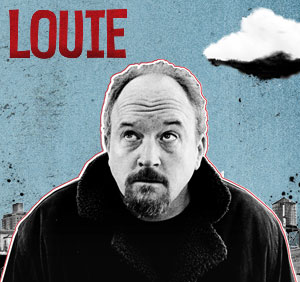
| Louis C.K.’s Louie |
 |
| Louie eats dinner with his two on-screen daughters. |
 |
| Parker Posey plays one of Louie’s love interests in season 3. |
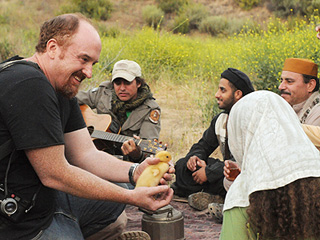 |
| C.K. used his own experiences and inspiration from his daughter to create “Duckling” in season 2. |
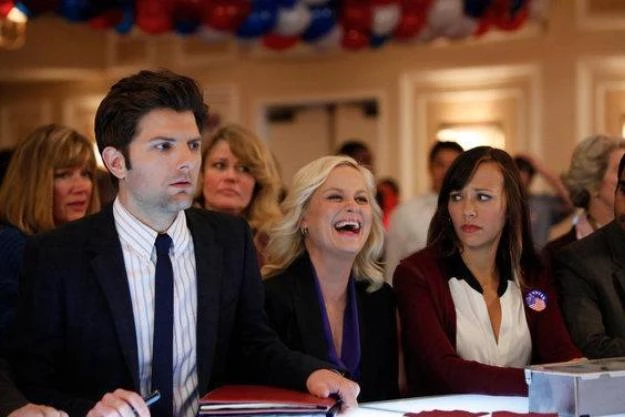 |
| Yaaaaay! |
 |
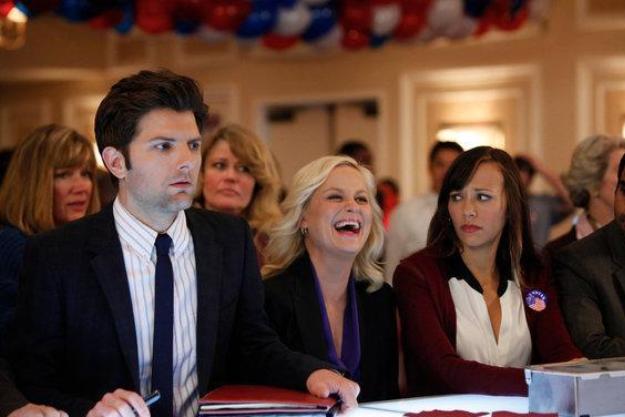
| Tina’s my favorite. No, Gene is. No, it’s Louise. Oh, don’t make me choose! |
 |
| ASDFSDALF;HDSLGJKHSJDK |
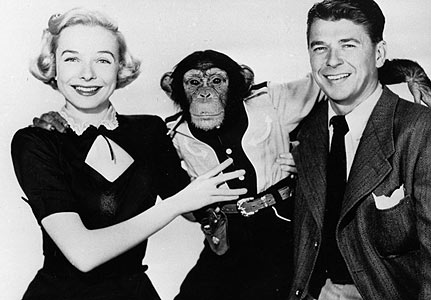 |
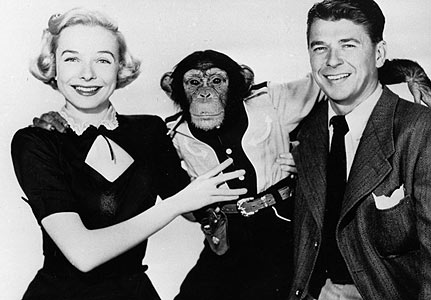
| Diana Lynn and Ronald Reagan in Bedtime for Bonzo |
 |
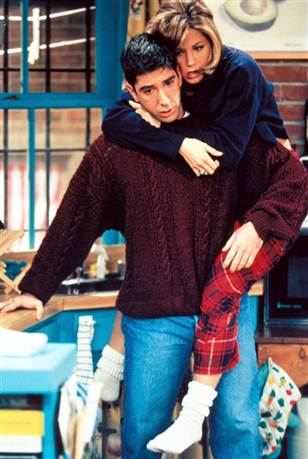
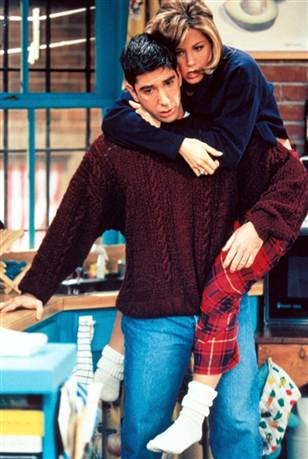
| Ross (David Schwimmer) and Rachel (Jennifer Aniston) after the infamous drunk-dial |
I recently indulged in some Friends-related nostalgia with a good pal of mine over a rainy weekend. We took fifteen episodes over two days and I was reminded why I was obsessed with this show during my first two years in high school. I loved Chandler, Lisa Kudrow, the chemistry among the cast members, Chandler, the way the show made typical sitcom cliches seem original and funny, the “comfort food” nature of the show, and Chandler.
One thing I did NOT love was the aspect of Friends that most people were obsessed with: the on-again, off-again relationship of the TV sitcom supercouple, Ross and Rachel.
I’ve spent some time looking at different romantic comedies and the cliches that are used and re-used in cookie-cutter scripts, and I finally pinpointed the reason why Ross and Rachel always bothered me as a couple: over ten years (seriously, ten years!) of a will-they-or-won’t-they relationship, they managed to cover almost every single one of my least favorite rom-com cliches.
 |
| “WE WERE ON A BREAK!” in five, four, three… |
He loves her. She’s oblivious until he’s with someone else, and then he’s oblivious. In the pilot episode of the series, Ross tells Rachel that he had a crush on her since high school, and she admits that she already knew. He asks her if he could ask her out sometime, and she seems receptive to the idea, and it’s a cute moment between them.
But we can’t have something as simple as a man asking out a woman in episode two, her saying yes, and seeing the two of them date over time and eventually fall in love, now can we? No, we must insert drama and other complications. In this case, this drama results in Rachel conveniently forgetting that Ross liked her and becoming completely oblivious while he mooned after her for an entire season, making her look stupid and unobservant and him look pathetic. When she re-learns that he has a crush on her, she decides that she likes him too, but whoops – he’s moved onto someone else, and now, instead of a season of Ross whining, we’re treated to six episodes of Rachel being jealous and bratty to his new girlfriend.
When Ross is pining for Rachel, he’s a whiner. When Rachel is pining for Ross, she’s a jealous brat. Why am I supposed to root for them to get together?
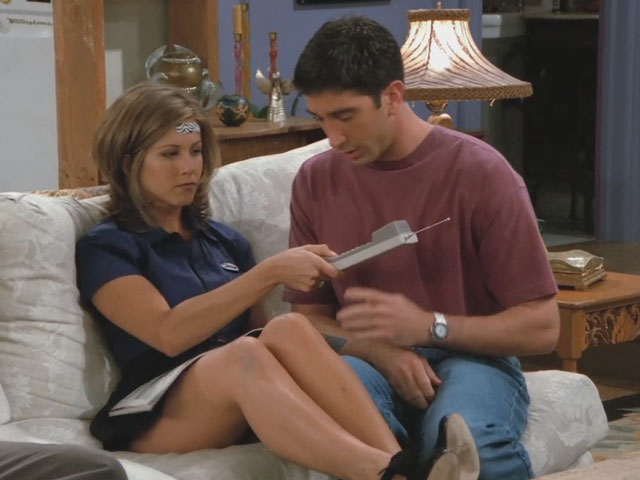 |
| Rachel hangs up the phone while Ross is talking to Julie |
“We’re still in love (during season premieres and season finales).” Unfortunately, this “we only like each other when we’re with other people” trend doesn’t end after the second season. Ross and Rachel finally date, and then they break up, and then Rachel realizes that she’s still in love with Ross when he moves onto Phoebe’s friend Bonnie. Then she realizes she’s still in love with Ross, again, at the end of the fourth season and runs off to ruin his wedding. She tells him she still loves him at the beginning of season five, but then gets over it for some reason. Then they get married in Las Vegas at the end of the fifth season, and Ross doesn’t annul the marriage because it’s implied that he still has feelings for Rachel, but then conveniently forgets about those renewed feelings at around episode six. Then they have a baby together at the end of season eight, and they consider getting back together at the beginning of season nine, but that desire is forgotten by episode two.
Is there something about the months of May and September that make Ross and Rachel fall back in love? Or is there something wrong with my suspension of disbelief, as I simply don’t buy that the same two people can fall in and out of love with each other that many times?
 |
| They had a KID together. A KID. And still didn’t get back together for two stinking years. |
Jealousy is romantic. The worst thing that Ross ever did in his relationship with Rachel was become a jealous, possessive jerk after she got a new job. (I consider that worse than his sleeping with the copy-shop girl when he and Rachel “were on a break”). The worst thing that Rachel ever did in her relationship with Ross was run off to England to stop his wedding even though he had happily moved on to someone else.
To be fair, Friends was initially honest about these issues and showed why the characters were in the wrong. Monica criticized Ross for being jealous, and his inability to get over his jealousy cost him his relationship with Rachel. Phoebe (and Hugh Laurie, in a great guest appearance) criticized Rachel for being selfish and wanting to end Ross’s wedding.
But then Ross says Rachel’s name at the altar. And at the end of the series, Rachel chooses Ross over a great new career opportunity in Paris with no apparent job to fall back on.
In the end, it doesn’t matter that Ross lost Rachel when he was jealous, or that Rachel realized it was wrong to break up his wedding. In the end, Ross wins Rachel over her career, and Rachel gets to be with Ross instead of watching him marry someone else. Getting them together in the end seems to retroactively reward them for their previous bad behavior, justifying their actions as okay because they were really in love the whole time!
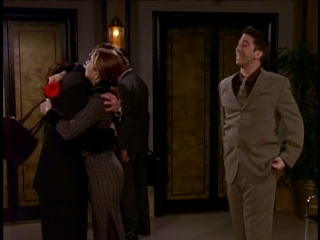 |
| Ross is jealous. This is a natural state of his. |
“Uh-oh. The placeholder love interest is more likable than the endgame couple. I know – we’ll turn them into jerks!” I can’t be the only one who thought Emily was a much better match for Ross than Rachel was. Ross and Emily had more in common than Ross and Rachel and he was more likable when he was around Emily – more genuinely romantic, more energetic, and she seemed to appreciate his geeky side more than Rachel did.
This was not a good thing for the Friends writers, apparently. Ross and Rachel were meant to be the endgame couple no matter what. The only thing to nip the Ross/Emily relationship in the bud was to turn Emily into a jerk who made him stay away from Rachel and move out of his apartment.
 |
| Rachel watches Ross and Emily (Helen Baxendale) |
Why did they like each other, anyway? What did Ross and Rachel have in common, aside from being two decent human beings who have the same friends? He had no respect or interest in her career and she had no respect or interest in his. He thought she was selfish and spoiled and she thought he was a geek and an intellectual snob. Yes, opposites sometimes attract, but sometimes I didn’t know why they even liked each other, much less loved each other.
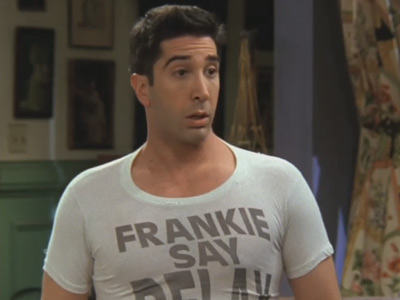 |
| Ross in his tiny T-shirt. |
The chase to the airport. They actually had a chase to the airport in the last episode. I mean, really?
“Oh, wait a minute,” you might be saying. “You’re telling me that you weren’t moved by the last scene where they got back together for real?”
Well, of course I was moved. I’m not made of stone, people. She got off the plane!
Yes, I “aww” and I tear up at their last scene together, as ridiculous as it is. To me, that’s a testament to how much Schwimmer and Aniston sold every step of the relationship. No matter how contrived the writing was, they committed to those romantic moments. Sometimes they made me forget how much their relationship got on my nerves. But when I’m re-watching old Friends episodes and indulging in some nostalgia, I tend to fast-forward the dramatic Ross and Rachel scenes, because those are too many cliches for me to handle with one couple.
Chandler and Monica, on the other hand – that’s where the magic was.
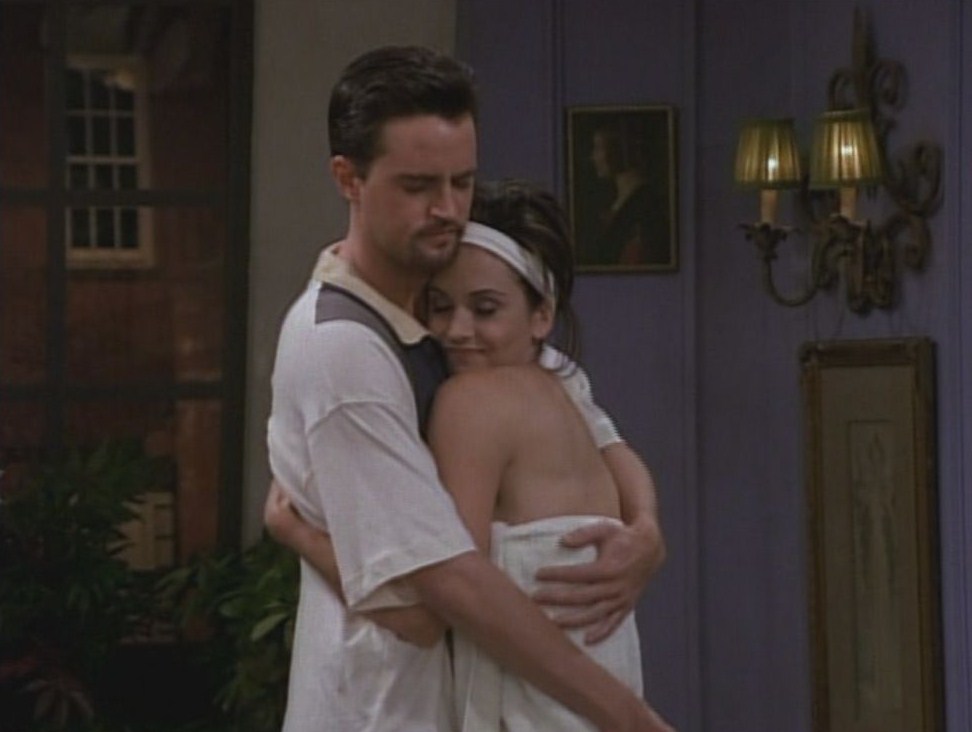 |
| They got together – and STAYED together – with very little bullshit! How refreshing. |
Lady T is a writer and comedian with two novels, a play, and a collection of comedy sketches in progress. She hopes to one day be published and finish one of her projects (not in that order). You can find more of her writing at www.theresabasile.com.
|
| Ross (David Schwimmer) and Rachel (Jennifer Aniston) after the infamous drunk-dial |
I recently indulged in some Friends-related nostalgia with a good pal of mine over a rainy weekend. We took fifteen episodes over two days and I was reminded why I was obsessed with this show during my first two years in high school. I loved Chandler, Lisa Kudrow, the chemistry among the cast members, Chandler, the way the show made typical sitcom cliches seem original and funny, the “comfort food” nature of the show, and Chandler.
One thing I did NOT love was the aspect of Friends that most people were obsessed with: the on-again, off-again relationship of the TV sitcom supercouple, Ross and Rachel.
I’ve spent some time looking at different romantic comedies and the cliches that are used and re-used in cookie-cutter scripts, and I finally pinpointed the reason why Ross and Rachel always bothered me as a couple: over ten years (seriously, ten years!) of a will-they-or-won’t-they relationship, they managed to cover almost every single one of my least favorite rom-com cliches.
|
| “WE WERE ON A BREAK!” in five, four, three… |
He loves her. She’s oblivious until he’s with someone else, and then he’s oblivious. In the pilot episode of the series, Ross tells Rachel that he had a crush on her since high school, and she admits that she already knew. He asks her if he could ask her out sometime, and she seems receptive to the idea, and it’s a cute moment between them.
But we can’t have something as simple as a man asking out a woman in episode two, her saying yes, and seeing the two of them date over time and eventually fall in love, now can we? No, we must insert drama and other complications. In this case, this drama results in Rachel conveniently forgetting that Ross liked her and becoming completely oblivious while he mooned after her for an entire season, making her look stupid and unobservant and him look pathetic. When she re-learns that he has a crush on her, she decides that she likes him too, but whoops – he’s moved onto someone else, and now, instead of a season of Ross whining, we’re treated to six episodes of Rachel being jealous and bratty to his new girlfriend.
When Ross is pining for Rachel, he’s a whiner. When Rachel is pining for Ross, she’s a jealous brat. Why am I supposed to root for them to get together?
|
| Rachel hangs up the phone while Ross is talking to Julie |
“We’re still in love (during season premieres and season finales).” Unfortunately, this “we only like each other when we’re with other people” trend doesn’t end after the second season. Ross and Rachel finally date, and then they break up, and then Rachel realizes that she’s still in love with Ross when he moves onto Phoebe’s friend Bonnie. Then she realizes she’s still in love with Ross, again, at the end of the fourth season and runs off to ruin his wedding. She tells him she still loves him at the beginning of season five, but then gets over it for some reason. Then they get married in Las Vegas at the end of the fifth season, and Ross doesn’t annul the marriage because it’s implied that he still has feelings for Rachel, but then conveniently forgets about those renewed feelings at around episode six. Then they have a baby together at the end of season eight, and they consider getting back together at the beginning of season nine, but that desire is forgotten by episode two.
Is there something about the months of May and September that make Ross and Rachel fall back in love? Or is there something wrong with my suspension of disbelief, as I simply don’t buy that the same two people can fall in and out of love with each other that many times?
|
| They had a KID together. A KID. And still didn’t get back together for two stinking years. |
Jealousy is romantic. The worst thing that Ross ever did in his relationship with Rachel was become a jealous, possessive jerk after she got a new job. (I consider that worse than his sleeping with the copy-shop girl when he and Rachel “were on a break”). The worst thing that Rachel ever did in her relationship with Ross was run off to England to stop his wedding even though he had happily moved on to someone else.
To be fair, Friends was initially honest about these issues and showed why the characters were in the wrong. Monica criticized Ross for being jealous, and his inability to get over his jealousy cost him his relationship with Rachel. Phoebe (and Hugh Laurie, in a great guest appearance) criticized Rachel for being selfish and wanting to end Ross’s wedding.
But then Ross says Rachel’s name at the altar. And at the end of the series, Rachel chooses Ross over a great new career opportunity in Paris with no apparent job to fall back on.
In the end, it doesn’t matter that Ross lost Rachel when he was jealous, or that Rachel realized it was wrong to break up his wedding. In the end, Ross wins Rachel over her career, and Rachel gets to be with Ross instead of watching him marry someone else. Getting them together in the end seems to retroactively reward them for their previous bad behavior, justifying their actions as okay because they were really in love the whole time!
|
| Ross is jealous. This is a natural state of his. |
“Uh-oh. The placeholder love interest is more likable than the endgame couple. I know – we’ll turn them into jerks!” I can’t be the only one who thought Emily was a much better match for Ross than Rachel was. Ross and Emily had more in common than Ross and Rachel and he was more likable when he was around Emily – more genuinely romantic, more energetic, and she seemed to appreciate his geeky side more than Rachel did.
This was not a good thing for the Friends writers, apparently. Ross and Rachel were meant to be the endgame couple no matter what. The only thing to nip the Ross/Emily relationship in the bud was to turn Emily into a jerk who made him stay away from Rachel and move out of his apartment.
|
| Rachel watches Ross and Emily (Helen Baxendale) |
Why did they like each other, anyway? What did Ross and Rachel have in common, aside from being two decent human beings who have the same friends? He had no respect or interest in her career and she had no respect or interest in his. He thought she was selfish and spoiled and she thought he was a geek and an intellectual snob. Yes, opposites sometimes attract, but sometimes I didn’t know why they even liked each other, much less loved each other.
|
| Ross in his tiny T-shirt. |
The chase to the airport. They actually had a chase to the airport in the last episode. I mean, really?
“Oh, wait a minute,” you might be saying. “You’re telling me that you weren’t moved by the last scene where they got back together for real?”
Well, of course I was moved. I’m not made of stone, people. She got off the plane!
Yes, I “aww” and I tear up at their last scene together, as ridiculous as it is. To me, that’s a testament to how much Schwimmer and Aniston sold every step of the relationship. No matter how contrived the writing was, they committed to those romantic moments. Sometimes they made me forget how much their relationship got on my nerves. But when I’m re-watching old Friends episodes and indulging in some nostalgia, I tend to fast-forward the dramatic Ross and Rachel scenes, because those are too many cliches for me to handle with one couple.
Chandler and Monica, on the other hand – that’s where the magic was.
|
| They got together – and STAYED together – with very little bullshit! How refreshing. |
Lady T is an aspiring writer and comedian with two novels, a play, and a collection of comedy sketches in progress. She hopes to one day be published and finish one of her projects (not in that order). You can find more of her writing at The Funny Feminist, where she picks apart entertainment and reviews movies she hasn’t seen.
In case you’re unfamiliar with this 90’s show (despite it’s old age, it deserves to be revisited) the series follows the misadventures of four aliens sent to Earth as a human family. Their mission? Learn and discover the ways of humanity and report it all back to the Big Giant Head, the leader of their home world (played by William Shatner). The show was rife with social criticism, as these “aliens” were able to point out hypocrisies that only an outsider could see.
First, Sally: tall, blond, and a soldier. Sally (Kristin Johnston) comes in with contradictions, my favorite kind of character. She’s the security officer and is the toughest, strongest and most militarily inclined of them all. However, her deep and abiding love for shoes is a running joke of the show, although, in spite of her long legs and blond hair (which would make a Barbie weep), her clothing is mainly old pants, army boots and a t-shirt.
Her character serves as the perfect point at which to make some valid criticisms of women in America. For example, her automatic assumption of all housewifely duties, her hatred of them and inability to fulfill them satisfactorily, is one of her constant frustrations. In fact, Tommy (Joseph Gordon Levitt) is the better cook (and florist) and the family is ashamed when they discover this fact. That gender roles must be kept intact is what these aliens have surmised from society and they feel it a rule that must be adhered to absolutely.
In fact, in the very first episode, Sally whines to the leader of their little family, “why do I have to be the female?” To which Lithgow, or Dick, replies, “We drew straws and you lost” the implication of course being, that everywhere in the universe, the females get the fuzzy end of the lollipop.
Sally’s adventures into the mysterious world of women showcases the varied and constant stereotypical ideas about womanhood. For example, Sally’s virginity is a great cause of confusion for her and she’s unsure of the way that she’s supposed to feel about it (she laments once that she is both ashamed and proud of it, but doesn’t understand why). In the episode given above, entitled “Big Angry Virgin,” Sally, in her experimental relationship, feels pressured to change to please the man she’s dating; this man asks her to allow him to be more in control, and when she completely concedes to his every opinion, he get’s frustrated, still feeling thwarted in his desires. Obviously, the moral in the end is that Sally must realize that she’s fine the way that she is, nor does she need to use pressured sex to repair their relationship (stick around after the credits of the episode to listen to her final thoughts on the matter).
Second Mary Albright: brilliant, saucy, sarcastic, sexy. I love this character, the older academic with her famous drunkenness and pettiness. Mary (Jane Curtin) portrays humanity’s goodness and our weaknesses and I loved that a woman plays this role. She’s there to educate the Solomon’s on everything that humans are, showing them the good and the bad and doing it all with no sense of long-suffering. She bitches about everything and makes her feelings known—no Angel on the Hearth here.
In the episode above, she’s shown in the first few weeks of her relationship with Dick (Lithgow) in uncharacteristic silliness, a trait that fades as their relationship progresses (stick around for characteristic Mary goodness in the clips below).
Third, Mrs. Dubcheck: a surprisingly virile and frisky older lady of dubious ethics; she’s the Solomon’s landlady and often regales them with tales of her glorious youth and exploits.
Fourth, Vicky Dubcheck: her younger, perky, white trash daughter (complete with colored bra and cleavage).
There are various other women in the show, including Tommy’s (Gordon Leavitt) girlfriends (one a hippy feminist, the other a prom queen), substantially different girls, although both are filled with angsty puppy-love.
While the show certainly isn’t a perfect example of feminism in Hollywood, the show does have an incredibly ability to understand and expose so many of the imperfections in our gender roles and relations in modern America.
 |
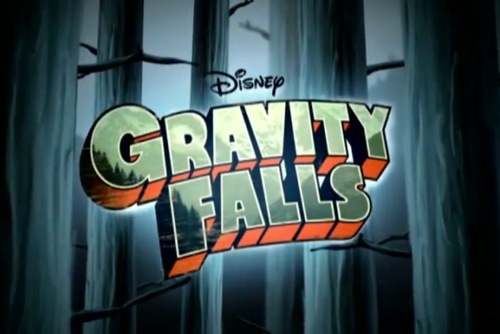
| Welcome to Gravity Falls. |
 |
||
| A cutie patootie. |
 |
||
| Don’t worry Mabel, you really are so so charming. |