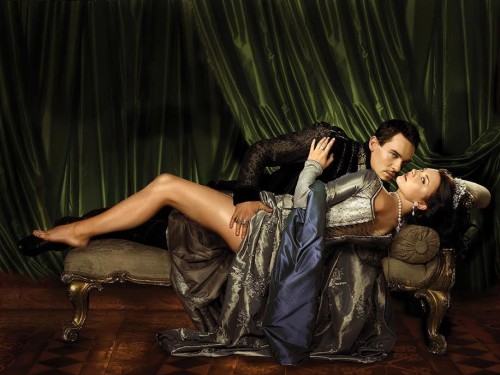
Anne Boleyn: Queen Bee of ‘The Tudors’

Anne Boleyn was considered by many contemporaries to be the very living, breathing definition of an unlikable woman. And perhaps “unlikable” is too soft a term here – at points in the 16th century, following her execution on trumped up charges of adultery and treason, Anne was so widely reviled that very few of her own words, actions, or even accurate portraits remain today, thanks to Henry’s redoubtable efforts to wipe her off the record completely.


This guest post by Emma Kat Richardson appears as part of our theme week on Unlikable Women.


“Write me letters and poems. Ravish me with your words. Seduce me.”

These words, spoken by Anne Boleyn to Henry VIII, are an arrow dipped in love potion, shot through the king’s heart – a direct command from the courtly lady he might worship and serve. From then on, Henry will stop at nothing to have her; and the consequences of this maddening obsession will go on to tear England nearly asunder with the initiation of the Reformation. That’s… quite a bit of exposition for a mere poetry request. How, exactly, did this ordinary woman of average background and breeding manage to ensnare one of the most powerful men in Christendom? With as much information as is publicly available on these grand historical events, it’s hard to say with certainty what Anne really did to pull off such an unprecedented feat. What we can say for sure is that these words never make an appearance in any textbook or scholarly treatise on the discarded queens of England’s eccentric eighth King Henry; rather, they are a snippet of sensationalistic dialogue accorded to Anne as portrayed in Showtime’s epic, sexed up costume drama, The Tudors.

A son will come out tomorrow.


But first, before we dive into the realm of heaving bosoms and salacious, soapy one-liners, a little historical background: as the second wife of England’s first Renaissance king, Henry VIII, Anne Boleyn was considered by many contemporaries to be the very living, breathing definition of an unlikable woman. And perhaps “unlikable” is too soft a term here – at points in the 16th century, following her execution on trumped up charges of adultery and treason, Anne was so widely reviled that very few of her own words, actions, or even accurate portraits remain today, thanks to Henry’s redoubtable efforts to wipe her off the record completely. Her unpopularity with the public stemmed mostly from the fact that Henry had moved heaven and earth (almost literally, since he all but kicked the national religion of Catholicism out of England just to have her) to divorce his first wife and marry Anne in her place. That first wife, Catherine of Aragon, had been a Spanish princess whose marriage of almost two decades to Henry had produced one daughter but no living sons to inherit the crown. With the royal succession dangerously in jeopardy, Henry began casting about for a way out of his marriage, and “Mistress Boleyn,” as she was then known, was more than ready to provide not only the ends but the means to Henry’s little marital dilemma as well. A committed reformer, Anne was a vocal advocate for reforming the abuses of the clergy and papacy, and even today is widely regarded as being responsible for England’s violent split with Rome and the “old faith.”

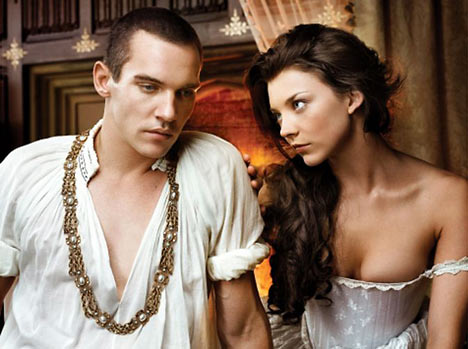
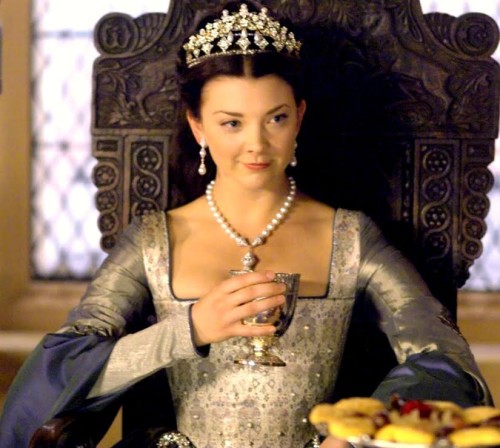
So, clearly, she was a little bit controversial. The whole home-wrecking aspect didn’t do much to bolster Anne’s personal approval ratings, either. But, especially as she’s played by Natalie Dormer on The Tudors, it’s impossible to deny that there’s just something about Annie. She’s easy to hate, in patches, but one who manages to be both polarizing and magnetic; indeed, Dormer’s Anne is a quick-witted, razor sharp intellectual with enough sex appeal drive a wedge not only between Henry and his wife, but Henry and his mistress, Anne’s own sister Mary.

If you can believe it, this chalice isn’t filled with blood and the tears of children.


Many recent portrayals of Anne depict her as utterly ruthless and oozing with ambition – the appallingly bad screen 2008 adaptation of Philippa Gregory’s novel The Other Boleyn Girl springs immediately to mind. But Dormer’s Anne is more coy and calculating than toxic and reckless. In early episodes of the series, while Jonathan Rhys Meyers’ Abecrombie-ized Henry is flitting from one court lady’s bed to another, it is difficult to know Anne’s thoughts as her family arranges for her own physical entrapment of the king. Dormer plays Anne as cool and aloof – so much so that the show nearly refrains from giving Anne a perspective at all in the nascent days of her courtship with Henry. Whether Anne is fending off his sexual advances for strategy, as her scenes with her family patriarchs suggest, or if she has legitimate concerns about her maidenly reputation is anyone’s guess; however, once it becomes clear that Henry has his hose in a bunch at the prospect of bedding Anne, the proverbial gloves come off, and, eventually, so do Anne’s gowns.

Not that Dormer’s Anne is without her moments of pure malice, of course. As supreme seductress of the king, Anne, riding high on ego and self-confidence, boldly spars with the queen, her rival. “I care nothing for Catherine,” she declares haughtily in the first season’s finale. “I would rather see her hanged than acknowledge her as my mistress.” On another occasion, Anne viciously tears in to Henry after she discovers that Catherine is still sewing his shirts; a truly intimate betrayal in 16th century terms. And, in the face of so much antipathy toward her presence, she even changes her public motto to, roughly translated, “this is how it’s going to be; let them grumble”!

“Henry, you keep leaving the lid to the chamber pot up. I thought we talked about this.”


But really, what lies beyond Dormer’s ability to fill Anne with fire is her careful attention to the qualities that render Anne sympathetic, too. During the show’s first season, Dormer reportedly fought with Showtime’s producers to transform Anne into more of a reformist intellectual and less of an overheated sexpot. As she told Susan Bordo in The Creation of Anne Boleyn, Bordo’s probe into the continued cultural relevance of Anne: “Men still have trouble recognizing that a woman can be complex, can have ambition, good looks, sexuality, erudition, and common sense.  A woman can have all those facets, and yet men, in literature and in drama, seem to need to simplify women, to polarize us as either the whore or the angel. That sensibility is prevalent, even to this day. I have a lot of respect for Michael [Hirst, creator of The Tudors], as a writer and a human being, but I think that he has that tendency. I don’t think he does it consciously. I think it’s something innate that just happens and he doesn’t realize it.” By the show’s second season, Dormer’s Anne had made the leap from elaborately dressed cock-tease to a fully formed, charismatic and courageous individual. Her execution in the season two finale saw an 83 percent spike in viewership over the first season’s finale episode, and once Dormer left the show, ratings dropped drastically.

Just as with the real Anne Boleyn, who once ruled over the kingdom of England and its monarch’s fickle heartstrings, Dormer’s Boleyn may have an unlikeable surface, but she’s so much more than a mere strumpet with a couple of decent lines. Right down to her alluring smile as she reads from the holy Scripture aloud in English, Dormer has created an Anne for all seasons: the very embodiment of just how complex and riveting she must have been during her all-too short life.

[youtube_sc url=”https://www.youtube.com/watch?v=i6-ThCEeTJU”]


Emma Kat Richardson is a Detroit native and freelance writer living in Austin, Texas. Her work has appeared in xoJane.com, Bitch, Alternative Press, LaughSpin.com, Real Detroit Weekly, 944, and Bust.com. She’s enough of a comedy nerd and cat lady to have named her Maine Coon Michael Ian Cat. Follow her on twitter: @emmakat.

Patterns in Poor Parenting: ‘The Babadook’ and ‘Mommy’

This is not to say that Amelia and Die are not sympathetic characters. Both want to do the best for their sons, but neither can handle the stress and actual responsibility of disciplining them. I do not mean for this to seem like an attack on Die and Amelia’s parenting skills, but rather a way to look at the sudden appearance of women in film who are not good at parenting.

maxresdefault


This guest post by Deirdre Crimmins appears as part of our theme week on Unlikable Women.


Last year, two completely different films presented two very similar mothers. Though the lead characters from The Babadook and Mommy do not look alike, their parenting styles, and subsequently their sons, are uncanny. This representation of poor parenting by ill-equipped mothers deserves a closer look.

The Babadook is getting showered with praise as one of the best horror films in decades. It is the story of a widow raising an overactive, imaginative son. Samuel is a well-meaning 7-year-old who misbehaves more than not. He throws tantrums. He builds contraptions like backpack-mounted catapults. He has frequent meltdowns. Samuel is not an easy child and mother Amelia is at the end of her rope when a strange book appears on his bookshelf. The story in the book is that of Mr. Babadook, a modern and all too familiar boogeyman. From here the film dives into Amelia’s coping with this monster and her eventual possession by the Babadook.

Mommy is not a horror film at all, though it does have a few moments that are shocking. The film follows Diana, Die, as she tries to deal with her delinquent son, Steve. Fifteen-year-old Steve has just gotten kicked out of the boarding school for problem children and Die must choose between surrendering him to the government or taking him back to her home. She chooses the latter and tries her best to parent Steve as much as he will tolerate. To say that both Steve and Die have unusual boundaries between appropriate and inappropriate is a criminal understatement, as neither of them seems capable of acting like an adult. Even with such rich characters, curiously the most interesting character in the film turns out to be their neighbor, Kyla. For the purposes of this article I won’t have time to explore her further, but it should be mentioned that there is much more subtext in the film that merely the mother-son relationship.

Before diving into the similarities between Die and Amelia, and Mommy and The Babadook, first I will point out one major discrepancy: the two women look completely different. This is not to say that the actresses have different physical attributes, but instead the conscious costuming of each woman is a polar opposite of the other. Die is a flamboyant dresser who styles herself much younger than she is. Everything she wears is tight, embellished, low-cut, and over accessorized. Her hair has chunky highlights that have grown out. Amelia dresses very simply. When she is not in her plain nurse’s uniform she is wearing either a modest sleeping gown (much of the film takes place over night) or an equally unadorned house dress. She wears no real jewelry, and her hair is always pulled back into a bun. Based on costuming alone Die and Amelia would appear to have nothing in common. But as we begin to look at their histories and character flaws, we see that Mommy and The Babadook in fact have a lot in common.

Clothing comparison
Clothing comparison


One of the most obvious correlations between the films is that that neither film is American. The Babadook has seen great success in the US, but it is an Australian production. Mommy is Canadian and is in Quebecoise with English subtitles. This is not to say that Hollywood is not capable of portraying poor mothering on screen, but it is interesting that the most striking examples of bad mothers have not come from America. We often see the evil stepmother in fairy tales, but these women are not responsible for raising the children. Also, in fairy tales these children are shown as good children who have overcome their lack of a caring mother. Here we are looking at children that are kind of jerks, perhaps due to the fact that their mothers are not good parents.

The fact that both Amelia and Die are raising sons is also of note. Casually I have heard films about sons and mothers described as horror films and films about mothers and daughters described as melodramas. Psycho and Friday The 13th certainly support the theory; however Carrie and Mommy Dearest swiftly disprove it. Not a solid approach to examining films, but it does bring into question the unique relationship between mothers and sons. Amelia never truly understands Samuel’s obsession with building projectile devices. She supports his creativity as much as she can, but cannot relate to his mechanical talents or even his interest in war and destruction. Die herself has issues relating to Steve. She walks in on him masturbating and brushes it off with a laugh though he is clearly humiliated. Her lack of understanding how valued privacy is, especially for teenagers, is disturbing to the audience and frustrating for Steve.

Two sons
Two sons


To further the gender politics of their households and their similarities, both Die and Amelia are widows. Amelia’s husband was killed while she was pregnant with Samuel, a fact that he brings up to complete strangers which makes them quite uncomfortable. Die’s husband died many years earlier, however her predicament is more heartbreaking in that Steve remembers his father. He romanticizes their life together when his father was alive. What is clear about both Die and Amelia is that neither has ever moved on or accepted the deaths. Amelia is still in mourning for her husband and allows her inability to mature to impact her relationship with Samuel and everyone around her. Die is also still in love with her husband and has not moved on romantically, but she has accepted her loss as a part of her life. She is not as paralyzed emotionally as Amelia, but she is still in desperate need of therapy to deal with the loss.

Outside of their family dynamics both mothers rely on caring female neighbors to help them with their problem sons. I briefly mentioned Die’s secretive neighbor Kyla, and symmetrically Amelia also receives help from her neighbor Mrs. Roach. These women are not very good mothers, but they are both good at recognizing that they need help with their sons. Kyla helps Steve pass his exams for his GED, and Mrs. Roach takes Samuel to give Amelia a desperately needed break. These women are not capable of handling their sons on their own.

This is not to say that Amelia and Die are not sympathetic characters. Both want to do the best for their sons, but neither can handle the stress and actual responsibility of disciplining them. I do not mean for this to seem like an attack on Die and Amelia’s parenting skills, but rather a way to look at the sudden appearance of women in film who are not good at parenting. Too often women are shown as having an innate ability to be amazing mothers with little training or support from others. Rather, Mommy and The Babadook show that women are capable of being bad parents. Their maternal instinct is not strong, and their lack of connection to their sons has in turn created sons with disciplinary and behavioral issues. Women on film are frequently shown in terms of extremes: they are either sluts or saints. There is rarely a gray area for representations of women. By showing women who want to do well, but do not have the skills to parent well, it is a step in the right direction for showing women who are imperfect but fully formed characters. Neither Die nor Amelia fit into the mold of the typical mother we see in films, and the developing variety in portrayals of women is quite welcome.


Deirdre Crimmins lives in Boston with her husband and two black cats. She wrote her Master’s thesis on George Romero and is a staff writer for http://www.allthingshorror.com/. You can find her on Twitter at @dedecrim.


Why Maxine from ‘Being John Malkovich’ Is The Best

Maxine is a perfect character. She stands up for herself, takes no guff off of anyone, and goes for what she wants while issuing remarkable and hilarious ultimatums to those around her. I don’t just like Maxine. I don’t just love Maxine. I am Maxine.

1178744_orig


This guest post by Sara Century appears as part of our theme week on Unlikable Women. 


Being John Malkovich is a delightful trip of a movie from beginning to end. It’s a classic, and, if you haven’t seen it, you really should, definitely before you read this article.

It is based on a puppeteer named Craig Schwartz, who has taken on a job to support his puppeting habit (stick with me here). He meets Maxine, who he develops an unhealthy obsession with despite the fact that he’s married to Cameron Diaz, aka Lottie. He discovers a portal that leads to John Malkovich’s brain that Maxine brilliantly decides to rent out to people… because she is a genius. Maxine seduces Lottie while Lottie’s in John Malkovich’s body, and then slaps Craig in the face when he tries to kiss her. It is amazing. The movie gets even more complicated from there. Charlie Sheen shows up out of nowhere. It’s epic, so just go watch it, or agree to be confused, because I’m here to mostly talk about why Maxine is a great character, despite the fact that she could be considered by some misguided souls as somehow “unlikable.”

Maxine is played by Catherine Keener, who is probably one of the better actors in all of Hollywood right now. When she shows up, she is immediately the most interesting character in the movie. Maxine radiates self-confidence and style, and, in comparison, Craig becomes absolutely cartoonish, if he wasn’t already. There is almost no reason to watch the movie without Maxine. She propels everything forward in a magnificently hands-off fashion, letting the obsessions of others carry her on a wave of success that could have lasted forever. If she hadn’t fallen in love. With… Cameron Diaz. Maxine is a perfect character. She stands up for herself, takes no guff off of anyone, and goes for what she wants while issuing remarkable and hilarious ultimatums to those around her. I don’t just like Maxine. I don’t just love Maxine. I am Maxine.

tumblr_n97zgcnLPQ1r5vp4eo4_500


Yet, not a year goes by, not a year, when I do not hear from some Cusack-loving member of the patriarchy (otherwise known as my friends and family) accusing Maxine of being “a bitch,” “a gold-digger,” and some… worse words than that. Use your imagination. I’m not going to, because it horrifies me to hear people speak badly of something that they clearly don’t begin to understand. Why try to put Maxine in a box? She doesn’t fit within your narrowly defined limitations, my friend. Maxine is one of the greatest characters in film, and I’m going to let you know why in a pointedly numbered list that descends in order of importance.

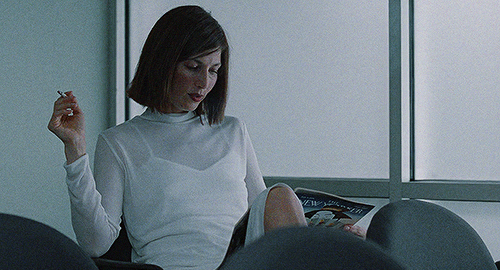
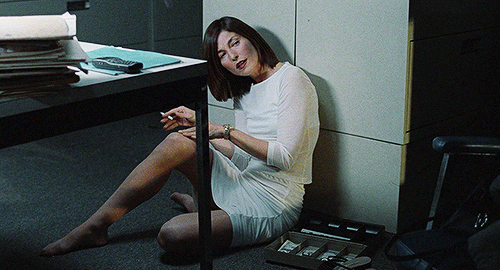
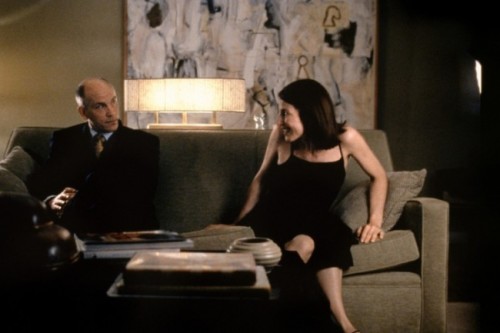
7. Best dressed person in the movie, and possibly in any movie, ever. Who did wardrobe for Maxine? Did you win an Oscar? Because you should have won an Oscar. Maxine actually has pretty much only two wardrobe items: white dress, and black dress. MAGNIFICENT. Brilliant social commentary on the rigid black and white world that tries to limit her from achieving her deserved position in society. Don’t care if that’s how you meant it, that’s how I’m taking it, and BRAVO.

Picture+3


6. Best lines in this movie, and possibly in any movie, ever. The first line Maxine has is just her calling out bullshit like a pro. She does that through the whole film, and it is great.

5. Craig Schwartz is like the stereotypical “nice guy,” who thinks he’s in love with a girl that doesn’t notice he exists, and then freaks out on her for being “evil” when she really just doesn’t want to sleep with him. He’s the worst, and he really just a whole lot of problems for everyone, ultimately leading himself down a path of ruin. Maxine as his breezy, unaffected foil is a perfect antagonist-turned-protagonist, so, even if she were evil, she’d still be a pretty great character.

dans-la-peau-de-john-mal-ii11-g-650x433


4. Maxine has a totally radical view of sex and relationships, and she isn’t afraid to go for what she wants and dare to have it all. She is a pioneer of not only women’s rights but also defining relationships in unconventional terms.

3. OK, so maybe once or twice Maxine behaves slightly amorally in this movie. Here’s the thing, she’s a single woman trying to make it in a harsh world where you gotta be tough as nails to survive, and if you don’t, it’s just too darn bad. You’re supposed to sympathize with her. She makes bad choices, we all make bad choices. Does that mean we deserve to be hounded forever over that one time we left our girlfriend in a cage with a monkey and slept with her husband after he literally stole John Malkovich’s entire body? It was ONE TIME. Come on, people, live and let live. We all learned an important lesson (not to date puppeteers ever, even when they’re in John Malkovich’s body). Isn’t that what’s important, here?

DSC0736-M5


2. Funniest woman in cinema? MAYBE. I’ve seen this movie so many times that I sometimes confuse it with actual memories, yet I still laugh at Maxine’s jokes. Catherine Keener’s deadpan delivery is flawless. Did she win an Oscar? Because she should have won an Oscar. P.S., she didn’t win an Oscar, because the Oscars are bogus. Except she did lose to Judi Dench, so that’s legit. If Judi Dench were against anyone else in any other movie, I’d say, “Give the Oscar to Judi Dench, why don’t you?” but in this one case, of course Maxine should have won.

1. Maxine and Lottie reuniting in the rain off the Jersey Turnpike, with Lottie screaming, “You’re so full of shit!” and Maxine screaming, “I KNOW, I KNOWWWWW!” is probably one of my top 10 favorite moments in the history of cinema. It crushes my heart, yet makes me fall in love with love all over again. Next, they eat Cheetos and raise a baby together. Greatest queer love story of our time? MAYBE.

large_being_john_malkovich_blu-ray_06


Finally, Maxine is the best for all the reasons above, but mostly for the fact that she is a strong woman who ultimately gets her life on track despite her flaws and past mistakes, and I really respect that. Well, I’m not sure what other evidence you need that clearly everyone is just misunderstanding Maxine.


Sara Century is a multimedia performance artist, and you can follow her work at saracentury.wordpress.com


Moments of Sincerity in Otherwise Endless Oscars

What stood out were what seemed like genuine heartfelt moments. John Legend and Common delivered a spirited performance of “Glory” from snubbed director Ava DuVernay’s ‘Selma,’ and an equally impassioned acceptance speech when they won, notable for its intersectionality. They brought up Hong Kong’s fight for democracy, Charlie Hebdo, and America’s shameful prison-industrial complex. “‘Selma’ is now” is a message many need to hear, including their liberal Hollywood audience.

oscar-nominations-2015


This is a guest post by Josh Ralske.


Here’s the sad, secret truth of every Oscars telecast: There are no winners. Ever. Especially not the audience.

This year’s show — at least, the prefabricated part of the show — peaked early. Neil Patrick Harris does a fairly charming opening musical number with the supremely talented Anna Kendrick, celebrating the movies (of all things), and gets hilariously interrupted by Jack Black (and seriously, thank goodness for Jack Black and his endless comic energy, his wholehearted commitment to whatever bit he’s doing — please let him host one year) who sings a funny, pointed rant calling out Hollywood these days as all about superhero movies and sequels and what the Chinese market will buy. Undeniable truths, and naturally he gets thrown off the stage. In any case, that is no longer the Hollywood that the Oscars celebrate. The blockbusters, for the most part, went home with nothing. Even the highly touted American Sniper, seen by many as a potential upset winner for Best Actor and Best Picture, only got one tech award. Which is a good thing, by my measure. The movie is an odious celebration of a man — if we judge him by his own words — completely unworthy of such.

Host Neil Patrick Harris


In any case, the awards mostly celebrated smaller, more idiosyncratic independent films. Which is a good thing, generally, even if the near sweep for Birdman smacked of some intense navel gazing. As JB alluded to, Hollywood is currently fixated on blockbusters, and mid-ranged “cinema of quality”-type movies like The Imitation Game and The Theory of Everything need the buzz of awards season to generate moviegoer interest and turn a profit. I didn’t love either of those films, but I think they both have their virtues, whether it’s Imitation‘s acknowledging Alan Turing’s persecution and highlighting the important role women like Joan Clarke played in WWII code-breaking, or Theory‘s sporadic directorial flourishes, which make one wish James Marsh had taken a less literal approach to the material. And of course, both films feature excellent performances, though Eddie Redmayne’s Oscar-winning perfect mimicry of Stephen Hawking has less dramatic impact than any other performance in the category.

It was an upset only because the pundits were wrong, seeing it as a battle between Michael Keaton and Bradley Cooper, when we all know that as far as the Oscars are concerned, the able-bodied actor playing a differently abled person, particularly a real person, always — ALWAYS — wins. That theory also held up with Julianne Moore beating out former Oscar winner Marion Cotillard, who gave the best performance of her career in the brilliant Two Days, One Night, because clearly by the Academy’s high standards, early onset Alzheimer’s is a “real” disability, while depression is not, and the quality of the movie that surrounds the performance is secondary. As someone who has suffered a loss to Alzheimer’s in his own family, and loved Sarah Polley’s Away From Her (for which Julie Christie was nominated for an Oscar, and lost to Cotillard), that melodramatic clip they showed on the telecast of Still Alice is all I need to see of it.

Winner Julianne Moore in Still Alice


Despite a couple of minor surprises, the show was mostly even duller than usual. Actors, including some great actors, blandly read their introductions from the teleprompters. The one exception, Terrence Howard, was apparently the victim of a technical malfunction. Either that, or he was simply overcome with emotion introducing a clip from Whiplash, but frankly we hope it was the former. NPH’s jokes were mostly bad puns, but he also managed to insult former winner Octavia Spencer, embarrass the snubbed David Oyelowo, and worst of all, smear Edward Snowden with a stupid quip following Citizenfour‘s well-deserved win for Best Documentary Feature. This was especially galling as brilliant documentarian Laura Poitras was one of the few women nominated for anything in a non-gendered category. NPH’s jokey allusions to the unbearable whiteness of the proceedings did little to alleviate our feelings of sadness and disgust over said. Then there was his 11th hour (or at least it felt that way) reading of a long list of weak jokes about the telecast, which he’d spent all night setting up. Seriously, a long-ass way to go for that dumb list, and by that point most of us still watching just wanted to go the fuck to sleep.

Similarly, Lady Gaga’s straightforward rendering of a melody from The Sound of Music was nicely performed, but poorly timed. If the producers need to include such extraneous musical numbers, they really need to frontload them. Once the broadcast hits the three hour mark, no one wants to see anything but awards.

John Travolta being creepy


Then there was Best Picture presenter Sean Penn’s dumb joke asking who gave Birdman mastermind Alejandro González Iñárritu, who also won for Best Original Screenplay and Best Director, his green card. Iñárritu claims he found Penn’s joke hilarious, but seriously folks, who wants what is possibly the biggest moment of his career upstaged by such shenanigans? Penn also should have realized that there were many in the millions of viewers who would take his insult at face value. That’s the kind of joke you only make in private. And only if you’re an asshole.

There were other highlights — mostly provided by awardees who shared their personal stories and points-of-view — and other lowlights, mostly provided by John Travolta. Seriously, this was supposed to be Travolta’s chance to redeem himself after last year’s embarrassing “Adele Nazeem” gaffe. Instead, his awkwardly entitled touchy-feely behavior with Scarlett Johansson on the red carpet, and onstage with Idina Menzel, while jokingly apologizing to her for his slip, just highlighted what a bizarre public figure he’s become. Scientology doesn’t seem to be helping him much these days.

Common and John Legend performing Oscar-winning "Glory"
Common and John Legend performing Oscar-winning “Glory”


Beyond that, what stood out seemed like genuine heartfelt moments. John Legend and Common delivered a spirited performance of “Glory” from snubbed director Ava DuVernay’s Selma, and an equally impassioned acceptance speech, notable for its intersectionality, when they won. They brought up Hong Kong’s fight for democracy, Charlie Hebdo, and America’s shameful prison-industrial complex. “Selma is now” is a message many need to hear, obviously including their white liberal Hollywood audience.

Megan Kearns makes some excellent observations about that, about Imitation Game screenwriter Graham Moore’s affecting acceptance speech, and about Oscar winner Patricia Arquette’s controversial remarks backstage. Arquette made a public stand on an undeniably important issue, and seemingly spoke off the cuff, so while I empathize with those who were offended, I’m inclined to be more forgiving of the tone deafness of her remarks. Beyond that, those moments of what appeared to be genuine sincerity helped get me through the slog of that endless telecast.

Winner Patricia Arquette


Josh Ralske is a freelance film writer based in New York. He has written for MovieMaker Magazine and All Movie Guide.


Bitch Flicks’ Weekly Picks

Check out what we’ve been reading this week–and let us know what you’ve been reading/writing in the comments!

recommended-red-714x300-1

Diversity isn’t just an Oscars problem, it’s a Hollywood problem by Angilee Shah at PRI

He, Himself, and Him by Martha Lauzen at Women’s Media Center

Jessica Williams Doesn’t Need Your Permission: How White Feminists Hurt Everyone By Trying To Lead Women Of Color by Mikki Kendall at Bustle

Wednesday Addams Reacting To Catcallers Is Exactly How We Wish We Could Respond To Street Harassment — VIDEO by Kat George at Bustle

50 Essential African-American Independent Films by Alison Nastasi at Flavorwire

Jessie Maple and Her Landmark 1981 Feature-Length Film, ‘Will’ by Alece Oxendine at Shadow and Act

‘Fifty Shades’ Becomes Biggest Box-Office Opening in History for a Female Director by Inkoo Kang at Women and Hollywood

Remembering Lesley Gore, Billboard-Topping Feminist by Inkoo Kang at Women and Hollywood

Feminist Ire in All The Wrong Places – The Chronicle of Higher Education by Suzanna Danuta Walters


What have you been reading/writing this week? Tell us in the comments!

Academy Awards 2015 Theme Week Roundup

Check out all of the posts for our Academy Awards 2015 Theme Week here.

Nightcrawler: Centering the White Fear Narrative by Lisa Bolekaja

Bloom is a lonely man who scrapes by on the underbelly of society. His white male privilege allows him to steal, beat up people, and sabotage competitors without fear of repercussions from the police. As the renowned comedian Paul Mooney would say, Bloom has “the complexion for the protection.”


Female Purity Is Some Bullshit: My Problem With Ida by Ren Jender

Religious devotion is a tricky quality to depict in any medium: so many of us have seen piety as hypocrisy both in film and in life that we’re prepared to laugh at or to dismiss deeply held religious beliefs onscreen. In work made for mostly secular audiences, filmmakers who want to show deeply religious characters have to answer the question: if piety isn’t a joke, what exactly is it?


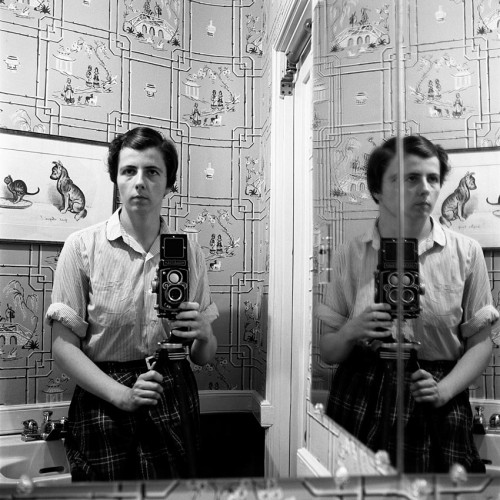
Finding Vivian Maier: The Greatest Art Mystery of the 20th Century by Rachel Redfern

However, Vivian Maier–besides being an obvious genius–remains a mystery. Finding Vivian Maier follows the narrative mystery as we pursue the reclusive and eccentric Vivian (or her personas of Ms. Meier, Mayer, Meyer, Meyers, Maier) across the US and through the streets of the 1950s and 1960s, attempting to discover more of a woman who is still unknowable.


Sexism in Disney’s Into The Woods by Jackson Adler

It seems Disney is saying that The Baker’s Wife is a “fallen woman,” and that it is making a firm decision on how it wants the audience to interpret the affair that occurred. This is made more problematic by how the affair was shot and choreographed. In the film, Cinderella’s Prince pins The Baker’s Wife against a tree and kisses her. There is nowhere for her to escape, even if she wanted to.


A Wild Woman Alone by Ren Jender

The filmmakers (director Jean-Marc Vallée and screenwriter Nick Hornby) profess to be fans of Strayed’s work, but they were apparently so busy patting themselves on the back for not making  this story of a woman alone into some kind of boy-meets-girl rom-com that they forgot to include everything else that makes the book distinctive.


Does Hating Foxcatcher Mean I Hate Men? by Robin Hitchcock

Foxcatcher is very serious meditation on men and masculinities, male relationships, and the white male experience of the class system in America. And I am so fucking bored with those subjects, even when they aren’t presented with a deliberately slow pace, sterile tone, and distracting amounts of face putty.


Gone Girl: How to Create the Perfect Female Villain by Alize Emme

Kudos to the 20th Century Fox exec who decided to market Gone Girl (2014) as a great date movie. This is not a date movie. This is a horror story about the sensationalized pitfalls of a doomed marriage.


American Sniper: We Can Kill It for You Wholesale by Lisa Bolekaja

This cowboy motif is no accident, as it connects this film to the old John Ford Westerns and the nostalgia some folks feel about John Wayne flicks and the mythology of good white cowboys fighting off savage Indians who were keeping good white settlers from utilizing this “wilderness” that would become the U.S.A. Dehumanizing non-whites is the foundation for creating this nation. It’s the glue that holds apple pies and hot dogs together.


The Alchemy of Still Alice by Lisa Rosman

What works beyond a shadow of a doubt is Moore herself. For a long time now, she has demonstrated an uncanny range and power without ever subjecting us to a shred of vanity. Here, she outdoes herself, channeling Alice’s physical, mental, and emotional devolution with an alchemy that is as thrilling as it is harrowing. Her luminous features slacken, her cadences falter, her life force fades. Scenes with Stewart are especially heartbreaking.


Gone Girl: Scathing Gender Commentary While Reinforcing Rape and Domestic Violence Myths by Megan Kearns

I wish I could say that Gone Girl is a subversive feminist film exposing myriad gender biases and generating a much-needed dialogue on rape and domestic violence. Yet it reinforces dangerous myths rather than shattering them.


Big Hero 6: Woman Up by Andé Morgan

The female team members are often shown as being more capable then the males, both as combatants and as scientists. Gogo Tomago, and Honey Lemon, are two bright, young scientists who exhibit strength of mind, body, and will. During a training montage, Gogo uses the phrase “woman up” to encourage one of her teammates to do better. This was a great, subversive line because it flowed naturally from the character and the context, rather than seeming like a forced injection of faux-feminism.


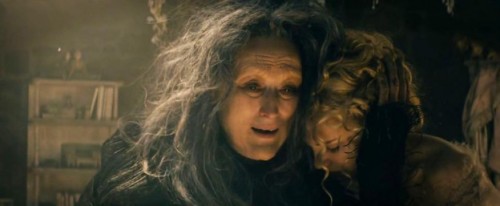
Child-Eating Parents in Into the Woods and Every Children’s Story Ever by Katherine Murray

Your dad is an ogre or giant, your mom is a witch, and both of them want to kill you. Welcome to your fairy tale life.


Birdman Is Black Swan for Boys by Robin Hitchcock

Birdman bears striking similarities to Black Swan, both in the broad strokes—each follow their protagonist’s slipping grip on sanity in the days before a high pressure stage debut—and in a strange number of superficial details—hallucinations of menacing black winged creatures, “surprise” lesbian scenes, and ambiguous suicides at least partially showcased on stage.


Am I The Only Person Incredibly Bored With This Awards Season? by Robin Hitchcock

Only one of the Best Actress nominations is from one of the Best Picture nominees, whereas four of the five Best Actor nominations are for Best Picture-nominated films. As I wrote in 2013, this trend suggests that movies with significant roles for women aren’t considered as great or important by the Academy. This year, it is even worse: four of the five Best Actresses were in movies not nominated outside of the acting categories.


What We Talk About When We Talk About Suck by Katherine Murray

So, you just saw a terrible movie and you want to tell the world about it – not so fast. How we frame our discussions about sucky movies depends on who’s listening, and whether we’ve got common ground.


Selma Backlash: Is It a Gender Issue? by Lauren Byrd

So what can women do about these smear campaigns directed at films by women? Go see films directed by women, support these filmmakers any way you can, whether it’s by filling theaters or participating in social media campaigns. We may not be able to change Academy voters’ minds, but we can continue drawing attention to gender disparities and focus on the positive changes.


Doing The Extraordinary in Two Days, One Night by Ren Jender

Women in films are even less likely to engage in this kind of dispirited struggle. Instead an actress usually plays the wife, mother, or girlfriend whose job it is to be “strong” and rub the hero’s back while he battles against his own obstacles. She talks reassuringly to him whenever he doubts himself, the exact same way Sandra’s husband does with her here.


What’s Missing from the Gone Girl Debate? Privilege! by Natalie Wilson

Gone Girl has been called misogynist, an amalgamation of negative stereotypes of women, a text that perpetuates rape culture, and a narrative that fuels Men’s Rights Acivtists’ ugly depiction of the gender equality feminists are trying to achieve. Yet, what is missing from the discussion is a focus on privilege.


Two Days, One Night: Marion Cotillard’s Insight From the New York Film Festival by Paula Schwartz

Cotillard did triple duty at the New York Film Festival Sunday to promote Two Days, One Night, which had its U.S. premiere. (The film is Belgium’s submission for best foreign film.) At 1, in jeans and a casual but chic top, Cotillard participated in a Q&A for a standing-room crowd. At 3 she changed into Dior and walked across the street to Alice Tully Hall and joined the Dardenne Brothers as they introduced ‘Two Days, One Night’ to a sold out audience, and afterward participated in a Q&A.


Where Is the Female Version of Whiplash? by Katherine Murray

I’d really like to see more introspective films about the human experience where the humans experiencing things look like me.


Boyhood (Feat. Girlhood) by Robin Hitchcock

Let’s face it, Boyhood is a gimmick movie. Richard Linklater sporadically filmed it over a twelve-year period so we could see the child actors in it actually grow-up. If you loved Michael Apted’s Up series but wanted more fiction and less wait, Boyhood is for you. But if you just love coming-of-age dramas, I’m not sure I can recommend this one.


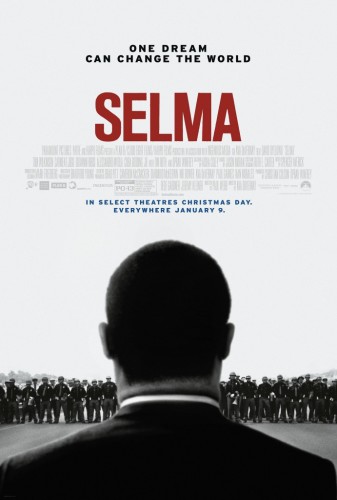
Selma Is Now by Nijla Mu’min

In so many ways, this film reflects the current moment, while also highlighting how things have and have not changed since the King family and their allies risked their lives to secure rights for all. Scenes in the film will jolt you into the present: watching Jimmie Lee Jackson’s mother grieve in 1965 for the son she will never see again made me immediately think of the family of Tamir Rice, the young black boy who was murdered by police officers this year for toting a toy gun in Ohio. ‘Selma’ is now.


The Theory of Everything: A “Great Man” From The First Wife’s Point of View by Ren Jender

Do great women exist? The film industry still hasn’t decided. We had Frida a dozen years ago and that bio-pic about Margaret Thatcher (like Frida, directed by a woman) from a few years back–which won Meryl Streep an Oscar, but tepid reviews along with a completely irredeemable main character kept me from seeing it. Usually the women in the “great man” films are great only by osmosis, because they married or otherwise provide emotional–and other–support to great men. The actresses who play these roles win Oscars too: they make the “supporting” category a literal one. The Theory of Everything, the new bio-pic about astrophysicist (and best-selling author) Stephen Hawking seemed like it might be different since it’s based on the book written by the great man’s first wife, Jane.


Selma Shows Why We Need More Black Women Filmmakers by Janell Hobson

DuVernay has said in interviews that when she inherited Paul Webb’s screenplay, she altered it to decenter its focus on President Lyndon B. Johnson (even though the controversy surrounding the film managed to once again re-center the story on white male power and its portrayal). Rather than criticize the director for shifting her gaze away from whiteness (or for getting certain historical details wrong), it may be more useful to consider the difference a woman behind the camera—and a Black woman in particular—brings to a motion picture.


The Imitation Game and Citizenfour: Secrets Then and Now by Ren Jender

Sometimes I wish the mainstream film industry would stop making movies about queers. The rare times that a queer person is allowed to be the main character in one of its movies, as in this one, he (almost always a “he”), like the rare main character of color is usually unrealistically isolated from the community he comes from, a trope fostered from before Stonewall to the ’90s to now: we are oh-so-tragic and oh-so-alone.


Richard Linklater and Ethan Hawke Praise Patricia Arquette’s Performance in Boyhood by Paula Schwartz

Arquette, who is terrific as Olivia, turns in a nuanced and complex performance that is vanity free. We watch her age perceptively and slowly as her character gains wisdom but still falters. In other words, she’s the kind of three-dimensional woman we rarely see in American films.


Captain Uhura Snub: The Politics of Ava DuVernay’s Oscar by Brigit McCone

It is appropriate, when celebrating the legacy of Martin Luther King Jr., to recall Dr. King’s words to Nichelle Nichols, as she considered quitting Star Trek in frustration at the limitations of her role: “You can’t leave!… For the first time on television, we are being seen as we should be seen every day. As intelligent, quality, beautiful people … who can go into space.” Dr. King’s words show that he clearly understood the value of a token image, as a symbol, a precedent and a possibility model for future progress.


The Boxtrolls: Better Than Its “Man in a Dress” Jokes by Ren Jender

In a nice contrast to many children’s films and books, the character at the start who goes against the mob is a girl, Lord Portley-Rind’s daughter, Winnie (voiced by Elle Fanning in a mid-Atlantic accent passing as British). Although Winnie, in her pink ruffled dress and blonde ringlets might look like other storybook heroines, her fits over never being believed or taken seriously by adults and her morbid fascination with the boxtrolls make her more like Daria than Alice in Wonderland. When she asks another character if boxtrolls ate his parents, she adds, “Did they let you, I mean, make you, watch?”


Colleen Attwood’s Costumes in Disney’s Into The Woods by Jackson Adler

Attwood’s designs are stunning, but they also highlight the discussions of gender roles and racial relationships in America.


The Academy’s White Noise: Silencing the Lions by Leigh Kolb

I said that I had hoped this year would be different. However, when the Academy announced its nominations, I was not surprised.


The Grand Budapest Hotel and Wes Anderson Fatigue by Robin Hitchcock

And the worst of it is that awards recognition will probably just send Wes Anderson further up his own ass, if such a thing is even possible. I don’t think I’ll be rushing to see his subsequent films until I hear that he’s finally tried something different.


The Internal Monologue of Wild: Lone Woman Walking, Lone Woman Writing by Elizabeth Kiy

In a film, as in real life, with no language to defend herself, the lone woman is a suspect. She gets stared at and scowled at and catcalled and often told that she’s making herself vulnerable, or taking unnecessary risks. In short, our culture says she’s asking for what she gets. A woman alone is unloved, uncared for and written off. In Wild, the film based on Strayed’s memoir of her months solo hiking the Pacific Crest Trail, she has several uncomfortable and frankly terrifying encounters.


Feminist Highlights and Fails at the 2015 Oscars by Megan Kearns

This year’s Oscars lacked racial diversity with all 20 acting nominees being white. The overwhelming whiteness of the Oscars, which hasn’t been this egregious in nominating people of color since 1998, spurred a Twitter boycott and the hashtag #OscarsSoWhite created by April Reign. In addition to racial diversity, once again the Oscars lacked gender diversity. No women were nominated for director, screenplay (adapted or original), original score or cinematography. The snub of Ava DuVernay especially stung.


Moments of Sincerity in Otherwise Endless Oscars by Josh Ralske

What stood out were what seemed like genuine heartfelt moments. John Legend and Common delivered a spirited performance of “Glory” from snubbed director Ava DuVernay’s Selma, and an equally impassioned acceptance speech when they won, notable for its intersectionality. They brought up Hong Kong’s fight for democracy, Charlie Hebdo, and America’s shameful prison-industrial complex. “Selma is now” is a message many need to hear, including their liberal Hollywood audience.
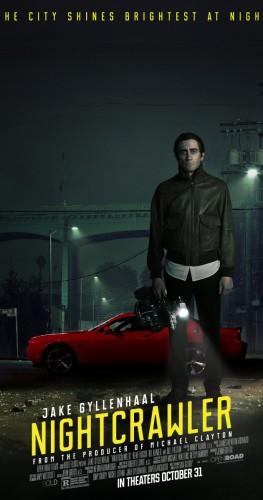
‘Nightcrawler’: Centering the White Fear Narrative

Bloom is a lonely man who scrapes by on the underbelly of society. His white male privilege allows him to steal, beat up people, and sabotage competitors without fear of repercussions from the police. As the renowned comedian Paul Mooney would say, Bloom has “the complexion for the protection.”

Jake Gyllenhaal as Lou Bloom


This repost by Lisa Bolekaja appears as part of our theme week on the Academy Awards.


Two Things:

1. Jake Gyllenhaal will be nominated for an Oscar.

2. Nightcrawler is one of the most honest depictions of the White Fear Narrative on film.

Bloom and Rick on the scene (Jake Gyllenhaal and Riz Ahmed)


Gyllenhaal plays Louis Bloom, a thief, a liar, and from my observations, a man on the spectrum of some form of neurodiversity. Obsessive compulsive perhaps, or living with some form of high functioning autism. (It was fascinating to watch Gyllenhaal’s face transmit so much dubious thinking behind those intense detail-oriented eyes.) Bloom is a lonely man who scrapes by on the underbelly of society. His white male privilege allows him to steal, beat up people, and sabotage competitors without fear of repercussions from the police. As the renowned comedian Paul Mooney would say, Bloom has “the complexion for the protection.”

Bloom lives in what appears to be an average working-class L.A. neighborhood (his basic studio apartment is as meticulous as his choice of words when speaking), but his only source of income and his only real viable skill is stealing from others. To the casual observer, his freshly pressed clothes, average white guy looks, and cheap car render him almost invisible. He is perceived to be a normal white person. And this perception of “normal” is crucial to his eventual rise in the world of crime journalism—nightcrawling, capturing horrific images of the worst of humanity and selling them to the highest TV network bidder. The bloodier the images the better. These “stringer” clips of film can bring in hundreds and upwards of thousands of dollars depending on who captures the images first and uploads them to the TV station the fastest. The mantra of “if it bleeds it leads” can now be given a dollar value. And the clock is always ticking.

Bloom stumbles across a car accident on the freeway one late night, and for some inexplicable reason, decides to pull over and watch the rescue of a woman from her burning car. As some police officers try to save the woman, a freelance stringer arrives (Bill Paxton in a small but compelling role) and begins filming the rescue operation. Bloom is introduced to his new obsession, TV crime news, and in his compulsive fashion, steals a high-end bike and sells it to get his hands on a cheap video recorder. A TV news starter kit.

Boss Lady. TV producer Nina Romino (Rene Russo) showing Bloom the ropes.


Bloom sells his first piece of shaky footage to Nina Romina (Rene Russo), a jaded veteran TV news producer who works at the lowest-rated TV station in Los Angeles. Nina tells Bloom that he has a good eye, and with this bit of encouragement (and his intense obsessive nature) Bloom sets off to take crime journalism by storm. He buys a police scanner and even hires his first crew member (Riz Ahmed in a heartbreaking role as a marginalized Guy Friday just desperate enough to endure Bloom’s reckless behavior).

Rick (Riz Ahmed) enduring the Mad Hatter that is Bloom (Jake Gyllenhaal)


Bloom is heckled by Paxton for being slow to big stories, and this disrespect spurns Bloom to be the best in the biz. Being the best means manipulating the raw footage before Nina gets her hands on it. The film moves into even darker territory when the quest to impress Nina and one up Paxton taps into Bloom’s deceitful nature: he now begins staging crime scenes by moving bodies, rearranging evidence, and omitting images to play up white fears of crime from the urban areas creeping into lily white suburbs. Nina even tells Bloom that the best stories are “A woman running down the street with her throat cut.” The implication here is a preference for white women because they illicit the most sympathy from white mainstream audiences. White news producers play up the recycled white woman in distress angle so often that it has become banal today.

Bloom stages the narrative.


Bloom creates the perfect angle to spin a story.


It’s a narrative used since the early 17th century. This narrative provides high viewership numbers, and Nina needs high ratings or she will be sacked by her bosses. Nina is unapologetic about framing whiteness as the center of the universe and churning out fear-based stories that disrupt the sanctity of white comfort. She is so apathetic about it, that she appears to dismiss how this narrative implicates her in upholding white supremacy, patriarchy, and the erroneous belief that whiteness is the be all to end all. This makes the film brutally honest. It does not sugarcoat what all non-white Americans understand from jump: the implicit bias of the American mainstream media. The centering of whiteness and white comfort are the only stories worth telling and protecting. And I applaud that honesty in this movie. It made me angry too since I am someone who comes from the margins of society trying not to be marginalized on a daily basis. At the same time, I give serious props to the writer/director Dan Gilroy. He gives it to you straight with no chaser. As much as I grew to loathe Bloom, I was still compelled to see him through to the end. He’s a real punch in the gut. And Gyllenhaal is simply brilliant in his portrayal of a man I want to see burn for his transgressions.

Bloom having a moment after failing to please Nina with great footage.


Eventually Bloom films the biggest story of his new career, a home invasion in an exclusive suburb, with plenty of blood, guns, and bodies, including a missing baby. He arrives at the scene before the police and enters the home filming every gory detail, including the murderers who escaped before Bloom entered the house. He withholds the footage of the killers and their SUV license plate. He has plans to keep the story going by following the so-called “Horror House” murderers and setting them up for a bigger news story– a future staged police shootout he will capture on film. He will control and manipulate white public fear. Because he can.

Bloom capturing the story of his life inside the “Horror House”, and manipulating it.


When Bloom shows the pre-edited Horror House footage to Nina, I swear her face appears orgasmic as she savors every bullet hole, and every inch of blood splatter. It seriously looks like she’s getting the best sex of her life. Nina calls in the newsroom lawyer to see how much she can get away with showing on live TV. As long as the victim’s faces are pixelated and the home address isn’t given out, it’s a go.

This move spins the story into a new direction with the appearance of the police who want to confiscate all the footage of the Horror House crime scene. Nina sends them to Bloom’s home, and no-nonsense Detective Fronteiri (Michael Hyatt) is determined to solve this case. From the moment she enters Bloom’s apartment, Detective Fronteiri knows he’s a conniving liar.

Detective Fronteiri (Michael Hyatt) has no chill. She sees through Bloom’s b.s.


Later, when Bloom sets into motion the tragic events that will net him his biggest stringer payday yet, Detective Fronteiri has to concede that she can never prove Bloom’s willful obfuscation, but she lets him know that she is aware of his deceit. He withheld crucial evidence to make a name for himself. And there are chalk lines on the ground for unnecessary deaths because of this deceit. In her eyes we see that she understands that he is controlling the false narrative of events. He has painted himself as a white victim who feared for his life and safety, and only called the police when he thought some big bad Latinos were following him. In reality, he planned to capitalize on the script he had pre-written for others to play out, including the Latino bad guys. He is the puppet master who pulls the strings. Detective Fronteiri knows this but is unable to take Bloom down. And Bloom gets to prosper in the end and continue nightcrawling with a brand new crew of underlings who have no idea that he has sociopathic tendencies. He just looks like a clean cut articulate white man with ambition. Y’know, the good guy.

The core story of Nightcrawler is how the media, TV news in particular, controls and manipulates the cultural discourse that portrays whiteness and white privilege as tangible things to be protected in America. Whiteness takes preeminence over non-white individuals and cultures. Non-white individuals in news stories are always seen as the scary Other, disrupting the comfort of good white folks–especially good white folks who live within high income zip codes. Fear-based media sells and it goes hand-in-hand with the threat of white comfort. Any challenge to the white comfort narrative is an assault on the perception that whiteness is the norm. Challenges to that white comfort norm are often rendered meaningless and worse, pathological. Look at real life TV news. Black Americans like Trayvon Martin, Renisha McBride, Marissa Alexander, Mike Brown, Tamir Rice, Jordan Davis, Eric Garner et al, are victims of police violence, violent anti-Black citizens, majority white jurors with irrational fears of Black skin, and the racist court of public opinion that puts Black victims on trial with immediate character assassinations. This violence done to Black Americans is used to uphold the sanctity of white comfort, and the delusions that white privilege perpetuates. Nothing in the media is happenstance. It is created, shaped, edited, and shared on television and the internet to protect a perceived white normality. All hail Hydra, darkies be damned.

Recent cartoon depicting the irrational and dehumanizing fear whites have of Black bodies. #MikeBrown


Perceptions of fear-based news do not match reality. Recently, Rudy Giuliani (in a television debate with Professor Michael Eric Dyson) tried to conflate Black-on-Black crime as an excuse to ignore state sanctioned violence on Black bodies, many of whom are children. He failed to mention white-on-white crime, or how most violent crimes are perpetuated by loved ones people already know. He misused facts to be obtuse and to derail the #BlackLivesMatter conversation on social media, once again centering the white fear narrative, and painting Black people for the zillionth time as the monstrous Other, the boogie man that has to be kept in check by more police crackdowns on Blackness. He became part of the media-created frenzy used to frighten good suburban white folk. The perception he tried to paint didn’t match the reality of the discussion. Much like the TV producer Nina, when faced with a counter-narrative that didn’t match the story she was trying to sell, Giuliani stuck to his erroneous script to fan the flames of white centered fear. Truth is more fucked up than fiction.

The power dynamics between Bloom and Nina is an engaging interplay of sexual tension, and sexual manipulation.  At the start of the film, Bloom is Nina’s subordinate, her little free-lance worker bee. Halfway through there’s a shift in the relationship, not quite equal, but Nina does treat him like a colleague. Bloom wants Nina sexually, and when he’s done his painstaking research on her career failures and her desperate need to keep her job, he calculates that he is worth more to her professionally than she lets on and uses this truth to pressure her into a date, and soon after, a sexual relationship.

Boss Lady still in charge. Angle framed so that Bloom has to look up at Nina.


Not equals, but Bloom impresses TV news producer Nina with his work ethic.


Power Dynamic shift: Nina realizes her new stringer has demands. Low angle framed so she appears to look up at Bloom.


Nina coerced into a dinner date she didn’t want to keep Bloom’s stringer hits.


One reading of this sexual coercion can be viewed as blackmail and harassment. But Rene Russo imbues Nina with a calculated agency that can also be interpreted as a woman who also knows her worth to Bloom, and uses his desire for her to get what she wants. I also sense that Nina actually finds Bloom attractive, especially when he makes demands of her. The same sexual look she gives bloody images is the same look she gives Bloom when he tries to dominate her. A lesser script would’ve used this tension as a subplot for Nina to rise above Bloom’s coercion. Instead, Nina concedes, has an off-screen relationship with him that we don’t see, and it is a stunning tête-à-tête to witness. It may very well gain Rene Russo her own Supporting Actor nod come Oscar season.

Nightcrawler is a wonderful respite from the big budget tent-pole films dominating the cinema. Original, daring, infuriating, and honest about ugly truths, I expect Jake Gyllenhaal to see his name on the Best Actor Oscar Ballot. He might even walk away with that gold statuette. And I would applaud him for it.

Jake Gyllenhaal, this film makes up for “Prince of Persia.” Expect to be nominated for an Oscar.


Come get this work.
Come get this work.


Lisa Bolekaja is a graduate of the Clarion Science Fiction and Fantasy Writer’s Workshop and was named an Octavia E. Butler Scholar by the Carl Brandon Society. She co-hosts a screenwriting podcast called “Hilliard Guess’ Screenwriters Rant Room” and her work has appeared in “Long Hidden: Speculative Fiction from the Margins of History” (Crossed Genres Publishing), “The WisCon Chronicles: Volume 8″  (Aqueduct Press), and the SF/F anthology, “How to Live on Other Planets: A Handbook for Aspiring Aliens” (Upper Rubber Boot Books). An associate member of the Horror Writers Association, and a former Film Independent Fellow. She is a profesional agitator on Twitter @LisaBolekaja

Female Purity Is Some Bullshit: My Problem With ‘Ida’

Religious devotion is a tricky quality to depict in any medium: so many of us have seen piety as hypocrisy both in film and in life that we’re prepared to laugh at or to dismiss deeply held religious beliefs onscreen. In work made for mostly secular audiences, filmmakers who want to show deeply religious characters have to answer the question: if piety isn’t a joke, what exactly is it?

IdaAlone


This repost by Ren Jender appears as part of our theme week on the Academy Awards.


Religious devotion is a tricky quality to depict in any medium: so many of us have seen piety as hypocrisy both in film and in life that we’re prepared to laugh at or to dismiss deeply held religious beliefs onscreen. In work made for mostly secular audiences, filmmakers who want to show deeply religious characters have to answer the question: if piety isn’t a joke, what exactly is it?

Sincere, spiritual belief in the Korean Zen film Spring, Summer, Fall, Winter… and Spring (which, for long stretches is, in all but name, a silent film) is shown in very specific ways, most compellingly when the young monk pours the ashes of his teacher into the water and we see the fish start to consume them. A very different viewpoint comes from Luis Buñuel, the anticlerical director of Simon of the Desert when he shows the audience that the “goodness” and faith of religious ascetic, Simon, interferes with his ability to understand and connect with other people–which is why his efforts to improve their lives never quite hit the mark.

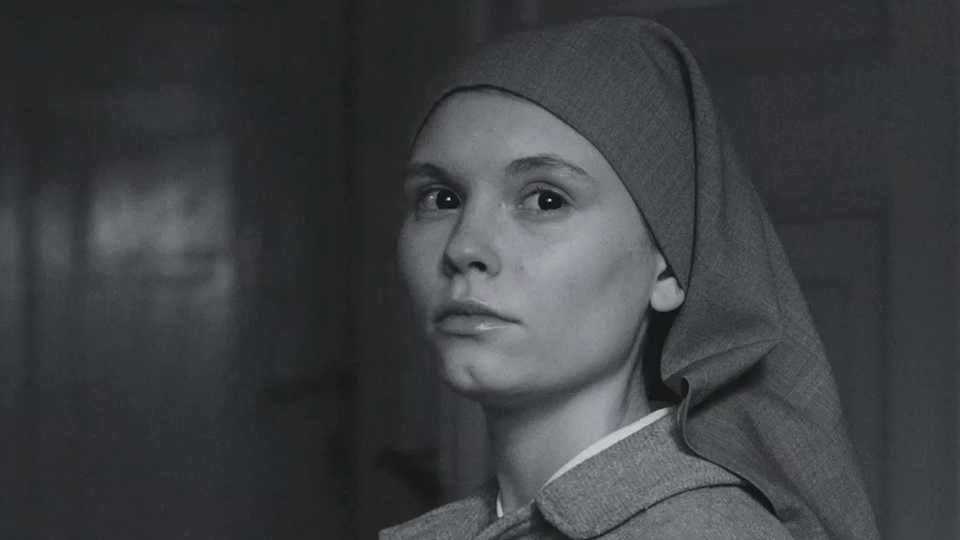
The title character of Pawel Pawlikowski’s Ida (Agata Trzebuchowska) starts out as Anna, a young novitiate in Poland in 1962, ready to take her vows when her mother superior tells her she must first visit her only living relative, an aunt whom she has never met, nor even heard about before. When the aunt, Wanda (Agata Kulesza), first sees Anna at her door she doesn’t even bother greeting her, just stares at her face for an uncomfortably long time. When Anna introduces herself, Wanda tells her that she knows who she is.

Anna comes in and they talk, Wanda says “They never told you? You’re a Jew.” Anna’s parents (her mother was Wanda’s sister) were slaughtered during World War II and Anna/Ida was brought up as an orphan in the convent. Wanda shows Anna/Ida photos of her family (including Anna’s mother, who looks just like her) and asks because Anna’s hair is covered with a wimple “You’re a redhead too, aren’t you?”

Ida’s Aunt Wanda
Ida’s Aunt Wanda


Anna/Ida wishes to find out how her parents were killed and where their remains are buried, so she sets out for the small town in the countryside where they lived and died. Wanda accompanies her, chauffeuring her in the shiny car that, like her spacious apartment, fur-collared coat and tailored dresses, are a perk of being a powerful Communist Party member (she works as a judge) and provide a stark contrast to how most of the others we see in the film live.

Wanda and Ida act as good cop/bad cop with Wanda’s past as a prosecutor put to use when she interrogates those who might know where and how her sister and brother-in-law were killed, while Anna’s wimple and cross serve as entrée through doors that even Wanda’s position as a powerful Party member can’t open. One of the many things the film gets right about the period is the deference laypeople show Anna. In the 60s and early 70s, years before the sexual abuse scandals came to light, a lot of Catholics, especially older people, still looked at nuns and priests with reverence. Even as a farmer’s wife rebuffs Wanda’s efforts to find out about the death of Ida’s parents, she asks Ida to bless her baby.

In the search for dead family


The excellent Enemies, A Love Story, from the late Paul Mazursky, is one of the few other films that shows surviving European Jews living with the aftereffects of World War II’s mass genocide without, as in The Pawnbroker and Sophie’s Choice, giving us flashback scenes to the camps themselves. But Ida is different in that it takes place in the country where the genocide happened–and where we see precious little soul-searching about it. We find out Ida’s mother and father never made it to the camps, or even into the presence of a Nazi soldier or bureaucrat, but were killed, like livestock, by a neighbor. He knew no one would punish him for their deaths.

He murdered the family to gain possession of the small, run-down farmhouse we see at the start of Ida and Wanda’s search, its dinginess a testament to just how little it takes for someone to lose all morality. When Ida asks the man why he didn’t also kill her, he tells her, “You were tiny. No one would know you were a Jew,” and the arbitrariness that spared her is as bracing to us as a slap.

The film presents but never quite answers a question that still persists in places like Rwanda today: how does one continue to live with the people who wanted to kill you and all the people like you, or at least didn’t try to stop those who wanted to see you and your kind dead? Anna/Ida, without revealing her relation to them asks the town priest if he knew her parents. His answer shows a continuing indifference to them and to their fate: Jews mostly kept to themselves, he says. That indifference is something Anna/Ida might have shared before she knew who her parents were and how they died.

On the road
On the road


The black and white cinematography of the film, by Ryszard Lenczewski and Lukasz Zal, is striking: at one point we see the spindly, dark trunks of trees pushing up between the gravestones in an abandoned cemetery like an Edward Gorey illustration come to life. And Ida passes the Bechdel test with flying colors (as they look for clues about her murder, the two women talk about Ida’s mother, but hardly at all about her father, whom Wanda holds responsible for her sister’s death). But a pass or fail of the Bechdel test alone doesn’t determine the worth of any film: in spite of the talent of both actresses, and the deep issues the film brings up, these two characters, in the end, inhabit unconvincing gendered stereotypes.

In the same way that some popular memes have placed men in poses adopted by women in magazine layouts to show the inherent sexism of these photo shoots, we can see how these characters are lacking by imagining the roles rewritten as men. “Adam” is scheduled to soon take his vows as a monk when he is told by one of the Brothers at the monastery that he should first visit his Uncle Waclaw, his only living relative. Waclaw tells Adam he’s Jewish: his real name is “Ira.” The uncle is a former prosecutor who degrades himself by sleeping with a lot of women and frequently getting drunk. But unless we’re seeing a film from director Steve McQueen, no male character succeeds in degrading himself by having sex with a lot of women. And hard drinking often telegraphs the man is the hero.

“Ira” never loses his temper or even cries when he encounters the evidence of his parents’ murder and the confession from the man who killed them. The closest he comes to a stand (outside of his determination to find out what happened to his parents) is a placid-faced, silent and motionless refusal to shake the hand of the farmer when he agrees to show Ira the grave in exchange for Ira dropping any claim to the farm.

Ida and the saxophonist


The hitchhiker the uncle and Ira pick up would be the woman singer in the jazz band instead of, in Ida, the male saxophonist (the singer would feel safe alone with two men in the car because one was wearing monk’s robes) and later when the monk comes to listen to the musicians jam after their gig, the singer could tell him, looking over his smooth, wide-eyed face (as the saxophonist tells Ida) “You have no idea the effect you have on (wo)men, do you?”

As Wanda’s character could be summed up as a screwed-up “slut” (a word she calls herself and for which there is no male equivalent), Ida/Anna seems to serve as a bastion of purity. The problem with purity as ascribed to everyone from the Virgin Mary through Snow White to every dull, “good” woman rescued by “the hero” is: “pure” is a better descriptor of soap than it is of a human being. In films as in life, purity is rarely an attribute assigned to men, only to women and girls  just like “strong” in the emotional sense of the word, is.

I wouldn’t categorize the two main women characters in Pawlikowski’s earlier film, the compelling My Summer of Love (its star Emily Blunt, in the role that brought her to the attention of Hollywood) as ultra-realistic either, but their actions and words seemed to have concrete (if sometimes complex) motivations: those two weren’t the opaque characters Wanda, to some extent, and Anna/Ida, especially, turn out to be. When Anna/Ida makes a life-changing decision toward the end, her expression is as serenely impassive as it was at the beginning, as if nothing had happened to her during the course of the film. Ida seems poised to forget everything she’s learned in the 80 minutes we’ve been in her company–including her own name.

[youtube_sc url=”http://www.youtube.com/watch?v=oXhCaVqB0x0&feature=kp”]


Ren Jender is a queer writer-performer/producer putting a film together. Her writing besides appearing every week on Bitch Flicks has appeared in The Toast, xoJane and the Feminist Wire. You can follow her on Twitter @renjender.

‘Finding Vivian Maier’: The Greatest Art Mystery of the 20th Century

However, Vivian Maier–besides being an obvious genius–remains a mystery. ‘Finding Vivian Maier’ follows the narrative mystery as we pursue the reclusive and eccentric Vivian (or her personas of Ms. Meier, Mayer, Meyer, Meyers, Maier) across the US and through the streets of the 1950s and 1960s, attempting to discover more of a woman who is still unknowable.


This repost by Rachel Redfern appears as part of our theme week on the Academy Awards. 


[youtube_sc url=”http://www.youtube.com/watch?v=2o2nBhQ67Zc”]

In April of 2009, one of the greatest street photographers of the 20th century died in a Chicago nursing home. Her passing was quiet and seemingly without notice, and the photographs that she left behind were dusty unknowns, auctioned off at a storage locker in Chicago. The buyer, John Maloof, began posting the photos on the Internet, hopeful that someone would recognize their quality. When the photographs went viral, Maloof began searching for the photographer, just a handwritten name on a few receipts stuck into the boxes, and stumbled upon a woman as fascinating as the art she produced.

Directed by John Maloof and Charlie Siskel, Finding Vivian Maier is an award-winning documentary exploring the art and artist discovered on an auction house floor, and whose prolific work has been subsequently shown all over the world. During her life, Vivian Maier produced over 150,000 photographs, as well as films and audio recordings, and did so while keeping her talents and work completely hidden from the world—choosing instead to work as a nanny in New York City and Chicago.

However, Vivian Maier–besides being an obvious genius–remains a mystery. Finding Vivian Maier follows the narrative mystery as we pursue the reclusive and eccentric Vivian (or her personas of Ms. Meier, Mayer, Meyer, Meyers, Maier) across the US and through the streets of the 1950s and 1960s, attempting to discover more of a woman who is still unknowable.

A portrait of the artist–Vivian Maier


Vivian Maier hid herself well during her life, and there has been some speculation: is it right to expose her now in death? Would Maier be pleased at the recognition of her talents? Her friends say no, but Maloof disagrees (for obvious financial reasons), arguing that since Maier corresponded with an art printer in France that she was obviously interested in displaying her work at some point.

Finding Vivian Maier embodies an art historian’s meta-dream of art exposing art and reveals the way that art can be lived in a person—empathetic, obviously political, socially conscious, occasionally gritty artwork, reflective of the woman behind the lens.

For photographers there is often the thought that we must be standing in front of the exotic to have something worth photographing; however, Maier exposes women, children, minorities, laborers, and other “background” faces in “normal” cities with a compelling charisma. As one historian states in Finding Vivian Maier, the fact that Maier was able to push so deeply into the personal space of her subjects and then photograph them with such an honest vulnerability, is remarkable. As an artist, her work is not a moment out of time, but instead occupies a contradictory grounded timelessness where we, the viewer, are included in a sympathetic, deeply personal interaction.

One of Maier’s beautiful, inclusive moments from the streets of Chicago


Despite the occasional self-congratulatory tone of the Maier discovery, the documentary is exceptional. Finding Vivian Maier is paced like a mystery film and viewers are drawn in to explore the fractured pieces of Maier’s secretive life along with Maloof.  However, in a delicious, almost teasing way, after Finding Vivian Maier is finished, we’re still left with much to wonder about the enigmatic artist and spirited woman that was Vivian Maier.

Additionally, within the past few months a legal battle has surfaced over the right to print, publish, curate and sell Maier’s work by a Chicago lawyer (aptly) named Mr. Deal. Until the case is decided it seems that the unknowns surrounding Maier’s curious life and work will grow even more.

Finding Vivian Maier was released on DVD July 29 and can be viewed in theaters around the country. Collections of Maier’s photographs can be viewed at exhibitions in New York City, Chicago, Los Angeles and a host of other cities around the world. To view Vivian Maier’s work online, click here.


Rachel Redfern is a traveler and teacher who spent the last few years living in Asia. Now back in her native California, she focuses on writing about media, culture, and feminism. While a big fan of campy 80s movies and eccentric sci-fi, she’s become a cable acolyte, spending most of her time watching HBO, AMC, and Showtime. For good stories about lions and bungee jumping, as well as rants about sexism and slow drivers, follow her on Twitter at @RachelRedfern2.

What We Talk About When We Talk About Suck

So, you just saw a terrible movie and you want to tell the world about it – not so fast. How we frame our discussions about sucky movies depends on who’s listening, and whether we’ve got common ground.


This repost by Katherine Murray appears as part of our theme week on the Academy Awards.


So, you just saw a terrible movie and you want to tell the world about it – not so fast. How we frame our discussions about sucky movies depends on who’s listening, and whether we’ve got common ground.

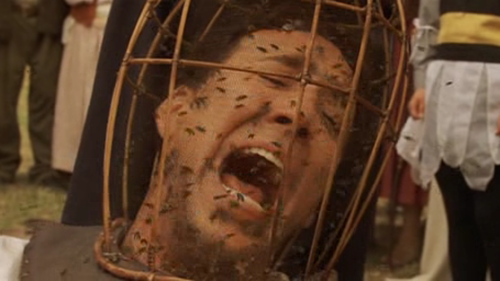
Nicholas Cage stars in The Wicker Man
No not the bees not the bees they’re in my eyes


There’s no such thing as a movie that’s universally hated, or a movie that’s universally loved. No matter how awful something is, there’s always somebody who likes it and, no matter how wonderful something is, there’s always somebody who thinks it’s garbage – that is the wondrous variety of human taste.

That said, if there’s one movie that almost everyone agrees is bad, it’s Neil LaBute’s 2006 re-make of The Wicker Man.

Starring Nicholas Cage at his Nicholas Cage-iest, The Wicker Man is a two-hour exercise in casual misogyny, featuring a confusing and unsuspenseful plot. It’s so bad that the YouTube videos designed to make fun of it literally do nothing but show scenes from the movie, exactly as they played out.

It isn’t hard to find people who agree that The Wicker Man was terrible, and it isn’t hard to find people who agree that it was misogynist – what’s weird is that discussions of misogyny in the film usually begin and end with the statement, “Nicholas Cage dresses up as a bear and punches women in the face.” And, while that is entirely terrible on multiple levels, it’s not the most offensive thing about the movie. The most offensive thing about the movie is that it takes for granted that there’s something disturbing and sinister about women who don’t take orders from men.

Billed as a horror story, The Wicker Man follows a detective who’s investigating a case outside his jurisdiction. That means that, when he travels to the remote community where the mystery’s taking place, he doesn’t have the power to make any of the citizens of that community – who are predominantly female – cooperate with him. Instead of adjusting his strategy and approaching them in a friendlier way, he starts off by screaming at everyone he meets, and then acts surprised when they don’t want to help him. Yet, the fact that the female characters recoil from him rather than scrambling to follow his orders is treated, by the movie, as though it’s a sign that Something Is Wrong.

The movie also features a large number of sequences where Nicholas Cage asks a woman a direct question, and the woman a) gives a vague answer that doesn’t help, b) answers with a total non-sequitur, or c) pretends not to understand what he’s talking about in a deliberate attempt to make him feel crazy. In other words, it’s just like talking to your wife – please, take my wife!

At the very end of the movie, when All Is Revealed, it turns out that Nicholas Cage’s ex-girlfriend purposely got pregnant so that she could guilt him into taking an interest in the welfare of their child, and use that as leverage to lure him to the freaky matriarchy she lives in, so that she and her womyn friends could sacrifice him to their pagan god, ‘cause women be bitches like that.

There’s no shortage of angles to take when you’re discussing the misogyny in this film, but the one that seems to resonate most with mainstream audiences is, “Nicholas Cage dresses up like a bear and punches women in the face” – which he does, for the entire final act – because we have achieved a state of gender-awareness in our culture where dressing up as a bear and punching women in the face is almost universally seen as a bad thing to do. Presenting a worldview in which powerful women are inherently threatening, women’s reasoning ability is suspect, and women use sex and pregnancy as a way to trap and manipulate men is actually more misogynist to me than having a guy dress up like a bear and punch women in the face, but that puts me out of step with the general discussion.

In other words, it’s really easy to get buy-in for the idea that The Wicker Man sucks, but we might not be adding much to the discussion of misogyny when we do that.

In fact, the truth is that I find myself not wanting to argue about exactly why this movie is misogynist, because I’m afraid that, if I start disturbing the soil around that one, I’ll quickly uncover the truth that most people don’t understand that misogyny is more than punching someone in the face. I’m afraid I’ll discover that most people hate this movie because it offends their sense that men should be chivalrous toward women – that they would be totally fine with everything else, if only he didn’t dress up like a bear and start punching.

I’m also afraid that the only reason people are really willing to criticize the content of The Wicker Man is because it’s also poorly made from a technical standpoint. If they were enjoying themselves more – if it were a little better-looking, and, technically, more well-crafted, I’m not sure it would be so easy to toss out this level of scorn.

Jessica Alba stars in Sin City
SCORN


Sin City is a film that is technically well made (so, one step up from The Wicker Man) and still completely blatant in its misogyny (with racism added to spice things up). I can tell you from personal experience that it’s a lot harder to have a conversation about why you hate Sin City than it is to make fun of The Wicker Man.

The first thing that Sin City’s defenders will tell you is that it is hateful on purpose (as though doing it on purpose makes it better). Frank Miller and the movie are imitating film noir – that genre where dames were dames and the hero was a hard-luck, working class guy who was awesome at bare-knuckle boxing, and gay people arrived in a cloud of evil smoke. I get that that’s on purpose, but all it means is that Sin City did a really good job of mimicking something sexist. If it’s not challenging, or examining, or interrogating the sexist thing in any way, then I need another reason for why someone thought that was a good idea.

The problem with criticizing Sin City is that it gets us into a discussion about whether a work of art can be both technically proficient and fundamentally unworthy in some other way. In other words, it gets us into a discussion of what we mean when we say a movie is “good.” Given the history of moral censorship in the United States and Canada, people are rightly cautious of the idea that we should declare things good or bad based on whether or not we agree with their values. At the same time, completely removing yourself from the meaning of a movie, or the ideas it’s trying to express, and focussing just on whether the camera was in the right place, and the pixels were coloured correctly, seems to be missing the point.

Sin City is a staggering technical achievement, and the tone I use when I criticize it is different because of that. It’s not like The Wicker Man, where you can just write it off, and be satisfied that everyone agrees with the broad-stroke message, “This movie was totally bad.” People have passionate feelings about whether or not it’s possible for a misogynist story to be good if it’s also well-executed. They have passionate feelings about whether it’s even appropriate to consider a story’s misogyny (or racism, or homophobia, or other ideological content) in rendering a verdict about it. The truth is, philosophically, I don’t know if it should be possible for a misogynist movie to be “good” – but I know that I can’t quite hear myself saying, “I found this completely hateful and, oh my god, it was the best!”

Just to be clear, for anyone who doesn’t remember the film, Sin City is about three tough, underworld men who interact with subservient women – mostly prostitutes and exotic dancers. The women have no power, no ability to look after themselves, no ability to make decisions – whenever they try to act, they just make things worse. The Black one is “wild” and she thinks it’s sexy when a guy hits her in the face. The Asian one doesn’t talk and carries samurai swords. The one who’s a stripper is told that she’s “strong” because she can really take a beating without screaming or crying about it. All of the women are sexually available to the men at the centre of the story. At one point, the prostitutes tie up one of the men, and it seems like they have the upper hand, but he reveals that he could have escaped at any time and was just humouring them.

It is horrible.

And yet, unpacking the horribleness of Sin City requires a deftness and care that isn’t required for The Wicker Man. You don’t have the automatic buy-in that comes from Nicholas Cage in a bear suit. You have to start talking about what you mean when you say something’s “good.” Imagine how difficult it would be if the misogyny were just a shade less obvious.

Rosamund Pike and Ben Affleck star in Gone Girl
Tastes like controversy


Gone Girl is the reason I’m writing this post because, holy shit, it is hard to talk about Gone Girl.

Megan Kearns did an admirable job of explaining what’s wrong with this movie, and I won’t re-tread the same criticisms, but my reaction, watching it opening weekend, was one of total shock. I could not believe the dedication with which this script was trying to score misogynist bingo. Like, I thought it was written by an MRA hate group. The overriding message, intentionally or not, is that, when a woman says a man attacked her, you should never, ever believe her, because it’s probably part of a nefarious scheme she cooked up just to get revenge on him for something, and women are crazy like that.

Unfortunately, we already live in a world where, every time a woman says a man attacked her, a thousand people who don’t even know her rush forward to call her a liar. We live in a world where guys I actually know said this Jian Ghomeshi stuff was probably a lie before any of us even knew what it was. We live in a world where one of the same guys said that whether you need a girl’s permission to punch her in the face during sex is “kind of” a murky issue (it’s not).

Watching Gone Girl spin out a misogynist fever dream about the lying liars we call women was unsettling enough, but a cursory search of the internet also revealed that this has been a longstanding argument since the novel came out, and that things seem to have settled in a place where it’s not cool to be annoyed by this story. In fact, trying to have a conversation about why you don’t like Gone Girl is like walking through a mine field that calls you a misandrist bitch. Don’t you believe that some men are trapped in abusive relationships? Don’t you believe that some women lie about rape? Don’t you think that people manipulate each other sometimes? Or can you just not handle the idea that any woman in a movie isn’t perfect? Does every woman in every movie that you deign to like have to be a role model? Can you handle the idea that some women aren’t very nice?

Honestly, it just makes me more entrenched in my original assessment that this wasn’t a very good movie.

Gone Girl is, I think, less well-made than Sin City, but worlds beyond The Wicker Man. What makes it difficult to talk about is that the problems with the story – as I’m choosing to call them – are much less concrete than dressing up like a bear and punching someone in the face. In order to talk about Gone Girl we have to talk about the much more abstract question of whether it seems appropriate, given the current political climate, and the rate of violence against women, and the difficulty women have in being believed when they report being assaulted by men – in that climate, do you think it’s appropriate, or do you think it necessarily constitutes a hostile act, to tell a story where the moral is that women are crazy liars and no one should ever believe them?

That’s harder to deal with than Nicholas Cage in a bear suit.

I don’t know the proper way to talk about movies that suck – or the proper way to determine whether they suck at all – but the answer might be that, instead of deciding whether or not something sucks, or how many stars it should have on a scale of one to five, we should talk about movies not as wholes to be judged, but collections of various elements, some of which are great (or fine) and some of which are problematic.

Don’t get me wrong – I love to say “suck,” and I doubt that I’m going to stop – but it occurs to me that I’m less prepared to argue for why any of these movies sucked than I am to argue for why I found particular elements troubling. I think that might be what I’m talking about, when I talk about suck. And I think I might be more eloquent, if I paid more attention to that.


Katherine Murray is a Toronto-based writer who yells about movies and TV on her blog.

Sexism in Disney’s ‘Into The Woods’

It seems Disney is saying that The Baker’s Wife is a “fallen woman,” and that it is making a firm decision on how it wants the audience to interpret the affair that occurred. This is made more problematic by how the affair was shot and choreographed. In the film, Cinderella’s Prince pins The Baker’s Wife against a tree and kisses her. There is nowhere for her to escape, even if she wanted to.

woods-624x257


This repost by Jackson Adler appears as part of our theme week on the Academy Awards.


CONTAINS SPOILERS for the stage musical and subsequent film adaptation of Into The Woods.


Previously, I have written on the racism in Disney’s Into The Woods, a film adaptation of the Stephen Sondheim and James Lapine musical that interweaves various European fairy tales into one tragicomedy. Sadly, while the movie certainly has its merits (and some great performances), it has a few more faults I would like to point out – particularly in regard to its subtle sexism towards women.

Much of The Baker’s Wife’s story is still the same as in the stage musical, with one major change – that of her death. Disney’s interpretation of her death has everything to do with the scene beforehand. Cinderella’s Prince uses his power as a nobleman, and the charm he has been taught to use, to seduce The Baker’s Wife. The Baker’s Wife is star-struck by The Prince, having even told Cinderella earlier that “[she] wouldn’t run if a prince was chasing [her].” However, when Cinderella’s Prince starts attempting to seduce The Baker’s Wife, she at first protests and even says “no.” He follows her protestations with “right and wrong don’t matter in the woods,” and continues to kiss her. While certainly attracted to him and star-struck, the question must be asked – What if she had continued to protest instead giving in and allowing herself to enjoy something that seemed inevitable? Would he have forcibly raped her? Would he have had her arrested on a trumped up charge? Did her consent matter at all? Certainly, he is more culpable in their affair, since he is an authority figure.

Cinderella’s Prince (Chris Pine) comes on to The Baker’s Wife (Emily Blunt)


After the brief affair, The Baker’s Wife sings “Moments in the Woods,” as a way of coming to terms with what has happened and to bring herself to return to the beauty of everyday life with her husband and child. In the stage version, as the Giantess walks by and her large feet make the ground tremble, a tree falls on The Baker’s Wife and kills her. The stage musical leaves the meaning of these events open to interpretation. I personally never interpreted The Baker’s Wife’s death as some sort of punishment. It seemed fitting to me that The Giant, who is avenging the murder of her husband and asserting her role as a wife, should accidentally damage/condemn the life of a woman who slept with a man other than her husband. However, while the stage musical leaves interpretations up to the audience, the film makes a firm judgment call. In the film, as the ground shakes, The Baker’s Wife falls off a cliff and dies.

It seems Disney is saying that The Baker’s Wife is a “fallen woman,” and that it is making a firm decision on how it wants the audience to interpret the affair that occurred. This is made more problematic by how the affair was shot and choreographed. In the film, Cinderella’s Prince pins The Baker’s Wife against a tree and kisses her. There is nowhere for her to escape, even if she wanted to. After some kissing, the affair seems over and the prince leaves (which is very different from most stage adaptations, where a lot more than kissing is implied). So The Baker’s Wife is condemned by Disney and made into a literally “fallen woman,” just because a prince kissed her? And even after she decides to return to her husband and child, content not to have another affair ever again?

Mackenzie Mauzy as Rapunzel


While only one major change is made to The Baker’s Wife’s story, half of Rapunzel’s story arc is cut, which in turn takes away from the character development of The Witch. Unlike in the stage musical, Rapunzel does not have a mental breakdown, and she does not get squashed and killed by the giantess (who was annoyed by her raving and screaming) in front of her mother and husband. In Disney’s film, the only consequence of Rapunzel having lived a sheltered childhood is that she runs away from her mother with the first guy she has ever met. The film even cut the fact that she becomes a mother to twins, something that would change anyone’s outlook on life, and certainly take a lot of responsibility – a responsibility for which Rapunzel is not ready. These cuts in the story take away entire conversations that are important for us to have as a culture. The Witch was trying to protect her daughter by sheltering her, but it is the fact that Rapunzel was so heavily sheltered that leads to her undoing, and ultimately leads to her death. Not only that, but Rapunzel develops a mental illness, something that still (and wrongfully) induces a terrible stigma in our society.

In addition, Rapunzel’s and The Witch’s story in the stage musical shows how our most well-intended actions can negatively affect those we care for most. Rapunzel was damaged by her upbringing in a way that made it impossible for her to be a functional human being in society. Not even her prince can help her. The Witch’s song “Witch’s Lament,” in which she sings about how “children won’t listen,” comes after Rapunzel’s death in the stage musical, but in the film it comes after Rapunzel and her prince gallop off into the sunset.

The song is still emotional, as her daughter has rejected her and left her forever. However, the pain within the song is incredibly undermined by the change in circumstances. The Witch then does not have as much justification for her breakdown in “The Last Midnight.” In the song, The Witch rages against all the “nice” people who have brought ruin upon her, her daughter, and the kingdom itself. She is fed up with the world, others’ treatment of her, and possibly of herself. The Witch then vaguely kills herself by goading the spirit(?) of her own mother, challenging her to curse her. Without the death of the person whom she loved most in the world, The Witch is denied what is arguably the most essential part of her character arc, and the story of Into The Woods is deprived of some of its most important themes.

The Witch (Meryl Streep) watches as Rapunzel (Mackenzie Mauzy) rides into the distance with Rapunzel’s Prince (Billy Magnussen).


To make matters worse, the way the special effects were designed during The Witch’s death reminds one of images of Hell, as if to imply that The Witch was sucked down into Hell by the spirit of her mother. This most definitely goes against the messages of the story, and in fact even some of the lyrics in “The Last Midnight.” The Witch is not “good or bad,” but she is “right” about many things (though not about how she raised her daughter). It is the fact that she is “right,” and yet an older and powerful woman (a “witch”) that has drawn condemnation from the other characters, many of whom don’t even know about (most of) the drama between her and Rapunzel. The Witch not only has had a large part of her character arc taken away from her, but she is then metaphorically sent to Hell. For what? For being a complicated human being? By the same line of thinking, what about The Wolf whose only crime was doing what wolves do? What about the adulterous princes who were raised “to be charming, not sincere,” and therefore abuse their power and influence? No, none of them are sent to Hell. The older woman is. Not only is there sexism in this, but there is also ageism. After her death in the film, The Witch’s body is swallowed up by a bubbling tar pit. Women are already overly punished in this film, and it’s no small matter that one of the greatest examples of it is for an older and powerful woman. The stage adaptation took a character that is the villain in fairy tales, and focused on her as a human being, making her into one of the main characters and a complicated human being to be played by a leading actress. The audience is invited to sympathize with her and her intentions, despite the fact that some of them backfire on her and her daughter. To take away so much of her arc undermines what makes the story powerful, and it is a disservice to the role, to the actress (Meryl Streep), and to the audience.

Into The Woods is a complicated story about complicated people, ending with the understanding that no one is completely good or evil, and we all must love and support each other as best we can. It saddens me that the female characters’ stories were altered in the way they were. I can only hope that this newer generation of film-goers is inspired by the film to seek out the many adaptations of the stage version and appreciate the story for what it is – one of community and caring, and not judgment and debasement.


Jackson Adler is a transguy with a BA in Theatre, and is a writer, activist, director, teacher, dramaturge, cartoon lover, and vegan boba drinker. You can follow him on twitter @JacksonAdler, and see more of his writing on the blog The Windowsill at http://windowsillblog.com.

‘Selma’ Backlash: Is It a Gender Issue?

So what can women do about these smear campaigns directed at films by women? Go see films directed by women, support these filmmakers any way you can, whether it’s by filling theaters or participating in social media campaigns. We may not be able to change Academy voters’ minds, but we can continue drawing attention to gender disparities and focus on the positive changes.


This repost by Lauren Byrd appears as part of our theme week on the Academy Awards.


Oscar nominations haven’t been announced yet, but there’s already a campaign to dethrone an Oscar hopeful. Selma, directed by Ava DuVernay, is a solid choice for film critics (100 percent on Rotten Tomatoes), but in the weeks following its release, the film has come up against criticism for its portrayal of President Lyndon B. Johnson.

During a time when the holiday season detracts from awards season, historians and former members of the Johnson administration voiced their concerns with the film.

Three days before the film’s release, Mark K. Updegrove, the director of the Lyndon B. Johnson Library and Museum in Austin, Texas, wrote a piece in Politico, titled, “What Selma Gets Wrong”:

In the film, President Johnson resists King’s pressure to sign a voting rights bill, which—according to the movie’s take—is getting in the way of dozens of other Great Society legislative priorities. Indeed, Selma’s obstructionist LBJ is devoid of any palpable conviction on voting rights. Vainglorious and power hungry, he unleashes his zealous pit bull, FBI chief J. Edgar Hoover, on King, who is determined to march in protest from Selma to Montgomery despite LBJ’s warning that it will be “open season” on the protesters. This characterization of the 36th president flies in the face of history. In truth, the partnership between LBJ and MLK on civil rights is one of the most productive and consequential in American history.

Updegrove makes his argument about what is and isn’t right about this portrayal, but what the articles about the “Selma controversy” in The New York TimesThe Wrap, and other media sites haven’t mentioned is that Updegrove also states that much of the film is correct and an accurate portrayal of the events of that time.
A former aide to Johnson Joseph A. Califano, Jr., wrote a similar piece in The Washington Post and on New Year’s Eve, The New York Times highlighted the charges of inaccuracy against the film in a piece by Jennifer Schuessler, which quoted several LBJ focused authors and historians.
Ava DuVernay on set of Selma
DuVernay isn’t standing silently in the face of the recent criticism. In a recent interview with Rolling Stone, she said, “I wasn’t interested in making a white-savior movie; I was interested in making a movie centered on the people of Selma.”
It’s hard not to compare the sudden firestorm of controversy surrounding a potential Oscar hopeful to the controversy in the 2013 Oscar season that befell Kathryn Bigelow’s Zero Dark Thirty.The debate about that particular film was based on its portrayal of torture and whether the film showed enhanced interrogation techniques producing intelligence that led to Osama bin Laden. Many journalists who had covered the wars in Iraq and Afghanistan, as well as national security, thought the film glorified torture, while film critics classified the film as an accurate depiction of the dark decisions made by the U.S. government during the murkiness of the post-9/11 decade.
It’s even more difficult not to note that both these films are directed by women. While questions about accuracy were also brought up about Lincoln during the 2013 awards season, which was directed by a man Steven Spielberg, the backlash against Zero Dark Thirty drowned out any questions around Spielberg’s film. As a result, Bigelow did not receive a Best Director nomination while Spielberg did. The inaccuracies in Argo, of which there were many, were not as widely discussed, and both Ben Affleck and the film went on to win Oscars.
Selma
Selma
This year, another film directed by a man, Bennett Miller’s Foxcatcher, has recently undergone criticism from Mark Schultz, one of the brothers whom the film is based on. But FlavorWire has already written a piece defending the film against Schultz’s remarks.
Compared to Foxcatcher, which has been in theaters since November, the controversy around Selma has received more media play and it’s possible the charges of inaccuracies from historians will affect how future audiences view the film. (It opens nationwide on Friday.)

These smear campaigns against films helmed by women are yet another sign of the disparity of the treatment of men and women in the film industry. So are these smear campaigns a gender issue or simply a coincidence?

As someone who knows enough about the industry to know that the Academy Awards are certainly not based on merit or artistry, but rather on money and publicity, it was still hard to believe smear campaigns were a reality until the 2013 Oscar race when Zero Dark Thirty‘s awards season chances quickly diminish.

Kathryn Bigelow moderating a Q&A with Ava DuVernay after a screening of Selma


So what can women do about these smear campaigns directed at films by women? Go see films directed by women, support these filmmakers any way you can, whether it’s by filling theaters or participating in social media campaigns. We may not be able to change Academy voters’ minds, but we can continue drawing attention to gender disparities and focus on the positive changes. Michelle MacLaren directing Wonder Woman, for instance.

While it’s unclear what effect the controversy will have on Selma and DuVernay’s Oscar chances, let’s hope that in the future, audiences and Academy voters learn how to think for themselves rather than be carried away by the most recent awards season smear campaign. Man or woman.


Lauren Byrd has a master’s degree from Syracuse University’s Newhouse School. She’s worked in television and recently worked as part of the education team at Brave New Films.