Quote of the Day: Sirena J. Riley

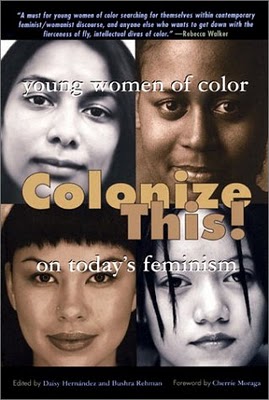
From her essay “The Black Beauty Myth,” which appears in the anthology Colonize This! (published in 2002):

As a women’s studies major in college, body image was something we discussed almost ad nauseam. It was really cathartic because we embraced the personal as political and felt safe telling our stories to our sister feminists. Whenever body image was researched and discussed as a project, however, black women were barely a footnote. Again, many white feminists had failed to step out of their reality and see beyond their own experiences to understand the different ways in which women of color experience sexism and the unattainable beauty ideals that society sets for women.

Discussions of body image that bother to include black women recognize that there are different cultural aesthetics for black and white women. Black women scholars and activists have attacked the dominance of whiteness in the media and illuminated black women’s tumultuous history with hair and skin color. The ascension of black folks into the middle class has positioned them in a unique and often difficult position, trying to hold onto cultural ties while also trying to be a part of what the white bourgeois has created as the American Dream. This not only permeates into capitalist material goals, but body image as well, creating a distinctive increase in black women’s body dissatisfaction.

White women may dominate pop culture images of women, but black women aren’t completely absent. While self-deprecating racism is still a factor in the way black women view themselves, white women give themselves too much credit when they assume that black women still want to look like them. Unfortunately, black women have their own beauty ideals to perpetually fall short of. The representation of black women in Hollywood is sparse, but among the most famous loom such beauties as Halle Berry, Jada Pinkett Smith, Nia Long, Iman and Angela Bassett. In the music scene there are the young women of Destiny’s Child, Lauryn Hill and Janet Jackson. Then, of course there is model Naomi Campbell and everyone’s favorite cover girl, Tyra Banks. Granted, these women don’t necessarily represent the waif look or heroin chic that plagues the pages of predominately white fashion and entertainment magazines, but come on. They are still a hard act to follow. 
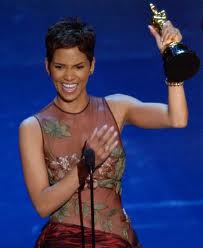
Oscar Acceptance Speeches, 2002

Leading up to the 2011 Oscars, we’ll showcase the past twenty years of Oscar Acceptance Speeches by Best Actress winners and Best Supporting Actress winners. (Note: In most cases, you’ll have to click through to YouTube in order to watch the speeches, as embedding has been disabled at the request of copyright owners.)
Best Actress Nominees: 2002
Halle Berry, Monster’s Ball
Judi Dench, Iris
Nicole Kidman, Moulin Rouge!
Sissy Spacek, In The Bedroom
Renée Zellweger, Bridget Jones’s Diary
Best Supporting Actress Nominees: 2002
Jennifer Connelly, A Beautiful Mind
Helen Mirren, Gosford Park
Maggie Smith, Gosford Park
Marisa Tomei, In The Bedroom
Kate Winslet, Iris
**********
Halle Berry (transcript only) wins Best Actress for her role in Monster’s Ball.
Jennifer Connelly wins Best Supporting Actress for her role in A Beautiful Mind.
**********
 See nominees and winners in previous years:  1990199119921993199419951996, 1997, 1998, 1999, 2000, 2001

Disembodied Women Take Five: Mouthing Off

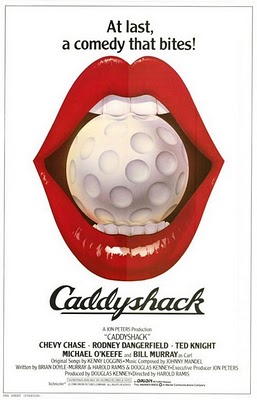
According to the following posters, women have bright red mouths.  Wide open mouths with perfect white teeth.  That they can put things inside of.  See, women often have objects inside their bright red mouths, like golf balls or strawberries, that they’re usually biting.  And if they aren’t visibly biting anything, it’s implied that they’ve recently bitten something, what with them all sexy-licking the dripping blood off their–in case you forgot–bright red mouths.  Or maybe they’re just biting their own mouths.  Or maybe their mouths actually become food (bright red food, even). But if they aren’t biting anything, then the least those bright red mouths can do is stay silent.  In fact, looking at the posters in succession, one could even argue that all those bright red mouths (oh yeah, and the completely erased mouths) represent the silencing of women.  Who can talk while wearing an implied ball gag?  Or while eating?  Or when you don’t have a mouth?  Or when your mouth is, you know, really just a pair of red chili peppers?  Or if you’ve got a bloody knife pressed against it? Or if that shit is zipped shut?

 
As discussed in the other parts of this series, separating women from their body parts in media images subtly reinforces women’s status as commodities, or pleasure-objects, or victims, who aren’t valued as whole, and who are, as a result, denied their humanity.  And we all know, because we live in This Society and it’s 100% inescapable, that the representation of women’s mouths is all kinds of tied up in the mouth-as-vagina metaphor–with the accompanying requisite phallic cigarette and lipstick images apparently never getting old. (And I’d be thrilled to never have to hear the phrase “dick-sucking lips” ever. again.)  But if the mouth isn’t a vagina, then it’s a nonstop, life-ruining motormouth (ever hear someone call a man a motormouth?) that even Mr. Potato Head wants to slap the shit out of. (If you don’t know what I’m talking about, have a look at the Mr. and Mrs. Potato Head commercial that ran during the Superbowl.)  
I guess I shouldn’t be surprised.  Molly Ringwald putting her lipstick on with her cleavage in The Breakfast Club is one of the most famous scenes in all of 80s film.  We’ve come a long way, baby!

Oscar Acceptance Speeches, 2001

Leading up to the 2011 Oscars, we’ll showcase the past twenty years of Oscar Acceptance Speeches by Best Actress winners and Best Supporting Actress winners. (Note: In most cases, you’ll have to click through to YouTube in order to watch the speeches, as embedding has been disabled at the request of copyright owners.) 

Best Actress Nominees: 2001

Joan Allen, The Contender
Juliette Binoche, Chocolat
Ellen Burstyn, Requiem for a Dream
Laura Linney, You Can Count on Me
Julia Roberts, Erin Brockovich 

Best Supporting Actress Nominees: 2001

Judi Dench, Chocolat
Marcia Gay Harden, Pollock
Kate Hudson, Almost Famous
Frances McDormand, Almost Famous
Julie Walters, Billy Elliot

**********

Julia Roberts wins Best Actress for her performance in Erin Brockovich.
**********
Marcia Gay Harden (transcript only) wins Best Supporting Actress for her performance in Pollock.
**********
Click on the following links to see the nominees and winners in previous years: 199019911992, 1993, 1994, 1995, 1996, 1997, 1998, 1999, 2000

Ripley’s Pick: Parks and Recreation Seasons 1 & 2

Two seasons of the NBC comedy Parks and Recreation have already aired, and it returns for a third season on NBC next Thursday, January 20th. If you haven’t yet watched Parks and Recreation, you should really consider it–because it’s the best comedy on network television. (Both seasons are available for streaming on Netflix, all episodes are available on hulu, and you can watch the final episodes from season two on nbc.com. See how much I want you to watch?)

A small-town political satire, shot in the same documentary style as The Office, the show is laugh-out-loud funny, smart, and cuttingly feminist (and we know how rare it is for network TV to even pass the Bechdel Test). To compare it to The Office doesn’t really do it justice, however, as The Office really depends on its one-bit-gag of inept office manager Michael Scott (Steve Carrell) and other caricatures working together.  

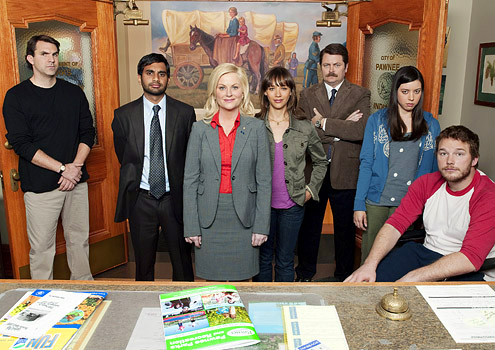
Parks and Recreation centers around Leslie Knope (Amy Poehler), who is smart and capable, yet who sometimes suffers from grandiose delusions and tragically funny missteps in her position of Deputy Director of the Parks and Recreation Department in Pawnee, Indiana. With her friend Ann Perkins (Rashida Jones), boss Ron Swanson (Nick Offerman), intern April Ludgate (Aubrey Plaza), and rest of the crew, Leslie sets out to build a new park in the small town and climb the political ladder.

Leslie Knope is openly feminist and politically ambitious. Her office is decorated with framed photos of female politicos, including Madeleine Albright, Condoleeza Rice, Hillary Clinton, and Janet Reno–along with her mother, who holds a higher political office than she. She struggles to accomplish anything in her bureaucratic position, fit in with the boys’ club of government, and navigate the social world of her small town. The supporting cast is equally good, with nearly all characters fully formed and three-dimensional. One of several great performances is Offerman’s anti-government Ron Swanson, the head of the Parks & Rec department, whose primary goal in his position seems to be the complete privatization and elimination of the department. Equally funny is April the intern, an ironically detached hipster who gradually grows annoyed with her gay boyfriend and comes around to sincerely connecting with her coworkers.

Season One was a short six episodes, while Season Two had twenty-four. At the end of the second season, the government was facing a shutdown due to budget concerns. Season Three (again, premiering next week) begins with the re-opening of the Parks and Recreation department. Here’s a sneak peak at Season Three, featuring guest stars Rob Lowe and Ben Scott. The preview relies heavily on these and other guest stars, and I hope they don’t dominate the series this season, superseding Poehler’s excellent comedic performance.

And here’s a clip from one of my favorite episodes, “Hunting Trip.”

Short Film: The Big Empty

The Big Empty (2005) is a 20-minute film starring Selma Blair and based on Alison Smith’s short story, “The Specialist.” Directed by Lisa Chang and Newton Thomas Sigel, the film appeared in the first issue of  the DVD magazine Wholphin, published by McSweeney’s. 
When I first saw the film, it struck me as beautiful, touching, and very funny–and more substantive than many feature films–and it strikes me the same way now, even after seeing it several times. Watch the entire film here:

Oscar Acceptance Speeches, 2000

Leading up to the 2011 Oscars, we’ll showcase the past twenty years of Oscar Acceptance Speeches by Best Actress winners and Best Supporting Actress winners. (Note: In most cases, you’ll have to click through to YouTube in order to watch the speeches, as embedding has been disabled at the request of copyright owners.)

Best Actress Nominees: 2000

Annette Bening, American Beauty
Janet McTeer, Tumbleweeds
Julianne Moore, The End of the Affair
Meryl Streep, Music of the Heart
Hilary Swank, Boys Don’t Cry

Best Supporting Actress Nominees: 2000

Toni Collette, The Sixth Sense
Angelina Jolie, Girl, Interrupted
Catherine Keener, Being John Malkovich
Samantha Morton, Sweet and Lowdown
Chloe Sevigny, Boys Don’t Cry
**********
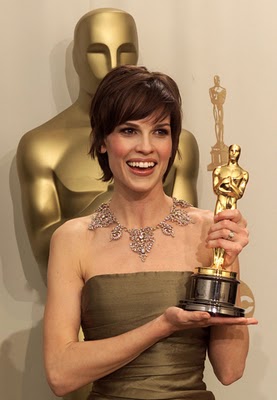
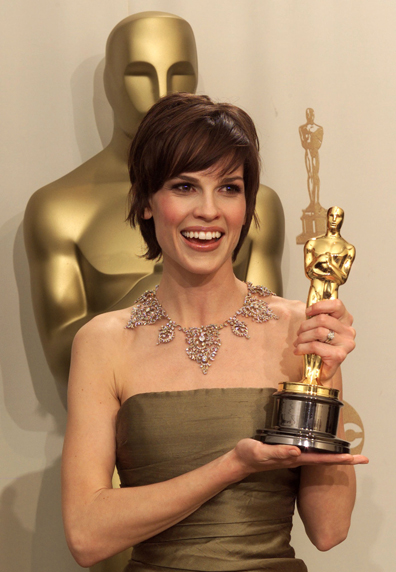
Hilary Swank wins Best Actress for her performance in Boys Don’t Cry.
**********
Angelina Jolie wins Best Supporting Actress for her performance in Girl, Interrupted.
**********
Click on the following links to see the nominees and winners in previous years: 1990199119921993199419951996, 1997, 1998, 1999

Oscar Acceptance Speeches, 1999

Leading up to the 2011 Oscars, we’ll showcase the past twenty years of Oscar Acceptance Speeches by Best Actress winners and Best Supporting Actress winners. (Note: In most cases, you’ll have to click through to YouTube in order to watch the speeches, as embedding has been disabled at the request of copyright owners.) 

Best Actress Nominees: 1999

Cate Blanchett – Elizabeth
Fernanda Montenegro –  Central Station
Gwyneth Paltrow – Shakespeare in Love
Meryl Streep – One True Thing
Emily Watson – Hilary and Jackie 

Best Supporting Actress Nominees: 1999

Kathy Bates – Primary Colors
Judi Dench – Shakespeare in Love
Brenda Blethyn – Little Voice
Rachel Griffiths – Hilary and Jackie
Lynn Redgrave – Gods and Monsters

**********

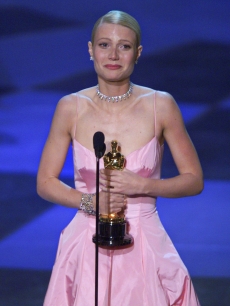
 Gwyneth Paltrow wins Best Actress for her performance in Shakespeare in Love.

Judi Dench (transcript only) wins Best Supporting Actress for her performance in Shakespeare in Love.

**********

See nominees and winners in previous years: 1990, 1991, 1992, 1993, 1994, 1995, 1996, 1997, 1998