Love Isn’t Always Soft and Gentle: Female Sexual Desire in ‘Secretary’

Sex and sexuality are complicated, whether we believe it or not. Most of us have experienced some type of same-sex attraction or participated in some kinky activity in the bedroom. Movies often help us to make sense of these feelings and experiences. However, too often, female sexual pleasure and arousal are still deemed unfit for viewing by mainstream film and television. America has a bipolar and hypocritical relationship with female sexuality. Our culture consumes copious amounts of porn and then doesn’t hesitate to slut-shame the women who create and act in pornographic films. Is this because pornography can be seen as objectifying women, while mainstream film humanizes them? Why does the marriage of sexuality and human intimacy feel so dangerous?

Written by Jenny Lapekas as part of our theme week on Representations of Female Sexual Desire.

Sex and sexuality are complicated, whether we believe it or not.  Most of us have experienced some type of same-sex attraction or participated in some kinky activity in the bedroom.  Movies often help us to make sense of these feelings and experiences.  However, too often, female sexual pleasure and arousal are still deemed unfit for viewing by mainstream film and television.  America has a bipolar and hypocritical relationship with female sexuality.  Our culture consumes copious amounts of porn and then doesn’t hesitate to slut-shame the women who create and act in pornographic films.  Is this because pornography can be seen as objectifying women, while mainstream film humanizes them?  Why does the marriage of sexuality and human intimacy feel so dangerous?

The depiction of female sexuality and sexual desire in the offbeat romance, Secretary (Steven Shainberg, 2002), is central to its themes of dominance and submission.  Lee (Maggie Gyllenhaal) can be read as “sexually uncontrollable” by some viewers and critics, but her sexuality complements Mr. Grey’s (James Spader), which is structured and contained.  Lee finds she cannot be sexually aroused or satisfied by the traditional man she’s set to marry; not only is their sex centered on his laughable spasms on top of her, Lee can’t even pleasure herself while his photo sits by her bedside.  We may say that he’s so bad in bed, he interferes with Lee’s orgasms even when absent.
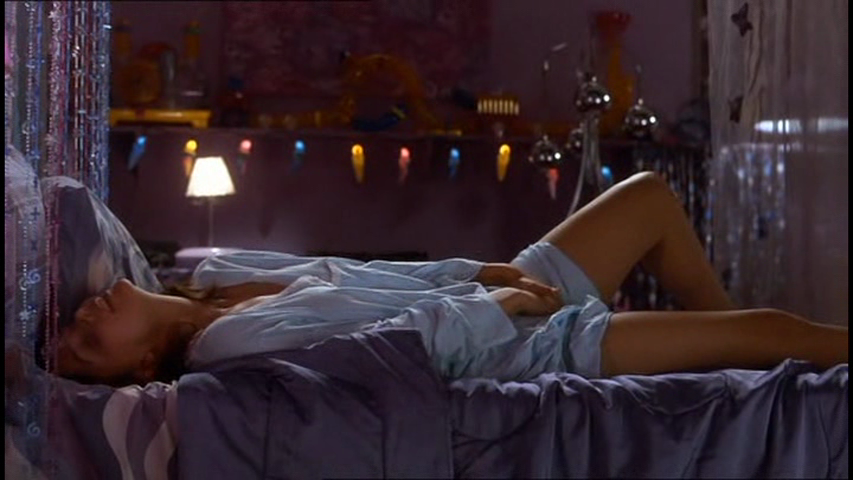
Lee gets to better know herself by exploring her body and entertaining erotic thoughts about her inaccessible employer.


Lee has just been released from a mental hospital, and she struggles to gain some independence as she moves back in with a hovering mother and a drunk father.  Among her masochistic tools, we find a hot tea kettle and the sharpened foot of a ballerina figurine, a rather melodramatic image as she sits in a bedroom that is reminiscent of early girlhood, rather than that of a 20-something young woman.  It’s no mistake that Gyllenhaal’s character has an androgynous name; when we meet her, she is not sexually realized, and the way the camera maneuvers around her small frame and conservative clothing communicates this very clearly.

Lee is giddy over her new title of “secretary.”


When Mr. Grey (50 Shades, anyone?) is “interviewing” Lee, he forwardly observes, “You’re closed tight.”  Lee is so willing to do anything and everything Mr. Grey tells her that he cures her of her cutting simply by telling her that she is never to do it again.  We may be tempted to label Mr. Grey rude or offensive, but his character is much more complicated than that, and Lee depends on his behavior to further develop throughout the film.  He is seemingly cruel as he explains that her only tasks are typing and answering the phone, and yet she is incompetent since she routinely makes spelling errors and answers the phone without gusto.  Lee wants desperately to please Mr. Grey.   The film contains two masturbation scenes where we watch Lee climax at the memory of doing exactly as Mr. Grey tells her.  Considering some of the recent controversy surrounding the censorship of female sexual pleasure on television, it feels daring and refreshing to find these scenes in a film.  Gyllenhaal has also received criticism for playing the love interest in The Dark Knight (Christopher Nolan, 2008) since viewers find her “cute,” and not “sexy” enough to take on such a role, which makes her portrayal of a sexually adventurous young woman all the more empowering.
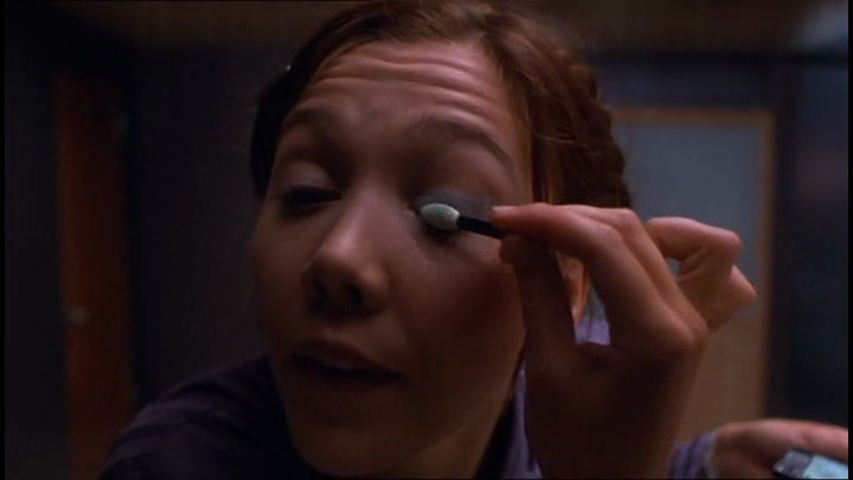
Lee looks like a little girl playing dress-up as we watch her apply the eyeshadow anther woman at work leaves in the bathroom.


While Lee is shown to be a sexually submissive woman–parallel to the sexually dominant Grey–she discovers her own agency as she blossoms into a more complete person.  She dramatically leaves her fiancé, Peter, and, while wearing her wedding dress, professes her love to Mr. Grey.  She also slaps Mr. Grey across the face as he fires her and successfully fights off Peter when he interrupts her sit-in.  Although Lee gets off on being subservient, she makes it clear that she isn’t afraid to let others know what she wants outside the bedroom; Lee literally runs to Mr. Grey and then screams at Peter to get out.  Paradoxically, Lee’s emergence as a “submissive” accompanies the forming of her newfound independence.
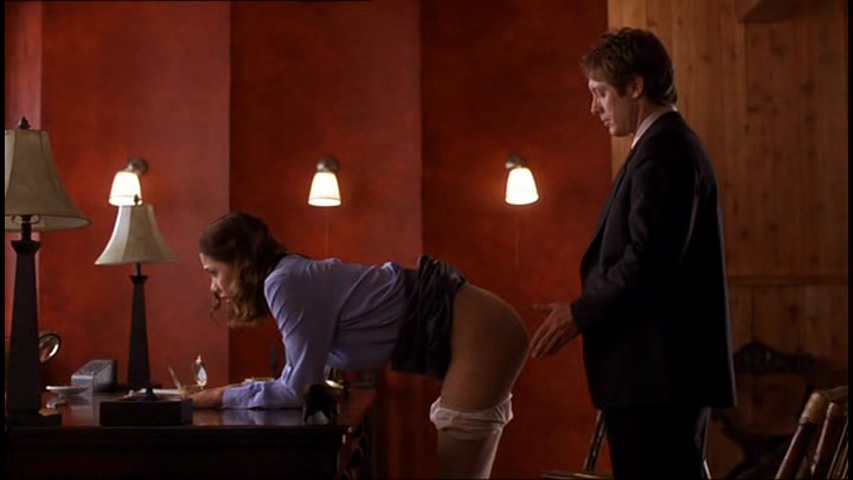
Upon doing what she's told, Mr. Grey asks Lee if she's afraid he's going to fuck her.
Upon doing what she’s told, Mr. Grey asks Lee if she’s afraid he’s going to fuck her.


What this film shows us is that sexual submission is a legitimate practice of men and women alike.  During Lee’s “sit-in,” we even see a women’s rights scholar (most likely a local graduate student) visit her to lecture about her apparently anti-feminist choice to obey Mr. Grey by sitting and waiting for his return.  I think it’s unwise to dismiss Lee’s portrayal of a “sexual submissive” as inaccurate or ineffective since this is not an archetype we see very often on the silver screen.  This film is subversive, transgressive, and feminist in its message, its imagery, and its challenging the popular belief that feminist sexuality is a one-size-fits-all cloak we all quibble over and clamber into when it’s time to play academic dress-up.  We watch Lee masturbate, fall in love, and cure an alienated man of his debilitating need for space and order, so I think it’s safe to say that the more Lee embraces her desire to be dominated, the more she controls the events of her own life and discovers agency.

Mr. Grey finally admits he loves Lee by undressing her and bathing her.


The desire to be told what to do or to obtain permission to do particular activities is undoubtedly linked to sexual arousal and gratification in both men and women.  Although Lee is sexually submissive, she alone pushes Mr. Grey out of his toxic bubble of isolation and shame; she declares her love for the brooding lawyer and kindly informs him that they are a match and can be themselves, together, every day, without embarrassment that their sexual preferences may be considered perverted or taboo by the dreaded status quo.

While this brand of complex female sexuality may not be readily understood by most, it would be reductionist to dismiss Secretary as a misogynistic film, especially when Gyllenhaal’s performance reflects a multi-layered persona and a powerful sexual identity that remains obscure in mainstream cinema.  Lee finds sexual agency, and we stand by to watch and enjoy the pleasure she finds, along with the man who becomes her husband.  The binary of dominance and submission, along with its negotiation of sexual boundaries, is what makes Secretary work.

Recommended reading:  Thinking Kink: Secretary and the Female Submissive

__________________________________________

Jenny has a Master of Arts degree in English, and she is a part-time instructor at Alvernia University.  Her areas of scholarship include women’s literature, menstrual literacy, and rape-revenge cinema.  You can find her on WordPress and Pinterest.

Queer Women as Sexual Beings: ‘The L Word’ and More

Today’s media landscape is fuller than ever with queer characters (though most of them are still white and/or male), yet the stories we see are still most commonly either angst-ridden fumbling towards a coming out or pregnancy and adoption dramas. It’s rare to see a fully realized queer character, too old for coming out and too young for children, actually dating and enjoying sexual encounters. It’s rarer still when it’s a woman.

A typical 'L Word' promotional image which highlights the sexual aspect of the show, luring viewers by titillation over plot or characters
A typical The L Word promo image, luring viewers with titillation


Written by Elizabeth Kiy  as part of our theme week on Representations of Female Sexual Desire.

Sadly, it’s still kind of revolutionary to show two women in love having sex or even kissing on TV or in movies that aren’t super niche or ghettoized as pornographic or gay-interest. However, it’s easy enough to see a nominally straight character go gay for sweeps week or two girls making out for male approval in mainstream media. What’s truly scandalous is when the women like it.

Today’s media landscape is fuller than ever with queer characters (though most of them are still white and/or male), yet the stories we see are still most commonly either angst-ridden fumbling toward a coming out or pregnancy and adoption dramas. It’s rare to see a fully realized queer character, too old for coming out and too young for children, actually dating and enjoying sexual encounters. It’s rarer still when it’s a woman.

While gay men are often portrayed as hypersexual partiers, gay women in movies and TV are more likely to worry about their kids, sit on the couch reading together or have rare sex. They’re more like best friends who’ve decided to move in and raise children together than romantic partners (though Modern Family was notably criticized for the lack of passion between its gay male couple, Cam and Mitchell, who didn’t kiss onscreen until the second season of the series). It’s a distinction most notable in the common description of The Kids are Alright, a movie where a lesbian couple have only unsatisfying sex and affairs as “The Lesbian Brokeback Mountain,” comparing it to a film where a gay male couple have a passionate and enduring albeit tortured love affair.

Though there have been some notable deviations from this pattern.

Last year, Blue is the Warmest Color exploded into mainstream discussion for its long and graphic sex scenes, but many viewers felt the scenes were steeped in the male gaze (descriptions of the director Abdellatif Kechiche’s behavior didn’t help matters). Some felt the sex scenes seemed like more of a break from the narrative than genuine portrayal of the character’s passion for each other.

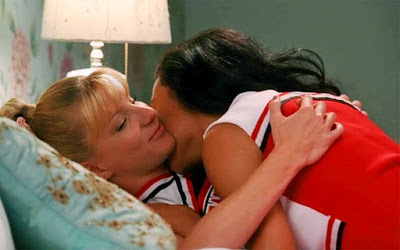
On Glee, Brittany (Heather Morris) and Santana’s (Naya Rivera) relationship began with sex, as they described regularly scissoring each other and were shown in bed together before any idea was given of their feelings for each other. All the emotional stuff between them was added in later. However, when they became an official couple, supposedly in love, the characters stopped interacting, and viewers had to fight to get an onscreen kiss.

Pictured: Not a Kiss


On Grey’s Anatomy, Erica Hahn (Brooke Smith) was moved to tears after her first sexual experience with a woman, which caused her to reassess the way she had been living her life. She compared it to getting glasses as a child and finally seeing the world clearly, after years of unknowingly looking at blurs and not knowing they were supposed to be leaves.

It also stood out when Emily Fitch (Kathryn Prescott) officially came out in the second generation of British drama, Skins, expressing her sexual interest in women. She didn’t just vaguely “like” girls or want to date them, she wanted to have sex with them and explained, “I like their rosey lips, their hard nipples, bums, soft thighs. I like tits and fanny, you know?”

The L Word, the lesbian drama which ran from 2004-2009 on Showtime, is remembered by queer women for problems like its hackneyed writing, transphobia, and bierasure, or its place in their realization of their sexuality, but it has an important role as perhaps the only mainstream TV series where all the major characters were queer women. It’s also the only program where you can list out its top ten lesbian sex scenes.

Ad for The L-Word comparing it to Sex and The City


The series was promoted as the queer version of Sex and the City (ads proclaimed “Same Sex, Different City”), and it’s a fairly apt comparison. It focuses on the professional and romantic lives of a group of affluent and fairly feminine queer women in their 20s and 30s living in LA’s gay mecca, West Hollywood, where their lives often intersect with celebrities.

Part of Sex and the City’s enduring position in popular culture is the ease by which the characters, even if you loved them and knew all the particulars of their lives, can be explained by types. We’ve all been asked: are you glamor-loving Carrie, traditional Charlotte, cynical Miranda or sexually liberated Samantha? Likewise, The L Word characters, like uptight power lesbian Bette (Jennifer Beals), earthy valley girl Tina (Laurel Holloman), awkward, closeted athlete Dana (Erin Daniels), social butterfly Alice (Leisha Hailey): the main cast’s only bisexual, and Jenny (Mia Kirshner), a confused midwestern transplant turned sociopath, are such clear types, it’s hard to imagine they’re friends. As THE lesbian show, the series is often posed as representative of lesbian life and love, the awful theme song even proclaims, “This is the way that we live!” Therefore the situations and other characters the protagonists run into are also played as typical.

Jenny’s attraction to Marina changed her life


With a cast (excluding male guest stars and short lived series regulars) of women, the show is ruled by female sexual desire and characters’ libidos and sexual pleasure are integral parts of the plot and of the sex scenes. Characters talk sex over coffee, give each other tips, worry about whether their partner orgasmed, fight attraction so strong it’s all-consuming and, in one episode, debate the meaning of female ejaculation. Most are young and single and spend their nights at parties and clubs, a far cry from the stereotype of lesbians staying home with their cats.

It also worked to debunk commonly held patriarchal ideas that sexual intercourse means penetration or requires a penis as women are shown receiving pleasure from different kinds of sex, involving dirty talk, roleplay, toys, hands and mouths.

A typical image of female pleasure from the L-Word
A typical image of female pleasure from The L-Word


In fact, the series is often viewed as a sexual primer, answering the curiosities of straight viewers and teaching basic techniques to baby queers. While women are often portrayed in the media as having sex only because the men in their lives desire it, The L Word characters enjoy sex and participate in it for their own sakes, without men to pressure them. In fact, sex between women in the show is often portrayed as more satisfying because sex scenes between women are longer, more explicit and more intense than scenes with men. A lot of attention is also given to the idea that a woman has superior knowledge of the female body because she has one herself. Likewise, Shane, the lesbian Casanova, is desired by every queer woman and most straight women she meets.


All the girls (even the straight ones) went crazy for Shane


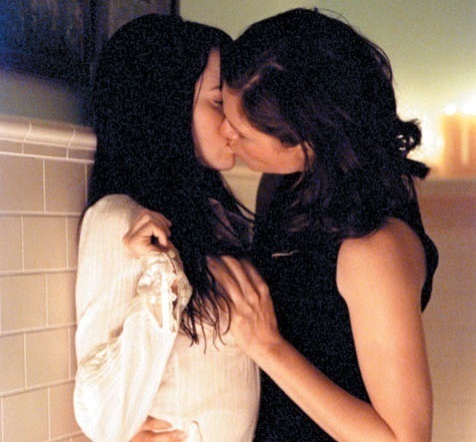
Right off the bat, lesbian sexuality is taken seriously as the first major plot line follows Jenny, consumed by her sexual desire for a woman named Marina despite all logic. By end of pilot, we see them have sex and see it as an amazing eye-opening and life-changing experience for her.

Still, the series can be accused of titillation, and as a mainstream production, it required the interest of straight male viewers to stay on the air. In a season two plot line, the series attempted to address the idea of the male gaze and rape culture with the inclusion of a straight male character who moved in with Jenny and Shane and filmed them without their permission. All the women are gorgeous and feminine (Shane, the most masculine is still thin and stylish), which led to criticism from queer viewers that the show was making the characters more familiar and digestible for straight audiences. On the other hand, The L Word has also been praised for breaking down stereotypes and teaching audiences that not all lesbians are butch.

Still, knowledge that the series came from lesbian creator Ilene Chaiken and involved several queer actresses, guest stars and episode directors allowed queer women to feel a degree of ownership and (often begrudging) affection toward the program. The community complained about it, but still held viewing parties, all hated Jenny together, and voted the stars on hot lists throughout its run.

In season five, the show even pokes fun at the portrayal of lesbian sex in the mainstream when characters get involved in the production of a movie based on their lives. Jenny has to give the cast, who are mostly straight, lessons on how queer women have sex as they have no idea how to portray it accurately. In another episode, a producer gives the ridiculous suggestion that the actresses could have unsimulated sex in the film as the MPAA wouldn’t consider it “real sex.” His suggestion is made more ridiculous by the fact that MPAA guidelines are actually tougher towards portrayals of queer sex than straight sex, and there are numerous examples of scenes of female pleasure garnering NC-17 ratings (as in seen in the documentary This Film is Not Yet Rated).

Though there are examples of movies and TV where lesbian sexual desire and romance are portrayed along with lesbian sex (and I’m sure I’ve missed some), unfortunately, there isn’t another show with an ensemble full of queer women where their sexual desires and sex lives are taken seriously and given consistent airtime. Love or hate The L Word, its portrayal of queer women as sexual beings was, and still is, important.

____________________________________________________________

Elizabeth Kiy is a Canadian writer and freelance journalist living in Toronto, Ontario.

Bewitched by Bridget: Female Erotic Subjectivity in ‘The Last Seduction’

Female viewers may derive psychological pleasure from watching Bridget’s erotic, self-interested shenanigans. It’s exhilarating to see a female cinematic character take sexual control and outwit her male partners. It makes a refreshing change from watching women suffer the pain of romantic love. We know that Bridget will never be a victim. She will never tolerate domestic drudgery or the compromises marriage brings. In fact, it’s pretty much a given that she will always overcome her opponents. Life is a pitiless yet entertaining Darwinian game in ‘The Last Seduction,’ and Bridget plays it brilliantly.

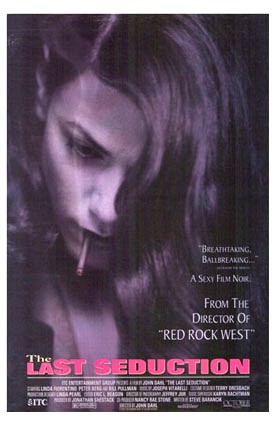
The-Last-Seduction

Written by Rachael Johnson as part of our theme week on Representations of Female Sexual Desire.

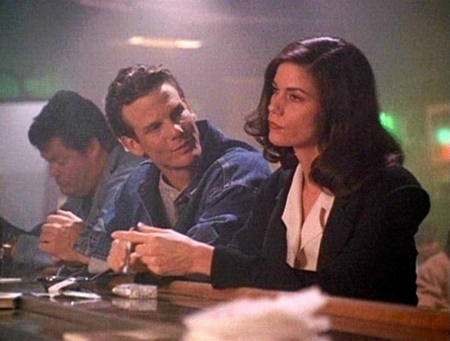
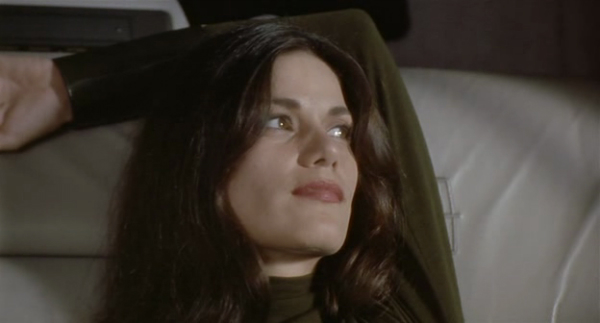
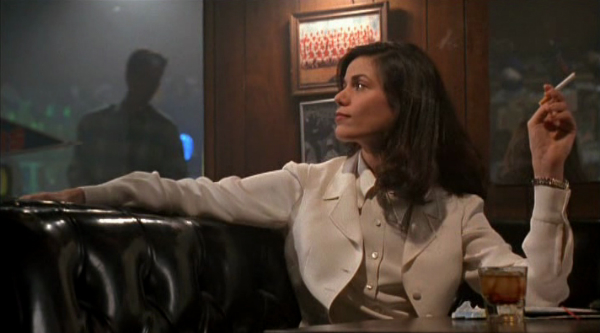
Bridget Gregory is one of American cinema’s great anti-heroines. Flawlessly played by Linda Fiorentino, she is the amoral yet captivating protagonist of John Dahl’s 1994 thriller, The Last Seduction. Fiorentino’s Bridget is a lithe, beautiful woman, and her look evokes heroines of post-war noir. Her sleek, dark hair has a Golden Age cut and style, and a cigarette is never far from her perfect lips. But Dahl’s neo-noir offers an original, post-modern female villain. She’s a femme fatale for the 90s. Bridget is, at heart, a  tough, lone wolf entirely dedicated to serving her own interests and ensuring her self-preservation. A female lone wolf is rare in American movies and one of the pleasures of The Last Seduction is watching her survive and thrive. Bridget is, also, gender-subversive as well as a desiring and assertive erotic subject. It is her sexual subjectivity that enthralls, amuses, and entertains.

Made crystal clear from the very start of the film, Bridget is a colorful piece of work. She’s the manager of a New York telemarketing company, and we first see her taunting and egging on her subordinates with inspirational insults such as “maggots,” “suckers,” “bastards,” and “eunuchs.” Dahl cuts between this scene and another involving a man meeting two younger guys under a bridge. The man, we will discover shortly, is Bridget’s husband, Clay Gregory (Bill Pullman). A medical resident desperately in need of cash, he is presently selling drugs to pay off a loan shark. The dangerous, nerve-wracking deal scores the couple a handsome sum.

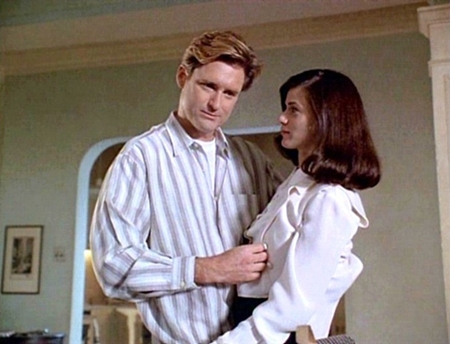
Husband and wife
Clay and Bridget: husband and wife


Clay is also a piece of work. As acquisitive as Bridget, he is also capable of violence. When Bridget later calls Clay an “idiot” back in their apartment for carrying the money around in broad daylight, he strikes her. He makes the cowardly excuse that he was shaken up by the deal, and Bridget fakes forgiveness. When he’s in the shower, however, she runs off with the stash. Before she quits the city, Bridget takes off her wedding ring. The act signifies a rejection of domesticity and traditional coupling as well as a repudiation of age-old ideas of female subservience and sacrifice. It also signals that she will now drive the narrative. Although the act of abuse serves as a trigger, the viewer is, in fact, encouraged to believe that Bridget is motivated by more than vengeance. She wants total mastery of her destiny and will do anything to achieve it.

She flees north. Stopping in a small, characterless town in “cow country,” she drops into a run-of-the-mill bar. A gorgeous, svelte yet foul-mouthed New Yorker, Bridget is perceived as an exotic figure in these parts. A young, attractive man with a pleasant personality and the very ordinary name of Mike, is drawn to her. Mike (Peter Berg) buys her a drink when her ungracious demand for a Manhattan is, quite understandably, ignored by the bartender.

Bridget at a dive bar


Their first encounter serves as an amusing, outrageous antidote to the saccharine meet-cutes of 90s romantic comedies. Bridget initially refuses Mike’s quite ordinary advances in inimitably impolite fashion: “Go find yourself a nice little cowgirl and make nice little cow babies and leave me alone.” But when Mike good-humoredly makes the claim that he’s “hung like a horse,” Bridget offers him a seat. She proceeds to unzip his pants, fondle his dick, probe him about his sexual history, and, then, smell her fingers. Inspection over, the newly acquainted couple head off to his place and spend the night together. The morning after, she heads off without telling him her name or saying goodbye.

Their next meeting, at Mike’s place of work, is pure coincidence. Deciding to lay low in the town, Bridget secures a managerial position at the same insurance company as her new lover, and takes on the name of Wendy Kroy. She wants distance from Mike at work and warns him: “Don’t fuck with my image.” She is, however, more sociable when she meets him again at the bar.

They soon have sex near the dumpster behind the bar. Bridget directs their love-making and plays the more sexually dynamic part. Hanging onto the rails, in an elevated position, Bridget fucks Mike against a fence. With his pants down to his ankles and knees bent, he looks the more vulnerable partner in this al fresco erotic episode. He is also the emotionally vulnerable lover. “Where do I fit in?” Mike asks Bridget. “You’re my designated fuck,” she replies. She later rides him in her car.

Bridget is the femme fatale


Bridget, for the most part, assumes the traditionally dominant position in her love-making sessions with Mike. The filmmakers’ characterization of their female protagonist’s desire is unusual for American cinema. Bridget’s physical beauty is certainly not obscured, but she cannot be characterized as a classic Hollywood sex object. She is, instead, presented as an assertive, dynamic sexual subject. Intense physical pleasure is not bound up with the self-abandonment of romantic love. Nor does it signify psychic self-annihilation. Reproduction, furthermore, does not play a part in Bridget’s world. She and her husband are childless. Love has an ideological import, and it has often, let’s face it, been a trap for women in patriarchal society. Bridget, however, is not confined by love. Sex, for her, is about control, pleasure and play.

Mike, however, falls in love with Bridget and craves a more emotionally intimate relationship. He is flattered that she has chosen him, as he believes himself to be “bigger than this town.” Although he bemoans, in a somewhat boyish way, her arrogance and dominance. Mike realizes, a little late, that Bridget is a dangerous, amoral woman. He calls her “sick” and “deranged” when she suggests they “sell murder” to people (for example, to women who have been betrayed by their husbands), but he is ultimately ignorant of her true intentions. She becomes increasingly calculating with her lover, and he just can’t keep up. Although Mike is horrified when Bridget (falsely) tells him that she has successfully sold murder, he is eventually manipulated into agreeing to kill Clay. Note that Bridget has lied to him about the identity of his target. Mike is unaware that he has been sent to New York to murder Bridget’s husband; he believes his target to be a man who’s been driving old ladies out of their homes. I will not tell you what happens when Mike encounters Clay.

Bridget is winning at her game


Bridget’s treatment of people, particularly men, remains consistently appalling throughout the film, but it goes beyond crude invective and exploitation. Bridget admits to Mike that she enjoys “bending the rules, playing with people’s brains.” She exploits both society’s moral codes and prejudices and takes advantage of the kindness of others. She espouses a certain moral relativism. When Mike says, helplessly, “Murder is wrong,” Bridget counters, “Unless the President says to do it.” In fact, Bridget gains an almost sexual pleasure plotting her clever moves. She screws men both literally and metaphorically.

Bridget’s unbound sexuality and gender-subversive behavior make her evil more interesting and radical. She knows how to manipulate the gender order and succeed in a phallocentric world. She is unfailingly resourceful and supernaturally resilient. In a way, this amoral female protagonist functions to strip patriarchy bare. Her cynical, manipulative words and acts serve to expose the weaknesses and wickedness of men: their insecurities, secrets, and vulnerabilities as well as their aggressive, acquisitive traits.

Bridget, as we have seen, does not conform to culturally constructed norms of femininity. She also manipulates and mocks conventional expectations of gender. Her parodic skills are neatly demonstrated in one short, entertaining scene when she offers cookies to a local detective her husband has recruited. Wearing a lace apron and a smile, she delivers the sweet gift to the man watching her movements in his parked car. He does not, however, see her placing a plank of nails by his tires, and he has only himself to blame when she drives off to an unknown destination.

The Last Seduction does not, of course, endorse a reversal of domination, but the movie makes for a playfully, and knowingly, subversive viewing experience. Although Bridget’s actions should not be read in a literal, man-hating way, female viewers may derive psychological pleasure from watching Bridget’s erotic, self-interested shenanigans. It’s exhilarating to see a female cinematic character take sexual control and outwit her male partners. It makes a refreshing change from watching women suffer the pain of romantic love. We know that Bridget will never be a victim. She will never tolerate domestic drudgery or the compromises marriage brings. In fact, it’s pretty much a given that she will always overcome her opponents. Life is a pitiless yet entertaining Darwinian game in The Last Seduction, and Bridget plays it brilliantly.

An in control Bridget
An in-control Bridget


Fiorentino’s interpretation of our deeply sexy, whip-smart anti-heroine is supremely persuasive. The casting is perfect; the actress should have won an Oscar for her performance, but the movie was shut out of the nominations because it was first shown on cable television before being given a cinematic release. Rules may be rules, but it’s nothing less than a sin that both Fiorentino and John Dahl’s smart, stylish film were deemed ineligible.

The Last Seduction is elegantly shot, well-paced and cleverly constructed. Bridget is the dominant sexual and narrative subject. The story is primarily shaped by her sensual, self-interested needs. If she can be characterized as a feminist cultural icon, she’s an amusing, distinctly anti-humanist one. One thing that’s certain is that watching her at work and play is the cinematic equivalent of an empowering Manhattan cocktail.

Prom and Female Sexual Desire in ‘Pretty in Pink’ and ‘The Loved Ones’

In this piece we focus on prom as a densifying trope for teenage female sexual desire in many cultural representations (think of ‘Carrie,’ ‘She’s All That,’ ‘My-So-Called Life,’ or ‘Glee,’ to name just a few). We are doing so by complementing John Hughes’ rather classic romantic-comedy and “Brat Pack” movie ‘Pretty in Pink’ with the horror/torture movie with comedy elements ‘The Loved Ones’ directed by Sean Byrne – two examples of female desire as imagined by male writers.

This is a guest post by Ingrid Bettwieser and Steffen Loick for our Representations of Female Sexual Desire week.

Girls want relationships, boys want sex. The notion that adolescent girls don’t act on their own sexual desires (and just look sexy) still seems to be a prevailing cultural organizing principle perpetuated by many media illustrations. For us the concept of “Prom” brings together – in a pop-cultural genealogy – diffuse notions of (predominantly) heterosexual teenage desire, depictions of romantic love and binary coupling combined with teen-horrors of social exclusion, acknowledgement and coming-of-age. Prom epitomizes the time and place where sexual subjects/objects of desire are ordered normatively. Individual freedom (not to go to prom but fall out of the place of acknowledgement) and social force (go to prom but subject to normalizing scripts) are negotiated accordingly.

In this piece we focus on prom as a densifying trope for teenage female sexual desire in many cultural representations (think of Carrie, She’s All That, My-So-Called Life, or Glee to name just a few). We are doing so by complementing John Hughes’ rather classic romantic-comedy and “Brat Pack”-movie Pretty in Pink (1986) with the horror/torture movie with comedy elements The Loved Ones (2009) directed by Sean Byrne – two examples of female desire as imagined by male writers.

Pretty in Pink: Prom and female heterosexual desire economized

In Pretty in Pink we follow Andie Walsh, a white working class high school student, whose symbolic entrance into upper class is negotiated in a romantic Cinderella narrative. As the story unfolds it becomes evident that Andie is motivated by economic desire that she can only satisfy through a makeover. In this process she turns from quite independent but socially marginalized teenager to coupled with a “richie” but silenced.

Due to a scholarship Andie attends a private high school and falls for yuppie Blane. The two start dating despite Andie’s geekish best friend Duckie (also a so called “mutant” e.g. working class member), who follows her around quite intrusively and whose love for her is unrequited since she doesn’t show any romantic interest in him. Duckie even warns Andie of the potential sexual motives Blane might have: “He is gonna use your ass and gonna throw you away!” But regardless of any peer skepticism, Andie assumes that hating people because of their money would be some kind of reversed injustice.

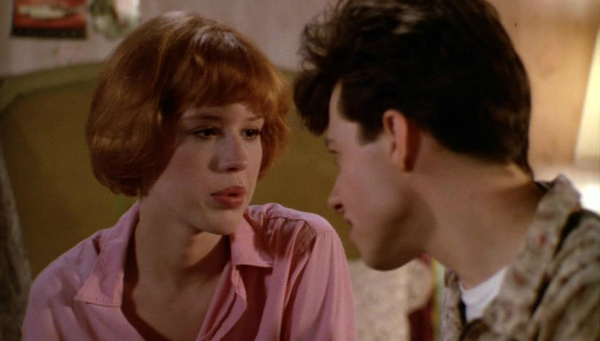
Pretty in Pink: Duckie is no object of Andie’s desire
Duckie is no object of Andie’s desire


After a disastrous date, where Blane’s rich friends humiliated Andie at a party, Blane asks Andie to go to prom with him. This important question leaves Andie utterly speechless and she kisses Blane right away in front of his BMW. Only as soon as she enters her house she screams out loud and tells her father, “I can’t believe it happened!” As if Andie is not entitled to have sexual feelings on her own, she uses a passive voice without seeming to be involved in any action. Being asked to prom and the couple’s first kiss intermingle to a single event that alludes to the sexualization of prom.

But in due course Blane stops answering Andie’s calls and freezes her off because of peer pressure and out of his own doubt in the relationship. After dramatic events, Andie decides to go to prom nonetheless to prove that “they didn’t break” her. Moreover Andie bonds with her elder friend Iona, a strong and creative record store manager, who advises Andie to go to prom in the first place when she questions the necessity of it being a “stupid tradition.” Iona stresses it would be essential in later life: “It was the worst, but it’s supposed to be, you know, you have to go.”

Lamenting her wasted creative talents, Iona asks Andy in another situation, “I am good in bed, should I be a whore?” It becomes clear that sexual abilities are to remain outside the realm of economic usability. In the course of events Iona goes through a transformation from punkish and outstanding to “mom-ish” in order to progress in her own cross-class relationship. When she is dating a “yuppie” she aligns the criteria for her happiness: “He is so nice, he is employed, he is heterosexual.”

Pretty in Pink: Andie cares for her part-time working father
Andie cares for her part-time working father


The desired combination of nice/employed/heterosexual is combined with a degrading of working class masculinities in homophobic modes as inefficient and therefore undesirable throughout the movie–Andie’s father, who hangs around the house during the day, is taken care of by Andie herself as he doesn’t get over the abandonment by her mother; Duckie, who doesn’t seem to be interested in finishing high school is mistaken for a male sex worker in one scene (the character’s sexual orientation/gender is still speculated on as supposedly “effeminate” or “gay”). Iona has an argument with her obviously incapable partner who demands not only house-work and sex but also transportation services and even Blane is “degraded” by his upper class friends as a “faggot” when seen with Andie.

Not so decent Benny and Steff
Not-so-decent Benny and Steff


Andie’s sexually decent behavior is contrasted by upper class Benny, who is obviously sexually active and in one scene tells her boyfriend Steff that she would be “one more step away from virginity” for which he labels her a “slut.” Andie’s character, however, doesn’t seem to be sexually motivated at any time and instead rather marked by protestant chastity. Female sexual desire is not absent here; it is told as economized and rationalized desire that can be satisfied through expressive self-entrepreneurship and working – even on a prom dress. Material wealth as represented here is therefore fetishized but corrected in its moral degeneration via Andie’s display of female sexual decency and DIY diligence. In order for her not to be labeled a “slut,” she cannot display sexual agency.

Andie's father gives her a pink prom dress
Andie’s father gives her a pink prom dress


In the end Andie creates herself an outfit out of two pink prom dresses–one of them given to her by her father, the other one being her friend Iona’s old dress. After days of working Andie goes to prom alone where she is met by Duckie and they walk in together as friends. As soon as Blane spots Andie he comes along and tells her he would’ve always believed in her whereas she didn’t believe in him. (Which is pretty implausible considering his behavior.) With Duckie’s approval, Andie finally follows Blane to the outside parking lot without many words. The movie ends with their final uniting kiss.

Final kiss
Final kiss


Prom and the monstrosity of female sexual desire: The Loved Ones

The Loved Ones (1999) could have been the ultimate feminist revenge-fantasy I have long craved. I imagined the film to be an utopist notion against the always similar plot-narrative of prom night as a heterosexist spectacle of the male desire. The heroine does not transform into a beautiful “swan,” the mandatory happy ending does not occur, and the anticipated couple does not find each other. Instead, a nerd-stereotyped boy experiences in a subplot that the reality of actually going to prom with the female object of desire is sad, awkward, and leaves a hollow feeling.

The film torpedoes the classical structure of the prom night narrative from the beginning: The female main character Lola, who is orchestrated to appear as unimposing and weird in her first scene, asks her crush, the melancholic school-bad boy Brent, to the ball herself. She is active and autonomous and waiting for a boy to ask her seems not to be an option. After Brent rejects her request, she secretly observes him having oral sex with his girlfriend in a car. Lola’s face is rigid and empty. In the next scene we find her sitting in her pink-colored room, gluing Brent’s yearbook-picture into her scrapbook. She even paints a heart around his face. While doing this Lola listens to a song of the singer/songwriter Kasey Chambers, which might become the hymn of the next generation of sad teenage girls: “Am I not pretty enough? Is my heart still broken? […] Why do you see right through me?”

One finally realizes that this self-dramatization as the sad outsider girl is just a performance when her father gives her a pink dress with matching shoes as a present. Unlike in Pretty in Pink, the dress scene takes places in a very early stage of the storyline, but it’s also one of the most important scenes of all. Thrilled Lola tries on the dress in front of her mirror, while her father – whom she tells to stay – watches her from the door. This two-sided lustful action, posing and watching, marks Lola via the insinuation of father-daughter incest, one of the most far-reaching narrative taboos, as sexually monstrous.


The moment of transformation: Lola and her dress


The pink dress simultaneously initiates her transformation: Lola shifts to a bloody prom queen and anti-heroine who acts out sadistic desires in a series of violent acts against Brent’s body. They are all bizarre persiflages of prom rituals. She carves her initials into Brent’s chest, after the obligatory posing and picture-taking and pretends to dance with the enamored boy, whose feet are nailed to the floor while her father showers them in glitter.

Lola experiences lust through torture


These tableau viands of violence begin with the annexation of Brent: The drugged and kidnapped boy wakes up wearing a smoking jacket in a kitchen tied to a chair. The room is decorated with balloons, there’s even a disco ball at the ceiling. Lola moves close and injects him something that suppresses his ability to talk. Brent, by the way the actual hero of the story, becomes a victim; he has to remain silent and subject to Lola’s haphazard power. This increases Lola’s lust and her desire to put him at the center of her enactments of torture, pain, and degradation.

A grotesque version of prom night pictures


Unfortunately this is not about taking revenge for all the rejected high school girls. The film points out clearly that father and daughter have done this before and that especially Lola is a sheer monster. Not because her violence seems to have no boundaries–Lola is finally portrayed as completely monstrous when she becomes less sexually devoted to Brent, who starts to resist her. In the course of them dancing together, she admits to her overwhelmed father: “Your are the prince, that’s why I can’t find what I want. It’s you, it has always been you, Daddy.” The indicated kiss between them is stopped by Brent, who escapes and kills Lola’s father, what finally marks the restoration of sexual normativity and social order respectively.

Monstrous desire: Lola and her father


In the end Lola represents abnormity, because she has violently abandoned her family. She not only cut the ties to her mother, like Andie does in Pretty in Pink, she also lobotomized and killed her. Lola’s sexual desire toward her father led to his death by Brent’s hand. When she is eventually killed by Brent and his girlfriend, it seems like the only plausible solution: disappointment. Not only is The Loved Ones not a feminist film, it’s also not a revenge-fantasy or even a film about a cool, crazed, pink female killer. It’s about a path of ordeals of a young man, who finds – after rightfully killing his sexually deviant female torturer – his long lost place in society with a more or less silent girlfriend.


Steffen Loick is doing his PhD on the relationship between gender identity and body optimation at Ludwig-Maximilian University in Munich, German. Ingrid Bettwieser just finished school and works as an extracurricular educator at a memorial in Berlin, Germany.

‘A Streetcar Named Desire’: Female Sexuality Explored Through a Bodice-Ripper Fantasy Gone Awry

‘A Streetcar Named Desire’ (1951), a classic movie based on a Tennessee Williams play, presents how society shapes, shelters, and shames female sexuality. Williams is well-known for writing plays that dealt with the gender-specific issues women faced, sympathizing with the way women were kept from being whole and balanced human beings.

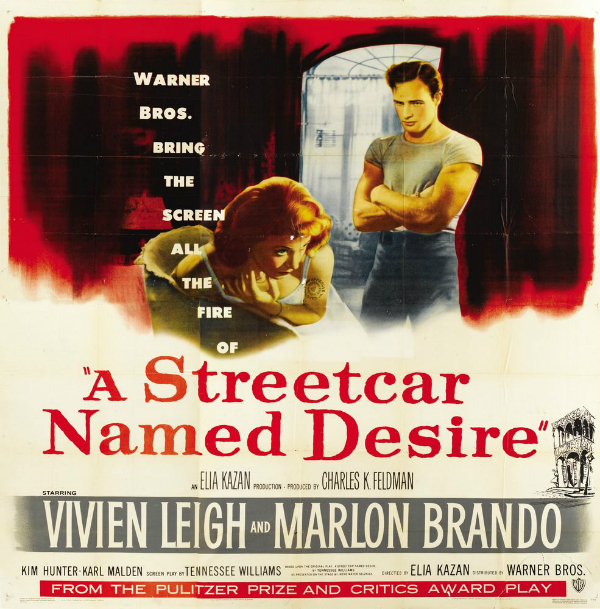
'A Streetcar Named Desire' poster
A Streetcar Named Desire poster

This guest post by Nia McRae appears as part of our theme week on Representations of Female Sexual Desire

For better or worse, sexuality can be deeply influenced by social expectations. Even with the independence women have gained, it’s been reported that one of the top fantasies women have involve being dominated by a man in the bedroom. There’s nothing wrong with that, but what does it say about our biology, or social conditioning, or both? A Streetcar Named Desire (1951), a classic movie based on a Tennessee Williams play, explores this question. It presents how society shapes, shelters, and shames female sexuality. Williams is well-known for writing plays that dealt with the gender-specific issues women faced, sympathizing with the way women were kept from being whole and balanced human beings.

Stanley Kowalski is probably the best remembered character Marlon Brando played in the early part of his acting career. The female gaze shows up in different forms regarding the character of Stanley Kowalski. Stan’s body is the one that is objectified. Kim Hunter’s Stella exhibits whatever the female equivalent is of “thinking with your penis,” because she’s both excited and hypnotized by his ruggedness and looks. Blanche, played by Vivien Leigh, isn’t unaware of his physical charms either. When Blanche first meets Stan, the camera operates as Blanche’s eyes, admiring the way muscle-bound Stan looks in his tight, sweat-stained clothing. It is unmistakably not love at first sight but lust at first sight, which is surprising because a woman being depicted as having the same carnal desires as a man was unheard of in the 1950s.

Stanley and Blanche
Blanche and Stanley: lust at first sight


Marlon Brando’s performance is the main aspect that gets talked about (understandably so), but the way female desires are acknowledged is impressive too. Movies during Hollywood’s Golden Age usually catered to the stereotype of only men being sexual creatures. Women were only shown as using sex to receive gifts or money or marriage, never enjoying sex for the sake of sexual gratification. Marilyn Monroe is a great example of this. She is considered one of the most famous sex symbols of all time but as was expected of women in her time, she was always shown as the object of desire and never the person desiring. In movies, her characters were typically ogling material things a man had, never the man himself. Of course, maybe if her leading man was Marlon Brando, it would have been different.

A topless Marlon Brando as Stanley

Before the audience can become too transfixed by Stan’s looks, the movie wisely demonstrates that what works as a lustful fantasy may backfire in real life. Stan doesn’t keep his wildness contained like Stella prefers which leads to devastating consequences by the end of the movie (I’ll revisit this later). At a card game with his friends, he smacks his wife on the butt and she chastises him. She tells Blanche afterwards that she doesn’t like when he does that in front of company, implying that she only approves of spanking when they are alone. It can be deduced that, like a lot of women, Stella wants “a gentleman in the streets and a caveman in the bedroom.” In an example of life imitating art, Marlon Brando explained in an interview once that many of his paramours requested he be “Stanley” during intercourse.

The problem with Stan is that he isn’t playing the part of a caveman simply to titillate his wife. He really is a caveman; he’s emotionally stunted, he’s insecure. and he’s short-tempered.

Stanley loses his temper. Stella and Blanche cower.


He’s everything patriarchy tells him a “real man” is supposed to be and Stella is both seduced and repulsed by it. Whenever he goes too far, she runs away but she always returns back to him. It can be argued that the wife keeps running back to Stan because she is blinded by love. But realistically, love involves respect, which she doesn’t have for him. Stan seems to be viewed by his wife as only good for two things: love-making and money-making. She laughs at his attempts at being smart. For example, when Stan tried to explain to her what a “Napoleonic Code” is, she responds like someone who is humoring a baby’s nonsensical ramblings.

Along with her sister, Blanche can be condescending to Stan too. Her condescension is more obvious than Stella’s and in one scene, Stan blows up at Blanche for talking down to him. This type of dynamic is usually gender-flipped. Stan is the male equivalent of the bimbo archetype; he’s eye candy that the sisters enjoy looking at and possibly sleeping with and not much else. He’s not too bright but that doesn’t matter because the wife clearly didn’t marry him for his mind. She’s the one with the brains, which is evidenced again in one scene where she explains to him what rhinestones are. She’s married to a man who doesn’t respect her and who, honestly, she doesn’t respect either. Their marriage seems to be based on carnal feelings only. So, the more accurate description of what Stella feels for Stan is lust.

Stella is living in a bodice-ripper fantasy gone awry. There’s a part in the movie where, after a night of seemingly amazing make-up sex with Stan, Stella regales Blanche about her and Stan’s wedding night, explaining that he broke all the light bulbs and how that “excited” her.  Blanche tries her best to talk sense into her, reminding her of the importance of valuing civilization and gentleness over barbarism. Just when it seems like Blanche is getting through to her, in walks Stan with something that is framed as more powerful than reason–animal magnetism. The camera works as Stella’s eyes, admiring how he looks in grease-stained tank top, sweaty from his mechanic work. Stella ogles him and jumps into his arms as if to suggest she’s ready for another round of make-up sex.

But even if Stan is treated like a sex toy, he’s not willing to be quiet like one. He’s boisterous, rude, entitled, and disrespectful to both Blanche and Stella. Much like a child who is willing to either scream or cry to get his way, Stan is not above resorting to theatrics to win her favor which is evidenced in the iconic scene where Stan drops to his knees, tears his shirt open and screams “STELLA!” which is followed by her walking sensually down the stairs and embracing him.

Stanley and Stella sensually embrace


While it’s great that female sexuality is being presented, it can be argued that this movie is doing the time-honored tradition of only presenting female sexuality in order to condemn it. Does this movie want us to use Stella as a lesson on why it’s wrong for women to embrace themselves as sexual creatures?

I think the answer can be found in the scene where Karl Malden’s character, Mitch, finds out that Blanche has a past. He slut-shames her, likening her to damaged goods even though, up until now, he had been depicted as a nice and understanding guy. But even though Malden shames her, Blanche is never framed as the bad guy. It’s easy to sympathize with her character as someone who wasn’t given the proper tools in life to handle tough situations. Her sexuality isn’t the enemy, it’s her naiveté that is. A Streetcar Named Desire makes an important point about the importance of teaching your daughters to be self-sufficient. It is hinted at that the sisters grew up sheltered and privileged, causing them to be immature and emotionally undeveloped. Once her husband committed suicide, Blanche looked for love in all the wrong places. And in a society that teaches women to be fantasies, Blanche unquestioningly avoided being true to herself.

Stella, on the other hand, rebelled in an unhealthy way. She embraced the cruelties of life in the form of Stan. Neither sister found balance because men and women weren’t conditioned to be whole people. When Stan criticizes Blanche, Stella defends her and explains she’s fragile and broken from mean people being so harsh to her. This scene gives us further insight into Blanche. She enjoys creating a fictional world rather than facing the harshness of reality. As many middle to upper class white women historically were, she was babied and it kept her from learning how to be a stable adult. By the end, adding to the theme of barbarity smothering gentleness, Blanche is raped by Stanley, which utterly destroys any mental stability she had left.

Stanley did it because he resented Blanche thinking she was smarter and better than him. Finding out about her soiled past made him feel entitled to harming her. After all, traditionally, an unmarried woman who is impure is worthless. The sexual assault is his twisted way of reclaiming manhood by destroying her spirit–this confirms he is patriarchy personified. Blanche’s ending line is one of the most often quoted: “I’ve always depended on the kindness of strangers.” Part of Blanche’s tragedy is that she was too dependent on other people taking care of her. She was never allowed to grow and take care of herself. That’s why I don’t think the movie is condemning female sexuality but more so showing female sexuality as a reality in the lives of two sisters whose sheltered upbringing and gendered socialization influenced them both to make questionable life choices.

Maybe if she lived in today’s America, Blanche could have learned to be self-reliant and to engage in sexual activity for gratification rather than self-esteem. Unfortunately, slut-shaming would still be a reality but at least she could be empowered enough to better handle it and stand up for herself. And maybe if raised differently in a more enlightened era, Stella could live out her bodice-ripper fantasy with a man who behaved properly outside the bedroom.  The men suffer too. Stanley’s insecurity is driven by being the product of an unhealthy definition of masculinity. By the end of the movie, it’s obvious that Mitch still cares for Blanche but his sexist ideas about female purity stifles his chance with her. Maybe if he lived in a more enlightened era, his knee-jerk reaction to Blanche’s past promiscuity wouldn’t have been so rash and backwards.

Overall, Streetcar is showing the downfalls of letting lust eclipse your reason while doing the rare thing of showcasing female sexuality in the context of a society that dismissed and condemned it. Tennessee Williams was a gay man who is noted for having a great deal of empathy toward women. He also knew the frustration of living in a time period that demanded his sexuality be repressed (except in his case it wasn’t due to his gender but due to his sexual orientation). That’s why A Streetcar Named Desire shouldn’t be dismissed as another cautionary tale that warns women not to embrace desires. On the contrary, this is a story that condemns society for keeping women from being stable, whole, and sexual human beings.

Catherine Breillat’s Transfigurative Female Gaze

The grotesque is enmeshed with sexual pleasure and violent death–all images and storylines that patriarchal cultures have been weaving together for centuries. A woman’s sexual desire and her actions stemming from those desires are often presented as horrifying and punishable: “unwatchable.” Much of what Breillat shows supports the reality that female sexual desire is real, and the societies in which we must function are at best, uncomfortable with that desire, and at worst, violently hostile.

Written by Leigh Kolb as part of our theme week on Representations of Female Sexual Desire.

“… a person who can find the transfiguration of sex in her life is no longer a person who can be directed.”

– Catherine Breillat

French filmmaker Catherine Breillat has spent her career exploring female sexuality. She hasn’t done so in a comfortable, easy way. When The Woman says to The Man, “Watch me where I’m unwatchable” in Anatomy of Hell, this could very well be Breillat’s message to her audiences as she presents female desire in harsh, jarring narratives that completely subvert the male gaze.

Normally, if we talk about subverting the male gaze and focusing on the female gaze in film, it’s cause for celebration. Finally! We scream. We’re coming!

Breillat’s female gaze is different, though. It pushes us to places of complete discomfort and sometimes disgust, and forces and challenges us to think about the deeply twisted cultural expectations surrounding women and sex.

Sometimes a shock is what it takes to bring us to places of transfiguration. We can’t smoothly transition to the female gaze after centuries of being surrounded and objectified by the male gaze. Breillat delivers shock after shock that serve to transfigure how we see ourselves and our culture. This isn’t comfortable, but it’s powerful.

The grotesque is enmeshed with sexual pleasure and violent death–all images and storylines that patriarchal cultures have been weaving together for centuries. A woman’s sexual desire and her actions stemming from those desires are often presented as horrifying and punishable: “unwatchable.” Much of what Breillat shows supports the reality that female sexual desire is real, and the societies in which we must function are at best, uncomfortable with that desire, and at worst, violently hostile.

A Real Young Girl (Une vraie jeune fille)


Breillat’s first film, based off her novel, Le Soupirail, was A Real Young Girl (Une vraie jeune fille). Produced in 1976, it was quickly banned and wasn’t released in France until 1999. The film centers around 14-year-old Alice, who is discovering and attempting to navigate her sexual awakening. A Real Young Girl is avant-garde puberty.

[youtube_sc url=”https://www.youtube.com/watch?v=z4FXxS9VevE”]

There are moments in the film that are confusing and grotesque (most notably one of her fantasies that involves barbed wire and a ripped-up earthworm). While I found some of these scenes disturbing, I like being disturbed. The worm scene horrified me at first, but then I realized that when I was in high school, the hit teen comedy involved a dude literally fucking a pie. Teenage sexuality is weird and when we are faced with a teen girl’s sexuality–something we are not used to seeing (unless she is a sexual object)–in all of its confusion and vacillation between intense desire and disgust, we are uncomfortable. Breillat wants us to be uncomfortable; she wants to push us to the edge to that visceral experience that will challenge how we see both female sexuality and film depictions of female sexuality.

Fat_Girl_poster
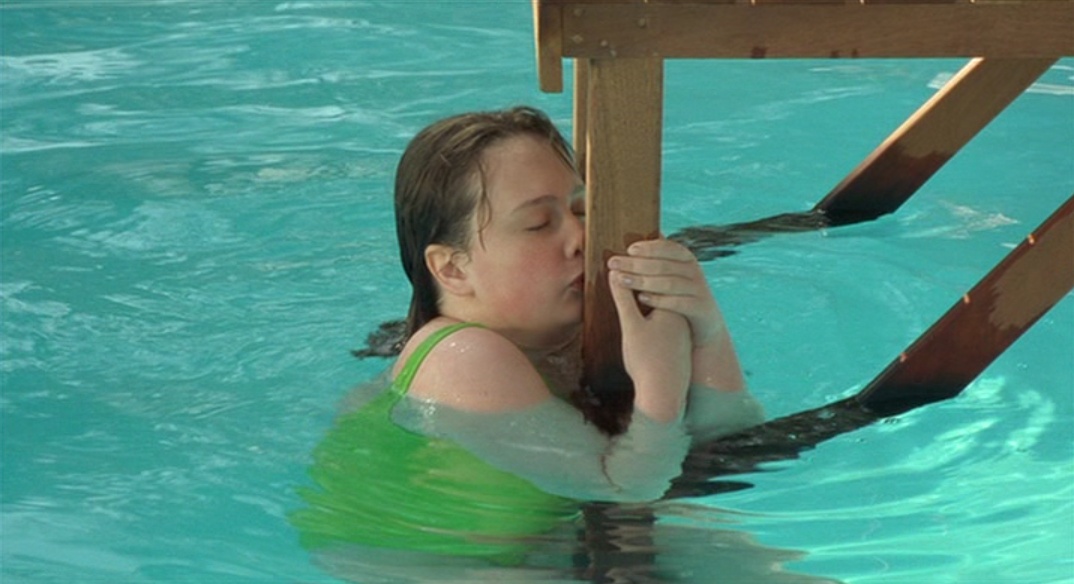
Fat Girl (À ma sœur!)


Fat Girl (À ma sœur!), released in 2001, follows two sisters–Elena, 15, and Anaïs, 12–as they vacation with their parents. Elena is conventionally beautiful, and while she likes boys and has experimented sexually, she wants to remain a virgin until she’s with someone who “loves” her. She quickly develops a relationship with a young man who is frustrated with her desire to not have sex. He pressures her into anal sex (which hurts her), tries to force her to have oral sex, and finally convinces her he loves her and she has sex with him. In all of these instances, Anaïs is in the room–feigning sleep, asking them to stop, or, when they finally have sex, crying.

Anaïs’s views on sex are very different than Elena’s. She is starting to feel sexual–she’s not a teenager yet, but she’s not a child. Her desires range from banana splits to having sex just to get it over with. She has sexual desires, and her responses to Elena’s sexual experiences show both naiveté and jealousy. Their ages, their exterior looks, their sexual experiences (or lack thereof) all inform Breillat’s treatment of the sisters’ relationship with one another, with their own burgeoning sexuality, and with a culture that insists on sexualizing Elena and ignoring Anaïs. Their desires–Elena as internalized (and then disappointed) object, Anaïs as frustrated subject–are common categories for adolescent girls to fall into.

[youtube_sc url=”https://www.youtube.com/watch?v=rHRJRbM2EAg”]

Fat Girl (read Breillat’s commentary on the title here) is disturbing in its depictions of some of Elena and Anaïs’s experiences. However, the end of the film is shocking and violent. After Elena and her mother are brutally killed at a rest stop, the murderer rapes Anaïs in the woods. The next morning, she tells the police she wasn’t raped, and she looks at the camera, in an ending that clearly reflects The 400 Blows. Like the Truffaut classic, we are saddened and disturbed at the life trajectory of our young protagonists, and have no idea where their lives will go from here. We just have a frozen young face staring at us, implicating us in their fate.

Anaïs, at the end, seems to embrace her rape (as her meaningless loss of virginity that she wanted) and deny its violence. This is made even more traumatic since her rapist murdered her mother and sister (her sister who had just become sexually active, and her mother who wanted to punish her for it).

The message here is that girls cannot win. A patriarchal culture–full of boys who think they’re entitled to sex and men who violently rape and kill women–cares little for female desire and agency. This world is a dangerous place for girls. This world treats pretty girls like objects, and unpretty girls like nothing. Their desires are complicated and real, but are eclipsed by toxic masculinity.

Anatomy of Hell (Anatomie de l'enfer)
Anatomy of Hell (Anatomie de l’enfer)


Released in 2004, Anatomy of Hell (Anatomie De L’Enfer) is a film that pulls together pornography, misogyny, and female sexuality in a way that shocks and disgusts (male reviewers in particular wrote scathing, condescending reviews of the film). The Woman visits a gay bar and attempts suicide in the bathroom–she is tired of being a woman and being hated by men, and surmises that gay men hate women the most. The Man, however, saves her and she offers to pay him to stay in her home for four days to “watch her where she is unwatchable.” What follows is, for some viewers, unwatchable.

The Woman is naked for most of the film (a body double is used for vaginal shots), and The Man is played by an Italian porn star. His homosexuality serves to completely upend the typical male gaze. He’s disgusted by much of what he’s seeing and experiencing, and the understanding that this primal, visceral, shocking female desire is at the focus of the film (and has absolutely nothing to do with male desire) reflects a culture that typically focuses only on the male gaze and male pleasure. In this culture, female sexuality isn’t a consideration.

[youtube_sc url=”https://www.youtube.com/watch?v=BbFSZiT2-a4″]

When The Man drinks a glass of water with a used-tampon teabag, certainly the audience is meant to feel disgust. Perhaps some audience members actually gagged at the sight. How many scenes, however, in porn (explicitly) or mainstream film (suggested), feature women swallowing male excretions? Do we blink? Or is it just part of what we expect it means to be a heterosexual woman?

Jamie Russell astutely observes at the BBC, “For all the shocks, though, this is a stoically serious movie: it’s anti-porn, a transgressive sex movie that’s not against pornography but against the (male-dominated) objectification of women’s bodies.”

Breillat’s complete oeuvre (which certainly demands our attention beyond these three films) delivers continually shocking treatment of female sexuality presented though the female gaze. She wants us to be uncomfortable and to be constantly questioning both representations of female desire and our responses to those representations, and how all of it is shaped by a religious, patriarchal culture.

In an interview with The Guardian, Breillat articulated that her female gaze should directly threaten the male gaze, and that men should examine their own sexuality in the face of female desire:

“It’s a joke – if men can’t desire liberated women, then tough. Does it mean they can only desire a slave? Men need to question the roots of their own desire. Why is it that historically men have this need to deny women to be able to desire them?”

The reporter points out that Breillat had said “that censorship was a male pre-occupation, and that the X certificate was linked to the X chromosome,” and Breillat goes on to discuss the religious and patriarchal reasons to censor female desire, which is directly connected to keeping power away from women.

Breillat’s 1999 Romance was originally given an X rating (or banned in some countries). At Senses of Cinema, Brian Price notes that “Breillat’s statement was echoed in the French poster for the film, which features a naked woman with her hand between her legs. A large red X is printed across the image, thus revealing the source of the trouble: a woman in touch with her own sense of sexual pleasure.”

Romance
Romance


And that’s always the problem, isn’t it? Breillat’s work pushes boundaries and forces us to live in the intense intimacy and discomfort of a female gaze that we are unused to due to social oppression of women and women’s sexuality (at the hands of patriarchal religious and government systems). The literal and figurative red X over Breillat’s work–and female sexuality–needs to be stripped away to reveal what’s underneath–which isn’t always pretty.

[youtube_sc url=”https://www.youtube.com/watch?v=jpH-V6kkOwI”]

___________________________

Leigh Kolb is a composition, literature, and journalism instructor at a community college in rural Missouri.

Of Phallic Keys and Ugly Masturbation: Let’s Talk About ‘Mulholland Drive’

That’s right, you guys. I’m gonna try to analyze ‘Mulholland Drive’ for sexual desire week. I do this partly out of love for you, and partly out of hate for me. Let’s get this party started.

Written by Katherine Murray as part of our theme week on Representations of Female Sexual Desire.

That’s right, you guys. I’m gonna try to analyze Mulholland Drive for sexual desire week. I do this partly out of love for you, and partly out of hate for me. Let’s get this party started.

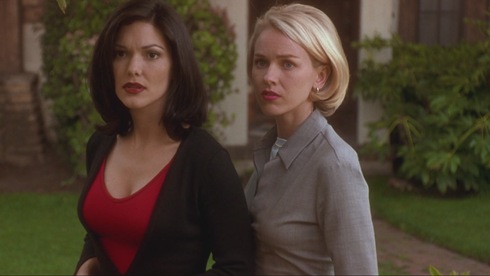
Laura Harring and Naomi Watts star in Mulholland Drive
Laura Harring as Rita/Camilla and Naomi Watts as Betty/Diane

Mulholland Drive (2001), more colloquially known as “Mulholland WTF Did I Just Watch?” is a story told in two parts, both of which were written and directed by David Lynch.

In the first part, Laura Harring plays Rita, a woman who escapes attempted murder but ends up with amnesia and doesn’t remember who she is or what’s going on. She stumbles across Betty (Naomi Watts), a plucky go-getter and brilliant actress who’s come to LA to launch her career, and Betty decides to Nancy Drew this thing by helping Rita piece together her identity. Along the way, they discover the body of a woman named Diane, who killed herself, and briefly run across an actress named Camilla who’s cast in a leading role as result of mob-related conspiracies.

Betty and Rita start a sexual relationship and go to a creepy post-modern theatre where everything is a facade. Then, Rita finds a magic blue box, and stuffs a key inside, at which point all of the characters and plot points go through a blender and the story starts again.

This time Naomi Watts is playing Diane, a failed actress who’s in love with her much more successful best friend, Camilla (Laura Harring). Camilla’s dating a man, which makes Diane insanely jealous, and, when she finally can’t take it anymore, she hires a hitman to murder Camilla and then feels guilty and shoots herself.

The most straightforward interpretation of the movie – and therefore, the one I will steadfastly cling to – is that the second story, about Diane and Camilla, is “true,” whereas the first story is a fantasy created by crazy Diane as a way to escape from her pain.

The first story shows Diane’s alter-ego, Betty, as being capable, likable, talented, and charming. She totally kills her first audition (even after being placed in an awkward position by her co-star), she lives in a beautiful apartment (owned by her aunt, who isn’t present), and she has a timeless, youthful appearance that invokes the sense of an earlier era.

Diane’s idealized version of Camilla is Rita, who takes her name from Rita Hayworth, also invoking the sense of an era gone by. In contrast to Betty, Rita is vacant and dependent, constantly deferring to Betty’s judgement and praising Betty’s abilities without offering any ideas of her own. She’s also the one who initiates their sexual relationship, which frees Betty/Diane from having to feel responsible for it.

The first two thirds of the movie, then, is a story about the way things should have been, from Diane’s perspective – the way, perhaps, that she imagined they would be, before her youthful optimism was crushed by the film industry. So, what do we make of the fact that Diane’s such a creepball?

The blue box of mystery in Mulholland Drive
The box of confusion

Because, make no mistake, now – Diane is a creepball. She behaves in a way that makes Camilla uncomfortable; she pretends to be Camilla’s friend while simmering with hatred, envy, and jealousy from the sidelines; she has Camilla killed (which is creepball enough); and her ultimate fantasy is one in which Camilla’s not even a person, but rather a prop in a story about how great Diane is. To drive it all home, the second story treats us to a long, ugly scene where Diane angrily cries while she masturbates, because that’s what her life has become. She is president of the Friend Zone, but the lesbian aspect adds an extra layer of discomfort.

The first part of the film, with Betty and Rita, feels uncanny and bizarre, like you’d expect from a David Lynch movie. You’re not going to sit there and think, “My, what a beautiful love story that isn’t unnerving at all,” but there’s a sense in which the lesbian romance is not a big deal. You’re just watching two attractive, basically likable people, with no secret, evil agendas, who decide to get it on. It’s a nice change from the way lesbianism was portrayed as sinister and corrupting in Ye Olde Hollywood – and that change lasts exactly as long as it takes for Rita to stick a key in a box and uncover the truth.

I haven’t checked to see, but I bet there’s a paper out there about what it means that one of the lesbian characters discovers her true identity as a straight woman after sticking that key in the box. I’m just saying. I won’t subject you to that kind of symbol analysis, but I do think it’s significant that, after we’re shown such a nice, cuddly picture of lesbian intimacy – like, almost right after – it turns out that Diane is a creeper who’s destined to wind up alone.

The trope of the lesbian friend who weasels her way into your life while secretly creeping on you is something that’s on the way out, but it still exists. You can see it, for example, in Notes on a Scandal, where Judi Dench pretends to be friends with Cate Blanchett while secretly stealing her hair. Somehow, she ends up looking like more of a creep than the woman who’s having sex with a 15-year-old boy.

The question for Mulholland Drive – and I confess that I don’t know the answer – is whether we’re supposed to see Diane’s situation as being universal to the human condition, or as being specifically wrought by her sexual preference. In other words, is this a story about envy and disappointment – the illusions we hold about ourselves, our regret when we don’t live up to our own expectations, our sense of being duped by the images we grew up watching on TV – or is it a story about how lesbians creep on their straight friends? Is Diane’s desire supposed to be creepy because she objectifies Camilla and wants to strip her of agency – because she feels entitled to have Camilla belong to her in a way that is creepy, regardless of gender – or is her desire creepy because she’s a girl?

I think it’s possible that the answer to all of those questions is, “Yes.” Mulholland Drive is a movie that, in many ways, could be about anyone but that, in being about a lesbian, connotes something different than if Diane were, instead, a straight man (or a woman in love with a man – or any other combination there might be). Notwithstanding recent events, as a culture, we’re much more relaxed about men who want to possess women than we are about women who want to possess. The experience of wanting something that doesn’t want you back is filtered very differently, depending on how much privilege we have, and Diane is rejected in a specifically woebegone, Hollywood lesbian way – a way that is, sadly, in keeping with the golden age of cinema she thinks she wants to resurrect.

That said, Mulholland Drive doesn’t feel like its trying to say something really self-reflexive and insightful about the way lesbians have historically been portrayed in film – it feels more like Diane is just creepy. But her creepiness is only one layer in a multi-faceted approach to character that touches on Big Themes of longing, regret, and self-hatred – so, it’s both. It is both a story about our universal humanity, and how lesbian friends are the worst. Complete with phallic keys and ugly masturbation.

Recommended Reading: After Ellen’s review of Notes on a Scandal, AMC’s blog post: Movie History – Why Are There So Few Lesbian Romance Films With Positive Endings?


Katherine Murray is a Toronto-based writer who yells about movies and TV on her blog.

‘But I’m a Cheerleader’: Stripping Away the Normalcy of Heteronormativity

‘But I’m a Cheerleader’ literally queers the stereotype of the popular cheerleader going steady with a handsome football player. The film’s overt display of oppression over queer sexuality speaks to the dominant patriarchal society that strives to eliminate all non-normative ways of living.

'But I'm a Cheerleader' movie poster
But I’m a Cheerleader movie poster


This guest post by Abeni Moreno appears as part of our theme week Representations of Female Sexual Desire.

But I’m a Cheerleader literally queers the stereotype of the popular cheerleader going steady with a handsome football player. Natasha Lyonne, who plays the main character, Megan, is confronted by friends and family who suspect her of being the “L” word. That’s right…a lesbian. Megan keeps provocative pictures of women in her locker, despises kissing her boyfriend and sexually fantasizes about her cheermates. It is then that she is sent off to a correctional program called “True Directions.”

But I’m a Cheerleader‘s overt display of oppression over queer sexuality speaks to the dominant patriarchal society that strives to eliminate all non-normative ways of living. In this case, the film focuses on Megan’s experience of discovering her queer sexuality ironically through her participation in “True Directions.” There she meets love interest Graham, Clea DuVull, who is portrayed as the bad girl with a trust fund. It is within their romantic involvement that the film makes painfully apparent conversation therapy fails miserably. Both characters find love and sexual desire in a place that is made to consist of homophobia, stereotypes, and internalized gender roles.

Graham and Megan find love in 'But I'm a Cheerleader'
Graham and Megan find love in But I’m a Cheerleader


But I’m a Cheerleader exaggerates gender-“appropriate” color schemes throughout the film, presenting the audience with the ridiculousness of assigned gender roles that people are expected to embody throughout their lives. The Pepto Bismol pink and baby blue uniforms along with the decorated living quarters help illustrate the defined “normalcy” of gender and sexuality often forced upon people by our society. When Megan arrives at True Directions, she is unaware that her sexual fantasies about women and undesirable boyfriend are “abnormal.” The definition of normal is pushed even further when a more tender, intimate, and sensual love scene between Megan and Graham is highlighted as beautiful and loving. In comparison, Megan and her boyfriend are sloppy, awkward, and unaffectionate. But I’m a Cheerleader shows heterosexuality as mundane and unattractive. The film’s focus on a woman sexually desiring another woman is a creative protest of normative sexuality.

The film challenges other forms of gender/sexual expectations. For example, an androgynous character named Jan realizes she is heterosexual during a group therapy session. Her epiphany brings up a vital point that we should not pre-judge and  categorize other people’s sexuality based on their gender, whether it be butch, feminine, trans*, etc. Jan states, “Everybody thinks I’m this big dyke because I wear baggy pants …play softball and I’m not as pretty as other girls, but that doesn’t make me gay… I like guys.. I can’t help it.” The other characters believe Jan is in denial because her outer appearance is masculine. Mike (RuPaul) even bluntly suggests, “Who is she trying to fool?” But I’m a Cheerleader uses Jan to comment on the way people label their peers and define their ways of love and sexuality for them even within the queer community.

Jan But I'm a Cheerleader

Overall, But I’m a Cheerleader shows that there are few safe spaces for alternative sexuality and desire. The characters suppress their identities during their time at True Directions, showing how society often leaves little space for the queer community to be open and out. Megan and Graham hide their relationship, Sinead uses aversion therapy and Andre fails at being butch. These are all common obstacles that many people can relate to. Plus, the film’s 1950s nuance and decor displays the decade’s reputation for the nuclear family and cisgender children as commentary on a time where the majority of the queer community was not out and proud but underground. But I’m a Cheerleader makes it clear that we sometimes internalize discrimination and homophobia to try to fit in. But in the end, we can’t change who are or how we love no matter how much we try to drown ourselves in pink clothes and do our best to throw a football. It’s inevitable that we will break out of the 1950s definition of “normal” that seeks to determine sexual desire and lifestyle.


Abeni Moreno is a Chicana feminist and a recent graduate from California State University Long Beach. She is also a volunteer radio host at Kbeach Radio and KPFK in Hollywood California.

The Sin of Sexuality: Desire in ‘Philomena’

Sex is everywhere and nowhere in ‘Philomena.’ Sex is the reason that the titular heroine is sent to Roscrea as a young woman, to have her illegitimate baby behind closed doors. Sex is also the reason that Philomena’s son, Anthony, is adopted out to an American family even though his mother is still living.

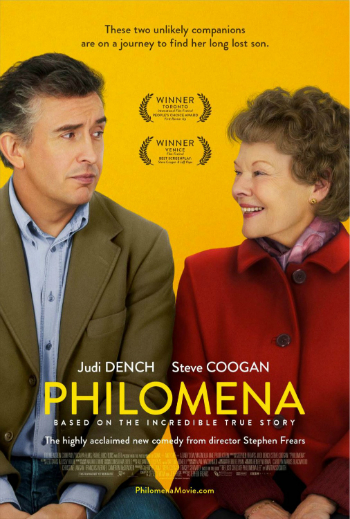
'Philomena' movie poster
Philomena movie poster


This guest post by Caitlin Keefe Moran appears as part of our theme week on Representations of Female Sexual Desire.

Philomena, directed by Stephen Frears, tells a recognizable story: a mother searches for the child she gave up for adoption in her youth. What complicates this recognizable story is that this isn’t the story at all: Philomena’s child was given up against her will by the Sisters of the Sacred Heart at Roscrea Abbey in Ireland, who held her in bondage as a laundry girl until she repaid the debt caused by her sin of sexual indiscretion. Sex is everywhere and nowhere in Philomena. Sex is the reason that the titular heroine is sent to Roscrea as a young woman, to have her illegitimate baby behind closed doors. Sex is also the reason that Philomena’s son, Anthony, is adopted out to an American family even though his mother is still living; the very fact that she gave birth to him at all, unmarried as she was, means she is unfit to be his mother. But we never see any sex—we get the faintest whisper of a flirtation at a county fair, a couple of innocent giggles, a dropped caramel apple, before the camera pans away. The next time we see Philomena, she is pregnant, standing before a firing squad of nuns, answering questions about her virtue.

Judi Dench as Philomena Lee, looking through the gates at Roscrea Abbey


The bulk of the film follows Philomena (Dame Judi Dench) as she tries to find her son after over four decades of separation with the help of journalist Martin Sixsmith (Steve Coogan, who was nominated for an Oscar for co-writing the screenplay). After being stonewalled by the nuns currently living at Roscrea, Philomena and Martin end up in Washington DC, following a tip from an Irish bartender that most of the Roscrea children were sent to America. I won’t spoil the surprise of what she ends up finding but I will say that we get to hear Judi Dench say the word “clitoris,” which in my opinion justifies just about every endeavor.

Catholic ideology hangs over the film like an incense-scented altar cloth. All discussions of sex, or sin, or pleasure, are tied to each other and connected in a messy tangle. When the nuns interrogate a pregnant Philomena, they don’t focus on what she did; they interrogate her agency and her gratification. “Did you enjoy your sin?” they ask. “Did you take your knickers down?” Sexual pleasure, in other words, makes an already execrable sin that much worse. Philomena herself buys into this logic; after she and Martin travel to Roscrea together for the first time, she speaks frankly about her first sexual experience. “And after I had the sex,” she tells Martin, “I thought anything that feels so lovely must be wrong.” To which Martin, a lapsed Catholic and former altar boy, replies, “Fucking Catholics.”

Philomena and Martin on the way to America—and answers.


Religion and sexuality were, and remain, uncomfortably coupled, not only in Ireland but in Catholic countries everywhere. In the climax of the movie, when Martin and Philomena confront Sister Hildegarde, the nun who purposely withheld information about Philomena from her son when he was dying from AIDS and searching from her, Sister Hildegarde lays it out for them: “I have kept my vow of chastity my entire life. Self-denial and mortification of the flesh. That’s what brings us closer to God. Those girls had no one to blame but themselves and their carnal incontinence.” (To which Martin, lapsed Catholic and former altar boy, replies, “I think if Jesus were here right now he’d tip you out of that fucking wheelchair.” Go Martin!) In Sister Hildegarde’s world, sexual purity is the only thing women possess that makes them valuable, worthy of both earthly and divine love. Once that purity has been lost—and especially if the losing of it was enjoyable—then women also lose the right to be treated like human beings. When Philomena was in labor, Sister Hildegarde was the attending nurse who refused to call a doctor or administer pain medication when it became clear that the baby was breach. “Her pain is her penance,” she says to another nun as she stood over a screaming Philomena. An exercise in sexuality may start out pleasurably, but it can only end in pain. Martin, too, learns this when he discovers old graves in the back of the abbey, all anonymous, for the women who hadn’t survived labor at Roscrea. Mother and child, in childbirth.

Philomena Lee was one of thousands of girls between the mid-18th century and the late 20th century who worked in the Magdalene laundries (named for Mary Magdalene, who in early Christian tradition was suspected of being a prostitute). Sometimes they came, like Philomena, pregnant and unwed. Others came from state-run hospitals and psychiatric wards, or were simply plucked from the street and delivered up to the nuns. Once in the control of the nuns, the women and girls worked for no pay doing backbreaking labor until they expunged their sins. But for women like Philomena, this was impossible. Her sexuality was her sin. Many of the Roscrea girls came from backgrounds rife with sexual abuse and violence. In 2013, the Sydney Morning Herald published interviews with women who had survived the laundries; one of them, named Mary Currington, described her three-decade marriage after incarceration in the laundries thusly: “I’m afraid I was a failure in the bedroom department. It was all tied up with the abuse as a child. I tried to be a good wife, but every time it felt like rape… It was a humiliating, degrading, shaming life and it doesn’t leave you.”

Young Philomena with Anthony, before he was taken away


The last of the Magdalene laundries closed down in 1996 (let that sink in for a moment). In 2011, after sustained efforts from survivors’ groups and the United Nations Committee against Torture, the Irish government officially recognized its role in the operation of the laundries and apologized. The religious orders that had run the laundries, however, refused to pay restitution to the surviving victims (justifying the note I scrawled in the margins of my notebook while watching the movie: “Damn, nuns are cold”). These were absolutely not the sins of the father being visited upon the son; the Church was still benefitting from the laundries only 15 years before the government’s formal apology, so they should have been held accountable. But the rhetoric of sexual indiscretion allowed them to escape culpability for their abuses. These were damaged women, irredeemable women. The fallen. If they had committed any other crime, any other sacrilege, then perhaps they would be worthy of an apology. But not these women. Not Philomena. After all, she took her knickers down.

In the end, Philomena finds it within herself to forgive the nuns of Roscrea for what did to her; Martin, ever the cranky atheist, can’t. As a viewer, I tended to side with Martin on questions of faith and forgiveness. If I were Philomena, the world could have pried my bitterness out of my cold, dead hands as I was lowered into the ground. But even more important than Philomena’s forgiveness of a wretched old nun is that throughout the movie she maintains an open heart and a loving soul in the face of incredible loss. She lives not as a woman afraid but as a woman mourning what was lost, who nevertheless keeps going. She maintains a love of the world, of things and of people, of cheesy romance novels that she continuously narrates to Martin and free booze on airplanes. She marries and has more children, who are good to her. In spite of a world that would have gladly consigned her to the anonymous headstones in the abbey’s graveyard, she lives.


Caitlin Keefe Moran is an editor in New York City. Her work has appeared on The Toast, in The Iowa Review, and other outlets. She lives in Queens and feels passionately about donuts and splitting infinitives as a form of protest.

‘Stoker’: Love, Longing, Desire, and Acceptance

In addition to telling a great story, ‘Stoker’ also shows an open and often eerie portrayal of female sexual desire, longing, perception of love and acceptance of one’s self as an autonomous sexual being. The film doesn’t shy away from pure desire and want as justifiable means to actions.

'Stoker' poster
Stoker poster

This guest post by Shay Revolver appears as part of our theme week on Representations of Female Sexual Desire.

A good psychological thriller pulls its viewers in like a spider web. The director and cinematographer work together like a couple of spiders, the actors and their performance become the web. If all of these elements come together as they should, a trap is set and the viewer becomes a fly. There is a sense of magic in Chan-wook Park’s Stoker. The story is compelling, the stage wonderfully set , the camera work is intense and the actors are amazing. If you haven’t seen the film yet, I urge you to check it out for these reasons alone. I will warn you, however, that there is an attempted rape in the film, and some of the other scenes might be a bit disturbing to watch. The beauty of the film isn’t the only thing that makes this film amazing. In addition to telling a great story, Stoker also shows an open and often eerie portrayal of female sexual desire, longing, perception of love and acceptance of one’s self as an autonomous sexual being. The film doesn’t shy away from pure desire and want as justifiable means to actions. Seeing such an open portrayal on screen is refreshing.

Virginal India Before the Sexual Awakening


Stoker tells the story of the newly 18 India Stoker, played by a very stoic and introspective Mia Wasikowska. India is coming to terms with the recent death of her father, Richard. He died in a tragic car accident on her birthday, leaving her alone to enter young adulthood with her cold and often irrational mother, Evelyn, played by Nicole Kidman. As if all of these feelings and emotions weren’t enough on their own, the funeral brings India’s uncle, Charlie, into the mix. The women have never met him because he has spent his life traveling the world and he offers, and by offers, I mean tells them that he is going to stick around and help out.

This is the point in the film where female desire starts taking shape and bringing itself to the forefront as a real theme of Stoker. Evelyn is a woman with needs and desires. With her husband now gone she finds herself in need of someone to connect with, someone to take care of her and make her feel wanted, desired, and loved. Her husband devoted himself to their daughter India, which gave India a sense of under-the-surface confidence and stripped away Evelyn’s “value” as a sexual, desirable woman. Because of this shift in the marriage you get the sense from the very beginning of the film that Evelyn has been alone in a sense for a very long time. With her husband now out of the picture, she finds herself alone with her daughter to lean on. However, India has just turned 18 and is trying to figure out who she is as a woman and what she wants. This leaves Evelyn vulnerable and hurt. This desire for a connection and to be needed that exists inside of her makes her easy prey for Charlie’s charm. She welcomes him into the home and her life to fill the hole inside of her.

Evelyn and Charlie
Evelyn and Charlie


India, on the other hand, is far more skeptical of her uncle and his motives. While she is mourning the loss of her father, she is not in such a rush to have another male figure come in and take his place. Having recently turned 18 and trying to figure out her place in the world, she’s already begun separating herself from her mother and her father’s death, while hurting her deeply, gave her an added sense of freedom. She also finds herself drawn to her uncle in an odd way. Having never met him she finds his gaze strange and his seduction of her mother even stranger. She watches him with equal parts curiosity and annoyance.

Charlie continues his seduction of Evelyn, which delights Evelyn because she has wanted to be desired for so long. However, the closer that the two of them become the further India pushes both of them away. Soon India’s great aunt arrives to visit and check up on India and Evelyn. This visit and subsequent conversations with her great aunt solidify India’s distrust of her uncle and his motives. Evelyn, on the other hand, believes that great aunt Gwendolyn is just continuing her pattern of being judgmental towards her and ignores her subtle warnings. Evelyn is finally feeling like a woman again, and she refuses to have this feeling ruined.

Evelyn and India mourning


One of the interesting things about Stoker is that while it doesn’t shy away from female desires or awakenings, it doesn’t exploit them either. It treats them as part of the story. Both female leads are experiencing a sexual awakening of sorts but from different ends of the spectrum. Evelyn is finding a second life through her intimate interactions with Charlie. She’s starting to feel alive again, wanted. Her needs are being met. India is experiencing an awakening as well. She’s exploring her sexuality and figuring out what excites her. After a rather violent day at school where she stabs a bully in the hand with a pencil, she returns home to witness Evelyn and Charlie exploring each other. This drives her from the home and into fellow classmate Whip. Wanting to explore her own sexual feelings she goes with him into the woods, they make out for a while and she begins to discover where her desires lead. As the make-out session gets more exploratory she bites Whip. Not in the playful coy way–in a violent way. A way reminiscent of the stabbing of the bully at school so much so that a correlation can be seen between the penetration of the male bully by the less-than-helpless India as the catalyst to her sexual awakening. This awakening is confirmed by her interaction with Whip.

This interaction with Whip starts to take a turn for the worse and Whip attempts to rape India; this interaction ends with Whip being buried in India’s garden. Her Uncle Charlie shows up at the last minute and breaks Whip’s neck with his belt buckle. This tragic experience doesn’t mortify India like such an horrifying back-to-back interactions would mortify most young women; instead, it excites her. So much so that her awakening comes to a head while she masturbates in the shower and climaxes to the memory of Uncle Charlie breaking the neck of her would-be rapist.

India Stoker masturbates in the shower
India masturbates in the shower


By this point in Stoker, Evelyn has begun to feel alive again and like a vital wanted woman and India has realized that her uncle is a murderer. While going through her dead father’s office, she finds letters from her uncle and realizes that her suspicions were founded–he’s crazy and she shouldn’t trust him. She confronts her uncle and you discover that not only is he delusional and probably in love with her, but he also killed her father. She covers her anger well and plays along nicely when Charlie steps in to save her again by giving her an alibi when the sheriff comes around to find out what happened to Whip, whom he believes has disappeared. As a thank you, India uses her new-found sexuality and seduction techniques on her eager uncle just in time for her mother to catch them before things go too far. Evelyn is hurt. Her need to be desired and to feel like a woman and sexual being seems to be on the verge of yet again being taken away by India. Evelyn begins to verbally attack India in a very cold way before confronting Charlie with the truth–something she plans to use to keep Charlie around as her lover and separate him from her daughter.

Evelyn and India have a mother-daughter talk


Her plan goes awry, and after an intense seduction by Charlie, he attempts to do what he does best and kill her. His plan doesn’t quite go as planned because the very capable India shows up and kills Charlie before he can kill her mother. She buries her uncle in the backyard and decides to follow her original plan and move to New York to start a new life.

As India drives off into to sunset in her/Charlie’s car, you can tell something is different about her. No longer the same unsure little girl she was at the beginning of the film , India had evolved into something altogether new. She experienced her awakening; she discovered the art of seduction. She knew what turned her on, what excited her, and you get the sense that she was going forth to find it. One of the great things about this film is that there is no judgment. Charlie’s character, while prominent, is more of a supporting role than a lead. His sole purpose in the film is to facilitate the awakening of Evelyn and India. His violent actions open the gateway for India to explore her masochistic , violent and dominating desires and his charm facilitate Evelyn’s return to being a sexual being after what the viewer can assume has been an 18-year void.

India breaks free
India breaks free

The film doesn’t ever fully punish the women as they go through their sexual transformations or subject them to a gratuitous male gaze-focused sex scenes like most films would have done. It treats their desires, needs, and curiosities as matter of fact and a part of life. It acknowledges that all women are, at their core sexual, beings just as much as men are, and they have needs and wants. Stoker never once shies away from these needs and desires. It even shows how these desires and awakenings can come on slowly over a period of time, like India’s, or can be latent and come on quick and all at once like Evelyn’s. It gave an actual unapologetic portrayal of women coming alive and actually wanting to be sexually and physically satisfied without condemnation or shame placed upon the act or their desire for it. And that makes Stoker not only an amazing psychological thriller with a gripping story, but also a representation of being a woman: discovering what turns you on and what you need from other people and from yourself, going for it, and being unapologetic for what you want.


Shay Revolver is a vegan, feminist, cinephile, insomniac, recovering NYU student and former roller derby player currently working as a New York-based microcinema filmmaker, web series creator and writer. She’s obsessed with most books, especially the Pop Culture and Philosophy series and loves movies and TV shows from low brow to high class. As long as the image is moving she’s all in and believes that everything is worth a watch. She still believes that movies make the best bedtime stories because books are a daytime activity to rev up your engine and once you flip that first page, you have to keep going until you finish it and that is beautiful in its own right. She enjoys talking about the feminist perspective in comic book and gaming culture and the lack of gender equality in mainstream cinema and television productions. Twitter: @socialslumber13.

‘Wish You Were Here’: Sex and Obscenities by the English Seaside

In the words for women that have no male equivalent–like “bitchy,” “slut,” and “hag”–we can easily discern sexism, but we can also see it in words and phrases that mean something different when applied to men than when applied to women–or when applied to boys rather than girls. A boy who is “acting out” is often a euphemism for a boy who is physically threatening or harming others or (less likely) himself. A girl, especially an adolescent girl, who is said to be “acting out” is sometimes harming herself (and even more rarely harming others), but is more likely behaving in ways that, in a bygone era, would have been called “unladylike” (when no one ever used the word “ungentlemanlike”). She’s loud; she’s crude; she’s inconsiderate–all things girls and even adult women are rarely allowed to be. When she is seeking out her own pleasure she is “acting out sexually,” another phrase with no male equivalent.

emily_lloyd_wish_you_were_here

This post by Ren Jender appears as part of our theme week on Representations of Female Sexual Desire.

In the words for women that have no male equivalent–like “bitchy,” “slut” and “hag”–we can easily discern sexism, but we can also see it in words and phrases that mean something different when applied to men than when applied to women–or when applied to boys rather than girls. A boy who is “acting out” is often a euphemism for a boy who is physically threatening or harming others or (less likely) himself. A girl, especially an adolescent girl,  who is said to be “acting out” is sometimes harming herself (and even more rarely harming others), but is more likely behaving in ways that, in a bygone era, would have been called “unladylike” (when no one ever used the word “ungentlemanlike”). She’s loud; she’s crude; she’s inconsiderate–all things girls and even adult women are rarely allowed to be. When she is seeking out her own pleasure she is “acting out sexually,” another phrase with no male equivalent.

Emily Lloyd’s Lynda, the main character of 1987’s Wish You Were Here is a textbook example of a girl (Lloyd, like her character, was 16) “acting out” in every way in a sleepy, English seaside resort town. The film is set in the early 1950s, and though the town has a postwar patina contemporary audiences have enough distance from to find picturesque, the sun barely breaks through the clouds over grey sea walls and piers, and the salty wind from the ocean has faded all the building signs. Wide shots show the dinky dance hall and rollerskating rink even at their busiest, are never really full. Against this backdrop Lynda rides her bike, has a penchant for colorful language (or the 50s British version of it: her favorite phrase is “up yer bum”) and likes to show off her underwear to boys her age–and to men.

She can barely wait to lose her virginity, making out with a boy in full view of an older man who threatens to tell Lynda’s stern father, a World War II veteran, hairdresser and “Freemason.” We can see Lynda become disenchanted with the boy when he runs scared. She wants someone who has as little use for propriety as she does.

Lynda and Dave
Lynda and Dave

She seems to find a good match in the young bus conductor, Dave (Jesse Birdsall), who takes her dancing and then to his grandmother’s house–empty while she is away. Lynda waits for him in bed, and he comes out of the bathroom in bright yellow pajamas and smoking a cigarette with a holder. He asks,”Do you fancy me?”

She laughs, “Not half as much as you fancy yourself.” Because it’s the early 50s Lynda has no knowledge of birth control and doesn’t even know what condoms are (or how they work) until her boyfriend informs her that he’s wearing one. We see both Lynda’s and Dave’s faces as they have sex, a study in why the sexual revolution and feminism couldn’t happen soon enough: Lynda, at first wide-eyed and then unimpressed at how quickly it’s over, and Dave pumping, straining and sweating but not really paying much attention to how much pleasure Lynda is getting out of it. But Lynda, taking another condom out of the package, tells him that they have all night to practice.

In the morning Dave’s uncle comes by for an unexpected visit, grilling Dave (“I heard you brought a girl here”) while Lynda hides under the bed, stifling laughter as she watches the man’s dog snatch a used condom from the floor. When the uncle leaves they watch from the window as he discovers what the dog has in its mouth–and he sees the two of them looking down at him. In the small town where everyone knows each other and each other’s business, the uncle informs her father–who then warns off the boyfriend for good.

Lynda’s father takes her to a psychiatrist, for whom Lynda proves a challenge. When he asks her to recite every obscenity she knows going through each letter in the alphabet, she pretends she’s stumped at “f” as he becomes increasingly impatient. Her father, wary of the expense, doesn’t schedule her for any more visits. Lynda’s encounter with psychiatry and the powers that be could have been a lot worse: “promiscuity” was a condition that could get young women committed to mental hospitals in those days, or, just across the water in Ireland, to lifetimes of unpaid labor.

From the earliest parts of the film we notice the bookie friend of Lynda’s father Eric (Tom Bell) looking at Lynda. Lynda refers to him as “Long John Silver” because of his lopsided (perhaps war-injured) gait: he is a tall, hatchet-faced, rail-thin, middle-aged man in a suit. One day he asks to come into the house even though her father is out, and while they are alone in the parlor, he mocks her, tells her she’s all talk and gets ever closer until he works his hand into her underpants–and we see her eyes grow wide again. She doesn’t say yes and she doesn’t say no, but she also doesn’t try to get away from his touch. When they are interrupted (but not caught) he whispers to her to meet him in the backyard later that night.

At first she’s determined not to go, but she’s starved for attention and affection; her boyfriend is with someone new, her mother is dead and her father, absent for much of the war, barely knows her. In spite of Lynda’s modern attitudes to sex and swearing, she’s a creature of her time (and of the movies she goes to see) when she asks Eric if he loves her. He tells her no, and also confirms that her father wants to be rid of her. She stays anyway.

Lynda at the tea room

Lynda is given to telling off (or showing up) the stodgy, older, often hypocritical people around her, and in some of those scenes we can see how, a decade early, other people in small-town England are primed for the rebellion of the sixties: the tea room waitresses in their black-and-white-uniforms (along with a 60 -or 70-something woman pianist) applaud her outburst, and, after Lynda causes a commotion at the bus company where her father has arranged for her to work, the other workers boo when the boss tells her she’s fired–and cheer when he tells them that they’re fired too.

Lynda’s tirades (like the song “Take This Job And Shove It”) are the sort most people fantasize about but never actually follow through with. But unlike in fantasies we see the aftermath, where Lynda is staring out her bedroom window in the dark or crying over tea, distraught. She’s in the wrong time as well as the wrong town, so her victories over the hypocrites around her are Pyrrhic ones, and we see her actions have consequences.

Her father catches her coming back from sex with Eric in the backyard shed and tells her that she can’t continue to behave this way because he’s “respectable.” His concern has nothing to do with her own well-being but with her reflection on him. He does not think to confront his friend about the affair. When his daughter asks about his own sexual relationship with a woman he brings to the house, he says, as if he need give no further explanation, “I’m a man.”

Lynda on her bike
Lynda on her bike

Lynda leaves home and tries to move in with Eric in his room above the movie house, but Eric is no comfort to her, taking off her clothes on the unmade bed that takes up most of the space as she sobs about her confrontation with her father. Later she informs Eric she’s pregnant, and following the lead of shitty men throughout history, he asks, “How do you know it’s mine?” Lynda, instead of being hurt, the way we expect women in movies to be, parries right back, “If it walks with a limp and thinks with its prick, I’ll know it’s yours!” Lloyd is fantastic in this scene as she is in the rest of the film. The script by director David Leland was the perfect vehicle for his young star who is alternately hilariously rude and vulnerable, an unusual mixture for a woman or girl character in films, TV or literature even today.

Lynda, at the end, has a kind of triumph over the town’s insularity (and the woman on whom the story was originally based went on to become a famous madam) but after a few high profile projects (and even more high-profile firings) Lloyd’s career shrank to very occasional, very small roles. The film industry continues to not have much tolerance for women and girls who “act out” in real life no matter how talented they are.

[youtube_sc url=”http://www.youtube.com/watch?v=KJY1Koru_Fs”]

___________________________________________________

Ren Jender is a queer writer-performer/producer putting a film together. Her writing has appeared in The Toast, xoJane, and the Feminist Wire. You can follow her on Twitter @renjender.

Enjoyment Isn’t an Item on ‘The To Do List’

The sex in ‘The To Do List’—which comes about for Plaza’s character Brandy Klark after she realizes she has no sexual experience going into college—was utterly joyless; it was as if Brandy was going through the motions. This is hardly surprising considering the premise of the film is to check off a smorgasbord of sex acts over summer vacation in order to be appropriately sexually educated as she becomes tertiary educated.

"The To Do List" poster
The To Do List poster

This guest post by Scarlett Harris appears as part of our theme week on Representations of Female Sexual Desire.

I was moved to watch The To Do List after seeing Emily Nussbaum tweet about it over the Christmas break. It was a stinking hot Saturday afternoon in my corner of the world, so I thought I’d watch along with her as she tweeted her disillusion with the Aubrey Plaza vehicle.

Nussbaum’s main complaint was that the sex in The To Do List—which comes about for Plaza’s character Brandy Klark after she realizes she has no sexual experience going into college—was utterly joyless; it was as if Brandy was going through the motions.

This is hardly surprising considering the premise of the film is to check off a smorgasbord of sex acts over summer vacation in order to be appropriately sexually educated as she becomes tertiary educated.

"The To Do List" list
The To Do List


It’s not a wholly ineffective idea: Brandy understands studying and academic excellence better than she does social mores, so making a project out of a desire to know what to do come college (pardon the pun) prepares her for the next chapters in her life: more academic aptitude and more sex.

Previously on Bitch Flicks, Leigh Kolb wrote in praise of The To Do List, asserting that in the film, “Brandy’s desire is always paramount,” but I don’t think this is the case. While Brady’s parents—well, at least her mum, played to scrunchie-wearing perfection by Connie Britton—and sister, Amber (Rachel Bilson) are portrayed as pretty sexually progressive, their dialogue doesn’t seem to connote “the joy of sex,” so to speak. For example, upon giving Brandy a tube of lube, Mrs. Klark tells her daughter, “As you move forward on your sexual journey, promise me one thing.” “To have fun?” Brandy asks. “No, to use lube,” Mrs. Klark replied. Here, enjoyment seems an afterthought.

A joyless kiss in "The To Do List"
A joyless kiss in The To Do List


Brandy’s sexually active sister, Amber, doesn’t seem to enjoy the copious amounts of sex she’s had, either. Though she does tell Brandy to “have fun getting your cherry popped” in the penultimate scene of the movie, it’s said with a heavy dose of sarcasm.

It’s important to note that part of the reason Brandy decides to cultivate a “sex manual,” as the objects of her attractions are wont to call it, is due to peer pressure. She’s called a virgin during her valedictorian speech, and her friends insinuate that Brandy can’t go to college as inexperienced as she is. The tipping point in Brandy’s decision to do her… erm… The To Do List ultimately lies in her lust for shirtless guitar player/lifeguard Rusty (Scott Porter), but even that turns out to be about what other people will think of her landing a college guy. At the end of the movie, she tells Rusty, “Am I going to regret losing my virginity to you? No, you are going to be an awesome story to tell my friends.”

Brandy
Brandy

So while The To Do List appears as part of the recent cannon of sex positive “chick flicks,” which includes For a Good Time, Call…, not everything is as it seems. The To Do List is more about peer pressure and the sexual experiences you should be having at that age than it is about actual young female desire.


Scarlett Harris is a Melbourne, Australia-based freelance writer and blogger at The Scarlett Woman, where she muses about feminism, social issues and pop culture. You can follow her on Twitter here.