‘Friends With Kids’: When Harry Co-Parented With Sally…

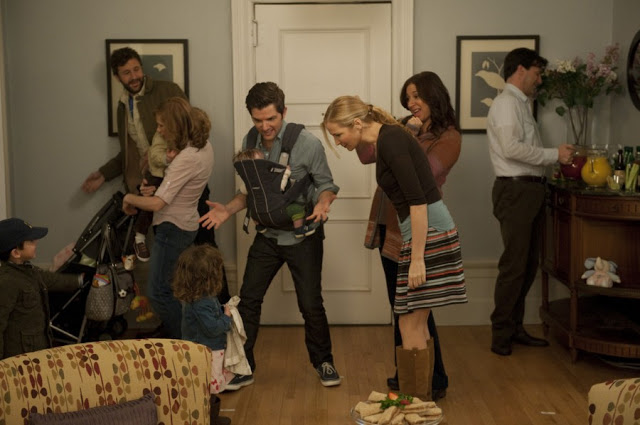
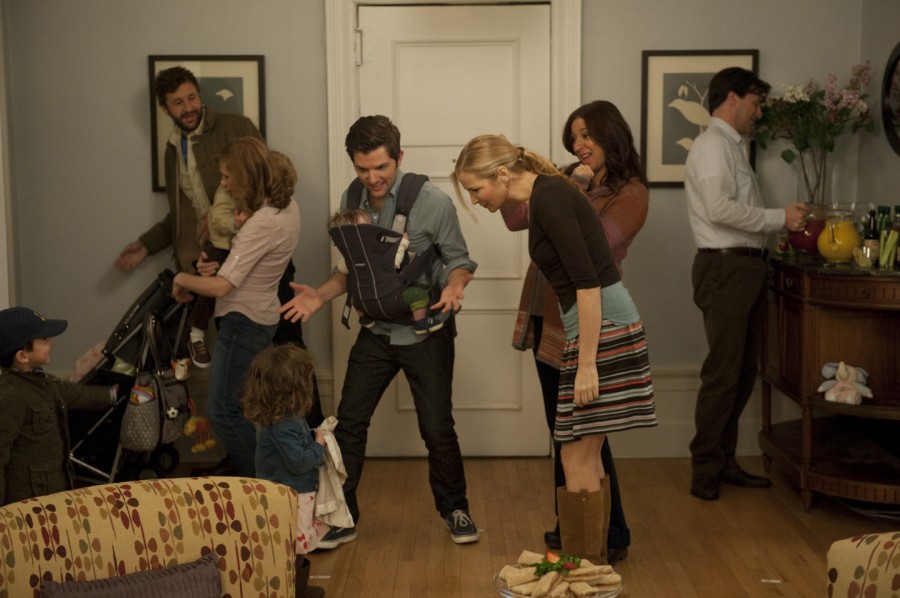
Still from Friends With Kids. [source]

I’ve been excited to see Friends With Kids since Megan Kearns first wrote about it for Bitch Flicks last March. What a cast! A female writer/director! A romcom with a genuinely new and interesting premise!

I finally got the chance to watch Friends With Kids on a long flight this week, and I tremendously enjoyed watching it, but still found myself wanting more.  As Megan expressed in her subsequent review of the film, Friends With Kids falls short of being a “feminist extravaganza” and ultimately isn’t too dissimilar from your standard romantic comedy.  I was constantly reminded of When Harry Met Sally… a film that Friends With Kids echoes not only thematically (testing the limits of men and women in platonic relationships) but also structurally (following its characters over the course of several years of their lives) and tonally (witty comedy striped with serious relationship pathos).

Writer/Director/Producer Jennifer Westfeldt also stars as Julie, whose life seems pretty great even though she’s been unlucky in love (one of the most refreshing things about this movie is how it portrays singledom as Not The End Of The World even for a woman who ultimately does want a committed relationship).  Her best friend is Jason (Adam Scott, as though that guy needed any more crush points), who favors brief dalliances with large-breasted women to actual relationships.  Julie and Jason function as an ersatz couple in their circle of paired-off friends (Maya Rudolph and Chris O’Dowd as the stable and happy partners Leslie and Alex, and Kristen Wiig and Jon Hamm as the more tumultuous pair Missy and Ben). After the rest of the gang starts having children, Jason and Jules surprise everyone by deciding to have a kid together.  They both want children and do not want to wait to find “their people” to do so, especially given the negative effects on romantic relationships they’ve seen having children can bring. As best friends, they have a lifelong love and commitment to each other making them suitable co-parents, without having to sacrifice passion or romance to the demands of child rearing.

My disappointment with Friends With Kids is that it doesn’t really explore the promise of that premise.  Jules and Jason’s child-rearing arrangement works seemingly effortlessly, and the film fails to really express why.  When the movie needs to inject some conflict, Friends With Kids retreats to the well-worn issue of whether a woman and a man can enjoy a truly platonic relationship.  Only when romantic drama is thrown into the mix does the pair struggle to divide their time with and responsibilities to their son, which seems to support the wisdom of Jason and Jules’ original arrangement, but in reality nullifies their alternative parenting scheme by suggesting that close male/female friendships are always a pretense ultimately giving way to romance.

Which means that in the end, Friends With Kids doesn’t have that much to say about alternative family structures, which is terribly disappointing.  Lip service is paid to gay couples raising children, and a few divorced straight couples with kids appear on the sidelines, but their struggles aren’t really explored.  So when our heroes end up as yet another “traditional” family by film’s end, it’s quite the let-down to my feminist hopes for the film.

That said, like with When Harry Met Sally…, my id was tickled to see these two characters find love with each other, even though I still long for a movie that explores a male-female friendship that is genuinely platonic.  Jason and Jules were so believable as best friends (I particularly got a kick out of their go-to conversation starter: making the other person choose between two hypothetical causes of death) and initially so believable as people not attracted to each other (their baby-making sex scene was so hilariously awkward I couldn’t help but laugh out loud even though I was watching it on a personal headset with earphones on a crowded airplane) that I was quite surprised when Friends With Kids took the old-fashioned turns it did.

Friends With Kids is still eminently watchable: smart, funny, and really phenomenally cast and acted (this is a movie where even Megan Fox is well-cast!).  Given that I like watching even bad romantic comedies, it feels unfair and greedy to emphasize my disappointment with what is a really, really good one, just for not being exactly the kind of movie I wanted it to be.

Robin Hitchcock is an American writer currently living in Cape Town, South Africa. She would choose death by shark over death by alligator.
Friends With Kids: When Harry Co-Parented With Sally…

Still from Friends With Kids. [source]

I’ve been excited to see Friends With Kids since Megan Kearns first wrote about it for Bitch Flicks last March. What a cast! A female writer/director! A romcom with a genuinely new and interesting premise!

I finally got the chance to watch Friends With Kids on a long flight this week, and I tremendously enjoyed watching it, but still found myself wanting more.  As Megan expressed in her subsequent review of the film, Friends With Kids falls short of being a “feminist extravaganza” and ultimately isn’t too dissimilar from your standard romantic comedy.  I was constantly reminded of When Harry Met Sally… a film that Friends With Kids echoes not only thematically (testing the limits of men and women in platonic relationships) but also structurally (following its characters over the course of several years of their lives) and tonally (witty comedy striped with serious relationship pathos).

Writer/Director/Producer Jennifer Westfeldt also stars as Julie, whose life seems pretty great even though she’s been unlucky in love (one of the most refreshing things about this movie is how it portrays singledom as Not The End Of The World even for a woman who ultimately does want a committed relationship).  Her best friend is Jason (Adam Scott, as though that guy needed any more crush points), who favors brief dalliances with large-breasted women to actual relationships.  Julie and Jason function as an ersatz couple in their circle of paired-off friends (Maya Rudolph and Chris O’Dowd as the stable and happy partners Leslie and Alex, and Kristen Wiig and Jon Hamm as the more tumultuous pair Missy and Ben). After the rest of the gang starts having children, Jason and Jules surprise everyone by deciding to have a kid together.  They both want children and do not want to wait to find “their people” to do so, especially given the negative effects on romantic relationships they’ve seen having children can bring. As best friends, they have a lifelong love and commitment to each other making them suitable co-parents, without having to sacrifice passion or romance to the demands of child rearing.

My disappointment with Friends With Kids is that it doesn’t really explore the promise of that premise.  Jules and Jason’s child-rearing arrangement works seemingly effortlessly, and the film fails to really express why.  When the movie needs to inject some conflict, Friends With Kids retreats to the well-worn issue of whether a woman and a man can enjoy a truly platonic relationship.  Only when romantic drama is thrown into the mix does the pair struggle to divide their time with and responsibilities to their son, which seems to support the wisdom of Jason and Jules’ original arrangement, but in reality nullifies their alternative parenting scheme by suggesting that close male/female friendships are always a pretense ultimately giving way to romance.

Which means that in the end, Friends With Kids doesn’t have that much to say about alternative family structures, which is terribly disappointing.  Lip service is paid to gay couples raising children, and a few divorced straight couples with kids appear on the sidelines, but their struggles aren’t really explored.  So when our heroes end up as yet another “traditional” family by film’s end, it’s quite the let-down to my feminist hopes for the film.

That said, like with When Harry Met Sally…, my id was tickled to see these two characters find love with each other, even though I still long for a movie that explores a male-female friendship that is genuinely platonic.  Jason and Jules were so believable as best friends (I particularly got a kick out of their go-to conversation starter: making the other person choose between two hypothetical causes of death) and initially so believable as people not attracted to each other (their baby-making sex scene was so hilariously awkward I couldn’t help but laugh out loud even though I was watching it on a personal headset with earphones on a crowded airplane) that I was quite surprised when Friends With Kids took the old-fashioned turns it did.

Friends With Kids is still eminently watchable: smart, funny, and really phenomenally cast and acted (this is a movie where even Megan Fox is well-cast!).  Given that I like watching even bad romantic comedies, it feels unfair and greedy to emphasize my disappointment with what is a really, really good one, just for not being exactly the kind of movie I wanted it to be.

Robin Hitchcock is an American writer currently living in Cape Town, South Africa. She would choose death by shark over death by alligator.
‘Friends With Kids’: When Harry Co-Parented With Sally…

Still from Friends With Kids. [source]

I’ve been excited to see Friends With Kids since Megan Kearns first wrote about it for Bitch Flicks last March. What a cast! A female writer/director! A romcom with a genuinely new and interesting premise!

I finally got the chance to watch Friends With Kids on a long flight this week, and I tremendously enjoyed watching it, but still found myself wanting more.  As Megan expressed in her subsequent review of the film, Friends With Kids falls short of being a “feminist extravaganza” and ultimately isn’t too dissimilar from your standard romantic comedy.  I was constantly reminded of When Harry Met Sally… a film that Friends With Kids echoes not only thematically (testing the limits of men and women in platonic relationships) but also structurally (following its characters over the course of several years of their lives) and tonally (witty comedy striped with serious relationship pathos).

Writer/Director/Producer Jennifer Westfeldt also stars as Julie, whose life seems pretty great even though she’s been unlucky in love (one of the most refreshing things about this movie is how it portrays singledom as Not The End Of The World even for a woman who ultimately does want a committed relationship).  Her best friend is Jason (Adam Scott, as though that guy needed any more crush points), who favors brief dalliances with large-breasted women to actual relationships.  Julie and Jason function as an ersatz couple in their circle of paired-off friends (Maya Rudolph and Chris O’Dowd as the stable and happy partners Leslie and Alex, and Kristen Wiig and Jon Hamm as the more tumultuous pair Missy and Ben). After the rest of the gang starts having children, Jason and Jules surprise everyone by deciding to have a kid together.  They both want children and do not want to wait to find “their people” to do so, especially given the negative effects on romantic relationships they’ve seen having children can bring. As best friends, they have a lifelong love and commitment to each other making them suitable co-parents, without having to sacrifice passion or romance to the demands of child rearing.

My disappointment with Friends With Kids is that it doesn’t really explore the promise of that premise.  Jules and Jason’s child-rearing arrangement works seemingly effortlessly, and the film fails to really express why.  When the movie needs to inject some conflict, Friends With Kids retreats to the well-worn issue of whether a woman and a man can enjoy a truly platonic relationship.  Only when romantic drama is thrown into the mix does the pair struggle to divide their time with and responsibilities to their son, which seems to support the wisdom of Jason and Jules’ original arrangement, but in reality nullifies their alternative parenting scheme by suggesting that close male/female friendships are always a pretense ultimately giving way to romance.

Which means that in the end, Friends With Kids doesn’t have that much to say about alternative family structures, which is terribly disappointing.  Lip service is paid to gay couples raising children, and a few divorced straight couples with kids appear on the sidelines, but their struggles aren’t really explored.  So when our heroes end up as yet another “traditional” family by film’s end, it’s quite the let-down to my feminist hopes for the film.

That said, like with When Harry Met Sally…, my id was tickled to see these two characters find love with each other, even though I still long for a movie that explores a male-female friendship that is genuinely platonic.  Jason and Jules were so believable as best friends (I particularly got a kick out of their go-to conversation starter: making the other person choose between two hypothetical causes of death) and initially so believable as people not attracted to each other (their baby-making sex scene was so hilariously awkward I couldn’t help but laugh out loud even though I was watching it on a personal headset with earphones on a crowded airplane) that I was quite surprised when Friends With Kids took the old-fashioned turns it did.

Friends With Kids is still eminently watchable: smart, funny, and really phenomenally cast and acted (this is a movie where even Megan Fox is well-cast!).  Given that I like watching even bad romantic comedies, it feels unfair and greedy to emphasize my disappointment with what is a really, really good one, just for not being exactly the kind of movie I wanted it to be.

Robin Hitchcock is an American writer currently living in Cape Town, South Africa. She would choose death by shark over death by alligator.
For F—‘s Sake, Watch ‘The Thick Of It’

The fourteen episodes of Armando Iannucci’s brilliant BBC show The Thick Of It appeared on Hulu a couple of weeks ago, and the upcoming fourth season will stream there as well. I am having a bafflingly hard time convincing even my most devoted Anglophile friends to watch it. Maybe the pace and intensity are off-putting: it’s a show that demands your full, rapt attention to decipher its rapid-fire dialogue (and British accents, if that’s a difficulty for you). Maybe the unrelenting cynicism is discouraging for my starry-eyed friends (I know a LOT of Aaron Sorkin devotees). Maybe the Westminster setting is daunting to Americans who assume that familiarity with the ins and outs of UK politics is a prerequisite, when in reality all a non-Brit would miss are throwaway jokes about odds and ends of British culture (Mark Kermode’s flappy hands, anyone?). Whatever it is that’s giving people pause, I wish they’d overcome it, because this is a really, really good TV show.
As a cynical comedy about the relationship between a hapless government minister and a Machiavellian civil servant, The Thick Of It is naturally a spiritual successor to excellent 1980s sitcom Yes Minister– but it is a very 21st-century successor. The archly satirical wit of Yes Minister isn’t wholly absent from from The Thick Of It, but it is rather overshadowed by, well, the gloriously colorful and endlessly creative obscenity. A viewer conducting even the most casual compare-and-contrast of the two series will notice two interesting trends:
1. Twenty-first-century Westminster is no less white than 1980s Westminster. This, unfortunately, is a reflection of reality: people of color currently comprise 4% of MPs (a figure that was significantly lower when The Thick Of It began in 2005), and Parliament’s own website admits that even though “[t]he House of Commons is more reflective of the population it represents than ever before […] it remains the case that more than 400 MPs, 62% of the total, are white men aged over 40.”
2. There is a far wider variety of accents, and a hell of a lot more swearing, in the newer show. This is something that cannot be explained without a brief discussion of the deeply complex question of class in British politics, so please bear with me. UK politics has always been an old boys’ club. The traditional track to Westminster runs through a private school, ideally Eton, and a top-tier university, ideally Oxbridge. That same Parliament webpage notes that over a quarter of current MPs went to Oxbridge, and over a third went to private schools. This is vastly disproportionate to the general population – but it is an improvement over the past. In 1982 Yes Minister could include lengthy rants about Greek and Latin quotations and jokes mocking a minister who attended the LSE; one suspects that that simply wouldn’t fly today.
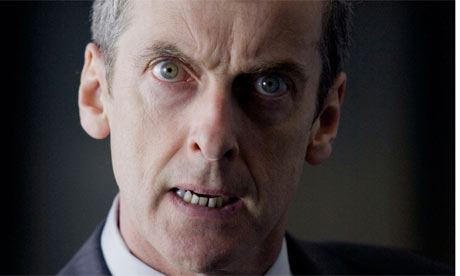
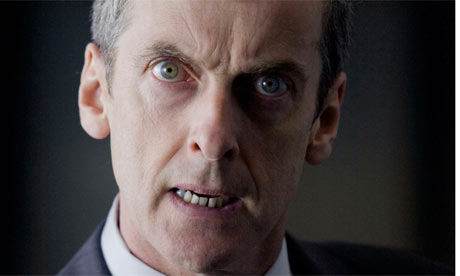
The delicate subtleties of regional accents in the UK are far beyond my capacity to explain; suffice it to say that, first, regional accents are historically the marker of a working-class background, and, second, they are much more acceptable in politics and media today than they were 30 years ago. There is, then, a more or less explicit class dynamic at play in The Thick Of It between the RP-accented ministers and the very Scottish Peter Capaldi, who stars as very terrifying government spin doctor Malcolm Tucker.
Good God this man is terrifying.
Malcolm is the core of the show, and he is a wonder to behold. In creating Malcolm Tucker, Iannucci seems to have drawn from both his own Scottish heritage and from the well of “terrifying Scot” archetypes that populate the British imagination: from Wallace bellowing “FREEDOM!” to Miss Jean Brodie to Professor McGonagall to the monstrous Manda in Alan Warner’s The Stars In The Bright Sky (get a copy; you’ll thank me later), echoed in US pop culture through figures like Groundskeeper Willie and Shrek. An explosive hurricane of Caledonian fury, Malcolm tears through Westminster, bullying, threatening, effing, blinding, and occasionally punching anyone unfortunate enough to oppose his will. He’s the kind of villain who’s an absolute joy to hate, reveling in his own evil machinations and spouting quotable profanity like it’s going out of style.
Not that the other characters lack for memorable quotes. The writing for this show reminds me of Oscar Wilde (in a potty-mouthed, 21st-century kind of way): all the characters essentially speak with exactly the same voice, but it’s such a very funny voice that nobody really minds. And, of course, a great strength of this style is that the women characters sound as though they were written to be characters first, women second. Our culture is swimming in female characters who sounds as if they were written by someone who, at best, has never actually interacted with a woman, and, at worst, genuinely believes women to be a completely different species than human beings. Armando Iannucci’s women are not like this at all, and it’s depressing how refreshing that is.
In my opinion, The Thick Of It only really hits its stride with the introduction of Rebecca Front as Nicola Murray, MP, in the third season. (The first two were only three episodes each, so she’s still in more than half the series.) This was a matter of necessity, owing to Chris Langham’s ignominious fall from public grace, but it gives the show a dynamic it really needs. When Langham’s Hugh Abbott was the hapless minister struggling to hang onto his job in the face of mockery from special advisers Glen and Ollie and relentless terrorism from Malcolm, the cast was just toohomogeneous. Nicola has to deal with not only the pressures Hugh faced as an overworked, underprepared, perpetually outgunned minister trying desperately to be relevant; but she also has to cope with the specific challenges of being a woman in a profession that is still 78% male-dominated. Dubbed a “glummy mummy” by the press, Nicola is caught in the damned-if-you-do, damned-if-you-don’t position of the woman in the high-pressure job – expected to prioritize her work while simultaneously being the World’s Greatest Mother, in a way that men are simply never expected to do. Being at the nexus of such impossible expectations never overwhelms Nicola’s character or turns her into a straw person of any kind, but it is a constant presence in the dynamic of her interactions with others, to the point that even the ferocious Malcolm appears to have a little sympathy for her.

Poor Nicola.
Iannucci seems to have recognized how interesting this dynamic is, and attempted to replicate it this year in his HBO show Veep, starring Julia Louis-Dreyfus as a (once again) hapless vice president. Veep is an intriguing attempt to transplant the magic of The Thick Of It to a US context (foreshadowed to some extent in the transatlantic hijinks of 2009 alternate-universe spin-off film In The Loop), but I’m not yet convinced that it’s a fully successful one. For one thing, the US televisual landscape is so prudish that, even on HBO, the swears don’t roll off tongues as organically as on British TV. For another, the lack of a truly nefarious Malcolm Tucker figure, while an understandable artistic choice to create distance from The Thick Of It, in my opinion undermines the show’s cohesiveness. And I question the wisdom of choosing to piss away a potentially really interesting pregnancy subplot offscreen.
My reservations notwithstanding, I will be watching Veep‘s second season, because it’s pretty funny, and because I trust Armando Iannucci. But I’m much more excited for The Thick Of It season four, and it would be nice if the rest of America cared too.
  
Max Thornton is a grad student who doesn’t really like pronouns but won’t object to either ey/em or he/him. Too British for the US and too American for the UK, Max currently lives in the San Francisco Bay Area but dreams of London and New York. Max likes theology, intersectional feminism, and pop culture, and blogs about these things at Gay Christian Geek.

Women in Science Fiction Week: The Roundup

The wonderful thing about science fiction is that the writers have the opportunity to create a world, which while based on ours, can be markedly different. This means that there should be a place for strong female characters who are not restricted by sexism or forced into a situation in which they must perform femininity on a daily basis to be accepted as ‘woman.’ Despite the freedom of this genre; however, nothing is born outside of discourse, which means of course that we end up with the same sexist tropes repeatedly.
Even in shows which readily lend themselves to recurring scenes of violence, because women have historically been framed as delicate and passive, men end up in the leadership roles. This also means that when the action does finally happen, women are placed into nurturing roles like doctors and nurses to aid the wounded men. While some may see this exchange as complementary, it in fact sets up a serious gender divide that is reductive.
The lack of representation of older black women in science fiction is coupled with a complete lack of interest in developing any kind of independent agenda for their characters. Guinan in Star Trek: The Next Generation and the Oracle in The Matrix, the only two named older black women that I (or anybody else that I asked) could think of,  are recycled wholesale from the stereotypical mammy of the slave era.
The main features of the stereotypical mammy are grounded in a white fantasy; often these women were wet nurses, bringing up their white charges in a far more intimate relationship than either have with their biological families. It is not Scarlett O’Hara’s mother who fusses about her eating habits, does up her dress, or worries about her relationships. It is Mammy. Scarlett, and the viewers of Gone With the Wind, never consider what Mammy might think of their relationship, or worry that she might have children of her own whom she cannot raise. We are content to construct a fantasy in which Mammy wants nothing more than to feed, clothe and care for her white charge.
It’s assumed that, of course we want Cobb to win because he’s really Leo, and, you see, Leo is talented but Troubled. What troubles him? You guessed it: a woman. A woman whose very name–Mal (played by Marion Cotillard, an immensely talented actress who’s wasted in this role)–literally means “bad.” Who or what will rescue Cobb/Leo from his troubles? You guessed it again: a woman. This time, it’s a woman whose very name–Ariadne (played by Ellen Page in a way that demands absolutely no commentary)–means “utterly pure,” and who is younger, asexual (a counter to Mal’s dangerous French sexuality) and without any backstory or past of her own to smudge the movie’s–and her own–focus on Cobb/Leo. So, it’s not a stretch here to say that Cobb needs a pure woman to escape the bad one. Virgin/whore stereotype, anyone?

For me, I can’t separate Alien and Aliens (although I pretend the 3rd and 4th don’t exist…ugh). Both amazing films possess pulse-pounding intensity, a struggle for survival, and most importantly for me, a feminist protagonist. Radiating confidence and strength, Ripley remains my favorite female film character. A resourceful survivor wielding weapons and ingenuity, she embodies empowerment. Bearing no mystical superpowers, she’s a regular woman taking charge in a crisis. Weaver, who imbued her character with intelligence and a steely drive, was inspired to “play Ripley like Henry V and women warriors of classic Chinese literature.”

Sigourney Weaver’s role as Ripley catapulted her to stardom, making her one of the first female action heroes. Preceded by Pam Grier in Coffy and Dianna Rigg as Emma Peel in The Avengers, she helped pave the way for Linda Hamilton’s badassery in T2, Uma Thurman in Kill Bill, Carrie-Anne Moss in The Matrix, Lucy Lawless as Xena, Sarah Michelle Gellar as Buffy, and Angelina Jolie in Tomb Raider and Salt. But Ripley, a female film icon, wasn’t even initially conceived as a woman.
Overall, Olivia Dunham is a prime example of what it is to be a heroine in a science fiction world. She can break bones, witness the aftermath of a gruesome fringe event without batting an eye, and go toe-to-toe with mastermind villains, and yet she is not invincible or impervious to emotional situations. Although she is constantly surrounded by extraordinary events and weird circumstances, she is a truly believable character, imbued in verisimilitude. With a fifth season on the horizon (slated for September), I cannot wait to see what is in store for Olivia and her team.
Joss Whedon is known for creating and writing about strong female characters in his science fiction shows. One of the most popular and complex of these characters is Willow Rosenberg from Buffy the Vampire Slayer. Willow speaks to many people and quite a few have named her their favorite character on the show, from Mark at Mark Watches to Joss Whedon himself, who put the most Willow-centric episode of the series (“Doppelgangland”) on his list of favorite episodes.
Another thing that makes Willow so appealing is the fact that her character arc over seven seasons can’t be described in only one way. Some see Willow’s story as a shy, brainy computer geek embracing her supernatural power in becoming a witch. Others relate to her arc as one of a repressed wallflower who explores her sexuality and finds more confidence in coming out as a lesbian. Still others are fascinated with the different ways she handles magic, and her recovery after drifting too far to the dark side.
What story is told when those three arcs are put together? For me, the story of Willow Rosenberg is the story of a woman who spends years defining and re-defining herself, rejecting roles that other people have chosen for her – for better and for worse.
As much as I would like to sit through a movie like this and enjoy it for what it is (ground-breaking sci-fi entertainment that will go down in history), I simply can’t. James Cameron’s attempt to create a more spiritual, natural, and peaceful society leaves me annoyed that once again this idea is filtered through a white, Western, male member of a patriarchal society. Some theorists will consider Cameron’s Alien trilogy feminist, because of Sigourney Weaver’s empowered Ripley (legend says it was written to be asexual–with casting deciding the character’s sex), but she still has to prove her femininity and womanliness by saving cats and small children. I fear that many feminists will laud Avatar as well–for creating a world where the people worship a female entity (“Eywa”), because the Clan leader’s female mate/wife is as powerful as him, and since the female lead is as empowered as Ripley. However, like Ripley, Neytiri too has her feminine trappings, as her power can be explained away through her heritage.

Patriarchy perpetuates rape culture and infringes on reproductive rights. Alien centered on rape and men’s fear of female reproduction. Littered with vaginal-looking aliens and phallic xenomorphs violating victims orally, these themes resurface. But this time around, Scott’s latest endeavor also adds abortion and infertility. As ThinkProgress’ Alyssa Rosenberg asserts, Prometheus bolsters the Alien Saga’s themes of “exploration of bodily invasion and specifically women’s bodily autonomy.”

[…]

But David doesn’t want her to have an abortion, insisting she be put in stasis and trying to restrain her. Like Ash in Alien, it appears David had an agenda to try and keep the creature inside Shaw alive. David tries to thwart Shaw’s agency and bodily autonomy, forcing her to remain pregnant. Hmmm, sounds eerily similar to anti-choice Republicans with their invasive and oppressive legislation restricting abortion. No one has the right to tell someone what to do with their body.
Lost has many strong female characters, many of whom I could easily see wearing a “This is what a feminist look like” t-shirt. As noted by Melissa McEwan of Shakesville, an admitted Lost junkie, “Generally, the female characters are more well-rounded than just about any other female characters on television, especially in ensemble casts.”
Lost has often presented ‘gender outside the box’ characters, suggesting being human is more important than being a masculine man or a feminine woman. After all, when you are fighting for your life, ‘doing gender right’ is hardly at the top of your priority list.
While Jack and Sawyer try to out-macho each other in their love triangle with Kate, neither hold entirely to the Rambo-man-in-jungle motif. As for the women, they just might be the strongest, bravest, wisest female characters to grace a major network screen since Cagney and Lacey.

Though the island is certainly patriarchal, one could make a strong case that male-rule is not such a good thing for (island) society. Kate or Juliet would be far better leaders than any of the island patriarchs (and as some episodes suggest, would make great co-leaders – what a feminist concept!)

But the film stars another woman, albeit in a more supporting role within the cast: Kirsten Dunst, who gives a sensitive portrayal of Mary, a character who is in many ways the polar opposite of Clementine. Mary is quiet, almost mousy. She wears rather plain, unobtrusive clothes. At work, she wears a smart white lab coat, as if to reinforce the medical nature of the proceedings, and answers the phone in the same measured tone of voice, responding to all queries with variations on the same stock phrases. Her inner extrovert manifests only after a combination of alcohol and pot, which lead her (and Stan) to have a wild dance party, including jumping half-dressed on the bed while Joel’s memory is being erased. Mary is, however, a woman who knows her own mind as the film progresses. She exchanges her seemingly blind devotion to Lacuna and Dr. Mierzwiak for her own brand of individual agency. By the end, it’s clear why: Mary has had her memory altered by Dr. Mierzwiak, after what appears to be some convincing on his part, when the affair they’d been having was discovered by his wife. The knowledge, if not the memory, of this seems to jolt Mary into coming into her own. Unfortunately, all this occurs in the last ten minutes of the film. For whatever reason, Mary is most definitely a sidelined supporting character, whose potential is never fully realized in the cinematic release, as director’s commentary and the trivia about the shooting script attest.
Splice explores gendered body horror at the locus of the womb, reveling in the horror of procreation. It touches on themes of bestiality, incest, and rape. It’s also a movie about being a mom.
Though it received somewhat lackluster reviews, I encourage anyone interested in feminism and film to give Vincenzo Natali’s sci-fi body horror film a try. Splice features female characters who are intelligent, emotionally complex, and incontrol. They’re not perfect, but they are three dimensional characters whose decisions drive the story. (One of them morphs into a male, but we’ll get to that.)
Splice asks a lot of questions about the terms and conditions of conception, gestation, birth, and motherhood, all without stabbing the viewer in the eye with reductive answers.
It also features some campy moments. Hipster scientists shout things like “It was the only way!” Academy Award winning actor Adrien Brody expresses his frustration by throwing down not just his jacket, but his scarf as well!
If you can stomach the juxtaposition of big thinky concepts and stilted clichéd dialogue, you will find Splice a thoroughly enjoyable mindfuck of a film.
There are moral issues at stake throughout the entire series, including the erosion of prisoners’ and laborers’ rights so that others may live more comfortably. The same critical lens is cast on forced birth, forced abortion, eugenics and abortion restrictions.
Early in the second season, Kara “Starbuck” Thrace has returned to Cylon-occupied Caprica (home planet for the crew of Battlestar Galactica) to find her destiny and aid the resistance, a group of humans who have stayed behind to fight the Cylons. She is kidnapped and knocked out, and wakes up in a hospital bed. Her “doctor” (who later is revealed as a Cylon) tells her she was shot in the abdomen and they have removed the bullet. As she drifts in and out of consciousness, she becomes suspicious. The doctor has excuses for every inconsistency. He tells her they’d operated because they suspected she had a cyst on her ovary. He says, “You gotta keep that reproductive system in great shape… it’s your most valuable asset these days. Finding healthy childbearing women your age is a top priority for the resistance. You are a very precious commodity to us.”
Starbuck replies, “I am not a commodity. I’m a viper pilot.”

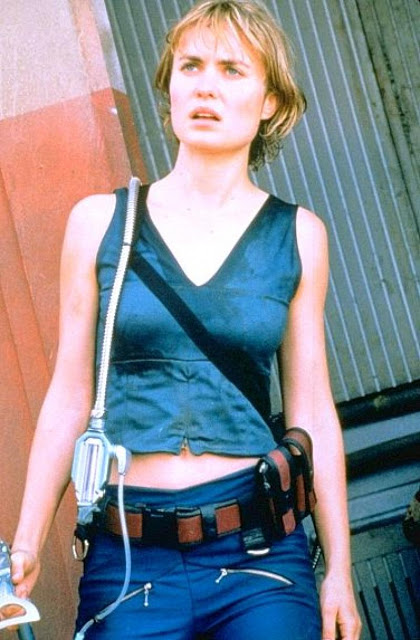
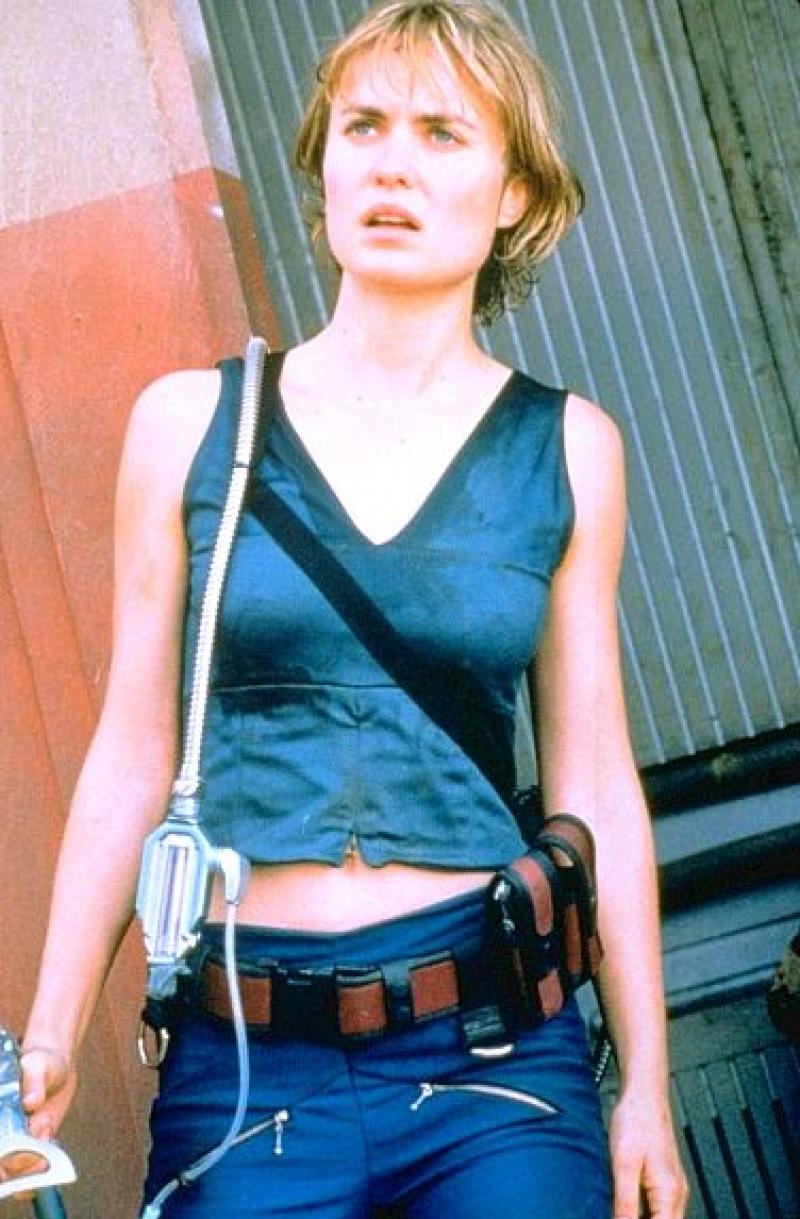
To me a character that deserves the reputation of a feminist heroine would be Carolyn Fry(Radha Mitchell) from David Twohy’s Pitch Black (2000), regardless of whether he intended it that way. We have time to watch her character grow through the movie, but she is a secondary character, Riddick is the famed anti-hero. To make an impression in spite of that is huge.

While Fry takes the reins of the group on the deserted planet by default, the one thing that drives her bravery is her terrible mistake — attempting to eject the passengers in cryogenic sleep to lighten the load of the spaceship before it crashed, stopped from doing so by the more conscientious navigator who died as a result, earning her a lot of resentment from the group, their mistrust eventually pushing her to fight for her leadership position more fiercely. I don’t particularly consider that a negative point, I see a person deeply ridden with guilt, antagonists willing her to fail, Riddick keenly watching her every move, reacting to her willingness to risk her safety for the sake of the others with amusement. I see a lot of a pressure on a person who is not particularly skilled to handle the task before her, but she pushes on in spite of that.

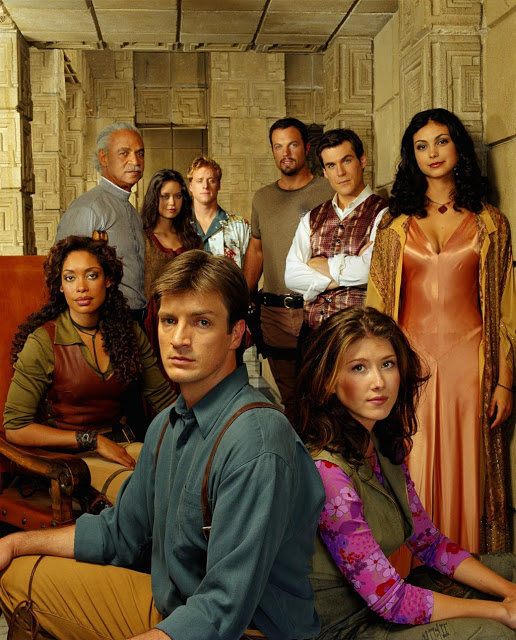
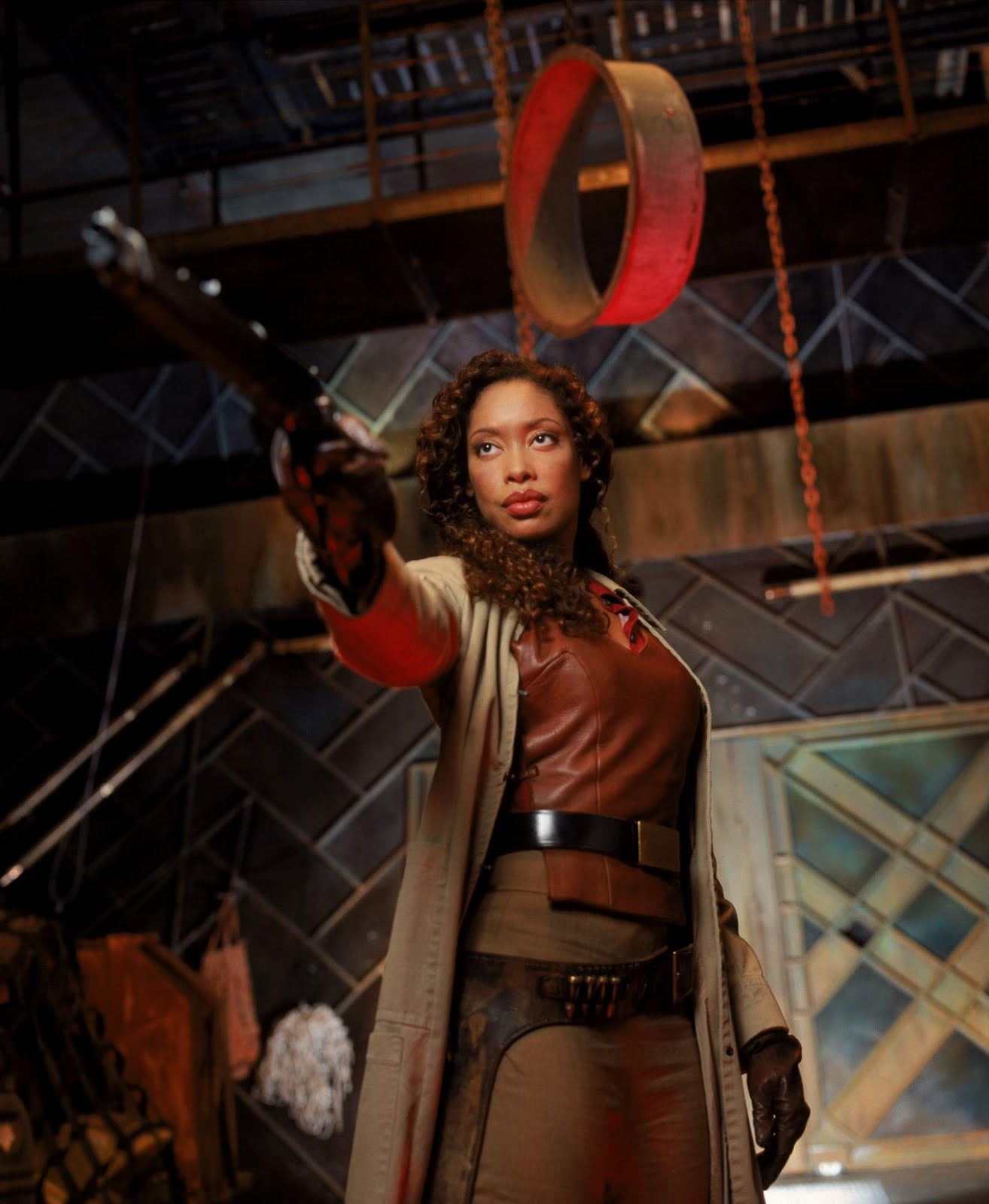
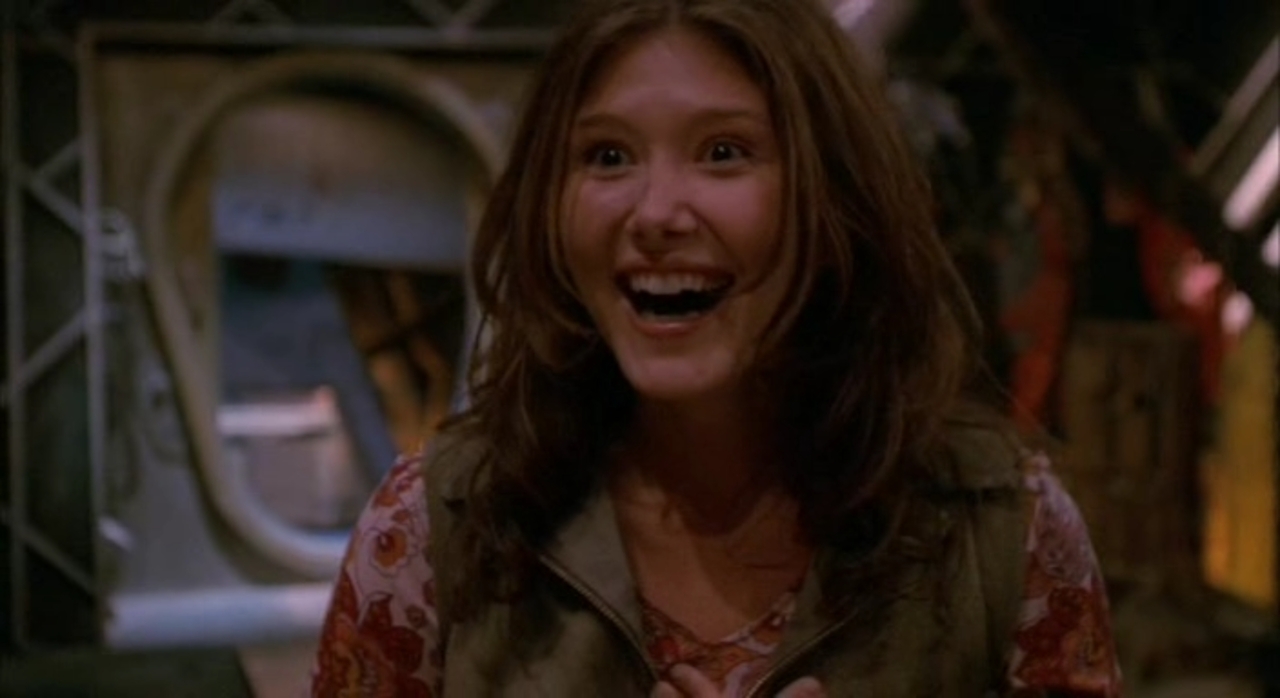
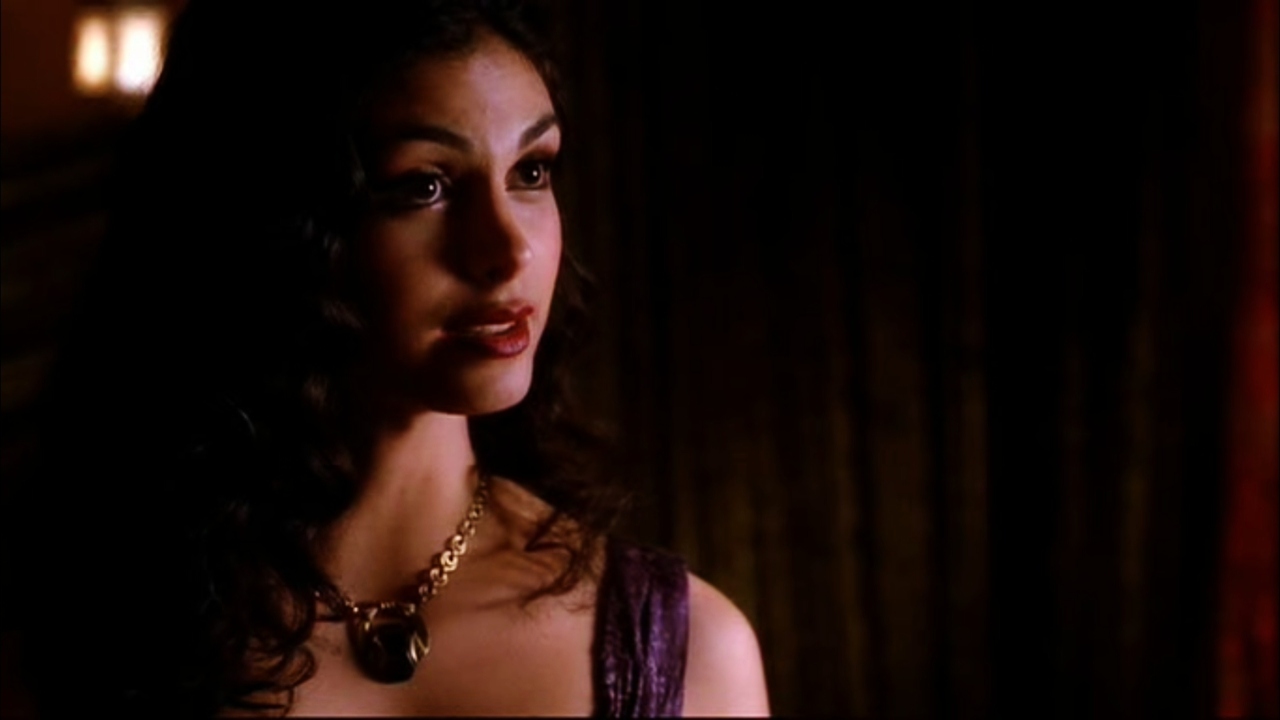
Mastermind behind phenomenal, groundbreaking television hits, Buffy The Vampire Slayer and Angel and recently helming a little box office smash called The Avengers, Whedon has always crafted the powerful, intelligent female hero. He illustrates that aesthetic further in the short lived FOX series Firefly turned feature motion picture, Serenity showcasing not just one, but four intriguing women characters- Zoe, Kaylee, Inara, and River.

In a science fiction space western combining a thrilling taste of adventure, mayhem, and Whedon’s trademark humor, flying aboard with the wisecracking Captain Malcolm Reynolds, softhearted Wash, short-tempered Jayne, and the good doctor, Simon, these spirited and diverse women bring more than male gazing eye candy ornamentation.

Science fiction is, or should be, a place to examine stereotypes and political and social conventions, not to reinforce them. Before Le Guin came along, we had authors like Piers Anthony (a notorious misogynist, although like most misogynists he denies that he is one) and Ray Bradbury. Now I wouldn’t go so far as to call Bradbury a misogynist — I admire Bradbury’s work, I really do, because many of his themes are universal. But he falls into the same trap that Stephen King does — very few of his main characters are female, and more often than not, men are the decision makers, and the ones that move the plot along. It’s interesting to note that many writers tend to write towards their own gender. In Bradbury’s fiction, like Anthony and King, the female characters often end up in supporting roles as wives, mothers, and crushes that turn into ‘marionettes’ or a controllable programmable robot that can be easily manipulated.
I read these books as a child and teenager, and I experienced a sense of dissatisfaction with the minor roles women were playing in this male literary playground. So I wondered what women writing science fiction would be like, and that’s where I found Ursula Le Guin, who didn’t merit her own displays in the library lobby like the other authors I’ve mentioned. At least, not when I was a kid.
WALL-E, it seems, has developed human qualities on his own. He is also capable of keeping up with a robot approximately 700 years newer (read: younger) than he is–an impressive age gap in any relationship. EVE worries over WALL-E and caters to his physical limitations (he is, after all, an old man–with childlike curiosity), acting as nursemaid in addition to all-around badass. Who says we can’t be everything, ladies? While EVE doesn’t have any of the conventional trappings of femininity, she’s a lovely modern contraption with clean lines, while WALL-E is clunky, schlubby, and falling apart (not to mention he’s a clean rip-off of Short Circuit‘s Johnny 5)–reinforcing the (male) appreciation of a certain kind of female aesthetic, while reminding girls that they should look good and not worry too much about the appearance of their male love-interest.
And while some of the scenes are admittedly, far more graphic and gratuitous than I think necessary (there is a simple purity to the original Alien death scenes that I think is lacking here), the film featured some thought provoking and disturbing themes, though all backed again by a strong, smart, female scientist-turned-reluctant heroine and survivor, similar to the original Ripley.
The Swedish Noomi Rapace (seriously loving these Swedish actors) and South African Charlize Theron oppose each other brilliantly; Theron as the efficient and disdainful corporate heavy, Noomi as the resistant, believing, courageous scientist out to find some answers.
The film features a hefty score of themes for discussion, including one of the most disturbing abortion scenes I’ve ever seen. That scene is apparently what pushed the film up from a PG-13 rating into an R; if the studio had wanted to ensure a PG-13 rating, the MPAA demanded that they cut the entire scene. However, both director Ridley Scott and Rapace felt the scene was pivotal in Shaw’s intense desire to survive and in her emotional and mental development. If you weren’t pro-choice before, chances are you might be after witnessing this scene.

As I watched Avatar, I for some reason (probably because predicting the next thing that would happen got boring once I realized I would never, ever be wrong) began thinking about the first time I saw 2001: A Space Odyssey and asked myself how the genre of science fiction and the movie industry as a pillar of American culture had changed in the time that had elapsed between the two films. What were the general cultural values and concerns being communicated in each of these films? What kinds of stories were being told about the world? How had cinema as a means of artistic communication and social commentary changed since 2001 was released? What do the methods of presentation in both films tell us about the ways in which our society has changed in the era of advanced mass communication? And, of course, how was gender represented?

I came to a few distressing conclusions. Naturally, I’ll get to the feminist criticism first. By the time Avatar came out, we’d traversed 41 years in which women’s status in society had purportedly been progressively improving since 2001 was released, but the change in representations of women in popular media, at least in epic sci-fi movies, doesn’t look all that positive. In 1968, we (or Stanley Kubrick and Arthur C. Clarke) could imagine tourism in space. We could not, however, imagine women occupying any role in space exploration other than as flight attendants. In 2009 we (or James Cameron) could imagine female scientists and helicopter pilots participating in extraterrestrial imperialism, and we could even tolerate warrior-like blue female humanoid aliens as central figures in the plot of an movie, but we still couldn’t imagine a world in which traditional gender roles and current human beauty ideals aren’t upheld, even when that world is literally several light years and 155 years away from our own.
So it might be easy to dismiss Jo as one of those useless female companions. A pretty bit of skirt to be an audience stand-in for the Doctor to explicate to. Except for the fact that Jo Grant is awesome. She’s a trained escapologist, she can fly a helicopter, she can abseil; in ‘The Mind of Evil’, she karates a prison riot leader out of his gun. On numerous occasions, when the Doctor’s got himself locked up somewhere, she comes to his rescue. Though in her first appearance, the Master hypnotises her, the Doctor teaches her how to resist it, so that in later confrontations, the Master is utterly frustrated by his inability to dominate her mind. In ‘The Time Monster’, when they run into the Master, again, and he finds himself unable to find anything to say, she mockingly suggests, ‘How about, “Curses, foiled again”?’ She’s also bold, capable of making hard decisions under pressure. Again in ‘Time Monster’, the Doctor threatens their mutual destruction by initiating a Time Ram, shoving his and the Master’s TARDISes into the same temporospatial coordinates; but when the Doctor hesitates, Jo’s the one who makes the final move to press the big red button.

District 9 operates with what I’d call an absent feminism, which isn’t quite an anti-feminism but a disregard for a female world altogether—except when a minor feminine presence functions as off-stage impetus for the lead character. Aside from a few bit parts, the most prominent female role is that of Wikus’s wife, Tania (Vanessa Haywood), who, although rarely seen onscreen, becomes the driving motivation for Wikus to risk his life to find the cure for his “prawnness,” befriending, out of necessity, Christopher Johnson, the same alien he tried to evict earlier in the day. (Wikus didn’t know then that Johnson actually built his shack atop the Mothership’s missing module; he’s been diligently working for twenty years to fix it, and was nearly finished when pesky Wikus confiscated that black fluid.)

Wikus’s wife, who is given no real identity, save the fact that she is torn between the age-old allegiance to her father and loyalty to her husband (implying that she most certainly “belongs” to one or the other), won’t relinquish hope of her husband’s return by the film’s conclusion. Someone is leaving strange gifts on her doorstep, gifts oddly similar to the ones dear hubby Wikus used to give her. Blomkamp insinuates that she’s a steadfast wife who will do her wifely duty and wait faithfully for her disappeared husband. The viewer is given no back-story or insights into their relationship; yet, forced upon us is the heavy-handed notion that they really do love each other—like, in that super-deep, eternal-love kind of way. Their story, of course, is a bottom-tiered thread in the narrative.
Only after witnessing a mother’s love does Klaatu feel that there is another side to humans (besides their unreasonable and destructive one), and curtail the attack of the killer nanobots. Unwittingly then, Benson changes Klaatu’s mind based on the advice Barnhardt gave her as they fled his house: “Change his mind not with reason, but with yourself.” In your standard anti-feminist fare, Barnhardt’s advice can only mean one of two things. Being a family-friendly film, the remake of Day passes on Benson’s seduction of Klaatu, deciding instead to confirm that she is a mother first and foremost, her position as scientist at a prestigious American university be damned.

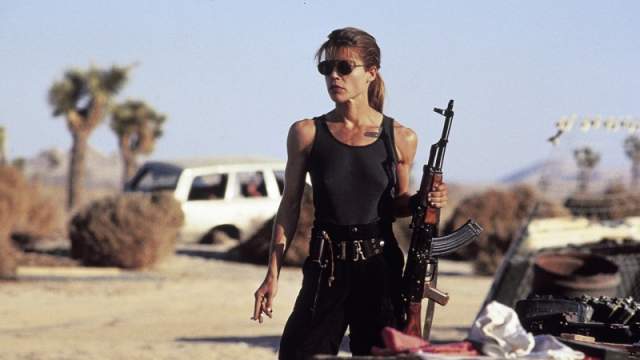
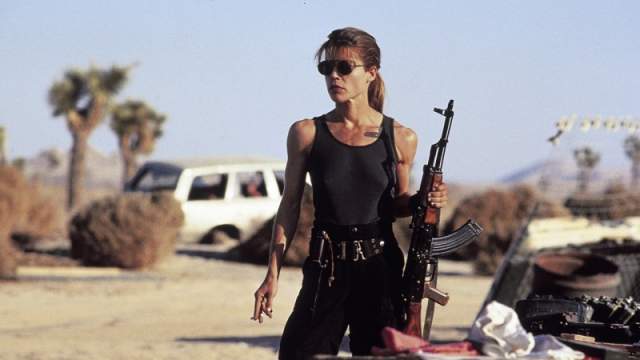
As kickass as she is, Sarah possesses no other identity beyond motherhood. She exists solely to protect her John from assassination or humanity will be wiped out. Every decision, every choice she makes, is to protect her son. In Sarah Connor Chronicles, Cameron tells Sarah that “Without John, your life has no purpose.” Sarah tells her ex-fiancé that she’s not trying to change her fate but change John’s. Even before she becomes a mother in Terminator, her identity is tied to her uterus and her capacity for motherhood.

[…]

On the surface, it seems like the Terminator franchise revolves around a dude often searching for a father figure rather than appreciating his mother. And problematic depictions of motherhood do emerge. But who’s really the hero? Is it the smart hacker son destined to be a leader? Is it the cyborg that learns humanity? Or is it the brave and fierce single mother who sacrifices everything to protect humanity and doesn’t wait for destiny to unfold but takes matters into her own hands?

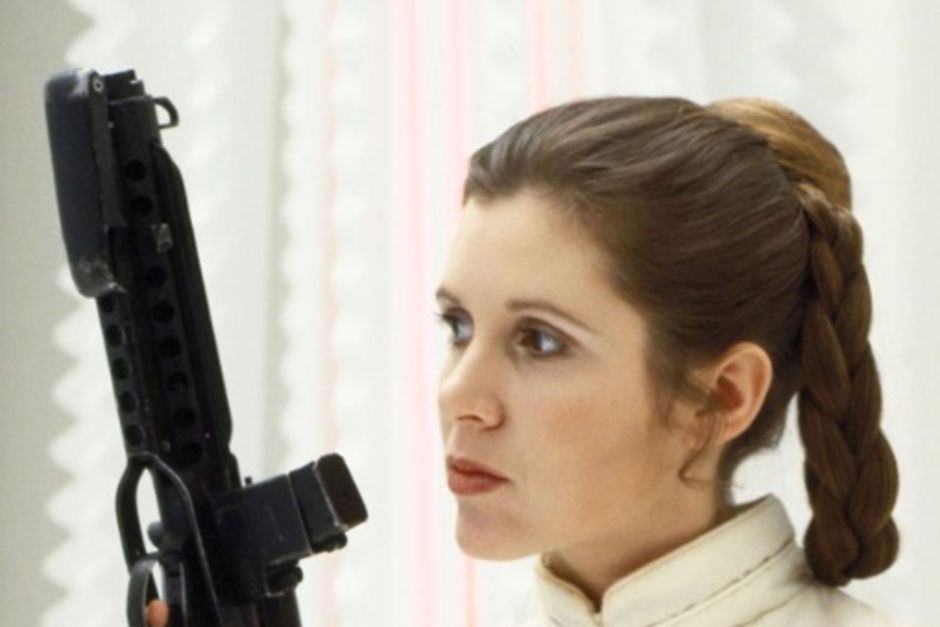
Even though Leia has romantic feelings for Han Solo in The Empire Strikes Back, she continues to call out his arrogant bullshit. She quips snappy retorts such as, “I’d just as soon kiss a Wookie” and “I don’t know where you get your delusions, laser brain.” She’s never at a loss for words and never afraid to express herself.
She also has burgeoning psychic powers as she picks up on Luke’s cries for help at the end of the film. Obi-Wan tells Yoda when Luke Skywalker leaves Dagobah, “That boy is our last hope.” But Yoda wisely tells him, “No, there is another,” cryptically referring to Luke’s twin sister Leia.
In Return of the Jedi, Leia puts herself in harm’s way posing as a bounty hunter to save Han. Sadly, after she’s captured by Jabba the Hut, she’s notoriously objectified and reduced to a sex object in the iconic metal bikini, essentially glamorizing and eroticizing slavery. And of course she needs to be rescued. Again.

New Bitch Flicks Regular Contributor: Lady T

Greetings and salutations. I’m Lady T and I’m thrilled to have been invited to be a regular contributor at Bitch Flicks. You may remember me from such guest posts as “Willow Rosenberg: Geek, Interrupted,” “Why Watch Romantic Comedies?“, and “Easy A: A Fauxminist Film”. I blog at The Funny Feminist, where I analyze media (mostly comedies) from a feminist perspective and smash trolls with my sarcasm hammer.
I’ve been a feminist my whole life, but it wasn’t until college that I felt comfortable calling myself one. I credit my feminist parents, my grandmother, my extended family filled with tough independent women (one of whom gave me the nickname Lady T in the first place), my college roommates, my younger brothers, the essay “Yes, You Are”, and the Internet blogosphere and sites like Bitch Flicks for helping me become the feminist I am today.
Before I was comfortable calling myself a feminist, I was a fan of comedy and television. The formative works that most influenced by sense of humor are The Simpsons, Monty Python’s Flying Circus, Sesame Street, and SCTV. Shows that I discovered later in life, but that are no less important to me, include Buffy the Vampire Slayer, Community, Arrested Development, 30 Rock, South Park, Daria, Freaks and Geeks, and The IT Crowd. I also enjoy the occasional excellent television drama like The Wire and Deadwood, the occasional excellent teen soap like The Vampire Diaries, and the occasional shameful guilty pleasure like a show I call The Creek because I hate Dawson.
As you can see, I’m a big fan of satirical, absurdist, supremely silly comedy. My favorite comedy films growing up were The Producers and Monty Python and the Holy Grail. I also love romantic comedies and anything based on Jane Austen – When Harry Met Sally…, Clueless, Pride and Prejudice (BBC), Punch-Drunk Love. My favorite movie of all time is The Wizard of Oz, because I am a sentimental fool.
If I can describe my approach to feminism in one sentence, it would be this: “There’s always room for improvement.” Occasionally, I blog about media that really grates my cheese, but I’m more likely to criticize and analyze works of media that I really love and admire. I like the female characters on The Vampire Diaries, but I think the show’s portrayal of its black characters leaves a lot to be desired. I love the late, great George Carlin for many reasons, particularly his stand-up about abortion and grammar, but I don’t agree with his opinions on rape jokes. Most works of art that I love have some problematic aspects and I think it’s worthwhile and necessary to analyze our favorite things.
Or maybe I’m just nitpicky and should rename myself Lady Nitpick of Anal-Retention Land. Whatevs.
LADY T is a feminist blogger and snarky person. She has two degrees of English and English Education from Hofstra University. She taught middle school English for four years in Brooklyn, but gave up that career to pursue a more fulfilling life of blogging about Disney princesses, posting sketch comedy videos, and snarking about The Baby-sitters Club. She writes for educational websites and regularly volunteers to work with adults and children with disabilities. Her first novel, Fanged, is now available for purchase. Her dream career is a combination of Tina Fey and Mindy Kaling’s – head writer/creator of a sitcom while playing one of the minor side characters. In the meantime, she’ll continue to nitpick like hell at her favorite things.


Women in Science Fiction Week: Princess Leia: Feminist Icon or Sexist Trope?

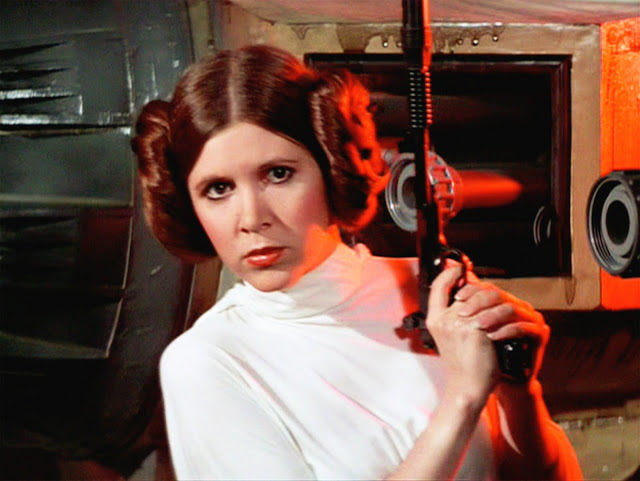
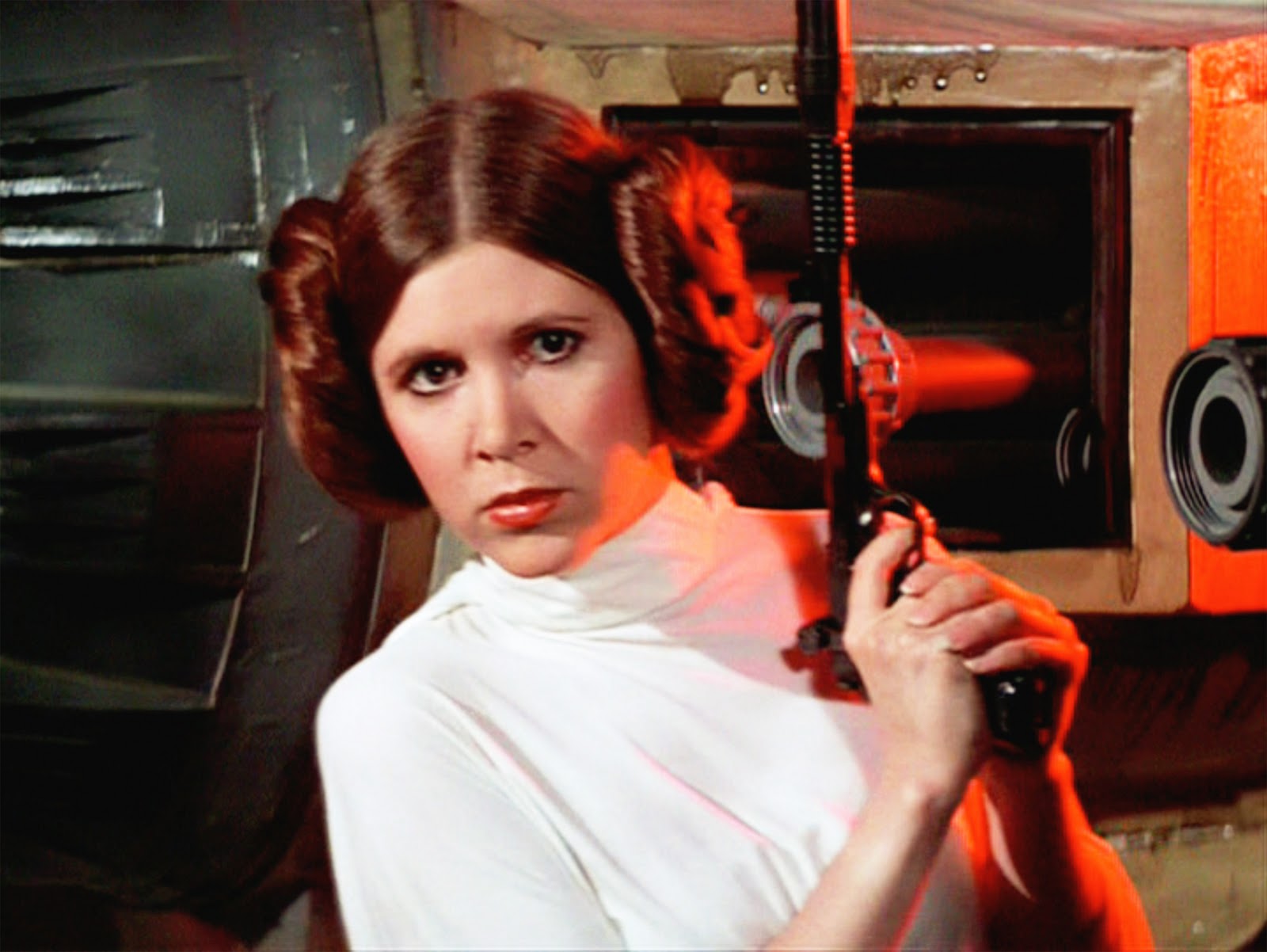
Princess Leia Organa (Carrie Fisher) in Star Wars Episode IV: A New Hope

 
When I was a young girl, Star Wars was my favorite movie. I’ve watched it more times than any other film. Premiering in 1977, the same year I was born, the epic sci-fi space opera irrevocably changed the movie industry. Beyond battle scenes, or the twist of Vader being Luke’s father, it impacted my childhood. Because Princess Leia was my idol.

In the Star WarsTrilogy, Princess Leia Organa of Alderaan (Carrie Fisher) was a member of the Imperial Senate, a diplomat and a spy for the Rebel Alliance. Courageous and determined, she boasted a defiant will. Leia boldly spoke her mind. And it’s what resonated the most with me.  
When I was 7, my mom sewed a Princess Leia costume for me for Halloween. A white dress with a hood cinched by a sparkly belt and accompanied by a plastic light saber. Yes, I realize Leia didn’t wield a light saber in the movies but she did have a laser gun. I continued to wear that costume long after Halloween. Every week (sometimes multiple times in a week), I would pop in our VHS of Star Wars Episode IV: A New Hope, don my white dress and act out Princess Leia’s scenes. I probably would have worn that costume to school if my mother had let me.
Looking back, why did Leia have to be a princess? Why did she have to bear a title that too often symbolizes hyperfemininity, passivity and sexualization? Why couldn’t she have been the President’s daughter or a merely a Senator? So yes, Leia is a princess. But she’s a badass warrior princess — a precursor to the rise of the warrior princesses we’re currently seeing today.
Princess Leia captured by Stormtroopers in Star Wars Episode IV: A New Hope
In the very first scenes of Star Wars, we see Leia shoot a laser gun. Yeah, she gets captured. But she didn’t go down without a fight. When she’s taken hostage, Leia unflinchingly stands up to Darth Vader, who intimidates everyone. But not her. She remains defiant. She stands up to Governor Tarkin, the Death Star’s Commander too as we witness in this compelling exchange:
Princess Leia:Governor Tarkin, I should have expected to find you holding Vader’s leash. I recognized your foul stench when I was brought on board.
Governor Tarkin:Charming to the last. You don’t know how hard I found it, signing the order to terminate your life.
Princess Leia: I’m surprised that you had the courage to take the responsibility yourself.
Governor Tarkin:Princess Leia, before your execution, I’d like you to join me for a ceremony that will make this battle station operational. No star system will dare oppose the Emperor now.
Princess Leia: The more you tighten your grip, Tarkin, the more star systems will slip through your fingers.
Even after she’s tortured by Vader, she refuses to reveal the location of the Rebel Base. When Grand Moff Tarkin, the Death Star’s Commander, threatens Leia to reveal the location of the Rebel Base or they’ll destroy her home planet of Alderaan, she lies disclosing a false location.
When Luke Skywalker, Han Solo and Chewbacca stage a rescue, Leia isn’t automatically obsequious. She immediately questions Luke when he’s disguised as a Stormtrooper with her infamous line, “Aren’t you a little short for a Stormtrooper?” When they’re all trapped, Leia takes matters into her own hands and shoots their way into a garbage chute, telling them, “Well somebody has to save our skins.” Leia continues to retain her grip of control when she tells Han: “I don’t know who you are or where you came from, but from now on you’ll do as I tell you, okay?”
Of course he horrifyingly says to Luke, “If we can just avoid any more female advice, we ought to be able to get out of here.” Nice. So men shouldn’t listen to a fucking diplomatic senator. Oh no. Why? Clearly, because they have vaginas.

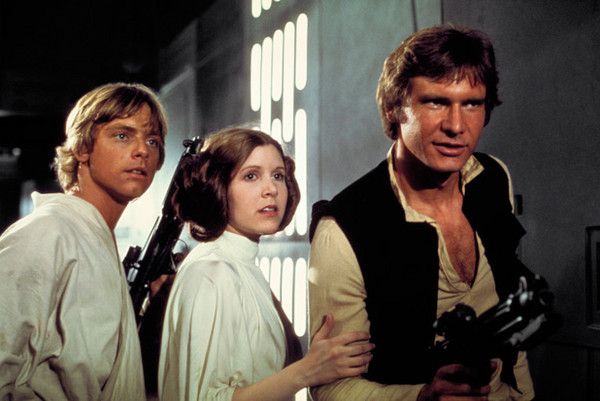
L-R: Luke Skywalker (Mark Hamill), Leia (Carrie Fisher) and Han Solo (Harrison Ford) in Star Wars Episode IV: A New Hope
Even though Leia has romantic feelings for Han Solo in The Empire Strikes Back, she continues to call out his arrogant bullshit. She quips snappy retorts such as, “I’d just as soon kiss a Wookie” and “I don’t know where you get your delusions, laser brain.” She’s never at a loss for words and never afraid to express herself.
She also has burgeoning psychic powers as she picks up on Luke’s cries for help at the end of the film. Obi-Wan tells Yoda when Luke Skywalker leaves Dagobah, “That boy is our last hope.” But Yoda wisely tells him, “No, there is another,” cryptically referring to Luke’s twin sister Leia.
In Return of the Jedi, Leia puts herself in harm’s way posing as a bounty hunter to save Han. Sadly, after she’s captured by Jabba the Hut, she’s notoriously objectified and reduced to a sex object in the iconic metal bikini, essentially glamorizing and eroticizing slavery. And of course she needs to be rescued. Again. 
Leia gets rescued. A lot. And that’s incredibly frustrating and annoying. But Leia often subverts the sexist Damsel in Distress trope. She takes matters into her own hands to free herself and others, whether it’s shooting their way into the garbage chute in Star Wars, shooting Stormtroopers, rescuing Han (Return of the Jedi), rescuing Luke (Empire Strikes Back), or killing Jabba the Hutt. Even when she’s being rescued, Leia always spouts her acerbic opinions, refuses to back down, and asserts her identity.

Princess Leia advising Rebel pilots in Episode V: The Empire Strikes Back
Throughout the trilogy, we see Leia lead and dispense tactical information to Rebel fighters. But ultimately, her underlying role appears to be to motivate Luke on his hero’s quest and Han on his personal transformation. Although George Lucas’ original ending with Leia coronated as Queen of the survivors of Alderaan sounds pretty amazing. It also would have been great to see her begin training as a Jedi, something the books explore. But even when you have a strong female protagonist, like Leia, her story must take a back seat to the dudes.
Now, I love Star Wars. But if you stop and think about the Star Wars Trilogy, it’s pretty shitty to women.
We only ever see 3 women — Princess Leia, Mon Mothma, Aunt Beru (Luke’s aunt) — who aren’t slave girls or dancers. Men make decisions, lead battles, pilot planes, smuggle goods and train as Jedis. It’s men, men, men as far as the eye can see. Hell, even the robots are dudes.

Wicket the Ewok and Princess Leia in Episode VI: Return of the Jedi
The entire Star Wars Trilogy suffers from the Smurfette Principle. The fact that there are no other women for Leia to talk to or interact with perpetuates the notion that women’s lives ultimately revolve around men. With a marketing campaign — if you look at the poster for each film — turned Leia into nothing more than a sex object (and of course aided by the metal bikini) reifying the idea that women’s bodies belong solely to tantalize the male gaze.
Boys and men see numerous male characters to emulate. But for girls and women? We get one. Leia. Well, unless you count Aunt Beru or Mon Mothma, both of whom only get like 60 seconds of screen-time. Leia exists as the sole token female.
“In Star Wars, a boy can grow up to be a knight, or a wizard. But if you’re a girl, you have one good role model…But you better be born a princess or good at space hooking cause those are your options.”
As the above video from Crackedastutely points out, all the women in the Star Wars Trilogy are space strippers, aside from Leia, Aunt Beru and Mon Mothma (a Republic senator and co-founder of the Rebellion, aka the red-haired woman in Return of the Jediwho gives tactical orders to the rebels). The Cracked writers also assert that Leia is actually a terrible female role model because she ditches her duties with the Rebellion to save her man (although so do the dudes) and then blows up Jabba’s barge which was filled with other slave women. Okay, that’s pretty douchey, Leia.
Sure, you could blame it on the fact that Star Wars is 35 years old. But even in the Prequel Trilogy, we haven’t come much further. While we definitely see more women — Queen Padme Amidala, Shmi Skywalker (Anakin’s mother), Naboo queens Queen Apailana and Queen Jamillia, Jedi Knights Staas Allie and Aayla Secura, Jedi Master Depa Billaba, Queen Breha Organa (Leia’s adoptive mother), Zam Wessell (bounty hunter who attempts to kill Padme) — only Padme and Shmi receive any focus. And of course their lives revolve around men. Actually, their lives around one man: Anakin. Yes, Padme is a political leader. But her role as birth mother to Leia and Luke and her death fueling Anakin’s anger trump any individuality she possesses. Both Padme and Shmi die tragically; both women’s purpose in the films serves to explain why Anakin turned to the Dark Side. 
Clearly, sexism and racism plague the Star Wars Trilogy. Really, only 3 women speak, only 3 women aren’t strippers and only 1 black person…in the whole fucking galaxy?! Gee thanks, George Lucas.

Princess Leia in Episode V: The Empire Strikes Back
If it seems like I vacillate between hailing Leia a feminist icon and condemning her a sexist trope, it’s because I’m torn. Leia is a spirited, fearless and fierce female protagonist. She kicks ass. Yet she exists in a fictitious galaxy mired by sexism where women barely exist that continually puts men — their stories, their perspectives, their struggles — front and center.
Despite its massive gender and race problems, Princess Leia aided me through my childhood. For a mouthy, opinionated little girl who was always getting in trouble for voicing their thoughts, Leia emulated a confident and rebellious woman. She had crucial duties and responsibilities as a leader and revolutionary. But she didn’t give a shit what anyone thought. Unafraid to let her temper flare, she spoke her mind regardless of the consequences.
In a world that so often silences women’s and girls’ voices, Leia shone as a beacon of hope. Not only did she teach me women could be political leaders and fight for freedom. But she affirmed that women can and should fearlessly speak their minds and take charge of their lives.

Women in Science Fiction Week: Is ‘Terminator’s Sarah Connor an Allegory for Single Mothers?

Sarah Connor (Linda Hamilton) in Terminator 2: Judgment Day

This post previously appeared at Bitch Flicks on May 25, 2012.

Mothers are supposed to be everything to everyone. Sadly, society often stigmatizes, vilifies and demonizes single mothers. Single moms are blamed for “breeding more criminals.” Single parenthood is criminalized and “declared child abuse.” On top of that, “almost 70% of people believe single women raising children on their own is bad for society.” WTF? Seriously?? Wow. Way to be misogynistic people.

So it’s no surprise to see broken and dysfunctional single moms reflected on-screen. And don’t get me wrong. I love watching flawed female characters. But what about single mom Sarah Connor, “the mother of destiny?” Often labeled a feminist hero, topping lists for greatest female characters, is she the “ultimate protective single mother?”
Along with Ellen Ripley, Sarah helped pave the way for strong female characters. In Terminator, Sarah (Linda Hamilton) is a friendly college student and food server, lacking confidence, who “can’t even balance [her] checkbook.” Targeted by cyborg assassins sent from the future to kill her son, the future resistance leader fighting against domineering machines, she is thrust into a hellish nightmare fighting for her life. The Sarah (Linda Hamilton) of Terminator 2: Judgment Daytransforms into a badass goddess. With her sculpted muscles doing pull-ups and firing guns, she’s a ferocious warrior filled with rage (something women are rarely allowed to exhibit) yet haunted and struggling with mental stability. In the cancelled-way-too-early fantastic TV series Sarah Connor Chronicles, we witness Sarah (Lena Headey) as a brave single mother, passionate, smart, angry and flawed, doing everything she can to not only survive but thrive.
As kickass as she is, Sarah possesses no other identity beyond motherhood. She exists solely to protect her John from assassination or humanity will be wiped out. Every decision, every choice she makes, is to protect her son. In Sarah Connor Chronicles, Cameron tells Sarah that “Without John, your life has no purpose.” Sarah tells her ex-fiancé that she’s not trying to change her fate but change John’s. Even before she becomes a mother in Terminator, her identity is tied to her uterus and her capacity for motherhood.

[…]

On the surface, it seems like the Terminator franchise revolves around a dude often searching for a father figure rather than appreciating his mother. And problematic depictions of motherhood do emerge. But who’s really the hero? Is it the smart hacker son destined to be a leader? Is it the cyborg that learns humanity? Or is it the brave and fierce single mother who sacrifices everything to protect humanity and doesn’t wait for destiny to unfold but takes matters into her own hands?

Continue reading –> 


Women in Science Fiction Week: In Defence of Jo Grant, Beyond Screams and Miniskirts: The Women of Classic ‘Doctor Who’

Guest post written by Barrett Vann.
Let’s talk about Doctor Who. Let’s talk, in fact, about the Doctor’s companions. Back in the day of 2005, when Doctor Who came back to the airwaves, there were a lot of inevitable comparisons between this New Who and the Classic Who that ran from ‘63 to ‘89. People talked about the Doctor himself, about the plots, the monsters– and they talked about his companions. Rose Tyler was lauded as a new kind of companion– not so much an assistant as a partner, wearing baggy jeans and using her wits and determination, not one of those screaming, knicker-flashing ninnies from the old series back in the sexist sixties and seventies.
Well, wait just a bloody minute. Certainly the stereotype exists that companions back in the day were nothing but a bit of eye candy to entice the dads into watching a family show, and no-one is going to argue that feminism and gender issues haven’t advanced in fifty years. But were the women of Classic Who really nothing but a load of scantily-dressed damsels who screamed at the first sign of danger or imminent alien invasion?
They certainly were not.
I’m going to start with the Third Doctor, because I love him, and because two of his companions make a wonderful illustration for the variety of why and how the women of Classic Who were awesome. The Third Doctor, played by Jon Pertwee from 1970-1974, had several companions, but it is the first two I want to compare here, Liz Shaw and Jo Grant.

Dr. Shaw, being serious
Jo Grant, being a nature child
Dr. Liz Shaw was a Cambridge-educated scientist, and expert on meteorites with at least two degrees, one in physics and one in medicine. Although young and fashionable (fashionable here meaning improbably short skirts and equally improbable heels), she has no romances whilst on the show, and grows impatient with being treated like the Doctor’s errand-girl. A career woman (and undeniably a woman not a girl), she’s part of UNIT before the Doctor showed up, and though they do develop a good relationship, he’s never the end-all be-all of what she’s doing with her life. Indeed, when she does eventually leave UNIT to return to her research, she cites as her reason that the Doctor did not need a capable assistant, what he really needed was “someone to pass him his test tubes and tell him how brilliant he was.” Amusingly, this rather meta observation does indeed reflect what was often the role of the Doctor’s companion, a role Liz often deviated from.
Her successor, Jo Grant, would seem initially to fit much more comfortably into that role. When she first hit the screen, Josephine Grant was young, 19 or 20, inexperienced, and only got the job at UNIT because she had an uncle in the ministry. She’s blonde, bubbly, and at first appears to be a bit of a ditz. She flirts with the UNIT men, she giggles, she admits (often) that she doesn’t understand things; when she’s frightened, she screams. In her first appearance, she accidentally wrecks an experiment the Doctor’s working on, and then is hypnotised into almost blowing up UNIT. In stark contrast to the very scientific Liz, and the Doctor himself, she’s a New Agey 70’s girl, open to the possibilities of magic and superstition, and occasionally the show mocks her for this. On one occasion, she actually ends up dressed in white and strapped to an altar as a virgin sacrifice. A more potent image of objectified, powerless femininity it would be hard to find. Unlike Liz, who leaves the show to further her career, Jo leaves because she’s fallen in love and wants to get married and study mushrooms in the Amazon.
So it might be easy to dismiss Jo as one of those useless female companions. A pretty bit of skirt to be an audience stand-in for the Doctor to explicate to. Except for the fact that Jo Grant is awesome. She’s a trained escapologist, she can fly a helicopter, she can abseil; in ‘The Mind of Evil’, she karates a prison riot leader out of his gun. On numerous occasions, when the Doctor’s got himself locked up somewhere, she comes to his rescue. Though in her first appearance, the Master hypnotises her, the Doctor teaches her how to resist it, so that in later confrontations, the Master is utterly frustrated by his inability to dominate her mind. In ‘The Time Monster’, when they run into the Master, again, and he finds himself unable to find anything to say, she mockingly suggests, ‘How about, “Curses, foiled again”?’ She’s also bold, capable of making hard decisions under pressure. Again in ‘Time Monster’, the Doctor threatens their mutual destruction by initiating a Time Ram, shoving his and the Master’s TARDISes into the same temporospatial coordinates; but when the Doctor hesitates, Jo’s the one who makes the final move to press the big red button.

Jo Grant is unimpressed by your gun, Master

Ultimately, though, even disregarding her badassery, Jo is a great character. It’s easy to dismiss her because she is, in many ways, very girly. And as anyone knows, girliness is too often considered one and the same as weakness; girly characters have to ‘make up’ for themselves by compensating with more masculine traits if they are to be considered strong. But are Jo’s girly qualities weak? Not at all. She’s good with people, certainly better than the Doctor; she’s emotional and empathetic– and if she screams when she’s frightened? I call that a perfectly reasonable response. She is sometimes gullible, ditzy, she did fail her science A-levels, but all that means is that she’s flawed, as all good characters should be.
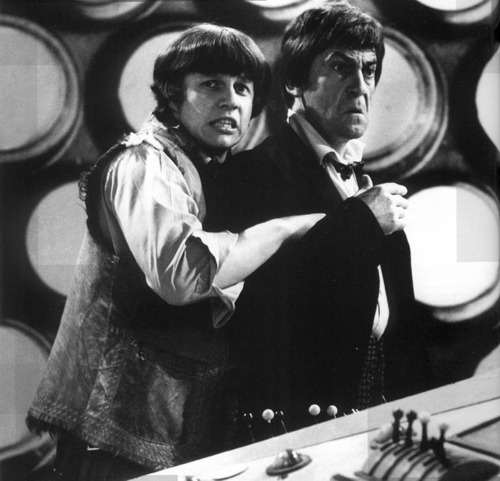
One of the things about the women in Doctor Who that’s wonderful is that, like Liz and Jo, they’re strong in different ways. Another interesting dichotomy appears with the Second Doctor, when he travelled with Jamie McCrimmon and Zoe Heriot. Jamie– short for James Robert– is a Scottish Highlander from the mid 18th century, while Zoe is a scientist who lived on a space station in the 21st. Despite the fact that Jamie was snatched, literally, out of the middle of a battle, and is still quick with his knife, it is he, not Zoe, who spends the most time physically clinging to the Doctor in times of danger.

Jamie McCrimmon does not know the meaning of personal space
Here, while Zoe is the competent scientist, Jamie is the volatile, emotional party who depends on the Doctor. Being a Scot, there are, of course, also the obligatory jokes about which member of Team TARDIS is the one wearing the short skirt this time.
And the list continues. Travelling with the Doctor’ fourth incarnation, there’s Romana, a Time Lady. Cool, arrogant, sharp-tongued, the Doctor’s intellectual equal; as she’s quick to point out, she did graduate from the Academy with a triple first. Romana is also eager to see the universe, despite coming from a highly insular society. Later, Leela, a knife-wielding warrior, all instinct and impulse, who doesn’t care for being treated like the Doctor’s own personal Pygmalion project. With the Fifth Doctor, there’s Nyssa, an alien, a scientist and pacifist; with the Seventh Doctor, Ace McShane, an emotionally troubled teenager who puts on an unfailingly tough facade and likes blowing things up. Or beating up Daleks with baseball bats. Even Peri, the American who travelled with the Fifth and Sixth Doctor, and who fairly obviously was there to be little more than a lot of bouncing cleavage, is a botanist, clearly intelligent, and refuses to take down-talking from anyone, whether the rather bombastic and volatile Sixth Doctor, or the Master, whom she famously tells, ‘I’m Perpugilliam Brown, and I can shout just as loud as you can!’

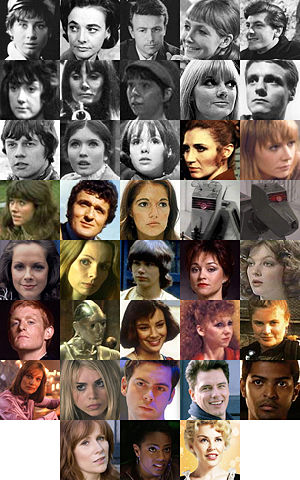
Most of the Doctor’s companions, Old and New (if you don’t include non-televised media)
All these characters have strengths and weaknesses, but one thing they certainly are not is a homogeneous mass of legs, high heels, and helplessness. Another wonderful thing about Doctor Who is that the universe is a living one. In non-televised media (the Big Finish audioplays, and Doctor Who novels, which, incidentally, I wholeheartedly recommend), characters who were short-changed in canon, like Peri, are expanded, and others who were a little one-note, like Tegan and Ace, are allowed to develop. But even without that, there’s far more to the women of Doctor Who than might at first meet the eye, and there are no few who’d give you a proper talking to for saying otherwise.

Barrett Vann is an English and Linguistics student at the University of Minnesota. An unabashed geek, she’s into cosplay, literary analysis, high fantasy, and queer theory. After she graduates in December, she hopes to tackle grad school for playwrighting or screenwriting, and become one of those starving artist types. 

Women in Science Fiction Week: Examining Stereotypes with Ursula K. Le Guin

Guest post written by Carissa Harwood.

In the past, the act of writing science fiction has been a traditionally male dominated genre. Women have sought to create their own meanings in the books they read that don’t often include their perspectives and experiences. In recent decades, though, women writers have searched for and taken control over a fiction category that seeks to shrink them, or exploit their gender for some statement, whether intentional or not, about the female body.
While times have certainly changed, and there are many fine science fiction writers, male and female, Ursula Le Guin stands out for me as a writer who has created new meanings for women in science fiction with seeming ease in her writing. She takes a simple concept — the ‘what if’ factor — and creates whole worlds that she populates as she gives us her answer. That’s the big golden key to science fiction writing — exploring the ‘what if’.
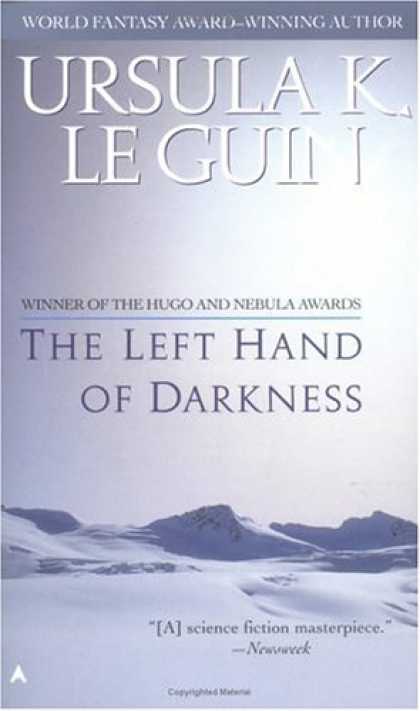
Here’s a ‘what if’ from her novel The Left Hand of Darkness — what if there was a planet where gender wasn’t so easily defined? What if there was a planet where men had the children, what would that be like? So often I’ve come across aspiring authors who request that I review their NEW FRESH EXCITING sci-fi novel, even though my blog explicitly states I no longer review new science fiction. And here’s the reason: the submissions (from male authors) I’ve read invariably read like this (I made this up as an example, this is not a direct quote from anywhere): 
“Susie laughed manically as she switched Betty’s birth control pills with pez. ‘Now I can have Tommy all to myself’, she smirked.” There is a lot of smirking going on in these novels, and I hate the word smirk. It should be used sparingly. A smirk should be used to indicate a sarcastic smile, an I-know-something- you-don’t-know sing-song smile, and I’ve always associated the smirk with something teenagers like to do. And that is how many writers of science fiction write their female characters: smirking adolescents.
Science fiction is, or should be, a place to examine stereotypes and political and social conventions, not to reinforce them. Before Le Guin came along, we had authors like Piers Anthony (a notorious misogynist, although like most misogynists he denies that he is one) and Ray Bradbury. Now I wouldn’t go so far as to call Bradbury a misogynist — I admire Bradbury’s work, I really do, because many of his themes are universal. But he falls into the same trap that Stephen King does — very few of his main characters are female, and more often than not, men are the decision makers, and the ones that move the plot along. It’s interesting to note that many writers tend to write towards their own gender. In Bradbury’s fiction, like Anthony and King, the female characters often end up in supporting roles as wives, mothers, and crushes that turn into ‘marionettes’ or a controllable programmable robot that can be easily manipulated.
I read these books as a child and teenager, and I experienced a sense of dissatisfaction with the minor roles women were playing in this male literary playground. So I wondered what women writing science fiction would be like, and that’s where I found Ursula Le Guin, who didn’t merit her own displays in the library lobby like the other authors I’ve mentioned. At least, not when I was a kid.
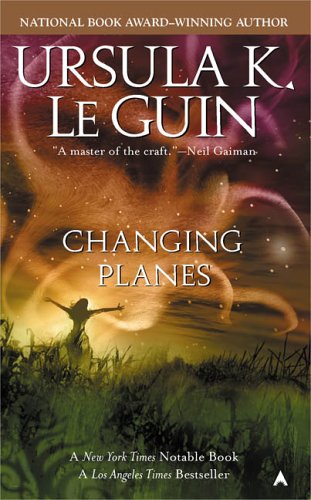
Compare Bradbury’s marionettes and Anthony’s robot women to Le Guin’s character of Sita Dulip in Changing Planes. The main character is a woman who travels alone and fearlessly not only to other cities in the world, but other dimensions and other planets and cultures. She isn’t someone’s ‘female companion.’ She’s not defined by her marital status or her relationships or how many children she can or cannot produce. Not once does she ask anyone’s permission. Not once does she require a male guardian or escort. Not once does she require supervision. She just goes, because that’s what any thinking and curious person should be allowed to do without restriction—go forth and explore and learn and imagine. And she can do all this without one single mention of menstruation, (or mentioning having to pack tampons) or heartlessly abandoning her children in favor of a free life seeing what the universe has to offer. A woman can venture forth into the world (or worlds, in this case) without one single thought for her reproductive capabilities.
What’s so innovative about that? A woman traveling alone, doing what she wants? Because there’s no sense of fear, or intimidation or dependence on anyone else. Sita Dulip is truly a free individual. There’s no sense of loss, or not belonging anywhere. It’s simply a story of exploring and learning, without any literal or figurative baggage.
Let’s look at another comparison of science fiction as a way to explore deeply held social constructs by looking at John Scalzi’s brilliant take on The Ones Who Walk Away From Omelas, by Ursula Le Guin. He wrote about this as a lens through which to examine the Penn State scandal, and I had my students read this article when we discussed comparing literature to current events. The world she constructed in the novel goes like this: If you could have a happy wonderful, perfect life, but the price was that one child would have to live his or her life in misery, neglect and starvation for the rest of that child’s life—would you do it? Could you live your life knowing it took someone’s direct pain and misery? What happens to the people who stay? What happens to the people who walk away into an uncertain world?
It’s these kinds of questions that are explored through science fiction that really melt my butter. And I’m not saying–at all–that women can write science fiction better, I just want women to have an active voice, and active participation.
It’s the demand for participation in this world as something other than a reproductive vehicle that I wanted to find. Writing is a mental communication of ideas from the author’s brain to yours, a communication that, hopefully, journeys with you as you read along and create new possibilities and opportunities, challenging our perspectives and allowing us into the hearts and minds of the most diverse cast of characters you can imagine. All writing explores how we think, but fiction provides with a vehicle we can ride in. I just don’t think the vehicles should come in distinct shades of pink or blue with all their incumbent stereotypes. This can only happen if, and hopefully when, more women take up the pen to write their own stories, and seek to answer their own ‘what ifs’.


Carissa Harwood is an adjunct professor and writer of things rich and strange, from aliens to zombies, with some feminism, paranormal romance, and urban fantasy thrown into the mix. She holds a Masters of Fine Arts Degree in Playwrighting and blogs at 3500 Words per Pound.

Women in Science Fiction Week: The Strong, Intelligent and Diverse Women of ‘Firefly’ and ‘Serenity’

Cast of Firefly and Serenity

Guest post written by Janyce Denise Glasper.

“Why do you keep writing strong female characters?”
“Because you’re still asking that question,”
Joss Whedon quips.

Mastermind behind phenomenal, groundbreaking television hits, Buffy The Vampire Slayer and Angel and recently helming a little box office smash called The Avengers, Whedon has always crafted the powerful, intelligent female hero. He illustrates that aesthetic further in the short lived FOX series Firefly turned feature motion picture, Serenity showcasing not just one, but four intriguing women characters- Zoe, Kaylee, Inara, and River.
In a science fiction space western combining a thrilling taste of adventure, mayhem, and Whedon’s trademark humor, flying aboard with the wisecracking Captain Malcolm Reynolds, softhearted Wash, short-tempered Jayne, and the good doctor, Simon, these spirited and diverse women bring more than male gazing eye candy ornamentation.

The women of Firefly and Serenity — L-R: Jewel Staite (Kaylee), Summer Glau (River), Morena Baccarin (Inara), Gina Torres (Zoe)
Wife of Wash, Zoe Washburne is a resilient, tough, hold the guns chick with a fiery attitude that is as wild as the curls of her hair. In the face of tragedy, she sheds not a tear, going head first into battle with weapons blazing in each hand while not wearing emotions on sleeve. This firecracker’s mind is sharply focused on the end game and to the Serenity crew, staying alive is the best option.
Gina Torres is made for Zoe. In every moving inch of her body and facial expression, she flaunts a calm, collected exterior that shields a force to be reckoned with. She is neither weak nor insecure in her prowess, taking fearless approach in the scariest of situations.

Zoe (Gina Torres)


Often, I have disagreed with angry sentiments of viewers voicing displeasure at Zoe calling Malcolm “Sir” and denoting that there is a master/slave relationship at work. He isn’t a whip slashing, verbally abusive tyrant lying on his back getting fanned upon while being hand fed grapes.
No. No. No.
He is a commander of a vessel, treating the crew like his family. Out of all of them, there is a special sibling type bond between him and Zoe. She, not Jayne, is his right hand man, or in this case woman. She has been at his side as a comrade in a lost war against the Alliance and that experience hasn’t wrought animosity, but pain and regret. Malcolm sees Zoe as his equal and that speaks volumes.
Yes. He tells her what to do, but she does in a way that she sees fit.
“Love. You can learn all the math in the ‘verse… but you take a boat in the air that you don’t love… she’ll shake you off just as sure as the turn of the worlds. Love keeps her in the air when she ought to fall down… tells you she’s hurting before she keels. Makes her a home.”

Malcolm’s quote is about Serenity, their beloved ship who is another unspoken feminine hero that is an integral part of the film.

Kaylee (Jewel Staite)
In comes Kaylee Frye, the adorable, sweet-natured Texan engineer who gets down and dirty repairing anything that needs fixing above the space vessel. Utterly devoted to the job, even without formal training, Kaylee speaks of things, especially emotions in mechanical terms and is often seen in oily, dirty jumpsuit. She may be seem to the anti-feminine, doing the “man’s” job, but that is not what’s so compelling about her. Often the voice of reasoning and moral compassion without being sanctimonious or preachy, Kaylee is the very heart of Serenity.
Actress Jewel Staite breathes a genuine special charm into Kaylee that is quite refreshing to watch. At times it seems that she doesn’t have a place amongst her sharply trained warrior peers, but Staite gives her a reason for being an imperative member. For in the toughest, most grueling predicament, when having to use a gun, Kaylee’s stern determination and iron will has her bravely wielding the weapon without tears and “womanly” fussiness. That’s something to be valued and commended.

Inara (Morena Baccarin)

 
Serenity means the state of being calm and untroubled — Inara Serra embodies the definition. The poised, tranquil companion, or in other words a courtesan, has illustrious skills beyond sensual grace. Softly spoken and wisely engaged, she battles with tongue more so than weapon. An expert with combat and a bow and arrow and often a vital aide in fighting the good fight, she gets knocked around a bit, but that doesn’t stop her from continuing to join in the battle of Malcolm verses The Operative, licking her wounds and going back for more to protect nearly brutally defeated captain.

Morena Baccarin personifies her character flawlessly. Possessing such phenomenal skill using widened eyes and speaking dialogue with sharp, clever articulation, a viewer cannot help but be arrested by her representation of peaceful tranquility, the way she floats effervescently into a scene, and the unmentionable smoldering toe-to-toe chemistry with Nathan Fillion who plays the sardonic Malcolm.

River (Summer Glau)
Last but certainly not least, River Tam, a former Alliance test subject, is the secret weapon. A broken mentally destroyed psychic, she is precocious, observant, and vulnerable, but her brother, Simon is overprotective in babying her at times. When she is purposely triggered by a creepy Alliance induced subliminal message, she unleashes a wild can of whoop ass crazy in a bar, maliciously hurting not only innocent bystanders, but also a Serenity crewmember which ultimately terrifies everyone. Yet seeing her brother down on the ground towards the climatic end pushes a different button and causes her to give the most poignant of sacrifices. While soft orchestra music plays, she fights passionately, kicking and punching the monstrous, once human Reavers with the strength of a thousand warriors.
She has then rightfully earned passage on the crew, albeit at the captain’s side commanding ship.
Summer Glau brings versatility to the complexity of River, showcasing the depths of a damaged psyche, ranging from cryptic, shattered girlish innocence, to altogether frightening, emotionless devoid. It would take only a solid actress to take on a role so challenging and Glau renders River meticulously.

The women of Firefly and Serenity — L-R: Gina Torres, Summer Glau, Morena Baccarin, Jewel Staite
Though under the command of a man, that doesn’t stop Zoe, Kaylee, Inara, and River from brutally speaking their razor tongued minds to the captain. River is an extraordinary circumstance; her words are enigmatic as opposed to outright as with the other three. 
Certainly not breaking down into sobs or running away in fright, these four animated, beautiful, and talented women band together in the face of battle. Along with the rest of the Serenity crew, an excellent villain played by Chiwetel Ejiofor, and a brilliantly penned script, there’s a reason fans remain attached to Whedon’s charismatic “browncoat” vision, especially the female rebel.


Janyce Denise Glasper is a writer/artist running two silly blogs of creative adventures called Sugarygingersnap and AfroVeganChick. She enjoys good female centric film, cute rubber duckies, chocolate covered everything (except bugs!), Days of Our Lives, and slaying nightly demons Buffy style in Dayton, Ohio.

Women in Science Fiction Week: Thoughts on Strong Female Characters: Carolyn Fry from ‘Pitch Black’

This guest post written by Rhea Daniel previously appeared at Bitch Flicks on June, 13 2012 and  originally published at Short Stories, cross-posted with permission. 
So I saw The Avengers(2012). I’ll be honest, pure entertainment, skillful use of existing archetypes to create entertaining group dynamic, how can you not fall for that? 
However the whole ‘strong woman character’ attribution to Joss Whedon isn’t completely merited. I love his truly sympathetic essay about women on Whedonesque.com, and his feminist bent, however as ‘strong’ women go, I could never relate to his female characters.  
To me a character that deserves the reputation of a feminist heroine would be Carolyn Fry(Radha Mitchell) from David Twohy’s Pitch Black (2000), regardless of whether he intended it that way. We have time to watch her character grow through the movie, but she is a secondary character, Riddick is the famed anti-hero. To make an impression in spite of that is huge.

While Fry takes the reins of the group on the deserted planet by default, the one thing that drives her bravery is her terrible mistake — attempting to eject the passengers in cryogenic sleep to lighten the load of the spaceship before it crashed, stopped from doing so by the more conscientious navigator who died as a result, earning her a lot of resentment from the group, their mistrust eventually pushing her to fight for her leadership position more fiercely. I don’t particularly consider that a negative point, I see a person deeply ridden with guilt, antagonists willing her to fail, Riddick keenly watching her every move, reacting to her willingness to risk her safety for the sake of the others with amusement. I see a lot of a pressure on a person who is not particularly skilled to handle the task before her, but she pushes on in spite of that.

[…]

It’s not that I don’t still love Ripley/esque sci-fi warriors, I just find Carolyn Fry’s inner turmoil borne of the vicissitudes of external forces much more approachable, and strangely unsung. I like her more because she is unsure of herself, searching for firm ground to walk upon, because unlike Ripley, she doesn’t know where she stands, steeling her vulnerable frame against the next onslaught.

Continue reading –>


Rhea Daniel got to see a lot of movies as a kid because her family members were obsessive movie-watchers. She frequently finds herself in a bind between her love for art and her feminist conscience. Meanwhile she is trying to be a better writer and artist and you can find her at http://rheadaniel.blogspot.com/.